SUSTAINABILITY REPORT 2025
ABSTRACT: This section highlights AIT’s significant contributions to advancing SDG 6 through research, capacity building, policy development, partnerships, and sustainable campus operations. Readers will find a diverse portfolio of initiatives addressing groundwater governance, water quality monitoring, wastewater treatment and reuse, sanitation systems, fecal sludge management, microplastic pollution, climate-resilient water management, and inclusive sanitation services across Asia and beyond. AIT’s impact is particularly evident through the leadership of the Global Water and Sanitation Center (GWSC), strategic collaborations with organizations such as ADB, UNICEF, the Gates
Foundation, IsDB, and regional governments, and the development of innovative solutions for water security and sanitation challenges. The section also showcases AIT’s role in strengthening institutional and professional capacities through regional training programs and knowledge networks. Complementing these efforts, AIT demonstrates its commitment through sustainable campus water operations, including wastewater recycling, rainwater harvesting, water reuse, infrastructure upgrades, and significant reductions in potable water consumption. Together, these initiatives reflect AIT’s leadership in promoting water sustainability, public health, climate resilience, and equitable access to sanitation.
NEWS: GWSC-AIT Leads Strategic Partnerships with ADB, Gates Foundation, and Dasra for Sustainable Urban Water and Sanitation
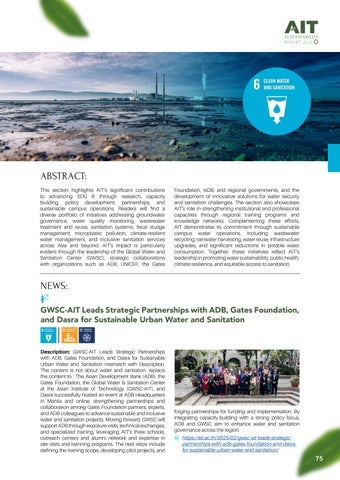
Description: GWSC-AIT Leads Strategic Partnerships with ADB, Gates Foundation, and Dasra for Sustainable Urban Water and Sanitation mismatch with Description. The content is not about water and sanitation. replace the content to : The Asian Development Bank (ADB), the Gates Foundation, the Global Water & Sanitation Center at the Asian Institute of Technology (GWSC-AIT), and Dasra successfully hosted an event at ADB Headquarters in Manila and online, strengthening partnerships and collaboration among Gates Foundation partners, experts, and ADB colleagues to advance sustainable and inclusive water and sanitation projects. Moving forward, GWSC will support ADB through exposure visits, technical exchanges, and specialized training, leveraging AIT’s three schools, outreach centers and alumni network and expertise in site visits and twinning programs. The next steps include defining the training scope, developing pilot projects, and
forging partnerships for funding and implementation. By integrating capacity-building with a strong policy focus, ADB and GWSC aim to enhance water and sanitation governance across the region. 🌐 https://ait.ac.th/2025/02/gwsc-ait-leads-strategic-
partnerships-with-adb-gates-foundation-and-dasrafor-sustainable-urban-water-and-sanitation/
75
SUSTAINABILITY REPORT 2025
AIT Signs Five New Partnerships to Strengthen Water, Sanitation, and Digital Municipal Services during IWA Water and Development Congress and Exhibition 2025
Description: AIT signed five new partnerships during the IWA Water and Development Congress 2025. The agreements focus on water, sanitation, and digital services. Collaboration supports low- and middle-income countries. The partnerships strengthen development impact. 🌐 https://ait.ac.th/2025/12/ait-signs-five-new-
partnerships-to-strengthen-water-sanitation-anddigital-municipal-services-during-iwa-water-anddevelopment-congress-and-exhibition-2025/
AIT co-organises IWA Water and Development Congress & Exhibition 2025 to advance solutions for low- and middle-income countries
Description: AIT co-organised the IWA Congress to advance water solutions for developing regions. The event brought global experts together. Discussions focused on innovation and equity. It strengthened international cooperation. 🌐 https://ait.ac.th/2025/12/ait-co-organises-iwa-water-
and-development-congress-exhibition-2025-toadvance-solutions-for-low-and-middle-incomecountries/
AIT and ADB Sign MoU at AWUF 2025 to Advance Water and Urban Development Solutions
Description: The Asian Institute of Technology (AIT) and the Asian Development Bank (ADB) have entered into a strategic partnership with the signing of a Memorandum of Understanding (MoU) at the ADB Water and Urban Development Forum (AWUF 2025). The agreement was formalised during the plenary session titled “Building Better Futures: Harnessing Innovation for Efficiency, Equity, and Inclusivity”, held at ADB Headquarters in Manila, Philippines. 🌐 https://ait.ac.th/2025/05/ait-and-adb-sign-mou-
at-awuf-2025-to-advance-water-and-urbandevelopment-solutions/
76
SUSTAINABILITY REPORT 2025
Sushil Kumar Himanshu Co-Edits Book on Nano-Solutions for Water and Wastewater Sustainability
Description: Sushil Kumar Himanshu co-edited a book on nanotechnology solutions for water and wastewater sustainability. The publication addresses emerging challenges in water treatment. It contributes to global research discourse. The work reflects AIT’s research leadership. 🌐 https://ait.ac.th/2025/07/dr-sushil-kumar-himanshu-
co-edits-book-on-nano-solutions-for-water-andwastewater-sustainability/
Meghna Knowledge Forum II spotlights River Resilience and Community Leadership
Description: The Meghna Knowledge Forum II brought attention to river resilience and the role of community leadership. Discussions focused on sustainable river management and climate adaptation. Experts and stakeholders shared regional experiences and best practices. The forum promoted inclusive, knowledgebased water governance. 🌐 https://ait.ac.th/2025/07/meghna-knowledge-
forum-ii-spotlights-river-resilience-and-communityleadership/
PROJECTS: Ecosystem-based Adaptations for Sustainable Groundwater Resources Management in the Transboundary Cambodia-Vietnam Mekong (TCVA) Delta Aquifer
AIT Research Theme: Climate change Contributed by Faculty/School/Center: FCEE Partners / Funded by: Stockholm Environmental Institute; Can Tho University, Center for Creative Initiatives in Health and Population; Institute of Technology of Cambodia Expected Social Impact: The three Work Packages are designed to facilitate truly multidisciplinary exchange and integration of different expertise domains, including (i) Remote Sensing, Groundwater Modeling; (ii) Rural Studies, and (iii) human-rights-based capacity building. Description: This project mainstreams Ecosystem-based
77
SUSTAINABILITY REPORT 2025
Adaptation (EbA) into groundwater management policies for the transboundary Cambodia-Vietnam Mekong Delta Aquifer. It targets vulnerable communities by integrating EbA with planning processes at local, sub-national, and transnational levels, with a focus on gender inclusion and marginalized groups. Project GEBA (Groundwater Ecosystem-based Adaptation) design and activities follow a highly multidisciplinary approach while simultaneously seeking the answers to (i) technical research question: “What is the spatiotemporal heterogeneity of groundwater storage of TCVA,
one of the most important transboundary aquifers (TBAs) in the region”; (ii) social search question: “how to mitigate the water insecurity issues and improve the resilience of the local communities”; and (iii) institutional research question: “how to effectively mainstream EbA into relevant decision-making processes, plans, and policies to achieve the co-benefits in both social and environmental aspects, contributing to poverty reduction and gender and social equality in the Lower Mekong Region, focusing on Cambodia and Vietnam.
Appropriate Management System and Policy Brief for Fecal Sludge Management in Thailand
AIT Research Theme: Technology, Policy and Society Contributed by Faculty/School/Center: Global Water and Sanitation Center Partners / Funded by: National Research Council of Thailand (NRCT) | Thailand | Expected Social Impact: Appropriate fecal sludge management in Thailand Description: This project addresses technical and governance gaps in fecal sludge management in Thailand by developing a national FSM plan and identifying driving forces for improvement. It assesses technical, economic, social, and environmental aspects to inform better policy and regulatory frameworks.
Techno-economic feasibility of sewage based adsorptive media and water reuse technologies for polishing treated wastewater in BMA
AIT Research Theme: Food-Energy-Water Contributed by Faculty/School/Center: Global Water and Sanitation Center Partners / Funded by: Joint Venture Gem Environmental Management Company Limited, Thailand (GEM) and Global Utilities Services Company Limited, Thailand (GUSCO) | Thailand | Expected Social Impact: As this research is to find out appropriate technologies and techniques for utilization of the generated sewage sludge and reuse the treated wastewater, the findings of this research would provide the BMA technical and technological information to sustainably manage the generated sludge as well as treated wastewater in the Bangkok and nearby areas. The reuse of the treated wastewater for the activities e.g., cleaning and gardening as well as private company activities such as flushing toilets would also help reduce negative impacts of freshwater scarcity during the seawater intrusion periods in the BMA areas.
78
Description: This project assesses the techno-economic feasibility of sewage-based adsorptive media and water reuse technologies for polishing treated wastewater at Bangkok’s Chatuchak WWTP. It evaluates novel adsorptive media derived from sewage sludge to enable water reclamation that meets reuse standards.
SUSTAINABILITY REPORT 2025
Development of Environmental Management and Conservation Measures Optimization Strategy for the Valued Freshwater Bodies of ASEAN Countries
AIT Research Theme: Food-Energy-Water Contributed by Faculty/School/Center: Global Water and Sanitation Center Partners / Funded by: ASEAN-Russian Federation Dialogue Partnership Financial Fund (ARFDPFF) | Indonesia | Lomonosov Moscow State University. Expected Social Impact: The project will provide representatives from ASEAN countries and Russia, including ministries, water agencies, and environmental authorities, with practical water management and monitoring solutions that can be adapted for similar water bodies in their respective countries. Scientists and specialists will gain access to valuable and up-todate data on natural processes occurring in Southeast Asian lakes and reservoirs to support future research and investigations. The initiative will also support the ASEAN Secretariat by establishing an international scientific group specializing in lake and reservoir issues, which can serve as a resource for future consultation on water pollution challenges. In addition, local authorities will benefit from
knowledge and solutions aimed at addressing freshwater demand and water resource management challenges. Description: This project develops environmental management and conservation strategies for valued freshwater bodies in ASEAN countries, integrating joint research, professional community building, and policy review. It uses GIS, wastewater treatment, and DNA extraction methods to support water quality improvement.
Hands-on Capacity Development Program on Citywide Inclusive Sanitation (CWIS) and Faecal Sludge Management (FSM)
AIT Research Theme: Food-Energy-Water Contributed by Faculty/School/Center: Global Water and Sanitation Center Partners / Funded by: Islamic Development Bank (IsDB) | Saudi Arabia Expected Social Impact: Participants equipped with knowledge of CWIS, FSM, inclusive sanitation services, infrastructure selection, climate resilient project components. Description: A three-day Capacity Development Program for executives from ten IsDB member countries on Citywide Inclusive Sanitation and Faecal Sludge Management. Organized by GWSC and the Islamic Development Bank, it enhances understanding of CWIS practices and urban sanitation planning.
79
SUSTAINABILITY REPORT 2025
Enhancing the Science-Policy Interface to Manage Microplastic Influx from Major Cities into the Oceans in Southeast Asia
AIT Research Theme: Food-Energy-Water Contributed by Faculty/School/Center: School of Engineering and Technology Partners / Funded by: APN | Japan | Universitas Pertamina, Indonesia Ho Chi Minh City University of Industry and Trade, Vietnam Expected Social Impact: The outputs of this project are expected to provide evidence-based policy recommendations for relevant stakeholders, including local governments and environmental management
agencies, to formulate effective strategies for preventing marine plastic pollution. By filling the current knowledge gaps and informing policy decisions, this project aims to contribute to the sustainable management of microplastic pollution in urban aquatic systems in SEA and beyond. Description: This project addresses microplastic pollution in Southeast Asian urban coastal areas by developing a comprehensive system model to quantify plastic pathways from land-based sources to ocean sinks. It aims to enhance the science-policy interface for managing microplastic influx in the region.
Treatment Performance Test of Wastewater Treatment Tanks Against the High-Efficiency Prefabricated Septic Tank Label Criteria for the Fibertech Co.
AIT Research Theme: Food-Energy-Water Contributed by Faculty/School/Center: Global Water and Sanitation Center Partners / Funded by: Fibertech Co., Ltd., Thailand | Thailand Expected Social Impact: The project is expected to enhance public health and hygiene, support environmental conservation, increase awareness and adoption of standards, contribute to the Sustainable Development Goals (SDGs), generate economic benefits, strengthen capacity building and knowledge transfer, and promote innovation in local industries. Collaboration with Fibertech Co., Ltd. may stimulate the development
of more effective and affordable wastewater treatment technologies tailored to local needs. The research also has the potential to serve as a model for other regions seeking to improve wastewater management and sanitation, thereby contributing to healthier and more sustainable communities. Description: This project conducts a treatment performance test of prefabricated wastewater treatment tanks manufactured by Fibertech Co., Ltd. in accordance with Thailand’s Pollution Control Department standards. Tests are conducted at AIT’s GWSC performance testing laboratory to assess compliance with high-efficiency septic tank criteria.
Strengthening Water Quality Testing, Environmental Monitoring and Surveillance
AIT Research Theme: Food-Energy-Water Contributed by Faculty/School/Center: Global Water and Sanitation Center Partners / Funded by: United Nations Children’s Fund (UNICEF), Nepal | Nepal | Environment & Public Health Organization, Nepal NATS Lab, Asian Institute of Technology, Thailand
80
Expected Social Impact: This project, hosted under UNICEF’s Pandemic Fund will significantly bolster public health and safety in Nepal by enhancing water quality and wastewater surveillance. Key impacts include reduced waterborne diseases through improved safe water access,
increased community resilience via local capacity building, and empowered communities through education and training. Enhanced early detection and response to health emergencies, coupled with promotion of sustainable practices and strengthened inter-sectoral collaboration, will contribute to a healthier and more resilient society. Description: This project strengthens Nepal’s health security by enhancing water quality testing, environmental monitoring, and disease surveillance systems. Aligned with JEE and PVS assessments, it improves early warning systems, laboratory capacity, and wastewater monitoring for public health protection.
SUSTAINABILITY REPORT 2025
Consultancy for Development of Design Criteria and Standards for Small Wastewater Treatment Systems for Residential Buildings
AIT Research Theme: Technology, Policy and Society Contributed by Faculty/School/Center: Global Water and Sanitation Center Partners / Funded by: Department of Public Works and Town & Country Planning, Ministry of Interior, Thailand | Thailand | Mahidol University (MU), Thailand Expected Social Impact: As this project aims to enhance public health and environmental quality in Thailand by developing effective and standardized smallscale wastewater treatment systems (OWTS) for residential buildings by reducing water pollution and minimizing the risk of waterborne diseases, the project could contribute to healthier communities and ecosystems. Additionally, the
project would foster community empowerment through collaboration and shared decision-making. By integrating effective wastewater management into urban planning and building design, the project also supports sustainable urban development and a stronger regulatory framework, leading to improved living standards and a more resilient society overall. Description: This project develops design criteria and standards for small-scale on-site wastewater treatment systems (OWTS) for residential buildings in Thailand, addressing the lack of accurate data for proper system selection. It aims to resolve environmental and public health risks from underperforming septic systems.
GSGS South & Southeast Asia Regional Hub
AIT Research Theme: Technology, Policy and Society Contributed by Faculty/School/Center: Global Water and Sanitation Center Partners / Funded by: The Gates Foundation / IHEDelft | United States of America (the) | Global Sanitation Graduate School (GSGS) ITN-BUET, Kathmandu University, Andalas University, Environment and Public Health Organization (ENPHO), Khulna University, Pokhara University, Tribhuvan University, Madan Bhandari University, Mahidol University, Shahjalal University, Sepuluh Nopember Institute of Technology, and Bandung Institute of Technology
RH a transformative project for the region, accelerating progress towards sustainable development in sanitation. Description: The GSGS South and Southeast Asia Regional Hub updates sanitation curricula with latest CWIS learnings, expands geographic membership, and diversifies its offerings. It serves as a dynamic platform for advancing the sanitation sector through alumni engagement, curriculum development, and regional collaboration.
Expected Social Impact: This initiative is strategically vital for the region as it seeks to bridge significant gaps in the sanitation sector through collaborative, inclusive, and innovative approaches. It will not only enhance knowledge sharing but also foster a unified regional effort to address sanitation challenges. Moreover, by ensuring financial sustainability and aligning with global goals such as SDG 6.2, the SSEA-RH positions itself as a cornerstone in the regional effort to provide equitable access to sanitation services. This comprehensive approach makes the SSEA-
81
SUSTAINABILITY REPORT 2025
Innovative Solutions for Plastic Free European Rivers
AIT Research Theme: Climate change Contributed by Faculty/School/Center: Geoinformatics Center Partners / Funded by: European Climate, Infrastructure and Environment Executive Agency | Belgium Expected Social Impact: Remove plastic from a few European rivers and provide clean water to the population living along these rivers. Description: The INSPIRE project aims to drastically reduce litter, macro- and microplastics in European rivers through 20 integrated technologies covering detection, collection, and prevention of plastic pollution. It takes a holistic approach spanning the full waste stream before plastics enter river systems.
Reuse Technologies for Polishing Treated Wastewater in Bangkok Metropolitan Administration
Duration: 1 March 2024 – 28 February 2025 Description: This project evaluated the techno-economic feasibility of utilizing sewage sludge-derived adsorptive media for polishing treated wastewater at the Chatuchak Wastewater Treatment Plant in Bangkok. While the plant meets discharge standards, effluent reuse remains limited due to residual nutrients and pathogens. The research introduces an innovative circular approach by transforming sewage sludge into adsorptive media integrated within the pilot-scale vertical garden systems. These systems enhance removal of nitrogen, phosphorus, and pathogenic contaminants, enabling treated wastewater to meet reuse standards. The project involved laboratory analysis, pilot-scale system validation, field surveys of potential reuse applications, and stakeholder engagement through workshops and seminars. It also assesses economic viability to support large-scale implementation. By promoting wastewater reuse for urban applications such as landscaping and cleaning, the project contributes to water security and reduces pressure on freshwater resources in Bangkok. Additionally, it supports sustainable sludge management and strengthens capacity among local authorities and stakeholders.
82
SUSTAINABILITY REPORT 2025
Pathum Thani Agrihood Model: Integrated Greywater Reuse, Vertical Green Wall System, and Flood Resilience for Community Wellbeing
Duration: March 2024 – January 2027 Description: This project develops and demonstrates an integrated Agrihood model in peri-urban Pathum Thani, combining greywater reuse, nature-based treatment systems, and flood resilience interventions to enhance the wellbeing of informal housing communities. The initiative focuses on the design and implementation of vertical green wall (VGW) greywater treatment systems and constructed wetland technologies to treat household greywater for safe reuse in community gardens. These systems leverage plant and media interactions to remove contaminants while contributing to green infrastructure and urban cooling. In parallel, the project addresses local flood risks through hydrological assessment, flood mapping, and the design and construction of a bund system to protect residential areas and community facilities. The project integrates technical research, participatory design with stakeholders, and on-site construction, followed by performance monitoring and knowledge dissemination. By linking water reuse, urban agriculture, and flood management, the project promotes climate-resilient community development, supports local livelihoods, and enhances environmental sustainability in rapidly urbanizing areas.
Global Sanitation Graduate School Regional Hub South and Southeast Asia
Duration: 2025 - 2028 Description: The Global Sanitation Graduate School Regional Hub South and Southeast Asia (GSGS RH SSEA), hosted at the Asian Institute of Technology (AIT), plays a critical role in strengthening sanitation education, research, and professional capacity development across the region. South and Southeast Asia continue to face significant sanitation challenges, including rapid urbanization, inadequate wastewater and faecal sludge management systems, and growing environmental pressures. Addressing these challenges requires a new generation of well-trained sanitation professionals, researchers, and policymakers equipped with interdisciplinary knowledge and practical skills. The GSGS RH SSEA contributes directly to this need by supporting postgraduate education, facilitating collaboration among academic and non-academic partner institutes, and promoting regional knowledge exchange. Through its network of academic institutions and sector partners, the hub enables the development and dissemination of high-quality citywide
inclusive sanitation (CWIS) curricula, promotes capacitybuilding initiatives, promotes knowledge exchange through training programs, academic and non-academic partnerships, and strengthens the regional sanitation knowledge ecosystem. 🌐 https://gsgs.network/
83
SUSTAINABILITY REPORT 2025
Strengthening Water Quality Testing, Environmental Monitoring and Surveillance
Duration: 19 March 2025 – 31 March 2027 Description: The Strengthening Water Quality Testing, Monitoring and Surveillance project is a collaborative initiative between UNICEF Nepal, the Asian Institute of Technology / Global Water & Sanitation Center (AIT/ GWSC), and ENPHO. Running from April 2025 to May 2026, the project aims to strengthen national and local capacity in Nepal for water quality and wastewater monitoring and surveillance, supporting the early detection of health risks and more effective outbreak response. Several key foundational activities have already been completed and submitted, marking important progress in strengthening Nepal’s environmental health surveillance systems. The project’s Guidelines and Training of Trainers (ToT) Manual have been submitted and approved under the Taskforce for SPEED, providing a validated framework for implementation and capacity development. In addition, the assessment report on surveillance capacity has been submitted, helping to identify existing system strengths, gaps, and priority areas for improvement. A dedicated training module on Water Quality Monitoring (WQM) field kits has also been developed and submitted to support practical, field-based capacity building for frontline users. Looking ahead, the project is now moving into a more implementation-focused phase. Provincial and local-level trainings on Water Quality Monitoring and Surveillance (WQM/S) and Wastewater Quality Monitoring and Surveillance (WWQM/S) are planned in the near term to strengthen technical capacity across multiple tiers of government. At the same time, efforts are underway to establish a cross-linked data stream between NWASH and SORMAS, which will be an important step toward improving data integration, early warning, and coordinated public health response. Together, these next steps will help translate the completed technical products into operational systems, strengthened institutional capacity, and more effective surveillance linkages across the water, sanitation, and health sectors.
84
SUSTAINABILITY REPORT 2025
GWSC to accelerate Water, Sanitation, and Hygiene (WASH)
AIT Research Theme: Technology, Policy and Society Contributed by Faculty/School/Center: Global Water and Sanitation Center Partners / Funded by: Bill & Melinda Gates Foundation Expected Social Impact: By advancing innovative WASH strategies and CWIS across Asia, the center aims to significantly improve public health outcomes and ensure equitable access to safely managed municipal services for vulnerable communities. Description: This grant establishes a Global Water and Sanitation Center of Excellence at AIT to accelerate Water, Sanitation, and Hygiene (WASH) strategies across Asia. It works with governments, international financing institutions, and development partners to advance CWIS and integrated municipal information systems.
Safely Managed On-site Sanitation: Technological Solutions for City Dwellers and Authority - Dhaka North City Corporation (DNCC)
AIT Research Theme: Technology, Policy and Society Contributed by Faculty/School/Center: Global Water and Sanitation Center Partners / Funded by: United Nations Children’s Fund; Umwelt-Projekt-Management GmbH Expected Social Impact: Improved health and wellbeing of urban residents by reducing exposure to diseases and pollutants; enhanced dignity and safety of vulnerable groups such as women, children, and persons with disabilities by providing access to adequate and inclusive sanitation facilities; and increased opportunities for education, work, and social participation by saving time and resources spent on coping with poor sanitation Description: This project addresses the challenge of safely managed on-site sanitation in Dhaka, Bangladesh, where millions live in urban slums without adequate
services. It develops climate-resilient fecal sludge management technologies and solutions for Dhaka North City Corporation.
85
SUSTAINABILITY REPORT 2025
Calculating Evapotranspiration using GIS and Remote Sensing Techniques for Calculating Crop Water Productivity in Sindh Province, Pakistan
AIT Research Theme: Climate change Contributed by Intelligence Center
Faculty/School/Center:
Artificial
Partners / Funded by: The Asian Disaster Preparedness Center, 360 Engineering and Management Solutions Expected Social Impact: The project aims to enhance crop water productivity and efficiency, providing farmers with valuable insights into optimal water use. This could lead to increased agricultural yields, improved livelihoods, and food security for local communities. By identifying climate-resilient water use zones and promoting sustainable water management practices, the project contributes to building resilience against climate change. This, in turn, helps communities adapt to changing
environmental conditions and reduces vulnerability to water-related challenges. Contribution to Sustainable Development Goals (SDGs): The alignment of the project with key SDGs indicates a commitment to broader global objectives such as zero hunger, clean water and sanitation, climate action, and sustainable communities. The project’s success can positively impact progress toward achieving these goals. Description: This project addresses critical water challenges in Sindh Province, Pakistan by using remote sensing, GIS, and nature-based solutions to estimate evapotranspiration and assess crop water productivity. Findings will support actionable recommendations for sustainable and climate-resilient water management.
Consultancy for Development of Design Criteria and Standards for Small Wastewater Treatment Systems for Residential Buildings
Duration: February 2025 – February 2027
86
Description: This national-level consultancy project focuses on the development of design criteria, technical standards, and regulatory guidelines for small-scale onsite wastewater treatment systems (OWTS) in residential buildings across Thailand. Led by Mahidol University in collaboration with the Asian Institute of Technology (AIT) and supported by the Department of Public Works and Town & Country Planning (DPT) of Thailand, the project addresses the issues related to the underperformance and inconsistent design of decentralized wastewater systems. Likewise, initial assessments and stakeholder consultations revealed several critical gaps, including inadequate treatment performance of existing OWTS, lack of standardized design and sizing criteria, poor operation and maintenance practices, and limited integration of innovative or nature-based treatment technologies. In response, this project develops standardized design manuals, performance benchmarks, and operational guidelines, incorporating both conventional systems (e.g., septic tanks, anaerobic filters anaerobic baffled reactors etc.), and nature-based solutions such as constructed wetlands. Moreover, the project also involves comprehensive technical assessment, stakeholder consultations, and preparing draft TORs for further project regarding field investigations to evaluate the designed OWTS technologies. The findings support the formulation of practical, scalable solutions that enhance treatment efficiency, improve regulatory compliance, and promote sustainable wastewater management.
SUSTAINABILITY REPORT 2025
Methods for Faecal Sludge Analysis, 2nd Edition
AIT Research Theme: Technology, Policy and Society Contributed by Faculty/School/Center: Global Water and Sanitation Center Partners / Funded by: Stitching IHE Delft Institute for Water Education | Netherlands Expected Social Impact: This project will strengthen global efforts to improve sanitation by ensuring accurate and standardized methods for faecal sludge analysis. The validated data will support better decision-making for waste management, enhance public health, and promote environmental sustainability—especially in underserved communities lacking access to safe sanitation. Description: The Methods for Faecal Sludge Analysis 2nd Edition project validates and verifies selected analytical methods for faecal sludge characterization to ensure reliability, consistency, and contextual adaptability across
different laboratory settings globally. It builds on the first edition to strengthen the scientific foundation of sanitation data standardization.
87
SUSTAINABILITY REPORT 2025
OPERATIONS: Sustainable Water Management at AIT The Asian Institute of Technology (AIT) maintains a comprehensive and integrated water management system that emphasizes efficiency, reuse, and infrastructure resilience. AIT has operated a centralized wastewater treatment plant since July 2012, enabling the treatment and reuse of campus wastewater. In 2025, the total treated wastewater reached 164,396 m³ (inlet) and 149,250 m³ (outlet), accounting for 46.89% and 42.57% of total water flows, respectively. Similarly, in 2024, wastewater treatment volumes were 151,170 m³ (inlet) and 137,288 m³ (outlet), contributing 34.92% and 31.71%. This reflects a growing reliance on recycled water within the campus system. The campus is supported by a closed-loop canal network, facilitating rainwater harvesting and reuse, alongside a 23.31-acre reservoir (depth: 1–2.5 m) and an outer
88
canal system of 77,341.04 m² (depth: 0.5–2 m). These infrastructures make sure that water is always available and can withstand dry spells. To further enhance water efficiency, AIT has undertaken a campus-wide water pipeline improvement project aimed at reducing leakages and distribution losses, improving operational efficiency and monitoring, and upgrading aging infrastructure. This initiative has significantly contributed to reducing overall water demand and improving system performance. AIT has demonstrated a strong reduction in potable water consumption supplied by the Provincial Waterworks Authority (PWA), decreasing from 590,360 m³ in 2018 to 350,600 m³ in 2025, achieving an overall reduction of 40.61%.