SUSTAINABILITY REPORT 2025
ABSTRACT: AIT’s contributions to good health and well-being through cutting-edge healthcare innovation, public health research, environmental health interventions, policy engagement, and regional capacity building. Readers will find how AIT leverages artificial intelligence, digital health technologies, robotics, and telehealth solutions to improve the diagnosis, monitoring, and treatment of neurological disorders, dementia, stroke, rehabilitation, and elderly care. The section also highlights AIT’s leadership in addressing environmental determinants of health through programs that improve air quality, transboundary air pollution initiatives, wildfire smoke health research, mercury management, marine
plastic reduction, and pollution control policies across Asia. AIT places significant emphasis on strengthening public health systems through capacity building, policy development, regional cooperation, and knowledge sharing with governments, international organizations, and communities. AIT’s highest impact is demonstrated through scalable health technologies, AI-enabled healthcare solutions, air pollution mitigation programs, and regional public health partnerships that collectively improve healthcare access, reduce health risks, enhance resilience, and contribute to healthier and more sustainable societies across the region.
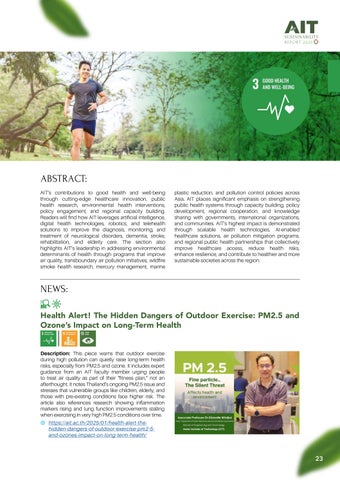
NEWS: Health Alert! The Hidden Dangers of Outdoor Exercise: PM2.5 and Ozone’s Impact on Long-Term Health
Description: This piece warns that outdoor exercise during high pollution can quietly raise long-term health risks, especially from PM2.5 and ozone. It includes expert guidance from an AIT faculty member urging people to treat air quality as part of their “fitness plan,” not an afterthought. It notes Thailand’s ongoing PM2.5 issue and stresses that vulnerable groups like children, elderly, and those with pre-existing conditions face higher risk. The article also references research showing inflammation markers rising and lung function improvements stalling when exercising in very high PM2.5 conditions over time. 🌐 https://ait.ac.th/2025/01/health-alert-the-
hidden-dangers-of-outdoor-exercise-pm2-5and-ozones-impact-on-long-term-health/
23
SUSTAINABILITY REPORT 2025
“We Don’t All Breathe the Same Air”- A Seminar with Allen L. Robinson
Description: AIT hosted Allen L. Robinson, Dean at Colorado State University, for a keynote on unequal air pollution exposure and health impacts. The seminar focused on PM2.5, emphasizing that the Global South faces higher pollution loads and health risks. It highlights a striking estimate of millions of deaths annually linked to elevated air pollution, while also pointing to hope through technology and collaboration. The talk also covered advances in monitoring, including low-cost sensors, mobile monitoring, satellite data, and machine learning approaches relevant to Thailand’s air-quality challenges.
🌐 https://ait.ac.th/2025/02/we-dont-all-breathe-
the-same-air-a-seminar-with-prof-allen-lrobinson/
Breaking Barriers: Innovating AI Solutions for Global Health
Description: This article follows Deepali Mishra and frames her work through the global push to increase women’s participation in science, referencing UNESCO messaging on women in science. It spotlights her motivation to improve diagnostic systems through AI rather than only practicing traditional medicine. The article lists practical impacts of AI in diagnostics, including improved accuracy, support for radiologists, and expanded access for remote areas. It also connects her work to SDG 3 (good health and well-being) and emphasizes resilience as a core theme in her journey. 🌐 https://ait.ac.th/2025/02/breaking-barriers-
deepali-mishras-journey-from-prayagraj-indiato-pioneering-ai-in-healthcare-at-ait-thailand/
Tackling Motorcycle Safety Through Hazard Perception Training
Description: This article highlights hazard perception training to improve motorcycle safety. The approach enhances rider awareness and risk assessment. Research supports behavior-based safety interventions. The initiative contributes to road safety outcomes. 🌐 https://ait.ac.th/2025/09/tackling-motorcycle-
safety-through-hazard-perception-training/
24
SUSTAINABILITY REPORT 2025
PROJECTS: AI System for Stroke Prediction and Recovery Analysis
AIT Research Theme: Technology, Policy and Society Contributed by Faculty/School/Center: Artificial Intelligence Center Partners / Funded by: Thailand Science Research and Innovation Expected Social Impact: This project applies AI to analyze EEG and fMRI data for diagnosing stroke and dementia conditions, using machine learning with interpretability techniques (SHAP/LIME). It aims to enhance stroke severity prediction and support personalized recovery monitoring for physicians. The project will benefit the general public and patients with neurological conditions by providing faster, more accurate, and consistent diagnostic services, leading to improved treatment outcomes, with an estimated
reach of 10,000 individuals. Communities, particularly in rural and regional areas, will gain improved access to radiology services supported by artificial intelligence (AI) at regional hospitals, helping to reduce health disparities and promote equitable healthcare across approximately 1,000 communities. In addition, radiologists and medical professionals will benefit from reduced workloads, enhanced diagnostic efficiency, and increased time for patient care through the use of AI-generated preliminary reports. Description: This project applies AI to analyze EEG and fMRI data for diagnosing stroke and dementia conditions, using machine learning with interpretability techniques (SHAP/LIME). It aims to enhance stroke severity prediction and support personalized recovery monitoring for physicians.
The Southeast Asia Regional Programme on Combating Marine Plastics (SEA-MaP)
AIT Research Theme: Technology, Policy and Society Contributed by Faculty/School/Center: Global Water and Sanitation Center Partners / Funded by: United Nations Human Settlements Programme Expected Social Impact: The project is expected to enhance the knowledge, skills, and capacities of stakeholders across ASEAN Member States in managing plastics and plastic waste, contributing to more effective and sustainable local and regional waste management practices. By strengthening collaboration among municipalities, the private sector, civil society, and other
stakeholders, the project will support the adoption of circular economy approaches and resource-efficient practices. This will ultimately lead to cleaner marine and urban environments, improved community health, and greater resilience of coastal and urban communities against the impacts of plastic pollution. Description: The SEA-MaP project supports ASEAN member states in implementing the Regional Action Plan for Combating Marine Debris by enhancing knowledge and capacities to reduce marine plastic pollution. It focuses on policy, governance, and circular economy practices across Southeast Asia.
Developing an Automatic Helmet-Wearing Data Collection System Processed on the Cloud
AIT Research Theme: Technology, Policy and Society Contributed by Faculty/School/Center: Artificial Intelligence Center Partners / Funded by: ThaiRoads Foundation Expected Social Impact: Safety and protection for people in society.
Description: This project advances a cloud-based helmet compliance monitoring system that collects statistical data on motorcycle volume and helmet usage. It resolves previous deployment challenges by migrating the AI detection system to the cloud for improved accessibility and sustainability.
25
SUSTAINABILITY REPORT 2025
Innovative Solutions for Plastic Free European Rivers
AIT Research Theme: Climate change Contributed by Faculty/School/Center: Geoinformatics Center Partners / Funded by: European Climate, Infrastructure and Environment Executive Agency | Belgium Expected Social Impact: Remove plastic from a few European rivers and provide clean water to the population living along these rivers.
Description: The INSPIRE project aims to drastically reduce litter, macro- and microplastics in European rivers through 20 integrated technologies covering detection, collection, and prevention of plastic pollution. It takes a holistic approach spanning the full waste stream before plastics enter river systems.
Air Quality Improvement Program in Thailand (AQIP-Thailand)
AIT Research Theme: Climate change Contributed by Faculty/School/Center: School of Engineering and Technology Partners / Funded by: The Agence Française de Développement (AFD) | France | Egis Airparif Citepa Expected Social Impact:
› Created healthy living environments › Promoted environmental conservation and economic growth
› Increased public awareness regarding air quality Description: The AQIP-Thailand project, funded by AFD, supports Thailand in developing and implementing policies to improve air quality, conducted by a consortium including Egis, AirParif, Citepa, and AIT. It focuses on
reducing air pollution impacts in Thai cities as part of a regional Southeast Asia initiative.
Effects of air pollution on motorcycle taxi drivers in Thailand using mobile air quality IoT sensors
AIT Research Theme: Smart communities Contributed by Faculty/School/Center: Education and Research Laboratory
Internet
Partners / Funded by: University of Washington | Thailand | Chiang Mai Rajabhat University Expected Social Impact: Good health and Well-being Description: This joint investigation managed by AIT examines the effects of air pollution on motorcycle taxi drivers in Thailand using mobile air quality IoT sensors. It aims to generate evidence on occupational exposure to air pollutants for this vulnerable workforce.
26
SUSTAINABILITY REPORT 2025
Strategies for Effective Public Health Policy Making: Unveiling Thailand’s Insights for Influencing Practice and Shaping Policies
AIT Research Theme: Smart communities, Infrastructure, Technology, Policy and Society
› Improved understanding of public health policies and
Contributed by Faculty/School/Center: School of Environment, Resources and Development
Description: A 7-day training and study visit program for Indian state healthcare officers and researchers offering exposure to Thailand’s public health system. It builds cross-country collaboration between India’s MATI and AIT in public health policy and practice.
Partners / Funded by: MATI | India | AIT MATI Expected Social Impact:
› Provided firsthand experience of public health
service implementation
situations
ReVitalize: Vitiligo Treatment Disposable Kit
AIT Research Theme: Technology, Policy and Society Contributed by Faculty/School/Center: Entrepreneurship Center Partners / Funded by: Dermatologist: Henry Loh; Singapore
Description: This project designs and develops a modular, sterile, and easy-to-use cell separation kit for vitiligo treatment, enabling efficient melanocyte isolation for autologous transplantation. The kit aims to make melanocyte therapy more accessible and clinically viable.
Expected Social Impact: 1. Improved vitiligo patient quality of life 2. Reduced social stigma 3. Promoted dermatological care innovation
Development of an AI-powered Robotic System Rehabilitation with Haptics and Immersive VR Gaming
AIT Research Theme: Technology, Policy and Society Contributed by Faculty/School/Center: School of Engineering and Technology Partners / Funded by: Asian Institute of Technology (AIT) | Thailand Expected Social Impact:
for
Knee
Description: This project develops an AI-powered robotic system for knee rehabilitation integrating haptic feedback and immersive VR gaming to enhance patient engagement. The system uses AI-driven adaptive therapy for real-time performance analysis and personalized rehabilitation protocols.
› Delivered AI-powered knee rehabilitation robotic systems
› Generated medical robotics AI integration insights › Enhanced patient recovery and engagement
27
SUSTAINABILITY REPORT 2025
International Conference on AI Innovations in Medical Engineering and Robotics Technology (AI-MERT 2025)
AIT Research Theme: Technology, Policy and Society Contributed by Faculty/School/Center: School of Engineering and Technology Partners / Funded by: Publication Partner: Taylor & Francis Group Expected Social Impact:
› Promoted AI-driven medical technology adoption › Built global collaboration and capacity › Included assistive innovation for underserved populations Description: The AI-MERT 2025 conference brings together global experts, researchers, and industry professionals to exchange knowledge on AI innovations in medical engineering and robotics. Held at AIT in December
2025, it addresses breakthroughs at the intersection of AI and healthcare technology.
Regional Mercury Management and Elimination of Mercury-Added Products Programme
AIT Research Theme: Technology, Policy and Society Contributed by Faculty/School/Center: Regional Resource Center for Asia and the Pacific Expected Social Impact: Awareness raising of cosmetics users, retailers, and producers on the negative impact of the Mercury-embedded skin-lightening products. Description: This regional programme consolidates a series of national and sub-regional initiatives led by AIT RRC. AP and partners to strengthen policy implementation, interagency coordination, trade control, waste management,
28
and public awareness related to mercury-added products, particularly mercury-containing skin-lightening products. The programme supports countries across Asia in protecting public health, reducing exposure to hazardous mercury, strengthening regulatory frameworks, and improving environmentally sound management of mercury-containing waste through workshops, training programmes, policy dialogues, and regional knowledge exchange.
SUSTAINABILITY REPORT 2025
The Southeast Asia Regional Program on Combating Marine Plastics (SEA-MaP)
AIT Research Theme: Technology, Policy and Society Contributed by Faculty/School/Center: Global Water and Sanitation Center Partners / Funded by: United Nations Human Settlements Program (UN-Habitat) | Thailand Expected Social Impact:
› Enhanced plastic waste management stakeholder capacity
› Supported circular economy approach adoption › Improved community health and marine environments Description: The SEA-MaP project supports ASEAN member states in implementing the Regional Action Plan for Combating Marine Debris by enhancing knowledge
and capacities to reduce marine plastic pollution. It focuses on policy, governance, and circular economy practices across Southeast Asia.
Deliver training program for implementing decrees for reducing open waste burning and air pollution
AIT Research Theme: Climate change Contributed by Faculty/School/Center: Air Quality Nexus Center Partners / Funded by: United Nations Environment Program (UNEP) | Clean Air Asia Asian Institute of Technology (AirQC), and Ministry of Environment of Cambodia
Description: This project supports Cambodia in reducing open waste burning and improving air quality through an action plan and a training program targeting federal, provincial, and district-level authorities. Training materials are developed based on a KAP survey and existing waste sector data.
Expected Social Impact:
› Improved public health through air pollution reduction › Enhanced urban and rural environment cleanliness › Strengthened local authority institutional capacity
29
SUSTAINABILITY REPORT 2025
Vanatera – Incubation & Product Development Support
AIT Research Theme: Food-Energy-Water Contributed by Faculty/School/Center: Entrepreneurship Center Partners / Funded by: Vanatera Co., Ltd | Thailand Expected Social Impact:
› Improve diabetes management and public health. › Promote awareness and use of evidence-based herbal medicine.
› Support sustainable use of medicinal plants.
› Create economic opportunities through herbal product development.
› Reduce reliance on synthetic drugs and healthcare costs. Description: AIT Entrepreneurship Center provides incubation facilities and development support to Vanatera Co., Ltd. for the creation of a herbal-based diabetes product, including literature analysis, herb selection, and formulation design.
The Fifth Asia Pacific Clean Air Partnership (APCAP) Joint Forum, Yokohama, Japan
Duration: 20-21 March 2025 Description: The Fifth Asia Pacific Clean Air Partnership (APCAP) Joint Forum was held in Yokohama, Japan, on 2021 March 2025. About 200 air quality stakeholders joined the discussions on how to increase investment for clean air. The 5th edition of the Joint Forum was hosted by the Ministry of Environment, Japan (MoEJ) and co-organized by UNEP and UNESCAP. The representatives from government, academia, civil society, and the private sector provided recommendations on the next phase of the partnership, including a proposed focus on synergies of air quality and climate action, solutions for ground-level ozone, and mobilizing finance. Dr. Vanisa Surapipith, AIT-RRC.AP’s Head of Air Pollution Cluster, participated and served as the panelist in session 4: Thematic discussion on technology and innovative solutions to improve air quality. She reviewed the Malé Declaration, which is set to be revamped with new
solutions aimed at combating air pollution in South Asia. She also introduced a new AIT RRC.AP project titled “Tackling open climate science questions and building consensus on black carbon.” This project, funded by the Clean Air Fund through Stockholm University, brings a new approach towards co-benefits.
🌐 https://www.rrcap.ait.ac.th/news/Pages/
vol26no1-06.aspx
Development of Artificial intelligence (A.I.) of Diagnostic Neuroradiology of Dementia diseases
AIT Research Theme: Smart communities Contributed by Faculty/School/Center: Artificial Intelligence Center Partners / Funded by: Mahidol University Expected Social Impact:
30
› Improved Alzheimer’s patient quality of life › Reduced healthcare burden through early detection
Description: This project develops AI-based tools to advance Alzheimer’s disease diagnosis and prognosis, using machine learning to analyze neuroradiology data. It aims to improve early detection accuracy and support personalized treatment planning for dementia patients.
SUSTAINABILITY REPORT 2025
The Clean Air for Blue Sky Asia (CABSA) Workshop, Bangkok, Thailand
Duration: 25-26 March 2025 Description: The UNDP with technical support from Incheon National University (INU) organized Clean Air for Blue Sky Asia (CABSA) workshop and working session from 25 – 26 March 2025. The event brought together a technology provider (INU) and end users (academia and government officials from participating countries such as Cambodia, Lao PDR, Mongolia, Thailand, Vietnam). AIT RRC.AP actively engaged in all sessions, as discussants and panelists. The Center shared insights on knowledge management and behavioral change technical discussions based on experiences from the ongoing Marine Plastic Prevention Knowledge Partnership under the 3RproMar project. The workshop aimed to (i) learn opportunities and exchange of dialogues on latest policies, technology trends, best practices, as well as challenges and opportunities related to air quality matters, (ii) discuss key recommendations from a recent evaluation of CABSA I and II to translate scientific data into practical policy recommendations that will guide participating countries to
tackle recent air quality and pollution, identifying suitable policy recommendations and investments related to air quality matters, and (iii) strengthen regional collaboration on air quality management as well as explore interest for future joint ODA initiatives related to air quality. AIT RRC.AP team participated onsite and provided insights during the moderated discussion session. 🌐 https://www.rrcap.ait.ac.th/news/Pages/
vol26no1-05.aspx
National Workshop on Strengthening the Elimination of Mercuryadded Skin-lightening Products in Sri Lanka, Colombo, Sri Lanka
Duration: 2 June 2025 Description: The workshop was organized on 2 June 2025 in Colombo, bringing together participants from Sri Lanka Customs, the Central Environmental Authority, the Consumer Affairs Authority, the Atomic Energy Board, the Ministry of Health, and other key agencies. Titled National Training on Strengthening Country-Level Inter-Agency Coordination on Trade of Mercury, the workshop was co-organized by the Ministry of Environment of Sri Lanka, United Nations Environment Program (UNEP), World Health Organization (WHO), the Biodiversity Research Institute (BRI), and the Regional Resource Center for Asia and the Pacific at the Asian Institute of Technology (AIT RRC.AP). The training responded to the growing threat of mercury trafficking and the continued illegal trade of mercury-added products including skin-lightening products, despite bans under the Minamata Convention. The workshop emphasized the critical role of customs and environmental authorities in enhancing enforcement and border controls through improved coordination and technical training.
Sessions covered practical aspects of mercury trade enforcement, including shipment profiling, customs inspection, use of X-ray fluorescence (XRF) analyzers, and case studies. Presentations by UNEP, WHO, WCO, and national institutions highlighted gaps in enforcement, data sharing, and surveillance capacity. Hands-on exercises provided real-time experience in mercury detection, seizure handling, and inter-agency response planning. 🌐
https://www.rrcap.ait.ac.th/news/Pages/ vol26no2-11.aspx
31
SUSTAINABILITY REPORT 2025
Sub-regional Workshop on Strengthening Inter-agency Coordination for Eliminating Mercury-added Skin-lightening Products, Colombo, Sri Lanka
Duration: 3-4 June 2025 Description: The workshop was co-organized by the Ministry of Health of Sri Lanka, United Nations Environment Program (UNEP), World Health Organization (WHO), the Biodiversity Research Institute (BRI), and the Regional Resource Center for Asia and the Pacific at the Asian Institute of Technology (AIT RRC.AP). The event aimed to strengthen institutional coordination and national implementation of the Minamata Convention’s provisions related to mercury-added skin-lightening products (SLPs). Delegates (from Sri Lanka, Thailand, Philippines, Malaysia, Indonesia, Vietnam, Nepal, and Maldives) discussed key regulatory and enforcement challenges such as fragmented institutional roles, limited coordination between agencies, and inadequate testing capacities at entry points. The need for targeted communications, and stricter controls on informal and online sales channels was also underscored. Over the two days, participants engaged in technical sessions and group work on national coordination mechanisms, real-time detection tools such as XRF analyzers, case study presentations, and a practical
exercise to simulate inter-agency response. Country presentations offered insights into progress made and identified gaps requiring joint solutions. The workshop stressed the need for formal inter-agency coordination mechanisms, scaling up product testing and post-market surveillance. The event reaffirmed that crosssector collaboration is essential to eliminate mercuryadded SLPs and to protect public health and consumer rights across South Asia. 🌐 https://www.rrcap.ait.ac.th/news/Pages/
vol26no2-13.aspx
Scoping study to Support the Revival of the Malé Declaration on Control and Prevention of Air Pollution and its likely Transboundary Effects for South Asia, Colombo, Sri Lanka
Duration: June 2025 Description: The scoping study aims to assess the aspirations of Malé Declaration member countries and how regional cooperation can support their national efforts to address air pollution. The study will review the status of air quality, institutional roles, and ongoing national policies, while it will identify key gaps in monitoring, emissions inventories, modeling, data sharing, and institutional coordination. The study will also map existing regional initiatives led by development partners, explore opportunities for enhanced collaboration, and evaluate stakeholder readiness for renewed commitment. The study will propose options to strengthen the regional framework and recommend priority actions for joint air pollution mitigation across South Asia. 🌐 https://www.rrcap.ait.ac.th/news/Pages/
vol26no2-07.aspx
32
SUSTAINABILITY REPORT 2025
Multi-country Meeting on Strengthening the Elimination of Mercuryadded Skin-lightening Products (SLPs), Colombo, Sri Lanka
Duration: 5-6 June 2025 Description: The meeting was attended by the representatives from Ministry of Health of Sri Lanka, United Nations Environment Program (UNEP), World Health Organization (WHO), the Biodiversity Research Institute (BRI), and the Regional Resource Center for Asia and the Pacific at the Asian Institute of Technology (AIT RRC.AP). The workshop focused on the growing public health threat posed by toxic cosmetics, particularly mercury-containing skin lightening products. The meeting had representatives from government agencies, customs departments, health and environmental institutions, and NGOs across Asia. Participants shared national progress, policy gaps, and enforcement challenges in phasing out mercury-added SLPs, in line with the Minamata Convention on Mercury. Difficulties posed by online trade, limited laboratory testing infrastructure, and persistent cultural perceptions linking lighter skin to beauty and status were majorly emphasized during the workshop.
The two-day workshop featured technical sessions on mercury regulation, risk assessment, legal enforcement, consumer awareness, and cross-border cooperation. Indepth country updates were presented, fostering an open exchange of best practices and needs.
🌐 https://www.rrcap.ait.ac.th/news/Pages/
vol26no2-14.aspx
Malé Declaration - Ambition to Action, Bangkok, Thailand
Duration: 11-12 June 2025 Description: The regional workshop “Malé Declaration - Ambition to Action” was successfully held from 11 to 12 June 2025 in Bangkok, Thailand (and hybrid for a few delegates). The workshop marked a significant step toward revitalizing the Malé Declaration on Control and Prevention of Air Pollution and its likely Transboundary Effects (Malé Declaration), fostering renewed regional collaboration to tackle air pollution challenges across South Asia. The workshop was co-organized by the South Asia Co-operative Environment Program (SACEP), which serves as the Secretariat of the Malé Declaration, and the Regional Resource Center for Asia and the Pacific at the Asian Institute of Technology (AIT RRC.AP), the technical partner of the Declaration. The event was supported by development partners such as UNEP, UNESCAP, CCAC, SEI, ICIMOD, CAF, and others. The two-day workshop gathered government representatives officially nominated by member countries
in South Asia, i.e. Bangladesh, Bhutan, India, Maldives, Nepal, Pakistan and Sri Lanka, core team, and international partners. Key discussions included the Think Piece (Vision Paper), the Strategies and Work Program for the Next Phase, and, in particular, the Scoping Study commissioned by SACEP to support the revival of the Malé Declaration.
🌐 https://www.rrcap.ait.ac.th/news/Pages/
vol26no2-05.aspx
33
SUSTAINABILITY REPORT 2025
Mongolia Hosts National Training on Strengthening Country-Level Inter-Agency Coordination on Trade of Mercury, Ulaanbaatar, Mongolia
Duration: 23-24 June 2025 Description: A 2-day National Training on Strengthening Country-Level Inter-Agency Coordination on Trade of Mercury was successfully conducted in Ulaanbaatar, Mongolia, bringing together customs officials, environmental regulators, law enforcement officers, and health experts. The workshop was co-organized by the Ministry of Environment and Climate Change of Mongolia (MOECC), the Biodiversity Research Institute (BRI), the Regional Resource Center for Asia and the Pacific at the Asian Institute of Technology (AIT RRC.AP), and the United Nations Environment Program (UNEP). This national training forms part of a broader regional initiative to enhance countries’ capacities to meet their obligations under the Minamata Convention on Mercury. It emphasized country-specific strategies, inter-agency coordination, and the application of forensic and risk assessment tools to detect and curb illegal mercury trade. Participants engaged in practical exercises on customs inspections, profiling of mercury shipments, and simulation of joint operations, culminating in discussions
on national action planning. A special highlight included Mongolia’s mercury mass flow analysis and the presentation of successful experiences from Indonesia and the PlanetGOLD initiative in Mongolia. The training concluded with an open forum to explore next steps in developing Mongolia’s national action plan for mercury trade enforcement and half-day field visit to secure mercury storage facility in Ulaanbaatar. 🌐 https://www.rrcap.ait.ac.th/news/Pages/
vol26no2-10.aspx
Air Quality Management Training Workshop held in Malé, Maldives
Duration: 23 July 2025 Description: A 1-day Training Workshop on Air Quality Management in Maldives was successfully conducted at Saafu Raajje Building, Malé, Maldives on 23 July 2025, as part of the Malé Declaration Scoping Study. The workshop brought together representatives from the key departments in the Ministry of Tourism and Environment (Pollution Department, Energy and Waste Management Department, Climate Change Department), as well as Health Protection Agency, Environmental Protection Agency, Maldives Meteorological Service (MMS) and Maldives National University. The event was co-organized by the Ministry of Tourism and Environment, Maldives, SACEP (Secretariat of Malé Declaration) and AIT RRC.AP (technical partner of Malé Declaration). Dr. Guilberto Borongan, AIT RRC.AP’s Director introduced UNEP training on Monitoring Ambient Mercury in the Atmosphere while, Vanisa Surapipith, Head of Air Pollution Cluster, AIT RRC.AP, shared about how modelling longrange transboundary air pollution has been conducted
34
over Indo-Gangetic Plain (IGP) and encouraged linkage to Malé Declaration member countries expanding the domain to the southern part of the region. All participants were actively exchanging their interests and strongly expressed the need for capacity-building as the key activities to be performed in the next phases of Malé Declaration. 🌐 https://www.rrcap.ait.ac.th/news/Pages/
vol26no3-02.aspx
SUSTAINABILITY REPORT 2025
Air Quality Management Training Workshop held in Sri Lanka
Duration: 25 July 2025 Description: The On-site Training Workshop on Air Quality Management in Sri Lanka kicked off at Water Edges Hotel, Battaramulla, Colombo on 25 July 2025, as part of the Malé Declaration Scoping Study. The workshop brought together the representatives from the focal point of Malé Declaration i.e. Ministry of Environment, Central Environment Agency (CEA) and Ministry of Transport, Highways, Port & Civil Aviation. The event is co-organized by SACEP (Secretariat of Malé Declaration) and AIT RRC.AP (technical partner of Malé Declaration) upon the request by Vehicle Emission Test (VET) Trust Fund, Sri Lanka. The opening session featured introduction by Eng.I.G.D.J.Kamal, Director of VET; followed by welcome remarks delivered by Vernika Ranawaka Arachchi, Director of Air Quality and Noise Management, Central Environment Authority (CEA), and opening remarks by Norbu Wangchuk, Director General of South-Asia Co-operative Environment Program (SACEP), who commissioned the program for revitalization of Malé Declaration. Then Jatinder S. Kamyotra, former Member
Secretary of the Central Pollution Control Board, India’s premier Environment decision-making body, delivered the topic - Monitoring Air Quality with Best Practices for Decision-making on Daily Air Pollution Assessment and Planning, and Vehicle Emission Standards. Vanisa Surapipith, AIT RRC.AP, encouraged discussion to stage more capacity-building activities that will be planned in the next phases of Malé Declaration. 🌐 https://www.rrcap.ait.ac.th/news/Pages/
vol26no3-03.aspx
Short-Training Workshop on Air Quality Management in Bhutan
Duration: 21 August 2025 Description: The On-site Training Workshop on Air Quality Management in Bhutan was conducted on 21 August 2025 at Osel Hotel, Thimphu, as part of the Malé Declaration Scoping Study. The event gathered officials from Bhutan’s focal point of the Malé Declaration, the Ministry of Energy and Natural Resources (MoENR). The program opened with a welcome address by Sonam Tashi, Director of the Department of Environment and Climate Change/MoENR, followed by inspiring remarks from Norbu Wangchuk, Director General of SACEP, and congratulatory words from Guilberto Borongan, Director of AIT RRC.AP. Jointly organized by SACEP, the Secretariat of the Malé Declaration, together with AIT RRC.AP as the technical partner, the workshop served as an important platform to strengthen Bhutan’s efforts in air quality management. It provided participants with the opportunity to learn
about ongoing initiatives, explore the latest technical advancements, and exchange insights into addressing national priorities. The interactive discussions also helped identify training needs and capacity-building opportunities for air quality management. 🌐 https://www.rrcap.ait.ac.th/news/Pages/
vol26no3-04.aspx
35
SUSTAINABILITY REPORT 2025
AIT RRC.AP Engages with Malé Declaration Member Countries for Scoping Study
Duration: June-September 2025 Description: The Regional Resource Center for Asia and the Pacific in the Asian Institute of Technology (AIT RRC.AP) has wrapped up a crucial series of high-level missions across South Asia, spanning Sri Lanka, Maldives, Nepal, Bhutan, and Bangladesh. The initiative focused on gathering essential insights to shape future regional strategies for combating air pollution. To complement the policy dialogues, the AIT RRC.AP team also conducted capacity-building workshops on air quality management in Sri Lanka, Maldives, and Bhutan, helping to enhance local technical skills. In a key technical exchange, the team visited the Air Quality Monitoring Station-1 in Thimphu, Bhutan, demonstrating a commitment to practical, on-the-ground understanding of monitoring efforts. The findings and stakeholder inputs gathered during these missions are now being integrated into the Scoping Study,
set to guide the next phase of collaborative action against air pollution in South Asia. 🌐 https://www.rrcap.ait.ac.th/news/Pages/
vol26no3-05.aspx
Sharing Regional Experience on Mercury Waste Management in Healthcare Sector, Webinar
Duration: 14 October 2025 Description: Guilberto Borongan, Director of the Regional Resource Center for Asia and the Pacific at the Asian Institute of Technology (AIT RRC.AP), Thailand, participated in an online pre-COP6 side event titled “Managing Mercury Wastes in the Healthcare Sector: From Existing Tools to Inclusive Applications” During the 1-hour webinar event, Borongan delivered a presentation on “Experiences on Environmentally Sound Management (ESM) of Mercury-containing Medical Measuring Devices (MCMMDs)”, where he shared practical insights and regional experiences in advancing safe and sustainable mercury waste practices in the healthcare sector. This event was organized as part of the preparatory activities leading up to COP6 under the Minamata Convention,
36
highlighting tools, policies, and inclusive approaches for managing mercury in healthcare settings. 🌐 https://www.rrcap.ait.ac.th/news/Pages/
vol26no4-04.aspx
SUSTAINABILITY REPORT 2025
The Study of Using Technology And Innovation to Reduce Particulate Emissions from Targeted Vehicles (Pick-Up Trucks and Diesel-Engine Trucks)
AIT Research Theme: Technology, Policy and Society Contributed by Faculty/School/Center: Artificial Intelligence Center Partners / Funded by: National Science and Technology Development Agency (NSTDA) | Thailand | WREE Dept, AIT
Description: This study uses deep learning and image processing to detect black smoke from diesel engine vehicles in Pathumthani and Bangkok provinces, measuring PM2.5 emissions. It aims to develop technologydriven solutions to reduce particulate emissions from pickup trucks and diesel trucks.
Expected Social Impact:
› Enhanced environmental policy planning › Provided real-time air quality data › Protected public health against respiratory diseases
System Integration and Development of Web-based Applications
AIT Research Theme: Smart communities Contributed by Faculty/School/Center: Artificial Intelligence Center Partners / Funded by: The National Broadcasting and Telecommunications Commission, Thailand
Description: This project provides technical IT services to maintain and develop a web-based healthcare application platform for an elder care system. The service provider ensures high performance, security, and continuous availability of all application components.
Expected Social Impact: Economic Security, Elderly Healthcare, Social Connectedness
Advancing Veterinary Epidemiology and One Health Capacity in the Asia Pacific
AIT Research Theme: Technology, Policy and Society Contributed by Faculty/School/Center: School of Environment, Resources and Development Partners / Funded by: The Department of Foreign Affairs and Trade, Australia; University of Sydney Expected Social Impact:
Description: This project addresses gender gaps in veterinary and animal health services in Asia, examining how women professionals face barriers in accessing field-based roles and extension services. It promotes gender inclusion in One Health frameworks and veterinary epidemiology capacity building.
› Increased Gender Equality in Animal Health › Improved Access to Animal Health Services for Women Farmers
› Gender-Sensitive Policy and Practice in Animal Health
37
SUSTAINABILITY REPORT 2025
Automatic Early Dementia Detection for Elder Persons in the nursing facilities
AIT Research Theme: Technology, Policy and Society Contributed by Faculty/School/Center: Artificial Intelligence Center Partners / Funded by: Program Management Unit for Competitiveness (PMU-C) | Thailand Expected Social Impact:
› Created local expertise and employment in the AI sector
› Reduced healthcare costs via early diagnosis › Promoted domestic technology utilization Description: This project develops an automated early detection system for dementia in elderly nursing facility
residents in Thailand, addressing the growing population of Alzheimer’s patients in an aging society. AI-based tools are designed to support timely diagnosis and care management.
Telehealth Monitoring and Assistive Systems for Elderly and Disabled People
AIT Research Theme: Smart communities Contributed by Faculty/School/Center: School of Engineering and Technology Partners / Funded by: The National Broadcasting and Telecommunications Commission, Thailand Expected Social Impact:
Description: This project develops telehealth monitoring and assistive technologies for elderly and disabled people through four work packages covering wearable glucose monitoring, activity and fall detection, telerehabilitation via haptic technology, and a cloud-based health management platform.
› Provided suitable and timely emergency care › Reduced long-term care costs › Enhanced patient life satisfaction
Climate Attribution of Wildfire Smoke Impacts on Priority Population Health in Southeast Asia and Australia (CANBREATHE)
AIT Research Theme: Climate change Contributed by Faculty/School/Center: Air Quality Nexus Center Partners / Funded by: Wellcome Trust Expected Social Impact:
› Increased awareness of wildfire smoke health impacts › Improved protection and resilience of vulnerable groups
› Strengthened evidence-based public health policy 38
Description: The project uses climate attribution modeling to assess the health impacts of wildfire smoke on priority populations in Southeast Asia and Australia. AIT is a key collaborating partner in this three-year international initiative spanning Thailand, Indonesia, Lao PDR, and Australia.
SUSTAINABILITY REPORT 2025
39