SUSTAINABILITY REPORT 2025
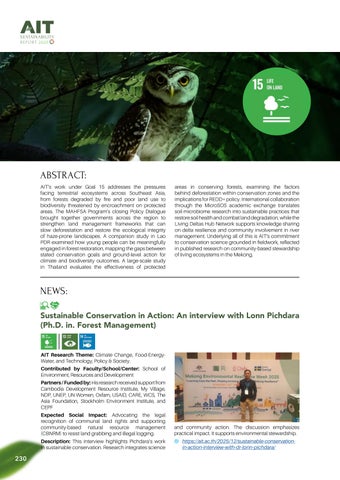
ABSTRACT: AIT’s work under Goal 15 addresses the pressures facing terrestrial ecosystems across Southeast Asia, from forests degraded by fire and poor land use to biodiversity threatened by encroachment on protected areas. The MAHFSA Program’s closing Policy Dialogue brought together governments across the region to strengthen land management frameworks that can slow deforestation and restore the ecological integrity of haze-prone landscapes. A companion study in Lao PDR examined how young people can be meaningfully engaged in forest restoration, mapping the gaps between stated conservation goals and ground-level action for climate and biodiversity outcomes. A large-scale study in Thailand evaluates the effectiveness of protected
areas in conserving forests, examining the factors behind deforestation within conservation zones and the implications for REDD+ policy. International collaboration through the MicroSOS academic exchange translates soil-microbiome research into sustainable practices that restore soil health and combat land degradation, while the Living Deltas Hub Network supports knowledge sharing on delta resilience and community involvement in river management. Underlying all of this is AIT’s commitment to conservation science grounded in fieldwork, reflected in published research on community-based stewardship of living ecosystems in the Mekong.
NEWS: Sustainable Conservation in Action: An interview with Lonn Pichdara (Ph.D. in. Forest Management)
AIT Research Theme: Climate Change, Food-EnergyWater, and Technology, Policy & Society. Contributed by Faculty/School/Center: School of Environment, Resources and Development Partners / Funded by: His research received support from Cambodia Development Resource Institute, My Village, NDP, UNEP, UN Women, Oxfam, USAID, CARE, WCS, The Asia Foundation, Stockholm Environment Institute, and CEPF Expected Social Impact: Advocating the legal recognition of communal land rights and supporting community-based natural resource management (CBNRM) to resist land grabbing and illegal logging. Description: This interview highlights Pichdara’s work in sustainable conservation. Research integrates science
230
and community action. The discussion emphasizes practical impact. It supports environmental stewardship. 🌐 https://ait.ac.th/2025/12/sustainable-conservation-
in-action-interview-with-dr-lonn-pichdara/
SUSTAINABILITY REPORT 2025
PROJECTS: Policy Dialogue Towards A Haze-Free Southeast Asia: Forging Climate Resilience and Sustainability, Bangkok, Thailand
Duration: 18 March 2025 AIT Research Theme: Technology, Policy & Society Contributed by Faculty/School/Center: Regional Resource Center for Asia and the Pacific Partners / Funded by: ASEAN Secretariat; International Fund for Agricultural Development; Measurable Action for Haze-Free Sustainable Land Management Program; Center for International Forestry Research; World Agroforestry Expected Social Impact: Strengthened regional policy frameworks for haze reduction and sustainable land management, contributing to improved air quality, public health outcomes, and ecosystem protection across Southeast Asia. Description: The Measurable Action for Haze-Free Sustainable Land Management (MAHFSA) Program’s Closing and Policy Dialogue was held on 18 March 2025 at Novotel Bangkok Sukhumvit 20, Thailand, in hybrid mode. The event brought together regional stakeholders to share best practices, discuss policy reforms, and
explore innovative solutions for building climate resilience and sustainable land management, while reflecting on the MAHFSA Program’s achievements, lessons learned, and the way forward in tackling fire and transboundary haze issues across Southeast Asia. The AIT Regional Resource Center for Asia and the Pacific (RRC.AP) participated onsite, with Vanisa Surapipith, Head of the Air Pollution Cluster, contributing as a panelist in a policy discussion session. 🌐 https://www.rrcap.ait.ac.th/news/Pages/
vol26no1-07.aspx
Youth Engagement in Forest Restoration for Climate and Biodiversity Goals in Luang Prabang, Vientiane, and Champasak, Lao PDR
Duration: 18 March 2025 AIT Research Theme: Climate change, Technology, Policy and Society Contributed by Faculty/School/Center: School of Environment, Resources and Development Partners / Funded by: The Swedish International Development Cooperation Agency through Regional Community Forestry Training Center for Asia and the Pacific; Center for International Forestry Research of CGIAR; International Center for Research in Agroforestry of CGIAR; Sasin School of Management of Chulalongkorn University; Zero Waste Laos; Government of Lao PDR; Explore Women’s Scholarship. Expected Social Impact: The project is expected to empower young people in Lao PDR with the knowledge, skills, and opportunities to actively engage in forest restoration and biodiversity conservation. By integrating youth perspectives into community-based restoration efforts, it will strengthen local ownership and the longterm sustainability of conservation initiatives. The project will also provide evidence-based recommendations to support more youth-inclusive national policies, while creating opportunities for employment and capacity
building in the environmental sector, thereby enhancing rural economic resilience. Ultimately, it will contribute to long-term climate action, biodiversity conservation, and sustainable natural resource management for future generations. Description: This project assesses youth knowledge, participation, and barriers in forest restoration for climate and biodiversity goals in Lao PDR across three provinces. It identifies policy gaps and proposes recommendations to enhance youth-led contributions to national environmental targets. 🌐 https://www.forru.org/stories/lao-pdr-navigates-the-
future-of-forest-restoration
231
SUSTAINABILITY REPORT 2025
Academic Exchange “Plants crying for help in a changing world”
Duration: December 2025 – March 2026 AIT Research Theme: Technology, Policy & Society Partners / Funded by: Institute of Subtropical and Mediterranean Horticulture; Malaga University Expected Social Impact: Enhanced protection of terrestrial ecosystems and agricultural resilience, achieved by translating international soil-microbiome research into sustainable practices that restore soil health, halt land degradation, and combat desertification caused by severe drought and salinity and ecosystem protection across Southeast Asia. Description: The MicroSOS project aims to enable exchange and mobility between academic and non-academic partners from the agricultural and environmental sectors. All the participants in MicroSOS have a connection to soils and agriculture, which are
Living Deltas Network
AIT Research Theme: Climate change, Infrastructure, Technology, Policy and Society Contributed by Faculty/School/Center: School of Environment, Resources and Development Partners / Funded by: Newcastle University Expected Social Impact: The project supports multistakeholder dialogue through facilitating discussions among diverse groups and capacity building to enhance community involvement in river management. Description: The Living Deltas Hub Network expands delta research collaboration at regional and global levels. It supports knowledge sharing and research activities on delta resilience, sustainability, and disaster risk across partner institutions.
232
under stress due to climate change impacts while being drivers of climate change as well due to the dynamics of the plant microbiome and its relationship to nutrient cycling and GHG emissions. 🌐 https://microsos.org/researchers/
SUSTAINABILITY REPORT 2025
Effectiveness of Protected Area (PA) in Forest Conservation: a largescale country study in Thailand
AIT Research Theme: Climate change Contributed by Faculty/School/Center: School of Environment, Resources and Development Partners / Funded by: Research Initiation Grant, Asian Institute of Technology Expected Social Impact: The project is expected to generate evidence that informs the design of more effective protected area (PA) policies and conservation strategies in Thailand. It will enhance understanding of the physical factors influencing the success or failure of protected areas in forest conservation, support the development of improved conservation measures, and contribute to scientific knowledge through the publication of at least one peer-reviewed journal article.
Description: This large-scale country study in Thailand evaluates the effectiveness of protected areas in conserving forests, examining factors behind deforestation within conservation zones. The research addresses issues of tropical biodiversity, land use change, and REDD+ policy effectiveness.
233