SUSTAINABILITY REPORT 2025
ABSTRACT: AIT focuses on the sustainable management, conservation, and restoration of aquatic ecosystems while supporting livelihoods and food security for communities dependent on fisheries and aquaculture. Recognizing the growing pressures of climate change, pollution, habitat degradation, and overexploitation of aquatic resources, AIT’s initiatives integrate science, technology, and community-based approaches to strengthen the resilience of freshwater and coastal systems across Asia and other developing regions. Activities include sustainable aquaculture development, aquatic animal health management, water quality monitoring, ecosystem restoration, and climate-resilient fisheries practices in the Mekong region, South Asia, and Africa. AIT also advances
research and innovation through the application of digital technologies, remote sensing, IoT-based monitoring systems, environmental modeling, and data-driven decision-support tools for aquatic resource management. In parallel, the institute delivers professional training and capacity-building programs for researchers, government agencies, and local communities to promote sustainable fisheries governance, biodiversity conservation, and integrated water resource management. Through interdisciplinary collaboration and regional partnerships, AIT contributes to healthier aquatic ecosystems, sustainable blue economies, and improved livelihoods for water-dependent communities.
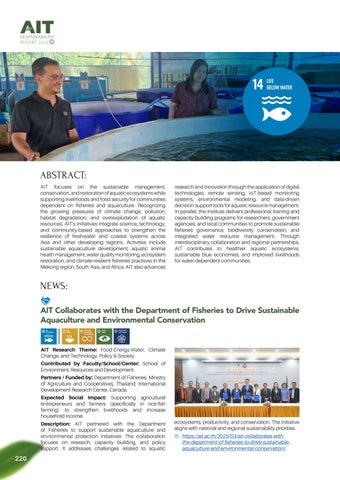
NEWS: AIT Collaborates with the Department of Fisheries to Drive Sustainable Aquaculture and Environmental Conservation
AIT Research Theme: Food-Energy-Water, Climate Change, and Technology, Policy & Society Contributed by Faculty/School/Center: School of Environment, Resources and Development. Partners / Funded by: Department of Fisheries, Ministry of Agriculture and Cooperatives, Thailand; International Development Research Center, Canada. Expected Social Impact: Supporting agricultural entrepreneurs and farmers (specifically in rice-fish farming) to strengthen livelihoods and increase household income. Description: AIT partnered with the Department of Fisheries to support sustainable aquaculture and environmental protection initiatives. The collaboration focuses on research, capacity building, and policy support. It addresses challenges related to aquatic
220
ecosystems, productivity, and conservation. The initiative aligns with national and regional sustainability priorities. 🌐 https://ait.ac.th/2025/03/ait-collaborates-with-
the-department-of-fisheries-to-drive-sustainableaquaculture-and-environmental-conservation/
SUSTAINABILITY REPORT 2025
Tracking Trash with Tech: AI-Powered CCTV Rolled Out in Mekong Region Department of Fisheries to Drive Sustainable Aquaculture and Environmental Conservation
AIT Research Theme: Technology, Policy & Society, Smart Communities, and Food-Energy-Water. Contributed by Faculty/School/Center: Geoinformatics Center Partners / Funded by: Mekong-Republic of Korea Cooperation Fund; Japan International Cooperation Agency; National University of Laos; ClearRivers; Delta Fly team (Vietnam); COMPOSTED, Samut Sakorn and Samut Prakan provincial authorities; Chai Klong Bang Bua and Roi Krong communities Expected Social Impact: The formulation of evidencebased national waste management strategies, driven by real-time, actionable data on plastic pollution, to drastically reduce aquatic waste and foster cleaner, sustainable urban waterways across the Mekong region. Description: AIT-supported initiatives introduced AIpowered CCTV systems to monitor waste and illegal dumping in the Mekong region. The technology enables
real-time tracking and data-driven waste management, successfully demonstrating the role of digital tools in environmental protection. It substantially supports regional efforts toward cleaner, more sustainable cities, and protected aquatic ecosystems. 🌐 https://ait.ac.th/2025/04/tracking-trash-with-tech-ai-
powered-cctv-rolled-out-in-mekong-region/
Global Aquaculture Leaders to Convene at GIANT PRAWN 2025 in Huzhou, China
AIT Research Theme: Food-Energy-Water Technology, Policy & Society
and
Contributed by Faculty/School/Center: School of Environment, Resources and Development Partners / Funded by: Shanghai Ocean University; Zhejiang Institute of Freshwater Fisheries; Huzhou University Expected Social Impact: Advancing international knowledge on the farming and conservation of freshwater prawns to support global food security. Description: Global aquaculture experts were set to convene at Giant Prawn 2025 in Huzhou, China. The event focuses on freshwater prawn innovation and sustainability. AIT contributes scientific and technical expertise. The forum promotes global knowledge exchange in aquaculture. 🌐 https://ait.ac.th/2025/06/global-aquaculture-
leaders-to-convene-at-giant-prawn-2025-in-huzhouchina/
221
SUSTAINABILITY REPORT 2025
GIANT PRAWN 2025 Concludes Successfully, Advancing Global Freshwater Prawn Aquaculture
AIT Research Theme: Food-Energy-Water Technology, Policy & Society
and
Contributed by Faculty/School/Center: School of Environment, Resources and Development Partners / Funded by: Shanghai Ocean University; Zhejiang Institute of Freshwater Fisheries; Huzhou University; Ghent University Expected Social Impact: Strengthening international cooperation for more sustainable production of freshwater prawns, a key source of protein and income in Asia and beyond. Description: The Giant Prawn 2025 conference concluded successfully, advancing innovation in freshwater prawn aquaculture. Researchers, industry leaders, and policymakers exchanged knowledge on sustainability and productivity. AIT played a key role in scientific and technical contributions. The event strengthened global collaboration in aquaculture.
🌐 https://ait.ac.th/2025/06/giant-prawn-2025-
concludes-successfully-advancing-globalfreshwater-prawn-aquaculture/
Balancing Conservation and Socio-economic Benefits: A Call for Gender-Specific Analysis in Sustainable Fisheries Management
AIT Research Theme: Technology, Policy & Society, Food-Energy-Water, and Climate Change. Contributed by Faculty/School/Center: School of Environment, Resources and Development Partners / Funded by: Belt and Road Research Center Expected Social Impact: The identification and mitigation of disproportionate financial burdens faced by impoverished women in indigenous communities during fishing bans, driving the formulation of highly equitable and inclusive sustainable fisheries policies. Description: The critical research calls for genderspecific analysis in sustainable fisheries management, highlighting the complex socio-economic and conservation trade-offs inherent in current regulations. By emphasizing inclusive policy design, the work actively supports equitable sustainability outcomes for marginalized fishing communities.
222
🌐 https://ait.ac.th/2025/07/balancing-conservation-
and-socio-economic-benefits-a-call-for-genderspecific-analysis-in-sustainable-fisheriesmanagement/
SUSTAINABILITY REPORT 2025
Leading Major Curriculum Reform in Sustainable Aquaculture for Cambodian Universities
AIT Research Theme: Food-Energy-Water, Technology, Policy & Society, and Climate Change Contributed by Faculty/School/Center: School of Environment, Resources and Development Partners / Funded by: Royal University of Agriculture; Prek Leap National Institute of Agriculture; ASEAN Qualifications Reference Framework Expected Social Impact: Strengthening Cambodian higher education by developing a modern Master’s curriculum in Sustainable Aquaculture aligned with international standards. Description: AIT led a major curriculum reform initiative in sustainable aquaculture for Cambodian universities. The program strengthened academic capacity and modernized teaching approaches. It emphasized sustainability and industry relevance. The reform supports
long-term sector development and food security in the region. 🌐 https://ait.ac.th/2025/08/ait-leads-major-curriculum-
reform-initiative-in-sustainable-aquaculture-forcambodian-universities/
AIT Launches Pioneering Aquaculture Initiative in Africa
AIT Research Theme: Food-Energy-Water, Technology, Policy & Society, and Climate Change Contributed by Faculty/School/Center: School of Environment, Resources and Development Partners / Funded by: Bill & Melinda Gates Foundation; FutureFish; University of the Sunshine Coast; Premium Aquaculture Ltd., Sej Farms; Continental Spring Harvest; African Women Fish Processors and Traders Network Expected Social Impact: The acceleration of sustainable and resilient aquaculture production across Africa, directly addressing escalating food demands, empowering women in the fisheries sector, and securing robust community livelihoods. Description: AIT launched a pioneering aquaculture initiative supporting sustainable food systems in Africa. The program focuses on strategic capacity building, innovation, and research transfer, actively supporting
long-term food security and vulnerable livelihoods. The initiative extends AIT’s global development impact through targeted technical interventions. 🌐 https://ait.ac.th/2025/10/ait-launches-pioneering-
aquaculture-initiative-in-africa/
223
SUSTAINABILITY REPORT 2025
Building Expertise: AIT Aquaculture Student Trains in Shrimp Disease Challenge, Health, and Welfare
AIT Research Theme: Food-Energy-Water Technology, Policy & Society
and
Contributed by Faculty/School/Center: School of Environment, Resources and Development Partners / Funded by: SyAqua Siam Co., Ltd., Thailand Expected Social Impact: Supporting the development of healthier, more resilient shrimp stocks to minimize losses from disease outbreaks like EMS and EHP. Description: An AIT aquaculture student completed specialized training in shrimp disease and health management. The training enhanced technical and diagnostic skills. It supports sustainable aquaculture practices. The experience strengthens workforce readiness.
🌐 https://ait.ac.th/2025/10/building-expertise-ait-
aquaculture-student-trains-in-shrimp-diseasechallenge-health-and-welfare/
AIT-RRCAP Highlights Regional Knowledge Leadership at 4th 3RproMar Workshop, Jakarta, Indonesia
AIT Research Theme: Food-Energy-Water Technology, Policy & Society
and
Contributed by Faculty/School/Center: Regional Resource Center for Asia and the Pacific Partners / Funded by: Association of Southeast Asian Nations; Government of Germany Expected Social Impact: The promotion of harmonized data sharing and evidence-based interventions to systematically combat marine litter and plastic pollution across ASEAN Member States, driving sustainable, gender-responsive circular economy frameworks. Description: The AIT Regional Resource Center for Asia and the Pacific (AIT-RRCAP) played an active role at the 4th Regional Workshop of the ASEAN-German 3RproMar Project, held on 6 May 2025, showcasing the Know Waste Knowledge Platform’s success in advancing harmonized data sharing to tackle marine litter across ASEAN Member States. The hybrid workshop reviewed progress from the first phase of implementation and established
224
priorities for strengthening regional cooperation, scaling sustainable business models, and enhancing genderresponsive circular economy frameworks. Through this engagement, AIT reaffirmed its institutional commitment to advancing knowledge partnerships and supporting the Regional Action Plan for Combating Marine Debris. 🌐 https://www.rrcap.ait.ac.th/news/Pages/
vol26no2-09.aspx
SUSTAINABILITY REPORT 2025
Learning, Leadership, and Knowledge Sharing at AQUADAPT Peer Workshop in AIT
AIT Research Theme: Food-Energy-Water, Technology, Policy & Society, and Climate Change Contributed by Faculty/School/Center: School of Environment, Resources and Development Partners / Funded by: International Development Research Center; Global Affairs Canada; Asian Fisheries Society Expected Social Impact: The advancement of sustainable, inclusive, and climate-resilient aquaculture systems across the Asia-Pacific region. By emphasizing peer learning and leadership development, the initiative actively integrates gender equality and nature-based solutions into the strategic planning of vulnerable coastal communities. Description: The AquaDAPT peer workshop at AIT focused on shared learning and building adaptive capacity in regional aquaculture. Participants exchanged field experiences and best practices, with an emphasis
on leadership development and gender-responsive monitoring. The workshop strengthened collaborative networks for nature-based climate solutions. 🌐 https://ait.ac.th/2025/10/learning-leadership-and-
knowledge-sharing-at-aquadapt-peer-workshop-inait/
PROJECTS: Diagnosis of Aquatic Animal Diseases and Health Management Services
AIT Research Theme: Food-Energy-Water Contributed by Faculty/School/Center: School of Environment, Resources and Development Partners / Funded by: Center of Excellence for Shrimp Molecular Biology and Biotechnology, Mahidol University; National Center for Genetic Engineering and Biotechnology Expected Social Impact: Sustainable growth of the aquaculture industry, ensuring healthier and more productive farming practices. Description: This project provides vital disease diagnosis and health management services to aquaculture farmers, helping them prevent and manage infectious disease outbreaks. It aims to strengthen the sustainability of the aquaculture sector through specialized technical support.
225
SUSTAINABILITY REPORT 2025
Mapping the plastic litter leaking into the waterways of Mekong countries and providing innovative solutions for efficient waste management
AIT Research Theme: Climate change, communities, Technology, Policy and Society
Smart
Contributed by Faculty/School/Center: Geoinformatics Center Partners / Funded by: Mekong Institute Expected Social Impact: The drastic reduction of marine plastic pollution and the empowerment of local NGOs and government agencies across the Mekong region. Through strategic awareness creation and community engagement, the initiative drives supportive policies for sustainable waste management, ultimately safeguarding aquatic ecosystems and enhancing regional livelihoods dependent on tourism and fisheries. Description: This project addresses plastic waste in Southeast Asia by mapping plastic leakage into
Mekong waterways and developing innovative waste management solutions. It engages stakeholders from public, private, academic, and government sectors to drive and promote national and regional plastic pollution prevention frameworks.
PISCES - Partnership to Prevent Plastic Pollution in Indonesia Societies
AIT Research Theme: Technology, Policy and Society Contributed by Faculty/School/Center: South and South-East Asia Multidisciplinary Applied Research Network on Transforming Societies of Global South Center Partners / Funded by: Brunel University; University of Leeds; University of Oxford; Coordinating Ministry of Maritime Affairs and Investments, Indonesia; Deutsche Gesellschaft für Internationale Zusammenarbeit Expected Social Impact: The mitigation of marine plastic pollution and the protection of urban infrastructure through comprehensive welfare loss valuation. This initiative equips municipalities with critical regulatory and incentive-based policy frameworks to combat plastic debris, ultimately safeguarding engineered drainage systems and broader aquatic ecosystems in Indonesia. Description: The PISCES project uses a systems analysis approach to create ‘hope spots’ in Indonesia’s
226
battle against plastic waste through an international multidisciplinary team funded by the UK Research and Innovation Global Challenges Research Fund. It addresses the interconnected environmental, economic, political, and social drivers of plastic pollution across multiple work packages.
SUSTAINABILITY REPORT 2025
Technical Assistance for Aquaculture Development in Nepal
AIT Research Theme: Food-Energy-Water Contributed by Faculty/School/Center: School of Environment, Resources and Development Partners / Funded by: Farm Land Agro-Concern Research Collaboration Center Co. Ltd. Expected Social Impact: The stimulation of national economic growth and food security in Nepal through the creation of direct employment opportunities for youth, the localized production of high-yield aquatic protein, and widespread public awareness regarding the benefits of sustainable fish farming. Description: AIT provides technical assistance to establish a model integrated aquaculture farm in Nepal, supporting the government’s goal of advancing
agricultural entrepreneurship and developing skilled technical manpower. The project deploys AIT’s cuttingedge aquaculture technologies to reduce yield gaps and build robust commercial fish farming capacity.
Nature-Based Climate Solutions in Small-Scale Aquaculture
AIT Research Theme: Food-Energy-Water Contributed by Faculty/School/Center: AIT Extension Partners / Funded by: International Conservation of Nature
Union
for
Expected Social Impact: The enhancement of rural livelihoods and food security through the deployment of nature-based eco-friendly aquaculture systems, ultimately empowering coastal communities to build localized climate resilience. Description: This project explores Nature-Based Climate Solutions (NbCS) in the context of small-scale aquaculture, investigating how ecosystem-based approaches can help the sector adapt to and mitigate climate change
impacts. The research provides actionable pathways for integrating ecological conservation with sustainable aquatic farming.
Advancing Fish Vaccination and Antibiotic Alternatives
AIT Research Theme: Food-Energy-Water Contributed by Faculty/School/Center: School of Environment, Resources and Development Partners / Funded by: Center of Excellence for Shrimp Molecular Biology and Biotechnology, Mahidol University; National Center for Genetic Engineering and Biotechnology Expected Social Impact: The mitigation of global antimicrobial resistance (AMR) risks and the protection of public health through the widespread adoption
of sustainable, vaccine-based disease management strategies in aquaculture farming operations. Description: This project develops and promotes effective vaccine-based and probiotic alternatives to antibiotics for aquaculture disease management, addressing the growing threat of antimicrobial resistance under the One Health framework. It proactively drives the industry toward safer and more sustainable disease prevention strategies.
227
SUSTAINABILITY REPORT 2025
Strengthening Iligan City’s Fight against Plastic Pollution
Duration: 11-12 March 2025 AIT Research Theme: Waste and Resource Management, Smart Communities, and Technology, Policy & Society Contributed by Faculty/School/Center: Regional Resource Center for Asia and the Pacific Partners / Funded by: Economic Research Institute for ASEAN and East Asia; City Government of Iligan; Holcim Expected Social Impact: Reduced plastic leakage from urban recycling facilities into marine ecosystems, thereby safeguarding coastal biodiversity and empowering local government frameworks to execute highly effective waste management strategies. Description: The Regional Resource Center for Asia and the Pacific at the Asian Institute of Technology (AIT RRC.AP) successfully conducted a Capacity Building Workshop on Preventing Recycling-Related Plastic Leakage on March 11-12, 2025, in Iligan City, the Philippines. The workshop brought together over 90 key stakeholders including local government units,
enforcement agencies, educators, and industry leaders, to strengthen localized plastic waste management. The comprehensive program empowered community leaders with collaborative recycling strategies and established robust, community-led frameworks to systematically tackle marine plastic pollution. 🌐 https://www.rrcap.ait.ac.th/news/Pages/
vol26no1-03.aspx
Khon Kaen Strengthens Capacity to Prevent Recycling-Related Plastic Leakage Under CaRMPAC Program, Khon Kaen, Thailand
Duration: 20-21 October 2025 AIT Research Theme: Waste and Resource Management, Smart Communities, and Technology, Policy & Society Contributed by Faculty/School/Center: Regional Resource Center for Asia and the Pacific Partners / Funded by: Economic Research Institute for ASEAN and East Asia, Association of Southeast Asian Nations; Khon Kaen City Municipality Expected Social Impact: The mitigation of transboundary marine plastic pollution through the minimization of plastic leakage across both formal and informal recycling systems, directly safeguarding aquatic ecosystems while preventing severe economic losses for small-scale municipal operators. Description: The Asian Institute of Technology Regional Resource Center for Asia and the Pacific (AIT RRC.AP) successfully held a Capacity Building Workshop on Preventing Recycling-Related Plastic Leakage under the CaRMPAC Program in Khon Kaen, Thailand. Participants explored the full recycling value chain to understand
228
how plastics escape the system, distinguishing between recoverable plastic loss and permanent environmental leakage. By framing leakage as a critical economic burden for small-scale operators, the event effectively strengthened local capacity to reduce marine debris and advance the circular economy transition across ASEAN. 🌐 https://www.rrcap.ait.ac.th/news/Pages/
vol26no4-07.aspx
SUSTAINABILITY REPORT 2025
Fisheries and Aquaculture Value Chain Expert Consultation in Papua New Guinea
AIT Research Theme: Food-Energy-Water Contributed by Faculty/School/Center: School of Environment, Resources and Development Partners / Funded by: European Union; Food and Agriculture Organization of the United Nations; Government of Papua New Guinea Expected Social Impact: The strategic enhancement of the fisheries and aquaculture value chain across the Sepik region, directly generating sustainable livelihood opportunities and securing food security and nutrition for nearly one million people in Papua New Guinea. Description: A desk study and series of online consultations to assess the fisheries and aquaculture value chain in Papua New Guinea as part of the EU-STREIT
project. AIT provides expert technical assistance and conducts workshops to support sustainable aquaculture development in the Sepik region.
Developing and Testing Circular Plastic Economy Training Modules
AIT Research Theme: Food-Energy-Water Contributed by Faculty/School/Center: South and South-East Asia Multidisciplinary Applied Research Network on Transforming Societies of Global South Center Partners / Funded by: Brunel University London; University College London; International Regional Partners Expected Social Impact: The widespread implementation of a circular plastic economy through the deployment of specialized training modules, empowering regional leaders, policymakers, and industry stakeholders to systematically monitor and reduce plastic pollution. Description: Throughout 2025, AIT successfully led a year-long initiative to design, finalize, and test comprehensive training modules for the Circular Plastic Economy Network (CPEN). In collaboration with global partners from the United Kingdom and regional members from Indonesia, the project convened diverse stakeholders across the entire plastic value chain to cocreate knowledge. Following a dedicated write-shop in
Circular plastic economy: Bridging theory and practice to train future leaders in sustainable plastics research, 3rd hybrid meeting
August to finalize the curriculum, the initiative culminated in a rigorous one-week hands-on training workshop in December. Twelve highly selected finalists, spanning industry professionals, government representatives, and academia, engaged in intensive, interactive exercises on the circular economy, environmental economics, and policy innovation.
Circular plastic economy: Bridging theory and practice to train future leaders in sustainable plastics research, 2nd in-person meeting
Trainers and participants at the CPEN December Training Course 2025
229