SUSTAINABILITY REPORT 2025
ABSTRACT: AIT contributes to climate action through research, education, policy engagement, innovation, and campus operations. The section highlights AIT’s leadership in addressing climate change through disaster risk reduction, climate adaptation planning, climate finance, sustainable agriculture, air quality management, greenhouse gas mitigation, and nature-based solutions across Asia and beyond. Readers will find examples of high-impact initiatives, including flood early warning and decision-support systems in Pakistan, regional adaptation and climate finance capacity-building programs, climateresilient agriculture projects in Southeast Asia, forest fire
and air pollution monitoring systems, greenhouse gas reduction technologies, and satellite- and AI-based tools for climate risk assessment and resource management. The report also presents AIT’s operational commitment to decarbonization through greenhouse gas inventories, renewable energy deployment, energy efficiency measures, and nature-based interventions under its Net Zero Campus initiative. Collectively, these activities demonstrate AIT’s strong regional influence in advancing evidence-based climate solutions, strengthening resilience, and supporting the transition toward a lowcarbon and climate-resilient future.
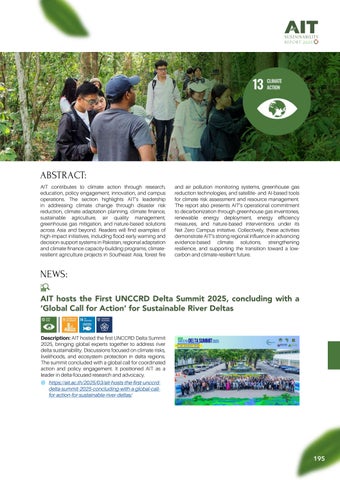
NEWS: AIT hosts the First UNCCRD Delta Summit 2025, concluding with a ‘Global Call for Action’ for Sustainable River Deltas
Description: AIT hosted the first UNCCRD Delta Summit 2025, bringing global experts together to address river delta sustainability. Discussions focused on climate risks, livelihoods, and ecosystem protection in delta regions. The summit concluded with a global call for coordinated action and policy engagement. It positioned AIT as a leader in delta-focused research and advocacy. 🌐 https://ait.ac.th/2025/03/ait-hosts-the-first-unccrd-
delta-summit-2025-concluding-with-a-global-callfor-action-for-sustainable-river-deltas/
195
SUSTAINABILITY REPORT 2025
Final DIWAM Workshop at AIT Highlights Collaborative Solutions for Drought Resilience in Northeast Thailand
Description: The final DIWAM workshop at AIT focused on collaborative strategies to improve drought resilience in Northeast Thailand. Stakeholders discussed datadriven planning, community engagement, and adaptive solutions. The workshop emphasized interdisciplinary and participatory approaches. Outcomes support longterm climate resilience planning. 🌐 https://ait.ac.th/2025/07/final-diwam-workshop-at-
ait-highlights-collaborative-solutions-for-droughtresilience-in-northeast-thailand/
Decarbonization Nexus 2025 Showcases Innovation for a Sustainable Future
Description: Decarbonization Nexus 2025 showcased innovations supporting low-carbon development pathways. Experts discussed technology, policy, and cross-sector collaboration. The event highlighted scalable climate solutions. It reinforced commitment to global decarbonization efforts. 🌐 https://ait.ac.th/2025/09/decarbonization-nexus-
2025-showcases-innovation-for-a-sustainablefuture/
AIT RRC.AP Hosted a Workshop at the Decarbonization Nexus 2025
Duration: 11 September 2025 Description: As part of the conference, the Regional Resource Center for Asia and the Pacific (AIT RRC. AP) conducted a hybrid workshop, Greener Futures: Advancing Climate Resilience through Nature-based Solutions (NbS), attracting over one hundred participants. Expert presentations covered nature-based solutions for climate adaptation, mainstreaming NbS into national adaptation planning, financing opportunities and challenges for NbS, and tackling black carbon in South Asia through the reinforcement of the Malé Declaration for sustainability and health and climate co-benefits. The Center also participated in the conference marketplace, showcasing promotional materials and knowledge
196
products supporting waste management, climate action, and adaptation. 🌐 https://www.rrcap.ait.ac.th/news/Pages/
vol26no3-06.aspx
SUSTAINABILITY REPORT 2025
Regional Training Workshop on Building Capacity for Green Climate Fund Concept Note Development in Central, South, and Southeast Asia
Description: AIT organized a regional training workshop to build capacity for Green Climate Fund concept note development. Participants learned proposal design and climate finance strategies. The workshop supported regional climate action readiness. It enhanced institutional and national capacities. 🌐 https://ait.ac.th/2025/05/regional-training-
workshop-on-building-capacity-for-green-climatefund-gcf-concept-note-development-in-centralsouth-and-southeast-asia/
Development of End-to-End Forest Fire Detection and Monitoring System
AIT Research Theme: Climate change Contributed by Faculty/School/Center: Education and Research Laboratory
Internet
Partners / Funded by: Silpakorn University | Thailand | Silpakorn University Expected Social Impact:
Description: This project designs an advanced early warning system for forest fire detection in Phrae Province, Thailand, using low-power IoT technologies and microsensor networks. It aims to improve early detection accuracy and community alert capacity in climatevulnerable areas.
› Reduce the problem of fine dust (PM2.5) › Reduce greenhouse gas emissions and increase ecosystem security and conservation of natural resources and the environment.
National Workshop Highlights Pathways for Climate-Resilient Agriculture in Savannakhet Province, Lao PDR
Description: A national workshop in Lao PDR highlighted strategies for climate-resilient agriculture in Savannakhet Province. Participants discussed adaptive farming practices, policy integration, and local capacity building. AIT contributed technical knowledge and research insights. The workshop aimed to strengthen agricultural resilience under climate change. 🌐 https://ait.ac.th/2025/04/national-workshop-
highlights-pathways-for-climate-resilientagriculture-in-savannakhet-province-lao-pdr/
197
SUSTAINABILITY REPORT 2025
Krufarm by AIT Students Showcases Climate Innovation at Bangkok Business Challenge 2025
AIT Research Theme: Climate change Contributed by Faculty/School/Center: School of Environment, Resources and Development; School of Engineering and Technology Partners / Funded by: Bangkok Business Challenge; Sasin School of Management; Kasikorn Bank Expected Social Impact: The mitigation of open-field burning and greenhouse gas emissions across tropical Asia through a pro-farmer digital marketplace. This innovation incentivizes sustainable biochar production, thereby generating new income streams for vulnerable smallholder farmers while actively restoring soil health. Description: An interdisciplinary team of AIT students presented Krufarm, a climate-focused digital innovation, at the Bangkok Business Challenge 2025, advancing as semi-finalists from a highly competitive pool of international institutions. The startup demonstrated sustainable, market-driven solutions that assist smallholder farmers in converting agricultural waste into biochar, a process that sequesters carbon and enhances soil health. By proposing the integration of AI
and blockchain technology for real-time monitoring and traceability, Krufarm provides farmers with transparent access to global carbon credit markets. Judges recognized its immense innovation potential, and the showcase powerfully highlighted AIT’s commitment to cutting-edge student entrepreneurship and crossdisciplinary climate action. 🌐 https://ait.ac.th/2025/05/krufarm-by-ait-students-
showcases-climate-innovation-at-bangkokbusiness-challenge-2025/
GIC Presents Risk Changes at Multi-Hazard Risk Assessment Training in Kyrgyzstan
Description: GIC presented findings on risk changes at a multi-hazard risk assessment training in Kyrgyzstan. The training focused on disaster risk analysis and capacity building. The presentation shared methodological insights. It supported regional resilience planning. 🌐 https://ait.ac.th/2025/05/gic-presents-risk-changes-
at-multi-hazard-risk-assessment-training-inkyrgyzstan/
198
SUSTAINABILITY REPORT 2025
AIT Joins Global Dialogue on Climate Action and Mountain Resilience at Sagarmatha Sambaad in Nepal
Description: AIT participated in the Sagarmatha Sambaad in Nepal to contribute to global climate dialogue. Discussions focused on mountain resilience and climate action. AIT shared research and policy perspectives. The engagement strengthened global collaboration. 🌐 https://ait.ac.th/2025/05/ait-joins-global-dialogue-
on-climate-action-and-mountain-resilience-atsagarmatha-sambaad-in-nepal/
Shaping the Future: Dr. Bindu Nath Lohani’s Insights on Sustainability and Development
Description: The story focuses on Bindu Nath Lohani’s reflections on sustainability and development priorities in Asia. It highlights the need for forward-looking leadership that can connect environmental goals with real economic and social progress. The article frames the talk as both a strategic perspective and a call to action for institutions and individuals working in development. It reinforces the idea that sustainability requires longterm thinking, coordination across sectors, and practical implementation pathways. 🌐 https://ait.ac.th/2025/01/shaping-the-future-dr-
bindu-nath-lohanis-insights-on-sustainability-anddevelopment/
Bangkok to Beijing: AIT Students Join Collaborative Environmental Research
Description: AIT students joined collaborative environmental research spanning Bangkok and Beijing. The initiative supported international research experience. Students gained technical and cultural exposure. It strengthened global research collaboration. 🌐 https://ait.ac.th/2025/11/bangkok-to-beijing-ait-
students-join-collaborative-environmental-research/
199
SUSTAINABILITY REPORT 2025
DRSD 2025 concludes with renewed commitment to building resilience
Description: DRSD 2025 concluded with renewed commitment to resilience building. Participants shared research and practices. Collaboration was emphasized. The event strengthened resilience networks.
🌐 https://ait.ac.th/2025/11/drsd-2025-concludes-with-
renewed-commitment-to-building-resilience/
PROJECTS: Promoting disaster preparedness and resilience by co-developing stakeholder support tools for managing the systemic risk of compounding disasters
AIT Research Theme: Climate change Contributed by Faculty/School/Center: Geoinformatics Center Partners / Funded by: European Research Executive Agency Expected Social Impact: The project follows a Responsible Research and Innovation approach as a process where all societal actors (citizens, transport infrastructure managers and operators, public authorities, business and industry, academia, Research and Innovation (R&I), and other relevant stakeholders) work together during the whole R&I process to align R&I outcomes to the values, needs, and expectations of the society, enabling easier access to scientific results, as well as the take-up of gender and ethics in the R&I content and process. The project will create an impact by increasing awareness of the benefits of a gender perspective in research, development, and innovation. From a long-term perspective, the gender mainstreaming approach will
200
contribute to favorable conditions for innovation systems and a more secure and sustainable society. Description: The PARATUS project develops an open-source platform for dynamic risk assessment of compounding disasters, accounting for cross-sectoral impacts and systemic risks. It equips disaster risk management stakeholders with co-developed digital tools and geo-information for adaptive crisis planning.
SUSTAINABILITY REPORT 2025
Flood Risk Assessment and Proposal of Mitigation Measures for the Right Band of Indus River
AIT Research Theme: Climate change Contributed by Intelligence Center
Faculty/School/Center:
Artificial
Partners / Funded by: Irrigation Department, Government of Sindh, Pakistan; Carthago Consultancy; Levant Consultancy; 360 Engineering and Management Solutions Expected Social Impact: The project is expected to enhance community resilience by strengthening local capacities to prepare for and respond to disasters through participatory approaches and capacity-building initiatives, thereby empowering vulnerable communities in Sindh and other targeted regions and reducing the loss of lives and property from floods, wildfires, and other hazards. It will reduce disaster risks through the implementation of AI-based early warning systems for floods and wildfires, improving preparedness and rapid response capabilities
while minimizing disaster-related damages and disruptions, particularly in rural and vulnerable communities. The initiative will also influence policy and governance by integrating climate risk management into regional policies and development plans, leading to improved governance and institutional frameworks for sustainable climate adaptation practices in Sindh, Central Asia, and beyond. In addition, the project is expected to improve livelihoods through increased agricultural productivity supported by better water resource management. Description: The Sindh Flood Emergency Rehabilitation Project (SFERP) conducts a comprehensive flood risk assessment for the right bank of the Indus River using advanced hydrological and hydraulic modeling. It proposes nature-based and infrastructure mitigation measures informed by lessons from the catastrophic 2022 floods.
National Adaptation Planning in the Asia-Pacific, and activities under flagship of Asia-Pacific Adapt
AIT Research Theme: Climate change Contributed by Faculty/School/Center: Regional Resource Center for Asia and the Pacific Partners / Funded by: Ministry of the Environment, Japan Expected Social Impact: The project will enhance the knowledge and capacity of stakeholders from the region on climate issues to develop resilient climate plans and actions, thereby continuing to support climate adaptation for the most vulnerable people in the region. Description: AIT’s RRC.AP contributes to supporting National Adaptation Planning in the Asia-Pacific and activities under the Asia-Pacific Adaptation Network flagship. It facilitates knowledge sharing and technical support on climate change adaptation planning and disaster risk reduction.
201
SUSTAINABILITY REPORT 2025
Expansion & Integration of Database Development for Flood Simulations in Decision Support System in Sindh Flood Emergency Rehabilitation Project
AIT Research Theme: Technology, Policy and Society Contributed by Intelligence Center
Faculty/School/Center:
Artificial
Partners / Funded by: World Bank; Carthago Consultancy International; Levant Consultant; 360 Engineering & Management Solutions; Z-Tech Solutions Expected Social Impact: Making flood management decisions across the planning, emergency response, and post-flood recovery stages requires comprehensive support to account for all impacts. By using the enhanced system, the Sindh Irrigation Department and relevant agencies will improve planning and decision-making to mitigate floods and minimize their overall impact. The proposed system enables users and decision-making authorities to identify affected areas and evaluate community-level solutions, ultimately minimizing human and economic losses. Description: This project expands and enhances a Decision Support System for real-time flood management
along the Indus River’s lower channel in Sindh, Pakistan, integrating satellite imagery and hydrological data. It improves flood monitoring, emergency response, and community involvement for the SFERP initiative.
Fusion of remote sensing, modelling, and ground measurement techniques for improved estimation of regional terrestrial water storage
AIT Research Theme: Climate change Contributed by Faculty/School/Center: School of Engineering and Technology Partners / Funded by: Expected Social Impact: The AIT high-resolution product includes a variety of environmental variables such as water, energy, climate, soil, and vegetation that are required by a wide range of disciplines. The product is not only useful for scientific advancement, but it is also beneficial for social applications such as agriculture, human/animal habitat relocation (due to limited water access), disease control, climate change impact
202
assessment/mitigation, and urban management, to name a few. An ease of use and free access to data for public, business, and government sectors also contributes to improvement of citizen science in Thailand, which is a crucial part of the country’s development. Description: This project develops techniques using remote sensing, hydrological modeling, and ground measurements to improve estimation of regional terrestrial water storage in the context of climate change. It advances understanding of hydrological cycle components and their impacts on floods, droughts, and water availability.
SUSTAINABILITY REPORT 2025
Development of Unique Carbon Storage capacity of the 3R Freshwater Mangrove Museum at AIT
AIT Research Theme: Climate change Contributed by Faculty/School/Center: Entrepreneurship Center Partners / Funded by: AirTrunk Singapore Holding Pte Ltd. Expected Social Impact:
› Creation of a novel ecosystem, which is globally new for nature and sustainable for cities and at the same time, offsetting mangrove habitat loss on the coast
› Improved waste management through 3R (Reduction, Re-use, Recycling) approach
› Enhanced urban food production (agriculture and aquaculture) utilizing waste nutrients for safe product-ofvalue generation (initially for AIT community, eventually for commercial sale) supported by better water resource management.
Description: Funded by AirTrunk Singapore, this project extends AIT’s Freshwater Mangrove Museum to enhance carbon capture and biodiversity, testing new mangrove planting and cultivation methods. It contributes to climate change mitigation through high-rate carbon sequestration and campus landscape improvement.
Lower Mekong Sub-region (LMS) Air Pollution, Short-Lived Climate Pollutants (SLCP), and Open Burning Emissions Assessment Program
AIT Research Theme: Climate change; Technology, Policy and Society Contributed by Faculty/School/Center: School of Engineering and Technology; Artificial Intelligence Center; Air Quality Nexus Center Partners / Funded by: United Nations Environment Programme; Thailand Pollution Control Department; Asian Venture Philanthropy Network Limited; School of Engineering and Technology; World Bank Group 1. Assessment of SLCP from Forest Fire and Open Burning in the LMS to Support the ASEAN Haze Control 2. Assessment of SLCP from Forest Fire and Open Burning in the LMS Region 3. Assessment of Agricultural and Forest Burning Emissions in Lao PDR Expected Social Impact: Strengthened implementation of the ASEAN Haze-Free Roadmap 2022–2030 and CLEAR Sky Strategy through the development of air pollution, GHG, and SLCP emission databases and standardized methodologies for assessing the contribution of agricultural open burning and forest fires. The program supports regional cooperation, knowledge sharing, capacity building, and institutionalization of methodologies and platforms to address transboundary haze and air pollution challenges in the Lower Mekong Sub-region and supports national policy development in Lao PDR.
Description: This program estimates Short-Lived Climate Pollutant (SLCP), greenhouse gas (GHG), and air pollution emissions from agricultural open burning and forest fires in the Lower Mekong Sub-region (LMS), including Cambodia, Laos, Myanmar, Thailand, Vietnam, and Lao PDR. It develops standardized methodologies for estimating emissions using satellite sensor data, remote sensing, and GIS techniques, updates incomplete datasets, and benchmarks results against global inventories to support national and regional policies. The program addresses critical gaps in health and environmental impact data under the ASEAN Haze Control framework and supports the implementation of the ASEAN Haze-Free Roadmap and CLEAR Sky Strategy through the development of regional emissions databases and baseline data.
203
SUSTAINABILITY REPORT 2025
Development And Integration Of Kirthar Model And Operations And Maintenance Of Data Center Under Sindh Flood Emergency Rehabilitation (SFERP)
AIT Research Theme: Technology, Policy and Society Contributed by Intelligence Center
Faculty/School/Center:
Artificial
Partners / Funded by: World Bank; Levant Pakistan; 360 Engineering and Management Solutions; Carthago Consultancy International; Z-Tech Solutions; Meridian PF General Trading Expected Social Impact: Overall, the project’s expected social impact on the right bank of the Indus River includes improved disaster management, sustainable resource management, informed development planning,
employment opportunities, stakeholder engagement, and technological advancement. These outcomes can contribute to the well-being, resilience, and sustainable development of the local communities in the region. Description: This project designs and integrates a Kirthar flood model into a data center for the Sindh Flood Emergency Rehabilitation Project (SFERP), procuring hardware and establishing data integration from satellite imagery and multiple monitoring sources. It supports informed decision-making for flood management in Sindh, Pakistan.
Regenerative Agriculture in ASEAN: Promoting Nature-Positive Solutions for Rice Production (REGA-ASEAN)
AIT Research Theme: Climate change Contributed by Faculty/School/Center: School of Environment, Resources and Development Partners / Funded by: The Rockefeller Foundation Expected Social Impact: The acceleration and widespread adoption of regenerative agricultural solutions across the ASEAN region, driving a significant reduction in agricultural greenhouse gas emissions while securing climate-resilient food production systems for local farmers. Description: The REGA-ASEAN project conducts desk research and field/greenhouse experiments on GHG emissions from rice production and the potential of nature-positive solutions in Thailand, Lao PDR, and Cambodia. It generates empirical evidence on the feasibility of regenerative agriculture for climate-resilient rice production.
204
SUSTAINABILITY REPORT 2025
Assessment of Natural Resources, Land Degradation, Biodiversity and Climate change impacts using Geospatial Technologies and Building Capacities
AIT Research Theme: Climate change Contributed by Faculty/School/Center: Geoinformatics Center Partners / Funded by: Food and Agriculture Organization of the United Nations; Global Environment Facility Expected Social Impact: The provision of critical geospatial intelligence on rangelands, water resources, and disaster-prone areas to empower vulnerable communities in Afghanistan. This technological integration directly improves sustainable livelihoods,
enhances environmental conservation, and secures long-term food security against severe climate impacts. Description: This FAO-GEF project combats land degradation and biodiversity loss in Afghanistan through sustainable rangeland management and community capacity building using geospatial technologies. It assesses natural resources, land degradation, and climate change impacts to inform conservation and restoration strategies.
Water resources risk and countermeasure for sustainable development under changing environment in the Pan Qinghai Tibetan Plateau
AIT Research Theme: Climate change Contributed by Faculty/School/Center: School of Engineering and Technology Partners / Funded by: Alliance of International Science Organizations, China; Institute of Geographic Sciences and Natural Resources Research, Chinese Academy of Sciences; China Institute of Water Problems, Hydropower and Ecology; National Academy of Sciences of Tajikistan; Institute of Geology, National Academy of Sciences of the Kyrgyz Republic; Department of Space Science, Institute of Space Technology, Pakistan Expected Social Impact: Increased awareness and knowledge related to climate change impacts and adaptation in the region; Improved water management. Reduced social and economic costs/damages associated with climate change through enhanced social cohesion and resilience among the various actors in the society.
Description: This project investigates the impacts of climate change on water resources and sustainable development in the Pan-Qinghai Tibetan Plateau, one of the most climate-sensitive regions globally. It uses dynamic downscaling and machine learning to model water resource risks and support resilience planning.
205
SUSTAINABILITY REPORT 2025
Climate Change Adaptation in Crop Production using Smart Farming Techniques
AIT Research Theme: Climate change Contributed by Faculty/School/Center: School of Environment, Resources and Development Partners / Funded by: Indian Council of Agricultural Research Expected Social Impact: The cultivation of a new generation of agricultural leaders equipped with practical, technology-driven skills in smart farming, empowering them to return home and champion sustainable, climateresilient crop production strategies within their local agricultural sectors. Description: An internship for Indian agricultural university students providing technical and practical experience in climate change adaptation in crop
production using smart farming techniques. Participants gain exposure to field design, data collection, and sustainable agricultural development.
Downscaling Future Extreme Weather and Natural Hazard Risks for Bangladesh
AIT Research Theme: Infrastructure Contributed by Faculty/School/Center: Geoinformatics Center Partners / Funded by: World Bank; National Center for Atmospheric Research, India; RTI International Expected Social Impact: The improvement of community resilience against climate change and severe hydro-meteorological disasters through the implementation of climate-resilient power system planning and targeted infrastructure risk mitigation.
Description: This technical assistance assignment downscales global and regional climate models for Bangladesh to assess changing climate hazard intensity, focusing on the power sector’s resilience to extreme weather. It provides hazard risk profiles to inform climateresilient power system planning.
Using Remote Sensing and AI Techniques to Forecast Future Peatland Fire Risk of the Kuan Kreng Landscape (KKL) in Thailand
AIT Research Theme: Climate change Contributed by Faculty/School/Center: School of Engineering and Technology Partners / Funded by: EcoSecurities Group Ltd. Expected Social Impact: The enhancement of community preparedness and resilience against wildfires through the deployment of AI-driven risk maps. These predictive tools inform proactive land use planning, optimize emergency response strategies, and safeguard
206
lives, property, and vulnerable peatland ecosystems from catastrophic fire risks. Description: This project develops a 10-year historical fire map and future fire risk projections for the Kuan Kreng Landscape in Thailand using remote sensing and AI techniques. It supports peatland fire prevention and climate change adaptation under human intervention scenarios.
SUSTAINABILITY REPORT 2025
Innovative tools to support the design and monitoring of NBS and GHG emission reduction projects
AIT Research Theme: Climate change Contributed by Faculty/School/Center: Geoinformatics Center Partners / Funded by: Food and Agriculture Organization of the United Nations Expected Social Impact:
› Promoting sustainable agricultural practices. › Mitigating climate change at the local level,. Description: AIT develops innovative tools for designing and monitoring Nature-Based Solutions and GHG emissions reduction projects in agriculture, including methods for measuring methane emissions from rice fields. The work supports FAO’s climate finance investment targeting and design under its Regional Priority Area 2.
Project: Third-Party Validation and Monitoring and Development of Data Analytics Tool of Sindh Flood Emergency Rehabilitation
AIT Research Theme: Climate change Contributed by Intelligence Center
Faculty/School/Center:
Artificial
Partners / Funded by: 360 Engineering Management Solutions Company Ltd.; Carthago Consultancy International; Impact International Expected Social Impact: This project promises significant social benefits. It will improve transparency and coordination among stakeholders, ensure timely project completion, and protect the environment and local communities. By understanding local needs, it
will distribute benefits fairly and address grievances. Engaging with communities will empower them, while data analytics will guide decision-making for sustainable development in Sindh. Description: AIT provides third-party validation and develops a data analytics tool for monitoring the Sindh Flood Emergency Rehabilitation Project (SFERP), which addresses the catastrophic 2022 floods affecting over 12 million people. The project supports infrastructure rehabilitation, livelihood recovery, and climate resilience building in Sindh, Pakistan.
Climate Change Adaptation in Agriculture for Enhanced Recovery and Sustainability of Highlands
AIT Research Theme: Climate change Contributed by Faculty/School/Center: AIT Extension Partners / Funded by: Asian Development Bank Expected Social Impact: The enhancement of agricultural resilience and economic recovery for upland farming communities through the deployment of tailored climate change adaptation strategies, ensuring
sustainable food production and livelihoods in vulnerable highland ecosystems. Description: This project supports climate change adaptation in agriculture for enhanced recovery and sustainability in highland areas, addressing challenges faced by upland farming communities. It focuses on building agricultural resilience through adaptation strategies tailored to highland conditions.
207
SUSTAINABILITY REPORT 2025
PyAEZ for localized crop suitability and land productivity assessment
AIT Research Theme: Climate change, Food-EnergyWater, Technology, Policy and Society
› Promote
Contributed by Faculty/School/Center: Geoinformatics Center
Description: The PyAEZ project develops software for localized crop suitability and land productivity assessment using Agro-Ecological Zonation methods, supporting climate resilience in agricultural planning. The tool helps developing regions adapt agricultural practices to climate variability and local conditions.
Partners / Funded by: Food and Agriculture Organization of the United Nation. Expected Social Impact:
› Create an open-access AEZ framework for developing
climate-resilience agricultural management.
considerations
in
nations
Testing Point-source Carbon Capture Technology under SMR Process Conditions
AIT Research Theme: Climate change Contributed by Faculty/School/Center: School of Engineering and Technology Partners / Funded by: Bangchak Corporation; Mitico Expected Social Impact: Provide the actual realtime testing results of the efficiency of carbon capture technology in Thailand. Description: AIT collaborates with Mitico (USA) and Bangchak Corporation to install and test a pilot-scale carbon capture technology at the Bangchak refinery in Bangkok. The project introduces carbon capture technology to Thailand and builds AIT’s expertise through a real-world industrial application.
208
SUSTAINABILITY REPORT 2025
Advancing Agriculture, Climate, Environmental, and Disaster Monitoring Through Satellite-Based Soil Moisture Retrieval and Applications in South East
AIT Research Theme: Climate change Contributed by Faculty/School/Center: School of Engineering and Technology Partners / Funded by: Asian Disaster Preparedness Center; Hydro - Informatics Institute; Kasetsart University Expected Social Impact: This workshop aims to improve understanding and application of soil moisture data in order to improve sustainable development goals. The workshop promotes effective water management in agriculture by enhancing access to accurate soil moisture information, thereby contributing to increased production and food security (SDG 2). It also improves climate resilience (SDG 13) by incorporating data into climate and disaster management plans, assisting with mitigation efforts and improving adaptive measures. Furthermore, the workshop encourages land conservation (SDG 15) by enhancing soil health and biodiversity through educated land use practices. Overall, it provides an important venue for collaboration in fostering a sustainable future for South East Asia.
Description: A workshop enhancing understanding and use of satellite soil moisture data for climate, agriculture, and disaster management in Southeast Asia. It fosters collaboration among soil moisture experts and stakeholders to improve calibration, validation, and data application for informed decision-making.
Empowering the Thailand high-resolution seasonal hydrometeorological forecasting system (THFS) to support smart agriculture under climate variation
AIT Research Theme: Climate change Contributed by Faculty/School/Center: School of Engineering and Technology Partners / Funded by: Agricultural Research Development Agency, Thailand; Rajamangala University of Technology Thanyaburi; Thai Meteorological Department; Royal Irrigation Department; Thailand’s National Electronics and Computer Technology Center; Office of Agricultural Economics, Thailand Expected Social Impact: The enhancement of agricultural productivity and community resilience through precise, high-resolution seasonal hydrometeorological forecasts. This capability significantly improves crop planning and irrigation strategies, reducing agricultural losses and strengthening long-term food security in the face of climate variability.
Description: The THFS project creates a high-resolution (1 km) seasonal hydrometeorological forecasting system for Thailand, providing real-time data and forecasts up to a season ahead for the agricultural sector. It supports smart agriculture decision-making under climate variability.
209
SUSTAINABILITY REPORT 2025
Sparking fairy dust: activating methanotrophy in rice paddies, through missing micronutrients
AIT Research Theme: Climate change, Food-EnergyWater Contributed by Faculty/School/Center: School of Engineering and Technology Partners / Funded by: EQT Foundation Expected Social Impact: This is a breakthrough research project. There is no direct social impact. However, the indirect social impact is that because of research like mine, there are global initiatives to mitigate GHG emissions which in turn will decelerate Climate Change with global implications. There are significant effects from Climate Change in all sectors, and deceleration of global warming has impact at a global scale. Description: Funded by the EQT Foundation, this project investigates micronutrient management and its
effect on methanotroph microbiology in Thai rice soils, which can prevent methane GHG emissions. Mesocosm experiments test cerium and copper amendments to monitor methane oxidation in batch experiments.
Strengthening climate resilience of agricultural livelihoods in Savannakhet Province, Lao PDR through participatory Ecosystembased Adaptation
AIT Research Theme: Food-Energy-Water Contributed by Faculty/School/Center: School of Environment, Resources and Development Partners / Funded by: Stockholm Environment Institute; National University of Laos; Kasetsart University Expected Social Impact: Enhanced climate resilience: Developing scenarios of climate-hazard impacts and assessing ecosystem-based adaptation practices informs and empowers Savannakhet Province’s agricultural communities to better understand and address their unique climate challenges. These actions and interventions foster heightened resilience, specifically livelihood resilience, and contribute to reducing inequalities in adaptation. Community empowerment: Through focus group discussions, key informant interviews and engagement with marginalized groups, the project fosters crosssectional community involvement and empowerment through a bottom-up approach where their voices will be amplified to the policymakers at the national and regional levels. This boosts awareness, participation, and local ownership through co-development of resiliencebuilding strategies.
210
Influence policy changes: Identifying policy gaps obstructing ecosystem-based adaptation implementation enables the project to influence positive policy change. Description: This project enhances climate resilience for marginalized agricultural communities in Savannakhet Province, Lao PDR through Ecosystem-based Adaptation (EbA). It assesses water infrastructure under current climate conditions and proposes EbA practices to strengthen livelihood resilience through WEC nexus policy changes.
SUSTAINABILITY REPORT 2025
Climate Finance for ASEAN
AIT Research Theme: Climate change, Technology, Policy and Society Contributed by Faculty/School/Center: AIT Extension Partners / Funded by: Deutsche Gesellschaft für Internationale Zusammenarbeit GmbH
Description: AIT’s Climate Finance for ASEAN project supports regional efforts to mobilize and manage climate finance aligned with sustainable development goals. It contributes to building climate finance capacity and frameworks across ASEAN member states.
Expected Social Impact: Participants can utilize their national policy instruments and planning mechanisms to access the Green Climate Fund
Empowering Developing Member Countries to Use Multispectral Satellite Images and Artificial Intelligence for Land Use and Coastal Planning
AIT Research Theme: Infrastructure Contributed by Faculty/School/Center: Geoinformatics centre Partners / Funded by: Asian Development Bank Expected Social Impact: 1. Improved livelihoods of farmers 2. Reduced impacts of disasters Description: AIT provides capacity building and system installation services for ADB’s cloud-based earth observation platform, enabling developing member countries to use satellite data for crop mapping, disaster risk assessment, and coastal planning. The project delivers knowledge products and case studies for operationalizing AI and remote sensing tools.
Review and Update BREB Climate Resilience Guidelines
AIT Research Theme: Infrastructure Contributed by Faculty/School/Center: Geoinformatics Center Partners / Funded by: World Bank Expected Social Impact: The sustained improvement of community resilience against severe climate change and hydro-meteorological disasters through the implementation of robust, climate-proofed rural electricity infrastructure guidelines. Description: This project reviews and updates climate resilience guidelines for the Bangladesh Rural Electrification Board (BREB) to better address hydrometeorological hazards including cyclones, storms,
and floods. It supports BREB’s mission to maintain electricity infrastructure resilience for over 90 million rural Bangladeshis.
211
SUSTAINABILITY REPORT 2025
Master’s Degree Program, Irrigation Department, Government of Sindh 2025-2028
AIT Research Theme: Climate change, Technology, Policy and Society Contributed by Faculty/School/Center: Artificial Intelligence Center Partners / Funded by: World Bank Expected Social Impact: The program will strengthen government capacity to reduce flood vulnerability, improve water management, and enhance disaster preparedness, leading to safer communities and more resilient livelihoods in Sindh Province.
Description: AIT delivers a Master’s Degree Program for Sindh Province Irrigation Department government officers from 2025-2028, combining advanced coursework, applied research, and practical training in flood risk reduction, climate resilience, and water resource management. The program directly supports SFERP’s objectives for disaster preparedness and sustainable infrastructure.
Harnessing Resilience of Agricultural Heritage Systems to Climate Change in the Highlands of Southeast
AIT Research Theme: Climate change Contributed by Faculty/School/Center: School of Environment, Resources and Development Partners / Funded by: Asia-Pacific Network for Global Change Research, Japan; Northeastern University of China; Naresuan University; Vietnam National University of Agriculture; National University of Lao; Department of Planning and Cooperation, Ministry of Agriculture and Environment. Expected Social Impact: The project strengthens food and livelihood security for highland farmers while preserving cultural and agro-ecological heritage. It will empower indigenous communities through the application of scientific knowledge, support evidencebased policy integration at national and regional levels, and enhance regional collaboration on climate-resilient agriculture. Description: This project identifies Agricultural Heritage Systems (AHS) in Southeast Asian highlands, assessing their social-ecological resilience to climate change
212
and integrating indigenous knowledge for communitydriven conservation. It establishes a regional network of AHS resilience studies and links science with policy for highland food security.
SUSTAINABILITY REPORT 2025
Smart IoT-Based Forest Fire Notification System Using Microsensor Networks
AIT Research Theme: Climate change Contributed by Faculty/School/Center: Education and Research Laboratory
Internet
Partners / Funded by: Broadcasting and Telecommunications Research and Development Fund for Public Interest, Thailand; Thammasat University; Kasetsart University Expected Social Impact:
› The general public and relevant agencies in the Northern provinces can know the air quality in their area in real-time and can plan their lives and operations accordingly.
› Academics, researchers, and students can utilize the database of the “Watfoon.Thai” platform, which is available as Open Data, for research and studies on solving air pollution and wildfire problems.
› Underprivileged people residing in remote areas can participate in the transfer of IoT technology and telecommunication network systems, creating an IoT ecosystem in the community that can be applied to other tasks.
› The spread of haze caused by wildfires can be promptly reduced at the source through rapid wildfire detection, which, if scaled up, will help reduce the PM2.5 dust problem for the entire region or country. Description: This project develops an IoT-based forest fire notification system leveraging microsensor networks and the LoRa IoT platform to detect fires and monitor PM2.5 air quality in northern Thailand. By addressing the seasonal haze crisis, the system safeguards public health and supports economic stability in affected tourism regions.
Greenhouse Gas Reduction in RICE: MICRO-biome climate smart applications
AIT Research Theme: Climate change, Food-EnergyWater Contributed by Faculty/School/Center: School of Engineering and Technology Partners / Funded by: National Higher Education Science Research and Innovation Policy Council, Thailand; Leibniz Universität Hannover; Institute of Biology Leiden Expected Social Impact: The Thai agricultural sector, because this research is relevant to rice agriculture. The benefits of these findings are not exclusive of one beneficiary but the field of rice agriculture as a whole. The other beneficiary is the staff to be hired by having the opportunity to develop their careers in the co-creation of science with European partners. Description: Funded by NXPO under a Joint Funding Scheme for Europe-Southeast Asia collaboration, this
project develops knowledge and microbial technologies to mitigate greenhouse gas emissions from rice agriculture. An international consortium led by Thailand partners with institutions in Germany, Spain, and the Netherlands.
213
SUSTAINABILITY REPORT 2025
Professional Development Program on Mainstreaming Climate Change and Gender in the Planning and Budgeting Process
AIT Research Theme: Technology, Policy and Society Contributed by Faculty/School/Center: Yunus Center Partners / Funded by: Ministry of Finance, Tanzania Expected Social Impact: To ensure a country’s longterm stability, promote economic development, and improve the well-being of its citizens. By incorporating climate change and gender considerations, government of Tanzania can ensure its financial resources promote a more sustainable and equitable society. Description: A professional development program equipping Tanzanian government officials with tools to integrate climate change and gender considerations into national budget planning processes. Participants learn to
allocate resources for environmental sustainability and social equity across key sectors.
Climate-Induced Risks in Agriculture: Assessing and Addressing OnFarm Impacts
AIT Research Theme: Food-Energy-Water Contributed by Faculty/School/Center: School of Environment, Resources and Development Partners / Funded by: Expected Social Impact: This research is expected to have a profound social impact by empowering farmers in Thailand to better manage agricultural and climate risks while providing critical insights for policymakers, extension educators, and researchers. By identifying factors that influence farmers’ adoption of risk management strategies, the study guides government agencies in designing targeted policies that improve access to agricultural information and credit, enabling farmers to cope with climate variability and safeguard their livelihoods. Policymakers can take the findings to understand which types of farmers are more likely to adopt government-supported risk coping tools alongside traditional strategies, enabling efficient resource allocation. Additionally, the study helps extension educators focus on producers who need risk
214
management education the most, ultimately enhancing resilience, improving farm productivity, and contributing to sustainable development. Description: This project assesses climate-induced agricultural risks and develops strategies to address onfarm impacts of climate change. It focuses on climatesmart agriculture approaches and risk management strategies for agricultural communities.
SUSTAINABILITY REPORT 2025
Tackling Open Climate Science Questions and Building Consensus on Black Carbon
AIT Research Theme: Climate change Contributed by Faculty/School/Center: Regional Resource Center for Asia and the Pacific Partners / Funded by: Stockholm University; The Maldives Climate Observatory Hanimaadhoo; Institute for Governance & Sustainable Development Expected Social Impact: The project will a) tackle two fundamental scientific problems regarding BC, (i.e., BCclimate modelling uncertainties and discrepancies in BC emission estimates) b) build consensus between different groups of climate science experts (observational, emission inventory, modelling) and c) effectively disseminate policy-relevant BC science insights. The peer-reviewed project outputs can directly contribute to IPCC shortlived climate forces guidance (set to be published in 2027) and Assessment Report 7 (to be published in 2029). South Asia is the world’s second-largest regional emitter of black carbon, existing observational data and is a high priority region for advancing emissions inventories and regional scale climate understanding. Outputs of the project will be globally-relevant, but the focus of the data and regional scale analysis will be in South Asia,
leveraging the project team’s network expertise and available datasets. Description: This project continues the ABC initiative, promoting regional capacity building and sciencepolicy interaction on atmospheric brown clouds and black carbon aerosols, with emphasis on South Asia and the Maldives Climate Observatory. It provides scientific evidence on ABC causes and impacts to inform air quality and climate policies.
Building Capacity for Green Climate Fund (GCF) Concept Note Development in Central, South, and Southeast Asia
Duration: 28-30 May 2025 Description: The Regional Resource Center for Asia and the Pacific at the Asian Institute of Technology (AIT RRC.AP) successfully organized the “Regional Training Workshop on Building Capacity for Green Climate Fund (GCF) Concept Note Development in Central, South, and Southeast Asia ” from 6 to 9 May 2025 in Bangkok, Thailand. This intensive four-day workshop brought together around 20 participants from seven countries. Participants included representatives from National Designated Authorities (NDAs), Accredited Entities (AEs), government agencies, and technical consultants, each playing a key role in the design and implementation of climate change adaptation projects. The event fostered hands-on learning, regional collaboration, and knowledge exchange to strengthen access to climate finance through the GCF. The training addressed a critical need in the region: strengthening institutional capacity to access and manage climate finance through the GCF. Participants gained an in-depth understanding of GCF’s updated policies, the Simplified Approval Process (SAP), and
investment criteria. Through interactive sessions, technical briefings and group exercises, participants built practical skills in concept note development covering impact chains and problem analysis, theory of change and logical frameworks, climate rationale and financing strategies, gender and social inclusion. The workshop also served as a platform for regional knowledge exchange, enhancing participants’ ability to navigate GCF processes and improve the quality of concept notes. 🌐 https://www.rrcap.ait.ac.th/news/Pages/
vol26no2-04.aspx
215
SUSTAINABILITY REPORT 2025
Regional Training Workshop on Building Capacity for Green Climate Fund (GCF) Concept Note Development in Central, South, and Southeast Asia, Bangkok, Thailand
Duration: 6-9 May 2025 Description: The Regional Resource Center for Asia and the Pacific at the Asian Institute of Technology (AIT RRC.AP), with support from the Ministry of the Environment, Japan (MoEJ), and in collaboration with the Green Climate Fund (GCF) Secretariat, successfully organized the “Regional Training Workshop on Building Capacity for Green Climate Fund (GCF) Concept Note Development in Central, South, and Southeast Asia from 6 to 9 May 2025 in Bangkok, Thailand. This intensive fourday workshop brought together around 20 participants from seven countries such as Bangladesh, Cambodia, Kazakhstan, Kyrgyzstan, Lao PDR, Nepal and Uzbekistan. Participants included representatives from National Designated Authorities (NDAs), Accredited Entities (AEs), government agencies, and technical consultants, each playing a key role in the design and implementation of climate change adaptation projects. The event fostered hands-on learning, regional collaboration, and knowledge exchange to strengthen access to climate finance through the GCF. The workshop commenced with welcoming remarks from Dr. Guilberto Borongan, Director of AIT RRC.AP. He highlighted the critical role of climate finance in supporting vulnerable developing countries to confront the impacts of climate change. He also encouraged active engagement to drive inclusive, resilient climate action across the region. In his keynote address, Prof. Pai-Chi Li, President of the Asian Institute of Technology, warmly welcomed participants on behalf of AIT, emphasizing the importance of green finance and resilience, and expressing confidence that the workshop would help develop impactful, locally relevant solutions aligned with global climate goals. Mr. Taiki Kohno, Assistant Director of the Climate Change Adaptation Office at the Global Environment Bureau, Ministry of the Environment, Japan (MoEJ), delivered the next keynote speech. He highlighted timeliness in advancing equitable access to climate finance, emphasizing the importance of strengthening technical capacity, promoting peer learning, and fostering collaboration to overcome barriers and maximize
216
opportunities through the reformed GCF Readiness Program for climate-resilient development. Mr. Ivo Besselink, Subregional Lead, Southeast Asia, Department of the Asia and the Pacific Region (DAPAC), GCF followed with a keynote speech emphasizing the urgency of climate action and reaffirmed GCF’s commitment to enabling green finance through partnerships, institutional reforms, and tailored regional solutions. The training addressed a critical need in the region: strengthening institutional capacity to access and manage climate finance through the GCF. Participants gained an in-depth understanding of GCF’s updated policies, the Simplified Approval Process (SAP), and investment criteria. Through interactive sessions, technical briefings and group exercises, participants built practical skills in concept note development covering impact chains and problem analysis, theory of change and logical frameworks, climate rationale and financing strategies, gender and social inclusion. The workshop also served as a platform for regional knowledge exchange, enhancing participants’ ability to navigate GCF processes and improve the quality of concept notes. Several country teams developed draft concept note proposals for future GCF concept note submissions, contributing to stronger pipelines of climate adaptation projects. Building on the momentum of this event, AIT RRC.AP will continue to provide technical assistance and promote knowledge-sharing to empower national and local actors in accessing and utilizing climate finance more effectively.
SUSTAINABILITY REPORT 2025
AIT’s Climate Action to Achieve Net Zero for a Sustainable Tomorrow
Duration: 6-9 May 2025 Description: The Regional Resource Center for Asia and the Pacific at the Asian Institute of Technology (AIT RRC. AP), with support from the Ministry of the Environment, Japan (MoEJ) and in collaboration with the Green Climate Fund (GCF) Secretariat, successfully organized the regional training workshop “Building Capacity for Green Climate Fund (GCF) Concept Note Development in Central, South, and Southeast Asia” from 6 to 9 May 2025 in Bangkok, Thailand. This intensive four-day workshop brought together around 20 participants from seven countries: Bangladesh, Cambodia, Kazakhstan, Kyrgyzstan, Lao PDR, Nepal, and Uzbekistan. Participants included representatives from National Designated Authorities (NDAs), Accredited Entities (AEs), government agencies, and technical consultants—each playing a key role in designing and implementing climate change adaptation projects. The event fostered handson learning, regional collaboration, and knowledge exchange to strengthen access to climate finance through the GCF. The workshop commenced with welcoming remarks from Dr. Guilberto Borongan, Director of AIT RRC.AP, who highlighted the critical role of climate finance in supporting vulnerable developing countries to confront climate impacts. He encouraged active engagement to drive inclusive, resilient climate action across the region. In his keynote address, Prof. Pai-Chi Li, President of the Asian Institute of Technology, warmly welcomed participants on behalf of AIT, emphasizing the importance of green finance and resilience while expressing confidence that the workshop would help develop impactful, locally relevant solutions aligned with global climate goals. Mr. Taiki Kohno, Assistant Director of the Climate Change Adaptation Office at the Global Environment Bureau, Ministry of the Environment, Japan (MoEJ), delivered the next keynote speech. He highlighted the timeliness of advancing equitable access to climate finance, emphasizing the need to strengthen technical capacity, promote peer learning, and foster collaboration to maximize opportunities through the reformed GCF Readiness Program. Mr. Ivo Besselink, Subregional
Lead for Southeast Asia (DAPAC) at the GCF, followed with a keynote speech emphasizing the urgency of climate action and reaffirming the GCF’s commitment to enabling green finance through partnerships, institutional reforms, and tailored regional solutions. The training addressed a critical regional need: strengthening institutional capacity to access and manage climate finance through the GCF. Participants gained an in-depth understanding of updated GCF policies, the Simplified Approval Process (SAP), and investment criteria. Through interactive sessions, technical briefings, and group exercises, participants built practical skills in concept note development, covering:
› Impact chains and problem analysis › Theory of change and logical frameworks › Climate rationale and financing strategies › Gender and social inclusion The workshop also served as a platform for regional knowledge exchange, enhancing participants’ ability to navigate GCF processes and improve proposal quality. Several country teams developed draft concept notes for future GCF submissions, contributing to a stronger pipeline of climate adaptation projects. Building on this momentum, AIT RRC.AP will continue providing technical assistance and promoting knowledge sharing to empower national and local actors to access and utilize climate finance more effectively. 🌐 https://www.rrcap.ait.ac.th/news/Pages/
vol26no2-03.aspx
217
SUSTAINABILITY REPORT 2025
Country-Scale Quantification of GHG Emissions from Domestic WWTP in Thailand
AIT Research Theme: Technology, Policy and Society Contributed by Faculty/School/Center: Global Water and Sanitation Center Partners / Funded by: United Nations HUMAN settlements PROGRAMME Expected Social Impact: Estimation of GHG emission from Domestic WWTP in Thailand. Description: AIT estimates greenhouse gas emissions from domestic wastewater treatment plants across Thailand using secondary data from the Pollution Control Department, applying a GHG estimation tool tailored to the Thai context. The study develops guidelines for data collection and supports GHG reduction planning in the wastewater sector.
OPERATIONS: AIT’s Climate Action to achieve Net Zero for a Sustainable Tomorrow Under SDG 13: Climate Action, AIT has strengthened its commitment to reducing greenhouse gas emissions through systematic assessment and targeted mitigation strategies. Total campus emissions increased from 8,367 tCO2e in 2022 to 9,629 tCO2e in 2023, followed by a reduction to 9,221 tCO2e in 2024, reflecting the initial impact of ongoing decarbonization efforts. Scope 2 emissions from electricity consumption remain the largest contributor, while Scope 3 emissions—particularly from air travel and commuting—also represent a significant share. AIT has adopted a structured decarbonization roadmap that integrates renewable energy, energy efficiency, infrastructure upgrades, and behavioral interventions. Key initiatives include solar rooftop and floating PV systems, chiller and air-conditioning upgrades, energy
218
conservation measures, and nature-based solutions. These interventions collectively demonstrate substantial emission reduction potential, gradually lowering cumulative emissions toward net zero. The increasing role of clean energy, improved operational efficiency, and data-driven emissions monitoring highlight AIT’s transition toward a low-carbon and climate-resilient campus. Continued focus on Scope 3 emissions, particularly mobility and procurement, will be critical in achieving long-term targets. Overall, AIT’s integrated approach positions the campus as a living laboratory for climate action, supporting its commitment to achieving net zero emissions by 2030 while contributing to global climate mitigation efforts.
SUSTAINABILITY REPORT 2025
219