SUSTAINABILITY REPORT 2025
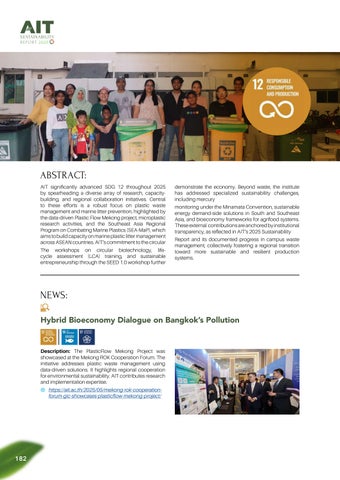
ABSTRACT: AIT significantly advanced SDG 12 throughout 2025 by spearheading a diverse array of research, capacitybuilding, and regional collaboration initiatives. Central to these efforts is a robust focus on plastic waste management and marine litter prevention, highlighted by the data-driven Plastic Flow Mekong project, microplastic research activities, and the Southeast Asia Regional Program on Combating Marine Plastics (SEA-MaP), which aims to build capacity on marine plastic litter management across ASEAN countries. AIT’s commitment to the circular The workshops on circular biotechnology, lifecycle assessment (LCA) training, and sustainable entrepreneurship through the SEED 1.0 workshop further
demonstrate the economy. Beyond waste, the institute has addressed specialized sustainability challenges, including mercury monitoring under the Minamata Convention, sustainable energy demand-side solutions in South and Southeast Asia, and bioeconomy frameworks for agrifood systems. These external contributions are anchored by institutional transparency, as reflected in AIT’s 2025 Sustainability Report and its documented progress in campus waste management, collectively fostering a regional transition toward more sustainable and resilient production systems.
NEWS: Hybrid Bioeconomy Dialogue on Bangkok’s Pollution
Description: The PlasticFlow Mekong Project was showcased at the Mekong ROK Cooperation Forum. The initiative addresses plastic waste management using data-driven solutions. It highlights regional cooperation for environmental sustainability. AIT contributes research and implementation expertise.
🌐 https://ait.ac.th/2025/05/mekong-rok-cooperation-
forum-gic-showcases-plasticflow-mekong-project/
182
SUSTAINABILITY REPORT 2025
Indonesia Moves Forward on Plastic Waste Reduction as Global Talks Stall
Description: The article examines Indonesia’s progress in reducing plastic waste despite slow global negotiations. It highlights national policies, innovation, and community action. Local initiatives demonstrate practical pathways to environmental improvement. The discussion underscores the importance of national leadership in sustainability. 🌐 https://ait.ac.th/2025/08/indonesia-moves-forward-
on-plastic-waste-reduction-as-global-talks-stall/
AIT and UN-Habitat Sign Agreement to Strengthen ASEAN Capacity on Plastic Waste and Marine Litter
Description: AIT and UN-Habitat signed an agreement to strengthen ASEAN capacity on plastic waste and marine litter. The collaboration focuses on research, policy support, and capacity building. It addresses marine pollution challenges. The partnership advances regional environmental sustainability. 🌐 https://ait.ac.th/2025/09/ait-and-un-habitat-sign-
agreement-to-strengthen-asean-capacity-on-plasticwaste-and-marine-litter/
AIT Murdoch University Workshop Explores Biotechnology and the Circular Economy
Description: AIT and Murdoch University co-hosted a workshop on biotechnology and the circular economy. Discussions linked innovation with sustainability. Participants explored applied research opportunities. The workshop strengthened international academic collaboration. 🌐 https://ait.ac.th/2025/10/ait-murdoch-university-
workshop-explores-biotechnology-and-the-circulareconomy/
183
SUSTAINABILITY REPORT 2025
Mapping Plastic Leakage Hotspots in the Mekong Subregion: Insights from Geoinformatics Center (GIC)
Description: This article highlights research mapping plastic leakage hotspots in the Mekong subregion. Datadriven analysis supports targeted interventions. The work informs policy and waste management strategies. It contributes to plastic pollution mitigation. 🌐 https://ait.ac.th/2025/10/mapping-plastic-leakage-
hotspots-in-the-mekong-subregion-insights-fromgic/
Strengthening Academic Collaboration with the National University of Singapore (NUS)
Description: AIT strengthened academic collaboration with NUS through strategic engagement. Discussions focused on research and exchange. The partnership enhances academic excellence. It supports global collaboration. 🌐 https://ait.ac.th/2025/10/strengthening-academic-
collaboration-with-the-national-university-ofsingaporenus/
Workshop Explores Circular Solutions for Waste Management Challenges
Description: AIT hosted a workshop on circular solutions for waste management. Discussions emphasized innovation and sustainability. Participants explored policy and technical approaches. The workshop supported circular economy transitions. 🌐 https://ait.ac.th/2025/11/workshop-explores-
circular-solutions-for-waste-managementchallenges/
184
SUSTAINABILITY REPORT 2025
Session on Microplastics and Environmental Challenges Held at AIT
Description: AIT hosted a session on microplastics and environmental challenges. Experts discussed research findings and policy responses. The session emphasized environmental health. It supported sustainability awareness. 🌐 https://ait.ac.th/2025/11/session-on-microplastics-
and-environmental-challenges-held-at-ait/
AIT and UCAS Strengthen Belt and Road Cooperation through CASANSO Microplastic Research Initiative
Description: AIT and UCAS strengthened Belt and Road cooperation through microplastic research. The initiative supports environmental science collaboration. Research addresses regional challenges. It enhances scientific diplomacy. 🌐 https://ait.ac.th/2025/12/ait-and-ucas-strengthen-
belt-and-road-cooperation-through-cas-ansomicroplastic-research-initiative/
Building LCA Capacity: Two-Day Professional Training Empowers Decision-Makers and Researchers
Description: AIT conducted a two-day training on lifecycle assessment. The program empowered decisionmakers and researchers. Skills supported sustainability analysis. The training strengthened capacity. 🌐 https://ait.ac.th/2025/12/building-lca-capacity-
two-day-professional-training-empowers-decisionmakers-and-researchers/
185
SUSTAINABILITY REPORT 2025
PROJECTS: Reduce, Reuse, Recycle to Protect the Marine Environment and Coral Reefs (3RproMar)
AIT Research Theme: Food-Energy-Water
Expected Social Impact: Health and Environment
Contributed by Faculty/School/Center: Regional Resource Center for Asia and the Pacific
Description: The 3RproMar project provides a common platform for information and knowledge sharing on marine litter management in ASEAN, enhancing decisionmaking capacity to combat marine plastic pollution. It focuses on knowledge transfer and exchange on integrated solid waste management and waste streams.
Partners / Funded by: The German Agency for International Cooperation or (GIZ) | Germany | - ASEAN Secretariat, Environmental Division - Deutsche Gesellschaft für Internationale Zusammenarbeit (GIZ) GmbH - ERIA NIVA
Support to the Global Strategy for SCP, the GO4SDGS, and the Sea Circular in Asia
AIT Research Theme: Climate change, Food-EnergyWater
2. Enhancing Industry Empowerment
Contributed by Faculty/School/Center: Office of President
Description: This project strengthens AIT’s support for SDG 12 through a Small-Scale Funding Agreement (SSFA) with UNEP, promoting Sustainable Consumption and Production (SCP) strategies in Asia. It facilitates use of UNEP’s SCP Hotspot Analysis tool and science-driven tools to develop and execute SCP initiatives.
Partners / Funded by: United Nations Environment Programme Expected Social Impact: 1. Promoting Sustainable Consumption and Production (SCP) Awareness and Capacity
Sustainability
and
Youth
Capacity Building Program for Reducing Recycling Related Marine Plastic Pollution in ASEAN Cities (CaRMPAC Project)
AIT Research Theme: Technology, Policy and Society
› Improved accessibility to comprehensive training
Contributed by Faculty/School/Center: Regional Resource Center for Asia and the Pacific
materials and capacity building support resources and tools for policy regulators and technical officers conducting training on the monitoring and prevention of plastic leakage from recycling facilities
Partners / Funded by: Economic Research Institute for ASEAN and East Asia, Indonesia; ASEAN Cities Expected Social Impact:
› Enhanced technical capacity among regional, national, and local policymakers in ASEAN cities for formulating, implementing, and monitoring policies aimed at preventing or reducing plastic pollution and leakage from both formal and informal recycling sectors.
186
Description: Component 1 of the CaRMPAC Project delivers tailored capacity building interventions for recyclers and municipalities across major ASEAN cities to reduce recycling-related marine plastic pollution. It focuses on policy support, industry best practices, and environmental awareness training.
SUSTAINABILITY REPORT 2025
Mastering Life Cycle Assessment: A Dynamic Training Workshop for Decision-Makers and Managers
AIT Research Theme: Climate change Contributed by Faculty/School/Center: School of Engineering and Technology Partners / Funded by: Asian Institute of Technology, Thailand Expected Social Impact: The training workshop on LCA will be designed to elevate private sector leadership by equipping participants with practical Life Cycle Assessment (LCA) skills. In manufacturing, it can enhance product design, reduce costs, and minimize environmental impact. Retail managers can leverage these skills to develop greener supply chains, enhancing brand appeal. Similarly, leaders in the energy sector may refine their assessments of renewable technologies, gaining a competitive advantage. In the food and agriculture industries, the workshop fosters sustainable sourcing and waste reduction. Construction leaders can prioritize low-carbon materials to comply with green standards. By targeting decision-makers, the workshop ensures that LCA insights influence highlevel strategies rather than merely satisfying compliance requirements. Its engaging, hands-on format can inspire
actionable outcomes, promoting broader adoption of LCA practices across various sectors. Description: A training workshop on Life Cycle Assessment (LCA) and Circular Economy principles designed for managers and decision-makers. Participants gain practical tools to assess and reduce the environmental footprint of products and processes throughout their lifecycle.
Promotion of Action Against Marine Plastic Litter in Asia
AIT Research Theme: Technology, Policy and Society Contributed by Faculty/School/Center: School of Environment, Resources and Development Partners / Funded by: United Nations Environment Programme Mekong River Commission; Institute of Strategy and Policy on Natural Resources and Environment, Vietnam; International Union for Conservation of Nature, Sri Lanka; Ministry of Environment, Ministry of Environment, Cambodia; Living Indus, UN Resident Coordinator Office, Pakistan; Mahidol University; Bangkok Metropolitan Administration; Pollution Control Department, Thailand Expected Social Impact: Contribute to protecting the marine environment from land-based plastic pollution through strengthened regional coordination and technological adoption. Description: This project promotes science-based action to reduce and prevent plastic pollution in Asian
riverine ecosystems, focusing on Thailand, Cambodia, Sri Lanka, Vietnam, and Pakistan. It advances green financing, capacity building, and improved waste management systems for plastic litter prevention.
187
SUSTAINABILITY REPORT 2025
Development and dissemination of technical guidelines for plastics and resin pellets leakage prevention from factories and informal recycling sector i
AIT Research Theme: Technology, Policy and Society Contributed by Faculty/School/Center: School of Environment, Resources and Development Partners / Funded by: ERIA through Regional Resources Center for Asia and the Pacific Expected Social Impact: Reduce poverty and improve environmental and health protection for recyclers to support better livelihoods. Description: This project contributes to preventing plastic and resin pellet leakage into marine environments by developing and disseminating technical guidelines and best practices for resin-producing factories and informal recycling facilities across ASEAN member states.
Developing and Delivering a Capacity Building Training and Study Tour Program on Behavioral Change in Plastics and Plastic Waste Management in ASEAN
AIT Research Theme: Technology, Policy and Society Contributed by Faculty/School/Center: Global Water and Sanitation Center; Regional Resource Center for Asia and the Pacific Partners / Funded by: SEA-MaP Project Management Unit, Indonesia Expected Social Impact: These activities will emphasize the identification and exploration of applicable and transferable technologies and policies that are pertinent to the ASEAN context. Description: This project creates and institutionalizes platforms for innovation, knowledge sharing, and partnerships across ASEAN to address plastic pollution through behavioral change in plastics and waste management. It promotes circular economy solutions and encourages plastic reduction partnerships among regional stakeholders.
188
SUSTAINABILITY REPORT 2025
Strengthening Plastic Pollution Management in Asia and the Pacific Implementation
AIT Research Theme: Smart communities Contributed by Faculty/School/Center: School of Engineering and Technology Partners / Funded by: UN Environment Programme Expected Social Impact: Raising public awareness on plastic waste pollution Description: This project enhances systematic approaches to plastic pollution management in the Mekong River Basin and Pacific Islands under Japan Government funding, improving assessment tools with the Mekong River Commission. It strengthens national and local waste management systems for plastic pollution control.
Assessment of the Quantity and Rate of Solid Waste Generation Using a Mathematical Modeling Approach
AIT Research Theme: Climate change Contributed by Faculty/School/Center: Global Water and Sanitation Center Partners / Funded by: National Research Council of Thailand; Ramkhamhaeng University, Thailand Expected Social Impact:
› Improved waste management efficiency through datadriven decision-making.
› Enhanced recycling and waste segregation at the community level.
› Strengthened institutional collaboration for sustainable waste management solutions.
› Contribution to policy development for sustainable waste management in Thailand. Description: This project develops a mathematical modeling approach to assess solid waste generation quantity and rates in Thailand, integrating data-driven analysis of recyclable waste. A database system supports real-time analysis to improve waste management decision-making.
Capacity Building Program for Reducing Recycling-Related Marine Plastic Pollution in ASEAN Cities (the CaRMPAC Project)
AIT Research Theme: Technology, Policy and Society Contributed by Faculty/School/Center: Regional Resource Center for Asia and the Pacific Partners / Funded by: Economic Research Institute for ASEAN and East Asia, Indonesia; Regional Knowledge Center For Marine Plastic Debris (ERIA-RKC-CMD) seed Expected Social Impact:
› Improved plastic recycling facilities › Community behavioral change › Awareness raising of plastic recycling facilities
› Integrated informal waste sector in SWM › Enhanced healthy and clean environment ASEAN cities Description: The CaRMPAC Project designs, develops, and implements comprehensive capacity building programs targeting 10 ASEAN cities to enhance waste management practices and prevent plastic leakage. It strengthens technical capacity among government officers, regulators, and both formal and informal recyclers.
189
SUSTAINABILITY REPORT 2025
SEA-MaP Knowledge Exchange Program 2025
AIT Research Theme: Technology, Policy and Society Contributed by Faculty/School/Center: Global Water and Sanitation Center; Regional Resource Center for Asia and the Pacific Partners / Funded by: SEA-MaP Project Management Unit, Indonesia; Regional Resource Center for Asia and the Pacific Expected Social Impact: The SEA-MaP Knowledge Exchange Program is expected to generate significant social impact by enhancing awareness, knowledge, and skills related to marine plastic management among participants from ASEAN Member States. Improved capacity of policymakers, practitioners, and stakeholders will lead to more effective and inclusive strategies for reducing plastic pollution, benefiting coastal communities and ecosystems. By fostering collaboration, knowledge sharing, and the adoption of sustainable and circular economy practices, the program will support healthier marine environments, strengthen community resilience, and promote long-term societal well-being in the region.
Description: The SEA-MaP Knowledge Exchange 20252026 facilitates knowledge sharing and innovation on marine plastic pollution management among ASEAN member states under the World Bank-funded SEA-MaP Regional Project. It supports policy strengthening and circular economy practices through peer learning and exchange events.
Shaping a Regional Program Framework for Bioeconomy (BEST) and Technical Support to Advance the Priority Program Area Bioeconomy for Sustainable F
AIT Research Theme: Technology, Policy and Society Contributed by Faculty/School/Center: AIT Extension Partners / Funded by: UN Environment Programme Expected Social Impact: A fully integrated, inclusive and circular regional bioeconomy across Asia and the Pacific that transforms agrifood systems, balances economic growth with environmental sustainability, optimises biological resources, reduces waste and emissions, and contributes to long-term climate resilience and sustainable development in line with FAO BE2 and the SDGs.
190
Postdoctoral research, Firuz Ahamed Nahid, presenting via Zoom on the “Integrating Demand-side Solutions for Accelerated Decarbonization of Power Supply System: Insights from Bangladesh and Thailand” webinar
Description: AIT contributes to shaping a regional bioeconomy program framework (BEST), providing technical support to advance bioeconomy for sustainable food and agri-food systems. The project addresses climateresilient agrifood systems, bio-based value chains, and green finance in the context of Southeast Asia. 🌐 https://SMARTS Center.ait.ac.th/post/integrating-
demand-side-solutions-for-accelerateddecarbonization-of-power-supply-system-insights-f
Webinar’s poster for the Integrating Demand-side Solutions for Accelerated Decarbonization of Power Supply System: Insights from Bangladesh and Thailand
SUSTAINABILITY REPORT 2025
Strengthening Mercury Monitoring: AIT Hosts Intensive Training for Thai Laboratories, Pathumthani, Thailand
Duration: 13-17 January 2025 Description: AIT RRC.AP, with support from UNEP, conducted a five-day intensive training on mercury and hydroquinone analysis for Thai laboratory personnel. Participants gained hands-on experience in sample preparation, instrument operation, and data interpretation. The training strengthened technical capacity for mercury monitoring and laboratory testing. It also enhanced understanding of Thailand’s obligations under the Minamata Convention. The initiative supports improved environmental monitoring and regulatory enforcement. 🌐 https://www.rrcap.ait.ac.th/news/Pages/
vol26no1-01.aspx
AIT RRC.AP and GWSC Jointly Organize Regional Workshop on Extended Producer Responsibility in Kuala Lumpur
Duration: 18-21 November 2025 Description: The Asian Institute of Technology Regional Resource Center for Asia and the Pacific (AIT RRC.AP), in collaboration with the Global Water and Sanitation Center (GWSC), successfully organized a four-day regional workshop on Extended Producer Responsibility (EPR) under the Southeast Asia Regional Program on Combating Marine Plastics (SEA-MaP). Held from 18–21 November 2025 in Kuala Lumpur, Malaysia, the program brought together delegates from ASEAN Member States (AMS) to enhance regional capacity in addressing plastic pollution. The workshop forms part of the annual Knowledge Exchange Program (KEP) under SEA-MaP, a World Bank–supported initiative aimed at strengthening the implementation of the ASEAN Regional Action Plan for Combating Marine Debris. This year’s focus on EPR reflects growing demand among AMS for practical guidance on designing and operationalizing producer responsibility systems. Across two days of intensive training, participants engaged in modules covering the foundations of EPR policy, producer obligations, financial mechanisms,
data and monitoring systems, and eco-design. Handson activities, including group exercises on developing national EPR action plans, promoted peer learning and cross-country exchange. This joint effort by AIT RRC.AP and GWSC marks an important step toward building a more harmonized and effective EPR landscape in ASEAN—supporting the region’s transition toward circular economy models and strengthening collective action to combat marine plastic pollution. 🌐 https://www.rrcap.ait.ac.th/news/Pages/
vol26no4-08.aspx
191
SUSTAINABILITY REPORT 2025
Understanding the Role of Consumer Wisdom in Sustainable Consumption Behavior
AIT Research Theme: Technology, Policy and Society Contributed by Faculty/School/Center: School of Management Partners / Funded by: AIT Research Grant Expected Social Impact: This project is dedicated to developing sustainable consumption practices and harnessing the transformative potential of Consumer Wisdom (CW) to reduce environmental harm, conserve natural resources, mitigate climate change, enhance societal well-being, and empower consumers to make informed, responsible choices that align with their wellbeing and the collective welfare of society. By examining
the dimensions of responsibility, purpose, flexibility, perspective, reasoning, and sustainability within CW, our research aims to bridge knowledge gaps in the field and promote a culture of mindful consumption, contributing to a more equitable, just, and environmentally sustainable world. Description: This research explores the role of consumer wisdom in shaping sustainable consumption behaviors, contributing to the growing discourse on green consumption. It develops a clearer understanding of how consumer decision-making influences environmental and social outcomes.
Waste to Quest Blue Labs Program: Creating Blue Labs for a Greener Future and Happier Customers
AIT Research Theme: Technology, Policy and Society
performance.
Contributed by Faculty/School/Center: Yunus Center
Driving industry-wide change: Fostering a culture of sustainability within the medical technology sector.
Partners / Funded by: Roche Diagnostics (Thailand) Ltd. Expected Social Impact: Reducing plastic usage: Minimizing the consumption of single-use plastics and other environmentally harmful materials. Implementing sustainable practices: Adopting eco-friendly waste disposal and recycling methods.
Description: The Blue Labs Program promotes sustainable waste management in the medical technology sector by recognizing laboratories that excel in reducing plastic usage and implementing eco-friendly practices. It provides training, support, and a standardized framework to improve waste management efficiency.
Recognizing and rewarding excellence: Awarding the Blue Labs badge to laboratories that demonstrate outstanding
Circular Plastic Economy: Bridging theory and practice to train future leaders in sustainable plastics research
AIT Research Theme: Technology, Policy and Society Contributed by Faculty/School/Center: SMARTS Center Partners / Funded by: International Science Partnerships Fund, UK | United Kingdom | Indonesia -Bandung Institute of Technology, Udayana University, National Research and Innovation Agency | Badan Riset dan Inovasi Nasional UK: Brunel University
192
Expected Social Impact: Advancing circular economy through upskilling, reskilling and new skill building Description: This project co-creates a high-level multidisciplinary training program on circular plastic economy for students, researchers, and practitioners across academia, industry, and government. It bridges theory and practice through networking and brainstorming activities linked to complementary research in Indonesia and Thailand.
SUSTAINABILITY REPORT 2025
Value Chain Transformation for Ocean Plastic Management
AIT Research Theme: Smart communities Contributed by Faculty/School/Center: School of Engineering and Technology Partners / Funded by: EU, Mahidol University Expected Social Impact: In the long term, VALOR strives to catalyze changes across policies, legislation, economy, society, technology, and the environment. National and regional energy policies will integrate ocean waste management and environmentally sustainable technologies and principles as a cornerstone of new strategies, supported by legislation that fosters innovation, industry-academic collaboration, and workforce development. Economically, this approach will drive
job creation, green entrepreneurship, and investment in sustainable infrastructures and processes, positioning the region as a hub for waste management innovation. Societal impacts will include heightened public awareness of sustainability’s importance. Description: The VALOR project builds capacity in Ocean Plastic Management in Thailand, the Philippines, and Indonesia by addressing skills gaps across the plastic waste value chain. It integrates environmental sustainability and deep tech skills into four key areas of the waste management lifecycle.
OPERATIONS: Summary Report: AIT Campus Waste Management Performance (2022–2025) AIT has advanced sustainable waste management through improved segregation, recycling, and resource efficiency practices. Campus wet waste decreased from 168.876 MT in 2022 to 129.975 MT in 2025, indicating progress in organic waste management, although fluctuations were observed in intermediate years. Campus mixed waste showed a gradual decline from 257.973 MT in 2022 to 217.316 MT in 2024, followed by an increase to 264.639 MT in 2025, highlighting the need for continued behavioral and operational improvements. Recycling efforts have been sustained, with food waste recycling reaching 5.012 MT in 2025 and general waste
recycling at 0.36 MT. New recycling streams have also emerged, including plastic recovery by informal pickers (0.72 MT) and e-waste recycling (1.993 MT in 2025), reflecting expanded circular practices on campus. Ongoing awareness campaigns, improved waste collection systems, and partnerships with recycling stakeholders support these initiatives. The results demonstrate AIT’s transition toward a more circular resource management approach, reducing waste sent to landfill and enhancing material recovery. Overall, AIT continues to strengthen its role as a sustainable campus living laboratory, promoting responsible consumption behaviors aligned with SDG 12.
193
SUSTAINABILITY REPORT 2025
194