SUSTAINABILITY REPORT 2025
ABSTRACT: The Asian Institute of Technology (AIT) advances SDG 10 – Reduced Inequalities by fostering an inclusive, diverse, and globally representative academic community. With 657 full-time employees from 34 nationalities, AIT reflects strong international diversity across staff and faculty, promoting equity and cross-cultural collaboration. The institute prioritizes inclusive access to education by supporting first-generation students and students with disabilities, ensuring equal opportunities for academic success and participation. AIT extends its impact through research, innovation, and policy engagement. The Migrant Asia Conference
strengthened regional dialogue on migration, labor mobility, and human rights, positioning AIT as a platform for inclusive policy development. Projects such as the Baengpun digital platform enhance community-level inclusion, while AI-powered sign language technologies improve accessibility for Deaf communities. Through interdisciplinary initiatives and partnerships, AIT promotes social inclusion, reduces systemic inequalities, and contributes to building equitable, resilient, and inclusive societies aligned with the principle of leaving no one behind.
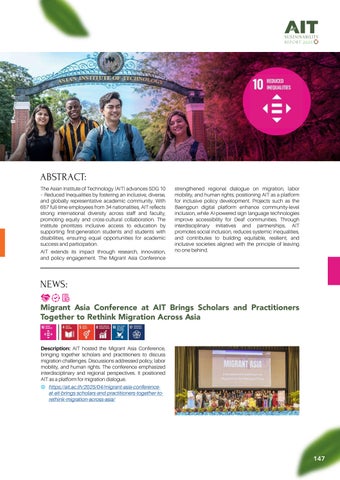
NEWS: Migrant Asia Conference at AIT Brings Scholars and Practitioners Together to Rethink Migration Across Asia
Description: AIT hosted the Migrant Asia Conference, bringing together scholars and practitioners to discuss migration challenges. Discussions addressed policy, labor mobility, and human rights. The conference emphasized interdisciplinary and regional perspectives. It positioned AIT as a platform for migration dialogue. 🌐 https://ait.ac.th/2025/04/migrant-asia-conference-
at-ait-brings-scholars-and-practitioners-together-torethink-migration-across-asia/
147
SUSTAINABILITY REPORT 2025
AIT signs MoU with International Federation of Red Cross and Red Crescent Societies to Enhance Volunteer Training and Inclusive WASH Systems
Description: AIT signed an MoU with the IFRC to enhance volunteer training and inclusive WASH systems. The collaboration focuses on capacity building, humanitarian response, and community resilience. Joint efforts aim to integrate academic expertise with field-based humanitarian practice. The partnership aligns education with global humanitarian needs. The initiative promotes equitable access to water and sanitation, integrates gender and disability inclusion, and enhances community resilience in vulnerable and disaster-prone areas through collaborative, practical, and scalable solutions. 🌐 https://ait.ac.th/2025/06/mou-signed-between-
ait-and-the-international-federation-of-red-crossand-red-crescent-societies-to-enhance-volunteertraining-and-inclusive-wash-systems/
PROJECTS: Baengpun IV Technical support for Baengpun deployment
AIT Research Theme: Smart communities Contributed by Faculty/School/Center: Education and Research Laboratory
Internet
Partners / Funded by: Multiple donors in Thailand Expected Social Impact: Reduce inequalities within the country. Description: Baengpun IV is the deployment-support phase of a community digital transaction platform developed through three prior research projects. It provides technical support to ensure the successful deployment of the Baengpun platform in local communities.
Sign Language Production using Deep Learning
AIT Research Theme: Smart communities Contributed by Faculty/School/Center: School of Engineering and Technology Partners / Funded by: AIT Research Initiation Grant/ Client: Hearing impaired people | Thailand Expected Social Impact:
› Improved 148
accessibility communities
and
inclusion
for
deaf
› Enabled real-time AI sign language communication › Provided inclusive digital learning platform access Description: This project develops a real-time sign language production system for hearing-impaired people using a deep learning transformer model. The system is designed for deployment on video channels to enable automated, accessible sign language communication.
SUSTAINABILITY REPORT 2025
Development of Sign Language Intelligence and Its Applications
AIT Research Theme: Smart communities Contributed by Faculty/School/Center: FAST Partners / Funded by: Office of The National Broadcasting and Telecommunications Commission, Thailand; ThaiPBS; National Association of the Deaf in Thailand; Ratchasuda Institute Expected Social Impact: This project aims to significantly improve accessibility, inclusion, and quality of life for Deaf and hard-of-hearing communities by reducing communication barriers in education, public services, and everyday interactions. By developing an open Thai Sign Language dataset, AI-based sign language recognition and translation models, a realistic sign language avatar, and a user-friendly translation application, the project enables more equitable access to information and digital services. Beyond technology development, the project promotes social inclusion, awareness, and empowerment of Deaf communities through community engagement, knowledge sharing, and capacity building, contributing to inclusive digital transformation and aligning with the principles of “leaving no one behind.”
Description: This project develops an end-to-end AIpowered sign language translation system for Thai Sign Language, integrating data collection, ML models for recognition, a sign language avatar, and a real-time translation application. It emphasizes inclusive design through collaboration with Deaf communities and capacity building for sustainable impact.
Sustaining the shared groundwater resources of the transboundary Cambodia-Vietnam Mekong River Delta aquifer under Climate Change impacts
AIT Research Theme: Climate change, Food-EnergyWater, Technology, Policy and Society Contributed by Faculty/School/Center: School of Engineering and Technology Partners / Funded by: Department of Foreign Affairs and Trade (DFAT) of Australia through SEI, Asia office Bangkok | Australia | Institute of Technology of Cambodia (ITC); Vietnam Women’s Academy (VWA);Institute for Water Resources Engineering and Environment Technology (iWAT), Vietnam; and Ho Chi Minh City University of Technology (HCMUT), VNU-HCM Expected Social Impact: Enhancement of water security and resilience for local communities in Cambodia and Vietnam, while also benefiting national and regional agencies involved in water and environmental management across the Mekong region.
Description: The SAGA project works to sustain the shared groundwater resources of the transboundary Cambodia-Vietnam Mekong River Delta aquifer under climate change impacts, using GEDSI tools and Naturebased Solutions. It produces new knowledge on natural and man-made impacts and develops a gender-inclusive, transdisciplinary operational strategy for equitable groundwater management.
149
SUSTAINABILITY REPORT 2025
OPERATIONS:
150