Middle School Curriculum Guide 2021 - 2022
MIDDLE SCHOOL CURRICULUM GUIDE 2021 - 2022 American International School Chennai
1
Middle School Curriculum Guide 2021 - 2022
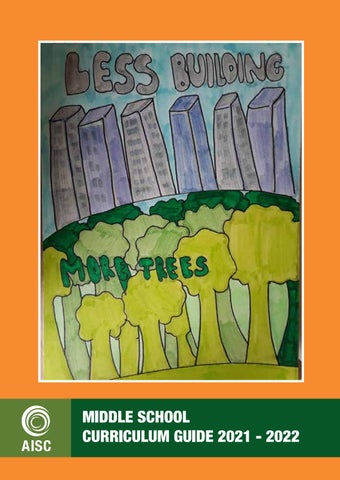
COVER ART BY: KIM SEJIN, CLASS OF 2027
2
American International School Chennai
Middle School Curriculum Guide 2021 - 2022
TABLE OF CONTENTS A LETTER FROM THE PRINCIPAL
4
MISSION
5
CORE VALUES
6
INTERNATIONALISM AT AISC
7
VISION FOR AN AISC LEARNER
8
ABOUT THE CURRICULUM GUIDE
10
ACADEMIC PROGRAM & SAMPLE SCHEDULE
10
COURSE DESCRIPTIONS
10
LANGUAGE ARTS
11
ENGLISH FOR ACADEMIC PURPOSES
12
WORLD LANGUAGE
13
SOCIAL STUDIES
15
SCIENCE
17
MATHEMATICS
18
FINE ARTS
21
THEATER
25
VISUAL ARTS
26
DESIGN TECHNOLOGY
27
PHYSICAL AND HEALTH EDUCATION
28
MIDDLE SCHOOL ADVISORY
29
INDEPENDENT STUDY
29
ACADEMIC HONESTY
30
INSTRUCTIONAL TECHNOLOGY BRING YOUR OWN TECHNOLOGY ACADEMIC SUPPORT PROGRAMS
31 31 32
ENGLISH AS AN ADDITIONAL LANGUAGE
32
LEARNING SUPPORT SERVICES (LSS)
33
LIBRARY SERVICES COLLABORATION & INQUIRY CENTER
33 33
EXPERIENTIAL LEARNING
35
WEEK WITHOUT WALLS
36
SEVAI: SERVICE LEARNING
37
CURRICULAR CONNECTIONS
37
ARTS, SPORTS AND ACTIVITIES
38
American International School Chennai
3
Middle School Curriculum Guide 2021 - 2022
A LETTER FROM THE PRINCIPAL
Dear Middle School Parents and Students, As a Middle School, we provide excellent learning experiences, enriching Arts, Sports & Activities (ASAs) programs, and a nurturing environment for our students to challenge themselves and grow. The programs offered in sixth through eighth grade are in alignment with our mission to foster courage, creativity, confidence, and compassion. Our academic and co-curricular experiences provide students with opportunities to develop themselves as internationally minded learners and individuals. This foundation positions students to successfully transition to schools in their home country as well as to other international schools. Our community embraces international diversity as we consist of students from about 30 different nationalities. In this rich setting, students learn skills for collaborating and developing relationships. We embrace our host country through connections with our community—interwoven into the Middle School experience through our service learning program and curricular connections. Our advisory program allows students to explore their identity, build relationships, and focus on wellbeing. Our integrated English as an Additional Language (EAL) program provides support and instruction to learn English while learning subject-area content. We strive to provide an academically challenging environment in order to foster intellectual curiosity and a sense of responsibility in our students. We offer an American curriculum with an international perspective. We focus on how to learn throughout our entire curriculum by modeling, teaching, and facilitating reflection on Learning Habits. Technology is seamlessly incorporated into all subject areas and students celebrate their learning with their parents with end-of-the-year portfolio presentations. Our Week Without Walls experience builds our students’ independence, responsibility, and takes learning outside of the classroom. To fully educate the whole child, we are committed to cultivating lifelong learners and balanced, globally-minded citizens who are prepared to positively contribute in a dynamic and interconnected world. Our programming supports this belief by empowering students with the opportunity to choose from a variety of elective classes during the school day and participate in co-curricular activities. Through our co-curricular activities, our students are exposed to the ideas of others by engaging with students across grade levels, India, and our region. The Middle School years are a time of transition and change as students grow physically, socially, emotionally, and cognitively. We work as a community of faculty, staff, and in partnership with parents to ensure that there is a supportive environment for this development. We invite you to support us in this endeavor. Sincerely, Ms. Jennifer Bertram Middle School Principal
4
American International School Chennai
Middle School Curriculum Guide 2021 - 2022
AISC Mission Together we inspire a love of learning, empowering all students with the
courage, confidence, creativity and compassion
to make their unique contribution in a diverse and dynamic world. American International School Chennai
AISC 5
Middle School Curriculum Guide 2021 - 2022
AISC BELIEVES THAT… Each person has equal intrinsic value, worthy of dignity and respect. We are responsible for our choices and their effect on ourselves, others and the environment.
Being open to new ideas and challenging experiences enriches our lives. Mutual respect, trust and caring foster healthy interpersonal relationships. Embracing our diversity makes us a stronger community. In an interconnected world, our positive contributions to the community and the environment are essential.
Individuals thrive in a nurturing environment that provides for their physical and emotional safety.
RESPONSIBILITY 6
EXCELLENCE
INTEGRITY
RESPECT
DIVERSITY
American International School Chennai
Middle School Curriculum Guide 2021 - 2022
Internationalism at AISC
At AISC, we define international-mindedness as: Possessing a strong sense of one’s own cultural identity; Respecting and valuing the differences of others; Learning about local, national, and global issues; Showing empathy for others and care for the world around us.
Therefore, as an international school, we are committed to: Incorporating other perspectives; Seeking common learning experiences with all peoples; Finding enriching connections between cultures; Using exposure to language, history, and the arts to access diverse cultures; Working well with all; Contributing through service; Reflecting about our thoughts and actions. American International School Chennai
7
Vision for an AISC Learner
Middle School Curriculum Guide 2021 - 2022
8
Leaders Collaborators
We show courage by taking action and inspiring others to serve and contribute positively to our interconnected world. Leaders develop a vision, plan appropriately, and work collaboratively to achieve results.
Collaborators
We develop a deeper understanding by listening carefully to others’ perspectives and confidently articulating personal viewpoints in the pursuit of common goals.
Innovators
We approach uncertainty with confidence, designing novel solutions in the face of challenges or change. Innovators are creative, resourceful, open-minded and resilient, seeking new perspectives through inquiry, trial, error and feedback.
Explorers
We investigate new interests with curiosity, inquiring with purpose, and seeking deeper understanding and fulfillment through our independent pursuits.
Thinkers
We use critical and creative thinking skills to analyze and take responsible action on complex problems. We exercise initiative in making reasoned, ethical, data-informed decisions.
Ethical
We show responsibility for our choices and consider their effects on ourselves, others, and the environment. We act on our principles and ideals because we value the dignity of others.
Versatile
We adapt to changing circumstances, balancing our commitments and showing courage as we take on new challenges. We seek new opportunities for learning, growth, and renewal.
Empathetic
We appreciate our own cultures and personal histories while respecting the values and traditions of others, believing each person has equal intrinsic value. We are sensitive to the needs of others and show compassion by making positive contributions to our local and global communities and the environment.
Resilient
We demonstrate on-going commitment to our endeavors by learning from our successes and failures in the positive pursuit of our objectives, goals, aspirations, and dreams. We practice patience and persistence in all situations, especially when they are challenging or uncomfortable.
Reflective
We pause to think about our goals, learning, and growth in order to develop and sustain our creativity and lifelong learning. We review and examine our own ideas and experiences in relation to the world and consider our interdependence and impact on others. American International School Chennai
Middle School Curriculum Guide 2021 - 2022
AISC Language Philosophy
rs
in t
era
m o n la n g u a g e. om
ac
be
Students use any resource, linguistic or otherwise, to be successful.
i
ng
C o m m u n it y m e m
Teachers instruct & assess in English.
ct w
it h e a c h o t h
e
s ru
Teachers instruct and assess in English. This is the teacher’s responsibility. To help navigate the process from instruction to assessment, teachers should set up activities that encourage students to practice their English. If there are parts of a lesson a teacher would like to comment on or assess, those parts should be performed in English. Students use any resource, linguistic or otherwise, to be successful. This is the student’s responsibility. In letting the students choose their path from instruction to assessment, we are creating learner autonomy and supporting the Vision for an AISC Learner framework.
Community members interact with each other using a common language. This is the community's responsibility. Community members should make a conscious effort to use a language all participants in the group understand. In addition, community members should feel comfortable to ask for a common language, when needed. American International School Chennai
9
Middle School Curriculum Guide 2021 - 2022
ABOUT THE CURRICULUM GUIDE The information contained in this Curriculum Guide is designed to help you understand our academic program and provide an overview of the Middle School learning community. In this Curriculum Guide, you will find course descriptions for each course offered. Over the course of three years, students will take a variety of required and elective classes. Middle School is a time for students to take advantage of a wide range of electives and discover areas of passion and interest. The purpose of this guide is to acquaint students and parents with the courses offered at AISC, and to enable them to plan a program of studies that maximizes student interest and engagement. Overviews of our advisory program (Advisory), learning support (LSS) and English as an Additional Language (EAL) program are provided. Our library services and technology integration is outlined for your reference. Other important aspects of our program, like academic honesty, experiential learning, and Arts, Sports & Activities (ASAs) are summarized.
ACADEMIC PROGRAM & SAMPLE SCHEDULE All students in Grades 6–8 take math, science, language arts, social studies, world language, and physical education courses each year. Students choose two elective classes each year from the following areas: art, theater, choir, strings, band or design technology. A student may be placed in an English for Academic Purposes (EAP), which replaces a world language course if a need to develop academic English is identified.
COURSE DESCRIPTIONS Sample Middle School Student Schedule Day
A1
B5
A2
B6
A3
B7
A4
B8
8:30 – 9:50
1 Spanish
5 Social Studies
2 Science
6 Art
3 Math
7 Band
4 PE
8 Language Arts
10:00 – 10:30
ADVISORY
ADVISORY
ADVISORY
ADVISORY
10:30 – 10:45
BREAK
BREAK
BREAK
BREAK
BREAK
BREAK 5 Social Studies
BREAK
BREAK
ADVISORY ADVISORY
10:50 – 12:05
2 Science
6 Art
3 Math
7 Band
4 PE
8 Language Arts
A Spanish
12:05 – 12:45
LUNCH
LUNCH
LUNCH
LUNCH
LUNCH
LUNCH
LUNCH
LUNCH
A Spanish
5 Social Studies
2 Science
6 Art PASSING
12:50 – 2:05
3 Math
7 Band
4 PE
8 Language Arts
2:05 – 2:15
PASSING
PASSING
PASSING
PASSING
PASSING
PASSING
PASSING
4 PE
8 Language Arts
A Spanish
5 Social Studies
2 Science
6 Art
3 Math
2:15 – 3:30
10
ADVISORY ADVISORY
7 Band
American International School Chennai
Middle School Curriculum Guide 2021 - 2022
LANGUAGE ARTS The Language Arts program is dedicated to providing learning that emphasizes inquiry and creativity through the use of the workshop model using the Common Core English Language Arts Standards as the framework of our curriculum. We encourage students to be growth-focused, improving their reading, writing, speaking and listening, as well as introducing them to a variety of genres and styles. To achieve this goal, teachers will: • Encourage students to engage with literature using compassion and thoughtfulness; • Develop a spirit of inquiry to enhance students’ critical thinking skills; • Promote creative expression; • Deepen students’ awareness of the credibility and usefulness of sources; and • Encourage the continuous development of written and oral expression The goal is that the Middle School language arts classes will allow students to become compassionate global citizens with the courage and creativity to express themselves with confidence. The Language Arts curriculum focuses on the areas of reading, writing, speaking, and listening. Each area will be assessed in every course in various ways, and skills will be revisited and refined over the course of the Middle School program. In each grade of our Language Arts program, students are taught using the reading and writing workshop model. The goal is to ensure that every student is highly engaged and working on materials that are appropriate to their proficiency levels. The workshop model helps to develop independent, thoughtful, and competent readers, writers, listeners, and speakers. Students are introduced to a variety of different genres and writing styles and encouraged to read a variety of fiction and nonfiction genres.
Language Arts 6 In Grade Six, students continue to develop their reading and writing lives by cultivating effective habits, building agency and independence, and responding to their reading in meaningful ways. Students use various reading comprehension strategies to make meaning from texts. They use textual evidence to support their analysis of inferences and what is stated explicitly in the text. Students explore literary elements and have several opportunities to analyze these over the course of the year. In writing, students continue to build their skills in narrative, argumentative, and informative writing. They focus on engaging the reader, organizing writing in various ways, using effective transitions and descriptive details, and writing satisfying conclusions. Students are provided opportunities—and choice—to examine a topic and convey themes, develop a literary argument, and present information. Student writing is further enhanced with particular attention to academic language development and English language conventions. American International School Chennai
11
Middle School Curriculum Guide 2021 - 2022
Language Arts 7 In Grade Seven, students build upon the strategies and skills learned in lower grades. Students are encouraged to become independent readers, as well as to develop their reading strategies, ability to compare and contrast, and analyze literature. In writing, students strive towards more advanced pieces emphasizing growth in their craft. They write arguments to support their claims, write informational texts, and create narratives to develop real or imagined experiences. Oral communication and language conventions are also addressed in this course.
Language Arts 8 In Grade Eight reading, students deepen and extend the understanding acquired in previous grades. They strive to improve their skills in analyzing a text to determine the theme and support their ideas with evidence from the text. Students increase their ability to evaluate the craft of the author by noticing word choice, structure, and point of view. Writing skills are strengthened in multiple genres by extending our skills in the areas of: organization, developing themes, supporting main ideas with specific details and evidence, using transitions to achieve cohesion, establishing point of view, and word choice. These skills are enhanced using argumentative, informative, and narrative writing as a framework.
ENGLISH FOR ACADEMIC PURPOSES Aligned to the California ELD Standards, the English for Academic Purposes (EAP) program is designed to enhance the academic abilities, communication skills, and vocabulary of students who are new to learning in English. Organized in grade-level classes, emphasis is placed on the following: • Strengthening a student’s foundation around English syntax and structure • Supporting content instruction while increasing academic language skills, knowledge, and abilities • Developing oral language through engagement discussion strategies • Strengthening the comprehension and production of various text types and participation in group discussions • Developing reading and writing skills • Understanding academic concepts and comprehending academic discourse • Building academic vocabulary through word study Students explore a variety of reading and writing genres and text types, learn cognitive academic skills (i.e. strategies for reading comprehension, vocabulary development, test-taking, critical thinking, and research), and develop their writing, grammar, language usage, mechanics, and spelling. Authentic learning activities and assignments will be used to motivate students and refine the course to best meet student needs.
12
American International School Chennai
Middle School Curriculum Guide 2021 - 2022
WORLD LANGUAGE The goal of the AISC World Language Department is to empower students to become versatile, empathetic collaborators who will be proficient communicators in more than one language. The AISC World Language Department is guided by the American Council on the Teaching of Foreign Languages (ACTFL) Standards. The program cultivates effective use of the target language by providing students with an immersive classroom environment and authentic materials. Language learning throughout the program occurs through meaningful, contextually-based interactions. Moreover, teachers encourage students to connect to other cultures and value international mindedness. Students throughout the Grade 3-12 World Language Department Program courses will: • Develop communication skills so that they can express themselves confidently, effectively, and creatively (orally and in writing) in more than one language; • Develop interpersonal, interpretive, and presentational skills; • Develop cognitive and critical thinking skills; • Make connections and comparisons between different languages and cultures; and • Be exposed to and learn to accept different perspectives
TABLE OF ACTFL LEVELS Novice Mid: I can communicate on very familiar topics using a variety of words and phrases that I have practiced and memorized. Novice High: I can communicate and exchange information about familiar topics using phrases and simple sentences. I can usually handle short social interactions by asking and answering simple questions.
French A / Spanish A Pathway A is an introductory language course that develops students’ basic communication skills in all three modalities: Interpretive Communication, Interpersonal Communication, Presentational Communication. Speaking, listening, reading and writing skills are developed through activities such as role-plays, interviews, projects, and presentations. Spanish/French is the language of instruction and communication in this class. Meeting the learning standards is based on achieving a Novice Mid-level of proficiency in Interpersonal American International School Chennai
13
Middle School Curriculum Guide 2021 - 2022
Interpersonal speaking
A
B
C
D
Novice Mid
Novice Mid
Novice High
Novice High
Novice Mid
Novice High
Novice High
Novice High
Novice Mid
Novice High
Novice High
Novice High
Novice Mid
Novice High
Interpersonal writing Interpretive listening
Novice Mid
Novice Mid
Interpretive reading Presentational speaking Presentational writing
Novice Mid
Speaking and Interpretive Listening modes. This course is offered to students with limited or no previous exposure to the language. French A / Spanish A
French B / Spanish B
Pathway A is an introductory language course that develops students’ basic communication skills in all
three modalities: Interpretive Communication, Communication, Presentational Pathway B continues to develop students’ basicInterpersonal communication skills in all three modalities: Interpretive
Communication. Speaking, listening, reading and writing skills are developed through activities such as role-plays, interviews, projects, and presentations. Spanish/French is the language of instruction and reading and writing skills are Meeting developed as role-plays, interviews, projects, communication in this class. thethrough learning activities standardssuch is based on achieving a Novice-Mid leveland of proficiency Spanish/French in Interpersonal Speaking and Interpretive Listening This course is offered presentations. is the language of instruction and modes. communication in this class. to Meeting students with limited or no previous exposure to the language.
Communication, Interpersonal Communication, Presentational Communication. Speaking, listening,
the learning standards is based on achieving a Novice Mid-level of proficiency in Interpersonal Speaking,
Interpretive Listening,Band Presentational Speaking modes. This course is offered to beginning students who French B / Spanish have successfully completed Pathway A (or with equivalent experience with the language as determined by B continues develop students’ basic communication skills in all three modalities: a Pathway teacher evaluation oftoproficiency).
Interpretive Communication, Interpersonal Communication, Presentational Communication. Speaking, listening, reading and writing skills are developed through activities such as role-plays, interviews, French / Spanish C Spanish/French is the language of instruction and communication in this projects,Cand presentations. class. Meeting the learning standards is based on achieving a Novice-Mid level of proficiency in Pathway C continues to develop students’ communication skills in all three modalities: Interpretive Interpersonal Speaking, Interpretive Listening, and Presentational Speaking modes. This course is Communication, Interpersonal Communication, Presentational Communication. Speaking, listening, offered to beginning students who have successfully completed Pathway A (or with equivalent experience with theskills language as determined by a activities teacher evaluation of proficiency). reading and writing are developed through such as vocabulary games, sentence creation,
comprehension activities, role-plays, interviews, projects, and presentations. Spanish/French is the French C / Spanish C
language of instruction and communication in this class. Meeting the learning standards is based on achieving Novice High-level proficiency in Interpersonal Speaking, Interpretive Listening, and Pathway aC continues to developof students’ communication skills in all three modalities: Interpretive Communication, Interpersonal Communication, Presentational Communication. Speaking, listening, reading and writing skills are developed through activities such as vocabulary games, sentence creation, comprehension activities, role-plays, interviews, projects, and presentations. Spanish/French
14
American International School Chennai
Middle School Curriculum Guide 2021 - 2022
Presentational Speaking modes, as well as achieving a Novice Mid-level of proficiency in Interpersonal Writing, Interpretive Reading, and Presentational Writing modes. This course is offered to students who have successfully completed Pathway B (or with equivalent experience with the language as determined by a teacher evaluation of proficiency).
French D / Spanish D Pathway D continues to develop students’ communication skills in all three modalities: Interpretive Communication, Interpersonal Communication, Presentational Communication. Speaking, listening, reading, and writing skills are developed through activities such as paragraph building, comprehension activities, role-plays, interviews, projects, and presentations. Spanish/French is the language of instruction and communication in this class. Meeting the learning standards is based on achieving a Novice High-level of proficiency in Interpersonal Speaking and Writing, Interpretive Listening and Reading, and Presentational Speaking and Writing modes. This course is offered to students who have successfully completed Pathway C (or with equivalent experience with the language as determined by a teacher evaluation of proficiency).
NL
NM
NH
IL
G4
G5
MS C
HS 2
MS A
MS D
MS B
HS 1
SOCIAL STUDIES The social studies curriculum is designed through the College, Career, & Civic Life (C3) Framework for social studies state standards. By the time students leave our social studies program, they will be able to think and learn independently as informed global citizens. To achieve this goal, teachers will: • Present social studies as a form of inquiry; • Promote the understanding and application of disciplinary skills and concepts; • Develop students’ abilities to detect credibility and bias when evaluating sources; American International School Chennai
15
Middle School Curriculum Guide 2021 - 2022
• Emphasize the importance of collaboration, communication, and international mindedness; and • Encourage not only the knowledge of topics and concepts but also the taking of informed action Social studies courses provide MS students with rich and engaging learning experiences in the areas of history, geography, economics, and civics. At every grade level, students will develop the skills needed to ask disciplinary questions, plan inquiries, evaluate and use sources, read and think critically, communicate their ideas effectively, and take action on a range of social studies topics. For each MS course, students will complete projects involving technology and peer collaboration.
Social Studies 6 In Grade 6, students examine the disciplinary fields of social studies through the lens of social connectedness. Students engage in a series of inquiries designed to deepen their understandings of human geography, history, economics, and civics. Through inquiry, students develop their questioning, research, and communication skills. Grade 6 students are encouraged to document connections between the concepts explored in class and what they observe in their host culture of Chennai. At the end of the year, students will share the connections they have made through a culminating project.
Social Studies 7 In Grade 7, students explore the theme of Social Responsibility through inquiry, project-based learning, and student choice. Once the concept of Social Responsibility is formed, students make connections between the UN Sustainable Development Goals and our local community. A guided inquiry unit on Inventions and Necessity challenges students to understand the geographic and social impact of innovation. Students then grapple with what inspires change and the intended and unintended consequences of historical turning points in our Change and Consequences unit. The culminating assessment challenges students to use the lessons they have learned throughout the year to design a product that helps our community for our Social Entrepreneurship project, Impact Chennai! Each unit features historical and contemporary case studies from around the world, with efforts made to help students connect their learning to their own culture and modern-day experiences.
Social Studies 8 In Grade 8, students investigate the theme of social justice through inquiry and project-based learning, built around six thematic units in world history: Colonialism, Revolution and War, Immigration, Industrialization and Wealth Inequality, and Social Justice Movements. Each unit examines case studies in United States history, with students developing their social science and critical thinking skills. Students then build action campaigns to connect these concepts to modern world issues, as well as to their own national and cultural backgrounds and modern-day experiences. At the end of the year, students synthesize their learning through a culminating social justice campaign on a modern issue of their choice.
16
American International School Chennai
Middle School Curriculum Guide 2021 - 2022
SCIENCE The goal of the Science Program at AISC is to empower all students to become curious inquirers, critical thinkers, and ethical citizens. Students will develop a strong foundation of knowledge and engage in collaborative, authentic inquiry to deepen their understanding of the natural world. Students will apply their understanding to solve problems and make informed and reasoned decisions in an interdependent and dynamic world. Through the Next Generation of Science Standards (NGSS)-aligned middle school science program, students will: • Build a strong foundation of knowledge in the physical, biological, and earth and space sciences—and make connections between these fields; • Ask questions, develop, and use models to explain observed phenomena and make predictions; • Design and perform experiments to investigate testable questions; • Apply mathematical and computational thinking to analyze and evaluate data; • Engage in evidence-based argument to make claims supported by scientific reasoning; • Communicate scientific ideas clearly, using appropriate academic language; • Develop effective collaboration and teamwork skills; and • Appreciate the dynamic nature of science and the impact it has on our lives
Science 6 In Grade 6, students examine the four main branches of Earth Science while developing and sharpening lab skills. Scientific concepts are reinforced through student exploration, experimentation, research, and model construction. Students have the opportunity to demonstrate and strengthen critical thinking skills as they examine the many complex challenges our society faces. A key feature of our science program is to help students as they work towards the development of unique, meaningful scientific conclusions that are supported with evidence.
Science 7 In Grade 7, students explore fundamental life science concepts and basic investigative skills. The purpose of this course is to develop an awareness of the characteristics and diversity of the living world. Study of the structure and function of cells and cell processes lays the foundation for investigation of human body systems. Learning the principles of genetics leads to understanding evolution by natural selection, a unifying concept in biology. Hands-on activities stress the scientific method of problem solving and allow students to see how experimentation and observation are the bases of scientific inquiry. American International School Chennai
17
Middle School Curriculum Guide 2021 - 2022
Science 8 In Grade 8, student performance expectations focus on developing understanding of several scientific practices. These include developing and using models, planning and conducting investigations, analyzing and interpreting data, using mathematical and computational thinking, and constructing explanations; and to use these practices to demonstrate understanding of the core ideas. Students are also expected to demonstrate understanding of several engineering practices, including design and evaluation. These practices will be demonstrated through 5 units: Matter and its Interactions; Motion and Stability: Forces and Interactions; Energy; and Waves and their Applications in Technologies for Information Transfer. More detailed information can be found at the Next Generation Science Standards website.
MATHEMATICS Mathematics in the Middle School follows the Common Core State Standards. These involve the study of general mathematical concepts and practices, covering several strands which include: Numbers and Operations; Geometry; Measurement; Patterns; Functions; and Algebra. While learning these concepts, students will be actively engaged through working individually and in groups. Manipulatives and accessing appropriate technologies are used to support learning in class. Students will learn concepts using the investigation-inquiry method. Problem-solving skills will be emphasized and students will be encouraged to develop novel approaches to multi-step problems. Teachers use flexible and adaptive strategies to facilitate the development of confident and thoughtful problem-solvers. Writing and speaking about math are key features in our approach to teaching/learning mathematics. The ability to explain the process and thinking is the emphasis of student learning. To this end, the acquisition of vocabulary specific to mathematics is emphasized. Students are encouraged to correctly use the concepts, skills, symbols, and vocabulary identified in each unit of study. Additionally, students identify and apply real-world applications to the mathematical, scientific, and logic principles they are learning.
Math 6 In Math 6, students use hands-on materials to understand mathematical concepts at a greater depth. Students have opportunities to apply these concepts to real-life situations and to also practice applying patterns and skills. Students are encouraged to try as many approaches as possible, even if it results in an incorrect answer. Mistakes are how we learn in Math 6. Flexible and adaptive strategies will be introduced to facilitate the development of confident, curious, and thoughtful problem-solvers. Writing and speaking about math is a key feature of our approach to mathematics; the ability to explain one’s process and thinking is fundamental to success.
18
American International School Chennai
Middle School Curriculum Guide 2021 - 2022
Math 6 Area & Surface Area Introducing Ratios Unit Rates & Percentages Dividing Fractions
Arithmetic in Base Ten Expressions & Equations Rational Numbers Data Sets & Distributions
Math 7 The Math 7 curriculum is aligned with the Common Core State Standards to focus on skill and content development. Instructional activities aim to provide learning opportunities that will help students increase their computational skills, nurture conceptual understanding, learn to communicate mathematically, make connections across disciplines and mathematical concepts, as well as enhance critical thinking and problemsolving skills. Units are designed to help students develop an understanding of number sense; solve multistep equations; analyze and represent linear functions; understand and apply proportional relationships; solve one- and two-step inequalities; work with two- and three-dimensional shapes focusing on area, surface area and volume and what changes happen to these values when a scale factor is applied; apply transformations; and analyze and summarize data sets. Throughout these units, students will be asked to explain their thought process as well as demonstrate their understanding by applying their knowledge to real-world applications. Math 7 Scale Drawings Introducing Proportional Relationships Measuring Circles Proportional Relationships and Percentages
Rational Number Arithmetic Expressions, Equations, and Inequalities Angles, Triangles, and Prisms Probability and Sampling
Math 8 In the 1600s, Rene Descartes united the fields of geometry and algebra using the Cartesian coordinate system. This allowed algebraic equations to be expressed as geometric shapes and vice versa. Under the Common Core State Standards, the two are encouraged to be learned simultaneously. Math 8 uses a task-based approach that leads to the skills and coherence in mathematics by first developing understanding. This leads students to develop deeper conceptual and procedural knowledge so that they can solve many open-ended problems. As a language teacher expects students to describe text with a rich and varied vocabulary, we also expect fluency in mathematics by solving problems in multiple ways and justifying their understanding with different representations. Math 8 will prepare students for HS Integrated Math 1 or 2, depending on the student’s mastery of the standards.
American International School Chennai
19
Middle School Curriculum Guide 2021 - 2022
Math 8 Sequences Linear & Exponential Functions Features of Functions Equations & Inequalities Systems
Transformations & Symmetry Congruence, Construction & Proof Connection Algebra & Proof Connecting Algebra & Geometry Modeling Data
Course Sequence Map
Middle School Math Progression Math 6
Math 7 Grade 9 IM 1 Math 8 Grade 9 IM 2
20
American International School Chennai
Middle School Curriculum Guide 2021 - 2022
FINE ARTS Performing Arts There are many compelling and promising reasons why the performing arts are extremely beneficial to the human brain regardless of age: increased comprehension and communication skills, better coordination, increased capacity for memory, focused multitasking, and building qualities of character such as resilience, patience, creative problem-solving and critical listening skills. In essence, engagement with the performing arts helps learning across all subject areas as it involves both sides of the human brain in the process of learning. The National Core Arts Standards (NCAS) is the foundation of the performing arts curriculum, where arts learning and arts making are cognitive and physical actions that drive the artistic processes of Creating, Performing, Responding, and Connecting. Each artistic process will be assessed in various ways and skills will be revisited and refined over the course of the Middle School program. The performing arts curriculum and the NCAS standards allow for a project-based and inquiry-based approach to learning as we focus on the artistic processes and not the finished product. Performing arts teachers facilitate a safe space for students to explore, respond, experiment, create, connect, and develop creative problem-solving strategies. To fully benefit from the performing arts requires a high level of engagement and commitment, whereby students pursue resilience and courage to express ideas within the performance medium. Through the performing arts, students learn how to collaborate with others as they work to creatively present their learning in front of an audience.
Band The Middle School Band is a comprehensive program of growth, beginning in Grade Six and continuing a pathway to High School. Students with no prior experience with a band instrument will be placed in the beginning woodwinds or beginning brasswinds class. For your reference, woodwinds consist of the flute, oboe, bassoon, clarinet, bass clarinet, as well as alto, tenor, and baritone saxophones. Brasswinds consist of the trumpet, trombone, euphonium, French horn, and tuba. Within both ensembles is an opportunity for students to take an interest in percussion as their main instrument, which includes marimba, vibraphone, xylophone, snare drum, bass drum, timpani, and a host of hand percussion instruments. Middle School students who have at least one year of prior experience with an instrument will be placed in the MS Concert Band class. As members continue from Beginning Band to Concert Band, they will perform an increasingly challenging repertoire representing a wide variety of history, geography, and styles.
American International School Chennai
21
Middle School Curriculum Guide 2021 - 2022
Beginning Band: Woodwinds and Brasswinds The Beginning Band aims to develop well-rounded musicians through the context of creating art with a woodwind, brass or percussion instrument. This course is designed to introduce students to the band ensemble experience as they connect the fundamentals of music theory, instrumental technique, breathing, tone production, reading and writing music notation, improvisation, music composition, and concert performance etiquette. Students respond to and create with fundamental skills designed to inspire a joy of learning with their instrument, both within the ensemble and at home. Learning experiences are integrated with a portfolio of student video and audio recordings, compositions, and reflections. Beginning woodwind and brasswind members perform together a minimum of two formal concerts each year. Students who complete the Beginning Band course can move forward to the MS Concert Band, which is a mixed ensemble of our MS experienced players. Ensemble
Prerequisite
Duration
Grade
Beginning Band
None
1 year
6–8
MS Concert Band The Middle School Concert Band is designed for students with one year of instrumental experience to continue their proficiency with the fundamentals of music theory and instrumental technique. Built upon the foundations of the beginning woodwinds/brasswinds course, the MS Concert Band prepares students to respond to and create with more complex and rich repertoire appropriate to their skill level as they demonstrate a higher level of performance. The MS Concert Band goes deeper into music vocabulary and connects their learning with music-making through improvisation, composition, and strategies to utilize their emotions as a catalyst for creativity both within the ensemble and when practicing their music at home. Learning experiences are integrated with a portfolio of student video and audio recordings, and reflections. The MS Concert Band performs two formal concerts per year and members are eligible to travel for music festivals. Ensemble MS Concert Band
22
Prerequisite Beginning wood/brasswinds or equivalent experience
Duration
Grade
1 year
6–8
American International School Chennai
Middle School Curriculum Guide 2021 - 2022
Guitar The Guitar Ensemble is an all-levels class that explores and responds to a variety of genres, including but not limited to classical, pop, blues, folk, and rock styles. A select few students may also choose to study the electric bass guitar or the ukulele, if the student provides their own ukulele. Students will study and create melodies and chord structures as well as use improvisation and composition as learning tools. The course is designed to be highly collaborative with small and large group learning engagements that lead ultimately to solo and group performances. Students who enroll in the guitar ensemble are encouraged to collaborate with other musicians in the Middle School Band and/or Choir to connect their learning with music that they personally enjoy. These extra-curricular connections create opportunities for performances around campus outside of the concert schedule. Learning experiences are integrated with a portfolio of student video and audio recordings, and reflections. The MS Guitar Ensemble performs two formal concerts per year. Ensemble
Prerequisite
Duration
Grade
Guitar Ensemble
None
1 year
6–8
Choir The Middle School choral program follows a progressive curriculum. Voice training in a choral environment and music literacy are the main components. We will learn about proper vocal technique, focusing on keeping our instrument—the voice—healthy for life. We will also learn music theory through the solfege system of sight singing. Group ensemble behavior and public performance will be emphasized. Students will explore different choral material from diverse cultures and languages, as well as a broad range of styles, genres, and historical periods.. Ensemble
Prerequisite
Duration
Grade
Beginning Choir
None
1 year
6–8
Experienced Choir
Beginning Choir or equivalent experience
1 year
6–8
Beginning Choir The Beginning Choir aims to develop well-rounded musicians through the context of group singing. This course is designed to introduce students with limited music experience to the fundamentals of music theory and vocal technique as outlined by the National Core Arts Standards (NCAS). Students learn about proper vocal technique, focusing on keeping their instrument—the voice—healthy for life. Students are exposed to basic music theory concepts while learning to read music and develop their aural skills. American International School Chennai
23
Middle School Curriculum Guide 2021 - 2022
Students sing music in unison and two-part harmony that come from a variety of sources and styles. Group music rehearsal during class is complemented by daily individual practice at home. Learning experiences are integrated with a portfolio of student recordings, compositions, and reflections. Students participate in at least two major public performances each year.
Experienced Choir The Experienced Choir builds upon the musical foundations of the Beginning Choir. It is designed to further students’ proficiency in music theory and vocal technique as outlined by the National Core Arts Standards (NCAS). Singers are challenged to engage with more complex music written in two- to threepart harmonies and to master higher levels of sight singing. Ensemble work at this level is both in large group and small group contexts. Group music rehearsal during class is complemented by daily individual practice at home. Learning experiences are integrated with a portfolio of student recordings, compositions, and reflections. Members of the Experienced Choir participate in two major public performances and are eligible to travel for music festivals.
Boys Choir The Middle School Boys Choir is designed to tailor the experience of the Beginning Choir to meet the specific needs of boys and their changing voices. The focus is on developing a culture of singing while learning healthy habits and techniques to carry through whatever vocal changes the student may encounter. The course is designed to introduce students with limited music experience to the fundamentals of music theory and vocal technique as outlined by the National Core Arts Standards (NCAS). Students are exposed to basic music theory concepts while learning to read music and develop their aural skills. Students sing music in unison and two-part harmony that come from a variety of sources and styles. Group music rehearsal during class is complemented by daily individual practice at home. Learning experiences are integrated with a portfolio of student recordings, compositions, and reflections. Students participate in at least two major public performances each year.
Music Technology The Music Technology course is an all-levels, project-based learning class that introduces audio engineering, recording, and production. Students will use their devices to access an online recording studio called “SoundTrap” and learn the fundamental vocabulary, audio theory, and editing tools that engineers, musicians, and producers use in real-world studios. The online studio works with both PC and Mac devices. The course is designed to allow students the creative freedom to choose their own inquiry into recording and composing music, podcasts, jingles, soundscapes, sound effects for scenes, and more. Soundtrap is a highly collaborative online recording studio that allows groups of students to work in the same studio in real time, communicating with built-in video and chat functions and provides hundreds of
24
American International School Chennai
Middle School Curriculum Guide 2021 - 2022
sounds and instrument options that inspire student creativity. Learning experiences are integrated with a portfolio of student video and audio recordings, and reflections. Opportunities for performance include live sound integration with musicians and recorded and pre-recorded audio and video presentations. Ensemble
Prerequisite
Duration
Grade
Music Technology
None
1 year
6–8
THEATER Theater 6 The Theater 6 course provides students with the dynamic opportunity to express their values and creative ideas through the medium of theater. Students will learn in a safe, supportive environment the importance of collaboration, respect, and inclusion. Students will then explore a variety of theatrical techniques and genres and be challenged to find performance solutions whilst creating quality theater. Students will experiment with spontaneous and planned improvisation techniques, further equipping them with the right skillset to devise. Throughout the course, students will be assessed on their ability to create, perform, and respond to theater work. They will also connect and relate their knowledge, personal experiences, and other historical contexts to deepen their understanding of theater.
Theater 7 Theater 7 further develops students’ ability to create increasingly sophisticated quality theater. Students will learn to work more independently and explore opportunities to analyze, reflect, and evaluate their own work. They will consolidate and deepen their understanding of how space, movement, and voice communicate meaning and explore how to negotiate and make decisions as part of a collaborative group. Students will use a range of approaches to create credible characteristics, varying vocabulary and body language, while using different techniques to structure an effective performance. Students will continue to be assessed on their ability to create, perform, and respond to their artistic process and connect their work to other contexts to deepen their understanding of theater.
Theater 8 Theater provides students with opportunities to develop practical performance and design skills, express themselves through the medium of theater, and inquire into historical and contemporary theatrical practice. Students will use space, movement and voice with imagination, commitment to communicate meaning, and evaluate that use. In order to further their understanding of performance technique, students will use a range of dramatic skills, techniques, forms, and conventions to express ideas and feelings effectively, with
American International School Chennai
25
Middle School Curriculum Guide 2021 - 2022
a clear understanding of the differences between naturalistic and non-naturalistic forms and techniques. Students will also consolidate their ability to reflect upon and respond in depth and detail to their own work and the work of others to analyze the application of skills required and what was communicated to the audience. Throughout the course, students are assessed on their ability to create, perform, and articulate their artistic process, while connecting with the world around them.
VISUAL ARTS The Middle School visual arts program teaches with an inquiry-based approach that guides choice-based learning. It is important that students have the opportunity to make decisions and choices that support the learning objectives and meet the National Core Arts Standards (NCAS). The importance of integrating new and innovative technologies, while weaving in the traditional methods, encourages students to challenge themselves, take risks, and experiment with various media and ideas. This empowers students so they can make their unique contribution to a diverse and dynamic world by giving them an opportunity to express their ideas through their artwork. Students have the opportunity to take year-long art classes in Grades Six, Seven, and Eight.
Art 6, 7, 8 The primary goals of the Middle School visual arts program is to teach creative problem-solving and visual literacy in a studio-based experience. The program provides direct exposure to modern and contemporary art and design issues and promotes an understanding of their relevance and contribution to society through multiple perspectives. Traditional art forms and techniques are also an important part of the curriculum. Integrating these into the program helps students develop a deeper understanding and appreciation for the connection between the old and new. The Middle School program provides the opportunity for students to explore a wide range of media and techniques. By doing so, they will develop a foundation for the visual arts and become prepared for the high-school level. Throughout the Middle School art program, students will build foundational skills in drawing, painting, photography, multimedia arts, clay, and sculpture. This will also be layered with art history, criticism, and aesthetics. Students will use their investigation workbook (sketchbook) to research, develop their ideas, problem-solve, and practice techniques while exploring various concepts about themselves and the world.
26
American International School Chennai
Middle School Curriculum Guide 2021 - 2022
DESIGN TECHNOLOGY Computer Aided Design (CAD) and Graphics CAD is an introductory course which is open for Grade Eight students. This course is based on the IB MYP Design Standards as the framework of the curriculum. CAD is a hands-on, project-based course where students design and create functional products using the design cycle process. Students will develop technical drawing skills with the emphasis on CAD drawing. They will also develop skills for basic hand tools, power tools, and materials in order to design and create two major products: a simple product of their choosing and a scaled model of their house design. A major emphasis is on the active involvement of students in designing and producing real-world applications. The main topic will be on low-cost, sustainable housing where students will investigate the components of a house, design a set of blueprints, draw a 3D SketchUp and AutoCAD drawing, and create a scale model house from their designs.
Electronics and Robotics This course is an introductory course which is open for Grade Seven and Eight students. Electronics and Robotics is based on the IB MYP Design Standards as the framework of the curriculum. In this class, students will learn and develop skills in basic electronics circuits, designing and creating their own simple functional electronic product. They will also delve into the world of robotics by learning simple coding and programming languages which will lead them into designing, creating, and programming their own functional robot from a Lego Mindstorm EV3 kit. The challenge will then be to complete specific tasks while navigating through an obstacle course with their robot.
MS Design Technology (MS DT) This is an introductory course which is open for Grade Six and Seven students. Middle School Design Technology is based on the IB MYP Design Standards as the framework of the curriculum. In this class, students will learn the work of product designers and develop an understanding of design thinking and the design cycle process. They will combine practical workshop and technological skills with creative thinking for designing, creating, and evaluating their own functional products, such as clocks, phone stands, etc. Several challenging design projects will be undertaken during the course of this semester using a range of different materials, tools, and manufacturing processes.
American International School Chennai
27
Middle School Curriculum Guide 2021 - 2022
PHYSICAL AND HEALTH EDUCATION In physical education (PE), students are provided with a unique opportunity to nurture their creativity, compassion, courage, and confidence in a safe environment beyond the classroom. The course is based on the Australian standards as the framework of the curriculum. The main objective is to guide students to understand the importance of valuing physical activity for its contribution to a healthy lifestyle and how it can enhance their health at, and beyond, the School. Physical fitness is a key component in every class that is showcased in a fun-filled atmosphere. Interpersonal skills such as demonstrating respect, offering positive feedback, demonstrating responsible behavior in terms of physical and emotional safety, as well as maintaining good personal hygiene are essential for success in the course. For health education, we use the Australian Health standards to guide our curriculum. Health-related topics and basic first aid information are consistently embedded into the PE schedule throughout the academic year. Please note that swimming constitutes 20% of the physical education curriculum. Students will need a properly fitted swimsuit and goggles. Female students are required to wear a one-piece swimsuit. Male students need a swimsuit that can be tightened at the waist. Students with long hair are required to wear swim caps. Sun shirts are optional.
Physical Education 6 In Physical Education 6, students build on the foundations laid in Elementary School and learn the fundamentals of fitness and movement, engaging in a variety of activities that promote fine and gross motor skills. Health lessons emphasize self esteem, student protection, diversity, and communicable diseases.
Physical Education 7 In Physical Education 7, students begin to learn more sport-specific skills. Using the fundamentals of movement previously learned, they begin to apply their skills in game play with a focus on sportsmanship and teamwork. Health lessons emphasize external influences on healthy behaviors, relationships, gender and sexuality, and the importance of healthy nutrition.
Physical Education 8 In Physical Education 8, students focus on improving their skills and learning more advanced game strategies to increase enjoyment and participation in games and sports. Students take on more responsibility for their learning through self and peer assessments. Health lessons emphasize mental health and wellbeing, global issues of health, freedom from chemical dependency, and first aid.
28
American International School Chennai
Middle School Curriculum Guide 2021 - 2022
Students’ progress in relation to the standards will be assessed through the unit by formative assessments, and at the end of each unit through a summative assessment. Depending on the unit, the summative assessment may be a skill test, a reflection, an individual project, or progress towards a personal fitness goal.
MIDDLE SCHOOL ADVISORY Middle School Advisory is a time in the schedule in which students meet in a smaller group with a teacher as “advisor.” These small classes, which meet every day for thirty minutes, create a structure that promotes connectedness, communication, and a supportive community for all students. The purpose of Advisory is to: • Create a community that is inclusive, friendly, caring and respectful; • Help students to learn about themselves, others, and topics that affect their lives; and • Support students’ wellbeing. Advisory activities range from lessons related to topics such as building positive relationships, persevering through difficulties, and exploring self-identity, to playing games together and participating in Middle School assemblies. The advisor also serves as a contact person for students and parents when there are questions or issues related to school. Advisory is one way in which we explore components of the AISC Wellbeing Framework. We nurture wellbeing in Advisory by: • Fostering positive relationships through communication and play; • Building self-awareness through reflection on strengths, culture, transition, and emotions; • Giving students opportunities to practice self-management through engagement and help-seeking; and • Providing opportunities to build healthy habits like helping others, connecting with others, and gratitude. We believe that taking this time during the school day to work together to build skills and relationships is particularly important for adolescents and their wellbeing as they progress through Middle School.
INDEPENDENT STUDY While the Middle School does not have an independent study program or component such as online classes, we understand that special circumstances arise with some families. Therefore special requests can be made with the Principal. The request needs to include the course description, supervision, and rationale for why it is needed. The School will make every effort to support and personalize learning for students. Due to the constraint of our schedule and staffing, requests will only be granted should the course fit with the schedule and staffing, and that it is aligned with the school mission, vision, and philosophy of teaching and learning of AISC. Permission will be at the discretion of the Principal and Head of School. American International School Chennai
29
Middle School Curriculum Guide 2021 - 2022
ACADEMIC HONESTY Trust is perhaps the most essential element in teaching and learning. Crediting the ideas of others is a skill that requires careful development as students delve into the research process. In an inquiry-based program in which students are often required to independently research ideas and information to expand their knowledge, citing the ideas of others is critical. Below is an outline of the expectations for Middle School students by grade regarding the level of detail in a citation. There are several web-based tools that support the creation of citations, works cited pages, and bibliographies. Among the most used at AISC are NoodleTools.com and Easybib.com. Unless specifically instructed otherwise by a teacher, students should use the Modern Language Association (MLA) style guide.
Citation Expectations by Grade Level By the end of Grade six
By the end of Grade Seven
By the end of Grade Eight
When citing, all of the important When citing, information needs When citing, information needs information needs to be present, to be in correct MLA format for to be in correct MLA format but it is still OK if it is not
the resources below. Resources for all resources, including, but
in perfect MLA format. The
not listed below are still flexible not limited to, the list below.
following information must be
until Grade 8. Students should Students should know how to
present in Grade 6 citations
know how to use online citation use online citation makers for
for the formats listed below.
makers for MLA format but MLA format but still need to
Unlisted resources are still
still need to double-check the double-check the citation for
flexible until Grades 7 and 8.
citation for correct MLA format correct MLA format if they use them.
• Books: Title, author, date, if they use them. • Book publisher, city • Websites: Title, author/ organization, URL, date, date accessed
• Anthology
• Database
• Book
• Magazine
• Database
• Photo/image
• Film/video clip/ Television show
• Reference source • Website
• Lecture/interview/Radio • Magazine/journal/ newspaper • Photo/image/work of art • Reference source • Website
30
American International School Chennai
Middle School Curriculum Guide 2021 - 2022
INSTRUCTIONAL TECHNOLOGY BRING YOUR OWN TECHNOLOGY AISC utilizes a 1-to-1 Bring Your Own Technology (BYOT) personal computing initiative for students. BYOT is a form of collaboration between home and school where families supply each child with a device that best meets his or her own learning needs and the School provides a high-speed wireless network, world-class software tools, and complementary devices for checkout. You can learn more about the program by visiting “Quick Links” on the AISC website.
Our Criteria for a Successful 1-to-1 Program • All students and staff have ubiquitous and unobstructed access to the information technology tools necessary for learning and use them frequently • Teaching and learning has been ultimately transformed in support of our student learning objectives • More intense investment and engagement is achieved on the part of the student • Closer, more relevant, repeatable, and authentic interaction with content has been achieved • Students are transported to places, experiences, perspectives, cultures, and people otherwise difficult to reach • Essential teacher–student interactions that drive both human and academic growth have been empowered and enabled, not replaced or reduced • All students demonstrate digital citizenship skills to conduct themselves ethically and securely with digital communication tools
Digital Citizenship Instruction AISC uses the Digital Literacy and Citizenship Curriculum from Common Sense Education to empower students to think critically, behave safely, and participate responsibly in our digital world. These digital-age skills are essential for students to harness the full potential of technology for learning. Learning Outcomes: Privacy and Security: Students learn strategies for managing their online information and keeping it secure from online risks such as identity thieves and phishing. They learn how to create strong passwords, how to avoid scams and schemes, and how to analyze privacy policies. Digital Footprint: Students learn to protect their own privacy and respect others’ privacy. Our digital world is permanent, and with each post, students are building a digital footprint. By encouraging students to
American International School Chennai
31
Middle School Curriculum Guide 2021 - 2022
self-reflect before they self-reveal, they will consider how what they share online can impact themselves and others. Self-Image and Identity: Students explore their own digital lives, focusing on their online versus their offline identity. Students learn the benefits and risks of presenting themselves through different personas and the effects on their sense of self, their reputation, and their relationships. Creative Credit & Copyright: Living in a “copy/paste” culture, students need to reflect on their responsibilities and rights as creators in the online spaces where they consume, create, and share information. From addressing plagiarism to piracy, students learn about copyright and fair use. Digital Ethics: Students delve into the concept of digital ethics, and they reflect on their understanding of and respect for intellectual property and copyright. Information Literacy: Students learn to identify, find, evaluate, and use information effectively. From effective search strategies to evaluation techniques, students learn how to evaluate the quality, credibility, and validity of websites, and give proper credit. Cyberbullying: Students learn what to do if they are involved in a cyberbullying situation. They explore the roles people play and how individual actions—both negative and positive—can impact their friends and broader communities. Students are encouraged to take the active role in building AISC’s positive, supportive online communities. Internet Safety: Students explore how the internet offers an amazing way to collaborate with others worldwide, while staying safe by employing strategies such as distinguishing between inappropriate contact and positive connection.
ACADEMIC SUPPORT PROGRAMS ENGLISH AS AN ADDITIONAL LANGUAGE American International School Chennai is proud to host a large population of students from different countries, cultures, and language backgrounds. A significant number of students at the School speak a language other than English at home. English language acquisition is supported by the English as an Additional Language (EAL) teachers through our inclusion model and our English for Academic Purposes (EAP) program. The EAL program is committed to excellence in delivering services in a nurturing, inclusive environment. Teachers differentiate instruction based on student needs, so that students are able to demonstrate mastery of content despite limited English language proficiency. Core academic courses are co-planned and co-taught by EAL specialists and content teachers. Our goal is to support student development in English for academic and social success while encouraging the continued growth of the home language
32
American International School Chennai
Middle School Curriculum Guide 2021 - 2022
and maintaining cultural identity. We value all students as members of our diverse, multilingual learning community. For those who need additional support, EAP classes are offered. Eligible students take EAP classes in lieu of world language. Upon admission to the School, students with limited academic English language proficiency take the WIDA MODEL (Measure of Developing English Language) test in order to determine their English language abilities. Teacher recommendation and WIDA scores are used to place students in EAP as well as co-taught classes.
LEARNING SUPPORT SERVICES (LSS) Learning Support Services provide a collaborative, balanced instructional approach that supports, motivates, and inspires all students to become socially, emotionally, and academically successful. If necessary, a collaborative team will create a tiered system of support that is developed to meet individual student needs (an Individual Learning Plan, or ILP). Determination of the nature and level of support is data-driven and may range from mild (consultative and monitoring) to moderate (direct intervention). The plan is targeted and monitored on an ongoing basis, and specialized instruction may occur in a variety of academic settings with a variety of instructional personnel. Services may include, but are not limited to, speech and language therapy, counseling, and/or occupational therapy. Families may be asked to seek external assessments to enable us to better meet the individual needs of their student.
LIBRARY SERVICES COLLABORATION & INQUIRY CENTER Our library services develop students’ information literacy, provide resources to enrich and support the curriculum, and promote pleasure reading. We believe in the power of collaboration among faculty and students as part of the learning process. We also believe inquiry is essential to discovery and authentic learning. For this reason, we call our library the Collaboration & Inquiry Center. We provide resources that appeal to a variety of interests and reading levels as well as services that fully support student learning.
The AISC Library Mission We collaborate with and empower students and staff to transform curiosity, creativity, and compassion into ideas or artifacts with personal, social, or global significance.
Library Services The library staff is available to offer students, parents, and teachers a wide range of services. The staff can recommend books and other resources for pleasure reading, research, and general inquiry. The library
American International School Chennai
33
Middle School Curriculum Guide 2021 - 2022
runs orientations throughout the year on how to make the most of our center and the resources offered. Patrons are provided assistance in locating materials, using online databases effectively, and much more. Please ask any of our staff members for assistance. The library also sponsors many activities throughout the year, such as author visits and book fairs.
Library Resources The shared Elementary/Middle Collaboration & Inquiry Center currently holds over 40,000 books, and we get hundreds of new books each year! Our extensive print and digital collections include varied interest levels and genres. Students and parents who are interested in finding book recommendations can use the online catalog, browse the shelves, check out the interesting book displays, or ask any staff member for assistance. Our staff is committed to supporting all community members as they use the library and its resources. To support a love of reading in any language, there are books in different languages, such as French, German, Japanese, Korean, and Spanish. In fact, we have books in over 50 languages! Books can be found in different sections over the two floors: Ground Floor
Upper Floor
Adventure
Animals
Classics
Biographies
Fantasy
Fine Arts
Historical Fiction
Folktales
Horror and Humor
Graphic Novels
Mystery
Health
Picture Books
India
Realistic Fiction
Math and Science
Science Fiction
Poetry
Sports Fiction
Social Studies
Audio Books and DVDs
Books in Other Languages
Teacher Bookroom
Newspapers and Magazines
Electronic Resources • The library carries thousands of eBooks, including fiction and nonfiction. These can be read at school or at home, using school or personal devices. Please see any of the library staff for assistance on getting started. • Students also have 24-hour access to Destiny Discover, our library catalogue. Destiny Discover
34
American International School Chennai
Middle School Curriculum Guide 2021 - 2022
provides students with information about the books we carry, including summaries, reading levels, and availability. To visit the catalog, please go to https://search.follettsoftware.com/metasearch/ ui/16368. • The library subscribes to a variety of online databases and resources. These are login/password protected. Please ask any member of the library staff for assistance, or check the ES/MS LibGuide, which can be found on the AISC homepage, under “Quick Links.” You can also visit the LibGuide directly with this link: https://aischennai.libguides.com/esms.
Collaboration & Inquiry Center Hours The Collaboration & Inquiry Center is open: • Monday, Tuesday, Thursday, and Friday: 8:00–5:00 • Wednesday: 8:00–3:30 (Early Release Days 8:00–2:00). • Saturdays: 8:30–12:30 (except during school vacation or long weekends)
Collaboration & Inquiry Center Use & Rules • Middle School students are welcome throughout the day and can visit before school, break, lunch, and after school. • Please enjoy your food or drink outside the library. Food and drink can damage books, carpets, and computers. Thank you! • Library patrons can normally keep a book for two weeks. After two weeks, the book is overdue. Please return all overdue books. Please pay for any lost or damaged items. Please see library staff for a bill, which can then be paid at the cashier’s window. • Parents are welcome to browse and check out books during the school hours of 8:30–3:30. However, as this is a student learning space, we ask that parents use other spaces (i.e. Madras Cafe) during school hours to sit, read, work, or socialize.
EXPERIENTIAL LEARNING The purpose of experiential learning in the Middle School is to provide opportunities beyond the classroom that promote connections to our community, the environment, and local culture, and nurture students’ self-management, self-awareness, and positive relationships through applied learning and reflection. Week Without Walls, SEVAI, and curricular connections incorporate experiential learning into our program. Experiential learning opportunities are not optional activities. Students participate in the activities as a grade level, through courses or interest groups. Events are a part of our school calendar. Experiences are integral for our program to further live our mission and develop Vision for a Learner attributes.
American International School Chennai
35
Middle School Curriculum Guide 2021 - 2022
WEEK WITHOUT WALLS As part of the Middle School curriculum, it is important for students to be given the opportunity to experience learning in the classroom as well as outside the classroom. Week Without Walls (WWW) provides students with a cultural, personal, interpersonal, and environmental experience not available within the regular classroom walls. During this week-long experience out of school with their classmates and teachers, students learn, reflect, and grow as individuals. It is an expectation that all students participate in this program. The aim of WWW is to: • Participate in experiences to promote the development and reflect on the attributes in our Vision for a Learner • Provide exposure to India in order to nurture a better understanding and appreciation of Indian culture • Develop relationships with peers and build community within grade levels • Promote personal independence and responsibility and to challenge students physically and mentally • Promote respect for the environment through exposure to diverse ecosystems Grade 8: Sajan and Dabhosa camps (operated by Nature Trails) are located 120 kilometers northeast of Mumbai. At the first camp, students stay in tents on a 30-acre property with tree-top rooms, tiled huts, rooms, and dormitories in a unique Maharashtra setting. Here students are trained in basic outdoor skills, such as orienteering, rappelling, trekking, valley crossing, and kayaking. Participation in these activities encourages students to develop their teaming and leadership capacities. The second camp is a 16-acre campsite that overlooks a 100-meter waterfall. Students take advantage of the kayaking, valley crossing, expeditionary challenges that the area provides. The focus of the experience is teamwork in the jungle which encompasses some physically challenging outdoor experiences. Week Without Walls also includes a community “build” experience in a nearby tribal village. Grade 7: The Grade 7 Week Without Walls program will take students to an amazing gateway to nature and adventure in Dandeli, in the state of Karnataka. Students will build relationships and develop interpersonal skills through cooperative activities as well as group and individual challenges. We will also have a chance to experience a mix of wildlife, adventure and night treks, visit Syntheri Rocks, raft on the Kali river, explore zorbing, archery, coracle rides, and a natural jacuzzi. Students will go on a safari to Dandeli Wildlife Sanctuary which offers a glimpse of black panthers, Sambar deer, bison, and Malabar giant squirrels—and maybe even a giant iguana, king cobra, or a tiger in the dense forests.
36
American International School Chennai
Middle School Curriculum Guide 2021 - 2022
Grade 6: The camp is a vast expanse of about 20 acres of land located in Panchgani, a hill station 100 kilometers south of Pune, which is well known for its natural scenic beauty. It is situated in a unique geographical area with a wide variety of flora and fauna, and the weather is pleasant all year round. The facilities have been recently renovated and there is plenty of space for both indoor and outdoor activities. Also, there are adventure points right on the property, as well as a farm with animals, an astronomical observatory, and hiking trails. The main focus of the trip is to help students develop their confidence and foster strong relationships by means of team building activities. In addition, they will have the opportunity to interact with local communities in nearby villages.
SEVAI: SERVICE LEARNING The word SEVAI means service in Tamil. AISC has adopted the word SEVAI to represent our overall service learning programming. Service Learning links teaching and learning to an increasingly interconnected world. Assessing genuine needs, developing and implementing sustainable solutions, and reflecting on personal growth and the impact of contributions are key steps of the process. The aims of SEVAI are to develop: • Socially aware, empathetic individuals; • Collaborative problem solvers who actively choose to embrace real-world challenges; and • Reciprocal relationships of mutual respect between AISC and the greater community In our mission-driven school, students are provided the opportunity to use their knowledge and skills in service to others in Chennai by participating in a variety of service experiences through partnerships with local NGOs. SEVAI promotes exploration for community connection and service by offering students a variety of opportunities to make contributions in the local community. SEVAI is scheduled into the regular school day. All students are expected to participate in SEVAI activities.
CURRICULAR CONNECTIONS Throughout the curriculum, teachers have designed opportunities for students to further their learning outside through field trips, transdisciplinary projects such as STEAM (Science Technology Engineering Art Math), and individual course projects. These learning experiences enhance curricular experiences through authentic real-world experiences from which students transfer and apply their learning beyond the classroom. Our STEAM projects follow a Project-Based Learning model that allows students to inquire into and personalize a driving question. In these projects, students apply principles of science, technology, engineering, art, and/or math as they intersect in the real world. Students engage in sustained inquiry in an authentic context by researching, planning, gathering data, designing a product, and drawing conclusions that address the chosen problem. The project enables students to demonstrate critical thinking and American International School Chennai
37
Middle School Curriculum Guide 2021 - 2022
problem solving by working with models (design cycle, trial, and error) in the design of their final product.
ARTS, SPORTS, AND ACTIVITIES (ASAs) There are a number of after school activities and athletics offered at the Middle School. Arts, Sports & Activities from the ASA Office are co-curricular activities and team sports sponsored by teachers and coaches. Middle School students are eligible to participate in SAISA Swimming and SAISA Track and Field and all ASIAC activities meets and athletics tournaments. Below are the activities available to students. Activities may be added on a yearly basis. Athletics Activities
Co-Curricular Activities
ASIAC Badminton
Activities Committee
ASIAC Basketball ASIAC Band and Choir ASIAC Soccer ASIAC Table Tennis ASIAC Tennis ASIAC & SAISA Swimming SAISA Track and Field ASIAC Volleyball
AMIS Honor Band AMIS Honor Choir Art Club Assembly Committee Blue Cross Service Project ISTA (Theater) Math Counts Model United Nations (MUN) MS Theatre Production Newspaper Rock Band Student Ambassadors Student Voices Forum
Paid Arts, Sports, & Activities (ASAs) For the most current list of activities available for each season, please see the Athletics and Activities website.
38
American International School Chennai
Middle School Curriculum Guide 2021 - 2022
AMERICAN INTERNATIONAL SCHOOL CHENNAI 100 Feet Road, Taramani, Chennai - 600 113, INDIA P: +91-44-2254-9000 | F: +91-44-2254-9001 | W: www.aischennai.org American International School Chennai
39