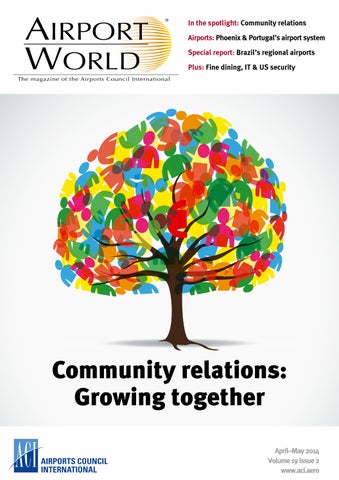
AIRPORT WORLD APRIL-MAY 2014
In the spotlight: Community relations Airports: Phoenix & Portugal’s airport system Special report: Brazil’s regional airports Plus: Fine dining, IT & US security
THE MAGAZINE OF THE AIRPORTS COUNCIL INTERNATIONAL
Community relations: Growing together April–May 2014 Volume 19 Issue 2 www.aci.aero
OPINION ;OL THNHaPUL VM [OL (PYWVY[Z *V\UJPS 0U[LYUH[PVUHS
Airport World Editor Joe Bates +44 (0) 20 8831 7507 joe@airport-world.com Reporter Justin Burns +44 (0) 20 8831 7508 justin@airport-world.com Design, Layout & Production Mark Draper +44 (0) 20 8831 7504 mark@airport-world.com Andrew Montgomery +44 (0) 20 8831 7564 andy@airport-world.com Erica Cooper erica@aviationmedia.aero Website Design & Production José Cuenca +44 (0) 20 8831 7517 jose@aviationmedia.aero Sales Director Jonathan Lee +44 (0) 20 8831 7563 jonathan@airport-world.com Advertising Manager Kalpesh Vadher +44 (0) 20 8831 7510 kalpesh@airport-world.com Andrew Hazell +44 (0) 20 8831 7518 andrewh@airport-world.com Subscriptions Lauren Murtagh +44 (0) 20 8831 7512 subscriptions@airport-world.com
Published by Aviation Business Media Ltd 26-30 London Road Twickenham, TW1 3RW, UK Fax: +44 (0) 20 8891 0123 Managing Director Jonathan Lee
Airport World is published six times a year for the members of ACI. The opinions and views expressed in Airport World are those of the authors and do not necessarily reflect an ACI policy or position. ISSN: 1360-4341 The content of this publication is copyright of Aviation Business Media and should not be copied or stored without the express permission of the publisher. USA Mailing Agent, Clevett Worldwide Mailers, 19 Route 10 East, Bldg 2 Unit 24, Succasunna, NJ 07876. Subscription price $125. Periodicals postage paid at Dover, NJ 07801. Postmaster please send address changes to Airport World, 19 Route 10 East Bldg 2 Unit 24, Succasunna, NJ 07876.
Printed in the UK by The Magazine Printing Company using only paper from FSC/PEFC suppliers www.magprint.co.uk
Winning
hearts and minds Airport World editor, Joe Bates, considers the importance of good community relations.
T
here is an old expression that you get out of life what you put into it, and while that is not always true, of course, I feel it is particularly appropriate to airports when it comes to community relations. I say this because as you will discover later in this ‘community relations’ themed issue, it appears as if there are almost incalculable benefits for those that go the extra mile to openly communicate with, embrace and work with the local community. In terms of communication, simply “talking to the neighbours” on a regular basis via email, newsletter, through newspaper articles or social media such as Twitter and Facebook can win hearts and minds of residents. Reminding people of the positives that an airport has on their communities, never does any harm, of course, but in today’s world of 24-hour communications, there is almost no excuse for airports not to open a dialogue with their neighbours about anything and everything! It is remarkable, for example, how effective a simple communiqué can be in terms of reassuring residents over the potential impact to them of airport expansion projects. But good communications should also be about helping airports promote the positives, and there are certainly many when it comes to community relations. In terms of embracing and working with communities, one of the things local residents invariably want is for airports to be responsible and proactive in terms of green initiatives designed to reduce aviation’s impact on their neighbourhoods. And in 2014, an increasing number of gateways across the globe are obliging.
Environmental schemes nowadays typically incorporate noise mitigation projects and a commitment to reduce carbon emissions, but they also include pioneering projects such as collecting and recycling rainwater, the increased use of renewable energy and creating wetlands, parks and forests. And, as you can read in this issue, a growing number of airports are also opening Leadership in Energy and Environmental Design (LEED) or BREEAM certified buildings, as sustainable development – often referred to as an airport’s “licence to grow” – becomes even more of a top priority. Many have done these things and more at the same time as showing a ‘human’ side through schemes designed to build on and strengthen their relationship with surrounding communities. Community schemes cover everything from supporting local schools and charities to sponsoring sports teams and organising events such ‘fun runs’, open days, planepulls, fashion shows and pop concerts. It might sound slightly cynical, but in today’s tough business environment, airports need all the help they can get – and getting surrounding communities on their side is vital to ensure their long-term growth. Indeed, the days of sitting back and leaving everything to chance are gone forever. Airports need to be proactive in their communities and win friends and influence people or, ultimately risk being denied the chance to grow by politicians AW with a different agenda.
AIRPORT WORLD/APRIL-MAY 2014
3
CONTENTS
$,53257 :25/' )(%58$5< -$18$5< $,53257 :25/' $35,/ 0$<
In this issue
,Q WKH VSRWOLJKW &RPPXQLW\ UHODWLRQV $LUSRUWV 3KRHQL[ 3RUWXJDO·V DLUSRUW V\VWHP 6SHFLDO UHSRUW %UD]LO·V UHJLRQDO DLUSRUWV 3OXV )LQH GLQLQJ ,7 86 VHFXULW\
+HDGHU 7KH WLWOH WH[W
3 Opinion 7+( 0$*$=,1( 2) 7+( $,532576 &281&,/ ,17(51$7,21$/
&RPPXQLW\ UHODWLRQV *URZLQJ WRJHWKHU $SULO²0D\ 9ROXPH ,VVXH ZZZ DFL DHUR
Issue 2 Volume 19
8 News 11 Money talks Joe Bates and Justin Burns look back at the 2014 Airport Economics & Finance Conference in London.
14 ACI News 17 View from the top ACI World director general, Angela Gittens, looks ahead to the ACI Asia-Pacific/World Annual General Assembly in Seoul, Korea.
18 Growth trajectory Vinci Airports CEO, Nicolas Notebaert, talks to Joe Bates about Portugal’s airport system and the group’s expanding airport portfolio.
22 On the right track Alexander Hannaford discovers more about the infrastructure and customer service development plans of Phoenix Sky Harbor International Airport.
26 Community trust ACI’s environmental senior manager, Xavier Oh, reflects on the need for communications and community engagement as the link between sustainability efforts and permission to grow.
28 Marvellous mascots They may not quite be super heroes, but airport mascots are growing in number and popularity as gateways look at increasingly innovative ways of communicating with the public, writes Robin Stone.
31 Being a good neighbour Airports across the globe are embracing new ways of connecting with the communities around them, writes Chris Beanland.
34 The art of communication SimpliFlying CEO, Shashank Nigam, reflects on how social media, online engagement and other initiatives are helping airports communicate with local communities.
AIRPORT WORLD/APRIL-MAY 2014
5
CONTENTS
Director General Angela Gittens Chair Fredrick J Piccolo (Sarasota, USA) Vice Chair Declan Collier (London, UK) Immediate Past Chair Yiannis Paraschis (Athens, Greece)
36 Sustainability + transparency = expediency Community engagement and sustainability are vital ingredients for any airport development project, writes Parsons Brinckerhoff’s aviation design manager, Jane Ahrens.
38 Spotlight on Brazil Brazil’s government is looking to private investors to breathe new life into hundreds of the nation’s smaller, regional airports, write Johann Frank and Marie Krpata.
41 People matters Our new feature on human resources/leadership. 42 Exit strategy LEO A DALY’s JP Grom discusses planning for and implementing technology at exit lanes at US airports.
44 Shared success Brad McAllister considers how airports can solve business issues and satisfy key stakeholder needs by leveraging contemporary technology to do more with less.
48 Airport Marketing Exchange In this age of increased connectivity and mobility, how exactly can airports tap into the connected travellers market?
51 Dine and fly Sarah McCay takes a closer look at innovations in airport dining as new celebrity chefs take up the challenge of operating airside outlets.
55 Project watch Oslo Airport.
57 Environment news 59 ACI’s World Business Partners 61 Traffic data 62 The last word Justin Burns talks to Claus and Gunnar Heinemann, the owners and great-grandchildren of the founders of Hamburg based duty free giant, Gebr Heinemann.
6
AIRPORT WORLD/APRIL-MAY 2014
Treasurer Stefan Schulte (Frankfurt, Germany) ACI WORLD GOVERNING BOARD DIRECTORS Africa (3) Pascal Komla (Lomé, Togo) Robinson Misitala (Livingstone, Zambia) 1 vacancy Asia-Pacific (8) Tan Sri Bashir Ahmad (Kuala Lumpur, Malaysia) Dennis Chant (Gold Coast, Australia) Zhiyi Dong (Beijing, China) Rodolfo Echeverria (Amman, Jordan) Kenichi Fukaya (Tokyo, Japan) Saud AR Hashem (Jeddah, Saudi Arabia) Seow Hiang Lee (Singapore) Kerrie Mather (Sydney, Australia) Europe (7) Declan Collier (London, UK) Arnaud Feist (Brussels, Belgium) Michael Kerkloh (Munich, Germany) Tonci Peovic (Zagreb, Croatia) Stefan Schulte (Frankfurt, Germany) Sani Sener (Istanbul, Turkey) José-Manuel Vargas (Madrid, Spain) Latin America & Caribbean (3) Philippe Baril (Quito, Ecuador) Fernando Bosque (Guadalajara, Mexico) Héctor Navarrete Muñoz (Merida, Mexico) North America (7) Thella Bowens (San Diego, USA) James Cherry (Montréal, Canada) Frank Miller (San Antonio, USA) Fredrick J Piccolo (Sarasota, USA) Mark Reis (Seattle, USA) Maureen Riley (Salt Lake City, USA) Tom Ruth (Edmonton, Canada) Regional Advisers to the World Governing Board (7) Aaron Adderley (Hamilton, Bermuda) Rosemarie Andolino (Chicago, USA) Ángel Córdova Carrera (Guayaquil, Ecuador) Howard Eng (Toronto, Canada) Saud AR Hashem (Jeddah, Saudi Arabia) Bongani Maseko (Johannesburg, South Africa) 1 vacancy (Europe) Observer World Business Partner Board Chairperson Roddy Boggus (Parsons Brinckerhoff ) Correct as of April 11, 2014
NEWS
Quality guaranteed Take a bow Cairo, Dubai (DXB), Sangster, Keflavik, Hyderabad Rajiv Gandhi and Taiwan Taoyuan airports, all of which have been inducted into the ACI Director General’s Roll of Excellence. The honour recognises those airports which, in the opinion of the passengers who participated in ACI’s Airport Service Quality (ASQ) surveys, have consistently held service excellence as a top priority. To qualify for inclusion in ACI’s customer service ‘hall of fame’, an airport must have been ranked in the top five by size or region categories in the ASQ survey for five of the last six years (2008-2013). Since 2011, 21 airports have been inducted into the Director General’s Roll of Excellence. “A focus on exceeding passenger expectations is crucial if airports are to remain competitive,” says ACI’s director general, Angela Gittens. “The six new inductees not only understand that passengers place a high value on customer service, but have also taken steps to ensure they are going above and beyond in this regard. “I would like to congratulate these airports for their commitment to serving passengers; they are a testament to the effectiveness of the ASQ survey, which provides the information airports need to improve the passenger experience,” ACI’s ASQ Survey, which has won industry recognition as a world-class benchmarking programme, has grown steadily since its inception in 2006 and now boasts more than 285 airport participants.
Turkish delight
TAV Airport Holdings has won the 20-year concession to manage Turkey’s sixth busiest gateway, Milas-Bodrum Airport. TAV placed the highest bid of €717 million (plus VAT) in an auction for the concession, and will take over the gateway in October 2015. It will become the fifth airport to TAV’s Turkish portfolio, which already includes Istanbul Atatürk, Ankara Esenboga, Izmir Adnan Menderes and Antalya Gazipasa airports. A total of 3.63 million passengers passed through Milas-Bodrum Airport in 2013. TAV Airports president and CEO, Sani Şener, says: “Milas-Bodrum becomes the 14th airport in our portfolio and is a candidate to become Turkey’s fourth largest city by 2025. We believe in the future of Bodrum.” Milas-Bodrum is located within the borders of Muğla province, between Milas and Bodrum, two important cities of Turkey’s Caria region.
Beatlemania
Heathrow says the public’s choice of the most iconic departure from the UK over the last century by aircraft, train, boat or car is The Beatle’s first tour of the US in 1964. The band left on Pan Am Flight 101 from Heathrow to JFK International Airport, when 3,000 fans were present to see them off, along with 5,000 fans and 200 journalists and photographers greeting them on their arrival stateside, which gained 49% of the vote. John Holland-Kaye, Heathrow’s development director, commented: “For 70 years, Heathrow has witnessed amazing departures and welcomed an array of British talent back home. The many iconic journeys in business, technology and science that feature heavily in the top 100 all demonstrate how important it is to have a world-class hub directly connecting the UK to future international success.”
Customs reinforcements for MIA The US government has listened to Miami International Airport and agreed to allocate it extra Customs and Border Protection (CBP) officers. The gateway called for additional staff to keep pace with rising passenger numbers and reduce “unacceptable” queue levels, and will receive a portion of the 2,000 additional officers being made available. Local politicians supported the claim and MIA’s aviation director, Emilio González, recently met with CBP and Department of Homeland Security (DHS) officials in Washington DC to urge for reinforcements. “The Miami-Dade Aviation Department welcomes the CBP announcement on the allocation of 2,000 additional officers to staff America’s ports of entry, including Miami International Airport,” says González. “Given MIA’s unique passenger make-up and unmatched 30% growth in international passengers over the past six years, we expect our airport to garner its fair share of those new officers when they enter service in approximately 18 months.”
News in brief The Austrian aviation agency, Austro Control, has started operations at its new 45-metre tower at Salzburg Airport. The airport now has one of the most modern control towers in Europe with four different systems as part of the €10 million project. Southend Airport has installed the largest solar panel installation at a UK airport on the curved tunnel-shaped roof of its terminal building. It is expected to save more than 1,000 tonnes of carbon emissions over the next 20 years and help the terminal receive a BREEAM sustainability rating.
8
Autogrill has won a contract to sell food and beverages at Abu Dhabi International Airport, which is expected to earn the F&B operator around €20 million in revenue over the next five years. The concession will see it operate six F&B outlets at the United Arab Emirates gateway. Warsaw Chopin Airport now has more than 30,000 fans on Facebook and an Instagram following approaching 1,000. The airport is a Facebook leader when it comes to engaging with its fans, according to social media specialist Sotrender. The firm says nearly 15% of all
AIRPORT WORLD/APRIL-MAY 2014
people following the airport’s profile during a 30 day period had actively interacted with the page by taking part in discussions, uploading own photos and information or recommending posts to other users. The Philippines’ largest company, San Miguel, is backing a proposal for a new $10 billion airport to compete against and eventually replace Manila’s Ninoy Aquino International Airport. According to reports, San Miguel wants to build the new airport on an 800-hectare site over a five-year period.
NEWS
Big year for AENA?
AENA Aeropuertos made a first time profit of €600 million in 2013, according to figures released by Spain’s Public Works Ministry, serving as a timely reminder of its potential to investors interested in its planned privatisation later this year. The profit is attributed to an upturn in the Spanish economy after years of recession, an increase in airport tariffs and a reduction in group costs, which fell by nearly €200 million to €1.86 billion. It contrasts with a 2012 loss of €64 million when the Public Works Ministry revealed that only nine of AENA’s 46 airports were profitable – Seville, Barcelona, Bilbao and the tourist destinations of Palma de Mallorca, Ibiza, Fuerteventura, Lanzarote, Tenerife Sur and Gran Canaria. AENA Aeropuertos, which is slated to be privatised in the first half of 2014, is believed to be valued at around €15 billion by the Spanish government. However, recent reports in the Spanish press about the reluctance of some potential bidders to acquire some of AENA’s loss-making regional airports, and claims that the government is no longer willing to sell its majority stake, have once again cast doubt on the sale, which has been in limbo since the collapse of a previous privatisation bid in late 2011.
Quito success story
The first year of operations at the new Quito Mariscal Sucre International Airport has been hailed a success and further expansion plans have been revealed for 2014. The $750 million airport opened on February 20, 2013, moving from the centre of Ecuador’s capital city to the parish of Tababela. Passenger numbers reached 5.8 million passengers in the first 12 months, and in December, international traveller traffic grew by 16.7%, while cargo traffic has also performed well. According to operator, Quiport, an airport city is also beginning to take shape. Quiport’s director general, Andrew O’Brian, says all objectives for the first 12 months have been met, and projects to be implemented in 2014 will focus on “more and better services”. They include the construction of the Grand Condor Hotel on a 20,000sqm site close to the terminal building.
Mumbai magic
The Industrial Development Corporation of Maharashtra (CIDCO) has received 176 queries from parties potentially interested in funding, building and operating India’s $2.5 billion Navi Mumbai International Airport. And on April 2, it met with representatives from 20 agencies and corporate consortia to discuss the bidding process in the first significant development since it issued a Request for Qualifications (RFQ) for the new gateway in February. It issued the RFQ within days of the opening of Mumbai’s Chhatrapati Shivaji International Airport’s new $2 billion Terminal 2 (pictured above). The 4.4 million square feet complex – designed by Skidmore, Owings & Merrill (SOM) – is designed to handle 40mppa. CIDCO claims that the huge future potential of the Mumbai market means that both airports will be needed to keep pace with demand. Mumbai International Airport Limited (MIAL), the GVK-led operator of Chhatrapati Shivaji, will have first refusal on the new greenfield gateway, which could open as early as 2018.
Dedicated LCC terminal for Sarajevo
Sarajevo Airport is set to open a dedicated terminal for low-cost carriers later this year in a bid to make the capital of Bosnia and Herzegovina more attractive to budget airlines. Known as Terminal 2, the no frills facility is expected to serve Pegasus Airlines, Norwegian Air Shuttle and Germanwings. The gateway is confident that more LCCs will launch flights to Sarajevo when it opens. In 2013, Sarajevo Airport recorded its highest traffic figures since opening its doors in 1969, handling 665,638 passengers, an increase of nearly 15% on the previous year.
For daily news updates, visit www.airport-world.com Manston Airport in Kent in the UK is holding a consultation over the possible closure of the struggling airport. The 144 staff at the loss-making gateway have been given details about the 45day consultation. Ann Gloag, who co-founded the Stagecoach Group, bought the airport, which is capable of handling one million passengers, for less than one Euro in October last year. The official opening of the JFK Travel Plaza at New York’s JFK International Airport took place on April 3. Built by Airport Plazas, it offers travellers, airport employees, taxis and visitors
a place to get food, fuel and other services without stepping foot inside the terminal. Finavia is to introduce bag drop machines at Helsinki, Oulu and Turku airports in a bid to speed up passenger processing times. Ten self-service machines will be introduced at Helsinki this summer followed by two at Oulu in the autumn and a handful at Turku Airport in 2015. Incheon International Airport has become the first gateway in South Korea to achieve Level 3 certification in ACI’s Airport Carbon Accreditation programme.
Brisbane Airport Corporation has released its Preliminary Draft Master Plan for the future development of the airport for public comment. The plan sets the scene for a A$2.5 billion investment in airport infrastructure over the next two decades. Mexican airport operator, Grupo Aeroportuario del Sureste (ASUR) handled 2.1 million passengers (+2.8%) across its airport system in March. In addition to nine gateways in south east Mexico, its airport portfolio includes Luis Muñoz Marín International Airport in San Juan, Puerto Rico, courtesy of its 50% stake in operator Aerostar Airport Holdings.
AIRPORT WORLD/APRIL-MAY 2014
9
EVENTS: ECONOMICS & FINANCE
Money talks
Joe Bates and Justin Burns look back at the 2014 Airport Economics & Finance Conference in London.
E
conomic reports, ambitious investment plans, the growing importance of non-aeronautical revenue, profitability concerns and a host of financial facts and figures all add up to one event – ACI’s annual Airport Economics & Finance Conference. In her opening remarks to a record 300 delegates, ACI World director general, Angela Gittens, was quick to point out that although global traffic was on the rise again, airports still faced tough economic challenges. Gittens, who used the occasion to preview the soon-to-be-released 2013 ACI Economics Report, cautioned: “While ACI is optimistic about aviation’s growth potential for 2014, we must remember that the global economy remains in a vulnerable state.” According to the report – which Gittens described as “the most comprehensive gathering of data on the business of airports there is” as it is based on data collected from 683 airports that between them handle 70% of the world’s traffic – 67% of the world’s airports operate at a net loss. Indeed, 80% of airports handling less than one million passengers per annum report average net losses of 6%. The figures prompted Gittens, to remark that “size really does matter”, when it comes to profitability. “Let’s talk bottom lines,” she said. “Overall, airport profit margins rise with traffic volume. Margins peak at airports serving a market of approximately 15 to 25 million passengers per year. However, the challenge remains that most airports are small, with high traffic volumes concentrated in only a handful of markets. “While the industry as a whole is profitable, with airports posting net profit margins in the realm of 13%, a significant proportion of airports are actually in the red. Industry profitability is primarily generated from the 20% of airports that carry the bulk of passenger traffic. Size matters.” The report reveals that industry income grew by 4.4% on 2012 to $117 billion, nearly 65% of which was made by airports in Europe (38%) and Asia-Pacific (27%), with North America accounting for another 22%.
Retail (29%), property and rent (20%) and car parking (20%) were the main sources of non-aeronautical revenue globally, although Gittens told delegates that big regional differences means that car parking currently accounts for over 50% of non-aeronautical revenue at North American gateways while retail/F&B income was “king” in Asia-Pacific and the Middle East. Somewhat surprisingly, the 2013 Economics Report found that the percentage of income airports make from aeronautical activity is rising, and now accounts for 57% of the total global revenue. Gittens attributes the rise – aeronautical revenue accounted for 51.5% of the income in 2005 – to the fact that many airports in the emerging markets had yet to fully develop their commercial revenue opportunities. She noted that despite the industry’s vulnerability to the worldwide business cycle, aviation remained a key global economic generator, job provider and connector of tourism and trade. In his opening address, ACI Europe’s director general, Olivier Jankovec, revealed that Europe remained a “two-speed market” last year, with traffic growth in non-EU countries – spearheaded by Turkey and Russia – averaging 9.6% compared to 1% in EU nations. He, however, noted that after “a year of recovery” in 2013, which saw passenger traffic increase by 2.8%, the overall outlook for 2014 looked “more positive” for Europe’s airports. Jankovec also repeated the warning that Europe faced a huge shortfall in capacity by 2035, based on Eurocontrol’s forecast that air traffic movements will increase by 50% over the next 20 years. “Europe’s airports are only planning to increase their capacity by 17% during the same period, that will mean that 12% of demand for air transport cannot be accommodated by 2035,” warned Jankovec. “This equates to two million flights not taking place and close to 240 million passengers unable to fly because we won’t have the airport capacity in Europe. The result will be congestion and skyrocketing delays.
AIRPORT WORLD/APRIL-MAY 2014
11
EVENTS: ECONOMICS & FINANCE
“Delays are expected to increase from one to six minutes per flight, which might not seem long, but I can tell you that this will effect and impact all airports across the globe. “Finally the cost of the lack of capacity for the airlines and airports in terms of lost revenues by 2035 will be €40 billion, which is quite significant.” Patti Chau, ACI Asia-Pacific’s regional director, chose to focus her speech on rapidly rising traffic demand, with 30% of the region’s gateways recording double-digit passenger growth in 2013. A keynote speech by The World Bank’s energetic lead air transport specialist, Charles Schlumberger, followed as did sessions on ‘The State of the Industry’ and ‘Economic Regulation’. Perhaps the biggest surprise of the day happened in the ‘Meet the New Owners’ session, when Heathrow operator, Ferrovial Aeropuertos, revealed its potential interest in the tender for Kansai International Airport (KIX). CEO, Jorge Gil, confirmed the group has been to Japan to speak with the seller, after the Japanese government decided to jointly privatise it and nearby Osaka–Itami Airport to raise funds and increase revenue and competitiveness. “In terms of the Kansai opportunity, my team has already been to Tokyo talking to the seller, possible partners, and advisers to understand the transaction, but we are interested, definitely,” enthused Gil. Speaking about the plans to privatise both Osaka’s Kansai and Itami airports, KIX’s president and CEO, Keiichi Ando, told delegates that the winning bidder would operate both airports and that the concession would be on a long-term lease. He said the government wants to use the expertise of a ‘world-class airport operator’ to improve ‘performance and revenue’ and drive passenger growth at both airports. “The main objectives are to reduce the debt burden of about $12 billion accumulated during the construction, and secondly, to increase the
12
AIRPORT WORLD/APRIL-MAY 2014
competitiveness of both airports, by bringing in experienced operators and investors,” said Ando. Ando revealed that there are plans for the construction of a new low-cost carrier Terminal 3 at KIX, which last year handled around 17.8 million passengers. The last session of the first day, ‘New Financing Models for Airport Ownership and Development’, saw speakers from the European Investment Bank, Denver International Airport, Heathrow, PricewaterhouseCoopers and Fitch Ratings discuss how airports are financed and potential routes they can take to pay for new projects and developments. The impressive Central London headquarters of the Institute of Directors was the venue for the Gala Dinner. Day 2 opened with ACI World chairman and president and CEO of Sarasota Manatee Airport Authority, Fredrick Piccolo moderating a session on Airport Performance Management and ended with a thought provoking debate about Commercial and Revenue Generation. In between, a session on ‘Crisis and Social Instability Management’ proved to be one of the most popular at the conference, with Dr Yiannis Paraschis (Athens); Normand Boivin (Heathrow) and Jost Lammers (Budapest) talking about challenging operating environments and leadership expert, Terri Morrissey, reflecting on the psychology of crisis management. In fact the economics marathon started on the eve of the event, when IATA revealed that 2014 is set to be a good year for world’s airlines, with anticipated profits of $18.7 billion. The figure is actually slightly down on its previous forecast of $19.7 billion, but still represents a huge upturn in fortunes for the world’s airlines compared to just a few years ago. IATA also revealed that airlines are expected to register an average net profit of $5.65 per passenger in 2014, which although improved from $2.05 in 2012 and $4.13 in 2013, is below the $6.45 achieved in 2010. AW
ACI WORLD NEWS
World in motion
Ryan White reports on the latest news and global initiatives from ACI World.
ACI World’s Angela Gittens with Dominique Anglade, president and CEO of Montréal International, at a recent event announcing the expansion of the APEX Programme.
ACI continues its growth in Montréal, the civil aviation world capital
Angela Gittens, director general of ACI World and Dominique Anglade, president and CEO of Montréal International, have announced that ACI would expand its activities in Montréal to develop its Airport Excellence (APEX) Programme. The expansion will create nine permanent jobs and economic spin-offs of $1.7 million a year. “Our relocation to Montréal in 2011 facilitated a closer alignment with ICAO and other aviation industry stakeholders based here in Montréal,” said Gittens. “We increased the quality and range of services to our members particularly with the APEX in Safety programme, which was launched in September 2012. APEX has attracted a great deal of interest and we have entered into agreements with several international ACI member airports. “The city has everything our organisation needs to grow, so the decision to expand our facilities was a logical one.” Passenger numbers and air traffic volume are increasing steadily. ACI’s recent forecasts indicate that there will be more than 12 billion passengers and over 135 million aircraft movements per year in 2031.
“To better manage this growth we are looking at expanding the scope of APEX to cover other disciplines in airport management including service quality, operational security and environmental management,” commented Gittens. “ACI has unique expertise in these areas and we will strive through our APEX expansion programme to make Montréal a global centre of airport management excellence.” Anglade noted: “ACI’s global role is fundamental to the aviation industry and Aéroports de Montréal has played an important role in the worldwide rollout of the APEX programme which has enabled a large number of airports to enhance the safety of operations. “We are therefore delighted with ACI’s success in Montréal and are honoured to have played a part. We believe in supporting our international organisations community, which is part of what makes Montréal such a unique multicultural and outward-looking city.” Montréal is host to 62 international organisations, including 10 in the aerospace sector.
ACI Economics Report now available
The preview edition of the 2013 ACI Economics Report, presenting data on and analysis of airport activity for the financial year 2012, is now available! This edition significantly expands the coverage of airport economics, including airport infrastructure, capacity, employment, ownership, regulatory models and a new section which analyses airports’ balance sheets. An in-depth analysis of industry income (aeronautical and nonaeronautical) and costs (operating and capital costs) continues to be the bedrock of the report. This year, the ACI Airport Economics Report includes data on 683 airports, representing 70% of the world’s passenger traffic. It is the most comprehensive gathering of data on the business of airports, and
14
AIRPORT WORLD/APRIL-MAY 2014
each year we have been able to add more airports and perform more insightful analyses. More than 100 financial and economic performance indicators – presented by region, airport size, economic grouping, regulatory model and ownership – are presented in the report’s annex. Additionally, the annex provides an exhaustive list of airports which have private-sector participation, as well as planned investment in airport projects. Please visit www.aci.aero/Publications/New-Release for more information or to purchase your copy, or call +1-514-373-1200 to place your order now.
ACI WORLD NEWS
ACI events
2014
2014
2014
2014
2014
September 7-10
June 16-18
October 13-15
September 17-19
May 26-28
ACI North America Annual Conference & Exhibition Atlanta, USA
ACI Europe General Assembly, Congress & Exhibition Frankfurt, Germany
ACI Africa Assembly, Conference & Exhibition Durban, South Africa
The Trinity Forum Bangkok, Thailand
ACI Asia-Pacific/ World Annual General Assembly Seoul, South Korea
ACI offices ACI World Angela Gittens Director General PO Box 302 800 Rue du Square Victoria Montréal, Quebec H4Z 1G8 Canada Tel : +1 514 373 1200 Fax : +1 514 373 1201 aci@aci.aero www.aci.aero
ACI Fund for Developing Nations’ Airports Angela Gittens Managing Director c/o Geneva, Switzerland Tel: + 1 514 373 1200 Fax: +1 514 373 1201 acifund@aci.aero ACI Asia-Pacific Patti Chau Regional Director Hong Kong SAR, China Tel: +852 2180 9449 Fax: +852 2180 9462 info@aci-asiapac.aero www.aci-asiapac.aero
ACI Africa Ali Tounsi Regional Secretary Casablanca, Morocco Tel: +212 619 775 101 atounsi@aci-africa.aero www.aci-africa.aero
ACI Latin America & Caribbean Javier Martinez Botacio Director General Panama City, Panama Tel: +507 238 2691 jmartinez@aci-lac.aero www.aci-lac.aero
ACI Europe Olivier Jankovec Director General Brussels, Belgium Tel: +32 (2) 552 0978 Fax: +32 (2) 502 5637 danielle.michel@aci-europe.org www.aci-europe.org
ACI North America Kevin Burke President & CEO Washington DC, USA Tel: +1 202 293 8500 Fax: +1 202 331 1362 postmaster@aci-na.org www.aci-na.org
ACI represents 591 members operating 1,861 airports in 177 countries and territories, which in 2013 handled 5.95 billion passengers, 93.6 million tonnes of cargo and 79.6 million aircraft movements. ACI is the international association of the world’s airports. It is a non-profit organisation, the prime purpose of which is to advance the interests of airports and promote professional excellence in airport management and operations.
AIRPORT WORLD/APRIL-MAY 2014
15
View from the top
ACI VIEWPOINT
ACI World director general, Angela Gittens, looks ahead to the ACI Asia-Pacific/World Annual General Assembly in Seoul, Korea.
A
CI World is pleased to partner with ACI Asia-Pacific for the 2014 ACI Asia-Pacific/World Annual General Assembly in Seoul, South Korea, on May 26-28, with Incheon International Airport as host. Home to over 10 million people and a major economic and cultural centre, Seoul is a fitting venue for this year’s World Annual General Assembly. And Incheon International Airport, which handled over 41 million passengers in 2013, is an equally appropriate host, exemplary of the exciting airport developments taking place in the Asia-Pacific region at large. At this year’s annual meeting, some 700 aviation colleagues, government officials, business and academic leaders, and other top industry professionals will come together to discuss the theme of serving the customer and the community. Just ahead of the conference, on Monday, May 26, we’ve organised the ACI World Human Resources Forum and the ACI Safety Symposium, both of which effectively add dimension to the event and allow for deep exploration of two key topics in the industry. As well, we will have workshops in the Exhibition Hall that will allow delegates to take advantage of ACI World Business Partners’ (WBPs) presentations on special innovations and business solutions. We are very excited about these additions to the event experience. As always, we strive to help airport leaders find solutions for the key areas of significance for their airports and communities. On Tuesday, May 27, Dr Olumuyiwa Benard Aliu, president of the Council of ICAO , will give the Keynote Address. During the Official Opening and Welcome, we’ll also hear from experts including Choi Hong-Yeol, acting president and CEO of Incheon International Airport Corporation; Tan Sri Bashir Ahmad Abdul Majid, president, ACI Asia-Pacific and managing director of Malaysia Airports Holdings Berhad; and Fredrick Piccolo, chair, ACI World and president and CEO of Sarasota Manatee Airport Authority. Tuesday’s first session on the art of leadership will feature Declan Collier, CEO of London City Airport; James Cherry, president and CEO of Aéroports de Montréal; Shashank Nigam, CEO of SimpliFlying; and George Uriesi, the former managing director of the Federal Airports Authority of Nigeria. A big topic for all of us in the modern age is achieving customer service excellence. In session two, we will hear from expert leaders Arnaud Feist, president, ACI Europe and CEO of Brussels Airport Company; Incheon’s Choi Hong-Yeol; Clecio Primo, vice president,
commercial strategic analysis and air services, Princess Cruises; and Michael Schriver, chief operating officer, DFS Group Limited. Fredrick Piccolo; Thomas Windmuller, senior vice president – airport, passenger and cargo services, IATA; and Rodolfo Echeverria, CEO, Airport International Group, will then take the stage for the third session to debate the ever-pressing issues of airport charges and economic regulation. On Wednesday, May 28, Simon Gandy, executive general manager of Melbourne Airport Group; Kwang Soo Lee, CFO, Incheon International Airport Corporation; and Sani Sener, president and group CEO of TAV Airports Holding Co, will speak at the ACI World Business Partner Breakfast/CEO Panel, always an informative and thought-provoking event. The conference proceeds with session four, featuring Michael Kerkloh, president and CEO of Munich Airport; Jonathan Astill, director of international affairs, NATS; Kees Jans, chief information officer of Amsterdam Schiphol; David Booth, airport CDM implementation manager, Eurocontrol; and Steve Lee, chief information officer/director, Changi Airport Group, as they discuss gaining airport resilience, relating to real-life crises that they managed through. Finally, session five explores a topic to which we have not given sufficient attention in the past, facilitating cargo growth. The world of air cargo is changing and we will learn the who, what and why from Jared Harckham, vice president, ICF SH&E; Guillume Drucy, head of cargo e-business management, IATA; Mark Whitehead, chief executive, Hong Kong Air Cargo Terminals Limited; and Jae-hoon Bae, CEO and president of Pantos Logistics Co, Ltd. We also have a full exhibition over the two full days of the event where there will be displayed the very latest in products, services, technologies and equipment for your review and edification. In the midst of this rich content, we have also organised ample networking opportunities, including the Welcome Reception, the Gala Dinner and ASQ Award Ceremony, and tours of Seoul, Incheon Airport and the Demilitarised Zone. And remember, the conference takes place in the Gangnam District of Seoul, so we can expect a visit from their most famous resident. Bring your dancing shoes everyone! I look forward to seeing you in Seoul for what I expect will be another outstanding World and Asia-Pacific Annual General Assembly, full of new ideas on how to capitalise on upcoming opportunities and meet future challenges. AW
AIRPORT WORLD/APRIL-MAY 2014
17 17
AIRPORT REPORT: VINCI AIRPORTS
Growth trajectory Vinci Airports CEO, Nicolas Notebaert, talks to Joe Bates about Portugal’s airport system and the group’s expanding airport portfolio.
W
ith Brazil’s second busiest airport sold for $8.3 billion and London Stansted swapping hands for €1.75 billion, the €3 billion VINCI Airports paid for ANA’s Portuguese airport system last year is beginning to look like a bargain. For the investment, VINCI acquired the concession to manage, operate and develop 10 airports across mainland Portugal and the islands of the Azores and Madeira for the next 50 years. The group includes Lisbon – the main hub of TAP Portugal and jewel in the crown of the nation’s airport system – as well as the highly successful and former Airport Service Quality (ASQ) award-winning gateway of Porto, and the popular Algarve gateway of Faro. But it also includes the less profitable airports of Beja (located in Portugal’s Alentejo region) and the island gateways of Funchal and Porto Santo (Madeira) and Ponta Delgada, Horta, Flores and Santa Maria (the Azores), which handle the bulk of their traffic during the summer months. By his own admission, VINCI Airport’s CEO, Nicolas Notebaert, admits that it is quite a mixed bag, but he is absolutely certain that the company made the right choice in buying a 100% stake in ANA. And he tells Airport World that just a year into the concession, ANA is already reaping the rewards, with traffic growth up 5% in 2013 to 32 million, while VINCI Airport’s annual revenues have risen from €429 million to €650 million. “We did not get any surprises when we acquired ANA because we did due diligence and knew exactly what we were getting – a well run airport business that we could take to the next level,” says Notebaert. “Our business model is very much based on the smooth integration of our people, ideas and philosophies. From the outset we worked together with the ANA team to develop a new strategic plan for the company, which has common goals for ANA and VINCI Airports.” Notebaert describes ANA’s new strategic plan as a mix of “continuity of ANA’s plans with some slight changes”, something that is perhaps best demonstrated by VINCI’s opting to keep the existing ANA chairman and board of directors, with the addition of two VINCI appointed executives. In the not too distant past, both ANA and TAP Portugal had reputations for being quite slow moving, staff heavy organisations, but Notebaert insists that this is no longer the case for ANA due to more than a decade of streamlining and cost control. Including 100% owned ground handling subsidiary, Portway, ANA currently employs around 2,828 staff across its airports, a figure that Notebaert doesn’t feel is excessive for 10 airports handling over 30 million passengers per annum. So, re-winding the clock back 18 months, what was the attraction of Portugal’s airport system to VINCI Airports? “It was the right deal at the right price and a strategic move for VINCI in terms of airport concessions,” says Notebaert. “First, it was a 100% acquisition, which gives us the control we need as an investor and operator of transportation infrastructure across the globe.
18
AIRPORT WORLD/APRIL-MAY 2014
“Secondly, the concession was for 50 years, which as a long-term investor/partner, fits our business model as it gives us time to make a difference. “Last, but by no means least, we found that the regulation in place in Portugal was very favourable and did not require significant investment from us at the outset.” The fact that that non-aeronautical activities are not regulated and ANA is free to set the structure and amount of aeronautical fees at its airports – as long as different inflation-linked price caps across the network are observed – are two of the regulations that particularly appealed to VINCI Airports. In essence, according to Notebaert, they ensure that ANA will benefit from all upsides on traffic, non-aeronautical activities, cost base and capital expenditure (CAPEX). And, he adds that rising traffic figures across Portugal’s airport system of around 4% per annum for the last decade, was the icing on the cake. Indeed, Notebart points out that the level of traffic growth in Portugal is one of the highest in the world, easily outstripping the more established European markets such as the UK and Germany. He also notes that although some of ANA’s airports are less profitable, its Madeira gateways – operated under the umbrella of 100% owned subsidiary, Aeropuertos da Madeira – made €40 million in revenue in 2012. “ANA is a growing company, 5% in traffic and more in revenues, and I can only see this continuing for the foreseeable future if we make the best use of our facilities and manpower,” he says. Although Notebaert won’t commit to any predictions for 2014, he expects another “very good year” for ANA, partly based on an 8% rise in passenger numbers in the first few months of the year and the upcoming football World Cup in Brazil. Don’t understand what the latter has got to do with Portugal? Well, things might become a bit clearer upon learning that in an average year, Lisbon Airport on its own accounts for 25% of the annual traffic between Europe and Brazil.
Airport development Not surprisingly then, Lisbon Airport (Portela) is the biggest airport in Portugal, handling 16 million passengers in 2013 – exactly 50% of the total handled across the entire country. Next biggest is Porto’s Francisco de Sá Carneiro Airport and Faro, which handled 6.3 million and 5.9 million passengers respectively in 2013 as they accounted for 19% and 18.4% of Portugal’s traffic. In terms of airport development, Notebaert reveals that the initial priority for ANA is to build up its route network, boost passenger numbers and increase non-aeronautical revenues before undertaking any infrastructure development projects.
AIRPORT REPORT: VINCI AIRPORTS Non-aviation related revenues currently account for around 30% of ANA’s income and Notebaert would ultimately like to see the figure rise to at least 50% to make the company less dependent on aeronautical activity. “Our customer base says that we can do better regarding nonaeronautical revenues, and this is something we are actively working on and will improve over time,” he says. He reiterates that there is no need for huge investment in Portugal’s airports as VINCI has inherited a “sound investment plan” from ANA, based on the commitment to make small and regular upgrades to its gateways. “We are committed to improving and expanding terminals over the next decade and this should be enough to cope with demand,” says Notebaert. The opening of a new shopping plaza at Lisbon Airport just prior to ANA’s acquisition by VINCI was the last big development project at a Portuguese airport. Next on the agenda are terminal improvement and expansion projects in Faro and Madeira. Madeira’s Funchal airport actually celebrates its 50th anniversary this year, and ANA intends to mark the milestone during ACI Europe’s upcoming Regional Airports Conference and Exhibition in Madeira. Funchal was actually Portugal’s fastest growing airport last year, experiencing a 7% upturn in traffic as 2.5 million passengers passed through its facilities.
AIRPORT WORLD/APRIL-MAY 2014
19
AIRPORT REPORT: VINCI AIRPORTS
Airlines TAP Portugal and its subsidiary Portugália are the dominant carriers in the Portuguese market, accounting for the lion’s share of the traffic at their Lisbon hub. Other big players in Lisbon and the Portuguese market include easyJet, Ryanair, and SATA International. Portela is also the base for charter airlines such as euroAtlantic Airways, Hi Fly and White Airways. “It is the role of the concessionaire/airport operator to be creative and develop the route network and we are absolutely committed to doing this in Portugal, as we do elsewhere,” states Notebaert. Rising international traffic, which in 2013 accounted for 83% of all passengers handled at Portugal’s airports, is driving the upward trend, according to Notebaert. System wide, the UK and France provided the bulk of foreign passengers, followed by Germany, Holland, Sweden and Belgium and then the old Portuguese colonies of Angola, Mozambique and Cape Verde in Africa and Brazil in Latin America.
New Lisbon Airport It feels like the project has been on the agenda for 20 years, and just when it seems likely to get go ahead, it is placed on the back burner again by the government. So what is the latest news on its development? Notebaert is quite clear on the matter, insisting that it will happen and that it will be built, co-funded [with private investors] and operated by ANA. He even goes as far as to suggest that the most likely opening date will be some time after 2024. “There is a clear ruling in our contract that when the annual passenger traffic at Lisbon reaches 22 million, the Portuguese government will choose the site of a new airport within four years,” says Notebaert. “It could serve the capital in addition to Portela, so the opening will not necessarily mean its closure. “What is clear is that as Lisbon only currently serves 16 million passengers per annum, the new airport is not imminent, and our first objective remains the same as the Portuguese government, and that is to optimise the capacity of Portela to allow it to reach its potential.” He cites London Gatwick, the busiest single runway airport in the world, as an example of what can be achieved in terms of making the most of limited resources, adding that its success makes him believe that Portela could easily accommodate up to 25mppa.
20
AIRPORT WORLD/APRIL-MAY 2014
“We are contractually bound to operate the new airport. It will be up to the government of the time to decide when and where,” enthuses Notebaert.
Global airport portfolio The acquisition of ANA ensures that VINCI Airports is now one of the world’s biggest airport operators in the world, managing 23 airports in Portugal, France and Cambodia, which between them, handle nearly 45mppa and earn in excess of €600 million in revenue. He notes that traffic at VINCI’s Cambodian airports (Phnom Penh and Siem Reap) grew by 18% in 2013 and has soared between 12% and 20% annually for the past four years. Its 10 French airports also recorded a 7% upturn in passenger throughput last year, so the VINCI business model is clearly working. So what next for VINCI in terms of adding to its airport portfolio? Notebaert was understandably cagey about revealing too much, but was honest enough to admit that it is actively looking for investment opportunities as well as management contracts. “Our Cambodian experience makes us think that we can replicate the experience in other emerging countries as we are interested in growth markets,” says Notebaert. “We could do it again in Latin America or elsewhere in South East Asia, for example, if the situation is right.” Although VINCI Airports has yet to make any big investment in upgrading Portugal’s airport system, it is certainly not shy of getting its chequebook out when required, as it demonstrated in Cambodia when building new terminals in Phnom Phen and Siem Reap. “We built everything in Cambodia, where we started out with 100,000 passengers and now handle five million per annum,” Notebaert remarks. “I think we will also be one of the last big builders of airports in western Europe as we are committed to building the new airport in Nantes and will build the new Lisbon Airport. “We are a long-term investor in airports. We have no exit policy and are not afraid of investing money on upgrading our airports when the time is right.” Portugal’s airport system clearly has found the right investor. AW
AIRPORT REPORT: PHOENIX
On the right track Alexander Hannaford discovers more about the infrastructure and customer service development plans of Phoenix Sky Harbor International Airport.
I
t may not be as grand as it once was, but Phoenix Sky Harbor International Airport’s revised capital development plan certainly does not lack vision and, in its way, is equally as ambitious as its multi-billion dollar predecessor. For Plan B is to transform its existing Terminal 3 into a modern new facility that will allow the airport to accommodate growth of up to 58mppa and eventually allow for the closure of Terminal 2, its smallest and oldest terminal, built in 1962 when the biggest aircraft handled at the gateway was a B707. According to the airport’s assistant aviation director, Chad Makovsky, the logic behind the move is simple – Phoenix Sky Harbor (PHX) no longer needs a new $2 billion west terminal and has a perfectly good building at its disposal that “just needs updating”. The original decision to build the new 33-gate west terminal was taken back in 2007 when passenger traffic at PHX was at its peak – 42 million people passed through the gateway that year – and forecasters predicted that annual throughput would reach 50mppa by 2015, explains Makovsky. The plan was officially shelved in 2008, and with traffic currently hovering around the 40mppa mark, Makovsky told Airport World that PHX could no longer justify the $2 billion expense of a new terminal on current forecasts. He notes: “The decision was made after receiving extensive feedback from the industry and our customer base. We understood that airlines rarely grow in ‘whole-terminal’ increments. The upgrade proved to be the more responsible path forward.”
22
AIRPORT WORLD/APRIL-MAY 2014
So, Plan B was approved last year and the estimated $500 million facelift of Terminal 3 is expected to begin this year and take place in three phases up to 2020. The ambitious project will include expanded checkpoints, additional ticket counters, larger baggage processing capacity and more baggage claim carousels, more food concessions and shops, more gates, and an expanded kerb for dropping off and picking up passengers. Makovsky reveals that the airport recognised that despite being built in 1979, Terminal 3 was still very viable, but that it had “not kept up with current trends” since its last revamp 17 years ago. “US Airways and American are getting married, so we co-located them in Terminal 4 in February,” Makovsky says. “It was very timely and it allows us to do construction in T3 with vacant gates. “Terminal 3 is initially going from a 15 to 26 gate capacity, after which we can increase it by two-to-three gate increments without having to build a whole new terminal.”
The appeal of Phoenix Dubbed ‘America’s friendliest airport,’ PHX sees more than 1,200 flights per day and handles upwards of 40 million passengers a year. Its major carriers are US Airways and Southwest Airlines. You may think that due to Phoenix’s geographical location – just under 400 miles east of Los Angeles – that most airline passengers are using PHX as a hub to get somewhere else. But most of them aren’t.
AIRPORT REPORT: PHOENIX Businesses, museums, restaurants and spas in the city itself, as well as rugged mountains and deserts on the outskirts (not to mention the fact that the Grand Canyon is just a three-hour drive to the north) attract both business travellers and tourists who account for 65 to 70% of Sky Harbor’s passenger traffic. “We are both a hub for one particular area and a focus city,” Makovsky explains. “We don’t take passenger activity for granted. We have a nice leisure market here — we are a tourist destination and there are a lot of reasons people want to come to Phoenix. “What’s great about this airport and this community is that there is such a strong business and tourist base, meaning that only 30% to 35% of passengers use it as a hub,” he says. Makovsky says the airport is just four or five miles from downtown Phoenix and it has major freeways coming in from both the east and west of the airport. “All roads lead to Sky Harbor — we’re the nerve centre for the arterial — but that can also pose operational issues,” he says. “When freeways are gridlocked at 5pm, a lot of people will take the road straight through Sky Harbor to get around that congestion. Most airports are in a cul-de-sac layout, with only one road in, but it’s different with us: people who use our roadways may not be doing business at the airport at all. So we did some research into ways we could alleviate that congestion.” The answer was the PHX Sky Train, which was also part of PHX’s 2007 master plan, but unlike the ill-fated west terminal, became a reality last year.
PHX Sky Train Stage 1 of the Bombardier operated automated people mover (APM) system opened in April last year and now transports people from Terminal 4, which currently deals with the vast majority of the airport’s traffic, to its biggest economy parking area, and the light rail – a public transport system which connects with downtown and the rest of the Valley (Phoenix is nicknamed the Valley of the Sun). “It’s the only automated people-mover to go over an active taxiway in the world,” Makovsky says. “You can fit a B747 under the bridge with no problem and BA does it on a regular basis. It’s beautiful.”
The fact that passengers can connect from the airport to the light rail means less traffic on the roads to and from the airport. The next stage of the Sky Train is stated to open in early 2015 and will connect to Terminal 3 and see a walkway installed linking to Terminal 2 (there is no Terminal 1 at PHX — it was demolished in 1991). The final stage will connect with the rental car centre but no date has been set for its completion. “In 2015 we’ll see all three terminals connected by the Sky Train,” Makovsky says. “And we’re hosting the Super Bowl next year, so it’s perfect timing.”
Customer service He insists the ‘friendliest airport’ slogan isn’t trite. “It’s engrained in our culture here at Phoenix and it’s what’s what makes us unique. We heard it from our customers and thought we should embrace it.” It’s going that extra mile to offer that added touch of customer service, Makovsky says. Indeed, according to Makovsky, PHX’s staff recognise that customers are pretty stressed out when they come to an airport and good customer service can help alleviate some of that stress. “We coined that five or six years ago and it was the result of us embracing what our customers are looking for. So we began training staff and empowering them and we extended that to our contracted stakeholders like TSA and skycaps [luggage handlers or porters],” he says. “When they go through their training we provide them extra customer service training too so they understand our culture and philosophy and we reward that through various programmes.” There are new restaurant concessions in T4, and Makovsky says these include some fantastic concepts and have been popular with passengers. In addition, PHX requires vendors to impose street pricing in every food concession. “You’ll pay the exact same amount for a burger in the airport as you’ll pay in downtown Phoenix,” he notes. It may not sound like much, but most passengers assume that there’s an airside mark-up. “I’ve talked to people who have actually made a day trip with their family to hop on the light rail and come to T4 in order to have a bite to eat at a restaurant here, visit our in-airport art museum, and peoplewatch,” enthuses Makovsky.
AIRPORT WORLD/APRIL-MAY 2014
23
AIRPORT REPORT: PHOENIX
Free Wi-Fi is standard in some — but by no means all — US airports, but Makovsky says he knows customers love it and that’s why it’s imperative it’s offered. “I know people get frustrated when it isn’t free, so we were early adapters in that area,” he admits. He says the airport used to facilitate this in-house, but as travellers began to connect to the Wi-Fi using multiple devices — mobile phones, computers, iPads — the time came for a change in the way it was offered. “The demand for service had outgrown our ability to service the community using Wi-Fi in-house,” Makovsky says. “We had long been known for a free service, so we decided to provide a tiered service.” As a result, PHX will soon have an enhanced Wi-Fi programme that offers a free service at the same speed as before, then, as Makovsky puts it, if you want to download a movie, or stream at higher speeds, you can subscribe to a higher speed service. “It was the recognition that different customers have different needs,” he says. “The business versus the leisure customer. So if someone wants the extra speed, they might want to pay for the premium feed.”
Terminal 2 As always when anything old closes, the news of the end for Terminal 2 – airport planners are currently considering the options and it might
have some aviation related use in the future – has been greeted with a mixture of nostalgia and reluctant acceptance by Phoenix residents. Indeed, some have taken to social media to extol the virtues of the building, one former local claiming on Twitter that “It is weird that I kinda love Terminals 2 and 3”, while another penned that T2 “reminds me of the Phoenix I grew up in back in the 1960s and 1970s”. The good news is that Phoenix Sky Harbor recognises the importance of preserving Terminal 2’s most famous and best loved resident – a gigantic mural of a phoenix bird. The 16ft high, 65ft long installation created out of paint, broken shells, glass, wood and other materials, was made by local artist Paul Coze in the early 1960s, and because of the sheer number of passengers passing through the terminal each year, one local newspaper called it “easily the most-viewed artwork in the Valley”. “We recognise how important it is to the community and are evaluating how best to preserve it,” admits Makovsky. “We already have an art museum here at the airport and we’ve asked the curator to bring a consultant on board to look at that mural and see how it’s constructed because it’s built into a wall. Right now when we close T2 we’re not tearing it down so the mural will be protected.” Preserving the old and loved while building for the future, sounds like Phoenix Sky Harbor is in good hands.
PHX Sky Train milestone April 8, 2014, marked the one-year anniversary of Stage 1 of the PHX Sky Train at Phoenix Sky Harbor International Airport. During the first year of service, the automated people mover (APM) has exceeded ridership expectations, carrying more than 10,000 passengers daily riders between the airport’s busiest terminal, Terminal 4, East Economy Parking, and the Valley Metro Light Rail. It is also environmentally friendly as the PHX Sky Train campus of stations was a LEED Gold project.
24
AIRPORT WORLD/APRIL-MAY 2014
Stage 1A is currently under construction and will extend to Terminal 3, expanding the system to serve all airline passengers. The Stage 1A system will transport passengers from 44th street to Terminal 4 in about five minutes, and to Terminal 3 in about seven minutes. Stage 1A is scheduled to begin passenger service in 2015. Lea+Elliott is the APM system designer and has led the planning, design, engineering, procurement and implementation of the Stage 1 and Stage 1A systems. The final stage of the PHX Sky Train, Stage 2, will extend the system 2.5 miles to the Rental Car Center.
AW
SPECIAL REPORT: COMMUNITY RELATIONS
Community trust ACI’s environmental senior manager, Xavier Oh, reflects on the need for communications and community engagement as the link between sustainability efforts and permission to grow.
M
any airports engage their neighbouring communities. Some publish annual or environmental reports. Others have websites describing sustainability initiatives, and more still have public meetings, community liaison groups or noise forums. Some engagement is related to specific projects such as expansion proposals; others might be general and on-going operational information. Sometimes an airport authority might be regulated by a permitting process and be required to inform communities of expansion plans and to accept and respond to comments from individuals and groups. In other circumstances, an airport might choose to provide information to neighbouring residents on a totally voluntary basis. Engagement can be categorised into several levels. ‘Informing’ occurs when information is provided by one party to another. ‘Involving’ occurs when information is exchanged between parties and ‘Collaborating’ means that the exchanged information is taken into account in decision-making. For most communities, the airport operator is seen as the primary point of contact, and would normally be the organisation seeking permission for an infrastructure expansion project. However, invariably, other aviation stakeholders would need to be involved. These can include airlines and aircraft operators, the air
26
AIRPORT WORLD/APRIL-MAY 2014
navigation service provider (ANSP), pilots’ groups, the civil aviation authority, local government bodies, elected representatives in government, individuals and community groups, boards of commerce as well as tourism and environmental groups. Whether for expansion or ongoing operations, environmental issues can dominate the concerns of the community. Noise is usually the most important issue for residents. Environmental authorities are normally focused on local air quality, the quality of water, especially storm water, flowing off the airport site, and land and soil contamination. Other issues can include greenhouse gas emissions, ground transport and traffic congestion, solid waste management and recycling, safety and security, habitat and wildlife, and heritage, archaeological and cultural issues.
Sustainability and permission to grow A cynic may view such initiatives as self-serving PR or ‘spin’. A sceptic may deem that the airport authority is just doing it to avoid opposition from noise affected communities. I believe that the modern realities of building a sustainable aviation industry means that airport operators (and the aviation industry) can
SPECIAL REPORT: COMMUNITY RELATIONS and should engage in constructive engagement and with open and transparent intentions. These ideas are not new to the discussion on sustainability and Corporate Social Responsibility (CSR). Airports should recognise themselves as an integral part of the communities they serve and take ownership of the benefits and impacts that they bring to the economy, society and the environment. To address the projections in the demand for air transport, airports need to recognise that they need permission to grow (PTG). Permission to grow, in this case, is a term that encompasses both permission to operate and permission to grow. Sometimes referred to as ‘licence to grow’, I prefer ‘permission’, as ‘licence’ can imply some sort of official document, such as a local government consent for earthworks or a new terminal. However, while PTG from a community might come in the form of general community support, it may be an absence of complaint or opposition to expansion proposals. An airport operator might not really realise when the community gives PTG, but more often it is clearly evident when permission is not given. Developing PTG can be a long process. The airport operator needs to establish its sustainability credentials – sound track records on environmental management, economic competence and social responsibility. Community engagement needs to occur at many levels. Keeping stakeholders informed and maintaining avenues for community members to respond and feel engaged in decision making processes. Communication is useless without mutual trust and understanding. Any data that is provided must be clear, transparent and presented in understandable formats. However, over-simplification can lead to suspicions of concealment, so detailed technical data needs to be available for those who can understand. Trust is also built as community members feel that their opinions are heard and heeded, that their concerns get addressed. The airport operator needs to work in partnership with the communities it serves.
Vienna case study One of the most interesting case studies I have come across started in Vienna, Austria, in 2000 when Vienna International Airport (VIE) identified the need to develop a new third runway to provide sufficient capacity for forecast air traffic. The usual planning process would have been to apply to authorities for planning approval for the preferred option, conduct public consultations, receive a decision and possibly appeal or defend the decision in court. The approval process would have been long and confrontational, and there would have been little certainty that a court decision would be in the best interests of the airport. Furthermore, much opposition from the communities around the airport and from politicians was expected, so VIE decided to try another approach. It and other aviation stakeholders in consultation with local and national government and representatives of local communities entered into a mediation process. The purpose was to examine the need and options for a new runway, the development of the region as a whole, as well as the existing environmental situation especially concerning aircraft noise. The only option not on the table was the closure of the airport. A website was established with all minutes of the meetings, results of investigations and other relevant data.
The surprising short-term outcome involved addressing the communities’ complaints regarding the then-current operations, in particular, the location of designated flight tracks and the scattering of flights from these tracks. Early agreement was reached on modified flight tracks, adherence to the track centrelines and the reduction of aircraft noise. In addition, based on traffic projections, capacity needs and potential impacts on the economic and social benefits provided by local air transport services, agreement was reached on the need for a third runway within the first year. After five years of mediated discussions, and although there was not 100% approval, the overall outcome was an agreement on a new runway – further south than the airport’s initially preferred location – in conjunction with certain operational and flight track restrictions and agreements on land use restrictions in noise affected areas. The Community Liaison Board continues to the present day with meetings and input on airport management and planning decisions. The use of a mediated approach avoided much confrontation and court action as the parties were able to work constructively with most issues being resolved with mutual satisfaction. This also led to a good understanding with all interested parties.
ICAO work item At its 9th meeting in 2013, ICAO’s Committee on Aviation Environmental Protection (CAEP) agreed to a new work item to: “Develop a document on best practice case studies and lessons learned to assist States and the aviation industry, in particular airports, airlines and ANSP’s, to engage local communities and address their concerns regarding aircraft operational noise and emissions, and aviation operations in general.” I can report that the working group taking on this item is making good progress and will soon be launching a survey questionnaire that will be sent to ICAO States, as well as aviation stakeholders. The questionnaire is designed to collect case studies of community engagement and the information will be used to develop an ICAO circular. In ICAO terminology, a circular contains a snapshot of practices and case studies, while not necessarily providing guidance or recommendations, the circular under development is expected to provide at least some lessons learned. ACI member airports will be invited and encouraged to submit case studies to the CAEP working group by filling in the survey during the second and third quarters of this year. Other aviation stakeholders and interest groups including community groups and NGO’s will also be welcome to add to the cases being collected. I believe that this ICAO document on Airport Community Engagement in development will complement ICAO’s Document 9829, Guidance on the Balanced Approach to Aircraft Noise Management. Known as the Balanced Approach (BA), the manual focuses of four elements – reduction at source, land-use planning, operational procedures and operating restrictions – elements mostly out of the control of most airport operators. Such data and case studies will assist airports and aviation stakeholders when developing their community engagement strategies. AW
AIRPORT WORLD/APRIL-MAY 2014
27
SPECIAL REPORT: COMMUNITY RELATIONS
Marvellous mascots They may not quite be super heroes, but airport mascots are growing in number and popularity as gateways look at increasingly innovative ways of communicating with the public, writes Robin Stone.
B
angor International has Monty the Moose, East Midlands has Travelin’ Tim, and the spirit of Mayday lives on at Augusta Regional, three years after the pooch she was named after went to the big kennel in the sky! All three characters have played starring roles in bringing their local airports closer to the travelling public and to the local communities they serve. They’re all airport mascots. Their duties are many and varied, but – not surprisingly – it’s younger travellers with whom they can form an instant bond. They can be a godsend to harassed parents, for it’s the airport mascot who’s invariably around to supervise in airport play areas. It is difficult to pinpoint the origin of the first mascot, or the identity of the pioneering airport. There were certainly mascots around in the 1970s, when a bear called ‘Gary Gatwick’ made his debut. Indeed, the bear’s image was still promoting airport privatisation in the UK in 1986-87, and bizarrely even had a child named after him, when airport staff found a 10-day-old baby abandoned on the floor of a ladies’ toilet. Badges featuring the same bear were also issued as Harry Heathrow, Stanley Stansted and Gordon Glasgow. At Helsinki, mascots play a key role in guiding passengers through the airport as quickly and efficiently as possible, particularly when the X-raying of liquids – such as baby food in cartons or glass jars – means that security screening takes longer. “During holiday flight departures, a children’s mascot takes care of families and guides them to the designated line for children,” says airport director, Ville Haapasaari. Augusta Regional has even made one of its sadly-departed ‘employees’ an airport mascot who will interact with the airport community for years to come. Mayday, a border collie who chased birds off the runway at Augusta for 10 years, died in 2011 – but her name lives on. “Mayday transitioned from a domestic household pet to a dog whose job it was to protect people,” says former handler Tina Rhodes. “She was a wonderful dog, dedicated to her job and everyone loved her.” School children interested in temporarily ‘adopting’ Little Miss Mayday – a fluffy black and white replica of the canine heroine – can write a one-page essay explaining why the stuffed dog should go on their family vacation. Four young fliers are selected each year. ”This will help promote aviation in the hearts of the young and old alike,” enthuses the airport’s communications manager, Lauren Smith. Meanwhile, last summer, Birmingham Airport in the UK unveiled Zoom, its first brand mascot. Zoom is a life-size blue sky cadet, part of an airport brand initiative aimed at making the departure lounge experience more fun for families. It offers children – from toddlers to teenagers – an interactive area where they can play and learn. Called ‘Sky Side’, the airport states that the ‘interactive’ experience that takes children on a journey from check-in, turning them into sky cadets like Zoom. Meanwhile, the departure lounge’s interactive Sky Zone has touch-screen tables, a ‘gazing station’, musical light beams and a story-telling pod to help children complete their Sky Pass.
28
AIRPORT WORLD/APRIL-MAY 2014
Beth Gawthorpe, Birmingham Airport’s marketing manager, says: “This was a unique concept which had to sit alongside our corporate brand identity, but with a completely different look to target younger passengers.” Some mascots stand the test of time for years, others are replaced in ‘refresh’ projects. When East Midlands Airport wanted a new mascot to represent the airport in the community, it asked students at Castle Donington Community College to design a replacement for Rascal Rabbit, who had been hopping around the airport for eight years. When the winning entry – ‘Travelin’ Tim’ – had been selected, the design was modified to tie into the EMA brand. A full-size mascot costume, complete with back pack, was manufactured and ‘Tim’ was off on his travels. Rascal Rabbit is not the only airport mascot to have been given the chop. At Nashville International Airport, Captain Harmony, a uniformwearing mockingbird who had served as the airport’s mascot since 1998, was also given his marching orders. The good captain was replaced by Commander Berry Field, a new mascot which will serve as its public face in the community. The decision coincided with the airport’s first major facelift in 20 years.
Tokyo Narita’s Kutan.
SPECIAL REPORT: COMMUNITY RELATIONS
Van Nuys Airport’s Vinny.
“The new mascot builds on the name and rich heritage of Nashville International,” says airport spokeswoman, Lynne Lowrance. The gateway was called Berry Field when it served as a military installation, reflected in its three-letter airport code, BNA (Berry Nashville). The new commander is represented as a vintage fighter pilot, complete with bomber jacket, goggles and scarf. “He’s someone who can be embraced by all the community – not just the kids,” says Lowrance. And when Burbank-Glendale-Pasadena Airport embarked on a major security upgrade back in 2002, the project was ‘overseen’ by Sam the Eagle. The character, dressed in stars-and-stripes overalls, was chosen to communicate to passengers why the project was so vital. Sam appeared on signs explaining why the work was going on, and helped to direct traffic around construction sites. A regional airport in Florida even decided to use its mascot to promote a new master plan. It is believed that ‘Valkaria Bob’ – an animated airplane – first appeared in the early 1990s, but had made no real impact until 2005, when members of the public approached the Valkaria Airport Advisory Board about an airport logo. An old sketch of the ‘happy airplane’ was rediscovered, and Valkaria Bob was reborn. He played a leading role in the campaign to get the master plan approved – which it finally was, in 2007. And, when Boeing chose Narita to launch the first commercial flight of its new 787 in October 2011, the airport’s own mascot – a young boy dressed in a red scarf, pilot cap and goggles called Kutan – was there to entertain the public. Also making regular appearances at Narita is Unari-kun, an immediately recognisable character in and around the terminals because he’s a cross between an aircraft and – of all things – an eel. A larger-than-life figure in the community – his moniker is designed to combine the Narita name with ‘unagi’, a local delicacy of grilled eel – he can often be seen around town doing his bit for the tourism industry to promote sightseeing attractions and special events. Heathrow Airport’s work in the social media arena last year – particularly via Facebook, Twitter and YouTube – was celebrated by the creation of a new mascot called Heath.
He sprang to life after Heathrow featured in the Social Brands 100, which recognises brands which lead the way in social media in the UK. Fostering good customer relations and working in the community have always been high priorities for airports worldwide, and Southern California’s Van Nuys Airport is no exception. It produces colouring books and activity brochures for children as part of a wider customer relations campaign designed to be both fun and educational. The campaign is spearheaded by Vinny, a child-friendly educational airplane. Parents and teachers are encouraged to take their children along to Van Nuys, where Vinny will accompany them on an airport tour. The airport also offers help with older students interested in an aviation career. On rare occasions, the mascots seen at airports don’t actually belong to the gateway at all. Some airlines, for example, have their own mascot on duty at airports and, in recent years, an increasing number of Olympic Games mascots have turned up to welcome arriving athletes and spectators. One such carrier is Bangkok Airways, which last year introduced five cartoon mascots to target young travellers – Sky, Sunshine, Rocky, Willy and Daisy. The quintet even starred in short animated films shown in the airline’s lounges and on the in-flight entertainment system. Puttipong Prasarttong-Osoth, president of Bangkok Airways, says: “The idea of the mascots was to expand our customer base by focusing on a younger target group.” When the Olympic Games came to Beijing in 2008, passengers were greeted by ‘Fuwa’ robot mascots. Using built-in microphones, the robots could conduct basic conversations with passengers and recite more than 100 sentences in Chinese or English. They also spoke simple greetings in 10 other languages, gave directions and recommended local beauty spots, while screens on their ‘stomachs’ displayed flight information. Gao Qingji, the robots’ designer, said: “We designed five mascot robots to combine the Olympics with high-tech while giving passengers a warm welcome.” In fact, they proved so popular that they quickly developed their own fan club, and one passenger interviewed at the time, Li Jia, enthused: “The mascot robots represent our country. They are so smart, you can take pictures with them or talk to them. I like them.” So there you have it, never underestimate the power of a mascot! AW
AIRPORT WORLD/APRIL-MAY 2014
29
SPECIAL REPORT: COMMUNITY RELATIONS
Being a good neighbour Airports across the globe are embracing new ways of connecting with the communities around them, writes Chris Beanland.
I
n these days of 24/7 communication, aviation is in the media spotlight like never before, and this high level of scrutiny arguably means that acting as a responsible corporate citizen is more essential than ever for the world’s airports. What exactly this entails is, of course, debatable, but one thing for certain is that being seen to be green and acting as a “good neighbour” to surrounding communities are bound to be high on the priority list of most airports. And, while the motivation for such policies varies hugely, there is simply no disputing that an ever-increasing number of airports are realising that being active in the local community needs to be a key trunk of their strategy. Airports, it seems, are determined to give something back to the people who have to deal with the downsides of living near an airport.
Beaches, trails and wetlands Ted Stevens Anchorage International Airport (ANC) in Alaska, for example, allows access to its land for recreation. “Recreation opportunities supported at the airport include access to a number of small beaches and wetlands, such as Spenard Beach on the shores of Lake Hood Seaplane Base, Connor’s Bog Dog Park, De Long Lake Park and Little Campbell Lake,” says airport manager John Parrott. “A portion of a popular Anchorage trail system, the Tony Knowles Coastal Trail, runs along the coastline on airport land, offering space for hikers, bikers, skiers and many others.”
Days out for the kids In Japan, airports are popular places for days out. “We organise an airport tour for elementary school children at Kansai (KIX) and Osaka (ITM),” points out Ritsuko Tajima of New Kansai International Airport Company. And it doesn’t stop there, as Osaka’s citizens are also welcome at other times. Tajima, the airport’s assistant director of airline marketing and promotion, adds: “We also host summer festival events, and a travel expo.”
Restoring woodlands Another airport operator with the environment on its mind is Aéroports de Montréal, which is restoring the Parc Marcel-Laurin woodland in St Laurent, near to Montréal’s Dorval Airport (YUL), under the umbrella of Opération Monarques II. “The Parc Marcel-Laurin woodland is an urban island of greenery. Our contribution will enable the planting of milkweed to encourage the reproduction and feeding of Monarch Butterflies – now an endangered species in Canada,” enthuses ADM’s assistant director of public relations, Stephanie Lepage. “An additional 125 trees and 150 shrubs will be planted, too,” she continues. “This is ADM’s third contribution toward the Parc MarcelLaurin woodland. Nearly 1,000 trees have been planted since 2009 as part of our policy, which seeks to protect areas of high ecological value on airport lands and to offset the environmental impacts of the corporation’s projects.”
Going green Dog training Down in Detroit, people with deafness or a physical disability who need canine help rely on Paws With A Cause. And Detroit Airport (DTW) is a perfect place to lick four legged recruits into shape. “DTW has partnered with Paws With a Cause to provide extensive training for potential assistance dogs,” says Wayne County Airport Authority spokesman, Michael Conway.
Norway is particularly eco-sensitive, and at Trondheim Airport, they’ve hit on an idea to encourage green commuting for airport workers. “Airport bus operators offer generous discounts for airport staff, and we encourage all employees at the airport to commute to work using everything but fossil cars,” says Avinor’s environmental advisor, Grethe Fremo, who notes than one of the bus company’s vehicles use biofuels.
AIRPORT WORLD/APRIL-MAY 2014
31
SPECIAL REPORT: COMMUNITY RELATIONS
“As an added incentive, for five months each year, all employees who commute to work on foot, bike, bus, electric vehicle or through car-pooling for eight days or more each month receive a prize.” Trondheim Airport is also a project partner in the Green Highway project – a partnership between the three municipalities of Sundsvall, Östersund and Trondheim – which aims to create a “fossil-fuel-free corridor” on a 450km stretch of motorway that stretches between Norway and Sweden. The project is part of the EU’s Interreg Sweden-Norway programme and financed by the European Regional Development Fund. “The aim is to create a fossil-fuel-free corridor, as well as to demonstrate that investment in green technology can boost the economy and contribute to sustainable growth and reduced environmental impact,” adds Fremo. “By extension, this may mean emission free destinations that are attractive to both residents and tourists.” Avinor is also plane spotter friendly. “At some of our airports – among them, Stavanger and Oslo – we have built special watch-towers for plane-spotters. Those are very popular,” she says.
Twitter Airports everywhere are tuning in to the fact that it’s really important now to communicate actively with passengers and with the local community – to engage, and most importantly to listen and be clear about what’s going on. UK airports are particularly active on Twitter, using effective social media techniques and employing full time Tweeters. Indeed, Manchester now has almost 100,000 followers, London City some 55,000 and Birmingham around 23,000. All three of these gateways offer breezy, informative daily dialogues on Twitter, which enrich and improve their image.
It’s good to talk “Denver International Airport is in frequent communication with our partners and the public in Denver and surrounding areas,” points out director of media relations, Laura Coale. “Airport representatives speak at community meetings regarding many topics, such as new construction, and we positively welcome guests. “In fact, we provide tours to community groups, host an annual children’s holiday party for foster and adoptive children, sponsor an internship programme at the airport, and host a ‘plane pull’ – which raised more than $65,000 benefitting Special Olympics Colorado last summer.” Coale adds: “Community relations is an integral part of running the fifth busiest airport in the US. It’s important that the community knows what is happening at an entity that generates more than $26 billion for the Rocky Mountain region, and, it’s important for the airport to be a steward in the community.”
32
AIRPORT WORLD/APRIL-MAY 2014
Charities, festivals and entertainment One gateway that combines nearly all of these disparate strands is Vancouver International Airport (YVR), whose community relations programmes are some of the most extensive in the world. “In 2013, we donated more than C$700,000 to local non-profits and good causes,” says Robyn McVicker, YVR’s communications director, who notes that the Canadian gateway launched its own YVR Summer Festival Tour last year. “We attended almost 20 local community events to connect with our neighbours,” says a proud McVicker. “We also run a very successful school tour programme for children in the fifth grade, which has been fully subscribed for the last five years. “In fact, we are expanding this very popular tour to community groups, beginning this spring.” But wait, there’s more. “Another very important way that we connect with the community is through our annual summer in-terminal celebrations: Take-Off Fridays,” says McVicker. “Every Friday during July and August, we host free entertainment in the terminal, lunch specials, giveaways and activities for the entire family. It’s become a highlight of many families’ summers.” According to McVicker, YVR also listens to its neighbours. She tells Airport World: “We connect with the community through our communications channels, and through community consultation activities when it comes to growth and development at the airport. “For instance, we sought public feedback on our proposed luxury outlet mall, and in response, in fact changed the location to make it more accessible by transit.” And, YVR doesn’t forget ecological issues either. “From a sustainability perspective, we strive to operate our airport in a responsible way, and have a host of environmental programmes that deliver on that promise,” states McVicker. “These range from noise management strategies to wildlife management and a commitment to emissions reduction through our investment in the Canada Line, the rapid transit link that connects YVR to downtown Vancouver and Richmond.” Arguably what all this shows is that engaging with neighbours is both possible – and in the long-term, desirable too. From charity drives, to school visits, from engagement on Twitter to town hall hustings and good environmental management – community relations builds a better business and a more AW successful airport.
SPECIAL REPORT: COMMUNITY RELATIONS
The art of communication SimpliFlying CEO, Shashank Nigam, reflects on how social media, online engagement and other initiatives are helping airports communicate with local communities.
O
ver the years, Los Angeles International Airport (LAX) has given its social media platforms more prominence. Presently, it is a key and valuable communication channel for local stakeholders and the community. Its public relations specialist, Katherine Alvarado, explains: “Social media is one of several avenues of communication LAX utilises to reach and connect with the community, travelling public, stakeholders and the world. “We use its social media platforms actively to communicate news and information of interest including traffic conditions, LAX traveller services, community events, airport conditions, emergency updates and more.” It is increasingly clear in 2014 that the meteoric rise of today’s ‘connected traveller’ and the ever-increasing closeness between people and brands is here to stay. Ready availability of the Internet, a surfeit of smart mobile devices and popularity of social networks has created a new communication paradigm – the age of one-way advertising is dead. Markets are conversations once more. This presents both an opportunity and responsibility on airports for closer, more meaningful interactions that create deep linkages with their online communities and beyond by using the potential of online communication channels to reach out to their neighbouring communities in more ways. So how are airports currently serving local communities – using both traditional and social means – and, what are some ways to magnify these efforts using social channels and online engagement?
The necessity of community engagement Airports aim to create opportunities for local residents to enjoy their local airport to make the most of the economic benefits such as training programmes and the creation of jobs for local people. Although airport operations can sometimes be intrusive for people living and operating in the local area, they generate significant social benefits and are a catalyst for economic growth. However, airports are also aware of the adverse effects that operations can have on some of their closest neighbours, so balancing the interests of all stakeholders including local, regional, national, aviation industry and wider interest groups, is vital to support the sustainable growth of any airport.
34
AIRPORT WORLD/APRIL-MAY 2014
Community relations programmes include a wide range of initiatives that encompass all three elements of sustainability – environment, social and economic. They also provide support in the form of charitable donations, staff volunteering, sharing of professional skills and expertise, or the use of equipment and premises. Quite clearly there is a need for communication, consultation and charitable support. “Our business is not only about airports, it’s about giving back to our communities. So, as an airport operator, contributing toward the development and sustainability of our communities is very important, and education is the foundation for the development of any community,” says Deidre Davids, communications manager at Cape Town International Airport.
Leading lights in airport community relations Cape Town International Airport has an annual Corporate Social Investment budget which focuses on development of youth, enterprise and community, as well as mobility and education. In the current fiscal year ending March 2014, the airport has spent €170,000 supporting various community projects within Cape Town. The key flagship projects for the airport are TRAC
SPECIAL REPORT: COMMUNITY RELATIONS
Western Cape (Technology Research Activity Centre) that focuses on improving disadvantaged schools’ maths and science marks for learners in Grade 11 and 12. Other projects include Heart Capital, a social enterprise accelerator that helps the youth become entrepreneurs, and Learn to Earn, an organisation that teaches unemployed youth skills to help them get jobs or set up their own business. “The uplifting of the airport’s immediate surrounding communities is important to us. In achieving this we have to ensure that whatever support we give leads to self-reliant and sustainable projects that benefits people living in these communities,” says Davids. Given how focused the gateway is on education, it would be interesting to see whether it can take advantage of the myriad of tools the Internet provides to aid its educational efforts. The Internet has seen the rise of many great educational start-ups. An online educational social network might be the next step in this direction for the airport. Elsewhere, the LAX Community Relations Division spearheads ongoing community outreach programmes designed to optimise effective two-way communications with various publics.
A key focus of the division is establishing programmes and services that address the needs and concerns of surrounding airport communities. Interesting initiatives include aviation education, a speakers bureau, and community and civic participation. They also liaise with community-based organisations and oversee public agency-private industry partnerships. Recognising the necessity of social communications, LAWA also uses its social media platforms actively to communicate different information of interest. When more pressing news does not supersede, LAX uses a social media editorial calendar to manage ongoing campaigns. Twitter is the go-to platform for real-time updates, with Facebook being second. Other platforms are utilised when the content is more of a visual and entertaining aspect. In the UK, London City Airport’s unique positioning on the doorstep of the local community is the driving force behind its CSR programme. The airport engages with children and young people in primary and secondary schools, offering literacy programmes, and careers advice. The London City Airport (LCY) Take Off Into Work scheme, now in its fifth year, provides skills training and work experience for local adults looking for employment. Since 1997, airport staff have raised more than €900,000 for the hospice. They have also devoted a total of 3,200 hours since 2010 to help local charities and organisations. LCY is also mindful of the residential and business premises located nearby, and has programmes in place to reflect its commitment to these residents. Air quality impact is central to the airport’s environmental strategies. Regular tests deliver levels well within EU limits. It also has in place schemes to encourage wildlife habitats in the locality and a waste management and recycling programme. Due to excellent public transport links at London City Airport, 69% of passengers travel to the airport using this method. Apart from these excellent initiatives, LCY is adopting a smart social media strategy as a way of community outreach. According to Liam McKay, head of community relations and public affairs, the corporate Twitter feed @londoncityair is manned all day by a dedicated team, so they now filter any relevant messages, questions and comments and direct them to @LCYLocal. This is a special feed for messages that are appropriate for community and stakeholder audiences but not necessarily of interest to general consumers.
Preparing for the connected community Social media will play a key role in not only the airport organisation, but also how people respond to events relating to operations. Indeed, LAX has seen that “the community has welcomed and embraced communicating through social media” and turn to their platforms for news updates and active sharing of feedback. Today, people no longer accept whatever good or ill the aviation industry dishes out to them. They are tuned in to the power of social media, as citizens of a virtually connected world. Perhaps the biggest challenge to airport policymakers is how to harness this potential for cross-community dialogue in such a way AW as to improve community relations.
AIRPORT WORLD/APRIL-MAY 2014
35
SPECIAL REPORT: COMMUNITY RELATIONS
Sustainability + transparency
= expediency
Community engagement and sustainability are vital ingredients for any airport development project, writes Parsons Brinckerhoff’s aviation design manager, Jane Ahrens.
D
“
o the right thing and you’ll have nothing to hide.” Generally, this advice will serve any individual or organisation well. The only glitch may be actually determining what the right thing is! Very often conflicting goals and priorities lead to differing opinions on what is right. Businesses and communities typically seek growth. Growth means more revenue, a greater tax base and more economic impact, all of which are considered good things in business. Unfortunately, these items often have some associated negative impacts and the environment tends to be the biggest loser. While negative financials can kill a project before it gets traction, negative environmental impacts are typically mitigated – one way or another. Introduced in the 1960s, environmental accounting is a method that quantifies the value of the services a healthy environment provides. And while widely understood, it’s still been a hard sell to most of the developed world. Norway and other resource dependent countries have led the way in collecting data and assessing value. The US, along with much of the rest of the world, has lagged behind in adopting an accounting system that considers natural capital. With no widely accepted way to measure the value of natural systems, the “green argument” can often get mired in opinions informed by ethics, religion, politics, special interests, or general misinformation. Rarely is an argument adequately posited that can quantify the environmental pros and cons of a project in terms that matter – dollars. In the US, federally funded projects must satisfy requirements of the National Environmental Policy Act to evaluate the environmental consequences of proposed actions and their alternatives, to identify measures to mitigate any significant adverse impacts, and to conduct the entire process in coordination with other agencies and the public. European nations have similarly stringent public engagement requirements for federally funded projects. While the processes are robust and public hearings are required, if the community is not engaged then a major oversight component and/or champion can be missing.
36
AIRPORT WORLD/APRIL-MAY 2014
Projects rarely have a smooth path from planning to construction. While strong community objection will not necessarily derail a project, it will always cost more time and money. Meaningful community engagement is critical both in support of good projects and in defense against bad ones. This is especially important for airports, as new greenfield airports in the US are a rarity due to many complex issues such as environmental regulations. It is then critical that each existing airport do the most with what it has to accommodate the increasing demands on the aviation infrastructure. This often means a need or desire to lengthen, expand, or otherwise improve taxiways and runways, acquire more land, or even make more land where there was once a body of water or wetlands, as what has been proposed in the Thames Estuary in the UK. Well-known examples, such as the San Francisco International Airport (SFO) runway expansion death in the late 90s because of well organised windsurfers, and the El Segundo blue butterfly that halted the Los Angeles International Airport (LAX) runway expansions, live on in people’s memory because they are rare. The fact that projects tend to move forward today does not imply that stakeholder opposition is non-existent, unsubstantiated, or being ignored. It shows that today’s processes better integrate community concerns into a viable project. The community has a seat at the table if it chooses to use it and exercising that voice can often improve the final solutions. It remains to be seen what happens with projects like the proposed Kansas City terminal and Heathrow’s third runway, but projects developed with more emphasis on the quantifiable and well articulated environmental benefits are often likely to have an easier time. ACI Europe reported last year that over 50% of European passengers arrived at green, environmentally friendly airports. While the US is not there yet, fewer projects move forward without a sustainability message attached. Airports are more interested in engaging the public when they have a win/win proposition to share, and those narratives are more believable coming from an airport with a credible sustainable culture.
SPECIAL REPORT: COMMUNITY RELATIONS
1
2 Community Action: With the help of the local community, Chattanooga Metropolitan Airport transformed this abandoned car lot in its Runway Protection Zone into a green oasis.
3 Third party rating systems add to that credibility: the Leadership in Energy and Environmental Design (LEED) system continues to add airport facilities to its ranks, and the Institute for Sustainable Infrastructure has released its LEED-like system, Envison, which will begin getting some major traction as it better addresses the needs of airports outside the footprint of their buildings. European airports are applying to become accredited with the Airport Carbon Accreditation programme to quantify their efforts toward carbon neutrality, and the Global Reporting Initiative (GRI) continues to gain supporters and encourage airports to start tracking their metrics. Airports use these systems to validate their own goals while also showing their communities that they are striving to be good neighbours and partners. Other means of communication such as websites that provide access to a noise complaint interface, a robust sustainability annual report, and regular public meetings all show the public that the airport has good things to say and wants the community to be a partner. It’s important that these systems are already in place before asking for community support. The Chattanooga Metropolitan Airport is an excellent example of an airport with a focus on transparency in its actions, for this small gateway has highlighted sustainability efforts for years as it helped Chattanooga move from one of the most polluted cities in the US 40 years ago to one of the nation’s cleanest. Recently the airport transformed a small Runway Protection Zone (RPZ) project into an award winning green infrastructure project by expanding its scope and inviting community involvement. The original project was simply to purchase the few abandoned car lots in the RPZ, clear the sites, and plant grass. The airport knew it was removing some blight in the process, but that was the extent of the community benefits. It was then that the City of Chattanooga asked the airport to include that land in a beautification and revitalisation effort that would ease community flooding.
This partnership changed the character of the project from a utilitarian project to a National Water Quality Demonstration Project designed and built with the help of volunteers that illustrates how green infrastructure can handle storm water run-off and prevent it from entering the city’s limited sewer system. It also leveraged a small project into a major community rallying point, helping to earn the trust and support of the community. The next time Chattanooga needs the community’s support, I bet it has it. Sustainability is so important to San Diego County that it named the airport’s expansion and modernisation project the ‘Green Build’ to demonstrate its green message every time the project was mentioned. This project builds on credibility garnered from being the first US airport to publish a sustainability report complying with the rigorous GRI standards. Abu Dhabi International Airport, while not a gateway that typically comes to mind when thinking of sustainability, is currently updating its master plan which, due to a wide stakeholder outreach process, includes a strong sustainability component. Indeed, Abu Dhabi has its own LEED-like system, the Pearl Building Rating System. While governmental buildings are required to achieve two pearls, the new Abu Dhabi terminal is targeting three. Airports with an established commitment to sustainability and transparency can earn greater trust from their communities through open communication and a shared vision of what is right for the airport and the community. Conflicting agendas will continue to exist. But since environmental issues tend to be the primary opposition to airport projects, this approach directly benefits airport assignments by reducing costs associated with holding additional outreach sessions, responding to lawsuits, public relations efforts, and, lost time. Once these more tangible costs are accounted for, the financial benefits of the green projects themselves can be tallied and shared. AW
AIRPORT WORLD/APRIL-MAY 2014
37
BRAZIL’S REGIONAL AIRPORTS
Spotlight on Brazil Brazil’s government is looking to private investors to breathe new life into hundreds of the nation’s smaller, regional airports, write Johann Frank and Marie Krpata.
A
lthough it is currently facing harsher times than a year ago in terms of GDP, the Brazilian market remains one of the most promising in terms of investing in the development of the aviation sector. To date, there have been successful auctions for the major gateways of Guarulhos, Brasília, Viracopos, Galeão and Confins airports, and the size of the winning bids and range of international companies involved in competing consortiums has clearly demonstrated the global appetite for the Brazilian market. But it is not just all about the big boys, as Brazilian President, Dilma Rousseff, is determined to make the hinterland more accessible by attracting private investors to help develop hundreds of smaller, regional airports across the vast country. And potential investors will not be short of opportunities as Brazil has an incredible 2,890 private airfields, 28 military airports and 720 public airports – about 10% of the latter being administrated by government owned, Infraero, with the rest belonging to states or municipalities. Around 270 regional airports are provisionally being considered for public-private-partnership (PPP) development, all of which will continue to be managed by Infraero, with a possible minority stake being granted to a private operator. The Banco do Brasil supports the management of the projects and the Brazilian Bank of Development will participate in the financing. As a result, over the next five years, $2.2 billion will be invested on improving the infrastructure of Brazil’s regional airports and a further $1 billion will be spent in incentives to encourage airlines to fly to the selected airports. Airlines such as Tam, Avianca and Azul have already showed themselves responsive to the regionalisation of Brazil’s air transportation.
The recent adoption of a law enabling all private airports to undertake new commercial, revenue-earning activities – such as the ability to handle private jets – has suddenly made many regional gateways a much more attractive proposition for potential investors. For although Brazil currently has eight domestic airlines, and 30 international airlines also serve the market, only 14 airports have a home base carrier, attesting a high concentration of flight activity in only a few spots, notably located within Brazil’s economic and financial heart in its south eastern region. There is certainly room for expansion as today only 120 of Brazil’s 5,565 cities have air connections.
Rodoanel and São Roque Business and general aviation are two of the fastest growing aviation segments in Brazil and therefore becoming of increasing interest to private investors. Indeed, businessmen Fernando Botelho Jr and André Skaf have plans to transform Rodoanel aerodrome (Aerodromo Privado Rodoanel) in Parelheiros, in São Paulo state, into a business jet airport, which would be administrated by Harpia Logística. The two businessmen intend to benefit from two factors: first, São Paulo’s crowded airports resulting in the necessity of a further airport in the São Paulo region and second, the growing demand for business aviation. It would effectively become the first to benefit from the law enabling private airports to generate commercial revenues, which was passed in 2012. The airport covers an area of four million square metres and the investment for this project is expected to be $450,000. Harpia is currently doing fundraising campaigns in order to find investors and, according to Skaf, the company is negotiating the sale of shareholdings to private equity funds of foreign provenience.
%UD]LOLDQ DLUSRUWV E\ FDWHJRU\ PLOLWDU\ XVH RQO\
SULYDWH DLUSRUWV
38
SXEOLF DLUSRUWV
AIRPORT WORLD/APRIL-MAY 2014
DLUSRUWV XQGHU 6WDWHV¶ DQG PXQLFLSDOLWLHV¶ UHVSRQVLELOW\
DLUSRUWV EHORQJLQJ WR ,QIUDHUR
BRAZIL’S REGIONAL AIRPORTS $QQXDO SDVVHQJHUV PLOOLRQV LQ %UD]LO DQG 6DR 3mXOR VWDWH
%UD]LO
6mR 3DXOR VWDWH
If all goes to plan, the airport would be operational in 2015 and have a helipad, an aircraft hangar and a hotel. Last summer, the Harpia project received the Secretary of Civil Aviation’s (SAC) approval, approximately at the same time as the Brazilian construction company JHSF’s ‘Catarina’ project in São Roque.
The six airports are Campos dos Amarais (Campinas), Comandante Rolim Adolfo Amaro (Jundiaí), Arthur Siqueira (Bragança Paulista), Gastao Madeira (Ubtauba) and Antônio Ribeiro Nogueira Jr (Itanhaém). Another six state-owned airfields focused on commercial aviation should follow soon.
State initiatives
Hints for a success
In September last year, the Minas Gerais state government announced the launch of a 25-year PPP, structured in the form of a risk-sharing model for President Itamar Franco Airport (ARZM), in Juiz de Fora, in Brazil’s Zona Mata Region. The announced value of the contract was $85 million. Conditions to fulfil this PPP were that the lead company had to be Brazilian and that all bidders must prove a minimal capital of $8.5 million. The main challenges associated to this project are to ensure the connectivity to one of the two biggest clusters of Minas Gerais; to attract new airlines and develop the route network; to increase quality and comfort for the customer; and to get prepared for the World Cup and Olympic Games in terms of service offerings.
As examples such as São João da Boa Vista Airport show, an important step for a private company wishing to participate or succeed in any non-Infraero airport transaction is to simply take the initiative and submit a proposal to the state where the targeted airport is located. Airport transactions trigger political discussions, so the advised investor needs to prepare well and provide convincing arguments before engaging public key decision-makers. One also has to be mindful of the fact that most of these airports are underdeveloped and that in order to be transformed into profitable business developments, the identification of at least one possible business driver is vital. It may also require out of the box thinking, as most of these airports cannot be developed with conventional solutions. Innovative and creative ideas are therefore required. Finally, it is important to note that while only financially sound investors should explore such airport opportunities, there are various public funding sources in Brazil ready to foster such initiatives, for instance through loans from the Brazilian Bank of Development.
Municipal and private initiatives At São João da Boa Vista Airport in São Paulo state, the airport’s development was initially triggered by 30 businessmen, who use the site for business trips, which between them raised $225,000 to install adequate take-off and landing equipment for night flights. The city government then successfully attracted two aircraft manufacturing companies to the city to help create an aeronautical centre. As an incentive, the companies were granted tax exemptions for 20 years and support in the hiring of labour. Negotiations are currently taking place with five other aeronautical companies, while work will shortly commence on a master plan that will help the gateway formulate a strategy for its future growth.
Initiatives in São Paulo state São Paulo’s state is especially affected by high air traffic demand. Indeed, to help cope with rising traffic, the state’s airports department, Daesp, and local public services body, Artesp, recently awarded a 30-year concession for five regional general aviation airports to SAC for $22 million, subject to approval.
Conclusion In the next 10 to 20 years, about 1,100 Brazilian airports will become available to the private sector. They will include regional airports, private-owned airstrips and greenfield projects, and such diversity will inevitably require many different business models. And, for those making the right investment, the rewards are potentially high. In some of the examples mentioned above, for instance, experts are predicting rates of return of up to 30% within a few years. With returns such as those, there is certainly potential for private investors to make a very profitable business in the Brazilian airport industry. AW
AIRPORT WORLD/APRIL-MAY 2014
39
HUMAN RESOURCES
PEOPLE
matters Cool head in a crisis Richard Plenty and Terri Morrissey provide their thoughts on: Crisis management.
T
he ongoing mystery around the tragic loss of flight MH370 dramatically illustrates how something completely unplanned and unanticipated can disrupt even the best laid plans, and place enormous challenges on organisations and their leaders. Whilst crises differ in nature, duration and impact, all well run organisations need to ask themselves how well prepared they are for a crisis. How can they be sure that their leaders – who may never have faced a real crisis – will be up to the job when the time comes? One aspect that makes handling crises difficult is that human nature means that the first instinct of people faced with unexpected danger, risk and/or uncertainty tends to be emotional rather than rational. Psychologists describe a number of typical dysfunctional response patterns: ‘Unconflicted adherence’ – often described as ignorance is bliss; ‘Defensive avoidance’ – sometimes called wishful thinking; ‘Unconflicted change’ – a refusal to consider a fallback position; or ‘Hyper vigilance’ – more commonly described as panic. Leadership in a crisis involves rising above these emotions and keeping a cool head. First, making sense of the situation, taking into account the facts and the data. Secondly, finding ways of communicating this effectively and bringing stakeholders on board who may themselves be distraught, in denial or afraid. And, thirdly, ensuring that accountabilities for action and decisionmaking are clear and accepted when multiple players become involved and traditional lines of authority don’t work well.
The best crisis leaders have the intellectual capacity to understand complexity, integrate rapidly multiple sources of information – and still remain open minded and flexible as the situation evolves. They need to have the emotional intelligence and interpersonal skills to lead others and gain respect – collaborate, communicate clearly, delegate and trust. And, they need to have personal qualities of mental toughness, emotional self control and self confidence, as well as a commitment to a successful outcome, not their personal glorification. The best organisations spend time preparing and practising for crises before they happen: • They think through as many different scenarios as they can, so people have the capacity and ‘bandwidth’ to think rationally and not emotionally when crisis hits. • They define their core crisis leadership team in advance, selecting the right people and skills for the team. They clarify roles and skills, especially those dealing with external interfaces. They then expand the team as necessary in a real situation. • Crucially, they make the time to rehearse and practice, and make this as realistic as possible. They learn from what happens, and are prepared to adapt roles and personnel accordingly. In crisis situations, it is impossible to get everything right. Indeed, in the case of MH370, the lack of certainty and information on what happened, the protracted nature of the crisis and the many countries, agencies and cultures involved, make the leadership task extremely difficult. Sometimes there are no easy answers, only more questions.
Incheon International Airport Corporation has appointed Choi Hong-Yeol as its acting president and CEO following the departure of Dr Jung Chang-Soo who resigned for “political reasons”. Choi has more than 30 years experience in the aviation industry and previously served as executive vice-president of IIAC’s administration division. It is understood that Dr Jung intends to run for governor of Gangwon province. Joyce Carter has been named as the new president and CEO of Halifax International Airport Authority (HIAA). “Since joining HIAA in 1999, Joyce has been an integral part of our airport community and HIAA’s growth and development,” says chairman of the board, Peter McDonough. Aéroports de Paris (ADP) subsidiary, Aéroports de Paris Management (ADPM) has appointed Frédéric Dupeyron as its new CEO. In 2008, Dupeyron negotiated the industrial alliance between ADP and the Schiphol Group and in 2013 he joined the Prime Minister’s office to run the Programme des Investissements d’Avenir (Investing in the Future Programme), which promotes the digital economy. Heathrow’s chief executive officer, Colin Matthews, has announced that he will leave the role later this year, claiming that after six years at the helm, it was time to “pass on the baton”. He is expected to go shortly after the summer opening of Terminal 2: The Queen’s Terminal. “The terminal’s opening is a further important step in the transformation of Heathrow, where the long-term prospects are bright following the decision of the Airports Commission to shortlist our proposal for a new runway,” says Matthews.
About the authors Dr Richard Plenty and Terri Morrissey, are directors of This Is... They can be contacted at info@thisis.eu
AIRPORT WORLD/APRIL-MAY 2014
41
US SECURITY
Exit strategy LEO A DALY’s JP Grom discusses planning for and implementing technology at exit lanes at US airports.
G
uarding the exit lanes between arriving flights and baggage claim is a critical aspect of airport security, and a breach into a secure area can shut down airports, create safety risks for passengers, and cost millions. After 9/11, the Transportation Security Administration (TSA) began staffing exit lanes at many US airports, but announced in April last year it would no longer do so due to budget constraints. While TSA has since received government funding to staff exit lanes, US airports are evaluating other options, including automated exit lanes.
Exit lane breach control guidelines In 2010, TSA developed guidelines for automated Exit Lane Breach Control (ELBC) saying that controls must match or exceed those provided by security personnel. The agency outlined three threats: a person who tries to pass into the lane without first being screened, a person in a non-screened area passing an object to someone in the lane, and an object left in the lane by a person who has exited. It made several recommendations. The first is that airports monitor exit lane areas and provide ways to identify and follow intruders. Second, they said that improper entry or movements within an exit lane must be identified, including passed or abandoned objects. The third recommendation is that intruders and authorities must be alerted via alarm systems or simple voice warnings. Next, they recommend that physical impediments are in place to limit passage or confine and apprehend an intruder. And finally, they require that the system’s controls interface with the airport command center.
Types of exit lane breach control So, airports are now working with TSA to test and implement exit lane technologies. Available options include systems that use motion sensors to monitor the before and after images of an exit lane and trigger an alert if a person or object moves in the wrong direction. An advantage of motion sensors is that they can cover large open areas. A few hybrid systems use interlocking doors for containment; however when used alone, sensors can’t capture and isolate a threat and so are best used to assist security guards. Systems are also available that combine motion sensors with video to recognise, capture and isolate passengers in the exit lanes. With this kind of system, a threat can be isolated. Other methods send exiting passengers through a revolving door or through portals that open and close.
42
AIRPORT WORLD/APRIL-MAY 2014
In the first case, tracking, monitoring or interfacing with the airport command centre is limited, and in the second case, significant space is required to achieve a high throughput. Also available are corridor systems, where a high volume of passengers exit through a one-way corridor installed with swing doors that open and close automatically based on a programmed flow or interlock mode. A series of motion and video analytic sensors within the corridors provide secure detection and entry prevention without the need for guards. Such systems can monitor, detect, alert and isolate a threat and be configured differently for individual airports, and they have satisfied TSA requirements. McCarran International Airport in Las Vegas, which serves over 41 million passengers yearly, recently expanded a terminal and added new passenger processing technologies, including corridor exit lanes.
US SECURITY One of the most critical considerations for installation is a well-planned pathway for data to travel from the exit lane system to the airport command centre. Success here can lower costs significantly, so it is important to understand data volume to determine the appropriate cabling system. Systems should also be equipped with alarm strobes and emergency telephones. High lighting levels with even distribution are also necessary to assure that surveillance cameras offer clear images. And, using long-life lamps helps reduce outages. Quality graphics and signage – that don’t impede camera views – add efficiency to the exit lane system. Signs such as ‘Keep Walking’ or ‘Proceed through’ assure smooth traffic flow and high throughput. ‘To Baggage Reclaim’ signs should also be visible at lane or door exits to avoid passenger traffic jams. Finally, using a three-hour battery back-up keeps exit lane systems operating smoothly and safely, as do region-appropriate seismic safeguards. And exit systems should be wide enough to allow access for wheelchairs, emergency technicians, and include provisions for cleaning staff to operate without setting off alarms.
Implementing automated ELBC systems While automated ELBC systems offer advantages, there are challenges as well. Chief among them is identifying the space needed to install the system and configuring it to fit the airport’s existing exit lanes. Airports with shallow exit lanes, unconventional ceilings or sloped floors may not conform to the building criteria required for a standardised system. In such cases, a customised solution might be needed. Throughput is another consideration. For airports with high throughput, some systems will work better than others. Not every airport will need several exit lanes or doors; one or two lanes may be enough. So airports should do a careful throughput analysis and take into account passenger flow during peak periods before deciding which system to implement. Finally, too much automation can be a challenge. Too many sensors will create excessive nuisance alarms, desensitise security and operations personnel, and create inefficiencies. It can also lead to higher maintenance and cleaning costs.
Conclusion System considerations For airports studying available exit lane systems, the first consideration is building system needs. It is important to have enough space to accommodate an exit lane system, no matter how it is configured. An airport’s passenger count determines how many lanes or doors are needed, and floors should be level and flat – no inclines – for proper installation and operation. Appropriately sized electrical circuitry should also be considered. Equally important are technology needs. A good system includes motion sensors and video with analytics that convey size, mass and movement to a command control centre. Having Ethernet capability allows cameras to network, and a system should also integrate with existing surveillance, fire and motion-detection systems.
While the discussion around TSA’s long-term capability of staffing airport exit lanes continues, all airports should be considering alternative solutions should the TSA change positions. Airports that embrace technology and transition to automated exit lanes in the coming years will not only improve passenger security but also regain control of the exit lane and achieve cost and time savings in the long run. Automated exit lane systems are the likely AW solution for the future.
About the author JP Grom, AIA, is a senior associate and team leader at international architecture/engineering firm LEO A DALY. Grom can be reached at JPGrom@lan-inc.com
AIRPORT WORLD/APRIL-MAY 2014
43
IT INNOVATION
Shared success
Brad McAllister considers how airports can solve business issues and satisfy key stakeholder needs by leveraging contemporary technology to do more with less.
C
ommercial service airports of all size and scope are being increasingly confronted by a multitude of issues that are fundamentally changing the nature of the airport business. In the US, these challenges span from managing an efficient operation in a recovering economy to a dwindling Aviation Trust Fund and increased pressure to enhance non-aeronautical revenue. Additionally, the costs to expand and/or enhance facilities are often opposed by carriers, and aged exclusive-use agreements allow airlines to tie up large amounts of terminal real estate – a dynamic that fosters conditions for a troublesome and contentious airline/airport relationship. Critical success factors for an effective airport-airline path of partnership and convergence that benefit all airport stakeholders must include cost containment, risk mitigation, and revenue generation.
Cost containment Vale/Eagle County Regional Airport (EGE) in Colorado, is a four-carrier, five-gate airport that predominantly serves as a winter destination for nearby ski resorts. Nevertheless, the popularity of those resorts such as Vail and Beaver Creek and the small size of its terminal and aviation facilities created “operational difficulties” during peak periods and it turned to ‘shared’ use IT for help. It favoured this option because the airport handles 70% of its annual traffic during the winter months, and even then it doesn’t have enough traffic at a single gate during the course of a day to justify dedicating it to a specific carrier. Aviation director, Greg Phillips, explains: “We had already reached the point where we would have delays and issues that would force aircraft to wait for a gate to open up. It was not good, especially for an airport where we often say we sell convenience.”
44
AIRPORT WORLD/APRIL-MAY 2014
All that changed at EGE with the introduction of shared use technology, according to Phillips, who notes that his airport is now able to schedule any airline to use any gate. “Any airline, any position, anytime is what we like to say,” relates Phillips. “The primary driver for shared use technology was to facilitate entrant service from Air Canada. All five preferential-use gates were spoken for and we needed capacity. “We found the best way to do that wasn’t through new brick and mortar, a very expensive proposition, but to optimise our gates; we needed to make the gates accessible by multiple carriers.” He goes on: “At EGE, we need to extend our ability to operate within the existing terminal before we add new brick and mortar for as long as possible. “If we have another new carrier come in, we’ll look at shared use as a way of enhancing our ability to use the ticket counters more flexibly, so we can operate the counters and gates in a virtual representation for the airlines, rather than having to add space.” Assistant aviation director, Chris Anderson, agrees. “The key is how we’re able to virtually expand the footprint of the terminal without actually building out; shared use really makes our facility much more operationally flexible,” he says. Another airport to realise the benefits of shared use IT systems is Fresno-Yosemite International Airport (FAT), which back in 2005 began the process of modernising its facility and optimising functionality within the existing terminal footprint. “We knew what we wanted to do; we had a plan in place to put in as many ticket counter locations as we possibly could within the existing footprint of the building, the problem was: how do we keep all the airlines functioning while performing the rehabilitation?” reveals director of aviation, Kevin Meikle.
IT INNOVATION The introduction of shared technology meant that San Jose International Airport no longer needed to build a new terminal.
FAT serves a healthy mix of ten airline partners, and it was critical to have carriers share space in order to keep them operating and keep the project within budget. Explains Meikle: “We rehabilitated one-half of the facility at a time – we shut one-half down completely and rebuilt it; we had all of our carriers operating in one-half of the terminal space. We didn’t have the budget for constructing a temporary facility for the ticketing operation. “We would seriously be looking at facility expansion to accommodate the growth that we’ve been seeing, and that is not something we like, because it would drive up our operating costs. And that’s the message we sent to the airlines: shared use infrastructure technology is a cost-control measure. The platform is absolutely key to meeting our needs and, ultimately, stabilising our costs.” It’s a similar story at Norman Y Mineta San Jose International Airport (SJC), where 12 carriers currently serve around 8.9 million passengers annually. In 2008, the terminal campus consisted of ageing buildings and it was time for an overhaul, and according to the airport’s director of planning and development, David Maas, the introduction of shared use technology made everything go much smoother than it could have been. He says: “We utilised shared use as a tool to move carriers around as needed during the construction period.” At one point, relates SJC’s deputy director of airport operations, John Aitken, San Jose was considering building a temporary structure to house some airlines during the construction process, but the ability to handle multiple carriers with complimentary schedules at the same gate in Terminal A, meant that this was no longer necessary. “There was a significant cost savings with the direction we went in adopting shared use and not having to build-out; we’re talking tens of millions of dollars,” says Aitken.
Risk mitigation Shared use ‘infrastructure’ platform technology should not to be confused with legacy common use passenger processing ‘application’ platforms. Indeed, with many carriers averse to being limited by homogenised CUTE/CUPPS functionality, remaining sensitive to air carrier constituents’ resistance to the same, helps airports mitigate risks. “At FAT we knew we wanted to adopt the shared use platform,” comments Meikle. “We had the traditional model where airlines had preferential use of the counter with their own equipment. However, that model does not provide for the maximum utilisation for the facility, it just doesn’t. “The other part of the equation was, we knew we were not interested in a common use system; we wanted an infrastructure platform that would allow the airlines to utilise their proprietary applications.” SJC’s Aitken, notes: “There was much discussion with the airlines about the lease structure, and about the IT implications – whether their IT groups would embrace shared use. The carriers had used common use systems before and they weren’t excited about it. We had to educate them on how shared use was different. “It took some time, but the carriers have embraced the technology. Even if they have preferential gates, many carriers use the shared use equipment because it’s cost effective for them.” The problem with common use is that the airline has to pay to build software that looks like their original software, says Aitken. Every time the airline modifies native applications, the airline also has to modify its emulated version to deal with the changes. “So, there’s a significant expense on the airline side to continually have to develop these emulated versions of their host applications,” he adds.
AIRPORT WORLD/APRIL-MAY 2014
45
IT INNOVATION
A major benefit of the system is that we can bring in new carriers with minimal airline investment
“With our virtualised shared use infrastructure platform, whenever American Airlines makes an upgrade, someone from our system provider, the AirIT group, just goes to the server, grabs the new version, uploads it, and we’re done. There’s no cost to the airlines for them to upgrade.” While Maas adds: “With common use and emulation, the airport is kind of in the middle; with virtualisation and shared use, we are not so much in the middle – the airline is directly connected to its native system environment. The carriers don’t want the airport in the middle of their business processes.” EGE had not used any common use system before, so the concept was completely new to the Colorado gateway. “The drawback that we saw in common use was the fact that it does not provide a direct link to each carrier’s proprietary system,” comments Phillips. “What we heard from the carriers’ IT departments was that they didn’t like what they considered a ‘vanilla’, or ‘bare-bones’ common use approach. The shared use system taps directly into the airline system; their airline agents have full access to the interface they’re familiar with.”
Revenue generation
Fresn0-Yosemite International Airport.
Norman Y Mineta San Jose International Airport.
Fresno’s Meikle has no doubts about the economic benefits of shared-use technology for both airports and the airlines. “Shared use really helps us control costs for our airline partners. We can keep our costs relatively flat and look for other ways to fund adding more gates or other infrastructure,” he remarks. “We’re fortunate that we’ve had carriers add a lot of seats to our market. The airlines no longer provide and support their own IT equipment here; the cost of a carrier having that infrastructure here is gone. That’s a huge benefit to the airlines.” SJC modified its airline lease agreement to allow the adoption of shared use and claims not to have looked back ever since. “A major benefit of the system is that we can bring in new carriers with minimal airline investment,” says Aitken. “Indeed, we have several carriers that started with a single flight, so equipping the terminal is a big investment for an airline for a single flight. “For example, ANA operates to Tokyo once per day and they use our shared use system to reduce the capital expense of opening the station. Same with Volaris and jetBlue; they all were able to start and expand with our shared use infrastructure. “Some of us early adopters of shared use did the bulk of the work in convincing the airlines that this isn’t the same as common use/ emulation. And now carriers like Alaska Airlines are asking airports to adopt shared use. It’s come full-circle.” He tells Airport World that SJC is currently looking at several new carriers and plans to use the shared use system with them to reduce their start-up costs. “And, as our existing carriers grow, our IT infrastructure allows us to help them grow at a pace that’s comfortable for them,” relates Aitken. AW The expression ‘win-win’ situation springs to mind.
About the author Vale/Eagle County Regional Airport.
46
AIRPORT WORLD/APRIL-MAY 2014
Brad McAllister is director of marketing at Air-Transport IT Services, Inc (AirIT). Visit www.airit.com for more information about the company.
E G N A H C X E G N I T E K R A M PORT
MARKETING
AIR
IMPROVING THE PASSENGER EXPERIENCE In this age of increased connectivity and mobility, how exactly can airports tap into the connected travellers market?
P
ertaining to this ever-growing and evolving segment, what are various ways in which airports can create and deliver value to their passengers, while building closer, more personal relationships with them? To analyse this, #AirportMarketingX will be delving into opportunities such as ‘crowdsourcing’, ‘crowdfunding’, end-to-end mobile experiences and next-generation airport retail over a series of upcoming articles. David McMullen and Shubhodeep Pal begin by exploring the harsh realities of the industry and suggest a number of new-age ways in which airports can make a name for themselves as traveller-friendly spaces. While this article seeks to broadly outline each of these opportunities, subsequent editions will dive deeper into each method, while offering accompanying case-studies and best practices as well.
One of the key questions discussed was: As the evolution of traffic reaches an all-time high, does connectivity deliver economic sustainability for airports? Quite clearly it does not. IATA continues to stress the need for airlines to develop their ancillary revenue streams and ACI states that 70% of the world’s airports are loss-making. Whilst the industry faces even further challenges in the form of fierce competition and even capacity constraints, airports are in dire need to upgrade infrastructure.
Waking up to a new world The traveller today has ever more access to the Internet, almost certainly carries a smart-device, and most likely uses one or more social networks. Consider, that on an A380, an average of 450 smartphones, 213 laptops and 207 tablets can be found. Second, airlines and airports are aware that the age of one-way advertising is over. In fact, many have taken to building careful multi-platform social presences that interact with customers in various ways. Third, it is clear that airlines have a clear lead over airports in terms of social marketing strategy. However, in the race to catch up, airports must not forget that their marketing strategies need to be focused on airport business objectives. Likewise, an airline’s success on social media need not be aped or, indeed, envied.
Trends and challenges for the aviation industry On February 30, 2014, SimpliFlying’s vice president of airports, David McMullen, was invited to share the stage with senior figures from ACI, IATA & ACAO at the Athens International Airport ‘Airline Marketing Workshop’, to discuss the clear recovery trend emerging in Greece, partnerships and air service development.
48
AIRPORT WORLD/APRIL-MAY 2014
The ACI-NA total estimate of airports’ capital development needs for 2013 through 2017, adjusted for inflation is $14.3 billion annualised. Around 54% of the development is intended to accommodate growth in passenger and cargo activity as well as larger aircraft; while 43% is intended to rehabilitate existing infrastructure, maintain a state of good repair, and keep airports up to standards for the aircraft that use them. Customer expectations are rising by the day with people demanding that Wi-Fi should be free. The European Commission recently implemented new rules covering airport subsidies, which are designed to phase out billions in hand-outs for unprofitable airports around Europe derived from taxpayers’ money. The commission claims that 42% of the continent’s 440 airports currently operate at a loss, whilst existing ‘operating aid’ to these airports is described as ‘technically illegal’.
MARKETING
Potential solutions
Under the new rules, airports will have to submit business plans that demonstrate a route to profitability in order to qualify for subsidies, whilst governments will also have permission to grant subsidies for airports to make infrastructure investments, as long as ‘there is a genuine transport need’ and ‘demand for it’.
Opportunities in the connected age Although the picture above might seem grim, our connected world is rife with opportunities. Over the last decade – especially the last five years – the new, connected traveller offers airports an unprecedented source of data and a willingness to contribute to the airport experience. Accessible to thousands of people in his or her virtual networks, today’s passengers also use these networks to find recommendations, share reviews and photographs as well as share feedback – all while hopping between airports. Not only do airports now have a dynamic communication channel with passengers, they can also understand what passengers want, like or dislike about the airport experience. The ability to provide real-time customer service open the doors to winning loyalty. More than just a function of communications, airport marketing nowadays serves to attract passengers from nearby competing airports. In fact, several airports have been investing in innovative products and service initiatives to differentiate their airport experience in hope of becoming a preferred airport of choice to passengers. Consider Manchester Airport in the UK. Its extensive #flymanchester campaign aimed to take air service development to the next level by directly promoting routes to a specific target market. The purpose was to get travellers to fly Manchester instead of neighbouring airports like Heathrow and Gatwick. Airport marketing today has dramatically evolved.
Armed with this new-found knowledge, can the airport customer experience and service quality be improved not only for, but also with, customers? Here are some of the ways airports can tap into the connected traveller market: Crowdsourcing – This is the seeking of ideas and opinions from a large group of people with a specific purpose in mind. It provides airports with a great way to engage with passengers online, invite ideas efficiently and helps draw travellers closer to the airport brand. Helsinki Airport’s Quality Hunters initiative is a great example of crowdsourcing in an airport context. Crowdfunding – The act of seeking funding from the public is booming in recent years. Movies, apps, games, consumer electronics are only some of the things that have been successfully funded by an online community interested in benefitting from them. This could potentially be extended to airports as well, especially in times when funding is hard to secure. Re-thinking airport retail – There are a number of ways in which airport retail can be spurred: Changi Airport, for instance, offers an online shop for its duty free store, so travellers can simply shop, collect and fly. Frankfurt Airport, Gatwick and Delhi Airport have had QR code walls for passengers to do grocery shopping easily. Given how often passengers ‘check-in’ to airports, there is also an immense opportunity to send location-based offers within the airport. End-to-end travel apps – Given how integral smartphones and tablets have become to travel, many airports now offer travel information such as flight times on mobile apps. Copenhagen even offers an interactive experience of the airport terminal online. Other airports have leveraged on Google Street View to offer travellers a peek into their terminals. In the future, we will see apps catering for before and after travel. In fact, Milan’s airports already offers an innovative ‘door-to-door travel management app’. In the light of the above, can airports make a name for themselves by creating memorable travel experiences that are shared and recommended widely by travellers on their online networks? The answer is, yes! AW SimpliFlying is a global consulting firm that believes in thinking differently in aviation marketing. David McMullen is its VP for airports and Shubhodeep Pal is VP for products and operations.
senior executive a h it w e g an h xc ure a Q&A e rt World will feat nked among the world’s best. o rp Ai f o e su is The June/July ort, which is consistently ra from Changi Airp AIRPORT WORLD/APRIL-MAY 2014
49
FOOD & BEVERAGE
Dine and fly Sarah McCay takes a closer look at innovations in airport dining as new celebrity chefs take up the challenge of operating airside outlets.
T
he recent trend for airports to become destinations in their own right, offering a place to relax, unwind and enjoy quality time, continues with further innovations in airport dining. Long gone are the days of hot dog concessions and popcorn stalls; today’s traveller wants a Michelin-starred dining experience, access to a well-crafted wine list, and the welcoming ambience of a street-side eatery.
Best of British Heston Blumenthal is to join the long list of dining’s ‘Who’s Who’ that have taken the plunge to open an outlet airside as the award-winning chef is currently putting the finishing touches to a new outlet at Heathrow’s Terminal 2: The Queen’s Terminal. Set to cover 443sqm, and prominently located just past security, the outlet is tipped to offer the very ‘Best of British’ with Heston’s inimitable take on stalwart favourites such as fish and chips. “This is an incredible project,” says Blumenthal. “There are so many different elements to consider when people are travelling. We want to deliver a broad spectrum of easy to enjoy, familiar dishes from fish and chips to pizza – with some truly British eccentricity thrown in for good measure.” Muriel Zingraff-Shariff, Heathrow’s retail director, is looking forward to the new arrival at T2. “This new restaurant will introduce a unique and original dimension to the airport eating experience at Heathrow,” she says. Once fully operational, Terminal 2 (Read more about it in the June/ July issue of Airport World) will have 67 outlets in total including shops, bars and restaurants.
Plane Food Blumenthal is in good company at Heathrow. Michelin-starred chef, Gordon Ramsey, has been operating an outlet at Terminal 5 since 2008. Plane Food reportedly cost €3 million to build. Additional expenses were incurred as the team worked around the unique sensitivities of an airside location. “There are definitely challenges to working airside, such as getting the supplies in to enable us to prepare the fresh food each and every day on site,” says Stuart Gillies, managing director of Gordon Ramsay Group. “Things like staffing and using gas are also not always as simple as you would think due to the restrictions of working in an airport environment.” Plane Food offers a plethora of dishes and flavours from around the world, with a menu that caters to different tastes and time zones. “You can come in and have a full English or a spiced chicken and cashew curry. We try to accommodate our guests’ needs, and if someone comes in with any special requests, we do our best to deliver,” adds Gillies. Many diners will, naturally, be in a hurry; therefore, Plane Food offers an express menu as well as picnic boxes, which can be taken on board. For diners who have more time to spend, the full Ramsey experience can be enjoyed over the course of a couple of hours. “When we first opened Plane Food we had a very clear vision of what we wanted to create. We knew there was a gap in the market and being able to give people the option to eat fresh, high quality dishes in a setting where it wouldn’t normally be seen is very rewarding,” reveals Gillies. Looking ahead, Gordon Ramsey is apparently now looking at taking the Plane Food concept to airports in the US.
AIRPORT WORLD/APRIL-MAY 2014
51
FOOD & BEVERAGE
Celebrity cuisine
Unique challenges
American airports offer a list of celebrity chef outlets and high-end local restaurants keen to take their product to a global audience. Bonfire by Todd English can be found at JFK and Logan airports, while Wolfgang Puck offers his Express concepts at numerous airports stateside. Rick Bayless has put his name, and the name of all his food suppliers, to Tortas Frontera at O’Hare International Airport in Chicago, while Cat Cora offers two different dining concepts at three airports. Most recently, Michael Voltaggio has tailored his sandwich shop, ink.sack, for a transient audience at LAX. The LAX outlet opened at the end of 2013, presenting Voltaggio with a high-volume challenge. However, he has adapted to the new market dynamics, retaining his full menu at LAX. The ink.sack line-up offers Banh Mi, a traditional Vietnamese sandwich; Jose Andres, which offers Spanish flavours; and a new addition – egg sandwiches served for breakfast. Voltaggio’s ink.sack is part of the HMSHost stable of airport outlets recently opened at the new Tom Bradley Terminal in Los Angeles. “The Tom Bradley Terminal is a really beautiful terminal and concourse and we opened up a lot of local LA concepts, such as The Larder, and brought in some celebrity chefs from the LA market,” says Frank Sickelsmith, vice president of adult beverage and restaurant development, HMSHost. The 150,000ft2 Villaraigosa Pavilion at LAX now offers Border Grill, Chaya, Umami Burger, 800 Degrees, Vanilla Bake Shop and Starbucks Evenings, to name but a few. Once complete, a total of 31 dining options will be available, with 18 of them being local LA concepts. “LAX was a celebration of LA, which was fun to do,” Sickelsmith admits. Further expansion will see HMSHost open 25 new dining outlets in Fort Lauderdale’s Terminals 1 and 2 over two phases. Phase One restaurants are scheduled to open in spring of 2014, and Phase Two’s are scheduled to open later in 2014 through 2017. He says: “Fort Lauderdale was the only airport where we didn’t have a presence in the Florida area. “The consumer base there wanted to have local brands and internationally famous brands, so we have the local brands like Rocco’s Tacos and Shula Burger, but then we have Starbucks and Jimmy Buffets Margaritaville.”
HMSHost operates in more than 100 airports around the globe so it’s fair to say Sickelsmith and his team know a thing or two about the unique demands of airport dining. “Space is the biggest operational issue. We also rely on a commissary system for our food supplies. The food has to go through the security screen, which adds to the cost,” says Sickelsmith. “It’s more expensive to do business in an airport – rents and labour costs are higher. However, we do have extremely high volumes; typically we have up to three times the volume of a street-side restaurant.” HMSHost aims to offer the best of what local restaurants have to offer. “Our menus carry fewer items, but that doesn’t meant there has to be lower quality,” he notes. “In some cases we are required to carry the whole menu of the street side menu – which is a nice intent because you get the entire feel of that restaurant – but you are in an airport, and there is a time restraint, and the traveller doesn’t want a lot of choices.” HMSHost also represents proprietary brands such as Starbucks, and has launched many of its own brands, such as Beaudevin, which first opened in Brussels, Belgium. Beaudevin welcomes travellers with more than 30 varieties of red, white and sparkling wines, featured in a setting that places guests right in the heart of Europe. On the menu are small plates of melon and prosciutto, charcuterie and feta meze, and tartines. “Beaudevin doesn’t have a massive wine list, but wines that are recognised. We offer 20-30% local produce but the rest are famous wines from around the world. We also sell beers and spirits,” Sickelsmith explains. Looking ahead, he believes the demand for high quality dining will continue. “Airport travellers are becoming more and more aware of what they are eating. The days of popcorn and hot dogs are long gone,” he says. “However, localisation will also be key. We will become more local and will create our own restaurants to establish what the airport customer will have in the future.” Sounds like airport dining is just going to keep on getting AW better and better!
52
AIRPORT WORLD/APRIL-MAY 2014
PROJECT WATCH
Oslo Airport Facelift planned for Norway’s international gateway to the world.
project details Location: Oslo Airport, Norway
Important developments:
O
slo Airport’s 148,000sqm terminal is being expanded and revamped as part of a development project to boost its capacity and provide passengers with improved services. Works on a new departures and arrivals hall, railway station and new pier have reached the halfway mark in the €1.6 billion construction project, and is on target for completion by April 2017. Once the first phase is finished, the capacity of Oslo Airport will increase to 28mppa, up from the current 23mppa. Managing director Nic Nilsen, explains the project is all about enhancing facilities for passengers, so a key aspect is short walking distances from the new pier, and easy access to public transport, along with providing improved F&B and retail options. All construction developments are taking place in the same architectural style as the existing facilities at Norway’s main gateway, part of Oslo Airport’s ‘one terminal concept’ strategy. Nilsen explained: “We have chosen a passenger-friendly solution. We are expanding the existing terminal to boost capacity and have focused on keeping the concept of a compact airport with short distances.” He says they want passengers to see and feel like it is one airport, not two, like some airports do, and it led to a decision against constructing a separate building. As construction work is taking place on the existing Gardermoen site, Nilsen explains that the biggest challenges Oslo has faced is making sure the airport runs smoothly and efficiently while work takes place, and it is not affected in any way during the revamp. To ensure this happens, more shuttle buses are running during the expansion period, as some gates have been closed to connect the new pier to the existing terminal.
Once the redevelopment is opened in April 2017, international and domestic traffic will be separated on different levels for the first time. A major aspect of the project is a new railway station, which is part of an ambitious target to encourage 70% of all passengers to use public transport to get to and from the gateway. And Oslo Airport’s goal is for the entire development and new facilities, to be as environmentally friendly as possible, and be as carbon free as possible. Nilsen explains that its aim is to shrink its carbon footprint, so the new building will have a wooden roof on the new pier, and it will use sound energy solutions utilising sewage and snow. “Among other things, the roof of the new pier is wood, not steel, and Oslo Airport is one of the first in the world to use snow for cooling and waste for heating,” Nilsen adds. The new departures and arrivals hall and new pier are set to be awarded an ‘excellent’ rating in the BREEAM building certification, a recognised architectural eco-assessment for new building constructions. Thorgeir Landevaag, director of the expansion project at Oslo Airport, says it is essential that the airport expands, so that it can compete with the Nordic hubs of Copenhagen, Stockholm and Helsinki. “The expansion will give us the capacity we need and also give us the opportunity to increase our revenues with more F&B and other services,” he says. “Once completed, we will be on the way to becoming a middle-tier international airport in Europe,” says Landevaag , which he adds is a long-term objective of Oslo Airport. He adds that with passenger figures projected to reach 28mppa by 2020, the key to success for Oslo Airport is ensuring that it has the capacity to stay one step ahead of demand. As a result, he reveals, that the gateway is already thinking about raising its capacity to 35mppa in future expansion programmes. AW
New departures and arrivals hall, pier, retail and F&B outlets and rail station to be added in terminal expansion programme.
Scheduled completion date: April 2017
Principal companies involved: Nordic Office of Architecture and OS Advansia.
Total investment: €1.6 billion
AIRPORT WORLD/APRIL-MAY 2014
55
ENVIRONMENT NEWS
Global round-up Airport World rounds up the latest environmental initiatives from across the globe.
Solar San Diego
Borrego Solar is to build a 3.3 megawatt solar energy system on the rooftops of San Diego International Airport’s Terminal 2 and adjacent parking lot. The system will generate an estimated 5.3 million kilowatt-hours of electricity in the first year, supplying 10% to 13% of the energy needs for Terminals 1 and 2. Borrego Solar will build and finance the system through a 20-year power purchase agreement (PPA), which is expected to save the airport between $3-8 million over the contract period. Thella Bowens, president and CEO of the San Diego County Regional Airport Authority, says: “This solar project – the first at the airport – will be a noteworthy and visible highlight of our ongoing commitment to sustainability. “By partnering with Borrego Solar, we will boost our sustainability efforts with clean energy generation, providing environmental benefits to the region and financial savings to the airport authority. “And we’re happy to be working with a company that is a local San Diego success story, employing local workers in construction of this project.” The installation is part of SDIA’s larger initiative that began in 2008, when it was the first major airport to adopt a formal sustainability policy. Efforts include reducing greenhouse gas emissions, achieving LEED certification in all new construction, reducing water use, using energy efficient lighting, and re-using and recycling construction waste.
Greek reward
Athens International Airport (AIA) has been rewarded for its environmental efforts by being upgraded to Level 3 status of the Airport Carbon Accreditation (ACA) programme. Greece’s capital city airport has been rewarded for its environmental protection efforts, by achieving Optimisation status in the environment initiative. AIA earned the level by expanding its carbon footprint calculations to include indirect sources – such as emissions from aircraft during the landing and take-off cycle – and emissions associated with how personnel and passengers access to the airport, ground support equipment, and engaging other stakeholders on the airport site in minimising CO2 emissions. From 2005 to 2012 AIA achieved an18% reduction in carbon emissions from its activities, which amounts to 12,000 tonnes of CO2. AIA’s main emission reduction initiatives include reduction in electricity consumption by nine million kilowatt hours between 2005 and 2012 as well as the construction and operation of an 8.05MWp Photovoltaic Park, the largest unified PV installation at an airport in the world. It has also reduced fuel consumption of its vehicle fleet through the conversion of 41 vehicles to run on LPG (liquefied petroleum gas) and replacement of older vehicles with new hybrid and low-emission models. AIA is planning to implement a range of additional measures to save energy and fuel, such as the modernisation of equipment and the optimisation of the operation of its energy systems.
New fire station takes the LEED Southwest Florida International Airport’s (RSW) new eco-friendly fire station has been awarded a highly regarded environmental certification. The Aircraft Rescue & Fire Fighting (ARFF) building has earned the Leadership in Energy & Environmental Design (LEED) run by the US Green Building Council and Green Building Certification Institute. The fire station is the first public or government building in Lee County, Florida, to receive the gold level rating for sustainable design and construction. Key features of the 31,000ft2 ARFF station include energy-efficient lighting and mechanical systems, and low-flow water fixtures. The state-of-art facility also has an innovative rainwater reclamation system for collection and storage of water to be used for landscaping irrigation; recycling and separating of construction debris and waste; the use of reflective building materials; and, the allowance of natural light into the building. Robert Ball, executive director of the Lee County Port Authority, says: “The Lee County Port Authority is proud to have our new fire station recognised as a LEED certified building project. “Efficiently managing our resources is an integral part of our business plan and we find every opportunity to make building projects sustainable.” The LEED certification is awarded to new buildings that are designed to lower costs, reduce waste, conserve energy and water, be healthier and reduce harmful emissions. The certification system is the foremost programme for the design, construction, maintenance and operations of environmentallyfriendly buildings. Atkins was the architect/engineer of record for the project, which was managed by AECOM. In 2012, the gateway handled 7.6 million passengers to cement its status among the top 50 US airports for passenger traffic.
AIRPORT WORLD/APRIL-MAY 2014
57
WBP NEWS
The latest news from ACI’s World Business Partners
Epinion Contact: Terje Vammen, Director & Partner Address: Toldkammeret, Nordhavnsgade 1-3 8000, Aarhus C, Denmark Tel: +45 2986 1515 Email: tv@epinion.dk Website: www.epinion.dk Epinion is a leading market research company within aviation and cooperates with more than 30 airports in six countries. Epinion’s expertise ensures reliable data and valid business insights about the passenger experience in the travel value chain, identifying trends and market potentials within retail and route development.
Bridging the gap
ThyssenKrupp Airport Systems claims to have “changed the game” with the unveiling of its new pre-conditioned airflow system for turnaround services on docked aircraft. It states that its pioneering PC Air hose management system CNDL offers up to 15% higher cooling rates, making it one of the most energy-efficient systems of its kind on the market. And, according to ThyssenKrupp, it is suitable for all airports from small regional airfields to major international hubs, and can be installed under almost any existing passenger boarding bridge. It is being introduced to the market after a successful six month trial on two boarding bridges at Heathrow.
Busy year for Rapiscan Rapiscan Systems has enjoyed a good start to 2014, winning a new contract at Oslo Airport and launching a new walkthrough metal detector. Estimated to be worth $7 million, the Oslo contract is for the provision of Real Time Tomography (RTT) hold baggage screening systems and related maintenance services. Commenting on the deal, OSI Systems CEO, Deepak Chopra, says: “We believe that our EU Standard 3 approved screening solutions are an excellent choice as European airports upgrade their screening infrastructure to handle increased passenger demand and comply with the latest regulatory requirements.”
Viva España!
Meanwhile, it claims that its new “user friendly” Metor 6E walkthrough metal detector offers “a high throughput rate with superior threat detection”. It claims that the Metor 6E has an industryleading 60-segment location display, enabling operators to locate alarmed items quickly and accurately. “Rapiscan’s Metor line of metal detectors has been screening people for over 40 years and is known for its durability, reliability and ease-of-use,” says Brad Buswell, president, aviation programmes, Rapiscan Systems.
Aelia España has won five fashion tenders covering 2,200 square metres of retail space at Madrid Barajas, Barcelona, Malaga and Valencia airports. The concessions adds to the operations of the subsidiary of LS travel retail, and has an annual sales target above €20 million. At Madrid Barajas Airport, it will operate two commercial areas, the larger of these, at 1,00sqm, is located in T1 (international) and trades under ‘The Fashion Gallery’ name. “With this major development in Spain, recent acquisitions and successes at Prague and Warsaw airports, Lagardère Services consolidates its leading position in fashion travel retail in Europe,” said a company statement.
Aviation Co-ordination Services (Pty) Ltd Contact: Juan van Rensburg, CEO Address: OR Tambo International Airport, International Departures, Terminal A, Mezzanine Floor, Johannesburg, Gauteng, 1627, South Africa Tel: +27 11 921 6699 Email: juan@acs.za.com Website: www.acs.za.com Aviation Co-ordination Services (Pty) Limited (ACS) was formed in 1999 by the Airlines Association of Southern Africa (AASA), the Board of Airline Representatives of South Africa (BARSA) and the Airports Company of South Africa (ACSA) to provide international best practice services to airlines operating to, from and within South Africa. Security is among its key areas of involvement.
AeroParker Contact: Jon Keefe, CEO Address: Kingfisher Court, 2 Yew Street Stockport, Cheshire, SK4 2HG United Kingdom Tel: +44 (0)161 429 1489 Email: jon.keefe@aeroparker.com Website: www.aeroparker.com AeroParker is proven, scalable pre-book and pay airport car parking and ancillary software which significantly increases direct non-aeronautical revenue whilst collecting customer data for future commercial gain. Its ‘Virtual Terminal’ is optimised for mobile, tablet and desktop devices ensuring the ultimate buying experience for all passengers using the system.
AIRPORT WORLD/APRIL-MAY 2014
59
TRAFFIC DATA
ACI Traffic trends ACI’s preliminary figures for 2013 show that the top six ranked positions with respect to the world’s busiest passenger airports remained unchanged from the previous year. Dubai was the biggest climber in the top 10, its 15% upturn in traffic boosting it from tenth to seventh, while Istanbul (18th) and Kuala Lumpur (20th) were two other airports experiencing double-digit growth rates, increasing by 13.6% and 19.1% respectively.
The world’s largest air cargo hub continues to be Hong Kong (+2.3%). Memphis (+3%) is in second followed by Shanghai (-0.3%) in third. Incheon (+0.3%) and Dubai (+6.8%) move up ahead of Anchorage (-1.7%) to the 4th and 5th positions respectively.
Evolution of airport traffic worldwide in 2013 &KDQJH IURP SHHYLRXV \HDU
3DVVHQJHUV
&DUJR
0RYHPHQWV
-$1
)(%
0$5
$35
0$<
-81
-8/
$8*
6(3
2&7
129
'(&
Preliminary facts at a glance: 2013 v 2012 PASSENGERS: 5.38 billion
+4.0%
CARGO (INCLUDES MAIL): 86.8 million tonnes
+0.7%
INTERNATIONAL PASSENGERS: 2.34 billion
+5.4%
INTERNATIONAL FREIGHT: 55.8 million tonnes
+0.9%
World’s busiest passenger airports – 2013 Enplaning and deplaning
Millions (PAX) % change
World’s busiest cargo airports – 2013 Loaded and unloaded
Cargo (Tonnes) % change
1
ATLANTA (ATL)
94.4
-1.1%
1
HONG KONG (HKG)
4,161 718
2.3
2
BEJING (PEK)
83.7
2.2%
2
MEMPHIS (MEM)
4,137 801
3.0
3
HEATHROW (LHR)
72.3
3.3%
3
SHANGHAI (PVG)
2,928 527
-0.3
4
TOKYO HANEDA (HND)
68.9
3.2%
4
INCHEON (ICN)
2,464 384
0.3
5
CHICAGO O’HARE (ORD)
66.7
0.2
5
DUBAI (DXB)
2,435 567
6.8
6
LOS ANGELES (LAX)
66.6
4.7
6
ANCHORAGE (ANC)
2,421 145
-1.7
7
DUBAI (DXB)
66.4
15.2
7
LOUISVILLE (SDF)
2,216 079
2.2
8
PARIS (CDG)
62.0
0.7
8
FRANKFURT (FRA)
2,094 453
1.4
9
DALLAS/FORT WORTH (DFW)
60.4
3.2
9
PARIS (CDG)
2,069 200
-3.8
60.1
4.1
10 TOKYO (NRT)
2,019 844
0.7
10 JAKARTA (CGK)
NB: Preliminary figures based on the response of 1,000 airports.
AIRPORT WORLD/APRIL-MAY 2014
61
The last word Justin Burns talks to Claus and Gunnar Heinemann, the owners and great-grandchildren of the founders of Hamburg based duty free giant, Gebr Heinemann.
Factfile
How would you sum up what the Heinemann duty free brand is all about?
Name: Claus and Gunnar Heinemann Ages: Both in their early 60s Job titles: Owners Nationality: German Time in aviation industry: 35 and 36 years respectively Best known for: Spearheading the family business Little known fact: Claus spends his free time sailing, skiing and playing tennis. Gunnar is a keen golfer
CH: The brand’s secret is the whole package we offer at airports – from the product assortment, to the architecture of our outlets. We are a family company and believe we can bring in these personal touches for our customers like no other, and we seek to be different from our competitors in this way.
What is the secret of success of a duty free operator? CH: Getting the highest penetration, with the highest capita spend and offering wonderful products and excitement, while making use of the floor space and making sure the logistics work efficiently. Logistics are the most underestimated asset in our market – but not for us! It is, of course, also essential that you have highly motivated people working for you, and that you train them so they are competent and customer service orientated.
Is Heinemann looking to expand outside of Europe? CH: Of course. For us, moving forward, Asia is very important. In fact, we have established a daughter company, Heinemann Asia Pacific, there for the last four years and are monitoring the market closely. Our philosophy is to look carefully at each concession opportunity and expand step by step when appropriate. Australia is one of the markets we have started business with in the Asia-Pacific region. We are also interested in developing more opportunities in
62
North America following the success of our US daughter company based in Miami, which has already started to serve the cruise liner market. Europe, of course, actually remains our most important market as it accounts for 90% of our business. This year we will open a second logistics centre near Frankfurt and expect duty free sales to be strong throughout the continent, especially in Southern Europe, where we are seeing strong growth.
How do you see the current market? GH: It is an ever growing and changing market due to political changes across the world. Nowhere is this more clearly demonstrated than in China and Eastern Europe, where the spending power of Chinese and Russian travellers has grown almost beyond belief over the last 20 years. Both are very
AIRPORT WORLD/APRIL-MAY 2014
interested in luxury goods and high-ticket items.
What innovations do you see entering into duty free stores? CH: E-Commerce is an alternative for every customer – we will give our best service to the passengers and will start with home delivery this year in the German market. This is a really big step to make, but it is possible, as we have proved with our trials in Germany. In terms of IT innovation, I expect to see more and more new technology introduced to be used in duty free stores in the years ahead. We strive to push these new opportunities for growing the business.
are growing as well, though tobacco has rather stagnated. Luxury items are getting more and more popular, and cigars at duty free prices are of great advantage to passengers.
What are your thoughts on the yet to open new Berlin Brandenburg Airport, where you are set to open your biggest store? CH + GH: We are eagerly looking forward to its opening as it will transform travelling to the German capital. Unfortunately, we still have no information about the opening day. We have taken on 90 new employees for the airport and could start any day.
What are your most popular duty free products?
What is your favourite airport?
GH: Perfume has traditionally been our most popular category, and remains so today. But both the liquor and chocolate sectors
CH + GH: All the airports at which we do business as a retailer or distributor are among our favourites!
AW