P. 30
HAWAI‘I DISASTER PREPARATION D A ‘ Ō P A L A M A N ’ S A H I T O N I N S T A G R A M P. 1 1
|
B I S H O P M U S E U M ’ S F I S H N E R D S P. 1 6
LOCALLY OWNED SINCE 1888
22
FUN AND EXCITING THNGS TO DO Learn jujitsu Take an art class Bar hop P. 18
$5.99 MAY 2026 honolulumagazine.com
P LU S
KOREAN DISHES YOU SHOULD KNOW Traditional dishes beyond mandoo and kim chee. P. 43
Kim Wong Balisacan
Jeff & Taryn Char
CEO, Owner, CLHMS, Realtor, RB-17242
Realtor, RB-21263
Realtors, RB-23468 & RB-23478
808.864.9000
808.258.1304
Myron Kiriu MyronKiriu.com
KimBHawaii.com
808.372.2282
PrimePropertiesHI.com
Scoop Slyman & Stephanie Wu
Wendy Tenn BIC, Realtor, RB-24084
808.389.8595
WendyTennRealEstate.com
CLHMS, MRP, ABR, SRS, Realtors, RS-83651, RS-83369
808.798.2098
HawaiiRealtyScoop.com
Krisztina Kollo Realtor, RS-66919
808.218.9196
HawaiiHome.realestate
Karin Moody & Meme Moody
PB, Owner*, R, RB-22505 | BIC, R, RB-22780
Michelle Doo Van Rafelghem MBA, Realtor, RS-39617
808.223.4719
OahuDreamHome.com
Daria Andreev
Sue Jo
MRP, ABR, Realtor, RS-85255
SRES, Relator, RB-23897
DesmondCura.com
BuySellWithDaria.com
SuesHIHomes.com
808.679.5276
808.674.7152
Ray Suganuma
Jaymes Song
Amanda Tee
MRP, GRI, SRES, Realtor, RS-69704
CLHMS, Realtor, RS-74206
Realtor, RS-88008
808.386.6628
808.228.3332
808.728.8841
808.392.7410 | 808.741.3835 ray-suganuma.remaxhawaii.com MoodyTeam.com
Desmond Cura ABR, MRP, Realtor, RS-84873
SoldBySong.com
Amanda-Tee.com
808.253.8477
Brett Aka Realtor, RS-75473
808.753.3923
AkaHomesHawaii.com
Better Homes and Gardens Real Estate Advantage Realty is now REMAX Hawai‘i. Enjoy the same award-winning company, trusted agents, and exceptional service — now strengthened by REMAX’s global reach and resources. Visit any of our six O‘ahu and Maui offices to connect with our 180 real estate professionals and learn how we can support your home journey.
REMAXHAWAII.COM | 808.738.3600 KĀHALA | KAKA‘AKO | KAILUA | KAPOLEI | HALE‘IWA | WAILUKU
RB-18228 REMAX Hawai‘i. ©2026 RE/MAX, LLC. * RB-21766 REMAX Hawai‘i North Shore. ** RB-22126 REMAX Hawai‘i West O‘ahu. Each Office Independently Owned and Operated.
For inquiries, contact our circulation department: Phone: (808) 534-7520 Email: circulation@pacificbasin.net
publisher
HONOLULU Magazine emerged from Paradise of the Pacific, a publication commissioned by King Kalākaua that began in 1888, making it the oldest continuously published magazine west of the Mississippi.
Donna Kodama-Yee (808) 534-7501 | donnaky@honolulumagazine.com
editorial design Editorial Director Creative Director
Diane Seo James Nakamura
dianes@honolulumagazine.com jnakamura@honolulumagazine.com Executive Editor Senior Art Director
Katrina Valcourt Christine Labrador Dining Editor
Mari Taketa
Home & Style Editor
Brie Thalmann Digital Editor
photography Staff Photographer
Aaron K. Yoshino
marketing
Andrea Lee Marketing Director Contributing Editor Christy Davis Don Wallace christyd@honolulumagazine.com Copy Editor Events Coordinator
Elroy Garcia Alithea Valdez
Editorial Intern Special Projects Editor
Esmé Betsch Thomas Obungen
contributors advertising Olivier Koning Strategic Partnerships Mary Vorsino Michelle Stofle | (808) 534-7532
FEEDBACK
michelles@honolulumagazine.com
Send us your comments and/or feedback: HONOLULU Magazine 1088 Bishop St., Suite LL2 Honolulu, HI 96813 Email: letters@honolulumagazine.com
Advertising Executive
Donnie Ford
donnief@honolulumagazine.com Advertising Project Manager
Michelle Okada
SOCIAL MEDIA
michelleo@honolulumagazine.com
Facebook: facebook.com/honolulumag Instagram: instagram.com/honolulumag YouTube: youtube.com/honolulumagazine
East Coast Representative
Jeff Greif | (212) 213-1155 jeff@freeagentmedia.com 15 Maiden Lane, Suite 1001 New York, NY 10038
SUBSCRIPTION SERVICES
To subscribe to HONOLULU, sign up online at bit.ly/subscrible-hnl or call (800) 788-4230. To purchase the latest issue, visit shop.honolulumagazine.com. Get the latest of HONOLULU Magazine sent to your inbox each week by signing up to be a newsletter subscriber at honolulumagazine. com/subscribe-newsletter.
PRESS RELEASES
Founder
Duane Kurisu
Chairman
Susan Eichor
President
Brandon Kurisu
Director of Finance
Jade Carrel
Submit all press releases to info@honolulumagazine.com.
ADVERTISE
For more information on advertising contact publisher Donna Kodama-Yee.
EVENTS CALENDAR
City & Regional Magazine Association
Hawai‘i Publishers Association
Circulation Vertification Council
honolulumagazine.com/contact-us
Got an event you’d like to promote? Submit your event listing at honolulumagazine.com/ local-events. (ISSN 0441-2044) © 2026 PacificBasin Communications, LLC. All rights reserved. Any unauthorized copying, distribution, or adaptation is strictly prohibited and will result in liability of up to $100,000. Published monthly by PacificBasin Communications. Advertising and business offices: 1088 Bishop St., Ste. LL2, Honolulu, HI, 96813-4204. Phone: (808) 537-9500. MATERIALS Publisher cannot be held responsible for care or return of manuscripts, photographs or art. Unsolicited material must be accompanied by a self-addressed envelope and return postage. Publisher reserves the right to edit letters to the editor and other material submitted. Periodicals postage paid at Honolulu, Hawai‘i, and at additional mailing offices. SUBSCRIPTION: one year $24.99. Foreign: one year $39.95. For subscription inquiries, additional rates, information, notification of change of address and subscription service, please call (800) 7884230. POSTMASTER Send address changes to HONOLULU Magazine, 1088 Bishop St., Suite LL2, Honolulu, HI 96813. Subscribers notify the same office. Please include new address and old address (mailing label preferred).
M AY 2 0 2 6
1
Set Yourself Up For Success at our:
BUILDING YOUR HOME FOR LIFE FREE SEMINAR Register at grahambuilders.com/seminar
Building Homes That Last For Generations • Hawaii’s Premier Design+Build Contractor • Building & Designing Homes Since 1990 • Oahu’s first Certified Aging in Place Expert • Hawaii’s only design+build Torch Awardee for small business ethics
(808) 593-2808 grahambuilders.com
• Multigenerational home building experts Licensed & Bonded BC-16446
C E L E B R AT I N G H AWA I‘I’S S O U L
Contents M AY 2 0 2 6 | V O L . L X N O. 9
A ARON K. YOSHINO
Learn to make a Turkish mosaic lamp at KraftStories. Find more activities starting on page 18.
DEPARTMENTS
FEATURES 18 We Tried It and You Can Too Twenty-two fun and exciting things to do that we personally recommend. BY E S M É B E T S C H , A N D R E A LE E , D I A N E S E O, M A R I TA K E TA , B R I E T H A L M A N N A N D K AT R I N A VA LCO U R T
30 Hawai‘i Disaster Preparation 2026 From storms to wildfires, devastating disasters can hit at any time. This guide was created as a resource for residents to prepare for whatever calamities come our way.
4 Editor’s Page
LOVE FOR HONOLULU
Our cover story is all about finding fun and celebrating our city. BY DIANE SEO
7 Currents Bespoke LEGO lei, Chinatown’s new archway, a makerspace for creatives, Hawai‘i folks in the news and more.
43 ‘Ono
KOREAN DISHES YOU PROBABLY DON’T KNOW (BUT SHOULD)
How well do you know Korean food? These traditional dishes go well beyond the familiarity of mandoo and kim chee. BY MARI TAKETA
48 Afterthoughts
WHAT RIDE SHARE DRIVERS SHARE
It’s a lot more than I thought. BY JAMES NAK AMURA
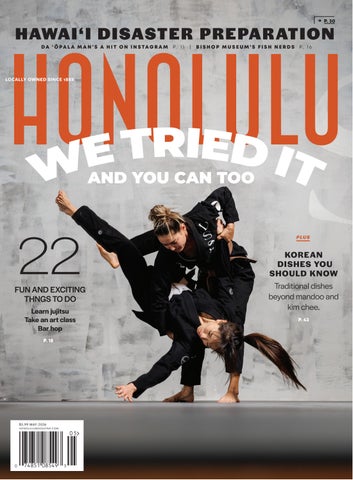
ON THE COVER: Juri Ko and Ocean Hay at VSSL Union. Photo: Aaron K. Yoshino M AY 2 0 2 6
3
EDITOR’S PAGE
Love for Honolulu
Our cover story is all about finding fun and celebrating our city.
difficult place to live for reasons beyond high costs. But we can’t forget what’s good about life here, beyond balmy weather. I know everyone experiences life individually and under completely different circumstances. Personally, I live with more ease here. I’m less stressed, more trustful of others and healthier than I was when I lived in larger cities. Work doesn’t consume me the way it used to, and I have time and ample opportunities to care for myself. Perhaps it’s because I’ve gotten older and my priorities have shifted, but whatever the reason, Honolulu offers me a high quality of life in big and small ways. This month’s cover story is a small way to celebrate our city at a time when it might be easier to focus on the negatives. Our editorial team was tasked with scoping out fun things to do and sharing the ones we would personally recommend. The result: 22 first-person write-ups that span food outings, wellness endeavors, outdoor adventures and art classes. After living in Honolulu for most of my life, including the past 21 years, I was surprised I didn’t know about many of the activities before this assignment. Most are offered by small local businesses, and when I thought about them collectively, I felt love for our city. I remembered an essay I wrote about four years ago, after starting this job as HONOLULU editor. It only ran online, but it spoke to my intentions. Here’s an excerpt: “I want to write a passionate love letter to Honolulu, the city where I was raised. … This is a city that can bring me to my knees with worry with its high cost of living, but also where I met friends that feel like family. It’s a city where the sun shines year-round and the skies turn a kaleidoscope of colors at dusk, and where people arrive at potlucks bringing way 4
HONOLULU MAGAZINE
AARON K. YOSHINO
H
AWAI‘I IS an increasingly
more than their fair share. It’s where my daughter’s kindergarten artwork once blew into rush hour traffic on Ke‘eaumoku and a guy got out of his car, stopped traffic and dashed around retrieving every piece with no honks or complaints from other drivers. It’s a city that I sometimes long to travel far away from, but the city that I have always said I’m from. “Now in this role at HONOLULU, I am working alongside people with equal passion for this city. Together, we know the ins and outs of our home, how government is run, the nuances of local
living, where to hear live music, where to shop for the perfect first birthday baby gift and the best place to get a smoked tako poke bowl. Together, we can pen a gorgeously written, heartfelt letter.” Consider this issue part of that ongoing love letter.
DIANE SEO EDITORIAL DIRECTOR DIANES@HONOLULUMAGAZINE.COM
One Subscription. One Price.
Everywhere CAN WE RETURN TO AHUPUA‘A?
|
NEW LATINO FLAVORS
2025 SUMMER PROGRAMS GUIDE
HOW HEALTHY IS HAWAI‘I, REALLY?
HONOLULU BOOK AWARD WINNERS S P R I N G FA S H I O N : F R E S H N E W M U ‘ U M U ‘ U | E AT I N G O U R I N VA S I V E S P E C I E S
H Ō K Ū L E ‘A C E L E B R AT E S 5 0 Y E A R S | R E S TA U R A N T Q U E S T I O N S YO U ’ R E T O O S H Y T O A S K
HAWAI‘IS HISTORIC HOMES
IT ’S EVERYWHERE!
TOP DOCTORS
LOCALLY OWNED SINCE 1888
3 neighborhoods with these gems. CASTLE CONNOLLY
P.30
9 13 P HYSI C IA N S 7 3 S P E C IA LT I ES P. 30
MAY/JUNEV 2025 | VOLUME LIX NO. 6 | $5.99
APRIL 2025 | VOLUME LIX NO. 8 | $5.99
MARCH 2025 | VOLUME LIX NO. 6 | $5.99
Pickleball has morphed into a serious sport and a wildly popular activity for people of all ages. $5.99 NOVEMBER SEPTEMBER OCTOBER 2023 2023 2024 HONOLULUMAGAZINE.COM
CELEBRATING WAHINE AWARDS
GIVE BIG HAWAI‘I 2025
H O N O R I N G O U T S TA N D I N G A N D I M PA C T F U L L E A D E R S
N E W W A V E O F J A P A N E S E E A T E R I E S P. 6 1
|
H O N O L U L U H O M E R E S O U R C E G U I D E P. 7 1
BEST LAWYERS IN HAWAI‘I 2026
LOCALLY OWNED SINCE 1888
LOCALLY OWNED
|
8 E A T E R I E S W O R T H T H E D R I V E P. 9 7
LOCALLY OWNED SINCE 1888
WISDOM OF OUR KŪPUNA
YOUR FAVORITE RESTAURANTS
K Ū P U N A R E S O U R C E G U I D E P. 4 1
K E E P C O U N T R Y, C O U N T R Y
LOCALLY OWNED SINCE 1888
| M I X O L O G Y G O E S M A I N S T R E A M P. 8 1
T H E PAT H T O P R O
2025 HALE ‘AINA AWARDS
W H Y A R E W E S O A N X I O U S ? P. 3 4
SINCE 1888
Maui’s Wehiwa Aloy, a first-round draft pick for the Baltimore Orioles
2025
A proposed gondola lift has pit North Shore residents against developers trying to expand visitor attractions.
P. 20
P. 22
DECEMBER 2025 / JANUARY 2026 | VOLUME LX NO. 5 | $5.99
Pursuing professional sports is an arduous, costly journey—a dream that burns big in Hawai‘i.
NOVEMBER 2025 | VOLUME LX NO. 4 | $5.99
P. 20
OCTOBER 2025 | VOLUME LX NO. 3 | $5.99
SEPTEMBER 2025 | VOLUME LX NO. 2 | $5.99
The best restaurants in Hawai‘i, chosen by our readers.
How we can realize more purposeful, peaceful and happy lives.
P. 24
P. 30
HAWAI‘I DISASTER PREPARATION 20 26
BEST DENTISTS 2026
C H I N A T O W N T H R O U G H A L E N S P. 1 6
|
SUMMER PROGRAMS GUIDE
D A ‘ Ō P A L A M A N ’ S A H I T O N I N S T A G R A M P. 1 1
|
B I S H O P M U S E U M ’ S F I S H N E R D S P. 1 6
P. 31
O U R E X P A N D I N G A N D T H R I V I N G C O F F E E C U LT U R E P. 5 7
W I L L R E S T A U R A N T S E V E R B E T H E S A M E ? P. 5 7
LI G HTS O UT?
H O N O LU LU S TO R I E S
W E TRIED IT A ND YO U CA N TO O
LOCALLY OWNED SINCE 1888
LOCALLY OWNED SINCE 1888 LOCALLY OWNED SINCE 1888
Without swift action, Hawai‘i faces a dire future and more exorbitant electricity costs. What will it take to move aggressively enough with renewable alternatives?
22
T H E J OY O F AG I N G | B E LO N G I N G | L I V E A L I T T L E T H E W O R ST TA P DA N C E R I N H O N O LU LU | P E T M A M A
P. 22
5
FUN AND EXCITING THNGS TO DO
writers share their tales in the city.
Learn jujitsu Take an art class Bar hop
P LU S
KOREAN DISHES YOU SHOULD KNOW Traditional dishes beyond mandoo and kim chee. P. 43
P. 18
P. 18
MAY 2026 | VOLUME LX NO. 9 | $5.99
APRIL 2026 | VOLUME LX NO. 8 | $5.99
FEBRUARY 2026 | VOLUME LX NO. 6 | $5.99
Access HONOLULU’s best dining, entertainment, culture and feature stories anytime, everywhere.
Just $24.99 a year*
Subscribe Now honolulumagazine.com
scan to subscribe
*U.S. residents only. International customers please call 1-800-788-4230.
Tickets on sale at HNLTIX.com
OFFICIAL RIDESHARE SPONSOR:
VENUE SPONSOR:
CO-SPONSORS:
Currents LI FE
CRAFT
Lei-go Land
I N
H O N O LU LU
➸ FOR A FUN, FRESH TAKE on Hawaiian lei, look no further than Natasha McKenna’s colorful creations,
built from hundreds of tiny LEGOs. The longtime local crafter has been making fresh flower and ribbon lei for decades, and in 2025 found new inspiration in the playful plastic bricks. Perfect for grad season or even cheery home décor, several of the lei resemble traditional favorites, such as maile, ‘ilima, crown flower, pakalana and tuberose. But McKenna also enjoys delving into offbeat color combos, whipping up entirely original strands. “I don’t see it as a business; it’s a hobby,” she says. “It’s a destresser, something I do just for the joy of it.” —Brie Thalmann, photo by Aaron K. Yoshino Available at HouseMart Ben Franklin Crafts Market City, 2919 Kapi‘olani Blvd., Kapahulu, (808) 735-4211. M AY 2 0 2 6
7
See more things to do this month at
CURRENTS
honolulumagazine.com/ things-to-do.
HAPPENINGS
May Picks Top events this month.
COURTESY: COLLECTION OF VIRGINIA MUSEUM OF ART
BY AN D R E A LE E
Food & Drink
Food & Drink
Run
May 2 / 6:30 to 8:30 p.m. / Inspiration Hawai‘i Museum / $75 to $125
May 16 / 4 to 8 p.m. / Ka Makana Ali‘i / Free admission
May 23 / 7 a.m. / Windward Community College / $35
Taste all-new poke creations and vote for the new King of Poke Fest while enjoying live entertainment, games and other ‘ono eats at this open-air foodie event. Buy a Poke Pass to try more poke in the fast lanes!
This inaugural family-friendly run will have awards for everyone from elementary school students to kūpuna and benefit Ke Kula Kaiapuni ‘o Pū‘ōhala school in Kāne‘ohe.
Rosé Soirée
At this The Devil Wears Pradathemed extravaganza, come dressed to the nines and ready to drink your fill of bottomless rosé paired with light bites. VIP ticketholders get early access at 6 p.m.
Poke Fest
The HONOLULU Edit May 9 / 10 a.m. to 3 p.m. / Ward Centre / Free admission Shop local at our curated popup market featuring clothing, accessories, plants, jewelry, food, drinks and more. Snag a VIP pass for $25 to get one-hour early access and exclusive discounts. honolulumagazine.com, @honolulumag 8
H O N O LU LU M AG A Z I N E
runsignup.com, @huimakuaopuohala
hnltix.com, @honolulumag
hnltix.com, @honolulumag Shopping
Himalayan Spirits, 2021 Gold, acrylic, and ink on four canvases Virginia Museum of Fine Arts, Arthur and Margaret Glasgow Endowment and the following by exchange: Naski and Alice Heeramaneck Collection, Gift of Paul Mellon; Gift of Miss Frances Leigh Williams in memory of her brother, Archer Anderson Williams; Gift of the Estate of Mrs. Mary Safford Hoogewerff; and Gift of Mr. George P. Bickford, 2022.74a-d
Kūkini Kea‘ahala 5K
Comedy
Ray Lau May 20 / 7 p.m. / Blue Note Hawai‘i / From $25 You may recognize Cantonese American comedian Ray Lau from his viral “Chipotle Bean Scheme” joke and other relatable stories about being Asian in America. bluenotehawaii.com, @rayjlau
Festival
Waimānalo Country Farms Sunflower Festival Anticipated to open May 23 / 9 a.m. to 4 p.m. / Waimānalo Country Farms / Admission price TBA Stroll through the blooming sunflowers with a Nalo-made lemonade in hand, take lots of cute photos, feed farm animals and eat grilled sunflowers and cornbread. waimanalocountryfarms.com, @waimanalocountryfarms
Art
Divine Disruption: The Art of Tsherin Sherpa May 30 to Jan. 31, 2027 / Honolulu Museum of Art / $15 kama‘āina admission Nepalese artist Tsherin Sherpa blends traditional Himalayan Buddhist motifs and iconography with his own vivid, mesmerizing style of contemporary art. honolulumuseum.org, @honolulumuseum
ENVIRONMENT
New in Town Places and activities that have opened recently. BY ANDREA LEE
COURTESY: ALWAYS A .LINE
COURTESY: THE HAWAIIAN COUNCIL
The Nature Conservancy hopes a recently renewed insurance policy can protect the Islands’ reefs for years to come. BY ESMÉ BETSCH IN 2022, The Nature Conservancy
1450 Ala Moana Blvd., Ala Moana, alwaysaline.com, @alwaysa.line
92-100 Waipahe Place, Kapolei, luaukaula.com, @kaulaluau
ANDRE A LEE
Kaula Lū‘au Produced by the Hawaiian Council, this new cultural performance at Ocean’s Edge at Ko Olina Resort features Native Hawaiian storytelling, hula, music and chants brought to life with modern staging.
ANDRE A LEE
Always A.line The local women’s fashion brand has moved into the ‘Ewa wing on the third floor of Ala Moana Center, filling out the larger space with its latest collections and plenty of petite options.
Thirty Eight From the same family as Nori Bar and Chao comes a new seafood-focused restaurant on Pier 38 with notable dishes like misoyaki black cod with squid ink rice and fried leeks. 1135 N. Nimitz Highway, Kalihi, @thirtyeighthi
Protecting Hawai‘i’s Coral Reefs
GET T Y IMAGES
A RRIVA L S
Victoria Ward Park Mauka The mauka side of the park has reopened, providing an expansive green space, artful playground structures, open-air seating and public art installations by Hiroki Morinoue and David Kuraoka.
purchased the country’s first coral reef insurance policy, hoping it would help protect Hawai‘i’s reefs, which had suffered massive damage in 2015 from record-breaking warm ocean temperatures. The policy was approved for renewal earlier this year. The Nature Conservancy, a global organization committed to environmental preservation, was inspired by similar policies in place in Mexico and Central America. The nonprofit’s policy pays from $200,000 to $1 million to assess and repair coral reef breakage. Reattaching broken coral using nontoxic adhesives could help sustain Hawai‘i’s reefs for years to come, says TNC marine project manager Julia Rose. “You could look at this as a crazy idea, right? We’re going out and we’re literally gluing corals back down,” she says. One of the biggest challenges with coral preservation is the short window in which broken corals can be reattached. That’s why insurance funding is crucial. TNC’s insurance policy is currently in effect statewide, offering coverage in the advent of hurricanes, tropical storms and major swells that may cause coral breakage. So far, TNC has not had to file any claims. To mobilize quickly, TNC is supported by 12 other organizations through the Hawaiʻi Emergency Reef Restoration Network. “What I’m most excited about for reef restoration in Hawai‘i is that we’re all learning from each other and working together,” Rose says. nature.org, @nature_org
1020 Auahi St., Kaka‘ako, wardvillage.com, @wardvillage M AY 2 0 2 6
9
CURRENTS
C U LT U R E
Welcome to Chinatown
A new archway is expected to open this summer. B Y K AT R I N A VA L C O U R T
A
of King and Kekaulike streets, one of the country’s oldest Chinatowns is about to get a new arch, the hallmark of Chinatowns across the globe. Businessman and philanthropist Eddie Flores Jr., founder and chairman of L & L Hawaiian Barbecue, has been working on the project with the city since 2019, when he was tapped by then-Mayor Kirk Caldwell. Flores formed the nonprofit A Better Chinatown Association to raise money and begin improving the area. “Because Chinatown is in the historical district, it requires significant effort and coordination with both the city and the state,” Flores says. The group has since refreshed the existing arches on the bridge near River and King streets and is planning the rollout of the new arch with officials and contractors. Flores hopes the arch will be completed this summer. “Chinatown will never be the same,” Flores says, adding that a second arch is planned for Hotel and Kekaulike streets. In late February, not long after Year of the Horse banners went up at Kekaulike Mall, the group broke ground on the arch. The top of the arch, designed by local architect Andrew Tang, was manufactured in China, while the base, made here, features inscriptions honoring 14 Chinese people who made significant contributions to the community. Some names are widely known, such as Clarence T.C. Ching and Chinn Ho, while others have shaped the Islands from behind the scenes, including Foodland co-founder Joanna Sullivan. COURTESY: ANDREW TANG.DESIGN
T THE CORNER
10
H O N O LU LU M AG A Z I N E
There also will be several murals in the area showing the history of Chinatown, painted by local artists. The first, by plein air painter Mark Brown, is at the entrance to Maunakea Marketplace on Hotel Street; it shows Sun Yat-sen arriving in Honolulu on one side, and on the other, giving his first major speech in 1903 in which he advocated for the overthrow of China’s Manchu regime. Brown, whose grandfather’s grandfather was one of Sun Yat-sen’s teachers at ‘Iolani School, says Chinatown is one of his favorite places to paint. honoluluchinatown.org, @abetterchinatownhnl
SOCIAL MEDIA
Hawai‘i’s Top-Selling Cars
Da ‘Ōpala Man’s a Hit on Instagram The anonymous O‘ahu refuse collection operator offers a behind-the-scenes look at his job.
It’s probably no surprise that the Toyota Tacoma is Hawai‘i’s most popular car, but the RAV4 is gaining speed.
B Y K AT R I N A VA L C O U R T
GET T Y IMAGES
BY TH E N U M B E RS
Top 20 Selling Models in 2025 INSTAGRAM’S ALGORITHM nailed it. Here on my
Toyota Tacoma
JAMES NAK AMURA
7.1%
Toyota RAV4
5.5% Tesla Model Y
4.4%
Toyota 4Runner
Toyota Corolla
3.8% 3.6%
% State Share
% chg. ’24 to ’25
Rank
Model
1 2 3 4 5
Toyota Tacoma Toyota RAV4 Tesla Model Y Toyota 4Runner Toyota Corolla
7.1 5.5 4.4 3.8 3.6
-0.5 27.5 -13.1 -4.1 8.6
6 7 8 9 10 11 12 13 14 15 16 17 18 19 20
Honda CR-V Honda Civic Tesla Model 3 Subaru Crosstrek Ford F-Series Honda HR-V Nissan Frontier Toyota Camry Chevrolet Silverado Subaru Forester Toyota Sienna Nissan Kicks Ford Maverick Honda Odyssey Lexus NX
3.3 2.5 2.0 2.0 2.0 2.0 1.6 1.6 1.5 1.4 1.4 1.3 1.2 1.2 1.2
10.9 -4.0 5.9 4.7 46.8 -11.9 9.1 -31.2 -6.7 0.5 19.1 45.9 10.9 4.1 -6.4
DATA SOURCED BY HAWAI‘I AUTOMOBILE DE ALERS ASSOCIATION FROM E XPERIAN AUTOMOTIVE
feed, a video appears of an O‘ahu garbage truck driver picking up fallen trash bins with the truck’s arm, shot by the driver. Suddenly, I’m curious about what it’s like to operate a massive truck, and the next thing I know, I’m watching dozens of videos posted by Da ‘Ōpala Man. I’m not the only one. Instagram Reels from @da.opalaman.808 routinely rack up thousands of views. His most popular one drew more than 200,000. The videos provide a behind-the-scenes look at a job that’s often underappreciated. It also makes it clear why we all need to follow “trash etiquette.” “I started this account to show everyone a side of my everyday work life that they don’t usually see,” says Da ‘Ōpala Man, who prefers to remain anonymous, blurring his face anytime he’s onscreen. “I didn’t realize how much people would enjoy watching my videos.” He’s worked for the City and County of Honolulu for 21 years, 11 of them as a refuse collection operator. “I started enjoying this job because of the role I got to play in the community, but us ‘ōpala people are often overlooked,” he says. Not by kids, though. “Seeing the excitement of all the little kids watching and waving every week takes me back to when my own kids were little and how excited they would be when they seen me or other truck drivers driving by. I’ve been blessed to see the kids on my routes grow up over the years, and I hope that they know that they made my days more enjoyable.” With seven children of his own, Da ‘Ōpala Man started his Instagram and TikTok accounts last July, then his YouTube about a month later, and Facebook this January. Collectively, he has about 7,300 followers and subscribers, as of late March. “I hope my videos give people a better look at what my job is really like, help them appreciate the work that goes into keeping our communities clean, and give recognition to the hardworking people I get to work with,” he says. M AY 2 0 2 6
11
CURRENTS
BREAKTHROUGH
Hawai‘i Folks in the News From athletes to actors, they’re making their marks. BY D IAN E S EO AN D B R I E T HALMAN N
BOBBY WEBSTER Kailua’s Bobby Webster, who has been the general manager of the Toronto Raptors since 2017, recently signed a three-year contract extension. Before taking the helm of the Raptors, the 2002 ‘Iolani School graduate served as the team’s assistant manager and VP of basketball management and strategy. He helped lead the team to its only NBA title in 2019.
In October 2025, the Los Angeles Angels announced Wailuku-raised Kurt Suzuki as the team’s new manager after he signed a one-year contract for the 2026 season. A Baldwin High School graduate, Suzuki was the nation’s top collegiate player in 2004, as well as its best catcher, while leading Cal State Fullerton to the NCAA College World Series championship. He went on to play 16 seasons in the MLB for five teams, including the Oakland A’s, Atlanta Braves and LA Angels. He was named an All-Star in 2014 with the Minnesota Twins and won the World Series in 2019 with the Washington Nationals. He is the MLB’s first Hawai‘i-born full-time manager.
NYJAH MUSIC AND ZYAH RHYTHM When they burst onto the scene in 2024, Nyjah Music and Zyah Rhythm were best known as Bruno Mars’ nephews, but these teen music artists from the North Shore are quickly making a name for themselves. The brothers’ cover of Elvis Presley’s “Burning Love” (produced by their megastar uncle) was a standout from the live-action Lilo and Stitch movie soundtrack. They were tapped to sing a cappella in a Gap holiday campaign. And they released a new single, “Be My Baby,” in January. 12
H O N O LU LU M AG A Z I N E
COURTESY: TORONTO RAPTORS
KURT SUZUKI
LACHLAN TA‘IMUA HANNEMANN O‘ahu native Lachlan Ta‘imua Hannemann is an actor to watch, after appearing as Mr. James Dickley in the short film Jane Austen’s Period Drama, which was nominated for Best Live Action Short Film at this year’s Academy Awards. The Saint Louis School grad says he’s proud to have worked on the comedic film, a satire on Jane Austen’s Pride and Prejudice. It was only his second project out of drama school. “I was learning the ways of being on set, acting in a period piece, in a castle, with an accent—it was all new to me,” Hannemann says. “To have it be nominated a couple years later, I feel extremely grateful.” The 25-year-old says he’s worked on other projects since then that will be making their way to theaters and festivals this year. “With all these exciting things happening, I get to reflect on the dreams I once made as a kid, and they’re all unfolding right in front of me,” he says.
Getting Creative in Kaka‘ako
OurSpace makerspace levels up in spacious new digs. BY B R I E T HALMAN N
C
ITIES WITH VIBRANT creative
communities don’t happen by accident. Makers and small businesses, especially those just starting out, need support. On O‘ahu, local nonprofit OurSpace aims to provide just that via its new makerspace in Kaka‘ako, designed to foster artistry, innovation and entrepreneurship by providing access to workspaces, tools and training. Founders Darren Yomogida, a jeweler and watchmaker, and Rechung Fujihira, who also co-founded BoxJelly, launched the initiative in 2023, operating on a smaller scale out of the Entrepreneurs Sandbox. Now, situated in its own 13,000-square-
COURTESY: OURSPACE/TOMMY SHIH
COMMUNITY
foot, two-story building, OurSpace’s offerings have expanded. Members have 24/7 access to a wide array of high-tech equipment geared toward small-batch production, including a 3D printer, CNC carving and forming machines, an industrial laser cutter, a laser welder, metal fabrication tools, specialized jewelry tools, and a vinyl and paper blade cutter. Large-format flatbed UV ink printers can create everything from art and photo prints to stickers, banners and wall clings; they can even print on rigid items for customized or branded products. There’s also a 600-square-foot photo studio and media suite equipped
with lighting kits, backgrounds and a monitor system. What’s especially nice: OurSpace teaches members how to use the equipment and coordinating software. Additional facilities include a variety of studio spaces—private and semiprivate offices, open work bays and dedicated desks. Along with a member lounge, kitchenette and dining area, members can make use of a utility sink, shower and washer-dryer. The building also boasts a roomy event space, which it plans to utilize for community gatherings, classes and talks. 1052 Waimanu St., Kaka‘ako, ourspacehawaii.org, @ourspacehawaii
Ride Local. Ride Easy. Ride holoholo. HAWAI‘I’S LOCALLY OWNED RIDESHARE with upfront pricing—no surge fees, just aloha service. Getting around the islands should be simple. holoholo connects you with local drivers for reliable, pre-scheduled rides across Hawai‘i—from airport runs to everyday adventures. Travel smarter with upfront pricing and a service built for our community and visitors alike.
BOOK YO UR RIDE TO DAY DOWN LOA D THE A PP: holoholomobility OR VI SI T : rideholoholo.com
L O C A L LY O W N E D
NO SURGE PRICING
PRESCHEDU E D2 0S2E6R V I13 CE M LAY
CURRENTS
STYLE
Growing Community Find beautiful blooms and fellowship at Haus of Puas. BY B R I E T H A LM A N N
Owner and co-founder Zabrina Zablan-Duvauchelle (left) and co-founder Bri Ornelas.
14
H O N O LU LU M AG A Z I N E
PHOTOS: AARON K. YOSHINO
I
NTENTION MATTERS— in life, in love, in business and
in flowers. No one knows this better than Zabrina Zablan-Duvauchelle and Bri Ornelas, who co-founded ‘Ewa Beach floral boutique Haus of Puas in 2024 with the dual mission of servicing queer clients and supporting local farmers and artisans. The duo first connected via Haus of Puas’ parent company, The Gay Agenda, an LGBTQ+ wedding planning business Zablan-Duvauchelle and her wife created in 2018 to address biases they encountered while planning their wedding. Clients often wanted simple arrangements but couldn’t meet the order minimums required by most floral companies. “A lot of queer couples are paying for their weddings on their own,” Zablan-Duvauchelle says. “Haus of Puas has no minimums and we have flex payment plans to make it more feasible, assuming they don’t have that familial support.” They also utilize nongendered forms, navigate conversations about family with sensitivity and make sure that queer couples are well-represented in their imagery. Floral artist Ornelas sources the shop’s blooms 100% locally and intentionally taps West O‘ahu makers to fill its lei fridge. Additionally, Haus of Puas strives to teach the public the value of the labor and artistry behind each strand. “We’re writing testimony for bills that would require state and city officials to source only local lei when spending taxpayer money,” Zablan-Duvauchelle says. If passed, all lei would be labeled with stickers saying either “made in Hawai‘i” or “100% grown in Hawai‘i.” A loose flower bar and a stylish assortment of locally made and designed products round out the shop’s mix. “We wanted people that align with The Gay Agenda’s pillars—queer, Native Hawaiian and sustainably owned,” says Zablan-Duvauchelle, who is Native Hawaiian. Even Haus of Puas’ name was chosen with fostering community in mind. “In queer culture, there are houses or homes and those are essentially your chosen families, because many of us get kicked out or we aren’t accepted,” Ornelas says. “That’s what TGA was for me and the shop became a home to all these smaller businesses and lei makers that can’t run their own brick-and-mortars.”
91-3633 Kauluakoko St., Suite 5003, ‘Ewa Beach, (808) 201-4528, hausofpuas.co, @hausofpuas
C R E AT E
INITIAL HERE
COURTESY: PALE PAPAHELE
COURTESY: ROYAL HAWAIIAN HERITAGE JEWELRY
Learn how to engrave your own Hawaiian jewelry.
HOME
Hitoshi Hida’s architectural illustrations are an ode to life in Old Kaimukī.
Y PERSONALITY IS A LOT, I’m pretty colorful,”
F
AARON K. YOSHINO
@palepapahele
Tuesdays and Thursdays, 1130 Bishop St., Downtown, (808) 524-4300, royalhawaiianheritagejewelry.com
DRAWN HOME
Pale Papahele’s yarn creations offer a soft, joyful touch.
“M
engraving from than one of the biggest names in Hawaiian heirloomstyle jewelry? Royal Hawaiian Heritage Jewelry’s new 2-and-ahalf-hour experience includes a tour of the iconic label’s Downtown Honolulu factory and a lesson in traditional hand-engraving techniques taught by its master artisans. Attendees select a sterling silver pendant in one of five silhouettes—circle, heart, rectangle, flower or turtle—to be embellished and polished. You also receive a sterling silver chain and if gold is more your jam, you can have the pendant gold plated for an extra fee. —Brie Thalmann
BOOKS
Tuft Love says Anale‘a Kahaiali‘i of Pale Papahele. “If someone had to pick a color to represent me, I don’t think they could pick just one.” That same vibrant energy pours out of the Waiehu textile artist’s tufted rugs and wall hangings depicting traditional kui iki patterns and island elements in a rainbow of exuberant hues. The former mechanic discovered tufting while doomscrolling on TikTok during the pandemic. “At the time, I was already punch needling,” she says. “It’s the same concept, just on steroids and with power tools.” She bought a tufting gun, enrolled in “YouTube University,” as she calls it, and fell in love with the craft’s endless possibilities. “There are so many cool things to make—pillows, purses, cushions, upholstery,” Kahaiali‘i says. “I even came across someone who made a cat house.” Along with the quilt motifs inspired by her Hawaiian heritage, she’s also tufted rugs shaped like mu‘umu‘u, cowboy boots and even kole (yellow eye tang fish). Kahaiali‘i releases pieces in small drops, so you’ll want to watch her Instagram, and O‘ahu fans should keep an eye out for her collab collection with Waiāhole Poi Factory, releasing in June. —Brie Thalmann
W
HO BETTER TO LEARN the art of
OR 35 YEARS, architect and longtime
Kaimukī resident Hitoshi Hida poured his love for his favorite neighborhood into the pages of a 5-by-7-inch notebook, capturing its small-town charm through intricate pen-and-ink drawings. Sixty-three of those illustrations can now be found in Sketches of Kaimukī, his hardcover book that celebrates the community’s quaint businesses, bungalow-style homes, unique architecture and unassuming vibe. A flip through the pages offers a nostalgic look back at some of Kaimukī’s most iconic haunts, from Harry’s Music Store and the Kaimukī AA Taxi stand to Tanoue’s Saimin and Queen Theater. Snag a copy at Fishcake, Small Kine Gift, Da Shop and Nohea Gallery. —Brie Thalmann M AY 2 0 2 6
15
CURRENTS
PURSUITS
Deep Dive Richard Pyle and Brian Greene have devoted their careers to discovering and documenting marine life in the ocean’s depths. BY D IAN E S EO
R
ICHARD PYLE AND BRIAN GREENE literally go where humans have not gone before, diving 500 feet into pristine indigo water to discover and document marine life around coral reefs. As ichthyologists—marine biologists who study fish (or “fish nerds” as they call themselves)—they’ve dedicated their lives to exploring reefs in oceans across the Indo-Pacific to collect information about our planet’s biodiversity. “What gets me excited is when I come around a corner on a deep coral reef and see a fish I know no human has ever seen. That thrill is indescribable; it’s a raw discovery,” says Pyle, Bishop Museum’s interim director of natural science. With climate change, there’s urgency in their work. Research shows that species are going extinct about a thousand times faster than they did before the Industrial Revolution, Pyle says. Adds Greene: “My motivation is my 5-year-old son. I want to document as much as possible, so he’ll be able to see what I’ve seen.”
COURTESY: RICHARD PYLE AND BRIAN GREENE
A scene from one of Pyle and Greene’s diving expeditions
16
H O N O LU LU M AG A Z I N E
Like their mentor, late Bishop Museum scientist Jack Randall, whom Pyle calls “the greatest ichthyologist in all of history,” Pyle and Greene are building a library of knowledge at the museum’s Center for the Exploration of Coral Reef Ecosystems. They’re also working through EXCORE to share information, photos and videos captured during their dives. “We’ve been living this for 40 years, but because we’re nerds and introverts, we’ve been keeping it to ourselves,” Pyle says. “But we’re now getting encouragement from museum leadership to get the word out.” The duo’s passion for deep-sea diving started early, and not even a traumatic accident would detour Pyle from his destined path. As a 19-year-old, while diving in Palau, his equipment malfunctioned, and he was paralyzed. While he eventually regained mobility, to this day he has lingering limitations like poor balance. “I was told by doctors I’d never go diving again, but I had already decided it was my life’s calling,” Pyle says. The experience got him fixated on how he could leverage technology to make dives safer. He spent years studying military and commercial divers, who use advanced equipment and special gas mixtures including helium, to go much deeper than scuba divers. Pyle adopted similar practices and became a chief beta tester for a diving equipment manufacturer. “I’ve been involved in developing the technology I use, and it’s been getting better, smaller, more efficient and more reliable,” he says. He and Greene now head into what they refer to as the “twilight zone,” the area below where scuba divers typically go, but shallower than where submarines venture, generally around 500 or 600 feet. During their explorations in the Indian and Pacific oceans, they’ve discovered many new species of fish, including previously unknown kinds of damselfishes, wrasses, butterfly fishes and angelfishes, Pyle says. To document their findings, Greene operates what arguably is the world’s best underwater camera, the kind of digital camera used by Hollywood cinematographers. Even today, with decades of explorations behind them, the pair regard every expedition as a privilege. “It wouldn’t be overstating to say it’s like what Neil Armstrong felt like stepping on the moon,” Pyle says. “Sometimes, we find enormous caves or giant schools of sharks, stuff completely unknown to humans, and that’s where the excitement comes from—discovering a new frontier.”
OLIVIER KONING
Brian Greene (left) and Richard Pyle at Kāne‘ohe Bay with their diving camera and equipment, including a mixed-gas rebreather, which they use to explore coral reefs at depths of about 500 feet
M AY 2 0 2 6
17
WE TRIED IT AND YOU CAN TOO
A trolley takes guests on the Kualoa Grown Tour at Kualoa Ranch.
p.18 18
H O N O LU LU M AG A Z I N E
COURTESY: KUALOA RANCH/ROBERT PASCUA
We Tried It and You Can Too
WE TRIED IT AND YOU CAN TOO
22 fun and exciting things to do that we personally recommend. by E S M É B E T S C H , A N D R E A L E E , D I A N E S E O , M A R I TA K E TA , B R I E T H A L M A N N A N D K AT R I N A VA L C O U R T
M AY 2 0 2 6
19
Food & Drink Bar Hop at Halekūlani Hotel
A ARON K. YOSHINO
Pair Rum and Chocolate at House of Mana Up
T
2201 Kalākaua Ave., Suite A112, houseofmanaup.com, @houseofmanaup
20
H O N O LU LU M AG A Z I N E
—Katrina Valcourt 2199 Kālia Road, halekulani.com/dining, @halekulanihotel TH
OM
AS
OB
UN
G
EN
HE GIANT DISPLAY OF RUM BOTTLES in Mana Up’s latest location at Royal Hawaiian Center in Waikīkī means we’re in the right place. Reservations for tastings of Mānoa Chocolate and Kō Hana Hawaiian Agricole Rum, which last about 30 minutes, can be made online, but walk-ins are welcome if it’s not too busy. The reservations are available every half hour between 11 a.m. and 8:30 p.m. Once at the bar, you choose whether to go with straight rum or ready-to-drink cocktails. We choose cocktails, all made with Kō Hana’s Kea, or white rum. Our knowledgeable guide explains the history of both local companies before giving us a small pour of the Classic Daiquiri to try on its own, followed by the Liliko‘i Daiquiri and a small triangle of Mānoa’s liliko‘i chocolate. In all we try six cocktails (the others were the Hemingway Daiquiri, 1944-style Mai Tai, Pineapple Daiquiri and Blue Hawaiian), paired with five chocolates (singleorigin Nīnole, banana, sea salt and a collab Kō Hana rum bar, along with the liliko‘i chocolate), plus rum-barrel-aged honey from Mānoa Honey & Mead, a sip of Kō Hana’s Kokoleka chocolate rum and a small piece of rum cake. It’s the perfect post-dinner treat and a great deal—only $30 for kama‘āina ($40 general). Each tasting also comes with a $5 coupon and commemorative tasting glass. —Katrina Valcourt
SPEND A BOUGIE NIGHT at one of Waikīkī’s swankiest locales—without a hotel room. We start with heavy pūpū (including hamachi crudo, ‘ahi tataki and hoisin coconut ribs) and a hula show at House Without a Key. Its bar, Earl’s, recently changed its menu; now it features only local beers and new cocktails, but you can still expect signature drinks such as the coconut cake martini or mai tai. I love the open-air seating, and if you’re there for sunset, even better. After dinner we step farther from the beach into tucked-away L’Aperitif, the upstairs bar of La Mer. Bartender Henry Kawaiaea is a wellspring of cocktail knowledge—tell him what you like and he’ll guide you toward one of the bar’s unique concoctions. Expect ingredients you don’t typically see: black garlic shrub, house-made pistachio syrup, macerated kumquats. He’ll even make you a classic 1944 mai tai to compare to the one you just had downstairs. End the night with jazz, drinks and the hotel’s famous coconut cake at Lewers Lounge. Sipping a jazz-inspired cocktail (the delicate Paper Doll comes in a teacup) while listening to the stylings of Maggie Herron and Dean Taba on Friday nights, you’ll think, I could get used to this.
WE TRIED IT AND YOU CAN TOO
TYPICALLY FOUND AT KOREAN supermarkets, songpyeon rice cakes are traditionally eaten during Chuseok, Korea’s autumn harvest festival. But Rice Blossoms has made them year-round treats that can be gifted or enjoyed at celebrations or just because. Even better, you can make them yourself in Shana Lee’s pop-up classes around the island. I’ve been a fan of Lee’s cabochonlike songpyeon, though I doubted whether I could make them as beautifully as she does. Yet it was surprisingly easy. During one of her classes, she showed us how to mix in colored powders derived from foods like kabocha and matcha, then to shape the rice cake dough into cute little fruits, similar to working with air-dry clay. The rice cakes admittedly looked a bit rough, but steaming smoothed them out and made them shine. Gluten-free and filled with a mixture of honey and sesame seeds, they were satisfyingly chewy and not too sweet. We enjoyed Korean refreshments while learning about songpyeon’s history and cultural significance. The classes, which vary in price, are intimate and family-friendly for ages 6 and up. Public workshops are typically held monthly, so check Rice Blossoms’ Instagram for the dates. —Andrea Lee
riceblossoms.com/honolulu, @riceblossoms _hi
WHEN JAMES BEARD PASTRY CHEF
finalist Michelle Karr-Ueoka offers an all-you-can-load cookie buffet, you don’t think practically about whether you really need or should eat a bunch NG A H C M ELISS A of cookies. You just go, like I did last year, to haul as many delightful treats from the celebrated sweets queen of MW Restaurant and Artizen as you can. This year’s event is on July 4, and here’s how it works. Pick either a small container or a large one (set price for each not available yet), then fill it with everything from Karr-Ueoka’s famous MW chocolate chip cookies to snickerdoodles, macarons, mini muffins, chocolate chunk cookies, matcha swirl cupcakes, brownies and more. Along with being able to sample a wide variety of delectable baked goodies, the event in and of itself is fun. Some make it a challenge to see how many treats they can stack into their containers without them toppling over. While my modest haul was only a few inches taller than the container, I saw others balancing foot-high towers of sugary selections. —Diane Seo 888 Kapi‘olani Blvd., Suite 201, mwrestaurant.com, @mwrestaurant
Health & Wellness
GET T Y IMAGES
DAN AHN
Make Korean Rice Cakes with Rice Blossoms
Load Up at a Cookie Buffet at MW Restaurant
Reset With a Lymphatic Massage at Seven Senses Spa
F
IRST PUT INTO PRACTICE IN FRANCE in the 1930s, lymphatic
drainage massage has been hugely popular in Asia for years and has become trendy in this country too for its numerous health and aesthetic benefits. If you’re not familiar, the lymphatic system is a network of vessels, nodes and organs responsible for balancing fluids in the body, transporting immune cells and getting rid of waste. A healthy lymphatic system means fewer toxins, better circulation and quicker healing. It can also provide a slimmer appearance. So, I was thrilled that Seven Senses Spa, one of my favorite wellness spots, had added it to its services. The 75-minute treatment starts with dry body brushing, in which a natural-bristle brush is run in gentle downward strokes across the skin to exfoliate and clear areas of stagnant fluid. Then, the deep tissues of the body are addressed with a mixture of kneading and sweeping motions that move fluid from the deeper layers of muscle upward to the lymph node regions—the neck, armpits, abdomen and groin. It was relaxing, for sure, but what I really liked was that it left me feeling lighter and a bit energized, and not tired or drained the way some massages do. I also really loved that I got to keep the dry brush, so that I could incorporate the techniques into my shower routine at home. —Brie Thalmann Multiple locations, sevensensesspa.net, @sevensensesspahawaii
M AY 2 0 2 6
21
WE TRIED IT AND YOU CAN TOO
Heal with Hyperbaric Oxygen Therapy at Lava Wellness
Learn Jujitsu at VSSL Union
COURTESY: L AVA WELLNESS
I WAS NERVOUS. I had never done
I HAD LONG WANTED TO TRY this wellness therapy, touted to reduce inflammation, boost the brain and supercharge the immune system among other benefits—and what an introduction I got. It was in the Starlight Deluxe hyperbaric oxygen chamber at the swanky new Lava Wellness at South King and Pi‘ikoi streets. Instead of being squeezed into a claustrophobic device like I imagined, I lounged on a comfy, reclined seat, gazing at colorful twinkling “stars” on the ceiling, while being infused with oxygen. I could’ve watched Netflix on the built-in TV or turned on the AC, but opted out of both. I just relaxed and listened to music on my phone while breathing in O2 flowing through my oxygen mask and throughout the chamber. I did some breathwork during the hour session and found that I could inhale more deeply than normal. At the time, I was recovering from the flu, but after my session, I felt calm and energized. While the experience isn’t cheap—$175 per person in the Starlight Deluxe, which can fit up to four people—there are less expensive options. A smaller Deluxe chamber ($150 per person for up to two people) is also available, along with an individual vessel ($100). It’s less expensive if you purchase packages or if you add a guest to your session, and you can also sign up for a membership, which provides access to yoga and fitness classes, time in the sauna and cold plunge, red light therapy and more. —Diane Seo
1155 S. King St., lavawellness.com, @lavawellness
22
H O N O LU LU M AG A Z I N E
jujitsu or any type of martial arts, and I couldn’t help but worry I would hurt myself, especially my sensitive neck. But I was locked in, committed to getting out of my comfort zone and shaking things up in 2026. VSSL Union is a recently opened jujitsu and yoga studio near University Avenue and South King Street, owned by longtime jujitsu instructor Jason Aquino and equally experienced yoga teacher Juri Ko, whom I knew. Ko recommended I take the women’s class. First off, I loved the space, with its high ceilings and hip, urban and industrial vibe. Wearing a borrowed gi (jacket, pants and belt), I followed the group warmup, jogging forward, sideways, backward then rolling. During the hourlong class, taught by Ocean Hay, we learned two moves, one referred to as “Mission Impossible.” With Ko as my partner, we took turns flipping each other, following Hay’s clear instructions. I was surprised I could easily do it. Then we sparred, using the same technique, but this time, we applied our body weight to resist being flipped. Ko didn’t budge, but I didn’t either when it was her turn to try. It was fun, exhilarating and empowering. “You did more than I thought you would,” Hay told me at the end of class. I was thinking the same thing. —Diane Seo
2615 S. King St., vsslunion.com, @vsslunion A AR
ON
K.
YO
SH
IN
O
Style & Beauty
AAR
ON
K.
S YO
H
IN
Shop for Vintage Sports Gear at Old Queen Street Stadium
O
A
Leilehua Mules track tank. A Hilo Stars baseball jersey in classic pinstripe. If you’re looking to immerse yourself in a bit of Hawai‘i sports history, there’s no better place than Old Queen Street Stadium. Half museum, half vintage boutique, it’s become one of my favorite places to snag one-of-a-kind fashions—the UH baseball warmup henley and Leeward Bowl bowling shirt I got there I rock on repeat. The business is the brainchild of friends Kevin Faller, Chester Sebastian and Kevin Sebastian who opened the shop in 2021 fueled by a shared love of old-school wares. A move in 2025 took the boutique from Kaka‘ako to Downtown Honolulu. Along with shoppable apparel and accessories, the place also boasts a slew of local sports memorabilia—from game day programs and trading cards to equipment, collectible tchotchkes and photos—that are a kick to look through and that you’re unlikely to find anywhere else. The trio has also started making throwback-inspired merchandise, including custom jerseys and graphic-print tees destined to become cool collector’s items for future generations. —Brie Thalmann
Take a Plunge at Plunge & Barrel COLD PLUNGING followed by time in
—Diane Seo 956 Kawaiaha‘o St., plungeandbarrel.com, @plunge.and.barrel
79 Merchant St., hawaiisportsmuseum.com, @hawaiisportsmuseum
A ARON K. YOSHINO
a sauna is all the rage, globally and in Honolulu. Several local businesses offering this practice (known as “contrast therapy”) have opened in recent years, one of the newest being Plunge & Barrel in Kaka‘ako. Although the benefits are widely known—inflammation reduction, improved circulation, mood boosting and more—many are hesitant to try it because of the discomfort of being submerged in icy water. The key is to engage in breathwork, which is exactly what you’ll learn in this class. Operations manager Amanda Coppes started by explaining the contrast therapy benefits, then led us in Wim Hof breathwork, inhaling through the nose and exhaling through the mouth in a rapid, circular fashion. Then it was showtime. The water in the outdoor cold plunge was a chilly 47 degrees, while the sauna was hitting 200 degrees. The three of us in the class took turns first in the cold plunge for a minute each, with Coppes coaching us to breathe the way we practiced but with extended exhales. Hitting a minute in the cold plunge was exhilarating, and settling into the sauna felt like being wrapped in a warm blanket. We then did another round in the cold plunge, and during this second try, I fully dunked my head in the water, accomplishing something I had been hesitant to try in the past. Having Coppes there to encourage me made the difference. I felt awesome for the rest of the day. Relaxed, invigorated, energetic. I would recommend this class for anyone curious about cold plunging but needing a little emotional support to give it a go.
N EMBROIDERED 1995 PRO BOWL CAP. An ’80s green and gold
Indulge in a Korean Facial at K Beauty Lab
Get a Color Analysis with Elizabeth Kosich “COLOR CAN EVOKE FEELING, emotions and moods,” Elizabeth Kosich says. “It’s
energy that travels in frequencies and vibrations. It’s not frivolous.” I’m seated near a window in her live-work loft space in Chinatown, fabric swatches draped across my chest. A fashion stylist-designer, Kosich has been helping people find their ideal palettes for decades, boasting an image analysis degree from the Fashion Institute of Technology and accreditations from the Association of Image Consultants International and the Image Resource Center of New York. She leans in close then steps back and cocks her head to the side, studying every nook and cranny of my face as she switches out swatches. “Interesting,” she murmurs, flipping over my wrists to inspect my veins and tugging at my socks for a glance at my ankles. “I get all up in your personal space,” she had warned me earlier, while going over an extensive questionnaire that touched on everything from my ethnic background and childhood hair color to my propensity for sunburns. Kosich utilizes a 16-color method, with four core seasons and three sub-seasons, to analyze hair, skin and eyes for temperature, value (light versus dark), chroma (vibrancy) and contrast. The right colors create harmony between these elements. “Lips look pinker, eyes appear brighter, we look fresh and well-rested with a healthy glow,” she says. The wrong ones can emphasize dark circles, make skin appear dull or splotchy, and cast unflattering hues. Kosich decides that I am a cool winter and I receive both a cardboard swatch with my palette and a color fan, detailing my best hues for wardrobe, jewelry and makeup. She also gives me an assignment—to go home and reevaluate my closet with new eyes. “Wardrobe is really visual messaging,” Kosich says. “It’s a tool to leverage. And color is the first stop.” —Brie Thalmann
elizabethkosichstyling.com, @elizabethkosich
24
H O N O LU LU M AG A Z I N E
current cultural zeitgeist, it was time to try the much-TikTokked Korean facial, or “K-facial” as it’s commonly called. While many in search of the holy grail of “glass skin” head to South Korea for aesthetic treatments, I haven’t been able to swing a trip. Instead, I booked an appointment at K Beauty Lab in ‘Ewa Beach, which came recommended by friends. Because of the popularity of this Korean skin care clinic, I had to wait two months for my facial. The K-Signature basic facial ($145) started with an analysis of my skin, using a high-tech scanning machine. The verdict: oily skin that lacks moisture, with wrinkles around my eyes and nose. Koreans (me included) can be direct, so this was delivered matter-of-factly by a staff member. While European-style facials typically entail cleaning, steaming, extracting, exfoliating, simple massaging and masking, half of my K-Signature facial involved massaging my face, neck and shoulders with firm, gliding strokes, which I enjoyed. My aesthetician then ran a metal cooling device over my face, before painting it with a mask that eventually turned thick and rubbery. “Better,” she said, after she peeled it off, patting my refreshed skin. While in the changing room, I looked closely at my face in a mirror. It was distinctly better—smooth, soft and dare I say glass-like! —Diane Seo
91-3575 Iwikuamo‘o St., Unit 404, kbeautylabhawaii.com, @kbeautylab808
GET T Y IMAGES
A ARON K. YOSHINO
WITH KOREAN BEAUTY part of the
Arts & Crafts Make a Ring at El Dorado Casting Lab
A ARON K. YOSHINO
ON A DREARY WINTER EVENING in Chinatown, folks peer through the window of KraftStories, lit from the soft glow of Turkish mosaic lamps. We’re already inside, having been greeted with chewy cubes of Turkish delight, admiring bowls of colorful diamond-shaped tiles. Each of us has a kit that includes a glass globe, LED bulb, lamp base and top (we went with the standard lamp, $89), and plaster. Though you can order the kit online and work from home, those kits come with limited tile and bead color options. At KraftStories, the hands-on instruction, additional colors and camaraderie with other participants make this worth doing in person. Four of us meticulously place hand-cut glass tiles onto template cards that show different geometric patterns, then glue them one by one onto the globe. It’s very meditative. Once the tiles are set, we sprinkle small glass beads between the larger patterns. It takes a few hours for the glue to fully dry, so the two-hour workshop ends there; I wait another day before mixing the little bowl of plaster to cover the entire globe, filling the empty space between beads and tiles. After five minutes, I use the provided sponge to wipe away the excess and let the lamp dry for half an hour before assembling. It’s a beautiful, one-of-a-kind addition to my desk.
OU DON’T NEED metalsmithing
experience to join El Dorado Casting Lab’s three-hour couples/BFFs workshop ($400 for two people), where you shape, carve and alter wax that will be used to create custom rings from scratch. I grab a friend and meet founder James Friedman at his Downtown studio, which has been around since 2020. El Dorado offers casting services, training and support for entrepreneurs in addition to multisession classes and one-day workshops like this. We begin by sawing off a small piece of hollow wax tube, then use a tool to widen it to our desired ring size. After lightly scoring our center lines, we use metal files to evenly round the edges. My friend and I both have ambitious designs, but Friedman patiently shows us how to use different files, carving tools, drill bits and more to achieve what we want. It’s a slow process for us, but every detail shows up in the final product, so we aim for that balance between perfection and going too far. After a quick sanding to buff out scratches and round the edges, I lightly wipe the green wax with orange oil to remove any last residue and hand my ring to Friedman, who takes it from there. A few days later, I pick up our designs, now cast in shiny sterling silver. —Katrina Valcourt
—Katrina Valcourt 15 N. Pauahi St., kraftstories.com, @kraftstoriesofficial
Create a Blind Box Keychain at HouseMart Ben Franklin Crafts
1130 Bishop St., #3, eldoradocastinglab.com, @eldoradocastinglab
AA
Decorate a Turkish Mosaic Lamp at KraftStories
A ARON K. YOSHINO
Y
WE TRIED IT AND YOU CAN TOO
THE BLIND BOX DIY KEYCHAIN WORKSHOP at HouseMart Ben RO
N
K .Y O
SH IN O
Franklin Crafts hits all the right notes for those who love all things cute (definitely me). At the Market City store, the $38 class is limited to up to four people, while other locations accommodate more. We chose a blind box containing a mystery figure from the vast under $20 selection, making it unlikely we’d end up with the same figure as someone else. After opening the boxes, we strung beads on wire to form the keychain straps, matching the colors to our figures. Our instructor helped us make small UV resin charms to further accessorize our chains and assemble them. The result: so kawaii and unique. The two-hour workshop allows time to carefully select a blind box and beads, but we finished earlier. I would do the class again. A fellow attendee had done it six times and made a different keychain on each visit. You can also bring your own figure and drill a hole into its head, if it’s hard enough. Plus, we got a 10% off coupon to use on craft supplies so we could continue the fun at home. —Andrea Lee
Multiple locations, benfranklinhawaii.com, @bfcrafts
M AY 2 0 2 6
25
A ARON K. YOSHINO
WE TRIED IT AND YOU CAN TOO
Take a Class at Glass Fusion Collective Classes at the nonprofit’s Nu‘uanu workshop are mellow. The Thursday evening all-levels session guides newbies like me through the basics of scoring and cutting glass, adding decorative elements like glass strings and colored powders, and using grinders, sand blasters, saws and drills. My classmates have made Christmas ornaments, a three-tiered photo frame and a 24-inch panorama of the Ko‘olau Mountains. I’ve lost count of all the fruit bowls and pickle plates I’ve made and given away. I’m still there most Thursday nights. I absolutely love it. —Mari Taketa
THE TABLE AT THE OKINAWAN FESTIVAL stopped me in my tracks. It held bowls and plates made of glass—fused glass, the colorful pieces and patterns merged by the heat of a kiln. Whoever heard of fused glass? Stained glass and blown glass get all the glory. But unlike stained glass, which produces flat decorative pieces, or blown glass, which requires a lot more than a kiln, fused glass can easily become functional things. Like plates and bowls—the only things (aside from scarves) I love shopping for. Now the Glass Fusion Collective could teach me to make my own! I signed up as soon as I could.
glassfusioncollective.com, @glassfusioncollective
Outdoors
K ATRINA VALCOURT
Restore a Native Bee Habitat with 808 Cleanups
I
T TAKES SOMETHING SPECIAL to get me out of the house
before 9 a.m. on Saturdays, which is when most outdoor volunteer opportunities seem to take place. That’s why I was delighted to come across 808 Cleanups’ weekly restoration of Kaiwi and Wāwāmalu in East Honolulu. Every Tuesday from 4 to 6 p.m., volunteers help remove invasive species and litter from the coastline and surrounding area to protect the habitat of the endangered nalo meli maoli, or yellow-faced bee. I drive over a rocky path to join five other volunteers and site leader Michael Loftin, who points out native ʻōhai, naupaka, ‘ilima, pā‘ū-o-Hi‘iaka and naio growing along the trail, along with the invasives: California grass, buffel grass, koa haole and kiawe. The good news, Loftin tells us, is that the native plants in the area tend to fill in the empty spaces easily; we just need to clear the way for them. I like that this volunteer assignment has a low barrier to entry: It’s only two hours, and supplies are provided. So now I know—next time I have a rough day at work, I can grab a pickax and do something productive. —Katrina Valcourt Kaiwi State Scenic Shoreline, 808cleanups.org, @808cleanups
26
H O N O LU LU M AG A Z I N E
WE TRIED IT AND YOU CAN TOO
Attend Cemetery Pūpū Theatre at O‘ahu Cemetery
A ARON K. YOSHINO
‘Ihi‘ihilauākea, available at Hui Kū Maoli Ola, is a four-leaf fern endemic to Hawai‘i.
WHITE TENTS IN A GRAVEYARD? If you
see them at O‘ahu Cemetery on a June evening, they’re not for people being laid to rest. The tents are part of the Hawaiian Mission Houses’ Cemetery Pūpū Theatre, an annual event that brings to figurative life historic characters who tell their stories to audiences at their gravesites. Add in a cocktail hour on the chapel lānai to kick things off, and what history buff can resist? Post-pandemic, the pūpū have turned into bentos with drink tickets, but plastic cup of chardonnay in hand, I’m always primed for the performances. As night falls over Nu‘uanu Valley, I’ve watched actors in period costumes deliver theatrical monologues as Margaret “Mother” Waldron, who taught children born out of wedlock in the early 1900s, and Edna Allyn, who opened the Honolulu Library and Reading Room (now the Hawai‘i State Library). This summer’s event is June 11–13 and 18–20 with the theme “Caring for Community.” Actors will portray figures including James A. Rath, a pivotal social worker at Pālama Settlement, and Dr. Mori Iga, a founding doctor of the Japanese Charity Hospital (now Kuakini Medical Center). The unorthodox shows are dynamic and captivating, using stories taken from characters’ letters and journals to illuminate personal corners of Hawai‘i history. They always sell out, so get your tickets early.
Buy Native Hawaiian Plants at Various Nurseries MY INTEREST IN NATIVE PLANTS started with the desire to make lei out of pickings from my garden. And once I began researching O‘ahu’s offerings, it became easier to choose native when rounding out an assortment. I was also pleasantly surprised to find a good number of nurseries that stocked them, perpetuating Hawaiian culture within our landscape. A little-known bonus— native plants, grown in their proper zones, require less water, fertilization and pruning than exotic species, making them easier to maintain and better for the environment. —Brie Thalmann
Hui Kū Maoli Ola Boasting 100-plus native plant species, this Kāne‘ohe nursery has an abundance of options and easily the biggest variety. Along with all of the commonly available varieties, Hui Kū Maoli Ola offers a large assortment of hard-to-find plants, including endangered ‘ihi, hō‘awa, koa, kalo, ‘ohai and more. 46-403 Ha‘ikū Road, hawaiiannativeplants.com, @hui_ku_maoli_ola Mari’s Gardens Native plants are carried at both the Mililani and Kailua locations, but Kailua tends to have a wider array. Snap up ‘a‘ali‘i trees; ground covers such as nanea, neke and ‘ākulikuli; and hedges, including pōhinahina and alahe‘e. Native hibiscus can be found in five colors. Kupukupu, palapalai, pe‘ahi and laua‘e iki ferns are also available. Multiple locations, marisgardens.com, @maris_gardens, @maris_kailua Ko‘olau Farmers With locations in Kāne‘ohe and McCully, the nursery offers trees such as koa, hala, ‘ōhi‘a ‘ai and ‘ōhi‘a lehua, and ferns such as hāpu‘u, pe‘ahi and kupukupu. You’ll also find nice landscaping options—‘ākulikuli and naupaka ground covers, ‘ākia and pōhinahina shrubs and pili grass.
—Mari Taketa 2162 Nu‘uanu Ave., missionhouses.org/ events/cemeterypuputheatre, @hawaiian_mission_houses
Multiple locations, koolaufarmers.com, @koolaufarmers AM
Y
SC H
Kapolei Greenz Frequently stocked are hau, ‘ōhi‘a ‘ai and nā‘ū trees, naupaka ground cover, pe‘ahi ferns and ‘ūlei shrubs.
W AB
92-582 Welo St., takenakalandscaping.net, @kcf_kgnursery City Mill All of the hardware store’s nurseries carry an assortment of native plants, usually smaller varieties. You can often snap up naupaka, kalo, pōhinahina, ‘a‘ali‘i and kupukupu. Multiple locations, citymill.com, @citymill
M AY 2 0 2 6
27
Enjoy the View on the Kualoa Grown Tour
GET T Y IMAGES
WE TRIED IT AND YOU CAN TOO
WHEN I MOVED TO HONOLULU for college from Albuquerque, New Mexico, I wasn’t well-versed in the history or culture of Hawai‘i. But a tour at Kualoa Ranch gave me the perfect opportunity to learn about the place I now call home. Our sweet guide on the Kualoa Grown Tour, Uncle Ioane, led us on an hour-and-a-half trolley tour of the ranch, exuding cheery energy that kept me engaged the entire time. He explained the history and sustainability of Kualoa’s agricultural industries and showed us locations where iconic films like Jurassic World and 50 First Dates were shot. Every time we passed a new tree or plant, he told us about its origins as well as a fun fact. The trolley stopped at three locations, allowing us to explore and taste locally grown cacao and pineapple and fresh-made poi. During breaks, I chatted with Uncle Ioane and he shared with me the moʻolelo of Kualoa Valley. I’ve seen many beautiful things in Hawai‘i, but the gorgeous views on this tour—especially the lush Koʻolau Mountains overlooking a loʻi, with a glistening fishpond on the horizon—took my breath away. Before I knew it, the experience was over, but I left with a much more grounded understanding of traditional Hawaiian values and practices. It was the kind of experience I would hold on to, long after the trolley’s last stop.
—Esmé Betsch $59.95 for adults, $39.95 for kids, with a 15% kama‘āina discount, 49-560 Kamehameha Highway, kualoa.com, @kualoaranch
S
INCE I WAS A KID, I’ve loved playing games. Puzzles, video games, board games—you name it, I played it. So, I knew I would have to check out the virtual reality escape rooms at Chambers VR. I spent weeks anticipating the experience, and I was not disappointed. Note, however, it’s not easy to get to. It’s at Schofield Barracks, which has strict entrance rules, and although open to the public, it’s important to read the visiting requirements on the base’s website. Once we passed that barrier to entry, my group decided to play the Manor of Escape map, one of many game options. We were each given hightech backpacks, connected to headsets, and owner Devin Otto coached us throughout the session, offering tips through our headphones. Soon, we were transported to a digital world of wonders, where I existed only as a pair of gloves and a doctor’s mask. The game dimensions matched the space in the room, allowing for free movement as I looked for clues to stop the evil Malum from completing a world-ending experiment. From wading through a flooded basement to creeping past a blind monster, it was unlike any other escape room I’ve tried. The impossible became possible. Prices start at $50 per person for two players, but the cost decreases the more people play, making it an ideal activity for a group of friends. Chambers VR certainly scratched my strong competitive itch, and I look forward to a return visit to become an Escape Master. COURTESY: CHAMBERS VR ESCAPE
Fun & Games
Become an Escape Master at Chambers VR
28
H O N O LU LU M AG A Z I N E
—Esmé Betsch
Schofield Bowling Center, 557 Burr Place, home.army.mil/hawaii/about/visitorinformation, chambersvr.com, @chambersvrescape
WE TRIED IT AND YOU CAN TOO
Unleash Your Inner Child at Dave & Buster’s Arena EVEN THOUGH ARCADES may be geared for kids, you never really age out of
GET T Y IMAGES
them. I have no shame in admitting that the recent Saturday night I spent at the new Dave & Buster’s Arena at Ala Moana Center was the highlight of my week. There was a line to enter the $25, no-reservation-required experience, and by the time our turn had arrived, I was excited. The Arena splits groups into two teams, each competing for points as they engage in various games for 20 minutes. The space was flooded with interactive lights, and every game was challenging. We spelled words with letters that lit up the room, and memorized pathways on the floor. My favorite game was Pulse Pace, which required acute teamwork and quick reactions as we ran around stomping on lights as they appeared. People of all ages were having a blast. It could be good for a date, though I wouldn’t recommend it as a first one considering I was dripping sweat by the end. As I left, feeling giddy and victorious, I wanted to do it all over again.
—Esmé Betsch
Rack Your Brain at Howzit Brewing’s Trivia Night
1450 Ala Moana Blvd., daveandbusters.com, @dnbhonolulu
—Esmé Betsch 330 Kamani St., howzitbrewing.com, @honolulutrivia, @howzitbrewing
A ARON K. YOSHINO
BEFORE ATTENDING a weekly trivia night at Howzit Brewing, I thought I’d be amazing at trivia. But as it turns out, I’m not. Every Sunday, Honolulu Trivia organizes a free night of trivia fun, centered on a specific theme. My friends and I arrived at the bar with plenty of confidence, but quickly realized we were woefully unprepared. We were asked more than 60 questions during the three-hour event, and we got only about a third right. Yet, the outing was so fun we just laughed off our poor performance. Time passed quickly as we racked our brains for band names, obscure historical facts, and details about celebrity relationship drama. Each of the six rounds was challenging, engaging and hilarious. I never stopped laughing. By the evening’s end, we were defeated but still smiling. I’m now on a mission to study up before the next event, driven to one day capture the Trivia Champion title.
30
IMAGE COMPOSITE: JAMES NAK AMURA ILLUSTRATION: GET T Y IMAGES
H O N O LU LU M AG A Z I N E
PREPARE FOR HAWAI‘I’S NEXT DISASTER
T
HE IMPORTANCE of disaster preparation
became abundantly clear in March, when a series of Kona low storms battered Hawai‘i with days of heavy rain and wind that caused extensive flooding, knocked out power for thousands of residents and caused at least $1 billion in damage across the Islands. From hurricanes to wildfires, our state over the years has experienced devastating disasters that claimed lives and destroyed homes and businesses.
This guide, Hawai‘i Disaster Preparation, was created as a resource for residents to prepare for whatever calamities come our way. Our featured story details how the state is utilizing artificial intelligence to bolster local disaster preparation efforts, a trend taking place across the globe. We also have tips and information to strengthen your own readiness efforts and keep residents in our Islands safe.
P 31 M AY 2 0 2 6
31
AI WILL TRANSFORM
DISASTER MANAGEMENT Hawai‘i is already testing tools and systems that could save lives during weather emergencies.
BY MARY VO R S I N O
32
H O N O LU LU M AG A Z I N E
over the Islands earlier this year, buffeting communities with forceful winds and torrential rain, a new internal AI program at Maui’s Pacific Disaster Center was taking notes. The system collected a stream of reports on the storms’ impacts, from downed trees to flooded neighborhoods, feeding a large database and learning along the way. In the case of the March Kona lows, the damage was extensive and devastating, submerging communities on O‘ahu’s North Shore and resulting in more than $1 billion in damage. Disaster planners hope the AI program could soon help construct better predictive models for storm destruction and alerts with more actionable insights. “We know that a Category 5 hurricane is bad, but what does that actually mean?” says Joseph Green, the disaster center’s director of applied science. “These reports fill in the blanks and over time, we can build more sophisticated models to say, this is what we can expect as far as impact.” The tool will be programmed to eventually offer region- or even neighborhood-specific analyses, a level of detail that emergency managers could use to focus storm preparations and response efforts and to tailor the urgency of messaging. Improvements like these could have helped such communities as Waialua, Kīhei and Mānoa, which were inundated with floodwater during the March storms. “It’s a whole new realm of disaster modeling,” Green says. Experts say AI is poised to transform just about every element of society, disrupting sectors as diverse as hospitality and health care, and the world of disaster management and preparation is no exception. Nationally and locally, AI promises to improve early warning systems and the allocation of resources, and disaster response groups, public agencies and private organizations alike are looking at how they can adopt it. Driven by a growing threat of climate-fueled disasters and the memory of the catastrophic Lahaina wildfires and the Kona low storms, the state is investigating AI systems that could make its work more efficient and help responders react quicker when lives and property are at stake. “We are diving headfirst into AI,” says Randal Collins, director of the Honolulu Department of Emergency Management. “When used responsibly, AI only ups the game.”
Faster Decision-Making Collins plans to use a $1 million federal grant to help build an AI-driven hazards information prediction and warning system for O‘ahu. “It will give us an early alert, a little more time,” he says. The system will be taking in data from a host of sources, including National Weather Service warnings, cameras and stream-level monitors. The AI system, preloaded with emergency planning documents, could also take in real-time reports from different entities, like Hawaiian Electric Co. and city maintenance crews, to help with decision-making. Collins describes the interface as much like ChatGPT and adds it would also be invaluable for after-action reports and on “blue sky days,” when emergency planners are looking to run scenarios or test out systems. The city is also tackling a separate AI project that would use drone and open-source video to create on-the-fly 3D representations of sites that could be used for response and recovery. CONTINUED ON PAGE 3 6
A ARON K. YOSHINO
W
HEN STRONG STORMS moved
Downtown Honolulu was among many communities across Hawai‘i that lost power during the first Kona low storm in March. M AY 2 0 2 6
33
PARTNER CONTENT
Preparing a Stronger Hawai‘i A statewide initiative for disaster recovery by Hawai‘i Community Foundation.
I
N HAWAI‘I, RESILIENCE IS BUILT IN COMMUNITY.
It lives in the relationships, partnerships, and shared sense of responsibility that help people care for one another in times of need. That spirit is at the heart of Stronger Hawai‘i, an initiative of Hawai‘i Community Foundation (HCF) designed to support disaster preparedness, response, recovery, and resilience across the islands. Created as a long-term resource for the state, Stronger Hawai‘i helps connect communities to trusted information and support while strengthening the network of nonprofit organizations and incommunity partners doing critical work on the ground. “The Maui wildfires gave us an opportunity to understand the exponential impact we can have when government, businesses, non-profit organizations, and community members work together to respond to disasters,” said Terry George, CEO & President. “Stronger Hawai‘i builds on that understanding and
34
H O N O LU LU M AG A Z I N E
reflects our commitment to helping not only respond in difficult moments, but prepare for the future with greater resilience.” Through the Stronger Hawai‘i Fund, Hawai‘i Community Foundation supports coordinated efforts that help communities across the state navigate immediate challenges while strengthening the foundation for long-term recovery and preparedness. Because when we invest in resilience together, we help build a stronger Hawai‘i for all. To learn more, visit https://www.hawaiicommunity foundation.org/strengthening/stronger-hawaii.
A STRONGER HAWAI‘I STARTS WITH US. The The Stronger Stronger Hawai‘i Hawai‘i Fund Fund is is dedicated dedicated to to supporting supporting statewide statewide disaster disaster and and emergency emergency related related preparedness, preparedness, response, response, recovery, recovery, mitigation, mitigation, and and resilience. resilience. Because Because we we can’t can’t predict predict when when or or where where disaster disaster will will strike, strike, the the fund fund is is designed designed to to move move quickly quickly and and fl flexibly exibly across across all all islands, islands, deploying deploying resources resources to to where where the the need need is is greatest, greatest, at at the the moment moment it it arises. arises. Whether Whether it’s it’s Hawai‘i Hawai‘i Island, Island, Maui Maui Nui, Nui, O‘ahu, O‘ahu, or or Kaua‘i, Kaua‘i, no no corner corner of of our our state state is is out out of of reach. reach.
When When you you give give to to the the Stronger Stronger Hawai‘i Hawai‘i Fund, Fund, you’re you’re investing investing in in a a resilient resilient Hawai‘i Hawai‘i before, before, during, during, and and after after disaster. disaster.
hawaiicommunityfoundation.org hawaiicommunityfoundation.org
M AY 2 0 2 6
35
U.S. COAST GUARD PHOTO BY PET T Y OFFICER 2ND CL ASS T YLER ROBERTSON
AI WILL TRANSFORM DISASTER MANAGEMENT
A damaged roadway in Waialua in the aftermath of flash floods that caused extensive damage in March CONTIN U ED FROM PAGE 33
He says the system will be capable of building so-called “digital twins,” or separate simulations for different scenarios. “We can go to critical infrastructure around O‘ahu, and then I can use a digital twin to ask, ‘What happens if there’s a landslide?’ We can then better coordinate a plan,” Collins says. The Hawai‘i Emergency Management Agency, meanwhile, is planning to pilot AI systems for training, operational planning and response efforts, as well as federal compliance work. “These efforts aim to enhance efficiency, improve decision-making, and strengthen overall disaster preparedness,” says community outreach lead John Vierra.
Real-Time Data Jason Leigh, a computer science professor and director of the Laboratory for Advanced Visualization and Applications at the University of Hawai‘i, is
36
H O N O LU LU M AG A Z I N E
part of a $25 million National Science Foundation project to install 300 advanced AI sensors across the country to provide faster warnings for everything from wildfires to floods. Leigh’s team plans to deploy two to three sensors in the Islands at as-yet undetermined locations. He says while AI-enabled sensors are pricey, costing $10,000 or more, they’re a relative steal compared to the growing costs of extreme weather events. In 2024 alone, the U.S. saw 27 disasters that each cost more than $1 billion. Damage and recovery costs for the wind-fueled inferno that tore through Lahaina in 2023, claiming more than 100 lives and leveling the town, have been estimated at $12 billion. “We don’t think twice about putting smoke detectors in our homes. Early detection and better forecasting can reduce downtime and protect assets. Even slightly reducing damage from one major event could justify the invest-
ment,” Leigh says. “Forecasting and modeling aren’t new. What’s changing is the speed, scale and accessibility. When you move intelligence closer to real-time and embed it directly in the field, you shorten the time between detection and action.” Green says the Pacific Disaster Center is also using AI to tackle gaps in hazard detection. The AI-built database that collected news reports on this year’s storms is designed to have a global reach. As reports come in, experts tag potential hazards (catastrophic flooding, wildfire risk and so on) so the model learns. In underserved and unserved communities with less real-time data input, the system could serve as an early warning system, pairing news and other reports with historical data to flag potential problems that people should be aware of. “If done correctly, we can start to generate more reliable forecasts,” Green says. Like the city, the Pacific Disaster Center is also eyeing “digital twin”
JAMES NAK AMURA
AI WILL TRANSFORM DISASTER MANAGEMENT
A large tree toppled on Kalākaua Avenue in Waikīkī during the first Kona low storm.
“EARLY DETECTION AND BETTER FORECASTING CAN REDUCE DOWNTIME AND PROTECT ASSETS.” — Jason Leigh technology, including as a tool to help policymakers and the public understand the importance of disaster preparedness and investments in critical infrastructure improvements.
Caution Urged To state Rep. Della Au Belatti, chair of the House Committee on Public Safety, AI’s potential for disaster management and response amounts is more a tsunami than a sea change. “It can help us at all points of disaster preparedness and response. It can help on planning and forecasting,
but also with warnings and assessment,” she says. But in talking about AI, Belatti also strikes a note of caution. “For one, how do you integrate systems that are siloed and operating on different frequencies? It’s going to be expensive,” Belatti says. “In Hawai‘i, you have a diverse community in terms of languages, access to communications. On the implementation side, how do we manage these things in a way that actually helps people?” Leigh, the UH professor, says solving those problems is a work in progress. Importantly, he adds, “AI isn’t replacing
human judgment. It’s helping people process more information, faster, so they can make better decisions under pressure.” That’s why even as they test out AI systems and look ahead to broader implementation, disaster managers and researchers in the Islands are stressing the need for coordination and for always keeping the “human in the room.” After all, one of the concerns about large language models like ChatGPT and Google’s Gemini is that they can “hallucinate,” a euphemism for fabricating information and data and even fudging conclusions in order to offer up a complete response. Green says AI also tends to reveal deficiencies in existing systems, not fix them. “AI is very exciting, I will give it that,” Green says. “But we have to be very careful about how we insert it into our systems. AI is not going to help us bridge siloes. That’s going to be the job of the people running and managing the systems.”
M AY 2 0 2 6
37
PARTNER CONTENT
Energy You Can Rely On Gas is a resilient energy source for your emergency preparedness kit.
R
ECENT DISASTERS REMIND US HOW QUICKLY CONDITIONS CAN CHANGE IN HAWAI‘I
and how critical it is to be prepared for any situation. Gas is a reliable, resilient source of energy. Gas appliances will work during a power outage while propane and natural gas generators can supply electricity to lights and charge phones if the power goes out. A key part of emergency preparedness is having a clear plan that everyone in your household has practiced and knows. Just as important is maintaining an emergency kit,
38
H O N O LU LU M AG A Z I N E
ideally with a backup source of energy to power devices. A propane generator can provide light, charge devices, and fuel portable burners and grills. For households or business with existing gas service, Hawai‘i Gas recommends that gas should not be shut off unless emergency management officials or Hawai‘i Gas instruct otherwise. Do not move gas tanks or cylinders in anticipation of a storm. After an emergency, check your gas pipes and equipment for signs of a leak. If one is suspected, utilize the shutoff valve only if it is safe to do so. Then
leave the area and call 911 or Hawai‘i Gas who will send professionals to assist. By planning ahead, maintaining gas equipment properly and knowing how to respond safely, households can reduce risk and gain peace of mind. Energy sources like propane and natural gas play a critical role in our ability to respond and recover when conditions change.
HAVE A PLAN,
BE PREPARED ✓ ✓ ✓
Have a Plan
When a natural disaster strikes, there is often little time to prepare. Have an emergency kit and an action plan ready.
Gas Safety
Gas appliances and equipment should still work during a power outage. Do not move your gas equipment in anticipation of a storm. Don’t shut off your gas unless instructed to do so by emergency management officials or Hawai‘i Gas.
Consider a Backup Generator
A propane or natural gas generator can supply power and serve as a source of energy for lighting, refrigeration, charging devices, and other essentials.
More safety information at Hawaiigas.com/safety.
Fueling Hawaiʻi’s communities with reliable, resilient gas energy since 1904.
EMERGENCY PREPAREDNESS TIPS
Helpful Tips for Emergency Preparedness Courtesy of Hawaiian Electric
Electrical Safety When lines from a utility pole fall on the ground or on a guardrail, assume they are energized and dangerous. Never touch downed power lines, stay at least 30 feet away. Always keep ladders, tools and poles at least 10 feet away from power lines. If you see something caught in a power line, do not try to free it. Report it to the appropriate Hawaiian Electric trouble line:
40
Hawai‘i Island:
1-855-304-9191
Maui:
1-855-304-8181
O‘ahu:
1-855-304-1212
•
If someone has received an electric shock from being too close to a powerline, call 911 for immediate assistance.
•
Do not touch photovoltaic panels and components. PV panels generate electricity and you should always assume they are energized. In the event your solar system is damaged in a storm or torn from your roof, contact your solar contractor.
•
In an emergency, such as an appliance fire, cut off the power to your house at the main breaker or switch. Never use water on an electric fire. Water can carry electricity back to you and cause electric shock.
•
If evacuating your home, turn off your electricity at the main circuit breaker or switch to prevent damage to your appliances and equipment. For more tips, download Hawaiian Electric’s Emergency Preparedness Handbook at hawaiianelectric.com/prepare.
H O N O LU LU M AG A Z I N E
An evacuation plan is a vital step in preparing your family for an emergency. It contains information about safe shelter options, evacuation routes, and how you will reconnect if you become separated and other communication methods are compromised. Evacuation plans should be developed for each specific disaster that could happen and should be practiced to prevent confusion during an emergency. Evacuation Checklist In addition to your Home Survival Kit, an Evacuation Kit should include: [ ] Sleeping bags or two blankets per person [ ] One complete change of clothing, face covering, sturdy shoes for each family member [ ] Important papers and documents (e.g., insurance and mortgage papers) in a waterproof bag or on a USB flash drive [ ] Have a full tank of gas or a fully charged electric vehicle in case evacuation is necessary.
First Aid Kit Checklist [ ] Adhesive tape, 2-inch-wide roll [ ] Applicators, sterile cotton-tipped [ ] Antibiotics (prescribed) [ ] Aspirin [ ] Baking soda, 4 ounces [ ] Bandages, 2- and 4-inch-wide sterile rolls [ ] Band-aids, assorted sizes [ ] Cough medicine [ ] Current medications with prescription information [ ] Diarrhea medication [ ] Ear drops [ ] Hand sanitizer [ ] Laxative
[ ] [ ] [ ] [ ] [ ] [ ] [ ] [ ] [ ] [ ] [ ] [ ] [ ] [ ] [ ] [ ]
Mosquito repellent Motion sickness tablets Nose drops Paper tissues, 1 package Petroleum jelly Plastic garbage bags Rubbing alcohol Safety pins, assorted sizes Sanitary napkins Scissors Smelling salts Soap Table salt, 8 ounces Toothache remedy Tweezers Water purification materials
EMERGENCY PREPAREDNESS TIPS
Planning and Preparation
GET T Y IMAGES
A home survival kit, emergency food and water are essential during disasters or extended power outages that leave you confined to your home. Home survival kits should include the following:
Home Survival Checklist [ ] [ ] [ ] [ ] [ ] [ ] [ ] [ ] [ ] [ ] [ ] [ ]
Portable radio Chemical light sticks or flashlights and lanterns Cellular phone with backup charger Extra batteries Manual can opener and bottle opener 14-day supply of food and water for your pet or service animal Personal hygiene, sanitary supplies and diapers Ice chest and ice or frozen ice packs Matches or a lighter in waterproof container Butane, propane or canned heat stove, and enough fuel for 14 days; or charcoal grill and charcoal Boards, shutters, or other shielding materials for windows or door openings First aid kit and special medications, including actual prescription information
[ ] 14-day supply of nonperishable foods needing little or no cooking [ ] Baby food and formula [ ] Water [ ] Mosquito repellent [ ] Whistle to signal for help [ ] Extra cash in small bills [ ] Disposable plates, forks, spoons, knives [ ] Disposable hot and cold cups [ ] Paper napkins or towels [ ] Trash bags [ ] Heavy-duty aluminum foil [ ] Plastic storage bags [ ] Basic tools and duct tape
M AY 2 0 2 6
41
Still serving up Hawai‘i’s food stories, one bite at a time. honolulumagazine.com/frolic-hawaii | @frolichawaii
Korean Dishes You Probably Don’t Know (But Should) How well do you know Korean food? These traditional dishes go well beyond the familiarity of mandoo and kim chee.
By M A R I TA K E TA Photos by AARON K. YOSHINO Mugeunji godeungeo jorim at Frog House
M AY 2 0 2 6
43
‘ONO
H
Hobakjuk pumpkin porridge “Hobakjuk? That’s country food,” says my hairstylist, who’s from Seoul. That jibes—a friend from a farm outside Daegu taught me how to make the velvety, mildly sweet soup. Cut, deseed, peel and boil a kabocha pumpkin, mash it with water, mix in chapssal garu or mochiko rice flour, finish with salt and cooked red beans. Eat hot or chilled with fresh kim chee. In Honolulu, you’ll find fresh hobakjuk on the prepared foods table at Pālama Supermarket.
HONOLULU LOVES KORE AN FO OD— full stop. The
first Korean restaurants opened more than 50 years ago with hearty, fulsome fare that’s remained largely intact, a testament to its widespread appeal. From kalbi and kim chee to sizzling jjigae stews and icy naengmyeon, Korean cuisine is integral to the city’s food scene— even as newcomers flash the latest food trends from Seoul (see page 46). But how well do most diners know Korean food? For guidance, we turned to two local Koreans who frequent many of Honolulu’s Korean restaurants. Gina Kim Nakamura is president of the Hawai‘i Korean Chamber of Commerce, and David Suh heads the United Korean Association of Hawai‘i. The dishes they recommend come from all over the Korean peninsula, with a fuller range of flavors than the fiery, salty, sesamenutty profiles most of us know. Try them if you’re curious to explore.
Bossam ››› boiled pork belly in cabbage wraps “Earthy” is how Suh describes Frog House’s bossam, a homey palette of boiled pork belly, dried radish kim chee, jalapeños and raw garlic. Tucked in between are the wrappers—not the fresh lettuce or lightly brined cabbage of other restaurants, but mugeunji or aged kim chee, rinsed of its spicy red coating. Layer the juicy pork and radish kim chee onto a leaf, smear with sauce, fold the leaf over and eat in one crunchy, tender, salty, spicy, nutty bite. Garlic and chiles are optional.
44
H O N O LU LU M AG A Z I N E
Bossam, a best-seller at Frog House, is distinguished here by glistening sheets of floppy-soft pork and pliant cabbage-leaf wraps with a gentle, salty tang.
Honolulu’s only DIY guksu jeongol is a lunch item at Onkee Korean Grill House, where the deep umami of an anchovybased broth gives rib-eye, fresh shiitake and leafy greens a buttery accent. Cook the ingredients at your own pace; at the end, hand-cut noodles go into the soup as a finishing touch.
ANDRE A LEE
Guksu jeon-gol ››› hot pot with noodles
Jeonbokjuk abalone jook Abalone jook wafts notes of a refined ocean, its slips of softly bouncy abalone mixed into a thick rice porridge flavored with sesame oil and salt, soy or fish sauce. It’s famously associated with Jeju Island, where fresh abalone is more abundant and affordable. In Honolulu, find it among 15 kinds of jook at Ireh Restaurant.
Rolls of thinly sliced rib-eye wait for the hot pot in Onkee’s lunchtime guksu jeon-gol.
Yielding coils of aged kim chee or mugeunji twine around mackerel fillets at Frog House.
Kongbiji jjigae puréed soybean stew A savory porridge tinged with pork and aged kim chee, kongbiji jjigae features soaked soybeans ground to a soft pulp. Many restaurants use a powder instead, but at Yakiniku Seoul, Nakamura says, “They grind the beans—the actual beans—they don’t buy powder. So it’s very good.”
Mugeunji godeungeo jorim ››› aged kim chee with steamed, braised mackerel Heady with tang, umami and the redolence of mackerel, this stir-fry of the fish with aged kim chee is a rice-chaser. Steaming and braising tamps down the strong nuances of the fish, but this is still a must-order for those (like me) who love fishy, oily mackerel.
M AY 2 0 2 6
45
‘ O‘ O NO NO
›››
Ojingeo bokkeum stir-fried squid and vegetables “It’s a whole bunch of squid with stir-fried mixed vegetables and it’s not that spicy, it’s kind of sweet spicy,” Nakamura says of this homestyle favorite tossed in a gochujang sauce with red pepper flakes. “Afterward you mix the rice with the leftover sauce and it’s so good.”
›››
Samgyetang ginseng chicken soup Equal parts comfort and health food, samgyetang presents a whole young chicken stuffed with rice, ginseng, jujubes and garlic and served in a boiling broth with ginger. The chicken is fall-apart tender and the thick broth plain—season it to your liking with salt and pepper and eat between bites of kim chee.
Korea Garden’s soothing, mildly flavored samgyetang arrives bubbling amid an array of banchan. At top: Stir-fried squid is more sweet than spicy. 46
H O N O LU LU M AG A Z I N E
A New Age of Trend Newcomers to Honolulu’s Korean food scene are anything but traditional. BY M A R I TA K E TA
WHAT’S THE TIE THAT BINDS Honolulu’s
newest Korean eateries? That’s what I’m wondering at Okdongsik, a sunbathed strip of golden wood and gleaming metal near Ala Moana Center. Spartan and modernist, Okdongsik opened last summer as Hawai‘i’s sole specialist in dweji gomtang, or pork rice soup—and that’s the conundrum. We’ll always have our mainstays (I hope)—the Korean barbecue houses of traditional fare and apron-clad ajumma, and neighborhood mom-andpops where kalbi and meat jun plates rule. But after a flurry of Korean fried chicken openings that now outnumber tonkatsu shops, newcomers of late have almost all been one-offs. At Okdongsik, I watch a worker aim an infrared thermometer gun into a pot of broth. The eatery rose to Michelin Bib Gourmand status in New York City on a deceptively simple dish of rice in a clear pork broth layered with sheets of slow-simmered pork shoulder. This is why the show of rinsing the rice in steaming broth, ladling both into gold-toned bowls and fanning the meat across the surface takes place in full view of a 20seat counter that’s often packed. “What temperature are you looking for?” I ask the worker. “One hundred sixty-nine to 170 degrees,” he says, and nearly repeats himself when I ask about the rice: “One hundred sixty-eight to 170 degrees.” The harmonized temperatures bring to the lips a clean, savory, deeply porky soup at a heat that showcases the flavors and melts a soul. Is that the common thread? Are new players applying craft approaches to Korean food? The answer becomes clear as I stand in front of the wall of instant ramyeon at Downtown Honolulu’s CU, among the latest of the Seoul-based chain’s 700-plus
Okdongsik’s gomtang soup swaps out the traditional beef and cloudy broth for premium Berkshire pork shoulder in a clear soup seasoned simply to highlight the meat.
stores worldwide, plus another 18,500 in South Korea. Billed as Hawai‘i’s first Korean convenience store, CU overwhelmingly sells food—which you can heat in-store and eat at tables shaped like instant ramen cups. “We love how often the ramen tables are filled, and we have ongoing requests for more seating,” says Gina Haverly, president of CU Hawai‘i. “Our community has a strong affinity for Korean culture and food, and we were early fans of Korean trends.” Trends—that’s the thread that runs through the tumble of newcomers. Honolulu is hungry to taste the Korea of the moment. All that ramyeon, and those packaged drinks poured into ice cups. Lines were long at Tous les Jours, Honolulu’s second Korean bakery chain, when it opened in January—just like the line that wrapped from Bishop Street onto South King Street when Paris Baguette, our first Korean bakery chain, debuted in 2024. What we line up to buy is often not traditional Korean food. Nor is it always from a restaurant. Tous les Jours is known for its cream-filled cloud cakes. Paris Baguette’s top sellers include fruit bite tarts—and its 4,000 stores set a Guinness World Record for most roll cakes sold. It’s no wonder that in Honolulu, the dividing line between Korean food past and present is such that eaters familiar with dishes at old-school eateries haven’t been to the new places, and few of those flocking to the new places have tasted Korean dishes beyond naengmyeon and seafood-and-chive pancakes. It doesn’t end here, of course. At Salt in Our Kaka‘ako I find Lani Sot, which specializes in sot bap, literally “pot rice”— the meat- and vegetable-topped stone pot rice bowls trending in South Korea. CU
Instant ramyeon choices at CU in Downtown Honolulu line a wall like so many library books. Hungry customers can get a bowl to heat and slurp their selections in-store.
opened a second Honolulu location in February, with at least two more in the works. Tous les Jours is reportedly planning another two stores; Paris Baguette is looking for locations. And randomly I stumble across Rice Burger & Café, a takeout counter in Kaimukī that sells trendy bap burgers—with fillings sandwiched between patties of grilled rice—and cup bap. Like sot bap! What’s next?
M AY 2 0 2 6
47
AFTERTHOUGHTS
BY JAME S NAKAMURA
What Ride Share Drivers Share It’s a lot more than I thought.
glide by at night. This one, like most Ubers, is clean and air-conditioned, its radio tuned to soft music, the driver appearing lost in thought. I ask if this is his primary gig. He says he’s training to be a boxer. He talks about his routine, his matches. Soon, he’s talking about nutrition. He hands me a business card. Turns out he’s a personal trainer and nutritionist too. The week before, another driver gave me his card, offering surf lessons at lesser-known breaks. A week before that, a driver handed me a memoir he’d written about his father. Hustle culture. Uber drivers are typically moonlighters and go-getters, excited to talk about their pursuits. Often, they dive into their life challenges and what they’ve overcome. They’re from everywhere. One was from Vietnam, with a Caucasian father and memories of how difficult it was to grow up mixed-race in her country. She didn’t feel she belonged anywhere until she moved to Hawai‘i. Another arrived from Taiwan, dismissive of the way Western media overblows the threat of China invading the island. Whenever threats are sounded, most people in Taiwan roll their eyes, he said. Another told me about his polyamorous lifestyle and the underground clubs that serve as havens for S&M parties, drugs and secret societies. Still another driver was a lively middle-aged man from Yamanashi Prefecture in Japan. He had married a woman from Hawai‘i, then moved to O‘ahu. He had harsh opinions
48
HONOLULU MAGAZINE
about his home country, spoke of the weakness in the people and the unforgiving nature of its culture, reasons enough to leave, he said. He then went deeper and reflected on an inherent sadness in his country. He grew up on a farm near the notorious Aokigahara Forest, also known as the Suicide Forest because it’s where so many have gone to end their lives. He remembers seeing cleanup teams venturing into the shrouded canopy, marking their paths with rope. By this point in his story, a hard veil of rain had smeared the car’s windshield, beating on the glass. Visions of a haunted forest hiding lost souls, with ropes tied around branches, filled the Tesla. Occasionally, drivers reveal their politics, launching into tirades. One woman told me cars can run on tap water with a few engine modifications, but the government has suppressed the information. I asked why she hadn’t modified her Uber. She said it would severely shorten the car’s lifespan. I nodded, weighing the trade-offs, when she switched topics and claimed that COVID-19 was a hoax and vaccines were dangerous. She told me her nurse friends sometimes switched vaccines with saline without patients knowing, saying they were being protected from bad medicine. The car grew silent. Despite the darker moments, I look forward to these conversations, surprised at how open drivers are with random passengers. I don’t debate or argue, regardless of what they share. I just listen, thank them when the rides end, and wish them Godspeed. PHOTO: GET T Y IMAGES, COMPOSITE: JAMES NAK AMURA
I
’M SITTING in the back of an Uber watching the city
James Nakamura is HONOLULU’s creative director.
WANT THE LATEST IN NEWS, DINING AND FASHION DELIVERED TO YOUR INBOX?
YES!
SCAN TO RECEIVE OUR FREE WEEKLY NEWSLETTERS. honolulumagazine.com/subscribe-newsletter