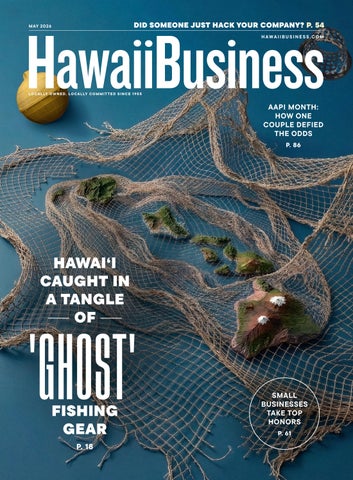
DID SOMEONE JUST HACK YOUR COMPANY? P. 54
M AY 2 0 26
HAWAI I B U S I N E S S .CO M
AAPI MONTH: HOW ONE COUPLE DEFIED THE ODDS P. 86
HAWAI‘I CAUGHT IN A TANGLE OF
'GHOST' FISHING GEAR P. 18
SMALL BUSINESSES TAKE TOP HONORS P. 61
A STRONGER HAWAI‘I STARTS WITH US. The Stronger Hawai‘i Fund is dedicated to supporting statewide disaster and emergency related preparedness, response, recovery, mitigation, and resilience. Because we can’t predict when or where disaster will strike, the fund is designed to move quickly and flexibly across all islands, deploying resources to where the need is greatest, at the moment it arises. Whether it’s Hawai‘i Island, Maui Nui, O‘ahu, or Kaua‘i, no corner of our state is out of reach.
When you give to the Stronger Hawai‘i Fund, you’re investing in a resilient Hawai‘i before, during, and after disaster.
hawaiicommunityfoundation.org
From Print to TheBus: Reflections on My First Year at Hawaii Business Magazine
T
his month marks my one-year anniversary at Hawaii Business Magazine, and I’m loving it. Over the past 12 months, we have been strategic about how we evolve our storytelling and expand our reach, and the results have been incredibly rewarding. My mission has been for our audience to experience storytelling in different ways — through print, online, audio with our readalouds, radio and reels, on TV and through our live events. One of our main priorities has been digitizing and expanding the multimedia dimension of our journalism. We have partnered with Hawaii News Now’s Annalisa Burgos and Hawai‘i Public Radio’s Catherine Cruz to bring our business reporting to broader audiences in more dynamic and accessible ways. We also launched our viral ICE Map, which quickly became one of our most impactful digital projects. At the same time, we have gone deeper in our coverage of Hawai‘i’s financial and banking sectors, featuring conversations with leaders like Ann Teranishi, Bob Harrison and Peter Ho, who recently retired as CEO of Bank of Hawai‘i, as well as University of Hawai‘i’s President Wendy Hensel. We introduced Trial and Error, a rotating column highlighting people in their 20s and 30s who share honest stories about wins, losses, failures and growth. It has been especially meaningful to create space for emerging voices and unfiltered experiences, including Marianne Leano’s story about two women who found themselves launching a business almost by accident. Beyond editorial, we have built a robust events platform by hosting programming every single month of the year. Highlights include our sold-out Wahine Forum last October, which brought together roughly 1,000 attendees and featured Nicole Lapin, our CEO Healthcare Summit in February, and our Money Matters conference with Jean Chatzky and Nash Subotic in November. We also hosted our HB20 “20 for the Next 20” event at the YWCA, an Oscar-inspired evening that celebrated an incredible group of honorees. As we continue to grow, we are also expanding how we collaborate. Hawaii Business Magazine is pleased to partner with Hawai‘i Community Journal, formerly known as Overstory, a solutions-focused newsroom serving Hawai‘i. Their community-centered reporting complements our coverage by offering deeper insight into how major issues impact people and places across the Islands. Together, we aim to help readers better understand how Hawai‘i’s biggest challenges across business, the environment and community life are interconnected. By sharing select stories
and perspectives across both platforms, we are excited to provide a broader and more complete view of the forces shaping Hawai‘i and the solutions emerging across sectors. This year, we also launched our first-ever Asian American Pacific Islander Month editorial package, highlighting the people, places and cultural forces influencing Hawai‘i today. It was an opportunity to celebrate identity, community and leadership in a way that felt both timely and rooted in the Islands. That coverage ranged from Kerri Meade’s feature on the resurgence of mahjong, a tile-based game that originated in China, which has taken on new life across generations and communities, to our profile of Tradewind Group Chairman Colbert Matsumoto, whose leadership reflects both legacy and forward-thinking vision. On a personal level, this year has also been about learning Hawai‘i by living it. In New York City, I was used to walking everywhere and relying on public transit, and I have brought that same mindset with me here. I take TheBus using my HOLO card, walk from the Skyline rail, use Uber when needed and often catch rides with friends and family. The experience has been humbling. TheBus is reliable, but it is not as frequent as I would like, and it still does not accept digital payment. Riders need a HOLO card or exact cash with three one-dollar bills, which feels like a clear area for modernization. Still, there is something honest about moving through Hawai‘i this way. You see more, you listen more and you better understand the communities we cover as many of our service workers take TheBus daily. My one year back home has been nothing short of a lesson in paying attention – to the people on the bus, the conversations at the stops and the quiet resilience that moves through these islands every single day. Please follow us on LinkedIn at Hawaii Business Magazine and on Instagram @hawaiibusinessmagazine to stay connected with our latest stories, events and initiatives.
JENNIFER ABLAN EDITOR-IN-CHIEF
H AWA I I B U S I N E S S
3
HB EVENTS C O N N E C T W I T H H AWA I I B U S I N E S S M A G A Z I N E L O C A L LY OW N E D, L O C A L LY COMMITTED SINCE 1955.
Our goal is to strengthen the local economy and help our communities thrive. Publisher KENT COULES kentc@hawaiibusiness.com • (808) 364-5869
JULY 17, 2026 Hilton Hawaiian Village Hawaii Business Magazine in Partnership with First Hawaiian Bank presents the Leadership Conference, Hawai‘i’s premier leadership event, bringing together professionals, executives and changemakers for a full day of insight, connection and growth. Through candid conversations, interactive workshops and real-world tools, attendees gain fresh perspective and practical strategies to lead with impact. Connect with those shaping Hawai‘i’s industries—and leave with ideas you can put into action immediately.
THE
A
B L A C K
B O O K
E V E N T
AUGUST 13, 2026 Capitol Modern An Evening with Hawai‘i’s Top Leaders convenes executive leaders from Hawai‘i’s Top 250 companies alongside rising changemakers for a highly curated, invitation-only experience. Designed to spark meaningful connections and cross-generational collaboration, the evening brings together those shaping the future of the Islands. Through shared dialogue and relationship-building, the event fosters the ideas and partnerships that will drive Hawai‘i forward. For more information on events, visit hawaiibusiness.com/events or contact Ashley McLean, Events Manager, at ashleym@hawaiibusiness.com
Editorial Editor-in-Chief JENNIFER ABLAN jennifera@hawaiibusiness.com Managing Editor KEN WILLS kenw@hawaiibusiness.com • (808) 987-8135 Senior Editor STEVE PETRANIK stevep@hawaiibusiness.com • (808) 534-7584 Senior Contributing Writer CYNTHIA WESSENDORF cynthiaw@hawaiibusiness.com Staff Writer RYANN NOELANI COULES ryannc@hawaiibusiness.com Staff Writer GRANT NAKASONE Copy Editor ELROY GARCIA Editorial Interns LILI HURD, KIANI VIDAURRI, ALLYSON WHALEY
Design & Photography Creative Director ESTHER MOHRMANN Graphic Designer KAREN TANIGAWA Staff Photographer AARON YOSHINO Digital Digital Director RANDALL LIBRAMONTE randalll@hawaiibusiness.com Digital Content Manager MARIANNE LEANO mariannel@hawaiibusiness.com Sales & Marketing Account Executive YONGCHAE SONG yongchaes@hawaiibusiness.com • (808) 228-5078 Account Executive CHAZ TIOGANGCO chazt@hawaiibusiness.com • (808) 387-1672 Operations Manager REBECCA BROOKING rebeccab@hawaiibusiness.com • (808) 534-7560 Events Manager ASHLEY MCLEAN ashleym@hawaiibusiness.com • (808) 272-6550 Events Coordinator OLIVIA DE SENA oliviad@hawaiibusiness.com Circulation circulation@pacificbasin.net Connect with us on social media: HawaiiBusiness HawaiiBusinessMagazine
Hawaii Business is published by
Founder DUANE KURISU Chairman SUSAN EICHOR President BRANDON KURISU Director of Finance JADE CARREL
05.26
CONTENTS
18
Asian “Ghost” Fishing Gear Invades Our Shorelines
Raven Brazee (left) and Alice Birnbaum pull hundreds of plastic particles out of rock crevices on Hawaiʻi island. Photo: Mark A. Johnson
TAP808 Guides Youth on Abuse Red Flags
Colbert Matsumoto: On Listening Before Speaking
The Teen Alert Program provides young people with skills and support to build healthy relationships. Even so, family, dating or social abuse, either mental or physical, can occur. TAP808 helps young people spot red flags that could signal potential abusive situations, with prevention playing a big role.
In an interview with Hawaii Business Magazine, Tradewind Chairman Colbert Matsumoto reflects on his background of disciplined introspection, decisive leadership amid political pressure, preserving cultural heritage and passing on a legacy of lessons learned. Instead of a solo act, he says, impact comes from being a conductor.
8
9
Thank You For Your Service Four social workers tell Hawaii Business what they love about their jobs despite the challenges of long hours, low pay, cuts in federal funding, plus shouldering the stress of others while navigating their own lives and careers. One big motivation for them is the satisfaction of being able to lend a hand to people in their time of need. 13
Tons of abandoned or discarded fishing nets and gear from foreign vessels litter Hawaiʻi beaches. Using sophisticated techniques, scientist-sleuths trace it to the source – mostly Asian fishing fleets -- in an effort to shut off the flow. They also hope to recycle some into asphalt ingredients, construction materials and souvenirs.
A Game of Wits Brings Us All to the Table From its origins in China nearly two centuries ago, Mahjong has spread across the world, growing rapidly across the state. Amid the clack and clatter of tiles, people of all ethnic groups and ages socialize, share gossip and even business ideas. We let you in on the game. 33
H AWA I I B U S I N E S S
5
05.26
CONTENTS
86
A Heart-Warming Tale for AAPI Month During Asian American and Pacific Islander Heritage Month, consider a story of two Filipino-American women who grabbed opportunities, muscled through hardships, embraced good fortune and can now look back with gratitude. The journey of Char’s Bar from a tweet to a thriving business resonates with many who’ve considered starting a business.
Guest columnist Perry Arrasmith (right) clowning around with his brother Nathan. Photo courtesy of Perry Arrasmith
Photo courtesy of Charissa Vallesteros and Rochelle Cariaga
Has Your Business Been Hacked?
Top Small Business Award Winners
Hackers pose an increasing and serious threat to Hawaiʻi businesses, and thatʻs created demand for experts who can try to control the damage once they gain access. Better yet, cybersecurity officials say, take steps now to prevent hackers from accessing critical data. Even the Lieutenant Governor was a victim.
From a husband-wife team running an expanding coffee shop chain to a tech support company for small- to medium-size businesses and an architecture firm that favors cultural and environmental resiliency, Hawaii Business showcases seven homegrown small businesses that stand out from the pack. Meet the entrepreneurs who made their dreams come alive.
54
61
In West Maui, Water is a Critical Resource As West Maui rebuilds from the devastating wildfires, attention is turning to the water sources needed to sustain future development, from recycled water to new wells. As renovation plans progress, community members are also organizing around efforts to bring control of water resources back into public hands. 84
SPECIAL ADVERTISING SECTIONS Keeping Hawaiʻi Healthy Hear from local health care leaders on key issues affecting our state this year. 43 Hawaiʻi Island Business Report Organizations share their current challenges and vision for the future. 75
HAWAII BUSINESS (ISSN 0440-5056) IS PUBLISHED 12 TIMES A YEAR BY PACIFICBASIN COMMUNICATIONS. ©2026 PACIFICBASIN COMMUNICATIONS, LLC. ALL RIGHTS RESERVED. ANY UNAUTHORIZED COPYING, DISTRIBUTION, OR ADAPTATION IS STRICTLY PROHIBITED AND WILL RESULT IN LIABILITY OF UP TO $100,000. EDITORIAL, ADVERTISING AND BUSINESS OFFICES AT 1088 BISHOP STREET, SUITE LL2, HONOLULU, HI 96813. TELEPHONE (808) 534-7520. POSTMASTER: SEND ALL ADDRESS CHANGES TO HAWAII BUSINESS, P.O. BOX 913, HONOLULU, HI 96808. SUBSCRIBERS NOTIFY THE SAME OFFICE. PLEASE INCLUDE NEW ADDRESS AND OLD ADDRESS (MAILING LABEL PREFERRED) PERIODICALS POSTAGE PAID AT HONOLULU, HAWAI‘I, AND AT ADDITIONAL MAILING OFFICES. SUBSCRIPTION: ONE YEAR $24.99 / TWO YEARS $34.99 / THREE YEARS $44.99. FOREIGN: ONE YEAR $53.99 (US FUNDS). FOR SUBSCRIPTION INQUIRIES, ADDITIONAL RATES, INFORMATION, NOTIFICATION OF CHANGE OF ADDRESS AND SUBSCRIPTION SERVICE, PLEASE CALL (800) 788-4230. MAY 2026 VOL. 71/NO. 11
6
M AY 2 0 2 6
YO U R R OA D M A P TO H AWA I ‘ I ’ S 2 0 26 BUSINESS EVENTS
MAY
May 18 Women Entrepreneur Conference May 28 P3 Summit
JUL
July 17 Leadership Conference
AUG
August 13 Top 250 CEO Celebration
SEP OCT
Hawai‘i Leadership Academy: Cohort Three September TBA Hawai‘i Excellence in Business Awards
October 8 HB20 (20 FOR THE NEXT 20) Impact Summit October 23 Wahine Forum Inaugural Wahine of the Year Pau Hana Celebration
NOV
November TBA Money Matters Financial Conference
DEC
December TBA CEO of the Year Celebration
V I S I T W W W. H AWA I I B U S I N E S S . C O M / E V E N T S
NONPROFIT WITH A MISSION
BY KIANI VIDAURRI
TAP808 Helps Hawaiʻi’s Youths Build Healthier Relationships
T
he team at TAP808 understands that Hawai‘i’s youths sometimes face dating violence and other abuse, and that many don’t know how to prevent it or where to turn for help. “Prevention is the heart of our work,” says Jordan Renfrow, the program manager at TAP808, also known as the Teen Alert Program, a service of the Domestic Violence Action Center. Renfrow and his colleagues talk often with people ages 12 to 21, including middle school, high school and college students, and hold community workshops to provide young people with “the knowledge, skills and support they need to build healthy relationships.” The presentations introduce students to the concepts of healthy communication, respect, compatibility and the red flags that may indicate abuse. “This is the time when young people are figuring out what’s normal and what’s not. If we wait until later, harmful patterns may already be set,” he says. “Constant check-ins, tracking someone’s phone, demanding passwords — it might seem cute at first, but jealousy is a big red flag. We also see coercion with
8
M AY 2 0 2 6
photos or secrets used for blackmail, and social abuse where someone isolates you from family and friends.” TAP808 also offers one-on-one help, including safety planning and education, and accompanying abuse victims to court. Abuse can mean more than physical violence, Renfrow says: It can also include emotional manipulation, controlling behavior and digital harassment. It can be challenging for people to seek help due to the shame and stigma associated with abuse. “Only about 9% of youth come forward to ask for help,” Renfrow says. In the U.S., 1 in 3 teens has been abused by their dating partners at some point, and in the past year, 1 in 10 high school students have been physically abused by their partner, according to the Domestic Violence Action Center. “We also work with parents, teachers, coaches and community members so that the adults in young people’s lives are better equipped to respond,” Renfrow says. TAP808 conducted surveys over three years through 2024 that showed that 83% of the parents surveyed in Hawai‘i did not know the red flags for dating abuse. The program launched its Parent Café,
a new workshop series that combines education with open conversation, giving parents opportunities to connect with other families and to learn more about teen relationships. “For many teens, having one trusted adult can make a significant difference,” Renfrow says. Parents can join by requesting a presentation on TAP808’s website, tap808.org. At Parent Café workshops, parents and caregivers learn about social media’s role in dating. Renfrow says that harassment and warning signs of violence often show up in social media posts and messages and that the tracking and stalking of young people has increased dramatically in recent years. Renfrow was a high school teacher for about a decade before working at DVAC. “As a survivor of domestic violence myself, working for a nonprofit agency that provides services to young people was a natural fit,” he says. From July 2025 through February 2026, about 17,000 youths and adults attended TAP808 presentations and activities. “Education is one of the most powerful tools we have to break the cycle of abuse,” Renfrow says.
The Conductor Who Doesn’t Need to Speak: Colbert Matsumoto’s Leadership Style
by J E N N I F E R A B L A N Photos by Aaron Yoshino
IN HONOR OF ASIAN AMERICAN AND PACIFIC ISLANDER HERITAGE MONTH, HAWAII BUSINESS MAGAZINE SPOTLIGHTS ONE OF THE STATE’S MOST CONSEQUENTIAL LEADERS, COLBERT MATSUMOTO, WHOSE QUIET, DISCIPLINED APPROACH TO LEADERSHIP CONTINUES TO SHAPE INSTITUTIONS, MENTOR THE NEXT GENERATION AND REDEFINE WHAT INFLUENCE LOOKS LIKE IN HAWAI‘I.
A
t our first meeting e i g h t m o n t h s ag o, Tradewind Chairman Colbert Matsumoto brought along one of his mentees, Chris Fong, to talk about the revitalization of downtown Honolulu. Matsumoto didn’t speak much himself; instead, he let Fong outline the ambitious projects Tradewind was leading. “Good leaders listen. They don’t always need to talk,” Matsumoto said in a follow-up interview. Matsumoto is candid about the role his cultural identity plays. “My
background has had a very strong influence in terms of my success,” he says. He describes a fundamentally different approach to decision-making with a focus on long-term outcomes and business relationships. “I think Asians tend to be much more holistic in terms of how they look at things, as opposed to having a linear, logic-based approach.” In Hawai‘i, where nearly half of all leadership positions in business, government and civic life are held by Asian-American or Pacific Islander individuals, that perspective resonates not just culturally, but practically, shaping the
H AWA I I B U S I N E S S
9
education. The work carried enormous pressure, with implications reverberating across Hawai‘i’s legal, political and business communities. Matsumoto understood the stakes in real time. Doing the job thoroughly meant inviting criticism – and potentially alienating powerful interests. There were moments he considered stepping away. Instead, he stayed. The report became a catalyst for sweeping reform, ultimately leading to significant changes in governance and restoring public trust in the institution. It also cemented Matsumoto’s reputation as someone willing to step into difficult, highly scrutinized situations and see them through with rigor and independence.
Colbert Matsumoto helped raise $9 million in an effort to save the Japanese Cultural Center from foreclosure.
PRESERVING A LOCAL INSTITUTION
way institutions are guided and communities are served. At the center of that approach is listening – not passive, but active, intentional understanding as well as humility. “They don’t always try to stand out,” he adds, “but they can do things very well, even if they are not recognized for it.” BEING ZEN
Discipline has been a theme in Matsumoto’s life for as long as he can remember. After he passed the Bar Exam, he spent time at a Zen monastery in Kalihi Valley, a six-month period that profoundly shaped his approach to leadership. Daily meditation, rigorous routines and deep introspection taught him patience, focus and the quiet power of observation. During this period, he shaved his head – a visible commitment to shedding distractions and embracing a more intentional way of living. It reflected an inner transformation, which involved learning to listen before speaking, to act with purpose rather than impulse. “I had heard about the teacher (at the monastery), Tanouye Tenshin Rotaishi, who was an accomplished martial artist, but also a Zen teacher,” he told PBS Hawai‘i in an interview in 2015. “I had trained in the martial arts when I was a kid growing up, and so, you know, I had an interest in it. But I had also realized that Zen was the philosophical underpinnings of Japanese martial arts and so, I wanted to learn more about that. That’s why I asked him if I could train with him
10
M AY 2 0 2 6
at his temple.” That practice now permeates every boardroom meeting, fundraising campaign and mentorship conversation he undertakes. He often describes leadership as being like a conductor of an orchestra. “You have different sections,” he says, “each with a different role and each with different strengths performing a symphony.” LEAVING LAW FOR ISLAND INSURANCE
Long before Tradewind, Matsumoto built his career in law, practicing for two decades before making a pivotal shift in 1999. At the height of his legal career – fresh off high-profile work as court master overseeing the Bishop Estate – he made an unexpected decision: He walked away. His role at Bishop Estate placed him at the center of one of the most consequential and controversial chapters in Hawai‘i’s modern history. Appointed to conduct an independent review of the trust’s operations, Matsumoto was tasked with examining allegations of mismanagement within one of the state’s most powerful institutions. What began as a technical legal assignment quickly escalated into a sweeping investigation. The findings were stark. His report detailed governance failures, conflicts of interest and systemic issues that called into question how the trust was being run. The organization was then estimated at $6 billion to $10 billion, making it one of the largest charitable trusts in the nation, stewarding assets for Native Hawaiian
Riding on that momentum, Matsumoto ended his legal career in 1998 and became chairman of Island Insurance in 1999. “At the time that I made that decision, my law practice was actually peaking,” he says. “I had just finished my work as a court master for Bishop Estate, and I had just been the recipient of all this publicity about that work – it raised my prominence. “I was on the front page of a newspaper on multiple occasions. I left because Island Insurance was my client, and I knew that Island Insurance at that time was struggling.” Island Insurance needed a touch of the Matsumoto magic. At a time when many Hawai‘i-based firms were being absorbed by mainland corporations, Matsumoto saw something at risk beyond a single balance sheet – the preservation of a local institution. “The thing that I feel most satisfied about is my leaving my law practice to join Island Insurance,” he says. “I left because I wanted to help play a role in making sure Island Insurance remained a locally based company.” The move was not without risk. He had never run an insurance company, and his legal career wins were at an all-time high. But Matsumoto’s trademark for problem-solving and playing as main “conductor” led him to identify and recruit executives who understood underwriting, risk and operations. Island Insurance stabilized – and then it grew. Matsumoto helped strengthen its position as a locally owned and managed company in a highly competitive
industry. Just as important, it maintained its identity, continuing to serve Hawai‘i’s businesses and residents with a level of local connection that larger firms could not easily replicate. “That whole experience was a very remarkable, satisfying and fulfilling experience,” he says. But Matsumoto was already thinking beyond insurance, recognizing that both the industry and Hawai‘i’s broader economy offered limited growth. Rather than look outward to the mainland – a path that had proven to be risky for other Hawai‘i companies – he looked inward. Using Island Insurance’s surplus capital, he helped launch Tradewind Capital as an investment platform focused on local opportunities: Hawai‘i-based businesses, real estate and ventures tied to the community. Tradewind invested selectively, often in companies navigating transition, providing not just capital but strategic guidance and long-term partnership. What emerged was not just an investment firm, but an ecosystem that reflected Hawai‘i’s unique economic and cultural
landscape. On its website, the firm says it targets “companies with EBITDA of $2 million to $10 million, ideally with an established and defensible market position, unique or proprietary products or services or cost advantages.” SAVING THE JAPANESE CULTURAL CENTER
One of Matsumoto’s defining moments came when the Japanese Cultural Center of Hawai‘i faced financial ruin. The nonprofit, a cornerstone of the Japanese American community, was on the brink of foreclosure in 2002. Closing its doors would have meant losing not just a building, but decades of history, memories and community programs. Matsumoto stepped in as a strategist, mentor and listener. Over months of careful outreach, coalition-building and hands-on management, he helped raise $9 million, securing the Center’s survival and sparking a revitalization. “It wasn’t just about the money,” Matsumoto says. “It was about understanding everyone involved – the staff,
the donors, the community. Listening first, acting second. That’s how you create lasting change.” All told, Matsumoto reflects that philosophy more than ever – not playing every note, but ensuring the next generation knows how to. Fong, Matsumoto’s mentee, says, “Colbert has an innate ability to see opportunity where others may not, and to thoughtfully connect ideas and people in ways that create something entirely new. He has taught me to embrace new ideas with courage, supported by diligent planning and disciplined execution.” Fong, who serves as a Senior Investment Associate at Tradewind Capital, where he is a member of the real estate acquisitions and asset management team, says: “Even at this stage of his career, he remains deeply committed to building for the future, with a focus on shaping a better path forward for the next generation.” Asked about what he wants his legacy to look like, Matsumoto says, “I don’t aspire to be remembered. The important thing is what we do in the moment.”
Two Hawai‘i Founders Score Major Deals in Breakout Quarter for Island Tech by J E N N I F E R A B L A N
KWH ANALYTICS AND VINOVEST ACQUIRED BY GLOBAL AND MAINLAND COMPANIES, RESPECTIVELY
Richard Matsui, founder, board member and former CEO of kWh Analytics
Brent Akamine, co-founder of Vinovest
12
M AY 2 0 2 6
A
pair of high-profile acquisitions is putting a spotlight on the global reach of companies founded in Hawai‘i. In the energy sector, UK-based Beazley has agreed to acquire kWh Analytics, founded by Richard Matsui, who was recently named one of Hawaii Business Magazine’s HB20 “20 for the Next 20” honorees for 2026. What began in 2012 as a data-focused startup evolved into what Matsui describes as “the insurance company for clean energy” — now one of the largest insurers of solar, wind and battery projects in North America. Like many tech startups, the company’s path was not linear. “We thought we were building a database,” Matsui says. “Then we asked, how do we make money off this? What if we build insurance policies off the data?” That pivot ultimately defined the business. The acquisition itself came together quickly after a long build. “Toward the end of last year, we realized the company might be best off as part of a bigger platform,” he says. After seeing signals that Beazley was looking to expand in the space, “we approached them… and the conversation moved quickly from there.” Beazley announced in March that it had agreed to the terms of a $10.8 billion takeover bid from Zurich Insurance Group, as the Swiss firm joins growing competition for holdings in the specialty insurance market. At the same time, another Hawai‘ifounded company was finalizing its own deal. StartEngine announced it has acquired Vinovest, co-founded by Brent Akamine. Akamine launched Vinovest in 2019 after years in Los Angeles startups, building a platform that allows everyday investors to access fine wine and whisky
— assets traditionally reserved for a select few. The company has since grown to more than 200,000 users and manages roughly $140 million in assets. “We ran a pretty standard process,” Akamine says of the acquisition. “But ultimately, we chose the partner where we felt growth would come faster as part of a larger company.” The timing of the two deals — closing within the same week — is notable. Both founders, longtime Hawai‘i residents and Punahou School alumni, see it as more than coincidence. “There’s been this narrative that tech in Hawai‘i hasn’t succeeded,” Matsui says. “But two exits in one week shows the ceiling is higher than people think.” Both founders also emphasize a broader shift that could unlock more local innovation: artificial intelligence. Matsui argues that many of the traditional barriers to building companies in Hawai‘i — such as geography, talent and capital — are rapidly disappearing. “You don’t need a big team anymore,” he says. “If I were starting today, it would be me in my living room with one or two people.” Akamine echoed that transformation from an operational perspective. “What used to take a team of 20 engineers can now be done by two,” he says. “We can ship in a day what used to take months.” Matsui and Akamine declined to disclose details of the acquisitions. For both entrepreneurs, the acquisitions are less an endpoint than a transition. Each plans to remain involved in the near term while also exploring how to give back locally, particularly by helping Hawai‘i businesses adopt new technologies. “If there’s one thing,” Matsui says, “people should just try it. Spend an afternoon with these tools. It will change how you think about what’s possible.”
Their Work Is BUT
demanding rewarding Social workers face overwhelming caseloads, low pay and long workdays. But they know their work is essential to local people and their families. Here, four of them explain why they’ve kept going for so many years. by L I L I H U R D
W
hen life becomes too hard to handle on your own, social workers often step in to help. But social work itself is demanding — emotionally, psychologically and physically — and the pay is low compared to other professions.
So why do so many social workers dedicate their entire careers to this field? Hawaii Business Magazine asked some of Hawai‘i’s most respected social workers what they do and why they do it.
Jocelyn Howard surrounded by attendees at the We Are Oceania, Micronesian Youth Summit. Photo courtesy of We Are Oceania.
H AWA I I B U S I N E S S
13
MICHELE NAVARRO ISHIKI
“Growing up, I always wanted to be a teacher,” Michele Navarro Ishiki says. “But as a social worker, I feel like I get to do more than teach. I’m fulfilling a childhood dream — teaching people how to live and how to identify areas in their lives that need improvement.” In 2025, Ishiki received the Public Citizen Award from the National Association of Social Workers for her efforts to create safe spaces for healing on Maui, including for survivors and first responders after the 2023 wildfires. The award honors individuals whose accomplishments exemplify the mission, values and dedication of professional social work. Ishiki, born and raised in Pā‘ia, Maui, faced many challenges early in life. At 18, she became a young mother after entering a difficult relationship, which later led to struggles with meth addiction and periods of incarceration. Today she says one of her proudest accomplishments was graduating from the Aloha House substance abuse treatment program, then working her way up to become the center’s clinical director. “Being able to help people, knowing that my life experience — although I don’t share it directly — gives me a level of insight that is powerful. I may recognize
things they’re experiencing or feelings they’re having, but I never make it about myself. It’s always about the person or people I’m helping.” Through her work, and especially in the aftermath of the fires, Ishiki recognized a gap in services for Native Hawaiians seeking culturally responsive care on Maui. This realization led her to found Piha Wellness and Healing, a nonprofit composed primarily of licensed professional Native Hawaiian practitioners. Ishiki says she manages 50 to 60 cases per month, working with individuals and families while also collaborating with partner organizations. She says she’s motivated to be a healer for her community. She acknowledges the work can be demanding and emphasizes the importance of self-care to maintain balance. “If we don’t take care of ourselves, there’s burnout,” she says. “When you’re feeling [fatigue], it’s important to step back, because you can become a detriment to the very population you are committed to serve.” Even after nearly 26 years in social work, Ishiki says, there are moments when she feels out of place. During those times, she reminds herself of her purpose
and that she may not always be the right fit for every client. “I have a responsibility to do a soft handoff to another provider who can help. I don’t take it personally. I’m not made for everybody.” She describes her approach as giving everything she can, even if the need for healing never fully disappears. “If we could erase all trauma, we truly would be out of a job. But trauma affects everyone differently. I envision a healed community, and my goal is to help as many people as possible find healing — for themselves, their families and their loved ones.” Ishiki, a licensed clinical social worker and board member of the National Association of Social Workers Hawai‘i, has earned bachelor’s and master’s degrees in social work from UH Mānoa. She says it was gratifying to receive the award from the National Association of Social Workers. “I’m truly humbled, especially knowing I was chosen by my peers and colleagues, not just across our state but nationally. While we don’t do this work for recognition, it does mean something to know that the work I do is meaningful to others, to my community and to my people.
Michele Navarro Ishiki
MICHELE NAVARRO ISHIKI IS A LICENSED CLINICAL SOCIAL WORKER WHO IS THE FOUNDER & EXECUTIVE DIRECTOR OF PIHA WELLNESS AND HEALING, A NON-PROFIT ON MAUI.
14
M AY 2 0 2 6
“
I envision a healed community, and my goal is to help as many people as possible find healing — for themselves, their families and their loved ones.”
“
An individual is connected to so many others. . . . when you help one person, you’re really helping everyone around them.”
JOCELYN HOWARD JOCELYN “JOSIE” HOWARD
Jocelyn Howard grew up in Micronesia on the island of Chuuk, where traditionally women have been the primary caretakers for their families because men were often absent while fishing or attending meetings on other islands. She says that feeling this responsibility inspired her to pursue a college education in Hawai‘i. After graduating with a bachelor’s degree from UH Hilo, Howard worked in the private sector before joining the state Department of Health. There she became familiar with government systems and policies, which helped shape her perspective and purpose. “That was also when Micronesians were taking a lot of blame — being labeled as the problem, the newest group in Hawai‘i that people said was causing issues.” In addition to her bachelor’s degree, Howard has a master’s in social work from UH Mānoa. She’s been in the field 15 years now, and it hasn’t always been easy. “The hardest part was honestly being who I am while going through a system that doesn’t see you for who you are or recognize your individual needs, especially those shaped by your cultural background and values,” Howard says. “That was the toughest part, particularly during my graduate program. In social work, we’re taught that empathy is essential — that understanding people is at the heart of the work. Yet that’s also where I experienced firsthand how rigid the system can be and how difficult it is for it to show empathy toward people from different cultural backgrounds.”
She is currently CEO of We Are Oceania, a nonprofit she co-founded that supports people in Hawai‘i by combining their cultural knowledge with new skills to help them become self-sufficient. She received the Health Equity Champion Partner Advocate Award on behalf of the organization at the Asian & Pacific Islander American Health Forum last year. Howard describes an incident involving a Micronesian youth who was shot by police in 2021 as a pivotal moment in her career. “It gave me the courage to stand my ground and be more intentional about my work. I started asking myself: What is the impact? How can we be more effective? How do we prevent something like this from happening again?” Howard says the incident highlighted a deep sense of disconnection among young people. They were detached from society, lacked relationships and felt unseen, she says, and it also revealed a fractured relationship between communities and law enforcement. “It became clear to me that there was a need to build trust between my community and the police department. I helped initiate efforts where officers came out to church groups and community spaces to tell stories and discuss how we could work together,” she says. “That case gave me the wisdom, clarity and courage to keep pushing for change and for stronger, more human relationships.” Throughout her career, Howard says, she has managed demanding caseloads, ranging from about 60 to 120 clients
while serving as a program coordinator at Goodwill. She notes that serving one person often means supporting many more. “An individual is connected to so many others. Sometimes they’re the decision-maker for the family, so when you help one person, you’re really helping everyone around them.” While much of her work centers on Micronesian communities, Howard says her services extend beyond them. “That’s what I love about being a social worker. We speak a universal language, and that language is compassion, along with respect and humility,” she says. At We Are Oceania, many people seek help with housing, over disputes with landlords, evictions, unsafe conditions and more. In one recent case, Howard says, a housing dispute went to court and was dismissed because the home was deemed uninhabitable. “So the work goes far beyond helping someone find another place to live. You help them find a lawyer, file a case, translate legal letters, organize documents and keep track of receipts. In many ways, you become a teacher, guiding people through systems they’re navigating for the first time.” Hawai‘i’s spirit of aloha, she says, gives her plenty of hope for the future of social work in the Islands. “There are so many people here who care deeply about justice and equity, regardless of cultural background. Social work is really a state of mind. It’s about sharing values, valuing humanity and valuing people. I see that spirit in Hawai‘i, and I feel blessed to learn from and work alongside my colleagues.”
H AWA I I B U S I N E S S
15
KEITH KUBOYAMA
Keith Kuboyama’s passion for working with youth was inspired by his mother, an elementary school teacher who often stayed late to care for children whose parents were working and didn’t have childcare. After earning a biology degree from the University of Iowa, he acquired a master’s in social work from UH Mānoa. “Early in my career, I worked with youth in care — those who were adopted or in need of foster placement. That experience made me realize the critical need to support this population. My focus became helping children develop coping strategies, empowering them to find their voice and advocating for their own needs. We also taught practical tools they could use during times of stress.” Kuboyama is a licensed clinical social worker serving individuals facing challenging circumstances such as poverty, abuse, neglect and mental illness. He has spent 46 years in the field, beginning as clinical director at Family Programs Hawaii and eventually serving as executive director until his retirement in December 2024. He was awarded the 2025 Jonathan Won Child Maltreatment Prevention Award by the Institute on Violence, Abuse & Trauma. The award honors individuals who exemplify Jonathan Won’s dedication and recognizes outstanding achievement in preventing child maltreatment. Kuboyama recalls a particularly impactful case. “I can think of one youth who experienced significant early abuse. She struggled greatly during adolescence, often acting out, punching holes in walls, kicking and
destroying property. She participated in several community programs but was unable to stay in most of them. Eventually, she was placed in a residential program on the mainland designed for youth with more challenging behaviors,” Kuboyama recalls. “Throughout this time, I was her social worker, consistently supporting her through her teenage years. Over time, she began to trust that there was a stable, reliable person in her life. Through that consistent relationship, she stabilized and is now thriving. She has a child, started her own business and even donates a portion of her business proceeds to support youth in care. Seeing someone overcome adversity and choose to give back is one of the greatest rewards in this work.” Kuboyama says one big misconception about social work is that workers are primarily there to take children away. Instead of just intervening at a crisis point, the work has evolved, he says. “Now, we focus on providing support and preventive services, helping families before they even enter the system. For those already in the system, we work to provide educational assistance, community resources, financial help and housing, so families feel supported rather than threatened.” Gaining trust, particularly with youth who have been hurt or abused, can be challenging. Kuboyama describes his approach: “When I first meet a youth, I ask, ‘Can you do some of this work?’ Often they say, ‘I don’t know.’ I follow with, ‘Whose life is this, yours or mine?’ Usually, they answer theirs. Then I ask, ‘Who should
work harder, you or me?’ I explain that taking control means they have to put in the effort.” Kuboyama says federal government cuts to social services and resources make it harder for families to get the support they need, increasing stress and challenges for both youth and communities. “We’re already seeing a decline in support for social work and services for families and youth. When these support systems are reduced, family stress increases because they struggle to access the help they need to function and eventually thrive. As these cuts continue, the impact is felt not just by families, but also across the community.” Kuboyama says caseloads are often overwhelming and, while training is essential, it takes time away from working directly with families. Compensation is another challenge, as is self-care. He recalls working long days, sometimes from 6:30 a.m. to 6 or 7 p.m., including weekends, yet often only being paid for a standard 9-to-5 schedule. Kuboyama knew Jonathan Won, the man whose name graces the award he received. “He did incredible work in the community. He was such an inspiration to many of us younger social workers through his work with Prevent Child Abuse Hawaii and other organizations. Having an award named after a role model like him makes you pause and think, ‘Wow, I hope I can have that kind of impact on a community.’ That’s the kind of legacy that makes a career feel truly worthwhile.”
KEITH KUBOYAMA
KEITH KUBOYAMA IS SEEN AT LAST YEAR’S INSTITUTE OF VIOLENCE, ABUSE & TRAUMA HAWAIʻI SUMMIT.
16
M AY 2 0 2 6
“
Seeing someone overcome adversity and choose to give back is one of the greatest rewards in this work.”
“
That’s the work. It’s not always about fixing everything, it’s about walking with someone until they’re ready.”
KANANI DIAS HAS 20 YEARS OF EXPERIENCE AS A SOCIAL WORKER. ON THE SIDE, SHE TEACHES FITNESS AND WELLNESS CLASSES, SPECIALIZING IN HULA AND TAHITIAN DANCE.
KANANI DIAS
KANANI DIAS
Social work isn’t just a career for Kanani Dias, it’s personal. While growing up on Kaua‘i, she was on the receiving end. After her father died, a social worker would regularly visit her home and one in particular, “Aunty Nalani,” didn’t feel like an outsider. “Looking back, I realized how hard it must have been for my mom,” Dias says. “But to me, Aunty Nalani felt like family. She didn’t just check in once, she watched us grow from when I was about 10 through high school. Every year she’d take us school shopping, picking out clothes and talking about how we were feeling. At the time, I didn’t even realize she was a social worker. She just felt like support.” That early experience shaped Dias’ path. She earned her master’s in social work from UH Mānoa in 2001, and later worked at the Hawai‘i Department of Human Services and several community organizations. One of her most meaningful moments came when she worked alongside Aunty Nalani at the Queen Lili‘uokalani Children’s Center in Honolulu, which has since closed. “It was surreal, full circle, to be able to do the same things she did for us,” Dias recalls. Like many in the field, she’s faced burnout. “At that point, I didn’t even have kids of my own — I had just gotten married. I thought, ‘There’s no way I could
have kids and do this job.’ You’re constantly wondering if you made the right decision. It definitely caused burnout, not just for me, but for many in child welfare and protective services.” To stay grounded, Dias turned to dance — a source of comfort long before her professional life — and created the dance fitness studio Tiare Fit. “Growing up, hula and Tahitian dance were huge parts of my life. Even on the day my dad passed away, I was dropped off at Tahitian practice. It wasn’t running away, it was how I worked through my grief. That grounding still matters to me.” In 2020, Caregiver’s Heart Hawaii named Dias as Social Worker of the Year for her dedication to helping people. In her role as a social health coordinator at HMSA and now at Mālama Ola Health Services, Dias focuses on holistic well-being, meeting clients where they are and supporting their goals. Whether helping someone manage diabetes, reduce substance use or find stable housing, she emphasizes realistic plans and long-term progress. “At first, it can feel like you didn’t do enough,” she says. “But stepping back and seeing things from the client’s view helps you create achievable steps. Problems that develop over years can’t be fixed overnight.” One of Dias’ most vivid memories
involves a client diagnosed with cancer who chose to suffer alone, though she had family. Dias validated her autonomy while gently preparing her for what might come next. Months later, a chance encounter at a medical appointment opened a moment of trust. The client, seeing someone familiar, finally reached out to her family and spent her final days surrounded by loved ones, comfortable and at peace. “That’s the work,” Dias says. “It’s not always about fixing everything, it’s about walking with someone until they’re ready.” At Mālama Ola, Dias carries a heavy load for even the most dedicated professionals. “There are just too many cases per worker,” she says. “We need balance, and we need to advocate for ourselves and for the people we serve. Sometimes clients need a different worker, and that’s OK. What matters most is that they get the support they need.” Dias worries about the future of social work in Hawai‘i under the current presidential administration, because she knows the need won’t disappear. “You only realize you have a calling for this work once you’re in school or in the field, surrounded by others doing it. Even if federal loans vanish or the profession changes, the need will still be here. We hold our breath and hope people continue to step up. The generation that trained me is retiring, but the need remains.”
H AWA I I B U S I N E S S
17
BY KEN WILLS
HAWAI‘I SHORELINES SNARED IN GLOBAL FISHING FLEET’S PLASTIC
'GHOST'
GEAR by K E N W I L L S
Assorted and tangled plastic debris collected from Hawaiʻi shorelines is delivered to the Center for Marine Debris Research for analysis. Photo: Aaron Yoshino
18
M AY 2 0 2 6
TONS OF PLASTIC TRASH WASH UP ON HAWAIʻI BEACHES EVERY DAY. FORENSIC SCIENTISTS USING CHEMICAL ANALYSIS AND OTHER MEANS TO TRACE THE SOURCES SAY 80% IS ABANDONED FISHING GEAR FROM GLOBAL FLEETS IN THE PACIFIC. CAN THE SCIENTISTS SHUT OFF THE FLOW?
L
ike a gyrating solar system casting particles across the universe, the Great Pacific Garbage Patch swirling near Hawaiian waters litters archipelago beaches with tons of floating plastics every day. More than 200 tons are collected and processed each year by the Center for Marine Debris Research at Hawai‘i Pacific University in Honolulu, with a goal of recycling much of it into products that can be added to asphalt, or sold as construction lumber boards or souvenirs at popular tourist outlets. That sounds impressive. But the patch floating between Hawai‘i and the California coast – about double the size of Texas — contains an estimated 100,000 tons of debris, and at the current rate of recovery, it will take more than 500 years to remove what’s already there, assuming nothing more is added. “Unfortunately, this removal and recycling thing is a beast that we don’t see ending anytime soon,” says Jennifer Lynch, director at the center. “Five hundred years maybe, but by then there will be other problems. How many generations is that?” That might discourage some who value the singular attraction of Hawai‘i as a pristine Eden about as far from polluting industrialized countries as one can get. Despite container-loads of marine debris literally dumped at her office door, Lynch radiates optimism and determination. She and her team of researchers have traced the bulk of the garbage to tens of thousands of mainly Asian fishing vessels that have been discarding or losing nets and gear in the Pacific. Over the years, ocean currents push the debris toward Hawai‘i and the West Coast where it gets tangled together in the Great Pacific Garbage Patch. So far, the center has had
Jennifer Lynch shows the location of the Great Pacific Garbage Patch on a mapping system developed by the International Pacific Research Center. Photo: Aaron Yoshino
mixed results in shutting off the flow. The center’s mega-plastics team of sleuths, located near Sand Island in Honolulu, collects debris from beach cleanups conducted by independent conservation groups on most islands (see accompanying story), from a bounty system of payments to fishing fleets that collect floating plastics as well as from annual excursions to the Northwestern Hawaiian Islands. UNTYING A TANGLED KNOT OF NETS
Eighty percent is what Lynch calls “derelict fishing gear,” mainly nets that were discarded at sea or snagged on the bottom and separated from the vessels. These float freely around the ocean for years, becoming tangled with garbage and even fish, turtles and other marine life. After inspecting the items for more than a decade, the center’s researchers can confidently identify the types and origins – the bulk is trawling nets from foreign fishing fleets. The vast majority of fishing fleets spreading their trawling nets across the
Pacific are Chinese. Nearly 60,000 vessels, in fact, according to the center’s analysis of data made available by Global Fishing Watch. The country with the next largest fleet is Vietnam, with about 15,000 vessels, followed by the U.S., with 2,000. Lynch will gladly take you into the weeds of their research. “The amount of evidence that we have is outrageous,” she concedes. “When you look at the main Hawaiian Islands, most of the events that we remove out of the ocean that are fishing gear are conglomerates, which are tangled messes,” Lynch says, comparing it to a drawer full of necklaces. “If you shake it, you’re going to open the drawer and they’re going to be tangled together. Same thing for nets and ropes in the ocean. Waves are doing this, they knot together and they’re not going to separate. They’re going to continue to grow. So, the conglomerates are growing to be bigger and bigger monsters before they wash ashore in Hawai‘i.” Fortunately, most of Hawai‘i’s beaches are not affected by the drifting mass of floating debris. Because of currents that
H AWA I I B U S I N E S S
19
move the garbage patch in a cycle to the north and east of the Islands, the heaviest concentrations wash ashore on the indward shores of the main Hawaiian chain and the Northwestern Hawaiian Islands. “You can’t walk on it,” Lynch says of the garbage patch. “It’s just a higher concentration of floating debris. I have stood on our windward shores and seen the garbage patch because we are inside of it. It washes up on our shores. Four years away, four years near us. We’re just finishing a period of it being near us.” To be sure, the ocean debris is not
confined to the Great Pacific Garbage Patch. Jim Scancella, a retired ships officer for UH research vessels that have been on voyages across the ocean, says it’s ubiquitous. “I’ve been through the main shipping lanes, and they were littered with debris, but we also went to some of the most remote places and still you’d see plastics,” says Scancella about his voyages over three decades working in the Pacific. “As big as the Pacific is, the garbage is everywhere.” Once the debris is collected and in
researchers’ hands, the hard investigative work begins. The aim is to trace it back to the source in hopes of appealing to those nations to shut off the flow. The giant nets, floats and other fishing gear drift for years, pushed by ocean currents in predictable patterns. Lynch knows that because she and her team have become ocean sleuths, tracing back the debris to manufacturers and sometimes specific vessels by analyzing types of nets, the color of floats, brand names and manufacturers’ codes and other markings still visible on some debris. A team of five employees at the center’s microplastics laboratory in Waimānalo can even pinpoint the exact chemical makeup of the plastic polymers used to construct the debris. “So we know when we find netting that’s nylon, it’s either purse seine or gillnets. Those are totally different vessels, totally different target species, totally different locations in the ocean. A different fishery than trawl netting,” Lynch says. “Trawl netting is our number-one marine debris by mass that washes into Hawai‘i. Those are made of high-density polyethylene (HDPE) and they are sewn into these gigantic tubes that get pulled behind a boat midwater, or bottom, or top, and it catches everything out in the sea. Knowing the polymer gets us to which fishing industry. We’ve been able to narrow down that the majority of the marine debris is this HDPE netting that we can point back to trawl fisheries.” Although the vast majority of fishing fleets are foreign, the Trump administration in April rolled back protections for the Pacific Islands Heritage Marine National Monument (PIHMNM) that were put in place during the George W. Bush and Barack Obama administrations. The new executive order restores access for American fishing vessels to the waters between 50 to 200 nautical miles offshore from islands within the zone. LINKS TO SPECIFIC VESSELS
Jeremy Axworthy, lab manager, and Simon Williams, research chemist at the CMDR microplastics laboratory in Waimānalo, examine the chemical makeup of marine debris to help trace its origin. Photo: Aaron Yoshino
20
M AY 2 0 2 6
In one example of the center’s tracking abilities, Lynch describes markings on floats that washed up in Hawai‘i, which showed a 5-digit code that could be tracked to an individual vessel. One marine scientist in Taiwan has made the search easier. She’s created the Marine Fisheries Handbook of West Taiwan, a detailed guide linking the codes
TRAWL F LEETS
FLAGGED TO PACIFIC COUNTRIES
60,000
China
15,000
Vietnam
2,000
USA Taiwan Malaysia Russia Japan South Korea Canada Thailand Indonesia Australia New Zealand Singapore Panama Hong Kong
China operates more trawlers than all other tracked nations combined.
Trawling Vessels with AIS Active Jan 1 to Sept 13, 2025
Source: Courtesy of Jennifer Lynch, CMDR, based on Global Fishing Watch data
GARBAGE CONCENTRATION
MODEL TRACER CONCENTRATION AROUND ISLANDS
2025
NWHI
2026 70
Kauai
60
Oʻahu Maui
40
Hawaiʻi
30 20 10 0 APR
MAY
JUN
JUL
AUG
SEPT
Timeline: 1-year hindcast and 1 month forecast (shaded) as of April 3, 2026
OCT
NOV
DEC
JAN
FEB
MAR
APR
Source: International Pacific Research Center (IPRC)
H AWA I I B U S I N E S S
21
conventional units
50
group of eight environmental professionals who visited the center last July as part of the U.S. State Department International Visitor Leadership Program. Rather than creating confrontation, Lynch says that as a scientist she prefers a cooperative approach. She feels more comfortable sharing information with other scientists who can appreciate the data and work within their own governments to find mutually beneficial solutions. “Asian non-government nonprofits or governments are already working on this derelict fishing gear issue,” Lynch notes. “If it’s washing up here and impacting us, it’s impacting them too. They’re actually doing something about it, and they’re coming to say, ‘Is it really ours? We already have prevention in place. Do we need to do more?’ The answer is yes.” CHINA IS A ʻBLACK HOLE’
Plastic fishing gear and other debris delivered to the Center for Marine Debris Research warehouse in Honolulu for analysis. Photo: Aaron Yoshino
to specific vessels. She created the handbook over years of picking up debris in Taiwan and tracing it back to its sources. “Here in Hawai‘i we find these and look up the 5-digit code and, here we go! The code is the code of the Chinese fishing boat, for example, this number … corresponds to a fishing boat in Fujian. If you enter the 5-digit tracking number into a ship tracking app, Global Fishing Watch, which I did, you can track that ship’s location. So I entered this number in, and I find it’s ‘Suganyu’. It was flagged in China. The last time it was active in the Global Fishing Watch was in 2014-2015
22
M AY 2 0 2 6
and it was fishing with set gillnets.” Further analysis of fishing nets that use nylon versus high-density polyethylene, or braided versus non-braided and knotted or unknotted all help trace the materials back to the source. So far, the center has had discussions and cooperation with fishing and government representatives from South Korea, Japan and Taiwan, which Lynch said is already far advanced in taking proactive measures to reduce derelict fishing gear from any of its vessels. Discussions with China, which has the largest fleet, have been limited to a
While Lynch was investigating trawling nets, Carl Berg, senior scientist at the Kaua‘i chapter of the Surfrider Foundation, decided to focus on another type of fishing gear that started washing up on Kaua‘i’s shores – black plastic cones that detach from eel traps. “We collected nearly 22,000 on our beaches” on Kaua‘i, Berg says. “My friends tell me yeah, they’re on the beaches of Japan, South Korea, Taiwan and the beaches of the West Coast. They are ubiquitous and dangerous.” “One of the little eel trap cones is about 50 grams. Each eel trap has the potential to break down into 3,000 microparticles. All of those things have toxic chemicals in them,” he says. He received a grant to study the problem from the Global Ghost Gear Initiative, an international consortium seeking to solve the problem of derelict fishing gear. “Their interest is in fishing gear that continues to fish after it’s lost,” Berg says. “It’s called ghost gear, it’s sitting on the bottom but it’s still catching. It’s like having another fisherman in the fleet. It’s taking stuff out but nobody gets the benefit of it. And in many cases, it not only catches eels but crabs, lobsters and many other things get caught in it.” The findings of his investigation were published in a March article in the Oceanography & Fisheries Open Access Journal. “In (South) Korea you have 70-ton boats and they put out 10,000 traps a
night on long lines,” Berg says. “These are factory boats. What we were astonished to find out is they can’t take the chance that one of those traps is broken and an eel can escape, so every night they take the entrance of the trap off and throw it overboard... It’s more efficient to throw these things away and put on new ones.” Berg’s investigation found that black cones were turning up in the stomachs of dead whales, and baby monk seals in Hawai‘i were found with the cones on their faces, preventing them from eating. As the plastic breaks down into particles, it also becomes ingested by all sorts of marine life. The most disturbing revelation came when he traced the cones back to a prime South Korean manufacturer that used recycled plastics to make the cones. Recycled sounds good, but these were recycled from heat-resistant plastics used in the electronics industry, and it all had PFAS, so-called forever chemicals that remain toxic for generations and can accumulate in human bodies as well as in wildlife. Many of the manufacturers used the same mix. “We found that black plastic makes up roughly 10-15 percent of all the microplastics on the beaches” Berg says. “Suddenly we found this stuff is all toxic, out there when it breaks up into little pieces. I know that whales eat it, and monk seals eat it, and birds eat it and turtles eat it, and oh, sharks and swordfish eat them.” He estimates that millions of the cones are discarded into the ocean each year. But Berg’s own forensic work, with the help of researchers in various countries, uncovered reasons for optimism, too. South Korea, in particular, he says, has already been introducing biodegradable plastics. Nonprofit groups there have instituted an educational program to increase awareness among the general public and the fishing industry. “The (South) Korean government has also instituted a deposit system on fishing nets and net-traps, whereby if they bring in their broken gear they are given money back,” Berg says. While those initiatives seem promising — and he’s had cooperation from officials and fisheries in Taiwan and Japan as well — Berg has had less success reaching out to China, which has an eel industry on par with South Korea’s. “How much is being thrown away, are
they regulating it?” Berg asks rhetorically of China, while stressing the importance of reaching out in a culturally sensitive way. “It’s a total black hole. I made all these contacts — low level scientists to the head of the Chinese Academy of Sciences who had been in Hawai‘i. I’ve had no acknowledgement of my emails.” The information office for China’s cabinet, the State Council, did not respond to an inquiry from Hawaii Business. Berg is hoping to educate the public in Hawai‘i as well. “People are cognizant of how dirty our beaches are,” he says. “We’ve gotten to the point where we say, we’ve got to do something. People can do something,” he adds, “something as little as picking up debris off the shore while walking on the beaches. The simple act of picking a cone off the beach, throwing it away, they could save a monk seal or turtle.” FLOATING DFADS
Even more debris is picked out of the ocean by fishing vessels sent to intercept so-called drifting Fish Aggregating Devices, or dFADs. These devices have become a preferred method of catching tuna for fleets supplying Bumble Bee and StarKist tuna brands, among others. Two global tuna fishing associations that regulate operations in the Pacific allow some 50,000 of the drifting devices to be released into the waters each year,
with nets dangling roughly 200 feet below the surface, Lynch says. Once set adrift, they attract tuna and other fish underneath, and when sensors show enough fish have collected around them, retrieval ships – “they are huge factory ships” is how Lynch describes them — are sent to pull up the seine nets, bringing in as much as 30,000 pounds of fish in a haul. Sounds simple, but there are problems, according to Lynch. The dFADS are made mostly of plastic. dFADs become marine debris when the fleet loses them or abandons them once they drift beyond international fishing grounds 10 degrees north of the equator. “The moment one of these goes beyond 10 degrees, they’re not chasing after it, it’s gone. … It’s estimated that more than 90 percent are lost or abandoned – and this is LEGAL,” she says, exasperated. Because the tails of netting hang down 200 feet, once they drift toward shallower waters surrounding islands and atolls, they can snag on the coral and rip up the bottom as waves and currents pull them along. “They’re snagging and toppling and barreling like a big bulldozer across our coral reefs, and they’re endangering marine wildlife,” Lynch says. One bright spot is that each is equipped with a satellite beacon, so they can be tracked. Once they drift above 18 degrees north latitude, The Nature Conservancy, working in cooperation
Baby monk seal in the Northwestern Hawaiian Islands with a cone from an eel trap caught on its mouth. Photo courtesy of NOAA
H AWA I I B U S I N E S S
23
Bundled marine debris being airlifted from a beach cleanup on Lānaʻi. Photo courtesy of Hawaiʻi Wildlife Fund
with the center, is alerted and can direct local fishing boats to retrieve them. The center pays $1 per pound of debris retrieved, and at 150 pounds each, it’s not worth going out of the way for most long-line fishing boats, Lynch notes. But they also get to pull in any fish under the devices, which can be very lucrative. By recovering these devices, they also prevent further damage to the fragile reefs around the archipelago. Two tuna industry associations govern fishing in the Pacific — The Western and Central Pacific Fisheries Commission and the Inter-American Tropical Tuna Commission. The WCPFC did not respond to an emailed request for comment. The IATTC, in an emailed statement, said it has “a dedicated program of work to reduce FAD losses and abandonment, increase their recovery, and promote the use of biodegradable FADs through binding measures.” It sets vessel limits on FAD releases and recovery allowed per season but not overall global fleet limits. For the region of the ocean it governs, it says: “All FADs used in the eastern Pacific Ocean must be non-entangling — meaning no netting materials may be used in either
24
M AY 2 0 2 6
the surface or subsurface structure.” FROM TRASH TO TREASURE
With the debris in hand, the center’s strategy is two-fold: One, to trace the bulk of the problem back to the sources in hopes of cutting the flow, and, two, to create recycled materials from part of the plastic that is recovered, thereby limiting what gets sent to landfills or is incinerated. Lynch says current policy priorities are often misguided. “So are we going to ban single-use water bottles because of our marine debris problem? It’s not going to fix it,” she says, answering her own question. “Are we going to argue with our state legislators about reducing plastic imports into the state to fix our marine debris problem? It’s not going to fix it. So, my argument is: Let’s put some laser focus on where the problem is, and it’s derelict fishing gear that’s not ours. We don’t use trawl nets in the state of Hawai‘i. It’s illegal.” Besides identifying the source of some of the debris, the center’s chemical analysis has allowed the team to divide the materials into those that can be recycled — essentially nylons and high-density
polyethylene — and those that will be either incinerated at O‘ahu’s H-POWER facility to make electricity or sent to landfill with other island waste. Mafalda de Freitas, a marine biologist and the center’s mega-plastics program director, points to a 40-foot container just outside the warehouse door that is partially filled with marine debris collected from Hawaiian waters and beaches. “When stuff comes in, we offload and sort it into what we can recycle, and what we can’t recycle. Whatever we can’t recycle either because it’s a blend or it’s the type of plastic that we don’t have the technology to recycle, we place in the bin for Radius Recycling to take to the H-POWER incinerator,” she says. She likes the idea of turning plastic waste into electricity but recycling it into useful products is even better. “What we would like to do is divert plastic from the incinerator and convert plastic into products that people can use, so, for example, plastic lumber, then you can make fencing, picnic tables, anything you can use lumber for you can use the plastic lumber for that instead and build structures,” de Freitas says. They’re already working on that idea.
They sent 200 pounds of shredded plastic to a Nebraska organization that successfully created 52 durable, 10-12 foot plastic lumber boards. “They were better than some boards made from post-consumer plastics…. Hahaha, I’m so competitive!” Lynch laughs. “They’re stronger, better and now that we know that it physically can be made and that the product works for its application, let’s get those machines here.” Architects and construction industry representatives have told them their clients would be interested if the center could produce the boards. Acquiring the machines to make the boards would also make it one of only 42 plastic recycling facilities in the country, and locating it next to a material receiving facility would make it even more rare. In her business plan, that would save money by eliminating the need to transport materials from the receiving center to the recycling center. The potential is huge. Of the 200 tons retrieved each year, Lynch estimates 40 tons can be recycled. Another form of recycling involves turning the plastic nets into plastic objects that tourists and locals might buy. Judy Journeay, owner of Lei Wili Plastic Recycling, which recently moved into the warehouse with the researchers, has proof that a recycling program can work. Holding green plastic turtles, coasters, keychains, dolphins and combs that came out of her plastic molds, she displays early prototypes of the wares she’d like eventually to sell as souvenirs in tourist-friendly shops. “I just got started. It’s a lot of trial and error,” she says while holding up a turtle without a head. “It’s a learning process, it’s evolving,” she adds, laughing. But her progress has been rapid, and now she is experimenting with color mixes and standardization that will allow her to mass produce each item. “My intent is not to sell at a craft hobby level,” Journeay says. “My intent is to have enough stuff to start talking to people about replacing the plastic souvenirs that are in the ABC Stores, that are in Target and Walmart, with ones that we can produce locally out of our own beach waste, our own household waste, paying people here to make the souvenirs here, to sell them here and keep that money here in the economy rather than buying more trinkets from China made of new plastic.
“So, it’s one source of new plastic that we can try to stop,” she adds with determination. “That’s the thing. You can’t just recycle, you have to do the reduce part.” Journeay has been planning this venture for a long time, starting from a concept she had many years ago while she was a high school science teacher. Over time, the idea began to take shape. “I met people who had machines that they weren’t using, and so that’s how I got the machines, but once I had the machines, I didn’t have a place to put them,” she says, encountering the struggles of
startups. “And then I met Mafalda and Jenn, and they said come here.” The transition from the shredded plastic parts that the Center for Marine Debris Research can provide to attractive plastic items that tourists and local residents alike might purchase is an intricate process. It’s also expensive to get started. “Right now, this is all out of my pocket,” Journeay says. “This is just the start to show what can be done with the material that we pick up off of our beaches. If someone here can take that and make money, then we should do
Prototypes of souvenir items made from recycled plastic fishing nets by Lei Wili Plastic Recycling. Owner Judy Journeay hopes to sell them to retail outlets. Photo: Aaron Yoshino
H AWA I I B U S I N E S S
25
that here. It’s about people as much as it’s about plastic. It’s at the proof-of-concept stage.” Adds Lynch: “The proof is in people’s hands today.” Yet another recycling project is to turn the plastic waste into an ingredient used in making asphalt roads in Hawai‘i. In fact, in a sustainable paving project contracted by the state Department of Transportation, more than 1,000 pounds of recycled plastic was shredded and added to the mix of asphalt that Grace Pacific’s crews laid down on roads in ‘Ewa Beach in 2024. The center’s microplastics research laboratory in Waimānalo is conducting tests to determine whether any of the polymers leach out of the asphalt into the rock bed and soil underneath. If it passes those tests, the department might contract to expand the plan, Lynch adds. “So we are replacing some of the polymer that we already put in our asphalts with this used polymer,” Lynch says proudly. THE TYRANNY OF FUNDING, A TICKING CLOCK
With all of these promising developments, the center’s efforts could come to a halt this year. That might demoralize others, but Lynch seems undeterred. In fact, intrepid is a good word to describe Lynch, who is racing against time with global and national forces aligned against her— and Hawai‘i. Almost all of the center’s work has been financed by federal funding — the National Oceanic and Atmospheric Administration, the Department of Transportation and the National Institute of Standards and Technology – and much is set to lapse in coming months. In 2025, Lynch lost her own federal job of 22 years as a Research Biologist when Elon Musk took a chainsaw to federal programs and President Donald Trump decimated funding for many science-related programs. “There’s a whole lot of different organizations out there that are all about to die because of our federal grant situation, including us,” Lynch says. “Donors need to step up because it’s all dying real fast. It’s going real, real, real fast for the nonprofits. We have a ticking clock.” As a result, Lynch talks with a sense of urgency for anyone who will listen. And
26
M AY 2 0 2 6
Jennifer Lynch, director of the Center for Marine Debris Research at Hawaiʻi Pacific University, giving a tour of the center’s warehouse. Photo: Aaron Yoshino
she comes ready with facts, lots of facts, as well as the determination of someone who believes in what she says. Lynch has made amazing progress in the seven years the center has been in existence, and she wins accolades from a wide spectrum. “It’s an incredible idea,” says Mariane Uehara, director of fundraising and strategic communications at Re-use Hawai‘i, which has a goal of turning Hawai‘i’s waste into reusable products and green jobs. “There’s probably high demand in Hawai‘i, especially to make lumber for decking or planter boxes and things. We think it would be a great idea to use ocean plastics from Hawai‘i, creating jobs, with locally made products.” Uehara says the nonprofit hasn’t yet committed to selling any of its products. Lynch finds herself in the awkward position as a scientist trying to take on additional roles as entrepreneur, public advocate and fundraiser. “Five million dollars is our fundraising goal,” Lynch says, as if she were reporting to a board of directors. “That would get us a long way toward our goal” to cover warehouse space, machinery purchases, salaries and operating expenses. The main challenge, she says, is space. Currently forced to pay $5,000 a month for the warehouse, they are looking for
new space while acknowledging there are limited spaces that could provide the right zoning for small-scale manufacturing as well as handle the electricity load needed for recycling equipment. “What really stands between us today and doing it is the warehouse,” she says. “We have the money to buy the equipment. We have a federal grant to buy the equipment. But why are we going to buy the equipment when we don’t yet have a place to put it?” Using her best scientist-turned-businesswoman sales pitch, she holds out hope that Hawai‘i residents and charities who share the center’s goals might help fill the gaps left by vanishing federal funds. “If we had a donation of $2 million or a warehouse, if someone wants to own some industrial property in Honolulu and have it be used for the good of society, we would be a very good tenant! “It’s a saving-the-planet venture while also creating some sort of circular economy that somewhat fuels a part of this,” she adds. “This is a public service…. If we can recycle this marine debris, we can easily recycle our other solid waste here in the Hawaiian Islands. If we can do it for the hardest materials, we can easily recycle milk jugs and yogurt containers.”
Beach cleanup leader Alice Birnbaum holds up a bag of plastic particles removed from a Hawaiʻi island beach. Photo: Mark A. Johnson
A DYSTOPIAN IMAGE O F HAWAIʻ I AS A
RECEPTACLE of
OCEAN WASTE by K E N W I L L S
H AWA I I B U S I N E S S
27
Volunteers organized by the Hawaiʻi Wildlife Fund spread out over a beach on Hawaiʻi island to remove plastic particles that have washed onshore. Photo: Mark A. Johnson
Can this really be in Hawai‘i? 28
M AY 2 0 2 6
I
t’s the first reaction visitors have when they approach the garbage-strewn beaches of Hawai‘i island’s southeastern coastline. Several times a month, volunteers trudge across lava and dirt paths to reach remote beaches near the southernmost point of the United States. As they approach the shoreline, many struggle to make sense of it. The reactions are not an appreciation for Hawai‘i’s boundless beauty but rather
the agony of seeing long stretches of shoreline littered with tons of garbage, mostly plastics of all shapes and sizes and colors. “The long drives to a remote region of the island with limited development coupled with the dichotomy of trash from humans around the world is pretty shocking at first observation,” says Megan Lamson, president and program director of Hawai‘i Wildlife Fund, which organizes the cleanups. It has removed more than 400 tons of debris since it began operating in 2003. The cleanup zone stretches primarily along a 10-mile section in Ka‘ū from Ka Lae at South Point up past the famed green sand beaches to Kamilo Beach. Additional debris comes from Kona-based fishing boats that bring in floating lines, ropes, floats and nets. Last year’s haul was a record 65,440 pounds, Lamson says. That year marked the end of the cyclical period when currents push the patch closest to the Islands, and now it is moving further away but will keep returning. In tandem with other organizations, similar cleanups occur throughout the year on the windward shores of the state’s other main islands, as well as annual excursions to the Northwestern Hawaiian Islands archipelago. Much of the collected debris is sent to landfill, but about a quarter — mainly large fishing nets tangled with all sorts of other garbage — is shipped to the Center for Marine Debris Research on O‘ahu. Nineteen-year-old Raven Brazee, an Ocean Science and Biology student at the University of Hawai‘i-Hilo, recalls the first time she went on a cleanup at Kamilo Beach as part of a class project. “I thought how crazy is this?!” she says of her visit two years ago. “There’s so much plastic, you can’t get your head around it. At the end of the day, the people who were piling up nets had to leave huge mounds to be picked up later because it couldn’t all fit into the trucks we had. It was so frustrating.” On a recent Saturday cleanup on a different section of the coast, Brazee was joined by her parents, Jen and Brendan, whom she “roped in” to help because they own a pickup truck. They now share family time every month or so at the beach cleanups. The 15 volunteers on this mile-long
stretch, ranging in age from 6 to 60-something, declared the section relatively “clean” compared to what they’d seen previously at Kamilo and other areas. Still, after a few hours they hauled out about a dozen large sacks full of mostly microplastic pieces – everything from toothbrushes to bottle caps to eel trap covers to combs to pipes and ropes and bottles and myriad particles of multicolored plastic in various shapes and sizes
mixed in with the rocks and sand. “This doesn’t accurately depict what it’s normally like,” declares Jeff Pollard, a Kona resident who has been volunteering every month for about a year. “Usually there’s big stuff that you can’t even pick up. Maybe the storm washed it away, but it’ll be back or on another beach.” Pollard, who moved to Hawai‘i island from Virginia, says he feels a responsibility to help.
Fishing nets and ropes tangled around coral off of the windward side of Oʻahu. Photo: Rachel Sandquist
Beach cleanup volunteers tug at tangled fishing nets that have washed ashore on Hawaiʻi island. Photo courtesy of Hawaiʻi Wildlife Fund
H AWA I I B U S I N E S S
29
“I’m of the belief that coming to the Islands as a transplant, you should do something to offset your impact,” he says. “A lot of people talk about taking care of the land and sea, but not that many do something about it.” The beach cleanups are also social events, with volunteers sharing stories about things that washed up on prior events. Breana Rich says this marked her 53rd beach cleanup since she moved to Hawai‘i from California. “I tell my friends that if they want to see me, they should come join me at a beach cleanup.” Rich and several others say the experiences changed their outlook when shopping. Some stopped buying items in plastic containers or with lots of plastic wrapping. “Everyone should do it at least once,” Rich says. “It makes you re-evaluate the things you buy. It also makes you realize you don’t need as much as you think you did.” Six-year-old Daelin Rain LogsdonMcGuire, who came with her mother Ashlie, eagerly searched out small pieces of colorful plastic that she intended to turn into a mosaic artwork. “I also found a black piece that I’ll use to make a bow and arrow design,” she declares. Art projects are one way that beach cleanup leader Alice Birnbaum uses to spread the message in schools about plastics pollution. When she’s not at beach cleanups, she visits schools around the island, combining her roles as ocean environmental educator and artist. “Art is another form of recycling,” Birnbaum says. “It gets the kids very inspired.” The lead environmental educator for the cleanup, Stacey Breining, joined Raven Brazee around a crevice in shoreline lava rock that revealed a mother lode of … plastic particles. As the two scooped out handful after handful of multicolored bits, someone suggested a portable shop vacuum might be more efficient. “I can’t tell you how many times I’ve cleaned out this hole,” Breining says. “Every time we come back, it’s full.” Although this day’s haul is mostly small particles, cleanups typically yield big, bulky objects that can only be hauled away by the truckload. “Primarily they are these large fishing net bundles,” Lamson explains. “Of those,
30
M AY 2 0 2 6
Dena Sedar and other volunteers load a truckload of derelict fishing gear removed from Hawaiʻi island shorelines. Photo courtesy of Hawaiʻi Wildlife Fund
only a certain percentage — because of the right mix of polymers — are we able to recycle into local infrastructure projects. We wait to fill a 40-foot container, which is about 10-12 tons, and ship it over to O‘ahu annually.” From there, the center led by Jennifer Lynch sorts through the waste and begins forensic research on its composition and sourcing before shifting some of it to a recycling track, which even proponents acknowledge have tradeoffs. “It took us a long time to get into this mess — post-World War II the plastic industry boom just overshadowed any health issues or environmental issues related to plastic,” Lamson says. “So, we’re slowly starting to move into other more sustainable options” such as
biodegradable materials. But every option has drawbacks. Incineration turns solid waste into air pollution and ash; landfill just piles up and sometimes leaches into the soil or water table; recycling often doesn’t happen properly or consumes other resources. “We’re the most isolated archipelago in the world,” Lamson notes. “For the most part, recycling things means to ship it really far away, so there’s energy, water, power. You have to do life cycle analyses on every single product.” “The best solution,” she says, “is to turn off the tap and stop using plastic altogether, but that’s very dreamy.” got a story idea or news tip? Let us know, at news@hawaiibusiness.com
A Public Private Exchange.
M AY 28 K APIO L ANI COMMUNIT Y COLLEGE 7: 30 A M - 3 : 30 PM +info (808) 272-6550
Special partner:
P UN G !
CLICKING TILES AND THE BUSINESS OF
g n o j h a M by K E R R I M E A D E
At tables across Oʻahu and around the state, women are quietly building something more than mahjong hands— they’re building networks, businesses and above all, camaraderie.
H AWA I I B U S I N E S S
33
34
M AY 2 0 2 6
T
The ritual of shuffling tiles before a game begins. Photo: Kerri Meade
HERE ISN’T MUCH HAPPENING ON NUʻUANU AVENUE JUST SOUTH OF BERETANIA IN HONOLULU’S CHINATOWN ON A TUESDAY NIGHT.
My destination is only a short walk from Mark’s Garage, but even so, I find myself glancing over my shoulder. The block is eerily quiet. Then I reach 1164. At a bright oasis in the dark, I step through the door of Native Books. It feels less like entering a shop and more like crossing into a portal to another world. Bustling noise, tiles clicking, happy chatter, plates filled with abundant potluck offerings. The room is alive with energy. A week before, I had never so much as held a mahjong tile. Three days later, I arrived at my friend Rachel’s mahjong lesson, unsure whether the game would even click with my brain. My seven-yearold son has tried countless times to teach me chess, and it simply refuses to stick. To my surprise — and delight — American Mahjong took hold. As complicated as it seemed, I followed along. I even somehow won. I stared at my tiles, cross-checking them with the card. “Wait — mahjong?” But that experience didn’t translate to my Chinatown foray at all. Rachel had coached us through every move, and I was surrounded by other women who, like me, had never even heard the word “pung.” Suddenly, I’d entered the world of mahjong in Hawai‘i. It’s more than a game. It’s also an excuse for people to come together to match wits, execute strategy, interact socially and share uncommon cultural experiences. In Hawai‘i, with nearly 5% of its population is ethnic Chinese and 37% Asian, the game that originated in China is now widespread. It has quickly spread beyond Asian communities to become a global trend. Interest in mahjong has surged in the last two years in Hawai‘i and across the nation, although the market size is difficult to discern because so much goes unrecorded. “Primary growth drivers encompass rising disposable income, extended leisure time, escalating game popularity, and a growing number of Mahjong venues,” according to Data Insights Market. Global estimates of the market range from $1 billion to $3 billion, with annual growth rates ranging from 3% to 8%. The U.S. contributes a rising segment as interest spreads across ethnic groups and among new players within
millennials and Gen Z, as well as older generations. Mahjong is a microcosm of the business community distilled into four chairs. It forces players to decide upon a strategy and commit, be aware of competitors’ hands and pay attention to what is discarded. On the table and in life, players need to be flexible, react quickly, and most importantly, work with what they’re dealt. American mahjong is played with a set of 144 tiles of different categories and colorful designs. Each player starts with 13 tiles and takes turns drawing and discarding tiles to combine them into sets, with rules along the way governing the process. The first player to complete a winning hand calls out “mahjong.” AT THE TABLE
I’m about to ride solo—seated at a table of mahjong regulars, without my official adviser. I pause near the entrance, not knowing where to go or what to do, suddenly feeling like the new kid on the first day of school trying to figure out where to sit in the cafeteria. Every seat at every table is full. A woman with a kind smile asks if I need help. I explain that I am new to mahjong and that this is my first time playing in Chinatown. She nods, then walks over to one of the tables and gestures in my direction. Four pairs of eyes look up at me. I smile uncomfortably and muster up a lame wave. One woman stands up to make room while the others introduce themselves. “So are you a first-timer here?” a woman with white-and-gray speckled hair and a bright red aloha shirt asks. I nod. “Just call me ‘Honorary Kūpuna,’” she says with a laugh. Her name is Barbara. “Have you played mahjong?” Lani asks kindly. “Yes, American mahjong. For the first time the other day.” They all look at me blankly. “We play Chinese here. But no worries, we’ll help you figure it out,” Joy says. I quickly discover Chinese mahjong is not only a completely different game, but it also comes with a whole new language. Cracks are characters, dots are circles,
H AWA I I B U S I N E S S
35
Mahjong player Rachel Bradley looks over her tiles while considering her strategy. Photo courtesy of Rachel Bradley
ORGANIC NETWORKING ENGINE
What started as a fun girls’ gathering experiment has become a standing game every Saturday at 1 p.m. Having a weekly commitment eliminates the hassle of scheduling, removing an obstacle that so often keeps people from making plans in the first place. Instead of trying to find a time, they’ve already made the time. The games became an opportunity to include friends from all of her social circles. On any given Saturday, her living room fills with a cross-section of professional women: triathletes and paddlers, a mortgage broker, realtors, a physical therapist, a Google employee, a teacher, a jeweler, a financial planner and even a professional musician. Bradley’s living room becomes a professional melting pot where credentials lose their weight. “It’s a leveler,” Rachel says. There is no hierarchy at the table. You’re simply playing mahjong. As hands are built, so are bonds. Although business is the last thing on anyone’s mind, circles naturally begin to widen. FROM HOBBY TO SIDE HUSTLE
soap are white dragons. But I feel at ease with Barbara by my side, who kindly exposes her hand so I can learn from two sides of the table. They are surprised that I managed to get a ticket. These monthly gatherings, they tell me, sell out in 20 minutes. Lani has actually timed it. I don’t leave with a win. But I walk away with a full stomach, the working knowledge of a new game and three new friends. Not bad for a random Tuesday night. BUILDING A COMMUNITY
After learning how to play mahjong from a friend, Rachel Bradley, a real estate agent, was hooked. But when that friend moved away, Bradley was newly obsessed with the game—and had no one to play with. So she taught her husband and children, then began recruiting friends.
36
M AY 2 0 2 6
Still craving more of a community around the game, she hosted a mahjong gathering of her own. She texted 20 friends, and to her surprise, every one of them showed up—not only that; they were eager to try something new. Looking around the room that first afternoon, watching friends mingle with ease, laughter mixing with the rhythmic clicking of tiles, she knew she had stumbled onto something special. “Before mahjong, we might see each other quarterly for lunch or run into each other once in a while. It’s hard to maintain friendships from all your different groups,” Rachel says. Of that original group, nearly everyone is still playing. “I’d say 18 of the original 20 still come every week,” she says. “Only a couple have drifted away. We were all hooked.”
One morning Bradley was paddling at Lanikai at sunrise and as she took in everything around her she thought, “If only there were tiles that looked like this water.” At that moment, her new business venture, Hale Mahj, was born. Although Bradley is a full-time luxury real estate agent, she couldn’t deny this passion project. She put pen to paper and drew the images for their signature set. Bradley wanted it to be representative of Hawai‘i but something authentic that would speak to locals, not tourists. “I wanted natural resources more than cheesy tropical drinks.” The set would be composed of all natural elements: coconut trees for bamboo, sea urchins for dots, hula dancers for the winds. She had been guilty of scrolling down a mahjong rabbit hole and discovering that entrepreneurial women all over the world were creating their own mahjong tile sets in endless styles and palettes— colors with playful names like Peach Fuzz, Lilac Sachet and Lemon Drop, alongside themed sets like Secret Garden,
Miss Cowgirl and Nantucket. Even a set called Dirty Mahj, which featured rather cheeky, risqué images (most certainly not your grandmother’s tiles). The same way the clothes you wear or the books on your shelf say something about you, now your mahjong tiles can, too. Since Bradley’s son, Henry, had just quit his job, she immediately appointed him CEO. He researched Chinese commerce platforms and then spoke directly to factories in China that make tiles, outlining costs and timeline. Her two other children are also involved in the venture: Sky manages Hale Mahj’s Instagram account, and Wyatt teaches mahjong lessons. Bradley is planning a vacation to China with her husband, Scott. Learning that one of their stops was only 10 minutes from the factory producing her mahjong tiles, she contacted them—and was invited for a private tour. Her hobby had unexpectedly become part of the adventure. For an empty nester who says she “cried every day for a year” after her
youngest left home, Hale Mahj has become far more than a business for her. Mahjong has brought her family around the table—and into business. For the Bradleys, the family that plays together now works together, too. LOCAL BUSINESSES HOPPING ON THE MAHJONG TREND
“Covid changed the whole business model of what a coffee shop was,” Liz Schwartz, owner of Talk Kaimuki, says. Before the pandemic, people stopped in briefly for a drink before heading to the office. After Covid, many were working remotely and lingering at tables for hours, often buying just one drink. Schwartz found herself wondering how she would keep the business profitable. “What will people spend money on?” she asked herself. The answer was clear: alcohol. She rebranded the space from Coffee Talk to Talk Kaimuki. When the café closes at 4 p.m., it transforms into a cocktail lounge at night, reshaping the business to adapt to changing times.
The idea for a mahjong night came after Bradley hosted a small daytime gathering at the café. Schwartz thought, “We should turn this into an evening event.” Talk Kaimuki recently hosted its first Mahjong Night, open to experienced players and those who are “mahj-curious,” with a $40 ticket that included two drinks. The night was a complete success. With only two weeks to organize, the event drew 40 people. People are “doing something they love, with an energy that’s completely different from a regular Friday night,” Schwartz says. Attendees were “mostly women from all walks of life. There wasn’t a singular demographic.” Social connection remains the common thread. “People want a reason to gather,” Schwartz says. She recalled one woman, a retired lawyer who had spent most of her life focused on her career and now found herself without a social circle. She learned to play mahjong and found one.
Cori Weston & Sandy Fong celebrating their opponents winning hand at Waiʻalae Country Club. Photo: Kerri Meade
H AWA I I B U S I N E S S
37
MY JOB
BY NAME
WHY IT’S HOOKING PROFESSIONAL WOMEN Although mahjong is played socially and competitively by men and women alike around the world, I found it has a particular appeal for women in Hawai‘i. Overwhelmingly, when I asked women what they love most about mahjong, the answer was social connection. They used many words to describe it: “camaraderie,” “social,” “friend time.” At the core of all of them is the same idea—togetherness. Another aspect is the friendly competition. “I’m surrounded by really smart women,” Rachel says, “and they’re all up for a challenge.” Every time you’re dealt a new hand, you have to figure it out. It’s like a different puzzle every time. Of course, every woman at the table wants to be the first to declare “mahjong.” But the competitiveness has a different tone—fun rather than cutthroat. When someone calls it, there’s a burst of pride and excitement that’s shared by the three other women at the table. The celebration feels genuine. There are no empty “good job” or “way to go” clichés. Anyone could have won
38
M AY 2 0 2 6
the hand, and someone was always going to. But when it’s you, there’s still a small sense of surprise—almost magic. Mahjong also forces players to be fully present—a rare gift in a multitasking, technology-driven world where many people easily spend four to five hours a day on their phones. The game demands mental sharpness and a tactile focus that requires your full attention. If your mind is still lingering on a coworker’s response to your idea at yesterday’s staff meeting, you might miss a joker swap or discard the wrong tile. Mahjong offers a chance to set aside the stresses of everyday life. “The worst thing you can have is a terrible hand,” Rachel says. Ironically, Bradley is not a game person. “I will not go to a card night. I will not play any board games. I’d rather die than play Monopoly for 10 hours. But this game, I don’t know what it is, perhaps because it’s a mix of social, tactile and strategy all at the same time, is just really unique and interesting.”
MAHJONG SISTERS
On Monday afternoons, more than 20 women gather in the grand ballroom at Wai‘alae Country Club to play mahjong, where floor-to-ceiling windows frame the Tiffany-blue water outside. Bonnie Fong, the group’s founding member, wanted to create a gathering point—a way for more members of the private club to meet and mingle. When she floated the idea, the answer came back quickly: mahjong. “Regardless of the level you’re at, you can play and have a great time,” Fong says. “And mahjong is a great way to build camaraderie.” The women invited me to their tables, and before long, they were drawing stories out of me. They knew about life with my three boys, why I chose to marry my husband, and my childhood growing up in New York. The conversation was punctuated by the steady rhythm of mahjong chatter: “I almost had seven sisters.” “She’s a good feeder.” “Seven bamboo.” Yet the talk never disrupted the game. Instead, the two moved together with a natural rhythm. The women seemed to enter what psychologist Mihaly Csikszentmihalyi famously called a flow state—complete immersion in an activity, carried effortlessly by the current of time. Two hours later, I walked away feeling as though I had gained several new aunties. I wasn’t treated like an outsider. They welcomed me in the same way they treat one another. “We call each other mahjong sisters,” Myrna Murdoch says. And I felt like one of them. REWRITING EXPECTATIONS
Although the women at Wai‘alae Country Club show up week after week, they’re always mixing up the tables and meeting someone new. One afternoon, Myrna Murdoch sat across from a woman she’d never met. They started out as strangers, but by the final hand, that had changed. “A random mahjong game has turned into what might be my next trajectory in life,” Myrna says. As they were all getting to know one another, she mentioned to Murdoch that she is a Dean Emerita of Pepperdine University. “I always wanted to get a Ph.D.,”
Bonnie Fong calling “pung.” Photo: Kerri Meade
Myrna admitted. Without skipping a beat, she replied, “Well, why don’t you?” Long after the game was over that day, those words lingered for Murdoch. “I couldn’t get it out of my mind. Why don’t I just do it?” Murdoch has since submitted her application to Pepperdine University’s Leadership & Change Ph.D. program, backed by a letter of recommendation from the same woman who inspired her to take the leap. When I asked Myrna why she chose to pursue that particular program, she replied simply, “I think the world needs it.” It’s not just professional women building networks. Women across generations are doing it, too. In an age bracket where most people are settling into a quiet routine, Murdoch defies that story. “At 70, time carries a
different meaning. I measure it not by how much remains, but by how intentionally it is used. And a doctoral program offers purposeful structure allowing me to be examined critically and translate into knowledge what I spend my whole life doing. I don’t need the prestige or authority that a Ph.D. confers. I would like to contribute something meaningful if there’s time left.” CULTURE & CONNECTION
Each woman has her own story. When Barbara Luksch joined the Peace Corps, her assignment was a community health development project in a very rural part of the Philippines that had no electricity or running water. There was nothing really to do socially other than talk story. But they played mahjong.
H AWA I I B U S I N E S S
39
left Sandy Fong Photo: Kerri Meade right Photo: Getty Images
40
M AY 2 0 2 6
Feeling a bit lonely, and eager to interact with the local people, she said, “If you could teach me, I’d love to play.” She remembers, “Before the sun set, you could walk around this small village and you would hear the tile mixing, and you could just go in and either join or watch. So this is how I learned mahjong.” Mahjong was her entry point into an entirely new culture, and a new way of life. Joy Zambarrano was born in the Philippines and moved to Hawai‘i when she was six years old. Growing up in Kalihi, she spent endless hours at friends’ houses as a teenager. On Friday nights around 10 p.m., the elders would pull out the mahjong tiles. When she came back the next day, the same group would still be there. They hadn’t gone home. They had been playing all night. “We’d be watching MTV or just hanging out,” Joy recalls, “and you would hear the tiles in the background. That sound will always be embedded in my head.”
Years later, mahjong came full circle for Zambarrano. After living in Brooklyn for more than two decades, she returned to the Islands and finally learned how to play—and was instantly hooked. Growing up in Kaimukī, Sandy Fong doesn’t remember a life without mahjong. Much of her childhood unfolded at her grandmother’s house, who was the matriarch of her family and a talented mahjong player. With nine children of her own, the house was always full. “And that’s how I learned it. When my auntie or mom would take a bathroom break, I had to fill in.” Her grandparents were from a village in southern China, and she emigrated to the U.S. when she was about 10. Although the details are fuzzy, the memories are not. She carried with her the culture of her youth, including mahjong. Fong remembers visiting her grandmother’s Kaimukī home, snacking on Chinese puff rice and mochi crunch while the clatter of tiles formed a constant hum in the
Small business with big dreams? We got you. CPB was founded to serve the local businesses and families whose needs were often ignored. We’re proud to say no bank in Hawaii does more for small businesses. See what we can do for you at cpb.bank/smallbusiness
soundtrack of her childhood. She didn’t love the game when she was a child, “but now I appreciate it. I don’t think I would have known it if it weren’t for my grandparents. And because of that, I love it.” Perhaps that’s really why so many are drawn to this game that dates back to the 1800s. It gives us everything that we didn’t consciously know we needed–a chance to disconnect from distraction and reconnect with what really matters. Mahjong is undeniably rooted in community. You’re not just learning your opponents’ tells, but most importantly, their stories. While you’re building your tile walls, you begin to let down your own. When you sit down at a table, you become a wind—north, east, south or west. In Chinese tradition, the winds represent the cardinal directions, the seasons and balance. Symbolically, this is what mahjong offers: the quiet reminder that we are part of something larger than ourselves.
Member FDIC
Sounds like CPB’s a great paw-tner.
H AWA I I B U S I N E S S
41
TO SUBSCRIBE, VISIT HAWAIIBUSINESS.COM/NEWSLETTER-SIGNUP-2
KEEPING HAWAI‘I HEALTHY
S PEC I A L PR O M OT I O N A L S ECT I O N
KEEPING HAWAI‘I HEALTHY
Photos courtesy of The Queen’s Health Systems
The Queen’s Health Systems
T
he queen’s health systems prioritizes the recruitment and development of newly licensed nurses, supporting their professional growth and ensuring a robust nursing staff across its six hospitals and 150 health care centers and labs in Hawai‘i and the Pacific. “Supporting recent nursing graduates as they transition into their new careers is essential to the success of Queen’s nursing,” says Linda Puu, The Queen’s Health Systems senior vice president and chief nursing executive. “Over the past three years, our average 12-month retention rate for new graduate nurses has exceeded 90%, reflecting our commitment to fostering a supportive and engaging environment for early-career professionals.” In 2025, The Queen’s Health Systems welcomed 71 new graduate nurses, the result of a comprehensive approach to recruitment and development that includes orientation, specialty track programs facilitated by university instructors, and a nurse residency program. “These initiatives are designed to build clinical confidence, promote professional growth and support long-term success,” says Puu, herself a registered nurse with a master’s in nursing and more than 35 years in the field. Queen’s partners with the University of Hawai‘i John A. Burns School of Medicine and the University of Hawai‘i School of Nursing and Dental Hygiene, serving as a major clinical training site for UH residents and students. It also works with UH on research, education and professional development, and supports nursing education and training across the state in collaboration with Hawai‘i Pacific University and Chaminade University. Additionally, Queen’s promotes employment opportunities on job boards, through social media, and with its staff through an employee referral program. “Our employees are our No. 1 referral source,” Puu says.
44
M AY 2 0 2 6
“We also partner with local educational institutions and offer externship and clinical rotation opportunities to students.” Queen’s also offers ongoing professional development programs to its nurses, to help expand their skills and advance their careers. They include the Evidence-Based Practice Mentoring Program, Nurse Research Fellowship, the Emerging Nurse Leadership Program, and the Clinical Ladder Program. “Our professional development program enables our nurses to participate in workshops, conferences and courses on nursing,” Puu says. “At Queen’s, we believe every nurse is a leader. Through our shared decision-making structure, nurses at all levels are empowered to take ownership and accountability for their professional practice, driving excellence, innovation and compassionate care across our system.” The Queen’s Medical Center is the only hospital in Hawai‘i to achieve American Nurses Credentialing Center Magnet® Recognition, the highest honor for quality and nursing excellence in the U.S. And four of its nursing departments have been recognized for excellence and healthy work environments through the American Association of Critical-Care Nurses. Likewise, The Queen’s Health Systems’ Nurse Residency Program includes Hawai‘i’s only accredited Practice Transition Accreditation Program. Certified by the American Nurses Credentialing Center, it offers residency experience in an acute care hospital setting to help nurses gain knowledge and tools to jump-start their careers. “For 167 years, the vision of Queen Emma and King Kamehameha IV has guided The Queen’s Health Systems in providing quality health care to improve the well-being of Native Hawaiians and all the people of Hawai‘i,” Puu says. “Today, their legacy lives on through the compassion, dedication and professionalism of our nurses, who bring our mission to life every day.”
S PEC I A L PR O M OT I O N A L S ECT I O N
KEEPING HAWAI‘I HEALTHY
Hawai‘i Pacific Health
H
awai‘i Pacific Health, in partnership with local high schools, does more than introduce students to exciting careers in the medical field – it prepares them for those careers as well. “It’s an important part of our ongoing commitment to education and community involvement,” says Jan Boivin, HPH executive vice president of human resources and organizational effectiveness. As part of its recruitment process, HPH offers a comprehensive summer internship program for high school and college students, who shadow and learn from health care professionals in both clinical and nonclinical settings. “We also offer training programs that enable students to learn the necessary skills to enter the medical field once they graduate from high school,” Boivin says. A prime example is the Academic Health Center at Waipahu High School. The center, which is located on the high school campus, is a fully functioning community clinic that provides primary care and OB-GYN services to the public. HPH staff, including physicians and nurses, run the clinic and see patients. “What’s unique about this clinic is that students from Waipahu’s Academy of Health & Sciences have the opportunity to shadow and help out, giving them invaluable firsthand experiences while they’re still in school,” says Boivin. In February, HPH’s Pali Momi Medical Center on O‘ahu and Wilcox Medical Center on Kaua‘i hosted career fairs for nearly 200 high school students. They participated in hands-on clinical activities, toured medical facilities, connected with staff members and learned about different jobs.
“These types of engaging experiences help us develop a pipeline of local, homegrown talent to meet the growing demand for health care workers for the future,” Boivin says. High school graduates who complete HPH’s training programs can be eligible to become nurse aides, medical assistants and more. These positions introduce young adults to the medical field, where they have the potential to advance their careers through experience and further education. HPH also offers an eight-week Summer Student Research Program, in which college students shadow physicians and observe surgeries based on their individual areas of interest in medicine. To date, more than 400 students have participated and many of them have gone on to become physicians at HPH, serving the community they grew up in. HPH has also tailored its human resources strategy to better reflect the needs and expectations of prospective employees. That includes using a variety of recruitment messages and platforms to reach different groups, from new graduates to seasoned professionals, along with offering generous benefits for employees at various stages of their careers. “We know that for many people, opportunities to learn and grow are an important part of a fulfilling career. That’s why HPH works to promote employee retention through a strong emphasis on career development that includes nursing academies, leadership training, mentorship programs, professional development and tuition reimbursement programs,” Boivin says. “This investment is complemented by an excellent benefits package that provides student loan repayment assistance and a retirement plan.”
H AWA I I B U S I N E S S
45
Building a brighter future for Hawai‘i, one Smile Maker at a time. At Hawaii Dental Service (HDS), we’re committed to building a strong dental workforce in Hawai‘i. By promoting oral health careers to Hawai‘i residents and supporting the next generation of dental professionals, we’re working to ensure that everyone has access to the care they need within their own communities. Live Well, Smile More, with HDS.
To learn how we’re shaping the future of oral health in Hawai‘i, visit HDSFoundation.gives/SmileMakers.
S PEC I A L PR O M OT I O N A L S ECT I O N
KEEPING HAWAI‘I HEALTHY
Hawaii Dental Service
H
awaii dental service (hds) is the leading not-for-profit dental benefits provider in Hawai‘i, serving the state for over 60 years. HDS partners with over 95% of Hawai‘i’s licensed, practicing dentists and serves more than one million residents in Hawai‘i, Guam, and Saipan, ensuring care for individuals, families, and employer groups. Beyond dental plans, HDS is deeply committed to improving oral health throughout Hawai‘i, especially in underserved rural communities. Since 1986, its charitable arm, the HDS Foundation, has played a central role in advancing this mission across the islands. In 2025 alone, the HDS Foundation distributed over $2.1 million in grants to 15 nonprofit organizations statewide, supporting programs that promote oral health education, prevent disease, strengthen the dental workforce, and expand access to care. In addition to providing grant support for oral health programs in Hawai‘i, HDS invests in local talent by funding scholarships for students pursuing careers in dentistry and dental hygiene. For the 2025-2026 school year, the HDS Foundation awarded $122,000 in scholarships, helping to further strengthen Hawai‘i’s dental workforce. In addition, HDS fosters early interest in dental careers through community events such as the HDS Tooth Fairy Fun Day. Held annually in recognition of National Children’s Dental Health Month, the event provides children with dental screenings and opportunities to interact with volunteer dentists. This year marked its 20th anniversary, celebrating two decades of promoting healthy smiles through
fun, educational experiences. HDS will continue to expand its outreach, with a growing focus on reaching rural and underserved communities. With a strong commitment to community outreach, workforce development, and oral health education, HDS
continues to play a vital role in shaping a healthier, brighter future for Hawai‘i. Through these efforts, HDS is not only improving access to dental care but also helping to cultivate the next generation of dental professionals in Hawai‘i.
At Queen’s, our nationally recognized cardiovascular team delivers advanced heart care, from prevention to complex procedures. So patients across Hawai‘i can stay healthier longer, and receive care closer to home.
queens.org
S PEC I A L PR O M OT I O N A L S ECT I O N
KEEPING HAWAI‘I HEALTHY
The Queen’s Health Systems Queen’s Sets a New Standard in Cardiovascular Care
O
Photos courtesy of The Queen’s Health Systems
ne of the biggest advances in heart care today is the ability to detect heart disease earlier—before a heart attack occurs. At The Queen’s Health Systems (Queen’s), cardiologists are using Coronary Computed Tomography Angiography (CCTA) with CT-derived fractional flow reserve (CT-FFR), and now Quantitative Plaque Analysis (QPA), a cutting-edge tool that uses artificial intelligence to help physicians detect problems earlier and treat patients with greater precision. Queen’s is currently the only program in Hawai‘i offering this advanced level of coronary CT analysis.
The test starts with CCTA, a non-invasive scan that uses CT imaging and contrast dye to visualize the coronary arteries, the vessels that supply blood to the heart muscle. CCTA is used with CT-FFR, a non-invasive scan that enables clinicians to identify which coronary blockages are limiting blood flow. What makes this technology unique is the addition of QPA powered by artificial intelligence. Instead of simply identifying whether plaque is present, QPA now enables clinicians to quantify overall plaque burden, characterize plaque composition, and detect high-risk and vulnerable plaque associated with future heart attacks.
“This is a game-changer for early detection and prevention of heart disease and represents a major advancement, allowing us to provide a new level of precision care that can meaningfully improve patient outcomes,” said Dr. Mahdi VeilletChowdhury, an advanced imaging cardiologist at Queen’s. “We can identify who truly needs invasive procedures and who can be treated with medical therapy. Quantitative plaque analysis helps us tailor how aggressive that preventive treatment should be for each patient.” According to recent studies, CCTA combined with CT-FFR and QPA can detect obstructive blockages in the coronary arteries with accuracy, helping reduce potentially unnecessary or invasive testing, and is a reimbursable standard of care. Recognizing the need of continuing to provide high quality care, Queen’s remains committed to investing in cutting-edge technologies like CCTA enhanced by Quantitative Plaque Analysis, providing state-of-the-art comprehensive cardiovascular care to improve the well-being of Native Hawaiians and all the people of Hawai‘i, while continuing the legacy and mission of its founders, Queen Emma and King Kamehameha IV. To learn more about the cardiovascular services at Queen’s, visit www.queens.org/services/cardiology/.
Exceptional care starts with exceptional people. We’re honored to be named a 2026 Gallup Exceptional Workplace Award winner – a reflection of the professionalism, compassion and teamwork of our employees. Their commitment to one another and those they serve makes Hawai‘i Pacific Health a place where people find purpose in caring for our community.
HawaiiPacificHealth.org/Careers
S PEC I A L PR O M OT I O N A L S ECT I O N
Photo courtesy of Hawai‘i Pacific Health
KEEPING HAWAI‘I HEALTHY
Representatives from across Hawai‘i Pacific Health with the 2026 Gallup Exceptional Workplace Award. From left: Taylor Shimada, RN, nurse team lead, Straub Benioff Medical Center – Ward Village Clinic & Urgent Care; Andrew Lum, CT technologist, Pali Momi Medical Center; Dale Yasumoto, occupational therapist, Straub Benioff Medical Center; Mary Matte, lead ECHO technologist, Wilcox Medical Center; Keʻala Aki, manager of organizational effectiveness, Hawai‘i Pacific Health; Max Ariola, environmental services, Kapi‘olani Medical Center for Women & Children.
Hawai‘i Pacific Health
H
Local Health System Receives Prestigious Workplace Engagement Award
ealth care isn’t a one-person job. From a routine checkup at the doctor’s office to an unexpected visit to the emergency room, it takes a team to provide the highest-quality care to a patient. And when you consider all the other aspects of health care that indirectly impact patients – information technology, human resources, maintenance, security and so much more – it becomes evident just how essential teamwork is. Fostering a collaborative team environment has always been a priority at Hawai‘i Pacific Health (HPH). In 2026, HPH was named a recipient of the prestigious Gallup Exceptional Workplace Award, which recognizes organizations that take the initiative to create a culture where employees feel valued, heard and empowered to perform. In 2026, there were 78 organizations worldwide that received the Exceptional Workplace Award. Of those, HPH was one of only 10 health systems, and the only one in Hawai‘i, to be honored. This isn’t the first time the local health system has
made the list. In fact, this is the ninth time HPH has earned this distinction. These exceptional workplaces have employment engagement rates that are eight times higher than the national average and 12 times the global average, according to Gallup. “When employees are engaged, patients and families feel the difference,” said Owen McDonough, HPH director of human resources strategies and organizational effectiveness. “Highly engaged team members bring energy, innovation and pride to their work. They elevate the experience for their colleagues and every patient we care for. Research continues to show that engaged teams contribute
to better outcomes, stronger safety performance and a more positive care environment.” HPH has more than 7,500 employees across its four medical centers – Kapi‘olani Medical Center for Women & Children, Pali Momi Medical Center, Straub Benioff Medical Center and Wilcox Medical Center – as well as its clinics throughout Hawai‘i. “This honor belongs to all of our employees,” said Ray Vara, HPH president & CEO. “Across our medical centers, clinics and offices, their professionalism, compassion and teamwork are what make Hawai‘i Pacific Health a place where people can do meaningful work in service to our communities.”
Hawaii’s health plan for generations past, present, and future. For nearly 90 years, HMSA has improved the lives of our members and the health of Hawaii. Today, with a focus on sustainability, we’re keeping quality at our core while innovating for Hawaii’s health care future. Founded in Hawaii, for Hawaii, we look forward to continuing to be the state’s leading choice for high-quality care. Learn more at hmsa.com or scan the QR code.
1010-1779650
S PEC I A L PR O M OT I O N A L S ECT I O N
KEEPING HAWAI‘I HEALTHY
SPRING INTO WELL-BEING!
The spring issue of Island Scene magazine is now available at islandscene.com/archives. Read the cover story, “Never Quit Dreaming,” about children with disabilities finding confidence and community in sports. Plus, enjoy local stories about the University of Hawai‘i at Mānoa Rainbow Warrior Marching Band, support for maternal mental health, and Hawai‘i residents who move to the Mainland and find their way home.
Hawai‘i Medical Service Association
F
ounded by social workers in 1938, HMSA is Hawai‘i’s most experienced health plan, now covering nearly 1 million people with the addition of TRICARE, the uniformed services health care program for service members, retirees, and their families. HMSA partners with employers and providers to promote wellness, offer competitive health plans, and support members with quality care. Caring for the people of Hawai‘i is our promise and our privilege. As HMSA looks toward the future, we remain committed to our core foundation of providing high-quality care while working across the health care system to lower costs and support our health plans’ long-term affordability and sustainability. This year, we began sharing our innovative approach to health care, which aims to generate substantial, lasting value for the community. Members and employers can continue to rely on us for:
Got liliko‘i (passion fruit)?
• Our focus on health care solutions that improve efficiency and affordability. • Quality care from Hawai‘i’s toprated hospitals, clinics, doctors, and other health care providers. • Convenient care options that go beyond the emergency room, such as participating urgent care clinics and pharmacies statewide. • Health and well-being resources such as Island Scene magazine, HMSA’s quarterly member magazine and website, islandscene.com.
Island Scene wouldn’t be the same without recipes, which include roasted chicken with liliko‘i glaze and a liliko‘i chia seed pudding in the spring issue. Prefer to read online?
Head to islandscene.com for mason jar work lunches and an inside look at Wai‘anae High School’s first high school Health Learning Lab in Hawai‘i.
818 Ke‘eaumoku St. Honolulu, HI 96814 hmsa.com
URGENT ACTION REQUIRED: Read this Article on Digital Dangers!
54
M AY 2 0 2 6
Ransomware, email compromises and phishing scams are hurting businesses across the Islands. Learn about the most recent attacks and get local cybersecurity experts’ advice to avoid becoming the next victim.. by R Y A N N N O E L A N I C O U L E S
C
ybercrime can happen to anyone, even high-ranking government officials. Take it from the state’s Lieutenant Governor, who realized her Alaska Airlines miles account had been drained in January. “Truly, anyone is susceptible to cyber threats. It’s more common than many people think,” Lt. Gov. Sylvia Luke wrote in an emailed statement to Hawaii Business Magazine. “When I noticed that most of my miles had been redeemed by an unknown individual, I reached out to Alaska Airlines right away, and their team helped me quickly resolve the situation.” Alaska Airlines confirmed that they promptly returned Luke’s points to her account but declined to comment on whether they identified the individual that stole her miles and if any action was taken against the person. The airline emphasized that protecting its users’ accounts is a top priority. “We routinely implement a number of security safeguards to protect guest information and
continue to invest in security measures,” a spokesperson for Alaska Airlines said in an emailed statement, adding that they’ve started “incorporating multi-factor authentication across our Atmos Rewards accounts.” They also strongly advise people to use strong, unique passwords to protect themselves from hackers. Although this tip may sound obvious, multiple studies show that an alarming number of people still have unsafe password practices. “As scams and cybercrimes continue to rise, initiatives like Connect Kākou are more important than ever. Not only are we expanding internet access across our state, but we are also working to ensure people know how to use the internet safely and effectively,” Luke said. “We encourage everyone to stay SAFE when navigating online spaces: Stop, Ask someone you trust, Fact-check, and Exit if unsure. It’s important that we look out for one another, especially our keiki and kūpuna.”
H AWA I I B U S I N E S S
55
THE SCALE OF IMPACT The FBI’s 2024 Internet Crime Report ranks Hawai‘i 14th among 57 U.S. states, districts and territories for cybercrime losses per capita. According to complaints filed with the bureau’s Internet Crime Complaint Center (IC3), the state’s government, residents and businesses lost an estimated $55 million because of cybercrimes that year. But experts warn that the true financial toll is much higher than the data indicates. “Only about 15-20% of cybercrimes are formally reported,” says Howard Whitman, a cybersecurity consultant at Honolulu-based cybersecurity firm Cypac. Based on that estimate, the true economic impact in Hawai‘i likely soared past $300 million in 2024. Several factors deter victims from coming forward, including a lack of awareness, distrust of law enforcement, personal shame and fear of reputational damage. Whitman believes underreporting is especially prevalent in Hawai‘i “because there’s such a heavy elderly population” who may be less inclined or able to report digital theft. A senior executive at one of the state’s top financial institutions told Hawaii Business that cybercrimes are rising “exponentially.” The executive, who said the company is confident about its own cybersecurity measures, declined to be quoted by name, saying that to do so would invite potential hackers to try to target it. With AI bots able to exploit corporate weaknesses in seconds, and as U.S. businesses and individuals come under increased cyberattack by global operatives in the wake of President Donald Trump’s war against Iran, the threats are only growing. None other than FBI Director Kash Patel has been hacked. Hours after an Iranian government-linked group posted documents online, the FBI confirmed in March that hackers had accessed Patel’s personal emails.
56
M AY 2 0 2 6
While those high-profile cases get a lot of attention, even small firms can become victims. Here’s some examples: in 2022, the kaimana beach hotel narrowly escaped a $130,000 theft after a hacker called a front desk worker and impersonated a representative from the hotel’s it firm. By convincing them that he needed to perform routine system maintenance, the scammer gained remote access to the hotel’s computers. According to law enforcement sources, the staff member quickly spotted a series of unauthorized credit card transactions totaling over $130,000. The employee immediately severed the connection, and a hotel spokesperson later confirmed that they successfully blocked the transfers, ensuring “no funds were lost.” hawaiian airlines faced a significant cybersecurity event that compromised several of its internal it systems in 2024. The airline maintained that flight operations and guest travel remained unaffected throughout the incident, but they still suffered reputational costs as a result of the breach. in 2025, the hawai‘i attorney general’s office issued an urgent warning to local nonprofit organizations regarding the rise of fake check scams targeting nonprofits. In these schemes, fraudulent donors send counterfeit checks and then request an immediate partial refund. Because banks often make funds available before a check fully clears, many organizations fulfill these refund requests, only to discover days later that the original donation was counterfeit. Once the check bounces, the nonprofit is held legally responsible for the lost funds and associated bank fees. hawai‘i’s healthcare sector and residents are still feeling the impact of the largest healthcare data breach in u.s. history that affected more than half the country. In February 2024, the hacking of Tennessee-based Change Healthcare’s network caused massive disruption to healthcare providers across the country due to the prolonged outage of its clearinghouse systems. Even though the UnitedHealth Group subsidiary paid $22 million in ransom, medical and other personal records for nearly 193 million people were compromised. The shock caused healthcare sector companies in Hawai‘i and elsewhere to take steps to secure their own systems.
Photo: Getty Images
“A CORPORATE CULTURE OF CYBERSECURITY” Stan Emoto, a business development manager at Cypac, says that while IT companies are usually great at providing general technological assistance, “they might not be as up to speed on every single cyber security crime that comes through, which is what we see all the time” as specialists in the field. In February, HR company ProService Hawai‘i said it had partnered with Cypac to offer its clients cybersecurity benefits. When Cypac is hired by a new business, Emoto says, they reassure existing IT administrators that the goal isn’t replacement, but reinforcement: “We’re not here to take over your job. We’re just here to complement what you do.” However, thwarting attacks requires vigilance across the entire organization, not just the tech department. Terence Tang, vice president of client strategy at Intech Hawaii, stresses that businesses need to have a “corporate culture of cybersecurity, because it starts at the top.” He says this initiative should be spearheaded by “internal champions,” ideally at the C-suite level.
Cybersecurity firms such as Cypac and Intech Hawaii provide a multi-layered defense. This includes 24/7 threat monitoring and the implementation of robust security strategies like multi-factor authentication and password management. They also train employees to recognize red flags and provide clear protocols for responding to potential threats. “The number one threat protection is awareness,” says Tang. To keep pace with evolving tactics, he says Intech’s training programs require employees to complete a new curriculum every quarter that educates on the latest threats. Beyond security, these partnerships ensure that businesses remain compliant with complex legal frameworks in healthcare, defense contracts and credit card payment processing among others. Failure to meet these standards can result in massive fines, even if a breach never occurs.
H AWA I I B U S I N E S S
57
RED FLAGS Al Ogata, president and CEO of CyberHawaii, a nonprofit he describes as dedicated to “building resilience in the business community and consumers against online threats,” says understanding the mechanics of these threats is the first step in building a robust defense. Here are some of the most common types of cybercrimes targeting businesses:
These are sophisticated scams targeting businesses that frequently perform wire transfer payments. The attacker compromises legitimate business email accounts to conduct unauthorized transfers of funds. Tang advises extreme skepticism regarding emails that pair unexpected requests with consequences, “especially if there’s some type of sense of urgency or there’s some emotional attachment to it.” In these cases, the best course of action is to “call the person” directly to verify the request. 3. ransomware:
Often the result of a successful phishing attack or business email compromise, ransomware is malicious software that encrypts a company’s data, holding it hostage until a ransom is paid.
“We typically, like the FBI and other authorities, recommend not paying the ransomware for a variety of reasons,” says Whitman. Chief among these reasons is that payment provides no guarantee that the hackers will actually restore access to the files. Instead, victims should immediately report the incident to the FBI IC3 and consult with cybersecurity specialists who may be able to recover data from backups. These three kinds of cyberattacks are just the tip of the iceberg. For more information on the variety of ploys used by cybercriminals and additional resources to protect your organization, visit tinyurl. com/2evphxfd.
∫
∫
1. phishing and spoofing: These are deceptive practices where attackers masquerade as a trusted entity (like a bank, the DMV or a colleague at work) via email, text or phone calls to steal sensitive information. In the past, a telltale sign of phishing scams and other cyberattacks was spelling and grammar mistakes, but now cybercriminals can use AI to formulate well-written messages and even manufacture images that make them appear more legit.
2. business email compromise:
BEST PRACTICES
A 2026 All About Cookies survey of 1,000 internet users found that 84% of respondents incorporate personal information such as birthdates in their passwords, making them easier for hackers to crack. The survey also found 50% of respondents reuse passwords across multiple online accounts, which can cause a single breach to spread like wildfire. Once hackers obtain one password, they immediately test it across multiple platforms — email, banking, social media — which is why setting different passwords for every account is critical. But keeping track of so many different passwords is tricky, so cybersecurity experts recommend using password managers, which are a secure, encrypted digital tool that generates and stores complex, unique passwords for all your online accounts. Whitman says “the key
58
M AY 2 0 2 6
thing is just having to remember a strong master password” that grants you access to the password manager. Multifactor authentication (MFA) is another essential safeguard, but “there’s certain versions of MFA that are better than others,” Ogata says. “The SMS text to the phone is the least safe of the approaches for MFA, because devices can be taken over and potentially stolen, or they can steal an eSIM, and then basically grab any kind of incoming SMS message.” He recommends using authenticator apps or biometric signals, which are much harder for hackers to intercept. Most professional-grade password managers and MFA services are highly affordable, with monthly subscriptions usually priced around the cost of a single cup of coffee.
Biometric authentication adds a crucial layer of security beyond traditional passwords. Photo: Getty Images
H AWA I I B U S I N E S S
59
THE ROAD TO RECOVERY If a business falls victim to cybercrime, the response must be swift and organized. Experts recommend taking these measures: Disable the compromised accounts and change all passwords immediately to prevent further infiltration; Notify your carrier immediately if you have cyber insurance; Save all logs, emails and screenshots. Do not “wipe” systems until forensic experts have gathered the necessary evidence. Having cyber insurance can help victims of cybercrimes recover their losses, but “just because you have cyber insurance doesn’t necessarily mean that the cyber insurance company will pay on that cyber claim” because there are “requirements that must be met in order for them to make a payment on that policy,” Whitman explains. Cybersecurity specialists can help ensure businesses meet their policy stipulations.
60
M AY 2 0 2 6
Regardless of whether your business has cyber insurance, contact the right authorities following a cybercrime: “If it’s a financial scam involving a credit card, get the credit card company involved right away. If it’s a bank account, get the bank involved right away,” Ogata advises. He notes that if the FBI is notified within 72 hours of a wire transfer crime, they often have the ability to “claw money back.” While they may not recover the full amount, quick action provides the best chance for financial restitution. Many free and inexpensive lines of defense include staying informed about emerging digital threats, maintaining unique passwords for every account and enabling multi-factor authentication. In today’s landscape it is no longer a question of if you will be targeted, but when.
F O T S E B
profiles of seven local companies that won hawaii business magazine’s smallbiz editor’s choice awards
BU
6 2 S I N E SS 20 H AWA I I B U S I N E S S
61
E
I
G
C
R AT
N
B LE
SMALL BUSINESS SUCCESS!
C
ongratulations to this year’s Best of Small Business honorees. We’re proud to recognize the work you’re doing across our communities. Small businesses like yours are the backbone of our state, creating jobs and providing essential products and services to our communities. Your commitment to excellence is inspiring, and we admire your perseverance and passion. We’re here to support you and your business with the people, tools, and guidance you need to grow, every step of the way. Congratulations on your well-deserved recognition. We wish you continued growth and success. Warm regards,
bob harrison Chairman, President and Chief Executive Officer First Hawaiian Bank
The Power of Small Businesses Congratulations to this year’s honorees. First Hawaiian Bank is proud to support small businesses across Hawai‘i that help shape our islands’ future. From neighborhood shops to growing enterprises, their hard work strengthens our communities every day. fhb.com/business
MORNING BREW: 31 YEARS OF LOCAL COFFEE The couple started with a cart and, all these years later, are launching their third location on O‘ahu.
P
eter and Debbie Anderson, who began their lives together as Punahou School sweethearts, got the idea of opening a cafe when Debbie worked at one part time while studying interior design at UCLA. On Saturday mornings, Peter would come in for breakfast and coffee. “We just really loved the vibe of the cafe lifestyle and the business model,” Peter says. When they returned to O‘ahu, they opened their “Krakatoa Kaffe” coffee cart at Diamond Head Theatre, across from Kapi‘olani Community College. They would serve KCC students and, during DHT production intermissions, would sell coffee to theatergoers, giving $1 from every drink sold to the theater. However, it only lasted a few months, since “it was a lot of work, not a lot of money,” Debbie says. They moved their cart to Hilton Hawaiian Village, but customers were sparse as nearby businesses did not open until later in the morning and the hotel launched its own coffee cart. They decided they needed a permanent location all their own so they ditched the cart, picked up some furniture at a Salvation Army store and moved into an 800-square-foot brick-and-mortar at Kailua Shopping Center. When they opened in March 1995, they had no employees and no sign outside to let people know what was going on inside. One early regular was a graphic artist who designed the couple’s original sun logo for $100 worth of coffee. “We did everything ourselves” for the first six months, Debbie says. “We always worked open to close” — 6 in the morning to 8 at night.
66
M AY 2 0 2 6
When Starbucks opened across the street in the early 2000s, business dropped off, so they pivoted. “That’s when we really started to kind of expand our food menu,” Peter says. And despite the competition, they moved next door into a space twice as large later in the decade. Coming up with the menu is the fun part of the business, Debbie says. While the cafe in Kailua and a second location — opened by the couple in 2017 in Kaka‘ako’s SALT — sell the same basics, some foods and specials differ. “Each cafe ends up creating their own personality that fits the community,” Debbie says. “We spend more time with the customer one-on-one than most places,” Peter says. And those relationships make a lasting impact on customers and staff. One current manager recalls coming often to the cafe with her parents as a toddler. Now the Andersons are opening a third location, on University Avenue near UH Mānoa, that will cater to students. “We were (originally) nervous about signing a five-year lease, and here we are 31 years” later, Debbie says. - KIANI V IDAURRI
TY REALTY: HOME AWAY FROM HOME Rooted in a quiet patriotism, this familyowned business serves the military community — and beyond.
F
ounded in 1995, ty realty began like many small rental-focused real estate companies, according to founder steven yamamoto. But the company truly found its purpose when it began working with clients connected with the military and government contractors. “We started TY Realty to quietly serve those who serve and protect our country — and giving back has been part of who we are,” says Yamamoto. His wife Nancy died in 2021, and today Yamamoto’s son serves as the company’s president. “Matt took over about three years ago,” says Dane Ing, TY Realty’s director of new business. “He grew up in the company, working summers. He’s done everything from taking reservations to cleaning condo units and delivering new refrigerators. He was the ideal fit to take over the company. He understands the scheduling, the clientele, and the core culture of aloha — making sure that people who come from the mainland feel really taken care of.” “Being raised in a fast-paced hospitality environment taught me to develop thick skin, communicate directly, and stay focused under pressure,” says Matt Yamamoto. “Those experiences played a big role in shaping who I am professionally.” TY Realty has a team of eight and serves a clientele of government and business professionals, as well as displaced locals during times of need. It specializes in providing them furnished condos, with services such as premium cable and weekly cleaning included. Over the past 30 years, the company has booked more than 35,000 reservations, Ing reports. “We’re not catering to vacationers; we’re catering to people who are coming to work and to integrate into the community,” says Ing. “Some of our contractors are bringing their families for months at a
time. They are signing up for AYSO soccer. They are going to farmers markets. That is the core of what we do.” TY Realty earned a series of awards in 2025, including one for Matt Yamamoto, who was an honoree at the Kilohana Hospitality Awards, and another for the company, which was named a finalist for the 2025 Better Business Bureau Torch Award for Ethics for the State of Hawai‘i. It is also involved in charitable donations to the Hawai‘i Foodbank, Palolo Chinese Home and the Hawai‘i HomeOwnership Center, and is active in the Military Affairs Council of the Chamber of Commerce Hawai‘i. “One of the things TY Realty is most proud of is housing traveling nurses during the pandemic, and FEMA teams in the aftermath of the Maui wildfires,” says Ing. Providing those kinds of services, he adds, makes him feel like he and his company are “part of a larger cause.” “We have seen a lot of activity here in the Pacific theater, so, with the clientele we work with, we feel we are not just supporting Hawai‘i’s economy but also Hawai‘i and the nation’s defensive readiness.” - KATHRYN DRURY WAGNER
H AWA I I B U S I N E S S
67
68
M AY 2 0 2 6
GRAND HAWAII ELECTRIC: WIRED FOR SUCCESS From apprentice to solo owner-operator, Johny Le turned hard, sometimes dirty work into a thriving business.
L
ong before he ran a business, Johny Le was running electrical conduit through concrete, pulling underground cables and studying blueprints at jobsites across Honolulu. It was the early 2010s and most of his peers were chasing office jobs, culinary careers, tech opportunities and college degrees. “At the time, nobody wanted to do trade work,” Le says. “It was hard, dirty and not attractive.” But he chose it anyway. Today, as the founder of Grand Hawaii Electric (no association with Hawaiian Electric Co.), Le is part of a different moment: Skilled trades are resurging, fueled by a younger demographic rediscovering the value of hands-on work — the so-called “toolbelt generation.” Le grew up in Kalihi, the son of Vietnamese refugees. He started in carpentry, earning an associate degree from Honolulu Community College before transitioning into electrical work through Hawai‘i’s apprenticeship system. In 2015, while still a third-year apprentice, Le worked on the sprawling redevelopment of the International Market Place. Within months, he was managing the project’s second and third floors, leading a crew of 16 electricians. “That project set the standard for me,” he says. “Take on the toughest jobs, lead with excellence and deliver every time.” The experience taught him efficiency, leadership and how to make complex work profitable. Le carried that mindset into subsequent projects: high-rises like Ae‘o at Ward Village,
Honolulu’s rail system and residential developments across West O‘ahu. He completed a 42-story high-rise deck project using just four workers per floor instead of the typical 10-plus. “I learned how to run lean,” he says. “That’s where the value is.” By the time he struck out on his own in October 2021, Le had spent more than a decade working nearly every layer of the trade. At Grand Hawaii Electric, Le manages every aspect of his solo operation: marketing, lead generation, customer communication, scheduling, fieldwork and invoicing. “The company forced me to build systems,” he says. “Everything is streamlined, everything is documented, nothing is left to chance.” Despite his background in massive commercial projects, Le focuses on residential maintenance services — a space he saw as underserved — such as panel upgrades, troubleshooting, fixture replacements and quick, reliable service. Le educates homeowners, explaining what’s happening with their electrical systems, what risks exist and how to protect their homes. “Electrical work can be dangerous. If people understand it, they can protect themselves and their families.” He’s developed a franchise model for Grand Hawaii Electric, aimed at helping other electricians replicate his approach. “I’m not rushing it. The goal is consistency and ensuring the system works for anyone who wants to operate it.” - JENNIFER ABLAN
H AWA I I B U S I N E S S
69
PURAL WATER: POWERING INVISIBLE INFRASTRUCTURE From family roots to employee ownership, Pural Water has built its reputation on technical excellence, long-term partnerships and a people-first culture — quietly keeping Hawai‘i’s most essential systems running.
E
very day, clean water flows reliably through Hawai‘i’s homes, hospitals, hotels and high-rises. And behind much of it is a company that has become indispensable: Pural Water. “We focus on the unseen but critical work,” says Ian Ichimura, president of Pural Water. “If we’re doing our job right, everything just works.” That commitment has defined the company since its founding in 1988 by Earl Ichimura, whose passion for water systems — and responsiveness to customer needs — laid the groundwork for what would become one of Hawai‘i’s most trusted water solutions providers. What began as a niche operation has grown into a multifaceted business offering more than 15 specialized services, from potable and nonpotable water system operations to industrial chemical treatment, boiler service and complex pipe work such as hot tapping and valve insertion. But technical capability alone doesn’t explain Pural Water’s success. Its true differentiator is cultural. For more than three decades, the company operated as a family business shaped by the values of Earl and his wife, co-founder Allison Ichimura. In 2024, Pural Water transitioned to a 100% employee-owned company through an employee stock ownership plan — an evolution that deepened those founding principles. “Every employee has a direct stake in our success,” says Ichimura. “That creates a level of accountability, pride and long-term thinking you can see in how we serve our clients and support each other.” That ownership mindset supports a diverse clientele that includes federal, state and county agencies, contractors, consultants, hospitals, hotels, condominiums and
70
M AY 2 0 2 6
office buildings. Equally central to the company’s growth is its commitment to partnerships. In a world frequently driven by short-term contracts, Pural Water has built its reputation on relationships that span decades. “We’re not chasing quick wins,” Ichimura explains. “We’re investing in people and solutions that will serve Hawai‘i well into the future.” Looking ahead, Pural Water aims to expand its specialized services responsibly, invest in workforce development, and strengthen its role as a trusted partner to communities, utilities and regulators. Ichimura’s vision is clear: To make Pural Water Hawai‘i’s go-to provider for water-related solutions. That’s not only for technical excellence, but for leadership, innovation and community impact, he says. For a company that operates largely behind the scenes, Pural Water’s influence runs deep — ensuring that across the Islands, an essential resource continues to flow safely and reliably, every single day. - JENNIFER ABL AN
FERRARO CHOI: PURPOSE-DRIVEN ARCHITECTURE The firm builds more than structures — it supports cultural and environmental resiliency.
F
erraro Choi was founded in 1988 by Joe Ferraro and Gerald Choi, and over the years it’s built a reputation for being progressive and innovative. “The firm originally focused on a client base of corporate interior projects,” designing professional workspaces for law firms, banks, developers and others, says Troy Miyasato, Ferraro Choi’s president and principal. It grew into a full-service architecture firm focused on commercial and institutional clients and projects. The firm quickly became known for energy-efficient designs, setting a course for its broader vision today of sustainability, both environmental and cultural. Its reputation attracts like-minded clients as well as design professionals seeking meaningful careers. “Everyone who comes to Ferraro Choi, myself included, comes because of the firm’s mission and foundation in sustainability,” says Karyn Lee, one of the firm’s principals. “Joe and Gerald were the first LEED-accredited architects in Hawai‘i.”
Notable past projects include the Daniel K. Akaka VA Clinic in Kapolei, the Hālau of ‘Ōiwi Art Hawaiian Cultural Center in Wailuku, Maui, The Queen’s Medical Center’s Airborne Infection Isolation Unit, and multiple public school campuses, most recently East Kapolei Middle School. The firm currently has 18 employees. While firmly grounded in Hawai‘i, Ferraro Choi’s portfolio spans projects in Japan, the Pacific Islands and even Antarctica with its work on the Amundsen-Scott South Pole Station. “Science-based research is one of the markets we are passionate about. It betters the world,” says Miyasato. Additionally, the firm is part of a team that has been awarded work in the Arctic, so Ferraro Choi soon may be doing work at both poles. The knowledge Ferraro Choi has gained in remote places, especially in the tropics, has led to a specialized understanding of sustainability and resiliency. A recent example has been its work with Ho‘okua‘āina, a kalo farm on O‘ahu. “They have a vision of creating a resiliency hub that could address food insecurity,” Lee says. The farm can provide areas for education and gatherings and, during storms, can be a hardened place for shelter and communications. Emma Freeman, another principal, says many of the firm’s current projects feature enhanced hurricane protection areas, or designated spaces within buildings that are specially designed to withstand storm winds and flying debris. “What makes something architecture and not a building? It’s an additional level of care,” says Freeman. “Cultural, societal and climate-response needs are changing. We have such a great group of people, and everyone thinks in a big picture mindset in what we do and what we can bring.” - KATHRYN DRURY WAGNER
H AWA I I B U S I N E S S
71
HAWAII ESTATE & JEWELRY BUYERS: TREAT CUSTOMERS LIKE FAMILY Founder Moshe Hakemolo values building a multigenerational legacy over short-term profit.
M
oshe hakemolo, owner of hawaii estate & jewelry buyers, grounds his business in his Jewish religious beliefs. For him, that means businesses built on dishonorable practices rarely succeed, and “karma” will come after you. Hakemolo has been working in the jewelry business as an estate appraiser and gemologist since 2001. He started his own business in 2010, which now has five employees, including two appraisers.
72
M AY 2 0 2 6
At first, customers came for appraisal services, but many returned frustrated after receiving low offers from cash-for-gold buyers. To better serve them, Moshe says they began selling select pieces on their behalf, with prices that reflected their care for the community. Now the business appraises, buys and fixes jewelry full time. After the jewelry is purchased by the business, it’s inspected and resold through a “network of jewelry investors willing to pay a premium for specialty or rare pieces,” he says. Some items can be viewed on the company’s website. Hakemolo explains that the value of jewelry depends on its type and materials. Metals, gold and gemstones are assessed with specialized equipment, and the value of jewelry can range from a few hundred dollars to many thousands. “The crux of the job is really knowing what you’re looking at and identifying its value, then explaining it to the client in a clear, easy-to-understand way. Values can vary widely; we’ve had pieces worth hundreds of thousands, and other clients come in with a $600 gold chain. While we can’t help
everyone, it’s not difficult to be transparent and communicate what each item is truly worth,” he says. Hawaii Estate & Jewelry Buyers operates by appointment only. Customers can schedule a visit Monday through Friday by calling or emailing the office (808-729-6000). Hakemolo says he loves working with clients of all generations, from grandparents to their children and grandchildren, and aims to support families rather than focus solely on profit.. “It’s very humbling to have two, sometimes three, generations of families trusting us with their jewelry and heirlooms. That responsibility has shaped the way I think about the future. I have two kids, a boy and a girl, and I hope they will be part of this business so they can continue helping the next generations in our community, just as I have,” Hakemolo says. He also makes it a point to give back to the community that’s given him so much. “We can give back in a variety of ways,” Hakemolo says. “What we’re doing right now is a service where we’re offering free verbal appraisals for seniors or military.” - LIL I HURD
HAWAII TECH SUPPORT: A GUIDING FORCE In a fast-changing world, HTS focuses on partnerships to keep clients supported and thriving.
T
“
echnology touches every part of a company,” says Stan Lau, founder and CEO of Hawaii Tech Support. That’s why his company works with small-to medium-sized businesses on everything from infrastructure and cybersecurity to accounting systems and onboarding and offboarding employees. “Help is the word I use most often with our team,” Lau says. “We’re here to help each other and we’re here to help our clients.” His business’s success, he says, is founded on trust, support for the community and a proactive approach. A graduate of Pearl City High School, Lau earned his computer science degree at UCLA. He founded HTS in 2004, when he was 26, at first working out of his apartment’s living room. “This was the earlier days of tech, when a lot of it was less accessible. I wanted to bring a lot of the things I had experienced in Los Angeles back to Hawai‘i to work with small businesses.” HTS has grown to 16 employees today, with two offices on O‘ahu and clients across the state. Lau prefers to call them “client-partners,” and they support a variety of sectors, including professional services, health care, nonprofits, architecture, engineering and construction. Christine Camp, president and CEO of real estate development firm Avalon Group, was HTS’ first client-partner; she later nominated the tech company for the SmallBiz Editor’s Choice Awards. In her nomination, Camp wrote: “We trust Hawaii Tech Support to successfully transition and manage the technology for every new property we’ve taken over. Their team handles each handover smoothly, stabilizing systems quickly and ensuring operations continue
without disruption. Their proactive support and deep industry knowledge give us confidence every time we expand our portfolio.” HTS also devotes time and resources to fostering new tech talent in the Islands. For example, it conducts workshops, seminars and mock interviews with students in Pearl City High School’s Academy of Technology and Design. The company also partners with UH Mānoa on the Leap-Start program, which prepares college students for careers in IT.
Lau says HTS is ramping up AI and automation support for clients. For example, the company has developed an AI readiness assessment for client-partners. “Our view is that AI is not meant to displace people,” he says. “It’s meant to enhance what we do. If AI is done right, we should expect things like consistency, efficiency and accuracy. It can help people do what they already do, but better.” - KATHRYN DRURY WAGNER
H AWA I I B U S I N E S S
73
NEWSMAKERS DESERVE CREDIT WHERE CREDIT IS DUE
COMMEMORATE YOUR
HAWAII BUSINESS
ACHIEVEMENTS PRESERVE YOUR STORY WITH OUR MODERN AND MEMORABLE KEEPSAKES. N E W S K E E P S A K E . C O M / PA G E S / H AWA I I - B U S I N E S S
SPECIAL PROMOTIONAL SECTION
BUSINESS REPORT 2026
SPECIAL PROMOTIONAL SECTION
6
Table of Contents
F R O M T H E H AWA I ‘ I I S L A N D C H A M B E R O F CO M M E R C E
76 FROM THE
The Hawai‘i Island Chamber of Commerce remains dedicated to supporting the business community on the east side of Hawai‘i Island, a region defined by its resilience. For generations, our community has faced ongoing challenges, from natural disasters to economic downturns and global uncertainty. These are not just events of the past, they continue to shape our reality today. Yet through it all, we keep coming together with strength, innovation, and the enduring spirit of aloha. Today, that resilience continues to guide our path forward. Recent episodic eruptions of Kīlauea Volcano have drawn some visitor interest, highlighting both the power of our natural environment and its role in supporting our tourism economy. Our community is preparing to welcome thousands of visitors for the world-renowned Merrie Monarch Festival, taking place April 5–11, an event that celebrates Hawaiian culture and provides a meaningful economic boost to local businesses. Looking ahead, new opportunities for connectivity and growth are on the horizon. The anticipated launch of direct flights between Hilo and Las Vegas this August is expected to improve access, strengthen visitor markets, and expand economic opportunities for our island. For more than 125 years, the Hawai‘i Island Chamber of Commerce has played an integral role in advancing our community. Our mission remains steadfast: to make Hawai‘i Island a better place for families to live and do business. In 2026, our priorities focus on addressing some of the most pressing needs facing our island - expanding affordable housing, improving access to healthcare, strengthening our education system, and fostering a resilient, adaptable workforce. These efforts are essential to ensuring that Hawai‘i Island remains a place where businesses can endure challenges and continue to thrive. This past year has also been marked by meaningful engagement and celebration within our business community. We proudly hosted our 25th Annual Whitey Rose Memorial President’s Cup Golf Tournament and presented the prestigious Athena Leadership Award® to
76
M AY 2 0 2 6
‘Imiloa Astronomy Center and Ka Haka ‘Ula O Ke‘elikōlani Hawaiian Language College’s Ka‘iu Kimura, whose leadership continues to inspire across our island. Through our Young Professionals program, we recognized outstanding emerging leaders, including Chelsey Chow of Paradise Goat Dairy as Young Professional of the Year, Dr. Colby Miyose of UH Hilo for Professional Excellence, Cecilia Sakata of Hawai‘i Island Community Health Center for Community Service, and for Chamber Service, Kelsey Nakamura of HFS Federal Credit Union. Our Chamber continues to foster connection through events such as our monthly Business After Hours gatherings, in partnership with organizations including Southwest Airlines, University of Hawai‘i at Hilo, Kumukahi Health + Wellness, and Hawai‘i Island United Way. We also look forward to upcoming initiatives, including our Young Professionals Recognition Gala, Career Fair in partnership with Pacific Media Group, and our Economic Outlook and General Membership Meeting & Luncheon sponsored by First Hawaiian Bank. The true strength of our community lies in its people. Our diverse membership reflects the dynamic and collaborative spirit of Hawai‘i Island, working together to support economic development and create opportunities that benefit all. We extend our sincere gratitude to Hawaii Business Magazine for continuing to highlight the stories, challenges, and successes of our island. It is our hope that this Hawai‘i Island Business Report provides meaningful insight into the collective efforts that make our home not only resilient, but forward-looking and strong.
HAWAI‘I ISLAND CHAMBER OF COMMERCE
78 FROM THE
KONA-KOHALA CHAMBER OF COMMERCE
7 9 2 02 6 HAWAI‘I ISLAND BUSINESS REPORT
PUBLISHER
Kent Coules kentc@hawaiibusiness.com (808) 364-5869 E D I TO R - I N - C I E F
Jennifer Ablan jennifera@hawaiibusiness.com ACCO U N T E X EC U T I VE
Chaz Tiogangco chazt@hawaiibusiness.com (808) 387-1672 ACCO U N T E X EC U T I VE
YongChae Song yongchaes@hawaiibusiness.com (808) 228-5078 O P E RAT I O N S M A N AG E R
Rebecca Brooking rebeccab@hawaiibusiness.com (808) 534-7560 WRITER
Cynthia Sweeney
Mahalo,
Carla Kuo CAR L A KU O, Executive Officer, Hawai‘i Island Chamber of Commerce
Hawai‘i Island Business Report is published by Hawaii Business Magazine, May 2026 ©2026 Hawaii Business Magazine, 1088 Bishop St., Suite LL2 Honolulu, HI 96813
Serving Hawaii Is Our Business Pasha Hawaii’s dynamic shipping network and knowledgeable professionals are here to serve your supply chain needs. Pasha offers the broadest range of container and roll-on/roll-off services between Hawaii and the Mainland, with connections to comprehensive intermodal services nationwide. Find out more at pashahawaii.com.
MATSON FP PG 77
SPECIAL PROMOTIONAL SECTION
F R O M T H E KO N A - KO H A L A C H A M B E R O F CO M M E R C E
ALO HA
Mahalo to Hawaii Business Magazine for this special section showcasing Hawai‘i Island’s vibrant business community! At the Kona-Kohala Chamber of Commerce, we believe that strong relationships are the foundation for a thriving Hawai‘i Island. With 460 member businesses and over 1,000 representatives, the Chamber offers multiple ways to connect. Our annual Governor’s Luncheon and Mayor’s Luncheon, held at worldclass resorts on the Kohala Coast, draw business leaders island-wide and throughout the state. Business expos, held in conjunction with these signature events, encourage connection and strengthen relationships. These prestigious gatherings also provide structured settings for meaningful dialogue between business and government leaders, creating access and deepening relationships that advance the Chamber’s advocacy. Additionally, Chamber members engage through monthly networking activities, committee involvement, and volunteer opportunities. It’s the collective commitment of our members that drives our mission: to lead and advocate for a successful business environment in West Hawai‘i. Whether you’re a local entrepreneur, a growing company, or an established industry leader, we invite you to connect and collaborate with us on Hawai‘i Island! Sincerely,
WE N DY J . L AROS , President and CEO | Kona-Kohala Chamber of Commerce
78
M AY 2 0 2 6
SPECIAL PROMOTIONAL SECTION
lthough repercussions from federal tariffs, higher fuel prices and shipping costs are impacting Hawai‘i Island business owners, continued eruptions from Kīlauea and events like the Merrie Monarch Festival and
Ironman triathlon continue to draw visitors and drive the economy. And the island’s tourism industry is set to get a boost from new direct flights to Hilo and major investments in guest accommodations. Additionally, plans for a new hospital in Kona could mean better access to health care and more jobs for local residents.
H AWA I I B U S I N E S S
79
SPECIAL PROMOTIONAL SECTION
TOURISM
Tourism numbers on Hawai‘i Island have remained steady, with consistent visitor arrivals throughout the past year. “At the same time, the visitors we welcome today are contributing more to our local economy — supporting our hotels, restaurants, retailers and locally owned businesses across West Hawai‘i,” says Wendy Laros, CEO of the Kona-Kohala Chamber of Commerce. The stunning, ongoing eruptions from Kilauea continue to make it the top site for international, mainland and Neighbor Island visitors. “We’ve been having spectacular flows. Visitors book rooms at local hotels and shop at our small businesses, which is great,” says Carla Kuo, executive officer of the Hawai‘i Island Chamber of Commerce. “We always appreciate the increase in business.” And getting there will soon be easier. For the first time since 2023, when United Airlines canceled direct flights to Los Angeles, direct flights between Hilo and the mainland will begin again in August, with Southwest offering regular flights to Las Vegas. “This is exciting,” Kuo says. “We hope to see some visitors from that region as well as those with connecting flights. And Hilo residents will more readily be able to travel to Las Vegas for business and pleasure.” Meanwhile, the state has released $1 million to study the feasibility of revitalizing downtown Hilo, and the Banyan Drive Redevelopment Agency, which was formed a few years ago, is gearing up now, ahead of that study. On the Kohala Coast, the historic Mauna Kea Beach Hotel recently underwent a $180M renovation, and in the heart of Kailua-Kona Village, the former Uncle Billy’s property is being redeveloped into a Hampton Inn, set to open this summer. The price tag on that project is $40 million. “It’s a big deal. It will revitalize the heart of historic Kailua-Kona,” Laros says. “This property has long served as an anchor along the village waterfront. Its revitalization will restore an important landmark while bringing new energy, jobs and visitor activity to one of Hawai‘i Island’s most important economic and cultural districts.” EVENTS
With nearly 3,000 of the most competitive and committed triathletes in the world competing, the Ironman World Championship returns to Hawai‘i Island in October.
80
M AY 2 0 2 6
SPECIAL PROMOTIONAL SECTION
“Ironman is more than a world-class race — it is an important economic driver for Hawai‘i Island and a time when our community comes together to welcome athletes and visitors from across the globe,” Laros says. This fall also marks the Kona Coffee Festival’s 20th anniversary. Among those attending this year will be representatives of the Kona-Kohala Chamber of Commerce’s sister chamber in Japan, the Hatsukaichi Chamber of Commerce and Industry. The Merrie Monarch Festival, which took place in April, also draws huge crowds each year, and Southwest Airlines again added extra mainland flights and deals for the event.
SMALL BUSINESS
Despite these tourism-related developments, federal tariffs and high fuel prices continue to negatively impact Hawai‘i Island’s small business owners. “It’s affecting our businesses and consumers,” Kuo says. “We’re definitely seeing an uptick in pricing. Local shipping costs are up as well. A lot of business owners have no choice but to up their prices, so we see it as consumers for sure.” Employers are also still struggling to fill positions, and the employees they do have are working extra hours and days to make up for staffing shortages. “It’s still a problem all over,” Kuo says. In Hilo, KTA put
in self-checkout stations which are widely used. “There’s a line for those too,” she adds. NEW HOSPITAL
The Queen’s Health Systems has announced plans to build an 80-bed hospital in Kailua-Kona. Queen’s has also partnered with Hawai‘i Health Systems Corp. to develop an outpatient care center in Kona. “We have been trying to get a new hospital in north Kona for decades,” Laros says. “We are thrilled that things are moving forward. It means jobs and increased access to health care for the community.”
“Hawaiʻi shines even brighter today. This Hawaii Business cohort of 20 has extraordinary potential that will undoubtedly lead to a meaningful long-term impact for our islands. Congratulations to our own Chris Fong and to everyone in this inspiring class. We have 20 reasons to be very, very excited.” - BOB BRUHL, PRESIDENT OF TRADEWIND CAPITAL
“Honoring Hawai‘i’s emerging leaders today who will shape our communities tomorrow.” - STANFORD CARR DEVELOPMENT
HB20 (20 for the Next 20), presented by Stanford Carr and Tradewind Group, was more than a celebration, it was a reflection of where Hawai‘i is headed and the people shaping that future. The energy in the room extended beyond the honorees on stage to those who showed up in support, the partners who helped bring the evening to life, and the communities that continue to uplift and stand behind these leaders every day. What we recognized that night was not just individual achievement, but the collective effort, values, and responsibility that move our islands forward. Together, it was a reminder that the next 20 years of Hawai‘i are already taking shape—and the 20 leaders defining that future were in that room.
MAHALO TO OUR SPONSORS CO-PRESENTING SPONSORS
“Congratulations to the remarkable leaders of Hawaii Business’ 20 for the Next 20 2026 cohort. Their accomplishments reflect not only professional excellence, but a deep commitment to strengthening our communities. At First Hawaiian Bank, we believe the most impactful leaders understand that success is measured not just by achievements, but also by giving back. We are proud to support the 2026 cohort of leaders and look forward to the positive contributions they will continue to make across Hawaiʻi for many years to come.” - BOB HARRISON, FIRST HAWAIIAN BANK CHAIRMAN, PRESIDENT AND CEO
“Bank of Hawai‘i extends heartfelt congratulations to the 2026 “20 for the Next 20” honorees. Your vision, dedication and sense of kuleana to our communities reflect the spirit of leadership that continues to move Hawai‘i forward. Mahalo to Hawaii Business for shining a light on these remarkable individuals whose work inspires others and strengthens our communities. We are honored to celebrate this year’s cohort and look forward to seeing the continued impact you will have in the years ahead .” - BANK OF HAWAI‘I
PLATINUM SPONSOR
HIGHER EDUCATION SPONSOR
“It was an honor to host Hawaii Business Magazine’s 20 For The Next 20 celebration. This recognition highlights individuals who are already making meaningful contributions in their fields and demonstrating the leadership that will help shape Hawai‘i’s future. Their accomplishments reflect not only exceptional talent and dedication, but also the important role education plays in preparing individuals to lead, innovate and serve their communities. We look forward to seeing the continued impact they will have across our islands in the years ahead. Congratulations to this year’s well-deserved honorees.” - CHAMINADE UNIVERSITY OF HONOLULU
SUPPORTING SPONSORS
“Congratulations to all of the 20 for the Next 20 honorees! Your leadership, mentorship, and commitment to the community are a true reflection of the aloha spirit. ” - HAWAII STATE FEDERAL CREDIT UNION
BY MEGAN MOSELEY
West Maui Advocates Seek to Make Water a Public Resource As West Maui recovers from fires and storms, residents call for public control of water systems—aiming to restore stream flow, protect the island’s future and honor ancestral stewardship.
This is one of an occasional series of stories published in conjunction with Hawaiʻi Community Journal.
W
est maui and lahaina are at a vital tipping point — with funding slowly trickling in to support rebuilding efforts and homes beginning to be developed one by one, the question on many residents’ minds is how West Maui will be sustained for the future. At the center of discussions is wai — or water, a sacred part of the ecosystem in Hawai‘i. County officials aim to develop new water sources in West Maui, including wells planned in Launiupoko and Honolua, along with the $16 million federally funded Kahana Well project. Discussions focus on expanding recycled water in the area, as well as Lahaina’s water infrastructure and firefighting capacity, all while officials work toward securing oversight of the area’s more than 100-year-old water systems. Archie Kalepa, whose family has kuleana land in Kahoma Valley, knows what can happen when streams are allowed to flow naturally. (These are lands granted to Native Hawaiians who live on and cultivate them under the 1850 Kuleana Act). After a decade of community-led advocacy, streamflow in the valley returned after almost 130 years of plantation-led diversion. There, the first
84
M AY 2 0 2 6
kalo plant in a century was replanted in the old taro fields, with marine life such as ‘ō‘opu returning as well. In 2018, the state Commission on Water Resource Management set a formal instream flow standard to support “native stream animals and traditional and customary practices.” But advocates say the stream was in danger of running dry in 2019 because of a lapse by the private infrastructure manager West Maui Land Co. For Kalepa and others, the lesson is twofold: Stream restoration works, but only if there’s accountable, public stewardship first. They favor putting water into public trust, managed by the county rather than by private entities, he says. Stream diversion causes long-term impacts on both the surrounding ecosystem and the communities that depend on it, and without accountability, change cannot be made. “It’s when we begin to divert water from one place to another place – we’re living outside of our means,” Kalepa says. He adds that stream restoration is vital to ensuring the long-term health of the area’s aquifers. For decades, water has been diverted in West Maui. From water infrastructure developed by what came to be known as Maui Land & Pineapple Co. beginning in
the 1900s for agricultural purposes, to expansion that grew in the 1970s, water has been tapped for commercial and real estate purposes, arguably beyond capacity. Today, West Maui’s water infrastructure managers, West Maui Land Co. and Maui Land & Pineapple Co., face new criticism from homeowners and golf course operators. One such resident concerned with the current oversight is Eddy Garcia, a West Maui farmer who has been posting on his social media that heavy storm damage in March was exacerbated by prior water management decisions affecting stream flows that led to flooding and damage. Despite repeated efforts to communicate the issues he has faced on his agricultural lot in the Olowalu area near historical petroglyphs, he says he has received little to no support to help solve these problems over the years. In an emailed statement, Race Randle, CEO of Maui Land & Pineapple Co.
ʻĪao Valley/ Getty Images
said: “For over a century, MLP has been committed to building and responsibly managing critical water infrastructure on Maui. The extreme weather we’ve experienced recently —from Maui’s driest year on record to severe flooding—requires shared responsibility to make our communities more resilient. We are currently working with the County of Maui to advance solutions that will benefit our community, including significantly increasing water storage in West Maui and the transfer of private water systems to public system integration.” A spokesperson from West Maui Land Co. did not respond to a request for comment. Garcia agrees that transferring oversight may be a viable solution to the ongoing problems he’s facing. “Get it in the hands of the people,” he says. “If it’s in the people’s hands, there are experts and resources, and it can be taken care of.”
Garcia also agrees that returning to the old ahupua‘a system is not just helpful, but wise. “The Hawaiians had a perfect agricultural system. They had a system that went from the source of the water, all the way down to the reef system,” he says. “These systems were perfect when they were intact,” he says. “The old agricultural companies drastically interrupted this. And when the old developers bought from the agricultural companies’ land that they didn’t actually own, that they were leasing, then they really didn’t do what they were supposed to do. They didn’t take into consideration that these systems were set up for the water flow.” Kalepa says county officials and decision-makers should also consider the knowledge of elders and support a value-first mindset. “You could have an engineer with a master’s in engineering, but you take that one kūpuna, and that kūpuna is a
grandmaster in area knowledge. We have to put those together and come up with something better than the Westernized way of thinking,” he says. And instead of “building back better,” ask ourselves, “what is better?” “Is it better for me or better for the place?” he says. “We have to get back to the original management methods that at one time allowed us to manage those lands within the ahupua‘a system. The answers to the future lie in our ancestors’ past. We have to take heart and pay attention to what that is.” Kalepa says recent heavy rains that caused flooding and forced evacuations may reflect new climate patterns that require thoughtful planning. “Any successful voyage in the last 2,000 years was built on a good plan,” he says. “Coming up with a good sail plan for the canoe of Lahaina is super important to the success of the next seven generations.”
H AWA I I B U S I N E S S
85
TRIAL AND ERROR
The Unplanned Success of Char's Bar Hawai‘i by M A R I A N N E L E A N O
Photos courtesy of Charissa Vallesteros and Rochelle Cariaga
Char’s Bar owners Charissa Vallesteros and Rochelle Cariaga
C
harissa vallesteros and rochelle cariaga have bartended for celebrities including Bretman Rock, AJ and Alyssa Rafael, and Roman De Peralta from Kolohe Kai. They have flown to Los Angeles to bartend for Jenn Tran, who starred in season 21 of The Bachelorette, booked more than 100 gigs in a single year, built a team of women they refuse to call employees and grown Char’s Bar Hawai‘i from a tweet into one of O‘ahu’s most recognizable mobile bar brands. When you ask them how they feel about all of it, they will probably shrug. Not because they are not proud. But because they have been too busy to notice. This is the story of what happens when two Filipino-American women build something extraordinary while keeping their heads down so long they almost miss it. It is a different kind of business model, one with no five-year plan, no investor pitch, no roadmap. During Asian American and Pacific Islander (AAPI) Heritage Month, it is a story worth telling for every entrepreneur in Hawai‘i who was raised to work hard and never look up.
Char’s Bar team
A TWEET, A REJECTION, AND A NONEXISTENT BUSINESS PLAN
next page top from left to right: Rochelle Cariaga built many bars, sizing from a single bartending bar to as big as a four person bar | Curated custom menus for each event | Char’s Bar mobile bar at Bretman Rock’s birthday party in 2023
86
M AY 2 0 2 6
bottom from left to right: Char’s Bar bartended for Jenn Tran, Season 21 of The Bachelorette at her birthday party in 2024 | Char’s Bar owners bartending Bretman Rock’s birthday party in 2023
It started with a 2019 tweet. Vallesteros was working a restaurant job in Waikīkī, mixing drinks and quietly dreaming. She posted a thought online via Twitter (now X): “how cool would it be to do this for events, for homes?” Then she filed it away. Two years and a global pandemic later, that thought became a business.
By 2021, Vallesteros had quit a toxic job mid-Covid, applied everywhere, and was watching her savings drain. Cariaga, her partner in life and eventually in business, was juggling teaching, GNC shifts and a valet gig just to keep them afloat. They were living with Cariaga’s uncle. “We were sleeping on a twin bed,” Vallesteros said. “And when it would rain, [the roof ] would leak.” Then came the interview. Vallesteros made it to the final round for a union poolside bartending position at the RitzCarlton, with good pay and benefits — the kind of job Filipino immigrant parents dream about for their children. “I would have been set for life,” she said. She sat in the lobby afterward and made herself a quiet deal with God: If I don’t get this job, I’ll start the business. She didn’t get the job. “Apparently you want me wherever you want me to be,” she recalled thinking. “Fine. I’ll do it.” She spent the last of her savings on a logo. They filed to form an LLC. Four days before their first real event, they built a bar from wood and paint. “If we’re gonna do this, we have to do this right,” Vallesteros said. There was no business plan. No roadmap. Just the next event, and the one after that. AHEAD OF THE CURVE, WITHOUT KNOWING IT
What Vallesteros and Cariaga couldn’t have known in 2021 was that they were in on the ground floor of a national
trend. The global mobile bartender services market was valued at $6.8 billion in 2024 and is projected to nearly double to $13.1 billion by 2033, driven by a growing consumer demand for personalized, experience-first events. As global economies recovered from the pandemic, there was a notable resurgence in social and corporate gatherings, with more clients opting for mobile bartending services. Char’s Bar launched right as that wave was forming. On O‘ahu, they were among the earliest. Now mobile bar companies have multiplied across the island. What makes Char’s Bar different is not just that they got there early. It is the relationship at its center. Ask Cariaga where her drive came from, and she doesn’t reach for ambition or strategy. “My drive comes from just trying to do and support her [Vallesteros] and whatever she wants to do,” she said. But she is quick to add where that instinct came from. “My mom forced me to work all these jobs,” Cariaga said. “She also works like three jobs right now. If she
can do it, why couldn’t I?” Her father was the same way, out before dawn and back after dark. When her parents divorced, her mother found more ways to make it work. Nobody told her to stop, so she never did. That model stuck. “She [Vallesteros] has an idea,” Cariaga said simply. “I make it happen.” Most businesses are built on projections. Char’s Bar was built on trust. THE YEAR THE HIGHLIGHT REEL LIED
From the outside, 2024 looked like their best year. Fully booked, flying to LA, bartending for high-profile names. “We were doing 100 events,” Vallesteros said. “We were flying to LA, bartending for Victoria Justice, the Bachelorette, everyone.” The highlight reel was full. Behind it though, both women were running on empty. “If I was doing it for me, I wouldn’t be doing this at all,” Vallesteros said. “I’m at my wit’s end.” Every time she wanted to quit, Cariaga held the line. “You’re in it,” Cariaga told her. “You can’t give up. You have a duty to these people.” Not because of contracts. “It’s ingrained in me,” Cariaga said. “You just have to keep going.” One afternoon at Island Vintage Coffee, Vallesteros told Cariaga she didn’t know how much longer she could keep going. A stranger walked up mid-meal, unprompted: I love what you’re doing. Don’t stop. “I was literally crying,” Vallesteros recalled. “And then she just walks up.” Those moments, the strangers, the thank-you messages, the brides who write back months later, were the only numbers that ever really mattered. Small wins. Small signs. Whatever they were, they kept the lights on when nothing else could.
H AWA I I B U S I N E S S
87
Char’s Bar bartended for AJ and Alyssa Rafael’s Hawai‘i Wedding in 2022.
WHAT THE HUSTLE WAS FOR
The deeper meaning of it all came later, when Vallesteros’ aunt fell seriously ill in December 2024, the same month she got the notification that she was on track to finish her master’s in mental health counseling. She thought about her grandmother, who had pleaded with her to quit nightclub shifts and finish school, and died before seeing it happen. She was not going to let history repeat itself. She graduated in March 2025. Her aunt was alive to know it. In that same season of reflection, she also thought about her mother, who had wanted to be a doctor but became an accountant instead, sacrificing her dream so her children could have room for theirs. “How cool is it,” Vallesteros said, “that whatever they’ve done, I get to do this? I get to be whimsical. I get to actually explore what I love to do.” Cariaga arrived at the same truth from a different direction. “My sacrifice would be whatever I owe to my parents,” she said. “A lot of times there’s things I don’t want to do, but I do it anyway, because it’s for the people that I love.” The American Dream, she added, looks different now than what their families crossed an ocean for. “I think the American Dream has changed,” Cariaga said. “The American Dream now is survival. You’ve got to do what you have to do to survive.” This is the throughline of so many AAPI stories in Hawai‘i. The generation
88
M AY 2 0 2 6
before you carried their dreams quietly so yours could be loud. Vallesteros and Cariaga did not start Char’s Bar as a tribute to that. They started it because a door closed and instinct said go. But what it became, a business rooted in community, in showing up, in taking care of the people around them, looks a lot like the values their families carried across an ocean. “Learn to love to suffer well,” Vallesteros said when asked what she would tell other young AAPI entrepreneurs. “If you don’t know how to suffer
well, you’re not going to get the fruits of your labor. You have to do the gardening.” Cariaga’s answer was quieter, but just as certain: “Find your reason for why you’re doing it.” Nearly five years in, what they have built is, by any measure, a success. Bootstrapped from nothing, scaled without loans, sustained through lows that never showed up on their Instagram. They just haven’t had much time to stop and notice.
from left to right: Char’s Bar has served over 100 events, many being at Kualoa Ranch | Char’s Bar won Mobile Bar of The Year in 2024 and 2025
SPECIAL PROMOTIONAL SEC TION
Preparing a Stronger Hawai‘i A STATE WIDE INITIATIVE FOR DISASTER RECOVERY BY HAWAI‘I COMMUNIT Y FOUNDATION.
I
IN HAWAI‘I, RESILIENCE IS BUILT IN
COMMUNITY. It lives in the relationships, partnerships, and shared sense of responsibility that help people care for one another in times of need. That spirit is at the heart of Stronger Hawai‘i, an initiative of Hawai‘i Community Foundation designed to support disaster preparedness, response, recovery, and resilience across the islands. Created as a long-term resource for the state, Stronger Hawai‘i helps connect communities to trusted information and support while strengthening the network of nonprofit organizations and in-community partners doing critical work on the ground. “The Maui wildfires gave us an opportunity to understand the exponential impact we can have when government, businesses, nonprofit organizations, and community members work together to respond to disasters,” said Terry George, CEO & President of HCF. “Stronger Hawai‘i builds on that understanding and reflects our commitment to helping not only respond in difficult moments but prepare for the future with greater resilience.” Through the Stronger Hawai‘i Fund, Hawai‘i Community Foundation supports coordinated efforts that help communities across the state navigate immediate challenges while strengthening the foundation for long-term recovery and preparedness. Because when we invest in resilience together, we help build a stronger Hawai‘i for all.
T O L E A R N M O R E , V I S I T H AWA I I C O M M U N I T Y F O U N D AT I O N . O R G/S T R E N G T H E N I N G/S T R O N G E R - H AWA I I
At Tradewind Group, we are a local company born and raised in Hawai‘i, and founded on the principle that success relies on our deep sense of kuleana and aloha for our community. We believe strong organizations start with their people. When companies invest in their employees, they build resilient cultures, navigate change with confidence, and strengthen Hawai‘i‘s future. We’re proud to support Hawai‘i’ s Best Places to Work and the organizations commited to building a thriving Hawai‘i.