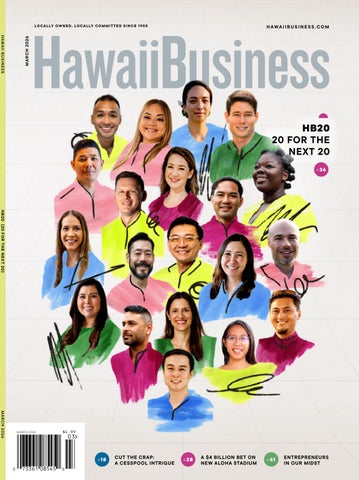
H AWA I I B U S I N ES S
M A RC H 2 0 26
HAWAI I B U S I N E S S .CO M
HB20 20 FOR THE NEXT 20 P.
36
H B 2 0 (2 0 FO R TH E N E X T 2 0)
M A RC H 2 0 26
MARCH 2026
P.
18
CUT THE CRAP: A CESSPOOL INTRIGUE
P.
28
A $4 BILLION BET ON NEW ALOHA STADIUM
P.
61
ENTREPRENEURS IN OUR MIDST
Care More Try Harder And Go Further
Tradewind Group is a local company born and raised in Hawai‘i, and founded on the principle that success relies on our deep sense of kuleana and aloha for our community. www.tradewindgrp.com
Impact Rooted in Service Guided by integrity and a deep commitment to others, Tricia Fujikawa Lee brings purpose to her work, both at the bank and throughout Hawai‘i. Her leadership supports financial education, affordable housing, and community development initiatives that expand opportunity statewide. Through her board service with Make-A-Wish Hawaii and leadership with other nonprofits, she continues to uplift families and strengthen communities across the islands. Congratulations to Tricia and the 20 for the Next 20 honorees.
Tricia Fujikawa Lee
Senior Vice President Division Manager & Chief Compliance Officer
FOR THE NEXT
20 0 20
CONGRATULATIONS TO RYAN KUNIYUKI for giving his all while still giving back.
Bank of Hawai‘i congratulates Ryan Kuniyuki and all of this year’s 20 for the Next 20 honorees. It’s good to know that Hawai‘i’s future is in such caring and capable hands.
“
The Hawai‘i Leadership Academy reinforced courage, gratitude, and clarity of purpose. It provided the opportunity to learn alongside like-minded leaders while strengthening perspective on authenticity, commitment to values, and having confidence and conviction in the value you bring.” – Brandon Kamigaki, Director, Auto Retail Strategic Initiatives & Operations, Auto Retail Operations
F E AT U RED SPEAK ERS
Raymond Vara Jr.
Christine Camp
Duane Kurisu
John Waiheʻe III
Michelle Bartell
The Hawai‘i Leadership Academy provides senior leaders with the fast-track, high-impact program they need to elevate their skills. Prepare for increased responsibility in just five weeks. The Hawai‘i Leadership Academy is an exclusive program designed for Hawai‘i’s leaders who are ready to develop and expand their executive skill sets. Tailored for director-level professionals and above, from all industries across the state, this academy offers strategic leadership growth, professional development, intentional networking, and direct exposure to Hawai‘i’s top leaders. We are excited to announce our second cohort in Spring 2026. Hawai‘i Leadership Academy:
Participants will benefit from:
• A five-week, in-person, half-day dynamic program designed to elevate careers.
• Personal and professional development by harnessing their innate leadership strengths.
• Consists of five immersive Friday sessions from April 10–May 8, 2026.
• Engaging guest speakers who will provide fresh perspectives and invaluable leadership insights.
• Offers a personalized and impactful experience with a limited cohort size for greater engagement.
• A powerful professional network, connecting with like-minded peers from diverse industries and organizations.
This exclusive academy is crafted for ambitious professionals, providing opportunities for personal and professional growth, leadership development, and insights from esteemed C-suite guest speakers.
This transformative experience is designed to inspire growth, expand leadership.
FOR MORE INFORMATION OR TO SUBMIT AN APPLICATION, VISIT HECOUNCIL.ORG/EVENTS/2026/04/10/TALENT-SOLUTIONS/9260410-HAWAII-LEADERSHIP-ACADEMY/ SUPPORTING SPONSORS
THE HAWAI‘I LEADERSHIP ACADEMY IS A PARTNERSHIP BETWEEN THE HAWAII EMPLOYERS COUNCIL AND HAWAII BUSINESS MAGAZINE.
03 . 2026
CONTENTS
Christine Heidama posing with one of her llamas. Photo courtesy of Christine Heidama
11
Spinning Farm Animal Fur into Yarn and Clothing On the slopes of Maui’s Haleakalā, Christine and Sam Heidama care for a mix of animals on their Kula Cottontail Farm, including llamas and alpacas. Christine spins their soft fur into yarn, which she then uses to make clothing.
4
M A R C H 2 0 26
13
18
Snorkelers preparing to swim over the coral reef at Kahaluʻu Bay on Hawaiʻi island. Photo by Mark A. Johnson
24
28
Trump’s Immigration Crackdown Has Triggered a Backlash
The Messy Political Path to Converting State Cesspools
One “Hot Spot” Village Hopes to be a Model But Lacks Funding
New Aloha Stadium Project Bulges With Ambition, as Well as Risk
In the Trump administration’s crackdown on immigration, the collision between events on the ground and official explanations for them has prompted a nationwide backlash. With independent videos, some things cannot be unseen. Hawaii Business Magazine has created a statewide I.C.E. Map to help businesses track agents’ actions here.
State officials have made a priority of converting some 83,000 cesspools to safer systems that don’t pollute our groundwater and the ocean. Logistics and cost have stymied those trying to map out a solution. It turns out the experience of Suffolk County in Long Island, New York, may provide some valuable lessons for Hawaiʻi.
The former royal village surrounding Kahaluʻu Bay on Hawaiʻi island attracts some 400,000 visitors who swim and snorkel around its shallow reef. Community members have taken the lead to protect the bay from cesspool runoff endangering the coral there. It’s one of several “hot spots” that aim to be a model for the state.
One of the state’s most ambitious development projects – the New Aloha Stadium Entertainment District -- is under way and will carry on for decades. Financing is uncertain and some plans still haven’t been made public. Can it stay on budget and hold to its timeline? We talk with the developers and community leaders tasked with keeping it on track.
HB EVENTS
C O N N E C T W I T H H AWA I I B U S I N E S S M AG A Z I N E
L O C A L LY OW N E D , L O C A L LY COMMITTED SINCE 1955.
Our goal is to strengthen the local economy and help our communities thrive.
TRAINING DAY APRIL 23, 2026 Japanese Cultural Center Best Places to Work: Training Day brings together Hawai‘i’s top-performing employers for a half-day conference focused on forward-thinking leadership, innovative HR strategies, and the evolving expectations of today’s workforce. Designed to inspire and equip, the event connects decision-makers and talent leaders for meaningful learning, idea-sharing, and practical takeaways that strengthen workplace culture and performance across the state.
The
MAY 18, 2026 Prince Hotel The Women Entrepreneurs Conference 2026 brings together founders, executives, and change-makers for a full day of connection, insight, and practical strategy on Monday, May 18, 2026, at Prince Waikiki. From keynote conversations and breakout sessions, networking expo, and pau hana marketplace, the conference is designed to leave attendees empowered, informed, and ready to take action. For more information on events, visit hawaiibusiness.com/events or contact Ashley McLean, Events Manager, at ashleym@hawaiibusiness.com
Publisher KENT COULES kentc@hawaiibusiness.com • (808) 364-5869 Editorial Editor-in-Chief JENNIFER ABLAN jennifera@hawaiibusiness.com Managing Editor KEN WILLS kenw@hawaiibusiness.com • (808) 987-8135 Senior Editor STEVE PETRANIK stevep@hawaiibusiness.com • (808) 534-7584 Senior Contributing Writer CYNTHIA WESSENDORF cynthiaw@hawaiibusiness.com Staff Writer RYANN NOELANI COULES ryannc@hawaiibusiness.com Copy Editor ELROY GARCIA Editorial Interns LILI HURD, KIANI VIDAURRI, ALLYSON WHALEY
Design & Photography Creative Director ESTHER MOHRMANN Graphic Designer CHASE NUUHIWA Graphic Designer KAREN TANIGAWA Graphic Designer GINNY WILLIAMS Staff Photographer AARON YOSHINO Digital Digital Director RANDALL LIBRAMONTE randalll@hawaiibusiness.com Digital Content Manager MARIANNE LEANO mariannel@hawaiibusiness.com Sales & Marketing Account Executive YONGCHAE SONG yongchaes@hawaiibusiness.com • (808) 228-5078 Account Executive CHAZ TIOGANGCO chazt@hawaiibusiness.com • (808) 387-1672 Operations Manager REBECCA BROOKING rebeccab@hawaiibusiness.com • (808) 534-7560 Events Manager ASHLEY MCLEAN ashleym@hawaiibusiness.com • (808) 272-6550 Events Coordinator OLIVIA DE SENA oliviad@hawaiibusiness.com Circulation circulation@pacificbasin.net Connect with us on social media: HawaiiBusiness HawaiiBusinessmagazine Hawaii Business is published by
Founder DUANE KURISU Chairman SUSAN EICHOR President BRANDON KURISU Director of Finance JADE CARREL
Guest columnist Perry Arrasmith (right) clowning around with his brother Nathan. Photo courtesy of Perry Arrasmith
Hawaii Venture Capital Associationʻs Meli James. Photo by Aaron Yoshino
36
61
Meet the Winning Class of 2026 HB20
Hawaiʻi’s Best Entrepreneurs
Hawaii Business Magazine proudly introduces the 2026 cohort of 20 for the Next 20, now called HB20. These honorees excel in each of their fields and share a passion for making Hawaiʻi not just better, but exceptional. Read the individual profiles, which are uplifting, inspiring and come from the heart.
For 26 years, the Hawaii Venture Capital Association has used its annual awards program to shine a light on the entrepreneurs and companies that choose to build, grow and innovate in one of the most challenging business environments in the country. We profile over a dozen business owners who made it into the Hawaii Entrepreneur Awards list.
70
Should I Stay or Should I Go: Can Hawai‘i Remain Attractive? Young professionals in the Aloha State face an agonizing choice amid an affordability squeeze: remain in the Islands or seek better wages and opportunities on the continent. Guest columnist Perry Arrasmith shares why he thinks being in Hawaiʻi is important. But it’s not a slam dunk and comes with an appeal for the state to do more.
SPECIAL ADVERTISING SECTION
15
Banking Report Leaders in the local banking industry discuss current financial news and trends in trust and asset management. As Hawai‘i’s population ages, estate planning is becoming an essential skill.
HAWAII BUSINESS (ISSN 0440-5056) IS PUBLISHED 12 TIMES A YEAR BY PACIFICBASIN COMMUNICATIONS. ©2026 PACIFICBASIN COMMUNICATIONS, LLC. ALL RIGHTS RESERVED. ANY UNAUTHORIZED COPYING, DISTRIBUTION, OR ADAPTATION IS STRICTLY PROHIBITED AND WILL RESULT IN LIABILITY OF UP TO $100,000. EDITORIAL, ADVERTISING AND BUSINESS OFFICES AT 1088 BISHOP STREET, SUITE LL2, HONOLULU, HI 96813. TELEPHONE (808) 534-7520. POSTMASTER: SEND ALL ADDRESS CHANGES TO HAWAII BUSINESS, P.O. BOX 913, HONOLULU, HI 96808. SUBSCRIBERS NOTIFY THE SAME OFFICE. PLEASE INCLUDE NEW ADDRESS AND OLD ADDRESS (MAILING LABEL PREFERRED) PERIODICALS POSTAGE PAID AT HONOLULU, HAWAI‘I, AND AT ADDITIONAL MAILING OFFICES. SUBSCRIPTION: ONE YEAR $24.99 / TWO YEARS $34.99 / THREE YEARS $44.99. FOREIGN: ONE YEAR $53.99 (US FUNDS). FOR SUBSCRIPTION INQUIRIES, ADDITIONAL RATES, INFORMATION, NOTIFICATION OF CHANGE OF ADDRESS AND SUBSCRIPTION SERVICE, PLEASE CALL (800) 788-4230. JANUARY 2026 VOL. 72/NO. 1
6
M A R C H 2 0 26
CONGRATULATIONS DANIEL MOATS AIA, LEED AP and all the 20 for the Next 20 honorees
CONGRATULATIONS TO
KALOA ROBINSON AND ALL OF THE 20 FOR THE NEXT 20 HONOREES!
This Well-Deserved Recognition Reflects Your LEADERSHIP, VISION, AND MEANINGFUL IMPACT On Hawai‘i’s Business Community. Wishing You Continued Success As You Help Shape The Future Of Hawai‘i.
AN OPEN MIND
BY JENNIFER ABLAN
"Nearly all men can stand adversity, but if you want to test a man’s character, give him power."
T
HE LINE, WIDELY ATTRIBUTED TO Lincoln — but in fact probably a description of him by another politician — stuck with me as we shaped this issue. In Hawai‘i, power rarely looks theatrical. More often, it appears quietly— in persistence, in service and in the choices people make when given responsibility over others’ lives, futures and communities. This issue introduces 20 for the Next 20, renamed HB20. When I think about what that means, I ask myself a deceptively simple question: If I were stuck on an island, who are the 20 people I would trust with this magical place we call home—Hawai‘i? After thoughtful debate, meaningful reporting and real due diligence, our editorial team selected the following honorees: Kapua Chandler; Jamila Jarmon; Elaine Gascon; Danicole Ramos; Trung Lam; Chris Fong; Tricia Fujikawa Lee; Gabriel Yanagihara; Warren Altona; Ryan Kuniyuki; Daniel Moats; Erin Uehara; Victoria Hanes; Lance Askildson; Su Lazo; Kaloa Robinson; Chelsie Evans; Summer Shelverton; Richard Matsui; and Zack Hernandez. Together with Ken Wills—HB’s managing editor and my longtime partner-in-crime—and the brilliant duo of Steve Petranik and Ann Auman, I had the privilege of interviewing and writing about these individuals. We often focus on the finished profiles, but what stays with me is the process. It was joyful, tearful and deeply human. These
8
MARCH 2026
were not transactional interviews; they were moments of trust (There was absolutely no influence or interference by our publisher and commercial-sales unit). Among our honorees are people for whom power was never assumed—it was earned. Elaine Gascon, the first in her immigrant family to graduate, represents the quiet force of perseverance. Her story is not just about professional success but about honoring sacrifice and expanding what is possible for the next generation. That kind of leadership reshapes families before it ever reshapes institutions. Danicole Ramos is another example of character under pressure. Known publicly for his work on the high-profile Sae Joon Park case—a Hawai‘i Purple Heart veteran who self-deported under threat of removal—Ramos operates daily inside what he calls a “complex and archaic” immigration system. His influence is felt not in headlines alone but in hundreds of lives altered through careful, compassionate advocacy. Power, in his hands, looks like credibility earned through service. Others represent the power of return. When Zack Hernandez talks about Hawai‘i, he does not frame it as a place people leave but as a place people are trying to get back to. After building his career recruiting talent on Wall Street and in Seattle’s tech sector, Hernandez came home to build what didn’t exist—AEP Hawai‘i—creating pathways for local and Hawai‘i-rooted professionals to access high-growth technology careers. His work acknowledges a simple truth: If people cannot thrive
“POWER, WHEN ENTRUSTED, MUST BE EXERCISED WITH CHARACTER.” economically here, culture alone cannot keep them. Power also shows up in stewardship. Summer Shelverton, a partner and department chair at Cades Schutte, works in trusts and estates—technical work with generational consequences. In a state where property is precious and the cost of living unforgiving, her work helps families preserve what they have built rather than lose it. Beyond her practice, she gives back through Volunteer Legal Services Hawai‘i and public school support organizations, reinforcing that leadership is as much about protection as it is about progress. Power comes from having a voice at the table where decisions are made. Chelsie Evans has served as the first Native Hawaiian member of the Advisory Board of the Consumer Finance Protection Bureau, advocating for equitable policies to address economic disparities. She is also a speaker at national events, including the National Low Income Housing Coalition and the NeighborWorks America Training Institute, among others. And power, especially today, lies in preparation. Gabriel Yanagihara believes AI literacy is essential for Hawai‘i’s future. As an emerging technologies teacher at ‘Iolani
Congratulations Summer G. Shelverton Partner and Trusts & Estates Department Chair
We’re proud to celebrate Summer and all of the outstanding leaders honored in Hawaii Business Magazine’s 20 for the Next 20 class! School, he is committed to ensuring students, educators and families are ready not just to use AI but to understand its ethical and economic implications. Ignoring these tools, he argues, does not shield students— it leaves them behind. Across industries—law, education, technology, housing, entrepreneurship—what connects this group is not ambition for power but respect for it. These are individuals willing to stay, to return, to build and to shoulder responsibility in ways that are often unseen. HB20 is not about predicting who will be powerful in the next 20 years. It is about recognizing those who already understand that power, when entrusted, must be exercised with character. After listening to these stories, I am not just optimistic—I am grounded in the belief that Hawai‘i’s future is in capable, conscientious hands.
Leading the way since 1922
MANAGEMENT COMMITTEE: AMANDA M. JONES, NATHAN T. OKUBO, RYAN M. WILSON Honolulu | Kona | Waimea | Kahului | Līhu‘e | (808) 521-9200 | cades.com ©2026 Cades Schutte LLP. All Rights Reserved.
JENNIFER ABLAN EDITOR-IN-CHIEF
H AWA I I B U S I N E S S
9
YO U R R OA D M A P TO H AWA I ‘ I ’ S 2 0 26 BUSINESS EVENTS
MAR
March 5 HB20 (20 FOR THE NEXT 20) March 27 Best Places to Work
APR
April 10–May 8 Hawai‘i Leadership Academy: Cohort Two April 23 Best Places to Work: Training Day
MAY
May 18 Women’s Entrepreneur Conference May 28 P3 Summit
JUN
June TBA HB20 (20 FOR THE NEXT 20) Impact Summit
JUL
July 17 Leadership Conference
AUG
August 13 Top 250 CEO Celebration
SEP OCT
Hawai‘i Leadership Academy: Cohort Three September TBA Hawai‘i Excellence in Business Awards
October 23 Wahine Forum Inaugural Wahine of the Year Pau Hana Celebration
NOV
November TBA Money Matters Financial Conference
DEC
December TBA CEO of the Year Celebration
V I S I T W W W. H AWA I I B U S I N E S S . C O M / E V E N T S
B Y A L LY S O N W H A L E Y
Llama and Alpaca Adventures on Maui CHRISTINE AND SAM HEIDAMA Guardians of llamas, alpacas and other creatures
WIFE AND HUSBAND CHRISTINE AND SAM HEIDAMA OWN KULA COTTONTAIL FARM ON THE SLOPES OF HALEAKALĀ, WHERE THEY CARE FOR AN ASSORTMENT OF CREATURES, INCLUDING LLAMAS AND ALPACAS.CHRISTINE IS A FIBER ARTIST WHO ACQUIRED THE ANIMALS FOR THEIR SOFT, LUXURIOUS FUR, WHICH SHE SPINS INTO YARN AND WEAVES INTO CLOTHING.
“As our herd grew, we discovered the llamas thrive on having a purpose, and they spread joy wherever they go,” Christine says. So today, they bring the long-necked and big-eyed animals to weddings, parties, hikes and other occasions. Beginnings: Christine and Sam are both the children of missionaries, and they met in Papua New Guinea. At age 18, they went in different directions: Sam to earn a degree in structural engineering while Christine traveled the world as a scuba diving instructor. After reconnecting, they married and settled in Hawai‘i to continue their careers. When they acquired the llamas and alpacas – native to the Andes Mountains in South America – there was little published research on their proper care, Christine says. “It was challenging when I first started learning how to care for al-
pacas and llamas because I was told all the wrong things. These guys are prey animals, so for us to stand and stare at them, or move forward to touch them, that is a very aggressive move.” Alpacas are smaller, shyer and have softer fleece, which is ideal for turning into yarn. Llamas, on the other hand, are more outgoing and better suited for interacting with people at events. Research: She spent time in Peru, learning about the cultural use of these creatures, especially llamas, which are often used as pack animals. And she had to unlearn other people’s ways of training them because that wasn’t how she wanted to train her own. She recognized that training that works for natural predators, like dogs, doesn’t work well with prey animals like llamas and alpacas. “If they come up against, like, a flag or something that frightens them, they’ll stop, adjust, so you must let them have time. I’m not going to force them, I’m going to wait for them to figure it out. That’s how you build trust.” Typical days: Christine says llamas like to keep busy, and every day they’re ready for new tasks to accomplish.
HIKERS ON A TRAIL WILL LLAMAS.
Photos courtesy of Christine and Sam Heidama
“Llamas especially love to feel useful, and they love routines. Every morning when I go out to feed them, they’re always looking at me like, ‘What are we going to do today?’ They really love to stay busy, and one way I thought they could be useful was to be at different events, such as weddings, so they could feel that sense of purpose.” Highlights of the job: She says she treats her animals with respect, not expecting them to be something they are not, and delights in how well-behaved they can be. The connection she builds with them, she says, is one of the best parts of her farm life. And she revels in the special connections between them and the people they meet, too. “You can see a bit of healing go on in the interaction. I had a guest at a wedding come up to me and tell me how her husband had just passed away a few weeks ago, and how meaningful was the time she spent with the llamas.” Community: A unique farm like Kula Cottontail requires creative people and solutions. Christy Haines, a large-animal veterinarian on Maui, learned a lot about caring for llamas and alpacas along with Christine, including different ways to treat infections, what works H AWA I I B U S I N ES S
11
LLAMAS PICTURED AT A WEDDING WITH A COUPLE.
LITTLE GIRL POSING WITH A SMILING LLAMA
12
M A R C H 2 0 26
and what doesn’t, and other best practices. “Most vets won’t even see llamas and alpacas,” says the veterinarian. “They can be finicky and there’s not much research done on them but it’s fun and interesting if you’re willing to figure it out and put in the effort.” Volunteers help with feeding the animals and other responsibilities. “I have multiple older women in the neighborhood who help me on a daily basis, whether it’s cleaning the pastures, or just watching the animals, walking them, even helping in the training,” Christine says. Challenges: The biggest challenge the farm faces is making a profit. She recently began to offer guided hikes with the animals but says the many rules and permits required, and other restrictions, can make it tough. “I’ve been trying to get something going for about two years now. If you don’t own the land, it’s difficult. The county wasn’t open to letting me use government land. And we’ve struggled with getting the word out.” Misconceptions: “A lot of people come in thinking llamas are mean or unpredictable, and it’s just not true. Once folks spend even five minutes with them, they see how gentle, goofy and sensitive they really are.” maluhiallamas.com
BY KEN WILLS
Crackdown
Trump’s Immigration THE THINGS WE CAN’T UNSEE
AT HAWAII BUSINESS MAGAZINE, WE HAVE A RESPONSIBILITY TO REPORT ON ISSUES AFFECTING THE BUSINESS COMMUNITY ACROSS THE STATE—EMPLOYERS AND EMPLOYEES ALIKE, AS WELL AS THEIR CLIENTS AND CUSTOMERS.
That responsibility led us, in August, to launch one of our most significant multimedia initiatives: the Hawai‘i I.C.E. Map. The map allows people across the Islands to report and track the locations of Immigration and Customs Enforcement agents operating in our communities. The volume and urgency of those reports underscore how deeply these enforcement actions are affecting workplaces, families and neighborhoods throughout Hawai‘i. Nearly every day, we witness shocking cruelty on the streets of America—including in our own neighborhoods in Hawai‘i. Video after video circulating on social media shows burly I.C.E. agents wrapped in combat-style protective gear assaulting, tackling and pummeling ordinary citizens. Some are protesting the militarization of their communities; others appear to be nothing more than bystanders. Adding a grotesquely theatrical accessory to camouflage uniforms, bulletproof vests, tactical gear, and
assault rifles, agents pull knitted ski masks and nylon balaclavas over their faces. Administration officials claim the masks are necessary for protection. Yet the agents were not in danger until they began violently confronting people in their homes, workplaces and on the streets. Rising public anger toward these extra-legal I.C.E. actions may well boil over, and sending ever more agents into communities can only inflame tensions. Public anger toward I.C.E. did not begin this way. Most Americans initially supported the stated goal of removing dangerous criminals. But the masks came on before any credible threat became evident—perhaps in anticipation that these actions would provoke resistance. While protests have been largely peaceful, I.C.E. tactics have been consistently cruel and violent. Videos show agents blindside-tackling elderly people merely standing on sidewalks; ripping others from their cars, including a woman who told them she was disabled; smashing the window of a man’s car at a gas station and beating him into unconsciousness—or worse—despite no sign of resistance. Transparency and accountability have become collateral damage.
In Minneapolis, the violence reached an unmistakable and horrifying extreme. Resident Renee Good’s last words heard on video recordings were, “That’s fine, dude. I’m not mad at you.” She was answered with a bullet fired at her through the windshield by agent Jonathan Ross, who then fired two more shots through a side window, including a fatal one to the head, according to an autopsy report. If that were not enough, he delivered a final verbal slur: “Fucking bitch!” Less than three weeks later, Border Patrol agents killed another Minnesota resident, Alex Jeffrey Pretti, an intensive-care nurse whom agents pinned down on the road and then fired multiple bullets into his back. With no evidence, Vice President JD Vance and White House aide Stephen Miller immediately tried to impugn Pretti’s character, calling him a “domestic terrorist” who came there to “massacre cops”. It turns out Pretti was helping another woman who had been shoved by agents, just as in his job he took care of U.S. veterans. In assessing officials’ credibility, these actions also cannot be unseen. These are the actions of poorly screened and poorly trained agents who have learned they are acH AWA I I B U S I N ES S
13
Masked Border Patrol agent caught in video frame lifting his handgun to shoot Alex Pretti in the back while Pretti is held down by other agents.
14
M A R C H 2 0 26
countable to no one except Department of Homeland Security Secretary Kristi Noem—who herself demonstrated ignorance of the constitutional principle of habeas corpus during congressional testimony, a safeguard that protects people from unlawful detention. These are also the actions of callous agents following the orders of a Justice Department that shut down an investigation into border czar Tom Homan, who reportedly was caught by the F.B.I. on video accepting a bag containing $50,000 in cash. And in a bitter irony, these are the actions of agents who appear to know less about First Amendment protections than the newly sworn-in citizens they so often detain. Immigrants are tested on their knowledge of U.S. law before becoming citizens. How many I.C.E. agents lacking basic civic knowledge would qualify? The President insists these agents are removing dangerous criminals to keep us safe. But our eyes show us something else. We see foreign-born neighbors seeking asylum or citizenship being dragged from courthouses where that legal process is unfolding. We see children forcibly separated from their parents. We see hard-working, tax-paying employees questioned about their accents and where they were born. We see U.S. citizens denied basic rights and detained for no reason other than the color of their skin or an agent’s suspicion. These are the things we see—and cannot unsee—regardless of official explanations. Time and again, authorities reflexively defend their agents’ actions before examining the evidence. Investigations work harder to discredit victims than to hold lawbreakers accountable. The world is watching, and America’s standing has been gravely damaged—perhaps permanently. The strength of the United States lies in its unique design as a country of immigrants and our strong rule of law. Hawai‘i’s business community depends on that rule of law being applied fairly and uniformly. When that fails, we fail as a nation. In that context, the Hawai‘i I.C.E. Map is not merely a reporting tool; it is a record. It exists so that the business community and the public can see patterns, share information and bear witness. Once these realities are documented, they become part of our collective memory—and they cannot be unseen.
SPECIAL PROMOTIONAL SECTION
THE 2026 HAWAI‘I
BANKING & FINANCIAL REPORT
Wealth that grows, a legacy that lasts. There’s nothing like the peace of mind that
designed to achieve your financial goals. With
comes from knowing you have a solid financial
this plan in place and dedicated bankers at
plan, for your own goals and for sharing your
work for you, you’ll be able to reclaim time for
legacy with family.
your personal priorities.
CPB’s Wealth Management team is committed
You’ll also have the opportunity to set up a
to providing that peace of mind. They offer
trust to ensure that your legacy is carried
boutique-style banking services that include
forward in the way you wish. Trusts can protect
both investments and trusts.
your assets, provide for family members, guide business succession, and much more.
Experienced wealth managers use a custom process to create a personalized road map
For more details, visit cpb.bank/Wealth
SPECIAL PROMOTIONAL SECTION
PHOTO COURTESY OF CPB
CENTRAL PACIFIC BANK TRUST AND ASSET MANAGEMENT
As Hawai‘i’s population grays and its demographics change, estate planning is becoming an essential step for anyone who wants to leave a legacy, protect loved ones and ensure a smooth transition of assets. “Our average client is over 70 years old,” says Central Pacific Bank’s Vice President and Personal Trust Manager, Jason Mukaida. “Once this large generation of Baby Boomers ages out, there’s going to be a tremendous shift of wealth to the next generation and it’s important to have a plan in place—before it’s too late.” CPB was founded by Nisei in 1954. Over 30 years ago, the bank became a trust charter institution, expanding its services to meet the evolving needs of its customers. “As the bank has matured so have our clients, and we found that there was a need to help them plan for the assets they have accumulated,” says Mukaida. Estate planning is not just for the wealthy. Though all banks have a minimum liquid asset requirement, compared to its competition CPB has the lowest threshold. As a trustee, CPB can manage assets, help settle an estate per terms of a trust, and depending on a client’s objectives, provide a legacy for the family, a bequest to a charity or both. “We encourage all our clients, even those in their 30s and 40s, to create an estate plan if they haven’t already,” Mukaida says. “It can benefit loved ones and help ensure an orderly transfer of wealth. In every case, the earlier the planning starts, the better.” Having a trustee doesn’t mean our clients have to give up being captains of their own ships. “They can be assured that if something happens to them, they have a backup,” Mukaida says. “In a nutshell, we help our clients with plans and investments that fit their needs including retirement funds, long-term care and much, much more, so that ultimately they feel secure in their future.”
When working with clients, CPB takes a team approach. Trust and Asset management falls under the bank’s Wealth Management Services division, which includes private banking, and portfolio and relationship managers. “Everything is tailored to meet the client where they are in life, and how they view different accounts they may have elsewhere, including assets and estates for a customized portfolio,” says Mukaida. Trust managers also work with estate planning attorneys and tax preparers to meet specific, detailed legal and financial requirements that may arise as clients age. That commitment hasn’t gone unnoticed. CPB was recently recognized by Forbes as the best bank in Hawai‘i, and by Newsweek as one of the best regional banks in the nation, due in large part to its customer service. “We’re not the biggest bank in Hawai‘i, but we are less compartmentalized, and things don’t get lost in the cracks. We provide quick responses and turnaround times,” Mukaida says. “Our customers come first, no matter what.” In getting to know a client, CPB also gets to know the client’s family, including its next generation members who would benefit from any transition of assets. When it comes to estate planning, family meetings at the bank are encouraged. “When we get to know the family, our clients get even more comfortable working with us, to the point where we are now working with the next generation to transfer assets smoothly, and make sure everyone is on the same page,” Mukaida says. “In this industry we have a tendency to focus on the money. At CPB, we focus more on the transition process, helping clients identify the legacy they want to leave behind and putting a thoughtful plan in place to support successive generations.”
PROTECT AND SECURE YOUR LEGACY WITH CPB. CPB is proud to partner with individuals, families, and businesses to help build, preserve, and transfer wealth for generations to come. Our Trust and Asset Management Services encompass everything from retirement planning and investment management to comprehensive trust services, such as trust administration and estate settlements. It’s about building your wealth so that you’ll be able to enjoy the retirement you envision. It’s about protecting your assets from whatever life throws at you, while avoiding probate expenses and minimizing taxes. And it’s about ensuring that your wishes are carried out – whether that be business succession, charitable bequests, or providing for beneficiaries with special needs. Want expert help in creating an investment strategy designed to meet your unique goals, optimize potential returns, minimize risk, and accommodate changes along the way? Looking to protect your family, community, or business today and long into the future? CPB’s Trust and Asset Management Services are here for you. We offer the expertise, commitment, and legacy of trust you can count on. We invite you to learn more about what we can do for you by visiting cpb.bank. SPONSORED BY CENTRAL PACIFIC BANK. MEMBER FDIC. CENTRAL PACIFIC BANK 220 S. KING STREET, HONOLULU, HI 96813 WWW.CPB.BANK
BY STUART COLEMAN PHOTOS BY MARK A. JOHNSON
Cut the
Crap A Cautionary Tale About Cesspools and a Story of Hope
18
M A R C H 2 0 26
A E R I A L P H O T O O F K A H A LU ʻ U B AY O N H AWA I ʻ I I S L A N D , W H E R E C E S S P O O L S N E A R H O M E S A LO N G T H E S H O R E L I N E A R E E N D A N G E R I N G T H E WAT E R Q U A L I T Y O F T H E POPULAR SNORKELING AND SWIMMING SITE.
With a self-imposed deadline looming, Hawai‘i faces a massive and expensive challenge to convert 83,000 cesspools by 2050, many of which are polluting our waters. At an average cost of $30,000 to $50,000 per conversion, that’s a $2-4 billion problem. Can the state work with the federal government and counties to come up with a coherent strategy to convert these substandard systems?
GOVERNMENT LEADERS INCLUDING GOV. JOSH GREEN AND HOUSE SPEAKER NADINE NAKAMURA HAVE MADE CESSPOOL CONVERSIONS A TOP PRIORITY OF THE STATE. Officials say
they are creating a cesspool conversion implementation group to find solutions, but the Hawai‘i Department of Health (DOH) is working to come up with a clear strategic plan. The only place in the U.S. that has more cesspools than Hawai‘i is Suffolk County on Long Island outside of New York City. Hawai‘i still has the most per capita, but Suffolk County has more than fourand-a-half times as many with over 380,000. The legacy of cesspools there has created serious threats to the environment, human health and the economy that can serve as lessons for Hawai‘i. As different as they are, Long Island and Hawai‘i share many intriguing parallels. Both experienced boom and bust cycles of rapid residential development, resulting in a lack of planning and sanitation infrastructure. The result was a proliferation of cesspools, sewage pollution and water quality issues. What happened in Suffolk County is a cautionary tale of what can happen in Hawai‘i if the problem goes untreated. But it is also an inspiring story of how a group of government leaders found a way to deal with the problem. Their solutions provide a template for Hawai‘i and other states to follow.
A MASSIVE, SLOW-MOTION SEWAGE SPILL
Sometimes it takes a major crisis to spur people into action. Ted Bohlen moved to Hawai‘i from the East Coast in 2006, partly drawn to the pristine waters of the Islands. A lawyer, he landed a job as the Deputy Attorney General for the Hawai‘i Department of Health and embraced the department’s goals to protect public health and the environment. Unfortunately, on his first day of work, a massive sewage spill erupted in Waikı̄kı̄. A main sewer line broke, and a toxic river of brown waste flowed into the Ala Wai Canal and out into the ocean for days. The spill would eventually discharge more than 48 million gallons of raw sewage into the canal. The event made international headlines and caused the closure of beaches in Waikı̄kı̄. Bohlen recalls how a man with a compromised immune system fell into the Ala Wai Canal and became infected with a deadly virus known as vibrio. He died in the hospital soon after. More than an environmental nightmare, the sewage spill was a health crisis that transformed Bohlen’s life. “Suddenly, the public realized how dangerous polluted water could be,” he says. Dealing with the sewer spill crisis, Bohlen realized it was partly due to aging infrastructure. During
PHOTO COURTESY OF TED BOHLEN
this time, he learned more about Hawai‘i’s cesspool issues and how these substandard systems were also polluting the state’s waters beneath the surface. Over time, he realized that cesspools generated more waste each day than the state’s largest sewage spill in 2006. While the spill in Waikı̄kı̄ was 48 million gallons, Hawai‘i’s 83,000 cesspools discharge more than 52 million gallons of raw sewage into our ‘aina each day, with a portion of that making its way to the water tables and into the ocean. It was like a massive, slow-motion sewage spill beneath the surface, going on every day for decades, yet people just couldn’t see it. “I became aware that cesspools were the largest water pollution issue in the state,” says Bohlen. Although layers of soil, sand and clay can filter much of the effluent to reduce what reaches the underlying water table or the ocean, this natural filtration can become
H AWA I I B U S I N ES S
19
AT K A H A LU ʻ U B AY, R E E F T E A C H V O LU N T E E R S I N S T R U C T V I S I T O R S T O AV O I D S T E P P I N G O N T H E C O R A L R E E F, A N O T H E R T H R E AT T O M A R I N E L I F E A LO N G W I T H C E S S P O O L C O N TA M I N A N T S .
overwhelmed in densely developed and low-lying areas close to the sea. During his time as the DOH’s Deputy AG, Bohlen recruited younger activists and environmental groups like the Surfrider Foundation to work on policies to reduce cesspool pollution. Together, they helped pass laws to ban construction of new cesspools and mandate the conversion of all cesspools by 2050 (Act 125, 2017). But with the current rate of 400 cesspool conversions per year, that rate will need to increase eight-fold to meet the deadline. Some legislators and homeowners say cesspools are not a major problem and that the issue is not urgent. But Roger Babcock, Director of Honolulu’s Department of Environment Services, says, “Cesspools are a primitive form of wastewater disposal. So, it’s disposal, not treatment.” Babcock adds that cesspools are “basically like having an outhouse in your front yard. Would you go out and do your business right out in your front yard in a pit, every day? I don’t think
20
M A R C H 2 0 26
that’s what people really want.” It’s natural to wonder how this form of sanitation became so common in Hawai‘i. “People don’t realize that cesspools were a temporary fix,” Babcock says. “They were never intended to be a long-term solution. It’s just that development happened so fast and the infrastructure couldn’t keep up with the pace of building.” It turns out that this was a common problem across the country, particularly in fast-growing places like Long Island. As of press time, the state Department of Health did not respond to requests for comment about practices in Long Island that might apply to Hawai‘i’s situation. BROWN TIDES AND TOXIC ALGAL BLOOMS
The cold waters around Long Island were once the home of the most productive fisheries in the country. Generations of fishermen worked in their boats to bring in bountiful harvests of clams, scal-
lops, oysters and other shellfish that fed expanding seafood markets across the country. When Walter Dawydiak moved to Long Island in the 1980s, he felt like it was a kind of Eden compared to New York City. On weekends, he would go clamming and scalloping and bring home fresh seafood for his family. Trained as an engineer, he worked at the Suffolk County Department of Health and enjoyed his suburban lifestyle. But as a public health official, he became aware of the rapid pace of development and lack of sewer infrastructure. “A lot of Suffolk County was planning for regional sewage treatment plants, and they would allow houses to come in with temporary cesspools,” Dawydiak says. “But the sewage treatment plants were never built so that they basically became permanent cesspools.” These substandard systems didn’t seem to be a problem at first, but then everything changed in the mid-80s. Like a plague, “brown tides” swept over the waters, and the shellfish started to disappear.
“The brown tide killed all the bay scallops,” Dawydiak says. “All the eelgrass beds disappeared.” These toxic algal blooms also led to massive fish-kills and die-offs that would devastate local communities that depended on fishing and tourism. The devastation to the ecosystem was so severe that 99% of the shellfish industry crashed. Thousands of fishermen lost their jobs. The local economy and housing market took a downturn. As the head of the health department, Dawydiac says, “We were all faced with the task of figuring out what happened.” Top scientists were summoned to help figure out what was causing the brown tides and the collapse of the shellfish industry. Chris Gobler, a researcher at nearby Stony Brook University, finally found the source: excessive nutrient loading and toxic pathogens from all the cesspools and failing septic systems. “We had over-polluted our environment and had to find ways to fix it,” Dawydiak says. RECLAIM OUR WATER
Armed with years of research and data, Chris Gobler began sounding the alarm. He spoke to environmental leaders, community groups and government officials about the need to protect water quality by reducing the nutrient loading of nitrogen and phosphorus from the more than 380,000 cesspools in Suffolk County. “We called him the Paul Revere of water quality on Long Island,” says Dorian Dale, Director of Sustainability for Suffolk County. Dale and his team embraced Gobler’s cutting-edge scientific work on harmful algal blooms, and they amplified his warning about the need to reduce nitrogen loading and convert the cesspools. With so many job losses, environmental crises and economic impacts, the message resounded across the county. Dale worked with Dawydiak at the Department of Health and Sarah Landsdale at the Planning
H AWA I I B U S I N ES S
21
PHOTO COURTESY OF DORIAN DALE: WA LT E R D AW Y D I A K H O L D I N G T H E S U F F O L K COUNTY REPORT
Office. Together, the newly formed team asked their boss Steve Bellone, the Suffolk County Executive, to help them come up with a plan to solve the problem. Those meetings with Bellone helped launch a movement. Instead of kicking the can down the road, the group decided that decisive action was needed. Bellone set up a press conference and proclaimed that it was time to stop polluting their waterways and fisheries. “I’ll never forget the moment he did this because it was life-changing,” recalls Dawydiak. “It was a John F. Kennedy moment, and he said, ‘If not us, who. If not now, when?’ He said, ‘We’re going to step up and do our part.’” Suffolk County spent tens of millions of dollars to devise a strategic plan, hire staff and set up grants to help home-owners with the costs of converting their cesspools. Bellone’s central message about the need to “reclaim our water” became the rallying cry for the movement and the official name of the campaign. His decisive, impassioned message transformed everyone involved. Dale says that Dawydiak could have been “just another bureaucratic roadblock, a guy who’s just collecting his pension.” Instead, he became a transformational leader. While working full time, Dawy-
22
M A R C H 2 0 26
diak went to law school at night to learn how to create more effective policies. “I mean, Walter ends up being a superhero,” Dale says. THE MAGICAL SEPTIC TOUR
As the Director of Planning, Lansdale decided that they should find out what other states in the area were doing about the issue. In 2014, Lansdale gathered Dawydiak, Dale and a handful of other agency leaders, and they took a 3-day road trip along the Northeast coast to talk with other state and county leaders. They learned that Rhode Island had the best regulatory policies for requiring better treatment systems that reduced nitrogen loading; Maryland had the best model for raising funds to help homeowners with the cost of conversions; and Massachusetts had the best testing center to approve better treatment technologies. Borrowing best practices from these other states, the leaders said the road trip proved to be a game changer for the county. Dale dubbed it the “Magical Septic Tour.” The experience made them realize they were on a common journey to solve a problem that affects many parts of the country, including Hawai‘i. “The principal mission is water quality,” Dale says. “And that’s why I’m concerned about your water
quality [in Hawai‘i]. It’s a shared struggle.” Over the next 10 years, they created new policies that could be a successful model for Hawai‘i’s Department of Health. Suffolk County required denitrifying treatment systems to remove nitrogen in coastal areas and new developments, and they fast-tracked the permitting process for cesspool conversions. The cost of conversions is still a major issue, but Suffolk County passed a bill to increase the sales tax by an eighth of a penny to create hundreds of millions of dollars in grants to help homeowners upgrade their cesspools and septic systems. These policy and funding innovations have increased the rate of conversions and reduced the amount of sewage pollution and nutrient loading, while also improving their water quality and quality of life. But in Hawai‘i, there is still no strategic plan or dedicated source of funding to help homeowners with the high costs of converting their cesspools. IMPLICATIONS FOR HAWAI‘I
What happened on Long Island clearly has powerful implications for the Hawaiian Islands. While Suffolk County has made substantial progress in converting thousands of cesspools each year, Hawai‘i’s conversion rate is stagnant. Meanwhile, the pathogens and nutrient loading from cesspools in coastal areas are leading to serious declines in water quality, fisheries and coral reefs. Just as Gobler showed how nutrient pollution was causing toxic algal blooms and killing the shellfish industry in Suffolk County, Greg Asner has been sounding a similar alarm about how nitrogen loading is having the same harmful effects on Hawai‘i’s coral reefs. A Navy veteran and Arizona State University professor based in Hawai‘i, Asner is a leading researcher on coral reefs and says that nutrients like nitrogen lead to algal overgrowth that smothers the reefs. He says that when stormwater runoff – including golf course
OVERVIEW OF SNORKELERS AND SWIMMERS N AV I G AT I N G A R O U N D T H E E L A B O R AT E C O R A L R E E F S T R U C T U R E S I N K A H A LU ʻ U B AY.
fertilizers and county herbicide spraying – combines with the “toxic cocktail” of wastewater pollutants, these stressors kill the state’s coral. On many coastlines, Asner says, “The high pollution areas already have seen massive decline.” Once vibrant reefs have been reduced to coral rubble in places across the state, including some parts of Puako and Kahalu‘u on Hawai‘i island, Ma‘alaea and Kahekili on Maui and Kāne‘ohe Bay on O‘ahu. In numerous ways, our state’s future depends on the health of our remaining reefs. NOAA has estimated that Hawai‘i’s coral reefs contribute an estimated $863 million per year to Hawai‘i’s economy. When asked about the consequences of losing our coral reefs, Asner explains that the losses are too large and hard to calculate. “There will be more and more coastal erosion, more and more loss of homes and livelihoods and economy along the coastline,” Asner says. “The fabric of the entire coastline is pulled apart when you have these losses.”
Due to Hawai‘i’s dependence on tourism, the loss of the state’s coral reefs would be economically devastating. “Our visitor industry is the lifeblood for our economy,” says Bohlen, “and people aren’t going to want to go to the beach when they know that the water is polluted.” He is also worried about the health effects of sewage pollution, especially when it comes to drinking water. A decade ago, a Department of Health study in East Hawai‘i found fecal indicator bacteria in 50% of private drinking water wells sampled. Besides the ‘ick’ factor, that’s a health crisis in the making. As in Suffolk County, Bohlen believes the state should hire more staff at DOH to come up with an actionable plan to convert cesspools in coastal priority areas. Also like Suffolk County, he says the state should adopt policies to do the following: develop new revenue sources and create grants to help homeowners convert their cesspools; create a new cesspool section at DOH to streamline permitting
regulations and speed up the rate of conversions; and fast-track approval of more affordable treatment technologies that reduce pathogens and nutrient loading to protect water quality and coral reefs. Though he retired from the Hawai‘i Department of Health in 2022, Bohlen continues to collaborate with the department. He also helps guide policy for a coalition of nonprofit groups and young activists who are working on cesspool issues. “It gives me a sense of purpose and makes me feel that I’m working on something worthwhile,” Bohlen says. After retiring from Suffolk County’s Department of Health, Dawydiac continues to work on wastewater issues. He and Dale have both offered to help the Hawai‘i Department of Health, sharing lessons learned and success stories from Suffolk County. “I felt like I spent 40 years accumulating all of this information that could still be useful to somebody,” Dawydiak says. “So, I thought I should try to be helpful and pass it on.”
H AWA I I B U S I N ES S
23
BY KEN WILLS
G R E E N D Y E P O U R E D I N T O T O I L E T AT S H O R E L I N E H O M E E N T E R S O C E A N A F T E R O N LY H O U R S . P H O T O C O U R T E S Y O F D R . S T E V E N C O L B E R T, U N I V E R S I T Y O F H AWA I ʻ I - H I LO .
A Hawai‘i Island “Hot Spot” Aims to be a Cesspool Model for the State
C I N D I P U N I H A O L E A N D K AT H L E E N C L A R K TA K E A WAT E R S A M P L E F O R T E S T I N G A S V I S I T O R S B E H I N D T H E M P R E PA R E T O G O S N O R K E L I N G AT K A H A LU ʻ U B AY. P H O T O B Y: M A R K A . J O H N S O N
24
M A R C H 2 0 26
Kahalu‘u Bay on the Kona Coast of Hawai‘i island has a storied history as a former royal village with protected fish ponds inside a “menehune” breakwater, ancient heiaus nearby and petroglyphs carved into lava rock. Today it is a destination for some 400,000 visitors each year who come to snorkel and swim in the warm waters.
But underneath the surface, the idyllic marine ecosystem is struggling, making it one of a number of “hot spots” for environmental degradation in the state. Corals are under threat from rising sea temperatures, toxic suntan lotions, tourists who step on them and especially due to runoff from dozens of nearby homes’ cesspools. “It’s such a welcoming shallow bay, and safe,” says Cindi Punihaole, whose family has lived on the Kona Coast for generations and who was featured in the “Keeper of the Bay” documentary on PBS Hawai‘i (https://www.pbshawaii.org/ keeper-of-the-bay/), which highlighted her efforts to preserve the aquatic life there. “When I talk to senators, or county officials, because they’re not in the water, they’re looking at a bay that is beautiful. ….. Those who’ve been in the water, they know. They’ll tell you it’s polluted.”
“
Engaging with the community is the key”
Shoreline areas across the state are grappling with the damage to marine life caused by cesspools that can’t properly filter the effluent before it flows directly into the ocean. Punihaole realized she needed hard evidence and data to demonstrate the threats to the coral life and to propose specific solutions. Toward that end, with help from the Kohala Center, the county and the University of Hawai‘i Sea Grant program, Punihaole ramped up ReefTeach, an outreach effort to educate visitors to protect coral and the marine environment. From six volunteers in 2006 when she first took over, the program now has more than 500 volunteers who help staff the beach park every day. They also report changes that they witness in marine life and coral conditions. “Engaging with the community is the key,” Punihaole says. But to convince state and county officials of the urgent need to address the cesspool runoff threat, Punihaole added: “I needed data.” Kathleen Clark, Punihaole’s understudy who has degrees in Conservation Science and Environmental Policy, started conducting regular water quality tests, including water temperature, salinity, turbidity, disolved oxygen and weekly visual assessments of coral conditions. They now have 10 years of data. “Numbers don’t tell the whole picture,” says Clark. “The real lessons have come from observation in Hawaiian waters.” Although tests for fecal bacteria including enterococcus have not shown levels requiring closure of the bay to tourists, a steady flow from underground seepage along the shoreline could be enough to kill some of the coral, which provide feeding areas
- CINDI PUNIHAOLE
for multitudes of fish and turtle resting areas. They also help block shoreline erosion from surf. “Coral that are constantly being exposed to pollution and other stresses are less resilient to stresses from rising sea temperatures,” which is a global phenomenon and poses its own risks, Clark notes. She has witnessed bleaching of coral, indicating stressed structures that may be dying. “In the last five years, it’s gone from 100% live tissue to 30% or less” in some areas of the bay, she says. “They’ve survived hundreds of years until now.” To be sure, there is also progress being made, including reattaching coral fragments that have been broken off by strong surf or by people stepping on them, as well as new coral being introduced from onshore nurseries An “aha” moment came when Dr. Steven Colbert, associate professor of Marine Science at UH-Hilo, conducted a dye test in August 2024. He and his researchers poured green dye into a toilet at a home along the shoreline, and in just five hours the dye appeared in the ocean, barely diluted at all. Punihaole says the dye studies as well as chemical analyses of the water showing the presence of household pharmaceutical products that enter the water from cesspool runoff gave her concrete evidence to seek solutions. But feasibility studies showing that costs to convert cesspools or to divert the waste to treatment facilities or localized closed-circuit systems would run nearly $2 million or more, money the community and their supporters lack. Punihaole sees hope in the shared concern of some wealthier
residents just up the Kona Coast. “We have folks, very wealthy billionaires, who believe in our work, believe in what we do, and believe in community and believe in democracy and what we can do together,” she says. Hawai‘i island Mayor Kimo Alameda commends the efforts of Punihaole and other community leaders in Puako to the north who are trying to address the problem, but he says federal funding combined with creative local financing is a more realistic option. “Relying on billionaire homeowners feels neither comforting nor reliable; philanthropy can help with seed funding or matching grants, but it shouldn’t be the primary financing strategy,” Alameda texted in response to a request for comment. “It would be great if the federal government could help us fund a detailed pilot with transparent costs and performance data; and I’ll be pursuing legislation that phases the conversion, with the priority areas being the shoreline first.” At 75, Punihaole is a relentless force who believes that Western science combined with Hawaiian traditions can solve intractable problems. She is not naïve about what it takes to bring about political change, nor is she ready to give up. “It’s a huge problem, but wouldn’t it be great if we could do Kahalu‘u to create a model?” she says. “There’s currently no model. So everyone is saying it’s not going to work. They have no clue. You have to create that model and tweak it, then you give it to O‘ahu, Maui. “Shame on us if we leave all of this to our children. We know what to do.”
H AWA I I B U S I N ES S
25
TO SUBSCRIBE, VISIT HAWAIIBUSINESS.COM/NEWSLETTER-SIGNUP-2
B Y M A R I A T O R R E S - K I TA M U R A / P H O T O S B Y A A R O N Y O S H I N O
The State’s Risky $4 Billion Bet on a Mixed-Use Stadium District Makeover As demolition begins at Aloha Stadium, a $4 billion vision is taking shape for a new mixeduse district covering nearly 100 acres. But are local stewardship and creative financing enough to navigate the decades of risk ahead?
A
S TOWERING CRANES MOVE INTO PLACE THIS MONTH FOR CREWS TO CUT AND REMOVE STEEL BEAMS AND CONCRETE,
THE DEMOLITION WILL MARK THE DEFINITIVE START OF THE NEW ALOHA STADIUM ENTERTAINMENT DISTRICT — THE OPENING ACT FOR THE STATE’S BIGGEST MIXED-USE BET EVER.
It’s a massive public-private undertaking valued at up to $4 billion that will unfold over the next 20 years. Phase One covers the new stadium and the “Aloha Live” entertainment district, with the new stadium slated to debut in early 2029. Later phases, planned over two decades, include 4,100 housing units, three hotel towers, and a mix of retail and open space uses. The project promises housing, economic development and cultural continuity. It also raises familiar questions about whether this vision can hold up over time, stay within budget, and, importantly, who will bear the cost if it doesn’t. To navigate that uncertainty, the state is relying on what it hopes is a safeguard that goes beyond contracts: the people at the helm. A consortium of local developers and contractors under the umbrella of the Aloha Halawa District Partners (AHDP) was chosen by the state to build the project. Expectations are running high, as expressed by Aloha Stadium Author28
MARCH 2026
ity Chair Eric Fujimoto: “Mahalo to all the dedicated individuals transforming our community’s vision into reality,” he said at a launch ceremony. “We hope generations of those with Hawaiʻi in their hearts will come here to dream, celebrate and make lasting memories.” Despite years of planning, however, community concerns about transparency have been raised, and risks have already surfaced that could bust the project’s cost projections. One of those is the impact of tariffs imposed or threatened by President Donald Trump on countries that will supply critical components for the construction project, including steel and cement. The United States imports roughly a quarter of its cement and steel from Canada, with Mexico and China also serving as notable suppliers. Domestic sources introduce other risks, such as higher costs. “Some of the external factors that really keep us up at night right now is that we’re still not fully sure of the impacts of tariffs on the cost of construction, especially on steel and aggregate and concrete,” says Brennon Morioka, special adviser to the governor overseeing the state’s $350 million investment in the project. “A lot of that comes from Canada, Mexico or China,” he says, which are at varying stages of negotiations with the
View of the existing Aloha Stadium in early 2026 before demolition crews begin dismantling the huge structure. H AWA I I B U S I N E S S
29
Stanford Carr, whose development company is leading the stadium district demolition and reconstruction plan, surveys progress at the site
Trump administration over tariff levels the president has said he will impose. Morioka says project leaders are being proactive, working to identify risks early and develop contingency plans while acknowledging that not all proposed solutions may prove viable. Another wild card is county and local financing above the capped state contributions. Details for borrowing those funds have yet to be hammered out. Some leases and other plans have also not been made public. THE STRENGTH OF LOCAL STEWARDSHIP
One structural advantage is that both sides of the public and private partnership are led by people with deep local ties. Together, they represent a combination of technical skills and relational “soft power” intended to keep such a large project on track. Morioka, who is also Dean of the University of Hawai‘i College of Engineering, oversees project delivery. While he acknowledges the skepticism inherent in large infrastructure projects, he adds that momentum is finally building. 30
MARCH 2026
“At the beginning, you always kind of wonder, is this really going to happen? Now you look back at all the hard work, long hours, pulling hair through negotiations, and it’s all worthwhile,” Morioka says, “especially with a project like this.” Fujimoto, who is part of the state’s leadership team, is an ‘Aiea-Pearl City native whose board authorizes the project’s contracts. Fujimoto views the stadium as a shared cultural touchpoint: “When somebody says ‘Aloha Stadium’, it invokes a memory – let’s say in those 30 years or older – that makes them smile, whether it’s a concert, or a football game, or graduation,” says Fujimoto. “To be able to build a community asset like that, it’s an exciting time,” he adds, noting that local oversight is critical to ensuring that the legal agreements align with community values. On the private side, developer Stanford Carr of Aloha Halawa District Partners has been developing master planned communities in Hawai‘i for 30 years and views this as a “legacy project.” “I’m local; I want the money to stay here,” says Carr, emphasizing his intent
to work with local contractors as much as possible, and to collaborate with other local developers to speed up the build-out. Carr is also CEO of Stanford Carr Development, which is the lead developer in the partnership. This local focus has earned cautious optimism from the community. ‘Aiea Neighborhood Board Chair Steve Wood noted that, from what he has seen so far, the developer has addressed fears about the community losing its identity. He points to the preservation of the Swap Meet through a new plaza design and the creation of a “tailgate preservation zone”—a designated surface lot ensuring that the tents and grills defining local fandom aren’t lost to the new vertical density. As for the community, he says, “There’s some excitement there, some relief—like ‘Okay, finally, we’re making progress.’” Even so, public concerns about transparency have begun to surface, especially about the fine print of the major agreements. The Stadium Operating Agreement and Initial Ground Lease had been
executed but not yet finalized, while the Master Development Agreement— which sets performance standards and responsibilities for financing, construction, operations, maintenance and lifecycle costs—was also still being finalized. Morioka says the terms for these major agreements have been set. However, none had been made public as of early January, as they were still officially considered under active procurement. Ground leases for 38 parcels and reciprocal easement agreements governing shared infrastructure and common areas were still under negotiation. That gap between visible progress and unavailable documents has heightened public concern, shaped in part by Hawaiʻi’s experience with past largescale projects. Oversight of the Honolulu Skyline rail project, for example, was later criticized by city auditors, who found that delayed access to key contracts and amendments made it harder to track risk, costs and accountability as the project evolved. Those experiences have made residents especially sensitive to transparency questions when work begins before agreements governing long-term obligations are available for public review. Adding to that perception is the absence of a single, final financing package, which Carr attributes to the project’s long timeline and the need for a phased development approach. “On a project like this, it’s a 20- to 30-year endeavor, depending on the different economic cycles,” he says, a horizon that affects interest rates, tax revenues and investor appetite. As a result, financing decisions are made in stages, aligned with what can be built at each phase rather than committed all at once. Carr says the early phase is dominated by costly but non-revenue-generating work. “Phase One, there’s going to be a stadium and the Aloha Live Entertainment District. We will not have any of the residential or commercial up yet because we’ve got a tremendous amount of infrastructure that first needs to be relocated,” he says. Housing, hotels, and commercial uses that typically generate lease revenue and tax streams come later, after utilities are redesigned and
rebuilt. “Before we can disconnect it and connect it to the new, we need to design and build the relocated utilities, then demolish the existing, and then install the new infrastructure to serve the community,” Carr says. Financing, he says, is therefore contingent on future build-out and performance: “Institutional investors buy tax-exempt bonds based on the future economic success of these communities.” Until that work is complete and site capacity is known, parcel layouts, densities, and uses—and the financing assumptions tied to them—remain unresolved.
The team is bracing for external cost risks that no amount of local bond authority can fully control WHO PAYS?
While leadership shapes execution, NASED’s success ultimately depends on a complex financial engine designed to shift more of the burden away from the state. Under the Public-Private Partnership (P3) model, the state has capped its contribution at $350 million in general obligation bonds and $49.5 million in special funds for operations. The private developer bears responsibility for all additional construction costs, assuming financial and operational risk for 30 years. For additional costs not involving construction that exceed the state cap, the team has proposed using Tax-Increment Financing (TIF) and Community Facilities District (CFD) bonds. Both rely on county-issued debt and will surely invite intense scrutiny, as neither has been used in Hawai‘i for a project of this scale.
But proponents argue the financial logic is secure because the project creates the potential for tax revenue streams where almost none exists today. The TIF and CFD bonds are a hybrid: Public authority enables the bonds, private investors purchase them, and repayment is intended to come from future property tax revenues generated by development on the site. These bonds would be issued by the City and County of Honolulu, but state and county officials have not yet decided whether to proceed or in what amounts. While the intent is to repay them from new taxable value that does not currently exist, the specific risk protections and contingencies have not yet been made public. Currently, the swap meet’s $5 million in annual revenue flows into a state special fund to maintain the facility. As a state-owned facility, the stadium and its surrounding parking lots had been tax-exempt, meaning the county currently collects no property tax revenue from the 98-acre site. Transforming this concrete expanse into a commercial district guarantees an immediate leap in assessed value. Under the plan, that new revenue—which currently doesn’t exist—would be captured to pay for the project’s debt service rather than flowing into the general fund. Carr noted that this strategy is standard for stadium-anchored districts he has seen nationwide. “Private capital, institutional capital will be buying these private tax-exempt bonds to fund the development,” Carr says. “This has been done successfully in so many different cities. It’s reinvented them.” Securing the capital is only half the battle; the other half is controlling how fast the money is spent. The team is bracing for external cost risks that no amount of local bond authority can fully control. Below ground, the risks are just as volatile. Carr estimates it will cost $150 million to $180 million just to update the infrastructure. Crews must navigate a subterranean maze of World War IIera easements, military sewer lines and jet fuel pipes before vertical construction can even begin. H AWA I I B U S I N E S S
31
MANAGING RISKS
Economists with the University of Hawai‘i Economic Research Organization (UHERO) say the dynamics facing the Aloha Stadium redevelopment are typical of long-term public-private partnerships, which often carry significant legal and financial risks. UHERO Executive Director Carl Bonham says large development projects in Hawaiʻi are especially vulnerable to legal challenges. “Any development project in the state is at great risk of being held up by lawsuits that can delay the project,” he says. Those delays have cascading effects on financing and development assumptions, particularly for phased projects. When assumptions change, outcomes depend on how responsibilities and remedies are defined in contracts. “This all comes down to what’s in the contract, which none of us know yet,” Bonham says. A developer facing higher-than-expected costs in early phases may adjust the mix of housing, retail or amenities later to recoup expenses. Assistant Professor Steven BondSmith, who is also with UHERO, says those pressures expose a core tension in how P3 risks are allocated. “Generally, you privatize the benefit and socialize the risks to the taxpayer,” he says. “Better to place those risks with whichever party can control them best.” Construction cost risk is often best borne by the private developer, while regulatory risks may fall on the public sector. “We have to watch for milestones: at what points are we allowed to renegotiate?” Bond-Smith says. UHERO research fellow Sumner La Croix says transparency and public monitoring determine whether risk allocations hold over time. “These public-private contracts work best when there’s actual public monitoring,” he says. Clear performance benchmarks and penalties become critical when projects encounter unexpected costs. La Croix cautioned that incentives differ sharply when costs rise. “The state doesn’t have the incentive to rein in costs if a project goes over budget, because the public bears that risk,” he 32
MARCH 2026
says. “A private firm has more incentive to control costs—but may also cut corners or perform only on the margins of what’s spelled out.” State officials say Hawaiʻi’s direct financial contribution is capped, with the developer responsible for private financing, operations and long-term maintenance. Economists say how clearly those responsibilities are defined—and enforced—will determine who ultimately pays if assumptions prove wrong. “It’s really important to catalog the risks we face and determine if they’re properly accounted for,” La Croix says. THE ECONOMIC CATALYST
The state is navigating this labyrinth of risk to spark what it hopes will be a multibillion-dollar revival. Phase One alone is projected to generate more than $2 billion in spending and 12,000 temporary construction jobs. “When you build something of this magnitude, that becomes the catalyst,” says Stadium Authority Chair Fujimoto. Morioka adds that beyond the shortterm construction bump, the long-term build-out could bring high-tech jobs and recurring revenue to the area. However, local economists caution against assuming large gains from the stadium itself. As UHERO Research Fellow Sumner LaCroix notes, People are often “disappointed with how little economic growth really comes out of the new developments.” Bonham says mixed-use sports districts often just shift economic activity rather than creating new spending: “If you’re going to go to the stadium and then spend money in the restaurants around it, you’re probably not going to spend money at restaurants in Kaimukī or the North Shore.” Economists suggest that the durable economic win may actually be housing. “If you build enough housing that you can help stabilize rents, and maybe help with some of the outmigration,” Bonham says, that would be a significant impact. Bond-Smith says the type and quantity of housing, along with transit access, will matter. Higher-den-
sity housing near the rail station could reduce traffic impacts if residents use public transit to reach the central business district, he says. Investor interest is also being stoked by NASED’s designation as a federal Opportunity Zone, which offers capital gains tax exemptions. Fujimoto says NASED offers a unique advantage: “This one is right across from Pearl Harbor, the most visited tourist attraction in the state, and two stops from the airport. There are big synergies with this site,” says Fujimoto. Market analysts agree, though they note that macroeconomics will dictate the timing. According to Colliers Research Director Mike Hamasu, “Currently, a lot of investment capital is sitting on the sidelines awaiting changes to interest rates before entering the commercial real estate investment marketplace.” However, Hamasu remains bullish on NASED: “I believe it provides an opportunity for investors to capitalize on the ground floor of an exciting project that will revitalize the neighborhood.” To prove the point, Carr says he has already discussed plans for UHERO to perform an economic impact study by 2030, a year after the stadium’s projected opening date. A WATCHFUL COMMUNITY
As the skyline is set to change, the neighborhood maintains its vigilance, supported by a long-established dialogue among neighborhood boards, the Aloha Stadium Authority and the development team. Wood says the community expects this level of engagement to continue: “They have a permanent monthly slot on our agenda. They know they have to be there, and they know they have to tell us what’s going on.” With the channels for local community engagement in place, Morioka also promises a broader community strategy, ranging from media appearances to updates on the NASED website. As they tear the stadium down, Carr says he imagines a billboard facing traffic on the H-1: “I’d love to put a sign out there” that reads “‘If you lived here, you’d be home by now.’”
Motorists and neighbors will be able to monitor outward progress of the New Aloha Stadium Entertainment District, shown here before demolition began. H AWA I I B U S I N E S S
33
New Aloha Stadium Entertainment District Construction Timeline
34
1
2
3
Mobilization and pre-dismantling
Stadium dismantling
New stadium construction
• Dismantling permits issued August 21, 2025 • Contractor mobilization begins October 2025 • Pre-dismantling activities begin such as hazardous material identification and disposal • Cost-only phase begins
• Stadium Dismantling (piece-by-piece deconstruction) begins • Schematic design and final design advance once demolition is underway • Completion targeted for mid-2026
• New stadium construction begins after dismantling is complete • Infrastructure relocation and early construction phases begin • Construction duration estimated at approximately 2.5 years
LATE 2025
LATE 2025 / EARLY 2026 – MID-2026
MID-2026 – 2028
MARCH 2026
4
5
Stadium opening
District development
• New Aloha Stadium projected to open in March 2029 • Adjacent retail, entertainment and hospitality venues open • Operations transition from the state to the private developer • Revenue generation begins
• Surrounding district developed in phases over 20–25+ years • Leasing and tenant mix updates shared publicly • Progress is expected to be incremental and non-linear; adjustments explained when market conditions change
MARCH 2029
POST-2029
Computer-generated rendering of the New Aloha Stadium Entertainment District after it is completed, as envisioned by Aloha Hālawa District Partners.
(PHASED, LONG-TERM)
Projected Economic Impact Construction Phase (ONE-TIME IMPACT) • $2 billion in total estimated to build the stadium and surrounding entertainment district • $600 million in total wages generated for construction workers during the build phase • 12,000 total construction jobs created during the development period Operational Phase (RECURRING ANNUAL IMPACT) • $30 million in net annual wages generated for O‘ahu workers • 700 net new full-time equivalent jobs after construction is complete Gross Tax Revenue Drivers (ANNUAL) $46 million estimated gross annual tax revenue benefit to State General Fund once the district is fully operational and stabilized: • $23 million: New General Excise Tax (GET) from retail and services to the State • $17 million: Real Property Tax to the City & County • $6 million: Transient Accommodation Tax (TAT) from hotel stays shared between the state and county (Sources: NASED Market and Economic Impact Analysis, State of Hawai’i Department of Accounting and General Services (DAGS)
Shaping Hawai‘i’s Energy Future
Congratulations to Jamila Jarmon, Hawai‘i Business 20 for the Next 20 honoree, and Manager of Growth Strategy for Electrification of Transportation at Hawaiian Electric.
H AWA I I B U S I N E S S
35
20 FOR TH E N EXT 20
THE 2026 COHORT OF HAWAI I S PEOPLE TO WATCH 36
MARCH 2026
FROM ACROSS THE ISLANDS, REPRESENTING A DIVERSE RANGE OF BUSINESSES AND NONPROFIT ORGANIZATIONS, THIS YEAR’S HONOREES LEAD BY THEIR SHINING EXAMPLE.
T
HIS is a story of inspiration and optimism, making this annual issue of Hawaii Business Magazine one of the most popular editions each year. More than ever, the HB20 special feature may be a needed antidote at a time of turmoil across the nation and amid disruption of global norms unseen for many decades. Rest assured, however, that here in Hawai‘i, the leaders you’ll read about on the following pages inspire hope for the future and confidence that we all have more in common than what divides us. Our profiles of the 2026 honorees of the magazine’s HB20, formerly known as 20 for the Next 20, highlight extraordinarily talented and dedicated individuals who, despite their diverse backgrounds and skills, share one goal – making the state a more enterprising, more affordable, more inclusive, equitable and innovative place tomorrow and for many years to come. While interviewing the honorees, I and the other writers of the short profiles were struck by a common characteristic that all of the recipients showed in abundance: an intense passion for the work they do in hopes of improving the lives of their fellow residents of the 50th state. More than a few of them became choked up with emotion while describing the hardships they have endured to reach this point in their careers or in overcoming hurdles that might have caused less determined people to give up and find an easier path. Many said they want to build something in their careers that has lasting impact. Like Chelsie Evans of Hawaiian Community Assets, they agreed that when they see someone in need, they feel compelled to help. And Kaloa Robinson of Stanford Carr was speaking for all of them when he said he was just a local person “trying to make his backyard a little bit better.” These 20 honorees have already made significant contributions in their fields, but we selected them in part because they also show promise that they’ll achieve even greater accomplishments in the years — yes, and decades — to come. The uplifting profiles are brief and concise, but we’ll certainly be following the progress of their careers. No doubt, you’ll learn more about them and their successes in future issues of Hawaii Business. Read on: Prepare to be inspired. - KEN WILLS
H AWA I I B U S I N E S S
37
WARREN ALTONA
T EXECUTIVE VICE PRESIDENT
Photo: Aaron Yos
hino
HAWAII STATE FEDERAL CREDIT UNION
38
MARCH 2026
HE leaders of Hawaii State Federal Credit Union chose Executive Vice President Warren Altona to be their first chief growth officer in 2025 because of his exceptional leadership skills and broad vision for growth. “For me, growth isn’t about more branches or bigger numbers,” Altona says. “It’s about increasing stability, opportunity and long-term well-being for our members and their families.” It also includes deepening relationships with credit union employees and customers throughout Hawai‘i. The five attributes of effective leadership at HSFCU, according to its president and CEO, Andrew Rosen, are to dream big, lead with passion, be a master of change, get stuff done and then encourage fun. Altona embraces all five. “He’s constantly learning, constantly reading and trying to improve himself,” and he takes the time to really learn the business, Rosen says. Tireless effort has been another of Altona’s attributes since his childhood in Pālolo as part of a close family. On the football field at Kalani High School, he was undersized but relentless and earned the role of captain on defense. “No one was going to outwork me on the field,” he says.
He became the first in his family to graduate from college, earning a degree in business and finance from UH Mānoa, and joined Bank of Hawai‘i soon after. He values his 15 years there: “They were great to me. There are so many good people I worked with, and I was able to develop there.” It was also a time of community service: He served on the Kalihi Business Association’s board of directors and eventually became president and was a charter member at the Rotary Club of Honolulu Pau Hana. Today, he’s on the board of directors for The Friends of ‘Iolani Palace. HSFCU recruited him in 2021 when several senior leaders at the nonprofit credit union were preparing to retire. After being promoted to executive VP, he led the creation of two major products: a savings account that began with a 5% interest rate and a credit card with a cash back rate of 2.5%. He says both products help attract new members and deepen the loyalty of existing ones. Looking to the future, Altona is focused on continued growth at home and work. “I want to be a good husband and father to my two kids,” he says, and “continue to grow our impact in the community so we all work toward building a better Hawai‘i.” – STEVE PETRANIK
LANCE ASKILDSON PROVOST AND SENIOR VICE PRESIDENT CHAMINADE UNIVERSITY OF HONOLULU
Photo courtesy of Lance Askildson
A
S provost and senior vice president at Chaminade University of Honolulu, Lance Askildson is the university’s chief academic officer and principal deputy to the president. A professor of Linguistics, he oversees the university’s academic colleges and operations while remaining active as a scholar. “I like to tell people that I’m the dean of deans,” Askildson says. “My job is to make sure the entire academic enterprise is doing what it’s supposed to be doing—serving students, the community and the educational mission of the university.”
Askildson leads Cham- programs in areas including clinical psychology, inade’s academic deans and faculty and oversees nursing practice, educational psychology, public more than 50 degree health and organizational programs, ranging from leadership—several of associate and bachelor’s them first-to-market in degrees to master’s prothe state. grams and professional “We start by asking, doctorates. His portfolio includes responsibility for ‘What does the community need?’” he says. “How can more than 200 full-time we credential, train and faculty and staff, as well prepare people to step into as academic planning, accreditation and institu- roles that matter right now?” tional strategy. Askildson also overA major focus of his sees Chaminade’s role as tenure has been aligning host of the first United academic offerings with Nations Institute for workforce needs across Training and Research Hawai‘i. Since joining regional training center Chaminade in 2019, for the Pacific Islands. As Askildson has helped chair of the CIFAL Center establish a new doctoral Honolulu, headquartered culture, launching five at Chaminade, he leads professional doctoral education and training
programs for municipal leaders, nonprofit organizations and practitioners working in sustainability and resilience. “We were selected because of the leadership Chaminade had already shown in sustainability,” he says. “The center allows us to connect local work to national and international priorities.” Beyond campus, Askildson serves on the executive board of the Hawai‘i Defense Alliance and on the steering committee of the Hawai‘i IDeA Networks of Biomedical Research Excellence. He is also a United Nations fellow. His academic specialization includes natural language processing and, more recently, the implications of generative artificial intelligence for higher education and national security. As a leader, Askildson emphasizes empathy and collaboration. “You can hire for expertise,” he says, “but you should be hiring for character and kindness.” Originally from Minnesota, he lives in Hawai‘i with his wife and son, speaks French at home and spends his free time surfing and diving. “I can’t get through a day without a good laugh,” he says, “and I try not to take myself too seriously.” - JENNIFER ABLAN
H AWA I I B U S I N E S S
39
KAPUA CHANDLER SCHOOL LEADER NAMAHANA SCHOOL
Photo courtesy of Kapua Chandler
L
AUNCHING Namahana School on Kaua‘i’s North Shore is Kapua Lililehua Chandler’s kuleana and passion. “My mission was to come home (after graduate school) and contribute to community,” Chandler says. Since the school’s opening last August, students from the Halele‘a and Ko‘olau districts won’t have to commute up to three hours roundtrip to a tuition-free, public middle school because Namahana has 7th and 8th grades, with plans to add additional grades through high school. Chandler, whose family has roots in the North Shore and is a proud grad-
40
MARCH 2026
uate of Kīlauea Elementary School, left Kaua‘i to attend Kamehameha Schools on O‘ahu for 7th grade and beyond. Chandler earned a Ph.D. from UCLA in 2020. Her research focused on fostering success for Native Hawaiian and rural students and how leadership and ‘āina-based education impacts rural communities such as Kīlauea. “To be in this position is a kuleana,” says Chandler, whose title is school leader. Namahana Education Foundation and community members have so far raised over $10 million – from more than 450 donors including Facebook founder Mark
Zuckerberg and his wife, Priscilla Chan – to help build the school on 11.3 acres of land the foundation owns in Kīlauea. The school currently operates in a temporary space five minutes away in Waipakē. Chandler’s mission is to empower people to come home and think about their community role. She also sees herself as “a bridge; to prepare children to address even the most complex challenges and transform their world with both traditional wisdom and global innovation.” “Generations of my kūpuna are in this place, on kuleana lands in Ko‘olau and Halele‘a,” Chandler says on the
school website. She was a consultant during the record flooding that closed roads in 2018. That was when she began gathering feedback on education from about 1,000 people while helping at the food pantry. Namahana refers to the mountain ranges that feed the ahupua‘a where the school will be built, and means a gathering place for chiefs, she explains. The school has partnered with Big Picture Learning, an international non-profit that helps hundreds of schools globally develop real-world learning. Chandler has built upon their innovative framework with an “‘āina-conscious lens” based on a “love of place.” Once a week Namahana students work in the community with experts and kumu with deep local knowledge. “It’s very emotional, exhausting, rewarding and joyful [work] … but I’m so humbled by it,” she says. The next challenge: getting essential classrooms built and stewarding Namahana’s first graduating class—the class of 2030. Someday: create an indigenous institute of higher education on Kaua‘i. – ANN AUMAN
CHELSIE EVANS
aron Yosh
ino
from Hawai‘i island to be closer. Although she was working, it was difficult to hold a job while taking her daughter to the hospital over a period of years. “I was trying to support three kids financially as a single mom while spending a lot of time in the hospital. Money was tight, and things were rough,” Evans recalls. With the help of HCA “I was able to do a match-savings program, which helped me save a little bit. “So being able to have those tools during times where you don’t know if there’s anything else you can do is really important.” It was a lesson she remembered as she built the organization’s budget from about $1.5 million when she started in 2021 to more than $10 million today. “We created a financial education curriculum — it’s financial education with the teachings of native Hawaiian values.” Later this year, HCA will launch a real estate brokerage, a for-profit company that will funnel profits to the nonprofit parent while also providing specialized services to those seeking affordable housing. “A big part of what our agents will bring to the table is an understanding of the buying process for affordable housing, or people who have been in affordable housing and want to move on to the next part of their lives, that also gets very complicated, with deed restrictions,” she says.
Photo: A
C
HELSIE Evans grew up surrounded by community service providers and advocates before she understood the critical role they play. She was influenced by her Hawaiian grandmother who dispensed free food out of a pantry in her home, and she had a Caucasian father who as a social worker “used his white privilege to advocate for Hawaiian culture,” as she puts it. Today she is Executive Director of Hawaiian Community Assets, Hawai‘i’s largest Department of Housing and Urban Development-certified housing counseling and financial education agency. “That was a big part of how I was raised,” recalls Evans about visits to her grandmother’s home on Moloka‘i where she witnessed the community support. “People would come and say, ‘Auntie, do you have any food?’, and she would go to the pantry full of canned goods and give them some … If you see some need, you’ve got to do something, you can’t just watch it.” For the last two decades, Evans has carried on that tradition in the nonprofit sector. “It’s about the only thing I know how to do,” she says. Coincidentally, because of hardships in her own life, Evans was once a client of the organization she now leads. Her daughter’s illness required frequent visits to a Honolulu hospital, so she and her children moved
EXECUTIVE DIRECTOR HAWAIIAN COMMUNITY ASSETS
– KEN WILLS
H AWA I I B U S I N E S S
41
CHRIS FONG SENIOR INVESTMENT ASSOCIATE TRADEWIND CAPITAL
C
HRIS Fong is not someone who is content with ideas alone. “People would talk about ideas,” he recalls of his early involvement in Honolulu’s Downtown Business Improvement District, “but rarely would people volunteer to do the work coming out of the calls.” For Fong, that gap between discussion and action was not a frustration — it was a call to execution. Rather than waiting for momentum, Chris stepped forward — researching, collecting data and studying how other cities had revitalized their urban cores. “I would volunteer to do whatever research or data collecting had been discussed,” he says. Over time, he became the person who held the data, the research and the collective perspectives of downtown stakeholders, helping push the initiative toward passage of an ordinance establishing the district.
42
MARCH 2026
Fong serves as a Senior Investment Associate at Tradewind Capital, where he is a member of the real estate acquisitions and asset management team. “My primary responsibilities are leading our development initiatives and sourcing and managing new real estate investments,” he explains, with a particular focus on development and affordable housing. Born and raised in Hawai‘i and a graduate of Punahou School, Fong left the Islands to attend the University of Southern California’s Marshall School of Business. Even then, his long-term intention was clear. “I always wanted to come back home to work in Hawai‘i,” he says. “It was never a matter of if — it was just when.” During college, he interned at Bank of Hawai‘i in the commercial real estate lending division just as the Kaka‘ako neighborhood’s skyline began to change. Following the guidance of mentors, Fong began his career in investment banking at Keefe, Bruyette & Woods in San Francisco, where he focused on M&A and capital raising for financial
institutions. “Part of our coverage was banks like Bank of Hawai‘i and First Hawaiian Bank,” he notes. “It was a way for me to have a piece of Hawai‘i with me.” After two years, he transitioned into real estate private equity, joining BlackSand Capital, where he spent four years gaining exposure across residential, office, industrial and hospitality assets throughout Hawai‘i. A pivotal influence throughout his career has been Colbert Matsumoto, chairman of Tradewind Group. While Matsumoto has stepped back from day-to-day operations, ceding leadership to CEO Rob Nobriga, he continues to play a critical advisory role. “Colbert serves more as a mentor-type role to
someone like me now,” Fong explains, offering guidance shaped by decades of experience in Hawai‘i real estate and public-private development. That mentorship helped draw Fong back to Tradewind, where he now focuses on affordable housing development. “The best type of real estate is real estate that’s used,” he says. “What I like about building housing for local people is that it ensures it’s going to be used by our aunties, uncles, parents, brothers and sisters.” - JENNIFER ABLAN
Photo courtesy of Chris Fong
TRICIA FUJIKAWA LEE CHIEF COMPLIANCE OFFICER FIRST HAWAIIAN BANK
T
RICIA Fujikawa Lee learned a lot at her first job – lessons she applies every day in her work at First Hawaiian Bank, in her extensive community service and in raising four children with her husband. “When I was a teenager, I got a working permit to work at my dad’s construction company as a janitor,” she says. “On Saturdays, I cleaned urinals with a pumice stone, vacuumed and did other cleaning. It taught me humility, empathy, respect for others and for all types of work.” Today, Fujikawa Lee has multiple roles at FHB, most prominently as chief compliance officer, where she leads a department that has far more responsibilities than most people might imagine. “We help the bank comply with laws and regulations, but it goes beyond that. We are trying to establish a culture of compliance, which is really to do the right thing at the right time for the right reasons.” The work includes analysis, risk assessment,
Photo: Aaron Yoshino
monitoring, testing, training and communicating key elements to the bank’s customers, management and board. “We have to do right, be trustworthy, build trust and have integrity,” she says. Bob Harrison, the bank’s chairman, president and CEO, says Fujikawa Lee is the ideal person for the job because her career “is defined by integrity, empathy and service … helping others within the bank and across the Aloha State.” Fujikawa Lee also ensures FHB fulfills its responsibilities under the federal Community Reinvestment Act, which obligates banks to meet the lending and banking needs of the whole com-
munity, including lowand moderate-income neighborhoods. With her guidance, FHB says it has maintained an “outstanding” rating – the highest possible – through 11 consecutive examinations since 1995, making it the only Hawai‘i bank to do so. “It shows our deep commitment to the community and being part of that was super special personally,” Fujikawa Lee says. Public service is a big part of her life. She serves as a board member and secretary for the Hawai‘i HomeOwnership Center, as an advisory board member for Teach For America Hawai‘i and as a board member and trea-
surer for Make-A-Wish Hawaii. Fujikawa Lee also serves as a board member and treasurer of the Athletic Booster Club at Moanalua High School, her alma mater and now where two of her children go. Her biggest challenge has also been her biggest reward. “I ended up with four children – growing my career in a leadership role while making sure my children felt like they were prioritized. That’s challenging, but it helped define who I am.” – STEVE PETRANIK
H AWA I I B U S I N E S S
43
Photo courtesy of Elaine Gascon
ELAINE GASCON
I
NSURANCE might sound unsexy—policies, premiums, fine print. For a young professional, it can seem even less glamorous. But for Elaine Gascon, it’s anything but boring. As Vice President and leader of Atlas Insurance Agency’s Commercial Lines AOAO (condominium) Unit, she oversees hundreds of condominium associations with replacement values topping $200 million, ensuring owners’ most valuable assets are insured and their futures protected. “It’s a rewarding career because you’re helping people,” Gascon says. “Even though I insure large condo master policies, I talk to unit owners all the time because I want to help them—protect their biggest assets and plan for their future. I get calls from people who think they don’t need insurance, and that hurts because they’re one loss away from losing their home,
44
MARCH 2026
VICE PRESIDENT COMMERCIAL LINES AOAO UNIT MANAGER
everything. There’s so much miseducation, but I’ve seen (insurance) save livelihoods.” She is the first in her Filipino family to graduate from college and went on to earn a graduate degree. Her family immigrated to the U.S. about 40 years ago with little more than hope and determination. Leaving Hawai‘i to study on the mainland, Gascon earned scholarships, navigated unfamiliar territory and built a foundation for a career in finance. She entered insurance through an administrative role and quickly discovered an industry that rewards curiosity, learning and service. Today, she holds multiple professional designations—Chartered Property Casualty Underwriter, Associate in Insurance and earned her Master of Business Administration — and has become a recognized expert in a traditionally older, male-dominated field. “I think a major thing for me is that there’s always been a negative stigma on being young when you’re in insurance because you can’t know things,” she says. Rather than letting bias hold her back, Gascon has used it as motivation to excel,
ATLAS INSURANCE AGENCY
mentor others and bring fresh perspectives to the industry. Balancing operational leadership with mentorship, succession planning and innovation, Gascon also manages life as a mother of two young children — proving ambition and family can coexist. If that weren’t enough, Gascon serves on numerous nonprofit boards, some of which include her roles as former President of the Rotary Club of Ewa Beach and current VP of the Community Council of Maui. She is Chair for the Young Agents of Hawaii Independent Insurance Agents Association, leading efforts to support and attract young insurance talent. Gascon is also a member of the Chamber of Commerce Young Professionals (YP) and serves on the YP Wahine Committee, providing professional development and support for young professional women in business. Looking ahead, she plans to expand her community involvement, inspire the next generation of insurance professionals and eventually launch a nonprofit that further benefits her community. – JENNIFER ABLAN
CHIEF OPERATING OFFICER HAWAI‘I ISLAND COMMUNITY HEALTH CENTER
Photo courtesy of Victoria Hanes
VICTORIA HANES
V
ICKY Hanes works for “healthcare’s best kept secret” – her term for community health centers. About 1,500 are located across the country, including 14 in Hawai‘i. Hanes is Chief Operating Officer at the Hawai‘i Island Community Health Center, overseeing a staff of nearly 500 professionals who provide primary care services, including medical, dental, behavioral health and social services, to 40,000 people on the island. She also is a clinical psychologist and an outspoken advocate for the role of primary care in reducing healthcare costs. She wants to flip the focus on paying for care after people get sick to prevention efforts.
“I don’t think people know about community health centers and how critical we are to the healthcare system in our country,” Hanes says. “We take care of people throughout the life span. We take care of mommies when they’re pregnant, we take care of babies when they’re born, we take care of pediatrics, we take care of adults, we take care of you when you’re well and when you’re sick, and we take care of our kūpuna.” Hanes says only 3 to 4 cents of every dollar spent on healthcare goes to primary care, adding that demand for expensive emergency and specialty services could be reduced if prevention were emphasized. “We’re here with people throughout the lifespan trying to take care of them to prevent people from ending up in the cardiologist’s office, or on the surgical table or in the emergency department,” she says. “We want you to come to us
before you have to get to the emergency department. “I feel really passionate about this. We need to change the tone of the conversation and think about how to support the primary care providers.” The year ahead will be particularly challenging. “We’re all bracing for immense change to happen in 2026 as the Affordable Care Act parameters change. I think we all know that there are going to be more people in need of help navigating the system or accessing health services as their insurance status changes or as they lose insurance because of affordability.” Hanes’ passion stems from a lifetime of helping vulnerable populations, including in her own home. As a child, she helped her mother, an immigrant from Thailand, navigate the new country. “My desire to help people as a psychologist is to help advocate for people who don’t really have a voice. It comes from those experiences with my mom,” Hanes says. “I really truly feel I’m in the right place.” – KEN WILLS H AWA I I B U S I N E S S
45
ZACK HERNANDEZ FOUNDER AND CEO AEP HAWAI‘I
W
HEN Zack Hernandez talks about Hawai‘i, he does not frame it as a place people leave. He talks about it as a place people are trying to get back to. “People know Hawai‘i for sports and tourism,” says Hernandez, founder & CEO of AEP Hawai‘i. “But what they don’t always see is how much talent comes from here—and how many people are just waiting for the right opportunity to return home.” Hernandez learned how talent markets really work far from the Islands. He began his career in New York City as a recruiter on Wall Street, placing candidates into investment banks and hedge funds where competition was relentless and compensation was unapologetically tied to performance. Later, in Seattle, he led recruiting teams supporting fast-growing technology companies. The experience was formative — but incomplete. “If I just stayed on the mainland,” he says, “I wouldn’t be able to help Hawai‘i. And coming back would only get harder.” So, he came home and built what didn’t exist.
46
MARCH 2026
Photo: Aaron Yoshino
AEP Hawai‘i was founded to create a real, repeatable pathway for Hawai‘i-based and Hawai‘i-rooted professionals to access high-growth technology careers — often remotely, often with mainland or global companies. Hernandez focused on roles that could change lives not just resumes. “We can’t live here on sub-$100,000 salaries anymore,” he says. “If we want people to stay—or come back—we have to give them the opportunity to thrive here long term.” The results are starting to show. AEP Hawai‘i has helped place engineers, product leaders and operators into roles earning well into six figures, including positions with venture-backed
startups and emerging Hawai‘i-based unicorns. One of Hernandez’s proudest moments came when he helped place a longtime friend—born and raised in Hawai‘i—into a senior role at a fast-growing local tech company. “That’s when you really feel the impact,” he says. “When it’s someone coming home.” But Hernandez is thinking beyond individual placements. “We’re such a strong community here,” he says. “What’s been missing is the infrastructure to connect people meaningfully between the moments—between the events, the meetups, the introductions.” That gap led to Talent Hui, a new platform spun out of AEP Hawai‘i designed to digitize Hawai‘i’s “coconut wireless.”
“The next generation needs something tangible,” Hernandez explains. “Something you can see, interact with and build on.” His long-term vision is bold: positioning Hawai‘i as a global connector between the U.S. mainland and Asia. “Hawai‘i is the most isolated land mass in the world,” he says. “But that’s actually our advantage. We want Hawai‘i to be the Singapore of the U.S.” A former Division I wrestler and team captain at Columbia University and Punahou, Hernandez approaches the challenge with discipline and resolve. “This is my new fight,” he says. “And it’s one worth showing up for every day.” - JENNIFER ABLAN
JAMILA JARMON
MANAGER OF GROWTH STRATEGY FOR THE ELECTRIFICATION OF TRANSPORTATION HAWAIIAN ELECTRIC
A
T work, Jamila Jarmon is always ready for something new. In fact, some jobs she’s had didn’t exist until she filled them with her eclectic mix of skills and experiences. Aki Marceau, who worked with her at Elemental Excelerator (now known as Elemental Impact), knew of Jarmon’s talents, and when a job opened at Hawaiian Electric, she made a call. Jarmon recalls Marceau saying: “I have this interesting job … that I think you have all the skills for. It’s around electrification of transportation and I need someone who does policy and regulatory work, understands startups and innovation and how to work with community in Hawai‘i.” Jarmon took the job and has been the utility’s manager for growth strategy in electrification of transportation for two-and-a half years. Shelee Kimura, CEO of Hawaiian Electric, says Jarmon has worked effectively with all stakeholders in that space, including community members, customers, government agencies and property owners. “She’s able to hear everybody” and then “maps out what we’re going to do.” Both of Jarmon’s parents were in the military when she was born in San Francisco. Her mother was transferred to Hawai‘i when Jarmon was 9 and she has made the Islands her home ever since. She graduated from Saint Francis School, then earned a bachelor’s degree in criminal justice and political science at George Washington University in Washington, D.C. She postponed law school to spend 2005 in China, where she taught English and traveled.
“I learned a lot about myself there and what I wanted to do next,” Jarmon says. Back on O‘ahu, she worked for a year at the Domestic Violence Action Center, where her duties required a lot of time in courtrooms. And it’s where she learned how law school could make her “more helpful to people.” Her degree from UH’s William S. Richardson School of Law led to a wide range of jobs, including helping poor children, serving as a policy staffer at the state Legislature, doing litigation work for a Honolulu law firm, teaching, working at Elemental Excelerator and being COO of a startup before joining Hawaiian Electric. “I like to build things that are new, something that can stand the test of time without me there,” she says. She’s on the boards of the Aloha Harvest food bank and the Ceeds of Peace nonprofit, and says one of her proudest achievements is helping Akiemi Glenn found The Pōpolo Project, which is dedicated to uplifting the Black experience in Hawai‘i. “As my dad says, if you’re not learning, you’re not living. So, I always will have more to learn, but I’m really steadfast in who I am and what I bring to the table.”
Ph o
to :
Aar
on
Yos h
– STEVE PETRANIK
H AWA I I B U S I N E S S
47
ino
RYAN KUNIYUKI
R Ph
oto
:A
n a ro
48
s Yo
hin
o
MARCH 2026
SENIOR VICE PRESIDENT AND DIRECTOR OF CORPORATE BANKING
YAN Kuniyuki says his leadership role at Bank of Hawai‘i puts him in an ideal position to help Hawai‘i create more opportunities for future generations of local people. “Most people think banking is purely financial, but to me, it’s about building relationships, understanding local needs and delivering solutions that create long-term value,” says Kuniyuki, senior VP and director of corporate banking at Bank of Hawai‘i. His vision for the bank is a high-quality 21st-century institution that honors Hawaiian culture and community. “When those two marry, that’s when results will follow,” he says. He has the experience to make that marriage work. He was born and raised here, and came home with his wife to raise their daughter, but also has 15 years of high-level experience with large banks on the U.S. continent, Europe and Asia. His latest overseas experience was as the global banking giant HSBC’s head of international corporate banking in Taiwan. “Ryan’s experience abroad – combining practical know-how, industry insight and disciplined execution – shaped the for-
BANK OF HAWAI‘I
ward-thinking strategies he brought back home to Hawai‘i,” says Peter Ho, Bank of Hawai‘i’s chairman and CEO. What distinguishes Ryan just as clearly is his values-driven leadership. People are his priority, whether clients, colleagues or community.” Kuniyuki serves in several volunteer roles at the Boys & Girls Club of Hawaii: on the board of directors and executive committee, and as board treasurer and chair of the finance and investment committees. He says 98% of the keiki served are from low or very low-income families, “so it makes a big difference for them.” His family was always close, so he says it was devastating when his father died in 2004, only a few years after Kuniyuki’s graduation from Purdue University. “We shared a very close relationship, and his passing was especially difficult to navigate.” His colleagues helped him cope during his first tenure at Bank of Hawai‘i. “Their encouragement and friendship taught me an invaluable lesson about the importance of meaningful relationships and a strong support system,” he says. “We’ve continued to foster and strengthen those bonds over the past two decades, and that experience really shaped my approach to leadership and client service.” Ho also emphasized Kuniyuki’s people skills: hands-on leadership and coaching, building trust with employees and customers while delivering strategic and innovative solutions. Kuniyuki says, “I believe that showing up for our clients and our community, through genuine, enduring relationships, is critically important. It’s become a principle that guides my work.” – STEVE PETRANIK
TRUNG LAM EXECUTIVE DIRECTOR AND CEO HAWAI‘I TECHNOLOGY DEVELOPMENT CORPORATION (HTDC)
W
HEN the pandemic brought Hawai‘i’s tourism economy to a sudden halt, Trung Lam noticed something that had never existed at scale before: a critical mass of technology talent living and working in the islands. “For the first time ever, we had a real density of tech talent here,” Lam says. “People who had always wanted to come home finally could — without giving up very high-paying jobs.” That moment sharpened Lam’s long-held conviction that technology could be more than a cyclical talking point in Hawai‘i’s economy. It could be a permanent pillar. Today, as executive director and CEO of the Hawai‘i Technology Development Corporation (HTDC), Lam is working to turn that once-in-a-generation disruption into sustained economic momentum. “I grew up here, went away for school and fully intended to stay on the continent,” Lam said. He earned a degree in mechanical engineering from the University of California, Davis, with plans to build a technology career in California.
Photo: Aaron Yoshino
Life intervened. “I followed the girl,” he said. “We’re married now and have three kids.” At the same time, his parents asked him to return home to help run the family bakery. After coming back to Hawai‘i, Lam earned his MBA from the University of Hawai‘i and spent 17 years working in the family business, La Tour Bakehouse in Iwilei. He applied what he describes as an “engineering mindset” to every aspect of the operation. Even while working in a traditional industry, Lam remained deeply engaged in the local tech ecosystem. For years, Lam watched Hawai‘i repeat the same pattern. “Every time tourism drops, everyone
says we need to diversify our economy through the technology sector,” he said. “Then tourism comes back and it drowns out all the momentum.” Covid, however, broke that cycle. By some estimates, 40,000 to 50,000 remote tech workers spent time in Hawai‘i during the pandemic, including many kama‘āina returning from the continent tech sector. Recognizing how different this moment was, Lam co-founded a nonprofit called ThriveHI to study and engage this workforce. That work brought him into close collaboration with HTDC, the state agency responsible for growing Hawai‘i’s technology sector. At the helm of HTDC
since June, Lam is focused on strategic discipline. “We don’t have unlimited resources, and every city wants to be a tech hub,” he says. “So the real question is: What is Hawai‘i’s value proposition?” His answer centers on sectors where geography creates advantage rather than limitation. “If being surrounded by ocean is usually seen as a challenge,” Lam said, “are there industries where that actually becomes a strength?” That thinking has led HTDC to prioritize ocean and space technologies — fields where Hawai‘i’s environment, infrastructure and history of navigation align naturally. - JENNIFER ABLAN
H AWA I I B U S I N E S S
49
WORKFORCE DEVELOPMENT PROGRAM MANAGER CITY AND COUNTY OF HONOLULU
Photo courtesy of Su Lazo
SU LAZO
S
U Lazo did not plan on leaving a Big Four accounting firm to work in workforce development. But over time, professional rigor and personal loss reframed how she measured success and impact. Born and raised on the island of Kaua‘i, Lazo spent more than a decade on the East Coast, building a successful career as an auditor with Deloitte in the Washington, D.C., and Virginia areas. The work was demanding and respected, but distance from home — and from purpose — became harder to ignore.
50
MARCH 2026
In 2017, she lost her father and ended a long-term relationship. That winter, during a walk in sub-freezing temperatures, the question that had been lingering finally surfaced. “I was walking in the snow—it was about 20 degrees, windy, painfully cold — and I remember asking myself, ‘What is keeping me here?’” Within a year, she made the decision to return to Hawai‘i — not as a reset, but as a recalibration of how she wanted to use her skills. Today, Lazo is a National Certified Counselor (NCC) and serves as the Workforce Development Program Manager for the City and County of Honolulu Office of Economic Revitalization. Her work is centered on partnering with government agencies, educational institutions and community organizations to invest in and build pathways to good jobs in key economic sectors for O‘ahu residents.
“I work in workforce development,” Lazo says. “My question is always: ‘How do we help young leaders see what’s possible—and then give them the tools to get there?’” Lazo’s community leadership style is reminiscent of Barack Obama’s early organizing roots—not in ambition or scale, but in her focus on convening people, questioning systems that don’t work and building practical, trust-based pathways that help people secure good jobs and build lasting lives here in Hawai‘i. Lazo currently serves on the boards of the Filipino Community Center and the Filipino Chamber of Commerce of Hawai‘i, further reflecting her commitment to strengthening economic and leadership pathways for Hawai‘i’s Filipino community. Her work has earned the respect of longtime community and business leaders, including Eddie Flores Jr., founder of the L&L family of restaurants. “I’ve seen her do a remarkable job. She’s very dedicated, hardworking, organized and always willing to volunteer her time pro bono,” he says. Lazo remains intentional about visibility. “I don’t like attention,” she says. “But I’m okay being on these lists because it brings attention to the organizations and communities doing the work.” For Lazo, success today looks different than it once did. It looks like local students staying in Hawai‘i, building meaningful careers and strengthening the communities they call home. “That’s the work,” she says. “And it doesn’t feel like work at all.” - JENNIFER ABLAN
RICHARD MATSUI
R Photo courtesy of Richard Matsui
ICHARD Matsui has been an innovator in the clean energy industry for nearly 20 years – an old tree inside a young forest, as he puts it – and judging by his entrepreneurial agenda, he‘ll be at it for decades more as that forest matures. Honolulu born and raised, Matsui studied at Georgetown University in Washington, D.C., was a founding member of McKinsey & Co.’s Global Solar Practice while based in Taipei, founded his first company in the San Francisco Bay Area in 2012, joined the Biden Administration‘s Energy Department in 2023 to help speed deployment of advanced clean energy technologies nationally, and built and sold an AI company to investors in India. Meanwhile, after returning to Honolulu in 2020, he has co-founded a couple of nonprofits, is a board member for at least two companies and has launched a pair of new companies in the last year. All of this while the national political environment and policies have turned hostile toward the renewable sector. “No entrepreneur would be worth their salt if they can‘t make something happen in any environment,” he says, while expounding on the opportunities to apply AI developments to the clean energy sector. Returning to Hawai‘i has restored his creative energy after getting “burned out” in San Francisco while running his first company, kWh Analytics. “It‘s now the largest
FOUNDER, BOARD MEMBER, FORMER CEO KWH ANALYTICS
independent insurance company for solar, wind and batteries in North America,” he says proudly. Coming back to Hawai‘i has been invigorating. “Yes, we have problems, but it‘s just a lot more personal here. So that‘s what gets me excited about this next chapter, hopefully being able to apply some of the things that I‘ve learned from a technology standpoint, a clean energy standpoint.” Since the pandemic, Hawai‘i has attracted many tech sector workers who, like Matsui, realized they could work remotely and live almost anywhere. “We have a fantastic quality of life here,” he says. “We‘re in a moment where there are a lot of talented people out there and a lot talented people with choices. There‘s a number that have chosen and will continue to choose to live in Hawai‘i ... . There‘s an unprecedented opportunity for startups to be built in Hawai‘i.” Toward that end, last month Matsui convened a Kuleana Summit, bringing together a couple dozen Asian-American and Pacific Islander CEOs in the energy sector, with the goal of making Hawai‘i an “essential hub” where leaders discuss accomplishments and influence a broader national agenda. “The more that Hawai‘i can be seen as not just a tourist location but a place where serious people are doing serious things, that‘s better for all of us,” he says. - KEN WILLS
H AWA I I B U S I N E S S
51
DANIEL MOATS
PRINCIPAL AHL
Photo: Aaron Yoshino
L
ONG before Daniel Moats was shaping Honolulu’s skyline, he was building with LEGO blocks. “Since I was very young, I would take these, you know, construction blocks or LEGOs, and I would build things,” Moats says. “I knew what I wanted to do in life.” Growing up in Hawai‘i, he was drawn to how things were assembled — how pieces came together to create something lasting. That curiosity deepened in Moats’ hometown of Mililani, where he rode his bike through active construction zones, watching an entire town take form. Architecture, he knew early on, was not an accident — it was the goal. A product of Pearl City’s public schools, Moats discovered architecture through high school electives and continued his training right after graduation, choosing a practical, hands-on path that allowed him to enter the profession quickly. With limited resources, he began his career as a drafter, learning on the job and earning experience through persistence rather than pedigree. His trajectory was shaped by rare mentorship. Early in his career, Moats worked closely with Joseph Farrell, a highly respected design and technical architect, and later with David Miller, whose business acumen influenced Moats’ approach to leadership. At the time, the work was demanding and relentless; in retrospect, Moats recognizes it as
foundational. Nearly 25 years later, Moats is a Principal at architecture firm AHL with extensive experience leading
52
MARCH 2026
large, complex, high-rise residential projects that define Honolulu’s urban core. His portfolio includes Symphony Honolulu, Ae‘o at Ward Village, Pacifica Honolulu, The Watermark, Allure Waikiki and Moana Pacific—projects known for balancing technical precision with culturally informed design. Currently, Moats is overseeing several major developments, including two ultra-luxury mixed-use highrise projects in Ward Village and the long-anticipated Mandarin Oriental project near the Hawai‘i Convention Center, a redevelopment intended to revitalize a key urban corridor. He is recognized for integrating advanced technologies into the design process to ensure accuracy, coordination and timely delivery across complex project teams. While his role includes vision, strategy and execution, Moats believes true leadership is rooted in mentorship and in providing others with opportunities to make an impact. “Success doesn’t come from focusing on yourself,” he says. “It comes from helping others succeed.” That belief guides how he supports younger professionals through the pressures of a demanding industry known for long hours and high expectations. Architecture, he notes, requires commitment because its impact endures. “Buildings don’t disappear,” he says. “They stay. They shape cities for generations.” Born and raised in Hawai‘i, Moats takes pride in showing what is possible for local students coming from public schools without traditional advantages. He is not one to self-promote; his reputation travels through trust, integrity and results. Asked what people may not fully see, Moats answers simply: “I care deeply—about the work, but more about the people. I wouldn’t be here without them.” - JENNIFER ABLAN
DANICOLE RAMOS
D
ANICOLE Ramos, a Honolulu attorney who specializes in immigration law, never had a burning desire to be a lawyer. His easy-going personality didn’t fit with his image of lawyers as argumentative or confrontational, he didn’t read or write well and he wasn’t the best student in school, he recalls. But several experiences steered him toward the role he now says “was meant for me” – staff attorney at the William S. Richardson School of Law Refugee and Immigration Law Clinic. In that role, he guides UH law students through real immigration cases, including preparing affidavits and immigration applications. He has assisted more than 125 community members in taking steps toward citizenship. One turning point came while he was helping another lawyer process an immigration application for a Filipino woman’s daughter. The woman, in her 70s, was with three aunties who reminded Ramos of his own mother and grandmother, themselves immigrants from the Philippines. When informed they qualified for a fee waiver, the client cried with joy and showered Ramos and the other lawyer with thanks. For attorneys, it was a small matter. For the family, it was huge. “It was the first moment in my life where I was thinking this immigration stuff might be meaningful to me, because it’s helping people that remind me of my own family,” he says. Ramos decided to go to law school, and since graduating he has become enmeshed in what he calls the “complex and archaic” immigration system in the U.S. Many days, the work is discouraging. “It’s just like there is ever-changing stuff that frustrates you. What motivates me is you get these small moments, like that grandmother – the
IMMIGRATION LAWYER REFUGEE AND IMMIGRATION LAW CLINIC
procedures are not a big deal to me, but to some people it means the world to them,” Ramos says. “That’s what reminds me that the small things you do, people don’t forget it, and it makes a huge impact on their life.” Ramos also worked on the high-profile case of Hawai‘i Purple Heart Veteran Sae Joon Park, who self-deported last year under threat of being forcibly removed by I.C.E. agents. Park, who arrived in the U.S. when he was 7 and spent nearly 50 years in the U.S. legally, was featured in an article in Hawaii Business Magazine. (https://www. hawaiibusiness.com/from-purpleheart-to-persona-non-grata/)
Looking ahead, Ramos says he wants to create a legislative advocacy course for law students “so they know how to navigate the legislative process and draft testimony.” He also wants to help change immigration policy. “I’d love to shift what I do to being able to speak on systemic changes. By practicing on the ground on a daily basis, that kind of springboards me to having credibility for speaking about it and pushing new policies and laws in the future.” Might that include public office? “It's a possibility,” he notes, “but not something that's immediately on my mind.” - KEN WILLS
Photo: Aaron Yoshino
H AWA I I B U S I N E S S
53
KALOA ROBINSON PROJECT MANAGER AND VICE PRESIDENT STANFORD CARR DEVELOPMENT
K
ALOA Robinson is 35 years old, and he already knows what he’ll be working on for the next 20 years – one of the largest public infrastructure projects in Hawai‘i’s history. As Project Manager and a Vice President at Stanford Carr Development, he is also Lead Project Manager for the New Aloha Stadium Entertainment District venture. In that role, Robinson will be busy overseeing virtually every aspect of the massive $4 billion endeavor that is slated to be built over at least two decades. “I feel that the lessons learned, the experience gained from spending a decade under Stanford’s mentorship has led me to this crazy opportunity,” Robinson says. “It almost feels like I was born for it, or it was waiting for me to grow up a little bit.” Besides a new stadium, the project includes housing, economic development and cultural venues over an expanse of nearly 100 acres. It will include 4,100 housing
54
MARCH 2026
units, three hotel towers and a mix of retail and open spaces. Initial demolition preparation of the stadium began in the last quarter of 2025, and the new stadium is slated to be finished in 2029. Even before that is finished, however, work on the housing and entertainment portions of the project will already be underway. “That project is huge, and it’s not a great project. It is extremely, extremely difficult,” he says. To help illustrate the complexity of what the developers face, Robinson says the underground utility lines and easements all have to be sorted out before digging for the new structures can begin. “While on the surface the stadium looks like a nice clean canvas, basically just a blank project for the new stadium plus all the other real estate,” Robinson says, “the truth is that underground it’s extraordinarily complicated … If you can imagine grabbing a handful of pasta and dropping it on a plate, that’s basically what the underground infrastructure looks like.” As a warmup to this herculean task, Robinson was also lead manager on Hale Mō‘ili‘ili, O‘ahu’s first high-rise affordable
rental project exclusively for Native Hawaiian beneficiaries. It includes a 23-story tower with 271 apartments and 7 separate townhouses on Isenberg Street. Robinson says he is driven by a desire to improve housing options for Native Hawaiians and to give back to the community. For two years after graduating from UH Shidler College of Business, Robinson worked for a small general contractor and then
joined Stanford Carr. “For the next 20 years, that’s going to be my work at the stadium,” he says, adding, “I’m just a local boy trying to make his back yard a little bit better.” - KEN WILLS
Ph o
to :
Aar
on
Yos h
ino
PARTNER AND CHAIR OF THE TRUSTS AND ESTATES CADES SCHUTTE
SUMMER SHELVERTON
S
UMMER Shelverton says her job as a trusts and estates attorney is technical and precise, but fundamentally it’s about helping families today and for generations to come. “My work helps families protect what they have built and pass it on in a thoughtful, sustainable way. In Hawai‘i, where the cost of living is high and property is both precious and scarce, proper planning can be the difference between families being able to keep assets in the next generation or being forced to sell,” Shelverton says. She’s a partner and the chair of the trusts and estates department at Cades Schutte, the state’s largest law firm, and chair of the firm’s summer associate committee, which is often a pipeline for future hires. Shelverton says one common misconception about estate planning is that it’s only for the wealthy. “In reality, it is for anyone who cares about their family and wants clarity, stability and protection for the people they love.”
Photo: Aaron Yoshino
She was born in Key Largo, Florida, but raised in a small coastal town in North Carolina. Her undergraduate degree is from the University of North Carolina at Chapel Hill and her law degree from UH’s William S. Richardson School of Law. “My husband jokes that he dragged me here, but I truly love it. There is a price of paradise, but the culture, beauty and sense of community make it worth it. Hawai‘i feels like home.” She gives back to her adopted home in many ways, including as a board member at both Volunteer Legal Services Hawai‘i, which provides free legal assistance to low-income people, and at Community Helping Schools, a
nonprofit that supports local public schools with resources and volunteers. “I am a mom, a bookworm and an attorney – in that order,” she says. In fact, asked what her proudest achievement is, she answers, “Without question, being a mom.” Of course, motherhood is rarely easy. “I had my first child between my first and second semesters of law school. It was one of the most challenging periods of my life, balancing the demands of a newborn with the intensity of legal education,” she recalls. Nonetheless, she graduated third in her class, with “the support of my family, classmates and the law school administration. That experience taught
me resilience, humility and the importance of community.” As a volunteer, she works on committees to improve Hawai‘i’s trust and estate laws, she says, “so they better serve families and reflect modern needs.” Fellow partner Rhonda Griswold, who previously led Cades Schutte’s trusts and estates division, lauds Shelverton’s leadership, community-driven vision and generous spirit. “Summer approaches her clients, colleagues and problems with grace and diplomacy. I believe she embodies the spirit of service and collaboration,” Griswold says. – STEVE PETRANIK
H AWA I I B U S I N E S S
55
Photo courtesy of Erin Ueahara
ERIN UEHARA
OWNER CHOCO LE‘A
56
MARCH 2026
L
EADERSHIP is serving others,” Erin Kanno Uehara says—and she lives that belief every day. For more than 10 years, Uehara has dedicated her time, talent and leadership to The Salvation Army, serving on the Honolulu Advisory Board and the Echelon Young Professionals Board. Through Echelon, a network of young professionals committed to service and community impact, she has held leadership roles, including vice chair and chair, helping to build a strong foundation and expand the board’s reach across the community. Echelon works alongside The Salvation Army to meet urgent needs through hands-on service projects, fundraising and long-term planning. “I fell
in love with the organization — the mission, the people and the way they serve without discrimination,” Uehara said. “They show up when there is a need and do it with kindness, care and love.” Her leadership became especially visible following the devastating Maui wildfires. Uehara immediately looked for ways to help and leaned into what she could do. Through her chocolate business, she created a special collection titled “We See You, Maui,” donating all net proceeds to The Salvation Army’s relief efforts. Over two months, the initiative raised $2,500, which Uehara personally matched to further support families impacted by the fires. Uehara’s leadership style is shaped by lived experience. She is deaf in her left ear, a reality that has influenced how she listens and communicates. Rather than seeing it as a limitation, she views it as a reminder to be present, observant and intentional — qualities that define her approach to service and relationships.
Born and raised in Hawai‘i, Uehara never planned to become an entrepreneur. In 2012, after reconnecting with a longlost family member who taught her how to make chocolates, she followed God’s calling to Choco le‘a with a mission that mirrors her service work: “Bringing peace to our world, one chocolate at a time.” By 2014, she opened a brick-and-mortar shop in Honolulu and built partnerships with major hotels and brands. When the pandemic disrupted her business, Uehara leaned into faith, reflection and community, openly sharing her rebuilding journey with her “chocolate friends.” Those reflections later became her book, Bringing Peace to Our World: One Chocolate Story at a Time. Today, Uehara balances life as a wife, mother of two, entrepreneur, author, speaker and volunteer. Through her Instagram, @erinkuehara, she documents her Salvation Army work and her personal goal of “learning and leading with God’s love”--- a mindset that has her back in school again to pursue her PhD in Organizational Psychology. - JENNIFER ABLAN
GABRIEL YANGIHARA EMERGING TECHNOLOGIES TEACHER ‘IOLANI SCHOOL
After a decade of teaching and running programs, he returned to UH Mānoa to earn a master’s degree in education in 2025. “I want to be a ‘safe port’ in the storm for my community. If I can help build an economy where our local kids don’t have to leave to work in tech, then I’ve done my job.”
Yoshin o
– ANN AUMAN
: Aaron
and the Neighbor Islands, and serving as a panelist for group discussions. His boss, Faye Furutomo, director of educational technology systems at ‘Iolani School, says “Gabe is the real deal; he uniquely possesses a mix of boundless energy, genuine curiosity, the ability to make technology accessible to anyone and a desire to help as many people as possible.” Yanagihara says that ignoring AI in schools doesn’t protect students: “It handicaps them for the modern workforce. We need to teach students how and when to use these tools and to model best practices.” Some people think AI is a tool for students to cheat. “In reality, it’s a co-pilot that allows students to tackle much more complex, creative projects than they ever could alone,” he says. And AI doesn’t replace teachers; they move from being lecturers to mentors on AI use. Yanagihara is dedicated to Hawai‘i. He was born “at home in the backyard in Waiehu, Maui,” and graduated from King Kekaulike High School. He earned his bachelor’s degree in creative media at UH Mānoa.
Photo
M
Y mission is to ensure every teacher, parent and student in Hawai‘i is ready to ride the AI wave,” says Gabriel Yanagihara, an emerging technologies teacher at ‘Iolani School. He makes learning about AI approachable and fun, while coaching about ethics and best practices. He says we should “be willing to get messy” and “fail forward” and that people who are willing to wipe out a few times while learning AI are the ones who will ultimately lead Hawai‘i’s industries. “Being an early adopter means being a guinea pig. I’ve learned that the faster you’re willing to look silly, the faster you’ll find the breakthrough,” says Yanagihara. Maui-born Yanagihara is a mentor to fellow ‘Iolani faculty but also helps teachers, schools and organizations statewide. “My role is to pilot things fast alongside my students and colleagues, figure out what works, and share it so others don’t have to start from scratch,” Yanagihara says. Beyond the classroom, he is a consultant for business, government and nonprofits, providing keynote speeches and custom workshops, both on O‘ahu
H AWA I I B U S I N E S S
57
2026 TWENTY FOR THE NEXT TWENTY
Congratulations to our own Warren Altona and all of the 20 for the Next 20 honorees!
WARREN ALTONA
Hawaii State Federal Credit Union EVP & Chief Growth Officer
/HawaiiStateFCU
His leadership, mentorship, and commitment to the community exemplify our always right by you spirit.
BY JENNIFER ABLAN
Meli James: A Force Behind Hawai‘i’s Small Business Renaissance “There’s so much innovation here,” James says. “People just don’t know about it.”
I
n Hawai‘i, small businesses are the lifeblood of the economy. They employ the majority of the workforce, anchor local communities and shape the intersection of culture and commerce across the Islands. Yet for decades, Hawai‘i’s entrepreneurial potential has been constrained by a persistent belief that serious growth requires leaving home. Meli James has spent the last decade dismantling that assumption. As co-founder of Mana Up and president of the Hawai‘i Venture Capital Association, James has emerged as one of the most influential figures in Hawai‘i’s modern business landscape. Her consequential work focuses on creating the pathways, networks and visibility that local companies need to grow into durable, competitive enterprises without relocating entirely to the mainland. The challenge, James often explains, has never been a shortage of ambition or skills. “Hawai‘i doesn’t lack talent or ideas,” she says. Instead, she notes, it lacks the systems, national visibility and support to help them scale. That insight – simple but far-reaching – has shaped nearly every initiative she has led. Culture, Identity and Reality
James and I meet at The Pig and the Lady, a celebrated Vietnamese-inspired restaurant in Kaimukī founded
by chef Andrew Le and his family, named in honor of Le’s mother, who fled Vietnam with him as a refugee. (And, yes, Le himself is the “pig.”) The restaurant embodies the potential of small businesses in Hawai‘i by combining personal storytelling with exceptional culinary craft; it has earned multiple awards and recognition as a James Beard Award nominee. It is here that James and I talk about culture, identity and the realities shaping local businesses – conversations that repeatedly return to her focus on outcomes, growth and a central question of whether founders in Hawai‘i can build competitive companies without leaving home. That belief – that Hawai‘i itself is not a limitation but a brand – runs through all of James’ work. It’s an asset, not something to overcome, because Hawai‘i carries global recognition, cultural resonance and trust. When founders learn how to leverage that authentically, it becomes a competitive advantage, not a constraint. That philosophy is most visible in Mana Up, the accelerator and venture platform James co-founded to support Hawai‘i-based companies. The name itself carries meaning: Mana is a Polynesian and Melanesian concept for a supernatural or spiritual life force residing in people, places and objects, signifying authority, prestige, energy and influence. It conveys the power
Meli James Photo: Aaron Yoshino
and spirit James seeks to unlock in Hawai‘i’s entrepreneurs. Annually, roughly 200 small businesses apply to Mana Up. Only 10 are selected for each year’s cohort. Selectivity is deliberate. Mana Up offers far more than mentorship; it provides operational guidance, access to national markets and, critically, capital. The goal is not growth at any cost but scale that strengthens Hawai‘i’s economy rather than extracting from it. In a state long dominated by small, family-run enterprises, that distinction matters. Small
H AWA I I B U S I N E S S
59
businesses have always powered Hawai‘i’s economy, but for years they’d operated in relative isolation, with limited access to growth capital or visible role models. As a result, many founders felt compelled to leave if they wanted to build something big.
associate with major innovation hubs, she argues, happens in Hawai‘i, too, when the right people are intentionally brought together. Long before Mana Up, James worked to create those moments through organizations such as Blue Startups and the University of Hawai‘i Venture Accelerator, dubbed XLR8UH, both of which Silicon Valley Success help founders navigate growth pathways that barely existed previously. James experienced that dynamic Later, as president of the Hawai‘i firsthand. Her entrepreneurial caVenture Capital Association, she reer began in Silicon Valley, where, tackled the challenge at an instituat 27, she founded the discovery tional level. platform Nirvino, the first mobile Founded in 2000, HVCA had website for wine. long hosted an annual awards As Apple’s iPhone emerged, luncheon – small and largely unNirvino evolved into the No. 1 wine known outside tight circles. James app, securing a spot among Apple’s transformed the luncheon into a top 100 paid apps and ranking major evening event, broadened among the top 10 lifestyle apps for the awards to 13 five years. In the categories, moved Valley, ambition is it to a larger venue assumed, mentorand partnered with ship is accessible and capital flows "Hawai‘i isn’t a limitation Hawai‘i Business Magazine to spread toward promising — it’s a brand, and the word. The ideas – conditions when founders learn to result was not just that shaped her early success. leverage it authentically, a larger gatherReturning it becomes a competitive ing but a public platform that now home, the contrast advantage." serves as a baromwas stark. The eter for innovation systems that made across the state. entrepreneurship Award recipients frequently go frictionless elsewhere – access to on to receive national recognition, capital, experienced mentors and funding and strategic partnerships. clear growth pathways – were fragJust as importantly, their stories mented or absent in Hawai‘i, despite challenge the enduring narrative an abundance of capable founders that meaningful business growth and viable ideas. cannot happen in the Islands. That gap was compounded by “There’s so much innovation perception. Innovation in Hawai‘i was here,” James has said. “People just largely invisible, even to residents. don’t know about it.” “People constantly say, ‘You can’t do business in Hawai‘i. Nothing is happening,’” James says. “And in some Launches Venture Funds ways, that’s understandable. It is hard. But when you start to see real people, Capital, however, remained the real companies, tangible examples of most stubborn constraint. Mentorsuccess, everything changes.” ship and connections alone could Visibility, she says, is catalytic. not close the gap. So in 2021, James So is proximity. helped launch a Hawai‘i-focused “There’s real power in getting venture fund called Mana Up people in the same room,” James Capital, designed to invest in local says. When founders, investors, opcompanies while targeting competierators and partners connect facetive market returns. to-face, momentum builds quickly. The first fund, at $6.3 million, The same kind of serendipity people was the largest Hawai‘i-focused
60
MARCH 2026
venture fund at the time. The second – a planned $40 million fund with more than $30 million already raised – is backed by institutional investors including the state of Hawai‘i Employees’ Retirement System, Alaska Air Group and prominent local families. This is not philanthropy. The funds are designed to perform. Mana Up Capital prioritizes anchoring headquarters, leadership and decision-making in Hawai‘i, even if companies scale nationally or globally. That approach also reflects James’ rethinking of what “Made in Hawai‘i” should mean. Rigid definitions – requiring all sourcing or manufacturing to remain local – can unintentionally cap growth and long-term impact. “A company stuck at a $2 million revenue ceiling can’t create the jobs Hawai‘i needs,” she has noted. “What matters most is that the company is headquartered here. The leadership, the values and the opportunity.” James sees Hawai‘i as uniquely positioned for what comes next. As an island state, challenges around sustainability, supply chains and resilience surface earlier and more acutely. Solutions are tested faster. Cultural values such as stewardship, transparency and connection, long embedded in Hawai‘i, are now global consumer priorities. And technology has finally allowed founders to reach global audiences without sacrificing authenticity. “People want to know who they’re buying from,” James says. “They want connection, culture and transparency. Hawai‘i has always embodied that – we just didn’t always recognize it as an economic strength.” James’ long-term vision is not to replicate Silicon Valley but to build something distinct. She wants to foster an ecosystem where entrepreneurship is a viable path, businesses can scale responsibly and success does not require leaving home. In her view, Hawai‘i itself is not a limitation but the foundation for the state’s next generation of leaders and innovators.
H AWA I I ENTRE PRENEUR AWA R D S 20 26
F
or 26 years, the Hawaii Venture Capital Association has used its annual awards program to shine a light on the entrepreneurs and companies that choose to build, grow and innovate in one of the most challenging business environments in the country. The Hawaii Entrepreneur Awards recognize not only commercial success but also resilience, creativity and a deep commitment to Hawai‘i. Doing business in Hawai‘i is not easy. Geographic isolation, a high cost of living and limited access to capital create hurdles that many founders elsewhere never face. According to a 2026 WalletHub study, Hawai‘i ranked 48th out of 50 states for starting a business, scoring just 34.80 overall — above only Maryland and Rhode Island. The study compared states using 25 measures tied to startup success, including business conditions, access to resources and costs. Yet, as Hawai‘i Venture Capital Association President Meli James notes, small businesses have always been at the heart of Hawai‘i’s economy and community. Entrepreneurs here are problem-solvers by necessity, driven by a desire to improve life in the Islands while competing on a global stage. In many ways,
James and the Hawaii Venture Capital Association have been Hawai‘i’s original Shark Tank — connecting founders with investors, creating opportunities and helping ambitious ideas become reality. This year’s honorees reflect that enduring spirit. Leaders like Jason Brand and Elisia Flores represent a new generation of entrepreneurs who are building companies with purpose, navigating complexity with determination and finding ways to turn Hawai‘i’s unique challenges into opportunities. Their work underscores that innovation in Hawai‘i is not confined to any one industry or background but is fueled by diversity of thought, lived experience and a shared commitment to impact. The Hawaii Venture Capital Association’s awards program is as much about connection as it is about recognition. By bringing entrepreneurs, investors and community leaders together, the Hawaii Entrepreneur Awards create space for ideas to collide, stories to be told and relationships to form. In an environment where it can be difficult to cut through the noise, this gathering ensures that the people doing meaningful work are seen and celebrated. Here are the 2026 winners →
H AWA I I B U S I N E S S
61
J
Entrepreneur of the Year Jason Brand KŌ HANA RUM
ason Brand, co-founder of Kō Hana Rum, represents a rare blend of strategic vision and long-term commitment to Hawai‘i’s land and people. Under his leadership, Kō Hana has grown into a respected, mission-driven distillery producing premium agricole-style rum made exclusively from heirloom Hawaiian kō (sugarcane), helping restore an agricultural and cultural practice that had nearly vanished. Brand’s path to Kō Hana began far from the cane fields of O‘ahu. In 2008, while serving as president of Merrill Lynch’s Asia-Pacific operations, he made a decisive shift. “I traded in my business suit for a bathing suit,” Brand has said, relocating to Hawai‘i after returning to the U.S. and developing a deep appreciation for the Islands.
R
Lifetime Achievement Rob Robinson HAWAI‘I ANGELS
62
MARCH 2026
ob Robinson is president of Hawai‘i Angels, an angel investing group based in Honolulu. Before he founded the organization in 2002, he says the Islands lacked a place where entrepreneurs “could formally apply for funding and go through a formal screening process.” Robinson’s introduction to angel investing began while teaching negotiation and conflict management at Harvard Business School in the 1990s. He says entrepreneurial students frequently sought his advice on negotiating with investors, but he wasn’t much help at first. “They would ask me questions like, ‘Hey Professor, I've got a venture capitalist, and they want to give me $2 million for 40% of my company. Is that a good deal?’ And
“The original goal of Kō Hana Rum wasn’t making rum,” he says. “We were actually trying to solve Hawai‘i’s electricity price problem.” Brand and his partners set out to build an agriculture-for-export model capable of supporting a future technology-based industry — one that could provide sustainable, high-paying jobs for generations of local residents. An original search for plant varietals suitable for biodiesel feedstock led the team to the incredible history of the canoe varieties of Hawaiian sugarcane and after many years, nearly three dozen genetically tested expressions of the plant. Along the way, Brand and his team recognized that premium rum production could advance the same agricultural, economic and environmental objectives.
I would say, ‘I have no idea. I mean, I understand the math, but I don't understand the rules of that particular game,’ ” recalls Robinson. That sparked a fascination with the field. Unlike venture capitalists, who manage pooled funds, angel investors supply their own capital. “They are generally high-net-worth individuals,” he says. In 2001, Robinson moved to the Islands to join the faculty at the University of Hawai‘i’s Shidler College of Business – where he continues to teach today – and launched Hawai‘i Angels the following year. He says the group has a rigorous “three layer filtering system,” starting with applications. “Most of those get rejected,” he adds. After members give feedback to those whose applications they approved, they make a final cut. Each month,
The market was already in place. Hawai‘i is the seventh-largest rum-consuming state in the U.S., driven largely by tourism and the enduring legacy of the mai tai. In 2011, Kō Hana Distillers was incorporated, with farms established in Kunia, Waialua and Hale‘iwa. Each site contributes distinct characteristics— from volcanic minerality to coastal salinity—expressed through specific yeast fermentations and aging in American oak, French oak, native Koa and repurposed barrels from whiskey, wine, sherry and Cognac. -JENNIFER ABLAN
roughly two companies are invited to pitch before 60 angels. “It is a lot like Shark Tank, but with less pressure,” Robinson explains. Founders are given 15 minutes to pitch followed by a Q&A. Entrepreneurs then step outside the room so members can deliberate. “If there’s enough interest, we schedule a meeting the following week with that entrepreneur to determine if there's a real appetite for investment.” To date Hawai‘i Angels has invested more than $70 million in start-ups. - RYA N N N O E L A N I C O U L E S
Deal of the Year Grant Demaree ONEBRIEF
I
n the high-stakes arena of modern conflict, the outcome of victory or defeat is often determined by split-second decisions. For decades, military command and control relied on static products and manual updates – a pace that struggles to keep up with the “machine speed” of 21st-century warfare. Enter Onebrief, a Honoluluheadquartered tech powerhouse that is transforming how military staffs collaborate, plan and execute. Founded in 2019, Onebrief was born from the direct field experience of CEO Grant Demaree. A former Army officer who served in Liberia and Iraq, Demaree launched the company to solve the systemic frustrations he encountered during his deployments. “I served in the Army on several deployments that needed Onebrief,” Demaree says. “In both cases, I thought that military command could be hundreds of times faster given the right tools.” Today, his company is doing exactly that. The platform acts as a command operating system that automates coordination, analysis and updates on a unified, secure digital workspace. This software allows small units in the field to sync perfectly with high-level command centers, ensuring the entire team is looking at the same live information at the same time. This efficiency allows small teams to scale their impact to match much larger units – a critical advantage as the U.S. military navigates significant recruitment challenges. Demaree says, “The government did several side-by-side comparisons. Depending on the details of the situation, teams that use Onebrief are 3x to 10x as fast as those that don't.”
The company’s innovative product has caught the eye of top-tier investors. Following a $20 million Series C extension last year, the company recently closed a Series D round, providing an additional $200 million at a $2.15 billion valuation. Demaree credits Onebrief reaching “Unicorn” status to several factors: “Defense command and control is very important right now. It’s a volatile world, and better command and control is the fastest and most cost-effective way to buy more combat power. So investors see a growing market. Onebrief specific, our growth rate helped a lot. Investors also care a lot about user sentiment and spent a great deal of time talking to our users.” The choice to keep the original headquarters in Honolulu is strategic. “Our first customer was one of the large military commands in Hawai‘i, and we’ve since expanded to most of the large commands on O‘ahu,” Demaree explains. He notes that a “free and open Indo-Pacific is the single most important foreign policy goal of the US,” placing Onebrief at the literal and figurative center of that mission. Looking ahead, Onebrief is pushing into “one-click wargames,” turning plans into simulations to test creativity before it hits the battlefield. For Demaree, the mission remains clear: “The future of military command will have decisive effects on our country and the world. We will make military command superhuman, and we’ll treat this issue with the seriousness it deserves.” - RYA N N N O E L A N I C O U L E S
H AWA I I B U S I N E S S
63
I
Startup Paradise Champion Michael Bennett HAWAI‘I TECH WEEK
n less than two years, Michael Bennett has helped to build many connections among students, companies, engineers, entrepreneurs and investors via Hawai‘i Tech Week. Since he founded HTW in 2024, thousands of people have had the opportunity to build strategic connections, grow their workforce, gain investments and share cutting-edge knowledge. “What I’m trying to do is build a broader movement while also being able to deliver value to the individual companies that are sponsoring” the HTW events, Bennett says. The Hawai‘i Venture Capital Association named him Startup Paradise Champion for 2026. Bennett is a 2012 finance graduate from Hawai‘i Pacific Univer-
P Social Impact Entrepreneur of the Year Pau Chin HUI MAKA‘ĀINANA O MAKANA
64
MARCH 2026
ua Chin is the Executive Director of Hui Maka‘āinana o Makana, a community-based nonprofit devoted to stewarding, protecting and restoring the natural and cultural resources of Hā‘ena State Park, Kaua‘i. A lineal descendant of Hā‘ena families, Chin leads with a profound sense of kuleana to the land her mom and ancestors once called home. “This is where my mom grew up,” she says. “Our families didn’t want to see it overgrown, developed or lost.” Founded in 1998 by lineal descendants, Hui Maka‘āinana o Makana was established to ensure the ‘ike, skills and practices of kūpuna would continue. As Chin explains, “We call it a hui because it is a team effort.” With many of its kūpuna no longer physi-
sity who then moved to the continent to build his career. After attending Maiami Tech Week in 2021, he was inspired to write a pitch for HTW and reached out to friends in the tech world in early 2024. The annual weeklong gathering features more than 50 speeches, panel discussions, workshops, networking mixers, product demonstrations and other events at multiple venues on O‘ahu. Events cover a range of topics for founders, investors, engineers, builders and students across the tech ecosystem, including “kama‘aina abroad plugging back in the local ecosystem,” he says. Bennett adds that non-locals are also integrating with Hawai‘i’s innovation and tech community as they network at these events. He says the rela-
tionships built have led to transformative outcomes for entrepreneurs, students and funders – resulting in new hires, internships, investments and more. “Millions of dollars in venture and LP investments have been facilitated during the week,” he says, referring to limited partner investments which usually involve passive investors. One 2025 HTW sponsor was Onebrief, a company valued at $2 billion that says it provides collaboration and AI-powered workflow software designed for military staffs. The company hired a few locals from last year’s Tech Week, prompting them to return home from the continent, Bennett says.
cally present, the organization carries forward their intentions through collective leadership and action. “Many of our kūpuna aren’t here anymore,” Chin says, “but through the guidance of our Ohana Council we know the work we are doing is what they wanted to see done.” Under her leadership, the Hui is currently operating under a Revocable Permit with Hawai‘i State Parks, caring for approximately 15 acres within Hā‘ena State Park. This stewardship includes lo‘i kalo restoration, rehabilitation of a historic poi mill, maintenance of family burial grounds and historic house sites and active participation in the Hā‘ena State Park Master Plan. The Hui’s work demonstrates how lineal descendants can responsibly manage lands that were once condemned or transferred into state control.
The Hui’s governance model is equally impactful. Guided by an ‘ohana council composed of lineal descendants, the organization ensures decisions remain rooted in ancestral values. “We didn’t want to lose the input of our kūpuna,” Chin explains. Even as a nonprofit, she says, “our legitimacy comes from community first.” Chin has also transformed visitor engagement at Hā‘ena. Through collaboration with The Hanalei Initiative, which operates the shuttle system and Waipa Foundation, visitors receive cultural briefings before arrival. “It helps because they become respectful, informed visitors,” she says. “This place is not just another tourist destination. It’s sacred. It carries its own essence—a sense of peace and calm. You feel nourished.”
- KIANI VIDAURRI
-JENNIFER ABLAN
W
ith Hawai‘i’s electricity prices soaring to more than triple the national average – a burden largely fueled by the state’s reliance on imported oil – access to affordable, clean power has become a critical necessity. This year’s Island Innovators of the Year, Holu Hou Energy’s President Ted Peck and CEO Brad Hansen, are meeting this challenge head-on. Their business model specializes in bringing solar energy and storage to traditionally underserved sectors, including low-income housing, multi-unit dwellings and military communities. Since its founding in 2019, HHE has focused on solving the fundamental mismatch between energy supply and demand. “What we do that's unique in the entire world of renewables
W
ith the world population expected to hit 10 billion by 2050, the race to secure sustainable food sources has become a matter of global urgency. This year’s Agriculture / Clean Tech Entrepreneur of the Year, Melissa DellaTorre, is looking to the ocean for a solution. As CEO of Pacific Hybreed, DellaTorre is leading the development of advanced selective breeding programs for oysters to secure a climate-resilient seafood supply. “The ocean is 99% of the bio volume of the earth, so there’s a lot of opportunities to get more food from the oceans than we currently do," DellaTorre explains. “Working for a company that is trying to maximize the potential of
is we connect four to six homes together,” which is called an ‘energy cluster’, Hansen explains. This setup allows surplus power from one household’s battery to be automatically rerouted to neighbors who still need it. “We pioneered this sharing methodology, and we’ve been refining it in commercial operations since 2021,” Hansen says. By sharing assets, the model reduces the total amount of storage required per building. By collaborating with the Hawai‘i Green Infrastructure Authority to calibrate Power Purchase Agreements (PPAs), Peck notes they can ensure an initial rate reduction of 25% or more compared to the utility grid. Beyond immediate savings, HHE’s model provides long-term financial security through relatively fixed
energy costs. Because grid electricity is tied to oil prices, it remains vulnerable to global events that “have nothing to do with us,” Peck explains. The company’s PPA model further removes financial barriers by leveraging third-party financing. These investors fund the installation of HHE’s solar-plus-storage technology while tenants pay them for the energy they consume. “Our first large project was on Kaua‘i in Koloa, at a low-income housing project called Koa‘e Makana,” says Peck. Building on that success, HHE is now scaling its impact. The company is currently outfitting between 4,000 and 5,000 Army homes with its modular technology and is in the process of securing contracts for another 2,000 units across various Association of Apartment Owners and low-income projects.
Ted Peck and Brad Hansen
- R YA N N N O E L A N I C O U L E S
HOLU HOU ENERGY
the ocean and shellfish to meet our growing demand for sustainable protein sources is an easy one to stand behind.” Unlike finfish farms, mollusks are filter feeders that actually clean their environment. “A single oyster can filter 50 gallons of water per day,” DellaTorre notes. Operating out of the Natural Energy Laboratory of Hawai‘i Authority (NELHA) in Kona and a second site in Washington state, the company acts as a high-tech oyster nursery. They grow microscopic larvae into ‘seed’ about three millimeters in size before shipping them to roughly 20 farms across the Pacific Coast. By collaborating closely with farmers, Pacific Hybreed tailors its research to solve specific regional stressors. In Alaska, they provide
lines that grow faster in short, cold seasons. For farms in California and Mexico – regions that often face mass mortalities due to the OsHV-1 virus – they “found some [genetic] lines are completely resistant to accumulating any viral load," DellaTorre explains. This breakthrough offers a lifeline to farmers in virus-prone areas. The Kona facility provides a “biosecurity” advantage, as the isolated location helps keep their genetic lines safe from diseases moving along continental coasts. Beyond the lab, DellaTorre says Pacific Hybreed is committed to the local community, working with programs like STEMworks Hawai‘i to give high schoolers “a taste of what it's like doing aquaculture.”
Agriculture / Clean Tech Entrepreneur of the Year
Island Innovator of the Year
Melissa DellaTorre PACIFIC HYBREED
- R YA N N N O E L A N I C O U L E S
H AWA I I B U S I N E S S
65
I
Corporate Intrapreneur of the Year Elisia Flores L&L HAWAIIAN BARBECUE
E
lisia Flores, CEO of L&L Hawaiian Barbecue, exemplifies intrapreneurial leadership through her ability to innovate and scale within a legacy family business while remaining grounded in its founding values. As the daughter of L&L’s co-founder, Flores operates at the intersection of entrepreneurship and corporate leadership, bringing both heritage and forward-thinking strategy to the organization. Flores emphasizes that entrepreneurship is deeply embedded in the company’s culture and in her own life. As she states, “I am surrounded by entrepreneurs. To its bone, it is entrepreneurial.” Working alongside her father has reinforced the importance of purposedriven leadership. “I work with my dad every day, and in some cases, I can’t escape it. He had a clear vision of why he was doing what he was doing and what he was doing it for.” She identifies two guiding “north stars” that continue to shape L&L’s strategic direction. The first is remaining authentic to the brand’s identity, and the second is ensuring that the company creates opportunities for others. “For other families to create wealth and opportunities as well— those two things are such north stars for us,” Flores
66
MARCH 2026
explained. This philosophy reflects an intrapreneurial mindset focused on longterm value rather than short-term gains. Despite being headquartered in Hawai‘i — far from most of its franchise locations — L&L consistently outperforms expectations. Flores describes the organization as agile and resourceful, noting, “We’re pretty nimble. We punch above our weight. We’re based out here in Hawai‘i, away from most of our stores, and we are always overperforming.” This ability to succeed despite geographic and resource constraints highlights her strategic adaptability. Under Flores’ leadership, L&L has placed increased emphasis on consistency, compliance and disciplined growth. “We have a growth strategy. We say no to things. We are holding our franchises a bit more accountable,” she shares, underscoring the importance of focus and efficient scaling. Beyond business, Flores draws inspiration from simplicity. “My favorite place is Banff, Canada. Peaceful and simple. It’s stuck with me.” That perspective is reflected in her leadership style — clear, direct and intentional — making her a compelling example of intrapreneurship in action. - JENNIFER ABLAN
Consumer Packaged Goods Entrepreneur of the Year Leala Humbert and Blaine Kusler UA HAWAII
M
iki Hardisty already had experience with nuclear design and aerospace engineering, but it was her studies in data patterns and machine learning that sparked her interest in AI. The result is Olelo Intelligence, which she co-founded with her brother, Ed Moore. The pair initially planned for their startup to focus on the mortgage industry by offering an AI system that listened to and analyzed sales calls. After they white-boarded their ideas, she created a prototype overnight. But when they applied the AI agents to Moore’s former colleague’s auto repair shops, they found an industry
n Hawaiian, Ua (pronounced oo-uh) means rain — a symbol of nourishment, renewal and healing. That meaning flows naturally into the story of Ua Hawaii, a fragrance and body lifestyle brand shaped by family history, craft and a deep relationship with place. “About 35 years ago, my mom had a skincare and lavender farm here on the Big Island,” says co-founder Leala Humbert. “I learned from her how to do botanical infusions, make skincare products, lotions and perfume.” Alice, Humbert's mother, sold her creations locally and was immersed in Hawai‘i’s lei-making community. “As a young child, I used to help sort flowers for lei,” Humbert adds. “That’s really where my love of fragrance began.”
that needs their AI services even more than mortgage companies. “We’re really addressing a market that has really gone untouched with a lot of technology,” Hardisty says. The Hawai‘i Venture Capital Association named Hardisty as Tech Entrepreneur of the Year for 2026. Olelo Intelligence helps auto repair shops capture sales and minimize “leakage” from missed calls, Hardisty says. The platform scores every call, offering personalized coaching to salespeople so they can provide better service. She says on average 22% of calls to these shops go unanswered, so she wants to combat that problem and earn more revenue for these small- and medium-size businesses.
In 2019, Humbert and her husband Blaine began reworking Alice’s original formulas. “When we started thinking about launching Ua, we took some of her favorite fragrances, tweaked them and added our own touches,” Humbert explains. The brand relaunched in 2020 and later evolved into Ua Hawaii. “We felt it better reflected what we were building — focusing on fragrance and experience, and how scent can remind you of a sense of place and nostalgia.” Most Ua Hawai‘i products are still made on the Hawai‘i island, with stores in Kona and at Ala Moana. The brand has also expanded internationally. “One thing Alice always told us was, ‘If you’re going to do this, focus on Japan,’” Blaine says. “She had modeled
Companies that use Olelo’s system also receive real-time notifications that alert advisers when a customer needs help. If no one is available to pick up the phone, an AI voice agent will take over to avoid a missed sales opportunity. This AI agent will also be scored and analyzed so that it can be improved. “There is a degree of empathy that you have to really emote within all of those calls,” says Hardisty, who is CEO of the company. She adds that repair shops must keep in mind that customers’ livelihoods are often impacted by their cars’ issues, which can be expensive to fix. - KIANI VIDAURRI
there and always wanted to explore that connection.” Today, Ua Hawai‘i operates stores in Osaka and Nagoya. “It was definitely a mission,” Blaine notes. “Japan is not an easy market.” Looking ahead, the couple shares a clear vision. “We want to be one of those brands that people immediately associate with Hawai‘i,” Blaine says. “Like Kona Brewing or Honolulu Cookie Company — but in fragrance and body care.” For Leala, success is measured in quieter moments. “When someone tells me, ‘This reminds me of my tutu,’ or ‘This smells like home,’ that’s success,” she says. “Seeing our products become something people never leave home without — that’s the best part.” - JENNIFER ABLAN
Tech Entrepreneur of the Year Miki Hardisty OLELO INTELLIGENCE
Investor of the Year Wayne Murphy HATCH BLUE
W
ayne Murphy, co-founder and partner of Hatch Blue, avoids the spotlight at all costs. When we talk about his Investor of the Year award, he instead focuses on Hatch Blue’s mission: “As global demand for sustainable protein continues to rise, Hatch Blue is focused on advancing solutions that responsibly steward ocean and aquatic resources.” Murphy adds, “With billions of people relying on the ocean for food and livelihoods, the company is committed to supporting innovation that enables smarter, more sustainable use of these resources and helps breakthrough ideas reach commercial scale.” Hatch Blue is a global venture capital platform dedicated exclusively to aquaculture and alternative seafood. Founded in 2017, Hatch Blue initially launched the world’s first aquaculture accelerator and now drives and supports innovation in the sector through its consulting and innovation program activities. The company operates globally, bringing deep sector expertise to founders and innovators working to transform aquatic food systems. Murphy says Hatch Blue’s mission is also rooted in “the belief that global expertise should be accessible wherever innovation
happens,” he says. “Central to its approach is a strong focus on founder capability and team execution, recognizing that successful companies are built by skilled, resilient leadership.” Hatch Blue has so far raised over $130 million through 3 different investment funds—two of which focused on early stage funding for companies participating in the CREST accelerator program (totaling $25 million). The third, Blue Revolution Fund, with a later stage focused strategy, raised over $110 million dedicated solely to aquaculture innovation. Hawai‘i has played a foundational role in Hatch Blue’s growth with the state of Hawai‘i as an early investor in Hatch Blue’s first fund and continued its support in subsequent funds. Between 2018 and 2025, Hatch Blue delivered 5 aquaculture accelerators and a host of innovation programs in Hawai‘i in collaboration with NELHA, Hawai‘i Department of Agriculture and Hawai‘i Technology Development Corp, supporting founders across the Pacific and strengthening the region’s role as a hub for aquaculture innovation. Some notable investment successes in Hawai‘i include Symbrosia and Kuehnle Agrosystems. - JENNIFER ABLAN
H AWA I I B U S I N E S S
67
W
hen computer science students Lionel Roxas and Victor Hoang crossed paths at a 2024 tech conference hosted by UH-Mānoa, their dreams turned into a partnership. “I went there to talk about my aspirations to start a business,” Roxas says. Hoang, driven by similar ambitions, saw the potential in working together. “We just connected and have been working together ever since,” says Roxas. They decided to focus their start-up on the job market, interviewing more than 100 companies and students to understand the friction points in hiring. “The main problem,” Roxas explains, “is that a lot of job seekers simply aren’t ready when they jump into these interviews.” Even qualified candidates often struggle to sell themselves effectively. They engineered Hexcelerate to help. The platform allows users to input specific job descriptions alongside their resume or LinkedIn profile to create a tailored mock interview with an AI avatar. “Our AI will go ahead and configure this interviewer for you and find relevant questions on the internet that a lot of companies use for these positions,” Roxas explains. After the mock interview, Hexcelerate “uses all this information to grade and give notes based on your interview performance.” Hexcelerate is also bridging the gap for overwhelmed workforce development programs. Roxas notes that organizations like WorkHawai‘i
68
MARCH 2026
Student Entrepreneur of the Year Lionel Roxas and Victor Hoang HEXCELERATE
may only have 10 coaches for thousands of job seekers, and in-person sessions are often inaccessible. Roxas says by tapping AI tools, Hexcelerate helps programs collect hiring data they need to secure funding. “We have about 12 organizations so far who signed our pilot program contract.” A key focus of the module’s training is the
STAR method. Hoang explains that for behavioral questions, “you want to describe the Situation, the Task that you’re trying to solve, the Action you took, and then the Result of your action.” By combining AI simulation with these structured techniques, the duo helps candidates find their voice. “If a very difficult question is being asked and the
interviewee gives a vague response or doesn’t really understand the question, the interviewer, or our AI system would actually explain or give a simpler version of that question,” Hoang adds. Designed for inclusivity, the program adapts to the needs of ESL learners, veterans and GED candidates. - R YA N N N O E L A N I C O U L E S
Congratulations
Gabriel Yanagihara ‘Iolani School proudly celebrates your recognition as one of Hawai‘i’s 20 for the Next 20. Mahalo for inspiring the ‘Iolani community and exemplifying our One Team spirit.
Your Wallet Called.
It Wants This Newsletter.
PERSONAL FINANCE REPORT Each issue covers essential money topics such as retirement timing, tax strategies, charitable giving, market trends, and Hawai‘i’s economy in clear, practical language.
SCAN TO SUBSCRIBE OR VISIT WWW.HAWAIIBUSINESS.COM/NEWSLETTER-SIGNUP-2
BY PERRY ARRASMITH
Hawai‘i’s Dilemma for Young Professionals:
Should I Stay or Should I Go?
P E R R Y A N D H I S YO U N G E R B R O T H E R , N AT H A N , AT P E A R L R I D G E M A L L . T H E Y G R E W U P I N ʻA I E A , B U T N AT H A N E V E N T U A L LY L E F T H AWA I ʻ I T O F I N D O P P O R T U N I T Y E L S E W H E R E .
2025
BOTH OF MY SIBLINGS LIVE ON THE CONTINENT.
Like me, they graduated from public high schools in Hawai‘i. Both of them later attained degrees from schools of higher learning (Leeward Community College and University of Hawaii, West O‘ahu). They both worked for a few years in Hawai‘i. Both were gone from the state before the age of 30. At some point, it just made more sense to leave. During the holiday season, they visit for a couple weeks. They marvel at the high cost of goods and the fact that their childhood friends still live at home. One speaks about his ability to buy a new house, a boat and a massive truck. Gas is cheaper. He can travel across state lines
70
M A R C H 2 0 26
to attend concerts or assess new fishing lakes. If he had stayed in Hawai‘i, he wouldn’t be able to do those things. They’re not alone. A lot of young people leave. For economic reasons, it makes sense to leave. Young people reckon with the impact of reality on their plans for the future and they make difficult decisions. With that said, it’s way too easy to complain about Hawai‘i’s problems. I don’t think it fair to make a list of all the reasons we know Hawai‘i is not friendly to young people. We know economic opportunities are limited. We know the cost of living is high. We know that our housing options are sparse. We know Hawai‘i is not an inviting place for young people, at least not anymore. We were once one of the youngest states in the country. Today, we are the fastest-aging state. It begs a question that we should ask more openly: Why should a young person stay in Hawai‘i? Seriously, ask a young person why they’re still in Hawai‘i. Ask them whether they’ve ever considered leaving. In 2025, Holomua Collective
conducted a survey of 3,241 residents. 17% of the people surveyed were between the ages of 18 and 34. For a Hawai‘i survey, Holomua Collective’s efforts are a unique window into statewide sentiment. As a part of their survey, Holomua asked respondents to weigh their odds of eventually moving away from Hawai‘i. Of the young adults surveyed, more than onethird (36%) predict they’ll eventually leave Hawai‘i. More than half of this group admits that they will need to leave in the next five years – or less. The only difference is that these young people have more options than a lot of other people. Many have not started their own families yet. They have not gotten too deep into their careers. They can leave when they want to. Many will start their careers in Hawai‘i or fall in love, only to conclude that limited economic opportunities, combined with a comparatively high cost of living, cannot justify staying in the islands. A lot of young people stay in Hawai‘i in spite of these challenges. They bundle up in bunches in childhood homes and share Costco memberships for food. They’re not
that special. They’re navigating the same Hawai‘i as everyone else. Many stay for the sake of their families. Others truly enjoy our nature and pay a “paradise tax.” When I was an undergraduate at Harvard College, members of the local Hawai‘i club regularly asked one another about whether they planned to return to Hawai‘i. In my friend group, no one planned to move back until retirement (I’m not kidding). Today, I’m the only member of my Harvard class of Hawai‘i students (there were over a dozen of us) who is back in Hawai‘i. People from Hawai‘i, especially young people, are fiercely proud of where they come from. This only magnifies after a few years on the continent. That’s why a lot of colleges on the continent have special social clubs for students from Texas, California, New York and our comparatively small archipelago of islands. It may be an indication of my own hubris, but I think the best and the brightest of those people raised in Hawai‘i aren’t the people who leave the islands. Even if they miss Trader Joe’s, the best and the brightest are the people who choose to stay in spite of Hawai‘i’s challenges. Many young people are looking for incentives. They are looking for more leadership opportunities. More economic incentives. More excitement. They are looking for the dynamism of a Hawai‘i that gives them room for true growth. What will it take to entice young people to see Hawaii as a place suited for growth, with fresh opportunities to engage in the social, cultural, economic and political fabric of Hawai‘i? What will it take to make Hawai‘i an attractive place to its young people? Young people don’t know. That’s why we wonder whether we should stay or go.
P E R R Y A N D N AT H A N AT T H E I R C H I L D H O O D H O M E I N ʻA I E A .
N AT H A N W O R K I N G A S A R O O F E R I N O R E G O N .
2012 2016
We welcome your news tips and suggestions for stories. Please send ideas to news@hawaiibusiness.com
H AWA I I B U S I N ES S
71
NEWSMAKERS DESERVE CREDIT WHERE CREDIT IS DUE
COMMEMORATE YOUR
HAWAII BUSINESS
ACHIEVEMENTS PRESERVE YOUR STORY WITH OUR MODERN AND MEMORABLE KEEPSAKES. N E W S K E E P S A K E . C O M / PA G E S / H AWA I I - B U S I N E S S
CHANGE STARTS NOW. Families planting roots in homes they can afford. Students discovering their passion in schools built for success. Reefs and forests thriving under the care of communities who know them best. From keiki to kūpuna, ensuring everyone has what they need, not just to survive, but to thrive. Community Centered Economy • Health & Wellness Arts & Culture • Natural Environment • Governance • Education This is the CHANGE Framework in action, and it’s happening across every island. Be part of it: hawaiicommunityfoundation.org/change
hawaiicommunityfoundation.org