Why Is Legal Case Monitoring Becoming a
Must-Have for AML and KYC Compliance?
A compliance officer at a mid-size bank told a story once An examiner pulled up a lawsuit against a "clean" customer. Filed four months earlier. Nobody hid it. It just never got flagged, because nobody was still watching once onboarding wrapped up That's the whole problem, right there, in one sentence
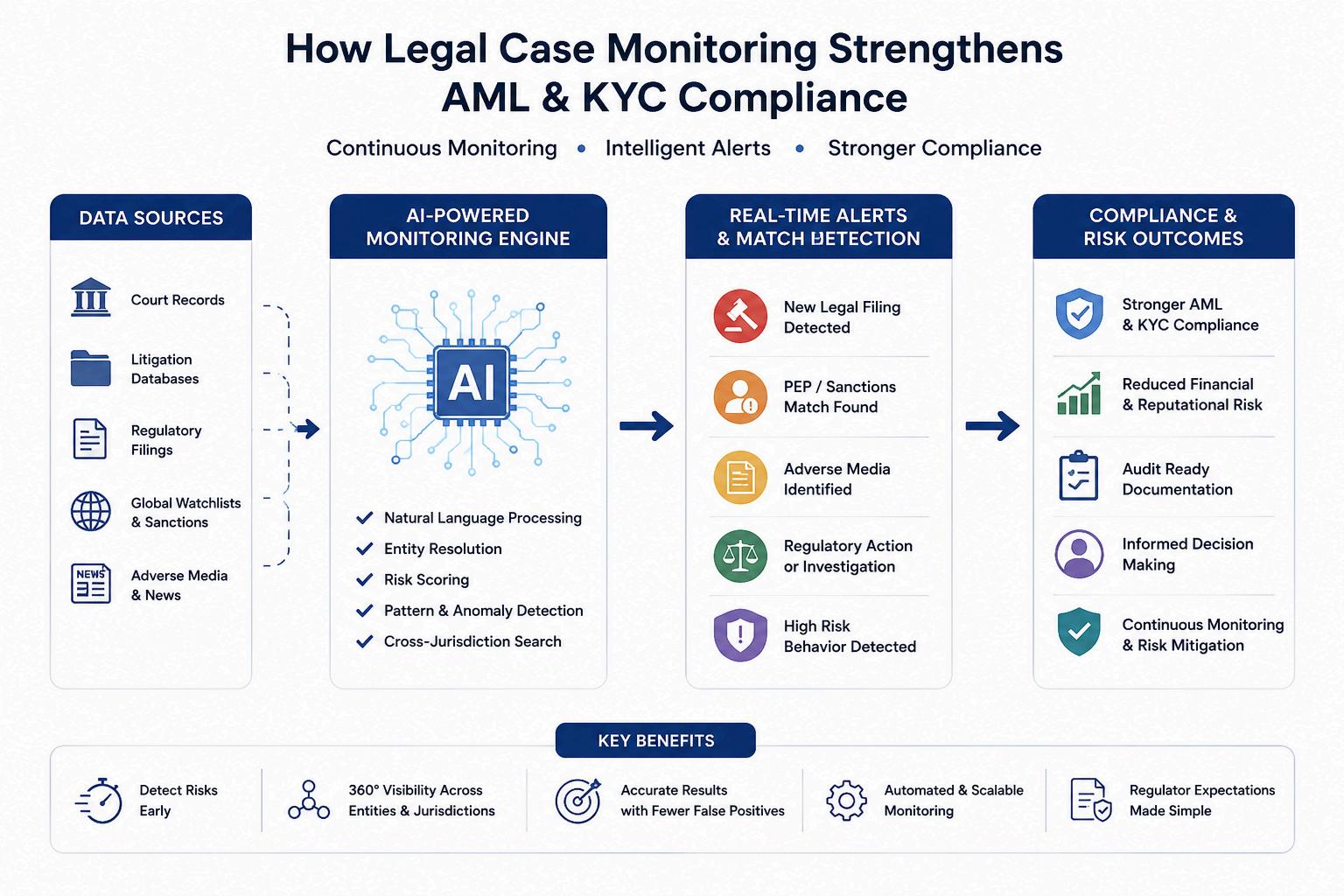
Legal case monitoring services for AML exist for exactly that gap. Not a one-time check at the start and then forget about it Continuous A new filing should surface the week it's filed, not the week an auditor stumbles onto it three months later And honestly, it's not only about surviving an exam. It's about not finding out too late that a relationship went bad.
Why Does Legal Case Monitoring Matter for AML and KYC Compliance?
Strip it down and legal case monitoring for KYC compliance is this: scanning court records, litigation databases, and public filings for the moment a customer or partner turns up somewhere they shouldn't. Sounds simple. Most teams still get it wrong anyway, treating it as a box checked once instead of something ongoing
Undisclosed litigation is usually the first crack you see in someone's finances Criminal filings point toward money laundering, sometimes worse. Civil judgments almost never show up alone either, one is a warning, two is a pattern worth worrying about. Regulators know this too Ongoing tracking is fast becoming the baseline expectation, not a bonus feature
A decent legal network monitoring setup keeps running after the account opens, not just before It pings compliance officers the second something new lands on a monitored entity That's really the entire pitch behind a legal monitoring service worth paying for, swapping a reactive scramble for something that catches trouble early
How Is Background Screening Powered by AI Automation Changing Compliance?
There used to be a version of this job where someone spent days combing through dockets and still missed a filing buried in another language That job barely exists anymore Background screening with AI automation cross-references thousands of records in roughly the time it used to take to read one file.
It's changed background check services as a whole, honestly A few things automated systems just do better now:
● Pull from several jurisdictions at once instead of one at a time
● Catch mismatches between what a customer reports and what's public record
● Cut false positives by reading context, not just matching a name
An osint background check built this way doesn't cut the analyst out of the process It clears the noise so their time goes toward cases actually worth a second look, not the ones that were never a problem.
What Do Global Intelligence Solutions Bring to Risk Management?
Business relationships stopped caring about borders a long time ago Risk management shouldn't either Global intelligence solutions for risk management pull sanctions lists, watchlists, adverse media, and litigation records from dozens of countries into one place, instead of making an analyst hunt through each source separately.
There's a real difference in what teams catch here Working with genuinely global risk management solutions means spotting regional risk patterns that stay invisible when you only look locally, and staying closer to frameworks like FATF's recommendations without extra legwork Throw in practical risk management tools on top of that global view, and figuring out who you're actually dealing with stops eating up whole afternoons
Why Are Corporate Risk Managers Relying on Modern OSINT?
Open-source intelligence used to mean typing a name into a search bar and hoping That's not what modern OSINT for corporate risk managers looks like anymore, not even close. It now covers structured analysis of social media, corporate registries, news archives, and corners of the internet standard databases never touch
What actually makes osint services worth using isn't the collection part. It's what happens after Language processing that reads tone and reputational risk instead of just keywords A historical view of how someone's risk profile has shifted, not just a snapshot frozen in time And for teams pulling from a dozen sources at once, osint integration solutions end up mattering nearly as much as the data itself. Nobody wants to be the analyst juggling fifteen tabs on a Friday afternoon, chasing one lead through three different logins