Modern Risk Intelligence and AI Compliance Monitoring for Businesses
Modern Risk Intelligence and AI Compliance Monitoring for Businesses
Risk rarely announces itself politely anymore
It slips through vendor onboarding forms, hides inside fragmented identities, shows up in court filings nobody reviewed, or spreads quietly across social media before compliance teams even notice there’s a problem
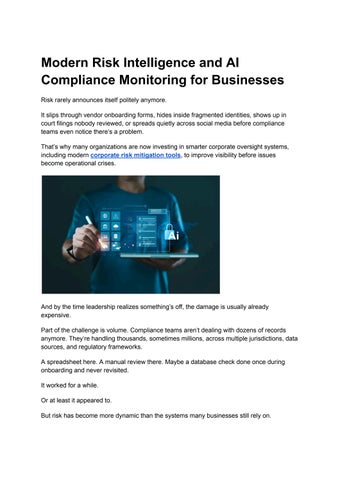
That’s why many organizations are now investing in smarter corporate oversight systems, including modern corporate risk mitigation tools, to improve visibility before issues become operational crises
And by the time leadership realizes something’s off, the damage is usually already expensive
Part of the challenge is volume. Compliance teams aren’t dealing with dozens of records anymore. They’re handling thousands, sometimes millions, across multiple jurisdictions, data sources, and regulatory frameworks
A spreadsheet here. A manual review there. Maybe a database check done once during onboarding and never revisited
It worked for a while
Or at least it appeared to
But risk has become more dynamic than the systems many businesses still rely on
Why static compliance checks are starting to fail
Traditional due diligence often treated risk like a one-time event Verify the documents, run a few searches, archive the report, move on
Reality doesn’t behave that neatly
A supplier can become politically exposed six months after approval. A business partner might appear in new litigation overseas Someone previously considered low-risk could suddenly trigger reputational concerns because of sanctions updates, fraud allegations, or emerging regulatory scrutiny
Continuous visibility matters more now than isolated screening moments
That’s where systems built around an intelligent risk management solution are becoming more valuable. Static databases alone rarely provide enough context for modern operational decisions
The small details are not small here.
AI is reducing investigative overload
Compliance professionals used to spend enormous amounts of time sorting through repetitive review tasks Matching names Checking lists Reviewing alerts that turned out to be false positives.
That workload still exists, except the data volume is larger and timelines are tighter
According to several industry estimates from firms like Deloitte and Thomson Reuters, false positives continue to consume a significant share of compliance review time across AML operations
So naturally, automation entered the picture.
Tools built around ai-powered sanctions screening and pep monitoring are helping teams review entities faster while reducing some of the manual burden that slows investigations down Human judgment still matters, especially in higher-risk reviews, but AI can usually surface patterns and connections that are difficult to identify consistently at scale
The same applies to pep screening automation, which has become increasingly useful for organizations handling large onboarding volumes across multiple jurisdictions
Because no compliance officer wants to explain why a politically exposed relationship was missed during review
That’s the kind of meeting nobody enjoys.
Some of the biggest operational challenges compliance teams still face:
Risk intelligence now goes beyond official databases
One of the biggest misconceptions in corporate investigations is the assumption that formal records tell the entire story
They don’t.
Public sentiment, digital footprints, archived media references, online affiliations, and behavioral indicators often provide context traditional databases miss entirely. Investigators and compliance analysts are spending more time examining alternative intelligence sources because risk rarely stays confined to official documents anymore
That’s partly why osint background checks have become more common across sectors ranging from finance to procurement to legal services
Open-source intelligence isn’t magic, though It still requires verification, context, and careful interpretation. But when used responsibly, it helps organizations identify reputational and operational risks that may otherwise stay hidden until much later
And later is usually more expensive.
Legal monitoring is becoming part of AML and KYC operations
Legal exposure has become deeply connected to compliance visibility
A court filing in one jurisdiction may affect banking relationships elsewhere A regulatory action against an executive could influence investment decisions. Litigation patterns can sometimes reveal operational concerns long before internal reporting surfaces them
This explains why many firms are investing in Legal Case Monitoring Services for AML to maintain visibility into emerging legal developments tied to individuals, entities, and counterparties.
Similarly, Legal Case Monitoring for KYC Compliance is increasingly being used to support enhanced due diligence programs where ongoing legal activity may affect customer risk profiles.
Not every legal filing signals wrongdoing, obviously
Still, ignoring legal developments entirely is rarely a comfortable strategy
The growing role of automation in background screening
Anyone who has worked in compliance operations knows the fatigue problem is real.
Review queues pile up Analysts spend hours on repetitive checks Escalations multiply Eventually, consistency starts slipping because people are overloaded.
That’s one reason organizations are exploring background screening with ai automation instead of relying entirely on manual review workflows The goal usually isn’t to replace investigative teams. It’s to allow experienced professionals to focus on judgment-heavy decisions instead of administrative repetition
Some firms are also integrating a broader legal monitoring service into onboarding and third-party oversight programs so risk signals continue flowing after initial approval stages.
That continuous layer changes things Quietly, but significantly
Compliance teams are paying closer attention to online behavior
Years ago, compliance programs focused mostly on financial records and identification documents
Now, digital behavior often tells an equally important story.
Organizations increasingly evaluate reputational exposure through publicly available activity, behavioral indicators, and online associations. In regulated sectors especially, public digital activity can create legal or reputational concerns surprisingly fast.
That’s where social media monitoring for compliance enters the discussion Not as surveillance theater, but as a way to identify potential red flags connected to misconduct, fraud exposure, insider risk, or reputational escalation
There’s nuance here, though
Monitoring practices should align with local laws, privacy expectations, and organizational policies What’s acceptable in one jurisdiction may not be elsewhere
Cross-border investigations are becoming more complicated
Global operations create global exposure.
A company may operate in five countries, hire contractors in three more, and onboard vendors from jurisdictions with entirely different reporting standards Risk intelligence has to move across those environments without collapsing under inconsistency.
That’s partly why businesses are adopting systems built around Global Open-Source Entity Intelligence to identify relationships, affiliations, and exposure indicators across international data environments.
The broader the footprint, the harder it becomes to rely on fragmented regional checks alone
Cross-border AML investigations are particularly difficult because reporting standards, legal disclosure rules, and enforcement expectations vary heavily between jurisdictions
And fragmented visibility creates blind spots.
Law firms are facing new types of risk pressure
Legal professionals are increasingly expected to assess reputational, financial, and behavioral risk alongside traditional legal exposure.
Clients expect more visibility now Regulators do too
As a result, some firms rely on criminal behavior monitoring for law firms when conducting sensitive investigations, conflict assessments, or ongoing client evaluations tied to high-risk matters
Others are integrating law office risk assessment tools to improve internal oversight and support compliance operations tied to evolving legal obligations
It’s not just about avoiding liability. Often it’s about protecting trust before a situation escalates publicly
Because once reputational damage spreads online, containment gets difficult fast
Due diligence is no longer limited to enterprise companies
Smaller organizations used to assume sophisticated investigations were mostly a Fortune 500 concern
That assumption is fading.
Even mid-sized firms now face vendor fraud, identity manipulation, sanctions exposure, and cross-border compliance expectations
Some organizations turn to government due diligence services for verification support tied to licensing, procurement, or regulatory review processes Others build internal frameworks using layered intelligence platforms and investigative workflows
Usually, the right approach depends on industry exposure, geography, and regulatory obligations
There isn’t one perfect model for everyone.
Identity verification has become far more complicated
This might be one of the most overlooked problems in modern compliance operations
Digital identities are fragmented People operate across platforms, jurisdictions, aliases, archived records, and evolving online profiles Fraud tactics evolve quickly, especially when synthetic identities or manipulated digital footprints enter the picture
Which explains the growing interest in digital identity tracking as part of broader risk intelligence and verification programs
The challenge isn’t simply finding information anymore.
It’s determining which information is trustworthy
Cost discussions are now part of compliance strategy
Risk management used to feel somewhat compartmentalized Compliance teams handled compliance Legal teams handled legal exposure Investigators handled investigations
Those boundaries are becoming less distinct
Modern risk environments require connected visibility across identity intelligence, legal monitoring, reputational analysis, sanctions exposure, and operational behavior
Businesses that still rely entirely on disconnected review processes may eventually find themselves reacting to risks instead of identifying them early enough to respond thoughtfully.
And oddly enough, one of the first questions leadership often asks during implementation discussions isn’t technical at all Teams want to understand regulatory compliance risk management pricing before deciding how deeply they can scale investigative and monitoring capabilities across departments
Fair question, honestly.
Because balancing operational cost against risk exposure is part of the equation too
FAQs
Why are continuous monitoring systems becoming more common?
Because risk profiles change constantly. A one-time background check may not reveal future litigation, sanctions exposure, or reputational concerns that appear months later
Can AI completely replace compliance investigators?
Probably not. AI can reduce repetitive workload and improve detection speed, but human review still matters in complex investigations and regulatory decision-making.
Are open-source intelligence checks reliable?
They can be useful when verified carefully OSINT works best as part of a broader investigative process rather than as a standalone decision-making tool.
What makes cross-border compliance investigations difficult?
Different countries have different legal standards, reporting obligations, privacy regulations, and enforcement practices. That creates inconsistencies investigators have to navigate carefully.