PARIS
PUBLICATIONS
DAVID McINTOSH
Airshow News
DAY 3
June 19, 2019
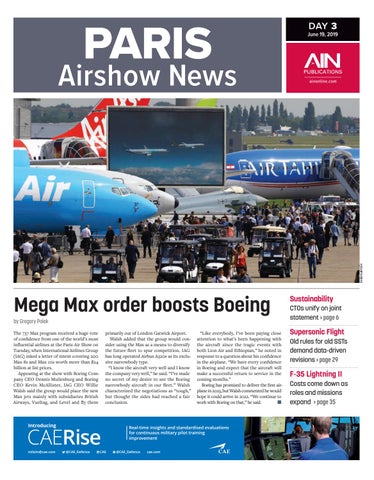
Mega Max order boosts Boeing by Gregory Polek The 737 Max program received a huge vote of confidence from one of the world’s most influential airlines at the Paris Air Show on Tuesday, when International Airlines Group (IAG) inked a letter of intent covering 200 Max 8s and Max 10s worth more than $24 billion at list prices. Appearing at the show with Boeing Company CEO Dennis Muilenburg and Boeing CEO Kevin McAllister, IAG CEO Willie Walsh said the group would place the new Max jets mainly with subsidiaries British Airways, Vueling, and Level and fly them
primarily out of London Gatwick Airport. Walsh added that the group would consider using the Max as a means to diversify the future fleet to spur competition. IAG has long operated Airbus A320s as its exclusive narrowbody type. “I know the aircraft very well and I know the company very well,” he said. “I’ve made no secret of my desire to see the Boeing narrowbody aircraft in our fleet.” Walsh characterized the negotiations as “tough,” but thought the sides had reached a fair conclusion.
Introducing
milsim@cae.com
“Like everybody, I’ve been paying close attention to what’s been happening with the aircraft since the tragic events with both Lion Air and Ethiopian,” he noted in response to a question about his confidence in the airplane. “We have every confidence in Boeing and expect that the aircraft will make a successful return to service in the coming months.” Boeing has promised to deliver the first airplane in 2023, but Walsh commented he would hope it could arrive in 2022. “We continue to work with Boeing on that,” he said. n
Real-time insights and standardised evaluations for continuous military pilot training improvement @CAE_Defence
CAE
@CAE_Defence
cae.com
Sustainability CTOs unify on joint statement › page 6
Supersonic Flight Old rules for old SSTs demand data-driven revisions › page 29
F-35 Lightning II Costs come down as roles and missions expand › page 35
Global 7500 Business aviation’s flagship aircraft Longest range | Largest cabin | Smoothest ride
Bombardier, Global, Global 7500 and Exceptional by design are registered or unregistered trademarks of Bombardier Inc. or its subsidiaries. All information above is true at the time of publication. © 2019 Bombardier Inc. All rights reserved.
Bring your jet
Home For all your support needs, bring your jet home to Bombardier and trust it to the experts who know it best.
Bombardier and Exceptional by design are registered or unregistered trademarks of Bombardier Inc. or its subsidiaries. Š 2019 Bombardier Inc. All rights reserved.
Daher .................................................................7
by Matt Thurber
AAR ................................................................. 26 Air Antilles ...................................................... 33 Airbus ......................................................7, 8, 28 Alsim ............................................................... 12 Astonfly........................................................... 33 ATR ................................................................... 6 Boeing ...........................................12, 30, 32, 38 Cebu Pacific.......................................................7 CFM International .......................................... 7, 8
De Havilland of Canada ................................... 9 DIRCM..............................................................37 Embraer .............................................................4 GE Aviation ..................................................... 33 GECAS .............................................................34 Gulfstream ...................................................... 36 IAI ......................................................................4 IATA.................................................................. 14 Ilyushin Design Bureau ...................................37 IndiGo ................................................................8 JSTARS .......................................................16, 18 Korean Air....................................................... 38 Kratos Defense & Security Solutions............... 12 L3 Integrated Aerospace Systems .................. 12 Leonardo .........................................................34 Lockheed Martin ............................................ 35
Rolls-Royce is accelerating its shift to more environmentally sustainable aviation transportation with a plan, announced at the Paris Air Show, to acquire Siemens’s electric and hybrid-electric aerospace propulsion “eAircraft” business. Terms of the agreement were not disclosed, but Rolls-Royce expects the deal to be completed late this year, “following a period of employee consultation.” Since 2017, Rolls-Royce (Chalet 93) and the Siemens eAircraft operation have been working together along with Airbus on the E-Fan-X demonstrator, which is a hybrid-electric propulsion test program for a BAe 146 regional jet—one of the jet’s four engines is being replaced with a two-megawatt hybrid-electric powerplant. Rolls-Royce (R-R) has conducted ground testing of a hybrid system based on its M250 turboshaft in three different configurations.
Paul Stein
MATT THURBER
Collins Aerospace......................................10, 26
Rolls-Royce acquiring Siemens’ eAircraft business
STORY INDEX
One is driving a generator that charges onboard batteries (series hybrid); the second is parallel hybrid, with thrust from a combined engine/electrical system; and finally as a turbo-generator, with the engine powering a generator that delivers electricity directly to electric motors and for other onboard power needs. The impetus for the purchase, according to Rolls-Royce chief technology officer Paul Stein, is that “pressure is on us to increase the environmental performance of all our products.” While R-R is applying this philosophy to products other than turbine engines and not just for aviation, it is focusing on three pillars for aviation: continuing to evolve the gas turbine engine; collaborating on the use of sustainable alternative fuel; and exploring radical alternatives such as electrification. Underpinning these efforts are R-R’s “Intelligent Engine” digital technology efforts.
Rolls-Royce envisions a range of technologies applicable to future aircraft, from more electric architecture for large aircraft that will continue to be powered by efficient turbofan engines to hybrids for regional aircraft and eventually all-electric power for personal air mobility vehicles that will fly from 100 to 600 nm. Aviation remains important for R-R as it plans on how to integrate the 180 Siemens eAircraft employees. “Flying is not bad for the environment,” Stein said. “CO2 is. Flying can be better. We have to manage emissions and CO2.” “Electrification is set to have as dramatic an impact on aviation as the replacement of piston engines by gas turbines,” said Rolls-Royce Electrical director Rob Watson. “We are at the dawn of the third era of aviation, which will bring a new class of quieter and cleaner air transport to the skies.” n
magniX ..............................................................8 Moxy ...............................................................34 Nordic Aviation Capital..................................... 6 Northrop Grumman ........................................ 38 Parker Aerospace ............................................34 Rafael ............................................................... 9 Raytheon ........................................................ 38 Rolls-Royce ........................................................4 Rosoboronexport............................................ 32 Russian Helocopters ...................................... 22 Russian Turboprops........................................ 28
Safran Helicopter Engines...............................37
IAI and Embraer to develop Praetor 600-based AEW
Saudi Arabian Airlines .................................... 38
by Beth Stevenson
Rychag AV ...................................................... 35 S.S. White Technologies ................................. 36 Safetyn ........................................................... 36
Siemens .............................................................4 ST Engineering Aerospace ............................. 32 Sukhoi Superjet .............................................. 22 Supersonic Regulations.................................. 29 Sustainability .................................................... 6 Viking ............................................................. 33 Virgin Atlantic ....................................................8 VoltAero ........................................................... 10 Wallwork Group ...............................................34 World Food Programme ................................. 24
4
Paris Airshow News
\
Israel Aerospace Industries subsidiary Elta and communications provision, while Elta Systems and Embraer signed a strategic will deliver the S-band active electronicooperation agreement to jointly develop an cally-scanned array (AESA) radar, signals airborne early warning (AEW) variant of the intelligence system, and other electronPraetor 600 business jet on Tuesday at the ics and associated integration. Elta is Paris Air Show. The P600 AEW is targeting providing its 4th generation AESA radar a new segment of the airborne early warning technology that it offers for other applicamarket, namely one for air forces with lower tions, which includes the electronic radar defense budgets that want to be able to oper- modules being compressed into a tile forate this type of capability, but is typically only mation that reduces power consumption. operated by a limited number of nations. One of the main differences between this Under the agreement, Embraer is version of the radar and other ones made charged with the aircraft, ground support, for this application by IAI is that this one
June 1 9, 2 0 1 9
\
a i n o n l i n e .c o m
has 240-degree coverage and the high-end ones have a full 360 degrees. Three operator stations will be found on board, and a prototype will not be built until a customer commits to an acquisition—although IAI has already been flying the system aboard its Boeing 737 testbed. The companies will use their respective market presence to pitch to potential customers, selecting which one takes the lead as prime depending on the operator. IAI provides a range of AEW aircraft based on different platforms, including the G550-derived Conformal AEW that is operated by Italy, Israel, and Singapore, and considers this a new type of capability within that family. “A relatively small group of nations can afford the other available systems,” Avishai Izhakian, deputy general manager for the airborne systems and radars division at Elta, told AIN. “Many want to join the club, but can’t afford these capabilities.” The companies are therefore targeting a balance in terms of capability and price, offering a scaled version of the radar and mission system on a more affordable platform. “We’ve leveraged the technology to come up with this new capability,” Izhakian added. The Praetor 600 in this configuration can operate at altitudes of 40,000 feet, which Izhakian noted is prime for this type of application so that it is operated above other types of military aircraft. n
PW100 AND PW150
SETTING INDUSTRY BENCHMARKS Pratt & Whitney’s commitment to performance and innovation has set the standard in regional aviation. Thoughtfully engineered to consume up to 40% less fuel and generate up to 50% fewer CO2 emissions, our turboprop engine family has the lightest impact on the environment. With industry-leading dispatch reliability and a comprehensive suite of engine services, we keep your costs low and help to propel your business forward.
EQUIP YOUR FLEET AT WWW.PWC.CA/PW100-150
19-0482 SIZE 2 / 06-2019
Major OEMs unite on aviation sustainability, climate impact by Chad Trautvetter and Celia Konowe Chief technology officers from seven of the world’s major aviation manufacturers issued a joint statement about the future of sustainable aviation yesterday here at the Paris Air Show. They include Grazia Vittadini of Airbus; Greg Hyslop, Boeing; Bruno Stoufflet, Dassault Aviation; Eric Ducharme, GE Aviation; Paul Stein, Rolls-Royce; Stéphane Cueille, Safran; and Paul Eremenko, United Technologies Corp. “Aviation connects our world by efficiently and rapidly moving people, opening new economic opportunities, and transporting food and goods all over our planet,” the companies said. “At the same time, climate change has become a clear concern for our society. Humanity’s impact on the climate requires action on many fronts. The aviation industry is already taking significant action to protect the planet and will continue to do so.” According to the companies, aviation contributes to 2 percent of human-made carbon dioxide emissions but is growing fast. Thus, the industry is banding together to reduce net CO2 emissions despite that growth. Through the Air Transport Action Group (ATAG), the aviation industry became the
world’s first industrial sector to commit to reducing CO2 emissions to half of 2005 levels by 2050, and to limit growth of net CO2 emissions by 2020. “We are on track to meet those near-term commitments, including the 2019 implementation of the Carbon Offsetting and Reduction Scheme for International Aviation (CORSIA) program as agreed upon by the nations of the International Civil Aviation Organization (ICAO),” the seven companies noted. But they’re not resting on their laurels. Rolls-Royce’s Stein laid out plans set to further reduce engine noise, lower emissions by 10 percent, and electrify aviation— though hybrids will likely come first, he said. Ducharme of GE Aviation added that goals to lighten the weight of engines by using lighter materials, as well as to improve aerodynamics, will also help on the propulsion side. Boeing’s Hyslop explained the urgent need for alternative fuels. Current airplanes are ready for—and can handle—these new energy sources, but the problem is in obtaining them, he noted. Retrieving alternative
Rolls-Royce’s Ultrafan could represent the next step in efficiency. fuels is not economically viable, and both “But until recently, we hadn’t achieved the infrastructure and incentives are needed to power levels and [energy] density necessary support their production, said Hyslop. to make this dream into a reality.” However, Liquid hydrogen has also shown bene- he and Safran’s Cueille agreed energy storfits of lowering combustion temperatures, age and weight are the biggest problems the being a clean energy source, and requires industry faces, making hybrids a realistic few materials to produce, according to next step. Dassault’s Stoufflet. Despite this, it has a Airbus’s Vittadini explained that to make low density, which means a large amount aviation more eco-friendly, multiple technois required to produce the same amount of logical advances must come. This includes energy as gasoline and it also requires the new architecture to reduce drag; improved, establishment of both a mass distribution lighter-weight materials; and engine therplan and regulations. modynamic developments to ensure the According to UTC’s Eremenko, the idea possibility of this “third generation” of aviaof electric propulsion in aviation isn’t new, tion—one of electricity-powered flight. n
Nordic Aviation Capital signs LOI for 105 ATR 72-600s Tuesday proved to be a good day for ATR at the Paris Air Show, with the signing of a letter of intent (LOI) with Nordic Aviation Capital (NAC) for up to 105 of the European OEM’s turboprops. The deal covers 35 firm ATR 72-600s, with options for a further 35 and purchase rights for another 35. Speaking at the signing ceremony, NAC chairman Martin Møller indicated the LOI would result in a detailed contract in the “next weeks,” and pointed out that the lessor and ATR boast a long history. For NAC, he said, “It does not take a letter of intent [to buy ATR aircraft], it takes a handshake. The deposits have been paid.” NAC is “fully committed” to take on the firm orders covered in the LOI, and deliveries of the initial 35 aircraft will begin in 2020 and run up to 2025, he said. The Copenhagen-based leasing company has firm dates on the options, while no timing is attached to the purchase rights. “To plan for a successful future, it is vital for us to invest in the very best technology, so that we can offer flexible and efficient solutions to our clients,” Møller noted. “The ATR72-600, with a significant fuel burn advantage drives lower costs and emissions
6
Paris Airshow News
\
making it the optimal choice for many of our clients. We love the ATR. More importantly, the operators truly love this aircraft.” Møller told AIN that Europe has “been consistently good” for NAC, accounting for about 50 percent of the lessor’s portfolio of regional aircraft. NAC’s current fleet of almost 500 aircraft includes types such as the ATR 42, ATR 72, Bombardier (now De Havilland of Canada) Dash 8, Airbus A220, and Embraer E-Jets. The other half of its fleet is in other world regions. “Since late 2015 until now, we have seen some economies in South America and parts of Asia slow down and they have not ordered as many aircraft,” said Møller. Some of these economies are doing better, he added, indicating he expects demand to pick up there. ATR chief executive Stefano Bortoli described NAC’s deal as “a smart business move and one very much in line with the trends in regional aviation to connect communities and develop businesses across the globe in the most responsible and cost-efficient way.” This agreement, he asserted, “clearly shows where the trend in regional aircraft is going.” n
June 1 9, 2 0 1 9
\
a i n o n l i n e .c o m
DAVID McINTOSH
by Cathy Buyck
People-watching in Paris If all the latest airplanes, helicopters, armaments, components, and manufacturing technologies aren’t enough to keep attendees at the 2019 Paris Air Show interested and entertained, there’s always the mix of attendees from literally every corner of the planet on which to fall back.
Cebu Pacific, Airbus ink deal for 41 narrowbodies
DAVID McINTOSH
by Cathy Buyck
TBM 940 makes world public debut here at Le Bourget French manufacturer Daher’s recently announced TBM 940, the latest in its line of turboprop singles, is making its world debut at the Paris Air Show (Static Display B4). The new model features increased automation, including an autothrottle and automated icing detection system, both installed for the first time on a standard-production turboprop weighing less than 12,500 pounds (5.7 tonnes).
Other enhancements—including cabin upgrades for style, ergonomics, and comfort—will also be incorporated into Daher’s entry-level TBM 910, along with the automated icing detection system. The first TBM 940 was delivered to a British customer the week prior to the Le Bourget gathering. Daher is also presenting in Paris its
CFM seals massive Leap-1A deal for AirAsia A321neos by Gregory Polek AirAsia and CFM International on Tuesday finalized an agreement for the purchase of 200 Leap-1A engines to power the 100 Airbus A321neos the airline has on order. It announced the airplane order and intent to purchase the engines in July 2016. At the same time, AirAsia has expanded its 20-year Rate-Per-Flight-Hour (RPFH) agreement to encompass its entire fleet of 808 Leap-1A engines for a combined total value of $23.1 billion at list prices. Under the terms of the agreement, CFM Services guarantees maintenance costs for the AirAsia’s engines on a dollar-perflight-hour basis. “We have centered our long-term growth and expansion strategy around the larger Airbus A321neo. Choosing the right engine to power those airlines is critical to the success of that strategy,” said
AirAsia Group executive chairman Datuk Kamarudin Meranun. “For us, the Leap-1A continues to be the obvious choice. We have been operating it for nearly three years and are very happy. Our passengers like its quiet operation and we like the fuel efficiency and very high asset utilization it gives us.” AirAsia has been a CFM customer for nearly 20 years. An early Leap customer, it placed its initial order for 400 Leap-1A engines—the largest in aviation history at the time—to power A320neos in June 2011. It took delivery of its first Leap-powered A320neo in 2016 and now operates 39, in addition to 191 CFM56-5B-powered A320ceos. AirAsia ranks as the single largest Airbus A320 operator in the world. The AirAsia deal outranked in value only a separate contract signed by Dublin-based international aircraft leasing
TBM Care—an operational entity that adds aspects of training and technical documentation to the single-point contact available to owners and operators through the French OEM’s “Me & My TBM” cloud-based support application. The app has been further upgraded with the introduction of new analysis modes, designed to optimize flight and flight time. J.W.
company Avolon covering Leap-1As to power an additional 70 Airbus A320neos. CFM valued the Avolon deal at $2.06 billion at list price. Avolon has been a CFM customer since the company was launched in 2010 and already has a committed fleet of more than 400 CFM-powered aircraft in its portfolio. Of that total, Avolon currently has Leap-1A engines on order to power 40 A320neo family aircraft. CFM also landed an order from SMBC Aviation Capital covering forty Leap-1As to power 20 additional Airbus A320s. CFM values that engine order at $588 million at list price. A long-time CFM customer, Dublin-based SMBC Aviation Capital controls a portfolio of more than 350 aircraft powered by CFM56 and Leap engines in service or on order. Separately, Indonesia’s PT Garuda Maintenance Facility AeroAsia (GMF AeroAsia) and CFM International on Tuesday signed a material service agreement. Together with the new contract, the parties extended the current CFM56-7B overhaul license agreement for another five years and added a new five-year license for CFM56-5B overhauls. n
a i n o n l i n e .c o m
\
Cebu Pacific signed an MoU yesterday at the Paris Air Show for 31 Airbus airliners—16 A330neos, 10 A321XLRs, and five A320neos—to support the Philippines-based low-cost carrier’s ongoing fleet renewal and growth. The deal also includes options on another 10 A321neos. Cebu Pacific, informally known as Cebu Pac, becomes one of the launch airlines for the newly launched 4,700-nm A321XLR. Cebu Pacific will start receiving the Rolls-Royce Trent 7000-powered A330900s in 2021 and the A321XLRs from 2024. The airline revealed the new widebodies with a high-density single-class configuration of 460 seats—5.5 percent more seats than its current A330ceos. It is one of the very few long-haul lowcost carriers not to feature a premium cabin on its widebodies, a decision that Cebu Pacific chief executive advisor Mike Szucs explained was mainly driven by the lack of available airport slots in its home base in Manila and other cities its serves. “We are operating in one of the most infrastructure-constrained environments [in the world],” he said. As demand for travel grows, “we need to have an as high seat density as possible to fly as many people as possible.” Szucs said the high-density layout was possible because Airbus had come up with some “some clever stuff,” such as the reconfiguration of the lavatories. Cebu Pac has not yet finalized the layout of the XLRs, though Szucs indicated the LCC would target 220 to 240 seats, and most likely 240—the A321neo is certified for a maximum seat capacity of 244. The A320neos will have 194 seats. CFO Andrew Huang conceded the company has not yet decided on the engine selection—CFM International’s Leap-1A or Pratt & Whitney’s PurePower PW1100G-JM geared turbofan—for the new single-aisle neos. The airline in 2011 ordered 32 A321neos for delivery through 2022. These are currently being delivered with Pratt & Whitney PW1100Gs. Cebu Pac’s strategy to replace its jet fleet with bigger and more fuel-efficient aircraft will support its drive to reduce CO2 emissions and the need to “remain as cost competitive as possible,” Huang noted. The airline will deploy an all-Airbus neo fleet by the end of 2024. Currently, it has a 72-aircraft fleet comprised of two Airbus A321neos, seven A321ceos, one A320neos, 33 A320ceos, eight A330ceos, eight ATR 72-500s, and 13 ATR 72-600s. n
June 1 9, 2 0 1 9
\
Paris Airshow News
7
MagniX debuts all-electric propulsion system options Havilland Canada Beaver and Otter, and Cessna Caravan. The liquid-cooled motors use lithium-ion batteries whose weight is about equivalent to the fuel the aircraft would otherwise carry—about 1,000 pounds for the magni500. MagniX expects to announce at Le Bourget another platform retrofit program, and Ganzarski said the company has been in contact with general aviation aircraft manufacturers about offering magniX motors as an option on production aircraft. MagniX is currently working with the FAA, EASA, Transport Canada, and Australia’s CASA on certification. First flight of Harbour Air’s magniX-powered Beaver is expected in November, and approval from the FAA and Transport Canada under Part 33 regulations governing electric engines is anticipated in late 2021. Harbour Air is expected to receive a supplemental type certificate for the installation soon thereafter, allowing the aircraft to enter commercial service, and for its retrofit program to continue. Meanwhile, Eviation will pursue its own type certificate for Alice and will offer buyers a choice of an electric engine from either magniX or Siemens. n
DAVID McINTOSH
U.S.-based magniX is debuting its all-electric aircraft propulsion systems in dramatic fashion this week at the Paris Air Show. Its magni250 and magni500 motors, as well as magniDrive multi-application inverter solution, are on display at its exhibit (Hall 2B, Stand DE18) and its magni250 motors are on Eviation’s prototype all-electric commuter aircraft, named Alice, which is also making its world debut in Paris this year at the static display. MagniX aims to transform flights of up to 1,000 miles with emission-free propulsion at operating costs 60 to 80 percent below conventionally powered aircraft. “We want to enable the electrification of aviation,” magniX CEO Roei Ganzarski told AIN. In March, North America’s largest seaplane operator, Harbour Air, announced plans to retrofit its fleet with magniX500 propulsion systems, while conversion of its first Beaver, to be used for certification flight tests, is currently underway. The 375-hp magni250 is intended for small aircraft, or as part of distributed propulsion systems on larger aircraft such as the three-engine Alice; the 750-hp magni500 is aimed for aircraft such as the Cessna Caravan, Beechcraft King Air, de
IndiGo opts for LEAP-1A in $20 billion order Indian budget carrier IndiGo placed a $20 billion order (at list prices) for CFM International Leap-1A engines to power 280 Airbus A320neos and A321neos on the opening day of the Paris Air Show, marking one of CFM’s largest single engine orders. The airline will take delivery of its first Leap1A-powered A320neo in 2020. Its contract also includes spare engines and an overhaul support agreement, as well as a longterm service agreement for the engines. IndiGo is the largest customer for Pratt & Whitney GTF engines for Airbus
8
Paris Airshow News
\
320neos. Following initial issues with the GTF, IndiGo suffered a large number of grounded aircraft, but acknowledged it received compensation from Pratt & Whitney for the AOGs. The airline presently operates a fleet of 17 A320ceos powered by CFM56-5B engines, part of a total fleet of 215 A320/A321 family aircraft. Fast-growing IndiGo has a fleet of more than 230 aircraft, with around 1,400 daily flights, 54 domestic destinations, and 19 international destinations. N.M.
June 1 9, 2 0 1 9
\
a i n o n l i n e .c o m
DAVID McINTOSH
by James Wynbrandt
The magni500 is electric aircraft propulsion developer magniX’s 750-hp answer to the industry’s quest for alternatives to conventional powerplants. It soon will be flying aboard a DHC Beaver.
Airbus wins Virgin Atlantic order for up to 20 A330neos by Cathy Buyck Virgin Atlantic on Monday confirmed a widely expected firm order for 14 Airbus A330-900s with options for a further six, marking a next step in its fleet transformation and what the London Gatwickbased airline’s CEO Shai Weiss described as “a commitment to sustainable travel.” The widebody neos will replace Virgin’s A330-200/300s starting in 2021. Delivery of the A330neos—eight are to be acquired by Virgin Atlantic and six leased from Air Lease Corp.—will run through 2014, and are complementing its 12 A350-1000s, the first of which is due to enter service this summer. Virgin’s A330900s will be powered by Rolls-Royce Trent 7000 engines, the sole powerplant for the model. Speaking during a Paris Air Show briefing, Weiss said the airline had considered “all options” for the A330neo replacement but selected the A330neos over the Boeing 787 owing to the commonality with the A350 and the model’s strong environmental credentials. “Our pilots can fly both the A330neo and the A350,” he said, adding that the newly ordered A330s will
A330neo
make Virgin “good neighbors” for the airports it flies to and from. The A330-900s are expected to reduce the airline’s noise footprint at its airports by more than half. Virgin’s 49 percent shareholder and transatlantic joint-venture partner, Delta Air Lines, provided input during the selection process, Weiss said. Delta has 35 A330-900s on order and took delivery of the first example last month. Virgin Atlantic in January embarked on a three-year business plan that eyes return to growth and aims to double its size at London Heathrow when the airport’s third runway becomes operational in 2026. “We want to become the nation’s second flag carrier at Heathrow,” Weiss insisted, calling the planned third runway a “once in a lifetime opportunity” to double Virgin’s slot portfolio at the airport. He said the current slot regime at Heathrow is “not fit for purpose and must change to allow for a second flag carrier,” vowing the airline intends to make a lot of noise on the subject. n
De Havilland of Canada ships first Dash 8-400
The Bombardier Q400—this one is operated by Spicejet—is the ultimate evolution of the de Havilland Dash 8 airframe. At least until the type certificate’s new owners, De Havilland of Canada, develop its own version.
Making its airshow debut this week in Paris, the newly christened De Havilland of Canada revealed it is delivering its first Dash 8-400 turboprop—to Kazakhstan’s Qazaq Air—since parent company Longview Capital took control of the program from Bombardier on June 1. Separately, the company introduced TAG Angola Airlines as the customer for a previously announced order for six of the turboprops. On Tuesday at the Paris Air Show, De Havilland of Canada chief operation officer Todd Young noted he “had some work to do” at the event, meeting with suppliers and potential customers to solidify relationships and show the company’s commitment to building the model’s modest backlog and re-establishing the competitiveness of the Dash 8. Young said the backlog supports production into mid- to late 2020.
DAVID McINTOSH
by Gregory Polek
While De Havilland of Canada remains The former head of the Q400 program tied to a land lease deal at the Dash 8’s at Bombardier, Young added that the comproduction site in Downsview, Canada, pany will continue to explore product until 2023, over the next 12 to 24 months “enhancements” and development. “Being it plans to “explore all options” relating an engineer from the past, and working to the location of final assembly. The on this program from the very beginning, company expects to deliver the 600th we would love to continue to develop and Dash 8-400 from Downsview “very soon,” expand the capabilities of this aircraft,” reported Young. said Young. “As far as the engine goes, we
Litening and RecceLite gain SAR capability by David Donald The phased-array antenna for the SAR is mounted on the door to the pod’s avionics bay, while the associated electronics are located in an empty slot in the bay that has been created by the miniaturization of the pod’s existing systems. This empty space could also be used for alternative add-on systems, such as those for electronic intelligence-gathering or
MARK WAGNER
Rafael is displaying the latest versions of its Litening targeting pod and related RecceLite ISR pod, both of which are being shown with an Elta synthetic aperture radar (SAR) added, this week at the Paris Air Show. SAR can produce reconnaissance imagery in any weather, and can also be used to cue the pod’s highly sensitive electro-optical (EO) sensors.
Rafael’s Litening and RecceLite targeting and reconnaissance pods have a free slot in their electronics bay for additional systems, here filled by an Elta synthetic aperture radar (in yellow), with the associated antenna mounted on the inside of the bay door, also in yellow.
communications. The SAR and other systems can be incorporated into existing Litening 5 pods. Its latest Litening 5 pod marks a move away from being a dedicated laser designation system to one that can also provide targeting from long standoff distances for GPS- and EO-guided weapons. This reflects the range limitations imposed on laser guidance caused by the growing diffusion of the laser designation spot as range increases. Rafael (Static display A8) has developed advanced algorithms that can extract highly accurate coordinates from the pod’s electro-optic imagery to provide guidance to GPS weapons, and also for those—such as the company’s Spice 250—that use inertial midcourse guidance and EO guidance with automatic target recognition in the terminal phase. Recent combat experience in the Middle East has shown that GPS can no longer be relied upon for weapons guidance. The Litening 5 can track and designate for multiple targets, and also introduces a color CCD camera in place of the earlier monochrome unit, a move that reflects the greater adoption of color cockpit displays in tactical aircraft. It also has a large-aperture forward-looking/shortwave infrared (FLIR/SWIR) sensor.
a i n o n l i n e .c o m
\
have had discussions with engine manufacturers on what is currently available for the aircraft, but that will all roll into the overall product development strategy for the Dash 8-400.” A Bombardier Q400 in a 90-seat configuration, first delivered to India’s Spicejet last September, is at Static Display B4 this week at Le Bourget. n
Using the same basic pod structure as the Litening, the RecceLite employs similar FLIR/SWIR optics as the targeting pod, but has a different day camera operating in both color (RGB) and near-infrared (NIR) channels, the latter offering better atmospheric performance and better discrimination between man-made and natural objects of similar visual color. While Litening is essentially a video-based system operated by the pilot, RecceLite is a “step and stare” system recording fixed frames at up to 120 Hz. In normal operation, the pod is programmed before flight to perform a variety of missions simultaneously, ranging from standoff reconnaissance to tactical missions. The pod performs its missions autonomously, requiring no input from the pilot, although onboard control is available if needed in certain operational scenarios. RecceLite has a dual-band datalink antenna underneath, which transmits gathered imagery in real-time to a ground station for exploitation. The system includes advanced stitching capability that can build wide-area images from a mosaic of individual frames. A Ku-band link transmits over ranges of several hundreds of kilometers, while a C-band link can transmit tactical imagery down to forces on the ground. The twoway links allow the pod’s mission to be reprogrammed from the ground station while in flight. n
June 1 9, 2 0 1 9
\
Paris Airshow News
9
VoltAero’s Cassio I set to make first hybrid flight French start-up electric-hybrid aircraft manufacturer VoltAero is preparing to start flight testing its Cessna 337-based “Cassio 1” with the front engine replaced with propellers driven by electric motors. Meanwhile, it is displaying its “iron bird” mockup incorporating the test hybrid power module this week at the Paris Air Show (Static A6) and is constructing the Cassio 2 production prototype, which will benefit from the fully validated propulsion system. The company said it has agreed on a certification plan with French industry regulator, DGAC in what is a cornerstone of its strategy—to bring a viable hybrid-electric aircraft to the market where such technology remains very new in the CS23 category (under 2.5 tonnes maximum takeoff weight). Cassio 1 is based on a Cessna 337 airframe while Cassio 2 is a new-build airplane based on the initial configuration being tested on Cassio 1, but with an all-composite airframe produced by Aero Composites Saintonge.
VoltAero has defined four configurations in its path to certification as it gradually introduces and tests the technologies required on Cassio 1. Configuration 1 saw an air data boom added for data gathering. Configuration 2 is being readied for flight with wing-mounted electric motors replacing the front engine. Configuration 3 will test these electric units with the existing rear engine. And Configuration 4 will, by the end of 2019, see the hybrid “power module” replacing the rear engine. At this stage, according to Jean Botti, VoltAero CEO and corporate technical officer, “This configuration will help us go to EASA and then we’ll go quickly to the FAA.” The Cassio design will have a pusher prop powered by a hybrid-electric “power module” (including a 60-kW electric motor driving the same shaft as the “thermal” engine), along with two forward-facing props, one on each wing, each driven by two 60-kW electric motors. It is designed for 3.5-hour endurance and a 200-knot cruise speed.
UTC’s Project 804, a Dash 8-100 with one hybrid-electric engine, will be the first to take advantage of Collins Aerospace’s new Grid lab.
Collins Aerospace builds toward next-gen power by Kerry Lynch Eyeing the future of hybrid and electric- aviation, commercial air transport, military, powered aircraft, Collins Aerospace in unmanned, and urban-air-mobility markets. April revealed plans to establish a $50 milTo be housed within Collin’s Aerolion, 25,000-sq-ft lab, called “the Grid,” in space’s nearly 100-year-old site in RockRockford, Illinois, that will pull together ford, the Grid will build on knowledge expertise throughout the company and the company has gained as a power sysits parent United Technologies Corp. to tems supplier over multiple platforms for make step changes toward electric flight. decades. This includes the development “Collins has a long and a strong history in and certification of what Ortberg called electrical systems,” said Collins Aerospace the “world’s largest flying micro-grid,” a CEO Kelly Ortberg while unveiling plans for 1.5-megawatt power-management and disthe new facility. “The Grid positions us to tribution system aboard the Boeing 787. remain the world leader in the electrification In addition to the background on elecof aircraft for decades to come,” enabling tric systems at Collins Aerospace, the lab the company to design and test the next gen- also will pull in know-how from fellow eration of electric aircraft across business companies and outside suppliers to solve
10
Paris Airshow News
\
June 1 9, 2 0 1 9
\
a i n o n l i n e .c o m
MARK WAGNER
by Ian Sheppard
VoltAero is testing hybrid-electric technologies on a Cessna 337 testbed. Its final, clean-sheet design, the Cassio 2 (left), will also be a hybrid-electric pusher-prop design.
Based at Aérodrome de Royan-Médis, north of Bordeaux, the company initially converted a Cessna 337 (Cassio 1) that it unveiled to the media in October, while it also has an iron bird development rig at partner Solution F in Venelles, France. Botti said taking the project into production will require €70 million ($79 million) of investment. The support of the region of Nouvelle-Aquitaine has been key, he said, with the location for series production set to be at a to-be-finalized location in the region. He said deliveries are planned “from 2022, and we expect to produce 150 aircraft annually at full rate, which we hope to reach in 2025-26, three years after we start.” Botti said the aircraft will have 600 kW of power (almost 800 hp) available, 300 kW from electric motors and 300 kW being the thermal portion of the hybrid power system.
The main role of the thermal engine is to charge the batteries while providing redundancy for “an unmatched level of safety,” given either thermal or all-electric power could be used if the other has a problem. Thus takeoff and landing would normally be full-electric, making for quieter operation. For a flight of less than 200 km (108 nm) Botti said pure electric could be used; with “mild” hybrid between 200 and 600 km; and “heavy” hybrid” for ranges beyond 600 km, with a maximum range of 1,300 km. The fuel tanks at present hold 120 liters (31.7 U.S. gallons). The demonstrator uses avgas but “the idea is to switch to biofuel,” said Botti, meaning the eventual hybrid engine will run on diesel or kerosene. “We get a 20-percent fuel saving despite having around 400 kg extra weight for batteries,” he added. n
issues surrounding weight, power density, thermal loss, and high-voltage distribution that are critical in making significant steps forward in electric propulsion. Tim White, president of Collins Aerospace Power and Controls, called the Grid a “tool” to enable the team to innovate on hybrid and electric systems, developing multiple multi-megawatt-class generators, motors, and motor controls that can be certified and operate safely in every environment and failure mode. To illustrate the scope of the projects, he noted that one megawatt of power is equal to the power consumption of about 400 homes. The Grid is anticipated to create 50 jobs just to operate the labs but might result in the creation or use of far more positions, depending on projects involved. The $50 million investment is part of a larger $150 million investment that the company plans to make over the next three years in electrification projects, Ortberg said, adding these technologies have the capabilities of reducing noise by 85 percent, fuel consumption by 40 percent, carbon dioxide emissions by 20 percent, and operations and maintenance costs by 20 percent. To begin operating in about 12 months and be fully operational by 2021, the Grid will comprise four separate labs with flexibility to interchange projects and run them simultaneously. The first to take advantage of the grid will be the recently revealed Project 804, a hybrid demonstrator that involves a re-engined de Havilland Dash 8 Series 100 stationed at Pratt & Whitney’s facility in Montreal, Quebec.
Spearheaded by the recently formed United Technologies Advanced Projects (UTAP) team, the project is designed to showcase the economic viability of hybrid-electric propulsion, and is anticipated to demonstrate a 30-percent savings in fuel consumption. Plans call for flying the demonstrator within three years. The idea isn’t to certify this particular project but to gain knowledge on a roadmap to the ultimate goal of electric and hybrid flight. This includes systems integration and involves a human factors element, working with pilots on what will work best from the flight deck. In addition, added Jason Chua, executive director of UTAP, the project will involve engaging with regulators to demonstrate the safety of the systems and pave the way for a certification basis. But the project underscores the philosophy of the team of working with speed by tackling doable projects that can be certified. This includes working with off-theshelf technologies, such as batteries. Collins Aerospace has the expertise in battery integration but will work with others with a background in battery cell technology. The Grid is not as much intended to look at the smaller motors involved in the generation of a small eVTOL commuter, White said, adding that technology is already available. Collins Aerospace is looking more at larger propulsion systems that could drive the range of aircraft. As such, company executives expect the lab will be used in partnership with a variety of partners, potentially including military, academia, and other interested parties. n
‘F1 of the Skies’ pilot Mélanie Astles and Alsim partner on training
News Clips L3 is offering C-130H avionics modernization for export
Alsim has partnered with Mélanie Astles, the first female Red Bull Air Race winner and French aerobatic champion, determined to use their technology to give her a competitive edge while training. The French company will develop a full-size simulator replicating her aircraft, the Redbull Edge 540 (also known as the Formula 1 of the skies), comprising of a single-seat cockpit with a central flight stick, rudder, and throttles. All primary flight controls in the sim will have an active control loading system, providing Astles with the same “cues” that she would encounter in her aircraft. Alsim (Hall 4, Stand D80) will additionally design a specific aerodynamic and performance model to provide Astles
DAVID McINTOSH
by Celia Konowe
Mélanie Astles is a five-time French aerobatic champion and the first woman in the Red Bull Air Race. with an efficient and competitive training device. To deliver the best immersion required for the sport, the visual system will be based on Alsim’s cylindrical screen with a 210 degree by 60 degree field of view. All of the race tracks will be fully replicated in the simulator, including pylons, terrain elevation, buildings, and the surrounding areas, all while providing real and post-time flight data to allow
Boeing tackles KC-46 tanker’s teething pains by Beth Stevenson affirms that a production challenge is being overcome with a steadfast approach by the company to ensure that it “never occurs again.”
DAVID McINTOSH
Boeing’s KC-46 Pegasus tanker is making its international debut this week at the Paris Air Show amid a troubled time for the program, as the OEM’s defense chief
The Boeing/USAF KC-46 tanker is based on the 767-2C, which combines wings from the 767-300 series with an updated flight deck. It was first flown in 2014 and received FAA certification in 2018.
12
Paris Airshow News
\
June 1 9, 2 0 1 9
\
a i n o n l i n e .c o m
Astles’ team to analyze her performance and skills. Alsim global business development director Mike Tonkin said he is looking forward to the joint collaboration with Astles, and is confident it will “help her stay ahead of the field at all times.” Looking forward to 2019 as a year of doing her best, Astles believes that Alsim “will be a strong partner to improve my skills and work hard [during] the season to reach my goals.” n
The U.S. Air Force stopped accepting the tankers earlier this year after foreign object debris (FOD) was found on aircraft coming through the production line heading for delivery—yet another hiccup for a program that has faced delays, technological challenges, and cost overrun issues. “We have had missteps. We owned those, and we have placed a fierce, focused approach upon that to ensure that it never occurs again,” Leanne Caret, CEO of Boeing Defense, Space & Security, told journalists at the airshow on Monday, referring to the FOD found on the tanker. “The debris and tools that were left on the KC-46 upon its delivery were unacceptable,” she added, noting that “decisive actions” have been taken to ensure that processes are enhanced within this program and across the company. “Our customers deserve better than that.” Elsewhere, Caret looked towards the first flight of the MQ-25 UAV that the company is developing for the U.S. Navy, which is expected to take place this summer. Boeing will also add the Embraer KC-390 transport to its offering once a deal with Embraer is finalized, which will result in the companies jointly developing and marketing the aircraft. It is linked to discussions between the two for Boeing to acquire an 80 percent stake in Embraer’s commercial aircraft business. “We very much look forward to the KC-390 becoming one of our products,” Caret noted. n
L3’s Integrated Aerospace Systems division is offering its C-130 Avionics Modernization Program (AMP) on the international market with the cooperation of the Warner Robins Air Logistics Complex C-130 Foreign Military Sales program office. AMP was devised for the U.S. Air Force’s C-130H fleet and is production-ready. An important element is the integration of commercial off-the-shelf communications, navigation, surveillance/ air traffic management (CNS/ATM) avionics that make the C-130H compliant with new air traffic mandates. It adds modern displays and is of an open architecture that permits the integration of various systems. The update is applicable to any C-130H subvariant and would be installed at L3 IAS’s facility in Waco, Texas.
Wescam’s turret business hits new highs
Orders for L3 Wescam’s MX series of electro-optic/infrared turrets continue to flow this year, boosting the business to a record first-quarter high of $120 million. This follows the company’s most successful year ever in 2018, when more than $500 million of orders was received. Orders to equip unmanned systems continue to drive up the order book. The company recently received an order for 47 MX-8 turrets from DrabPol Automotive for installation on a new fleet of E-310 Orlik UAVs for the Polish army. Another contract was received for the MX-10D turret for the RQ-7B Shadow UAVs of the U.S. Army. This indefinite-delivery/ indefinite-quantity (IDIQ) contract is valued at up to $454 million. More than 4,600 MX-series turrets have been delivered, serving on 210 platforms with 400 customers in 85 countries. The systems have been supplied for manned and unmanned air platforms, including aerostats, fixed and mobile land applications, and in the maritime domain.
Kratos mixes real and virtual reality
Kratos Defense & Security Solutions (Hall 3, Stand A132) is showcasing its newest technologies at the Paris Air Show including its mixed reality (MR) platform, which integrates technology advancements in gaming and simulation to achieve an immersive training solution. Mixed reality merges real and virtual worlds to produce new environments where physical and digital objects can coexist and interact in real time. The Kratos implementation creates a blended training system providing the means to train in complex, multidomain environments while reducing costs, speeding development, and delivering high-fidelity performance. Kratos’ offers sophisticated training simulations for air, land and sea platforms, services, and an aircrew training center.
leap forward flights to your favorite places are just a skip and a jump away
Š Gettyimages
atr-intolife.com
IATA downgrades airlines’ net-profit outlook | by Cathy Buyck
The International Air Transport Association upheld its outlook that 2019 will mark the tenth year of profit and the fifth consecutive year where airlines deliver a return on capital
that exceeds the industry’s cost of capital. However, profits will come in lower than initially expected due to rising costs and a weakening of world trade. IATA said on Sunday that
net income for 2019 will likely total $28 billion, which is almost a fifth less than its initial forecast of $35.5 billion, released in December. Speaking at the trade body’s annual general meeting in Seoul in early June, IATA director-general and CEO Alexandre de Juniac described the expected profit as “solid, under challenging conditions.” Passenger demand is robust, but trade wars and protectionist measures are taking their toll on the
THIS DOOR OPENS NEW BUSINESS The world’s first Super Versatile Jet takes off! No other business jet features an enormous cargo door integral to its design, which is exactly why Pilatus made it standard in the new PC-24. Whether it’s a bulky prototype to show your top client or your favourite mountain bike, we just removed the words “it won’t fit” from your pilot’s vocabulary. Load whatever you want and fly PC-24 – contact us now! Pilatus Aircraft Ltd • Switzerland • +41 41 619 61 11 • www.pilatus-aircraft.com
Pilatus_PC-24_AIN_EBACE_DailyNews_199x264mm.indd 3
14
Paris Airshow News
\
June 1 9, 2 0 1 9
20.03.2019 15:20:16
\
a i n o n l i n e .c o m
cargo business, he noted, cautioning that the weakening of global trade is likely to continue as the U.S.-China trade war intensifies. “This primarily impacts the cargo business, but passenger traffic could also be impacted as tensions rise,” he said, while pointing out that costs are rising across the board—labor, fuel, and infrastructure. Overall expenses are expected to rise 7.4 percent, to $822 billion, while overall revenues are forecast to grow only 6.5 percent, to $865 billion, as yields are under pressure due to stiff competition. IATA also—again—downgraded its profit forecast for 2018. It now expects the world’s airlines collectively—including non-IATA members like Ryanair, AirAsia, and Southwest—to report a $30 billion net profit for last year. In December, it still had expected net income for 2018 to total $32.3 billion. This was already down on a forecast of $33.8 billion in June. If airlines manage to make a $28 billion profit this year, it would mark almost $8 billion less than the 2017 net profit. On a passenger basis, likely profit per passenger will decline to $6.12, from $6.85 in 2018 and $9.18 in 2017. The good news, de Juniac said, “is that airlines have broken the boom-and-bust cycle. A downturn in the trading environment no longer plunges the industry into a deep crisis.” Airlines will still create value for investors in 2019, with above cost-of-capital returns, “but only just.” In 2019, the return on invested capital earned from airlines is expected to be 7.4 percent whereas the average cost of capital is estimated at 7.3 percent, IATA calculates. IATA expects all regions except North America and Latin America to report a reduction in profitability this year; regional differences remain significant. North America will, once again, account for the largest chunk of net profits. Forecasts call for airlines there to collectively earn $15 billion in 2019, or $14.77 per passenger— up from $14.5 billion, or $14.66 per passenger last year. The body’s forecast calls for European operators to earn $8.1 billion jointly and $6.75 per passenger, slightly down from $9.1 billion and $8.20, respectively, last year. It sees Middle East carriers posting a combined loss of $1.1 billion this year, while African carriers are again expected to post a loss. Latin American carriers are expected to deliver a small net profit of $0.2 billion this year, an improvement from the $0.5 billion loss in 2018. Asia-Pacific will deliver a net profit of $6 billion, down from $7.7 billion. n
Complete Lifecycle Sustainment for Legacy Avionics & Electronics
Navigation · Power · Mission Data · Communications · Control · Sensing · Display · Recording At Extant, our business is 100% focused on sustaining Aerospace OEM avionics and electronical mechanical products using our unique blend of manufacturing and engineering capabilities, highly developed obsolescence management and counterfeit part prevention processes, and our proven product licensing and acquisition programs. We’ve combined our decades of experience with continuing investment in the latest electronics manufacturing and test equipment, obsolescence management resources, and counterfeit prevention technology and training to provide OEMs and their customers with both viable and reliable sustainment services for legacy avionics and electronical-mechanical systems. Our creative and flexible programs offer a wide range of solutions to the challenges of maintaining long term support for aging or non-core products and enable OEMs to focus their resources on current products and new product research and development. Our expert customer service and technical support professionals help assure that your customers continue to receive the highest quality service post-transition.
For more information, please call Rick Schmidt, Vice President of Business Development (321) 313-2040
www . extantaerospace . com
Does JSTARS demise spell an end for ISR? by Chris Pocock
Sensor and Communications Advances
However, the positive news for those worried about the future of ISR collection is the rapid advances in sensor and communications satellites. And whereas in years gone by, the state-of-the-art was found in classified U.S. programs, commercial satellite providers can now provide huge capability in the defense realm. Of course, commercial satellite imagery (CSI) has been available since 1985, when the first SPOT satellite with 10-meter resolution was launched. Now CSI offers panchromatic, color, and infrared still and video imagery at resolutions to 0.3 meters. Everyone can view composites of CSI on Google Earth. Meanwhile, hyperspectral and radar coverage continues to expand. Geospatial Intelligence (GEOINT) is a multi-billion dollar industry of providers, analyzers, and exploiters. One company alone, Esri, boasts more than 350,000 defense and commercial users of its mapping, analytic, and visualization software. An American CSI provider, Tyvak, has launched multiple microsatellites that it claims provide the “first affordable” visible and radar imaging. It also offers radio frequency and mapping (eg, ELINT) that is particularly suited to the maritime domain. A similar claim for low-cost provision is made by British company Surrey Satellite Technology Ltd (SSTL). Last year it launched a smallsat named Carbonite 2 that provides 1-meter color imagery and video in a wide (5-sq-km) swathe. The UK continues on page 18
The Northrop Grumman Global Hawk Block 40 carries the MP-RTIP radar that could replace JSTARS, but it is not stealthy and can therefore not get close to defended ISR targets.
16
Paris Airshow News
\
June 1 9, 2 0 1 9
\
a i n o n l i n e .c o m
BOEING
BILL CAREY
Are airborne ISR platforms becoming too vulnerable to air defense systems? Last year’s decision by the U.S. Air Force (USAF) to cancel its JSTARS replacement was partly driven by this fear. But it was also because of the amazing capabilities now available from reconnaissance satellites, and an ambitious aim to intelligently network a variety of sensors from all domains. The 17 E-8C Joint Surveillance and Target Attack Radar System (JSTARS) airframes are based on the Boeing 707 and are now more than 50 years old. They perform onboard battle management as well as radar imaging. But their availability is down to 40 percent. In 2014 the USAF solicited suggestions for a JSTARS replacement and issued pre-development contracts. They went to Boeing, proposing the 737-700 airframe; Lockheed Martin (Bombardier Global 6000 business jet, with Raytheon); and Northrop Grumman (Gulfstream G550 business jet). Northrop Grumman and Raytheon also got A graphic from Lockheed Martin suggests an environment for the Advanced Battle risk-reduction contracts for the radar. Management System (ABMS) that the U.S. Air Force is seeking. But in February last year, the USAF said it was not proceeding. The service said it close to defended areas. Israel also uses Surveillance (AGS) system. The Global would keep the existing JSTARS until the Boeing 707s, and some other countries use Hawk has also been sold to Japan and mid-2020s. Meanwhile, it would inves- converted turboprop transports or mari- Korea. The U.S. Navy is introducing the tigate how to “network current and new time patrol aircraft. MQ-4C Triton version for maritime sursensors from air, space, land, and sea and Bombardier and Gulfstream would argue veillance, and Australia is another customer. fuse the information to create a more com- that their jets fly higher and can therefore But the Global Hawk is not stealthy and prehensive battle management picture… “collect” ISR data from greater stand-off can therefore not get close to defended ISR coupled with an agile, resilient communi- distances. They are also more maneuver- targets. What about the U-2, which flies cations architecture.” able: when the UK Royal Air Force was up to 15,000 feet higher than the UAV and Flying below 40,000 feet, the JSTARS evaluating business jets for its Airborne carries similar sensors? Lockheed Martin radar horizon is about 230 miles. That is Stand-Off Radar Requirement (ASTOR), says that “an enhanced defensive suite… within the reported range of the Russian it tested their ability to make a steep eva- enables the U-2 to operate in and around S-400 SAM system—and a Boeing 707 has a sive dive from 50,000 feet upon warning contested airspace.” That is one reason large radar return. The USAF told Congress of a SAM attack. But that was 20 years ago, why the Pentagon decided to retain the that JSTARS was already “being forced out- when the long-range SAM threat was still U-2 until at least 2024. The Dragon Lady’s side its effective range.” And in addition to the SA-5 and similar. Advanced Synthetic Aperture Radar Systhe air defense threat, there are concerns The Northrop Grumman Global Hawk tem (ASARS) is being upgraded with an about the vulnerability of its datalink. UAV can theoretically reach 60,000 feet, AESA. The maker, Raytheon, says that this but only toward the end of a mission. How- doubles the radar’s range and improves Future of Non-JSTARS Aircraft ever, it offers very long endurance, and in moving target tracking (a JSTARS speWhat does this mean for other aircraft that the USAF’s Block 40 version, a very capa- cialty) while retaining the very high mapcurrently perform the intelligence, surveil- ble AESA surveillance radar designated ping resolution of the current system. lance, and reconnaissance (ISR) mission? MP-RTIP, that was originally planned for So the U.S. has at least two current The USAF has a fleet of RC-135s also based retrofit to JSTARS as well. The same air- airborne alternatives to JSTARS. But can on the Boeing 707. But they mainly collect frame/radar combination is entering ser- these high-altitude platforms, or ASTOR SIGINT and therefore don’t have to fly as vice with NATO as the Alliance Ground and the other business jet conversions
for ISR that some countries have bought, remain viable ISR collectors against tomorrow’s air defense threat? With that in mind, the USAF has been developing a classified low-observable high-altitude ISR platform. It may recently have become operational in small numbers. Some analysts think that stealthy, fifth-generation platforms such as the F-35 can take over the airborne ISR mission. They certainly have state-of-the-art EO, IR, and radar sensors. But as a study by two officers with over 4,000 hours experience on JSTARS and AWACS noted recently, “their air pictures continue to be local by design. Their bubbles of awareness are short-range. Networked fifth-gen surveillance solves the access problem, but can’t provide a comprehensive, persistent picture.”
The Boeing X-37B has demonstrated unmanned reusable spaceplane techniques.
Ensure Your Superiority BNETâ„¢ SDR Family for Land, Air and Sea
See us at
Paris Air Show 2019 Static Display A8
continued from page 16
As the CSI constellations have grown, “revisit rates” to many points on earth are now measured in hours, not days. That clearly has operational defense utility. “High refresh rates could make near-real-time change detection a reality,” a manager from Ministry of Defence is a partner in this pro- American GEOINT provider Hexagon told gram. High-resolution video from space could the Defense Geospatial Intelligence (DGI) potentially substitute for airborne radar-based conference in London last year. Capella ground moving target indication (GMTI). Space, a Silicon Valley start-up backed by
CHRIS POCOCK
JSTARS spelling airborne ISR end
The JSTARS replacement proposal from Lockheed Martin would have used a Bombardier Global 6000 carrying a Raytheon radar. venture capitalists, is planning a constellation of 36 satellites that will offer hourly synthetic aperture radar coverage with one-meter resolution in spotlight mode. A senior USAF officer with management experience of both classified and unclassified satellite imagery analysis told AIN last year he did not think that space collection could replace airborne collection. “Space, too, is vulnerable to countermeasures,” he said. However, constellations of small satellites are inherently less vulnerable than the few large and expensive reconnaissance satellites that have been the specialty of the U.S. classified world. Another option is reusable space planes, like the Boeing X-37B. They are also more difficult to counter. The X-37B has completed five successful missions, whose purpose remains clouded. An official from one of the prime contractors for the JSTARS replacement admitted to AIN that the surveillance mission might be performed from space “provided that robust networking is in place.” Networking is the key to the ground-based Advanced Battle Management System (ABMS) that the USAF claims can replace the other key JSTARS mission. The service plans to spend $3.4 billion on developing ABMS and the associated Multi-Domain Command and Control (MDC2) network over the next five years. The buzzwords being used in descriptions of ABMS include “trusted networks,” “disaggregation,” and “intelligent algorithms.” A Lockheed Martin video claims that the company’s investment in artificial intelligence, pattern recognition, and adaptive learning is already mature enough to support MDC2. “A constellation of people working together with a common picture” is the aim. Lockheed Martin also says that its Open Architecture Processor can replace the multiple proprietary processors that compete for space, weight, and power on ground, air, maritime, and space applications. The payoff could be the level of integration that allows “any sensor to talk to any shooter” that is called for in the ABMS. n
GKN AEROSPACE CHALET PARIS AIR SHOW: ROW B #379
18
Paris Airshow News
GKN PARIS_SHOW DAILIES V2.indd 1
\
June 1 9, 2 0 1 9
\
a i n o n l i n e .c o m
22/05/2019 15:18:17
Reflecting on the past. Looking to the future. Our 600+ airline customers have helped CFM define the power of flight and these relationships have been the very heart of our business for more than four decades. Today, we have the power to redefine the future. Extraordinary together. cfmaeroengines.com CFM International is a 50/50 joint company between GE and Safran Aircraft Engines
SCAC
Some 75 percent of all Sukhoi SSJ100s that are still flying operate in Russia.
Superjet scrutinized after UAC board shift by Vladimir Karnozov The Sukhoi Superjet program faces more scrutiny following a reshuffle of the board at United Aircraft Corporation (UAC) in late April and appointment on May 13 of Rostec director Anatoly Serdyukov as the board’s chairman. In May Ravil Khakimov became president of both Irkut and Sukhoi Civil Aircraft (SCAC) and took on the task of creating a single entity within the UAC corporate structure to encompass development, production, sales, and aftersales support of civil aircraft. The changes take place in the context of President Putin’s transfer of a 92 percent stake in UAC to Rostec in October 2018. Rostec leadership and its new appointees in UAC
consider the MC-21 the top priority for investment, leaving other programs, notably the Superjet, with a limited budget. SCAC has built more than 180 SSJ100s, but dozens sit in storage. Of the active airplanes, 75 percent operate in Russia. About 66 percent fly with carriers on operational lease terms and 18 percent on financial leases. Operators themselves own most of the remaining 16 percent. In 2018 and early 2019 a number of service bulletins addressed many of the type’s weak points discovered since entry into service in 2008. UAC claims that the commercially operated SSJ100s subject to the bulletins routinely log 200 to 220 flight
hours a month, while fleet leaders register some 300 to 350 hours. According to a recently updated UAC forecast, airlines will need 2,000 aircraft in the class of the SSJ100 over the next 20 years, including 200 in Russia. Speaking at a conference in Moscow, Irkut head of marketing Cyril Budayev explained UAC’s approach to the Superjet. “Our current strategy is more oriented on perfecting the existing aircraft design and building an effective aftersales support system,” he said. “The immediate goal is to improve the current production version by introducing winglets and putting more passenger seats in [beyond the
currently permissible 103].” Although flight testing on the SSJ100 outfitted with winglets has run late, the program is approaching completion. Russian aerodynamicists call the devices “Sabrelets” and describe them as “a stroke type” capable of achieving a 5 percent improvement in fuel economy in cruise mode. Meanwhile, development of a completely indigenous SSJ75, now scheduled for completion in 2025, will likely see further delays as engineers concentrate efforts into achieving more commonality between the MC-21 and the Superjet, said Budayev. “[However], there is no decision at the top corporate level yet to what degree we should pursue that commonality,” he added. “[Management] is looking for solutions on a better use of what we have, and only then will draw plans how to move forward,” given limited financial resources. Another managerial priority lies with creating a structure that would be easier to control and more open to outside investors. In Budayev’s view, the MC-21 will represent the core of UAC’s civil product range, followed by the SSJ100 in the intended role of “a smaller brother” and “a second flagship,” followed by the Ilyushin Il-114 turboprop, the Il-96-400M quadjet, and the CR929 next-gen widebody, now under development with China’s Comac. He described the last three as “more of niche products in terms of market positioning…whose readiness is somewhat distant.” Most long-serving Irkut managers and their Rostec patrons who increasingly occupy top positions at UAC and its branches naturally share that view, given Irkut’s selection as the foundation for Russia’s civil aircraft manufacturing business, to which SCAC, Ilyushin, and other smaller companies will be attached. n
Putin pledges to order 100 Mi-28 helicopters The 12th edition of HeliRussia, held at the Crocus Center in Moscow on May 16-18, saw a considerable reduction in the number of exhibits and participants. This is partly explained by the poor performance of the annual show’s patron, Russian Helicopters, whose production rate dropped from a peak of 294 in 2012 to 214-220 in 2017-2018. However, on the eve of the show, Russia President Vladimir Putin promised a massive order for as many as a 100 Mi-28NM attack helicopters. On a trip to Kazan on May 13, Putin visited an aviation plant and, among other things, inspected two promising rotorcraft: an improved Ansat and a Mi-38 in its Russian Air and Space Force (VKS) version. The defense ministry and other governmental agencies are considering both types for acquisition. It is rumored that these two had been planned to make their debut at HeliRussia’2019 but remained in Kazan instead for the presidential inspection.
22
Paris Airshow News
\
Addressing the top brass and industry leaders on May 15, the president said, “The Army Aviation assets need an urgent upgrade with modern self-protection systems with improved performance and stateof-the-art extended-firing-range air-launched munitions. A hundred improved Mi-28NM combat helicopters will be delivered to the operational units by 2028.” He further stated that the Syrian campaign has highlighted a number of shortcomings in the technical condition of aircraft and helicopters, as well as air-launched munitions, including some points that are “impossible to find out during testing at firing ranges.” The industry is working on curing these technical problems. These words directly apply to the Mi-28MN. This version of the baseline Mi-28 appeared as a result of the Syrian war experience, during which deficiencies of the early production helicopters were discovered. Earlier this spring, experimental examples of the Mi-28MN were spotted flying combat
June 1 9, 2 0 1 9
\
a i n o n l i n e .c o m
President Putin inspects the Kazan plant where the Ansat (in the background) and Mi-38 would be built. missions against rebels in support of the ongoing Syrian army offensive in Idlib. While the future of the Mi-28MN is now decided, that is not yet the case for the improved Ansat and Mi-38. Reportedly, ministry of defense orders for them were discussed at one of the five separate meetings May 13-17 that Putin attended with military and industry leaders. A civilian version of
the Mi-38 gained local type certification in December 2015 and an initial order for two semi-experimental examples for military use two years later. With a price tag of $17 million, compared to about $15 million for the current-production Mi-17, the larger Mi-38 promises similar flight hour costs while offering seven times higher transportation efficiency on an 800-km (432-nm) leg. V.K.
Meeting Your Operational Needs is Our Mission
IAI – Your One-Stop Address for Helicopter Upgrade and Maintenance Needs • Modular integrated upgrade packages tailored to day/night missions • Optimized integration of advanced mission equipment and sensors • Mission-driven displays and controls for enhanced air crew performance • Refurbished helicopters and comprehensive helicopter support www.iai.co.il • Aviation_Group@iai.co.il
Meet us at
PARIS AIR SHOW Chalet 208A
World Food Program highlights aviation’s vital role by Peter Shaw-Smith Myriad considerations need to be borne in mind when it comes to providing food and other aid through air operations into natural disaster, emergency, and conflict zones around the world. They include air traffic management; security; airfield and ramp safety; service impartiality; war-risk premiums in conflict zones; reducing risk to humanitarian staff working in remote locations; airstrip assessments, aircraft effectiveness (in the wet season, helicopter deployment increases due to runway degradation for fixed-wing aircraft); passenger booking systems; aircraft tasking; and medical and security evacuation services. All need to be overseen at times when logistical operationality needs to be maximized. Due to expertise gained over many years, in 2003 the Rome, Italy-based World Food Program (WFP, Village F18) was given responsibility for providing “safe, reliable, and cost-efficient” air transport to all UN agencies involved in relief operations. This led in 2004 to the creation of the UN Humanitarian Air Service (UNHAS) which, in 2018, acting as one of three “common user” services available to the international donor community, operated in 16 countries, transported 386,330 passengers and 3,655 tonnes of cargo. Logistics and telecommunications are also required to keep aid flowing to disaster areas. According to the WFP, UNHAS serves “non-governmental organizations (NGOs), United Nations agencies, donor organizations, and diplomatic missions, and government humanitarian staff.” It also provides “transport of light relief cargo such as medical supplies, specialized food commodities and high-value equipment (such as information and communications technologies).” UNHAS is the UN’s only mandated humanitarian air service. WFP does not own a fleet of its own, but contracts aircraft from operators holding air operator certificates (AOCs) that are pre-evaluated by the WFP Aviation Safety Unit. In turn, these aircraft are managed by UNHAS. “UNHAS started in 2004,” Carlos Botta, deputy chief of WFP Aviation Service, told AIN. “Before this, the WFP was involved in air operations in support of WFP’s food assistance project. Across all sectors, UNHAS provides air transport to approximately 700 organizations and their impact
24
Paris Airshow News
\
Founded in 2004, the UN Humanitarian Air Service served 16 countries in 2018, delivering 3,655 tonnes of cargo to people in need. would be [negligible] without the access provided by UNHAS. “WFP Aviation also invests in in-country capacity strengthening initiatives, to build…the ability to operate effective and efficient air services that meet international standards. The goal is for UNHAS to close shop the moment commercial operators that meet international safety standards emerge. The [downside] is that this is [rarely] the case due to the very low-level capacity at inception.”
Standby Aircraft Support Fleet
Today, UNHAS operates a fleet of 63 aircraft in ongoing operations. The WFP enters into standby contracts with air operators to cater to surge requests during emergencies. Close to 40 aircraft are on a standby contract to enhance operational agility, especially during sudden-onset emergencies. Botta added that South Sudan, where 95 percent of airstrips are unpaved, was the WFP’s biggest operation, with 14 aircraft dedicated to common service, and Mauritania its smallest, with only one. “Currently, WFP has close to 100 registered air operators that not only meet ICAO international standards, but also the United Nations Aviation Standards for Peacekeeping and Humanitarian air transport operations (UNAVSTADS), whose assets may be contracted through a rigorous competitive process,” Botta said. “During emergencies, governments may donate aircraft or airlift relief supplies to the principal airport in the country. WFP Aviation may support coordination of all incoming airlifts where local capacity is
June 1 9, 2 0 1 9
\
a i n o n l i n e .c o m
unable to meet demand. WFP receives International Humanitarian City (IHC). in-kind contributions from donors and “IHC has been a key strategic partner to there are internal mechanisms for accept- the WFP and provides air assets during ing these which are beyond the technical sudden onset emergencies to support role of aviation.” airlift of urgently needed relief supplies,” UNHAS operations are concentrated in Botta said. “From the beginning of 2018 Africa and Asia. The operation is active in till date, IHC has provided aircraft for Afghanistan, Cameroon, Central African seven airlifts to Papua New Guinea, BanRepublic, Chad, Democratic Republic of gladesh, and Mozambique. Congo, Ethiopia, Kenya, Libya, Mali, Mau“This enabled the airlift of 390 metric ritania, Niger, Nigeria, Somalia, South tonnes of life-saving aid, out of the United Sudan, Sudan, and Yemen. Nations Humanitarian Response Report Botta said the WFP uses a wide range (UNHRD) for the following organizaof small- and medium-size aircraft for tions: WFP, IOM, UNICEF, Good Neighits passenger services ranging from the bors, SDC, WHO, Save the Children, CRS, 12-seater Cessna Caravan (C-208B) to the ADRA, SDC, World Vision, Lions Club, Airbus A320. “Other aircraft types include Welthungerhilfe, and ACF.” the Beech 1900D, Dornier 228, Dornier 328, Natural disasters have been on the Embraer 135LR, Embraer 145LU, Embraer increase, requiring speedy response 145MP, DHC-8-102, DHC-8-202, DHC-8- to assist affected populations. Due to 302, and DHC-8-402, and LET 410, while climate-induced disasters, the humaniour helicopter fleet comprises MI8, mod- tarian community will continue to rely els MTV, AMT, T, and P, and the Bell 412 on the WFP-managed UNHAS to reach and 212. affected populations, Botta concluded. “In 2019, WFP deployed its air service “Natural disasters very often destroy in support of the response to Cyclone transport infrastructures from road Idai in Mozambique and Zimbabwe. With bridges to airports,” he said. “Access increasing insecurity in Burkina Faso, to the population becomes a significant UNHAS received the request to activate challenge to aid delivery. Air transport air operations to support all sectoral is the fastest means to reach people responses. In addition to these emerg- who will otherwise be inaccessible by ing needs, UNHAS will maintain existing road. As part of WFP’s preparedness operations in the sixteen countries to measures, certified and pre-qualified air enable the humanitarian and develop- operators have been identified across all ment community to reach populations in regions of the world and a pool of staff need of assistance.” capacity exists, to ensure immediate Last year, the WFP’s Fast IT and Tele- deployment of air assets and personnel communication Emergency and Support in sudden onset emergencies. Response Team (FITTEST) celebrated 20 years time in such emergencies is between 48 of operations at the Dubai, UAE-based to 72 hours.” n
AAR receiving OEM interest in parts-supply services by Chris Kjelgaard Intrigued by the extensive data analysis AAR (Hall 3 A118) offers its customers on parts usage at airlines and the applicability of specific part numbers to multiple aircraft types, various OEMs are showing strong interest in the new parts-distribution services the company provides in the aftermarket for its customers throughout the aerospace industry. “A lot of OEMs are turning to us to ask how we fulfill our product-support agreements with Airbus and Boeing aircraft,” Darren Spiegel, vice president and general manager of AAR’s OEM Solutions business, told AIN. Given AAR’s existing portfolio of product-support agreements with at least a dozen component OEMs (many of those agreements including AAR providing AOG support globally), other parts and systems manufacturers are approaching the company to find out how it can help them improve their aftermarket distribution of new parts. AAR has an extensive existing commercial and military distribution business and is in talks with multiple additional OEMs about potential parts-distribution agreements to serve both U.S. and foreign markets, according to Spiegel.
The company views the Paris show as a valuable vehicle for progressing parts- distribution negotiations with prospective OEM partners on a face-to-face basis, as well as for its European customers to get to know AAR’s senior U.S.-based executives, said Pascal Parant, AAR’s Paris-based v-p of corporate marketing. AAR has been a Paris Air Show exhibitor for at least the past 10 shows, according to Parant, who has been present for AAR each of those times. Additionally, said Spiegel, AAR is in talks with several OEMs for which it already provides product support to expand the geographical reach, duration, or product-range coverage of their existing agreements. One of AAR’s existing OEM product-support partners is Eaton Aerospace: AAR is an exclusive distributor for Eaton’s Fluid and Electrical Distribution division and for subsets of its Fuel and its Motion Control divisions. Additionally, AAR has expanded Eaton’s AOG support to cover its entire aerospace portfolio. Another existing OEM customer is GE Aviation subsidiary Unison Industries, for which AAR is also an exclusive distributor and provides AOG support.
Aftermarket parts supplier AAR has established a reputation for efficiency and reliability that has aircraft manufacturers asking AAR to consult on their processes. AAR is a preferred supplier and master distributor for the products made by Collins Aerospace’s Landing Gear division, while Ametek Aerospace uses AAR OEM Solutions as an exclusive distributor for its power distribution product lines. In April AAR became a distributor and MRO provider for BASF’s Deoxo range of ozone and volatile organic compounds converters for aircraft, which improve cabin air quality for passengers. In addition, AAR is a preferred supplier for Zodiac Aerospace’s aircraft water and waste disposal product range and provides third-party logistics and warehousing support in North America for Viasat’s
Collins reaches 1,000 A320neo-nacelle milestone, eyes ramp up Celebrating two key milestones, Collins Aerospace is making plans for further production ramp up and the next generation of technologies. The company toasted the delivery of its 1,000th nacelle for the A320neo program and the 9,000th for the V2500 engine program. Collins Aerospace commemorated the milestone deliveries, as well as its 45-year relationship with Airbus, in May before about 900 of its employees, Airbus executives, and local government officials at its Foley, Alabama factory. Airbus reached the 1,000-delivery mark for the A320neo in three and one-half years. “The expansion that we did and the ability to ramp up on the A320neo program… is really incredible,” said Jim Pollock, Collins Aerospace v-p of Airbus programs. “I recall when we were making one nacelle a week. Now we are making three a day.” Plans call for boosting that to about 3.5 per day sometime in the first or second quarter of 2020, he added. Pollock believes that can be accomplished with the existing production capabilities and workforce, through what it calls an “achieving competitive excellence” program, or ACE— which “shamelessly” borrows operating approaches from Toyota.
26
Paris Airshow News
\
To position itself for higher rates, Collins invested hundreds of millions of dollars to expand manufacturing capacity at six global sites, the company said. This includes an 80,000-sq-ft expansion that opened in 2017 in Foley, the final assembly site of the A320neo nacelle that integrates the thrust reverser, inlet, and fan cowl. The expansion increased total manufacturing space in Foley to 440,000 sq ft. “With the expansion, we committed to 260 jobs and have exceeded that commitment to over 300,” the company added. In addition to serving as the sole final assembly site for the A320neo nacelle, Foley also produces components for the MRJ and Embraer 190/195/175 (Legacy E1 and new E2). Collins made other infrastructure investments in preparation for the A320neo program at its locations in Tianjin, China; Riverside, California; and Mexicali, Mexico. “We’re now integrating A320neo engines with our advanced nacelle systems on three continents and continuing to introduce new manufacturing innovations—such as robotic painting systems and advanced fastening tools—to meet the increasing global demand for air travel,” Pollock said. More than 750 of the A320neo nacelles are now in service with 32 airlines, he added.
June 1 9, 2 0 1 9
\
a i n o n l i n e .c o m
“In more than a million fleet hours since the A320neo’s entry into service, there have been less than 10 delays and zero cancellations associated with the Collins nacelle.” Collins Aerospace executives acknowledged a push by Airbus to insource more components in upcoming years, potentially including nacelles. But they believe Collins can continue to compete with its history of reliability and quality of products; and through future innovations. It has an ongoing A320neo program the company has dubbed MI 2020 (for “Mission Improvement 2020”) that will involve incremental improvements to performance such as weight reduction and improved aerodynamics. One such advance the company is considering is introducing thermal plastics to certain components of the predominantly composite nacelle. This could lower cost and reduce manufacturing cycle time, while making them “a little more robust,” he said. While the A320neo program has flourished for Collins Aerospace, it is part of a relationship with Airbus that spans five decades, beginning with the original A300. In addition to the A320neo production plans, Collins Aerospace is also increasing production on Airbus’s newest program, the A220, to match demand, the company said. K.L.
range of in-flight connectivity equipment. The company also provides product support for Sumitomo Precision Products’ engine starter for IAE V2500 engines. The majority of AAR’s OEM relationships have expanded to new territories, services or products when customers have experienced its breadth of service, according to Spiegel. One reason Spiegel believes AAR OEM Solutions’ business is attracting potential new OEM customers is that it has a stringent policy of representing only one OEM in providing aftermarket support for any given product range, he said. “It’s not a catalogue approach—we don’t sell competing products.” However, Spiegel sees AAR’s huge parts database and its data analytical capabilities as the company’s greatest strength in the OEM aftermarket product-support business. The company accumulates data from its own business, from OEMs, and from airlines and crunches it in ways that allow AAR to advise airline customers as to how many examples of a specific part they should buy. “We analyze the usage [at airlines] to find the applicability of parts, so we target the right airlines with the right parts; it’s not just a shotgun approach,” said Spiegel. “A lot of OEMs don’t have online parts stores,” whereas at AAR “every month we are seeing record parts sales online. Our e-commerce solution is working. Nothing we do with any OEM is by-the-book: it’s all custom-designed. So we get into the nitty-gritty on the parts level with OEMs that we don’t think others do.” So detailed is the information that AAR develops on each part number at the technical level—in terms of materials, capabilities, life-cycle and total cost of ownership—that the company can advise airline clients at the technical level which parts they should consider buying. It is also able at times to advise OEMs of potential data-based marketing strategies which highlight the attributes of specific part numbers and the functions those parts provide, to help stimulate OEMs’ sales. AAR is now working with BASF on such a strategy for BASF’s ozone/VOC converters. n
CONNECTING T H E A E R O S PAC E INDUSTRY
17-21 NOVEMBER 2019 DWC , D UB A I A IRSH OW SIT E WWW. D UBA I A I R S H OW. A ERO | @DU B A IA IRSHOW
BOOK YOUR SPACE NOW
Leading the rebirth of turboprop technology in Russia, the Klimov TV7-117ST is expected to enter serial production in the 2021-2023 time frame. Illyushin has plans to use the powerplant on its Il-112V.
Russia reinvigorates turboprop technology by Vladimir Karnozov With the recent chill in East-West relations, the Paris Air Show gives Russia a rare chance to expose her key aerospace programs to the European public this year, as well as providing a convenient place for negotiations with traditional and potential customers including those in official delegations from about a hundred nations. Among important ongoing developments are efforts to resume serial production of turboprop aircraft in the country, following termination of most programs almost 20 years ago. Despite failures with the Sukhoi Su-80GP and Antonov An-38 programs at the turn of the century, the local industry now places hope in completely indigenous products: the Ilyushin Il-112V high-wing tactical airlifter and Il-114-300 low-wing regional airliner seating 64 passengers. Optimized for military and civilian use, respectively, both rely on locally made Klimov TV7-117ST turboprop engines. Already available in a prototype form, the two are on the way to quantity production starting in 2021-2023, each with a rate of 10 to 12 airframes annually. Three months ahead of the Paris show, a first prototype of the Il-112 and an Il-114LL chase plane made three low-altitude circles over the city of Voronezh at a speed of 250 km/h (135 knots). Such was the start of the Il-112 flight trials. Airborne for the first time on March 30 from the aerodrome of the Voronezh Aviation Plant (VASO), Aircraft 01 meets all customer requirements except payload-range (5 tonnes [11,022 pounds]) to 1,200 km [755 nm]), Ilyushin general designer Nikolai Talikov acknowledged. The industry needs to reduce structural weight by 2.5 tonnes to meet the Russian defense ministry’s specifications. A set of measures already prepared promises to remove 2,082 kg [4,590 pounds] by application of lighter construction materials, “optimization” of the hydraulic system, and replacement of mechanical linkage by fly-by-wire flight controls. Reworked documentation is being applied during construction of Aircraft 03, a second operable
28
Paris Airshow News
\
airplane that is due to be airborne in late 2020 or early 2021. For a year, Aircraft 02 has been undergoing stress and fatigue testing at TsAGI, the Central AeroHydroDynamics Institute in Zhukovsky near Moscow. Aircraft 04 is meant to be the first deliverable machine with full compliance to MoD specification. An issue with Aircraft 01 is unstable digital engine controls, discovered during the 45-minute first flight. It proceeded uneventfully until final approach when at 30 meters (98 feet) above the ground the right engine’s control system developed failures and automatically activated the hydro-mechanical backup. This resulted in the right-hand Klimov TV7-117ST
reducing rpm compared to the left-hand engine, which continued to function normally under digital control. “So, there was a malfunction, but the right engine itself worked well,” Talikov said. “The hydro-mechanical controls serve as a backup, and whenever it gets activated, the airplane remains fully operational.” Apart from a more reliable digital control system, serially produced TV7-117ST engines will be 90 kg lighter. Meanwhile, the customer warned Ilyushin and VASO that it will not award them a contract for serial production unless all parameters in the 2014 specifications are met. The defense ministry presented aircraft developers with an amended set of requirements in
December 2014. Reportedly, about 50 percent of 135 specific requirements were revised. To date, the manufacturer has managed compliance with 113 of those requirements, according to Talikov. The revisions were made shortly after the politically influenced decision to discontinue all major cooperative Russo- Ukrainian projects in the military-technical sphere in the light of Crimea’s annexation and hostilities in Donbass. Before that, Moscow was favoring a version of the Antonov An-140 turboprop with a ramp. The An-140 commuter passenger version was already in service with the Russian Air and Space Force (VKS), and the new version would reduce acquisition costs while promising fleet unification. Work on shaping the would-be replacement for the long-serving An-26 commenced at the turn of the century. In 2004 Ilyushin won the LVTS (local acronym for “lightweight military transport aircraft”) competition with the offer of the Il-112V. The airplane is suitable for air-dropping large loads, while its major role would be transporting various cargoes between short-runway airports with either paved or grass airstrips. A documentation pack was prepared in 2010, but shortly afterward the customer stopped funding manufacturing preparations at VASO. Three years later the Il-112V project was taken off the shelf. Demand is estimated at 300 units for Russia and 1,000 for countries within the former Soviet Union. As a first step, the Kremlin plans to place an order for “more than a hundred” Il-112Vs, according to Yuri Borisov, former deputy minister of defence, now deputy prime minister of Russia. n
French military accelerates Airbus H160M program The launch of the Joint Light Helicopter (Hélicoptère Interarmées Léger; HIL) program has been brought forward by one year, to 2021, announced French minister of the armed forces, Florence Parly. Launching the program earlier will enable delivery of the first Airbus H160Ms to the French armed forces in 2026 rather than the original target date of 2028. HIL is intended to replace seven different helicopter types used by France’s navy and air force to perform a variety of missions, including light attack, armed escort and reconnaissance, interdiction, patrol, and search-and-rescue. The French military anticipates taking 169 H160Ms in total. The aircraft will be equipped and weaponized with Airbus Helicopters’ HForce system, which can include features such as helmet-mounted display sights, search radar, mission computers, EO/IR sensor/ rangefinder turret, 7.62mm door guns,
June 1 9, 2 0 1 9
\
a i n o n l i n e .c o m
The H160M is part of Airbus’s effort to militarize civil variants. 20mm cannon, and laser-guided rockets. The SAR variants will be equipped with rescue hoists. The H160M is the latest example over the last 50 years of Airbus Helicopters’ successful program to militarize civilian airframes. Airbus anticipates certification of the civil variant of the medium-twin H160 later this year. The
company flew the first production model of the aircraft last December. The H160 features the Helionix avionics suite, an all-composite airframe, and Blue Edge active-tracking main-rotor blades in a five-blade system. It has an estimated maximum cruise speed of 155 knots and service ceiling of 20,000 feet, with an anticipated range of 450 nm. M.H.
Regulators eye standards for new supersonic aircraft by Kerry Lynch A little more than 15 years after Concorde took its final flight, the industry is beginning to see progress both within the U.S. FAA and the broader international spectrum on efforts to pave the way for the return of supersonic flight. But it may be at least a half-dozen years before any significant regulatory changes are in place. “We’ve come a long way,” said E. Tazewell Ellett, senior counsel for Hogan Lovells US, which has represented supersonic business jet developer Aerion on regulatory and legislative issues. “A lot has happened. But there is a lot more that needs to happen.” Currently, noise standards effectively prohibit civil flight at speeds greater than Mach 1 over land in most parts of the world. But at the direction of the U.S. Congress, the Federal Aviation Administration (FAA) is exploring regulatory possibilities that would make supersonic aircraft and operations feasible. In tandem, the International Civil Aviation Organization (ICAO) is beginning a similar exploratory exercise through its Committee of Aviation Environmental Protection (CAEP). “Companies in the U.S. and abroad are now taking a new look at supersonic air travel,” the FAA said. “Lighter and more efficient composite materials, combined with new engine and airframe designs, may offer the potential for introduction of a viable SST.” Stressing it wants to keep pace with the latest technological innovations, the agency said it is working with the U.S. Department of Transportation to advance these technologies.
supersonic aircraft noise standards when a market necessitated it. But about five years ago, stakeholders began meeting with regulators to discuss the need for takeoff and landing standards that were appropriate to and reflected the inherent differences in the physics of supersonic aircraft, Ellett said. Appropriate regulations are important, he added, because the physics of supersonic flight are very different from those of subsonic flight, and supersonic aircraft have very different takeoff and landing profiles. Current regulations do not reflect those differences and would be unworkable for supersonic aircraft. Those initial requests for standards that also reflect supersonic aircraft initially were met with seemingly tepid interest from government officials. Regulators remained concerned about the possible perception that new standards might constitute a weakening of environmental regulations. That approach in recent years has begun to change for a number of reasons. More players have expressed interest in entering the supersonic market, underscoring the potential for such a market. Congress has expressed its interest in the development of a supersonic market and mandated activities to that effect.
as shaped booms or Mach cutoff. “Nobody is proposing to create a sonic boom that will sound like Concorde,” he said. The Aerospace Industries Association’s (AIA) Supersonic Working Group—which has been working with both regulators and lawmakers on the issue—is encouraging regulators to develop data-driven standards that focus on the characteristics of flight rather than speed itself. At the same time, AIA also wants to ensure appropriate environmental safeguards are built into any new standards. “AIA believes it is important that decisions, including revisiting the overland ban on supersonic flight over the U.S., are based on robust data and realistic assumptions about how these aircraft will operate and what their impact will be,” the association said, calling the congressional measure a good first step. The FAA has initiated two rulemaking activities: the first involving the noise certification of supersonic (including landing and takeoff standards) and the second to provide for special flight authorization for conducting supersonic flight-testing in the U.S. The second effort is designed to enable certification testing. But while the congressional directives require a proposed rulemaking by next year, lawmakers didn’t include a deadline for its completion. The FAA might wait until ICAO develops its own standards before releasing a final rule, and ICAO is only in the early stages of such an effort. The industry is hoping that CAEP working groups—one on noise and another on
including noise standards that the aircraft must meet as it goes through the certification review process. “Until you have a certification basis, you can’t lock in a certification design,” Ellett said. This, however, will come before changes are made to FAR Part 36 to reflect supersonic aircraft. To account for a lack of rules governing supersonic aircraft, the FAA will have to go through a special rulemaking process: proposing for public comment and adopting a “rule of particular applicability” that applies only to the specific aircraft undergoing type certification. “Otherwise you’d hold up these aircraft type certification projects for many years,” he said. But in doing so, the FAA must continue to work with international regulators to ensure everyone is on the same page as far as the direction of future standards. If the special rule for Aerion were to be completely out of line with the international standard, Ellett said, “It would be a huge problem.” The FAA, however, has been talking with the foreign countries involved in the ICAO working groups to come to an agreement on initial standards. Importantly, Ellett said, there appears to be a general agreement that the standards must be based on data. AIA added that several of its members have been working with ICAO to furnish data results from their research. “With all of the information and data from these certification projects, everyone will continue to talk. Hopefully, as we move out on this, we’ll gradually move
U.S. Assesses Noise Standards
In addition, the U.S. Congress has expressed an interest in seeing supersonic technologies advance. The legislative body included several directives to FAA on supersonics in the comprehensive FAA reauthorization bill that passed last year. Those measures included a call for the agency to take a leadership role in the creation of regulations, standards, and policies surrounding supersonic aircraft. More specifically, lawmakers set a March 31, 2020 deadline for releasing a notice of proposed rulemaking that will pave the way. That proposed rulemaking is to address a key stumbling block to supersonic aircraft: landing and takeoff noise standards. In the U.S., Part 36 of the Federal Aviation Regulations covers noise regulations for subsonic aircraft, including standards for landing and takeoff. But except for a carve-out that applied specifically to Concorde, Part 36 does not address landing and takeoff of supersonic aircraft. In the past, regulators had largely taken an approach that they would address
Aerion’s AS2 supersonic business jet is slated to carry 12 passengers at Mach 1.6 with a minimum projected range of 4,750 nm (8,800 km). And research activity under way within both industry and the government has begun to develop a base of data that could be used to develop regulations addressing appropriate takeoff and landing standards. This data further could be used to potentially assure regulators, and the communities at large, that supersonic flight can be conducted far more quietly than it had been in the past. Recreating the acoustic profile of the Concorde is a non-starter, Ellett said. And, he added, industry leaders believe that the “sonic boom”—which has long been a focus of much of the opposition to supersonic flight—can be largely resolved through research conducted in areas such
emissions—would be ready to vote on a standard by 2023 with full ICAO adoption by 2025. “We won’t have an international standard until then, and we may not even have a final FAA regulatory standard until then, because the FAA often waits for ICAO,” Ellett said.
towards a strong consensus on what the appropriate standard should be,” Ellett said. “I can’t say that we have the consensus now, but since everyone agrees there needs to be data generated by type-certificate applicants that support the standard… by all rights there should be consensus on what is ultimately developed.” OEMs Progress, Share Data He cautioned a number of steps still Meanwhile, companies such as Aerion, remain before regulations are ultimately Boom, and Spike continue to progress on in place and “things can always creep in their supersonic projects. Aerion antici- to delay the process.” But, Ellett added, pates that it will apply for a type certificate “We are moving steadily and strongly in as soon as this year. Once an application the direction of civil supersonic aircraft is filed in the U.S., the FAA consults with flight, and we have an industry very interthe applicant on the certification basis, ested in this.” n
a i n o n l i n e .c o m
\
June 1 9, 2 0 1 9
\
Paris Airshow News
29
F-15 Eagle is still soaring, EX model waits in the wings by Jon Lake No one watching Patrick Henry’s polished displays in the F-15 at Paris in 1975 could have guessed that the aircraft would still be in production 44 years later, albeit under the auspices of Boeing and not McDonnell Douglas. That Boeing would be about to build a new variant of the mighty Eagle for the U.S. Air Force would have strained credibility even further, 18 years after the last USAF F-15s were ordered. And yet that is exactly what is happening, with the USAF’s Fiscal Year 2020 budget request including $1.1 billion to buy the first eight of 144 planned F-15EX aircraft. Under this plan, the Air Force is scheduled to receive two F-15EXs in 2022, six more in 2023, and a total of 80 aircraft over the next five years. Nor would anyone have been able to predict that others would be carrying on the patient work of McDonnell Douglas flight operations director Joseph Dobronski, who demonstrated the aircraft with potential customers in the back seat. These efforts have culminated in 108 recent Eagle sales to Saudi Arabia and Qatar, and these sales have in turn
contributed to some $5 billion of investment in the development of ever more advanced models of the F-15. Some years ago, the USAF staked its future on an “all stealth” combat aircraft force based on the Northrop B-2, and Lockheed’s F-117, F-22, and F-35. Cost constraints and the rise of stealthy stand-off weapons led to a more realistic bomber mix, but the air force remained wedded to the idea that it would procure only low observable (stealthy) fifth-generation fighter aircraft, phasing out fourth-generation fighters like the F-15 and F-16 as quickly as it could replace them. Cost caps brought production of the F-22 to a premature halt, however, while delays to the Joint Strike Fighter have forced the USAF to operate fourth-generation fighters for far longer than it had planned. The USAF soon came to realize the value of operating fourth- and fifth-generation aircraft together to provide a more lethal and cost-effective force than would be possible by using fifth-generation platforms alone. With the right datalinks and tactics, the distinct advantages of each generation
Armée de I’Air’s new bird
An Armée de l’Air (French Air Force) pilot shows off his squadron’s new Pilatus PC-21 trainer. The air force started training missions in PC-21s on June 4.
30
Paris Airshow News
\
June 1 9, 2 0 1 9
\
a i n o n l i n e .c o m
Today’s multirole Advanced Eagle is a different beast to the F-15 that entered service in the 1970s. The F-15X on offer to the U.S. Air Force is based on the version on order for Qatar. could be leveraged, while at the same time avoiding or mitigating against the inherent design weaknesses of either generation. While fifth-generation platforms like the F-35 can use stealth and advanced sensors to operate within contested airspace, aircraft like the F-15 offer higher performance and large external weapons payloads. In contested regions, teaming F-15Cs with fifth-generation aircraft can make the most out of both platforms. A combined force incorporating both generations is more lethal and cost-effective and will create complex problems for adversaries attempting to defend against it. Under the U.S. Air Force’s original plans, 749 F-22s would have completely replaced the F-15C, but the F-22 buy was prematurely terminated in 2009, leaving a significant shortfall in air superiority fighters (a role for which the F-35 is poorly suited). The USAF, therefore, continues to operate 234 F-15C/D aircraft primarily from six CONUS-based Air National Guard installations and two active-duty bases at Lakenheath in the UK and Kadena in Japan. These are rapidly running out of life, however, and the F-15EX promises to plug the gap quickly and easily, boosting the USAF’s shrinking force structure, and reinforcing its air defense capabilities without disrupting the larger F-35 procurement initiative. The F-15X can use approximately 70 percent of the existing Eagle spares inventory and is compatible with the F-15C/D’s existing ground support equipment and infrastructure. Conversion for pilots and groundcrew would be quick and easy, allowing an active duty F-15C unit to convert from the F-15C/D to the F-15EX in 12 months, compared to 18 months for the F-35. The F-15EX would also allow today’s F-15C/D units to embrace a multi-role mission rather than the pure air-to-air role that they have traditionally been assigned. The F-15EX is a derivative of the latest export standard Advanced Eagle. Successive export variants of the F-15 have progressively introduced new capabilities to the basic two-seat F-15E Strike Eagle airframe, culminating in the so-called Advanced Eagle.
The first step on the road to the Advanced Eagle was the development of the F-15K Slam Eagle for Korea, which introduced a number of features not found on the USAF F-15E, including an AAS-42 Infra-red search and track system, a refined Tactical Electronics Warfare Suite and the AN/APG-63(V)1 radar. This incorporates digital processing, making it upgradable to APG-63(V)3 standards via an Active Electronically Scanned Array (AESA) antenna upgrade. The F-15K also introduced new weapons, including the AGM-84K SLAM-ER, the AGM-84H Harpoon Block II, and the KEPD 350. The F-15SG for Singapore was fitted with an AN/APG-63 (V)3 AESA radar and a BAE Systems Digital Electronic Warfare System (DEWS). The F-15SA for Saudi Arabia was the first variant to actually use the Advanced Eagle/F-15 Advanced name. The F-15SA introduced a fully digital cockpit and a digital fly-by-wire flight control system. The latter allowed the reactivation of two outboard underwing hardpoints, which had been deactivated early in the F-15 program due to stability issues. Qatar has ordered the further improved F-15QA Advanced Eagle, with large area displays and other improvements, and the F-15EX is closely based on this configuration. The USAF approached Boeing to acquire a similar F-15 variant, then dubbed F-15X, in early 2017. This proposed USAF F-15X (known as the F-15CX in single-seat form or as the F-15EX in two-seat form) combined the advanced features of the F-15SA and F-15QA with an AN/APG-82 AESA radar—as used by upgraded F-15E Strike Eagles. The new aircraft will offer a 20,000-hour service life and dramatically reduced hourly operating costs compared to the legacy F-15 or to the F-35A. In 1975, the F-15 was cited as an example of a new generation of burgeoning U.S. technology, dismissing European competitors as “sadly representing the final refinement of an earlier generation.” Today it is the F-15 that represents the ultimate enhancement of the previous generation of fighters, and yet it is successfully winning orders in the face of competition from later-generation aircraft like the Dassault Rafale and Eurofighter. n
.BiZAV.
Deliver an exceptional door-to-door experience wherever your aircraft lands Specialised business aviation team available 24/7 Wide range of premium vehicles for both lead passengers and crew Real-time notifications & flight monitoring
Contact our BizAv Team to open your Drivania account business@drivania.com US +1 415 366 96 54 EU +44 203 769 1926 drivania.com
ST Engineering moves to meet the MRO competition by AIN Staff Singapore Technologies (ST) Engineering Aerospace is making significant moves in its quest to increase the company’s competitiveness, adding new capabilities and introducing new technologies in its maintenance, repair, and overhaul (MRO) portfolio. “There is a drive in the company to migrate upstream in the value chain and also to develop our own intellectual property to become an OEM of products,” said ST Engineering Aerospace deputy president, Jeffrey Lam. “We have been constantly looking out for the right opportunities, and we know what we are looking for.” One major move was the acquisition of nacelle manufacturer Middle River Aerostructure Systems (MRAS) in the U.S, worth $56 million, on April 18. “As we want to bring value to the business, it has to extend our capabilities too. Since we currently do not have engine design DNA, expanding into the nacelle systems via MRAS is a very natural extension. It was neither too big nor too small for us as well,” said Lam. He added there would be opportunities to supply nacelle and “last-mile” work to OEMs outside the U.S. The company is looking at ways to duplicate and synergize the capabilities to other ST Engineering facilities within a year or two. The company’s U.S. MROs are among its better-performing facilities. In the first quarter, a U.S.-based operator signed a 10-year deal for heavy maintenance checks for its fleet of 160 Airbus A300s and Boeing 757s at ST Engineering’s San Antonio, Texas, and Pensacola, Florida
facilities starting in 2020. This is on top of Bombardier Q400 component repairs for African and European airlines.
Smart MRO
ST Engineering launched the Smart MRO initiative in 2018 with four main elements: robotics, workspace digitalization, data analytics, and additive manufacturing. One main thrust of the program is the employment of robotics in the work process. For example, ST Engineering has developed a robotic system to grind down the abradable layer on the aircraft engine intake. Previously a manual process that took five days to complete, the automated system takes one day, with a more consistent result—a 500-percent increase in efficiency. Currently used on the CFM-56 series engines, the robotic grinder can handle 200 engines annually. ST Engineering said it can also recode the robot for other engine types. Although robotics solutions are easily available in the market, Lam said the adoption rate in the process-driven aerospace industry is relatively slow—authorities also are unsure how to certify new technologies. He gave the example of how the Civil Aviation Authority of Singapore (CAAS) currently does not have any certification capability for drones but has approved the trials of using drones for aircraft inspections at Singapore Changi Airport. The next step is to certify the drone inspection as a commercial entity and Lam said the company is prepared to work closely with regulators to give advice on “constructing new certification.”
Advanced technologies and new manufacturing processes are upending most industries, and aerospace’s maintenance, repair, and overhaul (MRO) segment is not immune to the changes. Meanwhile, in April, ST Engineering teamed up with Air New Zealand, Microsoft and Moog to study the feasibility of a blockchain-enabled supply chain, leveraging additive manufacturing (also known as 3D printing) capabilities. A trial was conducted where airline ordered a digital aircraft part file from ST Engineering and printed it in the U.S., with intentions for the part to be installed in an Air New Zealand Boeing 777-300ER. “There is no doubt that blockchain will be the de facto medium in the future and we stay invested in this technology,” he said, although he admitted that with so many platforms and so many standards, it is hard to identify which the company will invest in. “If you are the only one in the blockchain, there will be many incomplete records, such as component records,” Lam said. “ There should be a platform with many airlines on it so as to create the critical mass for it to go forward.” ST Engineering currently has a fused deposition modeling (FDM) printing machine in Singapore that produces plastic parts for CAT 4 (aesthetic) and CAT 3
components (low load, non–structural components). The challenge in 3D printing is proving to regulators that the product is consistent, and the next step is to certify it, regardless of the machining route taken. The company is now studying powder-bed 3D printing using metals, carried out offsite with partner EOS. It sees greater applications with metal parts especially in airframe maintenance and hopes to produce and test its first metal part by September. Lam said there is no end date in the company’s Smart MRO quest since technology is always evolving, along with the need for continuous improvement. “A marker is how we are moving ahead of our competitor, and how we translate our customer’s expectations with our processes,” Lam said. Many of ST Engineering’s customers are pleased with the initiatives, he added, and many hope it can move faster in employing these technologies. According to Lam, the 737 Max groundings could bring opportunities for MRO companies since older aircraft are having to fly more and longer to fill in the gap, creating a greater need to maintain them. n
DAVID McINTOSH
Rosoboronexport exports total $6B in ‘18
Bleu Boeing
Air Tahiti Nui celebrated delivery of its newest Boeing 787-9 Dreamliner on opening day at the 2019 Paris Air Show by flying a few passes down the flight line. This 787 is the third of four for the carrier.
32
Paris Airshow News
\
June 1 9, 2 0 1 9
\
a i n o n l i n e .c o m
According to Alexander Mikheev, director general of Rosoboronexport, speaking on Monday at the Paris Air Show, “In 2018, we exported combat aircraft, helicopters, UAVs, engines, and equipment for the Air Force worth over $6 billion.” Rosoboronexport, a part of the Rostec State Corp., is the only organization sanctioned in Russia to export the entire range of military services and technologies. “We expect a lot of attention from delegations from all over the world [in Paris]. Hardly anyone else can showcase so many products that have been tested in real combat conditions,” he added. Participating at the show this year, Rosoboronexport has been joined in making up the Russian contingent by United Aircraft Corp., Russian Helicopters, and United Engine Corp. Among the fixed-wing armaments being showcased by Russian concerns this week at Le Bourget are
the Sukhoi Su-35 and Su-30SME fighters, Mikoyan MiG-29M/M2 multi-role fighter, and Yakolev Yak-130 military trainer. Military rotorcraft on static display include the Kamov Ka-52 reconnaissance/attack helicopter, as well as the Mi-171Sh and Mi-17-V5 transports. Other armaments on offer by Rosoboronexport include the Orion-E, Orlan-10E and Tachyon UAS, the S-400 Triumph air defense missile system, and surface-toair (SAM) and man-portable air defense systems (MANPADS). “During the Paris Air Show 2019, Rosoboronexport will hold meetings and negotiations with partners from around the world. Unfortunately, due to unfair competition with respect to Russian weapons, we will not be able to please Le Bourget’s guests with bright performances by our stunt pilots and full-scale military hardware items,” Mikheev lamented. J.B.
Pilot shortage drives growth in Astonfly’s training biz
This Astonfly Cessna 172 Skyhawk on the red carpet at the 2019 Paris Air Show static display is the training organization’s entry-level offering. Its fleet also includes the Cirrus SR22 and Diamond DA42.
by Celia Konowe
percent of the traffic at the Toussus-le-Noble Airport. The campus, which can cater to up to 250 students simultaneously, includes an aircraft hangar, two lecture theaters, three simulators, and various recreational areas. The school supports students at all stages of their training, taking charge over student life such as boarding, financial assistance, and sports. The Astonjob pack includes three years of posttraining practice, preparation for selections, quarterly meetings with recruiters at the Aéro-Club de France, and access to a recruitment portal. Astonfly can be found exhibiting all week at Stand B1 in the “Careers Plane” space, as well as on the static display area with one of its Cessna 172s and a Cirrus SR22. n
GE Aviation wants to manage your assets GE Aviation signed an agreement with Aviation PLC to provide its AirVault Asset Transfer System for the lessor’s fleet. GE Aviation (Chalet A144) will begin implementing the digital asset documentation this month and anticipates to have the system in place across the lessor’s fleet by year-end. Aviation PLC’s fleet includes ATR 72 turboprops; Airbus A220-300, A320, and A321 narrowbodies; and Boeing 777300ER and Airbus A330-300 widebodies. “By providing the expertise to digitally manage mission-critical records across Aviation’s fleet, we’re strengthening the
DAVID McINTOSH
Astonfly, the flight school based at the Toussus-le-Noble (Yvelines) airport, is displaying two of its fleet of 40 single and twin-engine aircraft this week at the 2019 Paris Air Show. As airlines have experienced unprecedented growth (almost 5 percent annually) and are thus recruiting, flight-training organizations such as Astonfly (Static Display A6) are working to meet the demand for more pilots. In fact, analysts predict a need for 5,000 pilots annually in Europe, while only 1,500 are currently trained each year. Globally, that estimate increases to 41,500 pilots needed every year until 2037. At Astonfly, professional pilot training takes 18 months—nine for theory lessons and nine for practical lessons. After those 18 months of classroom and in-cockpit work, students receive their professional pilot’s certificate and are qualified to directly join an airline. Each year, four classes of 30 students graduate from Astonfly and 96 percent of all students find a job within 12 months, the company said. Astonfly accounts for almost 70
Air Antilles orders Viking 400s for Caribbean by Kerry Lynch Air Antilles has placed an order for two Viking Twin Otter 400 twin turboprops, making the Guadeloupe, French West Indies airline the first commercial operator of the Series 400 in the Caribbean. Under the agreement, Air Antilles will also become the first to receive European Aviation Safety Agency approval for Series 400 Twin Otter steep approach operations.
To be delivered later this year, the Twin Otters will be configured for 19 passengers and replace two de Havilland Canada Series 300 aircraft currently in service with Air Antilles. Steep approach approval for the Pratt & Whitney Canada PT6-powered aircraft will recognize procedures for operation at approach angles in excess of 4.5 degrees, which Viking said
is essential for operations at Gustaf III airport in Saint Barthelemy. “The Caribbean shows encouraging market opportunities for Series 400 Twin Otter due to its low operating costs, ability to access many short runways throughout the region, and its ability to support growth of an inter-island commercial transportation network,” said David Caporali, regional
a i n o n l i n e .c o m
\
focus on asset lifecycle management and aircraft transition optimization for the aviation industry,” said Gib Bosworth, global lessor director for GE Aviation. The collaborative platform is designed to streamline and simplify the management of leased asset documentation between the lessor and operator. GE is able to bring together data such as flight analytics and engine diagnostics with other documentation to help enable web-based fleet maintenance. Aviation said the selection of the AirVault platform came following an extensive evaluation and comparison process. K.L.
sales director for the Americas for Viking (Chalet 238, Static Display B4). Separately, Viking partner Longview Aviation Services has added to its order book for the Viking CL-415EAF enhanced aerial firefighter conversion program. In 2018, Longview Aviation Services launched the CL-415EAF under a multiple aircraft purchase agreement with Bridger Aerospace. The Bozeman, Montana, operator has now exercised all of its purchase options for six CL-415EAFs, which brings the value of the agreement to $186 million. Deliveries of the first two are scheduled for early next year. The CL-415EAF is a conversion of the CL-215 airframe with new Collins Pro Line Fusion avionics, Pratt & Whitney PW123AF engines, increased fire-retardant capacity, and other improvements. Noting an increase in wildfire activity in the U.S., Bridger Aerospace founder and CEO Tim Sheehy said, “It is becoming more important than ever to ensure we have the appropriate aircraft resources available to stay on the leading edge of next-generation aerial firefighting techniques.” Sheehy called the CL-415EAF an ideal platform to optimize the operator’s ability to combat wildfires and grow its position in the aerial firefighting arena. n
June 1 9, 2 0 1 9
\
Paris Airshow News
33
News Clips Wallwork Group displays thermal processing and coatings expertise
MARK WAGNER
Leonardo’s AW139 is powered by two P&WC PT6C-67C turboshaft engines of 1,142 kW (1,531 hp) each. This one on display this week at Le Bourget is configured for Italy’s firefighting operation.
Leonardo displays its newest technologies and products by Celia Konowe Leonardo has recently achieved advances in its helicopter business, consolidated its electronics activities, created a cybersecurity division, and rapidly expanded its commercial presence around the world, featuring new offices across Europe, Latin America, and Asia. This week during the Paris Air Show, Leonardo will maintain its drive for innovation, capabilities, and autonomous forms of transport by unveiling series-production versions of the new M-345 trainer and its new unmanned platform and the latest in the Falco family, the AWHERO rotorcraft. Leonardo’s focus on training has resulted in the ability to offer access to five training academies, the International Flight Training School (IFTS) in partnership with the Italian Air Force, and a wide range of training aircraft and helicopters. IFTS hosts a total fleet of 21 aircraft and the company’s schools trained more than 10,000 helicopter pilots and operators in 2018. The new M-345, making its debut at the show, has been pitched to replace the current fleet of basic trainers in-service, offering higher performance at an affordable cost. Further investments made by Leonardo include its combat aircraft portfolio, featuring the M-346 Fighter Attack (FA) equipped with the company’s Grifo346 radar. According to Leonardo (Chalet 244), the FA is an effective and low-cost tactical solution for the battlefield, as it offers the Advanced Jet Trainer features of the M-346 while performing close air support missions, battlefield air interdiction, homeland security and air policing missions and tactical reconnaissance, and support for personnel recovery operations in contested areas. Notable achievements have also been made recently for Leonardo’s helicopter business, with the U.S. Air Force selecting
34
Paris Airshow News
\
the MH-139, with Boeing as prime contractor, and a contract award from Poland for the AW101 for anti-submarine and CSAR duties. Leonardo’s strategic approach to its portfolio is dual-use products; applying this to the company’s unmanned systems allows government operators to execute a wide range of missions at a significantly reduced price, all while maintaining safety and performance levels. Also on display this week in Paris are virtual reality tools and data-driven flight diagnostics, both of which are accessible to Leonardo customers in training and services. In addition to the new M-345 and AWHERO rotorcraft, Leonardo is also
debuting the Multi-Aperture Infra-Red system, a threat-warning system for aircraft providing full spherical protection, this week in Paris. Also present will be the company’s Skyward InfraRed Search and Track, alongside the Miysis Directed InfraRed CounterMeasure and BriteCloud expendable active decoy (the latest aircraft protection from InfraRed and Radio Frequency, respectively). Beyond aircraft, Paris Air Show guests will be able to peer in the possibilities offered by Leonardo’s space capabilities. A model of a second-generation COSMOSkyMed satellite will be in the static area, representing an ambitious leap forward in terms of technology, performance, and operational life. It is expected to launch at the end of 2019. In partnership with the Italian Space Agency, Leonardo is revealing the first pictures from the PRISMA satellite— hyperspectral images that allow researchers and the public alike to view the Earth as never before—this week in Paris. n
Parker Aerospace touts recent contracts U.S.-based Parker Aerospace (Hall 5, Stand C210) has unveiled developments at the Paris Air Show involving Piaggio Aerospace, Boeing, Vericor Power Systems, and its joint-venture MRO in Singapore. For Piaggio, Parker has received a supplemental type certificate (STC) from the U.S. Federal Aviation Administration (FAA) for a retrofit configuration of the P.180 Avanti, Avanti II, and Avanti EVO twin turboprop’s brake system, developed in partnership with Piaggio Aerospace. The new steel system replaces the original carbon brakes, providing higher performance and equivalent life expectancy at a reduced cost. Boeing has awarded Parker a contract to supply the tail flight control actuator, using its electrohydraulic servo actuation technology, for the U.S. Navy’s MQ-25 unmanned aerial refueling program. The
June 1 9, 2 0 1 9
\
a i n o n l i n e .c o m
actuator is flying today on many military, commercial, and business aviation platforms, according to Parker. Meanwhile, U.S.-based Vericor Power Systems selected Parker’s Gas Turbine Fuel Systems PowerGen division to supply the fuel atomization nozzle and dual fuel manifold assembly for its TF50F oil field gas turbine. The newly designed nozzle and manifold assembly will be made via additive manufacturing, allowing improved fuel flow paths within the nozzle. Parker also announced plans to create a global center of excellence for Boeing 747-400/800 flight control systems at its joint venture MRO in Singapore, Aerospace Component Engineering Services (ACE Services). This facility currently provides MRO services for the 747-400 and plans to add it for the 747-800 in the third quarter. J.W.
First-time Paris Air Show exhibitor UK-based Wallwork Group (Hall 2B, Stand F188) is showcasing both its thermal processing services and the continued expansion of its business. “For some time now, we have been establishing firm relationships with European-based aerospace component manufacturers,” said group sales manager Howard Maher. “This has encouraged us to exhibit in Paris.” Known for its ultra-hard physical vapor deposition (PVD) coatings, Wallwork also offers a range of Nadcap-approved Nitron Flight aerospace coatings that can improve life on specific components up to 33 times, the company said. It also performs Xylan Fluoropolymer coatings and Molybdenum Disulphide dry film lubricants, and has added capacity for processing aluminum and magnesium components. Wallwork’s metallurgists and surface engineers are supported by a full laboratory and large in-house testing facilities, enabling the firm to provide “quality service in speedy order turn-around times,” the company said.
Neeleman’s ‘Moxy’ startup intends to lease A220-300s
GECAS inked a letter of intent at the Paris Air Show to lease nine Airbus A220300 aircraft to David Neeleman’s latest startup airline, codenamed “Moxy,” which will be based in the U.S. and aims to connect secondary airports. Deliveries are scheduled in 2021 and 2022. “With a low cost of operation and spacious cabin, the A220 will allow us to provide passengers with lower fares and a high-quality, comfortable flying experience,” Neeleman said, adding that the A220’s ability to operate profitably in thin, underserved markets across a broad spectrum of ranges is “unique.” GECAS CCO Declan Kelly said the lessor is “exceptionally pleased to be a partner in David Neeleman’s vision and excited to welcome ‘Moxy’ as a new customer of GECAS.” He said the A220-300, a new type in the lessor’s fleet, is “suited to serve smaller markets by providing the range needed for point-to-point operations with the right economics.” David Neeleman founded JetBlue and Brazil’s Azul airlines.
AERO DEFENSE INDUSTRY E-NEWSLETTER
www.ainonline.com/subscribe
Rychag-AVM ECM slated for Russian Mi-8 helicopters by Vladimir Karnozov
Lockheed outlines F-35 future developments by David Donald With more than 400 delivered to Israel, the U.S. Air Force, and U.S. Marine Corps, the Lockheed Martin F-35 is now proving its worth in the operational environment, especially as its data-gathering and networking abilities transform tactical operations. That’s the message from Lockheed Martin and its customers as the F-35 production effort continues to accelerate and flyaway costs tumble. A recent deal concluded over Lot 12/13/14 production has seen the cost of an F-35 decrease by 15 percent compared with Lot 11, and a sub-$80 million jet should be achieved later during 2019, a year earlier than planned. F-35 stakeholders are now focusing on driving down operating costs, aiming for the “25 by 25”—$25,000 per flying hour by 2025 (see Paris Airshow News, Day 2, page 20). Lockheed Martin and its partners continue to improve the aircraft’s capabilities to meet customer requirements and leverage experience from more than 200,000 flight hours. Over the next few weeks, the company expects to issue the operational flight profile (OFP) software covering the integration of an automatic ground collision avoidance system (AutoGCAS). Meanwhile, a major overhaul of the aircraft’s avionics is being developed as part of Technology Refresh 3. TR3 includes a new core processor with greater computing power, a new memory unit, and a new widescreen cockpit display, and is due to be included in aircraft from Lot 15 in 2023, but also is capable of being retrofitted at unit level, with around two weeks’ downtime. TR3 enables a range of new weapons and roles to be undertaken. Areas under consideration and trial include unmanned teaming and missile defense. Another area receiving considerable attention is
multi-domain operations, with the F-35 acting as a data-gatherer and network node to feed information to other friendly assets in the battlespace. Trials have been undertaken with receiving and disseminating data from a U-2 ISR platform. A number of F-35 operators have sought greater range, and Lockheed Martin is actively looking at 600-gallon external tanks on the inboard wing hardpoints. Studies are also being conducted into the development of conformal fuel tanks that could provide a 40-percent range increase (from the current range of around 1,200 nautical miles). In terms of weaponry, the company has recently introduced Sidekick, a program that modifies internal bays to accommodate six AMRAAM air-to-air missiles instead of the current four. Other weapons scheduled for integration in the forthcoming Block 4 software include the JSOW-C1, SDB II, Joint Strike Missile and Spear airto-ground munitions, Meteor and ASRAAM air-to-air missiles, and the AARGM-ER anti-radar weapon. Anti-ship capability is also under study, as is external carriage of a new family of hypersonic missiles now in the early stages of development. Integration work has begun on the Roketsan SOM-J standoff missile as part of Block 4. The Turkish weapon was designed to fit the internal bay of the F-35, but further integration is almost certain to be halted if Turkey is removed from the F-35 program over its refusal to halt acceptance of the Russian S-400 surface-to-air missile system. For now, Turkish F-35 acquisition remains a program of record. If that changes and Turkish suppliers are removed, Lockheed Martin envisions no impact on 2019 aircraft deliveries. n
fuselage and tailboom. Deliverable examples are assembled at Kazan Helicopters and then undergo mission equipment outfit at the nearby Kazan Optics Mechanical Plant (KOMP). The Russian armed forces are believed to have received all 18 such machines under the contract placed in 2013. The Rychag-AV comes with a threat analysis system that gathers, stores, and processes information on detected signals being emitted by sources not attributed to friendly systems in continuous, impulse, and quasi-continuous modes. When in an automatic mode, the system makes decisions about suppression of those signals that were rendered as “dangerous threats,” for which it can form a jamming pattern in different frequencies and directions. Electric power available is distributed between emitting channels in an optimal way to ensure sufficient jamming. A database stored on the helicopter is interconnected via a protected datalink with ground stations to exchange information on newly detected signals classified as those belonging to hostile systems and store them into memory. Having passed initial testing, the Rychag has been subjected to operational trials in Syria. Photos of the Mi-8 MTPR-1 surfaced last year, in both Russian and Syrian markings. There is no information whether the government in Damascus purchased the system or hired it from Russia. Earlier, KRET officials told reporters that several foreign customers had applied for an export version of the Rychag-AV. Syrian experience reportedly has resulted in the AVM variant, which adds datalink, relay, navigation and radiolocation capabilities. n
DAVID McINTOSH
VMFA-314 ‘Black Knights’ has become the first U.S. Marine Corps squadron to fly the carriercapable F-35C. It’s the second front-line unit to begin the conversion, following the U.S. Navy’s VFA-147 ‘Argonauts’ through the schoolhouse at California’s NAS Lemoore. When declared ‘safe for flight,’ the unit and its aircraft will relocate back to MCAS Miramar, near San Diego.
The Russian armed forces are set to take the Mi-8 MTPR-1 helicopter equipped with the Rychag-AVM electronic countermeasures (ECM) system. A further development of the semi-experimental Rychag-AV that was combat tested in Syria, the AVM version features higher emitting power, more channels, a wider frequency band, and is claimed to be the most modern and powerful ECM system ever used on rotorcraft. Developed by Kaluga-based Scientific and Research Radio-Technical Institute (Russian acronym KNIRTI), a member of the KRET Corporation, the Rychag family represents a next-generation ECM system intended for installation on warships and road and flying vehicles. In army service, it would complement the Smalta ECM and is intended for the protection of valuable pieces of equipment of the land forces from being hit by aerial and missile strikes within a 300 km (190 nm) radius. The system is able to detect and classify threats using Digital Radio Frequency Memory (DRFM) technology and suppress them in a smart way so as to attain the most efficiency possible. The “AV” suffix points at a version for rotorcraft. The first experimental Mi-8 MTPR-1 outfitted with the L-187A core mission equipment commenced flight tests in 2014. It employed the Mi-8 MTV5-1 (export designation Mi-17V-5) mainstream platform and 1,500-kg (3,307pound) mission equipment. Outwardly, the Mi-8 MTPR-1 differs from a serial Mi-17V5 in not having the ramp and armor plates protecting the pilot cabin. It comes with a narrow side door, fewer windows, and additional antennas on the
RUAG’s Do 228NG is ready for your special mission Originally manufactured by Dornier, the Do 228 type certificate was acquired by RUAG in 2003. Its new owner made numerous modifications and now offers the type’s next generation.
a i n o n l i n e .c o m
\
June 1 9, 2 0 1 9
\
Paris Airshow News
35
GA pilots get a safety assistant by James Wynbrandt
DAVID McINTOSH
Under the banner “Preserving lives,” French startup Safetyn (Hall Concorde Zone Protect) unveiled its Safetyn’Box, a portable cockpit device for general aviation aircraft and key component in a system designed to improve safety via the “human factors axis.” The device, announced this week at the Paris Air Show, collects data during flights that can ease single-pilot operations, helping pilots “anticipate some emergency situations that may potentially lead to a crash,” the company said. Critically, this data can later be used for ongoing analysis of the pilot’s situational awareness. In addition to flight data, Safetyn’Box records information on the pilot via sensors connected to the device. All data remains confidential, with protections exceeding General Data Privacy Regulation requirements, according to Safetyn. The analysis function is handled by Safetyn’Labs, the system’s second component, which aims to help pilots develop their “safety situational awareness” through personalized courses with pilot-coaches. These sessions, using virtual reality simulators and scenario-based training, help pilots develop an understanding of risk situations. In addition to Safetyn’Box, Safetyn’s Opening day at the 2019 Paris Air Show saw these unidentified attendees getting up close and personal with this crewman of a French Air Force pilot coaches are at Le Bourget this week Dassault Rafale. The twin-engine, delta-wing multirole fighter has been in service since the 1980s, and is powered by Snecma M88-2 turbofans. to showcase the company’s human facSome 175 examples of the type have been produced, including single- and two-seat versions, plus variants optimized for aircraft carriers. tors-based approach to safety.
Show and tell
S.S. White Technologies marks 175 years of flexibility by Kerry Lynch S.S. White Technologies, which supplies flexible rotary shafts for most of the major aircraft powerplants in production, is celebrating its 175th anniversary this week at the Paris Air Show. Originally founded as a tooth manufacturer by Samuel Stockton White in 1844, the Philadelphia-based company (Hall 6 Stand C11) obtained its first patent for a flexible shaft in 1879 and began supplying flexible-shaft assemblies for military aircraft in 1941. Today, nearly all commercial and military aircraft platforms (with the exception of Russian-produced aircraft) and half of U.S.-manufactured cars use S.S. White Technologies’ flexible-shaft products. The shafts transmit power to activate and synchronize power of the thrust reverser actuation systems on all CFM LEAP-series turbofans that power the Airbus A320neo and the Boeing 737 Max, as well as the new O-Duct thrust reverser
36
Paris Airshow News
\
system on the LEAP-1C engines powering the Comac C919. Other applications include RollsRoyce Trent 1000s aboard Boeing’s 787, Trent XWBs on the Airbus A350, and GE9Xs on the Boeing 777X, plus the Pratt & Whitney GTF turbofans on the Airbus A220, A320neo, Embraer E180-E2, and Mitsubishi M90 and M100. On many of these engines, the shafts transfer power to synchronize the actuators that expose the “cascade” vanes under twopiece D doors in reverser units upon landing. For the GE9X, the shafts are designed to transmit rotary torque during manual override of the Honeywell Aerospace air turbine starter’s air valve. The override allows ground crew to direct air flow from the engine bleed, APU or ground supply to the air turbine starter. Ground crew can thereby ensure an aircraft can be dispatched on time if there is a problem preventing a normal start procedure.
June 1 9, 2 0 1 9
\
a i n o n l i n e .c o m
Gulfstream expands its FAA approvals for EFVS landing and rollout capabilities Gulfstream Aerospace has expanded its list of aircraft that are U.S. FAA-approved to use its enhanced flight vision system (EFVS) for touchdown and rollout without the pilot using natural vision to view the runway. The most recent approvals for the EFVS credit are for the G650/650ER, G550, and G450. With this latest round, all of the Savannah, Georgia manufacturer’s certified in-production models, as well as the out-of-production G450, can now use the EFVS for landing. The authorizations come on the heels of similar approvals for the new large-cabin G500 in December and for the super-midsize G280 in April. Gulfstream (Chalet 602) expects to achieve FAA signoff for the ultra-long-range G600 once that twinjet is certified. The G600, which is making its Paris Air Show debut this year (Static C1), is expected to receive type certification later this month. According to Gulfstream, the
approvals will enable nearly 1,500 in-service Gulfstream aircraft to use EFVS for touchdown and rollout. “EFVS greatly reduces the possibility of runway incidents, puts aircraft and passengers on the ground faster, and saves fuel,” said Colin Miller, senior v-p of innovation, engineering, and flight. EFVS combines a Kollsman cooled forward-looking infrared camera— enhanced vision system—and a Collins Aerospace head-up display, providing improved visibility in conditions such as haze, smog, fog, and darkness. Operators must undergo training and obtain a letter of authorization from the FAA to use the EFVS for landing. Offered as an option on the G280, the EFVS system is standard on all in-production large-cabin Gulfstreams, and it was standard on the G450 as well. The visibility limitation for EFVS-to-land is 1,000 RVR. K.L.
Safran logs first ground run of Tech TP demonstrator than 200,000 hours in Indian airframes, including the HAL Dhruv, Light Combat Helicopter, and Light Utility Helicopter. Testing of the demonstrator engine will include integration of the gas generator, nacelle, air intake, and propeller. It will also be used to evaluate the case for more electric technologies, including the accessory gearbox and propeller controller components. Tech TP is slated eventually to be matured to the new “European Turboprop Engine.” The new engine will offer “increased performance, competitive operating costs, and low environmental footprint,” according to Didier Nicoud, Safran Helicopter Engines executive v-p of engineering. More than 20 European partners are contributing to the Tech TP program. They include MT-Propeller (Germany); VKI and Cenaero (Belgium); DMP Egile
NATO tests tanker self-protection system NATO has tested a direct infrared countermeasures (DIRCM) self-protection system onboard its Airbus A330-derived Multinational Multi-Role Tanker Transport Fleet (known as MFF), during which it demonstrated an ability to defeat simulated threats that were targeted at the aircraft. Elbit’s J-Music DIRCM system was integrated onto the Multi-Role Tanker Transport (MRTT) during the three-day test that took place at Getafe Airfield from May 27 to 30, showcasing an ability to protect the aircraft from simultaneous threats approaching it from the front, side, and tail from various ranges and altitudes. The system is expected to be certified for use on the aircraft before year-end and delivered in 2020 under the terms of a contract signed in 2017, which was awarded to protect the aircraft against a rise in the threat from shoulder-launched surface-to-air missiles.
MMF is a multinational effort through which Belgium, Germany, Luxembourg, the Netherlands, and Norway will acquire, manage, operate and support an eight-strong fleet of MRTTs—as well as options for three more—from Eindhoven in the Netherlands and Cologne in Germany. They are procured by the European Organization for Joint Armament Cooperation (OCCAR) collaborative armaments procurement agency, which supported the trials along with the NATO Support and Procurement Agency that manages the fleet, along with Airbus and Elbit. The Israeli electronics company says that DIRCM is an open architecture-based system that uses laser technology alongside a high frame rate thermal camera and small high-speed sealed-mirror turret to provide the defense against heat-seeking infrared missiles. B.S.
A technician checks over Safran Helicopter Engines’s Tech TP powerplant at its facility in Tarnos, France. The unit will be used to evaluate different nacelle, accessory, and propeller technologies. (Spain); Onera, ECL, Cerfacs, Akira Mecaturbines, Akira Technologies, SKF, Hutchinson, VibraTec, Thiot Ingeniere, EXA, Altran, Power Electronics, Safran Transmission Systems, and Safran
Systems Aerostructures (France); Piaggio (Italy); Jihostroj, Avia Propellers, and VZLU (Czech Republic); University of Nottingham, NEMA, HS Marston (UK); and NLR (Netherlands). n
Russia prepares to move forward on Il-276 transport by Eugene Gerden Russia is preparing to begin construction of the Il-276, a medium-airlift military transport aircraft that is considered as a potential replacement for the Antonov An-32 transport aircraft in the Russian Armed forces. Work on its design was officially completed in March by the Zhukovsky Central Aerohydrodynamic Institute, one of Russia’s leading aircraft design bureaus, as well as the Ilyushin Design Bureau. Alexey Rogozin, one of Russia’s leading experts in the field of aircraft construction and a former CEO of Ilyushin (who recently stepped down from his post), told AIN that the new aircraft is also designed to replace the An-12 medium transport of the Russian fleet, most of which are seriously outdated. He also noted that the new aircraft should be completed no later than 2023, adding, “I think this is an achievable task in the case of timely funding of the project.” It is planned that the Il-276 will occupy a niche between the light transport aircraft and the Il-76 aircraft in the Russian military transport aviation. It will be capable of transporting 20 tonnes over a distance of up to 2000 km. Its maximum speed will be 800 km/h and it will be able to take off and land on unpaved and temporary runways. Production of the Il-276 will be undertaken by Aviastar-SP JSC at Ulyanovsk, where the planned output is expected to
a i n o n l i n e .c o m
\
MARK WAGNER
Safran Helicopter Engines made the first ground run of its Tech TP turboprop technology demonstrator engine on June 12 at its facility in Tarnos, France. The Tech TP is based on the Ardiden 3 turboshaft and was developed as part of the EU Horizon 2020 research and innovation program. Tech TP aims to validate new technologies to deliver an engine that is 15 percent more fuel efficient and emits fewer CO2 emissions than current engines while producing between 1,700 shp and 2,000 shp. It builds on the design of the EASAcertified Ardiden 3C and 3G engines that have completed more than 10,000 hours of testing. The 3G powers the Russian Kamov Ka-62, while the 3C/WZ16 powers the Chinese Avicopter AC352. More than 250 Ardiden 1 engines are already in service and have flown more
SAFRAN/REMY BERTRAND
by Mark Huber
The proposed Il-276 is to be powered by twin Aviadvigatel PD-14M turbofan engines. reach 12 units per year. Serial deliveries of the new aircraft are scheduled to begin in 2026. The turbofan-powered Il-276 is based on theYO Il-214 U R S O U Rdesign, C E F O R AVaI ATmulti-purpose ION NEWS transport www.ainonline.com aircraft that was initially planned in 2010 as a joint product of United Aircraft Corp. (UAC) of Russia and Hindustan Aeronautics Limited (HAL) of India. However, it was susE - N E W S L E T T E R F O R B U S I N E S S AV I AT I O N pended in March 2017. www.ainonline.com/alerts An official spokesman in the main command of the Russian Aerospace Forces told AIN that the demand for such aircraft from the Russian Air Forces at the initial 55E Wunits. A E Rstage O D E F Ewill N S E be I N D at U S Tleast RY E-N SLETTER n
June 1 9, 2 0 1 9
www.ainonline.com/subscribe
AIR TRANSPORT INDUSTRY E-NEWSLETTER
www.ainonline.com/subscribe
\
Paris Airshow News
37
FOR NEWS VIDEO FROM HELI-EXPO
PARIS
Northrop, Raytheon partner on hypersonics
Airshow News JAMES HOLAHAN (1921-2015), FOUNDING EDITOR WILSON S. LEACH, MANAGING DIRECTOR EDITOR-IN-CHIEF – Matt Thurber PRESS ROOM EDITOR – Ian Sheppard PRESS ROOM MANAGING EDITOR – Chad Trautvetter THE EDITORIAL TEAM Rick Adams Jeb Burnside Cathy Buyck Gerrard Cowan William Dennis David Donald Curt Epstein Gordon Gilbert Ian Goold
by Beth Stevenson Northrop Grumman (Hall 2c, D322) will serve as the scramjet combustor provider for Raytheon’s planned air-breathing hypersonic weapon, which will be tested under a U.S. Air Force and Defense Advanced Research Projects Agency contract to accelerate the development of this type of munition. The companies, which announced the partnership yesterday at the Paris Air Show, are working on this type of weapon for the USAF/DARPA Hypersonic Air-breathing Weapon Concept (HAWC) program. The aim is to develop a cruise missile in this category by applying the scramjet propulsion expertise that Northrop has developed to Raytheon’s tactical missile experience. A scramjet engine uses high speed to forcibly compress incoming air before combustion to produce hypersonic flight speeds, enabling the weapon to travel as quickly and effectively as possible. Hypersonic weapons—ones that travel at least Mach 5—are of great interest to militaries, largely because they can travel over further distances in a quicker timeframe, increasing the stand-off range and the
chance of mission success. HAWC is designed to test technologies and is expected to result in flight tests on board the B-52 bomber later this year. Exact speeds of the planned weapon were not disclosed. Meanwhile, the USAF conducted the first test flight of its hypersonic AGM-183A Air Launched Rapid Response Weapon (ARRW) on a B-52 last Wednesday at Edwards Air Force Base in California. Test flights of the Raytheon/Northrop system are planned soon, the companies said, following a series of ground tests that have already been carried out. Raytheon and Northrop Grumman noted that additive manufacturing is planned for the engine to help reduce the weight of the weapon. Timescales are classified, they noted, and it is unclear if these will be carried internally or externally for air-launched operations. The somewhat rapid development of this type of weapon is in response to advancements in this area emerging from China and Russia, so the U.S. is trying to play catch up. Counter-hypersonic technology development is also high on the agenda. n
Airbus snags A321XLR orders from IAG, Saudia by Gregory Polek International Airlines Group (IAG) and Saudi Arabian Airlines both placed orders for the Airbus A321XLR at the Paris Air Show, where the new narrowbody variant was launched on Monday. IAG signed a firm order for 14 A321XLRs, eight of which it plans to place with its Iberia subsidiary and six with Aer Lingus. The aircraft will allow Aer Lingus to launch new routes beyond the U.S. East Coast and Canada. For Iberia, the new aircraft type will allow it to open new transatlantic destinations and increase frequencies in key markets. As the parent company of leading airlines also including British Airways, Level and Vueling, IAG ranks as one of Airbus’s largest customers and this agreement will take the overall order from the group to 530 aircraft. IAG airlines combined operate one of the world’s largest Airbus fleets, consisting of more than 400 aircraft.
38
Paris Airshow News
\
Meanwhile, Saudi Arabian Airlines has decided to expand its existing A320neo-family order from 35 to 65 aircraft, and place options on another 35. The additional firm order includes 15 A321XLRs. Saudi Arabia continues to experience strong growth in passenger demand on domestic, regional, and international routes. The airline plans to deploy the aircraft to support a plan to boost capacity. Airbus and Saudia have also agreed to expand their partnership with the development of technical training, maintenance, and other services. The biggest Airbus operator in the kingdom, Saudia operates a fleet of 100 Airbus aircraft consisting of A320s and A330s. The latest purchase follows with the group’s transformation program, which includes the establishment and growth of a dualbrand strategy of operating airlines catering to different customer segments. n
June 1 9, 2 0 1 9
\
a i n o n l i n e .c o m
Korean Air, ALC boost Boeing’s Dreamliner orders Boeing’s relatively strong sales year for widebodies continued Tuesday at the Paris Air Show, when the U.S. manufacturer landed sizeable orders for all three versions of the Dreamliner. First, Boeing, Korean Air, and Air Lease Corp. signed a letter of intent covering 30 GEnx-powered 787s, including a direct order for ten 787-10s and ten 787-9s with Korean and another ten 787-10s from ALC for placement with the flag carrier. Boeing estimated the value of the direct agreement with Korean at $6.3 billion. With its order, Korean will quadruple the size of its 787 fleet to 40 airplanes. Korean Air operates a fleet of 96 Boeing passenger airplanes, including the 737NG, 747, 777, and 787. The airline also operates an all-Boeing cargo fleet with 747-400, 747-8, and 777 Freighters. Meanwhile, Boeing and Air Lease inked a commitment for the purchase five 787-9s valued at $1.5 billion at list prices. For ALC, the order raises the number of 787-9s and -10s in its portfolio to nearly 60, said company chairman Steven Udvar-Hazy. “These aircraft are already placed; we have airline customers that have already signed leases with us,” he reported. Appearing alongside Udvar-Hazy, Boeing v-p of commercial sales and marketing Ihssane Mounir talked about the important role the leasing company played in Boeing’s latest widebody placement with Korean. “That was a joint effort between our company and ALC in working with the customer to define the requirements and determine what they need in terms of the mix,” said Mounir. G.P. YO U R S O U R C E F O R AV I AT I O N N E W S
www.ainonline.com
Mark Huber Reuben F. Johnson Vladimir Karnozov Chris Kjelgaard Jon Lake Kerry Lynch Neelan Matthews Jennifer Meszaros Mark Phelps
Chris Pocock Gregory Polek Peter Shaw-Smith Jerry Siebenmark Beth Stevenson Alan Warnes James Wynbrandt Annmarie Yannaco
GROUP PRODUCTION MANAGER – Tom Hurley PRODUCTION EDITOR – Martha Jercinovich GRAPHIC DESIGNERS – Alena Korenkov, John A. Manfredo Grzegorz Rzekos PHOTOGRAPHER – David McIntosh, Mark Wagner LEAD DEVELOPER – Michael Giaimo DEVELOPERS – Nathan Douglas, Ryan Koch GROUP PUBLISHER – Dave Leach ASSOCIATE PUBLISHER – Nancy O’Brien ADVERTISING SALES Georges France – Western Europe Tel: +33 6 80 21 17 93 Melissa Murphy – Midwestern U.S. Tel: +1 (830) 608-9888 Nancy O’Brien – Western U.S./Western Canada/Asia Pacific Tel: +1 (530) 241-3534 Anthony T. Romano – Northeastern U.S./Eastern Canada/ Mexico/Brazil Tel: +1 (203) 470-4957 Joe Rosone – Southeastern, Mid-Atlantic U.S./Middle East Tel: +1 (301) 693-4687 Diana Scogna – Italy/Northern Europe/Middle East Tel: +33 6 62 52 25 47 Victoria Tod – Great Lakes U.S./United Kingdom Tel: +1 (203) 733-4184 Yury Laskin – Russia Tel: +7 05 912 1346 AUDIENCE DEVELOPMENT MANAGER – Jeff Hartford MARKETING AND CLIENT SERVICES MANAGER – Lisa Valladares MANAGER OF ONSITE LOGISTICS – Philip Scarano III ONSITE PRODUCTION – Carmela Pedicini SALES COORDINATOR – Nadine Timpanaro SALES ADMINISTRATOR – Cindy Nesline DIRECTOR OF FINANCE & HUMAN RESOURCES – Michele Hubert ACCOUNTING MANAGER – Marylou Moravec ACCOUNTS PAYABLE – Mary Avella ACCOUNTS RECEIVABLE – Bobbie Bing U.S. HEADQUARTERS: 214 Franklin Ave., Midland Park, NJ 07432, +1 (201) 444-5075 Advertising Inquiries: +1 (201) 345-0085 adsales@ainonline.com Circulation Inquiries: +1 (201) 345-0085 subscriptions@ainonline.com WASHINGTON, D.C. EDITORIAL OFFICE: Kerry Lynch (business aviation) klynch@ainonline.com +1 (703) 969-9195 EUROPEAN EDITORIAL OFFICE: Ian Sheppard; isheppard@ainonline.com Hangar 9, Redhill Aerodrome, Surrey RH1 5JY, UK Tel: +44 1737 821409 Mobile: +44 7759 455770 Paris Airshow News is a publication of The Convention News Co., Inc., 214 Franklin Ave., Midland Park, NJ 07432; Tel: +1 (201) 444-5075. Copyright © 2019 All rights reserved. Reproduction in whole or in part without permission of The Convention News Co., Inc. is strictly prohibited. The Convention News Co., Inc. publishes Aviation International News, AINalerts, AIN Air Transport Perspective, AIN Defense Perspective, AINtv, Business Jet Traveler, BJTwaypoints, ABACE Convention News, Dubai Airshow News, EBACE Convention News, Farnborough Convention News, HAI Convention News, LABACE Convention News, MEBAA Convention News, NBAA Convention News, Singapore Airshow News, AINonline. PUBLICATION MAIL AGREEMENT NO. 40649046 RETURN UNDELIVERABLE CANADIAN ADDRESSES TO: PITNEY BOWES INTERNATIONAL MAIL, STATION A, P.O. BOX 54, WINDSOR, ON, N9A 6J5, returns il@imex.pb.com.
THE CONVENTION NEWS COMPANY, INC. AIN PUBLICATIONS EXECUTIVE TEAM Wilson Leach Jennifer Leach English Matt Thurber Dave Leach Michele Hubert Nancy O’Brien Printed in Manchecourt, France by Maury Imprimeur SAS Computer services: Lení Digital
E - N E W S L E T T E R F O R B U S I N E S S AV I AT I O N
www.ainonline.com/alerts PUBLICATIONS
AERO DEFENSE INDUSTRY E-NEWSLETTER
www.ainonline.com/subscribe
THERE IS NO COMPARISON. NO EQUAL. THERE IS ONLY ONE. THE COMMERCIAL JET ENGINE IN A LEAGUE OF ITS OWN. Powered by an industry‑first geared architecture — and more than 40 other groundbreaking innovations — the Pratt & Whitney GTF™ is unlike any engine that’s come before it.
EXPLORE THE FUTURE OF FLIGHT AT PW.UTC.COM