DAY 3
FARNBOROUGH AIRSHOW NEWS
JULY 22, 2026
BOEING’S ORDER STREAK ROLLS ON
By Kerry Lynch
Order announcements continued to pile in during the Farnborough International Airshow this week, with agreements announced from airlines, a lessor, and a cargo carrier for a mix of 30 Boeing 737s, 787s, and 777-8 Freighters yesterday. These follow the orders announced on Monday for nearly 150 Boeing airliners.
Among the latest round was a contract from AerCap for 15 additional 787-9 jets, with a substitution option to convert into the larger 787-10. Already the largest lessor owner of the Dreamliner, Dublin-based AerCap will see its fleet of
the family grow to about 140 aircraft with the latest order. The company became the first lessor to take delivery of the 787 in 2013.
“The 787 has consistently demonstrated strong operating economics and exceptional performance across a wide range of route networks,” said AerCap CEO Aengus Kelly.
GE Aerospace will supply GEnx-1B engines to power the 15 Dreamliners. The order brings AerCap’s portfolio of GEnx engines to approximately 200 owned and on order.
Also acquiring 787s is Uganda Airlines, which ordered four 787-9s as well as four 737-8s. The contract for the African continues on page 22
AINONLINE . COM
SUSTAINABILITY
SAF investment inked Airbus and Air Canada advance a joint SAF project to build out Canada’s feedstock and production | 10
ENGINES
The GTF turns a corner Pratt & Whitney reports steady recovery on grounded jets, targeting single-digit aircraft on ground before 2027 | 14
U.S. ARMY MV-75 on the fast track
The Army wants its FLRAA tiltrotor ASAP; digital engineering is helping Bell speed up production | 16
BUSINESS AVIATION THC gets bizjets Saudi Arabian helicopter operator THC signs letter of intent for 12 Bombardier aircraft, with options for 48 more | 22









A NEW ERA OF POWER AND EFFICIENCY.

Learn more at RTX.com
PERSPECTIVE IS EVERYTHING.



At RTX we build the hybrid-electric propulsion systems that will power the next era of flight. The payoff is real: a world where aircraft engines fly cleaner, quieter and further on less fuel. While others talk about the future of aviation, we have the scale, capability and experience to build it.





Australia’s Ghost Bat spreads its wings
By David Donald
In 2028, the Royal Australian Air Force aims to become the first air arm in the world to field an advanced collaborative combat aircraft (CCA). Formerly known as the Loyal Wingman, the Boeing MQ-28 Ghost Bat has been developed entirely in Australia but has significant global opportunities, especially as it is arguably the most mature of the CCA programs.
The MQ-28 first flew in February 2021, and the test fleet has accumulated some 230 hours over 200 sorties. Eight Block 1 aircraft were built, and the second of them is on static display at the Farnborough show. The last three Block 1 air vehicles will follow shortly as six Block 2 aircraft take over the test burden.
Among the Block 2’s improvements, the most obvious is a wing with 25% greater area,
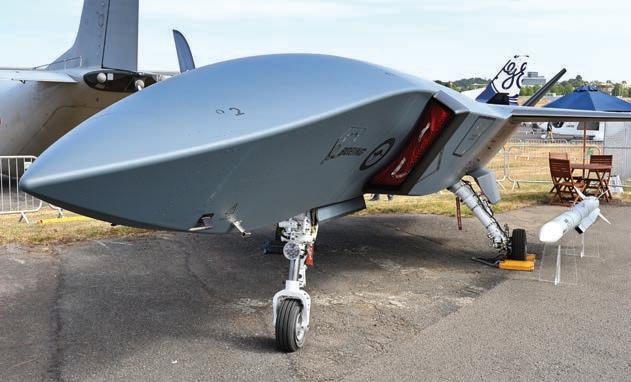
permitting an increase in maximum takeoff weight from 10,000 to 12,000 pounds and a corresponding rise in useful payload to 4,500 pounds. The internal weapons bays are longer, accommodating up to four Small Diameter Bombs or two missiles the size of the AIM120 advanced medium-range air-to-air missile (AMRAAM). Boeing has developed a revised modular nose that allows different sensor payloads to be fitted.
Boeing has established a production facility in Toowoomba, Queensland, which will initially build Block 2 aircraft. A Block 3 with further improvements is expected to enter production in 2029.
The company’s test fleet has not flown that much, but because development is performed
PAL & Shohin sign for 13 more Airbus airliners
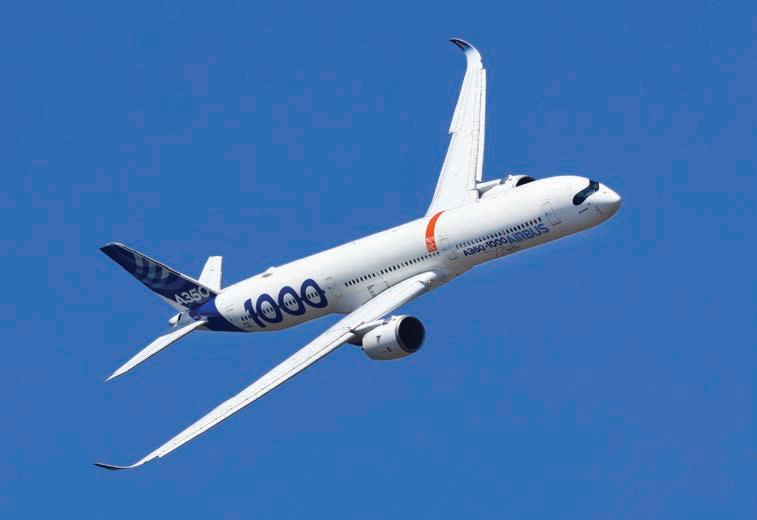
Airbus continues to rack up orders with announcements of agreements from Philippine Airlines (PAL) and Shohin Airlines for 13 more Airbus airliners.
PAL signed a memorandum of understanding for nine A350-1000s, while Shohin Airlines signed a deal for two A320neos and two A321neos in its first Airbus order. The latter was included in Airbus’ end-of-June order book as an undisclosed contract.
Once finalized, the PAL order will double the airline’s total A350-1000 orders to 18 aircraft, the first two of which were delivered this year. Designated as PAL’s new flagship,
the A350-1000 will enable the carrier to continue to expand its long-haul network, linking Manila with cities on the East Coast of the U.S. and Canada.
In addition to the A350, PAL operates A330-300s to the Middle East, Australia, and Asia, alongside the A320/321 single-aisle family on domestic and regional legs. As for Shohin, the airline was registered in June 2025 and is planning to build a wide route network.
The airline’s A320neos will be fitted with 176 seats while the A321neos will have 196 in a dual-class layout. K.L.
Boeing Australia designed the Boeing MQ-28 Ghost Bat as a simple aircraft with ease of operation and manufacturing in mind.
within the digital domain, testing is essentially a validation of modeling and results. Some notable capabilities have nevertheless been demonstrated in the air. In June 2025, an MQ-28 conducted find-fix-target missions in which it autonomously detected, tracked, and designated aerial targets within an assigned area.
In December 2025, an MQ-28 destroyed a jet-powered drone target with an AIM-120 fired at the Woomera test range in South Australia. An operator aboard an RAAF E-7A Wedgetail airborne early warning and control aircraft controlled the CCA and authorized the engagement, while an F/A-18F Super Hornet provided targeting data across the networked force. Boeing is in talks with MBDA about launching a Meteor air-to-air missile from the MQ-28.
International interest in the MQ-28 is high, and Boeing sees opportunities in many nations. In Germany, an industrial team has been formed to bid for air force requirements: Rheinmetall was named first as Boeing’s strategic partner, Rohde & Schwarz and Diehl Defence joined in June, and sensor and electronic warfare specialist Hensoldt has now completed the team. Internationally, Eaton and Leonardo have been named as partners.
Boeing Commercial Airplanes played a major role in designing production systems so that manufacturing facilities can be established easily and rapidly anywhere. For the MQ-28, the company favors small facilities in customer nations, allowing them to tailor their own air vehicles to national operational and sovereignty requirements. n
DAVID M c INTOSH

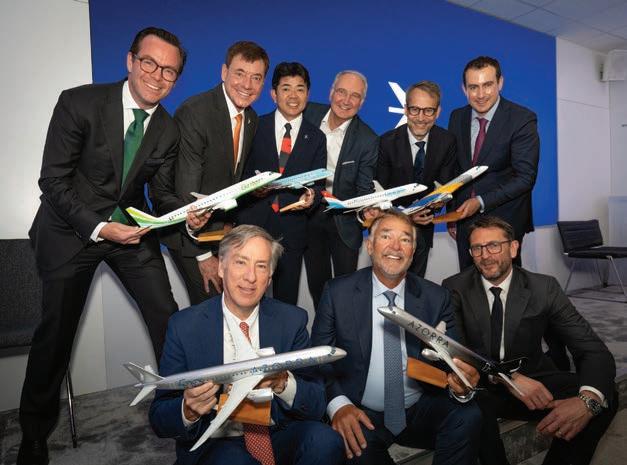
These model aircraft may be small, but the numbers aren’t: Embraer announced up to 58 E-Jet sales on the second morning of the Farnborough International Airshow.
Embraer racks up firm orders for 30 E-Jets
By Charlotte Bailey
Embraer announced a total of up to 58 E-Jet sales on the second morning of the Farnborough International Airshow. The firm orders for 30 aircraft are from both new and returning customers, and they build on the E2 program’s 500-order milestone, which Embraer marked with Azorra’s follow-on deal in June.
Included in the string of signings, Latin American airline group Abra—parent of Avianca, Gol, and Wamos Air, and described by Embraer Commercial Aviation president and CEO Arjan Meijer as “a regional giant”—placed
its first Embraer order. A firm deal for 20 E195E2s is augmented by 10 options and a further 15 purchase rights, with deliveries set to begin in the fourth quarter of 2027.
Luxembourg flag carrier Luxair, which only began E2 operations in January with the E195-E2, converted three purchase rights into a firm order for three E190-E2s, a new variant for its fleet—and secured one additional purchase right. “The E190-E2 combines outstanding economics, operational efficiency, and passenger comfort, making it the ideal aircraft for airlines seeking sustainable growth,” Meijer said.
Binter, which is based in the Canary
Voyageur orders Flexrotor for Canadian ISR
Canada’s Voyageur Aviation has placed an order for an unspecified number of Airbus Helicopters’ U030 Flexrotor uncrewed aerial system. The deal, signed at the Farnborough Airshow yesterday, will make the Ontario-based charter company the Canadian launch operator for the intelligence, surveil-
lance, and reconnaissance (ISR) platform.
The U030 is a high-endurance, tactical vertical takeo and landing UAS engineered for intelligence, surveillance, target acquisition, and reconnaissance (ISTAR) operations for military, parapublic, and commercial use cases. It has a maximum launch weight of
Islands and became the first European operator of the E195-E2 in 2019, placed its latest follow-on order for five aircraft plus four purchase rights.
Additionally, Embraer Commercial Aviation chief commercial officer Martyn Holmes revealed that Fuji Dream Airlines—Embraer’s “longtime customer” and operator of perhaps the world’s “most colorful fleet”—has opted for a further two E175s, previously held in the backlog under an undisclosed customer, for delivery in 2027 and 2028.
“FDA currently operates a fleet of 15 Embraer aircraft, consisting of two E170s and thirteen E175s. The introduction of these new aircraft will enhance our capacity and help further strengthen our network connecting communities across Japan,” commented Fuji Dream Airlines president Shunsuke Honda. Finally, commercial aircraft lessor Azorra— which had already signed a follow-on firm order for 15 E195-E2s in June, augmented by 15 purchase rights—also inked its first freighter deal. The agreement covers 20 firm E-Freighter conversions, spanning the E190F and E195F, plus purchase rights for 10 more.
Azorra CEO John Evans called the E-Freighter “a natural extension of that story, combining the proven performance of the E-Jet with a compelling solution for the growing express cargo market.”
“The E-Jet Freighter is an ideal replacement for older 737 freighters, offering reliable, Stage 4 noise-compliant operations and, with Azorra’s CF34 engine program, unmatched operating costs,” Evans said. “We are proud to deepen our long-standing partnership with Embraer and look forward to helping bring the E-Freighter to operators worldwide.” n
55 pounds and can fly for around 12 hours.
Voyageur president Cory Cousineau remarked, “As the first Flexrotor operator in Canada, Voyageur is well positioned to introduce and operationalize this new technology within the realities of Canada’s operating environment.”
The U030 Flexrotor is on display at the Farnborough Airshow this week. C.A.

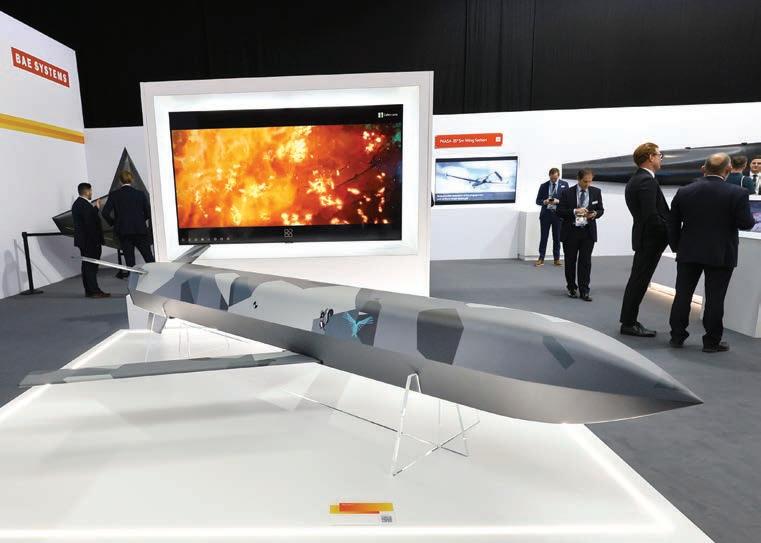
The Blizzard has an open system architecture and can be easily reconfigured with different equipment.
BAE Systems’ Blizzard vehicle hits Farnborough
By David Donald
Last September, the advanced research and development division of BAE Systems— FalconWorks—made public a collaboration with Lockheed Martin’s fabled Skunk Works on an autonomous and rapidly deployable air vehicle that can undertake a range of disruptive missions. At the Farnborough Airshow, BAE announced the name for this product: Blizzard.
Weighing in at around 330 pounds, the 7.7-foot-long vehicle is jet-powered and has pop-out wings with a span of around 5 feet. It can be configured with various payloads for a range of tasks, although initially, the focus is on those intended to disrupt and defeat surface-to-air threats. These include jamming and acting as a decoy. While Blizzard can be carried and launched from combat aircraft, it is also being developed for palletized delivery that allows it to be
launched in large numbers from cargo aircraft such as the A400M.
With an open system architecture, the Blizzard can easily be reconfigured with different equipment. This “plug-and-play” approach for both software and hardware allows it to be adapted to different tasks and permits rapid updating with new equipment to meet evolving threats. It also allows the Blizzard to be easily adapted to meet national technology security and sovereignt y requirements.
The FalconWorks/Skunk Works team has already conducted captive-carry and release trials and expects to conduct system trials soon, with the aim of having the system production-ready by around the end of the year. Blizzard faces competition from other systems, but its jet power, cruise altitude of 30,000 feet, and range of around 400 nm place it in a class that can more easily support combat aircraft. n
BAE Systems, Saab, and Boeing team on UK pilot trainer
BAE Systems has signed a teaming agreement with Boeing and Saab to o er a next-generation pilot training system to the UK, based around the T-7 Red Hawk. The advanced jet trainer has been selected by the U.S. Air Force, and it passed its Milestone C in April, leading to an initial production order. A full training system with ground-based aids is being o ered to the RAF, with the ability to evolve to meet future training requirements beyond those of the current Typhoon and F-35.
The proposal commits to a final assembly and integration facility to be created in the UK. This would not only create high-skill jobs but also ensure sovereign control over the UK’s future pilot training requirements. A robust supply chain would be established to support the new trainer throughout its UK service.
Boeing and Saab are already partners in the program, with the Swedish company supplying the aft fuselages from a new factory in West Lafayette, Indiana. The three companies—each with extensive experience and knowledge in training systems—initially signed a letter of intent to pursue the UK requirement last November. D.D.
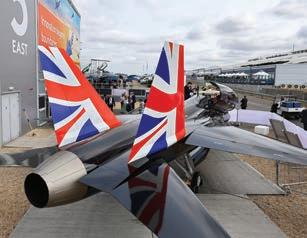
A full training system with ground-based aids is being offered to the UK’s Royal Air Force. It is based on the T-7 Red Hawk.
DAVID M c INTOSH

Sustainable aviation fuel investment plan inked at F’boro
By Cristofer Slotoroff
Airbus and Air Canada announced plans at the Farnborough Airshow on Monday to establish a jointly funded Sustainability Co-Investment Platform. The still-unnamed initiative aims to invest up to CA$13.7 million (US$10 million) to support commercial-scale sustainable aviation fuel (SAF) production in Canada.
The platform’s central aim is to carry a jointly agreed Canadian SAF project to a final investment decision, with both partners continuing advocacy work alongside the Canadian Council for Sustainable Aviation Fuels (C-SAF), as well as federal and provincial governments.
Speaking at the signing, Airbus chief sustainability officer Julie Kitcher said the funding would be split on a 50-50 basis, with Canada’s “exceptional positioning in terms of feedstock availability for the domestic market” providing opportunities for fuels made through the hydroprocessed esters and fatty acids (HEFA) pathway, gasification, and Fischer-Tropsch

production from Canada’s wood residues.
Airbus also signed a five-year agreement under Air Canada’s Leave Less Travel Program, under which the airline will both track greenhouse gas emissions tied to Airbus’ corporate travel and apply verified SAF environmental attributes against those emissions on the airframer’s behalf. Airbus’ first allocation covers attributes associated with more than 60,000 liters of SAF.
Valérie Durand—Air Canada’s v-p of airport affairs, corporate real estate, and sustainability—said the carrier exceeded its target of sourcing more than 1% SAF in 2025, reaching “nearly 1.6% of SAF usage in our operations.” Asked by AIN what outcomes partners envision regarding affordability, Durand said the goal is to move aviation through the energy transition “in a way that protects affordable travel for customers,” with policy support keeping the ecosystem balanced. Neither company offered specific affordability metrics.
Embraer trims 20-year small jet forecast
In its annual Market Outlook, Brazil-based Embraer forecasts demand for some 8,500 sub-150-seat commercial jets over the next two decades. According to Embraer Commercial Aviation president and CEO Arjan Meijer, a shift in consumer preferences— particularly regarding tourism—is driving
greater need for airline connectivity served by aircraft of this size.
Between now and 2045, China will lead the annual rate of expansion, with revenue passenger kilometer growth of 5.2%, while Europe and North America trail at 2.7% and 2%, respectively. C.B.
Airbus chief sustainability officer Julie Kitcher and Valérie Durand—Air Canada’s v-p of airport affairs, corporate real estate, and sustainability— announced plans to establish a jointly funded Sustainability Co-Investment Platform.
The platform announcement came alongside a macroeconomic study by Airbus and consulting firm ICF that Kitcher described as “highlighting Canada’s potential to lead in biofuels production.” The study found that scaling domestic production to meet 40% of Canada’s aviation fuel demand by 2040 could add CA$32 billion to national GDP and create 140,000 jobs. Air Canada, which operates more than 100 Airbus aircraft such as the A220 and the recently introduced A321XLR, framed the platform as a step toward a domestic supply chain. Both Air Canada and Airbus emphasized longterm, big-picture thinking as a virtue within the sector. Durand characterized the wider industry’s 2050 net-zero emissions goal as ambitious. “It’s a long-term ambition, and obviously there is no clear path toward reaching that ambition,” she said, but she pointed to Air Canada’s four-component plan as a roadmap: “The first one is efficiency and operations, [...] the second is new technologies, the third is renewable fuels—including SAF—but also on the ground, [...] and then the fourth is out-of-sector reductions that are available to the industry.”
For Airbus, Kitcher detailed a multi-decade timeline as the right lens for planning and executing change. “If you think about aviation decision-making, 2030 is tomorrow; 2050 is the day after tomorrow. We’re talking 20-plusyear product life cycles,” Kitcher said. “It’s an imperative to be able to think forward to the future to create the conditions for continued success of this industry.” n
Saab courts Canada’s undecided fighter fleet
By Charlotte Bailey
As Canada’s recently formed Defence Investment Agency—formally established in 2025— continues to ramp up domestic military capacity and opportunities, the organization has reiterated its commitment to strengthening Canadian capabilities. This, according to CEO Doug Guzman, is also crucial if Canada is to meet NATO’s target of 3.5% core GDP spending by 2035. Citing an initial 2% figure reached in March, he said during a panel on Monday, “It’s not about the willingness or the allocation of the funds. It was the ability of the system to absorb it, by which we mean people, training, infrastructure, and supply chain.”
The Canadian government’s industrial strategy, published earlier this year, is backed by CA$81.8 billion allocated over five years in the 2025 budget for defense investments. However, with the makeup of its potentially mixed future fighter fleet still undetermined, Sweden’s Saab could be a significant part of
the Canadian “build, partner, buy” framework.
In a memorandum of understanding signed July 17, Montreal-based CAE and Saab stated that, following a potential Gripen acquisition, CAE would be “responsible for operating and sustaining advanced Gripen training systems in Canada.” The agreement would, Saab said, “create high-value work opportunities [and] strengthen Canada’s defense industrial base.” Saab added that the partnership would also give Canada “the capability to independently support future mission systems enhancements and upgrades,” with Canadian specialists able to perform classified mission systems work.
Speaking at the Farnborough Airshow on Monday, Saab president and CEO Micael Johansson said that while it is important not to underestimate transatlantic relations among Europe, the U.S., and Canada, “we have to get our act together in terms of collaborating and aligning the view on the capabilities needed in the fragmented European perspective.” He acknowledged that tensions
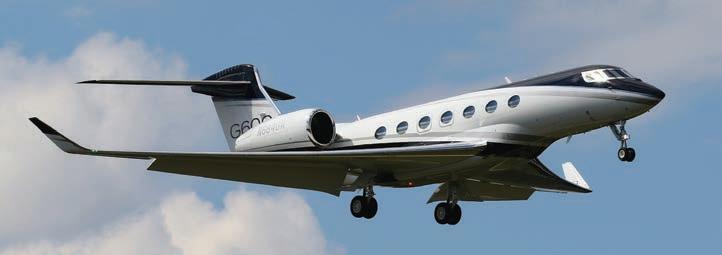
Gulfstream G500/G600 fleet tops 400 deliveries
With the completion of a G600 at the company’s St. Louis facility for a customer in Asia-Pacific, Gulfstream’s combined G500 and G600 fleet has surpassed 400 customer deliveries, the Savannah, Georgia-based jet maker said. The G500 and G600 were certified by the
FAA in 2018 and 2019, respectively, and both twinjets received EASA approval for steep approaches last year, expanding access to airports including London City (EGLC), which has a 5.5-degree glideslope. Notably, the G500 and G600 also introduced the Gulfstream Symme-
exist among international partners, pointing to the Future Combat Air System—a French-, German-, and Spanish-backed effort that the partners e ff ectively terminated last month after failing to agree on issues such as intellectual property rights and the aircraft’s core functions, which ultimately “became di fficult.” A balanced “logic” among industry, end users, and political security policy, he said, is the foundation of a more certain framework.
According to Johansson, Sweden’s accession to NATO (formalized in 2024) has helped make the case for Saab’s approach to data sovereignty and open-architecture software design. “It’s easier for us, being in the alliance, to convince people we’ve done it,” he said. Even so, he believes interoperability is “not only as easy as having the same links or the same connectivity.” It is about “making sure Canada, for example, can manage all the data they generate within their operations without having input from Sweden or Saab.”
And while Ottawa has yet to finalize a potential revision to its U.S.-built F-35 fleet, “There is no way all the countries in the European perspective can do everything; neither can Canada, neither can Sweden,” Johansson concluded. “There is no way back. If we don’t want to have [the] full dependency on the U.S. we have, we are in the right direction now.” n
try Flight Deck, and feature a Mach 0.925 Mmo. “Reaching 400 deliveries is a testament to the confidence customers around the world continue to place in Gulfstream and in the G500 and G600,” said Gulfstream president Mark Burns. “Together, these aircraft have fueled sustained demand for our next-generation fleet and play a pivotal role in Gulfstream’s vision to o er an aircraft for every mission.”
Since entering service, the G500 and G600 fleet has logged more than 519,000 flight hours and 200,000 landings. The program has set more than 190 city-pair speed records, contributing to Gulfstream’s overall total of 815 records. A recent G600 flight from Sapporo, Japan, to Savannah covered 5,835 nm in 11 hours 38 minutes at an average cruise speed of Mach 0.88. A.W.
DAVID M c INTOSH
A G600 was completed in St. Louis for a customer in the Asia-Pacific region.

Empowering Controllers and Pilots for the Future of Flight

Pratt & Whitney nears the end of the GTF saga
By Leeham News and Analysis Staff
Ten years into the seemingly endless technical issues with its “PurePower” Geared Turbofan (GTF), Pratt & Whitney says it is finally ready to put the engine behind it. At the same time, it is turning to a next-generation design built on the technology it once dismissed as its rivals’.
The Connecticut-based engine maker has invested hundreds of millions of dollars in building, expanding, and licensing MRO facilities to address durability problems that have plagued the GTF, primarily on the Airbus A320neo family. Similar issues emerged on the Airbus A220 and Embraer E195-E2, which use a smaller version of the engine. The latest upset was due to production powder contamination at the supplier level. At the peak, around 650 GTF-powered A320neos were grounded.
Recovery is now underway. Scott Kreamer, v-p of the PW1500G engine program that powers the A220, told reporters during an Airbus briefing last month that all affected A220s will return to service by the end of this year, and Embraer said its E2 fleet is back to normal. An A320neo operator told Leeham News and Analysis that the PW1100G engine on the A320 will remain an issue for another two or three years. Rick Deurloo, president of P&W’s Commercial Engines unit, declined to confirm
that timeline. However, during the Farnborough Airshow, he reiterated the company remains on trajectory to be in the single digits of aircraft on ground by the end of the year.
“We continue to make incredible progress,” Deurloo said. “I’m not going to put a hard date on it. But, by the end of this year, we’re going to be in a really good position to finally, in 2027 or 2028, kind of get this behind us.”
He added that P&W has been working with Airbus to balance returning the operating fleet to the air with customers’ requirements for growth, through investments in facilities, capabilities, and material flow—an area he said has been at the root of many of the issues.
The MRO expansion spans the U.S., Poland, New Zealand, and elsewhere. Deurloo said GTF MRO capacity is up 300% since 2019 and 26% this year over last, which is driving reductions in aircraft on ground. The upgraded GTF Advantage has been certified by both the FAA and EASA, and first deliveries to Airbus are underway. P&W plans to ramp up Advantage production in 2027 and shift all deliveries to Airbus to the variant by early 2028.
P&W also is in the final stages of certifying its Hot Section Plus upgrade kit for current GTFs, which incorporates Advantage technologies, with approvals anticipated late this year or in early 2027.
With the current-generation engine stabilizing, P&W is looking to the next one. There is no rush; Airbus, Boeing, and the engine makers don’t expect a replacement for the Airbus A320 and Boeing 737 families to enter service until 2038 to 2040. That timeframe is necessary for industrialization as well as design, Deurloo said, noting that P&W would need to design a new footprint for its product offering.
When P&W and CFM International developed the GTF and the LEAP engines, respectively, to power today’s single-aisle airliners, they pursued different technologies and each downplayed the other’s. Now each is developing nextgen engines that incorporate the technology it dismissed in the mid-2010s. P&W’s engine for the next narrowbody is a geared turbofan, but one that will draw on ceramic matrix composites and composite fan blades, both pioneered by GE Aerospace (a 50-50 partner with Safran in CFM). Ceramic matrix composites were the foundation of the LEAP. GE’s composite fan blades were first used on Boeing’s widebody airplanes and were also installed on the LEAP.
“We continue to have our research around composite fan blades,” Deurloo said. “I think when we discuss it internally around our nextgen single-aisle, it will include composite fan blades in the middle.” On ceramic matrix composites, he declined to quantify progress after citing about 50% completion a year ago: “I think it’s mature, but there’s still more work we’ve got to go do.”
GE and Rolls-Royce are adopting the gearbox technology P&W used as the foundation of the GTF. Rolls, which has no single-aisle engine today but wants to return to the sector, is developing its UltraFan geared turbofan engine in two demonstrator sizes: the UltraFan 80, which ran in 2023 at 85,000 pounds of thrust, and the smaller UltraFan 30 in the 30,000- to 45,000-pound thrust class.
CFM, meanwhile, is betting on its RISE open fan, an advance on the experimental open-rotor technology of the 1980s. Where the open rotor used counter-rotating unducted fans, RISE has a single unducted fan with non-rotating blades behind it. Composite blades are a key element in mitigating concerns of a blade-out emergency; GE says that over millions of hours of operation of its composite blades on Boeing and Airbus airplanes, there has not been a blade-out. z
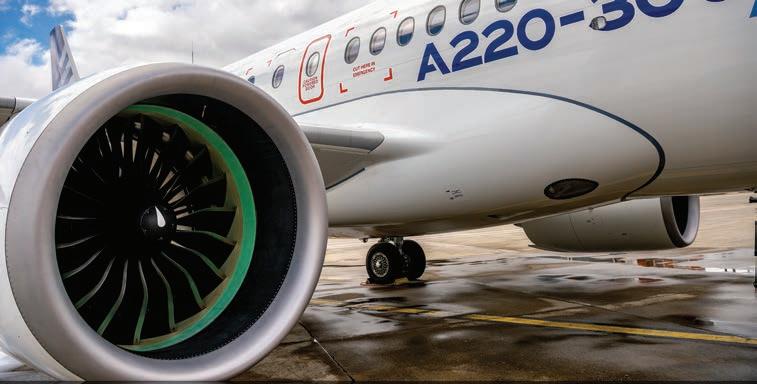
Pratt & Whitney’s PW1500G geared turbofan engine powers the Airbus A220.

From Valor to victory lap: Bell accelerates MV-75
By David Donald
Textron’s Bell company is on a mission to get the MV-75 Cheyenne II tiltrotor into the hands of the U.S. Army as soon as possible. When the company won the Future Long Range Assault Aircraft (FLRAA) competition to provide a replacement for the Army’s UH-60 Black Hawk fleet in December 2022, the entry-into-service date was stated as 2030/2031. However, the service now wants the aircraft quicker. Production could get underway in 2028, but exact program dates, such as the scheduled first flight date, remain under wraps.
In the meantime, Bell is moving forward rapidly to meet the accelerated deadlines. This would not be possible without the aircraft’s digital backbone, which allows rapid prototyping, development, and detailed design changes. With everything linked through a centralized digital model, the manufacturing process, production system, and maintenance regime can be developed and implemented in line with that of the vehicle itself.
Putting the Pieces Together
Based on the V-280 Valor technology demonstrator, the winning FLRAA design received the designation MV-75 in 2024 and was named Cheyenne II in April this year. Bell is building six for test purposes.
Final assembly of the MV-75 will be in Amarillo, Texas, with wing production being undertaken at the same facility, the first being completed in February. Thanks to digital engineering, the component was built in 90% fewer hours than it takes to manufacture the corresponding part in the V-22 Osprey. Informed by experience with the first wing, the building of the second achieved a further time saving of 40% compared with the first item.
Similar savings are being experienced as
other parts are completed: compared with the V-22, the engine nacelles have demonstrated 90% savings in build-time; the rotor blades 60%; and the yokes 75%. The first wing/nacelle mating has been successfully conducted, and the first gearbox is shortly to ente r test.
Three fuselages—which are built in Wichita—are in production, and the construction of components for all six test vehicles is under way. Software for the weapons, flight, and mission systems is being developed in Arlington, Texas, and is undergoing ground rig tests. Sub-assemblies are being manufactured at locations in the Dallas area, and fuel, hydraulic, and wiring systems are being installed in wings.
The U.S. Army, too, is preparing for the Cheyenne II’s arrival. The first operator will be the 101st Airborne Division in Fort Campbell, Kentucky, which has been inserting Marine
Corps MV-22s into its exercises to assist with the formulation of tactics with tiltrotors as part of the force mix.
More Applications
The V-22/V-75 is considerably faster than the current Apache, Black Hawk, and Chinook helicopters, complicating the task of planning an air assault operation that brings all assets to a single target area from different directions. However, the tiltrotor’s speed brings with it greater tactical flexibility and the ability to deliver more troops and equipment more rapidly. In the case of the 101st, most of these operations are undertaken at night.
Beyond the U.S. Army air assault/utility transport requirements, the MV-75 has obvious applications elsewhere. Bell is already working on medevac and special operations adaptations, and is in discussion with the Department of the Navy regarding its Future Attack/Strike (FASt) program to replace the Bell AH-1Z/UH-1Y in service with the Marine Corps. The MV-75 would also be a valuable asset in the combat search-and-rescue role conducted by the U.S. Air Force. The company reports strong interest from potential export customers.
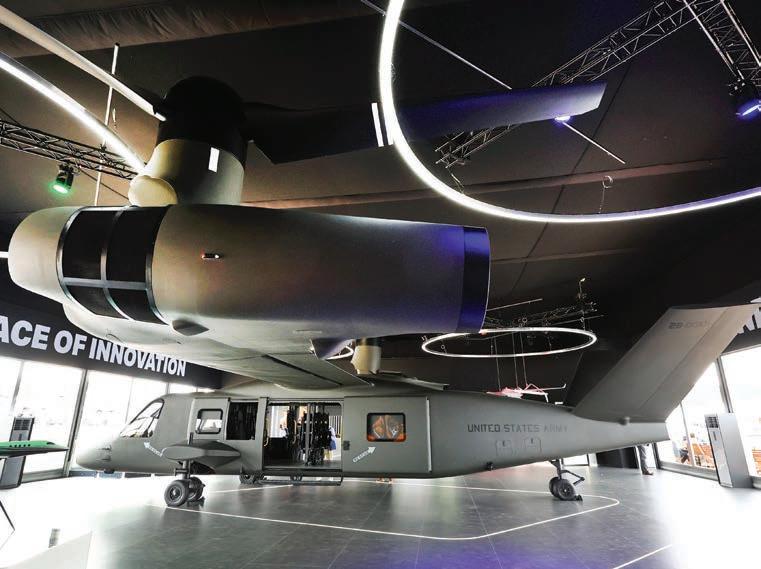
The U.S. Army chose what would become the Bell MV-75 Cheyenne II tiltrotor for the Future Long Range Assault Aircraft (FLRAA) program in 2022. Production could start as early as 2028.
DAVID

INDEPENDENT ANALYSIS. INFORMED DECISIONS.
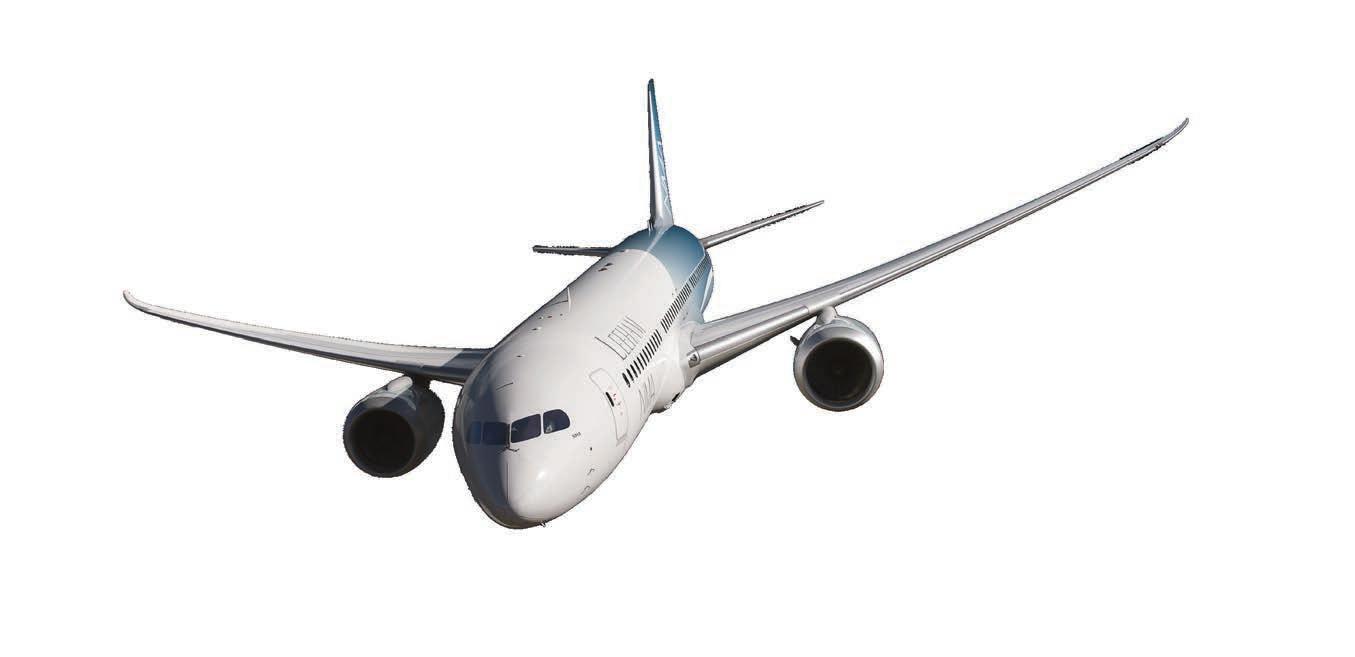
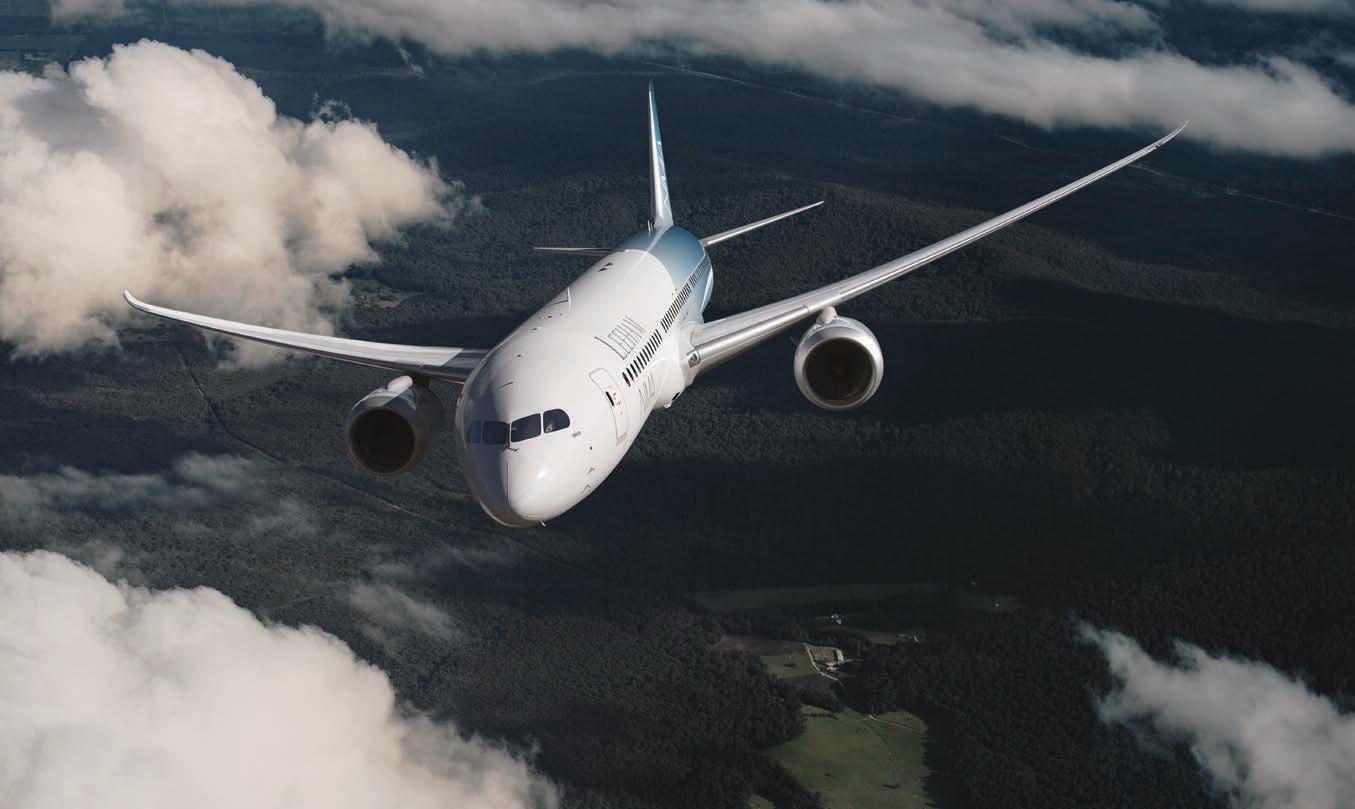
AIN Media Group has been the trusted source for business aviation news and insight for over 50 years. Now our coverage goes even further and deeper. With the addition of Leeham News and Analysis to the AIN portfolio, readers can gain even more independent, expert analysis of the global commercial aviation and aerospace sectors, including market trends and manufacturer strategies.
Together, AIN and Leeham News and Analysis deliver the most comprehensive aviation coverage available.

Gulf Air intends to buy blended-wingbody Z4 from JetZero
Gulf Air plans to add JetZero’s Z4 blendedwing-body (BWB) airliner to its fleet for routes out of Bahrain to destinations in Europe and Asia. Yesterday at the Farnborough Airshow, the carrier signed a letter of intent for an undisclosed number of the in-development 250-seater with preferential delivery positions in the early 2030s.
Yesterday, Japan Airlines also expressed interest and support for the Z4. The Asian carrier is evaluating the aircraft as part of its long-term fleet planning. In 2025, United Airlines signed a provisional agreement to buy up to 200 Z4s.
The U.S. start-up aims to fly a prototype in 2027 and in June broke ground for the construction of its manufacturing facility in Greensboro,
JetZero’s Z4 demonstrator will be powered by a pair of Pratt & Whitney PW2040 turbofans.
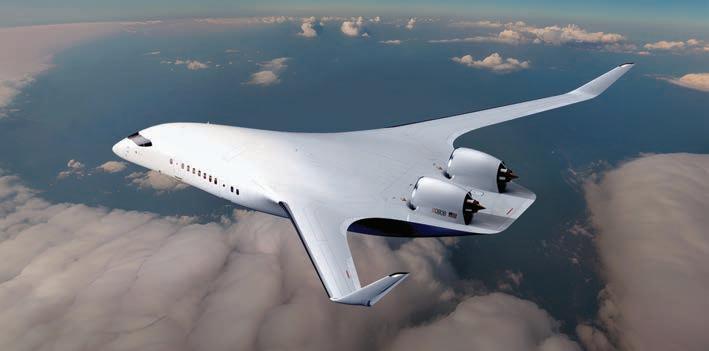
North Carolina. On Monday, the Export-Import Bank signed a letter of intent with JetZero to explore a $3 billion loan to establish the production line, and the company separately announced plans for an engineering o ce in Wichita.
JetZero’s full-scale demonstrator will fly on a pair of legacy Pratt & Whitney PW2040 turbofans, but the company has not yet named an
Sikorsky eyes Europe production line for NGRC
By Kerry Lynch
Sikorsky is planning to establish a Next Generation Rotorcraft (NGRC) production line in Europe as it works to strengthen its partnership with NATO and expand its collaborative research and development efforts in the region.
The Stratford, Connecticut-based Lockheed Martin subsidiary did not disclose possible locations but said the move will improve logistics and strengthen “NATO’s rapid response posture.” In addition, the move will enable Sikorsky to bring together multinational expertise on the program, the company maintained, adding that this will help it to provide a global NGRC.
Plans call for partnering with European aerospace firms and suppliers to support a locally sourced NGRC production line, an effort that Sikorsky said would generate jobs
and foster technology transfer.
The helicopter OEM continues to study advanced airframe configuration, open architecture avionics systems, and mission capabilities that it anticipates would meet NATO’s deterrence requirements.
Under the NGRC program, NATO is seeking a medium-class, multi-role helicopter to replace medium multi-role helicopters currently in service. The NGRC initiative began in 2022 and involves France, Germany, Greece, Italy, the Netherlands, the United Kingdom, and Canada. Spain and the U.S. are acting as observers. The NATO Support and Procurement Agency (NSPA) is leading the effort to fulfill the requirement.
In tandem, Sikorsky struck an agreement with Safran Helicopter Engines to explore areas where they can cooperate on existing and
engine for the production Z4, which is expected to carry up to 250 passengers with a 5,000-nm range, targeting the so-called “middle-of-market” segment served by remaining Boeing 757s and 767s, and older Airbus A321s and A330s. JetZero claims the BWB airframe will cut fuel burn by about 30% compared with the tubeand-wing airliners it aims to replace. C.A.
emerging vertical lift platforms. The agreement deepens a relationship that spans 40 years, with more than 1,230 Safran engines delivered and 10 million flight hours accumulated on the S-76.
Signed by Sikorsky v-p and general manager Rich Benton and Safran Helicopter Engines president Cédric Goubet, the agreement paves the way for new collaboration on power and propulsion technologies, accelerating design cycles and shortening turnaround times, Sikorsky said.
“This is a great example of Lockheed Martin’s commitment to partnering with the European industry to enhance the systems we provide that deliver high-performance, reliable mission capabilities,” Benton said.
“When we collaborate across industry from day one, we empower our customers with speed of decision-making and the confidence that the final aircraft will meet performance, safety, and schedule requirements.”
Sikorsky has further been expanding its work in Asia, where it has been involved in a joint program to develop an international variant of its X2 high-speed compound helicopter that has coaxial rotors. n

Slower growth reshapes airline outlook on capacity
By Charles Alcock
Slower commercial traffic growth—in part triggered by the economic fallout from the Iran war—could mean that airlines are less concerned about continuing delays to new aircraft deliveries, according to consulting group McKinsey. Briefing reporters on data from its latest industry whitepaper on Thursday, McKinsey partner Frank Coleman suggested that, in weakening market conditions, getting some breathing space before receiving new equipment might suit their short-term tactical needs quite well.
In the longer term, though, McKinsey envisages what partner Kevin Sachs described as “a return to normalcy” with more than 2,000 narrowbodies in the global fleet beyond their expected retirement age. While noting that maintenance organizations and leasing companies have benefited from the deferred replacement of older aircraft, the group does not expect carriers to ask OEMs to push back deliveries of new equipment even further, not least because slots are so hard to get.
“Some of the teething issues with new engines and supply-chain problems have benefited the airlines,” Coleman explained. “If they already had the extra capacity [from newly delivered aircraft], their revenue passenger kilometer [problem] would be even worse, or they would have had to park current aircraft.”
Nonetheless, consultants at IBA are predicting that up to 875 new airliner orders will be announced during the Farnborough show this week. Last Thursday, the company said that around 480 of these will be narrowbody airliners, with about 280 widebodies, 75 regional jets, 25 twin turboprops, and 15 large freighters.
According to IBA, sales activity at the 2026 Farnborough show will mark an uptick on the 438 orders announced in 2024 and 601 orders at the 2025 Paris Air Show. Its forecast said airlines are in a “race for dwindling delivery slots.”
“Meaningful production positions for new Airbus A320neo-family and Boeing 737 Max aircraft have become increasingly limited until approximately 2033, while Airbus widebody slots only begin to become more accessible
from 2032 and 2033,” IBA explained. “Boeing widebody availability remains constrained until around 2034, while delivery positions for the [Chinese] Comac C919 are similarly limited until approximately 2034 or 2035.”
Airbus and Boeing Crystal Balls
McKinsey published its somewhat sober assessment of the air transport sector around the same time that Airbus and Boeing both issued their latest, and characteristically bullish, forecasts for future demand. McKinsey’s research found that many airlines have cut their growth outlook in half, with more than two-thirds of all industry respondents now expecting a market slowdown in the next two or three years.
On July 8, Airbus published its latest Global Market Forecast, predicting that between 2026 and 2045, there will be 42,060 new passenger airliner deliveries in response to a projected twofold increase in revenue passenger kilometers (RPKs) to 21.3 trillion. In addition to replacing aging aircraft, the European airframer said that airlines’ desire to expand their networks with longer, thinner routes connecting smaller cities and rising disposable income for travel in markets including Asia and Latin America are the key drivers of this anticipated growth.
In its new Commercial Market Outlook published on Friday, Boeing acknowledged that a 2.2% dip in the global economy combined with jet fuel prices spiking by 70% or more is set to deliver a $23 billion hit to airline profits this year. However, the U.S. airframer is predicting a 6% to 7% increase in RPKs in 2027.
Boeing’s forecasters see demand for 43,625 new airliner deliveries through 2045, with around two-thirds of these going to Asia. These deliveries are expected to be split almost evenly between replacements for aging aircraft and fleet expansion.
According to McKinsey, the timeline for the long-anticipated next-generation single-aisle airliners to replace the ubiquitous 737s and A320s continues to be pushed to the right. Sachs told reporters that this is due to multiple factors, including the industry’s struggle to ramp up production rates, the readiness of new technologies, and questions about the return on investment for new programs amid market uncertainty. n
DAVID
IBA expects orders for about 280 widebodies at Farnborough this week, part of a “race for dwindling delivery slots.”



News and analysis covering cutting edge aviation technology and business models, including zero carbon propulsion, eVTOL aircraft, automation and autonomy, and new infrastructure.





Saudi helicopter operator expands into bizjets
By Charlotte Bailey
Saudi Arabian commercial helicopter operator
The Helicopter Company (THC) is planning its first foray into business jet services. An agreement inked with Bombardier yesterday at the Farnborough International Airshow will see THC work toward acquiring 12 aircraft— including five Challenger 3500s, five Global 5500s, and two Global 8000s—plus options for a further 48.
Speaking at the signing ceremony, THC CEO Capt. Arnaud Martinez said the potential purchase will “deliver the customer experience the Kingdom needs, that the Kingdom deserves.” He added that “as a portfolio of companies, THC was always poised to expand beyond rotary-wing aviation into fixed-wing operations.” THC,
Boeing orders
carrier marks the first it has placed for Boeing aircraft and will support demand for both its regional and international networks.
The 737-8s, which can fly between 160 and 180 passengers in a two-class configuration with a range of up to 3,500 nm, will boost Uganda Airlines’ intra-Africa routes, along with those to the Middle East and India. The 787-9, with a range of up to 8,300 nm, will support longer-haul routes to the Middle East, Asia, and Europe.

THC and Bombardier executives seal the letter of intent at Farnborough International Airshow. Bombardier’s Éric Martel called the agreement a symbol of both companies’ customer-centric DNA.
a Public Investment Fund company, was founded in 2018 and currently operates a fleet of more than 60 Airbus and Leonardo helicopters.
Bombardier president and CEO Éric Martel described the letter of intent as “a powerful symbol of our companies’ shared customercentric DNA and vision for economic growth in the region.” Building on an initial 12-aircraft
“This commitment with Boeing marks a defining step in Uganda Airlines’ growth journey and in our broader ambition to position Entebbe as a strategic aviation hub for the region,” said Uganda Airlines CEO Girma Wake.
Also buying Boeing 737s is Luxembourg national airline Luxair, which converted options for two 737-10s into firm orders and placed options for two more. Once all firm orders are delivered, Luxair’s Boeing 737 fleet will comprise 12 aircraft: eight 737-8s and four 737-10s.
“The Boeing 737-10 provides the additional capacity, operational efficiency, and flexibility
order, a potential fleet of up to 60 jets makes the venture “a very significant undertaking,” he added.
THC said the new business segment addresses growing demand in Saudi Arabia’s business aviation market. The choice of three different-sized aircraft will provide flexibility for a range of missions while offering fleet commonality benefits. n
we need to support future demand while maintaining the high standards of quality, comfort, and service our customers expect from Luxair,” said Luxair CEO Gilles Feith. Meanwhile, MSC Air Cargo purchased five 777-8 Freighters. The previously unidentified order—already on Boeing’s books—marks MSC Air Cargo’s first for the variant. MSC Air Cargo, which operates a fleet of Boeing 777-200 Freighters with destinations across Europe, the Americas, and Asia, becomes the third Europe-based cargo carrier to order the -8 Freighter. CEO Jannie Davel called the model “the right aircraft for the next stage of our growth.” n



Leeham’s Aircraft Performance & Cost Model (APCM) delivers the unbiased insights you need to make smarter decisions across every major expense — from aircraft purchase to fuel and maintenance