


GCAP is a collaboration between the United Kingdom, Italy, and Japan to design, develop and deliver a next generation combat aircraft, expected to enter service in 2035.
The new stealth fghter will be able to deliver surveillance and strike missions in heavily contested airspace, while at the same time coordinating assets across multiple domains. Leading from the front.
By creating a combat aircraft that each nation fully controls and deeply understands, the programme will support each partners’ sovereignty and security, for a generation.
VISIT US AT STAND E016.
By Charlotte Bailey
As the CFM RISE (Revolutionary Innovation for Sustainable Engines) program progresses toward its inaugural technology demonstrator, program partners are confident that the innovative open-fan design is achieving milestones set out at the beginning of the decade. However, while the experimental architecture is on track to deliver fuel-efficiency gains of at least 20%, this target is also being augmented by a more prominent focus on durability.
“If there’s anything we’ve learned over the last years, it’s that durability matters as much as, if not more than, fuel efficiency,” GE Aerospace v-p for future of flight Arjan Hegeman explained during a recent media briefing. The RISE initiative—first unveiled in 2021 by partners GE and Safran—initially prioritized unlocking fuel-burn benefits. Although Hegeman acknowledged that the industry will need to make ultimate trade-offs between durability and performance expectations, he is nevertheless confident that RISE can deliver “revolutionary improvements in both.”
“The overall deliverable for the operator is not fuel efficiency: that’s how the [high-bypass turbofan] CFM LEAP and [Pratt & Whitney] GTF were done. The overall deliverable for the operator is the cost of ownership,” he continued. Both of these commercial narrowbody engines have faced notable reliability challenges in recent years, with the higher
demands made of inherent architectural limitations contributing to time off-wing.
Crucially, RISE’s architecture is key to unlocking what Hegeman termed “a whole new system that is neither propulsive efficiency nor thermal efficiency, [but which] enables a new era of overall engine optimization.” Turbofans are physically restricted in size by their casings, limiting their bypass ratios, and a larger surface area diminishes overall propulsive efficiency returns. However, while the CFM56 and GTF have bypass ratios of around six and 11, respectively, RISE’s technology demonstrator is aiming for a figure above 60.
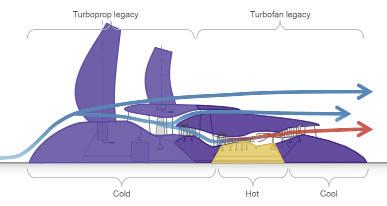
Alongside air drawn into the RISE powerplant’s fan and engine, a third stream—part of the adaptive bypass system—can be regulated to change the open fan’s bypass ratio during flight. This optimized efficiency will be enabled by a hybrid-electric system combined with a smaller engine core. Unlike previous counter-rotating second-stage fan concepts explored over recent decades, RISE’s static second stage will help simplify the system while retaining efficiency.
While narrowbody turbofan blades typically spin at over 2,000 rpm, RISE’s will spin at less than half of that. Durability expectations are being supported by Dowty Propellers, leveraging the GE subsidiary’s 40-plus years of composite blade experience. From its first fully composite propeller blade—which entered service in 1984 on the regional Saab 340—to high-intensity
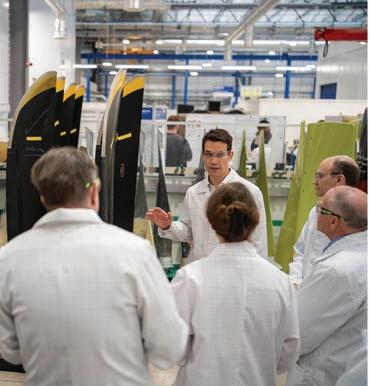
Dowty’s extensive experience with composite blade manufacturing will propel RISE’s success.
hovercraft applications, Dowty technical director Jonathan Chestney is confident the company can “address the challenges that are required to make [the RISE] model a reality in a few years.” While the RISE architecture will feature more blades than a legacy turboprop, and the overall blade shape may differ, Dowty says that the loads each one experiences are very comparable.
In 2025, project partner Airbus suggested that a fully functioning engine would be flighttested on an A380 by the end of the decade. RISE partners are working closely with airframers to define the optimum installation of a potential follow-on commercial offering. Hegeman explained that the underwing configuration remains the most realistic option, whereas a fuselage-mounted open-fan engine would entail a significantly greater weight penalty given the requisite armored areas of reinforcement.
RISE’s adaptive bypass system adds a third airflow stream alongside the flow through the fan, which creates propulsive thrust, and the flow through the core, which provides thermal thrust.
In addition to material expertise and manufacturing experience, Hegeman cited advanced computing power as integral to the project’s progress. For simulations, GE uses the Frontier supercomputer at Tennessee’s Oak Ridge National Laboratory, calculating in days what may once have taken decades. According to Hegeman, GE is “leaning into” ways of working more analytically versus empirically. “What has really changed over the last six years is that RISE is no longer just maturing technologies for the future generation; it’s also maturing the next generation of engineers, and it’s maturing the next generation of tools that we’re going to be using when we’re executing these programs,” he concluded. z

By Charles Alcock
Precision engineering group Doncasters is looking to grow in key sectors, including aerospace, with a $919.3 million capital boost from its New York Stock Exchange initial public offering on June 25. The UK-based group, founded in 1778, produces an array of nickel- and cobalt-based superalloy components such as airfoil blades and vanes, engine structural castings, and hot-side turbocharger wheels.
Doncasters’ aerospace customer base includes Safran Aircraft Engines, for which it supplies structural and hot-section airflow castings for the CFM International Leap-1A and 1B turbofans. It also produces blades and
vanes for several other propulsion systems under long-term supply agreements.
In recent months, the company has started building a 32,000-sq-ft production facility at its site in Bochum, Germany, as part of plans to strengthen its aerospace supply chain. This work is part of a $52 million investment in the facility announced in December 2025, which includes new furnaces to be installed over the next 12 months. The group has 14 production locations across Europe, Asia, and North America.
For components with complex internal features, Doncasters uses the customer’s design to produce the precision ceramic core that will be used for superalloy casting. From this, it makes a wax replica mold and coats
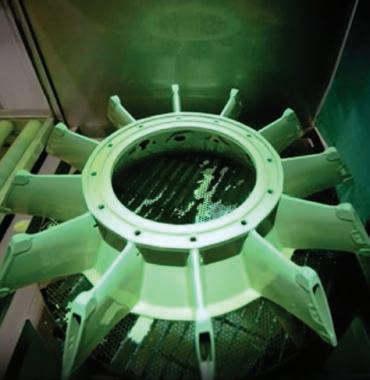
Doncasters has developed advanced processes for making precision castings for aircraft engine components.
the structure with strengthening materials before firing the ceramic shell to remove the wax. Once the structure has solidified, the ceramic mold is removed and the surfaces trimmed to remove excess metal before further strengthening processes. z
Clear Vision. Smarter Flight. Infinite Horizon.

ZEISS is advancing the future of aerospace with ProSight, a technology platform that transforms how information is seen, shared, and experienced in flight –for both passengers and pilots.
Experience these innovations for the first time at Farnborough International Airshow 2026, Chalet 404 via Gate B.
but that responsibility will transfer to the 165th Squadron under F16, the recently recommissioned wing at Uppsala, north of Stockholm. Originally, Uppsala was slated to host a fourth fighter wing, and it is undergoing extensive upgrades. However, under current plans, the F16 will not have fighter squadrons but will parent the operations of both Global variants. It will be the primary base for the S 106s, but they will also operate from the facility at Arlanda in certain weather conditions.
Rounding out the special-mission inventory is a pair of heavily modified Gulfstream IV-SPs (S 102B Korpen) that have been used to collect signals intelligence since 1997, operating from Malmen with the 74th Special Flight Squadron. In recent years, they have operated along the Polish and Romanian borders and over the Black Sea in support of Ukraine.
Sweden’s other major procurement program is the Embraer C-390 multirole aircraft, with four on order and seven options as part of a joint buy with Austria and the Netherlands.
Breaking with tradition, the C-390 will be officially designated as such and will not receive the Sweden-specific “TP 107” type designation. They will operate from Såtenäs, where a simulator is due for completion in 2029 to permit type conversion to be undertaken in Sweden. The initial cadre of C-390 crews begins training this year, with first delivery planned for 2028.
To answer strategic transport/tanking requirements, Sweden participates in the Heavy Airlift Wing program, with access to the three Boeing C-17s based in Hungary, as well as the Multinational MRTT Force. The nation joined the latter in 2025 along with Denmark, resulting in two more A330 MRTTs being ordered for the fleet, which will number 12 by 2029.
For many years, the SwAF conducted allthrough jet training with the Saab SK 60, but the type’s retirement in 2024 heralded a revamp of the training program. Basic training is now conducted in the Grob G120TP (SK 40), after which students are streamed according to intended role. Those destined to fly transports train with the U.S. Navy, while helicopter pilots train with the German army.
Engineering & Rotary Blade Design:
• Reduced assembly processes
• Lower overall manufacturing cost
Fast-jet pilots receive advanced training with the Italian air force, flying the Leonardo M346. Sweden has requirements for the rotarywing force. A second order for UH-60M Black Hawks has answered the NH90 troop transport replacement issue, but there is a need for a medium helicopter that can operate from ships, something that the current NH90/HKP 14 cannot do. A new light helicopter is also needed to replace the Leonardo A109/HKP 15s used for training, army support, and maritime duties.
Looking ahead, Sweden launched its Koncept för Framtida Stridsflygplan (KFS, future fighter concept) program in 2023 to examine future combat aircraft. As part of the process, Saab is to fly an uncrewed demonstrator next year, intended to inform the decision over whether Sweden should proceed with an indigenous fighter program—along with collaborative combat aircraft—or multinational programs. Sweden originally scheduled a decision for 2030 but may bring that forward. The announcement last month of the collapse of the Franco-German-Spanish FCAS/NGWS program may have a bearing on the Swedish decision. z

• Enhanced erosion protection of composite blades
Let our decades of experience help you simplify your assembly process.
By Leeham News and Analysis Staff
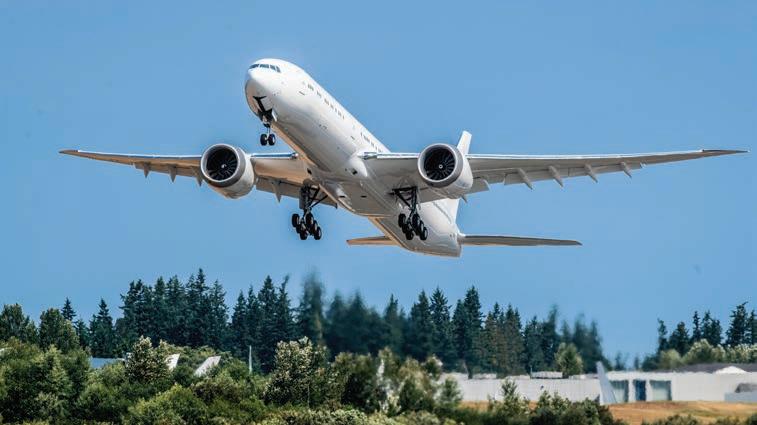
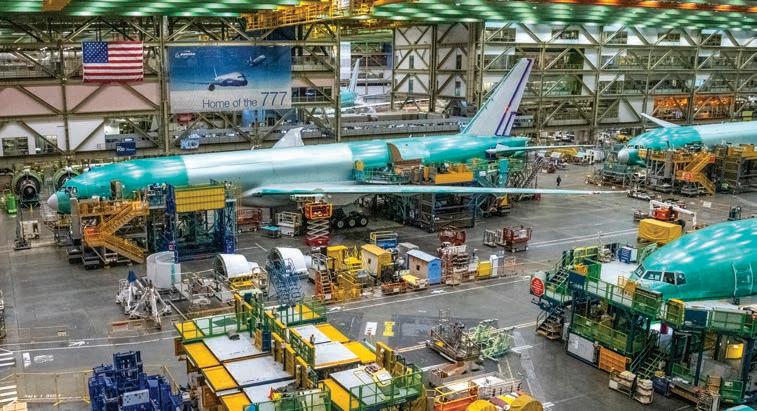
Boeing has more than 30 777-9 airliners built and stored at its production facility in Everett, Washington. Some have been stored since 2020 with years of testing and certification delays pushing deliveries to next year. However, every stored aircraft must undergo change incorporation first to meet FAA standards, a process that involves years of scrutiny, system updates, and fixes identified during testing.
CEO Kelly Ortberg, responding to a question on the first-quarter 2026 earnings call, provided a high-level overview of the challenges Boeing faces with the the 777X program.
“Change incorporation is basically for the airplanes that we have built, [we must] incorporate all the changes that have happened since they’ve been built. Things that result from the certification program, and things that happen as a result of productivity improvements or process improvements,” Ortberg said. “We go back in, and we incorporate all those changes before we make the delivery. It is a pretty massive activity that we have underway.”
There is a dedicated team within Boeing Commercial Airplanes focused on change incorporation. Roughly 30 777s will go through this process over several years.
“It depends on when the airplane was built,” Ortberg continued. “The older the airplane, the more change incorporation and the more structural-related changes that are needed, and they’ll take longer. The newer the airplane, it’s likely more minor upgrades. Each airplane has a different change incorporation work scope. That’s what the team is doing right now, going through defining the statement of work.”
Ortberg said Boeing will bring all the airplanes down to a common configuration level and then incorporate the changes. “We think that’s going to be the most efficient way. This isn’t new. This is something we’ve always planned. It’s a part of the production process. Unfortunately, when you build the airplanes early to get all the learning, in order to make the final delivery, we have to bring them all up to the latest configuration. It’s in our
operating plan, and we’re in the early stages of that change incorporation effort.”
Incorporating changes to address the gaps between fuselage barrels on the 787, discovered in 2020, took three to four months per airplane. Previous changes to the 737 Max narrowbody took “longer than it took to build them,” former CEO David Calhoun said. Before the Max crisis, it took about 10 days to assemble a 737.
From a 30-airplane cockpit rework crisis on the 767 to a supplier-driven configuration mystery on the 787, the history of Boeing’s pre-production change incorporation process is a master class in what happens when an industry’s best practices are forgotten in the name of financial engineering. Getting it right the first time and avoiding time-consuming, costly rework are crucial for Boeing’s future airplane programs—and its long-term financial recovery.
When Boeing builds an entirely new type of airliner, the factory does not wait for regulators to complete their final review. Assembly of pre-production aircraft begins months or years before the FAA issues a type certificate. There is a powerful economic logic driving this decision. A new commercial jet program represents an investment of billions of dollars, and every month that passes between the start of certification flight testing and the first
Boeing’s 777X must undergo the change incorporation process to bring earlier builds to the latest configuration.
revenue-generating delivery is a month of continued capital consumption with no return.
The practical consequence of that economic pressure is straightforward: Boeing starts building customer aircraft before the design is finalized. Flight tests expose aerodynamic surprises, systems integration problems, and structural issues to fix. Aircraft assembled in those early production positions will almost certainly differ, sometimes substantially, from the final certificated configuration. This is not a failure of planning. It is the unavoidable outcome of a complex certification program overlapping with an industrial-scale production ramp-up.
The gap between what is built and what is certified must be closed before any aircraft can be delivered. The structured, documented process for doing so is called “change incorporation”—in its purest form, a rigidly controlled disassembly and reassembly campaign. Engineers define which parts must be added, removed, or exchanged on each pre-production airframe to ensure conformity with the finalized, certified configuration.
To understand why the earlier Boeing 767 program produced a massive change-incorporation effort, you first have to understand the political and engineering battle over its cockpit, still being fought even as the first aircraft
rolled down the assembly line in Everett.
Large civil transport jets historically required a three-person flight crew: a captain, a first officer, and a flight engineer. By the late 1970s, when Boeing was designing the 767, advances in avionics had changed the equation. Computer-driven systems monitoring, electronic alerting, and centralized digital displays meant widebodies could be designed for a two-person crew. Boeing and most airlines badly wanted the two-crew configuration; the labor cost differential compounded into millions of dollars per jet per year.
The result was a compromise that became a manufacturing nightmare. Early 767 production aircraft were built with three-crew cockpits. When the FAA finally granted permission in July 1981 for the 767 to have two pilots—roughly 11 months before the scheduled first delivery—approximately 30 aircraft were already in various stages of production.
Boeing established a dedicated modification line to upgrade the cockpits of the pre-production aircraft to the two-crew standard.
This was not a minor adjustment. The three-crew cockpit had a full flight engineer’s panel with hundreds of gauges, switches, and indicator lights. Removing it, reorganizing the overhead panel, and installing the glass cockpit displays to replace the engineer’s monitoring functions constituted substantial structural and systems rework of the forward fuselage of each affected aircraft. Because each of the roughly 30 affected aircraft was at a different stage of assembly when the two-crew decision landed, the rework package differed for each airframe.
This crisis, painful and expensive as it was, turned out to be the crucible in which Boeing’s modern change incorporation discipline was forged. The 767 program needed to develop systems to track the individual configuration state of each pre-production aircraft and to plan unique, aircraft-specific work packages with the rigor required to satisfy the FAA.
The 747-400, which rolled out of Everett in January 1988 and earned its type certificate in January 1989, proved the discipline could scale. New wings, a glass cockpit, additional engine options, tail fuel tanks, and extended range made it, in certification terms, a new aircraft described as a derivative—one that reduced the number of
cockpit dials, gauges, and knobs from 971 to 365.
Engineers who worked through the 767’s cockpit rework crisis became senior members of the 747-400 program team. Change incorporation was a scheduled process that began early in the flight test campaign. The program was still delayed due to issues with the flight deck software, but Boeing had proven the foundational principles from the 767 crisis could be applied successfully to a major derivative.
If there is a single moment when the preproduction change incorporation discipline reached its high point, it is the 777 program. Launched in October 1990, first flown in June 1994, and certified in April 1995—with the unprecedented award of ETOPS-180 at service entry—the 777 represented the integration of two decades of hard-won experience incorporating change with a transformative new tool: full digital design.
The 777 was the first commercial airliner designed entirely in three-dimensional computer-aided design, using Dassault Systèmes’ CATIA software. Boeing was initially skeptical enough of the system’s accuracy to build physical mock-ups for validation checks; engineers found their alignment was more accurate than a physical engineering team could achieve, and all further planned mockups were canceled.
On the 767 and 747-400, tracking the configuration of a pre-production aircraft required correlating paper engineering drawings with build records, discrepancy sheets, and shop traveler documents. On the 777, every single part had a digital part number correlated to the CATIA design database.
For the first time, Boeing could ask “what is the current configuration of pre-production aircraft number four?” and get an answer sourced directly from a digital record. When the FAA’s certification team wanted to verify that a specific airframe had been brought to the certified configuration, Boeing could produce a correlated digital trail from the original part definition through the engineering change authorization to the physical build record. This was the discipline at its peak.
The Boeing 787 program, launched in 2004 with a promised first flight in 2007 and
industry, Essex Industries is a family-owned manufacturer of precision- engineered products, including platform controls, aircraft components, emergency breathing equip ment, and liquid oxygen systems.
Essex Industries in Hall 3 | Booth 3031 Grip Command Challenge Scan. Play. Win!
customer delivery in 2008, was not simply a new airplane. It was a complete reimagining of how a commercial jet could be designed, funded, and manufactured. Boeing’s senior leadership, facing intense financial pressure, chose to distribute both the manufacturing and financial risks across a global supply chain of risk-sharing partners. Suppliers would design, build, and deliver complete major assemblies—entire fuselage sections, the wing structure, the empennage—absorbing the tooling and development costs themselves in exchange for long-term production revenue.
On paper, if major assemblies arrived at Everett already complete and certified-conforming, final assembly could proceed in days rather than weeks. With nearly 900 orders on the books before the first flight, the backlog of customer aircraft in various stages of pre-production assembly represented an enormous financial commitment by airlines worldwide.
What was not adequately considered was how distributed manufacturing would affect the one thing that change incorporation absolutely requires: a single, authoritative, continuously maintained knowledge of the configuration state of each pre-production aircraft. In hindsight, Boeing executives and program managers realized it had been a major error not to embed company employees within industrial partners and key suppliers to provide oversight.
On every program from the 767 through the 777, the answer to “what is the current configuration state of pre-production aircraft number three?” was always knowable—centralized under Boeing’s own configuration management system. On the 787, each major assembly arriving in Everett was built under the supplier’s internal processes, documented in the supplier’s own quality management system, and inspected by the supplier’s personnel. The components’ precise configuration upon their arrival in Everett was a fundamentally different and far more difficult question.
ZA001 made the first flight on Dec. 15, 2009, over two years behind the original schedule. Behind the six flight-test articles, a large number of additional pre-production aircraft had accumulated on the ramp and in the factory in various states of incompleteness. Their actual
configuration states—as opposed to their intended design states—were not fully known.
The challenge was not that any single supplier was incompetent. It was systemic. When Boeing issued an engineering change, tracing its impact across assemblies built by multiple independent organizations in multiple countries, each with its own documentation standards, became an exercise in staggering complexity.
Before change incorporation planning could begin for any given pre-production airframe, Boeing’s engineers first had to determine through direct physical inspection and forensic documentation review what that aircraft actually was at that moment.
FAA type certificates rest on a certification basis: a formal, documented demonstration that the aircraft, as built, meets every applicable airworthiness standard. On the 787, this process was undermined at its foundation. Because the configuration state of each major assembly was not fully known at the time of delivery to Everett, Boeing could not present the FAA with a complete, accurate picture of the changes required to bring each assembly into compliance. The certification basis for each pre-production aircraft remained open—a liability that had to be resolved, one documented discrepancy and one physical inspection at a time, before any aircraft could be delivered to a customer.
The program’s first flight slipped from 2007 to late 2009. Entry into service, promised in May 2008, did not occur until October 2011.
Documentation gaps took years and billions of dollars to work through. The FAA eventually took the unusual step of retaining direct airworthiness certificate authority over all 787s—a signal of its deep concern about the state of Boeing’s configuration documentation system. Airline customers paid for Boeing’s configuration management failure in the hardest currency the airline business knows: years of missed schedules, network disruptions, and deferred revenue.
What failed was the foundational assumption that configuration management responsibility could be distributed along with manufacturing responsibility. Configuration management at the precision required for FAA type certification must be engineered, owned, and enforced by a single entity with complete authority and complete visibility over every part on every aircraft at every moment in the production cycle.
The arc from the 767 to the 787 is not, at its core, a story about technology, or globalization, or management competence. It is a story about the indivisibility of configuration responsibility. With more than 30 777X airplanes on the ramp at Everett and a work scope that Ortberg described as still being defined airplane by airplane, Boeing is now testing whether that lesson was learned well enough to matter. z
To enjoy full access to exclusive insights about the commercial aerospace sector, subscribe to Leeham News and Analysis— an AIN Media Group platform.
By Charles Alcock
As GKN Aerospace seeks to absorb what CEO Peter Dilnot described as “the most geopolitical change we have seen in a generation,” the group has been recalibrating the focus of its research and development work to prioritize areas such as new uncrewed aircraft applications. The company is also pursuing breakthroughs in additive manufacturing it believes could alleviate the industry’s ongoing supply-chain issues.
Briefing reporters several weeks before the Farnborough International Airshow, Dilnot said that the shifting role for drones in both the Ukraine and Iran conflicts points to a market in which “there will not be many armed helicopters.” This conviction lies behind new GKN partnerships supporting new autonomous platforms, including one it has begun developing with drone innovator Anduril and eVTOL developer Archer Aviation.
GKN is providing the wing structure for Archer’s Midnight air taxi, as well as thermoplastic flight control surfaces for the fourpassenger aircraft being developed by rival eVTOL developer Joby Aviation. The group is also active as a design partner for CFM International’s RISE narrowbody engine technology and supports the EU-backed SWITCH program that is developing a hybrid-electric version of Pratt & Whitney’s Geared Turbofan alongside RTX’s Collins Aerospace.
Dilnot said that in the 18 months since “[President] Trump rattled the cage on European defense spending,” the imperative to support military capability on the basis of national sovereignty has grown stronger through programs that include collaborative combat aircraft. That said, he added that GKN’s extensive manufacturing base in the U.S. enables it to satisfy the “buy American” ethos taking hold on that side of the Atlantic.
According to GKN chief technology officer Russ Dunn, the group could potentially expand its contribution to new uncrewed aircraft systems to include flight controls, aerostructures, electrical systems, and propulsion. In November 2025, Sweden’s Defense
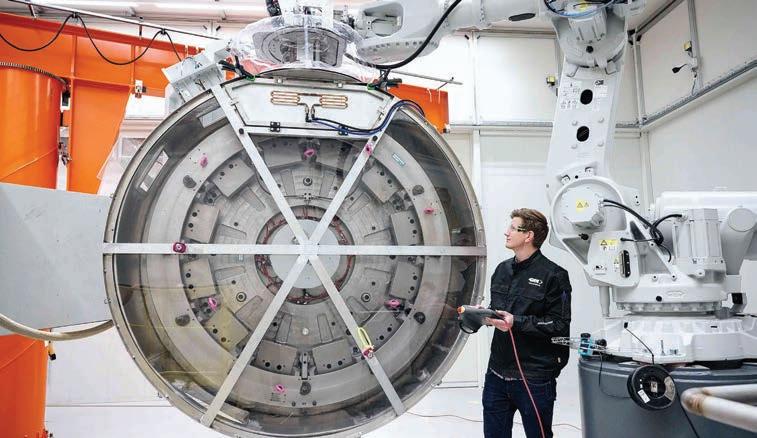
Materiel Administration awarded the company a $16 million contract to develop a technology demonstrator, including a turbojet engine, for a potential new family of drones.
In civil aerospace manufacturing, Dilnot said European companies are struggling to maintain competitiveness due to rising labor and energy costs. He sees a shift in work toward India, while adding that complex geopolitical tensions now make it less likely that Western companies will move further production there.
Nonetheless, Dilnot added that the longterm growth potential for air transport in China has vindicated GKN’s investment in its joint venture with local airframers Comac and Avic. This supports production of items including wiring and transparencies for Boeing airliners, as well as the horizontal stabilizer for Comac’s C909 and parts for the C919.
Meanwhile, GKN is backing the engineering teams at its four Global Technology Centers to achieve advances in additive manufacturing that could replace metal forgings and castings—the availability of which Dilnot said has “become a fundamental supply-chain issue.”
Since Spirit AeroSystems was broken up late last year, with some sites going to Boeing and others to its rival Airbus, GKN now claims to
be the world’s largest independent aerostructures business. It is targeting a 50% increase in incremental profits from additive manufacturing by 2029.
In June, GKN finished its work on the H2Gear hydrogen propulsion research and development program to explore options for next-generation regional airliners. While the work highlighted obstacles such as establishing acceptable permeability limits for hydrogen fuel tanks, Dunn indicated that GKN intends to continue efforts to bring cryogenic power distribution and propulsion systems to market in aerospace and other industries such as wind turbine energy production.
GKN is also advancing e ff orts to make hydrogen propulsion viable for commercial air transport through further collaboration with Airbus on cryogenic power distribution via the H2FlyGHT and ICEFlight programs. These are being conducted in tandem with its electrical wiring and interconnection systems business in the Netherlands.
Despite the renewed focus on military opportunities, GKN’s portfolio still favors civil markets. Civil work accounted for about 68% of the airframes division, which generated nearly £2 billion ($2.6 billion) in 2025, and roughly 78% of the engines division, which generated about £1.6 billion. z
By Hanneke Weitering, Scott Hamilton, and Bjorn Fehrm
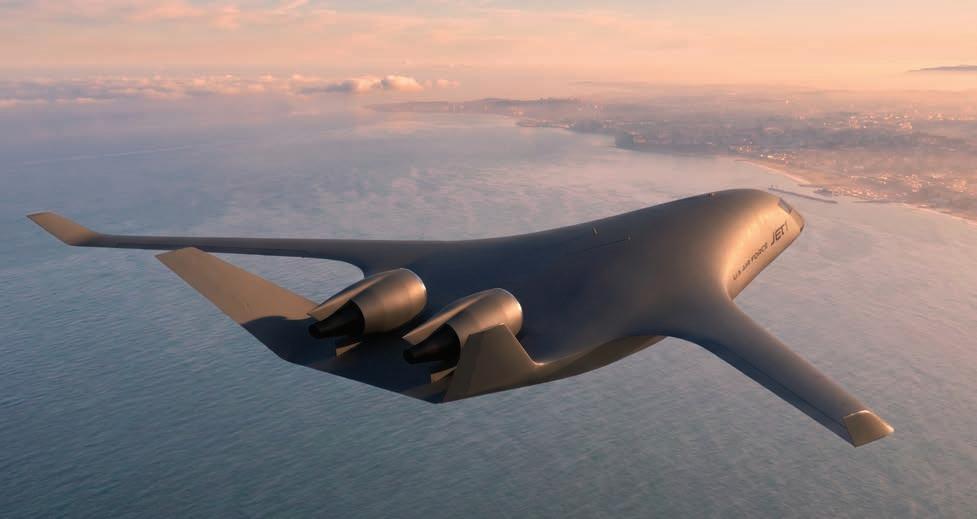
The Z4 blended-wing-body airliner that JetZero is pitching at Farnborough is not the airplane the industry has been watching for the past few years. It is bigger, heavier, sports a new V-tail—and still has no engine.
Weeks before the show, the California start-up revealed a major redesign of its Z4 aircraft. The tailless configuration in the company’s early renderings has been replaced by a V-tail that surrounds the engines on a longer, wider airframe. Fuselage length has grown from 33 to 38 meters, and the wingspan has stretched from 175 to 200 feet (54 to 61 meters).
Those changes addressed a fundamental control problem with the original Z4 design. Lacking a dedicated tailplane for pitch or yaw, the original design relied on winglets and small vertical surfaces—an arrangement without enough pitch control to raise the nose for takeo ff , and one that would have struggled to keep the airplane flying straight if an engine failed. Such shortfalls likely
A distinct V-tail now surrounds the engines on JetZero’s updated blendedwing-body design.
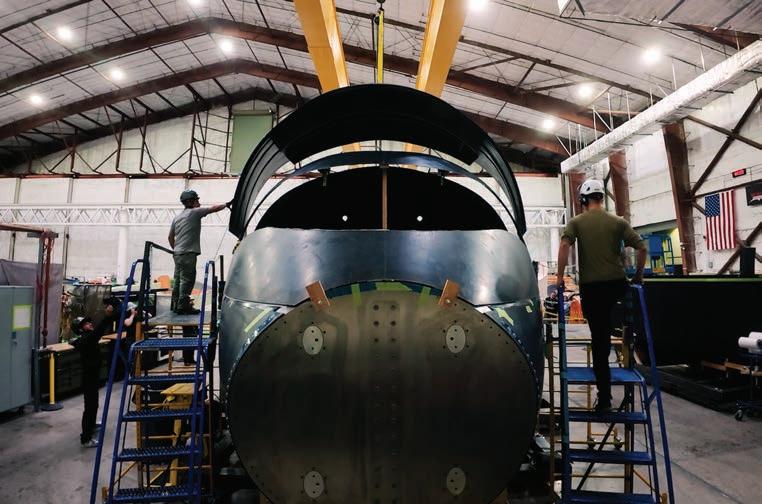
The first full-scale demonstrator is expected to fly in late 2027.
would have kept the airplane from passing FAA Part 25 certification flight tests.
V-tailplanes solve the control problem, but at a cost: the longer airframe has 20% more surface area exposed to the airstream—1,630 sq m in all—and all that extra so-called “wetted area” means more friction with the air, the main source of drag on an aircraft this size.
A larger airframe is also a heavier one. Leeham News and Analysis (LNA), using its Aircraft Performance and Cost Model, puts the redesigned Z4’s operational empty weight at 75 tonnes, up from a previous estimate of 71 tonnes, with maximum takeoff weight rising 4% to 138 tonnes. Passenger capacity is unchanged at 250 seats in a two-class U.S. domestic layout, as is the 5,000-nm range.
JetZero maintains that the “all-wing” shape, in which the entire body produces lift, will cut fuel burn by up to 50% compared with conventional tube-and-wing jets.
What the Z4 still lacks is a production engine—and none exists off the shelf in the
45,000- to 50,000-pound thrust class that the redesigned airplane requires.
The full-size demonstrator now in assembly will fly with 1970s-technology Pratt & Whitney PW2040 turbofans, the engine that powers the Boeing 757 and, in a 40,300-pound-thrust variant, the U.S. Air Force’s C-17 transport. JetZero co-founder and CEO Tom O’Leary said the combustor and other key elements of the PW2040 could be replaced to modernize it, but the company increasingly recognizes that a half-century-old engine core is less than ideal for a 21st-century commercial airplane.
Obvious modern candidates fall short. CFM’s Leap, which powers the Airbus A320neo and Boeing 737 Max families, reached its growth limit in the mid-30,000-pound thrust class. Pratt & Whitney’s geared turbofan architecture can scale beyond 100,000 pounds of thrust, but the company is not known to be working on anything that meets the Z4’s requirements.
Modern high-bypass engines, such as the 15:1-bypass-ratio design running as a technology demonstrator in Rolls-Royce’s UltraFan
program, lose thrust rapidly with forward speed and altitude. LNA’s modeling shows the updated Z4 needs 19,000 pounds of thrust per engine at 35,000 feet and Mach 0.8, which at a 15:1 bypass ratio translates to 48,000 pounds of static thrust, more than the 43,000 pounds of the demonstrator’s engines.
Rather than attempt to drive a clean-sheet engine program on its own—muscle a start-up simply doesn’t have—JetZero has hitched its engine strategy to the U.S. Air Force, which needs replacement powerplants for its C-17 fleet. The service is preparing to issue a request for information by year-end, and GE Aerospace, Pratt & Whitney, and Rolls-Royce are expected to respond. An engine that meets the C-17 requirement could power JetZero’s proposed aerial refueling tanker and, in turn, the cargo and passenger versions of the Z4.
“Our goal was to also set a partnership with them and to say, what do you have to bring to bear in this thrust class, because that’s the thrust class that we believe not only hits the middle market but hits that Swiss Army knife potential where you can be a freighter, a jetliner, and a tanker,” O’Leary said at a June 26 media briefing.
“Marrying and mapping engine to airframe is among, if not the most challenging thing that you can do, because it’s where everything comes together,” he added. “It’s
where lift, weight, drag, and thrust all meet.”
JetZero is targeting Z4 entry into passenger service in 2031 or 2032, but history suggests a brand-new engine takes at least seven years from program launch to service—often preceded by years of research before launch.
The PW2040-powered demonstrator, now about half-built at Northrop Grumman subsidiary Scaled Composites in Mojave, California, is expected to fly in late 2027, having cleared its critical design review in May 2025. The first production flight-test airplane, designated T1, isn’t due to fly until mid-2030.There will be five flight-test airplanes and two additional units dedicated to static tests. A subscale pathfinder model has been flying from Edwards Air Force Base since 2024.
“We want to have the most rigorous process possible,” O’Leary said. “The Air Force is leading that because they’re showing how serious they are about not just having a re-engine for the C-17 but having versatility.”
While the engine question plays out, JetZero is pouring concrete. On June 15, the company broke ground on its first factory: an 8-millionsq-ft plant at Piedmont Triad International Airport in Greensboro, North Carolina, where it plans to invest $4.7 billion and create more than 14,500 jobs over the next decade. State
officials called it the largest economic development commitment in North Carolina history, backed by what the company described as the largest state incentive package ever offered to a start-up.
Committing to large-scale manufacturing before flying a full-scale airplane is an unusual sequence. “We had to be able to compress timelines—time is money,” O’Leary told AIN at the groundbreaking. “As a venture-backed start-up, investors want to see you accelerating that time frame.”
Standing up the factory in parallel with flight testing, he said, lets the company push design, production engineering, and the manufacturing site forward all at once rather than in sequence, aided by digital twins of both the aircraft and the factory.
The plant’s design—developed with help from Siemens and Deloitte, and running on Nvidia and Amazon Web Services infrastructure—simulates how machines, people, and materials move through the facility before the building is constructed.
FAA deputy administrator Chris Rocheleau, who attended the groundbreaking ceremony, said the agency is already working with JetZero toward a type certificate and, eventually, a production certificate for the Z4 and the Greensboro factory.
Three major U.S. carriers have lined up behind the Z4 program. United Airlines invested in 2025 and signed a conditional agreement to buy as many as 100 Z4s, with options for 100 more, contingent on the demonstrator flying in 2027 and the airplane meeting the airline’s requirements.
Alaska Airlines was the program’s first airline investor, and Delta Air Lines is contributing operational and cabin-design input. JetZero has raised more than $1 billion and has said it may seek government loans to carry the Z4 to market.
The Air Force awarded JetZero a $235 million contract in 2023 to build and fly the demonstrator, but officials have said the Z4 has no inside track in any future tanker or airlift competition, and the latest federal budget request included no additional money for the program. For now, JetZero is building the factory, the demonstrator, and the order book all at once; the engine will have to catch up. z
By Charles Alcock
Almost half of the U.S. states have descended on the Farnborough International Airshow, vying for new customers, partners, and investors. The strong presence comes at a time when some see America’s position in the global aerospace sector as being in flux due to shifting geopolitical tectonic plates, prompted in part by the Trump Administration’s propensity to disrupt established assumptions about trade and defense alliances.
However, exhibitors in the USA Partnership Pavilion are largely pressing a narrative of continuity, emphasizing the industrial ecosystems they say make their states ripe with opportunity for aerospace companies. The consensus among state officials interviewed by AIN ahead of the show is that there is little they can do to temper contentious federal government policies, such as tariffs, so their focus is on value propositions close to home.
At the heart of the Wright Brothers’ origin story, the JobsOhio economic development corporation is emphasizing how it believes aerospace ventures can quickly and affordably scale up in the state. CEO J.P. Nauseef pointed to companies including Sierra Nevada Corp., Joby Aviation, and Hartzell Propeller that have upgraded their presence in Ohio with expanded facilities and payrolls since the Paris Air Show in 2025.
Aircraft modification specialist Sierra Nevada is, Nauseef explained, “the first new company to bend aviation metal” in the state since World War II. He sees the company’s $100 million investment in Ohio as vindication of efforts to shape agreements around each company’s specific needs.
Another example is Joby’s decision to acquire a second facility in the Dayton area after starting production of propeller blades for its eVTOL aircraft. Nauseef told AIN that Ohio hadn’t been on Joby’s shortlist at first, until a concerted pitch prompted a rethink. That relationship is now drawing
kindred spirits to the National Advanced Air Mobility Center o f Excellence.
“[Our approach] is more sophisticated than writing incentive checks, and every deal is unique to the client,” Nauseef explained. The deals “cover staff and resources such as power and water that we can curate. The more strategic the deal, the longer it takes to come to fruition.”
On Monday, JobsOhio is hosting a conference session called Vision to Velocity on advanced air mobility, with speakers including senior executives from Joby, Electra, and Eve, as well as FAA Deputy Administrator Chris Rocheleau. Another Farnborough show event on Tuesday will focus on efforts to boost U.S. defense production, featuring Linden Blue, the CEO of General Atomics’ Aeronautical Systems subsidiary, and GE Aerospace Defense & Systems president and CEO Amy Gowder.
North Carolina’s 400-strong roster of aerospace and defense firms already includes marquee names such as Boeing, Collins, Honeywell, GE, Pratt & Whitney, and Lockheed Martin. More recently, it has attracted JetZero, which plans to build its Z4 blended-wing-body airliner at Piedmont Triad International Airport in Greensboro.
The state has also had success attracting international companies, including the Irish division of component maker Eaton, German ground support specialist Goldhofer, and Samsung’s battery business. According to North Carolina’s Economic Development Partnership, a strong array of universities and colleges boosts the availability of skilled personnel, while international airports and deep seaports are a logistical boon.
Farther west, the aerospace and defense sector is now Oklahoma’s fastest-growing industry. According to the state’s Aerospace Commerce Economic Services agency, it achieved a threefold increase in new capital investment during 2025, attracting $450 million from 37 new or expanding businesses and netting 1,325 additional jobs. For example, Dawn Aerospace— with dual Dutch and New Zealand origins—has moved into the Oklahoma Air and Space Port with its Mk-II Aurora spaceplane program.
The Farnborough roll call of states runs coast to coast and includes Alabama, Arizona, Arkansas, California, Colorado, Connecticut, Illinois, Iowa, Mississippi, Missouri, New Hampshire, North Dakota, Oregon, Texas, Utah, Virginia, Washington, and West Virginia, among others. Altogether, almost 150 individual companies occupy the stands organized by Kallman Worldwide, which runs the USA Partnership Pavilion.

By Charles Alcock
The disparate imperatives to field hypersonic missiles and to support allies and partners such as Poland and Ukraine with mission readiness are prime examples of the immense challenges facing the UK military. Both are projects in which engineering and support specialist Amentum is partnered with the country’s Ministry of Defence (MOD) as it strives to meet both short- and longer-term objectives such as sovereign capability and supply-chain resilience as part of a fundamental reboot of its defense technology priorities.
In the first instance, Amentum is providing project management capacity that Amentum vice president for UK defense Justin Goldberg said is beyond the MOD’s internal resources. As the industry mission partner on the £1 billion Hypersonic Technologies and Capability Development Framework, the company provides engineering, program management, and technical integration expertise. That work falls under AUKUS, the trilateral security partnership that includes the U.S. and Australia.
As a “project delivery partner,” Amentum deploys engineers to develop early designs
for future systems, defining the scope of work that is then contracted out. The company then helps officials hold those manufacturers to account for meeting project objectives.
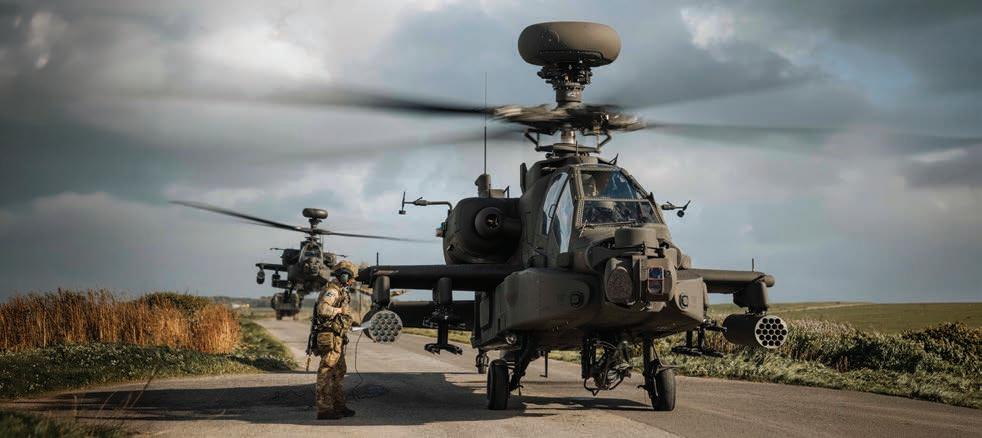
Cost control is part of the remit, with governments like that of the UK under great pressure to raise defense spending while minimizing the impact on other public services. “For example, when the MOD was negotiating the next tranche of the [Boeing] Apache helicopter program, we helped them to save over £200 million ($264 million) on support costs over a 30-year period,” Goldberg said, explaining Amentum’s role as something of a “bad cop” alongside defense officials in negotiations with suppliers.
According to Illy Andrews, Amentum’s vice president for defense and asset solutions, the company serves as a technology-agnostic solutions provider. “We have supported some of the UK’s most critical and complex defense programs, including those classified as ‘for UK eyes only,’ and have created around £2 billion in savings,” she told AIN.
In addition to introducing military technology into service and supporting existing
Amentum says it helped the UK’s Ministry of Defence achieve around $264 million in savings on support costs in negotiations for Boeing Apache AH64-e attack helicopters.
aircraft such as the UK’s F-35 fighters, Amentum’s work extends to the logistics needed to ensure defensive readiness and resilience against threats such as those posed by Russia along NATO’s eastern flank. The company has supplied materials and repaired damaged equipment for Ukraine’s military through a remote distribution center in southeast Poland.
Andrews told AIN that Amentum’s logistics specialists are helping partners to move beyond the standard “just-in-time” approach. Working with partners including GXO, Maersk, and Accenture, Amentum has formed the Torus Defence Supply Chain alliance to better respond to the need to deliver military hardware and materials when needed and to scale up supply lines.
“We are trying to look ahead to how we can better manage supply disruption [resulting from conflicts], using technology such as a digital backbone and artificial intelligence,” she explained. “We are very focused on deterrence but also resilience in the sense of if something [adverse] happens, what does recovery look like, and there are certainly lessons from Ukraine here.”
Though Amentum is U.S.-based, its UK operation is mindful of the need for the country to have independent, sovereign capability that does not hinge on U.S. government approval. Backing up its commitment to autonomy, the company employs more than 6,000 people, more than 500 of them former British service personnel, and plans to add a further 3,000 over the next four years. z



By Kerry Lynch
While the supply chain has turned a corner from the early post-Covid days, struggles remain. Driving this is unprecedented surging demand across the aerospace spectrum, from airlines to the global defense sector. AIN brought together thought leaders in the supply chain and broader market to share insights on how the industry is working to meet that demand. Here are highlights from those discussions. FDH Aero sponsored this roundtable.
MATT LACKI The supply chain is still certainly strained post-Covid, and now there’s increasing demand with increasing build rates. Many of the large OEMs [original equipment manufacturers] have all-time-high backlogs, which is leading to all-time-high production. This leads to an all-time-high demand for the parts that we generally distribute, both on the hardware side and on the electronics side. Certainly, air travel has grown significantly post-Covid, and that obviously is putting a strain on the aftermarket. It feels like the aftermarket has recovered somewhat, but on the OEM side, there’s still a lot of shortages.
Ž ILVINAS LAPINSKAS Demand for MRO services is growing, the market is growing, and more airplanes are coming. Of course, we feel that growing demand, and it has influenced supply chain shortages, influenced our TAT [turnaround time]. On the OEM side, we still feel that they are lagging in recovering after Covid. We can find parts in the aftermarket.
Problems with the delivery of new airplanes from Boeing and Airbus, and then GTF [Geared Turbofan] engines problems from Pratt & Whitney, are also influencing [the situation].
MIKE STENGEL There’s certainly no shortage of demand for new aircraft and new engines, and this is probably one of the first times in the history of the industry where we are supply-constrained rather than demand-constrained. Matt and Žilvinas mentioned the growing backlogs already— approaching a decade for a narrowbody.
Even the widebody market, which had been taking the longest to recover during Covid, had a banner year last year in terms of orders… and so now you could see the widebody market starting to show traits of what narrowbodies have shown for several years now. Backlogs
are lengthening further, and the OEMs are getting into a similar situation where they can’t deliver fast enough to keep up with demand.
MATT LACKI With many parts, especially on the fastener side, it feels like they’re made on machines that are 50 years old, so the expertise required to operate those machines has been built over decades. Many of those people retired or left post-Covid, and there’s definitely a massive gap in terms of manufacturing expertise and talent.
Some of the other gaps involve certain raw materials, and then certain factories have just really struggled with certain parts—fittings come to mind.
ŽILVINAS LAPINSKAS After Covid, I would say from 2022, there were two hot topics in the aviation industry, especially in MRO: the supply chain and the lack of manpower. In 2026, four years past, we have the same topics: supply chain and lack of [maintenance] engineers. The only way for us to keep and grow our business is to have more engineers. We’re trying to attract the young generation to come into the aviation maintenance business.
MIKE STENGEL As for other bottlenecks, engines are number one in our book, just with the complexity of the manufacturing. There are some critical processes, like forgings, where we still need more investment into capacity to meet future build rates. That’s on top of aftermarket requirements. We do see some positive signs, like Pratt & Whitney is investing in their Columbus, Georgia site with new forging capacity. There still needs to be more.
The other one that may surprise a lot of people is interiors on the new-build side with widebody production coming back. Widebodies tend to have more custom and bespoke interiors. Customization and bespoke are the enemies of supply chains, where you have less consistent runs. That means some deliveries of aircraft and certification of interiors have been delayed.
You hear stories about Delta taking delivery of a bunch of [Airbus] A321neos that were meant to go into a transcon fleet with a more premium configuration and new Delta One seats. They were sitting in the desert and were actually being reconfigured into a domestic configuration just so Delta could fly them. They don’t expect the new premium configuration to be certified until next year or the following year. It’s not an ideal outcome that they have to wait for those premium seats to come to the market.
MIKE STENGEL I think the OEMs and people in the higher tiers of the supply chain are slowly recognizing that it’s not the same supply chain as from 20 or 30 years ago, where they may have had their pick of the litter. All tides are rising regardless of the end market, which means suppliers deeper in the supply chain have a wider variety of options and markets to serve.
It’s almost like the higher you are on the supply chain, the more you have to be a customer of choice. They’re looking at their commercial terms like payment terms. Some are even going as far as to establish take-or-pay agreements. Traditionally, most long-term agreements in aerospace will guarantee a price and market share, but not volume. But now, a take-or-pay agreement would have a volume guarantee. You’re paid regardless of the outcome, just to secure the capacity.
MATT LACKI There’s certainly been a flurry of [mergers and acquisitions] on the manufacturer side, especially on the fasteners part of the business. We’ve also seen some people invest in capacity, and we’ve seen new sources develop around the world—such as in India and China.
Some of the part manufacturers are increasing capacity. But you can build all the machines you want; you just don’t have the labor to keep up with them.
ŽILVINAS LAPINSKAS We see that OEMs are building new factories, but…it will take some time. You can build the building, you can buy the machines, but then you have to get the people, train them, and get the approval. You have to wait for the regulator to come to do the audit.
These are not fast decisions, and it influences our ability to provide the service on time. As an example, we were waiting for some parts from brake producers during the high season last summer. We’re very strong in the wheels and brakes business, but we could not deliver the brakes on time to our customer, because those parts were not arriving.
Some brakes were removed from airplanes parked because of the GTF engine problems. So, we removed the brakes and used them in the existing fleet that is flying, because the other aircraft are waiting for the engines to come back from the shop. You have to be very creative in this kind of environment.
ŽILVINAS LAPINSKAS Some of the players call the situation a perfect storm. Mature aircraft are in big demand, because newer planes
are late and then these problems with engines. It means that the mature aircraft have to fly. And sometimes, the decisions made on this don’t look logical because six years ago, the decisions would have been different. For the MRO, it’s a really good cycle.
MIKE STENGEL Despite the constraints and challenges in the supply chain, I’d say overall a positive long-term outlook for the industry, whether you’re looking at commercial transport, military, or business aviation. We remain on the more optimistic side for the state of the industry and the outlook, and we just need to push through some of these bottlenecks.
MATT LACKI There’s more demand than there is supply, and that creates a lot of interesting challenges. There’s also a lot of geopolitical challenges that have occurred in the last 18 months and other challenges, but it also creates a lot of opportunities. It’s an exciting time in the industry if you can solve problems, be flexible, and move quickly.
I think our ability to put people around the world to provide solutions around the world is unique—it fits this particular time period well. It’s certainly a challenging time; there’s nobody I talk to who doesn’t have a mountain of emails, calls, and meetings. We want to make it easier for our customers to do business in perhaps the most highly complex industry in the world. By anticipating our customers’ needs and combining our global reach with local expertise, we can turn these current industry challenges into real opportunities. It’s a very exciting time in aerospace. z
By Charlotte Bailey
Jamming and spoofing have made global navigation satellite system (GNSS) signals less dependable, and Honeywell Aerospace is answering with an expanding menu of alternatives. At a recent JamFest demonstration event in Barcelona, Spain, the Phoenix-based company showcased smaller-form, unlicensed products—spanning radar velocity, visual, and low-earth-orbit (LEO) navigation—that build on its inertial navigation systems (INS) expertise.
“There’s no one silver bullet with alternative navigation modalities,” explained Darren Fisher, a founding member of Honeywell’s HGuide navigation business unit. The world has “really sat up and noticed” the effect of deliberate spoofing or jamming on traditional GNSS signals over the past five years, Fisher said, making it useful to mix navigation methods and give customers “an à la carte approach” based on mission requirements. That flexibility matters because each method carries limitations tied to terrain, weather, and size or weight.
Much of the technology on display at the fourth annual JamFest last month was scaled toward smaller drones, but it could evolve to fit other aircraft. This includes Honeywell’s proprietary ground control station (GCS), through which an operator can oversee multiple drones. “When we’re designing the technology, the foundation is agnostic to the segment, and that’s the biggest benefit,” explained Tomas Szaszi, senior director of technology and strategy. “When the application comes—be it commercial or defense— then we start to tweak that foundation into something very specific.”
The internet-connected GCS terminal is designed to improve efficiency and autonomy. After filing a flight plan, an operator oversees a drone along its pre-programmed trajectory, with the system set to flag events such as sudden airspace closures, restrictions, or intruder drones. Operators can also hand control to other remote GCS units, either deliberately or automatically if a system outage occurs. “The system is set up to be certified, and
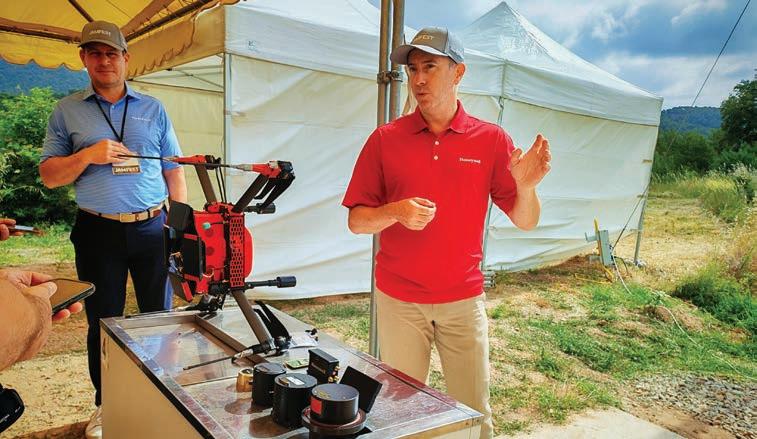
that’s our mission today,” said Martin Miehling, Honeywell’s European account manager for UAM and UAS. A commercially available beta version is already in customers’ hands, and Honeywell is “evolving and adding functionality” to it.
However, whether for drone or potential future eVTOL applications, the GCS’ ability to accurately pinpoint an aircraft’s position is crucial. One trick up Honeywell’s sleeve is its Radar Velocity System, which uses radar panels to measure velocity and supplement inertial navigation. Now in its second iteration after about two years on the market, the scalable system is designed primarily for “smaller, lighter, and much more attritable platforms,” Honeywell said.
Four updated radar boards drawing more power have extended the system’s range from 300 to 1,000 meters and added a waterproof connection. They connect to a Honeywell INS/GNSS box about the size of a credit card, which removes the need for heavier, more expensive sensors. Overall, the team expects a three- or four-meter margin of error over a three-kilometer flight.
Another alternative under consideration for smaller drones is the use of LEO satellites. A signal from a GNSS satellite in medium
earth orbit can be susceptible to intentional or accidental jamming, but a LEO signal is much stronger by the time it reaches the ground. “If someone would want to jam that signal, they would need to pump a lot more radio frequency into the atmosphere, and as that’s more challenging to do, the signal becomes more resilient,” Fisher explained.
Complementing this is what Honeywell describes as a unique approach to visual-aided navigation, in which an infrared signal from a camera is mapped and matched to a known daytime image. The end user loads a reference map—typically from a public source—and the system overlays the drone’s live pixel feed onto it to confirm position. Mission-planning software can also build key navigation features into a drone’s flight plan.
These capabilities, Fisher said, let users move from optimal conditions—albeit within a GNSS-denied environment—to nighttime or other challenging situations. If no map is available, or the drone is crossing repetitive terrain such as dense forest or featureless desert, the system can switch back to radar velocity. Its a “tightly coupled structure,” which uses direct signals, “gives us more flexibility when satellite ability drops down, and we’re not reliant on a minimum satellite count for navigation,” he explained. z
By Charles Alcock
Radia has added more partners to its network of suppliers as it steps up work on its planned WindRunner supersized cargo aircraft. On July 7, the start-up announced agreements with European aerospace groups Latécoère and Stirling Dynamics.
These companies join a list of program partners that already includes Italian aerospace giant Leonardo, Aernnova, and Astronautics Corporation of America, among others. The WindRunner is expected to be around 10 times larger than the Boeing 777. Using existing technology is the key to Radia’s target of achieving FAA Part 25 type certification in 2030.
France’s Latécoère will develop the electrical wiring interconnection system for the WindRunner. UK-based Stirling Dynamics has agreed to
support Radia with work on flight control integration, simulation, and aircraft engineering.
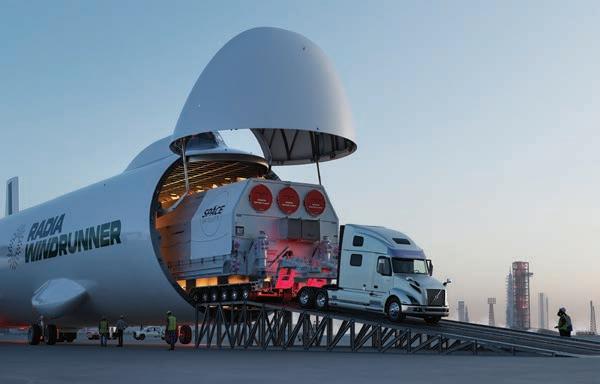
According to Radia, the WindRunner will provide a step change in commercial and defense logistics, with prospective applications including the transport of wind turbine blades, rocket boosters, and military aircraft. It is expected to replace aircraft such as Antonov heavy lifters and the C-5 and C-17 military transports while offering the operational flexibility of a C-130, with the ability to land on unprepared strips no longer than 1,800 meters (5,900 feet).
The four-engine model, with the same wingspan as an Airbus A380, is expected to offer a payload limit of 160,000 pounds. However, what sets the WindRunner apart is its vast volume of 240,000 cubic feet—enough space for four F-16 fighters or six Chinook helicopters.
General Atomics AeroTec Systems (GA-ATS) has brought its new Do228 NXT special missions demonstrator aircraft to the Farnborough show weeks after rolling out the refitted
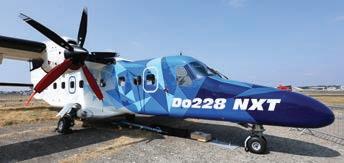
airframe at the ILA Berlin show in June. In a major upgrade to the 1980s-era twin turboprop, the NXT features a new cabin and cockpit and gives prospective customers multiple equipment options.
This particular Do228 is coming home to the UK. For more than 40 years, the Dornier model was in service with various operators in the country, including regional airlines and fishery patrols. Most recently, it was owned by hydrogen-electric propulsion innovator ZeroAvia as a test aircraft based at Cotswold Airport.
Last month, GA-ATS announced that it has
Radia’s supersized cargo aircraft will be roughly 10 times bigger than the Boeing 777 and will have space to carry up to four F-16s or six Chinook helicopters.
Radia’s engineering team has already completed initial wind tunnel tests and conceptual design. The company, which was founded in 2016, is giving itself until late 2029 to build what it says will be the first productionconforming aircraft for flight testing.
Founder and CEO Mark Lundstrom told AIN there is no need to build prototypes and that the path to type certification will be straightforward because it is using already in-service technology. “We have designed everything around products already available from Tier 1 suppliers, and so we are already at the industrialization stage,” he said.
Lundstrom said Radia is now targeting U.S. government defense funding to advance the program and may prioritize military approvals over commercial type certification. n
signed a contract with a launch customer for the NXT. It will be delivered to an undisclosed humanitarian group in early 2027.
GA-ATS holds the Do228 type certificate and o ers various modifications. The flight deck now features four Universal Avionics flat-panel displays, a digital autopilot, and a flight management system that supports satellite-based precision approaches.
Powered by a pair of 776-shp Honeywell TPE331-10 engines driving MTV-27 five-blade propellers, the aircraft has a range of up to 1,340 nm with an 1,100-pound payload. It operates up to a 25,000-foot ceiling and has a maximum cruise speed of 240 knots. C.A.
By Charles Alcock
CFM International has completed FAA and EASA certification of a high-pressure turbine (HPT) durability kit for the Leap 1B engine and expects these to be delivered with new production turbofans from early 2027. At a press briefing in London on Sunday, the manufacturer also reported that during the second half of this year, it expects to complete approval for a reverse bleed system (RBS).
According to Tom Levin, vice president for CFM commercial programs, the modifications are a key aspect of efforts to increase time on wing for Boeing 737 Max operators. The HPT kit is already installed on around 40% of the Leap 1A engines that power the rival Airbus A320 narrowbody, and 70% have the RBS.
Textron Aviation, working with Ariegsa Manufacturing, received an order to provide 10 Cessna Skyhawk 172s for the Egyptian Aviation Academy. Ariegsa is the prime contractor on the sale.
Scheduled for delivery in 2027, the aircraft will support the academy’s e ort to modernize its training capabilities for pilots across the Middle East and Africa. The single-engine four-seat, high-wing Skyhawk features Garmin G1000NXi avionics with wireless connectivity, a standard angle-ofattack display system, and a McCauley aluminum fixed-pitch propeller.
The Skyhawks join an Egyptian Aviation Academy fleet that also includes Cessna Citation Mustang, Beechcraft Baron, and Beechcraft Bonanza aircraft.
“The Cessna 172 provides cadets with the reliability, ease of flight, and advanced
Levin told reporters that these two improvements are responsible for delivering as much as 80% of the targeted improvement in engine durability. CFM expects the remainder to be delivered through other innovations, such as a foam wash process for the engines.
CFM joint venture partners Safran and GE Aerospace are making further investments to sustain increases in Leap production rates. In 2025, the OEM delivered more than 1,800 turbofans, representing 25% more than in 2024.
CFM president and CEO Gaël Méheust wants the company to sustain the improvements at a rate of 15% each year through 2029.
As part of the push to boost customer support, GE Aerospace has committed to $1 billion in

Ten Cessna Skyhawk 172s are bound for the Egyptian Aviation Academy in 2027.
avionics necessary to meet international aviation standards and prepare for successful careers in both civil and commercial aviation,” said Egyptian Aviation Academy chairman Ezzat Metwaly Ali.
Founded in 1932 and headquartered in 6th of October City in Giza, Egypt, Egyptian Aviation Academy is one of the oldest flight schools in the Middle East and Africa region. A government-owned organization, the academy is recognized by the International Civil Aviation Organization as a regional training center. K.L.
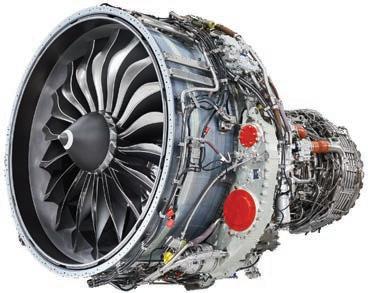
CFM delivered more than 1,800 Leap turbofans in 2025, a 25% increase over the previous year.
investments over five years, with Safran Aircraft Engines committed to a similar amount. Questioned about comments in June by IATA director general Willie Walsh accusing engine makers of MRO price gouging, Méheust said that CFM has purposely encouraged an open market for customer support with a growing network of independent providers.
The OEM has recently added new Premier MRO shops, including MTU Maintenance in Texas earlier this month, Iberia in Spain, and SSAMC in China. It no longer offers powerby-the-hour programs to airlines as a way to spread the cost of maintenance.
Five years on from launching its Revolutionary Innovation for Sustainable Engines (RISE) new-generation engine initiative to exploit open rotor technology, CFM reported that it has completed around 500 test campaigns covering features such as compact core modules and the hybrid-electric system that will serve as an engine starter while also stabilizing the operation of the engine’s two shafts. The group is now focused on mechanical and material tests on open-fan blades and outlet guide vanes, including impact, ingestion, fatigue, endurance, load, icing, and vibration response.
With the RISE preliminary design review now complete, CFM says it is on track to start ground tests with “representative-size equipment” before the end of the decade using a core engine of around the same dimensions as GE’s Passport business jet turbofan. Its long-term objective is to have a certifiable engine available from the mid-2030s, with production timing hinging on the still-unresolved questions of when and how Airbus and Boeing may bring next-generation narrowbodies to market. n
By Hanneke Weitering
Beta Technologies has brought two examples of its electric aircraft to this year’s Farnborough International Airshow: the piloted Alia CX300 electric airplane, which is taking part in the flying display, and the uncrewed, hybrid-electric Alia MV250 defense variant, which is parked in the static display.
The South Burlington, Vermont-based electric aircraft developer opened its doors to reporters on June 3 for a rare media day at its research and manufacturing facilities, where Beta founder and CEO Kyle Clark was candid about the company’s agenda: With roughly 300 seconds allotted for its flying display at Farnborough, he wanted the press to see the full scope of the operation before the show.
(CTOL) airplane to follow before the end of this year, and the Alia 250 vertical takeoff and landing (VTOL) variant about 12 months after that. Beta is developing the hybrid-electric MV250 in partnership with Near Earth Autonomy, with autonomous flight testing slated to begin this year.
“When we get to the VTOL, we burn down 80-plus percent of the risk of that final certification step,” Clark said, noting that the two aircraft share batteries, avionics, flight controls, and propulsion.
On the factory floor, the engineering for the CX300 is frozen, with seven airframes off the production line so far across both variants and a target of demonstrating a rate of 4.5 aircraft per month by the end of the year. Two to three FAA-conforming airplanes will support the flight-test campaign when type inspection
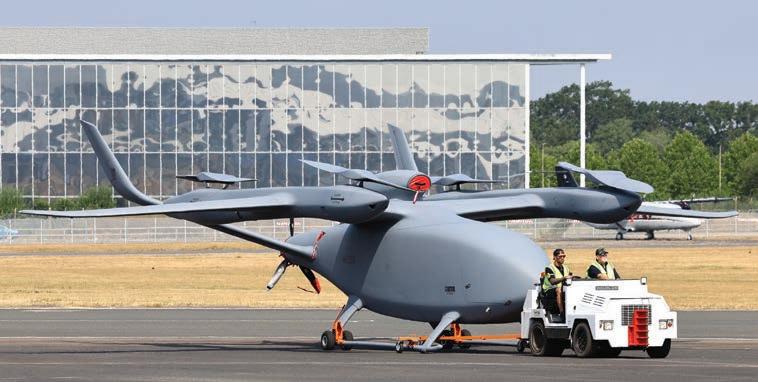
What visitors saw was a company methodically working down a stepwise certification strategy that Clark said tackles the technologies most novel to the FAA first. Beta certified its electric aircraft propeller—developed with Hartzell under Part 35—last year, clearing what Clark described as an entirely new class of propulsion.
The company is now closing in on certification of the H500A electric engine, with the CX300 conventional takeoff and landing
authorization testing begins later this year.
That certification progress underpins an international expansion that has accelerated over the past year. Beta has built charging infrastructure at 123 sites across the U.S. and Canada. Recent demonstrations in Sweden and Scotland showed the airplane’s ability to serve remote island and highland routes.
At home, U.S. regulators have handed Beta what Clark called a tailwind. On July 10, the
company flew the first operational mission under the FAA’s eVTOL Integration Pilot Program (eIPP), carrying manufactured organ products in development by launch customer United Therapeutics across a corridor of four airports in Virginia and Maryland. Two Alia CX300s flew the roughly 275-nm campaign in relay. Beta is participating in seven of the eight eIPP launch projects that the U.S. Department of Transportation and the FAA selected in March, the largest footprint of any electric aircraft developer in the program, which lets operators fly revenue missions before their aircraft complete type certification.
More eIPP operations are lined up. Beta is targeting a fall launch of commercial cargo service in Florida, where the state’s transportation department has agreed to buy 34 of Beta’s electric aircraft chargers and thermal management systems for 17 airports. Ahead of that launch, Beta ran an extended highcadence trial out of Orlando with Republic Airways, flying nine sorties a day to demonstrate dispatch reliability in hot, high-densityaltitude conditions.
Charging infrastructure is also drawing Beta into a rare collaboration with a rival. On July 16, Beta joined eVTOL developer Archer Aviation and Macquarie Capital to launch America’s Consortium for Electric Skyways (ACES), a plan to electrify up to 250 air taxi sites across California, Texas, Florida, and New York by 2030. Beta will supply charging hardware built on the Combined Charging Standard—the open standard endorsed by the General Aviation Manufacturers Association—so multiple operators can share the same sites, with Archer flying passenger air taxi missions and Beta’s customers handling cargo and medical transport.
The economics, Beta executives argued, are the point. Comparing the CX300 to a Cessna 208, the company put the electric airplane’s operating cost at roughly $450 per hour against $800 to $850 for the turbine-powered Caravan, with the eVTOL variant offering savings of about 75% over a comparable helicopter.
Customers appear to be buying the argument. Beta has reported an order backlog of approximately $3.9 billion across roughly 991 aircraft. The company, which went public in November 2025, reported first-quarter revenue of $10.1 million in May. n
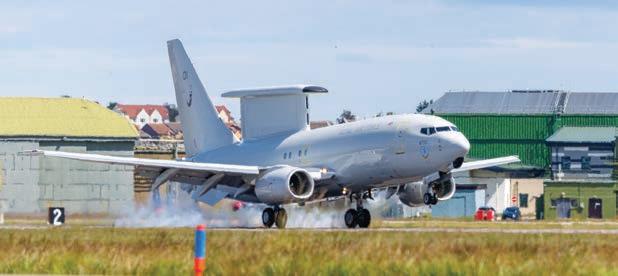
The UK’s second E-7 Wedgetail
AEW made its first functional flight from Birmingham Airport on July 15.
By Charlotte Bailey
Five years after the UK retired its last airborne early warning (AEW) aircraft, the RAF’s replacement is still working through “the final stages of ground and flight testing,” with Boeing Defence UK (BDUK) acknowledging that there is “obviously some work ahead” before the first E-7 Wedgetail AEW Mk1 enters service.
The modified Boeing 737 has flown just 10
test sorties since completing its missionization conversion at Birmingham’s STS Aviation Services in 2024, following a protracted test and evaluation process that included testing at RAF Boscombe Down. It remains unclear whether the aircraft’s Northrop Grumman radar—the core mission sensor the aircraft must demonstrate—has been tested in flight.
On July 15, Boeing Defence UK performed the first functional flight of the UK’s second
Safran Aircraft Engines has begun ground tests of its Phileas hybrid-electric propulsion demonstrator on open-air test stands at its Istres facility in southern France. The company announced the move on Friday, explaining that the technology could be used for a new generation of engines for short- and medium-range aircraft.
Phileas is a full-scale demonstrator that includes a pair of electric motors mounted on the powertrain’s high- and low-pressure shafts, which can directly drive the engine or serve as power generators. It also incorporates onboard power electronics and an electrical power distribution system.
Over six months, Safran will run nearly 300 hours of tests to validate the physical and functional integration of the technologies in conditions it says will be representa-
tive of real-world operations. The work is part of its decarbonization e orts along with the development of the open-fan engine and the expanded use of sustainable aviation fuels.
The tests will evaluate power extraction from and injection into the high- and low-pressure shafts under various engine operating conditions and during di erent phases of flight. They will include advanced power management scenarios such as balancing power extraction between the shafts, transferring power between the shafts, and managing power exchanges between the engine and the aircraft.
According to Safran, the Phileas project’s objectives align with those of the RISE (Revolutionary Innovation for Sustainable Engines) program, which it is pursuing through the CFM International joint venture with GE
Wedgetail at Birmingham Airport, where STS Aviation Services continues to work on the third airframe. On the same day, the National Armaments Director Group also awarded BDUK a sustainment contract worth $171.4 million (£127.5 million) for the future E-7 fleet. The program had previously targeted initial operational capability before the end of this year. Speaking to reporters ahead of the Farnborough International Airshow, Ben Kelsey, director of BDUK’s fixed-wing business, said flight trials would continue “over the coming months and then get into service in due course.”
Citing similarities between the E-7 and the P-8 Poseidon maritime patrol aircraft (itself a 737NG derivative) also based at Lossiemouth, BDUK managing director Thom Breckenridge said the company has added “a good number of additional engineers and test personnel” to the core team “to make sure we progress through that final round of flight testing as quickly as we can.”
Platform commonality is also expected to support what Kelsey called a “pretty mature solution” for sustaining the E-7 fleet. Around 200 team members and more than 100 UK suppliers have supported the UK’s P-8 program for the last five years. n
Aerospace. The RISE program aims to reduce carbon dioxide emissions by 20% compared with current aircraft engines.
The design of the electrical equipment for the Phileas demonstrator is being handled by the group’s Safran Electrical & Power business unit. Earlier work conducted under the DOPEE program in 2023 validated operations with 300-kilowatt electric propulsion motors in conjunction with the Silvercrest engine that Safran had developed for various business jets. C.A.
By Charlotte Bailey
“The global security environment is arguably more complex and volatile today than we have seen in many decades, and we are watching security threats evolve at breakneck pace,” according to UK Air Chief Marshal Harv Smyth.
Speaking at London’s 10th annual Global Air and Space Chiefs Conference on July 15, Smyth stated that similarly rapid multinational technological responses will prove key in countering these. “The rate of technological change, supercharged by leaps in digital capability, artificial intelligence, and autonomy, is—I would argue—our greatest challenge, but also our greatest advantage and opportunity,” he said.
Pointing to lessons learned from Ukraine and current operations in the Middle East, particularly Iran’s recent retaliation with long-range ballistic missiles, Smyth added that “there really isn’t sanctuary in the home
base anymore.” Acknowledging a “very broad range of threats, from tiny drones…right up to hypersonics, ballistic missiles, cruise missiles,” he said that “it’s very clear that we have to accelerate in a more meaningful way into AI, into autonomy, and where those capabilities can take us: they bring us affordable mass, and they bring us much better lethality.”
Minister for Defence Readiness and Industry Luke Pollard underscored that push at the conference, revealing the name of the Royal Air Force’s uncrewed Collaborative Combat Aircraft program: Storm Fighter, an autonomous “loyal wingman” designed to fly alongside the Typhoon, F-35, and future Tempest.
Alongside technological sovereign advancement comes a greater need for both national and international integration. Smyth explained how the UK’s recently
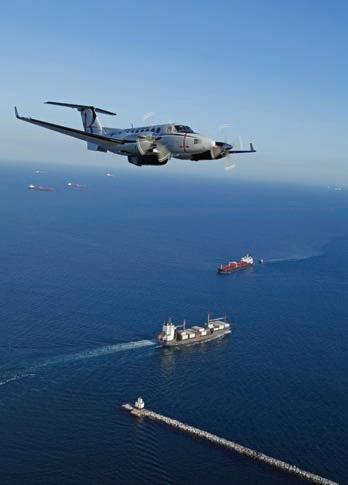
Textron Aviation has handed over a new Beechcraft King Air 360ER to the Armed Forces of Malta. The U.S. airframer delivered the aircraft to Aerodata AG in Braunschweig, Germany, where it will be outfitted with maritime patrol systems. It is due to be ready for operations next year.
Malta’s small air wing is based at Malta International Airport at the former RAF base in Luqa. The primary roles are support of army forces, maritime surveillance, border control, search and rescue, and law enforcement. The current fleet comprises three Leonardo
published Strategic Defence Review perceives air and space power as “critical and integral parts of a much broader system,” with the integrated force “a transition from traditional siloed joint military branches to a fully integrated lethal and agile structure” designed to “continuously evolve at a wartime pace.” While Smyth admitted this “does blur the lines between some of the services,” his respective chief-of-staff counterparts—participating in the same panel—were in unanimous agreement as to the relevance of increased crossservice collaboration.
Streamlining and coordinating national sovereign capabilities is far from the end answer, added Lt. Gen. Jamie Speiser-Blanchet, commander of the Royal Canadian Air Force. With the global security landscape “being reshaped by forces that are moving at unprecedented speed,” this also “reflects the realization that defending our airspace can no longer rely solely on our traditional warning and control constructs designed for traditional high-end threats,” she said. And with the proliferation of advanced threats ranging from uncrewed aerial systems to hypersonic weapons, “we could see integration not simply as a force multiplier, but potentially as the capability itself,” she said. n
AW139 helicopters (with another on order), an aging Britten-Norman BN-2 Islander, and three King Air 200s.
The latter have been in service since 2011 and were similarly tailored for maritime surveillance by Aerodata prior to service entry, including installation of a Telephonics RDR-1700B search radar. One of them was exhibited at the Farnborough Airshow in 2012.
Powered by PT6A-60A engines and outfitted with Collins Aerospace Pro Line Fusion avionics, the new King Air 360ER o ers improved surveillance capabilities and mission range/endurance. The extra capacity it brings to the air wing will aid Malta at a time when people-smuggling across the Mediterranean is at a high level. D.D.
By Kerry Lynch
Technology company ePropelled has unveiled a high-performance integrated propulsion system, the Skylark series, for light- and medium-duty drones. Launched during the Farnborough International Airshow this week, Skylark is designed to meet the growing demand for modular drone platforms and simple assembly, according to ePropelled.
The series combines motor and controller components into a single unit, enabling more efficient integration. This also reduces assembly times, the amount of wiring, and the number of connections required for production.
Manufacturers will be able to decrease build time per aircraft and improve repeatability at scale with the design, ePropelled added.
“We are seeing a clear shift toward the need to scale production of more capable UAV [uncrewed aerial vehicles] without compromising reliability, performance, and mission effectiveness,” said Dean Marcarelli, chief commercial officer of ePropelled. “Skylark has been engineered specifically to meet
those requirements, delivering ePropelled’s renowned power, endurance, and integrated control solutions in a compact unit for efficient and fast assembly.”
Skylark is part of ePropelled’s Unified Architecture, which launched globally this week and brings together motors, controllers, starter generators, intelligent power systems, and connected software into a single platform for system-level propulsion management across uncrewed air, land, and sea applications.
Central to this launch is ePLink, an onboard device that enables interaction with propulsion systems across development, manufacturing, and operational environments. The platform is designed to facilitate software updates, system configurations, diagnostics, and data exchange between systems and cloud-based programs.
“We are moving from static hardware to propulsion systems that can evolve over time,” Marcarelli said. “With ePLink and our Unified Architecture, customers can unlock new capabilities through firmware, improve performance continuously, and simplify how systems are configured, deployed, and maintained.” n

JAMES HOLAHAN (1921-2015), FOUNDING EDITOR
WILSON S. LEACH, FOUNDER & CHAIR EMERITUS
EDITOR-IN-CHIEF – Matt Thurber
MANAGING EDITOR – Charles Alcock
PRESS ROOM EDITOR – Hanneke Weitering
THE EDITORIAL TEAM - Charlotte Bailey, David Donald, Curt Epstein, Kerry Lynch, Jessica Reed
PRODUCTION MANAGER – Martha Jercinovich
GRAPHIC DESIGNERS – Alena Korenkov, Grzegorz Rzekos
PHOTOGRAPHER – David McIntosh
DIRECTOR OF VIDEO – Ian Whelan
EXECUTIVE CHAIR – Dave Leach
PRESIDENT – Ruben Kempeneer
HEAD OF PEOPLE & BRAND – Jennifer Leach English
SENIOR DIRECTOR EVENTS – Nancy O’Brien
ADVERTISING SALES
Victoria Tod – Northeastern U.S./Eastern Canada/United Kingdom, +1 (203) 733-4184
Michelle James – Western U.S./Western Canada, +1 (520) 343-0236
Joe Rosone – Midwestern U.S., Southeastern U.S./Caribbean/ Brazil, +1 (301) 693-4687
Diana Scogna – Europe/Middle East, +33 6 62 52 25 47
DIRECTOR MARKETING AND CLIENT SERVICES – Lisa Valladares
AUDIENCE DEVELOPMENT DIRECTOR – Eileen Silberfeld
SENIOR MARKETING SPECIALIST – Alyssa Barry
EVENTS SPECIALIST – Brien O’Brien
SOCIAL MEDIA MARKETING – Zach O’Brien
SALES ADMINISTRATOR – Cindy Nesline
FINANCE & HR DIRECTOR – Tracy Britton
ACCOUNTS PAYABLE MANAGER – Mary Avella
ACCOUNTS RECEIVABLE MANAGER – Bobbie Bing
U.S. HEADQUARTERS:
214 Franklin Ave., Midland Park, NJ 07432, +1 (201) 444-5075
Advertising Inquiries: +1 (201) 345-0085, adsales@ainonline.com
Circulation Inquiries: +1 (201) 345-0085, subscriptions@ainonline.com
WASHINGTON, D.C. EDITORIAL OFFICE: Kerry Lynch (business aviation) – klynch@ainonline.com +1 (703) 969-9195
EUROPEAN EDITORIAL OFFICE: Charles Alcock – calcock@ainonline.com, Tel: +44 7799 907595
Farnborough Airshow News is a publication of the AIN Media Group, Inc., 214 Franklin Ave., Midland Park, NJ 07432; Tel.: +1 (201) 4445075. Copyright ©2026 All rights reserved. Reproduction in whole or in part without permission of AIN Media Group, Inc. is strictly prohibited. AIN Media Group, Inc. publishes Aviation International News, AINonline.com, AINalerts, AircraftPost.com BJTonline.com, BJTwaypoints, Dubai Airshow News, EBACE Convention News, FutureFlight newsletter, VAI Convention News, Leeham News and Analysis, MEBAA Convention News, NBAA Convention News, Paris Air Show News, Singapore Airshow News
September 15-16 | Frankfurt, Germany

and clients. The one-on-one time and small group sessions are very valuable settings.”
– CALS SPONSOR