DAY 4
JULY 23, 2026
DAY 4
JULY 23, 2026
By David Donald
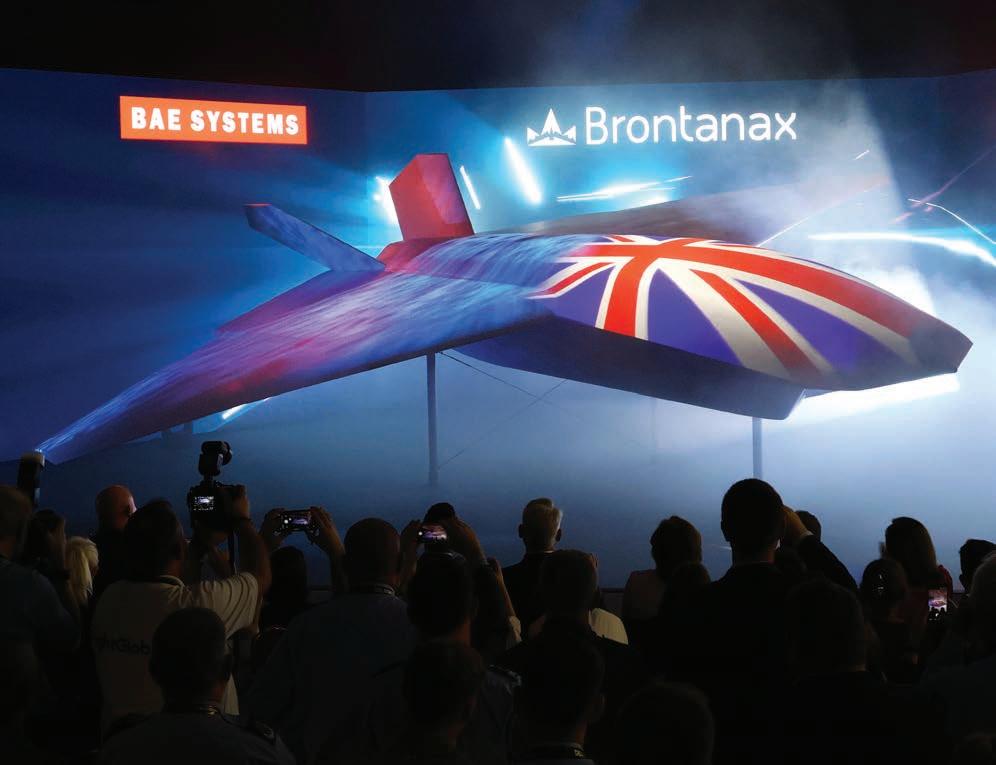
BAE Systems has lifted the lid on its hitherto secret Brontanax collaborative combat aircraft (CCA) program. A full-scale model was unveiled for the first time at Farnborough yesterday by the UK’s newly appointed defense secretary, Wes Streeting, along with BAE Systems group CEO Charles Woodburn and the chief of the air staff, Marshal Harv Smyth.
In recent years, it has become clear that large CCAs will
be a vital element of future air forces, adding combat mass and persistence at around 25% of the cost of a crewed fighter, and at far less risk to aircrew. Air chiefs are clamoring for the capability as soon as it can be fielded and, in the UK, the Royal Air Force requires a CCA capability to partner Typhoons and F-35s by the end of this decade. In so doing, the RAF aims to become Europe’s first sixth-generation air force.
BAE has worked behind closed doors on its own CCA program since 2022, starting with around 18 months of
continues on page 22
MARITIME PATROL
Poseidon joins fleet Germany’s new P-8As are chasing submarines over the North Sea and Baltic alongside a growing NATO coalition | 4
HEAVY LIFT
Supersized ambitions
Radia broadens vision for WindRunner freighter: rockets, fighters, Chinooks, oh my! | 10
EXTENDED WINGS Wing of Tomorrow Airbus launches next phase of development program to find efficiency gains | 15
REGIONAL AIR
Staying close to home ATR analyzes GPS data to identify optimal locations for short-haul air services | 16 alerts
&

By Cristofer Slotoroff
Saudi Arabian low-cost carrier Flynas signed firm orders for five additional Airbus A330900s and 20 more A321neos at the Farnborough International Airshow yesterday.
The Flynas agreement lifts the airline’s A330neo commitment to 20 aircraft and its A321neo commitment to 56, bringing its firm Airbus orders to 235. The carrier currently operates 67 Airbus aircraft: two A330-300s, four A320ceos, and 61 A320neos.
Flynas CEO and managing director Bander
Almohanna said the deal is “aimed at ensuring the sustainable growth of the Flynas fleet over the coming years to support the continued expansion of our six operating bases across the Kingdom, while also strengthening our operational and expansion capabilities for Flynas Syria.”
He added that the larger order book will support the Pilgrim Experience Program, which aims to facilitate access to the Two Holy Mosques, and position the airline for events Saudi Arabia is set to host, including Expo 2030 and the 2034 FIFA World Cup.
BOC Aviation has disclosed an order for up to 220 Pratt & Whitney geared turbofan (GTF) engines to power up to 110 Airbus A320neo family jets, the Singapore-based lessor announced at the Farnborough International Airshow on Tuesday. The deal was first signed as an undisclosed transaction in June 2025.
“This order is the largest that BOC Aviation has placed with Pratt & Whitney and a continuation of our 29-year relationship,” said BOC Aviation CEO and managing director Steven Townend, adding that the engines “enable a substantial reduction in fuel costs.”
Pratt & Whitney counts more than 2,800
GTF-powered aircraft in service with more than 90 customers and a backlog exceeding 8,000 engines.
The GTF commitment came one day after BOC Aviation announced orders and options for as many as 300 powerplants from CFM International—200 LEAP-1A and 100 LEAP1B engines—to equip a significant share of the A320neo family and Boeing 737-8 jets in its orderbook.
Townend called that deal, with the GE Aerospace/Safran Aircraft Engines joint venture, the company’s “largest-ever engine transaction,” saying it will support the lessor’s
BermudAir plans to link Bermuda, the Caribbean, and North America with its new 135seat, three-class A220-300s.
Meanwhile, BermudAir’s previously undisclosed March order for 10 A220-300s represents the airline’s first from Airbus. The carrier plans a 135-seat, three-class layout and intends to use the type to open nonstop routes linking Bermuda, the Caribbean, and North America.
“The A220 is the ideal aircraft to support the next phase of BermudAir’s growth,” BermudAir founder and CEO Adam Scott said, pointing to the type’s range, operating economics, and performance at constrained airports.
Airbus executive v-p of sales for commercial aircraft Benoît de Saint-Exupéry noted that the order brings the type into a new region of operation.
Through June, Airbus had delivered 526 A220s to more than 25 operators, with cumulative orders for the type exceeding 1,100. n
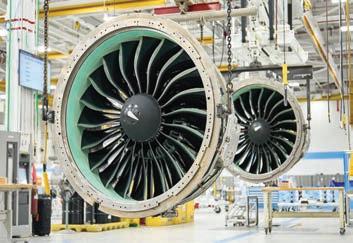
Pratt & Whitney’s GTF backlog tops 8,000.
growth “from this decade into the next.”
BOC Aviation’s portfolio comprises 811 aircraft and engines owned, managed, and on order. The company has leased its fleet to 88 airlines in 45 countries as of June 30. C.S.
For nearly 80 years, CAE has trained the people who protect nations across air, naval, land, joint, and cyber domains. All platforms. One focus. Mission-ready people.
Ready today. Prepared for tomorrow.


By Kerry Lynch
The German Navy has taken delivery of its first three P-8A Poseidon maritime patrol aircraft and has already deployed on the first few missions, according to Capt. Broder Nielsen, commander of German Naval Aviation Command. The aircraft are among eight under contract with delivery anticipated to continue through 2029.
During a briefing at the Farnborough International Airshow, Nielsen noted that the addition of the P-8 “marks the establishment of modern maritime patrol and anti-submarine warfare capability for the German Navy, and it will significantly enhance our contribution to NATO’s maritime security as well.”
Germany took delivery of the first example last October, and within three months the aircraft had deployed. The P-8s have also participated in anti-submarine warfare exercises. “For a newly introduced platform, this was really a remarkable achievement…The results really have been highly encouraging,” he said, adding that the training, logistics, and aircraft
availability have run smoothly, boosting the program’s readiness.
The P-8, a special missions variant of the Boeing 737NG series, is supporting the German Navy’s missions in the North Sea and in the Baltic region. Nielsen remarked on how critical the protection of these regions is to NATO; Germany is operating alongside other nations safeguarding the regions with the twinjet, such as Norway, which has taken delivery of five, and the UK, which has nine in its fleet.
Other P-8 customers in the High North region include Canada, which has 14 on contract, and Denmark, which plans to add two to its fleet. In all, Boeing has sold 207 P-8s, with eight operators currently flying them. The fleet has accumulated more than 730,000 hours.
“Through regular exchanges, common procedures, and multinational exercises, we are building a highly integrated maritime surveillance and anti-submarine warfare network,” he said.
Tim Flood, senior regional director of international business development for Europe
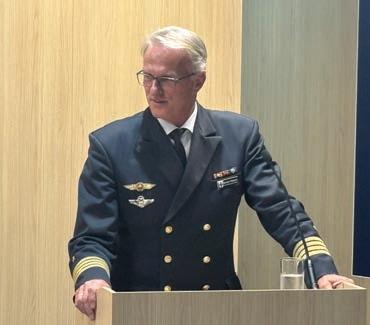
German Navy Capt. Broder Nielsen reflects on the P-8A’s seamless entry into service.
and the Americas at Boeing Defense, Space & Security, noted that the aircraft—which entered operational service with the U.S. Navy in 2013—continues to go through an upgrade cycle, with the latest Increment 3 Block 2 package covering anti-submarine warfare, beyond-line-of-sight communications, and sensor upgrades.
These are particularly important with the threats seen in the High North region, whether against shipping or other activities, he said.
In more recent missions, a P-8A helped the UK to expose covert Russian submarine operations in and around UK waters; a German aircraft has headed to Norway and Iceland for sub-hunting missions, and the aircraft was flown to the North Pole. n

The UAE’s national aerobatic team, the Fursan al Emarat, made its UK debut at the Farnborough International Airshow after flying in from the U.S., where it participated in the nation’s 250th anniversary celebrations. Having flown the Leonardo MB.339 for many years, the team has recently adopted the Chinese Hongdu L-15 jet trainer. The team made the first appearance with the new type at last year’s Dubai Airshow.


By Charlotte Bailey
In yet another signal that Canada could be preparing for a mixed fighter fleet, a new memorandum of understanding has pledged to support the Saab Gripen E’s engine in-country. Yesterday, GE Aerospace and Magellan Aerospace Corporation announced that they would provide maintenance, repair, and overhaul capabilities for the Gripen E’s F414-GE39E powerplant should the type be selected by the Royal Canadian Air Force.
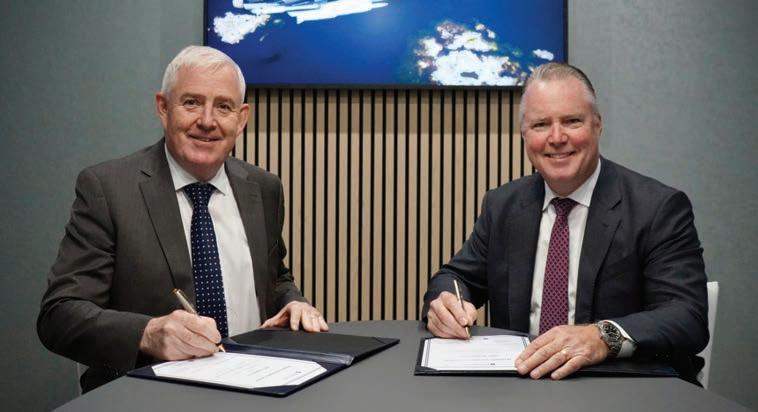
Under the agreement, GE Aerospace would provide training and license Magellan to support the F414 from its Mississauga plant. Magellan v-p of business development, marketing, and contracts Haydn Martin said the deal “reflects our shared intent to build enduring sovereign aerospace capabilities in Canada.” GE said the in-country capability would support the “build, partner, buy” framework at the center of Canada’s Defence Industrial
Strategy, released in February.
Canada picked the Lockheed Martin F-35A in 2022 and signed a CA$19 billion contract for 88 airplanes in January 2023, but the makeup of the country’s future fleet remains under review. Prime minister Mark Carney ordered that review in March 2025, a day after taking office. Funding for the first 16 F-35s is contractually committed, and those airplanes are due to begin arriving this year. n
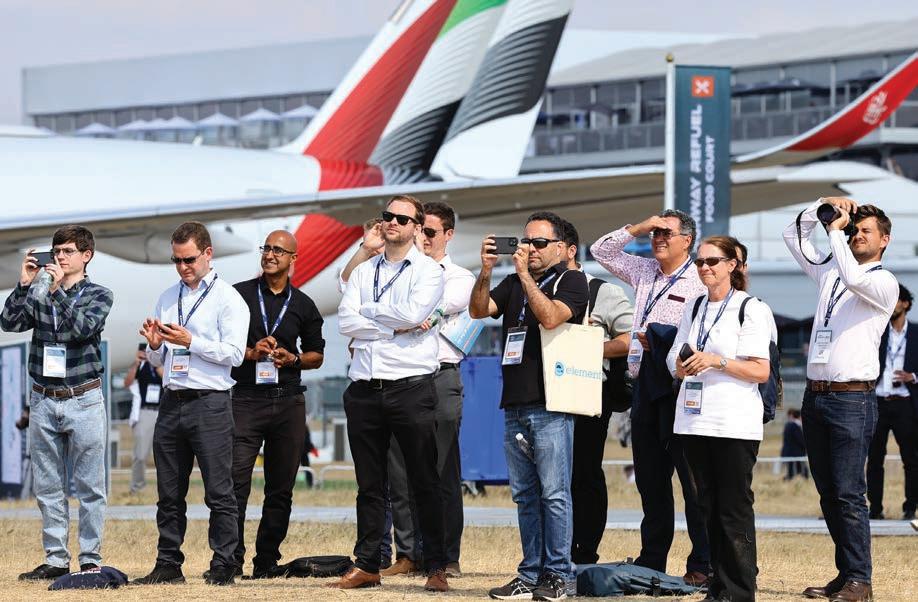
As aircraft roar past, the crowd falls quiet, phones and lenses lifted to catch every pass. It’s a scene repeated throughout the Farnborough Airshow, and one that captures the enduring pull of seeing aviation up close. For many, it’s the highlight of the week—and the reason they keep coming back.
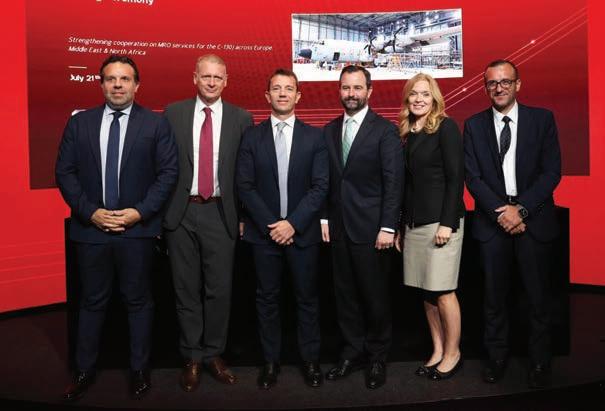
Lockheed Martin is further integrating Leonardo into its C-130J support network as a maintenance, repair, and overhaul center for operators in Europe, the Middle East, and North Africa.
By Kerry Lynch
Leonardo has struck agreements with CAE and Lockheed Martin covering M-346 training and C-130J Super Hercules support.
Under a collaboration agreement, Leonardo and CAE will build on their longstanding partnership on the M-346 integrated training system (ITS) to explore market opportunities in fighter pilot training and advanced capabilities, including addressing AI-enabled systems and autonomous missions.
The companies will develop a technology roadmap for the M-346 ITS, including the Block 20 system upgrades on the jet trainer and expanding the scope of their joint efforts into Live, Virtual and Constructive, and Live Synthetic Integration environments.
M-346 training is provided at the International Flight Training School (IFTS) in Decimomannu, Sardinia, an Italian Air Force and Leonardo joint venture in collaboration with CAE.
“The future battlespace will place greater demands on pilots than ever before,” said Pascal Grenier, president of CAE Defense & Security. “Through this collaboration, we will develop training environments that help aviators build the judgment, adaptability, and decision-making skills needed to employ
advanced and automated mission systems.”
Stefano Bortoli, managing director of Leonardo’s Aeronautics division, added that the progressive agreement “will strengthen the development of highly skilled pilots for current and future operational requirements.”
As for the Lockheed Martin C-130J, under a separate agreement, Lockheed Martin is further integrating Leonardo into its support network as a maintenance, repair, and overhaul (MRO) center for operators in Europe, the Middle East, and North Africa (MENA). The agreement opens the possibility for additional business opportunities related to C-130J maintenance and sustainment.
More than 570 C-130Js have been delivered to 27 countries. Of those countries, 16 are in Europe and MENA—all of which are potential users of the MRO facility in Italy, Leonardo pointed out. The Italian aerospace company added that the agreement builds on its 20-year relationship with Lockheed Martin involving technical and logistical support to the Italian Air Force’s Super Hercules fleet.
“Investment and teaming with Leonardo will create a better capability for Europe and an ability to expand services to other regions,” said Trish Pagan, v-p of air mobility and maritime missions at Lockheed Martin. n
General Atomics Aeronautical Systems, Inc. (GA-ASI) has completed the weapons testing for the RAF’s Protector RG.Mk 1 remotely piloted aircraft, which is based on the MQ-9B SkyGuardian. This marks the first time that GA-ASI has conducted qualification testing for a customer. The final test was conducted on June 18, and the Protector is now fully cleared for employing the Paveway IV laser-guided bomb and MBDA Brimstone 3 airto-surface missile.
Meanwhile, at the Farnborough Airshow, GA-ASI and MBDA signed a memorandum of understanding to integrate the MBDA Spear—similar to the Brimstone—onto the MQ-9B. It will also be integrated onto the Gambit 6, GA-ASI’s collaborative combat aircraft design.
Another weapon in line for the SkyGuardian is Kongsberg’s Joint Strike Missile (JSM), a large and stealthy longrange strike weapon that was initially developed for internal carriage by the Lockheed Martin F-35. The system requirements review and preliminary design review for the integration have recently been completed. D.D.
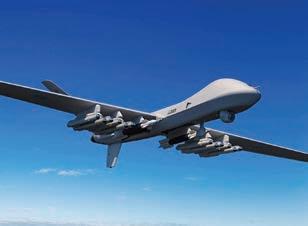
This rendering depicts a Protector RG.Mk 1 armed with the Paveway IV laser-guided bomb and the Brimstone 3 missile.
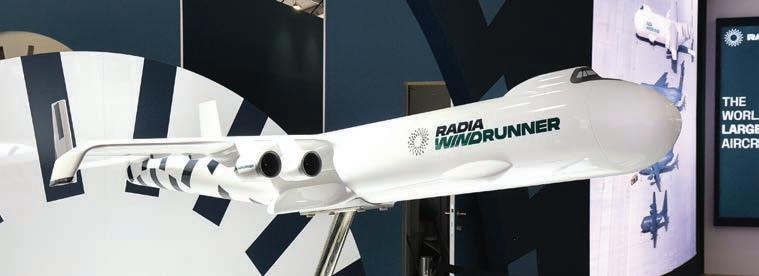
WindRunner was designed to accommodate wind turbine blades up to 105m long.
By Howard Hardee
Two years after emerging at the Farnborough International Airshow with a hugely ambitious air transport concept, Colorado-based Radia has expanded its envisioned market beyond moving massive wind turbine components and now sees much broader applications for WindRunner.
Chief executive Mark Lundstrom is positioning the four-engined heavy lift aircraft as a “platform to move the world’s biggest things to the hardest-to-reach places,” he told AIN during the show. Anything handled by an Antonov An-124 would fit inside the WindRunner, with far more volume to spare: “Take that and multiply it by seven.”
The original mission of moving skyscrapersized wind turbine blades remains intact. Wind power structures, commercial cargo, and military equipment are all considered potential payloads for the 356-foot-long freighter. Radia advertises an estimated range of 2,000 km (1,200 miles) while hauling a maximum payload of about 160,000 pounds.
WindRunner’s design calls for an ultrahigh-volume cargo hold capable of moving the world’s largest rockets—except for SpaceX’s Starship rocket—or at least four Lockheed Martin F-16s and six Boeing CH-47 Chinook helicopters lined up nose to tail.
“We’ve been getting a lot of interest from the military on things like moving six packs of Chinooks,” Lundstrom said. “Today, when you move a Chinook, you have to take the blades off
and the rotors off, and it takes the better part of a week or 10 days with a bunch of people and a bunch of tools in a forward-deployed theater.”
WindRunner would be large enough to move CH-47s without requiring disassembly. On the commercial side, another potential application for the heavy-lift aircraft is moving latest-generation widebody turbofans (produced by GE Aerospace and Rolls-Royce), which must be taken apart for transportation and reassembled upon delivery.
“And then imagine the engines they want to make next: The [Rolls-Royce] Ultrafan will be much bigger, and they will have to be completely modularized. WindRunner will move
them all at once,” he said.
How much demand exists for such a freighter is an open question. In the program’s favor is a plan to lean on the existing supply chain, using off-the-shelf, in-production turbofans, an all-aluminum fuselage, and a mostly composite wing structure. Unlike some moonshot aircraft development programs, Radia is not counting on radically new airframe or engine designs to reach market. In the view of some industry analysts, there is nothing groundbreaking about the slow-moving cargo jet aside from its sheer size.
Lundstrom argues that the program’s success will hinge on execution, rather than developing novel technology or manufacturing processes.
“There’s no new technology here that needs to be proven out; the components are all things in mass production,” he said. “The structure is just huge, but the processes to build that structure have been well-honed over decades. I don’t view it as a technology risk.”
Radia will pursue Part 25 FAA certification with a small fleet of test aircraft that will eventually enter commercial service in the company’s self-operated fleet. It intends to begin assembly of the first aircraft in 2029 and to launch test flights the following year.
Lundstrom anticipates excitement from plane-spotters when the supermassive freighter does get airborne. “It’s going to be fantastic at an upcoming air show, right? Imagine when we fly at minimum viable airspeed…it will look like it’s floating.” n
Australian start-up V-Star Powered Lift Aviation plans to buy up to 100 of Horizon Aircraft’s in-development Cavorite X7 hybridelectric VTOL aircraft. The letter of intent signed by the companies at the Farnborough Airshow on Tuesday covers firm orders for five aircraft and options for another 95. Adelaide-based V-Star is preparing to launch medical emergency air services with the six-passenger Cavorite, which is expected to have a range of 432 nm and a top speed of about 250 knots. Canada-based Horizon plans to start flying a full-scale prototype in 2027.
V-Star founder Tony Laws remarked, “Flying at nearly twice the speed of helicopters, the addition of Cavorite X7s to our fleet will be a critical advantage to help people in need when minutes matter. V-Star is committed to delivering leading powered-lift technologies across Australia.” He added, “This letter of intent with Horizon Aircraft brings us one step closer to a new standard for emergency services operations and cost-e ective transport solutions in regional Australia.” The deal was valued at $600 million, which implies a purchase price of $6 million per aircraft. C.A.
September 15-16 | Frankfurt, Germany

and clients. The one-on-one time and small group sessions are very valuable settings.”
– CALS SPONSOR
By Kerry Lynch
Turkish Aerospace is gearing up to begin test flights of the next two prototypes of its Kaan fifth-generation fighter this year as the company remains on target for delivery to the Turkish Air Force later in the decade, Turkish Aerospace president and CEO Mehmet Demiroğlu said Tuesday.
Speaking to reporters during the Farnborough International Airshow, Demiroğlu said the company has 10 GE F110 turbofans in stock in Ankara, Türkiye, for prototypes.
Plans call for Turkish Aerospace to buy 80 of the engines for serial production of the Mach 1.8 multirole aircraft. He added that the U.S. Congress granted export license approval for them on July 9. These engines are anticipated to fill the short-term needs until the domestically developed TEI TF-35000 is ready for service.
Royal Air Force Typhoons operating in the Middle East are wielding a new weapon that is primarily aimed at intercepting drones. The BAE Systems Advanced Precision Kill Weapon System (APKWS)—a laser-guided adaptation of the Hydra 70 unguided rocket—was adapted to an air-to-air role.
BAE Systems and the Royal Air Force’s No. 41 Test & Evaluation Squadron began work on the project last September. In early March, a test firing was undertaken—an air-to-surface shot that successfully hit a barge-mounted target. By May, the weapon was being employed in operation with No. IX Squadron in the Middle East.
The very short time between initial test and operational fielding was the result of a period of
With serial production anticipated in the next two years, “We will have no issue receiving those engines in time to support our serial production,” he said.
Initial deliveries to the Turkish Air Force are still anticipated in 2028, Demiroğlu said, cautioning, “These are challenging programs, and we are hoping that we’ll keep that delivery time.”
As for the flights of the next two prototypes, he said the company is waiting for a few tests to be completed and anticipated that P1 would fly in a couple of months with P2 by the end of the year. “That’s our goal.”
Meanwhile, Demiroğlu confirmed that the T70 heavy utility helicopter program has fully restarted and that the company reached an agreement with Sikorsky at the beginning of the year for another 39 units—“and we received the export license…so, we don’t see any problem.”
While the joint Sikorsky/Turkish Aerospace
program—which launched more than a decade ago—suffered setbacks over U.S. sanctions and licensing issues after the initial deliveries, Turkish Aerospace made contract changes in consultation with Sikorsky, along with the U.S. and Turkish governments, Demiroğlu added. “We found a way, and now it is back in.”
Under the Turkish Utility Helicopter Program, Turkish Aerospace and Sikorsky are to produce up to 109 of the T70 Black Hawks based on the Sikorsky S-70i under a potential $3.5 billion program.
Meanwhile, Turkish Aerospace continues work on its own 19-passenger, 12,000-kg T925 utility helicopter developed in-house. Demiro ğ lu stressed that even as the T70 program continues, the T925 program is on the “full burner, not even a back burner.” He explained this is because T70 acquisition is filling current requirements, but in the early 2030s, many such helicopters in the Turkish Armed Forces will begin retiring.
Turkish Aerospace sees a need for more than 200 by 2040, he estimated. “T925 is going to fill that gap.” Demiroğlu also believes there will be export opportunities, with a demand for another 200. n
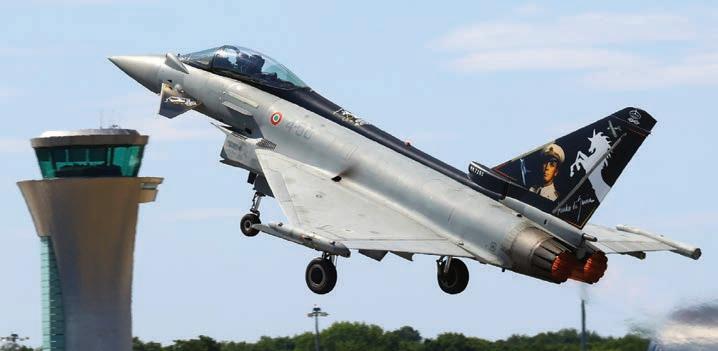
The rapid integration of APKWS is just one example of the ongoing improvements that are being made to the Typhoon to keep it at the forefront of European defense for decades to come.
intense development work by BAE and the RAF engineers involved. A key aspect was devising how the pilot would operate the weapon, requiring changes to the hands-on-throttle-and-stick controls to minimize workload.
At short ranges, the maneuvering aspect of the engagement is highly dynamic, while the pilot has to find and lock the target with the radar, then cue the targeting pod, achieve a tracking laser designation, and fire the weapon. D.D.
Canada has become the first “observer” nation to join the trinational Global Combat Air Programme (GCAP) e ort led by Italy, Japan, and the UK. A joint statement from the four governments said observer status gives Canada “enhanced insight” into the program and a chance to deepen its understanding of GCAP’s governance, capabilities, and industrial framework, along with related security requirements and partnering opportunities.
While Canada will not have a decision-making role, the UK Ministry of Defence said the arrangement gives Ottawa privileged access and paves the way for talks on future participation.
The four defense ministers announced Canada’s participation on Tuesday at Wellington Barracks in London. Ottawa now works alongside founding partners Italy, Japan, and the UK, whose defense ministers signed the convention establishing the GCAP International Government Organisation in Tokyo in December 2023.
Newly appointed UK defense secretary Wes Streeting, who took the post on Monday under prime minister Andy Burnham, hosted the meeting and said, “[I am] pushing this program forward on my very first day in the job.” C.B.
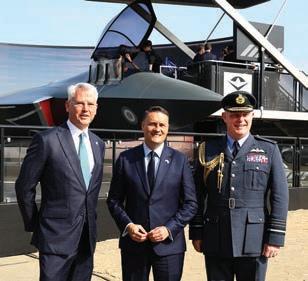
New UK defense secretary Wes Streeting (center), along with BAE’s group CEO and the chief of the air staff, welcomed the news that Canada was joining the GCAP program as an observer.

At the Farnborough International Airshow this week, Electra CEO Marc Allen and Safran Helicopter Engines CEO Cédric Goubet celebrate a life-ofprogram production agreement.
By Charles Alcock
Safran Helicopter Engines will supply its TG600 turbogenerator for Electra’s indevelopment EL9 Ultra Short hybrid-electric aircraft under a life-of-program production agreement announced on July 15. The 600-kilowatt turbogenerator, which is based on Safran’s Arrano turboshaft, will power the eight electric motors from Oxford, Englandbased Evolito that Electra selected last year.
Executives from the two companies held a ceremonial signing at the Farnborough International Airshow on Tuesday to formalize the partnership, which includes an initial order for 250 TG600s.
Safran Helicopter Engines CEO Cédric Goubet noted the company’s years-long work exploring electric technologies and said, “The time has come to drive this to fruition and to start leveraging all we have built. This is a first launch in development with a serial product, a serial application, a serial airplane.”
Electra CEO Marc Allen added, “The partnership is the foundation on which we’re building.”
The turbogenerator combines a gas turbine with a pair of GENeUS electric generators made by Safran Electrical & Power. Earlier this month, Safran Helicopter Engines carried out the first bench test at its facility in Bordes, France, of the flight-ready TG600 that will power the EL9’s initial flight tests. Goubet said flight testing will take place directly on
the EL9, which Electra expects to fly for the first time in late 2027 or early 2028.
Meanwhile, Electra said on July 10 that the FAA closed the G-1 issue paper establishing the certification basis for the nine-passenger aircraft, months after the company submitted its Part 23 type certification application in November 2025. The milestone sets the regulatory foundation for technologies such as the hybrid-electric propulsion system, the EL9’s blown-lift wing for takeoffs and landings in just 150 feet, and fly-by-wire controls. The company plans entry into service in 2030.
The same day, Electra confirmed it will build the EL9 in Springfield, Ohio, one of two aerospace manufacturing investments in the state announced at the show alongside Ohio Governor Mike DeWine. The $850 million investment in what Electra called the “anchor” production site for the EL9 will create 1,975 jobs. Located at AirPark Ohio next to Springfield-Beckley Municipal Airport, the facility is expected to build up to 800 aircraft per year, starting at a rate of 400 from 2030.
In a second Ohio announcement, Denverbased Beehive Industries said it will invest $70 million to expand its operations in the southwest of the state, where it makes 3D-printed jet engines for uncrewed aircraft, adding more than 200 jobs in the Cincinnati area. The company’s Frenzy engine is starting full-rate production backed by a $29.7 million U.S. Air Force contract. z
By Kerry Lynch
Collins Aerospace is tapping automation and data expertise from across its businesses to develop technologies that would simplify the flight deck and the management of airspace.
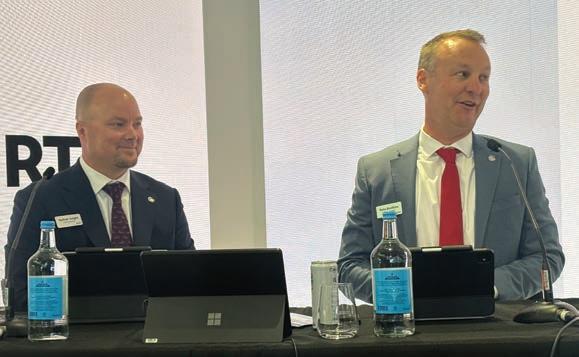
During the Farnborough International Airshow, Collins Aerospace avionics president Nate Boelkins provided a high-level overview of initiatives that tie together its air traffic control, flight-tracking data, and flight deck business units. “Demands on pilots and air traffic controllers are becoming much more complex every single day,” Boelkins said. “How do we reduce workload for both pilots and air traffic controllers? We want to drive capacity into the network while we improve efficiency and we improve safety.”
Nathan Voight, vice president and general manager of advanced flight systems for Collins Aerospace, added, “Our approach is really focused on advancing the automation in the air traffic system, both airborne and the ground side, so that we don’t get to a point where pilots and controllers become overwhelmed.”
Collins has concentrated on pilot-centric autonomy in both navigation and communications, Voight said. “It’s really all about simplifying the pilot workload, which allows them to work more safely and more efficiently.”
Aircraft systems generate a vast amount of data, but data alone doesn’t help a pilot, he said. “At Collins, we’re taking that data, applying automation, and synthesizing the access that we have to multiple sensors and surveillance on the aircraft to provide that actionable insight,” he said.
Radio exchanges can become difficult to follow across different dialects and background chatter, Voight explained, so Collins is working on a way to transcribe those communications digitally for pilots to read and play back. The technology aims “to really help decipher
what’s being said and avoid all of the challenges that come when you have different people trying to communicate. It also gives you an opportunity then to communicate that back to air traffic control either in voice or textual format, streamlining the communication.”
That can matter most in detecting erroneous information as an aircraft approaches the airport environment. “These technologies can help identify where those errors are, giving the pilot the awareness that they have to take action.”
Helping propel some of these initiatives
phase. Boelkins could not give a hard timeline for entry into service because that depends on certification.
On airspace modernization, Collins can draw lessons from FlightAware tracking data to guide the safest approaches. In Europe, Voight pointed to discussions around trajectory-based operations to support sustainable operations and ease congestion.
“As congestion increases, we have to expand capacity in the airspace,” he said. “You do that through resilient navigation, which allows controllers to position aircraft tighter and sequence them tighter around airports, which ultimately then leads to efficient operations as well.”
Better routing provides an economic benefit for carriers and a system-wide environmental benefit through lower fuel burn, Collins argues.
is data accumulated from its flight-tracking platform FlightAware. Voight said engineers are using that data to “stress test” the systems in development.
“Our systems are developed by pilots for pilots, so we know that as we field those solutions, they’re going to apply to real practical situations that they’re going to face,” he said.
The goal, he added, is “providing access to the right data, designing our solutions in an open modular way which allows us to then adapt and bring functionality more incrementally to the airspace and then layer on automation where we can provide that assistance to the network, whether it’s on the ground or in the air.”
Collins continues to work with customers to refine these technologies during the test
Collins Aerospace v-p and general manager of advanced flight systems Nathan Voight (left) and avionics president Nate Boelkins speak about automation and reducing pilot workload at the Farnborough Airshow.
An incremental approach will be necessary to implement some of these air traffic management changes, the company believes. “It has to be done incrementally,” Voight said.
To that end, Collins is extending a common automation platform that would provide an open architecture for air traffic management, tailored to the needs of an air navigation service provider and to the different functions within the system. The platform, which can move air traffic management to the cloud, is a potential offering for the FAA’s vision for the future of air traffic management.
Collins is already applying some aspects of the platform in trials involving uncrewed operations with an international air navigation service provider, which the company declined to identify. n
By Charlotte Bailey
Airbus has launched the next phase of its Wing of Tomorrow (WoT) development program, kicking off a three-year effort to assess the benefits and challenges of extended-length wingspans. With the first experimental folding wings due to commence assembly imminently, Airbus hopes to start testing the concept in flight on an Airbus A321neo testbed around the second half of next year.
Wing efficiency is “one of the biggest levers we have to improve the performance of our aircraft,” Airbus technology project lead Richard MacPherson told reporters during a briefing at the Farnborough Airshow on Tuesday, adding that Wing of Tomorrow “has the potential to give the same, if not more, efficiency gains than next-generation engines.” This program phase will analyze the performance benefits and

aerodynamic qualities of longer wings, helping inform future narrowbody design decisions.
Airbus has already started building various multi-meter-long devices intended to replace the upward-curving Sharklet wingtips that are standard on the A320 family. These will be built at Airbus’ Wing Technology Development Centre in Filton, England, before being flight-tested on its A321neo testbed in Toulouse, France.
“In the air, these extension devices are going to replicate a folding wing that is latched and fully locked in its fully extended flight position,” MacPherson said. Separate ongoing ground-based demonstrations are exploring the mechanism by which a future wing might fold.
Airbus validated early concepts through digital simulation, and MacPherson said the company
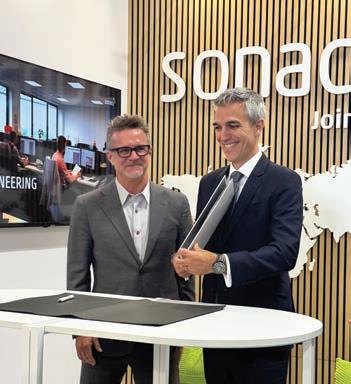
Sonaca Group signed a multi-year contract with Otto Aerospace covering the design, industrialization, and manufacture of the wings, fixed leading edges, and empennage of the Phantom 3500, the companies announced on Monday at the airshow. The agreement cements Sonaca’s stake in the laminar-flow business jet program, and forms part of a broader partnership under which Sonaca aims to supply the program’s key aerostructures over the long term.
About 50 engineers from Sonaca’s Belgian and Brazilian operations are dedicated to the e ort. Delivery of the prototype structures is
scheduled for next year, Sonaca said. Otto aims to fly the first Phantom 3500 in 2027, with certification targeted for 2030.
For Sonaca, the deal extends a diversification push spanning business aviation, defense, and space work. “Laminar flow is a concept that has been known in aerospace for many years,” said CEO Yves Delatte.
At the signing, Delatte expressed his hope for what “the technological and industrial expertise” at Sonaca can achieve with laminar-flow technology. Otto CEO Scott Drennan called the partnership “a critical milestone on our path to first flight.” C.S.
Airbus validated early concepts via digital simulation and has “performed intensive wind tunnel testing to really evaluate and optimize” different variants, according to technology project lead Richard MacPherson.
has “performed intensive wind tunnel testing to really evaluate and optimize” different variants. Building on WoT concepts that pair a 17-meter (56-foot) main wing box with a five-meter (16foot) folding section, he expects the extension devices “to be in that order of magnitude.”
While Wing of Tomorrow lead Sue Partridge acknowledged that folding wings are nothing new—including within military applications— this technology has never been applied to a high-rate single-aisle commercial aircraft before.
This phase comes as Airbus completes assembly of its first three ground-based wing demonstrators, which combine more than 100 technologies from 40 partners worldwide. Since 2014, the UK Aerospace Technology Institute program has put £227 million ($304 million) behind Wing of Tomorrow. n
By Charles Alcock
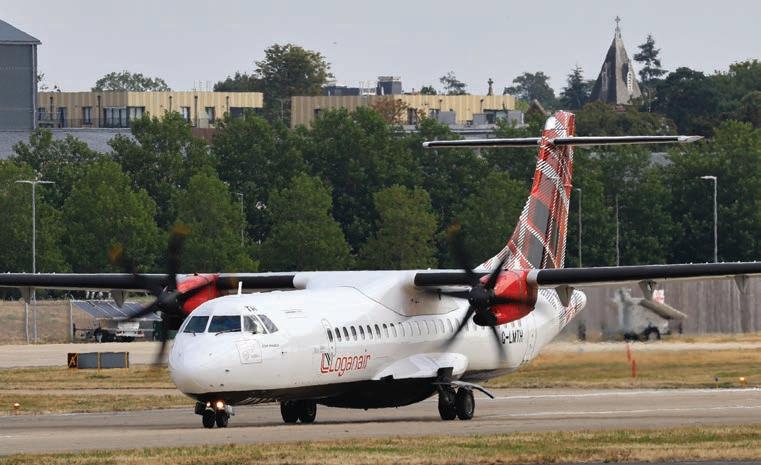
Some airlines have paused decisions over fleet replacement amid concerns about geopolitical threats to the global economy, according to ATR chief commercial officer Alexis Vidal. The regional aircraft maker had a strong start to its 2026 sales campaign with 12 firm orders for its 48- to 70-seat twin turboprops, but while closing deals may now be harder, Vidal told AIN that there have been no order cancellations or delivery deferrals.
The European manufacturer has few customers directly impacted by the Iran war, but elevated fuel costs are denting airline balance sheets globally. At the same time, ATR is investing effort to make the case for a more constructive government attitude to regional air services.
In India, the response has been positive with officials extending a regional connectivity scheme for another 10 years. But closer to home in the European Union, the company felt the need to speak out against policies such as anti-tankering restrictions, which Vidal said
“penalize society more than they benefit.”
ATR uses what it calls its “mobility monitor” that analyzes gigantic sets of GPS data from devices to better understand where short-haul air services would be better alternatives to constrained road and rail links. Vidal said that India is a prime test case for this approach to supporting airlines and stakeholders.
The Indian data shows four billion intercity trips, of which only 3% are flown. If this increased to a more typical global average of 7% to 8%, ATR believes it could double the number of its aircraft now operating in the country, and with 45% lower fuel burn than with jets.
Meanwhile, ATR is seeing growing interest in its HighLine premium cabin interior option designed to elevate the commuter flying experience. Operators including Air Tahiti and JSX in California are now, respectively, operating 30-seat versions of the ATR 72 and ATR 42. An undisclosed Canadian company has ordered a HighLine ATR 42-600 with 23 seats and the X-Space Table option to replace its corporate jet. n
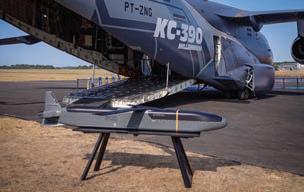
Embraer and Anduril signed a memorandum of understanding to pursue integration of the pallet-launched Barracuda 500M stand-o cruise missile into the C-390 Millennium, the companies announced Tuesday at the Farnborough International Airshow. The agreement between the airframer and the defense technology company aims to give the tactical transport a stand-o strike role.
Loaded on standard pallets, the munitions would leave the airplane through the open rear ramp using roll-on/rollo mission systems and conventional aerial delivery procedures, then separate from the pallet and fly autonomously.
“By exploring the integration of stando launch capabilities for palletized, kinetic, and non-kinetic e ects, we are further expanding the aircraft’s flexibility to meet the evolving needs of modern air forces,” said Embraer Defense and Security president and CEO Bosco da Costa Junior.
The collaboration o ers “a new way to generate massed, stand-o e ects from a proven airlift platform,” according to Anduril senior v-p of global defense Greg Kausner, who said the Barracuda family delivers “rapidly producible, operationally relevant capabilities.”
The agreement follows procurement framework agreements with the U.S. Department of Defense, most recently on July 15 covering large-scale production of pallet- and lug-launched Barracuda 500s with deliveries starting in 2027. C.B.

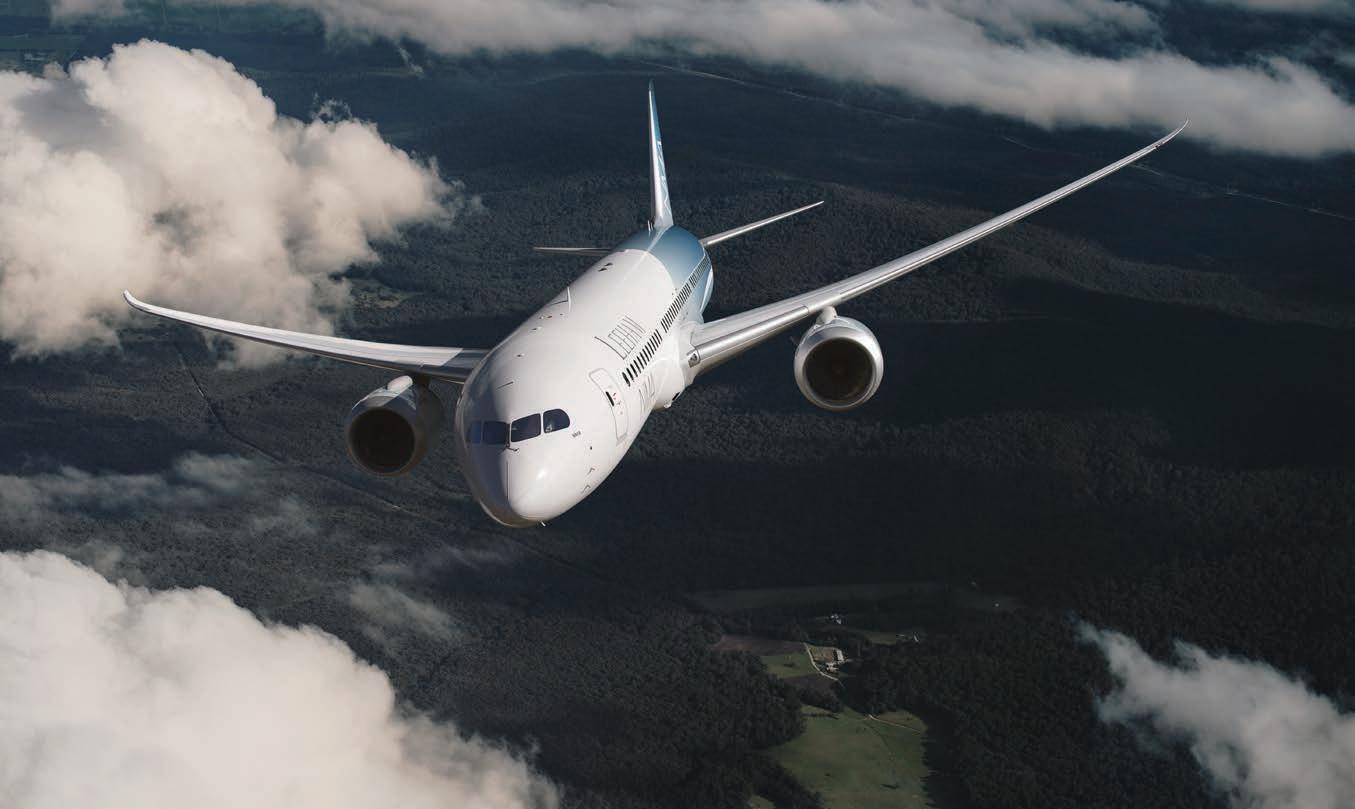
AIN Media Group has been the trusted source for business aviation news and insight for over 50 years. Now our coverage goes even further and deeper. With the addition of Leeham News and Analysis to the AIN portfolio, readers can gain even more independent, expert analysis of the global commercial aviation and aerospace sectors, including market trends and manufacturer strategies.
Together, AIN and Leeham News and Analysis deliver the most comprehensive aviation coverage available.

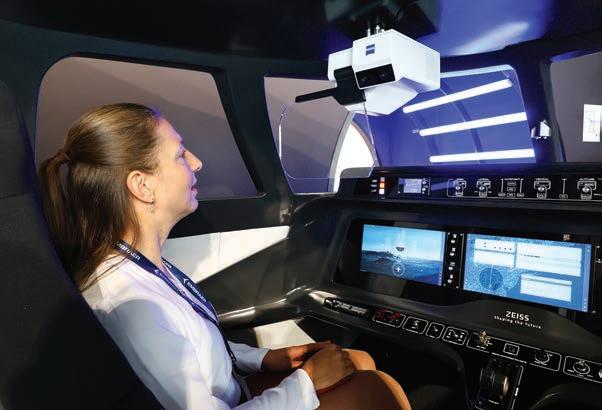
Zeiss demos its ProSight HUD, which projects critical flight information onto a transparent surface to support faster, more intuitive decisionmaking in the cockpit.
By Charles Alcock
Zeiss Microoptics is breaking into the aviation industry, offering new cockpit and cabin displays that it says are needed for more connected aircraft. The innovations the group is demonstrating for the first time at the Farnborough Airshow build on its 175-year pedigree of precision optical engineering in fields such as medicine, industrial metrology, microscopy, and advanced imaging.
The company’s new aerospace division is chasing applications for its scalable ProSight technology in head-up displays (HUDs) and transparent cabin displays for next-generation aircraft. It says this approach will consolidate the way increasingly complex data is presented in one place, avoiding the need for multiple screens and separate hardware.
According to Zeiss, it can relieve the pressure on aircraft manufacturers and tier-one suppliers to deliver greater display functionality without increasing weight and space requirements by tapping advances in holography and micro-optical engineering. It says that by controlling and directing light at a microscopic scale, optical functions can be integrated into transparent surfaces to deliver displays that are more compact, efficient, and intuitive.
The Zeiss HUD architecture offers an
alternative to flight deck systems already produced by companies including Collins, Honeywell, Thales, Elbit, and Garmin. The new market entrant claims these “conventional systems” rely on complex optical architectures that can limit field of view and increase integration challenges.
The Germany-based group’s HUD features a wide field of vision that will improve situational awareness for pilots by projecting critical flight and navigation information directly. By enabling pilots to keep their focus “eyes out” rather than looking down at cockpit instruments, Zeiss said the technology supports safer, faster, and more intuitive decision-making during critical phases of flight by removing the need for bulky projectors traditionally associated with HUDs. It claims the result is a significantly lighter, more compact solution capable of delivering a wider field of view and high optical performance, while reducing cockpit integration complexity and energy consumption.
In the cabins of airliners and business jets, Zeiss is proposing to present integrated information on transparent surfaces such as windows or dividers separating different compartments. According to the company, the ProSight technology will improve options for passenger communications and entertainment, as well as overall cabin design. n
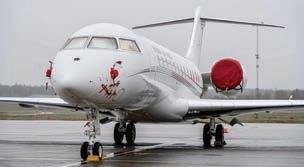
The Swedish Defence Materiel Administration (FMV) has signed a 10-year service support agreement with Bombardier for two Global 6500s. Signed on behalf of the Swedish Armed Forces, the contract enrolls the multi-role aircraft into Bombardier’s Smart Services Defense program, o ering 24/7 access to Bombardier’s service and support network.
Bombardier stated that this program “provides comprehensive cost coverage for parts, including landing gear and auxiliary power unit, labor, ground support equipment, engineering expertise, technical assistance, access to mobile response teams, and shipping costs.”
The modified jets, delivered in June via Bombardier Defense, will be primarily used in a VIP transport role. They will operate through the 75th Swedish Civil Aviation Squadron at Skaraborg’s F7 Air Fleet. Designated the TP 106 in Swedish military service, the units will replace a Gulfstream IV and G550.
Acquisition of the new platforms was carried out through what the FMV termed “a targeted deal” with Bombardier, worth a total of SEK 1.1 billion ($113 million). The agency was tasked with replacing Sweden’s existing state aircraft in the first quarter of 2025. The FMV stated the “rapid delivery was made possible by the fact that the aircraft had already been manufactured and had previously been used within the framework of the supplier’s demo operations.” C.B.
By Charlotte Bailey
Vaeridion has selected UK-headquartered Drive System Design (DSD) to develop, build, and test its nine-seat Microliner’s propeller drive system. As the German all-electric aircraft developer progresses from preliminary design review to full-scale testing, DSD’s two-phased approach will support the concept before delivering “tested hardware for integration” at Vaeridion’s headquarters in Oberpfaffenhofen.
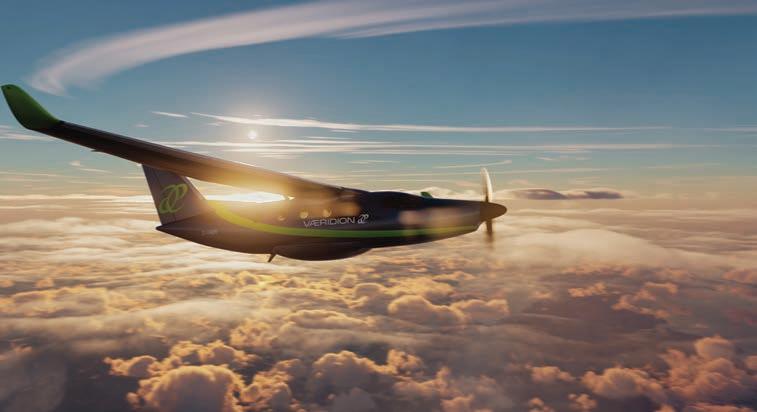
The Microliner concept will be powered by what Vaeridion describes as its proprietary multi-engine, single-propeller architecture. A propeller drive system combines and transfers the power output from the two engines, something Vaeridion CTO Markus KochsKämper described as the “critical link” within its setup. He added that DSD’s expertise will prove vital as the Microliner progresses
toward its “copper bird” ground testing.
“DSD brings experience not just in the latest propeller drives but also from technically demanding adjacent projects such as wheel drives or hybrid drives for gas turbines,” said managing director Jason Allen. DSD is now the “third key supplier” signed up to support Vaeridion’s electric propulsion unit, joining existing partners MT-Propeller and Evolito.n
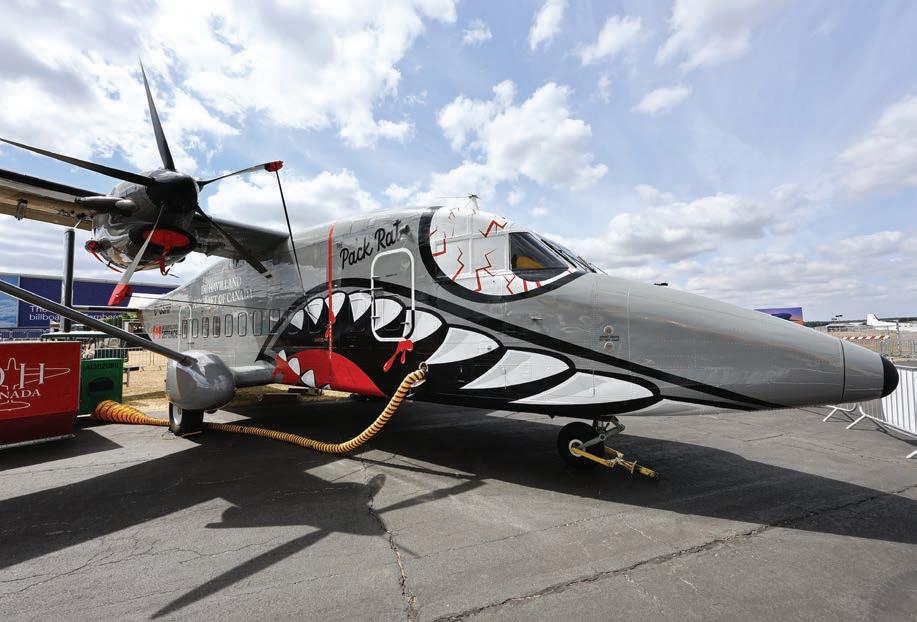
Nicknamed “The Pack Rat,” this SD 3-60 C-23B+ Sherpa draws crowds at the airshow. De Havilland Canada acquired the efficient and durable twin-engine aircraft in 2019. Prized for ruggedness and versatility, the Sherpa remains a workhorse of regional and specialized aviation. The original Shorts design was revealed at the 1974 Farnborough Airshow.
By Kerry Lynch
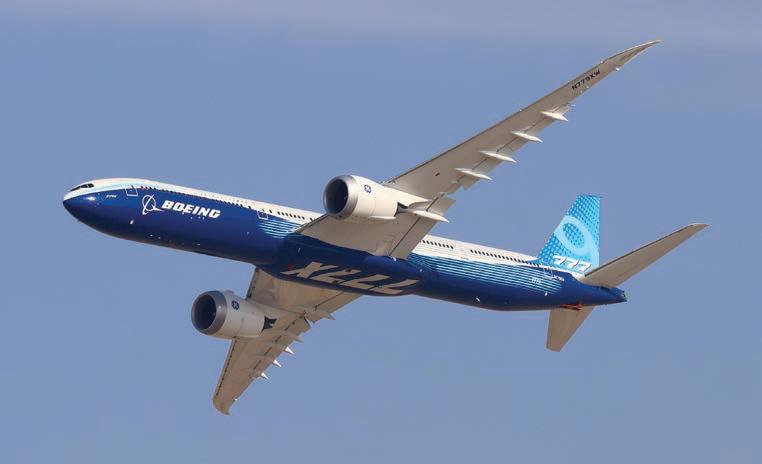
Boeing maintained its commercial aviation services and support outlook at a projected $4.9 trillion over the next 20 years, matching its 2025 forecast. However, the newly released commercial services outlook does reflect some shift toward digital services.
At the same time, Boeing projected a demand for 2.4 million new commercial aviation professionals, again mirroring its expectations in 2025.
Based on its 2026 commercial market outlook forecasting that the aircraft fleet will grow nearly 80% to more than 50,000 by 2045, Boeing believes this will generate a demand for $1.395 trillion in maintenance, repair, and overhaul (MRO) work and modifications; $1.915 trillion in parts and distribution services; $195 billion in training and pilot
services; and $1.355 trillion in digital services. The digital services projection was up over the $1.29 trillion forecast in 2025.
Overall, Boeing predicted a 3.7% compound annual growth rate (CAGR) for services during the forecast period.
Boeing cited increased aircraft digitalization and data-driven services and efficiency initiatives focusing on aircraft life cycle management as helping to shape the services market in the next 20 years. “By 2045, more than 90% of the global fleet is expected to be e-enabled, creating a strong foundation for digital services that can convert data into decision support,” according to Boeing.
In addition, Boeing sees geographic shifts in the demand for aviation services, with industry growth expected to trend toward emerging
Pratt & Whitney Canada received a nine-year, $1 billion contract to overhaul more than 750 PT6A-68 engines powering the U.S. Joint Primary Aircraft Training System (JPATS) T-6 fleet.
V2X awarded the work under its T-6 Contractor Operated and Maintenance Base Supply contract, continuing a longstanding relationship with Pratt & Whitney for support of the turboprop trainers.
Pratt & Whitney Canada’s facility in Bridge-
port, West Virginia, has maintained PT6A engines for more than four decades. The new contract marks the location’s second engine refurbishment award for the U.S. government.
“This award is a testament to our 500 West Virginia employees and the highquality sustainment support they provide to our customers,” said Pratt & Whitney Canada vice president of customer support operations Frédéric Lefebvre. K.L.
markets, including South and Southeast Asia, the Middle East, and Africa. Fleet expansions in these areas will generate demand for maintenance, training, parts, and operational support.
South Asia is expected to lead this growth, posting a 7.4% CAGR over the forecast period and accounting for $220 billion. Southeast Asia, meanwhile, is anticipated to have a 6.5% CAGR, accounting for $425 billion. Africa is expected to become the third fastest-growing region with a 4.6% CAGR, requiring $140 billion in services.
“In these regions, airlines and MRO providers will need more local capability, infrastructure, and workforce development to support growing fleets efficiently,” Boeing added.
As for workforce development, Boeing’s 2026 outlook sees a need for 674,000 new commercial aircraft pilots, 728,000 technicians, and 1,023,000 cabin crew members. Eurasia and China will drive the new-pilot demand, accounting for 153,000 and 123,000 additions, respectively. At the same time, North America will need 122,000. Eurasia will also create a demand for 169,000 technicians, more than any other region, followed by China at 131,000 and North America at 125,000.
“Our industry will keep the expanding global fleet flying safely and efficiently by investing in workforce development worldwide,” said Chris Broom, v-p of commercial training solutions for Boeing Global Services. “Immersive technologies will enhance training, supporting competencybased training and assessment approaches to ensure the highest quality aviation training.” z
By Charlotte Bailey
Honeywell Aerospace is set to expand the scope of its Stationary and Mobile UAS Reveal and Intercept (Samurai) system, with the technology now being integrated into Odys Aviation’s uncrewed Laila VTOL aircraft.
As with its existing ground-based solution—which can be operated from a fixed location or a moving vehicle—Honeywell sees the ability to “track, classify, identify, and ultimately defeat these different types of drones” as increasingly relevant. Serving as Samurai’s lead systems integrator via its Unitus software, Honeywell combines technologyagnostic hardware such as radars, sensors, and imaging devices.
“In my lifetime, I’ve never seen such a galvanizing threat [from potentially hostile drones] at every echelon of government,” said Tom Konicki, Honeywell’s director of business development for defense and space. Whether overflying an airport, a military facility, a sporting event, or another sensitive site, unknown operators and unclear intentions pose a real risk. “Are they clueless, are they careless, or is it nefarious?” he asked.
To combat this threat, Samurai—unveiled in 2024 and described by Konicki as “battle management software, more than just command and control”—allows an end user to specify which systems they choose to integrate. In the demonstration setup, four radar panels each offer about 110 degrees of field of view, with a range of around 20 kilometers (12 miles).
Radio-frequency detection capability helps to “gain a common understanding of what’s coming at you,” augmented by electro-optical infrared cameras or noise-detection capability, according to Honeywell. Working with a fixed ground control station, the system assigns detected drones a hostility score measured against predefined rules of engagement.
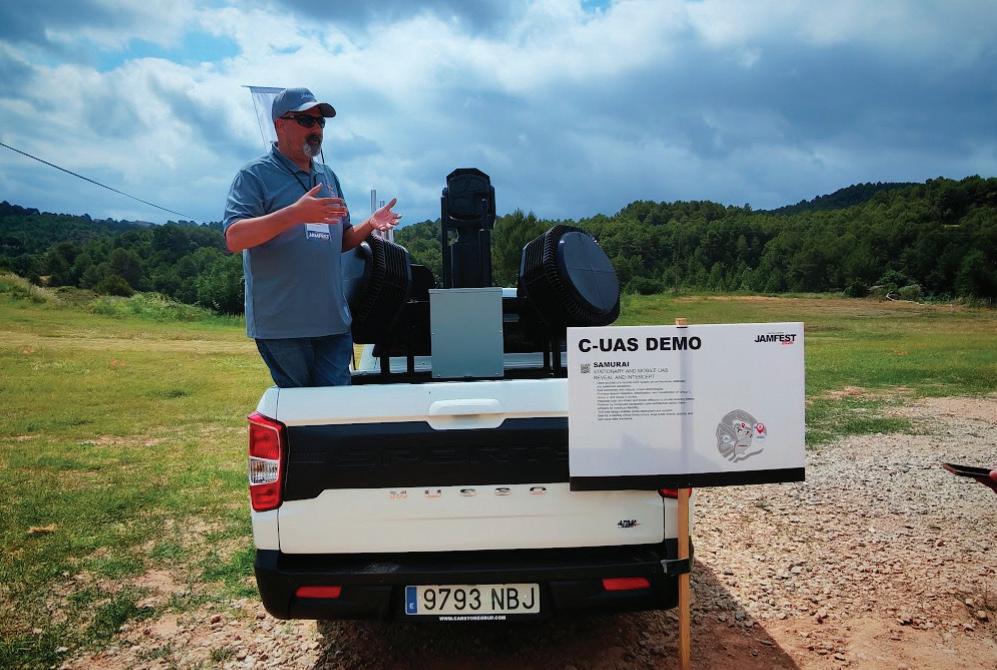
A vehicle-mounted Samurai system was displayed during Honeywell’s June 2026 Jamfest demonstration in Spain. Early contracts include protecting U.S. Air Force road-based nuclear convoys.
This ground control station also serves to note the position of known “friendly” drones, with operators able to verify and override threat signals (for example, a known oil refinery drone with faulty communications). “We’re in the process of being able to integrate with that station to pull the friendly picture in, especially on the commercial side,” Konicki said. “It’s just a matter of getting those data links and pulling that data, but as we build the software to be openarchitecture, we can ingest all sorts of incoming data streams.”
However, working within an operator’s preset rules of engagement, Samurai also supports the deployment of kinetic or nonkinetic e ff ectors to neutralize threats. Nonkinetic effects include jamming signals or a cyber takeover capability, potentially also pinpointing the operator’s location. Kinetic mitigation measures could include a low-collateral e ff ector such as deploying another drone with a net or, depending on
the circumstances, the use of a high-energy laser or kamikaze drone.
Although the system will suggest a course of action, with a semi- or fully autonomous mode helping to reduce operator task saturation, customers typically require human oversight before engaging a kinetic option.“Ninety-nine percent of what we’re doing is not unrestricted warfare scenarios,” Konicki said.
After a mission, AI-enabled analytics also help assess the data gathered to improve future performance. Honeywell leads continuous upgrade work from its facility in Brno, Czech Republic. Samurai’s open architecture also enables the company to integrate local content or swap out certain hardware to avoid U.S. export restrictions.
Honeywell also offers the entire Samurai system as a service, meaning that while the end user is responsible for its deployment, the manufacturer retains ownership and maintenance responsibilities. It can also operate the system itself if the customer prefers. z
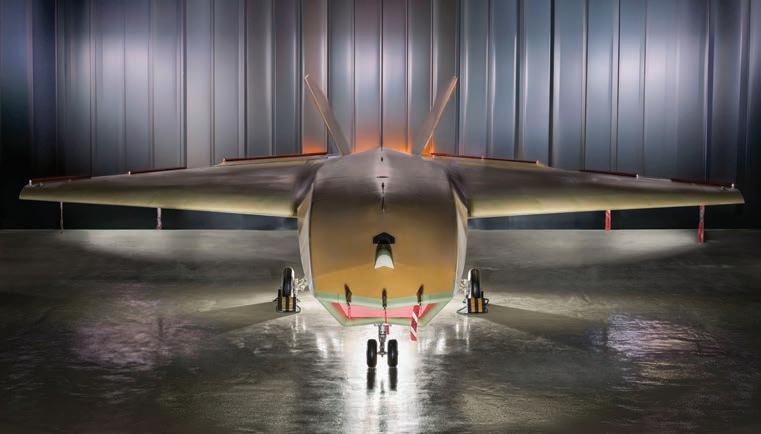
The first example of the Brontanax has been completed at the BAE Systems facility at Warton.
continued from page 1
operational analysis. The company has funded the project with about £300 million (about $400 million) of internal investment to date, and the design draws in part on BAE’s long involvement in autonomous systems, including the Taranis stealthy uncrewed combat air vehicle. The company has enlisted around 100 UK companies, adding innovative technology and pace to development and production.
Brontanax is aimed squarely at the UK’s Storm Fighter CCA acquisition program, announced last week, and will act as an operational concept demonstrator. However, BAE has designed the Brontanax as a production-ready vehicle, and the first example has been built on productionstandard tooling.
Driven by the aggressive initial operating capability target, the development roadmap will see the essentially complete first aircraft powered up for the first time in the third quarter of this year, leading to ground trials in the first half of 2027. Flight trials are slated to get underway in the second half of 2027. Later that year, the Brontanax is due to take part in Steadfast Defender—a NATO air defense exercise—to prove its ability to operate with the Typhoon and augment the crewed
fighter’s ability to defend airspace.
Brontanax is a roughly Hawk-sized uncrewed air vehicle with a design somewhat redolent of the crewed Tempest/GCAP fighter. With a maximum takeoff weight of more than five tonnes, the vehicle is initially powered by a Williams International engine, but RollsRoyce is developing engines in the Orpheus family that are likely to power the CCA in the future.
The vehicle has two internal weapons bays sized to fit current and prospective RAF weapons, and they can also accommodate other effectors, such as the Blizzard decoy/defense suppression air vehicle that BAE and Lockheed Martin are developing. Its modular design permits rapid evolution to meet emerging threats and allows potential export customers to tailor the vehicle to their own national requirements and equipment.
From the outset, the Brontanax has been designed with the Royal Navy in mind. The vehicle can launch from an aircraft carrier without a catapult, but would need some form of arresting system and a stronger undercarriage for shipboard operations. However, the necessary modifications can be incorporated on a single production line for both ship-based and land-based variants. The requirements of both the air force and navy are closely matched in terms of timeline and capability. n
JAMES HOLAHAN (1921-2015), FOUNDING EDITOR
WILSON S. LEACH, FOUNDER & CHAIR EMERITUS
EDITOR-IN-CHIEF – Matt Thurber
MANAGING EDITOR – Charles Alcock
PRESS ROOM EDITOR – Hanneke Weitering
THE EDITORIAL TEAM
PRODUCTION MANAGER – Martha Jercinovich
GRAPHIC DESIGNERS – Alena Korenkov, Grzegorz Rzekos
PHOTOGRAPHERS – David McIntosh
DIRECTOR OF VIDEO – Ian Whelan
EXECUTIVE CHAIR – Dave Leach
PRESIDENT – Ruben Kempeneer
HEAD OF PEOPLE & BRAND – Jennifer Leach English
SENIOR DIRECTOR EVENTS – Nancy O’Brien
ADVERTISING SALES
Victoria Tod – Northeastern U.S./Eastern Canada/United Kingdom, +1 (203) 733-4184
Michelle James – Western U.S./Western Canada, +1 (520) 343-0236
Joe Rosone – Midwestern U.S., Southeastern U.S./Caribbean/ Brazil, +1 (301) 693-4687
Diana Scogna – Europe/Middle East, +33 6 62 52 25 47
DIRECTOR MARKETING AND CLIENT SERVICES – Lisa Valladares
AUDIENCE DEVELOPMENT DIRECTOR – Eileen Silberfeld
SENIOR MARKETING SPECIALIST – Alyssa Barry
EVENTS SPECIALIST – Brien O’Brien
SOCIAL MEDIA MARKETING – Zach O’Brien
SALES ADMINISTRATOR – Cindy Nesline
FINANCE & HR DIRECTOR – Tracy Britton
ACCOUNTS PAYABLE MANAGER – Mary Avella
ACCOUNTS RECEIVABLE MANAGER – Bobbie Bing
U.S. HEADQUARTERS:
214 Franklin Ave., Midland Park, NJ 07432, +1 (201) 444-5075
Advertising Inquiries: +1 (201) 345-0085, adsales@ainonline.com
Circulation Inquiries: +1 (201) 345-0085, subscriptions@ainonline.com
WASHINGTON, D.C. EDITORIAL OFFICE: Kerry Lynch (business aviation) – klynch@ainonline.com +1 (703) 969-9195
EUROPEAN EDITORIAL OFFICE: Charles Alcock – calcock@ainonline.com, Tel: +44 7799 907595
Farnborough Airshow News is a publication of the AIN Media Group, Inc., 214 Franklin Ave., Midland Park, NJ 07432; Tel.: +1 (201) 4445075. Copyright ©2026 All rights reserved. Reproduction in whole or in part without permission of AIN Media Group, Inc. is strictly prohibited. AIN Media Group, Inc. publishes Aviation International News, AINonline.com, AINalerts, AircraftPost.com BJTonline.com, BJTwaypoints, Dubai Airshow News, EBACE Convention News, FutureFlight newsletter, VAI Convention News, Leeham News and Analysis, MEBAA Convention News, NBAA Convention News, Paris Air Show News, Singapore Airshow News