The 2026 edition of the Farnborough International Airshow opened with a bonanza of orders on day one as both Airbus and Boeing staged signings and announced orders for hundreds of narrowbody and widebody airliners.
Financier SMBC Aviation Capital is padding out its portfolio, ordering 200 aircraft in total from Airbus and Boeing, while new Saudi Arabian national carrier Riyadh Air is taking steps to shore up its nascent fleet through orders and the exercise of options that amounted to 34 aircraft. Meanwhile, Philippine Airlines committed to order up to 20 more aircraft. In sum, these deals could combine for a potential value of upwards of $40 billion, based on publicly available list prices.
SMBC Builds Up Airbus, Boeing Fleet
SMBC Aviation Capital signed a deal later on Monday for another 100 Airbus narrowbody aircraft, including 65 Airbus A321s and 35 A320s.
“This significant new order will give our airline customers access to a continuous delivery pipeline of the latest technology A320neo family aircraft into the mid-2030s,” said SMBC Aviation Capital CEO Peter Barrett.
Noting its 25-year relationship with Airbus, Barrett added, “Today’s announcement reflects SMBC Aviation Capital’s long-term commitment to supporting our airline customers.” He said that he anticipates the company receiving the aircraft beginning in 2030.
SMBC Aviation Capital is one of the largest customers for the A320 family, Airbus noted, and added that together with parent company Sumitomo Corporation, SMBC Aviation accounts for more than 900 commitments for all Airbus aircraft types.
Meanwhile, the lessor signed a deal for 100 Boeing 737 Max airplanes, calling for 60 of the Max 10 variant and 40 of the Max 8 single-aisles. The order marks the aviation financier’s first for the Max 10, the highest-capacity
variant of the Max family at 230 seats.
Overall, the deal brings SMBC Aviation Capital’s fleet of owned, managed, and committed Boeing Max airliners to 450. It represents a potential value upwards of $13 billion, based on publicly available list prices.
“This transaction represents a significant milestone for SMBC Aviation Capital and will ensure our airline customers have access to a long-term pipeline of new-technology aircraft,” said SMBC’s Barrett. “Our partnership with Boeing spans over two decades, and this order reflects market dynamics as our airline and investor customers look to upgauge to the 737-10.” He said the order supports the company’s plans for growth into the next decade.
The latest contract comes as global passenger traffic is forecast to grow 4% annually over the next two decades, Boeing noted, adding that lessors have collectively ordered more than 1,450 of the 737 Max jets, representing 20% of the family’s total backlog.
Riyadh’s Growing Fleets
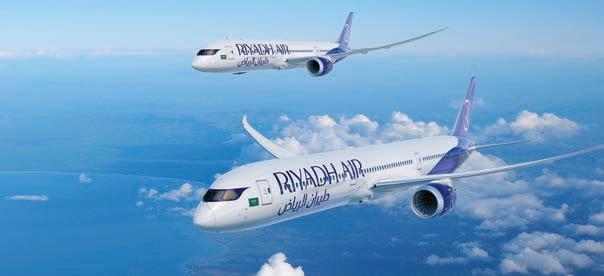
Also on Monday, Riyadh Air exercised options for 28 more Boeing 787 widebodies, including converting 20 for the larger 787-10 variant, and placed new orders for six additional Airbus A350-1000 aircraft.
The Boeing announcement included a previously unidentified purchase of 11 of the 787. Under the latest commitments and including existing orders, Riyadh Air’s 787 fleet is set to grow to 67. Riyadh Air’s current 787 fleet is at six.
“The commitment to firm up an additional twenty-eight 787 Dreamliners and introduce the 787-10 marks another significant milestone in Riyadh Air’s journey to serve over 100 international destinations by 2030, a key part of the Kingdom’s Vision 2030 ambitions,” said Riyadh Air CEO Tony Douglas. Adding the -10 to its -9 fleet, he continued, strengthens the airline’s ability to accommodate passenger and cargo demand.
The Airbus order, meanwhile, increases Riyadh Air’s commitment for the A350-1000 to 31 aircraft and is part of a 2025 agreement for up to 50.
“The firm-up of these additional aircraft reflects Riyadh Air’s continued confidence in its growth trajectory and in the future of Saudi Arabia’s aviation sector,” Douglas said.
Wholly owned by the Public Investment Fund, Riyadh Air was founded in March 2023 and is expected to contribute more than $20 billion to GDP growth by 2030.
Philippine Bets Big on Dreamliners
Boeing continues to expand its 787 Dreamliner orderbook under a deal with Philippine Airlines for up to 20 aircraft. That deal includes a firm order for fifteen 787-10s and options for another five as the airline modernizes and expands its fleet.
“The Boeing 787-10 will strengthen our medium- and long-haul fleet, allowing us to provide an even better travel experience for our customers while improving operational efficiency and supporting our long-term sustainability goals,” said Lucio C. Tan III, president and chief operating officer of PAL Holdings. Philippine Airlines, which Tan noted is Asia’s first and longest-serving airline, is celebrating its 85th anniversary this year and its 80-year relationship with Boeing. n
Riyadh Air deepened its Airbus commitment, ordering six additional A350-1000s while also converting 20 Boeing 787 options toward the larger -10 variant.
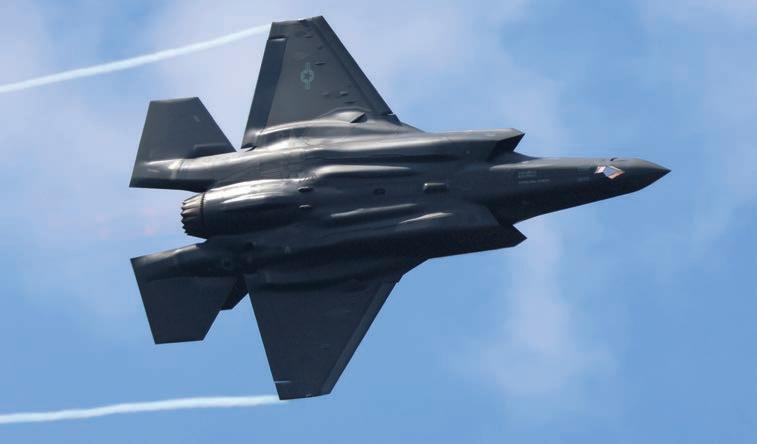
Strong demand for U.S. defense platforms such as the F-35 has strained an aerospace supply chain that years of cost-cutting left with little slack to absorb a surge in orders.
U.S. aerospace chases supply-chain stability
By Charles Alcock
“You get what you pay for” would appear to be the mantra the Aerospace Industries Association (AIA) is channeling in its ongoing efforts to shore up an industry supply chain it says has struggled with inconsistent levels of government spending. The impact goes beyond military programs, contributing to challenges on the commercial aviation side of the industry, according to AIA president and CEO Eric Fanning, although he did acknowledge some improvement on both fronts when speaking with AIN before the Farnborough International Airshow.
Decades of pressure on manufacturers to reduce aircraft prices have resulted in a lean supply chain that has struggled to adapt to increasing demand. “Progress has been made, especially on the commercial side,” Fanning commented. “Having capacity and the ability to move quickly comes with some expense, and we have seen the commercial side invest in that capacity, so improvements are being made there.”
Meanwhile, at face value, U.S. defense spending is on the rise under the second Trump administration—not least due to the war with Iran—but Fanning explained that the impact
on AIA member companies remains unclear in important ways. “It is the stability of the budget and appropriations process that is still not fixed, and it is also the duration of the demand signal,” he explained. “In aerospace and defense, there is a very expensive and capitalintensive workforce, as well as significant supply-chain investments. For that investment to be justified, there has to be some sense that the demand signal will have a long duration.”
Fanning’s acute insights into the mysteries of federal defense budget allocation come from personal experience as a former U.S. secretary of the Army, and he acknowledged that he has done his share of penny-pinching in the past. “Spikes in baseline budgets are disruptive; what’s more important is a budget you can count on,” he said.
Inflation Bites Budgets
At the same time, inflation has added to the pressure on industry leaders, making it hard for them to get pricing right for long-term contracts. “It is not just a fixed number; there are many factors such as energy, labor, et cetera,” Fanning explained. “How do you do a five-year bid having been burned before with long-term contracts and planning? Inflation takes a while to work its way through.”
AIA provides a space where aerospace partners and competitors alike can address shared challenges. “One of our superpowers is that we bring together the supply chain to learn from them,” Fanning said. “We also bring them together with their customers because the big companies sometimes think they are doing something helpful, but smaller companies find it is not helping. Big companies have more tools to weather perturbations. Small companies can find it hard to raise capital and also hiring [the skills they need].”
Many of AIA’s members will be part of what the group said will be a very strong U.S. presence at this year’s Farnborough show. As well as companies exhibiting, Fanning expects to be alongside a large congressional delegation, officials from 20 states, and senior federal figures including the NASA administrator.
Some might hope this year’s show will provide space for some constructive dialogue between the U.S. industry and its partners/clients at a time when antagonism has undoubtedly taken a toll. Fanning indicated that while he endorses the validity of U.S. government calls for European countries to significantly step up their defense spending in the face of real and immediate threats, their response could result in complex outcomes.
Like the U.S. military, NATO states and other allies are dealing with surges in defense spending that cannot readily be met on the supply side. At the same time, governments scrambling to inflate military budgets while balancing their books are under political pressure to spend this money at home.
“It took the U.S. decades to build today’s defense industrial base,” Fanning reflected. “It is not something Europe can turbocharge in a few years, even if there is agreement to do so.”
Meanwhile, AIA member companies are pressing ahead with efforts to make electric aviation commercially viable despite the U.S. government’s abandonment of decarbonization goals. “Whatever your position, it is an economic competitiveness issue, especially if [the] price of fuel is going up,” Fanning concluded. “We are hearing good things about FAA certification [of new eVTOL aircraft]. Who is going to solve the noise emissions issue is going to have the competitive advantage.” z
DAVID MCINTOSH
Honeywell Aero makes solo Farnborough debut
By Kerry Lynch
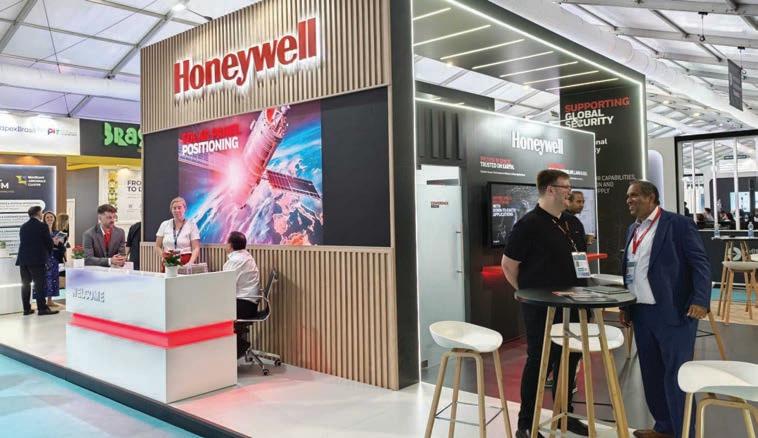
Honeywell Aerospace is marking the 2026 Farnborough International Airshow as its public debut as a standalone company with 36,000 employees and 10,000 customers across the defense, commercial, business, general aviation, and space sectors. Farnborough is its first major airshow appearance since completing its spinoff on June 29, when it emerged as an independent company trading on Nasdaq under the ticker symbol “HONA.”
Speaking to reporters ahead of this week’s event, Honeywell Aerospace CEO Jim Currier outlined a vision and plans moving forward. Noting that the spinoff occurred in 15 months— ahead of original plans for completion in the latter part of 2026—Currier said that the accelerated timeline “was incredibly demanding.” It required bringing on board 2,500 employees to ensure it could operate independently.
“That’s almost like a full integration that you would do when you acquire a company,” he noted. Another dynamic was building on Honeywell’s corporate culture, which had operated within its parent company’s culture.
Purpose-built Leadership
Critical to Honeywell Aerospace, the company now has a “purpose-built” management rather than what previously came from a corporate holding company. “There’s no such thing as a holding company in Honeywell Aerospace anymore,” Currier added, saying the team is running the business and the strategy specific to that business. “That’s a huge differentiation as a result of this,” he said.
Honeywell Aerospace now has a purpose-built board of directors solely focused on the mission of the company rather than an overarching corporation. The spinoff also changes how Honeywell Aerospace is able to deploy capital.
“Now, as a pure-play [aerospace and defense company] with that singular mission, singular strategy, singular purpose-built management
team and board, we know exactly where we want to deploy capital, and it’s all going to be around driving organic growth of the business going forward.” He noted that the company’s backlog is at a record high, at $19 billion.
Powering What’s Next
Currier added that organic growth will be the fastest path to meet that demand, which is
and on international fronts, where the company has more of a commercial focus with defense businesses.
On the civil side, Currier discussed further-reaching capabilities such as electrification. He cited electromechanical actuation systems as a technology for potential nextgeneration single-aisle aircraft. He called such technologies critical to increase the efficiency of airframes by 20% to 30%.
But a move in that direction will require an architectural change within the aircraft system, including the environmental control systems and pressurization. “That changes the entire architecture of an aircraft,” he said. “And those are technologies that we’re devel-
coming from all of the company’s major markets. However, he did not rule out mergers and acquisitions activity either, saying that if such opportunities met the company’s criteria moving forward, it would consider them.
While organic growth is the fastest way to balance demand, Honeywell Aerospace is exploring ways to leverage opportunities across its businesses and rethink its approach to engineering and product development to accelerate time to market and enable scalability.
On the defense side, which is 40% of the company’s overall business, budgets for products are record-setting, but Honeywell approaches these budgets di ff erently in the U.S., where spending is substantially focused on new platforms and sustainment,
oping.” He also pointed to changes in the wing with electromechanical actuation.
While addressing the next-generation single-aisle airliner, the company is maturing these technologies for other end markets as well. In fact, the company already has platform commitments that it’s not ready to announce in the defense, business, and general aviation sectors. “Those products will be certified before next-gen single-aisle selections are made,” he said. “It’s super important that we keep [moving] these programs, get them certified, and reduce substantial risk for next-gen single aisle.”
For such an aircraft, he said Honeywell anticipates a range of possibilities, but it’s important to start with the architecture design. n
Honeywell Aerospace greets Farnborough International Airshow attendees as a standalone company.
DAVID M c INTOSH
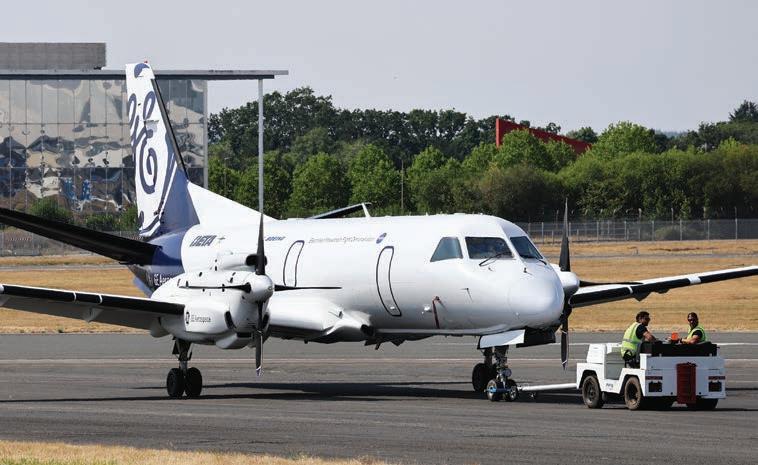
GE Aerospace, along with NASA, Beta, and Boeing, conducted hybrid-electric flights above 30,000 feet with a modified Saab 340B.
GE & partners conduct high-altitude test flights
By Jessica Reed
GE Aerospace and partners NASA, Beta Technologies, and Boeing have completed what GE says are the first hybrid-electric flights above 30,000 feet, as well as the first across the North Atlantic. The longest of the tests lasted more than two hours in hybrid-electric flight, powered by GE Aerospace’s propulsion system developed through the NASA Electrified Powertrain Flight Demonstration (EPFD) project.
For the campaign, GE Aerospace modified the right side of a Saab 340B twin turboprop, fitting a hybrid-electric system inside an inverted nacelle that provided additional ventilation. The system paired a CT7 engine with GE-developed motor/generators, power converters, inverters, and controllers, along with Avio Aero gearboxes, Dowty propellers, Unison heat exchangers, torque sensing, and engine harnesses. BAE Systems supplied the batteries, while Boeing subsidiary Aurora Flight Sciences provided the complete nacelle.
Pilots from GE Aerospace and Beta flew the U.S. test campaign, with Beta serving as systems integrator. Beta pilots then ferried the aircraft across the Atlantic to the UK
for the Farnborough International Airshow, operating in hybrid-electric mode on each leg. GE plans public demonstration flights this week during the show’s daily flying displays, with the aircraft also on static display.
One for the History Books
“This hybrid-electric system improved the high-altitude performance and climb capability while creating a flying laboratory to inform all future hybrid designs,” said Beta founder and CEO Kyle Clark. The Vermont-based company is also developing its own family of electric and hybrid-electric aircraft. “The GE Aerospace team brought rigorous design, test, and operational expertise,” Clark added. “The ground and safe flight test campaigns, capped by a flight across the North Atlantic, [are] the first of many important milestones for hybrid electric technology.”
During the Atlantic crossing, pilots switched on the hybrid-electric boost to achieve altitude and range that otherwise would require a standard gas turbine. During descent, the batteries were recharged.
H. Lawrence Culp, chairman and CEO of GE Aerospace, called this achievement “one
for the history books,” saying, “GE Aerospace is grateful to NASA, Beta Technologies, and Boeing for their collaborative partnership to accelerate hybrid electric technology to meet customer needs for greater efficiency, durability, and range.”
“Hybrid-electric technologies are durable and efficient,” said Mohamed Ali, president and CEO of GE Aerospace Commercial Engines & Services. “By flying a hybrid-electric engine system at altitudes never achieved before, we’re proving to our customers and to the industry the advanced capabilities we can bring to next-generation aircraft with ready technologies.”
NASA’s Efforts
GE Aerospace was awarded the NASA EPFD contract in 2021 to demonstrate the flight readiness of hybrid-electric technologies for single-aisle aircraft. The company previously tested a megawatt-class, multikilovolt system under simulated altitude conditions up to 45,000 feet at NASA’s Electric Aircraft Testbed in 2022 and completed ground tests of the EPFD propulsion system earlier this year.
“For nearly seven decades, NASA has taken on the near impossible, solved very hard technical problems, and helped move new capabilities into the hands of American industry,” NASA administrator Jared Isaacman told reporters during a press conference at the Farnborough International Airshow yesterday. “And we’re doing it again today with a new generation of hybrid-electric propulsion systems that can improve efficiency, expand capability, and potentially contribute to an exciting new future in air travel.”
Noting that NASA began exploring this technology 15 years ago, he said people questioned at the time whether it could become practical at scale. “We spent years working through the hardest technical problems electrical components, batteries, size, weight, thermal management, and the power systems needed for megawatt-class performance to make it a reality,” he continued. “Now, alongside GE Aerospace, we made those systems lighter, more efficient, and ready for the demands of flight.” n
DAVID M c INTOSH
Saudi, UK operators buy Airbus helicopters
By Cristofer Slotoroff
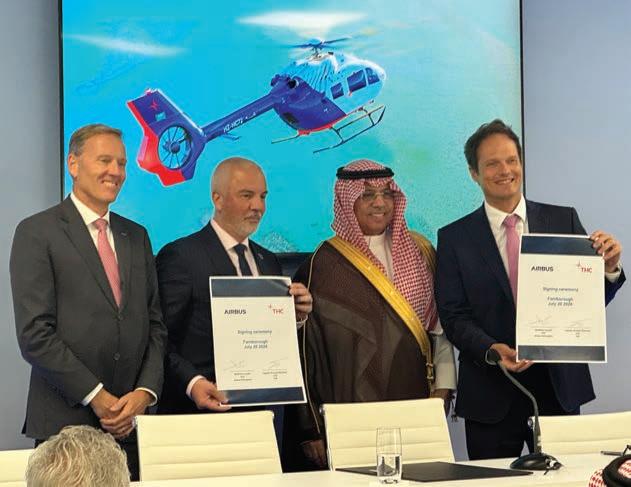
Airbus Helicopters opened the Farnborough Airshow yesterday with a pair of helicopter orders, with Saudi Arabia’s The Helicopter Company (THC) signing for eight additional H145s and the UK’s National Police Air Service (NPAS) placing an order for two more H135s.
The THC deal, signed by CEO Capt. Arnaud Martinez and Airbus Helicopters CEO Matthieu Louvot, added to the growing fleet that Louvot recounted—“25 H125s, 11 H160s, and 39 H145s for the THC Group, and today, eight more 145s.” Louvot expected the new aircraft “to be delivered very fast,” in 2027 and 2028.
Martinez declined to delegate the helicopters to a specific mission, highlighting instead
Bombardier
Global 8000 hits F’boro flightline
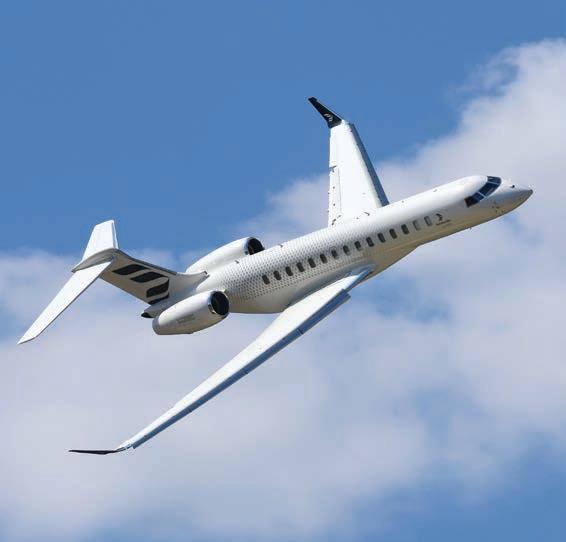
Bombardier’s Global family returns to an airshow flightline for the first time in more than 20 years: the Global 8000 can be seen at Farnborough this week performing its first such aerial display. The team is showing o the ultra-long-range business jet’s short-field takeo abilities and its agility in the sky.
the flexibility and especially the “agility” provided by THC’s framework agreements with Airbus. “We know that we will have additional aircraft for additional segments. We cannot anticipate all the time by when, and on which segment, specifically,” Martinez explained.
“That is why we are looking for special, multi-mission aircraft with specs that give us—until the last minute—the agility to decide if we turn left or if we turn right.” Martinez cited both medical services and tourism
The Helicopter Company CEO Arnaud Martinez and Airbus Helicopters CEO Matthieu Louvot signed a deal for eight Airbus H145 helicopters yesterday at Farnborough.
as deployment possibilities for the new helicopters, but cautioned that plans can change. “This is why we need the agility,” he said. “It’s not linked to the geopolitical situation. It’s linked to the Saudi vision.”
Louvot, who took over as Airbus Helicopters CEO on April 1, noted that the H145 fleet worldwide has reached 1,800 units in service and 8.6 million flight hours. A Public Investment Fund initiative, THC began operations in 2019 and has since grown into a significant helicopter operator in the region.
Separately, the NPAS order for two H135s brings its fleet renewal program to nine H135s under a 2025 framework contract with procurement agency BlueLight Commercial, making Airbus the exclusive helicopter supplier to NPAS for up to six years. The first two aircraft arrived at Airbus Helicopters’ UK operation in April for policing customization. From there, the helicopters will move to Airbus’ Oxford site in 2028 before completion to NPAS configuration. Both are equipped with Helionix avionics new to NPAS pilots, who have started familiarization flights and training.
NPAS operates 16 H135s and four H145s from 14 locations on behalf of the 43 police forces in England and Wales. “Together with our partners, we are building a fleet that will serve policing and the public for many years to come,” said chief superintendent Fiona Gaffney, NPAS accountable manager. n
DAVID M c INTOSH
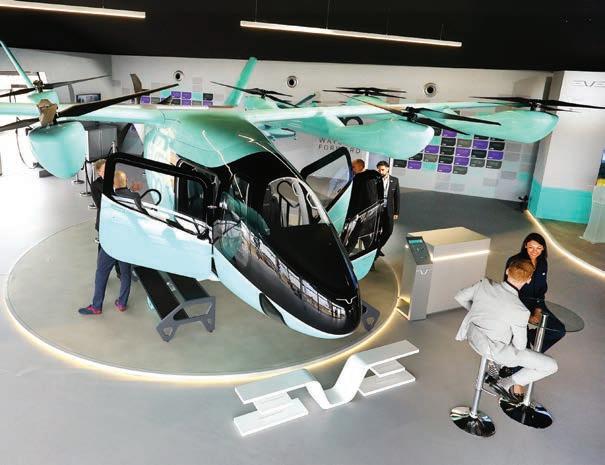
The “Eve 100” name references a certification moniker designated by Brazilian regulator ANAC. However, Eve says it represents “100 ways to go forward” while also symbolizing its all-electric sustainability commitment.
Eve 100 starts next phase of flight testing
By Charlotte Bailey
Eve Air Mobility has resumed flight testing of its initial eVTOL engineering prototype as it moves toward its first low-speed transition flight. The Embraer spinoff expects an ongoing expansion phase to result in a “full transition” flight— transitioning from vertical lift to horizontal cruise—between October and the end of the year. With Brazilian certification and FAA validation expected by the second half of 2028, Eve’s order book of some 2,700 aircraft, 52 of which are firm orders, has also been augmented by an additional 46 units from two new customers.
Following three months of scheduled “downtime,” Eve has been working to perform the necessary aircraft upgrades, software development, and structural reinforcements to progress to the next phase of flight testing. Speaking at the Farnborough Airshow, Eve Air Mobility CEO Johann Bordais reiterated that lessons learned from this engineering prototype will inform a total fleet of six aircraft, with the first conforming prototype on track to start assembly next year.
On July 19, Brazilian regulator ANAC published its proposed noise certification criteria for Eve 100, a key consideration as flight test
activities intensify. Although Bordais cited slightly more vibration in the initial vehicle to date, noise levels were slightly less than anticipated—perhaps around 60 to 65 decibels— though he cautioned that sound perception is more nuanced than just a number.
Also announced at the show, two new customers placed orders for Eve. Swiss start-up airline Moov Airways signed a letter of intent for up to 30 units to deploy across Cabo Verde and Europe. Eve stated that use cases could include medical transport services, infrastructure inspections, sightseeing, and shuttle services. Shearwater Global Capital, Bay Point’s aviation finance company, opted for 16 units.
According to Eve chief commercial officer Megha Bhatia, the latter order “expands on the emergence of leasing and financing solutions to accelerate the adoption of advanced air mobility worldwide.” This flexibility is, she argued, particularly “important for our customers, especially as we’re looking to convert into firm [orders].” Of Eve’s entire order book— potentially valued at more than $14 billion—the majority consists of customers in the Americas, with more than half of the backlog in the U.S. alone.
To date, Eve has signed two binding deals, the first with São Paulo urban air mobility operator and launch customer Revo, which placed a firm order of 50 aircraft worth $250 million. The second, Tokyo-based AirX, has signed for two firm units and 48 further options. Both of these deals include pre-delivery payments. However, Bhatia concluded that Eve is “fundamentally seeing an increased interest from [its] customers,” with a “tangible demand coming through the market.” n
Global 8000 sets speed record from L.A. to FIA
Bombardier underlined the billing of the Global 8000 business jet as the world’s fastest civil aircraft (since the Concorde) by setting a city-pair speed record on the way to its appearance at the Farnborough Airshow. Leaving Los Angeles on the roughly 4,700-nm journey, the Global touched down in Hampshire 8 hours 46 minutes later.
Less-than-favorable winds prevailed during the flight, but a top speed of Mach 0.93 was achieved, just short of the Global’s maximum of Mach 0.95, the company said. The new city-pair record was 2.2% faster than the previous figure.
Boasting an 8,000-nm range, the Global
8000 is also one of the most comfortable business aircraft, with the lowest equivalent cabin altitude—just 2,691 feet—of any type. It has exceptional landing performance, allowing it to operate from 30% more airports than its competitors, according to Bombardier. However, it is its speed that is the most eye-catching of its attributes. “Speed is without a doubt the Global 8000’s calling card,” said Stephen McCullough, executive v-p, engineering, product development, and Bombardier Defense, “and this latest accomplishment aptly underscores what sets this aircraft apart—the ability to bring the world closer and closer than ever before.” D.D.
DAVID
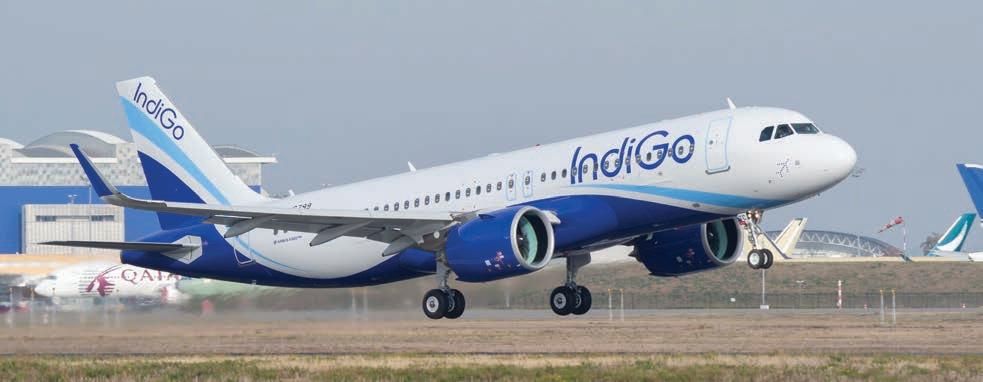
The Leap 1A engines will power IndiGo’s fleet of 510 Airbus A320neos. CFM also agreed to help establish IndiGo’s new MRO facility.
IndiGo orders 1,000+ CFM Leap engines
By Charles Alcock
IndiGo has ordered more than 1,000 of CFM International’s Leap 1A engines to power its fleet of 510 Airbus A320neos. The Indian carrier signed a memorandum of understanding with the Safran/GE joint venture at the Farnborough International Airshow yesterday, representing the largest-ever order for the turbofans.
Under the terms of the deal, CFM has agreed to help establish IndiGo’s new maintenance, repair, and overhaul facility. The engine
maker will also provide spare parts and a commitment to support high dispatch reliability.
IndiGo has operated aircraft with CFM engines for 10 years, having begun with A320ceo twinjets powered by CFM56-5B engines in 2016. In 2019, the carrier ordered its first A320/321neos.
“As IndiGo embarks on its next phase of growth towards becoming a truly global airline, we are delighted to extend our long-standing partnership with CFM International for the engines powering future deliveries of our Airbus A320/321neo
Family aircraft fleet,” commented Willie Walsh, IndiGo’s CEO designate. “The Leap engine’s industry-leading proven reliability makes it the ideal choice to support our scale, operational resilience, and sustainability ambitions. This partnership reinforces our commitment to providing safe, reliable, and efficient travel across an ever-expanding network in India and around the world.”
In another deal announced yesterday, leasing group Jackson Square Aviation selected CFM’s Leap 1A engines for some previously ordered A320neos. n
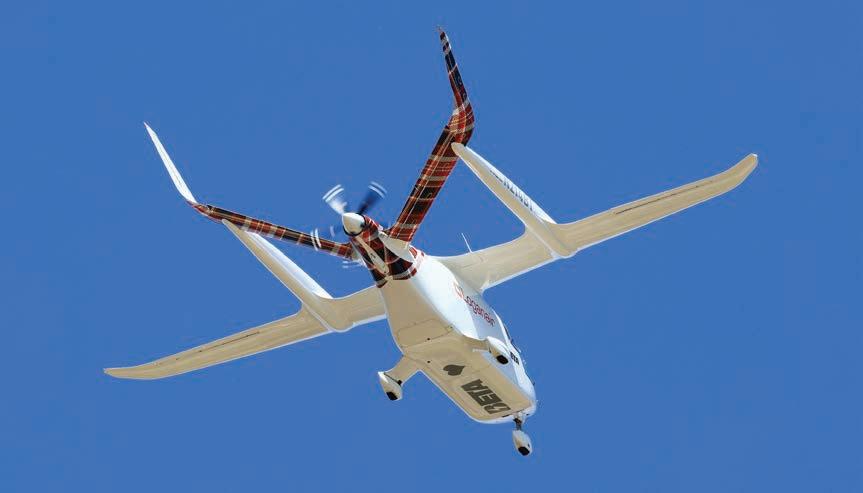
Loganair plans to add 5 Beta aircraft in 2029
Scottish regional carrier Loganair is to integrate five Beta Technologies Alia CX300s into its fleet from 2029, with options signed for a further five. The adoption of the conventional takeo and landing aircraft positions Loganair to become Europe’s first commercial airline to operate an electric aircraft fleet.
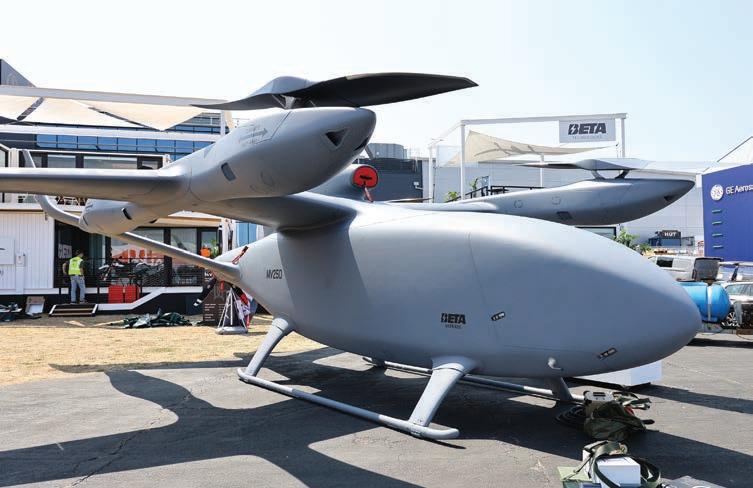
Beta Technologies unveiled the autonomous MV250 at Farnborough.
Sikorsky brings Matrix autonomy to Beta MV250
By Charlotte Bailey
Vermont-based electric aircraft developer Beta Technologies debuted a full-scale example of the autonomous, hybrid-electric defense variant of its Alia A250 eVTOL aircraft on Monday at the Farnborough International Airshow. Dubbed MV250, the aircraft is the latest uncrewed type to adopt Sikorsky’s Matrix autonomy suite—technology also
found on the Sikorsky S-70UAS U-Hawk, the Nomad UAS, and the optionally piloted Black Hawk.
The MV250 builds on what Beta terms the “simplicity and common architecture already flying” in its crewed Alia CX300 all-electric airplane, which the company aims to certify for commercial operations this year.
For the hybrid-electric MV250, Beta claims a maximum range of 2,408 kilometers (1,300
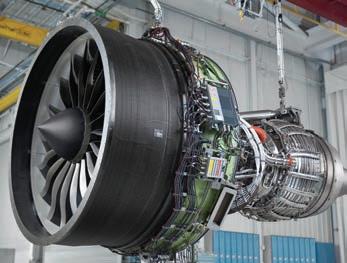
GE’s Dreamliner engine hits 50 million hours
GE Aerospace’s GEnx-1B high-bypass turbofan engine has surpassed 50 million flight hours. The engine, in three di erent thrust ratings, is one of two options available for the Boeing 787 Dreamliner family, the other being the RollsRoyce Trent 1000. The GEnx-1B has been selected by more than 50 operators and is flying approximately 600,000 hours each month.
First running in 2006, the GEnx engine family was designed to succeed the CF6
powerplant, of which more than 8,300 were supplied for widebody airliners and transports, plus around 3,000 marine and industrial powerplant derivatives. The first GEnx variant to enter service was the GEnx-2B, which powers the Boeing 747-8. More than 2,700 GEnx powerplants of both versions are now in service, and they are approaching 75 million flight hours and 12 million cycles. D.D.
nm), or a 250-nm “tactical range,” with a payload of up to 2,000 pounds. The aircraft’s series-configured, hybrid-electric turbogenerator, developed with GE Aerospace, will deliver greater speed and more operational availability, according to the company.
Beta believes that, unlike existing tiltrotor and legacy platforms, its “simplified aircraft architecture” can reduce maintenance and support requirements while offering lowercost solutions “to quickly move equipment, munitions, medical supplies, and critical cargo across dispersed operating environments.”
Integrating the Matrix stack into Beta’s open-architecture flight control system is “another step forward in providing a range of solutions for contested logistics missions,” said Sikorsky v-p and general manager Rich Benton. The Lockheed Martin subsidiary has demonstrated capability in autonomous operations since 2021, and every Matrixequipped aircraft is commanded through the same interface.
Notably, with Sikorsky and Beta having agreed to the collaboration only earlier this month, Sikorsky said the integration of Matrix into Beta’s CX300 was completed in just two weeks. It added that the open-architecture Matrix solution is ideally suited for “easy integration with other flight control frameworks,” such as the common flight control architecture shared by the Alia aircraft family. To date, Matrix autonomy has been integrated on more than 20 different platforms, “from helicopters to drones to fighters and cargo aircraft,” according to Sikorsky. n
DAVID M c INTOSH
More than 50 operators have chosen GE Aerospace’s GEnx-1B turbofan engine.
Airbus closes in on options for next-generation airliners
By Leeham News and Analysis Staff
In 2004, Airbus launched what would become the first version of the A350—its last all-new airplane design. Two decades on, the European airframer’s plans to refresh its product line remain unclear, albeit plenty of options appear to be on the table.
The A350 was an extreme makeover of the A330. Rolls-Royce Trent engines developed for the Boeing 787 were chosen for the new A350. A new composite wing replaced the A330’s metal wing. A few dozen A350s were sold, but it wasn’t long before Airbus realized this was going to be a loser.
After more false starts, Airbus launched the revamped A350 in 2006, called the XWB, for Xtra Wide Body. Since the A350 was Airbus’ response to the 787, the final version was slightly wider but still narrower than the 777 fuselage. Airbus tried to straddle the 777 and 787 lines with a compromise design.
Airbus CEO Guillaume Faury previously said he expected to launch a new airplane program in 2030. This would follow about two years of testing CFM’s RISE open-fan engine, designed for the single-aisle replacements of the A320 and Boeing’s 737.
Engine testing was to begin in 2027. It now isn’t slated to begin until 2029. This means that a program launch is unlikely before 2031.
In recent years, Airbus floated the concept of a stretched A220, commonly referred to as the A220-500. Internally, Airbus calls the concept the A220S for Stretch.
Reinventing Narrowbodies
The big decision to come is when to replace the A320neo family—and with what engine. Christian Scherer, a lifer at Airbus who served as chief strategist, chief salesman, and, most recently, CEO of Airbus Commercial Aircraft, has been a strong proponent of the RISE openfan engine. He was also the leading proponent of the A220S.
Scherer retired on December 31. His successor, Lars Wagner, appears to favor proceeding with the A220S. Wagner joined Airbus from his position as CEO of MTU Aero Engines. MTU is a big contractor to CFM’s rival Pratt & Whitney on the Geared Turbofan.
When Airbus was about a third of the way into the development of the A350-900, it decided in late 2010 to upgrade its A319/ A320/A321 lineup with new engines, in which a doubled bypass ratio saved an average of 15% in fuel.
At the June 2011 Paris Air Show, Airbus recorded more than 1,000 orders for the A320neo/A321neo. Airbus had played a highstakes game of chicken with Boeing to win a huge order from American Airlines for 260 A320s one month later, half of which were neos. When Boeing learned of the looming Airbus deal, the U.S. company’s then-CEO Jim McNerney decided to halt development of a 737 replacement and launch the re-engined backup design. This became the 737 Max.
Airbus prepares various technology development programs—which it calls “Technobricks”—to be ready for upgrades of existing aircraft or the development of a new aircraft program like its Next Generation Single Aisle (NGSA) aircraft. These include the following: CFM’s open-fan engine concept and other propulsion alternatives; the development of lower-cost and higher-rate composite structures; the Wing of Tomorrow program; the Multi-Functional Fuselage Demonstrator; and the biomimicry-based “Flapping” Wing (AlbatrossONE & eXtra Performance Wing) initiatives.
Green Aviation Goals
When Airbus received French government money as part of efforts to shore up the aerospace sector in the wake of the Covid pandemic, it was on the understanding that it would contribute to decarbonization efforts. Airbus pledged to intensify its research into hydrogen as an alternative fuel to jet-A.
The company set 2035 as its initial target to design, launch, and put into service a
Airbus’ hydrogen-powered ZEROe project was slated to enter service in 2035 before switching to a more complex fuel-cell-based design that might not see commercial development until after 2040.
hydrogen-powered airliner, but in 2025 said the timeline had slipped to at least 2040. The company showed three concepts: a propeller aircraft, a tube-and-wing mainline jet, and a blended-wing-body design.
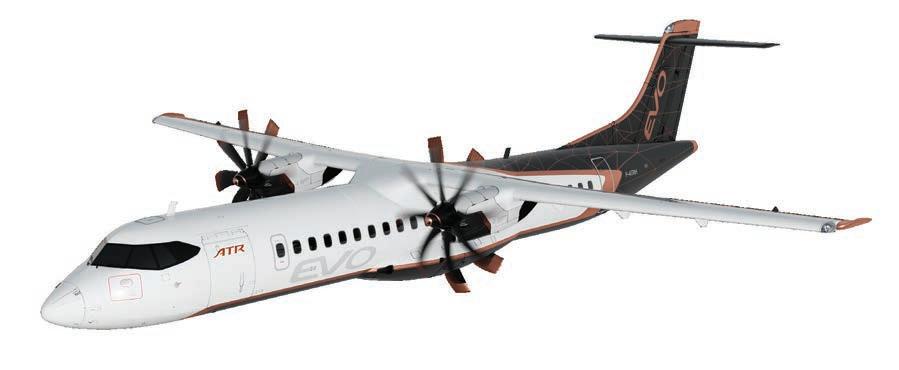
At the same time, ATR, of which Airbus owns 50%, committed in February to deciding by the end of 2029 whether to launch its hybrid-electric Evo turboprop, which it would bring into service in the mid-2030s. The question is: how does all this fit into the work on the Airbus Next New Airplane?
Airbus has long been active in the green aviation space. Europe has been more aggressive about green aviation than the U.S., so pressure on Airbus plays a role. With a large customer base in Europe, Boeing must engage in green aviation research as well. But there are fundamental differences between Airbus’ and Boeing’s approaches.
Airbus’ research has been more broadly based and more aggressive in alternative fuels than Boeing’s. Airbus believes in hydrogen, while recognizing the challenges of production and infrastructure. Both companies invest time and money in the sustainable aviation fuel (SAF) arena.
But Boeing’s research in hydrogen is limited. Its R&D into batteries and hybrids is focused on how these may be applied to systems rather than alternative power for airplanes. Boeing believes that SAF is the only feasible solution in the near-to-medium term. It’s not wrong, and years ago announced a commitment that its aircraft would be 100% SAF-capable by 2030. Airbus soon followed, as the near-term feasibility of its hydrogen-based ZEROe project waned.
Airbus Bets on a Fuel Cell-based ZEROe
Airbus conducted broad studies on alternative propulsion systems after the 2014 flight of its Airbus E-Fan technology demonstrator. It was quickly realized that battery-powered aircraft would not have the required range and that hybrid aircraft faced challenges in achieving operational and production cost advantages over classical gas turbine propeller aircraft. By 2019, it focused on hydrogen as a viable alternative to jet-A1-fueled turbofan aircraft. The ZEROe concepts presented in 2020 were all hydrogen-based, with a turboprop concept using fuel cells to generate
electric power and the jet alternatives using hydrogen-fueled turbofans.
As the project matured, it was more and more clear that a hydrogen-fueled aircraft would have a limited operational base for quite a long introduction period, as the aircraft requires a liquid hydrogen production facility at airports. It became clear how challenging it is to get airports to invest in such a facility for initial hydrogen-based airliner projects.
As the ZEROe project morphed into a ground-breaking sustainable aviation project, it became fitting that the airplane produced would be a true zero-emission aircraft. This made the gas turbine-based concepts burning hydrogen less attractive, as they still emit nitrogen oxide emissions, though at a reduced level.
The decisions regarding a fuel cell-based airplane limit the size to what is practical for an electric-motor-propelled aircraft in the coming decades. Airbus has presented a refined concept for the four-engine, 100-seat turboprop aircraft it is working on for the ZEROe introduction after 2040.
Years ago, Airbus confirmed that it retains its ownership in ATR as a proving ground for new technology. Otherwise, there is no apparent reason for Airbus to own 50% of this manufacturer, with Italy’s Leonardo owning the other 50%. The regional turboprop market is minuscule, and Airbus for years has blocked development of a successor to the ATR 42/72.
That design dates to the 1980s. It’s been updated continuously, and it is now the sole OEM in the Western world in its space following the withdrawal of the former Bombardier Q400 from new production. Former Airbus CEO Fabrice Brégier put it succinctly when Bombardier was still in business: why design a new airplane when ATR already had 85% of the market?
According to Kiran Rao, who was Airbus’ strategy chief for many years and its representative on the ATR board of directors, the capital cost to airlines of an entirely new airplane couldn’t be justified with the low cost of the amortized ATRs. The limited utilization couldn’t recoup the return on investment for a new $20 million airliner.
Airbus consistently blocked Leonardo’s desire to design a new airplane for these business case reasons. Embraer similarly studied and abandoned re-entering the turboprop sector due to the lack of a new engine that could offer a step-change reduction in fuel costs.
Evolution Beckons
However, with advances in new technologies that could marry electric power with turboprops, ATR is moving forward—so far—with its Evo project, which is still based on the ATR 42/72 series. It’s looking into improved aerodynamics coupled to further developed propulsion technology involving different levels of
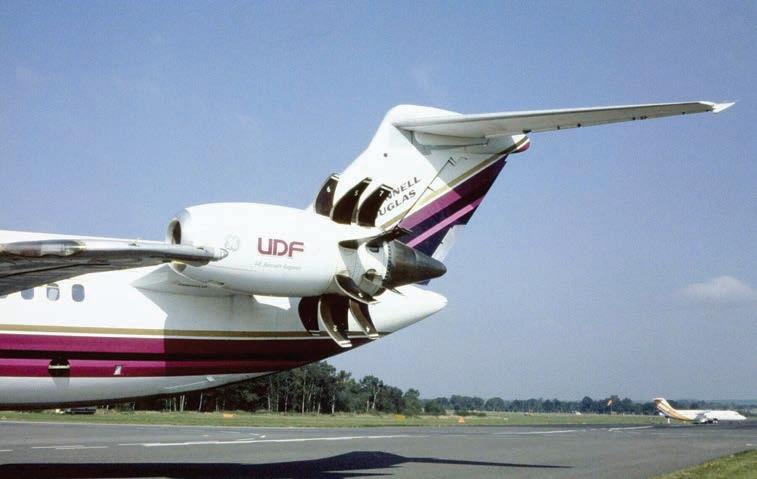
Research on unducted fans has a long history, including the GE 36 program, which ended in 1989.
hybridization. ATR has given itself the rest of the 2020s to determine whether its proposed Evo hybrid-electric regional airliner is feasible.
At the European airframer’s annual results press conference on February 18, CEO Nathalie Tarnaud Laude told reporters that the learnings from the research and technology work it is doing as part of EU-backed Clean Aviation projects will support the decision-making process for its Evo feasibility study.
Since September 2025, ATR has taken the lead in a pair of EU Clean Aviation Joint Undertaking programs intended to support service entry for a next-generation regional airliner in 2035 that will deliver at least a 30% reduction in carbon-dioxide emissions. Along with two other programs that are part of the Ultra-Efficient Regional Aircraft initiative, the work is backed by €140 million ($165 million) in Clean Aviation funding and more than €200 million from industry partners
The Hybrid-Electric Regional Aircraft Concept for Low Emissions (HERACLES) project is focused on the development of propulsion technology, high-performance batteries, an improved thermal engine that can run on 100% sustainable aviation fuel, advanced propellers, optimized aerodynamics, and a more-electric architecture. Aerospace groups, including Airbus, Leonardo, Safran, Pratt & Whitney, Collins Aerospace, Ratier-Figeac, and CIRA, are contributing to this work.
The Demonstrator of an Electrified Modern Efficient Transport Regional Aircraft (DEMETRA) project will use an ATR aircraft as a flying testbed to validate the integration of hybrid-electric propulsion, electrical and
thermal system performance, high-energy-density batteries, ground and flight testing procedures, and the certification process. The partners supporting work toward test flights in 2029 include Airbus, Collins Aerospace UK, DNW, Leonardo, Liebherr Aerospace, Pratt & Whitney, Ratier-Figeac, Safran Electrical & Power, Saft, and Thales Avionics.
“Clean Aviation offers us the perfect platform to work hand-in-hand with strategic partners on maturing the technologies that will be essential for our future Evo concept,” Tarnaud Laude said. “These projects are already informing the Evo feasibility study, and they play a critical role in ensuring that our next-generation aircraft continues to deliver the right combination of sustainability, economics, and versatility that regional operators expect from ATR.”
Incremental Improvement
The ZEROe and Evo projects are on a different scale. In ZEROe, Airbus is developing a 100% new propulsion system and an aircraft adapted for this four-engine system. The ATR Evo program is an incremental further improvement of the trusted ATR 72 platform, improving its efficiency and emissions in the single-digit to low two-digit percent range.
The Airbus ZEROe is a project that targets a 100% reduction in environmentally damaging emissions. The two projects, therefore, have very different goals, budgets, and targets.
When Boeing entered crisis mode with the March 13, 2019 grounding of the 737 Max, the company jumped from one crisis to another. The Covid pandemic in March 2020 dried
ATR is conducting ongoing research into the feasibility of hybrid-electric power with the EVO project, as part of the European Union’s Clean Aviation program. The partners in the program expect to test fly these concepts in 2029, and the results could lead to refining the EVO design.
up demand for widebody airplanes, grinding 787 deliveries to a virtual halt. Then, all deliveries were suspended for 20 months from October 2020, when a production flaw was discovered.
Just when things appeared to be looking up at long last, the door plug blew off a 10-weekold 737-9 Max. The cause was traced to sloppy assembly at Boeing and Spirit AeroSystems. Boeing slid into another crisis.
At long last, things began to look up for Boeing in 2025 and continue their ascent this year.
Its archrival, Airbus, didn’t have a crisis to deal with—just a balky supply chain that has disrupted plans to ramp up production of the A220, A320neo, A330neo, and A350 lines. In other words, every commercial line.
Supply-chain problems, especially with engines and interiors, make it difficult for Airbus to meet its delivery goals.
At face value, Airbus is in far better shape than Boeing. Nevertheless, there are some challenges that may not be immediately apparent.
The European aerospace giant ended 2025 in good shape financially and with strong commitments to R&D spending. At the same time, it faces higher manufacturing costs and a still-unresolved product gap in the middle of the air transport market. z
To enjoy full access to exclusive insights about the commercial aerospace sector, subscribe to Leeham News and Analysis— an AIN Media Group platform.
15-19 November 2027 DWC, Dubai Airshow Site
Where Aerospace Business Takes Off
Dubai Airshow is where industry-defning partnerships are forged and future technologies are launched to a global audience.
Be part of the 20th edition, where global aerospace leaders meet buyers, governments, investors, and partners that move business forward.
1,500 exhibitors
115 countries
248,000+ attendees
490 official delegations
219 aircraft on display
$202B+ announced deals
Pratt & Whitney ramps up for next-gen jets
By Curt Epstein
Pratt & Whitney is reaping the benefits of its recent major investments, according to Rick Deurloo, president of its commercial engines division. Speaking to journalists at a pre-Farnborough visit to the company’s main production facility in Middletown, Connecticut, he noted that in the first half of the year, the company invested more than $400 million in the further development of both its production capacity and MRO capabilities, part of a larger billion-dollar investment that has seen the engine maker increase its production by 50% above pre-pandemic levels. That ramp-up in production is certainly warranted.
“Right now, we have 15,000 commercial engines out there generating flight revenue for us,” Deurloo said, adding that its geared turbofans equip more than 2,800 aircraft and that it has an 8,000-engine backlog. Following EASA certification earlier this year, the RTX subsidiary started deliveries of its GTF Advantage engine to Airbus, with service entry expected by the end of the fourth quarter.
“If you think about where it’s going to be playing on the A320neo family, that order book is sold out right now until 2030 and beyond,” explained Deurloo. “At one time when we watched this program, we thought it was going to be a seven-, eight-year run. Now we know it’s going to be an airplane that’s going to be delivering for some time.”
At Pratt & Whitney’s facility in Rzeszów, Poland, more than a quarter of that recent $400 million went to expanding production capacity, adding advanced capabilities, and meeting growing global demand for its commercial and military engines. The company will construct a new facility that will house specialized capabilities for processing isothermally forged parts, including heat treatment, sonic machining, and inspection operations.
The company also added a modern $235 million, one-million-sq-ft advanced casting facility in Asheville, North Carolina, which has enabled it to begin consolidating and streamlining production of turbine blades under one roof rather than having to ship them around to several different locations at various steps
in the process. At RTX’s wholly owned subsidiary HMI, in Clayville, New York, the principal supplier of superalloy powder and billet to Pratt & Whitney, a third production tower will come online toward the end of the year and increase its output of raw materials to the engine maker by 50%.
Additionally, P&W is investing $200 million to build a seventh isothermal forging press at its Columbus, Georgia facility. Slated for completion by 2028, the expansion is expected to boost output of critical jet engine parts by 30%.
All this investment comes not just to support the current aircraft designs, but to position P&W to power future airframes as well. “Some of the biggest pacers to next-gen single-aisle timing is the industrial footprint needed,” Deurloo said. “All this investment we’re making today gives the foundation of the framework of an industrial footprint that will help support next-gen single-aisle as well.”
Taking advantage of that investment is the company’s military engine side. “I love that we are part of the business that has both commercial and military, because as we invest in the company and the growth that’s going on on both sides, it helps each other, it lifts the capacity across the board,” said Jill Albertelli, president of P&W’s military engine division. “Very often we share technologies across the business, from military to commercial, so I do get the advantage of those many millions of flight hours that [the commercial engine business] has, and vice versa. It’s critical to our business.”
P&W provides powerplants for the fifth-generation F-22 and F-35 fighters, and the under-development B-21 Raider. “We are the only provider of fifth-generation power that’s with our F135 and also our F119,” Albertelli said, adding that the F119—equipped on the F-22 Raptor—recently surpassed a million flight hours. “This is the first fifth-generation engine and jet application that existed. It definitely is the base off of which we moved into the F135 on the F-35 platform, and it continues to fly very critical missions today.” As well, the company’s engines equip the legacy F-15 and F-16, the C-17 transport, and the KC-46 tanker.
For the F135 engine, which powers all three variants of the F-35 and is capable of producing more than 43,000 pounds of thrust with
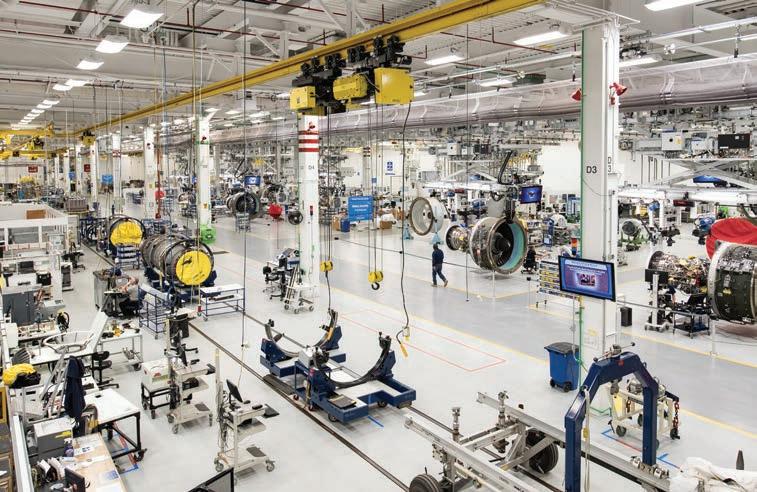
Pratt & Whitney has invested more than $400 million into its facility in Middletown, Connecticut.
the afterburner engaged, P&W has delivered more than 1,500 units thus far, according to Albertelli. “I would say this year we’re up about 20% from a contractual standpoint for construction of new engines.” In March, P&W was awarded a $3.8 billion contract modification for lots 18-19 of the powerplant, bringing the total value of the F135 lots 18-19 contract to $6.6 billion.
Infrastructure Improvements
Built in the 1970s and described as the crown jewel of the company’s main production plant in Connecticut, the Product Delivery Center is the last stop for engine testing before the units are shipped to customers. In the ensuing half-century, the facility has been continually renovated and refurbished to the point that Edward Sluis, the location’s v-p and general
manager, explained during a pre-Farnborough Air Show tour, “There’s not much left other than concrete from the 1970s.”
Part of its latest $30 million upgrade to the eight-test-cell facility was the reconstruction of cells one and two, which are dedicated to military engines such as the F135. A quenching system uses water pumped from the adjacent Connecticut River to cool engine exhaust when run on full afterburner. The test cell ejectors—the tunnels leading to the “hush houses”—were paneled in stainless steel to prevent corrosion over an 18-month span, as were the interiors of the hush houses themselves, which serve to muffle the exhaust and release steam.
Having both those test cells in operation has contributed to the up-tempo in production. “The importance of that is it’s leveled up our
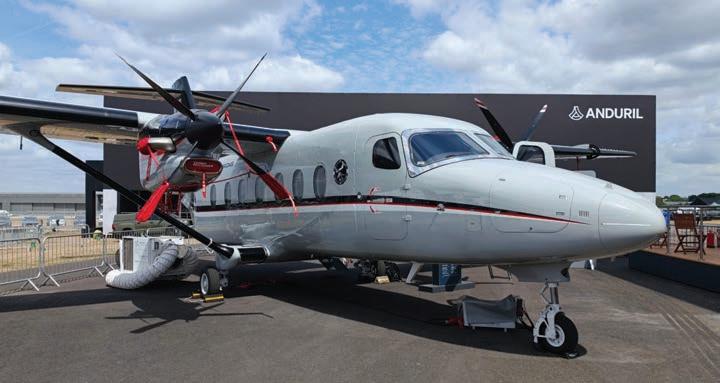
Textron takes SkyCourier’s special-missions variant to UK after Belgium’s 5-aircraft order
Textron Aviation’s special-missions Cessna SkyCourier is making its Farnborough Airshow debut, three months after the multiuse variant secured its first military order. According to the OEM, the twin- engine turboprop’s presence at the European show “provides an opportunity to highlight growing international interest in the Cessna SkyCourier as it enters new global defense markets.”
Textron had previously hoped to bring its special-missions SkyCourier to the Dubai Airshow last November, following a demonstration tour in Africa. However, owing to what a Textron spokesperson termed “current geopolitical environmental factors,” the aircraft was unable to secure the necessary overflight permits.
In April, Belgium selected five SkyCouriers to augment its special operations forces, with deliveries to the program’s prime contractor expected throughout 2027. According to Textron Aviation Defense president and CEO Travis Tyler, “this first announced military purchase shows strong interest in the Sky-
Courier and proves it is ready for high-stakes missions.”
The special-mission variant builds on the standard SkyCourier’s flexible cabin layout, able to accommodate up to 19 passengers or three LD3 containers in a freighter configuration. All versions benefit from what the manufacturer describes as “proven performance from rough or remote airfields,” with
capacity to be able to test 135 engines, which is important every single day,” Albertelli said. She added that her division isn’t beyond adapting existing Pratt & Whitney technology and even products from other divisions to suit new military applications, such as in the case of powering collaborative combat aircraft. “That’s one of the hot topics,” she said. “Always on the defense side, we have been able to test small engines on remote applications, so that’s where we would pull a business jet engine from Pratt & Whitney Canada (P&WC)—say, the 500 series type of engine.”
Albertelli noted that P&WC’s off-the-shelf engines can offer an up to 20% increase in their qualified thrust capability for uncrewed applications, enabling them to deliver increased performance for those applications. z
a maximum range of around 1,666 km (900 nm). The clean-sheet, high-wing type received FAA type certification in March 2022. Optional special-mission capabilities include two underwing stations per side, an extended fuel system o ering around 50 minutes of extra endurance, and equipment for static-line parachute jumps.
Textron also announced in April an InFlight Operable Door option for the passenger variant, expected to be available as a special-mission, factory-installed option in 2028. C.B.
Special-missions Cessna SkyCourier with extended-range fuel system makes its Farnborough debut.
DAVID M c INTOSH
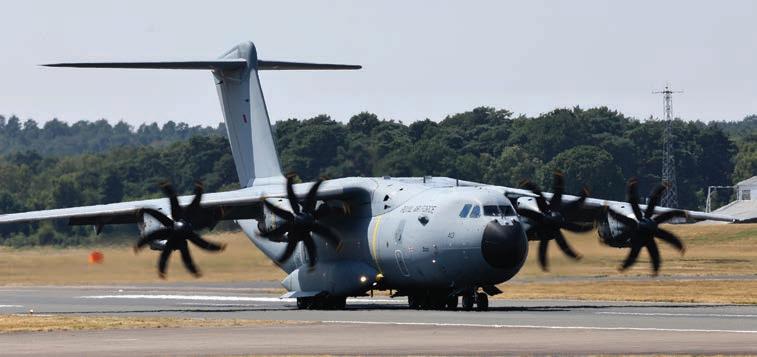
The UK is one of five current A400M operators involved in the multinational airlift project.
NATO allies accelerate multinational fleets
By David Donald
Following the success of the Multinational MRTT Fleet (MMF), which provides strategic tanker/transport capability for its participants, a group of seven NATO nations has announced a High Visibility Project to create a similar organization to address strategic airlift shortfalls among alliance members.
Unveiled earlier this month at the NATO Summit Defence Industry Forum held in Ankara, Türkiye, the program would be based on the Airbus A400M. The initiative is being proposed by Belgium, Croatia, France, Poland, Spain, Türkiye, and the UK. Of these nations, only Croatia and Poland are not current operators of the A400M.
As with the MMF, the multinational airlift proposal is based on the pooling and sharing of all aspects of the operation. This includes a jointly owned aircraft fleet, as well as multinational training, maintenance, infrastructure, and procurement. The end-to-end solution is designed to ensure that national and NATO requirements are fulfilled, while at the same time increasing operational flexibility. The latter includes improved provision for secondary roles such as firefighting, in-flight refueling, medical evacuation, and disaster relief.
More than 135 A400Ms are now in service, and the type has become the backbone of air mobility capacity among the larger European air forces.
At the same forum, 11 NATO allies announced that they had selected Saab’s GlobalEye to equip a multinational airborne early warning fleet that will partially replace NATO’s aging Boeing E-3 Sentries, with a purchase of around 10 thought likely. The nations involved in the GlobalEye coalition are Belgium, Canada, Denmark, Germany, Latvia, Lithuania, Luxembourg, the Netherlands, Norway, Romania, and Sweden.
In addition to providing improved aerial surveillance capability, the GlobalEye
introduces expanded multi-domain capabilities and networked operations. France has independently ordered two GlobalEyes (plus two options), and their operations would likely be integrated to some extent with those of the multinational force, as is already the case with France’s E-3s.
These announcements show Europe’s determination to improve its defensive capabilities, with the U.S. not involved in either of the above programs, although it remains a contributor to the existing NATO AEW Force and also to the multinational Heavy Airlift Wing (HAW). The latter is a coalition of 12 NATO allies that share three Boeing C-17 strategic airlifters based in Pápa, Hungary. The HAW operates outside of NATO, the EU, or other alliance command, its operations being controlled by the Strategic Airlift Capability program that was formulated within a broad NATO framework in the 2000s.
In the meantime, the MMF also continues to grow. The current fleet of nine Airbus A330 Multi-Role Tanker Transports is to grow to 12 following the addition of new participating nations. The original group of six—Belgium, Czechia, Germany, Luxembourg, the Netherlands, and Norway—was joined by Denmark and Sweden in 2025, while at the Ankara summit this month, Finland was announced as the latest member. As well as providing air-to-air refueling and troop/cargo transport in support of deployments, the MMF’s A330s have also been used for evacuation operations. n
Runway overrun system OK’d for Embraer E2
Following certification by Brazil’s ANAC civil aviation authority, the Runway Overrun Awareness and Alerting System (ROAAS) for the Embraer E2 airliner has been approved by EASA. Using predictive algorithms, the system continuously monitors landing conditions to provide timely alerts to the crew.
The ROAAS is designed to help the crew prevent runway overruns when landing. It continuously monitors the aircraft’s condition and calculates landing performance in real time, both before and after touchdown. Using Embraer-developed algorithms,
the system provides alerts to the flight crew if it detects a potential overrun, allowing the crew to react accordingly. It provides enhanced awareness and actionable information in situations when landing margins have been reduced.
D.D.
DAVID M c INTOSH
787 Dreamliner to trial fuel-saving technology
By Charles Alcock
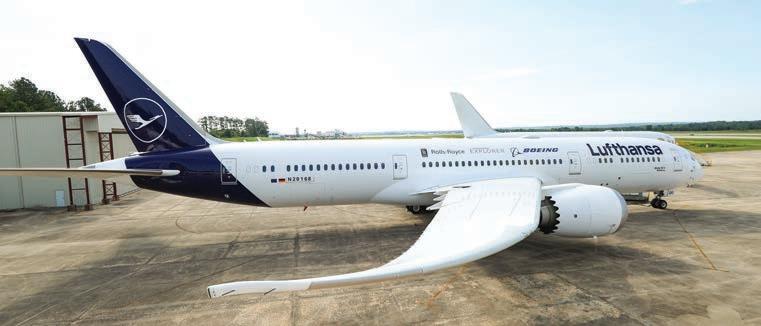
A Boeing 787 airliner is set to begin flight trials later this month as part of the airframer’s ecoDemonstrator campaign to reduce fuel burn and noise. Along with partners Rolls-Royce and Lufthansa, Boeing announced the plan for its new flying test bed on Thursday.
The modified Dreamliner, which will fly from Boeing’s facility in Glasgow, Montana, has been fitted with a shorter engine inlet demonstrator featuring advanced acoustic treatments. According to the manufacturer, the new design will support the integration of more fuel-efficient engines on next-generation aircraft and reduce weight and drag while maintaining acoustic performance.
This new round of ecoDemonstrator flight trials will also evaluate modified departure and arrival procedures, including what Boeing described as “intelligent operations” flight paths intended to reduce noise levels in communities close to airports. These flight paths are generated using algorithms based on multiple data sources to identify opportunities for fuel efficiency and noise mitigation.
The Boeing 787-9 will serve as the ecoDemonstrator test bed for 2026, with the latest set of flight trials expected to run through mid-August. The aircraft, which will
be delivered to German flag carrier Lufthansa, is powered by a pair of Rolls-Royce Trent 1000 engines.
The technology being tested is part of Phase III of the FAA’s Continuous Lower Energy, Emissions, and Noise (CLEEN) program. Julie Marks, executive director of the U.S. agency’s Office of Environment and Energy, said the latest round of tests “demonstrate how the public partnership of the CLEEN program supports the development and integration of advanced technologies into current and future aircraft.”
Boeing launched the ecoDemonstrator program in 2012 to evaluate technology developed in laboratory settings in a real-world operational environment. So far, the program has tested more than 260 technologies aimed at improving safety, as well as reducing fuel burn, carbon dioxide emissions, and noise.
“The more efficient inlet and Intelligent Operations flight paths we’re evaluating on this year’s ecoDemonstrator Explorer are among the most promising concepts we’re working on,” said Boeing chief technology officer Lane Ballard. “These enhancements have the potential to make our airplanes even more valuable to our partners, including customers like Lufthansa and suppliers like Rolls-Royce.” z
Anello’s tiny
gyroscope prevents GPS spoofing
Anello Photonics claims to have marketready technology that allows drones to navigate reliably in airspace where a reliable GPS signal is not available due to hostile blocking or spoofing.
At the Farnborough International Airshow, the U.S. company is displaying its silicon photonics optical gyro (SiPhOG), built around a 2-mm-by-5-mm photonic chip and packaged in a housing about the size of a coin.
The tiny device is the basis for Anello’s X3 inertial measurement unit, now available for aviation applications. The “gyroscope on a chip” sensor package measures motion and orientation based on roll, pitch, and yaw.
According to co-founder and CEO Mario Paniccia, the U.S.-made X3 replicates the functions of current fiber-optic gyros while being far more compact. Anello now also produces an aerial inertial navigation system, which it has been delivering over the last few months.
Extensive testing of the technology demonstrated that the SiPhOG detects GPS outages and automatically initiates navigation to keep the aircraft on the correct flight path throughout its mission.
Paniccia told AIN that in four- to six-hour flights with fixed-wing drones, Anello found an average error rate of just 1.5% in terms of distance traveled. The technology has been deployed for maritime applications as well as on autonomous ground vehicles. C.A.
Coin-sized device navigates without GPS.
A Boeing 787 airliner due to be delivered to Lufthansa will first be used for flight trials as part of the ecoDemonstrator technology program. It is powered by two Rolls-Royce Trent 1000 engines.
Avealto starts $50 million funding round
Avealto has opened a 12- to 18-month, $50 million funding round to advance its plans to o er a low-cost broadband alternative to low-Earth-orbit satellite constellations. The program is principally aimed at regions with poor existing broadband coverage, for which Starlink is the only real current option.
SpaceX has now raised Starlink’s rural prices while preparing a retail push that puts it in competition with its own telecom customers. Avealto, by contrast, plans a wholesale-only operation dedicated to supplying telecom operators with reliable capacity.
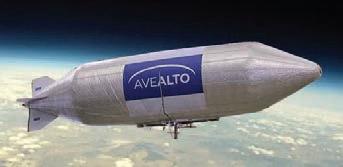
Rather than rely on satellites, Avealto’s system uses solar-powered high-altitude platform station (HAPS) airships that fly in the stratosphere at about 20 kilometers to provide e ective ground coverage of about 45,000 sq km. The airships deliver the signal directly into telecom operators’ networks.
Using HAPS instead of satellites cuts costs by about 80%, according to Avealto, while avoiding byproducts of satellite operations such as space debris and particulate
Full speed ahead
The chief executives of both Edgewing and the agency are confident that they can avoid some of the pitfalls that have dogged other multinational programs, and both report strong government support and full alignment between the three nations at both industrial and political levels. Having Edgewing as the prime contractor removes potentially destructive competition between industrial partners, and the whole GCAP program is built on an equal three-way share. The venture is busy establishing offices at Turin, Nagoya, and Warton, the main locations of the three national industrial leads.
In terms of industrial workshare, Edgewing CEO Marco Zoff said that a fairly detailed framework plan is already in place, including down to fourth- and fifth-tier supplier levels, but it is not set in concrete by any means. Work
pollution from rocket launches. Each airship is fully reusable, the company says; when needed, it can be landed, serviced, reconfigured, and relaunched.
Avealto has secured a facility at Lydd Airport in Kent, England, as a manufacturing center that could create up to 50 highly skilled engineering jobs. The funding drive will finance the factory as well as a full-scale prototype demonstration set for September in Wales.
Avealto signed a memorandum of understanding with Indonesian partners in 2023 and is also progressing discussions in Malaysia, with Southeast Asia seen as the most likely region for initial commercial operations. D.D.
is being shared out with the aim of having no redundancy of effort across the tri-national concern, but a delicate balance is required between maintaining an equal split and providing the best possible capability. “We don’t want to invest in weakness,” remarked Zoff
Production plans concerning locations of final assembly lines and the logistics of moving components between sites have yet to be established, although it was anticipated that each of the three nations would assemble aircraft.
As a whole, GCAP remains open to other nations joining the program in some form or other, either in what the GCAP Agency’s chief executive, Masami Oka, calls “wider partnering” or as observers, with Canada expected to announce that it will follow the latter path imminently. Adding partners that can bring new or improved technology would only benefit the program, but Zoff warned that the inclusion of further partners must not be allowed to jeopardize the current timeline. n
JAMES HOLAHAN (1921-2015), FOUNDING EDITOR
WILSON S. LEACH, FOUNDER & CHAIR EMERITUS
EDITOR-IN-CHIEF – Matt Thurber
MANAGING EDITOR – Charles Alcock
PRESS ROOM EDITOR – Hanneke Weitering
THE EDITORIAL TEAM - Charlotte Bailey, David Donald, Curt Epstein, Kerry Lynch, Jessica Reed, Cristofer Slotoroff
PRODUCTION MANAGER – Martha Jercinovich
GRAPHIC DESIGNERS – Alena Korenkov, Grzegorz Rzekos
PHOTOGRAPHERS – David McIntosh
DIRECTOR OF VIDEO – Ian Whelan
EXECUTIVE CHAIR – Dave Leach
PRESIDENT – Ruben Kempeneer
HEAD OF PEOPLE & BRAND – Jennifer Leach English
SENIOR DIRECTOR EVENTS – Nancy O’Brien
ADVERTISING SALES
Victoria Tod – Northeastern U.S./Eastern Canada/United Kingdom, +1 (203) 733-4184
Michelle James – Western U.S./Western Canada, +1 (520) 343-0236