


SECURITY: KEEPING SKYBORNE SPIES AT BAY
AAM: EVTOL PILOT PROGRAM PROVING POPULAR
ROTORCRAFT: ICARUS IN-AIRCRAFT IMC TRAINING
Special Report: Focus on Safety
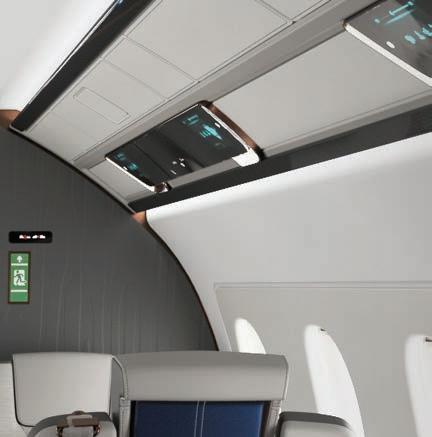
We fly the newest jet in the Citation stable, Textron Aviation's Ascend upgrade of the 560XL






























16 FAA eVTOL integration pilot program flips the script on certification
6

Bizjet deliveries at Gulfstream Aerospace hit Q1 record 12 Defeating spies in the sky DEPARTMENTS
4 Cirium: Bizjet deliveries to edge up in 2026
8 Bombardier book-to-bill swells, Q1 deliveries up YOY
10 NetJets adds first Citation Ascends to fleet
22
26
28
Safety Report: Charter experts stress culture drives brand and vitality
Safety Report: ACSF expanding horizons, diving into data
Safety Report: NTSB probes hazardous Hawker stall test flights
32 Safety Report: Hop-A-Jet CL604 crash, the final report
34 Pilot Report: Citation Ascend is the ultimate XLS
40 Aero Friedrichshafen takes bizav to the max
Rotorcraft | 46 On the Ground | 48 MRO
Accidents | 52 Compliance | 54 People in Aviation
the cover: the Textron Aviation Ascend


Despite its higher bizjet sales forecast through 2045, data specialist Cirium anticipates that the industry will stay below 1,000 annual deliveries over the next 10 years.
BY KERRY LYNCH
Business jet manufacturers are poised to deliver about 870 aircraft in 2026, marking a 2.8% increase over the 846 counted in 2025, according to data specialist Cirium. Releasing its 2026 Business Jet Delivery Forecast, Cirium noted that growth follows an 11% increase in deliveries from 2024.
Meanwhile, Cirium revised its forecast upward through 2045 by 3%, or nearly 600 business jets, to 18,000 deliveries worth $584 billion. Long-range and light jet segments are each anticipated to account for 28% of the deliveries over the 20-year span. While rivals on a unit delivery basis, the long-range segment will have an outsized share of value, accounting
for 62% of the total, Cirium forecasts. Gulfstream Aerospace and Bombardier will drive the dollar volume, while Textron Aviation’s Cessna Citation line is anticipated to lead in unit deliveries, followed by Gulfstream and Embraer.
As for the bump in the long-term forecast, Cirium cited an upward adjustment of 13% to the light segment compared with the 2025 forecast. It also factored in new aircraft types on the horizon, such as the Honda Aircraft HondaJet Echelon, Dassault Falcon 10X, and Gulfstream G300.
Despite the higher forecast, Cirium anticipates that the industry will stay below 1,000 annual deliveries over the next 10 years.
Textron Aviation kicked o 2026 with a 22% revenue gain over first-quarter 2025—and growth in both jet and commercial turboprop deliveries—as parent Textron Inc. announced its intent to separate its Industrial segment to refocus the company as a pure-play aerospace and defense business. The Wichita-based aircraft manufacturer delivered 37 Cessna Citations in the quarter, up from 31 in the same period last year, and handed over 35 turboprops, five more than in the same period a year ago. Aircraft revenue reached $954 million in the quarter, up 30% year over year, while aftermarket added another $531 million. Textron Aviation’s profit was $154 million in the quarter, up 26% from a year ago. Backlog grew to $8 billion.
Fractional start-up Bond has boosted its commitment to Bombardier aircraft under an agreement now valued at up to $5 billion and is planning to accelerate deliveries in 2027. Bond announced plans at NBAA-BACE 2025 to launch a fractional ownership model using a fleet of 50 Bombardier Globals and Challengers under a $1.7 billion firm order that included options for up to 70 more. Bond “achieved oversubscription” in the first three months and has expanded with firm orders for four additional Globals and converted 24 options to Global 8000s.
Bell Textron delivered 20 commercial helicopters in the first quarter, down from 29 in the same period last year. Despite the decline, revenues climbed 9%, to $1.1 billion, up $87 million YOY, driven by higher military income. First-quarter commercial deliveries included twelve 505s, five 407s, and three 429s.
BY CHAD TRAUTVETTER
Gulfstream Aerospace saw its highest-ever first-quarter delivery total, with 38 business jets (31 large-cabin and seven super-midsize G280s) handed over, Danny Deep, president of parent General Dynamics, said during an investor call. That compares with deliveries of 36 aircraft (30 large-cabin and six G280s) in the same period last year.
According to Deep, the aerospace division—Gulfstream and FBO/MRO provider Jet Aviation—performed “very well” in the quarter. Revenues at the division rose 8.4% year over year, to $3.279 billion, while earnings soared 14.1%, to $493 million. Order intake stood at $3.843 billion, equating to a 1.2:1 book-to-bill ratio.
Backlog, meanwhile, climbed to $22.267 billion as of March 31—up about $500
million quarter over quarter and some $3.3 billion higher than a year ago.
Despite the strong sales, Deep noted that the Iran war slowed some Gulfstream order intake toward the end of the first quarter, though he said the business jet industry remains “durable.”
He also expressed concerns about supply of the G280, which is manufactured in Tel Aviv at Israel Aerospace Industries, due to labor issues caused by military call-ups related to the war.
Still, Deep expects deliveries in the second quarter to be similar to those of the first quarter, with the third and fourth quarters seeing increasingly higher shipments. He said the 25th G800 will also be handed over in the second quarter. z

Pilatus has begun construction on a customer delivery center at Rocky Mountain Metropolitan Airport (KBJC) in Broomfield, Colorado. The building will allow customers to configure and personalize PC-12 turboprop singles or PC-24 light jets. “This new facility with an investment of $50 million will allow Pilatus to expand local engineering capabilities,” said Pilatus Group CEO Markus Bucher.
Embassair, one of five FBOs at Miami–Opa Locka Executive Airport (KOPF), has been sold to Brazilian luxury real estate developer/ operator JHSF. The $50 million facility opened in February 2023 and features a 25,000-sq-ft terminal. An adjoining 60,000sq-ft hangar space can accommodate ultra-long-range bizjets. JHSF owns and operates the business aviation gateway São Paulo Catarina International Executive Airport (SBJH). According to company executives, this acquisition fuels JHSF’s international growth in the business aviation market and hints at the start of a new U.S. FBO network.
Wheels Up has transitioned its legacy jet fleets out of revenue service approximately 18 months ahead of schedule, completing a fleet modernization strategy announced in October 2023. Now, the on-demand private aviation provider exclusively operates Embraer Phenom 300s and Bombardier Challenger 300s in support of its charter membership o erings. The company sold o its Citation Xs and Hawker 400XPs. The fleet modernization is part of an ongoing transformation designed to improve customer experience and simplify the company’s product and fleet architecture.


Demand for the Global 8000 remains strong, helping to boost Bombardier’s new order book, while most existing Global 7500 customers are also looking to upgrade to the speedier model.
BY KERRY LYNCH
Despite a supplier “snag” that pushed a couple of Challenger deliveries into upcoming months, Bombardier delivered one more aircraft in the first quarter from a year ago and still finished the first three months with a historic 3.6:1 book-to-bill, the company reported in late April.
Bombardier handed over 24 aircraft in the quarter, compared with 23 in the same period last year. This reflected one fewer Global with 10 delivered and two more Challengers (12). Meanwhile, backlog jumped by $2.8 billion to $20.3 billion, representing 43% year-over-year (YOY) growth.
“The first quarter of 2026 was a very strong start to the year for Bombardier,” company president and CEO Éric Martel said during the company’s first- quarter results call on April 30. “We saw exceptional momentum on orders that gives us again and again trust in our strategy, in our people, and in our products.”
Bombardier reported a 5% increase in revenues in the quarter, to nearly $1.6 billion, thanks to growth in its services business. But reported EBIT was down 6%, to $167 million, with a margin of 10.4%, down 120 basis points. Even so, reported net income increased by 20%, to $53 million.
While the company credited fleet orders for the bump in order book, Martel also noted that the orders from “traditional” customers alone approached a 2:1 bookto-bill. As for the fleet orders, he said, this gives visibility into its services business and production lines into the future. Demand is strong across the product lines, he said, expressing confidence that the broader market remains positive going forward.
The services business was a standout for the quarter, reaching $617 million and marking a 25% YOY jump as the company continues its quest for expansion in this area. “We’ve been aggressive in investing in that business,” Martel noted, adding that Bombardier continues to look for opportunities. “So far, it’s been paying off nicely.”
Helping to boost this business is Global 7500 owner uptake of the Global 8000 upgrade. Martel said the majority of these customers want this upgrade, keeping the service centers busy.
The supply chain issue dampened EBITDA and margins, but Martel said the situation has been resolved and “we expect to progressively catch up over the coming quarters.” The company expects to meet its guidance for deliveries of at least 157 aircraft this year, at a minimum matching that of last year. z
Embraer Executive Jets has added Execaire Aviation to its authorized service center (ASC) network to support customers in Canada. The maintenance provider is the third Embraer ASC in the country and will provide line maintenance at Toronto Pearson International Airport (CYYZ) for Phenom 100s and 300s, Legacy 450/Praetor 500s, and Legacy 500/Praetor 600s. Execaire o ers a full range of services across Canada.
Textron Aviation has designated Signature Aviation as the exclusive FBO sponsor for this year’s Special Olympics Airlift, to be held next month in Minnesota. As part of the world’s largest peacetime airlift, Textron will mobilize more than 100 volunteer Cessna, Beechcraft, and Hawker owners and pilots to carry participating athletes and their coaches to the games on Friday, June 19, and return them home on Saturday, June 27. Signature will provide operational and hospitality support from 17 of its locations throughout the country as athletes travel to and from the Minneapolis area.
The global business jet maintenance market will reach $10.4 billion by 2032, growing at a compound annual rate of 4.5% from a 2022 baseline of $6.7 billion, according to Allied Market Research. Fleet expansion, aging aircraft, and advances in avionics and composite systems are driving demand growth, it said. North America holds the largest market share by revenue, but the Asia-Pacific region is expanding at the fastest rate of 4.9% annually. Heavy jets account for the largest share of maintenance spending due to complex systems, extended flight hours, and higher overhaul costs.

Deliveries of the new TBM 980 are now underway, redefining the travel experience for pilots and their passengers.
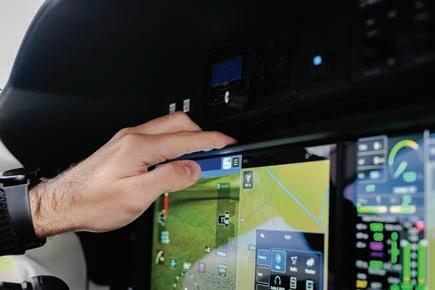
Its Garmin 3000® PRIME avionics places everything at the pilot’s fingertips through a highly intuitive interface, enhancing cockpit ergonomics while significantly reducing workload.
For passengers, the Prestige cabin delivers a distinctive onboard experience, including satellite-based internet connectivity when equipped with a Starlink Mini terminal.



BY KERRY LYNCH
Textron Aviation has handed over the first batch of Cessna Citation Ascends to fleet launch customer NetJets. Announced last month, delivery of a trio of the twinjets to the fractional provider comes six months after the newest member of the Citation family secured FAA certification. The latest in the venerable Citation XLS line, the Ascend entered service with an unidentified retail customer earlier this year.
NetJets has operated a dozen different Citation models, including Ascend predecessors, over the past 40 years. The order for the Ascend came through a multiyear agreement placed in 2023 for up to 1,500 Citation Longitudes, Latitudes, and Ascends.
Additional deliveries are expected in the coming months as the NetJets fleet continues to expand, according to Textron Aviation. Noting that the fractional provider’s customers have shown a preference for the midsize jet category, NetJets Aviation president Patrick Gallagher said, “The Citation Ascend represents the next evolution in midsize jet travel, delivering the latest in exceptional design and comfort.”
The Ascend brings factory-standard Garmin G5000 avionics with autothrottle to the XLS line as well as a flat floor, a range
of cabin upgrades, and other enhancements.
Sporting two Pratt & Whitney Canada PW545D engines, the Ascend has increased thrust, improved fuel efficiency, and a 1,940nm range with four passengers. The cabin can seat eight passengers, and has a full refreshment center.
“The Citation Ascend represents our continued investment in supporting NetJets customers well into the future,” said Lannie O’Bannion, senior v-p of sales and marketing for Textron Aviation.
NetJets, meanwhile, continues to see growth in its fractional programs. Parent Berkshire Hathaway reported that its aviation services businesses—including both NetJets and FlightSafety International— generated 11.8% year-over-year revenue growth in the first quarter.
This increase was primarily due to the higher number of aircraft in shared ownership programs, and in-flight hours flown and higher average rates at NetJets.
“The increase in demand, in part, was attributed to customers responding to potential further price increases and supply chain concerns,” the report notes, “including extended inventory order lead times,” for new-production business aircraft. z

The second edition of the Business Aviation Asia Forum & Expo (BAAFEx) will be held in Singapore next year from March 22 to 24, and organizer Experia Events is targeting 50% growth in exhibitor and attendee numbers versus the inaugural show in March 2025. More than 2,000 visitors from 56 countries attended the show last year at Singapore’s Changi Exhibition Centre. One of Experia’s objectives is to expand the scope of the business aviation ecosystem represented at BAAFEx to include more OEMs, as well as FBOs, MROs, other service providers, and helicopter and eVTOL manufacturers.
Business aviation digital platform Tuvoli logged $100 million in air charter bookings in March, pacing it for a $1.2 billion annualized run rate. Tuvoli estimated that the bookings made through its platform equate to one departure every 11 minutes. CEO Greg Johnson called the March results “a meaningful inflection point” for the platform, which enables air charter brokers and operators to manage the sales process. Tuvoli plans to launch a global distribution system for private aviation by June.
Two pilots who were forcibly detained and jailed after landing their Gulfstream IV in West Africa on December 29 have been released on bail but are still being held in detention. Pilots Scott Schlenker and Fabio Nunez were flying a Brazilian family and landed at Ahmed Sékou Touré International Airport (GUCY) in Conakry, Guinea, for a tech stop. News reports claimed that the pilots were arrested for allegedly landing without authorization and violating the country’s airspace.
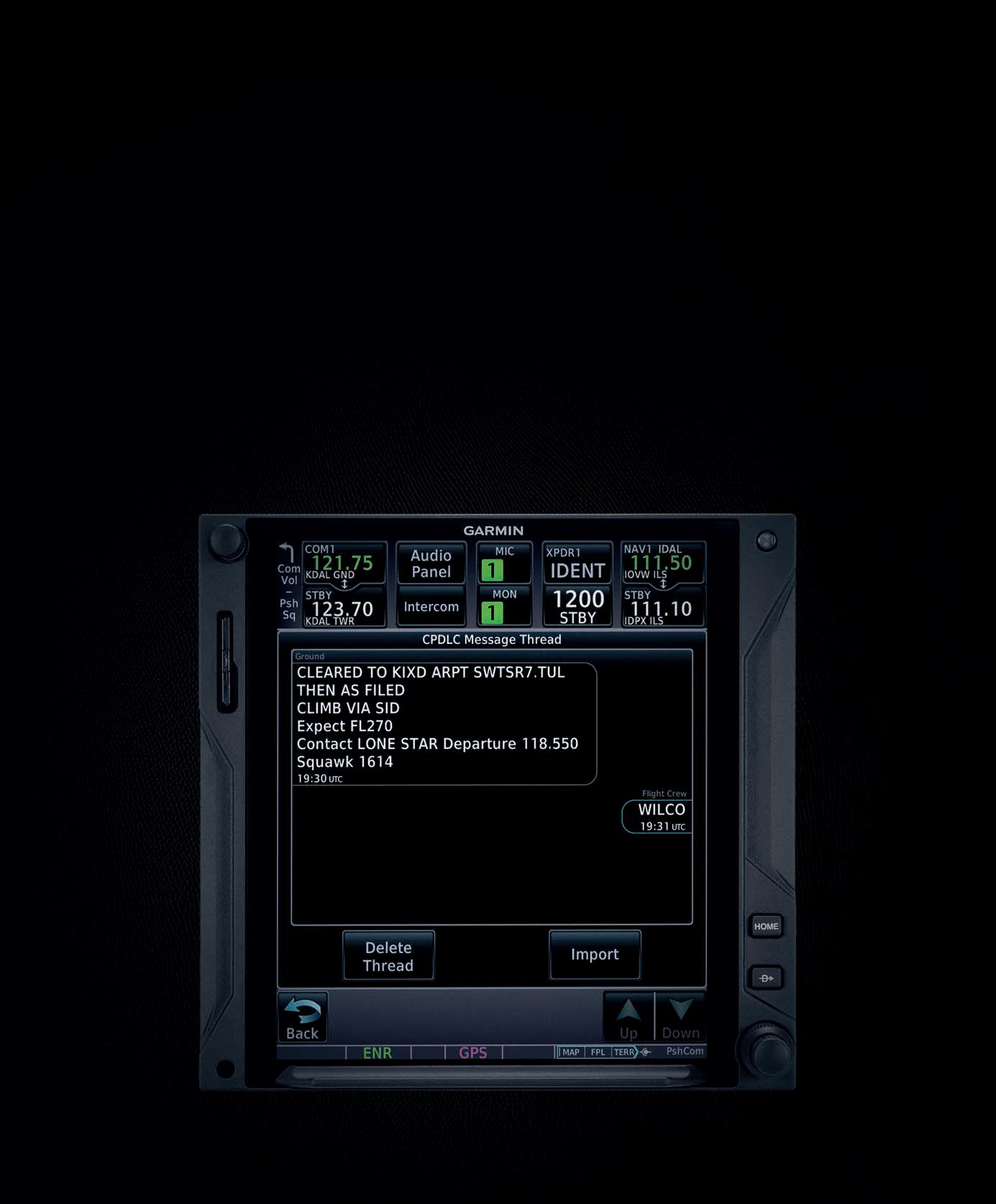
VOICE CALLS AND READBACKS AREN’T ALWAYS CLEAR. UPGRADE TO FAA DATA COMM FOR TEXT-BASED ATC CLEARANCES. AVAILABLE NOW ON SELECT GTN™ X i- AND TX i ™-EQUIPPED AIRCRAFT.
BY DALE SMITH
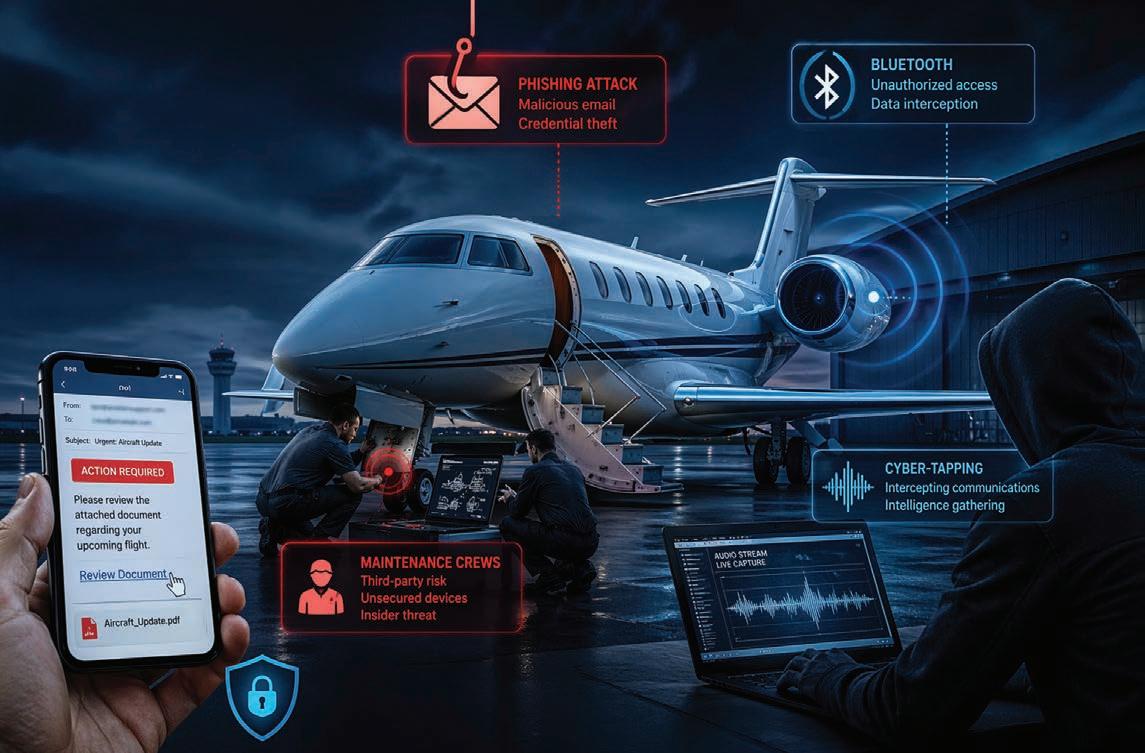
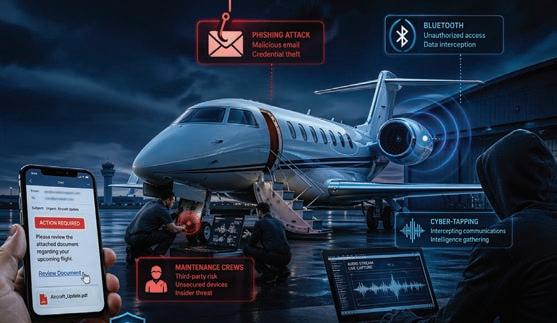
aircraft are ripe targets for the threat of business or personal espionage, according to industry experts.
While it might sound like the plot of a Cold War-era spy novel, the reality is that electronic trackers, listening devices, micro-cameras, bribes, and even— metaphorically speaking—shady characters in long trench coats have become major problems within the business aviation world.
“With business aviation, we are typically dealing with high-net-worth individuals or high-value/high-stakes information, so espionage has become a bigger problem than most people think,” said J.D. LeaSure, president and CEO of counter-espionage company ComSec. “Within the aircraft’s cabin, you have a great concentration of
sensitive data, intellectual property, and very personal information. And it’s all very valuable to someone.”
“The most sensitive decisions start as a simple conversation,” added Dean Cvetkoski, COO and director of activation for Activion Defence Systems, a technical surveillance counter-measure (TSCM) workplace awareness and training provider. “If an adversary can capture those discussions through human sources or covert surveillance devices, they gain intelligence without ever touching the network.”
Flight departments may have solid cybersecurity protocols in place, and believe their aircraft and passengers are
safe from any cyber-eavesdropping or hacking. But experts say that’s the first mistake that too many business aircraft operators make.
Cybercrime and espionage can be linked, but they are not the same thing. And because of that, cyber-hacking into a passenger’s phone or email is way down the list of how today’s espionage adversaries will try to swipe the information they want.
“Espionage is the unlawful and unethical acquisition of a person’s or company’s data, trade secret, or proprietary information,” LeaSure said, “anything adversaries can get that will give them an advantage or competitive edge.”
For a variety of reasons, data stolen from a company doesn’t get big headlines. As an example, such an event can undermine investor confidence in the company’s future business plans. However, the FBI has highlighted estimates from the Commission on the Theft of Intellectual Property that consistently place the annual losses driven by counterfeiting, piracy, and theft of trade secrets between $225 billion and $600 billion in the U.S. alone.
“Unlike traditional theft, espionage is designed to remain invisible. The attacker does not want the victim to know their information has been taken. They want to listen, observe, and collect intelligence over time quietly,” Cvetkoski said. “Boardroom discussions, aircraft cabin conversations, and executive travel plans can reveal insights that are far more valuable than any database.”
In fact, the simple reason that business and governmental leaders are becoming more comfortable with having sensitive conversations on board their aircraft is their increasingly incorrect belief that it’s more “secure” than their office.
and easier-to-access source for sensitive information.”
Cvetkoski cautioned that in many instances, especially those driven by “government-sponsored” entities, they are smaller pieces of a much bigger and more internationally dangerous puzzle.

J.D. LEASURE PRESIDENT AND CEO OF COUNTERESPIONAGE COMPANY COMSEC
are still eavesdropping using the same tried and true methods their predecessors have used for decades.
“A phishing attack might get you a person’s passwords or credentials,” Cvetkoski said, “but a covert listening device gets you strategy, intent, and decision-making in real time, and from an intelligence standpoint, that’s far more valuable.”
“There are all kinds of micro-sized listening and recording devices on the market that you can buy on Amazon,” LeaSure noted. “They can store hours of conversations and then, at a set time, the unit bursts what it’s recorded out over Wi-Fi, Bluetooth, or a cellular network—whatever it can gain access to. Unfortunately, it’s a very common thing today. Our adversaries are just substituting the aircraft cabin for the C-suite on the 27th floor.”
The number of influential and highnet-worth individuals flying today makes these aircraft prime targets for anyone looking for anything from executive and IP theft to social engineering, ransomware, or whatever. The list goes on and on.
“I say that the private aviation industry is pretty much a ripe opportunity for corporate or personal espionage,” LeaSure said. “The number of influential and high-networth individuals flying today makes these aircraft prime targets for anyone looking for anything from executive and IP theft to social engineering, ransomware, or whatever. The list goes on and on.”
In 2025 alone, corporate espionage and cyber-attacks on the aviation sector surged by 600% over the previous year—and those are just the crimes that get reported, he continued. “That rise is driven by the perfect storm of technological and geographical factors that enable a much larger
“If a company has direct or even indirect exposure to government secrets, energy, or infrastructure information, you may find that what you suspect is a competitor trying to obtain an unfair advantage is actually a foreign adversary or a state-sponsored threat,” he explained. “Take a look at Venezuela and how quickly the U.S. shut down its power grid. Now ask yourself: how valuable is my information to my competition?”
While cyber-tapping into a VVIP’s phone or aircraft’s wireless network would seem to be the eavesdropping tool of choice, experts say that in actuality, adversaries
He added that the “bad guys” can use an international mobile subscriber identity (IMSI) catcher with digital analyzer and cell-site simulator capabilities to hijack the control of cellular devices on the airplane.
“When operating in active mode, these devices mimic a wireless carrier’s cell tower to force nearby phones and cellular data devices to connect with it,” he explained. “They allow someone to capture the connections of every cellular device on the airplane and give the user total control of each device without the owner ever knowing it.”
“They can extract data, turn on microphones or recorders, or just listen in to conversations, without having any hardware on the airplane,” LeaSure said. “It’s all totally independent of the aircraft’s Wi-Fi system. As long as the phone is turned on, the enemy can control it.”
He stressed that while IMSI-catchers are available, they rely on the spy being in the same place and at the same time as the airplane. That narrows the window of
opportunity. That’s why simple electronic bugs are the tools of choice for the majority of ne’er-do-wells.
Under the heading of “Things that will keep you up at night,” it’s a lot easier for people to get access to private aircraft cabins than any flight department would like to admit, the security experts believe.
“In most cases, there is no forced entry. Devices are introduced through legitimate access,” Cvetkoski said. “It can be through maintenance crews, cleaners, contractors, or anyone who has a valid reason to be around the aircraft or facility without raising suspicions.”
Bribery is more common than people realize, he continued. “Your adversaries will identify individuals that have access and, under some form of pressure—financial stress, family issues, or personal circumstances—they approach these individuals and convince them to complete the task.”
Often, the “target” doesn’t fully understand what they are doing or why, Cvetkoski added. “The person directing them may indeed be their regular supervisor and is asking them to place a sensor that only needs to be installed temporarily.”
While social manipulation is effective, it takes considerable effort to identify and coerce the right person to do the nefarious deed. It’s so much simpler for the adversary to get on the aircraft themselves.
Ethical hacker and founder and CEO of cybersecurity firm PhishFirewall, Joshua Crumbaugh, said that in his many years of being hired by large companies and government agencies to test their physical and cybersecurity practices, he has found that, in most cases, it’s more a matter of what he calls “security theater.”
“It’s the illusion of safety through the practice of implementing highly visible protocols, like gate guards, ID badges, and chain-link fences, that are designed to make executives feel secure, rather than actually stopping a threat,” he said. “In business aviation, it
means spending millions on perimeter cameras, but leaving the side door propped open for the caterer. It’s a performance that deters honest people, but to a hacker or a spy, it is nothing more than a prop.

The
Eskan Palladium 21 radio frequency and camera detector can be used to sweep an area and monitor for any RF activity during a meeting or event.
“Whether it’s a $20 high-vis vest from Amazon or a $500 suit, the right clothes grant invisible access in most situations,” Crumbaugh continued. “One of my favorite ways to exploit someone’s hospitality is to walk up to a side door or gate with a laptop bag and a coffee in each hand.”
If someone should approach him, he said he would ask: “‘Hey, can you hold that? My hands are full.’ Nine times out of 10, they will hold it open for me, and I walk right into the ‘secure’ area. We are socialized to be helpful, and hackers of any kind use that hospitality to bypass biometric locks every day.”
Another weak link in most flight departments’ security practices that Crumbaugh has exploited is what he refers to as the maintenance gap. “We spend a fortune vetting pilots and crewmembers, but what about the thirdtier contractors who come in at 2 a.m. to fix or clean something?” he asked. “When a regular team member is sick, or a subcontractor is used, the aircraft becomes vulnerable if you don’t ask the right questions.”
With regards to the previous example, LeaSure suggested that one of the best ways to keep the proverbial barn door locked is to stay aware and look for behavioral red flags.
“Any type of unscheduled maintenance, technician visits, or last-minute changes to a contractor’s crew or how they behave are clues that need looking into,” he said. “I’ve found that it’s very easy to be unobserved in a hangar environment.
“I’ve swept everything from Bell JetRangers to Boeing 777s and done them over a long period of time,” LeaSure continued. “It’s not a one-and-done situation. Threats change all the time.” Electronics sweeping also includes any phones, laptops, or tablet devices passengers take on board.
In that regard, he stressed that while a company may have tight control over who has access to the flight department’s hangar and facility, the same can’t be said for the MRO providing the aircraft maintenance.
“We have been called in to sweep a client’s aircraft before, during, and after it returned from a stay in the maintenance facility,” LeaSure said. “And that includes all the furnishing, fixtures, and accessories to make sure nothing had been embedded in those items. If the value of the information is high enough, adversaries will go to great lengths to get it.”
While a company wants to take control of the situation to keep its airplane and passengers “bug-free,” the physical makeup of these devices can make visual
identification nearly impossible. They can be disguised as coffee cups, screws, bolts, wires—people can look right at them and not know what they are seeing.
But, in the unlikely event that a person does find a listening device in the aircraft, Cvetkoski cautioned against taking any action.
“Do not touch anything. Attempting to remove or interfere with a suspected device can destroy evidence or activate some fail-safe mechanism,” he explained. “The correct approach is to isolate the environment if possible and engage a qualified TSCM specialist. A proper inspection requires specialized equipment and methodology to identify and neutralize any threats safely.”
While active countermeasure detection is an excellent step to add to your operation’s processes, all of the security experts stressed that it’s equally important to introduce ongoing “counter-espionage”

practices to take proactive steps, including implementing tighter access control, increased vendor management, and physically securing the aircraft, especially during high-risk periods like maintenance and overnights away from home base.
“It all starts with having the initial conversations with your key executives
Calibre Defence Systems’ Specan Touch spectrum analyzer is used by TSCM experts to analyze radio frequencies to indentify and neutralize potential espionage threats.
about why you need these kinds of services,” LeaSure said. “It can be a hard sell for some people. So many of them feel strongly that their private aircraft is indeed private. Taking steps to mitigate these kinds of threats comes down to determining the real value of the information you are trying to protect.” z

BY HANNEKE WEITERING

Across the U.S. this year, electric, hybridelectric, and autonomous aircraft will begin flying commercial cargo and medical missions under a federal pilot program— before the aircraft involved have received type certificates and before the rules that will eventually govern them have been fully written.
That is the defining feature of the FAA’s eVTOL Integration Pilot Program (eIPP), a White House initiative that recently selected eight state-led projects to bring the nation’s advanced air mobility (AAM) ecosystem to fruition. Rather than waiting for new rules and regulations to enable commercial AAM operations, the eIPP will allow early commercial operations to proceed in an immature regulatory
environment, with the goal of gathering data to inform those rules.
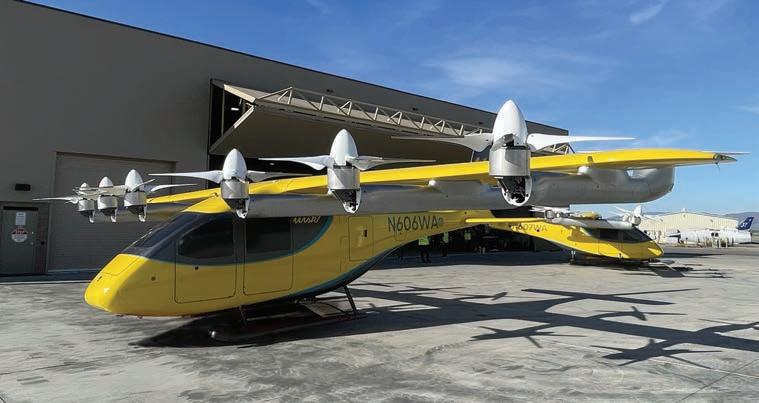
“It’s really a major policy unlock,” Dan Dalton, Wisk Aero’s vice president of commercialization and airline development, told AIN . Through the eIPP, Wisk—a Boeing subsidiary developing a pilotless eVTOL air taxi—can accelerate its path to market by getting a head start on the data collection flights needed to certify its autonomy system, he said. “What we would have normally done in a few years, [the eIPP] allows us to pull that left and collect that data even sooner.”
Selected from a pool of more than 30 proposals, the eight eIPP projects span 26 states, involve dozens of industry partners, and cover use cas es from offshore oil
logistics and organ delivery to firefighting— far more than just eVTOL air taxi operations for affluent passengers. Together, these eight projects constitute the largest coordinated experiment in advanced air mobility that the U.S. government has ever attempted.
Under the eIPP’s Other Transaction Authority (OTA) structure, selected participants can conduct commercial operations under FAA-approved experimental frameworks prior to full type certification, a significant departure from the standard sequence in which certification must precede commercialization. The OTA mechanism, designed for speed and flexibility, is intended to move quickly from contract to flight, with initial
operations targeted within 90 days of finalized agreements.
“We know that the program allows us to do commercial operations ahead of the type certificate issuance,” Dalton said. “So we’re actively looking at what those com mercial opportunities could look like.”
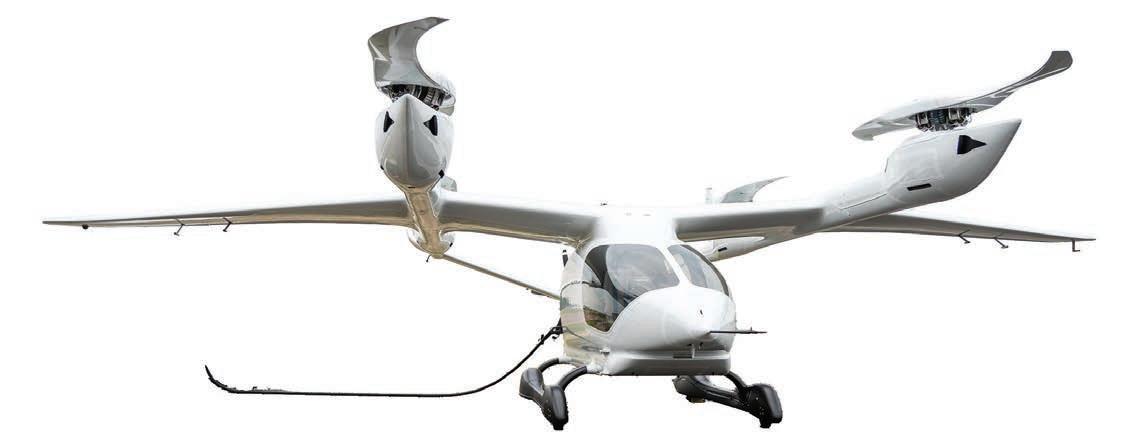
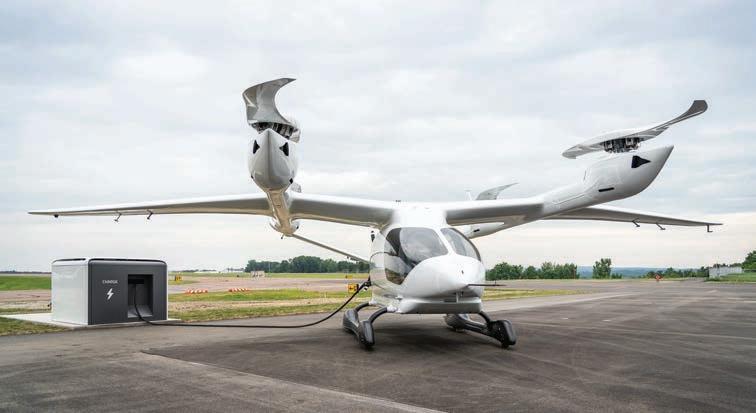
For Wisk, whose autonomous aircraft has no human pilot on board and there fore requires an entirely new regulatory framework, the implications are substan tial. The company is participating in the eIPP project led by the Texas Depart ment of Transportation (TxDOT), a coa lition that also includes manufacturers of piloted eVTOL models: Archer Aviation, Joby Aviation, and Beta Technologies. Operators participating in the TxDOT project include aeromedical provider Metro Aviation, which is a Beta partner and customer, and Amazon, a Beta investor that has previously conducted cargo demonstration flights between its “Air Hub” facilities using Beta’s Alia CX300 electric airplane.

While Wisk intends to certify its pilotless, four-passenger Gen 6 eVTOL aircraft for commercial operations before the end of the decade, the company may not get around to flying passengers on any pilotless aircraft during the eIPP, Dalton said. Rather, the company intends to start
deploying various conventional, piloted aircraft on eVTOL routes to collect data for the development and certification of its autonomy system. However, “it’s certainly not outside the realm of the possible for that to happen within the time bound of the eIPP,” Dalton said of passenger flights on the Gen 6, for which Wisk recently rolled out a second test aircraft. “It’s all just a matter of how fast all of the different partnerships and players move.”
“The insights we gather in Texas are not just limited to our aircraft or the state,”
added Wisk CEO Sebastien Vigneron. “We are validating the entire digital and physical ecosystem. This program allows us to perform real-world operations that can be translated into FAA policy and regulations, ensuring that when Wisk launches our full commercial service, the regulatory environment is as ready as our aircraft.”
Across the eight selected eIPP projects, one clear pattern emerges: cargo and medical logistics dominate the portfolio.
Beta Technologies, participating in seven of the eight programs—more than any other OEM—is deploying its Alia aircraft almost exclusively for cargo and medical missions. In Louisiana, Beta is partnering with Bristow Group and Metro Aviation to support offshore energy operations in the Gulf of Mexico. In Maryland and Virginia, the company is conducting organ delivery logistics with medical logistics group United Therapeutics, its launch customer. In New York and Vermont, Beta is handling cargo and medical runs in upstate communities.
Perhaps the most unique cargo entry is Elroy Air’s Chaparral aircraft, selected for the Louisiana program. The autonomous hybrid-electric VTOL drone can carry 300 to 500 pounds of cargo up to 300 miles— specifications that position it for the kind of industrial supply chain work that dominates the Gulf Coast: drilling platform resupply, equipment delivery to remote energy sites, urgent cargo runs across a geography that has long depended on helicopters.
“Chaparral was selected to define the federal standard for uncrewed heavypayload logistics,” said Elroy Air CEO Andrew Clare.
Bristow Group, a Houston-based global helicopter operator offering offshore energy transportation and search and rescue services, plans to add up to 100 Chaparral freighters to its fleet under a letter of intent signed in 2022.
“Our energy and government services customers are demanding lower risk, higher tempo, and more efficient options to meet the increasing demand for offshore aerial work, including the movement of critical cargo,” said Dave Stepanek, Bristow’s executive vice president and chief transformation officer. “Louisiana is our core U.S. base of operations to serve the Gulf Coast.”
Cargo and medical missions carry lower risk thresholds and face fewer regulatory hurdles and less friction with the FAA.
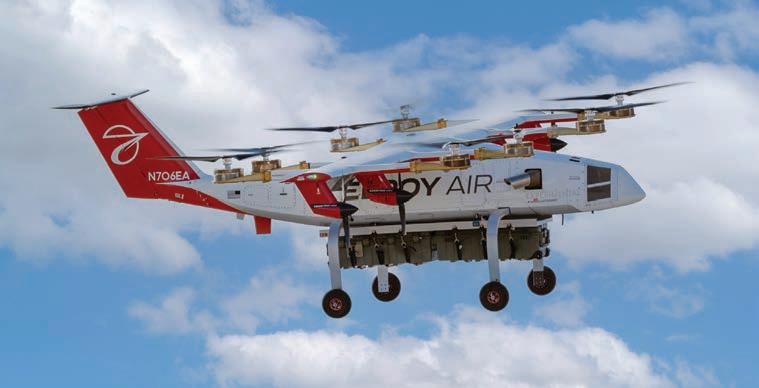
Elroy Air’s Chaparral, an autonomous hybrid-electric VTOL drone, will deliver cargo across the Gulf Coast and to energy industry locations throughout Louisiana, Texas, and Mississippi.
They also generate the real-world operational data that will eventually underwrite approval for carrying passengers.
If cargo is the near-term engine of eIPP, autonomy is its most consequential longterm output.
Wisk is operating as what Dalton called a “pathfinder” for the FAA on autonomy policy—a role that extends beyond its own certification to shaping the regulatory architecture other operators will
eventually use. Central to that effort is SkyGrid, an airspace management company that Wisk acquired as a subsidiary last year to vertically integrate its aircraft autonomy technology with established airspace automation capabilities. Where other eVTOL manufacturers rely on third parties for digital airspace services, Wisk now controls both sides of the equation in-house.
“Think of Wisk as developing the aircraft system,” Dalton explained. “SkyGrid is the corollary from an airspace management perspective.” The system enables autonomous
aircraft to receive digital instructions from air traffic control, communicate with each other, and operate with tighter separation standards than piloted aircraft—analogous, Dalton noted, to today’s high-altitude operations, where aircraft rely on the autopilot to meet required altitude-keeping performance, and a loss of that capability can require leaving the airspace.
The long-term ambition is what SkyGrid, Wisk, and Boeing refer to as “automated flight rules”—a new regulatory tier for highly automated aircraft operating in the low-altitude national airspace system (NAS), governed by digital communication rather than voice ATC. SkyGrid is already working with international partners and conducting simulation validation with the FAA and NASA. Dalton said announcements from countries preparing to deploy early versions of automated flight rules are imminent.
The most concrete near-term demonstration of autonomous flight in the eIPP portfolio comes from the City of Albuquerque. Working with Reliable Robotics, whose subsidiary Reliable Airlines has already been conducting piloted cargo operations in Albuquerque since 2023, the project will operate an autonomous, remotely piloted Cessna Caravan from Albuquerque International Sunport (KABQ) to Colorado’s Durango-La Plata County Airport (KDRO) and New Mexico’s Santa Fe Regional Airport (KSAF).
Rather than introducing a new aircraft design, Reliable is retrofitting an established cargo workhorse with its autonomous flight system, making the core regulatory challenge not the aircraft but the operation. According to Reliable, it could represent the first commercial air cargo service by a large-category uncrewed aircraft in U.S.-controlled airspace.
“The technology we’re certifying with the FAA will substantially enhance the safety of regional air cargo operations and demonstrate that large UAS can be integrated into controlled airspace,” said Reliable Robotics CEO Robert Rose.
North Carolina adds another dimension: the state’s eIPP project, known as eLIFT-NC (Electric Logistics and Integrated Flight Testing), combines piloted medical operations with autonomous flight testing that extends across the border into Virginia—a cross-state precedent that, if validated, will inform how autonomous flight corridors are approved nationwide.
Aircraft development has outpaced the ground infrastructure needed to support it, and the eIPP projects make that gap visible. At the program’s most visible urban site, the gap is closing fast. New York City awarded the Downtown Manhattan Heliport’s operating contract in late 2024 to Downtown Skyport, a venture backed by Skyports Infrastructure and Groupe ADP, with eVTOL charging infrastructure targeted for completion this year.
Joby, which acquired Blade Air Mobility’s passenger division in 2025, arrives with existing New York terminal relationships no competitor can match. Archer, which has outlined a nine-node vertiport vision connecting Manhattan helipads with JFK, LaGuardia, Newark, and four regional airports, is participating in the Port Authority of New York and New Jersey’s eIPP project
alongside them. Other infrastructure partners include FBO chain Signature Aviation and Vertiports by Atlantic.
In Central New York, where the Port Authority’s program will conduct much of its upstate activity, the foundation is arguably the most mature in the country. The Northeast UAS Airspace Integration Research Alliance (NUAIR) has built a beyond visual line of sight (BVLOS) surveillance network covering 1,900 square miles of Central New York airspace, with more than 6,000 flights already completed and an FAA Letter of Acceptance for its surveillance-as-a-service capability issued in July 2025.
At the center of that network is Syracuse Hancock International Airport (KSYR), which will serve as the primary hub for the program’s upstate operations. One aspect that makes KSYR particularly unusual and useful as an AAM testbed is its longrunning integration of military remotely piloted aircraft alongside commercial traffic. The New York Air National Guard’s 174th Attack Wing’s MQ-9 Reaper drone has been operating at Hancock without chase aircraft since 2019, sharing runways, taxiways, and ramps with commercial flights that serve 2.8 million annual passengers. The control tower and airspace managers have spent years handling large remotely piloted aircraft alongside regional jets and general aviation.
“We’re already about two to three years ahead because of the NUAIR Alliance, because of what’s going on with already having remotely piloted aircraft operating on the airport,” said Jason Terreri, executive director of Syracuse Regional Airport Authority. “The FAA is already comfortable in this location.”
The range of missions envisioned for the upstate corridor extends well beyond conventional air mobility use cases. One under active discussion involves Micron Technology’s semiconductor fabrication facility under construction in Clay, just north of the airport. The plant will produce dynamic random-access memory chips, which are unusually vulnerable to the vibration of ground transport—a problem that a direct UAS link to KSYR’s cargo apron would neatly solve.
Utah’s uFLY program has a practical answer to the state’s geographic diversity; the Utah Department of Transportation has already deployed portable command centers with satellite-connected workstations that can be positioned anywhere in the state, supporting data collection across urban corridors, remote communities, mountainous terrain, and wildfire-prone regions. Utah also partnered with Beta to install the latter’s electric aircraft chargers at airports across the state.
Beneath the urban air mobility headlines, the eIPP’s most durable legacy may be regional connectivity.
The Pennsylvania Department of Transportation’s program, organized through the National Association of State Aviation O fficials’ (NASAO) 13-state collaborative, is explicitly designed to develop routes analogous to those historically served under the Essential Air Service program— short-haul connections between small communities and regional hubs that have become economically unviable for airlines.
Working with the NASAO collaborative, Electra—a Virginia-based start-up developing a nine-passenger, hybrid-electric, short takeoff and landing (STOL) airplane—aims to demonstrate regional feeder routes between Atlantic City and Philadelphia.

The technology we’re certifying with the FAA will substantially enhance the safety of regional air cargo operations and demonstrate that large UAS can be integrated into controlled airspace.
In upstate New York, the same dynamics are playing out at a granular level. UPS currently operates small twin-engine feeder aircraft on sub-100-mile runs from New York’s North Country to Syracuse. The economics of electric aircraft—lower operating costs, reduced maintenance, no fuel— make those same routes not merely viable but potentially superior with AAM vehicles.
The uFLY program, spanning five states and built on the foundation of Project Alta
(a state-led public-private AAM initiative Utah launched in 2024) has an additional long-horizon driver: Utah will host the 2034 Olympic and Paralympic Winter Games, and planners are already modeling how advanced aviation could support logistics, emergency response, and athlete transport during the event.
The distribution of roles across the eight projects reveals the current shape of the nation’s AAM industry, particularly in terms of technology readiness.
Beta Technologies has the largest eIPP footprint, participating in seven programs and serving as both manufacturer and infrastructure provider—delivering aircraft and chargers across 10 states. While the company’s Alia 250 eVTOL model is still in the early stages of development and flight testing, its Alia CX300 conventional airplane counterpart, which has logged nearly 130,000 nm in flight testing, is expected to receive an FAA type certificate as early as this year.
Joby, which plans to offer ride-hailing services on its pilot-plus-four-passenger JAS4-1 eVTOL air taxi via the Uber app, was selected to participate in five eIPP projects. Archer Aviation is present in three programs with its Midnight eVTOL aircraft, also positioned for urban passenger transport.
Electra’s EL9 Ultra Short, selected to participate in three of the eight eIPP projects, is being certified under Part 23 rules. The Ultra Short is capable of operating from very short runways and existing heliport infrastructure. Virginia-based Electra is participating in Florida, New York, and the Pennsylvania multistate program, targeting dense urban and regional routes where a minimal ground footprint and conventional runway compatibility set it apart from the rest of the eIPP fleet.
Ampaire, a Los Angeles-based developer of hybrid-electric propulsion systems for existing regional aircraft, also appears on the Utah program’s manufacturer roster. Ampaire’s approach involves retrofitting conventional airframes with its hybrid system—an emphasis on incremental electrification rather than clean-sheet design that, alongside Electra’s Part 23 STOL airplane, underscores how broadly the FAA has drawn the eIPP’s technological boundaries.
Utah’s uFLY partnership also lists Jump Aero among its broader ecosystem contributors through the state’s Project Alta coalition, although the company’s aircraft will not be flying as part of the eIPP. Jump Aero’s JA1 Pulse is designed for emergency first response, built to carry one trained medical responder plus equipment to unprepared landing zones. Their presence in the Utah ecosystem signals how widely the state is thinking about the range of missions AAM could eventually serve—well beyond air taxis and cargo.
The uFLY program includes Sikorsky, a Lockheed Martin company, among its more than 30 public and private partners—notable as one of the few traditional aerospace primes in the portfolio and an example of the program’s system-integration ambitions. Sikorsky has spent more than a decade developing an autonomy system called Matrix and is now implementing the system on various UAS.
AAM operators are embedded across the eIPP portfolio, serving as the practical bridge between technology and operations. Some, like Metro Aviation, Bristow Group, Republic Airways, and Alpine Air Express, bring decades of conventional flight operations experience to the program. Others represent a newer model: Future Flight Global (FFG), an operator partner in the Utah uFLY program, is structured specifically around AAM deployment—managing aircraft from multiple manufacturers across cargo, medical, and passenger missions rather than operating a single platform or fleet type.
One conspicuous absentee on the eIPP project list is the state of California. Despite being home base for several of the program’s most prominent participants, none of the eight selected projects is California-based. Archer, which has built its long-term commercial strategy around a Southern California urban air mobility network anchored by Hawthorne Municipal Airport and anticipated operations tied to the 2028 Los Angeles Olympics, leads no eIPP project in its home state.
Collaboration across the industry, meanwhile, is more active than competition might suggest. “We have really healthy relationships with all of our friends in the industry,” Dalton told AIN , describing ongoing coordination through industry associations including GAMA, NBAA, and VAI, on shared policy priorities. “We want to make sure that the tide lifts all the boats.”
The FAA and selected entities are still finalizing their OTA agreements, but the first flights are expected to begin within 90 days of signing. The program runs for three years.
That window may be shorter than it seems. Aircraft have to be positioned, operational agreements have to be established, local partners have to be ready, and the FAA has to be satisfied with the data-collection frameworks before any flight can meaningfully contribute to the regulatory record.
“We really want to make sure we’re using it as best we can,” Dalton said of the threeyear timeline.
The resulting flights will not be the measure of the program’s success. Rather, the measure will be the quality of the regulatory output—the procedures, policies, and frameworks produced by the operational data. Whether that includes pre-type-certificate commercial passenger operations, cargo missions in industrial corridors, autonomous flights in controlled airspace, or some combination of all three, the objective is the same: to build the rules by following the practice of aviation’s oldest principle and actually flying.
The aircraft are largely ready. The question eIPP is designed to answer is whether the system around them—the airspace management, the infrastructure, the operational procedures, the regulatory framework—can be ready, too. z

BY KERRY LYNCH
The 2026 Air Charter Safety Foundation (ACSF) Safety Summit spotlighted safety culture and how everyone is interconnected: what affects one organization’s brand affects everyone around them.
Robert Sumwalt, the former long-time NTSB chair and executive director of Embry- Riddle Aeronautical University’s Boeing Center for Aviation and Aerospace Safety, which co-hosted the event, welcomed attendees, praising how the summit has turned into a first-rate safety event, alongside ACSF’s other initiatives such as the Aviation Safety

Action Program, its safety management system tool, the Industry Audit Standard, and activities surrounding flight data monitoring.
“You are collectively raising the bar on safety,” Sumwalt said. But he added, “I really worry about the people that are not here, and what are you going to do about that?” He asked if the audience would be good mentors if “the guy in the hangar next to you is running a loose operation.”
Conceding that it’s hard to do, he proposed, “We are our brother’s keeper because if there’s a crash involving a Part 91 airplane or Part 135 airplane or even a Part 121 airline, the entire industry gets painted with a broad brush.” He emphasized that the industry has a responsibility for mentorship to collectively raise the bar.
ACSF chairman and Flexjet chief safety officer Kent Stauffer also picked up on that theme and added that this comes down to safety culture. “Safety will live and die in your culture,” he said. “If you have the wrong culture, it will die.”
Stauffer pointed to the recent accident involving a Bombardier Challenger 650 in Bangor, Maine, and asked, “How many of you who operate Challengers immediately got calls from your owners going, ‘Am I going to crash too?’”
He further stressed, “There is no part of safety that’s proprietary. It’s not a competitive sport. If any one of us makes a mistake, all of us are going to feel it. Anything that happens in our collective industry—and even in the airlines—is a reflection of all of us. We must be aligned in the risk management, the processes and procedures, and the culture which we impart on all.”
Underscoring that point, Stauffer introduced Richard Meikle, executive v-p of safety at rival fractional operator NetJets, who will collaborate with him on safety issues. Meikle’s presentation centered on “A Living Culture,” and he stressed that an organization’s safety culture “really forms the foundation of your business in terms of viability and your brand. If you have a good, solid culture, you’re going to have a good brand; you’re going to have a good business viability.” However, an organization must also be aware of those cultures around them because a mistake by one could affect other brands.
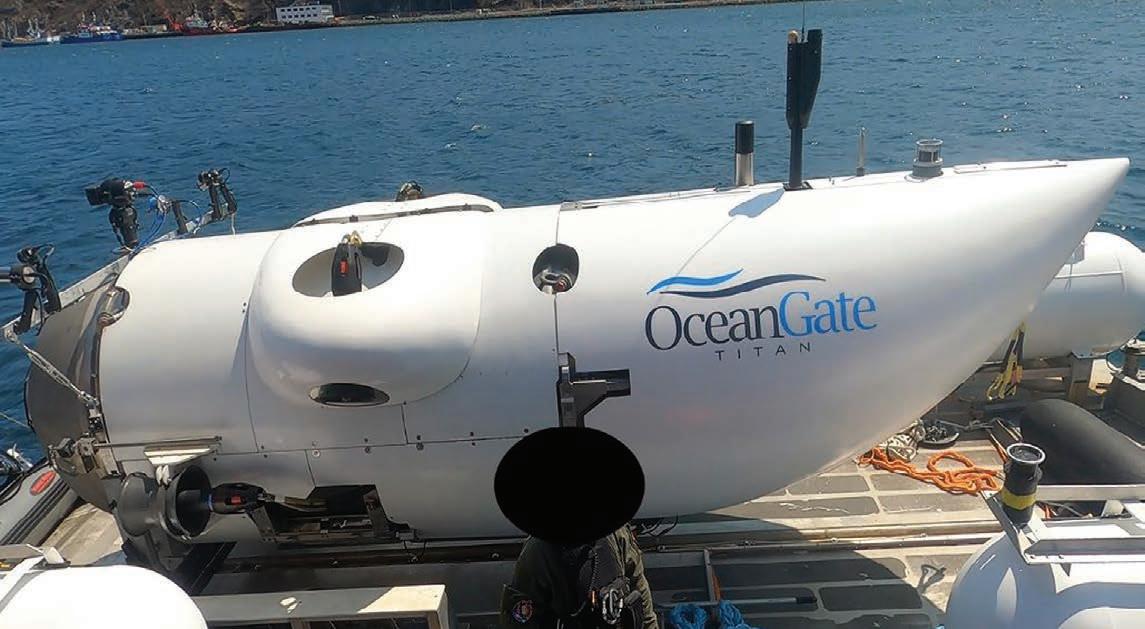
Meikle gave examples of strong and questionable cultures across transportation modes. One such example involved the tragic implosion of the OceanGate Titan submersible on June 18, 2023, that killed all five aboard, including company founder Stockton Rush and Action Aviation chairman Hamish Harding. The Titan is believed to have imploded at about 11,000 feet below the surface as it was on an expedition to view the Titanic wreckage.

The U.S. Coast Guard Marine Board of Investigation called the accident preventable and cited inadequate design, certification, maintenance, and inspection processes for the Titan, along with a toxic workplace culture and inadequate regulatory framework. The investigatory board noted that the company culture enabled the CEO to “completely ignore vital inspections, data analyses, and preventative maintenance procedures, culminating in a catastrophic event.”
Meikle delved into the report, noting that this was the carbon-fiber submersible’s 88th dive. “It’s really intriguing that [this accident involved] the same hubris that actually resulted in the sinking of the Titanic with Captain [Edward] Smith saying, ‘Look, we’re going to go as fast as we can; don’t worry about the iceberg warnings.’”
OceanGate manuals specified that employees are required to comply with all safety rules and should actively participate in making the company safer, he pointed out. “That’s what they had on paper, but that is not even close to reality,” he said.
He noted the board’s finding of a toxic environment. “It was so toxic that it was based on termination of senior managers,
the threat of looming termination when you would raise safety concerns, and the [board] described it as a critically flawed safety culture. They had glaring disparities between what was written on paper and what actually went on in the real world.”
Bleeding money, the company prioritized revenue over safety, he said. While it had 88 dives, only about a dozen had passengers on board. “It was so bad that in one particular point...they left the vessel outside over the winter.”
Kept in Maine with a thaw-freeze cycle, he said this would make the vessel vulnerable to expanding, driving some of its carbon fibers apart. At the same time, customer expectations could weigh heavily as they were paying a quarter of a million dollars for their experiences.
“Then of course, [there were] operational demands because they had a waiting list of people,” he said. “Ultimately, the culture here was usurping the mission director’s authority and responsibilities.”
The director of marine operations (DMO) was really concerned about the safety of the operation, Meikle said. In 2018, the DMO recorded a two-hour meeting held with the CEO in which he outlined “significant safety concerns” and asked for
additional testing. Four days later, the DMO was fired. The termination letter said the company disagreed, but “given your qualifications, we are confident that you will find another position soon,” Meikle said, and noted, “Essentially, they’re acknowledging the fact that this guy’s an expert in the field but because we don’t agree with you, because you said it’s unsafe, you’re fired.”
During one later dive, a loud bang was heard, believed to be carbon fibers separating. The acoustic monitoring system picked it up, and it apparently frightened the passengers on board. An individual on a support ship raised concerns about the hull. The response, Meikle said, is that she was told the company was concerned about her “adventurous attitude.” That individual resigned. “Innovation was prioritized over safety,” Meikle added. As experienced people left, inexperienced people came in behind them.
The CEO was wedded to the design, but others had concerns. Partners such as the University of Washington and Boeing exited the project. “So, when you’ve got companies like that that are walking away, and you’re saying, ‘No, no, no,’ you should be asking yourself, ‘Why are we running forward now?’”
Meikle called the secrecy between the OceanGate departments “pretty fascinating.” The acrimony between the engineering and operations teams ran so deep that they were not sharing information. This made testing difficult.
In addition, OceanGate avoided classing or registering the vessel under any country, thereby avoiding inspection. “Think through that one just a second. They deliberately didn’t register it somewhere to avoid any sort of inspections, and they didn’t class it, which is essentially the equivalent of an airworthiness certificate for a submarine.”
According to the board report, the CEO was quoted as saying the company didn’t want that type of investigation. “That’s pretty shocking,” Meikle said.
And then, OceanGate had a seven-hour delay in activating the emergency response plan. “That speaks a little bit about culture because they’re sort of in that mode of don’t tell anybody outside the world here until we get a chance to try and hide this or fix it ourselves. And if you can fix it yourself, then nobody needs to know.”
In this event, the seven hours would not have changed the outcome. But, Meikle asked, “What if they were entangled in something? That seven hours might have made the difference.”
But he also noted that this culture didn’t happen overnight. “They didn’t start with, ‘You know what, we’re going to ignore everything,’” he said, calling this an example of organizational creep.
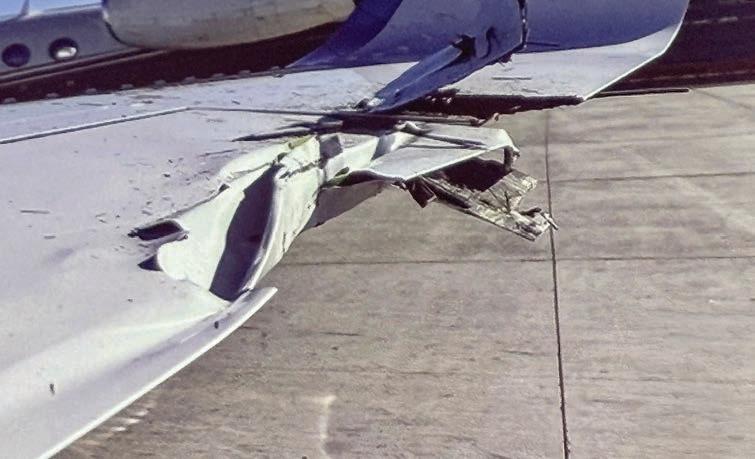
OceanGate was just one of the events that Meikle highlighted. Another—and this puts a spotlight on the interconnectivity of the industry—involved an incident in which a worker at an airport ran straight into a Gulfstream on an FBO ramp with a forklift. “We all rely on vendors an enormous amount to do our job,” he noted.
In the Gulfstream incident, the forklift operator said he couldn’t see the aircraft because the sun was in his eyes. But Meikle played security footage of the incident, which showed two forklifts that took off at the same time and went in parallel at the same speed, giving the appearance of a race. “I wonder what they might be doing,” he said, and added, “Interestingly, the forklift driver that hit the Gulfstream had been suspended by their employer the day prior for reckless behavior using a forklift.”
He said it was good that the employer recognized reckless behavior, but not that he was allowed to return to driving the forklift, which “smacked” into the back of the Gulfstream’s wing and caused significant damage. Meikle asked: “Whose brand is affected by this, beyond the FBO’s? If you saw that airplane on the ramp, you’d think, ‘Oh my, somebody hit that.’ But what if the airplane was facing the other way? What if that damage was on the leading edge of the wing? How does that affect your brand?” In that case, people would assume the pilot ran into something.
Even so, he said, “The snowball effect happens here. The brand of the FBO is affected. Are the crew going to go back
there? Probably not.” Further, the crew is going to talk about the incident when they are on the road, again further damaging the FBO brand. And it reflects on the operator.
“As we contract with vendors, we need to be thinking about what their safety culture looks like and how we hold them accountable as well.”
In another example of the snowball effect, Meikle pointed to a 2019 case of diesel exhaust fluid contamination in jet fuel that caused engine failures on two airplanes operated by the same air ambulance. Both aircraft landed safely, and lessons were learned at the FBO as a result.
But the incident brought press attention because in one case, a double-engine failure was involved—“lots of press.” Also, because of the double-engine failure, NTSB got involved, continuing to place attention on the incident. In 2020, the incident report was released, and the event popped back into the public eye. The same happened in 2023 when the FAA referenced it in a Safety Alert for Operators. For four years, this kept getting brought up. “If your brand was attached to that, now you’ve got to refresh on your brand damage.”
Meikle noted. “SubSafe is a really cool concept. It is definitely worth reading about.”
Highlighting some of the program, he pointed to the emphasis on communication, ensuring that critical information is passed through redundant paths. Contractor technical specifications and recommendations are documented in writing, with a person signing o ff on that documentation. A signature requirement makes people pause and read carefully what they just signed, he noted, “because we’re now on the hook for what we’ve put on paper.”
the end and ask what their concerns are. Emphasize the importance of speaking up, he added, and “people will start to say things.”
Clear guidance rather than policies that leave things open to interpretation is another key. Meikle said this is especially important when waivers come into play. “Then, compliance is independently verified,” and contended that if OceanGate had followed SubSafe, perhaps the people on board would still be alive.
He cautioned against the weaponization of information, saying that it will discourage transparency and prevent information from driving upward through the management chain. Avoid language such as, “How did we let this happen?” he said. “If we don’t deal with the bigger picture, something else is going to get missed.”
There are plenty of operators out there that have had audits that have been super clean, or they just finished an audit, and then they go out, and they have an accident . An audit is a snapshot in time. It is not an inoculation.
—Richard Meikle Executive v-p of safety at fractional operator NetJets
Recurrent training folds in lessons learned from other events—whether from the U.S. Navy or from the Space Shuttle Challenger. The Navy uses cross-industry lessons for training and knowledge retention.
In addition, he warned that clean audits do not mean a safe operation, calling that belief a misconception. “There are plenty of operators out there that have had audits that have been super clean, or they just finished an audit, and then they go out, and they have an accident,” he said. “An audit is a snapshot in time. It is not an inoculation.”
All of this ties together in culture, he said, and promoted a “good, better, best” concept. This means always pushing higher without regulating oneself out of business. Meikle gave an example of this, pointing to the SubSafe program approach. The U.S. Navy developed SubSafe after the 1963 sinking of the USS Thresher. This was the first nuclear submarine lost by the Navy and one of 16 lost in non-combat accidents to that point, killing more than 500 personnel.
The Navy recertified submarines under the program, and “subsequent to that, they have not had a single loss of a submarine,”
Retention is also critical in personnel. SubSafe requires overlap in positions before one person departs to ensure knowledge transfer. “In the civilian world, that’s harder to manage because we don’t control when people are going to decide they’re going to go somewhere else, but if you can keep mentoring people up, then you have reduced that risk,” he said.
Another aspect is the insistence on airing minority opinions. “This is a really powerful technique, and I challenge all of you to do this,” Meikle told the ACSF Safety Summit attendees. In meetings, he suggested, go around the room at
Further, he advised using an independent auditor and said that if an organization gets a bad audit, keep that auditor in the future. “You’ve got to suck it up and say, ‘We didn’t do well on that one. That’s okay.’ Bring them back next time.”
He noted that his company had one remarkably tough auditor years ago. Company executives still ask what the auditor would say as they evaluate their operations. “That’s how powerful an impact that had. It was really good.”
Ultimately, he said, “your culture and your vendors’ culture affect your brand. They affect your business viability. They’re really coupled.” z
BY KERRY LYNCH
The Air Charter Safety Foundation (ACSF) is continuing to evolve with new and changing programs, as well as deeper partnerships both with government and industry, reported chairman Kent Stauffer during the organization’s annual Safety Summit in Daytona Beach, Florida, in April.
Not quite two decades old, the nonprofit safety organization has continued to grow as initiatives such as its Aviation Safety Action Program (ASAP) have taken root. The association has also rolled out tools surrounding safety management systems (SMS), an Industry Audit Standard, and flight data monitoring, and has expanded participation with helicopter operations, insurance companies, and other organizations that typically haven’t been involved in the past, said Stauffer, who is chief safety officer of Flexjet.
However, as ASAP has been an important part of the organization’s financial underpinnings, he warned that SMS will undercut the need for such programs. As a result, ACSF is pivoting, exploring other ways to add value, including diving deeper into data.
Stauffer also praised president Debi Carpenter, who took over last year after Bryan Burns retired. He noted that Carpenter has been working hard behind the scenes during the transition. “She’s made some great connections with the FAA [and] other industry groups, and what we’re starting to see is the government and other organizations coming towards us to act as the intermediary—as a safe space where we can all come together. There’s no agenda other than truly improving the safety of our industry,” Stauffer said.
include everything from an operator’s mobile device policy to an SMS manual and OSHA inspection guidelines.
“You can take any of them, put your name on them, and tweak them to your operation. You don’t have to reinvent the wheel,” he said, noting that most of the documents have been well vetted: “They’re third and fourth versions. They’re not something you find on the shelf. Most of them are working currently in some operation somewhere.”
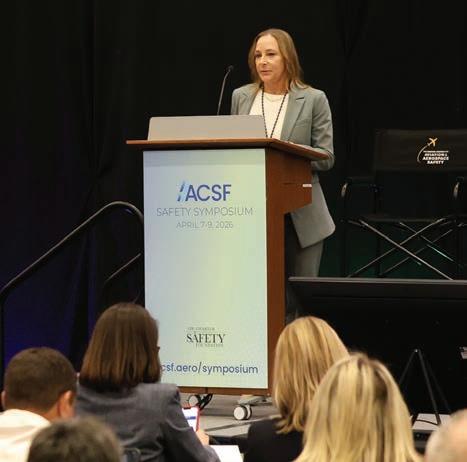
“We know that with the evolution of SMS programs, ASAP programs are going to go away at some point. It’s just going to be SMS,” Stauffer pointed out. “So, our sources of revenue or the way that we pay for all the things that go back to you have to change, too.”
One way to prepare for this is to invest in technology to become more of a data aggregator, he further said. Maintaining that the organization is financially strong, he explained the update was to highlight “some of the visions that we have going forward.”
The results of some of this will come to light soon, he added. “We’ve seen a lot of momentum.”
With the idea of being a central forum for industry safety, Stauffer pointed out that, as a membership benefit, ACSF has created a repository of more than 60 documents involving manuals, policies, and procedures of other member operators that are deidentified, Stauffer said. These
However, he asked members if they “take any from the repository, leave one in exchange” that has worked for their operation. This could be a manual, SOP, or something that works for the organization. ACSF staff reviews all the documents before they get posted. “We want this sharing of information,” he said. Most recently, the foundation launched a tool to help operators demonstrate the benefits of safety programs. Demonstrated during the recent Safety Summit in Daytona Beach, Florida, the Aviation Safety Return on Investment (AvSFTY-ROI) initiative and Safety ROI Calculator are designed to highlight that safety is a strategic investment that strengthens business performance and long-term success.
Developed by safety stakeholders, the calculator enables organizations to itemize costs of an actual or potential event and to propose initiatives to mitigate future occurrences. Available to members by contacting ACSF, the tool features simple inputs and is designed to help organizations invest in risk management.
Another effort at the organization is a ground operations working group. This committee includes broad industry participation with the hope of developing
recommendations on safety measures that could guard against ground incidents.
Patrick Burns, Wheels Up senior v-p of flight operations and committee chair, said that the group was born out of a concern about increasing ground damage events at his own operation. He noticed this uptick at the beginning of the first few days of last year. “We hit everything whether [or not] it was bolted down,” he said, adding that this prompted an internal review.
The operator wanted to ensure that pilots had all the tools they needed, but it also factored in a partnership with the FBOs and other ground handlers. This review led to phone calls with other major operators. “Are you guys running into everything as much as we are?” he asked. The response: “Yes, and more.”
This led the executives from the entities to sit down in June to explore commonalities and develop means to mitigate

damages. Burns added that the conversation continued to grow, and the group extended beyond the major Part 135 operators, fractional ownership providers, and FBOs to insurance underwriters, MROs, and Part 91 operators, eventually formalized under the ACSF umbrella.
Pointing to the sentiments that as an industry, “we are our brother’s keepers,” the
working group forwards the concept that “if there’s an operator out there that has a great best practice or robust guidance and policies and procedures, let’s share that for those other organizations that don’t have that, so that rising tide can not only float all boats, but we all miss each other in the channel as well,” Burns said, referring to the ground mishaps.
The goal, added Larry Soles, director of operations at ACSF, is to create resources where resources and standards don’t exist.
The committee is conducting data analysis across the companies to look for commonalities involving these ground incidents. “We think we know, but it’s all anecdotal,” Soles said. “So, we’re going to dive into the data, and the ACSF can help with that.”
Ultimately, the participants are hoping to develop standards and procedures, backed by training materials and videos—“some different things to help be the rising tide that lifts all boats,” Soles said. z

Can I borrow your copy? I’m not sure why I stopped receiving mine.
Perhaps you forgot to renew.
Although your AIN subscription remains active for several more months, renewing now ensures ongoing access to leading business aviation news and information.
Renew now (even early!) and keep receiving AIN — right to your door.
scan the QR code phone: (201) 345-0085 e-mail: subscription@ainonline.com online: ainonline.com/renew
BY STUART “KIPP” LAU

This 2008 Hawker 900XP crashed near Westwater, Utah, on Feb. 7, 2024 and was almost entirely consumed by a postcrash fire.
During a 20-month period, two Hawker business jets crashed during postmaintenance test flights. Each was required by the manufacturer to undergo a stall test flight following a routine four-year maintenance inspection; in both cases, the aircraft entered an aerodynamic stall, and the pilots—although qualified to fly the aircraft—were unprepared to safely address the adverse stall behavior encountered.
NTSB, through its investigations, found three additional incidents involving the aircraft type. In January 2026, the board published a report (Aviation Investigation Report AIR-26-01) that made several urgent safety recommendations to the manufacturer, the FAA, and NBAA. NTSB found flight crews unprepared for post- maintenance stall test flights in Hawker airplanes, due to insufficient training and procedural guidance from the manufacturer.
Former Hawker Beechcraft chief test pilot Gary Grommet, during an NTSB interview, expanded on the stall test procedures and requirements. He found that “the requirements in the maintenance manual were ambiguous” and the wording appeared biased toward the qualification that any pilot—not a trained factory test pilot—with experience performing stalls in the Hawker may perform that stall test.
To date, Grommet has performed more than 400 stall test flights in Hawker aircraft: 100 while employed by the OEM and the remainder as a contracted flight test pilot. Grommet does not believe that the guidance in the Hawker maintenance and flight manuals is the industry standard because the pilot would then need procedures, tolerances, and training to determine that the stall characteristics of the aircraft (during the test flight) satisfied airworthiness requirements.
According to Grommet, to mitigate the risk associated with a Hawker stall test flight, a detailed flight test plan is required to be briefed, followed, and flown by a highly qualified pilot with flight test experience.
The complete NTSB Operational Factors/Human Performance interview with Grommet is available in the docket of the investigation into one of the Hawker accidents, registration N900VA (NTSB WPR24FA083).
On Oct. 16, 2025, a Raytheon Hawker 800XP (registration XA-JMR) crashed near Bath Township, Michigan, approximately 8 nm northeast of Capital Region International Airport in Lansing, Michigan (KLAN). The pilot, copilot, and a maintenance technician for the aircraft owner were fatally injured.
According to the NTSB’s preliminary report, the aircraft, which was owned and operated by a Mexican charter company, had just completed routine maintenance at Duncan Aviation’s facility in Battle Creek, Michigan (KBTL). One inspection required the removal of the wing leading edges and TKS ice protection panels for a visual inspection for cracks and signs of corrosion. Per the manufacturer’s structural repair manual (SRM), a post-maintenance stall test flight was required prior to return to service.
According to the NTSB’s preliminary report, the aircraft departed KBTL and entered a left climbing turn to the northeast. The flight crew asked air traffic control for a block altitude from FL140 to FL160. Once level at FL150, the aircraft began a rapid descent. Cleveland Center queried the aircraft, and the pilots responded, “We are in a…” followed shortly by a transmission in Spanish, which translated to “in a stall, recovering, sorry…” There were no further transmissions to ATC from the accident flight crew. The aircraft, according to the NTSB, impacted the ground in “relatively flat attitude.”
According to Duncan Aviation personnel, the two pilots were the primary crew of the accident aircraft. Before the completion of maintenance, the captain was provided with a list of experienced test pilots to perform the post-maintenance stall test flight. Unable to connect with an experienced contracted flight test pilot, the flight crew instead flew the accident stall test themselves.
NTSB reported that both crew members recently completed simulator training at a commercial training facility. The stall training included stall prevention procedures, stall recovery, and stick pusher demonstrations; this training was focused on recognizing and avoiding stalls.
The NTSB investigation into the Hawker 800XP accident in Michigan continues. However, the descent profile and other aspects of the flight are like another post-maintenance test flight that occurred
20 months earlier involving a Hawker 900XP crash in Utah.
According to the NTSB, on Feb. 7, 2024, a Hawker 900XP (N900VA) was destroyed when it crashed near Westwater, Utah. Both pilots were killed.
The aircraft was owned by Vici Aviation and was operated by Clay Lacy Aviation. Like the Hawker 800XP accident in Michigan, this aircraft had just completed routine maintenance that included removal of the wing leading edges and deicing panels to inspect for cracks and signs of corrosion. Before reentry into service, the aircraft would be required to have a post-maintenance stall test flight.
Both crewmembers of the Hawker 900XP accident flight were “the operator’s line pilots” and had attended separate simulator training sessions that covered stall warning and identification system (stick shaker and stick pusher) and focused on recognizing and avoiding stalls. It is unlikely that this simulator profile would prepare the pilots for a flight into the regime of an actual aerodynamic stall. According to the accident report, the pilot (PIC/pilot flying) had participated in a stall test flight four years before the accident as a SIC, and the copilot had never participated in a stall test flight.
The accident flight departed from Grand Junction Regional Airport (KGJT) and climbed to near the top of the flight crew’s requested block altitude of FL180
to FL200 before leveling o ff. At the time of departure, areas of clouds and precipitation were reported at KGJT.
The pilot operating manual (POM) requires a minimum altitude of 10,000 feet above ground, 10,000 feet above the clouds, and below 18,000 feet msl in VMC. Subject matter experts of Hawker stall flight tests recommend altitudes between 14,000 and 16,000 feet msl.
Flight data recorder and ADS-B data showed that the airplane entered a rapid, vertical descent consistent with a flat spin from which the flight crew did not recover aircraft control. Data indicates “the aircraft rolled through 360 degrees multiple times in a corkscrew descent.” Investigators confirmed through flight data that the airplane was configured with flaps retracted and the autopilot off. Prior to entering the spin, the aircraft entered the stall at the same time the stick shaker activated before the stick pusher activated (the stick shaker is designed to activate 7% to 9% above stalling speed). In this scenario, there was no indication to the flight crew that the stall was imminent. NTSB determined that this stall identification and warning system activation sequence— the stall occurring at the same time as the stick shaker activation—was likely due to wing performance degradation from structural icing that occurred during the climb.
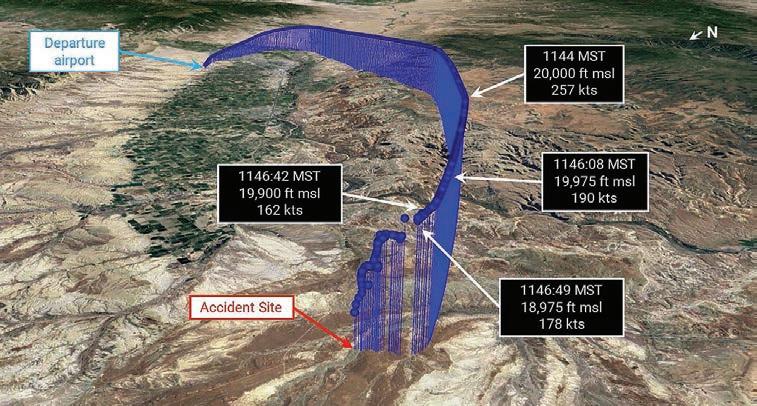
According to flight data for the accident flight, following the stall, the aircraft abruptly rolled to the right, the flight crew responded with full left wing down aileron input, full power, and full aft (airplane nose up) elevator control input, which aggravated the stall and spin.
According to NTSB, two other Hawker stall test flights were investigated. In each case, uncommanded roll behavior occurred on aircraft certified under Textron Aviation’s type certificate A3EU. The Hawker type certificate (A3EU), initially issued in the 1960s, has been held and transferred by at least seven different companies and includes 51 unique airplane models.
On May 4, 2006, a BAE 125-800A departed Lincoln, Nebraska (KLNK), for a manufacturer’s required post-maintenance stall test flight. During this flight test, according to the NTSB, the airplane entered a stall without the expected stick shaker and stick pusher activation and rolled uncommanded through 360 degrees. The pilot, copilot, and four technicians on board the aircraft sustained minor injuries. Both pilots were employed by the manufacturer; however, neither was a factory flight test pilot.
According to the flight crew, the stall test was conducted with the autopilot engaged, and the stall occurred at a higher airspeed than they had calculated. Unexpectedly, as the aircraft entered the stall, the right wing dropped abruptly, and the aircraft rolled through 360 degrees multiple times, both left and right. NTSB analysis of the flight data recorder indicated that the aircraft became inverted 4 seconds after the initial upset and lost 11,000 feet of altitude in 30 seconds. During the recovery, the crew and aircraft experienced downward acceleration forces that exceeded 6 g.
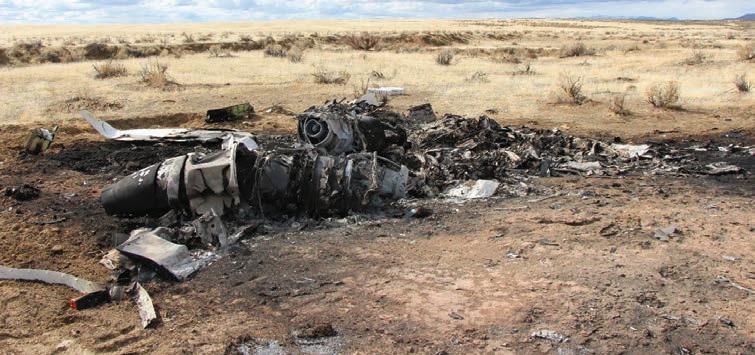
Again, investigators found that the flight crew initiated the stall test with ice contamination on the wings, and this contamination resulted in adverse stall behaviors. Although the flight crew did not observe any icing advisory lights or any ice on the wings, a technician on board saw “frost” on the wing surface near the root of the wing and reported it to the crew. The pilots continued with the stall test.
After this incident, Raytheon Aircraft issued an internal Production Flight Test Procedure that included a stall training syllabus that outlined the operational considerations for stall testing and clarified approved recovery procedures; this information was not included in the aircraft flight manual or pilot operating manual.
On March 3, 2005, a Hawker 800XP undergoing a post-maintenance test flight in West Palm Beach, Florida, stalled without stick shaker or pusher activation and rolled three times to the right. During the recovery, the aircraft lost about 3,000 feet of altitude before the flight crew regained control of the aircraft.
Following this incident, maintenance personnel found several deformed vortex generators on the aircraft’s wing, which contributed to the unacceptable stall
characteristics. The NTSB determined that a deformed vortex generator, inadequate fillet sealing on the wing leading edges, and additional imperfections may negatively impact Hawker stall performance.
An earlier stall test flight incident highlighted the adverse effects of deformed vortex generators. In 1993, a Hawker 125800 exhibited unsatisfactory stall characteristics during a post-maintenance test flight. A Raytheon Service Information Leaflet (SER No. 180) reported that the aircraft entered an aerodynamic stall before the stick shaker or stick pusher and rolled uncommanded to the right. The leaflet advised operators of Hawker aircraft to exercise caution when cleaning the top surface of the wing and to replace or repair damaged vortex generators.
The former factory test pilot, Grommet, inspected the condition and placement of the wing vortex generators before each stall test flight. “Unacceptable stall characteristics are remedied by adjustment of these spoilers (vortex generators),” according to Grommet. Each vortex generator can be moved by only .02 inches per adjustment. Grommet said they typically are adjusted during production test flights and, if maintained properly, the stall characteristics should never change.
During the NTSB interview, Grommet described his plan for a stall test flight. From the discussion, he took a disciplined approach to each of these flights using the same flight test procedure, test card, fuel loads, and briefings. Typically, Grommet flew for a block altitude of 14,000 feet msl to 16,000 feet msl and always stayed clear of icing conditions. He cautioned that flights above FL180 are undesirable because the true stall speed would increase due to the lower density of the air.
Grommet said, “99% of the time the test can be accomplished in 30 minutes.” During the test, he would conduct the stall and record the information on a test card using di ff erent flap and landing gear configurations. He always flew from the left seat and reviewed the stall test procedure with the other pilot on the ground. During the stall recovery, Grommet briefed the other pilot that “there would be more grass in the windscreen than they are used to.”
As a result of its investigations, the NTSB made seven urgent safety recommendations: five to Textron Aviation, the type certificate holder, and one each to the FAA and NBAA.
The following recommendations were made to Textron Aviation:
» Recommendation A-26-1: Define manufacturer- authorized pilot training and experience qualification criteria for pilots who perform post-maintenance stall test flights in Hawker 750, 800, 800XP, 850XP, and 900XP airplanes to ensure they are prepared with competencies needed to safely respond to an encounter with unacceptable stall characteristics.
» Recommendation A-26-2: Develop a stall test plan that describes unacceptable stall characteristics, recovery procedures, and safety considerations needed to prepare manufacturer-authorized flight crewmembers to safely perform post-maintenance stall flight tests in Hawker 750, 800, 800XP, 850XP, and 900XP airplanes.
» Recommendation A-26-3: Review all other models (besides the Hawker 750, 800, 800XP, 850XP and 900XP) listed on type certificate A3EU, and for each model that is subject to post-maintenance stall test flights, define stall test flight pilot training and experience qualification criteria and develop a stall test plan, as specified in Safety Recommendations A-26-1 and A-26-2 (above).
» Recommendation A-26-4: Review the Pilot’s Operating Manual and Airplane Flight Manual for the airplanes on type certificate A3EU and revise them, as necessary, to provide a description of the adverse effects of certain wing surface anomalies, such as visually imperceptible defects or light ice accretion, on the airplane’s stall behavior, including: the possibility of stall before stick shaker or stick pusher activation; a description of unacceptable stall characteristics; and procedures for recovering the airplane from an inadvertent encounter with a stall or adverse stall behavior.
» Recommendation A-26-5: Inform owners and operators of the airplane models on type certificate A3EU that are subject to post-maintenance stall flight tests of the circumstances of these accidents to increase their awareness of the possibility of unacceptable stall behavior, such as
uncommanded roll through 360 degrees and entry into a spin, and that the flight crew training and experience needed to ensure the safety of these flights exceeds that which is typically provided to operational line pilots.
The following recommendation was made to the FAA:
» Recommendation A-26-6: Require Textron Aviation to complete the actions specified in Safety Recommendations A-26-1 through A-26-3, and ensure that the information is accurate and correctly incorporated into the appropriate FAA-approved manual or document for each airplane.
The following recommendation was made to NBAA:
» Recommendation A-26-7: Inform your members about the recent accidents that occurred during post-maintenance stall flight tests required for certain Hawker airplanes including the Hawker 750, 800, 800XP, 850XP, 900XP, and others on type certificate A3EU, to increase owner, operator, and pilot awareness that unacceptable stall behavior may occur and that the flight crew training and experience needed to ensure the safety of these flights exceeds that which is typically provided to operational line pilots. z

The NTSB issued the final report on the crash of a Hop-A-Jet Bombardier Challenger 604 on Feb. 9, 2024, citing corrosion in the jet’s GE CF34-3B engines’ variable geometry (VG) system. Hop-A-Jet president Barry Ellis told AIN following the release of the report on April 23, “We’re very happy, the NTSB did an accurate assessment, and the way that it was written is understandable to a layman.”
Both pilots died in the accident after the Challenger’s engines lost power on approach to Naples Municipal Airport (KAPF) and they landed on the southbound lane of I-75. The flight attendant and two passengers were able to escape through the baggage door.
One element of the NTSB final report surprised Ellis: the agency did not issue any recommendations. While Ellis appreciates that GE Aerospace revised service bulletin and maintenance manual procedures to emphasize corrosion- detection procedures, he also believed that the service bulletin should be mandatory.
“We believe that in the interest of safety, there needs to be an FAA mandate to adhere to these service bulletin procedures, and even go further,” he said.
In line with that belief, the FAA has issued a proposed AD that would address these issues.
The proposed AD would require, after a hung start, repetitive engine heat soak restart tests, and based on the tests, troubleshooting and corrective actions. The proposed AD would further require a series of other actions, including a borescope inspection of the high-pressure compessor (HPC) case for corrosion and,
BY MATT THURBER
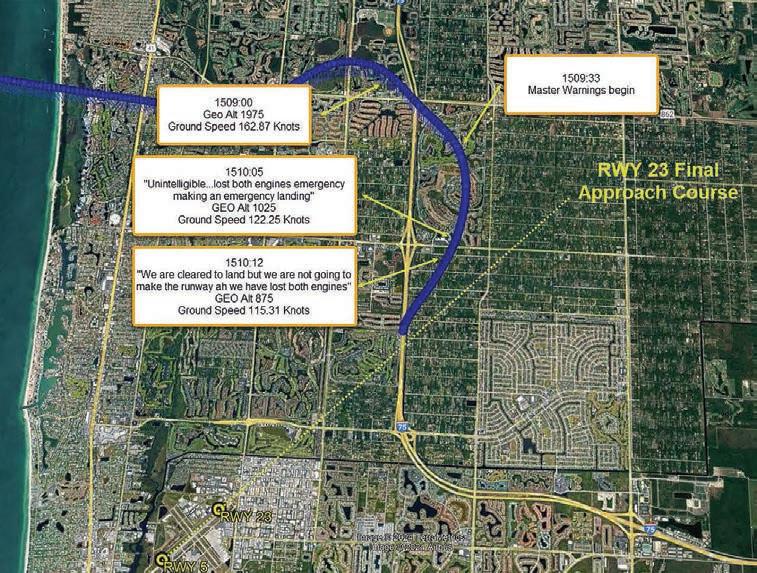
depending on the results, a VG system functional check.
“This proposed AD would also require, depending on inspection results, performing a force gage test on the feedback cable for tightness and a visual inspection of the VG system for obstruction and, if necessary, removal of the engine from service,” the FAA said.
The NTSB’s probable cause of the accident was: “Corrosion of both engines’ VG system components, which led to their operation in an off-schedule position and resulted in near-simultaneous sub-idle rotating compressor stalls on approach, subsequent loss of thrust in both engines, and an off-airport landing. Contributing
to the accident was inadequate fault isolation guidance from the engine manufacturer, which prevented the identification of corrosion buildup in VG system components during troubleshooting of hung start events of both engines about one month before the accident.”
According to the NTSB, after both engines were sent to GE for post-crash evaluation, VG tests revealed “corrosion was observed in the HPC case flow path area, with the most significant corrosion found in the VG stage 5 area. Extensive corrosion was observed in the HPC case VG stage 5 stator vane spindle bores.”
Additionally, the VG stage 5 stator vanes were unable to travel fully (that is, the
distance from fully opened to fully closed) when tested using the specified maintenance procedures, and higher than normal actuation pressures were required to move the VG hardware through its full range when compared to other engines without corrosion on the HPC spindle bores, with a slower than normal VG system response when tested with pressurized air.
“At low power conditions, as was the case at the time of the accident, it can lead to sub-idle rotating stalls,” according to the NTSB. “It is likely the corrosion limited the VG hardware travel as the flight crew reduced the power for landing, resulting in near-simultaneous, sub-idle rotating compressor stalls and a subsequent loss of thrust in both engines, which was unrecoverable at the low altitude.”
A Maintenance Practice 68 (MP 68) pressure test is part of the troubleshooting procedure for a hung start problem, which the accident airplane experienced 25 days before the accident. With GE’s assistance, Hop-A-Jet’s maintenance team spent three days troubleshooting the Challenger.
During the GE troubleshooting procedure, according to the NTSB, the MP 68 test “was not performed because the
engines were started and no further anomalies were noted, allowing discontinuing of troubleshooting in accordance with the flowchart. With the concurrence of the engine manufacturer, the airplane was returned to service and flew 33 uneventful flights (excluding the accident flight) over the next 25 days, accruing 57 hours of flight time until the accident.
“According to the engine manufacturer, a hung start may be an indicator of corrosion buildup in the engine and will result in poor engine starting and operating performance.”
Along with the hung start 25 days before the accident, the operator experienced seven others in the previous 10 years, the NTSB said. “One way corrosion could have been identified in the engine, and specifically of the VG system components, was through the MP 68 pressure check. However, because this step was so late in the fault isolation hung start guidance, and it was not a required maintenance check, the airplane was returned to service after successful engine start and no other subsequent engine start issues. Thus, the corrosion of the VG system components continued to go undetected.”
After the accident, Hop-A-Jet grounded its Challenger fleet—all the jets powered
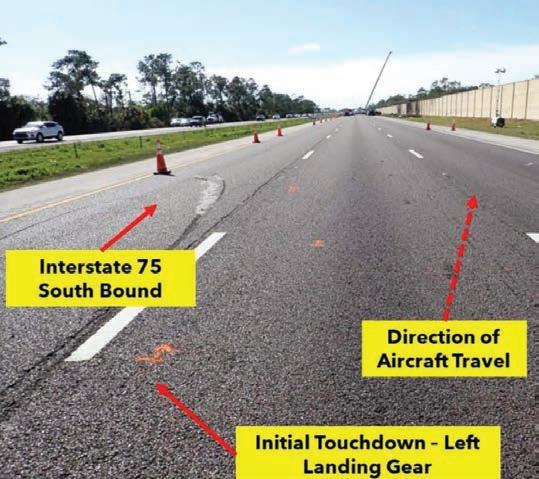
by the CF34-3B engines—and GE technicians traveled to Hop-A-Jet’s Fort Lauderdale Executive Airport (KFXE) headquarters to examine those engines. Since then, Ellis said, “We are super cognizant of anything that would indicate that there could be a guide vane issue.” Hop-AJet’s maintenance crew also built its own MP 68 pressure test tool so it didn’t have to rely on borrowing the two sets that GE owns. “We have preemptively used [that tool] in testing routinely,” he said.
Ellis wants to make sure other operators understand VG corrosion issues and thinks the NTSB report will help with that. “We’ve tried to be very transparent about this from the beginning,” he said. “We haven’t tried to hide behind anything, but we’ve definitely learned a lot that has made us a safer company, and we’d like for everybody to have that knowledge.”
While Ellis also thinks that there is more to the story that will eventually be revealed, he concluded, “We believe the NTSB did a good job…of making this [final report] understandable to everybody. It’s a very complex issue with internal components of engines, but the way that they finally wrote the final report, [people] should be able to understand exactly what happened.” z
Both pilots were killed in the accident, but the flight attendant was able to help the two passengers escape through the baggage compartment.
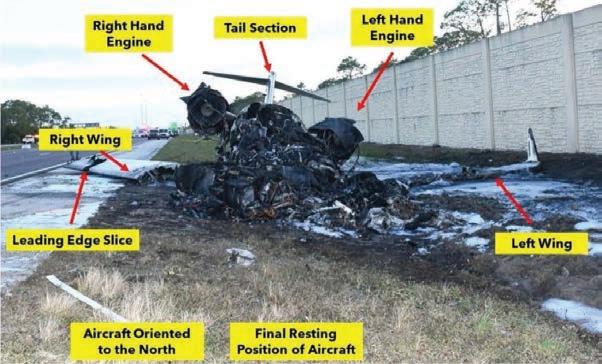
BY MATT THURBER

A recent demonstration flight in Textron Aviation’s new Ascend midsize jet was interesting from a variety of perspectives. For one, this is a great example of an OEM pushing the envelope on upgrading a popular legacy product. It was also an excellent way to compare the state of the art in the aftermarket retrofit field to what an OEM committed to significant upgrades can accomplish.
The Ascend has the distinction of being the final modern Citation model to switch to Garmin avionics—not a surprise given strong aftermarket interest by owners switching to Garmin’s G5000 flight deck upgrade. And having flown an XLS with the G5000 upgrade, I found that flying the Ascend was a little like flying an old
friend, albeit with much more than just a shiny coat of new paint. The changes to the Ascend are significant and should propel this jet to an even longer lifetime, well beyond the 1,000-plus family members delivered thus far.
Certified last November, the Ascend is the latest version of what started in 1998 with the Citation Excel. The Excel/XLS series is an example of how Cessna successfully marries old and new, with a two-footshorter Citation X fuselage matched to an unswept wing and Citation V empennage, and powered by Pratt & Whitney PW500 engines. Over the years, the Excel/XLS has seen many upgrades, including switching from Honeywell avionics to Collins Pro Line 21 and now to a Garmin G5000 suite.
The last upgrade before the Ascend was the XLS Gen2, which added a lighted airstair door; a new entry door curtain; a high-power outlet at the refreshment center; an updated seat design; a wireless cabin management system with wireless device charging and USB-A and -C ports; a fold-down two-place couch in the vestibule area; and a Bongiovi speakerless surround sound system.
“We really made a nice improvement with the XLS Gen2,” said Lannie O’Bannion, Textron Aviation senior v-p, global sales and flight operations. “We saw an uptick in order activity with those improvements, but the Ascend is a significant improvement over the Gen2.”
With a base price of $18.175 million, the Ascend changes affect almost every part of
the airplane, from the windshields to cabin windows, interior configuration, engines, and G5000 configuration.
Switching the XLS series from Collins avionics to the Ascend’s Garmin G5000 suite seems like a natural move for Textron Aviation, continuing a familiar interface for Cessna pilots who start flying with G1000, then progress to G3000 or G5000 as they move into the modern Citations.
“As customers move up, everything outside of the King Air is Garmin, and this falls in line with that,” said Jimmy Beeson, v-p product development. “It gives them an improved but enhanced familiar platform.” Textron Aviation’s Denali single-engine turboprop is also Garmin-equipped, as are the Caravan and SkyCourier.
“Voice of the customer was important,” he added, in helping shape the improvements that resulted in the Ascend design.
In the Ascend, the four Garmin touch controllers (GTC) give pilots more options for controlling the two 14-inch G5000 primary flight displays (PFD) and the single 14-inch multi-function display (MFD).
Pilots can, for example, use one GTC to set
up and run the PFD and one for the MFD (which can be split into two panes, one for each pilot).
The center GTCs in the Ascend are positioned at a comfortable and easily viewable angle between the top of the center console and the bottom of the center MFD, blending smoothly with the redesigned lower switch panel. The redesign gave Textron Aviation engineers latitude to eliminate unneeded instruments, switches, and buttons, and the result is an extraordinarily clean-looking instrument panel. For example, systems such as pressurization are incorporated in the G5000 avionics, so those are no longer needed separately.
The Garmin mode control panel under the glareshield is flanked by two GCU controllers, one for each pilot. Interestingly, the landing gear handle moved from the right side of the lower instrument panel, about lined up with the copilot’s left knee, to the left side and lined up with the pilot’s right knee. Instead of the Mid-Continent Standby Attitude Module that is installed in the XLS G5000 upgrade below the MFD, the Ascend has a more traditional square L3 standby between
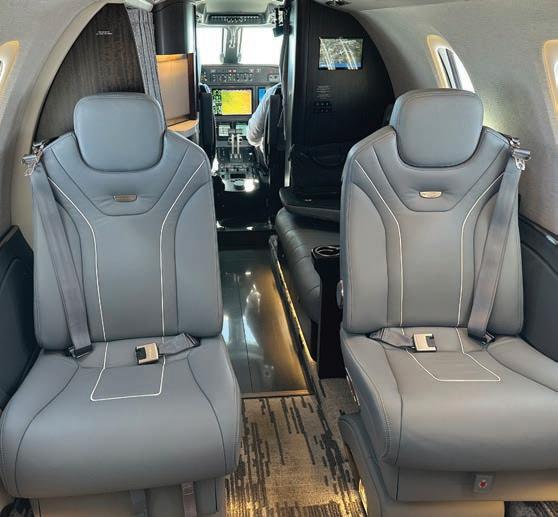
the left GCU and the mode control panel, much more in line with the pilot’s view out the windshield.
The Ascend G5000 has all the expected modern features, including electronic checklists and charts, synthetic vision, ADS-B Out and In, the GWX 8000 StormOptix digital radar, and autothrottles (which aren’t available in the XLS G5000 upgrade). Datalink communications are an option and, where available, make possible digital messaging with ATC. “Pilot workload is a piece of feedback we have to listen to as well as [in relation to] cabin technology,” said Beeson.
Climbing into the cabin via the airstair door is now easier, with new anti-slip tread and added step lighting in down- and upwash configurations.
The standard Ascend interior configuration fits nine passengers, including a twoseat couch across from the door, a double club area, two seats behind that, and a belted lavatory seat. With the standard setup, the closet next to the forward couch measures 16 inches (41 cm) wide, but an option changes that seat to a single-place with a 33-inch closet, for eight passengers total.

From the outside, the nose of the Ascend presents a different look, more like that of a larger Citation Latitude or Longitude, thanks to new electrically heated windshields that eliminate the XLS’ bulky bleed air eyelets. The cabin windows are 15% larger, which doesn’t seem like much but brings a lot more natural light inside. Optional lighted window rings make for a more spacious feel and mirror a feature available in other Citations. Another change that sets the Ascend apart is a subtly twisted-up wingtip to give a hint of winglet appeal, although there isn’t a huge aerodynamic benefit.
Perhaps the most significant change in the Ascend is the cabin’s standard flat floor. However, rather than a complex redesign of the fuselage with a floor that is lower than the shelf on which the XLS seats are mounted, Textron Aviation elected to fill in the jet’s center aisle trench. This provides the flat floor that has become desirable in the midsize/super-midsize jet market, but also allows Textron Aviation to o ff er the option of retaining the original dropped aisle, which is available at no extra cost. Another benefit of the flat floor is that it is more comfortable for pets, a key consideration for owners who want to fly with furry friends.
Buyers are going with the flat floor, which reduces headroom to 60 inches in the cabin from the previous trenched aisle’s 68 inches. The entry vestibule remains at the original 63 inches, and a small ramp makes the transition from vestibule to cabin. “Once you sit down, there’s still plenty of space to get into the seat,” said O’Bannion.
“That’s why we focused on seated comfort,” said Beeson. The new seats, designed for the Ascend, allow more swivel action, and passengers can now turn the seat toward the aisle and have a comfortable place to put their feet instead of trying to scrunch them over the shelf or have them

hanging over the dropped aisle. I tested this, and the seats o ff ered a high level of comfort, while swiveling outward gave my legs and feet plenty of places to rest, especially when sitting opposite someone in the club seating section.
“You can see how much cleaner it looks,” Beeson said. “What most people do when they get in is sit down and track the seat outboard, canted in towards the aisle. I think this aircraft was built for me, because if I dangle my feet in the aisle, once I tilt the seat towards the middle, I can’t touch the bottom of the dropped aisle. That’s not optimal comfort for me. If you’ve got the flat floor, you don’t have to do that anymore. You can sit much more naturally. Even for taller individuals, it makes much more sense. When you experience the cabin, you get that sense of what we were aiming for, which is seated comfort.”
Although some might think that the 68-inch dropped aisle might prove more comfortable, he explained, “It’s a number. In reality, once you get in, you sit down, you experience that, and it makes sense…Individuals get on the airplane, track the seat, swivel towards the middle,
and now they have much more freedom of movement and freedom of comfort in the seat. It’s not something they could have done with the dropped aisle, at least comfortably.”
The new Ascend seats’ electric locking mechanism makes it easier to move in and out of swivel mode and holds the seat more firmly when locked, reducing shaking. Optional leg rests are available, and buyers can specify material patterns and quilting styles. Further work on soundproofing, tapping technology from the Latitude and Longitude, lowers the Ascend’s interior noise by 3 to 4 dB compared to legacy models.
In the rear cabin, the lavatory has a coat closet, and two windows keep the area bright. The seat on the externally serviced toilet folds down to provide additional luggage capacity, although that might not be needed with the Ascend’s 80-cu-ft, 700-pound-capacity baggage compartment.
Opting for the Bongiovi speaker-less sound system fills the cabin with hi-fi audio generated by 26 transducers hidden behind cabin panels. Textron Aviation’s Clairity in-flight entertainment/cabin
management system runs on a Heads Up Technologies backbone and has all the modern features, such as Bluetooth connectivity to smart devices for cabin control and playing content, and FlightPath 3D moving map on a touchscreen bulkhead monitor or on personal devices (customer livery is optional).
Textron Aviation just announced that its service centers are installing Starlink low-earth-orbit satcom systems in 560XL models and the Ascend, so this is an option after purchase. Gogo Galileo satcom is also an option, and with the HDX antenna installed, delivers up to 60 Mbps from the low-earth-orbit OneWeb satellite constellation.
For flights that remain in the contiguous U.S. and parts of Canada and Alaska, Gogo’s Avance L3 Max air-to-ground connectivity system comes standard, and Avance L5 is an option.
The Garmin upgrade for the Excel through XLS Gen2 transforms previous models into a thoroughly modern airplane, albeit with some necessary legacy buttons and switches. Textron Aviation took great advantage of the opportunity to bring the
Ascend into a higher level of comfort and convenience, almost as though there were plans to make this Part 25 airplane into a single-pilot machine (which obviously isn’t the case). The G5000 suite with wellintegrated systems is near the pinnacle of flight deck design, and perhaps won’t be exceeded until a possible future switch to the fully touchscreen-capable G5000 Prime, not that anyone at Textron Aviation told me this is coming.
In any case, the Ascend cockpit is roomy and ergonomically welcoming, a good example of design that enhances safety by freeing up the pilots’ attention for important matters.
With Textron Aviation senior pilot Wade Williams in the right seat and senior pilot Bill Hoyer in the cabin, the G5000’s weight and balance showed Ascend N502XL carrying 3,960 pounds of fuel with a takeoff weight of 17,775 pounds, 2,725 pounds less than the 20,500-pound mtow. Fuel capacity is 6,740 pounds.
The weather was, unfortunately, perfect for our flight with clear skies and wind straight down the runway, so I didn’t get to fly in challenging conditions, although demo flights in good weather are probably much safer.
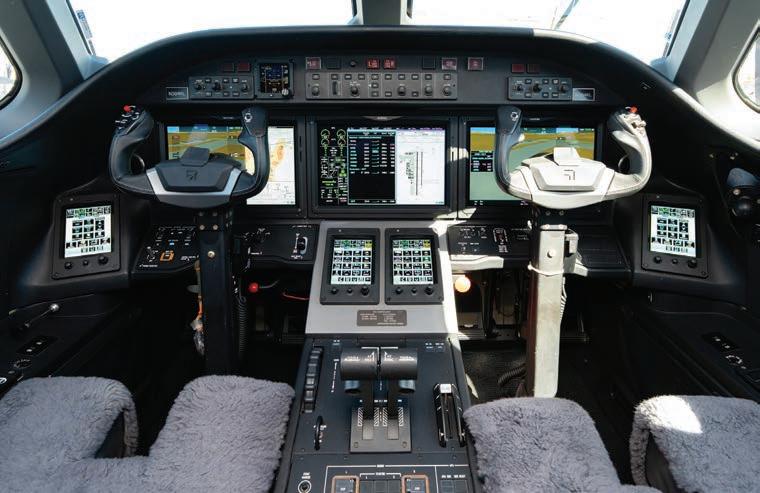

Upgraded 4,218-pound-thrust Pratt & Whitney Canada PW545D engines provide more thrust and boost range by about 100 nm compared to previous models. The new engine has longer hot-section inspection and time between overhaul intervals, at 3,000 and 6,000 hours, respectively. However, to use those longer times, the optional Pratt & Whitney Canada flight data, acquisition, storage, and transmission system must be installed, and the customer has to enroll in an engine program and Camp Systems maintenance tracking.
New for the Ascend is the upgraded Honeywell RE100 (XL) APU that can be left unattended while running.
A typical IFR range with four passengers is 1,940 nm at high-speed cruise. Maximum cruise speed is 441 knots, and full-fuel payload 900 pounds. At its maximum altitude of FL450, the Ascend has a cabin altitude of 6,800 feet.
With a mtow takeo field length of 3,800 feet, the Ascend can climb to FL410 in 20 minutes or FL430 in 26 minutes.
High-speed cruise tops out at 437 knots in standard conditions at FL330 at lighter weights, with a 1,600 pph fuel burn. At FL410, high-speed cruise with a mid-weight load is 420 knots and burning 1,234 pph.
At a more e cient long-range cruise power setting, the Ascend cruises at 391 knots at FL430 and burns 1,042 pph.
At maximum landing weight and sea level, landing distance is 3,180 feet.
The first step to bring the Ascend to life is switching on the battery, then starting the APU. All the avionics come on automatically, and the optional Honeywell Laseref VI ring-laser-gyro inertial reference system starts its alignment process, which takes a few minutes. The Laseref replaces Garmin’s GRS 7800 attitude heading reference system and helps the Ascend stay on track in case of GNSS jamming activity.
A new feature for the Ascend is a warning if the fuel crossfeed is left on too long; if too much fuel—60 pounds—is sent to the other wing, the system will alert the pilot.
The Ascend comes with Garmin’s GDL 60 ground-based communication system as standard. When connected via cellular LTE, Wi-Fi, or Bluetooth, the Ascend can automatically upload database updates and transfer flight data logs to assigned users, such as Textron Aviation’s LinxUs maintenance system.
Williams uploaded our flight plan from his iPad using ForeFlight into the G5000 FMS. After reviewing it, all we had to do
was push the activate button. The plan was relatively simple: climb west toward Dodge City and then back to Wichita.
We reviewed the active performance numbers to make sure they reflected speed restrictions in the Wichita airspace. The Ascend’s autothrottles will help make sure we stay on the scheduled speed constraints, which are adjustable.
After checking the takeoff field length requirement, which was 3,195 feet, Williams ran the systems checks, including the new runway overrun awareness and alerting system. He then selected his crew profile in the G5000 system. The number of options in the profile settings continues to expand and includes, if desired, settings for each phase of flight.
During our pre-takeoff briefing, Williams reminded me that even with the elevator trim set perfectly, just like the XLS, the Ascend requires a hefty pull on the yoke during rotation.
Starting the fadec PW545D engines is dead simple: just push the start button, then move the throttles forward to the idle
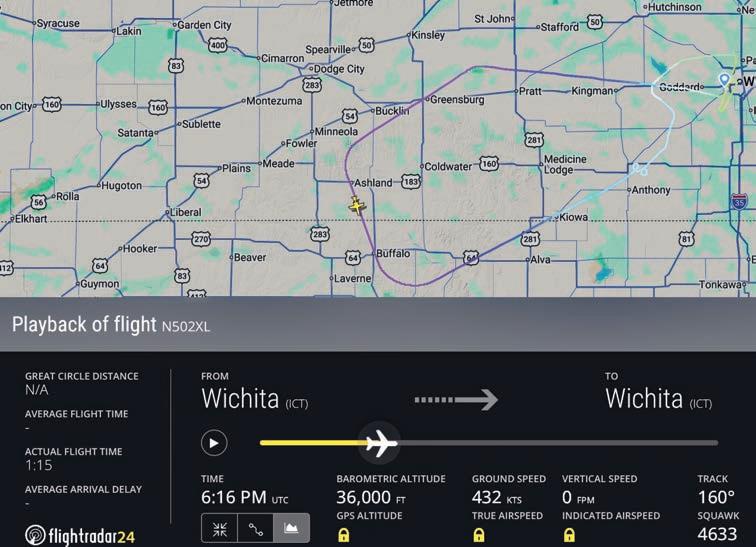
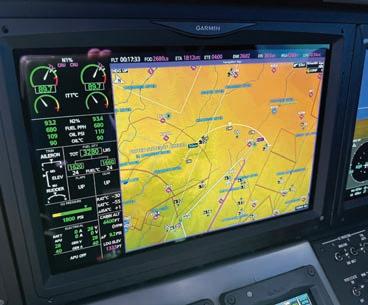
position once the fan starts turning. With both engines running, I switched one then the other generator off to make sure they could each handle the load.
After I released the parking brake and with flaps 2 set, the V speeds populated on the PFD, with V1 at 94, VR at 101, and V2 at 113 knots.
The Garmin 3D exocentric taxiway routing view popped up on the PFD. After Williams called ground, he plugged in the route to Runway 19L, and I could see the highlighted taxi path depicted clearly on the display. Eisenhower Airport (KICT) is not terribly complex, but at larger airports, taxiway routing is extremely helpful.
For the first takeoff, I elected to use the autothrottles. In the Ascend, these don’t engage until 400 feet.
As Williams had warned, after the Pratts accelerated the Ascend quickly to rotation speed, I pulled and then had to pull some more before the jet broke ground. Once airborne, with gear and flaps up, the autothrottles engaged and kept the Ascend below 200 knots. I kept my hands on the controls to get a better feel for the airplane until we climbed into the high teens, then switched on the autopilot and climbed to FL360 for a performance check.
It took 16:30 for our relatively direct climb to FL360. We hung out for about 15 minutes, clocking Mach 0.746 and 430 ktas,
while burning 680-690 pph per side, with temperature at ISA+2 degrees C. Cabin altitude was 4,400 feet with a 9.2 psi pressure ratio.
We tried to look for some thunderstorms to display with the GWX 8000 radar, and saw some at the limits of the radar’s reach, but clear skies covered most of the western U.S.
I wanted to get a feel for the Ascend’s handling, so we descended to 14,000 to 15,000 feet for some steep turns and slow flight practice, trying out the speedbrakes on the way down. There is no speed limitation for speedbrake use.
The steep turns revealed solid, stable handling, and I was able to maintain a steady altitude, although that may be due more to the helpful flight path vector on the PFD than my skills.
I pulled the power back and trimmed nose up, then slowed to about 140 knots, then with landing gear extended and full flaps, to about 120 knots. The Ascend handles well at low speeds, without some of the heavier feel that I’ve experienced when flying larger Citations, and the practice gave me confidence for the upcoming landings.
The first order of business was a coupled go-around, which the Ascend does without anyone needing to touch any controls other than the go-around button, then landing gear and flaps. We vectored around north of KICT with autothrottles engaged, then joined the ILS to 19L, watching closely as the autopilot flew a perfect approach. At minimums, I pushed the go-around button, and the autothrottles smoothly ramped up the power, and the autopilot checked our descent and raised the nose for the climb away from the runway.
For my first landing, I elected to keep the autothrottles engaged. Level at 3,000 feet, I turned left onto the downwind leg and followed Williams’ suggestions for when to add flaps and lower the landing gear. The visual approach looked perfect as we rounded base to final, and the autothrottles

remained engaged right until touchdown. I lifted the nose a little too soon and floated a little bit, but held the airplane steady until it settled smoothly onto the runway. A touch of reverse thrust and brakes slowed us down—I didn’t want to use maximum braking—and we turned off about twothirds of the way along the runway.
For my final takeoff, I wanted to go fully analog with no autothrottle, and hopefully, with a proper rotation. Williams suggested raising the nose to 10 degrees and being ready to pull the power back fairly quickly to level off at pattern altitude.
I pushed the throttles all the way forward, and the lighter Ascend gained speed quickly. When Williams called out “rotate,” I gave the yoke a hefty yet smooth pull, and we left the ground right on schedule. With the attitude at 10 degrees and speed rapidly increasing, I reduced power and leveled off below 3,000 feet.
Without the autothrottles managing power this time, I got a little low and slow on the base leg, but I could feel it happening and started adding power just as Williams was pointing out the low energy state. The Ascend quickly returned to the proper
glidepath, and unlike the first landing, I did a better job holding the nose in the right attitude as we crossed the threshold, and after I pulled the power all the way back, the Ascend gently touched down right on the centerline.
It was a great way to end a flight that bracketed my previous experience in the G5000-upgraded XLS, illustrating how Textron Aviation is not holding still on improving all of its products. z

In the annals of air show history, the 2026 Aero Friedrichshafen event could go down as the year when its courtship of the business aviation community reached the wedding day. The show was already set to host a record presence from the sector, but the cancellation of the European Business Aviation Convention and Exhibition (EBACE) opened the doors to a growing number of visitors eager to establish a longer-term plan for the annual air fair on the banks of Lake Constance in Germany. In fact, the general aviation event drew 37,000 visitors from 88 countries over four days, surpassing 2025’s 32,100.
In April, the European Business Aviation Association (EBAA) announced that it had decided to cancel the 2026 EBACE scheduled to be held in Geneva from June 2 to 4, saying the show’s revised format had not generated “the momentum needed to deliver a viable edition of the event.” The group did not say whether it will attempt to relaunch the show in future years.
“This is a difficult decision, and one we have not taken lightly,” said EBAA CEO Stefan Benz. “We know it will cause disappointment for exhibitors, partners, and participants who have committed to this year’s event and placed trust in it. However, we believe this is the most responsible course of action. It is also the right decision to help minimize further impact on those who had already committed to the event, and reflects the transparency and seriousness with which we must act towards our members and the wider market.”
Meanwhile, Aero Friedrichshafen organizers noted that business aviation was the area that grew the most, with a 50% expansion of floor space dedicated to the sector. As such, more than one third of the show’s exhibitors—300 or so of the 830 total—occupied the growing business aviation cluster on the
BY CHARLES ALCOCK

static display and in Halls A1 and A2. Part of the rising tide flowed through new group exhibits, including the German, Austrian, Dutch, and Chinese pavilions and the preowned aircraft corral convened by the International Aircraft Dealers Association.
Between the exhibit halls and the eye-catching Zeppelin airship hangar, the static display was bulging. Textron Aviation brought a pair of debutants in the shape of its Citation Ascend and Longitude, as well as its SkyCourier utility twin turboprop. Other newcomers included Dassault’s Falcon 6X, Bombardier’s Global 6500, Daher’s TBM 980 and Kodiak 900, a trio of Diamonds, and the latest Cirrus Vision Jet.
The scale and diversity of Aero Friedrichshafen can be somewhat overwhelming for newcomers, so organizers Fairnamic arranged guided tours and improved signage. Across the seven halls, visitors found concentrations of exhibitors around up-and-coming sectors such as electric aviation and additive manufacturing.
This year, the show drew exhibitors from well beyond Europe’s boundaries, including a growing number of Middle Eastern companies. The high concentration of start-ups is partly explained by Fairnamic’s policy of granting a 50% discount to exhibitors younger than four years old.
Aero Friedrichshafen 2026 featured an enlarged bizav contingent.
“This will be our most diverse show ever,” Fairnamic’s head of aviation Tobias Bretzel told AIN, acknowledging the strong growth in both the business aviation footprint and, more generally, the ratio of business-to-business exhibitors. While some trade shows have struggled to attract high-net-worth aircraft buyers, he advised business jet sales executives to be alert to prospects dressed more like general aviation tire-kickers.
“The sort of people who can afford to buy something like a Global come to our show dressed less formally, including families from the Middle East,” Bretzel commented. He had expected Aero Friedrichshafen to draw serious buyers right through to the final day.
While the scrapping of the EBACE show might be viewed as a boost for Aero Friedrichshafen, the Fairnamic team takes no pleasure in the demise of the Genevabased event. “I have had to postpone and cancel shows due to reasons like Covid; these are very hard decisions, and it really hurts me,” Bretzel reflected.
That said, there appears to be some prospect for future collaboration with EBAA. “We already work with different organizations and groups, and our door is wide open for discussion on future ideas. The role of EBAA is crucial,” Bretzel concluded. z
250 Years Of America. 122 Years of Aviation. 1 Nation’s Capital.
Let’s Celebrate The Power of American Imagination.


SEPTEMBER 24, 2026 | 6:00 PM - 10:00 PM | WASHINGTON, D.C.
PRESIDENT’S RECEPTION SEPTEMBER 23, 2026, 6:00 PM
CELEBRATING THE INDUCTION OF THE CLASS OF 2026
William F. Bahret | Leonard Michael Greene | Dr. Shannon Lucid | John D. Odegard
Ross Perot Jr. | Captain CB "Sully" Sullenberger | Dr. Peggy Whitson
Presented by:



For details, tickets, and table sponsorship, visit NationalAviation.Org/Enshrinement



Piaggio Aerospace is preparing for its next-generation Avanti NX.
BY KERRY LYNCH
Aero Friedrichshafen 2026
Piaggio Aerospace has secured the launch customer for the P.180 Avanti NX with an order from a European operator for two of the next-generation pusherprop twins, the company announced at Aero Friedrichshafen. The aircraft will be delivered in executive business configuration with stretcher modules that enable conversion for air ambulance operations.
Unveiled in late February, the NX will have upgrades in systems, including avionics, as well as new interior features and bolstered support. The unveiling came less than a year after the company underwent an ownership change and emerged from bankruptcy following a years-long process. Piaggio said the aircraft will be a “working forum” to explore new concepts and targeted upgrades.
“We are proud to sign a contract for the sale of the Avanti NX so soon after unveiling the aircraft,’’ said Piaggio Aerospace CEO Giovanni Tomassini. “Returning to Aero Friedrichshafen after a long absence and signing a contract for two aircraft
demonstrates that, with the support of Baykar, we are making a strong comeback in the aviation market.’’
Piaggio Aerospace plans to gradually increase production in the coming years, striving to reach up to 30 aircraft per year over the next decade as demand continues to develop. As it moves to its nextgeneration model, Piaggio is celebrating the 40th anniversary of the aircraft’s first flight.
At the same time, Piaggio is reinforcing maintenance and customer support, including strengthening its partnership with Rheinland Air Service (RAS) as an authorized service center. RAS has served as an authorized service center since 2014, and Piaggio noted that the company worked on more than 40 Avantis in the last two years alone, representing a quarter of the fleet.
Also, Piaggio recently obtained EASA Part-147 Category C approval from the Italian civil aviation authority (ENAC), enabling its maintenance training organization to offer a dedicated training program for P.180 base maintenance staff that certify aircraft return to service. z
French air charter firm SD Aviation placed an order at Aero Friedrichshafen 2026 for a pair of Cessna Citation M2 Gen3s and a CJ3 Gen2, Textron Aviation announced. The aircraft operator also signed for options on three additional unspecified light jets.
These Citations will be deployed to support SD Aviation’s new SD Share shared ownership program, o ering flights in aircraft based in Paris and Côte d’Azur resort Cannes. The program has been launched through a partnership between Groupe Dubreuil and SD Aviation, which has not disclosed further details of the terms.
Deliveries of the M2 Gen3s and the CJ3 Gen2 are expected to start in 2027. SD Aviation, which is based at La Roche-surYon in the west of France, already o ers preferential charter flight terms through its Club Entreprise membership plan.
According to Textron Aviation, the light jets will be suitable for charter flights across Europe, connecting Paris with capital cities such as Lisbon, Athens, and Copenhagen. SD Aviation has operated two Citation M2 twinjets since 2024. C.A.

BY CHARLES ALCOCK
Thirty aviation software and technology companies are looking to improve standardization in the business aviation sector through a new group called Technology Aviation Business (TAB). The association was launched at the Aero Friedrichshafen show with founder members including FL3XX, SkAI Tech, GlobeAir, Aviowiki, and Axturis.
TAB’s main focus is on technology used to optimize aircraft operations, including flight planning tools. Member companies, including operators, are aiming to establish clear definitions and standards.
According to Paolo Sommariva, co-founder and chairman of FL3XX, the absence of this degree of commonality can cause “huge friction” in how new technology is implemented by business aviation companies. TAB also wants to establish a clearer sense of purpose for integrating more advanced software with current operational processes.
“There is software being offered that people [in the industry] really don’t understand,” Sommariva told AIN . “We want to create a discourse across the industry so that people can buy software that they actually need and understand.”
In his view, smaller companies without a chief technology officer can struggle to adopt technology effectively. These projects are generally run by business leaders such as the head of charter sales or the CEO.
“We hope that our group could help to drive adoption of new technology,” Sommariva added. “It is not possible [for the industry] to keep going this way because regulatory requirements are changing with mandates for specific software. [Operators] cannot keep doing it with Excel or Post-It notes.”
Several years ago, FL3XX and several other companies created a technology group as part of the European Business Aviation Association. Sommariva indicated that the new approach will have a sharper focus on priority outcomes, while adding that TAB may well become an EBAA member.
“At SkAI Tech, we’ve always believed that technology reaches its full potential when it’s seamlessly integrated, a vision TAB is putting into practice through a commitment to universal standards and API connectivity, collaboration with the industry’s leading tech players, and a global strategy for a more integrated aviation ecosystem,” commented Nicolas Saudreau, SkAI’s CEO and co-founder. z


BY MATT THURBER
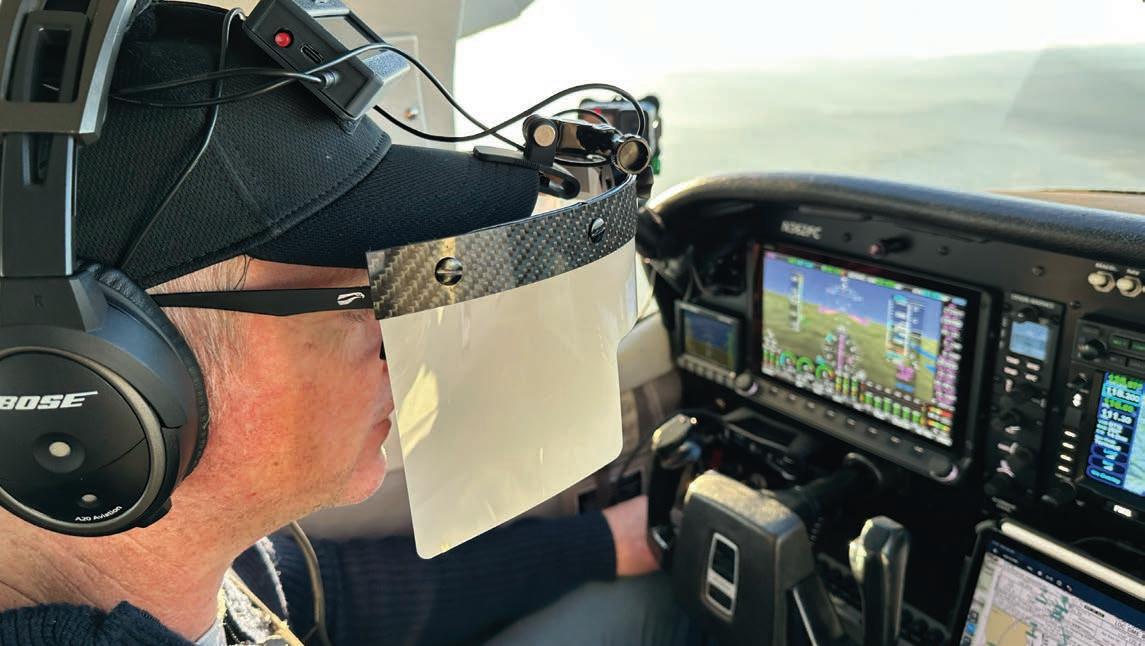
The instructor controls the opacity of the Icarus View Limiting Device to replicate visibility changes while flying in clouds.
Maintaining control and recovering from an encounter with poor weather remains a serious problem for helicopter and fixedwing pilots. Even high-time instrumentrated pilots experience inadvertent entry into instrument meteorological conditions (IIMC) and, unless prepared, might not survive the encounter.
Black Hawk pilot Nick Sinopoli is trying to help pilots learn how to avoid the deadly results of IIMC encounters with the Icarus Smart View Limiting Device (VLD). The Icarus Smart VLD is a modern version of the typical hood or glasses that features eye panes with adjustable opaqueness,
designed to limit pilots’ ability to see anything except the instrument panel and some of the obscured outside world, in an effort to better replicate flying in IMC.
While the FAA requires VLDs for instrument training, it does not define exactly what these are, only dictating that pilots using them are “flying without utilizing outside visual references.”
Helicopter pilots are especially vulnerable during IIMC because helicopters are dynamically unstable. Without a stability augmentation system (SAS) or autopilot, if the pilot isn’t constantly maintaining precise control, the helicopter will
rapidly diverge from controlled flight. In most fixed-wing aircraft, the airplane will maintain its trimmed attitude, at least long enough for the pilot to avoid losing control.
While it is equally important for fixedwing pilots to practice IIMC encounters and recoveries, they have an advantage, thanks to built-in dynamic stability. For helicopter pilots, especially those with very little actual time flying on instruments in low visibility, practicing how to recover from an IIMC encounter is vital.
A problem with helicopter IFR training is that trainees rarely experience actual IMC. Much civil IFR training occurs in
helicopters that aren’t qualified for actual IMC, mainly because they aren’t equipped with autopilots, so training must be done with a VLD. Another problem is that VLDs aren’t very limiting when it comes to helicopters because, unlike airplanes, most helicopters have much larger windows and chin bubbles that are easy to see through while wearing a device.
Even pilots wearing the most restrictive of hoods or view- limiting glasses can see outside references—for example, when looking at a compass mounted on the glare shield or when looking at the edges of the instrument panel.
The other, more critical drawback of these devices is that they in no way replicate what it is like to fly from good to poor visibility in the real world. Generally, the weather is VMC, and the pilot hands the controls over to the instructor, puts the VLD on, then retakes control.
Essentially, we’re teaching pilots that IMC happens suddenly, like a light switch, either on or off. In fact, IMC rarely happens in such a clear fashion; clouds are often not like a wall of white or gray sitting there waiting for hapless pilots to penetrate, but can materialize with a subtle and hard-to-detect gradual loss of visibility.
The Icarus Smart VLD replicates that visibility change, unlike other VLDs, by allowing the instructor to control the opacity of the eye panes, from clear to gradual reductions in visibility until it’s fully obscured. The opaque eye pane is made of a polymer-dispersed liquid-crystal film, and its carbon-fiber frame attaches to any conventional baseball hat.
To adjust the opacity, the instructor uses the Icarus app on a smartphone, which connects via Bluetooth to the Icarus VLD. The instructor can set various levels of opacity, from VMC to the worst heavy IMC, adjust the time for the opacity to change to replicate lowering visibility, or opt for a mode that simulates flying in and out of the clouds.
I tested the Icarus Smart VLD with pilots in airplanes and helicopters, and flew with it myself to experience how it worked.
The Icarus Smart VLD doesn’t eliminate the ability to see a bit underneath the panes, but it covers a lot more of the outside world than traditional VLDs.
Flying the helicopter on instruments was just as difficult with the Icarus Smart VLD as any hood or foggles, but the gradual lowering of visibility and adjustable opacity made it much more realistic while allowing me to look outside. This highlights a huge difference between the Icarus and traditional devices. With the Icarus, you are supposed to be able to see the outside world as represented with varying visibility. With traditional devices, you are not supposed to ever look outside but only at the instrument panel. This alone makes the Icarus Smart VLD much more useful for IMC practice.
My CFII instructor in the Cabri, Curtis Wilber at Pureflight Aviation Training in Chehalem, Oregon, tried the Icarus Smart VLD during our flight and thought it would be a valuable tool for IFR training.
At $1,250, the cost isn’t a major stumbling block, although a busy school might need more than one.
Barry Munsterteiger, an IFR-rated pilot and Cessna 182 owner, tested the Icarus Smart VLD during some practice IFR approaches and said he found it more comfortable than the hood he used during training. With the hood, he had to keep moving his head to view the instruments and avionics, but the cutout on the Icarus VLD was large enough that he didn’t have to move his head as much.
While airplane schools are using the Icarus Smart VLD, “Helicopters are where we started because the need is so acute,” Sinopoli said.
He is well aware of the benefits of flight simulators for IFR and IIMC encounter training, but pointed out that few flight operations can afford their own simulator. “All I’m trying to do is bring that simulator capability into the aircraft,” he said. “Helicopters are all spread out. They are working aircraft. The great thing about the Icarus Smart VLD is if an air ambulance operator has one per base, they can maximize the training value.” z
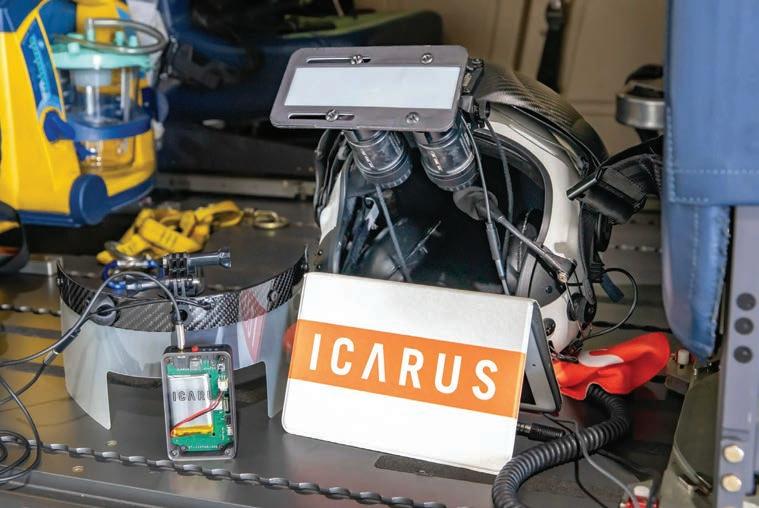

Velocity FBO Network has expanded to five locations with the acquisition of BTR Jet Center, one of three service providers at Louisiana’s Baton Rouge Metropolitan Airport (KBTR).
Located on the field’s east ramp, the facility—which opened in 2021—includes a two-story 6,600-sq-ft terminal and 90,000sq-ft hangar. It features a passenger lobby, pilot lounge with a trio of snooze rooms, flight-planning area, eight-seat conference room, kitchen with cold storage, and observation deck. The hangar can accommodate ultra-long-range business jets.
Velocity, which began as a brand last year, operates four other FBOs: at Detroit-area Willow Run Airport (KYIP); Kissimmee Gateway Airport (KISM) in Central Florida; St. Simons Island Airport (KSSI) in Georgia; and Lake Havasu City Airport (KHII) in Arizona.
Aircraft charter, management, and brokerage provider
SkyShare has been selected to take over the former municipally-operated FBO at Utah’s South Valley Regional Airport (KSVR). Located near Salt Lake City, KSVR is a general aviation reliever with a 5,862-foot runway. It features a 6,000-sq-ft, two-story terminal with showers, passenger lobby with refreshment bar, pilot lounge, and crew car.
SkyShare has begun a full remodel of the building. The project will add a new pilot lounge, 12-seat conference room, and a business center.
The Titan Aviation Fuels-branded complex also includes an adjoining 10,000-sq-ft hangar, as well as a 15,000-sq-ft hangar, both of which can accommodate up to super-midsize jets. The company plans to address the hangar shortage on the field by adding a second 15,000-sq-ft hangar, in addition to 50 T-hangars.
Texas-based service provider Galaxy FBO is taking over the operation of the former city-run FBO at Big Spring McMahon–Wrinkle Airport (KBPG). Located between Midland and Sweetwater in the western part of the state, KBPG offers an 8,800-foot runway.
Galaxy has rebranded the facility as its fourth FBO in Texas. The facility includes a 4,500-sq-ft terminal with a crew lounge, conference room, refreshment bar, flightplanning area, concierge, and crew car. An Avfuel-branded facility, it offers both full- and self-serve jet-A and avgas.
The Black Forest Ventures subsidiary is currently renovating the complex’s 43,000 sq ft of hangar space, which can accommodate up to a large-cabin business jet.
With the FIFA World Cup starting this month at 16 locations across North America, Universal Aviation has inaugurated its new FBO and general aviation terminal at Mexico’s Guadalajara International Airport (MMGL), one of the country’s tournament host cities. Universal has had a presence in the country for nearly 50 years, and the Guadalajara facility is the city’s first to be dedicated to business aviation.
It includes a 22,000-sq-ft double-height terminal with customs, immigration, and quarantine services, as well as lounges, conference rooms, covered drop-off, and secure parking with electric vehicle charging. An onsite Air Culinaire kitchen also provides high-end catering support for the region.
The 8-acre complex features a 51,700-sq-ft hangar capable of accommodating bizliners. Security is a foremost concern and includes perimeter fencing, controlled access gates, closedcircuit video cameras, visitor management, secure parking, and coordination with local police and airport security.
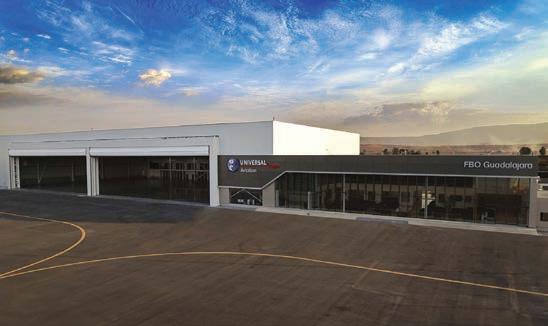
With cities across North America hosting the latest edition of FIFA’s quadrennial World Cup tournament, airports and FBOs are preparing for what they anticipate to be a surge in private aviation tra c. The 16 host sites include 11 in the U.S.: Atlanta, Boston, Dallas, Houston, Kansas City, Los Angeles, Miami, Philadelphia, New York/New Jersey, San Francisco, and Seattle; three in Mexico: Guadalajara, Mexico City, and Monterrey; and two in Canada: Toronto and Vancouver.
Those cities are taking steps to accommodate increased tra c. Earlier this year, officials at Mexico City’s Benito Juárez International Airport (MMMX) launched a massive renovation project, which had passengers threading their way through active demolition zones in a terminal crowded with orange-vested construction workers.
Among those that had long ago circled the June start of the tournament on the calendar is International Corporate and Cargo Services (ICCS)—Mexico’s largest FBO chain— which celebrated the grand opening of its second FBO (T2) at Toluca International Airport (MMTO) with a gala event in February.
Toluca is the designated business and general aviation gateway to the country’s capital, with all private aircraft directed there as opposed to MMMX, making it Mexico’s busiest business aviation gateway.
Since 2019, ICCS has had an FBO (T1) at Toluca, which is now home to more than 500 jets. In 2022, the company acquired a former Mexican government facility and entirely gutted the 1980s-vintage building, transforming it into a state-of-the-art base.
The three-story, 16,000-sq-ft terminal is sheathed in perforated steel paneling and has amenities such as three private passenger lounges and a pilot lounge; a

ICCS’ new FBO at Toluca Airport will be fully operational by the start of World Cup.
rooftop garden/observation lounge; and a dedicated chau eur lounge. It has separate entrances for domestic and international arrivals, with in-house customs facilities.
“Toluca is one of the busiest in North America, and the most important in Mexico,” ICCS CEO Nelson Dumas told AIN . “We knew all along that having a strong position [here] was mandatory and really strategic”
In addition to the two facilities at Toluca, which have 43 staff members between them, ICCS operates FBOs at Chihuahua, Acapulco, Saltillo, and Monterrey, the latter also a World Cup host city.
Along with those preparations at MMMX and MMTO, Universal Aviation debuted an FBO at Guadalajara International Airport (MMGL), the city’s first dedicated bizav facility. The April opening was keyed to ramping up operations for World Cup games.
ICCS COO Miguel Ballesteros said his company has received many inquiries about availability at the FBOs for the tournament, and he expects an increase of at least 50% over normal activity at host city facilities.
Industry data tracker WingX believes business aviation in North America is set for “one of the most significant demand events in its history.” Compared with surges in the three
previous World Cups, WingX noted a consistent pattern of business jet fuel uplift spikes, with host city airports averaging a factor of 1.5, increasing to 1.9x for the quarterfinal matches and 5.2x for the semifinals. “The numbers accelerate sharply as the tournament reaches its climax, peaking at an average surge factor of 12.9x for the final,” WingX analyst Nick Koscinski reported.
NBAA is advising operators to secure parking reservations early and to expect possible flow programs.
On game days, pilots should anticipate standard TFRs of a roughly 3-nm radius around the venues, extending from the surface to 3,000 feet. Such TFRs usually last from an hour before to about an hour after the game, and transiting aircraft must be in contact with ATC and squawking their assigned code. Anyone operating in the area of a host city should check notams. After matches, aircraft are likely to face delays as tra c filters out of the area.
As has become commonplace, many FBOs in host city areas will institute special event fees for the tournament, with the major
continues on page 56

Rolls-Royce authorized maintenance and overhaul center Essential Turbines has opened a facility in Mesa, Arizona. Previously, the company operated at a temporary location in the Phoenix area. It is also a member of the engine manufacturer’s First network.
With the new facility, Essential Turbines has tripled its capacity to service M250 and RR300 engines and will be able to provide faster turnaround times for customers in the U.S., particularly in the Southwest.
More than 16,000 M250 and RR300 engines are in service, and Essential Turbines serves EMS, government, utility, oil and gas, and commercial helicopter operators.
Embraer Executive Jets has added Execaire Aviation to its authorized service center (ASC) network to support customers in Canada. The maintenance provider is the third Embraer ASC in the country and will provide line maintenance at its facility at Toronto Pearson International Airport (CYYZ) for Phenom 100s and 300s, as well as the mid- and supermidsize Legacy 450/Praetor 500 and Legacy 500/Praetor 600.
Execaire offers a full range of services across Canada, including aircraft management, aircraft maintenance, aircraft charter, and sales, as well as FBO operations.
Piedmont Propulsion Systems—which specializes in maintenance, repair, and overhaul of airplane propellers and helicopter rotor blade components—is expanding
its Winston-Salem, North Carolina, maintenance facility by 13,500 sq ft to support increasing global demand. Located at Smith Reynolds Airport (KINT), the Piedmont facility—which services a broad range of Dowty, Hamilton Sundstrand, Hartzell, and McCauley propeller systems—currently includes 66,000 sq ft of space.
According to parent company First Aviation Services, the multimillion-dollar expansion, which is expected to be operational by October, will enable Piedmont to further optimize its facility layout and production flow, as well as improve turnaround times. The redesigned workspace will also enhance shop floor ergonomics, enabling a safer and more efficient working environment while supporting lean practices across the facility.
Pilatus is acquiring Germany-based Air Alliance, which provides sales and support for the Swiss aircraft manufacturer’s PC-12 and PC-24. The deal is subject to regulatory approval by Germany’s civil aviation authority and does not include Air Alliance’s ambulance flight subsidiary Unicair.
From its headquarters at Burbach in northwestern Germany, Air Alliance has operated a Pilatus factory-authorized sales and service center since 2014. It also provides flight training, as well as aircraft charter and management services with both the PC-12 turboprop single and PC-24 twinjet. All 120 employees will stay with the organization following the takeover by Pilatus, and Alliance managing director René Petersen will continue to lead the operation as CEO.

While California-based ACI Jet has had a maintenance presence at San Luis Obispo County Regional Airport (KSBP) since 2008, the grand opening of its new FBO/MRO facility in 2021 was muted by the pandemic. But in the half-decade since, the company has seen its repair business expand on average by 9% annually due to its increased space. Over the past year, the maintenance provider handled 174 di erent tails in its shop. An FAA Part 145 repair station, it also carries repair designations from Transport Canada, Isle of Man, and, as of last year, EASA.
The 35,000-sq-ft hangar can accommodate the latest ultra-long-range business jets, which, for ACI, means the Bombardier Global 8000. The company is a Bombardier factoryauthorized service center, a parts depot for the Canadian OEM, and handles the full line of Challengers and Globals.
ACI also specializes in Textron Aviation Cessna Citations, with the two airframers accounting for nearly all customer aircraft.
“For AOG, we will help anybody out if they have a problem,” said ACI CEO Bill Borgsmiller. “But for scheduled inspections, modifications, and large-scale work packages, we’re really focused on the Bombardier and Citation product lines. We’re focused on being a master of something instead of a jack-of-all-trades.”
At any given time, the company can have up to nine aircraft in the hangar simultaneously, depending on the size mix. Given California’s typically agreeable weather, additional work can be done on the ramp. For a major project, ACI is scheduling three months out, but smaller-duration tasks, such as connectivity installations, are used to backfill any gaps in the schedule.
To take advantage of the Golden State’s abundant sunshine, the complex was recently equipped with a 900-panel solar

array, which generates enough electricity to meet all its needs.
The MRO also has another 8,000 sq ft of administrative and guest o ces in the FBO terminal. “One thing we do probably better than most service facilities is the customer experience,” said Borgsmiller. “It’s like taking your car to a really nice dealership for service, but a couple levels up from that.”
At KSBP, ACI has 52 employees on the maintenance side, while its mobile repair teams are based out of its other FBO at John Wayne Orange County Airport (KSNA) in Santa Ana. There are another 14 technicians to handle AOG situations.
The company has seven work vans (soon expanding to nine) that travel as far north as Canada, and as far south as Mexico. “There’s not a location we won’t go,” said Isaac Garner, the company’s MRO quality control manager.
ACI’s shop runs an overlapping four-day, 10-hour work week. “Our goal is to grow where we’re running two shifts, seven days a week, ultimately,” Borgsmiller told AIN
To help fill its ranks, the company has partnered with a local community college to
establish an aircraft maintenance technician program, which has paid dividends, with six newly minted airframe and powerplant graduates joining ACI’s sta and a seventh on the way. Each new hire is assigned to a mentor for their first three months. “We want to encourage good habits, and we want to teach good habits,” said Garner. Despite a “minimal” turnover rate, like most in the aircraft maintenance arena, retention is a key concern for ACI. “I think treating people well is probably the best thing you can do,” explained Borgsmiller. “You have to pay a fair wage, but at the end of the day, that’s not what usually makes the difference.” The company runs internal surveys and holds quarterly open town hall meetings where no topic is off limits, so employees can express their concerns.
And among its worker benefits is an employee flying club, with each employee receiving a monthly budget for subsidized flying. “The goal is to get everyone up in the air, and not just to learn how to fly, but also to essentially become customers themselves,” said John Tucker, ACI’s director of marketing and communications. C.E.
Beech B200GT, March 22, 2026, Sharps, Louisiana
The solo pilot was killed when the twinengine turboprop crashed into a swamp following an uncontrolled descent from FL280. The final ADS-B position fix showed the airplane banked 66 degrees to the right in a 46.1-degree nose-down attitude; its final descent rate ranged from 32,000 to 45,000 fpm. Excavation of the accident site's 15-foot-deep impact crater failed to recover either engine or any “portion of the cockpit, cockpit flight controls, or instrument panel.”
The flight from Fort Lauderdale Executive Airport (KFXE) in Florida to Dallas Executive Airport (KRBD) in Texas, proceeded uneventfully for nearly two and a half hours. After crossing the Alexandria, Louisiana VORTAC, the pilot asked the Houston Center controller if he could “leave your frequency for about 60 seconds.” He never checked back in, and less than 20 seconds later, the airplane began descending.
The King Air’s cockpit voice recorder was recovered and successfully downloaded. It captured sounds of “clicks and rustling” followed by the autopilot disconnect alert. Track data showed that the airplane entered an increasingly steep descending right turn two seconds later. The remainder of the recording included the sounds of excessive bank, altitude, and overspeed alerts and the landing gear warning horn, but no speech.
BY DAVID JACK KENNY
Honda HA-420 HondaJet, Jan. 28, 2024, Orlando, Florida
A HondaJet pilot’s failure to control the twinjet after landing with known wind gusts exceeding the airplane’s crosswind limitation resulted in a runway excursion and substantial damage, according to the NTSB final report. Contributing to the accident, the NTSB found, were the flight crew’s continued approach despite knowing that consistent wind gust crosswind components exceeded the published limitation, and an incorrect crosswind gust calculation made in flight.
The two pilots and two passengers were not injured when the airplane veered off the left side of Runway 36L at Orlando International Airport (KMCO), and the left wing struck a distance-remaining sign. The pilot steered the aircraft back onto the runway and stopped on a taxiway. Inspection revealed substantial damage to the left wing’s forward spar in the area that contacted the sign.
Nearly an hour and a half before landing, the crew reviewed the destination ATIS, which reported wind from 270 degrees at 14 knots gusting to 24. At 39 miles from the airport, the pilot flying checked the ASOS, which showed wind from 270 degrees at 13 to 14 knots. CVR recordings captured the crew discussing the crosswind component, aircraft operating limitations, company procedures, and the option of diverting to a better-aligned runway at
Orlando Executive Airport (KORL). The pilot flying elected to continue to the planned destination. About 1.2 miles from the approach end of the runway, the tower advised wind from 290 degrees at 19 knots gusting to 24.
The NTSB noted that gust values at the destination consistently exceeded the airplane’s published crosswind limitation for the majority of the five-minute ASOS observations during the 1 hour 23 minutes before the accident, and that conditions should have prompted either an earlier diversion or a go-around on short final after the crew was informed of the gusts.
Rockwell International 690A, May 5, 2024, Palmyra, Virginia
The NTSB concluded that structural icing led the airplane to break up at FL200. The pilot and only passenger were killed; the resulting debris field stretched more than three and a half miles. Examination of the wreckage suggested that the tail likely separated first, followed by the right wing; the horizontal and vertical stabilizers were found about three-quarters of a mile north of the main wreckage and showed no evidence of the fire that consumed much of the cockpit and left wing.
The aircraft departed Manassas Regional Airport (KHEF), Virginia, to Georgetown County Airport (KGGE), South Carolina, at 08:28 local time, establishing cruise flight at FL200. The pilot’s preflight weather briefing included an Airmet for moderate icing between the
freezing level, estimated at 9,000 feet to 13,000 feet, and FL240 covering a portion of that route. Twenty-five minutes after departure, the airplane abruptly reversed course. The pilot responded to the controller’s query by saying, “We have lost … We need to climb,” and subsequently clarified, “We have lost autopilot.” Radar contact was lost shortly afterward, and a witness saw the airplane flying “on its left side and on fire in the middle of the airplane” before it struck trees directly across from his house.
The 63-year-old airline transport pilot’s most recent insurance application showed 3,801 hours of flight time, of which 2,860 hours were in turboprop aircraft.
The airplane was equipped with de-icing boots and a heated windscreen but was subject to an airworthiness directive prohibiting use of the autopilot during more severe icing, “as it could mask tactile cues indicative of adverse changes in the airplane’s handling characteristics.” Pilots were instructed to “immediately contact air traffic control and ask for a change in altitude to exit the icing conditions.”
Airbus AS350B, May 2, 2025, 5.5 nm east of Whitehorse/Erik Nielsen International Airport, Yukon Territory, Canada
An undetected reversal of wind direction led the helicopter to drop to zero airspeed without losing groundspeed during an attempted power recovery from a practice autorotation, causing it to enter vortex ring state (VRS) when power was increased. Because the training flight took place over a dry lakebed on the floor of a mountain valley with little to indicate wind direction, neither of the highly experienced pilots on board was aware of the shift when it occurred.
The accident occurred about 5.5 nm east-southeast of the Whitehorse/Erik Nielsen International Airport (CYXY)
during onboard training for the operator’s new chief pilot (“the candidate”) conducted by a Transport Canada-approved authorized check pilot (ACP) contracted for the flight. Following a series of maneuvers and emergency procedure reviews, the pilots conducted both straight-in and 180-degree autorotations to the south, into the prevailing winds. The fifth of the series was a straight-in autorotation entered from 1,500 feet above ground level at 100 knots. The rate of descent stabilized at 1,400 fpm after airspeed was reduced to 60 knots.
The candidate began the flare at about 100 feet with 65 knots airspeed, slowing the helicopter to 20 knots over the next 30 feet of descent. Airspeed then dropped to zero while groundspeed remained unchanged, and the rate of descent increased.
Recognizing the onset of vortex ring state, the ACP used forward cyclic in an attempt to recover, but the helicopter hit the ground, spreading the skids and striking the tail rotor, then bounced, spun, and rolled onto its left side. “At least one of the main rotor blades” penetrated the cabin and struck the candidate, causing fatal injuries. Responding to the emergency locator transmitter and a call on the ACP’s satellite phone, the first emergency responders reached the scene 25 minutes after the accident.
The candidate held an airline transport license for helicopters and a commercial airplane license, with about 9,800 hours of flight experience that included 1,900 hours in type. The ACP held a commercial license for both helicopters and airplanes and had logged some 13,000 hours in helicopters, including 7,000 hours in type. He was also reported to be experienced in mountain flying and familiar with the accident site. Following the accident, the operator changed policy to require all emergency training to “be conducted at an airport with suitable facilities to report or indicate wind direction and speed.”
Cessna 650, June 13, 2025, Westplains, Colorado
Three months after the event, an anonymous informant notified the FAA that damage to the twin-engine jet from an unreported accident was being repaired in the owner’s hangar at Airlake Airport (KLVN) in Lakeville, Minnesota. At the request of the NTSB, reports were eventually made on Form 6120.1 by both pilots and the airplane’s operator.
The flight from Harry Reid International Airport (KLAS) in Las Vegas, Nevada, to KLVN was under the command of a 58-yearold airline transport pilot and flight instructor. A 26-year-old commercial pilot and flight instructor in the right seat was given instruction en route. The pilot reported that near the Nebraska-Colorado border, he attempted to overfly an area of convective activity at FL410 and Mach 0.75 but encountered “heavy turbulence and hail,” causing damage, including a cracked outer windscreen on the pilot’s side. He responded by descending to FL350 and slowing to Mach 0.68, and continued to KLVN rather than making a precautionary landing.
Photographs of the airplane taken by the FAA show extensive damage to the radome, the leading edges of both wings, and the empennage, in addition to the shattered outer windscreen. The pilot in command reported 13,400 hours of flight experience and held nine different type ratings. The right-seat pilot reported 1,172 hours of experience and held single-, multiengine, and instrument ratings but was not typerated in the CE650. The NTSB noted that the airplane was not approved for singlepilot operation. z alerts
BY GORDON GILBERT
The European Union has pushed the compliance date from Jan. 1, 2025, to July 1, 2026, for certain large airplanes used in commercial air transportation to be equipped with a runway overrun awareness and alerting system (ROAAS). The requirement applies to aircraft with mtows of more than 12,500 pounds for which the first individual certificate of airworthiness is issued on or after July 1, 2026. “Several large airplane type certificate holders are facing industrial issues resulting in significant delays preventing them from being able to deliver newly produced airplanes equipped with a certified ROAAS before Jan. 1, 2025,” said the EU. “Hence, the date of application of EU regulations 26.205 should be postponed to reflect the current industrial capabilities and to permit business continuity for large airplane operators.”
June 9, 2026
Between June 9 and July 19, 2026, flight limitations and slot restrictions for private aircraft will be in effect at many airports during the FIFA World Cup Games taking place at 16 host cities in Canada, Mexico, and the U.S. The period is expected to be one of the busiest for business aviation that North America has seen. International flight information provider OpsGroup has published a comprehensive guide for the game schedule, operational limitations anticipated at 15 of the airports nearest the game venues, suggestions to ease restrictions, and an interactive map to help in flight planning.
June 30, 2026
On September 29, the FAA started its scheduled eight-month transition timeframe to align the U.S. notam format with ICAO international standards. According to the FAA, the new format will result in improved accuracy and accessibility of notam information for pilots, dispatchers, and other notam consumers, provide notam consumers with one consistent format for domestic and international operations, and allow for enhanced search, sorting, filtering, and archiving capabilities of notam information. “This initial
deployment establishes the framework for the new service, enabling testing and validation with early user adopters,” said the agency. Completion of the transition is expected in the second quarter of 2026.
June 30, 2026
Transport Canada (TC) has published a Civil Aviation Safety Alert announcing that major telecommunications service providers in Canada have voluntarily agreed to postpone the sunset of existing 5G mitigation measures until June 30, 2026. After that date, TC said, “Aircraft may be subject to stricter aviation limitations and/or radio altimeter retrofit expectations.” On Jan. 1, 2028, the remaining voluntary spectrum mitigations are scheduled to end, “which may further alter aviation limitations and or retrofit expectations.” Meanwhile, ADs issued in 2024 describe current radio altimeter tolerance requirements and continue to be effective while 5G mitigations are being maintained.
30, 2026
The FAA received 46 comments on its proposed regulations that would require radio altimeters to withstand interference from wireless signals in neighboring spectrum bands. An industry/government committee
is scheduled to develop the required methodology and publish recommended standards by June 30, 2026. Those standards will be available for public comment.
Oct. 1, 2026
The implementation timelines for the European Union’s ETIAS (European Travel Information and Authorization System) and EES (Entry/Exit System) have been delayed again. Originally set to launch in 2022, EES will require operators to electronically verify visa validity for third-country nationals traveling to the EU. This system replaces manual passport stamping and aims to improve tracking of visitor entry, exit, and overstay status. The new scheduled start date is Oct. 1, 2026. ETIAS is an online pre-travel and pre-boarding requirement applying to visa-exempt third-country nationals planning to travel to European states. The new scheduled start date is not exact but won’t occur before late 2026. Business aviation flight planning organizations believe both programs will apply to passenger-carrying private and charter flights into the EU.
Oct. 1, 2026
The FAA has published FAA Order 8100.15C expanding its organization
designation authorization (ODA) program and revising procedures for administering and rewarding ODA approval to individual and company designees. This order, which canceled 16 previous orders, addresses how FAA personnel evaluate, appoint, and oversee the ODA program. It also provides guidance to current and prospective Parts 91, 135, 121, and 141 ODA holders on applications, procedures manual contents, and roles and responsibilities. The National Air Transportation Association noted that changes to Part 135 operators are limited to four specific tasks: conducting pilot airmen certification tasks; conducting air carrier check pilot evaluations; conducting advanced qualification program initial qualification checks; and conducting airman certificate qualification reviews. The order contains some revisions suggested by comments to a notice of proposed rulemaking issued late last year. This new order, effective on Oct. 1, 2025, requires that current ODA holders submit revised procedures manuals for FAA approval by Oct. 1, 2026.
By Dec. 2, 2026, all Australia-registered Part 119 (air transport operators) and some Part 138 (aerial work operators) must have in place: a safety management system; a safety manager accepted by the Civil Aviation Safety Authority (CASA); a human factors and nontechnical skills training program for Part 119 operators; and a flight data analysis program for certain operators. These requirements began on Dec. 2, 2021, for new operators. Existing operators had the option to defer implementation under transitional exemptions, which end in December 2026. The CASA is o ff ering sample SMS manuals to help operators comply with the new requirements.
For the most current compliance status, see: ainonline.com/compliance
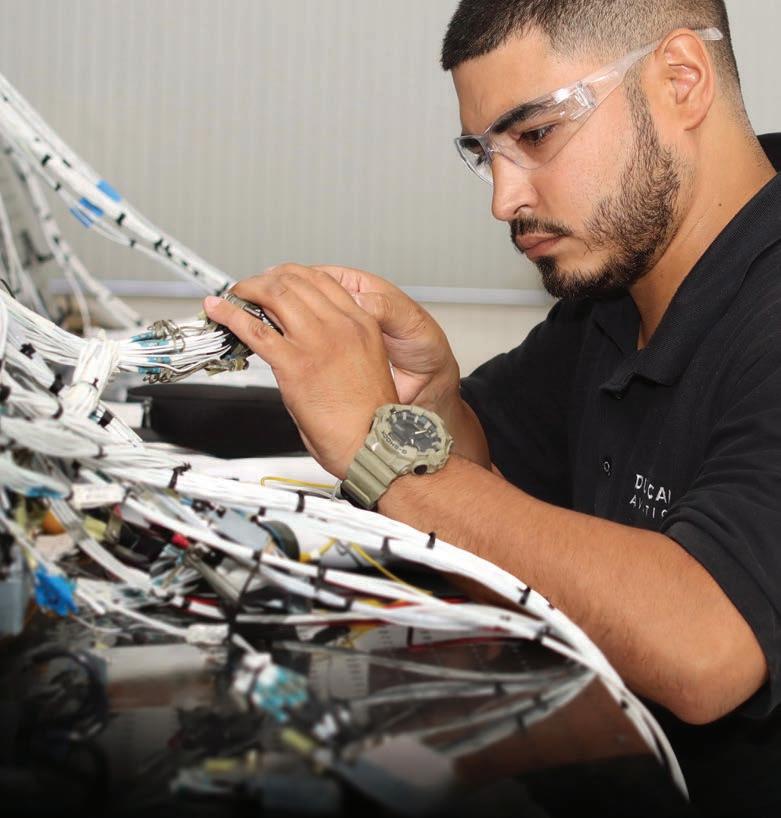
BY JESSICA REED

SATHEESHKUMAR “KUMAR” KUMARASINGAM
Pratt & Whitney Canada named Satheeshkumar “Kumar” Kumarasingam as its next president, succeeding Maria Della Posta upon her retirement effective June 1. Kumarasingam joined the company in 1995 as a mechanical engineer and has since held roles in engineering, quality, operations, sales and marketing, and customer service. He was appointed chief transformation and strategy officer in 2022, and most recently served as chief digital officer beginning in 2025. Della Posta, who led the RTX subsidiary through a period of significant product development, oversaw the launch of several engines.
Gregg Fahrenbruch took over as CEO of Yingling Aviation in April as part of a planned leadership transition. Fahrenbruch’s previous experience includes a term as Wheels Up’s executive v-p of operations, CEO of Mountain Aviation, and, most recently, operations manager at the National Center for Atmospheric Research.
Michele Riccobono, chief technology officer of Leonardo’s company Kopter for nine years, is moving up to the position of CEO. Former chief executive Marco Viola is shifting to another position within the Leonardo Group. As CTO, Riccobono directed the AW09’s development and certification. During his term as CEO, Viola oversaw Kopter’s integration into Leonardo’s helicopters division.
NTSB member Michael Graham was appointed to serve as vice chair, filling the slot vacated last year after the White House ousted Alvin Brown from the safety agency. Graham joined the Safety Board as the 45th member in January 2020 and has been nominated for a second term as a member that would extend through Dec. 31, 2030.
Rep. Sam Graves (R-Missouri), who has served in the U.S. Congress since 2001 and took over as chairman of the House Transportation and Infrastructure Committee in 2023, decided against seeking reelection this year. A private pilot who has amassed well over 5,000 hours of flight time,
Graves steered through the FAA Reauthorization Act of 2024, including the first-ever title solely dedicated to general aviation. More recently, he has been helping drive a broad safety bill, the so-called Alert Act.

Giovanni Spitale , previously CEO of Davis Standard, was named president of StandardAero ’s business aviation segment. Former president Anthony Brancato III has retired after almost 10 years at StandardAero. Spitale’s three-plus decades of leadership and operations experience include roles at Milacron Holdings, GE Aviation, Moog, and Honeywell International.
APP Jet Center named Eric Hietala chief operating officer. Most recently, Hietala consulted in business and general aviation, and he was previously senior v-p of airport property development and senior v-p of the western region at Signature Aviation.
Simone Pérez joined the Aerospace Industries Association (AIA) as v-p of civil aviation. In addition to holding the position of senior director of civil aviation at AIA from 2022 to 2023, Pérez was previously assistant administrator for policy and strategic engagement at the FAA.

Gulfstream Aerospace made several recent appointments and promotions in its strategic sales team. Thomas Verbeeck, who joined Gulfstream in 2021, was named regional v-p of sales for Alabama, North Florida, and Tennessee. Matt Baer, regional v-p of sales for the Northeast U.S. and Eastern Canada, was promoted to regional v-p of sales for Northern California, Arizona, and Oregon. Justin Gaeta, meanwhile, is taking over as regional v-p of sales for the Northeast U.S. and Eastern Canada after five years in sales management with the company. In Latin America, Pedro Ruiz was selected as v-p of the region. Ruiz started his tenure at Gulfstream in 2007 and was most recently regional v-p of new aircraft sales for South


America. The company promoted Luiz Alves, regional sales manager for Latin America, to regional v-p of sales for South America. Gulfstream Aerospace also recently hired Matt Davies as director of service center operations at its facility in Farnborough, England. Davies previously worked at AAR company Airinmar as well as Honeywell Aerospace and GE Aircraft Engine Services. Car rental company Go Rentals made two leadership appointments. Hiral Nelson , now director of FBO relations, worked to elevate the guest experience in previous roles. Named relationship manager for Go Rentals, Kelsi Yordi brings significant knowledge and experience in aviation operations.
Michael Lawrence was promoted to director of FBO operations at Fargo Jet Center, overseeing line service operations at Premier Jet Center (KFCM) and Fargo Jet Center (KFAR). He joined the company in 2017 as operations manager and had served as general manager of subsidiary Premier Jet Center since 2021.
Chapman Freeborn promoted Adnan Rahal to senior v-p of business aviation, supporting the company’s global strategy. He previously worked as v-p of business aviation for the Americas.

Janine K. Iannarelli was re-elected to the Associate Member Advisory Council of the European Business Aviation Association (EBAA) . An EBAA member for more than 30 years, Iannarelli founded Par Avion in 1997 and continues as its president.
Joan Sullivan Garrett was tapped as the newest member of Corporate Angel Network ’s board of directors. Founder and chairman of MedAire, Garrett has made significant contributions to the advancement of health and safety protocols in the aviation industry.
Atlantic Jet Partners named Steve Takacs v-p of maintenance and general manager of Sky Aircraft Maintenance. With more than four decades of experience in aviation maintenance, Takacs has held leadership roles at Wheels Up, United Express, Mountain Aviation, and Travel Management Company. z
John J. Sheehan III, a decorated U.S. Navy aviator, GA advocate, and author, passed away in March at his home in Wilmington, North Carolina. He was 85. Sheehan’s four-decade career spanned military service, leadership, consulting, and publishing.
After retiring from the U.S. Navy in 1980, he served as executive v-p at AOPA and later as secretary general of the International Council of AOPA. Next, he worked as an aviation consultant with Phaneuf Associates in Washington, D.C., before founding Professional Aviation Inc., a firm that advised corporate flight departments on safety, training, and management practices.
Sheehan contributed to NBAA and IBAC as a consultant, auditor, and presenter. His book, “Business and Corporate Aviation Management,” is a standard reference for professional flight departments and is included in NBAA’s Certified Aviation Manager curriculum.
NBAA president and CEO Ed Bolen said: “John was a true advocate for the general aviation community, promoting its value and protecting its access for nearly 40 years. He quite literally wrote the book on business aviation.” Sheehan is survived by his wife of 55 years and three daughters.
The British Business General Aviation Association presented board member Charles Henry with the Michael Wheatley Award for Outstanding Services to Aviation. Henry was chair of the General Aviation Awareness Council for more than 25 years and had also served as director of AOPA UK for 25 years.
Angel Flight West honored Cutter Aviation, Huntsman Cancer Institute, and two volunteer pilots at its 12th annual Endeavor Awards on May 1 at the California Science Center in Los Angeles. Cutter Aviation president and CEO Will Cutter and Huntsman Cancer Institute at the University of Utah received Inspiration Awards. Endeavor Awards were presented to volunteer pilots Chris Bennett of Angel Flight West and Jerry Hill of Challenge Air for Kids and Friends. Industry veteran Keith Clark received the Flight Safety Foundation’s (FSF) 2026 Business Aviation Meritorious Service Award at the 71st Business Aviation Safety Summit (BASS) in May. A senior quality control and technical representative at Phillips 66 Aviation, Clark was recognized for his e orts in misfueling prevention and operational safety.
chains publishing their extra fee schedules on their websites. Joining them will be Global Select at Houston-area Sugar Land Regional Airport (KSGR), which will be instituting special event fees for the first time.
MJ Barroso, the FBO’s customer experience manager, recalls the level of preparation that went into the one-day event in 2017 when Houston hosted the Super Bowl. “Today we are looking to plan a 20-day event, with seven games in between,” she told AIN. “So for us, it would be seven Super Bowls in the span of 20 days.”
As a city-owned entity, the airport began planning for the tournament a year ago, in step with the city’s budget cycle. Among the concerns for an airport that had never assessed a special event fee was how much to charge. “That’s the logistical side of things that I think as an airport, we really have to consider,” Barroso explained. “That’s going to include manpower, hours, equipment, maybe we do need to rent more stu in order for us to be successful.”
The airport bought more equipment, including a 5,000-gallon jet-A refueler, a new Lektro tug, a lavatory cart, another GPU, an additional ice maker, and an electric food warmer. A walk-in catering refrigerator was rented, and a contingency was included in the budget to rent up to three additional refuelers if necessary.
All these factors turned the special event fee structure into a balancing act. “You don’t want to overprice, where you don’t get anybody to come into your airport, and you most certainly don’t want to not charge anything, because you end up needing money on the table,” said Barroso.
Barroso noted there was no early rush for reservation slots. “We have to keep in mind that those that we serve here, our customers, are people that can literally call a charter company and say, 'Hey, I want to go to the game today,' and the company will make it happen,” she said. While Global Select struggled with how much to charge for its special event fees, another service provider took an opposite course. Clay Lacy Aviation, with FBOs in California and Connecticut, announced it was not going to enact special event surcharges during the tournament. The company stated that it does not anticipate too many logistical strains at those locations. C.E.

JAMES HOLAHAN (1921-2015), FOUNDING EDITOR, WILSON S. LEACH, FOUNDER & CHAIR EMERITUS
EDITOR-IN-CHIEF – Matt Thurber
MANAGING EDITOR – Charles Alcock
DIGITAL EDITOR – Chad Trautvetter
EDITOR AIN MONTHLY MAGAZINE – Kerry Lynch
BUSINESS AVIATION SERVICES EDITOR – Curt Epstein
SENIOR EDITOR – Hanneke Weitering – Technology Editor
COPY EDITOR – Jessica Reed
NEWS REPORTERS – Charlotte Bailey – Europe, Amy Wilder
CONTRIBUTORS – Julie Boatman, David Donald – U.K., Jennifer Leach English, Gordon Gilbert, David Hughes, David Jack Kenny – Safety, Stuart “Kipp” Lau, Robert P. Mark, Jennifer Meszaros – Southeast Asia, Richard Pedicini, Dale Smith, James Wynbrandt
PRODUCTION MANAGER – Martha Jercinovich
GRAPHIC DESIGNER – Grzegorz Rzekos
DIRECTOR OF VIDEO – Ian Whelan
SENIOR DEVELOPER – Cameron MacPherson
FRONT END DEVELOPER – David Lohmeyer
EXECUTIVE CHAIR – Dave Leach
PRESIDENT – Ruben Kempeneer
HEAD OF PEOPLE & BRAND – Jennifer Leach English
SENIOR DIRECTOR, INDUSTRY AFFAIRS AND EVENTS – Nancy O’Brien
ADVERTISING SALES
Victoria Tod – Northeastern U.S./Eastern Canada/United Kingdom, +1 (203) 733-4184
Michelle James – Western U.S./Western Canada, +1 (520) 343-0236
Joe Rosone – Midwestern U.S., Southeastern U.S./Caribbean/Brazil, +1 (301) 693-4687
Diana Scogna – Europe/Middle East, +33 6 62 52 25 47
DIRECTOR OF MARKETING AND CLIENT SERVICES – Lisa Valladares
AUDIENCE DEVELOPMENT DIRECTOR – Eileen Silberfeld
EVENTS SPECIALIST – Brien O’Brien
MARKETING SPECIALIST – Alyssa Barry
SOCIAL MEDIA MARKETING – Zach O’Brien
SALES ADMINISTRATOR – Cindy Nesline
FINANCE AND HR DIRECTOR – Tracy Britton
ACCOUNTS PAYABLE MANAGER – Mary Avella
ACCOUNTS RECEIVABLE MANAGER – Bobbie Bing
U.S. HEADQUARTERS
214 Franklin Ave., Midland Park, NJ 07432, +1 (201) 444-5075
Advertising Inquiries: +1 (201) 345-0085, adsales@ainonline.com
Circulation Inquiries: +1 (201) 345-0085, subscriptions@ainonline.com
WASHINGTON, D.C. EDITORIAL OFFICE:
Kerry Lynch: klynch@ainonline.com, Tel: +1 (703) 969-9195
EUROPEAN EDITORIAL OFFICE: Charles Alcock: calcock@ainonline.com, Tel: +44 7799 907595
Aviation International News (ISSN 0887-9877) is published twelve times per year (monthly). Periodicals postage paid at Midland Park, N.J., and additional mailing o ces. Postmaster: Send address changes to AIN Media Group, 214 Franklin Ave., Midland Park, NJ 07432. Allow at least eight weeks for processing. Include old address as well as new, and an address label from a recent issue if possible. Subscription inquiries: +1 (201) 345-0085 or email: subscriptions@ainonline.com.
Aviation International News is a publication of AIN Media Group, 214 Franklin Ave., Midland Park, NJ 07432; Tel.: +1 (201) 444-5075. Copyright © 2026 All rights reserved. Reproduction in whole or in part without permission of AIN Media Group is strictly prohibited. AIN Media Group publishes Aviation International News, AINalerts, AINonline, Business Jet Traveler, BJTwaypoints, ABACE Convention News, Dubai Airshow News, EBACE Convention News, Farnborough Airshow News, FutureFlight.aero, VAI Convention News, LABACE Convention News, MEBAA Convention News, NBAA Convention News, Paris Airshow News, Singapore Airshow News, Mobile Apps: Aviation International News; AINonline. PUBLICATION MAIL AGREEMENT NO. 40649046 RETURN UNDELIVERABLE CANADIAN ADDRESSES TO: PITNEY BOWES INTERNATIONAL MAIL, STATION A, P.O. BOX 54, WINDSOR, ON, N9A 6J5, returns il@imex.pb.com.
For feedback, letters to the editor, or other editorial needs, please contact AIN’s Editors at ainedit@ainonline.com
Since 1981, Corporate Angel Network (CAN) has been dedicated to one mission: helping cancer patients access the lifesaving treatment they need. anks to the unwavering support of our partners and donors, we recently completed our 70,000 cancer patient flight.
But the need continues. Join us in making a difference.
Because cancer is hard, but getting to treatment shouldn’t be.




With three market-leading businesses, world-class operations and investments in research and development, we ofer capabilities no one else can. Together, our global team pushes the boundaries of known science—and fnds new ways to connect and protect our world.
Learn more at rtx.com
September 15-16 | Frankfurt, Germany

and clients. The one-on-one time and small group sessions are very valuable settings.”
– CALS SPONSOR
With three market-leading businesses, world-class operations and investments in research and development, we ofer capabilities no one else can. Together, our global team pushes the boundaries of known science—and fnds new ways to connect and protect our world.
Learn more at rtx.com