

FUEL: ALTERNATIVES TAKING THE STAGE
SAFETY: ARE YOU READY FOR THE WORST?
SUPPLY CHAIN: ROUNDTABLE EXPERTS EXPLAIN
TRAINING: A BETTER DEVICE FOR IFR INSTRUCTION

FUEL: ALTERNATIVES TAKING THE STAGE
SAFETY: ARE YOU READY FOR THE WORST?
SUPPLY CHAIN: ROUNDTABLE EXPERTS EXPLAIN
TRAINING: A BETTER DEVICE FOR IFR INSTRUCTION
The sky is the limit for combining technology and aesthetics in today's modern aircraft

































10
SyberJet Aircraft to unveil SJ36 mockup on October 19

36 AIN Roundtable: The supply chain and overheated demand
4 GAMA: General aviation market up and down in Q1
6 Textron eyes CJ4 Gen3 FAA cert as 500th CJ4 rolls out
8 Otto Aerospace freezes Phantom 3500 jet design
12 Completions Special Report: Highlighting the best and the latest
30 Fuel crisis raises alternative opportunities
32 Safety Report: Preparing for the worst: are you ready? DEPARTMENTS

34 Safety Report: Helping families through emergencies

AN INDUSTRY FIRST
FlightSafety International’s new Advanced Circling and Visual Approaches course gives you the most comprehensive industry training available to master challenging approaches.
“It’s not a matter of if, it’s a matter of when a pilot will need these skills. Advanced training is critical to ensure we’re prepared to safely execute these di cult approaches.”
- Chief Pilot, Fortune 100 company

Scan to learn how to protect your operation.

BY CURT EPSTEIN
Business jet deliveries rose by nearly 15% year over year (YOY) in the first quarter, to 162 units, while airplane billings increased by 19% to $6.1 billion, according to the General Aviation Manufacturers Association’s first-quarter 2026 delivery report.
Nearly all major business jet manufacturers saw improvement from the first quarter of 2025. Embraer saw the largest growth in the segment during the first three months of 2026. The Brazil-based OEM handed over six more midsize Praetor 500s in the quarter than it did a year ago, which contributed to a 26% increase in deliveries.
Textron Aviation also improved by six aircraft from the first quarter of 2025, led by deliveries of five more Citation Longitudes this year, equating to a nearly 20% increase.
Gulfstream increased its first-quarter 2025 total by two aircraft in the same span this year with 38 deliveries, while Bombardier added one to its first-quarter 2025 total of 23 handed over in the same quarter this year. Dassault only reports Falcon deliveries at mid-year and year-end.
Among the light jet OEMs, Pilatus nearly doubled PC-24 output YOY, with nine deliveries in first-quarter 2026. Cirrus added two Vision Jets to its tally this year, shipping 21 of the single-engine jets. Honda Aircraft was one off the mark from a year ago with three HondaJet deliveries in the first three months of the year.
In the bizliner segment, Airbus delivered one ACJ320 in the first quarter this year, after delivering none a year ago. Boeing delivered no BBJs in the first quarter of either year.
While the overall turboprop segment saw a more than 3% dip from a year ago, deliveries of higher-end business aviation models increased by more than 10%.
Pilatus delivered 15 single-engine PC-12s in the first quarter, up 36% from a year ago.
With nine deliveries of the TBM 980 and two additional Kodiaks, Daher improved on the first-quarter 2025 delivery total by one airplane. Epic Aircraft handed over one more E1000 than it did a year ago, for a total of seven in the quarter.
Gulfstream Aerospace notched two key milestones for its ultra-long-range G700: the 100th customer delivery and 100th city-pair speed record. The delivery, to an unnamed customer, comes a little more than two years after the 7,750-nm business jet first entered service. The 100th speed record was logged on a trip from Savannah, Georgia, to San Jose, California, completed in 4 hours 36 minutes with an average cruise speed of Mach 0.91. Subsequently, it set another record between San Jose and Teterboro, New Jersey, in 4 hours 14 minutes, also at Mach 0.91.
Textron Aviation’s Cessna Citation M2 Gen3 prototype made its first flight on June 2, advancing the light jet program toward FAA certification and service entry in 2027. During the 2.7-hour flight, pilots Andrew Thorson and Tanner Towns evaluated aircraft handling and key systems, reaching a maximum altitude of 41,000 feet and speed of 263 knots. The test airplane will now enter an expanded phase of flight testing. The M2 Gen3 features Garmin G3000 avionics, autothrottle, and Autoland.
Bombardier announced a major expansion of its Singapore service center at Seletar Aerospace Park (WSSL), with the planned addition of a 250,000-sq-ft (23,000-sq-m) facility. Complementing the airframer’s existing service center, the new facility represents a total planned investment of approximately $78 million. Construction will begin this year, with completion anticipated in 2028. The added facility is expected to o er a broad range of services, including scheduled and unscheduled maintenance, modifications, avionics installations, and 24/7 AOG support, as well as exterior paint and interior finishing capabilities.
BY AMY WILDER
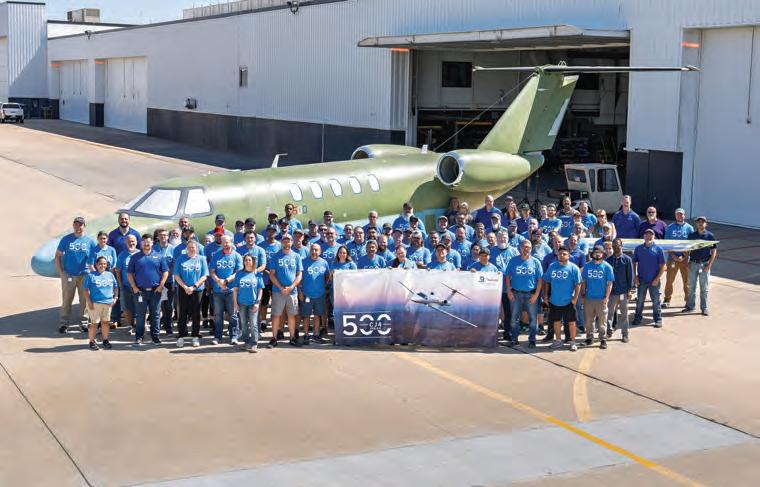
Textron Aviation expects the Cessna Citation CJ4 Gen3 to receive FAA certification this year, the company said as it marked the rollout of the 500th CJ4 at its Wichita facility on June 1. The milestone aircraft is a CJ4 Gen2. In production since 2010, the CJ4 series has been delivered worldwide to owner-pilots and fleet operators alike.
The Gen3 variant includes Garmin G3000 Prime avionics and Garmin Emergency Autoland, along with what Textron describes as the most standard features in the light jet class. The upgrades reflect customer feedback gathered across the nearly 500 aircraft delivered before the Gen3’s development.
“For more than a decade, customers around the world have chosen the CJ4 for its combination of performance, ease of operation, and confidence in the cockpit,” said Lannie O’Bannion, senior v-p of sales and marketing at Textron Aviation.

“Reaching 500 aircraft built demonstrates the strength of this platform and reinforces our continued investment in the light-jet market as we prepare to bring the CJ4 Gen3 to customers.”
The CJ4 series is a single-pilot-capable light jet. Designed to build on that foundation, the Gen3 incorporates advanced technologies to enhance the pilot experience. z
Beta Technologies, in cooperation with FBO group Signature Aviation and regional operator Republic Airways Holdings, recently completed three days of flight demonstrations with its Alia CX300 electric airplane at Kissimmee Gateway Airport in Florida. This follows a winter demonstration campaign in Burlington, Vermont, and Plattsburgh, New York, earlier this year. Notably, the hot- and cold-weather demonstrations proved the readiness of electric commercial aviation to support cargo, logistics, passenger, and medical missions.
Pilatus Aircraft launched a 32-month study with Swiss institutions to investigate whether carbon fiber production waste can be recycled back into the aircraft construction process. The Swiss manufacturer produces more than six tonnes of carbon fiber waste annually. Recycling it could reduce waste and potentially replace certain aluminum parts with carbon components, saving up to 36 tonnes of aluminum per year, according to Pilatus.
Tamarack Aerospace has introduced AirConnect, an in-flight connectivity system designed for the Cessna CitationJet and most of the CJ family. FAA supplemental type certificate approval is pending for the CitationJet, Citation M2, CJ1/1+, CJ2/2+, and CJ3/3+. AirConnect uses a low-earth-orbit satellite network and features a fuselagemounted, low-drag antenna. The installed system includes aircraft-grade cabin Wi-Fi distribution, certified electrical integration, and a complete FAA STC documentation package. Once certified, installation is expected to take approximately three days at a Tamarack-authorized service facility.

BY MATT THURBER
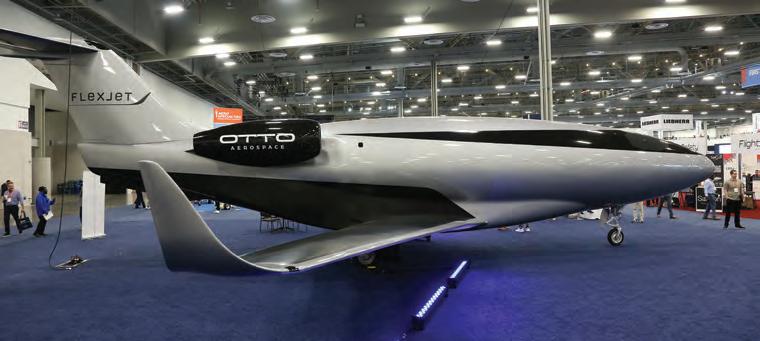
After completing the preliminary design review (PDR) and freezing the design of the Phantom 3500 light business jet, Otto Aerospace is moving ahead with construction of the first of four planned flight test vehicles, FTV1, and sourcing key components from suppliers. These activities are taking place at Otto’s facility at Meacham International Airport (KFTW) in Fort Worth, Texas, but the company plans to move to a new campus at Cecil Airport (KVQQ) in Jacksonville, Florida, by the end of the year.
While the all-composite, 19,000-pound Phantom 3500 is categorized as a light jet due to its size, it promises the range and cabin comfort of a super-midsize jet.
“Our performance looks great,” Otto president and CEO Scott Drennan said after the PDR. “We are going to match the coast-tocoast performance of all the super-mids.”
With NBAA IFR range (four passengers, 100-nm alternate) of 3,200 nm, the Phantom 3500 is powered by Williams FJ44 engines. What sets it apart from competitors is a flat-floor cabin that is 6.4 feet tall and 7.5 feet wide with a volume of 800 cu ft, giving it almost the same cabin volume as a super-midsize jet at half the weight.
To achieve this performance, the Phantom 3500 must fly high, often at its 51,000foot maximum altitude, which could present certification challenges for a single-pilot Part 23 design. The jet’s laminar-flow design is critical to achieving that performance. Another design feature is a windowless cabin; passengers view the outside world via screens connected to external cameras.
Otto has begun composite layups for FTV1 and has ordered long lead-time items such as the landing gear forgings from supplier Mecaer. Other suppliers include Leonardo for the fuselage and Sonaca for the wing and empennage. Garmin will supply federated avionics for FTV1 and G3000 Prime avionics with Autoland for the production airplanes.
FTV1’s first flight is planned by the end of 2027. “We’re trying to stay within a certain schedule to get onto the market in 2030 or 2031,” Drennan said.
Some individual buyers have already committed to buying Phantom 3500s, and fractional-share operator Flexjet has made a firm commitment for 300, a deal worth as much as $6 billion at the estimated $19.5 million price. Drennan anticipates officially opening the order book next year. z
Iridium Communications has agreed to acquire Aireon, the operator of the only space-based ADS-B aircraft surveillance system in commercial service. Iridium, which co-founded Aireon in 2012 and already held a minority equity stake, is purchasing the remaining 61% of the company from its five air navigation service provider shareholders—Nav Canada, UK NATS, AirNav Ireland, Italy’s ENAV, and Denmark’s Naviair—for approximately $366.7 million.
While emphasizing the strains on the existing air tra c control workforce, the FAA’s 2026 Air Tra c Controller Workforce Plan cuts the certified professional controller (CPC) sta ng target by 2,000 positions. The FAA will continue to ramp up on controller hiring, but the latest plan suggests a necessary full CPC target of 12,563, down from the 14,633 in the 2025 plan. To achieve that goal, the FAA is continuing its aggressive plans to hire 2,200 potential controllers in fiscal year 2026; 2,300 in 2027; and 2,400 in 2028.
An NTSB safety research report reveals that 28.6% of pilots killed in aircraft crashes between 2018 and 2022 tested positive for potentially impairing drugs, and 52.8% tested positive for at least one drug of any type, continuing an upward trend. Drug presence identified through toxicology testing does not necessarily indicate pilot impairment, the report emphasizes. The most commonly detected included cardiovascular medications, sedating antihistamines, non-sedating over-the-counter drugs, cholesterol-lowering medications, prostate or erectile dysfunction drugs, and illicit drugs.






BY MATT THURBER
On the eve of NBAA-BACE on October 19, SyberJet Aircraft plans to unveil a full-scale mockup of the SJ36, the latest iteration of the Ed Swearingen-designed light business jet that was originally FAA-certified as the SJ30-2 in 2005. The SyberJet World 2026 event, held at Henderson Executive Airport, will include a presentation on “the full design vision, program roadmap, and an exclusive early-owner incentive program,” according to the company.
SyberJet Aircraft, led by CEO Trevor Milton, purchased the program in 2023 and is redesigning the jet with fly-by-wire flight controls, an in-house-developed SyberVision avionics suite, emission-free APU, and a more spacious cabin.
The $14 million SJ36 will accommodate nine people, up from the SJ30-2’s seven
occupants, with a four-foot stretch of the cabin. The cabin’s width and height are similar to the SJ30’s, although the cabin redesign will maximize the space using modern materials.
The SJ36’s Mmo is projected to be Mach 0.88, with a long-range cruise of Mach 0.74. Maximum altitude is the same as the SJ30-2’s—at FL490—as is the 12-psi cabin pressure differential, providing a sea-level cabin at FL410.
Williams International FJ44-4A engines, each producing 3,621 pounds of thrust, will power the SJ36, an upgrade from the SJ302’s 2,300-pound-thrust FJ44-2A turbofans. Mtow is projected to be 18,500 pounds, and the SJ36 will have a range of 3,000 nm.
FAA certification of the SJ36 is expected in 2032, according to the company. z
The FAA has completed the first phase of its long-planned upgrade of the notam system. Implementation followed the initial deployment of the new cloud-based Notam Management Service (NMS) on September 29. The FAA said the new cloud-based service will prevent airspace shutdowns caused by outages of the previous aging system, while improving safety and communications. NMS o ers a streamlined, modern interface that can accommodate future enhancements, such as changes to notam formatting.
The African Business Aviation Association (AfBAA) says it has more than doubled its membership, to 55 members, in the year since the organization elected new leadership. AfBAA named Dawit Lemma—founder and CEO of Ethiopia-based Krimson Aviation—as its chair and 30-year industry veteran Craig Middleton as vice chair. Since then, the association has formed an uncrewed aircraft systems committee and an operators committee, and it has strengthened its safety and training committee. AfBAA also held a meeting with the African Civil Aviation Commission focused on creating and sharing aviation data.
Bombardier is rolling out a FastTrack program to develop a pipeline of qualified airframe and powerplant technicians for its U.S. facilities. Developed with Wichita State University’s Campus of Applied Sciences and Technology, the initiative debuted at Bombardier’s Hartford, Connecticut service center in partnership with CT Aero Tech. The accelerated training pathway for maintenance technicians, which supports the growing Bombardier fleet, will expand to the company’s other U.S. service locations.

PRIVACY ISN’T ACCIDENTAL
BY JAMES WYNBRANDT

Demand for completions and refurbishment (C&R) is booming, according to more than a dozen companies across the industry that service aircraft from turboprops to executive airliners, with growth projected to continue. Research & Markets estimates global aviation C&R spend will rise some 36% between 2026 and 2034, and both the business jets and VIP refurbishment segments account for “significant market share.”
Several factors are driving this growth, and clear trends are emerging. Key among them is roaring low-earth-orbit (LEO) satcom installation activity. “New internet options have pushed retrofit work,” Duncan Aviation reported, specifically, LEO satcom availability.
Greenpoint Technologies said it is putting “a strong focus on integrating next-generation LEO connectivity systems” in current projects, and multiple providers noted recent
Starlink installations, even as new LEO network options come online. Lufthansa Technik (LHT) recently installed Gogo’s Galileo LEO, leveraging Eutelsat OneWeb’s network, on a VIP ACJ319neo completion.
At the same time, the widebody market is “very, very busy right now,” LHT said. Greenpoint Technologies estimates 10 widebodies— ACJ350s and BBJ787s—entered completion in the second quarter alone, “testing industry capacity, [and] prompting many clients to move quickly to secure production slots.”
AMAC Aerospace sees “a clear market shift toward next-generation widebody platforms,” specifically ACJ350s and the forthcoming BBJ777X. Cabin concepts for the latter have been presented by LHT, Greenpoint, and Jet Aviation.
Concurrently, VIP and VVIP customers are showing less appetite for bespoke
completions, and providers are offering more modular cabin options. Boeing Business Jets’ BBJ Select program, LHT’s BOW narrowbody concept, Greenpoint Technologies’ AeroSuite pods, and the Comlux/ACJ TwoTwenty interiors are examples. “Even in the VVIP markets, cost of ownership and an eye on resale value are driving a shift to standardized, less unique interiors,” said Comlux.
To keep up with this demand, C&R companies are instituting formal apprenticeship programs to meet hiring needs. Comlux America is partnering with the state of Indiana, developing programs with local colleges “to funnel more people into the industry.” Pennsylvania’s SureFlight Aircraft Completions apprentices students from local vocational schools; their work during school hours is graded, and “some graduate and come on full-time.”
UNSTOPPABLE PERFORMANCE
EXCEPTIONAL SUPPORT
ONLY GULFSTREAM

Request your private consultation
Ohio’s Flexjet has brought its fleet refurbishments in-house and, in tandem, created an intensive training program. “Almost all our talent is being developed in-house now,” the company said.
Meanwhile, C&R companies are finding additional help: providers report putting AI to work across multiple disciplines. It creates multimedia presentations and analyzes complex test data; AI screening tools assess job candidates. Customers use AI tools to develop aircraft paint schemes, though “just because it looks good in AI doesn’t mean that it’s reasonable for an aircraft,” one provider noted. But for now, AI “does not have a role in the physical production of aircraft,” as LHT said and others echoed.
This report highlights recent developments from the companies whose work helps set the standards for C&R today and showcases a recent project from each, demonstrating the artistry and technical capabilities deployed on these refurbishments and completions. These interiors and exteriors also illustrate the trends and customer preferences driving industry growth.


With its Provo, Utah full-service facility now completely operational, Duncan Aviation’s business has been “very brisk over the last year,” marked by growth of large-cabin customers operating Gulfstream G550s, Bombardier Global Expresses, Dassault Falcon 7Xs, and Bombardier Challengers.
A recent Challenger 350 interior and exterior refurbishment performed in Provo captured the clean, modern aesthetic the longtime owner sought, balancing dark veneer and carpeting with white soft goods and paneling for a clean, cohesive interior. Redesigned two-tone leather seats and a single-tone leather divan feature perforated inserts and contrasting black French stitching. The custom black carpet was owner-inspected and approved before being tip-sheared to reveal its full whitewave pattern.
The interior refresh included elements commonly requested in upgrades across the industry today, said senior completions rep Jeff Beaudette: custom RGB lighting, home-theater quality audio system, and modern vinyl to replace carpeting in entryways, galley, and lavatories.
“Carpet is on the outs,” said Beaudette, in favor of new textures and colors of rolled vinyl and luxury vinyl tile, “for cleanability, and because it doesn’t degrade when it gets wet.”
The new livery features a pearl tricot base in sweeping white arcs overlaid by swaths and stripes of light and dark grays, creating the appearance of an aircraft in perpetual motion.
Ronkonkoma, New York
Global Aircraft Interiors’ clients—midsize and large-cabin jet owners—comprise both Part 135 charter and private Part 91 operators, and refurbishments reflect their respective use. “There’s a lot more wear and tear on a charter aircraft,” said Robert Roth, president and owner.


Featuring the Garmin G3000 ® PRIME with the largest touchscreen displays in its class, professional has been rede ned – introducing the brand-new PC-12 PRO.
Global’s 45,000-sq-ft MRO facility can accommodate four Gulfstreams simultaneously, and has been “very, very busy” with both types of upgrades, he said.
The recent interior refurbishment of a Part 91-flown Falcon 2000 showcased the firm’s bespoke cabin approach, featuring new seating and a redesigned interior dressed in updated neutral colors, anchored by two-tone gray Corian surfaces, and complementary carpeting. Subtle orange welting accents the dado panels. Veneers were retained, darkened, and refinished with high-gloss clearcoat. In the galley, solid-surface countertops replaced brittle, aged stone. The cabin was enhanced with RGB lighting and theaterquality audio systems.
For charter aircraft interiors, leather “has to be high-grade, but durable,” Roth said. Wood finishes should be gloss: “Scratches can be wet-sanded and polished out.” Carpets have to stand up to washings, and soft goods materials must be easy to clean on the road.
Full-service MRO Elliott Aviation “develops solutions that go above and beyond refurbishment” for aircraft ranging from

Beechcraft King Airs to midsize jets, said Meghan Welch, director of paint and interior sales. The recent interior and exterior transformation of a Cessna Citation Sovereign put those practices on display.
In the cabin, blue custom-patterned carpet anchors the white interior and contrasting dark cabinetry, while quilted seats add character and texture. A galley upgrade, new audio system, and Starlink installation were included. Constellations can be displayed on the headliner via custom Prizm LED lighting, created at the client’s request. And “every door and drawer is purposed

to maximize the space in the aircraft,” said Welch.
The Sovereign’s new livery features sweeping grey and black swaths with gold and silver highlights over a bold white base, applied in Elliott’s computerized, downdraft paint booth. “Demand for paint is very, very strong right now,” Welch said, with many customers “looking for more color and personality.” A Kodiak owner recently had P-40-style shark’s teeth painted on his cowl.
Known for Garmin G5000 avionics upgrades for the Citation XLS, Elliott now offers Citation Excellence, an all-inclusive package combining the G5000 retrofit, interior refurbishment, and new paint, creating “a like-new airplane while eliminating obsolescence issues.”
Coatesville, Pennsylvania
SureFlight Aircraft Completions serves turboprop, rotorcraft, and light and midsize jet operators. “A lot of our customers are owner pilots, so we’re more of a custom shop,” interior completions manager Dave Thompson said. Standard cabin

Whether you operate a single aircraft or a growing fleet, having the right professional aircraft services provider on your team is like having an autopilot to manage ongoing regulatory, budgetary, maintenance, and operational requirements, streamlining your flight department and greatly enhancing your ownership experience.
Industry-unique suite of solutions to simplify maintenance, reduce risk, inform better decisions, and stabilize costs — supporting all business aircraft. We deliver maintenance programs, software, parts, engines, and financing — backed by intelligence and data, unrivaled expertise, and relentless customer advocacy.


There’s no debating that the years following the pandemic have seen a renaissance of business aviation activities around the world. In fact, according to the General Aviation Manufacturers Association (GAMA), 2025 was a banner year, with some 854 new business jets delivered, marking an 11.8% increase from 2024 and the highest output since 2009.
While most of these new aircraft went to established operators, industry insiders say that about one-third went to firsttime buyers. In many cases, these individuals and companies are buying because of positive experiences with charter or fractional-ownership programs.
Unbeknownst to many of these new owners is the often “sticker-shocking” reality that, in today’s world, owning and operating any aircraft is an extremely complex, expensive, and time-consuming undertaking. It’s a common cause of bizjet “buyer’s remorse.”
But there is a solution. The Zurich-based global aircraft management company Comlux was founded in 2003 to support a single client’s operations.
“That client wished to have their own aircraft, and have it professionally served, and that was our beginning,”
states Comlux Group COO Andrea Zanetto. “Today, there are many individuals and companies who want the same level of professionalism and convenience, especially if their operation is becoming more complex through the addition of charter or increased intercontinental flights.”
So, an aircraft owner who wants to benefit from all of the safety, security, and flexibility provided by aircraft ownership – but who doesn’t want to deal with all the daily requirements – simply hires an aircraft operational services provider and “enjoys the ride.”
Well, it’s not quite so simple. Like everything in private aviation, the reasons for wanting an aircraft management company or aircraft services provider are as vast and varied as the people who operate private aircraft.
For example, the aircraft’s owner may want or already have a flight department that, for numerous reasons, needs the added expertise they don’t have in-house. Or perhaps they are looking to put their aircraft on a Part 135 on-demand charter certificate and need an experienced aircraft manager to handle all FAA or EASA regulatory compliance documentation. Or they want to expand into more international flights.

Depending on the owner’s operational profile, Comlux o ers a selection of AOCs for commercial or private operations, namely Malta (9H), Aruba (P4), and Kazakhstan (UP). Comlux also manages privately registered aircraft across all jurisdictions, providing flexibility for global operations. Pictured
Airbus ACJ TwoTwenty operated by Comlux.
“We have the capabilities and expertise with the various certification requirements to operate a complex aircraft legally and safely, with the added ability to understand the needs to manage a high-value asset like an aircraft to ensure that the owner is getting exactly what they need,” Comlux’s Zanetto says. “It can be very complicated, so we recommend that any individual or corporate aircraft owner who wants to be served professionally select a provider that has both management capabilities and certification know-how that fit their situation.”
“Flexibility matters, and is core to the JSSI model” JSSI’s Bourke adds. “For example, not every owner needs the same maintenance program or coverage, and a good services partner should be able to customize around specific assets, utilization profile, risk tolerance, and operational profile – rather than o ering a one-size-fits-all solution.”
As JSSI’s Bourke explains, “The right services provider brings aircraft and operational expertise, regulatory knowledge, safe infrastructures and established vendor relationships, and knows how to coordinate them all for the aircraft owner’s benefit. The larger management companies often have broader fleet experience and a wider geographical footprint. At the same time, smaller, more specialized firms may o er deeper expertise in a specific aircraft type or regional market,” she says.
Our experts agree that selecting the right professional aircraft services provider should be handled much the same way the owner selected their aircraft in the first place: namely, start with a list of how they want to operate the aircraft and find a provider that best meets those needs.
For example, with so many individual and small companies seeking to o set the costs of their aircraft through Part 135 charter operations, it’s best to start with a services provider that has recent experience in what’s required to put an aircraft with an on-demand operator.
“Both FAA and EASA charter certification requirements are very complex today, and the management company’s experience is very important to the owner,” Comlux’s Zanetto explains. “But there are other areas that are equally

“The most important thing is to look for a partner whose strengths fill the gaps. An aircraft management company handles operations, while JSSI handles the financial, technical, and analytical infrastructure that supports those operations. Ultimately, the best solution is the one whose strengths align with what matters most to your specific operation.”
important for a successful charter operation. What is the management company’s reputation? How good is their image and marketing? Are they able to reach worldwide all the individuals who may charter your aircraft?”
He adds that, because Comlux is both an experienced private aircraft management company and an active global charter operator, he’s seen firsthand the di erence an excellent reputation makes in the market.
“In the end, it’s not your aircraft they are ‘buying,’ it’s the reputation of the management company and charter provider,” Zanetto says.
The bottom line is that aircraft owners need to take their time and practice due diligence during their selection process. You are trusting a highly valuable asset to your aircraft manager or solutions provider, and the more you know about who that company is and how their particular services and expertise can help you, the better.


While operating under a charter certificate is optional, routine inspections and maintenance are not. This means a critical part of your aircraft management or service provider’s portfolio of capabilities is how and by whom your aircraft’s maintenance is handled.
“That’s a complicated question. The airlines always know where they are flying, but with business aviation today, you can never know where the airplane is going to be when it needs unscheduled maintenance,” Comlux’s Zanetto says. “It’s much better to have very good relationships with many MROs and suppliers, rather than a strong relationship with one.”
“On top of that, the aircraft’s owner needs to have control to choose where the maintenance will be performed,” he continues. “We recommend two or three options that may be geographically di erent for the owner to select from, then we consult with them to make the final decision.”
The global company’s portfolio of services, complemented by its strong relationships with a vast network of aircraft maintenance, repair, and overhaul (MRO) facilities, is why so many aircraft management companies work with JSSI’s experienced technical team when it comes to selecting the right facility for inspections, maintenance, aircraft upgrades, and other operational services.

“A company’s longevity, financial strength, experience with your type of operation, and a spotless safety record are very important. Still, it’s critical to find a company with a demonstrated culture that is a good match for your operation. If you operate internationally, it’s also important that they have recent experience working with diverse cultures.”
“We are an independent aviation services company that partners with management companies to help them deliver better outcomes and maintenance planning for the aircraft owners they represent and serve,” JSSI’s Bourke explains. “From day one, every aircraft on a JSSI program

Comlux operates across multiple global hubs, o ering clients roundthe-clock support wherever they are in the world. Their aircraft management services are backed by regional expertise and an international network of partners, providing unmatched flexibility for private and corporate jet owners.
has a dedicated service representative, a technical advisor, and, where applicable, a dedicated product line specialist for their specific engine or airframe.”
“JSSI helps management companies fulfill their core obligation to the aircraft owner by supporting maintenance services that ensure the aircraft is available when the owner needs it and that costs are predictable,” she continues. “For example, our hourly maintenance programs—uniquely covering all assets across most business aviation platforms, including engines, airframes, and APUs (auxiliary power units)—provide budget stability.”
Another way that JSSI can help the aircraft’s management company plan and control budgets is through its popular Traxxall maintenance tracking platform. “It gives the aircraft’s managers full visibility into upcoming scheduled maintenance so they can plan ahead and minimize downtime,” Bourke says. “When a major inspection is approaching, our technical team works alongside the management company to benchmark costs, review estimates, and ensure nothing surprises the aircraft owner.”
And speaking of budgets, another benefit to JSSI’s unique business model is that the company’s support contracts are not bound by the constraints of OEM-owned maintenance networks, so the aircraft’s management company can choose the MRO that best fits the immediate needs.
“Additionally, JSSI’s established relationships with maintenance facilities across the industry mean that our clients
often benefit from our negotiated agreements and purchasing power – savings and access that an individual owner or management company may not be able to secure on their own,” Bourke adds. “JSSI’s guidance before, during, and after maintenance delivers significant value to the aircraft’s owner – and in turn, to the management company.”
No doubt you’re wondering what all the time- and moneysaving conveniences provided by a professional aircraft management or operational services provider cost? Well, according to our experts, while every situation is di erent, the fees are “minimal” when compared to the overall budget of owning and operating a business jet.
“Everything is negotiable in this business, and we like to learn about the owner’s needs and goals and discuss up front what we feel is applicable for their situation,” Comlux’s Zanetto says. “It’s very important to have total financial transparency, and that’s important to look for in a management company. The owner needs to know and control everything they are doing.”
“Our fee structure is very simple and clear. In most cases, the owners prefer that we create a fixed-fee-per-month because it’s so much easier to budget for,” he continues. “Any additional costs incurred are passed along directly to the owner at cost, with no handling fees on our part.”

Managing a mixed fleet means juggling multiple aircraft types, maintenance schedules, and operational demands at once. JSSI partners with management companies to bring structure, predictability, and independent expertise to every aircraft in the portfolio.
And while many aircraft owners may focus on the “bottom line,” both Comlux’s Zanetto and JSSI’s Bourke stress the need to consider how much time and money the services they provide can actually save for owners’ in-house flight departments.
“The management company can help reduce the overall costs of the operation by e ciently managing all the various regulatory, outside costs, and supply chain activities, including procurement, purchasing, training, and controlling the costs of goods and services we buy on behalf of that owner,” Zanetto says. “It’s also important to look at the service provider’s ability to optimize the aircraft’s availability so the owner continues to be able to use it to its maximum benefit.”
“One mistake customers often make is making their selection by the final price,” he continues. “There are so many other things to consider, including the types of ‘valueadded’ services like coordinating inspections and maintenance intervals to increase aircraft availability.”
As JSSI’s Bourke explains, helping the aircraft’s owner achieve optimum aircraft availability is another reason why management companies like the company’s “independence.”
“Management companies often operate mixed fleets under one roof, and because JSSI is manufacturer independent, we’re a consistent partner across all those aircraft—even
for those not on one of our programs,” she continues. “For example, through JSSI Parts and Engines, we can supply parts and rental engines for their aircraft, which helps minimize AOG (aircraft-on-ground) time whenever possible.”
The truth is, doing your homework to find the right aircraft management company or service provider for your situation is the only way to ensure that you choose the right fit.
But as JSSI’s Bourke and Comlux’s Zanetto share, the benefits of that search can deliver so many benefits that take so much of the stress and worry out of everyday operations.
As Bourke says, “For an aircraft owner or business operator, the benefit is clear: they get expert oversight of a highly complex, heavily regulated asset. In that regard, the owner focuses on flying when they need to, while the professional aircraft services provider handles everything that makes it possible.”



Covered by JSSI means more than a maintenance program. It means a dedicated team, independent technical oversight, and a partner working alongside your management company at every step.
refurbishments incorporate new carpeting, cabinetry, upholstery, soft goods, and seat design, and projects often include new paint and avionics upgrades. Renderings for an upcoming PC-12 refurb showcase current design preferences, with white leather seats, contrasting black Alcantara sidewalls, and forged carbonfiber cabinetry.
SureFlight opened as a paint shop for Sikorsky helicopters in 2009, and comfort with livery is displayed in the red and black honeycomb scheme applied on a Pilatus PC-12 during a recent refurbishment.
Last year, the company opened a facility in Springville, Utah, to support its growth. In addition to Citations and Beechjets, it’s known for work on Beechcraft Premier jets.
Customization notwithstanding, SureFlight recently added generic interior panels and seat covers from Generation Global to its refurb options. “If [customers] just want something standard, or back to original OEM, we have the capability of saving them a few dollars,” Thompson said.
“It’s not just how an aircraft should look, but how it must perform, endure, and live at altitude,” said International Jet Interiors (IJI) president Eric Roth, explaining his

approach to working on clients’ Gulfstreams, Bombardiers, Dassault Falcons, and BBJs. A recent Gulfstream G550 interior refurbishment embodied the principles in application. Combining utility and artistry, a 42-inch monitor rises from the mid-cabin credenza. Handcrafted tables incorporate leather inlays, while the earth tones and textures, curves and contours, and natural-finish wood veneer bulkheads harmonize the interior, creating a warm, tranquil sanctuary.
Celebrating its 40th anniversary this year, IJI performs all work in-house. Facilities include a design studio with scale Gulfstream and Falcon mockups, and
full engineering, cabinetry, and upholstery shops, in addition to its hangar and paint booth.
Roth sees “a shift toward fully realized environments” as customers “accessorize and personalize the entire aircraft.” IJI is addressing the trend with Jet Essentials, its in-flight accessories and cabin-ware outfitting service for “life at altitude.”
Created in collaboration with Italian luxury brand Sferra, the collection includes custom-tailored table linens, oversized cashmere blankets, plush pillows and slippers, and other coveted cabin items, designed with aircraft proportion, weight, and in-flight performance in mind. “What works on the ground doesn’t always function at 40,000 feet,” Roth said.


Fort Lauderdale, Florida
Many of the refurbishments that VIP Completions performs on large-cabin business jets are referrals from sister brokerage SmartJets. With scarce late-model inventory available, SmartJets locates suitable airframes, and VIP can quote an all-inclusive refurbishment price, providing significant savings over market value.
“That’s where the value proposition is for our customers,” said VIP president Ben
Shirazi, who founded both companies in 2013. VIP’s clients “expect to have all the creature comforts they do in a new home.” Home theater audio systems and RGB lighting are de rigueur.
A recent Gulfstream 550 project, created with design firm Yodezeen, the Gulfstream owner’s residential architect, exemplifies contemporary, elegant minimalism and won the 2026 Yacht & Aviation Award for Best interior design-business jet/VIP completion. Using an earthtone palette, the cabin is outfitted with materials including Garrett leathers, Loro Piana cashmere, custom Italian hand-tufted carpet, eucalyptus paneling, and carbon-fiber accents. Custom dynamic fiber-optic lights create starlight patterns in the headliner.
Upgraded galleys are a “big piece” of current refurbs, Shirazi said. Customers “are making cocktails for their clients, like a house bar.” All cabinetry, upholstery, and work besides plating is performed at VIP’s 35,000-sq-ft production center, critical “for controlling project timelines,” he said.
Fractional share provider Flexjet operates almost 400 jets, all tastefully appointed,

including limited-edition LXi Cabin models, which encompass more than 50 unique designs. “We are the antithesis of the beige and grey interior,” said Jay Heublein, Flexjet Technical Services president. Flexjet’s Riva Volare cabin, for example, features “Blu Sera” leather, aquamarine piping, blue and white maritime stripes, and mahogany and maple trim. But the fleet requires ongoing refurbishment, a massive undertaking.
Three years ago, Flexjet began bringing all MRO in-house and expanding capacity, borrowing techniques from the high-end automotive and marine industries. “We went


from 85% outsourcing to 99% in-house, and from 120 maintenance employees to more than 1,600,” Heublein said.
A Gulfstream G650 refurbishment that took 10 to 12 months now takes eight to 10 weeks. As for fit and finish: “I guarantee you couldn’t tell anything’s different,” he said.
Addressing the skilled labor shortage, the company’s apprentice program uses technology “to jump what used to be 10 or 15 years of hands-on sweat and tears.”
To control spiking parts costs, Flexjet, a Directional Aviation company, is also in-sourcing replacement parts. “My engineering team is working on PMA reverse engineering the carbon brakes for every one of the airplanes we operate,” Heublein said.
Basel, Switzerland
AMAC Aerospace creates “highly personalized residential-style environments,” reflected in a recent Airbus VIP ACJ320 completion. The furnishings’ neutral tones, popular in many contemporary interiors, are offset by rich


wood veneers, while curved surfaces and orange accents emphasize the layout’s natural flow. Unseen is the LED lighting and cabin controls discreetly integrated in the interior.
The market for VVIP refurbishments, modifications, and cabin upgrades “is characterized by constant demand and strong growth, and slot availability is under constant pressure,” said group sales director Eric Hoegen. Narrowbody C&R inductions remain robust, and “a significant number of advanced negotiations are underway.”
In December, AMAC delivered the first head-of-state (VVIP) ACJ350 completion.
Regionally, AMAC sees demand in Europe for refurbishments and life cycle extensions. Strong Middle East activity is driven by governmental and VVIP operators. In North America, modernization and reconfiguration projects dominate, while Asia-Pacific activity is expanding.
Last year, AMAC added engineering firm Kreative Engineering Services to its portfolio and is now upgrading its headquarters engineering facility.
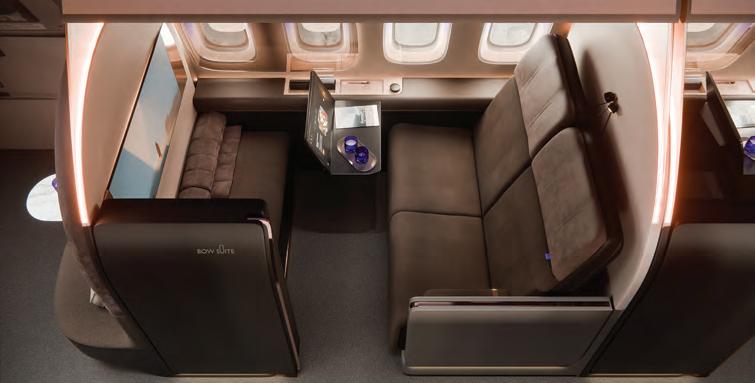
Lufthansa Technik’s “BOW” narrowbody VIP cabin concept, created with BMW Designworks and unveiled in March, envisions a modular solution for group VIP travel—a board of directors, professional sports team, touring band, or delegation. “This is a new customer segment,” said Fabian Nagel, v-p of sales for VIP and special aircraft services.
Named for the design’s signature arcs and soft shapes, interior components can be chosen and installed per the client’s needs, and when in service, changed during maintenance events. Two-passenger BOW Suites with convertible full-flat beds feature individual inflight entertainment system (IFE), cabin managment system (CMS), and environmental systems.

LHT’s Hidden Touch controls won the Red Dot award for Design Concept 2025. Table surfaces in the lounge incorporate LHT’s new intelli-table haptic technology, which blends a disappearing high-definition touchscreen directly into durable hard surfaces that can resemble wood, carbon fiber, metal, or other materials. A central lounge table morphs from one into four individual surfaces.
Similarly, LHT’s latest Nice CMS iteration, which debuted on the Embraer Praetor 500E and 600E, incorporates an OLED multifunction “Smart Window” that can function as a window, fed by three external cameras.
LHT has also introduced a modular VIP cabin upgrade package for aging Airbus
ACJ318 Elites; some 25 were built between 2007 and 2015, and originally outfitted by LHT.
Meanwhile, prospective BBJ777X customers “are waiting for the jet to enter service commercially before committing” to buy, Nagel said. LHT unveiled its CelestialStar cabin concept for the aircraft in 2023.
Basel, Switzerland
“Demand for large-cabin and widebody completions continues to grow,” said Christoph Fondalinski, v-p of completions at Jet Aviation. For the company’s clients, “Comfort, connectivity, usability,

and overall passenger experience” are the top priorities. Highly customized and completely bespoke projects remain the standard.
The Hesperis interior concept from its design studio sees the narrowbody cabin as a calm and minimal “sanctuary of wellbeing.” Lightweight bulkheads integrating 3D-printed panels embody a focus on optimized form and function. Composite seat shells reduce weight and volume, and “finishes become structure, simplifying the space and reducing visual and physical complexity.” Production-wise, advanced 3D manufacturing enables a more fluid, seamless interior, with materials that incorporate natural tactile qualities.
This year, Jet Aviation installed the first IFX system, its in-house developed IFE/ CMS, as part of a narrowbody refurbishment. The unit is backward- compatible and supports simple component updates and change-outs. Fondalinski noted that refurbishment customers are “prioritizing integrated solutions to combine maintenance, cabin upgrades, connectivity, and paint within a single input.”
Looking ahead, the company foresees “stable and diversified demand for completions and refurbishment services across all major regions.” Meanwhile, in Basel, the completions specialist is preparing to open the first of two widebody hangars undergoing extensions and refurbishments of their own.
Bothell, Washington
Amid “a notable surge in widebody activity,” Greenpoint Technologies delivered this year its ninth BBJ787 Dreamliner (a -9 model, coincidentally). Greenpoint created a “calm, residential environment through layered materials, soft forms, and integrated lighting,” said v-p of sales and design Bret Neely. Though confidentiality agreements preclude showing the VVIP

interior, images of a recent 787 completion illustrate a similar aesthetic.
VVIP customers today want “privacy and flexibility” within the aircraft, making Greenpoint’s AeroSuite— a modular private bedroom and personal lounge—a popular outfitting option. Six were installed aboard a recent 787 completion.
Greenpoint has also partnered with Boeing Business Jets and Aloft AeroArchitects on the BBJ Select program, offering catalog-selected interior designs and quick delivery times on BBJ Max 7 and Max 8 models. Greenpoint provides the program’s engineering services.
Concurrently, the company is expanding its aftermarket maintenance,
modification, and upgrade services and has tripled its client support team over the past year.
Anticipating the forthcoming BBBJ777X, in 2023, Greenpoint unveiled its Zen cabin concept for the jet. The Triple 7, and the interior, have drawn “continued interest from prospective clients,” said Neely, and the jet “has the potential to become a preferred choice for next-generation VIP and head-of-state aircraft.”
Indianapolis
Comlux America, the completions and MRO division of Switzerland’s Comlux




Group, sees “a shift in the market by customers to a more standardized, but still bespoke, product,” said CEO Adam White. Clients who traditionally sought “very high-end [completions], now want less complexity.” He noted that Comlux, which performed the first BBJ Max completion, is known for technical innovation. “Controlling things through your phone seemed unique and novel,” White said. “Now, customers just want a switch next to the light.” Government and head-of-state refurbishment projects are also choosing standardized interiors, he said.
Comlux’s ACJ TwoTwenty, its partnership with Airbus Corporate Jets, creates cabins from pre-engineered components, providing dozens of configurations and several design style choices, saving significant amounts of time and money over a custom completion, and epitomizes the shift. Production is accelerating; four TwoTwenties have been delivered, and the target is four to six per year.
Comlux will also outfit a VIP fleet (six Airbus A220s and two A321s) in standard formats for Magnifica Air’s forthcoming luxury airline service, slated for a 2027 debut. Carrying between 45 and 54 passengers, the cabins will offer private suites.
Comlux facilities now occupy some 250,000 sq ft, with room for further expansion. Last September, private equity firm Everpeak Capital Group made “a strategic investment” in Comlux America.
AIRBUS CORPORATE JETS
Toulouse, France
Airbus Corporate Jets (ACJ) sees a market for new luxury “shuttle services,” president Chadi Saade said, citing hotel chains, sports teams, and companies that transfer their staff. An interior design sketch of an ACJ TwoTwenty in shuttle configuration reflects

“the trend we’re seeing now,” which is also “very much appreciated by a lot of presidential and government customers,” he said.
The layout includes a forward “presidential” command suite (equipped with “therapeutic lighting” and sidewall-embedded augmented reality screens), a negotiating lounge, a meeting room, seating for a VIP delegation, and a medevac unit. Medevac demand is strong, Saade noted, and units have been certified for most ACJ models.
ACJ’s completions are performed at five authorized completion centers. ACJ has delivered 85 turnkey projects itself via the facilities, but “because of demand in the overall market, we want to add at least one more outfitter to our network,” Saade said.
“We’d prefer it to be in the United States.” Saade noted that the composite airframe of its widebody ACJ350 is outfitted with ACJ’s Easyfit pre-installed brackets, attachment points, and system interfaces, simplifying completions.
Meanwhile, ACJ has launched ACJ Connect Link, a OneWeb LEO connectivity offering, and has expanded its service center network, adding Bodrum, Turkey, in partnership with AMAC Aerospace.
Renton, Washington
Boeing Business Jets’ BBJ Select program offers modular lounge, suite, galley, and

other cabin outfitting options for the BBJ Max, providing some “200 different combinations, at a significantly lower price and in less time” than a custom completion, said global marketing director Chris Shindle.
Launched for the BBJ Max 7 in 2023, the recent addition of the Max 8 has “accelerated discussions…both from ultra-highnet-worth individuals and individuals comfortable with having an off-the-shelf catalog option,” Shindle said. Purchase will come with a residual value guarantee, providing buyers with “financial confidence.”
Boeing has partnered with Greenpoint Technologies and Aloft AeroArchitects on the completions, to be performed at Aloft’s Georgetown, Delaware facility. Orders continue for green BBJ737s (Max 7, 8, 9), which come with low cabin altitudes and humidification systems like the 787s.
BBJ announced its Queen of the Skies offering—turnkey refurbished BBJ 747-8s


in VIP and VVIP configurations—in late 2025. “It’s a very small market, but big enough to launch a program,” Shindle said. BBJ is in discussions with prospects and “carriers that have this feedstock.”
Concurrently, the BBJ787-8 model, providing excellent range and high/ hot performance, has been particularly
popular in Asia. A recent production increase at Boeing’s North Charleston, South Carolina Dreamliner factory should increase availability.
Meanwhile, though the BBJ777X won’t enter service until the early 2030s, given the lead times for such projects, discussions with prospects are proceeding. z





BY CHARLES ALCOCK

UK start-up OXCCU has developed a method to convert blends of carbon dioxide and/or carbon monoxide and hydrogen sourced from waste biomass and carbon into sustainable aviation fuel.
The chronic shortage of jet fuel caused by the ongoing wartime closure of the Strait of Hormuz has exposed the air transport sector’s vulnerability to geopolitics. At the same time, the industry is supposed to be focused on meeting its net-zero decarbonization commitments—a confluence that raises questions around how to reconcile short-term imperatives with longerterm objectives.
Some companies developing new approaches to fuel supply and aircraft propulsion see the crisis as a potential tipping point that could provide fresh impetus for their work. But they acknowledge that the urgent need to secure fossil fuels immediately could cause a loss of focus on the long-term ambition for alternative fuels.
UK start-up OXCCU is developing a process for converting biogenic waste carbon and hydrogen into SAF. At its headquarters near Oxford, it is planning to begin operating
a second test plant in early 2027 to demonstrate the capability to produce a few tonnes of fuel each year. This test operation will de-risk technology that could be scaled up for licensed production.
OXCCU’s CEO and co-founder, Andrew Symes, sees SAF as the long-term solution to air transport’s energy needs, but he also recognizes the imperative to secure affordable fossil jet fuel for the transition. In his view, air transport stakeholders need to step up efforts to shore up access to fossil-based jet-A and, at the same time, support longer-term availability of sustainable alternatives.
“In the short term, this is a real crisis, which SAF can’t solve immediately because the volumes are still too low,” Symes said. “At some point, you have to see that fossil jet fuel is not a stable, reliable, secure fuel; we are seeing constant crises, and we have to be ready for continuing volatility by developing the new sources of SAF. And as
SAF technologies are going to be the future, they will be in demand globally, creating a real export opportunity for the countries that develop them first, something not possible with fossil jet fuel.”
According to Symes, evidence of the balanced approach can be found in Asia, arguably more so than in Europe or the U.S. As governments and industry in that part of the world are scrambling to secure alternative sources of jet-A, there has been rapid growth in the availability of feedstocks and the plants needed for SAF production, including UCO via HEFA, biogas via gas-to-liquid, waste biomass via gasification, and green hydrogen and CO 2 via power-to-liquid.
Despite some recent shifts in thinking in Europe, there has yet to be a significant expansion in SAF production plants.
Symes believes that the heightened energy security risks posed by the Iran war—that arguably should have been learned from Russia’s invasion of Ukraine—are now resulting in a more productive focus on efforts to establish dispersed localized production capability that might support, for instance, air force fuel requirements.
“There is a way for us to make more modular plants that can supply critical infrastructure, and these get around the challenges of building larger plants,” Symes explained.
OXCCU is now focused on producing containerized units for smaller airports and military bases as a stepping stone to wider, larger-scale adoption of its technology. Each micro plant could be producing around 1,000 tonnes of SAF annually by 2028.
In the Netherlands, Conscious Aerospace is conducting preliminary designs for a
two-megawatt hydrogen-propulsion system that could decarbonize existing aircraft. While working with airlines including KLM and Transavia, the company and its partner De Havilland Aircraft are also addressing possible opportunities such as re-engining military aircraft.
Conscious Aerospace founder Michel van Ierland said that the blockade of fuel supplies from Gulf states has raised awareness of how complex energy dependency can become. He feels that the impact of the crisis could continue for months and maybe years before jet fuel supplies stabilize, worsening already constrained jet-A supplies at some airports, and causing more flight cancellations and price rises.
According to van Ierland, smaller regional operators are most exposed to the rising cost of jet fuel, and so potentially receptive to longer-term alternatives like hydrogen. His company’s work with
KLM and Transavia is tracking potential use cases on routes of up to 750 km (405 nm), which is the maximum range its propulsion system is expected to support initially. “More than three million passengers are currently flying out of [Amsterdam] Schiphol [Airport] each year over those regional distances,” he pointed out.
“Hydrogen could decrease the vulnerability of the fuel supply chain even if the capacity won’t be at a high rate to start,” van Ierland said. “We are now on the right path with new energy sources that can reduce carbon dioxide while also reducing vulnerability [for the air transport sector].”
Conscious Aerospace is aiming to start ground testing its technology at the end of 2027. It believes it can be ready to flight test a converted Dash 8 in 2029 and achieve entry into service with initial customers in 2030. z
LCR-100
LCR-110
LCR-350B



BY KERRY LYNCH

Organizations need to be fully prepared and repeatedly test and update their emergency response plans (ERPs) to ensure they are not in a position where they must either hit the panic or snooze button, a leading expert advises.
Speaking during the 2026 Air Charter Safety Foundation Safety Summit in Daytona Beach, Florida, on “Two Buttons to Never Hit: Panic or Snooze,” Gina Shealy, emergency operations manager at Fireside Partners, provided guidance and lessons learned on ERPs.
Fireside specializes in helping companies manage through emergencies, such as an aircraft accident, and Shealy noted that when she first meets people, often it is
“not the best day.”
This underscores the importance of preparation for that day: it never happens until it does.
“Where are you?” she asked. “Are you at the very beginning, where you’ve got no or a limited ERP? Are you a one-person show where you’ve got 12 hats, and somebody gives you one more, and how are you possibly going to get everything done that has to be done in a day? Or are you at that next level? You have got a decent ERP…but you’re still not there. You don’t have processes nailed down, or you may not have the best tools.”
Or, Shealy continued, “You’ve got all that leadership investment. You’ve got
robust teams. It doesn’t just cover aircraft emergencies. It may cover employee fatalities on the job, severe weather, or other events.”
She relayed her own experience working with a major airline where she had signed off on an ERP. “Unfortunately, one day we had a severe event, and I remember realizing at one point I’m actually running towards the event.” Meanwhile, leadership was “hanging out on the jetway,” or people were nowhere to be found.
“Those are the people who are on this checklist somewhere that are supposed to make things happen. That’s a reality,” she
said. “I never wanted to be in that situation again, so I made sure that I was going to not just know my role, but I was going to know my leadership’s role, and I was going to know the other person’s role because you never know when it may be you having to take on any of these responsibilities.”
The airline underwent a major integration with another airline. Emails flew around with what was believed clear direction. But, in reality, that direction was not so clear. “Everybody had their own agenda as to whatever topic it was. It was only centered on what they thought was [the direction], and then I would realize that means completely different things to each person.”
Everybody thought they were going the same way, but none were. “So that hit home.”
The first phase of ERPs, creating one, can be daunting because the person may have no idea where to start. Or, in the early stages, the company may just have a framework for an ERP.
“You ever go back and look at that last revision date and cringe? [Or is] your ERP on a wish list, or is it in a constant state of, ‘We’re going to get there one day when I have time.’ Is there ever enough time?” she asked.
you don’t know all the things,” she said, then quoted a passage from the book Predictable Surprises that an organization’s knowledge never equals the sum of its members’ knowledge.
“You are one person,” she said, urging attendees to optimize institutional knowledge both within the company and with stakeholders and/or vendors working with the company.

GINA SHEALY EMERGENCY OPERATIONS MANAGER AT FIRESIDE PARTNERS
have confidence in the process. Make it part of the debrief and involve different teams. Whether an event happens at 2 p.m. or 2 a.m., a company should be prepared. “You’ve got to have the right people plugged in. You shouldn’t have a B team.”
She cautioned against falling into a belief that the team is strong and will automatically take care of everyone. “Is that real? Absolutely not.”
And then, a company may have money for the ERP, and it looks good on paper. But is it real? she asked. “How many times have you actually sat down with all of your checklists and timed how long does it take to do each one of these items? Is that even feasible?”
If the checklist is timed, then she suggested multiplying the time by four, “because there’s always going to be distractions.”
Another caution: don’t give the “most important people” the most responsibility. “It needs to be the opposite.” High-level decision makers don’t need to be the ones who should notify security to lock the doors or cancel appointments. “For this size, less is more.”
You ever go back and look at that last revision date and cringe? [Or is] your ERP on a wish list, or is it in a constant state of, ‘We’re going to get there one day when I have time.’ Is there ever enough time?
The ERP must be prioritized, Shealy stressed, warning against excuses. People may be invested and knowledgeable, but focused on other projects. “Make sure that you’re not being your own obstacle by constantly putting up those excuses and blockers.”
To start with, she advised figuring out where an organization wants to be and deconstructing how to get there. “Go back and learn past events and what went wrong.”
She cautioned against getting into “analysis paralysis” and reminded attendees that they will not know everything. “Engage the right people. Do not forget to actually listen. I know you know a lot of things, but
Shealy also noted that when new people walk through the door of a company, they bring a wealth of knowledge and experience from other locations. But that knowledge frequently gets dismissed because the newcomers don’t have experience with the company. “Also, don’t let the title get in the way. Think about taking away a lot of your bias.”
In creating ERPs, make sure the roles and requirements are clear. While she said it is important to clearly know the roles, Shealy also cautioned: “Don’t gatekeep. Don’t be the only one [with this knowledge].” Instead, share the knowledge and bring other people along so they
When some parts of an ERP may require substantial investment, she advised starting with small changes that are within the budget and also partnering with insurance companies that may have funds for drills or tabletop exercises.
“Lead by listening. How long does it take for you to hear about issues, typically?” If it takes a while, then executives must reevaluate their communications. And, they must understand that just because they know something, it may not be intuitive for others. “You do an insane disservice when you are not helping, not sharing those lessons learned.”
This communication must foster responses and enable others to share, so
that warning signs surface rather than being covered up or hidden.
She called the most dangerous phase the one in which a company believes it has checked all the boxes in the ERP. “You got your panic zone, your learning zone, and your comfort zone. But, this is the most dangerous one because you think you know everything,” Shealy said. “Don’t just check the box. Don’t just say we’ve got this.”
The organization may have the programs and people signed up for training to learn a new online tool. “Then you find out during the response, they don’t know their login; they haven’t touched it since that first one. So, what do they do? They just revert back to the old ways,” Shealy said, adding that this invites chaos.
She questioned how often the plan is reviewed and updated; Shealy shared that she has had to break news to a person on an outdated emergency contact list, only to learn that person was an ex. “I’ve heard ‘good!’” she warned. “It’s very jarring.”
Shealy also warned against the belief that the plan doesn’t change, noting that companies diversify and expand to different locations. “Does that change your plan at all?” she asked. “Do not engage autopilot. Be mindful.”
Remaining proactive versus reactive is critical, she said. “Are you paying attention to the industry trends?” she asked. “Are you investing in that future? Are you just waiting for something to happen?”
Shealy advises clients who have developed ERPs to take real-world events
and pretend it was their organization. “Where would we have been at this time of day? Were we all offsite? Were half of us on vacation? Have you designed that to be a failure? Have you even thought about alternatives?”
What happens if the one or two people bearing the most responsibility leave the company or are inaccessible? Are there backups? “This is where you need to start doing as many tabletops as possible,” Shealy said. “You’re creating that trust that you know what you’re doing and your other people know, and they know and feel confident about it.”
The ultimate goal, she said, is “you want to be confident but never complacent.” This takes consistent drills, training, and balance of duties, with an eye and plan for changes that may be ahead. z
BY KERRY LYNCH
Notifying a family of the worst possible news is a difficult and delicate task, one that takes the right person and one that should be done immediately, advised Gina Shealy, emergency operations manager at Fireside Partners.
“You don’t want to be an expert at that,” she told attendees at the Air Charter Safety Foundation’s 2026 Safety Summit. Interacting with the family is difficult, Shealy said, noting that this is true even after she has done dozens of di!erent notifications.
But even if an organization doesn’t have many details, the family must be notified right away. “That is better than you sitting on it and waiting for hours before family members are notified. If we’re going to wait till we gather all the facts, it’s already out there. So do the responsible thing and just notify.”
Having the right people in the family assistance programs is critical, Shealy emphasized. She asked how many attendees don’t like people. “Guess what? Please don’t do notifications calls or work with families. If you get very irritated by having to repeat yourself, you’re doing the wrong thing.”
Also, she advised against having someone who speaks in rules and regulations as the contact person. “It is a completely different language. Don’t just assume they know what all the acronyms mean. Do you know what all the acronyms mean?”
Another caution: people who may be too eager to notify. Perhaps they are trying to make up for their own past and bring their own experiences to the situation. Each one
is different and needs to be approached that way.
When notifying, Shealy cautioned against treating the families like they are not smart or that they are broken. “They’re not dumb. It’s just that this is a shock to the system. So be respectful of that.” Let the family members lead.
She’s learned to never ask how they are or what they need. Shealy got an answer once to those questions: “I need your airline to not have killed my wife.” Instead, she asks, “‘What are you most concerned about? What is worrying you most right now?’ I’ve heard everything from, ‘I don’t know if I can pay the bills’ to ‘Can I buy my kids Chick-fil-A?’ It’s all over the place.”
Start with a little thing that worries the family members and take it off their
shoulders. “There’s no quick start guide,” she said. “You’ve got names, you’ve got titles, you’ve got agencies coming at them right and left, none of that matters. What matters is their loved ones not coming home anymore ever again.”
She further advised that people in a position to notify must make sure that the focus stays on the family rather than themselves. “You need to get out of your own head with a lot of the notifications. It’s not about you. It’s about doing the right thing for those families involved.”
One such family member in attendance at the event emphasized that message. Sheri Lilley, whose stepson Sam Lilley was the first officer aboard the PSA Airlines CRJ700 that was involved in the midair collision near Ronald Reagan Washington National Airport last year, noted how she “unfortunately has been the recipient of Gina’s services.”

SHERI LILLEY
Flexjet, the employer of her husband
Tim Lilley, activated its ERP even though it did not have to, and Sheri Lilley noted that Shealy was a part of this. “You do have to realize people are in shock, and like Gina said, you’ve got to tailor your response to what those individuals need. You cannot follow a checklist and go through points one through 10 sequentially because it’s going to be different for every family.”
She noted that it was di ffi cult to grasp it all. “Family members are not going to remember the names of the people they are interacting with if they didn’t know you previously,” she said. “So, you need to give them some paperwork to take away. Overcommunicate. Tell them, ‘You don’t need to read all this right now.’” Emphasize this isn’t homework but a resource.
When family members go onsite, they pack a suitcase with about one-tenth of what they need, she added. “They have no idea what they’re getting into, how long they’ll be there.” Lilley praised Shealy for helping them through that. “Gina did some beautiful things for us.”
Lilley also stressed that she is working to improve family notifications. “Meet those family members where they are and give them what they need,” she added. “Some people are going to go away after your initial notification, and they never want to see you again, so you need to respect that too.” z

ZEISS is advancing the future of aerospace with ProSight, a technology platform that transforms how information is seen, shared, and experienced in flight –for both passengers and pilots.
Experience these innovations for the first time at Farnborough International Airshow 2026, Chalet 404 via Gate B.

BY KERRY LYNCH
While the supply chain has turned a corner from the early post-Covid days, struggles remain. Driving this is unprecedented surging demand across the aerospace spectrum, from airlines to the global defense sector. AIN brought together thought leaders in the supply chain and broader market to share insights on how the industry is working to meet that demand, despite ongoing supply-chain struggles. Here are highlights from that discussion. FDH Aero sponsored this roundtable.


MATT LACKI PRESIDENT OF FDH HARDWARE

Lacki joined FDH Aero nearly four years ago and last year became president of its FDH Hardware organization. Before that, he spent nearly a decade in private equity and banking, including as an investment partner with Huron Capital. He also spent nine years with the U.S. Army. With a background of more than 60 years, FDH Aero is one of the largest independent aerospace distributors, supplying hardware, electrical, and other products and services across the military and civil aerospace markets with 34 locations and 1,500 employees.
Ž ILVINAS LAPINSKAS CEO OF FL TECHNICS
Lapinskas has led FL Technics as CEO since 2013 and before that headed up the Lithuanian company City Service, which is one of the largest property management, building maintenance, and utility service groups in the Baltic region. FL Technics is a global MRO group headquartered in Lithuania and with major facilities in multiple locations in Europe, as well as in Indonesia and, most recently, the Dominican Republic. With more than 4,000 employees, the company also has more than 100 line maintenance stations, making it one of the largest independent line maintenance networks.
MIKE STENGEL PARTNER AT AERODYNAMIC ADVISORY
Stengel joined AeroDynamic in 2017 after serving with ICF International’s aerospace practice. At AeroDynamic, he oversees the firm’s aftermarket-related intellectual property and has led or contributed to more than 100 consulting engagements surrounding business strategy, market analysis, and transaction advisory for clients across the aerospace industry. AeroDynamic is a management consulting firm focused on the global aerospace and defense sectors.
MATT LACKI The supply chain is still certainly strained post-Covid, and now there’s increasing demand with increasing build rates. Many of the large OEMs have all-time-high backlogs, which is leading to all-time-high production. This leads to an all-time-high demand for the parts that we generally distribute, both on the hardware side and on the electronics side. Certainly, air travel has grown significantly post-Covid, and that obviously is putting a strain on the aftermarket. It feels like the aftermarket has recovered somewhat, but on the OEM side, there’s still a lot of shortages.
While commercial OEMs are managing historically high backlogs and the commercial aftermarket remains under strain, demand is also rising across the military market, which is relevant to us because defense represents a large share of our business and gives us a clear view into the pressure customers are facing across both sides of the industry.
On key parts, many factories have more than one year of backlog, and so they struggle with capacity, both on the manufacturing side and on the people side. That creates a lot of strain across the supply chain.
ŽILVINAS LAPINSKAS Demand for MRO services is growing, the market is growing, and more airplanes are coming. Of course, we feel that growing demand, and it has influenced supply chain shortages, influenced our TAT [turnaround time]. On the OEM side, we still feel that they are lagging in recovering after Covid. We can find parts in the aftermarket.
Problems with the delivery of new airplanes from Boeing and Airbus, and then GTF [Geared Turbofan] engines problems
from Pratt & Whitney, are also influencing [the situation]. Older planes have to fly, and the number of retirements is not so big. For the older planes, the TAT in the hangar is longer, and they need more parts.
And of course, the candidates for teardown are fewer than we could expect in a normal situation. Sometimes, we have a situation where we have the aircraft in the hangar, we have [tools], we have manpower, and we cannot do the job because our hangar is in Indonesia, and we found a part that is only in the U.S. So, we have to wait two, three, or four days till the part comes. It’s challenging. In my view, that situation will not change for the better soon.
While commercial OEMs are managing historically high backlogs and the commercial aftermarket remains under strain, demand is also rising across the military market...
— Matt Lacki
MIKE STENGEL
There’s certainly no shortage of demand for new aircraft and new engines, and this is probably one of the first times in the history of the industry where we are supply-constrained rather than demand-constrained. Matt and Žilvinas mentioned the growing backlogs already—approaching a decade for a narrowbody.
Even the widebody market, which had been taking the longest to recover during Covid, had a banner year last year in terms of orders, and the asset values for those aircraft are growing again for mature aircraft, like GE90-powered Boeing 777s. And so now you could see the widebody market starting to show traits of what
narrowbodies have shown for several years. Backlogs are lengthening further, and the OEMs are getting into a similar situation where they can’t deliver fast enough to keep up with demand. That’s assuming there are no boulders thrown into the pond with the developments in the Middle East and no major changes to the demand profile for air travel and such.
This is also true for not just commercial transport, but also for business jets and military. A common theme we tell a lot of clients is that all tides are rising in aerospace, regardless of the end market, which is unique. That hasn’t happened all at once when you look across the history of the industry.
The average age of the fleet has continued to go up since 2018. We’re living not just in the world of post-Covid consequences, but also going back further to the initial grounding of the 737 Max. In our research, when we look at how the fleet evolves after a black swan event, whether it was 9/11 or the 2008 financial crisis, or Covid, the average age of the fleet has always gone up. Once it goes up, it’s very difficult to bring it back down.
MATT LACKI With many parts, especially on the fastener side, it feels like they’re made on machines that are 50 years old, so the expertise required to operate those machines has been built over decades. Many of those people retired or left postCovid, and there’s definitely a massive gap in terms of manufacturing expertise and talent.
Some of the other gaps involve certain raw materials, and then certain factories have just really struggled with certain parts—fittings come to mind. There are some other factories that have really struggled to meet the demand that’s needed. Those struggles continue every day. This
makes it really challenging because we sit in the middle between the suppliers and the OEMs; the suppliers deliver it 50% on time, and the OEMs want delivery at 95% to 100% on time. Because we sit in the middle, we view the talent gap as a place where we can provide a ton of value. Many of our team members are engineers, and we can bring that high technical competence directly to the table.
Ž ILVINAS LAPINSKAS After Covid, I would say from 2022, there were two hot topics in the aviation industry, especially in MRO: the supply chain and the lack of manpower. In 2026, four years past, we have the same topics: supply chain and lack of engineers. The only way for us to keep and grow our business is to have more [maintenance] engineers. We’re trying to attract the young generation to come into the aviation maintenance business. We publish a lot of articles about the aviation maintenance engineer profession, promoting it. Then, we started to give scholarships to the universities for young people. I meet with the best students to talk about the company, about the market, about the future, and about the possibilities to work at FL Technics. If I meet 10 or 12 people, it’s not enough. But I know that when they come back, they will talk with their family, friends, colleagues, classmates, and so on. Then that information goes on, and we see that the number of students who are going for [aviation maintenance at] Vilnius Tech University doubled. So, I think it’s quite a good result.
The average age of our engineers in the hangars is also not getting younger, so the only way is to get young people to join aviation maintenance. And of course, we have to wait maybe eight years for them to get enough experience to replace the old certifying staff But this is the only way, because if we start to get the guys from other companies—from our competitors—we have to overpay. It means costs rise, and we have to put those costs on our customers. It’s not so easy.

MIKE STENGEL On the talent pipeline, the strategies that suppliers, OEMs, and MROs have put in place may not show immediate results. These are multi-year kind of initiatives before you see the benefits, and especially because [to] a lot of people, an MRO or working a factory job may not be as appealing as it used to be. So, you need to go further back in the talent pipeline, down to middle schools and high schools, to remind students that this is a viable career pathway and there are a lot of options in this industry, and help them understand how things have modernized— it can be a lot more exciting than it may seem from the outside. But by going back that early in the education pipeline means it’s a very long-term investment and bet.
As for other bottlenecks, engines are number one in our book, just with the complexity of the manufacturing. There are some critical processes, like forgings, where we still need more investment into capacity to meet future build rates. That’s on top of aftermarket requirements. We do see some positive signs, like Pratt & Whitney is investing in their Columbus, Georgia site with new forging capacity. There still needs to be more.
The other one that may surprise a lot of people is interiors on the new-build side with widebody production coming back.
Widebodies tend to have more custom and bespoke interiors. Customization and bespoke are the enemies of supply chains, where you have less consistent runs. That means some deliveries of aircraft and certification of interiors have been delayed, and there’s also a shortage of people at the regulators to certify these interiors.
You hear stories about Delta taking delivery of a bunch of [Airbus] A321neos that were meant to go into a transcon fleet with a more premium configuration and new Delta One seats. They were sitting in the desert and were actually being reconfigured into a domestic configuration just so Delta could fly them. They don’t expect the new premium configuration to be certified until next year or the following year. It’s not an ideal outcome that they have to wait for those premium seats to come to the market. There have been some other examples, like A350s getting delivered with empty first-class cabins, and the airline has to retrofit them later.
MIKE STENGEL I think the OEMs and people in the higher tiers of the supply chain are slowly recognizing that it’s not the same supply chain as from 20 or 30 years ago, where they may have had their


pick of the litter. All tides are rising regardless of the end market, which means suppliers deeper in the supply chain have a wider variety of options and markets to serve.
It’s almost like the higher you are on the supply chain, the more you have to be a customer of choice. They’re looking at their commercial terms, like payment terms. Some are even going as far as to establish take-or-pay agreements. Traditionally, most long-term agreements in aerospace will guarantee a price and market share, but not volume. But now, a takeor-pay agreement would have a volume guarantee. You’re paid regardless of the outcome, just to secure the capacity.
That’s a tailwind for suppliers for visibility on their business and revenue, and it helps them understand better where they can invest more, too. That flows down to how private equity might assess a business in the supply chain, as well as the growth prospects and how attractive it is to invest in.
Between what we’ve all said about the aftermarket and also with Boeing turning the corner, finally, over the past year or so—starting to consistently achieve higher output on the 737 Max—that’s a positive sign for investors.
consolidate their customer base, which is good for distribution. And then, many of the large OEMs are also consolidating their supplier base, so everyone wants less on either end.
That gives us an opportunity to really sit in the middle and provide expertise and try to figure out where the right sources are, where the new sources are, where the approved sources are—again, ultimately to bridge that gap between the delivery rate and then what the OEM expects.
Some of the part manufacturers are increasing capacity. But you can build all the machines you want; you just don’t have the labor to keep up with them.
to come to do the audit, as we have at our Punta Cana [facility in the Dominican Republic]. We [were] waiting for roughly five months.
These are not fast decisions, and it influences our ability to provide the service on time. As an example, we were waiting for some parts from brake producers during the high season last summer. We’re very strong in the wheels and brakes business, but we could not deliver the brakes on time to our customer, because those parts were not arriving. And we’re speaking about the serious producer, not about the factory somewhere in a village. It’s a big challenge, and it will take some time to get back.
We see a demand, we see the labor, because in Indonesia, it’s a good situation with the engineers. There are more than 20 universities and colleges that produce 3,000 or more engineers per year. This is the only market where we are not facing big labor problems...
— Žilvinas Lapinskas
MATT LACKI There’s certainly been a flurry of M&A activity on the manufacturer side, especially on the fasteners part of the business. We’ve also seen some people invest in capacity, and we’ve seen new sources develop around the world—such as in India and China. We’ve tried to grow relationships with our existing suppliers, figure out where there are new approved sources, and partner with them as well to meet the demands of the OEM.
Many of these suppliers, being capacity- constrained, are trying to
We will see more capacity in the next few years, but the ability to operate at the level of quality that a Boeing or Airbus expects is really hard to do. It will come, but it will be very slow, because getting those machines to operate at the right level of proficiency to deliver again on the quality standards is very, very challenging. We’ll see some, but we’re not going to see a ton of it tomorrow.
Ž ILVINAS LAPINSKAS We see that OEMs are building new factories, but I agree completely with Matt that it will take some time. You can build the building, you can buy the machines, but then you have to get the people, train them, and get the approval. You have to wait for the regulator
Some brakes were removed from airplanes parked because of the GTF engine problems. So, we removed the brakes and used them in the existing fleet that is flying, because the other aircraft are waiting for the engines to come back from the shop. You have to be very creative in this kind of environment.
Speaking about expansion, we will look at each business case carefully, if we see the demand in the market. For example, we are working on an additional hangar investment in Jakarta, a plus to our existing operations. We see a demand, we see the labor, because in Indonesia, it’s a good situation with the engineers. There are more than 20 universities and colleges that produce 3,000 or more engineers per year. This is the only market where we are not facing big labor problems. In all other countries, it’s a big problem.
If we see the demand and the opportunity, then we make a calculation, and we go. Being in Central America, we can deal with North America and Latin America. Of course, we are trying to get the customers from the U.S. Our launch customer is JetBlue.
MATT LACKI Prior to Covid, there was a big focus on centralizing decision-making and centralizing customer service and other parts of the business. Now, we’ve gone the opposite direction, where we’ve tried to put local teams around the world.
We have solid teams in India, the UK, Germany, Italy, and Singapore. We try to put local teams at every major hub for aftermarket or for OEMs, and empower those local teams to make decisions, to put warehouses and inventory as close to the customer as possible. So, parts made in Europe stay in Europe. Parts made in Europe don’t have to travel to the U.S. to go to Brazil. There’s less travel or more simple travel for those parts around the world.
The local teams that are there with the customers are able to make decisions on their own. It sounds simple, but it’s highly complex, and there’s a lot of things that come up day to day.
When a customer needs something that they didn’t anticipate, or there’s a quality issue, or some regulatory issue, the local team is empowered to solve those problems. Local teams can make local decisions fast without bureaucracy, and where we keep inventory as close to our customers
as possible. I think it goes a long way in this environment where production time matters.
The other simple things are—this sounds insanely easy—answering the phone and answering emails. You’d be surprised, but that matters a lot to customers, and so we think the biggest thing that’s changed is to be responsive, be local, and try to drive the very highest service level that we can drive to the global customers. You can’t make decisions in Texas for customers in India; that doesn’t work.
Because many of the OEMs want to consolidate their supplier base, many of the manufacturers want to consolidate their customer base. The only way to do that on either end is through distribution. Part of the market will always be direct to OEM. But there are many OEMs and subcontractors that the manufacturers are just not going direct with, and that’s a really big opportunity for distribution. And then certain OEMs do not want to deal with 2,000 different suppliers on a complex bill of materials, and that is just perfect for distribution.
We manage 2,800 suppliers, and we serve 10,000 contractors, which takes the burden off both our suppliers and customers because they only have to deal with us.

needs.
MIKE STENGEL Whether it’s manufacturers wanting to consolidate or whether they’re buying or selling, there are more consolidated purchasing channels. I think distributors have an important role in today’s world, where there’s still some uncertainty geopolitically or in build rates. Distributors fill a natural role of smoothing out the demand signals and the supply signals for everyone, and they act as that risk bu ff er. That’s ultimately one of their key roles. So, I think there is a growing role of distributors, both on the supply chain and the aftermarket, for those reasons.
MATT LACKI One of our biggest value adds is just inventory availability. If you ask the manufacturer, you ask the OEM, the most important thing we do is hold inventory.
And so that’s not just a single source; that’s seeking out new sources and partnering with those new sources around the world, bringing customers to them, so that we’re aggregating demand and buying at scale. That helps them, that helps us, and then we build that inventory for customers.
Inventory availability is key. It’s not just having the most inventory, but it’s having the right inventory, and then making sure that you’re building that inventory base with alternative sources, and helping those sources get the right approvals and the right customers to grow.
The right inventory is a complex question because of the amount of the bill of material, the complexity of the bill of material, and the vast amount of platforms that are out there. But I think our strategy has been to focus on our key OEM partners and really try to uphold a significant amount of inventory to support them through production.
To consistently ensure we have the right inventory, we can’t, nor do we operate in a vacuum. We are deeply embedded with our customers to understand exactly what they
need and when they need it. This allows us to work with them on the long-term, multiyear plan and gain greater transparency into their future demand.
Ž ILVINAS LAPINSKAS We buy spare parts and consumables, not only for our operation, for our hangars or line maintenance business, but we also buy to sell. When we get requests, it doesn’t matter whether from our hangar, from the line maintenance business, or from our customers; we are asking our suppliers and making a decision from whom to buy.
We [may] have a situation where we can buy the spare with the 10% higher price, but the lead time is tomorrow. Or we can buy it overseas, and then it will come in three days, but the price is 10% less. It depends on different situations.
We are good at the analysis and prediction of the usage of the spare parts and consumables. We buy a lot in advance, because we know that we will sell—maybe not tomorrow, maybe in two weeks. It helps us because we have it at the right time and in the right place.
buy airframes, we do teardown, and we have to repair those parts in the different component shops. We have more than 100 different component repair shops in our network, and we have contracts and experience working with them. We categorize them: those that are more reliable and those that are less reliable. We are trying to work only with the most reliable shops.
We know that when we send the part to them to repair, it will come back in good condition with all the proper documents, on time, and the price we agreed to before the repair. It’s predictable. They are reliable shops, and we have a really good partnership with them.
times matter a lot; quality matters a lot. It’s certainly not always cost. The ability to deliver and deliver on time can matter more than cost.
Ž ILVINAS LAPINSKAS Some of the players call the situation a perfect storm. Mature aircraft are in big demand, because newer planes are late and then these problems with these engines. It means that the mature aircraft have to fly. And sometimes, the decisions made on this don’t look logical because six years ago, the decisions would have been different. For the MRO, it’s a really good cycle.
We remain on the more optimistic side for the state of the industry and the outlook, and we just need to push through some of these bottlenecks..
—Mike Stengel
We’ve done this for many years, and we are not simply working with the shops that cannot deliver the proper quality, which is according to our standards for our customers.
MIKE STENGEL Despite the constraints and challenges in the supply chain, I’d say overall a positive long-term outlook for the industry, whether you’re looking at commercial transport, military, or business aviation. We remain on the more optimistic side for the state of the industry and the outlook, and we just need to push through some of these bottlenecks.
MIKE STENGEL I know there have been some high-profile, quality events surrounding certain engines, like the [Pratt & Whitney] geared turbofan. They’re working their way through—they are inspecting the engines for the powdered metal issues that they had. But besides that, we don’t hear about a lot of persistent quality issues.
There’s a lot of tactics that customers can use with their suppliers to incentivize cost reduction and make sure everything stays economical while everyone still continues to make an acceptable margin.
Ž ILVINAS LAPINSKAS Quality is the requirement of your customers. When we
MATT LACKI We have lots of di ff erent sources that we inspect. In some cases, we are outsourced quality for our customers, so we invest heavily in quality. We know, generally, for certain parts in certain factories where there are historical challenges and where people excel. We try to have the highest standard of quality. We think about, in some cases, we may be the last touch on a part before it goes into an aircraft. So we invest heavily in quality, both in people, expertise, and technology.
We want to create competition, but we also have partnerships, and we understand who can make what part when. Lead
MATT LACKI There’s also a lot of geopolitical challenges that have occurred in the last 18 months and other challenges, but it also creates a lot of opportunities. It’s an exciting time in the industry if you can solve problems, be flexible, and move quickly.
It’s certainly a challenging time; there’s nobody I talk to who doesn’t have a mountain of emails, calls, and meetings. We want to make it easier for our customers to do business in perhaps the most highly complex industry in the world. By anticipating our customers’ needs and combining our global reach with local expertise, we can turn these current industry challenges into real opportunities. It’s a very exciting time in aerospace. z
Step into the future of business aviation at the 2026 NBAA Business Aviation Convention & Exhibition (NBAA-BACE).
NBAA-BACE is where you can get up close with the newest business aircraft, meet legendary heroes of flight and witness epic announcements. It’s where business aviation comes together – not just to do business, but to connect, belong and celebrate the shared passion that unites our industry.


BY MATT THURBER
After the fatal crash of an MD 369FF into a slackline strung across a canyon at 600 feet agl on January 2, killing the four occupants, questions were raised about why the helicopter’s pilot might not have been aware of a notam highlighting the slackline’s location. Team members at underwriter Class A Insurance couldn’t help thinking about the notam problem, especially because one of them was a personal friend of the deceased helicopte r pilot.
“He was a good pilot,” said Robin Graham, Class A’s head of underwriting, “and that should have never happened.” Graham called chief technology officer Shayne O’Sullivan, and they wondered whether Class A could build a tool to help prevent accidents by making pilots more easily aware of critical notams.
The problem with this particular slackline notam, which the people who installed the slackline dutifully filed, is that notams have to be pinned to a

geographical location, usually an airport. The nearest was Arizona’s Superior Municipal Airport (E81), which is 3 nm north of the slackline location. “The notam was active between Dec. 26, 2025, and Jan. 6, 2026,” according to the NTSB.
Unfortunately, unless the pilot performed a preflight briefing that included that airport, he likely would not have seen that notam. He would have had to brief a flight plan that was near enough to E81 for its notams to be included, but if he just checked notams for his departure airport, the E81 notam would not have been presented to him.
Another pilot likely missed that notam as well, because the NTSB preliminary report noted: “According to first responders, about an hour after the accident, a second helicopter flying a similar flight path flew about 10 feet under the signalization line, which had remained suspended after the accident along with portions of the highline/slackline webbing.”
What O’Sullivan and the Class A team came up with was a way for their customers who also have helicopters to conduct a risk assessment for their helicopter flights that captures obscure but critical notams and other hazards. Class A serves the owner-flown, high-performance airplane market, mostly single-pilot jets, and the company’s iOS app already helps pilots conduct a risk assessment based on their flight plans.
“We take that flight plan when it comes in,” O’Sullivan said, “and we run our risk analysis on it. Then we can notify the
pilot if there’s a risk level that warrants putting something in front of their eyeballs to review.” However, he explained, there is “this fundamental limitation with helicopters, which is virtually no one’s filing a flight plan…they’re just going and flying visuals.”
Lacking a flight plan to run a risk analysis, he wondered how the app could help a helicopter pilot in these circumstances.
The solution turned out to be a relatively simple concept. Knowing the type of helicopter and its range, O’Sullivan designed the risk analysis to start at the helicopter’s location and analyze potential hazards within the possible area that it could fly. “If you’ve got a helicopter on your policy,” he said, “you can just tap and run a full scan…against the universe of risk that may exist for the helicopter before you fly. This little radar icon shows up [on the app] for our policyholders with a helicopter…and you get this analysis.”
The app allows the user to change the location of the risk heat map by starting at the phone’s location, by choosing a starting point, or by dragging a pin on the map to highlight the planned route. “Then we take a large swath of potential range and let’s find any risk within this geospatial area where the helicopter could theoretically fly, and then bubble that up for the pilot,” he said.
An example of the risk heat map is a helicopter at Dallas Executive Airport (KRBD), and the map shows some unlit obstacles near Cedar Hill, so pilots should avoid flying near them, especially if there are low cloud ceilings. “This is a snapshot risk profile for the helicopter,” he said. “This can get refreshed every couple of minutes.”
To help mitigate unusual risks such as the slackline problem, the Class A app doesn’t only rely on notams but also incorporates information from the slackline community. Applying this retroactively to the accident day highlighted that slackline with a red high-risk circle on the
app’s heat map. “This is something where if a pilot were flying in that area today, they would see the risk zones displayed to them in this visual manner,” he said.
While the risk heat map is available only to Class A customers, O’Sullivan said, “We have been talking about releasing it to the market in a di ff erent fashion. We’re just not there yet.”
For Class A customers who are interested in the risk assessment features, the company isn’t trying to overload them with new procedures, according to O’Sullivan. “Being a pilot, your life’s chock full of procedures, and so we don’t want to be the insurance company that shows up and says, ‘Hey, add this new procedure.’ What we try to do is demonstrate value, and then hopefully from there the pilot says, ‘I find this very valuable, I would like to incorporate this into my procedures.’”
By default, Class A doesn’t overload its customers with notifications of flight risk analyses unless it’s a significantly high-risk situation. However, customers can adjust the level of interaction using the app to whatever suits their comfort level. “We don’t shove it down their throats,” he said, “which most people appreciate. That’s the plan here with the rotor-wing side, to create something that’s as frictionless and as low of an ask as possible; literally just hit one button and you get this in a risk report.”
Later this year, Class A will introduce a corridor feature where the user can view the heat map for a corridor between two points. “That goes a long way,” O’Sullivan said, “because then we no longer have to just search the universe of where they could be, but we search the logical corridor between those two points, and that’s going to yield a much more impactful kind of safety report.” z


Atlantic Aviation has officially opened its new FBO at Napa County Airport (KAPC) in California’s wine region. Work to replace the company’s former 2,000sq-ft terminal began in late 2024. That facility was torn down in March to provide more ramp space.
The new 9,500-sq-ft terminal features a spacious lobby with a fireplace and café area, crew lounge with snooze rooms and shower facilities, and a 12-seat conference room. An adjoining 39,000-sq-ft hangar with an additional 3,100 sq ft of shop and office space can accommodate ultra-long-range business jets. It brings the complex to 89,000 sq ft of aircraft storage space. Also added was a fuel farm with a capacity of 40,000 gallons of jet-A and 10,000 gallons of avgas.
The facility was designed with a range of environmentally conscious features, including the use of recycled-content building materials, solar panels, energy-efficient lighting, bio-retention systems, water-conserving plumbing fixtures, and native landscaping to reduce irrigation demand.
Tampa Executive Airport (KVDF) is experiencing a building boom that will add 42,000 sq ft of aircraft shelter to a tight Florida aviation real estate market by year-end. The growth spurt at the Hillsborough County Aviation Authority-managed facility began in March, when Skyport Aviation—the lone FBO on the field—added a 12,000-sq-ft hangar, doubling its available aircraft storage space. Other private aviation developers have three additional projects underway.
Another 12,000-sq-ft hangar was started in June and is more than 50% complete. It is anticipated to open by October. Work recently began on a third 12,000-sq-ft hangar, which
is slated for completion by year-end. This one is intended to be divided into two 6,000-sq-ft bays. A fourth hangar is currently in the permitting phase, with construction to commence shortly. This 6,000-sq-ft structure is also expected to be completed by year-end. Combined, the four hangars represent $6.4 million in investment, and one of the largest general aviation infrastructure expansions at KVDF, increasing its business aviation shelter by nearly 50%.
Fledgling FBO chain Infinity Aviation Group has expanded its footprint to South Florida with the acquisition of Corporate Air, one of three service providers at Vero Beach Regional Airport (KVRB). Situated adjacent to the airport’s primary 7,300-foot runway, the facility has a 5,000-sq-ft terminal with a passenger lounge, crew lounge with private bathroom/ shower and snooze room, eat-in kitchen, and a 12-seat conference room. Last year, the FBO added a $3 million 3,800-sq-ft U.S. Customs and Border Protection facility. The complex, which has more than eight acres of ramp, also offers eight hangars totaling 106,500 sq ft and has the ability to accommodate up to ultra-long-range business jets. Launched last year, Charleston, South Carolina-based Infinity also operates an FBO at Boire Field Airport (KASH) in Nashua, New Hampshire and recently upgraded the terminal there. The project, which began last July, transformed a 12,000-sq-ft former government building into a modern FBO terminal with a dedicated lobby, CSR desk, pilot lounge and snooze room, a pair of 12-seat conference rooms, and a meeting space that can seat up to 30 people. The location—a Titan Aviation Fuels-branded facility—also offers 140,000 sq ft of hangar space capable of sheltering up to a Gulfstream G550.

Despite learning how to fly before he could drive a car, operating an FBO was not a career choice for Kyle Gress, owner of Blue Line Aviation, the lone service provider at Nebraska City Municipal Airport (KAFK).
A Nebraska native, Gress’ father owned a Piper Saratoga and a Cherokee, which he flew from a landing strip on the family farm in Nebraska City. When KAFK opened down the road in 1994, the younger Gress was the first pilot to solo there, and the family relocated its aircraft onto the airfield.
Kyle went on to establish a career in law enforcement, serving on the Nebraska State Police Patrol in various roles and earning a commercial pilot license. In addition to helping out with farming duties, he considered establishing an aerial application business.
But when KAFK’s FBO operator ran afoul of FAA regulations on using airport infrastructure solely for aeronautical purposes and was removed, Gress was asked if he would consider taking over the operation. “I said, ‘Absolutely not,’” he told AIN , noting that after the passing of his father, he had also taken over running the farm. “But I told them I want this place to be something, at least what it used to be. So, I told them I’d help try to find somebody.”
When that search only turned up associates of the former FBO operator, Gress reluctantly decided to toss his name in the ring. “They said, ‘You’re it.’ That’s how it started for me.”
Gress found that the 1,350-sq-ft terminal had been stripped by its former operator, leaving little but bare walls. He and his wife—who also serves in law enforcement—got to work restoring it into a small, but functional, cozy terminal. “It looks really nice,” said Gress. “People walk in here, and they’re like, ‘Oh, wow, we weren’t expecting this in the middle of a cornfield

in nowhere Nebraska.’ We’re doing the best we can with what we’ve got.”
One notable feature in the lobby is the Pop-Tart bar, with several varieties of the breakfast treat on hand at all times, along with ice cream, other snacks, and beverages. Among the amenities are a crew car and a pilot lounge with shower facilities. Private car rental is also available.
Last year, the Titan Aviation Fuels-branded airport upgraded its fuel farm via a $1.3 million grant. It now holds 15,000 gallons of jet-A and 10,000 gallons of avgas and o ers a self-serve option.
One thing that Gress has maintained since he took over the FBO five years ago is low fuel prices. “It’s just kind of my way of giving back,” he told AIN. “My intent is always to have low fuel prices, so my margins are very, very small. I don’t have to live o of [profit from fuel sales] like most people do.”
Continuing with that focus on customer friendliness, the FBO doesn’t charge ramp, parking, or even after-hours call-out fees.
As a CAA-preferred FBO, Gress recalled a recent situation where a turboprop pilot notified him that he would be arriving late
and would require fueling. When the customer inquired if he would get the CAA fuel discount, Gress replied that the self-serve payment system couldn’t give the discount. Instead, he waited at the facility until the aircraft arrived to fuel it manually and give the pilot the adjusted price.
The facility's 10,000-sq-ft hangar can accommodate up to super-midsize business jets. It has nearly two acres of ramp, which will more than double next year as part of a $4 million airport improvement project that will also pave the parallel taxiway to 4,500foot Runway 33/15, and add new lighting to replace the field’s aging system.
The airport has applied for more federal grants, which could result in construction of a new terminal and larger hangar, and possibly a runway extension for 33/15 to bump it out to 5,000 feet. “There’s a lot of things in the works,” added Gress. “It’s exciting.”
“Things happen for a reason,” concluded the once-reluctant FBO operator. “It wasn’t really the path that I was anticipating; it just kind of happened, but I’m so glad it did because it’s just turned out to be such a great thing.”
C.E

MRO provider Haven Aviation Services Group (ASG) has expanded its upstate New York footprint with the opening of a maintenance facility at Frederick Douglass/ Greater Rochester International Airport (KROC). Located on the Avflight FBO campus, the 14,500-sq-ft facility can accommodate up to a Bombardier Challenger 650 and is FAA Part 145 certified. This approval allows the company to perform maintenance, inspections, and repairs on a wide range of aircraft platforms, including Bombardier Challengers, Dassault Falcons, Embraer executive jets, Cessna Citations, Hawkers, and Beechcraft King Airs, among others. The Amarillo, Texas-based MRO also has a location in Green Bay, Wisconsin, and its first New York facility is in Buffalo. Haven said it will continue to expand across the U.S.
DAS Aviation and AQRD Engineering have developed a modification to replace Embraer Phenom 300 engine inlet fasteners and repair mounting flanges and surrounding structure. According to DAS Aviation, “The solution changes the inner barrel fasteners as part of a comprehensive repair intended to address fastenerrelated inlet issues and improve overall inlet reliability.”
Instead of replacing loose or missing fasteners, the modification replaces about 700 rivets and involves a complete teardown to inspect mounting flanges and structural elements to “identify hidden failures that can contribute to blind rivets working loose,” the company explained. The entire process takes seven to 10 days, and DAS Aviation can provide loaner inlets and spares if necessary, or the work can be done during a regular inspection.
Commercial, business, and general aviation MRO specialist VSE has completed its acquisition of Precision Aviation Group (PAG) from private-equity firm GenNx360 Capital Partners for $2.025 billion in cash and equity.
The acquisition creates a combined aftermarket services provider that spans 61 locations across eight countries, including 48 repair facilities and 11 distribution centers.
Founded in 1996, Atlanta-based PAG provides MRO, distribution, and other supply-chain services to the commercial, business, and general aviation markets and the rotorcraft and defense markets. GenNx360 acquired PAG in 2018 and has since helped steer the growth from nine repair stations to 29, with an expanded footprint from North America to Europe, Australia, and Brazil. PAG employs more than 1,000 people and completes 175,000 repairs annually.
Daher Aircraft named Columbia Aircraft Sales and sister company Columbia Air Services as authorized sales and service providers for the Kodiak, adding to the companies’ similar and longstanding status for Daher’s TBM family. Under the agreement, Columbia’s portfolio now includes sales and support for the Kodiak in 12 states in the Northeast and Mid-Atlantic U.S. Columbia Air Services is providing support for both Kodiak and TBM turboprop singles at its headquarters at Groton-New London Airport (KGON) in Connecticut and newly opened facility at Eastern West Virginia Regional Airport (KMRB) in Martinsburg, West Virginia. Services include maintenance, repair, and overhaul; avionics upgrades; and parts support. The company is also working to add float certification to its FAA Part 145 approval.

Altus Aerospace, a maintenance provider based at New York’s Long Island MacArthur Airport (KISP), traces its roots to 1995 as privately owned Eastway Jet Services. After a stint under private equity ownership as part of the Hawthorne Global Aviation Services group, it was brought back under private ownership in 2023. Despite the changes in who signed the checks, the company has operated under the same Part 145 certificate for the past three decades.
Altus occupies three 30,000-sq-ft hangars on the field, the site of the former Garrett Long Island facility. While one hangar was built as recently as 2020, the oldest dates to the 1940s. According to Chris Zarzano, v-p of maintenance services, it was used to load military transport aircraft heading to Germany for the Berlin Airlift.
Today, rather than handling four-engine C-54 Skymasters packed with supplies needed to keep a divided Berlin alive during the siege, the hangars can accommodate the latest ultra-long-range business jets. Last year, the facility handled more than 1,000 work orders. In terms of backlog, the facility is booked through the remainder of the year, with limited slots available for tasks such as pre-buy inspections.
With a focus on midsize to large Bombardier and Gulfstream jets, Altus does heavy maintenance, including 192-month checks on the Gulfstream G550, of which it has performed seven. “Right now we work with a capabilities list,” Zarzano told AIN . “The largest aircraft on there is the [Boeing] 737 and [Airbus] A320, but for the bizjets it’s the [Bombardier] Global Express and G550.” The G650 will soon be added.
An Embraer factory-authorized service center, it has also conducted 20-year inspections on the Legacy 600 and 10-year inspections on Phenoms. “Generally, we

have two big inspections going at the same time,” said Zarzano.
The company was recently named as an authorized dealer and installer for Klatt Works’ SAVED oxygen mask system.
Altus is the designated on-call service provider for the airlines that frequent KISP with work on 737s and A320s translating to their private aviation BBJ and ACJ brethren.
With a staff of 25 A&P technicians, the company runs two shifts during weekdays plus a single shift on Saturday. Zarzano noted that the company is hiring more technicians as it looks to add a Sunday shift by the end of the year, but like most in the aviation industry, he is finding skilled technicians hard to come by. He estimates that his current staff averages more than a decade of experience, and cash is king when it comes to retaining them. “As far as hourly techs, they’re probably the highest paid in the region, definitely on Long Island,” Zarzano told AIN. “It’s too costly to lose them and have to continuously resta and retrain people. We’ll invest in them. If we send them to airframe training or engine training, we’ll have them sign a contract to
stay with us for two or three years, depending on the value of the training.”
The company also has a pipeline for newly minted technicians through the Suffolk County BOCES vocational training program, and it has already hired six of the top-performing graduates.
AOG response is a major focus, and Altus has three mobile workshop vans in addition to two other equipped vehicles.
The facility has more than five acres of ramp, and the company recently acquired the space that was part of the former Hawthorne FBO on the field. Altus is converting the 1,750 sq ft of space adjoining one of its hangars to a customer lounge, concierge desk, and private customer offices for directors of maintenance or airframer representatives to work from while aircraft are undergoing maintenance.
In terms of expansion, the company just opened a satellite repair station under its same Part 145 certificate, further out on Long Island at Francis S. Gabreski/ Westhampton Beach Airport (KFOK). There, it occupies 12,000 sq ft of space in one of Modern Aviation’s hangars. C.E.
BY DAVID JACK KENNY
Beechcraft King Air 200 and Cessna 172S, April 11, 2026, Marathon, Florida
Both aircraft made successful emergency landings at Florida Keys Marathon International Airport (KMTH) after colliding about 10 miles to its northwest at an altitude of 5,500 feet. None of the occupants were injured. The two pilots on the Cessna were northeast bound on a VFR instructional flight and receiving tra ffi c advisories from air traffic control. The King Air was inbound from Leonard M. Thompson International Airport, formerly Marsh Harbour International Airport (MYAM) in the Bahamas, on a Part 91 business flight, with two pilots and four passengers on board.
About 20 miles northeast of KMTH, the King Air pilots canceled IFR and were cleared for a frequency change.
ATC advised them of VFR traffic 15 miles ahead at 5,500 feet “following the keychain [sic]” opposite their direction of flight. Descending through 11,000 feet, they reset their transponder code to the generic VFR code of 1200. ATC subsequently advised the Cessna pilots of “unknown traffic” one mile straight ahead descending through 6,200 feet; they reported the collision immediately afterward and subsequently recalled catching a brief glimpse of the King Air too late to take evasive action.
The King Air pilots likewise reported seeing the Cessna just before impact. The accident sheared off the outboard 36 inches of the Cessna’s left wing; the aileron remained partially attached. Damage to the King Air’s left propeller, engine intake, and left wing’s leading edge was described as “minor.”
Cessna 750 Citation X, May 9, 2026, Fort Myers, Florida
After leveling off in cruise on the second flight in which the crew alerting system (CAS) produced multiple warnings, including cautions for “Stab Bleed Leak” and “Tail Cone Door Open,” the captain had the first officer pull the audio warning circuit breaker. The first officer recalled the captain having coached him through the approach phase of the Part 91 positioning flight, but could not remember whether he’d verbally called for the before-landing checklist. The captain said that he’d begun the checklist at the final approach fix but was interrupted when air tra ffi c control issued their landing clearance, and neither returned to the checklist nor called it complete.
Airport surveillance footage showed the jet approaching and touching down with the landing gear retracted and sliding to a stop on the runway. Both pilots acknowledged that they’d landed with the gear up. The first officer reported that after the airplane came to a stop, the captain moved the gear handle to the “down” position, and the surveillance footage showed the nose gear beginning to deploy about six seconds after the jet came to rest. Damage to the fuselage was described as “substantial.”
Beechcraft King Air 300, May 12, 2026, o Melbourne, Florida
U.S. Air Force Reserve crews rescued all 11 occupants of a Beechcraft King Air 300 that ditched in the Atlantic
Ocean off Florida’s east coast on May 12, reportedly following an engine failure. The 920th Rescue Wing, based at Patrick Space Force Base, Florida, recovered the survivors from life rafts approximately five hours after the aircraft went down.
The airplane, registered HP-1859 in Panama, departed Leonard M. Thompson International Airport (MYAM) in Marsh Harbour, Bahamas, on a flight to Grand Bahama International Airport (MYGF) before the pilot declared an emergency and communication was lost with air traffic control. An ELT signal alerted U.S. Coast Guard watchstanders in Florida around 11 a.m. local time.
Pararescuemen aboard an HH-60W Jolly Green II helicopter completed nine hoists in three- to five-foot seas, finishing the recovery with only five minutes remaining before reaching bingo fuel. Crews located the survivors shortly after beginning the search and dropped an MA-1 survival kit containing two additional life rafts, food, water, and survival tools. An HC-130J Combat King II crew assisted with the operation, as did a Coast Guard Air Station Clearwater C-27 Spartan crew that helped locate the downed aircraft and life raft.
The rescue marked the first for the 920th Rescue Wing with its new HH-60W fleet. Three survivors suffered injuries, according to news reports; the remaining eight were uninjured.
The Aircraft Accident Investigation Authority of the Bahamas said it does not intend to investigate based on the occurrence location and has notified Panama, the state of registry for the King Air, and authorities in the U.S. The investigating authority for the accident has not yet been determined.
Eurocopter EC155B, Sept. 15, 2022, Shannon Airport, County Clare, Ireland
The pilot’s inability to slow the helicopter to a hover was traced to a “portable power bank device” that slipped off the center avionics console and obstructed movement of the collective lever, preventing him from flaring to stop its forward movement. The aircraft sustained a fractured nose gear torque link, decompression of the left main gear strut, and a fluid issuing from a displaced transmission deck drain after touching down on Taxiway D1 “with considerable horizontal and vertical acceleration.” Witnesses described the impact as “nose heavy.” The 12,591-hour airline transport pilot was uninjured.
Data recovered from the flight recorder showed a groundspeed of 43 knots as the helicopter hover-taxied above Taxiway D1 toward the light aircraft parking area. When the pilot tried to flare, he found that the collective “would only move one to two inches from the full down position.” The craft remained upright after touching down and continued “towards cargo trailers and ground personnel (who took evasive action).” The pilot used differential braking to steer left and avoid a collision, and the helicopter stopped on the east apron.
The power bank, used to charge mobile telephones for passengers and crew, was found to have slipped forward into the gap between the center console and the adjuster sleeve for the collective’s friction lock, e ff ectively jamming the collective. Crush damage to the power bank’s aluminum case corroborated this finding.
Airbus Helicopters AS350B3, May 6, 2023, Smithers Airport, British Columbia, Canada
An apprentice aircraft maintenance engineer (AME) was killed, and a more senior AME
suffered injuries requiring multiple surgeries when both were struck repeatedly by the tail rotor on the third of a series of ground runs required to balance the short section of the tail rotor’s driveshaft. The work was part of the helicopter’s scheduled 600-hour maintenance checks and required the engine to be operated at flight idle to measure shaft balance and assess vibrations. Having no intention of flight, the pilot was following a sporting event on his mobile phone while guarding the controls.
During the second run, the pilot both started and shut down the engine, relying on memory rather than the written checklists. He was subsequently found to have forgotten the freedom of flight controls, hydraulic accumulator, and hydraulic pressure isolation checks before starting, and the yaw load compensator check during shutdown. After power was set at flight idle on the third run, the helicopter lifted slightly and began rotating to the right. The AMEs, standing on its left side, were unable to move out of the way as it spun through 540 degrees before the pilot reduced power to idle and applied the rotor brake. First responders were unable to revive the apprentice; the AME was airlifted to the hospital in Prince George, B.C.
Sikorsky S-76C++, Oct. 24, 2023, Vancouver, British Columbia
The captain recovered from an uncontrolled descent that reached a rate of 5,240 feet per minute, and the helicopter landed safely after having been struck by lightning during a scheduled IFR flight between Vancouver Harbour and Victoria Harbour Heliports (CBC7 and CBF7, respectively). There were no injuries to either pilot or any of the 12 passengers, but one tail rotor blade assembly separated and damaged three of the four main rotor blades, the left horizontal stabilizer, the left side of the tail boom, and the left engine cowl.
The accident occurred on the third of a series of shuttle flights between the two
heliports. The first officer was the pilot flying. While cruising at an assigned altitude of 4,000 feet over Pender Island, the weather radar began showing precipitation echoes, and the ship entered an area of heavy rain and turbulence. At 09:29:56, “the occupants heard a loud bang and saw a bright white flash that encompassed the helicopter.” The autopilot, flight director, and all four electronic flight instrument displays (EFIS) “momentarily turned off,” and the crew immediately recognized a lightning strike. Though the EFIS displays powered back up, only those on the left side displayed valid data.
The captain took control as the helicopter climbed 100 feet and then twisted downwards, reaching a maximum left bank of 63 degrees in a 44-degree nose-down attitude and descending from 4,029 to 885 feet in 36 seconds. As it exited the base of the clouds, he was able to level off and stop the descent. Vertical acceleration peaked at 2.48 G while the helicopter climbed to 2,073 feet. The crew first requested and then canceled a diversion to Victoria International Airport (CYYJ) and eventually proceeded to CBF7 VFR at 1,300 feet. z
—Amy
Get Up To Speed on the Latest Bizav News
!
Wilder contributed to this report alerts

BY GORDON GILBERT
Pilots can now download the EAA AirVenture Oshkosh 2026 notam featuring arrival and departure procedures for the Experimental Aircraft Association’s 73rd fly-in convention, July 20 to 26 at Wittman Regional Airport in Oshkosh. The document is in e ect from noon CDT on Thursday, July 16, until noon CDT on Monday, July 27, and outlines air tra c control requirements for the many types of aircraft that fly to Oshkosh for the event, as well as aircraft that land at nearby airports. “The most essential information for any pilot flying to Oshkosh involves reading and thoroughly understanding the 2026 AirVenture Notice to ensure safe operations on arrival and departure,” said Sean Elliott, EAA v-p of advocacy and safety. “We urge all pilots to adequately prepare prior to their trip to Oshkosh and consider such things as our AirVenture arrival flight review so they have the proficiency and confidence to fly safely.”
July 6, 2026
An FAA proposed rule would allow specific categories of “critical infrastructure” sites to apply for restrictions on drone operations around their facilities. Restrictions would be approved based on “safety or security criteria.” Sixteen sectors would be eligible for restrictions, including communications, energy production, transportation systems, chemical facilities, water treatment plants, and defense industrial complexes. Restricted areas would have defined horizontal and vertical boundaries, and violators could face civil or criminal penalties. Comments on the proposal are due by July 6, 2026.
July 9, 2026
Starting July 9, 2026, airspace across Sydney, Australia, will change to support the new Western Sydney International Airport (YSWS), which opens later this year. The changes include new controlled airspace, revisions to some restricted areas, and updates to VFR routes. “You must follow new procedures, including coded clearances at Bankstown Airport and carrying a transponder in the new Class D airspace,” said the Civil Aviation Safety Authority. Revisions will require operators to update
electronic flight bags, charts, databases, and any physical copies before flying in the affected airspace. The new airspace will feature: a control zone from the surface to 1,500 feet surrounding YSWS; a stepstructured design of controlled airspace from 1,500 feet to 18,000 feet; and Australia's first Digital Aerodrome Service.
July 24, 2026
Nav Canada released for consultation a proposal to revise customer service charges, effective Sept. 1, 2026. The proposal calls for increased service charges averaging 1.92% across all service categories. The overall average net increase in service charges includes an average base rate increase of 2.04% and an average temporary rate decrease of 2.25% compared to existing rates. Comments on the proposal are due by July 24, 2026.
July 31, 2026
The Civil Aviation Authority (CAA) is proposing regulatory changes needed to accommodate the safe use of new types of VTOL aircraft in the UK. “Following our initial consultation and consultation response document on the policy
frameworks for new types of VTOL, the CAA is consulting further on the detail of these frameworks—specifically covering complex-motor powered aircraft, continuing airworthiness, pilot licensing, and flight operations regulations.” Comments are due by July 31, 2026.
Oct. 1, 2026
The implementation timelines for the European Union’s ETIAS (European Travel Information and Authorization System) and EES (Entry/Exit System) have been delayed again. Originally set to launch in 2022, EES will require operators to electronically verify visa validity for third-country nationals traveling to the EU. This system replaces manual passport stamping and aims to improve tracking of visitor entry, exit, and overstay status. The new scheduled start date is Oct. 1, 2026. ETIAS is an online pre-travel and pre-boarding requirement applying to visa-exempt third-country nationals planning to travel to European states. The new scheduled start date is not exact but won’t occur before late 2026. Business aviation flight planning organizations believe both programs will apply to passenger- carrying private and charter flights into the EU.
Oct. 1, 2026
The FAA has published FAA Order 8100.15C expanding its organization designation authorization (ODA) program and revising procedures for administering and awarding ODA approval to individual and company designees. This order addresses how FAA personnel evaluate, appoint, and oversee the ODA program. It also provides guidance to current and prospective Parts 91, 135, 121, and 141 ODA holders on applications, procedures manual contents, and roles and responsibilities. The National Air Transportation Association noted that changes to Part 135 operators are limited to four specific tasks: conducting pilot airmen certification tasks; conducting air carrier check pilot evaluations; conducting advanced qualification program initial qualification checks; and conducting airman certificate qualification reviews. The order contains revisions suggested by comments to a NPRM issued late last year. This new order, effective on Oct. 1, 2025, requires that current ODA holders submit revised procedures manuals for FAA approval by Oct. 1, 2026.
2, 2026
By Dec. 2, 2026, all Australia-registered Part 119 (air transport operators) and some Part 138 (aerial work operators) must have in place: a safety management system (SMS); a safety manager accepted by the Civil Aviation Safety Authority (CASA); a human factors and nontechnical skills training program for Part 119 operators; and a flight data analysis program for certain operators. These requirements began on Dec. 2, 2021, for new operators. Existing operators had the option to defer implementation under transitional exemptions, which end in December 2026. CASA is offering sample SMS manuals to help operators.
For the most current compliance status, see: ainonline.com/compliance

BY JESSICA REED
TracPlus appointed a new CEO, Todd O’Hara, effective May 1, following a six-month leadership transition at the company. John O’Hara, CEO since 2024, shifted to the role of president. Todd O’Hara had served as chief commercial officer at TracPlus since 2020 and also held leadership roles at Spidertracks and Airways New Zealand.
GE Honda Aero Engines promoted Tim Varga from executive v-p to president. His aviation industry experience spans more than three decades. The company also named Mel Solomon executive v-p, and Andrea Franks took over as CFO after 10 years of doing financial management work at the joint venture.

Christi Tannahill joined West Star Aviation as an ambassador, working to improve customer experience and expand strategic partnerships at the company. Tannahill’s 30-plus years of experience in aviation include 17 years on Textron Aviation’s senior leadership team.
Embraer’s global director of treasury, Felipe Santana Santiago de Lima, was promoted to executive v-p of finance and investor relations. He has held various positions at Embraer for 18 years and has significant expertise in corporate finance.
EASA appointed a new certification director, Thibauld Jongen, effective June 1. Jongen has led innovation for more than 25 years across the industries of manufacturing, aerospace, and defense.
Jesse Laughlin, formerly president of Northeast Air since 2024, joined Pro Star Aviation as vice president. Laughlin, a commercial pilot, will have active involvement across Pro Star Aviation’s three locations.

Brian Reid, a former executive v-p at Wheels Up, was named FlyHouse’s first chief revenue officer. With more than 25 years of experience building and scaling companies, Reid recently held the position of chief sales and marketing officer for Thomas James Homes.
Nick Chantorn joined Western Aircraft as regional sales manager for jets. His recent experience includes serving as director of sales for
FXAIR/Flexjet, and he previously worked for Gulfstream, NetJets, and Signature Flight Support. Western Aircraft also announced Doug Wendt’s retirement. Wendt, regional sales manager, had formerly been employed at Honeywell Aerospace, Western Jet Aviation, and Gulfstream.

Business aviation advisory and aircraft brokerage firm Mente Group recently hired Steve Main as chief revenue officer and named Kyle Bonda senior managing director. Additionally, the company promoted Jay Bushouse to senior managing director, and Brent Hanson and Rich Ropp to managing director roles.
Aviation insurer USAIG announced several promotions. Brett Bernard, regional manager of general aviation underwriting in USAIG’s New York office, was promoted to senior v-p. Mitzi Rasmussen, regional manager of general aviation underwriting at the Chicago office, was also promoted to senior v-p. Senior v-p in Chicago Kathleen McCoy was chosen for the role of underwriting operations manager. USAIG promoted two assistant v-ps of accounting in New York to senior accountants: Jacqueline Gonzalez and Phurba Sherpa. In Atlanta, Robert Barrett moved into the role of assistant v-p, senior claims representative. USAIG named Serafina Vitale assistant v-p, senior claims representative for the special risks claims division in its New York office. Jessica Tilson , previously an underwriting support coordinator in Wichita, advanced to the position of underwriter. Underwriting assistant Andrea Vanderpool was promoted to quality assurance coordinator.
C&L Aerospace appointed Dub Timmons regional sales manager for business jet parts sales in the Midwest, the Northeastern U.S., and Canada. Timmons previously worked at West Star Aviation and Jet Air and brings significant experience with aircraft parts and maintenance. C&L also promoted Amanda Hartwig to the position of strategic


sales manager, focusing mainly on regional and business jets. Her 17 years of experience in aviation started at Rockwell Collins, and she has held roles at Regional One and AIRCO. A third recent appointment announced by C&L Aerospace is Ike Knudson, who takes on the position of regional sales manager in the Northern U.S. and Canada, bringing 28-plus years of experience in regional aircraft parts. Finally, Jason McNutt was hired as regional sales manager at C&L for the Southwestern U.S. He previously worked at West Star Aviation in various positions supporting business aviation and has more than three decades of experience in aircraft parts.
Professional pilot Blaze Grubbs joined aircraft sales and acquisitions firm Arcadia Jets. Grubbs, whose total flight time is close to 2,000 hours, will work with clients on evaluating their options, understanding cost of ownership, and making informed acquisition and sales decisions.
The German civil aviation authority has recognized Andreas Stegemann as DC Aviation’s accountable manager. Stegemann has worked at DC Aviation since 2012, including a recent position as v-p of ground operations.

Mike Fischer , who was hired as aircraft research manager at Elliott Jets in 2018, was promoted to senior director of aircraft research. One of his key contributions has been developing and improving the company’s quarterly market reports. Mike Saathoff , a member of the Elliott Aviation team for 30 years, was promoted to senior director of King Air maintenance sales and programs.
Laurie Barringer joined ACASS as senior director of aircraft market research. Her 25-plus years of experience in aircraft market intelligence and analytics include improving a comprehensive global database at JetNet.
Erik Snell, executive v-p and CFO of Delta Air Lines, joined the board of directors at Wheels Up Snell, who had been a member of the board from July 2021 to September 2023, previously served as president of Delta Private Jets and, more recently, had served as executive v-p and chief customer experience officer at Delta Air Lines. z
Vern Raburn, who established Eclipse Aviation with the idea of carving out a new business aviation market niche with a low-cost very light jet, died in late April in Albuquerque, New Mexico. He was 75. Raburn brought a strong technology background when he founded Eclipse in 1998, having served as one of Bill Gates’ first executives and ultimately executive v-p of Microsoft, as well as holding leadership roles with Lotus Development, Symantec, and Paul Allen Group.
A pilot who learned to fly as a teenager, Raburn built Eclipse on the belief that a twinjet sold for less than $1 million could spur a wave of point-to-point air taxi travel. The first prototype of the six-place, 1,200-nm Eclipse 500 flew with Williams EJ22 turbofans on Aug. 26, 2022, but, after a redesign, a second prototype flew two years later, sporting the Pratt & Whitney Canada PW610F.
Eclipse secured certification in 2006 and handed over the first copy in 2007. However, Eclipse filed for bankruptcy in late 2008. By August of 2009, the company was in Chapter 7 liquidation, with Eclipse Aerospace buying the assets to support the 260 aircraft in service.
Raburn later served as chairman and CEO of drone specialist Titan Aerospace. He had accumulated more than 6,500 hours of flight time and was type-rated in more than 15 aircraft.
Curt Campbell, recently retired from his role as avionics component tech rep at Duncan Aviation, was recognized with the Charles Taylor Master Mechanic Award. He started working at Duncan Aviation in 1975 as an avionics instrument technician and soon became known as the go-to for autopilot expertise. During his career, which spanned more than 50 years, he trained and mentored technicians and contributed to innovations in engineering.
Jessica Cox, an advocate and aviator based in Arizona who is recognized as the first licensed armless airplane pilot, was inducted into the Arizona Aviation Hall of Fame during a ceremony at the Pima Air & Space Museum in May. Cox works with Rightfooted Foundation International to increase public understanding of disabilities in aviation.
continued from page 4
Between its M500, M600, and M700 models, Piper increased turboprop deliveries by one YOY.
Textron Aviation remained static with 29 turboprop deliveries in the first three months of both years. The Wichita-based OEM increased King Air production by six units, offsetting the decrease in Caravans and Grand Caravans it handed over.
Piston-engined aircraft improved by 6.4% YOY for a total of 381 deliveries.
Turbine helicopter deliveries were down 9% in the first three months of the year compared with the same period in 2025, while piston helicopters were off by 13%.
Airbus Helicopters bucked the trend, increasing deliveries by more than 16% the first quarter. Leonardo saw a twounit increase YOY, which put it at a 7.4% improvement over its 2025 first-quarter deliveries of 27 helicopters.
On the downside was Bell, which was off by nine deliveries through the first three months of the year, a 31% decline. It had six fewer deliveries of the 407GXi and did not hand over any 412EPX twins this year, after delivering three in the first quarter of 2025.
Robinson Helicopter saw deliveries of its turbine-powered R66 slide by nearly 43%, handing over 12 fewer of the single-engine helicopters than it did a year ago.
Sikorsky had no deliveries in the first three months of 2026, after handing over one S-92 during the same span last year.
Enstrom Helicopter is gearing up to resume aircraft deliveries for the first time since it emerged from bankruptcy in 2022.
“The demand for new general aviation aircraft remains steady, and manufacturers are navigating challenges to bring them to market,” GAMA president and CEO James Viola told AIN. “As general aviation manufacturers continue to advance safety and innovative technologies, it is imperative that regulators and authorities have the resources and policies needed to further the certification and validation process of these exciting developments.” z

JAMES HOLAHAN (1921-2015), FOUNDING EDITOR, WILSON S. LEACH, FOUNDER & CHAIR EMERITUS
EDITOR-IN-CHIEF – Matt Thurber
MANAGING EDITOR – Charles Alcock
DIGITAL EDITOR – Chad Trautvetter
EDITOR AIN MONTHLY MAGAZINE – Kerry Lynch
BUSINESS AVIATION SERVICES EDITOR – Curt Epstein
SENIOR EDITOR – Hanneke Weitering – Technology Editor
COPY EDITOR – Jessica Reed
NEWS REPORTERS – Charlotte Bailey – Europe, Amy Wilder
CONTRIBUTORS – Julie Boatman, David Donald – U.K., Jennifer Leach English, Gordon Gilbert, David Hughes, David Jack Kenny – Safety, Stuart “Kipp” Lau, Robert P. Mark, Jennifer Meszaros – Southeast Asia, Richard Pedicini, Dale Smith, James Wynbrandt
PRODUCTION MANAGER – Martha Jercinovich
GRAPHIC DESIGNER – Grzegorz Rzekos
DIRECTOR OF VIDEO – Ian Whelan
SENIOR DEVELOPER – Cameron MacPherson
FRONT END DEVELOPER – David Lohmeyer
EXECUTIVE CHAIR – Dave Leach
PRESIDENT – Ruben Kempeneer
HEAD OF PEOPLE & BRAND – Jennifer Leach English
SENIOR DIRECTOR, INDUSTRY AFFAIRS AND EVENTS – Nancy O’Brien
ADVERTISING SALES
Victoria Tod – Northeastern U.S./Eastern Canada/United Kingdom, +1 (203) 733-4184
Michelle James – Western U.S./Western Canada, +1 (520) 343-0236
Joe Rosone – Midwestern U.S., Southeastern U.S./Caribbean/Brazil, +1 (301) 693-4687
Diana Scogna – Europe/Middle East, +33 6 62 52 25 47
DIRECTOR OF MARKETING AND CLIENT SERVICES – Lisa Valladares
AUDIENCE DEVELOPMENT DIRECTOR – Eileen Silberfeld
SENIOR MARKETING SPECIALIST – Alyssa Barry
EVENTS SPECIALIST – Brien O’Brien
SOCIAL MEDIA MARKETING – Zach O’Brien
SALES ADMINISTRATOR – Cindy Nesline
FINANCE AND HR DIRECTOR – Tracy Britton
ACCOUNTS PAYABLE MANAGER – Mary Avella
ACCOUNTS RECEIVABLE MANAGER – Bobbie Bing
U.S. HEADQUARTERS
214 Franklin Ave., Midland Park, NJ 07432, +1 (201) 444-5075
Advertising Inquiries: +1 (201) 345-0085, sales@ainonline.com
Circulation Inquiries: +1 (201) 345-0085, subscriptions@ainonline.com WASHINGTON, D.C. EDITORIAL OFFICE: Kerry Lynch: klynch@ainonline.com, Tel: +1 (703) 969-9195 EUROPEAN EDITORIAL OFFICE: Charles Alcock: calcock@ainonline.com, Tel: +44 7799 907595
Aviation International News (ISSN 0887-9877) is published twelve times per year (monthly). Periodicals postage paid at Midland Park, N.J., and additional mailing o ces. Postmaster: Send address changes to AIN Media Group, 214 Franklin Ave., Midland Park, NJ 07432. Allow at least eight weeks for processing. Include old address as well as new, and an address label from a recent issue if possible. Subscription inquiries: +1 (201) 345-0085 or email: subscriptions@ainonline.com.
Aviation International News is a publication of AIN Media Group, 214 Franklin Ave., Midland Park, NJ 07432; Tel.: +1 (201) 444-5075. Copyright © 2026 All rights reserved. Reproduction in whole or in part without permission of AIN Media Group is strictly prohibited. AIN Media Group publishes Aviation International News, AINalerts, AINonline, Business Jet Traveler, BJTwaypoints, ABACE Convention News, Dubai Airshow News, EBACE Convention News, Farnborough Airshow News, FutureFlight.aero, VAI Convention News, LABACE Convention News, MEBAA Convention News, NBAA Convention News, Paris Airshow News, Singapore Airshow News, Mobile Apps: Aviation International News; AINonline. PUBLICATION MAIL AGREEMENT NO. 40649046 RETURN UNDELIVERABLE CANADIAN ADDRESSES TO: PITNEY BOWES INTERNATIONAL MAIL, STATION A, P.O. BOX 54, WINDSOR, ON, N9A 6J5, returns il@imex.pb.com.
For feedback, letters to the editor, or other editorial needs, please contact AIN’s Editors at ainedit@ainonline.com
Since 1981, Corporate Angel Network (CAN) has been dedicated to one mission: helping cancer patients access the lifesaving treatment they need. anks to the unwavering support of our partners and donors, we recently completed our 70,000 cancer patient flight.
But the need continues. Join us in making a difference.
Because cancer is hard, but getting to treatment shouldn’t be.




Built on decades of learnings and millions of fight hours, our Pratt & Whitney GTF Advantage™ engine sets the standard with exceptional durability and performance. With more thrust at takeof and unbeatable fuel efciency, it provides greater payload and longer range—helping airlines open new routes and passengers reach new destinations.
Learn more at RTX.com
PERSPECTIVE IS EVERYTHING.
September 15-16 | Frankfurt, Germany

and clients. The one-on-one time and small group sessions are very valuable settings.”
– CALS SPONSOR
Built on decades of learnings and millions of fight hours, our Pratt & Whitney GTF Advantage™ engine sets the standard with exceptional durability and performance. With more thrust at takeof and unbeatable fuel efciency, it provides greater payload and longer range—helping airlines open new routes and passengers reach new destinations.
Learn more at RTX.com
PERSPECTIVE IS EVERYTHING.