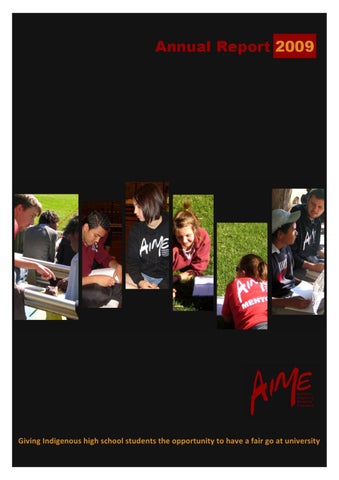
Annual Report 2009
Giving Indigenous high school students the opportunity to have a fair go at university
Contents Report from the CEO
1
2009 Highlights . . . From 2005 when AIME started with 25 Mentors and 25 Mentees, in 2009 AIME grew to more than 325 Mentees and 500 Mentors across 5 university campuses.
Report from the Chair of the AIME Board of Directors
3
Beyond the Numbers
5
From the People Involved
7
In 2009 2 Aboriginal students from AIME Sydney City became the first ever captains of their schools. One quarter of AIME Sydney City schools now have Aboriginal School Captains.
2009 AIME Outcomes
8
In 2009 the AIME Year 10 to Year 11 Progression rate was 81%, compared to the NSW rate of 59%. (see page 4)
Snap‐shot of Program Outcomes
9
In 2009 the AIME Year 12 completion rate was 73%, compared to a NSW rate of 60%. (see page 4)
Concise Financial Report
11
2009 Program Details
19
Community Partners
20
Thanks
21
Her Excellency, Professor Marie Bashir AC CVO, Governor of New South Wales becomes AIME’s Patron –in‐Chief Dr Chris Sarra, Executive Director, Indigenous Education Leadership Council, Queensland University of Technology becomes AIME’s Patron. We announce our future plans to take AIME around the nation.
The AIME Leadership Council is formed with Tom Calma, Ian Thorpe, Andrew Denton, The Hon Linda Burney, Greg Hutchinson, Professor Julianne Schultz, and Dr Chris Sarra as members. The first Strut the Streets fundraising event is held.
Our goals . . .
Contact Jack Manning Bancroft CEO Adam Linforth Director Partnering and Finance 160 George Street Redfern NSW 2016 T 02 9319 0439 F 02 9310 3139 www.aimementoring.com
To increase Year 10 completion rates of AIME students to greater than 90% in all participating schools (compared to the current baseline of 69% of Indigenous students nationally). To increase Year 12 completion rates of AIME students to greater than 75% in all participating schools (compared to the current baseline of 39% of Indigenous students nationally). To increase university admission rates of AIME students to 30% of those who complete Year 12 at participating schools (compared to a national university participation rate of 1.25%). By 2014 to be engaging 3,600 Indigenous high school students and 3,600 volunteer Mentors at universities in every state and territory of Australia.
The hardest years, the darkest years. . . these should not be forgotten years. . .
Jack Manning Bancroft in the Graffiti Tunnel at the University of Sydney – photographed for Boss Magazine 2009
Report from the CEO For the year ended 31 December 2009
It was the year we had to have. When reflecting on last year I am suddenly struck with some of the lyrics from the Midnight Oil track Forgotten Years: The hardest years, the darkest years . . . These should not be forgotten years. . . Etched in the memory are the challenges associated with rapid growth and a young relatively inexperienced management team. As we sat in the basement of a retail building of Sydney University, the loading dock and bin area as our only neighbours, there were moments when it was only human to think, “Can we pull this off?” From three staff we grew to thirteen. Systems were needed ‐ internal communication channels struggled and technology was our answer. Who would have thought technology wasn’t that simple. Getting a server was like trying to order a Big Mac in a vegetarian restaurant. Then our emails went down. Text messages didn’t work. Org charts were revised, strategies reviewed, we were doing everything at pace. But growing quickly also means you learn quickly. It was flight or fight. As we stood up to fight in ‘09 it felt like AIME was standing in the ring between Ali and Frazier in
Manila. But we didn’t go down. We didn’t make the same mistake twice. If the kids were going to step up to their challenges and walk with us, then we had no excuses. As Obama says “If you're walking down the right path and you're willing to keep walking, eventually you'll make progress.” Well we’re running down that path Mr President.
“
Our partners, our friends, our
mentors, our teachers and our families believe in our mission.
”
There are some bloody big boulders in the way and it hurts when you hit one. But every time we hit the ground one of you reading this report picked us up, patted us off and said, “Back you go”. Our partners, our friends, our mentors, our teachers and our families, believe in our mission. They have believed in our ability to change the nation and they have believed in our 1
Mentors’ and Mentees’ desire to lead this change. Change in 2009 included: Two Aboriginal students becoming the first ever Captains of their schools. Two AIME sites had 100% progression from Year 11 to Year 12 – the state average was 63%. In the first year of operation at two new sites we achieved 90% and 96% progression rates from Year 9 to Year 10 At our oldest site, AIME kids were 11 times more likely to go to university than other Indigenous kids in the state. And the list goes on and on. . .
“
My sister Ella Bancroft, the Program Manager at Sydney City in 2009, was one of those people. As we sat in the car park at Balmain in December 2008 I said to Ella, “El, I need you to take my place and run the Program at Sydney Uni.” She was 20 years old, mid‐way through a degree, and we both knew that she still had a lot of growing up to do. But these kids needed a role model ‐ a young Indigenous person who was ready to step up and show the way. She said “I’m in”. Ella stepped up because the situation needed it. Unsure and inexperienced, but passionate and driven, Ella shouldered the responsibility. Her role in 2009 left a legacy that saw 400 USyd students turn up to be involved in AIME in 2010. AIME’s journey is like Ella’s. Young, inexperienced and often lacking in the skills needed. Our will and desire is forcing us ahead. These kids are forcing us ahead, the Mentors are forcing us ahead and so are you. The nation deserves AIME to be something bigger for us all. And as I sit on the plane in 2010 I’m happy to say to you all, we are now ready to take on this responsibility.
Constantly at AIME, we see
people step up years before they are ready . . .
”
As I sit on the plane writing this report I look at the date, it’s the 19 April 2010. I’ve just finished the AIME training at Monash University and am flying to Brisbane to deliver our final training session for Mentors at QUT. I can’t help but think how far we’ve come. I know this has been because of the selfless attitude of so many and because of all the hard work that has been done before us. Constantly at AIME, we see people step up years before they are ready.
Jack Manning Bancroft CEO
The flow‐on effect of Ella’s work in 2009: 400 Sydney City university students queue up to be part of AIME in 2010
2
Report from the Chair of the AIME Board of Directors For the year ended 31 December 2009 Jack’s CEO report aptly reflects the boundless energy of the many people who support AIME. It is this enthusiasm, more than anything, which is enabling AIME to transform the educational opportunities of Indigenous kids across our nation. On behalf of the Board of Directors, I would like to thank all those who contributed to AIME during 2009. The journey thus far would not have been possible without them. • We are indebted to our young and vibrant staff, who have such a strong desire to learn and make a difference. Indeed, we all have much to learn from them. They have high standards and are being well led by Jack Manning Bancroft and his leadership team. Jack’s selection as NSW’s 2010 Young Australian of the Year reflects his own outstanding contribution to Australian society, but it is also reflective of AIME as a program of national significance (and I know Jack views the honour in that way.) • In 2009, we had 500 Mentors ‐ university students who are stepping outside their comfort zones to help those in need on a voluntary basis. They are the foot soldiers of this movement. The potential is limitless, as we have far more willing candidates than we currently have Mentees. • Our university partners – the University of Sydney, the University of Wollongong, Macquarie University (new in 2009) and Southern Cross University (also new in 2009) – make AIME’s work possible through their provision of financial support and infrastructure. They provide the hubs from which AIME’s programs are delivered. We believe that AIME is also helping them fulfil their purpose as “civic educators”. • Our high school partners, who numbered over 30 in 2009. They have allowed us to come alongside them to help Indigenous kids. • Social Ventures Australia, which selected AIME as one of its portfolio ventures in 2009, has played a central role in building AIME’s strategy and sustainability. We look forward to continuing to work with SVA over the next few years until we can truly “stand alone”. • Our many other contributors, who may donate money, provide facilities, provide advice, provide transport, and so much more.
Our auditor KPMG (who so kindly provides its services at no cost to AIME) has estimated the value of the “in‐kind” support given to AIME during 2009 at approximately $1.2 million. So a very BIG thank you to all!
“
. . . we have been stunned
already by the enthusiastic support of so many people . . .
”
2009 saw some significant changes at AIME: we have grown in terms of staff numbers and our geographic reach. Our systems and financial base have had to adapt to this growth, and I believe we now have a highly cost effective model for delivering our programs. It was a big year. Our Board has also had to increase their level of engagement so I would like to thank my fellow Directors for their contributions. We launched nationally during 2009 and 2010 has seen AIME expand into Victoria (to Monash University and RMIT) and Queensland (to QUT). We have been stunned already by the enthusiastic support of so many people in these locations, not least by the university students of whom – once again – there are many more willing candidates than we can accommodate.
We also launched our National Leadership Council in 2009, whose expertise and connections we will seek to further harness during 2010. Lastly, I would like to commend this Annual Report to all who read it. Within it you will read of the evidence‐based outcomes that are being achieved by AIME. These are tangible measures of how AIME is making a difference to Indigenous education. But there are other measures too. Such as the impact being made on our Mentors, most of whom are non‐Indigenous.
3
“
. . . we will never be able to fully
If you are already a supporter, then please keep walking with us. This is a grass roots movement which deserves all of our support. Its potential has no limit.
measure the hope that is being instilled in the hearts of our Indigenous children. . .
”
These young people are building one‐on‐one relationships with Indigenous kids and are going back to their homes and to their mates to say “we can all make a difference”, “we are in this together” and “these kids have aspirations just like you and me”. And we will never be able to fully measure the hope that is being instilled in the hearts of our Indigenous children – hope for a better education, for a better future, and for a better life. If you are not currently a supporter of AIME, I hope this annual report arouses your curiosity and perhaps you will seek to join us.
Geoff Lovell Chair
??
4
Beyond the Numbers From Mentee to Mentor
bowls. Naturally, a memorable photo of our first day was taken that morning. Of which (much to my horror), now takes pride of place on mum's fridge. The school year sped on and I found myself completely out of my depth. There was so much work to do and there didn't seem any time to do it. The teachers were supportive, but they didn't quite seem to comprehend the challenges that I was experiencing.
It's hard enough getting the motivation to continue on with your education and finish your HSC year. What's harder still, is being not only a part of the minority that does this, but also moving away from the comforts of home, family and friends to actually do it. After my brother's initial suggestion and my mum's total joy in getting me out of the house, this was exactly what happened. I pursued to end my school career in Sydney. A far cry from my small, but beautiful home town of Tweed Heads. 15 hours by bus and train and a few silent tears of farewell later, my mum and I arrived at my temporary home for the next two years of my life, Saint Scholastica's College (Schols). I wasn't sure which was more terrifying . . . the fact that I was now going to be a student of an all girls day and boarding college, (so cattiness was clearly going to be my new best friend) or that I was no longer going to be indulging in my mum's famous cooking (something that I definitely took for granted). As my mum and I walked up to the door of the boarding school, I was greeted warmly with both a smile and a hug off an almost complete stranger. I say almost, because I had only met the boarding school mistress once before during my interview.
“
them.
”
My work quality started to drop. And I was way too nervous and unsure to ask the teachers themselves for some extra help as, for some reason, I always pictured them as a pack of wolves (not in the literal sense of course), but they always seemed to be looking out for wandering students. Their pack‐like formation prepared for springing on the unsuspecting victim and their D‐ grade homework. But, I heard rumour of a group of mentors that were willing to give up their free time in order to help Indigenous students get back on track. One dark and gloomy day however, my saviours did arrive. Their red AIME shirts sticking out like a sore thumb had the preying wolves scampering in the other direction. These mentors and my saviours were closer to my age. They understood what I needed help with and instead of glaring at me when I asked a stupid question, I received smiles and reassurance.
mentors that were willing to give up their free time in order to help Indigenous students get back on
I don’t think I would have
achieved so much if it wasn’t for
I heard a rumour of a group of
track.
“
”
I knew no one. I knew nothing about the surrounding areas, and I'm completely and utterly hopeless at remembering names. (I was told close to 30 different names that day). Thankfully, the girls who had been there for a while befriended us so we didn't feel so alone and vulnerable in this new terrain. My first day of actual school, I donned the exceedingly fetching navy blue, knee‐length skirt, the Peter Pan collared, white blouse and the ankle socks that were longer than your average ankle socks with my lovely, sturdy black leather shoes. I felt more or less like an old woman getting ready for an intense match of lawn
5
Back to the AIME Mentors . . . they were a massive help to myself and the girls at Schols. I don't think I would have achieved so much if it wasn't for them. I finished my HSC in 2008. I bid my temporary home goodbye and returned to the gorgeously sunny beaches of the Gold Coast. AIME helped me in deciding where I wanted to study and I am proud to say that in 2009 as a student of the University of Sydney, I completed my first year of a combined Bachelor of Education and Bachelor of Arts degree. I want to be a high school teacher (that is hopefully more approachable). After achieving my goal of becoming a university student, in 2009 I decided to return the favour to AIME by becoming a Mentor to other students in the hope that I can help them the way that AIME helped me.
Their stories about their own misdemeanours and epic HSC mistakes made me relax, as they seemed more human. They could relate to us better as it wasn't that long ago that they were doing the HSC or equivalent themselves. That and most of them were still studying at university, so they knew all about time management and study skills that would benefit my overall performance. Not only did the AIME Mentors (my saviours in red) assist my school performance and help me once again improve my grades, they helped form a network between schools through out‐of‐school learning activities and events. Like the occasional highly educational footy game (Go the Bunnies all the way), or university "camps" in which we were able to stay on campus to allow us to see what it was like.
Zoe Betar AIME University Student Mentor
??
CALL TO ACTION AIME Mentors are at the core of what makes our Program possible. Without the time and expertise generously volunteered by the university students we work with AIME would not exist. For your opportunity to become a part of the educational revolution that is sweeping our nation and volunteer as an AIME Mentor in 2010 please go to: www.aimementoring.com/join
6
From the People Involved
“
AIME is a great program, I
“
I also think it’s a great way
“
AIME allows the students
really like it. It kind of made me
to bring people from different
to explore different facets of
believe in myself, and my
cultures together. It is just as
their identity and personality
Mentor was really nice. She
much an experience for the
in a culturally supportive
helped me out a lot.
Mentor as the Mentee. I believe
environment that promotes
it’s programs like these, that
risk taking.
start from the ground up, that
Teacher
”
Mentee
have the greatest chance of encouraging reconciliation.
”
”
Mentor
“
I would encourage schools
“
Many of these kids have
“
AIME is the best thing
to become involved in the
never had a positive experience
that has happened to our
program. It’s an exciting
with a non‐Indigenous person
school.
innovative program which will
before. This program is breaking
Principal
most certainly improve the
down cultural barriers on both
attendance, retention and
sides.
engagement of the Indigenous
Principal
students of the school.
”
”
Teacher
7
”
2009 AIME Outcomes The two thermometers below compare two classes of 40 Year 9 students. The hotter the thermometers, the more students there are progressing through school and into university. By using the National and NSW State average progression percentages for Indigenous students (on the left) with the average AIME progression percentages for 2009 (on the right) we can compare the hypothetical progression of non‐AIME students with AIME students. An AIME class will have more than double the amount of students complete Year 12 and approximately 7 times the amount progress to university. Imagine a class of 400... or 4000...
The program results below are in accordance with an independent examination conducted by AIME's auditors, KPMG.
National and NSW State Progression Indicators
AIME Outcomes for 2009
NSW Year 7‐10 retentions
81%
Year 9‐10 progressions
88%
NSW Year10‐11 progressions
59%
Year 10‐11 progressions
81%
NSW Year 11‐12 progressions
63%
Year 11‐12 progressions
92%
NSW Year 12 completions
60%
Year 12 completions
73%
1.25%
University admissions
38%
National university participation
8
Snap‐shot of Program Outcomes AIME Sites In 2009 the AIME Program was delivered at five university campuses in NSW: The University of Sydney Camperdown campus, The University of Sydney Cumberland Campus, Wollongong University, Macquarie University and Southern Cross University, Coffs Harbour campus. For new sites like AIME North Coast and North West Sydney we have provided snapshots, with a focus in the first year of operation on building a student base through our Year 9 and 10 programs. For AIME Western Sydney, we had logistical issues that made it harder to access the Year 11 and 12 students. Across the five AIME Sites there were thirty‐three schools engaged in the AIME Program with over three hundred and twenty five Indigenous high school students participating in AIME sessions in 2009. Below you will find AIME Program outcomes data for each site in 2009. For comparative purposes we have benchmarked against Student Progression rates statistics from The Report of the Review of Aboriginal Education p. 28 & 138‐1401. AIME Sydney City – University of Sydney, Camperdown campus Students working with AIME Sydney City in 2009 were significantly more likely to progress through their schooling when compared to other Indigenous students Nationally and across the NSW State. University admission rates – 11 times the National average‐ indicate what can be achieved when a student’s desire to succeed is fuelled by belief, in themself and by others. AIME Sydney City
New South Wales
Year 9 – 10 Progression
83%
81% (Year 7‐10 Progression)
Year 10 – 11 Progression
81%
59%
Year 11 – 12 Progression
88%
63%
Year 12 Completion
75%
60%
University Admission
33%
1.25% (National Participation Rate)
AIME North Coast – Southern Cross University, Coffs Harbour campus After only one year working in Coffs Harbour both the Year 9 – 10 Progressions and Year 10 – 11 Progressions were higher than the state average. One hundred percent of the AIME North Coast Year 11 students who participated in the AIME Program progressed on to Year 12. AIME North Coast
1
New South Wales
Year 9 – 10 Progression
96%
81% (Year 7‐10 Progression)
Year 10 – 11 Progression
71%
59%
Year 11 – 12 Progression
100%
63%
New South Wales Aboriginal Education Consultative Group Incorporated and New South Wales Department of Education and Training, The Report of the Review of Aboriginal Education. 2004, NSW Department of Education and Training and NSW Aboriginal Education Consultative Group Inc: Darlinghurst 9
AIME Wollongong – Wollongong University, Wollongong campus In its second year of Program delivery, Wollongong saw 100% completion rates for students undertaking their HSC as well as those progressing from Year 11 to 12 and for university admissions. Year 10 to Year 11 progressions are also a reflection of AIME’s efficacy. AIME Wollongong
New South Wales
Year 9 – 10 Progression
78%
81% (Year 7‐10 Progression)
Year 10 – 11 Progression
73%
59%
Year 11 – 12 Progression
100%
63%
Year 12 Completion
100%
60%
University Admission
100%
1.25 (National Participation Rate)
AIME North West Sydney – Macquarie University, North Ryde campus In its very first year of operation North West Sydney surpassed the NSW averages for Year 9 – 10 and Year 10 – 11 Progressions. AIME North West Sydney
New South Wales
Year 9 – 10 Progression
90%
81% (Year 7‐10 Progression)
Year 10 – 11 Progression
86%
59%
AIME Western Sydney – University of Sydney, Cumberland campus Despite the difficulties with the urban spread of students and schools across the area, Western Sydney achieved outstanding outcomes with the Program. AIME Western Sydney
New South Wales
Year 9 – 10 Progression
100%
81% (Year 7‐10 Progression)
Year 10 – 11 Progression
100%
59%
“
With the support and engagement of our partners and investors AIME will
continue to engage Indigenous students in positive educational experiences, and through these positive experiences AIME students will continue to succeed. Penelope Gillam, Director Research
10
”
CONCISE FINANCIAL REPORT For the year ended 31 December 2009 ABN 31 081 797 652 ICN 7040
Contents Directors Report
12
Statement of Comprehensive Income
16
Statement of Financial Position
16
Statement of Changes in Equity
17
Statement of Cash Flows
17
Notes
18
From the Finance Team . . . The ever‐increasing good stories on the ground at AIME have been accompanied by an increasing group of supporters. Our existing university partners continue to support AIME and the participation of hundreds of their students who volunteer as Mentors is key to the cost effectiveness of AIME. In fact over half of the support received by AIME in 2009 came in the form of in‐kind support! 2009 was the first year that we received contributions from both corporate partners and family foundations. Both of these groups have showed a strong interest in AIME, visiting our Program sessions and acting as a sounding board and source of ideas and energy. The Finance Team at AIME would also like to extend our thanks to KPMG, Shorrock & Partners, Social Ventures Australia and Frank Budai for the generous in‐kind support we receive. To all our valued supporters, thank you for walking with us.
??
???
11
Directors Report The Board of Directors of Australian Indigenous Mentoring Experience Indigenous Corporation (AIME) submits herewith the annual financial report of the corporation for the financial year ended 31 December 2009. In order to comply with the provisions of the Corporations (Aboriginal and Torres Strait Islander) Act 2006, the director’s report is as follows: Directors The names of the Directors throughout the year and at the date of this report are: Name
Position
Meetings Held
Meetings Attended
Maurice Shipp
Chair to 03/06/2009 and Director
7
2
Kerry Paul
Deputy Chair and Director
7
5
Bronwyn Bancroft
Director
7
7
Geoff Lovell
Chair from 03/06/2009 and Director
7
7
Jeff McMullen
Director
7
4
Philip Morrissey
Director
7
4
Larissa Behrendt
Director
4
0
Paul Chandler
Director
4
4
The above named Directors held office during the whole of the financial year and since the end of the financial year except for: Maurice Shipp – resigned as Chair 3 June 2009 and as Director 9 December 2009 Larissa Behrendt – appointed Director 3 June 2009 Paul Chandler – appointed Director 3 June 2009
Information about the Directors and senior management Geoff Lovell (Chair) Geoff is a Division Director of the Macquarie Group, based in Sydney, where he is currently responsible for various strategic initiatives across the Macquarie Capital Funds Group. Geoff has a Bachelor of Engineering with First Class Honours from the University of Sydney and a Master of Arts from the University of Oxford, where he was a Bradman Scholar. Geoff is a Member of the Australian Institute of Company Directors, a Fellow of St Paul's College at the University of Sydney and a Vice‐President of Sydney University Cricket Club. Kerry Paul (Deputy Chairman) Kerry has significant experience in consulting and large program/project management. Whilst a long‐term employee with AMP, her career has included consulting assignments in Australia, New Zealand and the UK, across a range of functions, but with her strength lying in applying contemporary IT solutions within the Financial Services sector of AMP. Bronwyn Bancroft (Director) Bronwyn is a descendant of the Djanbun clan of the Bundjalung nation. She works as an artist across many mediums. Over her 30 year career, Bronwyn has participated in more than 200 exhibitions, comprising of solo and group shows within Australia and overseas. Bronwyn has a Diploma of Visual Arts, two Masters degrees from the University of Sydney and is currently a Doctoral candidate at the University of Western Sydney.
12
Larissa Behrendt (Director) Prof. Larissa Behrendt is a Eualeyai/Kamillaroi woman. She is the Professor of Law and Director of Research at the Jumbunna Indigenous House of Learning at the University of Technology, Sydney and a practicing barrister. She has a Bachelor of Law and a Bachelor of Jurisprudence from the University of New South Wales and a Master of Laws and a Senior Doctorate of Jurisprudence from Harvard Law School. Larissa is a Board Member of the Museum of Contemporary Art and a Director of the Bangarra Dance Theatre. Paul Chandler (Director) Paul started his education career in 1987 teaching science and mathematics in his local community at Matraville High School. He pursued a Master of Science in Psychology and PhD in Education at UNSW and in 1992 he became the first academic (Aboriginal or Non‐Aboriginal) from education to ever receive an Australian Research Council post‐ doctoral research fellowship. Today, Paul is regarded as an international expert in cognition and learning and currently is the most cited educational researcher appointed at any Australian University. Jeff McMullen (Director) Throughout his professional life as a journalist Jeff McMullen has worked on a great many humanitarian projects. Jeff is also CEO of Ian Thorpe's Fountain for Youth. Jeff has a Bachelor of Arts (Macquarie), Hon Doctorate Journalism (CQU), Hon Doctorate Letters (Newcastle) and Hon Doctorate Letters (Macquarie). Philip Morrissey (Director) Philip Morrissey teaches in the School of Culture and Communication in the Faculty of Arts at the University of Melbourne. He is currently the Academic Coordinator of the Australian Indigenous Studies program in the Faculty of Arts. Deborah Kirby-Parsons (Secretary) Deborah has been working with AIME since 2008 and is currently the Systems Manager. Prior to this Deborah provided administrative support to the Executive at the Koori Centre at the University of Sydney and was Secretary to the Board of Studies (Indigenous Studies) and the Policy Advisory Group, both at the University. Deborah has a BVA and Grad Dip (Vis Art) from the University of Sydney.
Principal Activities AIME is an Indigenous Corporation, and a not‐for‐profit organisation with the objective of providing a six‐year mentoring program for Indigenous Australian students to access while undertaking their high school studies from Year 7 through to Year 12. AIME partners university student volunteers in a one‐on‐one mentoring relationship with a high school Indigenous student, for an hour a week over the course of a 17‐week program. AIME's goals are to improve Year 10 completion rates, Year 12 completion rates and university admission rates for all participating students. Apart from the impact AIME is having on Indigenous high school students, it offers a significant opportunity for Indigenous and non‐ Indigenous university students to gain invaluable experience working with Indigenous high school students, and offers a great base for university marketing and recruitment with AIME facilitating the development of long‐term partnerships between local high schools and the university. Operating Results The operating surplus of the corporation for the financial year amounted to $327,497 (2008: surplus of $107,916). No income tax is payable as the corporation is exempt from income tax.
13
Review of Operations Since the end of the previous financial year, the corporation has engaged in its principal activity, the results of which are disclosed in the attached financial statements. Subsequent Events No matter has arisen since the end of the year that will or may significantly affect the operations of the corporation, the results of those operations, or the state of affairs of the corporation in future financial years. Changes in State of Affairs There was no significant change in the state of affairs of the corporation during the financial year. Future Developments The corporation expects to maintain the present status and level of operations and the future developments as detailed above as subsequent events which will have a significant impact on the corporation’s operations. The corporation expects to achieve profitable operations in the current financial year. The corporation expects its results and expansion to be further underpinned by partnerships with other universities. Environmental Regulations The corporation’s operations are not regulated by any significant environmental regulation under a law of the Commonwealth or of a State or Territory. Distributions Paid or Recommended No distributions were paid or declared since the start of the financial year as the corporation’s constitution does not permit payment of distributions. In-Kind Support The Corporation was supported by many organisations offering in‐kind support to ensure the success of the mentoring program and AIME as an organisation. It is estimated that the value of this in‐kind support is approximately $1.2 million. The following organisations have donated their time and services to AIME during the course of the financial year: University volunteers
Professional mentors
Teacher relief
Schools have provided student transport, teacher relief and facilities for AIME Learning Centres
Our University Partners have provided venues for the Program
Corporate governance through our Board of Directors
Strategic advice by Social Ventures Australia
National Leadership Council
Website advice by FiveStarStuff
Finance and accounting support by Frank Budai and Shorrock Partners
Advertising space through SBS and Foxtel
Audit services by KPMG Sydney
Legal services by Baker & Mackenzie
Textbooks from the Co‐op Bookshop
National Launch venue provided by Macquarie Group
Human Resources support provided by Ros Morgan and Morgan and Banks
14
Indemnification of Officer of Auditor The corporation has not, during or since the end of the financial year, in respect of any person who is or has been an officer or auditor of the corporation or a related body corporate: ‐ indemnified or made any relevant agreement for indemnifying against a liability, including costs and expenses in successfully defending legal proceedings; or ‐ paid a premium in respect of a contract insuring against liability for the costs or expenses to defend legal proceedings. Proceedings on Behalf of the Corporation No person has applied for leave of Court to bring proceedings on behalf of the corporation or intervene in any proceedings to which the corporation is a party for the purpose of taking responsibility on behalf of the corporation for all or any part of those proceedings. The corporation was not a party to such proceedings during the financial year. Signed in accordance with a resolution of the Board of Directors: Chair
Geoff Lovell Dated:
27 April 2010
Children of the Future We are the children of the future we choose our own destiny. We need to respect ourselves just as much as we respect our Elders. They have so much wisdom to share with us and guide us with the choices we make. Our culture is one of a kind and it needs to stay alive through us. You’re on a journey to experience everything life has to offer so don’t waste it or take it for granted. To become Elders you have to know about your history and your culture. Take what you have learnt to help shape your destiny. Text: Year 9 Mentee Artwork 2009
15
STATEMENT OF COMPREHENSIVE INCOME For the year ended 31 December 2009
Note
2009
$
2008
$
Revenue
1
1,405,187
170,861
Employee benefits expense
(899,505)
(57,655)
Depreciation expense
(15,364)
Other expenses
(162,821)
(5,290)
Surplus before income tax expense
327,497
107,916
Income tax expense
‐
‐
Surplus for the period
327,497
107,916
Other comprehensive income Total comprehensive income surplus for the period
‐ ‐
327,497
107,916
2009
2008
$
$
‐
STATEMENT OF FINANCIAL POSITION As at 31 December 2009
ASSETS
CURRENT ASSETS
Cash and cash equivalents
476,159
129,773
Trade and other receivables
3,631
‐
TOTAL CURRENT ASSETS
479,790
129,773
NON‐CURRENT ASSETS
Property, plant and equipment
26,701
‐
TOTAL NON‐CURRENT ASSETS
26,701
‐
TOTAL ASSETS
506,491
LIABILITIES
CURRENT LIABILITIES
Trade and other payables
52,865
21,857
Employee entitlements
18,213
‐
TOTAL CURRENT LIABILITIES
71,078
21,857
TOTAL LIABILITIES
71,078
21,857
NET ASSETS
435,413
129,773
107,916
EQUITY
Retained earnings
435,413
107,916
TOTAL EQUITY
435,413
107,916
The accompanying notes form part of these financial statements. 16
STATEMENT OF CHANGES IN EQUITY For the year ended 31 December 2009
Retained Earnings $
Total $
Balance at date of incorporation
‐
‐
Surplus attributable to members
107,916
107,916
Balance at 31 December 2008
107,916
107,916
Surplus attributable to members
327,497
327,497
Balance at 31 December 2009
435,413
435,413
STATEMENT OF CASH FLOWS For the year ended 31 December 2009
2009
2008
$
$
Cash flows from operating activities:
Receipts from customers
1,458,184
181,796
Payments to suppliers, employees and others
(1,075,392)
(52,500)
382,792
129,296
Net cash provided by operating activities
Cash flows from investing activities:
Payments for property, plant and equipment
(42,065)
‐
Interest received
5,659
477
(36,406)
477
Net cash provided by/(used in) investing activities Net cash provided by/(used in) financing activities
‐
‐
346,386
129,773
Cash at beginning of financial year
129,773
‐
Cash at end of financial year
476,159
129,773
Net increase in cash held
The accompanying notes form part of these financial statements. 17
NOTES TO THE FINANCIAL STATEMENTS For the year ended 31 December 2009 Note 1: Revenue 2009 University partners and fees for services rendered
2008
$
$
533,650
116,400
Donations
256,597
28,983
Social Ventures Australia
240,000
‐
Corporate partnerships
174,000
25,000
Bequests
187,000
‐
Interest received
5,659
478
Other
8,281
‐
1,405,187
170,861
For a copy of the full 2009 Financial Report audited by KPMG please contact: enquiries@aimementoring.com
“
All you need is desire . . . Desire to see change, desire to make it happen, desire to
give these kids the chance they deserve, the desire to give Australia the chance to
”
connect and move forward as one. Jack Manning Bancroft, CEO
18
2009 Program Details Indigenous high school student Mentees: 325
University student volunteer Mentors: 500
Partner high schools: Alexandria Park Community School
Orara High School
Bass High School
Pymble Ladies’ College
Bishop Druitt College
Quakers Hill High School
Blacktown Girls High School
Riverside Girls High School
Coffs Harbour High School
Riverstone High School
Coffs Harbour Senior College
Seven Hills High School
Dapto High School
St Andrews Cathedral School
Doonside Technology High School
St Scholastica’s College
Dulwich High School of Visual Arts and Design
Sydney Secondary College: Balmain High Campus
Hunter’s Hill High School
Sydney Secondary College: Blackwattle Bay Campus
Illawarra Sports High School
Sydney Secondary College: Leichardt High Campus
Kanahooka High School
Tempe High School
Liverpool Boys High School
Toormina High School
Mitchell High School
Warilla High School
Muirfield High School
Wollongong High School of the Performing Arts
Newtown High School of Performing Arts
Woolgoolga High School
Northmead High School
Partner universities:
19
Community Partners for 2009 included:
We would also like to acknowledge the generous support of all of our Donors in 2009. 20
Thank you All of the staff at AIME would like to extend our thanks to everyone who engaged with AIME in 2009. Without your support and belief in the AIME Program, what we do and how we do it would not be possible. AIME is looking forward to your continued support in 2010.
Keep walking with us
“
It was late at night in October of 2009 when the AIME Office phone began to ring. I
had the privilege of answering a call from an elated mother who wanted to pass on to the AIME Team that her daughter had just been named the first Aboriginal School Captain in the history of her high school! The pride and joy on the other end of the phone line has stayed with me to this day.
”
Adam Linforth, Director Partnering and Finance
21