January 22–25, 2026
ART SG Stand BC11
ART MUMBAI
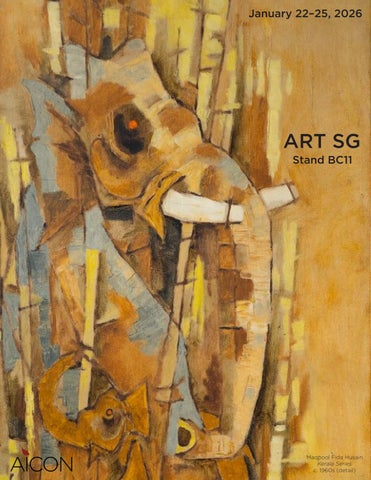
Maqbool Fida Husain Kerala Series c. 1960s (detail)
MODERN Maqbool Fida Husain Sayed Haider Raza Francis Newton Souza Sadanand Bakre Mohan Samant Lancelot Ribeiro Achuthan Kudallur Allah Bux Jamini Roy
CONTEMPORARY Paresh Maity Salman Toor Victor Ekpuk Sneha Shrestha (aka IMAGINE) Safdar Ali Qureshi Sheetal Gattani Purvai Rai
STAND BC11 Marina Bay Sands Expo and Convention Centre VIP PREVIEW January 22, 2 - 9 pm GENERAL PUBLIC January 23, 12 - 7 pm January 24, 11 am - 7 pm January 25, 11 am - 6 pm
MAQBOOL FIDA HUSAIN
MAQBOOL FIDA HUSAIN (b. Pandharpur, 1915; d. London, 2011) was widely regarded as the “Picasso of India” and is arguably the most recognizable figure of modern and contemporary Indian art. Self-taught, Husain moved to Mumbai at an early age and began his artistic career by painting the billboards for cinemas. Husain became associated with Indian modernism in the 1940s. His narrative paintings, executed in a modified Cubist style, can be caustic and funny as well as somber. His themes—usually treated in series— also include hallmarks of Indian culture and history, such as the Ramayana, the Mahabharata, the British Empire, and motifs of Indian urban and rural life. One of the most celebrated and internationally recognized Indian artists of the 20th century, he also received recognition as a printmaker, photographer, and filmmaker. In 2025, Husain’s Gram Yatra (1954) became the world record holder for a South Asian modern artist at auction.
4
MAQBOOL FIDA HUSAIN Kerala Series, c. 1960s Oil on canvas 49 ⅕ x 25 ½ in 125 x 64.8 cm POA PROVENANCE Directly from the Artist, to Important Private Collection, New Delhi Private Collection, New York EXHIBITIONS New Delhi, Akar Prakar, Masterstrokes—M. F. Husain, September 2025 New Delhi & Mumbai, DAG, Husain: The Timeless Modernist, 26 October – 14 December 2024 & 7 March – 25 April 2025 HUSMF468
5
This striking painting belongs to M. F. Husain’s Kerala series, created after his travels through the region. During this period, Husain absorbed Kerala’s rich cultural tapestry—its lush tropical landscape, folk rituals, elephants, tigers, Kathakali dance, drummers, and temple traditions—and reimagined them in his bold, modernist idiom. Husain’s use of flat, bold color planes and jagged outlines infuses the work with modernist abstraction, while the palette—earthy ochres, muted yellows, and warm browns—evokes the natural tones of Kerala’s forests. The painting conveys a sense of serenity and cultural richness, with the elephants symbolizing heritage and continuity. The layering and rhythmic repetition of shapes create a feeling of movement—almost like a festival procession seen through memory or haze. It is a textural, abstracted homage to Kerala, where Husain captures the essence of the region not through literal depiction but through symbolic form, color, and structure.
6
MAQBOOL FIDA HUSAIN Hamburg, 1975 Ink on paper 9 1/2 x 6 ⅝ in 24.1 x 16.8 cm $20,000 NOTES Signed, titled and dated ‘Hamburg / Husain / 75’ (lower right). PROVENANCE Chester and Davida Herwitz Collection Private Collection, New York HUSMF132 7
MAQBOOL FIDA HUSAIN Banares, 1961 Ink on paper 7 ⅛ x 10 ⅞ in 18.1 x 27.6 cm $35,000 NOTES Signed and dated ‘Husain / '61’ (lower right). PROVENANCE Chester and Davida Herwitz Collection Private Collection, New York HUSMF136 8
Aicon, Husain + Herwitz, A Beautiful Friendship, 10 October – 15 November 2025 Photography by Sebastian Bach
This fall, Aicon celebrated the friendship between M. F. Husain and Chester & Davida Herwitz in a landmark exhibition of the record-breaking Indian modernist. Chester & Davida Herwitz first met Husain during business trips to India in the 1960s. It was on one such trip that they encountered his seminal painting, Zameen (1955), at the National Gallery of Modern Art in New Delhi. Their initial encounter blossomed into something more, with Husain introducing them to other Indian artists and artists’ groups. The relationship they had with Husain was instrumental in the Herwitzes’ decision to focus on and collect Indian art, which they did for over two decades, amassing the finest collection of Indian modern art in the process. They collected no one more than Husain himself: “People often ask me why I have so many Husains. It has to do with the continuing vision of the artist. And what has Husain not done! From ’66 till this day I see him as a one-man happening.” —Chester Herwitz (R. Shahani, “An Indian frame of reference,” The Sunday Times of India, 5 February 1995) In the simplest of terms, the friendship of artist and patron allowed Husain to be a pioneering figure, merging Western modernist techniques with themes from India’s epic historical and mythological texts, along with its ongoing struggle for an independent modern identity and stability in a post-colonial world. South Asian modern art would not have been the same without this relationship.
9
MAQBOOL FIDA HUSAIN Untitled (Piano Chair Military Man), n/d Ink on paper 5 ½ x 3 ⅛ in 14 x 7.9 cm $15,000 NOTES Signed ‘Husain’ (lower right). PROVENANCE Chester and Davida Herwitz Collection Private Collection, New York HUSMF091 10
SAYED HAIDER RAZA
SAYED HAIDER RAZA (b. Madhya Pradesh, 1922; d. New Delhi, 2016) began painting in the early 1940s in India, and after this beginning, Raza’s subject, style, and technique evolved in distinct stages through his migration to France, his interaction with Abstract Expressionism through the 1950s and 1960s, and his return to a core Indian aesthetic philosophy in the 1970s. These periods of Raza’s work, though distinct, form a continuum—one that is a testament to the artist’s constant negotiation to develop his painterly vision. Breaking away from frames like nation and specific locations in time and space, Raza’s body of work is trans-cultural in its appeal. He was a member of the Progressive Artists’ Group along with F. N. Souza, Ram Kumar, and M. F. Husain. Although the Group disbanded in 1956, its leading artists continued to cultivate their individual styles and to this day remain an influence and inspiration for generations of contemporary South Asian artists.
12
SAYED HAIDER RAZA Valley, 2006 Acrylic on canvas 40 x 20 in 101.6 x 50.8 cm POA NOTES Signed and dated ‘Raza 06’ (lower right). Further signed, dated and inscribed 'RAZA / 2006 / ''Valley''' (verso). PROVENANCE Saffronart, 24-Hour Absolute Auction, 18-19 January 2012, Mumbai, Lot 6 Private Collection, UK RAZSH121 13
Painted in 2006, Valley exemplifies Sayed Haider Raza’s late period of geometric abstraction, a phase in which landscape, memory, and metaphysical inquiry converge within a highly disciplined visual language. By the early 2000s, Raza had arrived at a mature synthesis of form and philosophy, shaped by his long engagement with European modernism and his sustained exploration of Indian cosmology, particularly concepts of balance, origin, and spiritual energy. In this period, the landscape ceases to be descriptive and instead becomes a symbolic structure—an inner terrain articulated through geometry and color. The composition of Valley is organized around a powerful inverted triangular form that anchors the lower half of the canvas. This recurring motif in Raza’s late work functions both as a stabilizing force and as a metaphysical signifier, evoking sacred geometry and the elemental energies of the earth. The triangle draws the viewer inward, creating a sense of gravity and contemplation, while also serving as a formal counterpoint to the layered bands above. These horizontal registers unfold in richly modulated blues, greens, and earthy tones, interspersed with gestural passages that hint at foliage, water, and atmospheric movement. Rather than depicting a specific place, Raza abstracts the essence of a valley into rhythmic strata that suggest geological depth and cosmic order. The dynamic interplay between gestural brushwork and sharply defined geometric forms underscores the tension between intuition and structure. Color, as always, plays a central symbolic role. Deep blues convey introspection and infinity, while greens and yellows evoke growth, vitality, and renewal. Together, they establish a chromatic harmony that reinforces the painting’s meditative quality. Valley stands as a compelling example of Raza’s 2000s output, in which the landscape is transformed into a timeless, universal geometry— an expression of both the physical world and the spiritual forces that animate it.
14
FRANCIS NEWTON SOUZA
FRANCIS NEWTON SOUZA’s (b. Goa, 1924; d. Mumbai, 2002) works drew inspiration from the folk art of his native Goa alongside various European sources such as the full-blooded paintings of the Renaissance, landscapes of the 18th and 19th centuries, and the dynamism of Cubist composition. As one of the founders of the Progressive Artists’ Group in 1947—along with M. F. Husain, S. H. Raza, and others—Souza led the charge of the Indian modernist art movement. He was the only Indian artist to be included in Tate Modern’s group exhibition on 20th century modernism in 2002. An iconoclast known for his powerful and provocative imagery, Souza’s unrestrained and graphic style was a source of controversy in both his art and life. His repertoire covered still life, landscape, nudes and icons of Christianity, boldly rendered in a frenzied distortion of form. Souza’s paintings express defiance and impatience with convention and the banality of everyday life. Aicon celebrated the centenary of his birth in 2024 with a solo exhibition of works from 1947 through 1989 at our New York gallery.
16
FRANCIS NEWTON SOUZA Untitled (Man with Bulging Eyes), 1952 Ink on paper 22 x 18 in 55.9 x 45.7 cm $25,000 NOTES Signed and dated 'Souza 52' (upper left). PROVENANCE Private Collection, Washington SOUFN091
17
FRANCIS NEWTON SOUZA Untitled (Nude Drawing), 1950 Ink on paper 10 x 8 in 25.4 x 20.3 cm $20,000 PROVENANCE Private Collection, New York Private Collection, Washington SOUFN090
18
SADANAND BAKRE
SADANAND BAKRE (b. Baroda, 1920; d. Murud, 2007) was a pioneering modernist and the only sculptor among the founding members of the Progressive Artists’ Group. Trained in Academic Realism at the Sir J. J. School of Art, where he received a diploma in sculpture in 1944, Bakre was recognized early for his mastery of modeling and casting. Encouraged by critic Rudy von Leyden, he soon moved beyond academic convention to engage with international modernist currents, developing a vocabulary that traversed figuration, abstraction, and structural experimentation. His paintings and sculptures of the 1960s reveal a distinct shift from spiky, dynamic forms toward refined, simplified structures, marking his mature idiom. Bakre held exhibitions across India and Europe before eventually returning to the Konkan coast in the 1980s. Though often considered a reclusive figure, he left a lasting legacy as one of India’s foremost artist-innovators, whose contributions to both sculpture and painting expanded the language of modernism in postIndependence India.
20
SADANAND BAKRE Portrait, 1959 Oil on Masonite board 36 x 23 ¾ in 91.4 x 60.3 cm NFS NOTES Signed ‘BAKRE’ and dated in Devanagari (lower right); signed and inscribed ‘‘S.K. BAKRE’ / 27ST HELENS GDNS / W.10 / “PORTRAIT”’ (on verso). PROVENANCE Gifted by the artist to Mr. Absalom Peters*, London, 1970s Thence by descent Saffronart, Winter Live Auction, 13 December 2023, New York, Lot 228 Private Collection, New York *Mr. Peters was a friend of the artist. For a short time in the 1970s, they shared a flat in London where the artist used the back bedroom as a studio. Bakre gifted this work to Mr. Peters upon returning to India permanently. BAKSA001
21
I paint as I like. It is a compelling passion with me to keep alive and I cannot help painting or sculpting. — Sadanand Bakre
Sadanand Bakre was one of the founding members of the Bombay Progressive Artists’ Group alongside K. H. Ara, S. H. Raza, F. N. Souza, M. F. Husain and H. A. Gade. In 1939, he joined the J. J. School of Art in Bombay where he formally trained as a sculptor. He was mentored in modernism by Charles Garrard, the then head of the institution, and was first introduced to European and American modernist masters by Rudi von Leyden, Emmanuel Schlesinger, and Wayne Hartwell. His association with the Progressive Artists’ Group, which sought to reassert Indian art within an international framework, drove his own artistic trajectory. He participated in their early shows and by the late 1940s, developed a style characterized by “free- flowing form and unconventional shapes” (Yashodhara Dalmia, “The View from the Wings,” The Making of Modern Indian Art, New Delhi: Oxford University Press, pp. 190-191). Like his contemporary Souza, Bakre moved to England in 1950 with fellow artist Laxman Pai. It was here that he took up painting, often exhibiting his works with others at Hyde Park to earn a living. Though trained in academic realism, like many of his peers, he broke away from convention and favored abstraction instead. He remarked, “I am traditionally trained and perfectly capable of accomplishing completely realistic work. But my interest in forms has gone far beyond the dull imitations of subject matter, which to me is almost unimportant” (S. K. Bakre, “All Art is Either Good or Bad,” Free Press Bulletin, 24 March, 1965). Bakre’s paintings from this period appear as extensions of his sculptures. By the time Portrait was made, in 1959, he had arrived at what art historian Yashodhara Dalmia terms his “spiky phase” in which he created “small triangles wedged into each other to create geometrical shapes that reached out aggressively from all sides.” Delineated with strong, bold lines, Portrait underlines Bakre’s skill as both a draughtsman and a colorist and recalls the advice Garrard once gave him—“Make a sharp line. Whatever line you make, make it masterly, give it life” (Dalmia, p. 189). Its angular, geometric forms were likely inspired by the Vorticists whom he was greatly influenced by. The members of the group “were known for their anti-realist character and they expressed the human figure and its surroundings in a jagged, rhythmical, and linear style verging on total abstraction. The vigor and energy of modern life was shown in taut, expressive forms that favored the angular over the curved, the hard over the soft, and the precise over the undefined” (Dalmia, p. 195).
22
MOHAN SAMANT
MOHAN SAMANT (b. Bombay, 1924; d. New York City, 2004) was an early Indian modernist painter and a member of the Progressive Artists’ Group (PAG). He received his diploma from the Sir JJ School of Art in 1952. Samant had several solo shows with his New York representative, World House Galleries, and was included in major group exhibitions such as the Venice Biennale (1956), the touring Trends in Contemporary Painting From India (1959-60), Contemporary Indian Painting 1973 (1973, Renwick Gallery, Washington, D.C.), Contemporary Indian Art (1982, Royal Academy of Arts, London, UK), and The Progressive Revolution (2019, Asia Society, New York). In addition to his art practice, Samant was a skilled musician who favored the sarangi (an Indian bowed instrument). He often held concerts in his Flatiron loft with his wife, musician Jillian Samant. Samant’s artworks are held in prestigious collections including the Hirshhorn Museum (Washington, D.C.), Museum of Modern Art (New York, NY), National Gallery of Modern Art (Mumbai, India), Picker Art Gallery (Colgate University, NY), Tate (London, UK), and The Metropolitan Museum of Art (New York, NY).
24
MOHAN SAMANT A Man of the Town, 2002 Acrylic and watercolor on paper 40 x 35 in 101.6 x 88.9 cm $80,000 PROVENANCE Directly from the Artist’s Estate LITERATURE M. Sirhandi, J. Wechsler & R. Hoskote, Mohan Samant: Paintings (Volume I), Ahmedabad: Mapin Publishing, 2013, pages 287 & 479. SAMMO031 25
MOHAN SAMANT Angelica, 1996 Watercolor on paper 48 x 36 in 121.9 x 91.4 cm $90,000 PROVENANCE Directly from the Artist’s Estate LITERATURE M. Sirhandi, J. Wechsler & R. Hoskote, Mohan Samant: Paintings (Volume I), Ahmedabad: Mapin Publishing, 2013, pages 131 & 469. SAMMO032 26
LANCELOT RIBEIRO
LANCELOT RIBEIRO (b. Bombay, 1933; d. London, 2010) was born into a Roman Catholic family from Goa and was the younger half-brother of F.N. Souza, with whom he shared a close bond. From a young age, Ribeiro observed his brother’s rise in the Progressive Artists’ Group, often welcoming its members at their family home. Educated at St. Xavier’s in Mumbai, he later described his turbulent experience at St. Mary’s Catholic School in Rajasthan as the beginning of his journey as an artist. At sixteen, he followed Souza to Britain, initially studying accountancy while staying with his brother’s family in London. In 1963, Ribeiro co-founded the Indian Painters Collective, which evolved into Indian Artists UK (IAUK) in 1988, championing Indian artists in Britain. Throughout his career, Ribeiro held nearly 70 exhibitions worldwide, including notable shows with his brother, such as The Arts of India (1966) and Five Indian Artists (1976). His retrospective at Leicester’s Museum & Art Gallery in 1986 marked a major solo milestone. His final show in India, held in 1998, marked a symbolic return 30 years after he had left the country.
28
LANCELOT RIBEIRO Divinity, 1968 Oil, polyvinyl acetate and metallic pen on canvas 60 x 31 ⅞ in 152.5 x 81 cm $70,000 NOTES Signed, titled and dated ‘Divinity / Ribeiro 68’ (lower left). PROVENANCE Directly from the Artist’s Estate LITERATURE Restless Ribeiro: An Indian Artist in Britain, Bangkok: River Books Co., 2013, page 51. RIBLA018
29
LANCELOT RIBEIRO Untitled (Erotic Piece), 1968 Polyvinyl acetate on canvas 53 ⅙ x 33 in 135 x 83.7 cm $75,000 NOTES Dated '68 June' (upper left). Label affixed (verso). Inscribed ‘42 x 32.5’ (verso). PROVENANCE Directly from the Artist’s Estate RIBLA010
30
Lancelot Ribeiro, Requiem, Aicon, New York, August 15 - September 21, 2024. Photography by Sebastian Bach.
31
LANCELOT RIBEIRO St Francis of Assisi (Psychedelic Man Series), 1968 Polyvinyl acetate on PVA-based canvas 31 ⅓ x 22 ⅚ in 79.5 x 58 cm $30,000 NOTES Signed and dated ‘Ribeiro 68’ (upper left). PROVENANCE Directly from the Artist’s Estate RIBLA015
32
LANCELOT RIBEIRO Knight of the Grail (Psychedelic Man Series), 1968 Polyvinyl acetate on PVA-based canvas 31 ⅔ x 24 in 80.5 x 61 cm $30,000 NOTES Signed and dated ‘Ribeiro 68’ (upper left). PROVENANCE Directly from the Artist’s Estate RIBLA014
33
LANCELOT RIBEIRO The Juggler (Psychedelic Man Series), 1968 Oil and polyvinyl acetate on canvas 30 ⅔ x 23 in 78 x 58.5 cm $30,000 NOTES Signed and dated ‘Ribeiro 68’ (upper left). PROVENANCE Directly from the Artist’s Estate RIBLA013
34
ACHUTHAN KUDALLUR
ACHUTHAN KUDALLUR (b. Kerala, 1945; d. Chennai, 2022) became a prominent figure in the Madras Art Movement after joining the famed Arts Club in the 1970s at the behest of his friend Mohan Rao. What Kudallur would find at the Madras Arts Club was an outlet for his creative spirit that had been dulled by an education in engineering. Before engineering and before Madras, Kudallur dreamed of being a writer so he took classes with the goal of illustrating his stories. Instead, he found a love for painting that became the central focus of his life. He continued to work as a civil engineer in public works in Chennai until he could sustain himself as an artist. He had several solo exhibitions in India, and participated in international exhibitions in France, Czech Republic, and London. His works were shown at the Bhopal Biennale (1991 and 1998), the Seventh Triennial in Delhi (1991) and the 3rd Asian Art Show at Fukuoka, Japan. He won the Tamil Nadu Lalit Kala Akademi award in 1982 and the National Academy Award in 1988. Kudallur’s paintings can be found in prestigious public and corporate collections throughout India, and have been acquired by the Glenbarra Art Museum (Japan) and the National Gallery of Modern Art (New Delhi).
36
ACHUTHAN KUDALLUR Untitled, c. 1990s Oil on canvas 59 x 35 in 149.9 x 88.9 cm $45,000 PROVENANCE Directly from the Artist’s Estate KUDAC032
37
ACHUTHAN KUDALLUR Untitled, c. 2000s Oil on canvas 49 ⅗ x 45 ⅞ in 126 x 116.5 cm $50,000 PROVENANCE Directly from the Artist’s Estate KUDAC022
38
ACHUTHAN KUDALLUR Untitled, c. 1975 Oil on canvas 20 ⅞ x 30 in 53 x 76.2 cm $15,000 PROVENANCE Directly from the Artist’s Estate KUDAC030
39
Achuthan Kudallur, A Cloud of Flowers, Aicon, New York, May 23 - June 29, 2024. Photography by Sebastian Bach.
40
ACHUTHAN KUDALLUR Untitled, c. 1975 Oil on canvas 35 ⅚ x 34 ½ in 91 x 87.5 cm $20,000 PROVENANCE Directly from the Artist’s Estate KUDAC029
41
ALLAH BUX
ALLAH BUX (b. Punjab, c. 1895; d. Lahore, 1978) was a leading painter of the Indo-Western academic tradition in South Asia. Trained outside formal academies, Bux nevertheless mastered Western academic realism, primarily working in oil on canvas, while also demonstrating remarkable facility with pen and ink, tempera, and watercolour. Deeply influenced by colonial artistic conventions introduced in the eighteenth century, Bux developed a lyrical, romantic style that drew equally from European painting and local cultural traditions. His subjects ranged from Hindu mythological scenes—particularly numerous depictions of Krishna—to Punjabi village life, pastoral landscapes, and folk narratives. These works are distinguished by meticulous detailing, subtle modulation of light, and an evocative treatment of textiles, jewellery, and natural surroundings. In 1919, Bux moved to Lahore, where he quickly gained acclaim and was bestowed the honorific “Ustad” in recognition of his mastery. Choosing to remain in Lahore after Partition, he continued to paint idyllic landscapes and scenes of everyday life, leaving behind a body of work that captures a region and visual culture in transition.
43
ALLAH BUX Untitled (Potato Harvest), 1968 Oil on canvas 34 x 54 in 86.4 x 137.2 cm POA NOTES Signed and dated 'allah bux / 1968' (lower right). PROVENANCE Directly from the Artist to Salman Khaliq in Lahore, 1976 Bonhams, Art of Pakistan, 24 May 2017, London, Lot 1 Private Collection, North America Christie's, South Asian Modern + Contemporary Art, 20 March 2024, New York, Lot 685 Private Collection, Singapore BUXAL001
44
JAMINI ROY
JAMINI ROY (b. West Bengal, 1887; d. Kolkata, 1972) began his career by painting landscapes and portraits in a post-Impressionist style, keeping with his training in a British academic system. Yet, by 1925, Roy had begun experimenting along the lines of popular bazaar paintings sold outside the Kalighat temple in Kolkata. By the early 1930s, Roy started incorporating indigenous materials in his paintings, using woven mats, cloth, and wood coated in lime. The resulting mosaic-like surface from painting on woven mats was inspired by the textures of Byzantine art, which the artist had seen in color photographs. The Santhals, tribal people who live in the rural districts of Bengal, were an important subject and source of inspiration for Roy. He fused the minimal brush strokes of the Kalighat style with elements of tribal art from Bengal (like the Bishnupur temple with its elaborate terracotta portals and exterior walls). The mother and child, Radha, and animals were painted in simple two-dimensional forms, with flat color application and an emphasis on line. Through his rejection of the then-modern style of painting and his foray into the realm of Bengali folk painting, Roy marked a new beginning in the history of Indian modern art.
46
JAMINI ROY Cat, n/d Tempera on paper 12 ½ x 10 in 31.8 x 25.4 cm $20,000 NOTES Signed in Bengali (lower right). PROVENANCE Private Collection, New Jersey ROYJA127
47
JAMINI ROY Ramayan Series, n/d Tempera on card 17 ¼ x 39 ½ in 43.8 x 100.3 cm $40,000 NOTES Signed in Bengali (lower right). PROVENANCE Private Collection, New Jersey ROYJA130
48
JAMINI ROY Madonna and Child, n/d Tempera on board 37 x 27 ⅙ in 94 x 69 cm POA PROVENANCE Private Collection, Singapore ROYJA113
49
PARESH MAITY
PARESH MAITY’s (b. Tamluk, 1965) adventurous, experimental personality has prodded him to explore in all mediums—drawing, watercolor, oil, mixed media, installation and sculpture, photography, and filmmaking. Maity’s uniqueness lies in his rediscovering India’s charm, flavor, and magic in his paintings. Rajasthan is the human inspiration behind his work; Shantiniketan is the spirituality of mind, body, and soul. In Agra, he visualized the beauty of Taj; in Ajanta-Ellora, he recreated the amazing Buddhist frescoes; in his magical series on Kerala, he captured the destination in its pristine colors. He has created artworks on almost all facets and destinations of India, from the serene ghats of Varanasi to the Himalayan heights of Himachal Pradesh and then across the seas to London, Venice, China, and Japan.
51
PARESH MAITY The Morning Glory, 2025 Oil and acrylic on canvas 58 x 46 ½ in 147.3 x 118.1 cm $70,000 NOTES Signed and dated 'Paresh Maity / 25' (lower right). MAIPA174
52
PARESH MAITY The Mystic Light, 2025 Oil and acrylic on canvas 36 x 36 in 91.4 x 91.4 cm $35,000 NOTES Signed and dated 'Paresh Maity / 25' (lower left). MAIPA174
53
PARESH MAITY The Winter Light, 2025 Oil and acrylic on canvas 58 x 46 ½ in 147.3 x 118.1 cm $70,000 NOTES Signed and dated 'Paresh Maity / 25' (lower right). MAIPA176
54
SALMAN TOOR
SALMAN TOOR’s (b. Lahore, 1983) works range from meticulously executed nineteenth-century-style history painting to loosely painted and abstracted figuration employing design elements and visual language from Eastern and Western pop culture. As observed by Whitney curators Christopher Lew and Ambika Trasi, “Toor’s paintings consider vulnerability within contemporary public and private life and the notion of community in the context of queer, diasporic identity.”
56
SALMAN TOOR Untitled, 2009 Oil on canvas 29 ⅗ x 23 ⅚ in 75.2 x 60.5 cm POA NOTES Signed in Urdu and dated ''09' (verso). PROVENANCE From Canvas Gallery to Private Collection, 2009 Christie's, Post-War to Present, 1 October 2021, New York, Lot 45 Private Collection Sotheby's, Modern & Contemporary Art, 9 June 2024, Singapore, Lot 3844 Private Collection, Singapore TOOSA100
57
VICTOR EKPUK
VICTOR EKPUK (b. Nigeria, 1964) takes the ancient Nigerian script Nsibidi as a starting point for his own abstract visual language. He considers drawing a fundamental aspect of his art practice, which also includes painting, printmaking, collage, sculpture, installation, and public art projects. His art began as an exploration of traditional graphics and writing systems in Nigeria and has evolved to embrace a broader spectrum of meaning rooted in African and global contemporary art discourses. Guided by the aesthetic philosophy Nsibidi, where sign systems are used to convey ideas, Ekpuk reimagines graphic symbols from diverse cultures to form a personal style of mark-making that lives in the interstices of art and writing.
59
VICTOR EKPUK Wise One, 2022 Painted aluminum, Edition 3/10 31 x 24 in 78.7 x 61 cm $12,000 EKPVI069
60
VICTOR EKPUK Ibibio Maiden Head, 2023 Painted aluminum, Edition 3/10 31 x 24 in 78.7 x 61 cm $12,000 EKPVI070
61
VICTOR EKPUK Anwan Obong (Chief's Wife), 2025 Acrylic and cloth on board 36 x 36 in 91.4 x 91.4 cm $22,000 NOTES Signed and dated 'Victor Ekpuk / '25' (lower left). EKPVI054
62
FEATURED ARTISTS
SNEHA SHRESTHA (AKA IMAGINE) Home214, 2020 Acrylic on canvas 40 x 30 in 101.6 x 76.2 cm $8,000 IMAGI024
64
SNEHA SHRESTHA (AKA IMAGINE) Everyone's Favorite, 2023 Acrylic and oil pastel on canvas 24 x 18 in 61 x 45.7 cm $4,500 IMAGI008
65
SNEHA SHRESTHA (AKA IMAGINE) Memorizing Colors, 2023 Acrylic and oil pastel on canvas 24 x 18 in 61 x 45.7 cm $4,500 IMAGI012
66
SAFDAR ALI QURESHI Untitled, 2025 Gouache on wasli paper 20 x 26 ½ in 50.8 x 67.3 cm $5,500 QSAFD022
67
SAFDAR ALI QURESHI Untitled, 2025 Gouache on wasli paper 20 x 12 ½ in 50.8 x 31.8 cm $3,500 QSAFD015
68
SAFDAR ALI QURESHI Untitled, 2025 Gouache on wasli paper 29 x 39 in 73.7 x 99.1 cm $8,000 QSAFD026
69
SHEETAL GATTANI Untitled (Contours of Memory), 2024 Acrylic on canvas 36 x 36 in 91.4 x 91.4 cm $10,000 GATSH045
70
SHEETAL GATTANI Untitled (Collapsed Moments), 2024 Acrylic on canvas 36 x 36 in 91.4 x 91.4 cm $10,000 GATSH043
71
PURVAI RAI Hands tended through the Rains, 1, 2025 Crochet jute and thread 70 x 60 in 177.8 x 152.4 cm $19,000 RAIPU004
72
PURVAI RAI Hands tended through the Rains, 4, 2025 Crochet jute and thread 64 x 38 in 162.6 x 96.5 cm $12,000 RAIPU003
73
SNEHA SHRESTHA (AKA IMAGINE) (b. 1987 in Nepal) Sneha Shrestha is the first contemporary Nepali artist collected by the Museum of Fine Arts, Boston, which acquired her painting Home416 (2020) in 2023. Her monumental sculpture Calling the Earth to Witness was commissioned by the Isabella Stewart Gardner Museum, and she is a recipient of the James and Audrey Foster Prize from the Institute of Contemporary Art, Boston, where her solo exhibition will be on view from August 25, 2025 to January 19, 2026. Her work is held in public and private collections including the Davis Museum, Worcester Art Museum, and major corporate collections. Shrestha holds a Master’s degree from Harvard University and is Arts Program Manager at the Mittal South Asia Institute. SAFDAR ALI QURESHI (b. 1980 in Pakistan) Safdar Ali Qureshi specialized in miniature painting when studying fine art at the National College of Art in Lahore. After graduating in 2005, Qureshi began experimenting outside the confines of miniature painting with narrow color palettes and abstract compositions. His paintings are now characterized by his dashes and use of monochromatic schemes. Qureshi’s works are a direct response to his experiences, capturing his memories in swirling and overlapping layers. Prior to dedicating himself to his art practice full time, Qureshi taught miniature painting at SABS University of Art, Design and Heritages Jamshoro, a short distance from his home in Hyderabad. SHEETAL GATTANI (b. 1968 in Mumbai) Having trained at the Sir JJ School of Art in Mumbai, Gattani poured her methodical strategies into evocative watercolors before moving on to explore her idiom in other mediums. The artist maintains her studio in a bustling commercial pocket of Mumbai, and the resultant studio practice takes on the qualities of a kind of meditation and disassociation from self. In a metropolis with overwhelming visual and aural stimuli, the works offer a liminal space from which one might glean a fragile sense of empathy and solitude. PURVAI RAI (b. 1994 in New Delhi) Purvai Rai employs textiles, embroidery, and mixed-media installation to explore personal and collective histories of gender, labor, and cultural memory. Using hand-stitching, layering, and reclaimed fabrics, she builds intricate surfaces that reflect the invisible work of women and the intergenerational passage of knowledge. Her practice often reinterprets traditional craft techniques within contemporary frameworks, creating textile works that weave together intimacy, resilience, and the lived experiences of women in South Asia and its diasporas. Through these processes, Rai’s work materializes stories which are often left unrecorded.
74
NEW YORK 8 January - 7 February 2026 Tantra and Sufism ART FAIRS 23 – 25 January 2026 Art SG | Stand BC11 5 – 8 February 2026 India Art Fair | Stand E01 12 – 22 March 2026 TEFAF Maastricht | Stand 467 17 – 19 April 2026 Art Dubai
GALLERY INFORMATION 35 Great Jones Street New York, NY 10012 +1 646 539 8300 aiconart@aicongallery.com www.aicon.art @aiconart_ny Tuesday – Saturday, 10 am – 6 pm
75