T
T R N A A
AND
SUFISM January 8 – February 7, 2026
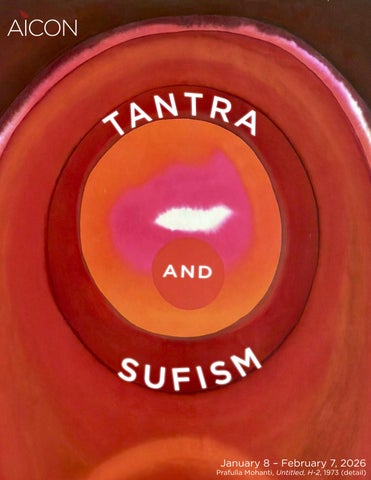
Prafulla Mohanti, Untitled, H-2, 1973 (detail)
TANTRA + SUFISM
Lancelot Ribeiro, G. R. Santosh, Prafulla Mohanti, Biren De, Sohan Qadri, Rachid Koraïchi, Safdar Ali Qureshi January 8 - February 7, 2026 | Opening Reception Thursday, January 8, 6–8 pm
Aicon Art is pleased to announce Tantra + Sufism, an exhibition that delves into the intricate and oftenoverlooked connections between two profound philosophical and artistic movements. While originating from distinct religious traditions, both Tantric and Sufi practices resonate deeply with shared themes of spirituality, symbolic language, and the pursuit of enlightenment. This exhibition invites viewers to reflect on these instances of syncretism, showcasing how artists from both traditions have crafted works that explore intersecting ideas of chakras, ritual movement, and the cyclical nature of life through vibrant symbolic representations. By examining how artists utilize symbolic language— such as triangles and ovoids in Tantra and earthy elements in Sufism—the exhibition reveals a unity that transcends cultural and religious origins. The exhibition features a remarkable collection from renowned Tantric artists G. R. Santosh, Prafulla Mohanti, Biren De, and Lancelot Ribeiro, alongside celebrated Sufi artists Sohan Qadri, Rachid Koraïchi, and Safdar Ali Qureshi. The Tantric artists featured in this exhibition bring distinctive approaches to exploring the spiritual. G. R. Santosh (1929-1997), a pioneering figure of NeoTantric art, is known for his vibrant color palette and innovative integration of geometric shapes. His work often reflects a metaphysical understanding of the universe, using intricate designs to symbolize the cosmos and glorify the feminine divine. Prafulla Mohanti’s (b. 1936) captivating use of three circles represents Brahma, Vishnu, and Maheswar, the Trimurti, or the triple deity of supreme divinity in Hinduism. These three circles and deities embody the cosmic functions of creation, maintenance, and destruction. This drawing of the deities in their simplified form became Mohanti’s primary focus for several months, as he immersed himself in the purity of these circles, chanting their names as he worked. Biren De’s (1926-2011) paintings feature symmetrical geometric patterns and incorporate Tantric symbols, including mandalas, phallic forms, and vaginal motifs, which symbolize the interplay of masculine and feminine energies within the universe. His work blended traditional Tantric elements with modern aesthetics, creating a dialogue that speaks to both the historical significance of these symbols and their relevance in contemporary society. A recent rediscovery in the Neo-Tantric canon is the Indian-British artist, Lancelot Ribeiro (19332010). After a transformative six-month stay in India in 1968/69, during which he immersed himself in Tantric writings and philosophy, Ribeiro created richly colored, hard-edged geometric abstractions. Tantra + Sufism marks the first time these works have been exhibited in the United States.
The Sufi artists featured in the exhibition present their interpretations of spirituality through dynamic forms and narrative techniques. Sohan Qadri (1932-2011) adopted his last name from his Sufi teacher, Ahmed Ali Shah Qadri, as a sign of devotion. His figurative works shifted towards abstraction in pursuit of spiritual transcendence. “When I start on a canvas,” he stated, “first I empty my mind of all images. They dissolve into a primordial space. Only emptiness, I feel, should communicate with the emptiness of the canvas.” Qadri developed a methodology for his painting, dividing pure colors into three categories— dark, warm or cool, and light—allowing for a tripartite arrangement that could be organized in ascending or descending order, reflecting the spiritual energies and emotional vibrations inherent in each hue. The color blue plays a significant role in the work of Rachid Koraïchi (b. 1947), symbolizing the ultimate unification of one with the divine. Koraïchi has developed a unique script that he describes as an “alphabet of memory,” artfully melding Arabic script with personal codes to convey deep reflections on spirituality and coexistence. He often incorporates Sufi poetry by such seminal figures as Rumi and Ahmad al-Tijani into his paintings, prints and tapestries, offering an additional dimension to his unique visual language. Safdar Ali Qureshi (b. 1980) began his artistic journey specializing in miniature painting but has since transcended those boundaries, developing his own distinct style characterized by narrow color palettes and abstract forms. His current works reflect memories and experiences, skilfully captured in swirling and overlapping layers, bridging the traditional with the contemporary. Tantra + Sufism highlights the dynamic dialogue between these two artistic traditions, emphasizing their shared focus on spirituality and symbolism. Both Hinduism and Islam encourage seekers to explore paths towards enlightenment and divine connection, enriching the human experience in diverse ways. This exhibition celebrates the unity found within diversity, showcasing how the vibrant expressions of Tantric and Sufi art resonate with the universal quest for meaning and connection in the human experience. For more information and sales inquiries, email Hannah at hannah@aicongallery.com. Aicon Art, 35 Great Jones St, New York, NY 10012 Tuesday – Saturday, 10 am – 6 pm +1 646-539-8300 | www.aicon.art | @aiconart_ny
2
PART I: TANTRA
3
G. R. SANTOSH 4
G. R. Santosh Born in 1929 in Srinagar, Kashmir. Died in 1997 in New Delhi, India. G. R. Santosh (Gulam Rasool Santosh) was born in Kashmir, and emerged as a significant figure in India’s modern art movement. He studied at the College of Art in New Delhi, where he began shaping a distinctive visual language rooted in both modernist principles and Kashmiri cultural traditions. Santosh became known for integrating traditional motifs with contemporary abstraction, producing works marked by vibrant color, spiritual symbolism, and a deep engagement with mysticism. His practice reflected a sustained dialogue between place, philosophy, and form, resonating with audiences in India and abroad.
5
G. R. SANTOSH Untitled (White, Diety), 1969 Oil on canvas 50 x 36 in 127 x 91.4 cm NFS PROVENANCE Private Collection, Connecticut SANGR063
6
G. R. SANTOSH Untitled (Red Tantra Square, Green Background), n/d Oil on canvas 50 x 40 in 127 x 101.6 cm NFS PROVENANCE Private Collection, Connecticut SANGR062
7
G. R. SANTOSH Divine Energy, 1993 Oil on canvas 45 x 39 in 114.3 x 99.1 cm NFS PROVENANCE Private Collection, Connecticut SANGR064
8
G. R. SANTOSH Untitled 28, n/d Serigraph 24 x 18 in 61 x 45.7 cm $2,500 PROVENANCE Chester and Davida Herwitz Collection SANGR040
9
G. R. SANTOSH Untitled 29, n/d Serigraph 25 x 19 in 63.5 x 48.3 cm $2,500 PROVENANCE Chester and Davida Herwitz Collection SANGR041
10
G. R. SANTOSH Untitled, n/d Serigraph 8 x 6 in 20.3 x 15.2 cm $1,000 PROVENANCE Chester and Davida Herwitz Collection SANGR061.3
11
G. R. SANTOSH Untitled, n/d Serigraph 8 x 6 in 20.3 x 15.2 cm $1,000 PROVENANCE Chester and Davida Herwitz Collection SANGR061.2
12
G. R. SANTOSH Untitled (Union Trident Moon), n/d Ink on paper 11 ½ x 8 in 29.2 x 20.3 cm $4,500 PROVENANCE Chester and Davida Herwitz Collection SANGR030
13
BIREN DE 14
Biren De Born in 1926 in Faridpur, India. Died in 2011 in New Delhi, India. Biren De was born in Bengal and emerged as an influential voice within India’s post-independence modern art scene. He studied at the Government College of Art & Craft in Kolkata, where he developed a disciplined approach grounded in modernist abstraction. De became closely associated with the Neo-Tantric movement, drawing on tantric philosophy, sacred geometry, and yantric forms to construct meditative, highly structured compositions. Known for his luminous surfaces and restrained palettes, his work explored the relationship between inner consciousness and visual form. Through this synthesis of spirituality and modernism, De established a distinctive practice that resonated both in India and internationally.
15
BIREN DE Untitled, n/d Oil on canvas 46 x 32 in 116.8 x 81.3 cm NFS PROVENANCE Private Collection, New York
16
UPPER: Untitled 93, n/d Crayon on paper 5 ¼ x 3 ½ in 13.3 x 8.9 cm $5,000 DEBIR098 LOWER:
Untitled 70, n/d Crayon on paper 3 ¾ x 5 in 9.5 x 12.7 cm $5,000 DEBIR079
PROVENANCE Chester and Davida Herwitz Collection
17
LANCELOT RIBEIRO 18
Lancelot Ribeiro Born in 1933 in Bombay, India. Died in 2010 in London, United Kingdom. Ribeiro was born into a Roman Catholic family from Goa and was the younger half-brother of F.N. Souza, with whom he shared a close bond. Educated at St. Xavier’s in Mumbai, he later described his turbulent experience at St. Mary’s Catholic School in Rajasthan as the beginning of his journey as an artist. In 1963, Ribeiro co-founded the Indian Painters Collective, which evolved into Indian Artists UK (IAUK) in 1988, championing Indian artists in Britain. Throughout his career, Ribeiro held nearly 70 exhibitions worldwide, including notable shows with his brother, such as The Arts of India (1966) and Five Indian Artists (1976).
19
LANCELOT RIBEIRO Untitled (Tantric), 1966–67 Oil and polyvinyl acetate on canvas 34 ¼ x 32 ⅔ in 87 x 83 cm $37,000 PROVENANCE Directly from the Artist’s Estate RIBLA049
20
LANCELOT RIBEIRO Untitled (Abstract), c. 1969 Oil and polyvinyl acetate on canvas 19 ½ x 19 ½ in 49.5 x 49.5 cm $12,000 NOTES Inscribed ‘19.5 x 19.5’ (verso). PROVENANCE Directly from the Artist’s Estate RIBLA045
21
LANCELOT RIBEIRO Untitled (Tantric), c. 1969–70 Oil, polyvinyl acetate, metallic paint, and plastic collage on canvas 35 ¼ x 23 ⅝ in 89.5 x 60 cm $27,000 PROVENANCE Directly from the Artist’s Estate RIBLA044
22
Lancelot Ribeiro, Art Mumbai, November 13-16, 2025. Photography by Vicky Luthra.
23
LANCELOT RIBEIRO Untitled (Tantric), c. 1966–67 Oil and polyvinyl acetate on canvas 47 ⅝ x 35 ⅝ in 121 x 90.5 cm $56,000 PROVENANCE Directly from the Artist’s Estate RIBLA040
24
LANCELOT RIBEIRO Untitled (Tantric), c. 1969 Oil and polyvinyl acetate on canvas 42 x 32 ½ in 106.5 x 82.5 cm $50,000 NOTES Label affixed (verso). Inscribed ‘42 x 32.5’ (verso). PROVENANCE Directly from the Artist’s Estate RIBLA039
25
LANCELOT RIBEIRO Revolving Off Centre, 1969 Liquid acetate and collage on canvas 56 ⅓ x 56 ⅓ in 143 x 143 cm $105,000 NOTES Signed and dated ‘Lancelot Ribeiro 1969’ (verso). PROVENANCE Directly from the Artist’s Estate RIBLA037
26
PRAFULLA MOHANTI 27
Prafulla Mohanti Born in 1936 in Nanpur, India. Lives and works in London, United Kingdom. Prafulla Mohanti is an Indian painter and writer based in London, often associated with the NeoTantric art movement that emerged alongside modernism in India in the 1960s. Born and raised in the village of Nanpur in Odisha, Mohanti cites his early exposure to village culture, yoga, and tantric philosophy as central influences on his work. After graduating with a degree in architecture from Sir J. J. School of Art in Mumbai, he moved to the UK, where he later left a career in town planning to devote himself fully to art. His paintings are characterized by bright concentric circles and radiant color fields that echo mandalas, yantras, and the bindu.
28
PRAFULLA MOHANTI Untitled, H-2, 1973 Watercolor on paper 29 ¾ x 21 ⅞ in 75.6 x 55.6 cm $10,000 PROVENANCE Chester and Davida Herwitz Collection MOHPR002
29
PRAFULLA MOHANTI Untitled, H-3, 1973-74 Watercolor on paper 30 x 22 in 76.2 x 55.9 cm $10,000 PROVENANCE Chester and Davida Herwitz Collection MOHPR001
30
PRAFULLA MOHANTI Untitled, H-1, 1974 Watercolor on paper 29 ¾ x 22 in 75.7 x 55.9 cm $10,000 PROVENANCE Chester and Davida Herwitz Collection MOHPR003
31
PRAFULLA MOHANTI Untitled, H-6, 1984 Watercolor on paper 29 ⅗ x 22 ⅛ in 75.7 x 55.9 cm $10,000 PROVENANCE Chester and Davida Herwitz Collection MOHPR004
32
PART II: SUFISM
33
SOHAN QADRI
34
Sohan Qadri Born in 1932 in Punjab, India. Died in 2011 in Toronto, Canada. Sohan Qadri was an Indian modernist artist whose practice was deeply shaped by spiritual inquiry and ascetic discipline. Deeply influenced by Sikhism, Buddhism, and tantric philosophy, he underwent rigorous spiritual training with tantric masters in the Himalayas, which profoundly shaped his artistic practice. In the 1960s, Qadri began exhibiting internationally and later settled in Copenhagen, where he lived and worked from the early 1970s. Known for his meditative abstractions created through dyeing, burning, and incising paper, Qadri exhibited extensively across Europe, North America, and Asia, earning recognition as one of India’s foremost modern abstract artists.
35
SOHAN QADRI Untitled, 2007 Ink and dye on paper 55 x 39 ⅕ in 139.7 x 99.6 cm POA NOTES Signed and dated 'Qadri / 07' (lower right). Further inscribed, signed and dated '100 x 140 / 07193 / Qadri / 07 Oct. / cph' (verso). PROVENANCE Private Collection, India QADSO027
36
SOHAN QADRI Untitled, 2010 Ink and dye on paper 78 ¾ x 49 ⅕ in 199.9 x 125 cm POA NOTES Signed and dated 'Qadri 10' (lower center). PROVENANCE Private Collection, Dubai QADSO028 37
SOHAN QADRI Untitled, 1984 Acrylic, ink and incisions on paper 12 ⅗ x 13 in 32 x 33 cm $18,000 NOTES Signed and dated 'Qadri 84' (lower center). QADSO024
38
SOHAN QADRI Untitled, 1983 Embossed paper laid down on silver-coloured paper 9 ⅞ x 13 ⅘ in 25 x 35 cm $19,000 NOTES Signed and dated 'Qadri 83' (lower center). QADSO025
39
SOHAN QADRI Untitled, 1984 Acrylic silver paint and incisions on paper 12 ⅗ x 12 ⅗ in 32 x 32 cm $21,000 NOTES Signed and dated 'Qadri / 84' (lower center). QADSO026
40
SOHAN QADRI Untitled, n/d Ink and dye on paper 27 ½ x 39 ½ in 69.9 x 100.3 cm NFS PROVENANCE Private Collection, New York
41
RACHID KORAÏCHI 42
Rachid Koraïchi Born in 1947 in Aïn Beïda, Algeria. Lives and works in France, Algeria, Tunisia & Egypt. Koraïchi’s work is influenced by his heritage as a Quraishite, a transcriber of Quranic text, in the Aurès region of Algeria. Language, whether written or spoken, transmits history, faith, culture, and life. For African artists in particular, it is a powerful combatant against pernicious myths about Africa’s supposed lack of history or letters, as well as a medium for visual experimentation. For Koraïchi, an artist deeply invested in democratic and free speech movements, the omnipresence of language, both readable and inscrutable, is a political statement. Koraïchi works closely with artisans all over the world to create each textile by hand using ancient techniques.
43
RACHID KORAïCHI Le Chant de l’Ardent Désir VI, 2021 Alabaster 43 ⅓ x 43 ⅛ in 110 x 109.5 cm POA KORRA109
44
UPPER LEFT: Rumi (8), 2009 Lithograph 24 x 15 ¾ in 61 x 40 cm $2,500 KORRA202 LOWER LEFT:
Rumi (4), 2009 Lithograph 24 x 15 ¾ in 61 x 40 cm $2,500 KORRA204 LOWER RIGHT:
Rumi (6), 2009 Lithograph 24 x 15 ¾ in 61 x 40 cm $2,500 KORRA203
45
46
UPPER LEFT: Algérie à L'honneur, 2013 Lithograph, 1/30 39 ½ x 28 in 100.3 x 71 cm $6,000 KORRA237 LOWER LEFT:
Saint Denis LXXII (2), n/d Lithograph 27 ½ x 19 ¾ in 69.9 x 50.2 cm $3,000 KORRA235 LOWER RIGHT:
Untitled (4 Eyes), 1999 Lithograph, 1/10 39 ½ x 26 ⅚ in 100.2 x 68.2 cm $6,000 KORRA240
47
48
RACHID KORAïCHI From the Series “Les Sept Stations Celestes” (11), 2017 Soft paste porcelain, blue and white oxide 12 x 8 x 8 in 30.5 x 20.3 x 20.3 cm $12,000 KORRA051
RACHID KORAïCHI From the Series “Les Sept Stations Celestes” (13), 2017 Soft paste porcelain, blue and white oxide 12 x 8 x 8 in 30.5 x 20.3 x 20.3 cm $12,000 KORRA053
49
RACHID KORAïCHI La Montagne aux Étoiles IX, 2021 Acrylic on canvas 55 ⅛ x 55 ⅛ in 140 x 140 cm $75,000 KORRA118
50
SAFDAR ALI QURESHI
51
Safdar Ali Qureshi Born in 1980 in Pakistan. Lives and works in Hyderabad, Pakistan. Safdar Ali Qureshi specialized in miniature painting when studying fine art at the National College of Art in Lahore. After graduating in 2005, Qureshi began experimenting outside the confines of miniature painting with narrow color palettes and abstract compositions. His paintings are now characterized by his dashes and use of monochromatic schemes. Qureshi’s works are a direct response to his experiences, capturing his memories in swirling and overlapping layers. Prior to dedicating himself to his art practice full time, Qureshi taught miniature painting at SABS University of Art, Design and Heritages Jamshoro, a short distance from his home in Hyderabad.
52
SAFDAR ALI QURESHI Untitled, 2024 Gouache on mount paper 20 ½ x 27 ½ in 52.1 x 69.9 cm $5,500 QSAFD012
53
SAFDAR ALI QURESHI Untitled, 2024 Gouache on mount paper 26 ½ x 20 ½ in 67.3 x 52.1 cm $5,500 QSAFD010
54
SAFDAR ALI QURESHI Untitled, 2024 Gouache on mount paper 20 ½ x 26 ½ in 52.1 x 67.3 cm $5,500 QSAFD007
55
SAFDAR ALI QURESHI Untitled, 2024 Gouache on mount paper 29 x 39 in 73.7 x 99.1 cm $8,000 QSAFD008
56
SAFDAR ALI QURESHI Untitled, 2024 Gouache on wasli paper 20 x 25 in 50.8 x 63.5 cm $5,500 QSAFD004
57
NEW YORK 8 January - 7 February 2026 Tantra and Sufism ART FAIRS 23 – 25 January 2026 Art SG | Stand BC11 5 – 8 February 2026 India Art Fair 12 – 22 March 2026 TEFAF Maastricht | Stand 467 17 – 19 April 2026 Art Dubai
GALLERY INFORMATION 35 Great Jones Street New York, NY 10012 +1 646 539 8300 aiconart@aicongallery.com www.aicon.art @aiconart_ny Tuesday – Saturday, 10 am – 6 pm
58