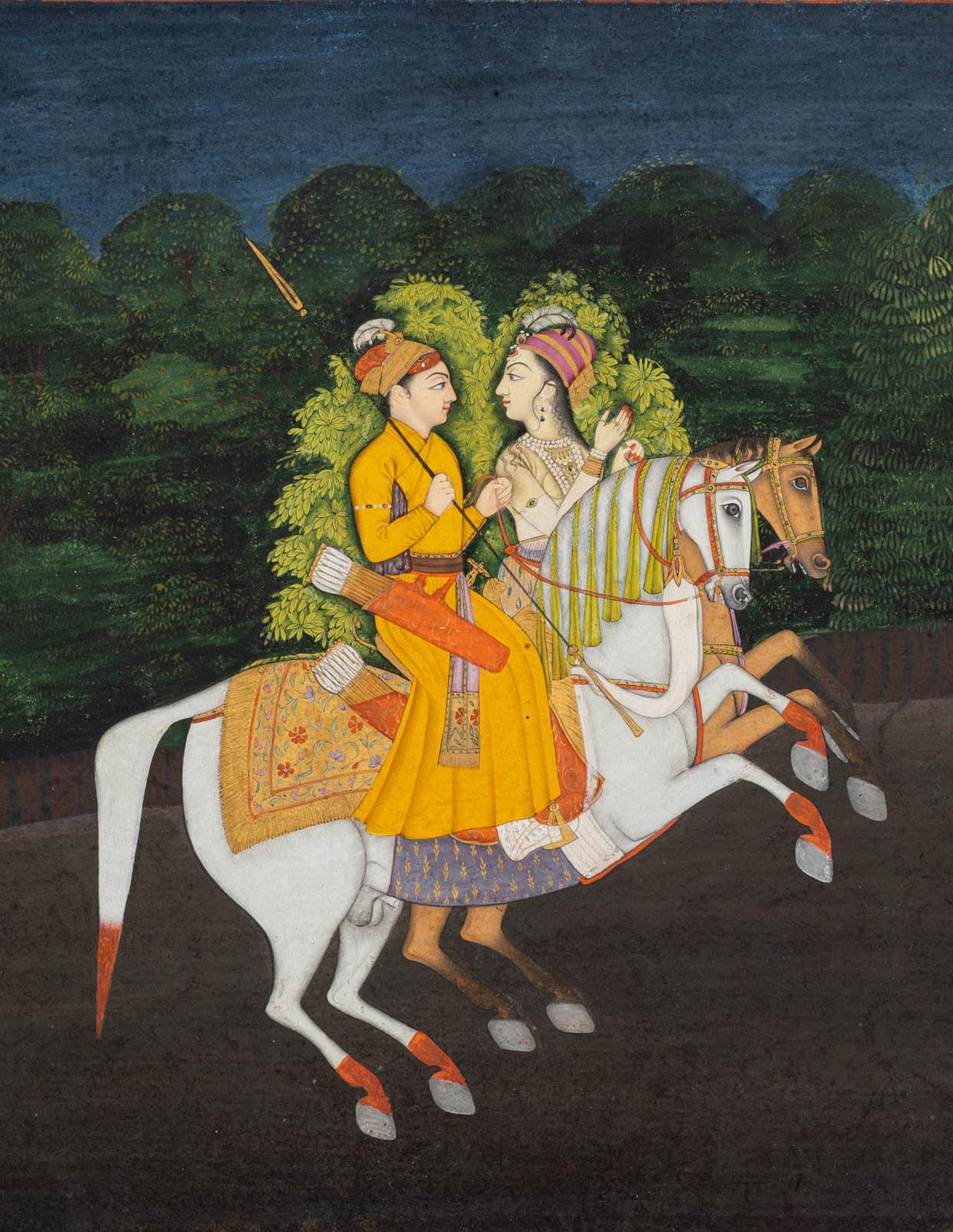
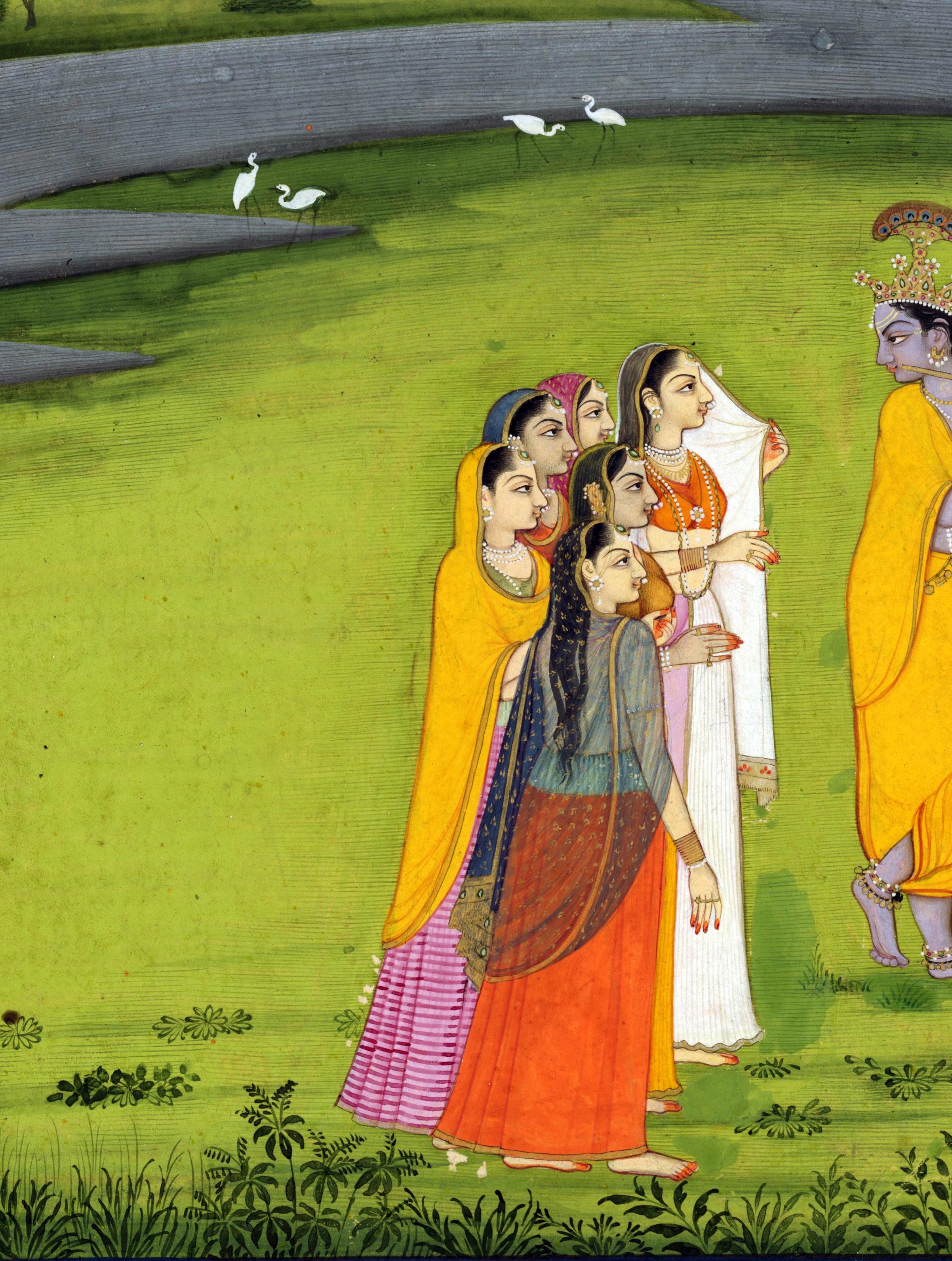
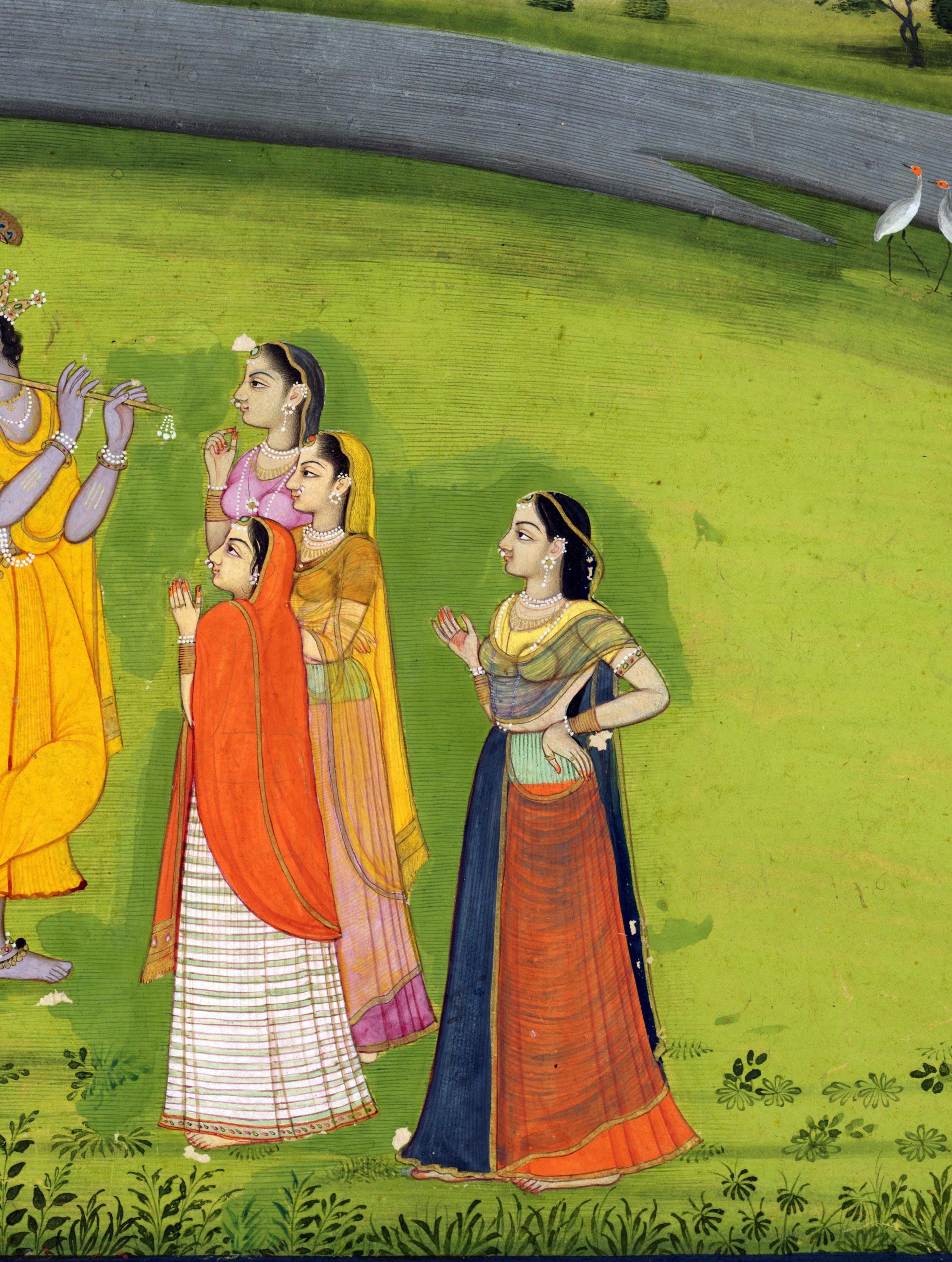
CONTENTS
PAHARI
Kangra | 7
Guler | 34
Basohli | 45
Bilaspur and Garwhal | 53
RAJASTHANI
Kishangarh | 59
Bikaner | 69
Mewar | 77
Datia | 79
MUGHAL | 83 DECCAN | 103
| 109
lllustration to the Gita Govinda: Krishna and the Gopis, The Charming Flautist
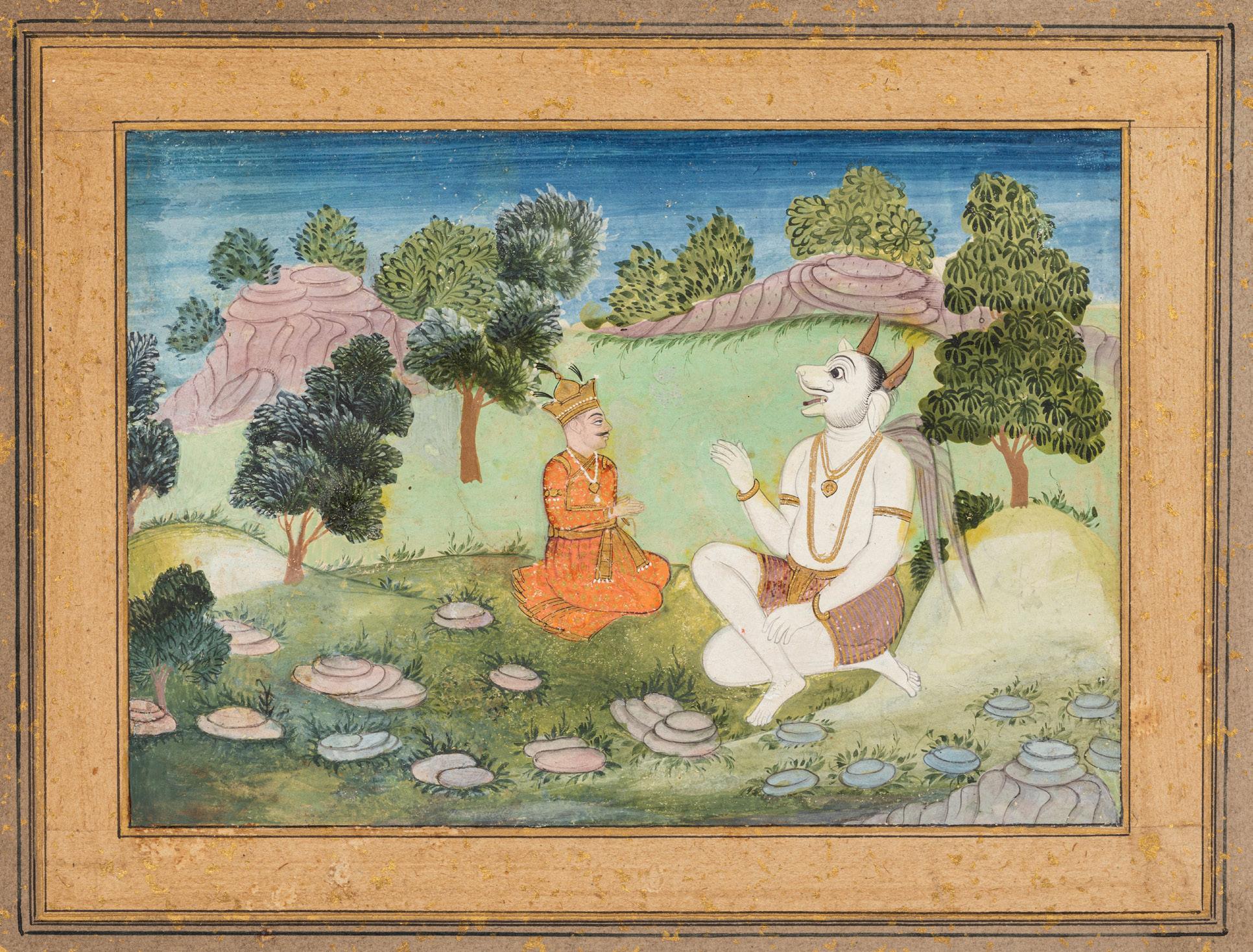
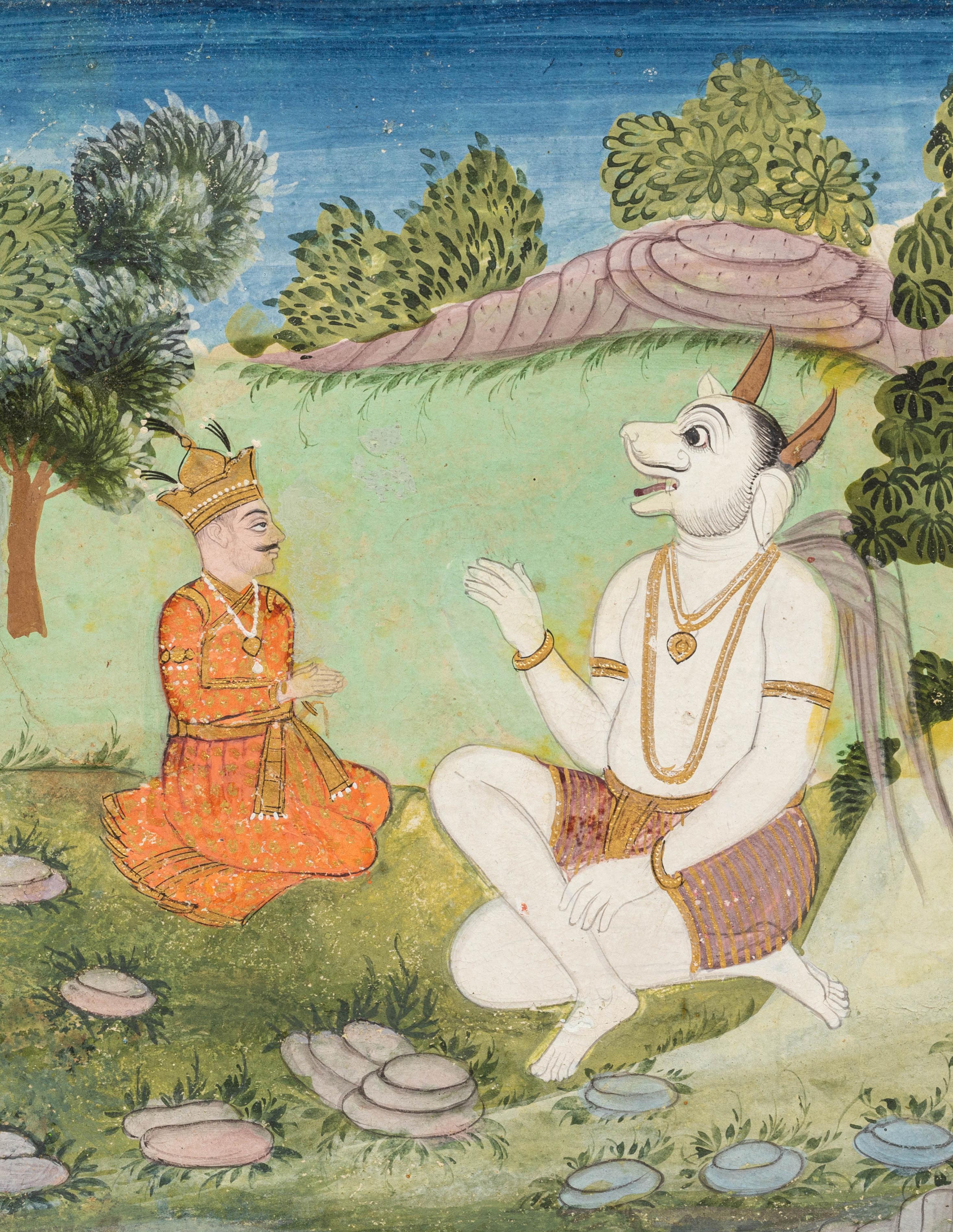
IIlustration from the Harivamsa: Krishna, Narada, and Arjuna converse while their companions look on
Illustration to a Rasikapriya series: Krishna and Radha at a Jharokha Window
Illustration to a Rasikapriya series: Krishna Enthroned
Illustration to a Rasikapriya series: Krishna Seated with Radha
Illustration to a Rasikapriya series: An Older Sakhi Comforts a Forlorn Radha
Illustration to a Rasikapriya series: Krishna Paying Homage to Radha
Illustration to a Rasikapriya series: Radha, seated in a pavilion, visited by a female companion dressed as a boy
Illustration to Kirata-Arjuniya Episode, From a Mahabharata
to the ‘third’ Rasamanjari
ILLUSTRATION
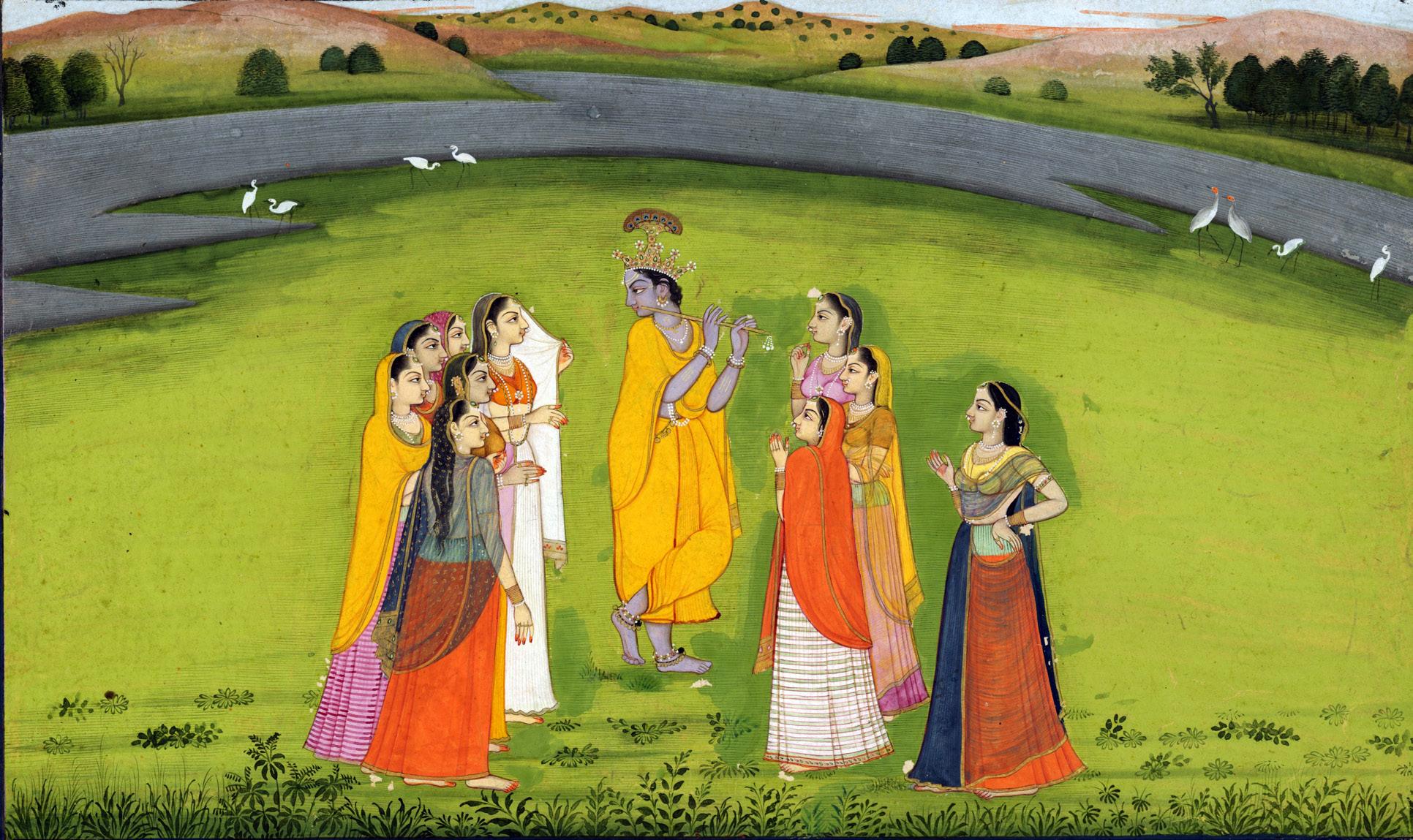
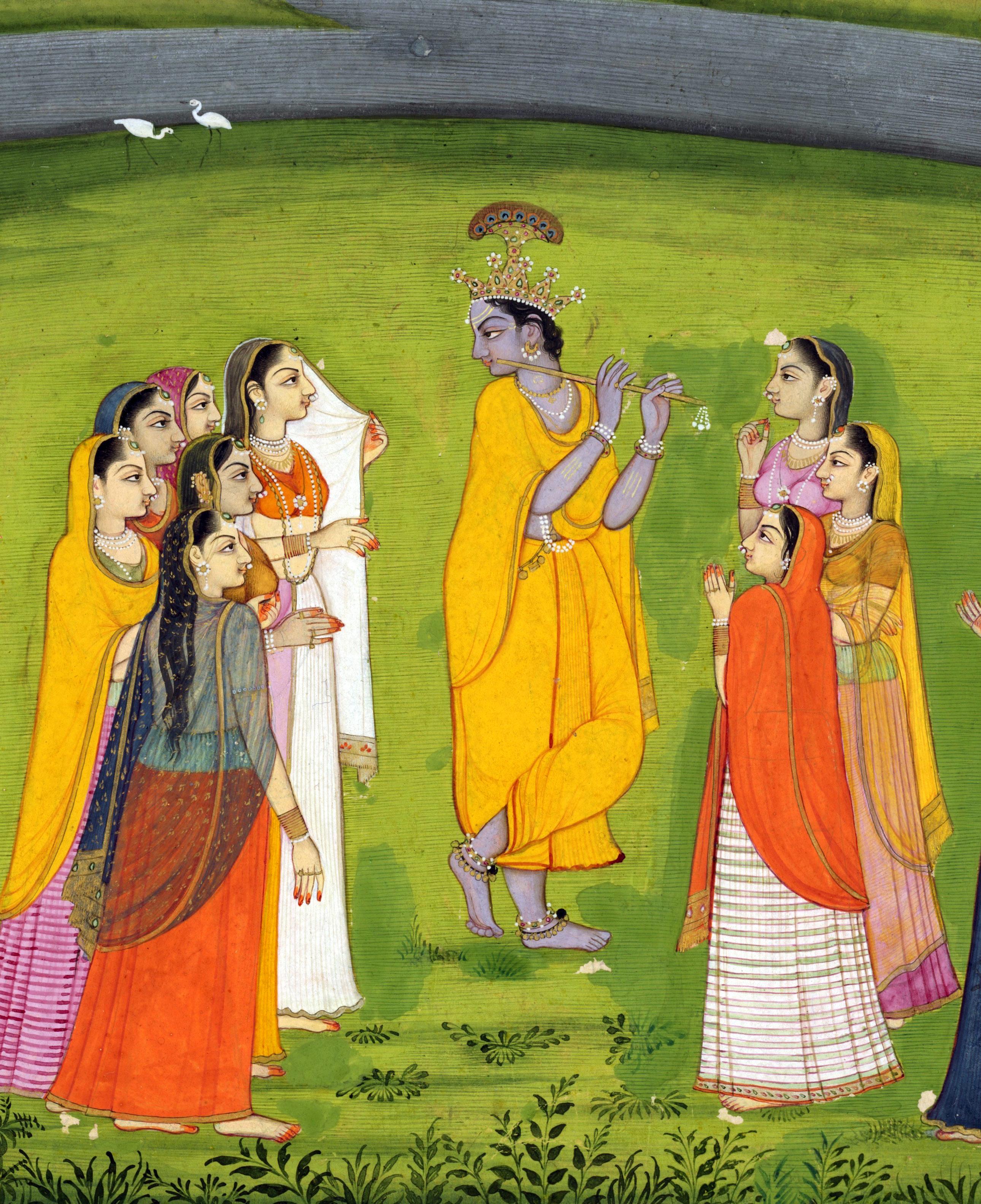
TO THE GITA GOVINDA: KRISHNA AND THE GOPIS, THE CHARMING FLAUTIST
Attributed to a master of the first generation after Nainsukh, or Kushala and Gaudhu (sons of masters Manaku and Nainsukh respectively), Guler or Kangra, Pahari, c. 1775
Opaque watercolor heightened with gold on paper
Image: 6 x 10 in, 15.2 x 25.4 cm
Folio: 7 x 10 ¾ in, 17.8 x 27.3 cm
POA
PROVENANCE
Maharaja Manvindra Shah of Terhi-Garhwal
Sotheby’s, New York, 22 March 2002, Lot 51
LITERATURE
M.S. Randhawa, Kangra Paintings of the Gita Govinda, New Delhi, 1963, pl. XI
W.G. Archer, Paintings from the Punjab Hills, Belgium, 1973, Vol. II, no. 33 (iii), p. 206
EXHIBITION
The Norton Simon Museum of Art, 2004, L.5.2002.1
Rapt in the charm of the flute melody, gopis surround Krishna in a divinely enchanting fashion. The tenderly rendered nature and female forms in such paintings from the Gita Govinda are evocative of the translation of poetry into painting. The Gita Govinda is a 12th century poetic metaphor about the spiritual union through the divine relationship between Krishna, Radha and the gopis (milkmaids) of Vrindavan.
The figures of women in these paintings, as M.S. Randhawa described in Kangra Paintings of the Gita Govinda are painted with elegance, warmth and passion. These delicate and chiseled figures gliding with grace are symbolic of the beauty of womanhood. The scene here is a pictorial representation of the divine leela (play) orchestrated by Krishna.
The depiction of love here is layered with a divine aspect to it. This scene of divine play or enactment of love is symbolic of the piety that encompasses the bond between the divine and the devotee. The iconographic rendering of the foreground and background both immerse the viewer in a love laced temperament.
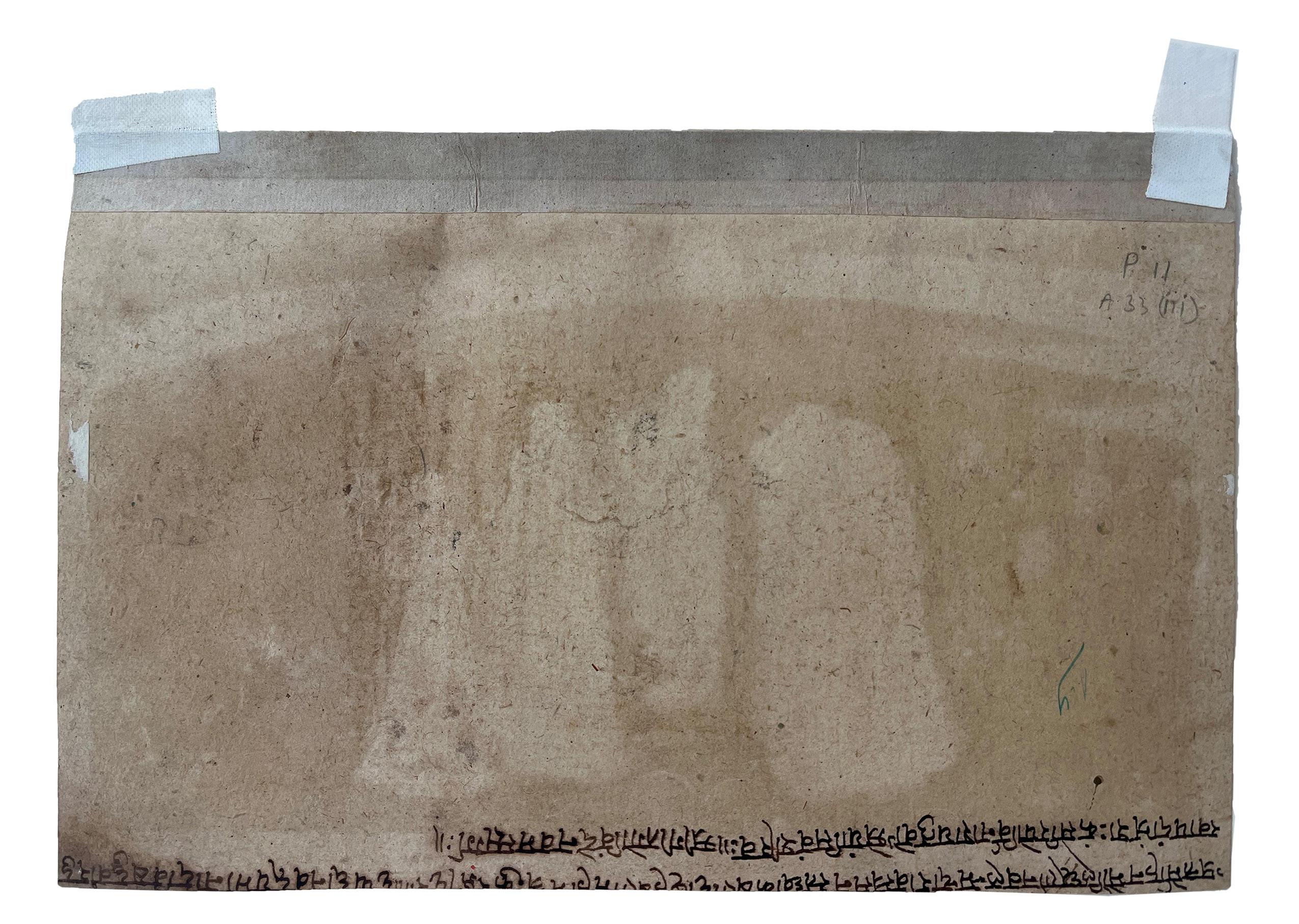
Inscribed on the verso of the painting is a verse from the Gita Govinda, and the inspiration behind this lyrically beautiful piece. According to the inscription, the verse is from the ninth canto of Jayadeva’s Gita Govinda, but it has been attributed elsewhere to the eighth canto (Randhawa 1963, p. 94).
The painting belongs to what has come to be regarded as one of the finest series illustrating the Gita Govinda. Krishna is clothed in yellow garb, playing the flute in his popular iconic form. Framing him in the background is the river Yamuna and the rolling hills of the Aravalli range. Surrounded by a group of gopis, they stare at him, enraptured by his performance. Notably the artist chose not to depict flowers falling from their hair as is mentioned in the verse.
The depiction of the ladies is characteristic of Guler/Kangra artists, with delicate graceful features. Although their faces show little variation, emotions are expressed clearly and encoded within subtle gestures of their hands and body language.
It was first suggested by William Archer that this series was likely painted by two cousins: Kushala (c. 1730-1790) and Gaudhu (c. 17401820). The two cousins are respectively sons to the acclaimed masters Manaku and his sibling Nainsukh (Archer, 1973, vol. I, p. 292). However in later texts Goswamy and Fischer (Pahari Masters, Court Painters of Northern India, 1992, p. 312), attribute the series more broadly as that of a solitary “master of the first generation after Nainsukh.”
Regardless of the uncertainty towards the identity of the creator, this series belongs among the finest of achievements of Pahari painting, and does little to detract from the joyous visualization of Jayadeva’s everlasting poetical composition.
Translated, the inscription on the back reads:
May blessings be bestowed by the sound of the flute of Kamsa’s foe, The sound of the flute removing the difficult grief of the gods by the danavas [demons] humbled, The sounds of the flute, the great invitation to the deer-eyed women, stirring, delighting, and making them bold, The sound bringing down from the crests of the dwellers of heaven, Swaying with pleasure, the mandara flowers!
Translated by George Kyt and quoted in John B. Alphonso-Karkala, ed., An Anthology of Indian Literature, Penguin Books, 1971, p.523.
Randhawa offers a slightly different translation of the verse, shown as the following (Randhawa 1963, p. 94).
The sound of Krishna’s flute charms the entire creation, animate as well as inanimate.
The deer-eyed gopis of Vraja are so fascinated therewith that Mandara flowers which decorate their coiffure fall.
May the sound of Krishna’s flute, the enemy of Kamsa and savior of gods, bless you all!
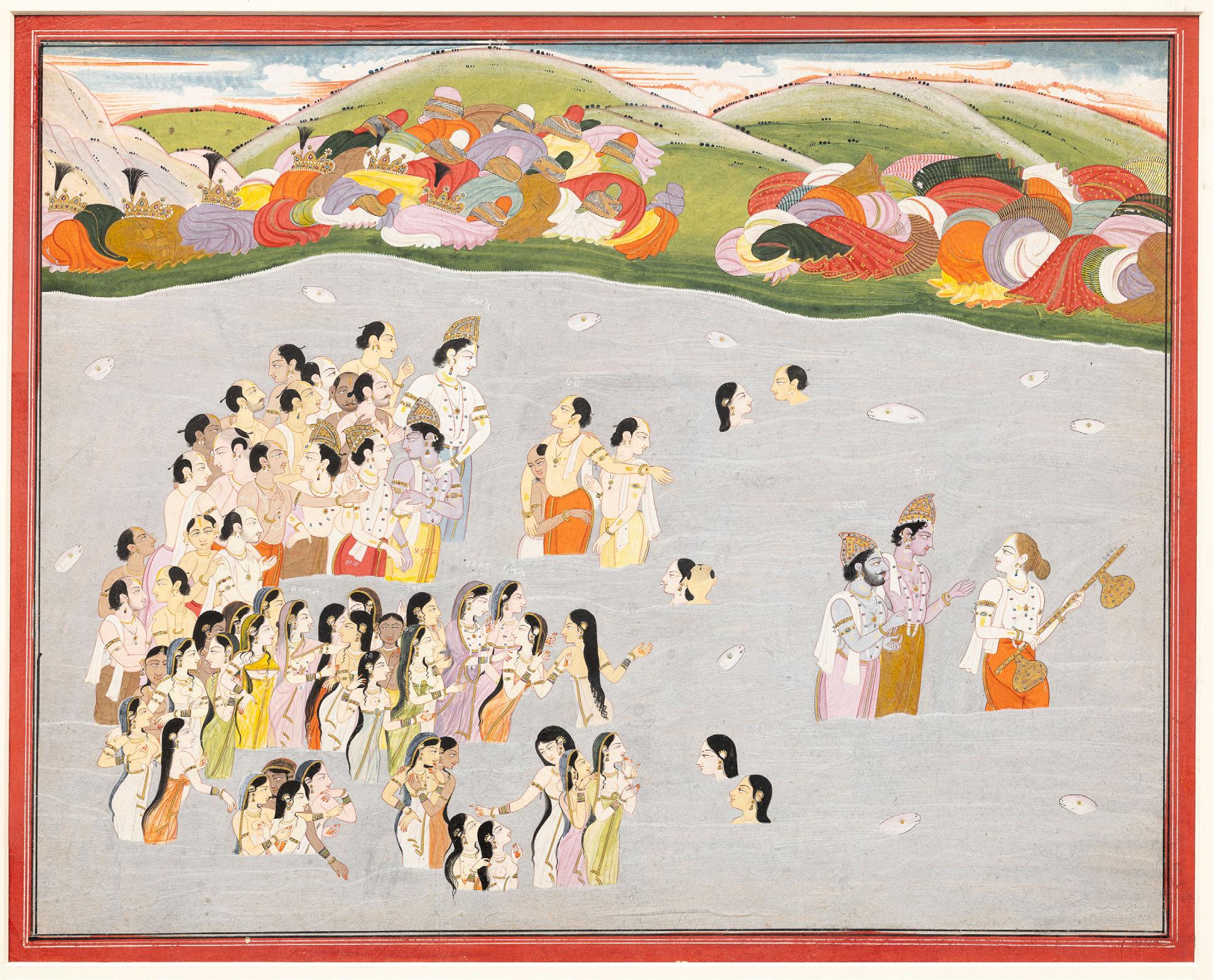
ILLUSTRATION FROM THE HARIVAMSA: KRISHNA, NARADA, AND ARJUNA
CONVERSE WHILE THEIR COMPANIONS LOOK ON
Attributed to Purkhu, Kangra, active c. 1780–1820
Opaque watercolor heightened with gold on paper
Image: 13 ⅘ x 17 ½ in, 35 x 44.5 cm
Folio: 15 ¼ x 19 in, 38.8 x 48.2 cm
$150,000
PROVENANCE
Acquired from the Royal Library of Mandi in 1969
Sotheby’s, New York, Indian & Southeast Asian Works of Art, 19 September 2008, Lot 206
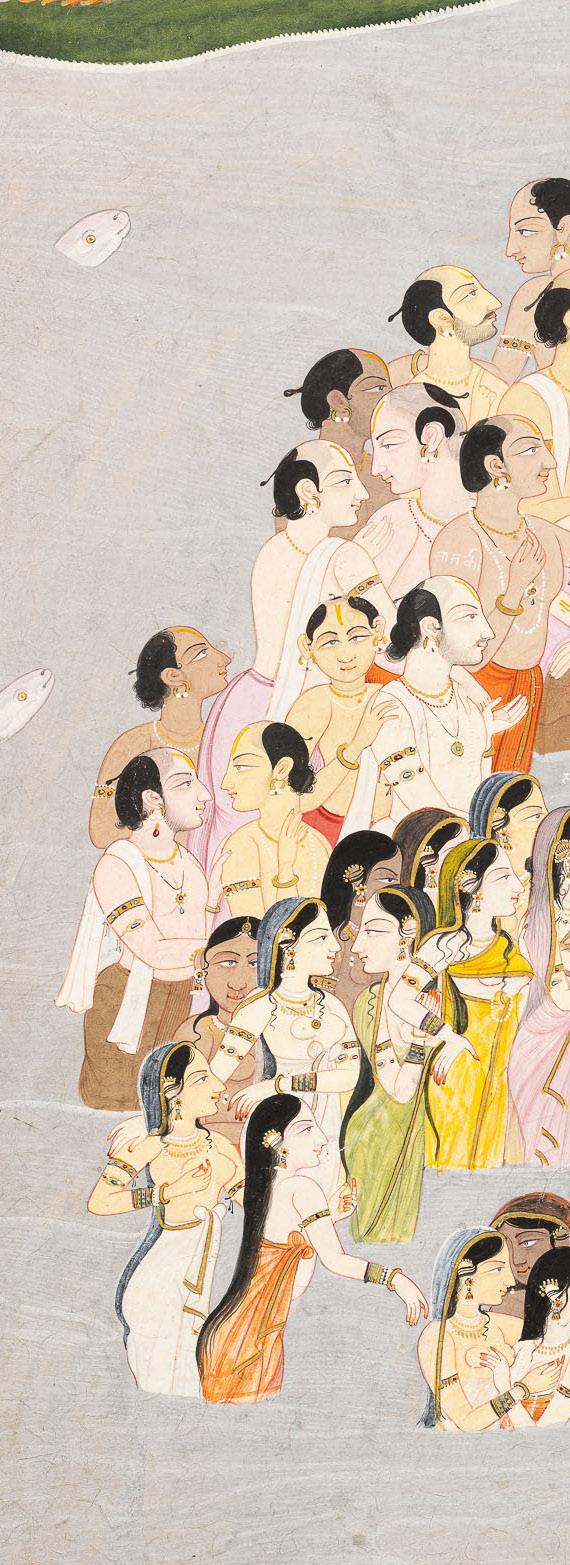
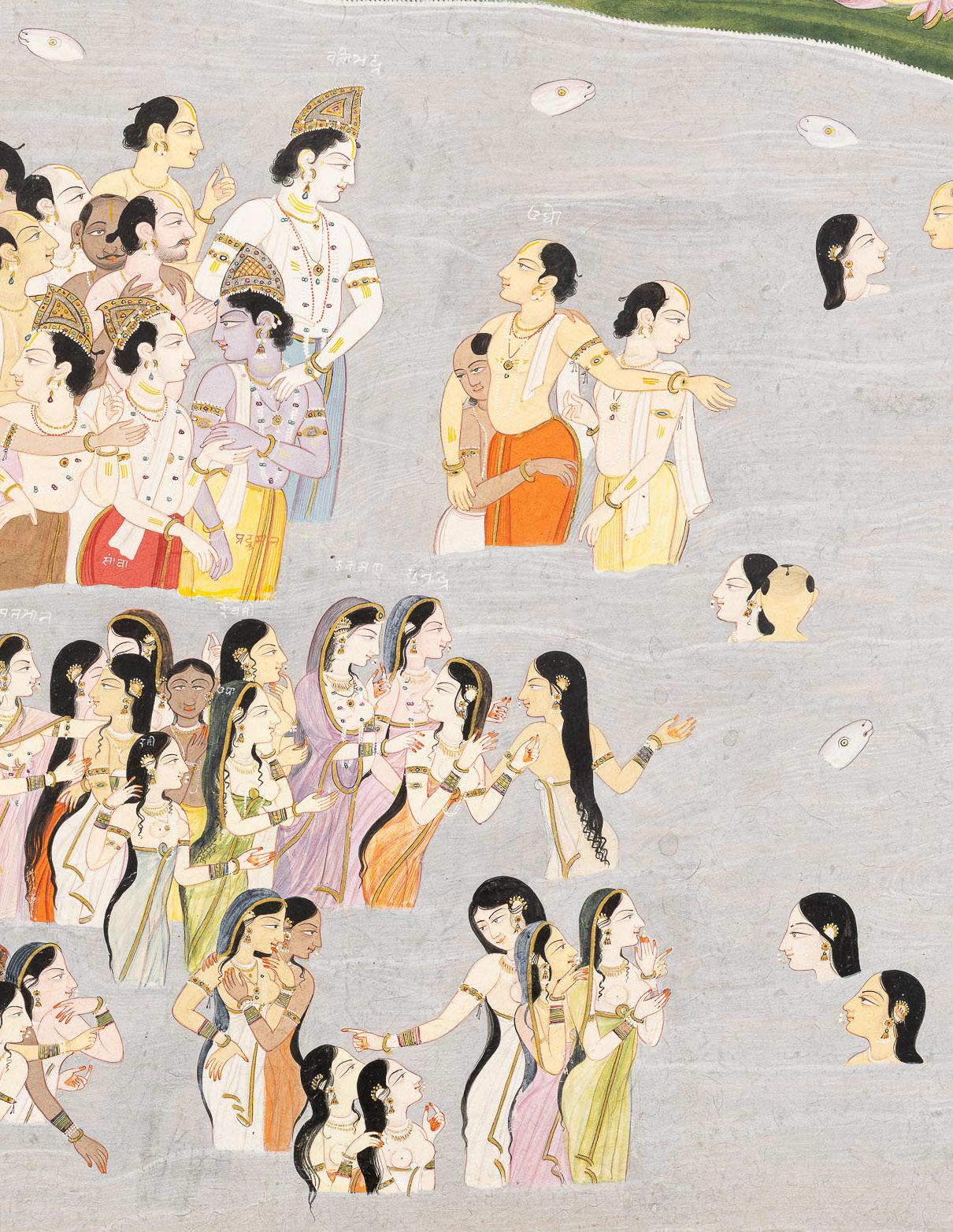
A river becomes a stage, and a conversation becomes an event. In this shimmering folio, Krishna stands effortlessly and luminously, exchanging words with Arjuna and Narada while a constellation of attendants gathers— half listening, half basking in the moment.
The palette is pure pleasure: cool water like brushed silver, hills like velvet, and textiles piled on the bank in jeweled cascades of saffron, coral, emerald, and rose. With delicate gold catching the light, the scene feels less like an illustration than an invitation into Krishna’s world, where the sacred arrives with the ease of music and laughter.
From a dispersed series illustrating the Harivamsa—a richly episodic companion to the Mahabharata that amplifies Krishna’s life into a cycle of glittering scenes—this folio turns sacred narrative into lived experience, and lived experience into a kind of painted music. Instead of a temple court or battlefield, the setting is the wide, silvery calm of the Yamuna, where revelry becomes ritual and conversation becomes spectacle.
Krishna is shown in measured dialogue with Arjuna and the sage-bard Narada, while companions and consorts gather in attentive clusters, their faces angled toward the exchange as if the river itself were carrying the words outward in gentle ripples.
The painter’s compositional intelligence lies in how the scene is paced. Large figures amass and then dissolve into open water, so that the
eye moves as the body might move through a crowd: drawn in, released, and drawn in again. The river is not a blank field but a luminous stage—cool, quiet, and deliberately restrained—against which human presence reads with heightened clarity. Small fish drift across the surface like punctuation marks, slowing the gaze, marking intervals, and lending the moment a dreamlike suspension. Above, the hills roll in softened green arcs, and the bank is strewn with bright textiles in sumptuous heaps—color held back from the river’s hush and then released all at once, like laughter after a whispered line.
Gold heightening animates the scene at exactly the right pitch: a glint at an earring, a tremor along a hem, a flash in a border, all of it catching light the way a remembered celebration catches in the mind—selective, radiant, and strangely intimate. In the finest Kangra manner, splendor here is never shouted; it is suggested—a calibrated shimmer that turns ornament into atmosphere. The result is an image that is both communal and private: a gathering witnessed by many, yet centered on a small nucleus of speech, attention, and charisma.
This painting is firmly attributed here to Purkhu, the celebrated Kangra master active during the reign of Maharaja Sansar Chand, remembered as the head of a large workshop whose productions include portraiture and ambitious narrative cycles on an oversize folio scale, notably including the Harivamsa.
Scholarship further underscores that extensive large-format series (including the Harivamsa) have been associated with Purkhu and his family workshop—precisely the kind of dispersed, episodic series to which this folio belongs. Market precedents reinforce this attributional framework, with multiple Harivamsa illustrations cataloged as “Attributed to Purkhu” or often in closely comparable format, palette, and border design.
Its provenance provides an especially resonant anchor. The folio was acquired from the Royal Library of Mandi in 1969, consistent with other Harivamsa leaves that carry Mandi royal-collection associations in later literature. That princely context matters: such paintings were not merely “illustrations,” but portable theaters of devotion and refinement—kept, studied, circulated, and cherished as visual counterparts to recitation and storytelling. Even in a scene of water-play and easy pleasure, the page retains the gravity of courtly taste: exuberance framed by discipline; delight rendered with scholarshiplevel presence.
ILLUSTRATION TO A RASIKAPRIYA SERIES: KRISHNA AND RADHA AT A JHAROKHA WINDOW
Attributed to Purkhu, Kangra, c. 1820
Opaque watercolor heightened with gold on paper
Image: 10 ⅜ x 6 ¾ in, 26.4 x 17.3 cm
Folio: 12 ⅞ x 9 ¼ in, 32.8 x 23.5 cm
$45,000
NOTES
Inscribed with Braj Bhasa (upper middle) as well as folio number ‘193’ (upper left).
Further inscribed with ‘12ll’ and a verse from the Rasikapriya (verso).
PROVENANCE
Royal Mandi Collection
Private English Collection
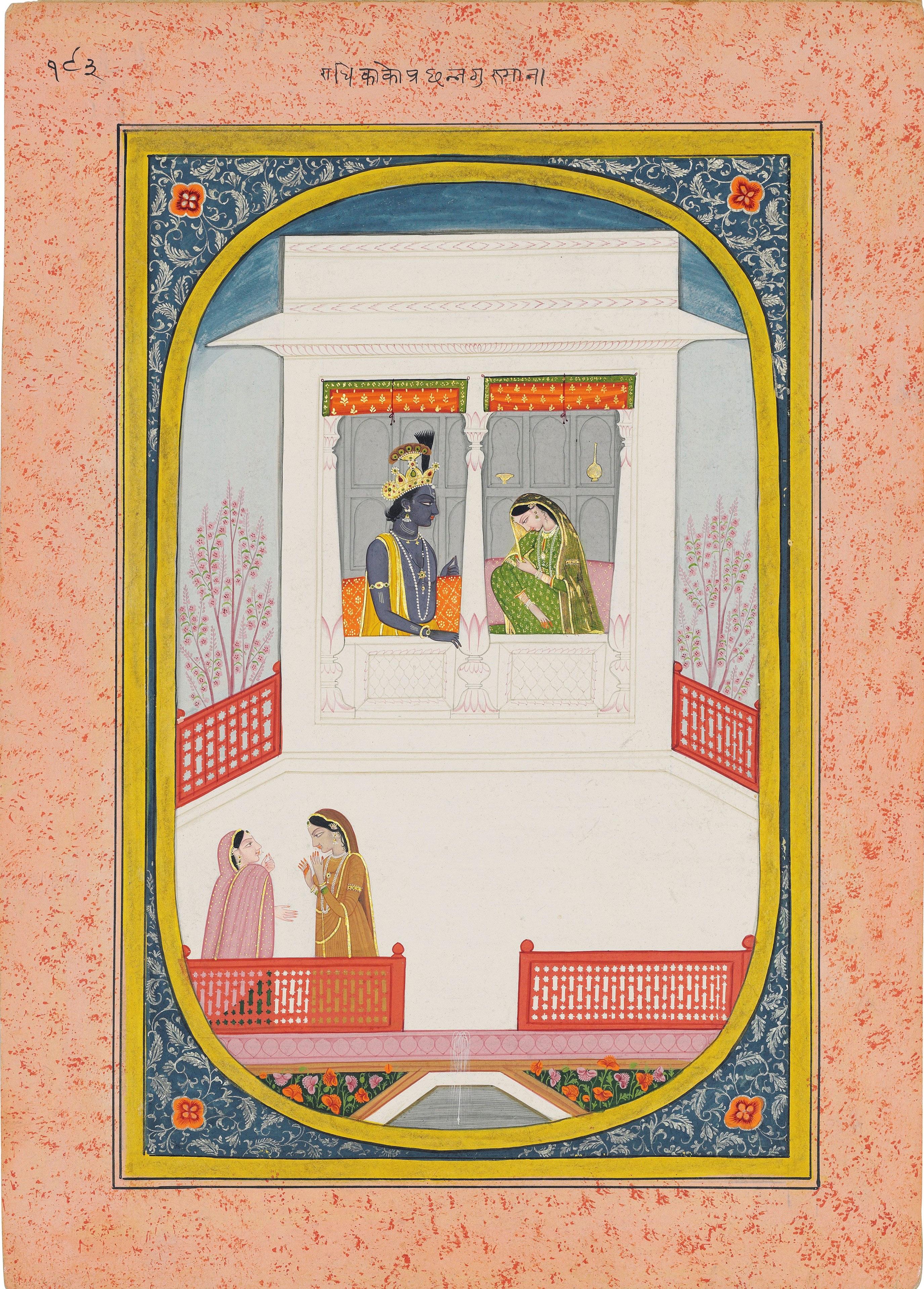
The present scene shows Krishna and Radha seated together in a jharokha window, while two sakhis converse on the enclosed terrace below, which opens onto a verdant garden with flowering plants and an ornamental fountain. Krishna, crowned with peacock feathers, turns toward Radha with evident affection, but she refuses to return his gaze. Instead, her attention falls on the faint scratches visible across his chest. With her left hand she draws at the edge of her dupatta, as though instinctively shielding herself.
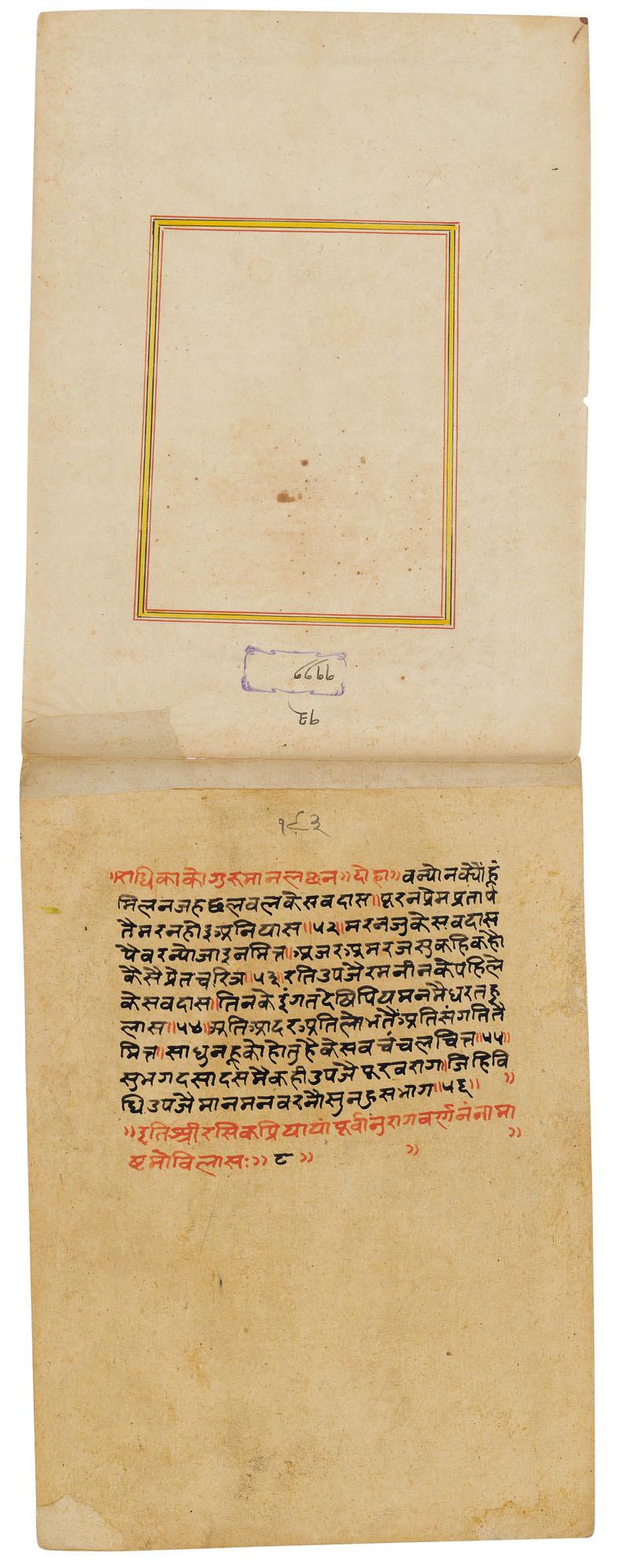
The folio is numbered “193” in the upper left corner, and the reverse is further inscribed “12ll.” A line in black Braj Bhasha written above refers to Radhika’s hidden condition of intense separation: the emotional state of wounded pride or jealousy provoked by signs of another woman. This condition, known as gurumana, is considered the most powerful form of mana, one that paradoxically deepens and elevates the experience of love.
The verso also bears a verse from the Rasikapriya:
Forgetting his quarrel with Radha, Krishna met her and revelled in the enchantment of her beauty, love and laughter. On seeing nailmarks on his person beneath his garment, she turned her gaze away, and her eyes drooped like a lotus flower at the sight of the moon.
(Translation from M.S. Randhawa, Kangra Paintings on Love, New Delhi, 1962, p. 89.)
The painting visualizes Radha’s response to the telltale marks left by another woman. Faced with evidence of Krishna’s infidelity, she is overcome by a mixture of jealousy, hurt, and longing.
ILLUSTRATION TO A RASIKAPRIYA SERIES: KRISHNA ENTHRONED
Attributed to Purkhu, Kangra, c. 1820
Opaque watercolor heightened with gold on paper
Image: 10 ⅛ x 6 ¾ in, 25.7 x 17.2 cm
Folio: 12 ⅞ x 8 ⅝ in, 32.4 x 21.9 cm
$45,000
NOTES
Inscribed with Braj Bhasa (upper middle) as well as folio number ‘262’ (upper left).
Further inscribed with ‘10ll’ and a verse from the Rasikapriya (verso)
PROVENANCE
Royal Mandi Collection
Private English Collection
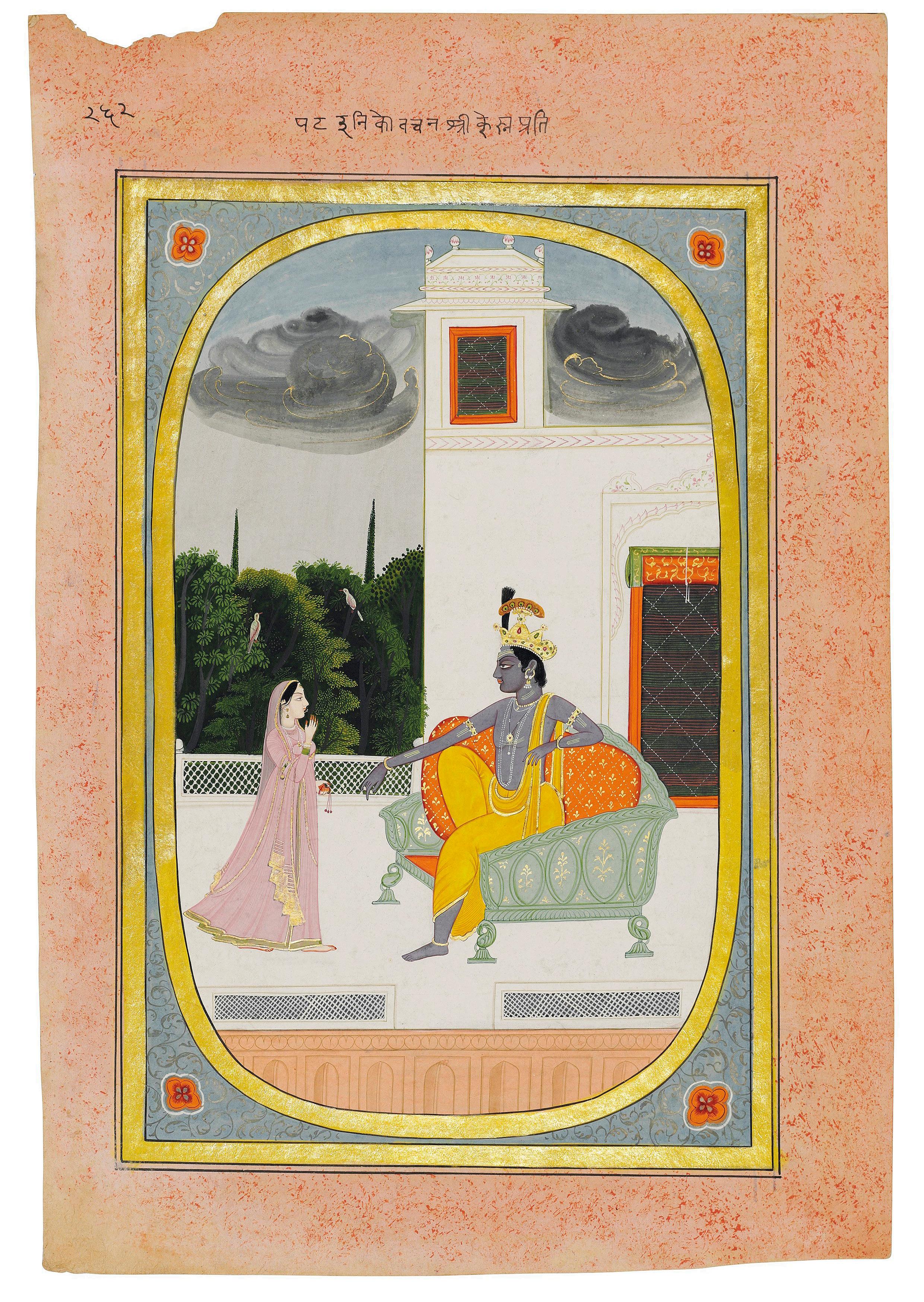
The present painting depicts a sakhi conveying a message to Krishna from Radha, mediating between the two on some matter of love.
Krishna sits against an orange bolster cushion on a celadon green throne. He wears a vibrant saffron jama and is adorned in jewels on his head is his signature peacock feather crown. In the background two lovebirds gaze at each other across the foliage which is interspersed with pointed cypresses a symbol of Krishna’s passion for Radha. Storm clouds lined in gold descend on the scene, perhaps reflective of some turbulence forming between the fabled lovers.
A line of black Braj Bhasa above reads “pat ini ko vachhan shri Krishna prati” (“conveying a message to Shri Krishna”).
The verso is inscribed with a verse from the Rasikapriya in alternating red and black script:
Having loved her, why is it that you are involved with other women? Do not confuse brass with gold. Even if Saraswati teaches a crow, it cannot sing as sweetly as a cuckoo. Those who like a mango cannot be satisfied with a tamarind. Do desist from your misdemeanours. 12.29
(Translation by Dr. Harsha Dehejia)
ILLUSTRATION TO A RASIKAPRIYA SERIES: KRISHNA SEATED WITH RADHA
Attributed to Purkhu, Kangra, c. 1820
Opaque watercolor heightened with gold on paper
Image: 9 ¾ x 6 ½ in, 24.8 x 16.5 cm
Folio: 13 x 9 ⅛ in, 33 x 23.2 cm
$45,000
NOTES
Inscribed with Braj Bhasa (upper middle) and folio number ‘305’ (upper left). Further inscribed with ‘12ll’ and a verse from the Rasikapriya (verso).
PROVENANCE
Royal Mandi Collection
Private English Collection
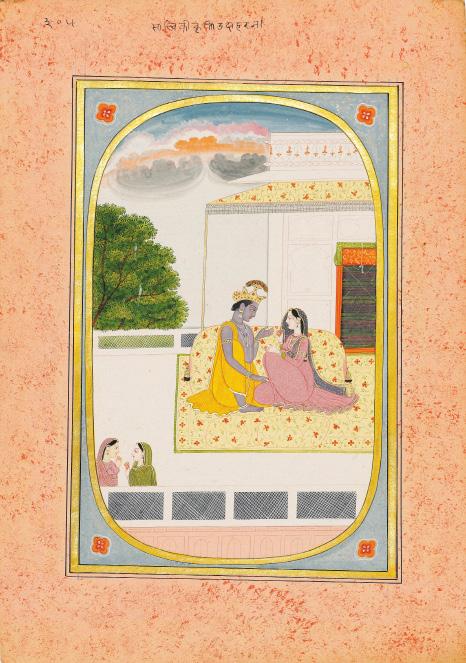
The iconic lovers gaze into each others’ eyes, Krishna’s hand barely grazing Radha’s dress as she pinches her dupatta in her right hand
Two sakhis (companions) converse nearby.
In the background, lush foliage emerges over the terrace walls. Among the branches sit two birds, resting under a vibrant pink and orange sky framed by undulating clouds.
A line of black Braj Bhasa above reads “saatvik ki kriti udaharan” (an example of an involuntary expression of emotion), referring to the eight involuntary expressions of emotions, as listed by Keshav Das: expressions of “stupor, trembling, speechlessness, pallor, tearfulness, perspiration, thrill and fainting.”
(M.S. Randhawa, Kangra Paintings on Love, New Delhi, 1962, p.51.)
The verso is inscribed with a verse from the Rasikapriya in alternating red and black script:
O foolish girl! Abandon all your desires and do not get your heart on fire. Radha and Krishna are the ideal romantic couple, better than Rati and Kama. Even Parvati cannot sow discord between them, and it would be foolish of Saraswati to come in between them. The two of them are of the same mind, they share the same thoughts and have one breath. They may appear two in body but are united by their eyes. 15.9
(Translation by Dr. Harsha Dehejia)
This is likely a conversation between the two sakhis, one warning the other not to covet the handsome Krishna or attempt to come in between the couple. Watching the two together, she speaks to the divinity of Radha and Krishna’s love, which reaches higher heights than even that of the gods. Not even the god of love himself, Kama, can compete with the depth of their love–and who could, when the union of Radha and Krishna is one and the same as the union of the soul with god.
ILLUSTRATION TO A RASIKAPRIYA SERIES: AN OLDER SAKHI COMFORTS A FORLORN RADHA
Attributed to Purkhu, Kangra, c. 1820
Opaque watercolor heightened with gold on paper
Image: 10 x 6 ½ in, 25.4 x 16.4 cm
Folio: 12 ⅞ x 9 ⅛ in, 32.8 x 23.1 cm
$40,000
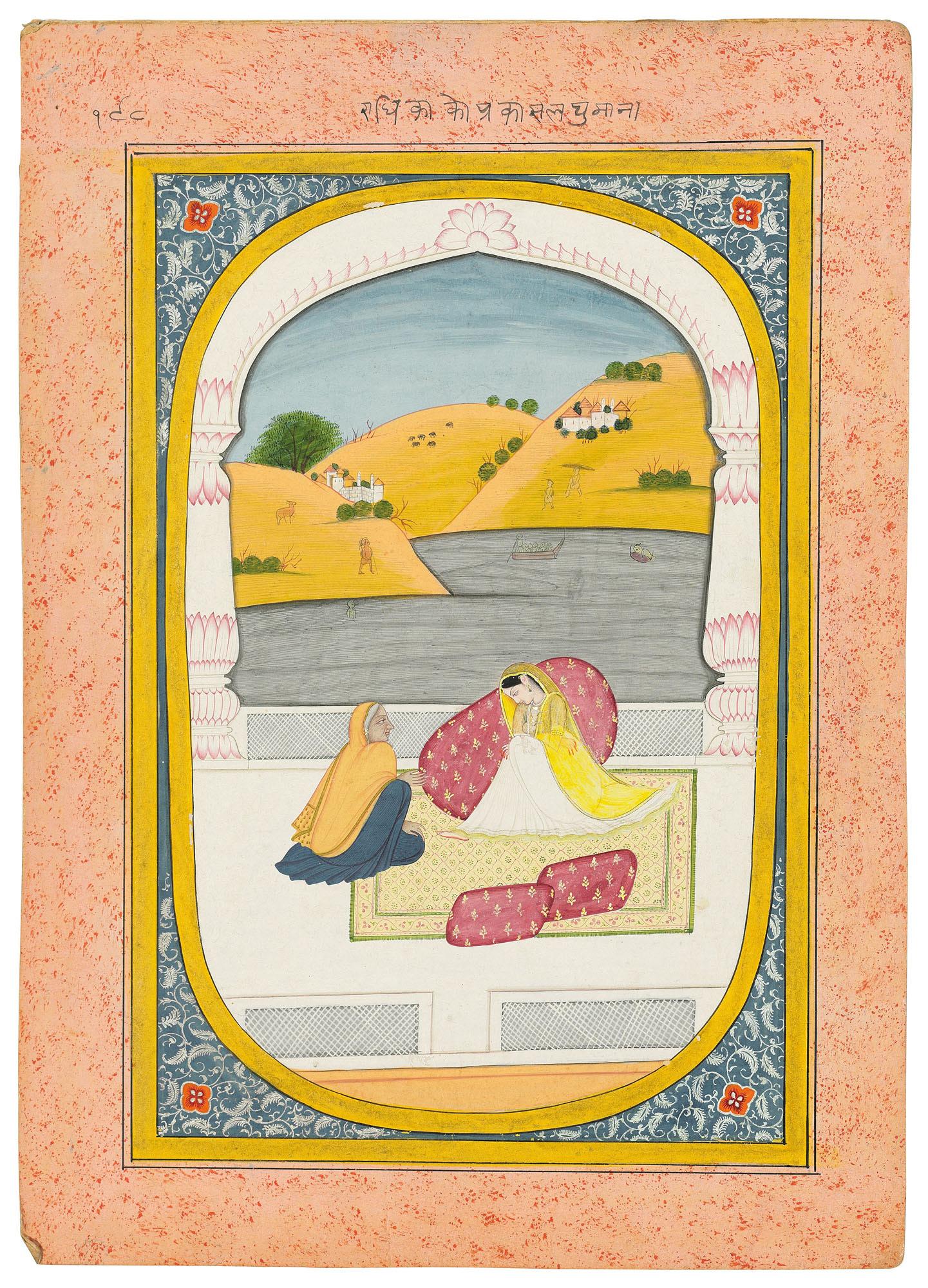
A forlorn Radha is seated on a terrace pavilion overlooking a lake and hills. Typical of the Pahari style, great attention is paid to the rolling hills in the background—diminutive figures appear dispersed amongst the countryside, rowing in boats, swimming, and strolling in the fields. Lotiform columns frame the scene, almost as if looking through a ‘window to the past.’ Next to Radha sits an older sakhi (companion) who comforts the separated lover amidst her bout of malaise.
A line of black Braj Bhasa above reads “radhika ko prakas laghu mana” (“Radhika’s manifested state of slight separation”). Mana is the separation of lovers due to jealousy and obduracy. Laghu mana occurs when the nayika herself sees the nayaka with another woman.
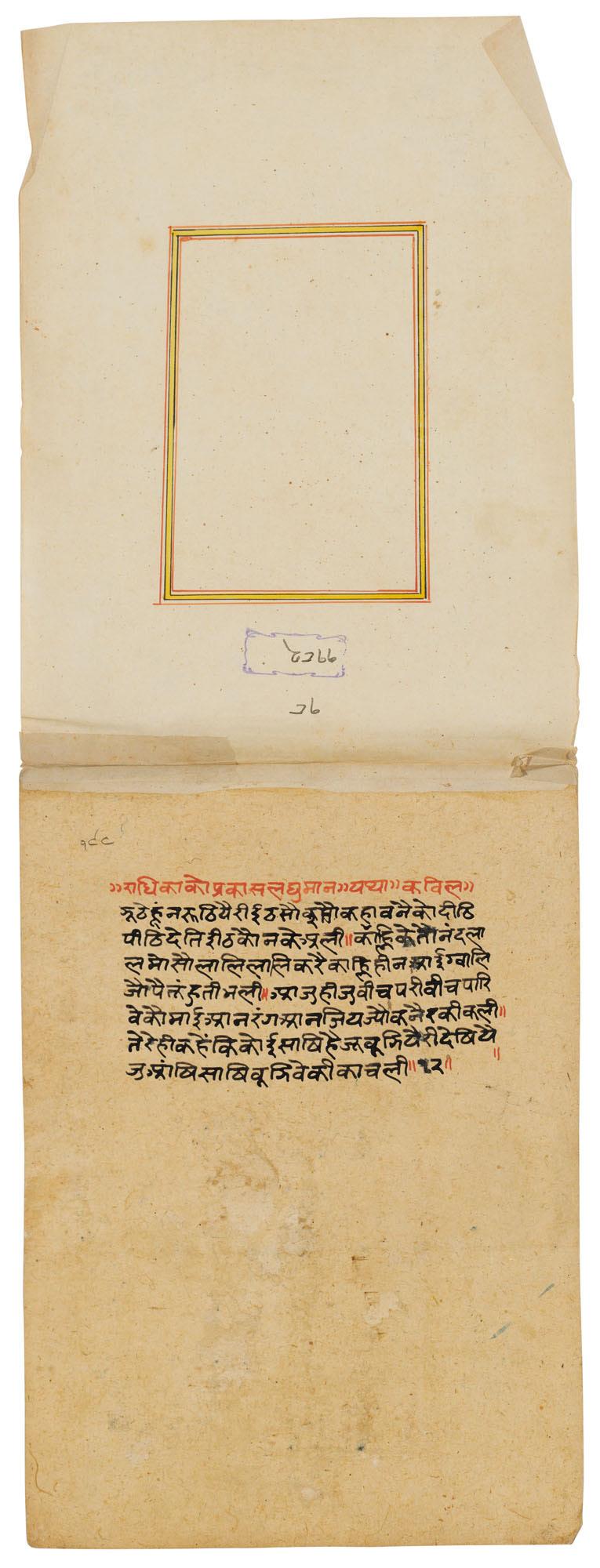
The verso is inscribed with a verse from the Rasikapriya in alternating red and black script:
Sakhi: “Even the pretence of annoyance with the dear one is unworthy, and such indifference is indeed unimaginable.”
Radha: “Who is dear, if he is himself indifferent?”
Sakhi: “Only yesterday he was sending his messages of solicitude through me.”
Radha: “Why did you not come yesterday, if you profess goodness?”
Sakhi: “Today I offer to act as a truce-maker.”
Radha: “It seems you will only cause a breach, for I am disillusioned by the deeds of Krishna, who like a kanera bud is white within, though red without.”
Sakhi: “Is there a witness who can be asked to verify this accusation?”
Radha: “I would need no witness, for I have seen things myself.”
(Translation from M.S. Randhawa, Kangra Paintings on Love, New Delhi, 1962, p.91.)
ILLUSTRATION TO A RASIKAPRIYA SERIES: KRISHNA PAYING HOMAGE TO RADHA
Kangra, Pahari, c. 1810
Gouache heightened with gold on paper 9 ⅓ x 6 ¾ in, 23.7 x 17.1 cm
$27,000
PROVENANCE
Koller Zurich, 30 October 2014, Lot 549
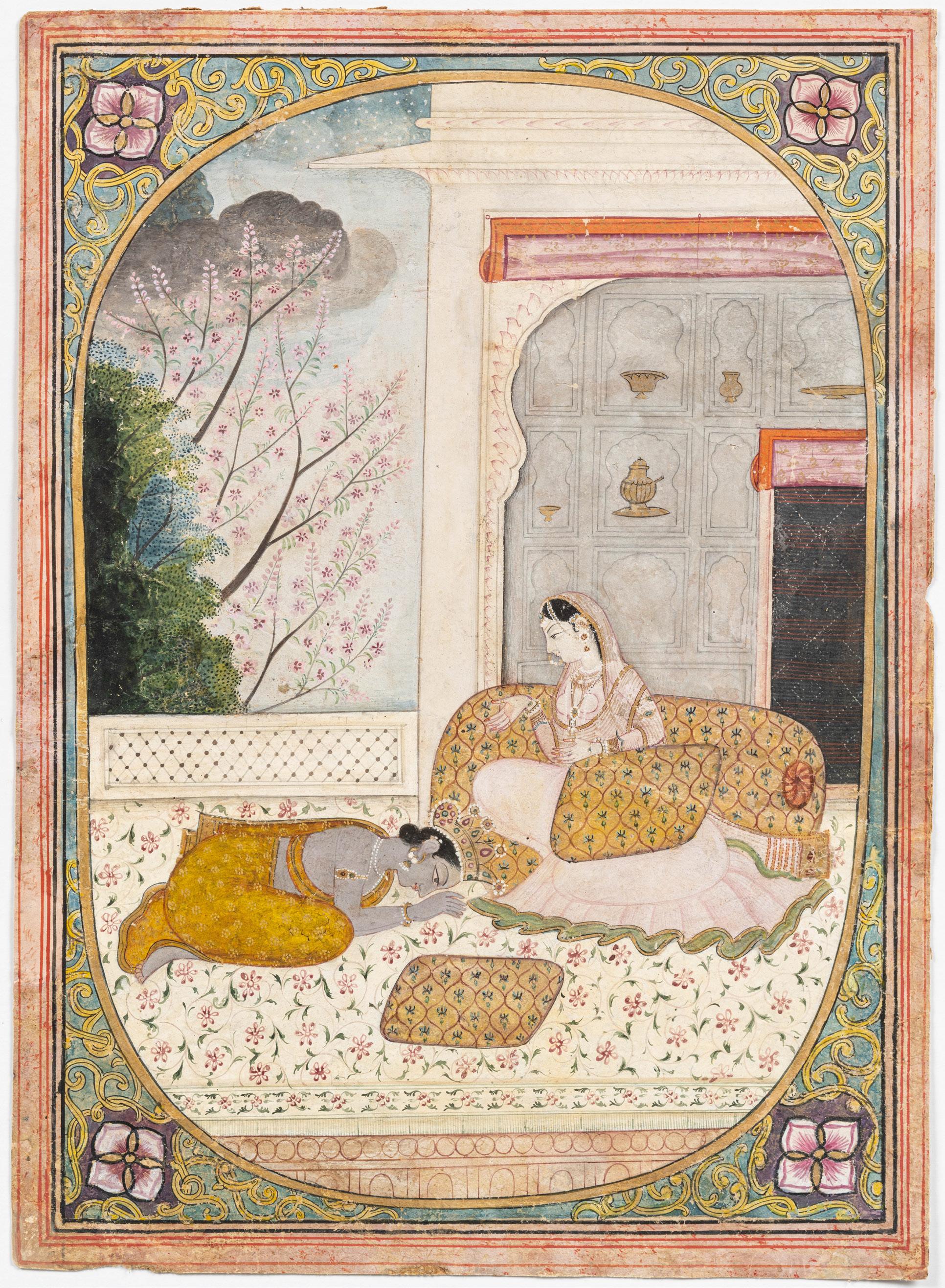
Radha lounges on a large cushion with Krishna bowing at her feet, exemplifying his fidelity to her and any prying eyes that may be spying on the lovers. Here, Krishna and Radha embody the nayika and nayak, as so purported in the poet Keshav Das’ Rasikapriya. Within the Rasikapriya, Keshav Das elaborates on the Ashta Nayika, describing eight versions of the heroine.
This work likely depicts the Svadhinapatika Nayika, she who is loyally loved by a husband that is subject to her will. The nayak willingly chooses to submit himself to his lover, as it is not a forced or manipulated form of devotion, but a true commitment to the other. Krishna and Radha assume these roles of the hero bound in companionship and the heroine deserving of fealty described in the Rasikapriya:
“....and you, only a mean little cow-girl, have your feet cleaned by him and he, the Lord of the Universe, is constantly clinging to you like your shadow. He takes care of your pettiest affairs, and protects you like betel-leaves kept in the basket and resides in you as the image dwells in the mirror. He runs after the chariot of your desires like the water of the Ganga, which followed in meandering motion the chariot of Bhagiratha. Your words are like scriptures to him. It is, therefore, absurd to try to dissuade him from doing all this even for the sake of saving him from calumny.”
While Krishna is infamous for his philandering ways, it is always Radha that he returns to, yearning for her to reciprocate the infatuation that consumes him so entirely.
It is likely that this scene shows the Svadhinapatika Nayika, but the work deviates slightly from the typical presentation of such classification. Other scenes of the Svadhinapatika Nayika show the nayak cleansing or painting the feet of his beloved, but this image simply depicts Krishna bowing at Radha’s feet.
This could be a sort of combination of the Svadhinapatika Nayika and the Khandita Nayika, one whose lover is expected to spend the night with her but instead comes to her the next morning after trysting with another. In these scenes, the nayak is seen bowing to the feet of the nayika, who turns away in hurt.
As the present painting appears to be an amicable exchange, it probably is not meant to portray the Khandita Nayika, but given that Krishna is bowing rather than cleaning Radha’s feet, it can be argued that the scene presents the duality of their relationship: a deep sense of loyalty between Radha and Krishna, contrasted with the pull of others who demand the Lord’s company.
This speculation is a fitting metaphor for god and the devotee while god is always there for the devoted, he also must care for the rest of his followers without placing too much focus on one individual.
For a traditional example of the Svadhinapatika Nayika, see the Pahari drawing of same subject from the Museum of Fine Art Boston, accession number 17.2483.
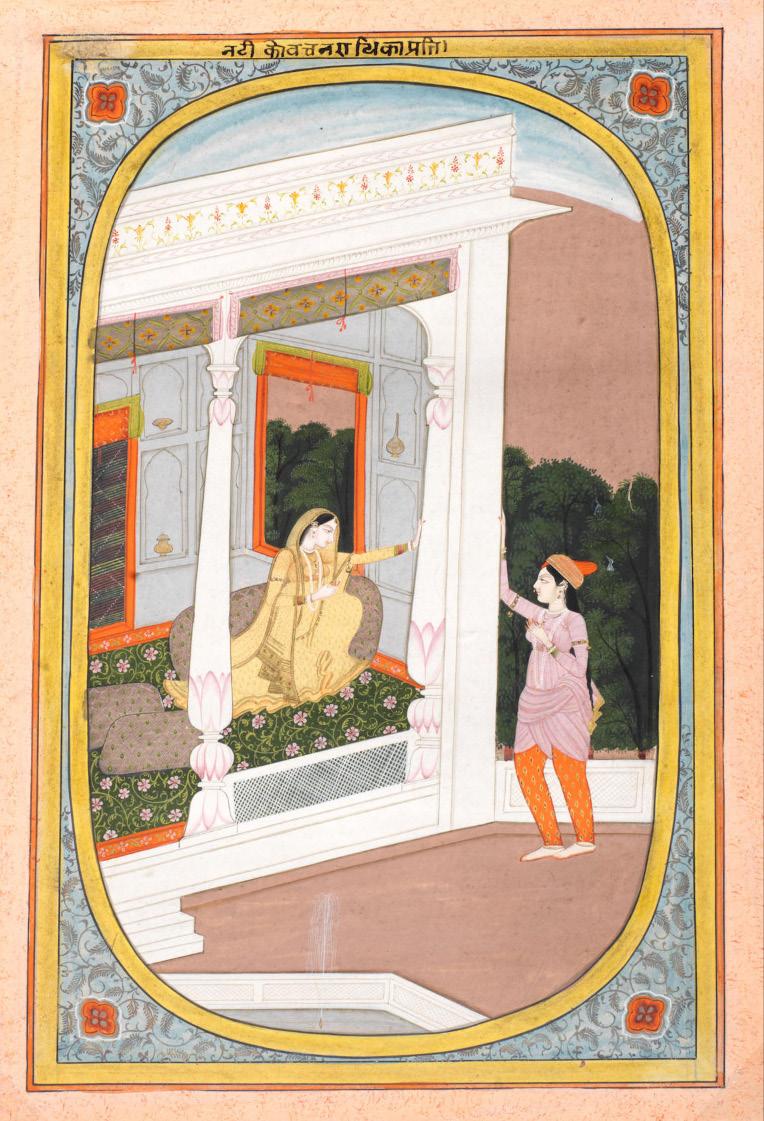
ILLUSTRATION TO A RASIKAPRIYA SERIES: RADHA, SEATED IN A PAVILION, VISITED BY A FEMALE COMPANION DRESSED AS A BOY
Kangra, Pahari, c. 1820
Gouache heightened with gold on paper
11 x 7 ½ in, 28 x 19 cm
$30,000
NOTES
Inscribed with Devanagari (upper middle).
Further inscribed with a verse from the Rasikapriya in Nagari script (verso).
PROVENANCE
Collection of the late Pearl King (1918-2015)
Probably acquired from Maggs Bros or Sotheby’s London from the 1960’s onwards (based on communication).
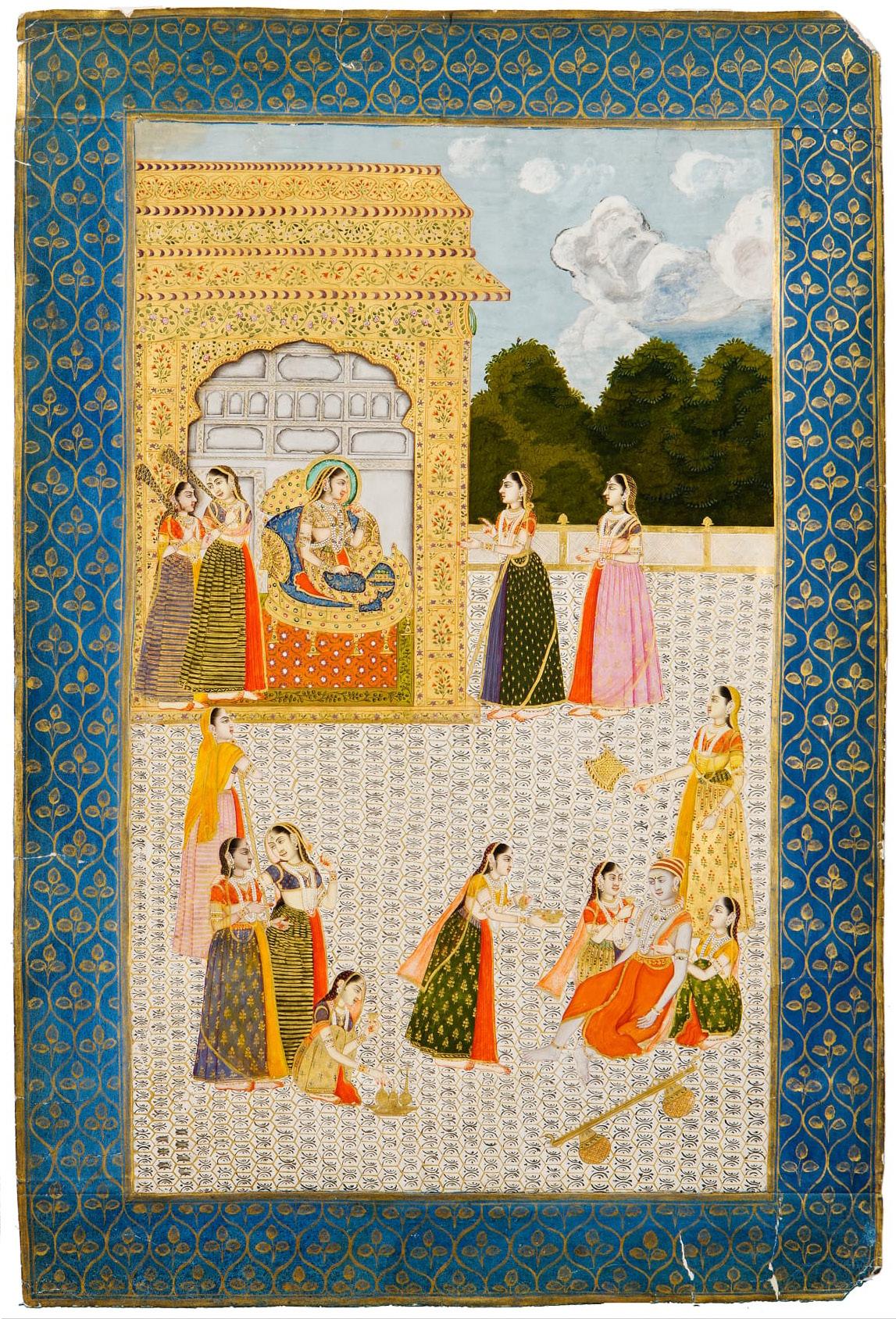
Here Radha sits within a richly appointed pavilion, poised on a floral terrace-bed, as she is approached by a female companion disguised as a young man. Such moments of disguise and mediation are characteristic of Rasikapriya imagery, in which sakhis often serve as confidantes, messengers, and facilitators of love. The companion’s theatrical dress suggests that she has come either to test Radha’s feelings, to deliver news in secret, or to help arrange a clandestine meeting. The painting captures the suspended emotional atmosphere so central to the Rasikapriya: anticipation, hesitation, and the subtle negotiation of desire within an intimate courtly setting.
A line of black Braj Bhasa above reads “nati ko vachan radhika prati” (“an actress addresses Radhika [Radha]”).
The verso is inscribed with a verse from the Rasikapriya in alternating red and black script:
Hearing from you about Krishna, my desire to see him was kindled in me. He embraced me so closely that even now there is pain round my neck. My experience with him last night was exactly the same, as you had related to me.
Fourteen paintings from this series are in the Victoria and Albert museum, London; see Archer, W.G., Indian Painting from the Punjab Hills, London, 1973, Kangra, no.66 (i)-(vi).
The distinct ovaloid format along with yellow margins and floral surroundings are, according to Archer, based on the Lambagraon Baramasa series, dating them to circa 1820.
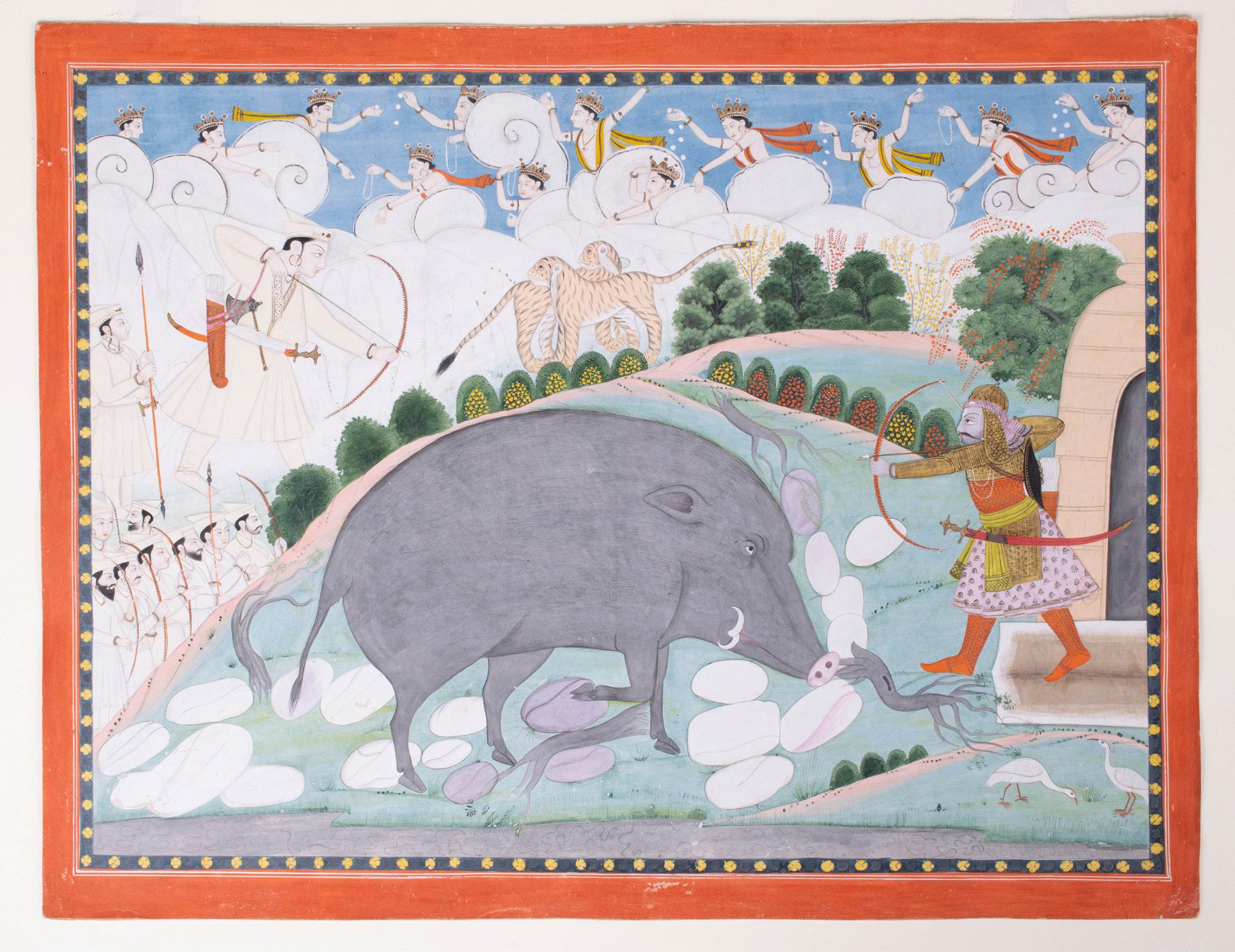
ILLUSTRATION TO KIRATA-ARJUNIYA EPISODE, FROM A MAHABHARATA SERIES
Kangra, Pahari, c. 1820
Opaque watercolor heightened with gold on paper
Image: 13 ¾ x 18 ½ in, 34.9 x 47 cm
Folio: 15 ½ x 19 ⅞ in, 39.4 x 50.5 cm
$50,000
PROVENANCE
Acquired from the Doris Weiner Gallery by repute
Private Virginia Collection, thence by descent
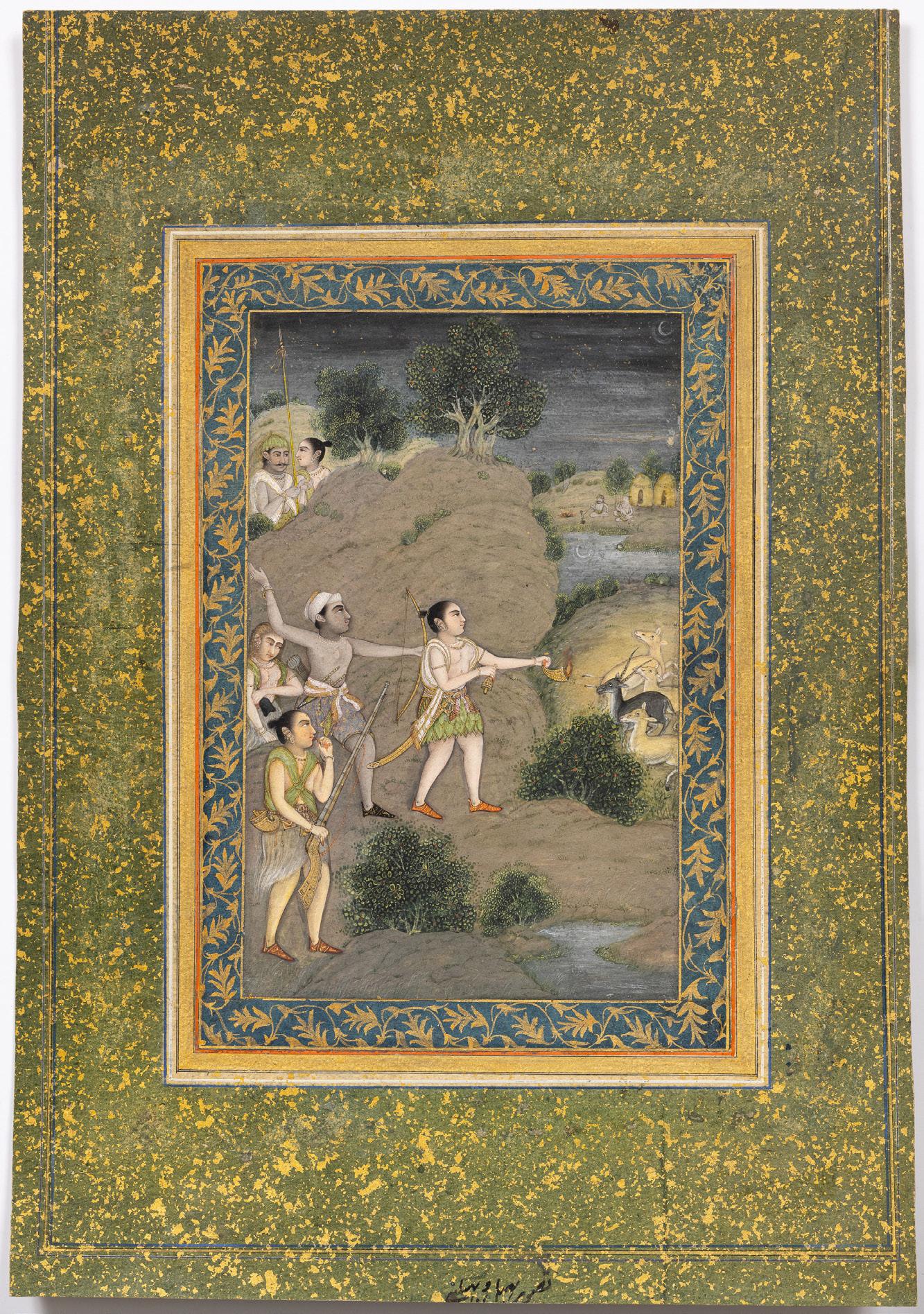
A Sanskrit epic, written by Bhairavi in the 6th century, the Kirata-Arjuniya episode revolves around the encounter of Pandava Prince Arjuna with Lord Shiva (in disguise of a Kirata, a mountain dwelling hunter).
During the Pandavas’ exile, Arjuna encountered a demon in the form of a boar. After Arjuna killed the boar in self-defense, a dispute arose with Shiva, disguised as a hunter, claiming he had shot first. Despite Arjuna’s use of divine weapons, he couldn’t defeat the hunter. Recognizing the hunter as Shiva, Arjuna sought forgiveness. Shiva revealed his identity, and blessed Arjuna with powerful weapons, including the Pashupatastra, strengthening him for the Kurukshetra War.
This artwork beautifully encapsulates the quintessence of the Kangra style by incorporating a distinctive bold border adorned with foliate motifs that gracefully traverse the composition. The airbrushed portrayal of trees and the opulent landscape, coupled with the application of linear perspective for depth, depicts the typical Kangra paintings of its era. Notably, the majority of figures are depicted inside or quarter profile. The meticulous detailing of weaponry, jewels, and clothing in the depictions of Arjuna as a warrior prince and Shiva as the Kirata hunter underscores the exquisite artistry inherent in Kangra miniatures.
Refer to a similar painting (M.70.38.1) from the Los Angeles County Museum of Art which comprises the same subject matter.
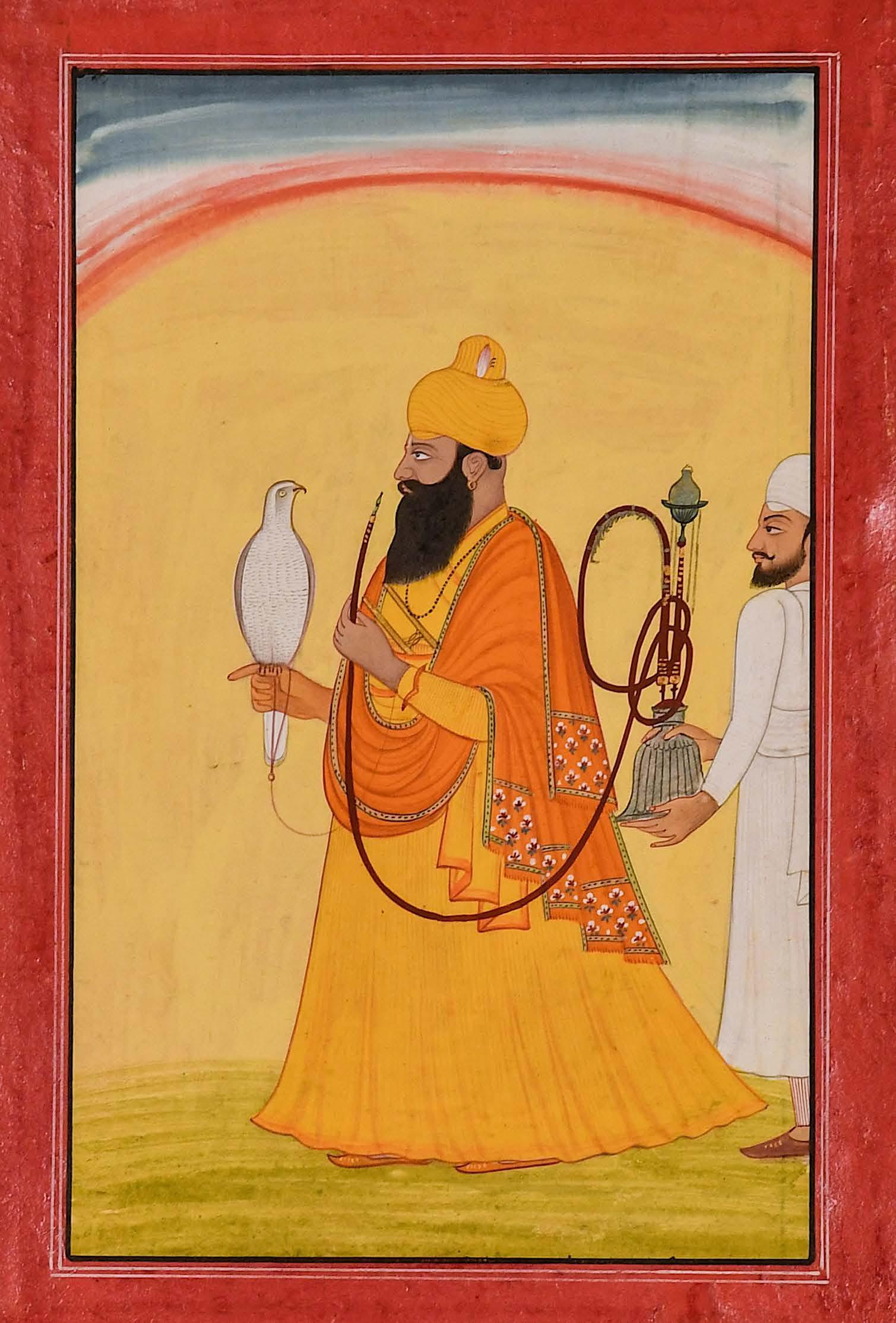
A NOBLEMAN HOLDING A HUNTING FALCON
Kangra, Pahari, c. 1790-1810
Water based opaque pigments with gold on paper, red outer borders with black and white ruled lines
Image: 7 ½ x 5 in, 19 x 12.7 cm
Folio: 9 ⅗ x 6 ⅗ in, 24.4 x 16.8 cm
$45,000
PROVENANCE
Rob Dean Art Ltd. (2010)
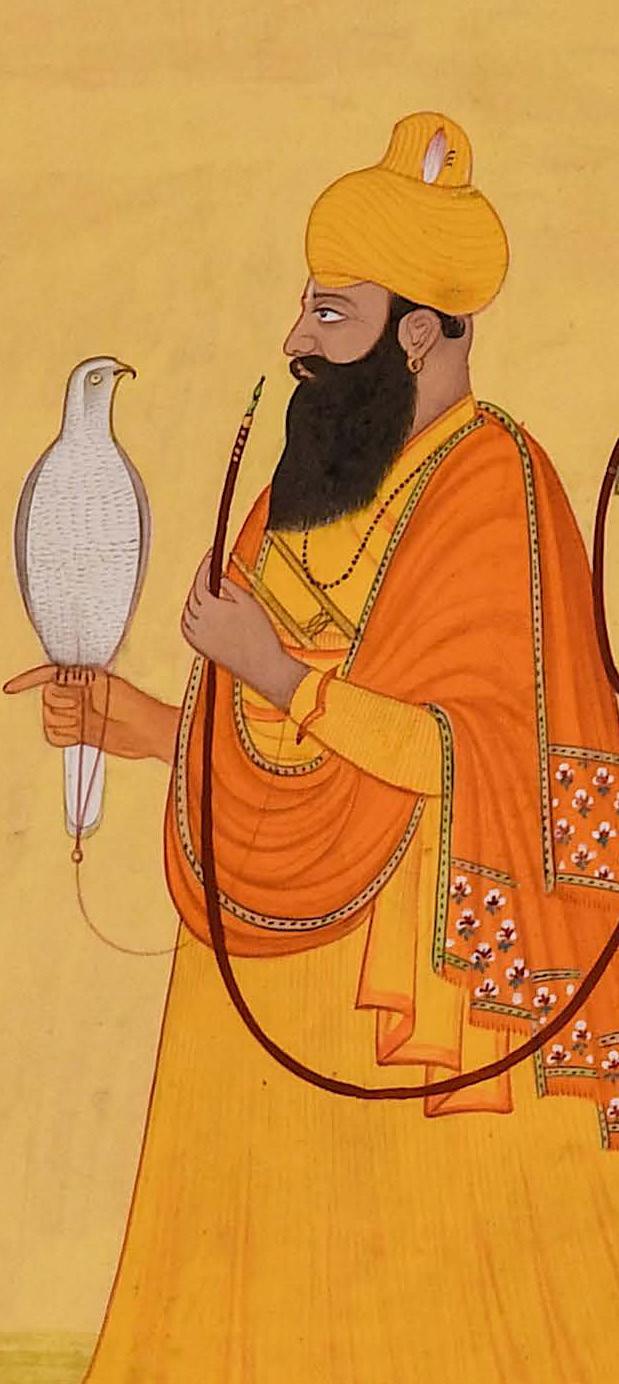
He stands with a tethered raptor perched on his hand holding the stem of a silver-based hookah lifted waist-high by an attendant. The falcon peering upwards perhaps scanning the skies for possible prey. All against a brilliant yellow ground arching upward into a crimson arc with blue sky above.
Our nobleman is not identified by an inscription but he strongly resembles Fateh Chand1, brother of Maharaja Sansar Chand (r. 1775-1823) of Kangra and uncle to Anirudh Chand (b. 1786), Sansar’s son and successor.
He appears in numerous paintings standing or sitting behind the young Anirudh as the prince looks at pictures and plays at Holi. In 2017 J.B. Losty convincingly identified the Guler artist Kushala and his workshop active at Kangra as responsible for those portraits of Anirudh Chand and his court2 which include depictions of Fateh Chand.
Based on elements of style we may place the origin of our own painting at the ateliers of Maharaja Sansar Chand of Kangra and possibly thus to the workshop of Purkhu the best-known artist (chitara) active at the Maharaja’s Kangran royal painting ateliers, and likely its workshop master.
This miniature also recalls a painting once in the James Ivory Collection, of Bir Singh of Nurpur. Although our present painting is a portrait of a different nobleman, the style is similar with a flat expanse of yellow ground with arching skyline and similar figural composition³.
1 J.P. Losty 2017
2 ibid Losty 2017
3 see Welch 1973 cat. 49. MINIA022
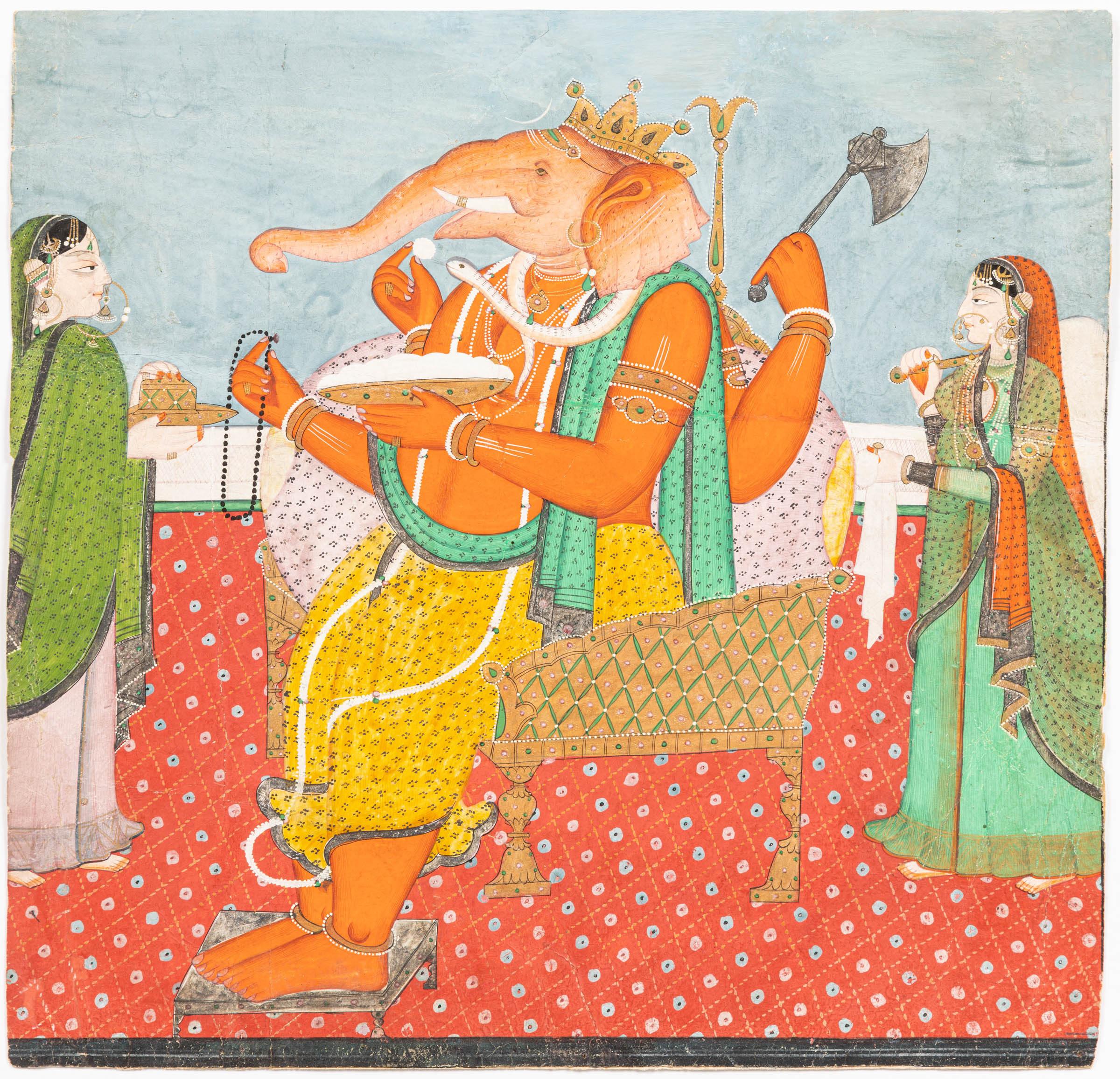
GANESHA ENTHRONED
Kangra, Pahari, c. 1800-1850
Opaque watercolor heightened with gold on paper
10 ¾ x 11 in, 27.3 x 27.9 cm
$27,000
PROVENANCE
Private New York Collection acquired in the 1990s, by repute
The bestower of good fortune, remover of obstacles, and god of new beginnings sits here enthroned, consuming sweets. He appears at ease, his gaze as relaxed as his posture, encouraging his snake to take part in the snack. The tilaka and crescent moon which grace the divine elephant-headed god’s temple are marks of his divinity and transcendent knowledge. He is attended to by two lavishly dressed women in full jewelry sets and layered textiles in hues that create continuity in the palette and connect the attendants to their object of veneration. Playful patterns and bright colors give great vibrancy to this miniature painting of the widely adored god, Ganesha.
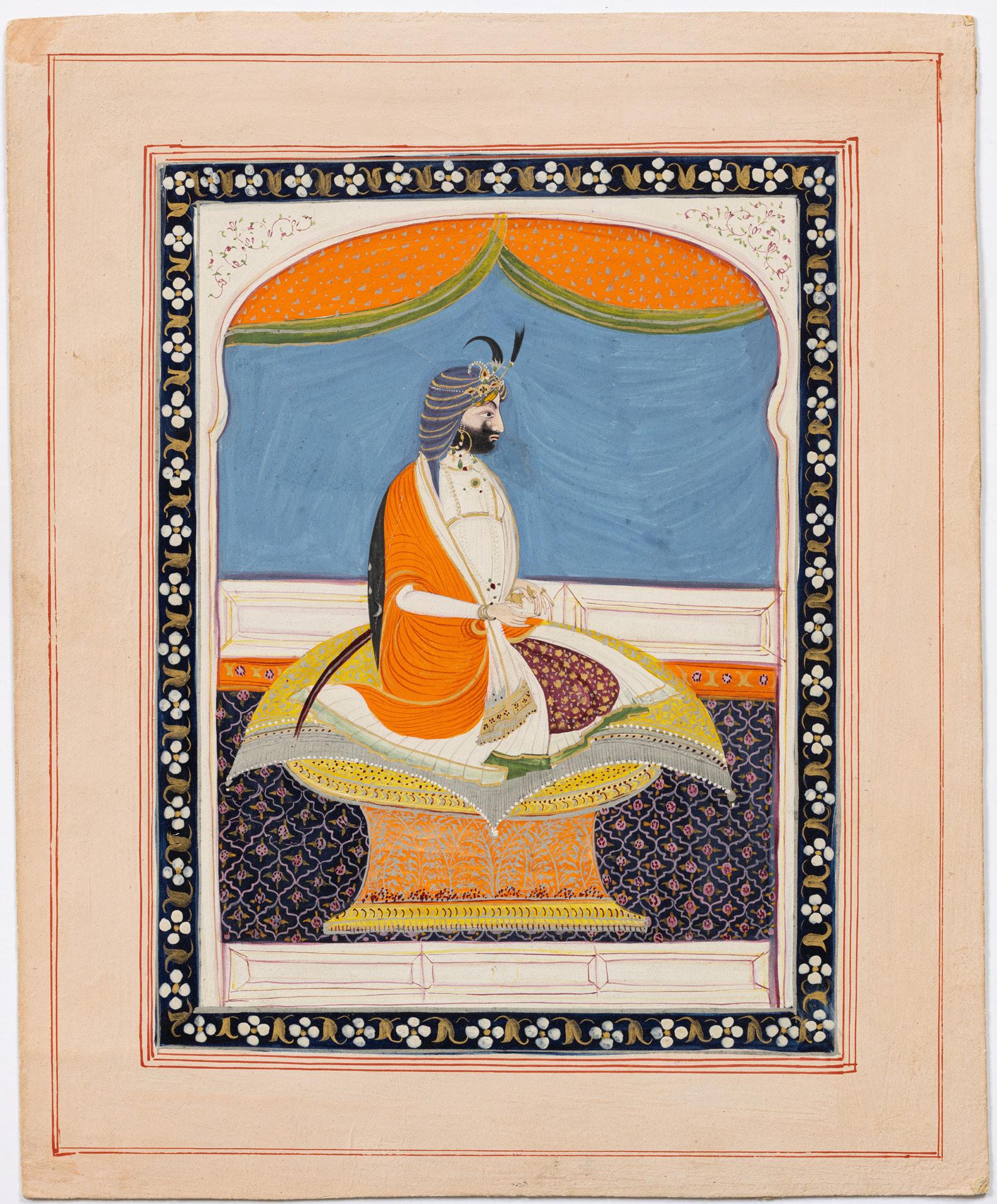
PORTRAIT
Kangra, Pahari, 19th century
Opaque watercolor heightened with gold on paper
7 ⅝ x 6 in, 19.4 x 15.2 cm
$27,000
OF RAJA SUCHET SINGH
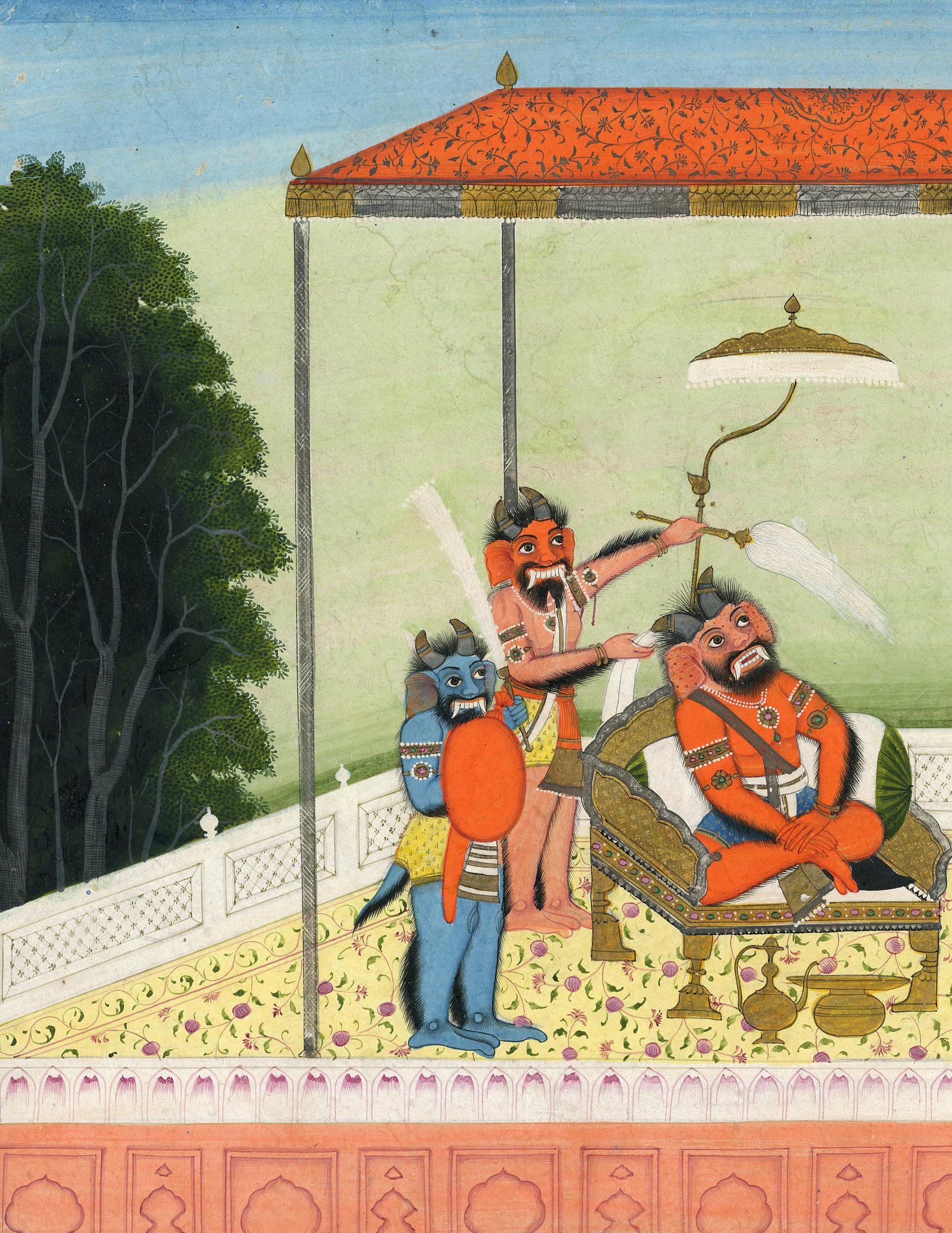
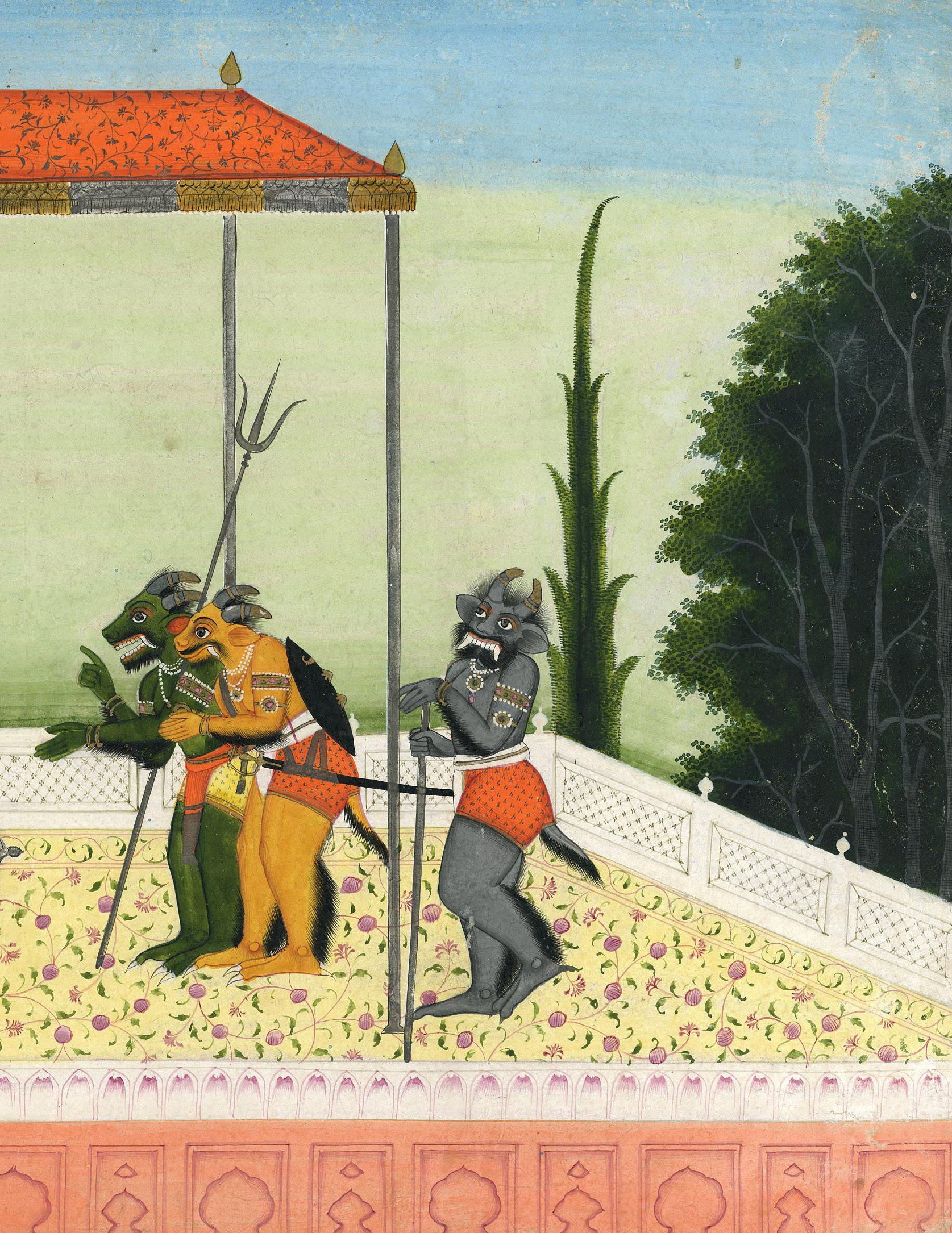
ILLUSTRATION TO THE MARKANDEYA PURANA: THE BEAUTY OF AMBIKA
Guler, Pahari, c. 1810
Opaque watercolor heightened with gold on paper
8 ¼ x 12 in, 20.9 x 30.5 cm
$35,000
PROVENANCE
Christies, London, 10 October 1989, Lot 70
Private Swiss Collection, by descent
This painting depicts the demon king Shumbha speaking to his servants Chanda and Munda. The servants are seen reporting the beauty of Ambika, one of the many forms of the mother goddess Devi. Sumbha is eventually destroyed by the all-powerful goddess, solidifying her powerful position in this great story celebrating the feminine.
The painting is in a Pahari style that emerged in the mid-eighteenth century. The light pink hues of the flowering plants, the leaf-green background, and the nuanced shading on the demons’ faces reflect the naturalistic and delicate style that these paintings are known for. Compare the juxtaposition of the quality and the colorful and detailed execution of the demons against the pale landscape to a circa-1780 scene from the Devi Mahatmya at the Cleveland Museum of Art (acc. 1996.436).
Then Chanda and Munda, two servants of Shumbha and Nishumbha happened to see that Ambika (Kausiki) looking extremely beautiful. They reported to Shumbha,
“O great king there is an exceedingly beautiful woman whose queenly beauty is illuminating the Himalaya. No-one has ever seen such sublime loveliness anywhere. Find out who that goddess is and take possession of Her, O Lord of Asuras. She is a gem among women, with exquisitely beautiful limbs which illuminate the four directions with their lustre. There she stands, O King of Demons.
You deserve to see Her.
Lord! Whatever precious stones, jewels, elephants, horses and so on are in the three worlds, all now decorate your house, O King! You have obtained the precious elephant Airavat, also the fabulous tree Parijata, as well as the wonderful horse Ucchaishrava, which was Indra’s. Here in the courtyard stands the gem-studded chariot drawn by swans, brought here from Brahma the Progenitor. Here is the treasure Mahapadma from Kubera and the unfading lotus garland Kinjalkini, the gift from the ocean. Varuna’s umbrella, which showers gold, now stands in your house with the superb chariot that once belonged to Prajapati.
Lord! You have snatched Utkrantida, the missile of Yama by which he gives exit to all creatures. Your brother now possesses the noose of the Ocean King. Nishumbha also has all the gems from the Ocean while you have the two fire-proof garments from Agni.
O Demon king, as all these gems have been given you why not also seize this jewel among women?”
After listening to all this from Chanda and Munda, Shumbha sent out the mighty demon Sugriva as his messenger to the Devi.
He said:
“Go and convey my invitation to Her in a gentle way so that She will be affectionate toward me.”
Going over to the lovely mountain seat of the Goddess, the messenger spoke in a sweet, soothing tone, saying:
“O Devi, I am the messenger of Shumbha, Lord of the Demons and Sovereign of the three worlds. He has vanquished all his foes among Asuras and even the Gods were unable to resist him. He sent me here to Your presence. Listen to what he says, his message is this:
‘All the three worlds are mine. Even the Gods obey me. I eat all the offerings which once were theirs. All the finest jewels of the three worlds are now mine. Even Indra’s elephant, Airavata, I now have. With salutations the Gods have even offered me the glorious horses called Ucchaihsravas which arose at the churning of the milk ocean.
O magnificent lady! All the other objects which belonged to the Gods or Gandhavas or Nagas, all are now in my possession. We regard You, O Devi, as the jewel among womankind. Therefore, come to us, we who are the connoisseurs of gems. Come to me or to my powerful younger brother Nishumbha, O Lady of the quick side-glances, You are indeed a sparkling jewel. By marrying me You will gain incomparable wealth. Think of the advantage and become my wife.’”
When this was said, the adorable Goddess Durga who sustains and protects the universe, smiled thoughtfully and said:
“What you say is true, no doubt. Shumbha is indeed sovereign of the three worlds together with Nishumbha. But how may I nullify My former vow? Please listen to this vow I once made in ignorance: I once declared I would only marry one who could be My equal in strength, one who could defeat Me in battle and remove My pride, only he could be my husband.
So let Shumbha come here, or Nishumbha the great Asura, let him vanquish me without delay and gently take my hand in marriage.”
The messenger said:
“O Devi! This is arrogance! Do not talk this way to me! Name a single god from the three worlds who is capable of standing against Shumbha and Nishumbha!
In fact all the Gods were unable to face even the other Asuras in battle. So how could You, a single woman do this on your own? If Indra and all the other Godheads united could not defeat Shumbha, how will You, a woman, dare to face him? It would be better that You heed my message and go to Shumbha and Nishumbha yourself. Otherwise you will suffer the humiliation of being dragged there by the hair.”
The Devi said:
“It is true. Shumbha is strong. Nishumbha is very heroic. But what can I do? In My ignorance I made my vow. You go back to the Asura Lord and tell him politely what I have said, then he may do whatever he pleases.”
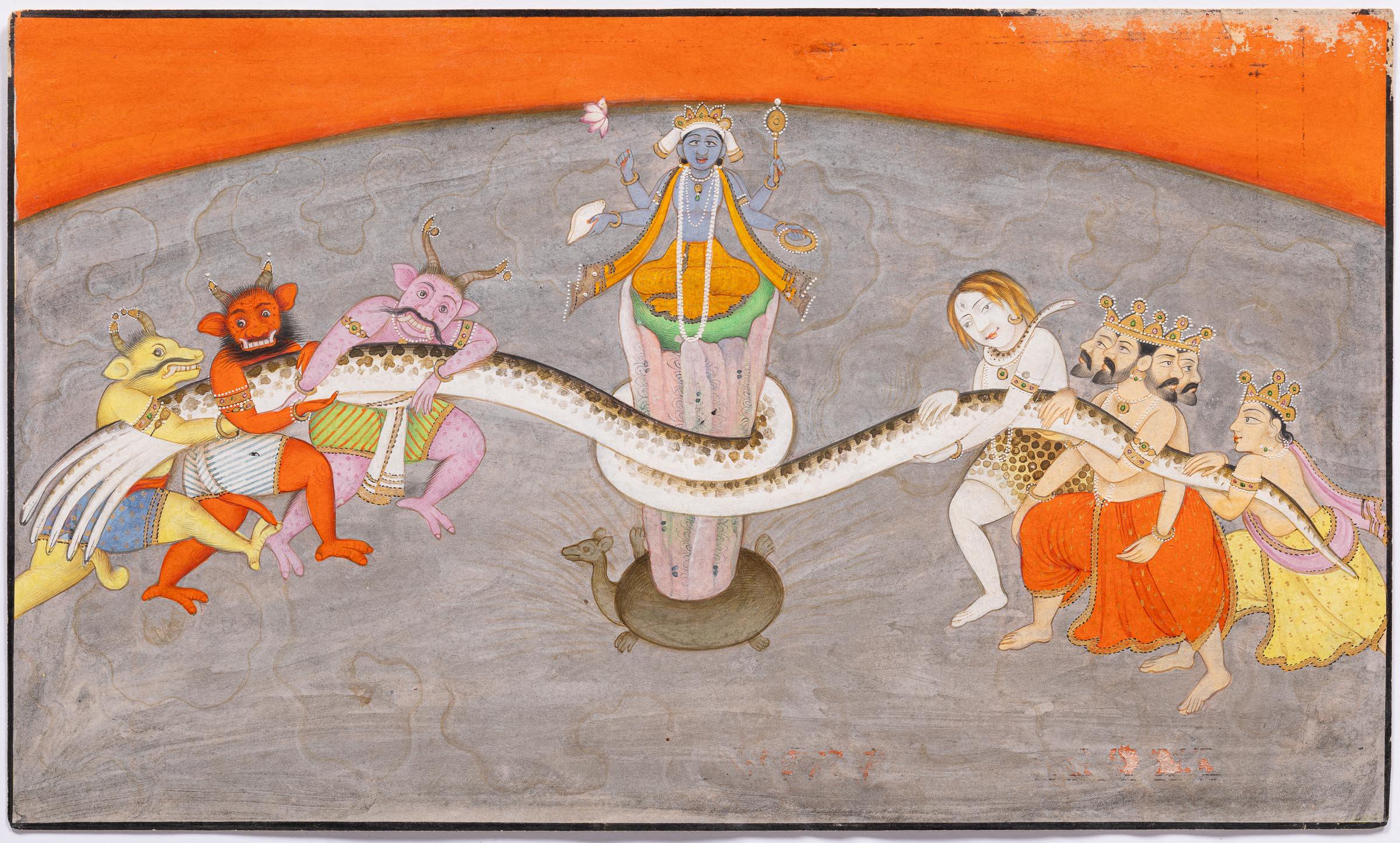
SAMUDRA MANTHAN: KURMA AVATAR
Guler, Pahari, c. 1780-1800
Opaque watercolor heightened with gold on paper 8 x 4 ½ in, 20.3 x 11.4 cm
$20,000
PROVENANCE
Private New York Collection since the 1980’s by repute
Kurma, the tortoise avatar of Vishnu, is rendered, connected as he is with the great myth of the churning of the ocean. Kurma supports on his back the cosmic mountain, Mandara (Meru), as the churning stick, and the awesome serpent, Vasuki, serves as the churning rope. The gods take up their position on the tail end of the serpent; the demons, as cleverly contrived by the gods, are on the side where the heads of Vasuki are so that they are constantly weakened by the poisonous fumes emitted by the great snake.
The gods are led by Shiva, then Brahma and finally another depiction of Vishnu. Vishnu is depicted three times in this work, once in the act of churning, a second time in his form as the tortoise, and then appearing a third time, seated atop the mountain, four-armed, holding his familiar attributes.
In this piece, the sky takes a warm orange color, and the water a more dull gray, whereas blue is used to highlight the divinity of Vishnu himself. Small line work in the lower half of the painting gives texture and movement to the water, as if it is funneling near the tortoise form.
The legend of Samudra Manthan, “The Churning of the Ocean,” begins with the curse of the sage Durvasa. Long before the present event takes place, Durvasa brought a fragrant garland for Indra, the king of the gods. Indra, in an inebriated state, hung the garland on the trunk of his elephant Airavata who trampled it under his feet, irritated by its smell.
Seeing this, Durvasa flew into a rage, and
placed a curse upon Indra so he would lose all his splendor. As a consequence the goddess Lakshmi, his source of prosperity and fortune, disappeared from the abode of the gods and gloom descended upon earth.
When Indra appealed to Vishnu for answers, he explained that since Lakshmi had dissolved herself into an ocean of milk, she would have to be churned out. Vishnu indicated that both Lakshmi and the divine nectar of immortality, amrita, would emerge from the ocean of milk if the gods partnered with the demons to churn the milk together.
Despite being at war since the beginning of time, both the devas and the asuras were driven to join forces by their desire for immortality. This pivotal event is illustrated in the colorful painting here.
Many things emerge from the ocean in this wonderful origin story. First emerges an overwhelming poison that Shiva drinks up to save the world from greater misfortune. Then emerges Jyestha, the goddess of misfortune. What follows is much more auspicious: a precious jewel, a wish-fulfilling cow, the goddess Varuni, a divine parijata tree, Vishnu’s mighty bow, a wish-fulfilling tree, apsaras, the glorious Lakshmi, Dhanvantari, founder of Ayurveda holding amrita in his hands, and even more divine beings.
SEATED NOBLEMAN ON A TERRACE
Attributed to Pandit Seu and his family workshop, Guler, c. 1750
Opaque watercolor heightened with gold on paper
Image: 7 ⅛ x 5 ⅓ in, 18.2 x 13.6 cm
Folio: 11 ½ X 7 ⅞ in, 29.1 x 20.1 cm
$30,000
PROVENANCE
The Collection of Carol Summers.
Christie’s New York, 20 March 2019, lot 713.
EXHIBITION
Air India’s Maharaja: Advertising Gone Rogue, Poster House Museum, September 9, 2022 - February 12, 2024.
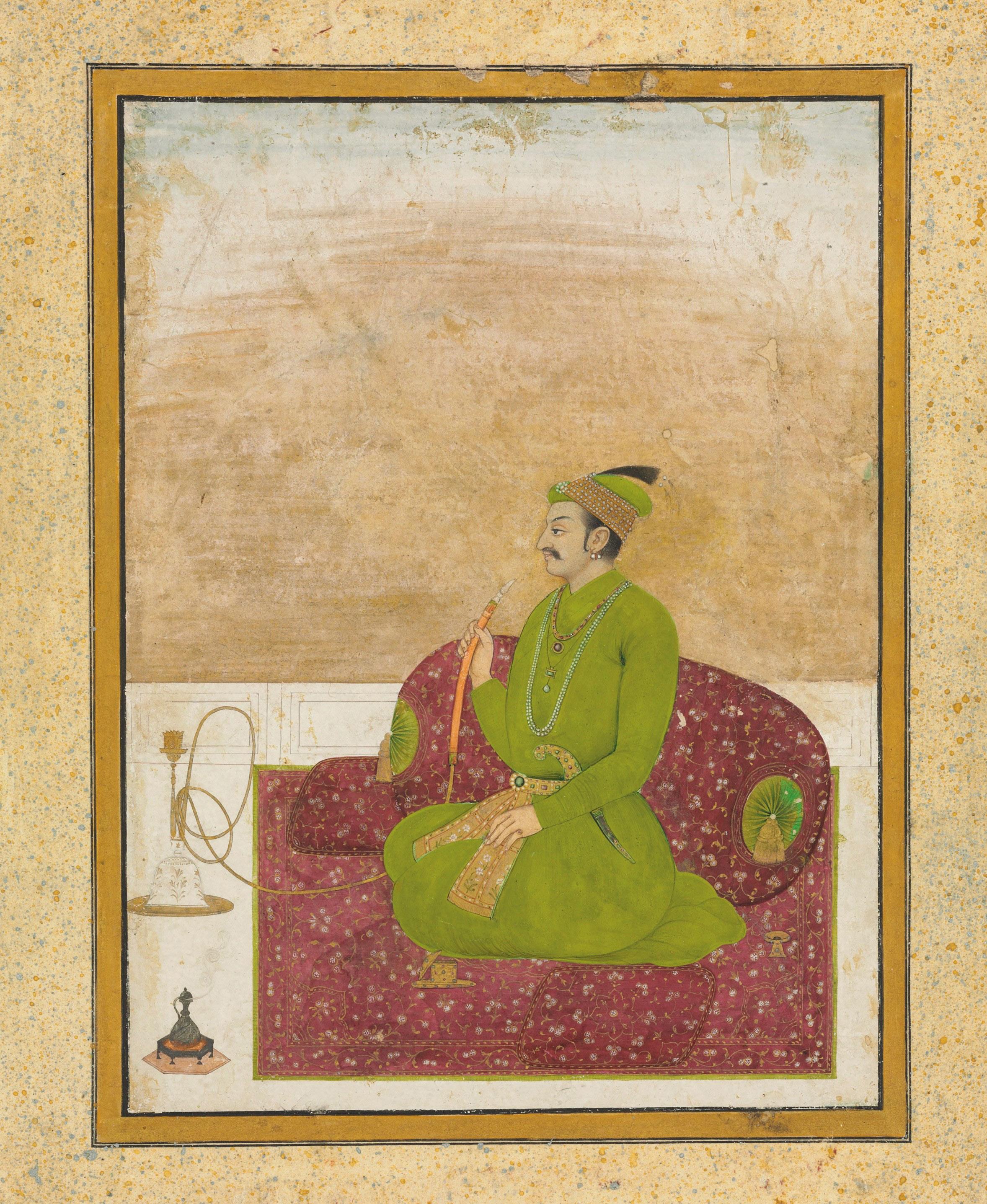
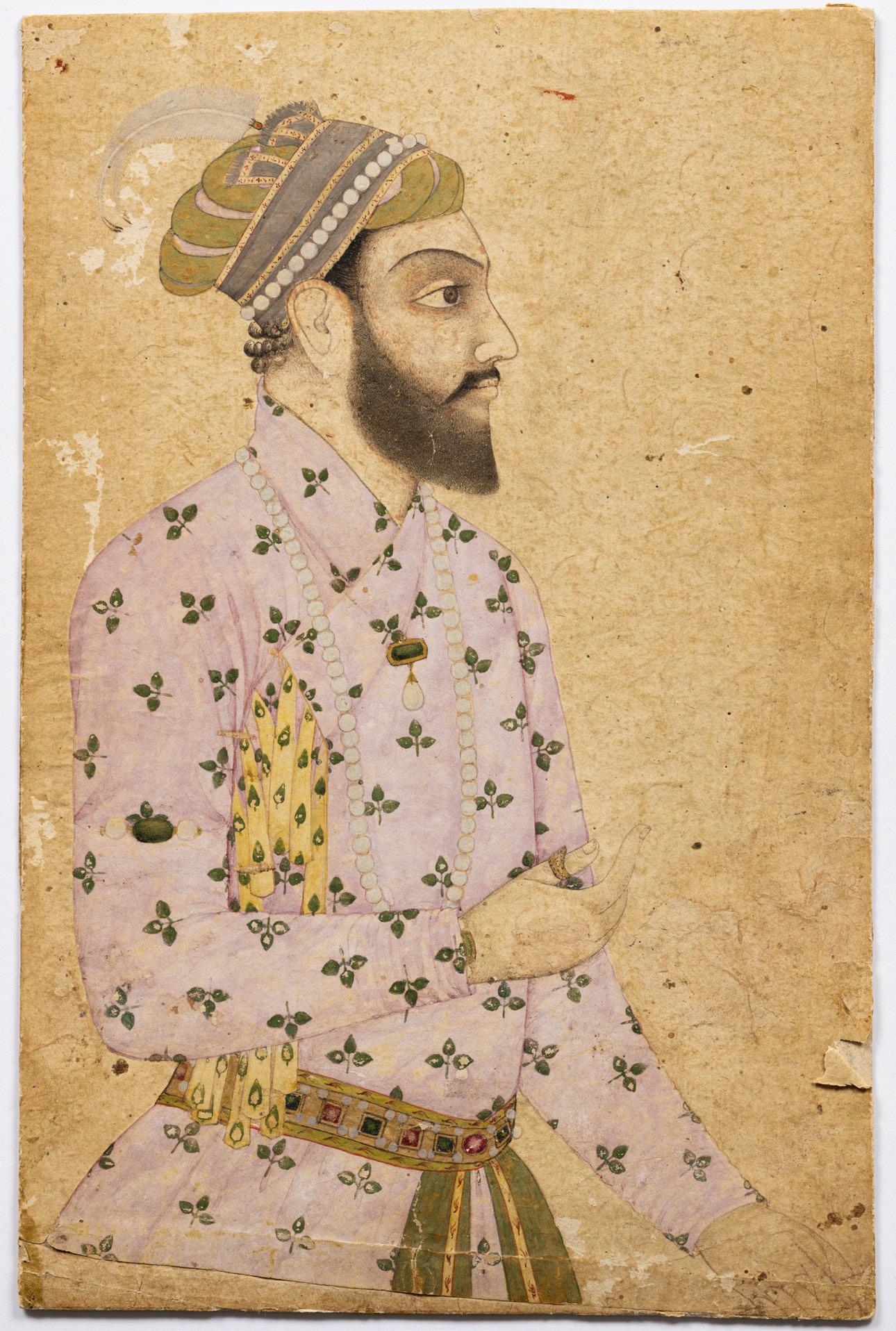
A nobleman in a vivid green jama with an elaborate floral and jeweled belt, necklaces of rubies, emeralds and pearls that match his embellished turban surmounted by a feathered sarpech, appears dignified atop a white marble terrace. He relaxes before an elaborate drawstring bolster atop lavish textiles as he holds the end of a hookah, before which a heated vessel sits emitting wisps of smoke. The elegant composition is worthy of close comparison to a figure in the same posture, garb and environment as the present nobleman, attributed to the master painter Nainsukh: a drawing of Mir Mannu in the Government Museum and Art Gallery, Chandigarh (acc. no. B-60), illustrated by B.N. Goswamy in Nainsukh of Guler, Zurich, 1997, pp. 102-103, no. 27.
Since Akbar’s time, the Mughal Empire exerted suzerainty over the small principalities within the rich landscape of the Punjab Hills. The present painting is a result of that influence, as it was very likely painted from an imperial Mughal model. The painting is, nevertheless, of the highest quality and thus attributed to the famed atelier of Pandit Seu of Guler—an artist who credited with aiding in the shift to a more formal style with the transmission of Mughal techniques learned directly from disbanded artists from Aurungzeb’s former atelier.
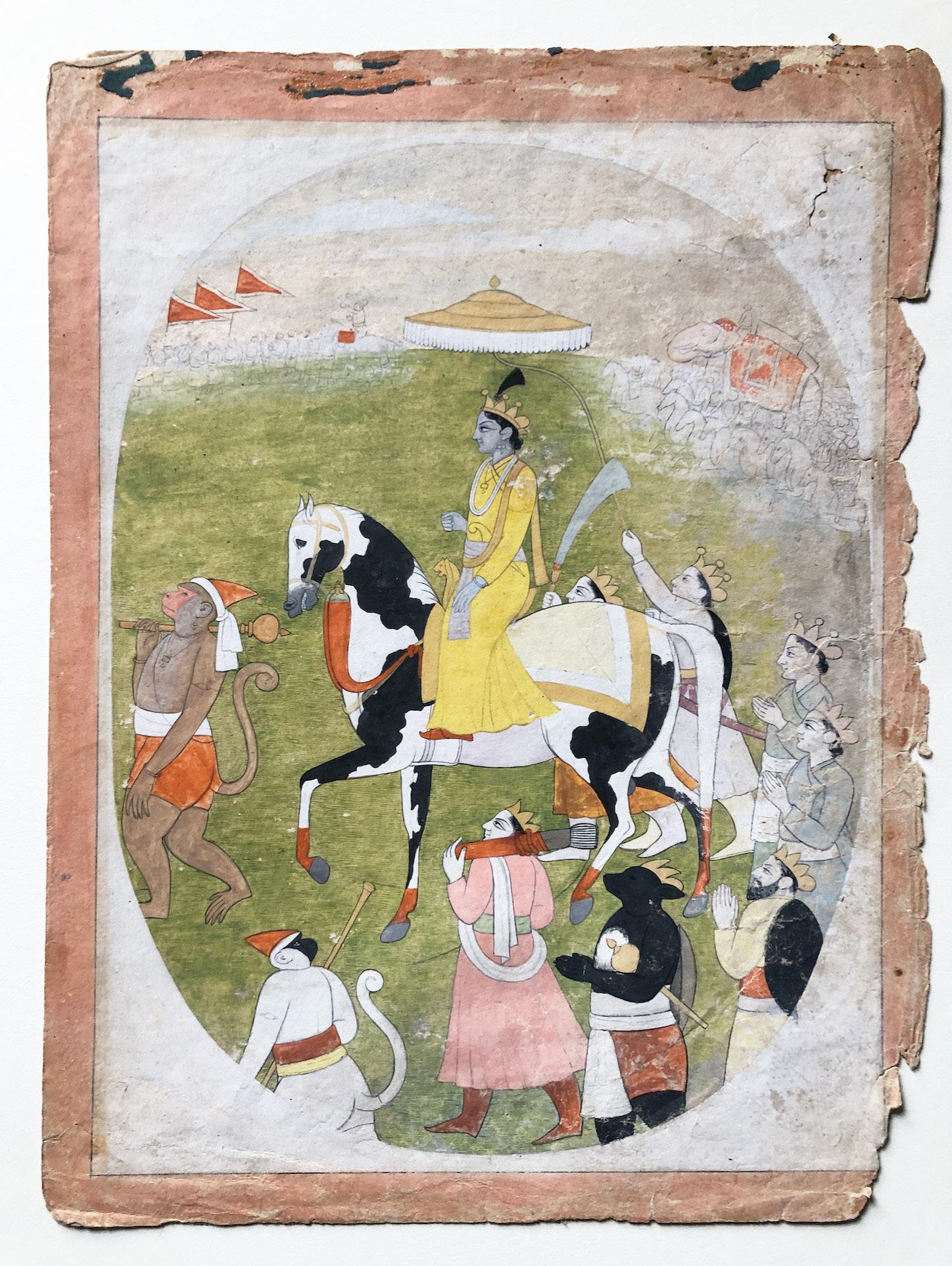
RAMA’S PROCESSION LED BY HANUMAN
Guler, Pahari, 18th century
Opaque watercolor on prepared paper 11 ¾ x 9 in, 29.8 x 22.9 cm
$30,000
PROVENANCE
Bequeathed in 1946 by P. C. Manuk and G. M. Coles through the National Art Collections Fund, accessioned 1948
Private New York Collection, acquired in the 1960s by repute
This striking painting shows Rama, the blueskinned seventh avatar of Vishnu and heroic protagonist of the Ramayana, mounted on a piebald horse and moving across an open green field in the company of attendants and allies. The scene appears to represent the triumphant return to Ayodhya described near the close of Book 6 of the Ramayana (Yuddha Kanda), after Rama has defeated Ravana and recovered Sita:
[Rama] proceeded along the highway to his capital; Bharat took up the reins, Shatrughna the parasol, Lakshmana the fan and Sugriva one of the chowries, whilst that Indra among the Titans, Bibishana, held the second that was made of Yaks’ tails of dazzling whiteness and like unto the moon, waving it to and fro over the prince, behind whom he stood. At that instant, the sweet music of Rama’s praises rang out in the sky sung by companies of Rishis and Gods with the Marut Hosts. … nine thousand elephants carried the monkeys, who, in the form of men, proceeded along the way, … Then that Lord of Men advanced towards the city, to the sound of conches and the roll of drums.1
The painter follows the spirit of the passage closely, though not literally. Rama sits at the center of the composition, sheltered by a parasol and accompanied by attendants who carry royal insignia, including a flywhisk. At the front of the procession Hanuman is prominently shown in simian form, leading the way and sounding a wind instrument, while other companions gather around Rama
with hands raised in reverence or prayer. A dark, bear-like figure almost certainly alludes to Jambavan, king of the bears, and the lightly sketched ranks in the distance, together with banners and an elephant, evoke the larger retinue described in the text.
The composition departs from the Ramayana narrative in one especially meaningful respect. In the epic, Rama returns to Ayodhya in a chariot drawn by horses; here, by contrast, he appears on a piebald stallion. This change is significant, for it places Rama within an established visual language of imperial Mughal equestrian portraiture. The broad green setting and the distant, lightly massed figures in the background also recall conventions of imperial Mughal painting.2 Particularly relevant is an image of the emperor Farrukhsiyar riding a piebald horse with attendants bearing the parasol and chowrie and troops extending into the distance.3 In the present work, Rama is therefore imagined not only as the victorious hero of the Hindu epic, but also as an ideal sovereign rendered through the idiom of Mughal kingship.4
1 Ramayana, Vol. III, pp.363-7.
2 There are a number of Mughal paintings of emperors Aurangzeb (r. 1658-1707), Muhammad Shah (r. 171948) and Ahmad Shah (r. 1748-54) by the royal artists Bhavanidas, Chitarman II and Hunhar II that display this feature (e.g. Metropolitan Museum of Art, New York, 2003.430, see Haidar 2011, fig. 6, p. 538, Dalrymple and Sharma 2012, no. 2, p. 71; private collection, see McInerney 2011, fig. 7, p. 554; private collection, see McInerney 2002, fig. 15, p. 30; Royal Scottish Museum, IL.2013.8.7)
3 Farrukhsiyar reigned from 1713 to 1719. The painting is attributed to Chitarman II (Baroda Museum and Picture Gallery, see McInerney 2011, fig. 3, p.553).
4 Other late Pahari versions of the present composition survive (see Khandalavala and Chandra 1965, fig. 89; National Museum, New Delhi; Sotheby’s 1983, lot 127; Tooth Gallery 1980, no. 5), and the same iconography was used in several equestrian portraits of the early nineteenth century portraying Guru Gobind Singh, the 10th Sikh Guru (Museum of Fine Arts, Boston, 17.2729; Government Art Museum, Chandigarh; private collection, see Stronge 1999, p. 36, fig. 32).
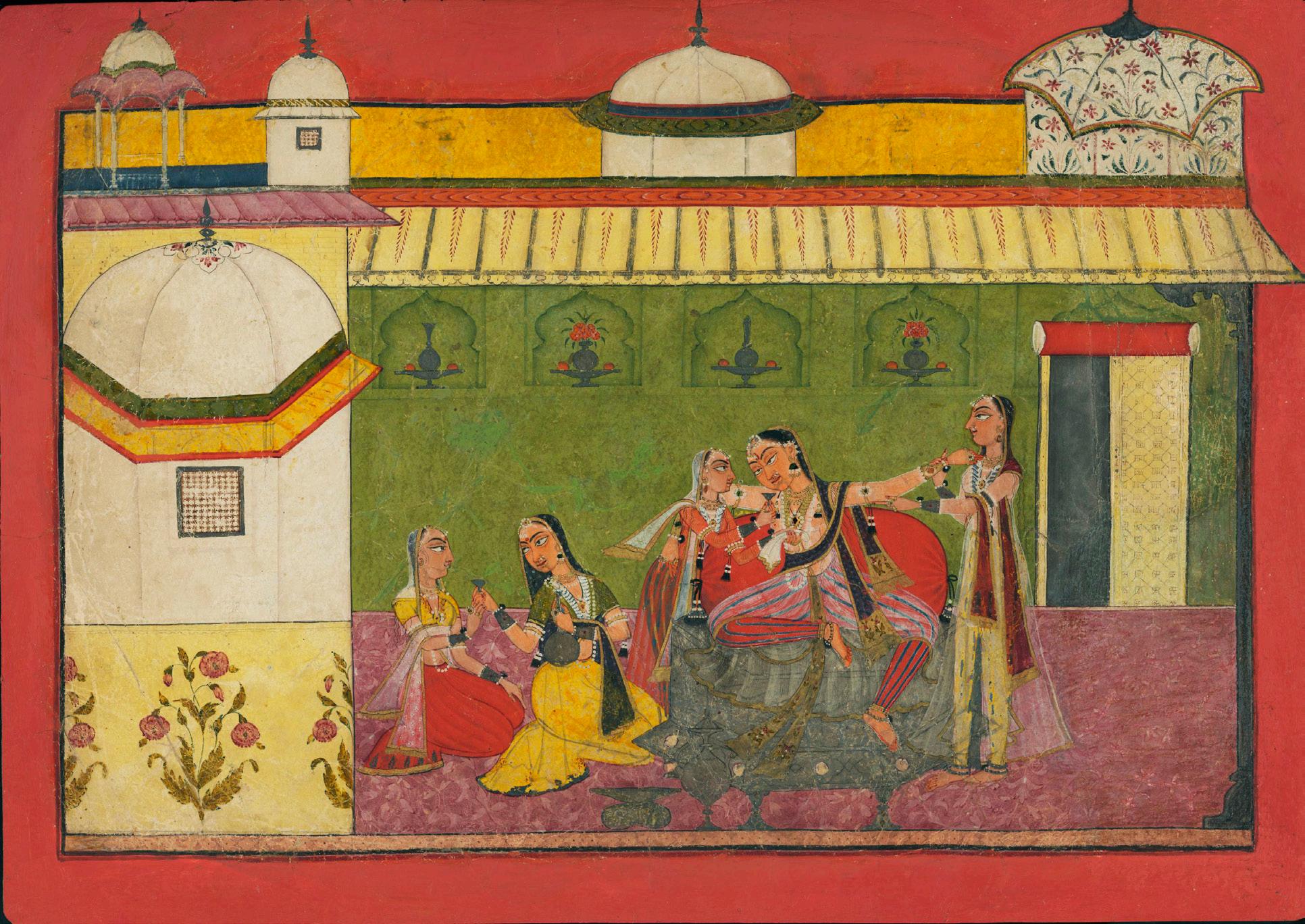
ILLUSTRATION TO THE ‘THIRD’ RASAMANJARI OF BHANU DUTTA: THE INTOXICATED COURTESAN
Attributed to Devidasa, Basohli, c. 1695
Opaque watercolor heightened with gold, silver, and beetle wing cases on paper 8 ¼ x 11 ½ in, 21 x 29.2 cm
$125,000
PROVENANCE
Doris Wiener, New York, before 1981 Bonhams, New York, 11 Sep 2012, Lot 83 Private Collection, USA
The maiden is seen seated in a relaxed and open pose supported by a silver platform against a red bolster, secured at the arms by attendants who offer her more wine. To the left foreground a seated maiden offers wine to another who raises her hand in refusal. The gathering is set against a green wall decorated with vase filled niches and surrounded by white faceted turrets, a yellow awning and flowering shrubs.
The Rasamanjari cycle explores the wellknown theme of the lover and beloved (nayaka–nayika), unfolding the many emotional states of love, including desire, estrangement, yearning, and refusal. Its paintings are distinguished by bold, contrasting planes of color, graceful figural rhythms, and sumptuous surface embellishments, including shimmering green beetle-wing inlay and raised white dots of shell-lime that lend the compositions a jewellike richness.
As noted by Archer in The Loves of Krishna in Indian Painting and Poetry (London, 1960, p. 06), “The text in question is a treatise on poetics illustrating how romantic situations should best be treated in Sanskrit poetry—the conduct of mature mistresses, experienced lovers, sly go-betweens, clowns or jokers being all subjected to analysis.”
This piece shows a mature heroine (nayika) so distressed by the absence of her lover that she spends her days intoxicated to numb the pain, drowning her longing. Sensitive to the pangs, her consumption is excessive contrasted with the accompanying maiden
who practices moderation, raising her hand to refuse another glass.
Archer goes on further to state (ibid, 105), “This series of illustrations is in some ways a turning point in Indian painting for not only was it to serve as a model and inspiration to later artists but its production brings to a close the most creative phase in Basohli art”.
Four other pages from the same series are in the Lahore Museum (see FS Aijazuddin, Pahari Paintings and Sikh Portraits, London, 1977, nos. 3 (i-iv). Also see W. G. Archer, Indian Paintings From The Punjab Hills: A Survey and History of Pahari Miniature Painting, Delhi, 1973, nos. 15 (i-v).
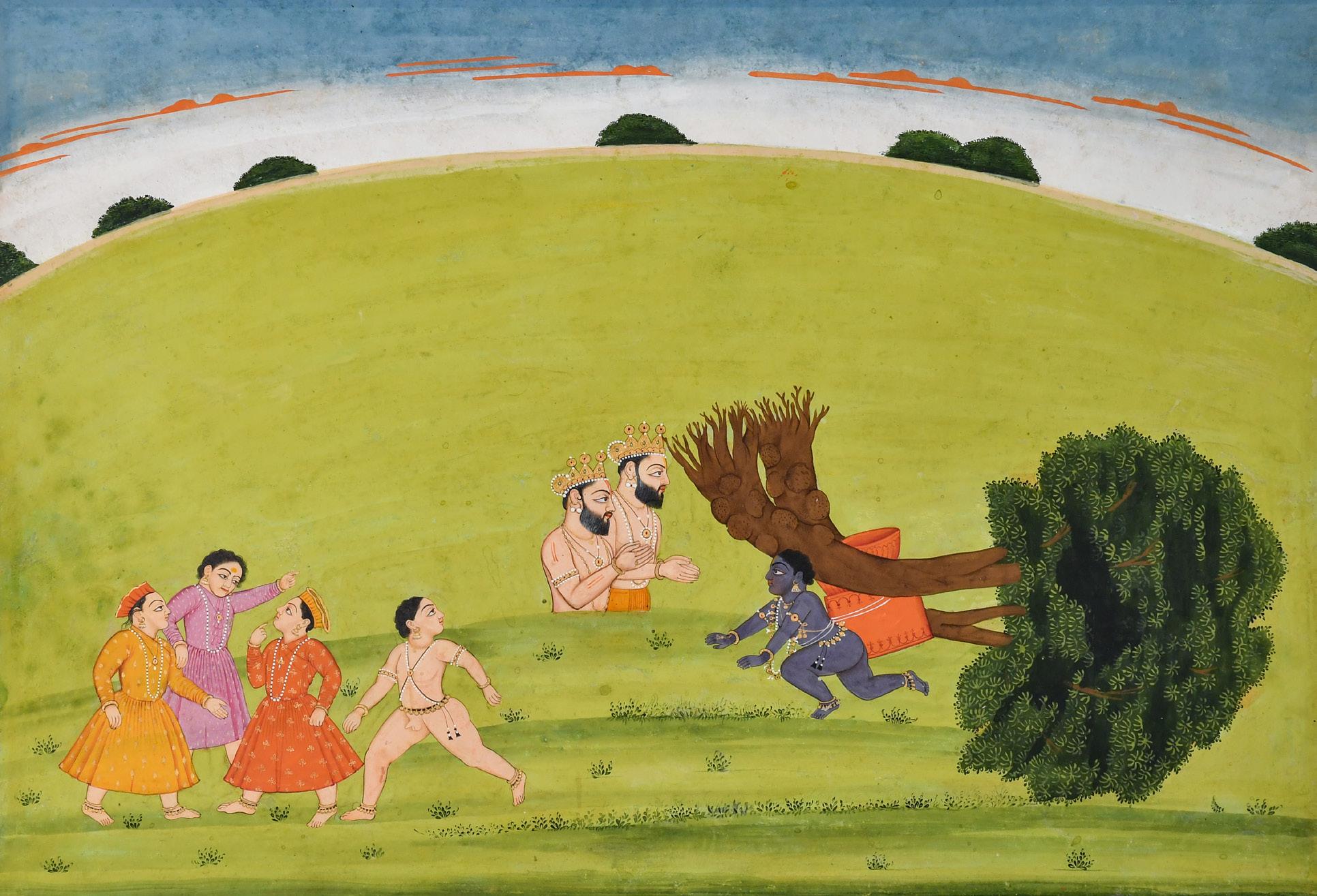
ILLUSTRATION TO THE ‘LARGE’ GULER-BASOHLI BHAGAVATA PURANA:
THE LIBERATION OF NALAKUVARA AND MANIGRIVAA
Attributed to Manaku, Basohli, c. 1760 - 1765
Opaque watercolor heightened with gold on paper 9 ⅙ x 13 ⅕ in, 23.3 x 33.5 cm
$150,000
PROVENANCE
Brendan Garry Collection
Siva Swaminathan Collection
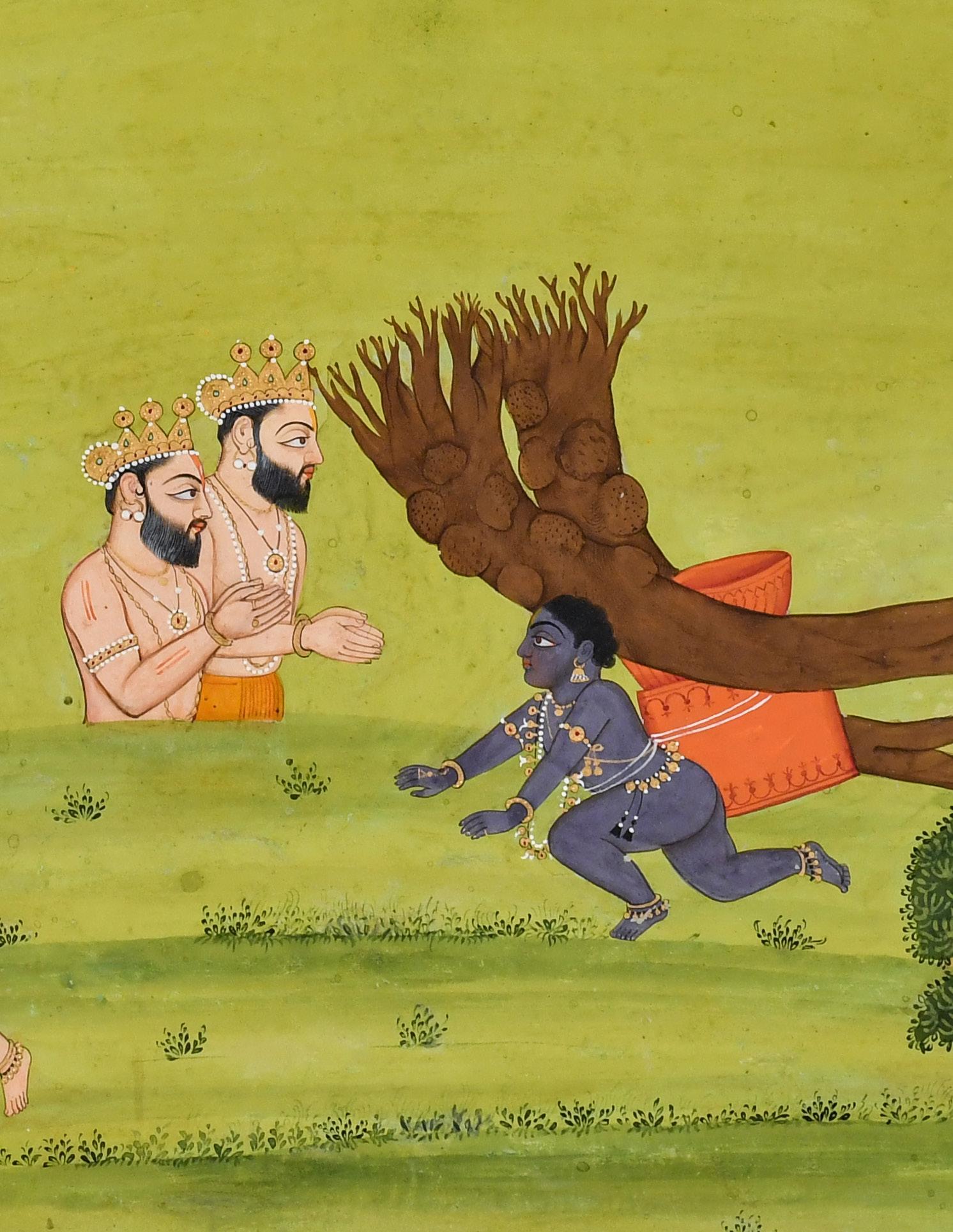
This painting illustrates an episode from the tenth book of the Bhagavata Purana that highlights the mischievous exploits of the young Krishna. Repeatedly caught stealing butter, Krishna is punished by his foster mother, Yashoda, who ties him to a wooden mortar to keep him out of trouble. Yet this domestic act of punishment becomes a moment of divine intervention.
Many years prior, the yakshas Nalakuvara and Manigriva, sons of Kubera, had been cursed for their arrogance and condemned to stand bound within the forms of two arjuna trees. Krishna, in his omniscience, recognized their presence within the trees. Dragging the mortar behind him and forcing it between the trunks, he used his supernatural strength to pull the trees down, thereby releasing the two brothers from their enchantment. In the center of the composition, the crowned yakshas appear in liberated form, offering praise and thanks to Krishna.
The present folio belongs to a series generally dated to about 1760–1765 and commonly referred to as the “Large” GulerBasohli Bhagavata Purana, or the “Fifth” Guler-Basohli Bhagavata Purana. The series is distinguished by expansive landscapes populated by relatively few figures, a feature characteristic of a transitional Basohli manner. Each painting was originally marked on the reverse with identifying inscriptions in Gurmukhi and Nagari scripts. The present leaf is numbered “Leaf 35” in Gurmukhi and further inscribed in Sanskrit as Bhagavata Purana, tenth book, tenth chapter. The series has long since been dispersed, with related folios now in collections including the Victoria and Albert Museum, the Philadelphia
MINIA041
Museum of Art, and the Archer Collection (see W.G. Archer, Indian Paintings from the Punjab Hills, London, 1973; Visions of Courtly India, London and New York, 1976, no. 8, p. 15; and W.G. Archer and Edwin Binney 3rd, Rajput Miniatures from the Collection of Edwin Binney 3rd, Portland, 1968, nos. 55a and 55b, pp. 74–75).
The painting has often been associated with the hand of Manaku, the elder brother of Nainsukh. Even if he may not have been responsible for the entirety of the series. Manaku is securely identified with the illustrations to a Gita Govinda series of the 1730s, as well as the “Small” Guler Bhagavata Purana executed between about 1740 and 1750. Comparisons between those earlier works and the paintings of the later 1760s Bhagavata Purana suggest that he likely played a role in the production of at least some folios from the later group.
A useful comparison may be made with the depiction of figures in The Sage Kardama Renounces the World from the “Small” Guler Bhagavata Purana, now in the Lahore Museum (see B. N. Goswamy, Manaku of Guler, New Delhi, 2017, p. 405, no. B35). The yakshas in the present work share with that painting a similarly careful treatment of facial hair and elaborate jewelry, details that strengthen the attribution to Manaku. The attentive rendering of trees, too, is consistent with a quality often noted in his known works and is echoed here in the depiction of the arjuna trees.
Although some scholars have proposed that the later Bhagavata Purana series was illustrated by Fattu, Manaku’s son, it is evident that more than one artist was involved in its execution. Because such manuscript series were typically painted in the sequence of the text, the present folio would likely have been completed relatively early within the cycle. That chronology lends further support to the possibility that this work was executed by Manaku himself.
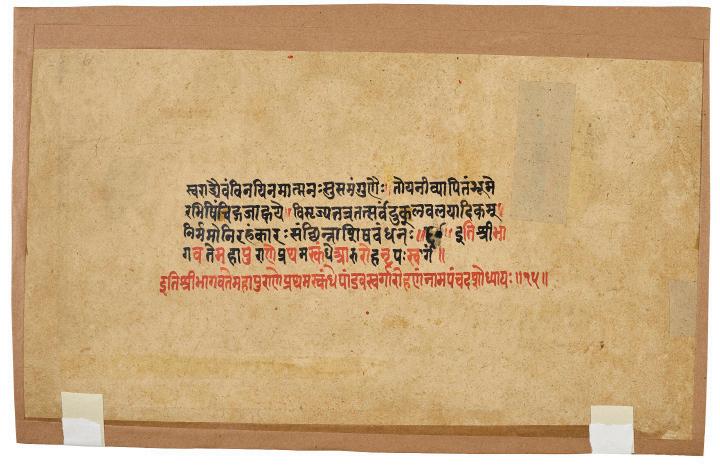
Inscribed on the verso in Sanskrit, written in Devanagari script, is verses 23-24 from the end of the Govardhana lifting episode of the Bhagavata Purana. There is a small blot affecting part of one line, but the passage is still clear.
Conventionally, folios would be read flipped upwards in stacks, with the text on the back of each painting referring to the next page of illustration. This verse describes Krishna holding aloft a mountain for seven days and Indra’s astonishment and surrender; followed by the chapter colophone ending the twenty-fifth chapter.
The verso reads:
Putting aside the suffering of hunger and thirst, and disregarding all concern for his own comfort, Krishna held up the mountain while the people of Vraja looked on; for seven days he did not move from that spot
. When Indra saw that manifestation of Krishna’s divine power, he was utterly astonished. His pride was broken, his resolve frustrated, and he ordered his clouds to cease.
Thus ends the twenty-fifth chapter in the first half of the Tenth Book of the great Purāna, the Śrīmad Bhāgavata, the compendium of the paramahamsas.
ILLUSTRATION FROM A MAHABHARATA SERIES: DRAUPADI AND HER FIVE HUSBANDS LEAVE AFTER VISITING A PRINCE
Attributed to Manaku, Basohli, c. 1740
Opaque watercolor heightened with gold on paper
6 ¼ x 10 ½ in, 15.9 x 26.6 cm
$65,000
PROVENANCE
Christie’s New York, 20 March 2012, Lot 215
LITERATURE
B.N. Goswamy, Manaku of Guler: The Life and Work of another great Indian Painter from the small Hill State, New Delhi, 2017, pp. 447
EXHIBITION
Doris Wiener Gallery, New York, Indian Miniature Painting, 16 November - 31
December 1974, no. 19
Carlton Rochell Asian Art, New York, Classical Indian Paintings, 13-20 March, 2015, no. 24
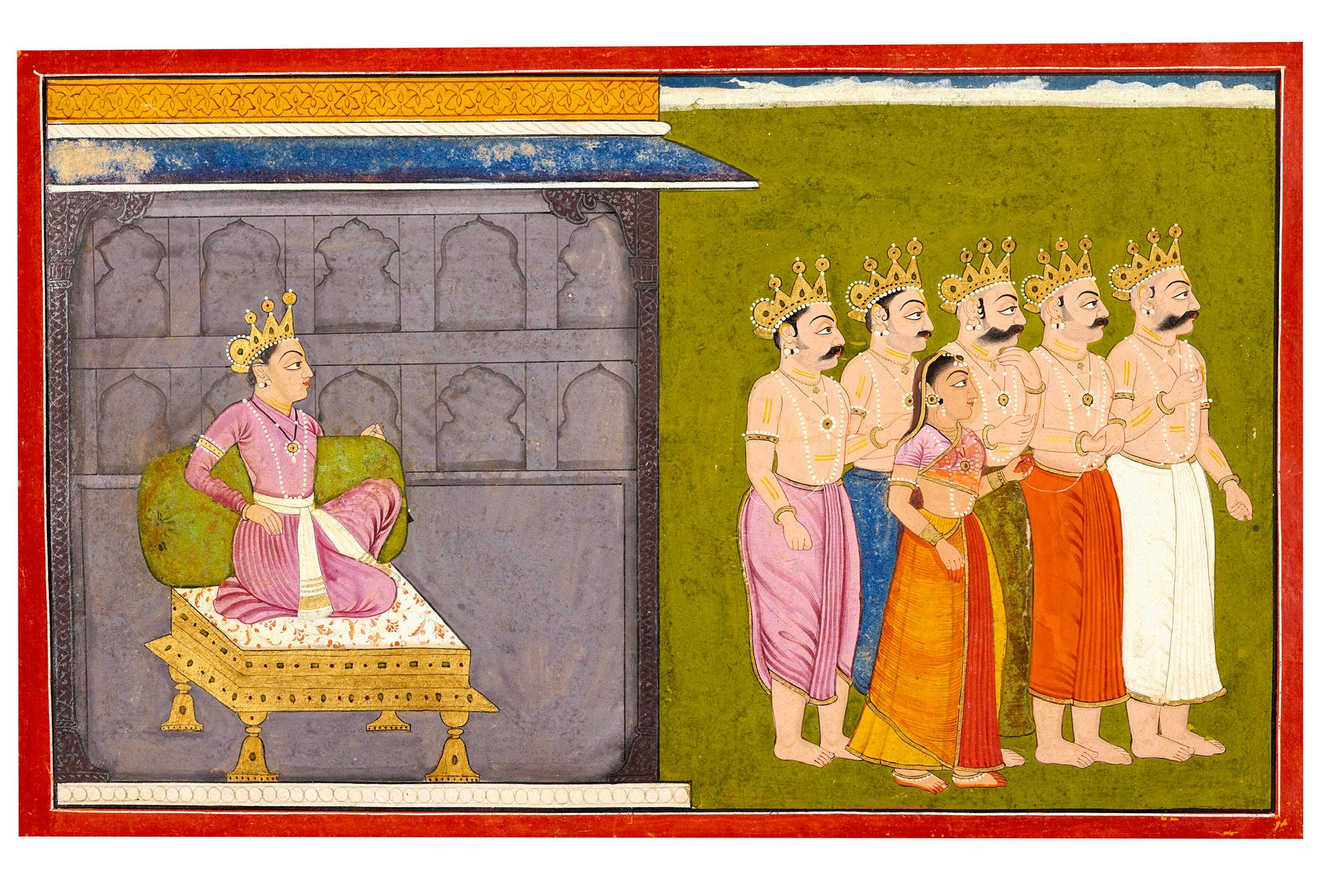
In the Mahabharata, the Pandavas were the five sons of Pandu, born to the same father from two mothers. Arjuna was given Draupadi’s hand in marriage after he won a shooting contest arranged by her father Drupada. However, all five brothers, Yudhisthira, Bhima, Arjuna, Nakula and Sahdeva, were married collectively to Draupadi. Here, Draupadi stands to the right with her husbands against a field of moss green. To the left, a king identified as Aruroha in the inscription on the verso sits within a palace chamber.
This illustration belongs to a known, unfinished Bhagavata Purana series that has been estimated to comprise hundreds of paintings and drawings. The drawings exhibit the same energy and vitality that is evident in the finished paintings from this series. Manaku must have taken years to finish the work and would most certainly have had assistance from other artists in his workshop.
AURANGZEB IN COURT
Possibly Bilaspur, Pahari, Mid 18th century Gouache heightened with gold on paper 8 ½ x 11 ¾ in, 21.6 x 29.8 cm
$55,000
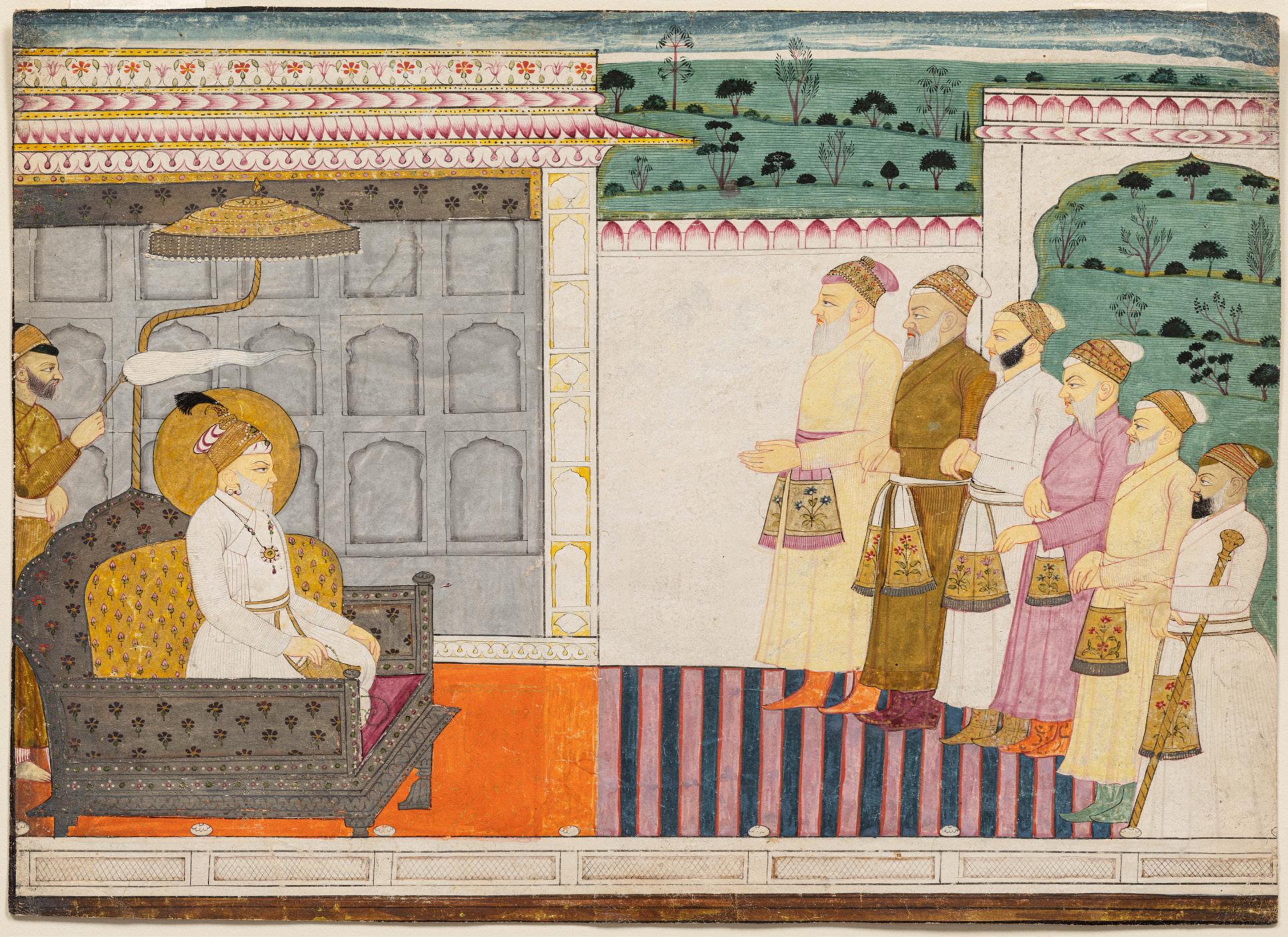
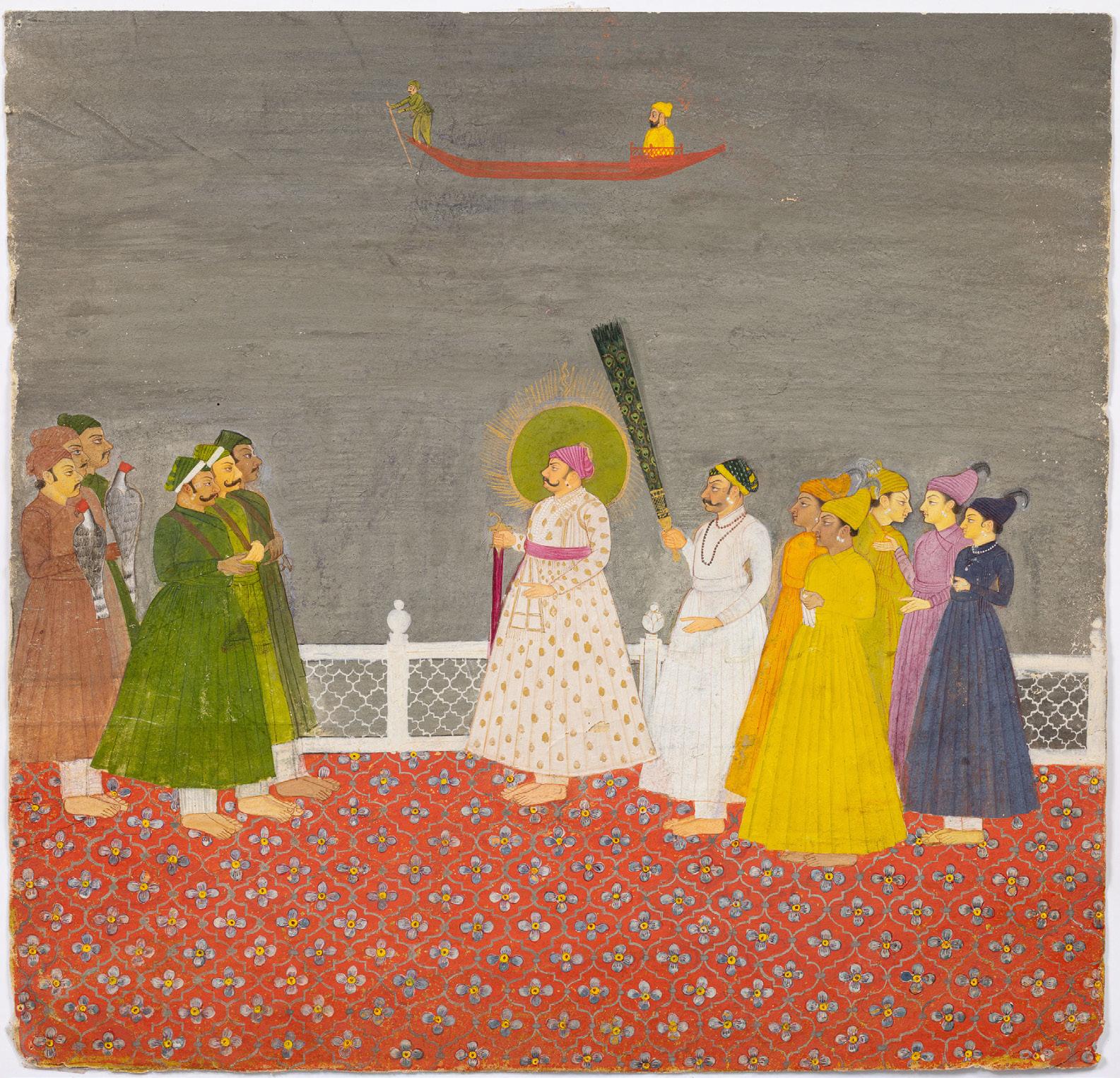
A nimbate (haloed) Mughal ruler, likely a stylized Emperor Aurangzeb, is shown seated on a silver throne chair, leaning against a floral gold bolster as he gives audience to a delegation of six gray-bearded Muslim ministers who respectfully stand before him, perhaps seeking appointments as governors or envoys. The Emperor is seated on the terrace of an outdoor pavilion, beneath a golden parasol, impatiently handling a strand of prayer beads while an attendant stands behind him waving a flowing chowrie as a symbol of his royal authority.
Behind them a grayish blue-green landscape rises to darkening chilly blue clouds, with a narrow white band separating the earth and the sky. Several features of this work are indicators of a Bilaspur origin: the overall color palette with its flattened darkish green-blue landscape accentuated by short parallel strokes of dark green ground, as well as the curiously patterned lines of trees, small bushes and the striped rug. The painting is composed in pothi (horizontal) format.
The work is uninscribed so one cannot be sure of the figures’ identities (including the “emperor”) however, their faces, defined with individualizing features and distinctive beards, are depicted with Mughal influenced naturalism, leaving open the possibility of future identification. The characters serve as representations of real individuals rather than idealized types.
The scene evokes cold overtones, as it is most likely winter-time in the Punjab Hills. The figures can be discerned as Muslims by their long winter jamas that are tied to the right (unlike Hindus who tie to the left), the style of their boots and the manner of their neatly trimmed beards.
LAKSHMI NARAYANA ENTHRONED
Perhaps Garwhal, Pahari, Samvat 1845 (1788 C.E)
Opaque watercolor heightened with gold on paper 8 ¼ x 8 ⅛ in, 21 x 20.6 cm
$40,000
PROVENANCE
Purchased from Hearst & Hearst, Boston USA, in the early 1980s.
Private Collection, Boston USA Bonhams, Islamic and Indian Art, October 25, 2021, Lot 304
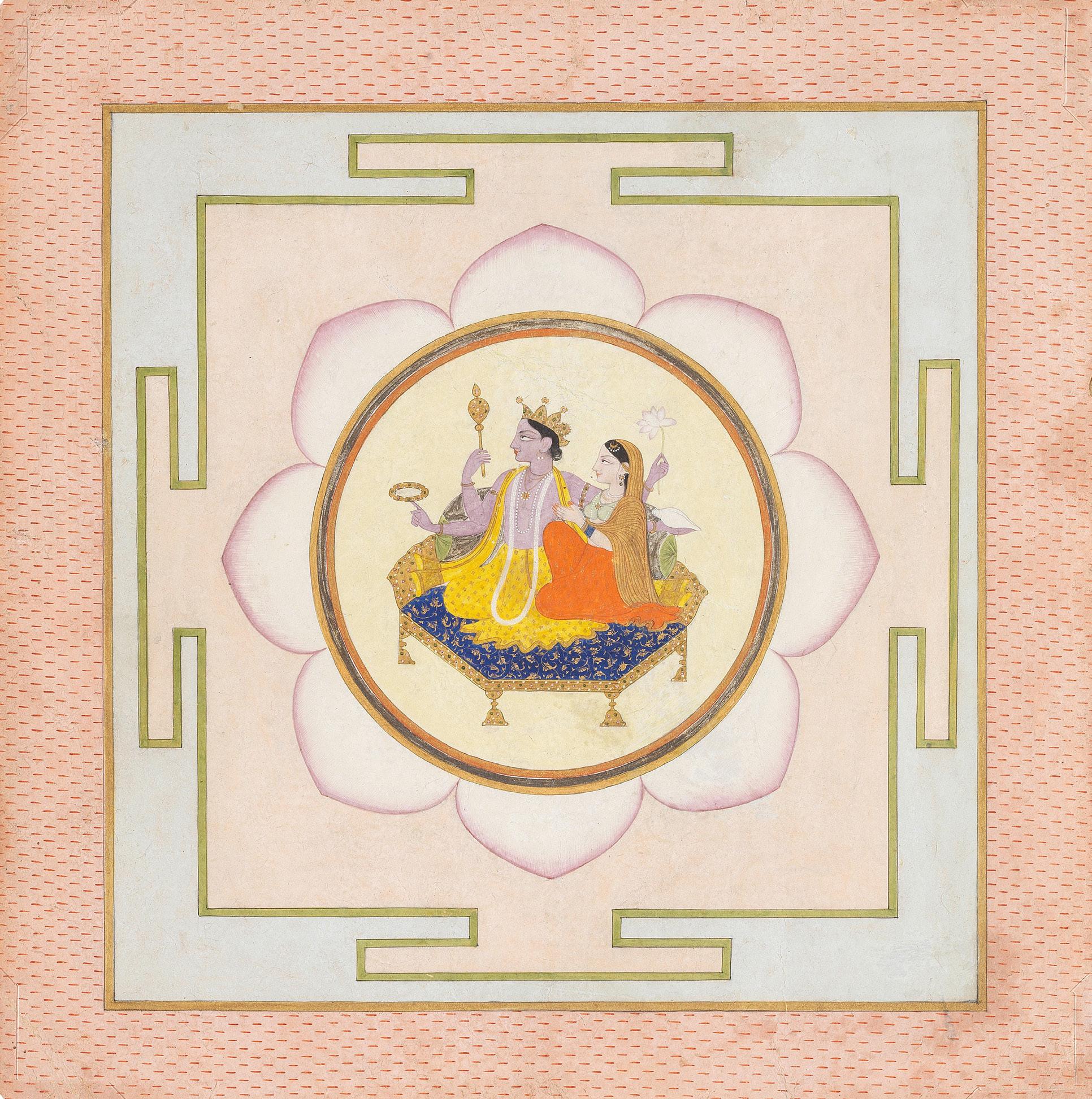
Vishnu the Preserver appears here in his Chaturbhuja (four-armed) form, enthroned beside his consort Lakshmi. The god’s identity is revealed by his blue-toned skin and vibrant yellow dhoti as well as the objects he carries in each of his four hands: a discus (chakra), mace (gada), conch (shankha), and lotus. Both deities are illustrated in an opulent manner garbed in vibrant colors and lavish pearl, emerald, and gold accessories which follows the typical convention for depicting Vishnu as a king and Lakshmi as the goddess of wealth and prosperity.
Perhaps most notable, however, is the placement of the divine couple within a yantra—a rare practice in Indian miniature painting. Yantras are tantric diagrams used in homes and temples to aid in meditation and can be of several types. The present painting displays a pujayantra, which is invoked in the worship of specific deities. Vishnu and Lakshmi are encircled within a border surrounded by eight lotus petals pointing in the cardinal and intermediate directions. Yantras often include lotus petals—a symbol of purity, transcendence, and fertility—in various numbers, but with eight being one of the most common. The lotus is then enclosed in a square with four gates–sacred doorways also pointing in the four cardinal directions—a standard convention in the representation of yantras.
The painting’s verso is dated Samvat 1845 (1788 C.E.) and inscribed with a devanagari couplet that translates to:
May Lord, [I pray], please listen to the songs (bhajana) about the suffering of the world (bhava-peer). Save me! Save me! O Raghu Veer, the one who takes away all sorrows and gives happiness to all.
MYTHOLOGICAL FIGURE WITH RULER (A PRINCE SEATED BEFORE NANDI (NANDIKESHVARA))
Pahari, 17th century
Opaque watercolor heightened with gold on paper
4 ½ x 6 ¼ in, 11.4 x 15.9 cm
$20,000
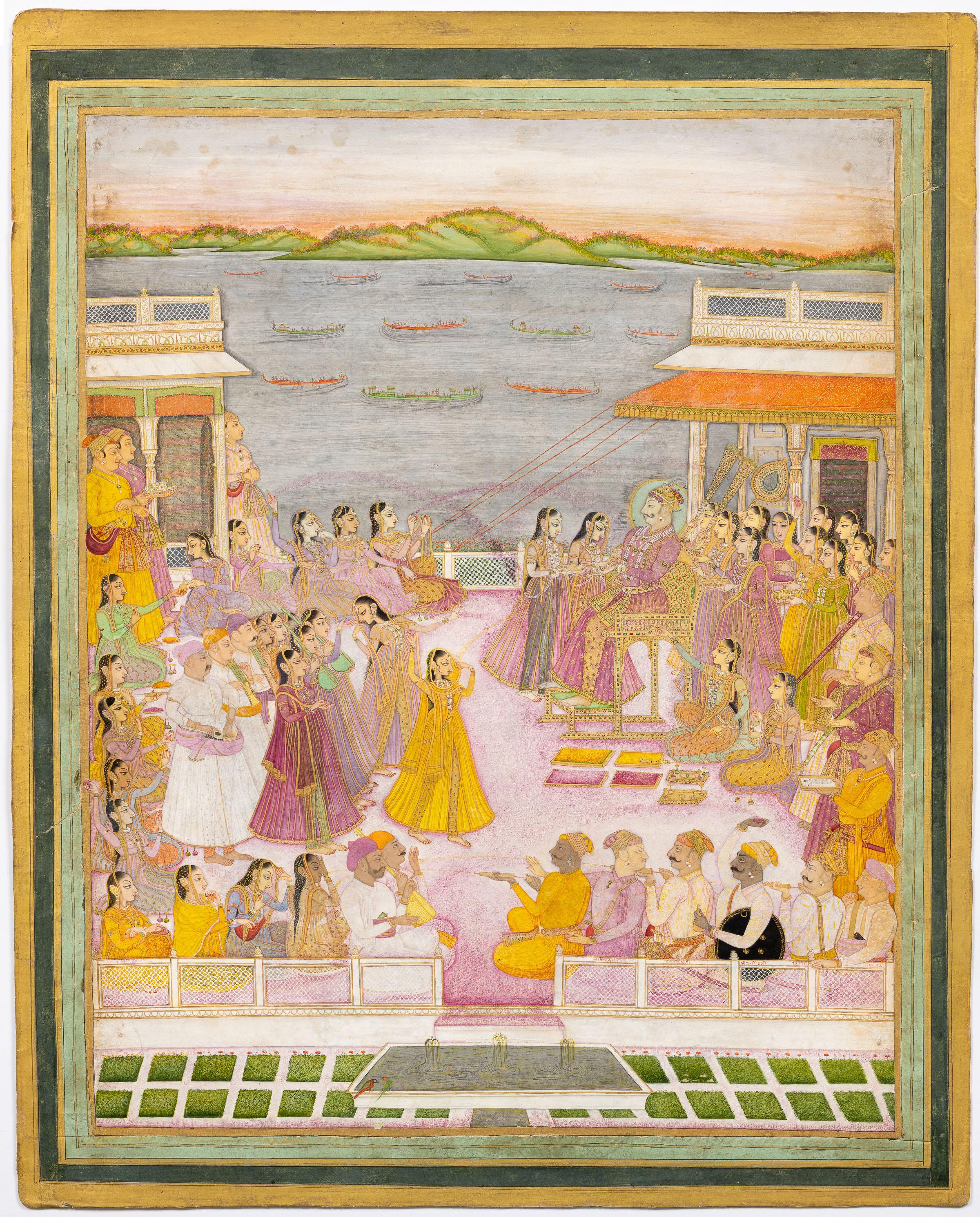
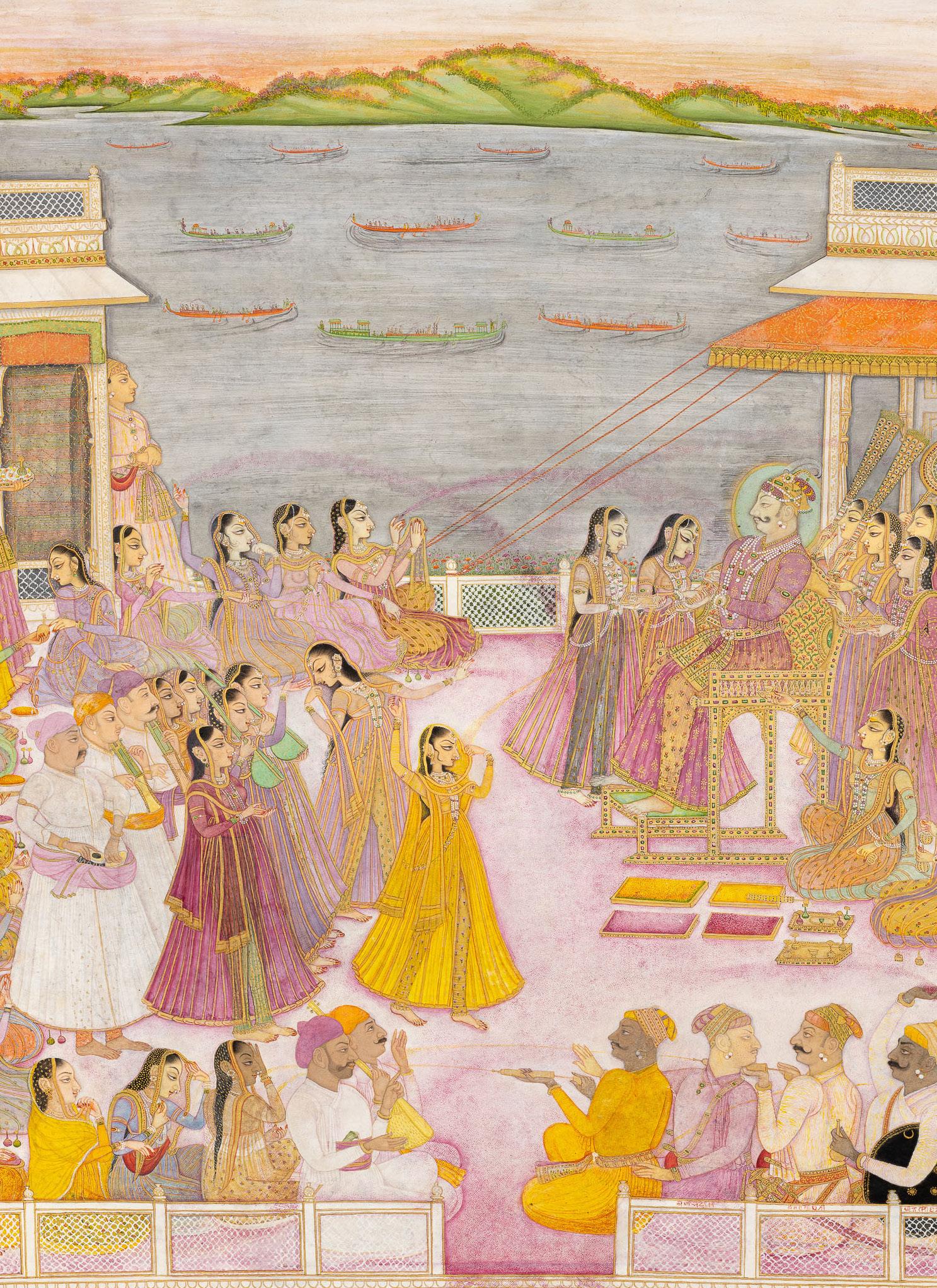
PHĀLGUNA COURT FESTIVITIES ON A LAKESIDE PALACE TERRACE
Attributed to Amar Chand, Kishangarh, Rajasthani, Samvat 1848 (1792 C.E)
Opaque watercolor heightened with gold on paper 15 x 13 in, 38.1 x 33 cm
POA
NOTES
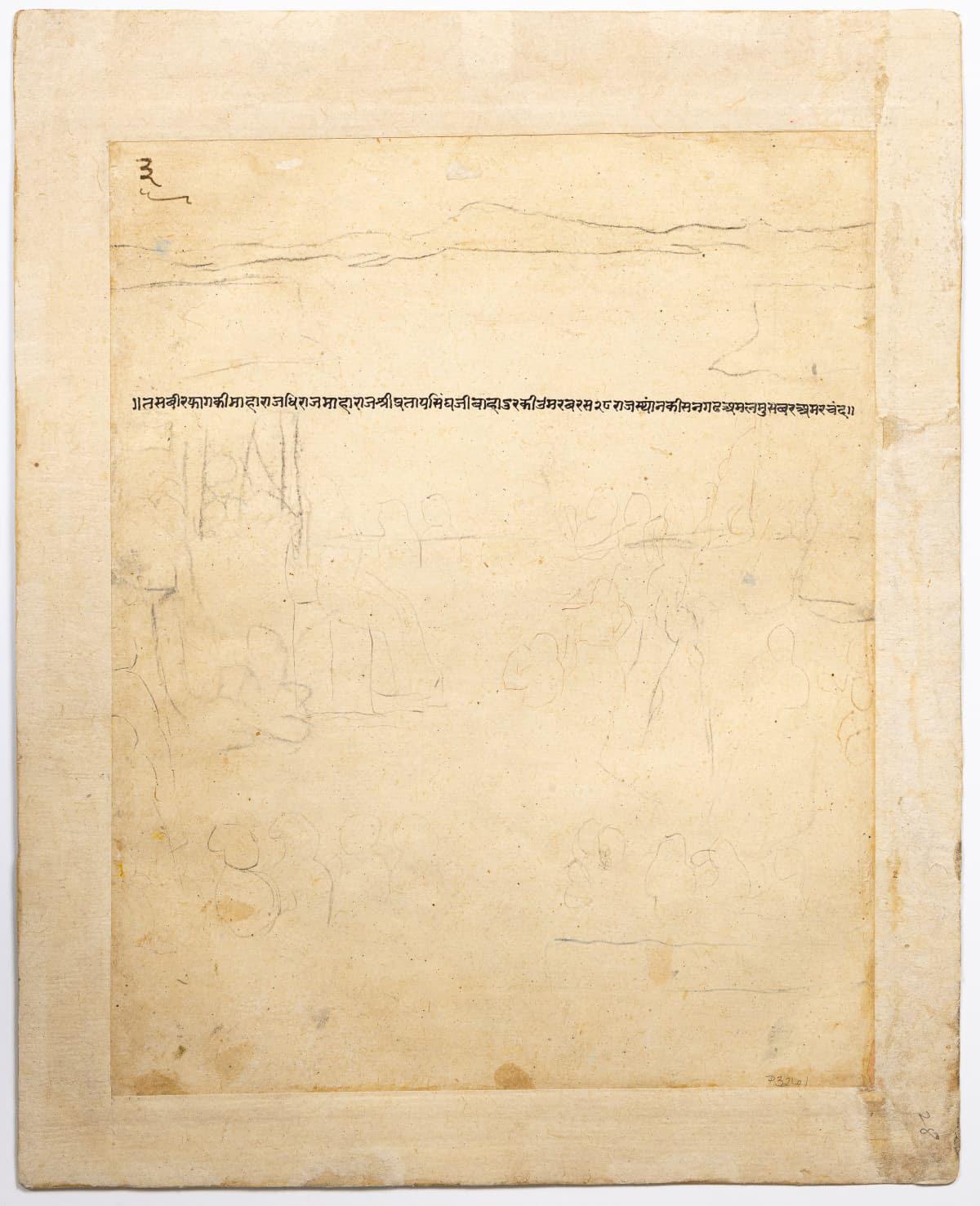
Signed ‘Mūsavvir Amar Chand’ and inscribed for Maharajadhiraj Maharaj Shri Pratap Singhji Bahadur in Devanagari (verso)
This imposing Kishangarh leaf stages the court’s springtime life as both spectacle and ideology: a lakefront terrace becomes a carefully composed theatre in which rank, ritual pleasure, and seasonal renewal are braided together into one sustained, luminous moment. The entire scene is set against the Kishangarh painter’s favorite kind of distance—water that cools the eye and steadies the composition—peppered with boats and backed by low, softened hills.
That quiet, breathy horizon is not “background” so much as a poetic register: it turns the terrace into a suspended world where gesture and glance can carry the weight of meaning. Within the palace architecture, a dense assembly gathers around the enthroned ruler, while attendants, musicians, and noblewomen form a living border of movement and attention. The mood is celebratory yet controlled: the court allows festivity, but it is festivity disciplined into choreography.
The iconography reads with particular force once one takes the verso seriously. The inscription identifies the subject as occurring in Phāgunī/Phālguna—the threshold month of late winter and early spring when the world of scent, color, and play intensifies—and it names Pratap Singhji Bahadur of Kishangarh as the royal figure to whom the scene belongs. In other words, this is not a generic “palace terrace” picture; it is a season-specific court performance anchored to a named ruler and place.
Kishangarh painters were especially sensitive to the emotional temperature of months and the courtly rituals that define them, and Phālguna is the month that most openly licenses pleasure: music becomes more insistent, textiles brighten, and the very air seems to anticipate color.
In the painting, that seasonal charge is materialized in the tidy, rectangular trays of pigment laid out on the ground before the ruler and in the poised dancer who claims the foreground with a bright, sunlit costume— an embodied metaphor for spring’s arrival. A suspended swing (jhūlā) traverses the terrace space above, an unmistakable emblem of vernal leisure and romantic play in North Indian court culture, and it subtly binds the architectural pavilions into a single ceremonial arena.
Court painting at Kishangarh has long been celebrated for its “high style” lyricism, but what makes this leaf so compelling is its ability to translate lyric beauty into social complexity. The artist manages an unusually crowded terrace— dozens of figures—without allowing the scene to collapse into decorative noise. That clarity comes from an intelligent use of architecture: railings and thresholds work like musical barlines, breaking the human mass into legible groupings, while the lake beyond provides a calm, open counter-space against which every figure reads sharply. The result is both scholarly rich and sensuously immediate: you can study hierarchy in the arrangement of bodies, the protocols of attendance, and the choreography of looking—yet you also simply feel the buoyant rhythm of the gathering, the pulse of music at the lower edge, and the soft shimmer of water that turns the whole world into a stage of refinement.
Placed within the later eighteenth century, the painting sits at a fascinating point in the Kishangarh tradition—after the canonical moment of Savant Singh and Nihal Chand, but still fully alive with the school’s characteristic elegance. It is precisely here that artists active at court sustained and refreshed the idiom: attenuated bodies, almond-shaped eyes, and a taste for poised profile become not merely stylistic signatures but the visual language through which Kishangarh continued to imagine itself as a court of cultivated feeling. Pratap Singh’s reign (1788–1798) provides a historically coherent frame for the scene’s late-century court atmosphere.
On attribution and dating, the most responsible scholarly position is to let the object’s own evidence lead. The verso inscription clearly anchors the subject to Phālguna, and Maharajadhiraj Maharaj Shri Surat Singhji Bahadur, closing with a conventional benediction (‘may it be auspicious always’). That alone ties the image to a specific court calendar and ruler. Museum comparables demonstrate that Amar Chand’s name is consistently associated with this genre of Kishangarh terrace-landscape and his works fits within the chronological parameters.
The Cincinnati Art Museum holds a closely related Kishangarh painting attributed to Amar Chand, titled Conversation of a Palace Terrace c.1750. Even if the Cincinnati leaf is smaller in scale and quieter in event, it clarifies the reoccurring motif of the terrace in Kishangarh idiom as not merely a setting but a genre to explore the performance of courtly ease.
The Ashmolean Museum also offers an especially illuminating anchor, describing a lakeside terrace portrait of Maharaja Sirdar Singh of Kishangarh (c. 1760-1770) as “probably by Amar Chand,” calling him “a leading court painter of the time.” Looking at the continuity of motifs: the lakeside terrace as a signature Kishangarh space, the careful balancing of regality with intimacy, and the expansive landscape, there is a strong argument for similar attribution of this piece with Amar Chand. At the very least this leaf participates in that same world of lakeside splendor, turning the ruler’s cultivated aura outward into a broader social ecology involving the women’s quarters, attendants, musicians and the ceremonial apparatus of festivity.
Ultimately Phālguna Court Festivities on a Lakeside Palace Terrace offers Kishangarh at its most irresistible: the school’s poetry of distance— water and sky that seem to exhale with each glance—paired with an opulent, intimate human drama in the foreground. It has the “Kishangarh look,” but it also has something rarer: a narrative density that rewards long looking. One can read it as a document of seasonal court culture, as a meditation on how monarchy is staged through pleasure, or simply as an exquisite arrangement of color and rhythm. In a field where many leaves survive without firm anchors, any work that can be credibly placed within a named court tradition gains a different gravity. It stops being merely beautiful and becomes legible as history—history rendered in perfume, water, song, and spring light.
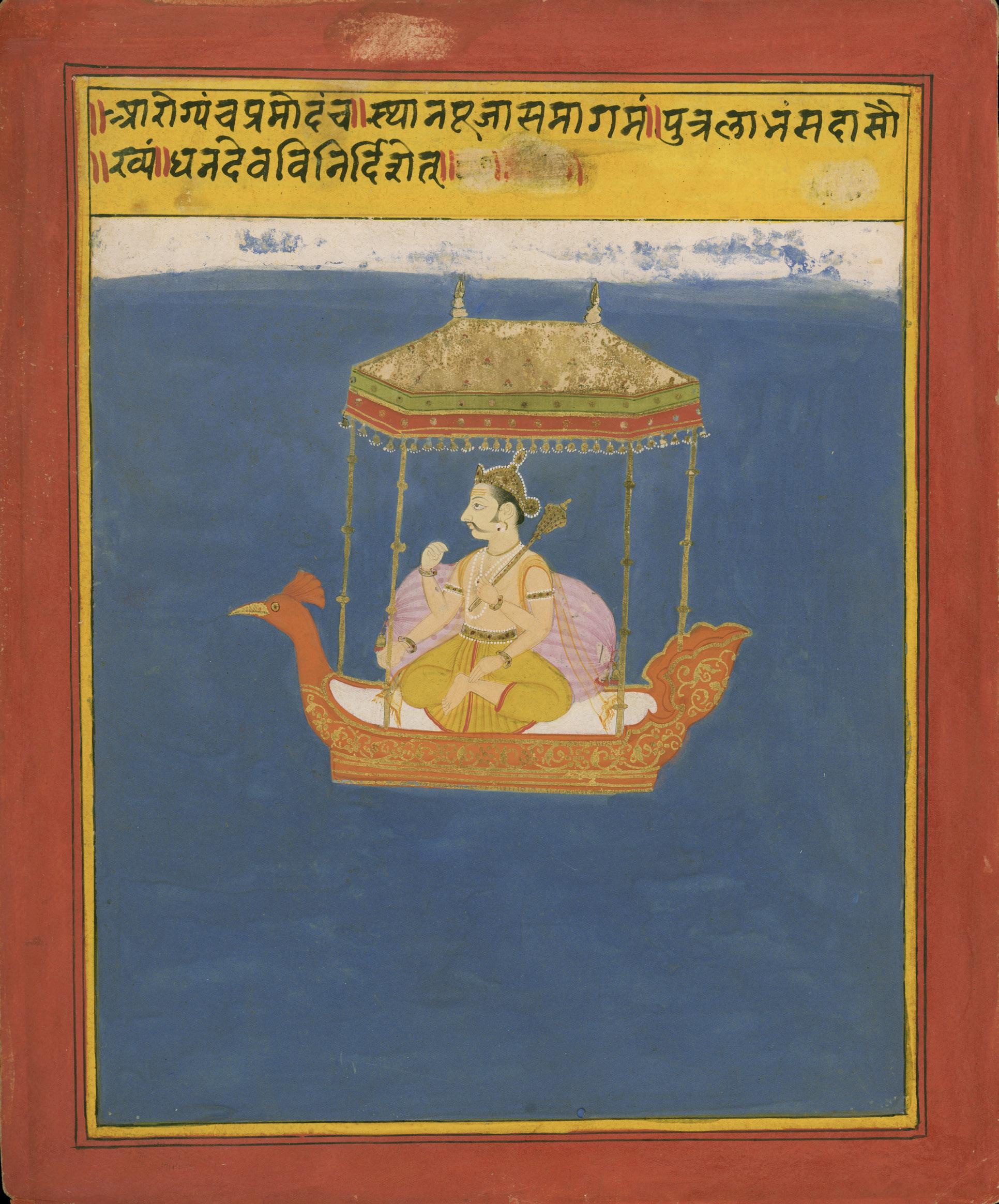
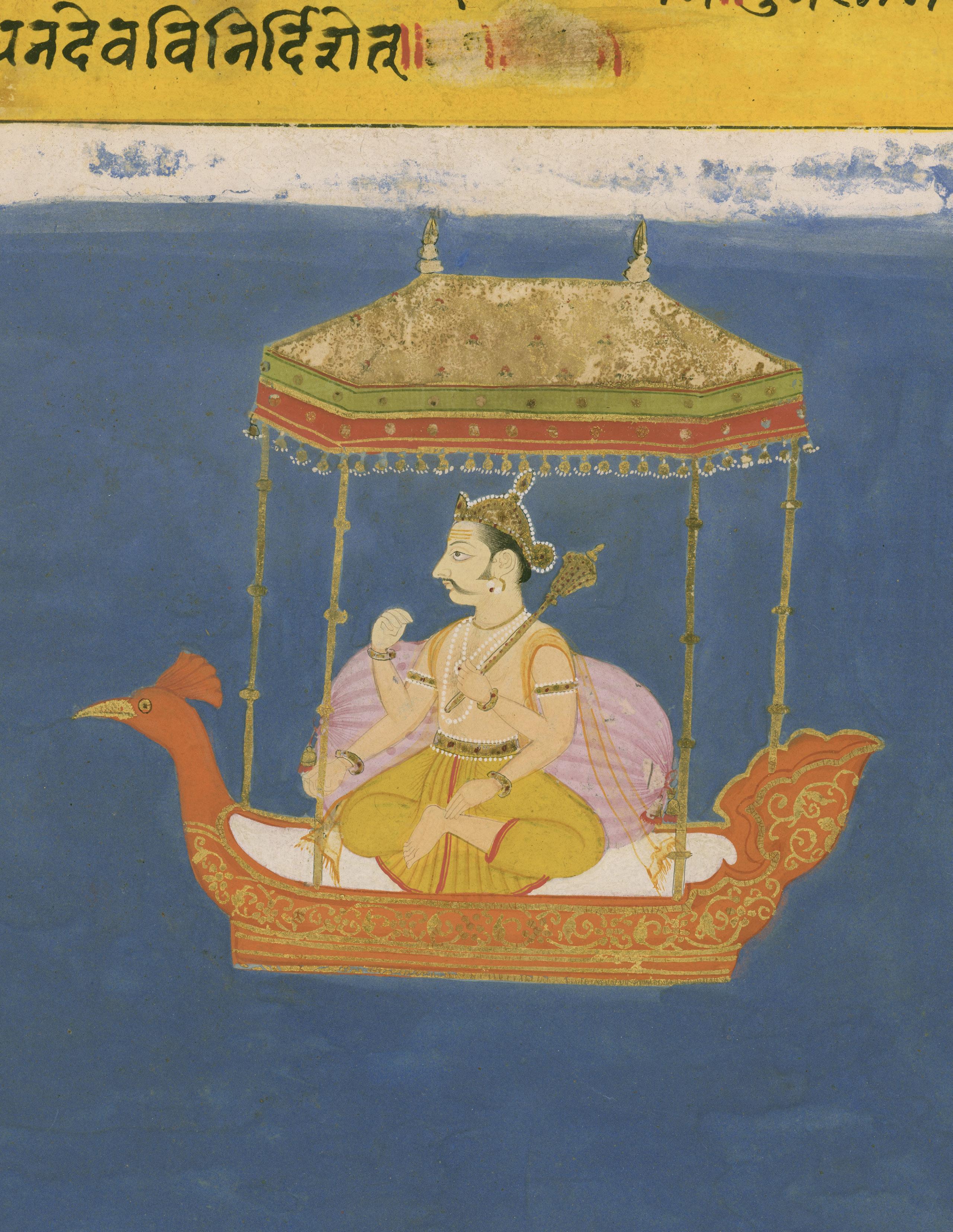
FOLIO FROM A SAKUNAVALI SERIES: LORD KUBERA
Udaipur, Rajasthani, c. 1720
Opaque pigment on paper
Image: 8 ¾ x 7 in, 22.2 x 17.8 cm
Folio: 10 x 8 ½ in, 25.5 x 21.6 cm
$18,000
NOTES
Inscribed with a Sanskrit verse (upper center)
PROVENANCE
Private European Collection
This folio comes from an illustrated Sakunavali (‘Book of Omens’ or ‘Book of Dreams’) series, likely based on texts such as the Svapna Darshana, which deals with the significance and interpretation of dreams.
Acting as a sort of visual codex, this series was not used simply to analyze one’s inner consciousness, as in the Western tradition of dream interpretation, but instead to divine the future.
In Court Painting at Udaipur Art under the Patronage of the Maharanas of Mewar (Zurich, 2002, p. 144), art historian Andrew Topsfield writes: “For kings and subjects alike, the interpretation of dreams and omens could be as much a guiding factor in their enterprises as the prescriptions of the astrologers. A cat crossing one’s path might nullify plans for a journey. But a cricket (sarabha), according to the present text, will bring ‘victory to one’s affairs, success in all undertakings.’”
Each image is accompanied by a “grade,” ranging from evil (asubham; e.g. a burgled house, families of dogs or monkeys) and undesirable (neshta; e.g. a poor man), to good (subham; e.g. cows in a byre), excellent (srestha; e.g. a yogi in a hermitage, a king enthroned), or the best of all (utamam; e.g. winged elephant, lions, a pride of lions).
The Sakunavali is quite a unique commission among paintings from Udaipur. It’s patron, Sangram Singh II (r. 1710-34) gave the royal ateliers unprecedented freedom in which to widen the scope of their narrative imagination. According to Topsfield, this resulted in a “substantial reinvigoration of the stagnant tradition of manuscript illustration,” thus resulting in the wonderfully inventive and original series we see here (ibid, p. 141).
Many of the dispersed folios from this 1720-Udaipur set appear to have had their folio numbers and dream grade ratings removed, as apparent in the present work. Other examples from the same set, also with rubbed out grade ratings, appear in B.N. Goswamy & Caron Smith, Domains of Wonder, San Diego Museum of Art, cat. 31, and the aforementioned Topsfield scholarship.
The present painting depicts the god of wealth, Lord Kubera, adorned with jewels and holding a golden gada. He sits upon a magical flying chariot with the head of a hamsa bird, the Pushpaka Vimana.
According to the Ramayana, Kubera was once the king of Lanka, the legendary demon fortress located in the towering peaks of the Trikuta Mountains. His brother Ravana, however, overthrew the great king and took the Pushpaka Vimana for his own. The mythical chariot was eventually returned to Kubera by the hero Rama.
The Sanskrit inscription on the recto on the present folio reads:
Health and pleasure,
A place of gathering for worship, The benefit of a son’s birth and a life of comfort: The Lord of Wealth, Kubera, indicates all this.
(Translation by Dr. Harsha Dehejia)
Another folio from this set, which resides in the Los Angeles County Museum of Art, resembles this one closely. The LACMA folio depicts Chandra, the moon god, who rides a flying chariot carried by a stag (Pal, Pratapaditya, The Classical Tradition in Rajput Painting, New York, 1978, cat. 30).
Both these folios are likely graded uttamam, which is the most auspicious type of omen; however, because the inscriptions have been rubbed out we cannot be sure.
See alternative imaginings of the Pushpaka Vimana in five folios from a Mewari Ramayana series published in J.P. Losty, The Ramayana: Love and Valor in India’s Great Epic, London, 2008, plates 118-122. Therein the chariot is carried by four hamsa birds rather than the bird and chariot being one and the same.
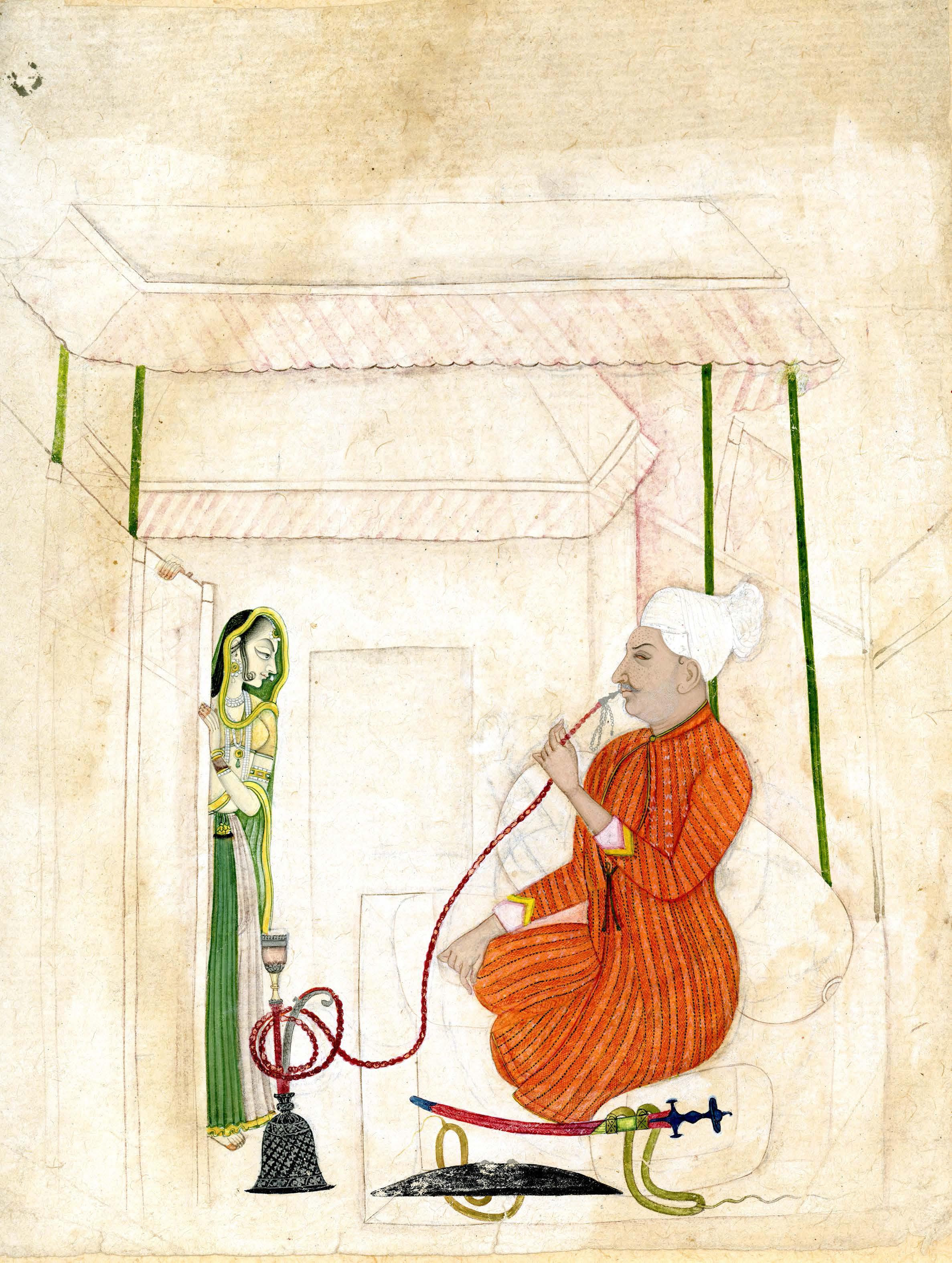
A MAIDEN APPROACHES A NOBLEMAN
Kishangarh, Rajasthani, c. 1740
Ink drawing with gouache and gold on paper 10 ½ x 8 ¼ in, 26.7 x 21 cm
NFS
PROVENANCE
Doris Wiener Gallery
A naturalistically depicted elder nobleman seated against a bolster puffs from the metal tip of a winding hookah stem, his eyes half shut with a sheathed sword and shield laid out before him. A beautiful young maiden looks intently out from behind a screen, coyly hiding part of her body as if trying to be careful to not to be seen. Her angular face with its pointed nose and chin, pursed mouth, almond-shaped eye and high brow, and black hair tied back with three curls placed over her cheek remind the viewer of Bani Thani a poetess and courtesan, considered the epitome of idealized Kishangarh beauty 1
The scene could be the old man’s intoxicated dream a glimpse into the memory of a past love, now elevated to perfection in the noble’s thoughts. Conversely, the maiden could be taking the position of the archetypal seductress, a universal subject serving as a trope of the older man’s desire for a youthful woman.
This is an enigmatic scene often found in paintings from Kishangarh and particularly from the period of the artist Nihal Chand (c. 1710-1782), whose training in the Imperial Mughal workshops at Delhi helped him create a popular new style that combined Mughal naturalism with the romantic, poetic idealization beloved at Kishangarh courts.
The signature Kishangarh style began to develop under Raj Singh (r. 1706-1748), and reached full fledged actualization under Sawant Singh (r. 1748-1764).2 As the present painting dates to the mid-1700s, we know it was executed under one of these rulers’ reigns. As such, it is a delightful example of the evolution of Kishangarh painting during the century.
This idyllic, amatory manner so valued within the realm is well suited for the depiction of bhakti, the ecstatic longing for the divine often anthropomorphized as Radha’s love for Krishna.
1. For another example of Radha depicted like the idealized Bani Thani, see Nihal Chand, “Portraits of Krishna and Radha” in Kishangarh Painting (Bombay: Vakils, Feffer, & Simons Limited, 1980), p. 16, pl. II. 2. ibid., p. 8
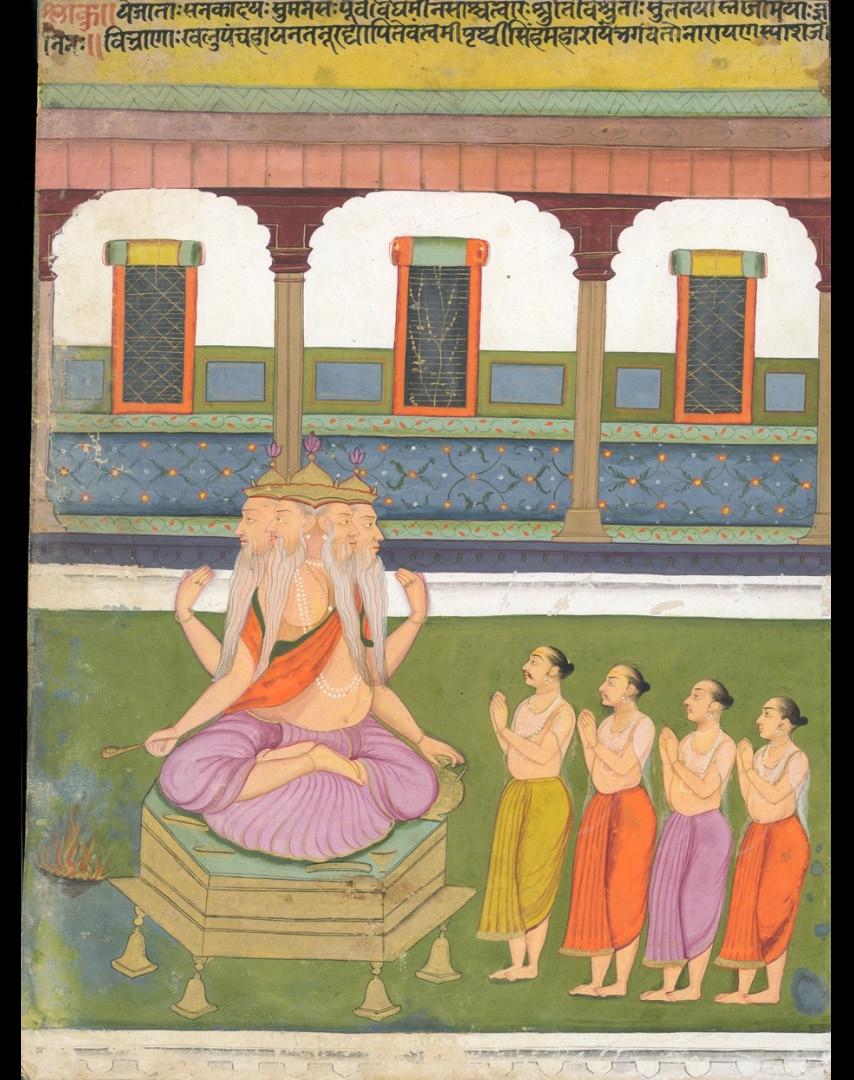
BRAHMA WITH DEVOTEES
Bikaner, Rajasthani, c. 1630-1640
Opaque watercolor heightened with gold on paper 10 ⅛ x 7 ⅔ in, 25.7 x 19.5 cm
$60,000
NOTES
Inscribed in Devanagari script (upper center). Further inscribed with a Devanagari verse (verso).
PROVENANCE
From an Important European Collection
A third of the Hindu triad of supreme divinity, along with Vishnu the Preserver and Shiva the Destroyer, is Brahma the Creator—progenitor of the hymns and ritual texts known as The Vedas. The Brahma Purana describes him with five heads. As the story goes, he became too arrogant, referring to himself as the greatest of the Trimurti or divine triad, so Shiva removed his fifth head to humble him. In the present composition, Brahma is shown worshipped by four devotees who may represent the four Vedas: the Rig Veda, the Sama Veda, the Yajur Veda, and the Atharva Veda.
The current painting is from the same series as The Liberation of Gajendra, evidenced by Andrew Topsfield in In the Realm of Gods and Kings, New York, 2004, p. 117, no. 43, and formerly in the collection of Cynthia Polsky before it sold at Bonhams New York, 16 March 2015, lot 70. The series was commissioned for a Maharaja of Bikaner; it includes a variety of Hindu deities including Vishnu’s many avatars. Each of the compositions display a strong Mughal and Deccani influence.
The verse inscribed at the top of the painting translates as:
Four great gods including Sanaka are the mind-born brilliant children of [Brahma]. Although they are eternally five years old, they are indeed renowned for their knowledge. May these divine beings protect the great king Prthvisimha, who is regarded as the partial incarnation [amsaja] of Vishnu.
The verse inscribed on the verso of the painting translates as:
[The name of the meter] is Savaiya. For the benevolence [of living beings], the god Brahma created the beautiful world, both animate and inanimate. Through his mental and ascetic power, he manifested himself in the form of forty incarnations including Sanaka. This is indeed beyond description. May [the creator god] protect our learned poet king [Prathipati; Skt. Prthvipati] and make him ever young and immortal.
(Translations by Gautama Vajracharya)
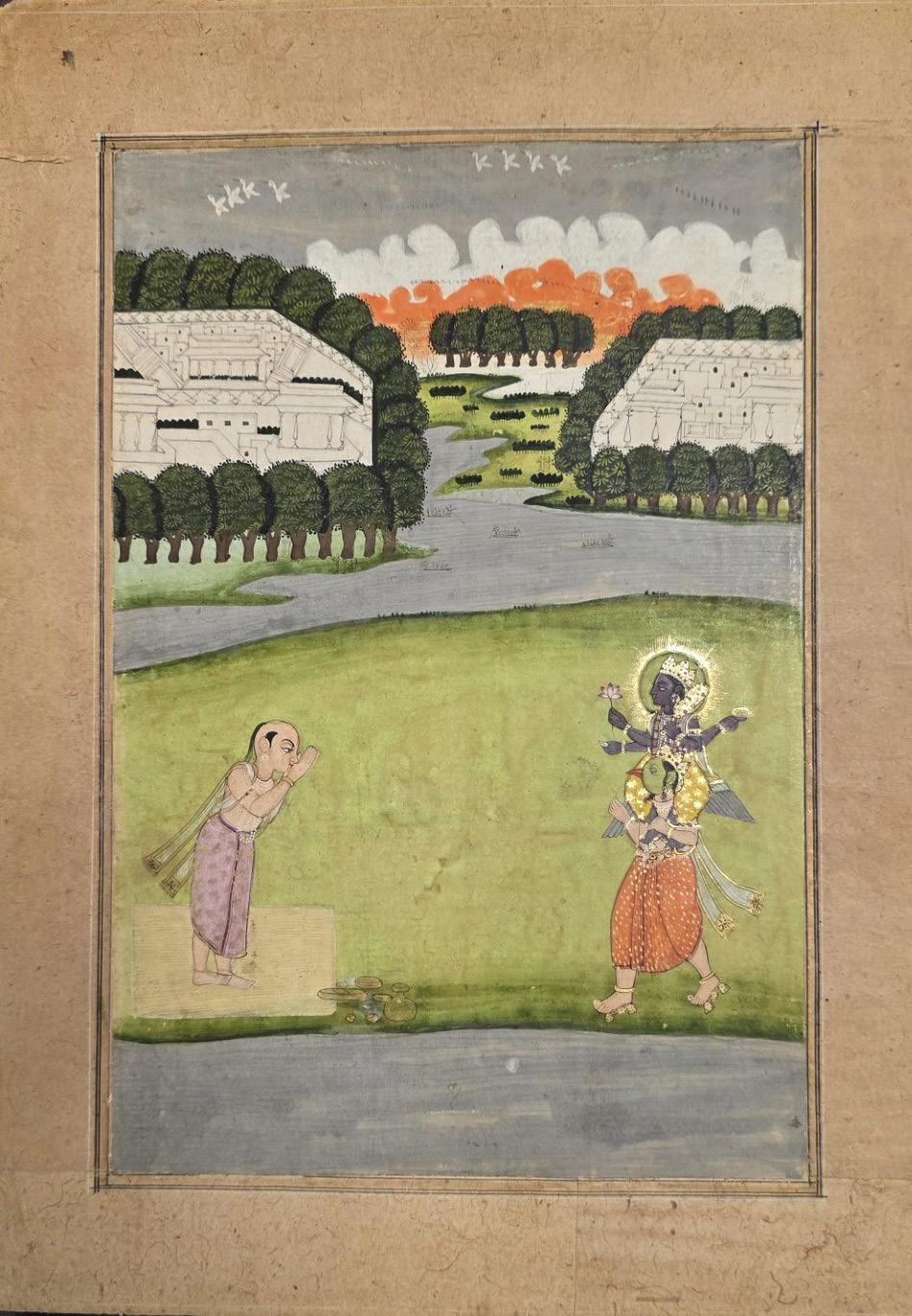
VISHNU AND GARUDA APPROACH AN ASCETIC
Bikaner, Rajasthani, 18th century
Opaque watercolor heightened with gold on paper
Image: 8 ½ x 6 in, 21.6 x 15.2 cm
Folio: 10 ½ x 8 in, 26.7 x 20.3 cm
$20,000
PROVENANCE
Acquired in New York in the 1980s, by repute.
This piece portrays the timeless iconography of Vishnu atop his vahana, Garuda. Garuda’s depictions differ depending on the origin, with some cases showing him much more bird-like and others featuring only his wings or face as avian. Here he is given a bird face with green feathers and small wings that appear off of his sides, the rest of his body is human. Vishnu appears very regal, with three of his four arms bent outwards. Some notable aspects of the pair’s depictions include the lotus and chakra weapon he holds and both his and Garuda’s embellished crowns.
The piece is neatly segmented with an immediate foreground river and the focal point of the Preserver and vahana approaching the bowing ascetic in a friendly manner. Separating the foreground and background is another river with folkish miniature depictions of people in boats, as well as on the shoreline. Trees are used to border the architectural portions of the piece and are drawn in a geometric style.
The small figures of people that are somewhat hidden in the background of the piece may be a device used to further highlight the importance of the gods while also showing the viewer their scale.
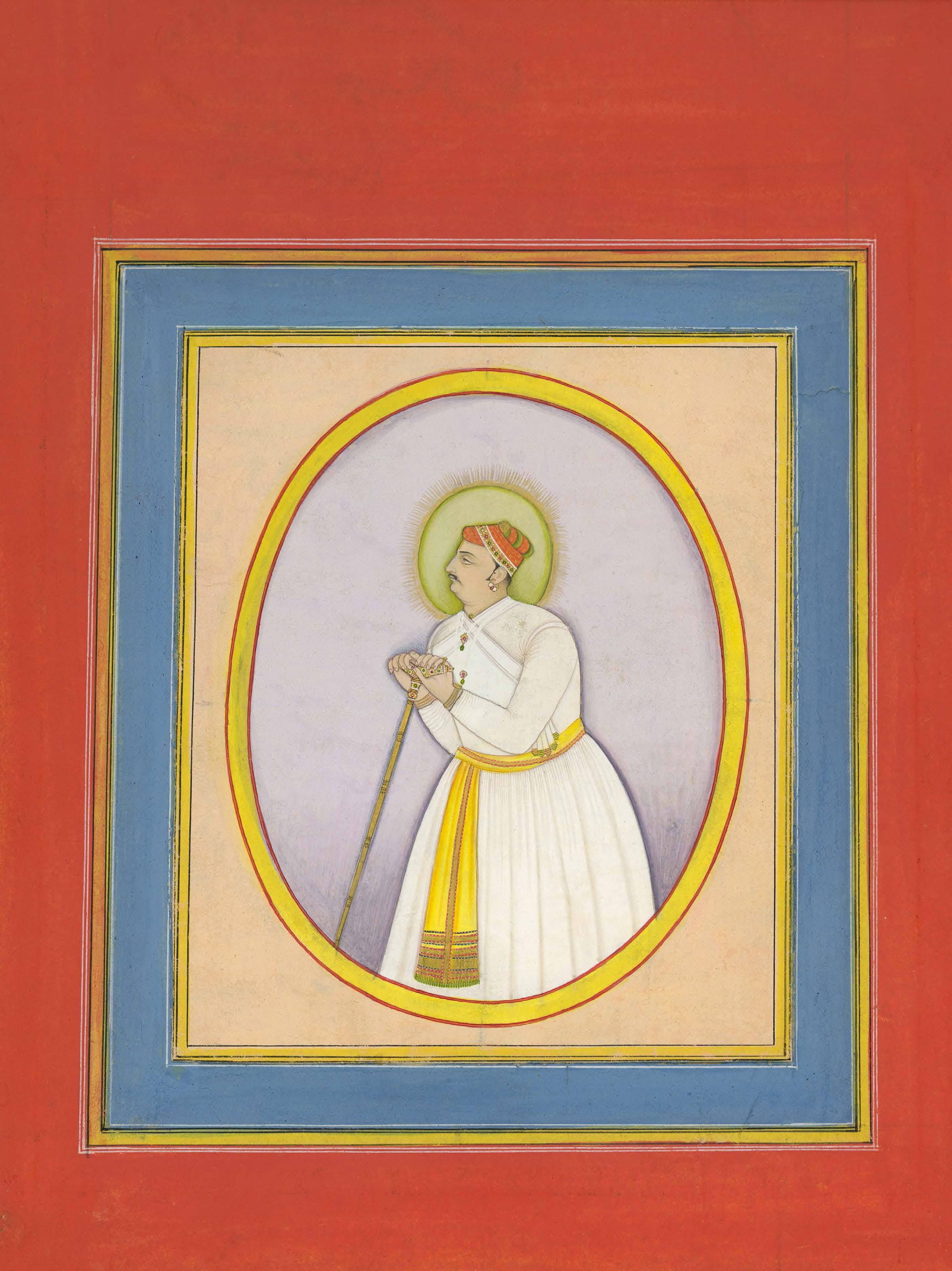
A COMMEMORATIVE PORTRAIT OF MAHARAJA RAI SINGH
Bikaner, Rajasthani, 19th century
Opaque water-based pigments heightened with gold on board
Image: 5 x 4 ⅓ in, 12.7 x 11 cm
Folio: 10 x 7 ¾ in, 25.4 x 19.7 cm
$25,000
PROVENANCE
Collection of the Maharaja of Bikaner, 1964, according to inventory seal verso (no. 4724)
Maharaja Rai Singh (r. 1571-1611), the sixth raja of Bikaner, is depicted here in an icon-like fashion, haloed and regal. Rai Singh held high rank as a general in the armies of the Mughal Emperors Akbar and Jahangir, winning large tracts of Mewar for the Mughals. For his exemplary service, he was awarded the jagirs of Gujarat and Burhanpur. He constructed the Junagar Fort in Bikaner during his reign.
An early drawing ascribed to the artist Nur Muhammad (active 1580-1630) of Maharaja Rai Singh, executed circa 1605-1610 and now in the collection of the Cleveland Museum (see acc. 1987.1100) may have been a prototype for later paintings like the present. Therein, the raja is depicted in full, wearing an Akbari period five-pointed-hem jama. The drawing is covered in ink inscriptions that likely serve as coloristic instructions preparing for a more finished version, executed later by workshop assistants.
The present image is a posthumous portrait of the famous maharaja which would have been commissioned by a noble family of Bikaner as a gift. This type of work is sometimes referred to as a ‘nazar’ painting for this reason (see Naval Krishna, Bikaneri Nazar Paintings Depicting Krishna, Ars Orientalis, Vol. 30, Supplement 1, 2000, pp. 93-97.).
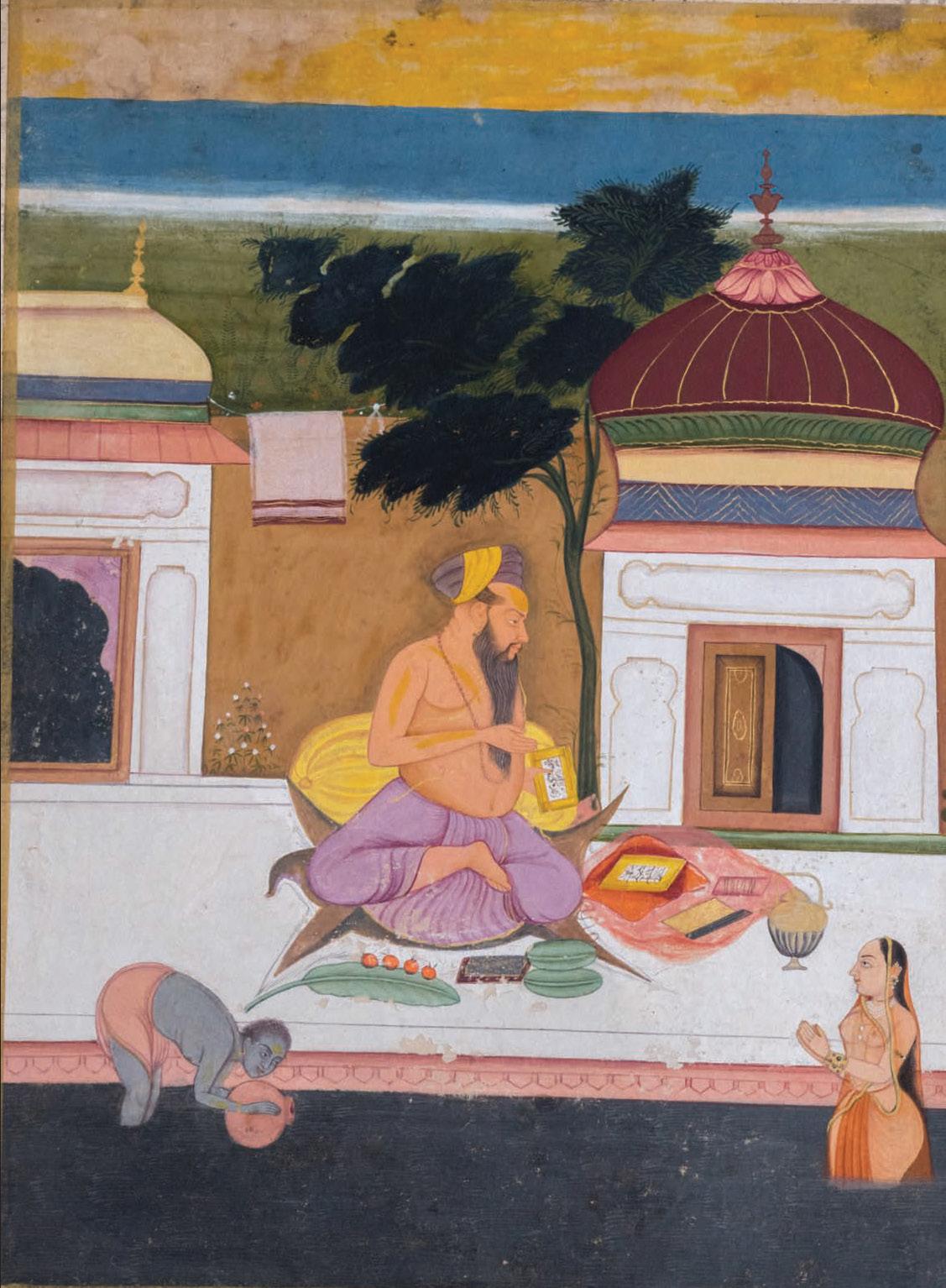
A MAHARISHI ON A TERRACE
Bikaner, Rajasthani, c. 1700
Opaque watercolor heightened with gold on paper
Image: 10 x 7 ¼ in, 25.4 x 18.4 cm
Folio: 12 x 9 ¼ in, 30.5 x 23.5 cm
$40,000
PROVENANCE
Private American Collection
This fine painting depicting an unidentifiable maharishi appears to be from the same set as circa-1700 Bikaner painting of Prithvisimha at worship; a promised gift to the Norton Simon Museum published in Pratapaditya Pal’s Painted Poems, Pasadena, 2004, p. 18-19, cat. 74.
As stated by Pal: “The painting is executed clearly, in a markedly different style from the pictures generally attributed to Bikaner early in the century. The pictorial touches evident in the handling of the internal space and the more realistic narrative strategies are derived ultimately from the Mughal tradition, which was introduced at the court, probably by Mughal-trained artists, during the reign of Karan Singh (1631-84). It was likely painted after the Karan Singh period” (see ibid). This stylistic approach is also reminiscent of that in the earlier Brahma and Narada paintings attributed to Bikaner, providing the possibility of an earlier date.
AN ILLUSTRATION TO THE BHAGAVATA PURANA: KRISHNA SLAYING ARISHTA, THE BULL DEMON
Bikaner, Rajasthani, Mid-18th century
Opaque watercolor heightened with gold on paper
6 x 10 ⅛ in, 15 x 25.8 cm
$25,000
PROVENANCE
London Art Market, 2014
Christie’s, New York, 26-27 September 2017, Lot 228
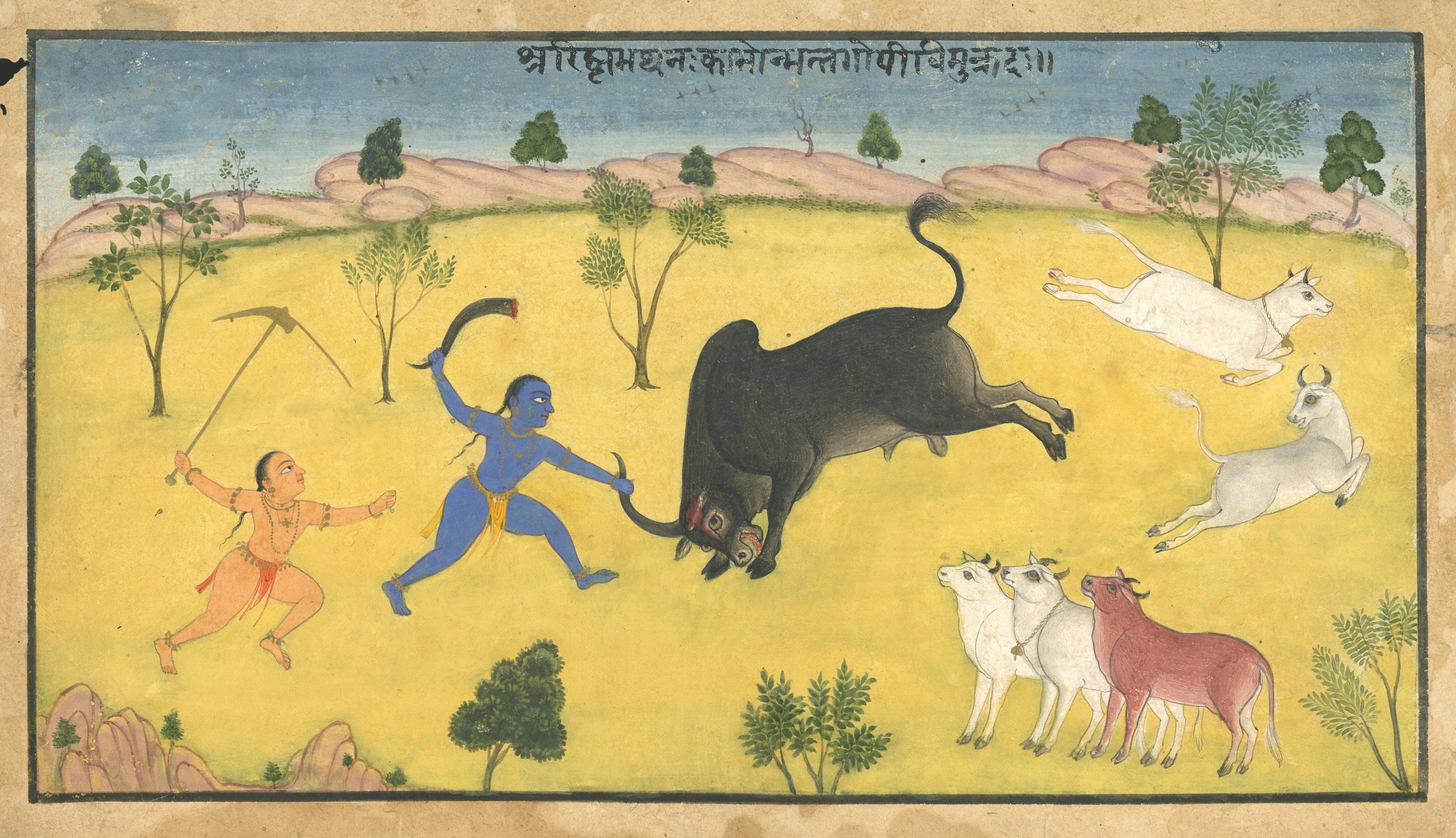
A broad landscape with sparse yet intricately designed foliage unfolds across the painting, distant cloudlike mountains appear in the background. Five cows stand to the right, vigilant onlookers anxious to witness the outcome of the fight between Krishna and the bull demon Arishtasura. Balarama stands behind Krishna, garbed primarily in jewelry with weapon raised high, ready to aid should his lord falter.
This scene originates from chapter thirty-six of book ten of the Bhagavata Purana. The demon Arishtasura came to Vrindavana where Krishna was residing and started to wreak havoc to get the god’s attention, uprooting trees and attacking people so that they ran away screaming for Krishna to rescue them. Tending to his cows away from the town, Krishna heard the cries for help and returned to face Arishtasura. The bull charged Krishna but was thwarted when he was caught by the horns and thrown a far distance. Unperturbed, the bull again charged the god but this time Krishna ripped one of the horns from the demon’s head and impaled him with it, claiming victory. This action is preemptively illustrated in the current example, depicting the moment right before Krishna’s triumph. Arishtasura kicks his back legs in protest and jerks his head down to escape Krishna’s grasp, but it is clear that the bull cannot best the mighty deity.
A LEAF FROM A PANCHATANTRA SERIES (OR ‘PANCHAKHYANA’ SERIES)
Mewar, Rajasthani, c. 1725
Opaque watercolor heightened with gold on paper
Image: 7 ½ x 7 ⅛ in, 19 x 18 cm
Folio: 13 x 10 ⅜ in, 33 x 26.5 cm
$30,000
PROVENANCE
Private Collection
Bonhams New York, 11 September 2012, Lot 124
Christie’s New York, 27 September 2017, Lot 251
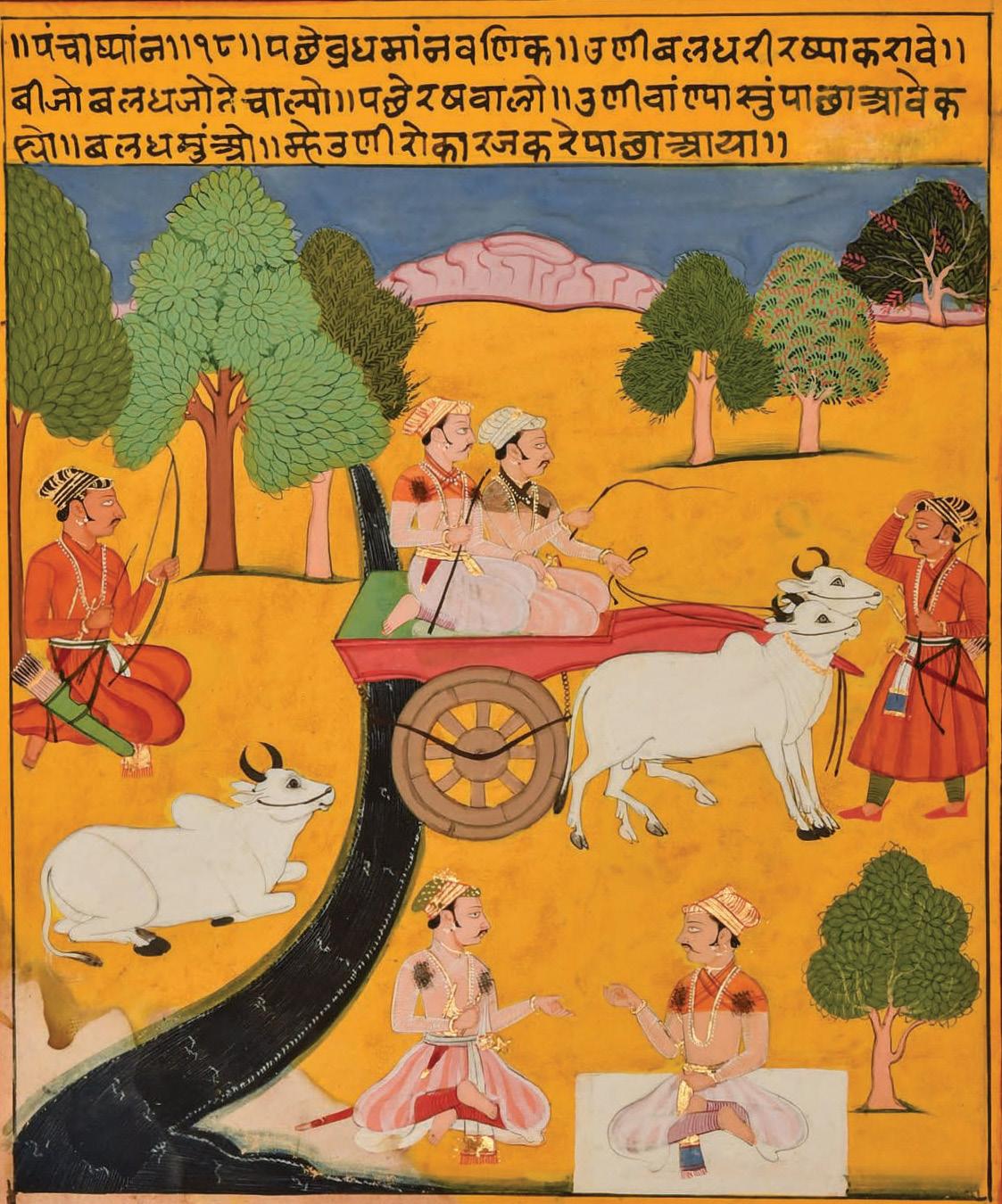
The Panchatantra is an ancient Indian collection of interrelated animal fables connected by a larger story. There is a version of the Panchatantra in almost every major language in India, as well as many adaptations from all around the world. This leaf comes from a Jain recension of the Panchatantra, called the Panchakhyana Series. These tales, largely following anthropomorphised animals, are meant to impart earthly wisdom on how to conduct one’s life.
The painting here is depicted in a continuous narrative, in which successive episodes of the story are shown in a single picture. The rural landscape, a vibrant yellow background split by a flowing river, contains three scenes. The first scene, on the left of the river, depicts an archer in red robes kneeling in wait with a resting bull. In the second scene to the right, the same archer is seen greeting two men in a bullock cart. The figure in orange is likely the protagonist of the narrative, while his companion holding the whip is the cart driver.
Finally, in the lower register, the figure in the orange robe meets with another man, just as richly dressed as he. The fact that he sits on a mat, while the other does not, signifies his rank and importance. Compare the color palette, strokes, and figural profiles of this painting to those of another circa-1725 illustrated Panchatantra folio at the Los Angeles County Museum of Art (acc. M.90.160.2).
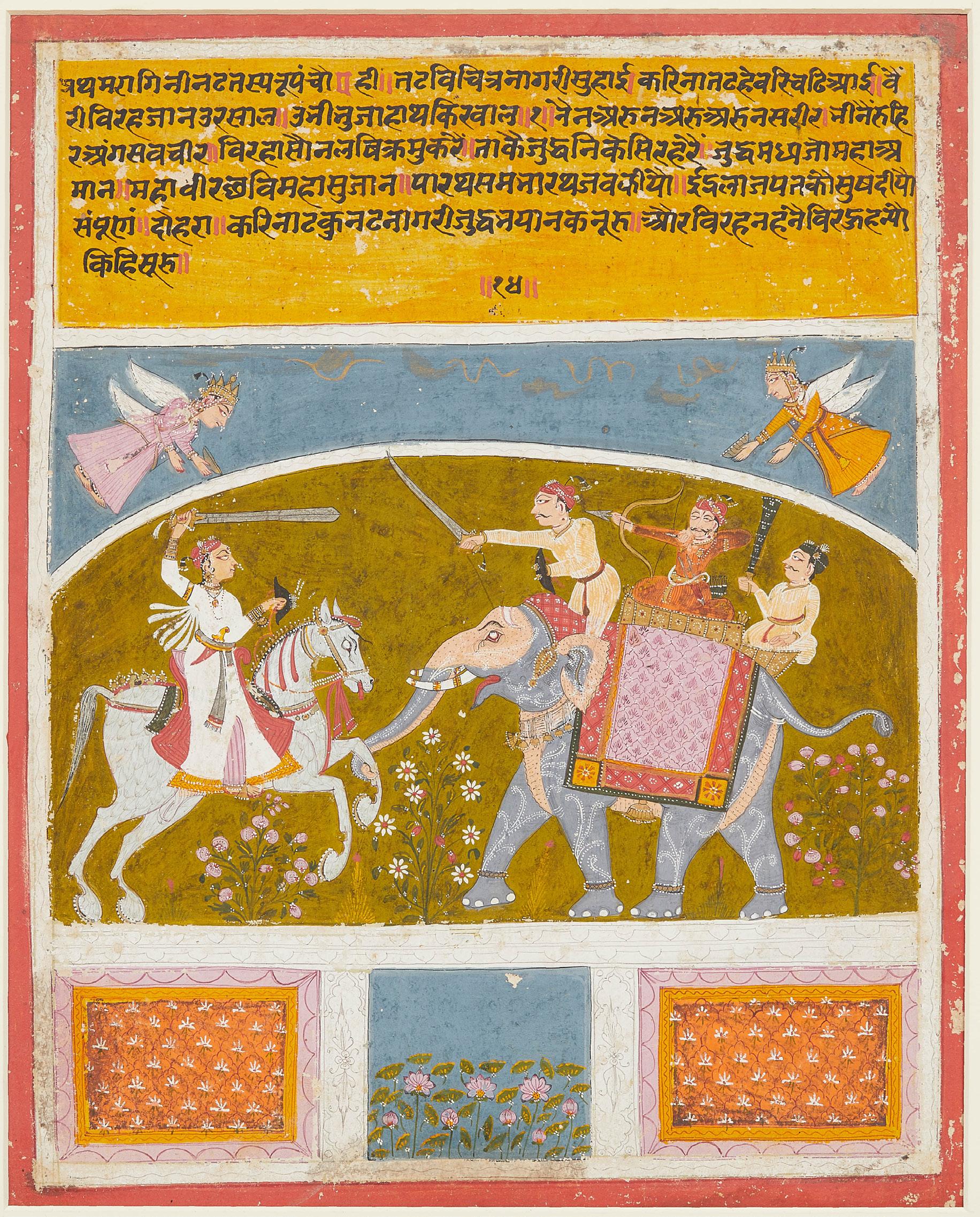
ILLUSTRATION TO A RAGAMALA SERIES: NAT RAGINI
Datia, Rajasthani, c. 1725
Opaque watercolor heightened with gold on paper 9 x 6 ⅓ in, 22.8 x 16 cm
$25,000
PROVENANCE
Christie’s New York, 27 September 2017, Lot 251
Bonhams New York, 11 September 2012, Lot 63
Ragamala or ‘Garland of Melodies’ paintings are visualizations of the ancient classification system for Indian music.
Ragamalas are the melodies that become templates for improvisation within Indian music. While each melody has a certain structure, there are infinite songs that can be produced within each mould. These melodies are generally categorized into six male personifications, or ragas, who are each accompanied by five wives, or raginis. The ragas are all in the stronger and more coherent pentatonic scale, while the raginis are in the heptatonic scale, which contains melodies with more contrasts and subtleties, and are thus considered more feminine.
Each of the thirty-six ragas or raginis are a pictorial embodiment of a particular musical mood or sentiment, often having to do with “love in union” or “love in separation.” They are meant to evoke the feeling or colour of the melody rather than a specific narrative. The six principal ragas are each meant to be performed during the six seasons of the year: summer, monsoon, autumn, early winter, winter and spring. The raginis, too, are often attributed to certain regions or times of day.
Depicted here is the Nat Ragini, an afternoon melody. Nat ragini is one of the wives of the Bhairava Raga. The Nat Ragini, although feminine, is depicted as a warrior on horseback. With her sword raised, she comes face to face in battle with a war elephant and it’s three riders.
Scholar Kalus Ebeling notes that “It is hard for the uninitiated viewer of Ragamala paintings to reconcile the concept of female ragini with the male images of battling warriors. While most Ragamala paintings are conceived in a devotional or erotic mood, Nat visualizes music of a heroic mood” (K. Ebeling, Ragamala Paintings, Basel, 1973, p. 37). Thus, the fact that these depictions are not literal, but instead meant to be evocative of a particular feeling, allows for this subversion of gender norms.
While typical Nat Ragini scenes are filled with the violence of battle, often featuring dead and decapitated soldiers, this depiction is relatively restrained. Instead of dead bodies, the battle ground is interspersed with detailed florals, which also decorate the lower register of the painting. Enclosing the scene is a curved horizon, above which two angels appear to be raising their cups towards each other as if in celebration. The marble architectural element atop which this scene takes place, as well as textile-like niches on either side of a manmade lotus pond within, are the Mughal elements that distinguish this Datia painting from the earlier Rajput Malwa painting style it owes homage to.
A MAHARAJA VISITS KISHANGARH
Attributed to Dalchand or follower, possibly Amar Chand, Kishangarh, Mid 18th century
Opaque watercolor, silver, and gold on paper 8 ¾ x 9 in, 22.1 x 22.9 cm
NFS
A visit by Maharaja Vijay Singh of Mewar (r. 1752-3; 1772-1793) to Kishangarh is recorded on a painting (Christie’s, London, 24 October 2024, Lot 153) in which he is also greeted by Kishangarh courtiers, holding hawks on a terrace fronting Lake Gundalao. However, in this work the personages wear tilak marks on their foreheads, and the central figure, while wearing a similar dress, is more stocky and mature. The composition and vitality of the facial features show affinities with works created after Dalchand’s arrival to Kishangarh in 1728, so too with a portrait of Maharaja Sirdar Singh of Kishingarh in the Ashmolean Museum (EA 1999.6), attributed to Amar Chand, c. 1760-70. It could be that the Christie’s picture is based on this work. An inscription, now painted over on the verso, would provide more clues.
ILLUSTRATION TO THE KAMA SUTRA, DESCRIBING DIFFERENCE ASANAS
Mewar, Rajasthani, Early 18th century
Opaque watercolor heightened with gold on paper
5 ¾ x 9 ⅝ in, 14.6 x 24.5 cm
$22,000
BAZ BAHADUR AND RUPMATI RIDING AT NIGHT
Probably Awadh, Mughal, c. 1800
Opaque watercolor heightened with gold on paper
Image: 7 ¾ x 10 ⅛ in, 19.7 x 25.7 cm
Folio: 8 ⅓ x 10 ⅞ in, 21.2 x 27.6 cm
$90.000
PROVENANCE
The Ehrenfeld Collection, California
Sotheby’s New York, 6 October 1990, Lot 19
Carlton Rochell Asian Art, New York
The Sterling Collection, US, 2011
LITERATURE
Daniel J. Ehnbom, Indian Miniatures: The Ehrenfeld Collection, New York, 1985, no. 30, pp. 76-77
Baz Bahadur of Mandu, the last King of the Malwa Sultanate (r. 1555-1562), is depicted here riding with his beloved Rupmati on a pair of horses. They gallop in sync through the darkened night landscape, rearing up in perfect unison as the lovers gaze into each other’s eyes. They seem to glow with an otherworldly radiance, their energy illuminating the green bush behind them like a spotlit stage. A lotus-filled pond with a pair of birds bathing is depicted below.
Although the Muslim Baz Bahadur and the Hindu Rupmati were historical figures who lived and loved during the reign of the Mughal Emperor Akbar, their inspiring story has transcended into folklore and poetry. Baz Bahadur was initially led to Rupmati by music he heard on a hunt. After years of palatial and romantic bliss, the two were divided by the 1661 Mughal conquest of Mandu, whereupon Rupmati chose death over being taken captive. Thus, they are the archetypal tragic lovers—an Indian version of Romeo and Juliet—and are represented here in this stunning miniature as idealized types, raised to heroic perfection.
Ehnbom offers a particularly sensitive description of the painting:
Here the lovers are shown hunting at night, seemingly more interested in each other than in any quarry. A dark ground gives way to a somber forest and a night sky of deep blue. In the center, the lovers glow as if illuminated by an inner light. A tree directly behind them reflects their effulgence and provides a frame of light-green leaves. The king’s robe is a sunny yellow, while Rupmati’s garment is of opalescent white. She is heavily jeweled. The lightly tinted horses spot rich tack. They rear up, but so gently that the lovers are not disturbed and continue to stare into each other’s eyes.
(The Ehrenfeld Collection, 1985, p. 76.)
While it is apparent that these are not actual portraits, we can nevertheless immediately recognize them as Baz and Rupmati with the help of longstanding visual conventions associated with their story: Baz Bahadur bears a long spear, two quivers of arrows, a bow, and a sword. Their eyes meet as their caparisoned horses lift them in a united stride.
On the broader question of genre in Indian painting, Ehnbom further observes that as Mughal authority declined—and as Delhi suffered a profound psychological blow after Nadir Shah’s invasion in 1739—images of idealized lovers and nostalgic visions of former imperial splendor gained renewed appeal, as though painting itself might offer a refuge from political upheaval.
PRINCESS STROLLING ACROSS A PALACE TERRACE AT NIGHT
Awadh, Mughal, c. 18th century
Gouache painting on paper heightened with gold leaf
7 ⅛ x 4 ⅞ in, 18.1 x 12.4 cm
$45,000
NOTES
Inscribed with a verse in Nastaliq script (verso).
PROVENANCE
Doris Wiener Gallery, New York, September 30, 1969
This exquisite miniature painting from 18thcentury Lucknow embodies the refinement and poetic sensibility of late-Mughal and Awadhi courtly aesthetics. The composition depicts a princess walking barefoot across a palace terrace late at night in an intimate moment, engaged in an act of quiet contemplation with a subtle sense of resolve. The artist employs a darkened background to evoke the enveloping night sky, enhancing the luminosity of the central figure whose delicate features, dress, and jewelry gleam in contrast. Awadhi miniatures often incorporate a diverse range of painting techniques, with specific interest in the interplay of light and shadow, as well as a more precise rendering of volume and spatial depth.
The princess is dressed in an elegantly pleated and embroidered golden skirt with a deep orange blouse. She gently draws her sheer dupatta (shawl) forward with one hand to partially veil her face, and perhaps wishing to remain hidden in the night. The fabric of her dress is rendered with an exquisite attention to textile detailing, showcasing the artist’s ability to convey the rich and graceful qualities of the princess. Soft shading across her form brings a sense of volume and dimensionality to the central figure. She is also adorned with a string of pearls draped around her neck, wrists, forehead, and toes with various jewels embellished throughout, emphasizing her regal presence.
Looking more closely, alta (red dye) decorates the tips of her fingers, toes, and the soles of her feet, denoting her status as a married woman. She also holds up a small diya (candle) to her face. Her ethereal presence in this scene is further accentuated by her serene expression and the soft upward curve of her lips.
A series of finely painted jharokhas (arched windows) frame the princess in the evening scene, and floral motifs decorate the structure on the right. A crimson red baustrade in the background anchors the composition spatially and adds a rhythmic contrast to the princess’s gentle stride. The restrained yet vibrant color palette, with the interplay of warm ochres, muted blues, verdant greens, and bold reds, reflects the refined sensibilities of the period. Such nocturnal vignettes, often laden with poetic and literary associations, were favored subjects in courtly ateliers, illustrating themes of solitude, anticipation, and the fleeting nature of beauty.
The miniature painting is encased by a large vibrant yellow and red floral border, its repeating pattern heightened with gold leaf. The verso of the painting includes a panel of Arabic-Persian calligraphy in Nastaliq script with a floral emblem at the top. The panel is surrounded by a dark green border speckled with gold leaf throughout.
The lines of script are addressed to God (or the beloved, a royal figure, the benevolent, the calif, etc.) and reads as follows:
Oh, thou who has solved world’s problems with your benevolence; solve people’s problems with your benevolence.
No other but thou is the granter of prayers; all prayers are granted because of thou.
It’s only your benevolence that is heartwarming; grant us your benevolence to warm our hearts.
(Translation provided by Yass Alizadeh, PhD, Clinical Associate Professor, Persian Program Coordinator, Middle Eastern and Islamic Studies, New York University.)
Refer to a painting for a comparable recto and verso of this piece at the Victoria and Albert Museum in South Kensington (IS.14-1949). This painting is from a similar period and includes a floral border and calligraphy panel as well.
A DRUNKEN PRINCE LED TO BED
Lucknow, Mughal, c. 18th century
Opaque watercolor heightened with gold on paper
Image: 9 ⅝ x 7 ½ in, 24.5 x 19 cm
Folio: 13 x 11 ¼ in, 33 x 28.5 cm
$50,000
PROVENANCE
Christie’s, London, 4 October 2012, Lot 178
A drunken prince is led to his bedchamber by female attendants and musicians as dawn is heralded by the cockerel and the grey halflight of the new day.
Lucknow was given the reputation of being highly elaborate, from their poetry to their culture, indulging in excess and embracing decadence. The present painting illustrates this zeal, showing a finely dressed prince who has reveled into the early morning hours and consequently become intoxicated.
Terrace scenes incorporating musicians such as those pictured here were popular in Awadh [the region where Lucknow is located], a composition technique adopted from the nearby Mughals.
The Nawabs of Awadh were originally appointed in the 18th century as governors of the rich agricultural province by the Mughal empire, but gained independence as their power faltered. In the latter part of the century, many Mughal artists, poets, and nobility fled to Awadh in search of stability amidst uncertain times for the Mughal empire.
This socio-political climate, along with a growing European presence, prompted the development of an Awadhi substyle. Artists took inspiration from European styles, paying attention to spatial depth and figural volume, hoping to escape the Mughal standards of painting in search of their own.
One characteristic and widespread feature applied across Awadh paintings is the aerial perspective, exemplified in the current work.
By giving the impression that the viewer is slightly above the figures’ eye level. The Awadhi region saw itself as a cultural successor to the Mughal dynasty when they showed signs of decline in the 18th century, providing a pool of patrons for artists to work for who commissioned pieces like the painting illustrated here.
With gracefully patterned, gold illuminated margins, this work demonstrates the skill and precision possessed by the artists of Awadh before they conformed to the popular Company style in the 19th century.
A ROYAL HUNT
Mughal, 17th century
Opaque watercolor heightened with gold on paper 9 ⅛ x 5 ½ in, 23.2 x 14 cm
$25,000
Depictions of the royal hunt, or shikār, were a recurring subject in Mughal painting, where they often functioned as visual metaphors for imperial authority and control over both nature and empire. In the present work, a nobleman participates in the Mongolian hunting practice known as qamargah, a highly coordinated operation in which an organized force of hunters surrounds and drives the quarry inward so that the ruler may deliver the decisive blow. The inherent danger of this method is underscored by the dramatic moment at the left, where a hunter is knocked to his knees by the charge of a powerful buffalo. Despite the peril, the hunt reaches its climax as the leader raises his long-bladed shamshīr shikārgār, poised to strike his fallen trophy.
Mughal hunting expeditions were often extensive, sometimes lasting for months and taking place deep within forested landscapes far from urban centers. While the present composition includes a palatial town visible in the distance and a small shrine nestled among rocky outcrops, the rugged, undulating terrain dominates the scene, conveying a sense of motion and intensity amid an expansive wilderness.
WOMEN IN THE ZENANA
Mughal, 17th century
Opaque watercolor heightened with gold on paper
Image: 8 ⅞ x 5 in, 22.5 x 12.5 cm
Folio: 11 ⅚ x 7 ½ in, 30 x 19 cm
$50,000
On a secluded palace terrace, the women of the zenana gather in an atmosphere of leisure, intimacy, and refinement. At the center of the composition, one woman reclines against a large bolster while another sits close beside her, their interaction forming the emotional focus of the scene. Around them, attendants and companions kneel and stand in quiet attendance: one offers refreshment, another appears to speak or gesture toward the pair, while a third approaches bearing a tray. Beyond the terrace balustrade stretches a formal garden and distant palace complex, lending the scene both depth and a sense of enclosure. Dressed in diaphanous garments, patterned textiles, and delicate pearls, the women inhabit a world of cultivated pleasure marked by music, conversation, drink, and repose
The repetition of floral and garden motifs throughout the composition—from the planted beds and tree-lined paths in the landscape beyond to the ornament of the terrace itself—underscores the zenana as an idealized feminine domain, ordered, fertile, and sensuous. Amorous and courtly zenana scenes such as this found early imperial expression under Shah Jahan (r. 1627–1658), and later continued in Deccani painting, where artists explored themes of luxury, intimacy, and elite domestic life. . The harems’ sumptuous attire and leisurely pursuit of pleasure speaks to the prosperity of the realm and provides a window into the fantasies of the male artists and their patrons.
Due to the inaccessibility of the zenana and the speculated delights therein, these imaginings of the women “behind-the- wall” were archetypal and highly idealized depictions, rather than individualized portraits.
BAJAZAT (BAYEZID) BROUGHT AS A PRISONER BEFORE THE EMPEROR TIMUR
Mughal, c. 1800
Opaque watercolor heightened with gold on paper 12 ⅔ x 9 ⅓ in, 32.1 x 23.7 cm
$45,000
PROVENANCE
Bonhams, London (New Bond Street), Islamic & Indian Art, 19 April 2007, Lot 380
A jewel-toned Delhi court scene of extraordinary theatricality: Timur, haloed and enthroned beneath a brocaded canopy, receives the captive Ottoman sultan Bayezid amid a dense press of officers.
Timur sits enthroned on a raised terrace platform beneath a wide mustard-yellow canopy trimmed with pink fringe and scattered with delicate floral sprigs. A smaller parasol is suspended above him, while a burnished golden nimbus encircles his head, visually asserting sovereignty and sacral aura. His throne is rendered as an inlaid bejeweled construction with patterned panels, floral diapering, and a red bolster behind, all set against a richly repeating green carpet whose lattice of blossoms creates a tapestrylike field of ornament.
At left, the defeated Bajazat/Bayezid is presented as a captive: a tall, bearded figure in a plain white robe and dark boots, held and guided forward by attendants and officers. One escort grips his arm as another gestures toward the enthroned ruler, staging the prisoner’s “presentation” as a formal act of submission. Around them, the assembly thickens into a portrait gallery of courtiers and military men—each differentiated by turban styles, caps, beard types, and garment fastenings. Quivers bristling with arrows, drawn bows, maces, and long swords punctuate the crowd, reinforcing the theme of conquest and martial order.
Beyond the terrace railing, the scene opens onto a panoramic landscape: a river with small craft, distant palace buildings on the horizon, and low green hills beneath a clouded, streaked sky. This broad
topographical register lends the composition an epic, world-historical scale while keeping the human drama tightly choreographed in the foreground.
The encounter between Timur (Tamerlane) and the Ottoman sultan Byjezid I—captured after Bayezid’s defeat—entered Indo-Persian visual culture through illustrated histories and imperial manuscript traditions, and remained compelling into the 19th century as a subject that dramatized kingship, legitimacy, and the moral theatre of rule.
Delhi ateliers of the 19th century frequently reimagined celebrated historical episodes in single-sheet paintings intended for albums and collectors: crisp figural profiles, individualized physiognomies, and controlled shading are paired with an almost luxuriant attention to costume, weapons, and textile patterning. Here, the painter heightens the contrast between victor and vanquished through costume language alone: Timur’s gold-toned splendour and haloed authority set against Bayezid’s austere white robe, visually “reading” power before the viewer even follows the narrative.
BHILS HUNTING BY NIGHT
Attribuated to Faizallah, Mughal, c. 1760
Opaque watercolor heightened with gold on paper
9 x 6 in, 22.9 x 15.2 cm
NFS
NOTES
Inscribed ‘(Women Hunting at night), Game in view, (No. 48), H.H. Chanhee Collection’ (verso).
PROVENANCE
Private English collection
AN ILLUSTRATED FOLIO FROM A VISHNU AVATARA SERIES: VAMANA AVATAR (THE DWARF INCARNATION OF VISHNU)
Popular Mughal, early 17th century
Opaque watercolor heightened with gold on paper
Image: 8 ⅖ x 6 in, 21.3 x 15.2 cm
Folio: 9 ¾ x 7 ¼ in, 24.8 x 18.4 cm
$50,000
NOTES
Buff borders (irregular) applied. Inscribed and numbered above in black ink with a partial black ink Nasta’liq inscription
Vamana the Dwarf the fifth avatar of Vishnu offers his hand outstretched to the asura King Mahabali as he stands holding his wooden umbrella. Inside a chamber three brahmins in discussion before a small fire. In the lower register Vamana approaches the palace of King Mahabali asking for alms and questioned by a gatekeeper.
Provincial Mughal, Late 18th century
Gouache heightened with gold on paper
Image: 12 ⅕ x 7 ¼ in, 31 x 18.5 cm
Folio: 15 x 9 ⅘ in, 38 x 25 cm
$50,000
LEAF FROM THE MADHAVANALA KAMAKANDLA: A FAINTED MUSICIAN IN THE ZENANA
PORTRAIT OF A MUGHAL NOBLEMAN, BAHADUR
Mughal, 17th century
Opaque watercolor heightened with gold on paper
7 ¼ x 4 ¾ in, 18.4 x 12.1 cm
$35,000
SHAH I
A HESITANT MAIDEN BEING LED TO A PRINCE’S BED
Mughal, c. 1720
Opaque watercolor heightened with gold on paper
Image: 10 ¾ x 7 ¼ in, 27.3 x 18.4 cm
Folio: 13 ½ x 9 ½ in, 34.3 x 24.1 cm
$80,000
Another version of this scene is the the National Museum, Delhi (No.79.195), published in Anjan Chakraverty, Indian Miniature Paintings, 1996. pp. 43-44, attr. Mughal, c. 1720. Here, the facial features are slightly softer, and the moon glows brighter to reveal the fine detailing of the canopy.
DOUBLE-SIDED MURAQQA’ FOLIO
Deccan, 17th century
Gouache heightened with gold on paper
$35,000
Recto (left): A Yogini Holding a Peacock
Feather Morchal
Mid-18th century
Image: 8 ¾ x 5 ⅔ in, 22.2 x 14.2 cm
Both of these paintings have been laid into the front and back of an ornate 19th-century muraqqa’ folio album page with multiple inner and outer borders filled with black foliate designs, ornamental cartouches and geometric patterns, bird motifs, and gold.
On one side of the album, a youthful nobleman dressed in a white muslin jama and matching Deccani turban stands against a verdigris ground with his sword and a large black shield visible behind him. On the other side, a Shaivite yogini (holy woman) clothed in a flowing, gilt-hemmed robe stands on a hillock beneath the green foliage of a vibrant tree. She holds a crook, a rosary strand and a gold peacock-feathered morchal (ceremonial fan) against a light blue sky.
The reason the two paintings are dated differently is because they were created as individual miniatures, executed by different workshops. This double-sided page may be referred to as a “muraqqa’ folio” a practice of Islamic art collectors (first in Persia and the Ottoman Empire and later, in India) to compile their many paintings into albums. Muraqqa’ is a Persian word meaning “patched together.” Disparate examples of painting and calligraphy trimmed down and laid within ornate borders, glued recto-to-verso, to form collector’s albums are common during this era.
Well-known muraqqa’ folio examples can be found in the Metropolitan Museum of Art (The Shah Jahan Album), the Chester Beatty Library, Dublin, the Harvard Art Museum, the Smithsonian Museum of Asian Art (acc. 1937.20) and many other museums.
Verso (below): A Deccani Nobleman
Late 17th – early 18th century
Image: 10 x 6 ½ in, 25.4 x 16.5 cm
Folio: 18 x 11 ⅛ in, 45.7 x 28.2 cm
A COURTESAN DANCE
Deccan, Golconda or Hyderabad, last quarter of the 17th century Ink with embellishments in gold on paper
Image: 7 ¾ x 2 ⅔ in, 19.7 x 6.7 cm
Folio: 13 ⅞ x 10 in, 35.2 x 25.4 cm
$35,000
PROVENANCE
Saeed Motamed Collection
Christie’s London, 7 October 2013, Lot 118
The young dancer’s long wavy black hair falls in slender tresses down her back and over her shoulder. She is dressed in a Safavid Persianate manner and faces the viewer in three-quarter pose. She places her weight on one leg and twists rhythmically, her left hand raised up above her head and her right playfully pinching out a strand of hair. A feathered and gold cap with strands of pearls, gold bracelets and necklaces adorn her figure from head to foot.
Her near-frontal pose suggests that she is a courtesan—only a princess would be allowed a regal profile view. The present portrait is similar to a published painting of a Yogini with a Mynah Bird (Chester Beatty Museum, Dublin, Ireland, accession no. In 11A.31), holding a mynah bird and depicted half length and boldly smiling with a full face. Both women project a similarly insouciant attitude.
Although the identity of this courtesan is unknown, she is depicted with realistic features, capturing a true representation of the sitter in a Mughal style. By this time, the Mughals conquered the Deccani Sultinate finalizing their triumph over the region. This portrait was executed when Mughal aesthetics dominated the Deccan, demonstrated here in the realism and empty background with a carefully patterned outer border.
FROM A
Deccan, probably Bijapur, 18th century
Opaque watercolor heightened with gold on paper
8 ⅜ x 6 in, 21.3 x 15.2 cm
$33,000
FOLIO
RAGAMALA SERIES: RAGAPUTRA MARU
A NOBLEMAN SMOKING HOOKAH
Deccan, 18th century
Gouache heightened with gold on paper
Image: 11 ⅔ x 7 ¾ in, 29.6 x 19.7 cm
Folio: 16 x 11 ¾ in, 40.6 x 29.8 cm
$30,000
A DERVISH WITH TWO GOATS
Attributed to Riza-yi ‘Abbasi or his circle, Persian or Safavid or Isfahan, Early-mid 17th century (probably after 1620)
Pen and ink drawing with gold on paper
Image: 8 ¼ x 4 ¼ in, 21 x 10.8
Folio: 12 ½ x 8 ½ in, 31.8 x 21.6 cm
$40.000
NOTES
Mounted within an album folio. Four panels of black ink Nasta’liq script in the four corners with later blue inner borders. Ruled lines. Outer buff borders with gold floral designs. A muraqqa’ album page with a calligraphy folio (verso).
An old bearded goat-herder perhaps a dervish or sufi leans on the crook of his walking stick as he looks wistfully beyond his two goats below, perhaps daydreaming of his youth. Hints of foliage suggesting landscape and stylized clouds in gold wash swirl in the background.
A fine pen drawing attributable to the circle of Riza-yi ‘Abbasi (c. 1565-1635) a highly influential and lavishly pampered artist in the atelier of Shah ‘Abbas I of Isfahan. Also called Aqa Riza, he received his early training from his father, the painter Maulana Ali Asghar, and joined the royal atelier at a young age to great acclaim.
However he mercurially left the Shah’s service for a bit c. 1605, giving up his courtly existence for a life among the morally-questionable lower classes of Isfahan. He later returned to the Shah’s atelier c. 1610 to remain until the end of his life. His late work, after c. 1620 is generally considered somewhat less refined than the earlier more elegant phase of his career. He was the teacher of the Safavid painter Mu’in Musavvir in Isfahan.
His lifetime mastery of calligraphic pen lines modulating from thick to thin, with minimal or no color (particularly in his later years) contain an aesthetic quality as expressive as it was economical in form and color.
A drawing of an old man with a cane bearing an inscribed attribution to Riza-yi ‘Abbasi is in the collection of the Arthur M. Sackler Museum, Harvard (access. 2002.50.16) has similarities to our drawing although the overall quality there is somewhat lower.
There are numerous extant drawings attributed to Rizayi ‘Abbasi and/or his circle in collections worldwide with some depicting an older man in a landscape setting. For some examples see: Metropolitan Museum of Art NYC for a double drawing mounted within one album folio1 (once in the Hagop Kevorkian Collection) and Old Man and Youth in a Landscape in the Freer Gallery Collection (44.48a)2 as well as in the British Museum, the Louvre and others
See also; Metropolitan Museum of Art NYC (Accession number 25.83.8) Man in a Long-sleeved Coat c. 1598.
1 Welch 1973 p.1472
2 Metropolitan Museum 25.83.8