



Two industry leaders have combined to give you more.
LPC veteran Jeff Bucholtz is another one of our Champions of More who is committed to giving you more. Our Client Project Managers form a unique level of service in the print industry. Focusing solely on managing the day to day activity of each individual client, Jeff Bucholtz and the other CPMs bring decades of experience and more expertise to our clients and help make up the backbone of our team Because, like all of us here at LPC, he loves her work. And you’ll love ours. LPC. Champions of More
Lewisburg Printing Company + Huston Patterson



OFFICERS
Chairwoman: Terri-Lynn Levesque, Royal Containers Ltd., Brampton, Ontario, Canada
First Vice Chairman: Joseph Morelli, The Morelli Group Decatur, Illinois
Vice Chairmen: Mike Schaefer, Tavens Packaging & Display Solutions, Bedford Heights, Ohio
Eric Elgin, Oklahoma Interpack, Muskogee, Oklahoma
Josh Sobel, Jamestown Container Cos., Cleveland, Ohio
Immediate Past Chairman: Gary Brewer, Package Crafters, High Point, North Carolina
Chair, Past Chairmen’s Council: Matt Davis, Packaging Express, Colorado Springs, Colorado
President: Michael D’Angelo, AICC, The Independent Packaging Association, Alexandria, Virginia
Secretary/General Counsel: David Goch, Webster, Chamberlain & Bean, Washington, D.C.
Administrator, AICC Canada: Leah Gardiner Administrator, AICC México: Veronica Reyes
DIRECTORS
Great Lakes: Brock Welch, Welch Packaging , Elkhart, Indiana
Midwest: Cassi Malone, Corrugated Supplies Co., Bedford Park, Illinois
Northeast: Larry Grossbard, President Container Group Wood Ridge, New Jersey
Southeast: Chad Wagner, Peachtree Packaging & Display, Lawrenceville, Georgia
Southwest: Jordan Dawson, Harris Packaging , Haltom City, Texas
West: Sahar Mehrabzadeh, Bay Cities, Pico Rivera, Califormia (interim)
AICC Canada: George Perreira, Moyy/Whitebird Hamilton, Ontario, Canada
AICC México: Jorge Ortega, Solemsa, Hermosillo, Sonora, Mexico
OVERSEAS DIRECTOR
Greg Jones, SUN Automation Group, Glen Arm, Maryland
DIRECTORS AT LARGE
Jenise Cox, Harris Packaging , Haltom City, Texas
Sahar Mehrabzadeh, Bay Cities, Pico Rivera, California
Casey Shaw, Batavia Container, Batavia, Illinois
Stuart Fenkel, McLean Packaging , Pennsauken Township, New Jersey
Jack Fiterman, Liberty Diversified International Minneapolis, Minnesota
EMERGING LEADER DELEGATES
Evan Clary, National Corrugated Machinery, Hunt Valley, Maryland
Cody Brant, A.G. Stacker Inc., Weyers Cave, Virginia
Nick Catania, BHS Corrugated–North America, Aurora, Illinois
ASSOCIATE MEMBER DIRECTORS
Chairman: Jeff Dietz, Koenig & Bauer (US), Dallas, Texas
Vice Chairman: Mike Butler, Domtar Packaging , Fort Mill, South Carolina
Secretary: Brian Foley, Bobst, Phoenix, Arizona
Director: Warren Bird, JB Machinery, Westport, Connecticut
Immediate Past Chairman: John Burgess, Pamarco, Roselle Park, New Jersey
ADVISORS TO THE CHAIRWOMAN
Joe Palmeri, Jamestown Container Cos Cleveland, Ohio
Al Hoodwin, Michigan City Paper Box, Michigan City, Indiana
Jeff Dietz, Koenig & Bauer (US), Dallas, Texas
PUBLICATION STAFF
Publisher: Michael D’Angelo • mdangelo@AICCbox.org
Editor: Virginia Humphrey • vhumphrey@AICCbox.org
EDITORIAL/DESIGN SERVICES
YGS Association Solutions • www.YGSAssociation Solutions.com
Vice President, Association Solutions: Craig Lauer
Creative Director: Mike Vucic
Senior Managing Editor: Sam Hoffmeister
Copy Editor: Steve Kennedy
Art Director: Alex Straughan
Account Manager: Jillian Mengel
SUBMIT EDITORIAL IDEAS, NEWS, AND LETTERS TO: BoxScore@theYGSgroup.com
CONTRIBUTORS
Cindy Huber, Director of Conventions and Meetings
Chelsea May, Meeting Manager
Laura Mihalick, Senior Meeting Manager
Patrick Moore, Membership Manager
Taryn Pyle Director of Training, Education, and Professional Development
Rebecca Rendon, Senior Manager, Education and Training
Alyce Ryan Membership Marketing Senior Manager
ADVERTISING
Taryn Pyle
703-535-1391 • tpyle@AICCbox.org
Patrick Moore
703-535-1394 • pmoore@AICCbox.org
AICC PO Box 25708
Alexandria, VA 22313
Phone 703-836-2422
Toll-free 877-836-2422 Fax 703-836-2795 www.AICCbox.org
AICC provides the education, tools, and information your company and employees need to thrive in the paper packaging industry.
In the first two articles in this series, we explored the foundation of Legacy in Action: Inspiring Tomorrow’s Leaders. We began with Mentor Intentionally, highlighting the power of guiding emerging leaders with purpose and focus. We then examined Empower Risk-Taking, showing how creating space for thoughtful experimentation builds resilience and confidence. In this third pillar, we turn our attention to Champion Inclusion —creating leadership that reflects the diversity and complexity of the world we serve.
The workplace today is more diverse than ever—not just in demographics but in mindset, experience, age, communication style, and expectation. The next gener ation of leaders will represent a broader spectrum of identities, backgrounds, and perspectives than any generation before them. That is not a challenge to legacy; it is one of its greatest strengths. To ensure that tomorrow’s leaders thrive, we must champion inclusion.
Inclusion goes beyond representation. It is the environment we create—the culture that tells people they belong, their voice matters, and their ideas are valued. It shows up in everyday leadership behaviors: how decisions are made, whose input is sought out, and whether diverse perspectives are truly leveraged rather than simply acknowledged.

Leaders who shaped our industries understood something profound: Innovation comes from difference. When people with varied life experiences analyze the same problem, they generate stronger ideas and more creative solutions. Markets expand. Blind spots shrink. Organizational cultures become more resilient and future-ready.
But inclusion cannot be assumed—it must be demonstrated. It appears when leaders invite quieter team members into the conversation, challenge group thinking, elevate historically overlooked talent, and rewrite systems—not slogans—to remove barriers and create access.
Next-generation leaders are watching. They are learning from how we treat people, communicate across differences, and model respect, empathy, and fairness. Inclusion also drives engagement and retention, fostering workplaces where people can contribute authentically and grow.
The most powerful impact of inclusion is its multiplier effect. When one person feels seen and supported, they create psychological safety for others, inspire collaboration, and widen the path for those who follow. Championing inclusion is not a program—it is a leadership practice. A leader’s legacy is measured by how many people feel seen because of them. When we champion inclusion, we build leadership that is bold, compassionate, and powerfully diverse.

BY RYAN FOX
Prices don’t always fall when demand declines. In mature, highly competitive industries such as U.S. corrugated packaging, tonnage can drift lower, square feet of box shipments can slide, and prices can still rise. This isn’t due to a breakdown of supply and demand but rather reflects how and where the industry adjusts to sinking demand.
In shrinking corrugated markets, the first response is rarely aggressive price competition. Instead, it’s exit. High-cost mills and inefficient box plants shut first, a pattern that has played out repeatedly over the past two years. As marginal producers disappear, capacity comes out faster than demand, leaving a smaller industry with fewer participants, more discipline, and less appetite for volume-driven price wars.
Yet discussions of “capacity” often focus on mills. Converting capacity has expanded significantly over the past several years, driven by investment in next-generation corrugators and high-speed boxmaking equipment. When demand softens and buyers test the market, excess converting capacity can exert downward pressure on box pricing—even if containerboard prices remain stable. Plants built on promised return thresholds can’t sit idle indefinitely. That dynamic helps explain why box prices eroded last year, despite limited movement in containerboard benchmarks.
The distinction between containerboard and boxes is critical. Containerboard functions as a commodity purchased by a limited pool of buyers. Boxes are customized products sold to thousands of end users. Yet, most box contracts remain tied to published containerboard assessments, even though the true “open market” represents only a small share of
Source: Fibre Box Association and U.S. Bureau of Labor Statistics
domestic consumption. With integration approaching 90%, much of what moves between mills and plants never reaches the open market.
Exports provide an outlet for excess tons, but those transactions often don’t factor in to domestic benchmark assessments. That allows capacity to clear without necessarily dragging down published prices.
Containerboard’s benchmark price had been flat since February 2025’s increase, even though underlying open-market transactions softened over the past year and box producers across the U.S. reported sustained pricing pressure. This February’s $20-a-ton decline in the benchmark disrupted major integrated producers’ pricing agenda. It also may reflect box buyers’ resolve to test the market and secure lower prices.
Demand erosion is rarely uniform. The customers that change behavior first are typically those with the most flexibility— buyers that can redesign packaging systems or shift formats without major operational
disruption. Amazon, for example, has increased its use of paper mailers while relying less on corrugated boxes.
The customers that remain are constrained by equipment, regulation, qualification requirements, or habit. They may resist price increases, but they can’t easily substitute. The pool of box buyers becomes smaller, but demand is less elastic.
In this environment, producers aren’t pricing to the average customer; they’re pricing to customers who are effectively locked in. For large publicly traded companies, pricing in a declining market becomes about preserving cash flow—protecting margins, servicing debt, funding capital spending, and maintaining dividends.
Public markets reinforce this behavior. Investors want growth, but not at the expense of return on invested capital, free cash flow, or earnings per share. Volume growth that destroys returns is penalized, while controlled expansion—or even modest contraction paired with stable margins—is often rewarded.
Once this framing takes hold, pricing becomes a defensive tool, potentially described as “discipline” or “value over volume.” The message isn’t that demand is strong but that accelerating decline by competing away margins is unacceptable.
At this stage of the cycle, the business shifts from growth to harvesting. The objective is no longer to expand the market but to extract as much value as possible from existing assets while they remain economically relevant. This behavior can appear irrational to customers facing higher prices amid weakening demand, but it often makes sense from the producer’s perspective.
Substitutes for corrugated packaging exist—returnable plastic containers or alternative packaging formats—but they aren’t yet cheap, scalable, or frictionless. Switching requires capital, operational focus, and internal justification. As long
as those frictions remain, the major integrateds retain some pricing power.
This condition isn’t permanent, though. Higher prices eventually force behavioral change, prompting customers to invest in substitutes, redesign packaging systems, or invite regulatory scrutiny. When the break comes, it’s rarely gradual. If volumes fall below what the remaining asset base can support, pricing power evaporates quickly, and the market fractures.

Supply and demand still get the final word—they simply take their time.
Prices rising in weakening markets signal where an industry sits in its life cycle. Exit comes first. Substitution comes later.

Ryan Fox is a corrugated market analyst at Green Markets, a Bloomberg company. He can be reached at rfox93@bloomberg.net








BY ERIC ELGIN
Packaging policy is changing quickly across North America, and two familiar acronyms are showing up everywhere: extended producer responsibility (EPR) and responsible end markets (REM).
For AICC members, these programs are shaping how packaging is designed, reported, recycled, and valued in the marketplace. Understanding the framework is becoming increasingly important as brand owners, policymakers, and consumers demand greater accountability and transparency in how packaging materials are produced, used, and recycled.
EPR changes who pays for and manages packaging waste. Traditionally, municipalities managed the cost of collecting and processing recyclables. EPR shifts that responsibility to producers —brand owners or companies that sell packaged goods.
Several states, including Maine, Oregon, California, and Colorado, have already adopted packaging EPR legislation. Many more have active legislation, making it likely that EPR will expand further in 2026.
The corrugated industry is in a position of strength as EPR moves forward. EPR programs reward materials that are recyclable and efficiently recovered. Corrugated boxes already have one of the highest recovery rates of any packaging material, a big plus for fee structures.
That said, companies across the packaging supply chain will face expanded reporting requirements, increased transparency around materials, and closer regulatory oversight. This is where REM programs come in.

REM initiatives are designed to verify that materials collected through recycling programs are actually recycled in legitimate manufacturing processes—not diverted, mismanaged, or exported without proper oversight.
For corrugated, this aligns closely with how the system already works. Boxes are routinely recycled into new containerboard and new boxes through a highly circular manufacturing process. The closed loop supports the key goals behind REM: traceability, transparency, and responsible reuse.
AICC members sit at a critical intersection—working directly with manufacturers, supply chains, and brand customers. As EPR expands, converters will increasingly be asked to help customers make smarter packaging decisions, evaluate recyclability, and provide documentation about material performance and sustainability.
In many cases, corrugated packaging already delivers the outcomes policymakers are trying to encourage. In fact, several states are embroiled in lawsuits as they relate to EPR and constitutionality. AICC is advocating for members as these regulations develop. One challenge is the emerging patchwork of state-by-state EPR policies.
AICC keeps you informed on developments through inBox and the website. In the meantime, independent converters are well positioned to lead—and as the regulatory landscape evolves, that leadership will matter more than ever.

Eric Elgin is owner of Oklahoma Interpak and chairman of AICC’s government affairs subcommittee. He can be reached at 918-687-1681 or eric@okinterpak.com












HOCKER POLYTECHNIK, INC.
PHILIPP KOCH
President 125 Don Truell Lane
Thomasville, NC 27360 336-313-5007 www.hockerpolytechnik.com
NORTHGATE
STEVE ADAMS
Executive Director, Sales and Marketing 3367 Corunna Rd. Burton, MI 48532 810-287-3052 www.go2northgate.com
BINGHAM FLEXO SERVICES
JOHN BINGHAM
President
245 West Roosevelt Rd., Building 9, Suite 62 West Chicago, IL 60185 630-879-7300 www.binghamflexoservices.com
CHROMASCAPE LLC
JENNIFER McCANN
Marketing Communications Manager 7555 East Pleasant Valley Rd., Suite 100 Independence, OH 44131 330-998-7559 www.chromascape.com
CREALUTIONS, LLC
STUART NEIDENBERG
Owner
7096 State Highway 21S Grandin, MO 63943 573-593-4521 www.crealutions.com
PAPER PRODUCTS MARKETING USA
MICHAEL JOHNSTON
President 4380 South MacAdam Ave., Suite 370 Portland, OR 97239 971-222-3116 www.ppm.com








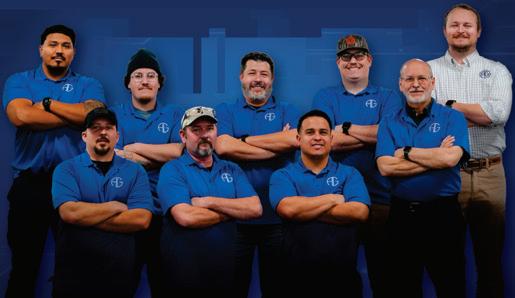







On February 26, the slopes of the Big Sky Resort in Montana beckoned 60 AICC members for another edition of the AICC West Coast Ski Meeting.
This purely social event draws boxmakers, suppliers, and friends from around the country to enjoy snow, sun, camaraderie, and networking. Three evening receptions, two breakfasts, and a Mid-Mountain Meet Up at Everett’s 8800, a restaurant named for its altitude, kept the skiers sustained as they tackled a mountain that is a thrill for skiers of all abilities. It was easy to find friends on any slope, anytime, as everyone sported their AICC armbands.
AICC thanks all who participated, especially our sponsors. Without their generous support, these events would not be possible:
• Welcome Reception: Haire Group
• Networking & Closing Receptions: Air Systems Design and SUN Automation Group
• Breakfast Sponsors: Global Boxmachine, Landaal Packaging, RapidBond, and MTorres
• Silver Sponsors: Doral Corp. and Viking Paper Corp.
• Bronze Sponsor: Arden Software North America





Kiwiplan embeds intelligence and 24/7 automation into planning, scheduling, and supply chain execution, helping packaging manufacturers operate leaner, smarter, and faster.
Powered by the Advantive ONE AI platform, Kiwiplan unifies operational, financial, and quality data into a single source of truth. This transforms complexity into clarity and enables confident, data-driven decisions –backed by 35+ years of industry expertise.








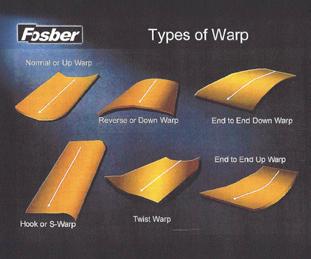
AICC just published an extensively searched and reviewed document from more than 20 years of AskRalph responses, other AICC brochures, presentations, internet posts, TAPPI and its corrugated board technical committee content, interviews with best-in-class corrugators and sheet feeders, corrugated manufacturers themselves, and digital press manufacturers. Not much has changed in combined corrugated board, except that digital presses cannot tolerate any warp greater than ⅛ inch per linear foot—they just need flat board.
So, we look obviously at the cause of warp and where in the manufacturing processes this manifests. While the image at right illustrates the common types of warp, the most troubling one is end-toend-up warp, which could possibly cause the sheet to make contact with one or more expensive print heads on the press.
Digital presses place fundamentally different demands on corrugated board than traditional flexographic or offset systems. Sheet delivery systems often rely on vacuum transport, bottom-feed delivery, and precise nip-point alignment before the first print station. Any variation in sheet flatness can lead to head strikes, image distortion, feeding errors, or press stoppages in digital presses. While flexos can be either top or bottom printers, digital presses are always top printers because they rely on gravity to deliver the ink drop to the sheet.
Unlike conventional presses, digital systems provide little opportunity to “force” a sheet through the machine. The result is that board that meets historical allowances may still be unsuitable for digital printing. In many cases, digital printers must reorient sheets, flip warp directions, or reject board entirely—increasing
waste, cost, and frustration across the supply chain.
There are newer corrugators and laminating processes to produce flat board more consistently than conventional corrugator processes. There are hybrid systems like Asitrade, Quantum, Interpac, and the BHS NextGraphX. The first has been with us for a long time, laminating printed top sheets to a single-face web. Recently, there has been the introduction of wider and longer machines.
The Quantum process appears as a rather conventional corrugator process but has a revolutionary engineering design focused on converting fine flutes and very low substance containerboards. It’s different.
Interpac uses a cold corrugating process that is not dependent on steam and heat to control board moisture and cure the starch-based adhesives. With the initial
installation in Canada, an additional 10 machines have been sold in North America. It’s a low-cost alternative to manufacture flat board.
The most recent announcement was a corrugator and digital printer all inline. This creation offers shorter lead times, significant cost savings, and reduced environmental impact. It is focused on replacing the litho-laminating step to high-quality graphics—amazing. Stay tuned for the white paper at NOW. AICCbox.org

Ralph Young is the principal of Alternative Paper Solutions and is AICC’s technical advisor. Contact Ralph directly at askralph@AICCbox.org about technical issues that impact our industry.









Give your brand an edge with Billerud’s new Tribute® family of high-performance, Americanmade coated white liner products.


Made in the Midwest, Tribute is the product of decades of American coating experience and global packaging expertise.


Tribute’s coated and lightly coated surface options take ink beautifully for packaging that shouts from the shelf. Tribute is built to run and fold flawlessly, delivering the consistency converters need to hit speed, quality and yield targets every day.






Tribute is available in an extensive basis weight range for maximum flexibility, offering a solid sustainability platform with independent supply and resources committed to supporting growth.














BY TOM WEBER
In the constant and growing competition for top talent, small independent businesses often find themselves at a disadvantage, struggling to compete with larger organizations.
One of the main reasons small businesses are in this position is because big companies have the ability to offer better benefits, which is a critical factor for many professionals when choosing a job. Without a well-thought-out strategy for attracting talent, small businesses are at a disadvantage in attracting top talent compared to larger corporations with more financial resources. For a small business owner, it’s crucial to be strategic and offer unique job benefits to attract the best candidates and to establish a successful talent attraction strategy.
Below are some effective strategies for creating job benefits to attract and retain top talent in your small business.
An upskilling study found that 90% of millennial and Gen Z employees prioritize career education and professional development when evaluating potential employers. For a business owner, it’s important to remember that these groups are the future of work. A company needs to prioritize their career desires to attract the top employees to their business.
One surefire way to cater to employees’ professional aspirations is through career pathing. It involves creating a road
map that deliberately aligns employees with career growth opportunities. Implementing a career-pathing strategy within a small business will make it an attractive work destination for modern workers who care more about professional development and career growth.
2.
Large companies often provide employees with generous perks such as health insurance, catered lunches, and on-site gyms. While it may be challenging for small businesses to match these benefits, they can offer something invaluable to their employees—a sense of community and belonging.
With fewer employees than large firms, small-business employees have





more opportunities to build longlasting relationships with colleagues. Business owners can take advantage of this benefit by organizing activities that further strengthen the sense of community, such as luncheons, team-building exercises, or local charitable events involving employees. These actions help employees feel more connected to their co-workers and the community at large.
Additionally, small-business employees have the opportunity to interact closely with customers and witness firsthand the impact of their services. These are the social benefits that large companies can’t guarantee employees. By fostering a deep sense of community and belonging within the company, small businesses can attract top candidates who seek purpose in their work.
Flexible time off (FTO) is a modern benefit that progressive companies use to attract employees. Unlike traditional time-off policies, FTO does not involve employees earning or accruing time-off hours. Instead, it combines sick leave and vacation time, allowing employees to use all their flexible time-off days at once.
In most companies with an FTO policy, employees don’t feel pressured to use or lose their time-off days when they’re due, as they can claim them at their convenience. FTO policies also accommodate more flexible reasons for taking time off beyond the traditional ones, including reasons such as mental health and wellness.
When crafting an FTO policy, it’s important to balance prioritizing employees’ needs with ensuring smooth company operations. Thoughtful FTO policies will ultimately attract modern employees who desire more flexibility in their time off.
The days when office cubicles were fashionable are gone. Thanks to new office designs and layouts, millennials and Gen Z employees favor collaborative office designs in which they can share ideas and learn from peers. They seek inspirational office interiors that foster creativity and productivity.
A successful talent attraction strategy requires more than just creating a list of benefits and posting it on job boards. It involves conducting a thorough analysis of the talent market to understand what motivates top candidates to join larger companies. The fast-changing talent market can strain the HR capabilities of small
businesses, and the increasing pressure to recruit and compete with larger companies that have extensive HR departments and budgets can feel overwhelming. In an era of scarce talent and high turnover, it pays to invest in a high-caliber HR experience. Professional employer organizations (PEOs) can manage HR and administrative needs, allowing you to concentrate on securing top talent and growing your business. PEOs can also support your business by designing a benefits package that is attractive to today’s job seekers.

Tom Weber is president of WeberSource LLC and is AICC’s folding carton and rigid box technical advisor. Contact Tom directly at asktom@AICCbox.org
Eliminate
Maximize



















BY TODD M. ZIELINSKI AND LISA BENSON
Packaging buyers who research their options carefully often focus on choosing partners that can reduce risk and deliver dependable value. These decision-makers seek manufacturers who demonstrate reliability, understand their specific needs, and provide solutions that strengthen the supply chain. Earning their consideration and making the short list require more than competitive pricing alone. Many packaging manufacturers are eliminated before they even have a chance to prove themselves, because they are seen as either posing an operational risk or failing to mitigate it. Several signs indicate friction and delay long before capabilities are evaluated.
The outreach from many packaging companies is very similar, focusing on custom packaging, high quality, and on-time delivery. But for buyers in specialized or regulated industries, those are baseline requirements. They need evidence that the packaging manufacturer understands their industry and the challenges they face.
With medical devices, for example, packaging is part of the product’s risk profile. The U.S. Food and Drug Administration’s (FDA’s) Quality Management System Regulation requires packaging and shipping containers to protect the device from alteration or damage during processing, storage, handling, and distribution.
For terminally sterilized medical devices, ISO 11607-1 defines requirements for materials and sterile barrier systems intended to maintain sterility to the point of use, and it explicitly ties packaging performance
to a documented set of requirements. The packaging system defined in this standard includes protective packaging that prevents damage during transit.
In the context of corrugated and paperboard packaging, the FDA regulates food-contact materials through the Food Contact Substance framework and specific guidance at the substance level. While the FDA establishes Current Good Manufacturing Practice expectations and general provisions for indirect additives through federal regulations, paper-based articles must also comply with regulations regarding safety and purity standards for additives used in the pulping, sizing, and coating processes, ensuring that components of the paperboard do not migrate into food at levels that would compromise consumer safety or alter the food’s organoleptic properties.
These are just three examples of industries in which companies put themselves at risk by not working with a packaging supplier with demonstrated industry experience. If outreach doesn’t mention the buyer’s reality, whether it be validation, traceability, migration or extractables concerns, distribution hazards, shelf life, labeling controls, etc., then procurement assumes the packaging manufacturer will require close monitoring and may cause delays.
What short-list suppliers do differently:
• Their outreach and messaging are category- or industry-specific, including touching on specific pain points and having relevant case studies.
• They ask better intake questions (e.g., sterilization method, shelf-life target, lot traceability).
Most suppliers describe processes (e.g., die cutting, printing). However, buyers may short-list based on outcomes. Can the manufacturer reduce line stoppages? Will I have fewer damaged shipments? Will I have faster approvals and fewer deviations? How can I lower the total cost of ownership?
Procurement teams that have shifted from lowest unit price to a comprehensive value-based strategy understand that focusing on unit price alone can lead to less effective decision-making, particularly when quality issues, freight, inventory, and disruption costs surface later. Many packaging manufacturers have the same capabilities, so selling on capability is weak unless it is tied to a measurable risk reduction or performance gain.
What short-list suppliers do differently:
• They provide concrete examples of how their solutions have directly improved operational metrics, such as reducing transit damage, minimizing downtime, or accelerating time-to-market.
• They align their value propositions with the buyer’s specific business goals, demonstrating ROI through case studies, performance data, or references that link packaging initiatives to broader organizational outcomes.
Procurement has to defend why each vendor is worth the evaluation time, so manufacturers with no differentiation will never make the short list. Supplier evaluations often emphasize measurable factors beyond unit price, such as delivery performance, quality systems, compliance, and continuity risk, because they use




those attributes to help predict downstream disruption costs. If two suppliers look equivalent, buyers keep the one with clearer quotes, better documentation, faster answers, and fewer exceptions.
Buyers care about how disciplined your processes are (e.g., document control, corrective action responsiveness, and on-time delivery consistency), how you prevent and handle disruptions, and evidence-based performance claims. What short-list suppliers do differently:
• They showcase performance guarantees or service-level commitments that set them apart.
• They provide third-party certifications, awards, or compliance credentials that directly differentiate them from generic suppliers.
• They present case studies or references showing how their approach outperformed the incumbent or industry average on meaningful KPIs (e.g., cost savings, reduction in line stoppages, faster market launches).
• They proactively address compliance, traceability, and risk mitigation in ways competitors do not, minimizing downstream disruption and audit risks for the buyer.
The adage “time is money” could not be truer for both the manufacturer and the buyer. When a quote is slow and there is no communication, the buyer interprets it as the manufacturer not being able to prioritize quotes, not considering the opportunity significant, or lacking a repeatable quoting process. What is worse, they will extrapolate this one data point to mean the supplier will be slow on engineering changes, samples, and delivery. Since procurement teams evaluate suppliers on delivery terms and lead times as part of standard quotation review and scoring, slow or inconsistent quote cycle times can signal how the manufacturer will behave after being awarded the project.
Additionally, when an RFQ window is tight, slow responders don’t get considered, because the buyer must move forward with the quotes in hand. What short-list suppliers do differently:
• They acknowledge receipt quickly and clarify any unknowns early (materials, artwork, test requirements).
• They quote with clear assumptions and options instead of waiting for perfect inputs.
• They provide realistic lead times and explicit constraints (tooling, MOQ, changeover, validation steps).
A vague scope, hidden assumptions, and missing requirements create frustration for buyers. A quote is a technical document, and buyers treat it that way. Common quote mistakes include:
• Requirements and assumptions are unclear (use case, board grade/specs, print method, tolerances, testing expectations, volumes, and release schedule).
• Timeline and approval gates aren’t defined (what starts lead time, sampling/proofing/first-article steps, and acceptance criteria).
• Execution details are missing (pack-out, palletization, and any warehousing/release cadence expectations).
• Logistics terms are vague (FOB/ freight included vs. estimated, accessorials, and transit-damage handling).
• Commercial terms are incomplete (MOQ/price breaks, setup/tooling charges and ownership, over/under policy, quote validity, and price-hold/ escalation triggers).
• Change control and issue resolution aren’t stated (what happens when specs/art change, required reapprovals, documentation/traceability when applicable, and the claims/returns window/process).
Buyers use quotes to predict execution risk. The more clearly assumptions
are defined, buyers’ requirements are acknowledged, and “what happens if …” scenarios are stated, the easier it is for procurement to compare suppliers, and the less likely you are to be eliminated for uncertainty. In practice, the supplier with the cleanest quote is often the one buyers expect to deliver with the fewest surprises. What short-list suppliers do differently:
• They package the quote, so it’s easy to approve: a one-page summary, clearly stated assumptions and options, and a simple checklist that mirrors the buyer’s requirements/critical-to-quality, highlighting any gaps, exceptions, or items needing confirmation.
• They show how the project will run after the award, including sample and artwork timeline, who owns each approval, and an escalation and communication path for changes and issues.
Packaging buyers screen for suppliers that are most likely to reduce their risk—those that offer quick and clear responses, industry-specific understanding, evidencebased differentiation, and reliable execution. If a manufacturer wants to make it onto more short lists, it must prove those signals early through response speed, quote quality, documentation readiness, and the ability to talk credibly about how it will mitigate the buyer’s risk.

Todd M. Zielinski is managing director and CEO at Athena SWC LLC. He can be reached at 716-250-5547 or tzielinski@athenaswc.com

Lisa Benson is senior marketing content consultant at Athena SWC LLC. She can be reached at lbenson@athenaswc.com

Revolutionising box production with the EMBA unique solution enabling double production capacity of RSC boxes:
TwinFeed™ + XL Slotter = DualBox™ = 2x Output
TwinFeed™ is an option for the EMBA 245 QS Ultima™, which feeds two identical sheets from 280 mm up to 520 mm in running direction in a single machine cycle.
The extended 4 shaft EMBA Magna XL VSC enables making all slots of both sheets in the slotting unit at speeds up to 30 000 boxes per hour – with no tolerance variations between the boxes. Like having two machines in one.
The DualBox™ innovation combined with the intelligent Ultima™ platform, unique Non-Crush Converting™ and Quick-Set™, makes EMBA 245 QS Ultima™ unbeatable. Converting knowledge into productivity.

To double your output: EMBA 245 QS Ultima™ with DualBox™
BY JULIE RICE SUGGS, PH.D.
Ididn’t start my career thinking about boxes, bottles, or barrier films. I started with molecules.
As a chemistry student pursuing my Bachelor of Science in chemistry, I was fascinated by reactions, structures, and the invisible forces that shape the physical world. I loved understanding why materials behave the way they do. But I didn’t yet know that this curiosity would lead me somewhere unexpected—the wide world of packaging.
That shift began while I was at North Carolina State University participating in a Summer Scholars program through Cornell University, where I studied food science. I developed and packaged a probiotic sweet potato juice—a product that required far more than a good formulation. Beyond ingredients, I was now working with materials, oxygen transmission rates, light barriers, labeling regulations, and consumer perception.
In that moment, chemistry became tangible. Barrier properties weren’t abstract equations—they determined shelf life. Polymer compatibility wasn’t theoretical—it influenced food safety.
Processing conditions weren’t academic— they shaped scalability.
That experience reframed everything for me. Packaging wasn’t secondary to product development. It was central to it.
Today, as academic director at The Packaging School, I see firsthand how many professionals arrive in packaging through unconventional paths, just as I did. Chemistry may have been my entry point, but packaging is a field that welcomes diverse academic backgrounds and transforms them into dynamic careers.
If you’re curious how chemistry, psychology, and history backgrounds translate into successful packaging careers, scan these codes.
This realization ultimately sparked a bigger conversation at The Packaging School—one led by our marketing and sustainability specialist, Mitch Webster. He recognized that so many professionals in our network had taken nonlinear routes into packaging, and he saw the opportunity to shine a spotlight on their stories.
That insight became the foundation for our Unconventional Paths to Packaging series, a collection that showcases the diverse academic backgrounds fueling this industry and proves there is no single “correct” way into packaging. Let’s take a deeper look at how different academic backgrounds translate into packaging careers through some of the standout examples Webster highlights in the series, starting with my own.
My journey is part of a broader pattern: Chemistry majors bring a unique and powerful skill set to the world of packaging. At its core, packaging is about












































controlling the interaction between a product and its environment, and that’s exactly where chemistry shines.
Chemists are trained to think critically about how molecules interact, which translates directly to selecting the right materials for packaging. For example, they can determine which polymers best block oxygen or moisture, predict how coatings and adhesives will behave over time, and troubleshoot potential reactions between packaging and the product inside.
This expertise isn’t just theoretical— it drives real-world innovation, from creating flexible films for snack foods to designing compostable packaging solutions that meet sustainability goals. In other words, chemists don’t just understand what happens in packaging; they understand why and can engineer solutions to optimize performance.
Packaging doesn’t just protect products; it guides decisions. And that’s where psychology majors shine. Their expertise
in cognition, perception, behavioral economics, and emotional triggers allows them to understand how consumers think, feel, and act in the moments that matter most: on the shelf, online, or during unboxing.
In packaging, psychology backgrounds often contribute to areas such as consumer research and testing, brand perception analysis, color and typography impact studies, user experience and unboxing design, e-commerce packaging behavior insights, and even the effectiveness of sustainability messaging. This helps brands understand not just what consumers buy, but why they buy and how packaging can influence decisions at both conscious and subconscious levels.
At first glance, history and packaging may seem worlds apart. But historians are trained in pattern recognition, contextual analysis, and storytelling— skills that are invaluable in a rapidly evolving industry.
Packaging reflects cultural values and adapts alongside technology, regulations, sustainability trends, and consumer expectations. History majors excel at interpreting these shifts, contributing to trend analysis, sustainability research, brand storytelling, regulatory studies, and understanding market changes across time and geography.
They bring exceptional communication skills, essential in an industry that requires extensive collaboration across teams. Understanding shifts in consumer priorities—from convenience to sustainability—and evolving food safety regulations helps guide innovation today.
What ties these stories together isn’t a specific degree; it’s applied thinking. Packaging sits at the intersection of science, engineering, design, consumer behavior, sustainability, supply chain logistics, and business strategy.
My professional career—from studying science to exploring food development and ultimately working in packaging education—reflects the industry itself: diverse, collaborative, and full of opportunity. There’s no single doorway into packaging. Scientific knowledge matters. Understanding people matters. Context and culture matter. Packaging needs all of it.

Julie Rice Suggs, Ph.D., is academic director at The Packaging School. She can be reached at 330-774-8542 or julie@ packagingschool.com

Alli Keigley, who contributed to this article, is production coordinator at The Packaging School. She can be reached at alli@ packagingschool.com

BY MATT EICHMANN
If you run a corrugated plant, you’ve probably had this thought: “We have good people. The market is there. So why aren’t we getting better results?”
The equipment runs. Orders are moving. Customers are buying. And yet:
• The same production issues resurface.
• Customer complaints follow familiar patterns.
• Meetings feel busy but not decisive.
• Improvements don’t seem to stick.
It’s easy to call this an accountability problem or a communication gap. More often, it’s simpler and more expensive. It’s an organizational knowledge problem.
Most small and midsized manufacturers don’t lack intelligence. They lack access to what they already know.
Your operators see waste before it shows up on a report. Your scheduler knows where next week’s bottleneck is forming. Your maintenance lead can predict which machine is about to act up. Your customer service rep hears patterns in complaints long before they become trends. But that knowledge doesn’t always make it into decisions. Why? Because most leadership conversations are built around reporting, not learning. We ask:
• “Did we hit the numbers?”
• “Are we on schedule?”
• “What happened yesterday?”
We rarely ask:
• “Where does this process break down in real life?”
• “What patterns are you seeing?”
• “Who’s closest to this issue?”
When conversations stay at the surface, insight stays buried.
When knowledge stays trapped:
• Problems get solved locally, not permanently.
• Best practices stay on one shift.

• People stop offering ideas because “no one listens anyway.”
In an industry with tight margins, relearning the same lessons isn’t frustrating —it’s expensive. You don’t have layers of management to absorb waste. You feel it immediately in scrap, rework, overtime, and customer frustration.
Three Practical Moves to Start Now
You don’t need to create a big initiative. You need discipline.
1. KILL STATUS UPDATES, HUNT FOR PATTERNS
In at least one weekly meeting, shift from “What did you do?” to “What are you noticing?” Patterns are where operational advantage lives. Repeated small friction points usually signal a bigger systemic fix.
If you’re adjusting the same die cutter three times a week, that’s not a people problem. It’s a pattern worth solving.
2. IDENTIFY YOUR INFORMAL EXPERTS AND MAKE THEM TEACHERS
Every plant has them—the die cutter whisperer, the scheduler who can untangle anything, the maintenance
tech who hears a problem before anyone else does. Name them, then give them a platform.
Have them walk the floor with newer employees. Teach mini sessions during safety meetings. Use simple smartphone videos to capture their shortcuts and decision rules. If they don’t teach, their knowledge retires or walks out the door. Capability compounds when expertise spreads.
3. SPEAK LAST
As an owner or business leader, your opinion carries weight. If you speak first, others adjust around you. Ask the question, then let the silence stretch. If your results lag your talent, it’s not a people problem. It’s a design problem. In the corrugated business, that’s good news. Your advantage is already on the floor. Use it.

Matt Eichmann is founder of Catalyst Point Leadership Advisors. He can be reached at 614-512-2940 or matt@ catalyst-point.com


Eliminate Warp at the Speed of Light!








Monitor It — Identify It — Eliminate It
Immediately identify and correct warp without operator intervention
Continually measure 1200 points across the full web width with laser precision
Produce high quality sheets sooner by utilizing Machine Learning algorithms (AI)



Fully integrates and communicates with CoparSolutions’ QualityMaster™ System

Laser Warp Correction AI brings the latest AI technology to corrugator process control. This next generation of automation combines the precision of laser measurement with closed-loop process control to enhance sheet quality, improve consistency, eliminate operator error, and maximize productivity and profitability!








BY BRIAN M. JAMES
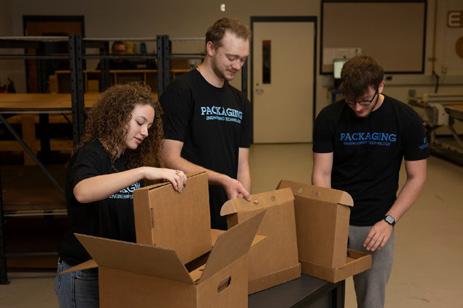
Indiana State University’s packaging engineering technology program has trained packaging professionals since 1975. The program has strong momentum, with new offerings designed to support both undergraduate students and the current workforce. Indiana State offers the first and only packaging bachelor’s program delivered both online and on campus, giving students a flexible way to earn a degree while
they work. The bachelor’s program is accredited by the Engineering Technology Accreditation Commission of ABET.
The program’s student support structure is expanding. This academic year, Indiana State launched a Packaging Student Worker program and hired 12 students from packaging and related fields. The program also has three packaging student ambassadors who represent
the program and support day-to-day laboratory operations. With support from the International Corrugated Packaging Foundation (ICPF), Indiana State plans to grow the student worker model to as many as 30 positions beginning this fall. Indiana State is also expanding options for working professionals and continuing learners. A packaging engineering technology certificate is approved for this fall. In addition,
KemiTM liners, Metsä Board’s premium white top kraftliners, have played a significant role in the evolution of corrugated packaging in the Americas. Known for their superior printing surface and high performance, KemiTM liners are a coated white top kraftliner that revolutionized the corrugated packaging industry by combining performance with visual branding.
KemiTM liners, then known as Kemiart, were launched in the American market in 1991. Innovation continued introducing double coated white kraftliner in 2011. Most recently, in 2023, the Kemi mill underwent further developments to increase its capacity to 465,000 tons, while enhancing energy and water efficiency.
At 465,000 tons, our facility is now the world's largest production plant for coated white-top kraftliner. Customers worldwide specifically request "Kemi" when they mean our first-class white kraftliners such as MetsäBoard Classic WKL, MetsäBoard Pro WKL and MetsäBoard Prime WKL.
With a legacy spanning over five decades, Metsä Board will continue to help set the standard for excellence in packaging, allowing every box to tell a story of quality and sustainability.
Growth, with a future
noncredit courses and workforce certificates are planned to launch in 2027, or earlier, through the newly established SycamorePro+ education platform. These offerings are intended to help current employees build skills quickly, while also creating clear pathways into the degree program.
We teach packaging as an engineering system. Students learn how materials, design, manufacturing, and distribution work together. They learn to design a package, prove it performs, and explain how it can be made and shipped reliably. Courses build technical skills, structured problem-solving, and project management. Students practice making clear decisions with real constraints, such as cost, speed, and supply chain limits.
Students are expected to show their work beyond the classroom. Indiana State regularly competes in the Paperboard Packaging Alliance (PPA) and AICC student design competitions. These projects require students to document assumptions, justify design choices, and communicate results to a professional audience, which is exactly what industry expects.
Hands-on testing is a major part of the program. Indiana State operates an International Safe Transit Association member testing laboratory, with equipment for random and fixed-displacement vibration, drop testing, and compression testing. Students also run common materials tests, such as compression and tensile testing. They learn how test methods, sample preparation, and conditioning affect results, and they use data to choose materials to design reliable packaging systems.
Design and prototyping move quickly from screen to sample. Students learn industry tools used by converters and brands. Core software includes Esko ArtiosCAD and Esko visualization tools such as Studio and
Store Visualizer, plus Arden Impact, Specright, Trayak COMPASS, TOPS Pro and MaxLoad Pro, AutoCAD, and Onshape. In the lab, Kongsberg precision cutting tables and metals prototyping and fabrication shop help students build samples, test fixtures, and make rapid design iterations.
Packaging decisions also affect the production floor, so students study how packages behave in real operations. In Indiana State’s automation laboratory, students work with a KUKA collaborative robot, Hoosier Feeder vibratory bowl tooling, FlexMove conveyors, PLC trainers, and robotics equipment. This helps students understand key steps such as feeding, conveying, packing, and inspection, and how package geometry and materials can help, or hurt, those processes.

Industry engagement is constant. The program works with organizations and partners such as ICPF, AICC, PMMI, the PPA, and the Institute of Packaging Professionals. Students also connect with companies including Arrow Packaging Solutions, H.B. Fuller, Rose-Hulman Ventures, Saturn Petcare, thyssenkrupp, Taghleef Industries, International Paper, and Welch Packaging. Internships are required, and experiential learning is encouraged at every level, including early opportunities for first-year students.
Indiana State’s graduates move into roles as designers, engineers, and test professionals. Many enter the corrugated industry in design, converting, and manufacturing. Others work in medical device and pharmaceutical packaging, consumer packaged goods, defense manufacturing, packaging and materials testing, and manufacturing engineering. Across industries, the program emphasizes the same mindset: Design it, validate it, and make it manufacturable at scale.

Brian M. James is senior instructor at the Bailey College of Engineering and Technology at Indiana State University.




BYLINE

AICC has unveiled a newly redesigned website, www.AICCbox. org, marking an important step forward in how the organization serves its members and the broader independent packaging community. Built with today’s users in mind, the new site delivers a streamlined, intuitive experience that makes it easier than ever to access the resources, connections, and education that define AICC membership.
The updated website reflects AICC’s ongoing commitment to supporting independent corrugated, folding carton, and rigid box manufacturers and their suppliers. From the moment users arrive, the improved navigation and modern design make it clear where to find key information—whether they are looking for upcoming events, educational programs, industry insights, or member benefits.
One of the most significant enhancements is the organization of content. The new structure allows members to quickly locate what matters most to them, with clearer pathways to education, networking, and technical support. AICC’s robust learning
platform, Packaging University, is now more prominently featured and easier to explore, helping members take full advantage of the Association’s extensive library of online courses and training opportunities.
The site also places a stronger emphasis on connection. With more accessible event information and streamlined registration processes, members can more easily engage with AICC’s wide range of in-person and virtual programs. Whether attending a summit, participating in a webinar, or planning for a seminar, users can now move from discovery to registration with fewer clicks and greater confidence.
In addition, the redesigned website highlights the expertise available through AICC’s technical advisors. Members can quickly find information on how to connect with industry experts for guidance on operations, safety, and production challenges—an often underutilized but highly valuable benefit of membership.
Behind the scenes, the new platform is built to be more flexible and scalable, allowing AICC to continue evolving
its digital presence as member needs change. The improved functionality ensures that content can be updated more efficiently, keeping information fresh, relevant, and aligned with the fast-paced nature of the packaging industry.
Equally important is the site’s responsiveness across devices. Whether accessed from a desktop, tablet, or smartphone, the experience remains consistent and userfriendly, supporting member employees who are on the plant floor, in the office, or on the go.
The launch of the new www.AICCbox. org represents more than just a visual upgrade—it is a strategic investment in the member experience. By simplifying access to critical resources and enhancing the overall usability of its digital platform, AICC is reinforcing its role as a trusted partner for independent packaging companies.
As the industry continues to evolve, AICC’s new website positions the Association to better connect, educate, and support its members—ensuring they have the tools and information needed to succeed today and into the future.
After 25 years with AICC, it’s not easy to put this experience into words. What began as a job became something far more meaningful—a community, a classroom, and, in many ways, a second home.
As I am preparing to retire this July, I’ve found myself reflecting on the countless meetings, plant tours, conversations, and moments that have shaped not only my career but who I’ve become. And what stands out most isn’t any one program or milestone—it’s the people.
When I look around a room at AICC, I don’t just see members or colleagues. I see mentors.
Everywhere I turn, I see someone who, at some point along the way, took the time to explain something, to answer a question, to offer perspective, or to share their experience. Whether they realized it, those moments mattered. They built my understanding of this industry, yes, but more importantly, they built my confidence and my sense of belonging within it.
The independent boxmaking industry is unique. It’s built on relationships, generosity, and a willingness to share knowledge in a way that lifts everyone. I had the privilege of sitting at the intersection of education and connection, and I saw firsthand how deeply people care about helping each other succeed.
I didn’t learn this industry from a textbook. I learned it from all of you.
From plant managers who walked me through operations step by step, to leaders who trusted me with ideas and encouraged growth, to members who showed up year after year ready to both teach and learn, each of you played a role in shaping my journey.
And that’s what I carry with me as I step into this next chapter: deep gratitude. Gratitude for the openness you showed. Gratitude for the patience you extended. Gratitude for the wisdom you shared so freely.
You didn’t just help me do my job better; you helped me become better. It has been an honor to serve this Association and to contribute to something that truly makes a difference in people’s lives and businesses. AICC is more than an organization; it’s a network of individuals who show up for each other, and I feel incredibly fortunate to have been part of it.
As I step away, I do so with one heartfelt hope: that you extend that same generosity, curiosity, and support to Rebecca Rendon as she steps into the education leadership role. The willingness you’ve always shown to teach, to share, and to welcome others in is what makes this community so special. I know it will make all the difference for her, just as it did for me.

While I may be retiring, the impact of these 25 years will stay with me. The lessons, the relationships, and the sense of community are things I will always carry forward.
I have so many people to thank, but that list would be very long. You all know who you are. Thank you—for your mentorship, your generosity, and your trust. It has meant more than I can fully express.
Taryn Pyle
AICC
Director of Training, Education, and Professional Development


Separate bundles with straight, interleaved, and nested die-cut configurations
Auto-Compensating Gapless Platen, eliminates upper edge roll and marking
Quick setup with single point order entry




Batch Mode improves speed and stability of narrow bundles
Smooth excel-decel further enhances bundle stability and a FULL range of







BY LIN GRENSING-POPHAL
There’s a saying at Coastal Container that doubles as a philosophy: “Give us another six months.”
It’s the kind of line that makes sense only when you understand the pace at which this West Michigan-based independent corrugated manufacturer has been evolving—and the decades of hard-won expertise that make that confidence earned, not boastful.
“That’s the kind of evolution that we manage here,” says Vice President and General Manager Nate Hoekstra, who has worked alongside owner and CEO Brent Patterson for more than 16 years.
But to understand where Coastal Container is going, it’s important to start with where this family business began.
COMPANY: Coastal Container
ESTABLISHED: 2007
JOINED AICC: 2014
PHONE: 616-355-9800
WEBSITE: www.coastal-container.com
HEADQUARTERS: Holland, Michigan
OWNER & CEO: Brent Patterson

The Patterson family’s connection to corrugated stretches back to 1962, when Patterson’s father founded a company called Patt’s Paper Specialties in Michigan. It was a true mom-and-pop
operation—Patterson’s mother handled payroll, bookkeeping, and insurance. By the time Brent was a teenager, most of those responsibilities had been handed over to him. “I started working in the company every day after school starting
in 1977 as a 14-year-old,” Patterson recalls. “I’ve been working in the corrugated business for 49 years.”
By 22, he was general manager. At 25, president. He bought the company from his parents at 27. It was a path he describes candidly as “fast and furious”— not one he’d necessarily recommend to most 20-somethings, but one that gave
him an unusually complete command of every facet of the business.
The company has operated under various names and structures over the years. In 1993, Patterson founded Five Star Sheets, a five-partner independent corrugator cooperative that came online at the end of 1996. He sold that venture in 2006 and, in 2007, Coastal Container was born. “When
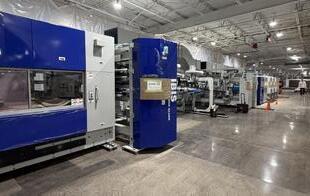
we moved over here, the attraction for the space was the building, the location, the access to rail,” he says. “I wanted to put my own corrugator in this facility.”
That vision took shape in 2023, when Coastal installed a new 110" Fosber corrugator and expanded its facility from 225,000 to 285,000 square feet. The expansion also brought rail inside the building, a feature that allows seven rail cars to be accommodated simultaneously under one roof.
“Indoor rail for an independent like us is something that gave us real flexibility,” Patterson notes.
Hoekstra puts the broader context succinctly. To be able to accommodate rail, he says, “You’ve got to have the real estate, and Brent had the foresight when looking for a new facility to find real estate that had that opportunity.”
The corrugator investment coincided with a wholesale reimagining of the plant’s layout and infrastructure. New
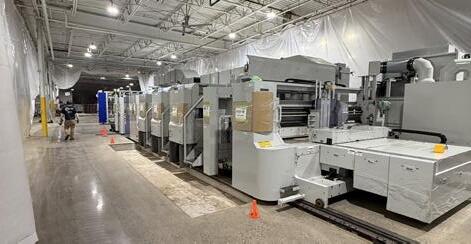
autonomous transfer cars, Dücker meshtop conveyor systems, motion-sensor LED lighting, polished and diamond-cut factory floors, and a fresh coat of paint inside and out have transformed the facility into what tour guests describe as a clean-room-type environment. “We intended our manufacturing space to be as clean or cleaner than those entrusting us with their business,” Hoekstra says.
“The plant is recruiting constantly,” he adds. “It’s recruiting employees, suppliers, and customers. Everything screams quality. Everything screams organization.”
That philosophy has earned validation from notable sources—from the industry and the buying community. A common response following a tour of Coastal Container: “This is one of the nicest independent plants I’ve ever been in.”
That recognition carries weight in a market that has shifted dramatically. Patterson notes that Michigan’s independent corrugated sector has contracted significantly over the years as many former independents have been acquired by larger integrated producers. Today, only three independent corrugators remain in the state.
“We’re one of the biggest independents in our marketplace now,” he says. “The normal public out there wants to deal with independents, but it’s hard to find one that can meet their needs. We’re filling that vacuum.”
Coastal is currently in the midst of an $11 million to $12 million converting expansion that will add two state-of-theart flexo folder-gluers: a three-color Ibis and a four-color Falcon, configured in a mirrored setup—one right-hand, one left-hand operation—with shared crew capability and fully autonomous Dücker pre-feeders and palletizers at both ends. The Ibis is already installed; the Falcon arrived earlier this year, with full project completion expected by mid-June.
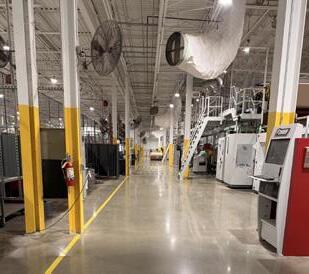
Cleanliness—a point of emphasis for Coastal Container—is showcased here amid the company’s 110" Fosber corrugator.
The investments in machinery are matched, deliberately and intentionally, by investments in people. Coastal’s bonus program ties compensation to attendance, safety, quality, on-time delivery, and productivity. The company holds regular plant meetings, daily huddles, and management forums. It runs job fairs that draw more than 70 applicants in a single day and, last year, earned recognition as one of Michigan’s Best and Brightest Companies to Work For.
The result is a workforce with remarkably low turnover. Patterson has employees who followed him from his previous company, some now approaching 30 years of continuous service. Second-generation employees—sons and daughters of longtime workers—have joined the floor. His own sons, Tyler and Spencer, are part of the leadership team. Tyler runs the honeycomb and pack
supply division; Spencer serves as field sales manager. “At some point, it’s going to be theirs to run,” Patterson says. “The investments we’re making are long-term investments, well beyond the time that I’ll be here.”
With 180 employees on the corrugated side and a management team that collectively brings more than 250 years of industry experience to the table, Coastal Container has assembled something rare: the agility and culture of a family business operating at the capability of a much larger organization.
If you’re wondering where they’re going next, just give them another six months.

Lin Grensing-Pophal is a Wisconsin-based freelance journalist.

BY ROBERT BITTNER
“Iwouldn’t use the word unstable to describe paper and raw-material pricing today,” says Jeremy Cohen, vice president and general manager of Acme Corrugated Box Co. “But when the index pricing is stagnant for long periods of time, which we’ve just gone through, price erosion in corrugated becomes a real problem.”
That problem is exacerbated, in part, by a recent decline in demand. “When demand is soft but supply is prevalent, that’s when most buyers shop,” Cohen says. “Over the last six months we’ve seen a lot of our customers shop and request price reductions because people are in the market looking to fill box plants with volume. Some of the big integrated players are light on volume, but they need to be able to run their box plants. So they lower price to fill the plant. It isn’t necessarily that prices are unstable; it’s just that box prices have been steadily under pressure because demand is soft and supply is prevalent.”
But that isn’t the only contributor to today’s raw-material pricing situation and the current market downturn.
The Pricing Picture
“If you look at most general economic reports, consumer discretionary spending continues to drop, because affordability is a real issue for people,” says Cohen.
One possible reason: The wage inflation that occurred during and immediately after the COVID-19 pandemic has stopped, while the cost of goods continues to rise. “People are keeping money in their pockets and not spending as much,” Cohen says. “And when people don’t spend, things don’t get shipped, and boxes don’t need to be made.”
There also is a growing use of less costly alternative packaging. “Boxes have been relatively cheap throughout their history,” says Acme Corrugated President Bob Cohen (Jeremy’s father). “Now, as they are becoming more expensive, people are finding lower-cost alternatives. We’ve seen that more and more in the last two years.”
For example, Jeremy points out that previously Acme customers might have ordered jumbo gaylords for internal warehouse use. Now they are shifting to reusable plastic containers. “Your home Amazon deliveries used to be 100% corrugated,” he adds. “Now you’re seeing a lot more paper bags, even in cases where the products would be better served by a box.”
For equipment manufacturer BW Papersystems, the situation hits a bit differently. Paper and related raw-material price fluctuations don’t directly impact their own business. But they do play a role in customers’ decision whether to invest in new equipment.
“Every customer has their own investment strategy and capital-expense strategy based on their business and what they’re wanting to accomplish in the short term, medium term, and long term,” acknowledges Neal McConnellogue, BW Papersystems’ president of corrugated and
“People are keeping money in their pockets and not spending as much. And when people don’t spend, things don’t get shipped, and boxes don’t need to be made.”
—Jeremy Cohen, vice president and general manager, Acme Corrugated Box Co.
chief commercial officer. “Paper prices are going to be a factor in that. It’s something we pay attention to. While it doesn’t drastically change what we do, it’s a variable we monitor closely so we can discuss the right solutions to help customers meet their specific business needs.”
That doesn’t mean, though, that equipment manufacturers themselves are unaffected by supply chain disruptions.
For machine manufacturers, raw materials might include steel, glass, plastics, and electronics. Within that context, equipment suppliers are experiencing their own sourcing challenges.
“We are buying raw steel and a variety of manufactured and electrical/electronic components to make our equipment,” McConnellogue says.
In the three-plus years since the pandemic, one of the more challenging parts of his business has been navigating the supply chain in terms of material supply, parts flow, component inventories, and pricing variations.
“Electronics and control-oriented devices have probably been the categories most disrupted for us because they’re typically made outside of the U.S.,” McConnellogue says. “That makes them vulnerable to tariffs and supply chain disruptions. So we’ve put a lot of attention into addressing that situation. We have tremendous relationships with our suppliers and our supply partners. And we work together to navigate the supply chain to
minimize disruption to our business and to our customers’ business.”
Because there are now more uncertainties surrounding availability and delivery, lead times have increased. “You have to forecast well and plan effectively to get ahead of the wave,” McConnellogue advises. “Having said that, we continue to deliver equipment within our typical time frame of nine to 12 months, depending on the specific machine.”
Adding to the uncertainty is the potential impact of tariffs, a topic that McConnellogue says is “front and center for us” and is regularly discussed. “The situation has been so turbulent and inconsistent, sometimes changing week to week, month to month. We are watching tariffs closely and are having more dialogs with suppliers on that topic than we’ve ever had in the past.”
“I know tariffs are hitting some box plants hard,” Bob Cohen notes. “We haven’t experienced that yet. The European market is oversaturated, with maybe 5 million tons of additional capacity versus demand. Every one of the European suppliers that we have has been willing to absorb the tariffs just to move their product out the door.”
“They are doing whatever it takes to conduct business,” adds Jeremy Cohen, “because they can’t run their mills without exporting to people like us.”
Those European suppliers have figured out what they need to do to succeed in the current business climate. Cohen believes boxmakers must do the same.
Boxmakers can do little about paper pricing and most of the factors stressing the supply chain. But they can take steps to ensure that their operations are equipped to remain competitive, despite potential disruptions. “You have to be a low-cost producer to remain competitive in the marketplace,” Jeremy Cohen believes.
To do this effectively, he says, you first have to source paper at a competitive price. Bob Cohen points out that Acme sources paper globally, prioritizing strength characteristics over other attributes. “We’re kind of agnostic about whether it’s recycled or kraft,” he says. “We’re looking for the best value we can give our clients.”
The company also seeks out alternative products that may not be on other companies’ radar. “We run some proprietary grades, and we run some proprietary flute combinations,” Bob Cohen says. “We’re always looking to innovate, and often that means straying from the current orthodoxy of how you run a box plant.”
Another important trait of a low-cost producer is efficiency, Jeremy Cohen states, which includes an efficient operation, efficient labor, and reduced waste. “In 2020 we started a building expansion to increase our square footage but also to implement a lot of changes to how we process work in the plant,” he says, referring to the company’s development program to improve
efficiency. “We have added a new corrugator, a new high-rack work-inprocess storage system, new automated infeed conveyors. Where we used to have five forklifts per shift handling material between the corrugator and our converting operation, we now have none.”
He notes that, with the aid of these systems, almost every sheet that comes off the corrugator now is usable, and internal waste has been reduced. “And we continue to invest in high-speed, automated production lines, converting lines, flexo folder-gluers,” he says.
Finally, Jeremy Cohen believes it’s especially important for low-cost producers to know where to draw the line on the jobs they accept. “If a competitor comes
in with aggressive pricing for one of our existing accounts, we have to evaluate whether we can still serve at that price level and make money.”
Sometimes, saying no may be best for your bottom line.
Like the boxmakers they supply, equipment manufacturers cannot prevent marketplace disruptions, but they can prepare for them. For BW Papersystems, that means developing a robust stocking model for raw materials and new machine components, so they are not forced to operate “hand-tomouth, if you will,” McConnellogue says. “We also have suitable inventory to support our installed base so we can support our [existing] customers on a daily basis.”
The company has built a local-for-local approach to its manufacturing, which helps to lessen the impact of tariffs and overcome some supply chain challenges. “We manufacture and build equipment in North America for the North American market,” McConnellogue explains. “Similarly, we have built up our capacity in Europe to support Europe and the EMEA region. And we have flexible capacity between those sites to support regions where we’re not embedded with a manufacturing facility. For example, we can serve Latin America from either North America or from Europe.”
When asked what advice he would offer other AICC members facing pricing and supply chain hurdles, McConnellogue says, “Plan and prepare, so that you can work to get ahead of potential supply chain disruptions. Focus on developing capacity and emphasizing flexibility. We all need to be constantly monitoring whatever may be affecting our ability to do our business well and then be prepared to adjust as quickly as possible to any
“Plan and prepare, so that you can work to get ahead of potential supply chain disruptions. Focus on developing capacity and emphasizing flexibility.”
—Neal McConnellogue, president of corrugated and chief commercial officer, BW Papersystems
disruptions—including changes in policy and geopolitical climates.”
The Cohens suggest that an uncertain market may offer the best opportunity to grow. “As the markets change, as they get softer, that’s usually when we make our deals on equipment and make plans to expand our capacity,” notes Bob Cohen. “We’re opportunistic. We always invest in down markets.”
That mindset reflects a firm confidence in the future despite current circumstances. “You have to be an optimist in this industry,” Bob Cohen adds.
Disruptions may mean that independents are not always able to compete on price. But the Cohens are convinced
that any independent that prepares for uncertainty will be successful in the long run. “If we’re going up against our major integrated competitors on anything other than price, we’re going to win that business,” Bob Cohen declares. “That’s because we’re going to be far more responsive, far more flexible, far more dependable. That’s just the facts on the ground.”

Robert Bittner is a Michigan-based freelance journalist and frequent BoxScore contributor.

Bringing together decades of German engineering expertise and industry-leading technology
SUN Automation Group and Kolbus Group unite to deliver precision automation for the corrugated packaging industry. Kolbus’ high-accuracy machinery ensures consistent, highquality converting, while SUN’s parts and service offerings enhance reliability and performance. Together, we advance packaging innovation.







BY DOUG FRIEL

The corrugated and paperboard
box manufacturing industry is the backbone of modern commerce. From e-commerce shipping to food packaging to industrial transport, if something moves, it’s probably boxed. But behind every roll of paper and hum of machinery lies a web of liability exposures that can threaten even the best-run operation. Understanding how to assess, manage, and insure against these risks isn’t just good business—it’s survival.
Boxmakers face a unique combination of property, product liability, and workers’ compensation risks. Fires ignited by combustible paper dust. Machines that can injure workers in seconds. Raw materials that carry hidden
chemical hazards. And a supply chain that places their finished product in the hands of downstream customers who may hold them responsible if something goes wrong. The good news: Most of these risks are manageable with the right combination of insurance coverage, engineering controls, contractual risk transfer, and operational discipline.
Before a manufacturer can protect itself, it needs to understand what it’s protecting against. Commercial insurance underwriters evaluate box manufacturing operations through several lenses: fire risk, machinery and equipment exposure, workers’ compensation liability, product
liability, and contractual exposure with customers and vendors.
The starting point for any manufacturer is a thorough risk assessment, ideally conducted with the help of a commercial insurance broker who specializes in manufacturing. This process maps exposures across the facility, evaluates the adequacy of existing controls, and identifies gaps. From there, a layered insurance program can be built.
A standard commercial insurance program for a box manufacturer will typically include commercial general liability, property insurance, workers’ compensation, commercial auto, and an umbrella or excess liability policy. Depending on the operation’s complexity,
it may also include product liability coverage, equipment breakdown, cyber liability, environmental liability, and directors and officers or employment practices liability.
Few industries face fire risk as acutely as paper and box manufacturing. Dry paper fibers, dust-laden air, high-speed printing inks, adhesives, and the sheer volume of combustible material create a combustion environment that demands constant vigilance. A single fire event can destroy a facility, halt production for months, and expose a manufacturer to significant business interruption losses on top of property damage.
Insurers scrutinize fire suppression systems closely. Wet-pipe sprinkler systems are standard, but manufacturers should also evaluate whether their systems are properly rated for their specific material handling and storage configurations. High-pile paper storage, for instance, requires different sprinkler density calculations than a finished goods warehouse. Dust collection is equally important. Paper dust is not just a nuisance—it’s a fuel source. Facilities should have documented housekeeping protocols for machinery and ductwork, and dust collectors should be inspected, emptied, and maintained on a defined schedule. Many fire losses in paper manufacturing trace back to dust accumulations in areas that hadn’t been cleaned in weeks or months.
Water damage is a frequently underestimated risk in paper manufacturing—doubly ironic given the industry’s relationship with the material. A burst pipe, a roof leak, or a malfunctioning sprinkler can ruin thousands of dollars in paper stock in hours. More critically, water intrusion in a manufacturing environment can damage equipment, cause electrical failures, and create slip-and-fall hazards.
“One of the most overlooked tools in a manufacturer’s risk-management toolkit is the contract itself.”
Smart water leak detection sensors— installed at key points near HVAC equipment, roof penetrations, loading dock areas, and around hydraulic or water-cooled machinery—can catch leaks before they become catastrophic losses. From an insurance perspective, demonstrating that a facility has invested in leak-detection technology is increasingly viewed favorably by carriers and can support more competitive premiums. Manufacturers should also verify that their property coverage properly accounts for water damage from equipment failures versus flood (which is typically excluded and requires separate coverage).
Lockout/Tagout and Machine Guarding Box manufacturing equipment—die cutters, folder-gluers, slitters, corrugators, and printing presses—is powerful, fast, and unforgiving. The workers who operate and maintain this equipment are exposed to serious injury risks, including amputations, crush injuries, and entanglement. Two Occupational Safety and Health Administration (OSHA) standards are particularly critical in this environment: lockout/tagout (LOTO) and machine guarding.
LOTO procedures govern how equipment is de-energized before maintenance or servicing. A facility without a comprehensive written LOTO program, employee training, and documented periodic inspections is not only exposed to catastrophic workplace injuries—it’s a significant red flag for workers’ compensation insurers. Carriers will frequently ask for LOTO program documentation as part of the underwriting process, and deficiencies can result in higher premiums or coverage restrictions.
Machine guarding is the physical barrier between workers and moving parts. Guards must be present, functional, and not bypassed. It sounds elementary, but production pressure creates a culture in which guards are sometimes removed for convenience and not replaced. Manufacturers should conduct regular audits of guarding across all equipment and hold supervisors accountable for enforcement. Documentation of these audits—dates, findings, corrective actions—supports both safety culture and workers’ compensation program performance.
Safety Training and Engineering Controls
Insurance is a financial backstop, not a substitute for loss prevention. Insurance carriers reward operations that demonstrate a commitment to safety culture with more competitive premiums and broader coverage terms. Boxmakers should invest in structured safety training programs covering machine operation, personal protective equipment, hazard communication, emergency response, and ergonomics. Engineering controls—physical modifications to machinery or workflow that reduce risk—are the gold standard of loss prevention. Examples in box manufacturing include automated feed systems that reduce hand-to-machine contact, dust-collection systems that limit airborne combustibles, and ergonomic lifting aids that reduce repetitive strain injuries. When safety training and engineering controls work together, the result is fewer claims, lower experience modification rates (EMR), and ultimately a healthier bottom line.
Manufacturers should track their EMR closely. This OSHA-derived rating is used by workers’ compensation insurers to adjust premiums based on a company’s actual loss history versus what would be expected for its industry class. An EMR above 1.0 signals above-average losses and triggers premium surcharges. An EMR below 1.0 reflects better-than-average safety performance and earns premium discounts. For many manufacturers, reducing EMR by even a tenth of a point can mean tens of thousands of dollars in annual savings.
One of the most overlooked tools in a manufacturer’s risk-management toolkit is the contract itself. Purchase orders, customer agreements, vendor contracts, and lease agreements all carry liability implications that can either protect a company or expose it to claims it never expected.
Manufacturers should ensure that their customer contracts include appropriate indemnification language—provisions that allocate responsibility for claims arising from the customer’s misuse of the product or from defects introduced downstream. Equally important are “additional insured” endorsements. When a manufacturer is required to add a customer as an additional insured on its commercial general liability policy, that customer gains the ability to make claims directly against the manufacturer’s policy. Understanding when and how to accept these requirements—and ensuring that your policy limits and coverage terms can absorb them—is an important conversation to have with your broker.
On the vendor side, manufacturers should require their paper suppliers and equipment vendors to carry adequate insurance and provide certificates of insurance. Contractual requirements should specify minimum limits and coverage types, and require notice of cancellation. This is especially important when working with smaller, regional suppliers who may
carry minimum limits that don’t reflect the actual exposure their materials create.
Finally, manufacturers should review their lease agreements carefully. Many commercial leases contain waiver of subrogation clauses and property damage indemnification provisions that can transfer significant risk to the tenant. An experienced broker or risk manager can help identify and negotiate these provisions before a lease is signed.
Product liability is a distinct and often misunderstood exposure for boxmakers. The question isn’t just whether the box was built correctly—it’s whether it performed as the customer expected in its intended application, and what happens when it didn’t.
Consider a box manufacturer that supplies corrugated shipping containers to a food distributor. If product is damaged in transit due to box failure—whether from inadequate burst strength, improper moisture resistance specification, or simply a defect in production—the downstream customer may pursue a product liability or breach of contract claim. These claims can be significant, particularly when the damaged cargo has high value or when a product recall is involved.
Product liability coverage is typically included within a commercial general liability policy’s products-completed operations coverage, but manufacturers should verify that their limits are adequate for the customers they serve and the applications their products are used in. High-value-cargo industries— pharmaceuticals, electronics, food and beverage—may warrant excess limits or dedicated product liability policies.
One product liability variable that many box manufacturers overlook is the difference between virgin paper and
recycled paper—and the specific chemical risks each carries.
Virgin paper, made from freshly harvested wood pulp, offers consistent fiber quality and chemical composition. Recycled paper and paperboard, by contrast, are made from postconsumer waste streams that can carry unexpected chemical contaminants. Among the most significant concerns in the industry is sulfur.
Recycled paper sourced from mixed consumer waste can contain sulfur compounds introduced during prior manufacturing processes or from contamination in the waste stream. When these sulfur compounds are present in corrugated packaging, they can off-gas hydrogen sulfide or other sulfur-based compounds under certain temperature and humidity conditions. In sensitive applications—particularly food contact packaging, pharmaceutical packaging, or electronics shipping—this can cause product degradation, odor contamination, or chemical reactions that damage the contents.
From a liability standpoint, a box manufacturer that supplies packaging that causes product damage due to sulfur off-gassing may face significant product liability claims from their customer. The defense—that the contamination came from the recycled fiber supply chain—can be difficult to establish after the fact. The proactive solution is twofold: First, work with paper suppliers to understand the sourcing and testing protocols for recycled fiber, particularly around sulfur content. Second, disclose to customers any material differences between virgin and recycled fiber packaging in applications for which chemical composition matters. Some applications simply require virgin fiber, and representing otherwise creates liability.
Manufacturers should also consider supply chain representations and
warranties in their contracts. If a customer specifies virgin fiber and receives recycled, the contractual liability may exist even if the product performed adequately. Documentation of fiber sourcing is becoming increasingly important as customers in regulated industries—food, pharma, medical devices—impose stricter packaging standards.
Beyond the major categories above, there are several coverage gaps and risk management oversights that commonly appear in box manufacturing operations.
Many manufacturers carry property insurance but underestimate the business interruption (BI) component. A major fire or machinery failure can halt production for weeks or months. BI coverage reimburses lost revenue and continuing expenses during that period—but it pays only if the limits are adequate and the waiting period is appropriate. Manufacturers should review their BI limits annually, particularly if revenues have grown, and understand the relationship between their coverage period and their realistic recovery timeline.
Also known as boiler and machinery coverage, this insures against sudden and accidental mechanical or electrical breakdown of production equipment. Standard property policies typically exclude this. For capital-intensive operations with corrugators, presses, and specialized converting equipment, equipment breakdown coverage can be the difference between a manageable loss and a business-ending one.
Printing inks, adhesives, solvents, and hydraulic fluids are all potential

“Commercial insurance for box manufacturers isn’t a commodity purchase—it’s a strategic risk-management decision.”
environmental contaminants. If these materials are released into the soil or storm drains—whether from a spill, a tank failure, or an equipment malfunction—the cleanup costs and regulatory liability can be substantial. Pollution liability coverage, while often overlooked, is worth evaluating for any manufacturing facility.
As boxmakers increasingly rely on automated production systems, ERP platforms, and connected equipment, their exposure to cyber incidents grows. A ransomware attack that shuts down a production management system can cause just as much business interruption as a fire. Cyber liability coverage remains underutilized in the manufacturing sector.
Commercial insurance for box manufacturers isn’t a commodity purchase—it’s a strategic risk-management decision. The right program requires a broker who understands manufacturing operations, can speak the language of underwriters
who specialize in the paper and packaging sector, and can advocate on behalf of the operation when claims arise.
Manufacturers that invest in safety culture, engineering controls, documented compliance programs, and proactive risk mitigation don’t just become better operations—they become more attractive accounts to insurers. And in a market in which capacity can tighten and premiums can spike, being the account that underwriters compete for is the most powerful risk management tool of all.
The corrugated box may seem simple— paper, glue, pressure. But the liability environment around making it is anything but. Understanding that environment and building a program designed to navigate it are how box manufacturers protect not just their property and payroll, but the enterprise itself.

Doug Friel is vice president at Johnson Kendall Johnson. He can be reached at dfriel@jkj.com
BY M. DIANE M c CORMICK
In the past, leaders were defined by their titles, and hierarchical decision-making reigned.
In the new era of leadership, Terri-Lynn Levesque, AICC chairwoman and vice president of administration at Royal Containers, devotes most of her time to instilling emotional intelligence in her team—“more of a life coach.”
“Some days, I’m more focused on driving output and problem-solving,” she says. “And there are days where I’m literally just coaching my staff if they’re having problems at home or on conflict resolution.”
Effective leaders give businesses a competitive advantage, says Matt Eichmann, founder of Catalyst Point Leadership Advisors. “If you collect more and better leaders, retain them, train them, and help them find meaning and connection,
you’ll build a durable moat around your business,” he says.
Uncovering Pathways
Leadership training is a “high-impact, low-cost activity,” especially compared to huge capital expenditures on equipment and machines, Eichmann says. “You don’t have to spend millions of dollars on your coaching and your leadership development, and you can get a real outsized impact. There’s an ROI story here.”
Open, authentic communication is at the heart of leadership committed to forging relationships in the workplace. “People have to know where the company is going,” says Levesque. “They have to know what success looks like for them and for Royal. Trust-based leadership is really, really important for me, not just
as a leader but as my own personal core value. Your core values of who you are as a person drive how you make decisions and how you lead your team because it’s authentic and not forced.”
While younger workers have begun to seek out more engagement in the workplace, leaders learned lessons in listening from the COVID-19 pandemic, says Scott Ellis, Ed.D., founder of Working Well, who is now retired. Things long sought by workers but deemed impossible by management—flextime, job sharing, remote work—have become the norm because “we had a whack in the head that made us do things differently and think more creatively about culture and leadership style.”
Today’s leaders are “much more involved and interactive,” Ellis says. “Now
that person is in the room 90% of the time because they’ve learned how to do the no-ranks conversations.”
Leaders can spotlight growth opportunities, and promote retention, by “painting a vivid picture” of why employees should stay, Ellis says. Eichmann notes that, in a time when specialties are losing value, rotating personnel exposes them to boxmaking’s big picture and the breadth of projects underway.
Even when certain skills and pathways have a ceiling, employees can find growth pathways in mentorship, joining or leading internal committees, or making lateral shifts. One longtime Royal Container machine operator is now a top estimator, skilled at his position because he brought machine knowledge to the post, says Levesque. “Our culture is promoting from within,” she says.
Royal also empowers safe risk-taking, giving employees the space to lead meetings, speak up in public or private, and accept feedback through coaching and mentoring, Levesque says.
As boxmakers often say, corrugated is not a “sexy” industry, but today’s leaders and AICC are improving at showcasing its creativity and growth possibilities to new and potential employees, says Levesque. “It’s a really cool experience to go into retail and see a pet food display that we were working on with one of our top clients,” she says. “We’re all taking pictures and sharing them, saying, ‘Look at this cool stuff we’ve done.’”
With a laugh, she adds, “I am sure all of us at some point go into a store and look at the class stamp to see who made it. I can’t be the only crazy one?”
Royal Container promotes retention by onboarding every new employee with AICC Packaging University courses on the whys of boxmaking, industry terminology, and subjects ranging from design and customer service to leadership and continuous improvement. Each is also welcomed through assignment of a mentor for four weeks, ready to answer the most basic questions that people might
hesitate to ask—“Where’s the bathroom?” “When is lunch break?”
For workers primed to seek out the next opportunity, loyalty can take a back seat to purpose and mission. Today’s younger workers want their efforts to make a difference, creating opportunities for leaders to win hearts and minds, says Eichmann. “Effective leadership requires being more collaborative, focusing more on the softer skills, and being a much better listener and communicator than perhaps it was in the past,” he says. Purpose, Eichmann adds, “is what you bring to the world. It’s the fundamental reason for a company’s existence, and it’s up to every company to determine what that purpose is. It has to be authentic, and it can be a highly effective means of motivating and engaging employees.”
While the full impact of AI on leadership is unknown, Eichmann believes that it might elevate the value of human relationships and connections as
technology takes on a greater workload.
“The onus is going to be on leaders to be able to connect with their people at a much deeper level, potentially, than they did in the past,” he says.
For employees interested in eco-friendly practices, Royal Containers’ sustainability story is “an easy one to tell,” including its partnership with the Greenpac Mill in Niagara Falls, New York, and its corrugator, Tencorr Packaging, in Brampton, Ontario.
Royal broadens the definition of “sustainability,” Levesque notes, to incorporate support for employees, their families, and valued causes within the community as a way to give back. One athlete on staff competes in world-class triathlons, and Royal supports Harvest Hands, an Ontario charity that feeds homeless people.
“Kim Nelson, our president and CEO, has even sponsored my very own
daughter’s hockey team over the years,” Levesque says. “We’re very actively involved in the community. That’s really important, especially to that younger generation. They want to know how we’re giving back and how we’re involved in keeping the planet running and keeping resources sustainable.”
As a young officer in the U.S. Marine Corps, Eichmann learned that titles mean little. “You’d have Marines with 20 or 25 years of experience who are calling me ‘sir.’ And yes, I might have the title, but they had the know-how. That’s when I learned that titles could be overrated and that leaders needed to be willing to humble themselves,” he says.
As leadership transitions away from hierarchies, “we’re moving from a command-and-control type of environment
to one more about equity and building consensus and influence,” Eichmann adds. Change can be operationalized when leaders engage with employees closest to production work. One effective practice is asking all personnel every week what the company should start, stop, and continue doing, he says. “They’re seeing things that management is not seeing,” he says. “They’re closest to the fight. We always get something out of it. There are some great ideas here. You do one or two of those things, and it sends a signal.”
And if the answer has to be “no,” the explanation must be authentic and real. “You can’t do everything,” says Eichmann. “You explain your thinking and the reasoning.”
Opening channels of communication to inclusion and engagement begins with showing vulnerability, says Ellis. The first step might be saying, “I don’t know the
answer to this question”—not asking people to implement your solution but soliciting expertise from a diverse group and giving them the tools that help them problem-solve. “MacGyvering simplified” might be based on a fishbone or Ishikawa diagram or other exercise that structures the conversation, prevents frustration, and concludes with the satisfaction of resolving an issue.
“Everybody’s contributing, and you’re coming to a solution and some ideas about how to approach the problem,” Ellis says.
At Royal Container, plant-floor personnel have “the doghouse”—a process for sharing with administration their ideas for greater efficiency or profitability. Every submission is reviewed and the circle closed with feedback to the submitter, even if it’s an explanation of why the idea isn’t feasible.
Inclusiveness as a cultural value means creating a safe environment in which every employee feels safe speaking up, because “that’s how innovation happens,” Levesque says. “They know we listened. We took their advice.”
Adding Accountability
Accountability and adherence to strategic goals should remain enmeshed in employee expectations, but leaders can embed them within inclusive cultures— and it all goes back to communication.
“People power the mission,” says Eichmann. “The phrase is, ‘Mission first, people always.’ And while accomplishing the mission is nonnegotiable, you can
never ignore the impact it may have on your folks.”
In this atmosphere, leaders walk a fine line, assessing and fine-tuning every day while setting an example of agility and uncertainty. “In a rapidly evolving and fast-paced environment, we need to teach our people the importance of simplicity and how to minimize the distractions that they face,” Eichmann says. “A tariff is on or off. You’re never going to have perfect data. But you can conduct little experiments that eventually scale over time.”
Ellis calls it “getting people to act like they own the place,” formally or informally incentivized into being productive and taking ownership of what happened, whether something went wrong or worked well, he says.
“You get everybody looking at it like, ‘How can we do better?’ instead of ‘Management’s watching you because you’re not toeing the line,’ ” he says.
If Kim Nelson had not tapped Levesque for leadership training early in her career, which included AICC’s Emerging Leaders program, Levesque believes she would not be AICC chairwoman today. “You have to be able to branch out,” Levesque says. “You have to be able to network. You have to be able to make your own connections. Being involved in AICC was the most important part of that journey for me.”
Royal Containers’ portfolio of leadership training also relies on inhouse training tools, such as courses on emotional
Effective leadership requires being more collaborative, focusing more on the softer skills, and being a much better listener and communicator than perhaps it was in the past.”
—Matt Eichmann, founder, Catalyst Point Leadership Advisors
intelligence or email etiquette, customized with input collected from employees.
The key to keeping pace with leadership trends and staying effective is “just staying super curious,” says Eichmann. “Leaders ask a lot of questions and bring people together.”
And, he adds, most of the tools and information that leaders need are within their own walls. Outside coaches and consultants don’t know the business inside and out as employees do, but they can be effective at asking the right questions to surface those insights.
Progressive leaders solicit input into their leadership styles, working with peer groups and seeking out training that reveals insights into strengths, emotional intelligence, and blind spots needing attention. “The fastest way to grow your own leadership style and the team’s is to problem-solve with them,” Ellis says.
The process cultivates judgment and critical thinking in the team, expanding the potential for delegating responsibilities and finding solutions.
Accountability extends to leadership and company performance, as well. Eichmann believes in regularly opening the books and sharing key performance metrics with all personnel, “because everybody wants to know if they’re on a winning team or not.”
“How did we perform?” he says. “Are we winning? Are we losing? If we’re losing, people will have ideas about how to close the gap. If we’re winning, people will have ideas about how to double down on strengths to get more. But this starts with transparency—people need to know what the score is.”
Leadership, Eichmann adds, is built on trust and honesty.
Genuine ROI
Engagement and inclusion pay dividends, and personnel issues such as turnover and morale, once relegated to HR, have risen to the C-suite, says Ellis. While cultural
change still needs to pay for itself, it is not the sole driver of policies that motivate and retain talent.
Stressing SOPs for operating machinery might play the safety card, “because that’s true, but you could also say that we want them to spend less time looking for things and more time actually doing things and making product,” Ellis says.
Still, the ROI story is real, demonstrated by improved decision velocity, better strategic focus, lower colleague turnover, and improved talent retention, says Eichmann. “If I can teach one leader to ask better questions, that gets the organization thinking better,” he says. “They’re going to have their people asking better questions. You’re going to create a more nimble, agile, and innovative firm because they’re capable of responding to customer demands or economic shifts faster. They’re sharper in that way.”
As younger workers enter the workforce, leaders are managing up to five generations in one workplace, notes Levesque. “Their knowledge of technology and AI and innovation is something we haven’t really wrapped our head around yet, but they love to just explore, and that’s what we need,” she says. “We need those explorers who are going to shape the future of the industry.”
Royal Containers’ leadership pipelines, succession plans, and mentoring encompass a broad range of people, preparing everyone from veteran machine operators to leaders for the day when someone changes roles, gets ill, or takes their tribal knowledge to another job, says Levesque.
With a leadership approach steeped in inclusion, engagement, and growth, the ROI accumulates in positioning the company to thrive and navigate a future

stocked with unknowns. “It comes back to making sure that you’ve got the right culture,” says Levesque. “I’m not going to be around forever. We have to identify the leaders that are coming behind us. My success is going to be measured by how successful the generation after me is. It’s not what I can accomplish with my time at Royal Containers. It’s how well I’ve done my job to set up the third-generation and fourth-generation leaders for success. Every executive at Royal has a pipeline of leaders they are training and mentoring for the future beyond our time at Royal.”

M. Diane McCormick is a Pennsylvania-based freelance journalist and a frequent BoxScore contributor.


superior graphics fast set-up
Max Speed: 12,000 s/h
Available Sizes: 2,800 (110”)
Max Sheet Width: 110.24 “
Max Sheet Length: 60.24”
Min/Max Caliper: .039/.354”
Features:
• 3 minute auto job change
• Setup while running
• Preset print and die cut
• Print and die cut inspection
• Anilox Roll Changing System (Full Automatic: 3+1)




inside-outside print fast set-up
Max Speed: 10,000 s/h
Available Sizes (max sheet):
2,100 / 82” (82 x 62.99”)
2,400 / 94” (94.5 x 62.99”)
2,800 / 110” (110.24 x 62.99”)
Features:
• 3 minute auto job change
• Setup while running
• Preset print
• Inside/Outside Print
• Print and die cut inspection
• Anilox Roll Changing System (Automatic: 2+1)




high-definition print fast ROI
Max Speed: 9,000 s/h
Available Sizes (max sheet):
2,100 / 82” (82 x 62.99”)
2,400 / 94” (94.5 x 62.99”)
2,800 / 110” (110.24 x 62.99”)
Features:
• Inside/Outside print
• Print and die cut inspection
• Anilox Roll Changing System (Automatic: 2+1)
For full features and specifications, visit koenig-bauer-celmacch.com Or contact Kevin Erbe at kevin.erbe@koenig-bauer.com, 303.718.0023

MIKE BUTLER DOMTAR PACKAGING VICE CHAIRMAN MIKE.BUTLER@DOMTAR.COM

JEFF DIETZ KOENIG & BAUER CHAIRMAN
JEFFREY.DIETZ@KOENIG-BAUER.COM

BRIAN FOLEY BOBST SECRETARY BRIAN.FOLEY@BOBST.COM

WARREN BIRD
JB MACHINERY DIRECTOR WBIRD@JBMACHINERY.COM

JOHN BURGESS PAMARCO
IMMEDIATE PAST CHAIRMAN JOHN.BURGESS@PAMARCO.COM
BY MIKE BUTLER
After spending years on the integrated and independent sides of this industry, I can say something that might surprise anyone who hasn’t lived it: The independents aren’t the underdogs. Once you understand how the independent community operates with its relationships, knowledge-sharing, supplier partnerships, and its AICC-powered networking, you realize it functions like a giant.
In integrated environments, decisions often wind through layers of committees and alignment meetings. There are real strengths in that model, but speed isn’t usually one of them. Independents are different. A design tweak can be tested that afternoon, not next quarter. And this agility is multiplied across the independent landscape. When one plant finds a better setup or a clever approach to save time, the idea spreads through phone calls, plant visits, supplier touchpoints, and AICC meetups where people actually talk shop.
AICC can be a force multiplier. Participation turns the many independents into one learning organism. Knowledge doesn’t move just top-down. It flows from peer to peer, from plant to plant, with suppliers acting as connective tissue. Members share what manufacturing innovations work, because helping another independent doesn’t weaken your position—it strengthens the network. What one converter figures out today can become common practice across dozens of plants tomorrow.
AICC is so much more than the two powerful annual meetings; it’s a year-round ecosystem of groups designed to accelerate capability through education and transparency. These groups are working forums in which peers surface challenges, benchmark
new processes, and provide unbiased advice. Respectful debate is welcome, and the output is practical—new SOPs, smarter capex decisions, faster troubleshooting, and stronger customer outcomes. Consider participating in one of the several groups AICC makes available.
In the independent ecosystem, suppliers are constantly cross-pollinating new manufacturing solutions. It’s common to hear, “Another plant cracked that exact problem. Want to see how?” Within AICC, that is routine.
Adaptation Without Bureaucracy
Independents excel at real-time adaptation. Decision-makers sit close to the work, so learning cycles are short and adoption curves are steep. When something works, the AICC network absorbs it almost instantly. Of course, AICC members are bound to uphold the letter and spirit of all applicable competition and antitrust laws, and they do so.
Yes, independents may operate fewer plants and smaller headquarters than integrated giants. But that’s the surface view. Independents aren’t small. Through AICC, they operate as a collective giant—faster, more connected, and more customer-aligned than any single entity can be on its own. The independent community’s openness, peer accountability, supplier integration, and structured advisory networks add up to a decisive competitive advantage. If you’re a member of AICC, make sure you add to the momentum.
Mike Butler is senior director, packaging sales, at Domtar and vice chairman of AICC’s Associate board.
“It’s


Marumatsu Automatic Flat Bed Die Cutter by Mikawa





JOHN KULA PRESIDENT OF FOREST PACKAGING


BY DAVID WIENS
The pricing model most independent converters built their businesses on is broken. Not breaking. Broken. And the last people who will tell you that are the ones who benefit from it staying in place. Things aren’t changing. That part already happened. The question now is whether you’re going to keep reacting to it quarter by quarter or start thinking strategically enough to still be relevant in five years.
Here’s what happened while a lot of us were still debating whether AI was coming for our industry: International Paper (IP), Smurfit Westrock, and Packaging Corp. of America (PCA) consolidated roughly 65% of the containerboard market. Box shipments barely grew in 30 years, but the companies controlling supply shrank from dozens to a handful. A historic 10% capacity pullback in 2025 wasn’t driven by weak demand. It was strategic. The IP-DS Smith and Smurfit Kappa-WestRock mergers, worth north of $20 billion combined, reshaped who makes board and who sets the terms.
Meanwhile, most independents are still pricing off an index that tracks less than 4% of total containerboard capacity. In late January, PCA and IP announced $70-per-ton increases effective March 1. A few weeks later, the pulp and paper index responded by publishing a $20-per-ton decrease. The producers went up. The index went down. This was the clearest signal yet that the benchmark most of us have been building contracts around no longer reflects what we’re actually paying for board.
Producers know it. PCA has told investors it’s moving away from the index “as fast as we possibly can.” Graphic Packaging built its own proprietary pricing model
for customer contracts.
Bloomberg Intelligence is developing an independent alternative because the current index, in their analysis, covers a sample too small to represent the market. Everyone at the top of the supply chain is moving to something new. The question is whether the independents buying from them are doing the same. This isn’t a pattern that snuck up on us.

Customers have been raising questions for years about how containerboard prices get set. Just a few years ago, the COVID-era double-talk had us all scratching our heads. These same questions have cycled through courtrooms time and again. The failure here isn’t that we haven’t noticed the inconsistencies. It’s that we take no steps to course-correct.
My advice: Start with discussions around your contracts, because that’s where the real exposure lives. If your largest accounts are on movement contracts tied to an index that no longer tracks your actual costs, you’ve got a structural problem that gets worse every cycle. The scenario we are looking at isn’t the normal lag in which you absorb higher costs for 30 to 60 days before passing them through. This is the index dropping and forcing your contract prices down to your biggest customers while the producer-controlled increase
pushes your material costs up. You’re paying more for board and charging less for boxes at the same time. Two numbers that used to move together don’t anymore, and your margin is what’s filling the gap. Contracts are the hardest piece to fix because they take the longest—renewal dates, notification clauses, relationships built over decades. Nobody’s restructuring 20 agreements by next quarter. But if you’re not starting those conversations now, you’re just running out the clock.
‘I Thought This Was a
Column’ It is! Even within existing contract structures, the right pricing tools can help change the conversation. If your ERP and quoting system can model actual cost impact at the item level across a customer’s entire portfolio, you can walk into a renewal and show what the real effect of a $10-per-ton movement on their business is, not whatever arbitrary formula the old contract assumed. It’s not perfect. But it’s a


number rooted in reality, and it gives both sides something to work with while you migrate toward pricing that doesn’t depend on an index everyone’s walking away from.
That kind of precision requires real tools. You can’t model cost impact across hundreds of SKUs and dozens of accounts on a spreadsheet. Configure-price-quote platforms from vendors such as Zilliant and Pricefx integrate with ERP systems to model cost changes across every open quote, every active contract, and every customer, and rank them by margin exposure in real time. The corrugated-specific providers are moving in the same direction. Amtech took a strategic investment from Vista Equity Partners specifically to accelerate AI and machine learning across its platform. McKinsey documented a packaging manufacturer that used customer-level pricing segmentation to improve margins
by several percentage points over two years—not by raising prices everywhere but by seeing exactly where value was leaking, account by account.
The barrier isn’t the technology. The tools exist, and most layer onto what you’re already running. The barrier is the guy with the spreadsheet who “knows the business” and figures if he’s selling around a 45%–50% material cost, he’s making money. Maybe he is. Maybe he isn’t. He actually doesn’t know, because his method can’t tell him what a $70-per-ton increase does to margin on a specific item for a specific customer with a specific board combination. It tells him roughly what his average looks like. And averages, in a market this volatile, hide the jobs that are killing you. I know, “It also hides the ones we’re making a killing on.” True, but if profitable jobs are subsidizing the losers and
you don’t know the ratio, that’s an indictment of the process, not a defense of it.
Then there’s the tariff situation. A Supreme Court ruling just invalidated most of last year’s trade policy. Replacement tariffs went up the same afternoon. A United States-MexicoCanada Agreement review is looming. By the time you read this, half these numbers may already be wrong, and honestly, that’s the entire point. Static pricing, quarterly and annual reviews, and index-dependent contracts are a blind bet that the world will hold still long enough for you to catch up. That bet hasn’t paid off in years.
The longer play, and this is where I’d challenge owners to start thinking, is building pricing intelligence that doesn’t depend on anybody else’s numbers. Not the mills’. Not the index providers’. Yours. Understanding your true cost-to-serve by customer. Knowing your break-even points by product line. Being able to run scenarios before someone else’s announcement forces your hand. The converters investing in this aren’t just faster at responding to the next increase. They’re making decisions the old model isn’t even capable of framing.


Your competition is out there working the same problem with the same tools, the same spreadsheets, the same reactive scramble every time costs shift. The ones who pull ahead won’t do it by working harder at the old model. They’ll do it by deciding the old model is finished and building something that puts them in front of the next cycle instead of behind it. That increase letter is on your desk. The index says something different. You’ve got 30 days.






David Wiens is CEO of BPS AI Software. He


• Only standard hand tools are required for all maintenance
• Direct drive with no chains or sprockets
• No tools for media change required
» just zip it up
» media change out in minutes
• Filter is accessible for visual inspection during operation,
» no shutdown required
• Filter media advantages
- high dust collection efficiency
- low pressure loss due to constant deep cleaning of the filter media in minutes
- long service life
• No pressure fluctuations within the system
• No compressed air required to clean the filter media



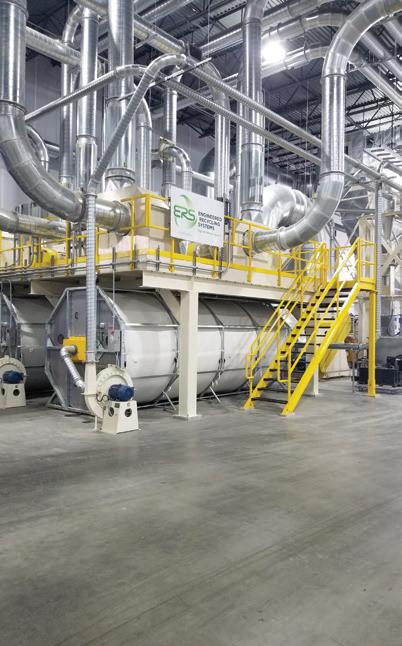
BY MITCH KLINGHER
The late great Harry Rhode, his older (and some people say smarter) brother Elliot, and his brilliant son Jan, who recently retired from his consulting business, created a cost-estimating system over 50 years ago that is still used by most converters today. Cosmo DeNicola, the founder of Amtech Software, basically copied this system, and it is still the backbone of all cost estimating done at the company. The basic architecture of this system is that the direct costs of the order, plus an allocation of all other enterprise costs, plus a provision for profit, equals sales price. This is what we accountant types call full absorption costing, because every cost is allocated to every order and therefore every order must “absorb” its share of the company’s expenses. It is pure poetry, and if you get the expenses right, the planned level of activity right, and all of the equipment speeds and setup times correct, then you might really have something special.
Most of these full absorption systems are set up to calculate two things:
• The contribution of the order—sales price less direct costs.
• The estimated return on the sale—contribution less direct and allocated overhead.
Unfortunately the world is a messy place, especially when you are running a custom job shop where every order is nuanced in terms of size, complexity, print, quantities, the equipment that it runs on, the handwork that needs to be done to make a completed product, and whether you will be storing the product for your customer. Lots of variables to contend with and, therefore, lots of things that can go wrong. If you were running a paper mill or a
cookie-baking operation with large batches running over the same equipment every day with well-established speed and capacity standards, then these systems would make very good sense. But in a custom job shop they can lead you to make poor decisions.
To be fair to the Rhode family, who contributed greatly to the converting business, when Harry and his team rolled out their ERP system, the American economy was still booming. Paper was starting to get scarce, new customers seemed to be popping up everywhere, and owning a converting operation was almost as good as owning a printing press to print dollar bills. Price competition was rare, and you really could go to market with a cost-plus system and charge what the system told you to charge. It was a true golden age for converters; machinery was getting faster and more accurate, real price competition was rare, and as long as you took care of your customers and paid your bills in a timely manner, there was good money to be made. The full absorption system of costing made sure that prices stayed high and life was good.
Of course, nothing lasts forever, and massive paper shortages, which facilitated the founding of AICC, the continued evolution of modern corrugators and modern converting equipment, and competition from foreign markets that severely impacted manufacturing in the United States changed the landscape dramatically. The more efficient producers and the integrated producers began flexing their muscles, and competition became a real issue. You could no longer go to market blindly following a cost-plus system and be successful. New customers were harder to find, and you needed to go to market with a combination of good pricing, high quality, and strong customer
service. Converters began to see that not all orders were able to absorb as much overhead as their systems told them to, so they began pricing different orders at different predicted profit levels within their costing systems. The market began to set the price, and converters often had to compete with competitors who had faster equipment, lower overheads, and a lower acquisition cost for raw materials. The landscape changed dramatically, but the costing systems did not.
If the pure poetry of cost-plus doesn’t work, what is a converter to do? They can’t simply scrap their entire system, and creating a parallel offline system is cumbersome and requires great duplication of effort. Even if they were willing to do this, they aren’t sure what the new system should look like. The practical manifestation of this is that almost every converter has created their own pricing “alchemy” and has tweaked their systems to spit out prices that they think will work in the marketplace. With so few new customers that require packaging starting up, almost every order must be taken away from an incumbent producer based on the combination of price, quality, and service, and the existing prices are known. Often, converters are hesitant to update their costing models, except for major changes in the cost of raw materials, labor, or other major cost components, because they have their systems tweaked in a way that they are comfortable with. Others lament the “irresponsible pricing” that they see from their competitors, as they don’t really understand the pricing that comes out of their own systems but can’t believe that anyone could possibly charge such low prices and still be profitable. Over time, the costing systems simply become a “black box” that no one really

Q U E S T I O N S ?

A s k A I C C ’ s e x p e r t s y o u r
c o r r u g a t e d , f o l d i n g c a r t o n , r i g i d b o x ,
a n d r i s k m a n a g e m e n t q u e s t i o n s .
F i n d y o u a n s w e r s a t
A I C C b o x . o r g / E x p e r t s .
understands anymore, and pricing becomes a combination of guesswork and alchemy. At the end of the day, the market determines the price anyway, and the converter’s decision is generally whether to accept the business at the existing price or to try to upsell the customer on a combination of better quality, innovative design, or better service.
As many of you who know me or read my articles know, my solution to this is two-fold:
• Simplify your systems by narrowing down your definition of contribution to consider only the cash costs of the order, and stop all of the allocations of costs that are fixed, regardless of whether you run that order. Disaggregation of costs and full absorption costing are causing you to run business that you shouldn’t and to not accept business that you should.
• Find meaningful ways to interject time into the equation. Time is the ultimate equalizer in this conundrum, and I can tell you from my 35-plus years of following this industry that speed kills. How long an order ties up your equipment becomes the most important measurement in a successful manufacturing operation. If you were running a paper mill, you would pretty much know exactly how long it takes to make a batch of paper and how many orders you can run in a month. In a custom job shop, this information varies greatly from order to order and from day to day, so you need to improve your plant measurements and bring this element of time into your estimating.
Thankfully you are no longer limited by the information that your software vendor
wants to give you, and there are new ways that you can utilize to move your data in the cloud and apply some really powerful analytical tools to it, some even powered by AI. This is the dawning of a new age of data management and analytics and probably time to retire the “black box” that is embedded in your existing ERP system. The good news is that you most likely don’t need to retire the system itself to improve your system of pricing and order decision-making, but you must take control of your data to better understand the implications of accepting or rejecting an order at a certain price point.

Mitch Klingher is owner of Klingher Nadler LLP. He can be reached at 201-731-3025 or mitch@ klinghernadler.com
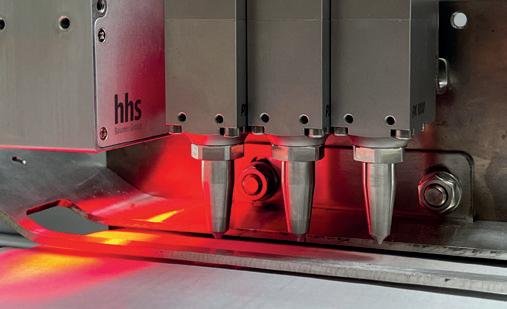

Because of your generosity, the Foundation for Packaging Education is already making a measurable impact on the future leadership of the corrugated packaging industry.
In fall 2025, with the help of Foundationfunded scholarships, AICC launched the Next Generation Masters Program—an intensive leadership development initiative designed to prepare rising leaders from AICC member companies for the challenges of tomorrow’s business environment.
The inaugural cohort includes 14 emerging leaders from across the industry. Guided by leadership advisor Matt Eichmann of Catalyst Point Leadership Advisors, participants are engaged in a 14-month program combining online learning, in-person sessions, and individual coaching focused on real-world leadership development.
Six months into the program, these future leaders are already gaining valuable skills that will strengthen their companies and our industry, including:
• Leading organizational change.
• Developing clear personal leadership missions.
• Strengthening influence and executive presence.
• Participating in one-on-one executive coaching.
• Building leadership philosophies that foster trust and psychological safety.
• Identifying and developing personal leadership strengths.
• Learning practical ways to gather and act on team feedback.
• Navigating uncertainty and leading effectively in VUCA (volatile, uncertain, complex, and ambiguous) environments.
• Building resilient, highperforming teams.

At the upcoming AICC Spring Meeting, the cohort will deepen their learning with sessions on market conditions, real estate trends, HR strategy, and emerging technologies. They will also hear powerful lessons in leadership under pressure—from navigating a major cyberattack to responding to a UPS cargo plane crash—experiences that reinforce the realities of modern leadership.
These are the kinds of practical, transformative experiences that your support makes possible.
By investing in leadership development today, the Foundation for Packaging
Education is helping ensure that AICC member companies—and the entire corrugated packaging industry—have the capable, resilient leaders needed for the future.
Your continued support makes this work possible. If you believe in developing the next generation of industry leadership, we invite you to join the growing number of donors making this investment in our future.
To make a pledge or donation, please visit www.packaginged.org or scan the code on this page.


A weekly update on benefits and upcoming events for AICC members.
New hosts. More Great Stories.
Hear compelling conversations with successful entrepreneurs released on the first Monday of the month.
The International Corrugated Packaging Foundation (ICPF) and The Packaging School recently celebrated the successful completion of ICPF’s first funded cohort in the Certificate of Mastery in Packaging Management (CMPM) program—an important milestone in expanding awareness of careers in the corrugated packaging industry.
In October, nine students were selected to receive ICPF’s $7,000 scholarship and completed the 12-week expert-led CMPM program. The inaugural cohort included students from the University of Northern Iowa, Carlow University, Clemson University, Rutgers University, and Wake Forest University.
As a culminating experience, students presented and pitched their packaging development plans to a review panel made up of ICPF staff, Packaging School faculty, and corrugated industry representatives. These panel sessions provided students with direct exposure to industry professionals, while reinforcing real-world expectations around packaging development, innovation, communication, and problem-solving.
For many students, the program opened the door to a career field they had not previously considered. Gabrielle Sedlar, a chemistry major at Carlow University and a member of the first CMPM cohort, reflected on the experience by saying, “Packaging is one option that stands out from the rest.”
Like many students, Sedlar entered the program from a different academic discipline and quickly realized how her background in chemistry connects
directly to packaging challenges involving materials, performance, and sustainability. Her experience highlights an important reality: When students see how their skills translate into real-world packaging applications, entirely new career paths come into focus.
Through completion of the program, students gained industry-focused knowledge, hands-on experience, and a project-based portfolio designed to be immediately applicable to packaging and manufacturing career opportunities, with a dedicated emphasis on corrugated packaging.

“This first cohort demonstrates the power of strategic partnerships to connect students with meaningful career pathways,” says Caitlin Salaverria, president of ICPF. “By embedding corrugated content and direct industry engagement into an established credential, we are strengthening talent pipelines and building long-term awareness of our industry.”
Building on the success of the inaugural cohort, ICPF and The Packaging School will launch two additional CMPM cohorts in 2026.
For AICC members, initiatives such as this represent an important opportunity. Programs that introduce students to packaging—specifically
corrugated—help ensure that the next generation of engineers, designers, and problem-solvers understands the value and impact of our industry. Continued engagement from companies through mentorship, internships, plant tours, and industry collaboration will help turn this early awareness into longterm careers.
To learn more and receive updates on the upcoming cohorts, visit www.packagingschool.com/icpf

Caitlin Salaverria is president of ICPF.








Over


Unlimited












Hosted twice a year, they o er industryleading programming, speakers, workshops & peer panels, along with networking opportunities and much more!


A well trained employee is more likely to stay at a company longer and perform better. With 15–20 seminars and webinars each year, we’ve got professional development for all departments.

With 5–8 regional topical meetings each year, you’ll have the chance to connect with independent converters across the country.

Dedicated to providing the rising stars of the industry with the information needed to develop and thrive in the paper packaging industry!





Define your pain points and AICC will develop a course based on your needs, create course materials, and bring industry trainers directly to your plant!

These groups allow participants to confide in peers, share ideas, receive honest feedback & give advice to help businesses grow.

“Those having torches will pass them on to others.” —Plato
Recently, AICC Chairwoman and Royal Containers Vice President of Administration TerriLynn Levesque shared a Forbes article titled Millions of Small Businesses Soon Changing Hands as Baby Boomers Retire in “Great Ownership Transfer,” Report Says. The article highlights research from the McKinsey Global Institute examining what may become one of the most significant shifts in American business ownership in decades.
The numbers are striking. According to the report, 6 million small and midsize U.S. businesses will be involved in a “great ownership transfer” by 2035. Roughly 1 million of those businesses are expected to change hands through transactions worth a combined $5 trillion.
Small businesses remain the backbone of the American economy. They employ more than 60 million people and generate roughly 35% of all business revenue in the United States. Their continued success matters, not only to owners and employees but to communities across the country.
The report describes this moment as “a new era of business stewardship.” But it also delivers a caution: Without intentional action, many viable small businesses may simply close rather than successfully transition to new ownership.
Several trends stand out:
• A large share of business owners do not have a formal succession plan, increasing the likelihood that otherwise healthy companies may shut down.
• If ownership transitions occur successfully at scale, they could preserve up to 12 million jobs and sustain roughly $250 billion in annual local spending power.
• Rural communities, where small businesses account for more than half of all employment, face particular risk.
• More than half of U.S. small-business owners are now over age 55, a figure that has grown by about 30% since the early 2000s. One in 4 is 65 or older.
• Annual business exits, through sales or closures, could rise 42% above 2011 levels by 2035, reaching as many as 665,000 per year.
For many in our industry, these statistics are not abstract; they describe our peers, colleagues, and perhaps even ourselves. That is why AICC places such a strong emphasis on leadership development and succession planning.
Through national meetings, webinars, and programs such as Packaging University, AICC provides members with practical guidance on planning ownership transitions and preparing the next generation of leaders.
At Pack U, a master’s-level course, partially funded by the Foundation for Packaging Education, is designed specifically for individuals on an ownership succession path. AICC’s Emerging Leaders program also helps young professionals build the experience and perspective needed to make lasting contributions to this industry.
The resources are there. The question is whether we will use them.
Whatever your plan may be or however far away the transition may seem, the future of your life’s work is at stake. For many, that future also includes your family, your employees, your customers, your community, and your Association.
Plan accordingly. Be intentional.

Michael D’Angelo AICC President

































Planning