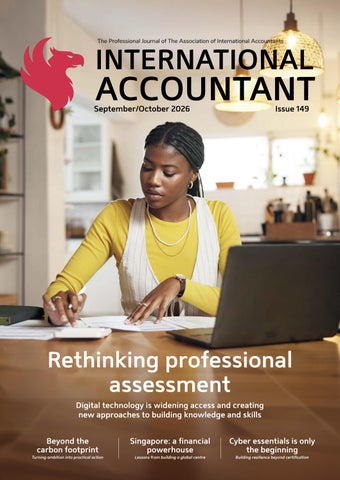
The Professional Journal of The Association of International Accountants
September/October 2026 Issue 149
Rethinking professional assessment Digital technology is widening access and creating new approaches to building knowledge and skills Beyond the carbon footprint
Singapore: a financial powerhouse
Cyber essentials is only the beginning
Turning ambition into practical action
Lessons from building a global centre
Building resilience beyond certification
CONTENTS
In this issue Contributors 2 Meet the team
News and views
3
AIA news
5
Singapore regulator uses AI to scrutinise company accounts
AIA presents awards to top performing accounting students
Exams
14
18
8
Students 8 Business Law for Accountants The IRAC framework can help Business Law candidates turn legal knowledge into effective analysis. We explore how to identify the issues, apply the relevant rules to the facts and reach clear, wellreasoned conclusions.
11
Singapore
Building a financial powerhouse Joey Teng (AIA Singapore branch President) examines Singapore’s transformation into a global financial centre and considers the lessons for accountants. The article explores regulation, resilience, technological innovation and sustainable finance.
11
Net zero
Beyond the carbon footprint AIA’s collaboration with Ecologi helps accountancy firms turn net-zero ambitions into practical action. We examine emissions measurement and reduction, credible reporting and the wider influence accountants can have through the businesses they advise.
Practice management
24
Cyber Essentials is only the beginning Steven Allan (Linten Technologies) explains why Cyber Essentials provides accountancy firms with a valuable security baseline, while examining how ongoing monitoring and management can help firms respond to evolving cyber threats.
26
21
Where your visibility drains away Mohammad A Mahmud (SEO Consultants) examines research into UK accountancy practice websites and identifies the gaps that can undermine online visibility, from missing service information to weak technical foundations.
Editor Angela Partington E: angela.partington@lexisnexis.co.uk T: +44 (0)20 8401 1810
International Accountant Staithes 3, The Watermark, Metro Riverside, Newcastle upon Tyne NE11 9SN United Kingdom
Advertising For advertising opportunities advertisingsales@lexisnexis.co.uk
AIAWORLDWIDE.COM | ISSUE 149
18
Cyber security
21
Editorial Information International Accountant, the bimonthly publication of the Association of International Accountants (AIA).
+44 (0)191 493 0277 www.aiaworldwide.com
24
Rethinking professional assessment AIA’s partnership with Eintech demonstrates how digital technology is changing professional assessment. We explore remote examination delivery, security, accessibility and new approaches to assessing the knowledge, skills and professional judgement required of accountants.
Subscribe to International Accountant subscriptions@aiaworldwide.com
Managing change
26
Dates for your diary
28
The office of the CFO Shane McMahon (Kefron) explains how CFOs can lead successful finance transformation by starting with clear business objectives, bringing people with them and combining technological innovation with effective governance, training and measurable outcomes.
Upcoming events
Technical 29 Global updates
Design and production LexisNexis, Lexis House, 30 Farringdon Street, London EC4A 4HH www.lexisnexis.co.uk Printed by Buxton Press Ltd, Buxton, Derbyshire SK17 6AE This product comes from sustainable forest sources.
AIA does not guarantee the accuracy of statements made by contributors or advertisers or accept responsibility for any views which they express in this publication. ISSN: 1465-5144 © Copyright Association of International Accountants
1
WELCOME
Contributors to this issue STEVEN ALLAN
Angela Partington Editor, IA
Keeping pace with change
C
hange is hardly a new challenge for accountants. What feels different today is the number of directions from which it is arriving at once. Technology is impacting how organisations operate, while regulators are adapting their approaches and the skills expected of finance professionals continue to evolve. This issue of looks at how the profession can respond without losing sight of the qualities that remain fundamental. Joey Teng provides an interesting perspective through Singapore’s development as a global financial centre. Its experience over the past quartercentury demonstrates the importance of adapting to economic shocks and technological change while maintaining strong regulation, governance and long‑term planning. For accountants, there is a wider lesson: resilience is built through continual preparation rather than simply responding when disruption arrives. That balance between innovation and continuity appears in AIA’s work with Eintech. Digital assessment has transformed how professional examinations can be delivered around the world, widening access while creating new questions around security, fairness and consistency. Technology may change the examination experience, but confidence in the qualification still depends on rigorous standards.
2
Sustainability is another area where expectations are shifting quickly. AIA’s collaboration with Ecologi, its official Climate Action Partner, is helping firms turn net-zero ambitions into practical steps. The updated Net-zero Accountancy Protocol, developed with AIA input, focuses on measurement, reduction, wider climate action and transparent reporting, while also recognising the wider influence that accountants can have through the organisations they advise. Elsewhere, Shane McMahon considers how CFOs can manage transformation by focusing on people and business objectives rather than technology alone, while Steven Allan argues that Cyber Essentials should be regarded as the beginning of effective cyber security rather than the destination. Mohammad A Mahmud’s research into UK practice websites adds another dimension, revealing some surprisingly basic gaps in how firms present themselves to prospective clients online and how easily visibility can be lost when information is incomplete or out of date. Taken together, these articles suggest that successful adaptation is not simply about adopting the newest technology or responding to the latest requirement. It is about knowing what needs to change, what needs to be protected and where professional judgement still matters. For accountants navigating an increasingly fast-moving environment, that may be the most important skill of all.
Steven Allan is CEO of Linten Technologies, a Manchester-based IT and cyber security specialist supporting organisations across sectors including financial services, legal, healthcare and manufacturing. MOHAMMAD A MAHMUD
Mohammad A Mahmud worked in accountancy practice before moving into marketing. He is founder and director of True SEO Consultants Ltd and the author of research into the public web estates of regulated professions. SHANE MCMAHON
Shane McMahon is Chief Product Officer and Director at Kefron. A former CFO, he brings extensive finance leadership experience to product development, digital automation and AI for modern finance teams. JANE STEELE
Jane Steele is Qualifications Manager at AIA and brings a wealth of experience supporting AIA students worldwide, overseeing assessments, qualification development, and the learner journey from enrollment to membership. JOEY TENG
Joey Teng is President of the AIA Singapore Branch, with a professional background spanning accountancy, business administration, compliance, governance and corporate services. ISSUE 149 | AIAWORLDWIDE.COM
News
News
CORPORATE REPORTING
Highlights and key stories from across the accounting world TECHNOLOGY
Singapore regulator uses AI to scrutinise company accounts Singapore’s accounting regulator is using artificial intelligence to identify potential gaps in the financial statement disclosures of listed companies, as technology plays an increasing role in regulatory oversight. The Accounting and Corporate Regulatory Authority (ACRA) has developed an AI tool known as CLAIR, or Compliance Lens for Accounting IRregularities. It screens the financial statements of Singapore-incorporated listed companies against selected Singapore Financial Reporting Standards (International), flagging potential disclosure gaps for further assessment by ACRA officers. CLAIR currently focuses on two areas: impairment of assets and fair value measurement. ACRA plans to extend its coverage to additional accounting standards over time. The regulator uses
a risk-based approach to select financial statements for review. Where CLAIR identifies a potential disclosure gap, ACRA officers consider the finding before any further action is taken. If an issue requires attention, ACRA may send a Disclosure Advisory Letter to the company’s board. The letters are advisory rather than enforcement action. Directors and auditors are expected to consider the observations, taking account of materiality, the company’s circumstances and professional judgement, and decide whether future disclosures should be improved. ACRA may also use the technology for thematic reviews to identify common disclosure issues and trends. Anonymised observations may be published to highlight wider lessons for the market. The initiative provides an example of AI being used not simply to prepare and analyse financial information, but to scrutinise compliance with accounting standards. CLAIR identifies potential gaps, while ACRA officers determine whether they warrant further attention.
AUDIT
US audit regulator revises quality control rules The US audit regulator has amended its new quality control standard ahead of its introduction in December, seeking to reduce compliance costs and bring some requirements more closely into line with international standards. The Public Company Accounting Oversight Board (PCAOB) adopted amendments to QC 1000, ‘A Firm’s System of Quality Control’, on 9 September. The risk-based standard is due to take effect on 15 December 2026. Among the changes, firms will be able to choose the date on which they carry out their annual evaluation of the AIAWORLDWIDE.COM | ISSUE 149
effectiveness of their quality control system, rather than using 30 September. The definition of a quality control deficiency has also been revised, while the documentation retention period has been reduced from seven years to five. Other changes provide greater flexibility over roles within firms’ quality control systems and narrow some requirements. The PCAOB said the amendments should improve alignment with other quality management standards. In particular, some changes bring QC 1000 closer to International Standard on Quality Management 1 (ISQM 1). The amendments remain subject to approval by the US Securities and Exchange Commission.
UK plans major corporate reporting overhaul The UK government has launched a wide-ranging consultation on modernising corporate reporting, with proposals intended to simplify requirements and reduce costs for businesses. Published on 7 September, the consultation covers financial and non-financial reporting, corporate governance and remuneration, alongside greater use of digital reporting and communications. Among the more significant proposals is the possibility of allowing some medium-sized companies to qualify for audit exemption. Currently, private companies generally qualify if they meet the small company criteria, including at least two of three tests relating to turnover, balance sheet total and employee numbers. The government is seeking views on whether the exemption should be widened. The consultation also considers whether some non-financial reporting requirements for private companies remain necessary, alongside proposals to streamline financial and remuneration reporting and make corporate governance requirements more proportionate. More fundamental changes include whether the UK’s existing rules on distributable profits and capital maintenance could be replaced by a solvency-based regime. The government also wants to explore how technology, including AI, could make corporate reporting more efficient. The government says reporting changes already introduced are expected to save businesses more than £450 million a year. Changes to audit exemptions could be particularly significant for practitioners and medium-sized businesses, while greater use of digital reporting could affect reporting processes more widely. The consultation closes on 30 November 2026.
3
News REGULATION
Hong Kong regulators widen financial reporting oversight Hong Kong’s financial and accounting regulators have expanded their cooperation on financial reporting and audit oversight, extending their arrangements beyond listed companies to a wider range of regulated businesses and investment funds. The Securities and Futures Commission (SFC) and Accounting and Financial Reporting Council (AFRC) signed a new memorandum of understanding on 28 September, broadening an existing framework for regulatory cooperation. The agreement extends their collaboration to financial and compliance reporting by SFC-licensed corporations, licensed virtual asset service providers, authorised funds and open-ended fund companies. It also covers audit and assurance work associated with these entities. The two regulators will share information and make referrals where potential regulatory concerns fall within the other body’s remit. The agreement also provides a framework for coordinated inspections and investigations, where appropriate. The move reflects the increasingly interconnected responsibilities of Hong Kong’s financial regulators. The SFC oversees securities and futures markets and regulates a wide range of financial businesses, while the AFRC is responsible for regulating the accounting profession and overseeing the quality of financial reporting and auditing. For accountants and auditors, the agreement means financial reporting and assurance work across a broader range of regulated entities may be subject to coordinated scrutiny. It also highlights the growing importance regulators are placing on information sharing where accounting, audit and wider financial regulation overlap.
4
AUDIT
FRC strengthens rules on auditors’ use of experts The UK’s Financial Reporting Council (FRC) has revised its auditing and assurance standards governing the use of external experts, strengthening requirements around how their competence and objectivity are assessed. Published on 23 September, the changes affect ISA (UK) 620, ‘Using the work of an auditor’s expert’, and ISAE (UK) 3000, ‘Assurance engagements other than audits or reviews of historical financial information’. They follow amendments to international standards issued by the International Auditing and Assurance Standards Board (IAASB). Auditors increasingly draw on specialists in areas outside accounting and auditing when obtaining evidence, particularly where engagements involve actuarial calculations or other specialist matters. However, responsibility for the audit opinion remains with the auditor even where an expert’s work is used.
The revised standards clarify practitioners’ responsibilities when relying on external expertise. They align definitions and requirements for assessing an expert’s competence, capabilities and objectivity, and strengthen expectations around evaluation and documentation. The changes maintain compatibility with the International Ethics Standards Board for Accountants’ Code of Ethics, which introduced explicit ethical requirements covering the use of external experts in audit, assurance and non-assurance engagements. For audit and assurance practitioners, the revisions place additional emphasis on demonstrating why an external expert can be relied upon and documenting that assessment appropriately. The auditor remains ultimately responsible for determining whether the expert’s work provides sufficient appropriate evidence. The revised standards take effect for audits of financial statements for periods commencing, and assurance reports dated, on or after 15 December 2026.
EUROPE
Private equity reshapes European accountancy market Private equity investment in European accountancy and audit firms has risen sharply, as investors increasingly target a profession undergoing consolidation and technological change. Accountancy Europe, which represents professional accountancy bodies across Europe, has highlighted the scale of the trend in a new resource examining private equity investment across the profession. Research cited by the organisation identified 385 European accountancy and audit transactions involving private equity in 2025, compared with just 43 in 2022. The pace has continued in 2026, with 131 transactions recorded in the first four months of the year. Audit firms are increasingly involved: 139 of the transactions identified in 2025 involved
audit firms, while a further 62 audit-firm deals were recorded between January and April 2026. Several factors are attracting investors. Accountancy firms typically offer recurring revenues and predictable cash flows, while fragmented national markets provide opportunities for consolidation. Firms also need significant investment in technology and digitalisation, creating further demand for external capital. However, private equity ownership is prompting questions about auditor independence, governance and implications for audit quality. Regulators and professional bodies are paying increasing attention to how investment structures may affect firms’ decisionmaking and professional responsibilities. The rapid increase in transactions points to a significant change in the ownership and structure of accountancy firms, with private capital likely to play an increasingly prominent role in future consolidation. ISSUE 149 | AIAWORLDWIDE.COM
AIA NEWS
AIA news Updates, important shifts, and key decisions from the AIA GRADUATION CEREMONIES
AIA presents awards to top performing accounting students
AIA has celebrated the achievements of the next generation of accounting and finance professionals by presenting awards to outstanding students at recent graduation ceremonies held at the University of Derby and the University of Greenwich. As part of its ongoing commitment to supporting education and developing future talent within the profession, AIAWORLDWIDE.COM | ISSUE 149
AIA sponsors awards that recognise exceptional academic achievement and dedication among students. At the University of Derby’s International School of Business Graduation Ceremony, held at Pride Park Stadium on 15 July 2026, AIA presented an award to Angela Cruz, an Accounting and Finance student who achieved the highest dissertation mark in her class.
The ceremony was hosted by Keith McLay, Deputy Vice Chancellor, with students receiving their degrees from Professor Kathryn Mitchell, Vice Chancellor and Chief Executive. Guests also heard an inspiring address from Gordon Bennett, Managing Director, Utility Markets and Global Head of Environmental Markets at ICE, who encouraged graduates to remain curious, embrace challenges and become comfortable with being uncomfortable as they grow. AIA Chief Executive Philip Turnbull attended the University of Greenwich’s Business School graduation ceremony on 21 July 2026, where he joined Dr Gary Brown, Pro Vice Chancellor and Executive Dean, to celebrate the success of graduating students and present AIA-sponsored awards recognising outstanding academic performance. The awards were presented to: ● Esha Phull: Year 2 Best Overall Student ● Florina Afronie: Year 3 Best Advanced Financial Accounting Student ● Shaba Ponu Jacob: Year 3 Best Audit & Assurance Student Philip Turnbull said: ‘Congratulations to all of the students recognised through these awards. Academic excellence, commitment and a willingness to continue learning are qualities that underpin a successful career in accountancy. ‘AIA is proud to support universities and students as they take their first steps towards becoming the professional accountants of the future. Education is fundamental to building a strong, diverse and globally connected profession, and we are committed to championing excellence and creating opportunities for the next generation of accounting professionals.’ By working closely with higher education institutions and recognising exceptional student achievement, AIA continues to strengthen the link between academic success and professional qualification, helping students build the knowledge, skills and confidence needed to thrive in an evolving global profession. Students considering their next step can explore AIA’s internationally recognised qualifications, designed to support successful careers in accountancy and finance across the world.
5
AIA NEWS SINGAPORE
Michael Chow represents AIA at Brands for Good Awards 2026 in Singapore AIA was delighted to be represented by Michael Chow FAIA, former AIA Council Member, at the Brands for Good Awards 2026 in Singapore, where he took part as both a table host and panel judge. Held under the theme ‘Together for Good’, the awards celebrate organisations and leaders demonstrating that commercial success and positive social impact can go hand in hand. The event brought together more than 500 guests, including business leaders, entrepreneurs, diplomats, educators and community partners. Reflecting on the event, Michael
said: ‘It was a privilege to be part of the Brands for Good Awards 2026 and to join a community of leaders, entrepreneurs and changemakers who believe that business can be a force for positive impact. Meaningful and lasting change is achieved when people, organisations and communities work together towards a shared purpose.’ Michael also served as a panel judge for the fifth consecutive year, helping to recognise organisations and individuals whose work demonstrates strong values, innovation and a commitment to creating positive change.
The event’s focus on collaboration and responsible leadership closely reflects AIA’s own commitment to integrity, professionalism and public trust. Michael’s continued involvement highlights the important contribution that AIA members and Fellows make in promoting ethical leadership and positive impact across the international business community.
address the challenges and opportunities facing our profession.’ Professor Joan Ballantine, President of BAFA, welcomed the funding and the strengthened partnership between the academic and professional communities, saying: ‘These grants provided by the AIA Educational & Benevolent Trust will support meaningful, high-quality research and enable academics to make a real contribution to professional practice,
education and public interest outcomes.’ Andrew Lamb, Chair of Trustees, said: ‘Supporting academic research is central to the Trust’s objectives. By funding these grants for members of BAFA, we are helping to ensure that rigorous research continues to inform the profession and support its long-term sustainability and credibility.’ Further details on eligibility can be found at: tinyurl.com/mrxy5mdj
ACADEMIC GRANTS
AIA launches BAFA Academic Research Grants for 2026 AIA has announced a new academic research funding initiative for members of the British Accounting and Finance Association (BAFA), supporting highquality research that strengthens the accountancy and finance profession. Funded by the AIA Educational & Benevolent Trust (AIA EBT), the programme will provide four academic research grants of £2,500 in 2026. The grants are available to BAFA members and AIA Academic Members and will support research that informs professional practice, education and policy, including in sustainability, AI and ethics. The initiative was formally launched at Ulster University by AIA Chief Executive Philip Turnbull and Professor Joan Ballantine, President of BAFA. Philip Turnbull said the initiative reflects AIA’s commitment to bridging academic insight with professional relevance. He said: ‘Academic research plays a vital role in ensuring that the accountancy and finance profession remains informed, resilient and forwardlooking. Through the support of the AIA Educational & Benevolent Trust, we are proud to invest in research that generates evidence-based thinking and helps to
6
ISSUE 149 | AIAWORLDWIDE.COM
AIA members receive a 10% discount On Ecologi’s carbon accounting services during their first year
STUDENTS
Business Law for Accountants The IRAC framework helps AIA Business Law for Accountants candidates to apply legal knowledge effectively and reach clear, reasoned conclusions.
A
from among several possibilities and apply it to the facts to reach a reasoned, defensible conclusion.
Legal knowledge and legal application
A candidate may correctly state that an offer must be accepted to form a binding contract, or that a company possesses separate legal personality from its members. Such statements are necessary but not sufficient. The difference between a strong and a weak answer lies in whether the relevant legal rule is meaningfully applied to the particular facts, rather than simply stated alongside them.
©Getty images
Business Law paper presents a distinctive challenge for professional accounting students preparing for the AIA examinations. Knowing the law is only the starting point. Candidates must also identify the relevant issues, select the appropriate rules, apply them to the facts and reach a reasoned conclusion. The challenge often lies not in a lack of preparation, but in translating legal knowledge into effective analysis. Answers can remain descriptive, restating the facts of a scenario or reproducing textbook definitions without showing how the law applies to those facts. The ability to make that connection is an integral skill that a Business Law paper is designed to test, and one that can be developed through a structured approach. For professional accounting students, business law therefore requires a different approach from many other subjects. A problem question does not simply ask candidates to recall a definition. It requires them to identify the relevant legal principle
8
ISSUE 149 | AIAWORLDWIDE.COM
STUDENTS Answers are assessed not simply on whether they reach the correct conclusion, but on the quality of the reasoning used to reach it. This requires explaining why a particular rule applies, what it requires and whether those requirements are satisfied in the circumstances. A correct conclusion without supporting reasoning is therefore of limited value, because it does not demonstrate the legal analysis through which that conclusion was reached.
Using IRAC to structure your answer
A useful way to structure and present legal reasoning is the IRAC framework, a widely used approach in legal education that provides a clear and logical structure for analysing and answering problem questions. ● Issue: the specific legal question raised by the facts. ● Rule: the relevant legal principle, statutory provision or judicial authority. ● Application: the application of that rule to the particular facts. This stage typically carries the majority of the marks and is where descriptive answers must progress into genuine analysis. ● Conclusion: a clear, reasoned outcome that follows logically from the application.
IRAC in practice
Sarah, an accountant who owns a small accounting practice, is relocating to new furnished premises. At 10.30am, she faxes David an offer to sell her current office furniture. At 11am, Sarah agrees by telephone to sell the same office furniture to James instead. At 11.30am, a mutual acquaintance who was present during the call with James tells David that Sarah has already sold the office furniture. Undeterred, David faxes Sarah his acceptance at 1pm. Sarah never sees the fax, having already moved on to other business. Issue: The issue is whether a binding contract was formed between Sarah and David when he faxed his acceptance at 1pm, given that he had already been told, at 11.30am, that Sarah had sold the office furniture to James. Rule: An offer can be revoked at any time before it is accepted, provided the revocation is communicated to the offeree. Communication need not come directly from the offeror. Dickinson v Dodds (1876) 2 Ch D 463 establishes that reliable information reaching the offeree from a third party can be sufficient to communicate the revocation of an offer. Application: David learned, from someone who had directly witnessed Sarah’s call with James, AIAWORLDWIDE.COM | ISSUE 149
Strengthening your answers
1. Use precise legal terminology: Distinguish carefully between related but distinct terms, such as void and voidable. Employees, workers and those who are self-employed have different legal rights and protections, while the consequences of breaching a contractual term may depend on how that term is classified. 2. Give a complete legal conclusion: ‘The contract has been breached’ or ‘there is a conflict of interest’ is a starting point, not a complete answer. Explain the nature of the legal position and, where relevant, the consequences or remedy. 3. Avoid assuming a predetermined outcome: Facts are often constructed to test both sides of an argument; weigh them objectively rather than reasoning backwards from an assumed conclusion. 4. Maintain balance across the issues: A balanced answer addressing all the relevant issues using structured IRAC analysis is generally more effective than an exhaustive treatment of one point at the expense of others. 5. Practise applying the law to different factual situations: Knowing the relevant legal rules is only the starting point. Regular practice with problem questions helps you develop the ability to identify the issues, select the relevant law and apply it to the facts. Working through past papers alongside the official AIA study materials is one of the most effective ways to develop this skill and build confidence in tackling different problem questions.
that the office furniture had already been sold. This was not a vague rumour but a first-hand account from a reliable source, of the kind that Dickinson v Dodds treats as sufficient. By 11.30am, then, Sarah’s offer to David had already been validly revoked. David’s attempt to accept at 1pm therefore came too late: there was no longer an open offer capable of being accepted. Conclusion: No contract was formed between Sarah and David. The offer was effectively revoked once David received reliable thirdparty confirmation of the sale to James, and his subsequent fax could not revive it. The Issue and Rule can often be stated briefly; the Application should occupy the greater part of the answer. Credit may also be available for correctly identifying an Issue and stating the applicable Rule even where the Application is incomplete. Candidates should therefore set out each issue and rule they identify, even if they are uncertain about the complete analysis. A partial answer may earn partial credit; an issue left unmentioned earns none.
Identifying multiple issues within a single scenario Business law problem questions are seldom built around a single legal point.
9
STUDENTS An employment law scenario, for example, might raise questions about employment status, employment rights, termination and discrimination within the same set of facts. Identifying each distinct issue matters as much as analysing any one of them correctly. Candidates should read the scenario carefully, more than once, and note each legal question it raises before beginning their answer. Consider a scenario in which an individual has worked for a business for several years under a contract describing her as selfemployed. She works regular hours, is required to follow the business’s instructions and is paid a fixed weekly amount. After raising a complaint about her treatment at work, the business terminates the arrangement. Several issues may arise from these facts. The first may be employment status. Despite the contractual label, does the nature of the working relationship indicate that she is an employee or worker? This may need to be established before considering which employment rights are available to her. The analysis might then move to the relevant right or protection, the circumstances of the termination, and, if the facts involve a protected characteristic, any potential discrimination claim.
The order of analysis can therefore matter, but it should follow the logical sequence of the legal issues rather than simply the chronology of events. Where one issue determines the legal framework for another, it should generally be addressed first. Each distinct issue should then be analysed separately using the IRAC approach. This does not mean that every answer must be divided mechanically into separate sections labelled Issue, Rule, Application and Conclusion. The aim is to ensure that each legal question is identified and analysed before moving to the next. Keeping the analyses distinct makes it clearer which legal rule applies to which issue and helps to ensure that no relevant part of the problem is overlooked.
Conclusion
The AIA Business Law for Accountants paper tests both knowledge and application, with particular emphasis on how effectively you use the relevant law to analyse the facts. Consistent use of IRAC, together with careful application of the relevant rules, can help turn a technically correct answer into a clear and well-reasoned one. Where appropriate, accurate reference to supporting legal authority can provide further support for the analysis. ●
Think Tax. Think Tolley.
INTERNATIONAL TAX 2026 International tax issues continue to change and are an increasingly important focus for all UK tax advisers. Keep up to date with your international tax processes using Tolley’s International Tax 2026-27 Set. Fully updated for 2026 and all in one place, use Tolley’s complementary titles to advise your individual and corporate clients on their overseas tax position.
Titles include: •
Tolley’s International Tax Planning 2026-27
•
Tolley’s Worldwide Tax Guide 2026-27
Also available: •
Clarke’s Offshore Tax Planning 2026-27
ORDER TODAY lexisnexis.co.uk/internationaltax26
© 2026 LexisNexis SA-0726-3357.
10
ISSUE 149 | AIAWORLDWIDE.COM
©Getty images
SINGAPORE
Building a financial powerhouse Joey Teng examines Singapore’s transformation into a global financial centre and draws lessons for accountants navigating technological and economic change. Joey Teng President, AIA Singapore Branch
F
or finance professionals, Singapore’s development over the past quartercentury offers a compelling example of how regulatory foresight, strategic policymaking and continuous innovation can transform a financial ecosystem. During that period, Singapore has developed from an established regional banking centre into a leading global financial hub, with strengths spanning banking, wealth management, fintech, foreign exchange and sustainable finance. But Singapore’s experience is about more than growth. Its development illustrates the importance of balancing sometimes competing priorities: encouraging innovation while maintaining effective regulation; opening markets while strengthening institutions; and pursuing international competitiveness while building resilience against future shocks. As accountants and finance leaders navigate increasingly complex economic environments, Singapore’s journey provides valuable insights into resilience, governance, digital transformation and the future of financial services.
AIAWORLDWIDE.COM | ISSUE 149
A transformation born from crisis
The Asian Financial Crisis of 1997-98 was a defining moment across the region. Singapore had already begun a fundamental review of its financial sector before the crisis, but the disruption reinforced the importance of reform and longterm competitiveness. In 1999, the Monetary Authority of Singapore (MAS) launched a fiveyear banking liberalisation programme, increasing foreign participation and moving towards greater competition and international integration. For accountants, this period demonstrates an important principle: periods of disruption often create opportunities for structural improvement. Alongside short-term measures to address the downturn, Singapore continued pursuing structural reforms intended to support future growth. It also established a theme that has continued throughout Singapore’s financial development. Regulation and competitiveness need not necessarily be opposing forces. Well-designed regulation can provide the stability and confidence upon which competition and innovation depend.
Building a more competitive financial sector During the early 2000s, Singapore continued modernising its financial framework, with MAS adopting a more risk-based supervisory approach. Consolidation among domestic institutions also resulted in the emergence of three major banking groups: DBS Bank, Oversea-Chinese Banking Corporation and United Overseas Bank.
11
SINGAPORE A strategic vision for the future
Singapore’s Financial Services Industry Transformation Map 2025 was launched by the Monetary Authority of Singapore (MAS) in 2022 to set out the next stage of development for the country’s financial sector. It aims to strengthen Singapore’s position as a leading international financial centre in Asia while responding to major changes in technology, sustainability and global financial markets. Its five key strategies are: ● enhancing Singapore’s strengths in key asset classes, including foreign exchange, wealth management and insurance; ● digitalising financial infrastructure; ● supporting Asia’s net-zero transition; ● shaping the future of financial networks through greater payments connectivity and the development of digital asset ecosystems; and ● developing a skilled and adaptable workforce, including specialist talent in sustainability and technology. The strategy reflects an important evolution in what makes a financial centre competitive. Traditional strengths such as regulatory stability and access to capital remain important, but they increasingly need to be combined with digital infrastructure, sustainability expertise and a workforce capable of adapting to technological change. The Transformation Map also demonstrates the interconnected nature of these priorities. Digitalisation, sustainable finance, international connectivity and skills development are not separate challenges: together, they are intended to support the continued growth and resilience of Singapore’s financial sector. The approach remains highly relevant today. Around the world, regulators continue to balance financial stability with innovation while responding to technological change, geopolitical uncertainty and new forms of financial risk. Singapore’s experience suggests that effective regulation does not simply mean imposing more rules. Regulatory frameworks also need to be adaptable enough to respond to changing markets and emerging risks while providing businesses and investors with confidence in the financial system. Robust governance can therefore be an enabler of sustainable growth rather than simply a compliance obligation.
Resilience through global shocks
Singapore’s financial sector faced several significant tests during the following two decades, including the 2003 SARS outbreak, the 200809 Global Financial Crisis and the COVID-19 pandemic. Prudent regulation and supervision, strong capitalisation and robust governance standards helped Singapore’s financial system maintain stability through these disruptions. There is an important lesson here for accounting professionals. Financial resilience is rarely built during a crisis. It is developed long before one occurs through disciplined management, sound risk management, transparent reporting, effective internal controls and strong institutional frameworks. Accountants play a critical role in helping organisations understand their financial position
12
and risk exposure, ensuring that decisionmakers have reliable information before difficult circumstances arise. The real test of governance and risk management therefore comes when organisations encounter the disruption for which those systems were designed.
Becoming a global wealth and investment hub
Over the following years, Singapore saw significant growth in wealth management, asset management and insurance, while international financial institutions increasingly chose it as a regional headquarters. Today, Singapore is widely recognised as one of Asia’s leading wealth management centres, with S$5.4 trillion in assets managed from Singapore and more than threequarters of those funds sourced internationally. This development carries wider implications for accountants. As wealth becomes increasingly international, professionals must operate across multiple regulatory regimes, tax frameworks and reporting standards. Technical expertise consequently needs to be accompanied by an understanding of cross-border business and regulation. Singapore’s success highlights the growing demand for professionals who can combine financial expertise with knowledge of compliance, taxation, governance and international business.
The fintech revolution
One of the most notable aspects of Singapore’s financial evolution has been its development as a fintech centre. Over the past decade, MAS has actively promoted fintech innovation through initiatives including regulatory sandboxes, digital infrastructure development and collaboration with industry stakeholders. The introduction of digital banking licences also opened the banking market to new digital-only competitors. The result is an ecosystem in which traditional financial institutions and emerging technology firms increasingly operate alongside one another. Regulators therefore face the challenge of allowing innovation to develop while maintaining confidence in the financial system. For the global accounting profession, the technological shift is particularly significant. Artificial intelligence, automation, data analytics and digital platforms are reshaping how financial information is collected, analysed and reported. Accountants are no longer expected simply to produce information. Increasingly, their value lies in interpreting data, identifying risks, exercising professional judgement and providing strategic insight to support decision-making. Accountants need to understand what technology ISSUE 149 | AIAWORLDWIDE.COM
SINGAPORE can do and where professional scrutiny, judgement and ethical reasoning remain essential.
Sustainable finance takes centre stage
One important area of Singapore’s future growth is sustainable finance. Recognising Asia’s significant role in the global transition to a lower-carbon economy, Singapore has sought to position itself as a centre for green and sustainability-linked finance. Through its Financial Services Industry Transformation Map (ITM) 2025, MAS identified supporting Asia’s transition to net zero as a strategic priority, including by scaling sustainable and transition financing. This forms part of a wider shift affecting financial markets around the world. Investors, regulators and other stakeholders increasingly expect organisations to disclose information about environmental, social and governance (ESG) matters alongside traditional financial metrics. For accountants, sustainability is therefore becoming increasingly connected with mainstream financial decision-making. Singapore’s emphasis on sustainable finance also demonstrates how financial centres are having to think beyond the traditional functions of banking and investment. Mobilising capital towards transition and sustainable economic activity requires credible information, appropriate governance and confidence that reported outcomes can be relied upon.
Lessons for accountants worldwide
Singapore’s transformation offers several lessons that resonate far beyond Southeast Asia. First, long-term success requires a willingness to adapt. Economic shocks, technological disruption and changing market conditions reward organisations and financial systems that are prepared to respond to change rather than simply defend existing ways of working. Second, regulation and innovation need not be competing objectives. Singapore’s experience suggests that effective oversight can create the trust and stability required for innovation to flourish. The challenge is to develop regulation that is sufficiently robust to protect confidence while remaining adaptable as markets and technology evolve. Third, the future of finance increasingly sits at the intersection of technology, sustainability and global connectivity. Accounting professionals who develop expertise in these areas will be well positioned to create value in rapidly evolving markets. Finally, talent remains a critical differentiator. As more routine tasks become automated, the profession’s future will depend on skills such as analytical thinking, strategic advisory capabilities, AIAWORLDWIDE.COM | ISSUE 149
A model for others?
Singapore’s development offers useful lessons for other financial centres, but its experience cannot simply be replicated elsewhere. Its relatively small size, strategic location, international outlook and particular institutional and economic circumstances have all helped to shape its development. What may be more transferable is the approach underpinning that transformation. Singapore’s experience demonstrates the value of longterm policymaking, regulatory frameworks that can adapt as markets change, investment in financial and digital infrastructure, and continued development of professional skills. Perhaps most importantly, it suggests that regulation and innovation do not necessarily have to pull in opposite directions. Effective oversight can help to create the confidence in which new markets and technologies can develop. For accountants and finance leaders, the broader lesson is therefore not to copy individual policies, but to consider how governance, innovation, skills and long-term planning can work together to support sustainable financial development. digital literacy, sustainability expertise and professional judgement.
Looking ahead
Singapore’s experience demonstrates that the development of a successful financial centre does not happen through a single reform or initiative. Singapore’s position today reflects decisions taken over many years, including its responses to financial crises, banking liberalisation, regulatory reform, investment in technology and the continuing development of its international financial services sector. For accountants around the world, Singapore’s experience therefore serves as more than a national success story. It provides a practical example of how financial systems can evolve while seeking to remain resilient, competitive and relevant in an increasingly interconnected global economy. The profession faces many of the same choices. Accountants must embrace innovation without losing professional judgement, develop new skills while maintaining strong technical foundations, and respond to new expectations around sustainability and technology without compromising governance and trust. In a profession navigating significant transformation, the lessons from Singapore are clear: embrace innovation, invest in skills, maintain strong governance and prepare for a future where finance, technology and sustainability increasingly converge. ● Author bio
Joey Teng Joey Teng is President of the AIA Singapore Branch, with a professional background spanning accountancy, business administration, compliance, governance and corporate services.
13
EXAMS
Rethinking professional assessment AIA’s partnership with Eintech shows how digital technology is transforming professional assessment while maintaining accessibility, integrity and rigorous global standards.
P
rofessional accountancy qualifications have always had to achieve a difficult balance. Assessments must be sufficiently rigorous to give employers and the public confidence that those who qualify have demonstrated the required knowledge and competence. At the same time, they need to be accessible to candidates with very different circumstances and, increasingly, in very different parts of the world. Remote digital assessment is changing how professional bodies strike that balance. It can extend access to qualifications, create new ways to assess professional skills and enable candidates to sit examinations without travelling to a physical test centre. But it also raises important questions about security, consistency and fairness. These are issues with which the AIA has been engaging for more than a decade through its relationship with assessment technology provider Eintech and its Rogo platform. AIA began working with Eintech in 2015, initially because it needed a safe and secure way to transmit examination papers between AIA, examiners and moderators. Adopting the Rogo platform enabled AIA to move away from costly and less efficient postal delivery, providing immediate access to examination materials and streamlining the exam paper creation process. Over time, however, the relationship has developed considerably. Rogo now supports AIA’s delivery of professional accountancy qualifications across Asia, Africa and Europe, encompassing
14
Technology is influencing what can be assessed and how professional competence can be demonstrated.
ISSUE 149 | AIAWORLDWIDE.COM
EXAMS remote invigilation, different qualification portals, multiple languages and a range of assessment formats. Eintech also provides content support across parts of AIA’s assessment lifecycle. The result provides an interesting example of a much wider development: technology is no longer simply changing how professional examinations are delivered. Increasingly, it is influencing what can be assessed and how professional competence can be demonstrated.
Delivering assessment globally
‘We have been working with Eintech and the Rogo platform since 2015, and the partnership has been instrumental in how we deliver professional accountancy qualifications globally. Our candidates sit exams across Asia, Africa and Europe, and Rogo gives us the infrastructure to do that reliably and securely. It is a genuine partnership: they understand our needs and work with us to deliver the best possible experience for our candidates.’ Jane Steele, Qualifications Manager, AIA
AIAWORLDWIDE.COM | ISSUE 149
© Getty images
AIA and Eintech: A decade of collaboration
The international reach of professional qualifications creates some significant practical challenges. Different time zones have to be accommodated while ensuring that candidates receive fair and secure examination conditions. Infrastructure and connectivity also vary considerably. Candidates may have different levels of access to reliable internet connections, suitable devices and appropriate environments in which to sit an examination. These practical differences need to be considered carefully when designing assessment systems. Language and cultural differences add another dimension. Examination questions and supporting material need to be clear and appropriate for candidates in different markets without compromising the consistency of the qualification. For AIA, remote digital assessment has also created opportunities to overcome some longstanding barriers to professional education. Its experience has been that the impact can be particularly significant in areas where physical test centres and in-person learning have traditionally been less readily available, including parts of Asia and Africa and more remote locations. Being able to study and take assessments online can remove the need to travel considerable distances to attend classes or examinations. As well as reducing cost and travelling time, that can make professional qualifications more practicable for candidates balancing their studies with employment and personal commitments. But widening access cannot mean creating different standards for candidates in different locations. A global professional qualification must retain consistency, quality and security wherever an examination is taken. Candidate preparation has therefore become an important part of AIA’s approach. Step-by-step guidance and instructional videos are provided, alongside practice examination sessions that allow candidates to become familiar with the technology before the examination itself. As digital assessment becomes more sophisticated, ensuring that candidates understand the system is an important element in ensuring that technology itself does not become an unnecessary barrier.
15
EXAMS Protecting examination integrity
As assessments become more accessible online, maintaining confidence in examination conditions becomes a key consideration. If candidates no longer have to assemble in controlled examination halls, how can a professional body provide equivalent assurance about the conditions under which an assessment has been completed? For AIA, examination security is directly connected with the credibility of its qualifications. Employers, members and the wider public need confidence that candidates have been assessed fairly and consistently and that those who qualify have demonstrated the required competence. Delivering secure assessments remotely also requires robust identity verification, so that AIA can be confident that the registered candidate is the person actually sitting the examination. This sits alongside measures to safeguard against malpractice and maintain consistent examination conditions across different locations. Its remote invigilation arrangements therefore use several layers of monitoring. Live proctoring, in which an invigilator monitors the candidate remotely while they sit the exam, is provided through Eintech’s proctoring partner, Monitor EDU. This combines webcam monitoring with a mobile device camera that can provide a view of the candidate’s environment, together with screen sharing. This is supplemented by the Rogo Kiosk lockdown functionality. During an assessment, the candidate’s computer is locked down to prevent access to unauthorised websites, applications or other external resources. The intention is to reproduce as far as possible the controlled conditions of a physical test centre while allowing candidates to sit examinations remotely. There is an important principle behind the technology. The value of a professional qualification ultimately depends upon trust in the assessment underpinning it. Greater flexibility and accessibility are valuable only if employers and other stakeholders remain confident that the resulting qualification is rigorous. The challenge for professional bodies is therefore not simply to digitise existing examination processes, but to find ways in which accessibility and integrity can co-exist.
Assessing what accountants actually do
Perhaps the more fundamental development in digital assessment concerns not where an examination is taken but what candidates are asked to do. AIA’s assessments use a range of question types, including multiple-choice questions (MCQs), spreadsheet exercises, longer written answers
16
For AIA, examination security is directly connected with the credibility of its qualifications.
and scenario and case study-based questions. The choice is determined by the learning outcome being assessed. MCQs and shorter questions can efficiently test breadth of knowledge and understanding. Scenario-based questions can require candidates to interpret information, apply their knowledge and justify decisions. Spreadsheet questions can test the ability to manipulate information, perform calculations and demonstrate practical technical skills. Extended scenarios and case studies can assess professional judgement and decisionmaking. This allows assessment design to start with a fundamental question: what knowledge, skill or behaviour does the candidate need to demonstrate? The format can then be selected to provide the most appropriate evidence of that competence. That matters because accountancy is not simply a body of technical knowledge. Accountants must be able to interpret information, analyse problems, exercise professional judgement and apply their knowledge to unfamiliar situations. Where possible, AIA therefore seeks to make assessments reflect professional practice. Spreadsheet tasks reproduce the sort of data handling that candidates may encounter in the workplace, while scenarios and case studies can reproduce the complexity of professional decision-making. Such an approach can also help candidates to understand why particular skills are being assessed. Rather than simply recalling theoretical knowledge, they can demonstrate their ability to use it. Technology consequently becomes more than a mechanism for putting a conventional examination paper onto a computer screen. The range of question types available through Rogo has also influenced AIA’s thinking about assessment design, encouraging it to consider more creatively and deliberately how different skills and competencies can best be assessed. The technology therefore does more than provide different ways of asking questions: it enables assessments to move beyond testing recall and focus more closely on applied knowledge, analytical thinking and professional judgement. Different formats can also be combined within a single assessment, providing both broad syllabus coverage and more detailed examination of particular capabilities. This potentially produces a more rounded picture of whether a candidate can apply their learning in practice.
Global standards, local delivery
The internationalisation of professional education also creates a further challenge: ISSUE 149 | AIAWORLDWIDE.COM
EXAMS how far should a global qualification adapt to individual markets? AIA’s use of different Rogo portals illustrates one approach. Alongside portals supporting different qualification streams, it has developed a Greek-language portal for candidates and study providers in Cyprus and Greece. Providing the platform in a candidate’s native language can remove a barrier that is unrelated to the professional competence being assessed. Candidates can concentrate on demonstrating their accounting knowledge and skills rather than navigating the assessment system in a second language. At the same time, localisation cannot compromise the consistency expected of a professional qualification. The objective is therefore to adapt delivery to local requirements while maintaining common standards of quality and assessment. For an international professional body, those two objectives need not be contradictory. Appropriate localisation can make a qualification more accessible while the underlying assessment framework preserves its comparability across markets.
Beyond the examination itself
Much of the discussion about digital assessment naturally focuses on the candidate experience. But the examination sitting is only one part of a much larger assessment lifecycle. The AIA and Eintech relationship extends into the preparation and maintenance of assessment content. AIA identifies where new material is required or existing content needs updating and provides Eintech with the relevant material, briefs, assessment criteria and design requirements. Eintech’s content team then undertakes work such as updating existing questions and building online tests using material supplied by AIA. Content is subject to quality assurance by Eintech and review by AIA, with feedback incorporated before publication. Importantly, final approval remains with AIA. Once approved, material can be released through the platform for use in examinations, practice assessments or course materials. The process continues as AIA reviews content and identifies changes required because of developments in policy or the syllabus. The relationship therefore has to extend beyond purchasing a piece of software. AIA’s experience with Eintech has involved continuing feedback and development, with the two organisations working together as assessment requirements and the technology available to support them have evolved. Eintech has also attended and presented at AIA’s Examiner Conference, providing an opportunity to share AIAWORLDWIDE.COM | ISSUE 149
insights and discuss the continuing development of the assessment process directly with those responsible for examining candidates.
What comes next?
AIA expects professional accountancy assessment to become increasingly digital and flexible, reflecting both technological developments and changing expectations about the skills accountants require. One possible development is greater use of flexible and potentially on-demand computerbased assessment, allowing more frequent examination sittings and faster results. Another is a continuing shift away from testing technical knowledge in isolation towards assessment of its practical application. Scenario-based tasks, data interpretation and exercises requiring professional judgement are consequently likely to become increasingly important. Digital literacy, data analytics and emerging technologies such as artificial intelligence may also become more prominent within assessment frameworks. None of those developments removes the fundamental responsibilities associated with professional assessment. If anything, innovation makes questions of validity, quality assurance, security and comparability more important. The future challenge is therefore not to choose between innovation and rigour. The experience of AIA and Eintech over more than a decade shows how the relationship between a professional body and its technology partner can evolve alongside the assessment process itself. What began as a more secure and efficient way of exchanging examination papers has developed into an infrastructure supporting remote examination delivery, localisation, different forms of assessment and continuing content management. The technology will continue to change, as will the capabilities expected of professional accountants. The underlying objective, however, remains remarkably consistent: to give candidates wherever they are in the world a fair opportunity to demonstrate their competence, while giving employers and the public confidence that a professional qualification continues to represent a rigorous and trusted standard. ●
About Rogo
Rogo is Eintech’s digital assessment platform, supporting professional assessment through features including remote invigilation, secure exam delivery and a range of question formats. AIA has worked with Eintech and the Rogo platform since 2015. For further information, visit getrogo.com
17
NET ZERO
Beyond the carbon footprint AIA’s collaboration with Ecologi helps accountancy firms translate net-zero ambitions into practical action, from emissions measurement to reporting and influence.
F
or many accountancy firms, climate action can initially appear relatively straightforward. Unlike businesses in manufacturing, transport or heavy industry, professional services firms generally have relatively modest direct greenhouse gas emissions. There may be offices to heat and power, employees travelling to clients and technology to run, but few obvious carbon-intensive operations. That does not, however, mean that reaching net zero is simple. Much of an accountancy firm’s climate impact can sit outside its direct operations, while the profession’s influence potentially extends much further through the businesses it advises. These issues are addressed in the updated Net‑zero Accountancy Protocol, developed by Ecologi with input from accountancy organisations and firms, including the Association of International Accountants (AIA). AIA participated in the steering group, contributing accounting and finance expertise to help ensure that the guidance reflects the practical circumstances of the profession. The 2026 edition builds on earlier work by Net Zero Now to develop a sector-specific Net Zero Accountancy Protocol. It is intended to provide firms with a route for measuring emissions, setting reduction targets, funding wider climate action and reporting progress. Particular emphasis is placed on providing a structured approach for small and mid-sized practices. The challenge is to translate the ambition of net zero into decisions that can be measured, implemented and scrutinised.
Reduce, Restore and Report
At the centre of the protocol is Ecologi’s 3Rs framework: Reduce, Restore and Report. ● Reduce begins with measuring greenhouse gas emissions across Scopes 1, 2 and 3 before establishing targets and implementing reductions. ● Restore concerns funding climate action beyond
18
the organisation’s own value chain, including measures addressing residual emissions. ● Report focuses on communicating emissions, targets and progress consistently and transparently. Importantly, the protocol is not intended to replace existing international standards. It draws on established approaches, including the Greenhouse Gas Protocol Corporate Standard, the Science Based Targets initiative (SBTi) Corporate Net Zero Standard and the Oxford Principles for Net Zero Aligned Offsetting, applying them to the circumstances of accountancy practices.
Finding the footprint
The starting point is determining what belongs within the firm’s carbon footprint. For accountancy firms, Scope 1 and Scope 2 emissions are generally relatively limited. They can include fuel used in company vehicles, gas or other fuels used to heat premises, refrigerants and purchased electricity. Scope 3 is more complicated. It encompasses indirect emissions occurring through the organisation’s value chain and, according to the protocol, will typically represent the majority of an accountancy firm’s carbon footprint. That brings into the calculation activities familiar to almost every modern practice: purchased goods and services, business travel, employee commuting and homeworking, among others. Hybrid working creates a particularly interesting challenge. Closing or reducing office space may lower emissions associated with business premises, but energy is instead being consumed in employees’ homes. The protocol recommends including homeworking emissions where remote working is contractually supported or required. UK government conversion factors can be used to estimate the incremental emissions associated with homeworking where individual household energy information is unavailable. The objective is to reflect how the firm actually operates ISSUE 149 | AIAWORLDWIDE.COM
NET ZERO
AIA and Ecologi: supporting members
AIA’s work in this area began through its partnership with Net Zero Now, which was acquired by Ecologi in 2025. In January 2026, Ecologi was appointed AIA’s official Climate Action Partner. AIA subsequently participated in the steering group that helped develop the updated Net-zero Accountancy Protocol, contributing accounting and finance expertise alongside other professional bodies and accountancy firms. The protocol itself is a free resource and is designed to help accountancy firms measure and reduce emissions, fund wider climate action and report their progress using the Reduce, Restore and Report framework. Ecologi says the Accounting Protocol was developed with AIA alongside ICAEW, ACCA, AAT and the Good Business Charter. AIA members can also choose to use Ecologi’s commercial carbon accounting services. These include Scope 1, 2 and 3 measurement, emissions-reduction planning, target-setting and reporting tools. AIA members currently receive a 10% discount on Ecologi’s carbon accounting services during their first year. AIA itself also uses Ecologi to calculate its annual carbon review, reflecting its stated aim of applying the same principles within the organisation that it encourages among members. As Nicola Perry, Chief of Operations at AIA, says: ‘By working with Ecologi, we are giving our members practical tools to respond to the climate challenge.’
rather than measuring only what happens within its physical offices. Globalised delivery models create similar boundary questions. Where an accountancy firm owns or controls an offshore delivery centre, the associated emissions may fall within its organisational boundary. Where services are instead provided by an external outsourcing or business-process provider outside the firm’s organisational boundary, the associated emissions would generally fall within Scope 3, including purchased goods and services.
From measurement to action
Calculating emissions is only the beginning. The more important question is what firms do with the information. The protocol proposes a range of practical reduction measures. These include improving energy efficiency and purchasing renewable electricity, reconsidering underused office space, reducing higher-carbon business travel, reviewing procurement and IT infrastructure, and optimising the environmental impact of hybrid working. Individual measures can be assessed according to their expected emissions reduction, cost, delivery timetable and responsible owner. The protocol recommends using an abatement-cost curve to prioritise high-impact and cost-effective interventions, bringing emissions and financial planning together.
The same discipline applies to target setting. A baseline needs reliable data, while structural changes such as mergers, acquisitions and disposals can require firms to reconsider organisational boundaries and potentially recalculate their base year if the change materially affects emissions.
Beyond emissions reduction
Even ambitious reduction strategies are unlikely to eliminate every tonne of emissions immediately. This is where the protocol’s ‘Restore’ pillar enters the picture. It encompasses funding climate activity outside the organisation’s value chain, including verified carbon credits and wider ecosystem restoration, alongside continuing efforts to reduce its own emissions. But there is an important distinction. Funding climate projects is not a substitute for reducing the firm’s own emissions, and the protocol states that such activity cannot simply be netted against the greenhouse gas inventory. It also distinguishes between carbon avoidance and carbon removal. Avoidance projects aim to prevent or reduce emissions that would otherwise have occurred, while removal projects extract carbon dioxide already present and store it. The protocol envisages firms progressively increasing their use of removal-based credits as they move towards net zero, reflecting the approach set out in the Oxford Principles. This is an area where scrutiny matters. Carbon credits differ significantly in their characteristics and quality, making issues such as additionality, verification, permanence and transparency important when firms decide what climate projects to support. For accountants accustomed to asking whether evidence is reliable and claims can withstand scrutiny, those principles should be familiar.
©Getty images
AIAWORLDWIDE.COM | ISSUE 149
19
NET ZERO Reporting what really happened
Climate reporting is becoming increasingly important to clients, investors, regulators, employees and supply chains. But the credibility of that reporting depends upon the quality of the underlying information. The protocol argues that emissions data, targets and progress should be reported consistently and verifiably, with reporting serving three purposes: accountability, learning and leadership. It also distinguishes between assurance and certification. Assurance provides scrutiny of the reliability of reported emissions information against specified criteria, while certification under Ecologi’s framework recognises progress against its particular climateaction criteria. That distinction is important. A badge or certification does not remove the need for credible underlying evidence. The growing importance of assurance is also reflected in the new International Standard on Sustainability Assurance (ISSA) 5000, which provides a global baseline for sustainability assurance engagements. The protocol recommends reporting not only achievements but also shortfalls, and being transparent about methodologies, limitations, estimates and data quality. There is a clear parallel with financial reporting. Accountants expect organisations to provide information that is complete enough to be meaningful, supported by evidence and capable of scrutiny. Climate reporting ultimately depends upon the same qualities of transparency and trust.
Beyond Scope 3: the influence of accountants Perhaps the most thought-provoking part of the protocol concerns something it describes as ‘Scope X’. Scope X is not a formal emissions category under the Greenhouse Gas Protocol and does not form part of an accountancy firm’s greenhouse gas inventory. Instead, the protocol uses the term to consider the wider emissions that a firm may facilitate or influence through its professional work. That distinction raises some potentially significant questions for the profession. Advice about corporate structures, mergers or investments may influence a client’s future emissions trajectory. Audit and assurance work can affect how climate risk is reflected in corporate reporting. Tax, sustainability and advisory services can influence incentives, investment decisions and disclosures. The protocol does not suggest that accountants should include their clients’ emissions within their own carbon footprint. Instead, it asks more advanced firms to consider how their services enable or constrain progress towards a net-zero economy. That could involve identifying the service lines with greatest potential influence, considering how professional outputs affect emissions decisions and
20
eventually integrating those findings into service design, training and client engagement. It is a more challenging proposition than measuring electricity consumption or business flights because it moves from what a firm controls to what it influences. But that may also be where accountancy has particularly significant potential impact. Accountants advise businesses throughout the economy on investment, financing, taxation, risk, reporting and strategy. The protocol therefore argues that their sphere of influence can be considerably larger than their own emissions. Where the boundaries of that responsibility should ultimately sit remains open to debate. What Scope X does usefully is encourage firms to ask the question.
Making progress manageable
One danger with any net-zero framework is that the scale of the eventual objective can discourage organisations that are only beginning to measure their emissions. The protocol therefore adopts a progressive pathway rather than expecting every firm immediately to meet the same standard. Firms can develop their measurement, reduction, restoration and reporting capabilities over time, with increasingly demanding expectations around Scope 3 coverage, assurance, targets and wider influence. That principle of proportionality is particularly important for smaller practices. A multinational accountancy network and a five-partner firm cannot reasonably be expected to have identical sustainability resources, even if the underlying principles of credible measurement and transparent reporting remain the same. For AIA, that practical focus was an important reason for contributing to the updated protocol. Accountants are increasingly being asked to help clients understand sustainability, emissions and reporting requirements. Their credibility in doing so will also be influenced by the standards they apply within their own organisations. The starting point does not have to be complicated: understand the footprint, identify where the significant emissions arise and establish what can realistically be reduced. But the wider challenge goes further. Accountants have always helped organisations measure performance, assess risk and provide confidence in information. As climate considerations become increasingly embedded in business decisions, those same professional capabilities could give accountants an important role in ensuring that climate action is measurable, transparent and capable of standing up to scrutiny. ● For further information about Ecologi’s Net Zero Protocols, see: https://ecologi.com/resources/sectorprotocols ISSUE 149 | AIAWORLDWIDE.COM
©Getty images
PRACTICE MANAGEMENT
Where your visibility drains away Mohammad A Mahmud examines what UK accountancy practice websites actually publish – and the gaps that can determine whether a firm is found online.
T
o a prospective client, many of the accountancy firms they find online can look remarkably similar. The same services are listed, the same reassuring language appears and, all too often, even the same stock photographs are used. When a buyer cannot tell two suppliers apart, they choose on price – and every practitioner knows that clients who are won on price are the ones who leave on price. That makes visibility important. A prospective client may be given a firm’s name and search for it, or describe a problem to Google or an AI assistant and ask who can help. What comes back depends heavily on what firms have made available online. So I decided to measure it. In September 2026, I audited the public websites of 494 UK AIAWORLDWIDE.COM | ISSUE 149
Mohammad A Mahmud Founder and director, True SEO Consultants Ltd
accountancy practices drawn by probability sample from two published UK professional body directories of accountancy practices. Each website was assessed against 36 checks, with the methodology, limitations and measured error rate published alongside the study. The findings reveal some surprisingly basic gaps. Many firms fail to describe the work they most want to win, identify their regulatory status in searchable text or keep published information accurate and up to date. In other cases, what appears to be a decision made by the practice is actually a default chosen by its website provider.
A website that goes nowhere
To reach 494 firms with a usable website, I had to work through 926 listed practices. A large share
21
PRACTICE MANAGEMENT of the rest were a single page, while 133 domains returned nothing at all. Fifty-five had no DNS record, meaning that the web address had never been connected to a live site, and 34 of those domains were still being paid for. Roughly one register entry in 15 therefore leads to no working practice website, while one firm in 10 had only a single-page site. That matters because a site that does not resolve cannot be indexed. A single-page site also gives a search engine very little to work with when a prospective client searches for different services or problems. The simplest control is also the cheapest: periodically look up the firm’s own register entry from outside the office, preferably on a phone, and follow every link.
Missing the work firms most want
Across the 494 firms, 69.6% had no dedicated page for the highest-value service they themselves listed. Advisory, planning and valuation services might appear in a menu but be described nowhere in any detail. The pattern was particularly marked among smaller websites. A page for a high-value service was missing from 98 of every 100 firms in the smallest quartile, compared with 39 in the largest. The type of client served was unnamed on 84% of the smallest sites and 11% of the largest. Only 10 firms in 494 had a page explaining how someone changes accountant, despite that being one of the most predictable questions a prospective client may have. If a firm wants to be found for advisory work but has no page describing that work, there is nothing to index or retrieve. Each service that a firm particularly wants to sell therefore needs a page of its own, written in the language clients are likely to use. Firms should also identify the types of clients they serve and answer the questions a prospect is likely to ask before making contact. Another striking finding concerned something that accountancy firms should regard as a strength. Three in five practices, 60.9%, did not state in text which body regulates or supervises them. Some displayed a logo instead. A logo is an image. A prospective client, search engine or AI assistant looking for a textual statement about a firm’s regulatory position may therefore not get the answer the firm expects it to find. The remedy is straightforward: a short sentence, in text, stating the practice’s regulatory or supervisory position and any relevant registration details.
When the website is wrong
Bigger websites generally performed better on some measures, but they brought a different problem: maintenance. Superseded tax figures appeared on 18.4% of websites overall, rising
22
from 4% of the smallest quarter of sites to 41% of the largest. Broken links increased from 12% to 51%, while identical headline lines across different pages rose from 30% to 67%. The most concerning finding is the publication of out-of-date tax figures. The tax team is likely to know immediately that a threshold has changed and use the correct figure in its client work. But unless somebody updates the website, the old figure remains in public. The firm can therefore be right in its client work and wrong online, at the same time, about the same number. That is not simply a marketing defect. It is a control issue. Published figures need an owner, a review date and a process for dealing with missed reviews. Firms should also ask a basic question of their website arrangements: can somebody inside the practice make a change quickly, or must every amendment go back through a supplier?
Your supplier’s defaults
One of the more unexpected findings was that a website’s technical condition was strongly associated with the platform on which it had been built. The proportion of sites without a sitemap, for example, ranged from none on one platform to 55% among sites built from scratch. Structured data, which puts details such as a firm’s name, address, telephone number and services into a machine-readable form, was missing from between 5% and 45% across the same groups. That does not mean one platform was necessarily better. The platform with almost no missing sitemaps or structured data also had the highest proportion of firms with no page for the work they most wanted to sell. Some apparently deliberate choices were simply defaults. Files designed to tell AI systems what a website contains appeared on 17.8% of sites overall, but their presence was heavily concentrated on particular platforms. Google’s guidance says no special markup or AI text file is required for a page to appear in its AI features. The more important question is whether useful content exists and can be indexed. For practices buying or rebuilding a website, the answer is to write the specification first. Technical features should be treated as deliverables to be checked at handover, rather than mysterious extras understood only by the developer.
The enquiries you cannot see
There is another difficulty: firms may not know when their visibility is weakening. The Pew Research Center tracked 68,879 Google searches by 900 people through March 2025. When an AI summary appeared, 8% of visits ISSUE 149 | AIAWORLDWIDE.COM
PRACTICE MANAGEMENT resulted in a click on a search result, compared with results of 15% where no summary appeared. Only 1% clicked a source cited within the AI summary. For a practice, that means a prospective client may increasingly receive an answer without having ever visited the firm’s website. Whether the firm is mentioned may therefore matter even when that mention generates no measurable website visit. Google also says that appearances in its AI features are included within overall Search Console web-search traffic rather than reported separately. Even a firm with complete analytics cannot therefore isolate exactly what those AI answers are doing. And half the practices in my sample, 50.8%, had no analytics at all. The exposure does not arrive as a bill. It appears as an enquiry that was never made, after a recommendation the firm was not included in and never saw.
What the study does not show
There are limits to what can be concluded from this research. I measured websites. I did not measure rankings, traffic, enquiries or revenue, and no search result was recorded. It would therefore be wrong to attach a revenue figure to any of these failings. What the evidence supports is narrower. A firm cannot be chosen for work its website never describes. A page that does not exist cannot be indexed. And a published tax figure that is out of date is wrong for every reader, regardless of what any algorithm does with it. Those are sufficient reasons to act without inventing a financial loss that the study did not measure.
In conclusion: make visibility somebody’s responsibility
The study does not show how much business firms lose because of weaknesses in their websites. But it does reveal how often basic information is missing, difficult to find or allowed to become out of date. That matters because prospective clients increasingly encounter a firm online before speaking to somebody within it. If services are not described or information is inaccurate, the firm may be giving an incomplete picture of itself before any personal contact takes place. Many of these problems do not require significant investment to put right. They require clear decisions about what the website should contain, regular checks that it remains accurate and somebody within the practice taking responsibility for it. A firm’s website is an ongoing public representation of its services and expertise. AIAWORLDWIDE.COM | ISSUE 149
Seven gatekeepers for your next website contract
Ask for these in writing before the build starts, and test them at handover: 1. Every page has its own clear headline and none is cut off by the template. 2. Every page the firm wants found is indexed, and somebody has checked that it is. 3. The firm’s name, address, telephone number and services are published in a machine-readable form. 4. The practice’s regulatory or supervisory position appears in text, not only as a logo. 5. Each service the firm wants to sell has a page of its own. 6. A named person owns the review of every published figure, with a review date. 7. Analytics are live from day one, and somebody inside the firm can edit the site without going back to the supplier.
The study does not show how much business firms lose because of weaknesses in their websites. But it does reveal how often basic information is missing, difficult to find or out of date.
Keeping it useful, accurate and visible should be part of the firm’s everyday controls, not simply a marketing task.
About the study
The 500 Firm Study is a cross-sectional audit of 494 UK accountancy practice websites, drawn by probability sample from the published ACCA and ICAEW directories across 12 UK regions. Each website was assessed against 36 checks. The sample was confined to firms listed in those directories, so the findings should not be treated as representative of the accountancy profession as a whole. The full research report sets out the sampling methodology, findings, limitations and measured error rate. It is available at doi.org/10.5281/ zenodo.22280523, with a summary of the principal findings at tinyurl.com/bdhcj8dn. ●
Author bio
Mohammad A Mahmud Mohammad A Mahmud worked in accountancy practice before moving into marketing. He is founder and director of True SEO Consultants Ltd and the author of research into the public web estates of regulated professions.
23
CYBER SECURITY
Cyber Essentials is only the beginning
Steven Allan CEO, Linten Technologies
I
t is beyond debate that cyber security remains a significant risk for UK businesses. In fact, the government’s latest Cyber Security Breaches survey 2025/26 found that 43% of businesses had experienced some form of cyber security breach or attack within the last 12-month period. In an accountancy environment where compliance is increasingly complex and client expectations surrounding security are rising, Cyber Essentials (CE) certification provides firms with a recognised, government-backed baseline for cyber security. While it is an important element of modern security, certification alone does not make a company secure. Instead, it establishes a baseline and businesses need to recognise that cyber security requires ongoing monitoring and management. What, then, should firms do to remain protected as cyber threats continue to evolve?
The challenge facing the accountancy sector Accountants handle and store large amounts of confidential client information, making them attractive targets for cyber criminals. If a firm fails to maintain effective cyber security, criminals may be able to steal sensitive data, potentially causing significant financial and reputational damage. Basic protections, such as Author bio Steven Allan is CEO of Linten Technologies, a Manchester-based IT and cyber security specialist supporting organisations across sectors including financial services, legal, healthcare and manufacturing.
24
strong passwords and multi-factor authentication, can help prevent attacks but firms need to consider their security more broadly. Cyber threats continue to evolve, while criminals can also exploit relatively simple weaknesses in an organisation’s systems and security practices.
Why Cyber Essentials matters
CE plays an important role in improving cyber resilience. The government-backed scheme helps organisations implement a set of fundamental security controls designed to reduce exposure to common cyber threats: ● Firewalls: creating a security boundary between an organisation’s network or devices and the internet; ● Secure configuration: configuring computers, software and devices securely and removing unnecessary functionality or default settings; ● Security update management: keeping operating systems, software and devices up to date and applying security fixes promptly; ● User access control: restricting access to systems and data to those who need it, with particular controls over administrative accounts; and ● Malware protection: protecting devices against malicious software through appropriate technical measures. The technical requirements underpinning these controls are not static. They are reviewed regularly to reflect changes in technology and cyber risk, and version 3.3 took effect in April 2026. The latest update strengthens and clarifies the requirements in several areas. Cloud services that store or process organisational data must be included within the scope of certification, while failure to use multi-factor authentication for cloud services where it is available now results in an automatic assessment failure. The revised guidance also places greater emphasis on ISSUE 149 | AIAWORLDWIDE.COM
©Getty images
Steven Allan explains why Cyber Essentials provides a valuable security baseline for accountants, but ongoing monitoring and management remain essential.
CYBER SECURITY passwordless authentication, including passkeys, and on the importance of backups in recovering from a cyber incident. The changes demonstrate that even the baseline provided by CE must evolve as technology and cyber threats change. For many businesses, CE can deliver immediate benefits. Certification can support procurement requirements, improve client confidence and provide a clear framework for addressing basic cyber hygiene. Eligible UK organisations with turnover below £20 million can also receive cyber liability insurance as part of the certification. In sectors such as accountancy, where firms hold significant amounts of confidential client information, certification can also provide reassurance that an organisation has implemented recognised baseline security controls. However, CE is a baseline rather than a complete cyber security solution. Security requires ongoing management and monitoring. As Jamie Akhtar, CEO of CyberSmart, put it in the Making IT Simple podcast: ‘Doing something like Cyber Essentials once a year and not using software to monitor is like getting a scale and polish at the dentist then never brushing your teeth for the rest of the year.’
When Cyber Essentials isn’t quite enough
Achieving CE certification demonstrates that an organisation has met the scheme’s baseline requirements. What it does not guarantee, however, is that security controls will remain effective and consistently applied as the business and the cyber threats it faces evolve. Cyber Essentials Plus (CE+) builds on the core certification, providing a higher level of assurance that an organisation’s cyber security controls are working in practice. Unlike standard CE certification, CE+ includes an independent technical audit and vulnerability assessment carried out by a qualified assessor. It helps businesses demonstrate their commitment to protecting sensitive data, reducing cyber risks and building trust with customers, suppliers and stakeholders. However, even organisations that have achieved CE+ still need to manage cyber security on an ongoing basis. Systems change, new devices and users are added, software vulnerabilities emerge and security updates become available. In practice, firms need appropriate resources, whether internally, through an external IT or cyber security provider, or through a combination of the two, to manage areas such as email security, multi-factor authentication, security updates and threat detection. The challenge is to ensure that the controls assessed during certification continue to operate effectively in practice rather than allowing gaps to develop over time. AIAWORLDWIDE.COM | ISSUE 149
Cyber risk in numbers
The government’s Cyber Security Breaches Survey 2025/26 highlights the scale and nature of the threat facing UK businesses: ● 43% of businesses identified a cyber security breach or attack in the previous 12 months. ● 54% of businesses in the professional, scientific and technical sector identified a breach or attack, significantly above the business average. ● 38% of all businesses experienced phishing, making it by far the most common type of breach or attack. ● 12% experienced people impersonating their organisation or staff in emails or online. ● 7% experienced viruses, spyware or other malware. ● Among businesses that identified a breach or attack, 88% of firms experienced phishing.
Security beyond certification
The most resilient, well-prepared organisations treat CE as part of a wider security strategy rather than a standalone objective. That requires responsibility at an appropriate level within the organisation. The Cyber Security Breaches Survey 2025/26 found that 54% of UK finance and insurance businesses had a board member with specific responsibility for cyber security, compared with 31% of businesses overall. However, staff may not always have the time or expertise to regularly monitor devices and systems, apply security updates promptly, review access controls, educate colleagues about cyber risks and ensure that policies remain aligned with changing business requirements. Firms therefore need to ensure that responsibility for these areas is clearly allocated and appropriately resourced, whether through an internal team, an external cyber security provider or a combination of the two. External expertise can also provide additional support when new threats emerge or security and compliance requirements change.
In conclusion
CE remains a valuable place to start. It provides structure, clarity and a recognised benchmark for organisations looking to improve their cyber resilience, but certification alone should never be viewed as the destination. CE+ builds on this by providing a higher level of assurance through independent technical testing, but the firms best prepared for today’s cyber risks are those that understand security is not something achieved once and forgotten. It must be maintained, monitored and continuously improved. The National Cyber Security Centre itself emphasises that maintaining assurance should be a continuous activity as threats, vulnerabilities, technologies and business use change. The question is no longer whether an organisation should achieve CE certification. The more important question is what happens after it does. ●
25
MANAGING CHANGE
The office of the CFO
Why transformation stalls
Research suggests that many organisations are encountering problems with their finance transformation programmes. Gartner found that 69% of finance leaders said their transformations were moving more slowly than expected, with 31% saying they were having less impact than expected. Finance transformation rarely stalls simply because the vision or technology is wrong. More often, progress falters when focus becomes diluted, executive support is insufficient or teams and processes are not ready for the shift. This makes a strong change management culture essential. Clear communication, engagement and internal advocacy should be priorities, alongside an environment where curiosity is encouraged and teams can experiment, learn and adapt. Senior support is also critical. Goals should be clearly defined and supported by regular updates on progress and unexpected obstacles. These steps can help to build advocates and maintain support throughout the project. Budgets should also allow sufficient contingency, while project plans need flexibility to respond to a fast-moving technology landscape. What was specified at the outset may have changed considerably by the time the project reaches go-live.
Shane McMahon explains how CFOs can manage transformation effectively, bringing people with them while maintaining clear objectives, strong governance and momentum.
6 2
Transformation should begin with the business need and desired outcome, rather than a list of technical features. Is the organisation preparing for growth, an ERP change, an acquisition or new compliance requirements? The answer should determine what needs to change and how success will be measured. AI can support both the day-to-day running of a finance organisation and its future development. Its long-term value, however, depends on how it is implemented. An honest evaluation of the current position, alongside the establishment of clear KPIs and meaningful metrics, should take place before the search for solutions begins. Regular, relevant communications throughout the process, with both directors and frontline finance teams, can help to create a sense of involvement and build advocates for change. Planning should also ensure that improvements in processes, efficiency and accuracy can be demonstrated and measured.
C
hange, evolution, revolution, paradigm shift. Whatever you call it, transformation in the finance office is now difficult to ignore. CFOs have an opportunity to reshape their responsibilities and become drivers of strategic change and value, as organisations accelerate their use of AI and advanced analytics. Increasingly, AI adoption is becoming a business necessity rather than simply an opportunity. Successful digital transformation requires a holistic approach to change: a structured, well-planned programme that reaches beyond technology itself. It starts with an honest assessment of existing systems and workflow bottlenecks, alongside an understanding of how the ‘new world’ will affect the people whose roles and responsibilities will evolve. One useful model is the ‘Elephant Carpaccio’ approach, where teams break large, daunting projects into very thin, vertical and demonstrable increments. Setting simple goals and delivering tangible improvements can make progress easier to demonstrate, reduce scope creep and help to keep people engaged.
Clear and honest questions
©Getty images
Shane McMahon Chief Product Officer and Director, Kefron
Start with the outcome
Don’t let technology take the lead and try to shoehorn business objectives into it. Asking clear and honest questions at the outset about the current state of the operation can help ensure that the organisation leads the transformation, rather than allowing the technology to dictate it. What needs fixing? Where are inaccuracies creeping in? Which processes are slowing others down? Could supplier relationships be improved? ISSUE 149 | AIAWORLDWIDE.COM
MANAGING CHANGE Are there specific goals arising from the wider business plan? Technology should support those objectives, rather than determine them. It is also important to plan for scale from the outset. Investment in AI should be considered part of the organisation’s developing infrastructure rather than an end in itself. KPIs and metrics covering both implementation and subsequent performance can remove some of the guesswork when reporting progress, improvements and return on investment. Change does not necessarily require a single seismic event. It can start with relatively straightforward applications of AI that reduce repetitive tasks before expanding into more complex areas.
Bring people with you
Throughout the wider organisation, identifying key stakeholders at different levels early in the process can encourage involvement at every stage of the transformation. Key staff need to be reassured that they are part of the process, rather than simply having change imposed on them. Seeking regular feedback from teams and, most importantly, acting on it where appropriate, can make adoption considerably easier. Through this approach, it is possible to build a team of advocates who have not only bought into the development of the new systems but are enthusiastic about the technology and the way it could change their working day. There should be a focus on how this new world can release people from mundane, repetitive tasks and enable them to develop new, more impactful and rewarding skills. Our own research shows that almost 75% of respondents believe AI will free up finance teams to undertake valuable strategic work. These ‘champions of change’ can be invaluable in building a positive attitude towards AI transformation among frontline finance teams. And while AI is often associated with job cuts, its implementation does not necessarily mean reducing the existing headcount. While it may reduce future recruitment, it should be seen by current employees as an opportunity to move into more rewarding roles.
Governance
In an AI-based finance environment, the need for governance becomes crucial. Automation still requires appropriate human oversight, so approval hierarchies and audit trails need to be built in at the planning stage. Governance is led from the top down, but while control is necessary, it should not prevent change. Progress can be better than perfection, and CFOs should be experimenting with AI. Organisations should establish an approved product stack and give finance teams the opportunity to explore what it can do. AIAWORLDWIDE.COM | ISSUE 149
Finance can experiment, but it cannot do so without boundaries. The goal is governed innovation, with clear accountability, data controls, human oversight and measurable accuracy. Keeping everyone regularly updated on progress, including successes, pain points and budget tracking, will also help to maintain support throughout the process.
Training: keeping it in house
It is essential to retain in-house the core skills that will be relied on further down the line. Ensuring that those who will be using the new systems daily are part of the in-house team is critical. These employees need to feel ownership prior to go-live and be regularly updated on overall project progress. Familiarity with new processes is easier to develop if training is provided over time as systems are configured, rather than through an intensive programme just prior to launch. Assign roles and tasks at the outset, not late in the project. Those who will be responsible for exceptions, edge cases, reviews, coding or compliance should be involved in the project from the start and familiar with the new processes. Tailor training to individual needs. Train the trainers first. Workshops, videos and manuals will be more valuable if targeted at specific users’ requirements. Comprehensive, targeted training throughout the project should ensure that users are familiar with the new systems by go-live.
What comes next?
The pace of change in this sector needs to accelerate. Over the past 16 years, I’ve seen successive periods of evolution. Robotic process automation (RPA) was going to be the next big thing. Then COVID forced a rapid shift to remote working and changed the way we work. But now, the pace of change is on a whole new level. In the past year alone, the volume of information and data available has grown exponentially and organisations are trying to take that into account when making decisions, whether in marketing, sales or finance. AI is moving rapidly up the agenda, and CFOs need to embrace it. The rate of change over the next 18 months is likely to be considerable, and companies that fail to keep pace risk being left behind. ● Kefron’s research ‘AP Under Pressure: The UK Finance Operations Benchmark Report 2026’ can be found at tinyurl.com/yctnxmxz Author bio Shane McMahon Shane McMahon is Chief Product Officer and Director at Kefron. A former CFO, he brings extensive finance leadership experience to product development, digital automation and AI for modern finance teams.
27
EVENTS LEARNING WITH TRUSTED CPD PARTNERS
AIA’s CPD programme is supported by a growing network of specialist learning and industry partners, helping members to access practical, relevant and forward-looking professional development. From taxation, payroll and practice growth to sustainability, technology and business strategy, our CPD partners bring expert insight across a wide range of topics that matter to today’s accountants. Together, we are committed to providing high-quality ESG RISKS, DUE DILIGENCE AND SUPPLY CHAINS
A webinar by Sunita Devi exploring how businesses can manage ESG, climate and supply chain risks through sustainable finance, effective due diligence and practical resilience strategies, while building more sustainable business practices. For more information, see: tinyurl.com/3erc54xt AML POLICIES AND PROCEDURES: WHAT COMPLIANT LOOKS LIKE
This webinar by David Potts provides a practical overview of what effective Anti-Money Laundering (AML) policies and procedures look like in practice for accountancy firms. Drawing on the requirements of the Money Laundering Regulations 2017, the session will help delegates to understand the difference between simply having AML documentation and
learning opportunities that support career development, regulatory compliance and professional excellence. Look out for webinars, workshops and on-demand content delivered in collaboration with our CPD partners throughout the year. Our CPD partners:
being able to demonstrate effective compliance. For more information, see: tinyurl.com/yc2wmey7 FRS 102 FOR SMES AND SMPS: REVENUE RECOGNITION REQUIREMENTS
This practical webinar by Danielle Stewart is designed to help accountants and finance professionals understand and apply the revenue recognition requirements of the latest update to UK GAAP, with a focus on how recent changes impact financial reporting for smaller entities. For more information, see: tinyurl.com/ycx7c6sf TWO WORDS THAT COULD CHANGE HOW CLIENTS VALUE YOU
A practical webinar by Shane Lukas exploring why many accountants stay stuck in compliance-led positioning, why this matters even more
in an AI-shaped profession, and how two simple words can change the way clients perceive their value and help firms communicate more effectively what sets their services apart. For more information, see: tinyurl.com/398jxwhx PAYROLL LEGISLATIVE UPDATE FOR 2026-27 TAX YEAR
A webinar by Samantha O’Sullivan explaining the key legislative changes arriving in the 2026–27 tax year, why they matter and how pay professionals can prepare to ensure their clients remain compliant. This session will equip attendees with the knowledge and confidence to stay compliant, adapt their processes effectively and build their expertise ahead of the next tax year, with practical guidance on preparing for the changes in good time. For more information, see: tinyurl.com/37ne4awm CORPORATION TAX UPDATE FOR SMES
In this practically focused webinar by Emma Rawson, we look at the latest announcements and upcoming changes that those working with SMEs need to be aware of. We also look at some key problem areas and have a refresher of some important points. By attending, you will ensure you are up to date with the latest corporation tax issues for SMEs and be better placed to spot risks and opportunities for your clients, with practical insights that can be applied in day-to-day advisory work.. For more information, see: tinyurl.com/y4d3j8x7
CPD on Demand Are you looking for flexible, highquality professional development that fits around your schedule? AIA CPD On Demand is your go-to resource for on-demand learning giving you access to a wide range of webinar recordings anytime, anywhere.
28
Designed specifically for accountants, our content addresses the real-world challenges and evolving demands of the profession. Whether you’re aiming to deepen your expertise, stay current with regulatory changes or simply sharpen your skills,
our CPD resources are built to support your professional growth on your terms. For further details, see www.aiaworldwide.com/cpd/cpd-ondemand. ISSUE 149 | AIAWORLDWIDE.COM
TECHNICAL INTERNATIONAL
IASB targets improvements to cash flow reporting The International Accounting Standards Board (IASB) is progressing proposals to improve cash flow reporting, with a particular focus on non-cash transactions and the usefulness of the statement of cash flows for financial institutions. At its meeting on 22 July 2026, the IASB reached a series of tentative decisions as part of its wider project on the Statement of Cash Flows and Related Matters. The project is examining possible improvements to IAS 7 Statement of Cash Flows, including the reporting of non-cash transactions and classification of cash flows as operating, investing or financing. One area under scrutiny is investing and financing transactions that do not involve cash, such as acquiring assets by assuming liabilities or issuing equity. Such transactions do not appear as cash flows but can significantly
affect an entity’s financial position. The IASB tentatively decided to propose clearer guidance on which non-cash transactions fall within the disclosure requirements of IAS 7. Companies would be required to disclose information enabling investors to understand how these transactions affect net assets and the ability to generate future cash flows. Under the proposed approach, information about non-cash transactions would be brought together in a single note and presented in a structured format, such as a table. This would include the transaction amount and its effect on assets, liabilities and equity, alongside amounts for similar cash transactions. The Board is separately examining the usefulness of cash flow statements for financial institutions. For banks and similar
businesses, cash forms an integral part of their operations, potentially making conventional distinctions between operating, investing and financing activities less informative. The IASB plans further research and stakeholder engagement, including consideration of whether some financial institutions should be exempt from some or all of the requirements to present a statement of cash flows. No decisions have yet been taken on this aspect of the project. The proposals remain under development and will ultimately be subject to consultation through an exposure draft. However, the July decisions indicate the direction of travel towards more structured and transparent information about transactions that can materially change a company’s financial position without appearing directly in its reported cash flows.
INTERNATIONAL
Under ‘ISSB passporting’, a jurisdiction could allow foreign companies, or local subsidiaries of foreign groups, to meet domestic sustainability reporting requirements by reporting in accordance with ISSB Standards as issued by the ISSB. The intention is to reduce duplication while preserving a consistent international baseline. The approach would not amount to a single global reporting regime. Individual jurisdictions would decide whether to recognise ISSB-based reporting for these purposes. However, greater mutual recognition could help to limit fragmentation as national sustainability frameworks develop. The working group has agreed to establish a dedicated platform to consider the practical and operational aspects of passporting. For multinational businesses, the initiative could ultimately reduce the need to prepare multiple versions of broadly similar sustainability information. For investors, greater use of a common reporting baseline could improve comparability across international markets.
IESBA sets out ethical approach to emerging technologies
ISSB explores ‘passporting’ to reduce reporting fragmentation The International Sustainability Standards Board (ISSB) is exploring a ‘passporting’ approach that could make it easier for multinational companies to comply with sustainability reporting requirements across different jurisdictions. The issue was discussed in July by the ISSB’s Jurisdictional Adopters Working Group, which brings together regulators and other jurisdictional authorities as the use of IFRS Sustainability Disclosure Standards expands internationally. More than 40 jurisdictions are now adopting or otherwise using the standards in their sustainability reporting frameworks. As countries introduce their own sustainability reporting regimes, multinational companies can face overlapping or differing requirements, increasing reporting costs and making it harder for investors to compare information across markets. AIAWORLDWIDE.COM | ISSUE 149
The International Ethics Standards Board for Accountants (IESBA) has published new guidance to help professional accountants identify and address the ethical risks arising from emerging technologies. Published on 15 July 2026, ‘Emerging technologies: a characteristics-based approach to ethical considerations for professional accountants’ covers technologies including artificial intelligence, machine learning, distributed ledger technologies, quantum computing and robotic process automation. Rather than developing separate guidance for individual technologies, IESBA has adopted a ‘characteristicsbased’ approach intended to remain relevant as technologies evolve. It identifies characteristics including opacity, dependence on data, autonomy, scalability, speed and adaptability, and considers how these can create or amplify ethical risks. These risks are considered against the five fundamental principles in
29
TECHNICAL the International Code of Ethics for Professional Accountants (including International Independence Standards): integrity, objectivity, professional competence and due care, confidentiality, and professional behaviour. A central message is that greater automation does not remove professional responsibility. Accountants remain responsible for their judgements and decisions where technological systems produce or contribute to the underlying analysis. IESBA emphasises the importance of an inquiring mind, professional judgement and appropriate human oversight when assessing technology-generated outputs. The guidance also highlights professional competence. Accountants need sufficient technological literacy to understand the systems they use, their limitations and the risks they may introduce. This builds on earlier revisions to the Code addressing reliance on technology outputs, automation bias, data quality and confidentiality. The publication is the first in a planned series of technology-related guidance, with more practical material focused specifically on AI to follow. For accountants, the principle is straightforward: emerging technologies may change how professional work is performed, but responsibility for ethical judgement and appropriate oversight remains with the professional accountant.
The FRC found that progress continues to be made in audit quality, although improvements are not being delivered consistently. A gap persists between the largest and smallest firms, particularly in the development of and investment in systems of quality management. These systems are intended to embed quality throughout an audit firm rather than relying solely on controls at individual engagement level. They cover areas including governance, operating models and processes for identifying and managing risks to audit quality. The findings come as the regulator moves towards a more tailored and risk‑based approach to audit supervision, reflecting differences in firms’ structures, strategies and risk profiles while concentrating regulatory attention where it is most needed. Alongside the review, the FRC has published data on Audit Firm Metrics, intended to help audit committees and other users assess how individual firms define and manage audit quality. The metrics are not intended as a league table, but as a basis for more informed discussion between firms and users of audit. For audit firms, the message is that improving individual engagements is not sufficient: sustained audit quality depends increasingly on effective firm-wide systems, investment and governance.
UK AND IRELAND
using GenAI, with a further 31% piloting it and 18% considering adoption within the next year. Use is currently concentrated in lower-risk, task-specific activities, including data extraction and reconciliation, anomaly detection and compliance tasks. GenAI is also increasingly being used for narrative work: 61% of users reported using it to draft narrative sections and 57% for copy editing. However, much of this involves initial drafts or routine material rather than higher-value commentary. Companies are particularly cautious about using AI for management commentary, forward-looking statements and explanations of performance. Accuracy, data quality, transparency and explainability remain significant concerns, while investors expect corporate reporting to retain an authentic management voice. Governance is another important issue. While many organisations have policies covering acceptable AI use, accountability and validation, only 44% of surveyed companies had mandated human oversight. Some 24% of GenAI users were also using public AI tools alongside enterprise systems, potentially increasing cyber and data risks. For finance teams, the findings suggest that AI is becoming an established part of the reporting process without replacing professional judgement. The FRC expects adoption to continue and plans to publish case studies examining how companies are using AI in corporate reporting.
FRC finds AI adoption growing in corporate reporting
FRC says audit quality improving but remains inconsistent
European Commission simplifies sustainability reporting standards
The use of artificial intelligence in corporate reporting is increasing, but companies remain cautious about deploying it in areas requiring significant professional judgement, according to research published by the Financial Reporting Council (FRC) on 8 July 2026. The research, commissioned from Lancaster University with input from academics at Loughborough University, found particularly strong growth in the use of generative AI (GenAI). Some 39% of organisations surveyed were already
Audit quality in the UK continues to improve, but significant differences remain across the market, according to the Financial Reporting Council’s (FRC) latest assessment of audit firms. Published on 22 July 2026, the ‘Annual Review of Audit Quality 2026’ brings together the FRC’s assessment of firms’ systems of quality management with findings from individual audit file inspections. It replaces the previous approach of publishing separate marketwide and firm-specific supervision reports.
The European Commission has adopted substantially simplified European Sustainability Reporting Standards (ESRS), cutting the number of mandatory datapoints by more than 60% in an effort to reduce the reporting burden on businesses. Adopted on 3 July 2026, the revised standards form part of the EU’s wider Omnibus I simplification programme, intended to make sustainability reporting shorter and clearer while maintaining the quality of information available to investors.
30
EUROPE
ISSUE 149 | AIAWORLDWIDE.COM
TECHNICAL Overall, the revisions reduce the total number of ESRS datapoints by more than 70%, as well as introducing additional flexibility and streamlining reporting processes. The Commission estimates that the changes should reduce sustainability reporting costs by more than 30% per company. However, the fundamental approach to sustainability reporting remains. ESRS continue to cover environmental, social and governance matters, including climate change, biodiversity and human rights. Companies must report material information about both the sustainability-related risks and opportunities affecting them and their impacts on people and the environment. The revised standards will apply for financial years beginning on or after 1 January 2027, although companies will be permitted to adopt them early for the 2026 financial year once the delegated act enters into force. The measures are subject to scrutiny by the European Parliament and Council before taking effect. Alongside the revised ESRS, the Commission has adopted a voluntary sustainability reporting standard for smaller companies outside the scope of mandatory reporting. This includes a ‘value chain cap’, intended to prevent companies subject to mandatory ESRS reporting from demanding more sustainability information from smaller businesses in their value chains than is covered by the voluntary standard. For finance and sustainability teams, the changes should reduce the volume and complexity of information required without removing the need for robust materiality assessments, reliable sustainability data and effective reporting controls.
Financial Statements and corresponding changes to supervisory financial reporting, known as FINREP. IFRS 18, which replaces IAS 1 Presentation of Financial Statements, applies to financial statements for accounting periods beginning on or after 1 January 2027. It introduces a new structure for the statement of profit or loss, including defined categories and subtotals intended to improve comparability. However, revised FINREP requirements incorporating IFRS 18 are not expected to become mandatory until the end of September 2027. Banks could therefore have been required to maintain one profit or loss format for their IFRS financial statements and another for supervisory reporting during the intervening period. To bridge this gap, the EBA has advised national competent authorities to allow institutions voluntarily to use IFRS 18-aligned FINREP templates before they become mandatory. The templates have already been developed as part of proposed amendments to the supervisory reporting requirements. The EBA says the approach should maintain consistency between financial statements and supervisory reporting while reducing the operational burden of implementing IFRS 18. Final amended FINREP standards are expected to be submitted to the European Commission by the end of 2026. The transitional approach should simplify implementation by allowing reporting systems to move towards the new IFRS 18 presentation without maintaining two parallel profit or loss structures.
EBA eases banks’ transition to IFRS 18 reporting
FASB targets simpler accounting for debt modifications
European banks will be able to use new IFRS 18-aligned supervisory reporting templates early to avoid unnecessary duplication during the transition to the new accounting standard. The European Banking Authority (EBA) published an Opinion on 8 July 2026 addressing a timing mismatch between the introduction of IFRS 18 Presentation and Disclosure in
The Financial Accounting Standards Board (FASB) is considering significant changes to US accounting requirements for debt modifications and exchanges, including removing the existing 10% cash flow test used to determine whether altered debt should be treated as a modification or extinguishment. At its meeting on 26 August 2026, FASB added a project on debt
AIAWORLDWIDE.COM | ISSUE 149
UNITED STATES
modifications and exchanges to its technical agenda following feedback that existing US GAAP can be complex to apply and sometimes produces outcomes that do not reflect the economics of a transaction. Under current requirements, a borrower modifying or exchanging debt must determine whether it should continue accounting for the existing obligation, with its terms modified, or recognise the extinguishment of the old debt and issuance of a new obligation. This assessment can require a quantitative comparison of cash flows. FASB tentatively decided that extinguishment accounting should instead be required for modifications and exchanges within the scope of ASC 470-50 that affect the timing or amount of cash flows or the fair value of an embedded conversion option. Companies would consider changes to cash flows, written call options and conversion options when determining the treatment. The Board also tentatively decided to remove the existing troubled debt restructuring accounting model for borrowers, following feedback that it can be difficult to apply and produce unintuitive outcomes. Additional disclosures would be required for debt modifications and exchanges. The decisions are tentative and do not yet change US GAAP. However, they point towards a simpler model that could significantly change the accounting consequences when businesses refinance or renegotiate existing borrowing.
FASB clarifies accounting for crypto asset transfers The Financial Accounting Standards Board (FASB) is progressing proposals to clarify when companies should derecognise crypto assets that have been transferred to another party. At its meeting on 19 August 2026, FASB made a series of tentative decisions intended to address uncertainty over whether control of a crypto asset has transferred and to expand existing US GAAP guidance to cover a wider range of digital assets. The Board tentatively decided that most transfers of crypto assets should
31
TECHNICAL be assessed using the control principles in ASC 606 Revenue from Contracts with Customers. Whether control has transferred would be assessed primarily from the perspective of the entity transferring the crypto asset rather than the recipient. Crypto asset lending arrangements would be treated differently and would not fall within the ASC 606 control guidance. Digital asset transfers that qualify as transfers of financial assets would continue to be accounted for under ASC 860 Transfers and Servicing. The proposals would also clarify disclosure requirements under ASC 350-60 Intangibles – Goodwill and Other – Crypto Assets, including disclosures about crypto asset holdings, assets subject to contractual sale restrictions, and additions and disposals during the reporting period. FASB has instructed its staff to prepare a proposed Accounting Standards Update, which will be subject to further approval and consultation. For companies holding or transferring crypto assets, clearer derecognition requirements should reduce uncertainty over when an asset leaves the balance sheet. More broadly, the proposals illustrate how US GAAP is adapting existing accounting concepts to transactions involving digital assets rather than developing a wholly separate accounting framework for them.
ASIA PACIFIC ASIC sets reporting and audit priorities for 2026–27 Australia’s corporate regulator has set out its financial reporting, audit and sustainability priorities for 2026–27, with areas involving significant judgement remaining firmly in its sights. The Australian Securities and Investments Commission (ASIC) will continue to focus its financial reporting surveillance on revenue recognition, asset impairment and the recognition and measurement of financial instruments. Its reviews will cover listed and unlisted companies, registrable superannuation entities and managed investment schemes.
32
A particular area of scrutiny will be companies with provisions for decommissioning and site-restoration costs. ASIC will examine their disclosures against new guidance from the Australian Accounting Standards Board concerning AASB 137 Provisions, Contingent Liabilities and Contingent Assets. Audit quality will also remain a priority. ASIC plans to review 25 audit files during the year, selected using a combination of risk-based and random selection, with factors including material corrections, possible material misstatements and threats to auditor independence. The regulator will also monitor whether audit firms implement remedial actions following previous inspection findings. Separately, it is engaging with Australia’s six largest audit firms over measures taken following an earlier review of auditor independence and conflicts of interest requirements. Sustainability reporting and assurance form another strand of the programme. Australia’s mandatory climate reporting regime is being phased in, and ASIC will focus on reports submitted by the first group of entities subject to the requirements. It will also engage with large audit firms on their sustainability assurance methodologies. ASIC’s early review of sustainability reporting has identified improvements in the quantity and quality of climaterelated financial information, alongside areas requiring further attention, including judgements, assumptions and measurement uncertainty. For preparers and auditors, the priorities reinforce ASIC’s continuing emphasis on high-quality judgements, transparent disclosures and robust audit evidence, while adding sustainability reporting and assurance to the areas receiving increasingly close regulatory scrutiny.
Singapore proposes ISSB-aligned sustainability standards Singapore has proposed new sustainability disclosure standards aligned with the International Sustainability Standards Board (ISSB) framework, while tailoring
the requirements to its ‘climate-first’ approach to mandatory reporting. The Accounting and Corporate Regulatory Authority’s (ACRA) Interim Sustainability Standards Committee launched a public consultation on the draft Singapore Sustainability Disclosure Standards on 27 July 2026. The consultation runs until 25 October 2026. The proposed framework comprises two standards. Singapore Financial Reporting Standards (SFRS) S1 General Requirements for Disclosure of Sustainability-related Financial Information is based on IFRS S1, while SFRS S2 Climate-related Disclosures is based on IFRS S2. However, Singapore is proposing an important departure from the international framework. Only SFRS S2 would be mandatory initially, reflecting the country’s decision to prioritise climate-related reporting. SFRS S1, addressing wider sustainability-related risks and opportunities, would remain voluntary. Climate-related elements of SFRS S1 would be incorporated into SFRS S2 so that companies subject to mandatory climate reporting need refer only to the latter standard. Other Singapore-specific adjustments include tailored transitional reliefs. Companies would be required to publish climate disclosures at the same time as their financial statements, rather than benefiting from the ISSB’s firstyear timing relief. Scope 3 greenhouse gas emissions relief would, however, be extended for companies not yet required to report those emissions. Singapore is phasing in mandatory climate reporting according to company size and type. All listed companies already report Scope 1 and Scope 2 greenhouse gas emissions, while wider ISSB-based requirements are being introduced progressively. Large non‑listed companies meeting specified revenue and asset thresholds are due to enter the regime from the 2030 financial year. For finance teams, the proposals provide greater clarity over how Singapore intends to translate the ISSB global baseline into domestic requirements, combining international comparability with a phased approach intended to give companies time to develop their reporting capabilities. ISSUE 149 | AIAWORLDWIDE.COM
Stop relying on referrals alone! Don’t worry... Pixi’s here to help!
Pxa Marketing helps accountancy firms turn professional credibility into measurable growth. Sharper branding, better websites and digital campaigns designed to attract the right clients.
Book a FREE strategy call
!
e r o m r o f e Scan her hello@pxa.agency · 0330 301 0007 · pxa.agency
REFER A FRIEND
GET £75 CREDIT
Recommend a friend or colleague for AIA membership today and as a thank you for highlighting the benefits of membership you will receieve a £75 credit to your AIA account.
aiaworldwide.com/member-referral E: join@aiaworldwide.com / T: +44 (0) 191 4930277