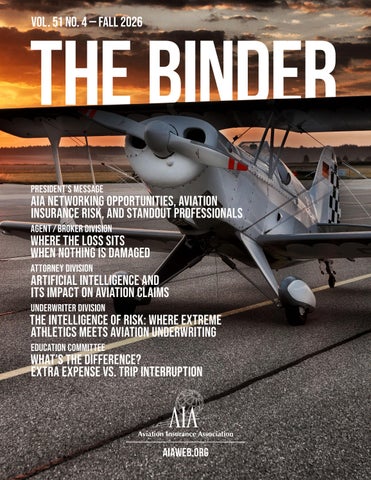
VOL. 51 NO. 4 — fall 2026
PRESIDENT’S MESSAGE
AIA NETWORKING OPPORTUNITIES, AVIATION INSURANCE RISK, AND STANDOUT PROFESSIONALS
AGENT / BROKER DIVISION
WHERE THE LOSS SITS WHEN NOTHING IS DAMAGED ATTORNEY DIVISION
ARTIFICIAL INTELLIGENCE AND ITS IMPACT ON AVIATION CLAIMS
UNDERWRITER DIVISION
THE INTELLIGENCE OF RISK: WHERE EXTREME ATHLETICS MEETS AVIATION UNDERWRITING EDUCATION COMMITTEE
WHAT’S THE DIFFERENCE? EXTRA EXPENSE VS. TRIP INTERRUPTION
table of contents
04
18
Looking Ahead: AIA Networking Opportunities, Aviation Insurance Risk, and StandOut Professionals
What’s the Difference? Extra Expense vs. Trip Interruption
06
21
President’s Message
education committee
agent / broker DIVISION
2026 aia open
10
24
artificial intelligence and its impact on aviation claims
the aging pilot population and the challenges ahead
13
34
where the loss sits when nothing is damaged
highlights and photos
attorney DIVISION
safety report
underwriter division
board of directors
The Intelligence of Risk: Where Extreme Athletics Meets Aviation Underwriting
EDITOR
KIM ROSENLOF
The ideas and opinions expressed by authors of articles published in The Binder are wholly their own and do not necessarily represent those of the Aviation Insurance Association. The articles are not provided as legal advice.
www.aiaweb.org 3
Published by the Aviation Insurance Association 2365 Harrodsburg Road Suite A325 Lexington, KY 40504
PRESIDENT’S MESSAGE
Looking Ahead: AIA Networking Opportunities, Aviation Insurance Risk, and StandOut Professionals Ian Wrigglesworth, Global Head of Aviation and Aerospace Specialty, marsh re aia president 2025–2027
Dear all,
This will be held during the week of February 8, 2027. The AIA gathering will focus on education, general aviation insurance and networking, particularly on Tuesday, February 9. I would like to thank Sompo Re, SCOR, Partner Re and Swiss Re for initiating and supporting this new gathering.
It was wonderful to see so many of you at the AIA Open at the Atlanta National Golf course on Monday, September 21. This has become a regular fixture on the AIA calendar; for those golfers who missed it, please watch for this event to be held at a similar time next year.
Regarding business, I have been hearing more about pressure on aviation insurance rating, which is causing concern throughout the market. The insurance underwriters are being encouraged to “sharpen their pencils” as new capacity enters the market. This is at a time of yearon-year social inflation and increasing repair costs, which in effect reduces the rates, even if rating and premium stand still. Reinsurers are demonstrating how unprofitable aviation has been for them over the past 10 years, with the liability for increasingly large losses being paid by their companies. Many of us have seen this trend over the years and it normally doesn’t end well. New initiatives and datadriven risk selection are only able to cover up rate decreases for a short while.
The London Symposium on October 27 has also become a regular feature in our autumn calendar. Since we outgrew last year’s location, we have a new venue at The Leonardo Royal Hotel, Tower Bridge. We look forward to another record attendance this year with interesting industry topics and well-chosen speakers. Thank you so much to our sponsors and please encourage your colleagues to join us at this event. To carry on the international flavour from London, we’re acting on some excellent ideas and enthusiasm for another event in Zurich.
4
PRESIDENT’S MESSAGE Focusing on people, I want to highlight one skill set that is often overlooked. Insurance to the outside world has many people glazing over. Slightly less so in Aviation because we are special—or so I keep telling everyone. Everywhere I go in this business there are stand-out entrepreneurs. We have educated, experienced and driven professionals who drive changes and improvements to our industry. These people are not only found in smaller firms but often at the heart of larger companies, too. Without these people who are willing to invest their time, money, and in some cases assets, we would not be able to provide the solutions that our clients want. Thank you to all those people who ultimately benefit us all.
We are known as a non-correlating class of business to Property, but is that correct, or have we just been fortunate? I feel the focus on cover is for a sudden and catastrophic loss arising from individual aircraft and damage to structures on the ground. It seems to me that cover is still very available not only for this, but also for a very wide range of natural catastrophe-related losses.
The insurance underwriters are being encouraged to Finally, thank you to all of you who contribute to the AIA in “sharpen their pencils” so many ways, from the Board of Directors, the committees, as new capacity sponsors and attendees. We enters the market. welcome all your ideas and encourage you to contribute to our future. I look forward to seeing you all in London, Zurich or Colorado in the coming months.
Lastly, I wanted to comment on risk. Whether aviation manufacturers, airlines owners and pilots see aviation insurance as a cheap form of capital, a required cost of doing business, or the ability to sleep at night, they are able to purchase protection for their risk. The deeper we examine risk, the more we as insurers and reinsurers need to learn as we try to predict the effects from solar storms, windstorms, hail, and earthquakes, very little of which seems to influence aviation insurance pricing.
Ian Wrigglesworth currently serves as Global Head of Aviation and Aerospace Specialty at Marsh Re, based in London, UK. As an active AIA member for more than 25 years, Ian has served in several capacities on the AIA Board of Directors. He assumed the role of AIA President in April 2025.
5
agent/broker division
Where the loss sits when nothing is damaged Melanie Daglish, Director of Aviation, ITIC AIA Premier Member
Grounding in Products Liability
When an airworthiness directive (AD) grounds a fleet, the financial consequences for the operators affected follow quickly. Aircraft are removed from service and routes are flown with substitute capacity or cancelled altogether. Revenue slows while the costs of aircraft ownership and operation continue.
In its standard form, aerospace products liability responds to losses arising from an occurrence, an accident or incident causing bodily injury or property damage. A precautionary grounding involves neither, so the policy is never triggered. A partial answer does exist. A non-occurrence grounding liability endorsement can be added to aerospace products liability cover and will respond to liabilities arising from an aircraft grounding without the usual occurrence-based trigger. However, it is not widely purchased, and it may only
Often no accident has occurred, and nobody has been hurt. But a question follows the regulator’s response, and it is one this market has yet to find a consistent answer to: while the policy holder may bear the financial loss, is it insured, and if not, can it be recovered from someone else?
6
agent/broker division really be considered by those insureds who would ordinarily take out aerospace products liability cover. For other parties in the chain, however, a real financial loss can be left without an obvious source of recovery.
argued to have been wider than necessary, poorly timed, or based on an incomplete or erroneous assessment, the exposure is not a products liability question. It is a professional liability question, resting on whether the advice was reasonable and how far others relied on it.
the loss still has to sit somewhere, and This is not to say that aviation insurance policies should the solution may sit be developed to respond, as outside traditional standard, to all losses arising from every AD. The cause of a aviation lines.
In IUAI’s 2026 Cyber and Emerging Risks Study Group survey, which polled 106 aviation insurance and reinsurance practitioners, supply chain and
directive can be as broad as its consequences, and no single class of business should be expected to absorb that
manufacturer issues appeared among the three most significant threats to the sector for the first time. The concern isn’t with the standard of manufacture, but the supply chain behind it and the escalating costs of aerospace parts and repair. Once an aircraft is grounded, how quickly can the parts be found to satisfy the AD? What will the costs be? The risks driving aviation losses can easily fall outside the frame of a strictly occurrence-based cover.
range as a matter of course. But the loss still has to sit somewhere, and the solution may sit outside traditional aviation lines.
The Effects of a Grounding AD An AD follows a chain of professional judgement: engineers assess the defect, technical consultants advise on its potential scope, and aircraft managers mitigate the effect on their fleet. When that judgement is challenged, whether the grounding is
7
agent/broker division
to aircraft, or risks arising from aircraft operation, are not necessarily thinking about professional liability, or the specialist advice that shaped how an aircraft was designed and deployed for operation. The two covers sit with different teams and are rarely discussed together, even though the same one event can trigger both policies. Professional indemnity insurance is also relevant to aircraft managers and other professionals whose advice informs these decisions.
Providing Cover with Professional Indemnity Insurance Professional indemnity insurance can respond to this kind of exposure where the loss arises from professional advice or judgement alleged to have been negligent. It is not designed to respond to liabilities arising simply from nonnegligent bodily injury or physical loss, but to claims arising from professional judgement that was relied upon and subsequently challenged.
Conclusion
For this reason, civil aviation authorities, independent aircraft technical experts, aerospace designers and certification agencies are the obvious candidates for PI cover. However, the range of companies within the aviation sector that hold a professional exposure is much wider than many initially realise. For example, aircraft fleet managers make decisions every day on behalf of the owner concerning the aircraft’s technical condition, crewing, utilisation and insurance arrangements. Where these decisions are challenged, a professional indemnity policy could often assist in the defence of the decisions made by the aircraft fleet manager.
As aircraft systems grow more complex, disputes are increasingly likely to turn on whether the right advice was given, not simply on what physically happened. None of this requires every aviation underwriter to become a specialist in a class they do not write. It requires a simpler question, asked earlier and more often than it currently is: when a grounding causes real financial loss, and no aircraft is damaged and no passenger is hurt, where does that loss land, and has anyone insured it? Melanie Daglish is Director of Aviation at ITIC, International Transport Intermediaries Club, which provides professional indemnity cover to transport professionals and intermediaries worldwide. Her insurance career spans more than twenty years in underwriting and claims, and she is a Board Member of the British Business and General Aviation Association.
Part of the reason the connection is rarely made is structural. Aviation insurance is a specialised market, and specialisation produces silos. Underwriters assessing physical damage
8
FLY SAFE. TRAIN SMART.
With 20 simulators, five locations, and 40+ experienced instructors, Executive Flight Training is proud to be expanding while ensuring individualized, custom instruction for our clients.
(843) 521-9412
A U S T I N ,
T X
B E |A U F O R T ,
S C
D A |L L A S ,
T X
H O U S T|O N ,
T X
S A V A N N A H ,
G A
attorney division
Artificial Intelligence and its Impact on Aviation Claims Simon Forster, Head of Predictive Analytics and Data, HF Limited and Lily Campbell, Project Manager in High Five, HF Limited
quantum, reserving and risk management. The challenge is no longer determining whether data exists, but how quickly and reliably insurers can turn that information into actionable insights and datadriven decisions.
Introduction The concept of Artificial Intelligence (AI) pervades almost every aspect of modern life and seems the inevitable next step in how business will be conducted, whether we embrace it or not. Yet the general populace knows little about how it works or its full capability at this early stage. The topic featured at our annual conference in Dallas, and the opinion of the panel that discussed it, was that claims professionals and their attorneys are still a necessity in the adjusting process. In this article the authors explain how AI is currently deployed in aviation claims and what we can expect in the near future.
simon forster
Technical expertise, legal judgment and experienced claims handling remain central to aviation claims. That hasn’t changed. However, the increasing use of analytics, intelligent document review and legally-trained AI now support those experts by reducing manual effort, identifying value drivers earlier, and creating a clearer view of portfolio risk.
lily campbell
The challenge is no Aviation Claims in the Age longer determining of Data and Artificial Intelligence whether data exists, Aviation insurance generates an exceptional volume but how quickly and of specialist information. reliably insurers can Incident investigations, engineering reports, turn that information maintenance records, regulatory correspondence, into actionable insights witness evidence and claim and data-driven decisions. files all contain insight that can influence liability,
10
The technology works by converting unstructured material—such as reports, correspondence and expert evidence—into structured and searchable data. AI models can identify entities, dates, issues, themes and potential risk indicators within documents, while analytical models compare those data points across claims or portfolios. This allows organisations to move from file-by-file review to a more systematic understanding of trends, outliers and emerging exposures.
attorney division For aviation clients, this is particularly relevant because claims often combine technical, operational, regulatory and legal evidence. A single matter may involve aircraft systems, maintenance history, pilot or crew actions, ground handling, contractual relationships, jurisdictional issues and safety regulation. Technology and innovative solutions can help connect those strands more effectively, ensuring that critical information is not lost within large document sets.
intervention. Claims teams are then able prioritise expertise where it is most likely to deliver the greatest material impact, whether that means earlier technical review, targeted strategies or closer monitoring of emerging risk/ the potential for rising exposure. At portfolio level, the same approach can support reserve adequacy, identify volatility drivers and improve forecasting confidence. In a market heavily impacted by rising claims inflation, supply-
Using Predictive Analytics to Gain Data-Driven Insights
chain pressures, evolving safety expectations and complex coverage positions, that additional visibility and oversight can be invaluable for insurers, reinsurers, brokers and aviation operators.
Predictive analytics builds on that extracted data by leveraging historical settled outcomes and observable claim characteristics to identify patterns associated with future cost, duration or complexity. It does not replace professional judgment or suggest that individual claims can be predicted with certainty. Instead, it adds a further layer of data-driven insight to support earlier and more consistent decision-making.
Some insurers already use an AI application built for legal and claims environments to interrogate large volumes of documentation, summarise key issues and locate relevant information faster, more consistently and with enhanced granularity, while at the same time preserving human oversight and governance. Its value is not in replacing lawyers, adjusters or claims professionals, but in allowing them to spend less time searching for information and more time applying expert knowledge and judgment.
For example, models can highlight claims that appear more susceptible to reserve deterioration, lifecycle elongation or specialist
11
attorney division
From Documents to Decisions
evidence base, with faster access to the facts that matter and a clearer view of comparable matters across the portfolio.
The strongest results emerge when AI-assisted documentary review and data analytics coincide. Information extracted from claim files, investigations and expert reports can feed dashboards to surface thematic developments and market-wide trend analysis. This turns individual file knowledge into portfolio intelligence, helping insurers to identify and understand recurring issues, loss drivers and claim development patterns.
This principle underpins solutions spanning predictive analytics, claims modelling, intelligent automation and legally-trained AI. These tools are designed to help aviation clients manage complexity, control cost and respond earlier to changing risk signals while maintaining the expert oversight that remains central to successful claims management.
Technology as an Enabler, Not a Replacement
The future of aviation claims will not be defined by AI alone. It will be shaped by the effective partnership between human expertise, high-quality data and intelligent technology. Organisations that build that partnership well will be better positioned to improve claims outcomes, strengthen reserving confidence and support more proactive risk management across the aviation insurance market.
The aviation sector already understands the value of technology-led improvement, from aircraft design and navigation systems to safety management and operational monitoring. Claims technology should be viewed in the same way: as an enabler of better expertise, not a substitute for it. Aviation claims still require nuanced assessment of causation, liability, regulation, coverage and commercial strategy. However, technology can ensure that specialists work from a richer
Simon Forster is Head of Predictive Analytics and Data and Lily Campbell is a Project Manager in High Five, a tech innovator for insurers.
12
underwriter division
The Intelligence of Risk: Where Extreme Athletics Meets Aviation Underwriting Britt Kral, Assistant Vice President and General Aviation Manager, Beacon Aviation Insurance Services AIA Board of Directors, Underwriter Division
What does climbing high-altitude peaks, moving through exposed alpine terrain, navigating unpredictable weather, carrying a heavily loaded pack for hours, and making consequential decisions when your body is exhausted have to do with aviation underwriting?
Physical fitness gets you to the starting line. Mental discipline is what gets you home: the ability to assess what is happening around you, recognize when something has changed, adapt your plan, and make a sound decision when the consequences are real.
Everything.
Mountaineering has taught me that some of the most valuable forms of intelligence cannot be measured by a test score. They are developed through experience, observation, pressure, preparation, and judgment. I think of them as four forms of intelligence: interpersonal, problem-solving, risk, and attentional.
I am an extreme athlete and alpine mountaineer. For over a decade, I’ve deliberately put myself in environments where preparation matters, conditions can change in minutes, and complacency can have consequences. The mountains have taught me something that extends far beyond physical endurance: risk is not something to fear or avoid. It is something to understand.
13
underwriter division
Interpersonal Intelligence
Problem-Solving Intelligence
Mountaineering may look like an individual pursuit, but some of the most consequential decisions are made as a team.
In the mountains, the prepared plan eventually meets reality. Weather changes. Terrain becomes more technical. Fatigue sets in. A route that looked manageable from the ground can look very different at altitude.
Interpersonal intelligence is understanding the people around you—your partners, guides, and teammates—and recognizing how they communicate, react under pressure, and make decisions.
Problem-solving intelligence is knowing what to do when the original plan no longer fits the conditions. You reassess, gather the information available, adapt, and make the best decision possible.
It is also recognizing what isn’t being said. A teammate may say they are fine, but their pace has changed. Their communication is different. They are making small mistakes they normally wouldn’t make.
Underwriting requires the same discipline. Information may be incomplete. Training may be outdated. Losses may raise questions. A pilot may be transitioning into an unfamiliar aircraft.
Underwriting is no different. A submission gives me facts; a conversation gives me context. The best underwriters learn to listen beyond the answers and recognize the human factors behind the risk.
Instead of simply checking boxes, I want to understand why something is missing, what it means, and whether it changes the risk.
14
underwriter division Risk Intelligence
In the mountains, small details matter: a building cloud, a change in wind, deteriorating terrain, equipment that isn’t quite right, or a teammate who suddenly isn’t moving the same way.
This is where the connection becomes almost impossible to ignore. In the mountains, I constantly evaluate exposure: weather, terrain, route conditions, equipment, fatigue, timing, altitude, and human factors. Credit: U.S. Air Force I am not trying to eliminate risk. I am trying to understand it well enough to make an intelligent decision about whether to proceed.
Underwriting requires the same awareness. Sometimes the most important piece of information isn’t the largest number on the submission. It is the small inconsistency: a pilot who hasn’t flown recently, training that is past due, hours that don’t align, a change in aircraft use, or a loss that looks minor until you understand the circumstances behind it.
That philosophy shapes my underwriting. I look beyond the aircraft and the numbers. Who is flying it? How current are they? How are they trained? How is the aircraft being used? What does the loss history tell us? And perhaps most importantly, what could happen next?
Attention is a form of risk management.
The Same Mindset, Different Mountain Both mountaineering and aviation underwriting require preparation, discipline, respect for conditions, and the ability to recognize when circumstances change.
Good underwriting isn’t about avoiding every risk that makes you uncomfortable. It is about understanding the exposure well enough to make a disciplined decision about it.
Both reward people who know when to push forward—and when the smartest decision is to stop.
Attentional Intelligence Then there is attentional intelligence — the ability to remain present and notice what is changing before it becomes a problem.
15
underwriter division
The irony is that extreme athletics has not made me more comfortable with risk. It has made me better at understanding it: better at recognizing it, questioning it, preparing for it, and knowing when conditions demand a different decision.
But the mindset remains the same: Assess. Anticipate. Adapt. Decide.
When I am standing on a mountain thousands of feet above the valley, I am not trying to prove that I am fearless. I am using experience, preparation, observation, judgment, and calculated risk to make the next decision.
Britt Kral lives in Salt Lake City, Utah, with her husband, two sons, and their GSP, Frank. Her aviation insurance career began as an agent in Chicago and has grown into 14 years of underwriting experience. Outside of work, Britt is an avid mountaineer with 59+ summits and a passion for chasing bigger challenges, exploring new places, and embracing the next great adventure. Britt was elected at the 2026 AIA Conference as the Underwriter Division’s Director-Elect.
Because the best risk decisions aren’t made by people who ignore risk. They’re made by people who understand it.
When I am underwriting an aviation risk, I am doing the same thing. The mountain changes. The aircraft changes. The exposure changes.
16
Protect the Claim. Control the Risk. 24/7/365 Nationwide Environmental Response, Regulatory Reporting, and Contractor Management for Aviation Incidents
NATIONWIDE EMERGENCY RESPONSE 800-579-2872 6205 Chapel Hill Blvd Suite 100 Plano, Texas 75093 Non-Emergency 972-378-7333 www.curaes.com
education committee
What’s the Difference? Extra Expense vs. Trip Interruption Joe Williams, EVP/MD, Marsh Agency se, and Jeff Higel, Underwriting Manager, Allianz Commercial AIA Education Committee and Course Instructors
Welcome to the fourth edition of “What’s the Difference?” In this edition, we’ll be discussing what’s the difference between:
Some policies require the insured to use Commercial Airfare, which is intended to mean an airline but generally does not explicitly state an airline airfare, whereas others will use the “reasonable means” requirement. This is intended to be a one-time coverage.
xtra Expense for E Substitute Aircraft Trip Interruption Before we discuss the differences, let’s briefly outline what each coverage is intended to do.
joe williams
Let’s look a little deeper at each. In the policies we reviewed for this article, Extra Expense can have varying Minimum Repair periods expressed in days, as well as Maximum Coverage periods which are also expressed in days. There may or may not be a daily limit. Finally, there is a total Coverage Limit. It’s an intentionally very broad coverage, though there are terms and exclusions. Here are a few common exclusions:
Extra Expense for Substitute Aircraft (abbreviated to Extra Expense for the rest of this article) is intended to provide the policyholder with coverage for their additional jeff higel expenses when required to use a substitute aircraft, generally a chartered 1. Another aircraft is available at no charge for its use aircraft. This coverage is only available due 2. If the policyholder acquires a new aircraft as a to a covered physical damage loss to the permanent replacement policyholder’s aircraft. Some markets refer 3. In the event of the offer of total loss (though there to this coverage differently, for example, are policy forms that we did not review for this as Replacement Aircraft Rental Expense. article that extend beyond the payment of a total Regardless of the name, the intent is similar. loss) Trip Interruption is a different side of the 4. There must be an actual “extra expense” as same coin. Trip Interruption is intended to defined by the policy. Some policies define this provide the policyholder with coverage to term and some do not. get home or to their final destination.
18
education committee So, with the basics of each coverage described above, let’s talk a bit more about the practical application in a couple hypotheticals:
It’s important to remember for point four that the insured must pay the same amount per hour to operate the rental aircraft as they did to operate their own. This is not limited to just fuel but can also include miscellaneous operating costs such as maintenance reserves.
First scenario: a flight is leaving PDK en route to FLL. It experiences a covered Physical Damage loss and diverts to JAX. Under the Trip Interruption coverage, each passenger could fly back to PDK or continue to FLL, all while charging their reasonable food and lodging expenses to the claim. The benefit to the insured here is that the coverage will not require them to spend any money and can be used for passengers independently. So, if two passengers want to book a flight to Atlanta and Uber back to PDK, they can, while two other passengers could spend the night in Jacksonville and catch a flight out the next day.
In the policies we reviewed for this article, Trip Interruption is a little more simply stated. This is generally due to having a lower limit available as well as being a one-time coverage to get the passengers, and in some policies crew, to their destination or home. All the policies we reviewed used the phrase “…for the reasonable expenses providing…” and then went on to list food, transportation, lodging or similar phraseology. This is a reimbursement coverage; most of the policies we reviewed indicated that the insurer will “promptly reimburse.” Furthermore, the limits of Trip Interruption are commonly presented as a “per Passenger” limit, sometimes with a per Occurrence maximum.
Once the dust has settled and passengers are at their destinations, then the Extra Expense coverage would shift into focus. The insured would have the ability to rent a replacement aircraft, subject to daily limits, minimum repair durations, and total limit of days.
19
education committee
Ultimately, the insured would be paying their usual expenses for operating the aircraft and the insurer would pick up the difference.
As always, read your insurance policies and keep in mind that they can be tailored to each policyholder. Each scenario and potential claim is unique.
Second scenario: a flight is leaving PDK and lands at FLL to pick up additional passengers and continue to the Bahamas. While on the ground, it experiences a covered Physical Damage claim. Trip Interruption is still available to take the passengers back to the original location or on to the destination, after which the Extra Expense will kick in for future flights.
Thanks for reading the fourth edition of “What’s the Difference?” We hope you enjoyed the article and sharpened your knowledge. If you’d like to suggest a topic, have a question, or want to co-author a future edition please reach out to the AIA Education Committee by emailing info@aiaweb.org.
Third scenario: a flight returns to PDK from a trip to FLL and upon landing experiences a covered Physical Damage claim. There is no Trip Interruption expense available in this scenario because the trip has been completed. Thus, Extra Expense is the only available coverage.
Joe Williams is an Aviation Insurance Broker and Managing Director of Aviation for Marsh Agency SE who formerly served as an aviation insurance underwriter at AIG and Starr. In addition to serving as the AIA Education Committee Chair, Joe co-teaches the AIA’s Core Principles and Introduction to Aviation Insurance courses. He is a former professional flight instructor as well as former corporate pilot.
Looking at our claims scenarios we can see the apparent overlap between the two coverages. However, the most important distinctions between the two coverages are:
Jeff Higel is an Underwriting Manager in Allianz’s Atlanta office. He is a Commercial Pilot, CFI, and licensed NY Attorney. Jeff began his career in Claims and has also spent time working in Product Development. He holds a B.S. in Aviation Management from Purdue and JD from Emory Law School.
rip Interruption can only take you back to T your origin or on to your destination. rip Interruption can have a per Passenger T limit and Passengers can book travel independently of each other. xtra Expense covers the extra costs an E insured incurs, but the insured still must pay for their typical costs associated with operating their aircraft.
20
2026 aia open
2026 AIA Open Highlights Thank you to the more than 85 professionals who joined us on September 21 at Atlanta National Golf Club. Our largest AIA Open to date featured blue skies, sunshine, and a fun day on the greens.
Congratulations to our winners: irst Place Team: John Fitzpatrick, Luke F Hargett, Todd Lewis, and Luke Uithoven econd Place Team: Preston Harris, S Tripp Harris, Josh Ray, and Dave Warfel Closest to the Pin: Aaron Schloegel
Enjoy highlights from the outing in the following pages and visit the AIA website for the full photo gallery.
ongest Drive and Putting Green L Contest Winner: Kate Bustin
21
2026 aia open
22
2026 aia open Winner’s Circle
Thank You, Sponsors
First Place Team Pictured L-R: AIA Executive Director Mary Gratzer, Todd Lewis, Luke Uithoven and Luke Hargett
Second Place Team Pictured L-R: Tripp Harris, Dave Warfel, Josh Ray, Preston Harris, and AIA Vice President Luke Uithoven
Longest Drive and Putting Green Contest Pictured L-R: Kate Bustin and AIA Executive Director Mary Gratzer
23
safety report
The Aging Pilot Population and the Challenges Ahead
Sherry J. Ortiz, Esq., Partner, US Head of Aerospace Claims, Gallagher Global Aerospace AIA Safety Committee Member Do accident statistics prevent healthy, capable pilots from flying due to uninsurability? Does aging research and accident data turn most underwriting models on their heads? How can insurers respond without treating chronological age as a complete measure of risk? What can aging pilots do to make themselves insurable?
The FAA’s 2025 Civil Airmen Statistics counted 887,518 active U.S. pilots. Of that total 114,392 were age 65 or older, which equals 12.9% of the active-pilot population. The FAA counted 45,224 pilots aged 65–69; 32,406 aged 70–74; 21,254 aged 75–79; and 15,508 aged 80 or older.
Figure 1. Active U.S. pilots age 65 and older by age group and selected certificate category, 2025. Federal Aviation Administration
24
safety report These figures do not prove that age is irrelevant to safety, nor do they establish how many hours each pilot currently flies. The FAA does not publicly cross-tabulate age with pilots’ lifetime flight time in this dataset. They do show, however, that the older-pilot population is both sizable and highly credentialed.
even without dementia or other neurological disease. These changes deserve attention, but they should not be confused with a diagnosis of incapacity.1 Research on aging pilots generally finds measurable changes in processing speed, working memory and performance under high workload, while also showing that aviation expertise and strong baseline cognitive ability can preserve performance. The studies do not support the conclusion that every pilot experiences the same decline at the same age.
Older pilots present a real underwriting challenge, but the common shorthand that they simply “crash more” does not describe the evidence well. Accident counts may rise in older age groups because those pilots fly more, while exposure-adjusted studies produce mixed results. Some insurance experience instead points to a sharper increase in the cost of claims after about age 70, especially when older pilots operate faster, more complex and more valuable aircraft. The sound underwriting response is therefore to measure proficiency, recent activity, mission and aircraft severity alongside age, then use training, operating restrictions, deductibles, second pilots or liability-only coverage to manage the identified risk.
One study (Morrow) compared older and younger pilots performing a laboratory task modeled on routine air traffic control communication. Aviation expertise reduced agerelated differences because experienced pilots used domain knowledge to organize and execute the instructions more effectively. The study showed that expertise can compensate for some cognitive aging in familiar, structured tasks.2 Another study followed 118 general aviation pilots aged 40 to 69 over three years using annual simulator evaluations. Older pilots began with lower average simulator scores, but the older group declined less over the study period. Higher FAA proficiency ratings predicted better initial performance and slower decline, particularly in the accurate execution of air traffic control communications.3 The
The Effects of Aging on Pilots Aging can affect abilities important to flying, but it does not affect every ability or every pilot equally. Normal cognitive aging may involve slower information processing and changes in memory and executive function,
25
safety report result cautions against assuming that a cross-sectional age difference necessarily predicts a rapid future decline in an individual pilot.
activity. Older pilots performed less well than younger pilots, with the largest difference during the highest-load spatialworking-memory condition. At that level, prefrontal activity reached a plateau consistent with a limit on available cognitive resources. Among the older pilots, those with extensive flight experience tended to preserve spatial working-memory performance better than their lessexperienced peers.5
Another study (Yesavage) expanded the longitudinal analysis to 276 pilots aged 40 to 77.9. Adding cognitive processing speed and executive-function measures significantly improved prediction of simulator-performance change. Pilots with the strongest scores in both areas showed the slowest decline. Aviation expertise enhanced
Sensory changes also matter. Research on aging and vision documents slower adaptation to darkness, reduced contrast sensitivity and changes in visual processing. These functions have obvious relevance to night flying and detecting low-contrast objects, although applying the vision research to those cockpit tasks
performance throughout the age range but did not eliminate the statistical effect of age.4 This finding supports functional assessment as a useful supplement to chronological age. Another study (Causse, Chua and Rémy) tested 61 private pilots across three age groups on spatial working memory and planning tasks while measuring prefrontal
26
safety report is an operational inference rather than a measured pilot-accident finding. Visual capability therefore deserves consideration beyond a pilot’s ability to read a standard acuity chart.6
Taken together, these studies describe a reserve-capacity problem rather than a uniform loss of competence. Experienced older pilots may perform well during familiar and moderately demanding operations, but differences become more visible when tasks require rapid processing, divided attention, workingmemory updating or recovery from an unexpected event.
Medical and Physiological Concerns Medical incapacitation presents a separate concern. A systematic review of ten studies found that most studies examining age reported increasing incapacitation with advancing age, while in-flight medical incapacitation remained rare. The reviewers could not determine whether the observed increase translated into more accidents or whether experience-related reductions in other errors could compensate. Their findings support attention to individual health without supplying a scientifically precise date or age at which a pilot becomes unsafe.7
Age-related changes warrant scrutiny, while demonstrated proficiency, relevant expertise, current health and the demands of the intended operation provide essential individual context. These studies also have limits: laboratory and simulator results are not accident probabilities, and findings from pilots enrolled through age 69 should not be extrapolated uncritically to pilots in their 80s. Age can inform an assessment; it cannot, by itself, complete one.
Other research has examined medical and physiological factors rather than cognition alone. In the Vuorio research, the study reviewed 114 fatal general aviation accidents involving pilots aged 70 to 92 and identified potentially relevant medical conditions and medication use, including polypharmacy. Because the study reviewed fatal accidents rather than a matched population of active pilots, it could identify hazards but could not establish the accident rate or prove that a particular condition caused a crash.8 Together with evidence of reduced tolerance for traumatic injury, this research supports individualized attention to medical fitness, medication effects and physical resilience without treating age itself as a diagnosis.
The Numbers An accident count is not an accident rate. A group can account for more accidents because it contains more active pilots or the subject group may fly more hours. The relevant denominator is exposure, usually flight hours, operations or an equivalent measure. Good data on flight hours by pilot age are limited, particularly above age 75. That limitation becomes more important as the population gets smaller and individual losses have more influence on the result. The available research does not establish a single, smooth risk curve that begins at a universally accepted age. An FAA analysis
27
safety report of professional ATP and commercial pilots found a statistically higher accident rate for pilots aged 60–63 than for pilots aged 55–59. However, that research concerned professional pilots; any inference to a correlation of accident rates should not be assumed to apply to general aviation pilots.9 Earlier FAA general aviation research also found that age interacted with total experience and recent flight time. Pilots with substantial experience but low recency hours were seen to perform
expectations at roughly age 55.11 A similarly states that accident numbers increase for pilots 55 and older, while cautioning that the increase may reflect greater flying activity among older adults.12 These observations identify an area for attention, not a defensible hard cutoff.
Qualitative vs. Quantitative Analysis of Risk is Critical The most supportable age-band description is qualitative. It avoids false precision while
Notable People (aged 65 or older) in Executive Roles Executive
Age
Current Leadership Roles
Warren Buffet
96
Chairman Emeritus, Berkshire Hathaway
Larry Ellison
96
Executive Chairman & CTO, Oracle
Stephen Schwarzman
75
Chairman & CEO, Blackstone
Ajit Jain
75
Vice Chairman, Insurance Operations, Berkshire Hathaway
Sir Tim Clark
76
President, Emirates Airline
Marc Hamburg
76
SVP/CFO, Berkshire Hathaway
Jamie Dimon
70
Chairman & CEO, JPMorgan Chase
Steve Ballmer
70
Chairman, LA Clippers; former Microsoft CEO
Carol Tomé
69
Senior corporate leader/former UPS CEO
Ed Bastion
69
CEO, Delta Airlines
Brian Moynihan
66
Chairman & CEO, Bank of America
Kelly Ortberg
66
President & CEO, Boeing
David Neeleman
66
Founder & CEO, Breeze Airways
showing where underwriting scrutiny typically becomes more intensive. In this author’s opinion, false precision is the major obstacle to overcome for the aging pilot’s insurability dilemma; population-level statistics should inform, not dictate an individual underwriting decision. Essentially, underwriters (and their respective actuaries) should consider replacing a rigid age cutoff with a comprehensive, individualized assessment of risk.
worse than equally experienced pilots who remained active.10 In a nutshell, pilots who combine substantial flight hour experience with regular, recent flight hours generally lower accident risk across all age groups. AOPA has cited an unpublished Air Safety Institute analysis suggesting that accident involvement began to exceed
28
safety report The Frequency vs. Severity Dilemma
Claim Severity with Accidents Involving Pilots Over 70
Insurance loss costs generally have two components: claim frequency and claim severity. A group can have the same rate of claims as another group but produce a larger expected loss if each claim costs more. AOPA reported in 2018 that insurers it interviewed saw higher average claim costs among pilots over 70, driven by severity rather than frequency.13 A later AOPA survey found that respondents over 70 were no more likely than younger respondents to report an accident in the preceding five years (although a voluntary survey is not an exposure-controlled actuarial study).14 Pilot Age
Claim severity increases with aircraft value and complexity. Experienced older pilots are often the owners of faster, more sophisticated aircraft. A runway excursion or propeller strike in a modest fixed-gear piston aircraft may produce a manageable repair. A similar event in a high-value retractable, turbine aircraft or pressurized twin can require engine teardown, propeller replacement, structural inspection and lengthy downtime. AOPA specifically linked heightened concern around age 70 to faster, higher-value and more complex aircraft.15
Risk Evidence
Practical Interpetation
Under 55
No consistent age-driven increase identified
Use conventional experience, recency, training and aircraft criteria
55–64
Some analyses detect the beginning of an upward pattern; findings vary with exposure and pilot population
Treat age as a prompt to examine activity and proficiency, not as a coverage boundary
65–69
FAA eligibility continues for most general aviation; insurance usually remains broadly available
Begin a documented annual proficiency and renewal strategy
70–74
Insurer scrutiny commonly becomes more visible; claim-cost concerns appear in market reporting
Evaluate hull value, aircraft complexity, medical fitness, recent hours and recurrent training together
75–79
Data are thinner and market appetite becomes more selective
Offer the underwriter specific mitigations instead of waiting for a binary accept-or-decline decision
80 and older
Small samples make broad conclusions unstable; conventional hull coverage can become difficult
Individual underwriting, second-pilot structures and liability-only coverage become increasingly important
The evidence is not uniform. In 2024, AOPA reported that one underwriter was seeing increases in both frequency and severity among pilots over 70, while another market participant emphasized more frequent, relatively minor events such as propeller strikes.15 The careful conclusion is therefore that a severity effect has been observed in insurance data, not that frequency remains flat in every portfolio or age band.
The operational error does not have to be more dramatic for the insured loss to be much larger. Experience can compensate for gradual changes in reaction time, divided attention, working memory and processing speed during normal operations. That same compensation may be less effective during
29
safety report a rapidly changing approach, equipment failure, go-around or loss-of-control sequence. The resulting hypothesis is plausible: experience can hold down routine error frequency while reduced cognitive or physical reserve can worsen the outcome when a demanding event occurs. While this interpretation is relevant, it is not proof of causation in insurance data.
earlier. Some pilots stop flying, fail to meet medical standards, move to simpler aircraft or limit the scope of their flying. Those who remain tend to be unusually experienced, active and medically fit. In AOPA’s 2021 survey, pilots over 70 reported nearly 70 hours of flying in the preceding year; more than 75% held instrument ratings, and more than half held commercial or ATP certificates.14
Another factor is that older people can suffer more serious injury from the same impact. An early FAA study observed a somewhat higher proportion of fatal accidents among pilots over 60 and discussed reduced physiological recovery from trauma as a possible explanation, while warning that the evidence was not sufficient to establish a general age effect.16 Accident severity, injury severity and insurance claim severity should remain distinct concepts, even though they can overlap.
This selection effect helps explain why chronological age does not translate neatly into accident frequency. It also makes recency critical. A pilot with thousands of lifetime hours who flies 20 hours a year may pose a different risk from a same-age pilot who flies 150 hours, completes annual recurrent training and regularly exercises instrument skills. Lifetime experience cannot substitute indefinitely for current proficiency.
FAA Authority and Insurance Appetite are Separate
Size matters. Relatively few insured pilots are active at very advanced ages. One major hull or liability loss in an age band can change an insurer’s results. If 1,000 pilots produce 20 claims averaging $75,000, the frequency is 2% and the loss is $1.5M. If 200 older pilots produce four claims averaging $300,000, frequency is still 2%, but the average claim is four times greater. The smaller group generates $1.2M of loss from 1/5 as many insureds. This simple example explains why an insurer can tighten underwriting even without a dramatic increase in frequency.
For most U.S. general aviation flying, the FAA does not impose a maximum pilot age. The FAA may issue any class of medical certificate to an applicant who meets the medical standards, regardless of age.17 The statutory age-65 limit applies to covered Part 121 air carrier operations, but not to general aviation.18 ICAO has implemented a statutory age-67 rule. An insurer may nevertheless impose stricter pilot qualifications, training, medical or operational conditions as a term of coverage. Legal authority to fly does not create a right to a particular insurance product. See automobile insurance, for example.
The pilots who continue flying into their 70s and 80s are not a random cross-section of everyone who held a certificate decades
30
safety report
Insurance Remains Available After Age 60
Total flight time and time in make and model ours flown in the preceding 12 months and H 90 days
Pilots in their sixties commonly remain eligible for conventional hull and liability coverage. Market pressure usually becomes more visible in the 70s, especially for new business, complex aircraft and high hull values. Carrier decisions remain highly individual, and no insurer will agree that it will accept every pilot through a stated age.
I nstrument currency, annual recurrent training and aircraft-specific proficiency edical status, loss history and any recent M change in capability A ircraft performance, complexity, insured value and repair characteristics ission profile, including night, IFR, M international, mountainous or high-densityairspace operations
A broker may approach established general aviation markets where the aircraft and account are a good fit. General published guidance encourages regular flying, recurrent flight reviews and instrument proficiency checks, thoughtful aircraft selection and continuity with the same underwriter.
The broker can then offer graduated controls. These may include annual recurrent training, an annual flight review and instrument proficiency check, minimum annual utilization, a higher hull deductible, a lower agreed value, defined day or VFR limitations, or an insurer-approved second pilot for higher-workload operations. A secondpilot requirement should respond to the mission and pilot profile rather than attach automatically to an age.
The clearest purpose-built option is liabilityonly insurance for senior pilots. Liability-only coverage protects against covered third-party bodily injury and property damage. It may be practical for an owner who can afford to absorb a hull loss but cannot get economically reasonable full coverage.
Continuity also matters. Moving a senior pilot from an established insurer relationship to save money may sacrifice the value of a favorable history. Underwriting guidance may encourage experienced pilots to recognize the value of maintaining an established relationship with their underwriter. A broker should begin planning before a difficult renewal. Particularly
Is There a More Defensible Underwriting Model? A senior-pilot submission should give an underwriter enough information to distinguish a strong individual risk from a weak one. The relevant variables include:
31
safety report when the pilot is considering a new aircraft or approaching an age at which a carrier’s appetite may narrow.
Better data remains essential. Public accident counts by age are insufficient without reliable exposure. Insurers can improve the discussion by analyzing claim frequency per insured aircraft or flight hour, severity by aircraft category and hull value, cause of loss, recent pilot activity, training and mission. Until that kind of data is available across a broad population, categorical statements about a universal age threshold should be treated cautiously.
Can the Market Improve? A measured underwriting response for managing an aging pilot population is built on objective, repeatable evidence. It should separate the probability of a claim from the amount likely to be paid and identify which factors respond to each component: specifically, age-related impairment and amelioration. Recurrent training and recent activity may reduce frequency. Deductibles, lower hull exposure and self-insurance directly address physical-damage severity. A mentor or second pilot may reduce operational risk during demanding missions. Medical and functional review can address individual capability without assuming that all pilots of the same age are alike.
Sherry J Ortiz serves as US Head of Aerospace Claims in Gallagher’s global aerospace practice. In her role, Sherry supports aerospace clients through complex claim scenarios and will be responsible for expanding the practice’s consulting capabilities. She also is a member of the AIA Safety Committee, serving as chair of the Aging Pilots sub-committee.
32
safety report Sources 1. Harada, Natelson Love and Triebel, “Normal Cognitive Aging,” Clinics in Geriatric Medicine (2013).
10. Federal Aviation Administration, Age Total Pilot Experience Recent Pilot Experience and Risk of Accident Involvement, Report AM 94 22. https://www. faa.gov/sites/faa.gov/files/data_research/research/ med_humanfacs/oamtechreports/AM94-22.pdf
2. Morrow, D. G., Leirer, V. O., Altieri, P. A. and Fitzsimmons, C., When Expertise Reduces Age Differences in Performance, Psychology and Aging, 1994, 9(1), 134–148. https://doi.org/10.1037/08827974.9.1.134
11. Aircraft Owners and Pilots Association, Aging and the General Aviation Pilot. https://www.aopa.org/ training-and-safety/online-learning/safety-spotlights/ aging-gracefully 12. Global Aerospace, Important Considerations for Aging Pilots, July 19, 2024. https://www.global-aero. com/important-considerations-for-aging-pilots
3. Taylor, J. L., Kennedy, Q., Noda, A. and Yesavage, J. A., Pilot Age and Expertise Predict Flight Simulator Performance A Three Year Longitudinal Study, Neurology, 2007, 68(9), 648–654. https://pmc.ncbi.nlm.nih.gov/articles/ PMC2907140
13. Aircraft Owners and Pilots Association, Ownership as Good as I Once Was, August 1, 2018. https://www.aopa.org/news-and-media/allnews/2018/august/pilot/ownership-as-good-as-ionce-was
4. Yesavage, J. A. et al., Initial Cognitive Performance Predicts Longitudinal Aviator Performance, The Journals of Gerontology Series B, 2011, 66B(4), 444–453. https://pubmed.ncbi.nlm. nih.gov/21586627
14. Aircraft Owners and Pilots Association, Older Pilots Report Negative Treatment from Insurance Companies, November 16, 2021. https://www.aopa. org/news-and-media/all-news/2021/november/16/ older-pilots-report-negative-treatment-frominsurance-companies
5. Causse, M., Chua, Z. K. and Rémy, F., Influences of Age Mental Workload and Flight Experience on Cognitive Performance and Prefrontal Activity in Private Pilots, Scientific Reports, 2019, 9, 7688. https://www.nature.com/articles/s41598-01944082-w
15. Aircraft Owners and Pilots Association, Insurance Tell Your Story, May 2024. https://www. aopa.org/news-and-media/all-news/2024/may/ pilot/insurance-tell-your-story
6. Owsley, “Aging and Vision,” Vision Research (2011).
16. Federal Aviation Administration, Age and Accident Severity in General Aviation, Report AM 67 22. https://www.faa.gov/sites/faa.gov/ files/data_research/research/med_humanfacs/ oamtechreports/AM67-22.pdf
7. Huster and colleagues, “Medical Risks in Older Pilots: A Systematic Review on Incapacitation and Age,” International Archives of Occupational and Environmental Health (2014). 8. Vuorio, A. et al., General Aviation Pilots Over 70 Years Old, Aerospace Medicine and Human Performance, 2017, 88(2), 142–145. https://doi. org/10.3357/AMHP.4717.2017
17. Federal Aviation Administration, Guide for Aviation Medical Examiners Who May Be Certified. https://www.faa.gov/ame_guide/app_process/ general/who
9. Federal Aviation Administration, Pilot Age and Accident Rates Report 4 An Analysis of Professional ATP and Commercial Pilot Accident Rates by Age. https://www.faa.gov/data_research/research/med_ humanfacs/age65
18. 49 U.S.C. section 44729, Age Standards for Pilots. https://uscode.house.gov/view. xhtml?req=granuleid:USC-prelim-title49section44729
33
Board of Directors Director, Underwriter Division Meghan Griffin
President ian Wrigglesworth Marsh Re London, United Kingdom
Sompo International Alpharetta, GA
VICE PRESIDENT Luke Uithoven
DIRECTOR-ELECT, UNDERWRITER DIVISION Britt Kral
Kimmel Aviation Insurance Agency, Inc. Greenwood, MS
Beacon Aviation Salt Lake City, UT
Treasurer Nicole Wolfe Stout
International Director nick redgrove
Strawinski & Stout, P.C. Atlanta, GA
Price Forbes London, United Kingdom
Secretary David Hampson
Director-at-Large Kristen harris
Schrager Hampson Aviation Insurance Agency Bedford, MA
BWI Aviation Insurance Agency, Inc. Warrenton, NC
DIRECTOR, AGENT / BROKER DIVISION Rachel Lewis
Director-at-Large Michael McGrory
Schrager Hampson Aviation Insurance Agency Bedford, MA
Amundsen Davis, LLC Chicago, IL
Director, Attorney Division Mark Meyer
International Director-at-Large Paul O’Ryan
HF Limited London, United Kingdom
Starr Aviation Toronto, Canada
Director-elect, Attorney Division Jennifer Fleming Perdigao
AIA General Counsel Bob Williams
Tressler LLP El Segundo, CA
Victor Rane PLC Pittsburgh, PA
DIRECTOR, CLAIMS DIVISION Stephanie Short
Executive Director Mary Gratzer
Great American Insurance Company Bellingham, WA
Aviation Insurance Association Lexington, KY
Director, Reinsurance Division Raffaella Basile Swiss Reinsurance Company Ltd Zurich, Switzerland
34
Aviation insurance glossary
Glossary of Common Aviation and Insurance Acronyms AIA — Aviation Insurance Association
GHSP — Ground Handling Service Providers
AOPA — Aircraft Owners and Pilots Association
HUD — Heads Up Display
ASAP — Aviation Safety Action Program (FAA)
IATA — International Air Transport Association
ASIAS — Aviation Safety Information Analysis and Sharing system (FAA)
IBAC — International Business Aviation Council
ASRS — Aviation Safety Reporting System (FAA)
ICAO — International Civil Aviation Organization
CASA — Civil Aviation Safety Authority (Australia)
IFR — Instrument Flight Rules IMC — Instrument Meteorological Conditions
CAAC — Civil Aviation Administration of China
IS-BAO — International Standard for Business Aircraft Operations
COPA — Cirrus Owners and Pilots Association
IS-BAH — International Standard for Business Aircraft Handling
DPE — Designated Pilot Examiner EAA — Experimental Aircraft Association
MRO — Maintenance Repair Organization
EASA — European Union Aviation Safety Agency
NBAA — National Business Aviation Association
E6B — A type of manual or electronic flight computer
NTSB — National Transportation Safety Board (U.S.)
ESG — Environmental, Social, and Governance
P&C — Property and Casualty
EVTOL — Electric Vertical Takeoff and Landing Vehicle
SMS — Safety Management System UAM — Urban Air Mobility
FAA — Federal Aviation Administration (U.S.)
UAV — Unmanned Aerial Vehicle (also known as a drone)
FBO — Fixed base operator (service station for aircraft and pilots)
VFR — Visual Flight Rules
FDM/FOQA — Flight Data Monitoring / Flight Operations Quality Assurance
WAI — Women in Aviation International
VR — Virtual Reality
GA — General Aviation
This is an abridged list of aviation insurance terms that appear in current and previous editions of the AIA’s The Binder.
GAMA — General Aviation Manufacturers Association
35