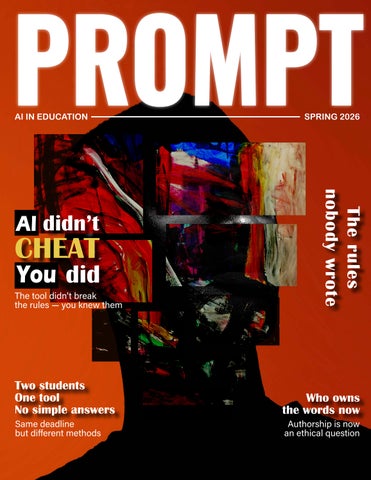
The tool didn’t break the rules — you knew them

Two
students
One tool

No simple answers
Same deadline but different methods
Who owns the words now
Authorship is now an ethical question
The tool didn’t break the rules — you knew them
students
One tool
No simple answers
Same deadline but different methods
Who owns the words now
Authorship is now an ethical question
01 02 03 04 08 07 06 05
Students defend it, lecturers distrust it, and institutions bury it in policies that are carefully crafted to be cited rather than read. Everyone has an opinion about A.I. in education, but when I actually started asking the questions, how few people were willing to say what they thought plainly.
Over the last five months, I interviewed students and lecturers at UK universities, ran a survey that only a few are willing to respond, and sat with the question that resists a clean answer: When a student submits A.I. written work, who failed first — the student, or the institution that never made the stakes legible?
PROMPT doesn’t take a side. It takes a position that ambiguity is not the same as neutrality.
Inside: A history of technology, a map of how institutions have responded, data from students who told the truth precisely, and voices from both sides of the argument. The essay was perfect. Nobody thought to ask who wrote it.
“In 1986, a group of maths teachers picketed an education conference in Washington DC. They were protesting the calculator, and it was an argument UK classroom already knew well.”

In 1986, a small group of mathematics teachers picketed the National Council of Teachers of Mathematics annual conference in Washington DC — not over pay, not over conditions, but over the pocket calculator. [Washington Post, 4 April 1986] Resistance to cal-
How
Aculator use had been building in classrooms on both sides of the Atlantic since the late 1970s, [Chartered College] and the underlying anxiety was consistent: that the tool would do the thinking, and students would stop. This argument however, was never about the calculator. Spell-checkers have provoked the same anxiety, all though nobody picketed over a red underline. Wikipedia was evenlouder, and the parents, broadsheets, university handbooks all weighing in, whether a crowd-edited encyclopaedia constituted a source. Each time the institution eventually absorbed the tool, and moved the goalposts on what it was actually trying to teach. Assessment redesign in response to large language models is already underway across UK higher education. Every time a new external tool entered the classroom, education eventually adapted — not by banning the tool, but by rethinking what it was trying to measure. Nothing about that pattern suggests AI will be any different.
t UCL, your module staff decide whether AI is permitted in each assignment — and detection software plays no part. At the University of Manchester, two hours north, the rule is simpler: use it if you want, but cite it like any other source. Same tool. Two entirely different frameworks. The divergence is deliberate. Across the UK, universities have landed in distinct positions on generative AI in assessment — and for students, the practical consequences vary considerably depending on where they study. Each module at UCL carries its own verdict on AI. Staff assign every assessment to one of three categories — prohibiting it entirely, permitting it in a supporting role, or treating it as integral to the work — and no detection software is involved. A student could submit two pieces in the same week under entirely different rules. Full details of the three-category framework are published on UCL’s website. Manchester’s approach is more uniform. AI is permitted across coursework; significant use must be declared and cited using Harvard Manchester referencing style. Minor would use grammar correction, for instance it does not require citation. Undeclared

significant use constitutes plagiarism under the university’s Academic Malpractice Procedure.
Kingston University takes a different route entirely. AI is permitted, but only via licensed tools, such as Microsoft Copilot and Adobe Express. Every submission in the relevant categories requires a dedicated acknowledgement section. No
automated detection is used. Writing for HEPI, Michael Grove observed that module-by-module variation leaves students “encouraged to use AI in one context, forbidden in another, ignored in a third, and unsure in a fourth.” Until universities agree on what AI is for, students will keep navigating the rules alone — and writing the policy in the gaps.


Almost every student in this survey uses A.I. tools. Two out of 32 do not. The remainder use it regularly for research, summarising, and breaking the paralysis of an empty page. The tools are not arriving, they are already embedded. What remains unsettled is everything that follows. Wheth-
er students chose honesty and declare their use, whether they believe it is diminishing their abilities, or whether the assignments troubles them.
Yet the data here does not resolve those tensions. It only traces their outline.
The most concerning figure in this survey is not usage, but the distance between awareness and behaviour. Every respondent
knows their university holds an AI policy, but only fewer than a third consistently declare their use. The gap between knowing the rule exists and deciding whether it applies to you, is exactly where this conversation actually lives.
[Snapshot survey of 32 UK higher education students, collected April–May 2026. All findings are indicative, no data are statistically representative.]
A snapshot survey of 32 UK higher education students reveals near-universal AI us — and a disclosure gap that lays bare the real tension between knowing the rules and choosing to follow them.



Eight in ten UK undergraduates now use AI for assessed work. The question stopped being ‘whether’ some time ago. It is, increasingly, what happens when someone asks them to account for it.
Nash has the assignment question in the chat window before he has a plan. He is fourth-year Business Management and Modern Languages at Sheffield, and the brief implies a correct answer exists somewhere — analytical, structured, the kind of question with a predetermined destination. AI lays out the section breaks, then Nash feeds in the lecture slides and asks it to expand each section against the slides, then works back through the statistics one by one, downloading the original paper to check the page number the AI gave him, because it invented one. More than once. Two days of that, spread across a few weeks. Then he sits down and rewrites everything. The rewriting matters to Nash, and he is precise about why. His Business assignments have something like a correct answer baked into them — AI navigates that terrain efficiently, and there is no particular reason, to his mind,
not to let it. His French literary essays are another matter entirely.
Those questions have no equivalent answer waiting; the argument has to be found, not located, and AI cannot follow him there. “Generative AI does not understand most philosophical or humanities texts,” he says, because those texts live largely outside the indexed web. He uses it, on the French side, only to check fluency and grammar. If a lecturer asked tomorrow how much AI had gone into a recent Business submission, Nash says he would be honest: he used it for research, to map the arguments and find the sources. He would not say he used it to write. He considers that a true statement.
“It is cheating in a sense if the user doesn’t rewrite any of the text and upload it directly as a final product, since none of the work could be attributed to the supposed author.”
A fourth-year, international Mechanical Engineering student at the University of Bristol who chose to remain anonymous, has
a different view on this. He did not use AI to write — he used it to learn, to be taught concepts in composites design he did not already know, to generate ideas he would then stress-test himself.
His three-week assignment would have taken the same three weeks without it. Just come out worse. His said that his three-week assignment would have taken the same three weeks without it, it will just come out worse. That is what AI actually did for him, not saving time, but raising the floor. If a lecturer asked him directly how much AI went into it, he says, he would tell them he used it only for research. These are not outliers. According to HEPI’s 2025 Student Generative AI Survey, 88% of UK undergraduates used generative AI for assessed work that year, up from 53% the year before. Josh Freeman, Policy Manager at HEPI, is unambiguous about what that number requires: “Every assessment must be reviewed in case it can be completed easily using AI.”
“It is cheating in a sense if the user doesn’t rewrite any of the text and upload it directly as a final product, since none of the work could be attributed to the supposed author.”
Two journalism students. One university. One tool on the table. What happens when their choices diverge — and what does that mean for the industry waiting to hire them both?
When asked independently to describe artificial intelligence, both Omar and Nezar arrived at the same analogy without prompting — performance-enhancing drugs. One used it to explain why he started. The other used it to explain why he will not. Between those two positions, lies every question the journalism industry has not yet agreed to answer. They study the same course, and are bound by the same university policy. Where assign-
Omar Wane
BA Journalism & Media
Omar did not begin using artificial intelligence out of enthusiasm. He began using it because a friend did. Cameron, studying Sports Science, was running nearly all of his second-year work through AI by the time Omar first paid serious attention to what the technology was capable of. Peer influence, he acknowledges, combined with the mounting evidence across his social media feeds that these tools were advancing at a pace few had anticipated. In sixth form, he had resisted. Through much of first year, he maintained that distance. Nevertheless, in second year — as assignments grew longer and available hours grew shorter — he decided, somewhat reluctantly, to understand what he was dealing with. He is precise about what that first substantive use felt like. Not
useful. Not exciting. Guilty. “I felt disappointed in myself — I’m using this as a crutch. This isn’t actually me, it’s a robot doing it.”

Nezar Boufrahi BA Journalism
He remained with that feeling for some time, sitting with the discomfort of having produced something that was not, in any straightforward sense, wholly his. However, he did not stop. Instead he constructed a rule. The rule is, in essence, structural: if it appears in the submitted work, he produces it himself. AI belongs in his framework, but only to the preparation phase only — generating interview questions ahead of a shoot, brainstorming angles for a piece not yet started, thinking around a brief where the obvious approach has not quite yielded results. On the River, Kingston’s live journalism module, he used it to prepare questions for an interviewee. The questions he subsequently asked were his. The re-
ments accumulate and deadlines converge, the same tool remains available to both of them. Omar uses it. Nezar, in the main, does not. This is not a question of right or wrong, but rather question of what two students have decided, independently, that their education is ultimately for.
cording, the transcript, the edit: all entirely his own. He draws the line, deliberately and consistently, before production begins. What Omar resists the most, is the cultural inflation he observes around AI literacy — the assumption that prompt-writing constitutes a skill worth presenting on a CV, that fluency with these tools represents a genuine professional attribute. He remains unconvinced. “I wouldn’t boast about AI as a strength. When you break it down, AI is really just how well you can type a prompt and how well a robot can answer it.” The candy analogy follows naturally from that position: something that resembles progress, is easy to reach for, and tends to leave one needing considerably more. He is eating it. by his own admission, and he knows it. He believes, despite this, that it matters to understand precisely what it is.
Naz does not frame his approach as restraint. He frames it, instead, as confidence. Where one already possesses the capacity to produce
ment he needed to understand in order to critique it effectively. The sourcing, the interviews, the copy: human-led throughout. The distinction — AI as a research object rather than a ghostwriter —
meme-ified, he suggests, it becomes accepted without scrutiny.
AI dependency among students has, in his view, already reached that stage: habitual, ambient, and largely unquestioned. His own
“It’s like steroids in the sporting community — you’re achieving results with less effort, but the skills you’re meant to be building up, you’re not using them.”
the work, handing it to a machine seems to him a curious choice. His working method is, by his own description, 99% preparation and 1% execution: all the research, all the interviews, all the structural thinking done manually, by him. The work that reaches the page is his. AI is permitted, in his framework, within two narrow corridors — correcting spelling, punctuation and grammar, and exploring the internal logic of positions he cannot access through conventional primary sources. That second use is worth dwelling on. While writing about extreme politics for a piece requiring him to understand far-right rationalisations, Naz used AI to inhabit a perspective he could not adequately access through standard reporting routes. He
is one he draws with some care.
The same discipline shaped his work on the AI-generated news story portfolio within Practical Journalism 2. Despite the writing in the final submission being AI-produced, every element that fed into it — the interviews, the sourcing, the editorial decisions — remained his own. Moreover, at the hackathon where students were asked to pitch journalism products, he used AI to understand how algorithms function, not to produce the pitch itself. The process, in each case, was his; the tool was, at most, a secondary instrument. He is, moreover, confident enough in his own abilities that AI offers him little beyond what he can already produce. What he refuses to accept, howev-
position, by contrast, is a deliberate one — and one he has thought through carefully, where many around him, he believes, have not.
The long-term argument is where Naz appears most certain.

“In the short term, maybe I’m at a disadvantage. But in the long term I feel like a lot of people are just crippling themselves.” He is not, he suggests, particularly troubled by finding himself in the minority. He is troubled, instead, by the possibility that the majority may not have examined, with any real care, what they are trading away — the slow accumulation of competence, the capacity to remain alone with a blank page, the muscle memory of original thought. These, he argues, are precisely the qualities employers will eventually discover are ab-
“The second pen comes to paper, AI policy should only support spelling, punctuation and grammar. Anything beyond that — it’s no longer your own work.”
was not, in this instance, asking it to write the piece. He was asking it to reason through an argu-
er, is the cultural normalisation he observes spreading around him. When something becomes
sent. By the time that discovery is made, the habit, in all likelihood, will be too embedded to reverse.
In UK universities, AI is no longer a question of if — only of how. Two educators answer very differently, and the gap between them points to a deeper divide in higher education.
In 2025, Jill Duffy, then Chief Executive of OCR under Cambridge University Press & Assessment, called for something the sector had been slow to produce: an actual strategy. Her position was straightforward, that AI was already around us, and the question worth asking was not whether institutions would have to respond, but whether they would do so on their own terms or everyone else’s. That position has gradually become more common across the sector. Rose Luckin from UCL Knowledge Lab has long argued that the focus should not be on resisting AI, but on understanding what it can’t do. In her view, the value of education doesn’t disappear — it shifts. Skills such as critical thinking, reflection, and adaptability become more important, not less, precisely because they aren’t easily replicated by machines. A similar kind of middle
ground appears in the work of Wayne Holmes at the UCL Institute of Education, who has also worked with UNESCO on AI and education. His position isn’t especially dramatic — and that’s kind of the point. He’s not arguing for full adoption or outright resistance, but for institutions to take AI seriously enough to evaluate it properly.
The difficulty is that this kind of measured position doesn’t always translate neatly into practice. Once you move out of theory and into actual classrooms, “how” quickly becomes “whether” — and not everyone arrives at the same answer. For KB, it did not begin with anything she could formally flag. It was subtler than that. Specifically emails from students that felt slightly off in a way that was hard to name at first. Too smooth, too neutral, without the small specificities or slightly wrong word choices that tend to appear when someone is thinking or in a rush.

She’s a lecturer in Journalism and Media at Kingston School of Art, and what concerned her wasn’t just that AI was being used, but what that meant in a subject built almost entirely around writing. If the core skill of the degree is communication, then outsourcing that — even partially — starts to change what students are actually learning.
That matters in a freelance economy where commissions depend on strong, distinct ideas. If the pitch isn’t there, nothing else follows. Her concern isn’t limited to tools like ChatGPT. She points specifically to advanced grammar software — the kind that can effectively rewrite a piece of student work, not just correct
“Understand that you are better than a large language model, and to stop outsourcing your thinking and writing skills, to something that will never be as good as you.” — KB
KB joined Kingston in September 2025, her first year in higher education, with no pre-AI version of the job to refer back to. She did not inherit a settled approach to any of this — she arrived into the problem directly. What concerns her more is something harder to address. She has noticed AI-generated phrasing beginning to appear not just in assessed work but in how students write more generally — absorbed through exposure rather than imitation, the way any register tends to settle into the writing of people who spend enough time around it. Her answer to that is not a policy but a habit: read more. Newspapers, novels, anything produced by someone with something specific to say. In journalism, she argues, the standard has not changed. Ideas still matter. Originality still matters. And on the question of pitching specifically, she is direct about what AI tends to produce: “Weak and not serviceable.”
it — as a more insidious problem. It’s harder to detect, harder to regulate, and in portfolio submissions, where there’s no controlled environment to fall back on, harder to challenge. KB said that journalism is about holding truth to power, and that AI would never be capable of a decent interview, colourful reportage, or the soft human skills fundamental to doing the job well.

Among the responses to our survey, one stands out less for its candour than for what it reveals about the conditions students are now navigating: a Year 4 student in Social Sciences describes using a paraphrasing tool not to disguise AI-generated text, but to rework sentences they had written themselves — sentences that Turnitincould no longer distinguish from machine output. The authorship question, in other words, has moved well beyond the familiar anxieties about plagiarism and detection. It has arrived, quietly and without much institutional acknowledgement, at something considerably more troubling. Turnitin’s AI detection tool has a known problem: it produces disproportionate false positives. Students whose prose does not conform to a narrow anglophone norm — whether because English is not their first language, or because their written style diverges from what the algorithm expects are flagged at higher rates. Turnitin’s own guidance acknowledges the tool should not be used as the sole basis for an academic integrity decision. Yet many institutions treat it as though it can. The result is a tool deployed
to protect academic integrity that undermines it — and a student paraphrasing their authentic voice to satisfy an algorithm.
Both the Russell Group Principles and QAA guidance exist. Both are publicly available. Both require institutions to uphold academic integrity and support students in understanding AI’s ethical implications. The data from our survey, however, suggests a structural gap: 21 of 32 respondents said they clearly understood their university’s AI policyet 75% of the heaviest users do not consistently disclose their AI use. Understanding a rule and internalising the ethical reason for it are not the same thing. That distinction carries more weight than it might initially appear. Crawford’s argument in Atlas of AI is essential that AI systems are built on aggregated human labourwriting, annotation and creative work. That contribution rendered structurally invisiblewhen a student submits AI-shaped text as their own, they are not merely bending a policy, but making a claim about authorship that obscures who and what actually produced the work. Holmes, Bialik and Fadel extend this concern into the institutional context, arguing that most AI in education — detec-
tion tools included has been deployed in what they describe as a moral vacuum, rolled out at scale before the ethical questions were anywhere near resolved. The frameworks and policies already exist, and have done exist longer than we thought. What most UK universities have not yet managed to build around them, however, is any sustained conversation with students about what authorship actually means, why it matters independently of penalty, and why disclosure carries an ethical rather than merely procedural weight. Russell Group
Principle 4.3 makes this expectation explicit, identifying open discussion of AI usag, conducted without fear of penalisation, as to maintaining academic integrity. Nevertheless, the gap between that principle and institutional practice remains considerable.
This is less of a failure of policy architecture than of pedagogy, but a more tractable problem than it might otherwise appear. The question of who wrote what doesn’t end at submission. It follows students into job applications, interviews, and careers, where an algorithm will be the first to read their words.
1Usage follows assignment type, not declared ethics: Omar felt “guilty” the first time he used AI — and then kept using it. Not on everything. Video work he did himself; written assignments were different, and 62.5% of survey respondents made the same distinction without being asked. What shifted wasn’t his ethics. It was the risk-reward on a Tuesday night.
2
. Policy awareness is present; compliance is selective: Sixty-two point five percent of respondents use A.I. always or
Specify at assignment level, not category level: A policy that doesn’t distinguish between tasks leaves students doing what the research shows they already do — deciding individually, based on convenience.
Treat assessment design as the primary deterrent: Timed tasks, oral examinations, pro-
often. Both student interviewees knew policies existed. Neither had read them fully. Kim saw the same from the front of the room — students registering that rules were there without absorbing what they said. A compliance culture built on approximation: close enough, probably fine.
3
4
. Teachers are deciding alone: There is no coordinated institutional framework for A.I. in UK higher education. Kim restructured her entire teaching approach in her first year to account for it. She hadn’t been asked to. There was no guidance. She didn’t know if anyone else had done the same. That’s not initiative. That’s a policy vacuum being filled one classroom at a time.
. Disclosure is inconsistent — and the gap isn’t dishonesty: Ten of 32 respondents always declared AI use. Eight never did. That middle group is the finding: not deception, but a structural absence of any clear expectation. Fourteen students disclosed when it felt necessary — and apparently it rarely did.
cess-based submissions. Nezar called AI “like steroids in sport” — and the response to doping isn’t an honour code, it’s a redesigned competition.
Research assistance and summarising: the survey’s two most common AI uses — are pedagogically defensible. Drafting as a replacement for writing is not. That
distinction needs to be named in induction, not left to inference.
Normalise disclosure by taking it from punishment: Declaration should function like referencing — expected, routine, unremarkable. At present it functions like confession.
The survey ran across Reddit (r/ Students, r/University, r/SampleSize) and student networks, and returned 32 responses from current UK higher education students. Interviews were conducted with two journalism and media students and one journalism lecturer — in-person where possible, audio recorded and transcribed, with email used where necessary. All participants gave written consent; anonymisation was applied where requested. Survey design, interview structure, and all analytical and editorial judgements are the author’s own.

The true prompt you should know — always think for yourself.