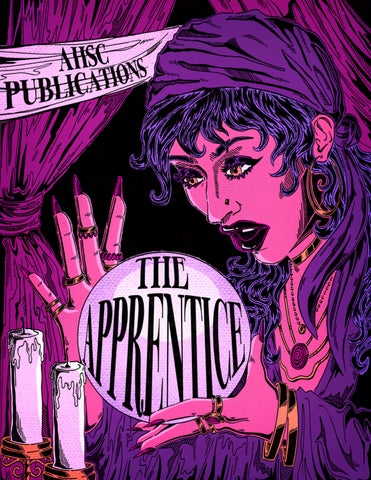
Volume 2 | Issue 1 | Spring 2026
Copyrights remain with the artists and authors. The responsibility for the content in this publication remains with the artists and authors. The content does not reflect the opinions of the Arts and Humanities Students’ Council (AHSC) or the University Students’ Council (USC).
About Apprentice The Apprentice is a publication from the Arts and Humanities Students’ Council at Western University that was created in the 2024/2025 school year. This publication highlights the excellence of first-year students at Western, accepting academic papers marked over 75% in Arts & Humanities courses, as well as creative written content and exceptional art. For more information and to view our other publications, please contact us at the Arts and Humanities council office in room 2135 at University College. Publications can also be viewed virtually at issuu.com/ahscpubs
Managing Editor: Evan Rogers VP Publications: Nicole Hennigar AVP Publications: Alyssa Naoum Layout Editor: Evan Rogers Copy Editor: Khadeejah Abdul-Khadir Cover Designer: Aimee Oosterom First-Year Associate: Claudia Arthur First-Year Associate: Kelly Chung
Editor’s Letter I am excited to present the sophomore issue of Apprentice, a publication made to celebrate first year excellence in writing and art. Welcome!
XIX
Apprentice is unique among our other AHSC publications in that it only takes work from firstyears. For most students, first year is an incredibly transformative time, where you start to learn who it is you want to be. I think that this issue of Apprentice represents this period in all of its growth, love, and chaos. To everyone who submitted this year, thank you so much, I genuinely enjoyed reading your work and admiring your art. I was wowed by the quality and depth of the Apprentice submissions this year, and narrowing our choices for the final print was incredibly difficult. Finally, I want to thank everyone who made this issue possible: Khadeejah, Kelly, and Nicole for copyediting and working with the first-years to perfect their pieces; Aimee for the incredible covers; Kelly and Claudia for assisting with the layout; our wonderful VP, Nicole, for her endless support; and of course all of the first-years who submitted—this publication would literally not be possible without you, so thanks!
the sun.
To all the incredible first-year students out there: keep writing, keep making art—you never know where it’ll take you.
Evan Rogers
Apprentice Coordinator
Editor’s Letter When I was in my first year at Western, The Apprentice wasn’t a thing; AHSC Publications only had Symposium and Semicolon open for submissions. It was daunting and I thought I’d get a rejection email, but I took a chance and submitted a poem to Fall Symposium. It was published and I was so proud of myself for putting my work out there. I went to the launch party alone, scared to walk into a room of upper-year students I had never met before, but seeing my poem in print was one of the best feelings ever. I sat quietly in the corner, then someone on Pubs smiled at me and struck up a conversation—and that was my introduction to the AHSC. It’s difficult to orient yourself in first year, being exposed to so many different perspectives and environments. Countless opportunities pass by that you aren't even aware of. The Apprentice is meant to be a helping hand—a guide toward the A&H community. Submitting your work can be scary, but regardless of acceptance status it's so much more than a submission. Publications like The Apprentice invite students to meet others in the same boat, to make friends, to smile and strike up a conversation with the quiet firstyear sitting at the back of the room. It’s not merely a publication, it’s a community. Putting together the second volume of Apprentice has been especially rewarding as a fourth-year, and I’m so glad firstyears now have a concentrated place to submit their work. I would like to extend a special thanks to our Apprentice Coordinator and Layout Editor, Evan, who has worked tirelessly to produce this issue. I would also like to thank our AVP, Alyssa; Copy Editor, Khadeejah; First-Year Associates, Claudia and Kelly; and Cover Designer, Aimee. Finally, I would like to thank all the first-years who submitted. This is entirely for you and would not be possible without your support.
XVIII
the moon.
Nicole Hennigar
Vice President Publications
Table of Contents 6-7
Lingering Iridescence by Sherry Liu and heilongjiang 1979 (did you eat today?) by Chloe Wang
8-9
Why We Can’t Pretend Art Is Separate from the Artist by Julia Flowerday
10-11 12-13 14-15 16-17 18-19 20-22 23-24 25-27 28-30 31-33 34
it’ll never be a lamb again by Chloe Wang and To the dead ladybug in the UC third-floor women’s washroom by Sophie Taylor Untitled by Julia Latella and The Zipper Mouth by Jasmine Xu Doubling the Dead in “A Rose for Emily” and “Shiloh” by Casey Kisielewski Death and Growth by Emily Carruthers-Genoe and Seasonality of Spots by Carter Norman The Three Faces of Julia by Julia Flowerday Untitled by Julia Latella and Dead Wives are Silent: Narrative Control Within Marriage as Portrayed in Maus and Othello by Sophie Taylor middle school lesbianism by Chloe Wang and The Pedestal by Sherry Liu Blackberries by Milena Antonova and Comic versus Wit in Gentlemen Prefer Blondes and The Catcher in the Rye by Casey Kisielewski I have a dream (a song to sing, to help me cope) by Sofia Dehar Under the Sky by Avery Pooransingh and Why I Will Adopt by Casey Kisielewski Loose Ends: A Quest for Meaning through The Lens of Surrealist Art and Dreams by Sherry Liu
Lingering Iridescence by Sherry Liu (she/her)
6
heilongjiang 1979 (did you eat today?) Written by Chloe Wang (they/them)
my father peels the world open like an orange, presses both thumbs into skin until flesh gives, the pith is white and bitter and devoured whole this too, is life, he says. the strings get caught in my teeth, as i eat the quarter he saves for me. if there are kinder words, my father does not know them he whets his tongue on the rim of bottle caps, lips the edge of empty plates and cold ambition; he learns love as a sharpening of blades, rolls the metal around in his mouth until any dull edges are scraped away. every cut of meat is the same when the taste is gone eat cheap, eat full, eat fast; when the tide rolls out, he dreams of the sugar factory on the hill sticky summer nights like the birth fluid of an unknown mother he washes it off when winter comes, and when he sticks his tongue out to catch the snow, the sweetness sticks his lips together. my father dresses a bird far better than he dresses himself pink muscles parts open in a blossoming flower, skin turns taut and plump as he serves it to me. i eat; he watches. the flesh is tender. i love the way my father loves. i hope he eats well. 7
Why We Can’t Pretend Art Is Separate from the Artist Writing 1025F
Written by Julia Flowerday (she/her)
Professor Jeremy Greenway
Over the past few years, the question of whether audiences can,
impossible to sustain (Huynh). These beliefs reflect genuine
or should, separate art from the artist has moved from scattered
attachment, but in today’s hyper-visual, algorithm-driven media
online arguments into a sustained cultural conversation. As The
culture, they ultimately overlook how our continued support still
Citizen reports, writers and critics are increasingly split between
translates into power, visibility, and profit for the very figures
those who fear that holding creators accountable will “limit artistic
whose actions jeopardize the safety and dignity of others.
freedom” (Sutherland) and those who argue that ignoring a
Emotional meaning may be real, yet it does not erase the real-
creator’s racism, misogyny, or abuse simply reinforces the power
world consequences of the choices we make as consumers.
structures that allow such harm to persist. These disagreements
However, the most tangible problem arises with money. In a
surface everywhere: in festival panels, in comedy reviews, in social
global, digital culture, every stream, movie ticket, and piece of
media commentary, and in the everyday choices people make
merchandise is a tiny financial endorsement. When people
about what to stream or buy. Rather than trying to account for
continue to stream Kanye West’s music after his antisemitic rants,
every perspective, what matters is recognizing the conditions
they are not just revisiting a soundtrack from their teenage years;
shaping this debate right now. This is the context my argument
they are helping maintain his cultural relevance and his earning
enters:
consumption,
power (Lynskey). Even after he wore a “White Lives Matter” shirt,
responsibility, and cultural power are no longer abstract but
praised Hitler in interviews, and posted antisemitic symbols, his
immediately tied to the ethical choices audiences make.
music remained among the most streamed in countries like the
a
moment
when
questions
about
This argument is directed toward everyday consumers, especially
U.K. and U.S., generating millions of plays and, with them,
young people and university-aged audiences, who often feel torn
ongoing royalties (Lynskey). Fan’s continued support is part of
between the nostalgia attached to certain artists and the
what allows him to keep building platforms such as political
discomfort of knowing the harm those artists have caused. It
campaigns, media appearances, and fashion projects, where he
speaks to readers who want to believe their consumption is neutral,
spreads more hate. The same is true with J.K. Rowling since every
yet also care about justice, accountability, and the impact their
new Harry Potter product or spin-off film puts more money in the
choices have on marginalized communities. Many people reassure
hands of someone who has repeatedly used her enormous reach to
themselves that they can enjoy an artwork without endorsing the
fuel anti-trans narratives (Bocco). In this context, spending is
person who created it, treating songs as mere sounds or books as
never passive; it actively funds and legitimizes voices that
nothing more than words on a page. Yet the trajectories of artists
perpetuate harm.
like Kanye West and J.K. Rowling demonstrate how misleading this
Beyond money, continuing to support an artist publicly can feel
assumption is. While many young consumers want to believe their
like a betrayal of the people they harm. Imagine being a Jewish
enjoyment of an artist’s work can be separated from the artist’s
person, watching friends shrug off Kanye’s threats against “Jewish
actions, continued support through streaming, purchasing, and
people” as just another outburst, while his songs still dominate
public celebration directly sustains the platforms and power
party playlists (Lynskey). Similarly, many trans fans who grew up
structures harming marginalized communities (Bocco). In a
with Harry Potter now feel that every cent Rowling earns from that
cultural moment shaped by digital influence and heightened
franchise strengthens the voice which undermines their rights and
awareness of systemic injustice, our choices as consumers are
humanity. For victims and targeted groups, these are not abstract
never neutral but carry real ethical consequences.
debates about “cancel culture”; they are daily reminders that their
Even with these concerns in mind, many consumers support
safety and dignity are negotiable when weighed against someone
arguments common in op-eds, social media debates, and fan
else’s comfort or nostalgia. When we keep boosting these artists,
communities by insisting that art should be appreciated separately
we send the message that our enjoyment is worth more than other
from its creator, claiming this preserves the emotional meaning
people’s pain. Choosing not to stream, buy, or publicly celebrate
their favourite books, films, or songs have accumulated over the
their work becomes a small but concrete way of standing in
years (Huynh). For many people, Kanye’s early albums or the
solidarity with those who are directly harmed.
Harry Potter series shaped their adolescence or became woven into
This dynamic connects to an even deeper cultural pattern.
their identity; it feels unfair to lose that comfort because the artist
Philosophers and cultural critics today already wrestle with
later caused harm. Others argue that ethical consumption is
whether the moral conduct of creators should affect how we
unrealistic in a world where nearly every industry has moral
engage with their art. As Duke University ethicists note, an artist’s
8 failings, so drawing a hard line around artists can feel arbitrary or
“moral life” can be a relevant lens when interpreting their work,
especially when the work reflects or benefits from that moral failing (Cox). Writers like Roxanne Gay show how this theoretical question becomes a lived debate in everyday culture. Since it is more than abstract philosophy, it is about whose stories get uplifted, who profits, and what kind of influence we pass on through our support (Mahdawi). For many consumers, especially younger audiences who navigate streaming, fandom, and media saturation, the choice to keep supporting controversial artists signals where they draw their ethical line and what values they want to support when culture and commerce intersect. Refusing to support their work after clear patterns of harm is one way of saying: genius does not grant immunity. Taken together, none of this requires us to erase our histories or deny the comfort that certain artists once gave us. While nostalgia is real, returning to the broader cultural debate about responsibility, consumption, and power reminds us that emotional attachment does not exempt us from making ethical choices in the present. We can still hold on to what those works meant to us while choosing forms of engagement, like secondhand copies or critical conversations, that avoid strengthening the platforms of people who misuse theirs. In a culture where digital visibility and profit translate directly into influence, every act of consumption becomes a form of participation in a much larger system. The question is no longer just what we enjoy, but what our choices enable. Pretending our playlists and purchases exist in isolation from artists’ harmful behaviour ignores the reality where victims feel the consequences of those choices every day. Ultimately, this decision is less about moral perfection and more about how we position ourselves as participants in culture. Appreciation and endorsement are not identical, yet in our current media ecosystem, they often function the same. If we truly care about justice and about the people harmed by the artists we elevate, we cannot continue to treat our consumption as neutral. Our choices are part of the cultural story being written right now, and they determine whose voices we amplify.
9
it’ll never be a lamb again Written by Chloe Wang (they/them)
i. there is something almost holy about how she pulls your body from the earth, like lazarus from the tomb, like jesus from the womb. holy is her touch as she splits you open from sternum to sacrum, holy is her caress around your neck … soft and sinking into flesh. ii. she stitches you back together: raw, bloody, yet whole, like the apple in eve’s hand. iii. here’s what they don’t tell you about digging graves; about burying your mother and your sins. family graves are built nine feet deep. they take six hours to dig on a balmy day and forty-eight in the winter. you manage to finish one in thirty minutes. you don’t know why you leave a space for yourself, you don’t know why you leave a space for the others, but you know that when they speak of children burying their mothers, they’d never meant it like this. iv. to be an act of violence against oneself—isn’t that the art of life? to turn oneself in and out and in again, if only to prove that you can change. v. you’re not as much of a monster as you would like to be.
10
To the dead ladybug in the UC third-floor women’s washroom Written by Sophie Taylor (she/her)
Apricot shell ink splattered Crumpled in a dusty corner Haute couture childish Facing away (were you afraid?) A casual casualty Nestled in the concrete window (were you seeking comfort?) Your mother’s embrace white paint The wrong side of freedom (did it hurt?) Waning of moons long gone I am sorry for your loss. (forgive me) I am sorry for everything. (forgive me)
11
Untitled by Julia Latella
12
apparently, my tai popo and tai gonggong live in china buried under a sea of reminiscence wishes, wants, flowers. popo’s mama was a teacher apparently. gongong’s mama loved to cook. popo’s baba was a juror. baba’s mama had cancer. apparently, they are concealed from me. popo wears a zipper mouth. the zipper makes her words almost indigestible “ , how was your day today? , are you hungry?” it’s never about her.
佳佳 佳佳
it’s never about what’s behind the zipper.
哈哈哈
& i prepare myself to remove the zipper mouth.
Written by Jasmine Xu (she/her)
The Z i
r M outh
gonggong is a professional cook. when he cooks, he unzips his mouth—the words he’s trying to say i speak and he creates dishes from even the strangest things gonggong never tells me where it all comes from but it’s always a joy to hear his ’s whenever my eyes light up eating his food. deceased, yes, fallen, almost. but why do i hear their voices everywhere i go? at the supermarket, when i spot my favourite spice in the languages i speak, the laughter i inhibit they have never truly perished
e pp
13
Doubling the Dead in “A Rose for Emily” and “Shiloh” English 1027F
Written by Casey Kisielewski (they/she)
In both William Faulkner’s “A Rose for Emily” and Bobbie Ann
nightshirt” for Homer: items that are designated for personal
Mason’s “Shiloh”, the death of a loved one prompts the main
moments, allowing her to control him even in his hygiene and his
characters to assume new roles in their relationships. In “Rose”,
sleep (Faulkner 267). Throughout "A Rose for Emily”, the narrator
the death of Emily’s controlling father manifests in Emily through
alludes to the Griersons’ reputation, including that Emily
her manipulation of her husband, where she ensures governance
“demanded more than ever the recognition of her dignity as the
over their relationship by preventing him from leaving her. In
last Grierson.” Emily carries the negative relationships that her
“Shiloh”, however, the death of Leroy and Norma Jean’s baby,
father passed onto her; for example: her kin from Alabama, who
Randy, causes Leroy to revert to a childish mentality, frozen
“had not even been represented at the funeral” (Faulkner 266). Mr.
forever in Randy’s young state; and it simultaneously causes
Grierson’s spirit haunts Emily from the instant of his death to hers
Norma Jean to pursue new interests and success as Randy would
—however, the opposite is true in “Shiloh”: Leroy encompasses
have as he grew older. In both stories, the characters assume their
the youthful behaviours that he and Norma Jean expected from
perceived role of the dead in their living relationships.
Randy but never encountered. Rather than a lifelong, learned
Before Mr. Grierson’s death in “A Rose for Emily”, he had
behaviour like Emily’s, Leroy can only assume his behaviour to
completely controlled Emily, and he prevented her from ever
fulfill a role that would otherwise remain empty. Norma Jean
pursuing romantic relationships. Consequently, the only significant
notices Leroy’s childlike tendencies when he returns home from
male figure in Emily’s life was her father, and as the narrator
truck driving: “[Leroy] makes things from craft kits. He started by
describes “all the young men her father had driven away, and [...]
building a miniature log cabin from notched Popsicle sticks. He
that with nothing left, she would have to cling to that which had
varnished in and placed it on the TV set, where it remains. [...]
robbed her” (Faulkner 265). Emily’s inexperience with freedom
Then he tried string art, [...] a macrame owl kit, a snap-together B-
caused her to adopt her father’s controlling role from his
17 Flying Fortress, and a lamp made out of a model truck” (Mason
relationship with her, and she translated it into her relationship
482-3). Leroy also behaves like a teenager at times, like when he
with Homer. Mr. Grierson’s portrait of a “crayon face [...] above
secretively buys marijuana from a high school student and
[Emily’s] bier” represents his control over her, which outlasted his
constantly smokes it (484). Leroy’s behaviour never surpasses the
death and ultimately died with Emily (Faulkner 268). Conversely,
maturity of a sixteen-year-old, which would be Randy’s age at that
“Shiloh” explores a relationship that Randy’s death cut off before
time (Mason 484). Leroy treats Norma Jean like a mother figure;
it could truly begin. Norma Jean and Leroy feel uncomfortable
he notices her explicitly maternal qualities, like cooking: “[Norma
about their late son: “They never speak about their memories of
Jean] would cook fried chicken, picnic ham, chocolate pie—all
Randy, which have almost faded, but [...] they sometimes feel
[Leroy’s] favorites;” and cleaning: “Norma Jean seems to be
awkward around each other, and Leroy wonders if one of them
cleaning the living room rug again” (488). Even Leroy’s thoughts
should mention the child” (Mason 483). Leroy’s homecoming
and feelings are immature. When Norma Jean is driving him to
initiates relationship problems with Norma Jean as she increasingly
Shiloh, he “feels like some boring hitchhiker she has picked up”
notices his lack of maturity. Following Randy’s death, Norma Jean
(Mason 490). Throughout “Shiloh”, Leroy never matures: even at
is unsure how to resume married life without parenting, and she
the end of the story, he childishly quips Norma Jean’s “I want to
treats Leroy’s childish tendencies as her motherly responsibility.
leave you” with “No, you don’t;” and while he “is trying to
Then, she leaves Leroy after sixteen years, which is generally the
comprehend that his marriage is breaking up, [...] he is wondering
amount of time a child takes to start becoming independent of
about white slabs in a graveyard” (491).
their parents (Mason 482-91).
14
B. Diemert, Q. Kielt
Finally, Emily’s and Leroy’s partners fulfill the other half of the
In both stories, one main character assumes the role of their
parallelled relationship: in “A Rose for Emily”, Homer represents
dead relative: Emily parallels Mr. Grierson in “A Rose for Emily”,
the position Emily had held in her relationship with her father, and
and Leroy parallels Randy in “Shiloh”. In “A Rose for Emily”, the
in “Shiloh”, Norma Jean represents the parental version of herself
first man that Emily Grierson ever dates in her lifetime is Homer
that Randy’s death cut short. In “A Rose for Emily”, Homer’s
Barron, a proclaimed homosexual, which prevents true romantic
position in his relationship with Emily mimics Emily’s position
connection between them (Faulkner 266). Emily controls Homer
under her father’s oppression. Like Emily, Homer “liked men,” but
in their relationship like her father had controlled her. Emily
Emily prevented Homer from pursuing romantic relationships with
purchases “a man’s toilet set in silver, with the letters H.B. on each
them, like her father did to her (Faulkner 266). Furthermore, when
piece,” and “a complete outfit of men’s clothing, including a
Emily kills Homer, her poison symbolizes the eternally toxic
nature of Mr. Grierson’s relationship with Emily. While Mr. Grierson ultimately controls Emily until her death, Emily’s control over Homer directly caused his death and continued long afterward
(Faulkner
266-9).
After
Homer’s
death,
the
townspeople’s reaction to the smell of Emily’s house also parallels their reaction to her relationship with her father; they “had long thought of [...] Miss Emily a slender figure in white in the background, her father a spraddled silhouette in the foreground, his back to her and clutching a horsewhip, the two of them framed by the back-flung front door. So when she got to be thirty and was till single, “[they] were not pleased exactly, but vindicated.” In both instances of the house’s smell and Mr. Grierson’s abuse, the townspeople are bothered at first, but their concerns eventually subside (Faulkner 264-5). Lastly, Emily’s attachment to Homer at the end of “A Rose for Emily” reveals the nature of Mr. Grierson’s subjugation. In the pillow beside Homer’s corpse “was the indentation of a head,” and from it, a townsperson lifted “a long strand of iron-gray hair,” which indicates that Emily regularly lay with Homer’s corpse. This detail reveals that Emily killed Homer because she needed his reliable presence, and through doubling Mr. Grierson, her actions expose the root of her father’s dictatorship: his own need for Emily’s company (Faulkner 269). Contrarily, in “Shiloh”, Norma Jean and Leroy lost a child instead of a parent. Due to this, Norma Jean assumes a parental role in her relationship with Leroy for sixteen years. When Leroy’s presence begins to bother Norma Jean, she tells him “to find a job first,” and says, “you could get a job as a guard at Union Carbide [...]. You could get one at the lumberyard. You could do a little carpenter work, if you want to build so bad.” At sixteen, children tend to become more independent from their parents, and this is the time in Randy’s life when Norma Jean would most likely encourage him to find a job, but instead she begins to doubt her marriage (Mason 485-6). In the final scene of “Shiloh”, Norma Jean “[walks] through the cemetery, following a serpentine brick path.” The cemetery symbolizes Randy’s death. The “serpentine brick path” also indicates trickery, as the serpent often does: Randy’s death misled Norma Jean’s life, and by “walking [...] toward the bluff by the river,” she finally finds a way to escape its clutches (Mason 492). The death of a loved one dictates both the lives of Emily and Homer in “A Rose for Emily” and of Norma Jean and Leroy in “Shiloh”. However, in “A Rose for Emily”, Emily perpetuates learned behaviours from her father, which haunt her throughout her life and ultimately cause Homer’s death, while in “Shiloh”, Norma Jean recognizes her motherly attitude substituted for Randy by Leroy and manages to elude it before it eternally encapsulates her (Faulkner 262-9; Mason 482-92).
15
Death and Growth by Emily Carruthers-Genoe (she/her) 16
Seasonality imperfect pigmented spots drawn with light brown pencil against my canvas. Their artistry clutches onto skin dispersed, in bunches, cloaking tears i stitched poorly.
of
passion of late spring stings the edges of my leather shell. flowers undrape in anticipation, Their dance reigns faster than any conspiring storm.
Spots Written by Carter Norman (he/him)
my mother calls Them ‘kisses from the sun.’ mottos encoded in receptors to muddle; irritable obligation itches within. hardening each vertebrae, They force singularity from blessings of the sky. They guide sight, mapping my spot in the world. fate is sketched, woven in stars, tattooed on my arm. thoughts raid the mind, athirst for likeness pursues. in front of you, as our eyes become attuned, i conceptualize my imperfections as covered with spangles while you compliment my camouflage. fading with swift rubber ends the shortening of days seizes Their function. frozen in november Their dance concludes; i hide my canvas with longer drapes. They become discoloured, revealing tears ripped and stained by expectation of Their return. impatient with imperfect pigmented light brown spots, stars and scars blend like oil on my canvas. bittersweet whispers accept Their smudges as spots.
17
The
Three Faces
I am Julia, revealing myself in three faces: The comforting friend, The resilient warrior, And the aspiring champion— Each face hiding unexplored depths. In the eyes of many, I am Julia, Radiating joy like a sunbeam’s gleam, And comforting hearts, like a soothing stream. My job is the “therapist friend,” Their safe harbour in the storm. It’s a role of immense responsibility, Requiring an authentic smile, That strenuous, convincing smile. However, beneath this façade Lie dreams that stretch far beyond The confines of everyday existence. I wait to carve out a path uniquely my own. Amidst the assumption that my life Is untouched by hardship’s strain, Lies a journey of trials and resilience, Shaping me through life’s refrain. In the legal system, I am reduced to a letter, A single character engraved onto court documents, A symbol with three faces of its own. Firstly, “C” is the third letter of the alphabet And the third-born child. Secondly, “C” is caught amidst the battleground Between “X” and “Y,” my parents. Thirdly, “C” is my only legal identity, My decade-long courtroom name.
18
Of
Written by Julia Flowerday (she/her)
Julia
A relentless cycle of conflict That left scars both seen and unseen. “C” carved upon my ankle, A profound reminder of strength, In trials where I was bound. In the eyes of my aspirations, As I strive to be perceived one day, Is an integration of the faces Presented to the world. I weave together the threads Of both identities: Julia, the comforting companion, And “C,” the overcomer. My journey ahead is fueled By a fiery determination To affect positive change. It is similar to a blooming rose, Emerging from darkness, Its petals unfolding in writing. With each thorn and petal, A story to tell, a testament to resilience, In which I dwell. I carry with me the lessons learned And wisdom gained as a stepping stone. Here I stand, With faces three, Yet only one The world shall see. I am the author of my narrative And the manifestation of hope In this cruel, unforgiving world.
19
Untitled by Julia Latella
20
Dead Wives are Silent: Narrative Control Within Marriage as Portrayed in Maus and Othello English 1027F
Written by Sophie Taylor (she/her)
Zahra Mirabolfathi-Nejad
To be a woman is to suffer, and to be a wife is to suffer silently. In
to Desdemona by name. As she begs for her life, he shouts, “down
both Shakespeare’s Othello and Spiegelman’s Maus, men construct
strumpet!” (5.2.99). Calling Desdemona a strumpet reduces her to
and develop women’s identities, which silences their voices and
a sexual object—a characterization Othello will later use to justify
rewrites their stories. Through the destruction of their private
his crime. The violence of this act surges as he murders her in the
spaces, Othello and Vladek reduce Desdemona and Anja,
one space where she briefly existed beyond male control.
respectively, to the identity of “wife.” This allows them to assume
Immediately after she loses consciousness, Othello realizes what
narrative control over their wives in death, revealing underlying
he has done and cries out, “My wife, my wife! What wife? I have
systems of ownership, marriage, and patriarchal control.
no wife,” (5.2.121). The emphasis on “wife” serves as a reminder
The depictions of Desdemona and Anja outside marriage are
that in Desdemona’s final moments, she is once again reduced to
inaccurate because these women are introduced in relation to their
property, even in the one place she was viewed as a person. For
husbands. This is mitigated by the existence of third spaces—
Desdemona, there was never truly a refuge from her marriage.
uniquely female outlets in which they can be authentically
Just as Desdemona is defined by her marriage to Othello, Anja
themselves. For Anja, this outlet is her journal writing, where she
is introduced through her relationship with Vladek and is not
keeps a detailed account of her experiences and innermost
given a separate, unique voice. As she is dead when the narrative
emotions, allowing her identity to expand beyond her role as wife.
begins, she only exists through the gaze of Vladek and Art. It
These journals become important after Anja’s suicide, as Art
should also be noted that we never visually see Anja in the present;
searches for a better understanding of his mother’s life. He
we only see her through Art’s depiction of Vladek’s memories and
explains to his father that “they’ll give me some idea of what she
Art’s drawings in “Prisoner on the Hell Planet.” This creates yet
went through while you were apart,” (Spiegelman 158). In finding
another layer of separation from her authentic story; however,
the journals, Art would be able to give life to Anja’s voice and tell
during her life she wrote a series of journals. Anja’s journals could
her story through her words.
have served as a detailed account of her innermost thoughts and
Desdemona’s status as a woman of high standing in Venetian
feelings. This would have allowed her to exist beyond her marriage
society allows for her to also have a private feminine space in
and have an identity other than “wife.” Despite Vladek’s
which she can authentically express herself. This space is her
reluctance, Art seeks a version of his mother’s experiences
chambers, where she interacts with Emilia, her handmaid and
separate from his father’s recollection. He asks his father several
confidante. From the beginning, she is the property of men in her
times for access to her journals; however, Vladek refuses and says
life, and as such, her marriage is merely a shift in ownership.
that “she went through the same that me… terrible!” (Spiegelman
Brabantio believes that by marrying Othello, Desdemona was
159). He does not understand Art’s desire to see Anja’s story, as
“st’olen from [him] and corrupted” (Shakespeare 1.1.73). The use
he believes that by being his wife, his experience represents them
of the word “stolen” establishes her value as property, no longer
both and their identities are intertwined. Eventually, Vladek tells
belonging to her father but to her husband, while “corrupted”
the truth: “these papers had too many memories. So, I burned
refers to Othello’s identity as a Black man viewed as dangerous and
them” (159). Art is horrified by this confession and says,
hypersexual. The ownership of Desdemona transfers from one man
“Goddamn you, you murderer!” (159). Calling Vladek a
to another, and Emilia is the only character who sees her not as
“murderer” frames this as Anja’s final death, as her voice is now
Othello’s wife, but as her own person. She serves as an emotional
lost forever. The existence of her journals allowed for a piece of
safe space for Desdemona and provides a different perspective on
her to stay alive; however, Vladek prioritized his comfort over
marriage: “’Tis not a year or two shows us a man” (3.4.120). Emilia
Anja’s voice, destroying the last piece of her life to alleviate his
warns Desdemona not to blindly follow Othello because men’s
pain.
true natures are not immediately revealed. By extension,
Similarly, Othello alleviates his pain by killing Desdemona and
Desdemona’s chambers become a safe space of intimate femininity,
assuming control over her narrative. After Desdemona’s death at
separate from a masculine world that seeks to control her.
the hands of her husband, it is no longer her story that matters.
While Desdemona’s chambers are her safe space, it is in those
Othello gains the power to “own” Desdemona’s legacy by
same chambers that Othello murders her. This act violates the
perpetuating lies about her character. He claims to be “an
intimacy of her space and allows Othello to seize control of her life
honourable murderer” by framing her as morally corrupt, thus
and identity. As he prepares to smother her, Othello does not refer
justifying his violence against her (Shakespeare 5.2.346). Othello
21
explains that “she must die else she will betray more men,” and
can better understand, while portraying himself as her blameless
after she dies, he proclaims that “she turned to folly, and she was a
saviour.
whore” (5.2.6, 5.2.159). He also says she is “gone to burning hell”
This need to control Anja’s story is not arbitrary, but rather a
for her sins (5.2.162) . His lies make her seem threatening to the
direct consequence of Vladek’s own trauma. Due to feelings of
supreme authority of the men who controlled her. By calling her a
powerlessness, both Vladek and Othello attempt to control their
whore, Othello demonizes the idea of female sexuality and
wives’ narratives and alleviate their own guilt in the process.
weaponizes a misogynistic society against her. Killing Desdemona
Vladek’s portrayal of Anja is influenced by the trauma he
reduces her to the object she has always been treated as and
experienced during the Holocaust and the lingering pain
removes any agency over her narrative after her death, which
associated with her death. He explains his destruction of the
allows Othello to perpetuate false claims.
notebooks and says, “I remind to myself what happened” (158). To
When Vladek talks about Anja, his nostalgic description of her is
recognize her life as separate from his would be to acknowledge
centred around himself, and this restricts control over her own
that she endured her own traumatic experiences and would be a
narrative, even in death. When he introduces Anja in his retelling,
reminder of his own loss. He continues to highlight how fragile she
Vladek describes her as “skinny and nervous,” and “such a good
was, yet he paints himself as her saviour to evade that, ultimately,
girl” (Spiegelman 19, 15). The emphasis on her physical and
he was not able to protect her. By contrast, Othello’s rewriting of
mental fragility only serves to portray Vladek as the stronger
Desdemona absolves his guilt by shifting the blame onto her to justify his actions. As a Black man in early modern Venice, Othello is subjected to constant racism from those who see him as a threat to Desdemona’s virtue and safety as a “lascivious Moor” (Shakespeare 1.1.141). Othello is aware that he has committed murder, and those who perceive him as dangerous will use this as an opportunity to discredit his character. Therefore, by pinning the blame on Desdemona, he attempts to escape his fate at the
Figure 1: Panel on Pg. 28 of Spiegelman’s Maus: A Survivor’s Tale. 1, My Father Bleeds History depicting Anja on the phone
partner in the marriage and reduces Anja to her tragic archetype of
racism, combined with the patriarchal expectations placed on him
“dead wife,” despite the strength and courage she demonstrates.
as a husband, create a pressure to rewrite Desdemona’s story.
For example, she smuggles communist documents through her
In conclusion, through a mix of physical destruction and verbal
house, knowing its great risk to her safety. When that is described,
reconstruction,
however, Vladek only emphasizes that “she was a good girl and of
Spiegelman’s Maus are silenced by their husbands’ efforts to
course she stopped all such things” (29). Even within the visual
rewrite their post-death narratives. Both Vladek and Othello
depiction (Figure 1), she appears frightened, with one hand to her
attempt to relieve their pain by controlling the narrative of women
mouth and an expression of almost childlike panic. Art’s drawings
who no longer have any control. By violating the private feminine
reflect his father’s description, and not necessarily the truth of a
spaces where the voices of Desdemona and Anja existed, they
woman who defied a fascist regime. Vladek’s repeated use of the
reduce these women to nothing more than wives. Even in death,
word “nervous” minimizes Anja’s suffering from mental illness and
these women do not escape the patriarchal societies that limit their
paints a softer version of the harsh reality—one that is easier to
agency and erase their identities. Their stories die alongside them,
cope with. Later, when Anja suffers a nervous breakdown, it is
and their voices remain forever silenced.
once again Vladek who is portrayed as the stronger partner in their marriage. In the first panel (Figure 2), Anja lies on the couch, in a passive state, while Vladek bends down to comfort her. The following panel narrows the focus, and her eyebags become visible, while Vladek is still above her. The final image cuts Vladek out entirely and showcases Anja’s exhaustion, both mental and physical. Her hands clutch the couch as if she were drowning, which calls to mind her eventual suicide in the bath, while the stripes of the couch fabric foreshadow the striped uniform she will wear in the Holocaust. These images depict Anja as a fragile and pathetic figure in need of rescuing by her husband. By focusing
22
hands of a society he never truly belonged to. His internalized
only on these traits, Art simplifies her identity into something he
wives
in
both
Shakespeare’s
Othello
and
middle school lesbianism Written by Chloe Wang (they/them)
i am the blue of the lake you sit by, wine turned back into water, our last breath already written as our clocks have run backwards, yours will never tick again, and i am the voice in the hyssops or maybe the rustle in the reeds, watching through the grass like issac watches the knife and you watch me. i am young, and I am tired. we walk this tale over and over again, one that has been spun so many times that we wear a groove where we stand. say your lines. use your words. i am your mother’s makeup, and the last time she held you in her arms, when her love was still the symptom and cure, as eve loved the apple, as lazarus loved the tomb. am I kind? or did I write myself that way, blood turned beautiful when it was just red, metaphors stuck in flytraps of sentiment. what I mean to say is, i think you’re beautiful tonight. i think I want to eat you raw.
23
The Pedestal by Sherry Liu (she/her)
24
Blackberries Written by Milena Antonova (she/her) I march like a toy soldier on a path mapped out for me. A brick road, a thin layer of red dust coats my once-white shoes, The bricks worn from 5 the marching of those before me, the bramble surrounding this path pruned, snipped by the people passing by who noticed the shiny purple blackberries 10 and bothered to stop for a taste. There are no berries left for me, though I am not surprised since the leaves of the oaks and maples are changing to reds, 15 yellows, and oranges. I know the bushes have grown dormant. I must assume the people who traveled weeks before me hadn’t a clue they’d be leaving nothing behind.
20
Not everyone has the time to look around and notice the changing seasons. They must have assumed more berries would grow, 25 that I would get a chance to have some blackberries. I do not resent them as my red shoes march me farther down this worn, dusty path.
30
25
Comic versus Wit in Gentlemen Prefer Blondes and The Catcher in the Rye English 1028G
Written by Casey Kisielewski (they/she)
According to Bergson’s Laughter, “a word is said to be comic
chucking it” (71-4). He also uses name play, as Lorelei does—
when it makes us laugh at the person who utters it, and witty when
however, unlike her, he creates the titles and recognizes how the
it makes us laugh either at a third party or at ourselves” (33b). He
reader might perceive it: “Caulfield and his Magic Violin, boy. It’s
also includes repetition, exaggeration, and absurd ideas fitted into
corny” (121). Bergson says the distinction between “the comic
well-established phrase-forms, as well as eccentricity that makes
expressed and the comic created by language” is that “the former
earnestness laughable as other comedic factors (13a, 29b, 39b, 36a,
could [...] be translated from one language to another,” while “it is
43a). While Gentlemen Prefer Blondes and The Catcher in the Rye share
generally impossible to translate the latter” (33a). In Gentlemen,
these comic factors, Gentlemen employs Lorelei Lee’s absent-
Lorelei conveys the comic expressed through her absent-
mindedness as the comic, while Catcher employs Holden Caulfield’s
mindedness, which could be expressed in any language, whereas in
critical personality as the wit.
Catcher, Holden’s thoughtfulness and wit employ the comic
Firstly, both texts use wordplay through punning and absurd
26
Dr. Diemert
created, where his specific usage of English is unique.
phrasing, though Lorelei’s naivety employs these devices in
Both texts include repetition as well, which, according to
Gentlemen, while Holden’s criticisms employ his own in Catcher. In
Bergson, indicates “some mechanism at work behind the living”
Gentlemen, Lorelei consistently misspells words, often in ironic
(13a). In Gentlemen, among the terms that Lorelei uses most are
circumstances, such as discussing her supposed intellect using the
“gentleman” and “quite,” which function ironically; she uses these
words “encyclopediacs” and “colledge” (Loos 11, 47). Then, as
words to appear intellectual, despite consistently demonstrating a
Bergson quotes Kant, “laughter is the result of an expectation,
lack of intellect. Lorelei engages immediate repetition as well,
which, of a sudden, ends in nothing” (28a). In this sense, Lorelei
where she quotes herself nearly word-for-word: “I wish I did not
makes roundabout statements that set up false expectations: “Most
feel so upset about the gentleman I think I saw. [...] It really is the
of the sailors seem to have orphans which they get from going on
gentleman I thought I saw” (Loos 45). Throughout the text,
the ocean when the sea is very rough” (54). While it is true that
Lorelei provides opinions on repeated themes, though this often
the set expectations are not met, the inversion of order, or what
acts as an agent of self-contradiction and thus conveys her absent-
Bergson describes as an “inversion of roles,” changes the phrase’s
mindedness. For example, she decides to call Sir Francis Beekman
meaning and thus prompts laughter once new expectations are
“Piggie” after saying that “it really does not show reverance to call
applied in retrospect (46a, 13b). The same laws can be applied to
a gentleman by his first name” (72, 15). Alternately, in Catcher,
Dorothy’s speech. However, Dorothy’s wit inspires her play with
Holden’s use of repetition strengthens his transparency and
phrase-forms, rather than the comic, like Lorelei. For example, she
observational consistency; he often uses “naturally” and “really” to
and Lorelei call the character Robert by “Robber,” due to his
emphasize obvious statements, and “gorgeous” sarcastically. While
French accent, and Dorothy says to him: “your mother certainly
he employs plenty of immediate repetition, too, like the previously
knew her grammer when she called you that” (112). Lorelei also
mentioned mimicking of Ackley, Holden also isolates specific
modifies well-established titles by nicknaming people of
terms and repeats them within sections of the text, like “flits,”
importance, like her claim that Mr. Eisman “is known practically all
which he uses to describe gay men in chapters nineteen and
over Chicago as Gus Eisman the Button King” (12). Conversely, in
twenty without employing synonyms (185-203). In these
Catcher, Holden intentionally modifies spellings and format to
instances, the context of Lorelei’s repetition conveys her habits of
convey tone and dialect, like his transcription of Bernice’s speech:
self-contradiction; however, Holden is purposefully authentic,
“‘Listen. I toleja about that’” (Salinger 126). Holden also uses
which makes it easier to understand his perspective and notice the
phrase-forms intentionally, often employing irony through
comic in other characters.
circumstantially inappropriate terms; he uses “all of a sudden” and
Exaggeration, Bergson states, “is always comic when prolonged”
“false alarm” when he wrongly suspects that Mr. Spencer has
(39b). In the context of these texts, the characters’ employment of
“something sharp as a tack to say” (14). He also parodies what
exaggeration and generalization supports repetition and absurd
other people say by cleverly reusing their words and changing the
phrase-forms. In Gentlemen, Lorelei continually criticizes Dorothy;
statement’s content; for example, when Ackley says, “that’s a deer
she claims at one point that “Dorothy never has any fate in her life
shooting hat,” Holden responds, “this is a people shooting hat”
and does nothing but waste her time” (43). She also exaggerates
(30). Holden even extends phrases past their original meaning, like
more generally, often supporting her materialistic tendencies, such
when he is “shooting the crap around” with Ernest’s mother: “then
as her claim that “it would be fatal if [Louie and Robert] got the
I really started chucking the old crap around. [...] Boy, was I
diamond tiara before Dorothy and I took them
shopping a lot” (119-20). Similarly, in Catcher, Holden uses critical standpoints to generalize in ways that resemble Lorelei’s criticisms of Dorothy; for example, he says the first taxi driver “was such a touchy guy, it wasn’t any pleasure discussing anything with him” (108-9). Holden also habitually exaggerates quantities, like his description of D.B.’s bed as “about ten miles wide and ten miles long” (206). Holden further exaggerates with his imagination to employ what Bergson calls “play of ideas;” for example, he explains, “you can hit my father over the head with a chair and he won’t wake up, but my mother, all you have to do is cough somewhere in Siberia and she’ll hear you” (Bergson 57b; Salinger 206). Aside from these brands of exaggeration, there is one that is specific to Catcher and ties into phrase-form inversion: Holden uses extreme exaggerations in the negative. For example, he says, “I wasn't going to break my neck telling him,” and, “if you think I was dying to see [Maurice] again, you’re crazy” (53, 137). These statements use common phrases in an unorthodox fashion, which contributes to the perception of Holden’s wit. The frequency with which both texts use specific forms of exaggeration speaks to their repetition and, therefore, the characters’ rigidity. Where Lorelei’s exaggeration
supports
her
rigid
materialism
and
absent-
mindedness, Holden’s exaggeration relies on his detailed observations and supports the reader’s perception of his selfawareness. In addition to those devices already discussed, Gentlemen and Catcher employ many others, including hoax, disguise, relatability, and human nature; however, the most prominent comic feature of both texts is what Bergson describes as “professional callousness,” which is when a character is “so tightly jammed into the rigid frame of [their] functions that [they have] no room to move or be moved like other[s]” (54b). In Gentlemen, Lorelei’s thought patterns can be summarized through her claim that “kissing your hand may make you feel very very good but a diamond and safire bracelet lasts forever” (100). Her materialism and absent-mindedness drive her desire for social status. Conversely, in Catcher, Holden’s selfawareness drives his consistent sarcasm and criticisms, and ultimately, his objection to social compliance. Where Lorelei contradicts herself without recognizing it, Holden admits his own faults from early on: “I’m the most terrific liar you ever saw in your life” (22). Thus, the question of comedy depends upon presence of mind and transparency. Lorelei’s inability to acknowledge her faults informs her absent-mindedness; as readers, we perceive her disguise as the secondary characters do. Holden, on the other hand, uses his self-awareness to admit his own faults and those of others; the reader experiences the narrative transparently from his perspective, and thus understands his judgements of the outside world. In this sense, Lorelei exists as the comic in Gentlemen Prefer Blondes, while Holden creates the comic in The Catcher in the Rye.
27
i have a dream “Alina?”
(a song to sing, to help me cope)
Alina’s head jerked up, her attention snapping back to the girl sitting in front of her.
Written by Sofia Dehar (she/her)
“What?” she asked. Diana smiled. “Did you hear anything I said?” she asked. Alina grinned sheepishly. “Sorry,” she replied, “I’m just tired.” More like distracted. But Diana didn’t need to know that. “You really need to stop staying up all the time,” Diana said. “When was the last time you slept?” Alina paused. She’d slept in the car on the way there. She knew Diana would just say that didn’t count. Alina shrugged and leaned back against the sofa cushions. “Depends on what you mean by that.” “A full night’s sleep of at least eight hours,” Diana said, giving her a sarcastic look. “Oh, Diana. You should know me better by now,” Alina replied. Diana scoffed and stood up. She walked around the table and plopped down onto the sofa next to Alina. Diana was close. So close, she had to lift her arm and rest it on the back of the sofa to not have it over Alina’s. So close, Alina could smell her deep, wooden perfume and the roses in her soap. So close, Alina could feel Diana’s chest rising and falling with each breath. “Let’s watch something,” Diana said, picking up the remote. “Maybe you’ll fall asleep.” Alina laughed. “I can’t tell if you’re making fun of me or being serious,” she said. It was well known to her close circle that, given the chance, Alina would sleep anywhere, just typically not for more than an hour at a time. Alina agreed to whatever movie Diana chose, not really paying attention. She knew that Diana was probably right and Alina would fall asleep at some point. Alina wanted Diana to at least enjoy whatever she was watching. Alina settled into the sofa as the movie started, trying to avoid brushing against Diana too much. She paid little attention to what they were watching, seeing faces and flashes go by, not remembering them once they were gone. At some point, Alina realized she’d been seeing two separate people as the same. Alina’s eyes grew heavy. She blinked slowly, inhaling the scent of Diana’s perfume. The rosy smell filled her head until it felt swollen. Behind closed eyelids, Alina saw soft pink swirls and ribbons flowing across her vision. Her vision cleared a bit. Alina saw a blur of green and purple and blue. She blinked, trying to clear her eyes. Diana was laughing and smiling. At her. Like she was the only thing in the world. Diana was sitting on the grass under a wisteria tree, the branches swaying in the wind, petals falling softly to the ground. She was wearing a structured, dusty pink dress; a stark contrast to the t-shirt and jeans Alina knew she was wearing in real life. Swirls of blue and purple surrounded Diana as she walked toward her. Alina was ashamed that her eyes ran over Diana’s body, even
28
more so at the hot flush creeping into her cheeks and running down her body. Her mind felt hazy. Her head was steady against Diana’s shoulder. She tried to lift it, feeling bad for using her friend as a pillow, but it was so heavy. Diana’s hand lightly rested on Alina’s head, urging her to rest. “Go back to sleep,” Diana whispered. Wisteria petals fell from the tree, coasting on the gentle breeze that caressed her arms and legs. The petals settled in her hair, brushed against her face, and fell to the ground. Alina scratched the bridge of her nose. She was in a lavender haze, her eyes constantly being splashed over with purple and blue. Diana looked beautiful in her dress, with her hair pulled back from her face. Her curls fell beautifully against her neck, brushing over her collarbones. She smiled, pulling Alina close. She sat near Diana, trying not to shift under her gaze. Diana so often held her under a sharp gaze, pinning her in place, not focusing on anything else, but this felt different. This was unreal. Alina couldn’t think. Couldn’t breathe. She couldn’t do anything but sit there and stare at Diana, wishing that she’d stop being a friend and just kiss her. “Are you okay?” Diana asked, her concerned gaze searing into Alina. Her mouth was lifted in a small smile. Diana never looked at anyone like that. “I’m fine,” Alina replied. Her voice sounded like she was underwater. All in her head, non-existent to the outside world. “Are you sure?” Diana asked. Her blue eyes were soft. That wasn’t right. Alina couldn’t pull a single image of Diana in her mind where her eyes were the colour of the ocean or sky. Alina nodded, wearily. “Just kinda dizzy.” She blinked, and Diana’s eyes were brown again. Something was still wrong, though, Alina could feel it. Diana’s eyes weren’t the colour of caramel or honey or amber. They were warm and soft and dark. Her stomach twisted. Something was seriously wrong. Diana’s face blurred and she felt herself falling, her vision darkening. Alina startled awake, suddenly wanting to be anywhere else. It was too hot in the room. The air around her was tight and sweet, clouding her head. Alina pulled away, rubbing her temples. Diana turned her head to her and raised an eyebrow. Alina nodded, trying to reassure Diana that she was fine. She hadn’t been asleep long enough for her shoulders to tighten, thankfully. Alina squinted at the TV, watching the end of the movie through tired, slightly pained eyes. As the credits rolled, Diana turned to Alina. “I’m guessing that’s the most you’ve consistently slept in a while,” she asked. Deep, coffee-coloured eyes, just like Alina was used to. Alina shrugged, “Probably,” she replied. Her voice was scratchy, and her throat was sore. Alina sat up properly and rubbed her eyes. She stretched and stood up. Alina walked to the kitchen and filled a glass with water.
29
As she lifted it to her lips and took a sip, Diana walked toward her. “Are you okay?” Diana asked. Her brown eyes were soft. Alina wished for the millionth time that she would stop being so concerned with being a good friend and just kiss her. “Yeah,” Alina said. Just once. “I’m fine,” Alina continued. One kiss and Alina could die happy on the way to kiss city. “Just kinda dizzy,” Alina added. Maybe she wouldn’t die. Maybe she could spend the rest of her life knowing that at the end of the day, she could return home, into Diana’s arms, and spend their nights in her embrace. Diana nodded. Her eyes said she was trying to believe her. Maybe she should try to say something. Or maybe she should finish her water and try to be normal around the one person she felt anything but normal about.
30
Step by step Coming closer to the moment When it all just Stops Time bends here Shades of greyish blue Slowly shifting Into flickers of purple across the sky Blink And it’s time to leave Watch the rain pitter-patter Wade through the waters of my mind Always coming back To this moment When it’s completely still But somehow feels like it’s only just begun A cacophony of traffic But all I hear is the melody in the air Feel the fullness One heartbeat One minute Bleeding into many others Blink And time distorts
Under the Sky Written by Avery Pooransingh (she/her)
Leaves fall Possibilities come and go The once amber leaves turn a muddy brown Days spent lying down in the snow Gazing up Watching the clouds amble along All the while, ice seeps into my jacket Even though I shouldn’t, I stay anyway. I’ll leave this moment eventually But for now, I’m here
31
W i l I l A y y h h dopt W W Written by Casey Kisielewski (they/she) In the seventh grade, I submitted a journal entry to my teacher about how hopeless I felt in humanity, repeating YouTube predictions and dinner-table lectures about the future’s constitution of undrinkable water and unfathomable temperatures: “I’m afraid of the future for the sake of my children and grandchildren.” When my teacher returned it, there were notes penned in the margins: she was scared, too. I started to consider adoption at thirteen, when I realised I was queer, and that I might end up in a committed same-sex relationship. Talking about adoption began as a subtle way to express my sexual orientation without coming out; I discussed its environmental and ethical benefits with my parents: why would I create new life that would use more resources when there were already children in need of families? Later, when I was around sixteen, I had become open about my sexual orientation, and I therefore felt less of an urge to express it in different or subtle ways. However, I stood by my initial arguments—and new ones continued to arise, too; for example, I have a weak, hypermobile body, and many symptoms of my father’s rheumatoid arthritis and hypothyroidism had already begun to appear in me. One night in high school while my mom drove me to volleyball practice, she told me that she’d had stitches after giving birth to me, which is a common experience. I was horrified; I leaned back in my seat, feeling too faint to give a coherent response. Then she told me she returned to the hospital days after my birth to deliver the placenta—and if she hadn’t been called back, she could have bled to death. In that moment, I realized that I might not have the capacity to carry a child: if my body was falling apart already, how would I be able to handle any of the possible physical consequences of delivering a child? It wasn’t just based on ideology anymore. The pandemic began the following spring—and less than a month later, Mom told me in the living room about a news article she was reading: the skies were blue in Indian cities because of suspended transportation, and the Himalayas were visible from a hundred miles away for the first time in thirty years. Behind her, sunlight streamed through the windows, and I pictured our cloudless, deep-blue sky turning yellow, like it would in India again as soon as the ban was lifted. I began in that moment to think about the massive impact that just one individual’s existence has on the environment. Throughout high school, I continued to stand by my arguments on adoption, but I didn’t give it as much thought as I had before, since they were fully formulated and no longer needed perfecting. One summer morning, however, I lay in bed with my window cracked open, breathing in the fresh air. I held my hands on my flat belly. The feeling of my empty womb spread throughout my whole body, and the desire to carry a child swept over my being and my mind. Suddenly, I understood that this was what I was made for: my body was begging me to bear a child. I could hardly fight the feeling that I wasn’t on earth for any other reason. Then, that afternoon, in a grocery store parking lot, I confessed to my mom: “I don’t know how I’ll be able to resist having a child in my twenties, when I already have baby fever at seventeen.” The feeling lasted for months, and it infuriated me that I could not consciously overpower my body’s desires; during that time, I solidified my decision to adopt, trying everything in my power to prevent my biology from usurping the conscious arguments I had spent years developing.
32 Not long after that, because I was fighting the urge to have a child with more difficulty every day, I told my parents I
wanted to get my tubes tied. Dad raised his eyebrows, and I recognized the wide-eyed expression he made every time I challenged the values he was comfortable with. He half-shouted from the kitchen over running water: “That’s a big decision! Wait until you’re at least twenty-five, in case you change your mind.” My parents explained how joyful it was to have their own children. I averted my eyes from them and started walking upstairs, because both of us knew that I was walking the fence and they could push me over to the other side. By the time this past summer arrived, I was confident in my decision to adopt. I was almost nineteen and I had been in several relationships with men—I finally knew that the thought of becoming pregnant repulsed me, and my mind was swimming with nauseating images: a fetus developing inside of me; the ailments it would bring me; the ways it would forever change my body; the thought of being responsible for creating and maintaining a human being’s life. At this time, I was working and living with my best friend at a campground near Parry Sound. One day, in early August, we were walking along a wooded trail, surrounded by damp soil and hemlock bark after the day’s late rainfall. We were talking about the conventions of contemporary life, like society’s structure around basic human functions: eating, sleeping, and reproducing. I said it was funny that people don’t seem to think about society from a biological perspective; people have sex, start families, and build communities because reproduction is a survival tool. I think almost every day about what he said next: “The thing life is best at is keeping itself alive.” My friend explained that we continue to conceive children because our biology asks us to—but the Earth is alive, too, and like every other living thing, it has an immune system: it’s kicking us out with climate change. There is one crucial difference between the Earth’s instinct to survive and ours: the Earth will succeed, and the human race will not. I don’t worry anymore about the future; that’s out of my control. I’ll do what I can: I’ll improve the lives of people in need, and I’ll be kind to the planet while I’m here. Then, as I live on and get older, and the news becomes increasingly horrific, I’ll at least have the peace of mind that I haven’t contributed to the dying world, and I haven’t brought anyone into it.
33
Loose Ends: A Quest for Meaning through The Lens of Surrealist Art and Dreams Written by Sherry Liu (she/her)
Words are representations of what we mean. Art is a representation of what we perceive. But what represents the representation? Meaning is never the thing itself either. Something only contains meaning when it touches another thing; the Thing’s relation to the Other is what allows it to be legible at all. I would define intertextuality as a web of concepts, ideas, and texts that which together, creates a meaning that is beyond the sum of its parts. I wonder whether or not the search for the “ultimate meaning” is a fruitful one. For example, surrealist art resists the demand of needing “ultimate meaning”. Rather than trying to find meaning from the origin, surrealism presents art as an accumulation of beginnings. Art cannot be finished; it is always in progress. I am unsettled by the act of dreaming because it destabilizes the assumption that meaning must be coherent. There is something absurd about painting the jumbled mess that is a dream. Often, my dreams are incoherent and suspiciously weightless and breathy, yet also heavy and real. Somehow, dreams possess a dialectical quality that I cannot wrap my head around. Every time I try to write it down, the memories of these dreams disappear, as if these memories are nebulous yet sentient creatures that refuse to be tied down by my inadequate, scrambled writing. My attempts at keeping dream journals have proven futile, time and time again. How are dreams intertextual, and are there instances where dreams are original—in that they are detached from experience entirely? This winter break, I saw Leonora Carrington’s artwork Green Tea at the MoMa. And I found it fascinating how there was nothing said about the piece on the wall except for its name. Surrealist artists and curators seem to invite the audience to flirt with the fact that the experience of viewing the art cannot be decoded. Meaning can be perceived, but that very perception is fluid. Even when one tries to nail meaning onto the artwork with symbolism, it feels as if the accumulation of meanings derived from the web of intertextuality still collapses into ambiguity and mystique. From a psychological standpoint, humans hate loose ends. Perhaps that very adversion shows us how important it is to try to live in the discomfort?
34
Perhaps this is the point of art, to never really know the meaning? And perhaps intertextuality is an invitation to play a pretend quest of finding truth and meaning, knowing that it simply does not exist within our scope?
Works Cited Doubling the Dead in “A Rose for Emily” and “Shiloh”
Written by Casey Kisielewski (they/she) Faulkner, William. “A Rose for Emily.” The Norton Anthology of Short Fiction, Shorter 8th Edition, edited by Bausch, Richard and Cassell, R.V. W.W. Norton, 2015, pp. 262-9. Mason, Bobbie Ann. “Shiloh.” The Norton Anthology of Short Fiction, Shorter 8th Edition, edited by Bausch, Richard and Cassell, R.V. W.W. Norton, 2015, pp. 482-92.
Why We Can’t Pretend Art Is Separate from the Artist
Written by Julia Flowerday (she/her) Bocco, Federica. “Why It’s Important to Boycott J.K. Rowling in Light of Her Continued Transphobic Stance.” Medium, 2 Aug. 2024, medium.com/@federicabocco/why-its-important-to-boycott-j-k-rowling-in-light-of-her-continued-transphobic-stance-aaf31edacca2. Cox, Sophie. “What Should We Do with the Works of ‘Immoral Artists’?” Duke | Research Blog, 14 Feb. 2023, researchblog.duke.edu/2023/02/14/what-should-we-do-with-the-works-of-immoral-artists/. Huynh, Jessica. “The Complexities of Supporting Art by Problematic Artists.” Medium, RU Student Life, 2 Nov. 2017, medium.com/call-me-a-theorist/the-complexities-of-supporting-art-by-problematic-artists-989827511f6b. Lynskey, Dorian. “Kanye West Has Shown Us Exactly Who He Is – and yet the Public Are Still Listening | Dorian Lynskey.” The Guardian, 16 Dec. 2022, www.theguardian.com/commentisfree/2022/dec/16/kanye-west-antisemitic-rapper-ye-spotify. Mahdawi, Arwa. “Opinions by Roxane Gay Review – the Art of Argument.” The Guardian, 28 Sept. 2023, www.theguardian.com/books/2023/sep/28/opinions-by-roxanne-gay-review-the-art-of-argument? Sutherland, Larissa. “Interrogating Cancel Culture: The Good, the Bad and the Ugly.” The Citizen, 2025, www.thecitizen.org.au/articles/interrogating-cancel-culture-the-good-the-bad-and-the-ugly?
Dead Wives are Silent: Narrative Control Within Marriage as Portrayed in Maus and Othello.
Written by Sophie Taylor (she/her) Shakespeare, William. The Tragedy of Othello, the Moor of Venice. Edited by Barbara A. Mowat and Paul Werstine, Simon & Schuster Paperbacks, 2017. Spiegelman, Art. Maus: A Survivor’s Tale. 1, My Father Bleeds History. Pantheon Books, 2006.
Comic versus Wit in Gentlemen Prefer Blondes and The Catcher in the Rye
Written by Casey Kisielewski (they/she) Bergson, Henri. “Laughter: An Essay on The Meaning of the Comic.” Temple of Earth Publishing, 1911. Loos, Anita. Gentlemen Prefer Blondes : The Illuminating Diary of a Professional Lady. Brentano, 1927. Salinger, J.D. The Catcher in The Rye. Black Bay Books, 1945.
Sharing one’s work can be daunting—especially in first year—so the publications team would like to thank everyone who submitted to Apprentice! Thank you for trusting us with your work.
Thank you! follow us on instagram: @ahsc_pubs | @ahscwesternu