



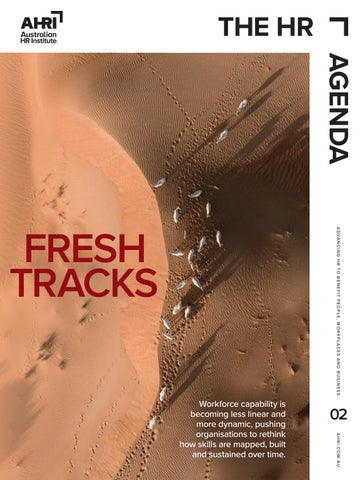



Workforce capability is becoming less linear and more dynamic, pushing organisations to rethink how skills are mapped, built and sustained over time.


The first response can reduce the risk. Or multiply it.
A complaint. A disclosure. A conduct concern. A team conflict. A performance issue. A psychosocial risk matter.
These situations can escalate quickly when the first response is informal, inconsistent or unsupported.
iHR Australia helps organisations respond early, fairly and commercially when workplace issues become sensitive, high-stakes or likely to escalate.
We support HR teams, executives and boards with investigations, mediation, workplace relations advice, compliance reviews, leadership training and practical risk management.
Need to sense-check a workplace issue? Speak with an iHR specialist.



VIEW
12 Are we setting up our workforce to fail?
The AI gap that could be costing your organisation. 14 Cover story
Skills are fast-moving targets.
Are we moving with them?
20 Below the surface
Are workforce planning decisions being shaped by what has already happened, or by what is about to?
Building pressure
Why conventional wellbeing strategies are failing us. 28 AI’s cost creep
The hidden workforce risks of redesigning work around AI.
31 Four Steps Ahead: Ashley Fell
When the training wheels of work vanish.
34 CPO profile
Paula Holden FCPHR reflects on what the role really demands.
38 Case study: ELMO Software
How AI-powered capability frameworks are changing the speed – and the stakes – of capability development.
42 The Pitch
How this HR leader won executive backing to invest in an ambitious new initiative.
46 Is momentum holding you back?
Dr Jason Fox argues relentless momentum blocks reinvention and keeps leaders trapped.
49 Line of questioning
Tim Abrahams CPHR describes the art of ‘two-speed leadership’.
50 Meet your State Council Members
54 Hidden in plain sight
What competitors’ annual reports can tell HR leaders.
58 Let’s Take This Offline
The mosaic career model is reshaping career progression.
60 The Big Ask
Rashmi Dixit Sharma CPHR answers HR’s burning questions.
62 Resources
Explore resources from AHRI’s AI Toolkit.
64 Calendar
Networking, webinars and professional development for you and your team.
66 Leadership toolkit
Content recommendations from Cassandra Hatton FCPHR

4 Contributors 6 Perspective column: Michael Rosmarin FCPHR, National President and Chair, AHRI 8 Executive brief: Sarah McCann-Bartlett MAHRI, CEO, AHRI 9 What to listen to: AHRI podcast recommendations





Paula is the Chief People Officer at the Royal Australian College of General Practitioners and sits on the boards of Orange Sky Australia, Canopy Early Education and API Leisure & Lifestyle.





Dr Jason Fox is a wizard-philosopher, complexity practitioner and leadership advisor. He works with clever teams and questing leaders seeking meaningful progress – beyond the default.
John is an industrial/organisational psychologist, Managing Director of Infinite Potential, a thought-leader in burnout and workplace sustainability and recipient of the 2025 AHRI Scholarship.


Besa is Chief Economist at William Buck and Chair of Australian Business Economists. She has more than 15 years’ experience in economic policy and market strategy.
Justin is Head of Talent, Capability and Workplace Experience at ELMO Software. He previously held senior talent and learning roles at Commonwealth Bank.





Anoop is the 2022 AHRI HR Leader of the Year and former VP, HR at Ford Australia and New Zealand. He now advises boards and executives on leadership strategy and transformation.
Sean is the founder of Humanova, a member of AHRI’s Future of Work Advisory Panel and previously led the Centre for the New Workforce at Swinburne University.






3/ 727 George Street, Haymarket NSW 2000, Australia
MANAGING EDITOR Kate Neilson
EDITOR Tahnee Hopman tahnee@mahlab.co
JOURNALIST Phoebe Armstrong
JOURNALIST Olivia Di Costanzo
CREATIVE DIRECTOR Gareth Allsopp
ART DIRECTOR Fiona Robinson
HEAD OF PUBLISHING Jelena Li
ADVERTISING SALES MANAGER Katrina Gilroy katrina.gilroy@ahri.com.au
CHIEF EXECUTIVE OFFICER Sarah McCann-Bartlett
CHIEF FINANCIAL OFFICER AND COMPANY SECRETARY Kate Ruddell
GENERAL MANAGERS
HR STANDARDS AND CAPABILITY Sarah Tedesco
PEOPLE AND CULTURE Matthew Connell FCPHR
SALES, MARKETING AND EVENTS Michelle Coleman
MEMBERSHIP & STAKEHOLDER ENGAGEMENT Robin Shepherd
TRANSFORMATION Phillip Harris
AHRI PRESIDENTS
NATIONAL Michael Rosmarin FCPHR
ACT Erin Prothero CPHR
NSW James Hancock FCPHR
NT Anita Carver CPHR
QLD Dr Anna Blackman FCPHR
SA Liana Reinhardt FCPHR
TAS Freya Beech CPHR
VIC Dr Maresa Seabrook FCPHR
WA Lucy Harding Williamson MAHRI






Dynamic business environments require a new approach to strategic workforce planning.
MICHAEL ROSMARIN FCPHR I CHAIR AND NATIONAL PRESIDENT, AUSTRALIAN HR INSTITUTE
Workforce planning has never gone away.
Yet somewhere between the talent crisis of the early 2020s and the daily urgency of managing AI disruption, it has slipped from being a strategic priority to something closer to an operational function.
That is changing. And the reason for this tells us something important about what workforce planning needs to become.
Although skills shortages persist, the primary driver of this change is more fundamental: the nature of work itself is shifting faster than most organisational systems can track.
The World Economic Forum’s Future of Jobs Report 2025 finds that 39 per cent of key skills required in the job market will change by 2030. Meanwhile, Mercer’s Global Talent Trends 2026 – drawn from insights from nearly 12,000 global executives, HR leaders and employees – finds that 65 per cent of executives expect between 11 and 30 per cent of their workforce to be redeployed or reskilled due to AI within two years.
In such a dynamic and uncertain environment, long-term workforce planning can feel daunting.
AHRI’s own research from late last year bore this out: 34 per cent of Australian organisations didn’t have a strategic workforce plan in place, and nearly threequarters expected AI to assist with that planning over the next three to five years.
The traditional workforce planning model, built on headcount projections against a known organisational structure, was developed for a more predictable environment. What replaces it has two defining characteristics.
The first is a shift from roles to capabilities. Rather than asking how many people are needed for a given set of positions, the more meaningful question is what
skills and experiences already exist across the current workforce, and where these could be further developed and applied elsewhere as work evolves.
People analytics and AI-enabled platforms make it possible to surface adjacent capabilities at a scale and speed that simply was not feasible before, identifying who has the potential to move into emerging roles with targeted development, rather than defaulting automatically to external hiring.
The second shift is from linear planning to scenariobased thinking. Business conditions are too volatile for a single, fixed workforce plan to remain useful for long.
“65 per cent of executives expect between 11 and 30 per cent of their workforce to be redeployed or reskilled due to AI within two years.
The more valuable capability is the ability to model options – to ask what the workforce needs to look like under different market conditions, business strategies and organisational contexts.
This is closer to how risk assessment and business continuity planning already work: not one answer, but a range of scenarios that organisations navigate between.
Jobs and Skills Australia’s Jobs andSkills Report 2025 concludes that generative AI is augmenting work –reshaping roles and lifting demand for digital literacy and human-centric skills. The organisations best positioned to capitalise on this will be those already mapping their existing capability and building from there.



Get the most out of your AHRI membership
Stay informed with exclusive research, HR Agenda magazine and member-only webinars
Get trusted HR support through AHRI Assist, Ask AHRI and practical workplace resources
Benchmark capability with the Capability Assessment Tool and personalised learning recommendations
Build your capability and credibility through professional HR Certification
Save on learning and events with member discounts

Access your full membership benefits now


Low turnover is not, in itself, a measure of workforce health.
SARAH MCCANN-BARTLETT MAHRI I CEO, AUSTRALIAN HR INSTITUTE
ustralian employees are leaving their jobs at the lowest rate since AHRI began tracking turnover in May 2023, with the annual rate declining gradually from 15.2 per cent in December 2025 to 14.2 per cent last quarter and 13.5 per cent in the 12 months to March 2026.
McKinsey’s CFO Pulse Survey, published in April 2026, found that 37 per cent of finance leaders identify geopolitical instability and conflicts as the biggest risks to growth over the next 12 months. Employees are responding to the more cautious economic environment by staying where they are.
Low turnover can mask significant variation in why employees are remaining. Those who stay because of financial caution behave differently to those who stay out of commitment.
There are three areas that HR will be actively managing.
1 Engagement and discretionary effort. Turnover data does not distinguish between motivated and cautious stayers. Understanding that composition – through engagement surveys, pulse data and manager intelligence – is essential for an accurate read of workforce health.
2 Capability and internal mobility. Reduced external job mobility is likely to slow the movement of people across roles and functions. Over time, this can reduce the cross-functional experience organisations depend on during restructuring or transformation and contribute to change resistance.
Many employers are responding by investing in their existing workforce. According to AHRI’s Q2 Work Outlook data, 39 per cent are investing in reskilling, 32 per cent are reorganising teams and 31 per cent are redeploying staff internally. This signals a clear shift towards building capability from within.
3 The real-earnings squeeze and the employment offer. Pay increase expectations for the year ahead sit at 3.1 per cent, down from 3.3 per cent last quarter.
For many employees, this represents another year of declining real earnings. This necessitates clear communication about pay decisions and active management of the broader employment offer –development opportunities, flexible working and internal career pathways.
Turnover data does not distinguish between motivated and cautious stayers. “
HR is well placed to quantify the consequences of the cost-management decisions being made now. AHRI data shows 15 per cent of employers are not replacing employees who leave, and 27 per cent are reducing contractor and labour hire use, transferring work to remaining employees.
Job demands are already the leading cause of psychosocial complaints, cited by 23 per cent of organisations. Workload that is redistributed without explicit management will emerge in those figures –and in absenteeism, declining engagement and, when conditions allow, increased turnover.
HR’s contribution is to interpret and act on the data in terms of risk, organisational capability and culture, and to ensure that development, redeployment and career progression opportunities are visible, equitable and actively supported.
Explore AHRI’s latest podcast episodes.


Let’s Take This Offline Episode 25
Host Narelle Hooper is joined by Elatia Abate, a US-based former HR executive turned futurist, to unpack her thinking on new ways to design a fulfilling and future-ready career.
What you’ll learn:
• How to embrace a mosaic career ladder, rather than a linear one
• The importance of learning and coaching for ‘regenerative resilience™ ’
• Other (unexpected) skills that can help you and your team thrive in a state of constant precariousness
Key moment
Jump to 5:11 to hear why Abate believes the concept of ‘future-proofing’ is futile, and what she thinks we should focus on instead; or skip to 8:32 to hear the three questions she says will help you determine the next step to take in your HR career.


ER/IR Unpacked Episode 3
Host Jonathon Woolfrey FCPHR is joined by Lisa Mannering FCPHR, employment lawyer and HR consultant at Langtree Legal, to unpack some of the big-ticket items currently being considered under the National Employment Standards review.
What you’ll learn:
• The purpose of the review
• The likelihood of an additional week of annual leave being added
• Proposed casual workforce changes
• Proposed AI consultation obligations
Key moment
Jump to 30:50 to hear Mannering and Woolfrey answering listener questions, such as how to write an employment contract when the law is in such a state of flux and what milestones HR practitioners should be looking for as the review process unfolds.


FUTURE DILEMMAS DRIFTING INTO TODAY
Let’s Take This Offline Episode 26
Academically trained futurist Reanna Browne offers listeners a glimpse into a simple exercise she runs with business leaders to determine how to approach future-of-work dilemmas that are playing out today.
What you’ll learn:
• Browne’s thoughts on an opening scenario in which AI use is crowding out a team’s capability
• The four questions Browne asks leaders to help them assess their current workforce dilemmas
• Small changes busy HR practitioners can make today to help their organisation move through complexity
Key moment
Jump to 16:40 to hear Browne’s perspectives on retaining the junior talent capability pipeline, or skip to 38:20 to hear Browne’s summary of the four questions that she gets HR leaders to ponder.






























12
ARE WE SETTING UP OUR WORKFORCE TO FAIL?
The AI gap that could be costing your organisation true ROI gains.
14
COVER STORY
Skills are fast-moving targets. Are we moving with them?
20 BELOW THE SURFACE
Are workforce planning decisions being shaped by what has already happened, or by what is about to?
24
BUILDING PRESSURE
Why conventional wellbeing strategies are failing us.
28
AI COST CREEP
The hidden workforce risks of redesigning work around AI.
31 FOUR STEPS AHEAD
What happens when the training wheels are removed from work?



A two-tier workforce is forming under HR’s feet. The leaders who have built true AI capability are the most likely to miss it because their own experience is telling them everything is fine.
BY DR SEAN GALLAGHER


The CFO of an ASX-listed company recently told me he has automated three-quarters of his role with AI. End-ofmonth reporting that used to take a week now takes him just two hours.
“Claude does most things for me now,” he said. “Extracting chunks of data and turning it into meaningful insights: dashboards, spreadsheets, reports.”
Over time, he’d built a system that runs all the time. What he couldn’t initially understand was why his team was slow to do the same. That puzzlement is the most important thing he noted.
A senior leader spending hours a day collaborating with AI on strategic decisions has a fundamentally different experience of the technology from an employee using it to summarise an email. Same tools, completely different capabilities.
The CFO was right about what AI can do; what he couldn’t see was that the conditions that let him build his practice don’t exist in most of his team’s roles. His experience was real, but it wasn’t representative.
HR has to look out for this, because the blind spot is invisible by default. My recent research shows only one in eight Australian knowledge workers has developed the capability to create real commercial value with AI – to collaborate with it on complex work rather than use it as a shortcut. Seventy per cent log in weekly, but only one in eight can use it to do work that matters. A two-tier workforce is quietly forming along that gap.
Senior leaders are five times more likely to be AI-fluent than their workforce, not because they are smarter or more motivated, but because of how their work is structured.
Senior roles are discretionary, with room to experiment and refine a method. When Sean is the founder of Humanova and a leading researcher on AI and the future of work. He’s also a member of AHRI’s Future of Work Advisory Panel, previously led the Centre for the New Workforce at Swinburne University and co-produced Australia’s first research into the impact of generative AI on knowledge work.
it comes to using AI, most roles are not: they’re full of friction – redacting information, re-entering context, moving data between systems that don’t talk to each other – and that friction recurs on almost every task, every time.
For a system-coupled worker, using AI costs more than the benefit. The CFO never met that friction, which is precisely why he had room to get good at using AI.
The risk this creates
One in three senior leaders in large organisations already see AI as an opportunity to reduce headcount – a view likely to sit on the assumption that the rest of the workforce can do what they can do, only with fewer people. The data says they cannot – at least, not yet.
Cut headcount before you build AI capability, and you’ll be left with fewer people doing harder work without the judgement to do it well – and poor capacity to oversee the agents arriving to handle the routine layer. Businesses need to build AI capabilities from a position of strength, not panic.
Three things HR can do now
This is HR’s moment, not HR’s problem. Leading in the AI era is not a training program; it’s a strategic agenda with three concrete moves.
Diagnose first . Adoption dashboards cannot distinguish a worker who spends three minutes a day using AI from one who spends three hours using it.
Dr Gallagher’s Humanova report, ‘Australia is not ready for the AI era’, highlights how AI will change tasks.
Map your workforce against both dimensions – frequency and depth – and the picture that emerges is rarely the one leaders expect. It tells you where capability is forming, where it is stalled and where to invest.
Map the friction. For most of the workforce, the barrier is not skill or motivation; it’s the work itself. A workflow analysis surfaces where the recurring cost of using AI outweighs the benefit – the system handoffs, the redactions, the formatting tax. Remove what you can; design around what you can’t. You can’t train someone out of a structural trap.
Build in protected time. The CFO had the runway to develop a practice because his role gave him the discretion most others don’t have. So how can you create that time? ELMO Software has engineered that runway deliberately with what it calls Freestyle Fridays. This is time set aside each week for employees to experiment with AI on their own work, with no productivity expectation. Without that space, depth doesn’t develop.
When agents arrive in earnest – and they are arriving – the organisations that thrive will be the ones whose people can do the value-creation work that’s left (see pyramid below), and direct the machines to do the rest. That capability isn’t built by accident and can’t be bought in a hurry. Agents will help you extract more value from your current business model. Your AI-capable people are the ones who will help you figure out the next one.
As agents handle the base of the pyramid, human value concentrates at the top: strategy, judgement, cross-functional decisions. The capability to do that work is intuition. It develops almost entirely through the deep engagement of AI.
Most Australian workers use AI weekly, but only one in eight has the fluency needed to apply it to complex, high-value work.
Senior leaders are five times more likely to be AI-fluent than employees – causing a blind spot that could drive premature headcount-reduction decisions.
HR must lead the shift: diagnosing structural barriers, building genuine AI capability, and preventing a two-tier workforce from hardening.
Learn more from Dr Gallagher by signing up to AHRI’s AI & HR: GenAI Integration Essentials course, which he facilitates.






The skills your organisation needs are not waiting to be discovered. They are moving – and the question is, are you moving with them?
BY TAHNEE HOPMAN




Most organisations are asking the right question: what skills do we need? But they often ask it through the wrong frame. The well-known gap-filling view – identify a skills deficit, deploy a program, plug it, move on – worked when disruption was episodic and the target was stable. This is no longer the case.
Mercer’s 2025-2026 Skills Snapshot Survey, spanning nearly 1100 HR and talent leaders across 72 countries, found that only 21 per cent of organisations apply skills-based thinking to work design, the lowest adoption of any talent practice it tracks.
Professor Barney Glover AO, Commissioner of Jobs and Skills Australia (JSA), sees the same problem in Australia’s labour market: shallow skills mapping that carries a cost – JSA’s numbers show 29 per cent of occupations are in skills shortage, rising to 60 per cent in sectors such as construction.
“Our labour market modelling makes it clear that skills are moving, evolving targets and the velocity is increasing. In that scenario, HR can’t just be a [skills] gap-filler.”
The challenge, then, is filling gaps faster while building organisations that can move with skills as they evolve.
This shift calls on HR to take on a skills architect role, which Jane Adams, Executive General Manager, Human Resources, Commonwealth Bank of Australia (CBA), translates into three questions she returns to in every skillsstrategy conversation.
Q1 Where do we need more of a skill, and where do we have skills we need less of? This is the diagnostic starting point, says Adams. It informs decisions on where to invest in skills development, and, just as importantly, where to stop investing.
Q2 Can we develop this capability internally, or do we need to bring people in? The most challenging trade-offs lie in determining whether the answer is a build, buy or blend strategy.
“Can we internally get our own people to learn and develop proficiency in the
skills we need, or do we need to bring new people in – or is it a mixture of both?” says Adams.
Q3 Is this about upskilling for performance, or a change in role?
Getting that distinction right shapes how the conversation is held and how capability building and career progression opportunities are identified, she says.
The trade-offs aren’t always comfortable. At CBA, the shift to a DevSecOps (Development, Security and Operations) way of working, where software development embeds automated security practices throughout the entire lifecycle rather than treating security as a final checkpoint, changed what the software engineers’ role required. It meant they needed less of the work they’d built their careers around: straightforward coding, and more security knowledge, automated testing and secure-by-design thinking.
It’s a change-in-role conversation, Adams says, that is exactly the distinction her third question is built to surface.
The three questions provide guidance for navigating skills decisions at the organisational level.
Yet the challenge stems from broader labour market conditions that are shifting and shaping those decisions, and the most effective HR leaders are already factoring the macro picture into their skills strategies.
The macro view
Glover’s labour market modelling adds context to Adams’ questions. The shortages HR is trying to solve have distinct structural causes, he says, each demanding a different response:
• A training gap, where not enough people are being trained fast enough.
• A suitability gap, where training is occurring, but graduates don’t have the skills industry needs.
• A retention gap, where the right people are in roles, but not staying, due to uncompetitive wages, limited career pathways or poor culture.
>
EXECUTIVE SUMMARY
The fastest-moving capabilities in 2026 include managing for stability, work redesign at task level and unlearning – none of which appear in most skills frameworks.
Organisations pulling ahead have matched ambition with infrastructure – unified skills libraries, individual-level skills mapping, and learning investment that goes beyond online content.
Shadow AI use is already widespread. Without a shared organisational language for skills, the result is a workforce that is technically active but strategically incoherent.
The right organisational response hinges on diagnosing which gap it is dealing with. For example, the construction industry’s 60 per cent shortage rate points to a training gap outpacing demand; in care industries, Glover notes, the more common story is retention – people leaving over wages, limited career paths or workplace culture, not a shortage of training providers.
Once that diagnosis is made, the next challenge is articulating the skills being built, bought or blended. That’s where JSA’s National Skills Taxonomy comes in. It offers a common language for capabilities, applicable across a full range of occupations, new and established.
“The taxonomy allows businesses to specify the skills they need, workers to articulate the skills they have and training providers to be transparent about what their credentials actually produce,” says Glover. “It’s being built using AI and large language models developed by Jobs and Skills Australia.”
While JSA is building the common language of skills, researchers like Dr Sandra Peter, Director of Sydney Executive Plus and Associate Professor at
the University of Sydney, are mapping where those skills are headed.
Peter, who is speaking at AHRI’s National Convention and Exhibition in August, co-developed the Skills Horizon report, which draws from conversations with hundreds of CEOs, CPOs and senior leaders across business, government, defence and the arts globally.
One of the report’s outputs is a mapping of skills across three horizons: capabilities needed now, ones that are being built by forward-looking organisations and emerging skills.
Certain skills identified as emerging might even be classed as fringe. Space business. Quantum literacy. These sit deliberately on the more speculative edges of the map, where early awareness has its own strategic value.
Peter’s own touchstone for emerging skills is quantum literacy. “A couple of years ago, the quantum conversation was only being had by the likes of Microsoft. But over the past two years governments, financial services and healthcare have joined the chat, working out what it means to be quantum-safe years before quantum lands,” she says.
At its most disruptive, quantum computing has the potential to break
the encryption underpinning virtually every digital system businesses rely on – from payroll and employee records to financial transactions.
That horizon is closer than most organisations think; research shows that 67 per cent of IT professionals expect quantum computing to significantly disrupt cybersecurity within a decade, yet only four per cent of organisations have a defined strategy to address it. But skills movement isn’t confined to the speculative edges of a skills map. The clearest example of a skill moving and evolving quickly is AI, which has shifted from a requirement of literacy to an expectation of fluency at an unmatched pace to what is now a baseline.
When a skill moves that fast and that broadly, responsibility for responding becomes an organisational challenge.
“In the past, there’d always be the one guy in the room – I call him Darren – who would hold the technical knowledge,” says Peter. “Everyone deferred to Darren. But it’s far more wide-reaching now.
“There needs to be enough collective understanding to decide what to do with technology. And just as importantly, what not to do.
Our expert interviewees share their views on the critical skills that often don’t show up in traditional skills frameworks, but that will be critical for the future of capability development.



Work redesign at task level: “Work redesign is a more detailed and complex approach because you have to get into it at a task level, not just a role level,” says Jane Adams, Executive General Manager, Human Resources, at Commonwealth Bank of Australia. “CBA has recently brought in people from process re-engineering and architecture backgrounds to build this capability into our HR function – because the skills required to lead workforce transformation are themselves transforming.”


Managing for stability: “This was the most surprising for me from this year’s research,” says Dr Sandra Peter, who will be speaking at AHRI’s National Convention and Exhibition in August. “We are so used to training leaders for change, and there is more change now than ever before. But these leaders are being asked to become the stable point while stability isn’t afforded to them as leaders. They’re being called on to absorb disruption on behalf of the team and return to constancy rather than more turbulence.”
“That comes from speaking the language of tech, fluently and together.”
What organisations need now, say Glover and Peter, is consistent vocabulary that allows for coherent decisions about AI’s opportunities, risks and trade-offs.
Jane Adams has felt the need for shared vocabulary from inside CBA’s welldeveloped skills ecosystem, built in 2023.
“The word ‘skills’ is being used within the agentic world as a folder of knowledge,” she says. “So when we talk of skills now, do we mean agent skills or human skills?
“I think we’re going to reach a crux point where we need to consider whether we’re comfortable using the word ‘skills’ for both human and agent, or whether we need a different language.”
That crux point extends beyond the banking industry, as seen in organisations’ low adoption (21 per cent) of skills-based thinking, as flagged by Mercer.
“This stems from a tendency to focus on AI in isolation,” says Peter. “But work redesign emerges at the intersection of AI, changing generational values and a fracturing information environment.
“The challenge then is, how do you craft effective technology-enabled teams while building for the flexibility people want, while driving productivity? And how do
you strike a balance between automation and human expertise at a systems level?”
Glover adds: “As with use of any transformative technology, if this develops unevenly – different people, different tools, different standards – the result is a workforce that is technically active but strategically incoherent.”
A subtler strategic trade-off worth naming is when AI absorbs the ‘grunt work’, which means it’s also absorbing the learning embedded in it.
The repetitive, unglamorous tasks that junior employees have historically complained about are also the ones that built foundational judgement, pattern recognition and professional instinct. Automate them away, and the capability that would have accumulated over two or three years simply doesn’t. The question organisations need to be asking is not just “What can AI do?” but “What are we losing when we use it – and where do we develop those skills instead?”
Glover points to the common response of cutting graduate intakes, on the assumption AI can absorb the work those roles once did. He understands the instinct, but argues the more sustainable
Taste-making: In a landscape increasingly saturated with AI-generated content, the ability to discern quality from mediocrity – to know instinctively when something is flat, formulaic or simply wrong – will become one of the most valuable and least automatable human capabilities an organisation can cultivate.
“We might have once called this judgement,” says Peter. “But taste is more nuanced and it’s not sourced purely from expertise and experience. For most of the problems leaders face today, there is either too much data to make a decision, or not enough. It comes down to taste – built through exposure, reflection and the kind of deliberate ‘learning diet’ the best leaders design for themselves.”
Unlearning: “So many leaders carry war wounds from previous technological disruptions or challenging business moments,” says Peter. “But are almost never good at saying: this model no longer serves us; this narrative is outdated. Taking things off the list is surprisingly difficult.”


Scan the QR code to download the University of Sydney’s 2026 Skills Horizon report.


resilience™:
Organisations so often talk about resilience, says Elatia Abate. “But resilience is exhausting and doesn’t work in a world of stacked disruption. Regenerative resilience has three components: clarity about what you are doing and why it matters; fearlessness – the capacity to manage your emotional responses and create multiple options for action when it feels like there aren’t any; and connection, personalising the relationships that technology has made increasingly impersonal.”
Simultaneous strategy™: “In the past, strategy happened at an off-site and was then largely forgotten. If you only focus on what’s producing results now, you’re going to miss opportunities and be blindsided by risks. The capacity to hold now-focused operational thinking and future-focused innovation at the same time is no longer a nice-to-have.”
structural response is work-integrated learning that comes with substantial embedded work experience.
“If someone’s embedded in an organisation and they’re earning while they’re learning, they’re going to be better equipped, because they would have had enormous experience about the company, its use of technology and commitment to innovation.
“It’s all about broad, continuous upskilling from which more specialised capability can grow. This doesn’t happen organically. You’ve got to invest and invest significantly.”
Former Vice President of HR at Dow Jones and futurist Elatia Abate’s provocation to boards and leadership teams on this point is equally direct.
“The most economical solutions are going to cost more in the long term,” she says. “If you want people to learn, you have to get them into experiential environments: executive education, proper classroom time, immersive experiences that change how they think about the skills they’re building.”
Adams describes CBA’s approach to learning investment as broader than conventional training.
“We don’t just think courses and learning. We think placements, experiences and on-the-job rotations.
“The measure of success is not completion, but speed to proficiency. We weigh a $3000 reskilling cost against the far higher price of redundancy and replacement, and place value on investing upfront so people are equipped to succeed in their roles.”
Formulating a skills strategy that keeps pace with disruption is a challenge on its own. Abate, whose practice centres on future-led strategy and organisational performance, has spent years developing a methodology for exactly this. Her framework, Business Beyond the Brain, a concept she will unpack at AHRI’s National Convention and Exhibition, is built on a somewhat radical premise.
“I put it to [organisations] that most of what they call strategy is not actually
strategy,” she says. “It’s experience, dressed up in planning language, run through a process designed in the past. For it to be future-ready, it’s got to come out of its container.”
Abate’s thinking centres on what she sees as a clear signal of changing skills requirements and work design: pressure on traditional authority models.
“The old model was a pyramid. The emerging one looks more like a Möbius loop, where leadership rotates to whoever holds the relevant expertise for the challenge at hand – and the person stepping back must have the strength and security to let someone else step forward.
“The environment is changing too fast for anyone to get comfortable, so we need to break the dynamic – to coach people away from ‘We have never done this before’ and ‘That’s never going to work’.”
For Abate, the underlying skill here is critical thinking. AI is framed as an eroder of critical thinking, but she disagrees. She often works with AI to interrogate her own reasoning, asking explicitly where her thinking is strong and where she’s making assumptions. “Used that way, it can amplify and sharpen your critical thinking.”
Scaling this type of thinking across a workforce is where HR’s challenge sits.
“There’s a real pace and psychological safety dimension that HR has to manage,” concludes Adams. “We don’t just launch the planes. We have to make sure they land safely.”
This article was peer-reviewed by Philippa Crome FCPHR,
Executive Manager, Corporate Services, Civil Aviation Safety Authority.
Three starting points for putting a skills reset into practice – from the boardroom case to the personal habits that sustain it:
FRAME the investment in commercial terms. Jane Adams offers two frames that cut through. The first is speed to proficiency: invest in getting people fully effective in three months rather than 12, and the organisation captures nine months of productive output it would otherwise have lost.
The second is cost avoidance. “If you’re reskilling someone from job A to job B and that costs [thousands] that’s a lot cheaper than replacing talent externally or rebuilding capability from scratch,” she says.
BUILD a deliberate ‘learning diet’. Across conversations with global CEOs and prime ministers, Sandra Peter discovered a pattern: extreme intentionality around personal learning. This included quarterly learning objectives treated as seriously as performance targets; or two conferences a year outside their own field, by design. Another interesting component was what Peter calls ‘information alliances’ –structured catch-ups with people chosen specifically for their unique knowledge and expertise.
GET INSPIRED by philosophy teachings. Abate argues that a philosophy class can be more transformative than a structured development program.
Ensure your HR team has the necessary capabilities to thrive in the future. Members can take AHRI’s Capability Assessment to discover capability gaps.
“If I could send everyone to a liberal arts philosophy class where they had to write structured arguments, debate and learn to pick apart logic, I would say, ‘go’. Philosophy has always asked what we know, how we know it and what we’re taking for granted. In a skills environment that is becoming progressively less technically legible, those are exactly the right questions.”





Introducing the AHRI AI Toolkit for HR
Practical tools, templates, learning, research and expert guidance to help HR professionals adopt AI responsibly and confidently.

Explore the AI Toolkit

For HR leaders making decisions that will play out months ahead, relying on lagging indicators can create costly timing errors. A broader, forward-looking reading of economic signals is essential to workforce strategy.
BY BESA DEDA | CHIEF ECONOMIST, WILLIAM BUCK

Besa Deda is the Chief Economist at William Buck. She also serves as Chair of the not-for-profit organisation Australian Business Economists and contributes to the broader economic community as a member of the ANU Centre for Applied Macroeconomic Analysis, the Reserve Bank Shadow Board and as a committee member of the Australian Annual Manufacturing Awards. She is an upcoming speaker at AHRI’s National Convention and Exhibition.
“In principle, workforce decisions should be guided by what lies ahead. The challenge is that many commonly used indicators are lagging, the most obvious example being the unemployment rate. By the time it rises, the slowdown is already underway.
Making sense of economic data is rarely straightforward for HR practitioners.
The signals that matter for workforce planning do not move together. They often point in different directions.
Yet decisions must still be made, and they shape capability, costs and resilience long before the full picture is clear. This creates a core dilemma. Should hiring decisions be based on what has happened or what is coming?
Hiring is inherently forward-looking: a judgement about future demand and future cost. When that judgement is wrong, the impact flows through to margins, productivity and resilience.
In principle, workforce decisions should be guided by what lies ahead. The challenge is that many commonly used indicators are lagging, the most obvious example being the unemployment rate. By the time it rises, the slowdown is already underway.
Relying on these signals alone risks decisions based on an incomplete view.
Unemployment still matters. But it is most useful when read alongside indicators that move earlier in the cycle.
Job advertisements have trended lower since late 2022, but unemployment largely held between 3.9 and 4.3 per cent after rising from a 50-year low of 3.4 per cent. That range appears to have broken, with April’s jobless rate reaching a four-and-ahalf-year high of 4.5 per cent, but unemployment slid to 4.4 per cent in May.
Measures such as job advertisements, business confidence and forward orders tend to turn sooner. They provide a more timely read on the environment and a clearer guide for workforce planning.
For example, job advertisements provide a direct read on hiring intentions. Business confidence reflects how leaders feel about future conditions, influencing
investment and staffing decisions. Forward orders offer insight into expected demand, while consumer sentiment shapes household spending, which in turn affects business revenue and labour demand.
The composition of employment is beginning to shift. There are some possible emerging signs of fragility in the mix of jobs. Part-time employment rose by 35,200 in May and annual growth lifted to 2.1 per cent. But over the past three months, part-time jobs have still declined. Full-time work remains soft, rising by just 5,200 in May while annual growth slowed to a six-month low of 0.5 per cent.
Hours worked fell by 1.1 per cent in May, adding to the picture of a market that is easing at the margins. Employers typically adjust hours first and slow full-time hiring before moving to layoffs. The continued decline in job advertisements supports this trend. Job ads have dropped 5.8 per cent over the year to May, the weakest annual growth rate since early 2025.
This aligns with feedback from our recent roundtable with recruitment businesses. Employers are becoming more cautious as demand softens, increasingly favouring part-time and temporary hiring over full-time roles. Rather than committing to permanent headcount, businesses are adjusting hours and relying on greater workforce flexibility, highlighting a more measured and risk-conscious approach.
Rising underemployment is one of the clearest early signals of this change. It indicates that labour is available but not fully utilised and typically moves ahead of any rise in unemployment.
Participation rates can further blur the picture. A rising participation rate can keep unemployment steady even as
Workforce planning built on headline unemployment rates alone risks acting on yesterday’s news, not tomorrow’s conditions.
The composition of employment, not just its volume, reveals more. Changes in that mix can signal caution or optimism before staffing levels shift.
Reading job advertisements, business confidence, hours worked and other labour-demand indicators together gives HR leaders a clearer, earlier view of where the market is heading.
employment softens, as more people enter the labour force in search of work.
This can create the appearance of stability at a time when competition for roles is intensifying.
Hours worked provide an additional lens. If hours rise while headcount growth slows, firms are stretching existing staff rather than hiring. Demand is being met, but without committing to new roles. It is a subtle but telling sign that labour utilisation is shifting.
Wage growth relative to inflation adds another dimension to reading trends. When wage growth lags inflation, real incomes come under pressure. This affects both sides of the labour market. Workers may seek more hours or pursue higher-paying roles. Employers facing rising costs may delay hiring, automate or reassess expansion plans.
Together, these signals show how labour is being deployed, not just how many people are employed. They reveal turning points earlier than headline employment data. For HR, the task is to look beneath the surface. Underemployment, participation and hours worked provide a clearer read on underlying demand than the headline numbers that dominate public commentary.
Conflicting signals are not uncommon at turning points. In short, steady employment growth can sit alongside weaker forward indicators and rising cost pressures.
The question is not simply whether to accelerate hiring or hold back – it’s how to calibrate hiring in a way that balances opportunity with caution.
Another approach involves differentiating between roles. Hiring can continue in areas critical to operations or long-term capability, while being more measured in parts of the business exposed to cyclical demand. This allows organisations to maintain momentum where it matters without overcommitting in areas where demand may soften.
Rising costs and uncertainty also increase the value of flexibility. Rather than expanding headcount broadly, businesses can adjust through hours, redeployment
and more targeted hiring – protecting capability while limiting fixed cost.
That flexibility extends to internal mobility, which becomes more important. It allows organisations to shift talent to where it is needed, rather than relying solely on external recruitment.
The broader point is recognising that headline stability can co-exist with a softer outlook. Reading both together allows HR to stay responsive without overreacting.
This helps avoid the twin risks of over-expansion and under-investment.
The goal for practitioners is not to predict the economy with precision, but to avoid being caught off guard.
In an environment of heightened uncertainty, forecasting becomes less reliable and more variable. The current environment underscores this. Geopolitical tensions, including the conflict in the Middle East, are driving volatility through oil and material prices, with broad implications for inflation, interest rates and business conditions.
HR leaders who broaden their lens and look beyond lagging indicators are better positioned to act earlier, move more confidently and build workforce strategies that hold up across different scenarios.
Early action takes many forms: securing capability before competition intensifies; adjusting labour utilisation before cost pressures build; preparing redeployment pathways before restructuring becomes unavoidable.
In a fast-changing environment, the ability to read signals before they hit the workforce is not just an analytical skill, but a strategic advantage. HR practitioners who understand the interplay between lagging and leading indicators, and who can interpret conflicting signals with confidence, are better equipped to guide their organisations through economic uncertainty with clarity and foresight.
This article was peer-reviewed by Dr Michelle Phipps FCPHR, AHRI Board member and Chair of AHRI’s DEI Advisory Panel. The information in this article is current at the time of writing (30 June 2026).
“
HR leaders who broaden their lens and look beyond lagging indicators are better positioned to act earlier, move more confidently and build workforce strategies that hold up across different scenarios.
AHRI members receive a quarterly forward-looking view of the labour market via the Quarterly Work Outlook report. View the research tab on our website for details.

Let's make sure you're doing it well.
We help organisations:
•deliver practical AI training
•develop AI governance frameworks
•write AI policies, procedures and guidelines
•review and improve existing AI documents.
Clear communication. Real results.
•fewer calls, less confusion, faster action
•higher compliance, fewer errors, stronger trust
•con dent AI adoption across your organisation
•audiences that act, because they're understood rst time.
Practical advice. Clear communication. Responsible AI.

The ongoing polycrisis isn’t just another storm to weather; it’s the new operating environment. And the coping mechanisms most organisations are running were never designed for it.
BY DR JOHN CHAN MAHRI


The polycrisis – the convergence of economic instability, geopolitical uncertainty, AI disruption and deepening global anxiety – doesn’t arrive in sequence. It arrives all at once, and compounds.
When I look at organisations scrambling to cope, I keep returning to Professor Christina Maslach’s challenge to the old saying “if you can’t stand the heat, get out of the kitchen”. Maslach, who has conducted foundational research on burnout, turns the question around. She argues that leaders should be asking, “why does the kitchen need to be this hot?” The question isn’t how to toughen people up for the heat. It’s whether the kitchen can be redesigned.

whether
That reframe is an important shift that HR practitioners are best placed to drive.
With good intent, organisations often default to an individually focused mode: supporting people to return to a baseline after a difficult period. The problem here is twofold: it places the burden of recovery squarely on the individual, and it assumes a tidy beginning, middle and end to the difficulty – and that’s no longer our reality.
The response needs to be organisational, not individual. That’s why HR practitioners need to push the conversation beyond traditional wellbeing programs and back towards work design.
The relationship between poorly managed demands and burnout has been one of the most consistent findings in
occupational psychology for some time. Sharon Parker’s landmark 2014 review in the Annual Review of Psychology found that organisations were adding complexity, cognitive demands and emotional labour to roles without redesigning the underlying job architecture to support people carrying that load. A systematic review in Frontiers in Psychology (Rothe et al, 2020) found the same pattern with technology: change consistently outpaces adaptation, leaving workers to absorb the cognitive and emotional costs without additional resources, training or role clarity. What’s changed is the pace at which demands are now being added, and the near-complete absence of reciprocal investment resources to help absorb them.
A polycrisis takes recovery time out of the equation, resulting in what is known as allostatic overload – when the nervous system is constantly activated. The cumulative cost keeps building and showing up in cognition, judgement, mood and even immune function.
AI compounds this. It can work forever, at speed, without rest. The natural pauses we once had – to think, talk and process – are gone, without any reconfiguration of how we work.
The pressure shows up most concretely in how organisations are managing the transition to AI-augmented work. The
intention to be proactive often means they dive in without rethinking underlying workflows or educating teams. I keep hearing: “Here’s the tool, go figure out how to use it.” Meanwhile, people are expected to deliver regular work faster while learning something new and innovating.
Managers, most of whom are already overstretched, are being asked to coach teams through AI adoption while managing engagement and wellbeing. The result is a retention crisis, manager burnout and a loss of trust. You can’t tell people this technology is good for them while they’re watching organisations cut roles because of it. That contradiction destroys trust.
What’s insidious is how interconnected it all becomes – workload, manager burnout, trust breakdown roll into each other and, because they’re so entangled, they demand a systems response.
The response must start with simplicity. When cognitive bandwidth is depleted, additional processes or ambiguous expectations become a heavier load on a system already struggling. What’s needed are fewer initiatives, sustained longer; fewer meetings, but better ones. In a highcognitive-load environment, clarity is wellbeing strategy and productivity strategy.
The interventions that work tend to be structural and normalised: protected time between meetings, consistently modelled expectations around after-hours communication, leave that is genuinely
Rather than defaulting to the mid-year engagement survey, here are the questions I’d encourage HR leaders to bring into their next executive conversation.
Q What have we said ‘no’ to this quarter, and what effect did that have? Sometimes not doing something has no measurable business impact and creates much-needed breathing room.
Q What are the biggest pressures on people right now and how are they connected? Once leaders see how one pressure triggers another, they can focus on how to break the chain.
Resilience programs are built for bouncing back. But in a polycrisis, there is no distinguishable ‘normal’ baseline to return to. This demands a fundamental rethink of how to support people through ambient difficulty.
Workplace demands have consistently outpaced resources for over a decade. The polycrisis has made that imbalance impossible to ignore.
Allostatic overload is now a workforce-wide condition that shows up in behaviour long before it shows up in traditional engagement data.
The organisations best placed to sustain performance are those redesigning the work, not just supporting the people doing it.
Q What are we doing to protect our middle managers from the pressures we’re placing on them? They are already unsustainably overstretched.
Q If we could redesign our processes from scratch, with a focus on reducing demands and building capacity, what would that look like? This question puts an often-neglected discipline back on the table.
taken, and regular low-pressure touchpoints where people can surface early signs of overload.
Reducing ambient uncertainty matters too. Clear, honest communication about what is and isn’t changing signals safety to an overloaded nervous system. So does a sense of control – and it doesn’t require wholesale flexibility. Genuine input into how a project is sequenced, or latitude to manage a schedule around a deadline, can be enough.
Using technology better
Technology is not the sole problem. The same tools driving much of the pressure could, if applied differently, help us understand and reduce it.
Workforce communication platforms are already capturing information on how and when people work – and whether they’re over-extending – that could serve as leading indicators of stress load. The point isn’t surveillance; it’s that we’re still largely relying on lagging indicators: the annual engagement survey, exit interviews, sick leave spikes. By the time those signal a problem, significant damage has already been done.
The tension is worth naming. Even well-intentioned monitoring can erode trust if it isn’t handled carefully. According to recent industry data, 78 per cent of employers now use some form of employee monitoring, up from 60 per cent pre-pandemic, and the global employee
monitoring software market is projected to reach US$1.87 billion in 2026. While monitoring may be intended to improve productivity, research suggests it can be corrosive to trust, with PwC’s 2024 Trust Survey reporting that over one-third of employees would trust their employer less if their employer tracked their activity. Which is why framing matters: how this data is used, why it’s collected and what guardrails are in place.
Handled well – anonymised, transparent, clearly oriented towards reducing load rather than managing performance – these leading indicators can tell HR leaders things that surveys can’t. Are people consistently working Sundays? Is leave accruing but not being taken? These are upstream signals. Acting on them early is far more effective than trying to restore people after the fact.
An underrated gamechanger I want to end on something that doesn’t come up enough: hope. Without it, organisations drift into cynicism – and cynicism is dangerous in a polycrisis. But hope only becomes powerful when people can see how progress will happen.
HR’s role is to counterbalance the conversation at the leadership table: to keep asking if we’re adding to people without ever removing anything. Our job is to make sure the people part – the biggest driver of the finances – gets the same level of rigour and intention.
The complexity of the polycrisis is not entirely of our making, but how we respond is. I believe organisations have the instincts and expertise to reset: to move from episodic intervention to sustained load management; from reactive support to structural stability; and from labelling distress to understanding its origins and formulating a more informed response.
That’s what designing calm looks like. It’s not quiet or passive. It’s one of the most active and consequential choices an organisation can make.
This article was peer-reviewed by Dr Michelle Phipps FCPHR, AHRI Board member and Chair of AHRI’s DEI Advisory Panel.
REFERENCES
1 Parker, S.K. (2014). ‘Beyond motivation: Job and work design for development, health, ambidexterity, and more.’ Annual Review of Psychology, 65, 661–691. annualreviews.org/content/journals/10.1146/annurevpsych-010213-115208
2 Rothe, I., Söffker, G., Richter, P. and Wöhrmann, A.M. (2020). ‘Work design in the context of technological change.’ Frontiers in Psychology, 11, 570612 frontiersin.org/journals/psychology/articles/10.3389/ fpsyg.2020.00918/full
ALLOSTATIC OVERLOAD ON A TIMELINE
Chronic stress is the product of accumulation. By the time it surfaces, it has already cost your organisation.
0-6 months
Discretionary effort disappears first. People are still delivering, but the coffee catch-ups, the knowledge-sharing, the willingness to go beyond the brief fade – early warning signs often written off as busyness.
6-12 months
High performers leave. Attrition at this stage falls disproportionately on senior women and underrepresented groups – consistently, across the research. What remains is a smaller core carrying a larger load.
12 months+
Sick leave rises. Cognitive sharpness dulls. Survival thinking crowds out strategic thinking. The organisation loses the forward-looking capacity it needs most, precisely when it needs it most.
The signals that matter tend to be behavioural and upstream: leave accruing but not taken, quieter teams, declining participation in anything non-mandatory. These signals are far easier to act on before the 12-month mark.



corporate remuneration. If Treasury forecasts the Wage Price Index to grow at 3.5 per cent while a business’s enterprise agreement assumes 2.5 per cent, it may have a structural problem brewing.


Artificial intelligence’s low-cost era is ending, yet the commercial rules for its use are still in flux. HR leaders can take steps to maximise AI’s returns while minimising its risks.
BY DAVID WALKER

You’ve probably seen the 12-digit numbers. They come from chipmaker Nvidia, OpenAI, Alphabet, Microsoft, Amazon, Meta and Anthropic.
These seven big AI firms are using history’s largest-ever pile of investor cash to design and build hugely expensive new query-answering arrays of AI chips: Goldman Sachs estimates total AI capex of around US$755 billion in 2026 and up to US$1.6 trillion in 2031.
Yet the big AI firms know they are not yet creating the AI profits that investors seek. In March 2026, OpenAI’s Vice President in charge of ChatGPT, Nick Turley, compared today’s unlimited subscription models to “having an unlimited electricity plan – it just doesn’t make sense”.
So the big AI firms are expected to raise prices, impose tougher usage limits and create new tiers of AI functionality to squeeze more money from customers. Some of them have already started down this path.
University of Melbourne Associate Professor Jan Kabátek can see these price rises growing. Kabátek heads the university’s highly-regarded AI initiative known as CALIBER (Collaborative AI Laboratory in Business and Economic Research). CALIBER works directly with organisations wanting to improve their AI deployments. Currently, “we are not paying for the real cost of the [AI] services that we are using”, he says.
If this continues, as seems likely, this rise in costs will force decisions on companies. Where do they deploy large volumes of increasingly costly AI resources? Where do they resist the call of AI? And how do they make those calls?


To complicate the problem, as Kabátek puts it, most companies using the technology “do not really understand AI to start with”.
Little verified on AI-related staff cuts
There’s little doubt AI can be used to replace a range of human tasks – and some organisations are moving fast.
But verified data on outcomes remains thin. Even organisations investing heavily – Amazon and Walmart in logistics, major finance firms globally – have produced few quantified labour cost figures.
The risks extend beyond headcount. A CNBC analysis of 23 S&P 500 companies that tied layoffs to AI found 56 per cent were trading in the red by mid-May 2026 relative to their share price at the announcement, averaging a 25 per cent decline. Nike was down nearly 35 per cent after cutting 800 roles; Salesforce was down 32 per cent after cutting 4,000.
Service and brand risk are just as immediate. Gartner predicts half the companies that cut customer-service staff for AI will be rehiring by 2027, under different job titles. Klarna replaced 700 service roles with an AI chatbot in 2024; by 2025, CEO Sebastian Siemiatkowski was rehiring humans after admitting the shift produced “lower quality” service.
Kabátek can point to some superannuation funds and banks in Australia with decent strategies and singles out the Reserve Bank of Australia for leveraging its “huge” internal knowledge base. Beyond that, he is reluctant to name leaders, “because I could be eating my words very soon”.
Additional integration challenges
Such circumstances should make organisational leaders cautious about the likely returns from implementing AI-driven cost-cutting, and about the conditions under which AI should be deployed. Even for high-tech organisations, AI is a peculiar new resource.
Ethan Mollick, a professor at the University of Pennsylvania’s Wharton School, has since 2023 observed that AI often functions as an almost infinite team of super-industrious, super-fast, hugely eager-to-please and supremely overconfident interns. Now organisations face the shock of genuinely changing to
maximise the benefits of these new resources and tools.
Kabátek, like several other experts, stresses the challenges involved in truly understanding how AI will help innovate, raise quality and lower costs for a particular organisation.
He also acknowledges that organisations often struggle to identify the unstated or “implicit” employee knowledge – knowledge that organisations may find hard to identify before they implement new AI systems.
And failure to understand or adapt effectively to AI technology can generate a hefty bill. Some firms have tried to ignore AI; others have adopted it without sufficient understanding.
In a recent survey of 600 HR professionals, US-based outplacement firm CareerMinds reported that:
• 33 per cent said AI-related cuts had lost them critical skills and expertise,
• 55 per cent said the technology needed more human oversight than they’d expected, and
• Just 27 per cent came out financially ahead after they included the costs of rehiring people.
In the face of rising AI costs, a lack of useful data on AI, and other AI deployment challenges, HR teams need to acknowledge the need for AI strategies that can adapt as their organisations learn.
In these circumstances, few AI experts advise immediate radical, costly restructuring.
Instead, they suggest having employees use AI to gather existing data and apply it to their current business challenges. That way, says Kabátek, employees will “actually get the right information that is pertinent to your business and to your workflows”.
And your employees, Kabátek stresses, are the people most likely to understand “which tasks can be easily automated and which tasks require the nuance that might be lacking from automated solutions”. >
AI’s low-cost era is ending. Providers are shifting to usage-based pricing, and organisations that built workforce strategies around static cost assumptions are now exposed.
Organisations are cutting headcount on the assumption AI will absorb the work, but research suggests only 27 per cent come out financially ahead once rehiring costs are included.
Fifty per cent of enterprise leaders are now spending 21-50 per cent of their digital transformation budgets on AI, making token economics a significant workforce-planning variable for HR.
1 2
Explain changes to employees early. The Australian Financial Review reported that WiseTech’s lack of clarity since its February 2026 AI-related restructuring announcements is creating a loss of trust and morale. Jane Livesey, Microsoft’s Managing Director for Australia and New Zealand, told the 2025 Aon Human Capital Insights Conference that one of HR’s most vital jobs in the AI transformation would be “helping teams understand what’s going to happen to their roles”.
Establish in-house capacity. Kabátek stresses the importance of in-house understanding of current and emerging technology. “If you’re going to just be looking around at what other people are doing, then you’re already losing,” he says. “The landscape is evolving so dramatically that … it’s important to establish in-house capacity. It’s going to be different for every firm.”
5
Look at tasks and skills, not jobs. According to Deloitte’s 2024 Generative AI and the Future of Work report, high-volume automation concentrates rather than disperses the cognitive load on remaining employees, often exposing skills gaps in the process.
6
3
4
Guard data security. “If you’re using any sort of public [AI] agent, then your information basically gets put into their training data sets … Especially if you are working with sensitive data of the clients, emphasis on security is paramount.”
Redesign primarily for augmentation. The Australian Government’s April 2026 response to the Senate Select Committee on AI says Jobs and Skills Australia scores occupations for their augmentability and automatability, and only 4 per cent of Australia’s workforce is in occupations with high automation exposure. The key takeaway is the need for augmentation-focused work redesign.

7
Stress-test the economics. Build scenarios for price rises, usage limits, vendor changes and additional compliance costs. Ask the organisation’s finance experts to model not just licence savings, but rework, assurance and rehiring risk.
Protect critical capability. Identify critical knowledge holders. Critical knowledge typically includes analytical/ judgement skills, technical/craft expertise, tacit institutional knowledge and relational skills. Knowing which is most at risk is vital before any restructuring.
8
9
Create checking systems. Do not just let individual employees use tools without enforcing checks. Right now, says Kabátek, AI systems risk “misbehaving in all sorts of unpredictable ways”. 2025’s Deloitte fiasco made that clear; a Big 4 accounting firm overlooked AI-hallucinated references in a report for the Australian Government, and suffered huge reputational damage.
Train employees to control AI. For HR leaders, this means ensuring employees have the ability to instruct this new entity correctly. Clear instruction, with context and direction, is a hard skill to acquire.
Token: The basic unit of AI work. Roughly threequarters of a word. Every prompt, response and document consumes them.
Context window: How much an AI agent can ‘hold in mind’ at once. Longer documents and multistep tasks eat through it fast and cost more. Inference: The act of the AI generating a response. This is where the compute cost sits, and why agentic tasks are far more expensive than simple queries. Flat-rate vs consumption pricing: The flat-monthlyfee model for enterprise AI is ending, as seen in GitHub’s mid-2026 move to consumption-based billing.
Learn how to responsibly and ethically integrate AI into your organisation with this course from AHRI.
ORGANISATIONAL ENABLEMENT


BY ASHLEY FELL | SOCIAL RESEARCHER
Ten years from now, the traditional junior role as we know it will be extinct, replaced by a generation of systems orchestrators who manage fleets of AI agents. For generations, the professional rite of passage was defined by administrative grunt work – earning your stripes through high-volume tasks like data entry or report drafting. Entry-level workers, primarily from Gen Alpha, will enter the workforce not to learn the how of manual execution, but to master the judgement calls required to validate and audit automated outputs.
By 2036, the entry-level role will transform from doer to orchestrator. This shift is driven by a generation that has grown up alongside AI, possessing a natural tech-fluency and an interactive, gaming-bred mindset that seeks agency over passivity.
Unlike the passive media consumption of Millennials, Gen Alpha’s experience with world-building platforms like Roblox means they enter the workforce expecting to influence outcomes and manage complex systems from day one.
However, this transition presents a significant friction point: while Gen Alpha is on track to become the most formally
educated generation in history, they will lack the traditional sandbox of grunt work that previous generations used to build professional intuition.
Organisations will face high intellectual expectations from young talent who have not yet developed the contextual muscle memory or the grit required to roll with professional punches.
HR leaders can support organisations by designing highintensity micro-apprenticeships that go beyond the skills that AI already possesses and instead train for the unique cultural and ethical context that only the organisation can provide.
1 Redefine entry-level descriptions
Move away from hiring for execution-based skills such as data entry or basic reporting. Reframe junior job descriptions to prioritise a prompt-engineering mindset and critical thinking. We must hire for the ability to question information and take initiative, rather than the ability to follow prescriptive command-andcontrol instructions.
2 Design L&D around context consumption
As AI absorbs junior tasks, identify where the learning by osmosis used to happen. Review meeting structures and communication flows to ensure young workers are invited into senior decisionmaking spaces early. Early on in their careers, they need to witness the debates, tradeoffs and pivots of leadership to build intuition that they can no longer gain through repetitive manual tasks.
3 Foster career portability
Research shows that the 2036 workforce will likely hold 18 jobs across six different careers. Shift from a retention-at-all costs mindset to a revolving-door perspective. Design positive exit processes and keep relationships warm; a junior employee who leaves to gain diverse experience is a high-value candidate who can return five years later with a supercharged skill set.
4
Be intentional with your cultural archive
While Gen Alphas bring the tech-savvy skills, they don’t necessarily have the institutional wisdom that only lived experience provides. Create intentional spaces for story transfers, where organisational veterans pass down the traditions and war stories that define your organisation’s unique DNA.
BY KARLIE CREMIN, CEO
DYNAMIC LEADERSHIP PROGRAMS AUSTRALIA (DLPA) & CRESTCOM ANZ
Every major technological revolution has reshaped the workforce, and AI is no exception. This understandably drives the question everyone is asking: “Will AI take my job?” But I think the more important question is “What happens when AI starts taking our judgement?”
For decades, organisations have focused on closing the skills gap. Today, we invest billions in developing technical capability, leadership capability and digital capability. But AI has the potential to create something far more dangerous: the judgement gap.
A judgement gap emerges when people stop exercising critical thinking because technology does it for them. It doesn’t happen overnight. In fact, it happens so gradually we barely notice until it starts showing up in the quality of decisions made.
The first calculator made us less reliant on mental arithmetic. GPS reduced our need to navigate. Search engines meant we no longer had to remember facts. None of those technologies made us less intelligent. They simply changed what our brains practised and became proficient in.
However, AI is different. For the first time, we’ve created a technology capable of performing many of the cognitive tasks that once developed expertise. It can analyse, write, summarise, prioritise, recommend and create in seconds. And that’s extraordinary. But every time AI provides the first draft, identifies the pattern, solves the problem or recommends the decision, it removes an opportunity for someone to wrestle with complexity.
And it’s through wrestling with complexity that judgement is formed. Judgement isn’t knowledge. It’s the ability to weigh competing priorities, recognise context, challenge assumptions, navigate ambiguity and make decisions when there isn’t a perfect answer. It’s also one of the few capabilities that cannot simply be downloaded.
This is why the conversation around AI needs to move beyond productivity. The organisations that thrive won’t necessarily be those that automate the most work. They’ll be the ones that deliberately preserve the thinking that matters.




That has profound implications for leaders and HR professionals. How do we ensure AI accelerates learning instead of replacing it? How do we develop future leaders if emerging talent no longer experiences the messy process of analysing, questioning and solving problems for themselves? How do we maintain accountability when decisions increasingly begin with a machine?
And what happens to psychological wellbeing when people lose confidence in their own judgement, become dependent on AI for reassurance, or feel they must constantly keep pace with technologies that evolve faster than they can?
These aren’t simply technology questions. They’re fundamentally leadership questions. They’re culture questions. They’re psychosocial questions.
“The organisations that thrive won’t necessarily be those that automate the most work. They’ll be the ones that deliberately preserve the thinking that matters.
The challenge isn’t deciding whether your organisation should adopt AI. It almost certainly should. The challenge is deciding which human capabilities should never be outsourced, because organisations don’t succeed because they have the fastest technology. They succeed because they have people capable of exercising sound judgement when technology reaches its limits.
Perhaps that’s the defining leadership challenge of the AI era. Not teaching people how to use AI, but teaching them when not to.
The future belongs to organisations that close the skills gap as that gap continues to change and flex, but it will ultimately be led by those that never allow a judgement gap to emerge in the first place.
Case studies and expert guidance from HR’s executive peers.

34
CPO PROFILE: PAULA HOLDEN FCPHR
RACGP’s Chief People Officer tells her origin story.
38 CASE STUDY
How AI-powered capability frameworks are changing the speed – and the stakes – of capability development.
42 THE PITCH


Ford’s former ANZ HR lead on pitching the company’s first global strategic workforce planning initiative.
46 IS MOMENTUM HOLDING YOU BACK?
Speed may feel like progress, but in complex times it might be eroding judgement and decision quality.


48 LINE OF QUESTIONING
Two-speed leadership: managing now, shaping what’s next.
50 Meet this year’s AHRI State Presidents and Councillors.




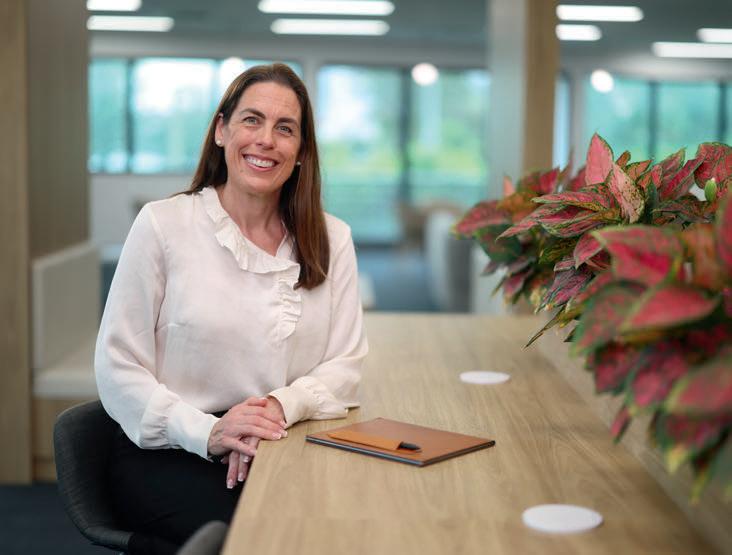
“I’VE GOT TWO EARS AND ONE MOUTH, AND I USE THEM IN THAT ORDER.”
Paula Holden FCPHR, Chief People Officer at the Royal Australian College of General Practitioners, on building HR credibility and what leading across radically different industries taught her about people strategy.
AS TOLD TO AMANDA SMITH
I spent the early part of my career in some pretty remote places. Flashy marketing and management roles that I studied for didn’t extend out in regional areas, so I ended up working with the exploration drillers.
This involved mapping grids, crushing rocks and taking them to the laboratory. But all along, my manager knew I wanted to be in HR.
A role eventually came up, supporting a recruitment campaign to bring on 75 people in three months. When that finished, I took on entry-level HR policy and recruitment work, supporting WorkCover claims and training. This is where I learned the power of making your intentions known and building relationships with frontline teams to establish credibility.
I’ve since oscillated between mining and non-profit, and have seen the profession’s transition from personnel to HR, to people and culture, and to where we are today as strategic and trusted business partners.
The capabilities I’ve developed over my HR career have travelled well, but I’ve also learned that knowing how to read people is only half the equation. The other half is understanding the business itself – and that doesn’t happen by accident.
Throughout my career – across mining, disability services, early childhood education and now healthcare – I’ve proactively pursued conversations with COOs and CFOs to understand their world and identify the gaps I needed to fill.
The fundamentals – culture, systems, ways of working – carry the same weight wherever you work, but the emotional dynamics are completely different.
In community-focused, purpose-led organisations, every workforce decision is made with a lens of deep mission commitment. In mining, the purpose is financial. Neither is wrong, but if you walk into one assuming it operates like the other, you’ll lose people fast.
As a CPO, you’re often acting commercially with people at the heart. It’s frequently necessary to remind people that, without financial success, it’s hard to drive more purpose.
For-purpose organisations are far more employee-led, so conversations will often have to happen at a grassroots level. For example, educating employees on why it’s okay to spend money on a nice office space, because, ultimately, it helps to attract quality hires and deliver better outcomes. It’s not about being splashy, but making sure we have the right people in the right roles at the right time to deliver on the purpose.
In the first 90 days in a new organisation, I always strive to listen more than I talk. I’ve got two ears and one mouth, and I use them in that order.
It’s important to recognise how far the business has come before you arrive. I’ve seen leaders walk in and immediately call out everything that could be done. That energy and enthusiasm matters, but you’ve got to honour the past and build on what’s already there – not dismiss it or come in trying to be the hero.
Ask yourself: Do we need to reach the gold-star standard right away, or is bronze okay while we build? Who are the key stakeholders who are deeply ingrained in the business that I need to get to know? Who can help me challenge what needs to be challenged?
When I was working in mining, the laboratory team were known for running their own show, often despite policies and procedures in place. Their leader, who had been there for 20 years, had an “it’s too hard, so we won’t do it” mindset. By spending a few weeks side-by-side with them day-to-day, I built enough trust to slowly introduce new ways of working and get them to see the value in having HR on their side.
The unspoken change champions often don’t always have the most influential formal roles. They’re frequently the
>
“
You’ve got to honour the past and build on what’s already there – not dismiss it or come in trying to be the hero.
PAULA HOLDEN FCPHR, CHIEF PEOPLE OFFICER AT THE ROYAL AUSTRALIAN COLLEGE OF GENERAL PRACTITIONERS







long-tenured middle managers who’ve seen multiple leadership agendas and organisational challenges. These stakeholders can be just as important as anyone in the C-suite.
On designing for scale without losing people
I’m most energised being able to create a people-aligned strategy that connects with business strategy – getting to know where the business is at and where it’s dreaming of going. Global HR thought leader David Ulrich framed it best: HR should be “doing business from the outside in”.
At RACGP, our strategy is about innovating and leading in primary care. But we can’t be what we can’t see. If we don’t have the space to take risks, or a culture that makes it safe to fail, we can’t deliver on that strategy.
A practical example of that is starting with the strategy in mind, then building leadership capability frameworks that allow our people to take measured risks and think differently.
If continuous improvement isn’t part of your culture, the innovation won’t follow. Start with the end in mind, create safety around a specific component, and by innovating within the workforce, you enable innovation for the customer.
Moving into board settings in recent years has changed the way I show up as a CPO. I’m part of conversations well beyond my functional remit, which means I can help shape the people component of strategy with a whole-of-business lens.
Serving as a non-executive director has given me real empathy for where a board’s focus sits. They’re not in the weeds of day-to-day operations. They’re looking over the next horizon, asking where the organisation is heading through a people lens.
That perspective has reinforced something I feel strongly about: People
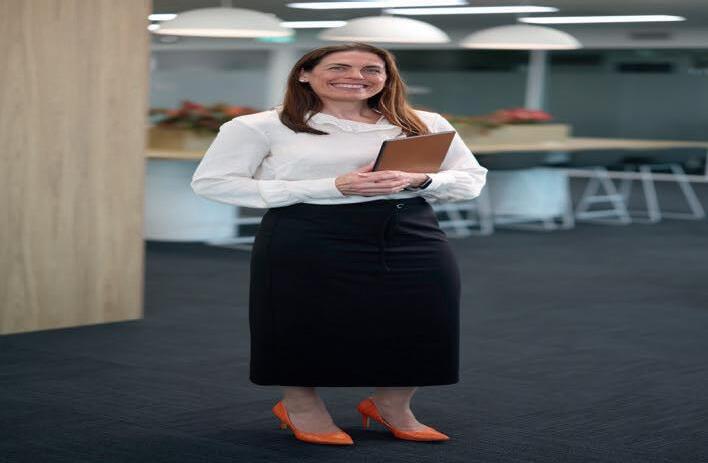
“ Moving into board settings in recent years has changed the way I show up as a CPO.
PAULA HOLDEN FCPHR, CHIEF PEOPLE OFFICER AT THE ROYAL AUSTRALIAN COLLEGE OF GENERAL PRACTITIONERS
are the biggest expense, but also the biggest opportunity for service delivery.
When working through a leadership issue with a board some years ago, I secured support because I prepared documentation at the appropriate level, using data, trends, and evidence, without pulling them into unnecessary detail or white noise.
HR leaders are constantly navigating the impact of new trends – from the shift to remote work during the pandemic to the current wave of AI. The challenge isn’t staying abreast of these trends, but knowing how to filter them: understanding what genuinely applies to your organisation and what doesn’t. When we skip that step, we risk losing focus on what matters most within our own context and environment.
Know your strategy and use it as your filter. Stay open to anything new that might genuinely support delivery, network outside of HR to see where the trends align, don’t get sold to by vendors, and pressure-test ideas with your peers and team.
Earlier in my career I was in a role that just wasn’t working, but I couldn’t understand if it was me or the person leading me. I shared this with my mentor, who was one of the big chiefs over at Queensland Rail (when they were called Aurizon). As a single mum with big career aspirations, I asked her how to balance parenting, a heavy workload, further study and sitting on a board.
She said something I’ve never forgotten: You have to find the right environment where that works for you. I’d been in environments where it didn’t work for me and I fought harder than I needed to. Sometimes the fight’s worth it, but often it’s not.
I know it’s time to leave when I’ve genuinely tried to make a difference and things aren’t moving in the direction or at the pace I need. At these inflection points, I remind myself that I learn something from every role, even if it’s what I don’t want to be as a leader.
Start your journey to HR Certification with the Talent Management and Trusted Partnership Micro-credential. Scan the QR code to learn more or visit ahri.com.au/certification
Don’t tell me, show me. What is the data telling us?
What do you want to be when you grow up?
This one usually gets a laugh. I tell my team to always think two roles ahead, then ask what I can do for them now that’s going to help in two roles’ time. The question applies equally in a business context: What do you think we want to be when we grow up? It’s about building growth into everything we do, as individuals and as an organisation. 123
A team I work with proposed shifting a pay cycle from arrears to advance. Employees would initially miss a week’s pay, which created some apprehension, but the commercial case was strong. Careful planning and understanding of individual impacts helped us to offer the right support. Once in place, people reflected on how much better it was.
Is it 80% there?
Don’t let perfection be the enemy of good. Sometimes we won’t have all the data and we’ll need to take a leap of faith. It goes back to building continuous change into the culture. Get it out, test it and adjust along the way. A longterm mindset doesn’t mean having everything lined up from the start.

With roles evolving faster than ever, an AI-powered capability framework is helping ELMO Software to continuously build, test and refine skills at scale.
BY JUSTIN MEIER | HEAD OF TALENT, CAPABILITY AND WORKPLACE EXPERIENCE, ELMO SOFTWARE
Many organisations still treat capability development as periodic rather than as a live operational discipline. In the past, we’d spend months building a beautiful capability framework and review it in 12 months. But as AI reshapes jobs faster than we can redesign them, traditional capability frameworks are changing almost as quickly as they are delivered.
This is not just a theoretical problem. The ability to deliver timely development opportunities has a massive impact on retention. Data from AHRI’s Quarterly Australian Work Outlook from March 2025 shows that one of the most frequent reasons for employee turnover is too few learning and development opportunities (19 per cent). If employees lack visibility over what is possible, they feel stuck.
ELMO Software’s response was to build an internal AI-powered capability framework designed to shift development from a static, spreadsheet-based exercise into a live, data-led workflow.
Before launching business-wide, we rolled it out to a cross-functional pilot group with mixed experience of capability frameworks. This allowed for a full picture of overall functionality, relevance and usefulness across different levels of understanding and seniority.
The process involved three distinct steps within each function:
1 Initial setup: Mapping the structural foundations based on existing data.
2 Build and deployment: Partnering directly with function leaders to generate the frameworks.
3 Feedback and reflection: Reviewing and calibrating the output before launching fully.
By going deep into functions rather than slicing horizontally across management layers, we could see exactly how the ecosystem connected. It allowed us to test what enablement materials we needed and what change management had to happen before moving to the wider business. ORGANISATIONAL
The real magic of integrating AI into this process is its sheer velocity.
In my experience working in large organisations, building a capability framework meant endless workshops and putting sticky-notes all over walls. It required huge consulting budgets and significant HR time.
AI cuts out that heavy lifting at the start. The tool reads off the position and job-family information already recorded on our HR platform and instantly generates a foundational framework. It populates definitions, drafts core competencies and outlines initial structures in a fraction of the time.
This drastically lowers the barrier to entry for capability planning. For midmarket organisations tight on time and resources, this is significant. It means HR can deliver sophisticated frameworks without a small army of consultants.
However, AI-powered framework generation can bring operational risks if you let the technology run wild.
We soon discovered that AI can be too ambitious. When setting some of the proficiency targets for job families during the initial build, we went a little too high. At the assessment phase, we realised the aspirational targets the system had generated were impractical and unrealistic and needed human calibration to anchor them back in reality.
AI gets you to the starting line, but it doesn’t replace human judgement. You can’t simply hand this technology to your managers and say, “Here, off you go with it.”

• Architecture validation: Reviewing the AI-generated job-family structures to ensure they align with our actual business operations.
• The co-creation layer: Bringing the draft framework into open workshops with our director-level and team managers to refine definitions. HR can’t be experts in every functional role – we need the leaders to contextualise the skills.
• Escalation and sign-off: Partnering learning and capability experts with functional people partners to review, sign off and escalate any areas of disagreement.
We split our architecture cleanly into core capabilities and functional capabilities. Core capabilities are the future-focused skills critical to overall success, regardless of role. For example, we have a specific core capability relating to AI expectations across ELMO, and another centred on critical thinking.
Functional capabilities are the deep, specific skills relevant only to particular parts of the business. For instance, within solutions consulting, a functional capability might be ‘customer demonstrations and presentations’, while our product team requires specific ‘product design’ capabilities.
AI gave us the platform to embark on the journey, but human alignment ensured the outputs were accurate and meaningful.
The primary friction point was helping employees and managers differentiate between assessing someone for career growth versus performance.
AI gets you to the starting line, but it doesn’t replace human judgement. You can’t simply hand this technology to your managers and say, ‘Here, off you go with it.’
delegated to AI, including:
We established strict touchpoints throughout the process where human judgement absolutely could not be delegated to AI, including:


A performance conversation looks backward; it is a lagging indicator of where you are now. Career growth conversations must look forward. We had to deliberately steer the narrative away from performance and anchor it completely in growth,
>
opportunity and future pathways. For example, we changed the language within the tool based on internal feedback. Terms like ‘area for improvement’, for example, felt negative. We tweaked the phrasing to make it more aspirational and focused on development opportunities.
We wanted managers and employees to understand that if an individual sits below a required proficiency target for a capability, that’s not a performance failure but a tangible, data-backed opportunity to refocus their development and accelerate them to the next level.
Once the framework was live and fully integrated into our core HR ecosystem, the operational impacts were immediately visible. Any change we make to a capability flows instantly through to job profiles, job families and positions.
This live connectivity quickly revealed hidden internal mobility opportunities. By stepping back and analysing the data across functions, we gained visibility over adjacent capabilities. We identified connections between different parts of the business that we had never thought of before, showing where employees could easily make lateral career moves.
It also completely reshaped the narrative around learning and development within the organisation. Rather than relying on traditional training courses to build capability, personalised frameworks prompt people to look at development through the lens of the 3 Es: experience, exposure and education.
The learning pathways anchor heavily in experiential development, surfacing tangible on-the-job activities that employees can dive into immediately.
For example, instead of watching a presentation on emerging technology, an employee looking to grow their AI proficiency is given a real-world scenario to solve. They might be asked to run a mock pilot – safely researching, testing and refining an AI tool to speed up a high-volume candidate-screening

campaign against tight timelines. To back that up, the system pushes specific reflection prompts that force them to think about things like the ethical considerations of AI. This allows employees to adapt the activity and their approach, encouraging experimentation while reinforcing critical thinking and accountability.
For HR leaders looking to modernise their capability planning, my advice is to let go of rigid, preconceived ideas. Go in with a flexible point of view, run a tight pilot, establish direct feedback loops with your business leaders and be prepared to iterate in real time.
You must also be agile with timelines. When co-creating frameworks with the business, you are competing for limited leadership bandwidth. While building a framework might be at the top of HR’s priority list, it won’t be at the top of a functional leader’s list. We had to push our own rollout timelines out by a few weeks to accommodate operational realities. That flexibility was critical to securing buy-in.
AI removes so much administrative friction, but the magic will always be in the quality of the human conversation. Use technology for heavy lifting, keep your experts in the loop to guide strategy and act on the data to spark meaningful growth across your workforce.
This article was peer-reviewed by Dr Michelle Phipps FCPHR, AHRI Board member and Chair of AHRI’s DEI Advisory Panel.
“
For HR leaders looking to modernise their capability planning, my advice is to let go of rigid, preconceived ideas. Go in with a flexible point of view, run a tight pilot, establish direct feedback loops with your business leaders and be prepared to iterate in real time.
BY KAREN O’CONNELL, LEADERSHIP AND EXECUTIVE COACH, KINGFISHER COACHING SERVICES
We know that many good things can come from a coaching engagement. Organisations invest in coaching to support leadership capability and performance, and leaders seek to develop and expand capabilities that meet both personal and organisational needs.
Leadership models and competency frameworks provide useful guidance about the capabilities and behaviours associated with effective leadership. They help organisations identify and develop leaders, often shaping leadership development programs, and can readily be incorporated into coaching.
However, leadership takes place in complex and changing environments. Leaders are required to respond to organisational expectations and operational challenges, and to how they experience and make sense of those demands.
Research by Tatiana Bachkirova and Peter Jackson (2024), based on more than 150 leadership coaching engagements, explored what leaders actually choose to learn when they are dealing with the realities and demands of leadership. Their research suggests that developmental needs emerge through the interaction between
external demands and leaders’ internal experiences.
Initially, coaching conversations often focus on familiar themes reflected in many leadership frameworks –managing people, communication, developing presence and impact, and strategic thinking. These themes remain important throughout the coaching engagement.
However, as leaders respond to the demands and complexities of their roles, other themes also emerge. Stakeholder relationships, organisational dynamics, uncertainty, transitions and relationship challenges become increasingly prominent. Leaders are often managing competing priorities, changing expectations, new role demands and the need to influence effectively in increasingly complex environments.
Alongside these organisational demands, more personal themes emerge. Confidence, wellbeing, values, purpose and identity become important areas for reflection and development.
By the later stages of coaching, understanding the self and identity had become increasingly important. Not because organisational challenges had disappeared, but because leadership effectiveness involves making sense of the interaction between external demands and our own values, strengths and ways of responding.


This reflects what we often see at Kingfisher Coaching Services. Leaders usually begin coaching seeking support with a particular challenge, capability or transition. As the work progresses, coaching provides the opportunity to step back from the immediate demands of the role, reflect on experiences and make sense of increasingly complex situations. It creates space for meaning-making and development, supporting leaders to integrate organisational expectations with their own values, strengths and ways of responding.
Through coaching, leaders continue to grow and develop, deepening their understanding of themselves and strengthening their effectiveness in increasingly complex environments. That is what really happens in coaching.
Scan the QR code to learn more, or contact Karen on kareno@ allthingshr.com.au M: 0432 056696






How do you build a business case for a capability that doesn’t yet exist – and secure global funding to make it happen?
One HR leader shares the influence models behind pitching a Fortune 10 company’s first-ever global people analytics and strategic workforce planning function.
BY ANOOP CHAUDHURI FCPHR



When I was appointed to lead Ford Motor Company’s global capability in strategic workforce planning and talent analytics, the landscape was vastly different to what it is today. We are talking about the 2012-2015 era. Back then, people analytics and predictive modelling weren’t the HR staples they are now. There was no AI to lean on and only a handful of firms in the world had an established practice in this space.
Stepping into Ford’s world headquarters in Dearborn, Michigan, as an internal appointment from Australia was an immense honour, but it also came with a heavy burden of responsibility. The mandate from the executive team was clear yet ambiguous: we know there is an opportunity here, go figure out what to do and how to do it.
What followed was a masterclass in managing global transformation, navigating competing stakeholder priorities and learning how to pitch a highly technical, multimillion-dollar vision to a Fortune 10 executive committee.
For Chief People Officers and HR leaders facing similar greenfield transformations today, the blueprint we forged at Ford offers lessons in commercial acumen, co-creation and the art of the simplified pitch.
Understanding perspectives
When you take on a transformation role, the temptation is to immediately draft a project plan, define a vision from your own perspective and start executing. That’s a trap. If you move too quickly on your own, you might go fast, but you won’t go far because you haven’t brought your people and organisation with you.
I met with a number of senior leaders across the core business units and HR, and had just two or three very simple questions for them, so I could make sure I understood what they hoped to get out of this transformation. These included ‘What does success look like?’, ‘What role do you see yourself playing?’, ‘What role do you see me playing?’ and ‘What potential blockers do you see?’
What I quickly discovered was a paradox: everyone was incredibly excited about the concept of workforce analytics, but no one knew what it should look like in practice. Almost every single stakeholder had a different perspective. More importantly, the business overlay introduced layers of systemic complexity:
• North America: The epicentre of global corporate decision-making.
• Europe: A highly mature, stable market bound by intricate labour laws and operational complexities.
• Asia Pacific, Middle East and Africa: A hyper-growth region with vastly different maturity levels and workforce dynamics.
Rather than pitching a top-down vision, this Strategic Workforce Planning & Analytics project was organically co-created through six to eight months of one-on-one dialogues outside the boardroom, securing alignment and ownership before asking for funding.
To influence a high-stakes C-suite, complex analytics were stripped of HR jargon and distilled into brief, commercial pitches focused purely on risk mitigation and bottom-line impact.
The capability successfully shifted Ford’s people data from historical reporting to predictive modelling, accurately forecasting a major engineering retirement cliff 5-10 years in advance to proactively safeguard the company’s organisational capability.
In my first two weeks on the ground in the United States, I didn’t look at data models or technology vendors. Instead, I conducted an exhaustive listening tour.
Each region was pulling in a different direction based on their local market needs. Had I pitched a top-down, UScentric vision on day one, the business value would have been completely diluted, and we would have lost the regions entirely. Instead, I suspended my own biases. I listened to their pain points without judgement and played back exactly what I heard. By mapping out their alignment and surfacing their gaps neutrally, the leaders could see the challenges for themselves. This created an immediate environment of psychological safety and a shared appetite for dialogue.
I conducted an exhaustive



There is a pervasive myth in corporate life that major decisions are made during
formal presentations in the boardroom. In my experience, they aren’t.
The real work, the deep thinking and the alignment have already happened outside the boardroom.
Before we ever asked for a single dollar of funding, we spent six to eight months chipping away at the vision. Every second week, I was on the 12th floor of world headquarters, presenting our iterative progress to the global HR leadership team, with regional Chief People Officers dialling in virtually from across the globe.
Between those fortnightly meetings, I spent an extraordinary amount of time in deep, one-on-one sessions, particularly with the business unit leaders.
Together, we co-created the vision. We didn’t look at what competitor companies were doing; we benchmarked deeply to define what strategic workforce planning and analytics meant specifically for Ford. It had to be strictly fit-for-purpose, aligning with where the business was positioned at that moment and where it intended to go over 10 to 15 years.
Because the executive stakeholders were in the room, building the foundation with us, they owned it. When it came time to ask for financial backing, we weren’t fighting for buy-in. We were simply executing a vision they’d helped create.
When you are granted an audience with the CEO and the global executive team, you operate in a high-stakes, low-time environment. Every quarter, I was given a strict 10 to 20-minute slot in the main boardroom to provide an update on our progress. I had seven or eight slides to convey an incredibly intricate corporate transformation.
radical simplicity. You have to strip away the HR jargon, centre the bottom line and articulate the commercial significance of the project.
My technical background as an engineer with Ford (I started my career at the company on the factory floor) allowed me to blend data analytics with a deep comprehension of what Ford is fundamentally built to do. Manufacturing a vehicle is an exceptionally complex process, and the core intellectual property of the company sits squarely within the engineering workforce.
When pitching to the executive team, I didn’t talk about ‘talent optimisation’ or ‘capability frameworks’. I talked about engineering capacity, product development timelines and financial risk mitigation. I partnered closely with the Chief People Officer and her direct reports to meticulously rehearse and finesse our messaging before every single executive review – practising continuously until the complex message was distilled into its most potent, commercially grounded form.
If you want a definitive, 100 per cent confirmation of approval for a major HR investment, you can’t rely on theories or elegant slide decks alone. You must prove the commercial concept with real dollars tied to the business.
To achieve this, we designed and executed three strategic pilots. I purposely targeted the Product Development and Product Engineering functions – the largest and arguably most
influential divisions within the company. Within that function, we embedded our pilots inside the advanced research arm, where engineers were developing materials and technologies that wouldn’t see a production line for years to come.
We deployed a small but brilliant team consisting of PhDs in mathematics, data science and behavioural science. By pairing these technical experts directly with the heads of research, we spoke their language.
The pilots ran anywhere from a few months to over a year and were deliberately designed to demonstrate exactly how predictive data could prevent critical operational bottlenecks.
The eyes of the chief research officers lit up. They had never experienced an HR partner discussing investments, data models and bottom-line impact. They immediately recognised the immense commercial value of strategic workforce planning, and they transformed into our most vocal advocates when it came time to secure global funding.
This maturity shift was vividly demonstrated in our work on ORGANISATIONAL
The ultimate validation of our pitch and strategy lay in the capability we built. Over my three years leading the department – growing the team from a handful of people to an established global unit of 14 or 15 experts – we systematically shifted the paradigm of how Ford viewed its people data.
We mapped our progress across a clear maturity spectrum (see below).
Some HR practitioners make the mistake of over-complicating their presentations. They want to show all their workings and highlight every data point and methodological nuance because they want to prove their expertise. But to influence a C-suite who may only grant you four or five minutes of undivided attention, you must master the skill of
What happened? Retrospective metrics (e.g. headcount churn)
OVERSIGHT What is happening today?Real-time operational monitoring
INSIGHT Why are things happening? Identifying underlying systemic and operational drivers
FORESIGHT What could happen, and what must we do about it?
Predictive modelling and risk mitigation
demographic modelling within the US. Through sophisticated predictive analytics, our team identified a significant demographic imbalance: our engineering workforce was heavily weighted toward later-career professionals.
We moved past historical reporting to predict, with a high degree of accuracy, a massive impending wave of retirements among our core engineers.
In high-tech, asset-heavy manufacturing operations like Ford, the talent lifecycle is remarkably long. It takes years for an incoming engineer to understand the systems, mature in their role and reach peak productivity.
We demonstrated to the CEO and executive committee that if we failed to act immediately, this retirement cliff would severely fracture our core research and development capability, directly hindering our capacity to productise advanced technologies.
Because we provided this foresight 5-10 years ahead of the risk, we successfully secured the mandate to implement comprehensive, long-range strategic workforce plans to proactively manage the talent pipeline.
For HR leaders pitching major strategic changes in an era dominated by AI and rapid disruption, consider my three key takeaways, below:
THREE KEY TAKEAWAYS
1 Don’t pitch in isolation: Slow down, listen without judgement and co-create with your key stakeholders.
To gain further insights from Anoop Chaudhuri FCPHR, subscribe to our YouTube channel for his upcoming video.
@ahrichannel
2 Master radical simplicity: Distill the most complex data models into clear, brief, commercially focused messages.


3 Prove it with a commercial pilot: Find a high-impact division, speak their language and show value.








ORGANISATIONAL ENABLEM EN T
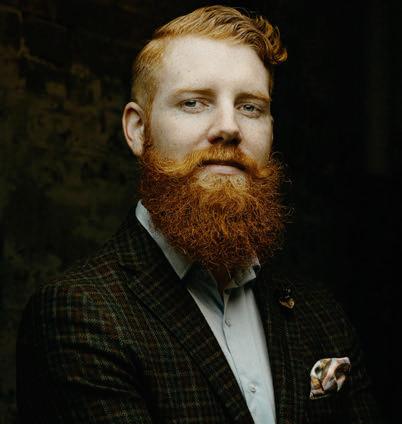
It’s time to sit with an uncomfortable idea: the faster you move, the less you actually lead.
BY DR JASON FOX
There’s a saying I keep returning to: momentum inhibits reinvention. Sit with that for a moment. Because right now, most of the organisations I work with are running so fast that the concept of pausing feels not just alien, but dangerous.
The thought of a protracted offsite with a minimal agenda and plenty of open space – physical and mental – is genuinely terrifying for many leadership teams. They can’t fathom how it could possibly be a good return on investment.
So instead, they double down. They junk up the content. They perform this theatre and parade of busyness that is incremental at best. This is what keeps us locked inside the same paradigm of thinking.
The leadership practices that emerged over 2010-20 served us well within stable, predictable contexts. They helped businesses optimise and scale. But those practices are not apt for the context we’re in now.
And rather than examining them, most organisations are doubling down on them – a reflex I call decision-based evidencemaking, where the pressure on executives to appear confident and fluent is so strong that decisions get made first and justified afterwards.
The idea that to be bold, decisive and declarative is the mark of a good leader is a lingering undercurrent within most leadership cultures. What gets crowded out in that framing is doubt. Curiosity. Introspection. The capacity to widen the focus and ask, honestly, what are we missing here?
Doubt is not a weakness. Doubt is evidence of thinking. When someone
presents with extremely high conviction and high fluency, the wise response is to wonder whether they’ve actually thought it through.
The deeper structural problem is that most organisations are now complex, where they used to just be complicated. There’s a difference between the two, and it’s an important distinction.
A complicated system has lots of moving parts, but if something’s wrong, you can find it, diagnose it, fix it, replace the part and then it works again.
A complex system – an open, living system, like an ecosystem or the human body – doesn’t work like that. The parts relate to each other non-linearly. The fix you deploy might create unintended consequences. The problem you solved perhaps spawns three more.
Some executives have made entire careers of arriving, fixing problems and leaving before the consequences catch up with them. That won’t hold for much longer.
What complexity asks of us instead is attunement. Sensing. Orienting. Probing lightly and watching what happens. This is not the kind of leadership that looks impressive in a performance review, because complexity actively deprivileges expertise. You don’t get to be the big dog with all the answers.
But in aggregate, these subtle sensibilities – knowing when to follow the org chart and when to step around it, catching someone at the right moment, making the case in a way that aligns with what they care about – make for a vastly more effective leader.
Good leaders already do this. It’s just that most of them are doing it at the level of tacit knowledge. It hasn’t been brought into conscious competence. And our traditional leadership development programs are not helping – most of what I see is cookie-cutter, tick-box, linear content that grooms people to operate
within the boundaries of the system. Fine for a stable era. Not fine for this one.
Now let’s talk about AI. Because I suspect many of you reading this have spent the past 18 months being told that AI will save your organisation time, and have watched that time evaporate into a larger pile of work than you had before.
This phenomenon has a name: Jevons Paradox. When steam engines became more efficient at converting coal into power, the expectation was a fall in overall coal consumption. Instead, demand increased. We saw the same thing with computers – ‘Think of all the time you’ll save,’ they said, and now we spend more time on computers than ever before. Email. Social media. Large language models. These things are meant to make things easier for us, and they do, sometimes. But they’re also creating more work, and in some organisations they’re justifying laying off the very people whose absence then creates more work for the few left behind.
We are, as I see it, collectively drunk on the hype of AI – pursuing supposed productivity gains, some of which are real, and many of which I would call a delusion of progress.
This is not a call to be anti-AI. You can’t ignore it. But you can run alongside it and practice wise discernment about when you do and when you do not use it. And there’s something important worth protecting in that discernment: taste.
Taste is perhaps the most underrated organisational capability of our time, and the one most at risk of being processed out of us entirely.
What I mean by taste is the capacity to integrate more-than-rational sensibilities – intuition, imagination, the relational quality of things – alongside the analytical.
Many people in senior roles have been so numbed by overwhelming workloads and the performance demands of >
Organisations running flat-out can’t pause to reinvent, and they run the risk of staying trapped in outdated thinking.
The bold, quick-answer-driven leadership styles upheld in more stable eras must make way for introspection and the time needed for reframing within complex situations.
Leaders should ask whether they’re making real progress or a comfortable delusion of it –and not be afraid of uncertainty.
AI’s efficiency promise creates more work, not less. While productivity remains important, developing taste and discernment drive real competitive edge.
ORGANISATIONAL ENABLEM EN T

corporate life that maintaining this quality of aliveness – let alone cultivating it in others – takes conscious effort. This is precisely what’s at stake when we optimise everything in sight. We end up as husks of ourselves: getting results, but at what cost?
What does this mean practically? There are three questions I’d encourage you to take to your executive team or board.
The first – and most important – is this: Is this meaningful progress, or are we perpetuating a rich delusion of progress? Meaningful progress is that which brings us closer to future relevance. The delusion of progress is what happens when default thinking gets in the way of it. This question is valid across almost any context you’re working in.
The second is deliciously subversive: What are we pretending not to know? I love this question because it reveals the fabricated, constructed nature of some of the narratives we dwell within. There is almost always something the room has collectively agreed not to surface. This question names that agreement.
And the third: What will they say of us in years to come? It’s a simple question, but it reminds us that the conversations we’re having now and the decisions we’re making now will be reflected upon in future years. Are we making wise decisions today that we can stand behind tomorrow?
I will leave you with a term coined by the poet John Keats: negative capability. This is the ability to remain within uncertainty and paradox for extended periods without desperately reaching for certainty or resolution.
The leaders I’ve seen do this well are the ones who have built cultures where people actually like their teammates, where humour exists, where disagreement is healthy. Where you can spend the whole day doing hard work together and go out to dinner afterwards and feel like you spent the day working with friends. That is the substrate of a healthy and adaptive culture.
So here is my provocation for you: the pace you’re running at right now – is it serving reinvention, or preventing it? And what would you need to protect, or slow down, or let go of, to find out?
“
Here
is my provocation for you: the pace you’re running at right now – is it serving reinvention, or preventing it? And what would you need to protect, or slow down, or let go of, to find out?
Dr Jason Fox is an upcoming speaker at AHRI’s National Convention and Exhibition in Brisbane, taking place 4-6 August. Book your spot today.
Tim Abrahams CPHR reflects on the strategic questions that guided HR through the complexities of Machinery of Government changes in the Australian Public Service following periods of institutional realignment.
TIM ABRAHAMS CPHR | ASSISTANT SECRETARY, PEOPLE, DEPARTMENT OF HEALTH, DISABILITY AND AGEING
Stepping into senior HR leadership within the public service means accepting that structural change can arrive overnight. Machinery of Government (MoG) changes – where functions, funding and people are redistributed across departments following decisions of government –require governments to reshape priorities and reallocate capability.
Early in my career, I was at the operational coalface of MoG changes that saw two functions move into one department, reshaping both scale and complexity overnight.
Practically, that meant going from managing a single building in Canberra with a few hundred employees to supporting 2500 employees across more than a hundred locations nationwide, inheriting multiple enterprise agreements in the process.
Working through that complexity taught me that managing rapid realignments requires ‘leadership at two speeds’ – in the now and with tomorrow in mind.
As a senior leader, you’re not just managing the process, you’re shaping the judgement calls beneath it in real time and often under scrutiny.
Today, sitting in the CPO seat, when I’m faced with a similar transformation project, these are the questions that I pose for myself and my team.

Tim Abrahams CPHR is the Assistant Secretary, People at the Department of Health, Disability and Ageing. He was previously the Chief People O cer and General Manager, Organisational Development at the Australian Bureau of Meteorology. He is an experienced executive leader, navigating human capital strategy, industrial frameworks and organisational resilience within the Australian Public Service. BUSINESS STRATEGY
1
What’s our authorising environment and governance framework?
When an organisation undergoes rapid structural change, speed can easily compromise clarity. MoG changes may be formally directed through government decisions, but implementation sits with agency leadership.
The first priority for any CPO must be establishing a clear line of sight regarding decision-making authority. You have to ask: what authority does the CPO hold independently and what requires escalation? How quickly do decisions need to be made and how does the executive expect to receive risk advice?
My rule of thumb is that less is more, provided there are no surprises. By clearly mapping governance and escalation pathways, you create discipline in decision-making and establish a safe perimeter within which teams can execute at pace.
At a more senior level, this becomes less about process and more about judgement. You aren’t escalating risks. You’re framing them and prioritising them.
2 What structural scaffolding is required?
A common pitfall in structural realignments is treating people as line-item transfers.
Employees may formally move with functions, but functions don’t operate in isolation – they depend on an ecosystem.
During changes like this, I look beneath the surface to understand what the business area is truly there to deliver –and what it needs to remain viable within a new organisational context. Sometimes, an executive decision means you’re being asked to integrate a function into an environment that wasn’t designed for it. That’s where HR’s role shifts from transactional to strategic.
3
Am I letting myself become stuck in the operational details?
MoG changes create uncertainty, disrupt identity and often generate anxiety.
The instinct can be to dive into the detail – to solve, to stabilise and to be present where the pressure is most immediate. But you cannot elevate a function if you remain permanently in the weeds. I often use the analogy of the ‘dance floor’ and the ‘balcony’.
On the dance floor, you’re managing immediate logistics. On the balcony, you’re assessing the broader system – culture, leadership alignment and the longer-term integration of the workforce. Both perspectives are essential, but they carry different forms of value.
I actively encourage my team to call me out when I get stuck ‘on the dance floor’. It requires vulnerability and self-awareness, but giving others explicit permission to pull you back is key.


Erin Prothero CPHR State President
Erin is a senior HR and workforce leader with over 20 years’ experience across the Australian Public Service and professional services. She is a Director at the Australian Taxation Office and has expertise in workforce strategy, planning and analytics, capability development and organisation design. She previously led the APS HR Professional Stream team and contributed to major workforce engagements in professional services. She has served on the AHRI ACT State Council since 2021, including as Vice President, and has been an AHRI mentor for several years.
Vice President
Anna Calder CPHR
Secretary
Tim Abrahams CPHR
Councillors
Paula Goodwin FCPHR
Andrew Marshall CPHR
Myra Patil CPHR
Nicole Lisle CPHR
Maria Slaughter FCPHR
Emily Backhouse CPHR
Catherine Terrell CPHR


James is the Managing Director and co-founder of Wickvale, an executive culture advisory and strategy firm specialising in culture, talent, organisation design, M&A&I (mergers, acquisitions and integration) and leadership. He partners with boards and executives across financial services and investment banking, private equity, educational institutions and government. His work has received global recognition from AHRI and the Society for Human Resource Management in the US. He also serves as a NonExecutive Director of the Australian Online Giving Foundation.

Vice President Certification
Linda White FCPHR
Vice President Membership
Desleigh White FCPHR Secretary
Victoria DeGennaro CPHR Councillors
John Alexander FCPHR
Motofumi Kotsuka FCPHR
Marnie Rowden CPHR
Vesna Vrankovic FCPHR
Josette Moffatt CPHR


State President
Anita is a people and capability leader with a passion for strengthening organisations through leadership development, workforce capability and cultures of learning. At the Northern Land Council, she leads learning strategy and systems. Her career spans the public, private and for-purpose sectors. She holds a Master of Human Resource Management and Bachelor of Commerce from Curtin University, along with qualifications in training, assessment, leadership and mentoring. Anita was appointed to the AHRI Board in June 2026.
Vice President
Allie Kellichan CPHR Secretaries
Narelle Thrift CPHR
Nicola Castillon CPHR Councillors
Doug Gillanders CPHR
Sarah Bass CPHR
Jane Riggall CPHR
Ceire Doherty CPHR
Emily Nyamdorj CPHR


State President
Anna is a strategic learning, leadership and workforce development expert with more than 20 years of experience designing and delivering high-impact capability solutions across Australia and the Asia-Pacific region. She is a former Associate Professor of Business and has led award-winning learning programs, mentoring initiatives and workforce strategies across the health, education, infrastructure, disability and government sectors. She holds a PhD in coaching and is the founder of The Talent Table, a business community.
Vice President Certification
David Concannon FCPHR
Vice President Membership
Barbara Fidock FCPHR
Vice President Engagement
Nathan Atkinson CPHR
Vice President Networks
Gerardine Rudolphy FCPHR
Dr Kym Davis CPHR
Vice President Partnerships
Claire Harrison FCPHR Secretary
Rachel O’Sullivan FCPHR Councillors
Antonia Buckman CPHR
Simon Ives FCPHR


Liana Reinhardt FCPHR
State President
Liana is Chief Experience Officer at Credit Union SA, where she is responsible for delivering the member experience through marketing, partnerships, retail and lending channels. She also serves as a Non-Executive Director on the Board of Kudos Services and joined the AHRI Board in 2025. Liana lives in a neurodiverse household with experience of autism and ADHD, which has driven her passion for disability inclusion and positive psychology practices.


Vice President Certification
Shaun Monis FCPHR
Vice President Membership
Ritu Datta FCPHR
Secretary
Kyle Murray-Symonds CPHR
Councillors
Stephany Dobbelstein FCPHR
Georgi Collins CPHR
Leanne Carr CPHR
Alfi Dawson MAHRI
Rachel Renshaw CPHR
Brett Ey CPHR


State President
Freya is a forwardthinking people leader known for creating highperforming, inclusive workplaces where people and culture thrive. As a trusted contributor and advisor to executive teams, she brings insight, empathy and influence to leadership and culture conversations, leading impactful people and culture initiatives that align with broader business goals. Freya is a nonexecutive director across not-for-profit organisations and a champion of equity, inclusion and wellbeing.
Vice President Membership
Angie Everingham CPHR
Vice President Certification
Lisel Allen CPHR
Secretary
Karlie Lister CPHR
Councillor
Cameron Scott FCPHR


State President
Maresa is a strategic people and culture leader and researcher with a passion for solving complex challenges. With experience across technology, education and professional services, she specialises in workforce strategy, transformation, leadership capability and culture. As General Manager People, Culture, Capability and Wellbeing at the Law Institute of Victoria, she leads initiatives to strengthen performance, employee experience and wellbeing. Previously, she held senior roles at Netcraft and RMIT University. She holds a PhD in HR from the University of Sydney Business School.
Vice President
Lauren Waddell CPHR
Secretary
Sarah Busscher CPHR
Councillors
Julie Coleman FCPHR
Dora Peake FCPHR
Simone Spaulding CPHR
Alexis Donachie CPHR
Shane Cameron CPHR
Kerry Young FCPHR
Jess Johnston CPHR


Lucy is a people & culture leader with over two decades of international and Australian experience. She has worked across a broad range of industries, including oil and gas, IT, defence and aerospace, financial services and higher education. Her career has spanned a mix of large multinational organisations through to growing businesses. She is the Director of LHW Consulting and holds qualifications in business psychology, change management and project management.
Vice President Certification
Richard Prunster FCPHR
Vice President Membership
Paul Harrison CPHR
Secretary
Kassy Taylor-Burch CPHR
Councillors
Nicola Veal CPHR
Laura Buck CPHR
Corrina Tolomei CPHR
Ashley Carthy FCPHR
Noor Talpur CPHR
Nicholas Rodgers CPHR

Do you want to increase your knowledge and appreciation of Aboriginal and Torres Strait Islander Australia?

Core is a comprehensive and flexible online course designed for individual and group learning.
•Ten modules of engaging content with interactive activities.
•Self-paced.
•Licenses are available to organisations.
•Designed to stimulate dialogue between participants in group settings and foster continued learning.
Core will give you
A foundational understanding and appreciation of:
•Cultural perspectives and a greater understanding of your own cultural lens.
•Unique aspects of Australian Indigenous culture.
•History and its continuing impact.
Please contact us for more information.
core@aiatsis.gov.au aiatsis.gov.au/core









What your competitors’ annual reports are telling you about their strategy – and how you can leverage this information.
BY PRASHANT MEHRA
In the mid-2010s, Australia’s major banks began using a new word in their annual reports: automation. It appeared in strategy discussions, capital allocation tables and risk disclosures. To most readers it was standard operational detail, but for those paying close attention it was a clear sign.
References to ‘automation’ and ‘simplification’ became more prominent years before large-scale branch closures and teller redundancies finally arrived. The workforce shift was visible in plain sight, disclosed formally to investors, well before it became evident through hiring freezes or unexpected attrition.
This is the central argument for why competitor annual reports increasingly matter to HR leaders.
These documents are often treated as a backward-looking compliance exercise – a record of what has already happened. Read differently, however, they can offer a clear view into an organisation’s future priorities: where capital is being allocated, which capabilities are becoming more valuable, where cost pressures are emerging and how operating models may be changing.
AGM season is when these signals are most clearly articulated, before they flow through into hiring markets and wage pressures.
Joanna Bell FCPHR, Chief People, Risk and Governance Officer at Eurobodalla Shire Council in NSW, describes annual reports as a “strategic early warning system, positioning HR professionals as a partner to see what’s about to come around the corner; not just what’s happened, but what is about to happen”.
“Signals generally appear 12 to 24 months before any workplace impacts are formally announced,” she says.
Many organisations still read annual


reports narrowly, focusing on financial performance or people sections rather than reading them as indicators of strategic direction.
For HR leaders operating in increasingly competitive labour markets, that broader perspective matters, because these signals can shape workforce planning long before labour market effects become visible.
Like many investors, HR leaders often focus on the sections of an annual report that seem most relevant to them, such as headcount data, diversity metrics, people strategy and remuneration frameworks. But the most strategic message can often be found elsewhere.
While financial statements capture the past, heightened disclosures around liquidity or funding can signal pressures that later translate into workforce decisions. These can include:
• A competitor reporting shrinking operating cashflow alongside rising debt levels, or flagging new borrowing facilities where none previously existed, often preceding the kind of cost discipline that shows up later as hiring freezes or restructuring.
• A competitor whose CFO letter shifts from growth investment to “preserving financial flexibility”, or whose auditor flags material uncertainty, often signals conditions that translate into workforce consequences well before any formal announcement.
Often the signs are not just in the numbers; language shifts can be equally telling. The narrative sections of an annual report, such as the CEO and Chair letters, strategy discussion and risk disclosures are constructed to frame where the business is going.
EXECUTIVE SUMMARY
Competitor annual reports sometimes signal workforce shifts 12-24 months before they hit hiring markets – so reading them as forward intelligence, not financial history, changes what HR leaders can anticipate.
Language in CEO letters and capital allocation tables reveals strategic intent: shifts towards ‘efficiency’, ‘discipline’ or ‘automation investment’ often precede restructuring, hiring freezes and capability gaps.
HR leaders who bring structured competitor intelligence into planning conversations reframe the function’s contribution –from responding to market movements to shaping strategy ahead of them.
Every word in the frontend narrative is chosen carefully to manage stakeholder expectations while staying within disclosure obligations. This is precisely why shifts in language are meaningful – they rarely happen by accident.”
PROFESSOR ANGEL ZHONG, RMIT UNIVERSITY
Professor Angel Zhong, of RMIT University, who studies corporate reporting and strategy, explains that annual reports are “extremely intentional” documents.
“Every word in the front-end narrative is chosen carefully to manage stakeholder expectations while staying within disclosure obligations. This is precisely why shifts in language are meaningful –they rarely happen by accident.”
For instance, one of the clearest indicators of future workforce change is often the language companies use to describe their priorities. Terms such as ‘productivity’, ‘efficiency’, ‘discipline’ and ‘transformation’ are common throughout annual reports and investor communications. According to Zhong, experienced readers treat these as early indicators, not neutral corporate phrasing.
‘Efficiency’ and ‘discipline’ often precede cost-reduction programs, she says. ‘Transformation’ typically signals significant change through technology investment, process redesign or headcount reshaping, while ‘productivity’ is often code for doing more with the same or fewer people.
Subtle shifts in wording can also reveal changes in strategic emphasis. Examples include the disappearance of a previously prominent strategic pillar, or “investment in our people” being replaced with “workforce optimisation”, or a move from specific growth targets to more cautious and aspirational language.

The real value of annual reports lies not just in identifying strategic shifts, but in understanding what they may mean for future workforce needs, retention pressure and capability gaps.
A competitor signalling strong liquidity, investment growth or capital building is more likely to increase hiring and compete aggressively for scarce talent.
Conversely, a rival with weak operating cashflow, or rising references to ‘efficiency’ and ‘discipline’ may be heading towards cost control, restructuring or wage pressures.
Similarly, heavy investment in technology or AI can signal future labour substitution in certain roles. Acquisitions often bring integration costs and cultural disruption.
Bell says this is where HR leaders can move beyond reactive workforce management and contribute more strategically to organisational planning, whether reporting to the board or to a chief people officer.
“If you’re proactively reading other annual reports, you can have those conversations early,” she says. “You can say, ‘I know that our competitor is doing X, Y, Z, so it’s going to affect us in some shape, way or form.’”
That may include preparing for increased retention risk, investing earlier in capability development, reassessing workforce design or forecasting where competition for talent is likely to emerge.
There is also value in understanding the broader context behind these decisions.
This is where annual reports become a form of competitive intelligence. A single company reducing graduate intake may not mean much in isolation, but five companies doing it simultaneously can be read as a labour market signal.
“When you see the same language and strategic pivots appearing across multiple competitors in the same reporting cycle, it’s no longer a company-specific decision – it’s a sector shift,” says Zhong.
She gives the example of the retail sector, where global annual reports were flagging digital transformation investment
from around 2014 – well before the workforce consequences arrived. Major retailers were disclosing substantial capital allocation toward e-commerce and digital infrastructure in their investor reporting years before any formal announcements about store footprints. The large-scale wave of store closures and distribution centre expansion that reshaped those workforces followed on from 2017, peaking in 2019 at nearly 10,000 announced closures in the US alone – the highest figure on record at the time. That is a two-to-three-year planning window. The signals were there for those reading carefully, she says.
Of course, none of this means annual reports should be treated as absolute indicators. Changes in economic conditions, strategy or leadership can all alter direction.
Bell cautions against overinterpreting a single disclosure or reading one annual report in isolation. Zhong similarly warns against confirmation bias (i.e. reading competitor reports to validate existing assumptions rather than stress-testing them).
Still, both consider that organisations able to interpret these signals earlier gain an important competitive advantage.
“The most common failure is waiting for certainty before acting,” says Zhong. “By the time a strategic shift is explicit – a public announcement, a media story – the planning window has often closed.”
For HR leaders, building the habit of reading competitor reporting directly, rather than receiving it filtered through finance or strategy, closes that gap.
For them, the opportunity lies in building enough commercial fluency to connect competitor strategy with workforce consequences.
That may start with something relatively simple: reading competitor annual reports more intentionally, comparing them over time and asking different questions of the information already sitting in plain sight.
By the time many organisations respond to a competitor’s workforce move, the window for choice may have already closed. But it doesn’t have to.
“It’s shifting the conversation from how do we manage the impact to what choices do we have?” says Bell.
Gain the skills required to practise strategic HR leadership with this course from AHRI.
The challenge for most organisations is extracting relevant patterns, workforce implications and strategic direction from competitors’ annual reports to make the insights useful. AI tools can help HR compare multiple reports simultaneously, identify recurring themes and highlight shifts in language that may otherwise be easy to miss. Professor Angel Zhong of RMIT University suggests the following prompts:
1 “Compare how each of these three companies describes their workforce strategy, people investment and talent priorities. Identify areas of convergence and divergence and flag any shifts in language from what a traditional employer might use.”
2 “Identify every instance where the terms efficiency, productivity, transformation, restructuring or automation appear in these reports. For each, summarise the surrounding context and assess whether the usage signals cost reduction, growth investment or strategic change.”
3 “Extract all capital allocation decisions across these three reports – including technology, acquisitions, property and people – and rank them by materiality. What do these decisions collectively suggest about each company’s workforce priorities over the next two to three years?”
4 “Compare the risk-factor disclosures across these three reports. Which workforce, talent or labour-related risks appear in all three? Which are unique to one company? What does this suggest about shared industry pressures versus company-specific vulnerabilities?”
5 “Track changes in the CEO or Chair letter tone and content across these reports. Where does language become more cautious, more aspirational or more specific? What strategic or workforce implications might an HR leader draw from these shifts?”
HR executive turned futurist Elatia Abate says it’s time to forget the career climb and take charge in a career mosaic.
Getting ready for takeoff, there’s the routine reminder from the flight crew: in case of emergency, secure your own oxygen mask before you try to help someone else.
Chatting with Elatia Abate for AHRI’s podcast Let’s Take This Offline, on the future of work and careers, that warning popped loudly into my head.
It was the same week that Pope Leo XIV’s first encyclical, Magnifica humanitas: On Safeguarding the Human Person in the Time of Artificial Intelligence, went viral, calling out the pivotal choices facing humanity in the age of digitalisation, AI and robotics.
So often HR leaders are thinking, planning and juggling the needs of others in the organisation. Now they need to secure their own masks.
Abate’s encouragingly positive message is that it’s time for us to take charge of ourselves. To reassess our career needs, aspirations and assumptions and, potentially, recalibrate. That means changing how we think about and adapt our careers.
“There’s no hiding under the couch and hoping it all goes away,” she says.
In a fascinating podcast chat, I found these three insights particularly helpful.


BY NARELLE HOOPER GAICD
1 Flat pyramids
In an analogous shift to when factories came online in the second industrial revolution, the corporate pyramid of knowledge workers is collapsing and flattening – and quickly.
“We’re going to be human beings guiding machine intelligence…We’re seeing these career ladders and even, in some cases, industries that may be disappearing,” says Abate.
2 Future-preparing, not proofing
The concept of future-proofing is a futile exercise, says Abate, because of the size, scale and scope of change that’s happening in our organisations.
Our mission is “to gather the skills, capabilities, know-how and flexibility to be able to dance with uncertainty so that we can be prepared no matter how crazy the world gets.”
A career built for seismic social and economic upheaval should look more like a mosaic than a ladder. Take comfort; there is a repeatable pathway to navigate the times, to bring clarity, the skills and confidence, so we become career “captain rather than captive”.
“A more interesting question is to take a few steps back and ask yourself three questions. What do I want to create? What kind of impact do I want to have? And how do I want to use my life?”
The answers start to give you the idea of where you might go.
3 Quick tips from improv
To thrive in an uncertain future, Abate offered an unexpected piece of advice: take improvisation classes. This gives you the capability to react and move with what’s going on around you, and not get surprised by unexpected changes.
“Yes and….” is a foundational technique, she says. Instead of negating what other people bring to the conversation, say yes and build on top of that. It’s good for innovation too.
Abate, who applies her own advice, says, “this is not a one-and-done… It’s a constantly changing thing.” And what’s to lose? She quotes mythologist Joseph Campbell: “We must be willing to let go of the life we have planned, so as to have the life that is waiting for us.”



LISTEN TO THE WHOLE CONVERSATION
Hear Narelle Hooper in conversation with former HR leader and futurist Elatia Abate in this podcast episode of Let’s Take This O ine. Learn how to design a career you love and how to prepare yourself for the future.


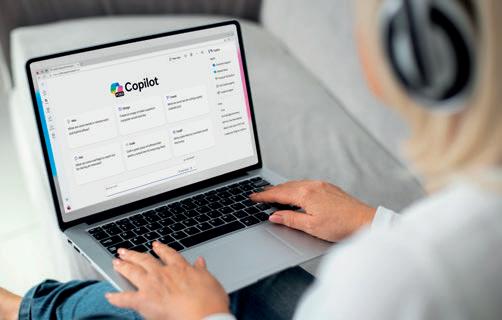


WITH
RASHMI DIXIT
SHARMA CPHR
AHRI’s latest video series convenes senior HR leaders to tackle the defining questions shaping the profession today.
HR practitioners are increasingly called upon to serve as the organisation’s strategic backbone –navigating board-level governance, complex cultural transformation and everything in between.
Yet for the profession’s most demanding challenges – AI integration, mental health boundaries, executive performance management – there is rarely a standard playbook.
In AHRI’s new video series, The Big Ask, senior HR leaders share direct, unfiltered perspectives on the issues defining Australian organisations right now.
Q How should you respond when the board involves you in managing the CEO’s performance?
Rashmi: This is not an easy situation, particularly if you report directly to the CEO. However, as people and culture professionals, we have an obligation to ensure fairness, institutional compliance, and that individuals are given the ability to present their side of the story.
The CEO should be afforded that baseline fairness as well, and it is your responsibility to advise the board accordingly. That said, if you believe you can’t remain entirely objective throughout the process, it’s important to excuse yourself. In those instances, involving a third-party legal firm is perfectly appropriate and often preferable.
Q How should you approach performance issues related to mental health challenges?
Rashmi: We need to normalise mental health and treat it with the same baseline regard as physical health. However, experiencing a mental health challenge does not absolve an employee of their baseline performance requirements or obligations to the business.
As leaders, we must support our people with kindness and empathy, but we must also keep health and performance separate. If an employee’s performance is slipping, you must still document and manage those gaps.
If a person is genuinely too unwell to discuss work-related matters, their doctor can provide a medical certificate clarifying the necessary workplace adjustments or time off. Understand your rights as an employer and ensure your managers do, too.
Q How should HR respond when it becomes clear that the next generation of talent is not interested in stepping into management or leadership positions?
Rashmi: The first question an organisation needs to ask is: do you actually have good role models for leadership? Why should a person want to become a leader, and what is really in it for them?
Very often, people don’t want these roles because they see them as exclusionary or they see a leadership team that is constantly overwhelmed and disconnected.
It’s perfectly fine if someone prefers to remain an individual contributor, and organisations must build clear, valued career paths for them. But for those stepping up, we have to reframe what leadership looks like. True leadership is not about power; it’s about influence and removing roadblocks to enable the team to do a good job.
When the workforce sees that leaders are central to supporting the team – and that they actually make time for their people – leadership ceases to be a scary, unappealing role and becomes something they genuinely aspire to.

Watch the full video, where Rashmi answers more questions in AHRI’s video series The Big Ask.
Build industry-recognised HR capabilities with AHRI courses, trusted by Australian employers


Built by HR professionals, for HR professionals
Flexible learning

Courses for all experience levels
Explore our range of HR courses Why study with AHRI?

AHRI’s 2026 Professional Development calendar is out now
This is an excerpt of AHRI’s AI Toolkit, a central hub comprising tools, learning and guidance to support HR practitioners at every stage of AI adoption, from building foundational knowledge to embedding responsible practice across their organisations. AHRI members have access to exclusive resources including webinars, research reports, ready-to-use templates and support materials. To access this toolkit’s content in its entirety, scan the QR code on the opposite page.
Up to a 20 per cent discount for members
AI & HR: Gen AI Integration Essentials
An introductory course covering the fundamentals of generative AI and how to apply it across HR functions, from recruitment and performance to workforce analytics. Includes practical guidance on managing change and positioning AI’s role in the HR value chain.
Complimentary for members
AI in HR – From Insights to Impact
Practical strategies for applying AI across HR functions, from decisionmaking to workforce planning.
AI & HR: What You Need to Know to Stay Compliant
A two-hour course covering the legal, ethical and practical risks of AI in HR, including workplace discrimination, privacy obligations and vendor accountability. Participants leave with ready-to-use checklists and clear action steps.
Embedding Responsible AI: Shaping Workforce and Culture
An advanced course focused on HR’s role in embedding AI into workforce strategy, planning and organisational culture. Covers governance, workforce transformation and building a culture that supports responsible AI adoption.
The State of Work: AI, Absence and Australia’s Changing Workforce
Examines how AI is shaping workforce trends in Australia, including patterns in absence, engagement and the changing shape of work.
Generative AI for HR
Apply generative AI across HR tasks to improve efficiency and support decision-making.
Member exclusive
Explore how organisations are managing recruitment, retention, reskilling, reorganisation and redundancies simultaneously in response to economic uncertainty and rapid technological change.
Member exclusive
Understand the economic, workforce and AI trends shaping HR priorities, with practical insights to help you anticipate change and position HR as a strategic driver of performance.
Embedding Responsible AI: HR Roadmap
A step-by-step implementation guide structured around four phases: ideation, implementation, inspection and iteration.

AI Policy Template (Responsible Use of AI in the Workplace)
A legally reviewed, best-practice template aligned with Australian workplace law and the Privacy Act 1988.
AI Readiness Framework for HR Leaders
A structured diagnostic tool to assess organisational readiness across performance, compliance and wellbeing.
BUSINESS STRATEGY
WORKFORCE EFFECTIVENESS
The Strategic HR Leader 22, 23, 29 & 30 October 11am – 12:30pm AEDT
Leadership and Management Essentials 16, 17, 23 & 24 November 11am – 12:30pm AEDT

Organisational Design
1 & 2 September 1pm – 4pm AEST
HEALTH, SAFETY & WELLBEING
ORGANISATIONAL ENABLEMENT
Trauma Informed HR 16 & 17 September 9:30am – 12:30pm AEST
Enterprise Bargaining: A Step-by-Step Engagement Plan
27 & 28 October 1pm – 4pm AEDT
Performance Management for Neurodiverse Workplaces
13 October 11am – 1pm AEDT
Change Management: Driving Engagement and Performance 11 & 18 September 1pm – 4pm AEST
TRUSTED PARTNERSHIP
TALENT MANAGEMENT
Advanced Workplace Conduct Standards 14 September 1pm – 4pm AEST

CULTURE LEADERSHIP
DEI for HR Leaders: Advanced DEI Practices 29 October 1pm – 4pm AEDT
AI & HR: What You Need to Know to Stay Compliant
30 September 11am – 1pm AEST
HR Law – Advanced 24 September 1pm – 4:30pm AEST
Workforce Planning –Advanced 11 & 18 November 10am – 1:30pm AEDT
TRAINING FOR YOUR TEAM
Ensure your team remain up to date with best-practice HR
HR Law – Foundations 8 & 9 September 9:30am – 12:30pm AEST
Implementing Wellbeing Initiatives 16 & 23 October 1pm – 4pm AEDT
AI & HR: GenAI Integration Essentials 23 & 30 September 11am – 12:30pm AEDT
People Analytics & Insights – Advanced 1 & 8 December 10am – 1:30pm AEDT
Reasonable Adjustments for Neurodiversity 19 November 11am – 1pm AEST
Workplace Conflict Resolution 29 & 30 September 1pm – 4pm AEST
AHRI also delivers in-house training for your team. Get in touch to learn more.
Developing a Capability Framework 4 September 10am – 12:30pm AEST

Developing and Embedding an Employee Value Proposition 4 & 5 November 1pm – 3:30pm AEDT
Visit ahri.com.au/training to book into an upcoming course.
Organisational Enablement
Talent Management & Trusted Partnership
Business Strategy & Culture Leadership
Workforce Effectiveness
Health, Safety & Wellbeing
FACILITATOR-LED
Health, Safety & Wellbeing
11 – 18 August
Business Strategy & Culture Leadership
24 – 25 August
Organisational Enablement
27 August – 1 September

AHRI National Convention & Exhibition HR Conference 2026
BCEC Brisbane
4 – 6 August
See the line up: ahri.com.au/nce
NT Conference
DoubleTree Hilton Hotel, Darwin
9 September
See the line up: ahri.com.au/eventsand-networking-state-conferences
UPCOMING NETWORK FORUMS
VIC
FY26/27 Salary Guide Webinar:
Workforce Trends & Market Insights
11 August, 12pm – 1:30pm
VIC Ballarat Network
NSW
Effective Behavioural Assessment
13 August, 11:45am – 1:30pm
NSW Central West Network
WA
Public Sector Morning Mingle
26 August, 8am – 9am
WA Public Sector Network
SA
SA HR Connect
24 September, 5pm – 7pm
SA State Council
Visit ahri.com.au/networking-and-events to sign up to these events and to see local networking opportunities in your state.



Content recommendations from an experienced HR leader.
CASSANDRA HATTON FCPHR I
I deliberately look outside the traditional HR bubble because the future of work is being shaped everywhere: technology, behavioural science, hospitality, sport and design. I regularly learn from The Knowledge Project, Dan Turchin, Reid Hoffman, Amy Edmondson and Rory Sutherland, because they are voices that challenge how we think about leadership and human behaviour. But some of the sharpest insight comes from ‘following’ your staff, customers and culture itself: what people are watching, listening to and talking about. You can’t lead humans well if you’ve lost touch with the world they’re living in.
Learn the business deeply. The most influential HR leaders understand commercial priorities, operational pressures and customer outcomes, not just frameworks and theory. Influence comes when people trust that you genuinely help move the organisation forward. I also strongly believe that more is caught than taught. Intentionally spending time with smart, challenging and different thinkers will stretch your judgement and perspective. If everyone around you agrees with you, you’re probably not learning very much and your influence will stagnate.

CASSANDRA HATTON FCPHR I CHIEF PEOPLE AND CAPABILITY OFFICER, SQUARED GROUP

WorkLife with Adam Grant is one I recommend constantly because it explores leadership, culture and human behaviour in a way that’s intelligent, practical and deeply relatable. Adam Grant has a rare ability to translate research into stories and insights leaders can actually apply. I love content that stretches how people think about work and relationships, particularly in a world where technical skills matter, but human skills increasingly create real competitive advantage.
“Don’t confuse activity with impact.” Early in my career, someone reminded me that being busy, responsive and constantly available is not the same as being strategic or effective. HR can easily become the organisational catch-all if we’re not disciplined about where we spend our energy. That advice completely changed how I work. I now spend far more time asking: what problem are we actually trying to solve, and what will create a meaningful impact for people and the business?

The Power of Moments shaped how I think about leadership, culture and employee experience. It reinforced that moments such as feedback, challenge and connection are the ones people remember at work, and they’re rarely accidental; they’re intentionally designed. As we move into an era of blended human-machine workforces, meaningful human experiences will become a competitive advantage. AI may streamline work, but nobody feels deep loyalty to beautifully automated workflows.
MY FAVOURITE QUOTE
In a time of drastic change, it is the learners who inherit the future.
ERIC HOFFER





Showcase your capability and stand out from the crowd with a CPHR
Are you ready to begin your journey to becoming a certified HR practitioner?

Take our 1-minute quiz to discover your pathway