


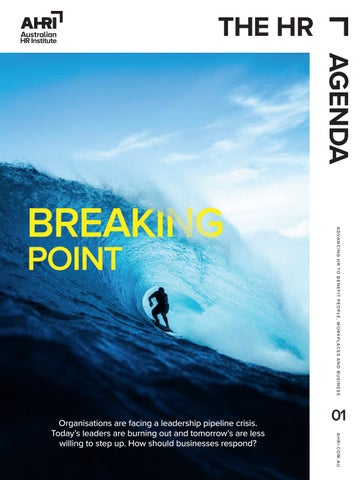






Organisations are facing a leadership pipeline crisis. Today’s leaders are burning out and tomorrow’s are less willing to step up. How should businesses respond?




Cover story Are we facing a future leadership pipeline crisis?
The data credibility gap How to create stronger data governance practices.
4 steps ahead
Will HR need to justify human presence in the future?
Hidden signals
Your guide to reading the Federal Budget papers. 28 The people squeeze
When people costs become a board concern.
31 Opinion: Rabia Siddique
Does your trust strategy stand up to scrutiny?
34 CPO profile: Erika Takahashi
The ICONIC’s CPO on building out HR from scratch.
38 Taking a leap of faith
Amart Furniture’s CPO reflects on the “toughest six months of his career”.
42 The Pitch
PepsiCo ANZ’s HR leader outlines how she secured buy-in to invest in an “incubator-style team”.
46 Expand your capacity for change
Michael Bungay Stanier says conventional change wisdom is no longer fit for purpose.
48 Line of questioning
Star Entertainment Group’s HR lead offers a look into her strategic thinking approach.
52 Shadow costs
Exploring the human capital risks of restructures.
56 The Game Plan
Four HR leaders answer a complex HR conundrum.
60 ER/IR Unpacked
Explore takeaways from AHRI’s new podcast.
62 HR resource
Download AHRI’s AI Readiness Framework.
64 Calendar
Networking, webinars and professional development for you and your team.
66 Leadership toolkit

4 Contributors 6 Perspective column: Michael Rosmarin FCPHR, National President and Chair, AHRI 8 Executive brief: Sarah McCann-Bartlett MAHRI, CEO, AHRI 9 What to listen to: AHRI podcast recommendations


Alison Stott FCPHR shares content recommendations.





Sarah is the Group Chief People Officer at The Star Entertainment Group. She is also an experienced CEO, Director, Board advisor, executive coach and Chair of Too Good Co.



Rabia is an international criminal and human rights lawyer, former British Army officer, author and leadership and cultural change consultant focused on trust, courage and ethical leadership.
Philip is the co-founder of Agile HR Analytics and a chartered psychologist. He has spent over two decades at the intersection of data, technology and complex human behaviours.




Michael offers the tools and confidence to make a real difference in your work. He’s best known for his book The Coaching Habit and his most recent book is How to Work with (Almost) Anyone.



3/ 727 George Street, Haymarket NSW 2000, Australia
MANAGING EDITOR James Chalmers
EDITOR Kate Neilson kate@mahlab.co
JOURNALIST Phoebe Armstrong
JOURNALIST Olivia Di Costanzo
CREATIVE DIRECTOR Gareth Allsopp
ART DIRECTOR Fiona Robinson
HEAD OF PUBLISHING Jelena Li
ADVERTISING SALES MANAGER Katrina Gilroy katrina.gilroy@ahri.com.au
Level 2, 31 Queen Street, Melbourne VIC 3000, Australia enquiries@ahri.com.au 1300 811 880
CHIEF EXECUTIVE OFFICER Sarah McCann-Bartlett
CHIEF FINANCIAL OFFICER AND COMPANY SECRETARY Kate Ruddell
GENERAL MANAGERS
HR STANDARDS AND CAPABILITY Sarah Tedesco
PEOPLE AND CULTURE Matthew Connell FCPHR
Kirsty is the Senior Director of Human Resources ANZ at PepsiCo and previously held HR positions with Vodaphone, BP and Xerox across the UK and in Australia.


SALES, MARKETING AND EVENTS Michelle Coleman
MEMBERSHIP & STAKEHOLDER ENGAGEMENT Robin Shepherd
TRANSFORMATION Phillip Harris
AHRI PRESIDENTS
NATIONAL Michael Rosmarin FCPHR
ACT Paula Goodwin FCPHR
NSW Athena Chintis CPHR
NT Anita Carver CPHR
QLD Dr Anna Blackman FCPHR
SA Liana Reinhardt FCPHR
TAS Freya Beech CPHR
VIC Dr Maresa Seabrook FCPHR
WA Jonathon Woolfrey FCPHR
Erika is the Regional People & Culture Director at THE ICONIC. She formerly held senior HR roles with Fiskars Group, Mastercard, Gucci and GE.
Nick is the Chief People Officer at Amart Furniture. Previously, he held HR roles with City Beach, Dick Smith Electronics and the Department of the Premier and Cabinet (QLD).








Why human-centred leadership is a strategic necessity.
MICHAEL ROSMARIN FCPHR
MICHAEL ROSMARIN FCPHR I NATIONAL PRESIDENT AND CHAIR, AHRI
hen we reflect on leaders who successfully anchored their followers through volatile periods – figures such as Winston Churchill, Nelson Mandela and Mahatma Gandhi – their ‘strategic foresight’ or their status as ‘visionaries’ are not the first things that come to mind. Followers don’t look back and say, “They were such a brilliant systems-thinker.” Instead, they more often than not highlight the human elements – the leaders who provided clarity, communicated with conviction and transparency, demonstrated courage and genuinely cared about people.
In a climate of constant disruption, where leaders are steering in and out of change cycles in quicker succession than ever before, human-centric leadership skills become a strategic necessity.
Work is becoming faster and more complex, and the transformation mandate is only strengthening as businesses look to keep pace with competitors, innovations, AI and the broader market.
Many HR practitioners will be aware of the oft-cited McKinsey research which found that roughly 70 per cent of transformation efforts fail. In an article for Harvard Business Review, executive coach Jenny Fernandez suggested that a reason for this was a breakdown in leadership skills. What looks like change resistance is often a leadership perception gap, she said, such as misreading employees’ silence on an issue as buy-in, or dismissing valid concerns as complaints, which can cause dissent to surface.
When leaders show genuine care, they shift their approach from control to curiosity. They are less focused on having the right answers and more focused on creating the conditions for others to contribute. Listening becomes more intentional and space is made for the full reality of people’s lives – both in
and beyond the workplace – to be acknowledged. This matters because transformation cannot succeed on logic alone. It requires leaders to engage both the ‘hearts and minds’ of their workforce. When people feel heard and respected, they are more willing to commit discretionary effort and stay the course through disruption. Take Microsoft for example.
Under Satya Nadella’s human-centric leadership – which prioritised empathy over internal competition – cutthroat silos were dismantled to focus on collective innovation. This cultural overhaul drove a historic turnaround, seeing Microsoft’s market valuation surge by over $2 trillion during his tenure.
When leaders show genuine care, they shift their approach from control to curiosity. “
Research continues to reinforce this. A 2024 study published in the Behavioral Sciences Journal on the mechanics of “servant leadership” – a model defined by a leader’s decision to prioritise their team’s development and wellbeing above their own ego – found strong links to employee wellbeing and organisational justice.
Human-centred leadership is not merely about being kind. It strengthens trust, fairness and commitment, which are critical for sustained performance, particularly through protracted periods of change.
Transformation is a technical challenge, but leading it is a human one. Let’s ensure that we’re helping our organisations invest in the latter with as much fervour as the former.










































Register for the celebration webinar.




On 20 May, join AHRI’s International HR Day webinar as we recognise the leadership, integrity and innovation of HR professionals driving meaningful change.
Hear expert perspectives on responsible AI, skills based workforce planning and inclusive leadership — and the role HR plays in designing the future of work.





HR has a vital role in supporting the C-suite to make informed decisions during periods of volatility.
SARAH MCCANN-BARTLETT MAHRI I CEO, AUSTRALIAN HR INSTITUTE
Businesses are navigating a period of acute pressure, with the protracted conflict in the Middle East driving volatility across oil prices, inflation and borrowing costs. As these external forces put pressure on revenue and margins, leaders are being forced to reassess their strategic position.
McKinsey research confirms this shift: leaders now identify geopolitical and trade instability as more significant threats to global growth than macroeconomic volatility, cybersecurity or technological disruption.
While such shocks often necessitate rapid responses – including tighter cost management – the long-term implications of these decisions still require rigorous assessment.
HR’s role is to provide the systemic perspective necessary to ensure that short-term measures enable effective navigation of disruption and don’t derail delivery and performance over time.
While a temporary reduction of payroll expenses may be a necessary short-term measure – be that through hiring or pay freezes, headcount reductions or a hold on discretionary incentives – HR leaders are presenting alternative options for consideration.
Early insights from AHRI’s Q2 Quarterly Australian Work Outlook found that many organisations are considering a mix of capability and cost-preserving measures. Thirty-one per cent plan to pursue internal redeployment, 27 per cent plan to reduce reliance on contingent labour and 26 per cent are considering modified working patterns to maintain stability. Interestingly, redundancy intentions remain flat at 19 per cent, suggesting that businesses are prioritising talent retention.
However, where headcount reductions or not
replacing exiting employees (15 per cent) are considered as potential cost-saving levers, HR can quantify the shadow costs of these decisions.
For example, short-term savings could increase psychosocial risk, erode service or quality standards, or deplete institutional knowledge, all of which are difficult and costly to reverse once market conditions stabilise.
As well as highlighting shadow costs, HR leaders play a critical role in shaping strategic trade-offs. While AHRI data indicates that 32 per cent of employers are considering restructuring to address inefficiencies, the C-suite must weigh competing priorities.
The immediate challenge for the C-suite is ensuring tactical responses don’t inadvertently erode long-term performance. “
For example, while pivoting talent from long-term projects to immediate remediation may support market share and revenue in the short term, it can impede longer-term growth. HR’s role is to help quantify these frictions, ensuring that resource allocation is driven by strategic necessity.
The immediate challenge for the C-suite is ensuring tactical responses don’t inadvertently erode long-term performance. This is where HR’s ability to integrate business strategy, organisational design and workplace capability serves as a critical lever for informed decision-making and organisational resilience.
Explore AHRI’s latest podcast episodes.


IN THE AI ERA
Let’s Take This Offline Episode 23
Host Narelle Hooper is joined by Shirley Chowdhary, seasoned board member, Chair and former CEO. They move beyond the AI hype to explore how HR leaders can use AI to forecast, challenge ingrained thinking and influence strategic decisions.
Key lessons
• Potential downstream governance risks of AI
• The implications of AI for organisations’ workforce strategies
• The shift to mixed teams (humans and AI agents).
Key moment
Jump to 31:29 minutes to hear how Shirley has used AI to create a scenario-planning tool to design ten “no regret bets” to support her strategic planning, or skip to 24:55 minutes to hear her thoughts on the questions HR leaders should be taking to their leadership peers and boards regarding how to surface AI risks.




ER/IR Unpacked Episode 1
Host Jonathon Woolfrey FCPHR is joined by Natalie Gaspar, employment lawyer and Partner at Herbert Smith Freehills Kramer, to discuss existing and emerging legal frameworks around AI, and how to stay compliant while adopting new technologies.
Key lessons
• The current legal safeguards in place and what HR can expect coming on the horizon
• The minimum governance frameworks organisations should implement, including rules on privacy, confidentiality and appropriate AI use
• Leading with consultation and transparency when introducing AI to manage psychosocial and trust risks.
Key moment
Jump to 27:47 minutes to learn about where accountability lies when engaging third-party vendors who use AI in their systems.


ER/IR Unpacked Episode 2
Dr Samone McCurdy, Executive Manager of Insights and Capability at the Workplace Gender Equality Agency (WGEA), discusses new gender equality target-setting requirements for large employers and what they mean for HR.
Key lessons
• Examples of what meaningful progress looks like
• How to respond if you don’t meet your organisation’s targets
• Advice for small organisations looking to increase gender equality efforts.
Key moment
Jump to 32:00 minutes to hear Samone and Jonathon answering listener questions about how to set meaningful goals, what happens if you don’t make progress on those goals and whether or not you can adjust your targets once they’ve been submitted to WGEA.


AI is rewriting the rules – redefining roles, reshaping skills, and raising the bar on what leadership expects from HR. Yet fewer than 23% of organisations have all their HR data in one platform. And AI without complete data is just guesswork.
Take ELMO’s free 5-minute AI maturity assessment.
You’ll discover your AI maturity archetype, see how your readiness and effectiveness compares to 1,200+ ANZ HR leaders, and get a tailored action plan to level up your AI capabilities.
Scan the QR code and find your AI maturity archetype




OPINION: RABIA SIDDIQUE Does your trust strategy stand up to scrutiny?






Current leaders are exhausted and many future ones are hesitant to step up. To bridge this emerging succession gap, HR can help redesign the leadership value proposition to prioritise impact over endurance.

BY KATE NEILSON AND ANNIE LAWSON

Have we made modern leadership impossible to perform effectively?
It’s a provocation that simmered in boardrooms long before the polycrisis of global volatility, post-pandemic burnout and AI disruption began placing additional pressure to an already stretched leadership bench.
For years, experts have debated whether we’ve loaded too much complexity, liability and emotional labour onto managers and executive leaders.
Now, data reveals that we aren’t just facing a tough patch in management and leadership. We are witnessing a potential systemic erosion of leadership bandwidth and a thinning of the executive bench.
This fragility is hitting businesses exactly when they can least afford it –at a time when navigating financial and technological volatility requires more human judgement and stronger leadership than ever before.
“Leadership is getting harder,” says Sally Elson, Chief People Officer at business management technology company MYOB. “From shareholder considerations to growing people concerns, the pressure is intense.”
The issue is not a lack of resilience, she adds. Leadership responsibilities have expanded faster than either the design of the roles or the support provided to the people filling them.
“And the psychosocial piece is evolving. That puts so much pressure on leaders as individuals, not just on organisations.”
When leaders are forced to operate at the edge of their cognitive and emotional capacity, the fallout extends far beyond individual wellbeing. It can manifest as a strategic paralysis.
AHRI’s Quarterly Work Outlook (March) surveyed more than 600 HR and business leaders, and found the proficiency gap is becoming impossible to ignore:
• 31 per cent of respondents report that their leaders are not fully proficient in strategic leadership.
• More than one-third indicate that critical problem-solving skills are lacking across their leadership cohorts.
• Over one-third cite team development and people management skills as “not fully proficient” in their leaders.
“Holding people accountable and building psychologically safe spaces requires significant energy,” says Dr Marcele De Sanctis, Managing Partner at Future Leadership. “If a leader is coming from a place of burnout, depletion or a sense of self-protection, it absolutely impacts how much they can empower or trust others.
A recent memo from the CEO Institute stated that “leadership has become relentlessly unsustainable” and cited data showing 68 per cent of its members agreed that leadership today requires more mental and emotional stamina than it did just two years ago.
It quoted its members as saying, “I can’t remember the last time I stopped to think” and “I’m making decisions faster, but not always better.”
The Institute reports “[These] are not confessions of weakness or poor time management. These are descriptions of systemic overload.”
Startling departures
This strategic overwhelm is playing out in the talent market too. Last year, Russell Reynolds Associates cited a 16 per cent year-on-year increase in CEOs leaving their roles. This represented a 21 per cent increase on the eight-year average.
More concerning was the increase in short-term tenures. The report indicated a 79 per cent year-on-year increase in the numbers of CEOs departing within 30-36 months of being appointed.
Boards are also showing concern. Only one in five Australian boards is confident in their organisation’s internal CEO pipeline, according to the Australian Institute of Company Directors.
These are all lead indicators of organisational fragility. When problemsolving at the top stalls, the entire business risks its ability to pivot, leaving the leadership bench looking less like a talent pipeline and more like a significant balance sheet risk.
>
EXECUTIVE SUMMARY
Leadership accountability has expanded faster than the support structures designed to sustain them, leaving current executives operating in a state of chronic systemic overload.
There has been a 79 per cent year-on-year increase in the numbers of CEOs departing within 30-36 months of being appointed.
Only 6 per cent of Gen Z and Millennials now aspire to senior leadership roles.
Gen Z are 1.7 times more likely than other generations to avoid management to protect their wellbeing, often choosing specialist pathways over the perceived liability of people leadership.
To restore the pipeline, experts suggest pivoting from the ‘heroic individual’ model towards ‘capability clusters’ that distribute the leadership burden across collective systems.
“Now, success is defined through identity, selfworth and doing work that’s values-aligned... The desire to be successful hasn’t changed, but the definition of it has.
DR MARCELE DE SANCTIS, MANAGING PARTNER, FUTURE LEADERSHIP
While it makes sense that HR leaders and businesses would turn their full attention to addressing these worrying risks to the strategic agenda, they also need an eye on the horizon.
The next generation of leaders is looking at what their current leadership bench is facing and they see a cohort operating in survival mode and struggling under the extreme pressure of an ever-widening job scope. For many future leaders, a promotion to senior leadership looks less like an achievement and more like a liability.
Catherine McLachlan FCPHR, Chief People Officer at the Federal Department of Finance, has watched this shift play out in the public sector.
The workforce has become more fluid, with employees “happy to move between sectors” and increasingly focused on “what’s in it for them, rather than staying put to learn the [leadership] ropes”.
“It’s a change to the workforce model that we probably haven’t allowed for yet,” says McLachlan.
Generational
thinned because the pathway to the top jobs was deemed to be “too much” by the cohort, he says.
“No matter what organisation, no matter what industry, I see and hear overwhelm, everywhere,” says Shepherd, who has coached leaders in organisations including Kraft Heinz, Westpac and Woolworths.
Operating models, spans of control and accountability structures have all boosted leadership load without redesigning the role to make way for these changes, he adds. Leaders who once managed in-person teams now manage virtual, hybrid and hybrid-plus-AI teams.
“That wasn’t in the job description when they signed up,” he says. “They’re thinking: ‘My role is expanding, but what am I getting as a result? I’m happy to lean in but my susceptibility to burnout is just getting amplified.’”
The pipeline problem is about a lack of leadership desirability, he says.
“[People ask themselves]: What does success look like for me? Can I even see myself in that role? What are the impacts on my life and family? These are not questions of capability. They are questions of desirability.”

Deloitte’s latest Gen Z and Millennials survey found that only six per cent of these cohorts have ambitions to step into a senior leadership position.

Korn Ferry found that 72 per cent of Gen Z workers would rather be individual contributors than middle managers and, according to separate data, are 1.7 times more likely than previous generations to avoid leadership roles to protect their wellbeing.
Peter Shepherd, executive coach and founder of Human Periscope, observed this trend during a recent leadership development program he ran.
The group were identified by their organisation as the next wave of executive talent. While energised by the development program, coaching and the prospect of climbing the career ladder, he describes watching a number of them reach a tipping point and “search for a life raft”, whether it be a different job or leaving all together. By the end of the program, the successor ranks had
These perception shifts have undermined the leadership value proposition. So if current leaders are looking to the exit door and the vast majority of the Gen Z workforce – which make up 30 per cent of the total workforce – aren’t looking to fill their place, where does that leave organisations?
While De Sanctis says there is certainly still a portion of emerging leaders who are ambitious to step up, the majority are redefining what success looks like.
Where previously getting the corner office and the leadership title was the way to express one’s success, that’s not necessarily the case anymore. There’s a growing sentiment from younger workers about being recognised for their expertise in a specific area.
“There was once this concept that success was about being at the top of a
hierarchy where you had control over resources, profitability and people. And the bigger the operation I’m running, the more successful I am.
“Whereas now, success is defined through identity, self-worth and doing work that’s values-aligned, such as feeling like one’s contribution is meaningful. The desire to be successful hasn’t changed, but the definition has.
“Emerging leaders and professionals today are more interested in collecting a diverse tapestry of leadership experiences and skills that will help them to make lateral moves.”
De Sanctis says the rise in entrepreneurial mindsets and desires, and the ‘be your own boss’ movement could also be influencing workers’ views of traditional leadership models. People may want to be their own brand, rather than the face of someone else’s.
Reframing opportunities
Restoring leadership attractiveness requires making current roles sustainable and future roles more compelling.
McLachlan believes in early intervention and actively reshaping what leadership looks like at every organisational level.
“Our opportunity is in our entry-level programs,” says McLachlan. “What is it we’re doing with those colleagues in the first year or two that will help reframe what they consider to be [leadership] opportunities.
“We need to help both leaders and new people see that navigating a career doesn’t have to be linear. There are lots of opportunities.
“We need to encourage managers to think outside the box – to take the advice of people who are junior to them or alongside them, rather than expecting people to follow exactly the same path.”
Calling back to her earlier insight that younger workers are seeking leadership experiences, rather than leadership roles, De Sanctis suggests organisations of the future could potentially break up the role of the leader and distribute it among a group of people. One person could be

Analysis of 87 public companies led by co-CEOs, published in Harvard Business Review, found the financial and strategic case for “duo leadership” to be surprisingly robust.
> The data suggests that two heads are often more profitable than one. Research that spanned two and a half decades into 87 co-CEO tenures revealed that these organisations generated an average annual shareholder return of 9.5 per cent – outperforming the 6.9 per cent average for solo-led firms. This “co-leadership premium” is driven by a more sustainable distribution of the executive mandate.
This isn’t to say co-leadership models are always better (there are plenty of instances where it hasn’t worked), but it could be worth considering for organisations looking to spread the load and protect executive staying power. The potential benefits include:
Fiscal and operational specialisation. For example, one leader could focus on external fiscal pressures, climate reporting and investor relations, while the other drives internal digital transformation and AI integration.
Reduced attrition costs. The dual model could offer built-in succession insurance. If one leader exits, organisational memory and strategic continuity remain intact through the partner.
Faster, better decisions. Co-CEOs report that having a peer to stress-test ideas prevents the strategic paralysis and protection mode that often plagues solo leaders operating at the edge of their capacity.
the company’s visionary thinker, another its accountability ensurer, another its regulatory protector.
“There are already these concepts of holacracy and self-managed teams… so we could see something like this.
“I’m a proponent of ‘capability clusters’. Instead of one person doing everything, we cluster the leadership role around sense-making, vision, strategy, culture and coaching. We move away from a reliance on documentation, collation and the constant reviewing of tactical work.
“The leadership model of the future will likely be more collaborative – perhaps even moving toward ‘dual head’ or shared leadership models [see breakout on page 16] – where the burden is distributed and the focus is on high-value impact rather than administrative oversight.”
She adds an important caution. Distributed leadership roles can also lead to a lack of clear accountability and says that “understanding how technology can redefine the work of leadership is critical”.
Organisations should also think about how to design leadership roles that allow for more space and protection of cognitive load.
The CEO Institute cites research showing that when managers and leaders can delegate “burdensome” work and offer more decision rights to their teams, decision latency improves by 27 per cent and implementation speed is doubled.
“HR leaders need to champion what I call a ‘subtraction audit’ for their senior leaders,” says Shepherd. “We constantly add new responsibilities to a leader’s plate. We’re asking them to manage hybrid teams, enforce return-to-office mandates, champion new business strategies, navigate compliance frameworks and master new technologies that we don’t fully understand yet, but when do we ever take things away?
“The most practical thing HR can do to make leadership compelling again is to say “We see you. This is too much” and strip away low-value, high-friction work. We have to help clear away the noise and create the conditions and capacity for leaders to actually lead.”
Then, of course, there’s the AI influence to consider. If leaders can identify and remove 15 to 20 per cent of their workload through automation, that capacity needs to be redirected towards the strategic, relational, human-centred work, says Elson.
“In an AI world, we can’t rely on traditional approaches to succession planning. It’s no longer about what a leader has done in the past. It has to be much more about their learning agility and their ability to lead through change.”
De Sanctis agrees AI is a key aspect of enhancing the value proposition.
“In the future, let’s say compliance is entirely outsourced to AI. The role of the leader or manager becomes about critically appraising those data points and stitching them into a narrative that their workforce can follow.”
For this to work, the architecture of leadership development programs might need to be redesigned, says Shepherd.
“We’ve spent years labelling humancentred skills like empathy and collaboration as ‘soft’, but they’re the human skills that will drive a business forward. In a world where subject matter expertise is being democratised, these skills are fundamental to what it means to be an effective leader.
“If we don’t fundamentally redesign the leadership model to be more sustainable, we’re going to burn out the humancentred leaders we need to guide our teams, technology and businesses through the ambiguity of tomorrow.”
This article was peer reviewed by Catherine
McLachlan FCPHR, CPO
at the Department of Finance and member of AHRI’s Future of Work and Public Sector National Advisory Panels.
The psychosocial piece is evolving. That puts so much pressure on leaders as individuals, not just on organisations.
SALLY ELSON, CHIEF PEOPLE OFFICER, MYOB “


Give your team the Leadership and Management skills they need to thrive with AHRI’s essentials course. Scan the QR code for details.
BY KARLIE CREMIN, CEO DYNAMIC LEADERSHIP PROGRAMS AUSTRALIA (DLPA) AND CRESTCOM AUSTRALIA
There’s a version of the “AI-in-HR” story that gets told at every conference right now. It goes something like this: AI removes human bias, surfaces insights at scale and helps leaders make better, fairer decisions. It’s objective. It’s consistent. It’s the future.
I’ve heard this story a lot. And I don’t buy it.
Across organisations of every size, AI-powered tools are now being used to monitor productivity, score performance, predict attrition and assess employee wellbeing. In many cases, workers have no idea how these systems work, what data is being collected, where that data is stored or how the outputs are being used to make decisions about their careers and ultimately their lives. That’s not empowerment. That’s surveillance with better marketing.
The problem isn’t that the technology exists. The problem is the assumption that, because it’s automated, it’s fair and free from bias.
Every algorithm is trained on historical data. This means it’s trained on historical power structures. When a system learns to identify ‘high performance’ from patterns in existing data, it doesn’t find some neutral truth. It encodes whatever the organisation already valued, rewarded and promoted.
That typically means always-on availability, fast response times and the ability to show up in ways that suit a particular kind of worker in a particular stage of life. Anyone who doesn’t fit that pattern, including the carer, the person managing a health condition or the worker who simply operates differently, gets quietly penalised by a system that presents its conclusions as objective fact.
This is where the conversation becomes uncomfortable for HR. Because, in many organisations, we’re not the people asking hard questions about these tools. We’re the people implementing them.
We roll out the wellbeing platform, the engagement pulse tool, the sentiment analysis dashboard, and we frame it as listening




to employees. But if workers can’t see how they’re being assessed, can’t contest the findings and can’t opt out without consequence, we’re not listening. We’re collecting – and then ultimately dictating.
The legal and psychosocial dimensions of this are real and growing. Opaque algorithmic management, where an automated system influences decisions about workload, performance or job security without transparency, is a documented psychosocial hazard. Loss of control over work, lack of role clarity and unpredictable consequences are not theoretical concepts. They’re risk factors under WHS legislation, and they sit squarely within the jurisdiction of every HR leader in this country.
Power doesn’t disappear when a decision gets automated. It just becomes harder to see and harder to challenge. “
Rather than asking whether a tool can do something, we should be asking whether it should, and whether workers have a meaningful say in the answer. What data is being collected? How are outputs being used in decisions? Can an employee challenge a result? What happens to the people the system gets wrong? How do we know if the system is not correct? Or, moreover, if we don’t agree with the system?
Power doesn’t disappear when a decision gets automated. It just becomes harder to see and harder to challenge. HR’s job has never been to make management more efficient. It’s been to make workplaces fairer, more compliant and places where people can thrive. Oftentimes, these things do make organisations more efficient (and certainly more successful). However, those two things are not always the same. And right now, more than ever, it matters enormously which one we’re choosing.
ORGANISATIONAL ENABLEMENT
What happens when workforce numbers stop being trusted?
Learn how to eliminate ‘definition drift’ and system fragmentation by establishing a standing ritual of reconciliation.
BY DR PHILIP GIBBS MAHRI



Dr Philip Gibbs MAHRI is a digital, data, analytics and workforce transformation leader. He is the Co-Founder of Agile HR Analytics, a chartered psychologist and has spent over two decades at the intersection of data, technology and human behaviour, transforming complex challenges into innovative solutions.
In February this year, technology markets erased hundreds of billions of dollars in value in a matter of days as investors reassessed which companies were genuinely positioned for AI-driven productivity and which were not.1 The trigger was not a change in headcount. It was a shift in expectations about operating models.
A statistic now circulating in boardrooms and investor briefings is striking: leading AI-native companies are reporting revenue per employee north of US$2.5 million. Some estimates place it closer to US$2.8 million per FTE. 2 Traditional software and services firms operate at a fraction of that level.
The instinctive board response is predictable. If revenue per employee is the benchmark, headcount must be the lever. That interpretation is too simplistic, but it has produced a consequential shift for HR leaders: workforce data has stopped being an internal reporting exercise and has become capital markets evidence. That changes everything about what it means to present it with confidence.
The problem is rarely a shortage of data. It’s a shortage of data HR leaders can genuinely stand behind.
The fragmentation nobody talks about Most large organisations don’t run their workforce on a single system. Payroll sits in one platform. The HRIS or HCM in another. Rostering in a third. Finance maintains its own headcount model, often built across spreadsheets that have evolved over years, maintained by people who have long since moved on. Contingent workers flow through procurement and vendor management systems that HR may only partially see. Each system is internally coherent. The gaps sit between them.
When a board requests total workforce cost aligned to a revenue-per-employee calculation, data gets extracted from multiple systems and reconciled manually. Definitions vary. Timing differs. Coding conventions diverge. The resulting number may look precise, but its integrity is often fragile. 3
Revenue per employee appears straightforward. In practice it is sensitive to definition. Is the denominator headcount at period end or average FTE? Are contractors included? Are employees on extended leave counted? Is revenue gross or net? Minor definitional shifts can materially alter the narrative.
I have worked with HR leaders who walked into board presentations with headcount figures that, when scrutinised after the fact, didn’t reconcile with finance’s model by a margin that would have been comfortable to explain. This wasn’t because anyone was careless. Both teams were drawing from different source systems, neither of which had been formally designated as the single source of truth. The numbers were not wrong, exactly. They were not the same numbers. In a board setting, that distinction matters enormously.
The reputational consequence in that scenario is real. It is modest compared to what happens when data fragmentation produces a compliance failure.
When data gaps become legal events Australia’s underpayment landscape has been transformed. What was once treated as an administrative error is now viewed through a criminal lens. The Fair Work Legislation Amendment (Closing Loopholes) Act introduced intentional wage theft as a criminal offence, and regulators have made clear that selfdisclosure doesn’t guarantee immunity. What most commentary on underpayment misses is that the majority of cases don’t originate in deliberate misconduct. They originate in misaligned data. Payroll calculates entitlements based on the employment conditions it has been told about. Rostering records the hours actually worked. The employment contract governs what was agreed. When these three sources don’t speak to each other, when a role change isn’t reflected in the payroll system for weeks, when a roster records hours against the wrong award classification, when a contract amendment sits in a document management system that payroll has no
>
EXECUTIVE SUMMARY
The shift in how boards and capital markets scrutinise workforce data has created a critical ‘credibility gap’ for HR leaders. This feature outlines how to move from fragile, fragmented data to enterprise-grade integrity.
Integrity is often undermined not by technical error, but by structural gaps between siloed systems (HRIS, Payroll, Finance) that lead to misaligned headcount figures and criminal underpayment exposure.
Solving the gap requires a multidisciplinary helm where HR, Finance, and Payroll move beyond assumptions to formal, monthly reconciliation as a standing operating ritual.
Using the Workforce Data Integrity Framework, leaders can transition from providing probable estimates to delivering assured, auditable figures that strengthen HR’s authority.
Developed by Dr Philip Gibbs and Nicole Vas
Establish belief in the aspiration
Leaders who trust their numbers
Walk into your next board meeting and answer every workforce question with confidence. No hedging. No corrections after the fact.
Teams who feel seen
When data is accurate and used well, employees experience decisions that reflect their reality. Fair pay. Recognised contribution. Meaningful work.
HR at the enterprise table
Not defending data quality. Driving the conversation. People insights shaping strategy the same way financial data shapes investment decisions.
Replace assumption with inquiry
System fragmentation
Payroll, HRIS, rostering and finance each hold a partial picture. The gaps sit between systems, not within them.
Assumption culture
Teams assume alignment rather than verifying it. Nobody asks the uncomfortable question. Nobody owns the gap.
Definition drift
Revenue per employee shifts materially depending on who built it, which date was used and whether contractors were included.
Defines employment reality
visibility of, underpayment becomes structurally likely.
Make integrity real in decisions
Data is our reputation
Every number you present is a statement about your credibility. When the data holds up under scrutiny, so do you.
Build a culture of curiosity
Ask better questions before accepting the number. Reward people who dig deeper. Make it safe to say: something here does not look right.
Reconcile as a standing ritual
Monthly reconciliation across payroll, HRIS and rostering becomes the heartbeat of data health. Not a crisis response. A standing commitment.
Integrity is enterprise-owned. Not People & Culture’s alone to carry.
Owns the capital narrative
I have seen this play out in ways that surprised experienced HR leaders. In one organisation, a large-scale enterprise agreement variation was implemented across operations. The HR team was confident the changes had been communicated. What they had not confirmed was whether the payroll system had been updated to reflect the new conditions in full.
The misalignment wasn’t discovered for several pay cycles. The remediation bill, and the board conversation that accompanied it, was considerably more uncomfortable than it needed to be. The lesson was not that the HR team was
negligent. The governance model assumed alignment rather than verifying it. Nobody owned the reconciliation step across HR, payroll and operations.
For HR leaders who can’t confirm these systems are regularly reconciled and tested, the exposure is not hypothetical. Saying: “We believed our systems were accurate” is not a defence that holds with regulators or boards.4
What the board is actually asking Expectations have shifted more than many HR functions have absorbed. Proxy advisers and institutional investors increasingly scrutinise workforce disclosures as part of broader ESG and governance assessments. 5
PAYROLL
Governs legal compliance
They want to understand workforce composition, cost structure, pay equity and compliance status. They are asking questions that require HR to provide defensible, auditable answers. Not estimates. Not directional figures. Not data that’s ‘probably’ right.
CEOs and CFOs are making capital allocation decisions, headcount investment, restructuring, offshoring, that depend on workforce data being accurate. When HR provides figures that later require correction, it affects how seriously HR’s strategic input is weighted in every conversation that follows.
In one organisation under pressure to demonstrate productivity gains, leadership froze hiring after revenue per
employee plateaued. A deeper review revealed that contractor spend had increased significantly, but was excluded from both the headcount count and the cost base used in the calculation. The denominator looked stable. The true labour input was not. Revenue per employee appeared to have stalled, but the metric itself was incomplete – it was measuring output against a fraction of the workforce actually doing the work. The hiring freeze that followed was a response to a distortion, not a genuine productivity problem, and the operational strain it created took months to unwind.6
These are not edge cases. They are the ordinary consequence of data architectures that were never designed for the level of scrutiny now being applied to them. The organisations navigating this well are building the internal capability to translate workforce data into trusted insight, reliably and repeatedly.
What stronger governance looks like
The instinct in many organisations is to solve data quality problems with better technology – a new HRIS, an integration layer, a people analytics platform.
Technology certainly helps, but it won’t resolve a governance problem. Many organisations already undertake periodic payroll and system integrity audits – and that is a sound foundation. But the gap is rarely the absence of audit. It’s the absence of ongoing governance between audits: the standing reconciliation, the named ownership, the shared definitions that mean discrepancies are caught in a monthly cycle rather than a board meeting.
The organisations I’ve seen handling workforce data with confidence are focused on accountability. They have established clear ownership of people data. Not in a nominal sense, but with specific accountability for each data domain, named custodians and documented processes for what happens when discrepancies emerge. Someone is formally responsible for ensuring that what payroll knows about a worker matches what the HRIS knows, and that both reflect what the contract says.

Before any significant board or executive presentation involving workforce data, you should be able to answer these questions with confidence:
What is our single source of truth for headcount, and does every function in this presentation agree on that source? If finance is drawing from a different system than HR, the conversation will be about the discrepancy, not the strategy.
When was this data last reconciled across payroll, HRIS and rostering? Recency matters. A reconciliation from last quarter may not reflect a restructure, a hiring spike or a system update that occurred since.
Are our award and contract classifications consistent across all three systems? Misalignment here is the most common origin point for underpayment exposure. If the answer is uncertain, that uncertainty is the finding.
What assumptions are embedded in this data, and have they been tested? Every workforce dataset contains assumptions. The question is whether anyone has stresstested them against real operational data.
These questions are the foundation of The Workforce Data Integrity Framework, developed by Dr Philip Gibbs and Nicole Vas.
If this data were audited tomorrow, could you reconstruct how you arrived at it? Auditability is not a compliance box-tick. It is the difference between a defensible position and an uncomfortable one. 1 2 3 4 5 >
They treat reconciliation across systems as a standing governance practice, not a crisis response.
They have tested their assumptions. Not assumed that integrations between systems are working correctly, but verified it. Not assumed that award interpretation is being applied consistently, but stress-tested it against real roster data. The difference between a well-governed people data environment and a fragile one comes down to whether someone has actually looked.7
The strongest environments involve close, ongoing collaboration between HR, finance and payroll, as a standing operating model. When these functions share definitions, reconcile figures regularly and escalate discrepancies through agreed protocols, the risk of material error reaches the board as a managed issue rather than a surprise. 8
To make this actionable, Nicole Vas and I have developed the Workforce Data Integrity Framework (page 20). The framework moves through three stages. ‘Imagine’ establishes belief in the aspiration: leaders who trust their numbers, teams who feel seen, and People and Culture at the enterprise table. ‘Investigate’ replaces assumption with inquiry: diagnosing system fragmentation, assumption culture and definition drift. ‘Impact’ makes integrity real in decisions: data is our reputation. Build a culture of curiosity and reconcile as a standing ritual. Underpinning all three is the multidisciplinary helm: People and Culture, Finance and Payroll, each with a defined role, jointly accountable for the integrity of the numbers.
Integrity should be enterprise-owned, not HR’s alone to carry. This is a capability question as much as a structural one –the intersection of HR, finance and systems governance requires people who can hold definitions, reconciliation and data ownership jointly, not functionally.
The question that defines your position Revenue per employee is an indicator. It’s not a strategy. AI-native organisations achieve productivity because automation,
system discipline and platform leverage are embedded deeply in the operating model. Workforce size is a consequence, not the primary driver. Your task is to help boards interpret productivity metrics accurately. Be the person in the room who can say, ‘Here’s our number, here is how we define it, here is how it reconciles and here is what it does and doesn’t tell us.’
Experienced boards know the difference between a figure and an assured figure. When workforce metrics shift materially between executive meetings without clear explanation, trust erodes. When a CPO clearly states the metric, its definition, reconciliation and limitations, authority strengthens, even when the message is uncomfortable.
A good test to see where your organisation is at in terms of its data integrity and maturity is to ask yourself the following question: If your revenue per employee or your underpayment exposure were challenged publicly tomorrow, could you defend it with confidence? If the answer is uncertain, the vulnerability is not technical. It’s structural. In an environment where workforce data has become enterprise evidence, that’s a risk the board cannot afford to carry – and neither can you.
This article was peer reviewed by Dr Michelle Phipps FCPHR, CPO SDN Children’s Services, AHRI Board Member and Chair of AHRI’s DEI National Advisory Panel.
Saying: “We believed our systems were accurate” is not a defence that holds with regulators or boards. “
Expand your data analysis skills with AHRI’s advanced-level People Analytics and Insights course. Scan the QR code to learn more.
ENDNOTES
1 Jon Markman, “The Brutal Pace Of AI That Just Wiped $300 Billion Off Software Stocks,” Forbes, February 2026. forbes.com/sites/jonmarkman/2026/02/16/the-brutal-pace-of-ai-that-just-wiped-300-billion-off-software-stocks/
2 FourWeekMBA, “AI Companies Hit $2.8M Revenue Per Employee: The Death Of Traditional Business Models,” 2025. fourweekmba.com/ai-companies-hit-2-8m-revenue-per-employee-the-death-of-traditional-business-models/
3 McKinsey and Company, “The New Metrics of Workforce Performance,” 2025. mckinsey.com/featured-insights/future-of-work/the-new-metrics-of-workforce-performance
4 Harvard Business Review, “CEOs Want CHROs to Focus on Enterprise Outcomes,” 2025. hbr.org/2025/10/ceos-want-chros-to-focus-on-enterprise-outcomes
5 Economist Intelligence Unit, “Data Quality in the Boardroom,” 2026. eiu.com/n/data-quality-in-the-boardroom-2026/
6 Harvard Business Review, “AI and the Future of Human Work,” 2025. hbr.org/2025/03/ai-and-the-future-of-human-work
7 Gartner, “People Data Governance: Avoiding the Risks That Undermine Trust,” 2025. gartner.com/en/articles/people-data-governance-avoiding-risks
8 World Economic Forum, “The Future of Jobs Report 2025,” 2025. weforum.org/reports/the-future-of-jobs-report-2025/
ORGANISATIONAL ENABLEMENT


BY MORRIS MISEL | GLOBAL BUSINESS FUTURIST
Prediction: By 2036, HR will be asked to justify the human presence in the organisation, not just manage it. For most of modern history, we designed work structures around roles and optimised from there. That assumption is no longer guaranteed. Even now, systems absorb scheduling, forecasting and reporting without expanding headcount. Structured cognitive tasks are becoming automatable at scale. Not just physical labour, but repeatable thinking.
Now let’s extend that trajectory and step into the future: it’s 2036. You are at the board table. Many core tasks run inside systems. External experts connect for defined outcomes. Analysis happens continuously, whether people are present or not. There are still people. But human presence is deliberate, not assumed.
The question has shifted. Not: “How do we manage our workforce?” But: “Which tasks genuinely require a human and what value can be created by humans?”
By 2036, I predict HR will increasingly be asked to justify the human presence in the organisation, not just manage it. I don’t mean that dramatically. I mean it quite calmly.
Once we separate task from role, allocation becomes a design choice. We will think about engaging human, system, AI, robot, who/what delivers the best outcome. That shift moves the conversation beyond the HR process into business design.
It determines cost, capital deployment and accountability. It forces a harder definition of human value: judgement under ambiguity, moral accountability, relational trust, sense-making across silos. If HR does not lead, others will. Finance will model the economics. Technology will shape the architecture. Operations will optimise the flow. Authority follows those who decide how the work gets done. CHROs have a different mandate: to specify where human judgment is non-negotiable, where trust can’t be outsourced to code, and where accountability must remain with a person, not a platform.
In the decade ahead, human presence will become a strategic choice. An audit committee in 2036 may spend more time reviewing a heatmap of judgment-critical human decisions, rather than a static business org chart. The critical question is whether HR will define this future first.
1 Audit legacy work
Map current tasks against necessity. Which exist because of history rather than judgement, trust or context? If you rebuilt this business today, what would still require human involvement?
Boards and leadership teams begin to see headcount as a deliberate allocation, not a default.
2
Map non-negotiable human presence
Identify where the business would feel existential pain without humans. Not where process slows, but where revenue, trust or judgement are exposed.
That is your map of human-critical roles. This means HR earns authority over risk-weighted business decisions.
3
Shift metrics from activity to consequence
Move from headcount reports to impact dashboards. Ask not “How many FTEs?” but “Where is human judgement concentrated, and what risks live there?”
Board packs and leadership presentations evolve from counting people to mapping strategic human value.
4 Design new practice fields for leaders
Routine tasks once built pattern recognition and moral confidence. As systems absorb them, deliberately create environments where future leaders build judgement and wisdom under real pressure. This means leadership depth is preserved rather than hollowed out by automation.

Treasury’s forecasts are HR’s best economic crystal ball. But leaders need to go beyond the headlines and look for specific signals to stress-test wage and hiring assumptions.
BY DAVID WALKER
Note: this article was written ahead of the Budget being handed down and is designed as a guide to help you interpret some of the potential economic signals that could impact your organisation.
Every May, the Federal Treasurer stands up in Parliament to deliver a speech that is equal parts economic roadmap and political theatre.
Most people read the headlines and await a summary email from their accountants or their bank.
But while the media fixates on the surplus or the price of beer, the Federal Budget also tells a different story – a story important to workforce planning.
The economy changes for many reasons which the government can’t control. And Treasury lacks magical powers to see the future. But it does house many of the nation’s most skilled economic forecasters, and they have built sophisticated forecasting machinery.
As independent economist and long-time Treasury-watcher Saul Eslake points out: “The only other available source of authoritative forecast is the Reserve Bank – and the Reserve Bank and Treasury try to minimise differences between the views that they have.”
The Budget tells you what these Treasury experts think about where labour will be scarce, where wages will rise and where the regulatory net will tighten.
Governments are often first elected on promises not to change economic policy dramatically, says Eslake. So Budgets like this, the first since the Albanese government’s re-election, may drive more change than usual.
“The Budget isn’t just a financial report – it’s the ultimate lead indicator and clearest glimpse of the future the government will ever grant you.
Where the signals live
When downloading the Budget, it’s advised not to start with the glossy overview. The signals that matter to businesses live in the Budget papers’ dense, unloved corners.
Budget Paper No. 1 – and specifically Statement 2: The Economic Outlook – is where HR leaders should start. This contains the government’s official forecasts for the Wage Price Index (WPI), unemployment and participation rates over the forward estimates (the next four years). These are not just estimations; Eslake notes that they usually form the baseline for non-government economists like himself.
HR leaders can usefully compare Budget numbers with their own estimates for, say, rises in corporate remuneration. If Treasury forecasts the WPI to grow at 3.5 per cent while a business’s enterprise agreement assumes 2.5 per cent, it may have a structural problem brewing, as, upon the EA’s expiry, employees will likely demand a significant re-basing of wages.
Eslake also points to the Budget’s Statement 3, where a table called “Reconciliation of general government sector underlying cash balance estimates” shows how the government expects its Budget decisions will change things.
Next, turn to the Portfolio Budget Statements. When the government commits billions in new spending to aged care, the NDIS or clean energy infrastructure, it is not just buying more services; it is buying more people. It is aggressively entering the market for

more project managers, engineers, nurses and trades.
In times of economic slowdown, such extra spending can help keep the economy afloat. But Leonora Risse, an assistant professor of economics at Queensland University of Technology, notes a problem. When the private sector is already spending, big new programs can leave private business effectively competing against the government for skilled and talented people.
It can be easy to miss this crowding-out effect. If a massive infrastructure pipeline is funded in your state, the cost of retaining your maintenance crew just went up – even if you don’t work in construction.
Finally, scan the Statement of Risks (usually Statement 8). Eslake and Risse both identify this as containing useful insights for private organisations. It sets out fiscal risks and “contingent liabilities” – money that might have to be paid out if things go badly.
This statement often sets out the likely consequences of events such as big changes in commodity prices or US economic policies. It also highlights possible legal challenges to the government’s economic decisions. A risk around “compliance activities”, for instance, may warn of a coming regulatory crackdown.
Reading the tea leaves
Once you locate these signals, your next job is to translate them into second-order impacts on your organisation. For example: • Labour supply and demand. Recent Budgets have used migration levers and
The Federal Budget provides useful forecasts for workforce planning.
Key insights are found in specific Budget papers, not the main speech.
Government decisions affect private sector labour supply, wages and compliance costs.
Use Budget analysis to question assumptions and prepare for future workforce challenges.

fee-free TAFE places to steer labour towards favoured sectors. This creates distinct winners and losers. If the Budget prioritises “care economy” visas, and you rely on generalist admin staff, your talent pool just shrank relative to the market. HR needs to ask: is the government subsidising my talent pipeline, or poaching from it? And what can I do in response?
• Wage floors and ceilings. The government is the largest employer in Australia. When it lifts the pay cap for public servants or funds a wage increase for childcare workers, it sets a new floor for the private sector. Watch for “funded wage increases” in the Human Services portfolio. These decisions ripple outward, adjusting expectations in adjacent industries faster than any EBA negotiation.
• The cost of compliance. Regulation is only as effective as its funding. A Budget that allocates an extra $100 million to the Fair Work Ombudsman or the ATO for “integrity measures” is a clear signal: audit activity will rise. For HR, this translates immediately into operational cost: more rigorous payroll governance, better data capability and perhaps a larger legal budget.
The leadership and board brief
The HR leader’s goal in analysing the Budget is to prepare their organisation for likely future changes. This means avoiding offering a simple recap of the Treasurer’s speech or making statements that could be interpreted as overtly political. Instead, present a risk analysis framed by three questions:
• “Are our assumptions credible?” Show how your internal forecasts for turnover and wage costs compare to Treasury’s baseline. Is there divergence? Why?
• “Where is the crowding-out?” Identify the specific government-funded programs that will compete for your critical skills. Ask the board if they are willing to pay the premium required to defend your talent retention rates.
• “Is our compliance engine ready?” If the Budget signals a crackdown on wage theft or contractor classification, ask for the resources to audit your systems before the regulator does.
The Budget isn’t just a financial report – it’s the ultimate lead indicator and clearest glimpse of the future the government will ever grant you.
This article was peer reviewed by Catherine McLachlan FCPHR, CPO at the Department of Finance and a member of AHRI’s Future of Work and Public Sector National Advisory Panels.
HR leaders can usefully compare Budget numbers with their own estimates for, say, rises in corporate remuneration.
If Treasury forecasts the Wage Price Index to grow at 3.5 per cent while a business’s enterprise agreement assumes 2.5 per cent, it may have a structural problem brewing.








How should HR leaders respond when people costs become a board problem?
BY PRASHANT MEHRA

Two organisations decided to come together in an environment of tight margins and overlapping cost bases. The merger proposal assumed synergies over time, a significant portion of which sat in workforce and leadership structures. On paper, the savings were compelling but in reality, the implications were complex.
“The financial modelling showed clear duplication in corporate functions and some operational overlap,” says veteran non-executive director Samantha Martin-Williams FAICD, who sat through the discussions.
“However, the more difficult discussion centred on capability: Which leadership roles were essential to execute integration successfully? Where did each organisation hold institutional knowledge that could not be easily replaced?”
Initially, the conversation leaned toward accelerating cost-out to demonstrate merger momentum. But a more disciplined shift came when the board reframed the issue.
“We slowed pace and asked what workforce decisions would genuinely strengthen the combined entity and
“Boards are not looking for activity reports. They want to know what those numbers mean for performance, risk and strategy.
SAMANTHA MARTIN-WILLIAMS FAICD, BOARD MEMBER AND CHAIR
which might undermine integration success,” says Martin-Williams.
That tension between immediate margin relief and long-term organisational capability is increasingly familiar in boardrooms across Australia. Labour costs are claiming a larger share of business revenue, thereby putting margins under sustained pressure.
Latest data from the Australian Bureau of Statistics shows wages climbed 3.4 per cent over the year to December 2025 while company gross operating profits rose 1.1 per cent over the 12 months to September 2025. Wage pressure ranked the biggest or second-biggest business inhibitor for 34 per cent of respondents in the Australian Industry Group’s January 2026 Leaders Survey
“People costs show up as a board or executive issue, but they often point to a broader performance challenge in strategy, execution or both,” says Melissa MacGowan, HR Executive and leadership coach, who partners with leaders and HR leaders navigating these conversations. “Understandably, the question is: are we getting the return we need on our greatest and most expensive asset – our people? Are we protecting the capability that allows the business to perform tomorrow?”
The measurement gap
The questions boards are asking of HR have shifted materially. Five years ago, directors tended to focus on total labour cost, headcount growth and alignment to revenue. Today the conversation is more strategic and risk-based, covering which capabilities will differentiate the business in three to five years, where there is over-reliance on key individuals and where critical skills are thin. Leadership pipeline strength, workload sustainability and early signals of cultural stress now sit firmly within the board’s line of sight.


Christina King FCPHR, a Chief People Officer with experience across well-known Australian organisations, sees this reflected in board composition. More boards now include directors with HR or organisational capability experience, actively seeking a CPO perspective alongside the CFO’s and asking for data that sits outside the profit and loss statement.
But that shift creates a gap that traditional HR frameworks need to close. Boards and executive leadership teams continue to receive engagement scores, turnover percentages and training hours. While these are all useful data points, they’re not answers to the questions they are now asking.
“Boards [and leaders] are not looking for activity reports. They want to know what those numbers mean for performance, risk and strategy,” says Martin-Williams.
MacGowan identifies the core issue: the longstanding practice of measuring activity as a proxy for performance, which boards have historically accepted. It works well in good times but when margins tighten, the gap becomes visible. She recalls working with a leadership group where hundreds of performance goals had accumulated in the system. Many were well intentioned but described activity rather than outcomes.
“There were too many, and most described activity rather than outcomes that improved performance,” she says.
King believes the solution requires translating HR’s work into financial impact – i.e. supplementing traditional metrics with dollar outcomes and a narrative that connects the two.
HR leaders also need clarity on what value different teams contribute to the P&L, because once cost pressure intensifies, decision-making can become clouded.
As labour costs outpace profit growth – with wages rising 3.4 per cent against a 1.1 per cent profit increase in 2025 –HR leaders need to steward the capabilities that drive future revenue while actively removing structural inefficiencies.
Focus on the data that matters most (such as skills density and personnel risk). Boards aren’t seeking activity reports; they need to know which skills are thin, where the pipeline is weak and which cost-outs could cause potential damage.
When a program is on the chopping block, calculate the cost of not doing it, such as regulatory fines, customer churn or integration delays.
Be equipped to answer rigorous board-level questions such as productivity per FTE, the long-term consequences of a hypothetical headcount reduction and the direct link between people costs and the profit and loss statement.
High-performing boards and executive teams recognise workforce spending as enterprise capability and approach it with the same discipline as any other strategic investment, says Martin-Williams.
When margins tighten, labour costs attract attention as the largest controllable expense. But in well-governed organisations, the conversation quickly moves beyond how much can be removed to what capability is being shaped, protected or potentially eroded.
The pattern of capability erosion is familiar. Organisations remove experienced middle leaders who hold deep operational knowledge, freeze specialist recruitment during downturns or accept voluntary redundancies without mapping the capability being lost.
The early warning sign, says MartinWilliams, is when proposals are framed purely in financial terms, with little discussion of execution risk. The cost often reappears later, through the need for consultants, delays or stalled initiatives.
MacGowan sees these patterns play out after restructures. Businesses reduce headcount under pressure, then lack discipline to prevent capability creeping back in through contractors at premium cost. The result is no structural improvement, higher ongoing expense, and disengaged staff. Businesses that avoid these traps reframe cost discipline.
“My first question is, are we sure we need to cut costs, or do we actually need to grow revenue or profit?” says King, adding that this simple intervention forces a distinction boards often blur: between a cost problem and a performance problem.
King describes an example when reframing changed the outcome. A proposal to cut training linked to quality outcomes looked sensible on the surface. Instead of defending the program on principle, she calculated the full cost picture: customer complaints, remediation, regulatory exposure and reputational damage. As a result, the training was protected. Avoiding damage requires HR leaders to influence before parameters harden. MacGowan
challenges HR’s tendency to position long-term capability against short-term cost discipline as a false choice. She recalls advice from a former boss: there is no long term without the short term and there is no short-term performance without the right capability.
“If I’m sitting at that table as an HR leader, and we’re talking about cost pressures, and I’m also wanting to move forward with something that perhaps was aligned back when we made that decision, but now is not the right time from a cash perspective – it’s tone deaf, and I lose credibility.”
That doesn’t mean accepting every reduction uncritically, but distinguishing between discipline and damage.
“A CHRO who positions themselves as a steward of enterprise capability, willing to identify inefficiency as well as risk, builds credibility quickly,” says MartinWilliams. “It’s entirely possible to support disciplined cost management while being clear about where reductions would damage strategic capacity. That balance earns trust in the boardroom.”
In her merger example, the approach was eventually staged rather than immediate. Structural redesign occurred where duplication was clear, but critical roles were protected. Investment in integration capability happened early.
When boards and management operate as a cohesive team, workforce scrutiny becomes strategic, not simply cost-cutting.
This
Services, AHRI Board. Member and Chair of AHRI’s DEI Advisory Panel.
Learn how to create value and drive sustainable change by preparing your organisation for the future. Scan the QR code or look for ‘The Strategic HR Leader’ at ahri.com.au/courses

SAMANTHA

MARTIN-WILLIAMS
says before walking into a discussion where workforce spending is under scrutiny, HR leaders should be prepared to answer five questions:
1 If labour costs needed to reduce by 10 per cent, where would you act and what would the consequences be?
2 Which capabilities must be protected over the next three years?
3 How is productivity per FTE trending?
4 Where are you seeing structural inefficiency?
5 What industrial, safety or reputational risks are embedded in this proposal?


CHRISTINA KING FCPHR says a pre-meeting checklist should cover: the key contributors to revenue and profit; current investment in people resources; whether the organisation is cutting costs or building productivity; how people costs link to the strategic plan; and how far forward is the organisation looking to ensure capability?


MELISSA MACGOWAN focuses on preparedness across five dimensions: the structural drivers of people cost movement; how effectively workforce investment is converting into measurable business outcomes; whether organisation design is enabling or constraining productivity; the short-term trade-offs versus long-term capability consequences; and the specific actions underway to lift productivity and strategic alignment.
All three agree: HR leaders should bring answers proactively and consistently, before being asked.

You can feel the moment trust is about to fracture. A capable employee raises a concern about a powerful “rainmaker”. A near miss is quietly reframed as “no harm done”. A restructure is sold as strategy while people can see the politics. Everyone watches what happens next. Not the posters. Not the values. The response.
The old adage is right – trust is rarely tested when it is easy to gain. It is tested when speaking up carries personal, professional or reputational risk. When silence becomes the rational choice, cultures do not merely drift, they fail.
I learned this the hard way. During my time in the British Army, I was taken hostage in Iraq. After my release, I chose to speak up about serious wrongdoing from the Army during this time. The cost was immediate: disbelief, character assassination, the quiet warnings to stop. But what stayed with me most was not the hostility. It was the organisational choreography that followed, who was protected, who was isolated and what the system taught everyone watching. That is the point for senior HR leaders. The organisation is always teaching. So stop measuring “trust” as a mood and start treating it as a governance metric
Every organisation says it wants honesty. The real question is whether it can survive honesty when it’s inconvenient.
BY
RABIA SIDDIQUE QCVS BA LLB GAICD FAIM CSP
that belongs on the risk register, alongside cyber and liquidity. The question is not “Did people report?” The question is: “What happened next, and did anyone learn from it?”
Three strategic moves shift this from aspiration to architecture.
1 Measure the echo of the truth. Trust is not measured by the volume of reports. It is measured by the visibility of resolution. Confidentiality matters, but confidentiality cannot become a shield that hides whether integrity is rewarded. Create an executive level “case-to-change” narrative: themes, actions taken, controls strengthened and time-to-closure. Publish it internally, de-identified and routinely.
2 Track psychological friction, not just engagement. Engagement scores can coexist with fear. Start reporting indicators of how hard it is to tell the truth: retaliation allegations, substantiation rates, investigation cycle time, exit interview patterns, leader concentration in complaints and repeat issues. This is language boards and leaders understand: control effectiveness, trend analysis and residual risk.
3 Call in integrity debt before it compounds. Every “known secret” leadership avoids is integrity debt, borrowed against future trust at a high interest rate.
HR’s hardest job is to be the debt collector: to quantify the long-term cost of short-term comfort.
If you want a single test: ask your executives, “When someone challenges authority here and they are right, do they leave, or do we change?”
The answer is your trust strategy, whether you admit it or not.
Hear more from Rabia at AHRI’S 2026 National Convention and Exhibition, held in Brisbane from 4-6 August. Scan the QR code or visit ahri.com.au/nce to register.



Build industry-recognised HR capabilities with AHRI courses, trusted by Australian employers.



learning Built by HR professionals, for HR professionals
Courses for all experience levels
Explore our range of HR courses

Case studies and expert guidance from HR’s executive peers.














34
CPO PROFILE: ERIKA TAKAHASHI
The ICONIC’s CPO on her career journey so far.
38
TAKING A LEAP OF FAITH Amart Furniture’s CPO on the “toughest six months” of his career.
42 THE PITCH PepsiCo ANZ’s CPO on selling in an investment in a new “incubator” team.

46
EXPAND YOUR CAPACITY FOR CHANGE
Michael Bungay Stanier’s views on change management.
48 LINE OF QUESTIONING
Explore the strategic questioning of this HR leader.



“NO GRAND GESTURES –JUST CONSISTENCY AND TRANSPARENCY”
Erika Takahashi MAHRI, People and Culture Regional Director at THE ICONIC, says building credibility as a CPO starts with the discipline to design what the business truly needs.
AS TOLD TO PHOEBE ARMSTRONG
I’ve spent much of my career stepping into organisations at critical inflection points. Some organisations had strong fundamentals that needed reshaping. Others were still evolving their operating structures. In both cases, the work began with hard choices about what to prioritise.
I was born and grew up in Brazil, but I built my career across multiple countries and cultures. Navigating different labour systems, languages and leadership styles has shaped how I think about people leadership. It also taught me that strong people strategy must always adapt to context. What works in one culture does not automatically translate to another, and effective leaders learn to listen deeply before they act.
One of the clearest examples was in 2013, when I joined Gucci in Latin America as a Human Resources Director. I was the first HR person the region had ever had. Some of the stores had existed for more than 20 years without any dedicated HR support. Everything was managed from the US or Europe, and often there wasn’t a real understanding of local labour laws or the cultural context.
I didn’t have a team initially, which meant I didn’t have the bandwidth to be involved in every single conversation across more than 20 stores in different countries in the region.
I didn’t want to create a model where leaders depended on HR for every people decision. In my view, HR should design the system, set the principles and define the non-negotiables, but leaders should own the outcomes. The experience needs to scale without constant HR intervention.
My strategy boiled down to one question: What is the minimum viable structure we need in place to enable performance, protect the brand and build leadership capability fast?
That principle – only building what earns its place – has shaped every operating model I’ve designed since, including in my current role as the HR lead at THE ICONIC.
One of the most valuable things I did in those early Gucci days was meet with every employee I could. It was intense. Some days I was interviewing seven, eight, 10 people, taking notes and managing expectations, all while building out the HR function. It was draining, but it created something incredibly powerful – an open channel. Some employees just wanted to be heard. And when they felt listened to, trust began to grow.
That trust helped us identify leadership issues in certain stores and surfaced behaviours that weren’t aligned with what “good” looked like for the brand.
In one country, those conversations surfaced a gap between the leadership expectations and the local operating environments.
Addressing that meant strengthening leadership capability and making some leadership changes.
Short term, it was painful, but it was the right thing to do. Once those changes were made, engagement lifted.
Performance improved. The brand became stronger. We started attracting the best talent in the country.
That experience reinforced something for me: you can’t protect a brand externally if you tolerate the wrong behaviours internally.
On tweaking the HR model
When I joined THE ICONIC, I realised redesigning an established function is much more complicated than building one from scratch. When nothing exists, whatever you build feels exciting. When something already exists, people have habits, history and emotional investment. There are biases. There are expectations. There is protection of legacy.
When I joined THE ICONIC in early 2024, the organisation was navigating cost pressures and a leadership transition. It called for strong clarity, internal alignment and instilling confidence across the organisation. My focus was helping to create the conditions where people, leadership and strategy
“
I didn’t want to create a model where leaders depended on HR for every people decision.
ERIKA TAKAHASHI MAHRI, PEOPLE AND CULTURE REGIONAL DIRECTOR, THE ICONIC





were fully aligned to enable the business to perform at its best.
My feeling was that people didn’t necessarily disagree with the decisions being made. Instead, they disagreed with how those decisions were made and communicated. As a result, the priority wasn’t launching big initiatives. It was regaining trust.
For me, that meant building clarity, consistency and confidence. We had to explain the ‘why’ – not defensively, but honestly. When people understand where the business is heading and how decisions are made, anxiety drops. You can’t build performance or capability on top of fear.
Part of this shift was normalising the fact that not everyone would stay. When strategy changes, some people will decide their next chapter is elsewhere. That’s not a failure. It’s a reality. We had to acknowledge openly that not everyone would want to continue on to the next chapter with us. That honesty removed a layer of passive resistance and it allowed those who wanted to be on the journey to lean in fully.
On moving away from transactional HR
Another shift at THE ICONIC was broadening the scope of the HR function.
Of course, the basics must work. Payroll, access, compliance – these are non-negotiable. But, like in many growing organisations, some processes had become more complex than was necessary and technology was not being fully leveraged.
To remedy this, we created a clear HR playbook. Promotions, role openings and redundancies were documented, centralised and consistent. There was no more “my way versus your way” – our

“ HR often overengineers things when we arrive, wanting to prove impact... Where we underinvest at times, in my view, is in leadership courage.
ERIKA TAKAHASHI MAHRI, PEOPLE AND CULTURE REGIONAL DIRECTOR, THE ICONIC
playbook is how the company operates. We consolidated into a sophisticated HRIS. Performance reviews, remuneration, development plans and people data now sit in one place. This reduced spreadsheets and manual reporting, but also gave leaders direct access to their own employee data.
We asked ourselves, why should HR spend time running reports that leaders can access on demand? We found that when leaders can see turnover, open roles and team structures in real time, they operate better.
That shift frees my team up to focus on higher-value work, such as coaching, strategic thinking and guidance – the things systems can’t replace.
On rebuilding with subtle changes When engagement scores are low, there’s often a temptation to launch big, visible programs.
In my early days at THE ICONIC, we resisted that. Instead, we changed how we communicated. We unpacked survey feedback in focus groups. For example, while leaders assumed “recognition” meant salary increases, employees were actually talking about something else.
We created simple one-page role charters: responsibilities, shared accountabilities, decision rights and KPIs. Many employees didn’t have individual KPIs before. In a fast-changing business, that was creating confusion.
We introduced performance reviews because employees asked for them. That was the first time in my career I saw people celebrate a performance process. Why? Because they wanted clarity on what good looks like.
There were no grand gestures – just consistency and transparency.
Engagement, trust and confidence have risen steadily since.
On demonstrating leadership courage HR often overengineers things when we arrive, wanting to prove impact. We launch big programs. We use HR language. We create HR-for-HR processes.
Where we underinvest at times, in my view, is in leadership courage. We love leadership development programs. But if leaders are not empowered to own tough conversations, half the work is ineffective. Too often, HR takes over difficult communications or absorbs the discomfort.
At THE ICONIC, we run regular forums exclusively for people leaders. We cover fundamentals like probation, termination, remuneration cycles and performance reviews in clear, simple language.
We don’t make attendance mandatory on purpose. We want to see who is on the journey with us.
The result is that leaders come to HR with bigger, bolder questions. They act more decisively. They own their people outcomes. That is when HR becomes a true partner.
Start your journey to HR Certification with the Talent Management and Trusted Partnership Micro-credential. Scan the QR code to learn more or visit ahri.com.au/certification
THE THREE QUESTIONS THIS CPO ALWAYS ASKS HER TEAM
“What business problem are we actually solving?” This keeps us focused on impact. It challenges us to ensure we are not just delivering good initiatives, but addressing underlying business needs and enabling company strategy – whether it’s productivity, leadership capability, engagement or organisational effectiveness.
“What does success look like and how will we measure it?” This creates clarity and accountability before we start any initiative. It ensures we define upfront what will be different if we succeed and how we will measure progress, so the team stays focused on outcomes rather than just completing tasks.
“Is this the culture we want to build?” This question reinforces that culture is shaped by everyday decisions. It encourages us to think about whether our actions reinforce the leadership behaviours and performance standards we want to see, and whether we are consistent between what we say and what we reward.
Sometimes you need to bend the spring back so far before you realise it’s not going to break, says this Chief People Officer.
BY NICK SHELTON MAHRI, CHIEF PEOPLE OFFICER, AMART FURNITURE

A few years ago, I went through the toughest six months I’ve ever faced in my 20-year career.
My CEO, Lee Chadwick, approached me with a “continuity decision”. The business needed operational coverage, and because I’d built strong rapport with the operations side, I was the person he tapped on the shoulder for a six-month stint as the organisation’s interim Chief Operating Officer.
This was not part of my plan. I felt like he’d chosen the wrong person for the job – and I said as much. In fact, if you had asked me two years ago where I saw my career heading, being a COO wouldn’t have even made the shortlist.
I had spent years carefully crafting my HR expertise, finding a rhythm and a level of confidence in the people and culture space. At the time, I was the General Manager of People and Culture at Amart, and I was resistant to stepping outside of that. I was comfortable; I knew my patch. I didn’t want to step into something that was going to disrupt that.
My resistance wasn’t about the required travel or the physical demands of the job, which were extensive. It was about the (self-imposed) psychological pressure. I was stepping into an arena where the team I would be leading had experienced more about operations than I would ever know. I felt like an imposter. How could I lead in an area of the business that I hadn’t fully wrapped my head around?
In the early days of this secondment, I went into survival mode. I felt the crushing weight of imposter syndrome, questioning my ability to influence enterprise-wide metrics in a role I didn’t fully understand. I felt the best I could do was simply keep the fires burning until a formal COO was appointed.
Lee corrected that thinking immediately. He said to me, “You’re not here to keep a seat warm. You’re here to make an impact.” Essentially, he was saying the bar had been raised and I was
expected to meet it. It was a tough message, but it was exactly what I needed to kick me into gear.
The next barrier was falling into the trap of thinking I needed to perform with certainty and have all the answers.
But operations teams are famous for having a finely tuned radar for theatre. The minute you pretend to have the answers, trust evaporates. I realised very quickly that my technical knowledge wasn’t the point; it was the behavioural piece, the relationship-building and the ability to influence that were my real assets, and these were all skills I’d honed in my HR leadership position.
I pivoted from faking confidence to leading with curiosity. I kept my mantra, written on a Post-It note on my laptop: “Smooth seas never made a skilled sailor.” I stopped trying to be the expert and started focusing on being the catalyst for clarity, alignment and obstacle removal. My job wasn’t to know the trade; it was to ask the right questions of the 1200 experts who already did.
To absorb the operational knowledge, I practiced blunt force immersion. I wiped my existing calendar (getting rid of the ongoing meetings and tasks that were part of my former role), moved out of my HR office and spent my days doing store visits, at trade meetings and shadowing the operations team.
In HR, we often have the luxury of philosophical debate and seeking independent advice. In trade, you measure performance by the hour. There is an intensity and an immediacy that I had never experienced in the HR space. You learn to let the numbers narrate reality. This experience didn’t just teach me how to read a P&L; it fundamentally

changed how I viewed the engine room of the business. It gave me an enterprise lens that I simply couldn’t have developed from within the HR silo.
Getting this view of the business has fundamentally changed my HR practice. I now have a better sense of how the machine and the cogs connect, moving beyond a functional silo to understand that marketing, logistics and property are all essential drivers that lead to the final execution in operations.
This experience shifted my focus from generating policy in an ivory tower to being a proper partner in the trenches, ensuring that HR delivers commercial outcomes by providing the clarity, alignment and obstacle removal the front line actually needs to succeed.
When the six months ended, Lee did something that I now realise was the most critical part of the journey. He didn’t just let me slide back into my old desk. He imposed a four-week break, took away my computer and forced me to decompress.
He said, “Sometimes you bend the spring so much that it won’t go back to its original form,” and he was right. I returned and was soon elevated into the Chief People Officer role. I wasn’t the same leader I’d been before. I had a deeper commercial grounding and a sharpened sense of self-awareness regarding my blind spots. I ‘weaponised’ my authenticity, in a way, because in the trenches of operations, being real is a commodity.
I became hyper-vigilant about not falling back into ‘bear traps’ – those standard HR tropes like being the ‘counsellor’ or solving tactical issues that others should handle.
“
I stopped trying to be the expert and started focusing on being the catalyst for clarity, alignment and obstacle removal. My job wasn’t to know the trade; it was to ask the right questions.
how to read a P&L; it fundamentally >



Now, my role is to solve strategic problems, not tactical ones.
I also had to shift some of my behaviours that were allowing dependency to form. In my former role as GM of People, I realised things would often back up or stall because the team felt they needed my specific advice or final sign-off to proceed. I had unintentionally become a bottleneck. By stepping away into the COO role, I’d forced a change in my availability, and my HR team, to their credit, did such an amazing job stepping up and keeping the wheels turning.
I learned that it wasn’t about losing control; it was about empowering the team to function sustainably, whether I was in the room or not.
To maintain this new altitude, Lee and I became precise about the language I used. We identified specific hallmarks – certain ‘old’ phrases, or signs I was getting involved in tactical task noise –that signalled I was sliding back into being the GM of People rather than the executive leader the business required. We built an imaginary scoreboard which outlined who owns problems and who exports them. That nuance matters. I had no interest in being the “Not my job” guy.
The goal was to shift from advisor to enabler: less “Bring it to me,” more “I’ve got your back. Run the play.”
To ensure these habits didn’t take root again, I met with Lee every week to check in against each of these markers, using his feedback to ensure I wasn’t falling back into the trap.
If a formal secondment isn’t on the cards for you, find ways to gain exposure to the engine room. Own a cross-functional project, sit in on trade reviews or spend a week on the tools.
Don’t wait until you feel ‘ready’. As Lee told me, you won’t feel ready for the ‘big job’ in five or 20 years. The goal isn’t to be the expert; it’s to have the courage to ask better questions and the honesty to admit when you don’t have the answers.
Today, our HR team is stronger because I stepped away. They lifted to fill the gap, their roles expanded and the organisation matured as a result. We are no longer just a functional silo; we are proper partners, shoulder to shoulder in the trenches, delivering commercial outcomes.
Learn how to create value and drive sustainable change by preparing your organisation for the future with AHRI’s Strategic HR Leader course.
THE REFLECTIVE PERIOD
During my four-week sabbatical, my CEO, Lee, asked me to reflect on three specific areas, which helped me to establish some non-negotiable guidelines that formed the type of CPO I wanted to go on to be. I didn’t rush to answer these questions; I lived with them for the better part of a month. It took almost the entire four-week break to articulate the answers because I wanted to be deeply honest about how that intensity had ‘bent the spring’ of my leadership. It was a process of turning a jarring career experience into a set of intentional, strategic insights.
What did I learn about myself?
I realised I had a disposition to internalise critique too deeply. The COO role forced me to reframe negative feedback as simply a gap to be filled. It required a level of vulnerability and “exposure therapy” that sharpened my resilience.
What did I learn about the organisation? I learned that the execution of a strategy is often a sprint and a marathon happening simultaneously. Our frontline teams are superheroes who need clarity and the removal of barriers more than they need another policy from the ivory tower.
What did I learn about my CEO?
I learned that everything he did was intentional. Lee saw a capacity in me that I didn’t see in myself, and his hard push was entirely designed for my growth. I learned the value of a CEO who refuses to let you fail even when you are catastrophising the situation.

























By standing up an incubator-style go-to-market team, and reinvesting for growth, this HR Director was able to help PepsiCo go after an uptapped business opportunity.
BY KIRSTY CHARLTON | SENIOR HR DIRECTOR, PEPSICO ANZ
In the fast-moving consumer goods (FMCG) sector, speed isn’t just an advantage – it’s an imperative to ensure companies meet the needs of consumers and customers today and tomorrow.
As the Senior HR Director for PepsiCo ANZ, I’ve always believed my role is to not only lead the People Function agenda, but demonstrate that our team can, and should, add value beyond our functional expertise by contributing to wider business priorities.
When our former ANZ CEO identified an opportunity regarding our speed to market, there was a unique chance to shape a new team, implement different ways of working and build capability within the business.
While we were a well-oiled machine with robust processes, those same processes were sometimes holding us back. We were seeing other PepsiCo markets conceptualise and prototype ideas with incredible agility and pace while we often felt caught in our own internal processes.
We realised we needed a fast lane –an incubator-style environment where we could test, fail and scale outside of the core operating rhythm of the business.
Following an initial research brief from our CEO, I started to explore how other global FMCG companies were approaching this space. I reconnected with a senior HR leader I’d worked with previously, who had spearheaded an incubator to launch a new brand within a multinational organisation. His insights on the drivers of success and key lessons learned were invaluable.
During this research phase, I discovered a European-based consultancy that had successfully



partnered with multiple global FMCG firms to build secondary, autonomous companies under their corporate umbrellas. What made them stand out wasn’t just their creative energy, but their proven business proposition: they created brands that were completely unassociated with the parent company from a consumer perspective, enabling true experimentation.
To ensure this wasn’t just a theoretical proposal, I worked closely with our CFO and Strategy Lead to define the boundaries of play. We clarified the opportunity statement, understood the different approaches to address this and considered the investment required for each. We considered a number of investment models. We could buy a startup, support entrepreneurs or go down a partnership route, bringing in expertise to help build in-house capabilities. We landed on the latter.
When considering the right partner to work with, it was clear we needed to bring in expertise and experience that would fundamentally help us do things differently and lift internal capability. This partner would need to help create a methodology and governance framework that could navigate PepsiCo’s complex global systems.
By the time the concept was fully presented to our CEO, I was sharing a validated commercial model that other organisations, just like ours, had been successful in implementing.
A key component of this project that was central to it moving from conception to reality was the partnership between the CEO, CFO and myself – known as the ‘trusted triangle’.
I was brought in as an equal partner from day one. We knew that to make this work, we had to have the same vision and be aligned on the parameters of the
Standard internal processes and bureaucracy were slowing speed to market, requiring a fast-lane incubator to conceptualise and prototype ideas with greater agility.
Absolute commercial alignment between the Senior HR Director, CEO, and CFO was established from day one to ensure the project had total executive backing as equal partners.
To protect innovation, the unit had its own governance structure and relief from standard ROI and profitability pressures for the first three years.
The initiative was stood up by repurposing and reallocating existing internal headcount and roles to create the dedicated team.
project – what it was, and more importantly, what it wasn’t.
We also needed to make difficult choices to enable us to fund the model, such as collectively finding productivity that we could reinvest elsewhere in the business, and influencing other executive team members to make this happen.
The narrative we crafted for the pitch
The next step was taking the ideas to our regional leadership team with a clear opportunity statement: ‘In order to truly accelerate growth in an unconstrained way, we need to step out of the day-today, have dedicated focus on the opportunity and deliver with speed.”
Our presentation focused on:
1 The overall why. We needed to show why companies like PepsiCo explore these types of opportunities.
2 Key FMCG examples of success. The approaches they took, the outcomes/ success factors and any FMCG-related failures or lessons learned.
3 The non-negotiables for success, including what we needed to get comfortable with (see next column).
4 The talent play. We used this to stretch our internal talent and build capability beyond our go-to people.
It was critical to articulate that many incubators fail because organisations
start demanding the same return on investment and profitability metrics used for the core business. Realistically, we required alignment on a minimum three-year timeframe to ensure the project had a genuine chance of success.
As mentioned earlier, we also needed the regional leadership team to get comfortable with the non-negotiables for success, which included:
• A clear governance structure that was distinct from our core approach.
• Well-defined scope and objectives, with freedom to explore how these would be achieved outside usual methods.
• A ssurance that new ideas would not be subjected to same level of ROI scrutiny.
• Enablement of a test-and-learn culture.
• The right balance of independence and visibility.
• A direct line to the CEO and senior stakeholders.
To enable this incubator unit to be set up, we committed to building a plan that would involve repurposing and reallocating existing roles to stand the team up.
This removed the immediate financial barrier that can prevent a good idea from getting the seal of approval and demonstrated that we believed this would be central to our future growth. The regional leadership team was supportive,

but they were rightfully concerned about the ‘how.’ They asked:
• H ow do we protect early-stage innovation? We explained that these projects wouldn’t be subject to the same scalability or requirements as the standard business planning cycle.
• H ow do we handle failure? We had to build a culture where a project failing wasn’t a career-ending move, but a data-gathering exercise – especially as we saw this as an opportunity to stretch internal talent.
• W hen does it become profitable?
We set clear guardrails and requested relief from standard profitability pressure-testing for the initial phase.
Once we had the internal alignment in place, we started working with the external partner. We cleared our diaries, flew the team over from Europe and priortised a two-day workshop.
As part of this we also brought in other key members of the executive leadership team and mapped out objective, scope and governance principles. We then aligned on the decisions to be made to enable us to fund the new model.
In March 2025, just three months after our initial workshops, we started recruiting for the new team.
We didn’t hold traditional interviews. In the spirit of doing things differently, we asked internal applicants to pitch to us. The lead role was swiftly appointed, who then selected their own team.
Our external partner worked closely with the newly formed team to establish governance, upskill in new capabilities and introduce agile ways of working.
As the team established and progressed, the initial concept and testing phases were impressive, using different methodologies to quickly validate consumer demand for new propositions within weeks.
We saw significant momentum in gaining insights and embedding agile capabilities. However, the complexities of commercialising the
propositions quickly became apparent, as this was highly reliant on other internal teams and expert knowledge. We had an incredibly tight six-month lead time to get a gifting proposition on the shelf for Christmas. The complexity of supply chain and importing requirements was a steep learning curve.
If I could go back and do one aspect differently, I’d have more realistic expectations about what we can do outside of our core operating cycles.
A year later, we’ve seen progress and wins to be proud of – seeing some early ideas in market and reflecting on how we can continue to optimise and improve. We’re staying true to our non-negotiables while learning, testing, adapting and evolving the model as we go.
What I’ve taken from this experience is the ability to not only influence but actively champion a different proposition outside of the people agenda. This was
enabled by being an active member of the executive team, contributing to conversations outside of my functional area and having a genuine interest in commercial delivery.
I feel fortunate to have worked with incredible leaders and partners throughout this journey who trusted me and allowed me to grow both my wider business acumen and leadership skills.
1 Develop your ‘trusted triangle’. Success depends on alignment between HR, the CEO and the CFO from the start.
Subscribe to AHRI’s YouTube channel to see a video (coming next month) featuring Kirsty Charlton unpacking this case study in more depth. Subscribe today @ahrichannel
2 Controlled failure. Build a talent proposition where high-performers feel safe to take calculated risks.
3 Self-funded innovation. Solve for the ‘how’ before you are asked, but do the commercial modelling up front.

Conventional wisdom is no longer fit for purpose. Michael Bungay Stanier explores the two spheres of change and why ‘Hard Change’ requires more than just a spreadsheet.
BY MICHAEL BUNGAY STANIER
Change is difficult. When it doesn’t work out, it can be easy to think: “Why am I failing here?” The answer is because the odds are probably stacked against you. Navigating and managing change is harder today than ever.
We know this from data. For decades, McKinsey has been telling us that 70 per cent of change initiatives fail. A recent Bain study found the proportion had increased to 88 per cent.
Those odds have an impact on leaders. A recent report from Development
Dimensions International found that only 18 per cent of leaders felt capable and ready to lead through change.
To improve our chances of success, we need to accept that what we’ve been taught about change is no longer fit for purpose – if it ever was.
Part of the problem is that different types of change have historically been lumped in together, when, in reality, there are two distinct spheres of change: individual change and organisational change.
The two spheres are not particularly compatible. They require different frameworks and solutions to make them happen. But you need to understand both in order to have a chance of transforming your organisation.
HR leaders can ask themselves, simply: where is my bias? If you’re really into organisational design, you might know less about individual behaviour change, and vice versa. Knowing your strengths helps you to understand your possible blind spots.
There is another way of understanding change, which involves defining the difference between ‘Easy Change’ and ‘Hard Change’. Easy Change is additive to
what’s already there. You’re becoming incrementally different, incrementally better. It’s a linear process of progress. On an individual level, we do it all the time: we learn things by reading a book or taking a course.
Hard Change transforms what’s there. It’s not linear. It’s not easily mappable on a graph or teachable from a textbook. Just knowing what to do isn’t enough to get it done.
Easy Change is like adding a new app to your phone. You download it and your phone gets a little bit smarter, a little more productive. In organisations, Easy Change at an individual level could be a training course. At an organisational level, it could be a marketing strategy. It’s stuff you can figure out on a spreadsheet.
Hard Change is like installing a new operating system on your phone. How do you give people agency? How do you help people go through grief? How does power and influence work in this organisation?
Modern change mastery begins with understanding which types of change you are pursuing.
Interrogating ourselves
It also pays to ask tough questions before embarking on a change initiative. In fact, it’s the only way to accurately identify which path you should take.
Here are three questions HR practitioners should consider:
1 Can my organisation handle change? Give your change initiatives a fighting chance by ensuring your teams are prepared and motivated. Ask yourself:
• Does my organisation have distributed agency? Distributed agency is individuals thinking: “I’m responsible for this and I can do it myself.” Change initiatives can’t succeed without it.
• H ave we expanded our organisation’s capacity? It doesn’t matter how good the vision is – unless an organisation has some space to take on change, it’s
like trying to pour water into a full glass.
• A re we communicating with great technical excellence? Your internal marketing needs to be as good as Netflix’s or TikTok’s. We’ve all seen emails from the C-suite about change that are much less compelling than that.
2 Have I formed the necessary alliances? Trying to drive change initiatives from within a silo doesn’t work. Ask yourself: “Who are my allies in this?”
Start by looking for smart allies in the C-suite. But don’t stop there. Look at the org chart and ask yourself: “Where are the hubs of influence?” These are the people who can help you effect change.
Spend some time with those people. If you can understand what they are up against and what they want, you can shape an initiative that they will champion for you.
3 How can I simplify, subtract and focus? Often, spearheading a change initiative is like trying to roll 100 peanuts forward. It’s inefficient and impossible.
To succeed, get strategic and concentrate your attention on the one thing that will make the biggest difference. You can apply the Theory of Constraints here. Complex systems always have bottlenecks. Identify yours, then focus all your energy on it. Do that, and you will unknot the knot.
The theory suggests that resolving one bottleneck inevitably reveals the next. In the landscape of complex organisations, this isn’t a failure – it’s just the process. By systematically addressing these friction points, you strip away unnecessary complexity, streamline operations and ultimately expand your organisation’s capacity for change.
Traditional change models are failing, with recent data showing that 88 per cent of initiatives now fall short.
Success requires distinguishing between individual vs. organisational change, and “easy” (additive) vs “hard” (transformative) change.
HR must ensure the organisation has distributed agency, sufficient spare capacity and high-quality communication before starting. Rather than juggling multiple priorities, leaders should use the Theory of Constraints to identify and resolve the single most critical bottleneck.
from 4-6 August.
Following a period of significant transformation, Star Entertainment Group’s CPO reflects on the strategic questions that have helped guide the organisation through complexity, change and opportunity.
BY SARAH DERRY | GROUP CHIEF PEOPLE OFFICER, THE STAR ENTERTAINMENT GROUP
Stepping into the Group CPO role at a time of meaningful change across the organisation was an opportunity I embraced for both its complexity and impact. From day one, the pace was immediate, working alongside the CEO and leadership team to navigate priorities and set a clear path forward.
Since then, the organisation has continued to evolve. We’ve seen changes across shareholders, leadership and board direction –all shaping a renewed focus on strengthening the business and positioning it for the future.
My first year in the role has been about balancing transformation with momentum, evolving practices in a regulated environment while ensuring the organisation is set up to operate more effectively and sustainably. Recently, we executed a significant restructure at pace, delivering in weeks what would typically take months.
To lead through such velocity, I relied on three critical questions to guide our executive thinking.

1 What is the imperfect solution that gets us through phase one?
When operating at extreme speed, perfectionism is the enemy of progress. You often don’t have time to design the ‘perfect’ organisational structure immediately. I asked this question to give us permission to implement a functional bridge – a structure that achieves immediate financial targets while buying us the time to plan a more sophisticated future state.
What separate capabilities do we need for planning versus execution?
The skill set required to model financial data and design a structure is rarely the same as the one needed to manage a redundancy conversation.
In my experience, there is a distinct difference between the analytical ‘how’ and the human ‘who’. I pushed to stand up two distinct teams to manage this period. While the first team focused on the design, structure and the ‘imperfect’ financial bridge, I had a secondary team to execute.
This second group was specifically trained to handle the high-stakes human delivery: building out employee packs and FAQs, managing the consultation timeline and coaching others in how to have incredibly difficult conversations.
Separating these functions allowed us to move at an exceptional pace without compromising the financial integrity of the plan or the necessary support for the impacted people.
3
Where are the self-selection risks in our business-critical talent?
In a large-scale restructure, you need to be prepared for talent loss outside of the people who’ve been tapped on the shoulder; the shift in scope or reporting lines may cause them to self-select out.
This requires a granular understanding of your high-performers’ psychological contracts. Even if a role isn’t eliminated, a change in who they report to or the breadth of their remit can make the role feel materially different.
When this happens, business-critical talent may decide the new environment no longer aligns with their goals, leading to unexpected resignations.
This happened to me once. After notifying one team that their roles were being made redundant, that afternoon a large proportion of a different team handed in their resignations. It wasn’t something we could plan for, and we couldn’t reverse the redundancy process once we’d kicked it off.
If you haven’t accounted for these ‘voluntary’ departures in your financial modelling, you risk losing essential capability – and incurring unbudgeted redundancy or recruitment costs – at the very moment you need stability most. You can’t be left stuck if the market or your team reacts unexpectedly. You must constantly ask “What’s next?” and have the courage to change direction the moment the data, or the human factors, shift in a different direction.
WGEA reporting obligations are here.
For HR leaders, employer-supported childcare is no longer a nice-to-have – it's one of the simplest, most measurable gender equality actions you can take.
BY REBECCA DREDGE – FOUNDER & CEO, KIDDO
When I returned to my banking career after having my daughter, I quickly discovered that flexible work meant very little without flexible care to back it up. When childcare falls through – a last-minute cancellation, a school closure, a late client meeting – the flexibility employers offer disappears with it.
That gap is playing out across Australian workplaces every week. Absenteeism, lost billable hours, missed development opportunities and, at the extreme end, good people leaving altogether. The triggers are familiar. The cost is real. And almost no employer has a solution ready.
of Australian employers provide any form of employer-supported childcare – despite childcare disruption being one of the most consistent drivers of absenteeism and attrition among working parents. (WGEA)


From April 2025, large employers must publicly report gender equality actions under updated WGEA obligations. Employersupported childcare is one of the most direct, verifiable and impactful actions available – with measurable outcomes across workforce participation, retention and pay equity.
Kiddo Corporate Care requires no onsite infrastructure, no longterm contracts and minimal HR admin. It can be implemented in days – not months.
Kiddo Corporate Care gives employers of every size a practical, ready-to-deploy childcare solution – no onsite centre, no long-term infrastructure, no complex procurement. Employers sponsor Kiddo Premium memberships for their workforce, giving employees ondemand access to fully verified babysitters, nannies and NDIS support workers whenever they need them.
Every carer on the platform is ID-verified through the Australian Government DVS Gateway, holds a valid Working With Children Check, and is reviewed by real families. It works across evenings, weekends, school holidays and last-minute emergencies – the exact moments centre-based care cannot help.
"When childcare breaks down, it becomes an employer problem very quickly – through absenteeism, reduced output or losing good people." – Rebecca Dredge, Founder & CEO, Kiddo
The 2024 National Working Families Report found more than one in three think of leaving their job in the next 12 months due to work and care pressures. That's a retention risk sitting directly in HR's hands – and one that's straightforward to address.
Join leading employers like McCullough Robertson, Clayton Utz, Healius, Brisbane Economic Development Agency and Gameloft who have already implemented Kiddo Corporate Care to support their workforces. www.kiddoapp.com.au/corporate-care
Do you know how much unplanned leave is driven by childcare disruption?
Does your flexible work policy cover early starts, late finishes, travel & peak periods?
Do you have a childcare solution for emergencies outside standard hours? Are your WGEA gender equality commitments backed by practical parent support?




Save up to $1,391 on NCE 2026 as an AHRI member
National Convention and Exhibition early bird registrations are now open, with AHRI members able to save up to $1,391 compared to a non-member on a 3-day pass –delivering substantial value for those who attend.
Returning to Brisbane from 4–6 August, I am HR, Hear Me ROAR brings global thought leaders, bold ideas and practical insights specifically designed for HR professionals.
Early bird access is one of the many ways AHRI membership recognises and rewards its community. I am HR, Hear Me

Register now for early bird tickets.


Resources and tools to help you turn insights into action.

SHADOW COSTS
Exploring the human capital impacts of a restructure.
56 THE GAME PLAN Responding to psychosocial risks during performance management season.
60
ER/IR UNPACKED
Explore insights from AHRI’s new ER/IR podcast.
62 RESOURCE Download AHRI’s AI Readiness Framework.
64 CALENDAR Professional development for you and your team.
66
LEADERSHIP TOOLKIT
Alison Stott FCPHR shares her content recommendations.
TALENT MANAGEMENT

What can HR leaders do to minimise the cultural fall-out of a restructure?
BY KATE NEILSON
The true cost of a restructure is rarely found on the initial balance sheet; it’s the ‘shadow costs’ that haunt an organisation in the years after the ink has dried.
Take Nokia’s infamous 2011 “burning platform” memo, which triggered a pivot that saw the company close its R&D centres, abandon its proprietary operating system and slash 18,000 roles as it was acquired by Microsoft. While intended to halt a financial freefall, the move backfired into a textbook case of what happens when you ignore the human capital risks of a restructure. By treating its workforce as an overhead to be pruned rather than the engine of its next transformation, Nokia severed institutional memory, as well as specialised capabilities required to remain competitive in the emerging smartphone era.
When a restructure is viewed strictly through the lens of short-term P&L metrics, it often results in a “successful” exit on paper that leaves the organisation operationally paralysed, says Dr Juliet Bourke GAICD, Adjunct Professor for the School of Management and Governance at UNSW Business School and experienced chair, non-executive director and human capital expert.
“When finances are the dominant, if not only, factor, and there isn’t a conversation around hidden impacts from a people perspective, that’s when you introduce unnecessary and preventable risk.”
The Commonwealth Bank offers a more recent example. After announcing it would cut 45 jobs in its call centre in 2025, to be replaced with AI bots, just one month later it backtracked on its decision after workers reported an increase in their workloads following the introduction of the bots.
CBA wasn’t an isolated case. Fintech firm Klarna faced a similar experience, but its backlash was fuelled by customer dissatisfaction with AI-enabled customer service. IBM also announced a sharp increase in hiring intentions following thousands of AI-related cuts three years prior (most from its HR team), although it says these roles now look different.
“When organisations reduce a role to a simple financial equation – annual salary cost minus redundancy cost equals ‘annual savings’ – it assumes the person being removed was a replaceable unit of labour, like a replaceable part in a machine,” says Melissa Mason CPHR GAICD, a former HR leader at Lendlease, now founder of Red Jacaranda Group.
“Humans run on relationships, trust and the ‘invisible work’ that keeps teams functioning. Most executives understand this but emotionally underestimate these additional costs. The financial model captures the salary, but completely misses the human capital that made that salary worthwhile. By placing cost on the human capital component into the financial equation from the start, HR leaders add huge value to the conversation,” says Mason.
Mason will never forget the worst restructure she had to manage. It happened earlier in her career and highlighted what happens when the C-suite abdicates its cultural responsibilities during a transition.
The unravelling began when the CEO, CFO, Head of HR and GM of Sales all resigned within months of one another, leaving the organisation on the pathway to voluntary administration. They had “jumped from the ship before it sank”.
Humans run on relationships, trust and the ‘invisible work’ that keeps teams functioning.
MELISSA MASON CPHR GAICD, FOUNDER OF RED JACARANDA GROUP


Standard financial models often miss the ‘human capital’ impact – loss of institutional memory, specialised skills and the rhythm required to maintain project momentum.
Cutting ‘culture carriers’ (informal leaders) or ‘connectors’ can trigger a shock effect that leads to voluntary turnover and a breakdown in trust among the survivors.
Replacing human teams with AI or new models frequently backfires when the hidden workload or “time-to-fill” gaps aren’t factored into the initial savings.


Leaders often pivot to the future vision too fast; true recovery requires naming the loss, creating debrief spaces and recalibrating values that feel fractured.
We need to add another column to the spreadsheet that adds the human capital impacts.
DR JULIET BOURKE GAICD, ADJUNCT PROFESSOR FOR THE SCHOOL OF MANAGEMENT AND GOVERNANCE AT UNSW BUSINESS SCHOOL
In the resulting vacuum, Mason – with just three years of tenure – found herself as the longest-serving member of the HR team, effectively “holding the baby” while interim leadership was flown in from overseas to wind down the business.
The fall-out was immediate. Without a consistent narrative or local leadership presence, trust evaporated. Mason was tasked with notifying 500+ employees that their roles were redundant just weeks before Christmas.
“I was angry on behalf of the impacted people and felt useless. I was unable to offer support,” says Mason.
Perhaps the most poignant symbol of this leadership failure was the final administrative task she performed: writing and delivering her own redundancy letter.
“At the time, I made a joke of it, but the reality was there was no one there for us.”
Having navigated the complexities of both voluntary and involuntary transitions, Bourke has witnessed how a poorly executed restructure can evolve into a long-term culture liability.
She recalls one example where the organisation “overweighted its immediate financial pain and underweighted the long-term hidden financial impacts”.
“Everyone always talks about the loss of knowledge, but there was also this long-term loss of social capital. It led to an uptick in voluntary turnover, including from leaders, who questioned the morality of the decision.”
This is why it’s important to expose decision-making processes to others in the business, she says. Bourke suggests running restructure conversations in a similar manner to talent reviews.
“With talent reviews, you have multiple criteria beyond ‘Is this person a financial superstar?’ You think about the cultural elements they’re bringing to the business and asking ‘What are the intangible aspects this person brings to the business that have a tangible impact?’”
Consideration for the ‘intangible’ is often what’s missed.
“We need to add another column to the spreadsheet that adds the human capital impacts,” says Bourke.
This might look like posing questions such as:
• If this person left tomorrow, how many other people’s workflows would grind to a halt because they are the only ones who know ‘how’ or ‘why’ we do ‘X’?
• Does this person’s presence act as a ‘force multiplier’ for the team’s energy?


“The cluster of relationships that sat around the people who’d been made redundant were impacted. The impetus was financial, which meant the decisionmaking criteria were financial, and only the most obvious ones like salary and on-costs were considered.
“I’m thinking about one person who was ‘let go’. He was a culture carrier –that was a known informal role he held.
“When he was asked to leave, it created a big shock effect throughout the business. He’d been there for nearly 20 years and had a lot of corporate knowledge and social capital. He was a leader, without the title, so that didn’t appear on the spreadsheet.”
The decision-making process and follow-up communication was opaque, which meant employees couldn’t understand why this culture carrier was exiting the business.
• Which of these individuals holds a ‘legacy relationship’ that, if severed, puts a specific revenue stream or external partnership at risk?
• How will this exit be perceived by our clients/customers?
Both Mason and Bourke clarify that the objective for HR isn’t to resist structural change, but to ensure the executive team isn’t flying blind into a period of volatility.
HR’s mandate is to provide the necessary friction to test those assumptions, ensuring that a short-term reduction in overhead doesn’t inadvertently trigger a long-term loss of the institutional memory, or other people-related risks.
Mason recalls working for an organisation that was transitioning from delivering recruitment and selection capability from a recruitment process outsourcing (RPO) model to an in-house

recruiter model, to reduce overhead spend. The executive team wanted to cut ties with the RPO quickly to enable an immediate transition.
“They were working on simplified financial logic: reduce external spend, hire internal recruiters and bank the difference. But in reality, the equation was missing a critical piece: the delay in filling roles while the new team found its rhythm,” says Mason. “We had to factor in the cost of projects slowing down because critical roles stayed vacant for longer. By building assumptions into the model that reflected extended time-to-fill and the downstream impact on delivery, we were able to show that the original cost-cutting decision needed deeper consideration.
“It reframed the conversation from ‘How do we save money?’ to ‘What might this change cost us in capability, continuity and momentum?’”
These ‘friction points’ will look different from business to business, but could be surfaced by posing questions such as:
• Beyond the immediate P&L savings, have we modelled the shadow costs of this transition, such as the projected productivity drag during the 6-to-12month recovery period and the potential recruitment premiums we’ll face if we need to buy these skills back?
• A re we inadvertently accelerating a voluntary exit of the very talent we need for our next transformation?
• I s there a risk we are solving a ‘process inefficiency’ with a ‘people reduction’, which would leave the remaining team struggling with the same broken workflows?
In the wake of a restructure, legacy values often ring hollow and need to be rethought to ensure they act as a credible foundation for future performance rather than a reminder of a fractured past.
“When a redundancy happens, people often see themselves as a number,” says Bourke. “Whereas often the narrative beforehand – particularly coming out of HR and the CEO – is all about values. ‘We value our people’ or ‘We’re a family.’ That narrative lacks credibility now.”
Recovery often necessitates a pivot in communication approaches.
“You need to explain why [the restructure] happened, acknowledge the consequences and broker a new way of living those values.”
It’s common for language to become “sharp, operational and overly focused on ‘moving forward’ following employee exits”, says Mason.
“That’s where unintended cultural damage begins.”
Practical ways to soften the blow, according to Mason, could include creating a debrief space for teams, facilitating conversations that name the loss and
giving people time to ask questions.
“A simple anonymous channel for feedback helps leaders and HR stay connected to the emotional pulse of the organisation after the decision lands. The biggest pattern I see is leaders pivoting too quickly to the future vision before people have processed everything. Yes, the future matters, but psychological safety comes first.”
Bourke concurs. In one restructure, she recalls one of the leaders saying, “I just need to rip the Band-Aid off.”
“This was just an analogy in her mind, but it trivialised what the experience was like [for those impacted]. It gave this sense of: ‘Don’t think about it; just do it.’ Rather than thinking, ‘With that Band-Aid rip, I’ve just pulled skin away.’”
Employees never forget the moments after a fracture point – they become part of the corporate memory. So aftercare should never become an afterthought.
“People want to know why, and what other things were thought about before this decision was made,” says Bourke.
“We’re not looking for, and have become immune to, the long-term shadow costs [of redundancies]. A key role for HR – maybe even the CEO and Board – is to challenge that mindset and consider viable alternatives.”
This article was peer reviewed by Catherine McLachlan FCPHR, CPO at the Department of Finance and member of AHRI’s Future of Work and Public Sector National Advisory Panels.
Start your journey to HR Certification with the Talent Management and Trusted Partnership Micro-credential. Scan the QR code to learn more or visit ahri.com.au/microcredentials

When concerns about psychosocial-risk claims influence managers’ performance ratings of their teams, how should HR intervene?
We put this scenario to four experienced HR leaders.
THE SYSTEM DOES WHAT IT WAS DESIGNED TO DO
As part of the upcoming performance cycle, your organisation has rolled out a refreshed performance framework designed to lift accountability, eliminate ‘rating inflation’ and differentiate between top and bottom performers.
The executive team is fully behind it. However, while the governance looks strong on paper, a culture gap is emerging. Behind the scenes, HR Business Partners are reporting that managers are terrified that giving a low rating will trigger a formal stress claim or a bullying complaint under new psychosocial safety legislation. What does this tell you?
KATRIINA TÄHKÄ
CEO, A Human Agency
The rating itself is just a symptom, not the cause. We need to go back to the original philosophy of why we introduced this change. If managers are clustering around ‘needs improvement’ because they fear the fallout, it suggests they lack the confidence and capability to implement the cycle we’ve asked for.
It tells me our culture doesn’t yet support a highfeedback or coaching environment. Instead, these conversations are instilling fear rather than elevating performance.
We need to understand the behaviours driving this change and address the implementation gap before it becomes the new cultural norm.
If we don’t empower our managers to lead with confidence, we risk losing the very performance uplift we were trying to achieve.
Red flags are multiplying. Your first-time leaders are feeling paralysed, delivering vague feedback that leaves employees anxious. At the same time, your high performers are asking if the bar was quietly moved. Most concerningly, a so-called ‘flight to safety’ has begun – employees are stopping all risk-taking to avoid any chance of a poor rating. What’s your next move?
This signals an increasing trust issue that could have dire consequences if not caught early. We need to ensure all leaders, especially those new to the role, have absolute clarity and consistent messaging around the review ratings in this performance review process.


We should also consider the value of productive discomfort. If delivered with the right intent, discomfort can drive uplift. The other thing that we could do is put together a brief organisation-wide survey to understand the sentiment around this new process.
However, if the link to pay is causing this paralysis, we might even need to consider the ‘out there’ idea of decoupling the performance review from remuneration. By removing the financial pressure, we allow leaders to focus on growth and genuine development.
We must bridge the gap between psychosocial safety and honest feedback, ensuring our teams understand that being held to a high standard, when done respectfully, is not a threat to their wellbeing but an investment in their success.


You are now in the boardroom with the CEO and Finance Director. Finance wants to use the lower ratings to justify a smaller bonus pool. The CEO is blunt: “Discomfort is the price of high standards. If people feel unsafe because they’re being held accountable, that’s a performance issue, not a culture issue.
You’re now facing a future where the system could create a culture of silence and fear. How do you begin to reframe this conversation for the CEO and Finance Director?
CEO, Anoop Chaudhuri, and Former CPO, Ford Australia and New Zealand
I would approach the CEO and the Finance Director one-on-one to have a data-driven, commercial conversation. We need to reframe this: the unintended outcome of this change is a decline in risk-taking and innovation. If we use this framework simply to tighten remuneration, we risk pushing our people even further away from the commercial goals we set out to achieve.
I’d ask the CEO: “Is this really the outcome you wanted?” We must talk the language of the bottom line to show how a culture of fear eventually costs the business money. By using the data we’ve collected, we can demonstrate that while the short-term ‘fiscal discipline’ looks good, the long-term impact on our competitive edge is negative. We need to align the executive team on the fact that true accountability requires a foundation of safety, or we will continue to see people playing it safe rather than pushing for the next big leap.
THE CALIBRATION OF HIGH PERFORMANCE
It’s now six months after the performance cycle has ended. The organisation has achieved its goals: rating inflation has gone and fiscal discipline is strong. However, the executive team is observing a ‘caution plateau’. While people are meeting the new higher standards, they’re no longer taking the creative risks that are needed to outperform the competition.
The framework has unintentionally traded innovation for compliance. What would you suggest?
Group Director, People and Culture, Versent, and AHRI Victorian State Councillor
This must be viewed as a strategic piece of work rather than a tactical one because the impacts are wide-reaching. We need to ensure stakeholders across the entire organisation have a vested interest in bringing back experimentation and risk-taking. It’s not just an HR issue; it’s about how we enable ‘just-in-time’ learning and create an environment where high standards co-exist with the safety to innovate.
We have to position the framework as a tool for growth, not a mandate for labels. Addressing this plateau requires us to create a structural feedback loop.
us to create a structural feedback loop.

have disappeared, ensuring that our
We need to pivot our leadership focus towards incentivising the very risks that have disappeared, ensuring that our senior leaders are modelling a culture where failing forward is protected and innovation is once again the lifeblood of our strategy.





WATCH THE FULL VIDEO
This is an excerpt from AHRI’s new video series: ‘The Game Plan’. Scan the QR code to watch our host, Dora Peake FCPHR, walk panellists through the full scenario and hear more from our panel of experts.


In the debut episode of AHRI’s ER/IR Unpacked podcast, Natalie Gaspar, Partner at Herbert Smith Freehills, discusses some of the employment and industrial relations implications of AI use in the workplace.
BY JONATHON WOOLFREY FCPHR
Conversations around AI often oscillate between existential dread and hype-fuelled overexcitement. As Natalie Gaspar, Partner at Herbert Smith Freehills, made clear in our recent conversation, the more pressing reality is closer to home. AI is already making decisions that affect performance management, rostering, monitoring and termination, and organisations are only beginning to grapple with their workplace obligations, industrial relations exposure and position under existing law. The technology has moved fast, but the frameworks haven’t kept up. That gap is where things go wrong.
Here, I unpack my top takeaways from this insightful conversation with Gaspar.
Psychosocial considerations
Regulatory frameworks are already moving in this space. The NSW Work Health and Safety Amendment (Digital Work Systems) Act 2024 is an early example, explicitly including AI and algorithmic systems in an employer’s duty to manage psychosocial risks, and signalling the direction of travel for businesses more broadly.

The principle applies regardless of jurisdiction: whether harm arises from a person or a digital system, the responsibility for safe work design remains with the employer. HR needs to be asking hard questions about how automated tools monitor, manage or allocate work, and whether systems tracking keystrokes or productivity are inadvertently creating unreasonable workloads or intrusive surveillance that could lead to psychological harm.
Crucially, you cannot outsource this liability to a software vendor. There must always be meaningful human input and oversight before a digital output drives a performance or disciplinary outcome. That is not an IT responsibility. It is ours.
The good news
While the technology is new, the governance requirements are not. We’ve been doing this for decades through consultation, transparency and rigorous process. That’s our toolkit.
Effective AI governance means applying what we already know: establishing clear policies around confidential data, creating structured processes for how new tools are trialled and assessed, and ensuring employees understand what’s being used and why.
The extraordinary nature of AI does not require a departure from sound management practice. It requires practitioners to apply existing expertise with intention and authority.
HR needs to be at the table when AI decisions are made. Not as observers, or as compliance checkers, but as the professionals who understand how these tools intersect with job design, people management and organisational risk. That means building AI literacy, asking the right questions at the right time and ensuring governance doesn’t get left to procurement or tech teams alone.
The legal landscape is still forming. Unions are preparing their claims. The organisations that move now will be the ones that shape how this lands in their workplaces. Evolving legislation is not a reason to wait. It’s a reason to move.


Join Jonathon and Natalie as they discuss how to turn AI apprehension into structured innovation, and answer listeners’ questions, such as where legal accountability lies when using third-party AI tools. Scan the QR code to listen to this episode.
Build confidence in your professional pathway by gaining a deeper understanding of your HR capabilities and identifying your unique strengths and knowledge gaps. Focus your professional development where it will have the greatest impact by completing your annual AHRCF Capability self-assessment today.


Start your capability self-assessment today
RESOURCE ORGANISATIONAL ENABLEMENT
A strategic matrix for navigating the stages and lenses of AI adoption.
IDEATION
(Vision, Principles & Governance)
STRATEGIC ALIGNMENT
What business problems are we trying to solve with AI and what does success look like?
What is the expected ROI?
IMPLEMENTATION (Policy & Operations)
PROCESS & WORKFLOW
What tasks can be automated or augmented without compromising on quality or compliance?
OUTCOME TRACKING & VALUE ASSESSMENT
INSPECTION (Review, Monitor & Assess) PERFORMANCE
How will AI change workflows, team roles and decision-making processes?
Is the AI system delivering the outcomes, efficiencies, or quality improvements originally expected?
Are we measuring and reporting on system reliability, downtime, and error rates? COMPLIANCE
LEGAL, ETHICAL & REGULATORY RISK
What risks (operational, ethical, reputational, legal) does AI introduce?
Are we compliant with current and upcoming regulations?
OPERATIONAL CONTROLS & DATA PROTECTION
What data will the AI system(s) access, store or generate, and what controls protect that data?
Do procurement processes detect bias, security issues or compliance risks?
REGULATION STANDARDS & AUDIT
Are audit trails, documentation, and decision logs being consistently captured and retained?
Is there evidence of ‘model drift,’ and are we monitoring performance and accuracy?
WORKFORCE IMPACT & HUMAN ELEMENTS
Which roles are affected and how will we support employees now and ongoing?
How do we ensure AI augments, not replaces, critical thinking and judgement?
EMPLOYEE IMPACT & SUPPORT
Are we prepared for the productivity gains to change workflows or performance expectations?
How will we protect against over-personalisation or inappropriate profiling of employees?
PSYCHOSOCIAL SAFETY MONITORING
Are employees experiencing new forms of burnout, overwhelm or pressure linked to AI-enabled work patterns?
Have any concerns emerged regarding surveillance or over-monitoring?
This is an excerpt from AHRI’s AI Readiness Framework. The full framework – including the full diagnostic question set – is available exclusively to AHRI members via the AHRI:ASSIST portal. Scan the QR code to access.
This framework facilitates a partnership between HR, IT and digital teams by providing a set of strategic questions for HR leaders to deploy throughout the AI implementation lifecycle. While ensuring performance and compliance, the framework specifically surfaces wellbeing considerations. It moves the conversation from simply managing tools to fostering a culture of responsible experimentation.
Ideation
Start here to define your ‘why’. Use the key questions to spark high-level discussions with IT and the Board regarding ROI, strategic alignment and ethical risk tolerances before a single tool is purchased.
Implementation
Move to this stage to operationalise your vision. This section helps you draft robust policies, establish clear accountability for AI outputs and identify skills (such as data literacy) your teams must master to work alongside these systems safely and productively.
Inspection
Use this as your ongoing audit tool. AI is not set-andforget; this stage prompts you to monitor for model drift, assess psychosocial impacts such as burnout, and ensure that AI-driven decisions remain transparent and fair over time.
To enhance your AI knowledge, sign up for AHRI’s course Embedding Responsible AI: Shaping Workforce Planning and Culture, which goes into this framework in more depth.













PROFESSIONAL DEVELOPMENT OPPORTUNITIES FOR THE UPCOMING QUARTER
BUSINESS STRATEGY
The Strategic HR Leader 2, 3, 9 & 10 June 11am – 12:30pm AEST
Leadership and Management Essentials 13, 14, 20 & 21 July 11am – 12:30pm AEST

WORKFORCE EFFECTIVENESS
HEALTH, SAFETY & WELLBEING
Enterprise Bargaining: A Step-by-Step Engagement Plan 27 & 28 May 9:30am – 12:30pm AEST
Implementing Wellbeing Initiatives
11 & 18 June 1pm – 4pm AEST
Organisational Design 10 & 11 June 9:30am – 12:30pm AEST
Trauma Informed HR 11 & 18 June 1pm – 4pm AEST
Workforce Planning –Advanced 19 & 26 August 10am – 1:30pm AEST
ORGANISATIONAL ENABLEMENT
TRUSTED PARTNERSHIP
Change Management: Driving Engagement and Performance During Change 16 & 23 June 9:30am – 12:30pm AEST
Advanced HR Law 2 June 9:30am – 1pm AEST
AI & HR: What You Need to Know to Stay Compliant 7 August 11am – 1pm AEST
Advanced Workplace Conduct Standards 10 July
9:30am – 12:30pm AEST
Eliminating Sexual Harassment from your Workplace 10 July 1pm – 4pm AEST
People Analytics & Insights – Advanced 13 & 20 August 10am – 1:30pm AEST
TRAINING FOR YOUR TEAM
Ensure your team remain up to date with best-practice HR
Introduction to HR Law 4 & 5 June 9:30am – 12:30pm AEST
Investigating Workplace Misconduct 2 & 3 June 10am – 1:40pm AEST
Psychosocial Code of Practice 12 June 9:30am – 12:30pm AEST
Workplace Conflict Resolution 15 & 16 July 9:30am – 12:30pm AEST
Navigating the Future of HR: GenAI Integration Essentials 15 & 22 June 11am – 12:30pm AEST
TALENT MANAGEMENT

CULTURE LEADERSHIP
The Employee Value Proposition: An Introduction to Attracting the Best Talent 12 & 13 August 9:30am – 12pm AEST

Developing a Capability Framework 4 September 10am – 12:30pm AEST
AHRI also delivers in-house training for your team. Get in touch to learn more.
Visit ahri.com.au/training to book into an upcoming course.
SELF-LED
Organisational Enablement
Talent Management & Trusted Partnership
Business Strategy & Culture Leadership
Workforce E ectiveness
Health, Safety & Wellbeing
FACILITATOR-LED
Workforce E ectiveness
20 – 21 July
Talent Management & Trusted Partnership
22 – 27 July
Health, Safety & Wellbeing
11 – 18 August
Business Strategy & Culture Leadership
24 – 25 August
Organisational Enablement
27 August – 1 September
HR Connect: Navigating Hypothetical Challenges QLD Cairns Network
Friday 15 May 12pm – 1:30pm
An Overview of the Fair Work Ombudsman and its Role QLD Employee Relations/ Industrial Relations Network
Thursday 21 May 9:30am – 10:30am
International HR Day webinar: HR as Architects of the Future of Work
Wednesday 20 May 12pm – 1pm


Thursday 14 May, 9am – 5pm VIC
Tuesday 2 June, 9am – 5pm NSW Thursday 25 June, 9am – 5pm
Visit ahri.com.au/networking-and-events to sign up to these events and to see local networking opportunities in your state.





Content recommendations from an experienced HR leader.
ALISON STOTT FCPHR I DEPUTY COMMISSIONER, ATO PEOPLE, AUSTRALIAN TAXATION OFFICE
I make a conscious effort to follow professional associations and a broad range of voices, including AHRI, international HR associations, Harvard Business Review, Institute of Public Administration Australia and the OECD. Staying connected to diverse perspectives helps me remain informed, curious and grounded in both local and global thinking.

The Rest Is History with Tom Holland and Dominic Sandbrook. I’ve always had a strong interest in and enjoyed history, both modern and ancient. This podcast is consistently fascinating, drawing lessons from the past across a wide range of topics. It challenges perspectives and provides insights that are often surprisingly relevant to leadership and organisational life today.

Good Strategy / Bad Strategy – Richard Rumelt. One of the things I’m known for is my ability to deliver with pace, and I read widely to learn from others. This book offers an excellent collection of case studies from across sectors and clearly illustrates the importance of having a strong, coherent strategy. Most importantly, it reinforces that success is achieved through people and guided by clear intent and disciplined execution.
Make connections and work with others. I have wide networks of colleagues and friends, and we regularly share insights and support one another. Being loyal, honest, approachable and generous with knowledge is very important to me. Understanding what’s happening for others in your industry is key to being influential, both within your organisation and across the broader profession.

Relax and have balance in your life. I ensure I have uninterrupted time with my family and husband. I don’t always read for work or listen to work-related podcasts – I switch off with great music, movies and a lot of novels! Switching off is really important for your health and wellbeing.
MY
FAVOURITE
DAVE ULRICH “
The success of HR is not determined by what it does, but by what it enables others to do.
The AHRI Assist Policy Suite has undergone a complete review and update, ensuring your employment policies reflect current legislation, standards and best practice.
Reviewed by Holding Redlich and validated by senior HR experts across IR, DEI, technology and enterprise environments, these refreshed resources give members confidence they’re using policies that are current, compliant and practical.
Content you can trust – available free and exclusively to every AHRI member.

View refreshed policies