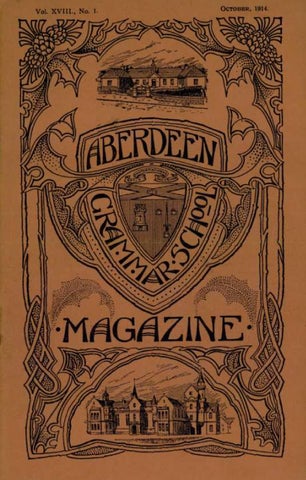
OCTOBER, 1914.
Vol. XVIII., No. 1.
isi
I I
15
Educational Books. JAMES G. BISSET ONTINUES to supply all the Class Books (New or Second-hand) suited for the Requirements of the Higher Educational Institutions in the City, at the Lowest Prices.
C
-
-
N.B.—BEST VALUE IN STUDENTS' NOTE BOOKS.
JAMES G. BISSET, Classical, fecbical, aub Ebucattonal 130ot:seller,
85 BROAD STREET (Opposite leerIschia, College).
Aberdeen Sports Warehouse PREMISES JUST EXTENDED.
Everything for
Everything for
Football,
Cricket,
Hockey,
Bowling, Running,
Badminton, Golf, Tennis.
Boxing, and the Gymnasium.
SPECIAL TERMS TO CLUBS.
The LONDON RUBBER CO. I6-I8 St. Nicholas Street, ABERDEEN. 'Phone 2369.
SILVER, 20/- to £5.
Nx(Rzs-r
GOLD, 36/- to £10.
Wc -retylas
ON LEATHER STRAPS OR GOLD BRACELETS
For Ladies and Gentlemen.
GOLD - - - £4 to £25. Doctors' Watches.
Nurses' Watches.
Sportsmen's Watches.
A. & J. SMITH, 3cwcAlcre,
. .
ttilatcbmahen3 anb epticiami,
191 Union Street, and 23 & 25 St. Nicholas Street.
RIGBY'S
DELICIOUS SWEETS, 54 Union Street.
•
Wait at RIGBY'S for Beach Car. ELLIS & IS REGENT QUAY &
-
NI‘HARDY, 130?.?
-
UNION STREET.
I
Importers of Household and Steam Coals. Delivered by Careful and Experienced Drtvers. Telephone 2889.
t-sibivitewiiiviveAks.,,,eseavisAteeztrovivoAeywevii 4bAbAiirs,,Asivihiriop ( PURVEYORS
TO
BY
11:s MAJEkl 1 Y.
A PPOIN Thi&ZIFP.
The Unprecedented Demand for our
0
\03
4
I DUX ' OAT
CAKES
HAS MADE AN EXTENSION OF THIS DEPARTMENT ABSOLUTELY NECESSARY. Our Increased Facilities will Ensure Prompt Attention to all Orders.
_
.
11111-THELIAM i Lr Agra °
LETTERING.
Established 1893
SIGNS.
.
CHARLES F. BENZIES, ENGRAVER,
DESIGNER, AND
15 Correction
DRAUGHTSMAN,
Wynd, ABERDEEN.
Artistic Productions of BRASS PLATES for all Trades and Professions. Boor Plates, Office Plates, Window Plates, Monumental Church Brasses. Raised Letter Work, and all classes of Metal Signs. STENCIL PLATES, Stencil Inks and Stencil Brushes, Swing Signs, Iron Enamelled Signs, Iron Brands, Steel Punches, Seals, Lever Embossing Presses and Dies. INSCRIPTIONS and MONOGRAMS on Gold, Silver, and Ivory, etc. LETTERING for Windows, Doors, Fanlights, in Gold, White Enamelled Copper, etc., supplied and fixed RUBBER STAMPS, Inks and Pads. Name Stamps specially made for marking ESTIMATES GIVEN. Linen.
W. & J. HAY, flOcrchaith3, 459
UNION
STREET.
Cigar Importers and Cigarette Telephone 2274.
Specialists.
LEARN TO SHOOT with a B.S.A. Air Rifle
Not a toy but a serious weapon. (Guaranteed accurate up to 50 yards.) Made in various Weights and Bores.
" Junior" Model, for Boys and ladies. 35/- each. Heavy Model for Adults, 45/- and 50'- each. Ammunition, No. i Bore, 1/11 per 1000. Accurate '22 Rifles (for 50 and 100 yards) 10/6.
Catalogues Free.
Inspection Invited.
intending Purchasers can Shoot Rifles on our Underground Rifle Range in Aberdeen.
ALEXANDER MARTIN, Gunmaker, Tel. No. 480.
128 UNION STRFET,
ABERDEEN. Agents for the Ariel, Rover, and Hazlewood. Any other make supplied at Liberal Discounts.
asibNikl
Repairs a speciality by experienced Cycle and Motor Mechanics at Moderate Charges.
G
— t 1
*fie/
GEORGE BRUCE & SONS, i , lePlu me N... 1524.
t
oat attention given.)
Holborn Motor and Cycle Works,
18
HOLBURN
STREET.
liAILD:E .AND WORKS---1 ALFORD LANE.
The Ideal Schoolboy's Watch:
5/- " THE ENIGMA" 5/In Oxydised and Nickel Cases.
To be had from THE
City Goldsmiths' Co• 5 98 Union Street, ABERDEEN. Will be sent to any Address on receipt of P.O. for 5/6.
A large selection of Wristlet Watches also kept in stock. For really reliable India rubber and Waterproof Goods, try the Actual
Makers,
Campbell & Company, 18 Bridge St., ABERDEEN. Telephone No. 157.
Estab. 1878.
Telegrams : " RuBBElt."
Estaplished 1847.
togan's Music %goons, .349 Union Street, Aberdeen. 4
•
PIANOS and ORGANS.—A Large and Varied Selection of the Best I
Models always on hand. Instalments.
An Inspection Invited.
Cash or
MUSIC.—Up-to-date Music of all kinds always on hand. Examination and Educational a Speciality. Any kind of Music sent on approbation. Music specially ordered delivered in Three days.
MISCELLANEOUS.—Violins, Bagpipes, Mandolins, Strings, and all Musical Accessories of the Best Quality.
UEO. T. CANTLAY, Proprietor.
CONTENTS. PORTRAIT OF THE Sciroor, CRICKET 1ST XI., 1914 PORTRAIT OF THE CLASS OF 1873-78 PORTRAIT OF CLASS III., MIDDLE SCHOOL, 1895-96 -
t
-
Facing p. 24 56 „ 57
THE SCHOOL MUSTER ROLL " MENTIONED IN DESPATCHES" PRO PATRIA MORTUI SCHOOL NOTES RANDOM NOTES NOTES ABOUT OLD BOYS DEATH OF MR. JAMES ESSLEMONT THE RECREATION GROUND How BRITAIN RDLES, BY Wm. P. MILNE, D.Sc. SENLIS : THE CITY AND ITS PEOPLE, BY CANON HARPER OUR CONTEMPORARIES Two OLD CLASS GROUPS A DAY WITH THE GORDONS AT BEDFORD MELVIN AND GEDDES: LETTER FROM REV. JOHN SMITH, D.D., SOME RECOLLECTIONS OF 1874-79, BY WM. MOIR _ How I CAME TO THE SOUTH SEAS, BY D. R. BARCLAY SUNDAY—VERSES CRICKET NOTES MUSEUM THE FORMER PUPILS' CLUB SCHOOL OFFICIALS •
-
1
-
20 20 24 26 29 42 43 45 51 55 56 59
-
61
-
63 65 6i7 68 69 70 76
-
-
BREAKFASTS, LUNCHEONS,
WEST END eilFE,
TEAS,
LIMITED,
DINNERS, Finest in City. Prices Moderate. Everything First-Class.
SWIFT . CYCLES.
154 UNION STREET.
El '41
.4
en oi
reD. 0
E. A P
AT HOMES Purveyed in Cafe.
DRAWING-ROOM, and SMOKE ROOM.
THE
CITY
CYCLE CO., Ltd., THE
BON-ACCORD CYCLE CO.
61.E BRIDGE STREET.
SPARKBROOK CYCLES.
DANCES, and
TELEPHONE 2309.
WI PH WHICH IS INCORPORATED
A
CONCERTS,
Cycles from £3 15s.
BON-ACCORD CYCLES. • • g• f' :1
CD
.
tr 0
2
o " CD A ENFIELD CYCLES.
NEAT. CHEAP. QUICK.
Printing.
ESTIMATES GIVEN. *IF
THE CENTRAL PRESS (John Milne), GENERAL
PRINTER, LITHOGRAPHER, AND STATIONER,
61 BELMONT STREET, ABERDEEN. Telephone No. 809. Telephone 431.
BOWMAN & SON, Picture iftainetz, 187 UNION STREET, AND 79 HOLBURN STREET. GET YOUR PHOTOGRAPHIC REQUIREMENTS AT
D. SOUTER ALLAN'S PHARMACY, 35 Ho!burn Street (NeclrunInbnurn) Photographic Department. A Large Stock of Cameras, Plates, Films, Papers, and Accessories. Depot for Kodaks and Kodak Supplies. g CC
-
DeVeloping and Printing executed by an Expert and delivered in ;V, hours.
LETTERPRESS AND LITHOGRAPHIC
PRINTING THE A A
ROSEMOUNT PRESS FARMERS' HALL LANE ABERDEEN
&
-4)(19G
REASONABLE TERMS. ESTIMATES ON APPLICATION TELEPHONE No. 1035
LIFE AT A NORTH ERN UNIVERSITY
I prop, =
A New Edition of Neil Maclean's
,
VI well-known work has recently been
published, with Notes and trations, at the Popular Price of 3s. 6d. net ; post free 3s. tod. (borne), 4s. Id. (abroad).
lill li ll ( 7 1 ,.-7 11. li I : VII lil iiii9 7 IIIII tag,— .
,51 1 I
JIM. ,:
al.
I.II,•••• •••
-
ififlall~
OF ALL BOOKSELLERS, OR DIRECT 4'IIII'l 1./„......
FROM THE PUBLISHERS,
.II/I '1 II
III i hi E x_.
Ilima,_—__=_Am ea
The Rosemount Press,
II iv
[ x\A%-___
I MintEllIMIDIIMMEA
A .,7,,,,
—,—i-
,.....--.---,-III
i,f,
-- 3
ue®
sonersoznis
Aberdeen.
Orammar School tllaga3ine. Vol. XVIII.
OCTOBER, 1914.
No. I.
The School Muster Roll. First Instalment. The Aberdeen Grammar School is not generally regarded as a " Service " school, and it boasts neither of an Officers' Training Corps nor of a Cadet Corps. The following list shows, however, that, though lacking such incentives, the School, as represented by its past and present pupils, is taking a worthy part in the defence of the Empire. The Muster Roll as now presented contains well-nigh 500 names, but it must be regarded only as a first instalment—a mere fragment. Probably most of those Old Boys who were serving professionally either in the Navy or the Army before the commencement of the War—particularly those holding commissions—are mentioned below, but it has so far been impossible to obtain the names of many who were serving in the Territorials before the beginning of August or who since then have given their services to the country in some capacity or other. Doubtless the publication of this preliminary Roll will lead to an influx of names, and in course of time it may be possible to record the great majority of those who have served. The present list will be kept in type and all additional names, after being printed in Supplementary Lists, will be incorporated with the names which have previously appeared, with a view to the publication at the end of the War of a complete Roll. With regard to arrangement, apart from the Navy Section, the names are in alphabetical order under the various ranks, and the units are in the order given in the Army List. So far as commissioned officers are concerned the ranks are in general those shown in the Army List for August. Promotions have been noted to some extent, but absolute accuracy either with regard to rank or unit is not guaranteed. It is hoped that all who peruse this Roll and can correct or supplement it in any way will communicate with the compiler, Mr. THEODORE WATT, 206 Mid Stocket Road, Aberdeen.
Aberdeen Grammar School Magazine.
Royal Navy and Royal Marines. Center, Fleet Surgeon William Rudolf (1883-85). Chance,* Surgeon Clifford Cuthbert (1906). Cowan, Chaplain Charles E. L. (1878-80). Cumming, Midshipman Alistair Shand (1901-05). Danson, Lieutenant Edmund Wilmot (1887-92), Royal Indian Marine. Danson,* Surgeon James Gordon (1894-1903). DavidSon,* Lieutenant Charles (1881-83), Royal Naval Reserve (Commander, British India Steam Navigation Company). Hamilton, Staff Surgeon George Eric (1884-95). Macbeth,* Captain Herbert Norman (1882-85)—Royal Naval Reserve (T.)—Chief Signalling Officer for the mine-sweepers. McClement, Sub-Lieutenant Reginald C. G. (1894-97), Royal Indian Marine. MacDiarmid, Surgeon Alexander James (1889-94). MacLeod,* Lieutenant Edwin Salisbury (1881-89), Royal Naval Reserve. Mahon, Commander Richard F. H. Hartland (1885-87)— Admiralty (Department of Director of Naval Equipment). Masson,* Surgeon Charles Armit (1900-02). Murray, Surgeon Herbert Leith (1886-88)—R.N.V.R. Parrott, William Charles (1904-06), Royal Marines. Shaw, Lieutenant Peter (1883-91), Royal Naval Reserve. Shinnie, Sub-Lieutenant Herbert Forsyth Craig (1902-07), Royal Naval Reserve. Smith, Deputy Surgeon-General James Lawrence (1877-79), M.V.O., R.N. Hospital, Malta. Stuart,* Commander Charles Edward (1882-84), Royal Naval Reserve. Troup, Captain Arthur G. (1888-90), Royal Marine Artillery. Wilson, Lieutenant-Commander Thomas Clarence (18941897). *Indicates Member of the Former Pupils' Club.
Aberdeen Grammar &hool Magazine.
3
The Army. REGULAR FORCES. Cavalry. 1ST LIFE GUARDS— Macleod, Malcolm (1909). 20TH HUSSARS—
Ferguson, Major James W. (1878-82)—Reserve of Officers.
6
Unit Unascertained— Burnett,* 2nd Lieutenant (temporary) Ian Alistair Kendall (1894-1903). Royal Regiment of Artillery. ROYAL FIELD ARTILLERY— Mahon,* Major Marcus C. J. Hartland (1885-88). Butchart, Captain James A. (1889-95). Crombie, Lieutenant James Adrian (1894-96)—Recruiting Officer, Castlehill, Aberdeen. Thomson, Lieutenant James Noel (1896-1900). . Chinn, 2nd Lieutenant (temporary) Walter James (19051907). Laing, 2nd Lieutenant Wallace (1906-07). ROYAL GARRISON ARTILLERY— Cameron, Captain Robert B. M. (1886-89)—Reserve. Grant,* Captain Henry Frederick Lyall (1888-95). Lumsden, Captain William Forbes (1887-?). Urquhart,* Captain Angus Munro (1892-94). Meston, 2nd Lieutenant Dougall (1901-02). Hay, Robert Crawford Buchanan (1900-06)—Singapore.
#
Corps of Royal Engineers. Barron, Captain William Ernest (1884-88). Asher,* Lieutenant (temporary) Robert Smith (1898-1903). Merrylees,* 2nd Lieutenant (temporary) Louis Francis (1896-1905). Robb,* 2nd Lieutenant Douglas George (1899-1902). Foot Guards. SCOTS GUARDS— Scott, Alexander Henry (1891-93)-1st Battalion.
Aberdeen Grammar School Magazine.
4
Infantry. ROYAL SCOTS—
Lumsden, Captain Alfred Forbes (1887-?)-1st Battalion. Chree, Lieutenant George William Johnstone (1900-08). Hay, 2nd Lieutenant (temporary) John Crawford Matthew (1895-1902)-13th Battalion. Dawson,* Private George (1896-1901 ; Assistant Master, 1911- )_Edinburgh Battalion. Selbie,* Private Colin Mackenzie (1902-06)-11th Battalion. ROYAL FUSILIERS—
Spence,* Lieutenant (temporary) Patrick Magnus (19041906)-1st Public Schools Battalion. LEICESTERSHIRE REGIMENT—
Clark,* 2nd Lieutenant James Cooper (1894-96)—8th Battalion. ROYAL INNISKILLING FUSILIERS—
Crawford, Captain Kenneth Hugh (1898-99)-4th Bat- ' talion. WORCESTERSHIRE REGIMENT—
Crawford,* Lieutenant Charles Frederick Graham (18981902).
Coldsmid, 2nd Lieutenant Sydney Alexander (1902-03). BLACK WATCH
(Royal Highlanders)—
Cruden, Lieutenant James Wilson Fraser (1891-1900)— Adjutant, 5th Gordon Highlanders. DURHAM LIGHT INFANTRY— Robb,*
Major Alexander Kirkland (1880-89).
Ferguson,*
Lieutbnant John Frederick (1904-09).
Benton, 2nd
Lieutenant Ronald MacKenzie (1902-05).
HIGHLAND LIGHT INFANTRY—
Mackenzie,* Private Hugh Fordyce (1888-96)—Glasgow Battalion. SEAFORTH HIGHLANDERS--
Henderson, Lieutenant William Thomson (1899).
Aberdeen Grammar School Magazine.
5
GORDON HIGHLANDERS— Ferguson,* 2nd Lieutenant Alexander Lundie Hunter (1905)-11th (Service) Battalion. McKenzie,* 2nd Lieutenant Thomas Best Gibson (19091911). Milne,* 2nd Lieutenant George Smith Mitchell-10th (Service) Battalion. Duncan, Sergeant George Jeans (1888-98)-2nd Battalion. Army Service Corps. Currie, John Laird (1903-06). Stericker, Walter Heinrich (1900-07). Royal Army Medical Corps. Coutts, Lieutenant-Colonel George Cook (1872-74)—in medical charge of the Depot, Royal Sussex Regiment, Chichester. Davidson, Major Hugh Allan (1889-92). MacKessack, Major Peter (1887-89). McLennan,* Major Farquhar (1888-90)—Adjutant, Highland Division, R.A.M.C. (T.F.). Profeit, Major Charles William (1884-87). Ritchie, Major Theodore Francis (1883-93). CroII,* Captain (temporary) William Flett (1882-91). Fortescue,* Captain Archer Irvine (1892-97). Fraser, Captain Alexander Donald (1898-1900). Grant, Captain James Forgan (1889-99). McKenzie, Captain John (1884-?). Maydon, Captain William George (1882-95)--Adjutant, West Lancs. Division, R.A.M.C. (T.F.). Rennie,* Captain William Benton (1898-1902). Ritchie,* Captain Michael Balfour Hutchison (1897-98). Rose,* Captain Alexander MacGregor (1883-94). Shepherd,* Captain Arthur (1891-1902). Williamson,* Captain Maurice Joseph (1894-1903). Anderson, Lieutenant (temporary) Archibald Stirling Kennedy (1900-06). Anderson,* Lieutenant (temporary) Norman William (1881-84).
6
Aberdeen Grammar School Magazine. Brown,* Lieutenant (temporary) John Gatherer (1905-08). Cheyne,* Lieutenant, (temporary) Douglas Gordon (1901-
1905). Falconer,* Lieutenant (temporary) Francis William (1889-
1900). Fraser, Lieutenant (temporary) Archie Reith (1902-07). Calloway,* Lieutenant (temporary) Rudolf William
(1902- ?). Cordon, Lieutenant (temporary) Edward (1907-08). Ingram,* Lieutenant (temporary) William John Sive-
wright. Mackenzie,* Lieutenant (temporary) Kenneth Pink (1901-
1907). Mackenzie,* Lieutenant (temporary) Kenneth William (1893-97). Macleod,* Lieutenant (temporary) Clement Rickard (18941903). Mitchell, Lieutenant (temporary) John Marsters (1903-05). Mortimer,* Lieutenant (temporary) Hector (1904-09). Snowie,* Lieutenant (temporary) Robert Simpson (19031908). Stewart,* Lieutenant (temporary) James Smith (1901-08). Will, Lieutenant (temporary) Alexander James (1907-09). SPECIAL RESERVE OF OFFICERS—
Inkster,* Captain John (1902-04). Shand,* Captain George Ernest (1894-1900). Cumming,* Lieutenant Robert S. (1905-10). Duffus,* Lieutenant Alan A. (1900-11). Forgan,* Lieutenant Robert (1898-1908).
Fraser,* Lieutenant Douglas M. M. (1898-1910). Griffith,* Lieutenant Frank (1905-07). Lawrence,* Lieutenant Robert D. (1900-09). Melvin,* Lieutenant James (1904-10). Menzies,* Lieutenant Thomas (1905-10). Robb,* Lieutenant Alexander Lawrence (1897-99). Rorie,* Lieutenant Frank Miller (1905-12). Rose,* Lieutenant Gilbert Wolridge (1900-09). Tomory,* Lieutenant Kenneth A. M. (1899-1908).
Aberdeen Grammar School Magazine.
7
Army Chaplains' Departmgnt. Farquhar, Rev. Henry (1874-75), Dover (Presbyterian).
Scott, Rev. Thomas (1863-68), Aldershot. Army Ordnance Department. Dymock,* Captain Arthur (1887-95). McLean, Douglas Stewart (1903-05). Channel islands Militia. 2ND BATTALION (Light Infantry)—
Johnston,* 2nd Lieutenant George Mitchell (1898-1907). Indian Army. INDIAN CAVALRY—
Davie, Squadron Commander James Henry Morison (18811885)-34th Prince Albert Victor's Own Poona Horse. INDIAN MOUNTAIN BATTERIES— Edmond,* Captain James Hector (1894-98)-28th Mountain
Battery. INDIAN INFANTRY--
Sangster,* Major Patrick B. (1884-88)-Brigade-Major, Ferozepore Brigade.
Simpson, Major John Chalmers (1883-99)--4th Prince Albert Victor's Rajputs.
Skeen, Major Andrew (1881-86)-24th Punjabis. Skeen, Major Oliver St. John (1881-86)-62nd Punjabis. Smith, Major John Lindsay (1889-90). Cobban, Captain Clement Lee (1891-96)-43rd Erinpura Regiment. Cray,* Captain John (1894-96)-36th Sikhs. Milne, Captain Thomas (1892- ?)-55th Coke's Rifles. Robertson, Captain R. Arthur H. (1892-94)-30th Punjabis. Trail, Captain and Adjutant William Samuel (1896-1901) -57th Wilde's Rifles.
Leslie,
Lieutenant Pioneers.
Frank
Downie
(1898-1905)-48th
Indian Medical Service.
Davidson,* Lieutenant-Colonel David Macdonald (18801882).
Aberdeen Grammar School Magazine. Black, Major James Alexander (1882-86). Justice, Major William Adolphus (1883). Mackworth,* Major Norman Walter (1892-96). Barron, Captain Robert McPherson (1882-88). Maconachie, Captain Gordon William (1897-98). Rennie,* Captain Patrick Manson (1895-1901). White, Captain Maurice Forbes (1883-88). Easton,* Lieutenant Robert Morrison (1894-1904). Macrae,* Lieutenant Archibald Campbell (1896-1901). Porter,* Lieutenant Richard Reginald Maitland (1895-
1906).
TERRITORIAL FORCE. Yeomanry. DENBIGHSHIRE HUSSARS—
Baxter,* Lieutenant Andrew (1882-86)—Medical Officer. WESTMINSTER DRAGOONS—
Taylor, Trooper Roger Brown (1897-98). SCOTTISH HORSE—
Butchart,* Captain Henry Jackson (1890-99). Beath, Trooper Halliwell (1901-07). Elmslie, Trooper William (1904-07).
C ill, Trooper William James (1907-11). Miller,* Trooper Noel W. J. (1906-11). Proctor,* Trooper Donald Fraser (1908-12). Still, Trooper Andrew (1900-02). Moffatt, Trumpeter William Murray (1906-09). Smart, Trumpeter William Farquharson (1906-
).
Honourable Artillery Company. INFANTRY—
Smith,* Sergeant George Thow (1881-91)—No. 2 Company. Royal Artillery— ROYAL FIELD ARTILLERY. 1ST HIGHLAND BRIGADE—
Carden,* Major James William (1886-95). Rae,* Major John Everard (1885-87).
Aberdeen Grammar School Magazine.
9
Davidson,* Captain Thomas (1893-97). Edwards,* Captain James Hastings (1894-1900). Collie,* Lieutenant James Stuart Gorham (1905-10). Davidson,* Lieutenant Lessel Murray (1905-14). DuBus,* Lieutenant James Catto (1897-1904). Ledingham,* Lieutenant Robert Mackay (1897-1909). Mackie,* Lieutenant James Cecil Davidson (1898-1909). Adam, 2nd Lieutenant William Ernest (1902-07). Anderson,* 2nd Lieutenant Robert John (1895-99). Craigen,* 2nd Lieutenant William Gordon (1894-1902). Ironside, 2nd Lieutenant Oliver Dalton (1904-13). Jameson, 2nd Lieutenant Alexander Seymour (1908-12). Maxwell,* 2nd Lieutenant Robert Irvine (1910-13). Stobie, 2nd Lieutenant John Francis Robert (1910-12)— Seconded, 18th August 1914. Bothwell, Bombardier Henry Alexander (1902-04). 7TH LONDON BRIGADE-
Cooper,* Captain Patrick Ashley (1896-1901). ROYAL GARRISON ARTILLERY. LONDON BRIGADE (Heavy)—
Creig,* Major James Rennie (1882-87)—Reserve (1st London Battery). NORTH SCOTTISH GROUP (For Defended Ports)—
Minto,* Major William Bain Griffiths (1888-98). Shepherd,* Captain Lindsay Lyall (1900-07). Macbeth,* Lieutenant Ian Langland Fraser (1898-1902). Murray,* 2nd Lieutenant John (1884-91). Ross-Keyt,* 2nd Lieutenant Frederick Dudley (1901-12). Hopkins, Bombardier Cyril E. (1913-14). Royal Engineers— DIVISIONAL ENGINEERS. EAST ANGLIAN GROUP—
Mowat,* Major Magnus (1882-84). HIGHLAND GROUP—
Cornwall,* Lieutenant-Colonel George A. (1879-80). Kinghorn,* Major Harry J. (1876-80).
10
Aberdeen Grammar School Magazine. Barron,* Captain (temporary) Wilfrid Philip (1896-1903). Ledingham,* Lieutenant George Alexander (1894-1905).
Clegg,' Lieutenant (temporary) Robert (1911). Bisset,* 2nd Lieutenant William (1895-1903). Clegg,* 2nd Lieutenant William Cowan (1898-99). MacNeill,* 2nd Lieutenant Alexander Gunn (1905-09). Shepherd,* 2nd Lieutenant William (1894-1903). WEST LANCASHIRE GROUP—
Reid,* Lieutenant James Meston (1896-1907). SIGNAL SERVICE. HIGHLAND DIVISIONAL SIGNAL COMPANY—
Bruce,* Lieutenant Robert (1896-1901). Bruce,* 2nd Lieutenant John (1896-1903). Craigen,* 2nd Lieutenant John Henry Newman (18941905). Ducat,* Lance-Corporal (Motor Cyclist) Ernest Seyton (1898-1906). Forbes, Sapper William (1904-06). Grant, Driver Ian (1910-11). Hendry, Allan Cruickshank (1907-14). Holmes, Harry Alexander (1904-08). McLean, Thomas (1894-1902). Scott, William Walker (1903-13). Williamson,* Sapper Alexander Dinnie (1898-1902). LONDON CABLE SIGNAL COMPANY—
Ward,* 2nd Lieutenant William Arthur B. Kirwan (18951902). FORTRESS ENGINEERS. CITY OF EDINBURGH—
Ogilvie, Major Alexander (1880-81). CITY OF ABERDEEN-Miller, Captain J. Bruce (1876-80)—Reserve. Harper,* Lieutenant Charles (1898-1902). Cook, Sapper William Ferguson (1911-13). Babb, Sapper William George (1908-12).
Aberdeen Grammar School Magazine.
11
Unit U na.scertained— Johnstone, Thomas Russell (1907-10). Morgan, James Alexander (1908-09). Infantry. 4TH ROYAL SCOTS—
Buyers,* Lance-Corporal George Alston (1906-08). 9TH ROYAL SCOT S—
Jones,* Private Herbert James (1902-07). DUKE OF CAMBRIDGE'S OWN (Middlesex Regiment)—Public Schools Battalion— Legge, Private Stafford Henry (1900-03). Munro,* Private Norman (1895-1900). HIGHLAND LIGHT INFANTRY-
Philp,* Private Robert Charles Penny. Thomson,* Private George Grant (1910-12). (Morayshire) SEAFORTH HIGHLANDERS— Mackintosh,* 2nd Lieutenant John (1904-10).
6TH
HI GHLANDERS—U n Unascertained— McIver, Kenneth (1899-1901). Watt, Private Victor William (1897-1903).
SEAFORTH
4TH GORDON HIGHLANDERS-
Stewart,* Colonel David Brown Douglas (1874-77). Christie,* Major John Farquhar (1878-87)—Medical Officer. Ogilvie,* Major Thomas (1884-87). Smith,* Major George Alexander (1888-91). Brown,* Captain John (1893-1900). Cillies,* Captain James Brown (1895-1904). Cordon,* Captain James Hall McIntosh (1901-?). Lyon,* Captain Alexander (1893-1902). Peterkin,* Captain Charles Duncan (1893-1905). Reid,* Captain Charles Cook (1895-1906). Scott, Captain Robert (1884-85). Watt,* Captain Edward William (1883-94)—Acting Adjut ant, Reserve Battalion. Wilson,* Captain Alexander Morice (1895-1906).
12
Aberdeen Grammar School Magazine. Begg, Lieutenant John Henderson (1901-06). Brander,* Lieutenant Eric William Harcourt (1894-1901). Catto, Lieutenant (temporary) Robert K. T. (1889- 9). Hay,* Lieutenant James (1883-87).
Johnston,* Lieutenant Alexander McKenzie (1898-1903). Simpson,* Lieutenant Harry Graham (1899-1912). Williamson,* Lieutenant William B. (1900-02). Brander, 2nd Lieutenant Charles Ronald (1900-10). Clarke,* 2nd Lieutenant Ian Anderson (1902-08). Dunn,* 2nd Lieutenant Robert J. A. (1891-1900). Falconer,* 2nd Lieutenant Douglas (1891-1900). Hyslop,* 2nd Lieutenant Archibald Forbes (1897-1910). McKerron, 2nd Lieutenant Patrick Alexander Bruce (1904-10). Mackintosh, 2nd Lieutenant John Falconer (1902-12). McMillan,'<- 2nd Lieutenant Douglas Stuart (1896-1904). Munro, 2nd Lieutenant (Rev.) Alexander James (18991902). Nicol,* 2nd Lieutenant George Gordon (1894-1903). Sangster,* 2nd Lieutenant William John Campbell (19031910). Sleigh, 2nd Lieutenant George Reid (1902-05). Watson,* 2nd Lieutenant James Innes (1905-09). D COMPANY. (Captain—Charles Duncan Peterkin.*) NOIC—Those to whose names no date of leaving School is attached are still on the School Roll.
Simpson,* Sergeant James (1902-06). Conner,* Corporal Frederic Attenborrow (1905-13). Rose,*+ Corporal Alister (1900-13). Benton,* Lance-Corporal William Stephen (1904-11). Cray, Lance-Corporal Alexander Ogilvie (1903-09). Cray, Lance-Corporal Andrew Paton (1903-11).
Halley,* Lance-Corporal William Curr (1903-11).
Johnston,* Lance-Corporal John Stuart (1900-10). f Detached from the Company for duty with Signal Company under Lieut. A. M'K. Johnston. No. 3 Section of the Highland Divisional
Aberdeen Grammar School Magazine. Aitkend Private Alexander (1909-14). Beath, Private George Christian (1901-06). Bell, Private John Hamilton (1908-14). Bisset,* Private Douglas Maitland (1901-08). Bisset,* Private Victor Ogilvie (1903-12). Booth,* Private John Lyon (1904-10). Brodie, Private Henry Ross (1906-12). Brodie,* Private John (1906-11). Bruce,*$ Private William George (1901-14). Cameron, Private George Grant (1901-11). Chalmers,* Private John James (1910-13). Cooper, Private James (1908-14).
Coutts,* Private Harry George (1908-13). Craig,* Private Andrew (1900-12). Craig, Private Gordon (1902- ).
Cumming, Private Ian (1907-14). Daniel,} Private Francis Rennie (1905-14). Dawson, Private Frank Maitland Fraser (1904- ). Dean, Private Charles Alfred (1908-14). Duffus, Private James Logie Lyall (1912-14). Edwards, Private Henry George (1905- ). Esslemont, Private Ranald (1903-13). Ferguson, Private Arthur Hercules Peter (1905- ). Fiddes, Private James Ogilvie (1904- ). Foster, Private John Wilford (1911-14). Fraser,* Private Ernest Cecil (1909-11). Carbutt, Private Alfred (1910-11). Garbutt, Private William Percival (1910-13). Cray, Private James Bruce (1909- ). Cray,f Private Olaf Everard (1912- ). Halley, Private Alexander Munro (1904-12). Henderson, Private Arthur Gordon (1911- ). Henderson, Private Charles Lamond (1909-13). Jackson, Private Walter Dalgleish (1912-14). Johnstone, Private Robert D. (1910- ). Johnstone, Private William James (1903 ). Kelly, Private Francis Charles (1905- ). Kilgour,* Private Ormonde John Lowell (1911-12). Lumsden, Private Alan Murray (1907-12).
13
I4
Aberdeen Grammar School Magazine.
McBain,* Private Ian (1904-14). McCrae,*f Private William Moir (1899-1910). McCavin, Private Robert Julius (1903-14). McIntosh,f Private Hamish Ogilvie (1910- ). Martin, Private Alexander Vincent (1910- ). Milne, Private Alexander (1911-13). Morrison, Private Charles Mitchell (1910-12). Munro,* Private Gordon Dean (1908-13). Murray, Private John Charles Edward (1904- ). Nicholls, Private Burwood (1903-14). Ritchie, Private James Garrick (1910- ). Saunders, Private Charles Edward (1902-14). Scott,t Private William Walker (1903-13). Stephend Private Ian William (1906- ). Strachan, Private George Henry (1909-12). Sutherland,t Private Charles NIcHardy H. (1908-
).
Taggart, Private John Douglas (1906- ). Taylor, Private Alexander L. (1911- ). Tennant, Private Edward Martin Cookes (1909-13). Teunon, Private William Duguid (1909-13). Thomson,f Private Charles Ferguson (1912- ). Walker,f Private Andrew Norman (1902-14). Walker, - Private Charles William (1902-12). Walker, Private James Frederick (1902-14). Watson, Private Harry Findlay (1903- ). Watson, Private William Ledingham (1902-12). Williamson,t Private Lawrence Pierre de Loriol Hamilton (1906-14).
Wisely, Private Alfred Douglas (1909- ). Wright, Private Maxwell Campbell (1902- ). Brown, Acting Piper Stephenson (1910-13). Mackinnon, Bandsman Walter Grieve (1905-08). E
COMPANY.
Munro, David C. (1910-13). G COMPANY.
Finlayson,* Private Finlay William Nugent (1902 09). Gerrard, Private James Francis (1911-13).
Aberdeen Grammar School Magazine.
15
U COMPANY.
Hawes,* Lance-Corporal Arthur Joseph (1899-1900). Spark, Lance-Corporal Arthur Percy (1905-11). Barron,* Private Arthur Morison (1910-13). Knox, Private Edward Wilson (1908-11). Still,* Private Sydney Cardno (1904-10). Taylor,* Private John William (1906-11). Company U nascertained—
Crombie,* Sergeant Douglas F. H. (1876-83). Simpson, Corporal Robert Fraser (1899-1906). RESERVE BATTALION.
Macrae, Corporal Victor Charles James (1908-10). Robson, Corporal Norman Keith (1900-13). Semple,* Corporal Walter Smith (1905-08). Davidson,* Lance-Corporal Alexander Aitken (1900-07). Knight,* Lance-Corporal Theodore William Brailsford (1906-11).
Leith,* Lance-Corporal Douglas Meldrum Watson (19031910).
Mackay, Lance-Corporal Thomas Arthur (1903-06). Fotheringham, Private Thomas (1903-06). Grant,* Private Stanley Noel (1902-13). Henderson, Private Graham (1906-12). Knowles, Private John Forbes (1903-09). Mackay, Private Harry William Mackintosh (1910McLeod, Private John (1903-13). Macrae, Private Duncan (1910- ). Morrice, Private Alexander Mackay (1904-10). Murray, Private Alexander (1903-13). Ross, Private James Murray (1903-14).
Scarth,* Private Robert (1910-12). Scott, Private Frederick (1908-14).
Stephen, Private Alexander Thomas (1906- ). Tough, Private Robert (1909- ). Valentine,* Private Alfred B. (1905-11). Wilson, Private Hugh Norman Blackett (1905-14).
).
16
Aberdeen Grammar School Magazine.
5TH (Buchan and Formartin) GORDON HIGHLANDERS— Reid,* Lieutenant-Colonel (temporary) John Low (18791884). [Cruden, Captain J. W. Fraser, Royal Highlanders- Adjutant.] Robertson, Captain Alexander W. (1893). Lyon,* 2nd Lieutenant Robert (1899-1908). Pixie, 2nd Lieutenant Patrick Taldo (1906-07). Kemp, Rev. Robert Sangster (1876-77), Chaplain, 1st Class. Mackenzie,* Rev. Charles Gordon (1887-92), Chaplain, 4th Class. Keith,* Lance-Corporal John (1905-08). Garland,* Private James Harvey (1900-02). (Banff and Donside) BATTALION— Dawson,* 2nd Lieutenant William Maurice Grant (19051907).
6TH
7TH (Deeside Highland) GORDON HIGHLANDERS— Bower,* Lieutenant-Colonel George Haddon (1881-87). Bruce,* Major Robert (1886-89). Milne,* Captain John (1884-94). Adams,* Lieutenant William (1884-85). Watt,* Lieutenant Alexander Mackay (1895-1903)— seconded. Ellis,* 2nd Lieutenant James (1896-1904). Mackay,* 2nd Lieutenant Robert Whyte (1882-90). Spark,* 2nd Lieutenant Archibald Douglas (1905-10). Williamson,* Corporal Alexander McGregor (1908-11). Adams,* Private George Napier (1911-12). 14TH (County of London) LONDON REGIMENT (London Scottish)— Allan,* Lance-Corporal George Joseph (1897-1902). Buyers, Private William Nicoll (1906-10). Davidson,* Private Arthur Gerrard (1901-07). Johnstone, Private Charles Simpson (1903-07). Robertson,* Private Cecil Valentine (1897-1906).
Aberdeen Grammar School Magazine.
17
Rob8rtson, Private Fred Percival (1902-06). Smith, Private Andrew (1907-12). LONDON ARTISTS' CORPS-
Will,* Ian Charles Ogilvie (1893-97). Army Service Corps. HIGHLAND DIVISIONAL TRAIN-
'
Smith,* Major Alexander G. Nicol (1880-88). Lorimer,* Captain J. Vass (1894-1906)—Adjutant. Watt,* Captain Charles (1894-98). Macdonald,* Lieutenant Hector R. (1900-12). Horne, 2nd Lieutenant William Hepburn (1900-08). Smith, 2nd Lieutenant Walter Andrew (1888-96). Unit U nascertained— Watson, Private George (1910-11). Royal Army Medical Corps. SCOTTISH HORSE MOUNTED BRIGADE FIELD AMBULANCE—
Veal,* Captain Raymond (1896-99). Gammie, Private Alexander Edward (1907-13). HIGHLAND FIELD AMBULANCE—
Ogston,* Hon. Colonel Sir Alexander (1855-58), K.C.V.O. Kelly,* Lieutenant-Colonel Francis (1879-85). Fiddes,* Captain John Douglas (1896-1902). Kellas,* Captain Arthur (1896-1901). Stephen,* Captain John Herbert (1899-1900). Cameron, Lieutenant Charles (1887-91). McConnachie, Lieutenant James Stewart (1897-1900). Prosser,* Lieutenant (honorary) Alfred A. (1877-86)— Quarter-Master. Gaiter, Sergeant John Alexander (1909-13). Gill,* Corporal Arthur William (1909-13). Connon, Thomas (1901-07). Fyfe, Private Charles Findlay (1911-13).
18
Aberdeen Grammar School Magazine. Joss, Driver William Taylor Barron (1909-14). ).
Kelly, George Carmichael (1905MacFarlane, Donald (1909-14). Ogilvie, Gordon (1904- ).
Scott,* Douglas S. (1907-11). ).
Smith, Henry J. (1913-
3RD WEST LANCASHIRE FIELD AMBULANCE---
Middleton, Lieutenant Harry (1901-02). 2ND NORTHERN GENERAL HOSPITAL-
Griffith,* Major Thomas Wardrop (1871-76). 1ST SCOTTISH GENERAL HOSPITAL-
!ooth, Lieutenant-Colonel James Mackenzie (1866-70). Crombie,* Captain James M. P. (1884-89). Duncan,* Captain George Mellis (1890). McQueen, Captain James M. (1886-98). Peterkin, Captain Henry (1886-90). Sauter,* Captain William Clark (1893-98). HIGHLAND CLEARING HOSPITAL-
Ogston,* Lieutenant-Colonel Alexander (1885). Munro, Lieutenant (honorary) James M. (1880-84)— Quarter-Master. Unit l'nascertained— Skakle, George (1894-98). Smith, Henry J. (1913- ). Stevenson, James Barclay Mitchell (1908-09).
COLONIAL AND OTtIER TROOPS. CANA I)I AN CONTINGENT, EXPEDITIONARY FORCE--
Rae,* Captain William (1888-1900)-72nd Seaforth High-
landers of Canada (Vancouver, B.C.). Donald, Private William Ogilvie (1896-?)-101st Regiment, 9th Battalion (Quebec). Hay, Private Andrew Stirling (1895- ?)—Canadian Royal Dragoons. Robertson,* Stuart Miller (1893-1904).
Aberdeen Grammar School Magazine.
19
CANADIAN FIELD ARTILLERY—
Thomson,*
Signaller Roderick Fraser Battery (Hamilton, Ontario).
(1905-08)-8th
AUSTRALIAN CONTINGENT, EXPEDITIONARY FORCE—
Ratcliff-Caylard, Cecil C. A. (1898-1900). SINGAPORE VOLUNTEER CORPS—
Legge,* Surgeon-Lieutenant Angus Forsyth (1901-07). INDIAN LIGHT HORSE—
Macbeth,* Lieutenant David (1884-85). INDIAN MOUNTED INFANTRY—
Barnett, Arthur G. CALCUTTA SCOTTISH VOLUNTEER CORPS—
Rose, George F. (1881-92).
Our Boy Scouts. Along with the list published in this number of those who are at present serving their country, it gives us peculiar pleasure to record the names of our Boy Scouts who in this emergency have done good service to their country, some, indeed, being still engaged in responsible work at the various coastguard and military stations, hospitals, etc., etc., in Aberdeen and the neighbourhood. The following is the list:— Benzie, James H. S. Lister, Robert Bisset, Charles McLean, William J. Bonner, Douglas G. McLennan, lain Brown, Donald I. McLennan, Roderick Duthie, Robert Marr, Alexander S. Cammie, Robert Munro, Hamish Cow, Harry Prosser, Oswald G. Grafton, Edward G. Robertson, Kenneth M. Grant, Gordon C. Smith, Lawrence Gilling Hayward, A. Jack Stewart, James G. Hendrick, Charles Symons, William Kennaway, Charles Walker, Alexander A. Kennaway, James Walker, James Knowles, Charles Walker, Patrick Leith, James Williamson, Archibald M. Leslie, Norman Wilson, Norman J. Lister, Hugh E. J.
20
Aberdeen Grammar School Magazine.
"Mentioned in Despatches." The names of two Old Boys appeared in General French's despatch of 8th October. These are Charles William Profeit (1884-87). Sydney Alexander Coldsmid (1900-03). The former is Major in the Royal Army Medical Corps, and
the latter is 2nd Lieutenant in the 3rd Battalion, Worcestershire Regiment.
Pro Patria Mortui. Already, as a result of the War, the School has suffered the loss of at least two of her sons. illexanDer virfttanb 1Robb* (1880-89), Major, of the Durham Light Infantry, died on 20th September of wounds received in action in France. He was trained at the Military College, Sandhurst, and passed out first on In May the list, with honours, in January, 1893. of the same year he was gazetted as Second-Lieutenant to the 2nd Battalion Durham Light Infantry, then stationed in India. He was on active service on the North-West Frontier of India in 1897-98, attached to the King's Own Yorkshire Light Infantry, and was present at the engagement at Shin Kamar, was mentioned in despatches, and received the Tirah medal with two clasps. His services were afterwards transferred to Burma on various duties, including the Burma Intelligence Branch, to which he was attached in connection with the Chinese Boundary Commission of that time. In 1907, Major Robb returned home and rejoined in Ireland his battalion, which had a few years previously returned from its term of Indian service. His next move was to the regimental depot in Newcastle-on-Tyne, and before the outbreak of the present War he was on the General Staff of the Army for duty as Adjutant to the Officers' Training Corps of Durham University. In this connection he was appointed lecturer in military subjects at the University. When mobilisation took place at the beginning of August he rejoined his battalion at Lichfield for regimental duty. The Durhams spent about three weeks in camp at Cambridge, and thereafter embarked at Southampton for France. The following thrilling account of how Major Robb was brought in after being wounded appeared in a recent issue
Aberdeen Grammar School Magazine.
21
of the Darlington Northern Echo. The story is told by Private Warwick, of the 2nd Durham Light Infantry, who has been recommended for the most coveted honour that can be conferred on a soldier:— " On Saturday, 19th September, we were on the banks of the river Aisne, and at about 7.30 in the evening we were ordered into the trenches to relieve the Northamptonshires, the South Wales Borderers, and a regiment or so of the Guards. Our trenches were on a hillside, and we had not been there above half an hour before the German snipers opened fire upon us from the hill-top only 40 yards away. This sniping was kept up all night long. At dawn on the Sunday morning, about 4 o'clock, the German artillery opened a very heavy fire upon us with shrapnel shell. . . . [Soon] we had to look to our own front, for we saw the Germans coming over the hill top towards our trenches. We succeeded in driving them back with rifle fire. . . . " Major Robb then gave the order for the 13th Platoon to charge with the bayonet. We leaped from the trenches and charged up the hill. Private Howson and I were rushing up
22
Aberdeen Grammar School Magazine.
the hill together when we saw Lieutenant Twist of our company fall, shot through the neck and in the right side. Howson and I ran across to him and bandaged his wound with my field dressing, and succeeded in bringing him out of the firing line and back to the stretcher bearers. We both returned to the firing line, the men having dropped flat to escape the hail of German bullets. We again got the order to go forward. Shrapnel shells were bursting all over the place, and we were exposed to both French and German artillery fire and were suffering severely, but we went forward. When we got to within 15 yards or so of the Germans, they turned and rushed back to their trenches, frightened at the prospect of cold steel. We were ordered to return to our trenches. " Then we discovered that Major Robb was missing, and I was told that he was lying wounded over the hill top in front of the German trenches. I went out alone and unarmed, for I had to crawl up the hill under a hot fire and hardly dare rise even to my knees. I took cover as I went behind the bodies of dead Germans, the field being strewn with them. I crawled for about 60 yards, and after some difficulty found Major Robb lying wounded about 30 yards away from the German trenches. When I reached him he ordered me to go back, but for once I disobeyed my officer's orders, and told him that as I had come so far I was going to try to take him back with me. The German snipers had spotted us, and were waiting for me to get up with the Major. I lay close to him for about ten minutes until the French artillery opened a heavy shrapnel fire upon the German trenches. There was a lull in the German fire, and I took advantage of this to raise the Major to his feet. He put his left arm round my neck, and I put my right arm round his body, and half carried him along. When we reached the top of the hill and came within sight of our trenches Private Nevison, of Bishop Auckland, seeing me hard pressed, left the trenches and came to my assistance, and together we helped the Major down the hill. We were exposed to an enfilading fire from both right and left flank. We thought we had got the Major safe, but when we were only 15 yards from our own trenches both Nevison and I were shot at the same instant and all three of us fell. The Major himself was not struck. Sergeant Dee, and Private Wilson and Private Harry Pattison, pulled us into our trenches. I was shot in the back, and the bullet came out at my right shoulder. Nevison was, I believe, shot in the head. Major Robb died the same night in the field hospital. I was taken first to the field hospital, and afterwards by easy stages sent home."
Aberdeen Grammar Schaal Magazine.
notnas
eraser
23
peppe (1886-94), M.B., Ch.B. (Aberd.) 1901, D.P.H. (Camb.), 1912, was killed in action in Nigeria shortly after the commencement of the War. He was a member of the West African Medical Staff under the Colonial Office, and accompanied troops engaged in military reconnaissances on the frontier of Nigeria and the Cameroons. After graduating in medicine at Aberdeen University he held appointments as hospital physician in Denbigh, Grimsby, He was in practice in London Swansea, and Sunderland. for a time, and then entered the Government service, being appointed first to the Gold Coast and transferred to Nigeria in April of this year. He was 34 years of age.
24
Aberdeen Grammar School Magazine.
It was to a strange and unfamiliar School that we returned after the Summer Holidays. New rooms met our eyes on every side; the smell of paint and varnish assailed our nostrils at every turning. Workmen wandered about at will, armed with hammers and other instruments of torture. Besides, several classes were much lessened in number owing to many Territorials having been called away to serve their country. The two Sixths suffered most severely, but the Fifths and Fourths were also affected. Many scouts were also away from the School, helping coastguards and on duty at the hospitals. At the beginning of the session, the Staff was the same as before, with the exception of Miss Pixie, M.A., who takes Miss Maydon's place, and Miss E. Davidson, who is in Later, however, Mr. Dawson joined charge of Lower II. Kitchener's Army " in Edinburgh. The School wishes him the best of luck in his new profession. Meantime his place has been taken by Mr. Cruickshank.
0 0 0 As several of the Aberdeen schools have been converted into hospitals, we now share our buildings with the Central School. Everybody is now quite accustomed to rising early, while the " shop " and the free afternoons are most popular. The gymnasium is being used as a hospital, together with the rest of the Westfield building. The Gymnastic Instructor, Mr. Summers, is Colour-Sergeant of the 6th Gordons (T.F.). Af,
sI
The field is being used for drilling recruits, and our studies are disturbed by the somewhat spasmodic utterances of the drill sergeants. However, the inconvenience is small, and we have the consolation that the Kaiser will have to answer for it at the end of the war. Football has been transferred to the Bleachfield ground, but as there are no other teams to play, there will be no matches this year. The sports have also been put off till a more suitable season.
If
fr
•
THE SCHOOL CRICKET ist XI., SEASON 1913-1914.
W. T. B. Joss. H. Mackintosh.
A. D. Wisely. A. Mcliain (Secy.)
F. R. Daniel. Mr. James Das idson J. T. Sorley. B. Nicholls. (//nn. Sec. Games Coatatitte.v). C. E. Saunders (cap.) W. 0. Fiddes. J. H. Bell. Absent—J. L Duffus.
Aberdeen Grammar School Magazine.
25
A weekly collection has been instituted at the School for the various War funds. Now is the time to give up sweets, and help by contributing every week as much as you can spare. We cannot all be at Bedford, but we can all do something even here. 0 0 The library is now open from the hours of 1.30 to 1.45 on Mondays and Fridays, and also at the interval on Wednesdays. It is hoped that all those who were members last year will come forward again, and that all new boys will join. There are many fine books in the library, and the sum of one shilling for the session is not exorbitant. *
:Tr
fi
Two splendid cases of eggs have been presented to the museum by Mr. Fenton. A more detailed account of the gift will be found on another page. 0 O 0 The School has over thirty Territorials serving in the Gordons alone, besides many Former Pupils in that and other branches of the Army. It is worthy of mention that the four School Editors of the Magazine last season—two of whom would in the ordinary course of events have been in the highest class this session—are at present under arms at Bedford. During the absence of the Gymnastic Instructor, ColourSergeant R. Proven has been engaged as Drill Instructor. A section of the School drills every day in a church hall. Attempts are being made to procure some shooting practice for the School by way of a change from drill. Effi Among the most interesting of the new rooms are those on the top storey of the west wing of the School. These consist of a splendid new Science Laboratory, a Geography Room, and a Lecture Room. Gone are the days when those poor unfortunates who were in for the Intermediate had to struggle with insufficient apparatus, for the new room is equipped with everything needed for the most elaborate experiments. 0 % 0 For a long time the accommodation provided for bicycles has been utterly inadequate; but at last a new shelter is to be provided. It is being built in the corner beside the workshop, and will be large enough to hold fifty bicycles.
26
Aberdeen Grammar School Magazine.
Cycling in the grounds will lose much of its charm, as that glorious dash through the narrow gate will soon be a thing of the past. A new gateway has been built, with steps from the road up to the field, which ought to check anyone but the boldest. A new pathway has also been constructed, not across the small field as before, but along the edge of the big field. Before the next School Notes are written, it is to be hoped that we will have become accustomed to these changes, and that the School will have regained the neat, tidy appearance of former days.
Random Notes. Summer holidays are over, and we look forward to a year of hard work, examinations, fortnightly essays and impositions; the Sixth and Fifth with great despondency since visions of the " Leavings " and of the Bursary Comp. constantly float before their mind's eye. Thoughts, too, of their friends who are now enjoying themselves at Bedford, add materially to this despondency. This year's Sixth comprises six members, there being about ten " would have beens " on military duty. This departure of more than half of last year's Fifth has severely handicapped the remaining six. At the beginning of the session there arose a grave question. No humorist could be found within the ranks of that class. What was to be done? A Magazine minus "Random Notes " was unthinkable. There was but one way. A poor hapless youth was chosen and strictly enjoined to endeavour to be funny; and we are now dreading the time when our Editor-in-Chief will ask, " with a scowl on his face, if you know that you're paid to be funny." Ah ! pardon me ! not paid. Much has taken place since the publication of our last Magazine—an unprecedented number of events in so The holidays were extended by a fortshort a time. night because the alterations in the School buildings We shall make no comment were not quite completed. here beyond stating that little inconveniences such as Then the Board this have to be met and endured. decided that the School should have no September holiday this year. The reason given was that we had had a fortnight's extra holidays already. We consider that this was rather mean. The Sixth and Fifth were indignant. Their principles were against such a proceeding. All their best and Only one noblest instincts rose in rebellion against it. member, however, had the courage of his convictions and remained absent.
Aberdeen Grammar School • Magazine.
27
It is not surprising to note that the Athletic Sports, which are generally held this quarter, have been deferred till spring. This must be a sad disappointment to the masters ; they will miss the feast of buns and cakes, of which they were wont to partake when the duties of the afternoon were over. We shall be relieved, however, of the pain of witnessing Mr. Summers' frantic efforts with his antiquated pistol. We suppose that the advent of the war has made the possibility of the purchase of a real pistol more remote than ever. And this is saying a good deal. We may mention that the aforesaid Mr. Summers is at present in the service of his country. His absence, combined with the fact that our gymnasium flies the Red Cross flag, led many youths to suppose that there would be no gymnastic classes this year. But they laboured under a delusion. The services of an interim drill instructor have been obtained, who drills the various classes in the field. Daily, therefore, unmelodious and disagreeable noises greet the ears of the Sixth as they sit with their beloved ( ?) Cicero, or Demosthenes —" Quick march "—" Halt "—" Mark time "—" Form fours." The six stalwarts who compose the Sixth are wondering how they shall be able to form fours. This class find their present room an agreeable change from the dungeon which they occupied last year. It is one of the new rooms, and accommodates thirty, so that the occupants do not feel cramped in it. The Fifth and Fourth were also allotted new rooms in the same quarter. As these three rooms project from the rest of the School, it has been suggested that the authorities deemed it prudent to station the three highest classes there as being most capable of holding such a dangerous position in the eventuality of a siege. But quite as likely an explanation is that the Fourth, Fifth, and Sixth were given new rooms as a mark of honour and respeot. • The position of the room also lays the Sixth open to great disturbances from yelling youngsters outside, who delight to sport among the heaps of sand, etc., in connection with the building operations. . One day the uproar became so great that work was impossible. The master accordingly selected a very feroCious-looking member to go out and quell the riot. With sturdy stride and visage bold, he strode forth; and anon cries of fear greeted the ears of the expectant Sixth, as did also 'some remarks, very much to the point, on the part of the small boys,, which need not be recorded here. The same class is disturbed also. by squads of recruits who drill daily,,,in the ground. In the early forenciOn.. Pley ,are heard afar off—tramp, tramp, tramp; then, they. ,corn,e nearer
28
'
Aberdeen Grammar School Magazine.
and nearer until they eventually pass under the Sixth's windows, and take up their position on the field. This state of affairs, however, is not so unbearable as the incessant taptap of the chisels and the bang-bang of the hammers, to which last year's Fifth were subjected, and but for which every member would have passed his " Leavings." " Up in the morning early " has been chosen as a suitable motto for the School at this time. Work is commenced at 8 a.m.—at the time when most youths are beginning to think of getting up. It means a struggle in the morning, partly compensated by the loss of half an hour from the usual six hours per day, and all this to oblige the Central ! The Grammar School always was generous and self-sacrificing. When the proposal was first made, the question of food was the subject of universal discussion. Some presumed that youths would be expected to take a " piece in their pockets." One very fastidious individual suggested that a quantity of baps, tuppenny pies, etc., should be ordered from some pieshop and sent daily to the School addressed " c/o the Rector." The question was settled for them, however. Cakes and cups of milk are sold daily between 10.45 and 11 o'clock in the teachers' old room. This canteen is much patronised. The company is always rather rowdy (no reflection cast upon the milk). On the first day of this experiment, we wended our way to the refreshment room and what a sight met our gaze ! " What a crew ! " Crowded round the table could be seen dense masses of seething humanity, who, maddened by hunger and privation, were frantically waving their pennies to the two over-worked waitresses and imploring to be served. Hapless youngsters, too, bearing cups of milk, could be seen vainly endeavouring to extricate themselves from the struggling multitude without depositing their purchase on the floor. It was a moving sight. When the mob had departed, it was found that the colour of the floor had changed from brown to white. The Sixth, however, do not mix with this rabble. They can be seen any day in the sanctity of their own room, " far from the madding crowd," each munching at his own tit-bit. At lunch time one day, the Fourth had an unbidden guest —to wit, a fox-terrier, which belongs to one of the masters. It entered the room, calmly took up its position on the master's desk, and looked round as if in expectation of a feast. Some say that the luscious smell of sweet delicacies in that room led the dog to leave its home and make its way thither. Quite as likely an explanation, however, is that it was attracted by the exceedingly canine atmosphere of the Latin in that room. However, it is but surmise.
Aberdeen Grammar School Magazine.
29
The dates given in parentheses after names indicate the sessions of attendance at the School. * Indicates Member of the Former Pupils' Club Sir JOHN MACDONELL* (1860-61), C.B., LL.D., King's Remembrancer, was in June created a Knight Commander of the Bath (K.C.B.), in the Civil Division of the Order. He is one of the Vice-Presidents of the Former Pupils' Club. Sir WILLIAM MACGREGOR* (1865-67), G.C .M. G., Governor of Queensland, left Brisbane for this country in July. He went to Queensland in 1909, and his term of office expires in December of this year. HERBERT TOWER SORLEY* (1899-1909), M. A. , recently passed the examination for admission to the Indian Civil Service. He was placed 32nd in the list. WILLIAM JAMES FROFEIT (1885-87), M.A., B.Sc.(Agr.), who has been for some time Temporary Lecturer in Agriculture at the North of Scotland College of Agriculture, was recently appointed Senior Lecturer in Agriculture. WILLIAM SOUTAR MACKIE (1895-1901), M.A., Lecturer in English in Hartley University College, Southampton, has been appointed Additional Examiner in English Language and Literature in Aberdeen University. WILLIAM PHILIP SELBIE* (1901-06), M.A., has been appointed second assistant to the Professor of Greek; JAMES ROBERTSON MURRAY* (1895-1906), M.D., first assistant to the Professor of Physiology; ALEXANDER MIDDLETON BROWN* (1894-1904), M.A., M.B., assistant to the Professor of Forensic Medicine and Public Health—all in Aberdeen University. WILLIAM ROBERT TENNANT* (1904-10), M.A., has been awarded the Fullerton Scholarship in Classics, Aberdeen University. GEORGE FREDERICK COX (1899-1906), M.A., B.D., has been appointed assistant to the Professor of Hebrew, St. Andrews University. In May he was awarded by the Court
30
Aberdeen Grammar School Magazine.
of that University the Berry Scholarship of £80, for one year, in Biblical Criticism and Hebrew. JAMES GRAY FRASER (1887-88) has been appointed London editor and Lobby correspondent at Westminster of the For several years he has written the Glasgow Herald. Parliamentary sketch for that newspaper. ARTHUR JOHN MILNE* (1884-96), M.B., who was for a number of years in the Colonial Medical Service, formerly in Mauritius and latterly in the new Sanitary Department of Ceylon, has been appointed Assistant Medical Officer of Health of Johannesburg, South Africa. JOHN INKSTER* (1902-04), M.D., has received the D.P.H. of Oxford University. WILLIAM WILSON JAMESON* (1892-1902), M.A., M.D., and JAMES INGRAM PIRIE WILSON (1896-1902), M.D., have received the D.P.H. of the Royal College of Physicians and Surgeons (Eng.). Rev. CECIL BARCLAY SIMPSON (1898-1902), M.A., assistant in St. Bernard's U.F. Church, Edinburgh, was recently ordained minister of Moss Street U.F. Church, Elgin. ROBERT BUCHANAN MORTON* (1881-92), organist of St. Ninian's Parish Church, Aberdeen, resigned this appointment some months ago and left for Vancouver, British Columbia. He was teacher of pianoforte music in the Grammar School. DUNCAN HARLINGE CAMPBELL* (1868-69) recently retired from the Inland Revenue Office, Aberdeen, after thirty years' service in the department of the Surveyor of Taxes. GEORGE OGG GAULD* (1886-91), M.B., of Nottingham, has on several occasions during the past summer been again acting as captain of Notts County Cricket XI. JAMES S. G. COLLIE* (1905-10), at the Scottish InterUniversity Sports at Aberdeen in June last year, won the 220 yards race in 22 seconds. After the lapse of about a year, his performance was officially recognised as a Scottish amateur record. It was fully i of a second better than the previous record. FRANCIS WILLIAM GRAY (1888-91), M.A., D.Sc., Lecturer on Physical Chemistry, Aberdeen University, is the author of Practical Physical a recently-published " Manual of Chemistry." Rev. REGINALD E. BUTCHART* (1894-1906), assistant curate, S. Peter's Episcopal Church, Peterhead, has been appointed to a curacy in Walworth, London.
Aberdeen Grammar School Magazine.
31
DAVID HOUSTON LEARMONTH* (1899-1904) is now in the service of the Peace River Trade and Land Co., Ltd., at Hudson's Hope, Peace River, Canada. Rev. ALASDAIR M. MACLEOD* (1904-06), M.A., has been ordained minister of Kirkhill U.F. Church, Inverness-shire.
Among
Old
Boys
recently
home
from
abroad
are
ALEXANDER ROBSON* from Assam, WILLIAM NORMAN LESLIE* from India, DOUGLAS DAVIDSON* hom Ceylon, Professor J. J. R. MACLEOD* from U.S.A., and Professor ALEXANDER R. GORDON* from Canada.
Captain MAURICE J. WILLIAMSON* (1894-1903), R.A.M.C., who played in the final international trial of the Scottish Rugby Union several years ago, and who has been stationed in South Africa, played for the well-known Villagers XV. during the past season. He was chosen to play in the final international trial of the South African Rugby Union at Durban in the beginning of August, but had only played in one match when the War broke out, and he was ordered home. If this year's First Bursar at Aberdeen University is not an F.P., he is at least the son of an F.P., namely, LieutenantColonel ALEXANDER VASS ANDERSON* (1869-74), late of the Indian Medical Service, to whom we offer our congratulations. GEORGE ALEXANDER COMBE* (1889-95), of H.M. Consular Service, China, who has been Acting Vice-Consul at Canton since 1911, was transferred in June to be Acting Consul at Chefoo. " This is," he says, " a pretty spot, especially on a summer day. We are on a hill at one end of the bay: the blue sea, the white beach in front of the Foreign Settlement, and the green semi-circle of hills behind make an attractive picture. There are vineyards on the southern slopes of the hills. We row and bathe every morning before breakfast, and again in the evening. " Passing through Shanghai we saw R. R. Hynd, of the Hong Kong and Shanghai Bank. He has a palatial abode about four miles out, where we spent a pleasant afternoon and took our tortoise for a walk on the lawn, Shanghai and dined and talked about the School. is a wonderful place in the matter of wheeled vehicles: motor cars, taxis, tramcars, victorias, brokers' carriages, closed cabs and rickshas of all descriptions have not, however, ousted the native wheelbarrow with a Chinese lady seated on one side of the wheel and her baggage, or perhaps a pig, tied up on the other to balance her. Sedan chairs also are still common enough." Another Old Boy resident at Chefoo is ROBERT WEYER
32
Aberdeen Grammar School Magazine.
DUNLAP* (1896-97), medical missionary of the Presbyterian Church in U.S.A. HENRY BURNETT (1893-98), of the Kemnay family, has recently been home from Brazil. He is employed as Superintendent in the Mangos Harbour Ltd., Mangos. He went out to Brazil in 1904. RICHARD PITHIE* (1875-76), chief engineer in the service of the Indo-China Steam .Navigation Company, Ltd., sailing between Japan and India, has recently sent a Chinese mariner's compass for the School Museum. His letter advising the gift is written on Japanese wood-veneer, with a beautifully-coloured view printed on it. ARTHUR BERESFORD BYRES* (1899-1910) has recently entered the service of the Malayalam Rubber and Produce Company, Quilon, Travancore, Southern India. JAMES GORDON DAMSON* (1894-1903) is surgeon on H.M.S. " Warrior," which, in the month of May, was stationed ut Malta. His ship was ready to go up to Durazzo, in Albania, on the shortest notice, but when the excitement there passed away they went off to Corfu and Athens for the Coronation of the King of Greece. Malta he found to be a charming station, " full of variety in sports, work, and entente cordiales." The Deputy Surgeon-General of the Royal Navy Hospital at Malta is an F.P.-JAMES LAWRENCE SMITH (1877-79), M.V.O. Doubtless the " Warrior " has now left the sunny South. ALISTAIR S. GARDEN* (1896-97), M.B., Ch.B., has recently been home from Colombo, Ceylon. At the meetings of the British Medical Association in Aberdeen in July he was present as a delegate from Ceylon. GEORGE WATSON* (1904-09), who was for five years in the Cluny Estates Office, Aberdeen, left in June to take up an appointment with the Hudson's Bay Company, Canada. ALEXANDER M. GEDDES* (1897-1903), M.B., Ch.B., who is in medical practice at Woodstock, Cape Town, writes :—" Rather a unique experience happened to me the other day. I was having lunch at the Railway Station Restaurant, Cape Town, and to my astonishment, and, I must add, pleasure, a small boy came walking in wearing on his cap the School badge. I noticed it at once, and all sorts of conjectures as to why it should be in Cape Town passed through my mind. The explanation followed in the shape of the boy's mother, at one time a well-known Aberdeen girl."
e •t ! 0
Aberdeen, Grammar School Magazine.
33
Rev. BASIL LEWIN GREESON (1898-1902) has recently been presented to a living in Northamptonshire by the Lord Chancellor. Rev. ALEXANDER WARRACK* (1847-51), M.A., minister emeritus of Leswalt Church, attained his jubilee on 14th July. He retired from the active ministry in November, 1904, and has since resided in Oxford. He was associated with Dr. Wright, both while at Leswalt and since, in the preparation of the English Dialect Dictionary, and has himself published the Scots Dialect Dictionary. The United Free Church Presbytery of Wigtown and Stranraer marked the occasion of Mr. Warrack's jubilee by sending him a letter of congratulation, accompanied by the gift of a study clock, in token of their remembrance; and the congregation of Leswalt also made a presentation of handsome silver candlesticks to their former minister in recognition of his long and devoted service among them. ALEXANDER STRONACH* (1890-97), barrister-at-law in Saskatchewan and Alberta, has been appointed Depute Local Registrar to the Supreme Court of Saskatchewan at Regina. Rev. JOHN RAMSAY MCMILLAN (1877-82), M.A., Fettercairn, has been called to the Logie-Pert United Free Church, near Montrose. HAROLD TURNER FINLAYSON (1895-1907), M.B., Ch.B., recently returned from a voyage to Australia, was taken over along with the ship on the outbreak of war, and is now plying to and from the North Sea Fleet as doctor to the vessel engaged in delivering stores. It is reported that he has had the honour of dining with Admirals Jellicoe and Beattie. THOMAS OGILVIE ROBSON* (1902-11) and GORDON JAMES KEY* (1900-11), both medical students of the fourth year at Aberdeen, are at present acting as dressers in the Scottish Section of the British Red Cross Hospital in the Hotel Astoria, Paris; and IAN STEWART THomsoN* (1903-09), a medical student of the third year, is acting in France as an orderly in a mobile motor unit which conveys wounded from the front in motor ambulances to the Red Cross Hospitals in Paris. WALTER HEINRICH STERICKER (1900-07) is acting as a motor ambulance driver in France. JOHN Low DICKIE (1881), M.B., C.M., has been appointed registrar and secretary to the British Red Cross Hospital, Netley, and personal assistant to the Commandant. Captain ALEXANDER DONALD FRASER (1898-1900), M.B., Ch.B., of the Royal Army Medical Corps, has been serving in France and is reported " missing." He served for some
34
Aberdeen Grammar School Magazine.
years in sleeping sickness camps and laboratories in Uganda, under the Colonial Office. the HERBERT LEITH MURRAY (1886-88), M.D., was one of wrecked recently Rohilla," " hospital ship the board on staff near Whitby. He had a nerve-wracking experience, but is fortunately among the survivors. FREDERICK W. RENNET (1879-85), who has latterly been in Petrograd representing Laffan's News Agency and the Sew York Sun, is at present acting as correspondent at Petrograd for the Daily News. At the Summer Graduation of Aberdeen University, degrees were conferred on the following Old Boys :— Master of Arts (M.A.)— with First Class (He received the Honours in Economic Science. M.A. degree with First Class Honours in Classics at the Spring Graduation this year). CHARLES HARVEY SIMPSON* (1897-1909), with Second Class Honours in English. WILLIAM PETERKIN MASSON (1905-11).
HERBERT TOWER SORLEY* (1899-1909),
Bachelor of Science (B.Sc.)— ADAM ALEXANDER RITCHIE* (1903-08).
Bachelor of Science in Agriculture (B.Sc. Agr.)— DOUGLAS MELDRUM WATSON LEITH* (1903-10), M.A. Diploma in Agriculture— JOHN FALCONER MACKINTOSH (1902-12).
Bachelor of Laws (LL.B.)DAVID EDWARDS* (1903-09), M.A. ROBERT LYON* (1899-1908), M.A. CHARLES MANN* (1903-08), M.A. CHARLES STRACHAN HADDEN (1903-08), M.A. Doctor of Medicine (M.D.)— WILLIAM JAMES REID (1901-03), M.A., B.Sc., M.B., Ch.B., Royal Infirmary, Manchester, with Highest Honours for Thesis. JAMES ROBERTSON MURRAY* (1895-1906), M.B., Ch.B., Aberdeen, with Honours for Thesis. Bachelor of Medicine (M.B.), and Bachelor of Surgery (Ch.B.)RUDOLF WILLIAM GALLOWAY* (1902- ?).
Aberdeen Grammar School Magazine.
35
ANDREW MOIR GRAY (1908-09). WILLIAM WALKER (1896).
In the Faculty of Medicine the Fife Jamieson Memorial Gold Medal in Anatomy was awarded to JAMES S. B. FORBES* (1903-10). The Town Council Gold Medal for the most distinguished Master of Arts of 1914 in the department of language and philosophy has been awarded to WILLIAM ROBERT TENNANT* (1904-10). In October the M.A. degree was conferred on WILLIAM JOHN CAMPBELL SANGSTER* (1903-10).
MARRIAGES. MILNE (1871-73).-At Baxter Church,
Kidderminster, on the 30th September, Lieutenant-Colonel ALEXANDER FINDLAY MILNE, I.M.S., retired, late Assay Master, Bombay Mint, of Morkeu, Cults, Aberdeen, to Margaret Neilson, eldest daughter of Mr. and Mrs. Peter Adam, Cairndhu, Kidderminster. HYND (1881-85).—At All Saints' Church, Wigan, on the 27th May, ALFRED JAMES HYND, M.B., C.M., D.P.H., youngest son of the late Thomas Chalmers Hynd, Aberdeen, to Gertrude Margaret, only daughter of John R. Hewitt, Glencaple, Thornhill, Wigan. MoIR (1881-93).--At Johannesburg, South Africa, on the 24th June, JAMES Mom,* M.A., D.Sc., F.R.S.S.A., to Gertrude Wilson, only daughter of Mrs. Moir, Broadyards, Bervie. OGILVIE (1881-90).—At the South United Free Church, Aberdeen, on 24th October, JAMES TOUGH OGILVIE,* woollen merchant, Aberdeen, to Mary Isobel, only daughter of Alexander Duffus, advocate in Aberdeen. CATTO (1882-89).—At 27 Polwarth Terrace, Edinburgh, on 22nd September, GEORGE JAMES CATTO,* Attareekhot, Assam, to Jessie Shoolbred Rowat, younger daughter of John C. AP:Vail, M.D., LL.D. SMITH (1882-87).—At Queen's Hotel, Dundee, on 20th June, GEORGE F. SMITH,* Maryton, to Edith Mary, daughter of William Webster, Broughty-Ferry. INKSTER (1884-88).—At Stromness, on 14th July, ROBERT INKSTER,* Liverpool, third son of James Inkster, Belvidere Crescent, Aberdeen, to Gordon, daughter of the late J. Fraser, shipmaster, and Mrs. Fraser, Sunnyside, Stromness.
36
Aberdeen Grammar School Magazine.
KYD (1885-92) .-At Buxton, on 21st July, DAVID KYD,* to Alice Beryl Dawson, only daughter of Rev. Leonard Dawson, B.A. (Cantab.). POPE (1885-96).—At South United Free Church, Aberdeen, on the 3rd October, JOHN R. POPE,* resident secretary, Caledonian Insurance Company, Birmingham, to Jessie Macnaughton, youngest daughter of the late John A. Dunn, and of Mrs. Dunn, 5 Queen's Road, Aberdeen. RAE (1886-94).—At St Ninian's Parish Church, Aberdeen, on 1st June, DONALD BRUCE RAE,* son of the late John Rae, 82 Queen's Road, Aberdeen, to Marjorie Leith, daughter of the late Charles Todd, S.S.C., Edinburgh, and of Mrs. Todd, 20 Bayview Road, Aberdeen. SLEIGH (1886-94).-At 38 Grosvenor Place, Aberdeen, on 24th July, JOHN LUMSDEN SLEIGH, chemist and druggist, son of the late Charles Sleigh, mathematical master, Aberdeen Grammar School, to Jeannie M`Kay (Jean), eldest daughter of the late Edward Copland, decorator, and Mrs Copland, 38 Grosvenor Place, Aberdeen. KILGOUR (1887- ? and 1896-97).—At Feughside, Banchory, On 21st October, HENRY JACKSON KILGOUR, Assam, son of late James Kilgour, Sunnybank, Banchory, to Margaret, daughter of David Smith, Feughside, Banchory. GRAY (1889-? and 1895-1901).—At Roslyn, Dunedin, New Zealand, 011 15th October, THEODORE GRANT GRAY,* M.B., Ch.B., son of the late Henry Gray, Aberdeen, to Kate, eldest daughter of Mr. and Mrs. David Sutherland, of Stoke Newington, London, and Bridge House, Torphins, Aberdeenshire. LEVIE (1889-93).--At 34 Rubislaw Den South, Aberdeen, on 20th June, WILLIAM ELDER LEVIE,* solicitor, Aberdeen, to Edith, daughter of the late Charles Sim. MACDIARMID (1889-93).—At Rowan Bank, Blackburn, on the 15th August, JOHN DUNCAN MACDIARMID,* advocate in Aberdeen, to Mary Jane, eldest daughter of William Mackay, Rowan Bank. MACLENNAN (1889-91) .—At Palace Hotel, Grantown-onSpey, On the 19th September, Rev. KENNETH MACLENNAN, B.D., U.F. Church, Fortrose, to Mary M`Niven, second daughter of M. Campbell, Parkburn, Grantown-on-Spey. WATT (1889-94).-At the Presbyterian Church, Swarthmore, Pennsylvania, U.S.A., on 22nd July, the Rev. THOMAS MEIKLE WATT, M.A., of South Shields, to Edith M. Jackson, of Swarthmore. LAW (1890-99).—At Scranton, Pa., U.S.A., on 10th June, ROBERT LAW,* Aberdeen, to Laura Mabel, daughter of Mr. and Mrs. Alexander Meldrum.
Aberdeen Grammar School Magazine.
37
FLEMING (1891-98).—At Winnipeg, on 21st August, ROBERT FLEMING,* railroad contractor, Kenora, third son of
I
t
t
Sir John and Lady Fleming, of Dalmuinzie, Murtle, Aberdeenshire, to Elizabeth Sinclair Patten, eldest daughter of Mrs. Patten and T. J. Patten, D.L.S. ROBB (1892-97).—At Redmoss, Nigg, on 26th August, GEORGE Ross,* solicitor, Aberdeen, to Bella, second daughter of George Walker, farmer, Redmoss. LAIRD (1893-98).—At Great Victoria Street Presbyterian Church, Belfast, on the 3rd October, GEORGE P. LAIRD, Aberdeen, to May, only daughter of Thomas Stuart, Ruskey, Cranmore Avenue, Belfast. LYON (1893-1900).—At St. Ninian's Parish Church, Aberdeen, on the 12th June, JAMES C. LYON,* boxmaker, to Alice Graeme, second daughter of James C. Glegg, iron merchant, Aberdeen. SOUTER (1893-98).—At St. Ninian's Parish Church, Aberdeen, on 2nd June, WILLIAM CLARK SOUTER,* M.D., Aberdeen, to Caroline Hunter, eldest daughter of ex-Lord Provost Alexander Wilson, Aberdeen. ROBERTSON (1894-96).-At 27 Whitehall Road, Aberdeen, on the 18th August, SAMUEL CRAIGIE ROBERTSON, to Eleanor Fitzgibbon, third daughter of John Leith, late H.M. Customs. WILSON (1894-99).--At Pauilo, Hawaii, on the 21st September, CHARLES ELRICK WILSON, son of Mr. and Mrs. J. H. Wilson of Papaaloa, Hawaii, and Lochhead House, Aberdeen, to Vivienne, daughter of Mr Percy Weekes of Elmhurst, Alameda County, California. BEATON (1895- ?).—At St. Columba Church, Glasgow, on 18th June, WILLIAM LESLIE BEATON, ' M.B., Ch.B., The Beeches, Forres, to Mima Nora, only daughter of Archibald Macqueen, Ardmore, Lenzie. MURRAY (1895-1900).-At Queen's Cross U.F. Church, Aberdeen, on the 20th June, CHARLES HALLIDAY MURRAY, elder son of Alex. Lovie Murray (of Messrs A. & R. Milne), Aberdeen, to Alice Jane, third daughter of Francis John Jolly (of Messrs. James Allan & Co.), Aberdeen. WALLACE (1895-1902).-At Ingleside, Dyce, on 4th July, GEORGE WALLACE,* son of the late John Wallace, Bonnymuir Place, Aberdeen, to Emily Charlotte, eldest daughter of the late Captain and Quartermaster James Ross, Gordon Highlanders. DEAN (1896-1901).-At the Maitland Hotel, Edinburgh, on 3rd July, FREDERICK JOHN DEAN,* M.A., Victoria School, Falkirk, to Marion Lennie, second daughter of Wm. Whitehead, " Strathesk," Falkirk.
38
Aberdeen Grammar School Magazine.
MACKINNON (1896-99).-At Buenos Ayres, on 3rd August, ALISTER MACKINNON, A.M.I.C.E., eldest son of William
Mackinnon, Binghill, Murtle, to Kathleen Emilie, third daughter of James Marr, C.A., Buenos Ayres. MORRISON (1896-1902).—At the Royal Station Hotel, Fortrose, on 12th June, JAMES A. MORRISON,* M.A., the Academy, Fortrose, to Louise Catherine, third daughter of the late Andrew Grant and Mrs. Grant, Fortrose, Ross-shire. RAMSAY (1896-99).—At Lauriston Manse, Falkirk, on 17th August, ANDREW MITCHELL RAMSAY, SO/I of Sir W. M. and Lady Ramsay, Edinburgh, to Ysobel, daughter of Rev. James Hunter, B.D. ARTHUR (1897-1900) .—At Station Hotel, Aberdeen, on 4th July, JAMES CAMPBELL ARTHUR,* elder son of A. W. Arthur, 176 Crown Street, Aberdeen, to Martha Moir, fourth daughter of the late Wm. Douglas, Coldwell, Gourdon. HALL (1897-1901).—At the Balmoral Hotel, Sauchiehall Street, Glasgow, on 5th September, ALFRED PETRIE HALL, M.B., Ch.B., Richmond Hill, Accrington, to Jessie M`Call, only daughter of the late James Goodwin and of Mrs. Goodwin, 18 Montgomery Street, Ardrossan. CANNON (1899-1901).—At the Imperial Hotel, Aberdeen, on 12th June, SIDNEY MORRIS CANNON,* chartered accountant, Aberdeen, to Isabel Mary Hynd, youngest daughter of the late James A. Hynd,' Huntly, and Mrs Dawson, 50 Mile-End Avenue, Aberdeen. SANGSTER (1899-1903) .—At the Station Hotel, Aberdeen, on 24th October, ALEXANDER GORDON SANGSTER, G.P.O., to Nellie, youngest daughter of James Simpson, 11 Richmond Terrace, Aberdeen. LAWRENCE (1901-03).—At Holy Trinity Church, Keith, on 20th June, GEORGE LAWRENCE, second son of George Lawrence, bank agent, Fraserburgh, to Isbel Bennett, only daughter of John W. Cowie, " Dunallan," Keith. MACGAVIN (1902-06).—At Penzance, on 25th October, JOHN D. MACGAVIN,* second son of Mr. J. D. MacGavin, of Aberdeen (late of Manila), to Janet Willis (Nettie), only daughter of the late Mr. and Mrs. W. M. Robertson, of Singapore and Aberdeen. MACLEOD (1904-06).—At the Palace Hotel, on 22nd July, Rev. ALASDAIR M. MACLEOD,* M.A. , Kirkhill, Invernessshire, to Margaret Ingram, daughter of the late John Sangster, manager, Aberdeen Commercial Co., and Mrs. Sangster, 170 Bon-Accord Street, Aberdeen.
t a
t
Aberdeen Grammar School . Magazine.
39
OBITUARY. (1843-44), M.A., LL.D., formerly head College, Edin}Durgh, died at Aberof George Watson's master deen on 27th June, aged 88. He attended the School under Melvin,•and then went to Marischal College, where he graduHaving adopted the teaching proated in Arts in 1848. fession, he began work in a boarding school at Dyke, near Forres, and thereafter he became teacher in Dunnottar Parish School. In 1850 he was transferred to Turriff, and taught in In 1856 he the public school there for about six years. became head master and house governor of Daniel Stewart's Hospital, Edinburgh, a position which he held for fourteen years. When the hospital system was abolished in 1870 and the Edinburgh Merchant Company day schools instituted, he was appointed head master of the newly-created George Watson's College for Boys. He occupied this post for twentyeight years, retiring in January, 1899. Thereafter he lived for a few years in Edinburgh, and latterly in Aberdeen. The success of his work in connection with the development of George Watson's College has been described as phenomenal. From the beginning the school grew, the general work broadened and became more thorough, and the successes of its pupils were more and more marked. During his headmastership of the school over 10,000 boys passed through his hands. For many years before his retirement there were from 1650 to 1700 boys on the roll. " Dr. Ogilvie was a remarkable personality. He was simplicity itself. There was no ornament about him, no affectation. He had a great mastery of detail, and his memory was impeccable, both in accuracy and in duration. His faculty of individualising boys, numbering at a time many hundreds, and keeping up a knowledge of them, and his power of inspiring them to do their best, was remarkable, and the fact that he constantly received grateful letters from former pupils in all parts of the world was a testimony to the success of his work. He was the most approachable of men, and was a master beloved, not feared, by his pupils. By the mere force of a faithful, sincere, and serious personality, he could subdue them and hold them, and influence them and inspire them. He preached the gospel of work by the eloquence of example. He had a singular gift of encouraging the boys, and of instilling into them a due self-reliance and ambition, and not by word only, but by example also he inspired them with a reverence for higher things." ROBERT CRAM (1847-48) died at Aberdeen on 25th July, aged 83. For over fifty years he served in the offices of advocates in Aberdeen. GEORGE OGILVIE
t
I
40
Aberdeen Grammar School Magazine.
JAMES REID (1849-53), M.A., died at Kemnay on 29th August, aged 85. For thirty-two years he was parish schoolmaster of Leochel-Cushnie, Aberdeenshire. It is interesting to note that one of his pupils was our distinguished Old Boy, Sir WILLIAM MACGREGOR, G.C.M.G., Governor of Queensland. ALEXANDER REITH (1849-52), M.D., died at Aberdeen on 14th July. He was for many years in medical practice in Aberdeen. JOSEPH OGILVIE* (1851-52), M.A., LL.D., died at Aberdeen on 14th August, only a few weeks after his brother, Dr. GEORGE OGILVIE. He was 82 years of age. Like his older brother, he spent a short time under Melvin at the Grammar School, which he entered along with his younger brother, ROBERT, for many years H.M. Chief Inspector of Schools in Scotland. Dr. Joseph Ogilvie graduated in Arts at Marischal College in 1856, and thereafter taught successively in Turriff, Methlick, and Keith. When the Aberdeen Church of Scotland Training College was opened' in 1874 he was chosen as its first Rector, and this position he held for thirty-four years, during which the College developed immensely. From 1893 to 1898 he held the post of Lecturer in Education at Aberdeen University. In 1894 he issued, in conjunction with Rev. JAMES WILSON LEGGE, M.A., for many years classical master in the School, a collection of " Melvin's Versions," in celebration of the birth of the famous Rector of the School, and with a view to preserving to posterity his memory and his method of teaching. Rev. ROBERT GRANT DUNBAR (1855-56), M.A., of Weem, Aberfeldy, died at the Manse on 3rd July, aged 74. He spent some years as a parochial schoolmaster, and became minister of Weem in 1871. Rev. JOHN PHILIP BERRY (1862-68) died at Colliston, He was Arbroath, on 17th September, in his 61st year. minister of the Free South Church of Ceres, Fife, for thirtyfour years. In 1913 he was appointed to Coniston U.F. Church. SPENCER SHIRRES (1863-66) died at Manchester on 23rd He was for many years in the service of a firm of June. wholesale warehousemen in Manchester. ALEXANDER RITCHIE (1866-68), M.A., died at Urquhart, Morayshire, on 22nd September, aged 65. He was parish schoolmaster of Urquhart from 1872, the year in which he graduated M.A. at Aberdeen University. Rev. ALEXANDER MORRISON PHILIP* (1871-76), M.A., B.D., died at Avoch, Ross-shire, on 14th June, aged 54. He was ordained minister of the Scots Church, Crown Court, Lon-
•
e s
I
IIF
Mr. JAMES WM. MILNE, C.A., Secretary, Grammar School F.P. Club, 1.5i Union Street, ABERDEEN. Scotland.
DEAR SIR,
Aberdeen Grammar School f.p. Club. being my subscription
I enclose
year(s), and also £
for
:
-•
being a donation to the Recreation Ground Scheme of the Club. Kindly acknowledge receipt. Yours faithfully,
MR. JAMES W. MILNE, C.A., 154 Union Street, Aberdeen.
(To be filled in by Members at firesent on Active Service.) I am at present serving with the
and my rank is
Aberdeen Grammar School Magazine.
41
don, in 1885, and was appointed to the parish of Avoch in 1892. JAMES NICOL (1873-75), M.B., C.M., died at Inverurie on 12th August, aged 57. He was appointed Medical Officer of Yell and Fetlar, Shetland, in 1887, and held this post for three years. From 1890 he was in medical practice at Alford, Aberdeenshire. JAMES BEGG (1879-80) died at Fulham, London, on 28th October, aged 51. He was an art teacher under the London County Council. DAVID KEITH WHITE (1880-89), died at Buenos Aires, Argentine, on 27th May, aged 39. He had been in Argentine for a number of years, and latterly was secretary on the construction staff of the Retiro new station of the Central Argentine Railway. Captain CHARLES RIDDOCH (1888-c.95), died at Rangoon on 27th August, aged 32. He served a sea apprenticeship with Messrs George Milne & Co., Aberdeen, and thereafter entered the service of Messrs Adam Brothers, Aberdeen; in 1908 he joined the Irawaddy Flotilla Company as captain of a steamer trading from Rangoon. He held the rank of sub-lieutenant in the Royal Naval Reserve. GERALD MOSS JOHNSTONE (1895-1905) died at Buenos Aires on 25th October, aged 23. He served his apprenticeship as an engineer in Aberdeen, and thereafter was in the employAt ment of Messrs. Beardmore and Co., Ltd., Glasgow. the time of his death he was acting as an engineer on the s.s. " Clan Buchanan." M.A. (Aberd. ), B.A. URQUHART* (1901-02) , JOHN (Cantab.), died on 6th July, aged 31. After graduating in Arts at Aberdeen University, he became a scholar of Jesus College, Cambridge, and was 16th wrangler in 1909. In the same year he was appointed Lecturer and Assistant in the Department of Mathematics at Edinburgh University, and he held this position at the time of his death. At Cambridge he won a College Blue for boating, and at Edinburgh he was joint coach of the University Boat Club. ROBERT GORDON NICOL,* jun. (1902-09), died at AberHe had been an deen on 7th August, in his 18th year. invalid for several years and suffered much, but throughout he maintained the keenest interest in the School and its doings. He became a member of the Club only a few months ago. Mr JOSEPH FRASER, of Ceylon, who died recently, though not a former pupil of the School, took a very deep interest in it. He was a generous supporter of various Club schemes, and did much to help Old Boys to obtain situations in Ceylon.
-1'?
Aberdeen Grammar School Magazine.
Death of Mr. James Esslemont, President of the Former Pupils' Club. It is with very deep regret that we record the death, which occurred on 20th September, of Mr. James Esslemont, who was elected President of the Former Pupils' Club for the year 1913-14, and re-elected last April for the year 1914-15. Mr. Esslemont, who was only 51 years of age, was a pupil at the School from 1875 to 1880. On completing his education he joined the firm of Messrs Esslemont and Macintosh, warehousemen, Aberdeen, and became specially associated with the retail department of the business, which he managed with conspicuous ability. In Mr. Esslemont the School had one of her truest friends, and on no one could the choice of President of the Former Pupils' Club have more worthily and appropriately fallen. He had long desired to show in some practical way his attachment to the School, and he was determined that his period of office should stand out in her annals. All irr any way interested in the School are aware of the vigorous effort he made to initiate a scheme for the acquisition of a new playingfield for past and pre'sent pupils, and though he has not lived to see the scheme completed, he had the very great satisfaction of knowing that its success was amply assured. A short appreciation of Mr Esslemont by one who was intimately associated with him in the working out of the scheme is given below. James Esslemont —An Appreciation. The Grammar School owes much to its Old Boys, but there are few to whom it owes more than to James Esslemont. It is fitting, therefore, while we are yet under the bright and cheery influence of his genial nature, and before we come to think of him as one whom we shall no more meet in our common daily duties, that we should gratefully acknowledge all that he has done for the School. It is said that among all our friends there are none like the friends of our youth, and we all know how difficult it is as we grow older to form new and really intimate friendships. If that be so, one envies the friends of James Esslemont's youth, for even to one who knew him only in his later years, and more intimately only in the last year of his life, there remains the memory of a kindly and intimate friend, whom it was an inspiration to know. It is with a certain wistfulness that we testify to his efforts in securing the new playfield for the School, for had
Aberdeen Grammar School Magazine.
43
he been alive he would never have permitted anyone to attribute to him what is, however, no less than his just due. It is from intimate knowledge that the writer of these lines can speak, and " Grammar " boys, past, present, and future, should always remember with gratitude that had it not been for James Esslemont the field would never have been secured. His business ability and tact in all the negotiations were conspicuous. His advice to the F.P. Club and others interested was wise and judicious, and, above all, his cheery confidence The field will always be his memorial. inspired us all. One likes, in looking back over these last few months, to think of the quiet and cheerful resignation he showed when he was prohibited, owing to the state of his health, from presiding at the last historical dinner of the F.P. Club, when he intended to launch his scheme. We had hoped to do him honour at the next F.P. dinner, and he was re-elected President for a second time. He is not now with us, but we honour him all the same. We shall riot intrude into his private home life at Langley, We rejoice, however, to think which meant so much to him. of those young boys of his, two of whom took the leading place in their respective classes in the Junior Department last session, and we believe that all his sons will worthily maintain the dignity of one of the most respected family names in Aberdeen. A. T. C.
The Recreation Ground. When the last Magazine was issued, it was impossible to give information about the progress of the scheme for a new Recreation Ground on account of the fact that negotiations had not reached a sufficiently advanced stage, but the circular letter which was issued almost immediately after gave the broad outlines of the proposal. The result of the appeal made for subscriptions is published on another page, and, in present circumstances, may be considered fairly satisfactory. A large sum, however, has yet to be raised in order to place the scheme on a really sound footing, and, while no special effort to raise funds is to be made while the War continues, it is hoped that those members who can afford to give subscriptions will do so as soon as possible, and without being directly appealed to. The agreement entered into between the Aberdeen School Board and the Club is as follows :1. That the Former Pupils' Club undertakes to raise from its members at home and abroad a sum of not less than
44
Aberdeen. Grammar School Magazine.
One Thousand Pounds as a contribution towards the purchase price of the Playfield, and shall be prepared to hand over such amount to the School Board at the term of Martinmas, 1914. 2. That the said Former Pupils' Club shall not regard the raising of the said sum of One Thousand Pounds as exhausting its efforts towards affording pecuniary help in the purchase of the said Playfield, but shall continue such efforts with a view to securing an additional contribution by members of the Club and by friends of the School of a further sum of at least Five Hundred Pounds. 3. That the Grounds shall be under the management of a Grounds Committee, consisting of three members to be elected by the School Board, one of whom shall be the Convener for the time being of the Board's Higher Education Committee, for the period of office of each Board, three members of the Former Pupils' Club, and two members of the School Staff, the Chairman of the Grounds Committee to be the Convener for the time being of the Board's Higher Education Committee. 4. That in consideration of the assistance to be thus rendered by the Former Pupils' Club in terms of this agreement towards the purchase of the said Playfield, the members of the Club shall have the exclusive use of one football pitch and one hockey pitch on Saturdays during the season, facilities for cricket and tennis during the summer, and such further facilities as the Grounds Committee may from time to time determine. 5. In the event of the Board at any future time finding it desirable to use the site for other purposes than a Playfield for the Grammar School, the Board shall be entitled to take such a step on providing the School and the Club with ground of a similar extent and equally suitable. 6. That the agreement be meantime provisional, but shall become absolute on the payment by the Club to the Board of the sum of One Thousand Pounds above-mentioned. • The Recreation Ground Committee has held several meetings, and has appointed Messrs Walker and Duncan, C.E., as surveyors, and Mr. James Wm. Milne, C.A., as its clerk. Arrangements are being made for the immediate fencing and laying out of the ground, and for this purpose it is intended to give employment in the first place to men who are out of work owing to the War. The Committee hopes that a large part of the ground will be ready for turfing and sowing by the spring of next year.
Aberdeen Grammar School Magazine.
45
How Britain Rules. The Editor of the Grammar School Magazine sent me a note—more peremptory even than usual—bidding me (1) to provide an article by the middle of October, and (2) to choose a subject of a cheerful nature, as Old Boys would be perusing it on active service and would not want their spirits needlessly depressed. If, therefore, this contribution is couched in a somewhat lighter vein than is consistent with the gravity of the situation on the Continent of Europe, part (2) of the editorial communication must be my apology. With this preamble I plunge in medias res. There is nothing harder to kill than " iVationality." No one knows exactly what it is, and philosophers have failed to give a satisfactory definition. It is not subject to the laws of logic, and it defies the laws of common sense. I know a man in the South of England, swarthy in face and raven black in hair, talking with a strong French accent. He has married a Parisian wife (whose father is a member of the Legion of Honour), and they never use good, honest English coal in their home, but always French stoves. Yet he is not a native of France, but was born in the good old Somerset town of Taunton, and was educated in that most un-French of all institutions—an English boarding-school. But his father and grandfather were French, and French he remains to the core. He still has the nationality of his forebears. I knew of another man hailing from the Garioch who had lived three-quarters of his life in London. As long as he lived he had an annual truck of peats brought all the way to London, and he burnt one peat—never any more and never any less—with every grateful of coal because " he ]ikit tae No man that ever breathed is the fin the gluff o't." creature of a day, or of a generation. He is born into a certain community, the inheritor of its traditions, of its It has taken prejudices, nay more—of its ceremonials. centuries to fashion him, be he conscious of it or not. A Lonmay man, swallowed up in Liverpool, married a countrywoman from Maud. He was poor, and his bride had to go and be wedded to him in the great English city. Misfortunes, To his dying unforeseen and inexplicable, followed them. day the old man accounted for all his troubles by the fact that the ancient Buchan ritual of " Feet-Washin' " had been omitted from his nuptial ceremonials. In general, a man is not really fully aware of the effect that previous generations have had in moulding his character and temperament—in fact in producing him as he is—until he is removed from his native environment and is compelled to reflect upon it by
46
Aberdeen Grammar School Magazine.
contrast with the customs of other lands. A Banffshire farmer was ordered south to the Isle of Wight for the cure of his asthma. When tea-time came, he viewed the tempting array of cakes and cakelets, chocolates and bon-bons placed before him, but his desire was not unto them. " Na thank ye," he said, " I wad rayther jist hae a saft biscuit." He learned then for the first time that the people of that region knew not of them, and it is still a matter to him' of astonished reflection that a people who had genius enough to create Westminster Abbey, and to regulate the traffic in Threadneedle Street, should never have been able to devise that most obvious of all refections, " a saft biscuit." Even education, though it may modify, cannot entirely remove all the subtle, underlying traces of national feelings and modes of thought. Robert Louis Stevenson has said that though a Scotsman may, by foreign intercourse, have lost all his traditional Scottish accent of speech, he still has his Scottish accent of the mind, and nothing is more striking of this fact than two books recently published in a well-known series dealing with universal knowledge. The first book describes the manners, customs, organisation and life of one of the greatest of the Continental nations. One has not read far till one suspects that the author is a thorough-going Englishman of an older generation than the present, educated at an English public school, and finished off at one or other of the two older English Universities. It oozes out somehow from the pages that he regards cricket and a scholastic boarding-house as the two greatest educational weapons that have yet been devised, and when he contrasts the educational system of this particular country with that of England, he means the boarding-school system, which educates a mere fraction of the English people, and he has no thought in his mind for the ninety and nine per cent. of the population who are efficiently educated and equipped to face the battle of life by other systems. Furthermore, the other volume deals with Disease, and one would think, a priori, that the treatment of that subject would give little opportunity for the detection of implied nationality. Yet one does not read far till one encounters the description of a robust farmer, suddenly stricken with a mortal disease. There is only a pen-sketch of an abstract case, occupying about a third of a page, and yet the farmer's type is no abstraction. He stands out from the page, the shrewd, hard-headed, hard-living Scotch agriculturist, with visions in the background of Tarnty Fairs and Muckle Monondays—a man who attended kirk and market with equal regularity and with equal zeal. We suspect at once that the author is himself a Scot, and further reading
Aberdeen Grammar School Magazine.
•
47
confirms by actual statement this suspicion. One might even go further and suspect that the author is a native of the That, country, so sympathetic are the few pen-sketches. however, must remain a speculation for the general reader. Thus difficult is it to conceal nationality, even if one tries. How deep national feelings are needs no proof. Evidences are to be seen all around. I was once standing in a London crowd watching a military procession. A man near me was beholding silently and stolidly the long array troop past, when suddenly the skirl of the pipes was heard in the distance. " Ay," he said to himself in an unmistakable tone That remark took a and accent, " here we come noo." thousand years of recorded history to produce and to explain. Again, what are the English public schools ? No one can say. Yet they stand there absolutely unique, and only less characteristic of the national life of England than the national Englishmen say and believe that Waterloo was Church. fought and won on the playing-fields of their public schools. On the present occasion, again, England believes that her great public schools stayed the onrush of the Prussian Guard at Mons, while Scotland attributes it to her Highland regiments. (The reason assigned by France I do not know). Yet, though they are believed to have done so much for the country in which they are located, great public schools, in the truly English sense, exist only in England. Other countries have copied, and are copying them, but their products are not the genuine thing. A public school has taken centuries to evolve. It has been done in England. It is part of the genius of the English race, and it answers a felt want in their national character, which is satisfied in other ways in other lands. Other nations admire them, wonder at them, criticize them, but there is probably no other nation in which they will, even in the distant future, be intertwined with the very tissues and fibres The germ of the great public of the national existence. schools of the present day is to be found in the old endowed grammar schools, where boys from the immediate neighbourhood came and went each day, while those from a distance boarded and inhaled the beneficent influence issuing from the portly cleric who was usually the headmaster. He who would enter into the spirit of these ancient grammar schools must read the opening chapter of " Lorna Doone," and see how John Ridd left behind him for the last time the gates of the Free Grammar School of Peter Blundell at Tiverton. Thus will the non-English reader understand how, the well-to-do classes of England have been educated from time immemorial, and how every quaint grammar school, with its oaken beams
48
.4 berdeen Grammar School Magazine.
and clustering ivy, situated on the remote hillside or in the hidden dell, has behind it centuries of youthful adventure, youthful achievement, and, in many cases, the youthful foundations of fame. These institutions and their descendants of to-day are in every sense truly national. Similarly, with the folk-speech of a nation. It has for centuries described their subtlest and most elusive emotions. It has chronicled their successes and their reverses. Think of such compositions as " The Flooers o' the Forest," " Flora Macdonald's Lament," " The Auld Man's Meer's Deid," " John Grumlie " ; they contain volumes of history, and are more pregnant than John Hill Burton himself. The familiar intonations and turns of expression seem to cling to the very rocks and purl in the running brooks, and they welcome the wanderer home. An old Aberdeen Grammar School boy once told me that he was returning from South Africa and was not sure of his train change at Edinburgh. After considerable jolting and shunting in Waverley Station, the train came to a standstill, and he put out his head to see whether or not he was in the right compartment. He beheld the figure of a barrel being energetically pushed into the van by a man on the platform, and the arms of a man in the van vigorously pulling. Said the man on the platform, " Keep 'er 'ead well fohwa'd." Said the man in the van, " Ay, ay, haud roon the boddam o"er." The exile knew that he was in the Aberdeen train. We have only typified a very few of the racial differences and peculiarities amongst the peoples that constitute the British Empire, and these are but the minutest fraction of the nations over which the Flag of Britain waves. The differences are magnified to the thousandth degree when we include in our survey Sikhs, Hottentots, Red Indians, Maoris, Bushmen, etc., etc. How does Britain manage to rule them all to their own satisfaction, for she could never govern them for any indefinite length of time against their will ? Does Britain have one code of government for all her diverse races? Like " All Gaul " of our schooldays, they differ among themselves in language, laws, and institutions, and the minute differences that we have exemplified above occur on a vast scale all over her dominions. Other nations have tried it. Some have egregiously failed: others have been only partially successful. Yet Britain does everything which, in the eyes of many other nations, she ought not to do, and in spite thereof the other races over which she rules are as happy and contented as human nature will allow frail mortals to be. Probably the simplest answer is the correct one. Britain allows each unit of her Empire to rule itself in its own way. Its history and nationality is
Aberdeen Grammar School Magazine.
49
respected. Britain does not attempt to force its own language and habits upon its dependencies. One of the most tragic passages in literature is a scene in a French novel, in which the " Last French Lesson " is described in Alsace, before it became a German province and had to use the German tongue in its schools. Such attempts to thrust an alien civilisation on a race irritate that race perpetually. It is never allowed to forget that now it is subject, while once it was free. On the other hand, the subject race that is governed according to its own traditions, is comfortable, and forgets with the lapse of time that autonomy has been lost. The strict adherence to this policy on the part of Great Britain can be seen in the most diverse forms, even within this small island of ours, from one end of which to the other it is quite easy to go in 24 hours. After the Battle of Culloden, the tartan dress was forbidden on the part of private individuals in order to render the members of one clan indistinguishable from those of another, and so break and indignation down the clan feelings and feuds. would have arisen at once at the disappearance of the traditional and picturesque garb of the Gael, but the Highland regiments were formed, and, instead of a faction of embittered men, we have some of the most loyal regiments to the British Crown. Again, there is no commercial value in the Gaelic tongue. Why is it not ruthlessly suppressed? Why does it receive official recognition? Again the answer is simple. One section of the population loves and reveres it as its distinguishing mark. In the Celtic tongue their ancestors yelled their slogans as they charged their foes; in its guttural tones, their love, their home, their cradle-songs are sung. Hence it is but natural that the Highland people wish to foster a tongue with which has been connected for centuries all that is nearest, dearest, and most characteristic of them. We are not surprised therefore to find it nourished in their schools and to read in the public advertisements such notices as, ." Wanted a Headmaster for Loch an Oidhche Public School; Gaelic speaker preferred." The same thing in another form is true of Ireland. The Irish exile returns to Dublin and reads the names of its streets in old Irish characters and in English, the former to cheer his soul, and the latter to let him know where he is. When a librarian or a University professor is wanted in Wales, the advertisement is headed with an awe-inspiring headline, which I have never yet found the Welshman who could interpret. Below that is a statement of the wants of the Principality in mere English. Some have even ventured to hint that the headline is intended to appeal to the heart of the Cymri, and
50
Aberdeen Grammar School Magazine.
the rest of the paragraph to their understanding. Only themselves can say. There is no School Board clerk in the island of Jersey. They employ a greffier instead. Furthermore, the inhabitants of that isle, instead of receiving a yellow tax-paper, which takes them metaphorically by the throat with the stern decree, " TAKE NOTICE," are wheedled in succulent French. A form of intercession in connection with the present war has been circulated to be used in all the " churches and chapels of England and Wales and the town of Berwick-upon-Tweed," and in the omission of her name on this document, Scotland feels herself complimented. Also it must have struck terror to the hearts of our foes when they found that Berwick-upon-Tweed had separately, decisively, and on her own account joined her ally of Great Britain and declared war on her own account against them. We might continue to enumerate countless other instances of what would seem to other nations needless organisation for nothing—as, for example, the government of the Isle of Man, but we have said enough to give in greater part, if not in whole, the answer to the question of " how Britain rules." We will conclude by giving two anecdotes which, if they are not relevant to the subject of this article—if indeed it can be said to have a subject—are at all events consonant with the editorial decree of not being depressing in their spirit Two worthies were sitting in the train between Gloucester and Bristol, and were reading the papers and discussing the war. They were vastly irritated by the continual recurrence of that bone of contention, the city of Przemysl. The one said to the other, " Noabody knows w'at to call that thur place." His companion replied, " Oi calls it Ginger." The other story relates to life further north :— An agricultural expert in Aberdeenshire has for long deplored the abandonment of oatmeal by his rural brethren. " Ay," he said, meditatively reflecting on the war and stroking his beard, " we read that oor folk heeld them again at Mons, bit gin they hidna gi'en up their pottich an' brose an' teen tae tay an' fite breed, they wad nae only hae heeld them again, bit ca'd them birlin' back hame again." WILLIAM P. MILNE.
12th October 1914.
Aberdeen Grammar School Maga:iiii
51
Senlis: the City and its People, in Peace and Afterwards. By Canon Harper. "France, take my hands in those kind hands of thine: Like a chill swallow to thy fields I fly : Warmth, beauty, calm, and happiness are mine When o'er me bends that soft and radiant sky, When in that vivid atmosphere I sigh— Sigh for pure gladness. while my pulses dance A joyful measure to the praise of France." —Edmund Gosse. Two years ago the present writer, along with a companion, went on holiday to the North of France, on a bicycle tour. We cycled from Compiegne to Senlis, and afterwards to Maubeuge by way of Noyon, Chauny, St. Quentin, Le Cateau, and Landrecies. But of all the places we visited on that occasion, Senlis made by far the deepest impression on us, and we stayed there for the most part of a week. During the last few weeks Senlis has become known everywhere, and this fame has been entirely unsought and undesired by her quiet and peaceful citizens. It is proposed in the present paper to give some description of the place as we saw it, and to make a slight sketch of some of the new friends we made there. I. Let us begin with a brief description of the picturesque little city. It may be noted at the outset that the final " s " is sounded in pronouncing its name. It is apparently a corEverardus, better known as Joannes Secundus, ruption. writing in 1532, calls it Sainct Lis. It is a charming little town, of about 7000 inhabitants, and is a treasure-house alike for the artist and the antiquary. Perched on the side of a hill in true mediaeval fashion, its buildings are grouped round its fine Cathedral. Up the hill above the town the old bulwarks have been turned into a shady and elevated walk, planted with rows of fine trees. Senlis is a city of churches, of which it once possessed eighteen. Near the Cathedral' is the desecrated collegiate church of St Frambourg, which was rebuilt in 1177. It is of striking and simple proportions, without aisles or transepts, and has a circular east apse. The building is now attached to a private house. Then the fine old church of St Peter, also
52
A berdeen Grammar School Magazine.
close to the Cathedral, is now enclosed in a cavalry barrack, of which it forms the stable. It is of elaborate, flamboyant style, with a porch rich in sculpture. It has two towers, one crowned with a beautiful spire of 1431. But the glory of Senlis is its Cathedral. It was once the seat of a bishopric, founded by St. Rule. There is also a chapel in his honour in the Cathedral, and there was an old collegiate church, now in ruins, that was dedicated to his name. It may be noted in passing, that here we have another connection between Scotland and our ancient allies, the French. For it was St. Rule, who, according to the well-known story, brought the relics of our national Saint to St. Andrews. The see, however, was suppressed at the Revolution, and since then there has been no bishop of Senlis. The church now serves simply as the parish church. It was originally planned on a vast scale, but had to be curtailed for want of funds. It is essentially a small and simple edifice, of which, perhaps, the outside is the better part. At the west end are two towers, but only one of them is coin: pleted. Its crocketed spire, dating from the beginning of the Thirteenth Century, is extremely graceful—it has been called a gem of French Gothic. This wonderful tower is 211 feet in height, and forms a landmark for the whole country side. The deep, shadowy porches and the slender, lofty tower make up an exterior, simple, noble, and religious. Senlis still retains its old walls, the original Gallo-Roman fortifications of the Silvanectes. They are amongst the most perfect in France, being built of cement, which is faced on both sides by cut stone, and they have preserved sixteen out of their twenty-eight ancient towers. They are much hemmed in by houses, and they cut off communication with the Cathedral and inner town, except by a few openings. In the tortuous and narrow streets of the city are some picturesque houses of great antiquity. Attached to the city walls are the remains of the castle, now enclosed in a private mansion. It was once the residence of the Kings of France. The local name for it is the Chateau of Henri IV., who was much devoted to it. It is said that he expressed his affection for it in these words, " It was here that my good fortune began, and it ever kept on increasing." Just outside the city, on the south side, is a half-buried Roman amphitheatre, cut in •the hill side, but the podium, with dens for beasts, is of solid stone. The discovery of this interesting relic of antiquity was made in 1863, and the hotel at which we stayed evidently got its name from its proximity to it.
Aberdeen Grammar School Magazine.
53
II. We were very happy at the Hotel des Arenes. It is quite true that our quarters were not of the most- luxurious description, but still we had everything that was necessary. If our beds were hard, we slept soundly. To go to our rooms it was necessary to pass through the kitchen. All the guests had to go the same way, because the staircase opened on to the culinary department. It always gave us an opportunity of saying a word to the family in passing. We were, in fact, treated like old friends during our stay, and we took leave of them in the end with a mutually affectionate regard. It was amusing to sit in the verandah at and after our various meals and to watch our neighbours and the people Hundreds of motor cars and the vehicles in the street. passed, for our premises were on the high road to Paris. If the cars passed through Senlis, they had to drive close past us ; if they went by the road outside the walls, we still had a view of the occupants, as the hotel lies exactly at the angle of the road. The proprietor of the hotel was M. Ott, who had formerly been chef to the late Duc d'Aumale at Chantilly, a few miles distant. His reputation as a chef brought many visitors to In managing his house he was the Hotel des Afenes. energetically supported by his excellent spouse, and their One evening a large and clever and 'courteous family. fashionable party arrived in a motor car. They dined extensively, and did themselves extremely well. Mme. Ott had an easy task in persuading them to select the most expensive items on the menu. There was an octroi office opposite the hotel. The officer was quite a character. He was a tall thin man of about fifty, well set up and handsome, with a black beard, and piercing black eyes. He was a bachelor, and came to the hotel for his meals. He was extremely polite; his manners were perfectly charming. He did not appear to be overburdened with work, but we were told that he was a very capable officer, and knew every cart that came into the town. There was a young couple who came to the hotel every day. The man was short, and dressed in a grey tweed suit and straw hat. The lady was plump for a young woman, and Both were fair-haired so they are here dressed in blue. designated M. and Mme. Blond. They always arrived in a On the first evening that we saw them, they dog-cart. wanted to stay the night, but there was no place for them ; we were in possession of the only rooms available. Then Mme. Blond declared she was very hungry, and must have
54
Aberdeen Grammar School Magazane.
dinner. Next day she told us they had got a room at the Hotel du Nord. How they did chatter! The smallest trifle of no importance would occupy their interest and amuse them. They would discuss it from every point of view, and make little jokes about it. For instance, one day M. Blond went to post a letter, and the officer of the octroi went with him. M. Blond pretended to take the officer prisoner, by holding the tail of his coat. Mme. Blond, who sat by us, watched them with much amusement. As they were crossing the road, M. Blond let go the other's coat tail. The officer delivered it up to his captor again—he was a willing captive. Mme. Blond chuckled with pleasure. When the two men returned after a few minutes, they discussed all these little follies over again. The officer had gone to his garden.,behind his little house to pick some roses, and he presented Mme. Blond with a fine bouquet, to her great delight. Then we all had dinner together. And when it was finished M. Blond made an indirect reference to us. Calling to the waiter, he said, "Mister So-and-so, I veel pay." Evidently he meant to make his contribution to the entente cordiale. There was a. tall, dark man living in the house whom we called M. Broun. He could speak three languages equally well, English, French, and German. He was a keen sportsman, and kept a light trap and two ponies in the stable. He looked after them himself, grooming the ponies and cleaning the harness. He kept a number of race horses, and he was training one for the Chantilly races. One other guest there was at the hotel, a German ex-professor from Dresden. He was a man of culture and refinement. He told us that he found the German aspirations repulsive to him, and the politics of his countrymen did not attract him. He had drifted to Senlis, partly because it w.as cheap, and partly because he liked the. loyal and patriotic character of the natives. He occupied his time in writing scientific articles for the magazines. We saw more of him than of the others, and we found him a friendly and interesting companion. Of the new friends we made in the town, the chief was the Cure. We made his acquaintance after morning service on Sunday. He is a fine old man, with a strong face, and evidently full of character. He preached at the service, the subject of his discourse being the great necessity of religion for the country. Other nations had kings, now France had none. Her only safety lay in taking Christ for king. Let everyone be a loyal subject of Him who is King of kings. Such was the substance of his touching and eloquent sermon. Needless to say, he spoke extempore. No Frenchman would
Aberdeen Grammar School Magazine.
55
dream of preaching from MSS., and if he did, his congregation would hardly be likely to listen to him. After the service was over, the preacher came to the west door to greet his parishioners, and especially the young men. He is evidently beloved of his people, and seems to be a true father to them. We met him again a few days after at Compiegne, whither he had taken his choir over for a day's outing, and. to take part in the Joan of Arc festivities. III. Where, one wonders, are all these people now? Is the Hotel des Arenes still standing ? Possibly it is, as the attack on the city was from the other side. But those of us who have seen Northern France have a possession denied to the future. The whole country is swept and desolate, a Via Dolorosa, as one graphic writer called it. Senlis, alas! has been sacked. Our enemies turned their great guns on this attractive city. Shells crashed into the houses and shops, and the bombardment went on till the principal street was shattered and the Cathedral tower smashed and broken. Senlis, we are told, is a city of the dead. The few inhabitants who remain, gaze in bewilderment (out of which, however, is coming forth a lively wrath) on the downfall of their homes. The Times correspondent saw one of the Cathedral clergy viewing the work of destruction with deep horror. A woman spoke to him. His eyes filled with tears. She had a child by her side. Her home lay in dust before their eyes.
Our Contemporaries. The Editor begs to acknowledge receipt of the following magazines, with apologies for any omissions :—" Turriff H. G. School Magazine," " Fraserburgh Academy Magazine," " Under the Dome " (Montrose Academy), " Edinburgh Academy Chronicle " (3), " The Fettesian," " The Herioter," " The Watsonian," " Stewart's College Magazine," " Sligo Grammar School Magazine," " Glasgow Academy Chronicle," " Glasgow High School Magazine," " Lanark Grammar School Magazine," " Alloa Academy Magazine," " Harris Magazine," " Boltonian," " Olavian " (2), " Portmuthian " (2), " St. Andrew's College Magazine," " School News " (Belfast), " C.A.I.," " Courier " (2), " South African College Magazine " (2), " St. Andrew's College Magazine " (South Africa), " Penang Anglo-Chinese Scholar's Own," " SCotch Collegian," " Yellow Dragon."
56
A berdeen Grammar School Magazine.
Two Old Class Groups. As the reproduction of old class photographs has proved to be a very welcome feature of recent numbers of the Magazine, we have thought it desirable to include two in the present issue. In order to extend the interest, these have been chosen from widely separated periods, the first dating back about forty years, the second about twenty. The short biographical notes which follow are based on information collected for the Roll of Pupils, now in the press. The Class of 1873-1878. JOHN GEORGE SCROGGIE became a doctor in Aberdeen, where he died in 1896; JAMES KEMP* is in the service of the North of Scotland and Town and County Bank, St. Nicholas Branch, Aberdeen; JOHN COUTTS* is assistant minister (C. of S.) at Alvah, Banffshire; GEORGE FINDLAY is medical officer of health at Brailes, Warwickshire; JOHN MAIN is an engineering surveyor in Aberdeen ; PETER M. MACKAY is resident in New Zealand ; ALEXANDER S. JAMESON was a doctor in Stockton-on-Tees, and died in Java in May of this year; WILLIAM MOIR also became a doctor, and settled at North Mirboo, Victoria; GEORGE WATSON* is chairman and managing director of Messrs. Lidgerwood, Ltd., export merchants and engineers, of London, Coatbridge, Brazil, Dutch East Indies, etc. ; WILLIAM MACKAY M`LACHLAN is a writer to the Signet, Edinburgh; WILLIAM CRAIG was an engineer in the Government service, Cape Town, and after retiring in 1909, went to Queensland; WILLIAM CROMBIE* is a member of the firm of James Crombie & Sons, shipping agents, Aberdeen; WILLIAM HENRY HENDERSON has been employed in banking and in the G.P.O., London, and has visited many parts of the world as a travelling companion and alone; WILLIAM REID is head master of the Public School, Fraserburgh; ERNEST WYLLIE was an engineer and surveyor in various parts of South Africa, and died about ten years ago; WILLIAM SIM CRAN* is agent at the Holburn Branch, Aberdeen, of the Union Bank of Scotland; GEORGE G. OGILVIE was a clerk at Shanghai of the Hong Kong and Shanghai Bank, and died in
THE CLASS OF 1873-1878.
•
Row--John G. Scroggie, James Kemp, John Coutts, Janitor Dawson, George Findlay, John Main, Peter M. Mackay, Alex. S. Jameson, Wm. Moir, George Watson. SF.COND Row—Wm. M. McLachlan, Wm. Craig, Wm. Crombie, Win. H. Henderson, Wm. Reid, Ernest Wyllie, Wm. S. Cran, Geo. G. Ogilvie, Wm. Mitchell. BACK
THIRD Row—Pat. L. Forbes, Alex. Watt, Arthur S. Inglis, Wm. R. C. Middleton, Hendry Davidson, Robert A. Lendrum,, William Calder, Jas. Bryce, Geo. M. Preston, Jas. Alexander.
Fivaisr Row--Thos. B. Graham, Alex. J. R. Thain, John Adams, David Wood, Melvin Rattray.
CLASS III., MIDDLE SCHOOL, 184)5.1806.
BACK Row--Theodore Wan, Pat. R. Monra, Jas. M. I lector, John C. Mackenric, James It. Scott. SEcoNn Row—Chas. T. B. Bentley, Norman Munro, Wm. Gray, Geo. Skakle, Robert Law, Thos. C. Wi:sone, Mr. J. B. Philip, Stephen J. Hunter, Samuel Smy:h.
THIRD Row—Wm. Shepherd, John Gray, D. Ernest Rae, Jas. S. Willox, Wm. D. Scott, Robert S. Clark, J. Moir Mathieson. Donald T. Skeen. Was. C. Welsh, Thos. Morrison, Robert J. Anderson. FOURTH Row—Robert G. Watson, David Anderson, Thus.. B. Robertson, Alex. K. Maclean, G. Stanley Russell, Alfi Ernest Milne, Was. R. Myers, Alex. B. Strachan, Geo, Mortimer, Wm, L. Watson,
FRONT ROW—Geo. D. Allan, A. F. Vere Stephenson, Wm. Francis Harper, Geo, B. Pine, Wm. Logie, Free. H. Fraser, Robert W. A. Salt-nand,
Aberdeen Grammar School Magazine.
57
the staff Aberdeen in 1589 ; WILLIAM MITCHELL has been on been has latterly and of various financial newspapers, London; Company, Syndicate secretary of the Anglo-Foreign water-colour artist in PATRICK L. FORBES is a professional Belhelvie; ARTHUR S. from came WATT London ; ALEXANDER and died in LonLeonards-on-Sea, St. INoLts was a doctor at is medical MIDDLETON COLVIN ROBERT don in 1908 ; WILLIAM is of the DAVIDSON* HENDRY Singapore; at officer of health ROBERT A. Aberdeen; tailors, Son, & Davidson firm of W. Church, Glasgow ; LENDRUM* is minister of St. David's U.F. in 1896; JAMES WILLIAM CALDER died at Fettercairn and died at Herts, BRYCE was a doctor at Puckeridge, to, book-keeper was sea in 1896; GEORGE MURRAY PRESTON Co., & Hargreaves and later partner in, Messrs. Riley, engineers and shipbuilders, Singapore, and is now resident in Wimbledon, London ; JAMES ALEXANDER* BELL carries on a corn and flour business in London; THOMAS and Yorks, Bradford, Frizinghall, GRAHAM was a doctor at in advocate an is TRAIN R. J. ALEXANDER died there in 1905 ; but, Aberdeen, in solicitor a became Aberdeen; JOHN ADAMS owing to ill-health, was able to pursue his profession only for a short time ; DAVID Wool) was head master of the Public School, Glass, Aberdeenshire, and was killed in a cycle accident near Huntly in 1909; and MELVIN RATTRAY was clerk in to Messrs. George Milne & Co., Aberdeen, where he died 1891.
Class
III.,
Middle School, 1895-1896.
is manager of the Rosemount Press, Aberdeen ; PATRICK R. MONRO is an electrical engineer in Argentine; JAMES M. HECTOR* is plant pathologist at University College, Reading; JOHN C. MACKENZIE* is assistant medical officer, County Mental Hospital, Lichfield; JAMES B. SCOTT* is an architect in London ; NORMAN MUNRO* is mathematical and science master in Morrison's Academy, Crieff; WILLIAM GRAY died in 1913 ; GEORGE SKAKLE is in the counting-house of Messrs. Esslemont & Macintosh, warehousemen, Aberdeen; ROBERT LAW is a retail shoe merchant (The THEODORE WATT*
58
A berdeen Grammar School Magazine.
Market Cash Boot Store) in Aberdeen; THOMAS C. WILSONE is a lieutenant-commander in the Royal Navy; Mr. JOHN BENTLEY PHILIP was the class master, and is still a member of the School staff ; STEPHEN J. HUNTER* is resident engineer on Lord Cowdray's estate of Dunecht, Aberdeenshire; SAMUEL SMYTH is in the service of a firm of wholesale grocers in Winnipeg, Canada; WILLIAM SHEPHERD is a wheat and sheep farmer in Western Australia; JOHN GRAY* is a captain in the Indian Army (36th Sikhs); DAVID ERNEST RAE* is a doctor at Plumstead, Kent; JAMES S. WILLOX* is a journalist in London; WILLIAM DAWSON SCOTT is a minister of the U.F. Church of Scotland; ROBERT S. CLARK* is on the staff of the Marine Biological Association, Plymouth ; JAMES MOIR MATHIESON* is assistant medical officer, South Yorkshire Asylum, Wadsley, near Sheffield; DONALD T. SKEEN* is a doctor in the Federated Malay States Medical Service; WILLIAM C. WELSH* is head master of Grange Crossroads School, Banffshire ; ROBERT JOHN ANDERSON* is a partner in the firm of Messrs. Reith & Anderson, cattle salesmen, Aberdeen; ROBERT G. WATSON* is in the service of the Nova Scotia Steel and Coal Company, West Wabana, Newfoundland; DAVID ANDERSON is a doctor at Shipley, Yorks; THOMAS B. ROBERTSON* is minister of Newhills United Free Church, Aberdeen; ALEXANDER KENNETH MACLEAN became an architect in an estate office in London, and died there in 1911; GEORGE STANLEY RUSSELL* is minister of the Congregational Church, St. Anne's-on-the-Sea, Lancs; ALFRED ERNEST MILNE* is a writer to the Signet in Edinburgh: WILLIAM R. MYERS* is in the Chinese Maritime Customs Service at Harbin, North Manchuria; ALEXANDER B. STRACHAN is a civil engineer at Whitby, Yorks; GEORGE MORTIMER* has recently gone to New Zealand to take up farming; WILLIAM L. WATSON is a civil engineer, and member of the technical staff of the Crown Agents for the Colonies, London ; GEORGE DOUGLAS ALLAN is managing clerk to Messrs. Horne & MacKinnon, stockbrokers, Aberdeen; A. F. VERE STEPHENSON* is district engineer, Negri Sembilan, Federated Malay States; WILLIAM FRANCIS HARPER* iS assistant priest, S. Luke's Church, Southport; GEORGE BARCLAY PIRIE was for some years in South Africa, and is secretary of a company in London ; WILLIAM LOGIE died at Vernon, British Columbia, in 1909 ; FREDERICK H. FRASER* is a tea and rubber planter in Ceylon; and ROBERT W. A. SALMOND* is assistant radiographer at King's College Hospital, London.
Aberdeen Grammar School May(I:i1,, .
59
A Day with the Gordons at Bedford. "Dinna ye hear it?—dinna ye hear it? The pipes of Havelock sound."
This sound is all very well in the lines of the poets, and may have its romantic attractions when heard in some lonely Highland glen, but when the plaintive, wailing note strikes the ear at the early hour of six in the morning (the chime of eight formerly found our sleepy heads still reposing on their pillows) one is apt to sit up in bed (we are amongst the lucky few who possess such) and to consign pipes, piper and reveille itself to the warmest regions-of the firing line. Immediately the sergeant in charge of our billet (a disused gymnasium behind a girls' physical training college: be not alarmed, we are staid and aloof) jumps out of bed and commences to divest himself of the many garments he uses to secure warmth at night. He then puts on his daily layer, and whilst engaged therein, discovers that the hand of the clock has been steadily creeping round, and now stands perilously near quarter-past six, when all must parade in the street for roll-call. Meanwhile we have been dozing, heedless of the time. The sergeant shouts invitations to us to get up, and finding these of no avail, has recourse to the ancient and never-failing device of pulling off the blankets (a brutal and inhuman proceeding). When exposed to the chilling blast, we are all fain to get up and dress to restore our frozen circulations. As soon as we are ready, out we troop to the street, where we find a portion of the company already formed up. These we join, and listen to the orderly sergeant calling over the At our names we answer, " Present, company-roll. sergeant," and on he goes until he reaches the name of the last comer. By this time the junior company officer has appeared on parade, and the company is reported present to him. He then puts us through a few simple movements and marches us off at a smart pace up the road. Soon the command comes, " Company, double march." This is continued for some distance, and then, " Company, quick march." This goes on alternately until we reach a building on the road called the Anglers' Rest. Although not all of us anglers, most of us would have no objections to resting here, but it may not be. " About turn," and away back we go till we reach our starting place. Here we are dismissed with an intimation of time and dress for next parade, and a caution to turn up punctually. Immediately we disperse in quest of morning rolls, a luxury not yet denied us. Those poor unfortunates who have been given the post of orderly get out our little trolley and proceed to the cook-
60
Aberdeen Grammar School Magazine.
house at a steady trot. Once there, the cook gives them out the allowance for the company, five " dixies " of tea and one large tin dish of fried bacon. The rations of bread, butter, and jam, or cheese, are drawn overnight. When the provisions arrive at our garden, where the company has its meals, those waiting form up into queues and file past, each receiving his share. Breakfast over, we commence our preparations for morning parade. Buttons have to be brassoed, spats and rifle sling blancoed, rifles cleaned, and shoes brushed. After this we are free to complete our morning ablutions. Then we don our " marching order," snatch up our rifles, and hurry off to parade. After we have been subjected to a critical inspection by the captain, we are marched off to the tune of the pipes, and arrive in slightly over an hour at the place where our manoeuvres are to start. Let us suppose that to-day C and D Companies are to be opposed by A and B (we, of course, are in D). Forward go the scouts (not Boy Scouts), and then the rest follow on behind. When the enemy is sighted the men extend into a line and go forward in rushes, firing between each rush. When the two opposing lines get to closer quarters, all reinforcements are brought up, and soon the " Cease fire " is blown and the merits and demerits of the two parties are discussed. The troops are rested for a time, and then we march to the field where our dinners have been cooked. After piling arms we are free to take our dinners, either the customary stew provided by the Government or some little snack provided by ourselves. Sardines or pine apple chunks are a favourite delicacy for this purpose. We have a little over an hour to ourselves, and then we fall in for about half-an-hour's company drill or extended order drill. After this we march home, and are dismissed. Tea is timed for five o'clock, and afterwards we are absolutely free to do anything we like till roll-call, unless we happen to be on any duty such as picket or guard. The more serious-minded of us stay at home to write letters or play billiards (we have a small table in our billet), while the light-minded go down town to frivol about in the cafes or picture houses. Roll-call comes at 9.20, and all must be present at it. All absentees are reported, and get punished. After calling the roll, the orderly sergeant reads out the routine for the next day, and then details men for all duties to be done by the Then we return to our company on the following day. billets and turn in for the night, putting out all lights at quarter-past ten. So finishes a typical day of our life here. I. C.
A b erde en Grq,,o mar School Magazine.
61
Melvin and Geddes. Letter from Rev. John Smith, M.A., D.D., Natal. [To the Editor of The Aberdeen Grammar School Magazine.] Dear Sir, Although I must look on myself as a very old " Boy " now, your Magazine gives me pleasure every time I receive it—especially when I find among its contents something that carries my thoughts away back to the days when I was a laddie at the School. The picture at the top of the front page of the cover recalls many vivid memories of teachers, class-fellows, and classrooms. The First Class always began in the room on the right-hand side of the quadrangle; after a year it became the Second Class and moved to the room on the opposite side of the quadrangle; when it became the Third Class it moved into a room behind the last-named one, and access to it was had through the Main Hall or Public School by the door under the little belfry shown in the picture. During those three years master and scholars continued together. Then we moved to the other end of the Main Hall to the Rector's Classroom, which projected behind the first one in which we began. In my day the three masters of the under classes were Messrs Dun and Geddes, and the Rev. Mr. Beverly: Dr. Melvin was the Rector. I had the good fortune, as it was thought, to begin with Mr. Dun, who was near the end of his career, but had won and kept a high reputation as a teacher. Even at this distance of time I easily recall his face and form and swallow-tailed coat, behind and beneath which he had a habit of putting a hand when he left his desk to walk up and down the passage which divided the two rows of factions occupied by the boys. He maintained excellent discipline in his class, and to this day I have a distinct impression of the thoroughness with which he taught us Latin and carried us on to Csar and Virgil in his last year with us. I remember, too, that he had a pack of cards on which the boys' names were written: every now and again he shuffled the pack, changing the order of names, and every boy knew he would be called to say his lesson, but did not know when his turn would come. In 1852 I passed into the Fourth Class which, along with the Fifth, was under the Rector. In June of the following year Dr. Melvin died. I have a distinct recollection of his being taken ill in the class and carried home to his house in Belmont Street. When the School resumed after the mid-summer holidays the Rector's place was filled by Mr. (afterwards Sir) William D. Geddes, under whom I remained, passing from the Fifth
62
A berdeen Grammar School Magazine.
Class to Marischal College in 1854. I had thus the advantage, the very great advantage, of being under both the famous Rectors of the Grammar School, Melvin and Geddes. When I received the last number of the Magazine it so happened that I had been reading Professor David Masson's most interesting book, " Memories of Two Cities," in which he has much to say about Dr. Melvin and his " Versions." This led me to read Dr. Rowell's letter on " The Latin Version " with special attention and interest, and I am moved to pen a few remarks on the point he raises. Without claiming for myself anything like " sufficient scholarship and knowledge to pass a verdict on this most interesting question," I venture to express my views on it. With Dr. Rowell's differentiation of the styles of the versions set by Melvin and Geddes respectively, I am inclined, on the whole, to agree. Each of them had a style of his own, but it must be said of both of them that their versions were fitted to give their scholars an acquaintance with classical Latin such as, I believe, they could not have acquired in any other way. The very careful rendering of Latin into English, as described by Masson, had its own merit and advantage, but I am decidedly of opinion that it was the version that impressed on our minds and memories the clearest and most lasting ideas of the niceties of grammar and style which some at least must have retained as long as they lived. If my memory serves me rightly, Caesar and Cicero were Dr. Melvin's standards ; Livy and Sallust were Geddes's. Each of them, more suo, made a point of dictating phrases, which were sure to find a place in the versions that followed. Geddes, especially, entered into great detail in setting forth the various shades of meaning and style; and the phrase books which were the result were really very valuable aids in the mastering of the language. I have often wished that we had enjoyed the same kind of drill in Greek as we had in Latin. But neither at the Grammar School nor at the University did we have Greek versions set for us. At the School, in the Fifth Class, Geddes gave us the Rudiments of Greek and started us on Xenophon's Anabasis : at College, of course, we read a good deal of Greek prose and a little of Greek poetry; but one feels that versions would have given him a grip of the language such as even careful reading failed to do. I can only add now that Masson passed through the Grammar School several years before my time, and Dr. Rowell must have followed some years later. Masson's account of Dr. Melvin's " passing " is correct. Dr. Rowell writes of Dr. Melvin as having " retired from active work " before his day. The fact is he died in harness—prematurely
Aberdeen Grammar School Magazine.
63
as some men might judge—but full of honours and leaving behind him a name which Scotchmen, and especially Aberdonians, will not willingly let die. With all good wishes for the prosperity of the School and for the continued success of the Magazine, believe me. Yours faithfully, JOHN SMITH, Minister of St John's Presbyterian Church.
BEAUFORT VILLA, PIETERMARITZBURG, NATAL, 20th May 1914.
Some Recollections of 1874=1879. [To the Editor of The Aberdeen Grammar School Magazine.' Dear Sir, I was very pleased to have the February issue of the G. S. Magazine, which I have read and re-read. One of its most interesting features, in my opinion, is the excellent reproduction of the 1876-77 class photo. With the exception of two or three I was able to name all the boys without referring to the printed list. In a note it is stated that this is the farthest back group that has appeared so far, and that you are not aware if any older ones are in existence. Probably not, but I think our class, 1874-79 (my term was 1874-78) was photographed as well as all the other classes about the same time, and reproductions of these would be highly interesting. . . . In the group there is an excellent likeness of Janitor Dawson, who was quite a character in his way. He was an old soldier, and used to make a little extra money by drilling a few of the boys. On one side of the School entrance gate Mr. Sam. Pope, in the valley of the Den Burn, used to spend all his spare time in gardening. On the other side an old gentleman by the name of Symon used to devote his attention to growing fruit on the sunny boundary wall. To boys going to School a luscious collection of apples, pears and plums placed temptation in their way, and petty pilfering of fruit was the result. Dawson used to patrol the place in the autumn evenings with a view to catching the culprits. On one occasion I remember Dawson telling a group of boys that on the previous night a certain number of plums and pears had been taken, that he watched the thefts taking place, and that he knew and could put his finger on the guilty ones. Two of his listeners were
64
Aberdeen Grammar School Magazine.
amongst the raiders! Dawson never found out who pilfered the fruit. He used to ask the boys for sweets to slake his thirst when sweeping out the classrooms at week-ends—the dust must have been pretty bad, as the rooms were swept out only once a week. I remember on one occasion the English master sent for Dawson to remove one of the boys, a hefty youth from the country, who is now, I understand, a prominent cattle breeder. Dawson came in with a full consciousness of the importance of his office, and this youth, who might have thrown Dawson through the window, got up and quietly left the room. I should think such an incident as a master seeking the assistance of the janitor to remove an obstreperous pupil never happens now-a-days. Nor does an incident like the following :—The geography teacher, " Beak," had one of the boys up for punishment. This youth kept dodging the tawse, and " Beak," in a fury, threw down the tawse and squared up to his pupil, saying, " Don't think I haven't learned the boxing." Perhaps there is not so much difference in the pupils ws in the masters. On one morning the English master's " locum tenens," who was credited with " a gift of prayer," was rather long-winded. In the midst of his eloquence I sat down, but I think he must have prayed with one eye open, for, on concluding, he ordered me to write out (I forget how many) pages of Bain's Grammar, saying in a most solemn manner, " How dare you sit before your Maker ! " The recollection of this incident makes me smile. As it happened, the Free Church I attended still stuck to the custom of sitting during prayers and standing during the singing. Shortly after my punishment the minister visited cur house, and I had the temerity to say, " How can your congregation dare to sit before their Maker?" My mother t‘ as horrified, and I was ordered out of the room. Of the methods of teaching in those days I am afraid I am not so enthusiastic as some of the old pupils : being one of the backward ones, I learned very little. It seems to me that the brilliant pupils had all the attention of the masters, and it is an easy matter to teach such pupils—we unfortunate ones were a nuisance, and the only attention we got was in the way of punishment. With best wishes for the success of the F.P: Club and Magazine, Yours faithfully, WM. MOIR. COCHIN, MALABAR COAST, INDIA, 25th May 1914.
Aberch en Grammar School Magazine.
65
How I came to the South Seas. By David Reid Barclay (1883-88). [To the Editor of The Aberdeen Grammar School Magazine.] Dear Sir, You have asked me to write some of my experiences for the School Magazine. I may say that I am not used to writing for the public, but I am willing to try my hand on this occasion, as I think that short sketches of careers of F.P.'s should be interesting and instructive to the younger generation. I will tell something of my career since I last visited the Granite City fourteen years ago, ten of which have been spent in the South Sea Islands. In January of the year 1900 I qualified for shipmaster at Aberdeen. You may be sure I was anxious to get to work with my newly-acquired " ticket," so, hearing that out on the China coast was the place for L. S. D., I forthwith set out for London City, where most of the China companies have their headquarters. For a week I prowled round in quest of a " tea boat," then one day I found myself gazing on a frosted glass door with " U.S.S. Co. of New Zealand " thereon. Now, it had never entered my head to go towards New Zealand, but the entrance had an invitingly easy downgrade, and it sealed my fate. Next week I was in a North of England port, officiating amongst the coal dust as chief officer of a large new cargo steamer, the " Whangape," which is a Maori name-accent on the last letter. First we sailed for Durban, Port Natal, which port we found in a state of great hustle, owing to the siege of Ladysmith being then in full swing, then on to Sydney, in sunny New South Wales, where I had visited years before as an apprentice in a " windjammer," and eventually finished the voyage in Lyttleton, New Zealand, sometimes called the " Britain of the South," and deservedly so, only the climate is a vast improvement on that of the Old Britain. After sailing in the inter-colonial trade for a short period, I took a situation as pilot with the Harbour Board of Timaru, a beautiful and healthy port in New Zealand. Now, here was a chance for a sailor-man to get married and settle down, but the ideal was not for me, and at the end of three years I had a strong attack of " wanderlust," and was still a single man. One day in the boarding-house where I stayed I heard the word " coconuts." I daresay it was dreams of coconut palms and " Aiberdeen clippers " that sent me to sea Well! a young Englishman as well as many more boys.
66
Aberdeen Grammar School Magazine.
happened to be in correspondence with a missionary in the New Hebrides, who told him of the fortune that surely awaited anyone who came there and " simply " planted coconuts in holes in the ground. Ha! this seemed a good lead for me. Inside of a month I had resigned from the good " home job," as sailors call harbour billets, gathered up my life's savings, which did not amount to many pounds over one hundred, and then off for the Islands. I well remember the parting salute of an old skipper, also on the harbour staff. " Ah well ! you are just like a young bear, all your troubles in front of you." I took passage for Sydney, New South Wales, first. There I was disappointed by a man, who was to go into partnership with me in the Islands, backing out (he had a " bit mair siller" than me). Nothing daunted, I sailed on 1st May 1904, for Malo Island, New Hebrides, in the small island steamer " Tambo." This little tub rolled and wallowed her way out into the broad Pacific, called at Lord Howe and Norfolk Islands, bright gems of the South Seas, and four days later we arrived at Aneityum, the southernmost island of the New Hebrides group. I remember when a boy being greatly interested reading in the Queen's Cross Church Missionary Record about the missionaries and the heathen and the arrowroot of Aneityum. Well, here was I now right at the scene of all this missionary activity. Day after day the fussy little steamer passed from island to island, landing stores and loading the copra (dried flesh of the coconut) bought from the traders who deal with the natives. At that time very few white men had plantations. I may say that I was not disappointed at the appearance of these islands. They looked lovely, mostly mountainous, of volcanic and coral formation. They were clad from mountain top to water's edge with dense, green jungle. Here and there groves of coconut palms, and smoke rising from the forest, indicated the presence of native villages. The natives, too, were the real thing in naked and painted savages. Ropes of beads round the waist and neck and a couple of boar's tusks dangling down the back of their necks completed the airy costume of the " man-bush," and all carried the Snider rifle. Now, after finishing round wild Malekula Island, I was in sight of my destination, Malo Island, lying off the coast of the large Island of Santo, just one month out from Sydney. As this is getting long-winded for a letter I will bring it to a close and write separately a yarn of my ten years' life in the New Hebrides, which has been not without incident and hardship. Yours truly, D. R. BARCLAY. SASSIIII PLANTATION, MALO, 1st May 1914. .
Aberdeen Grammar School Magazine.
67
Sunday. The denner past wi' din and clatter, Oor faces shined wi' soap and watter, Aff tae the kirk the faimly traivelled, Tae hear the knotty points unraivelled, Wi' mony a warnin'. In pews we sit wi' solemn faces— Tae mak' a noise wid fair disgrace us; Wi' collars stairched we suffer sairly; We hope to hear the Amen early That lats us oot. Ootside the kirk the birdies sing, And in the sun they tak' their fling, Bit we maun sit sae douce an' proper, And fan the plate comes gie oor copper For ither heathen. The bees drone roun' the ivy wa's, The preacher drones wi' ne'er a pause, And now and then wi' baleful e'e He turns aroun' an' glares at me For nae attendin'. Oor mither sits jist up the pew, She keeps her e'e on me and you, For weel behaved her loons maun look ; What pains wi' us she surely took Tam mak' us guid. The sweetie passed aneath the seat, To keep us quait she hid tae dee't; And foo—at last the sermon endit— Oor parents aye we sair offendit By rinnin' oot! The folk a' githered roon' the door, And fauts in sermon they'd deplore, While to the burnie we would rin: Oor boots were aff, and we were in And happy widein'. A. C. G. Winnipeg.
68
Aberdeen Grammar School Magazine.
It cannot be said that the School had a very successful season in comparison with previous years. Only 5 matches were won, 8 lost, and 2 drawn. Only three of last year's eleven returned, and the selection of the remaining eight proved very difficult owing to a scarcity of batsmen of sufficient merit, and too many bowlers. The batting averages are rather disappointing. Mackintosh should have been higher, hut bad luck dogged him throughout. His 48 at Mannofield was an excellent piece of work. Saunders and MacBain also did well. Joss astonished everybody on his own side, and enraged all on the other side, by his regular stonewalling. Mackintosh was easily best with the ball, taking 63 wickets out of a total of 126. Only one other bowler reached the required standard—of 20 wickets—to merit a place on a bowling average list. It was very gratifying to the team to see Mr. Henry, one of the masters, take such an interest in the practice at the nets. His advice was of great service to those who attended net practice. The following are the batting and bowling averages for the season :— Batting Averages Names. A. McBain • C. E. Saunders H. Mackintosh • W. T. B. Joss J. H. Bell J. L. L. Duffus A. D. Wisely A. Hendry W. 0. Fiddes B. Nicholls J. T. Sorley • H. W. M. MackayN. R. Daniel • -
Highest Matches. Innings. Runs. Score. 14 14 122 28 14 14 111 20 15 15 125 48 10 10 74 24 12 11 76 16 8 7 51 14 12 46 11 19 5 5 13 5 • 14 13 49 14* 15 ' 14 40 9 10 8 16 5* 5 5 8 13 12 10 8 23 *Signifies not out. Highest score-48 by H. Mackintosh. -
Times not out. Average. 1 9.38 1 8.54 0 8.33 8.22 1 7.6 0 7.28 1 4.6 2 4•;3 1 4.08 4 4 2 2.67 0 2.6 0 2.3
Aberdeen Grammar School Magazine.
69
Bowling Averages. Names. H. Mackintosh W. O. Fiddes C. E. Saunders A. McBiun .1. L. L. Duffus J. T. Sorley -
Runs. Wickets. Overs. Maidens. 53 15 388 139.1 24 193 67 13 17 114 3 35.5 12 2 43 24.3 7 20 0 106 • . 4 17.4 62 Best bowling feat-4 for 0 by W. O. Fiddes.
-
• -
Average. 6.16 8.04 6.71 3.58 15.14 0.67
The Museum. Shortly before the reopening of School, we received from Mr. R. H. Fenton a gift of rare beauty, and almost unique interest. Mr. Fenton is widely known as an enthusiastic egg collector and authority on the subject. To him we owe practically all our collection, which, by his careful selection of choice specimens, and constant advice in the arrangement of them, bids fair to be one of the finest collections in Great Britain. His latest gift is contained in a case as a companion else to the one he presented last session, and showing, with appropriate letterpress, (1) an account of the structure of an egg, illustrated by a diagram drawn by Mr. Leslie Miller, and portions of the shells of the rare and extinct Moa of New Zealand, Ostrich and Fowl ; (2) the numbers in a clutch from one to sixteen (Partridge) ; (3) eggs of various form--spheroidal (Owl's), elliptical (Shag, Nightjar), biconical (Grebe), oval (Dipper, Partridge), conical or pyriform (Dentin, Avocet, etc.) Size, namely, birds of equal size with differently sized eggs, such as the Curlew and Raven, the Guillemot and Raven, the Snipe and Blackbird, the Cuckoo and Meadowpipit ; (4) contrasts of size, e.g., the Humming Bird, small nest of eggs, set side by side with the egg of the Ostrich ; and (5) texture of surface, (a) extremely smooth and glossy— White-throated Laughing Thrush, Spotted Tinamou, Crested Tinamou, all eggs of remarkable beauty; (b) smooth and glossy, e.g., Kingfisher, American Robin, Green Woodpecker ; (c) dull and chalky, e.g., Fulmar, Griffon Vulture ; (d) covered with a calcareous film, e.g., Gannet, Slavonian Grebe, Cormorant, Guira Piririgua, a very remarkable pair of eggs, and Rosy Flamingo, and (e) surface granulated and pitted, e.g., the Emu ( Dromacus Novae-Hollandiae). A number of these eggs are new species in our collection. They are beautifully mounted, glued on a small pedestal of mother-of-pearl button, so as to show the whole contour in excellent relief. Even to those, and they cannot be many, to whom the beauty and scientific interest of these exhibits does not appeal, the neatness of arrangement will prove a revelation and a stimulus to the boy collector, whatever may be his hobby. The whole case contains 111 eggs, making with the 173 in the companion case, and those in the general systematic collection, 2,529 British Birds' eggs and 1O4 Foreign eggs. Besides the above, Mr. Fenton has also added to the general collection 1-6 Short-eared Owl, 1-6 Pied Flycatchei; 1-4 Rough-legged Buzzard, 1-4 Termninck's Stint, 1-3 Little-ringed Plover, all new species, and 1-4, 1-6 Hooded Crow, and 1-6 Tree Creeper. Besides the above gifts, we have also received a finely marked specimen of the Parrot Fish (Indian ocean) from A. G. Mowat ; and two stuffed specimens, male and female, of the handsome Sheld duck. Already, thanks to our many friends and Former Pupils, the School Museum contains many objects of great variety, scientific interest, beauty, and intrinsic worth. S.
7(,)
Aberdeen Grammar School Jtaga:ine.
The Former Pupils' Club. Notes. The Membership. A list of new Members is published on another page, and although not so long : as some earlier ones, it shows that the membership is still on' the upgrade. Members will greatly assist the Secretary in his work of increasing the membership of the Club by forwarding to him the names and addresses of any Old Boys who are likely to join, and they would help still further by obtaining the new Member's subscription and forwarding it along with the name and address to the Secretary, who will acknowledge receipt direct to the new Member. Those Members whose subscriptions are due for the year ending 15th April, 1915, are reminded of the fact by a notice which is affixed to the outside cover of the Magazine, and the Executive trusts that they will fill up the Form enclosed with this number and remit their subscriptions by return of post, so that the additional work and expense involved in sending out further notices may be reduced to a minimum. Programme for Io14-I5. The Executive has meanwhile postponed arranging for the Programme for the coming season ; and if the European War is not brought to an early conclusion, the Annual Dinner and the Annual Ball will not be held. The Rugby Football and the Hockey Sections have cancelled all their fixtures for the coming season. The Badminton Section will endeavour to arrange for one evening's play in the week. Annual Summer Meeting. The Summer Meeting was held at Cruden Bay on Saturday, 27th June, and during the week-end some fifty Members were present. In the Golf Competition the first handicap prize was won by D. H. W. Williamson, and the second by T. W. Tait. The arrangements made at the Hotel for the comfort of the Members were excellent. Year by year this Summer Meeting is growing in favour.
F. P. Hockey Section. Almost all the members of the Hockey Section either hold commissions or are serving in the Territorial ranks. At the time of writing, four are already in France and a larger number are undergoing training at various centres in the south of England. Several, however, are with units still stationed in Aberdeen, and others who hold medical commissions have been ordered to proceed to graduation before being called up. It will thus be possible for us to raise a single "scratch"
1
Aberdeen Grammar School Magazine.
71
eleven for occasional "friendly" games, at least during the earlier part of the winter. Nothing, however, in the nature of a formal season will be attempted. The Scottish Hockey Association, it may be remarked, has cancelled the Internationals and Trials.
List of New Members. Life Members. The following have become Life Members of the Club since the last issue of the Magazine :— William Miller (1894- ?), Public Wdrks Department, Victoriaborg, Accra, Gold Coast. Captain P. M. Rennie (1895-1901), I.M.S., c/o Messrs. King, King' & Co., Bombay. A. B. Byres (1899-1910), c/o The Malayalam Rubber and Produce Co., Quilon, Travancore, Southern India. Lieutenant L. F. Merrylees (1896-1905), R.E., c/o W. Merrylees, Esq., 23 Rubislaw Den South. Dr. Alistair T. Garden (1896-97), Colombo, Ceylon. Dr. Donald T. Skeen (1895.99), Kuala Lipis, Pahang, F.M.S. A. Campbell Macrae (1896-1901), I.M.S., c/o 47 Rubislaw Den South, Aberdeen.
Ordinary Members. The following have become Ordinary Members of the Club since the last issue of the Magazine:— J. Davidson Kelly (1872-77), M.A., Birnock, Bridge of Allan. Rev. T. C. still (1872-77), M.A., U.F. Manse, Pencaitland. Philip W. Stewart (1899-1906), M.B.. c/o View House, View Terrace, Aberdeen. George L Barrie (1893-94), M.A., 41 Montgomerie Street, North Kelvinside, Glasgow. William Moir (1874-78), Cochin, Malabar Coast, India. W. Taylor (1881-82), 16 Turney Road, Dulwich, London. Ian McBain (1904-14), 54 Queen's Road, Aberdeen. Alexander G. Davidson (1872.77), M.A., M.D., Taquah, Tarquah, Gold Coast, West Africa. George W. White (1::0-88), c/o Cape Orchard Co., Orchard Siding, Hex River, Cape Colony. Benjamin D. Milne (1893-96), Ingoinar, lielksharm Wilts.
John C. Nicol (1859-61), Elindon Lodge. Elmdon Road, Acocks Green, Birmingham. Rev. Alexander McBain (1900-03), M.A.. 14 Annfleld Place, Dennistoun, Glasgow. Charles G. McKenzie (1909-12), 136 King's Gate, Aberdeen. Alan M. McBain (1903-14), 12 Rubislaw Den South, Aberdeen. Charles G. Cowie (1884.86), MA., M.D., Bon-accord, Branksomc Park, Bournemouth. Evelyn Newton (1907-12), Cl,, Mrs. Gunn, 93 Pitt Street, Glasgow. Alexander T. Anderson (1897-1900), Station House, Holburn Street, Aberdeen. James Kemp (1874-78), St. Nicholas Branch, North of Scotland and Town di County Bank, Limited, Aberdeen. J. J. Chalmers (1910-13), Middleton of Rora. Longside.
72
Aberdeen Grammar School Maga
Donations towards Recreation Ground. Aberdeen Grammar School Former Pupils' Rugby Club - £105 0 0 . Alexander 13ufins, Advocate, Aberdeen 50 0 0 Wm. Dunn, Murtle House, Murtle 50 0 0 C. J. Davidson, Advocate, Aberdeen 50 0 0 James Esslemont, Langley. Forest Road. Aberdeen 50 0 0 H. F. Morland Simpson, LL.D., Forresterhill, Aberdeen 50 0 0 Joseph Fraser, 31 Queen's Road, Aberdeen '25 0 0 John M. Fyfe, 36 Albyn Place, Aberdeen 25 0 0 Ewen Macdonald, Aberdeen 23 10 0 Alex. Ledingham, Advocate, Aberdeen 20 0 0 Right Hon. Sir James Stirling, Goodhurst, Kent 20 0 0 Dr. A. Hill Griffith, 17 St. John Street, Manchester 10 10 0 Lord Provost Adam Maitland, Rubislaw Den House, A berdeen 10 10 0 George Croll, Millfield, Chislehurst, Kent 10 10 0 _ „. A. W. Christie, Huntly 10 10 0 Andrew Davidson. Advocate, Aberdeen 10 0 0 George McBain, C.A., Aberdeen 10 0 0 Wm. Shepherd, 52 King Street, Aberdeen 10 0 0 John Craig, Holly Grange, Bowdon, Cheshire 10 0 0 F. H. Fraser, Pitakande Group, Matale, Ceylon 10 0 0 John McBain, C.A., Aberdeen 5 5 0 John Crombie, 18 Rubislaw Den North, Aberdeen 5 5 0 T. R. Gillies, Advocate, Aberdeen 5 5 0 Wm. Crombie, 36 Morningfield Road, Aberdeen 5 5 0 D. H. W. Williamson, 15 Union Terrace, Aberdeen 5 5 0 Dr. J. Crombie, 5 Golden Square, Aberdeen 5 5 0 G. Mollison, 201 Union Street, Aberdeen 5 5 0 1)r. A. A. Morrison, 3 Place Mehemet Ali, Alexandria, Egypt 5 5 0 Dr. Stephen Goodbrand, Akurr, Gold Coast, West Africa 5 5 0 Aberdeen Grammar School Debating Society 5 5 0 James C. Glegg, 60 King's Gate, Aberdeen . 5 0 0 A. Spence Macdonald, 98 Queen's Road, Aberdeen 5 0 0 Sir Thomas Sutherland, G.C.M.G., LL.D., London 5 0 0 Dr. George J. Robertson, 61 Queen's Road, Oldham 5 0 0 Dr. A. H. Lister, 22 Queen's Road, Aberdeen 5 0 0 Henry Alexander, jun., 1 Queen's Cross, Aberdeen 5 0 0 Charles Williamson, C.A., 154 Union Street, Aberdeen 5 0 0 Sir John Fleming, LL.D., Dalmuinzie, Aberdeen 5 0 0 Lieut.-Col. J. F. Michie, 7 King Street West, Toronto 5 0 0 J. L. Chalmers, 33 Hart Road, Shanghai 5 0 0 Go Khek Law, 15 Syed Ali Road, Singapore 5 0 0 A. G. Nicol Smith, 23 St. Nicholas Street, Aberdeen 5 0 0 D. M. K. 5 0 0 David Scott (of Messrs. L. Brown & Co.), Colombo, Ceylon 5 0 0 Captain M. J. Williamson, R.A.M.C., 15 Union Terrace, Aberdeen -----5 0 0 W. G. Craigen, M.A., LL.B., 210 Union Street, Aberdeen 4 4 0 George D. Collie, 10 Bon-Accord Crescent, Aberdeen 3 3 0 Sir Alex. Ogston, 256 Union Street, Aberdeen 3 3 0 J. Younger Collie, Advocate, Aberdeen 3 3 0 Henry A. Davidson, Advocate, Aberdeen 3 3 0 A. Morrice Mackay, 26 India Street, Edinburgh 3 3 0 E. W. Watt, 33 Carlton Place, Aberdeen 3 3 0 W. Kennaway, 16 Gladstone Place, Aberdeen 3 3 0 Ranald R. Macdonald, 74 Queen's Road, Aberdeen 3 3 0 Charles Watt, 5 St. Swithin Street, Aberdeen 3 3 0 To page 73 £720 11 0
McMILLAN'S, BESIDE THE BRIDGE. THE PLACE FOR
EVERYTHING IN
PRESENTATION GOODS. SPECIAL
TERMS
TO
COMMITTEES.
McMILLAN7 Ltd., UNION BRIDGE, ABERDEEN.
RAINPROOF COATS AND
FLEECY OVERCOATS FROM 2 GUINEAS.
W. DAVIDSON & SON, TAILORS,
123 UNION STREET, Aberdeen. Telephone 579.
Chiropody Manicure Face Massage
Electrolysis Electric Hair Treatment DINE AT • • •
Established [888.
J. F. N SAVE, Ltd., M.N.C.S.,
hairdressers and Chiropodists, 118 Union Street. (Under Queen's Cinema.) 'PHONE 2315.
BY
APPOINTMENT.
The Royal Athenaeum Restaurant and Grill Room TO'zircm, THE PREMIER DINING HALL IN THE CITY.
Patronised by the elite of tike Gown 4 County. CHOICE SELECTION OF
OLD VINTAGE CHAMPAGNES AND OTHER WINES. HIGH-CLASS PURE HIGHLAND POT-STILL WHISKY. Tel. No 2273.
John Mitchell, Proprietor.
Aberdeen Grammar School Magazine.
-
73
From page 72 £720 11 0 . . 3 3 0 R. G. Wilson, jun., 116 Queen's Road, Aberdeen 3 3 0 R. M. Morgan, 393 Union Street, Aberdeen 3 3 0 R. Fleming, C.E., Shoal Lake, Kenora, Ontario, Canada 3 0 0 Wm. Kelly, 62 Rubislaw Den North, Aberdeen 2 2 0 George Mair, M.D., 37 Queen's Road, Aberdeen 2 2 0 Professor James Hendrick, 72 Queen's Road, Aberdeen A. F. V. Stephenson, Irrigation Depart., P.D.H., Perak, _ . . _ . . _ 2 2 0 F.M.S. 2 2 0 J. B. Gillies, B.L., 14 Golden Square, Aberdeen 2 2 0 Alex. C. Bonner, 129 Hamilton Place, Aberdeen 2 2 0 Dr. T. Wardrop Griffith, 43 Park Square, Leeds 2 2 0 R. Norman Hally, 40 St. Enoch Square, Glasgow . . 2 2 0 W. Morrison, Qlengorse, Eastbourne 2 2 0 Dr. R. Raymond Verel, 1 Alford Place, Aberdeen 2 2 0 Dr. T. Irvine Bonner, 3 Bradford Road, Shipley 2 2 0 Theodore Watt, 206 Mid Stocket Road, Aberdeen 2 2 0 Harald Merrylees, Great Sutton Lodge, Cheshire 2 2 0 Dr. T. Irvine Rowell, M.B., C.M.G., Stansted, Essex 2 2 0 ---Dr. T. P. Slessor, Glamis 2 2 0 Norman Walker, 55 Carlton Place, Aberdeen 2 2 0 . J. B. Rennett, 5 Forest Road, Aberdeen 2 2 0 Major General Sir J. R. L. Macdonald, Cothal, Dyce Professor J. C. Philip, D. Sc„ Imperial College of Science and 2 2 0 Technology, South Kensington, London. S.W. 2 2 0 John Brebner, 12 Oakvilla Terrace, Leith 2 2 0 John Murray, 37 Forest Road, Aberdeen R. R. Hynd, c/o Hong Kong and Shanghai Banking Cor2 2 0 poration Ltd„ Shanghai, China 2 2 0 R. S. Troup, I.F.S., Dehra-Dun, Upper Provinces, India 2 2 0 James Stewart, 4 Gowan Terrace, Newcastle-on-Tyne 2 2 0 Dr. Alex. Low, 142 Blenheim Place, Aberdeen 2 2 0 Talbert Helmrich, 3 Richmondhill Place, Aberdeen 2 2 0 James Davidson, jun., Provost Blaikie's Quay, Aberdeen 2 0 0 James Strachan, M.A., B.Sc., Darlington 2 0 0 Mrs. A. Brown, 90 Queen's Road, Aberdeen 2 0 0 General J. N. Young, Eastbourne 2 0 0 A. M. Robson, Laluk P.O., Upper Assam, India 1 1 0 Professor F. R. Japp, 17 Carden Place, Aberdeen 1 1 0 Alex. Thomson, Hazeldene, Hazelhead, Aberdeen 1 1 0 Wm. Rae, 9 Queen's Terrace, Aberdeen A. F. P. Roger, Dashwood House, New Broad Street, -1 1 0 London • 1 1 0 G. W. S. Walker, Advocate, Aberdeen 1 1 0 Hendry Davidson, 46 Don Street, Old Aberdeen1 1 0 A. J. Brander, 14 Hamilton Place, Aberdeen 1 1 0 Dr. W. F. Croll, 33 Albyn Place, Aberdeen 1 1 0 A. Emslie Benzie, 62 Queen's Road, Aberdeen 1 1 II John Wilson, 27 Salisbury Terrace, Aberdeen 1 1 0 James Hay, 7 Albyn Terrace, Aberdeen 1 1 0 M. Kazim Hosain, 110 King's Gate, Aberdeen 1 1 0 G. A. Smith, Advocate, 147 Union Street, Aberdeen 1 1 0 Dr. Alex. T. Arthur, Cults 1 1 0 R. W. Ledingham, 96 Queen's Road, Aberdeen 1 1 0 Dr. Williamson Rust-Reith, Erdington, near Birmingham 1 1 0 Professor J. Theodore Cash, Aberdeen 1 1. 0 Miss J. A. Anderson, Aberdeen 1 1 0 E. W. If. Brander, M.A., LL. B.. Aberdeen To page 74 £815 11 0
74
Aberdeen Grammar School Magazine. From page 73 £815 11 0
_ _ G. L. Allardyce, W.S., Edinburgh Sir John Collie, London Dr. Alex. Forbes, Hillsbro' Lodge, Sheffield W. Littlejohn, Advocate, Aberdeen Sir W. D. Gibbon, Hateraway Cottage, Bournemouth Wm. P. Milne, D.Sc., Clifton, Bristol Dr. Andrew Baxter, Northcliffe, Alderley Edge, Cheshire Lieut.-Col. A. V. Anderson, 66 Arduthie Road, Stonehaven Alex. Lyon, jun., 71 Forest Road, Aberdeen Dr. J. Stephen, 96 Queen Street, Peterhead Rev. A. L. Routledge, Whentonholm, Scarborough Dr. J. G. Mackintosh, Edinholm, Stonehaven Dr. G. B. Currie, 5 St. James Avenue, Ealing, London ... Dr. R. Haldane Cook, World's End, Winchmore Hill, London Dr. Sinclair Couper, Aviemore, South Shore, Blackpool Dr. Arthur Kellar, Royal Asylum, Aberdeen Laurence Smith, St. Anne's-on-Sea Dr. Henry Watson, 2 Earlham Road, Norwich Rev. John Fleming, c/o M. F. Mathers, 7 Thistle Street, Edinburgh .... . Alex. Esslemont, 30 King Street, Aberdeen J. R. Wardlaw Burnet, 1 St. Vincent Street, Edinburgh Right Hon. Robert Munro, K.C., M.P., 161 St. James Court, Buckingham Gate, London, S.W. Professor J. Arthur Thomson, 15 Chanonry, Old Aberdeen M. F. G. Cumming, 15 Dee Street, Aberdeen John G. Smith, Wyre Docks, Fleetwood Douglas Falconer, 65 Union Street, Aberdeen - ..... Dr. F. W. Davidson, 118 Brigstock Road, Thornton Heath, London -----Wm. Miller, Public Works Department, Accra, Gold Coast R. M. Johnstone, Government Railway, Freetown, Sierra Leone -----Rev. W. F. Harper, 11 Windsor Road, Southport John H. Irvin, 86 Queen's Road, Aberdeen . J. E. Rae, 46 Queen's Road, Aberdeen . G. A. Combe, H.M. Consulate, Chefoo, China James Scott, jun., 8 Desswood Place, Aberdeen C. A. Cheyne, Heilbron, Orange Free State D. J. T. Jamieson, India -W. E. Wallace, 139 Hardgate, Aberdeen Dr. Rose, 16 Rubislaw Terrace, Aberdeen Alex. Ogilvie, 119 Hamilton Place, Aberdeen Hugh Imlay, South House, Kirk Brae, Cults K. J. Allardyce, Fiji Civil Service, Fiji Alex. M. Watt, 92 Queen's Road, Aberdeen J. C. Taylor, Hong Kong Miss A. C. Adam, Grammar School, Aberdeen W. F. O. Dawson, Banker, Insch Dr. R. A. Slessor, Fraserburgh C. W. Sleigh, Strichen Wm. Duthie, Tarves Rev. George Wisely, Valetta, Malta Dr. R. R. Alexander, 38 Glenloch Road, Haverstock Hill London, N.W. ---W. Keith Leask, 82 Union Grove, Aberdeen . James M. Munro, 3 Bayview Road, Aberdeen -
1 1 1 1 1 1 1 1 1 1 1 1 1 1 1 1 1 1
1 1 1 1 1 1 1 1 1 1 1 1 1 1 1 1 1 1
0 0 0 0 0 0 0. 0 0 0 0 0 0 0 0 0 0 0
1 1 0 1 1 0 1 1 0 1 1 1 1 1
1 1 1 1 1
0 0 0 0 0
1 1 0 1 1 0 1 1 1 1 1 1 1 1 1 1 1 1 1 1 1 1 1 1 1 1 1
1 0 1 0 1 0 1 0 1 0 1 0 1 0 1 0 1.0 1 0 1 0 1 0 1 0 1 0 0 0 0 0 0 0 0 0 0 0 0 0 0 0
1 0 0 1 0 0 1 0 0
To page 75 £869 13 0
Watt & Milne,
*17/1-chrSS OressmakerS, Costumiers,
I72
I
,rntritlemakers,
r
Union Street,
furriers, eCaaies'
Aberdeen.
Outfitters.
Dinners,
OF ALL KINDS CATERED FOR IN ROOMS OR AT YOUR OWN HOMES.
Dances, and Parties
NO WORK OR WORRY TO HOSTESS. Menus, Terms, Engagements, from Manager, 173 Union Street. TABLE
01\T HIRE_
A PPOINTMENTS
WEDDING
CAKES
A
SPECIALTY,
Unsurpassed for Quality.
itcaNN7xW7xY
9
BAKERY AND SALE SHOP, 'Phone 2371.
5 and 7 HOLBORN STREET.
Telephone 994.
WEST=END TAILORING AT MODERATE PRICES.
Autumn Suitings. NEWEST
DESIGNS
AND
COLOURINGS.
SPECIAL VALUE FROM £3 15s.
(Every Garment made under the expert supervision of Mr. WATsoN, formerly Principal Cutter with R. K. Smith.)
WILLIAM N. WATSON, 1La0ies' ant) Gent.'o tailor ant) Outfitter,
347 UNION STREET, ABERDEEN. 'Phones-1891 and 1391a.
WM. SMITH, HIGH-CLASS
FRUITERER, FLORIST, and CONFECTIONER. THE SHOP FOR LUCKY WEDDING BOUQUETS. Only Address:—
HOLBURN
JUNCTION
(TOP OF UNION STREET). —4— Greenhouse and Vineries—I2 HUNTLY STREET. Telegraphic Address—Smith, Aberdeen, 1591.
Established t8S9.
Telephone 1750.
FOR MILK and CREAM, BUTTER, EGGS, TEA CAKES, SCONES, & OATCAKES,
TRY -
FINDLAY'S DAIRY, 457 UNION STREET, & BRANCHES, ABERDEEN; Also, THE SQUARE. CULTS. Established aver a (eidary.
DAVIDSON BROTHERS, Cabinctmakerci anb lapbolacrers, CARPET WAREHOUSEMEN,
Removal Contractors & Complete House Furnishers,
131; UNION STREET, ill3ERDEEN. Works-45 and 47 CHAPEL STREET.
GEORGE ANDERSON, " THE "
IRONMONGER,
19 BROAD STREET, Opposite "Journal" and "Express" Office. The Store where you can get anything in Household Ironmongery at most Reasonable Prices.
SPECIALIST
IN
KERBS
Variety; all for PARLOUR, BEDROOM, or KITCHEN. Endless requirement. every suit to Prices Sizes and by Bedsteads and Bedding in great variety. Cutlery Incandescent best Sheffield makers, at Lowest Prices. Fittings, Mantles, Globes, Beaded Shades, etc., etc. A VISIT WILL REPAY.
'PHONE 2174.
THE FOOTBALL SEASON. / BOYS' WORSTED SWEATERS. i Boys' White Worsted Sweaters (Polo Collar), 4/6, 4/11, 5/6, 5/11. Boys' Navy Worsted Sweaters (Polo Collar), 3/11, 4/6, 4/11, 5/6. Boys' Ribbed Worsted Jerseys (Superior Finish), 3/6, 3/11, 4'6, 4/11, 5'6. I
BOYS' FOOTBALL SHORTS.
I
Navy Serge Shorts, Back Pocket, Loops for Belt, 2 6, 2/11, 3/6, 4/6. BOYS GRAMMAR SCHOOL CAPS. I Navy Vicuna Cloth Eton Caps, Piped Red, White, Blue, 1/- each. I
Grammar School Cap Badges, 2id. each. each. Grammar School Ties, 6&d. Grammar School Elastic Belts, 6d. each. Wincey Shirts, Loose Polo Collar, good wearing Scotch White Boys' cloth, 2/11, 3/3, 3/6, 3/11, 4/6. Boys' White Flannel Shirts, 2/6, 2/11, 3/6, 3/11, 4/6.
JOHN FALCONER c
ROYAL ARCADE, ABERDEEN.
CO.,
Messrs. MORGAN, Vbotograpbic artists, Miniature Painters, ant' Makers of artistic frames. . .
393
•
'
UNION STREET, ABERDEEN. 000
Special ?erns to Grargmar School Stuaetits.
10 A.M. TILL 5 P.M.
TELEPHONE No. 603.
Cailoring for Oenttemen. GEORGE NICOL the patronage of gentlemen desirous of being well dressed at a moderate cost. We are fully prepared for the coming season with extensive ranges of the smartest materials in Lounge Suitings, Dress Coatings, and
S
OLICITS
Overcoatings. Bartell Patent Pocket in all Garments. Selections of Patterns and Estimates forwarded on approval.
11 CROWN Telephone 2540Y5.
STREET.
TELEPHONE No. 1891.
ARCHIBALD MIELLAR, Family Grocer and Wine Iltercbant,
456 UNION STREET, BERDEEN. * Excellent Value given in 2/- Tea. English Bottled Fruits, in globe-shaped bottles, 1 - each. Glass Shapes, Chicken, Ham and Tongue, etc., etc., 1 6 each. Glasses Potted Grouse, 6d. each. Glasses Potted Wild Duck, 6d. each. White's Crystal Jellies, per pint packet, 3 each.
Medicinal Wines—Yibrona, Hall's, Wincarnis, Glendenning's.
Vegetable Ivory Collar Studs Price One Penny.
For Back of Neckband.
—~ -These Studs are made from a hard nut that grows in Brazil. -
W. 251
J.
'e~.-
-
MILNE,
UNION
STREET,
ABERDEEN (Opposite the Royal Northern Club). '
Telephone 1293.
Aberdeen Grammar School Magazine.
76
School Officials.
.
SESSION
.
=
1914-1915.
Football. CafiAtin,
-
- W. 0. FIDDES. I Secretary,
-
J. T. SORLEY.
Swimming. Cafitain, Vice-Cafitain, Secretary, Treasurer, -
-
-
-
' AIN D. F. MACLENNAN. J. COOPER RENNIE.
D. S. WALKER. Mr. R. M`RAE.
Committee. E. R. LINKLATER.
F. M. GLENNIE.
I
B. Ross HURST.
J. M. SLEIGH.
Library. Chief Librarian,
D. A. DAVIDSON.
-
AssistantsJ. M. Ross.
i
W. 0. FIDDES.
I
D. WALKER.
Magazine Committee. F.P. Club Representatives— THEODORE WATT, M.A. (Editor-in-Chief). ! WM. KEITH LEASK, M.A.
CHARLES DAVIDSON, M.A.
School Representatives— D. A. DAVIDSON. Editor, A. SIMPSON. Literary Editor, W. 0. FIDDES. Editorfor Sj5ort, D. WALKER. Business Manager,
Aberdeen Grammar School Magazine.
75
From page 74 £839 13 0 l 0 0 Rev. Robert Forgan, 32 Carden Place, Aberdeen 1 0 0 Sir Alex. B. McHardy, K.C.B., Edinburgh1 0 0 Dr. Alex. Hendry, Ballater 1 0 0 John Minto, 83 Conniston Drive, Edinburgh 1 0 0 Henry W. Brazier, 9 Gracechurch Street, London, E.C. Deputy-Inspector-General R. Gavin Brown, R.N., St. 1 0 0 Michael's, Southsea John Young, Marconi Wireless Telegraph Company of 1 0 0 America, New York City 1 0 0 John Jameson, Cults House, Cults 1 0 0 Louis Findlay, 150 Wellington Street, Glasgow 1 0 0 George Mackay, 1609 Broadway W., Vancouver, B.C. 1 0 0 A. P. Milne, Queen's Road, Aberdeen 1 0 0 Rev. W. Mair, D.D., 145 Mayfield Road, Edinburgh 1 0 0 E. D. Jameson, Bank of Scotland Chambers, Elgin O 12 0 Dr. Wm. Sinclair, Ellon O 10 6 Rev. Dr. J. Smith, Pietermaritzburg, Natal 0 10 6 Dr. G. M. Duncan, 12 Bayview Road, Aberdeen O 10 6 Robert Forgan, jun., 32 Carden Place, Aberdeen O 10 6 Wm. A. Key, 86 High Street, Montrose O 10 6 --Rev. Alex. Ross, Wick O 10 6 Mrs. Maitland, 74 Fountainhall Road, Aberdeen O 10 6 Alex. Davidson, 33 Gladstone Place, Aberdeen O 10 6 Dr. A. J. Williamson, Wharf Cottage, Chelmsdale, Essex O 10 6 Captain J. H. Edmond, 12 Rubislaw Terrace, Aberdeen O 10 6 D. Mackintosh, Bank of Scotland, Union Street, AberdeenO 10 6 L. J. Smith, 9 Hambly Avenue, Toronto O 10 6 W. Aitken, 335-Union Street, Aberdeen O 10 6 W. M. Littlejohn, Admiralty Works, Peterhead _ . O 10 6 W. A. Williamson, Australia O 10 6 A. McKenzie, jun., 219 Market Street, Aberdeen O 10 0 James T. Jeffrey, Advocate, Aberdeen O 10 0 E. Wyllie Fenton, 58 Desswood Place, Aberdeen O 10 0 R. Gordon Nicol, jun., 51 Queen's Road, Aberdeen O 10 0 Mrs. Walker, 7 Bayview Road, Aberdeen O 10 0 J. A. Lillie, 22 Braid Avenue, Edinburgh . Rev. Principal P. T. Forsyth, M.A., D.D., Finchley Road, O 10 0 ----Hampstead, London O 10 0 Miss J. A. Mackie, Grammar School, Aberdeen O 10 0 Professor Alex. R. Gordon, Presbyterian College, Montreal 0 10 0 Wm. MacBain, 34 Bridge Street, Aberdeen P. A. Cooper, 68 Dashwood House, New Broad Street, 0 10 0 London 0 10 0 Dr. John C. Mackenzie, County Mental Hospital, Lichfield 0 10 0 George B. Gauld, Box 1051, Wellington, New Zealand 0 10 0 Rev. R. A. Lendrum, 2 Melrose Street, Glasgow 3 3 0 Sums under 10s. ----•
•
•
•
•
•
•
•
•
•
•
•
•
•
•
•
•
• • •
•
£901 0
6
Contributions for the next issue of the " Magazine." Notes, Verses, Photographs. etc., 1915, issue of the "Magazine" February, intended for the than ist February, lois, to later not should be sent, STOCKET ROAD, ABERDEEN. MID 206 WATT, THEODORE Articles,
Letters,
Visit
. .
Moir's Hairdressing Saloons, 5 DEE STREET (Just off Union Street). First-class Assistants always in attendance (0% .
Business Hours-
OU OE
/P
Monday, Tuesday, Wednesday, Thursday, Friday, 8 a.m. to 8 p.m. MEMBER
OF
Saturday, 8 a.m. to I.3o p.m.
FOR .
.
THE ABOVE
.
Drawing Instruments and Materials, picture framer ant) 9 artists' CoIourman, SCHOOLHILL, ABERDEEN.
TAYLOR Telephone 2870.
J. GEDDES, Uobacco a Cigar Merchant. All High-class Tobaccos, Cigars, and Cigarettes in perfect condition
41, All kinds of Smokers' Requisites.
may be had at
Al
A large and varied Stock of Walking Sticks by the best London !Makers.
(.‘
Agent for Loewe Pipes.
478
Union Street, Aberdeen.
TELEPHONE 989.
TRAVELLING
Established over Half a Center).
REQUISITES,
GLADSTONE BAGS, I2S. and upwards. IMMENSE TRAVELLING TRUNKS, los. to 30.s. SELECTION. Solid Leather PORTMANTEAUX. SCHOOL BAGS and BOOK STRAPS. REPAIRS neatly executed by practical workmen on the premises. TRUNK, AND GAUL & WILSON, SADDLERY, PORTMANTEAU MANUFACTURERS
BON-ACCORD STREET, ABERDEEN.
All Fresh from ElIon Daily.
The Fountainhead for Fine Buchan Butter. Fresh Farm Eggs, Fine Home-made Cheese, Fowls, Chickens, Rabbits, Ducklings, Jams (all own make), Honey (in Supers, 1 lb. and 2 lb.), Honey (in nice Tumblers(.
MI LN E, Ellon Stall, New Market •/ TELEPHONE 746.
And Branoh-404
UNION STREET—Tel. 251.
TEETH MUNRO'S DENTAL ROOMS, TEETH i 16 bank Place, Aberdeen. Good Teeth being absolutely necessary for the benefit of your health, why suffer with Bad Teeth? y system of extracting teeth, which is the best in use, can be carried out at your
M
own residence if required. Nothing but the very best workmanship and materials used in the making of Artificial Teeth. Hundreds of Testimonials from all parts of the town and surrounding districts proving the satisfaction my system and methods are giving to grateful customers. Original Testimonials can be seen at any time. My aim is to deal fairly with my customers by giving the best workmanship and materials at reasonable charges. No charge made for Extractions when teeth are supplied. Repairs and Remodelling carefully attended to. First-class workmanship and fit guaranteed. Easy payments if required. Prices to suit all requirements.
HOURS from o a.m. to 8.3o p.m.
TEETH can., send P.C. Advice will gladly be given free. TEETH Best Quality of DRUGS, etc., at Lowest Gash Price.
JAMES D. DUNCAN, M.P.S., ebentEit---Pbarmacit3t,
231 UNION STREET
231
Telephone 311.
D. WYLLIE & SON, 247 UNION STREET, ABERDEEN.
Agents for Ordnance Survey Maps. Booksellers, Army and Navy Stationers. Circulating Library in connection with Mudie's, of London. Engraving, Bookbinding, and Printing of every description. Fountain Pen Emporium. Premier House in the North of Scotland for the sale of Scottish Publications. Publishers and Proprietors of " The Aberdeen Book-Lover." Telephone 402. Established 1814. Telegraphic Address : " Wyllie, Booksellers, Aberdeen."
CAST=OFF CLOTHING. Mrs. M`CALL, 50 UPPERKIRKGATE, ABERDEEN, (Established over quarter of a century)
will wait upon Ladies and Gentlemen, and give Extreme Value for all Kinds of
OLD GOLD AND SILVER,
LEFT-OFF CLOTHING,
WORN-OUT JEWELLERY, SHEFFIELD PLATE,
TRINKETS,
FALSE TEETH,
FURS,
FURNITURE, etc., etc. BANKERS—North of Scotland and Town & County Bank, Ltd. Telephone No. 3002.
M. GERARD, JEWELLER
AND
SILVERSMITH,
411 UNION STREET (WEST).
Engagement and Wedding Rings. JEWELLERY OF EVERY DESCRIPTION; ALSO
Watches. Clocks, Silver and Electro-Plated Goods in Newest Designs, and Large Selection to choose from. Tel
2533Y5.
ABERDEEN
GRAMMAR SCHOOL.
(l'anuleti previous to 1256.) Rector—H. F. MORLAND SIMPSON, M.A. (Cantab.), LLD., F.S.A. Scot. The School, which is one of the Secondary Public Schools of Scotland, provides for Boys a complete course of study—Elementary and Secondary, Classical and Modern. The Lower School receives Boys of the Infant stage and upwards. The School contains excellent Laboratories—Chemical and Physical, Art Room, Workshop, Botanical Garden, Gymnasium, Library, and Reading Room. The situation of the School is open and healthy, within ten minutes of the Railway Station. There is a Cricket Field, and there are.separate Playgrounds for the various departments. Boarders are received by several of the Masters. Information as to Fees, Scholarships, etc., is given in the School Prospectus, which may be had free on application to the CLERK of the SCHOOL BOARD, 22 Union Terrace, or to the RECTOR.
ABERDEEN HIGH SCHOOL FOR GIRLS. Head Mistress—Miss LUCY L WARD, B.A. (Loud.) The School, which is one of the Secondary Public Schools of Scotland, is organised in Three Departments—a Junior, an Intermediate, and a Secondary—the last combining Modern and University Sections. The Art and Music Departments are under highly qualified Masters and Governesses. Pupils are received from the age of Five Years. The recent additions, consisting of an elegant Hall, Cookery and Laundry Rooms, and a Suite of Laboratories of the most approved description for the teaching of Physics, Chemistry, and Biology, make the School one of the best equipped in the country. A Library and Reading Room and Luncheon Rooms are provided. The School occupies a spacious site in the West End of the City, within twelve minutes of the Railway Station. The Head Mistress can arrange for the Boarding of Pupils from a distance. Information as to Fees, Scholarships, etc., is given in the School Prospectus, which may be had free on application to the CLERK of the SCHOOL BOARD, 22 Union Terrace, or to the HEAD MISTRESS.
CAST-OFF CLOTHING AND OLD JEWELLERY WANTED.
Mr. and Mrs. D. McKAY, 15
SCHOOlzHIlata,
Give Highest Prices for Ladies' and Gentlemen's Cast-off CLOTHING, OLD JEWELLERY, FALSE TEETH, OLD PLATE, &C. Either Mr. or Mrs. McKAY will call at your residence on receipt of Post Card or Telephone 2612.
BUSINESS STRICTLY PRIVATE. BANK REFERENCE.
TELEPHONE 2612.
Note Address —15
SCHOOLHILL.
Bring or send your Cast-off Clothing to MoKay's, 15 Sohoolhlll.
When you are in need of ANYTHING in the Chemist's line
Telephone 1784,
or call at
476 UNION
STREET
(Between Rose Street and Holburn Junction) when your requirements will be attended to.
WILLIAM
F. HAY ,
,G.;_C Chemist (From Dunce,u Flocithart & Co., Edinburgh),
476 UNION STREET, ABERDEEN. (Near Holburn Junction.)
FRED HARDIE, Photographic Zirtist,
J416 UNION ST.,
MBERDEEN,
For every style of In- and Out-door Group, Composite Groups, and General Portraiture, etc., Telephone 651.
At Popular Prices. Telephone 2807.
H. THOMSON, CABINETMAKER 260A
AND
UNION
UPHOLSTERER, STREET.
First-class Furnishings of every description at Moderate Prices. Workshops and Stores-7 UNION WYND.
Your Boys' Winter Outfits R. K. Smith's Comfortable and Hard Wearing OVERCOATS are just the thing for your boys' Winter wear. They are in good style and perfectly tailored, and their is a large variety ;of materials and sizes from which to make selection. TWEED SUITS are another Seasonable requirement which are largely featured, and in fact you will do well to get the whole of your boys' outfits at R. K. Smith's. SCOUTS' UNIFORM and Equipment is a speciality of which we should like you to have a complete list. Please ask for one.
R. K. SMITH, Ltd., The King's Buildings, II3-II9 Union Street (°F`27:Lr), ABERDEEN. Telegrams—" Clothing, Aberdeen."
Telephone No. 677.
BUY DUNN'S BOOTS "THERE'S A REASON."
Newest in Fall and Winter Footwear. Speolalltles In Brogues—
"KELTIC" BROGUE • ,
SHOE (STYLE AS ILLUSTRATED) In Three Prices-
CCe
14/6, 16/6, 18/6. '2ffrosste•rt":,
Cheaper Qualities also Stocked.
LADIES' BOX CALF BROGUE SHOES, with or without Tongue, or in one Bar with Buckle, 8/6, 9/6, u/6, 14/6.
JOHN A. DUNN,
26 AND 175 UNION ST., ABERDEEN.
Repairs done with Leather, Rubber, or Gutta Percha.