Vol. XVI., No. I.
OCTOBER, 1912.
Educational Books. JAMES G. BISSET
C
ONTINUES to supply all the Class Books (New or Second-hand) suited for the Requirements of the Higher Educational Institutions in the City, at the Lowest Prices.
N.B.-BEST VALUE IN STUDENTS' NOTE BOOKS.
JAMES G. BISSET, Classical, flbcOical, anb Encational Vonseller,
85 BROAD STREET (Opposite Marischal
College).
J. & A. MARR. Pianos.
Organs.
Violins.
Gramophones.
Mandolines.
Melodeons.
Cornets. Bugles.
Autoharps. Banjoes. Concertinas. Flutes. Piccolos. Music. Music Rolls and Portfolios.
-
Strings, and all Musical Fittings and Repairs. Best and Keenest in the Trade.
J. & A. MARR, 58-60 ST. NICHOLAS STREET, ABERDEEN. Telephone No. 89.
ENGAGEMENT RINGS. Finest Quality Diamonds.
5
•
£65
£85
A. & J. SMITH, Selections
Rings of every description from £1 to gioo.
JEWELLERS, SILVERSMITHS, :WATCHMAKERS, OPTICIANS,
sent on Approval
191 UNION STREET, AND
at
23 AND 25 ST. NICHOLAS STREET,
our risk.
ABERDEEN.
rz- Christmas Gifts AND
Fancy Chocolate Boxes VISIT
lk
RIGBY'S, 54 UNION STREET. ***
My Window Display for CHRISTMAS PRESENTS will include all the Latest Novelties from the Best Makers.
ELLIS & M'HARDY, IS REGENT QUAY & I3CY
UNION STREET.
i I
Importers of Household and Steam Coals. Delivered by Careltil and Experienced Drivers. Telephone 2889.
VatroniseD bZ lf:opaltr
for over Cwentv Mato.
SPICER & KIDD, HAIR SPECIALISTS,
1Lat)tes' ant) Gentlemen's lbigh.class lbairbressers ant) Verfumers,
10 BRIDGE STREET, AND PALACE HOTEL, gBanDEEN. The Largest Ladies' Saloons in Scotland. Face Massage—French and American Methods. Telephone No. 2995.
and Manicure.
Electrolysis, Chiropody,
DINE AT The
Royal Athenaeum Restaurant and Grill Room TOrsr=> THE
PREMIER
DINING
HALL
IN
THE CITY.
Patronised by the elite of the Gown 4 County. CHOICE SELECTION OF
OLD VINTAGE CHAMPAGNES AND OTHER WINES. HIGH-CLASS PURE HIGHLAND POT-STILL Tel. No. 2273.
WHISKY,
John Mitchell, Proprietor.
Telephone 1750.
Established 1859. FOR
------
MILK and CREAM, BUTTER, EGGS, TEA CAKES, SCONES, & OATCAKES, Ices, Trifles, and Pies to order, -TRY -----
FINDLAY'S DAIRY, 457 UNION STREET, & BRANCHES; ABERDEEN.
BROWN & THOMSON, CABINETMAKERS
&
UPHOLSTERERS,
242 Union Street. DESIGNERS AND MANUFACTURERS. ) DESIGNS AND ESTIMATES FREE
a Telephone No. 1204. C
Licensed Valuators.
Removal Contractors.
•
(
PURVEYORS TO
BY
HIB hiAJEBTY.
APPOINTMENT.
-
.
The Unprecedented Demand for our
HAS MADE AN EXTENSION OF THIS DEPARTMENT ABSOLUTELY NECESSARY. Our Increased Facilities Nv i I I Ensure Prompt Attention to all Orders.
ELL& Min[TABER ESTABLISHED 1342.
DUTCH BULBS For PRESENT PLANTING. IiYACINTI-IS, TULIPS, CROCUS, DAFFODILS, SNOWDROPS, IRIS, ANEMONES, LILIUMS, etc., etc., ALL IN PRIME CONDITION. Catalogues Free on Application.
W. SMITH & SON , EXCHANGE SEED WAREHOUSES,
ABERDEEN.
-'7,-. - \ , ll I
_,__ 'ill_ ili::_r___:_'' ____
...-7.-..--'-- -
Telegrams: "Smiths al, Aberdeen " Telephones: J Seed Warehouse 575. Nurseries 1641.
1
n,
106-UNION STREET-106
High=class TEAS at moderate prices. Rare Old WINES, excellent value. Mellowest WHISKIES obtainable. Speciality, 2 -1s. per Gallon. " Semper Idem."
P. GRANT GARIOCH, & %pirit fIDercbant,
tea,
1O6 UNION
STREET,
ABERDEEN. Rifle
Not a toy, but a serious weapon
a B.S.A. Air LEARN TO SHOOT with (Guaranteed accurate up to 50 yards.) Made in various Weights and Bores.
tat
" Junior " Model, for Boys and Ladies, 40/- each.: Heavy Model for Adults, 45/- and 50/- each. Ammunition, No. 1 Bore, 1/2 per 100. Accurate •22 Rifles (for 50 and 100 yards) 10/6. Catalogues Free.
Inspection Invited.
Intending Purchasers can Shoot Rifles on our Underground Rifle Range in Aberdeen.
ALEXANDER MARTIN, Gunmaker, Tel. No. 480.
128 UNION STREET, ABERDEEN. -
F.P.'s and Present Pupils, -
-
We have by far the largest stock in Aberdeen of Fountain and Stylo Pens, and every Pen we sell is guaranteed perfect. The "Armil" Fountain Pen (14-carat Gold Nib) " Self-Filling Pen Stylo Pen Swan, Waterman, and Onoto Pens, from -
-
3/6 5/6 3/6 10/6
A. & R. MILNE, 229 Union Street, Aberdeen. Telephone 269.
-
T h i s sh ou l d in t e res t yo u I
Established 1847.
Logan's
Zatoone,
349 Union Street, Aberdeen. PIANOS and ORGANS.—A Large and Varied Selection of the Best Models always on hand. Instalments.
An Inspection Invited.
Cash or
MUSIC.—Up-to-date Music of all kinds always on hand. Examination and Educational a Speciality. Any kind of Music sent on approbation. Music specially ordered delivered in Three day-r.
MISCELLANEOUS.—Violins, Bagpipes, Mandolins, Strings, and all Musical Accessories of the Best Quality.
GEO. T. CANTLAY, Proprietor.
CONTENTS. PORTRAIT OF SCHOOL CRICKET CLUB, 1ST XL, 1912 Frontispiece PORTRAIT OF A CLASS IN THE MIDDLE SCHOOL IN 1881-82 Facing p. 8 PORTRAIT OF MR. SAMUEL POPE . 30 ,, SCHOOL NOTES 1 RANDOM NOTES • 5 NOTES ABOUT OLD BOYS 8 AFTER FORTY-FIVE YEARS 2,6 MR. POPE'S RETIREMENT 31 A DAY'S SPORT IN INDIA . 36 THE FIFTH OLYMPIAD 40 OUR LETTER-BON : LIFE IN THE ROYAL NAVY • 43 A MR. POPE ANECDOTE 45 THE ATHLETIC SPORTS 47 CRICKET NOTES 50 SCHOOL FOOTBALL NOTES 52 THE SWIMMING CLUB; THE LITERARY AND DEBATING SOCIETY 54 THE LIBRARY ; THE MUSEUM 55 THE FORMER PUPILS' CLUB 56 SCHOOL OFFICIALS 60
BREAKFASTS, LUNCHEONS,
WEST END eAFE,
TEAS,
LIMITED,
CONCERTS, DANCES, and AT HOMES Purveyed in Café.
DINNERS, Finest in City.
154 UNION STREET.
Prices
Moderate. Everything First Class.
THE
CYCLES.
"t'' •
am p,
234 UNION STREET,
. V ,•.1 &.4 ti
6 -
ABERDEEN.
";,' ;
SPARKBROOK
CYCLES.
TRIUMPH
CYCLES..
BON=ACCORD CYCLE CO., CYCLE & MOTOR AGENTS,
•
i
BILLIARD ROOM, and SMOKE ROOM.
TELEPHONE 2309.
SWIFT .
DRAWING-ROOM,
{i
Triumph," "Swift," "Enfield," and "Motosacoche" Motor Cycles. " Rollo" Cycle Cars.
t5 m o 'el,
•. ,
o2
,
A.
ENFIELD
CYCLES.
N EAT. CHEAP. QUICK.
Printing.
ESTIMATES GIVEN.'
**
THE CENTRAL PRESS (John Milne), GENERAL
PRINTER,
LITHOGRAPHER,
AND STATIONER,
61 BELMONT STREET, ABERDEEN. Telephone No. 809. Telephone
431.
BOWMAN & SON, 'Diane fraincr6, 187 UNION STREET. The Ideal Schoolboy's Watch
5/- "THE ENIGMA" 5/In Oxydised and Nickel Cases. To be had from THE
City Goldsmiths' Co., 98 Union Street, ABERDEEN. Will be sent to any Address on receipt of P.O. for 5/6. A large selection of Wristlet Watches also kept in stock.
The
n
Rosemount Press SUPPLIES EVERY DESCRIPTION OF
LETTERPRESS AND :: LITHOGRAPHIC ::
PRINTING On the Most Reasonable Terms.
\.1
ESTIMATES ON APPLICATION.
Farmers' Hall Lane, Aberdeen. Telephone No. 1035.
J
"To shorten time is to lengthen life."
THE GAZETTE FOUNTAIN PEN ought to be one of the most cherished possessions of every student. It will materially aid him in his studies, will make writing a pleasure, and will tend to increase his leisure for recreation. It is well worth Half-a-Sovereign, and only costs
HALF-A-CROWN, With 14-carat Gold Instructions.
Nib, in box with
Filler and
STILOS, with Gold Spring Needle, 3s. 6d. POST FOUNTAIN PEN, Filling for a day or a week.
-
- 5s. 6d.
As easy as dipping once.
Secure O1le hOle at the
"GAZETTE " OFFICE, UNION STREET, ABERDEEN.
THE SCHOOL CRICKET CLUB, ist XI., 1912.
ALEXANDER. W. P. GARBUTT. J. M. MdBAIN. N. K. RO13SON. C. C. HUNTER. H. A. D. (Sports Sec.) J. G. ELMSLIE. NEWTON. E. STEWART G. R. W. A. CARROLL G. MACKENTCISH. J. F. (Cap) (Sec.) F. A. Coo N EX. R. I. MAXWELL.
J. DA% IDSON, Esq.
••
•
•
•
Grammar School tliaga3ine. Vol. XV I.
OCTOBER, 1912.
No. I.
•
0
f.:
,•
"There is just this one difference between editing the Times and the average school magazine," says a well-known author, "whereas the editor of the Times is often perplexed as to what he can most safely leave out, the editor of the average school magazine is at his wits end for something to put in." These troubles seem as nothing to the new editor of this magazine, compared with the trouble of writing the first paragraph of his notes. Thanks to the above quotation that difficulty has been surmounted. Now that he has been able to make a beginning, he will spend no more sleepless nights over his School Notes, while the look of despair that has so often been noticed on his face of late will be there no more. •
Mr. Pope has left us. After forty-five years of hard work in our midst he has at last been compelled to retire by the regulations of the Department. In the whole history of the School no other master has ever been with us for so long, and we can only say that his departure leaves a blank in our midst that can never be filled. Full appreciations of the work of Mr. Pope in the School will be found on another page.
.
His successor is Mr. J. M. Moyes, who we have every reason to believe will fill Mr. Pope's place admirably. Mr. Moyes was educated at Morgan Academy, Dundee. Then he studied
2
Aberdeen Grammar School Magazine.
art in the School of Art Technical Institute, Dundee, and obtained his A.C.T.C. in 1908. In the following year he gained several valuable awards in the National Competition, including a special prize for certificate works. Since then he has been assistant art master in Dundee Training College, while at the same time he has held the posts of art master in Lawside Higher Grade School, and painting and design master in Dundee Technical College.
! ; •
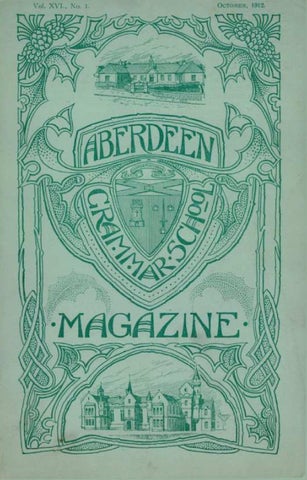
We are indebted to Mr. Moyes for the splendid new cover which appears for the first time with this number. It is a tribute to his artistic skill, and we are glad that he is associated with the Magazine so early in his connection with the School. Eft, Mr. R. Macrae, our new science master, was educated at Fortrose Academy, at which school he attained the honour of being dux. Afterwards he attended the Church of Scotland Training College, Aberdeen, and subsequently went to Aberdeen University, where he graduated M.A. He has had experience of teaching at Insch Higher Grade School, and at the Normal School, Aberdeen. At each of these two schools he was master of science and mathematics. Both our new masters are already proving very capable and enthusiastic teachers, while they are at the same time very popular among their pupils. te.. broke up for the summer holidays School the Just after our new flag arrived from the Scotch College, Melbourne. When we came back to the School on the first day of this session we were not long in noticing it floating at the top of the tower. The flag is a large Union Jack with the letters S.C.M. inscribed on it, these being the initials of the Scotch College. It is indeed a contrast to our old flag which was very much torn and frayed by the onslaughts of the wind, and we hope to see it flying at the top of our tower on fête days for many years to come.
4! ,
•
•
I
A very good appearance was again made by the School in the Leaving Certificate Examinations. The number of single passes obtained in the Higher Grade was 90, and in the Lower Grade 244. Intermediate Certificates were gained by 41, and Leaving Certificates by 18. The improvement shown in the number of passes this year corresponds to the increasing numbers in the Upper School. The passes were specially good in German, Greek, Latin and Science. Congratulations to all those who gained honour to the School and to themselves in the examinations !
.1
!i I 4 • •
,
L
Aberdeen Grammar School Magazine.
3
The Bursary Competition this year was chiefly remarkable for the success of the Fifth. J. M. McBain, who was fifth on the list, was the first of the School candidates. Surely it is a record for a boy in the Fifth to figure so high on the list. E. B. Boyd, who was sixth, also deserves our heartiest congratulations. Twelve of the School obtained places on the list, six of whom were in the first twenty. We are now living in the hope of having the first place in the Bursary Competition gained once more by a member of the School, while at the same time we have to express our regret at the departure of A. C. Anderson, the best of this year's Fifth, who was sure to take a high place in the list next June. a The Athletic Sports, which were held this year on the 13th and 14th of September, proved a great success. The weather was glorious on both days, consequently the attendance, especially on Saturday, was very satisfactory. No fewer than ten records were broken on the two days, perhaps the most noteworthy being the feats of W. T. B. Joss in the broad jump and hundred yards, and of J. G. Elmslie in the half and quarter miles. Special mention must also be made of the magnificent running of A. Tait, who in the half mile (class iii.) easily outdistanced all the others, and created a record for this event. We wish to thank all who contributed to the prize fund, and also those masters who acted as timekeepers and judges. Mr. Summers must also be congratulated on the behaviour of his pistol, which went off no fewer than five times, constituting another record. .3^; e e Professor Hendrick presented the prizes gained at the Sports to the successful competitors on Tuesday, 15th October. Before the presentation of prizes he delivered an interesting address about sport and its importance, which was much appreciated by those present. a a The Annual Business Meeting of the Swimming Club was held in Room V. on the 16th September. The Honorary Treasurer, Mr. Mackie, presided over a fairly large attendance drawn mostly from the Lower and Middle Schools. C. E. Saunders was elected captain for the coming year, with A. H. P. Ferguson as vice-captain, and R. I. Maxwell as secretary. Under these officials, who have several years' experience of the Club to help them, we may be sure of a prosperous and successful year. a a More success than usual fell to the lot of the cricket eleven this year. They won seven of the twelve matches played, and
4
Aberdeen Grammar School Magazine.
drew two. The most important match, that with Dollar, was unfortunately lost by the School, who made up for this by three beating their old rivals, Gordon's College, in two of the have matches played with them. Seven of last year's eleven successful very to a forward looking returned, and we are season when summer comes round once more.
t. existence The Tennis Club entered upon its second year of extent an such to increased membership this summer, and the attempt that the Club had to be divided into two sections. An one could was made to obtain a court for each section, but only of be had. This year a tournament was held, the success weather. of the inclemency the by marred somewhat which was while In this tournament, J. M. McBain won the open singles, McBain M. J. doubles the in and second, was Robson K. N. to the and A. McBain were successful. Our thanks are due he captain, G. A. Carroll, for the efficient way in which Club. the of managed the affairs
:z9.
moderate The football fifteen start this season with only Eight hopes of retaining their position as junior champions. is the whom among returned, have fifteen year's last of elected secretary, J. G. Elmslie, who has ithis year been players captain with W. P. Garbutt as secretary. These two them we form the mainstay of the School team, and without Queen's should be in a bad state. A match with 1st and season, the opened October 5th on School Cross at the weight although the School lost heavily against a fifteen of such far more and experience, we are confident that they will be Junior the from opponents successful against their usual League. CeP wellThe name of the Bishop of Aberdeen and Orkney, a list the to added been has School, the of pupil known former McBain is of patrons of the Debating Society. J. M. head President of the Society this year, and, with him at the have a most of affairs, we feel confident that the Society will An attractive programme has been arsuccessful session. Mackie ranged. The first lecture was given by Mr. Alexander and, needless on the 18th October before a large attendance, Mr. Mackie's to say, was greatly enjoyed by the members. and we annual lecture is now a feature of the programme, him. hearing without complete session the consider should not
a
held Another golf match between masters and pupils was the for victory another record to this summer, and we have
Aberdeen Grammar School Magazine.
5
masters. Nine matches were played, of which the masters won five. Let us hope that the next time this match takes place the pupils will break their long series of defeats at the hands of the masters. We feel confident that they can do so, because there are now some really good golfers in the School. @ cgs . In conclusion we would only say that nothing could please us better than to see more work by the School in the Magazine. Only one boy out of the whole six hundred not on the Magazine staff has contributed anything to this number. If our budding authors should chance to be shy to hand their effusions to the editor in person, they will find an editor's box just outside the Rector's room in which they may place their contributions when nobody is looking. And now good-bye to our readers till after Christmas !
Random Notes. It is with fear and trembling that we assume an editorial frown and lift up an editorial pen to write our first " Random Notes." Of one thing we are sure, however, " Random Notes " shall not be miscalled, for all written here will be put down at random. As this is our first attempt at public writing, we fervently pray our readers to overlook our many mistakes, and to swallow our dry remarks with a good grace. Let us change the maxim to suit ourselves—Facetus nascitur, non fit. Last year's Fifth were treated every day to the delightful notes of a " rooster." When, five minutes before the hour, any one of these " sturdy beggars " was called upon to translate Latin or Greek, it was a favourite device to call attention to the " rooster," and to propose plans for his decapitation; thus did the youth avoid having to translate, since the discussion of " ways and means" usually monopolised the remaining minutes. But alas ! the " rooster " is no more, or, at least, his voice is broken. No longer do the walls of Room III. echo with his " lively din " ; no longer do we propose to feast on him; no longer are we awakened from our day-dreams by him. Chauntecleer is silent. The reason ? We know not; some surmise that hens' suffrage leaves him no chance to assert himself ; others would hint that he has flavoured the broth, but, at anyrate, let the gallant Sixth mourn the loss of his hallowed voice.
6
Aberdeen Grammar School Magazine.
A few weeks ago, a certain class was favoured with a visit from a welcome intruder. While the members were engaged in deep study, a dog suddenly made its voice heard above all else. Pandemonium reigned supreme. There was a rush to the door, but the master was first, and all, save one, had to retire to their seats. The master accounts for the dog's appearance by saying that it was attracted by our " dog "Latin; our theory is that it was attracted by our " low "-Latin.. " The most successful sports we have ever had," is the general opinion of this year's Athletic Sports. Besides being blessed with two splendid, sunny, summer days, there was a record entry of competitors, and a record record of records. The programme was gone through very smartly, and all was over by five o'clock. Did we say all ? Nay, the most important item had yet to come—the providing of tea for the Games Committee. It was really a fine sight to watch how the buns vanished. At one table we know for certain that six platefuls of buns disappeared ! The band was again with us this year, and livened up the proceedings, so much so that several masters could be heard singing while the band played " King Arthur." When, oh when, are we to get a new pistol ? The starter, knowing the tricks the pistol has played for years past, used a " pop-gun " (value 10d) on Friday. But after firing at the proper moment four times, it struck—no, that is to say, it refused to " strike." In desperation he resorted to the old pistol on Saturday. So he well might. It went off once ! We think that Mr. Summers ought to be provided with a new hat out of the Games Fund. The manner in which he had to throw it about at the Sports left it in a very dilapidated condition. Scene—Junior classroom. Teacher (to promising first bursar)—What plays of Shakespeare have you read ? Pupil—"The Merchant of Venice," "Macbeth," and " Hamlet." Teacher—And which of his plays have you not read ? Pupil—" The Merry Widow ! ' The boys of the lower classes are becoming far too wise in their generation. One youth, whose mind should have been innocent of such frivolities (!), dared to suggest " sit out " as the probable meaning of " partir." We might have excused some members of the Sixth and Fifth for this slip, but such a gross error from one of tender years ought to have been " visited with condign punishment on the spot! "
Aberdeen Grammar School Magazine.
7
It is indeed a blessing that " Cassell " is " always merry and bright." Without him, we should be bored; without him, we should be deprived of some of the " tit-bits " of Latin. We owe this to him:— " Having advanced ten miles, our men halted." " Nostri decem milia passuum progressi, claudicaverunt ! " The American in Paris (at a perfumer's)—Voulez-vous donny moi une bouteille de—de (aside) say, girls, what is the French for " eau de Cologne " ? We read recently in a newspaper the description of a popular soprano. She was said to have " a voice of fine timbre, a willowy figure, cherry lips, chestnut hair, and hazel eyes." She must have been raised in a lumber region ! Poet : " I want your opinion of my poem." Friend : " It's absolutely worthless." Poet: " Never mind, I should like to know it." Do you know That the Sixth all got into the Hall two mornings ? That the Fifth cannot spell ? That they are advised to take drastic measures ? That they should try " Beating's Powder? " That someone asked " what's a Johnnie Walker ? " That the Library is very much frequented now ? Although we know that it is customary to write a great deal more than we have done, we are going to stop. In apologizing (if any apology is necessary) we shall submit the reason :— It is not that we've lost a friend, A tried and trusty brother; Nor griefs their shadows o'er us send. And warm impulses smother. There is no lady in the case, We're longing to behold— Those evils we could boldly face— But—we have caught a cold !
8
Aberdeen Grammar School Magazine.
The dates given in parentheses after names indicate the years of entering and leaving the School. * Indicates Member of the Former Pupils' Club. Two of the three volumes of the new Supplement of the Dictionary of National Biography have been published within the last few months. The memoirs in this Supplement are of persons who died between January 22, 1901, and December 31, 1911. We have perused the two volumes with the object of discovering the Old Boys who are considered worthy of immortality, and the following is the list:— ALEXANDER BAIN (1835-36). ANDREW WILSON BAIRD (1853-57). GEORGE CHRYSTAL (1863-67). ANDREW BRUCE DAVIDSON (1844-45). GEORGE KING (1849-50). ROBERT MACHRAY (1846-47). DAVID MATHER MASSON (1831-35). JOHN MURRAY MITCHELL (1828-29). We note that Professor Thomas Barker is said to have been educated at " the grammar school " of Aberdeen, but his name does not appear in the School Register. Since the last issue of the Magazine, the King has been pleased to confer knighthoods on two more Old Boys, these being Professor Alexander Ogston, and Lieutenant-Colonel David Prain. SIR ALEXANDER OGST0N, M.D., LL.D. (1855-58), who has been made a Knight Commander of the Royal Victorian Order, commenced medical practice in Aberdeen in 1866, and was Professor of Surgery in Aberdeen University from 1882 to 1908. He served as a surgeon in the Soudan in 1885, and in the South African War, 1899-1900. He was Surgeon-inOrdinary to Queen Victoria and King Edward VII. in Scotland, and is Surgeon-in-Ordinary to King George in Scotland. Lieutenant-Colonel Sir DAVID PRAIN, C.M.G., C.I.E., M.A., M.B., LL.D., F.R.S., F.R.S.E., F.L.S. (1872-73) has been Director of the Royal Botanic Gardens, Kew, since 1905.
Aberdeen GI am mar School Magazine.
11
Congress of Chambers of Commerce and Commercial and Industrial Associations recently held at Boston, U.S.A. An interesting article appeared in a recent issue of the ,Saturday. Westminster Gazette entitled " An Experiment under the Insurance Act." This was in effect an appreciation of the work as superintendent of Labour Exchanges in the Northern District of England of Lieutenant J. B. ADAMS, R.N.R. (1893-94), who was formerly second in command to Sir Ernest Shackleton during his celebrated expedition to the Antarctic. A memorial window to Professor GEORGE PIRIE, M.A., LL.D. (1853-56), Professor of Mathematics in Aberdeen University, who died in 1904, was a few weeks ago unveiled in King's College Chapel, Old Aberdeen. The window was presented to the University on behalf of the subscribers to the memorial by WILLIAM P. MILNE,* M.A., D.Sc. (1897-99), of Clifton College, Bristol, and was unveiled by Professor WILLIAM L. DAVIDSON,* M.A., LL.D. (1859-64). PERCIVAL R. KIRBY, M.A. (1892-1907) has for the second year in succession been awarded an exhibition for composition at the Royal College of Music, London. He is to continue his studies in London for a third year. MARSHALL J. ROBB, B.Sc. (1897-1906), has passed the final examination for the Associateship of the Institute of Chemistry of Great Britain and Ireland in the section of Food and Drugs and Water, with the special certificate in Microscopy and Pharmacology. He is the first to take the A.I.C. direct from Aberdeen: HENRY M. MICHIE (1901-02), assistant factor in the estate office at Raith, has been appointed factor on the Logan estate, Wigtownshire. JAMES S. WALKER* (1880-83) has been appointed deputy borough engineer and surveyor of the Wallasey Corporation. WILLIAM J. MORTIMER (1905-11) has passed the examination for second division clerkships in the Civil Service. JAMES COOPER CLARK* (1894-96) has been devoting much time to the study of the mysterious Mexican hieroglyphic codices, and has recently published a most interesting monograph entitled "The Story of `Eight-Deer' in Codex Colombino." The history of a man named ' Eight-Deer ' "is represented," says the Times, "in a series of pictographs, which give the chief events of his life ; his career as a soldier is shown in his attack on a fortress with a priest named OneOllin, both using the throwing-stick against a conventional building. At one period of his life he was raised to the priestly .order, as is shown by his being partly painted in black. An
12
Aberdeen Grammar School Magazine.
elaborate hieroglyph shows the operation of nose-piercing performed upon him by a priest; Eight-Deer lies on his back on an ocelot skin, naked save for a loin-cloth and his ornaments, while the awl is bored through his nostril. The last scene of his life is depicted in other codices, where he is stretched on a sacrificial stone while a priest plunges a knife into his breast. It is a book of curious interest, throwing no inconsiderable light on the customs and folk-lore of a peculiar people; for instance, the method of kindling the sacred fire with a drill is shown with a pleasing simplicity. The illustrations have been excellently reproduced." We hope a copy of the book will be placed in the School Library, and in this connection would throw out the suggestion that all Old Boys, when they write a book, should present a copy to the School. Many remember the University Library, but why forget the School' Library ? ALEXANDER MIDDLETON (1898- ?) has been appointed assistant mine manager with the Kramat Pulai Co. Ltd., at Perak, F .M. S. IAN L. F. MACBETH* (1898-1902), having received a nomination for the Hong-Kong and Shanghai Bank, and having passed the necessary examinations, has been appointed to the London office, where he is to take up duty soon. MALCOLM MACRAE (19O6-11), who was Captain of the School Football Team in 1910-11, is now at Sherbrooke, Quebec, where he is in the service of the Canadian Bank of Commerce. It seems that there is a large Gaelic-speaking community at Sherbrooke, and Macrae's command of that language got him the appointment. JOHN C. TAYLOR* (1904-06), who is in the service of Messrs. Jardine, Matheson and Co. Ltd., was recently sent out to the• Hong Kong office. He is delighted with Hong Kong. "Its situation is simply grand—nothing but ' mountain and sea ' all round. The town itself is fairly quiet, and after London, I am thankful for it. We have every facility for bathing (simply ripping), tennis, etc. in the summer, and cricket and football' in the winter. Not a pigtail is to be seen anywhere here— one result of the revolution !" WILLIAM M`M. ANDERSON,* M.A. (1895-1902), has been appointed to Troon Higher Grade School. He was previously on the staff of Rothesay Academy. ERIC W. H. BRANDER,* M.A., LL.B. (1894-1901), has been assumed a partner in the firm of Messrs Brander and Cruickshank, advocates, Aberdeen. HERBERT A. BREMNER* (1893-95), is now engineer and works manager for the Commonwealth Oxygen Co., Alexandria, New
Aberdeen, Grammar School Magazine.
13
South Wales. The company manufactures oxygen by the liquid air process, and is the Australian branch of the British Oxygen Co. Ltd., of London. Two years ago the fact was recorded in the Magazine that WILLIAM DUTHIE* (1853-55) of Collynie had received 1,050 guineas for a white calf. That was a record price at the time, but the other day this was completely eclipsed by the sale of a calf, barely six months old, for no less than 2,000 guineas. Altogether Mr. Duthie realised nearly £10,000 for 36 calves! Well may it be said that he stands supreme as the king of breeders. ROBERT W. A. SALMOND,* Ch.M., M.D. (1891-99) has been appointed medical officer in charge of the X-ray and electrical department, Queen's Hospital for Children, Bethnal Green, London. EDWIN MORGAN* (1906-12) has received an appointment in the Canadian Bank of Commerce, and leaves for Toronto at the end of October. JAMES TAGGART, M.A., B.Sc. (1887-92), has been appointed Rector of Brechin High School. Since 1900 he has had charge of the science and mathematical departments of the school. JAMES T. SOUTTER,* M.A. (1898-1902), took part as one of the representatives of Great Britain in the Olympic Games held in July at Stockholm. He ran in the 400 metres and the 800 metres flat races, and the 1600 metres relay race. During the summer he won the quarter-mile and half-mile Scottish Athletic Championship, and was selected to represent Scotland against Ireland, but was unable to do so owing to an accident at the Olympic Games. An article by him on " The Fifth Olympiad " appears in this issue of the Magazine. GORDON ALEXANDER MUNRO* (1901-06) has passed the Final Scottish Chartered Accountants' Examination. HERBERT DOUGLAS HENDERSON* (1901-04), of Emmanuel College, Cambridge, has been elected President of the Cambridge University Union. Another Old Boy held this muchcoveted position some years ago, namely JAMES STRACHAN,* M.A., B.Sc. (1885-95), now H. M. Inspector of Schools in the North of England REGINALD E. BUTCHART* (1894-1906) was in June ordained by Bishop Anthony Mitchell* to the Diaconate of the Scottish Episcopal Church. He has begun his ministry as assistant curate of St. Peter's Episcopal Church, Peterhead. CHARLES A. CHEYNE* (1884-85), who is a chemist in Heilbion, Orange Free State, is one of the new members of the Club.
14
Aberdeen Ura in mar School Magazine.
LINDSAY D. Cox* (1898-1903) is another recent new member. He is in the service of the East Rand Proprietary Mines, Ltd., Transvaal. Captain ARTHUR SHEPHERD,* M.B. (1891-1902), of the R.A.M.C., is at present in medical charge of the 1st Seaforths at Agra, one of the hottest stations in India. The temperature there goes up to 120° in the shade. He says, " We are quite hielan' here with the pipes going all day." GARLAND C. MILNE* (1897-1901), who was formerly working in the Canadian Pacific Railway Irrigation Department, has now got a very good post in the engineering department at Vancouver• of the British Columbia Electric Railway Co. Ltd. HUGH R. LAMBIE* (1906-08), who was one of three Old Boys who went out to Chile in the beginning of the present and year to take up appointments in the Anglo-Chilian Nitrate Coya, Railway Co. Ltd., in the course of a letter from Oficina and I Tocopilla, dated 5th June, says :—"Halliday, Rhind, in is Halliday months. three have now been here for over and one of the oficinas some thirty miles distant from Coya, lead we Pampa the On Tocopilla. Rhind works in the office at any a very out-of-the-world sort of life. No vegetation beof seen. can miles and miles for sand yellow sort, nothing but rain Day after day we have great heat and brilliant sunshine,When world. the of part this in unknown being practically to I have been here a little longer I shall be pleased to write on surroundings and life the of idea an give and Magazine, the the Pampa of North Chile." JAMES CAMERON (1885-88), who was trained in the Burgh Surveyor's office, Aberdeen, is at present engaged as surveyor on the Union Buildings at Pretoria. ARTHUR O. WARRACK (1902-04) is now in the employment of the Rising Sun Petroleum Company at Yokohama, Japan. GEORGE C. CHEYNE,* M.A., B.Sc. (1900-04), of the Indian Forest Service, writes from Mogok Ruby Mines, Burma, that bucked he " bagged a tiger the other day and was very much and there, out kind" of a "soccer of about it." There is plenty lots of tennis. We expect a contribution to the Magazine from him in the near future. WILLIAM ARTHUR B. KIRWAN WARD* (1895-1902) has received a post as engineer with the Constantinople Telephone Company. If he finds anything interesting in the Ottoman capital he also will be a probable future contributor to the Magazine. Judging from current newspaper reports from the Balkans, we are distinctly hopeful of securing good " copy " from him.
Aberdeen Grammar School Magazine.
15
JAMES STODART* (1899-1901), who served his apprenticeship as a civil engineer in Aberdeen, is now at Hamilton, Ontario, Canada. GEORGE Ross* (1898-1906) has received an appointment with Messrs. Finlay and Co., Glasgow, and has sailed for Assam. A most enthusiastic Old Boy has just been discovered in Rev. JOSEPH D. CARNEGIE* (1877-80), of Bond Street Congregational Church, Leicester. He is very interested in the Roll of Old Boys, and has been revelling in back numbers of the Magazine which were sent to him. We hope to have him as a contributor• to the February issue. Captain JAMES A. BUTCHART* (1889-95), of the Royal Field Artillery, has been appointed aide-de-camp to the Governor of Madras. EDWARD P. BARNETT* (1895-1903), of Messrs. Harrisons and Crosfield, Ltd., was recently at home from Ceylon on sick leave, and has now gone out to Sumatra. WILLIAM A. CAMERON* (1882-87) has been assumed a partner by Mr. W. D. Esslemont, advocate, Aberdeen. DAVID WOOD CLAPPERTON* (1892-1902) has commenced practice as a barrister at Medicine Hat, Alberta, Canada. IAN A. CLARKE,* M.A., B.Sc. (Agr.), (1902-08), who last summer won the hurdles at the Scottish Inter-University Sports, and represented Scotland against Ireland, is studying for the Indian Forest Service, and has gone to Oxford. He has been playing Rugby for Oxford University, and is declared by the Tinies to be the best of the Freshmen. His brother, JAMES B. CLARKE* (1896-99), who was 100 yards champion of Egypt, has been at home on holiday. Go GHEK GHEE* (1904-08), who has been in a civil engineer's office in Aberdeen, is now studying at the Glasgow Technical College. ALFRED JOAQUIN GRAY* (1902-05) is studying agriculture at the Ontario Agricultural College, Guelph, Canada. HORACE O. P. HEPBURN* (1895-1903) is in the service of the Trans-Continental Railway at La Tuque, Quebec, as a civil engineer. ALEXANDER PRINGLE JAMESON,* B.Sc. (1892-1904) iS FLOW studying in Germany for six months, and thereafter is going to London. CLEMENT R. MACLEOD,* M.B. (1894-1903), who has been assisting Dr. ARTHUR A. MORRISON* (1870-73), Alexandria, Egypt, for the past three years, has returned to this country and is now in London studying for the D.P.H.
Aberdeen Grammar School Magazine.
16
S. CLARK,* M.A., B.Sc. (1894-1901), who has Research Scholarship in the department of Carnegie received a Zoology, is assisting Dr. W. S. Bruce at the Scottish Oceanographical Laboratory, Edinburgh. He was selected to play for Scotland against the Australians at cricket this summer, County and was of great help to Aberdeenshire in their Forfarshire. against century a scoring matches, Championship JOHN R. ESSON* (1893197) has obtained an appointment with the Lidgerwood Manufacturing Co. (of London, Glasgow, and New York) at Rio de Janeiro, Brazil. to ALEXANDER G. TINDALL* (1902-11) has left Aberdeen under Ceylon, Matale, Pitakande, at appointment take up an on holiday. FRED H. FRASER* (1888-99), who is at present home JOHN F. FERGUSON* (1904-09) has been gazetted to the Durham Light Infantry, at present stationed in the Punjab, India. the CHARLES I. GILES* (1900-03), who is in the service of to Alliston from promoted been has Canada, Home Bank of Toronto. apTHEODORE W. O. KNIGHT* (1906-11) has just been Legal Victoria Liverpool the of office Glasgow the pointed to Friendly Society. s.s. JOHN W. ANGUS (1890-92) has been made master of Skerries (8000 tons) of the Clyde Shipping Co., Glasgow. in JAMES MESTON REID* (1896-1907), who has been Brussels. in resident now is Germany for the past year, WILLIAM L. WATT* (1905 -09) like many more Old Boys, is in the service of the Canadian Bank of Commerce. For the last eight months he has been stationed at Rainy River, on the border of Canada and U.S.A., about 150 miles east of Winnipeg. ." Despite the name," he writes, " I like the place very well and have all kinds of sport and pleasure. It is quite a busy little place, being in the centre of a large lumber district." One of the most recent New Members is DANIEL A. LEVIE,* M. S.A. (1886-91), who is an architect in Cork. ELWALDA W. ELWELL (1894-97) now holds the post of level man and topographical and mechanical draughtsman for the Oregon and Washington Railway and Navigation Co., U.S.A. Professor ALEXANDER R. GORDON,* D.Litt., D.D. (1884-88) of the Presbyterian College, Montreal, is the author of a new volume entitled " The Poets of the Old Testament." WILLIAM A. DAVIDSON (1907-10) has received by competition an appointment in the Union Bank of Scotland. ROBERT
'
A CLASS OF THE MIDDLE SCHOOL IN 1881-82.
BACK
Row—Ernest Rennet, Thos. C. Hynd, A. G. Wright, Alex. Inns.
SECOND Bow—(?) R. S. Machray, John Kelly, Samuel Baker, Daniel Peterkin, John Elrick, Alex. Crnmar,
- — (?) Wm. Rose.
THIRD Row—Donald McCombie, John Adlington, Edwin Hector, Mr. Young, Donald Lamont, Alex. Henderson, Edward Smith, Jas. A. Coutts, FRONT
Row—Alex. G. Craighead, J. Glanville Mine, Alex. Christie, Jas. Munro, Harvey Burr, Jas. Watt, Chas. Maguire.
Alex. Moir
_r—da
Aberdeen Gram mar School Magazine.
-
9
He entered the Indian Medical Service in 1884, and held the offices of Curator of the Calcutta Herbarium, 1887-1898; Professor of Botany in the Medical College, Calcutta, 18951905 ; and Director of Botanical Survey of India, and Superintendent of the Royal Botanic Garden, Calcutta, 1898-1905. He retired from the Indian Medical Service in 1906. ARTHUR M. CHALMERS (1881-82), British Consul at Nagasaki, Japan, has recently been appointed Consul-General for Korea, and is to reside at Seoul. His eldest brother, JAMES L. CHALMERS* (1867-69), who until the beginning of October was resident in Aberdeen on furlough, is in the Chinese Customs Service at Shanghai, while the death of a younger brother is recorded in the obituary on another page. The father of these three Old Boys, Rev. JOHN CHALMERS, M.A., LL.D. the well-known Chinese scholar and missionary of the London Missionary Society, who died at Chemulpo, Korea, in 1899, was a pupil at the School in 1843-44. SIR JAMES S. MESTON,* K .C.S.I. (1876-80), who was recently home on furlough, has now returned to India and assumed the Lieutenant-Governorship of the United Provinces. In a letter to the Club Secretary, written just before he left this country, he expresses thanks to the Club for electing him an Honorary Vice-President, and adds : "I greatly appreciate the honour, and shall always do what may lie in my power to further the interests of the Club, and to exalt the horn of the old School. I owed it much, and retain the kindliest memories of it." Colonel Sir WILLIAM SINCLAIR SMITH BISSET,* K.C.I.E. (1854-55), who has had wide experience in connection with Indian railways, has begn appointed one of the eight British directors of the Societe d'Etudes for the proposed trans-Persia railway to connect the Russian and Indian systems. Sir JOHN MACDONELL,* C.B., LL.D. (1860-61), is one of the editors of a work on " The Great Jurists of the World," announced by Mr. John Murray. Sir JOHN COLLIE,* M.D. (1873-76), is the author of a recently-published volume entitled " Medico-Legal Examinations and the Workmen's Compensation Act, 1906." As a medical referee and examiner he has acquired special knowledge of the working of the Workmen's Compensation Act. Sir WILLIAM ROBERTSON NICOLL,* M.A., LL.D. (1866), has recently completed a book just published under the title " The Problem of `Edwin Drood,' a Study in the Method of Dickens." GEORGE S. MIDDLETON,* M.A., M.D. (1863-68), Glasgow, has been appointed President of the Association of Physicians of Great Britain and Ireland for 1912.
Aberdeen Grammar School Magazine.
10
JOHN RUDOLPH WARDLAW BURNET,* B.A. (Cantab.), LL.B. (Aberd.) (1899-1901) was in July admitted to the Faculty of Advocates, Edinburgh. ANDREW GOURLAY CLOW (1896-98), scholar of St John's College, Cambridge, was one of the wranglers in this year's Mathematical Tripos—Part II. ALEXANDER G. G. ELLIS, B.Sc. (Agr.) (1908-09), has passed for the national diploma in dairying at the Dairy School for Scotland, Kilmarnock, and has been awarded a prize as the best male student of the senior course.
Captain ARCHER IRVINE FORTESCUE* (1892-97), Royal Army Medical Corps, medical officer to the Second Battalion of the Gordon Highlanders at Cawnpore, has been appointed senior medical officer at Benares. CHARLES W. SLEIGH,* M.A. (1874-79), factor at Strichen, has been appointed by the Board of Agriculture for Scotland one of the valuators under the Agricultural Holdings Act, and has JAMES S. SHEWAN, M.A. (1875-77), solicitor in Aberdeen, arbiters. of list special on the placed been Rev. ALEXANDER J. MONRO, M.A. (1899-1902), assistant in St Mary's, Edinburgh, has been elected minister of the United Free Church at Ancrum in the Presbytery of Jedburgh and Kelso. In the reports of the recent meetings in Dundee of the British Association the names of various Old Boys appeared. P. CHALMERS MITCHELL, M.A., D.Sc., LL.D., F.R.S. (1879-80), secretary of the Zoological Society, London, delivered an address as president of the Zoological section. In this section also ARTHUR LANDSBOIROUGH THOMSON,* M.A. (1899-1908), who is taking a leading part in the Aberdeen University inquiry regarding the migration of birds, spoke on the subject of "Bird-marking." Others who took part in the proceedings of the Association were HENRY J. WATT, M.A., Ph.D. (1891-96), and WILLIAM P. MILNE,* M.A., D.Sc. (1897-99). Rev. WILLIAM W. CRUICKSHANK,* M.A (1895-97)' who in 1907 was appointed Priest-in-Charge of St. Barnabas' Mission, Mlengana, Pondoland, Kaffraria, has accepted the incumbency he was of the Holy Trinity Episcopal Church, Keith, to which unanimously nominated. Rev. CHARLES DUNN, M.A., B.D. (1888-91), Arbuthnott, Fordoun, has been translated to the parish of Uphall, Linlithgowshire. C. GLEGG* (1863-67) and GEORGE HUTCHESON* Aberdeen at the Fifth International represented <1877-79) JAMES
Aberdeen Gi a m mar School Magazine.
11
Congress of Chambers of Commerce and Commercial and Industrial Associations recently held at Boston, U.S.A. An interesting article appeared in a recent issue of the . Westm inster Gazette entitled " An Experiment under the Insurance Act." This was in effect an appreciation of the work as superintendent of Labour Exchanges in the Northern District of England of Lieutenant J. B. ADAMS, R.N.R. (1893-94), who was formerly second in command to Sir Ernest Shackleton during his celebrated expedition to the Antarctic. A memorial window to Professor GEORGE PIRIE, M.A., LL.D. (1853-56), Professor of Mathematics in Aberdeen University, who died in 1904, was a few weeks ago unveiled in King's College Chapel, Old Aberdeen. The window was presented to the University on behalf of the subscribers to the memorial by WILLIAM P. MILNE,* M.A., D.Sc. (1897-99), of Clifton College, Bristol, and was unveiled by Professor WILLIAM L. DAVIDSON,* M.A., LL.D. (1859-64). PERCIVAL R. KIRBY, M.A. (1892-1907) has for the second year in succession been awarded an exhibition for composition at the Royal College of Music, London. He is to continue his studies in London for a third year. MARSHALL J. ROBB, B.Sc. (1897-1906), has passed the final examination for the Associateship of the Institute of Chemistry of Great Britain and Ireland in the section of Food and Drugs and Water, with the special certificate in Microscopy and Pharmacology. He is the first to take the A.I.C. direct from Aberdeen-. HENRY M. MICHIE (1901-02), assistant factor in the estate ,office at Raith, has been appointed factor on the Logan estate, Wigtownshire. JAMES S. WALKER* (1880-83) has been appointed deputy borough engineer and surveyor of the Wallasey Corporation. WILLIAM J. MORTIMER (1905-11) has passed the examination for second division clerkships in the Civil Service. JAMES COOPER CLARK* (1894-96) has been devoting much time to the study of the mysterious Mexican hieroglyphic codices, and has recently published a most interesting monograph entitled " The Story of ' Eight-Deer' in Codex Colombino." The history of a man named ' Eight-Deer ' "is represented," says the Times, "in a series of pictographs, which give the chief events of his life; his career as a soldier is shown in his attack on a, fortress with a priest named OneOllin, both using the throwing-stick against a conventional building. At one period of his life he was raised to the priestly „order, as is shown by his being partly painted in black. An iS' aturday
12
Aberdeen Grammar School Magazine.
elaborate hieroglyph shows the operation of nose-piercing performed upon him by a priest ; Eight-Deer lies on his back on an ocelot skin, naked save for a loin-cloth and his ornaments, while the awl is bored through his nostril. The last scene of his life is depicted in other codices, where he is stretched on a sacrificial stone while a priest plunges a knife into his breast. It is a book of curious interest, throwing no inconsiderable light on the customs and folk-lore of a peculiar people; for instance, the method of kindling the sacred fire with a drill is shown The illustrations have been with a pleasing simplicity. excellently reproduced." We hope a copy of the book will be placed in the School Library, and in this connection would throw out the suggestion that all Old Boys, when they write a book, should present a copy to the School. Many remember the University Library, but why forget the School' Library? ALEXANDER MIDDLETON (1898- ?) has been appointed assistant mine manager with the Kramat Pulai Co. Ltd., at. Perak, F.M.S. IAN L. F. MACBETH* (1898-1902), having received a nomination for the Hong-Kong and Shanghai Bank, and having passed the necessary examinations, has been appointed to the London office, where he is to take up duty soon. MALCOLM MACRAE (191)6-11), who was Captain of the School Football Team in 1910-11, is now at Sherbrooke, Quebec, where he is in the service of the Canadian Bank of Commerce. It seems that there is a large Gaelic-speaking community at Sherbrooke, and Macrae's command of that language got him the appointment. JOHN C. TAYLOR* (1904-06), who is in the service of Messrs. Jardine, Matheson and Co. Ltd., was recently sent out to the Hong Kong office. He is delighted with Hong Kong. "Its situation is simply grand—nothing but ' mountain and sea ' all round. The town itself is fairly quiet, and after London, I am thankful for it. We have every facility for bathing (simply ripping), tennis, etc. in the summer, and cricket and football in the winter. Not a pigtail is to be seen anywhere here— one result of the revolution !" WILLIAM M`M. ANDERSON,* M.A. (1895-1902), has been appointed to Troon Higher Grade School. He was previously on the staff of Rothesay Academy. ERIC W. H. BRANDER,* M.A., LL.B. (1894-1901), has been assumed a partner in the firm of Messrs Brander and Cruickshank, advocates, Aberdeen. HERBERT A. BREMNER* (1893-95), is now engineer and works manager for the Commonwealth Oxygen Co., Alexandria, New
Aberdeen Grammar School Magazine.
13
South Wales. The company manufactures oxygen by the liquid air process, and is the Australian branch of the British Oxygen Co. Ltd., of London. Two years ago the fact was recorded in the Magazine that WILLIAM DUTHIE* (1853-55) of Collynie had received 1,050 guineas for a white calf. That was a record price at the time, but the other day this was completely eclipsed by the sale of a calf, barely six months old, for no less than 2,000 guineas. Altogether Mr. Duthie realised nearly £10,000 for 36 calves ! Well may it be said that he stands supreme as the king of breeders. ROBERT W. A. SALMOND,* Ch.M., M.D. (1891-99) has been appointed medical officer in charge of the X-ray and electrical department, Queen's Hospital for Children, Bethnal Green, London. EDWIN MORGAN* (1906-12) has received an appointment in the Canadian Bank of Commerce, and leaves for Toronto at the end of October. JAMES TAGGART, M.A., B.Sc. (1887 ° - ' has been appointed Rector of Brechin High School. Sin( ,0 he has had charge of the science and mathematical departments of the school. JAMES T. SOUTTER,* M.A. (1898-1902), took part as one of the representatives of Great Britain in the Olympic Games held in July at Stockholm. He ran in the 400 metres and the 800 metres flat races, and the 1600 metres relay race. During the summer he won the quarter-mile and half-mile Scottish Athletic Championship, and was selected to represent Scotland against Ireland, but was unable to do so owing to an accident at the Olympic Games. An article by him on " The Fifth Olympiad " appears in this issue of the Magazine. GORDON ALEXANDER MUNRO* (1901-06) has passed the Final Scottish Chartered Accountants' Examination. HERBERT DOUGLAS HENDERSON* (1901-04), of Emmanuel College, Cambridge, has been elected President of the Cambridge University Union. Another Old Boy held this muchcoveted position some years ago, namely JAMES STRACHAN,* M.A., B.Sc. (1885-95), now H. M. Inspector of Schools in the North of England REGINALD E. BUTCHART* (1894-1906) was in June ordained by Bishop Anthony Mitchell* to the Diaconate of the Scottish Episcopal Church. He has begun his ministry as assistant curate of St. Peter's Episcopal Church, Peterhead. CHARLES A. CHEYNE* (1884-85), who is a chemist in Heilbron, Orange Free State, is one of the new members of the Club.
14
Aberdeen Grammar School Magazine. LINDSAY D. Cox* (1898-1903) is another recent new mem-
ber. He is in the service of the East Rand Proprietary Mines, Ltd., Transvaal. the Captain ARTHUR SHEPHERD,* M.B. (1891-1902), of R.A.M.C., is at present in medical charge of the 1st Seaforths at Agra, one of the hottest stations in India. The temperature there goes up to 120° in the shade. He says, " We are quite hielan' here with the pipes going all day." working GARLAND C. MILNE* (1897-1901), who was formerly has Department, Irrigation Railway Pacific Canadian in the at department engineering the in now got a very good post Vancouver of the British Columbia Electric Railway Co. Ltd. three Old HUGH R. LAMBIE* (1906-08), who was one of Boys who went out to Chile in the beginning of the present and year to take up appointments in the Anglo-Chilian Nitrate Railway Co. Ltd., in the course of a letter from Oficina Coya,I Tocopilla, dated 5th June, says :—"Halliday, Rhind, and have now been here for over three months. Halliday is in one of the oficinas some thirty miles distant from Coya, and Rhind works in the office at Tocopilla. On the Pampa we lead any a very out-of-the-world sort of life. No vegetation beof seen. can miles and miles for sand yellow sort, nothing but rain Day after day we have great heat and brilliant sunshine,When world. the of part this in unknown being practically to I have been here a little longer I shall be pleased to write on surroundings and life the of idea an give and Magazine, the the Pampa of North Chile." the Burgh JAMES CAMERON (1885-88), who was trained in surveyor as engaged present at is Aberdeen, Surveyor's office, on the Union Buildings at Pretoria. employment ARTHUR 0. WARRACK (1902-04) is now in the of the Rising Sun Petroleum Company at Yokohama, Japan. Indian GEORGE C. CHEYNE,* M.A., B.Sc. (1900-04), of the Forest Service, writes from Mogok Ruby Mines, Burma, that he " bagged a tiger the other day and was very much bucked about it." There is plenty of "soccer of a kind" out there, and lots of tennis. We expect a contribution to the Magazine from him in the near future. has reWILLIAM ARTHUR B. KIRWAN WARD* (1895-1902) Telephone Constantinople the with engineer as ceived a post Company. If he finds anything interesting in the Ottoman capital he also will be a probable future contributor to the Magazine. Judging from current newspaper reports from the Balkans, we are distinctly hopeful of securing good " copy " from him.
Aberdeen Grammar School Magazine.
15
JAMES STODART* (1899-1901), who served his apprenticeship as a civil engineer in Aberdeen, is now at Hamilton, Ontario, Canada. GEORGE Ross* (1898-1906) has received an appointment with Messrs. Finlay and Co., Glasgow, and has sailed for Assam. A most enthusiastic Old Boy has just been discovered in Rev. JOSEPH D. CARNEGIE* (1877-80), of Bond Street Congregational Church, Leicester. He is very interested in the Roll of Old Boys, and has been revelling in back numbers of the Magazine which were sent to him. We hope to have him as a contributor to the February issue. Captain JAMES A. BUTCHART* (1889-95), of the Royal Field Artillery, has been appointed aide-de-camp to the Governor of Madras. EDWARD P. BARNETT* (1895-1903), of Messrs. Harrisons and Crosfield, Ltd., was recently at home from Ceylon on sick leave, and has now gone out to Sumatra. WILLIAM A. CAMERON* (1882-87) has been assumed a partner by Mr. W. D. Esslemont, advocate, Aberdeen. DAVID WOOD CLAPPERTON* (1892-1902) has commenced practice as a barrister at Medicine Hat, Alberta, Canada. IAN A. CLARKE,* M.A., B.Sc. (Agr.), (1902-08), who last summer won the hurdles at the Scottish Inter-University Sports, and represented Scotland against Ireland, is studying for the Indian Forest Service, and has gone to Oxford. He has been playing Rugby for Oxford University, and is declared by the Times to be the best of the Freshmen. His brother, JAMES B. CLARKE* (1896-99), who was 100 yards champion of Egypt, has been at home on holiday. Go GHEK GHEE* (1904-08), who has been in a civil engineer's office in Aberdeen, is now studying at the Glasgow Technical College. ALFRED JOAQUIN GRAY* (1902-05) is studying agriculture at the Ontario Agricultural College, Guelph, Canada. HORACE O. P. HEPBURN* (1895-1903) is in the service of the Trans-Continental Railway at La Tuque, Quebec, as a. civil engineer. ALEXANDER PRINGLE JAMESON,* B.Sc. (1892-1904) is now studying in Germany for six months, and thereafter is going to London. CLEMENT R. MACLEOD,* M.B. (1894-1903), who has been assisting Dr. ARTHUR A. MORRISON* (1870-73), Alexandria, Egypt, for the past three years, has returned to this country and is now in London studying for the D.P.H.
Aberdeen Grammar School Magazine.
16
S. CLARK,* M.A., B.Sc. (1894-1901), who has Research Scholarship in the department of Carnegie a received Zoology, is assisting Dr. W. S. Bruce at the Scottish Oceanographical Laboratory, Edinburgh. He was selected to play for Scotland against the Australians at cricket this summer, County and was of great help to Aberdeenshire in their Forfarshire. against century a scoring Championship matches, Jom R. EssoN* (1893:97) has obtained an appointment with the Lidgerwood Manufacturing Co. (of London, Glasgow, and New York) at Rio de Janeiro, Brazil. to ALEXANDER G. TINDALL* (1902-11) has left Aberdeen under Ceylon, Matale, Pitakande, at appointment take up an on holiday. FRED H. FRASER* (1888-99), who is at present home JOHN F. FERGUSON* (1904-09) has been gazetted to the Durham Light Infantry, at present stationed in the Punjab, India. of the CHARLES I. GILEs* (1900-03), who is in the service to Alliston from promoted been has Home Bank of Canada, Toronto. apTHEODORE W. G. KNIGHT* (1906-11) has just been Legal Victoria Liverpool the of office Glasgow pointed to the Friendly Society. of s.s. JOHN W. ANGUS (1890-92) has been made master Skerries (8000 tons) of the Clyde Shipping Co., Glasgow. in JAMES MESTON REID* (1896-1907), who has been Brussels. in resident now is Germany for the past year, Boys, WILLIAM L. WATT* (1905-09) like many more Old is in the service of the Canadian Bank of Commerce. For the last eight months he has been stationed at Rainy River, on the border of Canada and U.S.A., about 150 miles east of Winnipeg. ," Despite the name," he writes, " I like the place very well and have all kinds of sport and pleasure. It is quite a busy little place, being in the centre of a large lumber district." One of the most recent New Members is DANIEL A. LEVIE,* M.S.A. (1886-91), who is an architect in Cork. ELWALDA W. ELWELL (1894-97) now holds the post of level man and topographical and mechanical draughtsman for the Oregon and Washington Railway and Navigation Co., U.S.A. Professor ALEXANDER R. GORDON,* D.Litt., D.D. (1884-88) of the Presbyterian College, Montreal, is the author of a new volume entitled " The Poets of the Old Testament." WILLIAM A. DAVIDSON (1907-10) has received by competition an appointment in the Union Bank of Scotland. ROBERT
Aberdeen Grammar School Magazine.
17
ANDREW RAMSAY (1896-99), of Edinburgh, has recently taken up aviation. ROBERT M. JOHNSTONE* (1886-94) who is civil engineer of the Colonial Government Railway, Sierra Leone, West Africa, in a letter just received says :—" In one of the School Magazines sent out last year was an excellent photograph of another old favourite, Mr. Maxwell Mackie, and while looking at this one evening the washerwoman stepped in with the returned washing, and not being so polite as a washerwoman in Aberdeen, she said ' Who dat?' Well I thought it quite unnecessary to go into explanations to her for she wouldn't have understood, so I said ' Dat be me daddy.' Her first remark was ' He fine,' and after looking at me and at the photograph again she added ' He fine past you,' which meant `He is a. fine looking man ' and ' He is much better looking than you.' My washerwoman is truthful, but, as I said before, she is not polite. The funny part is that when she came back next week she asked again ' Me want to look you daddy's picture,' and to crown all she added ' Me go keep this. You get plenty.' Mr. Mackie has thus a lady admirer of whom he doesn't know." JAMES ELMSLY (1870-72) has recently retired from the post of manager at Montreal of the Bank of British North America. He entered the service of the Bank in 1878 and has filled many important positions. Before 1878 he was with the North of Scotland Bank in Aberdeen. ROBERT W. DUNLAP* (1896-97), who is a graduate in medicine of Johns Hopkins University, Baltimore, U.S.A., is devoting himself to medical mission work in Shantung Province, China. In a recent letter from Wei Hsien, which is about five hours by rail from the German port of Tsingtau, he makes some interesting remarks about the present condition of China, and we take the liberty of quoting, as follows :—"I believe that this great country is starting to find her way out, and the process is going to be a very interesting one to watch. In the north here, there is great conservatism and little confidence in the new order of things on the part of the common people, and the queue is still in evidence. It will take time and education to break down all this prejudice against anything different, which they have inherited from remote generations. Of course, the enlightened classes, such as the students and officials, can see that it is the only thing for the country. It is undoubtedly a time of great opportunity, and of no less urgency for the spread of the Gospel among this people. A country of such magnitude with power unlimited for either good or evil, by force of mere numbers, as well as by physical and intellectual fitness, could work great havoc in the world
18
Aberdeen Grammar School Magazine.
if it obtained all the shell of civilisation, and the power that comes with it, without the mellowing and softening influence of Christianity to curb it and exercise it in proper directions. Witness, for instance, the situation in Korea under Japan at the present time, in unjust arrest and imprisonment, torture, and assumption of guilt without fair trial, of thousands of the native Christians. And yet Japan does not dare to do anything to arouse the suspicion of the other nations that she is not really civilised at heart." Rev. WILLIAM S. BRUCE,* M.A., D.D., •of Banff, is the editor •of the recently-published Record of the Arts Class 1864-68 of Aberdeen University. The volume is a particularly interesting one from the School point of view, as the majority of the members of the Class received part of their education at the School. The Class may well feel proud of the careers of its various members, and we note with great satisfaction that the more outstanding names are on our Roll also. The most famous, perhaps, is that of WILLIAM JENKYNS, C.I.E., of the Indian Civil Service, who, as everyone knows, fell gloriously, sword in hand, at the massacre of Cabul, on 3rd September, 1879. Two other members who have risen high in the Indian Civil Service are Sir GEORGE STUART FORBES,* K.C.S.I., and Sir JAMES THOMSON, K.C.S.I.; while DAVID DUNCAN, D.Sc., LL.D., entered the Madras Education Service and became Director of Public Instruction and Vice-Chancellor of Madras University. In the Indian Army THOMAS HARDING MACKENZIE was at the relief of Kandahar, and rose to the command of the 2nd Grenadiers (now the 102nd Grenadiers). WILLIAM DONALD SPENCE entered the Chinese Consular Establishment as a student interpreter and became ActingConsul at Taiwan and Assistant Chinese Secretary to the Legation in Pekin. Among the professors and teachers are WILLIAM LESLIE DAVIDSON,* LL.D., of Aberdeen University; Principal PETER TAYLOR FORSYTH,* D.D., of Hackney Theological College; the late WILLIAM GRAY ELMSLIE, D.D., of the Presbyterian College, London; and JOHN BREMNER In Law, INNES,* for 40 years schoolmaster of Strathdon. JOHN ADAM* is Crown and Public Prosecutor in Madras; GEORGE FALCONER* is in practice in Aberdeen; JAMES A. STEPHEN is solicitor and bank agent in Keith; and JOHN WATSON STUART is a member of the Faculty of Procurators, Glasgow. The ministers include WILLIAM S. BRUCE,* D.D., Banff ; Rev. MATTHEW DICKIE (d. 1890), of Alva U.P. Church ; ROBERT GORDON, of Pluscarden U.F. Church ; CHARLES P. LITTLEJOHN, a clergyman of the Church of England ; GEORGE G. MACDONALD, of U.F. Church, Ordiquhill and Ord ; GEORGE MINTY, of St Mary's Church, Fyvie ; and the late JOHN SMITH, of Broughton Place U.F. Church, Edinburgh. A connecting
i
1
•
5
Aberdeen 6' ro m mar School 77ayazine.
19
link between the Church and Medicine IS JAMES SHEPHERD,* M.D., D.D., medical missionary, of Rajputana, India. The doctors are fairly numerous, and include ROBERT REID ALEXANDER,* M.D., formerly Superintendent of the Middlesex County Asylum, Hanwell, where he had charge of more than 2,500 insane men and women; ARCHIBALD CARMICHAEL,* M.D., Barrow-in-Furness ; CHARLES DAVIDSON, M.D. (d. 1912), Coventry; JAMES DUNCAN, M.B. (d. 1909), Ashton-underLyne; ROBERT JOHN GARDEN, M.D. (d. 1903), Aberdeen; ROBERT SHIRRA GIBB, M.B., formerly Medical Officer of Health for Berwickshire, and now farmer at Boon, Lauder; PETER GRANT HAY, M.B. (d. 1908), Forgue ; JOHN LYON, M.B., (d. 1910), Hodnet, Shropshire; and DONALD SIMPSON, M.B., now settled near Melbourne. WALTER COWAN iS an iron merchant in Glasgow; WILLIAM T. GERRARD (d. 1908) was in the Bank of Manchester; GEORGE GILCHRIST (d. 1897), once in the Army, emigrated to America; GEORGE D. JAMIESON was a tea-planter in Ceylon and now lives in Alberta, Canada; LEWIS J. PIRIE (d. 1889) started a soap and candle factory in South Africa; and JOHN MACDONALD, formerly a journalist, is now a farmer at Echt. There are a few members of the Class who are declared to have attended the Grammar School, but so far we have been unable to find their names in the School Register. At the Summer Graduation of Aberdeen University degrees were conferred on the following Old Boys :— Doctor of Divinity (D.D.)— Rev. WILLIAM SUMMERS SUTHERLAND, M.A. (1871-72), Universities Mission, Kalimpong, India. Master of Arts (M.A.)--CHARLES BUCHAN (1906-08), with first class honours in Economic Science ROBERT LYON* (1899-1908), with second class honours in Economic Science. HUGH GRANT ADAM* (1907-08). EDMUND CHALMERS (1895-99). ALEXANDER CHEYNE (1903-09). PETER DIACK* (1904-09). JAMES CATTO DUFFUS* (1897-1904). DAVID EDWARDS* (1903-09). EDWARD WYLLIE FENTON* (1895-1908). JAMES SMITH HASTINGS* (1903-09). JOHN FORBES KNOWLES (1903-09). ROBERT DANIEL LAWRENCE* (1900-09). JAMES CECIL DAVIDSON MACKIE* (1898-1909). JOHN HALL RITCHIE* (1903-09). JAMES INNES WATSON* (1905-09).
20
Aberdeen Grammar School Magazine.
Bachelor of Science (B.Sc.)— GEORGE KNOWLES FRASER, M.A. (1907-08). IAN GEORGE INNES,* M.A. (1905-08).
Bachelor of Science in Agriculture (B.Sc , Agr.)— IAN ANDERSON CLARKE,* M.A. (1902-08). Bachelor of Laws (LL.B.)PATRICK ASHLEY COOPER,* B.A. (Cantab.) (1896-1901). Doctor of Medicine (M.D.)— ANDREW JAMES SHINNIE,* M.B., Ch.B. (1897-1903). HENRY GEORGE DEANS, M.A., M.B., C.M. (1881-83). GEORGE MICHIE, M.A., M.B., C.M. (1876-80). WILLIAM ROBERT COLVIN MIDDLETON, M.A., M.B., C.M. (1873-79). Bachelor of Medicine (M.B.) and Bachelor of Surgery (Ch.B.)WILLIAM JOHN SIVEWRIGHT INGRAM* (1905-06). The John Murray Medal and Scholarship to the most distinguished graduate in Medicine of 1912 was awarded to RICHARD R. M. PORTER,* M.A., M.B., Ch.B. (1895-1906); the Edmond Prize to the most distinguished graduate in Law of 1912 to FREDERICK WISHART* (1897-1906); and the Hunter Gold Medal in Roman Law to JAMES C. D. MACKIE* (1898-1909). JAMES OLIVER TnomsoN, M.A. (1899-1900) has been awarded the Croom Robertson Fellowship for three years. This is the most important fellowship in the bestowal of the University.
The Editor begs to acknowledge, with thanks, the receipt of the following contemporaries, and to apologize for any accidental omissions :—" The Erasmian " (2), " The Yellow Dragon " (4), " The Herioter," " The Watsonian," " Royal Belfast Academical Institution School News," " The Portmuthian " (2), " The Glasgow High School Magazine," " Mercer's School Magazine," " The Olavian " (2), " The Edinburgh Academy Chronicle" (3), " The Courier " (3) (Cincinnati), " The Fettesian" (2), " The Penang AngloChinese Scholar's Own " (4), " Sligo Grammar School Magazine," " Stewart's College Magazine," " The Nelsonian," " The Boltonian," " The Westovian," " The Scotch Collegian," " C.A.I." (2), " Turriff School Magazine," " Foyle College School Times," " The Harris Magazine," (Harris Academy, Dundee), "Ayr Academy Magazine," " Clasgow Academy Magazine," " Under the Dome," " St. Andrew's College Magazine," " Handels-Hochschule " (Berlin), " Animal's Friend " (2).
Aberdeen Grammar School Magazine.
21
OBITUARY. (1830-35), advocate, died at 33 Albyn Place, Aberdeen, on 15th June, in the 93rd year of his age. By his death the School has lost one of her very oldest " Boys," and one who took a life-long interest in her welfare. Mr Allan has described how, from Mr Ledingham's Academy in the Guestrow, he entered the School in the company of Sir James M`Kenzie of Glenmuick, and was received by Melvin. Another class fellow of his was Professor David M. Masson, of Edinburgh University, H.M. Historiographer for Scotland. After attending •classes at Marischal College, Mr Allan served a law apprenticeship, and was admitted a member of the Society of Advocates in Aberdeen in 1844. He was the second oldest member of the Society, the doyen being Mr James Collie* (1827-32), who is understood to be the oldest surviving Former Pupil of the School. Mr Allan engaged actively in business until about a dozen years ago, and almost to the last maintained a keen interest in local affairs. He was the possessor of a unique collection of reminiscences of most Aberdonians of note of last century, and had a large circle of friends to whom he rejoiced to relate his anecdotes. Dr. ALFRED GILCHRIST (1832-33), another very old " Boy," died in Aberdeen on 31st July in the 92nd year of his age. He was a graduate of Edinburgh University, and engaged in boarding-school teaching in England. For a long time he lived in retirement in Aberdeen. By his will he provided for two bursaries tenable at Aberdeen University, and also for tw•o public lectures. Rev. WILLIAM LYON RIACH, M.A. (1841-42), ministeremeritus of Grange Parish Church, Edinburgh, died in Edinburgh in June at the age of 87. He graduated at Marischal College in 1846, and was successively minister at Balmaghie in Galloway, Pencaitland, and from 1872 to 1895 in Grange Parish, Edinburgh. Deputy Surgeon-General WILLIAM WATSON, M.A., M.D. (1843-46), of the Indian Medical Service, died at The Lea, Corstorphine, on 16th June, aged 80. After passing through Marischal College he went out to India in 1853, and as a surgeon served through the Mutiny with great distinction. He later was appointed superintendent of the Vaccination Department, N.W.P., and rendered great service in fighting cholera. He retired in 1883, and after settling in Edinburgh interested himself in scientific and philanthropic work. JOHN GRANT (1847-49), late of Methlick, died at Bieldside, Aberdeen, on 28th June, aged 77 years. He was for long the leading merchant in Methlick, was agent there for the North GEORGE ALLAN*
22
Aberdeen Grammar School Magazine.
of Scotland Bank, and was widely known as a farmer and successful breeder of Aberdeen-Angus cattle. For about ten years he lived in retirement at Bieldside. JOHN S. STUART (1850-52) died in Aberdeen on 23rd September, aged 74 years. He entered the service of the Great North of Scotland Railway Company in 1857 as assistant to the General Manager. He later became head of the Audit Department, and ultimately accountant. He retired in 1906, after having served the Company for over forty-eight years. Rev. ALEXANDER ANDERSON, M.A., D.D. (1851-54), minister of the United Free Church, Edinkillie, died in He graduated in Arts at King's Aberdeen on 18th June. College with first-class honours in Classics in 1858, and became minister of Edinkillie in 1863. It is worthy of mention that all his family, consisting of seven sons and two daughters, pa-ssed through the University of Aberdeen. WILLIAM COPLAND BEATTIE (1855-58), died at The Wilderness, Peterculter, on 20th July, aged 70 years. As a young man he went to Australia and engaged extensively in sheepfarming. He retired and returned to this country many years ago. DAVID WALKER (1859-60), one of the best-known farmers in Central Aberdeenshire, died at Coullie, Udny, on 24th July, aged 67 years. He specialised latterly in dairy-farming, his farm being one of the principal sources of milk supply for the city of Aberdeen. Sir WILLIAM JAPP SINCLAIR,* M.A., M.D. (1864-65), the well-known Manchester physician and Professor of Obstetrics and Gynaecology in Manchester University, died in ManHe was mainly chester on 21st August, aged 66 years. instrumental in bringing about, in 1884, the publication in Manchester of the " Medical Chronicle," and was one of the chief founders, in 1902, of the " Journal of Obstetrics and Gynwcology of the British Empire." He was an Honorary Vice-President of the Former Pupils' Club. ALEXANDER WATT FARQUHAR, M.A. (1866-67), retired schoolmaster, Gamrie, died in Aberdeen on 14th September, After graduating at Aberdeen in his sixty-fourth year. University in 1871, he was appointed in the same year schoolmaster at Gamrie, and later was transferred to Bracoden Public School. He retired in 1903 on account of ill-health, and came to reside in Aberdeen. WILLIAM HAY* (1867-71) died at Sydney, N.S.W., on 30th July, aged 59 years. He went to Australia in 1872 and became the owner of several sheep stations in New South Wales.
Aberdeen Grammar School Magazine.
23
WILLIAM TROUP MARSHALL (1876-83), of the Rosemount Branch of the North of Scotland and Town & County Bank, Ltd., died in Aberdeen on 7th August, aged 46 years. JOHN ALEXANDER CHALMERS (1881-82), consulting mining engineer, died at Bournemouth on 9th September. GEORGE ALEXANDER STRATH (1881-87), formerly of Messrs. Finlay, Muir & Co., Calcutta, died at Banchory on 2nd August. ALEXANDER M`MILLAN (1885-86) died of bubonic plague at Kisumu, Victoria Nyanza., British East Africa, on 16th October, at the age of 36. He was acting under the Colonial Office as second engineer of the s.s. Lake Nyanza on the Lake Victoria Nyanza service. He served his apprenticeship as an engineer with Messrs. James Abernethy and Co., Aberdeen, and had experience also in electrical and marine engineering. JAMES ALEXANDER GIBE, M.B., Ch.B. (1889-92), died in Aberdeen on 9th September. He was for a time in South Africa, and latterly was in practice in Heanor, Derbyshire. JAMES STEWART* (1896-1901) died suddenly at Obuassi, Gold Coast, West Africa, on 13th July, aged 25 years. He was for a time in the engineering department of the Great North of Scotland Railway, and completed his apprenticeship as a civil engineer and surveyor with Messrs Walker & Duncan, Aberdeen. Thereafter he studied at the Glasgow Technical College. It was only in February of this year that he left for the Gold Coast, having received an appointment in the service of the West African Prospecting Company. Ho was a member of the F.P. Football Club, and of the Aberdeen Rowing Club.
MARRIAGES. BARRON (1881-87).—At Christ Church, Simla, on 12th June, CLAUD A. BARRON,* C.I.E., Indian Civil Service, eldest son of the
late Colonel W. Barron, Bengal Staff Corps, to Ida Mary, eldest daughter of Colonel R. H. Ewart, C.I.E., D.S.O., Indian Army. DURNO (1881-86).---At Ferryhill U.F. Church, Aberdeen, on 3rd August, ALEXANDER JAMES DURNO,* Aberdeen, to Isobel Stewart, eldest daughter of James Kemp, Aberdeen. KELLAS (1881-87).—At the Parish Church of St Olaves, York, on 15th June, HENRY KELLAS,* solicitor, Aberdeen to Mary, daughter of the late George Browne, Dunedin, New Zealand. STRATH (1881-87).—At 4 Regent Terrace, Edinburgh, on 30th September, DAVID MURRAY STRATH,* Aberdeen, to Alexia Maud McCombie, elder daughter of the late John Duthie, shipbuilder, Aberdeen. MoNRo (1885-93).--At the Parish Church, Dunstable, on 23rd August, JAMES WEBSTER MONRO,* 41 St. Swithin Street, Aberdeen, to Maggie, daughter of Robert Campbell, Johannesburg.
24
Aberdeen Grammar School Magazine.
011
DAVIDSON (1886-93).—At Queen's Cross U.F. Church, Aberdeen, 10th July, HENRY ALEXANDER DAVIDSON,* solicitor and
chartered accountant, to Elspeth Fyfe, fourth daughter of William Findlay, 34 Fountainhall Road, Aberdeen. MARE (1886-89).—At Colne Parish Church, on 18th July, GEORGE ERSKINE MARE, eldest son of the late Surgeon-Major George Marr, I.M.S., and Mrs. Marr, Aberdeen, to Ethel Schofield, fourth daughter of Mr. and Mrs. Schofield Clegg, East Parade, Coke, Lancs. DANSON (1887-92).—At Coonoor, Nilgiri Hills, Madras, on 29th May, Lieutenant EDMUND WILMOT DANSON, Royal Indian Marine, to Gladys Sarah, daughter of E. S. Alexander, South Indian Railway. DAVIDSON (1888-99).—At the Imperial Hotel, Aberdeen, on 21st August, THEODORE DAVIDSON,* youngest son of James Davidson, Homewood, Mannofield, Aberdeen, to Lucy, eldest daughter of John A. Huggan, Kenfield, Mannofield, Aberdeen. ADAM (1889-90).—At North U.F. Church, Prestwick, on 29th July, GEORGE ADAM,* M.A., teacher, High School, Prestwick, to Margaret Constance, second daughter of the late Andrew Bremner, gardener, Ayr, and of Mrs. Bremner, Firthview, Prestwick. REID (1889-90).—At Mannofield Parish Church, Aberdeen, on 15th October, Rev. WILLIAM WALKER REID,* minister of the parish, -to Mary, younger daughter of the late Captain Thomas Scott and of Mrs. Scott, Rosemount, Stonehaven. SMITH (1889-96).—At the Maisie, Passy, and the Scots Church, Paris, on 3rd July, ALFRED SMITH,* of Messrs. A. & J. Smith, jewellers, Aberdeen, to Rosa Julia, second daughter of Monsieur Bernard Salesses, ancien professeur de l'Universite, Paris. BARCLAY (1890- ).—At St. Matthew's Church, Ottawa, on 4th June, JoHN MORRISON BARCLAY, eldest son of the late John Barclay, wine merchant, Aberdeen, to Elsie Eleanor, third daughter of A. V. Lawton, Ottawa, Ontario. BEATH (1890-95).—At Rosemount Parish Church, Aberdeen, on 22nd June, JAMES WATT BEATH,* Glasgow (Collard, Parsons, and Coy., London), to Margaret Bartlett, eldest daughter of William Wyllie, seedsman, Aberdeen. DUNN (1891-1900).—At Ferryhill Church, Aberdeen, on 27th July, ROBERT J. A. DUNN,* to Annie Johnston, daughter of Peter Beveridge,* 19 Polmuir Road, Aberdeen. LYON (1893-1902).--At Queen's Cross U.F. Church, Aberdeen, on 4th September, ALEXANDER LYON,* elder son of Sir Alexander Lyon, to Ruby, youngest daughter of the late James Robertson Grant, and Mrs. Grant, 15 Richmondhill Place, Aberdeen. MURRAY (1893-96).—At St. Paul's Episcopal Church, Aberdeen, on 2nd October, ALEXANDER R. MURRAY,* Aberdeen, to Cissy Warner, daughter of the late Robert Stove, ship captain, South Shields, and Mrs Stove, Aberdeen. WALKER (1893-1902).—At the Grand Hotel, Aberdeen, on 12th July, NORMAN J. J. WALKER,* advocate, to Jean, third daughter of Alexander Robson, seedsman, Aberdeen.
Aberdeen Grammar School Magazine.
25
Dunn (1894-96).—At the Imperial Hotel, Aberdeen, on 12th June, FRANK NICOL DUNN, Middle Ardo, Belhelvie, to Mary, fourth daughter of Matthew Booth, Darrahill, Belhelvie. RITCHIE (1894-1900).--At Censeau, Jura, France, on 28th August ROBERT GRAEME LINDSAY RITCHIE,* Lecturer in the University of Edinburgh, second son of the late Rev. Robert Ritchie, Inverurie, and of Mrs. Ritchie, 63 Forest Avenue, Aberdeen, to Yvonne Martha, second daughter of Monsieur Armand Pillot, Notary, Censeau. Ross (1894-96).—At the Imperial Hotel, Aberdeen, on 11th July, KENNETH J. Ross, agent, Bank of Scotland, Stornoway, to Margaret MacRae, second daughter of Angus Mackenzie, Melbost Farm, Stornoway. JAMIESON (1895-1903).—At St. Andrew's Presbyterian Church, Vancouver, B.C., on 11th June, DOUGLAS JAMIESON,* youngest son of the late Peter Jamieson, Aberdeen, to Mary Stewart, eldest 'daughter of A. A. Brown, 79 Hamilton Place, Aberdeen. NICOL (1895-99).--At Aberdeen, on 18th September, JOHN A. Nicol,* solicitor, Aberdeen, to Ella, daughter of the late George Fowler, Bucksburn, and of Mrs. Fowler, 43 Stanley Street, Aberdeen. WELSH (1895-96).—At 162 Mid Street, Keith, on 17th July, WILLIAM COCHRANE WELSH,* eldest son of the late Hugh Welsh, H.M. Inspector of Schools, to Kate, only daughter of Robert Hendry, auctioneer, Keith. RAFFAN (1896-1900).--At Gilcomston U.F. Church, Aberdeen, on 11th September, JAMES RAFFAN,* M.D., F.R.C.S. (Ed.), Huddersfield, younger son of the late John Raffan and Mrs. Raffan, 49 Queen's Road, Aberdeen, to Nellie Bruce, elder daughter of A. B. Robertson, Moray Place, Aberdeen. DEUCHAR (1897-1902).—At Mains of Buthlaw, Peterhead, on 28th September, WILLIAM RENSHAW DEUCHAR,* B. Sc. , A. M. I. C. E., London, to Marjory, only daughter of George Johnston. GILES (1897-1900).—At St. John's Presbyterian Church, Toronto. Canada, on 29th August, ALEXANDER OGG GILES, of the Standard Chemical Co., Winnipeg, son of the late Mr. Giles, banker, Udny, to Jean, third daughter of William P. Robertson, Hillside, Portlethen. MCCONNACHIE (1897-1900).—At St. John's Church, Crown Terrace, Aberdeen, on 12th June, J. STEWART MCCONNACHIE, M.B., Ch.B., Fraserburgh, to Mary Watson, daughter of John Reiach, Fraserburgh. SIMPSON (1897-1903).—At Keith-hall Parish Church, on 6th June, PETER BARTON SALISBURY SIMPSON,* son of Robert Simpson, 54 Forest Road, Aberdeen, to Helen, daughter of Andrew Duncan, Kinkell, Inverurie. STRATTON (1897-99).—At 6 Priestfield Road, Edinburgh, on 17th July, WALTER FORBES STRATTON, India (Alex. Pirie & Sons, Ltd., Aberdeen), to Mary, fourth daughter of David Fairfoul, Edinburgh. on 8th MACKIE (1898-1904).-At Braidwood, Kilwinning, August, JAMES A. MACKIE,* M.A., Lesmahagow H.G. School, to Minnie Keith, eldest daughter of Robert Caldwell, Kilwinning.
Aberdeen Grammar School
26
Ma / a:
•
After Forty-Five Years. ALL Old Boys over the world will hear with deep feeling that Mr. Pope, the father of the School and the Princeps Senatus, has retired into private life after the long service of forty-five years. They will all feel that it is no ordinary event, and they will be right•. It is not in the run of ordinary events, but something in its way quite unique and outstanding. So long as Mr. Pope was in the School, the Old Guard, Hannibal's Spanish veterans, could console themselves with the thought that one face and link still survived to bind them to the past. For myself, I can only think of the famous lines in " Punch " on the death of the great singer Mario : The stage grows dark, The end has come, and slow the curtain falls. Mario is dead : it cannot be, for hark ! The name still echoes in repeated calls.
Happily for us, Mr. Pope is not dead, nor is likely to be for many years; yet the thought of his retiral will profoundly affect the memories of all his old pupils when they learn the fact through the medium of the Magazine. It will be noted and discussed in every continent, and the heartiest wishes of all will go with the veteran—though he looks so young that the word is a misnomer—into his well-earned retirement. His record in the School is unique. No second can take his place. Worthy James Legge had thirty-six years of service to his credit, and the nearest rival is the old Rector, David When he demitted office in Wedderburn, elected in 1602. 1640, he signed that he had " continewit fourtie yeires in the said service," so that he had been a master in the School before being conjunct-Rector with Thomas Reid. In 1634 he speaks of his aeta8 inyravv'scens, but Mr. Pope will make no such complaint. I do not know his age : there are, no doubt, data for the surmises of the arithmetical calculator. To me he possesses the secret of immortal youth, the elirir vitae, and I know not the slightest change in him since I saw him first in 1868. As a distinguished F.P. of the School would have said, " Time writes no wrinkles on his aged brow." Such as we knew him then, so is he now. His colleagues have been He has seen five Rectors. changed again and again ; the School has been extended, and, in many parts, rebuilt, while classrooms have been altered beyond all recognition. But he has remained to give the note of continuity : his retiral has come, and the curtain falls. To many, things can never be what they have been. As in the passing of Arthur, he can stand like Sir Bedivere, revolving
Aberdeen Grammar Seboal Maya:ine.
27
many memories, and the far-flung line of his old boys during that long period will be round him, as one voice, around a king returning from his wars. The School has been fortunate in all its teachers, unless we except one, in the far-off days of Evans. Even of him I never heard anything very serious, except that he was not a native of the city, and that he pronounced Latin with an English accent. This last was regarded as high treason, and really in the City of Ruddiman it was a felony; no sound scholar can condone such an offence, corrupting Latin at the very source. But all others have left memories of which neither they nor theirs need be ashamed. This is matter of the very deepest importance to such a School as the Grammar School, for none but those who have traced such influences, or their lack in other schools over the North, can justly estimate the value of such a feeling. When a man after fortyfive years' service retires, with such admiration for his character as Mr. Pope carries with him, the School and the town of Aberdeen may justly say that here is a man who for that long period has been fairly dissected and turned outside in, yet nothing has been found wanting. Not one boy has ever carried home anything but love and respect for Mr. Pope; and if this is not a fact of which the town may well be proud, then we must re-write all our dictionaries and find a new definition for these words. Such men are to be sincerely envied. In June, on the Prize Day, I shook hands with him on behalf of myself and class, after all had departed. He lingered long, as if reluctant to quit the familiar scene. He said that, though he retired, he was still represented there by his grandchildren, and he hoped to be present every year at the distribution of prizes. " The very stones of this School are dear to me," he said, simply. " I do not know how to account for it. I have never sought popularity, yet it seems to have come to me." As his senior pupil there, I said he might take it from me there was no doubt on that point. What a strange feeling it is to sit at these distributions of prizes and turn over the pages ! To see the sons and grandsons of old classfellows, to hear names and mark features recalling those that are dead or scattered far and wide over the world! To look at the wall, and to reflect on Thomas de Bennum, the Rector in 1262! That was one year before the battle of Largs, which the West of Scotland is going to commemorate this year. His name is in the Register of the Abbey of Arbroath, and recalls the days when the pilgrims used to cross at Torry, as boys in my day did by the same ferry, on their way to the shrine of St. Thomas a Becket at Arbroath, founded by that incompetent King, William the Lion, who was four years longer on the throne of Scotland
28
Aberdeen grammar School Magazine.
than Mr. Pope has been in the School. It was pleasant to see so many Chinese boys in the School affecting the national dress of the kilt, and to find it so universally worn. The Grammar School is really inoculating the Celestial Empire. In my class I alone wore it, but I felt that the rather vague talk in the papers, educational congresses, and British Associations at Dundee, about Eugenics and the future of the nation has little bearing on the School, if the physique of so many handsome boys holds out, albeit now I should feel some diffidence in arraying my shrunk shanks in the same. The oldest F.P. present in the Hall was sitting next me; this was Dr. Robert Walker, the University Registrar, who left the School in 1857, and asked me to point out Mr. Pope to him. I did so, and he relapsed into silence. I asked him what he was thinking of, and he replied that he was looking at the Town's Officers in their red coats, and was hopeful the old custom was kept up. He seemed quite eager and wistful, and I asked what custom it was. It was in his day the custom for the Officers at a psychological moment to lug in two huge hampers of packets of sweeties, when every boy, without favour or distinction, received one. I answered, with a sigh, that in my day the custom had fallen into desuetude, but I have since learned that it must have been the temporary gift of some individual Provost, and not the recognised practice in the School. Why not revive it? Provosts now talk of dustdestroyers. And they talk to us, to us, I say, of Progress and City Improvements! Some men date the landmarks in their life variously. On my horizon 1868 stands out very clearly, and I associate it with a peculiar year of the Derby, for before me on the bench in Dr. Beverly's room was the mystic name of Bluegown carved in large letters, commemorating, as I came to learn long after, the fact that some juvenile plunger had been obsessed by the race. How often since have I oracularly referred to that date as " Bluegown's Year," and ostentatiously aired my sole point of information about the annals of the British Turf' What is it to me that from time to time the newspapers have brought before me additional information : that 1865 was the year of Gladiateur, the first French winner, that snow fell in 1867, and that another walked over and divided stakes after a dead heat with Camellia! All is vanity! I have in my It eclipses all the rest. history only one Derby Day. " Eclipse is first and the rest nowhere," as Macaulay says in that famous phrase about Dr. Johnson's biographer, in reference to the great historical race-horse. His year I have never cared to know. For me 1868 is enough, for I then saw Mr. Pope for the first time. My own handwriting is modelled on that of a long dead F.P. of the School, James Beattie, the
1
Aberdeen Grammar School Magazine.
29
author of " The Minstrel," in 1771, and, in turn, on Dr. Melvin's, also based on Beattie. Then comes Mr. Pope. I would fain hope that I do not altogether disgrace him. " Music grew dumb the day that Mario died," and I feel something must come over the art now that Mr. Pope no longer directs it. I tremble for the Ark. " J " pens, Waverleys, typewriters, and other abominations distort the writing of most men, and if the decline and fall of writing goes on much farther, I fear it will rank as a lost art; for nothing is more offensive to the intelligence and patience than the miserable scrawls one everywhere sees. I am writing this, not without special labour and patience, with a Joseph Gillott's 166 Pen, the same style of pen we used in those days with Isbister's Copybooks. It brings, and is meant to bring, a flood of memories with it, with what Moore in the song calls " the light of other days around me." The room, now divided into two, is, I believe, known as 13-14, and has been changed out of all recognition. Only the large window and the press in the wall remain. Death, the great divorcer, has been busy ; for of all the writing class that began in 1869, Mr. Pope and myself alone survive. I see them all yet. The one that sat next to me, John G. Webster, died this year in Missouri, after a lingering attack of paralysis. As he was dying, he had read to him, somewhat like Haco of Norway, after Largs, with the Chronicles of the old Vikings, a letter from me with the statistics of the class, and how I had seen Mr. Pope some time before. I had " it " once only. " Off Caraccas he got it," says Billy Bones in " Treasure Island," and it was for speaking to Robert Milne, son of the manager of the Great North, about James Grant's novel, " The Romance of War," which to us then appeared the acme of all fiction. Just one; but the legend was that the strap was artificially hardened by being dipped in ink. From 1869 to 1912 is a long time. The period of the year and the associations bring into my mind Sir Walter Scott, as he was writing in 1814 " The Lord of the Isles," and looked from Abbotsford over the departure of autumn from Ettrick and the fields of Gala. He noted how all the rural sounds were heard no more, and in the distance one solitary gleaner was gathering a few ears of scattered grain. So with me— A lonely gleaner I, Through fields time-wasted, on sad inquest bound. Then on the table of the writing class lay a copy of the " Gardener's Chronicle," for Mr. Pope was and is an enthusiastic and practised horticulturist. " Roses, roses, all the way.' I fancy one of the secrets of his youthful activity is his long addiction to the arts of the Father of the Human Race
30
Aberdeen Grammar School Magazine.
and of Izaak Walton. " Don't drink, and don't smoke," was the rather vague advice of Mr. Carnegie to the University. I do neither, yet I am not a millionaire, and I feel certain that the way to longevity does not lie in that direction. If this, as it certainly will, should fall under the eye of my coevals (1868-73) all over the world, and if they have not seen Aberdeen since then, I fear they would not know the surroundings of the School, still less the expansion of the town to-day. The long reign of Mr. Pope has kept pace with it all. I see one has been writing to the editor of the Old Boys' Roll that my name is the only one he, in Queensland, has heard since last he saw Aberdeen. But if he found the city new, he would not find the very slightest change in Mr. Pope. In the first eight on the two front benches in Dr. Beverly's class, three are alive, and James Angus is one of them. To-day I profess my utter inability to distinguish the three Stocket Roads. The Rector lives at Forresterhill. To many in the old days it would, with the mill wheel at Maidencraig, have been familiar. Now I should feel reluctant without a guide to plunge into the maze of new streets and vast acreage of houses. Old legends of Theseus and the Labyrinth of Crete throng the memory and unnerve me. I do not like to hear people speak of Cults and Rubislaw Quarries : it seems frivolous and ostentatious talk, deliberately calculated to impress me with the distinction of foreign travel. To think of the Black Dog is like contemplating a voyage to Jan Mayen Island. I remember a long day at Nigg with my Queensland schoolfellow : but what I see of Torry from the pier is a new world. And so Mr. Pope has retired. Of course, that certainly does not mean that he has retired from us. I hope it will be seen, by the hearty response to the notice made in this number of the Magazine, that absence only makes the heart grow fonder. Such things make us all younger, and it will be a pleasure for many to turn from their present surroundings, " when the wind is in the palm tree," on the road to Mandalay and elsewhere, to what the lyrist of Bon-Accord styles " the Silver City by the Sea, whose white foot rests on Golden Sands." To-day it is the city of blown bents, wintry seas, and driving sands. Is it necessary to remind all Mr. Pope's boys of the notice ? Of course, to us there was never such a person; he was affectionately known as " Sammy." A bumper house is expected for that Benefit Night. The Rector said on the Prize Day that Mr. Pope was an Englishman, and I confess that the thought fairly staggered me. It does really sound incredible, for he is to-day truly one of the possessions of Aberdeen. WM. KEITH LEASK.
i a
$ i
r t
NIP. SAMUEL POPE.
Aberdeen Grammar School Magazine.
31
Mr. Pope's Retirement. The closing days of a term are in general a period of great joy and satisfaction. There is the sense of delight because of the approaching holidays; the feeling that yet another year of steady work has been passed by; and above all, the delicious excitement and mystery with regard to the concluding ceremony of prize day. One thing, however, tended to modify the general satisfaction evinced throughout the School during the close of last session ; and that was the retirement of Mr. Pope—in accordance with the Superannuation Scheme recently instituted by the Department-alter forty-five years' continued service in the Grammar School. For forty-five long years his form has been a familiar sight within our halls; he has earned the well-merited love and sincere admiration of every one of the upwards of five thousand pupils who have passed through his hands. Hard it is, indeed, to conceive the School without its venerable drawing master; and great was the regret among masters and boys alike, when his approaching retirement became known. But " the old order changeth, yielding place to new;" and so, as his last term drew to a close, the School determined to present him with some slight token of their esteem for him and their regret at his loss. On Thursday, the 27th June, the ceremony took place, when Mr. Pope in a few well chosen and touching words, took leave of the School in which he has served so long. Mr. Pope was born in Cornwall in the year 1839—so that he has just attained to the venerable age of seventy-three. At the early age of fourteen he came to Aberdeen, and for a brief space attended " a little school in Correction Wynd, kept by one Mr. Ledingham, a well-known teacher in his day," as he himself described it. On 27th November 1867-four years after the opening of the present building—he was appointed teacher in the Grammar School by the Town Council ; since then he has been continuously our writing and drawing master. The School building of those days was very different from what it is now; and Mr. Pope's first Drawing-room was the classroom at present occupied by Mr. Ritchie. Mr. Pope has witnessed the gradual development of the School under a succession of no less than five Rectors—Mr. Barrack, Mr. Stewart (interim), Mr. Martin, Dr. Moir, and the present Rector. He has taught the fathers of many of the present pupils; and he carries with him into his retirement the affection and the well wishes of all who know him. Always a loyal and enthusiastic supporter of the School, he has taken a kindly interest in outdoor as well as indoor affairs ; and his veteran, but still erect and vigorous figure was well known at
32
Aberdeen Grammar School Magazine.
all our athletic and other sports. Truly might he have said, in reviewing the succession of pupils, of teachers, of Rectors who have passed since that far off day in '67 when he was first called upon to take up his enduring position, that " men may come, and men may go, but I go on for ever ! " And now at last the time has come when he must needs lay down the burden he has borne so long, and take leave of the institution with which for the last forty-five years his interests and his sympathies have been bound up. " I can scarcely realise that I am no longer a master of the Grammar School," he said the other day. " As soon as I hear the bell beginning to ring, I feel inclined to snatch up my hat and run." He has gone, however, and with him goes the earnest prayer of all his many friends and connections, that he may be granted many a long year of tranquil rest and retirement. Assuredly none will gainsay that he has deserved it. W. D. SIMPSON. Presentation from the School to Mr. Pope. In the Hall of the School on the forenoon of Thursday, 27th June, Mr. Pope bade farewell to his pupils. Mr. Maxwell Mackie, French Master, presided, and asked Mr. John Grant, president of the Literary and Debating Society of the School, to present Mr. Pope with a purse collected by his present pupils. In doing so, Mr. Grant alluded to Mr. Pope's long connection with the School, his kindly feelings towards his young friends, and their love and respect for him, promising him a hearty reception when he should be present at any of their functions in the future. Mr. Pope, in reply, said :—" It is almost 45 years ago since I entered the Grammar School as one of the staff, and I have continued to teach in it daily during all these years. Numberless pupils have passed through my hands, and it has always been my good fortune to have the high opinion and regard of many pupils past and present. Many former pupils hold important positions all over the world, and I sometimes receive a kindly message from pupils of long ago expressing their affection for me. Need I say that these kindly greetings are gratifying to me, and have helped me often in the performance of my difficult duties? I have seen many changes in the School. Rectors and masters have come and gone, and I seemed to be the only fixture in it, but the time has at last come when I must retire, and I feel the wrench to be very severe, and can hardly realise that from to-day I am no longer a teacher within these walls, where I have spent so many happy years. I have to express my heartfelt thanks to you all
Aberdeen Grammar School Magazine.
33
for your very handsome present, and shall carry with me into my retirement a grateful sense of your goodness to me. I am going away for a long holiday, which, thanks to your generosity, I shall be able to extend, but I hope to return in time for your sports, and I shall be pleased to give my usual prize, if the sports master will allow me. In saying good-bye to the whole School I have to express the hope that you will have a very happy holiday, and to assure you that I shall continue to take a warm interest in the School and to rejoice in its prosperity." Tribute from the Masters. Immediately afterwards the teachers met together, and in token of their affection and esteem presented Mr. Pope with a complete edition of the works of Charles Dickens. Mr. Mackie was called upon by Dr. M`Leod to make the presentation and said :—" I am sure we all regret that one who has been so long with us is about to sever his connection with the Grammar School, and that he will not occupy his usual chair in the Hall when we meet again two months hence. By the age rule it has been decided that Mr. Pope retires after completing a record service of 44A years under no fewer than five rectors. To contemplate Mr. Pope's stalwart and erect figure and his brisk energy we think he would have been about the last we should have selected for retirement. He seems to have been always here and to be good for a quarter of a century at least. With all of us he has always and under all circumstances been the best friend and comrade, and we shall miss his hearty laugh and apt allusion in the Masters' Room. As a teacher for well nigh half a century he must have had his share of troubles and vexations, but he has never inflicted them on us, and we admire him on that account for his manliness and undisturbed serenity. As we all know well, his pupils past and present hold him in the highest esteem. His old pupils have always retained their respect for him. Not long ago he was the honoured guest of Old Boys at their reunion in London, and though we were not told all the mysteries that were enacted on that occasion, we know on the best authority that they made a night of it. There is no need to speak here of the results of Mr. Pope's work, such as Passlists, and Inspector's reports, but I might mention that many of his pupils have come to the front as artists and architects— you may have seen in the newspapers that one of them is getting as many orders for portraits as he can well execute. Though all Mr. Pope's pupils have not adopted art as a profession or as a hobby, there must be many in whom he has implanted a genuine and fruitful interest in art with all its
34
Aberdeen Grammar School Magazine.
purifying and elevating influences, thereby helping on what our art-loving and generous fellow-citizen, Mr. Murray, and others with him are aoing their best to encourage in Aberdeen. Something else in Mr. Pope's teaching has had its value; his unvarying good nature must have been a lesson even for the dullest. Though we are bidding good-bye to Mr. Pope as a fellow-teacher we hope to see him often, as vigorous as ever. He is merely laying down the tawse. He has still got his pencil and box of colours, his spade and his fishing-rod, and for many a year we hope to meet him near some of his favourite haunts by the Dee stepping briskly along with the strap of his fishing-basket cutting into his shoulder with the weight of fish. Mr. Pope, in asking you to accept these volumes, I would convey to you the earnest wish of all here that you may long enjoy your well earned leisure in health and happiness." Dr. Simpson added an appreciation of Mr. Pope's work, speaking of his long and honourable service, and of his unfailing devotion and loyalty to the School. Mr. Pope's Reply. Mr. Pope, in acknowledging, said :—" At Christmas of the present year it will be 45 years since I entered the Grammar School as writing master, and I have taught continuously in it during all these years down to the present time. This record of service will not be easily beaten even by the very young members of the present staff. I have seen many changes, rectors and masters have come and gone, but I seemed destined, like the brook, to go on for ever. I alone am the only remaining link with the far away past. I have been privileged to serve under five rectors, nine English masters have come and gone, and there have been many changes in other masterships about which I need say nothing on this occasion. In 1881 I was appointed by the School Board to the combined office of drawing and writing master in the School; but gradually the teaching of writing receded into the background, and for some years past my whole time has been devoted to the teaching of drawing. It now holds an important place in the curriculum of the School, and is taught in all the classes. For some years after 1881 I only held the " D " Certificate of the Science and Art Department, but as the subject of drawing grew in importance I felt that the " D " Certificate was not good enough, and in the 'eighties I became a student at the Aberdeen School of Art in the evenings for two sessions, and succeeded in securing the Art Teachers' Certificate and higher certificates in drawing from the antique, from life, and from plant form. I then found myself better qualified than before
Aberdeen Grammar School Magazine.
35
to do justice to my subject, and I can honestly say that I have endeavoured to impart to my pupils here all that I knew about drawing. I have worked for many hours outside the school day, and I was gratified last week to be told by an inspector that I had done my duty faithfully for many years in the School and deserved a rest. I tried to make my subject interesting and as little irksome as possible. I liked my work and was fond of my pupils, and though I never courted popularity, it has always been my good fortune to win the good opinion and the affection of many pupils, past and present. I am sure many of the present pupils have a kindly feeling towards me, and are sorry that I am now to leave the School. As you know I have had the unique experience of being entertained in Aberdeen and London by former pupils, and their exceeding kindness to me will be a grateful memory to the end of my life. And now the time has at last come when I have to say farewell to the School and to the staff, and make my bow and retire. I feel very acutely the severance of my very long connection with the School, the very stones of which are dear to me, but I had no option in the matter. It is a very real pleasure to me to tell you that I shall be represented here by three grandsons, one of whom has been here for a year, and two came from Egypt this summer to join the School in the autumn. My daughter in Egypt writes to me that her boys have a grievance because I am not to be a teacher in the School when they join it. I have to express my heartfelt thanks to the whole staff, and to you, Dr. Simpson, for this very handsome present, and for your considerate kindness to me during many years, and to assure you that I shall continue to take an interest in the dear old School and to rejoice in its prosperity to the end of my life. I hope to have the privilege of visiting the School on high and other occasions, and feel sure of receiving a hearty welcome from you all for auld lang syne."
36
Aberdeen Grammar School Magazine.
A Day's Sport in India. Five years ago Mr. Charles Davidson claimed from me a contribution to the Magazine. Charles is a reasonable man, and with judicious treatment, was staved off. Mr. Watt cannot be dealt with in the same way. His pertinacity is trying in the extreme. Where kindness could not move, bullying has proved effectual. It is not easy for one whose life is spent abroad to comply with the demand for an article dealing with The feeling is that either he his familiar conditions. would require a volume space wherein to let himself go, or must produce a result that from lack of detail will be sterile. So much by way of apology. Casting about for a likely subject, I fancied that the account of a day's sport in India might prove interesting. I have attempted, therefore, to describe a shoot which is fairly typical in a certain part of India. The Province of Sind, lying along the western border of the Indian Empire between the mouth of the Indus and the hills of Khelat, forms an absolutely flat plain down the middle of which flows the river Indus. In the absence of the monsoon, which does not carry rain into the Province, cultivation is dependent on irrigation. From the river a network of canals runs over the land. The rice crop is watered from these during the summer months, and, from November after the reaping, there are left stretches of water, formed partly by the submerged fields, and partly by surplus flood water. To these the general name of " dhand " is applied. After the annual migration of birds from the north has begun in October or early November, the dhands and their margins are full of game. The water in a dhand may be some five feet deep in the centre, but the average depth is less. The cropped rice fields, skirting the deeper and jungle portion, are ten inches or a foot under water, shallowing to the edges as evaporation goes on. Approaching a dhand the cover for some distance from the water is pretty sure to hold partridge, mainly Frankolin, and quail. Round the margin snipe abound. Towards the centre of the dhand is to be found almost every species of duck. Two species of geese are met with, the grey lag, and the bar-headed. With these is mingled a variety of other water birds, teal, flamingoes, snippets, etc. On the particular day I am about to describe, four men had met in camp on their respective tours of duty. Sunday came round, and we were determined to make its rest a pleasant one. Eight of the morning found us in the half light heavily clad against the bitter north wind, riding out on our camels across the plain towards a dhand some fourteen miles off. Behind us trotted, on similar mounts, the shikaris (or
Aberdeen Grammar School Magazine.
37
ghillies) and a couple of servants with lunch baskets and a change of clothes. By ten o'clock we were on the shooting ground. In front was a stretch of uncultivated land where low bushes alternated with tall jungle grass. The zemindar, or " laird " of the place was waiting with a number of villagers who were to beat for us. A line was soon formed of some twenty of these with the guns at intervals, and we marched forward towards the dhand. Partridge and quail were now feeding, or taking cover before the heat of the day. As we advanced we heard the call of the birds in all directions, and soon the whirr of their rising tightened the line and set us going. The partridge rise with little fuss, fly straight some fifty yards or more and drop again like stone into cover. The quail break with much ado, fly low and in any direction, with frequent deviation after the first few yards to nearly a right angle. Both birds afford good shooting. Retrieving, which is done by the beaters, is fairly certain, though occasionally a winged bird, by running or lying close in a tuft of grass or the roots of a bush, escapes. Half a mile brought us to the edge of the dhand with a bag of ten couple of partridge, and quail, and three hares. We now faced the partially dried fields beyond which lay those deeper in water, then the jungle portion of the dhand, consisting of bushes and reeds in some four or five feet of water, and beyond that again more fields and the farther shore. Fencing and dividing the fields were " bands " or mud walls thrown up to contain the irrigation water. The zemindar, who had now come up behind us, pointed out four " khudnas," or butts, in the dhand. We drew lots for these. The beaters dispersed round the edge of the dhand, and we proceeded to our places. My khudna was at some distance, being the farthest into the dhand. Accompanied by my shikari and four beaters I waded out to it. The khudna was on a band, or rather the intersection of two bands. A clear space of some four feet diameter was surrounded by cut branches and reeds stuck into the ground so as to form an apparently natural cover chest high. Inside this was laid out my cartridge case containing a large stock of No. 5's, and a few No. 2's for use should geese come over. By this squatted the shikari, whose business it was to keep me supplied with cartridges, draw attention to duck coming up in directions I was not watching, and supervise the marking and gathering of killed birds. The four beaters were scattered in the water crouching under cover at a distance of some twenty feet from the khudna. A look round to grasp the situation showed two guns en echelon between me and the bank we had left, and the third gun well to my right. Between me and the two rear guns only a few
38
Aberdeen Grammar School Magazine.
coots and duck were to be seen paddling excitedly about. Turning round and looking to the far edge of the dhand, bush and grass obscured the immediate water, but about half a mile further away the fields began again. Here black splatches of duck could be seen, as also to the right. A glance round to see that none of the beaters were displaying any white garment that would alarm the birds, and I loosed off a cartridge at the empty heavens. This shot signalled the beaters on the edges of the dhand to advance and stirred up the inhabitants. On my front there arose a clamour of duck and a black sheet of birds lifted from the water and dispersed in all directions. For a few minutes duck passed crossing and recrossing wildly above. But I had caught the note of geese and held my fire. Soon a gaggle came down the wind flying low. I let the leader have the right barrel, and as they rose over me, fired the left into a bunch of outstretched necks. The first bird dropped with a splash, followed by another also dead. A third bird slanted down badly hit and took the water behind me. A beater pounced on him as he fell, and as I turned from watching the drop I heard the " Bismillah " that betokened his death. The geese were now thoroughly alarmed and rose out of range. For the rest of the day they circled high in the air clanging the alarm. The duck by this time began to come over in a manner that permitted of clean shooting. Their first flurry past, they settled back in the further parts of the dhand, whence they were pushed in driblets by the beaters. Though thoroughly disturbed by the first fire and kept on the alarm as shooting goes on, duck in large numbers are reluctant to seek new water, and it is this pecularity coupled with skilful driving that gives the guns their opportunity. For the next hour a fairly constant stream of birds was kept going, affording every variety of shot at all speeds. Mallard, pintail, gadwell, and pochard of several species were the most common. Now and then the shoveller, bird of shame, lumbered by. Mingled with the duck came wisps of teal. The whistling teal was frequent, but was left alone, as in Sind it is not regarded as a game bird. An occasional bittern flapped heavily in front of the beaters. Firing was general and sustained. The man posted parallel to me was apparently doing well, for I could hear the " plop " of birds in the water after most of his shots. I was too far from the others to judge how they were getting on. At the end of the first hour and a half, too quick a snap at a teal coming down wind resulted in laying open the top of my right thumb against the lever of the gun. After that I was practically out of action as I could not control the tendency to flinch while pulling trigger owing to the pain of the wound. I soon stopped shooting, and called in my men with the birds they had
Aberdeen Grammar School Magazine.
39
gathered. A count resulted in 82 geese, duck, and teal, with one bird I could not identify. This proved afterwards to be an immature female smew. Very soon the other guns ceased firing as the duck grew scarcer and the beaters had come up to the butts. We returned to shore and totalled the bags. They were 47, 53, 79, and 82 respectively. After a hurried lunch and a pipe, the other three men started off to shoot snipe round the skirts of the dhand. I had bandaged my thumb, but felt that snipe shooting would be too fast and painful. As I had 79 duck and teal to my credit, it struck me as worth trying to complete the century by shooting leisurely through the rushy parts of the ground. The sun was by this time strong and the bigger duck, especially mallard, will lie close in the heat, allowing themselves to be pushed up as one advances, but settling again at a short distance. From a village close by six " chattis " or large clay jars were procured. These were laced together mouth upwards to branches cut from the bushes and crowned with brushwood. On the raft thus formed I took my seat and started through the reeds to the centre of the dhand with one man pushing the raft from behind, and two others following to pick up birds. In the course of an hour the hundred was attained. This manner of shooting is particularly productive when engaged in by a single gun. The birds rising at about 20 yards afford the easiest of shots as they emerge from the reeds and pause to gather way for flight. Shortly after I had finished, the others returned. They had got 7, 13, and 17 couple of snipe. After a cup of tea and a change into dry clothes, we got on our camels and made for camp. The evenings in winter are very cold, and the lights of the tents were a welcome sight presaging warmth and dinner. Before the latter the bag arrived and was laid out. It totalled 7 geese, 279 duck and teal, 37 couple of snipe, 14 partridge, 6 quail, and 3 hares. This represents a good bag for four guns in really fine shooting country such as we were in. It will give some idea of the paradise of small game shooting that exists in Sind, if I quote one or two figures from my game book. At Christmas,1904, eight guns in seven days made a total mixed bag of almost 4000 head, at Christmas, 1907, five guns in a similar period got 2737. From 1st December, 1909, to 20th February, 1910, one gun totalled just 1600 partridge, quail and snipe. This total leaves duck out of count and all birds shot in Christmas camp. The figure is exceptional, but was the result of a tour through splendid country in a good year. I may add that no complete days with the exception of Sundays were devoted to making up this total. With the exception of the snipe, the birds were got in the early mornings and evenings only. A. G. WRIGHT.
40
Aberdeen Grammar School Magazine.
The Fifth Olympiad. To have another article in print on such an outworn subject is indeed superfluous. But at the repeated request of the Editor I venture to take up the pen in the hope that, though nothing be added to what has already been said, a few lines from an old Grammar boy who was a keen spectator of, and a loyal competitor in these memorable Games, may be of interest to some of the pupils, both past and present, who share with him the jealousy for the honour and welfare of the old School. To make a long story short, the Olympic Games of 1912 are over, and the British athletes received a crushing defeat. Each day added the more to their humiliation, and we were glad when at length the end came that we might have a quiet hour to think the matter out. When defeat after defeat was reported at home, many speculations were made as to the cause; but few of these were either worthy of the British Press, or charitable towards those who, greatly handicapped, and at much sacrifice, were striving to uphold the honour of their race. But if the defeat of Britain's team came as a surprise to the British public, it was far from unexpected by the athletes themselves. Indeed, so sure were they of ignominious defeat that many were unwilling to make the journey- to Stockholm ; and it is no exaggeration to say that the British athletes acquitted themselves better than was expected by those who knew anything at all of the odds against them. Beaten as we have been in 1912, we necessarily ask ourselves—What of the future? Many suggestions have been forthcoming. Some enthusiasts pin their faith on a British Empire team. Its devotees demand that the British Olympic team of 1916 shall include our Colonial athletes. This, they say, is the only way for us to compete successfully against such a vast country as the United States. The idea has much to commend it, but there are weighty arguments against it. What of the smaller countries if the Olympic Games be converted into a pitched battle between the two great powers of the world? Other nations would never be heard of, and the Games would lose not only their world-wide interest but their purpose, and if so, then let us hope also their existence. Another suggestion is that we should try to emulate the Americans at their own game, that is to say, we should enter into it with the same business-like methods and the same business-like spirit as they do. But public opinion here is still strong enough to reject with indignation any such proposal. Britain takes her sport as recreation, not as a business or a profession, and in it she seeks not a source
Aberdeen Grammar School Magazine.
41
of gain, but a means for the physical, the moral, and the social welfare of her people. And on the other hand the suggestion has been brought forward that as a nation we should withdraw from these contests altogether, and cease to give our sanction and support to an institution which provokes so much ill-feeling and leads to much dishonourableness. But this suggestion has nothing to commend it. In the recent Olympic Games, Britain's presence was invaluable, and though she was taught much, she had much to teach. We were beaten it is true, and in most cases justly and deservedly, but we had also a lasting triumph. We stood before the nations of the world for amateur against professional sport; we entered on the Games with their truest purpose in our heart—the furtherance of international goodwill and peace; and it was our highest ambition ever to play our part honourably and to see justice done to all. But apart from this, now that we are beaten, would it not seem cowardice to withdraw ourselves from these contests ? We must go on and prove to the world that the muscles of old England are as good as ever. The past is past: the present is with us: the future depends on our ability to profit by experience. It will therefore suit us best to find wherein we have failed and to use every lawful and worthy means to regain our place of honour. Let us look then to the causes of our defeat. Of these some were just, some unjust. Of the former, three were evident to even the most superficial observer—lack of organisation, lack of training, lack of money. All praise, however, to the officials of the British Olympic Association, for they did valiantly under the circumstances. If they failed at all, it was in not taking the British Press into their confidence and enlisting its sympathy in time. Without a comprehensive and perfect organisation success in such an undertaking could not be hoped for. Our system failed in both respects. It was too late in bringing the individual within it, and even when at length the team was assembled in Stockholm, it was unable to provide some of the essentials to success. For example, the boarding of the team was given to a contractor, and the result was disastrous ; whereas if Britain had carried her own chef and catered for herself as others did, her athletes would have been immune from the dangers of unwholesome food. The second of these causes was lack of training. Our athletes had received no tuition in their respective work and were allowed to train as they liked, and according to the old rule-ofthumb methods. So long as rule of thumb was the only method we were all right, but now that scientific methods of training have been adopted by our rivals our old-fashioned method is beaten. As is the case in other spheres, for example the military and the commercial, so also is it in
42
Aberdeen Grammar School Magazine.
athletics, that with the introduction of science the old rule-ofthumb methods have been superseded. British trainers, however, were not awake during the last few years to the advance made in this sphere, and the team suffered greatly from the lack of someone to appreciate and to apply to it these up-to-date methods of training that have been evolved by those who have made a scientific study of the subject. It is false to say that Britain's athletic prowess has declined. The judgment pronounced by the recent Olympic Games was only relative, and our performance in 1912 has been on the whole a distinct advance on our former work. Now the cause of these two causes, if I may put it thus, was lack of money, and if we are to make a worthy preparation for 1916, we must have liberal funds. To some, of course, this will savour of professionalism, but one always hears a deal of nonsense about making athletics a business instead of allowing it to remain a sport. No sane man would put eight men in a boat and tell them to row as best they could without giving them any instruction or training. And no one would say that the men who rowed in the Leander boat at Stockholm have made a business of sport, while the fellows who enter a riverside regatta in a happy-go-lucky way are the real sportsmen. In cricket or gymnastics also, you are not left to mere rule of thumb. You have a coach to tell you what you ought to do and how to do it. This is what we want in athletics. And now with regard to the unjust causes of our defeat. I shall summarise these briefly not wishing to complain of the tactics used by our victors. First there was professionalism on the part of at least two nations, Sweden and America, our untrained men being pitted against those who for months, and in some cases for years, had made it their sole profession. Secondly there were the base tactics adopted by some of our opponents; but of these I shall say nothing. The whole world saw them and marked them. That is enough. And lastly the judging was not worthy of the occasion. There are many little mysteries that one would like to see cleared up —for example: Why were three nations driven to withdraw their teams from the wrestling competitions? Why was it that on more than one occasion a squad of Americans was allowed systematically to play out a solitary but honourable opponent by a series of false starts? Ought Germany really to have been disqualified in the final of the 400 metres relay and Sweden placed second? And was there only humour in asking the City of London Police to pull on soft sand ? However, all honour to Sweden for the great reception she gave us, for her Queen of Cities, her lovely Stadium, and her generous hospitality. These were ideal, and we shall ever .carry with us the most pleasant memories of " The Venice of
Aberdeen Grammar School Magazine.
43
the North," with her Italian sky, her summer sun, and a sea that laughed and sparkled round her rocky islets and peninsulas. Spotless and gay and decked like a bride, she welcomed the nations who came to woo her. Fair by nature, more beautiful by art, and with beauty still unfolding, girl-like she fell captive to the youth who brought the money, had a bit of dash, and made the most advances. Old Britain and Germany smiled, shook each other by the hand, and wished them happiness. To sum up then, Britain had her faults, but these will be got rid of before another Olympiad has run. What we must acquire is the financial support of the British public, a wide and efficient organisation, and a thorough system of training according to scientific rules. But along with these we must retain at all costs the claim to be amateurs in the best sense of the term, that honour and chivalry which are the watchwords of British sport, and the high purpose for which these Olympic Games were revived—the furtherance of international goodwill and peace. As I lay my pen aside, I would urge upon my readers that as surely as there will be other Olympic Games, so surely will Britain enter again the arena of the world. In whose hands then will her honour lie? It will lie with you who are boys to-day, and who will be athletes or capitalists to-morrow. J. T. S.
Our Letter=Box. Life in the Royal Navy. My Dear Sir,—When you asked me to describe for the Magazine " Life in the Royal Navy," you gave rather a tall order, more especially so to myself, whose sole experience has been in what is nautically known as the " Homeless Fleet " with a very marked emphasis on the " less." As you must already know, this huge armada is now concentrated on our south and east coasts; it has in its numerous divisions battle squadrons, cruiser squadrons, destroyer flotillas, submarines, and even aeroplanes ; and it is yearly increasing both in weight and in powers of destruction. It is based chiefly on soulchilling, desolate Portland; but its units belong to one or other of our great dockyard establishments, Portsmouth, Devonport, or Chatham. In whichever division one happens to be, one's heart always glows at the name of the home port, for that name means refit and a spell of the beach; and, in her perversity, Nature has decreed that the average sailor's highest
44
Aberdeen Grammar School Magazine.
ambition after a prolonged course of North Sea " sousing " is a short billet in the bosom of his kith and kin. But I set out to describe life on board. Our time is divided pretty well equally between English and Scottish waters, and a winter cruise to Ireland, or even to the north-west coast of Spain is thrown in. As the week closes we try as a rule to come to anchor somewhere, if not anywhere, and to stretch our unexercised limbs ashore. Golf is the most convenient game for your casual sea-shore wanderer, and golf accordingly is the Home Fleet's game, although occasional spasms of cricket, tennis, or football occur. In the latter pursuits, the majority are not exactly " star turns." Life on board is pleasant enough, at times amusing, at times monotonous, and occasionally even uproarious. Just imagine yourself thrown suddenly among a motley assemblage of lieutenants and specialists, gunnery men, torpedo men, navigators, engineers, doctors, parsons, paymasters, and sea lawyers : sent off to sea in a steel cage (for a ward room is little else), with each man talking his own " shop," some attempting that of their loving messmates, and all chattering in the jargon of the Royal Navy—a lingo, I promise you, as artistic as that of Winchester College, and as intelligible to the new found " makee-learn " as the voices in the Tower of Babel! One soon learns that in small confines it isn't worth squabbling. Talent is always welcomed in the Service be it singing, playing, or conjuring; and amidst the wreaths of evening smoke and ethereal fumes, one can always discern a bridge-fiend quartette struggling in " the rigour of the game." It is no far cry from the quarter-deck to the mess-deck in His Majesty's ships and vessels; hammocks are slung outside one's very cabin ; and nothing is more surprising than the rate of travelling news, be it from stern to bow or vice-versa. Even bulkheads have ears that the Daily Mail would envy. The modern seaman is hardly the Simple Simon that the man in the street imagines him to be. He, too, rubs shoulders with specialist ratings—electricians, artificers, armourers, stokers, painters, carpenters, and his soldier friends the marines. He is generally cheerful, prompt, intelligent, and a good worker, yet a knowing bird withal : a perfect genius at excuses, knows all the latest music hall catches, a regular tape machine on football and matters of the turf, and has moods at times, even as Punch depicts him, when he eats all right, sleeps all right, but when he goes to work, he gets all of a tremble. Nothing delights him more than a spell ashore ; nothing alarms him so much as when he's off his victuals. When a squadron goes to sea, it does not, like a liner, go from start to finish direct. It awaits flagship inspiration. Nor is that delayed long, for signals in the language of flag or
Aberdeen Grammar School Magazine.
45
flashlight constantly come through, curt, precise, not always too polite: "line ahead," " line abreast," " alter course together," or " in succession," and so forth. Sometimes we Day. do a " P.Z "—what you Territorials know as a Field Sometimes we go scouting for our battle squadron, shooting off, fan-like, to scour the sea ahead : and again it is a matter of " gunnery, gunnery, gunnery " for weeks on end. We constantly alter speed—from a tranquil twelve we are suddenly thrust forward at a quivering eighteen or twenty-one knots. It would need the genius of a Kipling to interpret the music of the engine room, and describe the fall of those threatening connecting rods, regular of stroke, remorseless, unrelenting, slanting and straightening alternately ; and as to the stoke-hold under forced draught, it is eloquent of a region of eternity seldom named in polite society, but variously described by experts as hot, glowing, infernal, and everlasting. It is up to spectators to stand clear of the shovels, the slices, and the trolleys, for the stoke-hold code of manners is far from progressive. But I have descanted too long. In conclusion I hope you will not infer that all they that go down to the sea in ships are necessarily strange children. D. A Mr. Pope Anecdote. " Bon-Accord," 106 Hamplin Road, Redland, Bristol, 9th Sept., 1912. Dear Sir,—I hasten to respond to your request for a subscription towards the testimonial to Mr. Samuel Pope. I cherish the most charming recollections of Mr. Pope— both as a writing master and as a drawing master at the Aberdeen Grammar School ; but since I left Aberdeen over a quarter of a century ago, I have never had the pleasure of seeing Mr. Pope, though I have chanced to descry him in the distance more than once, engaged in his favourite pastime of gardening —a now fashionable hobby to the fascination of which I myself several years ago succumbed. I cannot justly, however, accredit Mr. Pope with this " surrender," because I never— perhaps being then a Philistine !—had the honour of being introduced into the garden that he loved. I do not doubt but that there will be a plethora of anecdotes concerning Mr. Pope and the genial and encouraging influence that he has exercised over the minds and careers of his very numerous pupils. But I have a little anecdote of my
46
Aberdeen Grammar School Magazine.
own, which may, in all humility, bear repetition. When I was attending Mr. Pope's classes in the 'seventies, he did his level best to teach me to paint pictures in water-colour from " copies," and to generally awaken my somewhat numb artistic sense. Amongst the pictures I painted under Mr. Pope's supervision was one which hangs before me now on my study wall. It is a representation, from Bristol Harbour, of the picturesque and famous church of St. Mary Redcliffe, in the muniment room of which the Chatterton MSS. were found. The picture was painted, so far as I can make out, in 1872 ; and it shows the spire of St. Mary Redcliffe in its uncompleted state. The spire (which is the highest of those of any of the parish churches in the Kingdom) was completed in the very year in which I painted the picture at the Aberdeen Grammar School. And the curious point about it is that the picture appeared to be prophetic (topographically, at anyrate) of my future career, for it seemed to foreshadow my settlement in Bristol, where I have been since 1884. I did not know when I painted the picture that it was a Bristol scene at all ; but, of course, I soon discovered its identity when I came here. This curious episode may be trivial enough, but it is not wholly worthless as a coincidence. I most sincerely trust that Mr. Pope may live long to enjoy all the consciousness that his life has been a purposeful one, and that in the sunset of his years he may look along a splendid vista of glowing memories and imperishable friendships. Faithfully yours, G. FALCONER KING. (1870-74).
Aberdeen Grammar School Magazine.
47
The Athletic Sports. Owing to the strenuous exertions of the Games Committee, the Annual Athletic Sports, which were held on the 13th and 14th of September, turned out an unqualified success. For once the weather was favourable, and that was perhaps the reason why so many records were broken. Both on Friday and Saturday there was a large turnout of spectators, who fully appreciated the efforts of the competitors. Among those present were Mr. J. H. Barron, B.C.L., and Mr. F. Michie, H.M. Inspector of Schools. On Friday the programme was confined to the deciding of heats in the various competitions, necessitated by the extraordinarily large number of entries. In the contests, twelve records were broken. Of these, the most important were W. T. B. Joss's magnificent leap of 19 ft. 81 in., and J. G. Elmslie's half-mile which The high-jumping was he accomplished in 2 min. 13 1-5th sec. disappointingly poor, the highest jump in the open event being only 4 ft. 11 in. The flat-racing on Saturday was better than it has been for several years, three records being established. The pillow fight provided much fun to the spectators ; so also did the obstacle race, in which the frantic endeavours of the competitors to surmount the greased board were especially amusing. In the tug-of-war between the School and the Former Pupils, the School proved victorious. Another interesting feature was the 100 yards race run by Former Pupils, I. Clarke winning in 10 3-10th secs. Needless to say, the refreshment tent was well patronised. The Oakbank Brass Band gave several selections between events, and helped to make the time pass pleasantly. Mr. P. Edward acted as referee, and Dr. McLeod as timekeeper. The judges were Mr. J. C. Knox and Mr. A. Spiers ; the starter, Mr. J. B. Summers. Our best thanks are due to Mr. James Davidson for the admirable way in which he performed the duties of Hon. Secretary of the Games and Sports Committee. List of Prise-Winners. FRIDAY.I.—High Jump (Open)-1 W. T. B. Joss, 2 G. D. Munro. Height —4 ft. 11 ins. II.—High Jump (Class II.)-1 W. Fiddes, 2 I. R. Spark, 3 E_ McDonald. Height—5 ft. III.—High Jump (Class III.)-1 G. Esslemont and W. R. D. Glennie (equal). IV.—High Jump (Class IV.)-1 J. Lindsay, 2 O. G. Prosser, 3 F. Anderson. H. V.—High Jump with Springboard (Class V.)-1 J. G. Grant, 2 Munro, 3 C. McLeod. VI.-XIX.—Trial Heats. XX.—Broad Jump (Open)-1 W. T. B. Joss, 2 J. G. Elmslie. Distance-19 ft. si ins. (record). XXI.-Broad Jump (Class II.)-1 W. Fiddes, 2 M. C. Wright, 3 G. C. Whyte. Distance-15 ft. 7 ins. XXII.-Broad Jump (Class III.)-1 H. Mackintosh, 2 J. Chalmers, 3 N. J. Stewart. Distance-14 ft. 6i ins. (record).
48
Aberdeen Grammar School Magazine. SATURDAY.-
I.—Hurdle Race (Open)-1 W. T. B. Joss, 2 J. G. Elmslie. II.—Hurdle Race (Class II.)-1 M. C. Wright, 2 W. Fiddes, 3 B. Nicholls. III.—Hurdle Race (Class H. Mackintosh, 2 R. A. Milne, 3 G. Esslemont. IV.-60 Yards (Under 6)-1 R. W. Ross, 2 E. M. Munro, 3 D. M. Wood. V.—80 Yards (Under 7)-1 J. Gill, 2 H. Bannochie, 3 I. B. Munro. VI.-100 Yards (Class VI.)-1 H. Gunther, 2 H. I. Davidson, 3 N. B. Wright. VII.—Throwing the Cricket Ball (Open)-1 W. P. Garbutt. Distance-79 yards. VIII.-100 Yards (Class V.)-1 A. G. Esslemont, 2 A. Patterson, 3 W. W. Rose. IX.-100 Yards (Class IV.)-1 O. G. Prosser, 2 E. D. Gray, 3 J. Sharp. X.-100 Yards (Class H. Mackintosh, 2 C. Hendrick, 3 G. Esslemont. XI.-100 Yards (Class II.)-1 W. Fiddes, 2 B. Nicholls, 3 I. R. Spark. XIL-100 Yards (Open)-1 W. T. B. Joss, 2 J. G. Elmslie. Time —10 3-5th secs. (record). XIII.-300 Yards (Class V.)-1 W. W. Rose, 2 J. G. Grant, 3 A. Edwards. XIV.-300 Yards (Class IV.)-1 O. G. Prosser, 2 J. Mackintosh, 3 E. D. Gray. XV.-300 Yards (Class G. Esslemont, 2 H. Mackintosh, 3 E. Grafton. XVI.—Throwing the Hammer (Open)-1 I. R. Spark, 2 W. T. B. Joss, 3 D. Macfarlane. Distance-68 ft. XVII.—Half-Mile (Class II)-1 I. R. Spark, 2 M. C. Wright, 3 O. E. Gray. XVIII.—Half-Mile (Class III.)-1 A. Tait, 2 E. Grafton, 3 C. Fyfe. Time-2 mins. 28 3-5th secs. (record). XIX.—Putting the Weight (Open)-1 W. T. B. Joss, 2 J. G. Elmslie, 3 I. R. Spark. XX.—Sack Race (Classes IV. and V.)-1 C. McLeod, 2 M. Galloway, 3 J. L. Fiddes. XXI.—Sack Race (Class III.)-1 J. T. Sorley, 2 C. G. Kennaway, 3 E. Watt. XXII.—Half-Mile (Open)-1 J. G. Elmslie, 2 G. D. Munro, 3 A. M. Barron. Time-2 mins. 13 1-5th secs. (record). XXIII.—Quarter-Mile (Class II.)-1 W. Fiddes, 2 M. C. Wright, 3 I. R. Spark. XXIV.—Quarter-Mile (Open)-1 J. G. Elmslie, 2 G. D. Munro, 3 A. M. Barron. Time—54 secs. (record). XXV.—Drop Kick (Open)-1 J. G. Elmslie. Distance-124 ft. XXVI.—Three-legged Race (Open)-1 A. Hendry and M. C. Wright, 2 J. Peters and W. Teunon, 3 C. G. McKenzie and R. I. Maxwell. XXVII.—Egg-and-Spoon Race (Open)-1 R. I. Maxwell, 2 J. G. Elmslie, 3 H. M'Intosh. XXVIII.-Tug-of-War—Classical v. Modern—Modern won.
Aberdeen Grammar School Magazine.
49
XXIX.—Obstacle Race (Class III.)-1 G. Esslemont, 2 W. R. D. Glennie, 3 D. G. Bonner. XXX.—Obstacle Race (Open)-1 J. G. Elmslie, 2 A. H. P. Ferguson, 3 C. E. Saunders. XXXI.—Tilting the Bucket (Open)-1 A. Hendry and C. McKenzie, 2 D. McCallum and R. I. Maxwell, 3 J. G. Elmslie and G. D. Munro. XXXIL—Pillow Fight-1 W. T. B. Joss, 2 D. McCallum, 3 D. Macfarlane. Contributors to the Prize Fund.
Miss Adam, Miss Anderson, Master J. Beveridge, Mrs. Bulmer, Mr Fred A. Conner, Professor Dean, Miss E. Davidson, Mr Charles Davidson, Mr. James Davidson, Mr. George Dawson, Mr. Alex. Duffus, Mr. Peter Edward, Mr. James Fiddes, Mr. John Grant, Lieut.-Col. Gray, Mr. Thomas Gray, Commander J. Hayward, R.N. ; Mr. George E. Hay, Professor Hendrick, Mr. James Humphrey, Mr. Wm. Kelly, Mr. John A. King, Mr. James Knight, Mr. James C. Knox, Mr. George Laing, Miss M. J. Ledingham, Dr. Lister, Master Arthur Lister, Mr. J. McBain, Mr. George McBain, Miss J. A. Mackie, Mr. M. H. Mackie, Dr. Mackintosh, Dr. McLeod, Mr. R. Macrae, Miss N. D. Maydon, Mr. George Middleton, Mr. J. M. Morrison, Mr. J. M. Moyes, Mr. Wm. Murison, Mr. John Murray, Mrs. Ogilvie, Mr. J. Peters, Mr J. Bentley Philip, Mr. Samuel Pope, Miss M. Reid, Mr. G. N. Ritchie, Dr. Morland Simpson, Mrs. Morland Simpson, Mr. John T. Sorley, Mr. J. C. Soutter, Mr. Alexander Spiers, Miss B. Sutherland, Mr. W. Stewart Thomson, Mr. G. W. S. Walker, Mr_ R. M. Williamson, " Anonymous."
BO
Aberdeen Grammar School Magazine.
In the match against Dollar, played at King's, the superiority of professionally-trained cricketers was shown. The Dollar batsmen dealt very severely with the School bowlers, and hit several sixes off them. They concluded a very finely-played innings for 111, while the School was dismissed for 62. Conner, who made 26, was the only man on the School side who had any mastery over the Dollar bowling. Bowling for the School, Stewart had four wickets for 45, and Elmslie had three for 41. June lst.—On this date the School travelled to Stonehaven to play Mackie Academy, at Cowie Park. Stewart and Robson opened against Knox and Mann, and the first wicket fell for 13. Then Mackintosh, by steady cricket, carried the total to 39,t himself scoring 25. Most of the others made a few runs, and the School innings closed for 93. Mackie's could make nothing of the School bowling, Stewart being particularly deadly, and they were all out for 29. Stewart had six wickets for 14. June 8th. — The School played Gordon Schools at Huntly. Gordon's batted first, but runs came slowly and in singles, and it was evident that the School bowling was troubling them not a little. Elmslie, who bowled consistently and kept a good length, had six for 22. The School opened as usual with Stewart and Robson. After they had been dismissed, a rot set in, but Carroll retrieved the honour of the School by scoring 32 (not out). The School total was 88, to Gordon's 53. June 14th.—The School batted first against 'Varsity, and did exceedingly well to reach 80. Batting for the School, Hunter had 17, Robson 16, and Conner 13. 'Varsity were all out for 59. Unfortunately the bowling averages were not kept, but Robson got six wickets. June 15th.—The match between the School and Huntly was played at Stewart Park on this date. Huntly opened against .Stewart and Robson, and the first two wickets fell to Stewart Of 2i
Aberdeen Grammar School Magazine.
51
for 0. A stand was made at the eighth wicket, but after that the rest went out for very little. Huntly's score was 35; the School's, 81. Batting for the School, Mackintosh had 20 ; Carroll, 19 ; Hunter, 18. June 22nd.—Stewart and Elmslie bowled, unchanged, in the match against Ballater and got them all out for 21. The School's score was 67, to which Conner contributed 31 (not out). The School's next match was against their old rivals, Gordon's College, at King's, in which they were rather badly beaten. The score was 15 to 96. Some of the School men were unaccountably run out in this match, and that was, perhaps. the reason for their defeat; but they made up for it on the 27th June, when they beat Gordon's by 7 runs. The latter match had a close and exciting finish, which shows how well the rival schools were Batting for the School, Newton had 15 runs, and matched. Mackintosh had 11. The best for Gordon's was Murray, with 27. Bowling for the School, Stewart had six for 21, and Elmslie had three for 24. The result was 57 to 50. Batting Averages. Name. • F. A. Conner . • J. G. Elmslie • . G. A. Carroll . J. F. Mackintosh C. C. Hunter . N. K. Robson . . G. R. W. Stewart . W. P. Garbutt . E. Newton H. A. D. Alexander . . J. M. McBain . . R. I. Maxwell .
. . . . . . . . . .6
. . . . . . . . . . .
Times Total No. of Innings. Not Out. Runs. 118 3 12 95 10 1 92 2 12 82 12 2 93 0 12 82 0 12 70 12 0 44 2 11 12 0 41 23 1 8 19 2 8
1
11
Highest Score. 31* 39* 32" 25 18 18 17 18 15 8 8*
3
Average. 13.1 10.5 9.2 8.2 7.75 6.83 5.83 4.9 34 3.28 3.1
2.2
"- signifies not out.
Bowling Averages. Name. . R. I. Maxwell G. R. W. Stewart . J. G. Elmslte . . N. K. Robson W. P. Garbutt .
. . . .
No. of Dyers. Runs. 9 6 . 223 . 113 89 215 . 64 . 41 36 11 .
Wickets.. Average. 3 3 43 5.18 5.8 37 6.4 10 1 36.
Wicket-keeping. Average Extras per Match—J. F. Mackintosh, 1.4. E. Newton, 1.5. do. Do. Matches played, 12—won, 7 ; lost, 3 ; drawn, 2.
52
Aberdeen Grammar School Magazine.
The football season is once more upon us, and footballers will have to turn out in full force to uphold the honour of the School as well as their predecessors have done. Eight of last year's XV. have returned, and the new men are all eager to do well. Stewart is the most noticeable absentee, and will prove a serious loss to the School. Some of the fifteen have only lately returned, and we hope to see them turn out in the next match. Altogether we expect that this year's team will have a very successful season. School v. 1st Queen's (Friendly).—Elmslie, the School captain, kicked off against 1st Queen's on Saturday, 5th October. Play was immediately transferred to the School twenty-five, and it continued there the whole of the first half. The School forwards were run off their feet by the heavier Queen's men, and they only got the ball out twice in the first half. Ferguson stopped some dangerous rushes, but Queen's threes, who combined well, quickly got round him and placed down. Milne scored several times and was the most outstanding man on Queen's side. Ledingham also played a fine game. The second half was a repetition of the first; the School could do nothing against Queen's big forwards. The School scored off a penalty, and it was expected that they would improve after scoring, but they could make no headway against their heavy opponents, and finally left the field a well-beaten team. Elmslie and McLeod were the best three-quarters. Garbutt, Macfarlane, and M`Callum were the best forwards; and Ferguson, at back, played well, as he always does. The score was—Queen's, 54 pts. ; School, 3 pts. School v. 'Varsity.—The School played a friendly game against 'Varsity, at the School on Wednesday, the 9th October. 'Varsity were some men short, and Elmslie quickly ran through and scored. Saunders, Macneil, and Leith scored in quick succession for the School, and Hogg for 'Varsity. Play was very even after this, and
Aberdeen Grammar School Magazine.
53
was confined to mid-field. A penalty was awarded to the School and Garbutt converted from far out on the touch line. In the second half some of the School men changed over, and the teams started again on even terms. After some fine passing between Saunders and Leith the latter scored a try and converted it. At the end of the game the scores were School, 24 points; 'Varsity, 11 points. Best for the School were Garbutt, Elmslie, Saunders, and Leith. School v. 2nd Queen's (at School).—Soon after the kick-off McLeod rushed in and scored for the School. Elmslie took the kick, but did not add to the score. Scrum followed scrum at midfield, but at last the School threes got away and Elmslie, after eluding several of Queen's men, ran in and touched down. Queen's got away from the twenty-five, but the School quickly returned to the attack, and McLeod scored off a penalty. Joss had several fine runs, and ought to have scored more than once. Just before half time Queen's got their only goal. In the second half Queen's played much better, and their back stopped several dangerous rushes. Conner broke away, but was pushed into touch. From the throw-out the ball was kicked over the line, and Conner dashed in and placed down, just as two other School men fell on the ball. The final score was—School, 20 points ; 2nd Queen's, 5 points. School t'. 2nd F.P.'s.—A very fast and exciting game was played between the School and 2nd F.P.'s on Saturday, 19th Oct., at the Favoured by good weather a large turn-out of School Grounds. spectators saw the School kick-off in the direction of Westfield School. By some splendid cross-kicking, which completely upset their opponents, the School kept the ball close to the F.P.'s goalThe School forwards line, and quickly scored through Hunter. worked well together, and altogether outclassed the opposing forwards, who were somewhat weak in attacking. McLeod, Joss, Elmslie, and Conner (twice) scored for the School, and all these When half-time tries were converted by Elmslie and McLeod. arrived the score was 28 pts. to nil in the School's favour. The School opened strongly in the second half, and scored through Conner. After this the game was more evenly contested, and the F.P.'s, by good passing, got down to the School twenty-five, and Dawson secured a try, which was cleverly converted by Simmers. F.P.'s kept up the pressure, and, though the School made several dangerous rushes, only one more try was scored. A free kick was awarded the F.P.'s, but nothing came of it, and the game ended —School, 34 pts. (5 goals 3 tries); 2nd Grammar School F.P.'s, 5 pts. (1 goal).
2nd XV. Match. Saturday, 12th October.-2nd School beat 2nd Gordon's by 11 points to 0. Play was scrappy, and neither side showed up well. Hendry got the ball and ran up half the field and scored a try for The Whyte took the kick, but failed to convert. the School. School continued to keep the upper hand till the interval. Gordon's played better in the second half, but could not get past Cumming, who frequently relieved by good kicking. McLeod played a pushing game, and it was mainly through him that Hendry scored his second try. It was converted by Whyte,
54
Aberdeen. Grammar School Magazine.
who played a good game all through. Coutts played well, too, in the second half. Hendry was the best man on the field, and probably would have scored oftener if the ball had been sent out to him. Esslemont played well at half, and Cumming was safe at back.
The Swimming Club. Mr Mackie presided over a meeting, held in Room V., on the 16th September, for the election of officials. The following were appointed :—Captain, C. E. Saunders; Vice-Captain, A. H. P. Ferguson ; Secretary, R. I. Maxwell ; Honorary Treasurer, M. H. Mackie, Esq. ; Committee, R. Esslemont, D. Macfarlane, D. McCallum, J. D. Taggart.
The Literary and Debating Society. September 9th, 1912.—On the above date the Society's general meeting was held in Room I. at 4 o'clock for the purpose of electing office-bearers for the Session 1912-13. Mr Munson, Hon. President, presided. At his suggestion, the members unanimously elected the Right Reverend the Bishop of Aberdeen and Orkney a Patron. The honorary office-bearers were re-elected. The following were elected as office-bearers for the session :—President, Mr J. M. McBain ; Vice-Presidents, Messrs. A. M. Barron, and R. D. Lyon ; Secretary and Treasurer, Mr G. H. McKenzie ; Committee, Messrs. I. Cumming, A. E. Gammie, J. Lumsden, A. McBain, I. McBain. The officials are looking forward to having a very successful session. They have arranged for lectures from some of the most influential men in the city. R. T. Skinner, Esq.. M.A., of Donaldson's Hospital College, Edinburgh, is to give an important lecture on " The Isles of Greece " on November 1st. 18th October, 1912.—The opening meeting of the Society was held in Room I., on the above date, when Alexander Mackie, Esq., M.A., gave a lecture on " John Galt and his Annals of the Parish." Dr. McLeod, in a very appropriate speech, introduced the lecturer to a large attendance of members. In the introduction to his lecture, Mr. Mackie gave an interesting account of the life of John Galt, naming also some of his books, and showing how they all described Scottish life and character. He then came to the book which he had proposed to lecture on, giving an interesting and delightful account of it. Mx. Mackie read some most amusing passages out of the book, for example , The Minister's Induction. They were all enjoyed very much, and elicited warm applause. After he had finished this book, he read a passage from another, entitled " Sir Andrew Wylie," where Sir Andrew, in search of the King, talked with him, although he was not aware of it. Giving some interesting examples of the cunningness of the Scottish language, Dr. McLeod asked the members to give a vote of thanks to Mr. Mackie, which they did with enthusiasm. A vote of thanks
Aberdeen Grammar School Magazine.
55
was also given to the Chairman. After the lecture " Impromptu Debates" were held. Several debates were begun. but none of them were carried to any length. Among them were " Should Rule 14 be rigorously enforced? " and Should politics not be discussed in this Society ?" The chief speakers were M. Henderson, Mr. Lyon, and Mr. Hendry. The meeting broke up at 9 o'clock.
- - The Library. Although the membership of the Library is somewhat larger this year than it has been for several years, yet there is plenty room for more members. Thirty-five is far too small a membership for a library of over nine hundred books. Our last year's dux, Mr E. B. Boyd, has just presented us with a number of new books. We heartily thank Mr Boyd for his gift, and we hope that this announcement may induce some more to join our sadly-neglected library. The following are the books received :— " Sea Lions " (J. Fenimore Cooper), " Devon Boys " (G. Manville Fenn), " A Mother's Son " (C. B. Fry), " The Yellow Shield " (W. Johnston), " A Fight for a Friend " (A. G. Hales), " At the Black Rocks" (Rev. E. A. Rand), "Among the Cannibals," and " Mistress Branican " (Jules Verne), " Strong Mac," and " Deep Moat Grange " (S. R. Crockett), " The Secret Men " (Tom Bevan). We have also to acknowledge, with thanks, the presentation of the following books by Mr. W. Murison :—" The Ancient World " (C. du Pontet), " Voyages of Famous British Seamen " (R. Brimley Johnson), " Scotland Under James IV." (Eric Stair-Kerr, M.A.), " Sportsmen and Others " (R. C. Lehmann).
The Museum. Presented (September) by R. Hay Fenton, Esq. :-1-5 blackheaded bunting, 1-4 short-toed lark, 1 albatross, 1-6 tree-creeper. 1-4 golden oriole, 1-5 blue-headed wagtail?, 1-11 shelduck, with down, 1-5 Scop's owl, 1-4, 1-4 turnstone, 1-4 avocet, 1-4 cirl Also 1-5 bunting—the above all new species in our collection. thrush, 1-3, 1-3, 1-4 thrush, to show varieties ; 1-3, 1-3, 1-4 blackbird ; 1-5 nightingale, and nest ; 1-4 yellow hammer, 1 chaffinch, and 1 long-tailed tit, unusually small specimens, 1-6 willow wren, 5-10 nightjar, 1-5, 1-5 robin ; 1-11 pheasant, 1-16 partridge, 1-5, 1-5 house sparrow, 5-25 rock pipit, 2 canary—all choice specimens. Also fragments of hornbeam wood chipped out by a woodpecker. Also egg of a tortoise. The collection now contains 1745 British birds' eggs, including 218 species, with the nests of 51, and stuffed specimens of 46 British birds. In the last respect we are still very far from having at least one specimen of each order.
Aberdeen Grammar School Magazine.
The Former Pupils' Club. Notes. The Record of Old Boys. As a result of the publication along with the last issue of the Magazine of an " Information Wanted " list, the number of unannotated names there given has been very considerably reduced. A second instalment of names is being sent to all members of the Club along with the present issue of the Magazine, and further assistance, either in the way of definite information or clues, is requested. The information received in response to the last appeal came from a small minority of the members. In this connection a quotation will be apposite from a letter to the Editor of the Roll, from an Old Boy now living in an island in the Pacific. He writes : " The work you have undertaken is a colossal one, and none but those who have tried similar jobs can have any idea of it. The worst trial I used to find is the indifference of those who could be of assistance, but who will not be bothered. If the majority of the Former Pupils now on the Roll of the Club would each read over the list and send you what particulars they know, the work of compilation would be child's play instead of being a task like Sisyphus' one." We would commend these remarks to the earnest attention of Old Boys. The Magazine. Various Old Boys have from time to time promised to send articles or letters for publication in the Magazine. Up to now there has been no great rush of contributions, and it will readily be understood that the production of the Magazine would be greatly facilitated had the Editors a few articles in hand. Anything intended for publication in the February issue should be sent to the Secretary of the Club not later than the middle of January, and earlier, if possible. Golf Meeting. As the outcome of a suggestion made at the annual business meeting, arrangements were made to hold a Golf Tournament at Cruden Bay, on Saturday, 22nd June. A Handicap Stroke Competition was played in the morning, and a Bogey Competition in the afternoon. The prizes in the former were won by D. H. W. Williamson and H. N. Macbeth, and in the latter by J. W. Milne and A. W. Edwards. About thirty members of the Club competed, and also several masters at the School, who are always welcome at any of the Club meetings. It was the unanimous opinion of those present that a golf meeting on similar lines should be held annually, and accordingly arrangements will be made for another Tournament next year. Programme for 19'2-'3. The arrangements for the year have now been completed, and will be found in the Syllabus, which is the official receipt for
McMILLAIWS7 BESIDE THE BRIDGE. THE PLACE FOR
EVERYTHING iN
PRESENTATION GOODS. SPECIAL TERMS TO COMMITTEES.
1111OMILLAN, Ltd., UNION BRIDGE, ABERDEEN.
DRESS SEASON, I9I2-I3. --cm 2J
6-
Mre96 Znitz : £5 5s.
£6 6s.
£7 7s.
£3 15s.
£4 4s.
Mintier 3achete : £3 3s.
Lined Satin. — Faced Silk.
W. DAVIDSON & SON, TAILORS
123 UNION STREET, Aberdeen. Telephone 579.
Large Selections for
BULBS .
Indoor and Outdoor Culture. All the Ie.,/ II,
ROSES in great variety.
PLANTS.
Rhododendrons and Hardy Shrubs. Herbaceous Plants. All kinds of Fruit Trees & Bushes.
FLOWERS
Wedding Bouquets, Wreaths, AND EVERY RINI) oF
Artistic
Floral Work
BY EXPERT FLORIST).
Choice Cut Flowers always in stock. Catalogues Free.
M. H. SINCLAIR,
TELEPHONE 1 121.
Bulb and Plant Merchant, and Art Florist,
156a 8c 156b UNION STREET.
Famous
HATS All One Price,
3 /9. Best Value under the Sun.
!it%.,
BOOTS
All One Price,
10/6. Ladies' and Gent.'s
Guinea Styles for Half a Guinea.
21 Union St, & 119 George St., ABERDEEN.
Aberdeen, Grammar School Magazine.
57
subscriptions. Particular attention may be drawn to the Annual Dinner to be held in the Palace Hotel on Saturday, 2nd November, end the Annual Ball to be held in the Music Hall Buildings, on 28th December. On account of the expense it is impossible to send detailed notices of these two functions to every member of the Club, and any member resident out of Aberdeen who thinks it may be possible for him to attend should send intimation to the Secretary, who will forward particulars. Attention may also be directed to the performance of "The New Clown" by the Dramatic Section on 5th, 6th, and 7th December. Presentation to Mr. Samuel Pope. The Executive have decided that the presentation to Mr Samuel Pope from the Club and its members will be made at the Annual Dinner, and all Old Boys who have not yet subscribed but who desire to do so should send their subscriptions to the Secretary at once. The presentation is to be in the form of a cheque, with a list of the subscribers. London Section. Members of the London Section will in due course receive notice of the arrangements for the season. Any change of address should be intimated to Mr. T. J. Wilson, C.A., 59 Old Bailey, London, E.C., to whom subscriptions should also be sent. Situations for Old Boys. As mentioned in the last number of the Magazine, a Register of Situations Vacant and Wanted is now kept at the Secretary's office. Old Boys having posts vacant, or likely to be vacant, should bear in mind that the Secretary of the Club is generally in a position to recommend suitable applicants for all kinds of vacancies. All communications should be made in writing to the Secretary. Situations Vacant. Chartered Accountant wanted for Colombo. Experience of Cost Accounts essential. Salary, £400 per annum to commence. Age, 23-26. Chartered Accountant for Ceylon. Situation suitable for recentlyqualified man. Good prospeots. Age, 21-23. Several Situations in Commercial Houses in the East. Knowledge of accounts and correspondence desirable ; secretarial experience a recommendation. Age, 23-26.
58
Aberdeen Grammar School Magazine.
List of New Members. Life Members. The following have become Life Members of the Club since the last issue of the Magazine :— Charles W. Beattie (1888- ?), Telbeddie, Badulla, Ceylon. Right Rev. Bishop Anthony Mitchell, M.A., D.D. (1882-86), Bishop's Court, Aberdeen. Principal William G. Robertson, M.A., B.D. (1884-90), Guzerat College, Ahmedabad, India. John Glanville Milne, M.B. (1881-88), Roodepoort, Transvaal. Douglas Harper, M.A., B.L. (1888-98), Fort Saskatchewan, Alberta, Canada. Alex. M. Gold (1906-12), 83 Braemar Place, Aberdeen. David Scott (1886-94), 24 Baillie Street, Colombo, Ceylon.
Ordinary Members. The following have become Ordinary Members of the Club since the February issue of the Magazine :— David D. Smith, M.A. (1893-1900), 24 Swinton Road, Baillieston, near Glasgow. David Scott (1906-10),5 Mid Stocket Road, Aberdeen. Professor Alex. Thomson, M.A. (1872-77), The Scottish Churches College, 4 Cornwallis Square, Calcutta, India. Patrick W. Rattray, M.A., M.B., F.R.C.S. (1872-77), 17 Pemberton Gardens, Upper Holloway, London, N. Win. Robertson Clark (1907.11), 42 Salisbury Terrace. Aberdeen. Arthur P. Spark (1905-11). c/o Cluny Estates Office, trnion Terrace, Aberdeen. Rev. George MacKay (1890-92), United Free Church Manse, Drumblade, Huntly. Robert Wm. Macpherson, M.B., Ch.B., D.P.H. (1896-99), Town Hall, Chester. Thomas B. G. McKenzie (1909-11), 67 Desswood Place, Aberdeen. John W. Taylor (1936-11), 69 Bonnymuir Place, Aberdeen. John M. Adcock (1901-11), 26 Carlton Place, Aberdeen. James Cooper Clark (1894-96), 30 Trevor Square, Knightsbridge, London, W. Alex. G. R. Mackenzie (1894), 30 Trevor Square, Knightsbridge, London, W. James R. S. Scott (1895-1902), The Club, Quetta, Baluchistan, India. ' Alfred E. Milne (1893-7), Solicitor, 31 Adelphi, Aberdeen. Alfred B. Valentine (1905-11), 67 Desswood Place, Aberdeen. Alex. M. Williamson (1908-11), The Schoolhouse, Kingswel Is. James Stewart (1863-66), Proctor House, Newcastle-on-Tyne. Arthur J. Hawes (1899-?), 8 Calsayseat Road, Aberdeen. Alex. If. Gauld (1893.96), Hamilton Lodge, Hamilton Place, Aberdeen.
Robert Aitken (1897-1903), 46 Warbonne Avenue,ClaphamCommon, London,S. W. James H. Sim (1901-06), Canadian Bank of Commerce, Chatham, Ontario, Canada. Captain Patrick M. Rennie, M.B. (18951901), Torryburn, Kintore. John Walker (1892.95), Schoolhouse, Durnese, Sutherlandshire. Dr. Wm. S. Mackenzie (1859.60), Lochinver, Sutherlandshire. Hector R. Macdonald (1900-1912), 10 King's Gate, Aberdeen. James Cheves, C.A. (1:':4-85), 30 Mackesor Road, Hampstead, London. Alex. R. Clark (1887), Chemist Braemar. Jas. B. Clarke (1896.99), c/o 7 Chanonry, Old Aberdeen. Allan Rae (1901-03), University Hall, Ramsay Lodge, Edinburgh. H. G. Anderson (1881.83), Burgh Chambers, Fraserburgh. George A. R. A. Bruce, M.B. (1883-86), 53 Middle Lane, London. William Macbain, M.D. (1880-85), Limefield House, Cheetham Hill, Manchester. Lawson Paul (1903-06), 417 Great Northern Road, Aberdeen. Norman Davidson,M.B.(1884-94),Peterhead. Rev. Jas. Lumsden, M.A., B.D. (1879-80), Tolbooth Manse, 9 Chalmers Street, Edinburgh. Lindsay D. Cox (1898.1903), East Rand Proprietary Mines, Ltd., East Rand, Transvaal. Charles A. Cheyne (1884-85), Heilbron, Orange Free State. A. Ogilvie Hector (1898.99), Beaufort House, Parliament Hill, Hampstead, London. William Duthie (1853-55), Collynie, Tarves. Richard W. Nicol (1871.73), 7 Northcote Road, Sidcup, Kent.
Continued on page 59.
Watt & Milne,
$09-17-class Oressmakers, Costumiers,
I72
I
)Wcrq
Union Street,
furriers,
Xaaies'
Aberdeen.
Outfitters.
Dinners,
OF ALL KINDS CATERED FOR IN ROOMS OR AT YOUR OWN HOMES.
Dances, and Parties
NO WORK OR WORRY TO HOSTESS. Menus, Terms, Engagements, from Manager, 173 Union Street.
TABLE
APPOINTM
WEDDING
CAKES
E NTS A
ON TITRE_
SPECIALTY,
Unsurpassed for Quality.
i•c a 1%1 Nixwg BAKERY
AND
SALE
SHOP,
5 and 7 HOLBORN STREET.
Telephone 994.
WEST=END TAILORING AT MODERATE PRICES.
evercoatinge._The Newest Designs and Colourings are now to hand. DRESS SUITS, from 4 Guineas; Silk Lined, 5 Guineas and upwards.
Patterns on application.
(Every Garment made under the expert supervision of Mr, WATSON, formerly Principal Cutter with R. K. Smith.)
WILLIAM N. WATSON, 1Labies' anb C3ent.'s tailor ant Outfitter, 347 UNION STREET, ABERDEEN. Telephones—isoi and 1591a.
WM. SMITH, HIGH-CLASS
FRUITERER, FLORIST, and CONFECTIONER. THE SHOP FOR LUCKY WEDDING BOUQUETS.
Only Address: —
HOLBURN
JUNCTION
(TOP OF UNION STREET). Greenhouse and Vineries-12 HUNTLY STREET.
Aberdeen Grammar School Magazine. Ian L. F. Macbeth (1898-1902), 10 Queen's Gardens, Aberdeen. William Davidson, M.B. (1891.84), Cairnbrogie,Wimborne Road, Bournemouth. William Russell, M.D. (1878-85), Kimberley Hospital, Smith Africa. Allan C. Anderson (1907-12), Canada. Godfrey P. Geddes (1903-11), Postcliffe, Peterculter. Victor 0. Bisset (1903-12), 38 Albyn Place, Aberdeen. Robert Glegg (1911), 60 King's Gate, Aberdeen. George A. Carroll (1935-12), 10 Campbell Road, Hanwell, London, W.
59
Rev. Joseph D. Carnegie (1877-20), Fir Dale, Wentworth Road, Leicester. Alex. M. Halley (1904.12), 21 Albert Street, Aberdeen. James W. Mann (1938-12), Bank House, Lumsden. Robert Scarth, .Tun. (1910.12), Binscarth, Orkney. George G. Thomson (1910-12), 128 Osborne Place, Aberdeen. Edwin Morgan (1906-12), 58 Mid Stocket Road, Aberdeen. Chas. W. G. Stuart (1897 99), c/o Northern Assurance Co., Aberdeen. John Cooper (1909-12), Ley, Banchory.
The above list of new members shows clearly that the Club has been by no means dormant during the summer months. It is hoped that a large number of new members will be enrolled before 15th April next, but this can only be accomplished with the help of the present members, who should at once send to the Secretary of the Club the name and address of any Old Boy (and also his subscription of 2/6, which in many cases might be obtained direct, and thus save the Secretary considerable trouble). New members' subscriptions forwarded through present members will be acknowledged direct to the new member.
Club Office- Bearers. Secretary and Treasurer. JAMES WAI. MILNE, C.A., 461 Union Street, Aberdeen.
Sectional Secretaries. London Section—T. J. WILSON, C.A., 59 Old Bailey, London, E.C. Rugby Football Club-1st XV.--D. M. W. LEITH, I Gladstone Place ; 2nd XV.—WILLIAM ELMSLIE, 96 Fountainhall Road. Hockey Club—Ist XI.-A. LANDSBOROUGH THOMSON, M.A., Castleton House, Old Aberdeen; and XI.—A. DUFFUS, II Queen's Gardens. Badminton Club—ALFRED SMITH, 191 Union Street. Dramatic Section—J. H. N. CRAIGEN, 40 Carden Place. Ball Committee—W. G. CRAIGEN, 210 Union Street. Gordon Highlanders' Section.—For particulars apply Lieutenant A. M. WILSON, 15 Golden Square.
Magazine Committee. THEODORE WATT, M.A. (Editor-in-Chief). CHARLES DAVIDSON,. M.A. Wm. KEITH LEASK, M.A.
60
Aberdeen Grammar School Magazine.
Zcbool SESSION
-
1912 -1913.
Sports Committee. The RECTOR. JAMES DAVIDSON, Esq. F. A. CONNER. C. C. HUNTER. J. M. MCBAIN. J. G. ELMSLIE. W. T. B. Joss. M. H. MACKIE, Esq. A. H. P. FERGUSON. J. C. KNox, Esq. D. MCCALLUM. A. E. GAMMIE. J. LUMSDEN. R. I. MAXWELL. W. P. GARBUTT. R. D. LYON. N. K. Roasorr. President, Hon. Secretary,
Captain, -
Football. - J. G. ELMSLIE. I Secretary,
- W. P. GARBUTT.
Swimming Club. C. E. SAUNDERS. A. H. P. FERGUSON. R. I. MAXWELL. M. H. MACKIE, Esq. committee. R. ESSLEMONT. I D. MACFARLANE. J. D. TAGGART. D. MCCALLUM.
Captain, Vice-Captain, Secretary, Hon. Treasurer,
Debating Society. President, J. M. MCBAIN. f A. M. BARRON. Vice-Presidents, (R. D. LYON. Secretary, G. H. MCKENZIE. I. CUMMING. A. E. GAMMIE. 1
Committee. J. LUMSDEN. A. MCBAIN.
I. MCBAIN. I
• Library. Reference, A. M. BARRON. I
Mi5s SINCLAIR. Lending— A. E. GAMMIE. J. LUMSDEN.
Magazine. Editor-in-Chief, Literary Editor (Random Notes), Editorfor Sport, Business Manager,
R. D. LYON.
A. E. GAMMIE. R. D. LYON. J. LUMSDEN. H. A. ECCLES.
TELEPHONE No. 1891.
ARCHIBALD NicKELLAR, family Grocer and Wine Merchant,
456 UNION STREET, 7zBannaaNt. * Excellent Value given in 2/- Tea. English Bottled Fruits, in globe-shaped bottles, 1 - each. Glass Shapes, Chicken, Ham and Tongue, etc., etc., 1;6 each. Glasses Potted Grouse, 6d. each. Glasses Potted Wild Duck, 6d. each. White's Crystal Jellies, per pint packet, 3d. each.
Medicinal Wines—Yibrona, Hall's, Wincarnis, Glendenning's.
COLLAR STUDS. A special make of Stud for back of Neckband.
Price - ONE PENNY,
W. J.
MILNE,
'batter ant) lbot3icr,
251 UNION ST., ABERDEEN, Slightly West of, but nearly opposite, the Royal Northern Club. Telephone 1293.
Messrs. MORGAN, 0botographic artists, Miniature painters, anb Mahers of artistic frames, . . . .
393 UNION STREET, ABERDEEN.
Special Germs to Grammar School Students.
10 A.M. TILL 5 P.M.
TELEPHONE No. 603.
tailoring for (13entlemen. FASHIONABLE OVERCOATS For Autumn and WinterriVear.
DRESS SUITS, Newest Styles. - -""drdrd..
SUITINGS in the Latest Designs and Colourings.
GEORGE NICOL, 11 CROWN STREET.
Telephone 2540Y5.
Visit . .
Moir's Hairdressing Saloons, 5 DEE STREET (Just off Union Street).
First-class Assistants always in attendance Business Hours—
Monday, Tuesday, Wednesday, Thursday, Friday, 8 a.m. to 8 p.m. MEMBER OF THE ABOVE Saturday, 8 a.m. to 1.30 p.m.
FOR . . .
Drawing Instruments and Materials,
„m.ctritutie st.ff:TocLariit11, TAYLOR, SCHOOLHILL, ABERDEEN. Telephone 2870.
HIGH CLASS
51
Tobaccos, Cigars, and Cigarettes.
•
Specialities :—
" DIVAN " CIGARETTES All kinds of Smokers' Requisites.
and MIXTURES
Large Assortment of Walking Sticks.
478 UNION STREET. J. GEDDES, Proprietor. TELEPHONE 989.
Established over Half a Century.
TRAVELLING REQUISITES. GLADSTONE BAGS, I2S. and upwards. TRAVELLING TRUNKS, los. to 3os. Solid Leather PORTMANTEAUX. SCHOOL BAGS and BOOK STRAPS.
IMMENSE SELECTION.
REPAIRS neatly executed by practical workmen on the premises.
GAUL 6' WILSON,
SADDLERY, TRUNK, AND PORTMANTEAU MANUFACTURERS
BON-ACCORD STREET, ABERDEEN.
" ROBINHOOD" CYCLES are Second to none. Built throughout of the finest Steel in every part, and fitted with Dunlop Tyres, Brooks' Saddles, and Oil Bath Gear Cases.
Prices from £13 13s. to £7 7s. Liberal discount for cash. Our own make, " The Nelson," are undoubtedly the finest value in the market. All fitted with Palmer Tyres and Brooks' Saddles, with or without Gear Cases.
Prices from £11
1 e. to £6 6s.
See our range of cheaper makes. Why Patronise the Bogus Advertisements from Private Houses when you can be supplied by a Legitimate Trader with Cycles from Xs ss. to £3 12s. 6d. (Ladies' or Gent.'s), with Free Wheel and two Brakes 7 Also any flake of Cycle supplied to order at keenest Prices. Repairs of every description undertaken. Satisfaction guaranteed. Cycles sent for if required.
J. A. M'COMBIE Teuph„„,
344
KING
467.
(Facing
STREET
Nelson Street).
Best Quality of DRUGS, etc., at Lowest Gash Price.
JAMES D. DUNCAN, M.P.S., ebonot4barniaci6t,
231 UNION STREET
231
Telephone 311.
DAVID WYLLIE & SON 1815). (Established
" Fountain
Pen
Emporium,"
247 UNION STREET, ABERDEEN. EVERYONE WRITES—more or less: hardly a day passes without frequent occasions for it. Now, to write with any degree of comfort and rapidity, one wants a pen thoroughly suitable and always reliable. The "SWAN" Fountain Pen combines all the advantages of the perfected pen, with a reservoir of ink sufficient to write continuously for hours. Prices lo/6 and 16/6. Satisfaction guaranteed. Repairs speedily executed. Ink and other accessories. Fountain Pens by other makers also stocked. Prices 1/- upwards. Telephone No. 402.
An Easy Chair which is really Cosy. THE first and fast cover of the Chair is in an artistic two-tone Green Striped Cotton, the facings being neatly corded. The seat is very comfortable, and the filling material is part hai The loose cover is of Cretonne, and can be had to suit any colour scheme. Samples of Covering free on request. Tula illustrates our Langham Chair at 39 6 complete.
Produced by
WATT BROTHERS, 412 Union Street, W., Aberdeen.
M. GERARD, JEWELLER
AND
SILVERSMITH,
411 UNION STREET (WEST). Engagement and Wedding Rings. (JEWELLERY OF EVERY DESCRIPTION; .\
i
Watches. Clocks, Silver and Electro=Plated (foods in Newest Designs, and Large Selection to choose from. Telephone 2533Y5.
ABERDEEN
GRAMMAR SCHOOL.
(Founded previous to 1256.)
Rector—H. F. MORLAND SIMPSON, M.A. (Cantab.), LL.D., F.S.A. Scot. The School, which is one of the Secondary Public Schools of Scotland, provides for Boys a complete course of study—Elementary and Secondary, Classical and Modern. The Lower School receives Boys of the Infant stage and upwards. The School contains excellent Laboratories—Chemical and Physical, Art Room, -Workshop, Botanical Garden, Gymnasium, Library, and Reading Room. The situation of the School is open and healthy, within ten minutes of the Railway Station. There is a Cricket Field, and there are separate Playgrounds for the various departments. Boarders are received by several of the Masters. Information as to Fees, Scholarships, etc., is given in the School Prospectus, which may be had free on application to the CLERK of the SCHOOL BOARD, 22 Union Terrace, or to the REcron.
- \ -
f, . 1 4 .
/'
"It Ilrit 1 '
.
ABERDEEN HIGH SCHOOL FOR GIRLS. Head Mistress—Miss LUCY L WARD, B.A. (Load.) The School, which is one of the Secondary Public Schools of Scotland, is organised in Three Departments—a Junior, an Intermediate, and a Secondary—the last combining Modern and University Sections. The Art and Music Departments are under highly qualified Masters and Governesses. Pupils are received from the age of Five Years. The recent additions, consisting of an elegant Hall, Cookery and Laundry Rooms, and a-Suite of Laboratories of the most approved description for the teaching of Physics, Chemistry, and Biology, make the School one of the best equipped in the country. A Library and Reading Room and Luncheon Rooms are provided. The School occupies a spacious site in the West End of the City, within twelve minutes of the Railway Station. The Head Mistress can arrange for the Boarding of Pupils from a distance. Information as to Fees, Scholarships, etc., is given in the School Prospectus, which may be had free on application to the CLERK of the SCHOOL BOARD, 22 Union Terrace, or to the HEAD MISTRESS.
PIANOFORTES, ETC. Upright and Horizontal Grand Pianos, by excellent makers, from £15 to £150 ; also Second-hand Pianos. Bargains may be had on 3 years' Instalment System. Kimball Organs, Panorma, Cramond and Ruddiman Violins. also Violas, 'Cellos, all of high-class make and cheap. De Meglio and other Mandolins, Guitars, Banjos, Cornets. Violin Repairs, Strings, Bows, Bridges. Pianos Tuned, Exchanged, and Repaired. Teachers Supplied. AGENT for Skidmore's Bent Steel Fire-proof Safes, and Hobbs & Co.'s Fire- and Burglarproof Steel Safes, Doors, and Locks; Makers to the King, and Bank of England, etc.
JOHN G. MORISON, 48 Netherkirkgate. Jewellery of Quality and Refinement. CHOICE
STOCK.
FREDERICK WM. LAWSON, Tailatcbinaher an0 jeweller, 7 ROSE STREET, ABERDEEN. 1 -lease remember our Repair Department. Watches, Clocks, and Jewellery are altogether useless ornaments if out of order. We specialise in Repair Work. Charges moderate. Colonial Orders receive Specill and Prompt Attention.
FRED HARDIE, Pbotoorapbtc Zirtist,
kl6 UNION ST., FIBERDEEN, For every style of In- and Out-door Group, Composite Groups, and General Portraiture, etc., Telephone 851.
At
Popular
Prices.
FAMILIES FOR ABROAD Secure Cheapest Fares, Comfortable Cabins, and Heavy Baggage Shipped at Cargo Rates if booked by
MRCKI:IY
BROTHERS,
48 UNION STREET. Luggage despatched in advance, and everything arranged quietly and economically. No Booking Fees.
Aberdeen Address—
MACKAY
BROTHERS, 48
UNION
STREET;
Also at Glasgow, Edinburgh, Dundee, Kirkcaldy, etc.
" BE PREPARED." Anything and
Scouts'
Everything the Boy Scout
Uniform
requires.
and
Equipment.
Complete List on Application.
R. K. SMITH, Ltd., THE
KING'S BUILDINGS,
113 to 119 Union St. (°,1::(1,7), Aberdeen. Telephone No. 677.
Telegrams—" Clothing, Aberdeen."
JOHN A. DUNN'S New Spring Styles in Footwear for Ladies and Gent.'s, Boys and Girls. Patterns and Styles specially suitable for Town and Country wear. Light and heavy makes of Boots and Shoes in Black and Tan Leathers. All Prices. Boots and Shoes Made to lfeasure, Splendid Fit Guaranteed. . . We do repairing, either with Leather, Rubber, - or Gutta Percha. LETTER ORDERS HAVE PROMPT ATTENTION.
26 & 175 UNION STREET, ABERDEEN. TELEPHONE No. 158.