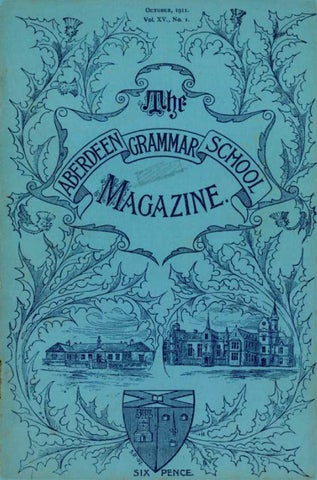
OCTOBER, 191I. Vol. XV., No. 1.
OMAR
D O
SIX
PENCE
Educational Books. •
JAMES G. BISSET
C
ONTINUES to supply all the Class Books (New or Second-hand) suited for the Requirements of the Higher Educational Institutions in the City, at the Lowest Pricee.
N.B.-BEST VALUE IN STUDENTS' NOTE BOOKS.
JAMES G. BISSET, Classical, Inebtcal, ant) E6ucational Zookseller,
85 BROAD STREET (Opposite Marischal College).
A. & C. GRANT & CO., 142 GEORGE ST., Aberdeen, FOR
14-6,9
1Pianos aub Organs '
./G-- C HOME
•
1, 01i,
AND
•
•
ABROAD.
Instruments Carefully Packed and Sent Anywhere.
Our
Spencer Piano is absolutely The Piano for Extreme Climates.
It is supplied to Queen Mary, and the Battleships of the British Navy.
Gramophones and Records—Latest Styles and Newest Titles. Catalogues Free.
l
ENGAGEMENT RINGS. Finest Quality Diamonds.
Rings of
A. & J. SMITH, Selections JEWELLERS, SILVERSMITHS,
every
sent on
WATCHMAKERS, OPTICIANS,
description 191
UNION
STREET, AND
-
from
—
to £I0o.
23 AND 25 ST. NICHOLAS STREET, ABERDEEN.
Approval at our risk.
YOUNG'S, 1 Belmont Street, Aberdeen. Antique Furniture, China, Silver, Old Prints, and Works of Art. Established
Telephone 739.
1887.
I
I: ;
OLP ABE1ZDEEN r1 TNT.
ELLIS &
IVPHARDY9
IS REGENT QUAY & 130! UNION STREET.
Importers of Household and Steam Coals. Delirereol by Careful and Experienced Drirer,4. Telephone 2889.
for over uwentr, Vears.
IDatrottise0 by Vovartv
SPICER & KIDD, HAIR SPECIALISTS, 1Labies' ant) C3entlemen's lbtob.cta9s lbairbre5sers aub Perfumers,
10 BRIDGE STREET, AND PALACE HOTEL, gam RDEEN. The Largest Ladies' Saloons in Scotland. Face Massage—French and American Methods. Electrolysis, Chiropody, and Manicure. Telephone No. 2995.
DINE AT
The
Royal Athenaeum Restaurant and Grill Room ITE TO=USE)
THE PREMIER DINING
HALL IN THE CITY.
Patronised by the elite of the Gown ct County. CHOICE SELECTION OF ••
OLD VINTAGE CHAMPAGNES AND OTHER WINES. HIGH-CLASS PURE HIGHLAND POT-STILL WHISKY, Tel. No. 2273.
John Mitchell, Proprietor.
Telephone 1750.
Established 1859.
FOR
MILK and CREAM, BUTTER, EGGS, TEA CAKES, SCONES, & OATCAKES, Ices, Trifles, and Pies to order, TRY -
FINDLAY'S DAIRY, 457 UNION STREET, & BRANCHES, ABERDEEN.
BROWN & THOMSON, CABINETMAKERS & UPHOLSTERERS,
242 Union Street. DESIGNERS AND MANUFACTURERS. K.-a\. ..GX DESIGNS AND ESTIMATES FREE
Telephone No. 1204.
Licensed Valuators.
Removal Contractors.
1017RVNYORS TO
BY
HIS MAJESTY.
APPOINTIIENT.
-
The Unprecedented Demand for our
I .
HAS MADE AN EXTENSION OF THIS DEPARTMENT ABSOLUTELY NECESSARY. Our Increvied F acilities will
Engiire Prompt A tten ciao to all Orders_
144.44AteAkAut.ftAmmi.".1.v.t.I...
46,sive..4$4464.4,e,..vs,s,....isii.4.4 ESTABLISHED 1842.
DUTCH BULBS For PRESENT PLANTING. HYACINTHS. TULIPS, CROCUS, DAFFODILS, SNOWDROPS, IRIS, ANEMONES, LILIUMS, etc., etc., .
ALL IN PRIME CONDITION. Catalogues Free on Application.
9
i
•-;
W. SMITH & SON, EXCHANGE SEED WAREHOUSES,
Telegrams: "Smithson, Aberdeen."
ABERDEEN.
Telephones : i ifeueid.seliN.iaes rell.g411se 575
106-UNION STREET-106
High=class TEAS at moderate prices. Rare Old WINES, excellent value, Mellowest WHISKIES obtainable. Speciality, 21s. per Gallon. " Semper Idem."
P. GRANT GARIOCH, Zea, Mine, & Zpirit inercbant,
106 UNION
STREET,
ABERDEEN, with a B.S.A. Air Rifle. Not a toy, but a serious weapon. (11111 (Guaranteed Accurate up to 50 yards.) Made in various Weights and Bores. " Junior " Model, for Boys and Ladies, 40/- each. Heavy Model, for Adults, 45/- and 50/- each. Ammunition, No. 1 bore, 1/2 per 100 ; -22 bore, 2/8 per 1,000. The -22 bore is specially suitable for Rabbit Shooting. INSPECTION INVITED. If unable to call, Write or 'Phone for Catalogues to the District Agent.
LEARN TO SHOOT
ALEXANDER MARTIN, Gunmaker, 128 UNION STREET, ABERDEEN.
Tel. No. 480.
This should
I F.P.'s and Present Pupils, Interest Youl We have by far the largest stock in Aberdeen of Fountain and Stylo Pens, and every Pen we sell is guaranteed pet feet. The "Armil" Fountain Pen (14-carat Gold Nib) - - 3/6 5/6 Self-Fi~lirg Pea It 3/6 Stylo Pen t, Swan, Waterman, and Onoto Pens, from - - - 10/6
A. & R. MILNE, 229 Union Street, Aberdeen.
Established 1847.
1Logaif,)IOSuSIC Zatoonz, 349 Union Street, Aberdeen. •
PIANOS and ORGANS.—A Large and Varied Selection of the Best Models always on hand. Instalments.
An Inspection Invited.
Cash or
Examination Any kind of Music sent on and Educational a Speciality. approbation. Music specially ordered delivered in Three days.
MUSIC.—Up to-date Music of all kinds always on hand.
MISCELLANEOUS.—Violins, Bagpipes, Mandolins, Strings, and all Musical Accessories of the Best Quality.
GEO. T. CANTLAY, Proprietor.
CON TENTS. PORTRAITS OF WM. MURISON, Iv1.A., AND MAXWELL H. Frontispiece MACKIE, M.A. Facing p. 54 PORTRAIT OF ALEX. SPENCE MACDONALD 1 • SCHOOL NOTES 6 OUR CONTEMPORARIES 7 NOTES ABOUT OLD BOYS . • 20 RANDOM NOTES MY GRAMMAR SCHOOL EXPERIENCES, BY J. F. KELLAS JOHNSTONE - 23 . . . 31 A DAY AT THE HAGUE 34 STUDYING FORESTRY IN GERMANY 36 A JAUNT IN JAVA 38 RECOLLECTIONS OF TILE SCHOOL IN THE 'FORTIES 40 OUR LETTER-BOX 46 • THE ATHLETIC SPORTS 48 THE SWIMMING SPORTS 49 CRICKET NOTES . 51 FOOTBALL NOTItS 52 THE LITERARY AND DEBATING SOCIETY, THE MUSEUM, THE LIBRARY • _ 53 THE FORMER PUPILS' CLUB 56 SCHOOL OFFICIALs -
BREAKFASTS, LUNCHEONS,
WEST END eAFE,
CONCERTS, DANCES, and AT HOMES
TEAS,
LIMITED,
Purveyed in Café.
DINNERS, Finest in City.
Prices
Moderate. Everything First-Class. SWIFT &
SPARKBROOK
CYCLES. a
i 0, • at P 1;1' 4 4) pi -
E°4 3 .t'
a,
ROVER • CYCLES.
154 UNION STREET.
DRAWING-ROOM, BILLIARD ROOM, and SMOKE ROOM.
TELEPHONE 2309.
THE
BON=ACCORD CYCLE CO., CYCLE & MOTOR AGENTS, 234 UNION STREET, ABERDEEN. "Triumph," "Rover," "Enfield," and "Motosacochi" Motor Cycles.
TRIUMPH CYCLES..
.-3
‘ rn ▪ co .-.-.
P 13 ty Ow 0D ol CD gi
o :11. a
ENFIELD
CYCLES.
V The
r,`
Rosemount Press SUPPLY EVERY DESCRIPTION OF
LETTERPRESS AND :: LITHOGRAPHIC ::
PRINTING On the Most Reasonable Terms. ESTIMATES ON APPLICATION.
Farmers' Hall Lane, Aberdeen. Telephone No. 1035.
A N EAT. CHEAP. QUICK.
Printing.
ESTIMATES GIVEN. **
THE CENTRAL PRESS (John Milne), •
GENERAL
PRINTER, LITHOGRAPHER, AND STATIONER,
61 BELMONT STREET, ABERDEEN. Telephone No. 809.
"To shorten time is to lenzthen
THE GAZETTE FOUNTAIN PEN ought to be one of the most cherished possessions of every student. It will materially aid him in his studies, will make writing a pleasure, and will tend to increase his leisure for recreation. It is well worth Half-a-Sovereign, and only costs
HALF-A-CROWN, With 14-carat Gold Instructions.
Nib, in
box with
Filler and
STILOS, with Gold Spring Needle, 3s. 6d. POST FOUNTAIN PEN, - 5s. 6d. Filling for a day or a week.
As easy as dipping once.
Secure one non' at the
" GRZETTE "
OFFICE,
UNION STREET, ABERDEEN. -
BOWMAN & SON, Picture framers, 187
UNION
STREET.
Tel. 1942.
W. & J. BOWIE, CLYDE DYE WORKS, GLASGOW. Local Branch-397
UNION
STREET.
Dyeing, French Cleaning. Carpet Renovating. SPECIAL LINES—
Costumes, Gent.'s Suits, Military
Uniforms.
D. M. III‘DONALD, District Manager.
WILLIAM MURISON, M.A., Senior English Naster of the School.
MAXWELL H. MACKIE, M.A., Senior French Naster of the School.
4
(5rammar Sci2oot tiTaga3ine. Vol. XV.
OCTOBER, 1911.
No. I.
There is a maxim that in all cases it is more blessed to give than to receive, and certainly it would seem that nothing is cheaper than advice. For if the receiving of advice were of the same benefit as the giving, thrice blessed should be the Editor of these School Notes. When speaking with a friend, for instance, he will suddenly be assailed in this manner— " By the way, see that you don't let us hear anything of your sleepless nights and other editorial troubles when you write the first paragraph of the Magazine." Another begs him not on any account to begin by wishing the School and all therein a happy New Year while it is still October ; and a third advises him to adopt an entirely new method, and produce something original. Unable to comply with these numerous demands, and overwhelmed with the real difficulties of the case, the Editor has at last solved the problem, and made no beginning at all.
'T.
Before going into detail, we think it suitable to make a few remarks about the School in general. The total number of pupils on the roll shows a slight increase on that of the previous year, and, so far, the attendance has been highly satisfactory. The addition of eight new classrooms to the School buildings, and the alterations in the grounds, which were promised in the last number of the Magazine, have not yet been accomplished, and are likely not to take place now this year.
2
Aberdeen Grammar School Magazine.
The new session has brought us a new master—Mr. James Ewing, M.A., B.Sc., to whom we offer a hearty welcome. We regret, however, that he is to remain with us only till Christmas. His present work is the teaching of Latin, Greek, and French to Classical II. B, a section of last year's Classical I. Mr. Ewing was from 1901-07 a pupil of the School here, and many will remember the ability in athletics which he showed then. In 1905 he gained a medal for gymnastics, and next year was first in throwing the hammer and putting the weight. Since leaving School he has continued his studies at Aberdeen University, of which he is now M.A., B.Sc. From all we have heard, he appears to be proving an able and popular teacher, and we wish him all success both while he is in our midst and during his future career. 0 ED 0 During the summer holidays the results of the Leaving Certificate Examination were given out. We are glad to be able to state that the appearance of the School in both grades is very creditable. Like last year the number of passes in the Higher Grade numbered 72, while in the Lower Grade we have far exceeded the previous number, gaining this time no fewer than 256, as compared with last year's 99. Our congratulations are due to all who have succeeded in upholding the good reputation of the School in these examinations. A?. 01) The results of the Arts Bursary Competition, also announced about the same period, are, on the whole, not so satisfactory. Though, compared with the other schools, ours ranks second with its number of successful candidates, there is no doubt we should have had more names on the list. Some consolation may be found in the fact that this was the first year of the new regulations, allowing a very liberal choice of subjects—a change which brought the number of entries considerably over two hundred. Perhaps next year, with more candidates in the field and knowing what to expect, we may be able to double the number and re-establish our position. (5l3 % Towards the end of last session a pleasant break in the ordinary School routine was occasioned by our first celebration of Empire Day. At nine o'clock the whole School assembled on the lawn near the front entrance. The classes were drawn up in their order, and at the Rector's command stood at attention facing the flag-tower, awaiting the hoisting of the flag. When it appeared, all saluted and gave three cheers for the " old flag." After this the School marched to the Hall to complete the ceremony. Here a suitable service was gone through, including the singing of " Rule Britannia " and an
Aberdeen Grammar School Magazine.
3
appropriate hymn. A very patriotic and stirring address was then given by the Rev. J. S. Stewart. " God Save the King " finished the proceedings. Then the School dismissed, to spend on holiday the remainder of the day. 0 0 0 On the two last days of September the Annual Athletic Sports took place. On both occasions the inclemency of the weather somewhat marred the proceedings, and doubtless prevented many of our usual visitors from being present. The Sports, however, were marked by the usual enthusiasm on the part of the competitors—all the events being keenly contested. We wish to thank all the donors to the prize fund, and also those masters who, even in the heavy rain, readily and cheerfully lent their assistance. 0 It is unnecessary to mention here the individual races and prize winners, as a full account is given by the Sports Editor, and we wish to draw attention only to the most outstanding events. In the open races W. Farquhar was the most notable figure, winning the hundred yards, quarter-mile, and halfmile, while in Class II., W. T. B. Joss greatly distinguished himself, breaking the record in the broad jump, and gaining The most amusing the first prize in other four events. items in the programme were the obstacle, biscuit, and blindfold races—the last being quite an innovation. General regret has been expressed that J. Stuart Ross, who usually takes so prominent a part in the Sports, should this year have been prevented through illness from competing at all. Owing to examinations and the early close of the School it was found impossible to hold the Swimming Sports as is usual in June. So, with the provision that any of last year's Club who had left should be free to compete, they were held on the 6th October. A very interesting and entertaining proThe number of gramme was carried out without a hitch. spectators, too, was unusually large. This year the race for the Rector's cup was won by J. D. Taggart, a swift and graceful swimmer. Great amusement was caused by the attempts to walk a tight-rope, few managing more than a. yard or two. The Sports were very enjoyable, and reflect great credit on all those who arranged and carried them out. 0 0 0 The business meeting of the Swimming Club was held on the 18th September. Mr. M. H. Mackie, the Honorary Treasurer, presided over a fairly numerous gathering, mostly of junior members. H. Graham Simpson, who won the Rector's cup in 1910, was elected Captain ; the Secretaryship remains
4
Aberdeen Grammar School Magazine.
as last year in the hands of J. F. Mackintosh. Now that last year's Sports are over, they take up office immediately, and we are sure that their efforts for the welfare of the Club will be attended by all due prosperity. tj, 6!D The cricket eleven has once more had a very successful season, characterised by good all-round play. Seven of the ten matches played were won and two drawn. Much of the credit must be given to the captain, T. 0. Robson, whose batting, in particular, was exceptionally strong, while G. R. W. Stewart and G. Davidson kept the bowling at a very high standard. Next summer, however, we expect to be even more fortunate, for, though last year's Captain has left, Stewart and another half-dozen out of the eleven have returned, so that our hopes are high with regard to cricket prospects. fffi & That much-debated theme—the forming of a School Tennis Club—has at last been realised. Early in May a court was acquired in the Duthie Park, and there our tennis enthusiasts disported themselves after the fatigues of the classroom. A maximum of thirty members had been determined upon, a number which was almost immediately completed. The dry weather of June helped to make this new Club a success, and nearly every evening the court was in use. Our best congratulations are due to J. F. Mackintosh, who organised the Club. upon bringing the season to a successful close, and we hope that next year another court will be added so that the Club may become a permanent School institution. z,s: 0 p. This winter's football commenced on Saturday, 7th October, and it says much for the School XV. that they won by eleven points to nil against a team so much stronger and heavier. It was feared at the beginning of the session that our football prospects were scarcely so bright as in the last few years, but since then several of last year's XV. have returned. G. R. W. Stewart is Captain, with two years' experience in his favour, while the Secretary is J. G. Elmslie, whose accident last year still renders it doubtful whether he will be able to play or not. May the team's first success be the presage of many more brilliant ones to follow !
a a a We are at present looking forward to the commencement of this session's Literary and Debating Society. The president is John Grant, whose ability and former experience of the Society makes certain the hope of a most enjoyable season. The programme drawn up is quite as good as usual, and comprises lectures from Mr. Middleton, the Rev. D. Ritchie Key,
Aberdeen Grammar School Magazine.
5
the Rev. W. M. Grant, Professor W. A. Curtis, the Rev. Austen Foster, Dr. Macleod, and the Rev. J. A. Irvine. Heckling night has at last been replaced by a Parliamentary night, an alteration which is generally considered an improvement. The membership last year numbered about ninety; this time we should like a hundred, and we specially appeal to those junior classes who possess the privilege of joining our old and distinguished Society. Eit)
5
It seems fated that the Library should never be patronised by more than a score or so of members. It is a pity, for the School collection contains all that a schoolboy should desire to read. This year, too, through the generosity of a former pupil, it has been enriched by a gift of over forty new volumes, including many tales of adventure by Henty, Ballantyne, and other famous writers of boys' stories. This last complaint we would make in the hope that a few more may join.
a a, A detailed account of the additions to the Museum and Reference part of the Library will be found on another page. The Museum is increasing in value every year. Mr. R. Hay Fenton has once more made it a splendid gift of birds' eggs, including half a dozen varieties new to our collection. The care spent in the arrangement of the Museum, and the real worth of the exhibits surely merits more attention than it receives at present from many of those who pass through it on their way to the Reading Room.
Cf.
5
The mention of the Reading Room recalls another matter. Dining a free hour, the Sixth determined to form a Chess Club, and a delegate was despatched and returned with the requisite artcles. It has succeeded remarkably well considering the counter-attractions of sports outside, and anyone visiting the Reading Room after four o'clock is almost sure to find there some of the less energetic members of the Sixth in profound meditation over the study of that intricate game.
Efforts are being made just now to arrange another golf match between masters and pupils. So far, the former have always been the winners, and we feel it would be a noteworthy event if we could manage to prove ourselves superior this year, even if the victory were only a temporary one. On the School side it is most difficult to find any real golfers; many have tried
Aberdeen Grammar School Magazine.
6
the game, but few seem willing to come forward and show their skill in the presence of a master.
• It has been thought advisable to discontinue the Lower School Notes as not being of sufficient interest to the general reader of the Magazine. So far in the session nothing of special note has taken place there, but all the classes are being kept up to their usual standard of excellence. We believe the pride of the Lower School is a little man of four, whose long golden hair is the cynosure of all eyes.
We are pleased to be able to continue the series of portraits of our masters. In this number we give the photographs of Mr. W. Munson, our senior English master, and Mr. M. H. Mackie, our well-known French master. 6115 •
Thus far our chronicle ; and now we pause, Though not for want of matter.
It is the feeling that we have said enough that bids us stop and write no further.
Our Contemporaries. The Editor begs to acknowledge, with thanks, the following contemporaries :—" Glasgow Academy Chronicle," " Edinburgh Academy Chronicle," " The Scotch Collegian " (Melbourne), " St. Andrew's College Magazine," " Grahamstown " (S. Africa), " The Westovian " (S. Shields), " Turriff School Magazine," " The Courier " (3) (Cincinnati), " C.A.I." (2).
xak
Aberdeen Grammar School Magazine.
7
•
The dates given in parentheses after names indicate the years the Old Boys referred to entered and left the School. * Indicates Member of the Former Pupils' Club.
I
,
Since the last issue of the Magazine the School has had another knight added to its Roll of Old Boys. In the list of Coronation Honours appeared the name of Lieut.-Colonel ALEXANDER BURNESS M`HARDY* (1853-57), who has been created a Knight Commander of the Bath. Sir Alexander joined the Royal Engineers in 1862 and rendered varied service until 1877. In that year he was ordered to the Home Office for special duty in connection with the Prison Act of 1877. Since then he has been specially identified with the work of the Prison Commission, and from 1896 to 1909 was Chairman of the Prison Commissioners for Scotland. He retired from the Civil Service two years ago. At the time of the Coronation the honour of Augmentation of Arms was granted to Sir JAMES REID* (1861-65), in the following terms :—" The King has been pleased, by Warrant under His Majesty's Royal Sign Manual, to give and grant unto Sir James Reid, Baronet, G.C.V.O., K.C.B., one of His Majesty's Physicians-in-Ordinary, Physician-in-Ordinary to His late Majesty King Edward the Seventh and to Her late Majesty Queen Victoria, in consideration of services rendered to His Majesty's dearly beloved father, Royal Licence and Authority that he, the said Sir James Reid, and his descendants, may bear to his and their Armorial Ensigns the Honourable Augmentation following, that is to say :—On a chief Gules a Lion passant guardant Or armed and langued Azure (being one of the Lions from the Royal Arms) : Provided the said Honourable Augmentation be first duly exemplified according to the Laws of Arms and recorded in the College of Arms." Lieut.-Colonel and Hon. Colonel GEORGE MILNE (1867-72) of Logie, Aberdeenshire, was in June made a Commander of
8
Aberdeen Grammar School Magazine.
the Bath. He is colonel commanding the 1st Highland Brigade Royal Field Artillery (T.F.), and as senior commanding officer in the Scottish Territorial Artillery was in command of all the detachments of that force present in London in connection with the Coronation celebrations. ALEXANDER G. R. MACICENZIE (1894) is the architect of the memorial which the King has recently placed in Crathie Parish Church in memory of King Edward VII. At the time of the unveiling of the memorial he had the honour of being received by the King at Balmoral Castle. FRANCIS GRANT OGILVIE, C.B., LL.D. (1872-74), has been appointed by the President of the Board of Education to the post of Director of the Science Museum, which he will hold in addition to his present office of Secretary for the Science Museum and Geological Survey and Museum. HUGH GUNN, M.A. (1888-89), dux of the School in 1889, has accepted an invitation from the Government of West Australia to act as adviser and organiser for the University which the State is founding at Perth. After being for some years an inspector of schools in Scotland, he went out to South Africa and became in 1903 Director of Education of the Orange River Colony. This position he resigned last year. COLIN MCKENZIE SELBIE,* B.Sc. (1902-06), as the result of an open examination, has been appointed assistant in the Biological Department of the National Museum of Science and - Art in Dublin. ALEXANDER FINDLAY,* M.A. , D. Sc. , Ph . D . [Leip.] (1882-91), Special Lecturer on Physical Chemistry in Birmingham University, has been appointed Professor of Chemistry in the University College of Wales, Aberystwyth. CHRISTIAN HOYER MILLAR MILNE,* M.A. (1881-87), who has been rector of the Arbroath High School since 1900, has been appointed headmaster of Daniel Stewart's College, Edinburgh. He is not a stranger to Edinburgh, having been for seven years one of the classical masters in George Watson's College. JOHN WATSON ROBERTSON, M.A., B.Sc. (1903-05), who has been assisting the Professor of Mathematics at Aberdeen University, has been appointed teacher of mathematics and science in Robert Gordon's Technical College, Aberdeen. JAMES ELSMIE FOWLER, M.A. , M.D. (1855-57), who has been a doctor in Woodside, Aberdeen, since 1865, recently retired from practice. On the occasion he received a public presentation. DAVID RENNET,* M.D. (1877-79), assistant Professor of Forensic Medicine in Aberdeen University and assistant and
Aberdeen Grammar School Magazine.
9
deputy medical officer of health for Aberdeen, has been appointed medical officer of Chester. THEODORE GRANT GRAY,* M.B. (1895-1901), assistant medical officer at Kingseat Lunatic Asylum, Aberdeen, has gone out to New Zealand, having received an appointment of a similar nature there under the Government of New Zealand. IAN OGILvIE, M.B. (1902-03), succeeds Dr. Gray at Kingseat. GEORGE ERNEST SHAND,* M.B. (1894-1900), has been appointed senior medical officer at the City Asylum, Birmingham. He was previously on the staff of the Asylum as junior assistant. Rev. WALTER TAYLOR WISHART, M.A. (1885), minister of the United Free Church of Abercorn, in the Presbytery of Linlithgow and Falkirk, has resigned his charge in view of his paying a visit to Australia. Rev. ROBERT SANGSTER KEMP, M.A., B.D. (1876-77), minister of the parish of Old Deer, has been appointed by the Foreign Missions Committee to act as a deputy to visit the missions of the Church of Scotland in India. He leaves for India in the beginning of November, and will be absent for about three months. Rev. PATRICK JOHN GREEN, M.A. (1894-97), has been appointed minister of the Presbyterian Church at Bedlington. Rev. GEORGE STANLEY RUSSELL,* M.A. (1894-1901), of the Congregational Church at Mirfield, Yorks, has accepted the pastorate of St. Anne's-on-the-Sea Congregational Church. When at School he was president of the Debating Society and editor of the Magazine, in the running of which he displayed extraordinary ability and initiative. Rev. DAVID BRUCE NIcoL,* M.A., B.D., for two years assistant in the Scots Church at Buenos Ayres, and latterly assistant in St. Cuthbert's, Edinburgh, has been elected minister of the parish of Skelmorlie. Rev. ALEXANDER JAMES MONRO, M.A. (1899-1902), has been appointed assistant in St. Mary's U.F. Church, Edinburgh.
Rev. THOMAS BREMNER ROBERTSON,* M.A. (1887-1901), minister of Kingswells U.F. Church since 1908, has been called to Newhills U.F. Church. When at School he was captain of the football team for two seasons. Major JAMES FREDERICK CLYNE (1881-84) has been promoted lieutenant-colonel to command the 3rd Battalion the Royal Warwickshire Regiment (Special Reserve). CHARLES WILLIAM SLEIGH,* M.A. (1874-79), factor on the estate of Blackwood, Lanarkshire, since 1894, has returned to Strichen, Aberdeenshire, to assist his father in the management of the Strichen estates.
10
Aberdeen Grammar School Magazine.
JAMES E. H. WATT (1881-82), who is senior purser in the P. and O. service, has been appointed purser of the new liner " Maloja," which is conveying a large number of visitors to the Indian Durbar. Rev. JACKSON STEWART CHEDBURN (1896-99), formerly of Coatbridge, has accepted the pastorate of Latchford Church, Warrington. The Very Rev. WILLIAM MAIR* (1843-44), M.A., D.D., Moderator of the General Assembly of the Church of Scotland in 1897, has written his autobiography, which has recently been published by Messrs. Hodder & Stoughton under the title, " My Life." A portion of the book deals with his reminiscenoes of the School and of Melvin. ALEXANDER BANKS* (1903-09) has received an appointment in the Canadian Bank of Commerce. ALEXANDER MACKIE, M.A. (1870-72), Principal of Albyn Place School, Aberdeen, is the author of " Aberdeenshire," in the Cambridge County Geographies series, of which Mr. Murison, senior English Master of the School, is general editor. Mr. Mackie's book has been very favourably received, and a perusal of it will make Old Boys envious of the present-day schoolboy when they remember the dreary instruction in geography which they used to receive. WILLIAM ELMSLIE HENDERSON, M.A., M.B. (1887-89), School Medical Officer of Westmoreland, is the author of " Notes for Teachers on School Infections " recently published. Lieut. JOHN GRAY* (1894-96), of the 36th Sikhs, has recently been holidaying in Kashmir, revelling in the marvellous scenery of the enormous snow-clad mountains in that " back o' beyont " region of the world. JAMES TINDAL SOUTTER* (1898-1902) has been distinguishing himself as a runner during the summer at various amateur athletic gatherings. In a championship race at Manchester he helped to establish a new world's record for the mile relay, which was done in 3 mins. 33 4-5 secs. WILLIAM FRASER, M.A. (1893-96), one of the inspectors of schools for the Orange River Colony dismissed some time ago by General Hertzog in connection with the language question, has brought an action for slander against the latter. Cabled reports of the hearing of the action appeared in the newspapers during part of August and September, but judgment has been reserved until November. Old Boys one way or another have had a good deal to do with the Quincentenary Celebrations of St. Andrews University. In the first place, the Principal of the University, Sir JAMES DONALDSON,* D.D., LL.D., is an Old Boy, having been
Aberdeen Grammar School Magazine.
11
at the School from 1842 to 1846. He has just completed the twenty-fifth year of his administration at.St. Andrews, and has been heartily congratulated thereon. Then we observe that the address in Latin presented from the General Council of the University of Aberdeen was composed by our Rector and WILLIAM KEITH LEASK,* M.A. (1868-73). Among those who were delegates at the celebrations and received honorary degrees was Lieut.-Colonel DAVID PRAIN, C.I.E. (1872-73), Director of the Royal Botanic Gardens, Kew. The Aberdeen student delegates were FREDERICK WI SHART ,* M.A. (1897-1900) ; HUGH Ross SOUPER,* M.A. (1894-1905); and ARCHIBALD CAMPBELL MACR 4.E* (1896-1901). At the Commemoration Service the organist was HERBERT H. E. WISEMAN, M.A. (1896-1903), of Madras College, St. Andrews.
I
i
ALEXANDER M. DRUMMOND* (1869-70), of Adelaide, Australia, is one of the distant Old Boys who have recently been brought into touch with the Club. Indeed, since the last issue of the Magazine, he has become a Life Member. After leaving the School and serving an apprenticeship with a tea merchant in Aberdeen, he was for ten years in Ceylon superintending various estates. In 1884 he went to Adelaide, and shortly afterwards started there as tea merchant and importer. His firm is Drummond Bros. DAVID STRACHAN* (1893-1902), Johannesburg, has left the service of the Standard Bank of South Africa, having secured a billet with Messrs. Aiken & Carter, accountants—one of the best firms in Johannesburg.
.
Rev. STEPHEN FORSYTH,* M.A. (1876-80), has been called from Springburn, Glasgow, to Chapelshade Parish Church, Dundee. ROBERT MELDR UM JOHNSTONE* (1886-89 and 1891-94), civil engineer, Colonial Government Railway, Sierra Leone, has become a Life Member of the Club. GEORGE CARDNO STILL,* M.B. (1874-78), has been elected president of the Richmond (Surrey) Division of the British Medical Association. Major-General Sir ALEXANDER JOHN FORSYTH REID ,* K.C.B., LL.D. (1859-61), has accepted office as one of. the Honorary Vice-Presidents of the Club, and has become a member. Sir JOHN MACDONELL,* C.B., LL.D. (1860-61), Master of Supreme Court, London, has also become an Honorary VicePresident of the Club. He says it is always a gratification to him to be brought again in any way into touch with Aberdeen. The Magazine seems to him " full of vitality and rich in promise."
r-
12
Aberdeen Grammar School Magazine.
HENRY W. BRAZIER* (1878-80), of the I. M. Customs, China, is now stationed at Kiungchow, Hainan, and no longer at Canton. WILLIAM STILL LITTLEJOHN, M.A. (1873-75), Principal of the Scotch College, Melbourne, and member of the Council of Education for Victoria, has sent one guinea for the Record Fund. In sending the donation he says : " I have none but the happiest and most grateful feelings towards my old School. If I can be of any service to the School in this corner of the Empire, you may command me." JAMES NAPIER ADAMS* (1895-1901), of the Caledonian Insurance Company, Edinburgh, has passed the final examination of the Faculty of Actuaries. GEORGE COWIE* (1907-08) has recently gone out to Sydney. For nine months in the year he is to be engaged on work in the Presbyterian Church College of New South Wales, while for the remaining three months he is to be working among the bushmen. He expects to meet with some adventures, and promises to record in the Magazine any thrilling experience he may have. THOMAS BEST GIBSON HENDERSON,* C.A. (1894-1900), general auditor of the Buick Motor Company, Flint, Michigan, U.S.A., in a recent letter to the Secretary of the Club says : ---" Some day I intend writing you a few lines giving my views on the prospects a young fellow has coming over to the States, for having travelled from coast to coast investigating the affairs of numerous large concerns, I feel that I am now sufficiently posted to offer some advice which might prove of value to those who find that Scotland is not large enough and does not present sufficient opportunities for their ambitious natures." Why not write for next issue, T. B. G. H. ? A. F. VERE STEPHENSON,* A.M.Inst.C.E. (1894-99), on his way out to Kuala. Lumpur to take up his duties as assistant engineer in the F.M.S. Public Works Department, met at CO10111130 LUCIEN DES CLAYES (1894 and 1896), who is with Messrs. Carson & Co. there, and at Penang dined with JAMES C. H. MACBETH* (1881-85). JOHN DAVID THOMSON* (1892- ? ), writing from Haputale, Ceylon, says that although not an out-and-out " Grammar " F.P., but one having considerable connection with the " rival Gordon's," he would not like to drop the associations of the F.P. Club. He has accordingly paid his annual subscription for some years in advance. JAMES TAYLOR LAWRENCE, M.A. (1898- ? ), obtained in June a First Class in the Cambridge Mathematical Tripos, and has since gained a place in the list of successful candidates for the Home, Indian, and Colonial Civil Services. He gradu-
. _
I
Aberdeen Grammar School Magazine.
13
ated in Arts at Aberdeen University in 1908, carrying everything in the mathematical line before him, and since then has been an undergraduate at Trinity College, Cambridge. ARTHUR C. SMITH* (1893-1900) recently sent to the Secretary from Singapore the names of two Old Boys-ALEXANDER W. DUNCAN* (1891-92) and CHARLES MUIR* (1899-1900)—who were not then members of the Club, but who have since joined. Smith says that he hopes soon to have further names to send, as an effort is to be made to form a section of the Club out there, into which, of course, every Old Boy in the region will be pressed. With reference to the foregoing note, ALEXANDER W. DUNCAN* has written to the Secretary from Palembang, Sumatra, explaining how he came into touch with the Club. He was in Singapore one night and met two or three men. From certain remarks he came to the conclusion that they were Aberdeen Grammar School men, and asked them. " We drank the Old School's health there and then ! " He was at the School only for a short time (1891-92), and, leaving home in 1895, he has been over a good part of Europe, Asia, Africa, and Australasia. The last Magazine interested him immensely. He thinks the Herbert Bremner mentioned in it was at School in his time, but he may be mixing him up with Herbert Bower, " who was the bane of Mr. Pope's life " ! ROBERT FLEMING,* C.E. (1891-98), has meantime given up engineering, having been awarded a contract to build a portion of the Trans-Continental Extension of the Algoma Central and Hudson's Bay Railway. His address is now Hobon, Ontario. JOHN SANGSTER,* C.A. (1896-1900), who is in the service of Messrs. Marwick, Mitchell, & Co., writes from Chattanooga, Tennessee, in the centre of the U.S.A. cotton industry, that the Magazine comes very acceptably to one some few thousand miles away from Aberdeen. At the time of writing he was finding the temperature comfortably cool at 95 deg., and would be content if it did not go much higher. ALEXANDER VERNON WHITE CANTLAY* (1903-10) is the most recent Old Boy to enter the service of Messrs. Guthrie & Co., of London and Singapore. DOUGLAS C. WATSON* (1892-1900), who has been for several years in the Burgh Surveyor's Office, Aberdeen, has received an important appointment with the Tram Welding Co., Ltd., Westminster. GEORGE MITCHELL JOHNSTON* (1898-1907), who took the B.Sc. (Agr.) degree at Aberdeen Unversity in July, has since been experiencing the vicissitudes of a harvest hand in farther Saskatchewan.
14
Aberdeen Grammar School Magazine.
Who says the F.P. Club is not a valuable asset to the School ? The attractions of its membership appear to be such that a pupil for several years at the rival establishment has recently transferred himself to the " Grammar " in order to qualify as a member of the Club ! ALEXANDER HECTOR* (1881-89) has received an appointment in the commercial department of the " Daily Express," London. " Never say die ! " JAMES COLLIE,* advocate, Aberdeen, who entered the School eighty-four years ago, has become a Life Mexnber•of the Club. Another aged recruit to life-membership is Surgeon-General GEORGE BIDIE,* C.I.E. (1845-47). WILLIAM M. ALEXANDER,* M.A., B.L. (1887-96), of the " Aberdeen Free Press," has recently been on an extensive tour over Canada with a party of journalists. WILLIAM KNOX BAXTER,* M.A., B.L. (1889-94), solicitor, Cape Town, paid a visit to the home country this summer. ALEXANDER PRINGLE JAMESON,* B.Sc. (1892-1904), has been appointed assistant to the professor of Natural History, and GEORGE NEWLANDS,* M.A., B.Sc., to the lecturer in Geology in Aberdeen University. JAMES E. LAw* (1905-06), who was a keen member of the School Rugby XV., is now in business in Shanghai. HERBERT S. MILNE,* M.B., Ch.B. (1897-1901), has been appointed one of the resident doctors at the Royal Lunatic Asylum, Aberdeen. ALISTER MACKINNON (1896-99) is at present employed by the Buenos Aires Western Railway Co. as one of their engineers in the construction of a large railway tunnel which they are making underneath the city. One of our well-known country ministers in Aberdeenshire, an F.P., had an interesting experience at the Coronation. He was invited by the organist of Westminster Abbey, Sir Frederick Bridge, who is an intimate acquaintance, to become an official organ blower for the day, and thus get a splendid chance of seeing the stately ceremonials below. An English clergyman was the other " blower." Both of them were delighted with their experiences. But, it may be said in parenthesis, the Abbey organ is worked by electricity ! JAMES RAE, M.B. (1889-1901), who is a resident physician at the Park Hospital for Children, Lewisham, has about 800 little ones to look after. Talk of the Old Woman who lived in a Shoe! We are sorry to hear that ALEXANDER FORBES (1845-50), whose lively and charming recollections of the School appeared lately in these pages, has not been quite so well as his many
Aberdeen Grammar School Magazine.
a
•
a
a
i
15
friends would like. We wish that he may soon be restored to his usual vigorous health. And let us meantime whisper that he is well on with his book of reminiscences of Aberdeen. It will be a welcome volume. In " Golf Illustrated " appears an interesting article about a famous Aberdeen golfer now over 80 years of age. The octogenarian is ROBERT DUTHIE, a partner of the well-known shipbuilding firm. He was captain of the Aberdeen Golf Club in 1867-8. He made many improvements on golfing materials, and he shows the first golf-ball mould ever used north of the Tay. He brought about a change in club shafts by substituting hickory for ash. When he was at School he carved some fine model heads of Napoleon, which he still shows with justifiable pride. R. R. HYND (1879-84), of the Hong-Kong and Shanghai Bank, is now on furlough in this country, and though he is engaged with the bank's business in London at present, he is to make an effort to come to Aberdeen specially for the F.P. Dinner. Our sympathy goes out to Go KHEEK LAW (1904-08), on the tragic death of his father, who was shot by some miscreant while sitting in the verandah of his house in Singapore. No clue has yet been found as to the murderer, although the son has offered a reward of 10,000 dollars for information that will lead to the arrest of the man. The deceased gentleman was greatly interested in our School, and sent a subscription of five guineas to the Byron Statue Fund. At the Summer Graduation of Aberdeen University degrees were conferred on the 'following Old Boys:— Doctor of Laws (LL.D.)— The Hon. Sir WILLIAM BISSET - BERRY,* Kt., M.A., M.D. (1848- 53), late Speaker of the House of Assembly, Cape of Good Hope. Master of Arts (M.A.)— WILLIAM MAXWELL PETERS (1900-06), with First Class Honours in Economic Science. JAMES DRUMMOND SMITH* (1900-08), with Second Class Honours in Economic Science. ROBERT FORGAN* (1898-1908). WALTER INKSTER* (1903-08). CHARLES MANN (1903-08). DAVID COOPER REES* (1897-1907). ARTHUR LANDSBOROUGH THOMSON* (1899-1908). Bachelor of Science (B.Sc.)— ROBERT SELBIE CLARK,* M.A. (1894-1901). JAMES EWING,* M.A. (1901-07). JOHN KELMAN, M.A. (1899-1906).
16
Aberdeen Grammar School Magazine.
Bachelor of Science in Agriculture (B.Sc. Agr.)— GEORGE MITCHELL JOHNSTON* (1898-1907). Bachelor of Laws (LL.B.)ERIC WILLIAM HARCOURT BRANDER,* M.A. (1894-1901). Doctor of Medicine (M.D.)— NORMAN STEPHEN GILCHRIST,* M.A., M.B. (1897-1901), with Commendation for Thesis. JAMES RAE,* M.A., M.B. (1889-1901), with Commendation for Thesis. ALFRED JOHN WILLIAMSON,* M.A., M.B. (1897-1902). Bachelor of Medicine (M.B.) and Bachelor of Surgery (Ch.B.)ALEXANDER MIDDLETON BROWN,* M.A. (1894-1904). GEORGE P. BURR* (1894-1905). CLIFFORD CUTHBERT CHANCE* (1906). WILLIAM JENKYNS CRUICKSHANK, M.A. (1895-1902). WILLIAM EDWARD GLOVER* (1896-98). JAMES ROBERTSON MURRAY (1895-1906). The Edmond Prize was awarded to JOHN R. WARDLAW B.A. (Cantab.) (1899-1901), as the most distinguished graduate in Law of the year. BURNET,*
•
OBITTJA RY. Rev. JAMES SIMPSON, M.A. (1831-35), died in Aberdeen on 31st August. He graduated in Arts at Marischal College in 1839, and became a licentiate of the Free Church of Scotland but never took up a pastoral charge. He was one of our oldest " Boys," having entered the School just eighty years ago. Very Rev. JAMES MITCHELL, M.A., D.D. (1844-46), late of South Leith Parish Church, died in Edinburgh on 21st September, aged 81 years. He graduated in Arts at Marischal College, Aberdeen, in 1850, and was ordained as minister of the parish of Peterhead in 1855. He was called to South Leith in 1864, and remained there until he retired from the ministry in 1903. He was appointed Moderator of the General Assembly of the Church of Scotland in 1901. One of his books, " The Minister in the Manse, the Pulpit, and the Parish," has reached its twelfth edition, and has been translated into German and Chinese. Rev. GEORGE GARDEN GREEN, M.A. (1854-56), senior minister of Lancefield United Free Church, Glasgow, died in June
Aberdeen Grammar School Magazine.
17
at Scotstoun, in his seventy-eighth year. He graduated at King's College, Aberdeen, in 1860, and in due course became a minister of the United Presbyterian Church, his first charge being at Buckie, and his second and only subsequent one being in Glasgow. He was the author of two books, entitled "Gordonhaven " and " The Kidnapper," both int eresting pictures of life in the north-east of Scotland, and both written in dialect. Rev. WILLIAM MEARNS MACPHERSON, M.A., D.D. (185556), died at Monymusk, Aberdeenshire, on 3rd September, aged 69 years. After graduating in Arts with honours at Aberdeen University in 1861, he was appointed minister of Kennethmont, Aberdeenshire, in 1866, and two years later of the parish of Monymusk. His published works include " Materials for a History of the Church and Priory of Monymusk," which has been described as a model parish history, and " The Path of Life : Thoughts on Personal Salvation." ROBERT SHAND ANDERSON (1865-70), of Woodhouse, Dumfriesshire, and of 14 Billiter Street, London, of the firm of Leslie & Anderson, East India agents and commission merchants, died at Harrogate on 19th September, aged 56 years. Rev. Joan BucHAN ADAM WATT* (1867-72), minister of the parish of Cadder, Lanarkshire, died on 18th June, in his fiftysixth year. After being licensed to preach, he was for a time assistant in St. Cuthbert's Church, Edinburgh, and was appointed to Cadder in 1882. WILLIAM SIDNEY SMITH WALLACE (1869-71), youngest son of the late James Wallace, inspector of poor in Aberdeen—also a former pupil—died at Perth on 12th August. Rev. WILLIAM GORDON LAWRENCE (1870-71), died at Putney, London, on 16th August, aged 59 years. He was successively minister of the Free Church, Edzell, Forfarshire; a Presbyterian minister in the Transvaal; assistant in the Free High Church, Paisley; minister of Broad Street Presbyterian Church, Birmingham; and, at the time of his death, principal of Cusack's Business College, Putney, having a few years ago retired from the ministry and devoted himself to teaching. Major CHARLES JOHN ROBERTSON-MILNE,* M.D. (1881-88), of the Indian Medical Service, died of enteric fever at Berhampore, Bengal, on 22nd May, aged 39 years. After graduating in Medicine at Aberdeen University in 1893, he passed into the Being Indian Medical Service, first on the list, in 1895. placed on military duty, he was present at various actions on the North-West Frontier, and it fell to him to attend the Gordon Highlanders wounded at the famous fight at Dargai. He later did civil duty, being Deputy Sanitary Commissioner,
18
Aberdeen Grammar School Magazine.
Western Bengal Circle, and, at the time of his death, superintendent of a large lunatic asylum at Berhampore. He was a Life Member of the Club. WILLIAM ALEXANDER FRASER (1892-96), died at Durban, from dysentry contracted in Zululand, on 29th April. HENRY CHARLES ANDERSON (1893-96), engineer in the service of the Bathurst Trading Co., Ltd., River Gambia, West Africa, died at Bathurst, of yellow fever, on 26th May, aged 23 years. EDWARD GRANT, M.A., B.L. (1893- ? ), of the firm of Messrs. William Grant & Sons, distillers, Glenfiddich, Dufftown, died at Glasgow on 7th September, aged 32 years.
MARRIAGES. In a previous issue of this year we almost apologised for the small number of marriages that fell to be recorded, and pleaded in extenuation that summer was the time. This contention, we think, is fully justified by the following record of marriages which have been announced since the last number of the Magazine was published. MESTON (1879-86).—At College Church, Madras, on 18th September, Rev. WILLIAM MESTON,* B.D., Madras Christian College, to Mary Innes, daughter of the late Rev. Colin Sinclair, Invergordon. MACKENZIE (1881-84).—At the Manse, St. Martin, Quebec, on 18th June, G. D. MACKENZIE, Jun., Toronto, to Mabel, eldest daughter of George Gray, 41 Springbank Terrace, Aberdeen.
MILNE (1881-90).—At Presbyterian Church, East London, on 3rd June, NORMAN B. MILNE, Deputy Inspector of Mines (Boksburg District), fourth son of the late John Milne, Aberdeen, to Jean MacGlashan, fourth daughter of James MacGlashan, of Brownlea, Ballinluig. LAIRD (1882-85).—At the Palace Hotel, Aberdeen, on lit July, HENRY LAIRD, Great North of Scotland Railway, to Elizabeth Davidson, only daughter of Alexander Barclay, 33 Abergeldie Terrace, Aberdeen. STRACHAN (1882-87).—At Nairn Parish Church, on 14th July, Huoit GEORGE STRACHAN, B.L., Solicitor, Nairn, to Janet May Campbell, eldest daughter of the late William Campbell, and Mrs. Campbell, Lily Cottage, Nairn. HECTOR (1883-96).—At St. Peter's Church, Bayswater, London, W., on 12th August, JoHN B. HECTOR,* Architect, London, to K. Eveleen Dowsing, daughter of the late Samuel James Dowsing, and Mrs. Dowsing, Kensington, London, W. GRAY (1885-93).—At the Palace Hotel, Aberdeen, on 4th July, JAMES RITCHIE GRAY, eldest son of David Gray, 270 Great Western Road, Aberdeen, to Annie S. T. Simpson, youngest daughter of Robert Simpson, 54 Forest Road, Aberdeen.
Aberdeen Grammar School Magazine.
19
BIssET (1886-88).--At the Carlton Hotel, Edinburgh, on 12th June, JAMES MILNE BISSET, younger son of the late Rev. A. Bisset, M.A., of Aberdeen, to Hilda Kathleen, fourth daughter of the late Zerub Baillie, and Mrs. Baillie, and grand-daughter of Alexander Wood, Seton House, Jedburgh. PHILIP (1887-90).—At Roodepoort, Transvaal, on 18th April, HARDY PHILIP, Solicitor, son of the late Rev. W. M. Philip, of Skene, Aberdeenshire, tb Gertrude Alice, younger daughter of the late John Courtney, and Mrs. A. M. Courtney, of Florida, Transvaal.
♦
I
HECTOR (1889-97).-At Beechgrove U.F. Church, Aberdeen, on 2nd September, GEORGE PITTENDRIGH HECTOR,* M.A., B.Sc., Economic Botanist, Indian Agricultural Service, eldest son of Rev. John Hector, D.D., to Nellie, youngest daughter of Rev. T. T. Matthews, D.D. HECTOR (1889-1900).—At Wrangthorn Parish Church, Leeds, on 1st August, JAMES M 1SSON HECTOR,* B.Sc., F.L.S., Lecturer in the University of Leeds, to Irene Muriel, youngest daughter of Mr. and Mrs. J. R. Bakewell, 15 Delph Mount, Leeds. WATT (1889-1901).—At St. Paul Street Congregational Church, Aberdeen, on 3rd June, THEODORE WATT,* M.A., youngest son of the late William Watt, " Aberdeen Free Press," to Mabel Florence, younger daughter of George Murray, 81 Fountainhall Road, Aberdeen. BUCHAN (1890-97).—At St. Ninian's Church, Aberdeen, on 5th September, ERNEST ALEXANDER BUCHAN,* Tocopilla, Chili, to Annie Melvin, eldest daughter of James Wilson, 26 Rubislaw Den South, Aberdeen. STRONACH (1890-94).—At 2 Monifieth Road, Broughty-Ferry, on 3rd June, HARRY MILLAR STRONACH, Engineer, second son of Alex. Stronach, Advocate in Aberdeen, to Christian, only daughter of D. A. Mortimer, Chemist in Broughty-Ferry.
f
SHARP (1893-98).--At Strathdon, Aberdeenshire, on 6th September, RUSSELL SHARP,* Private Secretary to the Hon. Thomas Cochrane of Crawford Priory, Springfield, Fife, to Nina, younger daughter of Charles F. Wattie, Bank Agent, Strathdon. SMITH (1893-1900).—At the Windsor Hotel, Glasgow, on 5th July, DAVID D. SMITH, M.A., to Ann Hamilton Forrester, second daughter of the late Robert Gardner, and Mrs. Gardner, Victoria House, Baillieston. 1
• I
I
r
WATSON (1896-99).—At St. Matthias Church, Richmond, on 2nd September, THOMAS G. WATSON,* to Winniefred Annie, daughter of the late Harry Mear, of Bellevue House, Richmond. BROWN (1897-1900).—At St. Luke's Church, Wallsend, near Newcastle-on-Tyne, on 23rd September, THOMAS DUNCAN HUNTER BROWN,* Solicitor, late of 37 Mile-end Avenue, Aberdeen, and now residing in Liverpool, to Isabella, eldest daughter of J. T. T. Wilson, late of 164 Bon-Accord Street, Aberdeen. HENDRY (1897).—At the Palace Hotel, Aberdeen, on 4th October, GEORGE HENDRY, M.B., Ch.B., Buckie, fourth son of Alexander Hendry, Rosebank, Buckie, to Mary, third daughter of Alexander Grassack, Cairncosh, Alford. MORGAN (1897-98).--At 129 Desswood Place, Aberdeen, on 10th June, ROBERT MILNE MoRGAN,* photographer, Aberdeen, to Nellie Simpson, step-daughter of the late Mr. James Skene.
20
Aberdeen Grammar School Magazine.
TAIT (1898-99).—At the Royal Hotel, Dundee, on 18th July, ROBERT GARLAND TAIT, District Secretary, Law Union and Rock Insurance
Company, Dundee, to Helen Grace, eldest surviving daughter of John Hepburn, mahogany merchant, Puerto Cortes, Honduras. BOOTH (1898-1900).—At Aberdeen, on 14th June, EDWIN BOOTH, Leighs of Cannahars, Belhelvie, to Nellie, fifth daughter of James Yeats, Wester Hatten, Belhelvie. Ross (1898-1904).—At St. Margaret's Church, Newlands, Glasgow, on 3rd August, FINLAY APLEOD Ross, of 6 Ferryhill Place, Aberdeen, to Clara, eldest daughter of the late W. G. Chovil, of Brentford and Chiswick. MAIR (1899-1902).—At St. Luke's, Chelsea, on 15th July, GEORGE HERBERT MAIR,* M.A., elder son of George Nair,* M.D., Fleet Surgeon, R.N., Aberdeen, to Maire O'Neill, third daughter of the late George Allgood, Dublin.
Random Notes. It is with very mingled feelings that we prepare to write our first " Random Notes." With especial repugnance do we view that dreadful task—the writing of the first paragraph. Unfortunately, our difficulties do not stop here, for we can find scarcely a thing which has not been touched upon by some previous editor. The same events naturally happen year after year, and to make new jokes out of the old material is to try to make bricks without straw. We therefore ask a plentiful share of our readers' indulgence, and apologise for all our shortcomings, which are, indeed, not a few. After the long summer holidays the School has settled down in earnest. The four busts in the Hall—John Hill Burton, Sir William Geddes (a former Rector), Byron, and Seneca— have ceased comparing notes, and look on the rabble below with lofty disdain. The first three wear a calm expression (for have they not been connected with the School ?). But Seneca, poor old gentleman, wears an agonised look, piteous to view. He was never very happy, but at present he is worse than usual. Various suggestions have been put forward as explanations of this. One affirmed that the extraordinary " pancake " caps, which are so very much in evidence just now throughout the School and especially in the lower classes, had given him a slight obliquity of vision. Another suggested that the speeches last prize day had affected him, and a third that he had not yet recovered from the singing on Empire Day. This last solution seems the most probable, for we ourselves have vivid memories of certain vocal feats perpetrated on that occasion. We regret to have to state that there is a bad attack of " sleeping-sickness " in the School, and especially in the Sixth
Aberdeen Grammar School Magazine.
•
I
21
and Fifth—not that this is anything new. The symptoms are The unmistakable, and we shall merely mention them. afflicted one begins to show no interest ill the work on hand. Not even the atrocious puns of a certain gentleman can rouse the fires of his indignation. If the attack is of long duration he may forget which books to bring to School, and solve the difficulty by bringing none. (We know of one youth who went so far as to forget for a few days to come himself.) The most efficacious remedy is the frequent and energetic application of a pin or a boot. It is then advisable, if possible, to subside into the background and assume an innocent or " dying duck " expression, for, unfortunately, the infected person does not always take the efforts made for his recovery in the spirit in which they are given. Truly the Sixth deserve the epithet hurled recently at their heads of being a " through-ither lot." The country in general was amused lately by the unusual spectacle of a school strike. Although Aberdeen was within the disturbed area, the strike, happily, did not spread to this School, except to cause a few manifestoes to be posted up on the blackboards. For example, in a class (not to be mentioned by name) the following legend was read one morning by the wondering students: "roirrcup,ev." This, we may state for the benefit of our friends on the Modern side desirous of learning Greek, means " Free Beer." The Sixth this term have had as neighbours a crew of Between hours those gentlevery callow fledglings indeed. men seem to execute a series of lengthy and intricate manoeuvres across the floor and through and between the desks. These movements are accomplished amid the shouts and the songs of the victors and the groans and yells of the stricken. But one day things reached a climax with a noise reminiscent of " Judicial Night " at its wildest moments, which is saying a good deal. So were the members of the long-suffering Sixth, but at last relief came, when a swarm of angry masters appeared on the scene. Apres ca, le deluge. It is not so advantageous, after all, to have " trumpet" and " thunderous " tones. (Would a certain member of the Fifth please note.)
•
I c
The Athletic Sports are now a thing of the past. There was nothing very remarkable in the way of records, and the weather was of such a nature that the last event was hailed with joy. Seldom have we seen more cheerless weather at the School Sports; the steady wind and the showers of rain chilled everybody and caused a " frost." There was a novelty on Friday—a blindfold race, which astonished the onlookers. There was certainly great unanimity among the competitors, for they all agreed to go—in different directions. Another circumstance to be remembered about the Sports was their
22
Aberdeen Grammar School Magazine.
shortness, especially on Saturday, when everything was over by half-past four. We were puzzled at the time, but we afterwards found that this was due to the Games Committee, who for once hustled on the proceedings ; but it was through fear that the tea might be all finished before they themselves got any. Their performance, as a matter of fact, lasted fully as long as the Sports. At length everything was finished except one bun.
4
We here protest it, and are covetous Posterity should know it.
While all viewed the orphan with rolling eyes in the most approved and cannibalistic fashion, an interlude took place. A certain youth, labouring under the delusion (as well he might) that the Games Committee had departed, came rushing in, smoking a fragrant weed. During the excitement which was caused by the youth's dramatically sudden exit on finding out his mistake, no attention was paid to the table. When peace was restored, the bun was gone. Oh, the language ! " Curses, not loud, but deep," were uttered. The band, a once familiar feature, was absent this year from the Sports. After all, they were old friends. Though we did know the three tunes they played, yet these could be played in all the combinations possible (and impossible), and they agreeably passed the time while the starting-pistol was missing fire with monotonous regularity. By the way, it is about time that that old curiosity was given to the School Museum. For several years it has had a habit of going off at the most unexpected times, to the unfeigned astonishment of all concerned, and especially of the starter himself. One correspondent suggests that it is being preserved lest there should be a rise in the price of old iron after the manner of the recent rubber boom. At present we should think it dear at threepence. Doubtless after the Byron Statue is erected (if any of us are alive to see it) a special effort may be made to buy a new pistol. While a certain class was reading Homer lately, they came across the phrase "K00721/70pe XCUIPV," of which the stock translation is " marshallers of the host." Two pawky youths were dissatisfied, however, and suggested " trade-unionists" and " policemen " as more suitable. Their untimely humour, strange to say, was not appreciated, and the class still weeps for their sad fate. Another youth, mindful of the near approach of the Town Council elections, translated "'or/era Zvi)" as Councillor Zeus. But councillors, unfortunately, are not always counsellors.
.
)
Aberdeen Grammar School Magazine.
23
My Grammar School Experiences. 1
August, 1858—June, i860. Barring out the Rector, November, 1859.
c
•
i
By JAMES FOWLER KELLAS JOHNSTONE. THREE weeks ago Lord Rosebery, in the most perfect public oration he ever delivered, told a multitude of listeners that the only institution still existing in Scotland of earlier origin than the University of St. Andrews is the Convention of Royal Burghs. Feeling aggrieved that my old academia should have escaped his lordship's research, I have the honour to inform him that the Grammar School of Aberdeen was founded two centuries earlier than either his Convention or his University, and, judging from its prosperity and their prospects, will easily survive both. For some day in the future the burghal interests in Scotland may be entrusted to a committee of the Scots Parliament at Edinburgh, while the University of St. Andrews may find a home of superior beauty and its professors and students a sphere of greater usefulness in the suburbs of bonnie Dundee; but Aberdeen Grammar School, founded upon and built of the everlasting granite, must endure as long as the ancient city itself should its citizens continue to cherish and support the blessings of education as they have done for the past seven hundred years. Our ancient School, from time immemorial occupying a site near the church of St. Nicholas, whose pre-Reformation clergy were associated until 1518 with the City Council in its manage. ment, gave its name to School Hill, and appears in Gordon's pictorial map of 1661 as a plain, single-storey building fronting the north side of the street, with a wing stretching rearward from each end. This building, with a small detached outhouse close to the north end of the west wing, had been erected in 1623, its predecessor having become ruinous. In 1757 it was succeeded by a somewhat improved structure, very clearly described in Dr. Morland Simpson's " Bon Record, p. 172, which continued to be used until 1863, and was the scene of my experiences. For the last half-century of its existence the full curriculum required an attendance of five consecutive years, and there is no better way of understanding the system than by referring to Mr. Theodore Watt's carefully prepared abstracts of the class registers presented to the subscribers with recent issues of this magazine. In its first year the class was taught by a master who conducted it through the second and third to the fourth year, when the Rector took charge of it until the end of the fifth. Entrants at the be-
24
Aberdeen Grammar School Magazine.
ginning of the first year had equal prospects, outstanding genius and other causes excepted, but it was to be expected that care would be taken that boys joining the class in its subsequent years possessed the qualifications requisite to begin its work at the point of progress already reached by the earlier students. Unhappily there was no preliminary examination, and as admission to a class was absolutely within the control of its master, who pocketed all the fees paid by his pupils, instances of abuse and injustice were not only liable to occur, but were not infrequent. The School was mainly classical, the subjects taught being much Latin, less Greek, still less of geography and history, with a minimum of advanced English. For writing, arithmetic, mathematics, modern languages, elementary science and art the boys must attend elsewhere. There was no library or museum, no printed school magazine, no drill, and athletic exercises, swimming, or sports of any kind were not encouraged. Holidays were few as possible: statutory days, the half-yearly fasts of the Kirk, May Day, a week at New Year, the summer vacation of five weeks, which comprehended the whole month of July, and two or three days in late October or early November following the annual examination, when advanced scholars of the Rector's classes passed forward to the universities, of which at that time Aberdeen had two. In 1858 the School was reopened after the summer holidays on Monday, 2nd August, and one afternoon of the same week Mr. Robert Sim, for many years the proprietor of a successful elementary school in the city, led his two best scholars to the door of the second class room, where he introduced them to the master, with whom he had a slight personal acquaintance. After a brief conversation, the master undertaking to do his best for them when he had ascertained their fitness, the little lads were left in his charge, conducted to a seat in the classroom, and handed a copy of the lesson book in use that they might follow the work then proceeding. When five o'clock came, the class was dismissed, but the newcomers remained. John Brebner, the master, a great, broad-shouldered, fair blonde, ruddy and rustic-looking from holiday sunshine, approached to interview them. He was the son of the village blacksmith of Fordoun, had attended the Rector's cia'ss in the School ten years before, was first bursar of Marischal College in 1848, and M.A. there in 1852. Questioning them upon their attainments, particularly regarding their knowledge of Latin, he was made aware that they had studied Ruddiman's " Rudiments " as far as the verb, and the short exercises in the primer of Alexander Adam, the once famous rector of Edinburgh High School, but they had never seen a Latin grammar or classic, did not know what a version was, and did
Aberdeen Grammar School Magazine.
25
not possess a Latin dictionary. The result of the conversation was that, saying he would try what he could make of them, he told them to procure Melvin's " Latin Grammar," "Cornelius Nepos," Milton's " Paradise Lost," Stewart's " Geography," and a Latin dictionary, that the hours of attendance were 9 to 11 a.m. and 3 to 5 p.m., and that the fee of l0s 6d was payable in advance. Thus were the writer and his school friend, George Masson, admitted to the Grammar School class of 1856-1861 in the fourth term of its second year. Only a month earlier they had seen it announced on the front page of the " Aberdeen Journal " that between them they had won all the first prizes at the annual examination of Sim's Academy, Johnstone carrying off six and Masson four. Happily ignorant were they that their Paradise was lost, and that the struggle about to begin was quite hopeless from the meagreness of their equipment. For my own part it was not until I had passed through a course of self-education filling the leisure of many years that I discovered by personal examination and reflection, and by comparing notes with old Robert Sim, that the master ought to have refused us admission to the second class and advised us that we might do well to join the first class, then in its fourth term, or, still better, to return to our academy for three months and then enter the first class, which would begin its duties in early November. Books were dear in those days, but I was already acquainted with the second-hand book shops and stalls, where I spent the few not easily-spared shillings necessary to fill my wants. The smaller books thus acquired proved to be quite right, but the Ainsworth's dictionary was a blunder, being an eighteenth century edition, a huge quarto printed on thick paper, its two volumes bound together in massive calf. It weighed over 14 lbs., and with the other books strapped to it formed a bundle just within the limit of my carrying capacity. It was an object of amazed curiosity and unfailing amusement to the happier possessors of the more modern and portable Riddle's " Lexicon " of the period in octavo. Internally it was absolutely disappointing, for the explanatory notes were in Latin and so quite worthless to me. But I was pleased to be of the Grammar School, for I had lived close to it for years, my mind was full of its minor traditions, the names of famous students were familiar to me, I had witnessed on the rough and steep slopes of Mutton Brae and by the Denburn side and Corbie's Howe many a battle between the boys of the School and those of Gordon's Hospital, and five years before had watched from the ledge of my father's shop window the long and mournful procession which followed the bier of its most celebrated rector. I was at the bottom of the class, and the main test of
26
Aberdeen Grammar School Magazine.
position was the bi-weekly Latin version. My first version raised me but little, only about a dozen being left behind, and George Masson was close by me. Afterwards in this class progress was small and slow, and neither he nor I ever reached a middle position. Latin lessons occupied all my time and were imperfectly learnt because I was floundering in dark ignorance of the first principles of Latin syntax. I never was able to master the Latin rules in Melvin, which, like those of every grammar, must be begun at the beginning and learnt carefully step by step, the examples and exceptions thoroughly studied and committed to memory, while I had perforce to begin in the middle of the book. Other lessons were sufficiently studied to pass muster, but could never counterbalance defective Latinity. I remember that the first lesson in English construction, rendering a lengthy passage in " Paradise Lost " into prose although a novel exercise to me—was accomplished with but small difficulty, and that I delighted in history and geography. At first there was little time to observe my schoolmates, and my recollections chiefly refer to the following year. Besides George Masson, I was already intimate with one whose name I shall not disclose because I wish to make a few remarks upon the then prevailing frequency of school nicknames. Most of the boys possessed them, but this boy had none until one day, long before my time, he made his appearance in a pair of trousers manufactured from the showy tartan of Erracht Cameron. Instantly a quick-witted lad in the front playground shouted " Sodger! " The word was immediately repeated by scores of others, to the intense mortifiThe cation and annoyance of the blushing warrior. " breeks," never seen after that morning, were discarded in vain, for the name stuck fast. Some of the nicknames were funny, many were absurd, and a few were coarse or offensive, the very worst of these belonging to the master himself, for he was called " Cuddie." The School tradition was that it originated at Fordoun, where, having formed the unpleasant habit of employing the word to describe others, it became distinctively applied to himself, and clung to him although the offensive practice was abandoned. The class never called him by any other—always " Cuddie." Moral : It is dangerous to develop the use of a catching word or phrase until it becomes a personal characteristic. I knew a Garioch chiel whose too frequent use of the curious tri-syllabic combination of county Doric " Ca-awa " provided him a nickname in his earliest school days which followed him through various seminaries to the Grammar School, thence to the University, and thereafter into his practice as a fully qualified healer of the physical torments of mankind, until at length in middle life he sickened and died of it, and I venture to add that if it has been omitted
Aberdeen Grammar School Magazine.
1
27
from his tombstone, ninety-nine per cent. of his acquaintances could not identify him by perusing his epitaph, for I myself cannot recall his other names. I believe the use of school nicknames has long been declining, which is right, for sensitiveness increases with a more perfect civilisation, and young gentlemen will not wilfully torture their classmates. Long ago they were prevalent in the great public schools of England as slang words are still. I have in my library a dictionary of slang current at Eton, but I am happy to say that in my time it was unknown at Aberdeen. Both my class friends belonged, like myself, to households of slender means, but " Sodger" had the distinction of be ing the only poor lad who held a presentation bursary. In those days such gifts were under the control of private patronage, which was tapped by influence, so that they were usually held by the sons of citizens who could not only well afford to pay for education, but ought to have been ashamed to seek the aid that belonged by right to indigent scholars. So abominable was their administration that the editor of the " Scotsman " then denounced it in the strongest terms, declaring that the State ought to take charge of funds left for the public purpose of education, and if one should leave a bursary limited to red-haired preference to the inhabitants of Dunse, with a youths of the name of Noodle, our public functionaries should not be obliged to carry out such absurd directions, but should award it to the best and most aspiring scholar, the strongest intellectual athlete in public competition. I would fain hope that every Scottish school is now free from such a stain. The case of my friend " Sodger" was an exception proving the general rule, for he owed his bursary to the favour of Mr. Irvine of Drum, to whom his father had been of some slight service in a humble capacity. It was no great rarity to find full-grown men in all the classes, and in the fourth and fifth there always were a dozen or more. The second class included three very big fellows: Thomas Lawrence Shaw, a finely built young man of the kind who detest the confinement of school and decline study, whose happiness lay consistently and permanently somewhere about the bottom faction. He failed to pass forward from our third class, spent a year in Mr. Legge's third class and another in the fourth under Mr. Barrack, and, after all, became merely a sheriff's officer. John George, a powerful young giant of splendid physique, who, after being absent some time from the third class, reappeared in the fourth, but made no mark of scholarship. I next met him at Inveraray in August, 1866, when he attended the festivities at the coming-of-age of the present Duke of Argyll, as an athlete competing in heavy Scottish sport with Donald Dinnie, of Aboyne, and James
28
Aberdeen Grammar School Magazine.
Fleming, of Athole, forming together the most notable trio They were lodged in the schoolhouse of the of the time. beautiful little county town by my friend Henry Dunn Smith (M.A., King's Coll., 1852), who, after their departure, called my attention to some classical quotations scrawled in pencil upon the walls of the schoolroom, wondering who of the many athletes, bagpipers, and dancers who had used it as a dormitory could have possessed so much erudition. Again I met him in 1874 and 1875, when the same trio visited Manchester to bear off the chief prizes at Scottish sports held under the patronage of a society of which I was one of the founders. His subsequent history is unknown to me, but he was very much less distinguished as a classic than as tosser of the caber and putter of the stone. William Williams, the son of a well-to-do estate agent and property owner, a tall youth of rather delicate appearance, was a much better scholar than the other two, leaving School in 1860, about the same time as I did, probably to enter his father's lucrative business. But in 1858, with the exceptions just mentioned, most of the boys were quite young, from eleven to fourteen years of age, the great majority of them conscientiously doing their The dux was John Scott best to perform the class work. (M.A. 1866, M.B. 1873, M.D. 1891), who has been for many years a physician in Manchester and a notable member of the He was one of the Aberdeen University Society there. cleverest boys I ever knew, of small, neat, and compact build, dark-haired and bright-eyed, quick and alert in movement and speech, his correct answer to any question ready on the instant and well and clearly expressed. In Latin he was never beaten at School, being first prizeman every year of the five, and medallist when the class completed its course in 1861. At the competition of 1860 (the first after the union of the Universities) he declined the 12th bursary, having been beaten by two of his classfellows. In the following year he was second to the celebrated William Robertson Smith (M.A. 1865, LL.D. 1882), who was not a Grammar School boy, and again declined. Beside him were generally seated in the two first factions seven other lads, all older than himself : Robert Alexander Watson (15th bursar 1860, M.A. 1864, D.D. 1891), son of a silk mercer in Union Street, I remember as a dark, spare, seriousvisaged youth, who worked very hard, wrote good versions, and was able to commit to memory very lengthy exercises. Upon one occasion in the third class I heard him repeat with very little hesitation the whole of the exceptionally long topographical and historical description of Jerusalem which occupied several double columns in brevier type of Stewart's " Geography." He is now a distinguished pulpit orator, the author of several thoughtful books, and his clever wife, writ-
t i
Aberdeen Grammar School Magazine.
29
ing under the nom de plume of Deas Cromarty, is a well-known authoress and contributor to current literature. Alexander Hunter Mair (M.A. 1864, M.B. 1867), the well-bred son of a country manse who also entered the University in 1860, follows the practice of his profession in a charming Oxfordshire village. William Macintosh Arthur (M.A. 1865), son of a worthily popular Congregational minister, was the oldest, longest, and lankiest of the little group, flaxen-haired, blueeyed, with a complexion like a girl's, began well, but fell off by degrees as the class advanced and its work became more difficult. He was 34th bursar in 1861, and follows in England the profession of his father. As he once threatened me with personal castigation for addressing him by his nickname, which had been bracketed with mine in a mock list of desirable book-titles privately published in a manuscript magazine circulated among us sub rosa, I must refrain from mentioning it, because he is about four years older than I am and half as big again, and I still feel afraid of him. David Nicolson (M.B. 1866, M.D. 1875), a short, stout, very lively, clever, and good-natured Buchan loon, became an eminent authority on mental diseases, is a high official of the Court of Chancery in the metropolis, and had C.B. conferred 1897. The remaining member of the second faction was William Malcolm (M.A. 1864), son of the schoolmaster of Leochel Cushnie, a quiet, well-built up lad of my own age (12), with a determined mouth. He was the very best student in the class, making greater and more steady advance than any other, and, by taking 10th bursary in 1860, beat our dux, John Scott. In 1871 he passed 7th wrangler at Cambridge, but unfortunately died in the following year. To the same family of Malcolm belong on the distaff side two well-known F.P.'s, John Malcolm Bulloch (M.A. 1888), laureate and historian of the University, and a generous benefactor to its library, now editor of the " Graphic," holding a distinguished position among London journalists, and William Bulloch (M.B. 1890, M.D. 1894), who has already attained eminence in bacteriological research. Close behind the leaders were some really good, if less brilliant, students, of whom I remember several, notably John Edmond, a tall, slender youth, dark-haired and eyed, with pale complexion and aristocratic in appearance and dress, whose father was a local lawyer of repute. He left before the end of the third year, and probably passed into his father's profession. John Charles Ogilvie Will (M.D. 1868), then the life, soul, and leading spirit in every kind of sportive enjoyment and not a little mischief, yet a capable and clever student, whose position in the class steadily improved year by year till he left it as 5th prizeman in 1860. I congratulate him very heartily on the high position he deservedly holds in practice
30
Aberdeen Grammar School Magazine.
and as an exponent of the science of his profession. Alexander Webster Robertson (M.A. 1866), the youngest boy in the class, who maintained a steady position in Latin and in English subjects, especially in history, divided the prizes with Scott. Although not a strong lad, he had a brave spirit, for I recall his accomplishing very creditably a task which the master imposed upon him rather unfairly. He became the first librarian of the Public Library, but retired a dozen years ago. It is with sincere sorrow that I have to add that for more than two years past he has been afflicted by a very painful disorder, which he has endured manfully, winning the heartfelt sympathy of his many friends. He is the author of several works of usefulness and importance to librarians and book-lovers, and also of very extensive collections towards a much desiderated bibliography of North-East Scotland. I remember many more of my schoolmates, but feel that the retrospect is becoming stale, and therefore proceed with my personal narrative. Late in October (1858) came the examination by which not only was the prize list determined but also what pupils were fit to go forward to the third class with the master. This, however, was very largely a foregone conclusion, for, as the master took all the class fees, he also took great care to leave behind as little as possible for his successor. The writer was declared to have passed, also his friend George Masson, whose parents, however, had the good sense to withdraw him from the unequal struggle very shortly afterwards, and I think he became a clerk and feel sure he made a very good one. Even Tom Shaw was dragged along, and, indeed, I doubt whether a Then followed the annual single 10s. 6d. was left behind. visitation by the Lord Provost, Magistrates, and Council, and several of the more prominent city clergymen, attended by the city officers in scarlet livery, bearing ancient halberds. The Rector, an erudite but unpopular little Irishman named Evans, and nicknamed "Paddy," made a Latin speech, followed by English speeches by the Lord Provost (John Webster) and others to the whole school assembled in the large public room. The prizes, most of which were for proficiency in Latin, were distributed to the successful competitors, and we were dismissed for two or three days' holiday. (To be continued.)
Aberdeen Grammar School Magazine.
31
A Day at The Hague. HOLLAND has been called a land of paradoxes, but at the same
time it is one of peculiar fascination. All who have visited it must have felt the charm of the country—the long stretch of fields, the canals, the windmills; or must have admired the quaintness of its towns, with their old bridges and irregular buildings; or esteemed, perhaps most of all, the pleasant, homely nature of its inhabitants. It is not Holland, however, as a whole that I intend to describe, but one of its cities, The Hague, the political capital and seat of the International Conferences. It was early in the morning when we arrived, and we thus had the opportunity of seeing the various characteristics of the city without the usual bustle. The streets are broad and straight, often embellished with rows of trees planted in methodical order. Unlike the other Dutch cities, The Hague possesses few canals. In the newer parts one is surprised at the number of vast squares, with stately mansions and avenues of trees. As we stayed near the centre of The Hague, we had the advantage of being close to the oldest and most interesting parts. Indeed, the actual centre of the city is a broad sheet of water called the Vyver (Fish Pond) round which clusters a group of very historic squares and buildings. A few minutes' walk brought us to the Buitenhof, a large open square extending to the side of the artificial lake. Situated at one of the gateways is the Gevargenpoort, the prison in which Cornelius de Witt was confined and tortured, and on the other side of which lie the Plaats where he and his brother John were dragged and murdered by the infuriated populace. This crime is one of the few stains in the annals of Dutch history. The incident is vividly described by Dumas in " The Black Tulip," where he makes William of Orange watch, unseen, the slaughter of his rivals from one of the windows overlooking the square. Leaving the Plaats we proceeded along the north side of the Vyver. The road is wide, clean, and very pleasant to walk on owing to the neat, yellow brick pavement and an avenue of stately trees which skirts the edge of the lake. Sitting under the shade of the trees we had time to consult our guide book about the buildings which rose sheer from the water on the other side and which were reflected so beautifully in the water between. That on the extreme left we found to be the Mauritshuis, or Royal Museum, regarded as the treasure house of The Hague. Here, then, we resolved to go. The building itself
32
Aberdeen Grammar School Magazine.
is over three centuries old and was erected by Prince Maurice of Nassau, from whom it gets its name. Next to the Rijks Museum in Amsterdam, it ranks as the best picture gallery in Holland. Most of the great Dutch painters are represented —Rembrandt, Van Dyck, Ruisdael, Jan Steen, Van der Velde, and many others, but the gems of the collection are " Professor's Tulp's Anatomical Lesson " of Rembrandt, and "The Young Bull," the chef-d'oeuvre of Paul Potter. Around these two pictures, especially, eager groups of visitors were always standing. The same precautions are not taken here as at Amsterdam, for there Rembrandt's famous painting " The Night Watch " is kept in a room by itself, with a special attendant to look after it. The room is darkened to preserve the painting. Benches are provided for visitors, and there you sit with many others in dead silence, as if you were almost worshipping the picture; then, when you are satisfied, you creep on tip-toe out of the room. There was none of that at The Hague, however: the rooms are bright and cheerful, and an American-conducted-tour party kept the building lively with an incessant chatter. In the afternoon we blade our way to the Plein, a busy square to the east of the Mauritshuis. In the centre stands a statue of William the Silent, with many trees surrounding it. Overlooking the square are several of the Government buildings. This, too, is the centre of the car system. We wished to see Scheveningen, the fashionable watering-place a few miles from The Hague, and had been advised to go by tramway from the Plein. The journey through the outskirts of the city is very pleasant, the route lying through broad squares and avenues, and the cars (never with top-deck) run quickly and smoothly along. In less than half an hour we reached Scheveningen. Formerly a fishing village, it is now a. very popular bathing resort, and has a brick promenade a mile in length, along which extend many splendid hotels and cafes. The chief attraction is the Kurhaus or Grand Hotel des Bains, which, among other things, includes the Kursaal, a large hall in which concerts are held several times a day. But it is the great expanse of smooth, firm sand that makes the place remarkable, stretching away on each side till it ends in the sand dunes. The beach looks very picturesque on account of the famous yellow wicker chairs, with back and top of the same material, which shelter the occupant from wind, rain, or sun. After a pleasant hour or two here, we returned by the same route and reached the Plein again. The shortest way back to our hotel lay through the Binnenhof, and we were about to enter it when we were accosted by a guide who, guessing our nationality and perceiving a chance " of turning an honest penny," offered in his very best
Aberdeen Grammar School Magazine.
33
English to show us through the Parliament Houses. Having some spare time we agreed and entered the Binnenhof. This is an irregular group of buildings dating from very early times. The square which these buildings surround is entered by five gates, and once you go in you seem to have passed again into Old, sombre, and bare, and edged with medieval times. gloomy cloisters, it stands now as it did centuries ago. All that is modern is a car line, which passes through from one gate to another and seems to desecrate the solemnity of the surroundings. Here is situated the Gothic Hall, the oldest building in the city, in front of whose steps the martyr Olden Barneveldt was executed. His end was a sad one—not even a lifetime devoted to the service of his country could save him. Pathetic, indeed, were his last words before he laid his head on the block. " O God! what does man come to? This, then, is the reward of forty years' service to the State ! " Entering from a corner of the Binnenhof our guide showed us first through " The Hall of the Knights," a chamber of a former royal palace, where the International Peace Conference met in 1907. " Here," the guide informed us, " they talked, and talked, and talked." The rooms are well kept, and contain portraits of Dutch celebrities, among them the Our guide amused us with his garrulity. two De Witts. With much emotion he told us how he shook hands with President Roosevelt, and how they mingled tears on parting. He showed us also the Parliament House. The chamber is long and spacious but rather bare, and compares but badly with ours at Westminster. The Parliament was not sitting at this period, however, and some of the furnishings were covered up. We saw the Queen's throne, with her ministers' seats on each side. That done, we bade adieu to our guide, and took our way home. This concluded the day's sight-seeing, for in the evening we contented ourselves with the streets. But there are many other things which may be seen; for instance, there is the Stadhuis, or Town Hall ; the Municipal Museum, and, as in every Dutch town, a vast " Groote Kerk," very bare and severe inside, with huge whitewashed pillars and a great organ; and, lastly, there are the beautiful woods which gave The Hague its name. It is difficult to pick and choose between the Dutch cities : some prefer Amsterdam, with its noise and bustle and interminable canals and bridges; some Leyden, with its pleasant old streets and ancient university; or Haarlem, perhaps, for its lovely flower gardens. Each has its own attractions, but it is generally acknowledged that The Hague is the prettiest and cleanest city in all Holland. E. B. B.
34
Aberdeen Grammar School Magazine.
Studying Forestry in Germany. It may not be generally known that the University of Oxford makes it obligatory upon all candidates for its Diploma of Forestry, whether in the capacity of private students or as probationers for the Indian Forest Service, to spend eight months in Germany for the purpose of gaining a first-hand practical knowledge of forest operations, and also to utilise the knowledge thus gained in the drawing up of a working plan for some specified piece of forest. It was my good fortune to be stationed at a place called Heppenheim, in Hessen, on the Bergstrasse, which is called the Riviera of Germany. This town possesses the additional advantage of having an exceedingly pleasant and painstaking Forest Officer, and offers a unique opportunity of seeing something of German social life through the charming hospitality of an English lady who is married to a German gentleman. For the first fortnight the Forstmeister took us all over his division, so as to give us a general idea of the topography, growing stock, botany, and geology, covering, on an average, twelve miles a day, but often a good deal more. After this we were put on to marking and selecting trees for felling, almost the most important forest operation upon which depends the whole future success and final value of your timber crop upon the completion of its fixed rotation. Many were the arguments we had with the Forstmeister over the selection of this or that tree, and we enjoyed them none the less for the fact that we generally came off second best. Just before leaving Germany for Christmas we managed to finish the collection of the necessary statistics for the compilation of our working plan, such as measurement of areas, determination of groups, quality of the soil, and species and quality of the timber in these groups. We also saw the commencement of the fellings, and had ourselves to cut down a few trees to see what it was like and learn how it should be done. Some of the woodcutters attain to such a pitch of skill and accuracy that they can drop a tree on the proverbial pocket handkerchief. By way of relaxation, we had also the pleasure of participating in some of the first dances of the Christmas season, which ushers in as much, if not more, festivity than in England. The three months after Christmas were spent in the working up and arrangement of the materials for the work-
Aberdeen Grammar School Magazine.
35
ing plan, including the compilation of several tables and a great deal of calculation. This work was varied by excursions to various other forests to study points not met with in our own. We had also to help the Forstmeister to check off various lots of wood which had to be sold by public auction. Since the forest is a commercial one, every man possessing burgess's rights must obtain a fixed quantity of timber every year, and certain public officials of the community, such as the schoolmaster and pastor, received part of their salary in the shape of firewood. In spring we had to make practical acquaintance with planting and roadmaking, more especially with the use of different explosives in blasting rock and big tree stumps from the line of the road. During the whole time a diary describing what we had seen from day to day had to be kept in the German language. This was gone over and discussed with the Forstmeister once a week, who also decorated the document with red ink in the course of correcting our not over-accurate German. Every month this diary is sent to headquarters at Oxford. For men who are keen sportsmen and play football or hockey there are heaps of opportunities of playing for German teams, who are always keen to enrol Britishers in their ranks, such is our national reputation for skill in these games. For those who play neither of these games tennis is available almost steadily from the end of January till the end of October. The Germans do not understand hard play, but you can enjoy quite amusing sets, both mixed and otherwise. In fact, the girls generally excel the men. In Germany we get to know our fellow-students better, and there is not one of us who will not look back to our time there with pleasure. For those who are fond of an open-air life none could be better or healthier. If any who may read this short description should be thinking of taking up the profession of Forestry either privately or in Government service, I hope they will glean some information as to the nature of their training from the facts given here. WM. C. MILNE.
36
Aberdeen Grammar School Magazine.
A Jaunt in Java. TOWARDS the end of last year I was fortunate in obtaining short leave from Singapore, and, having heard much of the beauties of Java, I decided to go there, making my immediate objective the famous health resort of Tosari, high up among the mountains south-east of Sourabaya. I intended to return overland to Batavia, taking ship thence to Singapore, but unhappily found it necessary later on to omit this part of the tour. The voyage to Sourabaya took three days, our only stop being for a few hours at the small island of Baween—Dutch territory, like the greater part of the Malay Archipelago. In the interior are said to be the temples of a now forgotten race, but these are difficult of access, so I contented myself with the view from the bay. That was sufficiently beautiful in the grey light of dawn, with the surf beating on the shore, palms waving gently, and the mist-wrapped hills rising behind. Sourabaya is not visible till a few minutes before the steamer anchors, because of the long tortuous passage between the mainland and the island of Madura. Long before the city came in sight, however, a glorious panorama spread before us. Far to the south, in black and purple, loomed the great mountains of Ardjoeho and Kawi ; above them towered the cone of Smero, from which, as we looked, shot high in the air a cloud of sullen smoke, while the sun set in a splendour of blue and gold such as only the tropics can present. To step from admiration of such a scene to the unlovely, grimy, stifling streets of Sourabaya was disenchantment indeed. Few places that I have seen have struck me so unfavourably as Sourabaya did. It has few notable buildings, the " Club " being one of the best, but its shops and cafes are big and gay—in fact, life is very continental ; bands play in the cafes of an evening, and friends gather together there. The journey to Tosari is of a somewhat strenuous nature. The first part is by train through flat country covered with sugar plantations to Pasocroean ; its second, by primitive dogcart to the half-way house at Poespo, the scenery gradually changing from the monotony of flat paddy fields and sugar plantations to deep, wooded valleys and overhanging cliffs. The third stage is by pony, up the steep mountain road, amid trees and shrubs so European in appearance and an air so cold as to make it hard to believe that the equator is only a few hours away. The hills here are not very wild or rugged, however, the district being famous for its garden produce, cultivated with great toil on steep slopes and carried in queer little panniers on ponies to the plains. Tosari, 6000 feet high, is perched on a mountain range amid great peaks. The air is keen and sharp, and at first I
Aberdeen Grammar School Magazine.
37
could hardly keep warm, but I soon became acclimatised, and thoroughly enjoyed tramping the hillsides. My room looked sheer into the great valley between Tosari and Ardjoeho, and it was a delight to watch the rising sun gradually gilding the mountain tops. Every visitor to Tosari goes to the Bromo volcano and the Sandsea, a vast expanse of sand covering the bottom of an old crater many miles in extent. They certainly are wonderful, but I was a little disappointed, perhaps because I had heard them talked about so often that I expected too much. I enjoyed far more a trip with some others to the Penandjan Pass, some 9000 feet above the sea. To reach the Pass we had to start at two in the morning and scramble up and down mountain paths in the darkness, our aim being to see the sun rise, although mist unfortunately prevented its fulfilment. I do not think that any of us very greatly regretted that, however, for the scene around us was in itself beautiful. East, south, and west ranged peak after peak, giant Smero overtopping all. On our left we looked into the desolate Sandsea and the smoking crater of Bromo; on our right the plains lay far below, with Madura and the sea beyond. The ceaseless outpouring of smoke from Bromo, the almost complete silence, and the grandeur of the surrounding scenery combined to impress us powerfully. After a few days I returned to Sourabaya, and from there went down to Makassar, in the Celebes. This is an old trading centre, and has been held in turn by Portuguese, British, and Dutch. From the commercial standpoint its importance is great and steadily growing, for it is admirably placed to handle the trade of the Celebes, the Moluccas, and Dutch Borneo. Till a comparatively recent date all this trade came to Singapore, but, as Makassar has an excellent harbour and good shipping facilities, it is to be feared there is little prosThe town is pect of Singapore regaining its pre-eminence. charmingly home-like, with its pleasant gardens, bungalows, and Dutch church, the old fort—supposed to date back to Portuguese times—adding the finishing flavour of antiquity. Some miles from the town is the palace of the Sultan of Goa, an interesting example of a Malay ruler's court, and also of what can be done in the way of collecting miscellaneous European furniture. On our voyage back to Sourabaya we stopped for a few hours at Bolelong, an island to the south-east of Java. It is of the volcanic formation so common in the Archipelago, and Their its inhabitants are said to be of Hindu extraction. appearIndian distinctly a have mud, of made are houses ance, and are quite different from those of the Malay peoples. It is, I may say, a proved fact that there was a Hindu invasion of Java and neighbouring countries centuries before the Westerner found the East.
38
Aberdeen Grammar School Magazine.
My leave had almost expired and I had to give up the idea of an overland trip, much as I should have liked to visit the famous temples of Boro Bodoer and the gardens of Buitanzorg — said to be the finest in the world. But I spent one day in Batavia, which is cleaner and more attractive than Sourabaya — perhaps because the Governor-General lives there. Its clubs and some of its buildings are fine, while the Koningsplein, whose extent is one mile square, is a valuable asset to the city, which is apparently not recognised by its rulers, as I was told they proposed to cut it up into building lots. From Batavia to Singapore we were seldom out of sight of land, first running along the coasts of Java and Sumatra, then past Banka and Billiton—so rich in tin—up through the Straits of Rhio. The many islands of these straits form a beautiful panorama, but make navigation difficult and dangerous, and, in spite of the lights studding the passage, ships often come to grief. It's a far cry from Aberdeen to Java, but even this imperfect account may tempt someone to make the journey. I can safely promise him an interesting and enjoyable time, and I need scarcely add that if I can be of assistance I shall be only too pleased. Singapore, 14th May, 1911. J. I. DAWSON.
Recollections of the School in the 'Forties. [A contribution from William D. Gibbon, the veteran tea planter of Ceylon, is very welcome. Mr. Gibbon, who was at the School 1848-1851, is 74 years of age, and has spent 54 years in Ceylon. Though he is reported to be still as fit as a youngster of 20, he intends coming home for good next year.—Ed. A.G.S. Mag.] It may interest the readers of the Magazine to have the recollections of a Grammar School boy in the end of the 'Forties. My father, who was a minister of the Auld Kirk in Lonmay, Buchan, brought me up to Aberdeen and introduced me to Mr. Dunn, who taught the Third Class. It was the last quarter, and I was not long under the worthy master, but passed into the Fourth Class, which, with the Fifth Class, was under the great Latinist, Dr. Melvin, or " Old Grim." Not having been introduced personally to him, I thought I might have a good time and found some other boys of the same way of thinking. In about four weeks' time the Doctor, at the end of class, expressed a wish to see William Gibbon. So, as the classes wended their way out, I walked up to the Rector's desk. He took little notice of me for a minute or two, but glowered at me. He was a grim, big man, deeply marked with small-
Aberdeen Grammar School Magazine.
39
pox, and had a colourless face. At last he made me stand close to him, and, opening a letter, said—" Aye, min, and ye are the useless, lazy brat a worthy father asks me my opinion of." He also gave me some prods with his knuckles on the shoulders. Silence was golden on my part, while he gave me some prophecies of what I would eventually turn out, with a broken-hearted father and a sorrowful mother, and having the finger of scorn of everyone in the parish pointed at my miserable position. After ten minutes of this, he dismissed me with a word of caution, and the promise that if I did not get out of the set of loons at the bottom of the class he would take sterner measures. Next trial Latin version landed me half-way up the class, and that was about the position I maintained during the Fourth and Fifth Classes, and I never had another interview with the Rector. The last quarter, the one before the Fifth Class left for the University, brought lads and men from all parts of the country to get their Latin properly furbished up. I remember a lank, long-legged, poorly-clad young man of 23 or 24 years, seated in the very bottom of the Fifth Class, the first day of the quarter. The trial version result sent him up to No. 3, and he became the Professor of Latin in Aberdeen University. He had been a farm labourer, and worked away in his spare hours, helped by the parish schoolmaster in the evenings, and managed to get a good King's College bursary. We had the two Universities then—Marischal and King's. The examination of the Grammar School and giving out of the prizes by the Lord Provost was a " red letter " day. The Rector gave a Latin speech, and pure Ciceronian Latin it was. To see the Aberdeen baillies with open mouths listening for all they were worth and understanding nothing of it was as good as a play. I think Mr. George Thompson, who was afterwards Member of Parliament for the city, was the Lord Provost when I was at the Grammar School. The night the names of bursary winners was proclaimed at the window of the Town Hall by one of the sheriff officers was the night of nights. Many a poor lad's future fate was fixed by the results of that night. The School fights between the three lower classes and the two upper were stern battles, and often resulted in broken heads. We old boys had to storm the part of the building in which the junior classes met. All the classes came forward to fight the larrikins of the Denburn, who were generally helped by the " Sillerton loons," to whom we had a, rooted aversion. Of course, I left the " Grammar " before the new School was built, and high time it was that the Grammarians were lodged in better quarters. Lake Bungalow, Kandy, Ceylon. 3rd August, 1911.
W. D. GIBBON.
40
Aberdeen Grammar School Magazine.
Our Letter=Box. From many places, near and far, letters have been tumbling into our letter-box since the last issue. Nearly all, we are pleased to note, contain some mention of the Magazine, indicating that its periodical appearance is eagerly awaited and warmly welcomed. It is impossible for us to publish or acknowledge all the letters received, but a representative selection is given below. We thank our correspondents for their letters, and trust that many other members of the Club will follow the example shown, and let us have an account of their experiences or reminiscences. No contributions could be more suitable for a school magazine.—Ed. A.G.S.M . A Typical Letter. The following letter is typical of many which have been received by the Secretary since the present campaign for the extension of the Club membership was started. It is from Daniel Peterkin (1880-86), who is treasurer of the Morton Salt Company, Chicago :— Morton Salt Company, 717 Railway Exchange, Chicago, 20th May, 1911. My Dear Sir,—Nothing in recent years has given me so much pleasure or has recalled so vividly to my memory old friends, masters, and fellow-pupils with whom I spent so many happy years at the Grammar School as the Magazine just received. I have read with great delight of the dinner in London given by his old pupils to Mr. Samuel Pope, of whom, with others of the masters mentioned in the article, I have the most pleasant recollections. I shall esteem it an honour to be enrolled in the Former Pupils' Club, and enclose subscription for a Life Membership. Sincerely yours, DANIEL PETERKIN. From a Bradford Doctor. Dr. William Mitchell (1876-81), in joining the Club, writes : Woodville House, Horton Lane, Bradford. My Dear Sir,—Your letter with enclosures was an unexpected delight to me. I had long thought that all trace of
Aberdeen Grammar School Magazine%
41
my humble self would have been forgotten at Aberdeen Grammar School, at which I am afraid I was not a very industrious student. I have been reading the Magazine, and many old, sweet (and bitter) memories have been revived. I entered the School the first year of the " preparatory department " under Mr. Green, and well I knew the taste of his " Beak " and " Poker," " Uncle George," " tawse." MacDonnell, Still, Legge, Sleigh, and dear old " Popie" (whose ruler across my knuckles I can well remember) are all fresh in my memory. I left the School the same year as " Sandy" Martin, the rector. Went to the Town and County Bank, New Pitsligo, from 1881 to 1885, then went to U.S.A. and was in Mitchell's Bank, Milwaukee, till 1890, then came home to Edinburgh, went in for medicine, took my degree in 1894, and have been here ever since. I can repeat the "construction rules " at the end of Martin's Latin Grammar yet, I had to write them so often as a penalty—" six pages " set by dear old Legge for speaking in class. Yours faithfully, WILLIAM MITCHELL.
On a "Tramp" to the Philippines. The following letter has been received by the Secretary of the F.P. Club from Alexander Reid, M.Inst.C.E., of 155 Fenchurch Street, London, E.C.:— My Dear Sir,— . . . I have just returned from a voyage to the East. My work took me to Karachi, Bombay, Colombo, Singapore, Labuan, Brunei, Borneo, the Philippines, Hong-Bong, Shanghai, Honan, China, Japan, and thence home by the Trans-Siberian Railway, via Vladivostok. Apart from the general interest of the trip, I had an amusing experience in Manila. My return route from Brunei lay by Labuan and Singapore. On my arrival at Labuan I found that the mail steamer—the Nord Deutscher Lloyd (which is the only passenger line serving the Great British possessions of Borneo)—had sailed a day before its scheduled time. This was explained as being to allow the captain and the passengers to eat their Xmas dinner in Singapore. It meant a ten days' wait for a Singapore mail boat. Fortunately there was at the time a tramp steamer, the s.s. " Fiume," taking a coal cargo at the wharf, and after assuring the captain that I would be a cheerful passenger and would take a passage on the understanding that the decks of the steamer would, at most times, be awash with seas, and my cabin, which was over the propeller, at most times inaccessible, I was allowed on board.
42
Aberdeen Grammar School Magazine.
Against the north-east monsoon this old tramp had a frightful passage. We averaged 4f knots per hour. The skipper, who was a decent chap but a rough diamond, cheered me up at the height of a gale by saying that the " Fiume " was an old German tramp which had previously been wrecked. " She was bought up by our owners for £750-£750 was spent on her repairs—and she is insured for £4000. Her ' plimsol ' is too high to be safe, and we are down to our marks. I guess the owners hope never to hear of us again, but I'll disappoint them if I can." My cabin had an average of six inches of water awash in it for four days, and you could load up a basket of flying fish from the decks after a heavy wave. In due course we reached Manila, and then the sport was renewed. I could not land till pretty well all the officials in Manila had examined me. The deputy chief of the Secret Service kept his eye on me during my visit, and when I got on board the " Wingsan " for Hong-Kong and the propeller had started to revolve for the voyage, in bidding me good-bye he remarked, " Well, stranger, I guess you may be all right, but in these strenuous times with the Japanese in the Philippines I could not reconcile your respectability with your mysterious arrival in that there tramp and I'm glad to see the last of you." I had been taken for a gunrunner or some such upsetter of American comfort in the debatable territory of the Philippines, and as I had arrived just when the offio-s of all the Japanese residents in Manila had been searched by the American authorities for incriminatory papers, my mysterious advent had added colour to the amusing misunderstanding. Yours very truly, ALEXANDER REID. From British Columbia. A letter from British Columbia from Walter Bryan Wright (1897-1900), who is with the Hosmer Mines, Ltd., miners and shippers, will be read with interest:— Hosmer, B.C., Canada, 25th July, 1911. Dear Sir,—I have just had sent to me a copy of the February Magazine, and in consequence my head is full of memories of the good old School. I think my term at the School was from 1895 to 1899 or thereabouts. I know I took a great interest in all School affairs, especially in the " Debater," which must have had a great influence on me, for candid friends tell me in the vernacular of to-day, " You shoot off your face too much ! "
Aberdeen Grammar School Magazine.
43
I am always glad to think that I helped out the F.P. Rugby teams as much as in me lay, for I played for and was secretary of the 2nd for two years, and secretary of the 1st for one year. It was delightful to me to see that the F.P.'s had honoured themselves by honouring Mr. Pope—kindly, helpful, and genial always. I remember his little rhymes, " Bryan, Bryan —you're very trying ;" and I guess I was ! I have been very unlucky in not meeting many F.P.'s out here, but hope for better luck in the future. I have knocked about the West for the last eight or nine years, and am now an old, married man, with two sturdy Scoto-Canuck youngsters. If you will let me know what the fees are for joining the F.P. Club, and also the annual subscription for the Magazine I shall be very much obliged. With best wishes for the School and the boys—both present and F.P., Very sincerely yours, W. BRYAN WRIGHT. P.S—To-day it is 96 deg. in the shade, and this winter it went as low as 44 deg. below zero. I have seen 60 deg. below in the North.
From a Doctor in Alexandria. The following letter from Dr. Clement Rickard Macleod (1894-1903) is very welcome :— C/o Dr. Morrison, Alexandria, Egypt. My Dear Milne,—You must think me most terribly slack for not having joined the F.P. Club sooner. I can only blame myself, as the way you fellows have got it up is just splendid. However, " better late than never," so I am sending you 10s. as subscription for the next year or two. As you will see from the above address, I am in Egypt and staying with another F.P. [Arthur Andrew Morrison, M.A., M.D. (1870-73)]. In fact, the thing that has finally made me toe the line is the arrival of his Magazine by to-day's mail. You have n° idea how we read it. Every line is full of interest. The chief thing in this number is, of course, the welldeserved honour conferred on the Rector, and through him, on the School. The F.P. notes are always full of interest. I have boon in this country now for two years, and find the life very interesting. I do not think there are many F.P.'s
44
Aberdeen Grammar School Magazine.
here. Except for my chief and myself, I do not know of any in Alexandria. Last week we had J. B. Clarke [1896-99] staying with us, but he has now left for Suakim, so that we two are left alone. Clarke was in great form on going to take a place in the National Bank down there. Now you must excuse this short note, just as you must excuse the much greater fault of not joining the Club sooner. Yours sincerely, CLEMENT R. MACLEOD.
Work and Play in Manila. Younger F.P.'s especially will be glad to read a letter from William M. MacGavin (1902-06) :— C/o W. F. Stevenson & Co., Ltd., Manila, 14th July, 1911. Dear Milne,—I had the School Magazine the other day, and, as usual, found it most interesting reading. I saw the addresses of most of the F.P.'s out East, and recognised several names of fellows of whom I had entirely lost trace, such as Arthur Horne, James Fisher, and several others. Judging by the photograph on the frontispiece, the School's first XV. seem to be a might hefty lot, and later on they justified my opinion when I read of their feats, namely, those of having gone through their League fixtures undefeated, beaten the 2nd City, and, best of all, having beaten Watson's College. I hope they will do just as well during the cricket season. I manage to get a great deal of exercise out here, though one never feels so keen for it as at home. There is rowing all the year round, I play soccer for the British team from November to the end of January, and get plenty of riding. I have tried cricket once or twice, but found it too much of a good thing playing in the heat of the sun when the thermometer stood at 95 deg. in the shade. You will naturally think soccer a much more strenuous game than cricket, but as we play soccer in the cool, rainy season, when there is very little sun, this is not really the case. I am getting on very well, indeed, and, although I would much rather be back in Aberdeen again, I must say the climate is not at all bad, and up to the present I have felt quite fit. Most fellows coming out here, however, get quite a shock when they hear of the long office hours and the amount of work they are expected to get through; most men imagine they are coming out to have an easy time, and, as I say, it is quite a severe shock when one finds the office hours to be from 7.30 a.m. to 6.30 p.m. It is really a blessing the office hours
Aberdeen Grammar School Magazine.
45
are so long, as it makes the time pass very quickly, which, were they otherwise, one would be sure to get the " blues " pretty quickly, as there is very little else but work to do out here. With best wishes for the prosperity of the Club, Yours very truly, W. MACGAVIN. From an Assam Valley Light Horse Volunteer. Several Old Boys are resident in the district of Assam where the recent massacre of the Political Officer took place. One of them, Gerald Harper (1891-1902), wrote at the end of Div y to the Secretary of the Club as follows :— Bokel, T.E., Lahoal P.O., Lakhimpur, Assam. My Dear Milne,—I find the Magazine most interesting reading always, and eagerly devour the news of old Schoolfellows, who seem to be scattered pretty well over the face of the earth. You can imagine we had some excitement here when news came of the massacre of our. Political Officer by Abors, as Riu is only thirty or forty miles from this place. All sorts of rumours were current at that time about Abors and Dufflas combining and coming down to raid the outlying districts, and I felt rather thankful I was not situated on the north bank of the Brahmaputra, as we would have had a mighty poor chance there. Of course, every man-Jack in the Assam Valley Light Horse immediately volunteered his services, and the Maxim gun section actually got as far as embarking (if that's the right expression) on the train, but a telegram came from the Chief Commissioner, " Stand fast." One fellow had got so far as to make his will and hand over the keys of the wine cellar to his chum. The Assam Valley L. H. is full of Aberdonians, and there are several F.P.'s I have met during the course of a year. At last year's camp I actually came across two F.P.'s who had been in my class at School. It makes one think how small the world is. It is too late in the year now for a punitive expedition to go up to the Abor country, but it is a pretty " dead cert." a force will go up next year, though not likely any Volunteers will get now. With best wishes for the prosperity of the F.P. Club (and don't forget to send the Magazine regularly), Ever yours sincerely, G. HARPER.
46
Aberdeen Grammar School Magazine.
The Athletic Sports. The Annual Athletic Sports were held on Friday and Saturday, the 29th and 30th September. On both days the weather was far from favourable, especially for the spectators. Friday, though dry, was extremely cold, and on Saturday frequent sharp showers made the afternoon very unpleasant. In spite of this, however, many friends boldly defied the storm and were present at the Sports to encourage the competitors. On Friday, as usual, the jumping competitions and the trial heats of several of the races took place. The Open High Jump Competition was won this year by W. T. B. Joss, who would indeed have jumped in Class II. had there been sufficient entries; in that case he would probably have had a record. He balanced his loss, however, by making a record for Class II. in Broad Jump, when with a jump of eighteen feet he passed the longest distance in the Open Competition. Towards the end of the proceedings on Friday, the spectators were suddenly startled by the amazing proposal of a Blindfold Race. A number of racers were captured and blindfolded ; the pistol was fired, and each had to turn three times and run. To the tape, the orders were, but some of the racers were very independent. Two set off full tilt for the spectators, one made a gallant attempt at the hurdles, while several contemptuously turned their backs on the tape and fled in the opposite direction. There were a few hard knocks, but nothing serious. Owing to the disagreeableness of the weather on Saturday, the events were hurried rather more than usual. W. Farquhar's running was perhaps the most noticeable feature during the afternoon ; he won both the Half-Mile and Quarter-Mile, and also Hundred Yards (all open). F. Conner followed him very closely, and ran him hard in both the HalfMile and the Quarter. In violation of the usual custom, the Modern decided to defeat the Classical in the Tug-of-War this year. Against their weighty opponents the Classical team could do little, but the Modern had a stubborn pull before they finally won. The enthusiasm of some of the small boys towards the end of the races was seemingly not appreciated by the Games Committee, who made futile attempts to keep the eager supporters of the runners behind the wire. Some seem to think it impossible to wait till the competitors reach the tape : an effort must be made for the tape to reach them. List of Prize-Winners. FRIDAY.I.—High Jump (Open)-1 W. T. B. Joss. Height--5 ft. 2 ins. II.—High Jump (Class III. )-1 J. Anderson, 2 I. Stephen, 3 C. A. Mulligan. Height-4 ft. 3 ins. III.—High Jump (Class IV. )—i D. Cochran, 2 J. Peters, 3 W. F. 'MacLennan. IV.—High Jump (Class V.)-1 I. Shaw, 2 G. Gordon. V.-VIII.—Trial Heats in Hundred Yards (Classes III., IV., V., VI.). IX.-X.—Trial Heats in Sack Race (Classes III., IV., V.). XI.—Broad Jump (Open)-1 G. R. W. Stewart, 2 R. B. Finlayson. Distance-17 ft. 4 ins. XII.-Broad Jump (Class II.)-1 W. T. B. Joss, 2 R. D. Lyon. Distance —18 feet. XIII.—Broad Jump (Class III.)-1 J. Anderson, 2 I. Stephen, 3 C. A. Mulligan-14 ft. XIV.—Throwing the Cricket Ball-1 R. B. Finlayson, 2 J. G. Elmslie, 3 J. Mann. Distance—83 yards. XV.--300 Yards (Class III.)—First Heat-1 J. Anderson, 2 J. Bell, 3 D. G. Bonner. Second Heat-1 I. Stephen, 2 J. McLeod, 3 C. A. Mulligan.
Aberdeen Grammar School Magazine.
47
SATURDAY.— I.—Hurdle Race (Open)-1 F. Conner, 2 R. B. Finlayson. Time-17 seconds. II.—Hurdle Race (Class II. )-1 W. T. B. Joss, 2 A. Hendry. Time-17 seconds. IIL—Hurdle Race (Class III.)-1 J. Anderson, 2 — Henderson, 3 I. D. MacLennan. IV.-60 Yards (Under 6)-1 R. Holmes, 2 W. A. Mitchell, 3 H. H. M. Russell. V.—80 Yards (Under 7)-1 H. C. R. Gunther, 2 A. Gray, 3 G. Ogilvie. VI.-100 Yards (Class VI.)-1 R. MacLennan, 2 I. G. McPherson, 3 W. Holmes. VII.—Throwing the Hammer-1 G. R. W. Stewart, 2 R. Scarth. Distance-61 ft. VIII.-100 Yards (Class V. )—i P. Davidson, 2 K R. Sorley, 3 T. Ogilvie. IX.-100 Yards (Class IV.)-1 A. J. Wyness, 2 J. G. Stewart, 3 W. Duthie. X.-100 Yards (Class III. )-1 I. Stephen, 2 C. A. Mulligan, 3 W. Skene. XI.-100 Yards (Class II.)-1 W. T. B. Joss, 2 G. C. Whyte. Time12 secs. XIL-100 Yards (Open)--1 W. Farquhar, 2 J. Mann, 3 F. Conner. Time-11.6 secs. XIII.-300 Yards (Class V.)-1 M. Galloway, 2 J. G. Kilgour, 3 J. J. C. Crombie. XIV.-300 Yards (Class IV.)-1 A. T. Wyness, 2 J. Peters, 3 J. G. Stewart. XV.-300 Yards (CIass III.)-1 I. Stephen, 2 J. Anderson, 3 J. McLeod. XVI.—Putting the Weight-1 G. R. W. Stewart, 2 J. Grant. Distance —30.2 ft. XVIL—Half-Mile (Class H.)-1 M. C. Wright, 2 R. D. Lyon. Time2 mins. 57 secs. XVTIL—Half-Mile (Class ILL)-1 J. E. Bain, 2 J. Anderson, 3 T. Collett. XIX.—Half-Mile (Open)-1 W. Farquhar, 2 F. Conner. Time-2 mins. 33 secs. XX.—Sack Race (Classes IV. and V.)-1 R. G. McKerron, 2 E. Watt, 3 J. Peters. XXI.—Sack Race (Class IH. )-1 W. Cruickshank, 2 C. Kennaway, 3 C. A. Mulligan. XXII.—Three-legged Race-1 H. R. Macdonald and A. R. D. McKenzie, 2 E. Newton and A. Smith, 3 A. Hendry and C. Saunders. XXILL—Quarter-Mile (Class II.)-1 W. T. B. Joss, 2 J. G. Hay. Time —68 secs. XXIV.—Quarter-Mile (Open)-1 W. Farquhar, 2 F. Conner, 3 R. B. Finlayson. Time-62 secs. XXV.—Drop Kick-1 G. R. W. Stewart, 2 J. G. Elmslie, J. Grant (eq.). Distance-151 ft. XXVI.-Biscuit Race-1 Cheah Tathow, 2 J. Grant, 3 A. Smith. XXVII.—Tug-of-War—Won by Modern. XXVILL—Obstacle Race (Class III. )—i J. Fiddes, 2 G. Henderson, 3 J. E. Bain. XXIX.—Obstacle Race (Open)-1 A. Smith, 2 A. H. P. Ferguson, 3 A. G. Henderson. XXX.—Tilting the Bucket-1 E. Newton and R. Scarth, 2 Cheah Tathow and A. Smith, 3 A. H. P. Ferguson and C. Saunders. Contributors to the Prize Fund. Miss Adam, Miss Anderson, Mr. James Conner, Dr. James Crombie, Miss E. Davidson, Mr. Charles Davidson, Mr. James Davidson, Mr.
48
Aberdeen Grammar School Magazine.
George Dawson, Mr. Peter Edward, Mr. J. Ewing, Mr. George E. Hay, Mr. H. Holmes, Mr. J. C. Knox, Mr. J. W. Knight, Mr. George Laing, Miss Ledingham, Dr. Lister, Master Arthur Lister, Mr. J. McBain, Miss Mackie, Mr. M. H. Mackie, Dr. McLeod, Miss Maydon, Mr. George Middleton, Mr. J. M. Morrison, Mr. Wm. Murison, Mr. J. B. Philip, Mrs. Philp, Mr. Samuel Pope, Miss M. Reid, Mr. Walter Reid, Mr. G. N. Ritchie, Dr. Morland Simpson, Mrs. Morland Simpson, Mr. J. C. Soutter, Mr. Alexander Speirs, Mr. Wm. Taggart, Rev. Maxwell Wright
The Swimming Sports. Owing to the Coronation celebrations in June and the consequent shortening of last term, the Swimming Sports had to be postponed. They were held at the Corporation Baths on Friday, 6th October. The Rector presided over a large and enthusiastic gathering, and in a few words of introduction thanked the visitors for their interest in these sports. Many parents, he said, failed to recognize the value and necessity of this branch of education, yet it was quite as important as any other. The various events were contested keenly. The race for the Rector's Cup was very exciting, but J. D. Taggart, who won, swam with great ease. I. Cumming, who was first in the Junior Handicap, gained much admiration for his graceful swimming. There was a hard tussle between W. Johnston and J. D. Taggart for the Senior Handicap Race, but the former finished a little ahead. The neat diving of C. E. Saunders won much applause. The tight-rope walking and cock fighting caused great amusement, and in the Blindfold Race it was remarkable how easily the swimmers lost their bearings. P. Ferguson alone finished the two lengths. The Committee desire to thank the staff and the few friends who contributed to the prize fund. List of Prize-Winners. Rector's Cup (4 lengths)-1 J. D. Taggart. Time-1 min. 41 sees. Beginners' Race —1 L. Williamson, 2 R. Esslemont, 3 F. R. Daniel. Neat Dive-1 C. E. Saunders, 2 P. Ferguson. Junior Handicap-1 I. Cumming, 2 A. Rose, 3 W. G. Bruce. Candle-and-Potato Race-1 C. E. Saunders, 2 R. Glegg, 3 P. Ferguson. Learners' Race-1 W. McLennan. Senior Handicap-1 W. Johnston, 2 J. D. Taggart. Plunge-1 D. Macfarlane. Blindfold Race-1 P. Ferguson. Object Diving--1 P. Ferguson, 2 R. Glegg. Three-legged Race-1 P. Ferguson and C. E. Saunders. Boat Race-1 R. Philp and H. C. Simpson
SWIMMING STATISTICS. Of 397 boys in the School over 11 years of age, 109 profess to be able to swim one length = 30 yards. The remaining 288 would drown, as well as the 183 boys under 11—total 471, or about 73 per cent. drowned !
Aberdeen Grammar School Magazine.
49
Cricket Notes. The season just ended has proved one of the most successful the School Cricket Team has yet experienced. Of the ten matches played, The only one has been lost, while two were drawn and seven won. fielding has been very keen, and although the batting has not been brilliant, yet in every innings one or two batsmen have always reached double figures. 6th May, 1911.—As reported in the last issue of the Magazine, this match against Huntly resulted in a win for the School by 23 runs. 10th May, 1911.—In sunny weather the School opposed the 2nd XI. The Seconds batted first, but could do nothing at the Duthie Park. against the bowling—it was difficult to find cricket in some of the displays. When the Firsts went in, they hit the bowling all over the field. T. Robson, with 22 not out, and K. Robson, with 20, were top scorers. 12th May, 1911.—On this date the School played the 'Varsity " A " at King's. From the commencement the School batting collapsed; none of our men could stand against the bowling of Whammond and McLennan. The total of 24 included six " ducks." In reply, the 'Varsity hit up 93 for the loss of only three wickets. 23rd May, 1911.—This match, played against Abernethy's at the Duthie Park, was keenly contested throughout. The School began well, but then gave way, finding A. G. Grant's bowling extremely difficult. Later, however, the School recovered, and before the last wicket fell had made 43 runs, to which Newton had contributed 17. Abernethy's made a poor stand in return, scoring only 14 runs. Stewart's bowling was almost unplayable, and he secured nine wickets for five runs. 26th May, 1911.—On this evening the School met Gordon's College at King's. Gordon's batted first and scored very slowly. The School's fielding was remarkably good, Robson and Benton catching very smartly. For Gordon's, Sim, who scored 17 runs, was the only one to reach double figures. By the time Gordon's were all out, a heavy fog had come down, and the School found it very difficult to bat. They played carefully, however, and had made 35 for six wickets before the match had to be abandoned owing to the bad light. Alexander, with 19, was Scores—Gordon's, 56; School, 35 for six top scorer for the School. wickets. 27th May, 1911.—At the Stewart Park on this date the School played Mackie's Academy. The School batted first, and runs were not difficult to get. Alexander and T. O. Robson opened, and scored nine before Newton )oined Alexander; between them they Robson was bowled. added 20. Davidson and K. Robson followed, but the bowlers had no effect. The School closured at 93 for three wickets. K. Robson had 35 not out. Mackie's got into difficulties at once: two wickets fell for one run. Lunan and Duncan steadied the game a little, but were never comfortable with the bowling of Stewart and Davidson, and the last wicket fell for 30. 3rd June, 1911.—Next week the return match was played at Stonehaven. Scoring was not so easy in this game. Without T. O. Robson's 13, not out, the School would have fared badly; as it was, their total Against Grant and Stewart, Mackie's scored with reached only 37. difficulty, and were all out for 23. For the School, Grant secured five wickets at the cost of 13 runs.
50
Aberdeen Grammar School Magazine.
9th June, 1911.—The School again played the 'Varsity " A" at King's, and fared little better. Our bowlers found it almost impossible to get at the 'Varsity's wickets. The first two men fell easily, but after that the others scored steadily. When the sixth wicket fell, the 'Varsity closured for 83. Light was fading quickly when the School followed, and wickets fell cheaply. Later, however, Stewart and T. O. Robson made a good stand. The School had scored 42 for six wickets when the game had to be abandoned. 10th June, 1911.—Next day the School travelled to Aboyne in splendid cricket weather. The School, batting first, began poorly, but Newton and Mackintosh remained together for some time. Later, when T. O. Robson joined Mackintosh, the score rose rapidly, and 61 was reached before the whole side was out. Two of Aboyne's wickets fell without a single run being scored. Mearns, however, had settled down, and, though no long stand was made, he hit freely. Of the total of 58 he claimed 32 For the School, Davidson had six wickets for 20. The School were delighted with their treatment at Aboyne, and look forward to repeating the visit next year. SCHOOL. H. Alexander, e Slessor b Coutts K. Robson, b Coutts E. Newton, b Finch J. F. Mackintosh, c Laing b Finch G. Stewart, lbw b Coutts T. 0. Robson, c Mearns b Finch G. Davidson, b Coutts. W. S. Benton, h Finch F. Conner, b Coutts. G. S. S. Leith, not out J. Grant, c Slessor b Finch Extras Total
8
ABOYNE. G. Coats, b Davidson A. Mearns, b Stewart J. Finch, c T. Robson b Davidson F. C. Waters, b Davidson B. M`Donald, b Stewart W. Laing, b Stewart G. Allan, b Davidson D. Cameron, c Leith b Davidson J. Fletcher, e T. Robson b Stewart . — Slessor, b Davidson E. Coutts, not out Extras
61
Total
1 1
.
-
7 10 1 14 1 7 3 6 2
0 32 0
3 0 2 6 2 7 0 0 6 — 58
17th June, 1911.—The School seem fated to play Monaltrie in disagreeable weather. As last year, the wind was cold and damp. Monaltrie batted well throughout, Bushby and Beattie making 15 and 12 respectively, although both K. Robson and Elmslie bowled successfully. The School went in against a total of 54, and played a very exciting innings. For the first four wickets the School were behind what Monaltrie had been. Then they passed, chiefly through the stand of K. Robson and Newton. At the eighth wicket they were again behind, but Conner joined T. O. Robson, and together they brought the score above Monaltrie's. The game ended in a win for the School by 67 runs to 54. Batting Averages. Name. T. O. Robson . N. K. Robson • E. Newton F. Conner . . H. Alexander J. F. Mackintosh J. G. Elmslie . G. Davidson . G. A. Carroll G. K. W. Stewart G. S. S. Leith . W. S. Benton . J. Grant
. . . . . . . . .
No. of Times Innings. Not Out. 10 3 10 2 . 9 1 1 . 6 . 9 0 . 6 0 1 . 3 . 1 9 . 5 0 . 7 1 1 • • 3 . . 5 0 2 6 . Signifies not out.
.
. • . . . . . . .
Total Runs. 84 92 76 41 55 31 10 32 19 25 7 13 3
Highest Score. Averages. 22* 12 35. 11.5 22 9.5 16. 8.2 19 6.1 10 5.16 6 5 15. 4 9 3.8 11' 3.57 6* 3.5 7 2.6 2
Aberdeen Grammar School Magazine.
51
Bowling Averages. Name. G. R. W. Stewart G Davidson . J. Grant . N. K. Robson . J. G. Elmslie . . . F. Conner
. . . .
Runs. . 149 . 151 27 25 6.3 8
Average Wickets. Runs per Wicket. 4.8 31 4.87 31 3.85 7 4.16 6 7 9 8 1
Wicket-keeping. W. S. Benton—Average Extras per Match
SECOND XL 10th May, 1911.—This match was played against the 1st XI., and is reported above. 3rd June, 1911.—On this date the School 2nd XI. travelled to Ellon and played the Gordon Schools 2nd XI. The School batted first, and had no difficulty with the bowling. They closured at 81 for six wickets, of which Maxwell had 25 and G. McKenzie 16 not out. Gordon's J. made a poor reply, and quickly collapsed against our bowling. McBain was especially successful, his achievements including the " hat trick." Scores—Grammar School, 81 for six wickets; Gordon Schools, 25.
Football Notes. For two years in succession the School Rugby Football XV. have been Junior Champions, and there is considerable interest as to whether the team will win the same honour this season. Last year it was not unexpected, as the team had scarcely changed from the former year, but now the School finds itself compelled to play a team almost entirely different. On Wednesday, 4th October, a practice match was arranged, and some really smart play was witnessed. From amongst the players, G. R. W. Stewart, who captains the team this year, was able to pick out a fairly strong XV. for Saturday. 7th October, 1911.—School v. 2nd Queen's Cross.—There was a good turn-out of boys to watch this first match of the season. The School did not play its strongest team; both Elmslie and Stewart were prevented from playing. Queen's, too, was compelled to play three men short. The School team pressed hard, and always kept the game in their opponents' half. In a short time Hunter kicked the ball into touch close to the Queen's goal, and Ritchie scored a try, which was not converted. Just before half-time Farquhar ran into touch at the same place, and another try was scored. Simmers converted this. Queen's played harder second half, but could not score. They stopped some splendid School rushes, however, with the result that only one try was scored when Mackintosh ran cleverly down the field. The School owed much to Mackintosh's cool play at back; more than once he prevented an almost certain score. For the Queen's, Clyne was the most useful player. The final scores were—School, 11; 2nd Queen's, nil-
52
Aberdeen Grammar School Magazine.
The Literary and Debating Society. September 14, 1911.—A meeting of the members of the Society was held on the above date in Room I. at 4 o'clock for the purpose of electing office-bearers for the Session 1911-12. Mr. Murison, Hon. President, presided. The patrons and honorary office-bearers remain as last year. There was some close voting, the following being elected as acting officials—President, Mr. J. Grant; Vice-Presidents, Messrs. E. B. Boyd and A. R. D. McKenzie; Secretary and Treasurer, Mr. H. A. D. Alexander; Committee, Messrs. V. O. Bisset, J. L. Irvine, J. M. McBain, G. M. Thomson, H. R. Macdonald, J. Patterson. The office-bearers and committee are all very enthusiastic, and are looking forward to having a very successful session.
The Museum. Recent additions :—From Mr. R. Hay Fenton— Eggs-1-4, 1-4 lapwing, 1-10 wild duck,* with down; 1-5 robin, 1 76 willow wren, 1-5 whitethroat, 1-5 with nest, and 1-8 greenfinch (the latter a very rare if not unique number in one clutch) ; 1-5 wren, with nest ; 1-3, 1-5, 1-5 house sparrow, 1 cuckoo with 1-5 tree pipit, 1-1, 1-3 thrush (rare markings), 1-3 blackbird, 1-2, 1-2 nightjar, 1-3 Kentish plover,* 1-5 marsh harrier,* 1-5, 1-4 linnet, 13-1 guillemot, 1-4 little egret,* 1-6 hawfinch,* 1-8 green woodpecker,* 1-3 swift, 1-3, 1-3 blackheaded gull, 1-3 spoonbill,* 1-5 white wagtail," 1-5 wood lark,* 1-4 cormorant,* 1-6 coot, 1-4 night heron,* 1-4 purple heron,* 1-6 little owl,* 1-9 red-breasted merganser,* with down, 1-9 teal,* with down, 1-5 meadow starling* (American). Those marked * are new species in our collection. The above guillemots make 57, all choice specimens of these remarkably diversified eggs. Mr. Fenton has also sent us some of the fishbone castings on which the kingfisher lays its eggs. From Mrs. Gordon, Fiji-2 of the beautiful Sici shells, also a web of Tappa, a kind of cloth made in Fiji from tree bark. This specimen decorated the winning canoe at the Coronation Regatta. From Rev. A. Billington, Tshumbiri, Congo-3 pictures on bamboo pith by native artist, elephant's tail, as a chief's emblem; horn of antelope.
The Library. Presented to the Lending Library by Ian McLaren (F.P.) 44 vols., including a number by Henty, Ballantyne, Mayne Reid, Fennimore Cooper, Rider Haggard, and other popular novelists; also to the Reference Library 163 vols., including valuable books by Kearton, Bonhote, Dixon, Seebohm, etc., on ornithology and other branches of natural history; a number of useful guide books, travels, maps, and other works on topography, mountaineering, etc.; Brown's " History of the Highlands," and a number of books of history and biography. The whole 207 volumes form the largest and most valuable gift our Libraries have received from any Former Pupil, and suggest that others too might do something to help us in filling the gaps in our shelves. As for Former Pupils who write books, it is the rarest thing for them to remember that we have a Library, with many vacant spaces, eloquent of neglect. For " The Former Pupils' Club" see p. 53.
MoMILLAN'S, BESIDE
THE BRIDGE. THE PLACE FOR
EVERYTHING IN
PRESENTATION GOODS. SPECIAL
TERMS TO COMMITTEES.
McINILLAN7 Ltd., UNION BRIDGE, ABERDEEN. DRESS SEASON: 1911-12.
Dress Suits : Five, Six, and Seven Guineas.
Dinner Jackets to match : Three Guineas, Seventy Shillings, and Four Guineas.
W. DAVIDSON & SON, TAILORS, 123 UNION STREET, Aberdeen. Established aver Ralf a Century. Telephone 579.
54
Aberdeen Grammar School Magazine.
William A. Key (1885-86), 170 High Street, Montrose. Robert L. M'Laren (1885-89), 15 Seymour Street, Dundee. Wm. M. Pressly (1895.99), c/o D. L. Pressly, 62 Bootham, York. George Clark (1889- ?), West Summerland P.G., British Columbia. Thomas Mair(1886-88), Doornkop, Elton. John Reiach, jun. (1904-06), c/o Town and County Bank House, Fraaerburgh. George G. Moncur(1881-88), Adelphi Hotel, Aberdeen. Henry Elkington Smith, M.A., M.D. (188788), Strathspey House, Fairfield, Manchester. Murdo Morrison, M.A. (1894.96), Inspector of Schools, Rose Place, Elgin. John G. M'Gregor, M.B. (1836.1900), Armadale, Thurso. Andrew Clark, M.A. (1895.1901), Public School, Cathcart, Cape Colony. If. Hume M'Gregor, S.S.C. (1887- ?), 12 Duke Street, Edinburgh. Rev. D. Bruce Nicol, M.A., B.D. (1900-02), The Manse, Skelmorlie, Ayrshire. James A. Mackie, M.A. (1898-1904), 1 Brunswick Place, Aberdeen. Rev. Alfred M. Philip, M.A., B.D. (187176), Manse of Avoch, Ross-shire.
Rev. George Lawson, M.A. (1877.78), The Manse, Selkirk. George B. M'Lean (1892-97), c/o Gowanlea, Cults. James Rose, W.8., M.A., LL.B. (1883-84), Municipal Buildings, Rothesay. Lieut.-Col. Sir Alex. B. M`Hardy, K.C.B. (1853-57), 3 Ravelston Park, Edinburgh. Captain Farquhar M'Lennan, M.B., R.A.M.C. (1888.90), 154 Hamilton Place, Aberdeen. Rev. James N. Ogilvie, ,D.D. (187276), 13 Dryden Place, Edinburgh. D. H. Halliday (1904-07), c/o Rev. J. Halliday, St. Peter's U.F. Manse, Peterhead. W. Bryan Wright (1897-1900), c/o The Hosmer Mines, Ltd., Hosmer, British Columbia. Major William Sinclair(1870-75), Rangalla, Ceylon. Hugh S. Robertson, M.A., B.Sc. (1900-02), Mountain View, Golspie. Sir John Macdonell, C.B., LL.D. (1860.61), 31 Kensington Park Gardens, London,
w.
Herbert D. Henderson (1901-04), Glen Tower, Kelvinside, Glasgow. Lindsay D. Home (1885-87), Pahartali, Chittagong, India.
Roll of Old Boys Scheme. The following additional subscriptions have been received, and further subscriptions will be most acceptable. They should be sent to Mr. James W. Milne, C.A., 46A Union Street, Aberdeen :— Nicholas S. Mackenzie, Aberdeen . . . . £0 2 6 Chas. J. Davidson, Aberdeen (second subscription) . S2 0 Wm. McGavin, Manila 0 10 0 John M. Bulloch, London 0 5 0 Robert M. Johnstone, Sierra Leone . 1 1 0 John P. Reid, London . . . 1 1 0 David Nicolson, C.B., M.D., London . 0 10 6 John P. Miller, Banchory . . . . 1 1 0 Geo. B. Gauld, Wallington, New Zealand . 0 2 6 •
•
•
•
•
•
•
•
•
•
•
The Byron Statue. Subscribers to the Club Byron Statue Fund will be glad to know that an agreement has been made with Mr. Pittendrigh Macgillivray, R.S.A., the sculptor, for the execution of the statue. It is to be in bronze, nine feet in height, and will stand on a granite pedestal. The statue will be erected on a site within the School grounds, and in terms of the agreement it is to be completed and ready for erection in June, 1913. For further Notices see p. 55.
Aberdeen Grammar School Magazine.
51
Bowling Averages. Average Wickets. Runs per Wioket. Runs. Name. 4.8 31 G. R. W. Stewart - . . 149 4.87 31 . . 151 G Davidson . 5.85 7 27 J. Grant 416 6 • 25 N. K. Robson . . 7 9 . 63 J. G. Elmslie . . 8 1 8 F. Conner . . . Wicket-keeping. W. S. Benton—Average Extras per Match = 2.1. SECOND XL 10th May, 1911.—This match was played against the 1st XI., and is reported above. 3rd June, 1911.—On this date the School 2nd XI. travelled to Ellon and played the Gordon Schools 2nd XI. The School batted first, and had no difficulty with the bowling. They closured at 81 for six wickets, of which Maxwell had 25 and G. McKenzie 16 not out. Gordon's J. made a poor reply, and quickly collapsed against our bowling. McBain was especially successful, his achievements including the " hat trick." Scores—Grammar School, 81 for six wickets; Gordon Schools, 25.
Football Notes. For two years in succession the School Rugby Football XV. have been Junior Champions, and there is considerable interest as to whether the team will win the same honour this season. Last year it was not unexpected, as the team had scarcely changed from the former year, but now the School finds itself compelled to play a team almost entirely different. On Wednesday, 4th October, a practice match was arranged, and some really smart play was witnessed. From amongst the players, G. R. W. Stewart, who captains the team this year, was able to pick out a fairly strong XV. for Saturday. 7th October, 1911.—School v. 2nd Queen's Cross.—There was a good turn-out of boys to watch this first match of the season. The School did not play its strongest team; both Elmslie and Stewart were prevented from playing. Queen's, too, was compelled to play three men short. The School team pressed hard, and always kept the game in their opponents' half. In a short time Hunter kicked the ball into touch close to the Queen's goal, and Ritchie scored a try, which was not converted. Just before half-time Farquhar ran into touch at the same place, and another try was scored. Simmers converted this. Queen's played harder second half, but could not score. They stopped some splendid School rushes, however, with the result that only one try was scored when Mackintosh ran cleverly down the field. The School owed much to Mackintosh's cool play at back; more than once he prevented an almost certain score. For the Queen's, Clyne was the most useful player. The final scores were—School, 11; 2nd Queen's, nil.
52
Aberdeen Grammar School Magazine.
The Literary and Debating Society. September 14, 1911.—A meeting of the members of the Society was held on the above date in Room I. at 4 o'clock for the purpose of electing office-bearers for the Session 1911-12. Mr. Murison, Hon. President, presided. The patrons and honorary office-bearers remain as last year. There was some close voting, the following being elected as acting officials—President, Mr. J. Grant; Vice-Presidents, Messrs. E. B. Boyd and A. R. D. McKenzie; Secretary and Treasurer, Mr. H. A. D. Alexander; Committee, Messrs. V. O. Bisset, J. L. Irvine, J. M. McBain, G. M. Thomson, H. R. Macdonald, J. Patterson. The office-bearers and committee are all very enthusiastic, and are looking forward to having a very successful session.
The Museum. Recent additions :—From Mr. R. Hay Fenton—Eggs-1-4, 1-4 lapwing, 1-10 wild duck,* with down; 1-5 robin, 1-6 willow wren, 1-5 whitethroat, 1-5 with nest, and 1-8 greenfinch (the latter a very rare if not unique number in one clutch) ; 1-5 wren, with nest; 1-3, 1-5, 1-5 house sparrow, 1 cuckoo with 1-5 tree pipit, 1-1, 1-3 thrush (rare markings), 1-3 blackbird, 1-2, 1-2 nightjar, 1-3 Kentish plover,* 1-5 marsh harrier,* 1-5, 1-4 linnet, 13-1 guillemot, 1-4 little egret,* 1-6 hawfinch,* 1-8 green woodpecker,* 1-3 swift, 1-3, 1-3 blackheaded gull, 1-3 spoonbill,* 1-5 white wagtail,* 1-5 wood lark,* 1-4 cormorant,* 1-6 coot, 1-4 night heron,* 1-4 purple heron,* 1-6 little owl,* 1-9 red-breasted merganser,* with down, 1-9 teal,* with down, 1-5 meadow starling* (American). Those marked * are new species in our collection. The above guillemots make 57, all choice specimens of these remarkably diversified eggs. Mr. Fenton has also sent us some of the fishbone castings on which the kingfisher lays its eggs. From Mrs. Gordon, Fiji-2 of the beautiful Sici shells, also a web of Tappa, a kind of cloth made in Fiji from tree bark. This specimen decorated the winning canoe at the Coronation Regatta. From Rev. A. Billington, Tshumbiri, Congo-3 pictures on bamboo pith by native artist, elephant's tail, as a chief's emblem; horn of antelope.
The Library. Presented to the Lending Library by Ian McLaren (F.P.) 44 vols., including a number by Henty, Ballantyne, Mayne Reid, Fennimore Cooper, Rider Haggard, and other popular novelists; also to the Reference Library 163 vols., including valuable books by Kearton, Bonhote, Dixon, Seebohm, etc., on ornithology and other branches of natural history; a number of useful guide books, travels, maps, and other works on topography, mountaineering, etc. ; Brown's " History of the Highlands," and a number of books of history and biography. The whole 207 volumes form the largest and most valuable gift our Libraries have received from any Former Pupil, and suggest that others too might do something to help us in filling the gaps in our shelves. As for Former Pupils who write books, it is the rarest thing for them to remember that we have a Library, with many vacant spaces, eloquent of neglect. For " The Former Pupils' Club" see p. 53.
MoMILLAN'Sy BESIDE THE BRIDGE. PLACE
THE
FOR
EVERYTHING IN
PRESENTATION GOODS. SPECIAL TERMS
TO COMMITTEES.
Moll/IILLAN7 Ltd., UNION BRIDGE, ABERDEEN.
DRESS SEASON: 1911-12.
Dress Suits : Five, Six, and Seven Guineas.
Dinner Jackets to match : Three Guineas, Seventy Shillings, and Four Guineas.
W. DAVIDSON & SON, TAILORS,
123 UNION STREET, Aberdeen. Established aver Ball a Century. Telephone 579.
BULBS, ALL THE LEADING KINDS FOR HOUSE AND GARDEN. BULBS FOR BOWLS. BOWLS FOR BULBS.
Specialty:
Large Assortment of the Most Serviceable Kinds.
CATALOGUES FREE.
M. H. SINCLAIR, SEED AND BULB MERCHANT,
156a UNION STREET. Tel. 1121.
Famous
HATS All One Price, 3/9. Best Value under the Sun.
BOOTS All One Price,
10/6. Ladies' and Gent.'s
Guinea Styles for Half a Guinea.
21 Union St. & 119 George St., A.BERDEEN.
Aberdeen Grammar School Magazine.
53
The Former Pupils' Club. List of New Members. Life Members. The following have become Life Members of the Club since the last issue of the Magazine Alex. M. Drummond (1869-70), 144 Rundle Street, Adelaide, Australia. Robert M. Johnstone (1886-89 and 1891-94), Government Railways, Freetown, Sierra Leone. Daniel Peterkin (1880-86), 1134 48th Street, Chicago, U.S.A. R. L. Graeme Ritchie, D.Litt. (1894-1900), The University, Edinburgh. Harald Merrylees (1895-98), Sunniva, Kingsway, Waterloo, Liverpool. William Morrison, M.A. (1866-67), Glengorse, Meads, Eastbourne, Alex. Spence Macdonald (1871-73), 98 Queen's Road, Aberdeen. Thos. Ogilvie, Jun. (1884-88), 77 Dee Street, Aberdeen. Erskine D. Jameson, ALA., LL.B. (1880-84), Bank of Scotland, Elgin. James Collie (1827-32), Viewbank, Cults. Alex. Hendry, M.D. (1883-86), Netherley, Ballater. John P. Miller (1876-80), Feugh Lodge, Banchory. Williamson R. Reith, M.A., M.D. (1876-77), Brighton House, Erdington, near Birmingham. Wm. Yeats M`Donald (1866-67), 2 Marischal Street, Aberdeen. Surgeon-General George Bidie, C.I.E. (1845-47), Barmore, Bridge of Allan. Sir Wm. Watson Cheyne, Bart., 75 Harley Street, London.
Ordinary Members. The following have become Ordinary Members of the Club since the last issue of the Magazine :— Wm. D. Gibbon (1848-51), Kandy, Ceylon. Adam Stephen Niven, M.A., M.D. (1894-96), Towie Cottage, Turriff. William Reid (1900-07), 11 Dryburgh Gardens, Kelvinside, Glasgow. Chas. W. Milne (1897.1901), 10 Hamilton Place, Aberdeen. John S. Ogg (1904-07), 77 Abergeldie Road, Aberdeen. John D.Finlayson, M.A. (1897.99), Imperial Hotel, Thaba 'Nchu, Orange River State, South Africa. Ernest Rennet, M.A., B.L. (1879-88), 123& Union Street Aberdeen. William Rose (1881.88), 42 Carden Place, Aberdeen. Henry A. Richards (1901-05), 61 Braemar Place, Aberdeen. Patrick J. Macdonald (1872-74), c/o A. F. Macdonald, 100 High Street, Elgin. Alex. L. Robb (1897-99), Whinhill House, Aberdeen. James D. Mackie (1870.72), 166 Union Street, Aberdeen.
John C. Mackenzie, M.B. (1893-99), County and City Asylum, Hereford. Lieut. Edwin S. Macleod (1881-89), 41 Murray Terrace, Aberdeen. Alfred F. Esslemont (1883.86), 27 West Avenue, Gosforth, Newcastle-on-Tyne. James Durno, jun. (1900-02), Jackston, Rothienorman. Leslie Durno (1905.08), Jackston, Rothienorman. Hon. Sir Wm. Bisset-Berry, M.A., M.D. (1848-53), Speaker's Chambers, Parliament House, Cape Town. James Gardiner (1905-07), The Manse, Garmouth. William A. Benson (1883.87), Wellington, New Zealand. Alex. Meffet (1903-08), Maitland Villa, Craigton Road, Aberdeen. Rev. Wm. Stevenson Dickie (1868-69), Trinity Manse, Irvine. Adrian Stronach, jun. (1899.1902), 2 Union Terrace, Aberdeen. George Gordon (1::7-88), Ashley House, Kemnay.
54
Aberdeen Grammar School Magazine.
William A. Key (1885-86). 170 High Street, Montrose. Robert L. M`Laren (1885.89), 15 Seymour Street, Dundee. Wm. M. Pressly (1895-99), c/n D. L. Pressly, 62 Bootham, York. George Clark (1889- ?), West Summerland P.G., British Columbia. Thomas Hair (1886-88), Doornkop, Ellon. John Reiach, jun. (1904-06), c/o Town and County Bank House, Fraserburgh. George G. Moncur (1: :1-88), Adelphi Hotel, Aberdeen. Henry Elkington Smith, M.A., M.D. (188788), Strathspey House, Fairfield, Manchester. Murdo Morrison, M.A. (1894-96), Inspector of Schools, Rose Place, Elgin. John G. M'Gregor, M.B. (1896-1900), Armsdale, Thurso. Andrew Clark, M.A. (1895.1901), Public School, Cathcart, Cape Colony. H. Hume M'Gregor, S.S.C. (1887- ?), 12 Duke Street, Edinburgh. Rev. D. Bruce Nicol, M.A., B.D. (1900-02), The Manse, Skelmorlie, Ayrshire. James A. Mackie, M.A. (1898-1904), 1 Brunswick Place, Aberdeen. Rev. Alfred M. Philip, M.A., B.D. (187176), Manse of Avoch, Ross-shire.
Rev. George Lawson, M.A. (1877.78), The Manse, Selkirk. George B. M'Lean (1892-97), c/o Gowanlea, Cults. James Rose, W.8., M.A., LLB. (1883-84), Municipal Buildings, Rothesay. Lieut.-Col. Sir Alex. B. M'Hardy, K.C.B. (1853-57), 3 Ravelaton Park, Edinburgh. Captain Farquhar M'Lennan, M.B., R.A.M.C. (1888.90), 154 Hamilton Place, Aberdeen. Rev. James N. Ogilvie, M.A., D.D. (187276), 13 Dryden Place, Edinburgh. D. H. Halliday (1904.07), c/o Rev. J. Halliday, St. Peter's U.F. Manse, Peterhead. W. Bryan Wright (1897-19(0), go The Hosmer Mines, Ltd., Hosmer, British Columbia. Major William Sinclair(1870-75), Rangalla, Ceylon. Hugh S. Robertson, M.A., B.Sc. (1900.02), Mountain View, Golspie. Slr John Macdonell, C.B., LL.D. (1860-61), 31 Kensington Park Gardens, London,
w.
Herbert D. Henderson (1901.04), Glen Tower, Kelvinside, Glasgow. Lindsay D. Horne (1885.87), Pahartali, Chittagong, India.
Roll of Old Boys Scheme. The following additional subscriptions have been received, and further subscriptions will be most acceptable. They should be sent to Mr. James W. Milne, C.A., 46A Union Street, Aberdeen :— Nicholas S. Mackenzie, Aberdeen . . . . £0 2 6 Chas. J. Davidson, Aberdeen (second subscription) . 2 2 0 Wm. McGavin, Manila. . . • • • 0 10 0 John M. Bulloch, London . . . 0 5 0 Robert M. Johnstone, Sierra Leone . 1 1 0 John P. Reid, London . . . 1 1 0 David Nicolson, C.B., M.D., London . 0 10 6 John P. Miller, Banchory . . . . 1 1 0 Geo. B. Gauld, Wellington, New Zealand . 0 2 6 •
•
•
•
•
•
•
•
•
•
•
•
•
The Byron Statue. Subscribers to the Club Byron Statue Fund will be glad to know that an agreement has been made with Mr. Pittendrigh Macgillivray, R.S.A., the sculptor, for the execution of the statue. It is to be in bronze, nine feet in height, and will stand on a granite pedestal. The statue will be erected on a site within the School grounds, and in terms of the agreement it is to be completed and ready for erection in June, 1913. For further Notices see p. 55.
ALEXANDER SPENCE MACDONALD, Presiden! of the Fiume,. Pup'ls' Club, mit-it.
Watt & Milne,
.~(igli-claSS OressmakerS, Costumiers,
I72
I
jYtaritlemakers,
Union Street,
Furriers, £aaiee'
Aberdeen.
Outfitters.
Dinners,
OF ALL KINDS CATERED FOR IN ROOMS OR AT YOUR OWN HOMES.
Dances,
(
and Parties
NO WORK OR WORRY TO HOSTESS. Menus, Terms, Engagements, from Manager, 173 Union Street. T_A_BLM APPOINTM WEDDING
CAKES
E NTS A
ON HIRE_
SPECIALTY,
Unsurpassed for Quality.
les ENTqgNxf BAKERY AND SALE SHOP,
5 and 7 HOLBORN STREET.
Telephone 994.
WEST=END TAILORING AT MODERATE PRICES.
—per--
evercoatinas._The Newest Designs and Colourings are tio
now to hand.
DRESS SUITS, from 4 Guineas; Silk Lined, 5 Guineas and upwards.
Patterns on application.
--'a~~— (Every Garment made under the expert supervision of Mr. WATSON, formerly Principal Cutter with R. K. Smith.)
WILLIAM N. WATSON, lizOies' ant) Oent.'s tailor ant) Outfitter,
347 UNION STREET, ABERDEEN. Telephones—I50 and isnia.
WM. SMITH, HIGH-CLASS
FRUITERER, FLORIST, and CONFECTIONER. THE SHOP FOR LUCKY
WEDDING BOUQUETS.
Only Address:—
HOLBURN
JUNCTION
(TOP OF UNION STREET). ---~— Greenhouse and Vineries-12 HUNTLY STREET.
Aberdeen Grammar School Magazine.
55
An Opening for F.P.'s. A large Chilian company is at present desirous of adding some Aberdonians to its staff, the requisite qualifications being and the possession of sporting instincts, a sound education, some subsequent commercial experience of a general kind. Any F.P. who may think of applying for one of the posts should communicate with Mr. Charles Davidson, Grammar School.
The London Section. Members of the London Section of the Club will in due course receive notice of the arrangements for the season that have been made on their behalf.
CLUB OFFICE-BEARERS, 1911-12. (Abridged.)
,President—ALEXANDER SPENCE MACDONALD. Vice-President—EDWARD W. WATT, M.A. Secretary and Treasurer— JAMES W. MILNE, C.A., 46A Union Street. Sectional Secretaries:— London Section—T. J. WILSON, C.A., 59 Old Bailey, London, E.C. Rugby Football Club-1st XV.-J. C. DUFFUS, :: Queen's Gardens ; znd XV.—W. ELMSLIE, 96 Fountainhall Road. Hockey Club—A. LANDSBOROUGH THOMSON, M.A., Castleton House, Chanonry, Old Aberdeen. Badminton Club—ALFRED SMITH, 191 Union Street. Dramatic Section—J. H. N. CRAIGEN, 4o Carden Place. Orchestral Section—JAMES C. LYON, 10 Carden Place. Ball Committee—W. MACKINTOSH, 210 Union Street. Gordon Highlanders' Section.—For particulars apply to Captain T. OGILVIE, 77 Dee Street.
%- cbool Officia19. SESSION
=
-
.
=
1911 - 12.
Sports Committee. President, Hon. Secretary,
-
-
-
The RECTOR. JAMES DAVIDSON, Esq.
H. A. D. ALEXANDER.! J. C. KNOX, Esq. I E. NEWTON. E. B. BOYD. M. H. MACKIE, Esq, J. S. PIGGE. G. A. CARROLL. J. F. MACKINTOSH. N. K. ROBSON. F. CONNER. A. R. D. MCKENZIE. 1 A. SMITH. J. G. ELMSLIE. I G. R. m A. MILNE. W.STEWART. J. GRANT. i
Football.
Captain, Secretary,
-
-
G. R. W. STEWART. J. G. ELMSLIE.
Swimming Club. H. GRAHAM SIMPSON. C. SAUNDERS. J. F. MACKINTOSH. M. H. MACKIE, Esq. Committee. . G. A. CARROLL. D. MACFARLANE. I J. G. ELMSLIE. A. SMITH. G. R. W. STEWART.
Captain, Vice-Captain, Secretary, Hon. Treasurer,
President,
-
Vice-Presidents, Secretary,
-
V. 0. BISSET. J. L. IRVINE. J. M. MCBAIN.
Reference,
Debating Society. JOHN GRANT. (E. B. BOYD. 1.A. R. D. MCKENZIE. H. A. D. ALEXANDER. Committee. H. R. MACDONALD. J. PATTERSON. G. MORRISON THOMSON. Library. A. MILNE.
Lending— J. L. IRVINE. H. R. MACDONALD.
Editor-in-Chief, Literary Editor, Editorfor Sport, Business Manager,
E. B. BOYD. J. PATTERSON.
-
Magazine. .
E. B. BOYD. H. R. MACDONALD. A. R. D. MCKENZIE. G. MORRISON THOMSON.
TELEPHONE No. 1891.
ARCHIBALD McKELLAR, family Grocer and Wine iltercbant,
456 UNION STREET, 7kI3ERDEEN. * Excellent Value given in 2/- Tea. English Bottled Fruits, in globe-shaped bottles, 1 - each. Glass Shapes, Chicken, Ham and Tongue, etc., etc., 1/6 each. Glasses Potted Grouse, 6d. each. Glasses Potted Wild Duck, 6d. each. White's Crystal Jellies, per pint packet, 3?Id. each.
Medicinal Wines—Yibrona, Hall's, Wincarnis, Glendenning's,
W. J. MILNE, 'batter, lbosier, ano %birtmaher, 251 UNION STREET, ABERDEEN. Slightly West of, but nearly Opposite, the Royal Northern Club. Telephone 1293.
Messrs. MORGAN, 'photographic artists, Miniature 'inters, aii illSakers of artistic frames, .
•
•
•
393 UNION STREET, ABERDEEN.
Special e'er/77s to Grammar School Stuaegts.
10 A.M. TILL 5 P.M.
TELEPHONE No. 603.
WILLIAM RITCHIE, ffruiterer, floriet, anb Confectioner. 'P_ro c_c&
Magnificent Selection of Choice Fruits. Confections of every description.
WREATHS, CROSSES, BOUQUETS Made up on the shortest of notice.
Note Address-
34 MARKET STREET, RBERDEEN. 'Phone 798.
priyate Christmas Greeting Cards. Sample Books now ready. Selection of 1,000 _Designs.
Prices from 2/- per dozen.
A. C. EDWARD, artistic Stationer, 395 17llion Street and 21 St. Nicholas Street, ABERDEEN. FOR
.
.
.
Drawing Instruments and Materials, picture
~i~y~o~
raelnolcortiariflan, SCHOOLHILL, ABERDEEN. Telephone 2870.
t‘ Ti to
*1). % '
1bigb=cIass tobaccos, Cigars, Cigarettes, ipipes, etc., 478 UNION STREET, Aberdeen.
W. Y. MACKAY, PROPRIETOR. Established over Half a Centur3,.
TELEPHONE 989.
TRAVELLING
REQUISITES.
GLADSTONE BAGS, l2S. and upwards. TRAVELLING TRUNKS, los. to 30S. Solid Leather PORTMANTEAUX. SCHOOL BAG BOOK STRAPS.
IMMENSE
SELECTION.
REPAIRS neatly executed by practical workmen on the premises.
GAUL & WILSON,
sADDLERY, TRUNK, AND MANUFACTURERS, PORTMANTEAU
BON-ACCORD STREET, ABERDEEN.
Telephone No. 467.
M'COMBIE'S CYCLE DEPOT TO
344 KING STREET, ABERDEEN.
C YCLISTS.
--A chance in a lifetime to secure one of these High-Grade Cycles, Ladies' or Gent's. All fitted with 3-Speed Gears, Oil Bath Gear Cases, Dunlop Tyres, and Brooks' Saddles. To be cleared out at cost rather than keep them through the winter. INSPECTION INVITED Cycles Cleaned and Stored through the Winter.
Repairs and Accessories, including Tyres, at the very Lowest Prices.
Best Quality of DRUGS, etc., at Lowest Gash Price.
JAMES D. DUNCAN, M.P.S., ebernistoPbarmacia,
231 UNION STREET 231 Telephone 311.
DAVID WYLLIE & SON (Established 1815).
" Fountain
Pen
Ernpopium,"
247 UNION STREET, ABERDEEN. EVERYONE WRITES--more or less : hardly a day passes without frequent occasions for it. Nov, to write with any degree of comfort and rapidity, one wants a pen thoroughly suitable and always reliable. The "SWAN" Fountain Pen combines all the advantages of the perfected pen, with a reservoir of ink sufficient to write continuously for hours. Prices 10/6 and 16/6. Satisfaction guaranteed. Repairs speedily executed. Ink and other accessories. Fountain Pens by other makers also stocked. Prices upwards. Telephone No. 402.
(111?€. •
•
14ome Beautiful 1.91
LOOSE COVERS OF
UNIMPEACHABLE CUT AND FIT ARE A LEADING SPECIALITY OF
WATT BROTHERS. I. , T I M .11' ES FREE.)
WATT BROTHERS, Furnishing & Decorating Specialists, 412 UNION STREET (WEST).
M. GERARD, JEWELLER
\NI, SILVERSMITH,
411 UNION STREET (WEST). Engagement and Wedding Rings. 3.0reIllerv of cvCre. ALSO
WATCHES, CLOCKS, SILVER AND ELECTROPLATED Goons
In Newest Designs, and Large Selection to choose from. •-• CDX 1<,.
•
Telephone 2533Y5.
ABERDEEN
GRAMMAR SCHOOL.
(Founded previous to 1256.)
Rector—H. F. MORLAND SIMPSON, M.A. (Cantab.), LLD., F.S.A. Scot. The School, which is one of the Secondary Public Schools of Scotland, provides for Boys is complete course of study—Elementary and Secondary, Classical and Modern. The Lower School receives Boys of the Infant stage and upwards. The School contains excellent Laboratories—Chemical and Physical, Art Room, Workshop, Botanical Garden, Gymnasium, Library, and Reading Room. The situation of the School is open and healthy, within ten minutes of the Railway Station. There is a Cricket Field, and there are separate Playgrounds for the various departments. Boarders are received by several of the Masters. Information as to Fees, Scholarships, etc., is given in the School Prospectus, which may behad free on application to the CLERK of the SCHOOL BOARD, 22 Union Terrace, or to the RECTOR-
ABERDEEN HIGH SCHOOL FOR GIRLS. Head Master—JOHN M'BAIN, M.A. Lady Superintendent—Miss LUCY L WARD, B.A. (Lond.) The School, which is one of the Secondary Public Schools of Scotland, is organised in Three Departments —a Junior, an Intermediate, and a Secondary—the last combining Modern and University Sections. The Art and Music Departments-are under highly qualified Masters'and Goveruesses. Pupils are received from the age of Five Years. The recent additions, consisting of ass elegant Hall, Cookery and Laundry Rooms, and a Suite of Laboratories of the most approved description for the teaching of Physics, Chemistry, and Biology, make the School one of the best equipped in the country. A Library and Reading Room and Luncheon Rooms are provided. The School occupies a spacious site in the West End of the City, within twelve minutes of the Railway Station. The Lady Superintendent can arrange for the Boarding of Pupils from a distance. Information as to Fees, Scholarships, etc., is given in the School Prospectus, which may he had free on application to the CLERK of the SCHOOL BOARD, 22 Union Terrace, or to the HEADMASTER.
PIANOFORTES, ETC. Upright and Horizontal Grand Pianos, by excellent makers, from £15 to £150 ; also Second-hand Pianos. Bargains may be had on 3 years' Instalment System. Kimball Organs, Panorma, Cramond and Ruddiman Violins, also Violas, 'Cellos, all of high-class make and cheap. De Meglio and other Mandolins, Guitars, Banjos, Cornets. Violin Repairs, Strings, Bows, Bridges. Pianos Tuned. Exchanged, and Repaired. Teachers Supplied. AGENT for Skidmore's Bent Steel Fire-proof Safes, and Hobbs St Co.'s Fire- and Burglar-proof Steel Safes, Doors, and Locks; Makers to the King, and Bank of England, etc.
JOHN G. MORISON, 48 Netherkirkgate.
Jewellers' Windows are always Interesting ! Please have a look at mine.
If you are contemplating a Purchase I can suit you well. As regards Quality and Price, everything first-class and keen cut.
W.
PREDK.
LAWSON,
the Cash 3ewelter,
7
Os= STREE T_
We specialise in Repair Work.
Tel. No, 2523Y2,
FRED HARDIE, Photographic TArtist,
1416 UNION ST., ABERDEEN, For every style of In- and Out-door Group, Composite Groups, and General Portraiture, etc., Telephona.• 851.
At Popular Prices.
PIANOFORTES. STEINWAY. STEINWAY, STEINWAY. BECHSTEIN, BECHSTEIN, BECHSTEIN. BRINSMEAD "ANGELUS," "Piano and Piano Player combined." Sole Importers for Scotland—
PATERSON & SONS, Music Sellers, 116 UNION STREET. ABERDEEN.
" BE PREPARED." Anything and
Scouts'
Everything the Boy Scout
Uniform
requires.
--
and
Complete List on
Equipment.
Application.
4
K-1(
Telephone No. 677.
Otoll9 Union St, Aberren. Telegrams-- " Clothing, Aberdeen."'
Best of what's Newest in Ladies' and Gentlemen's Footwear.
Strong Waterproof For Winter Wear. Exclusive Styles
Ladies' Dress. Shoes. Splendid Variety in
Boys' & Girls' School & Sunday Boots AT
JOHN A. DUNN'S, 26 & 175 Union Street.