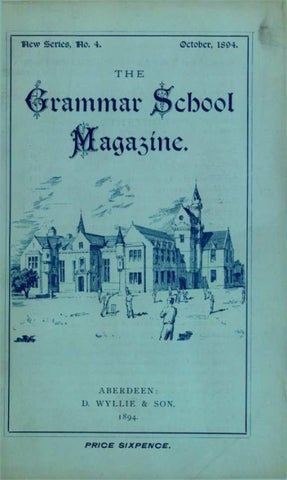
rammar cbool aga3ine.
ABERDEEN: D. WYLLIE & SON. 1894•
PRICE SIXPENCE,
- ,. - •- - - _ - _ _..
CONTENTS.
•
Page.
EDITORIAL .
.
•
•
NOTES ABOUT OLD BOYS
.
ATHLETIC NOTES
•
•
•
•
. 121
.
.
.
.
•
•
•
. 126
•
125
•
•
THE MELVIN CENTENARY •
•
•
•
•
•
. 127
•
•
•
•
•
•
. 136
•
•
•
•
•
•
MELVINIANA
•
THE HALL .
•
IN MEMORIAM
.
•
•
•
•
•
•
•
•
. 138
. 158
THE
®rammar Scf?oot )1Taga3tnc. New Series.
OCTOBER, 1894.
No. 4.
•
EDITORIAL. SINCE the last number of the Magazine was issued, several important events closely connected with the School have taken place. The Leaving Certificate and Kensington Science and Art Examinations have come and gone, and the results have been announced—by no means unfavourable results. The distribution of prizes took place on the 22nd of June in the Albert Hall, owing to the unfinished state of the alterations in the hall of the School. The School was re-opened after the summer vacation on Monday, 20th August, when the work of the new session was at once begun. A large number of new pupils were enrolled. The work of reconstructing the hall and of providing new class-rooms approaches completion. All the class-rooms have been re-floored. New desks have been substituted for the antiquated benches which have done duty for so long a time. In connection with the heating arrangements, new engines have been put in, and pipes have been laid through the hall and class-rooms. The pavilion also is undergoing alteration, with a lavatory attached. Two new windows have been knocked out of the north wall facing the field. A sketch of these alterations and improvements was given in our July number. A fence has been constructed down the field, outside the south touch line, to keep back the spectators at matches. The reply of the Secretary of the Universities Commissioners to the memorial of the Masters of the School as to the date of the Bursary Competition has been received by the Rector. It is matter for regret that the 1]
122
The Grammar School Magazine.
Commissioners have not seen their way to respond more favourably to the representations made to them. The proposal that all work for this and the Preliminary Examinations should be concluded in July is unsatisfactory. In fact, it leaves matters very much in their old position. The intending candidate will have the shadow of these examinations hanging over him all through his holidays, and, since the issues at stake are for him so important, he will be unable to give up work during this period of supposed rest. Hence he will not be able to derive full benefit from the vacation, but will, as formerly, enter upon his College career unrefreshed by any cessation from work after the labours of his last session at school. The Melvin Centenary was celebrated on 16th June. Elsewhere we give a report of the proceedings, and also a notice of the Centenary Edition of Melvin's versions. Lastly, the Preliminary Examinations and the Bursary Competition have taken place, and a number of boys have left the School to enter upon a College career. We give in another page the result of the Competition as far as the School is concerned. In the order of merit at the Bursary Competition just declared, boys who have been at the School within the last two years have obtained the following places in the first hundred (the number of competitors was about 180) :3rd, George Milne, 928 marks ; 4th, George L. Barrie, 913 : 10th, Thomas S. Slessor, 878 ; 11th, Harry M. Will, 878 ; 15th, George R. Watt, 847 ; 21st, Angus M. Urquhart, 834 ; 22nd, Charles Lyall Grant, 816 ; 31st, John S. Macdonald, 775 ; 32nd, George Adam, 772 ; 35th, John MacBain, 763 ; 38th, Thomas M. Watt, 761 ; 44th, William Mackay, 739 : 48th, Edward W. Watt, 723 ; 56th, James Strachan, 709 ; 57th, George A. Combe, 706: 63rd, James Forrest, 689: 68th, James Gilchrist, 667 ; 76th, Arthur Dymock, 655 ; 80th, William N. Leslie, 650 ; 82nd, James H. Fraser, 644 ; 83rd, William K. Baxter, 643 ; 94th, William Gray, 619 ; 97th, W. Harry Melvin, 608.
Editorial.
123
The Examination for the Anderson Scholarship took place on Saturday, 15th September, and F. W. Galloway has since been declared the successful competitor. James Strachan, Classical VI., has carried off the first prize of £5 among the Scottish competitors for the prizes offered by the Canadian Government for Essays on the History, Geography, and Resources of Manitoba and the North-West Territories of Canada. Thirty papers were sent in from Scotland, and Sir Charles Tupper, the High Commissioner for Canada, has intimated the result as stated above. Three of the Masters have been appointed to the important office of Examiner for Degrees in the University of Aberdeen—Dr. Moir in Classical Literature, Mr. John Clarke, M.A., in Education, and Herr Gustav Hein in Modern Languages. " The Lives of the Bishops of Aberdeen," by Hector Boece, First Principal of King's College, has just been Edited and Translated by Dr. Moir for the New Spalding Club. The translation accompanies the Latin text on the same page. The work, which has never been translated before, is accompanied in this edition by a historical Introduction and Notes. The Old Grammar School in Schoolhill figures prominently in a new novel, entitled, "From Ploughshare to Pulpit," by Dr. Gordon Stables, R.N., who is probably the busiest author among the former pupils. The book is specially interesting to present-day pupils, as giving sketches of life at the School forty years ago, and describing how the scholars conducted themselves both in and out of doors. That time-honoured institution, the ever-famous Bursary Competition, also comes in, and pictures are given 'of life at College in those days. We recommend the book to those who wish to get a peep into days gone by, and to have the enjoyment of a well-written and entertaining story.
124
The Grammar School 11htgazine.
One of the fruits of the extensive structural alterations that have been going on is that adequate chemical and physical laboratories are now provided. The former accommodates 64 and the latter 50 workers. An excellent Art room, 34 feet square, has also been equipped. The Examinations for the Town Council Scholarships and also for the Free Scholarships were held on Saturday, 13th October. The General Meeting of the F.P. Club for the election of office-bearers for the ensuing year is to be held at the end of this month. Dr. William Findlay, Secretary of the Club, will be glad to enrol new members. Boys now leaving the School may be reminded that they are eligible for membership, and it is to be hoped that all will avail themselves of this bond of continued union. It is satisfactory to learn that the F.P. Football Club has in prospect the completion of arrangements for acquiring a field, conveniently situated for play, in the immediate vicinity of the city. As an introduction to the work of the Botany Class, Mr. J. Bentley Philip, M.A., gave a lecture on the Kincardineshire Coast, illustrated by limelight views, prepared from his own negatives, on Saturday, October 13. There was a large attendance of the School and the public, and Professor Scorgie was in the chair. During the gymnastic hour on Tuesday, October 9, John Smith, who recently joined Class IV. (Classical), while vaulting over the horse, irregularly, fell and suffered a compound fracture of the left arm. He was removed to the Infirmary, and attended to by Dr. Garden, under whose care he is progressing favourably. Owing to pressure on our space, several contributions are uluivonlably held over.
s
NOTES ABOUT OLD BOYS. IN the Indian Medical Service Examination, the first place
has been taken (with 2,727 marks) by Dr. Charles J. Milne, son of the late Dr. Robert Moir Milne, of the same service. This examination is looked upon as the stiffest in the medical service of the country, and seven years have elapsed since an Aberdeen graduate succeeded in gaining the first place. Dr. Milne attended King's College for one year, and graduated M.B. and C.M. last year, after a full medical curriculum at Marischal College. Dr. Charles E. Profeit, son of Dr. Profeit, the Queen's Commissioner at Balmoral, has been placed seventh (with 2,075 marks) in the list of successful candidates for commissions in the medical staff of Her Majesty's Army. Dr. Profeit entered the Grammar School in 1882. He studied for two years at King's College, and then went through the full medical course at Marischal College, where he took the degrees of M.B. and C.M. R. A. Profeit— editor of " Under Lochnagar," the Crathie Bazaar Book•—who attended the School from 1882 to 1885, has received nomination to an important diplomatic appointment at Tunis. Robert S. Troup has passed the examinations for the Indian Forestry Service. He obtained high marks in all his subjects, especially in French in which he had 1,360, and in German in which he had 1,475, both out of a possible 2,000 marks. Dr. James Reid, a distinguished graduate of Aberdeen University, bas recently had the Order of the Red Eagle bestowed on him by the Emperor William. Among other honours, he some time ago received a Commandership of the Bath. Owing to remarkable equality of merit, complicated by the change from the old to the new Ordinances, the University authorities were unable to decide to which of two
126
The Grammar School Mugazime.
graduates the Town Council gold medal for highest distinction should be awarded, and reported to the Town Council the names of W. W. Reid and A. A. G. Wright. The Council has decided to give a medal to each. Reid is an old Grammarian, and Wright was also for a short time at the School. ATHLETIC NOTES. THE second Annual Meeting of the Swimming Club took
place in the Baths on the evening of Monday, 25th June. The Rector presided, and there was a good attendance, in spite of the fact that the School had been dismissed some days previously for the summer holidays. Mr. Mackie, French Master, and Mr. Wade, Manager of the Baths, acted as judges. The first event on the programme was the race for the championship of the School—distance, 100 yards. There were four entries, and, after a close contest, C. Lyall Grant was declared winner of the cup, Arthur Milne gaining the second place. The next event was a junior handicap race, in which Spence Donaldson was first and Alfred Macleod second. The third item was a competition for best Oxford header, without aid of spring-board. This competition was closely contested, and Charles Grant came out winner by half a mark. The next race—a senior handicap of 75 yards, for a prize by Mr. R. 1). Leslie—was won by C. Lyall Grant (scratch), Arthur Milne (8 sec.) being next in order. The futile efforts of some of the competitors in the egg and spoon race provoked much laughter among the spectators. C. Lyall Grant, the only competitor to fulfil all the conditions of the race, carried off the prize. Swimming under water, with a dive off spring-board, and a race for old boys were the concluding events of the first part of the programme. In the former C. and H. F. Lyall Grant were equal, while in the latter event John The second part of the Leibbrandt came off first. programme consisted of aquatic sports — diving, leapfrog, tub race, &c., in which all the competitors took part. After these sports had been brought to a close, Mrs.
11 thletic ,Votes.
127
Mackie was called upon to present the prizes as follows :— Championship race-1, C. Lyall Grant ; 2, Arthur Milne. Junior race (prize, a medal given by Mr. J. T. Clark, of Rose Street) — 1, Spence Donaldson ; 2, Alf. Macleod. Oxford header—.-1, C. Lyall Grant ; 2, Alf. Macleod. Senior handicap-1, C. L. Grant; 2, A. Milne. Egg and spoon race-1, C. L. Grant ; 2, J. W. Garden. Swimming under water—C. L Grant and H. F. L. Grant (equal). Old boys' race—John Leibbrandt. Prize for most regular attendance—A. Macleod. The Annual Gymnastic Competition for the gold medal was held about the end of August. The competitors had to perform four exercises in vaulting, four on the parallel bars, and four on the horizontal bar. At the close of the competition the order of merit was declared as follows :— W. Mackay, - 107 marks. A. Sheret, - - 96 „
C. Lyall Grant, 93 marks. A. G. Gray, - 87 „
J. W. Milne has been elected captain of football and H. F. Lyall Grant secretary.
THE MELVIN CENTENARY. THE centenary of the birth of Dr. Melvin was celebrated in
Aberdeen on the evening of June 15. A large company of his surviving pupils assembled in the Grand Hotel to do honour to the memory of the most famous Latin scholar of the North. The following account of the proceedings is taken from the Free Press of the 16th. Principal Sir William Geddes occupied the chair, and the croupiers were Mr. Alexander Forbes and Dr. John F. White. Among the gentlemen present were:— Sheriff Birnie, Glasgow ; Rev. Dr. Gray, Auchterless ; Mr. George Allan, Advocate, Aberdeen ; Mr. H. F. Morland Simpson, Grammar School ; Dr. James Moir, Grammar School ; Mr. Gray C. Fraser, Advocate ; Dr. Dey ; Mr. John Watt, Jun., Advocate ; Rev. James Johnston, Belhelvie ; Brigade-Surgeon Center ; Brigade-Surgeon Mackie ; Rev. James Legge ; Mr. Duguid M'Combie ; Rev. N. K. M`Leod, Ellon ; Mr. Alex-
128
The Grammar School Magazive.
ander Simpson, Advocate; Mr. James Duguid, Advocate; Dr. Gray, Forest Road; Mr. W. L Henderson, Architect; Mr. James Forbes, Albyn Place ; Rev. James Simpson ; Mr. John Parker, Advocate ; Rev. James Sutherland, late of Turriff ; Fleet-Surgeon Mair ; Mr. P. J. Anderson, LL.B. ; Mr. D. G. Cattanach, Advocate; Rev. Mr. Bruce, Newmachar ; Rev. Charles Dunn, Birse ; Dr. Joseph Ogilvie, Training College ; Mr. Robert Falconer, Stonehaven ; Mr. M'Kenzie, North of Scotland Bank ; and Mr. Alexander Martin, Deemount Road.
Apologies for absence were intimated from— • Lord Provost Stewart ; Professor David Masson ; Principal Donaldson ; Dr. Bain ; Rev. Professor Robertson ; Rev. Robert Stephen, Renfrew ; Rev. Dr. Walter C. Smith ; Rev. Professor Salmond ; Rev. Dr. Cooper ; Dr. Alexander Cruickshank ; Rev. Dr. George Philip, Edinburgh ; Rev. John Philip, Fordoun ; Rev. W. Lyon Riach, Edinburgh; Rev. Dr. Robert Hunter ; Dr. Middleton Rettie ; Rev. I)r. Murray Mitchell ; Dr. George Ogilvie, Watson's College ; Rev. Dr. George Reith, Glasgow ; Dr. James Macdonald, Kelvinside Academy ; Mr. John Clarke, Chanonry ; Mr. William Dunn of Murtle; Mr. John White of Dalhibety; Rev. Professor W. Garden Blaikie, Edinburgh ; Rev. A. F. Moir, Woodside; Mr. James Auldjo Jamieson, W.S., Edinburgh ; Rev. James M'Lauchlan, Inveravon ; Rev. W. Simmers, Portsoy ; Dr. Lawrence ; Rev. A. Gordon, Lethenty ; Mr. James Catto, Cliff House ; Mr. Alexander Simpson, Jun. ; Mr. Charles Robertson, Edinburgh ; Mr. Alexander Brownie, Bellie Public School ; Mr. George Chree, Schoolhouse, Keig ; Mr. John Forbes Robertson. London ; Rev. A. Anderson, Edinkillie ; Mr. Maxwell H. Mackie, Grammar School ; Dr. Profeit, Balmoral ; and Mr. Charles Sleigh.
In proposing " The Memory of Dr. Melvin," Principal Sir William Geddes said—I rise to propose the toast of the evening, and I do so not without a feeling of trepidation lest I should be unequal to the task of doing justice to the memory we are met to honour ; but, casting myself on your friendly sympathy and support, I shall put aside the fears and apprehension which even wise men may feel but dare not cherish, and address myself to the high duty you have assigned to me. My first remark is one of regret that in this matter I am only, in Grammar School phrase, an extranean ; and while among the admirers, and for nearly five years the colleague, I had not the felicity of being a pupil of Dr. Melvin, and so cannot claim, in the impressionable season of youth, to have come under the spell of his strong personality. But although I was not in the formal sense a pupil, I enjoyed advantages that led me to entertain a reverence and esteem for him such as no pupil could have
The )llelv'in Centenary.
129
exceeded, and it is because I feel that reverential esteem not less but more as years roll on that I appear here to-night in compliance with your request that I should take the chair on this occasion. The occasion is a notable one, not without a weighty significance. Here are we this evening, a gathering of busy men, at a most busy time, from all corners of the land, occupying the most varied walks of life, of no conspicuous unanimity in our views—municipally, politically, or socially—met together, after the lapse of forty years, to celebrate a great and influential memory, not yet grown dim, the most potential memory, educationally, that Aberdeen, in the course of a century, at least, has known. A hundred years ago, in a house at the head of the Gallowgate, the great teacher whom we know as James Melvin was born, just about the time when the greatest thinker and scholar of Aberdeen in last century was quietly passing away: I mean the great Principal George Campbell, beside whom, within a few paces, our great scholar lies interred. I mention this circumstance because the near conjunction in their last resting place of these twin spirits, both of them typical of robust Aberdonian sense, and each in his several sphere representative of all that is best in Aberdonian educational method, appears to me not without significance and appropriateness. They two together constitute probably the greatest educational memories of their several centuries connected with our city of Aberdeen. It was fortunate for Melvin that he was born in a city possessing educational ideals as those represented by George Campbell, a city cherishing traditions of the high character to which Melvin served himself the rightful heir, traditions which he focussed and crystallised. It is not among the simpler and unique titles of distinction of our city that, as in Dr. Johnson's days, the freedom of the city is, or was till lately, conferred by a diploma in the majestic language of old Rome, and that the Rector of the Grammar School used to greet the magistrates and examiners at the annual visitation with a Latin oration or address, as if redolent and reminiscent of the forum and the eternal city. These were days of state and ceremonial, as well as cultivated leisure, and one of Dr.
130
The Grammar School Magazine.
Melvin's earliest productions was a beautiful address with which he modestly, yet with quiet dignity, greeted the city fathers on his appointment in 1826. I refer to this with more pleasure because J have made recent acquaintance with it in a handsome and elegant volume, which has just appeared as a centenary volume, and which does so great credit to its two editors, Mr. Legge and Dr. Joseph Ogilvie. Dr. Melvin, therefore, grew up in an atmosphere where Latin had the palm, and where exactions as well as eloquence were the test of scholarship. There is a circumstance connected with the history of the Grammar School in this regard that I delight to recall. That brilliant pupil, a little before the period of Dr. Melvin, who was afterwards known in the class as Childe Harold, in one of his letters refers to the circumstance of some of his translators having bungled his poetry and made immense blunders in translating his verses, and the words that he used are of such flashing indignation that I quote them. " Only think," says Lord Byron, after enumerating some of the blunders, "only think of being introduced into a foreign language in such an abominable travesty." Thus ushered into an atmosphere surcharged with Latin memories and influence, young Melvin brought to bear on his life-task a combination of gifts and powers very noble and memorable. How long and faithfully he strove to fulfil his high function, Aberdeen and this gathering fully recognise, and we proudly yet pathetically recall the devotion with which, day by day and year by year, year after year, he laboured under depressing conditions, in a stifling atmosphere, and with slender pecuniary reward— endowed salary not reaching £100—and there was he, for 10s. 6d. a quarter, giving five hours a day of the best teaching then or since available. With blows now and again from fortune, more than once of a severe kind, such as would have staggered a less robust nature and less Spartan spirit ; yet strong under the inspiration of right and duty, he toiled on, so that we are almost constrained to address to him, across the mists of 40 years, the words of Shakespeare— O good old man ! how well in thee appears The constant service of the antique world, When service sweat for duty, not for need.
-I
The Melvin Centenary.
131
If such was the impression left by the tout ensemble of his life, hardly less ad►nirable is the result when we come to estimate the special features of his teaching, to a few of which I may briefly allude—his emphasising of quality rather than quantity : non multa sec multuim.—his favourite maxim—rather one subject well mastered and matured than many skimmed and learned badly, which, by the way, accounts for and justifies his supposed attitude to the sister study of Greek, for which at that stage he had no proper opportunity ; his appraising of training in Latin verse, as giving a sense of the value of fine form and melodious combination—an exercise which he did his best to encourage, but, alas! was never followed up to fruit at college, and received no real or adequate encouragement from Humanity professors then or since ; his patriotic appreciation of the scholars of his native country, placing the Psalms of Buchanan in line with the Odes of Horace, and awaking sympathetic memories at the very mention of Ruddiman and Arthur Johnston; his rich fund of pawky humour, when he would deviate into the vernacular, and light up the old past with modern instances from Burns and Allan Ramsay: the delight with which he would repeat a Porsonian puzzle or a conundrum embodying some principle he was enforcing; the felicity with which, in a quip or passing turn, he would implant indelibly an important truth, as, for example, in speaking of the retreat of the Roman army, he called attention to the unity of march and the organisation of the Imperial people. " A Roman army, mark you, had but one foot: hence, gentlemen, referre pedem; it would make a mob of it to allow referre pedes"; maxims such as these, proceeding from what was felt to be a dominant personality, made an impression on the dullest such as never could be forgotten. By such methods and with such ideas, he gradually trained his pupils to feel a pride in the manipulation of the Latin tongue, and thereby to understand that the proper handling of language is a fine art, and that the arrangement of the proper words in their proper places is like the marshalling of an army—a thing of tactical precision. In the sentences of a writer such as Cicero, we
132
The Grammar School Magazine.
have learned through such teaching to feel the echo of the great march of the tramping legions that conquered the world, and there is presented to us a magnificent language, having the stately regularity and official splendour of a All this was gradually instilled triumphal procession. under the methods and the ideals of Melvin, and hence the gratitude of his hundreds of pupils for the care and precision with which, in his translations to or from the Latin tongue, he taught them to weigh the gold dust of the ancients in the finest scales ; to extract the least grain, the smallest atom of the meaning—no more, no less—the exact commercial exchange betwixt tongue and tongue. The intellectual accuracy which he exacted was found to have more than intellectual results—it gradually passed into the character, and became an instinct affecting the feelings, and the rigour of his method was felt to be not only akin to but helpful in developing moral truthfulness, the best fruit of all training and instruction. If we ask, in conclusion, what it was that constituted the spell of Melvin, we are constrained to say, by way of reply, it was not learning, though that he had both wide and deep in all amplitude ; it was not intellectual strength and acuteness, though these he possessed also in large measure; it was something more valuable, an essence more potential even than these; it was his character, strong and stable character, based on moral worth, and formed and fashioned to a great result. There he stood, the impersonation of a great teacher, as if to give the world assurance of a man who would do his work devotedly and nobly, making his motto " Duty, duty, clear of circumstance," yea, " vanquishing circumstance," like the just and firm Roman of Horace— Justum et tenacem propositi virum Non civium ardor prava jubentium, Non vultus instantis tyranni Mente quatit solida. •
Hence it is that Melvin has left us a name still to conjure with—a memory that Aberdeen will do well to retain in proud remembrance, and after the silent lapse of forty years we have met to do fitting honour to his name. I give you with all reverence " The Memory of Dr. Melvin."
The )l'leivin Centenary.
133
Rev. Dr. Gray, Auchterless, proposed "The Grammar School." He did not know whether he was supposed to speak of the Grammar School of the present clay. That lie could not do very well ; but if it was the Grammar School of 47 years ago, coupled with the then Rector, Dr. Melvin, then he was more at home with his subject. He had to say, not with any spirit of egotism, that no student had more reason to respect the memory of Dr. Melvin than he had, because he believed that no pupil owed so much to him as he owed. He owed it to Dr. Melvin that he did not spoil a good ploughman and bungle his whole life, for it was a risky thing to leave the plough at 21 years of age, knowing very little of Latin and very little of anything else. He (Dr. Gray) was with his brother, George Melvin, at the time, who was a dungeon of learning, but not a teacher like Dr. Melvin ; and he so pestered George Melvin with questions that he was glad to get rid of him by sending him to Aberdeen to be instructed by Dr. Melvin. When the Doctor found out that he (Dr. Gray) knew little or nothing, he said to him, " Ah, man, I doot ye hae mistaken your vocation" ; but at the end of the first session, when he took the second prize in the class, Dr. Melvin said in his own quaint way, " Ah, Saunders, man, 1 think we'll mak' something o't yet." Dr. Gray told some further reminiscences of his teacher; and then went on to say that the Grammar School of Aberdeen always had a warm place in his heart ever since. His desire was that the Grammar School should take its stand in the foremost rank in the educational institutions of Aberdeen, and that the present rectors might take the same place in the hearts and the affections of their pupils, and have the same power and influence over them for good as Dr. Melvin had over his pupils. The Rector, in reply, said it was with pride and pleasure he remembered that the Grammar School had a very venerable history, and he was deeply sensible of the very high ideals of the past up to which he had to lead. He had been so short a time among them that he would not venture to prophesy as to the future of the Grammar School ; but
134
The Grammar School Magazine.
he would only venture to hope that the great ideals of the past might continue to inspire their teachers and their youth, so that they might endeavour to lead up to them— surpass them he did not think they possibly could do. Dr. Moir, who also replied, spoke of the antiquity and interesting history of the Grammar School, and of the eminent and useful citizens it had produced. He could imagine the " loons " of the Grammar School having gazed upon Wallace and Bruce, and thirty years after the death of Wallace they must have seen the terrible sight of the town burned by the English for three days. Then they had a distinct school of Latinity of their own. They had not been influenced much from the outside, but had been able to produce a series of scholars of their own manufacture. Dr. J. F. White gave the toast of " Education," stating that one aspect of the education question challenged attention at the present time—namely, the marked advance that had taken place in raising the art of teaching from an art to a science. They had now in every University either a professor of education or a lecturer on education. It seemed to him exactly as it should be, that the art of teaching should be raised to such a point as to prevent imperfections on the part of young teachers, and he thought it desirable that old methods should be abandoned, and the best methods taken whenever they could be got. But it was his belief that such teachers as Dr. Melvin were not made—they were born. He could not quite say that he had found out on the surface that Dr. Melvin was attractive and loveable, but his belief in that came later. But if they knew Dr. Melvin to be stern, they knew him to be eminently fair, and those who left his school without any intention of carrying out a learned profession had always confessed that the lessons he taught them of precision, accuracy, and perseverance were the means by which they attained success in after life. Dr. Joseph Ogilvie replied, pointing to the prominence given to translation by Dr. Melvin. They all knew that the version was a great thing in the Grammar School. The
The Melvin Centenary.
125
version could teach everything except physical education— it could teach everything intellectual, moral, and aesthetic. He only wished that he could be equal to Melvin in the stool he had got at the University, and that he could send away inspired teachers, for that was the best kind of teachers they could get. Sheriff Birnie gave " The Pupils of Dr. Melvin." He felt that it made him younger to be present that evening. They were there to speak of their school days, and it was that which made the invitation to the meeting absolutely irresistible, He remembered Dr. Melvin in his later days. The room in which Dr. Melvin sat for so many years would probably not meet the requirements of the present day, nor, probably, would Melvin's system entirely meet the requirements of the present day, but that schoolroom drew every lad in this neighbourhood whose father had a hope of sending him to college, and that system sent out to many places in the world the men who had made the town of Aberdeen, and the education of Aberdeen honoured and admired. They were to drink their own health, and although they had not much to ask for themselves now, they had a great deal to think for those who had to come after them. That evening they had done their something for those who were to come after them, for they had shown that there was a great man in their time, and that they had lived to honour him. Mr. D. G. Cattanach, Advocate, with whose name the toast was coupled, gave some very amusing reminiscences of Dr. Melvin's work as a teacher, speaking in what he said was the Doctor's tone -of voice, and indicating his mannerisms. Mr. Cattanach's efforts were much appreciated and greatly applauded. Interesting reminiscences of Dr. Melvin were given by a number of gentlemen present.
MELVINIANA. THE centenary of
Dr. Melvin brought out a Centenary Edition of his Exercises in Latin Prose Composition (or "Versions"), illustrated by a photogravure portrait, and selected and edited by two of his pupils, Dr. Joseph Ogilvie and Rev. James W. Legge. From an Introduction to the work, we gather the following particulars concerning the life of Dr. Melvin. He was born in Aberdeen, April 21, 1794, and received his education at the Grammar School. Proceeding to Marischal College, he gained the first bursary, and established his reputation as a scholar of high merit. After graduating, he received a teaching appointment in Dr. Bisset's once well-known Academy at Udny. He next held a mastership in the Old Aberdeen Grammar School, where the famous M`Lachlan was head master; and about 1822 he was appointed assistant to Mr. Nicoll, his former teacher in the Grammar School. On Mr. Nicoll's death he succeeded him, and a few years later, in April, 1826, was appointed Rector in succession to Mr. Cromar. This position he continued to occupy for the long period of twenty-seven years. From the estimate of his character, by Professor Masson, we quote the following sentences :— I remember Melvin's life was one of the most successful, in the best sense, I have ever known —a life not to have been exchanged, when it was fully closed, for that of the wealthiest and fattest-fed grandee of his fellow-citizens. For he was a man of Roman rectitude, who had thoroughly done his duty. He contrived to have the finest library of Latin books about him then known or imaginable in these northern parts, and to be himself perhaps the most perfect and exquisite Latin scholar of that Scottish generation ; and he had sent forth a number of pupils who were to think of him with respect and gratitude as long as they lived, because he had not only taught them Latin more admirably than they had ever been taught anything else, but in doing so he had drilled them also to care for accuracy in everything.
In the memorial window in the University Library at King's College, Melvin is depicted along with three other notable Latinists of Scotland, Ruddiman, Buchanan, and
Melviniana.
137
Arthur Johnston. On the occasion of the inauguration of this window, Principal Sir W.. D. Oeddes spoke of him thus :— The fourth light, that on the south side of the window, is appropriated to the figure of Dr. Melvin, in habit and manner, as he sat behind his desk, and with firm pressed lips and demonstrative finger was wont to 'scarify' the productions of ingenuous youth, pointing out the flaws and blemishes in the so-called ' Versions,' which were found in his hand a notable instrument of educative power. Shrewd and sagacious, with frosty yet kindly criticism, stately withal, and capable on fit occasions of high dudgeon, he commanded, by his gravity and weight of character, the respect, and eventually, whe❑ better known, the affection of a long line of pupils scattered over the north of Scotland and beyond.
It may be interesting to give here the rules for marking the Bursary Competition Versions, as drawn up by Melvin, at the request of the Senatus of Marischal College. They are as follows :— I. In rating the number of errors in any Version, a lnaximus shall be accounted equivalent to two meolii and four minimi, and a medics equal to two minimi, and every competitor who has [ ] maximi in his Version shall be deemed not habile to enjoy any bursary. II. In the examination of the Versions, the omission of an entire sentence shall set aside the exercise altogether. III. The omission of a clause or member of a sentence shall be accounted—max. IV. Every error in construction, unless accompanied by some alleviating circumstances—max. V. Any word employed that is not Latin, or any gross error in the inflection of nouns and verbs—max. VI.—Any word whose meaning is entirely different from that used in the argument—max. VII. Sentences or clauses not exactly conveying the sense of the argument, but not totally different—med. or min. VIII. A word which does not perfectly express the sense of the argument, but not totally different—med. or min. IX. A word used in Modern Latin, and not supported by classical authority, where a better might have been found, according to circumstances—med. or min. X. The omission of a word in the argument, in consequence of which the sense is less perfectly expressed—med. or min.
12
The Goon ,,«r School IlIrtgaziwe.
138
XI. Errors in tenses or moods of verbs, according as they are attended by alleviating circumstances—med. or min. XII. Superfluous words, or expressions vulgar and inelegant, when better were sufficiently obvious—med. or min. XIII. Errors in spelling or in punctuation—min. XIV. The omission of a word in consequence of which the argument is less correctly rendered, but the sense not in the least impaired
—min. XV. Words injudiciously chosen, or arranged in a perplexed and inelegant manner—min. XVI. Where two Versions are found to contain the same number of errors, that which has the fewest great errors to be preferred, and if similar in these also, preference to be determined by other circumstances. XVII. As the epithets bene and eleganter relate to the general performance of the exercise, they shall never be bestowed merely on account of the Version wanting errors, nor refused on account of great errors, if the composition on the whole is found to deserve them. XVIII. A repetition of the same error — max., med., or min., according to circumstances.
THE HALL. "PIOUS BENEFACTORS" WANTED ! THE Public Hall is now nearing completion, and will form one of the finest rooms in the city. The ceiling is panelled throughout, resting on wood-cased iron rafters, supported by handsome brackets, from which gasaliers will depend. The floor is of white pine blocks, in zig-zag pattern, laid on a foundation of solid concrete. The platform at the west end is reached by a new door opening into the central passage, opposite the Rector's room. The walls are panelled to the height of the window sills, and round the head of the panelling runs a broad band or dado of wood, on which it is intended to record the distinctions of pupils—past, present, and to come. Above the platform the names of former Rectors will be inscribed, from a list which Mr. Alex. M. Munro, of the Town House, has very kindly compiled from the city records. This leaves still a vast space for
The Hall.
•
139
portraits and busts. Here, if anywhere, will be the centre and Brennpunkt of our corporate life. Probably our school is unique in possessing so brilliant a roll of distinguished Alumni, who are hardly " become a name" in our midst. It will be a happy result if recent changes and renovations succeed in fostering more strongly a proper loving veneration for all that was noblest in our past; and this object we heartily commend to our friends and readers :— nrciprai, tXaxcs, Tairraw K61755L.
Die Achtung, die von aussen konnnt, Ist nicht die ganze die uns frommt : Nur der gilt mir als rechter Mann, Der ehrlich selbst rich achten kanu !* * NOM —I. q., "If you wish for respect, respect yourself."
GALLANT CONDUCT OF AN OLD GRAMMARIAN IN SOUTH AFRICA. "BRAVE BILLY
KEITH!"
IN one of the South African journals just to hand, we are proud to read the name of an F. P., who has been distinguishing himself by heroic conduct in the late disputes about "commandeering" which have broken out in the Transvaal. W. Keith left school, we believe, about six years ago, and since that time has been pushing his fortunes in the mining districts of South Africa. We subjoin the account taken from the Standard (South African) :—
Fort Pretorius, Malaboch's Mountain. (By heliograph and post cart to Pietersburg, Friday.)—The Pretoria townsmen have been hotly engaged, while attempting, in company with the Malitsie men, to take up a position and build a fort within 400 yards of the enemies' caves. They lost one man, J. Schmidt, who had been wounded in a most ghastly manner in the hip. This, together with the fact that two of our native allies had been killed and three wounded, in..
140
The Grammar Mona Magazime.
duced Lieutenant Schroeder to order the half-finished fort to be abandoned, and a retreat was commenced. Schmidt was being carried out by his comrades, and G. Scoble, W. Keith, F. P. Cowley, and D. Dunsdon were acting as rearguard, and were attempting to bring out a fatally-wounded kafir. [N.B,—The small k. Is this significant ?] Just at this critical moment the enemy, who had been stalking our fellows in the bush, rushed in and opened a murderous fire at from 150 to 50 yards. The fire took instant effect, wounding Dunsdon of the rearguard with buckshot over his whole body. He staggered on with his companions to the shelter of a rock. At this moment H. Smit rushed down to help, without his gun, just in time to see F. Cowley shot through the stomach. A second later Smit was back again armed, and pluckily rushing up, he plugged a Kafir at about 15 yards, who appeared intent on young Keith, and lifting one wounded man, and helping on the other, dashed for the safety of the main force. The highest praise is bestowed on brave Billy Keith for the coolness he displayed when things were looking very critical. He was walking between Dunsdon and Cowley when each of his companions was shot down, and Schmidt was shot just in front of him. He and George Scoble then covered the wounded men with their own bodies until assistance came. On the arrival of reinforcements the enemy opened fire on us, and young Herbert Loveday, shot through the leg, fell into your correspondent's arms. Bullets flew Two native allies dropped. Fire was thick and fast. opened from the rear, but was quickly silenced. The threepounder set to work with a couple of shells, and the natives retired. C. D. PIERRE. CHAPTER ELL—SEDAN. IT is half-past one o'clock in the afternoon of the first of September, anno domini, 1870. The autumn sun, which has been shining steadily all day over the fertile valley of the Meuse, is sloping to the west. The vineyards on all the hillsides in that sunny land are heavy with the grape harvest; but in the Meuse valley and on the hillsides around Sedan the great Reaper is reaping another harvest. All day,
Pierre.
141
since seven o'clock in the morning, the German host has been completing its great circle, enclosing in a ring of steel the doomed army of France. From every side batteries pour a tremendous fire of shells on the disorganised French. One hope is left. The French cavalry is still almost intact, and if it can break that fatal circle the army may still escape, though it cannot conquer. There is a long ridge of rising ground between the town and the little village of Floing. Beyond the ridge there is a plateau about a mile across, and the ground slopes down precipitously to Floing. Dark masses of Prussians swarm up the steep hill, and have just gained the plateau, when, from behind the ridge, sweeps in thundering gallop a glittering line of French cuirassiers. Before the Prussians can form in line they are upon them. Down go the dark riflemen like grass; nor can the cavalry stop their headlong rush, but tumble in wild confusion, rolling over and over down the hill, at the foot of which they are despatched by the Prussian reinforcements, and another line of Prussians swarms up the hill. So ends the first attempt to break the circle. Sheltered behind the ridge from which these ill-fated warriors issued stands all the cavalry of France stretched in long rows—Hussars, Cuirassiers, with glittering breastplates, Chasseurs d'Afrique, in their light blue tunics and mounted on white horses. Among these latter we find our old friend Pierre. He wears a black moustache now-a-days, and has a few seams and wrinkles on his face which were not there when he knew him before, but otherwise he is unchanged. The same fiery spirit that will not brook insult burns in him still. Just now it shines more steadily from the keen eyes, and the mouth is set firmly. All along the line for a mile and a half are the same set looks, the same determination—to slay or be slain—the same stillness of man and horse. Now General Margueritte rides out of the hollow to reconnoitre, accompanied by a couple of officers. In a minute he reappears, lying back in his attendants' arms, shot through the breast. A terrible cry for vengeance rose from the long line. The word is given— " Out sabres!" A glitter of steel shimmers along the ranks,
142
The Grammar. School Magazine.
and each man sits with his sabre hand resting on his right thigh, and his sabre blade at his right shoulder. Then comes the word " Forward!" and the great body, a moment ago still as a long gallery of equestrian statues, is in motion. Many a heart beat hard when the horses began to go forward. Pierre felt his thumping as if it would choke him. They walked slowly up the hill, and as they reached the summit Pierre saw, about a mile away, the enemy, like a long row of black ants. Then the motion became faster, first a trot, with jingling of bridles and spurs ; then a hand gallop, and the venomous line in front widened out, and the spiked brass helmets were plainly visible. Nearer, nearer, only half a mile now, and the pace has increased to a headlong, thundering gallop. Still there is no motion, no shot from the fast-increasing ranks in front. All the splendid exhibition of strength and courage of horse and man is rushing on at breakneck speed. Only a hundred and fifty yards from the dark blue line, the spiked helmets and the stern faces in front, when suddenly a movement of the rifles runs along the ranks, and a long sheet of flame and smoke spurts along the line accompanied by a sort of crackling roar. Down go man and horse crashing. Wounded steeds rear wildly, riderless ones gallop madly about the field. The rear rank rides headlong over the first, only to be mown down by a second leaden hurricane. Thus is the cavalry of France annihilated, and the terrible riflemen move forward over the remains of what a minute ago was the hope and mainstay of the French army. More batteries are brought up, and the French infantry, a disordered mob, rolls back in helpless confusion on Sedan. The battle is at an end. CHAPTER W.-THE NIGHT.
Pierre rode on with the rush in a sort of dream till the terrible volley, when his horse reared madly, beat the air for a moment with his forehoofs, and fell heavily to the earth stone dead, with his rider's leg beneath him. The pain was excruciating, men, horses, smoke, swam round Pierre for a
Pierre.
143
moment, grew dim, then black. How long he lay thus he did not know, but when he awoke it was dark. His leg felt crushed and numbed by the weight of the horse, but he managed to extricate it, and tried to rise. He fell backwards with a groan. The leg was helpless, and the blood recommencing to circulate caused him intense pain. Then he began to be tormented by violent thirst. Feeling hastily for his water-flask, he found to his delight that it was unharmed and full. A long pull refreshed him considerably, and he carefully screwed on the cap again so as not to lose any of the precious liquid. As he lay thus he heard on all sides through the darkness groans and now and then faint cries. All at once he heard, quite close to him, a low moan, and a faint voice asking for " A little water, for the mercy of God." Then was Pierre torn by diverse emotions. If he gave to this sufferer the flask could scarcely last the whole night, and the consequences might be unpleasant. On the other hand, it was decidedly uncomfortable to hear this poor devil moaning away so piteously. In a minute or two the moan and petition were repeated, a little more faintly this time. The supplicant seemed to be in a bad way. Pierre rolled over, and crawled towards the voice. When he had gone a yard or two he put his hand suddenly on something very cold and hard. Passing his hand along it he discovered that it was a cuirass, and a very faint moan assured him that it belonged to the individual who had attracted his attention. He was very faint now, but revived considerably after a draught of water, and informed Pierre that he was wounded in the thigh. Pierre put his hand to the spot, and felt a slow, warm stream trickling down to join a cool pool on the ground. Tearing his shirt into strips, he bound up the wound tightly, and again applied the water-bottle to the lips of the sufferer, who soon began to recover, and the two set about discussing their position. All at once the new comrade seized Pierre by the shoulder, and, pointing into the darkness, said excitedly, " What's that ? Do you see ? " Pierre looked. A faint yellow light moved slowly about, forwards, backwards, from side to side, apparently some distance off. " It's the ambulance," cried
144
The Grammar School Magazine.
Pierre ; "let us shout for aid" ; and he gathered himself up for a loud shout. " Be quiet," whispered the other, placing his hand over Pierre's mouth and gripping his arm, " there is no ambulance waggon; it's pillagers." They lay still a moment and watched the light. There was a gleam of white light beside the yellow, and through the darkness there came a cry. Pierre shivered. " They have murdered him," whispered his companion, hoarsely ; " let us go." And by an extraordinary effort he got on his feet and staggered forward a few steps. Pierre leapt •up too. The blood rushed through his veins, the instinct of self-preservation swept away the aching of his bruises. He had no wish to lie still and be poniarded in cold blood for the sake of his accoutrements. The two crept along as quietly as possible. At every step the slaughter became more evident. Now they just escaped the hoofs of a dying horse, which was lashing furiously with its feet in a way that would have made short work of them. Now they stumbled on a little knot of dead men who had crept together not to die alone. At last, after a dreadful monotony of horror, they reached a little wood, and, crouching in the brushwood, awaited the dawn. Pierre dozed off occasionally, but could not sleep. The other fell asleep almost immediately. Once they started up in terror, for the ground shook, and some great cavalcade dashed past, with wind and rushing of hoofs. At last the night lifted slowly, and the grey light revealed the silent scene. All the plateau was covered with men and horses, very still for the most part now, and the little wood was full of bodies, Frenchmen and Prussians, all dead, tumbled in ghastly confusion. The import of the earth-shaking rush which they had heard was . now obvious. The riderless horses had collected into a great troop and rushed madly about the field, trampling upon dead and living, and bearing all before them. Again they dashed past the two in the wood, but luckily kept to the open ground. Pierre now for the first time scrutinised his comrade. From his uniform he was evidently a captain of cuirassiers. He noticed Pierre's glance and said, " You have saved my life, I shall not forget it. What is your name ? "
Pierre.
145
" Pierre, sir," with a salute. " Pierre what ?" " I have no other name. I enlisted under the name of St. Honor6." " Ah," said the officer, contracting his heavy black eyebrows and looking fixedly at Pierre," well, I am your friend, Emile de Xan vine never forgets a service." At this moment a bugle was heard faintly, far away in the direction of Sedan. It was answered by another and another, fainter and louder, but all, generally speaking, to one side of them, the side of Sedan. They were outside the charmed circle, no Prussians were in sight except those lying stiff and cold in the little wood. They might escape. Swearing to stand by each other through all the perils of their flight they resolved to make a detour and strike for Paris, which, if no accident occurred, they might hope to reach before the Prussian army. GUILLAUME DE LISLE. (To be Continued.)
TIGER HUNTING BY A FORMER PUPIL (From letters by Mr. Chas. Michie.) STARTING from Calcutta with my khitmutghar (attendant), with the train that leaves Ballygunge station at 6 p.m., we reach Baroipur about 7.30. Then we had to wait the best part of an hour till a gharry (trap) was procured with some difficulty. As it was a warm, bright night I took my seat on the dickey, along with the driver, making my khitmutghar take his sahib's place, and lucky it was that I did so, for I found my jehu was by no means an adept at his art, and needed all the little assistance I could give him. After a drive of two hours we come to Ootturghat, our next halting station, where we obtain one of these native boats called dinghies, which will take us to the hunting grounds. While the boat was getting prepared and duly loaded, I took the opportunity of dining on roast duck, bananas, and
146
The Grammar School Magazine.
oranges, which my khitmutghar had providently brought with him. The dinghy was just sufficiently broad for one person to lie down, so spreading out my rugs I endeavoured to get some sleep, for I knew that I had a long day's work before me. Not being very successful in my attempts to sleep, I was not a little glad when we reached the Sunderbunds, the hunting grounds mentioned before. The Sunderbunds is the name given to that large tract of country which constitutes the Delta of the Ganges, and extends to the mouth of the Hugli. It consists of lowlying islands, covering an area of more than 6000 square miles, and intersected through and through by the mouths of the Ganges. Some of the islands have been cleared, but by far the greater part of them is still covered with primeval growth and jungle, affording suitable lairs for the tiger, wild boar, and other ferocious animals. We landed at 4.30 in the morning, when my khitmutghar immediately lit a fire and made me a cup of tea, which I very quickly disposed of, for my shikari (scottice "ghillie ") had just told me that a tiger was about. After partaking of this slight repast, the shikari and I started on our day's hunt, and we soon fell in with a tall, strapping native, of whose voluntary assistance we were glad to avail ourselves. We walked for some six miles till we came to dense jungle, where we at once saw fresh marks of our prey. All the forenoon we worked through the jungle, essaying to track the tiger and to get to close quarters, but he eluded us every time. These jungle tigers are in the habit of wandering for great distances, and this one seemed to have the knack of keeping within a short distance of us, but never letting himself be seen. More than once the shikari and I were aware that he was not far off, by the pungent disagreeable odour, which is a sure sign of his near presence. .About mid-day we made an excellent tiffin (lunch) off chicken-curry and rice, then renewed our search, and followed up some fresh tracks (pug marks we call them) which we discovered. On hands and knees we threaded our way through the dense undergrowth, expecting every minute to meet with his feline majesty. Suddenly the
Tiger Hunting by a Former Pupil.
147
breaking of twigs, accompanied by a low growl, and then another, which made my heart palpitate with excitement, told us that he could not be more than five yards off; however, we were doomed to disappointment, for the thick tangle of reeds and brushwood made it quite impossible for us to get a sight of him. It was now about 6 p.m. ; and, since it would soon be dark, we thought it advisable to make for the river. As luck would have it, when we emerged from the jungle we saw a pair of tigers about two hundred yards off, but only for a second, for they immediately made off into the jungle. In our walk to the boat we came across a boar, but I did not think it worth while taking a shot at him. But the two tigers—and we had reasons for supposing they were now tracking us—did not despise it as we had done, for the squeals which we heard afterwards told us the short work they had made of it. As the night was now coming down rapidly, we hastened with all speed to the boat, for, though we had no objection to meeting our quarry in the daytime, we did not relish a night encounter. You may imagine that I had no great difficulty in getting to sleep in the dinghy now after such a long day of it. All the way to Ooturghat I was in sweet oblivion dreaming of hair-breadth escapes from tigers. There we found the gharry waiting us, and we reached Calcutta without adventure. In my second adventure I determined to adopt new tactics, which, if less sportsmanlike, proved infinitely more effective. For this purpose I left my shikari at the Sunderhunds to make the necessary arrangements. A great many tigers in the jungles have regular beats which they traverse every night "seeking whom they may devour." In this respect they resemble a constabulary force, and each tiger acts as a policeman in his own district. The method of procedure is as follows ::—Some part of the tiger's beat is selected which is free from thick grass and brushwood, and in a neighbouring tree, a bamboo staging is erected— technically called a maeltau. A bullock or goat is tied near the tree to serve as a bait, and to make sure that the tiger will come within easy range.
•
148
The Grammar School Magazine.
I arrived at the Sunderbunds about 1.30 in the morning and was met by my shikari who was on the spot. We first went to a small farm about 3 miles from where the boat was moored, to get the bullock that was to entice the tiger to his doom. The place where the shikari had erected the macitau was about a mile from the farm, and thither we led the bullock. After having tied him fast to the root of a tree, we climbed the machau, and made all preparations to give our visitor a warm reception ; nor were we kept long in suspense, for scarce half-an-hour could have elapsed when a rustling of foliage hard by made me clutch my rifle with twitching fingers. Now it came in sight, and with difficulty I restrained myself from taking a shot right away ; but I wished to see how the bullock would behave when it became aware of the presence of the tiger, or whether it would show fight at all. The tiger advanced with the utmost caution and stealth, quite maintaining the reputation of its race, and keeping well behind the bullock. All the time I had him well covered with my rifle, in case he should make a spring which I fully expected him to do, for I had no wish the unoffending ox should come to hurt from mere wanton cruelty. Our feline friend, however, made no spring, he merely sniffed round and round the animal, till it, conscious now that something was wrong, sprang round and faced its enemy. The tiger retreated a few paces, but mustering up courage he advanced again to the attack only to be repulsed by the bullock which dashed at him with lowered horns. I was, indeed, very much struck with the bold front which the bullock showed. Disconcerted in his direct attack, the tiger swerved round and was just going to make a valiant spring when the shikari and I both fired, and in the excitement of the moment both missed. He now bounded off sonic fifteen yards, but, " screwing his courage to the sticking place," he turned and faced us. Our rifles immediately rang out a second time with truer aim and more deadly effect. Bounding up with a terrible roar he made a last gallant though desperate rush for the jungle ; but ere he reached it his strength failed him and he fell over. I will not quickly forget the excitement of those few
Tiger Hunting by a Former Pupil.
149
minutes, for it was the first tiger I had shot. The bullock, however, I was pleased to see, had not even been scratched. Cases have often occurred in which an infuriated tiger has sprung on to the machau, never very far from the ground : in this encounter, however, the tiger did not seem to he particularly "game," and since only a few minutes had elapsed between our first hasty fire and our more effectual second shots, we were practically free from risk. My next adventure, however, had no small share of the dangers that accompany tiger-hunting. When the report was spread that a tiger had been shot, the natives came from the neighbourhood and literally mobbed me with congratulations ; for the carcase had to go the round of all the surrounding villages and the story of its death had to be told repeatedly. My ardour was now rekindled by my success, and, in my eagerness to bag another monarch of the jungle, I sat up in the machau for another night; but I might have known that a tiger would never approach a spot where another had been killed a day or two before. Though there were two within a short distance of the machau they knew too well what awaited them if they tackled the bullock. So I changed the scene of my operations, and, on the next opportunity I had of leaving Calcutta, I betook myself to another part of the Sunderbunds where a tiger was said to be on the war-path. I got down to the place on Saturday night, and set forth with the shikari with the intention of getting upon the roof of a small hut, near which our tiger was accustomed to pass. Unexpectedly, however, we lost our way, and hence made for the nearest house, which was occupied by a native of the district. Alarmed as he was at being knocked up at the dead of night, a few pice (pence), made him more manageable and he offered to take us to the beat of a tiger. After reaching the spot he spoke of, we had quietly to squat down in the midst of the jungle and await the development of affairs. No machau for us now ! I can hardly say I liked the look of matters. Had it not been for the intense excitement I should have taken to my heels though never a tiger was in sight. The native lay dowh on his back and,
150 .
The Grammar School Magazine.
after a few grunts and yawns, was off to sleep in a twinkling. The shikari performed the same feat with the greatest ease, leaving me to wake him should a tiger make his appearance. I must admit I admired the way both the native and shikari tumbled off to sleep just as I would, had I been at home in Calcutta, instead of in the wildest parts of the Sunderbunds. All through the night I had to act as sentinel, and gradually I regained my wonted composure. As I lay full stretched on the ground, smoking a cheroot and counting the stars overhead, I could have wished for nothing better than the gleam of a tiger's eyes; I was so eager to make my rifle ring out into the night and give my companions a bit of a start: they seemed to be taking matters with such desperate coolness. It was not to be, for the day dawned finding us much in the same position as when we lay down. During the night I often thought I heard sounds of a tiger moving about, and, at daybreak, I awoke the shikari that we might have a search for his tracks. All around the spot where we passed the night were fresh pug-marks, which, the shikari said, were those of a very large beast. After making sure that a tiger was lurking about we walked to our boat to get breakfast, and we found that my khitmutghar had prepared an excellent one. Being convinced now that the tiger was too shy and wary for us to track him in the jungle, we obtained a small goat as a bait. Taking this to the jungle where we spent the night, we tied it up, and about ten yards from the spot we rigged up a machau on a convenient tree. The jungle there is divided into two distinct parts by an open space or lane (bund), which is void of all undergrowth. After we had mounted the machau, the goat immediately began to bleat, evidently not particularly pleased with being left alone in the midst of an Indian jungle. The tiger must have been immensely tickled with the bleating of the goat, for no sooner had we got into position on the machau than we heard the rustling of his approach, followed by a few low growls. We would have known that he was on the prowl by the flight of a crow which had been perched on a
Tiger 11antiwg by a Former Pupil.
151
tree near us, even although we had not heard his approach or his growls. Crows in the Sunderbunds act the part of the condors of South America, and can be best described as general scavengers. They follow tigers about, knowing well that they will get the remains of any unlucky animal that falls as his prey. They pick the carcases perfectly clean, so that only the bones are left to whiten under the blaze of an eastern sun. We now saw him about a hundred yards off, and even at that distance he appeared to be an immense brute, just as the shikari had conjectured. Warily did he advance through the jungle, and the moving of the tall reeds and grasses showed us that he was wending his way towards us, while at intervals we caught a glimpse of his shapely form. The goat gave a long tremulous bleat as he came into sight, about twenty-five yards off, and I thought I could discern a smile on that gruesome visage when he heard it. I know that I could not suppress a smile of a different sort. I now took steady aim at his shoulder and fired ; the shikari did likewise, and the tiger, with an appalling roar, fell over, but quickly regaining his feet plunged headlong into the jungle ere we had time to reload our rifles. In the twinkling of an eye we were down off the machau, and found no difficulty in tracking him by the blood spots on the ground. Fearing that he had made for the river we rushed after him and soon made out that he had crossed the hund and entered the other part of the jungle. We could make no headway through the densely interwoven undergrowth except on hands and knees, and a slow, wearisome process it was. We soon heard growls ahead of us, and not caring to approach too near a wounded tiger, we took two random shots in the direction from which they came. These evidently put the tiger on his mettle, for, bounding up, he rushed past us like a flash, his tawny skin gleaming in the sunlight. The shikari sent a bullet after him which turned him again, and with a heartchilling roar he charged straight at us. The shikari dashed to one side and I to the other, while the tiger, bounding up between us, again took refuge in the jungle. We knew he
152
The Grammar School Magazine.
could not hold out much longer, for he must have been hit three times at least. We now tracked him more cautiously, for I was anxious to give him his coup de grace. We came upon him sooner than we expected, and though I could just get a peep of his striped body, I took a steady shot and bowled him over, dead. This last shot of mine had broken his spine, and must have killed him on the spot. He was indeed a tremendous fellow, measuring nearly eleven feet from nose to tail. To carry him to the boat I had to get the assistance of ten natives, who swore he was a maneater, and that it had carried off a man and fourteen cattle in the last month. I am not a little proud of this tiger, and the skin, which lies before me as I write, will always keep the story of his capture fresh in my memory. R. M. M.
ALMA MATER'S MILK. " Is there no milk-pail by the way of life I"
YES! brother Grammarians, the fear you express is, alas, too true I Our Alma Mater has been giving very poor milk for the past few years. Sad, sad, is the consequence We are become gaunt, and lank, and lean. What is the reason of this serious fall in quality ? Can it be the blight of eld has settled on our common mother? The essential milk might thus indeed grow thin, and poor, and scanty. A certain Semi, well known at the Grammar two years ago, driven to desperation by our sparing, failing dietary, has insinuated a reason other far. He darkly hints that the barrenness of eld has not fallen on the twin-springed fonts of Alma Mater ;—that these indeed have a perennial flow. He points, however, the finger of assured suspicion at the retailers of the essential fluid. It has been habitually "christened," he avers; it bears manifest traces of the pamnpa Academica. No wonder it is " pale-faced " and rather German in consistency. He has gone further. He has boldly affirmed that even
158
Alma Mater's Milk
before the " watery element " is added, the Academic milkman has contrived to eliminate from it every particle of cream; that he has allowed it to stand for a summer vacation, that he has then skimmed it, thereafter adding the aqua—along with certain deleterious compounds. Of this fact the aforesaid Grammarian has taken pains to convince himself by a careful examination of the condition of 50 Bajans. So staggering has been the result that he has fortified himself with the following report of the public analyst :— " I examined a sample of liquid labelled milk, submitted to me by Mr. Starvedman, King's College. Details of the analysis and the properties are as follows :— . 95 per cent. . . " Aqua Academica, . 2.5 /3 . Common bunkum in solution, P5 ,/ Grandmother's wit in dilution, . . I Mother Bumble's Syrup, . . . .2 91 Proteids, . . . .0 f 2 . . Fats, . . . . .0 . . . Carbo-hydrates, . /) 'I. . . . Salts, . . • )1 Slight traces of milk are therefore discernible in this solution. But, at the same time, I should say, professionally, that such a sample as this is, as a food, quite unfitted for the nurture of intellectual Bajans to the stature of Magistrands. If this compound has been offered to the academic public as milk, there is certainly a case for prosecution. JAMES JOURNET FLYNN, "(Signed) If
"Public Analyst."
This is a damning report, if true. But Starvedman will hear of no " if." And, besides, the analyst has been already interviewed. "What I have analysed, I have analysed," said he. "These are the components and the proportions of the sample submitted." The retailers are incensed with prodigious indignation at the audacity of Semi Starvedman—like Oliver Twist, he would ask for more! They assert, too, that they have been wont to add a subtle volatile element: that this enhances the richness of the milk, though it renders, indeed, fats, proteids, and hydrates insusceptible to analysis ; that there is besides a powerful nutritious virtue in the 13
154
The Grammar School Mayazine.
ladle used to dispense their daily fare to the sons of Alma Mater. And, finally, they have laid it down, like the benevolent Emperor Peter: " This aqua Academica is as good milk as is to be found in Daisydew dairy, and bless you to all eternity if you venture to believe otherwise." Starvedman was like to have been silenced for a time. But the pangs of famine again overpowered the fulminations of the retailers, and he has sworn to improve the quality or ruin their business. We are wishing our brother " God-speed." R SMELFUNGUS.
A BEAR HUNT IN SYRIA. CHAPTER IV.-ARRIVAL AT THE TOP. WE —that is to say, Mortimer, Winter, and myself, with our cook and muleteer—had left the foot of Mount Hermon in order to begin the real ascent, at three o'clock, and we expected to reach about six a certain well in a grassy hollow where we were to tie our horses for the night, light a rousing fire, spread our blankets, and then go to sleep. About five o'clock, however, my two travelling companions began to grow rather uneasy. At half-past five this uneasiness developed into a decision that we had lost our way, and that, at a certain point, we should have taken the left track instead of the right. To get back to that correct turning would involve our going down hill for half an hour, and then there would be more than two hours' climbing, and that in darkness, before we should get to the spring we were in search of. Under the circumstances it was thought better to stay where we were. We had arrived at a clear level circle used by goats during the summer nights. No shed or shelter of any kind was to be seen, and, worse still, no water was to be obtained, as far as we knew, at any place nearer than the foot of the mountain. Our whole supply of that commodity was contained in a single small jar. We knew that the animals
A Bear Hilint in Syria.
155
would get what they wanted from the dewy grass, and we divided very carefully the water in the jar between ourselves and our servants. We ate part of the provisions we had brought with us from the village, and with the delicious mouthful or two of water that remained we managed to make a famous supper. All this time we had a large bonfire in full blaze, made of the branches lopped off by wood-cutters in preparing the trees to be taken down to provide timber and charcoal. Our supper was over about 7 o'clock, and, as we had had a laborious day, we decided to turn in for the night, early though it was. Occasionally one of the servants, the cook or the muleteer, "crammed with distressful bread," would give a comfortable, healthy sigh in his heavy sleep, or we heard the horses stamping and munching their barley. But for these sounds everything was still. We did not know but that there might be bears prowling about, and accordingly we had our guns and revolvers within reach in case of any sudden attack. Before we dropped off, Mortimer, who lay in the middle, congratulated himself on his position, not only for its advantages of animal warmth, but also because in case a bear should come and take a sudden snap at one of us, the one in the middle would be most likely to escape attention ; a view that the other two thought both selfish and cowardly. After a while—I could not say how long—I became conscious that something was moving. Winter was getting into a sitting posture, and Mortimer was leaning forward and looking into the embers of the recent bonfire. Was he peering into the darkness to make out the form of a bear or of a wolf, and take deadly aim ? Not at all ; he was just leaning forward to make out what o'clock it was by his watch. To our astonishment and disgust, he called out: " Why, gentlemen, it is only eleven o'clock yet, just time for going to bed at home, and here we are wanting to get up and knock around." The servants awoke while we were talking, and one of them asked, " What's the matter ? " and on learning the state of matters, turned over with a mild Arab blessing and went to sleep again. We were not long in following his example.
156
The Grammar School Magazime.
I slept soundly, but now and again I found myself moving up or down or sideways in order to get a rather large sharp stone to press somewhere else in my body for a little change. And so we slumbered on till, toward the grey of the morning, we were aroused by what made us throw off the blankets and instantly spring to our feet. (To be Continued.)
CRICKET. BATTING AVERAGES. (More than four completed innings.) J. W. Milne, J. Milne, B. Butchart, Mr. H. F. Menzies, J. H. Fraser, J. G. Slessor, E. W. Watt, W. Mackay, J. Butchart, A. G. Gray, J. M`Bain, W. Gray,
No. of innings.
No. of runs.
Times not out.
Highest score.
Average.
10 7 7 8 8 6 7 6 9 9 7 7
63 32 25 35 34 19 19 22 32 30 21 15
1 1 2 1 1 1 2 0 0 0 0 1
27 21 20 18 8 12 8 16 9 9 12 8
7. 5'3 5. 5. 4.8 3'8 3'8 3'6 3.5 3'3 3. 2.5
CRICKET TEAM. Mr. H. F. MENZIES.— Unlucky in batting, but his fielding is invaluable to the team. J. H. FRASER.—A steady bat, but rather a slow scorer ; dangerous bowler. J. BUTCHART. —Very useful behind the wickets. A good bat. J. W. MILNE.—Has scored steadily throughout the season—highest average. J. M`BAIN.—Not a stylish bat, but has sometimes been successful. JOHN MILNE.—Good bowler ; has made some good scores. B. BUTCHART.- One of our best and most promising bats. A. G. GRAY.--Has been rather unfortunate this season. A. J. MILNE.—Straight bat, but too slow in the field. W. GRAY.—Does not hit hard enough. J. SLESSOR.—Good hitter, but inclined to slog.
FOOTBALL. F. P. FOOTBALL FIXTURES.
DATE. 1894.
,,
GROUND.
CLUB.
Oct. 13, „ 20, " 27, Nov. 3, 10,
„ 17, „ 24, Dec. 1,
-
ff
8,
-
„ „
15, 22,
-
Nomads (sc.), H.R. Engineers, (N.C. v. Jedforest), Nomads, (City v. 'Varsity), 'Shire, 2nd 'Shire (sc.), School, 'Varsity, 2nd 'Shire, Inter-club game, -
-
Mannotield. 1, „
-
— Holburn. Maunotield.
If
If I/
-
Holburn. —
1895.
Mannofield. 'Shire, — H.R. Engineers, -C.M. Engineers, — Wanderers, Mannofield. Nomads, — (City v. 'Varsity), King's. 'Varsity, (N.C. v. Merchiston), 9, ff Grammar. School, „ 16, — (N.C. v. Edin. Wand.), „ 23, NOTE. —The dates of the Blair Lodge and Merchiston matches have not yet been finally arranged. 5, , „ 19, Feb. 2, „ 9, „ 23, Mar. 2,
Jan. 91
12
DATE. 1894. 6, Oct.
„ 13, 1, 20, „ 27, Nov. 3, „ 17, „ 24, Dec. 1, ,, 15,
SCHOOL FOOTBALL FIXTURES. CLUB.
GROUND.
Side (Nomads), C.M. Engineers, - ' Nomads, H.R. Engineers, 2nd 'Shire, Wanderers, C.M. Engineers, Former Pupils, H.R. Engineers,
Grammar. ,, Mannofield. Grammar. Holburn. Grammar.
1895.
Jan. 12, Feb. 2, 9, /I „ 16, „ 23, Mar. 9, „ 16, , 23,
. -
-
/I
-
Mannofield. Grammar.
Wanderers, 2nd 'Shire, C.M. Engineers, Nomads, (City v. 'Varsity), (N.C. v. Merchiston), Former Pupils, (N.C. v. Edin. Wand.), -
— Grammar. ,, Mannofield. — _ Grammar. —
158
The Grammar School Magazine. FURTHER LIST OF OBJECTS GIVEN TO THE SCHOOL MUSEUM.
DATE.
DONOR.
Mar. 22 June 18
OBJECT.
Wm. WRobbie, Edgar Poison, _ Berthold Poison, o Sept. 7 - Geo. Stanley Russell -
„ 97
V/
tf
37
-
/7
-
ft
-
Sept. 6 -
Mrs. Kirby
Sept.
7
33 Geo. Stanley Russell -
Oct.
- A. Shepherd 5 - Edw. Bisset
•
-
Florida Moss. Kaffir's Pillow : S. Africa. Elephant's Tooth : S. Africa. Sponge (natural state). Pair of Shoes : Morocco. Hebrew Rosary : Syria. Arab Spear : Palestine. Lachrymatory (" Tear Vase ") : Egypt (Roman ?) Egyptian Statuette. Sea-horse. Two Vols. "Illustrated London News," 1854-5. Model, New Tower Bridge. One Vol. Josephus, in English (old). Portion of Snake's Skin. Spiral Shell.
3n Memoriam. WE regret to have to record the death of Mr. Sleigh, which occurred suddenly on the 22nd of June, owing to an acute attack of peritonitis. Mr. Sleigh graduated M.A. in 1850, and gained the Simpson Mathematical Prize of £60. After filling some minor appointments, he was, in 1871, appointed to the Mathematical Mastership in the Grammar School. He continued to hold this post until November, 1893, when, owing to the state of his health, he retired on a pension.
JOHN C. MLEOD, HATTER, 46 UNION STREET, OULD respectfully intimate to pupils of Grammar School a Large Stock of Cap and ei le itgarrr 13abges, as authorised; also, football 3ersers, IBMs, Zatbing 'Pants, Costumes, and ties.
W
Great variety of Football, Cricket, Tennis, and Boating jerseys, Sweaters, Knickers, Trousers, Shirts, jackets, Belts, Cowls, Caps, and Hats. TROPHY AND CLUB CAPS MADE TO ORDER
for Bummer—SfraW fiats, with
and otizer panc9 Bands, @uards, Puttarees, k %%%%%%1"11.1.1.1%1.1.%,
1Rew Stples felt ibats, tweed Caps, &c. 1894.
Ties, Scarfs, Collars, Braces, and Umbrellas.
THE NEW HOWE CYCLES. Uhe 114CW lbowe flOacbine Co., Vb., (.61a6gow, Buy: to intimate that they have Opened a Branch Establishment at
244 UNION STREET, Aberdeen, Where they have Stocked a Large Selection of their famed NEW HOWE CYCLES, including all the leading Tyres of 1894.
See our 1894 Patterns, our New Roller Brake, our New Detachable Crank, our New Detachable Folding Mud Guards, our New Detachable Gear Case, and our New Locking Bit. PNEUMATIC SAFETIES from £9.
CUSHIONS from £6 10s.
Soo our Sigh Grade Machines at £12 and £15; also a Speoial Line of highest Grade Pneumatic L afeties, slightly used, from £10. Any of our Celebrated Machines may be purchasedfrom our Depot or Agents upon our Gradual Payment System. No Interest. No Fines. No Trouble. Accessories of all kinds. Catalogues on application.
Aberdeen Depot
.
244 UNION STREET. R. S. MITCHELL, Manager.
1400K. •••,,,,A.11AVIOVVVVIAW‘1%•.,
JAMES G. BISSET Continues to supply all the CL,,ISS BOOKS (New or Second-Hand) suited for the Requirements of the higher Educational Institutions in the City, at the Lowest Prices.
N.B.- Best value in STUDENTS' NOTE BOOKS.
JAMES G. BISSET, Classical, McNeal, anb Etnicational 7Gookse[[er,
85 BROAD STREET, Opposite Itlarisehal College.
& CO.'
CAMPBELL
Successors to CAMPBELL, ACHNACH, & co.,
311Diadlilubber anb litlaterproof Manufacturers, 18 BRIDGE STREET, ABERDEEN, Select Stocks in Show one of the Largest and most
WATERPROOF, AIRPROOF, & INDIA-RUBBER GOODS. CHOICEST GARMENTS FOR LADIES AND GENTLEMEN In oto4 Fashionable .Styles.
Neore,t PatIr
anti &led DesigaN.
Sporting ant' jfiebing 112O:111iSitCS in great variety.
CARRIAGE APRONS, LORRY COVERS, CART & LOIN COVERS.
MATS DOOR AND CARRIAGE INDIA-RUBBER notice. Made to any Size and Design on the shortest
India-Rubber Sheet, Insertion Valves, Packing, Washers, Hose Belting, &G.
Pipes,
SOLE AGENTS IN ABERDEEN AND IS ORM FOR
The Argyle Rubber Co.'s New Patent Rubber Foot Grip, used for Golf, dc.
inspection respectfully Soliciteb. Please Note the Address—
CAMPBELL
&
COMPANY,
Successors to CAMPBELL, ACHNACH, & CO.,
18 BRIDGE STREET.
PIANOFORTES, HARMONIUMS, AND ORGANS. 5C74.721.0.S
fe
HAS ALWAYS ON HAND A MAGNIER'ENT ASSORTMENT OF
BRAND PfANIOS, eeTTAgE ptiolog,
FRE14011 AND gERA\ANI SlAVAONI I UA,S• For Sale or Hire on the Three Years System. SECOND-HAND PIANOS, ORGANS, & HARMONIUMS ALWAYS IN STOCK, VERY CHEAP.
-
:inspection requested of ntp 6."Itock before settling
elsewhere.
Pianoforte and .Musie Saloon-
181 UNION STREET, ABERDEEN. --•:-•
19
BRIDGE
STREET.
N'S.•%11%.0.1SAW00"4.111%
LARGEST STOCK OF
SECOND-HAND
BOOKS
In the North of Scotland. NEW BOOKS IN STOCK at 3d. off ls. Discount.
UNRIVALLED VALUE IN EXERCISE BOOKS. Sour floors of Establishment open for inspection.
WALKER & COMPANY, Booksellers and Stationers, 19 BRIDGE STREET,
ABERDEEN.
D. WYLLIE & SON'S NEW BOOKS. JITSZ' •
DAVID THOMSON, M.A., Professor of Natural Philosophy in the University of Aberdeen ; a sketch of his Career. By W. L. Low, M.A., Rector of St. Columba, Largs, and Canon of Cumbrae. With Two Photogravure Portraits. 250 copies, numbered. Crown 8vo, cloth, 5$. Ism. 20 copies on large paper, numberei, Demy 8vo, cloth, 10s. 1/R. KIDD OF ABERDEEN : A Picture of Religious Life in Bygone Days. By Rev. JAMES STARK. With Portrait and Two Illustrations. Second Edition, Revised and Enlarged. Crown 8vo, cloth, 3s. 6d. NETT. NEW BOOK by the Author of " CRIUSIE SKETCHES." THE HUMOURS OF GLENBRUAR. By FERGus MACKENZIE. Crown 8vo, cloth, 3s. 6d. CRUISIE SKETCHES : Studies of Life in a Forfarshire Village. By Fraters MACKENZIE. Third Edition. 32mo, Pictorial Cover, Is. ; cloth, Is. 6d. THE THANAGE OF FERMARTYN, including the District commonly called Formantine: its Proprietors, with Genealogical Deductions ; its Parishes, Ministers, Churches, Churchyards, Antiquities: &c. By Rev. WILLIAM TEMPLE, M.A. Demy 4to, cloth, 21s. to Subscribers.
247 Union St., ABERDEEN : Branch-43 BRIDGE ST.
JOSEPH REID. TRAVELLING
SILK
FROM
BAGS,
AND
THE
FELT
BEST
MAKERS.
HATS,
CASES, MBRELLAS,
SCARFS,
1V ALKING
TIES, &c.
HAT
anspection anvite0.
STICKS, &c.
1.1A5.1%%%\.0.11, %%1AAAA.
NOTE THE ADDRESS--
389
UNION
STREET.