1
c (zeCtiSp-frimkS
1?-• s , t7
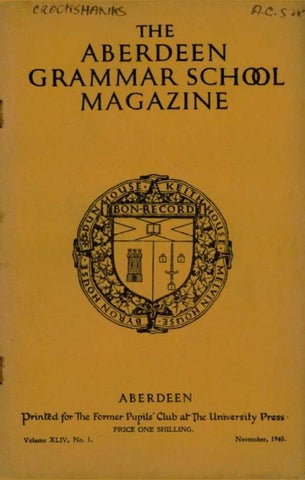
THE
ABERDEEN GRAMMAR SCHOU MAGAZINE .2 212
1
ABERDEEN
printlcl for The Former Pupils' Club at-The University Press PRICE ONE SHILLING.
Volume XLIV, No. 1.
November, 1940.
EDUCATIONAL BOOKS 1-€.>()‹.9"
JAMES G. BISSET
CONTINUES to supply all the Class Books (New or Second-hand) suited for the requirements of the Higher Educational Institutions in the City, at the Lowest Prices. N.B.—Best Value in Students' Note Boohj.
JAMES G. BISSET, Classical, Medical, and Educational
Bookseller,
85 BROAD STREET (Opposils Marischal Co!legs).
•
PHONE 753 •
GOOD HEALTH demands
GOOD BREAD For the children especially is it necessary to ensure their stamina and energy with good, wholesome, nourishing bread. In Hutchison's bread you'll find all these requirements are fully met. Phone or give instructions to have it supplied daily.
-
BRANCHES THROUGHOUT THE CITY
S
WATCHES FOR
ACTIVE SERVICE
STAINLESS STEEL CASES specially constructed for SEVERE
CONDITIONS and
Mechanism of exceptional accuracy and
We
have a
very
durability
large
Stock,
and
each Watch has been carefully tested
A. & J. SMITH 191 UNION STREET
ABERDEEN
tittles Have just what you are looking for. Something to wear that is well cut, smart, and practical and not too expensive. -
SUITS TRAVEL COATS MODEL COATS FROCKS DRESSES GOWNS FUR COATS
Sizes to fit all figures from 36" hip to 56" hip.
A. C. LITTLE & SONS, LTD. 105
UNION STREET
•
ABERDEEN
ICE SKATES and SKATING BOOTS STOCKS STILL AVAILABLE —AT PRE-TAX PRICE—
Campbell's Rubber Co., Ltd. 18 BRIDGE STREET
'Phone 157
-
-
-
t...
r-
- ape
-
tv
Itlezoton.rtaes,9(.6erciee/w xes-- SPECIALIST STAINED GLASS & MURAL DECO " ' aded4rW wen'
A. D. COPLAND. Phone 896.
For Better Footwear JAMES LORIMER & SON (BOOTMAKERS), LTD.
CIVIL and MILITARY BOOTMAKERS •
8 CHAPEL ST.
ABERDEEN
(Late of i62 Union Street)
Estd. A.D. 1844'
,
lo 4
COPLAND 13? DECORATOR - •
*Ja
'Phone 724.
Go to .
•
K EN NA \' of course RESTAURANT
I73 UNION STREET
Here you get the finest of food, daintily served, and at a reasonable price. The Restaurant is comfortable and commodious, and is just the place to entertain your friends. Our rooms are available for all types of functions. 'Phone 2371, and ask the Manageress for quotations
WM. KENNAWAY LTD. Quality
Bakers, Confectioners
and
Caterers, Aberdeen
Telephone No. 1891.
ARCHIBALD McKELLAR Family Grocer and Wine Merchant,
454-456 Union Street, Aberdeen. . .
Cooked
We Specialise in
. .
Gammons, Finest Belfast Smoked Hams, Wiltshire Bacon.
Medicinal Wines—Vibrona, Hall's, Wincarnis, Phosferine.
THE VALUE OF RECOMMENDATION " We have been recommended to you by Every day that phrase is being used by Customers on their first visit to our showrooms.
REASON-
THE
OUR STOCK is of good quality and our prices are reasonable. OUR SERVICE is of a personal nature and we study the requirements of every Customer.
SATISFACTION IS OUR AIM
ROBERTS (Abdn.) LTD. CABINETMAKERS AND UPHOLSTERERS
THE FURNISHING HOUSE OF ENTERPRISE
419 UNION STREET, ABERDEEN Telephone 2695
Established 1873
JAMES FYFE & SON PAINTERS AND GLAZIERS. .
.
•
OFFICE AND SHOWROOMS :-
11 DEE STREET, ABERDEEN. Telephone 304.
Telegrams--" Fyfe, Painters."
• It's an economy and a convenience to register with ALEXANDER . . . for your Butcher Meat, Bacon and Cooking Fats. You can then be certain of supplies of FISH and POULTRY—and you can place your order for all these food stuffs either in person or at the cost of only one 'phone call. The 'phone No. is 5172
A. Ai W. ALIEXANIDEU FISH, GAME AND MEAT MERCHANTS
492 UNION STREET
•
DAIRY : ABERDEEN Tel. 1215, 7o13, 7014
+
ABERDEEN
FARM: CULTER Tel. 6
KENNERTY FARM
DAIRY •
WILLIAM REITH Sole Proprietor : JOHN REITH •
46-48 ROSE STREET, ABERDEEN
CONTENTS ILLUSTRATIONS. Squadron Leader Alan Milne Scott . . . Duxes 187O : 1887 : 194O . Popocatcpetl—Four Views .
AO
✓
.
•
•
•
•
•
•
. Facing page 34 . 35 3, • • . Facing pages 58, 59
. Page 1 . . • . A Message to Former Pupils . . . . . 3 Hendrick PP A. C. Major By Wedding. A Sikh . . . 9 . PP . . " Shackleton's Boat Journey " . . . ,, 10 . . . . Notes About Old Boys . . ,,, 23 • • . . • • . • Marriages . „ 26 . . . . . . . The Admiral of the Fleet . • ,. 27 . • . . Obituary . . . • . . m 31 The Aberdeen University Bursary Competition . . . . . ,.. 32 . Pro Patria Mortui, with four Portraits . . . 35 . PP • • • • The Dux of 187O . . . . ,, 37 Roll of F.P. War Service, Second Instalment . . . . ,,, 46 Masters on War Service. Prisoners of War . . • . ,, 47 Missing. F.P. Club Consuls' War Help . . >. 48 The Vichy that I Knew. By Dr. Alexander A. Cormack . . . 54 . PP . . . The Shanghai Clock in Danger . . . . ,. 55 Popocatepetl. By Major J. Cooper Clark • ,, 58 • • • . . A Byron Relic Impressions of " Non-Belligerent" Italy. By the Right Rev. . . ., 59 Monsignor Clapperton, D.D. . School Section— „ 64 . • • . • . School Notes . . 70 . Pr Forestry Camping in Glenmuick „ 72 • My Air-Raid Experiences. By James Grant 74 . Down on the Farm. By C. Milne . 7 6 PP School Sport in War-Time. By A. J. M. E. • PP 7 8 . . . First XV Matches . 81 • OP • . • • • • . House Notes . Cross-Country Running. The Literary and Debating Society PP 82 The Dramatic Society. The Scientific and Photographic • • • • 84 • Club. The Gramophone Club . 8 5 PI . . . Notes . Scout The Former Pupils' Club— . F.P.s in Shanghai . . List of Club Consuls The Club Boarding House . . Rugby Section . . Cricket Section List of New Members .
•
•
•
•
•
•
•
•
•
•
•
•
•
•
•
•
•
•
•
•
•
•
•
•
•
•
•
•
PI
•
•
•
•
•
•
PP
88
•
•
•
•
•
•
•
•
•
•
•
•
•
•
•
•
•
•
•
•
•
•
•
•
• • „ $,
9O 91 93 94
8 7
WINDSOR WOOLIES for Kiddies
-, . .
..‘ -
Illustrated are two suits from a large range of styles
) l
-
Pr
/
titt, "FREDDIE" BUSTER SUIT Detachable Knickers to button on. Collar stitched flat. Zip fastener. Novel arrangement of stripes. Sizes 16, 18, 20, 22 in. length. Short or Long Sleeves, from
16 '6
" BRIAN " BUSTER SUIT
.),
/
Detachable Knickers. A serviceable suit in fine Merino yarn, Stitched collar. Zip fastener. Sizes 16 to 22 in. length. Long or Short Sleeves, from - -
19 6
In our Boys' section you can always be sure of finding a good selection of woollens— WOLSEY JERSEYS, WITH TIES 7/II BRAEMAR JERSEYS - - from II/6
ESSLEMONT & MACINTOSH LIMITED UNION
STREET
ABERDEEN
INSIDE INFORMATION • •
A WAR CABINET IN EVERY AIR-RAID SHELTER
• A
tin of our Ginger
Snap,,
will make an excellent Prime Minister of biscuits. They will help you snap your fingers at the "Blitz."
.
•
•
W. M. McPHERSON BAKER and CONFECTIONER
15 FOUNTAINHALL ROAD ABERDEEN
Established 1843
STRACHAN
WM. CAY & SONS
COMMERCIAL
(FUNERAL DIRECTORS) LIMITED
&
415 UNION STREET
PORTRAITURE
and
209 GEORGE STREET,
PHOTOGRAPHY
ABERDEEN
• Telephone 851
All Funeral Requisites Supplied
•
Cremations Arranged
416 UNION STREET Telegrams—"Cay, Telephone
Aberdeen."
ABERDEEN
Noe. 92 and 54.
Telephone: 8811-2
Telegrams : 'Blake Builders'
JI AM IES IU ILA Contractors
23, 25, 29 SUMMER STREET, ABERDEEN All classes of Building Joinery Enquiries courteously solicited ESTAOLISHEO I B I 8 HIS MAJESTY THE KING. DATED 1ST JULY 194o
APPOINTED MEAT PURVEYORS AND POULTERERS TO
J. WILLIAMSON & SON 1w. B. WILLIAMSON. PROPRIETOR)
Meat Purveyors and Poulterers 1, 2, cfr. 3 MARKET BUILDINGS, ABERDEEN 'PHONE 452 BRANCHES I
35 FOUNTAINHALL ROAD 'PHONE 1724
ALSO AT CHURCH SQUARE. BALLATER.
THE SQUARE. CULTS 'Nom. CULTS 2 'PHONE 38
YES, I STILL HAVE THEM
DRAWING
C• Cs•
INSTRUMENTS
Typewriters, large and small. Desks, Chairs, and other items of Office Furniture. It's not so easy to give bargains nowadays, but whiles it's wonderful what one can do.
PAPER COLOURS
Even with Purchase Tax added, the famous Imperial Portable Typewriter Its. 0d. only costs 52,- of that is a Hit at Hitler. One gets a little bit of a kick out of that.
BRUSHES
You can get literary, scientific, medical, mathematical, or Continental keyboards.
at
EASY DEFERRED PAYMENTS ON ANYTHING
""C,ctylors'
'Phone 505 or come along and
49-51 Scboolbill
C. H. WEBSTER 489 Union Street, Aberdeen
see me:
'Phone 2870
Nit ageo fog Ri ENGAGEMENT RINGS are our speciality. will
Our large selection
make your choice an easy one
Prices to suit all
£5 to
£150 Telephone :
I2I9
lamiesetn, 4 Cavul atchmakers.
Jewellers
and
Silversmiths
142 UNION STREET - Next Union Bri• •
-
Modern Designs
4
C
Established
Assets
L26,893,400
1836
Northern Assurance Company Limited •
•
FOR ALL CLASSES OF INSURANCE •
•
LIFE ASSURANCE BRANCH The Company's tables of rates for Life Assurance include every class of Policy SPECIAL LEAFLETS ON-
The " Optional " Policy The Educational Endowment Policy Child's Deferred Assurance Policy Death Duties Policy Life Annuities
CHIEF OFFICES:
ABERDEEN . . LONDON
1 UNION TERRACE 1 MOORGATE, E.C. z
Branches and Agencies throughout the World
YES, I STILL HAVE THEM
DRAWING
-
INSTRUMENTS
Typewriters, large and small. Desks, Chairs, and other items of Office Furniture. It's not so easy to give bargains nowadays, but whiles it's wonderful what one can do.
PAPER COLOURS
Even with Purchase Tax added, the famous Imperial Portable Typewriter only costs £14 12s. Od.
&
52,- of that is a Hit at Hitler. One gets a little bit of a kick out of that.
BRUSHES
You can get literary, scientific, medical. mathematical, or Continental keyboards.
at
EASY DEFERRED PAYMENTS ON ANYTHING
-.Nor
Octylors
'Phone 505 or come along and see me:
9
C. H. WEBSTER
49-51 Scboolbill
489 Union Street, Aberdeen
'Phone 2870
Engagement Rings ENGAGEMENT RINGS are our speciality.
Our large selection
will make your choice an easy one
Prices to suit all
£5 to
£150 Telephone:
I2I9
Itunicson si C44,4 atchmakers,
Jewellers
and
Silversmiths
14 2 UNION STREET - Next Uninn
-
Modern Designs
Perseverance PERSEVERANCE is the determination to carry on in the face of difficulties and discouragements and to overcome them in the end. At the present time we are faced with great difficulties and many discouragements, but we are determined to carry on and give our customers—as far as in us lies—the same service which has been a feature of our business for nearly a hundred years.
J. & A. OGILVIE 369 UNION STREET ABERDEEN Telegrams : " Interiors "
Telephone No. 433
Your Happiest Hours are spent at your own fireside, and the choice of your Fireplace deserves the utmost consideration. From the range of Modern and Period Fireplace Arrangements we are showing, you will find it easy to to select exactly the style you desire.
James Scott & Son (Aberdeen) Ltd. 483-485 UNION STREET ABERDEEN Phone 1881-2
•
1
1
,
_
:20 1I 1
-‘ 4343, i 1
"BUSINESS IS SERVICE" That's the guiding principle of Collie's of Aberdeen. To bring together the finest possible selection of quality goods, display them conveniently, and offer them at reasonable prices, combined with unobtrusively courteous service—these are the things that make shopping at Collie's of Aberdeen so pleasant and satisfactory. In peace or war, this famous shopping centre will hold fast to the sentimental maxim that " Business is Service."
Gee& fibzez FAMILY GROCERS AND WINE MERCHANTS
269-271 UNION
STREET
-4
ABERDEEN
Telephones: CENTRAL 4800 (4 lines) Branch Shops at CULTS, BALLATER, and BRAEMAR Telephones : Cults 28; Ballater 14; Braemar 212
•
0
0
Established 1836
Assets
£z6,895.400
Northern Assurance Company Limited •
•
FOR ALL CLASSES OF INSURANCE •
•
LIFE ASSURANCE BRANCH The Company's tables of rates for Life Assurance include every class of Policy SPECIAL LEAFLETS ON-
The " Optional " Policy The Educational Endowment Policy Child's Deferred Assurance Policy Death Duties Policy Life Annuities
CHIEF OFFICES:
ABERDEEN . LONDON .
1 UNION TERRACE i MOORGATE, E.C. a
Branches and Agencies throughout the World
Aberdeen Grammar School Magazine 56th year: No. 146 (New Series, 47th year, No. 1 37)
NOVEMBER 1940
Vol. XLIV
=
No. x
The "Grammar School Magazine" is issued under the auspices of The Former Pupils' Club, in March, June, and November. All communications with regard to the " Magazine" should be addressed to the Editor (the Secretary and Treasurer of the Club), THEODORE WATT, M.A., LL.D., The University Press, 6 Upper Kirkgate, Aberdeen.
-
A Message to Former Pupils. It will be recalled that last session School attendance was on a basis of three full days per week. A different principle has been adopted this session. We meet six days per week, 4i hours per day, morning one month, afternoon the next. Classes IV, V, VI have additional instruction in a group of huts transferred from the High School and erected in the field which adjoins the Gymnasium. The new arrangement is an improvement on the old, particularly for the younger boys and, if circumstances permit its continuance, there should be little reason for complaint. To all intents and purposes, we are operating on a full pre-war week. For the older boys and the members of the Staff, the summer vacation was a period of fairly intensive effort in the national cause. The Forestry Camp at Ballater had fortnightly relays of boys and Masters, and their work earned high and wellmerited commendation. Other boys lent a helping hand to farmers, but the re-opening of the School ruled out the possibility of assistance at harvest time on any serious scale. We lost a good many of our younger pupils through evacuation. Some have joined their parents abroad. In other cases parents have taken houses in the country and the boys attend the local schools. Hardly any advantage was taken of the Government's Overseas Evacuation Scheme. As things have turned out, there has been nothing to justify withdrawal. Indeed it is surprising how normal the life of the School has been this session. School Societies such as the " Debater " and the Dramatic, which were in abeyance last year, have resumed their activities. Games are carried on much as usual and a
a
Aberdeen Grammar School Magazine
few " away " fixtures—Strathallan, Glenalmond, Glasgow Academy—have added the spice of interest which is lacking in local matches. We are glad to see our Games Master from time to time. He looks very fit and his rapid promotion in the Army has not come as a surprise. The problem of staffing becomes more acute as the months go by. Seven of our Masters are in the Services. Others have registered and are liable to be called up at any time. It is almost impossible to secure men with suitable qualifications and we have had to requisition the services of the other sex. It is only fair to add that, so far, the ladies have proved efficient substitutes. One of our Masters, Lieut. J. S. McPherson, is a prisoner of war : so also is our erstwhile Physical Instructor, Capt. Lawrie. School, as every F.P. knows, possesses an excellent Library. Strangely enough, it has been left to this, the second year of the war, to witness a notable expansion of its contents. The explanation is that substantial grants of a non-recurring kind have come our way, and most departments of the reference section have benefited. The collection of authoritative books on History is unusually good, and a sound foundation has been laid in the departments of Mathematics, Science, Art, and Music. Gifts of suitable works of fiction, travel, biography, for the lending section are always welcomed. We lost a generous donor in the late Mr. Louis Wilson. It may be remarked in passing that the more valuable books from the old library have been removed for safe custody along with portraits, trophies, and documents of historical interest. There is little to add to what I said in a previous issue of the Magazine about the measures which have been taken for the protection of the School. Four additional surface shelters have been built—two in the Infants' playground and two near the Westfield buildings. All the windows of the School have been covered with lace mesh, and the screening of lights to conform with black-out regulations has, at long last, been made effective. So far we have not been tested under actual air-raid conditions. If, at any time, we are compelled to spend an hour or two in the trenches, it is comforting to know that a thoughtful Education Committee has provided us with iron rations in the form of barley sugar and Abernethy biscuits. We have had quite a number of visits this term from F.P.s on leave. Such visits are greatly appreciated and may be made at any hour when School is in session. The one unpardonable offence is to depart without signing the Visitors' Book. Meantime, good luck to you all and as happy a Christmas as the times permit 1 D. M. A. 18th November 1940.
Aberdeen Grammar School Magazine
3
A Sikh Wedding.
• *
[Major C. A. Hendrick is Military Adviser in one of the less known Indian Slates. It is a Sikh State in the Punjab, of something over 1,200 square miles in area. The ruling family and a large part of the population are Sikhs. Major Hendrick is the only European in the place where he lives and was the only European present at the wedding. " The Book" referred to several times is The Holy Book of the Sikhs.—Ed. A.G.S. Mag.] Well, the wedding is over and it was a wonderful business, a mixture of interest and boredom. On Friday afternoon I was fetched in a car to the bridegroom's house, where we all collected and hung around waiting for him to be suitably garbed and, I expect, prayed over. All the time, children, followers, women, beggars, and sweepers were swarming around and doing as they liked. The verandah was full of dirty yelling brats, while presently M--, the bridegroom, came out. He wore a gold coat, orange pagri, white trousers, shoes like a lady's, and carried a gold sword. He had to continue carrying this sword afterwards for identification. He also had a gold frill over his face, which he wore at all the functions till after he was married, to keep off the evil eye. Nowadays, it is only used for distinction as, except for the old women, the evil-eye idea has been given up. We drove in a procession of cars, headed by the Regimental Pipe Band, through the lines to the main road, where the band got in a lorry and we all pushed off to the bride's village, about ten miles away. Of course we got lost, but a local fellow directed us back to the track. Our guide's car had broken down, hence the loss of our way. Outside the village we halted and waited for the band's lorry to arrive. Various other cars from other directions joined us here, also a few guests on camels, horses, etc. We were all the bridegroom's party, called " Baraat." When the band came up, we again processed round and through the village. I changed cars, as I was invited to perform the chief ceremony of chucking money to the people. It was great fun. I got a big bag of pies and annas and chucked handfuls to the crowd. What a scramble! One had to be careful where one threw the coins so as not to bring them too near the cars. Men, women, and children were scrambling, yelling, and fighting. Eventually we got through and came to our camp in an orchard, where the bride's party met us, and took us to tea in the summerhouse. Only we could take tea. The bride's party had to wait on us. This was about 5 p.m. I was introduced to the bride's party, though I knew most of them. The bridegroom's father being dead, his brother-in-law was the senior member of the bridegroom's party. We whiled away the time talking and drinking. Then there was a formal dinner at the bride's home, men only of course,
4
Aberdeen Grammar School Magazine
but the bride's female relations were there in mass on the roof. Their job was to hurl abuse at the bridegroom's party. I took Indian dinner but had my own as well, my bearer having come to do my cooking. Again the bride's party had to feed us, but were not allowed to sit with us, though the bridegroom's party, who were all keen to do away with silly old customs, tried them hard to join. I forgot to say we had to go to and from every meal in procession headed by the pipes and led by the bridegroom and his " best man ". The actual marriage was to take place at 4.45 a.m. next morning, being supposed to be completed before sunrise. I got up at 4 a.m. and found everyone fast asleep. However, as they were mostly Sikhs and had not to shave, I thought they were not getting up earlier than was necessary. At 4.45 I was dressed and ready, and came out of my tent to find them all still asleep. I woke them up and they roared with laughter to find me the only one up. Then they only sat and talked. Eventually we got moving at 6. The ceremony was held in the inner court, converted into a temple—shoes off, of course, and hats on, as " The Book " was there. Then we had to wait nearly 4o minutes while they went through the morning prayer. I sat amongst the bridegroom's party, cross-legged on the floor, the bridegroom's party on one side, the bride's party on the other, the bridegroom in front, in centre, in his gold coat and face fringe. After the prayer the priest gave a lecture on the duties of marriage, etc., just as our padre would, and in much the same terms. Then a sheet was draped wide round the bridegroom and " The Book," about 4 feet high, held up all round by the bride's party. The ceremony then took place inside this, the bride having come in from the women's room, which opened on to the court but was screened off from male gaze. The sheet was to prevent the bridegroom's party from seeing the girl or the ceremony. Only the bride's party were allowed to look on. The bride and bridegroom were supposed to circle " The Book " four times at intervals during the ceremony, and we outside flung rose petals over them each turn. As we were squatting on the floor most of the petals never went over the sheet at all. There was lots of laughing and joking, and actually the General took the opportunity of introducing me to my nearest neighbours. After that the bride slipped out and the sheet was removed. There were more prayers. Prayers consist of the band, a drum, and a box harmonium, with singing and an occasional, very occasional, response by the congregation. Then there was the usual distribution of kara prashad, a sort of sweet porridge. The priest gives each person a lump in his hand. Then the show was over and there was the procession back. I had my " brekker," and the bridegroom was carted off to meet his new female relations. This is an ordeal, as they try
Aberdeen Grammar School Magazine
5
to pull his leg, it seems. They, for instance, produced a tray carefully covered over and told him to pay a rupee to see what it held. He did so and was told he must first make obeisance to it. He swears he refused, but the women swear he did it. Anyhow it contained a shoe. A terrible humiliation to bow to a shoe 1 Then I gather all the time they kept moving round him jabbing him with pins and so forth and so on. I was shown the bridegroom's presents to the bride—a complete set of gold jewellery, those head cups they wear, anklets, bracelets, ear-rings, forehead band, ring, watch, etc., etc. Then lunch. As before, only we ate and the women sat on the roofs and abused us. But this time I was warned to examine all the food carefully, as they would try and play tricks on us. Nothing out of the ordinary happened. In the afternoon the elect, i.e. The General, the brother-in-law and I had our beds taken into the summer-house and snoozed. Exceedingly hot! After tea we went to the bride's house and saw her trousseau: tot sets of clothes I more ornaments, silver tea sets, a silver ice-cream set, seven sets of bedding, i.e. silk pillows and quilts, and a complete kitchen set—some of the saris were marvellous, also the silk-embroidered shirts and trousers—thousands and thousands of rupees' worth—all the linen, the bedroom furniture —far more than she could use in ten years. I gather she will give half of it away. Then I was taken out quail-shooting. Of course, I had not anticipated shooting and had only store suitings, fancy shoes, and no gun, but I was given the last. Then dinner, but informal, i.e. no dressing up. This time they did play tricks on us. One sort of sweet was made of soap, country soap at that, and it had disastrous effects on the two who ate it, blistering their mouths. The potatoes had cotton wool mixed, the oranges had been injected with quinine. The spinach was grass, and so on. I refused Indian dinner. I got some abuse this time. While waiting for the procession to join, I was standing near the bridegroom's brother-in-law, the big noise of the party. The women suddenly sang, " Ohl you big fat buffalo " (the brotherin-law is a great fat big man). " Why is the Sahib here ? He is no relation of yours." The " big fat buffalo " promptly put his arms round me and, embracing me, replied, " That is how much of a relation he is I "—in other words, a brother's greeting, amidst shrieks of delight. All the abuse is leg-puffing and part of the show. It really means sorrow at the bride's being taken away from her village and friends, and abuse of the people taking her away. Well, we processed back. Old G-- (the brotherin-law) suddenly took the Drum Major's staff and started to do Drum Major. So I made all the officers who were there take the drums. Then we found the whole band was " tight." They had been given unlimited drink by the bride's party. After that we had a regular " guest night" band, officers
6
Aberdeen Grammar School Magazine
playing the drums, one even tried a bugle, but no one tried the pipes! Next morning there was nothing on, so we could sleep in. It was extraordinarily cold that night. I pulled on my only blanket and stuffed myself into my valise and was still cold. Of course I woke as usual at 6 a.m. and the others, being naturally early risers, were all awake. It seems my bearer brought my tea at 5, but someone else, seeing me asleep, " scoffed" it. I drank gallons to try and warm me up when I awoke. I went and sat with the General and his brother and son. There was an old man at the far end of the garden who had a voice like a bull—always roaring. He talked in a roar—a great big, blustering old boy. His chota bazri was a glass of whisky. They told me he drank two or three bottles a day. He once drank seven in 48 hours, " all to his own throat." He was over 7o and as hale and hearty and active as could be. They called him over and introduced him. Of course he brought his bottle and tried hard to make us all have a dram—especially me. He was as bald as a coot, in spite of being a Sikh. As one chap said, he was a relic of the ancient Sikh soldiery (he was pensioner Colonel of the 2nd Line). He reminded me exactly of the old roistering mercenary soldier one reads of in Sabatini's books. He had finished half the bottle before he left. Lunch was served as usual at the bride's home and, as before, there was " tampering" with the food and abuse from the females. After the marriage the bridegroom had to send up the first dish of everything to the bride, and I noticed a few rupees were always put on the tray. The bridegroom " blubbed" that morning. One of the bride's party suddenly arrived and presented him with a ring from the bride and reproaches that he had not sent her one. He got a terrible telling-off from the General and the brother-in-law. Apparently he should have sent her one, but either forgot or did not know about this. After lunch we all dossed down in the summer-house again and were up and ready to start on the homeward journey by 3 p.m. However, everyone was late once more. I gather this was chiefly due to the bride's being in tears and not wanting to go. Eventually at 4 p.m. we went to the village and sat in chairs waiting for the bridegroom and bride to come out. They came in their decorated car. I cinemaed for all I was worth, but the crowd and the dust were so awful, I doubt if much will come out. The bride, of course, was heavily covered up. Again there was the money-throwing to the crowd and the scramble. Then we drove off, headed by the pipes till out of the village, and made for Sangrur. We collected outside the lines and again processed, complete with band, to the house. There all the bridegroom's female relations were collected to greet the bride (it seems none of them are allowed to attend the wedding).
Aberdeen Grammar School Magazine
t *
7
Fearful giggling and squealing and kissing and hugging! Then the bridegroom had to carry the bride inside. All the males remained outside and had tea. All sorts of ceremonies went on in the house, I gather. Presently, with the usual bell-ringing, " The Book " and Priest came out and went back to the Temple, so there must have been some sort of religious ceremony too. It seems the bride has all sorts of trials to go through to prove she is a good wife and housekeeper. One or two I was told about. She has to load up and carry a thal, i.e. brass tray with all the little brass dishes of food, to ma-in-law and must not spill or make any noise. Another one is, she has to carry a brass tray on her head while the sisters-in-law load it with stones and all sorts of comic stunts. They may not have done all these, as the bridegroom's side seem to be rather advanced and eager to do away with silly practices. It would depend on ma-in-law, and the old women are often sticklers for ancient etiquette. I left after tea and went back to the guest-house, jolly glad to get a proper bath, decent meal, and decent sleep. Now there are umpteen parties to be gone through. Last night a big dinner at the General's house-3o people. We dined outside on the lawn and after dinner I showed the cinema by special request. All the women were there, un-purdah, including the bride, Mrs. General, the bridegroom's three sisters, General's brother's wife, etc., Judge's wife, Collector's wife (the Eurasian)—about ten women all told. The bride was very, very shy and demure—quite a pretty little thing. She is an educated girl and I gather it is a case of a love marriage—not an arranged one. She was a great friend of the bridegroom's sisters and niece of the General and the Major, so the bridegroom had seen and met her before. Wonderful saris! The bride wore a gold browband and large pendant hanging down her forehead; a flame and gold sari. I sat between the Eurasian, whom I already knew, and the General's son. They explained and apologized that I had to be put low down the scale, as the rules required relations to be put in certain places. After dinner they started speechifying and suddenly called on me. Before me the ex-Judge had waffled highfalutin nonsense for ages, so I just said I couldn't compete with the " magnificent efforts " made before, and gave the happy pair my blessings. To-day there is a tea party at the General's brother's house and a dinner party at G-- Singh's, the brother-in-law's house. 1 shall have to give them a party too. Now there is a lull in the proceedings, as the bride has gone back to her family for a few days according to custom. On her return, I understand, festivities will recommence, in milder form. I have attended two dinners and two tea parties since the return of the wedding party. All the functions are exactly the same— the same people go, the same procedure, and to me the food
8
Aberdeen Grammar School Magazine
seems the same, though they say it is quite different. It is so spiced that it tastes the same to me. At a tea party—held outside, of course—we all sit in a circle with small tea tables between every two or three guests. A sing-song party squats in the middle and squalls. All the neighbourhood squats around in an outer circle—I mean to say all the servants and their families and probably any stray passer-by. All the car-drivers— probably the Mali and his bullocks—will join the outer circle and gape. A few pidogs too will snoop around for scraps. Tea is brought, and if they are modern and up-to-date hosts, the napkins are removed from the tables so that the flies can have first pick. Tea is a tremendous meal. One generally starts with the sweetest thing, i.e. either Indian sweets or highly coloured iced cakes. It is correct to fill your plate up with as many as it will hold from plates on the tables, and all the time there is a procession of servants or hosts passing round with more. Then one descends to sandwiches. They come round long before you have finished the six or eight sticky cakes you started with. You add egg or meat or paste or lettuce or tomato sandwiches to the cakes, or on your lap, or just stuff them into your mouth out of the way. Then a procession of Indian dishes, such as roast wheat, well seasoned with red pepper, potato chips done in batter, fried cucumber in batter, meat patties, all with a good seasoning of spices. This goes on for at least an hour. Most of them realize now that I can't compete, and also that I like tea not dish water. Most of the Sikhs like good strong tea, but Hindus take tea like slightly coloured hot water, with seven parts milk and perhaps four to six spoonfuls of sugar. One competes with the flies over the food and with the " band " in the matter of conversation. The women arc, of course, a sight to see—the saris and colours, wonderful! At yesterday's tea some of the women wore trousers and shirts—very much like beach pyjamas. Mrs. General, for instance, had them on—very dark magenta—straight like pipes —satin with gold embroidery at the foot, a long shirt of the same and a thin silk head shawl and sort of beach sandals. The bride had the same, only hers were flame-colour and gold. Another dame had a yellow sari with coloured and sequin flowers. Another black and gold, yet another chiefly red and brown, another pale turquoise blue and silver. They all wear their hair in pigtails. They seldom do it up on the head. A dinner party is more or less on the same lines as our own. They generally have soup, fish, then an Indian dish—a large brass tray for each person with eight or twelve little brass bowls containing all sorts of things—meat, vegetables, sour milk, sweets, lentil mash, a small jid of some sort of chutney—generally spinach and two or three kinds of chupattis, greasy ones and dry ones and a special hard, crisp one. You eat by tearing off
Aberdeen Grammar School Magazine
9
a bit of chupatti and picking up in it whatever you select. No forks and knives. Servants run round all the time chucking more chupattis on your tray. They eat large quantities of them —say eight or a dozen. Then pudding, either English or Indian. Indian ones are nearly always a very sweet compound of milk and nuts or rice, with a sheet of very, very fine silver on top, which you eat. They say it is real silver. After dinner there is just talk and the inevitable " hand." C. A. HENDRICK (1906-I5).
" Shackleton's Boat Journey." This is the title of a small book by Commander F. A. Worsley, recently published at the price of zs. 6d. by Hodder & Stoughton. It tells the story of how the members of the Shackleton Imperial Trans-Antarctic Expedition of 1914-16 after their ship, the Endurance, sank—crushed by ice in latitude 69 S.—made their way in three small boats through the icc-floes to Elephant Island, from which they were subsequently rescued through the daring and determination of Shackleton. The book is of special interest to the Grammar School, an F.P., ROBERT SELBIE CLARK 1894-190I), M.A., D.Sc., was as biologist to the Expedition, and was one of the party cf 1z, under the leadership of Mr. Frank Wild, who were marooned on Elephant Island from April to the end of August 1916. The story has been described as a great drama, in that the difficulties overcome arrange themselves in a crescendo. In Act I the crushed ship sinks under the ice, and the obvious assumption is that the z8 members of the ship's company will freeze to death on an ice-floe. In Act II the ice-slab on which they have salvaged so much of their equipment creeps boo miles northwards in five months before cracking. In Act III they force their way in three boats to Elephant Island, sixty miles away, and they must perish there unless help comes soon. In Act IV Shackleton and five picked men in the stoutest of the boats fight hurricanes for fifteen days before beaching her on the uninhabited side of South Georgia. Three of the six dare the crossing of the intervening mountain ridge, and Act V ends with their reception at the end of a 36-hours march by hospitable Norwegians. For Epilogue there is the rescue by Shackleton of all the marooned men. The story is told in a racy style, as witness the following about the company on their ice-floe :— To prevent boredom, Micky told us how to make eleven varieties of cocktails, with scandalous names for each. He also sang songs and told tales hot enough to keep the cold out. To crown all, Bob Clark made a joke—I think it was about the killer whales blowing us up. We amused ourselves so well till dawn that, in spite of 24° of frost, we almost imagined we were at a picnic.
To
Aberdeen Grammar School Magazine
*.* The Editor is glad at all times to receive from any quarter items of information for this section of the " Magazine."
The dates given in parentheses after names indicate the sessions of attendance at the School.
Service Decorations. George Alexander Ledingham* (1894-1905), M.C., T.D., Lieut.-Colonel, Royal Artillery (T.A.), was in August appointed a Companion of the Distinguished Service Order (D.S.O.). In the last war he served as a Major in the Royal Engineers (T.F.), and was awarded the Military Cross in June 1915. Douglas William Gordon (1908-09), Major, Gordon Highlanders, who was killed in action in France in June 1940, was in July posthumously appointed an Officer of the Order of the British Empire (Military Division). As recorded in the last issue of the Magazine he became in 1938 Military Assistant to the Chief of the Imperial General Staff, Lord Gort. Stuart Auldjo Middleton* (1918-29), Flight-Lieutenant, Royal Air Force, was in October awarded the Distinguished Flying Cross (D.F.C.). I-le is sole partner in the firm of R. L. J. Henderson and Middleton, chartered accountants, Aberdeen. He took up flying as a pastime before the war, and on the outbreak of hostilities was commissioned in the R.A.F. MENTIONED IN DISPATCHES.
Alan Flockhart Esson* (1929-34), Midshipman, R.N. R., was " mentioned " for gallantry in action during the evacuation of the B.E.F. at Dunkirk. He is the youngest son of Lieut.Commander GEORGE FoRBEs EsSON (1 8 94-1903) and was trained in H.M.S. Conway. Patrick Taldo Pirie (1906-07), M.C., Major, The Gordon Highlanders (a son of the late Captain Duncan Vernon Pink, M.P.), was " mentioned " in July, in recognition of distinguished services. He has been an officer in the Gordons since receiving his commission as a znd Lieutenant on 4th August 5914. In the last war he was twice " mentioned," and received the Military Cross in June 1919. * Members of Former Pupils' Club.
Aberdeen Grammar School Magazine
II
Sir Henry Alexander (1881-91), M.A., LL.D., who died on 7th April 1940, left net heritable and movable estate • amounting to £69,360. Among his public bequests was one of £100 to Aberdeen University to be added to the fund for the establishment of a residence for students. William McCombie Alexander* (1887-96), M.A., B.L., who has an extensive knowledge of Continental languages, is at present engaged in postal censorship work. Francis Sheed Anderson* (1909-12) has been appointed Aberdeen and North-East of Scotland Divisional Food Officer as from 1st December. He was appointed Assistant Divisional Officer for Distribution in May 1938, when the scheme for the control of food in time of war was introduced by the Government. In May of this year he was promoted to be Deputy Divisional Food Officer. He is head of the firm of Messrs. Anderson Brothers, granite merchants, Aberdeen. Ian Alfred Anderson* (1912-24), B.Sc., M.B., Ch.B., is joint author with Professor L. S. P. Davidson, Edinburgh, of "A Textbook of Dietetics," recently published by Hamish Hamilton. In nineteen chapters it surveys the national diet and national nutrition at different income levels, the physiological requirements of nutrition, diet in health and in periods of stress, and dietetic treatment in established disease. There is a foreword by Sir John Boyd Orr. George Alexander Angus (1893-94), branch manager of the Commercial Union Assurance Co. Ltd. for the North of Scotland district, has retired after 46 years' insurance service. THREE BROTHERS COMMISSIONED IN SAME UNIT.
John W. L. Bain* (1915-22), Logie S. Bain* (19T9-31), and Alexander A. N. Bain* (1916-29), who are all graduates in Medicine of Aberdeen University, are respectively Major, Captain, and Lieutenant in the same unit of the R.A.M.C., at present serving in Egypt. This must surely be a unique family occurrence. Robert W. I. Band* (1924-26), M.A., of the Malayan Civil Service, who was formerly stationed on Christmas Island, Straits Settlements, returned there in June of this year as District Officer. Although he is a member of the Singapore Volunteer Corps, his sojourn in his present lonely outpost prevents his attending any Volunteer parades. George Hazelwood Barron* (1920-28), who served his apprenticeship as a compositor in Aberdeen and then qualified as a linotype operator in London, is an operator on the staff of the Star newspaper in Johannesburg. He is at present serving as a Private with the Transvaal Scottish. Colin Strachan Beattie* (1931-40) is serving his apprenticeship as a civil engineer with the Aberdeen County Council.
la
Aberdeen Grammar School Magazine
Walter George Swan Benzie* (1917-19), Acting Captain, Royal Tank Regiment, has been seconded for a staff appointment as Assistant Inspector (Tanks), Mechanization Inspection Department. He has held a regular commission in the Tank Regiment since 1932. Charles Ogilvie Will Bowman* (1910-15), who was for a time the F.P. Club Consul for British Cameroons, West Africa, and for the last year or two has been in business in Brought• Ferry, has lately been working in postal and telegraphic censorship. In November he sailed for Bermuda to take up an appointment under the Ministry of Information. Alfred Gordon Cameron* (1923-34), who is assistant manager on the Telepara Tea Estate, Binnaguri, Dooars, India, at the last annual general meeting of the local European Club was elected Football Captain for the coming " rains," and a member of the " Talkie Committee," there being a full film programme screened once every week in the Club. He has been a mounted member of the local Volunteers since he went out. Last year his employers, the Singlo Tea Co., Ltd., intimated that a new junior assistant manager was being sent out for one of their estates in Assam, and this proved to be none other than Cameron's old classfellow at the School and companion in the Metropolitan Police Force, DOUGLAS Y. LOBBAN* (19 2 2-3 4). The Right Rev. Monsignor William Robert Clapperton* (1899-1901), M.A., Ph.D., D.D., who has been Rector of the Scots College at Rome since 1912, remained there until the students were forced to return to Scotland just before Italy entered the war. He also came back to Scotland, and almost immediately afterwards was appointed to the charge of the Church of Our Lady of Mount Carmel at Banff. He was made a Privy Chamberlain to the Pope in 1920 and a Domestic Prelate in 19z3. He has meantime had to give up the post of F.P. Club Consul for Italy, but his continued interest in the School and the Club is shown by the article which he has very kindly written for this issue of the Magazine. James Cooper Clark* (1894-96), who is a recognized authority on early Mexican civilization and the editor and translator of " Codex Mendoza," has now turned his attention to Java, the Buddhist antiquities of which he is investigating in the light of a visit he paid to them a good many years ago. During one of his visits to Mexico he climbed the famous volcano Popocatepetl, and he, too, has been good enough to contribute an account of the expedition to this issue. F.P.s ON THE PINNACLES OF THE WORLD.
In connection with Major Cooper Clark's article, it will be of interest to recall that accounts of expeditions by F.P.s to
Aberdeen Grammar School Magazine
13
other famous mountains have appeared from time to time in the Magazine. The School's greatest mountain-climber was the late ALEXANDER M. KELLAS (1881-84), D.Sc., who took part in various Himalayan expeditions. In 1911 he ascended Mount Pawhurni (23,180 feet) in Northern Sikkim, and in 1920 he reached a height of over 23,500 feet on Mount Kamet in Garhwal. In the following year he was a member of the expedition to Mount Everest, and died suddenly from heart failure at Kampa Dzong, Tibet, on 5th June 192,1. Some years later a peak in the Himalayas of about zz,ooo feet was named Kellas Peak, and a neighbouring col was named Kellas Col, " in honour of the great Himalayan mountaineer, who, without any European companion, did magnificent work in the Himalayas, particularly in finding the route to this col." To the Magazine of November 1932 Surgeon LieutenantCommander ERNEsT R. SORLEY* (1906-18), R.N., contributed an account of " An Assault upon Kilimanjaro," the highest peak in all Africa—which rises to 19,700 feet in Tanganyika Territory. He himself had to be content with reaching 18,520 feet, but a companion and a guide got to within zoo feet of the coveted height. The next peak to be tackled was Fujiyama, the sacred mountain of Japan (12,395 feet), which was scaled by R. B. WHYTE MACKAY (1913-14), when Third Officer in the P. & O. R.M.S. Naldera—see the Magazine of March 1934. In March of this year JAMES S. ABERNETHY* (1924-26) contributed an account of his ascent of Mount Kinabalu in North Borneo, -which, with a height of about 13,500 feet, is the highest mountain east of the Himalayas. In June 1929 Dr. ARciiisALD C. IRvINE (1908-1o) gave an account of the first motor trip up the Kenya Mountain Road, planned to rise to within nearly 2,000 feet of Mount Kenya's summit at 17,040 feet. Robert Forbes Combe* (1923-30), B.L., a son of the late GEORGE A. COMBE ( I 889-95), C.M.G., and a nephew of the late Lieutenant ROBERT G. COMBE (1894-97), V.C., has recently become a member of the well-known firm of Messrs. Wink and ' Mackenzie, solicitors, Elgin. He is one of two Aberdeen international chess players, has been champion of the Bon-Accord Chess Club for a number of years, and was the highest ranking Scottish player at the last Scottish Chess Championship, where he was second equal with the British champion. When he graduated in Law at the University in 1936 he was the most distinguished student of his year. Norman Richard Corke (1896-1900) is one of a very small band of men who have volunteered for service in three major wars. In the South African War he was a Trooper in the Scottish Horse and was awarded the Medal with five bars ; in the Great War he was a Major in the Canadian Expeditionary
14
Aberdeen Grammar School Magazine
Force ; and in the present war he is a Lieutenant in the Royal Army Ordnance Corps. As he was only 16 when he went to South Africa, he is probably the youngest officer at present in the Army who served in the Boer War. He did not at first intend to take part in the present war, but feeling that it was going to be very serious and that there was a great need for engineers, he offered his services to and was accepted by the R.A.O.C. There were four Corke brothers at the School, and one of them, Guy—a B.A. of Cambridge—was killed on the Somme in 1916. Alastair Ogston Dickson* (1919-28), who is in the service of the Standard Bank of South Africa Ltd., is at present stationed at Blantyre, Nyasaland. Sydney Wardlaw Duguid* (1922-27), who was in the Civil Engineer-in-Chief's Department at Rosyth, has been transferred to Singapore. THE YOUNGEST SCOTTISH SHERIFF. James Lindsay Duncan* (1911-24), M.A., LL.B., Ph.D.,
was in October appointed to be Sheriff-Substitute of Ross, Cromarty, and Sutherland at Stornoway. Only 34 years of age, he is the youngest Sheriff-Substitute in Scotland. After graduating in Arts and Law at Aberdeen University, he was in 1931 awarded the Ph.D. degree in the Faculty of Law at Edinburgh University. He was called to the Scottish Bar in the same year, and has been in practice since then. Last year his new edition of " Glegg on Reparation" was published, and he has written extensively on other legal subjects. For some time he was an official reporter of cases in the First Division of the Court of Session, and also editor of the " Annual Digest of Cases." Sheriff Duncan was installed in his new office in October. Alexander William Duthie* (1910-11), who has been for a long time in the Administrator's Office, Cape Town, says there is tremendous enthusiasm for the Empire's cause out there. Thousands of the younger men have gone to Kenya, and great efforts have been made to raise funds for Spitfires and for air-raid relief in Britain. Walter Angus Elmslie* (1904-10) is a civil engineer in Admiralty service and has recently returned to Ceylon, where he had a previous spell. George Forbes Eason (1894-1903), who went to sea on leaving the School, is at present a Lieut.-Commander in the Royal Naval Reserve. In the last war he was a Lieutenant in the R.N.R., engaged in mine-sweeping operations from various ports in England and Scotland. He is the father of ALAN FLOCKHART ESSON* (1929-34), who is a midshipman in the R.N.R., and of STEPHEN GEORGE ESSON* (1929-34), who holds
Aberdeen Grammar School Magazine
15
a regular commission in the R.A.F. and is at present a prisoner of war. William John Strachan Ewan (1922-27), M.B., Ch.B., has been admitted a Member of the Royal College of Physicians, London. Adam Fyfe Findlay* (18 79-8 5 ), M.A., D.D., Professor of Christian Ethics and Practical Theology in the University of Aberdeen, has been re-appointed Dean of the Faculty of Divinity for the year 194o-41. Alexander Findlay* (1882-91), M.A., D.Sc., who was to retire from the chair of Chemistry at Aberdeen University on 3oth September 1940, is to continue at his post until such time as his successor is released from the duties he has undertaken for the Ministry of Supply. Alexander Forsyth* (1923-30), B.Sc., M.P.S., is at present Transport Liaison Officer, Molasses and Industrial Alcohol Control, Ministry of Supply. Archer Irvine-Fortescue* (1892-97), D.S.O., M.B., Ch.B., B.Com., Colonel, R.A.M.C.—the President of the F.P. Club— was for almost a year Deputy Director of Medical Services, Scottish Command, and is now President of the Standing Medical Board and acting as liaison medical officer with the Polish Forces. Rex Fowell* (1912-23), Captain, R.A., is a G.S.O. 3 with the British troops in Ireland. John Angus Fox* (1923-29) is at present on garrison duty in Iceland. James Gauld* (1923-34), M.B., Ch.B., is on the staff of Harlow Wood Orthopaedic Hospital near Mansfield, Notts. Charles Gillespie* (1910-18) is a professional actor, and not without honour in his native city. Some years ago he had a leading part in " White Horse Inn " when it visited Aberdeen, and recently, owing to the indisposition of Richard Tauber, he took the principal part in Lehar's operetta, " The Land of Smiles." John Hector Gray* (1917-29), M.A., LL.B., C.A., was in July awarded at Aberdeen University the Cruickshank Law Prize of the annual value of £120, tenable for two years. George Ian Griffiths* (1925-36), M.A., who is at present studying for the ministry of the Church of Scotland at Aberdeen University, has been appointed student assistant in Holburn West Church, Aberdeen. Hubert Douglas Henderson* (1901-04), M.A. (Cantab.), Research Fellow in Economics, All Souls College, Oxford, formerly Joint Secretary of the Economic Advisory Council, was in July appointed by the Chancellor of the Exchequer to be a member of a Consultative Council which is giving help
16
Aberdeen Grammar School Magazine
and advice upon the special problems which confront the Treasury as a consequence of war conditions. Another member of the Council is Mr. J. M. Keynes, like whom Mr. Henderson has come to be regarded as one of the leading economists in the country. Neil G. C. Hendry (1923 -25), M.B., Ch.B., was in July appointed Senior Casualty Officer at Woolmanhill, Aberdeen Royal Infirmary, for a period of twelve months. CHIEF MEDICAL OFFICER, MINISTRY OF HEALTH.
-
Sir William Wilson Jameson* (1892- 1902), M.A., M.D., LL.D., F.R.C.P. (Lond.), has been appointed Chief Medical Officer to the Ministry of Health and the Board of Education. He qualified at Aberdeen University in Arts in 1905 and in Medicine in 1909, receiving the M.D. degree three years later. Having taken the D.P.H. at London, he became Deputy Medical Officer of Health for the Metropolitan Boroughs of St. Marylebone and Stoke Newington, and then Medical Officer of Health and School Medical Officer for Hornsey and Finchley. Later he was appointed Medical Officer to the Secretary of State for the Colonies, Professor of Public Health in the University of London, and Dean of the London School of Hygiene and Tropical Medicine—posts which he now relinquishes. " The position now occupied by this School in medical education," said the British Medical Journal, " is in large measure due to the wisdom, energy, and foresight of Sir Wilson, and these same qualities may be confidently expected to make themselves felt in the Ministry of Health. The medical profession will give its whole-hearted approval to his appointment." In September, by an order of the Committee of the Privy Council, Sir Wilson was appointed a member of the Medical Research Council. Another F.P., ARTHUR LANDSBOROUGH THOMSON* (1899-1908), C.B., O.B.E., D.Sc., is the Principal Assistant Secretary of the Research Council. Herbert James Jones* (1902 -07) is Assistance Board District Officer, Inverness. John Laird* (1901-03), M.A., LL.D., F.B.A., Professor of Moral Philosophy in the University of Aberdeen, has resumed his Gifford Lectures in Glasgow University, the subject of the second series being " Mind and Deity." John Charles Ogg Lawrence* (1898- 99) holds an honorary post as a Sub-District Manager in the London area under the Ministry of Transport Petrol Rationing Scheme for Commercial Vehicles. Alexander E. Lee* (1884-90) recently retired from the English Co-operative Wholesale Society's soap works at Irlam, near Manchester, after 42 years' service. On leaving the School he started with Messrs. A. Ogston & Sons, soap manufacturers, Aberdeen.
Aberdeen Grammar Seho,91 Magazine
17
Alexander Low* (1883-86), M.A., M.D., LL.D., Emeritus Professor of Anatomy in the University of Aberdeen, was in July appointed by Admiral Sir Edward Evans, Rector of the University, as his Assessor on the University Court in succession to the late Sir HENRY ALEXANDER (1881-91). At the time of his retirement in 1938 Professor Low had been associated with the University as student and teacher for 52 years, and now he has entered on a further term of very welcome service. James Lumsden (1878-80), M.A., B.D., who has been minister of Ratho parish, Midlothian, since 1917, celebrated his ministerial jubilee in May of this year. He was ordained minister of the parish of Grange, Banffshire, in 1890, and was translated to the Tolbooth parish, Edinburgh, in 1909. He has for many years been closely associated with the Church of Scotland Committee on Christian Life and Social Work, being specially identified with the work of the Woman's Guild, and also with the care and direction of the Deaconess Rest Houses. Alastair David MacDonald* (1 9 z3-z5), M.A., who is a znd Lieutenant in the Army, last May " played himself in" as Organ Scholar at St. Catharine's College, Cambridge. He has been privileged to act as deputy and assistant to the Organist of Norwich Cathedral and latterly to the Organist of Truro Cathedral. John Macdonald* (19 r9-22), M.A., who was formerly one of H.M. Inspectors of Schools in Scotland, was in September of last year appointed Junior Assistant Secretary in the Scottish Education Department. Since November 1938 he has been seconded to the Department of Health for Scotland, Evacuation Division. Brian Walter Whyte Mackay* (1913- I 4 and 1922-25), who is now in the South African Air Force, writing in August said that in South Africa they were not feeling the war to any great extent, the only signs being the uniforms in the streets and the absence of young men in businesses and sports. Donald Hugh James Mackay (t 91 2-i 8), B.L. (Edin.), W.S., who in July 1939 was appointed Procurator-Fiscal Depute at Aberdeen, left the Fiscal's service in August of this year in order to engage in private legal practice. He has taken over the business of Messrs. Anderson & McArthur, solicitors, Stornoway. He entered the Fiscal's service in Glasgow in 1931 and was transferred to Edinburgh three years later. Edwin Salisbury MacLeod* (1881-89), O.B.E., R.D., Commander, Royal Naval Reserve (retired), who has been Principal District Officer in London for the Board of Trade, is now Assistant to the Professional Officer at the headquarters of the Ministry of Shipping.
18
Aberdeen Grammar School Magazine
Donald Graham McRobbie* (i921-33), M.B., Ch.B., was in October of last year appointed Junior Assistant Physician on the staff of the Royal Hospital for Sick Children, Yorkhill, Glasgow. He has recently received a commission in the R.A.M.C. Ernest Renan Mitchell* (x922-29), M.A., was for over two years English Master in the International School at Yokohama, Japan. In January of this year he was appointed English Master at the Cathedral School, Shanghai, China. George Wellington Moir* (1918-28), C.A., was on the staff in Paris of Messrs. Touche, Niven & Co., C.P.A. He was working in Brussels this year from ist April until the German invasion of Belgium, and returned to Paris on the day following the bombing of Brussels. He was arrested by the Belgian authorities as a suspect on the eve of the invasion, but was released 24 hours later through representations made by the British Consul. He volunteered in Paris on 21st May for service in the British Army, and has been training for a commission in the Royal Artillery. Eric Keir Morrison* (1922-32), M.A., teacher of modern languages, spent six months at Telephone House, Aberdeen, on special duties under the War Office. Latterly he has been in an " all ranks " Training Unit. Henry Knox Paterson* (1920-33), M.B., Ch.B., is at present in practice in North Shields, and his brother, Robert Edward Mitchell Paterson* (1919-32), M.B., Ch.B., is in practice at Burton-on-Trent. James Ogilvy Rae* (1912-21), who has been with the North British and Mercantile Insurance Co., Ltd., for a good many years, latterly at Calcutta, has left that Company's service for the duration of the war, as he has been selected to attend a course for a commission in the Indian Army. John Everard Rae* (188 5 -87), M.A., was in November appointed President of the Society of Advocates in Aberdeen. He has been a partner in the firm of Messrs. Adam, Thomson and Ross, advocates, since 1901, and Clerk of the Peace for the City since 1929. William Brian Richardson* (1919-28), who is in the service of the Chartered Bank of India, Australia and China, has recently been transferred from Hongkong to Iloilo in the Philippine Islands. In a recent letter he said that he was very sorry to read in the March issue of the Magazine of DOUGAL HARPER'S death, " as only last rugger season 1 had the pleasure of playing against him when he was Captain of the Straits rugger side which came up to play Hongkong, and he was very popular during his short stay with us."
Aberdeen Grammar School MagaVne
19
James Hunter Ritchie* (1921-27) has been transferred from a tea estate in Cachar, Assam, to another one in Jalpaiguri, Bengal. He also writes about DOUGAL HARPER, who was a classfellow of his. George Falconer Rose (1881-9z), who died on 24th February 1940, left net heritable and movable estate amounting to £110,632. James Ross (191o-t5), B.Com., is at present Inspector of Taxes (Inland Revenue) at Bethnal Green, London. John Hugh Gunn Ross* (1924-31), M.A. and B.D. (Aberd.), B.A. (Oxon.), after taking the B.D. degree at Aberdeen University, where he was awarded the King William Scholarship, studied for some months in La Faculte Libre de Theologie Protestante de Montpellier, France, and then went to Balliol College, Oxford, where he read for the Honour School of Theology, and received the B.A. degree in July of this year. In September he was ordained by the Presbytery of Aberdeen in his father's Church—Holburn \Vest. He is now engaged on work with 11.M. Forces in the Middle East. William Walker Scott* (1903-13) holds the rank of FlightLieutenant in the R.A.F.V.R. and is Senior Operations Officer to two bomber squadrons. In the last war he started as a Private in the 4th Gordons, and later was commissioned as a Flight Sub-Lieutenant in the Royal Navy (becoming later Lieutenant, R.A.F.). He has thus served in all three Services. John Sandison Simmers* (1927-30), M.B., Ch.B., is in medical practice at Patricroft, Manchester. Donald Trench Skeen* (1895-99), M.B., Ch.B., who retired from the Federated Malay States Medical Service some years ago, is at present acting European doctor for the Dimbula and Newara Eliya Districts in Ceylon. John Hastie Speirs (1911-24), M.A. (Aberd.), B.A. (Cantab.), Lecturer in English Language and Literature in the University of Egypt, Cairo, is the author of " The Scots Literary Tradition : An Essay in Criticism," recently published by Chatto and Windus. He confines himself to one only of Scotland's three languages, and, according to the Times Literary Supplement, what he has to say about his subject is genuine criticism, first hand, penetrating, and none the worse of being controversial as well. The best thing in the book is the study, at once sensitive and profound, of the far too much neglected Gavin Douglas. Adrian Hay Stephen (1914-18) was in August ordained and inducted to the recently united charge of Kininmonth and New Leeds, Aberdeenshire. John Low Stephen* (1921-28), M.A., M.B., Ch.B., F.R.C.S. (Eclin.), has recently been appointed Senior Resident Surgeon at Dulwich L.C.C. Hospital.
20
Aberdeen Grammar School Magazine
Ian Hay Storrie (1921-26) is in the employment of Rotol Airscrews Ltd., engaged in plant design, and responsible for layouts in connection with machines, etc., in the " shops" and in the location of new buildings. James Booth Thomson* (1918-3t) was in January appointed by the Education Committee of the Aberdeen Town Council to be Supervisor of Broomhill Recreation Club for youths and girls between 14 and zo years of age, organizing outdoor and indoor activities to suit all tastes. Alfred Buyers Valentine* (I 9o5- t t), M.A., who since April 1937 has been an Assistant Secretary in the Home Civil Service, was in charge for Scotland of the Children's Overseas Reception Scheme. Alexander George Walker* (1906-2o), who since 1932 has been in the service of the Northern Assurance Co., Ltd., at Alexandria, Egypt, has had to resign meantime from the post of F.P. Club Consul there, as he has accepted an emergency commission in the R.A.O.C., Middle East. George Alexander Craig Walker* (1917-23), on leaving the School, served for four years with the Union Bank of Scotland Ltd., and then went into partnership with his father in the firm of Messrs. W. & A. Walker, fish merchants, Aberdeen. Eight years ago this firm was amalgamated with Messrs. Stanley Pibel, Ltd., a subsidiary company of Mac Fisheries Ltd., which in turn is a subsidiary of Lever Brothers, Ltd., London. He is now assistant manager of Stanley Pibel, Ltd. Ronald Powlett Walker* (1916-27), M.A., M.B., Ch.B., is at present in medical practice at Tettenhall, Staffs. Alexander James Garland Waters* (5924-28) is on the research and experimental staff of Rotol Airscrews Ltd. Hugh Andrew Willox* (1925-35) has had rather a remarkable career during his short time in the Army. He volunteered at Aberdeen on 4th September 1939, left on the evening of the same day for Aldershot, and on 28th September landed in France. When Belgium was violated by the Germans his unit moved up to Louvain, and after three days' rather hectic work gradually fell back on Dunkirk, where he, along with what remained of his unit, embarked from the beach on Friday, 31st May. Douglas Moir Wood* (1918-29), M.A., LL.B., was in June appointed County;Clerk, Treasurer, and Collector of Rates to the County Council of Orkney. He began his legal career with Messrs. Edmonds & Ledingham, advocates, Aberdeen, as Court procurator and assistant. Since 1933 he has been chief legal assistant to Aberdeen County Council. EIGHT MATRICULATES OF 1875.
There are now only fifteen surviving members of the Aberdeen University Arts Class which matriculated in 1875, of which
Aberdeen Grammar School Magazine
21
the late Mr. JAMES YOUNGER COLLIE (1869-75), advocate in Aberdeen, was for many years the Secretary; and of these fifteen, eight were associated with the Grammar School either as master or pupils. The former master is HUGH FRASER CAMPBELL, M.A., B.L., who taught English in the School from 1882 to 1892, and then practised as an advocate in Aberdeen. The former pupils are GEORGE DUNCAN COLLIE* (1869-75), partner in the firm of James and George Collie, advocates, Aberdeen ; HENRY FARQUHAR (1874-75), M.B.E., M.A., B.D., formerly Army Chaplain (Presbyterian) at Shorncliffe, Hythe, and Dover ; ALEXANDER FIDDES* (I870-75), M.A., D.D., formerly Minister of St. Bernard's Parish, Edinburgh, who retired in 1926 ; JAMES HARVEY* (1870-75), M.A., D.D., Joint Senior Clerk to the General Assembly of the Church of Scotland until 1939 ; JAMES MACNAUGHTON (1874-75), for many years merchant at Aberfeldy and farmer near Kenmore ; CECIL GEORGE SMITH-SPARK (1870-75), M.A., retired land agent, Bridgwater, Somerset ; and JAMES GORDON SUTHERLAND (187275), M.A., D.D., formerly Minister at Galston, Ayrshire, and Junior Clerk to the General Assembly of the Church of Scotland until 1938. ABERDEEN UNIVERSITY DEGREES AND PRIZES.
At the Spring Graduation at Aberdeen University degrees were conferred on the following F.P.s :— Master of Arts (M.A.) :— John Robert MacKay* (1926-37). Bachelor of Laws (LL.B.) :— William Leslie Richards* (1924-35), M.A., (with distinction). Charles Cumming Calder (1921-33), M.A. At the Summer Graduation at Aberdeen University on x ith July 1940, degrees were conferred on the following F.P.s :— Degree of Doctor of Science (D.Sc.) :— William Rogie Angus* (1915-21), M.A. and B.Sc. (Aberd.), Ph.D. (Lond.), Bangor. Thesis—" Raman Effect and Molecular Structure." Degree of Master of Arts (M.A.) :— Philip Dawson* (t 92.5-3 7) (in absentia). William Gordon Hendry* (1924-36). Victor Wallace Jaffray (1930-36). Neil Ian Wilson Meldrum* (1925-37) (in absentia). Robert Lewis Ross (1923-32).
Degree of Bachelor of Science in Engineering (B.Sc.Eng.) :— James Mearns Davidson* (1927-37) (in absentia)—Civil Engineering. James Mortimer Durward (1930-37) (in absentia)—Civil Engineering.
22
Aberdeen Grammar School Magazine
Degrees of Bachelor of Medicine and Bachelor of Surgery (M.B., Ch.B.) :Bernard Hooper Smith* (1932-35), with First Class Honours. Robert Bruce Killoh (1927-35). Alfred William Clark Lobban* (192 5-35). George Lamb McEwan* (1 929-3 5). Duncan Arthur Hutchison McNaught* (1928-3 5). Robert Reid Maitland (1932-3 5). James Scott Campbell Monro* (1920-3z), B.Sc. David Forbes Ross* (1924-35), Neil Carter Sharp (1923-30). Leslie Watt* (1923-35). In the Faculty of Arts Ian Stark Flett* (1925-37) was awarded the Jenkyns Prize in Classical Philology, and Gordon Frederick Hendry* (1928-39) was awarded the Town Council Prize in Political Economy. In the Faculty of Law William Leslie Richards* (1924-35), M.A., LL.B., was awarded the Lyon Prize (for the Most Distinguished Graduate in Law of the year 1939-40). In the Faculty of Science Stanley Hay Umphray Bowie (1932-37) was awarded the Mitchell Prize in Geology. In the Faculty of Medicine Bernard Hooper Smith* (193235) was awarded the Anderson Gold Medal and Prize in Clinical Medicine ; the Butterworth Prize (to the student who obtained the highest total number of marks in Clinical Medicine, Clinical Surgery, and Clinical Midwifery of the year r939-4o) ; the Keith Gold Medal for Systematic and Clinical Surgery; the MacQuibban Prize in Surgery; the MacQuibban Prize in Medicine ; the Matthews Duncan Gold Medal in Obstetrics ; and the Murray Gold Medal and Scholarship (for the Most Distinguished Graduate in Medicine—M.B., Ch.B.-of the year 1939-40). It is noteworthy that this year F.P.s are the Most Distinguished Graduates in both Law and Medicine ; and further, that in eight out of the last nine years this distinction in Medicine has been gained by an F.P. At the Autumn Graduation at Aberdeen University on 3oth October 1940, degrees were conferred on the following F.P.s :— Degree of Bachelor of Science in Engineering (B.Sc.Eng.) :— James Mearns Davidson* (1927-37) (B.Sc. Civil Eng. July 1940), with First Class Honours in Civil Engineering. James Mortimer Durward (1930-37) (B.Sc. Civil Eng. July 1940), with First Class Honours in Civil Engineering.
Aberdeen Grammar School Magazine
23
Marriages. Allison O91i-1/0.—At 27 Greystone Avenue, Rutherglen, on 28th September, 1940, ROBERT WHITELAW ALLISON, M.A., second son of the late Rev. John S. Allison and of Mrs. Allison, 68 Quccnsborough Gardens, Glasgow, to Christina Smith, youngest daughter of Mr. and Mrs. J. G. Cruickshank. Bruce (19o9-18).—At Taiping, Perak, F.M.S., on 22nd October, 1940,
r
P
ERIC ROBERTSON GARDEN BRUCE, manager of Merchiston Estate, Perak, elder sun of Mr. and Mrs. J. Bruce, Beckenham, Kent, grandson of the late Rev. Dr. Bruce, Ncwmachar, to Joyce Law, of Sydney, Australia. Bruce (1914-22).—At Cults East Church, on 4th September, 1940, At LINTER LESLIE BRUCE, M.Y.S., Cults, elder son of the late Alexander Leslie Bruce and of Mrs. Bruce, 58 Fonthill Road, Aberdeen, to Muriel Amelia Smith, younger daughter of the late James Smith and of Mrs. Smith, Embangweni, Hillview Road, West Cults. Clyne (19 x9-20).—At St. Catherine's Church, Plymouth, on 22nd June, 1940, DOUGLAS GEORGE WILSON Ci.yN v.,* B.M., M.A., M.R.C.O.G., son of Dr. and Mrs. J. Wilson Clyne, of Fulham, London, to Elizabeth Jane Morris, eldest daughter of Mr. R. W. Payne, F.R.C.S., and Mrs. Payne, of Plymouth, Devon. Cruickshank (1919-23).—At St. Mary ' s Chapel, Aberdeen, on 29th July, 194o, IAN DOUGLAS CRUICKSHANK, only son of the late John Cruickshank and of Mrs. Cruickshank, late of 117 Forest Avenue, Aberdeen, to Agnes Laidler, only daughter of the late James C. Brock and Mrs. Brock, 67 Hammersmith Road, Aberdeen, Davidson (t922-28).—At St. Ninian' s Church, Aberdeen, on 3rd August, GEORGE WILSON DAVIDSON, son of Mr. and Mrs. George A. 1940, Davidson, io6 King's Gate, Aberdeen, to Isabella, daughter of Mr. and Mrs. William Kemp, Haddo, Methlick.
JOHN
Davidson (1926-33).—At S7 Queen's Road, Aberdeen, on 24th November, 1940, NORMAN JAMES HUNTER DAVIDSON, lieutenant, R.A.M .C., son of Dr. Norman Davidson * (1884-94), Aberdeen, to Winifred Doris Hayter, daughter of Mr. and Mrs. Fredrick A. Hayter, Bemerton, Salisbury. Ducat (1924-34).—At Auckland, New Zealand, on 27th May, 1940,
ANDREW ALEXANDER MARK DUCAT,* of 9 Carlton Place, Aberdeen, to Kathleen Gloria Stewart Taylor, of Wellington. Duguid
(i919-29).—At Salisbury, Rhodesia, on 16th August, 1940,
MARSHALL KEITH Du Gut D,* son of the late Mr. William Alexander Duguid and Mrs. Duguid, of Beira, Portuguese East Africa, and grandson of the late Provost Duguid, Ballater, Aberdeenshire, to Olga, daughter of Mr. and Mrs. Charles Ansell, of Beira.
s
0
Edwards (1908-21).—At Carden Place Church, Aberdeen, on 24th July, 1940, ALFRED JOHN MELDRUM EDWARDS,* eldest son of the late A. W. Edwards (1881-88) and of Mrs. Edwards, 72 Hilton Terrace, Aberdeen, to Joy Ligertwood, youngest daughter of Mr. and Mrs. A. W. ,Barclay, 317 Holburn Street, Aberdeen.
- Finnie (1928-31).—At Crockharn Hill Parish Church, Kent, on zoth June, 1940, WILT TAMSON JACKSON FINNIE,* B.Sc., M.B., Ch.B., son of the late Mr. and Mrs. W. Finnic, 73 Forest Road, Aberdeen, to Frances Evelyn, younger daughter of Mr. and Mrs. J. E. Foster, Skenc House Gardens, Dunecht. Gerrard (t 9t9-z9).—At Hull, on ind November, 1940, WILLIAM CHARLES GERRARD, son of Mr. and Mrs. William M. Gerrard, Scafield Gardens, Aberdeen, to Madge A., daughter of Mr. and Mrs. George Gould, Plymouth.
24
Aberdeen Grammar School Magazine
Gore (I925-29).--At the Church, Torry, Aberdeen, on 21st September, 1940, HERBERT GORE,* son of the late Mr. John Gore and of Mrs. Gore, 174 Oscar Road, to Marion HaIly, daughter of the Rev. and Mrs. D. G. 13aine, The Manse, Torry. Greig (1921-27).—At Ferryhill North Church, Aberdeen, on 3rd July, 1940, DAviu Co LLIER GRE1G, L.D.S., son of Mr. and Mrs. David C. Grcig, 63 Springbank Terrace, to Irene Alice Ogilvie Watt, M.A., daughter of Mr. John F. Watt and of the late Mrs. Watt, 18 Springbank Terrace, Aberdeen. Hardie (1918-28).--At the West Church of St. Nicholas, Aberdeen, on 3rd July, 1940, ALEXANDLR MER RIP. HARDIE,* M.A., B.Sc.(Eng.), FlightLieutenant, R.A.F.V.R., son of the late Mr. Alexander Hardie (1883-86) and of Mrs. Hardie, 131 Hamilton Place, to Phyllis Amy Isobel, daughter of Mr. and Mrs. Alexander Auld, 25 St. Swithin Street, Aberdeen. Hay (1921-31).—At King's College Chapel, Aberdeen, on and August, 1940, ANDREW BERTR AM H tYo* M.B., Ch.B., SOD of Mr. and Mrs. G. M. Hay, Hawthorn Cottage, Muchalls, to Isabel Agnes, daughter of the late George Paton and of Mrs. Paton, Lyons, New York, U.S.A. Hay (1922-31).—At Ruthrieston West Church, Aberdeen, on 15th June, 1940, Jon ‘4)-roN FARQUHARSON HAY,* younger son of Mr. and Mrs. Johnston Hay, 233 Westburn Road, to Margaret Elizabeth (Betty), daughter of the late Mr. Wm. Milne, St. Mary's, Ontario, Canada, and of the late Mrs. Milne, z7 Hartington Road, Aberdeen. Henderson (1919-31).--At King's College Chapel, Aberdeen, on 24th June, 1940, Captain WILLIAM LEWIs HENDERSON,* The Gordon Highlanders, younger son of Mr. and Mrs. William Henderson, 30 Woodhill Terrace, to Gladys, younger daughter of Mr. and Mrs. Alfred A. McKay, 14 Duthie Terrace. Laidlaw (1918-19).—At King's College Chip:1, Aberdeen, on 11th July, 1940, Roy ALAN LAIDLAW, elder son of Mr. A. W. Laidlaw, manufacturer, Keith, to Margaret Morgan, M.A., younger daughter of Mr. John M. Cook and Mrs. Cook, Corcnnie, Donbank Terrace, Aberdeen. Lind (r9r9-20.—At Craigdam Church, Aberdeenshire, on 26th June, 1940, JoHN MUNRO Lt ND, only son of the late John Lind and of Mrs. Lind, Overton of Keithfield, Methlick, to Jessie Phoebe, only daughter of the Rev. W. P. and Mrs. Fell, Craigdam. Lindsay (193o-32).—At St. Peter's Parish Church, Brighton, on 29th July, 1940, Lieut. S LAN LEY F. LINDSAY,* R.A., SOH of Mr. and Mrs. Lindsay, Peterculter, to Winifred Mabel, daughter of Mr. and Mrs. Gauld, Aberdeen. Lurnsden (I919-33).—At the North Church, Queen Street, Aberdeen, on 13th July, 1940, JAMES LEMSDEN,* eldest son of Mr. and Mrs. James Lumsden, Fountainhall House, to Catherine Fraser, eldest daughter of Mr. George Stewart and the late Mrs. George Stewart, i i Margaret Street. Lyall (1921-27).—At the West Church, Banchory, on 11th July, 1940, ERIC HARDIE LYAI.I , son of Mr. and Mrs. George Lyall, 119 Great Southern Road, Aberdeen, to Kathleen Mary, daughter of Mr. and Mrs. George Gray, Artamford, Banchory. Lyon (1918-21).—At Ruthrieston South Church, Aberdeen, on zest November, 1940, BLR TR AM OSWALD LYON, son of the late Mr. and Mrs. John R. Lyon, 43 Fonthill Road, Aberdeen, to Janet Elizabeth, second daughter of Mr. and Mrs. Andrew Hay, 4o Salisbury Terrace, Aberdeen. MacBean (1920-30).----At Nottingham, on Toth August, 1940, Lieut. A. F. Mk( Br AN, R.A.M.C., son of Dr. and Mrs. MacBean, to The Chanonry, Aberdeen, to Anne Doreen, second daughter of Mr. and Mrs. W. Goodrick, Halifax. MacKay (1919-32).—At West Church of St. Nicholas, Aberdeen, on 23rd September, 1940, JAMBS Fl N AYSON MACKAY,* M.B., Ch.B.,
Aberdeen Grammar School Magertine
25
R.A.M.C., son of Mr. and Mrs. John MacKay, 8 Hamilton Place, to Jenny Valentine, daughter of the late J. C. Duffus and of Mrs. Durfus, 216 Union Grove. Mackenzie (1921-2.3).—At Kirkfield Church, Bothwell, on 25th June, 1940, IAN ALEXANDER Ross MACKENZIE, Lieutenant, R.A.M.C., only son of Dr. and Mrs. J. Ross Mackenzie, Aberdeen, to Phyllis, youngest daughter of Mr. and Mrs. W. Clark Naismith, Bothwell. Milne (1915-26).—At Woodside, Rothiemay, on loth August, 1940, ROBERT LAnta MILNE,* son of the late Mr. Robert L. Milne and Mrs. Milne, 4 Albert Terrace, Aberdeen, to Elsie Isobel, daughter of the late Captain James Mackie (Shanghai) and Mrs. Mackie, Woodside, Rothiemay. Morgan (1 919-22).—At the West Church of St. Nicholas, Aberdeen, on 27th June, 1940, GEORGE HENRY MORGAN, son of Mr. and Mrs. William Morgan, I'vlurtk Lodge, Murtle, to Janetta Deans, daughter of the late Mr. and Mrs. William Shipley, Aberdeen. Pennie (1926-33).—At the Church of Scotland, Conon Bridge, Rossshire, on 31st July, 1940, IAN DURANCE PENN' F,* third son of the Rev. W. Pennie and Mrs. Pernik, Bucksburn, to Janet Mackenzie, only daughter of the late Rev. Ewen Galles, formerly of Echt, and the late Mrs. Gillies. Phimister (t931-37).—At the Palace Hotel, Aberdeen, on 14th September, 194o, ROBERT SLATER PHIMISTER,* eldest son of Mr. R. D. Phimister, of the K.U.R. and H., Kenya Colony, and Mrs. Phimister, 25 Northburn Avenue, Aberdeen, to Helen Gordon, youngest daughter of Mr. and Mrs. James Archibald, Milton, Crathes. Ross (1917-25).—At St. George's West Church, Edinburgh, on loth August, 1940, CHARLES MACDONALD Ross,* M.B., Ch.B., Deputy Superintendent of the Royal Mental Hospital, Edinburgh, son of the late Rev. Harry M. Ross, M.A., to Anne Margaret Palmer, B.A., daughter of the Ven. Archdeacon McLean, Hastings, New Zealand. Russell (I921-23).—At St. Columba's Church, Pont Street, London, S.W. I, on 26th October, 1940, GERALD BROWNE RUSSELL,* BanchoryTernan, Kincardineshire, to Margaret Parry Lewis, Barclay House, Tewin Wood, Hertfordshire. Sellar (1924-34).—At Gilcomston (South) Church, Aberdeen, on 23rd September, 1940, Cpl. JAMES COLLIE SELLAR,* Royal Signals, only son of the late James Collie Sellar and Mrs. Sellar, 43 Forbesfield Road, to Brenda Agnes, daughter of Mr. and Mrs. Middleton, London. Sharp (1918-24).—At Trumpington Parish Church, Cambridge, on Loth September, 1940, ALASTAIR GEORGE SHARP,* M.A., LL.B., Second Lieut., The Gordon Highlanders, eldest son of the late Alexander Sharp (1889-91), advocate, and Mrs. Isabella Sharp, O.B.E., 45 Gray Street, Aberdeen, to Daphne Sybil, daughter of the late Major Harold Smithers, R.G.A., and of Mrs. Connor, Southacre Lodge, Latham Road, Cambridge. Slessor (1889-94).—At Monaliadh, Inverness, on zoth June, 1940, THoM AS STEWART SLF.SSOR,* M.A., M.B., Ch.B., to Maribel Irma ("Babs "), elder daughter of the late James Luke, M.B., C.M., F.R.C.S.E., and the late Mrs. Luke, Inverness, (See page 5o). Slessor (1918-3o).--At King's College Chapel, Aberdeen, on 12th October, 1940, ALEXANDER JOHNSTON SLESSOR,* son of the late Dr. T. S. Slessor (1889-94), Inverness, to Phyllis Eileen, daughter of Mr. A. A. Davidson* (1900-07), Dunmail, Cults. Stephen (1920-3o).--At St. Ninian's Church, Aberdeen, on and November, 1940, HENRY GORDON STEPHEN,* son of Mr. and Mrs. W. E. Stephen, Aberdeen, to Ena (Ted), daughter of the late Mr. and Mrs. Richard W. Lewis, Aberdeen. Stewart (I923-29).—At King's College Chapel, Aberdeen, on 14th September, 1940, IAN JACKSON STEWART,* son of Mr. J. J. Stewart and
26
Aberdeen Grammar School Magazine
Mrs. Stewart, it Gray Street, Aberdeen, to Irene Mary, younger daughter of the late Lieut.-Col. James Robertson and of Mrs. Robertson, 95 Beat, >nsfield Place, Aberdeen. Strachan (1923-24 and 1929-36).—At St. Alban's Church, North Harrow, on 16th November, 1940, Sergeant Observer ERNEST STRACIIAN,* R.A.F., son of the late Mr. G. A. Strachan, Aberdeen, and of Mrs. Strachan, "Donaldan," Orpington, Kent, to Irene Worls, 6 Imperial Court, North I !arrow. Walker (1924-30).—At the Douglas Hotel, Aberdeen, on 9th October, 1940, GEORGE STEWART WALKER, elder son of Mr. and Mrs. James Walker, 45 Devonshire Road, to Elizabeth Agnes, younger daughter of Mr. and Mrs. Andrew Robertson, 63 Fountainhall Road. Waters (19z4-z8).—At Flaxley Church, Newnham-on-Severn, Glos., on 6th March, 1940, ALEXANDER JAMES G ARi kND WATERS,* son of the late Rev. Alexander Waters, B.D., and Mrs. Waters, 73 Westburn Road, Aberdeen, to Eileen Mary, daughter of the Rev. and Mrs. McNamara, Flaxley Rectory, Newnham-on-Severn. Watson (5923-30).—At King's College Chapel, Aberdeen, on 26th October, 5940, Lieut. JOHN SCOTT WATSON, R.A.M.C., only son of Mr. and Mrs. Alexander Watson, too Broomhill Road, Aberdeen, to Elizabeth, younger daughter of the late Thomas Michie, and of Mrs. Michie, 7 Rosehill Place, Aberdeen. Webster (1920-26).—At King's College Chapel, Aberdeen, on 18th September, 194o, JAMES WEBSTER,* M.B., Ch.B., D.P.H., 10 Bright Street, Dundee, son of Mr. and Mrs. Webster, Rosslyn, Westbum Drive, Aberdeen, to Helena Mary Lawson Ducat, M.A., daughter of Mr. and Mrs. Ducat, West Mount, Bath Street, Stonehaven. Wilson (1916-23).—At the Palace Hotel, Aberdeen, on 4th September, 1940, ALAN JOHNSTON WILSON, youngest son of the late Mr. John Wilson and of Mrs. Wilson, 26 Bonnymuir Place, Aberdeen, to Doris Lillian, youngest daughter of Mr. Peter Allan and of the late Mrs. Allan, x z Balmoor Terrace, Peterhead. Wilson (x923-32).—At Derby, on zoth July, 5940, DAVID MUNRO WILSON,* second son of Mr. and Mrs. David Wilson, Bieldside, to Florence Gordon, second daughter of Mr. and Mrs. D. A. B. Sim, Jun., Aberdeen. Wood (igio-20).—At Barry West Church, on 19th August, 1940, PERCY ROBERT WOOD,* younger son of the late Alfred A. Wood and Mrs. Wood, 24 Desswood Place, Aberdeen, to Cis, youngest daughter of Mr. and Mrs. William Black, Beechwood, Carnoustie. Wood (1920-zz).—At St. Columba's Church, Elgin, on 22nd November, 1940, ROBERT EDWARD WOOD (Flight Sergeant, R.A.F.), eldest son of Mr. and Mrs. Arthur Wood, Old Manse, St. Fittick's Road, Aberdeen, to Georgina, youngest (twin) daughter of the late Mr. and Mrs. John M`Rae, Blackdam, Fochabers.
4
The Admiral of the Fleet. There is an interesting family link between the School and the new Admiral of the Fleet, Sir Charles Morton Forbes, G.C.B., D.S.O., who was Commander-in-Chief of the Home Fleet from 1938. Sir Charles's father belonged to Aberdeenshire. His grandfather was the Rev. Robert Forbes of Woodside, Aberdeen, while his great-grandfather, Robert Forbes, who graduated M.A. at King's College in 178o and was schoolmaster at Inverurie, was appointed an Under-Master of the Grammar School in April 1799 and continued there until his death in 1-42. tt
4
Aberdeen Grammar School Magazine
27
Obituary. Henry J. C. Boulton* (1882-89), C.E., died in London on 27th June 1940, aged 67 years. He was the youngest son of the late Mr. William Boulton, C.E., Burgh Surveyor, Aberdeen, and served his apprenticeship as a civil engineer in his father's office. In 1895 he went out to Johannesburg, and for practically all his working days was engaged in railroad construction, in Rhodesia, in Portuguese East Africa, in Congo Belge from 1909 to 1914, and from 1920 on the Trans-Zambesi Railway from Beira to Chinde. His last post was that of constructional engineer on the Kenya and Uganda Railway, with headquarters at Masindi. In the Great War he served as an officer with a Railway Labour Battalion of the Royal Engineers, first in France and later in command, with the rank of Acting Major, in Palestine and Syria from September 1917 to July 1919, when he was invalided out. For the last few years he was resident in retirement in Muswell Hill, London. Owing to the nature of his work he had an intimate knowledge of the wilds of Africa, and few F.P.s can have had more thrilling experiences. John Cook (1872-76), third son of the late Mr. John Cook, of Ashley House, Aberdeen, died at Takapuna, New Zealand, on 27th May 1940, aged Si years. He went to New Zealand about 1880, and engaged in farming in Auckland Province until he retired about 24 years ago. He owned a small island, at which the steamer with mails and supplies called only about once a month. He is survived by his brothers, JAMES COOK* (1877-79), a partner in the family firm of Messrs. John Cook & Son, shipowners, Aberdeen; and ROBERT HALDANE COOK* (1877-82), M.D., who was formerly Resident Medical Superintendent of a hospital at Winchmore Hill, London, and is now living in retirement at Blockley, Glos. An older brother was GEORGE MILNE COOK (1864-69), also of the firm of Messrs. John Cook & Son, who died in 193 z. Arthur H. Hallam Davidson (1882-92), a son of the late Mr. James Davidson, insurance manager, Aberdeen, died at Hay, New South Wales, on 9th May 1940, aged 64 years. On leaving the School he served as an apprentice with Messrs. Morice & Wilson, advocates, Aberdeen, and after qualifying as a law agent in 190o, was for a time in partnership with the late WILLIAM LITTLEJOHN (1882-92). He emigrated first to South Africa and later to Queensland. In the last war he served with the Australian Imperial Force in France, attaining to the rank of Sergeant. Two of his brothers are members of the Club—JAMES S. B. DAVIDSON* (1889-99), Controller of Australia House, London, for the Commonwealth Government of Australia ; and DOUGLAS J. DAVIDSON* (1891-1902), the F.P. Club Consul for Ceylon.
z8
Aberdeen Grammar School Magazine
William Wade Gorrod (1879-8o) died at Aberdeen on 26th August 1940, aged 74 years. He served his apprenticeship with Messrs. Kemp & Walker, millers and grain merchants, Aberdeen, and from 1888 was a partner in the firm of Messrs. Gorrod & Davie, millers and grain merchants, which firm later amalgamated with Messrs. Kemp, Walker & Co., under the firm name of Gorrod, Davie, Kemp, Walker & Co., Ltd. Alexander Jamieson (1884-85), M.D., a son of the late THOMAS F. JAMIESON (1838-43), LL.D., Fordyce Lecturer in Agriculture in Aberdeen University, 1862-74, died in London on 18th September 1940, aged 7o years. After graduating in medicine at Aberdeen in 1891, he practised first at St. Helens, Lancashire, and thereafter in Chiswick, London. He and his wife died together through enemy action. Sinclair James McKay (1923-25) died at Aberdeen on zznd June 1940, aged 28 years. The elder son of Mr. James McKay, commercial traveller, Aberdeen, he was trained as a civil engineer under the Aberdeen County Council, and thereafter held appointments under the East Riding and the Norfolk County Councils. Prior to his death he was stationed at King's Lynn. James McPherson* (1934-37) died at Aberdeen through enemy action on izth July 1940, aged 19 years. He was the eldest son of Mr. James McPherson, 52 Mile End Avenue, Aberdeen, and was studying mechanical engineering. Arthur John Milne* (1884-96), Medical Officer of Health, Johannesburg, died there on 25th October 1940, aged 61 years. The younger son of the late Mr. James Milne, C.A., Aberdeen, he passed right through the Grammar School from the age of five years, and after graduating in Medicine at Aberdeen University in 1901, he served for a year as a civil surgeon in the South African War. Returning to Aberdeen, he took the D.P.H. in 1903, and then, in London, the Diploma in Tropical Medicine and Hygiene. In 19o4 he entered the Colonial Medical Service and was sent to Mauritius, where he was fortunate to be assistant to Sir Ronald Ross in his investigations into malaria in that island. In 1913 he was appointed Sanitary Officer, Ceylon, and in the following year resigned from the Colonial Service in order to become Assistant Medical Officer of Health, Johannasburg. In 1925 he was promoted to be M.O.H., Johannesburg, and continued in that post until his death. In the last war he served as a Captain in the South African Medical Corps, doing bacteriological work in British and German East Africa. At the request of the Union Government he was recalled to South Africa and demobilized in May 1918. In Johannesburg he had the care of the big native population as well as of the white people, and he brought that great city's public health services thoroughly up to date.
Aberdeen Grammar School Magazine
29
He is survived by his elder brother, JAMES WILLIAM MILNE* (1884-95), C.A., London, who for over ten years was Secretary of the F.P. Club. Both brothers were, in their earlier days, keen rugby players. James Adam Milne (1876-86), M.A., M.B., C.M., died at Nottingham on 22nd August 1940, aged 7o years. He was in medical practice first at Mirfield, Yorks, and thereafter at New Sneinton, Nottingham. Robert Burns Nicoll (1898- ? ), son of the late Mr. T. P. Nicoll, died at Aberdeen on 17th August 1940, aged S4 years. Alexander Ogston* (1884-85), M.A., M.B., C.M., died at his residence, 1 Carden Place, Aberdeen, on 24th September 1940, aged 71 years. A son of the late Mr. William Ogston, Crathie, he graduated at Aberdeen University in Arts in 1889 and in Medicine in 1893. His professional life was confined to Aberdeen, where he built up a large family practice. His special interest was anesthetics, on which subject he was lecturer at the University, and he became Senior Anesthetist at the Royal Infirmary. Dr. Ogston is widely known as the designer of the Ogston ether mask, by which the administration of ether is simplified. Throughout the last war he served in the R.A.M.C. (T.F.) as a Lieut.-Colonel. He is survived by his son, ALEXANDER WILLIAM OGST0N,* who was a pupil at the School from 1922 to 1935. James Rattray (1882-84), second son of the late William Rattray, tobacco manufacturer, Aberdeen, died at East Orange, New Jersey, U.S.A., on 4th November 1940, aged 64 years. He represented various firms in Scotland and England from 1894 to 1906, when he went to U.S.A., and engaged in banking. James Ian Ross, son of the late Captain James Ross, Dycc, who was at the School for a short time in 1903, died at Edinburgh on 24th November 1940, aged 52 years. William Law Rough (1873-75) died in Edinburgh on 26th October 1940, aged 77 years. He was formerly in the employment of the City Hospital, Edinburgh. THE SENIOR MEMBER OF THE F.P. CLUB.
William Shepherd* (1859-62) died at 24 Forest Road, Aberdeen, on 23rd June 1940, aged 91 years. A son of the late Mr. Simpson Shepherd, he went to sea as an apprentice in 1866, but two years later joined his father's firm of Messrs. Simpson Shepherd & Sons, wine and spirit merchants, Aberdeen. He eventually became head of this firm and continued to direct it until 1936, when the business was voluntarily wound up. Mr. Shepherd was at the time of his death the Senior Member of the F.P. Club, and the last member whose days at the School were over before the present buildings were opened in 1863. He
3o
Aberdeen Grammar School Magaine
had been a Burgess of Guild in Aberdeen since 1875, and was the oldest Guild member by 13 years. Mr. Shepherd, who was unmarried, left net heritable and movable estate amounting to Over £42,000. His nephew, SIMPSON SHEPHERD* (1890-97)— the third of the name—was associated with him in business for many years. The two senior surviving members of the Club now are PATRICK REID (186x-65), formerly a commercial traveller, Aberdeen, and WILLIAM A. Swim (186x-65), wholesale watch and clock-maker, Aberdeen. Both are 9o years of age and went through the School together. Thomas Stewart Slessor* (1889-94), M.A., M.B., Ch.B., died suddenly at Inverness on 3oth July 1940, aged 63 years. He had gone for a motor drive with his wife, to whom he had been married little more than a month previously, and died suddenly in his car. After graduating at Aberdeen University in Arts in 1898 and in Medicine in 19oz, he engaged in the practice of his profession at Glamis, Angus, from 1905 to 1914. In the last war he served as a Captain in the R.A.M.C. (T.F.), at home, in Belgium, and in France, and was mentioned in dispatches. In 19zo he was appointed Deputy Commissioner of Medical Services for the Highlands to the Ministry of Pensions, and in 1928 he joined in a medical partnership in Inverness. He is survived by his son, ALEXANDER JOHNSTON SLESSOR* (1918-30), M.B., Ch.B., F.R.C.S.E., at present a surgical registrar in Aberdeen Royal Infirmary, whose marriage is recorded on another page of this issue. Alexander Chalmers Smith (1883-84), M.A., died at Elgin on 29th June 1940, aged 75 years. He was Minister of the Free Church, later the United Free Church, Urquhart, Morayshire, from 1893 to 1937, and was 46 years in the ministry. Francis William Campbell Turreff (1881-89), M.A., died at Banchory, Kincardineshire, on izth October 1940, aged 67 years. He graduated in Arts at Aberdeen University in 1893, and after being trained at the Theological College of the Scottish Episcopal Church, Edinburgh, he became Curate of Holy Trinity Church, Ayr, in 1896, and Rector at Woodhead, Fyvie, Aberdeenshire, in 5903. There he continued until his retirement in 1937. He took a keen interest in natural history, and was a recognized authority on botany. James Cromar Watt* (1875-78), LL.D., A .R.I.B. A., died at Aberdeen Royal Infirmary, as the result of a street accident, on i9th November 1940, aged 78 years. On leaving the School he served as an apprentice in the office of Mr. William Smith, City Architect, Aberdeen. In 1884 a fine set of measured drawings that he had made of King's College Chapel, Old Aberdeen, gained for him a Medal of Merit from the Royal Institute of British Architects and were published. He passed through the Architectural Schools of the Royal Academy, London,
Aberdeen Grammar School Magazine
5'
and then travelled extensively in France, Spain, Italy, and Greece, studying Classic and Renaissance architecture, and measuring and drawing many important edifices. In 189o he was awarded the Tite Prize of the Royal Institute of British Architects for an original design, and two years later became an Associate of that body. Some of his architectural drawings, which arc distinguished by most careful observation, extreme accuracy, and delicacy of draughtsmanship, are exhibited in the British Museum and in the Victoria and Albert Museum, South Kensington. In 1897 Mr. Watt published a folio volume, containing sixty plates, " Examples of Greek and Pompeian Decorative Work," a beautiful and valuable book, which brought well-earned recogniton to the author from eminent artists and scholars. Thereafter, relinquishing architecture, he devoted himself to the art of enamelling and to other arts and crafts, mostly in metal (gold, silver, platinum, copper, bronze), in which he attained a high place. In the course of further extensive travel for the purpose of studying decorative crafts he made a valuable collection of objects of art, mostly old Chinese, part of which is permanently exhibited in the Aberdeen Art Galleries. Closely related to his study and practice of decorative art, Mr. Watt's interest in horticulture was so deep that it led him as far afield as the Himalayas in pursuit of rare and beautiful flowering plants. From his youth a lover of King's College Chapel, Old Aberdeen, from the time the restoration of the Founder's Tomb began to be discussed until the work was completed, Mr. Watt did much to further the scheme, his wide knowledge of the arts of sculpture and architecture and his professional skill having been placed freely at the service of the University. In recognition of this the University conferred on him the honorary degree of LL.D. in 1931, on the occasion of the celebration of the 5 ooth anniversary of the birth of Bishop William Elphinstone.
The Aberdeen University Bursary Competition. The awards of bursaries following this year's Competition at Aberdeen University were announced at the end of June. In the Arts section Hugh G. J. Aitken, 167 Anderson Drive, Aberdeen, was awarded a bursary of £6o ; Alexander E. Anton, 63 Hamilton Place, Aberdeen, a Drum Bursary of £31 los. ; and James A. Simpson, 13 Ashvale Place, Aberdeen, a Fullerton Bursary of £z4. In the Medicine section, James Barr, 29 Westburn Drive, Aberdeen, was awarded a Mather Bursary of £3o. It may be mentioned that an order of merit list is no longer published in connection with the Competition.
32
Aberdeen Grammar School Magazine
Pro Patria Mortui. " I have only done my duty as a man is bound lo do."
From October 1914 to June 1919, issue after issue, the Magazine recorded, under the heading " Pro Patria Mortui," the deaths of Former Pupils while serving in the Great War, and eventually 243 names were emblazoned on the School War Memorial. Again, in the midst of another war, it is the sad yet proud office of the Magazine to commemorate the sons of the School who have " given their bodies to the commonwealth and received the grandest of all sepulchres . . . " Robert David Spittal Fleming* (1925-37), Pilot Officer, R.A.F., was shot down in September 1940, when his squadron of Spitfires was attacking 7o enemy fighters and ;o bombers over the Thames Estuary. Born in February 1920, he attended the Aberdeen Grammar School for twelve years until his parents settled in London, where he became a pupil of St. Paul's School. He entered the Faculty of Laws at University College, University of London, in October 1938 and passed the Intermediate LL.B. Examination last year. While studying there, he joined the University of London Air Squadron, and when he obtained his " A " Licence, was enrolled in the R.A.F.V.R. as a Pilot Officer. In September 1939, on the outbreak of war, he was mobilized and trained as a Fighter Pilot, and from June of this year had been fighting in various parts of the country. Angus Frederic Galloway* (1921-22), Lieutenant, Royal Engineers, son Of FREDERIC W. GALLOWAY (1893-97), who is now practising law in Duncan, Vancouver Island, was killed in action near Dunkirk in June 1940. Born on 29th September 1914, at Kasauli, India (when his father was in the Imperial Indian Police), he received his early education in Aberdeen and in Vancouver. In 1932 he entered the Royal Military College, Kingston, Ontario, and graduated with honours, as a Sergeant, in 1936. In his second and third years he stood first in his class, and won the Governor-General's Silver Medal. In 1936 he was granted a commission in the Royal Engineers, and was admitted a member of Christ's College, Cambridge. He went into residence at Cambridge in October of that year, under the scheme whereby selected officers of the Royal Engineers were sent to study for a degree in Mechanical Sciences. In June 1938 he obtained Honours in the Mechanical Sciences Tripos, and qualified for the B.A. degree. He was popular in the social life of his College and was a member of the College Boat Club. In his course at Chatham he won the first place, being awarded the Fowle Memorial Medal. It is thought that he was the first ex-cadet to be killed in action in the present war. He was promoted to be Lieutenant on 2.2nd June 1938.
Pilot Officer R. D. S. FLEMING.
Pilot Officer D. J. YOUNG.
Lieutenant A. F. GALLOWAY, R.E.
Leading Aircraftsman J. M. Ross.
34
Aberdeen Grammar School Magazine
James Matthew Ross* (1923-35), Leading Aircraftsman, R.A.F., died in the North-West Frontier Province, India, on land July 1940, aged zz years. After leaving the School he joined the R.A.F. in October 1935, although under age. He was trained at various places in England and was sent to India in February 1937, being attached to the Armament Section at Kohat, N.W.F.P. Last year he was promoted to be Leading Aircraftsman. His death was due to cerebral hemorrhage. After his death a letter from him was received by the Editor of the Magazine, expressing his appreciation of the March issue. Alan Milne Scott* (1919-24), Squadron Leader, R.A.F., lost his life on active service in Scotland on 5th November 1940, aged z6 years. The younger son of Mr. James Scott, Inchgarth, Pitfodels, Aberdeen, he passed from the Grammar School to Merchiston, Edinburgh, and then to St. John's College, Cambridge, where he graduated B.A. He next spent two years in London with a contracting firm, and then, returning to Aberdeen, joined as a Director his father's firm of Messrs. James Scott & Son (Aberdeen) Ltd., reinforced concrete contractors and engineers. For a time he held a commission in the 319th City of Aberdeen Anti-Aircraft Battery, but, being always keenly interested in flying, he took a prominent part in the formation and establishment of the Aberdeen Auxiliary Squadron of the Royal Air Force. He was commissioned in the Auxiliary Air Force as a Pilot Officer in July 1937, and was promoted to be successively Flying Officer and Flight-Lieutenant. In January of this year he became Acting Squadron Leader. His work as an officer was of the very highest standard, being distinguished by courage, loyalty, and intelligence. He was not only highly efficient, but eager, energetic, and conscientious. At all times and in all circumstances he showed consideration for those who worked along with him or were under his charge. Unselfish and generous to a remarkable degree, he made for himself a wide circle of friends, who loved him for the happiness he radiated. His elder brother, JAMES IAN Scorr* (x9x3-21) is a Captain in the Royal Engineers. Donald James Young (1925-36), Pilot Officer, R.A.F., was killed on 6th August 1940, while on active service in England, aged 19 years. He was a son of the late Mr. James Young of Cloghill, and of Mrs. Young, Cornhill Road, Aberdeen. On leaving the School he joined the Quayside Branch of the North of Scotland Bank Ltd., and early in 1939 received a commission in the Aberdeen Auxiliary Squadron of the Royal Air Force.
4
o
Squadron Leader ALAN MILNE Sco-rr.
DUXES 1870 : 1887 : 1940.
RV courtesy of .9berdeen Journals Ltd.
From left to right—HUGH G. J. AITKEN, Classical Dux 1940; ALASTAIR W. L. TORVANEY, Modern Dux 1940; LACHLAN M ACKINNON, Dux 1870; ALEXANDER R. CUMMING, Dux 1887. In background—Town Sergeant SKENE.
i
-
Aberdeen Grammar School Magazine
35
The Dux of 187o. The outstanding feature of the School Prize-giving on Friday, 18th June 1940, was the presence on the platform of Colonel LACHLAN MACKINNON (I865-7o), D.L., M.A., V.D., the Dux of the School in 1870. Before the ceremony started the Gold Medallist of seventy years ago was photographed along with the two Gold Medallists of 1j40, and also the Gold Medallist of 1 887-ALEXANDER R. CUMMING* (18 8o-87), formerly of the Indian Civil Service, who fortunately was able to be present. The photograph is reproduced opposite. On being called upon to address the gathering Colonel Mackinnon got a great reception, the whole company standing and cheering him to the echo. Although in his eighty-sixth year, he spoke with vigour and humour. Here is what he said :— " The warmth of your welcome has almost taken my breath away. It makes me younger to receive it—shall I say 7o years younger, as I was in 1870, when on Prize-giving Day I sat in this Hall for the last time as a scholar in the School ? " I count it a great honour to be invited by your Rector and the teaching staff to say a few words of greeting to you on your Prize-giving Day. Our common School associations make it easy for me to speak to you and, I hope, for you to listen to me. I won't keep you long, anyway. " It has pleased Providence to grant me long life, so that to-day, as a Dux of 7o years' standing, I am become a sort of ' museum piece' or a moss-grown mile-stone in the long row of Duxes. But length of days is a doubtful advantage if it be not accompanied by health of mind. Well, I am fortunate also in respect that my mind remains younger than my body, and that I can still take pleasure in the society of the younger generations and share to some extent their outlook on life. " I have already given you in your School Magazine and elsewhere an account of some of my experiences here between 1865 and 1870. Let me visualize for a moment the scene of the Prize-giving on nth October 1870, when I was honoured with this Medal, which I am proud to have the opportunity of sporting alongside the Medallists of 1940. The Town Council was the education authority in those days, and I received the Medal by the hands of the Lord Provost of the day, who sat with the Rector and Masters on a platform between the two doors there that open into the corridor. Silver medals were presented to each of the four junior classes, but there were no book prizes. As education was not at that time a national affair, the cost of running the School, and of the medals, would be met out of the Common Good of the City—that is, out of the
36
Aberdeen Grammar School Magazine
money that the City had laid past from time to time. And so, perhaps from motives of economy, the Town Council didn't rise to providing a case for my Medal, or an inscription on it. There was, however, a ribbon attached to it. It was rosecoloured originally, and it has still some red in it, like the fading red of the last rose of summer. I thought that there must be an inscription, and had one put on, which says quite simply that it was presented to me on nth October 1870, but I put the inscription on in Latin, because in those Victorian days Latin was still considered to be more ' stylish ' than the language of Shakespeare for ceremonial use. When I get home, the Medal and the ribbon will go back to their usual place—to be worn— who knows ?—by me on the Both anniversary• of my Duxdom in 195o. Not that I want to live till 195o. But one must be prepared in these days for every eventuality ! " When I was a boy here my hat and coat peg in the corridor out there was No. 45. I just mention it in case any other boy might make a mistake about it. That is my peg, and don't any of you other boys forget it. The happenings of my School days are still very vivid in my mind, and I feel that if only some of my old School chums were alive to go with me, I would still quite naturally go to my peg to take down my cap and book strap and go on holiday with them and you to hike or bike or swim or fish or play cricket, or to climb Lochnagar by night to see the sun rise ; but as that can't be in fact, let me go with you in spirit. In my day it was the fashion for parents to make their boys do some work on holidays. They said that ' Satan finds some mischief still for idle hands to do,' and all that kind of nonsense. I can truly say that in my holidays I did as little work as I could get off with. It's a bad practice anyway to work on holiday. My father, who was a scholar in the old School in the Schoolhill, had no favour for holidays. He took almost none himself, and little wonder, for he had to make his own way in the world and had nine children to bring up. But if he had taken more holidays he might have lived longer than he did ; for he died comparatively young—at the age of 79 ! " Let me end—as from an old boy to young boys—by wishing you a fine holiday. Forget for the time everything about work, and so far as you may, the weariness of present times. And when the holiday is over, come back to become Duxes in your own particular vocation in the Great School of Life. " Good-bye and good fortune to each and all of you."
Aberdem Grammar School Magazine
37
Roll of F. P. War Service. Second Instalment. During the five months since the First Instalment of the Roll was published in the last issue of the Magazine many of the Inquiry Forms circulated with it have been returned, and it is therefore possible to publish the following Second Instalment. Again it should be noted that the Roll contains the names only of Former Pupils who are members of the F.P. Club, and that brief particulars of service in the last War have been added within square brackets. No further Inquiry Forms will be issued in the meantime, but the Editor will always welcome additional names for the Roll and particulars of commissions, promotions, decorations, "mentions," etc., etc.
The Navy, The Army, and The Air Force. ANDERSON, Arthur James (1903-06), shipmaster, Chesterle-Street, Co. Durham. Lieut.-Commander (Nov. 1939), R.N.R. [R.N.R. 1(915-19—Lieut. on special service.] ANDERSON, George Edmund (1934-3-7), Aberdeen, Aircraftsman (1st Class), R.A.F. BAIN, Alexander Adam Ness (1916-29), M.B., Ch.B. Lieut. (Dec. 1939), R.A.M.C. BAIN, John William Laing (1915-22), M.B., Ch.B. Major, R.A.M.C. BAIN, Logie Samuel (1919-31), M.B., Ch.B. Captain, R.A.M.C. BAIN, Robert Duncan (1915-23), Aberdeen. Corporal, Scots Guards. BAND, Robert William Ingram (1924-26), M.A., civil servant, Singapore. Sapper (1938), Singapore Volunteer Corps. BAXTER, Ian Francis George (1921-33), M.A., LL.B., Actuarial Department, Scottish Equitable Life Assurance Society, Edinburgh. and Lieut. (June 1939), Royal Armoured Corps (Lothian and Border Yeomanry). BELL, James Clark (1918-24), M.B., Ch.B., East Ham, London. Lieut., R.A.M.C. BENZIE, Walter George Swan (1917-'9). and Lieut. (Sept. 1932), Royal Tank Regiment (regular commission) : Acting Captain (1940). BIRSS, John Gordon Michie (1926-38), Arts student, Aberdeen. Infantry Officer Cadet. BUCHANAN, John Rust (1925-36), grocer and wine merchant, Aberdeen. Gunner (Mar. 1939), R.A. ; and Lieut. (Aug. 1939), R.A. CAMERON, Douglas Knox (1932-35), Dental student, Edinburgh. Rifleman, Cameronians, and Officer Cadet, 1939-40 (recalled to civilian duty on amendment of schedule of reserved occupations).
38
Aberdeen Grammar School Magazine
CHRYSTAL, George Fraser (19 z 7-38), Aberdeen.
Gunner, R.A. COCHRAN, Duncan Scott (1914-24), M. B. , Ch.B. Major (May 1940), R.A.M.C. (regular commission). COCKLE, Alastair Mackenzie (1923-36), Civil Service student, Edinburgh. Private (Oct. 1939), Gordon Highlanders. CONNON, James Whyte (1928-39), Aberdeen. Cadet, R.N. COVEY, David George Murray (19z5-37), bank clerk, Savings Bank, Aberdeen. In Accounts Department, R.A.F. DANSON, John Rhys (1897-1903), M.B.E., D.C.M., electrical engineer, Penang, S.S. Company Sergeant-Major (1919), Straits Settlements Volunteer Force. [R.S.M. (1916), znd Batt. London Scottish.] DAWSON, Philip (1925-37), M.A., law apprentice, Aberdeen. Aircraftsman (znd Class) (July 1940), R.A.F. DEY, James Alexander (1935-38), Arts student, Aberdeen University. Aircraftsman (znd Class), R.A.F. DOIG, John Andrew Melvin (1930-36), bank apprentice, Aberdeen. Lance-Sergeant (Apr. 1940), R.A. DONALD, Alexander Bothwell (19 z 2-28), M.D., Assistant M.O.H., Edinburgh. Lieut. (May 1940), R.A.M.C. DUFF, David Inglis (1915-16), merchant (Barry & Co.), Calcutta. Trooper, Light Horse. [Cameron Highlanders, M.G.C., and R.E. (Lance Corporal), 1917-19.] DUNNETT, John Stewart (1922-28), Hongkong and Shanghai Bank, Hongkong. Sergeant, Volunteer Defence Corps. DURNO, Sydney Elmslie (1935-37), Peterculter, Aberdeenshire. Private, R.A.M.C. FARQUHAR, Robert Warrender (1919-22), B.Sc.(Agr.), M.B., Ch.B., Aberdeen. Lieut. (Oct. 1939), R.A.M.C. FORTESCUE, James William Irvine- (1928-30), M.A., apprentice chartered accountant, Aberdeen. Private (Apr. 1940), R.A.P.C. FOX, John Angus (1923-29), A.M.Inst.C.E., civil engineer, Aberdeen. 2 nd Lieut., R.E. GAULD, Edgar Reuben (1917-23), M.B., Ch.B., West African Medical Service, Gold Coast. Lieut. (May 1940), Royal West African Frontier Force. GEDDES, Godfrey Power (i9o3-ii), D.S.O., T.D., Brevet Colonel : Director, Culter Mills Paper Co., Ltd. Colonel —Commander of Garrison (July 1940). [Gordon Highlanders, i 91 5-19 (Captain, Aug. 1917).] GOW, William George (1918-19 and 1925-28), insurance clerk, Glasgow. Gunner (Nov. 1938), R.A. GRANT, Angus William (1926-30), B.Sc.(Agr.), Leith. znd Lieut., R.A. HARDIE, Alexander Merrie (1918-28), M.A., B.Sc.(Eng.). Flight-Lieut., R.A.F.V.R.
Aberdeen Grammar School Magazine
39
HENDERSON, Leonard Warnock (1933-38), Aberdeen. Wireless Operator, R.A.F. HENDRY, John Maddison (1920-31), shipbroker, Aberdeen. Staff Quartermaster Sergeant (Oct. 1940), R.A.S.C. HEWET, Alexander Ross (1926-32), M.A., assistant mathematical master, Trinity Academy, Edinburgh. Sub-Lieut. (June 1940), R.N.V.R. (engaged in scientific research). HOGGARTH, Frank Evans (192 7-25), chartered accountant, Kingston-on-Thames. Cadet, O.C.T.U. HOLDSWORTH, Douglas (192 i -32), civil aviation pilot, Bournemouth. Sub-Lieut. (June 1940), Fleet Air Arm. HURRY, Stanley (1916-21), consulting engineer, Aberdeen. Captain ( r 937), R.A.O.C. HUTCHISON, Arthur Gilbertson (1909-21), B.Sc., Ph.D., geologist, Royal Dutch Shell, Trinidad. Warrant Officer (Aug. 1939), Artillery Volunteers. HUTCHISON, William Youngson (1931-37), apprentice civil engineer, Aberdeen. Surveyor Gunner, R.A. INNES, James Alexander (1921-32), bank clerk, Aberdeen. Private, R.A.O.C. IRVINE, James Graham (1927-38), Veterinary student, St. Margaret's-on-Thames. Naval Airman (znd Class), Fleet Air Arm—training as Pilot. KEIR, Ronald John (1924-32), engineer, Edinburgh. Pilot Officer on probation (Sept. 1940), R.A.F., V.R. ,student at Training KEITH, Donald Ritchie (1925-34), Centre, Aberdeen. Private, R.A.P.C. LAING, Andrew Ross (1921-32), M.B., Ch.B., Aberdeen. Lieut. (Sept. 1940), R.A.M.C. LILLIE, Hubert Jack (1924-33), M.B., Ch.B., House Surgeon, General Hospital, Birmingham. Flying Officer (Aug. 1940), R.A.F., Medical Branch. LINDSAY, Angus William (1933-38), Peterculter. Bombardier, R.A. LINDSAY, Stanley F. (1930-32), Peterculter. Lieut., R.A. LOGAN, Andrew William (1931-32), hotelier, Ballater. Private, R. A. M.C. LUMSDEN, Alexander Gow (1904-12), M.B., Ch.B., ophthalmic surgeon, London. Major (Ophthalmic Specialist), R.A.M.C. [R.A.M.C. (S.R.), '917-20—Captain, 1918.] MACCALLUM, Duncan (1929-37), apprentice civil engineer, Aberdeen. Sergeant Wireless Operator Air Gunner (June 1940), R.A.F. MACKAY, Brian Walter Whyte (1913-14 and t9zz-z3), electrical mechanic, \X'almer, South Africa. Air Mechanic (May 1940), Wireless Section, S.A.A.F. MACKAY, James Finlayson (1919-32), M.B., Ch.B., Aberdeen. Lieut. (Aug. 1939), R.A.M.C.
40
Aberdeen Grammar School Magazine
MACKAY, John Kinnear (1919-33), M.B., Ch.B., Aboyne. Lieut. (Jan. 1940), R.A.M.C. MACKAY, Lewis Alexander (1919-28), hotel manager, Aboyne. Pilot Officer (Aug. 1939), R.A.F. MACKENZIE, Alan Theodore Lewis (1927-29), B.Sc. (Eng.), Calcutta. Indian Motor Transport. McKENZIE, John Woffenden (1927-37). Pilot Officer (Oct. 1939), R.A.F. (regular commission). McKIDDIE, John MacDonald (1919-3z), M.B., Ch.B. Lieut., R.A.M.C. MACLEAN, Ewen (1902-03), M.A., Assistant ChaplainGeneral, Scottish Command, Edinburgh. Chaplain, 1st Class, Royal Army Chaplains' Department. [Army Chaplain from Sept. 1915.] MacLENNAN, Hamish Forrest (1908-15), Croy, Invernessshire. Captain, R.A.S.C. [Despatch Rider, Highland Cyclist Batt. ; Lieut., Gordon Highlanders and R.A.F., 1915-19.] MACLENNAN, John (1914-20), civil engineer, Aberdeen. znd Lieut. (Sept. 1939), R.E. MACRAE, John Kenneth (1931-38), insurance clerk, Stonehaven. Aircraftsman, R.A.F. MacRAE, Ronald Duncan (1916-23), M.B., Ch.B. Captain, Indian Medical Service (regular commission). McROBBIE, Donald Graham (1921-33), M.B., Ch.B. Lieut., R.A.M.C. MAITLAND, Robert James (1912- i 8), builders' merchant, Glasgow. Lieut. (Sept. 1939), R.E. MARR, James William Slesser (1913-1 9), M.A., B.Sc., zoologist to the Discovery Expedition, London. Lieut., R.N.V.R. MARSHALL, Ian Gordon (1926-27 and 1931-36), motor mechanic, Aberdeen. Acting Petty Officer (July 1940), R.N. MELDRUM, Ian (1923-36), insurance clerk, Aberdeen. and Lieut. (June 1939), Gordon Highlanders. MENZIES, Thomas (1905-10), M.B., Ch.B. Acting Lieut.Colonel, R.A.M.C. (regular commission). MENZIES, Walter Neil (1928-29), M.A. Army Educational Corps (regular commission): Acting Captain (Dec. 1939). MENZIES, William (1922-25), chartered accountant, London. and Lieut., The London Scottish. MENZIES, William McDonald (1933-35), bank clerk, Aberdeen. Leading Aircraftsman (Pilot Pupil Cadet), R.A.F. MIDDLETON, William James (1919-31), Aberdeen. Sergeant, R.A.F. MILES, Robert Charles Cruickshank (1923 -3o), clerk, Aberdeen and District Milk Marketing Board. Aircraftsman (1st Class) (Mar. 1940), R.A.F.
Aberdeen Grammar School Magazine
41
MILLER, Kenneth Bradley (1929-30), chartered and registered architect, Portsmouth. and Lieut. (1937), R.A. (T.A.). MILNE, Andrew Gordon (1925-35), student, Aberdeen. Aircraftsman, R.A.F. MILNE, John MacGregor (1927-30), accountant, Trinidad. Sergeant, Trinidad Volunteers. MILNER, Thomas Gordon (1925-37), student in engineering, Aberdeen. Cadet (May 1940), O.C.T.U., R.E. MOIR, George Wellington (1918-28), chartered accountant, Paris. Gunner (May 1940), R.A. MORRISON, Eric Keir (922-32), teacher of modern languages, Aberdeen. Lance-Corporal (June 1940), Black Watch. MORRISON, James Maconachie (1928-33), Calcutta. and Lieut., Indian Frontier Force. MOWAT, James Lawson (1915-16), M.A., Ph.D., interpreter, International Labour Office, Geneva. and Lieut. (July 1940), General List (Intelligence Branch). [R.G.A., 191719-2nd Lieut. (Feb. 1918).] MUNRO, Eric McDonald (1912-23), boot manufacturer, Aberdeen. Captain (1936), R.E. (T.A.). MUNRO, Hamish Andrew (1908-21), tea planter, Assam. and Lieut. (Aug. 1938), Assam Valley Light Horse, India. MURRAY, George Quintin (1922-27), stockbroker, Aberdeen. Petty Officer (July 1940), R.N. Patrol Service. NELSON, William James Adair (1914-24), chartered accountant, Aberdeen. Gunner (May 1940), R.A. NICOL, Thomas James Trail (193o-35), M.A., Divinity student, Aberdeen. Private, The Black Watch. PAUL, John William (1929-36), hotel trainee, Aberdeen. Leading Aircraftsman, R.A.F. PEARSON, Harold Bean (1928-36). and Lieut., R.A. PETERS, Alan James (1920-3o), C.A., Sheffield. Captain (Sept. 1940), R.A.S.C. PHIMISTER, Robert Slater (1931-37), telephone engineer, Aberdeen. Lance-Corporal, Royal Corps of Signals. PROSSER, Oswald George (1907-18), M.B., Ch.B., Anlaby, East Yorks. Major (Jan. 1940), R.A.M.C. REITH, John (1923-35), farmer. and Lieut. (June 1939), R.A. RHIND, Alexander Donovan (1933-37), textile-trade apprentice. Trooper, Scottish Horse. RIACH, Joseph Thomas (1922-33), civil engineer, Aberdeen. Captain (Sept. 1939), R.A. ROBB, James Harold (1925-29), life assurance official, Aberdeen. Bombardier (July 1940), R.A. ROSS, David Burgess (1928-36), clerk, Aberdeen. Aircraftsman (and Class), R.A.F. RUSSELL, Ramsay Roger (1923-35), building contractor, Aberdeen. Flying Officer (April 1939), R.A.F.
42
Aberdeen Grammar School Magazine
RUSSELL, Samuel Boyd (1919-28), public works contractor, Aberdeen. Major (Nov. 1939), R.E. SANGSTER, George Brown Cameron (1928-37), Arts student, Aberdeen University. Training as Pilot (July 1940), Fleet Air Arm. SCOTT, William Walker (1903-13), hospital equipment officer, Elstree, Herts. Flight-Lieut. (Nov. 1939) : Senior Operations Officer, R.A.F. [Private, Gordon Highlanders (T.F.) ; Signal Corps, R.E. ; Flight Sub-Lieut., N.R.A.S. ; Lieut., R.A.F., 19,4-19.] SELLAR, James Collie (1924-34), Aberdeen. Corporal, Royal Corps of Signals. SHARP, John Hall Davidson (1925-27), M.A., B.L., advocate, Aberdeen. and Lieut. (Dec. 1938), Gordon Highlanders. SHENNAN, Edward Theodore (1924-3o and 1933-34), M.B., Ch.B., Aberdeen. Lieut., R.A.M.C. SHIRREFFS, Percy Charles Brand (1913-16), M.B., Ch.B., medical specialist, Tetbury, Glos. Sub-Lieut. (May 1940), R.N.V.R. SMART, Robert Arthur (i 9 i 9-3 x), M.B., Ch.B. Captain (Oct. 1937), R.A.M.C. (regular commission). SMITH, James Edward (i9 I 6-22), B.Sc., Ph.D., geologist, Trinidad. Lance-Sergeant, Artillery Volunteers. STRACHAN, Ernest (1923-24 and 1929-36), Orpington, Kent. Sergeant Observer, R.A.F. TAYLOR, Frank Salmond (1923-28), banker, Edinburgh. Gunner (Sept. 1940), R.A. THOMSON, James Booth (1918-31), Local Government officer, Aberdeen. R.A.F. (Nov. 1940). TOPPING, William Renton (1914-20), M.B., Ch.B., Birmingham. Major (June 1940), R.A.M.C. WATT, John Petrie (1925-36), insurance clerk, Aberdeen. and Lieut. (Feb. 1940), Gordon Highlanders (later attached Highland Light Infantry). WEIR, John Park (1918-24), M.B., Ch.B. Captain, R.A.M.C. (regular commission). WILLIAMS, Harry Lyon (1925-36), Architectural student, Aberdeen. and Lieut. (1937), R.E. WILLIAMSON, Ian Hamilton (1917-21), perfume representative, London. and Lieut. (Sept. 1940), Gordon Highlanders. WILLOX, Hugh Andrew (1925-35), Cults, Aberdeenshire. Corporal (June 1940), R.E. WILSON, John H. (1923-30), Flying Officer, R.A.F. (regular commission). WRIGHT, George Tod (1901-06), M.A., B.D., Edinburgh. Chaplain, 4th Class, Royal Army Chaplains' Department. [Private, R.A.M.C., 1917 ; Chaplain, 1917-20.]
Aberdeen Grammar School Magazine
43
WRIGHT, Ninian Blundell (1910-23), M.A., B.D., Dalmellington. Chaplain, 4th Class (Jan. 1940), Royal Army Chaplains' Department. WYNESS, James (1933-39), law student, Aberdeen. and Lieut. (Nov. 1940), R.A.
Civilian Services. AITKEN, Arthur Jeffrey Hood (1927-38), Medical student, Aberdeen University. Observer in Observer Corps, R.A.F. ANDERSON, Stanley (1927-38), Aberdeen. Clerk (temporary), Air Ministry. ANGUS, William Rogie (19 t 5 -z t ), M.A., Ph.D., D.Sc., University lecturer, Bangor. Platoon Commander (July 1 940), Bangor H.G. ARTHUR, James Campbell (1897-1900), wholesale fishcurer, Aberdeen. H.G., Aberdeen. [Private, R.A.M.C. and London Scottish, 1916-19.] CAMERON, Douglas Knox (1932-35), Dental student, Edinburgh. Section Commander (Aug. 1940), H.G., Edinburgh. CAY, Edward (1918-z5), M.B., Ch.B., Edinburgh. M.O., First Aid Post. COOK, Robert Haldane (1877-82), M.D., physician (retired), Blockley, Glos. Staff Officer, H.G., Blockley. CROLL, John MacArthur (1912-24), M.B., Ch.B., lecturer in Bacteriology, Sheffield University. Pathologist in charge (Sept. 1939), Emergency Public Health Laboratory Service, Ministry of Health. DUCAT, Andrew Alexander Mart (1924-34), 3rd Officer, Merchant Service (New Zealand Shipping Co.). EDWARDS, Alfred John Meldrum (1908-21), M.A., B.Com., Lower School Master, Aberdeen Grammar School. A.R.P. Driver. EDWARDS, Herbert John (1906-17), M.A., LL.B., advocate, Aberdeen. Deputy Controller (Apr. 1940), Observer Corps, R.A.F. [Private and and Lieut., Gordon Highlanders, 1917-19.] ESSLEMONT, James Bryce (1 9 I 3-24), advocate, Aberdeen. A.R.P. Warden. FENTON, Edward Wyllie (1 895-1908), M.A., D.Sc., lecturer, Edinburgh. A.R.P. Senior Warden. [2nd Lieut., R.F.A. (T.F.), 1915 ; Chief Instructor of Signalling (Lieut.), Northern Command, R.G.A., 1918-19.] FIDDES, James (1904-14), box manufacturer, Aberdeen. Company Commander, H.G. ; also Flight-Lieut., Air Defence Cadet Corps. [Private, Gordon Highlanders (T.F.) ; and Lieut., Indian Army, x917.] FINDLAY, Louis (1924-3o), M.B., Ch.B., Physician (Sept. 1939), Emergency Medical Service, Bishop's Stortford, Herts.
44
Aberdeen Grammar School Magazine
GAMMIE, Robert Petrie (1912-18), M.B., Ch.B., Bishop's Stortford, Herts. Physician, Emergency Medical Service. HUTCHISON, Alexander Cantlay (1927-33), M.A., B.Sc., research student, Aberdeen. Chemist in Explosives Factory. IRONSIDE, Redvers Noel (1907-17), M.B., Ch.B., F.R.C.P., physician, London. Neurologist, Emergency Medical Service. [Cadet, R .F. A., 1918.] JEFFERY, James Olav (1923-29), civil engineer, Aberdeen. H.G. KEITH, James Duncan Lindsay (I 9z5 -32), B.Sc. (Eng.), Turriff. On Turbine Construction Staff, British ThomsonHouston Co., Ltd. LAING, Ian Horace (1926-30), Arbroath. ;rd Officer, Merchant Service. On Admiralty Service. LEDINGHAM, Robert Mackay (1897-1909), M.A., LL.B., advocate, Aberdeen. Commander, Aberdeen Works Battalion, H.G. [Lieut. and Captain, 1st Highland Brigade, R.F.A. (T.F.), 191 4-1 91 MacDIARMID, John Duncan (1889-93), M.A., B.L., advocate, Aberdeen. In command of N.D.V. Company, Aberdeen. [Captain, A.S.C., 1914-19.] MacIVER, William (1923-26), radio officer, Merchant Service. Senior Radio Officer in charge, Royal Naval Transports (Sept. 1940). MACKIE, Alfred Scott (19os -o9), M.B., Ch.B., Boscombe, Hants. M.O., A.R.P. Mobile Unit. [Sergeant, R.A.M.C. (T.F.), and Surgeon-Lieut., R.N., 1914-19.] MACKIE, Reginald Charles (1903-14), writer, Aberdeen. Assistant Divisional Food Officer, North-East of Scotland Division, Ministry of Food. [Private (1915), 3/4th Gordon Highlanders (T.F.) ; znd Lieut. (June t9 i 7), 3/1st Highland Brigade, R.F.A. (T.F.).] MacLENNAN, Roderick Ross Forrest (1909-18), I.C.I. Ltd., Newcastle-on-Tyne. Assistant Platoon Leader, H.G. McLEOD, James Milne (i 9t 2-25), civil engineer, Oxford. Assistant Civil Engineer (July 1940), H.M. Office of Works. MacTAGGART, Douglas Keith (1927-39), midshipman, Merchant Service (Blue Funnel Line). MAYOR, William Ferrier (1 9 z 3 -3o), M.A., preventive officer, Malaya. A.R.P. Instructor, Grade t, Singapore, and Sapper (May 1940), Volunteer Engineers. MILNE, Andrew (1903-09), M.A., Head of Classical Department, Aberdeen Grammar School. A.R.P. Warden. MILNE, Malcolm Ross (1925-35), student in Medicine, Aberdeen. H.G. MORTON, Frederic Peter (1882-94), art worker, London. Member of St. Paul's Cathedral Watch. [A.S.C. (M.T.), r 916- I 9 (Corporal).]
i
Aberdeen Grammar School Magatine
41
MURSELL, Donald Fraser (192r -zz), coffee planter. Adjutant in charge, A.R.P. First Aid Post, Paisley. NICOL, Alexander Adam McIntosh (1915-17), M.B., Ch.B., physician, Sunderland. Physician and Dermatologist, Emergency Hospital Service, Sunderland. PHILIP, James Duncan (1902-07), civil servant, Aberdeen. Employment Officer, Ministry of Labour. [Gordon Highlanders, 1915- I 7—Lance-Corporal.] RICHARDS, Robert Lawrence (1922-34), M.B., Ch.B. Emergency Medical Service, Edinburgh. RIDDELL, John Lennox (1907-16), oil and paint merchant, Aberdeen. A.R.P. Warden. [Private, Seaforth Highlanders, 1917-18, attached R.E.] ROBERTSON, Alexander Matheson (1926-3o), civil engineer, Aberdeen. Assistant Civil Engineer with Admiralty. SCOTT, James Richard (1895-1902), in service of Bristol Aeroplane Co. (Wages Dept.). H.D., Bristol. [Trooper, United Provinces Horse, India, 1914-15 ; Cameron Highlanders, 1916- I 9—Sergeant.] SHARP, George Alexander (1922-24), M.B., Ch.B., Bishop's Stortford, Herts. Physician, Emergency Medical Service. SHARP, Russell (1893-98), estate factor, Cupar, Fife. ViceChairman, East Fife Agricultural Executive Committee ; member of Observer Corps, R.A.F. [Black Watch, 191419-2nd Lieut., 1914 ; Quartermaster, 1916 ; Captain, 1917.] SHINNIE, Andrew James (1897-1903), M.D., M.O.H., Westminster, London. In charge of Casualty Services, City of Westminster. SMITH, Sydney Robertson (1924-30), civil engineer, Aberdeen. Assistant Civil Engineer, Air Ministry. 'TAYLOR, Alexander (191 1- I 5), H.M. Inspector of Taxes, London. A.R.P. Warden, Carshalton, Surrey. [Trumpeter, Scottish Horse (T.F.), and Corporal, Black Watch, 1915-18.] THOMSON, Ian Stewart (1903-09), M.A., M.D., Deputy M.O.H., Westminster, London. Deputy to Dr. A. J. Shinnie (q.v.), in charge of Casualty Services, City of Westminster. [Orderly attached R.A.M.C. in France 1914-17 ; Surgeon Sub-Lieut., R .N .V. R., 1918- i 9.] THOMSON, James Booth (1918-3i), Local Government officer, Aberdeen. A.R.P. Service, Aberdeen. THOW, William George (r9rr-22), L.D.S., dental surgeon, Aberdeen. A.R.P. First Aid Post. WALKER (DODDS), George (1920-27), engineering draughtsman, Aberdeen. Section Officer, Auxiliary Fire Service, Aberdeen.
46
Aberdeen Grammar School Magazine
WALKER, George Alexander Craig (1917-23), wholesale fish merchant, Aberdeen. Special Constable 192.6-40— Sergeant ; H.G., Aberdeen. WALKER, James Strachan (1913-17), M.D., Assistant M.O.H., Aberdeen. Staff Officer, A.R.P. Casualty Services, County of Aberdeen. WALKER, Ralph Spence (1910-22), M.A., lecturer in Aberdeen University. Deputy Group Warden, A.R.P., Aberdeen. WALLACE, James Henry (1888- ? ), architect, Edinburgh. Garrison Engineer, R.E. Services (Sept. 1939). [Flying Officer (Pilot), R.F.C. and R.A.F., 1916-19.] WRIGHT, Duncan James Johnstone (1929-32), architect, Aberdeen. Aircraft Draughtsman. YOUNGSON, William Coutts (1920-31), A.R.I.B.A., Bieldside, Aberdeenshire. In Air Ministry Works Directorate.
Masters on War Service. BAXTER, Archibald G., M.A. Signalman, Royal Corps of Signals. CUNNINGHAM, William, M.A. Signalman, Royal Engineers (Intelligence Corps). McCREA, Thomas H., M.A., B.A. Private, The London Scottish. MACGREGOR, Duncan. Captain, Argyll and Sutherland Highlanders. McPHERSON, James S., M.A. 2nd Lieut., Gordon Highlanders. (Prisoner of War.) STEWART, Norman G., M.A. Holds research appointment in Ministry of Supply. STEWART, William P., M.A. Captain, Royal Artillery.
Prisoners of War. During the last few months the following F.P.s have been reported to be Prisoners of War :— James Gordon Bisset* (1919-zo and 1922-29), Captain, Royal Corps of Signals. George William Bruce* (1915-24), Major, Gordon Highlanders. Joseph Robert Carry* (1918-3o), and Lieut., Royal Corps of Signals. George Francis Collie* (1916-26), Captain, Royal Army Service Corps. William Mackay Davidson* (1914-28), M.B., Ch.B., Captain, R. A.11I.C. George McNaughton Rae Duffus (1920-2 5 ), M.B., Ch.B., Major, R.A.M.C. Charles Annandale Wilson Durno* (1927-.33), Dispatch Rider, Royal Army Service Corps.
Aberdeen Grammar School Magazine
47
Stephen George Esson* (1929-34), Pilot Officer, Royal Air Force. James Robertson Guy* (1924-36), znd Lieut., Royal Corps of Signals. Sydney Hart Jackson* (1924-35), Sergeant, Royal Engineers. David Proudfoot Levack* (1 906-o9), M.B., Ch.B., Acting Colonel, Army Medical Services. James Stewart McPherson* (1928-33), znd Lieut., Gordon I Iighlanders. David Begg Morren (1922.-2.7), Captain, Gordon Highlanders. Thomas Patrick Edward Murray* (1907-18), Lieut.-Colonel, Corps of Signals. Edward James Nicol (1911-30), Corporal, Royal Corps of Signals. Alfred Herbert Reid (1914-16), Major, Royal Corps of Signals. Douglas Reith* (1924-35), and Lieut., Royal Corps of Signals. Grahame Norman Struan Robertson (1931-3z), and Lieut., Royal Corps of Signals. Harry Edward Ross Shand* (1925-34), znd Lieut., Gordon Highlanders. James Ross Sinclair Third* (1916-28), M.B., Ch.B., Captain, R.A.M.C. Robert Bertram Williamson* (1906-18), Major, .Royal Corps of Signals. Norman Richard Wylie (1927-30), Signaller, Royal Corps of Signals.
Missing. The following have been reported as missing :— James Gillan (1920-3 z), Flying Officer, Royal Air Force (regular commission), John Woffenden McKenzie* (1927-37), Pilot Officer, Royal Air Force—as the result of air operations in August 1940. Malcolm Hugh Alexander Macintosh* (1936-37), Gordon Highlanders—last heard of on ist June 1940.
F.P Club Consuls' War Help. Shortly after the outbreak of war Consuls of the F.P. Club were asked to do what they could in the way of raising funds from F.P.s and others in their areas for the supplying of comforts for men in the Services from the North-East of Scotland. The response has been gratifying : H. J. Lawrence has remitted £48 18s. from Assam ; A. W. Carle £3 from Bihar, India ; Ian Cumming £23 3s. 5d. from Madras, India; G. T. Simpson f,5 from Rajputana, India ; E. P. Barnett £66 los. from Sumatra ; and Archibald Young £61 from Trinidad.
i i
•
48
Aberdeen Grammar School Magazine
The Vichy that I Knew. Of sixteen sojourns made in France, my first—of four months in 19 i i —was in Vichy. Strangely enough my last sojourn— one month in 1935—was in Lorient, the much bombed German submarine base on the Blavet river in South Brittany, an admirable hide-out with a deep narrow entrance, heavily fortified on both banks, and a perfect maze of inland waterways. In the spring of 1911, at the age of 19, I mentioned to my parents that I intended to spend the summer vacation in France. Consternation and some financial anxiety! I explained that I would have the second moiety of my bursary, namely, the half of Lz5, some savings from my salary of one shilling per hour for teaching in St. Andrew's Ladies' College (now the Cowdray Club), and that I would advertise for a job. An advertisement in Les Annales brought two replies, and after exchanges of references through consular agents in both countries, I agreed to tutor the son of the headmaster of the Ecole Carnot in Vichy for my board and lodging. In short, it was a poste au pair. On Coronation Day of George V in June 1911 I sailed from Aberdeen for London on the City of London, at the steerage fare of z5s. return and no food provided. The bonfires that night along the coast were a great show. In due course, afte; 4o hours, I was dumped at Temple Pier on the Thames Embankment near Cleopatra's Needle along with my small " kist." With my left hand I held my " kist " on my back by means of a short rope, and in my right hand I carried a pillowcase full of Force, an American cereal ordered by my French host for his " sick stomach." Thus by easy stages I reached Charing Cross Station, and booked myself and my belongings to Vichy, second class return—paying only half the ordinary fare, by previous arrangement with the Franco-Scottish Society. Passing through Folkestone and Boulogne I reached Paris the same evening about 6.;o p.m. There I had to see my baggage through the customs. My home-made " kist " was easily spotted under letter C— the first letter of my surname. Business began, and my French was not fluent. I was not anxious to answer too many questions. The bag of Force intrigued the officer. He had to get inside. "Qu'est-ce que c'est que cela ?" " Manger," I stammered, as I put some flakes in my mouth. "Qud drale d'animal 1 Tiens ! Il vient d'Ecosse et it porte son avoine avec ha." (This funny fellow is from Scotland and he carries his oats with him.) He thought I was the domestic of some lord en route pour Vichy, and with a smile he chalked both sack and " kist." Little did he know that buried in the Force were S o Woodbines and half a pound of Bogie Roll in transit from our village policeman's daughter to her boy friend, Jimmie D., clerk in the Paris warehouse of A. Pirie & Sons, Ltd., paper manufacturers, Stoneywood, at
1
Aberdeen Grammar Seho91 Magazine
•
I
49
8 Ruc de Marseille. In those days Stoneywood exported a large amount of " writings" to Paris, where their warehouse had a staff of fifteen, working six days a week from 8 a.m. to 7 p.m. After the Great War, by reason of import duty, controlled currency, quota, etc.—these scourges of international trade—not an ounce of paper could be sent from Stoneywood to France. Jimmie and I dined together that night in a modest cafe, where I had my first French meal, followed by a little French cigar, while Jimmie enjoyed his " Bogie." At i 1 p.m. he saw me off from the Gare de Lyon for Vichy, which 1 reached at 5.3o a.m. With all the excitement of a first trip abroad I slept not a wink that beautiful summer night, and was met at the station by my pupil with a harrow, on which I trundled both him and my " kist" to my new home—the Acole Carnot, Vichy, where I stayed till October. The session had still five weeks to run, and I attended school full time, with classes of French literature and composition, from 8 a.m. to Ii a.m. and from 4 p.m. to 7 p.m. It was so hot in that hot summer of 191 i that every Vichyssois kept indoors from 12 till 3 p.m., but the late evenings and nights were delightful. Vichy, in the centre of France, 230 miles south of Paris, lies low by the river Allier in a geological fault, only 85o feet above sea level, surrounded by countless extinct volcanoes, whence issue innumerable springs, of which the hottest attains 140° Fahrenheit. The resident population numbers about 18,000, but the hotels from May to October can carry 30,00o visitors ; and so the puppet government of France betook itself to this very fashionable watering-place and to this the cleanest town I have seen in France. Vichy is said to signify in Celtic " power of water." It was called by the Romans Aquae calidae—hot springs—and remains of their baths have been uncovered. St. Martin of Tours founded an abbey in 310. In 1604 King Henry IV claimed the springs for the State, and let them for his own profit. To this day the chief springs remain the property of the nation, and no charge is made for the water to visitors. In 1676 the Marquise de Sevigne, travelling by post-chaise from Paris to Vichy in seven days to be cured of her rheumatism, reports in one of her famous letters to her daughter, " The countryside itself would cure me." Napoleon I had the old park made in narrow 181z, and Napoleon III built a dyke one mile long to marshes muddy of the out Park New the construct the river and reclaimed. At the same time he built a barrage to give depth to the stream alongside the town. The number of visitors grew from 197 in 1830 to 100,000 in 1913. Springs, baths, casino, bull-ring, race course, golf—all the activities of this famous watering-place—are now exploited by a public utility company, which rents its powers from the State. The export of bottled water must be very profitable at 3o million bottles
50
Aberdeen Grammar School Magazine
pcr annum. There is no industry in the town, apart from the bottling of water, the extraction of salt by evaporation, and the making of Vichy pastilles with the salts. Before I left home, my father, a worthy Free Churchman, made me promise to attend an English church, which we found in the Vichy Guide. The first Sunday T made my way there and the congregation numbered four—all in the back seat and all young—two English maids, one English jockey for the horse races, and myself. I was unaware that my father had written to the parson, and was amazed when the parson began : " Mr. Cormack will make the responses." I never was more uncomfortable in my life, and when no responses came, the maids giggled, and finally rushed from the church, followed by the jockey and myself. By midday the parson had called on me at school in a towering passion, and received the very blunt excuse of ignorance of his mode of worship. After the air cleared, he advised me to attend the Calvinistic French Service in the same church, where I made my first lasting friendships in France, and where the service was exactly like our own in Scotland, with many of our psalm and hymn tunes. It is certain that the thousands of Britishers who went to Vichy annually did not go there to attend church. Some weeks later I accompanied my pupil to the Forezian Alps, near Vichy, to spend a week-end with his grandparents, wine growers in a small way. We had miles to go on foot up the mountains in excessive heat, and I recall overtaking a team of twenty oxen hauling along the dusty track a huge piece of machinery for the first hydro-electric station of St. Etienne on the Lignon. In the village the priest and choir boys of the Roman Church came chanting round the narrow streets to gather the congregation in procession to church. I slipped in before the procession, and sat down in the far corner of a transept, to find that this section was reserved for young ladies! I sat it out and followed the service as best I could. The priest honoured me with a first and copious sprinkling of holy water, thinking probably I needed it. For my pupil's grandpa we drove loads of pears to market and sold them 25 for one sou, gathered grapes and danced on them with our bare feet in a huge vat, keeping our heads well over the side away from the fumes, and distilled the skins to get alcohol for the market. I could see in that little village, well off the main routes, that inbreeding had not produced a high level of intelligence. The maker of wooden shoes whom I visited asked me where I came from. " L'Ecosse," I answered. " Oh, yes," he said, " I know that island ; it belongs to France." He must have been thinking of La Corse, Corsica. The same man asked me in all sincerity whether it was true that the sea was blue and its water salty. Vichy then lies in this primitive upland, near the source of a tributary of the river Loire.
Aberdeen Grammar School Magazine
51
A cure at Vichy takes three weeks, and the springs are so varied in their mineral content that you must consult a doctor before beginning. The cure can be continued at home with bottled water, natural salts extracted by evaporation, or with Vichy pastilles. The waters drunk are supposed to have a tonic effect on the digestive tract, on the blood, and on secretion generally. Baths and douches help the medical process of water ingestion. Without consultation I began a cure with the spring I liked best, the hottest one in the pump-room. In ten days I was bleeding at the nose, and I recall how the schoolmaster solemnly warned me, " Ah, Monsieur Cormack, you have been drinking! " I admitted I was partaking copiously in the heat of La Grande Grille that came fizzing out of the earth hotter than you could drink it, and was advised to partake of a cold spring, Source Mesdames, which would do me no harm. What astounded me in Vichy was the blatant wealth of the visitors of all nationalities. The Shah of Persia was there, and the Russian singer Chaliapin came to perform in the Casino and theatre. British nobility jostled with Argentine ranchers around the baccarat tables and the petits chevaux. I can hear the banker of the petits chevaux repeat his formula, "Mesdames, Messieurs, faites vos jeux. Vos jeux sons faits? Rien ne va plus I" Whereupon, he set a little metal horse whirling round in a circle, while the visitors guessed upon which of nine numbers it would stop, and placed their money on a square on the table marked by the number chosen. You had eight chances of.losing and one of winning. With his rake he deftly pulled into the bank all money on losing squares, and paid out nine times the amount staked on the winning number. What a stupid game I Eight chances of losing and one of winning. Yet I have seen women of all nationalities sit at that table for hours until their purses were empty. Fewer men persisted in throwing away their money. I did try to get into the baccarat room, but was refused admittance, because I was not in evening dress. The headmaster very decently gave me a teacher's free pass for admission to the town's distractions. I did enjoy the concerts and theatre. Each alternate Sunday we had a bull-fight, at which six bulls were killed, and on Monday their flesh was sold on costers' barrows in the poorer part of the town at zd. per pound. The other Sunday we had horse-racing. The best actors, dancers, and musicians came to Vichy during the season. The Punch and Judy show in the park was well patronized, young and old screaming with delight when the policeman was well cracked over the head. The cinema was in its infancy, but it was there. Two miles up river, an aerodrome—one of the first in Europe —was constructed in 1909. This was one of the town's show places. Two aviators were on duty in 191I for exhibition flights across the river. Two records were broken, namely,
52
Aberdeen Grammar School Magazine
an aeroplane had remained in the air for one hour, and for the first time in the world two aeroplanes were seen in flight at one time. I can still recall the names of early aviators seen at Vichy —Paulhan, Tissandier, Zepfel, and Ferber. Visitors crowded out to see the machines at close quarters. I never went to see the pigeon-shooting—a cruel sport— nor to see the nine-hole golf course; but rowing, sailing, swimming, cycling, bowling—French and British—lawn tennis, all had their gala days, which I enjoyed. One Sunday I took a nose bleeding in church, and a resident French consultant, qualified in both Paris and London, came to my assistance. He was Dr. Gustave Monod, a distinguished member of France's distinguished Protestant family known as la grande tribu Monod, with whose members I have remained in touch ever since. Dr. Monod asked me where I came from. " Ah," said he, " that's funny. I have just bought a book, ' English Composition,' published by the Cambridge University Press and written by a master in Aberdeen Grammar School, William Munson. Come to my house to-night and we shall go rowing on the river and talk grammar." Now I had to confess that I knew neither the author nor the book, which had just appeared, because I had been a foundationer in the " other place." I examined the book carefully and admitted I knew Hyslop and Tennant, fellow students who had read the proofs. Dr. Monod wrestled that night with the uses of " shall " and " will," apud William Murison. The summer of 1911 was excessively hot in Europe and marked by many sharp thunderstorms and serious fires. One day the cry of "Au feu" rang through the street as we left school about 3[1.15 a.m. Off I rushed with the crowd towards the shopping centre, to find the biggest dry-goods store, Galeriei modems, blazing fiercely in all four stories. As I edged forward I saw some shop girls jump to death from the top flat. A policeman took my arm and led me to join a line of men passing canvas buckets of water to a hand-pump, driven by four soldiers and sending a miserably small jet of water only one story up. The fire-fighting apparatus of the town consisted of one army hand-pump and one railway hand-pump, into which we poured our buckets of water. Several lives were lost and the huge building was entirely destroyed. In the school the senior French master was very kind to me ; to him and to the Protestant parson, Rev. Alfred Cosson, I owe much accurate training in the French language. Every wrong spelling had to be corrected and every accent verified. Before me lies my Vichy notebook packed with proverbs expounded, compositions and dictations corrected, word families, and moral lessons, which in French schools take the place of religious instruction. Now my former pupils know why I inflicted endless dictations upon them. It was because
Aberdeen Grammar School Magazine
53
in dictation every single boy had to keep his nose at it, and think out all the time those accurate spellings demanded by French grammar and syntax. Being a lone foreigner in that school, I was obliged to learn to speak French. Three things in Vichy I hated. The old school, which served as a barracks for soldiers during the vacation, was infested with bugs, and for some time I failed to realize what was biting me by night. The parson enlightened me, and my bed was moved out of the school lingerie into the schoolhouse. The French word for bug is punaise, which also signifies " drawing pin." It is like a small reddish drawing pin full of ill-smelling blood. My second aversion was the small mosquito, moustique, which heralded its venomous approach with a continuous buzzing. Thirdly, les pisteurs annoyed me. These were touts, who, with a slight knowledge of English, waylaid British visitors and pestered them to patronize certain hotels, cafes, smutty theatres, etc., or urged you to purchase licentious post-cards. From my French schoolmates I soon acquired sufficient vocabulary from la /angle verte to keep the pisteurs at bay. In 191o-11 there was considerable international tension between France and Germany. The Kaiser sent a cruiser to Agadir, a port in Morocco, to question the colonization of that area of Africa by France. Just when an accord was reached, France was shaken by the explosion and complete destruction of its battleship Liberia in Toulon harbour on z5th September, with the loss of 400 sailors. At the same time a mad Italian stole from the Louvre gallery in Paris that famous picture, La Joconde, upon which the Italian artist Leonardo da Vinci spent four years round about 15oo, and which Francois I bought for his palace of the Louvre. I can remember going to see the four hooks on the wall upon which the famous picture had hung. At Christmas 1913 the picture was recovered by a French customs officer at the Italian frontier, as the mad Italian was endeavouring to smuggle it back to Italy. From Rennes University, where I was working that session, I had gone to Paris for the Christmas week to see a Grammar School Former Pupil, David Glass Larg, who was teaching in the Versailles Grammar School, the Lyle Hoche. Together we gazed at the restored picture, and by way of reaction from high art resolved to go to an afternoon show at the Folies Bergeres. A crowd of English girls tiptoed guiltily into the seats behind us. When the curtain rose we all gasped with amazement and looked blankly at each other. It was not what we expected, but a children's show, " Hop o' my thumb," Le petit poucet. Larg and I spent New Year's Day 1914 at Versailles. We set off from his lycie in the morning to visit the famous palace. It was bitterly cold, bleak, and snowing. Not a soul was to be seen in the park. To keep warm we entered upon a brisk
54
Aberdeen Grammar School Magazine
snowball competition, with Neptune for a target, sitting amid other mythological personages in one of the famous basins from which spout les grander faux every second Sunday in summer. All at once there pounced on us an ex-soldier guardian, complete with kepi, long moustache, blue coat, red trousers, and sword dangling behind. We weighed up the ponderous fellow, nodded to each other in silent agreement that the right course was a strategic retreat down the staircase, along the Tapis Vert, past the Colonnade, the Temple d'Amour and the Petit Trianon to the back gate by which we had entered. Larg took First Class Honours in Modern Languages at Aberdeen University, served with the Intelligence Corps, R.E., in France from 1916 to 1919, studied further at Strasbourg, and was awarded a doctorate of London University in 1929. As a result of his war service he had to resign his lectureship in French at Sheffield University and died in 1936. Since the first Great War and the development of the motor car, watering-places with their ritualistic cures have lost favour in all countries. So decadent Vichy seems an appropriate retreat where old Papa Petain can have treatment for his rheumatism and saunter between meals to the pump room, and where the distrusted Laval may seek distraction from his wretched conscience. The love of travel, shared by my wife, found an annual outlet for nine years in our organized tours to France with young Grammarians. Year after year we relived our own first experiences as we shared in the joyous discoveries of our eager, inquisitive young friends. We miss these trips to France, with their strong educational objective. Instead, under the imperious urging of the late Mr. J. B. Philip, we have sought and found in recent years a new realm of delight in Sweden. ALEXANDER A. CORMACK.
The Shanghai Clock in Danger. On 24th July 1940 Aberdeen experienced a very severe thunderstorm, and the tower of the Grammar School was struck by lightning. Damage was done to slates and woodwork at the top of the tower above the Shanghai Clock, leaving gaping holes in the roof of the structure. The stonework and the Clock, however, were undamaged, and everything is now back to normal.
Aberdeen Grammar School Magazine
55
Popocatepetl. What's in a name? Well, Popocatepetl owes its fame to its name. The two simple Nauatl words popoca, " it smokes," and teped, " mountain," although very commonplace to the Mexican ear, sound to us rather romantic, amusing even, albeit the last syllable is somewhat difficult to pronounce correctly. The ancient Mexicans, content to refer to their volcano merely as " the smoking mountain," could see it from their capital Tenochtitlan (now Mexico City) rearing its snowy peak some forty-five miles away to the S.E., as it forms part of a range running north and south dividing the Valley of Mexico on the west from the Plain of Puebla on the east. This fifty-mile ridge rises from the plateau (itself 8,ooo feet) in the ever-increasing heights of Tlaloc, Telapon, Papayo, and the massive Iztacciuatl, to end abruptly, at 17,888 feet, in Popocatepetl. For countless ages this beautiful white cone has changed to pink in the slanting rays of the setting sun. All volcanoes have moods : this one is no exception to the rule. It was during one of the quiescent periods, however, that I, in company with two guides and two friends—one of whom was Mr. William Young, a native of Glenmuick and director of Wm. Young & Co., bankers and foreign merchants of London and Mexico City and afterwards Member of Parliament for East Perth—made the ascent to the crater one Christmas Day. The first night was spent in Amecameca, where final arrangements were made for guides, mozos, and horses. We got away by noon next day after innumerable delays in loading up the transport animals. Our road led eastwards towards the foothills along a hot and dusty sunken track. In two hours we reached the belt of pines and deciduous oaks, halting beside a stream to refresh the horses. The aneroid registered 1o,65o feet. At 4.3o p.m. we passed through, without dismounting, the lumber camp of El Paraje and entered the zone of firs, torch pines, evergreen oaks, elders, and lupins. It was the branches of this particular fir that the ancient Mexican priests offered upon their altars after the leaves had been imbued with blood drawn from their ears. A further ride of half-an-hour brought us to the summit of the pass (12,788 feet), where we halted for the night at the Tlamacas Ranch. Looking down now over the eastern plain of Puebla, we saw the clear-cut conical shadow of Popocatepetl thrown as far as the slopes of La Malinche sixty miles away. Soon darkness fell ; there was no moon, but the stars shone clear and cold in the thin air ; and the wind moaning in the pines only added to the already depressing solitude of the surroundings. Next morning, Christmas Morning, we were in the saddle
56
Aberdeen Grammar School Magazine
again by 5.15 a.m., this time plunging in darkness through deep volcanic dust. Dawn only revealed the utter desolation of this no-man's-land of andesite and ash. The vast plain seen yesterday towards the east was now hidden beneath a sea of cloud, broken only by the peaks of Orizaba and La Malinche standing out like islands. Reaching the conspicuous rock of La Cruz about seven, we dismounted and proceeded on foot. The altitude very soon began to tell upon us. Up to this point our energies had in no wise been taxed, but immediately the wade through the deep, soft, volcanic ash began, all our physical and moral strength was required to overcome our difficulties. Added to these, a strong S.W. wind had sprung up, necessitating our moving round to the N.E. slope. After we had covered about half the distance across this dreary and wearisome stretch, the leading guide, halting suddenly, announced that as the wind was in a bad quarter, further progress that day was impossible and we must give up the attempt. Now it happened that Mr. Young had been warned that guides often made excuses at this difficult stage of the climb, and so was prepared for such. After a good deal of remonstrance on his part and finding the guide still obdurate, my friend cut short the argument by drawing his revolver and at the same time ordered the man to proceed if he valued his life. The effect was instantaneous : without more ado the guide wheeled about and led us onward and upward. Once on the snow-field all was plain sailing, or rather plain scaling. Coming to a good shelter, we halted again and, on the guide's advice, my companions now exchanged their boots for sandals, over which calico bandages were bound round the feet and up to the knees ; the guides did likewise, but I kept to my hobnailed boots. Here also the mozos left us, taking back to camp all unnecessary impedimenta, including the boots, which was very unfortunate for the owners, as it happened. Entering now upon the last stage of the climb, we took a zig-zag course mounting ever higher and higher, while our steps became ever shorter and shorter, our halts ever longer and longer. Although a seeming contradiction, it was noticed that, while the heat of the sun's rays was overpowering, yet the wind was intensely cold and turned our breath to ice on the veils. Occasionally waves of sulphur fumes came rolling down from above, just to remind us we were " sitting on a volcano." Toiling upwards for perhaps an hour, we suddenly became enveloped in cloud. Now every mountaineer knows that in these circumstances the only thing to do is to sit down there and then and wait patiently till it clears ; our guide thought otherwise and carried on. Great was our consternation when, after the considerable time that the cloud took to pass over, we discovered ourselves
Aberdeen Grammar School Magazine
57
but a few paces from the very brink of a precipice I Up till then we had not the slightest indication of our perilous position because of the impossibility of distinguishing what was shadowless mist from equally shadowless snow. What had happened was this : the guide, unknowingly, bearing always to his left had moved across to the dangerous eastern slope of the mountain with its i,ooo-foot precipices, and had it not been for the timely bursting forth of the sun to show us the way, the expedition might never have returned. Soon after one o'clock we all at once found ourselves standing at the edge of the crater-rim. This was a very pleasant surprise, because up till then we had been fixing our gaze on the western rim, which happened to be 400 feet higher than the eastern edge. The sight of the vast chasm before us quickly dispelled all feeling of weariness, giving place to one of suppressed excitement. In its way the crater of Popocatepetl is quite as impressive as that of Vesuvius or Kilauea, and I have seen both. To quote only a few measurements : the circumference is one and a half miles ; the perpendicular light-red porphyry walls are 6oo feet deep ; the width across is about 1,70o feet. On the crater floor is an emerald-green lake, and from the many breathing holes round the edge liquid sulphur oozes up ; from the numerous crevices sulphur fumes issue, covering the walls with yellow dust. Turning, reluctantly, from the crater we found the scene below no less enchanting. Through the clouds we caught glimpses of the plains, then mountains, then plains, and again more mountains until all was fused in the sky. The return journey began at two. The wind was now blowing hard from the sou'-west. The guides had brought with them two rush mats on which we were to have tobogganed down. This expedient, said they, would land us at the snowlimit in twenty minutes ; but we were denied this thrill. A squall struck us with appalling.suddenness and force, accompanied by blinding snow and fragments of ice. There was nothing for it but to crouch down together and wait, half buried, in the snow. In about fifteen minutes, however, the wind dropped and the storm passed as quickly as it had come, but during that short spasm the whole surface of the once soft snow had changed to become a vast sheet of ice. Imagine, then, the predicament of my companions and guides with their calico-bound feet I We had hardly begun the descent when the leading guide slipped and fell headlong down the frozen slope. Long afterwards we came upon the poor fellow lying at the snow-limit, almost insensible, with both a leg and an arm broken. Being the only one of the party with boots, I took the lead, making shallow steps with my heels all the way down, but for my companions it was a slow and dangerous progress in the
S8
Aberdeen Grammar School Magazine
extreme. The next victim was Mr. Young, who fell some zoo feet, when he had the presence of mind to dig his alpinestock into the hard snow. Stout as the pole was, it snapped like matchwood but checked his downward flight, and he was fortunate in getting off with only a severe shaking and injuries to his back. The other two also came to grief, suffering minor jolts. When about halfway down I foolishly removed both my veil and dark glasses. By the time I reached the snow-limit I was snow-blind. Nor was this all ; that night in camp I discovered my sense of taste had also gone and could not relish the supper of sizzling sausages. The warmth of the hut and a night's rest, however, restored my sight by next morning. After an arduous and perilous descent the rest of the party reached the snow-limit once again and, although exhausted, were glad to get off the snow ; here the mozos were waiting with the horses. Having attended to the injured guide, we mounted and rode slowly back to camp, happy at having conquered the peak. Perhaps the guide spoke the truth for once when he said the wind was in the wrong quarter. .Quien Babe ? J. COOPER CLARK (1894- 96).
A Byron Relic. Owing to recent events in Greece, our distinguished F.P., For instance, in the Observer of 3rd November, Mr. J. L. Garvin, wrote :— BYRON, has been much in the public mind of late.
Mussolini's armies were massed on the Albanian frontier. The moment took the Greeks by surprise. Owing to the lateness of the season they had thought that the peril would be postponed. They felt that compliance with the tyrant's debasing orders would be the death of their souls for ever. They knew well that resistance meant staking their lives on a desperate decision. They dared that decision and took their lives in their hands. They rose to the height of imperishable memories which belong not only to the soul of their own recovered freedom in the modern world but to the soul of all generous civilization. Byron, who died for their cause, would have been prouder of them for this. He has helped to do it. In a cause far greater than he or his age could imagine, we and they—and countless millions of other men whether they can speak or not—are of one heart to the end.
Recently a watch and seals used by Byron during the Greek War of Independence, 1823-24, were exhibited in a window in Colchester in order to obtain the highest offer possible on behalf of the local Spitfire Fund. " The watch is not in going order. It is of Pinchbeck in a pierced and engraved pair case, and is a verge striking movement made by Thomas Wagstaffe, of London, 1766-94. The seals are gold, one bearing a crest." On inquiry it was learned that the highest offer received had been km°, but that offer did not come from the School.
Photo. by J. Cooper Clark.
Iztacciuati and Popocateped from S.W.
Photo. try J. Cooper Clark.
Popocatcpctl—The Crater Floor showing Lake and Sulphur Fumes.
- %. ....••__tolc,,, : -4 'P_ - c ot-. 1„ma 111‘: 1.. . 11.' sv 4.•,, r- " .- %II. '' A .. . . 7-..
..... ,.-.^ N. .. t.-ot,, Ilc‘ , -- .43r . , ..,
0
-;;;:tr*
tt. *
A
•V; Photo. by J. Cooper Clark.
Popocatepetl—West Wall of Crater.
Photo. bl J. Carper Clark.
Popocatepetl—East Wall of Crater.
Aberdeen Grammar School Magazine
59
Impressions of " Non-Belligerent " Italy. By the Right Rev. Monsignor CLAPPEHTON, D.D., Rector of the Scots College, Rome. These lines make no pretence to be a study of Mussolini or Italian politics : they are written in answer to a request to write " something on Italy," and they merely give an account of my last year in Rome and some of the impressions gathered there during the period of Italy's " non-belligerency," when one hoped against hope that Italy would not come into the war against her former allies. In August 1939 the international situation began to present rather alarming features, and when war broke out between Great Britain and France, and Germany, it was thought by many that Italy would be bound to come in at once on account of the military alliance that had been formed between the two countries a year before, whilst others thought that she would temporize for a while and finally be induced to come in on our side. We of the Scots College were at our country house in the Alban Hills at the time, and the English College were at theirs, perched on the hillside overlooking Lake Albano, about 5 miles away. Naturally there was a good deal of coming and going between the two Colleges, and the Rectors, Scotsmen both— though the English Rector was brought up on the wrong side of the border—made many journeys to Rome together and had many discussions about the prospects of war and peace, and the best ways of protecting our property in case war broke out and we had to go. As Pontifical Colleges we were under the Vatican, as far as internal affairs were concerned, but whether that would secure the immunity of our property or our persons in case of war between this country and Italy was not so clear. The British Minister to the Vatican, Mr. Osborne, was very helpful and gave us no small relief when he told us he had received a communication from the Vatican to the effect that the Italian Government had given assurances that in case of war ecclesiastics of enemy nationality would be allowed to leave the country " in a calm and orderly manner." That was very satisfactory as far as it went, although it remained to be seen how far in effect the Italian Government would be able to carry out its guarantee. Anyhow, having made arrangements for the disposal of our possessions we sat back and waited on events. Nothing remarkable happened, though it did look as if Italy were making preparations to step in at any moment. In Rome, and elsewhere throughout the country, streets were darkened—arc lamps were removed and replaced by blue
6o
Aberdeen Grammar School Magazine
bulbs that gave only a tiny glimmer of light—and orders were issued that all houses had to be blacked out. The black-out was not continual however, it had only to operate when the signal was given. On one or two occasions there were mimic air-raids : the sirens sounded, aeroplanes droned overhead, and dummy bombs were let off; but in a very short time all these alarms ceased and life returned to normal. " Well," I asked a friend of mine one day, " is Italy going to war? " " No fear," he said, " we fought against the Germans in the last war and we're not going to fight with them in this : we don't like them ; and besides, the people don't want war." " The people don't count very much," I replied, " it all depends upon the Duce." He shook his head gravely and replied, " It would be a very dangerous card to play." Our boys had been in the habit of playing an occasional game of football with the soldiers of the King's Guard, and these matches were continued in the best of spirits. One day last spring some of the officers were at lunch in the College and were talking about a date for another match. " It all depends upon how long we are here," I said, " we may have to clear out one of these days." " I hope you won't have to go further than your country house at Marino," said one of them, " and we'll come and play you there." It may only have been politeness, for the officer in question had also German friends, with whom he went on ski-ing expeditions—but I think he was sincere. It was commonly said that the King disliked the German alliance and didn't want to go to war against Great Britain and France. The Italians have an inveterate habit of making jokes about everything, even the most sacred and solemn subjects. The Fascist regime came in for its share, and last year stories seemed to be bandied about even more freely than usual. There is the story of the French Ambassador, newly arrived from Paris, being invited by the Duce to assist at some kind of military display in the Foro Mussolini. When the enthusiasm of the people was pointed out to him he ventured to remark that perhaps it was engineered and not altogether spontaneous. " Test it for yourself," said the Duce, " pick out a man and ask him what you like." The Ambassador pointed out a black-shirt, who was summoned and told to answer the Ambassador's questions and do whatever he told him. " Do you love the Duce ? " asked the Ambassador. " Yessir." " Ready to die for him if he asks you ? " " Yessir." " Then go and throw yourself over that parapet." " Yessir." The soldier turned and took a few paces towards the edge of the parapet that looks down into the stadium. As he was about to throw himself down, " Halt," cried Mussolini, " I do not want to lose so precious a life." The soldier paused, turned round, and said with a scowl : " Do you call this a life ? " The story
Aberdeen Grammar School Magazine
61
is quite apocryphal and most improbable, but it is the kind of thing that was going the rounds. Here is another of the same kind. A man who wanted to have a tooth extracted went to a dentist in Rome and was told that it would cost 3,000 lire. This was too much, so having occasion to go to Berlin he asked a dentist there how much it would cost, and was told 3,000 marks. Worse than ever I Being in Paris he tried a dentist there and had his tooth out for 5o francs. On his return to Rome he asked the Roman dentist why the charges were so high in Italy and Germany compared with those of France. " Oh," said his friend, " the explanation is simple: in Paris you can open your mouth and it is an easy matter to draw a tooth, whereas in Berlin and Rome you are not allowed to open your mouth, and it requires a major operation ! " When coffee was withdrawn from the market and the Italians were deprived of their favourite beverage—which they drink at all hours of the day—they resented it very much ; all the more so as they had been told they would get plenty of coffee from Abyssinia ; and the following doggerel went the rounds : Quando it re era re, si gustav' un buon caffe ; Or ch'e fatto Imperatore, non si sente pin l'odore. (When the King was king, you could enjoy a good cup of coffee ; now that he has been made Emperor, you don't even get the smell of it.) To which, with reference to Albania, they added the couplet : Sc prendiamo un altro Stato Si perdera anche it surrogato ! (If we take another State, we'll lose even the substitute.)—the " substitute" being one or other of those patent coffees or essences that differ from one another only in their degree of obnoxiousness, to the real connoisseur of coffee. Autarky and Racialism also came in for their share of gibes and lampoons, and one could go on indefinitely with examples. They are not to be taken too seriously, of course, for as I have said the Italians will scoff at anything, and love making puns ; but they did show a general feeling of grievance under the Fascist regime and of genuine dislike for the way it was heading : they were so common and so openly repeated. Whether anything more serious was ever thought of I do not know : in a totalitarian regime it is not easy to organize any serious opposition ; there are too many spies about, and drastic action for any serious disaffection. Then came the Brenner meeting, followed by an intensified campaign in the Government-controlled press against the Democracies. The only paper that kept neutral was the arservatore Romano, the Pope's paper, which was printed in the Vatican City and therefore extra-territorial. It was
61
Aberdeen Grammar School Magazin,
allowed to circulate in Italy, and being written in Italian was eagerly bought up by the people. It gave the communiqués of the various belligerents every day, and an excellent short commentary, summing up the situation, which was very popular. It also published well-documented accounts of the sufferings of the Poles and the persecution of religion in that country under the German and Russian invaders. And when the Germans began their invasion of the Low Countries it published the Pope's telegrams of sympathy to the Queen of the Netherlands, the King of the Belgians, and the Duchess of Luxemburg—telegrams which did not appear in the Italian press. This was too much for the Fascist regime ; people who bought the paper at the kiosks, or who were seen carrying it in the streets, were set upon by Fascisti, who snatched the paper from them, tore it up and trampled on it, and treated their unfortunate victims to a dose of castor-oil or the manganello—a species of club which was much in evidence in the early days of Fascism. Finally, the paper was banned in Italy. After a time it was allowed to circulate again, but without its commentaries on the war. The Pope had reluctantly agreed to this, for he had little choice: either no paper at all or one without war commentaries—and he thought it better that the people should have a purely religious and cultural paper, containing also accounts of the papal allocutions and ecclesiastical announcements, than none at all. We were now in May, and all of a sudden there was a tremendous influx of Germans into all the principal cities of Italy. You saw them, men and women, middle-aged and young, in hotels and restaurants and cafes and in the streets, and you heard more German spoken than Italian. What did it mean ? Well, all those Germans were there with the knowledge and permission of the Gestapo—and they were probably under orders to report or suppress any signs of opposition to the regime they might discover. People became more cautious in their speech. At the same time bills and manifestos began to appear in the streets, plastered on houses, trams, and buses, announcing that " England has missed the bus," " The Collapse of the Democracies," " The Funeral of the Mistress of the Seas," and so on. There were a few demonstrations against the British and French Embassies, and against the Pope, accused of being pro-Ally and anti-Axis, but they were feeble efforts, obviously organized and far' from popular. In fact the manifestos soon began to be torn and disfigured and some disappeared altogether, although it required more courage to tear them down than to put them up, and woe betide the man who was caught tampering with them ! It was becoming evident that the Government was heading straight for war, although many still maintained that however far they might go on paper, they would stop short of actual
Aberdeen Grammar School Magazine
6;
hostilities : they couldn't stand a long war, and no one foresaw the collapse of France. Anyhow, on Whitsunday the English College and ourselves decided to make preparations for departure: it had been our settled policy to remain as long as possible, but now the atmosphere was too uncongenial and " unhealthy " and no useful object could be served by further delay. We set about getting visas from the French authorities for permission to pass through France, and although the French Consulate was being besieged by people anxious to leave, we were given every facility and in a few days all was ready. The following Thursday we sent the students off, the Rector of the English College and myself remaining behind to settle up financial matters and to make final arrangements about the property of the two Colleges. The students had an uneventful journey and crossed by the last boat that sailed from Le Havre. A fortnight later the English Rector and myself, with a few others who had been delayed, said good-bye to Rome ; we left behind us a number of British subjects who could not leave or whose work demanded that they should remain at their posts, including Mr. Osborne, our Minister to the Vatican, and Mgr. Heard (another Scot), judge of the Rota, who are now in the Vatican City. The Pope, of course, will remain in the Vatican until he is forced to leave ; like his predecessor in the last war, he is devoting himself, now that all his efforts to prevent the outbreak of war have failed, to the cause of alleviating its horrors and diminishing its hardships, and using all his influence to bring about a just and lasting peace. Our journey home was very uneventful ; we reached Paris in normal time ; there we were held up, for there was no means to be had of crossing the Channel. Three days we spent in Paris—a Paris without buses, empty and sad, with an air of expectancy and at the same time of confidence that the Boche would be stopped in his advance. And then we got a plane that flew us across to England and landed us on British soil, very happy to be amongst our ain folk once more. Ten days later Italy declared war. I do not think, pace Mussolini, that the Italians are " a warlike people." As far as I can judge they are a hard-working, peace-loving race : they can put up with hardship and can live on short rations, and doubtless they would make good soldiers in a cause they had at heart. But I do not think their heart is in the present war : the vast majority of them—I should say about 7o per cent.—have no relish for the Axis policy, involving, as it does, subservience to Hitler and his Swastika. Our business, therefore, now is to give them a good sound battering, and so free them and the rest of Europe from the menace of Dictators.
6.1
Aberdeen Grammar School Magaine
SCHOOL SECTION. School Notes. We make an inauspicious start. No apt quotation heads the Notes nor happy couplet strikes the eye. Some selfish youth borrowed the Dictionary of Quotations and left us in the lurch. But to the point. The changes wrought by friend Hitler must be reported. * * * The Modern Languages Department lost one of its most popular members when Mr. Cunningham was called up. " Sly Bacon," as he was popularly nicknamed, took a keen interest in the social activities of the School, principally the Dramatic Society, but he was always willing to help any of the Societies when called upon. Along with other energetic Masters of the School he led many an expedition over the hills of Deeside, being the leader of the last Lochnagar Expedition in 1938. His last School function was the Masters' Debate, when he delivered a witty speech which all but convinced us that it was better to be wealthy than intelligent. * * * Another popular Master who has left us is Mr. Baxter, a great loss to the Mathematical Department. He took a prominent part in School affairs, giving much-appreciated assistance to the stage efforts of the Dramatic Society, and wielding his bat to good effect in the Masters' XL Many pupils will have grateful memories of Mr. Baxter's helpful piloting through the somewhat troublous seas of L.C. Mathematics. * * * Among other Masters called up are Mr. McCrea, Mr. Morrison, Mr. Shiach, and Mr. Donald. Mr. McCrea, who taught English, will be missed in School sporting circles, for he was a well-known cricketer who, with Mr. Edwards, coached last year's XI with interest and skill. * * * The war's claims on our normal teaching staff have led to the introduction of women teachers in the Middle and Upper Schools. It was usual when the bell rang for a struggling mob to contend noisily on the stairs for the right of way. But now, on the appearance of the fair mentors, " the tumult and the shouting dies " and chivalry prevails. Perhaps certain seniors will restart the Lower School practice of bringing flowers to the teacher. Flower o' the clove, All the Latin I construe is " arno," I love.
Aberdeen Grammar School Magazine
65
For many years Mr. Collie's room held unrivalled sway over the cinema-minded youth of the School, because the only cinematographic projector was installed there ; but now it is rumoured, and the august Classicists have actually seen, that Mr. Forbes has set up a rival establishment. It has been suggested that the dark section of the main corridor where the School notice board is situated may be illuminated with flashing The Development of neon lights : "CoLLIE's COLLIESEUM the Tadpole.' Full supporting programme. Daily from 8.45 " ; or, " FORBES'S FOLLIES —` The Private Wives of Henry VIII,' featuring your candid reporter—Sees all, Knows all, Tells all." * * * one Saturday when the occurred A minor School crisis senior class of the School had forgathered for music. They were astounded to see that paragon of virtue, that criterion of morality, the Captain of the School, being led shamefaced and humbled to the hack of the class. But here the situation was quickly explained, for a slight error had been made. It seemed that an ink-stained scholar of Middle II, whose name bore some semblance to that of this noble youth, being a carpenter of no mean skill, had emblazoned his name across the desk. The punishment of the juvenile is unknown, but the tale reminds us of an incident which has never been recorded in the Magazine. A Spanish scholar bored a hole through the seasoned wood of his desk. The Master, on discovering this, immediately ordered him to have it repaired. . . . At the end of the day the Janitor was astounded to see a boy staggering out of School with a desk, slightly camouflaged by his overcoat, under his arm. The miscreant would have received our deepest sympathy if he had had to perform his manual operations on one of the Library tables. * * * Some weeks ago the question of a School Dance was broached. With the Rector's permission, Mr. Edwards has now made the arrangements for the evening of Wednesday, 18th December, in the Students' Union. The dance is open to classes IV, V, and VI, and several members of the Staff will be present. The large response from the School has justified the selecting of a larger hall than usual. Perhaps by the time this number of the Magazine is issued, the senior pupils will have enjoyed their evening out with their " sisters" and "cousins." " How do people get so many beautiful sisters and cousins ? " asks our office-boy. * * * The following story has the virtue of being true and somewhat humorous. The scene is laid in a classroom, tastefully furnished with four walls and windows, and some exceedingly hard benches occupied by twenty odd pupils who play no
66
Aberdeen Grammar School Magazine
significant part. An upholsterer is putting up a " black-out," while the Master is teaching. The conversation follows on these lines : Master, addressing the class, says : " Now, chaps . . . " Here he is interrupted by a burst of hammering which drowns the rest of his sentence. He glares at the upholsterer and continues : " Now, chaps, about the . . ." A vigorous clattering once more forces him to be silent, but, taking a deep breath, he retaliates, even louder than before : " Now, chaps, about the properties of . . ." The hammering is now positively deafening, the whole room shuddering with it. A strained silence descends on the room, while both protagonists prepare for the second round. Suddenly, the voice from the rostrum addresses the upholsterer : " I say, lad, we weren't disturbing you, were we ? " * * * It is learned from an unconfirmed neutral source that a certain science-room boasts a gas tap which, when touched by a piece of metal, fuses the whole electric light system of that block. This knowledge should lead to many scientific experiments being carried out on somewhat unorthodox lines.
*
*
*
The School's regret is expressed over Mr. Paterson's departure for reasons of health. Doctor's orders have sent him away temporarily from School duty, and we all hope that the bracing air of the countryside will soon send him back to School, fit and well.
*
*
*
On Tuesday, z9th October, there passed away amidst considerable noise and explosive action, Mr. Paterson's blackboard. It had spent the last few years of its life in semi-retirement in a corner of Room HI until shifted to pastures new, where it met its end at the hands of some juvenile thugs. The blow was hard, the shock severe, Now parted from one loved so dear. * * *
.
But the School communiqué is not wholly of losses. So many books, indeed, have been added to the Library• that it is now without question the finest School Library in Scotland. The chief source of these additions is the Annabella Walker Bequest towards the study of history in the School. Even the overrunning of Europe by the Nazis has been to its advantage, for the money for the travel scholarships has been diverted to the purchase of hooks. The Education Committee is another benefactor As a result of the various grants, many other valuable books on English Literature, Science, and Art have now been added to the Library.
Aberdeen Grammar School Magazine
67
The busts which lend that pseudo-classical atmosphere to the Library were looking a trifle jaded. Now from their dusty pedestals Byron and Pericles frown at the " Bridge of Arles " by Van Gogh, and " Still Life" by Cezanne. The new pictures somewhat distract attention from the less distinguished surrounding decorations—" George Meredith," " Andrew Lang," " Algernon Swinhurne," and " Sedge-warblers feeding Young at Nest." * * * Would any F.P. like to brush up a weak subject ? Why, then! just enter a classroom wearing a white apron, look knowingly at the windows, and bang away with a hammer. Everyone would think you were just another black-out man. If you were really enterprising you might draw an electrician's wage into the bargain. Just wear a pair of dungarees and stand about doing nothing. * * * Now we turn to the Temple of Classics, Sanctum Sanctorum. Recently such stocks of cosmetics and other aids to beauty have been left by the alien inhabitants of the School that a suggestion has been put forward for their disposal on behalf of the W.A.T.S. Comforts Fund. These novel sacrifices have doubtless been made to propitiate the wrath of the native divinity for the sacrilegious defacement of the hitherto unspotted desks. * * * The many miscreants at School have not many opportunities to continue their varied and nefarious practices this year without being pounced upon by one of the many Prefects. Never have there been so many enforcers of discipline as this year, and it is through this that the I.D.B.-Illicit Doughnut Buying—has been stamped out ; also, those dare-devils who career through the School grounds on bicycles have been swiftly and justly dealt with. There is a flaw in the School regulations, whereby a boy cycling in the School grounds at five miles an hour can be instantly ordered to dismount and issued sufficient lines to expiate his sin; but no heed is paid to the boy who speeds at 15 m.p.h., standing on the pedal! * * * The Prefects this year are :—R. K. Booker (Senior Prefect), J. R. S. Bell, R. A. R. Black, I. S. Duguid, A. M. Durward, C. Forbes, R. D. W. Jamieson, J. L. Kilgour, W. O. Pattullo, D. W. C. Smith, G. Stephen, R. C. Steven, and I. J. M. Sutherland.
*
*
*
One September evening several of the sporting fraternity of the School may have been seen slinking into the Girls' High School Playfields. Ha! Ha! What have we here—a conspiracy, a piece of sabotage! But no! merely the annual inter-school
68
Aberdeen Grammar School Magazine
hockey match. Few members of the School XI had ever brandished a hockey-stick before, and fewer knew any of the finesse or rules of the game. By brute force and energy the School eventually succeeded in scoring a goal in the first minutes of the game. But after this triumphant start feminine subtlety overcame masculine brawn, and the contest ended in a four-to-one win for the High. The game must have given much amusement to the spectators, because it was played as a hybrid between hockey and rugby. Some of the School rugby forwards galumphing up the field, twiddling their hockey sticks as if they were polo-mallets, and hacking vigorously with their feet as if they were in a loose scrum, must surely have struck terror into the young ladies' hearts. The golf drive of some members of the School XI deserves mention, if only for the consternation in their antagonists when the ball winged past with considerable velocity. However, the two teams will meet in more cordial circumstances at the School Dance Club, which is once more in full " swing." * * * This year it seems that the French classes have produced a bumper crop of howlers, these being mostly the efforts of the senior classes. The hero of the School translated " le plus affreux desespoir fondit sur lime," in one of these moments of mental fatigue from which he often suffers, as: " the most frightful despair sank on his ass" ; while one of the intelligentsia of the School rendered " Les vapeurs, retombee sur l'horizon, s'y tassaient en amoncellements d'ouates grises " as " the steamships, fallen back on the horizon, were silent in heaps of gray wadding." But the humble pupil is not only the sinner, for a certain learned Doctor in a French class gave the meaning of " boyau " as " bowels." To those whose French vocabulary does not extend to such words: " boyau " means " gut." * * * We must congratulate the First XV on their outstanding consistency this term, quite realizing that, through no fault of their own, they allowed themselves to defeat an occasional team. It is hoped that a new leaf, in fact a whole volume will be turned over before they meet that " other school " at the end of the term, and that the Magazine can proudly talk of the first victory after two years. The Editors recommend that, before joining battle, the First XV should read " Crossing the Bar." The Second XV has the following highly attractive fixture list : Gordon's versus Grammar ; Grammar versus Gordon's ; Gordon's versus Grammar; and Grammar versus Gordons. The last game should be worth seeing.
Aberdeen Grammar School Magazine
69
The influence of war on morality is most deleterious. Only the other day a juvenile delinquent of Middle I was heard sincerely expressing the hope that a 500 lb. bomb would blow the School into smithereens (we feel rather like that at present). A less sanguinary individual of the Vlth wanted a small bomb to penetrate the Hall on examination day and burn all the papers. So far, however, no kindly Nazi has obliged, for the siren has not yet sounded during School hours, though many practices have been held. The School bells were so inefficient, however, that the only way the air-raid practice bell, three short blasts, could be distinguished from the period bell was by reference to a wristlet. Apart from this, the drills have been most successful, the School being cleared in three minutes and everyone under ground. Seating accommodation has been provided in the trenches; the rumour of a running buffet, however, we are authorised to deny. A credulous passer-by would perhaps be alarmed to see boys being carried from the shelters on stretchers. But this is only evidence of our preparedness. Mr. Murray Stewart as Lord High Stretcher-Bearer, with Messrs. Walker, Stewart, Christie, and Hetruningway, as Stretcher-Commanders, lead teams of schoolboys. The " free rides " to the Gym. from the shelters are quite popular. The " Janny," too, commands a fire-fighting squad, armed with sand and stirrup-pumps and such-like. Recently the brick shelters were the scene of a heroic victory, when a sulphur bomb was completely put out (a practice bomb, of course). * * * Now the strain of compilation is telling upon the co-editor, who is pacing up and down the " editorial den," trying hard to think of an ending. The labour, alas, of a fortnight's notehunting has told upon us in spite of the gallant efforts of the Classical scribes, whom we most heartily thank. Press-ganged into our service, they have " gone to it" with a marvellous acquiescence. So now to press ; but not without offering our best wishes to the whole School for Christmas 1940. Grammar marches onl POSTSCRIPT. Saturday, z3 rd November, was a day of notable achievements on the part of the various School rugby teams. 1st, znd, and ;rd XV's all won their respective games with Gordon's College sides, and it was rather remarkable that not a single point was scored against any of the School teams. 1st School made amends for an early defeat at Rubislaw by winning 6-nil at Scafield; znd School beat and Gordon's College by 9-nil, and 3rd School won 3-nil. To complete a memorable day, F.P.s had a decisive win over Gordonians in the afternoon, winning by 14 points to nil.
7o
Aberdeen Grammar School Magazine
Forestry Camping in Glenmuick. I must remove Some thousands of these logs and pile them up Upon a sore injunction. —"THE TEMPEST."
If anyone had wandered through the woods beyond Ballater and the River Muick, below the brown lump of Knock Hill, during last July or August, he would have come upon a camp —a dozen or more tents pitched on the soft but dusty carpet of moss below the tall pine trees. Beside the stacks of carefully graded timber and spaced out among the pine trunks there would he seen tents, white, green, and brown ; also a large wooden shack with rough tables and a stove, wooden washstands, bicycles, a water cart, and other signs of camp life. Perhaps he would see a troop of rather weary boys plodding down the track, their boots caked in yellow mud after a long day dragging brushwood and piling logs on Knock Hill ; or others, cycling back along the Birkhall road from the plantations on the Coyles of Muick, wrapped up in waterproofs or yellow cycling capes, and splashing through puddles. Probably it would be raining and the corrugated iron roof of the cook-house would resound with the outpouring of the murky sky. Inside there would be preparations for supper, with a clatter of spoons on the wooden tables, and a mixed smell of stew and pine-logs, damp sawdust, and spotted dog. Boys would be there who had been detailed for kitchen duty that day, and two of the Masters, one in dirty blue overalls, the other in a coloured dust-cap. At last a sharp voice would call " kitchen staff," the whistle would sound for supper, and there would be a general rush to the seats in the cook-house from all over the camp. The camp was the Aberdeen Grammar School Forestry Camp at Dalliefour, near Ballater. The site could not have been better. The river Dee was quite near and would have been good for bathing ! Fishing was allowed on certain stretches of the Muick. To the west lay the Coyles of Muick, where some of the boys worked, and overlooking the camp was Knock Hill, where the rest of them worked. The work was of two kinds. Those on the Knock Hill stripped trees and piled brushwood, while those on the Coyles of Muick cut bracken and grass from around the young trees. There were about thirty boys at the camp and most of them worked among the felled trees on Knock Hill. Piling the brushwood into great heaps, dragging the great branches through the mud to facilitate the removal of the logs, peeled and stripped of their branches, was one of the main tasks. Others worked among the wood-cutters, snedding and peeling the newly cut trees, and burning the heaps of brushwood piled up by the
Aberdeen Grammar School Magazine
71
others when it had withered. Farther down the hill a few boys assisted the saw-millers at a temporary saw-mill. Here the logs which had been dragged down the slope by the horses were sawn up into fixed sizes, and some of the boys helped to check and pile them up in great heaps ready for carting away. This job required great care as, if even one log was misplaced, the whole heap might tumble down on top of you, and it was no mean job to build it up again. Two other boys peeled and loaded the logs at a larger mill quite near the camp. The rasping noise made by the circular saw at this mill was a familiar sound to members of the kitchen staff nearby. The work on the Coyles of Muick was bracken-cutting and later grass-cutting. If this were not done the young trees would be smothered. The tool used is short-handled and has a curved blade, similar to a sickle. Locally it is known as a " heuk." In cutting the grass and bracken we had to take care not to injure the tree. I think the voice of the forester crying, " Don't cut the tree," will live in the memories of the boys for a long time. The tediousness of the work was often relieved by the appearance of one or more adders (for these were quite numerous), whereupon all would rush to the point where one had been seen and duly slaughter it with their "heuks." Another welcome event was the sharpening of the " heuks." These would become blunt in a very short time. This was, of course, due to the terrific energy we put into our work, but I must admit that the " heuks " did become blunt suspiciously often. Sometimes, too, the work was lightened by discussions with the forester on such widely varying subjects as politics and beekeeping. When the day's work was over we would return to camp and wash ourselves for the evening meal. After that many of us used to go to Ballater, where the cinema and the Kettle-drum restaurant provided attractions. Some, however, preferred to remain in camp, where sing-songs were sometimes held, the music being supplied by one of the foresters on an accordion. Saturday afternoon and Sunday were holidays, and on these days parents or friends occasionally visited us. Once or twice expeditions were planned to the hills and successfully carried out. During the month of July the predominant feature of the camp was rain. It fell down through the trees above and sparked through the canvas of the tents below. On the hill it was common to see little groups huddled up under tarpaulins or, clad in sou'-westers hauling the brushwood made twice as heavy by the rain. Up the Glen there was no natural shelter, and we trudged on in the great rubber ditching boots, " heuking" bracken, or perhaps sheltering in the lee of the rocks. In August, however, when a fresh set of boys from School occupied the camp, the weather was much improved and on the week-ends expeditions were made up to Lochnagar.
72
Aberdeen Grammar School Magazine
The success of the camp could not have been achieved without the help given from many sources. For the camp equipment we must thank the Scouts and the Mountaineering Club, while the Forestry Commission and Mr. Corbett gave us much assistance at the camp site. The Rector and other visitors gave most welcome gifts of cakes, biscuits, and fruit. The success of the camp was largely due to the efforts made by the Masters and we acknowledge our indebtedness to them. Mr. Gray and Mr. Park won great distinction as brushwood carters, and Mr. Forbes and Mr. Dunn as bracken and grass cutters up the Glen. Mr. A. Milne proved an excellent cook-house manager and a talented concocter of bread puddings ; and Mr. Paterson was an enthusiastic fisher on the Muick, although he never succeeded in providing trout for the whole camp's supper. Mrs. Paterson and Mrs. Gray were very helpful in the cooking arrangements as adjutants to the redoubtable Mrs. Pringle. During the second month Mr. Cunningham, Mr. Christie, and Mr. Gonnella distinguished themselves both at the camp and at the work. The Janitor—whose stay unfortunately was all too short—was of great assistance at the pitching of the camp ; finally, to Mr. McKenzie the camp owed everything that a most efficient commandant and manager could perform in making it successful—both as a contribution to National Service and otherwise. Perhaps some day, many years hence, we may return and find Knock Hill again planted with young spruce and fir, and on the Coyles of Muick the trees will have grown tall. Memories of war will have gone, but not those of pleasant and useful experiences amongst the secluded beauties of Birkhall.
My Air-Raid Experiences. In pre-war days I used to read of atrocities committed by peoples at war, and see, in news-reels, houses and bridges being completely demolished by bombs, but I regarded those proofs of the horrors of war as I would regard the atrocities committed by the villain in an American gangster film—with only temporary disgust. War, and all that war means having come to this country, however, my temporary disgust has now turned to an intense hatred. When war was first declared, almost a year ago, I, along with many others, expected an air-raid, complete with mustard gas, in the immediate future. This attitude of mind, however, soon wore off, for no air-raid came for several months. When I heard the siren for the first time, I was convinced I had never heard a more disagreeable sound. I well remember the sinking feeling in the pit of my stomach on realizing that the wailing was due to the sirens, and not to some tormented soul. My first impulse was
Aberdeen Grammar School Magazine
73
to grab my dressing-gown and run, but I tried to laugh at the thought of my running from a sound, and told myself not to be a little girl. When this first reaction was over, I managed to regulate my pace so that I walked downstairs, although it would not have taken much coaxing to speed me up. After surviving this air-raid warning, I took the others as a matter of course, as did everybody. Perhaps, if I had been alone in the shelter, I would have felt uneasy ; but who could be uneasy with thirty boys laughing and talking all around ? As more and more warnings were sounded, the wailing lost much of its repugnance, and, instead of imagining, at their sound, lines of houses being wrecked by high explosive bombs, I imagined the raiders diving in flames before they got anywhere near the town. I soon learnt, however, that Germans are not so cowardly and inaccurate in their bombing as some people would have me believe. This lesson I learnt when staying the week-end at a town which possesses a target in the shape of an aerodrome. I had arrived about two hours before, and was discussing, at a friend's house, what we were going to do that evening, when the window started rattling. Thinking that someone was outside, we rose and made for the door, but we got no further than a few steps when we heard machine-gun fire, followed by a tremendous thump, that not only shook the window, this time, but the whole house. The sound of the bomb had hardly finished before we were outside, running as fast as we could for the shelter in the garden. I looked up once and saw tracer bullets flying through the air—they seemed inches above my head, and this added considerably to my speed. Everything around us was alternately light as day and black as pitch, and the noise of the bombs and the guns made me think the end of the world had come with a vengeance. In the shelter at last, we waited for the noise to stop, and, after passing my home to make sure it was still there, my friend headed his motor-bike for the aerodrome, with me clinging on behind. By this time we could see two colossal pyramids of flame coming from the aerodrome, and were looking forward to seeing some fire-fighting—if we could get close enough. We were just about to cross the bridge separating the town from the aerodrome, when we heard more machine-gun fire, and, looking up, saw a dark form flit across the sky, with tracer bullets spitting from it. My friend lost no time in bringing the bike to a stop, and we were just getting off, with the purpose of lying against the parapet, when a bomb dropped at the other side of the bridge. We both dived to the ground and crawled to the side of the bridge, I, for one, really thinking it was my last few moments alive. But worse was to come—for we had to lie there while the shrapnel clinked on the road, and thudded all around us on the
74
Aberdeen Grammar School Magazine
earth foot-path. Curiously enough, all I thought about, when lying there, was whether I should ever be able to play rugby again. When the clinking stopped, I was quite relieved to hear my friend's voice asking how I felt. Afterwards, we reflected that, if the motor-bike had not taken three kicks to start, we would have run right into the bomb, for we discovered next day that it landed at the other side of the bridge, and at the side of the road. My friend gave me some pieces of shrapnel he picked up, early next day, unbelievably near to where we had been lying. Although I did not get up early enough to collect any souvenirs, I saw the marks my toes and elbows had made in the soft ground, and, a few feet away from those marks, little holes from which people had picked the shrapnel. Admittedly war is rather grim, but it does have its light side. Once, in an underground public shelter, with bombs dropping close by, I was trying to cheer up a nervous old lady, when the door flew open and in rushed a middle-aged farm servant, cap in hand. From the looks of him I guessed he had had a near one, for his raincoat and nose were muddy, and his eyes looked as if they were going to pop out of his head at any moment. As every new arrival to the shelter had spun their yarn about what they had gone through before reaching safety, we all waited attentively for our new acquaintance's prolix account of his adventure. All he could say, however, was, " Dang it, man, the noisy deevil blew aff ma best bonnet into the dubs." Needless to say, this concern for a cap at such a moment completed the cheering up of my nervous friend. I saw, too, that same day, a school friend limping along the road to the doctor to have his leg examined. Suddenly a bomb landed nearby. Bad leg and all, my friend ran unlimping home. Yet such moments are all too few during these days of unrestricted war, with its slaughter of women and children, its destruction of age-old treasures of architecture and modern utility plants. The sweetest tune I shall ever here is the " all clear " blowing for the last time. JAMES GRANT.
(Mod. V A.)
Down on the Farm. During the month of August I was one of the lucky members the School to be chosen for harvest work. We were to be of hired out to farmers to help to take the crop in, and I was exceedingly fortunate to be commandeered by a farmer who in the last war had profited by the help of two Grammarians. On the strength of their industrious labouring we were given a great reception and, if they are reading this, I can only offer them my thanks for their keenness and hope I have kept up their dazzling reputation.
Aberdeen Grammar School Magazine
75
For the first week or so I had the company of another School lad, but to my disappointment he had to return home to attend night classes. So for three weeks I had the experience of being alone on a farm. Maybe this is not quite true, as I made friends with the men and passed many a pleasant evening with them in the " bothy." Under the common delusion that country folk are slow starters I set out early in the morning so that 1 might arrive there in time for dinner and have the rest of the day free to make acquaintance with my new surroundings. But my mistake was soon righted, for ten minutes after my arrival I was sent upstairs to change so that I could start that very afternoon. My first impression of the farm was the same as my last, namely, a solid, compact group of buildings radiating the warmth of kindliness and comfort. Inside was the huge kitchen with its great fire roaring up the chimney, and the homely diningroom with its comfortable arm-chair and couch drawn invitingly up to the fire. Here was where I was to spend my evenings. I had a very comfortable bedroom on the first floor with a fine view from the window and—just what the doctor orders— a tall plum tree spread its branches to either side of the window, so that every morning I could stretch out my arm and have my morning fruit. But, of course, I was not there to lie in bed or lounge on the couch. The harvest had to be gathered. At first the work I was put to was of the lighter and less involved type, till I should find my feet, being confined mostly to " forking." Nevertheless this was quite enough for me, as I was blissfully ignorant of the knack of this art, and by the end of the day was dead tired. Gradually, however, my muscles grew used to the strain and in two days' time I think I was forking as well as anyone. To begin with I experienced the usual awkward silence that prevails when you find yourself in a place where you know no one, but as the men became accustomed to my presence I was taken into their confidences and taught the tricks of farming. Whenever the weather permitted a period of " leading," many of the neighbours came round to help. We even had the minister working for two days. On these occasions we had all the carts in use, for, as the saying goes, many hands make light work. But when I was alone I was hard put to it to keep two carts going. I did try three carts occasionally, however, and once when I had been forking for the whole day (the other occasions were half-days), I felt perfectly exhausted as I had shifted about 5,000 sheaves in the eight hours. This I considered quite a fair feat for me. I have alluded to the weather and you will have guessed what I meant, for the weather rather spoilt my stay on the farm, as we had very few completely dry days throughout. On
76
Aberdeen Grammar School Magazine
account of the rain I was set to work on other jobs around the farm, the most interesting of which, in my opinion, were the threshing and bruising of the grain. These operations were simplified on our farm as we had a donkey engine, but this also made the work harder, as the sacks were filled all the more quickly and had to be moved immediately. In the carrying of the sacks I was greatly helped by my experience the previous month at the forestry camp, when we were carrying logs. The farm food was excellent—we fed like kings compared with the rationed meals in town—and I am glad to say I overcame much of my faddiness for variety. Before I went farming (sad to relate) I would take milk pudding only if it was forced on me, but after a hard morning's work in the field I thought I had never tasted anything quite so good. Home-baked oatcakes and scones with plenty of butter I demolished with great relish ; chicken, too, played another part in our menu. Though the men got up at 5.3o or 6 a.m. to see to the horses and generally make the place ready for the day's work, we, that is the other boy and myself, lay in bed till nearly 7.3o a.m. unless it was a fine day, in which case we rose with the rest to get out to the fields early. But you could not feel sleepy for long in the chill air of the country morning. It was as good as a cold douche, for on several occasions we were delayed in starting work on account of the frost. Altogether, I found my farm experience as beneficial as it was pleasant. C. MILNE. (Cl. VI.)
School Sport in War-Time. Despite difficulties School games continue more or less on normal lines. There are now only three rugby pitches at Rubislaw instead of four, but with the new Uptown Baths proving a strong counter-attraction on Sports afternoons and mornings, the ground is seldom filled to capacity. The First XV have lost several of their pre-war fixtures. but still have matches almost every Saturday in addition to mid week games. It is the minor sides which have suffered most in regard to curtailment of fixtures. In keeping with the policy of other Scottish schools, younger boys are not permitted to travel far to fulfil fixtures, and only the various games with " Gordon's " can now be looked forward to by School " rugger " players who have not yet gained their places in the First XV. The result has been an increase in the number of matches played against our rivals from Seafield. The First XV have played quite a number of games. The material is as good as ever, but there has been less intensive coaching than usual, now that Mr. Macgregor is no longer with
Aberdeen Grammar School Magatine
77
us, and the results to date have been somewhat disappointing. Fortunately, well-qualified coaches have recently come forward to help, and mention must be made of the efforts to help of such F.P.s as Dr. J. R. S. Innes and the Rev. G. S. Sommerville, and of Services " rugger" enthusiasts such as Sub-Lieutenant Stanley Harper, the Watsonian, and Pilot Officer W. J. Evans, formerly of Cardiff R.F.C. The results of their coaching should soon be seen, and certainly there was a big improvement in the play of the team as a whole in its latest match, which was won. October was a black month for the " Firsts," a narrow defeat by Strathallan at Forgandenny being followed by lapses at Rubislaw against Glenalmond and Gordon's College. Perhaps it was the prospect of school in the afternoon of the Gordon's match that kept School from playing with customary abandon against their rivals in the morning. At all events, during the four weeks' spell of " free" Saturday afternoons following that reverse School have not suffered defeat. They have overcome successively II 'Varsity—a strong side of first year students —and R.A.F., Montrose. Cross-country running has been tried as a sport worth while for its own sake and as an excellent form of training for " rugger " forwards. As it does not tend to concentrate large numbers of boys in a comparatively small area, it would appear to be a form of recreation particularly suitable to present conditions. With a few notable exceptions, however, road runs have not so far caught on with the seniors, and only two of the First XV pack have tried this means of adding to their stamina. Juniors, on the other hand, have shown no little enthusiasm for the sport, and a recent inter-house run over a 2 miles' course brought out some forty runners. The race was won by Melvin House. School swimming is meantime at a low ebb. The fact that when our Relay Team meet Gordon's College in a race they require a handicap speaks for itself. Last time the teams raced on level terms School finished over a length behind. The disparity between the swimmers of the two Schools is not altogether due to our rivals' having a pond of their own. It is largely owing to the School swimmers' disinclination to practise and train intelligently when they go to the Uptown Baths. Mr. Cunningham, who is now in the Army, and Mr. Gonnella have done what they could this term to raise the standard of School swimming. The younger members of the Staff continue to give invaluable help at Rubislaw in refereeing and coaching. In addition to Mr. Murray Stewart, assistance has been forthcoming from Mr. Forbes, Mr. Lynch, Mr. Eddison, Mr. Christie, and Mr. Bruce, and the help of the various F.P.s who have rallied round has been very gratifying. A. J. M. E.
78
Aberdeen Grammar School Magazine
First XV Matches. 5th September i94o.—v. Army XV, at Rubislaw. School :—G. Stephen; I. W. Sinclair, D. Farquharson, R. J. Armstrong, C. S. Forbes ; D. W. C. Smith, W. Lawrence ; K. Hunter, J. R. S. Bell, P. D. G. Lawrcnce, J. S. Grant, A. C. Mutch, R. McKenzie, J. S. Duguid, W. Davidson. Play at the outset was ragged, the few back-division moves being spoilt by faulty handling. Outwcighted in the scrums, the School forwards nevertheless contrived to get the ball back frequently. Inaccurate touchkicking afforded both sets of three-quarters scoring opportunities, but it was not until midway through the half that D. Donaldson, the Army right wing three-quarter, kicked ahead after a faulty clearance and scored a welltaken try. C. L. Melville failed to convert. Half-time score—School, nil ; Army XV, 3 points. In the second half the Army went further ahead when their Captain, C. L. Melville, scored a try after a forward rush. C. J. Officer converted easily. Armstrong just failed to convert a fret kick awarded to the School. D. Donaldson increased Army's lead after fine penetrative play by 1. Keith. School defended well, but fell further in arrears when C. A. McGregor, the former Gordonian " hooker," scored an unconverted try. Final score— School, nil ; Army XV, 14 points. lath September.—v. R.A.F. XV, at Rubislaw. School :—G. Stephen ; I. W. Sinclair, R. J. Armstrong, H. Leslie, A. Wilkens ; D. W. C. Smith, R. D. W. Jamieson ; K. Hunter, J. R. S. Bell, R. J. Bain, A. C. Mutch, J. A. S. Grant, R. McKenzie, J. S. Duguid, W. Davidson. Promising movements at the start were ruined by bad handling. R.A.F. ruled the set scrums, but School held their own in the loose. After several fruitless R.A.F. rushes, School attacked and Stephen scored near the corner. Smith failed to convert. Following heavy R.A.F. pressure, School had to concede an unconverted try, but replied with an unconverted try by Wilkens. From a kick ahead, Armstrong went through to score a good try for School. The kick was unsuccessful. Half-time score—School, 9 points ; R.A.F. XV, 3 points. After the restart, R.A.F. forced play into the School half, led by FlightLieut. R. B. Thomson, and reduced the leeway with an unconverted try. School then took command, Smith and Sinclair scoring good tries, one of which was converted by Armstrong, and Jamieson dropped a neat goal. Final score—School, 21 points; R.A.F. XV, 6 points. 21st September.—v. F.P.s, at Rubislaw. School :—H. Leslie ; R. Steven, J. T. Scorgie, D. W. C. Smith, A. NI. Durward ; W. Lawrence, D. Farquharson ; R. K. Booker, K. Hunter, A. Lewis, A. Tawse, G. Knight, P. G. D. Lawrence, P. McPhee. With a team well below full strength, School were soon in difficulties against a vastly superior F.P. team. School were kept on the defensive by heavy pressure from their opponents, and Forrest broke through to score a try which Urquhart converted. Chalmers and Connon scored tries in quick succession, each of which was converted by Urquhart. Continuing on the offensive, F.P.s increased their lead with tries by Boyd, Urquhart (z) and Webster. Half-time score—School, nil ; F.P.s, 27 points. F.P.s maintained their pressure after the interval and Watt (z) and Forrest scored unconverted tries. School fought back gamely, but fell further in arrears when Connon dropped a goal for F.P.s. Near the end, Smith got School's only score with a penalty goal. Final score—School, 3 points ; F.P.s, 4o points. 25th September.—v. University, at Rubislaw. School :—G. Stephen ; D. W. C. Smith, A. Wilkens, R. J. Armstrong, I. W. Sinclair ; D. Farquharson, R. I). W. Jamieson ; R. McKenzie, A. C. Mutch, K. W. Hunter, J. A. S. Grant, J. R. S. Bell, R. K. Booker, J. Duguid, R. S. Bain.
Aberdeen Grammar School Magazine
79
Although a man short University early took the lead, scoring an unconverted try through A. W. Thomson after Dr. Ines had made an opening. Shortly afterwards some clever inter-passing between R. A. S. Watt and Dr. Innes resulted in the latter scoring another try, also unconverted. School played pluckily. Forward they held their own, but their three-quarters seldom made ground, and it was no surprise when R. A. S. Watt added another unconverted 'Varsity try. Half-time score—School, nil ; University, 9 points. University continued to hold the upper hand in the second half, and scrum-half Lightbody dived over for their fourth try. Dumo did not convert. Solo tries were next scored by Dr. Innes and W. J. A. Meldrum, Innes converting his own try and R. F. Buthlay bringing out full points from Meldrum. School rallied and deservedly scored an unconverted try through Smith. L. Dumo completed the scoring with an unconverted try for 'Varsity. Final score—School, 3 points ; University, 25 points. ;oth September.—v. Army XV, at Hazlehead. School :—G. Stephen ; I. W. Sinclair, A. Wilkens, R. J. Armstrong, D. W. C. Smith ; D. Farquharson, W. Lawrence ; K. W. Hunter, W. Davidson, R. J. Bain, J. R. S. Bell, A. C. Mutch, J. A. S. Grant, J. S. Duguid, R. McKenzie. School made an excellent start, and with their better handling and quicker passing, they should have been ahead. School attacked vigorously, keeping the Army team in their own half. The Army XV retaliated and znd Lieut. Agnew broke through for a try, which he converted. School were kept on the defensive until half-time came with no further scoring. Half-time score—School, nil ; Army, 5 points. After the interval, Smith scored a spectacular try, running more than half the field to score. Armstrong failed with the kick. Thereafter Army took command and Captain Dunn went over. Agnew brought out full points. Agnew then went through for another try between the posts, and converted easily. A good run by Captain Dunn led to his scoring another try, which 2nd Lieut. Couper converted. School rallied and Armstrong scored after Smith had made an opening. Smith kicked a splendid goal from far out. znd Lieut. S. G. Grant ended the scoring with a try which was not improved upon. Final score—School, 8 points ; Army, 23 points. 4th October.—v. Strathallan, at Forgandenny. School :—G. Stephen ; I. W. Sinclair, R. J. Armstrong, A. Wilkens, D. W. C. Smith ; D. F. Farquharson, W. Lawrence • K. W. Hunter, W. Davidson, R. J. Bain, A. C. Mutch, J. A. S. Grant, J. S. Duguid, G. L. Gibb, J. R. S. Bell. From the start, the forwards took charge of the game, the Strathallan pack getting the ball back frequently. School backs handled well, but forward rushes by Strathallan led to School being forced on to the defensive. From a forward rush, Edmonds broke through to put Strathallan ahead. The kick was unsuccessful, School retaliated, Smith making a good run in vain. It was not until close on half-time, however, that Smith went over for a good try which he did not improve upon. Half-time score—School, 3 points ; Strathallan, 3 points. After the restart, School pressed hard, hemming Strathallan into their own half. From a loose scrum, Hunter dribbled ahead, but came to grief against the post. School continued to attack, and it was against the run of play when Edmonds went through to score between the posts. Gregory brought out full points. Strathallan defended until the end, and succeeded in holding on to their lead. Final score.—School, 3 points ; Strathallan, 8 points. I tth October.—v. Glenalmond, at Rubislaw. School :—G. Stephen ; I. W. Sinclair, H. Ross, J. D. Garden, and D. W. Smith (captain) ; D. Farquharson, W. Lawrence ; W. Davidson, J. S. Duguid, G. L. Gibb, J. A. S. Grant, J. R. S. Bell, R. I. Bain, A. C. Mutch, K. W. Hunter. School kicked off and play during the opening stages was mostly in mid-field. Glenalmond gradually gained the ascendancy, and were on two occasions unfortunate not to score tries. C. A. Lyall just failed to convert
8o
Aberdeen Grammar School Magazine
from a penalty award, but Glenalmond went ahead when G. J. Ogg scored. He kicked a penalty goal following an infringement by a School player in a loose scrum. From another penalty award J. D. Garden failed with his kick for School. Ogg and Davie threatened danger and only keen and tenacious tackling prevented another Glenalmond score. The interval came with School pressing. In the second half School were much more aggressive than in the first period, but their three-quarters were inclined to run across. Smith just failed to cross the visitors' line after a determined run. R. E. Arend scored a well-taken try to put Glenalmond further ahead, and thereafter School's play deteriorated. Further unconverted tries for the College were scored by P. A. M`Dowall and A. C. Macbeth. Final score—School, nil ; Glenalmond, i z points. 18th October.—v. Robert Gordon's College, at Rubislaw. School :— G. Stephen ; I. W. Sinclair, H. Ross, J. D. Garden, D. W. C. Smith ; W. C. M. Lawrence, R. D. W. Jamieson ; K. W. Hunter, W. Davidson, R. J. Bain, R. McKenzie, J. R. S. Bell, J. A. S. Grant, G. L. Gibb, J. S. Duguid. School forwards did well at the beginning, getting the ball hack frequently from the scrums. Attacking frequently, School raised hopes of an early score when McKenzie dribbled ahead from a forward rush. Dogged defence by Gordon's prevented School taking the lead, and the Gordon's back division made several attempts to break through. Mid-field forward play followed with School forwards dominating the set scrums until halftime. Half-time score—School, nil; Gordon's, nil. After the restart, Gordon's began to attack, and gradually took the upper hand. After heavy pressure one of them went over for an unconverted try. Both sides strove for the lead, and it was near the end that School staged a magnificent rally, their forwards maintaining heavy pressure. R. D. W. Jamieson had a good attempt at a dropped goal from a break through, and the end came with School still attacking. Final score—School, nil ; Gordon's, 3 points. z5th October.—v. and University, at King's. School :—H. Ross ; A. M. Durward, D. F. Farquharson, J. D. Garden, D. W. C. Smith; G. M. G. Robbie, W. C. M. Lawrence ; K. H. S. MacGregor, I. G. K. Philips, W. Davidson, G. L. Gibb, A. C. Mutch, R. J. Bain, K. W. Hunter, R. McKenzie. School pressed from the start, and Garden soon sent Smith over at the corner for an unconverted try. Clever inter-passing between the School backs led to Smith making an opening for Garden to score. Smith's kick was unsuccessful. 'Varsity then took the offensive with excellent forward play, J. D. Chalmers being outstanding. School hit back, and Garden scored near the post. Davidson failed to convert. Half-time score— School, 9 points ; znd University, nil. School pressed immediately after the interval, and Smith ran half the length of the field to score at the corner. His kick failed narrowly. Ross, at full back, was playing well, his touch kicking proving very effective. School forwards were heeling quickly and the hacks combined cleverly for Smith to score at the corner. His kick failed. Just on time, Birss dived over for a 'Varsity try, which Chalmers converted. Final score— School 15 points ; znd University, 5 points. 16th November.—v. R.A.F. (Montrose). at Rubislaw. School :—G. Stephen ; H. Ross, R. J. Armstrong, J. D. Garden, D. W. C. Smith ; C. L. C. Soutar, W. Lawrence ; W. Davidson, G. L. Gibb, J. S. Duguid, J. A. S. Grant, J. R. S. Bell, R. McKenzie. After a spell of mid-field play School took the lead. J. D. Garden passed to K. W. Hunter, who was backing up well, and had no difficulty in scoring a try between the posts. D. W. C. Smith converted. The School forwards were in good form, and the Airmen were kept for the most part in their own half. In the set scrums the Air Force seldom gained possession, but their forwards were clever in the loose, and on one occasion their grand rush
Aberdeen Grammar School Magazine
81
almost led to a try. Armstrong came near to increasing the Grammarians' lead, but fine play by L. A. C. Ranger prevented a score. On play the Airmen did not deserve to be behind, but School defended stubbornly. Several School three-quarter movements broke down through faulty passing. W. Lawrence was in good form at scrum half for School, and his outside half, C. L. C. Soutar, was also playing well. R.A.F. reduced the leeway against them when Sgt. Clarkson kicked a penalty goal. Half-time score— School, 5 points ; R.A.F., 3 points. With another penalty goal Sgt. Clarkson put R.A.F. ahead immediately after the resumption, but School regained the lead when Smith made ground and passed to R. J. Armstrong, who scored a try. Smith failed with the attempted conversion, but made amends later by following up well to score another try for School. W. Lawrence, the scrum half, made the opening for this try. R.A.F.'s next try was the outcome of a determined forward rush. Birrel was the scorer. Clarkson failed to convert. Final score—School, ri points ; R.A.F., 9 points.
House Notes. Byron House. The following were elected House officials at the start of the session :— House Captain, J. S. Duguid ; Rugby Captain, J. A. S. Grant ; Rugby Vice-Captain, D. W. C. Smith ; Swimming Captain, I. W. Sinclair. We must take this opportunity of congratulating the following on receiving their rst XV Caps :—J. A. S. Grant, D. W. C. Smith, J. D. Garden, J. S. Duguid ; and for ist XV Colours :—W. Davidson, I. W. Sinclair, R. J. Bain. The Byron rugby has not yet made a definite beginning. We have played only one House game, that against Dun, whom we beat narrowly in an informal game. The team seems very promising, and we are fortunate in having the Captain and six of the School 1st XV, which include the only four Caps. Although our Junior rugby has not made a very successful start, it is hoped that with plenty of practice the team will place itself at the head next term. J. S. DUGUID, House Captain.
Dun House. At the House meeting, held in September, the following officials were elected :—House Captain, A. M. Durward ; Rugby Captain, R. J. Armstrong ; Rugby Vice-Captain, K. W. Hunter ; Swimming Captain, C. W. Hainc. We heartily congratulate K. W. Hunter on gaining his ist XV Full Colours and R. Bell, G. Stephen, and A. Mutch on gaining their 1st XV Half-Colours. Our first game was against Byron and, contrary to expectations, Dun put up a great fight against a strong team, being beaten by only 3 points to nil. The team felt the absence of their Captain, R. S. Armstrong, who had a broken collar-bone, hut his place was aptly filled by K. W. Hunter. I am convinced that Dun in future games will prove a stronger team than it has been for many years. During bad weather cross-country running was introduced instead of rugby. Dun ranked high by very fine running on the part of J. Scorgic, who succeeded in being first in every race. Success will be gained by Dun only through the whole-hearted support of every member. A. M. DURWARD, House Captain.
Keith House. At the usual House meeting in September the following office-bearers were elected : —House Captain, R. D. D. Jamieson ; Rugby Captain, R. K. Booker ; Rugby Vice-Captain, C. L. C. Soutar ; and Swimming Captain, P. Harvey.
Sr
Aberdeen Grammar School Magazine
We heartily congratulate R. K. Booker on being Senior Prefect for this session, and wish him every success in his post of honour. Congratulations are also due to D. C. M. Lawrence on being awarded his 1st XV Colours. Up to the time of writing, Keith have not played any House rugby games, owing to bad weather. However, our prospects are reasonably strong, as seven of our team play for either the 1st or and XV's. The Junior XV has done very well, winning their three matches. This is mainly due to the steady play of I. M. Duguid and S. M. Davidson. It is too early in the session for me to say what our prospects are likely to be, but I urge every boy to work bard and play hard for the sake of the House, thus making it at the end of the year " Cock " House. R. D. D. JAMIESON, Hoare Captain.
Melvin House. At a House meeting at the beginning of the session the following officials were elected :—House Captain, C. S. Forbes ; Rugby Captain, C. S. Forbes ; Vice-Captain, R. A. Mackenzie ; Swimming Captain, I. G. K. Phillips. No officials were elected for cross-country running. R. A. Mackenzie and G. L. Gibb must be congratulated on receiving their xst XV Colours. Unfortunately, owing to our wonderful weather, Melvin has not had the chance to show what it can do on the " rugger " field. Even though the House has not the same number of 1st and and XV players as it usually has, some of the other Houses may be surprised when they play against us. We must extend our sympathies to R. M. Sinclair, who has not been able to play owing to an injury received in a Grammar versus Gordon's match. As for cross-country running, here again the House has not many long-distance runners, and up to date has had no success in any of the races. We must, therefore, keep on looking for that unknown genius that is somewhere in the House, and hope that we shall find him soon. C. S. FORBES, House Captain.
Cross-Country Running. A meeting was held early in the Term of those interested in the formation of a School Cross-Country Running Club, and the following officials were elected :—I. W. Sinclair, Captain ; K. W. Hunter, Vice-Captain. The Club's first run took place on Friday, 4th October, the route being from the Field to Long Walk by way of Anderson Drive North, returning to Rubislaw to complete almost a lap of the Field. The various School Houses were not strongly =presented, but the result of the run was :1st—Dun House (J. T. Scorgic, 1st ; J. C. R. Dawson, and)-3 points. and equal—Byron (J. S. Finnic, 4th ; S. Shepherd, 6th)—to points. Keith (J. Herd, 3rd ; A. G. Kirkland, 7th)—to points. 4th—Melvin House (— 5th ; J. Harper, 8th)-13 points. It is hoped that the Club will function more regularly next term on occasions when Rubislaw is not fit for rugby. An inter-club run is to be arranged with the 'Varsity Hares and Hounds. I. W. S.
The Literary and Debating Society. loth October 194o.—In the annual Masters' Debate held on this date, Mr. Dunn opened for the case that " It is better to be intelligent than rich." He ridiculed the idea of the buying by the wealthy of estates, art, musical, and book collections, saying that many estates were now accessible to the poor, who in addition had the use of public libraries, art galleries, and music halls. He compared the rich man with an animal, since the rich man could enjoy a more comfortable life only because of his wealth, which corresponds to strength in an animal.
Aberdeen Grammar School Magazine
83
Mr. Cunningham, in a humorous speech for the negative, refuted the idea that philosophers were poor men, and said that hospitals and education were dependent on money, stating that poverty had a soul-deadening effect. He ended by drawing a humorous picture of the advantages of life with no financial worries. Mr. Gonnella, seconding Mr. Dunn, gave an effective description of the idle rich class, while Mr. Christie for the negative dwelt on human nature, and struck a novel note by his description of the Forestry Camp. The after-speaking, although confined, was good and to the point, the negative side coming in for a good deal of criticism. On a vote being taken, the affirmative won by 39 to 15. i7th October.—On this date Mr. W. N. MacDonald gave a very humorous talk on " Humour, conscious and unconscious." After describing the five humours of the body, Mr. MacDonald gave a description of humour and proceeded to give many examples of howlers and puns. He amused the Society greatly by his manner in telling his many anecdotes, and finished his lecture by making a strong plea for cheerfulness in the world to-day. On the call of H. C. Anton, the Society accorded the speaker a hearty vote of thanks. 24th October.—There was a good attendance to hear a debate on the subject " That the chances of adventure are growing greater." R. K. Booker, for the affirmative, cited School life as being typical of an adventurous life, stating that adventure could be found in going to and coming from School. His theme was that adventure could be found in every walk of life. J. McKenzie, for the negative, in a very brief speech, contented himself with picking out points from Booker's speech and attacking them. J. McRae, for the affirmative, made modern exploring his theme, pointing out that despite scientific progress, the chances of adventure in Polar exploration were as great as ever. R. C. Steven, in a very humorous speech for the negative, described the " good old days," creating much amusement by his references to the country inn. When the debate was thrown open, several lively discussions arose, and upon the vote being taken, the affirmative won by 17 votes to 12. p st October.—The Society welcomed Dr. Bermann on this date, and was treated to a comprehensive survey of Masaryk's life. Dr. Bermann traced this from childhood through the struggles for Czech liberty, through the Great War, and in the post-war period. After a long and interesting talk, Dr. Bermann was thanked by I. Sutherland. 1st November.—The speaker on this date was Dr. MacAndrew of the School staff, who delivered a lantern lecture on " Spain at the Moment." He gave the Society an insight into Spanish life, and illustrated his talk with several excellent panoramic maps of Gibraltar, the return of which to Spain he discussed very fully. J. McKenzie proposed the vote of thanks, which was endorsed by the Society in no uncertain way. 14th November.—The annual debate with the Central School was held on this date on the subject, " That a liberal education is preferable to a specialized one." Miss Dougall, leading for the affirmatitive, gave an excellent paper, in which she stressed that education should serve as a builder of character, and proceeded to compare Continental education with British. H. C. Anton, for the negative, attacked the liberal system of education, stating that it had arisen from the upper classes, and that many young people had no need of a liberal education, because of the trade which they intended to follow. K. J. Peters, seconding Miss Dougall, upheld the British system of education against the Continental, likening specialized education to the totalitarian system. Miss Allardyce, seconding for the negative, stressed the fact that a specialized education was necessary in the new order which, she hoped and believed, would arise out of the chaos through which we were now passing. The after-speaking was fairly extensive, and supporters of both sides aired their views. On the motion being put to the vote, the affirmative won an overwhelming victory by 38 votes to 7.
84
Aberdeen Grammar School Magazine
The Dramatic Society. During the session 1939-40 the Dramatic Society fell into abeyance on account of the unsettled war conditions prevailing, but, now that the School routine has been stabilized, the Society has been revived. This is mainly due to Mr. Forbes, the Hon. President, who, having received the Rector's permission, formed a nucleus of the Society. The general meeting was held on Friday, 27th September, and the following officials were elected:— President, R. C. Steven ; Vice-President, G. Stephen ; Joint Secretaries and Treasurers, D. K. Marr and R. K. Booker ; and a committee consisting of J. Kilgour, J. R. MacKenzie, D. Herd, W. A. B. Forbes, D. Fiddes, and D. W. C. Smith. The Club meets regularly on Monday afternoons or forenoons, depending on the School time-table for the month. The membership is quite large, and, in fact, is increasing at each meeting. Two plays are being produced under the direction of Mr. Forbes and Mr. Christie. The casts for them have now been selected, and rehearsing is well advanced. The junior members, however, have not chosen their play, but it is expected that one will be selected and production started before the end of the term. R. B. D. M.
The Scientific and Photographic Club. This Club was started on 4th October 1940, under the supervision of Messrs. J. Lynch and N. McKenzie. For the time being the Club will function under the Literary and Debating Society, but in the near future we hope to make it a Club on its own. During the present term we have had very few meetings because of our lack of equipment, but this deficiency will soon be supplied, as the Club has received a grant of £zo to purchase an enlarger, and we hope to have some very successful meetings during the coming months. At a meeting held on 4th October it was found that the response from the Sixth year would enable the Club to commence its activities, the required quota of membc s, namely twelve, being enrolled. The members then proceeded to elect officials for the session, as follows :—President, H. C. Anton; Vice-President, P. M. Harvey; Secretary, D. W. C. Smith; Treasurer, J. L. Kilgour. On Wednesday, i6th October, Miss H. M. Bailey, an artist well-known in photographic circles throughout the country, who often collaborates with Mr. McKenzie, gave a most beautifully illustrated lantern lecture entitled, " But, is it progress ? " The slides were unanimously voted by all of the disappointingly small audience to be the best ever shown or likely to be shown in the School. Miss Bailey is to be thanked not only for the lecture but for actually delivering it at all, in view of the minute yet highly appreciative group of listeners. The photographic art in this series of slides is indeed something for the Society to aim at in its future activities. D. W. C. SMITH, Secretary.
The Gramophone Club. The Gramophone Club has not held any meetings this term, but it is hoped to hold a general meeting soon to try to settle the many difficulties that lie in the way of carrying on the Club. The most awkward problem is when and where to meet, but once that is settled, the Club should be able to proceed as usual next term. There are few schools which have such a varied and extensive library of records, and it is expected that many boys will take advantage of this opportunity of hearing some of the best known musical classics. GAVIN E. FALCONER.
Aberdeen Grammar School Magazine
85
Scout Notes. We were threatened with invasion : air raids still threaten with spasmodic fury ; the black-out is upon us again ; and winter with its attendant discomforts and illnesses might daunt the hearts of many. But the vicissitudes of war and the vagaries of our climate fail to impede the progress of scout activities, or, in other words, the scouts arc carrying on. Indeed, the war has afforded new outlets for their service and training in citizenship. Since the last issue of the Alaga-;ina two of our Scoutmasters, Norman Willox of the tst Troop and J. Gordon Birss of the 9th, have joined the Forces. Two of the Sea Scout patrol of the 9th Troop arc at a Naval Training School. We would thank them all for their help, their guidance, their leadership, and their friendship ; and we send to each our best wishes for health, happiness, and success wherever duty leads them. Still among us we are proud to record six members of the Home Guard —one of them in a special signalling section, four A.R.P. messengers at Report Centres, and three messengers for the Navy. Recently the service of boys at the Y.M.C.A. Canteen has engaged twenty-four scouts, and more are still coming forward. Such work is naturally restricted to the older boys, but the younger scouts are doing their bit in the collection of waste paper and other jobs. When one reflects how much time these services demand of our scouters and senior scouts, it speaks volumes for their enthusiasm that, for the sake chiefly of the younger boys, they give up some of what " spare " time they have left in order to hold Troop meetings on Saturday afternoons. These, unfortunately, will be impossible in the weeks when School meets in the afternoon : only evening meetings will be possible then. It should be emphasized, however, that each Troop has adequate shelter accommodation, in case of an air raid, within three minutes' walk of its headquarters. " Alerts" have already afforded opportunities for realistic rehearsals, and one Troop was completely under cover in the record time of two minutes after the siren sounded. It is realized, however, that a shelter is no place of luxury on a winter evening ; and if parents or boys have anxieties about turning out, there is no compulsion about the business. The Scoutmasters have already visited many of the boys' parent and a sympathetic understanding has been reached. Attendances at Troop meetings have been generally rather smaller than in normal times, but it is most satisfactory to learn that new recruits continue to come forward. There is still plenty of room for more, and any boy who wishes to join one of the Troops, or at least to " give it a trial," is assured of a hearty welcome. Scouts themselves can do—and arc doing —much in the way of enlisting new recruits ; if you are a scout, tell your pals ; if not, ask your pals who arc. Fl nsr TROOP.—Arrangcmcnts were well under way for holding camp at Brucklay Castle, but the increasingly serious war situation in June caused the abandonment of the idea. A few of the boys went to Finzean and camped out for a spell there, while others paid short visits to Clinterty. The winter's work is going ahead as usual, with games, patrol competitions, and instruction. A parents' meeting was held on 24th October, at which Mr. Brown was elected chairman in succession to Mr. McGregor. The boys probably do not realize how much time, help, and work Mr. McGregor gave, but the scouters appreciate this to the full, and wish to express their sincere thanks. Mr. Brown has generously offered the use of a plot of ground to members of the Troop, and it is expected that a crop of vegetables will be grown there next spring. This session five recruits have been enrolled and there is every prospect of more very soon. Promotions :—A.S.M. John Blair to S.M. ; Seconds R. Brown and D. Makkowi to P.L. ; Scouts M. Brown, A. Calder, and IL Fraser to Seconds. The 1st Pack Wolf Cubs are for the present meeting along with those of the 17th Pack in the First Troop Hut at Forbesfield Lane. They
86
Aberdeen Grammar School Magazine
meet at 9.3o a.m. or 2.15 p.m., according to the hours of School. The combined Packs make the excellent total of thirty-five boys. C.M. James Skoyles has been absent a good deal of late on work away from Aberdeen. His assistants, R. Brown, D. Makkowi, H. Fraser, and W. McTaggart from the Troop have been carrying on the good work, under the supervision of the Scoutmaster. NINTH TROOP.—Camp, which was to have been held again at Dunphail, was cancelled owing to the dangers arising out of the war situation in June. The cancellation allowed scouters and senior scouts to devote more time to various forms of national service. To compensate for the loss of opportunity for passing out-of-doors tests, an open-air meeting was held one Saturday during term, and a number of passes were recorded. Meanwhile the winter's work is in full swing, and the Troop is in excellent trim. Two National Service badges have been won, by W. Ross and J. M. Watt, for their work as Naval messengers. D. Mathieson is also engaged on this work now. Promotions :—A.S.M. Harold M. R. Watt to S.M. ; P.L. Gordon F. Lindsay to A.S.M. ; Second F. Alexander to P.L. ; Scouts D. Laing and D. Ross to Seconds. The 9th Pack Wolf Cubs' meetings have so far been most disappointing. Whereas last year 29 Cubs turned out on an average to each meeting, this term the biggest number at any one meeting has been ft. The Saturday morning meetings have been especially poor. A proper Pack meeting cannot be held with such small numbers, so unless there is an improvement in turn out, some other arrangement may have to be made. We have been fortunate in getting permission to hold our Pack meetings in K.G. Department of the School, thus ensuring the use of School Shelters if necessary. The time of meeting is duly posted on the Lower School Notice Board at beginning of each month—Thursday at 2.3o p.m. one month ; Saturday at 9.3o a.m. the next month. All Cubs who wish the Pack to be carried on are urged to turn out in full force. SEVENTEENTH Taoor.—Monymusk seemed sufficiently removed from the reverberations of war to justify the holding of camp there. So some twenty boys spent the first two weeks of July under canvas (duly camouflaged!). As usual the weather was atrocious, with only two days of sunshine to make the others seem all the worse. A thunderstorm broke while the boys were away bathing one day, and tents were so flooded as to be uninhabitable. The boys slept in the farm bothy for a few nights. This rather upset camp routine but did not damp the spirits of the boys. Despite the weather, several patrol hikes were made to Benachic and other neighbouring hills. The boys also did some " unofficial " forestry by cutting a few trees for the lumber men in the district. This winter, during the periods of forenoon school, Troop meetings have been held both on Friday evenings and Saturday afternoons. In weeks of afternoon school, this will be impracticable, and only the Friday evenings will be available. Routine work is going on satisfactory. Four of the Court of Honour arc in the Home Guard, three are A.R.P. messengers at the Western Report Centre, and one Scout has earned the National Service badge for messenger service in connection with the Navy. Besides all this, F. Paterson and E. Johnstone are temporarily taking charge of the 24th Troop, which has lost all its officers : such a good turn is in the best tradition of scouting and will benefit everyone concerned. A.S.M. Charles G. Coutts has been promoted S.M. Second Class badges have been won by R. Carswell, A. Kelso, G. Mathicson and G. Stewart. Six boys have been invested as Scouts, and there is a fair number of recruits from the Cub Pack. The 17th Cub Pack is meeting along with the 1st at present.
St. Marpret's Scboot for Girls (Incorporated)
ALBYN PLACE, ABERDEEN. Head AIistrrrs: Miss M. E. HOLLAND, M.A.Cantab. (Classical Tripes). Chairman of the School Council: Dr. E. W. WArr, Ex-Lord Provost of Aberdeen.
FOR GIRLS is an Incor-
T. MARGARET'S SCHOOL porated School, registered according to the Companies S is administered under the (Consolidation) Act, 19O8.
It
management of an ele&ive Council of prominent citizens, on lines similar to those of well-known Girls' Schools in other parts of Scotland. The School stands in its own grounds in the bett part of the City of Aberdeen, and in all respeas is well equipped to secure the comfort of pupils and the efficiency of the education imparted. The aim of the School is to provide a first-class education on modern lines, to care specially for the development of charaaer in the pupils, to prepare them for the interests and responsibilities of social life, and to enable those who desire it to proceed to the higher education of the Universities or to train for a career. SCHOOL
BOARDING
HOUSES.
As a special war-time arrangement, a country branch of the School has been established at Blackhall Castle, Banchory. This is organized as a Boarding School, with all the advantages of residence. In this healthy atmosphere, in conditions of complete tranquillity, girls are able to follow the normal School routine and at the same time enjoy the pleasures of an unrestricted country life. Full responsibility is taken by the School if the parents wish, and holidays are arranged for. Information 25 CO Fees, Entrance Scholarships, Courses of Study, etc., is given in the Prospeflus, which may be had on application to the HEAD MISTRESS, 7 QUEEN'S GARDENS, ABERDEEN.
Aberdeen Grammar School F.P. Club Boarding House Co. Ltd. GRAMMAR SCHOOL HOUSE: SENIOR HOUSE, 8 QUEEN'S ROAD,
JUNIOR HOUSE, 6 QUEEN'S ROAD,
ABERDEEN. The Houses are conveniently situated in the west end of the town, and are equidistant from the School and the Playing Fields. The Senior House, which can accommodate 45 Boarders, is specially designed and fitted for the purpose, having large Common Rooms, modern Dormitories, Bathrooms, Changing Rooms, etc. The Junior House, which has accommodation for about 15 Boarders, is available for boys up to 9 years of age. The Company have their own Hard Tennis Courts (3) and large Playground adjacent to both Houses. The Junior House is closed at present but there are vacancies in the Senior House for both Seniors and Juniors. Juniors (boys up to 9 years of age) have their separate dormitories and as much separate Common Room accommodation as possible. A.R.P. shelter accommodation has been provided in the Senior House basement in accordance with M.H.S. standards. Fees, £90 per annum exclusive of School Fees. House Master -
-
Miss ELSIE B. HAY.
-
Mr. J. S. M. EDDISON, M.A.
Matrons : Miss C. M. R. MAVOR.
For Application Forms and further particulars apply to the Secretary of the Company, Mr. JAMES C. DUFFUS, Advocate, 7 Golden Square, Aberdeen
Aberdeen Grammar School Magazine
87
The Former Pupils' Club. Founded 1893.
President : D.S.O., M.B., Ch.B. IRVINE-FORTESCUE, Colonel ARCHER Vice-President and Chairman of Executive : JOHN LENNOX RIDDELL. Secretary and Treasurer : THEODORE WATT, M.A., LL.D., The University Press, Aberdeen.
Rates of Subscription for Membership : . £5 0 0 . . . LIFE MEMBERSHIP Or Five Consecutive Annual Payments of LI IS. each.
ORDINARY MEMBERSHIPFor those of :I years of age and upwards at o 5 o commencement of Club year (1st January) For those under al years of age at the commencement of Club year (1st January) 0 2 6 but a single payment of Li is. will secure membership for SEVEN YEARS.
F.P.s in Shanghai. The Shanghai Centre of the F.P. Club held a small informal dinner in the Shanghai Club on and August, when the following were present :—P. D. L. Raeburn (1876-78), W. E. D. Smith (19°4-09), A. M. Halley (1904-1z), G. A. Buyers (1906-08), T. A. T. Begg (1909-1o), C. F. King (1912-23), D. I Campbell (1926-34), and T. J. Smith (1929-31). From a letter recently received it appears that there were no speeches, " but our thoughts were with you all at home and with the lads in H.M. Forces. We were all delighted to hear of Vernon Stanion's D.F.C. : we all remember his grand displays as Shanghai's scrum-half against the ' auld enemy,' Hongkong, and against the Japanese Universities in years gone by. " As you will no doubt have seen from the press, the British troops in Shanghai have been withdrawn, and we were very, very sorry to see them go. They have proved themselves worthy men, both on and off the field of sport, and we are the
88
Aberdeen Grammar School Magazine
poorer for their absence. The Seaforth Highlanders departed amidst scenes of the most unprecedented enthusiasm ever witnessed in Shanghai. All the way down the Nanking Road traffic was stopped as thousands of Chinese and other nationalities overflowed the sidewalks on to the road. Union Jacks were fluttering everywhere as the Battalion marched smartly past, headed by their own pipes and the American 4th Marines' Band. It was a never-to-be-forgotten sight. We all keep fit and well out here, despite the trying conditions."
List of Club Consuls. AUSTRALIA (Western Australia) :—IAN THOM (1952-25), Wydgee Station, Mount Magnet, Perth. BORNEO :-JAMES SMART ABERNETHY (1925-26), LL.B., W.S., Protectorate Office, Jesse'ton, North Borneo. CANADA (Alberta) :—DOUGLAS HARPER (1888-98), M.A., B.L, 609 Tegler Building, Edmonton. CANADA (British Columbia) :—WILLIAM ERNEST MILNE (1881-90), 347 Water Street, Vancouver. CANADA (Manitoba) :—JOHN DUGUID CRUICKSHANK (18991904), Personal Loan Department, The Canadian Bank of Commerce, Winnipeg. CANADA (Nova Scotia) :—GEORGE MACKENZIE WOOD (588°82), cjo Messrs. Joseph Wood & Co., Central Wharf, Halifax. CANADA (Ontario) :—ROBERT FLEMING (1891-98), C.E., c/o Messrs. Wood, Fleming & Co., 700 Royal Bank Buildings, Toronto, z. CEYLON :—DOUGLAS J. DAVIDSON (189x-19oz), Rosehaugh (Ceylon) Rubber Co., Ltd., Culloden Estate, Neboda. CHINA (Shanghai) :—CHARLES FORRESTER KING (191 2-2 3), The Chartered Bank of India, Australia and China, Ltd., Shanghai. EGYPT (Alexandria) :—[ALEXANDER GEORGE WALKER (1906zo) : meantime on War Serviced FRENCH CAMEROONS : WILLIAM GREIG HUTCHEON (1914-23), c/o The Niger Co., Garua. HONGKONG :-ANDREW N ICOL (1903-15), Port Works Office, Public Works Department, Hongkong. INDIA (Assam) :—HARCOURT JUST LAWRENCE (1901-04), Hoolungooree Tea Co., Ltd., Hoolungooree Division, Mariani P.O. INDIA (Bengal) :—HERBERT BREBNER SCOTT (1905-08), The Royal Insurance Co., Ltd., z6 Dalhousie Square, Calcutta. INDIA (Bihar) :—ALEXANDER WHINCUP CARLE (1914-20), B.Sc., Loco. Superintendent's Office, B. & N. W. Railway, Gorakhpur. INDIA (Bombay) :—JOHN HALL RITCHIE (1903-09), M.A., B.Sc., c/o Yacht Club, Bombay. INDIA (Madras) :—IAN CUMMING (1907-14), c/o Messrs. Vernon and Co., 36 Second Line Beach, Post Box 79, Madras. INDIA (Punjab) :—WILLIAM PHILIP SELBIE (1901-06), M.B.E., M.C., M.A., Major, District Headquarters, Rawalpindi. INDIA (Rajputana) :—GEORGE TAYLOR SIMPSON (1950-20), Jodhpur State Railway, Jodhpur. INDIA (United Provinces) :—WILLIAM MAURICE GRANT DAWSON (1905-07), cio Secretariat, Irrigation Branch, P.W.D., Lucknow.
THERE'S SAFETY FOR YOUR SAVINGS IN THE
ABERDEEN SAVINGS BANK
QUALITY BAKERY PRODUCTS in an unequalled selection are still obtainable at . . .
LEDINGHAM'S 4743 UNION ST. 58o GEORGE ST.
: :
48 UNION ST. (Tea Room) 6o ROSEMOUNT PLACE-
ABERDEEN
Despite the handicaps of the present day—
THE ABERDEEN STEAM LAUNDRY
remains, as before, • at your service
ABERDEEN 1531
BALLATER 30
Aberdeen Grammar School MagaVne
89
JAVA :-DOUGLAS SCOTT CRUICKSHANK (1918-23), B.Com., C.A., c/o Messrs. Francis Peek & Co., Ltd., Batavia. KENYA :—GRAEME GEORGE SUTHERLAND (1903-09), Municipal Offices, P.O. Box 124, Nakuru. MALAYA (Kedah) :—WILLIAM CLARK WARRACK (1898-1909), Victoria Estate, Padang Cerai, Kedah. MALAYA (Negri Sembilan) :—GRAHAM HENDERSON (1906-12), Sua Betong Estate, Port Dickson. MALAYA (Penang) :—JOHN RHYS DANSON, M.B.E. (1897-1903), Municipal Office, Penang. MALAYA (Perak) :—ALEXANDER ROSS MURRAY (1903-13), c/o Drainage and Irrigation Department, Kuala Lumpur. MALAYA (Selangor) :—COLIN HAY MILLER (1900-04), Lenggeng Estate, Semenyih P.O. MALAYA (Singapore) :—RAYMOND GRAHAM WILSON (1906-la and isa5-17), c/o United Engineers Limited, Singapore. MEXICO :-PATRICK JOHN M. WALKER (1914-20), C.A., Apartado Bis, Mexico, D.F. NIGERIA (Northern Provinces) :—Captain CAMPBELL GRANT McKENZIE (1910-12), c/o The Secretary, N.P., Kaduna. NORWAY :—[L. GEORGE STEPHEN SIMONSEN (19i0-14), MorgenSandefjord.] PORTUGUESE EAST AFRICA :-FRANK BRUCE F. DUGUID (1919-26), c/o Messrs. Allen, Wack and Shepherd, Ltd., Beira. RHODESIA (Southern) :—JAMES WYNESS MACGREGOR (1910-23), Municipality of Umtali, P.O. Box 91, Umtali. SOUTH AFRICA (Cape Province) :—PROFESSOR WILLIAM SOUTAR MACKIE (1895-1901), M.A., Drumoak, Greenfield Road, Kenilworth, Cape Town. SOUTH AFRICA (Natal) :—DAVID STRACHAN (1893-1902), 78/82 Salisbury House, Smith Street, Durban. SOUTH AFRICA (Transvaal) :—JOHN EWAN HENDERSON (1884-87), P.O. Box 4466, Johannesburg. SOUTH AMERICA (The Argentine) :—REGINALD J. G. WILSON (1 905-I:), Anglo-South American Bank, 78 Reconquista, Buenos Aires. SOUTH AMERICA (Brazil) :—JOHN BLAKE LYON (1900-04), cio The San Paulo Gas Co., Ltd., Caixa S, S1o Paulo. SOUTH AMERICA (Colombia) :—ROBERT WILLIAM YOUNG (1914-21), Emborelladara Tropical, S.A., Barranquilla. SOUTH AMERICA (Peru) :—JAMES FRANCIS FORBES (1921-27), C.A., c/o Messrs. Milne & Co., S.A., Lima, Peru. SUDAN :—JAMES LORIMER SOUPER (1898-1909), The Gordon Memorial College, P.O. Box 286, Khartoum. SUMATRA :—EDWARD PERCY BARNETT (1895-1903), Boekit Maradja Estate, Pemtang Siantar, E.C. Sumatra. UNITED STATES (Chicago) :—JAMES BRUCE SMITH (1918-25), c/o The W. W. Rice Company, 235 South La Salle Street, Chicago, Ill. UNITED STATES (New York) :—THOMAS B. G. HENDERSON (1894-1900), Messrs. Lybrand, Ross Bros. and Montgomery, 9o Broad Street, New York. WEST INDIES (Tobago) :—KENNETH REID (1901-04), King's Bay. WEST INDIES (Trinidad) :—ARCHIBALD YOUNG (1885-93), c/o Messrs. Alston & Co., Ltd., Port of Spain.
9°
Aberdeen Grammar School Magazine
The F.P. Club Boarding House. Boys who entered the House in September 1940. As was anticipated, the number of new entrants to the House this session has been unusually small, there being only the following four J. Russell S. Bell, s. of W. S. Bell, 56 Bridge Street, Aberdeen. Eric Rogers and James W. Rogers, ss. of Eric W. Rogers, Grinen Estates, Ltd., May Pen, Jamaica. Bruce E. Thomson, s. of George B. Thomson, Dhullic, Mijikajan P.O., Assam. C. Alan W. Ramsay, s. of Hugh G. Ramsay, " Broom Close," Cornsland, Brentwood, Essex.
Annual Meeting of the Boarding House Company. The Twelfth Annual General Meeting of the Aberdeen Grammar School F.P. Club Boarding House Co., Ltd., was held in the registered office of the Company, 7 Golden Square, Aberdeen, on 9th October 1940, Dr. Edward W. Watt, the Chairman of the Company, presiding. In the course of his speech, the Chairman said :— " During the period of the accounts the Company reached the highest number of Boarders in its history, and despite the fact that the opening of the School year 1939-4o coincided with the outbreak of war, the Houses flourished exceedingly for the greater part of the period under review. The Junior House had passed successfully through its development stage and had its full quota of Boarders, while the number of boys in the Senior House was what your Directors considered the proper and normal number of 45. " We are here in the first place to consider the financial aspect of the Company's existence, and the past year must be regarded as satisfactory from that point of view. Had peace reigned, however, the financial results would have been very much better and the Company would have been able to make provision for reducing the substantial amount of money borrowed on the security of the Company's properties. The coming of war made a great difference. A large sum had to be spent in strengthening, in accordance with the Home Office specification, the basement of the Senior House to provide air-raid shelter accommodation. In addition, ' black-out' and other war-time regulations had to be observed and consequently considerable expense was incurred. Further, over the year costs gradually rose, especially in catering expenditure. Our catering bills for both Houses come to almost £1,600 for the year, so that a so per cent. rise—which is not excessive in present circumstances—makes a considerable difference to net profits, which have averaged from £4oo to £5oo. " In the past it has always been your Directors' policy to charge as much as possible to revenue, without consideration as to whether the expenditure was of a capital nature or not. They have not been able to adhere completely to that policy this year, and some items of a capital character have been added to the book cost of the assets. The Directors have also created a new item in the Balance Sheet by crediting the bulk of the A.R.P. expenditure to a special account, the amount of which they propose should be written off over a period. A substantial part of this A.R.P. expenditure represents works which have been executed in a manner and with materials which should not call for renewing apart from the possibilities of enemy action. " In the Profit and Loss Account the total fees received of over £f,aoo constitute a record. The most gratifying feature of this account is the substantial contribution which the Junior House made toward the combined profit, thus justifying the Directors' faith in the venture and its desirabliity.
BOYS' KILT WEAR at
Falconers During the past twelve months we have experienced a remarkable increase in the demand for Boys' Kilt Wear. For School Wear there is no more economical dress and for Party Wear nothing more becoming than our National Dress. Our stock is equipped with thoroughly tailored garments correct in every detail. Expert advice given concerning correct Highland Dress for all occasions.
APPROVED SUPPLIERS FOR GRAMMAR SCHOOL OUTFITS. We pride ourselves on our quality clothing, which is the soundest guide to true economy. Generous upturns are allowed on all School Clothing where this is permissible, thereby ensuring extra allowance for growth.
JOHN FALCONER & CO., Ltd. UNION STREET
ABERDEEN
Uniforms on Leave!
No garments, not even can Uniforms, Service stand up to constant wear look smart. and still Uniform your Having freshened up from time to time will keep you well groomed. that Remember Gordon Cleaning
Cleaners
the Co.
&
clean and dress Uniforms to perfection. The charge is small, the results excellent, so pack them off without delay. You will have them returned in a very short time. Repairs and alterations will be successfully carried out to your instructions
Dyers,
HUNTLY
Aberdeen Branches : 434 Union Street—'Phone 3971.
505 George St —'Phone 6385.
91
Aberdeen Grammar School Magazine " The net profit for the year is and to this falls to be added the sum carried forward
• •
making a total available of
• £392 I S 61 19 II . • £454 1
7
" Obviously there was quite sufficient for our usual modest dividend of 5 per cent. and for leaving something available for special depreciation or the like, The actual allocation, however, was not arrived at so easily as that. The alteration in the fortunes of war in April changed Aberdeen from a possible objective to a very likely one, with the distinct prospect of a front seat for the invasion should that be attempted. Parents who had regarded their sons as reasonably safe began at once to take a different view, especially those abroad who could get their children out of this country. No fewer than 29 boarders were withdrawn at the end of the School year, and although in their place four or five heroes have presented themselves, the numbers were such that your Directors decided to close the Junior House and concentrate all the 52 boys in the Senior House. In spite of this the overhead charges of the Junior House will continue and the number of boys in the Senior House makes it exceedingly doubtful if it will manage to make ends meet this year. " With that knowledge your Directors had to consider whether they should not conserve to the utmost the Company's financial resources. Against this was the fact that the F.P. Club had a large part of its capital invested in the Company, and it was difficult for the Directors to ignore that fact. They have therefore reluctantly decided to pay the usual dividend and recommend that the allocation be as follows :— £too O O Write off the A.R.P. Expenditure Account . 2r5 12 6 . . . . Pay a dividend of 5 per cent. less tax . . 138 9 1 . . . . . Carry forward to next year a
0
.
454 I
7
" In view of the position the Directors ask that no Directors' fees be voted for the past year. " Mr. Stewart, the Under-Housemaster, was mobilized on the outbreak of war. Mr. A. J. M. Edwards filled the vacancy for a few weeks until we were fortunate to get the services of Mr. Niven Mackenzie, who has carried out the work with great acceptance. " I should like once again to pay tribute to the work of the Housemaster, Mr. Eddison, and the two Matrons. The year has been a difficult one. The School hours and arrangements were entirely new and sometimes altered on very short notice, while from day to day new difficulties and problems presented themselves. All these were met and overcome in the spirit and with the efficiency which one has come to rely on and with which one is never disappointed." On the motion of the Chairman, the Report was unanimously adopted. Colonel A. G. Nicol Smith, D.S.O., the retiring Director, was re-elected, and Mr. Alan McBain C.A., was re-appointed auditor.
F.P. Rugby Section. Despite the war the Rugby Section continues its activities and serves a useful purpose if only by helping to provide fixtures for Services sides. Two XVs are being fielded each Saturday, and of the seventeen games played up to time of going to press, nine have been with Army or Air Force teams. In addition, " rugger " players serving with the Forces in Aberdeen and district have been invited to make free use of Rubislaw and its equipment for training and recreational purposes. Results, which are not of paramount importance in war-time, have nevertheless been fairly satisfactory. The First XV is at present shaping
Aberdeen Grammar School Magazine
92
very well indeed, and the five most recently played matches have all been won, most of them quite decisively. The only lapses were in the opening game, when a scratch side fell to Gordonians, and in an evening match with Black Watch, when F.P.s were again below strength. Captain of the First XV by general consent is 1)r. J. R. S. Innes, the Internationalist, who has unfortunately been unable to play for over a month owing to injury but is shortly to resume. The Second XV, captained by J. F. Urquhart, has not fared so well as the First, owing chiefly to frequent changes in personnel, but a more enthusiastic side it would be hard to find. In the representative match at Linksfield Stadium between a North of Scotland side and United Services, five members of the North team were provided by the Section and eight were F.P.s : R. F. Buthlay (full hack) H. S. Cardno (left centre threequarter), J. C. Lightbody (scrum half), J. Dumo and J. I. Morrice (forwards) all acquitted themselves well in the successful North side, as did the three 'Varsity F.P.s, A. R. Taylor, W. J. G. Meldrum, and L. Dumo. It is hoped to continue fielding two XVs throughout the season, but much will depend upon future " calling up." Quite a number of members playing at present have registered, and the most recent departure was that of Deputy Captain R. F. Buthlay, who left to join the Army. He had been showing excellent form at outside half, a position now filled with acceptance by his younger brother, Eric Buthlay. One should not venture to make predictions in these days, but it seems probable that the F.P.s Second XV will find it hard to avoid defeat on Saturday afternoons when School is in session. The finances of the Section are in quite a healthy state, but expenditure is fairly high and Services sides are being entertained almost every week. No " gates " are being taken, and contributions to the funds from past and present players and from Honorary Members will be welcomed by the Treasurer. Results to date and lists of players who have made appearances for the First and Second XVs are as follow :—
First XV. 1940.
Sept. 54. v. Gordonians, at Rubislaw . . . . . Lost 6-zo . Won ;4-0 f, 21• v. R.A.F. (Montrose), at Rubislaw • • „ z8. v. Aberdeen Wanderers, at Rubislaw . . . Won 12-'10 Oct. z. v. Black Watch, at I Iazlehead . . . . Lost 3-9 „ 12. v. Gordon Highlanders, at Rubislaw . . . Won 17-0 „ 19. v. Aberdeen University, at Rubislaw . . . Won 34-0 26. v. No. 1 I.T.C. Gordon Highlanders, at Rubislaw . Won 36-3 Nov. z. (Representative Match at Linksficld Stadium). 9. v. R.A.F. (Montrose), at Montrose . . . Won 11-6 0, „ 16. v. Aberdeen Wanderers, at Hazlehead . . . Won 9-6 P. 9
W.
D.
L.
7
0
2
Appearances for First XV.
Backe—P. S. Boyd (2), E. Buthlay (2), R. F. Buthlay (7), H. S. Cardno (7),
W. L. Connon (7), J. G. Innes (5), Dr. J. R. S. Innes (4), J. C. Lightbody (7), W. J. G. Meldrum (I), F. R. Paterson (8), A. Paul (4), D. L. Paul (t), E. Strachan (i), G. C. W'arrack (7), I. S. Watt (i). Forwards—J. Bittiner (3), E. Buthlay (z), J. S. Calder (8), D. G. Dempster (7), J. Durno (5), L. D. Durno (4), C. M. Hall (9), J. A. Harrow (4), K. W. Hunter (1), I. W. Kirton (), R. A. D. Lindsay (5), H. Macpherson (I), N. I. W. Meldrum (1), R. Melville (5), J. M. S. Moir (3), J. I. Morrice (9), A. W. Torvaney (1), J. F. Urquhart (1).
ow EN winless a Um a li•e ._a esin s aeanima a alma a s•• • losmem a me a IN a solos • UN i Us NI ow ell Ns a a NUs m % Ne o s
SIMPSONS' FOR
..•sa
Ue s % •o s •
SPORTS
. E.• a m • Nm o a
!
..
% as
Specialists in Golf, Tennis and Cricket.
E•s •a e m•e
EXPERT REPAIR WORK.
• am s a o s
Us i s a a m m • N s %
s
e•a
EMPORIUM a%
m
Sports Outfitters and Golf Club Makers,
N o m i
28 BRIDGE STREET,
• li
(next Palace Cinema)
.a I
Ns NU • ow • en %o • Us •
■ •
U
SPORTS
on si as %
a
I as se a m • %
a ENs ••••
% SIMPSONS' •o
i
i i
ABERDEEN.
ma • UN is NEe s •
I
es
U
Business Hours : 8.30 a.m. to 8 p.m. ; Wed. I p.m. ;
Sat. 9 p.m.
'Phone 1094. •
•
M II IN II • II • • • ■ IN M II • MI IN MI • • II • • Il • IN M le II IN III • • • •
■ •
EN• • •
•
m a on o s• e si II s e
• ■•• II M II • •
WARM OVERCOATS 5 to I I Guineas
THE MAN'S SHOP
ESSLEMONT & MACINTOSH LIMITED UNION
STREET
ABERDEEN
Aberdeen Grammar School Magatine
93
Second XV. Sept. 21. v. A Grammar School XV (h.) . . 28. v. Robert Gordon's College 1st XV (a.) Oct. t 5. v. R.A.F. (Montrose) (a.) . . • 12. v. R.A.F. (Dyce) (a.) . PP . . . „ 19. v. and Aberdeen University (a.) . . „ z6. v. Robert Gordon's College 1st XV (h.) Nov. 9. v. No. 2 I.T.C. Gordon Highlanders (h.) 16. v. R.A.F. (Dyce) (h.) . . . .
. . . . . . . .
. Won 46-o . Drawn 6-6 . Lost 3-1i . Lost 3-23 . Won I t-o . Lost 3-6 .. Lost 0-26 Lost 6. 54
Appearances for Second XV. E. Alexander (1), F. Alexander (a), J. Bittiner (t), R. K. Booker (1), P. S. Boyd (t), E. Buthlay (t), R. F. Buthlay (t), J. D. Chalmers (2), W. L. Connon (3), E. Craig (1), J. Craig (5), D. G. Dempster (1), L. D. Durno (1), A. J. M. Edwards (I), A. W. Forrest (3), A. Fraser (6), G. L. Gibb (t), J. P. Hutcheson (6), A. B. Hutchison (t), C. Innes (7), J. G. Innes (I), R. A. D. Lindsay (t), J. C. Lightbody (t), I. S. McIntyre (3), H. Macpherson (3), N. I. W. Meldrum (t), W. J. G. Meldrum (;), T. Menzies (7), D. A. Milne (a), W. Milne (s), J. M. S. Moir (1), H. Ross (1), J. T. Scorgie (2), Rev. G. S. Sommerville (1), E. C. Strachan (3), A. W. Torvaney (3), F. J. Urquhart (8), G. C. Warrack (/), I. S. Watt {3), R. A. S. Watt (t), D. W. L. Webster (8). Tribute must be paid to the following F.P.s for their willingness to referee on various occasions—G. N. Gordon, D. Smith and R. G. C. Smith. A. J. M. EDWARDS, Grammar School, Aberdeen. Acting Hon. Sec. and Treas.
F.P. Cricket Section. The past season was one of the most interesting we have had, although for most of us it contained much in the way of disappointment. We were faced with the task of defending the League Championship with a team which was but a shadow of that which had done so well in 1939. What was more disappointing, both for the team and the players concerned, was that not one of the remaining first XI players could play regularly, and the same team never played twice running. Taking these difficulties into consideration it is heartening to know that we managed to achieve seventh place in the League. Averages. Batting. No. of Times No. of Innings. not out. Runs. Average. H. S. Cardno . . 2 22 • 14 264 J. A. W. Ines . . . 13 196 19.6 3 E. A. Gauld . . . 16 0 171 10.73 J. A. Dcy . . . . 8 0 83 10-37 Bowling. Overs. Maidens. Runs. Wkts. Average. H. J. Davidson . • zo 73 8.0 • 4 9 A. W. Innes . . • 30 2 132 16 8.3 . G. limes . . . 16 2 8o 8 Ivo . S. Card . 10. • • 2 2 51 1 G. P. Marino . . 4 • 86 134 301 254 12 07 The passing of the winter will see a further thinning of the ranks of the Section, and this will give an opportunity of joining to those who are modest about their cricketing ability. It will be a great help if all who arc keen to play next year will get in touch with the Secretary in good time. C. H. WFASTER, 88 Fountainhall Road, Aberdeen. Acting Hon. Sec.
94
Aberdeen Grammar School Magazine
List of New Members of the Club. LIFE MEMBERS. Duff, David Inglis (1915-16), cjo Messrs. Barry & Company, 2 Fairlie Place, Calcutta, India. Grant, George Scott (1 935-40), Glenfarclas, Blacksboat, Grantown-on-Spey. Logan, Andrew William (1931-32), Invercauld Arms Hotel, Ballater. Macgregor, Duncan Ronald (5924-38), 16 Wellbrae Terrace, Aberdeen. Milne, Ronald James (1924-29), t6 Louisville Avenue, Aberdeen. Riddoch, John Louis (1906-09), P.U. Box 4o, Kisumu, Kenya Colony, British East Africa. Ritchie, Rognvald Garden (1932-37), 8 Kingshill Road, Aberdeen. Scott, William Russell (1915-26), M.B., Ch.B., x Clearmount, Rodwell, Weymouth, Dorset. ORDINARY MEMBERS. Innes, Douglas Alexander Watt (1927-39), 74 Burns Road, Aberdeen. Jenkins, Alexander James (1934-40), The Manse, Dyce, Aberdeenshire. Kemp, Ian Dawson (5938-40), 41 Hammersmith Road, Aberdeen. Mackinnon, Neil Bruce (193o-4o), 35 Albert Terrace, Aberdeen. MacPherson, Colin Robertson ( 193540), cio Lieut.-Colonel Brocas Walton, Aboyne, Mill Park, Port Elizabeth, South Africa. Masson, Charles Gordon (1936-40), Linksness, 15 Momingside Avenue, Aberdeen. Mitchell, Ernest Reflall (1922-29), Cathedral School, Shanghai, China. Mollison, George Pirie (1929-40), 59 Cromwell Road, Aberdeen. Morrison, Stephen Duncan (x93339), 7 Allan Street, Aberdeen. Nutten, Horace Edward (5929-40), Northfleet, 6 Granville Place, Aberdeen. Paterson, Fordyce Ross (1927-40), z Mackie Place, Aberdeen. Ross, David Burgess (1928-36), 64 Anderson Avenue, Aberdeen. Smith, Luther Kitson (1928-40), 22 Osborne Place, Aberdeen. Soutar, Walter IIenry (1933-40), 501 Forest Avenue, Aberdeen. Taylor, William Reid Murray ( I 93536), 55 Cattofield Terrace, Abetdeen. Watt, Ian Stuart (1928-40), 9z Hammerfield Avenue, Aberdeen. Webster, Charles Antony (1932-40) 88 Fountainhall Road, Aberdeen
Anderson, George Edmund (59i437), zo Rubislaw Dcn South, Aberdeen. Anderson, Stanley (1927-38), 3r Holbum Street, Aberdeen. Bain, Logic Samuel (1 919-31), M.B., Ch.B., 2 King's Gate, Aberdeen. Barron, George Hazelwood (192028), 24 Eighth Street, Orange Grove, Johannesburg, South Africa. Beattie, Colin Strachan (1931-40), Selma, Cults, Aberdeenshire. Bennett, Harold Stanley (1928-40), 35 Desswood Place, Aberdeen. Buthlay, Eric (1928-40), 16 Carden Place, Aberdeen. Chalmers, James Dumo (1933-40), 55 Gladstone Place, Aberdeen. Connon, James Whyte (1928-39), zz Hosefield Avenue, Aberdeen. Connon, William Catto (1928-40), West Daugh, Tarland. Connon, William Lewis, (1930-40), 19 Hosefield Avenue, Aberdeen. Cra igen, William Gordon Cameron (1935-40), 39 Hamilton Place, Aberdeen. Davidson, Alexander John (1928-40), 2 Ashgrove Road West, Aberdeen. Davidson, James Watt (1932-39), 51 Gray Street, Aberdeen. Ducat, Eric Francis (1929-40), 9 Carlton Place, Aberdeen. Gordon, Charles Eddie Talbot (1930-40), 4 Albert Terrace, Aberdeen. Hutcheson, John Peter (1934-40), 28 Brighton Place, Aberdeen.
Vhe Best Place to Lunch in gberdeen—
Watt & Grant's Restaurant
A
BLE
Cent" D'HOTE LUNCHEON
AT 2/3
Including SOUP, FISH or ENTREE or JOINT, SWEET or CHEESE, and COFFEE.
Guests should inform the
Waitress of their wish to take the Table d'HOte when ordering the first course.
Grape Fruit Cocktail. Cream of Lentil.
Tomato Pearl Cocktail. SOUP. Scotch Broth.
FISH. Fried Fillet of Sole and Anchovy Sauce.
Mixed Hors d'aluvre.
Cream of Tomato. Fish Souffle.
ENTREES, Etc; Steak and Kidney Pudding. Grilled Lamb Cutlets and Peas. Sausage, Liver and Bacon Pie. Casserole of Ox Tongue. JOINTS. Rout Beef and Yorkshire Pudding. Boiled Shoulder of Mutton and Caper Sauce. VEGETARIAN DISHES. Pineapple and Cheese Salad. Cauliflower au Gratin. Omelettes (Various). Grilled Tomato on Welsh Rarebit. VEGETABLES AND SALADS. Brussels Sprouts. Potatoes: Mashed Turnips. Boiled Cabbage. Creamed Carrots and Cream Sauce. Baked Beetroot and Cream Sauce. Chip Orange and Cheese Salad. Potato and Beetroot Salad. SWEETS. Gooseberry Tart. Apricot and Banana Tart. Steamed Fig Pudding. Apple Dumpling. Pineapple Fritters. Pear Flan. Sliced Peaches and Custard. Orange Creams. Loganberries and Custard. Banana Split. Pear or Peach Melba.
WATT & GRANT Ltd., UNION ST., ABERDEEN
IRONMONGERY A LARGE AND VARIED STOCK ALWAYS ON HAND SHEETMETAL
WORK
A
SPECIALITY
H. LEITH & SON 26 and 28 NETHERKIRKGATE ABERDEEN
Phone 259
ELLON STALL NEW MARKET, ABERDEEN Famed for Aberdeenshire
Butter, Eggs, Cheese, Poultry. Honey—Clover and Heather (in combs or extracted)
EGG GRADING MACHINE WORKING DAILY
Also J. B. MILNE, Propr.
Jams, Jellies, and Marmalade
Tel. 746
(ALL OUR OWN MAKE)
There is none better than the " BEST" but Davidsons' Coals are better than the "REST "
J•
& A. DAVIDSON, LTD. 2 BLAIKIE'S QUAY, ABERDEEN
Branch Office:—MAJESTIC BUILDINGS, 238 UNION STREET Telegrams—"Davidson"
Phone 2873
Various kinds of ENGLISH, SCOTCH HOUSE, STEAM COAL, ANTHRACITE, and "Ideal" Triplex Fuel at keenest prices WE SOLICIT A TRIAL
ORDER Wyllics Circulating Library
Agents for Ordnance Survey Maps
WYLLIES Booksellers, Stationers
247 UNION STREET, ABERDEEN Established 1814 Books for Young Men Books for Boys
Telephone 402 Books for Lower School age Books for the Young
A?fILY COFFEE Curr's Coffee is the lavourite drink with everyl~al/ one. It is most delicious, especially Your in cold weather. grocer can supply you. ,
CURIA COF Thomas Curs & ABERDEEN.
Anderson & Spence DISPENSING
CHEMISTS PHOTOGRAPHIC DEALERS
31 FOUNTAINHALL ROAD, ABERDEEN Telephone No. 1711
Jackson's Bindery 1
18 Back Wynd Aberdeen ESTABLISHED 1855
BOOKBINDING OF EVERY DESCRIPTION
Leather Goods Lettered with Initials or Inscription Maps or Plans Mounted TRADE MARK
Loose Leaf Specialists
STAY
AT
THE
Caledonian Hotel ABERDEEN A.A.****
R.S.A.C.
Telephone 2916 (3 lines)
Telegrams " Repose, Aberdeen"
Overlooking Union Gardens. Terrace Three minutes from Quiet. Station,
80 Bedrooms, all with H. and C. Running Water. PRIVATE SUITES.
ELECTRIC LIGHT.
CENTRAL HEATING. LIFT.
LOUNGES.
WRITING ROOM.
AMERICAN BAR.
GARAGE
Dining Room
40
CARS.
and Restaurant t
la carte. Grill Room open until 11.45 p.m.
• En Pension Weekly from Five Guineas.
• Manager, G. S. AMNER.
R.A.C.
ABERDEEN
TOWN COUNCIL -
ABERDEEN
EDUCATION
GRAMMAR
COMMITTEE.
SCHOOL
(FOUNDED PREVIOUS TO 1256.) Rector
-
DAVID MIDDLETON ANDREW. M.A.
HE GRAMMAR SCHOOL provides for Boys a complete course of TStudy, both Elementary and Secondary, Classical and Modern. The School, which is organized in three Departments—Lower, Middle, and Upper Schools—contains, in addition to the usual classrooms, a Chemical Laboratory, Science Theatre with Physical Laboratory attached, Natural Science Laboratory, Art Room, Gymnasium, Workshop, Botanical Garden, Library, Reading Room, and Museum. Pupils in the Middle School are prepared for the Leaving Certificate of the Scottish Education Department, passes in the latter examination being recognized as exempting from further examination in the corresponding subjects of the Preliminary Examination for graduation in Arts, Science, Law, and Medicine at the Scottish Universities. The situation of the School in the West end of the City is open and healthy. The Class-rooms are large, and the Grounds for Recreation include separate Playgrounds for Juniors and Seniors, Tennis Courts, and a field for Cricket and Football. There is also a Boarding House run in conjunction with the School.
ABERDEEN
HIGH SCHOOL FOR GIRLS.
(ALBYN PLACE.) Head Mistress - Miss BEATRICE M. ROSE, M.A. (Aberd.. Oxon.)
THE HIGH SCHOOL provides a liberal education for Girls from 5 to 18 years of age, and aims at fitting them for home life and for professions open to women. The School buildings occupy an excellent and spacious site in the West end of the City. A Playing Field of i t acres, situated at Haziehead and provided with a suitable pavilion, is used for organized games. The School is organized in three Departments—Infants, Primary, and Secondary. The Classes in the Infants and Primary divisions are graded in accordance with the requirements of the Scottish Code. Pupils in the Secondary Department are prepared for the Leaving Certificate of the Scottish Education Department. Pupils whose parents desire it are taught Theory and Practice of Music (Pianoforte, Violin, and Organ) in preparation for the Examinations of the Associated Board of the Royal Academy and Royal College of Music. Advanced pupils are prepared for the Licentiate of the Royal Academy.
Information as to Fees, Scholarships, Courses of Study, etc., at the Grammar School and High School for Girls is given in the School Prospectus, which may be had free on application to the Director of Education, Education Offices, or to the Rector or Head Mistress respectively.
WE
SPECIALISE
IN
CabowseS W. J. MILNE, LTD. Hatters
ABERDEEN FEEIHQ THE FIT THROUGH XRAY EYES
Try the Comfort DUNN'S SHOES Afford
Preserve the symmetry of your feet COMFORT. SHAPE AND WEAR ENSURED BY PED0SCOPE XRAY PITTINEL
PRINTED AT THE ABERDEEN UNIVERSITY PRESS.