rz
ege) fisonlk1hc THE
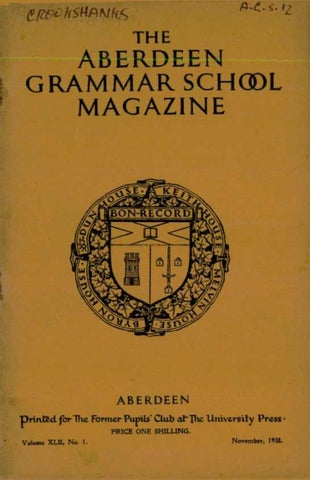
ABERDEEN GRAMMAR SCHCOL MAGAZINE
ABERDEEN Pupils' Club at- The University Press print ci for The Former PRICE ONE SHILLING. Volume XLII, No. 1.
November, 193E.
EDUCATIONAL BOOKS ".`@›0‹..9-1
JAMES G. BISSET CONTINUES to supply all the Class Books (New or Second-hand) suited for the requirements of the Higher Educational Institutions in the City, at the Lowest Prices. N.B.—Best Value in Students' Note Books.
JAMES G. BISSET, Classical, Medical, and Educational
85 BROAD
Bookseller,
STREET
(Opposite Marischal College).
•
PHONE 753 •
GOOD HEALTH demands
GOOD BREAD For the children especially is it necessary to ensure their stamina and energy with good, wholesome, nourishing bread. In Hutchison's bread you'll flnd all these requirements are fully met. Phone or give instructions to have it supplied daily.
BRANCHES THROUGHOUT THE CITY
ACVATIC
I
STAINLESS STEEL
UNBREAKABLE GLASS
WATERPROOF
LUMINOUS DIAL
Standard Size, Centre Seconds Plain Junior
„ „
Centre Plain
I I
£6 Its. 6d. £6 Os. 0d. £7 2s. 6d. £6 I5s. 0d.
In 1863 We sold watches. To-day many of these are still in daily use. What better testimonial could you have ? The watches of to-day are superior and very much less costly, sufficiently sturdy to withstand the vigour of present life, yet not ponderous as the watches of our grandfathers' time.
A. & J. SMITH JEWELLERS
191 UNION STREET
ABERDEEN
71Little's for fashions THE HOUSE
Coats Gowns in every
Quality and Style
Outsize Wear A
Speciality
A. C. LITTLE & SONS, LTD. 105
UNION STREET
•
ABERDEEN
III
GALLOWAY & SYKES LTD FURNITURE EQUAL TO ANY TEST Time has tested and firmly established our reputation for Fine Furnishings. Every suite, carpet or curtain is quite beyond reproach. The materials used are selected for fine quality, and the workmanship employed secures a perfect production. MAKE AN EXAMINATION of our stocks, you will find a high standard of comfort and beauty is now at your command for every room in the home, with expert advice to solve your furnishing problems. 361-363
UNION STREET, ABERDEEN
-
JAMES FYFE & SON PAINTERS AND GLAZIERS. .
•
•
OFFICE AND
:-
11 DEE STREET, ABERDEEN. Telephone 304.
Hairdressing for . . . LADIES, GENTLEMEN & CHILDREN
Maison Beattie HAIR STYLISTS
io Albyn Place, Aberdeen 'Phone 4104
Telegrams—"Fyfe, Painters."
THE
)
-FAMILY COFFEE Cum's Coffee is the favourite drink with everl ,
`VAT 10 Fik
(Me
ti
IS
1u1
it -I .
rnnet
especially delicious. Your in cold weather. grocer can supply you.
-
CURA COF
•
Thom°, Curr & Co., ABERDEEN.
Anderson % Spence DISPENSING CHEMISTS PHOTOGRAPHIC DEALERS
31 FOUNTAINHALL ROAD, ABERDEEN Telephone No. 1711
Jackson's Bindery TELEPHON E No. 291
•
18 Back Wynd Aberdeen ESTABLISHED 1853
BOOKBINDING OF EVERY DESCRIPTION
BIND; FEND FAST FAST
Leather Goods Lettered with Initials or Inscription Maps or Plans Mounted
•
TRADE MARK
Loose Leaf Specialists
TELEGRAMS. "HUB. ABERDEEN."
TELEPHONE. NO. I7I9.
CAMPBELL & SELLAR, LTD Engineers, Hirers and Garage Proprietors
QUEEN'S CROSS GARAGE to Fountainhall Road ABERDEEN ANY MAKE OF CAR SUPPLIED
OPEN DAY AND NIGHT
INNEN,
A. D. COPLAND.
Phone 896.
For Better Footwear
JAMES LORIMER & SON (BOOTMAKERS), LTD.
CIVIL and MILITARY BOOTMAKERS
8 CHAPEL ST.
ABERDEEN
(Late of 562 Union Street)
Eatd. A.D. 2844.
'Phone 724.
Go to . . .
K E N NAWAY'S of course
R ESTAUR ANT-173 UNION STREET Here you get the finest of food, daintily served, and at a reasonable price. The Restaurant is comfortable and commodious, and is just the place to entertain your friends. Our rooms are available for all types of functions. 'Phone 2371, and ask the Manageress for quotations
WM. KENNAWAY LTD. Quality
Bakers,
Confectioners
and
Caterers, Aberdeen
Telephone No. 1891.
ARCHIBALD McKELLAR Family Grocer and Wine Merchant,
454-456 Union Street, Aberdeen. . Cooked
.
We Specialise in . .
Gammons, Finest
Belfast Smoked Hams, " Harris's "
Wiltshire Bacon.
Medicinal Wines—Vibrona, Hall's, Wincarnis, Glendenning's.
Did Shakespeare eat Bacon? know We cannot tell, but we do — there will be no " Bacon" controversy
shop
you
if
at
the
Rubislaw Supply Stores 34 Queen's Road
:
Phone 2054
All our Bacon is cut to individual under
requirements,
personal supervision—hence our reputation
113urberrv Overcoats From 3i Guineas *
*
*
*
W. J. MILNE, LTD. Hatters & Out tters
251 Union Street, Aberdeen (Opposite Royal Northern Club)
Telephone 1293
Telegrams: "Gallowses, Aberdeen',
On your MENUS . include fresh fish prime butcher meat, poultry and game from A. & W. Alexander. You can be confident of complete satisfaction Telephone 5172 for courteous and personal attention Our delivery service is dependable
A. & W.
ALEXANDER FISH, GAME AND BUTCHER MEAT
492 UNION STREET
ABERDEEN
Telephone—Aberdeen 1710.
The Mastrick Dairies Ltd. 1 DESSWOOD PLACE, ABERDEEN WE offer you a Choice Selection of DAIRY PRODUCE from our own Farms, and produced under the direct supervison of members of the family. Our Customers may rely upon the absolute Purity and Cleanliness of all our products. Distributors of
CAIRNBROGIE CERTIFIED MILK. Head Dairy: 3, 5, and 7 WHITEHALL ROAD. Branches : 33 FOUNTAINHALL ROAD. 25 BEDFORD PLACE. 473 GREAT WESTERN ROAD.
CONTENTS ILLUSTRATIONS r
IP
. Facing page 44 . . . . Professor James Gregory • Between pages 44 and 45 . . Mr. Edward A. Smith, M.A. . . . . Mr. John I. W. Milne, M.A. . PP. PP „ „ „ F.P. Club Rugby Football Section rst XV—Season 1937-38 . Facing page 45 . . . The School Cricket XI of x884 • . • • • A Message to Former Pupils. . • . . • . Notes About Old Boys . • • • . . . Obituary . • • . . • • . • Marriages . . . . . The Crisis-1938. By J. B. C. . . The " Magazine " in the British Museum . The Attractions of British Columbia. By T. A. Keenan Petra, the Rose-Red City. By James Irvine-Fortescue . . Tercentenary of James Gregory's Birth . . . a • An Old School Cricket Group . • . . An Armed Raid on the School God's Own Country—I938. By Dr. Louis Findlay . . • • . . . A Gift from Malaya . . . • List of Former Pupils in Malaya School Section— . . . School and Random Notes . . . . Mr. J. I. W. Milne, M.A. . • . Mr. Edward A. Smith, M.A. . " Facilis Descensus Avemo . . ." By Cassandra " The Old Order Changeth." By Academicus . . Aberdeen University Bursary Competition . . . . . School Games Activities . xst XV Matches • . . . . . . . znd XV Matches . . . . . . . House Notes . . . . . The Literary and Debating Society . . . . Scout Notes . . . . The Former Pupils' Club— • • Club Executive Notes . • • The London Centre . The Glasgow Centre . • • The Edinburgh Centre . • • Rugby Section . • • . • Hockey Section . • • • • . Cricket Section • • • The Boarding House • • • • List of New Members • •
w
•
•
•
•
•
•
•
. . .
. Page I Pt 3 23 • PP 28 PP 22 32 38 9• 39 • 40 44 45 46 IP • PP 50 55 55
•
•
•
•
•
. . . •
. . . . 4
•
•
•
•
•
•
•
•
•
•
•
•
•
•
f1
•
•
VI
•
•
•
•
)3
•
•
P3
•
•
PP
•
•
PP
•
•
•
•
•
g
•
•
•
ff.
Pt
•
•
•
•
•
•
•
•
•
•
•
•
•
PP
•
•
PP
•
•
•
•
•
•
.
•
•
•
•
,,
57 63 64 64 66 67 67 68 7o 71 73 74 78 79 8o 84 85 86 87 88 89
Highland Dress for Girls & Boys E. & M. place at your disposal a service in Highland Outfitting backed by many years of experience.
If you
are unable to call let us post to you our Illustrated Catalogue and Price List.
FOR BOYS TWEED JACKET and VEST - 35,'- and 49/6 TARTAN KILTS - 34,6 and 45/Do. Ancient Colours 49/6 BALMORAL BONNETS 6/6 TARTAN TOP HOSE 6/6 TARTAN TIES I/11 and 2/11
FOR GIRLS TARTAN KILTED SKIRTS - 16/11 to 30/TAILORED KILTS - 35/- to 77/6 JERSEYS to suit Kilts I0/11 to 18/6 KILT JACKETS - 34/ to 55/-
ESSLEMONT & MACINTOSH LIMITED UNION
STREET
ABERDEEN
Silver Medal Bread Think of it ! A different Loaf for every day of the month 9 VARIETIES OF BROWN BREAD 21 VARIETIES
OF WHITE BREAD
Try them all
W. M. McPHERSON Baker and Confectioner
is FOUNTAINHALL ROAD AND
8 ST. SWITHIN STREET ABERDEEN Telephone 1515
1 ', I AHI ITN!-„
t.y r~.
Wm. Cay & Sons jfuneral Tanbertailers.
STRACHAN
415 UNION STREET
COMMERCIAL
&
AND
209 GEORGE STREET,
PORTRAITURE
ABERDEEN.
PHOTOGRAPHY Motor Hearses and Cars for Town and Country Funerals.
Telephone 851
416 UNION STREET ABERDEEN
Telegrams—"Cay, Aberdeen." 'Phones Nos. 92 and 54.
Telephone : 1156
Telegrams : ' Blake Builders ' "
JI
Sierviee and Quality"
S 11BILAIFIF ILTIIID .ittiett•rt. turd Ittlillgligit; 4 11111111•311'11111.14
23, 25, 29 SUMMER STREET, ABERDEEN All classes of Building Joinery Enquiries courteously solicited EST...RUSHED IBIS BY APPOINTMENT TO
,
'
•.
His LATE MAIEST TN, KING
J. WILLIAMSON & SON (W. B. WILLIAMSON. PROPRIETOR)
Meat Purveyors and Poulterers 1, 2, & 3 MARKET BUILDINGS, ABERDEEN 'PHONE 452 BRANCHES . 35 FOUNTAINHALL ROAD
'PHONE 1724 ALSO AT CHURCH SQUARE. BALLATER.
THE SQUARE. CULTS 'PHONE. CULTS 2 'PHONE 38
I.
QUALITY CAKES for The Seven Ages of Man CHRISTENING BURL HDAY MAJORITY WEDDING ANNIVERSARY SILVER
WEDDING
GOLDEN
WEDDING
CAKES
Mitchell &
Muil
Ltd.
THE FIRM WITH A REPUTATION
SEAMLESS FITTED CARPETS Every good housewife welcomes She the wall-to-wall carpet. appreciates the beauty and comfort it brings to her home, and the drudgery it saves in keeping polished floors spit and span.
We have arranged with one of the largest carpet manufacturing firms to manufacture a heavy pile carpet exclusively for ourselves, and we have named it " THE BALMORAL." It is woven in one piece, any width, any length, and the price is remarkably low. Obtainable in 6 different colours. 15 //- per square yard.
ROBERTS (Abdn.) LTD. lel. 2695
Carpet Specialists and House Furnishers
Lst. 1873
419 UNION STREET, ABERDEEN
`Art Students We carry a fine range of reproductions of the Old, Modern, and Impressionist School from P.C. size up—and frames to suit all subjects.
All the latest HANDICRAFTS
Oaylors 49-51 Scboolhill
DON'T WRITE IT—TYPE IT ! Little Portable Typewriters nowadays are very cheap, and enormous value for money — three British Portables the Barlock Portable, the Baby Empire, and, the best of all, the Imperial Portable, the famous — Good Companion... Also all the foreign Portables. You can get literary, scientific. medical, or Continental keyboards. :: ••
EASY DEFERRED PAYMENTS ON ANYTHING
Come along and see me :
C. H. WEBSTER 489 Union Street, Aberdeen 'Phone 505
'Phone 2870
ROLEX OYSTER 27 WORLD RECORDS WATERTIGHT
AND DUSTPROOF
ANTI - MAGNETIC — UNBREAKABLE czi arc Stainless Steel r- 8 gns. 'Centre Seconds..77-7gns. Extra Precision - 10 gns. 9 ct. Gold - 13 gns. Other models from 5 gns. We stock the complete
range of Rolex Oyster and Rolex Prince Watches.
IIAMIIIESIC
(lic ICAII?IRS
Established in the Year /733
WATCH AND GEM RING SPECIALISTS
142
UNION
STREET (next Union Bridge), ABERDEEN
COAL ELLIS & McHARDY LTD. (ESTABLISHED 1880)
I 8
REGENT
QUAY
AND
25O
UNION (AMICABLE
STREET
HOUSE)
ABERDEEN Telephone 2889
Telegrams " COAL, ABERDEEN "
the modern note is cleverly expressed in the new Fireplace
Arrangements.
Why not inspect them in our showrooms and see at first hand how greatly one would add to the appearance and comfort of your room ?
James Scott & Son (Aberdeen) Ltd• 483-485 UNION STREET ABERDEEN Phone 1881-2
Co-operation HE enthusiastic co-operation of many minds and hands make possible the fine productions of the HOUSE OF OGILVIE. For over three-quarters of a century our constant endeavour has been to give the best possible service to our Customers. We base our claim to your patronage on our ability to please you.
T
J. & A. OGILVIE 369
UNION
STREET,
ABERDEEN. Telephone : No. 433.
There is none better than the " BEST" but Davidsons' Coals are better than the " REST "
J. & A. DAVIDSON LTD.
2 BLAIKIE'S QUAY ABERDEEN Telegrams—" Davidson "
Phone 2873
Branch Office:— MAJESTIC BUILDINGS, 238 UNION STREET
Telegrams : " Interiors."
Showyard Erector to the Highland and Agricultural Society of Scotland, and Contractor to the Royal Northern Agricultural Society. 1:07.17
JOHN REID & CO. HOUSE CARPENTERS AND JOINERS
55 Blenheim Place and 14 Fountainhall Road ABERDEEN 444
Various kinds of ENGLISH, SCOTCH HOUSE, STEAM COAL, ANTHRACITE, and "Ideal " Triplex Fuel at keenest prices WE SOLICIT A TRIAL ORDER
Carpentry and Joinery Work of every description done ESTIMATES ON APPLICATION
Telephone No. 1997
I
•,
A 1
).-7" 1.1
MODERN SERVICE fi)i• MODERN . x MOTORISTS
.77--. •..•
yy„
.
•
We are equipped with the latest and most up-to-date appliances for the lubrication of your car. No longer need you struggle with grease guns and oil cans or crawl to reach inaccessible points. All this work can now be done for you cleanly, efficiently and effectively and without the slightest trouble to yourself. Call in sometime and let us demonstrate this Service.
We are an Official—
c
aitzt r
LUBREQUIPMENT SERVICE
STATION
AIIPEILIDLIES LIMITED
THE AUSTIN DEALERS
SICS UICIV Telegrams—" CARS "
0
AIt? IEIts 111) Telephone,-4580
Established
Assets
1836
L25,400,000
NORTHERN ASSURANCE COMPANY LIMITED •
FOR
•
ALL CLASSES OF INSURANCE •
LIFE
•
ASSURANCE BRANCH
The Company's tables of rates for Life Assurance include every class of Policy Special Leaflets on—
The Family Protection Policy The " Optional "
Policy
The House Purchase Policy The Educational Endowment Policy Child's Deferred Assurance Policy CHIEF OFFICES :
ABERDEEN
•
•
I UNION TERRACE
LONDON .
•
•
I MOORGATE. E.C. 2
Branches and Agencies throughout the World
Aberdeen Grammar School Magazine 54th year : No. 140 (New Series, 45th year, No. 131)
-
Po
Vol. XLII
NOVEMBER 1938
-
No. z
The "Grammar School Magazine" is issued under the auspices of The Former Pupils' Club, in March, June, and November. All communications with regard to the " Magazine " should be addressed to the Editor (the Secretary and Treasurer of the Club), THEODORE WATT, M.A., LL.D., The Rosemount Press, Aberdeen.
-
A Message to Former Pupils.
• •
It has been an interesting and, at times, an exciting term. The excitement, of course, centred round the latter days of September, when the crisis in world affairs gave a rude shock to our complacency and created a situation which looked really serious. The problem of " what to do with our boys " was given a new significance. There is no basement in the Grammar School and dismissal would be a risky undertaking with only five minutes' warning of an impending attack from the air. The whole question of protective measures is in the hands of the responsible officials and it can safely be left there. For the rest, the fitting of boys with gas masks was carried out in a single afternoon. The masks are being retained meantime by the authorities. We of the Staff were put through a short course of training in A.R.P. and as a result we can make the modest claim that we would not be helpless in an emergency. It was interesting to note the reactions of the boys to the crisis. So far as I could see they kept their heads remarkably well and showed no signs of nervousness. Indeed, I think there was some disappointment that the digging of trenches in the playground did not materialize. The flutter soon subsided and once again we resumed the ordinary routine of work and games. The Magazine will tell the story in detail and I confine myself to one or two items of passing interest. It is many years since we enjoyed so fine an autumn. The Playing Field—now fenced with smart iron railings and less smart wooden poles—has a healthy carpet of turf and should stand up well to the wear and tear of another rugby season. There was no break in the sequence of games up to the third week in November and this has meant an
2
Aberdeen Grammar School Magazine
improvement in the standard of play. Our 1st XV have done wonders and look like maintaining their form. The and XV deserve a word of praise for their record to date. We have been fortunate in securing a fixture for next season with Fettes College. In School the novel features, actual and prospective, include a cinema projector and a clock for the Hall. The projector is the most recent model of the Gaumont British Company and can be used for both sound and silent films. The quality of educational films has improved in recent years and it is now acknowledged that the cinema serves a useful ancillary function, particularly in such subjects as Geography and Science. The clock—still to come—is the much-appreciated gift of the F.P.s in Malaya. Once again the number of Boarders shows a material increase.. Both Houses are admirably managed and so far this term they have enjoyed complete freedom from epidemic troubles. The cheery atmosphere of the Junior House is a noticeable feature. The youngsters are eagerly anticipating one of the major events of the year, the Directors' Christmas Dinner. We are losing at the end of the term an able and enthusiastic member of our staff, Mr. John I. W. Milne, who has been appointed Principal Teacher of Classics in the Mackie Academy, Stonehaven. Another and even more familiar figure will have left us before the next Magazine is published. I refer to " Rab " —he needs no other designation—on whom the guillotine of a prescribed retiring age will fall in February. Gardener, feeder of boilers, weather expert, and literary critic, this genial son of Cumberland will be missed, and our hopes for his health and happiness go with him in his retirement. I spent a pleasant evening with the Glasgow Centre on the occasion of its Annual Dinner. The tributes which were paid to the chief guest—the Club's Secretary—were as spontaneous as they were well deserved. I expect there is a full account of Dr. Watt's reply in another part of the Magazine. A record of 31 years as editor of a school magazine is surely without precedent. The contacts which H.M. Inspectors of Schools have with the Grammar School are frequent and—how different from former days!—agreeable, and it is not without regret that we note the retirement at this time of Mr. F. W. Michie, the Chief Inspector of the Northern Division. Mr. Michie never tried to conceal the pleasure which a visit to his old School gave him, and it was here that he spent the last day of his official life. I conclude with the usual Christmas greetings and a special message of remembrance to Old Boys overseas. D. M. A.
Aberdeen Grammar School Magazine
3
* It is requested that the Editor be informed of all new appointments and interesting incidents in the careers of Former Pupils.
The dates given in parentheses after names indicate the sessions of attendance at the School.
• •
Commander Jameson Boyd Adams (1893-94), Secretary of King George's Jubilee Trust, opened in July a newsScottish Youth Hostel under the shadow of Ben Nevis. It is built on the lines of the traditional Norwegian log house, and takes the place of the old hostel which occupied the same site and was destroyed by fire. In the course of his speech he urged all who could to take a " hiking " holiday in Holland, Denmark, or Germany, or other places on the Continent where membership of the British movement entitled them to the facilities those countries had to offer. There was unlimited scope and unlimited need fOr a better understanding between the youth of the world—and that understanding would come only with knowledge. To keep oneself fit was a duty not only to country and to self ; it was also a cause of happiness. The Right Hon. Lord Alness* (1884-85), P.C., LL.D., was on 14th July last rewarded for his persistence and patience by the final approval of his Scottish Divorce Bill. The complete Bill came through Parliament substantially unscathed, to secure reforms in the Scottish divorce laws for the first time since 1573. George Andrew (1885-86), C. B. E., M. A. (Aberd.), B. A . (Oxon.), H.M. Senior Chief Inspector of Schools in Scotland, retired on 28th November. After a period as Classical Master in Hillhead High School, Glasgow, he was appointed to the Inspectorate in 1901. He became a Chief Inspector in 1931, being placed in charge of the Highland Division, but was transferred to the Western Division in 193z. Three years later he was promoted to be Senior Chief Inspector. He received the honour of C.B.E. in 1937. Colin George Marr Angus* (1925-36) is learning the hotel business at the Grand Hotel, Broadstairs, Kent. Reginald Rust Bisset* (1922-31), B.Sc. in Civil and Electrical Engineering, has been appointed resident engineer to * Member of Former Pupils' Club.
4
Aberdeen Grammar School Magatine
Messrs. Watsons of Edinburgh, the contractors for the new Government aerodrome at Dyce, Aberdeenshire. George Chambers Brander* (1920-32), M.R.C.V.S., who was on the staff of the Royal (Dick) Veterinary College, Edinburgh, for six months, graduated B.Sc. in Veterinary Science at Edinburgh University in July. He has since gone to Shrewsbury as an assistant veterinary surgeon. John Godsman Brown* (1924-26) was in July last selected by the Air Ministry to go out to California to inspect aircraft as they are being built there for the British Government. He served his apprenticeship as an engineer in Aberdeen, and after a successful course at the Aeronautical College in London, he became Assistant Manager of the airport at Lympne, and later Chief Engineer. While he was there, he took a keen interest in the practical as well as the theoretical side of flying, and in his spar. time qualified for all the certificates in flying as well as in parachute-jumping. He also acted as Master Flying Instructor to the apprentices at the airport. Subsequently he became one of the Air Ministry's examiners at Coventry, and shortly afterwards was promoted to the Inspectors' Department of the Air Ministry. He went by sea to New York, and thence by air to Los Angeles. William Bulloch* (1877-80), M.D., LL.D., F.R.S., Emeritus-Professor of Bacteriology in the University of London, is the author of " The History of Bacteriology," recently pub, lished by the Oxford University Press, at the price of los. 6d. In it he relates the story of the advance of microbiology from the Fracastorian era of theoretical speculation to the present time, including the Golden Age of bacteriology so intimately associated with the names of Pasteur, Koch, and Lister. Alexander Vernon White Cantlay* (1903-10), who was for a time in the service of Messrs. Guthrie & Co., Ltd., East India merchants, is now engaged in rubber planting on Rimbah Sawang Estate, Kwala Simpang, North Sumatra, Netherlands East Indies. James Alexander Cardno* (1929-32), M.A., has been awarded the Fullerton, Moir, and Gray Scholarship in Mental Philosophy at Aberdeen University. He is now at St. John's College, Cambridge, reading for Moral Sciences Tripos, Part II, Section C (Psychology). Charles Leopold Clark (1927-29) has been appointed assistant on an estate controlled by Messrs. Harrisons & Crosfield, Ltd., in Sumatra, Netherlands East Indies. Previously he was for eight years in the employment of Messrs. Richard Connon, Reid & Co., shipowners and brokers, Aberdeen. James Bryce Clarke* (I896-99)—elder son of Dr. John Clarke, formerly Classical Master in the Grammar School—
Aberdeen Grammar School Magazine
5
has recently retired from the position of joint manager of the Bank Handlowy, or Commercial Bank, of Warsaw, Poland, where he has also been the F.P. Club Consul. He is now in this country, and a very welcome contribution from his pen appears in this issue of the Magazine.
•
A MASTERPIECE OF PRINTING.
* •
•
James Cooper Clark* (1894-96) is the editor and translator of what is probably the most expensive book ever produced by a Grammar School boy. It is the " Codex Mendoza," in three volumes, published by Messrs. Waterlow & Sons, at the price of twenty guineas. According to The Times (for so far a copy has not been sent for review in the Magazine!), the book is a beautiful one—a masterpiece of printing on Whatman hand-made paper, bound in vellum—and contains a facsimile of the Spanish text of the Codex and of the picture-writing, reproduced in colours. The first volume contains. a translation of the Spanish text into English, and the second has a list of the place-names, with a full explanation of the glyphs by which they are written and the meanings of the names. This volume also gives a bibliography and a reproduction of Ortelius's Map of Mexico of 1579. The third volume contains the facsimile of the Codex. The historical portion has a commentary supplementing the brief statement of the Spanish text, and in addition a chronological summary of the whole of Aztec history from the foundation of Mexico is given in a table. The Codex, which is a series of documents dealing with the history, life, and customs of the inhabitants of Mexico, has been known to the Western World for 400 years and is preserved in the Bodleian Library in Oxford. Up to now there has been made no accurate reproduction of these documents, perhaps the most important—and certainly the most interesting —of any dealing with the pre-Spanish history of Mexico, and there has been no authoritative interpretation of the Nahuatl glyphs. The editing of the manuscripts has demanded an intimate and first-hand knowledge of early Mexican civilization, as well as familiarity with the Nahuatl language. The work now published constitutes the most notable contribution to Mexican archaeology for many years. James Cobban* (1925-32) is in• the service of the Burma Shell Co., Ltd., and is at present stationed at Budge Budge, Bengal. He was trained for four years at Faraday House, London. Colin Douglas Leslie Cromar* (1912-26), M.B., Ch.B., F.R.C.S.E., son of JOHN CROMAR* (1876-83), L.D.S., Aberdeen, is at present on the staff of the Mayo Clinic at Rochester, Minn. U.S.A. Andrew John Maxton Cruickshank (1919-25) is a professional actor, and has been taking the part of Claudius, King
6
Aberdeen Grammar School Magazine
of Denmark, in the modern-dress production of " Hamlet " (in its entirety) at The Old Vic, London. He is a member of the permanent company there. According to one critic, " Claudius's Renaissance villainy is not in place, though Mr. Andrew Cruickshank, in another setting, could make him more subtle and alive." Another critic writes that " Mr. Andrew Cruickshank's King is theatrically full-blooded." Eric Kennedy Cruickshank* (1920-32), M.B., Ch.B., was in June awarded at Aberdeen University an Alexander Anderson Scholarship of the value of L250. John Arthur Cumming* (1876-82), who retired from the Indian Civil Service in 1913, is the Honorary Treasurer of St. Peter's Hall, Oxford. Its primary objects are to promote religion and education generally, and especially to assist students of limited means, to encourage candidates for Holy Orders and Missionary Work abroad, and to maintain the principles of the Church of England. In the tenth annual report a special tribute is paid to the work of Mr. Cumming. " Already over k155,000 has passed through his hands. And the most eloquent tribute to our Honorary Treasurer's able and unflagging administration is the remarkable fact that his tenth list of donations to the Appeal Fund contains a record number of subscribers. Incidentally, and characteristically, the list was put into final shape a week after an operation for appendicitis with complications. ' I shall count it a privilege to have a part in the founding of a college in Oxford for poor students ' ; with these words Mr. Cumming accepted his post eleven years ago." Dugald Thomson Stuart Currie (1927-34) is a member of the Aberdeen Police Force, and recently received the bronze medal of the Society for the Protection of Life from Fire in recognition of his gallantry in entering the smoke-filled rooms of an hotel when on fire early one morning in April of this year. His object in entering the rooms was to find if there were any occupants, and he was nearly overcome by smoke. The Right Rev. Ernest Denny Logie Danson* (1892-94), M.A., D.D., Provost of St. Mary's Episcopal Cathedral, Edinburgh, and Assistant Bishop of the Diocese of Edinburgh, was in October invited to become Bishop of the Diocese of St. Andrews, Dunkeld, and Dunblane. He, however, declined the invitation, as he received his present appointment in Edinburgh less than a year ago and did not wish to relinquish it after such a short period. He was appointed Bishop of Labuan and Sarawak in 1917, and in 1931 he became Assistant Bishop and Canon Residentiary of Carlisle. Lessel Murray Davidson* (19o 5 -1 4), C.A., represented the Society of Chartered Accountants in Aberdeen at the International Congress of Accountants held in Berlin in September. Peter McLaren Davidson* (1908-13), B.Sc., who has
Aberdeen Grammar School Magazine
i
•
7
been for a number of years in the service of Messrs. Pilkington Bros. Ltd., as departmental manager in their vitrolite factory at Kirk Sandall, near Doncaster, has recently been transferred to their headquarters at St. Helens, Lancs. James Gordon Dawson* (1922-34), who graduated B.Sc. in Engineering at Aberdeen University, with First Class Honours both in Mechanical and Electrical Engineering, is now working in the Aero Experimental Laboratory of the Rolls-Royce Company, Derby. James Alexander Donald* (1920-32), C.A., has received an appointment with Messrs. Mackwoods, Ltd., importers and exporters, Colombo, and sailed for Ceylon in August. Ian Mackenzie Drummond* (1929-34) is manager of the Majestic Cinema, Durham, which was opened at the end of August. After leaving the School he was for nearly two years associated with three cinemas in Bishop Auckland, and from February 1936 he was in London gaining further experience in the cinema and film business, first with Girosign Ltd., cinema advertising specialists, and then with Ambassador Film Productions, Ltd., in Wardour Street, W. t. Robert Hutton Duguid* (I 91 8-23), B.Com., C.A., who has been in the service of Messrs. Duncan Brothers & Co., Ltd., Calcutta, since 1932, was home on leave this year. In April he was gazetted and Lieutenant in The Calcutta Scottish (Auxiliary Force, India), having served for five years in the ranks. He was captain of the Scotland side in the last Calcutta local rugby international match. Alastair Robert Campbell Duncan (1924-26 and 1930), M.A., has been awarded the Ferguson Scholarship in Mental Philosophy of £too for each of two years, open to graduates in Arts of all the Scottish Universities. He graduated M.A. at Edinburgh University in 1936 with First Class Honours in Mental Philosophy and was awarded a German Exchange Scholarship, providing for one year's free tuition, board and lodging at a German University. He was also awarded a Bruce of Grangehill Scholarship in Philosophy of L i 5o for each of two years. James Durno* (i9oo-oz), the well-known farmer of Crichie, Inverurie, has recently been appointed Chairman of the Highland and Agricultural Society. John Murray Easton* (1895-1905), F.R.I.B.A., a member of the firm of Stanley Hall, Easton & Robertson, who are the architects for the Empire and United Kingdom Section at the New York World's Fair of 1939, wrote recently from New York that the Fair was certainly going to be " more than somewhat." " The site thirty years ago was a swamp. Two years ago, when I saw it last, it was a gigantic ash-heap, with forty feet of city ashes and debris on top. Excavating machines
8
Aberdeen Grammar School Itifasatine
were running about levelling it off, and roads were being constructed. To-day the administrative building and a number of other structures are complete. Avenues of trees thirty feet high have been planted, and the first section of the garden layout is in being. . . . Great Britain, I am glad to say, is trying to make a good show—at least a good-sized show—and whatever the results, it has been the greatest possible fun to be connected with it. The customary hospitality of New York has been so reinforced for the occasion as to constitute a serious menace." Alfred George Emslie* (1918-24), M.A., Ph.D., who as a Commonwealth Fund Fellow studied physics for three years at Cornell University, is now an instructor at Williams College, Williamstown, Mass., U.S.A. Francis Millar Esson* (1918-25) was in August gazetted a and Lieutenant in the 4th Battalion The Gordon Highlanders. Stephen George Eason* (1929-34), son of GEoacs FORBES Essox (1894-1903), was recently granted a commission in the Royal Air Force, and holds the rank of Acting Pilot Officer at No. 6 Flying Training School, Netheravon, Wilts. He joined H.M.S. Conway (cadet ship) in 1935, taking the aviation course for a period of two years. COMMANDANT OF POLICE COLLEGE AT HENDON.
John Frederick Ferguson* (1904-09), formerly Major, Durham Light Infantry, and latterly Deputy Assistant Police Commissioner at Peckham, has been appointed as from 1st September Commandant of the Metropolitan Police College at Hendon. He joined the Metropolitan Police Force as a Chief Constable in 1933, taking up duties in the office of Lord Trenchard, then Commissioner of Police. Two years later he was promoted to be Deputy Assistant Commissioner, and took charge of the Peckham district. Alexander Findlay* (18 82-91), M.A., D.Sc., F.I.C., Professor of Chemistry in the University of Aberdeen, sailed in July for New Zealand to lecture in the University Colleges at Auckland, Wellington, Christchurch, and Dunedin—colleges of the University of New Zealand, for which Professor Findlay is examiner in Chemistry. Australia is included in his itinerary, and he is returning via Bombay, Baghdad, Damascus, and Port Said. Louis Findlay* (1924-30), M.B., Ch.B., is at present on the staff of the Hospital for Sick Children, Great Ormond Street, London. Robert Wilson Findlay* (1934-35), who is in the Photo Section of the Royal Air Force, was last summer posted from Montrose to Eastchurch, Sheerness, where he is attached to one of the bomber squadrons.
Aberdeen Grammar School Magazine
9
George Knowles Fraser* (1907-08), M.A., D.Sc., B.Sc. (For.), was last year appointed to the staff of the Macaulay Institute, Craigiebuckler, Aberdeen, as Research Officer in Peat Soils. He was previously Lecturer in Forest Soils and Chemistry at Aberdeen University. Godfrey Power Geddes* (19o3-11), D.S.O., Brevet Colonel, was Captain and Adjutant of the 5th Gordon Highlanders in 1918 and took a prominent part in the Battle of Buzancy, the importance of which as a turning point in the most critical days of the Great War was recalled on its twentieth anniversary in July. On 28th July, 1918, as the advance of the 44th Highland Brigade was going forward, the C.O. of the 5th Gordons, Colonel GEORGE ALEXANDER SMITH (1888-91), D.S.O., watched it from the crest of the hill facing Buzancy, accompanied by his Adjutant (now Colonel Geddes) and by his runner, Chalmers. They were all three standing close together when a S.9 shell burst just in front of them. When Captain Geddes recovered, he found himself lying below a tree about fifteen yards from where he had been standing. Ascertaining that he had suffered no major damage, he crept back to Colonel Smith, whom he found dead ; Chalmers was badly wounded and died soon after. Within an hour the Battalion had reached its objective north-east of Buzancy. That day the Germans received a blow from which they never recovered, and Buzancy ranks among the major battle honours of the Great War. The casualties of the 5th Gordons amounted to four officers and 75 men killed ; five officers and 216 men wounded. It was to commemorate the Battle of Buzancy that the French erected a small monument now preserved in the British Military Cemetery there, with the inscription, "Here will flourish for ever the glorious thistle of Scotland amidst the roses of France." Alexander Gray* (191o-2z), LL.B., has just had a scholarship named after him in appreciation of his services in saving Aberdeen Airport for civil flying. The scholarship has been established by the North British Flying Club, and provides entirely free tuition for a pilot's A licence at Aberdeen Airport. It will be operative for a minimum period of three years from 1939. William Tulloch Hutton Hay (1928-38) is now a " Fresher" at Loughborough College School of Athletics, Leics, and has been playing as full back fot the College 1st XV. The side is a very strong one, having defeated all its opponents, among them being Birmingham City, South Leicester, and Thornloe's Select, which included four International " Caps." Hubert Douglas Henderson* (1 go1 -04), M.A. (Cantab.), was in July appointed a member of the Royal Commission set up to conduct an investigation into social and economic conditions in certain of the West Indian Colonies. He has been a Research Fellow in Economics at All Souls' College, Oxford,
Io
Aberdeen Grammar School Magazine
since 1934, and was Joint Secretary of the Economic Advisory Council, 1930-34. Allan Cruikshank Hendry* (1907-14), M.C., M.B., Ch.B., has been granted a commission as Flying Officer in the Medical Branch, Auxiliary Air Force, and has been posted to No. 612 (County of Aberdeen) (Army Co-operation) Squadron. William James Hogg* (1908-20, M.D., has recently been appointed Depute Medical Officer of Health at Torquay. He was in medical practice in Aberdeen from 1931, having succeeded the late Dr. Geddie. He took his M.D. degree in 1936, and received the D.P.H. in 5937. Frank Evans Hoggarth* (192 i -25), C.A., has left the service of Cooper Brothers and Co., chartered accountants, London, and has started in business as an accountant at Kingstonon-Thames. Archibald Forbes Hyslop* (1897-1910), M.A., Ph.D., H.M. Inspector of Schools in Scotland, who was in charge of the Kincardine and Zetland District, has just been transferred to the Roxburgh, Berwick, Selkirk, and Peebles District. Douglas J. T. Jamieson* (1893-98), who has been with the Bombay, Baroda and Central India Railway since 1905, has recently retired, and is now resident in Aberdeen. Arthur R. H. Kellas* (1926-32), M.A., who won an Open Scholarship in Classics at Balliol College, Oxford, in 1935, was in August of this year placed in the First Class in the Final School of Litterae Humaniores. He is undoubtedly one of the finest Classical scholars that the School has ever produced. He hopes to enter the Diplomatic Service. Francis Henry King* (1916-26), in the service of the Hongkong and Shanghai Banking Corporation at Hongkong, has recently been home on leave. Percival Robson Kirby (1892-1901), M.A., D.Litt., Professor of Music in the University of Witwatersrand, Johannesburg, is this year's recipient of the South African Medal, awarded by the South African Association for the Advancement of Science for work of high promise and merit in South Africa. He has published numerous scientific papers and two books on musical ethnology. James Gray Kyd* (1891-98) issued in October his first Annual Report as Registrar-General for Scotland. It contained an appendix on Nomenclature in Scotland, giving the results of an investigation into the frequency of occurrence of surnames and Christian names in the year 1935, and making comparisons with the year 1860. This appendix received a considerable amount of attention in the press. Alexander Adamson Laing* (1877-79), who was for many years General Manager of the Royal Bank of Australia, Ltd.,
Aberdeen Grammar School Magazine
11
at its head office in Melbourne, retired some years ago, and
is now resident in the suburbs of that city. Ever since he left the School he has treasured a photograph of his classmates there. Recently he sent it, in a wonderful state of preservation, to the Editor of the Alagaine, and it will be reproduced in an early issue. James Ledingham* (1885-88), who has been Local Manager at Glasgow of the North of Scotland Bank Ltd., retired in September under the Bank's pension scheme, having completed fifty years' service. He entered the North Bank at Ballater in 1888, and after two years went to Lumsden. In 1895 he was transferred to the Market Branch, Aberdeen, and in 1898 was appointed Accountant at Forres. Three years later he became Accountant at the Perth Branch, which afterwards was named the Scott Street Branch, and in 1911 was appointed Joint Agent. After another three years he was promoted to be Assistant Local Manager at Glasgow—a new position which had been created in view of the Bank's growing business in Glasgow. In 1921 he became Local Manager there. For many years he has been on the Council of the Institute of Bankers in Scotland, being latterly one of the Vice-Presidents. Mr. Ledingham has always been a keen member of the F.P. Club, and when the Glasgow Centre was formed in 1930, he became its first President. It is in no small measure due to his active interest that the Glasgow Centre has become so firmly established. George Lawrence* (1901-03) has been appointed to succeed JAMES LEDINGHAM as Local Manager at Glasgow of the North of Scotland Bank. A son of the late Mr. GEORGE LAWRENCE (1863-66), who from 1898 until his death in 1916 was the North of Scotland Bank's Agent at Fraserburgh, he entered that Bank's service there in 1903, and four years later was transferred to the head office in Aberdeen. Thereafter he was Accountant at Aboyne, Cluny Square Branch, Buckie (1911), and Harbour Branch, Peterhead (1919). When the Lossiemouth Branch was opened in 19zo, Mr. Lawrence was chosen to be Agent, and two years later he became Agent at Cluny Square Branch, Buckie. He returned to Aberdeen in 1930, this time as Agent of the Commercial Road Branch, and in September of the following year was appointed Assistant Local Manager at Glasgow. Eric R. R. Linklater* (1913-16), M.A., is the author of yet another novel, " The Impregnable Women," published by Cape in July. This is a modern version of the " Lysistrata " of Aristophanes. " Mr. Linklater," says one reviewer, " by turns gay, ribald, eloquent with Elizabethan eloquence, and grandly powerful in peace and war, makes this extravanganza acceptable. He is for peace, and the book is great argument for peace. But that is not all: like his immortal forerunner,
Aberdeen Grammar School Magaine the author laughs hugely himself, and all readers who do not blench at his theme will undoubtedly do likewise." On 26th September Eric Linklater unveiled in the Old Parish Church of Cromarty a memorial tablet to " Sir Thomas Urquhart, Knight, of Cromarty, 1611-x66o—a great Scots writer and the translator of Rabelais." The memorial has been erected by the Saltire Society. In the course of a short address prior to the unveiling of the tablet Mr. Linklater said that the voice of Urquhart had universal importance, but in Scotland there was another voice in which they were interested, because in it he spoke of his own country. The patriotism of Urquhart emerged not from parochial tradition and a narrow knowledge of Scotland, but from a liberal education and Continental experience. He had acquired by study at the University of Aberdeen familiarity with the cultures of Greece and Rome. He had lived intimately and travelled widely in Europe. Urquhart might well have proclaimed himself as a citizen of the world. Instead, he proclaimed himself on every occasion as a Scot. Alexander Macdonald* (19z x -27), M.A., M.B., Ch.B., was in June awarded at Aberdeen University an A. W. Garden Scholarship of the value of L2OO for each of three years. Eric Douglas McDonald* (1909-13) has been promoted to be Superintendent of the Tadcaster Division of the West Riding Constabulary. On leaving the School he entered the service of the Canadian Bank of Commerce in Saskatchewan, and served for four years in the Great War, coming over with the Canadians in 1915, and being seriously wounded on the Somme in November ir 916. After he was demobilised in July, 1919, he joined the West Riding Constabulary. Promotion has come to him rapidly : he was made a Sergeant in 1927 and an Inspector in 1931. Most of his service has been on the administrative side. In a recent letter to the Editor he says that if any of the senior boys at the School or young F.P.s are thinking of the Police Force as a career, perhaps he might be able to give them some idea of what is required and what is the best way to approach the job. He will be delighted to answer anyone who cares to write to him at Cliff House, Tadcaster. Norman Crichton McIver (1928-34) was in October awarded at Aberdeen University the Memorial Prize in Economics. Dennis Lorraine Mackay* (1924-29) has recently been drafted to one of the Navy's latest cruisers, H.M.S. Manchester, which left England in September for the East Indies Station. George Scott McLaren* (1928-32) qualified as a chartered accountant in January last, and has recently gone to Johannesburg to take up an appointment in an accountant's office there.
Aberdeen Grammar School MageRine
13
B.A. Charles Stewart McLeod* (1908-20), M.A. (Aberd.), Northand London the of service the entered who (Cantab.), present Eastern Railway Company about ten years ago, is atGlasgow. at Area, Scottish Manager, Goods the to assistant His marriage in July is recorded on another page. formerly John George McWillie* (1889-92), M.B., C.M., KincardineBanchory, in now and Hull in practice medical in treatment shire, last year paid a visit to Pennsylvania to receive" The Hay of Hay Howard William Dr. from instruction and beneficial System" fame. He was so much impressed by the " The book little a written has he that treatment of the results recently Disease," and Health in Diet Hay System Simplified : McWillie published by Messrs. Harrap. For many years Dr. Hay, and Dr. by recommended principles has advocated the gives a the book sets out those principles very simply, and in the used be readily can that recipes number of menus and home. Robert James Maitland* (i 9 it 2-18) is now Director and Secretary of Nu-Style Products, Ltd., Glasgow. years Ralph Marshall* (1915-25), who has been for eight DepartWorks Public the of Section Roads and Buildings the in ment, Burma, has recently resigned and come home. Donald Matheson* (19 t 9-25), M.B., Ch.B., received a 1937. commission as Lieutenant in the R.A.M.C. in OctoberRawalat stationed is and last, September He left for India in pindi. Leslie Deane Mayor* (1923-33), who is a Pilot Officer Coin the R.A.F., is at present serving with the 31st (Army operation) Squadron in Baluchistan. Francis William Michie* (1885-91), M.A., H.M. Chief Inspector of Schools in Scotland, retired on 17th November. was After a period as Science Master in Dundee High School,aheChief became He 1901. in Inspectorate appointed to the Inspector in 1932, being placed in charge of the Highland Division, and in 1935 was transferred to the Northern Division. Douglas Falconer Middleton* (1920-25) is on the staff of the Union Bank of Scotland at its Hyndland Branch, Glasgow. as Lewis Middleton* (1919-32), B.Sc. (Eng.), is employed Department Engineering Military the in engineer a civilian at Cawnpore, India. Harold James Milne (1904-07), M.C., who in the Great War rose to the rank of Captain in the 6th Battalion The Gordon of the Highlanders, was in charge of the Scottish contingent during Sudetenland in duty do to recently chosen British Legion the party the proposed plebiscite. It will be recalled that Continent, the on landed never but Thames sailed from the owing to a change in the arrangements in Czechoslovakia.
14
Aberdeen Grammar School Magazine
Harold Samuel Milne* (1913-26), B.Sc. (Eng.), was in July appointed to succeed his father, Mr. Samuel Milne, as Gas Engineer of Aberdeen. At Aberdeen University he was one of the first students to take the degree in Engineering. He received part of his training in the Harbour Engineer's office, Aberdeen, and for three years was an engineering assistant with the Woodall-Duckham Vertical Retort Company. Later he was employed as resident representative engaged in the erection and operation of vertical retort installations in Aberdeen, in Edinburgh, in Denmark, and elsewhere. From 1933 to 1937 he was Chief Technical Assistant in the Greenock Gas Department, and then was appointed to be Chief Assistant to the Worcester New Gas Light Company. Robert Lamb Milne* (x 91 5 -26) has been assumed as a partner in the business of John Milne, auctioneer and licensed valuator, Aberdeen. Brigadier-General Magnus Mowat* (188 2-84), C.B.E., B.Sc., M.Inst.C.E., M.I.Mech.E., has recently resigned from the post of Secretary of the Institution of Mechanical Engineers and has been appointed Honorary Secretary, being the first to hold that office. He is the immediate past President of the London Centre of the F.P. Club. Donald Hunter Munro* (1916-17), who has been in the service of the B.B.C. for over thirteen years, was in charge of the Television Section at Radiolympia in September. As Television Productions Director, he is one of the best known officials at Alexandra Palace, the headquarters of television. Ian Gordon Murison* (1923-3o) in June obtained the degree of B.Sc. in Economics at London University, and in September took up an appointment as a trainee with the Calico Printers Association, Ltd. of Manchester. Hugh Alexander Murray* (1919-25), M.A. (Aberd.), B.A. (Cantab.), has for the past four years been Assistant in the Department of Greek at Aberdeen University, and has recently been appointed Lecturer in Classics in the University of Durham. He was Classical Dux of the School in 1925, and graduated at Aberdeen University in 1929, with First Class Honours in Classics. In the same year he was awarded an exhibition at St. John's College, Cambridge, and in the Classical Tripos was placed in the First Class both in Part I and Part II. Before his appointment to Aberdeen University he was for a year and a half on the Classical staff of the Grammar School. William James Adair Nelson* (1914-24), C.A., has for the past five years been with Messrs. Ford, Rhodes, Thornton and Co., chartered accountants, Colombo, Ceylon. On the termination of his engagement he came home, and in October took up an appointment with Messrs. Whinney, Murray & Co., chartered accountants, Antwerp.
Aberdeen Grammar School Magazine
15
George Gordon Nicol* (1894-1903), D.S.O., M.Inst.C.E.,
is now practising on his own account as a consulting civil
•
engineer at 21 Bridge Street, Aberdeen. He was formerly a partner in the firm of Henderson & Nicol at that address. Gibb Niven Pennie* (1923-26), M.A., has been appointed in the Scottish Episcopal Theological College, Edinlecturer a burgh, at which he was himself a student. James Charles Philip* (1886-89), M.A., D.Sc., Ph.D., F.R.S.—the President of the F.P. Club—in July received the title of Professor-Emeritus of Physical Chemistry in the University of London, on his retirement from the University Professorship of Physical Chemistry at the Imperial College, Royal College of Science. He was Deputy Vice-Chancellor of the University of London for 1937-38. John Riddell Knight Pirie* (1915-16), B.Sc., B.L., is on the Dietary Survey Staff of the Rowett Institute, Bucksburn, working on the medical and scientific side. Alfred William Raffan* (x 919-3 i), M.B., Ch.B., is at present on the staff of the Princess Alice Hospital, Eastbourne. James Ian Raeburn Rankine* (1925-37) is a cadet in the Mercantile Marine in the service of Messrs. Brocklebank, Liverpool. Louis Arnaud Reid (5904-09), M.A., Ph.D., D.Litt., Professor of Mental and Moral Philosophy at King's College, Newcastle-upon-Tyne (University of Durham), contributed in November to The Times a letter which received special prominence. It had reference to the recent official German edicts against Jews, and urged that we could as an Empire come together and resolve that we would receive our fair share, or more than our fair share, of the whole number of these and similarly tortured peoples. " The salvation of thousands must be worth real sacrifices. It can be done if there is the will and the enterprise to do it. How, in face of this rapidly accelerating persecution, can the British peoples and Governments refuse to give their help ? " Robert Lawrence Richards* (1922-34) is the President of the Aberdeen University Students' Representative Council for 1938-39; and the Vice-President is A. Henry K. Slater* (5922- 35)' William Brian Richardson* (1919-28) is in the service of the Chartered Bank of India, Australia and China, in Hongkong. Writing in September he said that the war was dragging wearily on, pretty successfully bottling up trade and making conditions very trying for business concerns. That was before the fall of Canton and Hankow, so what must things be like now ? He M.B., mentioned that ROBERT ALEXANDER STEPHEN ( for due was there, out R.A.M.C. the in Captain Ch.B., who is a
i6
Aberdeen Grammar School Magazine
home leave in November; and another F.P. on the spot is JOHN STEWART DuNNErr* (1922-28), who is in the Hongkong and Shanghai Bank. John Louis Riddoch* (1906-09) is a merchant at Kisumu, Kenya Colony. He was recently home and seized the opportunity to become a member of the F.P. Club. Charles Macdonald Ross* (1917-25), M.B., Ch.B., has returned from an eight months' visit to the United States for the purpose of studying American Psychiatry. He was temporarily attached as an Assistant Physician to the Phipps Clinic, Baltimore. James Murray Ross* (1903-14), who was formerly engaged in rubber planting in the F.M.S., is now in the service of the Firestone Plantations Coy., Cape Palmas, Liberia, West Africa. Launcelot Hugh Ross* (1898-1901), F.R.I.B.A., who carried out the erection of the Palace of Engineering, the Palace of Art, and the Tower buildings of the Empire Exhibition, Glasgow, was selected by the War Office and the Air Ministry to design the Services Pavilion. This Pavilion proved to be one of the outstanding successes of the Exhibition and was visited by over 1,ooo,ooo persons. Mitchell Cumming Ross* (1914-21), B.Sc., Ph.C., is Managing Director of the firm of William Paterson & Sons (Aberdeen) Ltd., wholesale manufacturing chemists, who this year celebrated their centenary. George Stanley Russell* (1894-1 901), M.A. (A berd.), D.D. (Victoria University, Toronto), minister of Deer Park United Church, Toronto, received the honorary degree of D.D. from Aberdeen University at the July graduation. In presenting him for laureation Professor A. FITE FINDLAY* (1879-85), D.D., Dean of the Faculty of Divinity, said— Mr. Russell is a graduate in Arts of our University, who for a time during his student days was editor of " Alma Mater." He studied theology in the United College, Bradford, and after two short pastorates in the provinces was called to the important charge of Grafton Square Congregational Church, London. During his ministry there he was honoured by being appointed Chairman of the London Congregational Union. It is, however, in Canada that Mr. Russell has given most signal evidence of his gifts. Called in 1929 to be minister of Deer Park United Church, Toronto, he has greatly increased the membership of that congregation, and in addition he has played an energetic part in securing the erection of fine Church premises, which were opened by the Prime Minister of Ontario, who paid a high tribute to his influential ministry. Mr. Russell has made a deep impression by his powerful preaching, both in the city of Toronto and throughout the Province of Ontario. He is the author, moreover, of several religious works. It is accordingly fitting that by conferring the degree of Doctor of Divinity the University should show her appreciation of the work of one of her sons who both in this country and in the Dominion of Canada has discharged able and fruitful ministries.
William Philip Selbie* (1901-06), M.B.E., M.C., M.A., Captain, Army Educational Corps, which he joined in 1920, is
Aberdeen Grammar School Magazine
t
17
now District Education Officer, Peshawar and Kohat, India. He was previously Commandant of the King George's Royal Indian Military School, Ghelum. He says that Ghelum pupils appear in many of the Indian units he visits. " Four of them have recently been selected for training as officers at the Indian Military Academy, Dehra Dun. Such progress is, in some degree, akin to that of the `lad o' pairts,' under the old educational system of Scotland, and it has been made possible by the vision of one of the School's most famous boys, the late Sir ANDREW SKEEN " (1880-86). • Captain Selbie was made M.B.E. (Military Division) on the King's Birthday this year. John Hall Davidson Sharp* (1923-27), M.A., B.L., was in October admitted a member of the Society of Advocates in Aberdeen. He served his law apprenticeship with Messrs. Morice and Wilson, advocates, Aberdeen, graduating B.L. last year. George Taylor Simpson* (1910-20), Chief Traffic Manager of the Jodhpur State Railways, Rajputana, India, has been elected Chairman for the year 1939 of the Personnel Section of the Indian Railway Conference Association. This is an association of the General Managers of all railways in India for the settlement of business connected with inter-railway matters, and its Personnel Section is that part of it which deals with staff matters. In spite of this appointment, he hopes to come home on leave during 1939, and, as he remarks, " somebody else will thus have to do the bulk of the work." William Douglas Simpson* (19o1- I 3), M.A., D.Litt., was in October appointed a member of a Committee set up by the Secretary of State for Scotland to advise the Board of Trustees for the National Galleries of Scotland on matters relating to the Scottish National Portrait Gallery. Earlier in the year he was appointed a member of the Scottish Records Advisory Council. Dr. Simpson is Librarian, Clerk of the General Council, and Registrar of the University of Aberdeen. Alexander Johnston Slessor* (5958-3o), M.B., Ch.B., was in June awarded at Aberdeen University an A. W. Garden Scholarship of £2OO for each of three years. Robert Arthur Smart* (1919-31), M.B., Ch.B., Captain, R.A.M.C., is at present serving in Palestine as Medical Officer with the and Battalion The Royal Ulster Rifles. David Drummond Smith (1893-1900), M.A., head master of Calderhead School, Shotts, has recently been promoted to the head-mastership of Coatbridge Central School. James Edward Smith* (1916-22), B.Sc., Ph.D., has since April 1937 been a geologist with the United British Oilfields of Trinidad. The chief geologist for the company in Trinidad
18
Aberdeen Grammar School Magazine
iS ARTHUR GILBERTSON HUTCHISON* (I 909-2 1), B.Sc. (Aberd.),
Ph.D. (Camb.). James Bruce Smith* (1918-25) is now in the service in Chicago of the W. W. Rice Company, which engages in insurance brokerage. Ernest Robert Sorley* (1906-18), M.D., Surgeon-Commander, R.N., was last year appointed Principal Medical Officer of H.M. Naval Base, Singapore, succeeding another F.P., Surgeon-Commander CLARENCE EDWARD GREESON (190 2-05), M.D. Sorley expects to come home towards the end of 1939. Alexander Wilson Souter* (1921-3z), M.B., Ch.B., has been awarded at Aberdeen University a George Thompson Fellowship of the value of £200. John Hastie Speirs* (1911-24), M.A. (Aberd.), B.A . (Cantab.), was appointed in October of last year to be Lecturer in English Language and Literature in the University of Egypt, Cairo. He previously held a similar post in the University of Riga, Latvia. John Low Stephen* (1911-z8), M.A., M.B., Ch.B., F.R.C.S.E., is at present on the staff of St. Giles' Hospital, Camberwell, London. Douglas Still* (1932-35) is in the service of Messrs. Steel Brothers & Co., Ltd., and has recently been transferred from their London to their Rangoon office. He sailed for Burma in October. Alexander Young Stirrat* (1911-20) is on the staff of Glass Fibres, Ltd., Glasgow, a subsidiary of Chance Bros. & Co., Ltd., the well-known glass manufacturers. Charles McHardy Hunter Sutherland* (1909-14), B.Sc., and B.Sc. (Agr.), for the last three years has been attached to the Medical Service of Tanganyika in connection with sleeping sickness. From 1925 to 1933 he was an Agricultural Officer in charge of the Central Province of the Territory. He was home on leave during the past summer. James Gordon Sutherland* (1872-75), M.A., D.D., of Galston, has retired from the Clerkship of the Synod of Ayr. At the time of his resignation it was said that Dr. Sutherland himself was hardly sure how long he has been Clerk, but the period went back more than forty years at any rate. In 192O he was appointed Junior Principal Clerk to the General Assembly of the United Free Church of Scotland, and in May of this year he retired from the Junior Clerkship of the General Assembly of the Church of Scotland, which he had held since 1929. In an appreciation in Life and Work the following was said of Dr. Sutherland :— Lucidity of statement, clearness of vision, insight into the essentials of
a case, sureness of judgment, wise decision, these, blended with shrewd
Aberdeen Grammar School Ma,gatino
19
•
common sense, have marked his tenure of office. An additional asset has been his Aberdonian characteristic of imperturbability, which kept him cool, collected, and ready for any emergency as well as patient and forbearing. Yet something more, and that is the singular courtesy, consideration, and helpfulness always found in him. Accessible and approachable at all times, he has benefited with sagacious advice or timely help many coming to him in difficulty. While in debate maintaining his view with forceful conviction, he never uttered a word that embittered or left a sting, and knew when to temper firmness with conciliation and compromise. He carries with him into well-earned retirement the honour accorded to a faithful servant of the Church and cordial and affectionate regard for " a brother beloved." OUR CONSUL LATELY IN VIENNA.
John William Taylor* (1906-II), M.B.E., M.A., who until recently was both H.B.M. Consul and F.P. Club Consul at Vienna, is referred to several times in R. H. Bruce Lockhart's recent " best seller "—" Guns or Butter." Lockhart, as it happened, arrived in Vienna on 15th March last, the day after Herr Hitler's triumphal entry. Thanks to the efforts of the British Consul, Lockhart got a room in the Bristol Hotel, which had been taken over by the German military authorities :— Silently I blessed Captain J. W. Taylor, our Consul, who had performed this good decd for me. I had known him for many years, and had always admired his courage and his energetic ability. During the Vienna troubles he showed both these qualities in the highest degree, and I hope that our Foreign Office will not overlook his merits.
Describing Vienna in the days immediately following the German occupation, Lockhart writes :— •
•
The Consulate was alive with human activity. The large ante-room was crowded with Viennese Jews seeking such help and advice as the British Consulate could give them. John Taylor, our Consul, handled them magnificently, and his calm, unruffled manner, and quiet efficiency made me proud of a brother Scot. He had a word of comfort and good counsel for each victim, and his soothing influence did much to chase the terror from many eyes. But there were tragic scenes, and one prominent Jew who had befriended many English people in Vienna fell on the ground, seized Taylor by the ankles and begged him to help him to leave the country. In other circumstances the position might have seemed ridiculous. But now pity fought with violent indignation for the uppermost place in my emotions. . . . Taylor took me into his private room, and in half-an-hour I had another picture of the Nazi soup d'elat. Taylor confirmed my impression of the excellent behaviour of the German troops. Even the Jews welcomed their presence, for the troops represented discipline, order, and certain standards of decency.
The British Consulate in Vienna was in a building known still as the Giesmueller Palace, and had great traditions :—
Here Beethoven and Schubert had given concerts, and in the room in which our Consul now sat, Bismarck had stayed when he attended his nephew's marriage. The same room might have been the scene of a more historical marriage. When I called on Taylor in z937, I found him busy with plans who at for the marriage of the Duke of Windsor and Mrs. Wallis Simpson,original that time were considering being married in Vienna. Had their intention been carried out, the ceremony would have been performed in the Giesmueller Palace.
zo
Aberdeen Grammar School Magatine Very soon Lockhart decided to leave Vienna for Prague :— I telephoned to John Taylor, and within half-an-hour that great little man
had obtained a sleeping-berth for me on the Prague train. Engaging a " sleeper " sounds a simple matter, but at a time when all is confusion and when even those in authority are not sure what is going to happen, it represents stout work and the possession of that powerful local influence which is the hallmark of every efficient Consul.
Lockhart later went back to the Consulate to say good-bye to Taylor :— It was after seven. But John Taylor was still working at full pressure. His day had been full of incident. An English business man with a Jewish name had been arrested and nearly beaten up by Austrian Nazis. Taylor had secured his release. On the Consular desk lay a sheaf of telegrams from England seeking news of English girls who were studying German and art in Vienna. One signed by Lord Halifax requested the Consul to send home at once Miss Ormsby-Gore, the daughter of the former Secretary of State for the Colonies. Taylor had answered all the telegrams and made the necessary arrangements for Miss Ormsby-Gore's departure. Yet his work was not over. The queue of Jewish suppliants seemed as large as ever. . . . When all was ready, I went off to dine with Taylor before catching the night train to Prague. . . . Dinner was an interrupted meal, Taylor being called away to the telephone every few minutes. But he gave me a graphic account of the situation as he had seen it. Behind the scenes of enthusiasm in the street, things were moving fast. . . . Arrests were being carried out ruthlessly. Several British subjects had been threatened. Others employed by Jewish firms were already bemoaning the almost certain loss of their jobs. These were the commonplaces of a Consul's daily round. He recounted them without any display of nervousness or excitement.
John W. Taylor is now British Consul at Baltimore, Md., U.S.A. In a recent letter he mentions that there is a very flourishing small town in Maryland called Aberdeen, and he has a " Scotland County" in North Carolina, another part of his district. The St. Andrew's Society of Baltimore was to hold its 133rd annual dinner in November " to the accompaniment of pipes and drums." George Theodore Robertson Watt* (19i 8-3 x), M.B., Ch.B., is Resident Surgeon at Mount Vernon Hospital, Northwood, Middlesex. Gordon Stuart Whitson* (1918-30) qualified last summer as a chartered accountant, and has been admitted a Member of the Society of Chartered Accountants in Aberdeen. John Strath Wishart* (1925-35), B.Sc. (Eng.), who graduated with honours in Civil Engineering at Aberdeen University in October, has been appointed an assistant in the City Engineer's Department, Edinburgh. Duncan James Johnstone Wright* (1929-3 z) qualified last summer as an Associate of the Royal Institute of British Architects, and is now on the staff of the City Architect, Aberdeen. He served his apprenticeship with Messrs. George Bennett Mitchell & Son, FF.R.I.B.A., Aberdeen.
Aberdeen Grammar School Magazine
at
Robert Park Yunnie* (1921-26), who since 1936 has been Local Secretary of the Guardian Assurance Co., Ltd., Aberdeen, left at the end of August to take up an appointment as Resident Consultant of the Manufacturers Life Insurance Co. of Canada in Bristol. ABERDEEN UNIVERSITY DEGREES AND PRIZES.
At the Summer Graduation at Aberdeen University on 6th July, 1938, degrees were conferred on the following F.P.s :— Master of Arts (M.A.) :— James Alexander Cardno* (1929-32), with First Class Honours in Mental Philosophy and in English (Language and Literature). Donald Leslie Bartlett Begg (1930-34), with Second Class Honours in History. Donald Ritchie Keith* (1925-34), with Third Class Honours in History. Harry Bews Anderson* (1921-27). Andrew Scott Finnie* (1925-35). Andrew Gordon Milne* (1926-35). Thomas James Trail Nicol* (193o-35).
Degree of Bachelor of Science (B.Sc.) :— Alexander Cantlay Hutchison* (1927-33), with First Class Honours in Chemistry. George Forbes Walker* (1923-34), with First Class Honours in Geology. Douglas George Dempster* (1924-33). Degree of Bachelor of Science in Forestry (B.Sc.For.) :— Derek Mario Mitchell Kellas (1924-35). Degree of Bachelor of Science in Engineering (B.Sc.Eng.) :— Henry William Rankine* (1925-3S)—Civil Engineering. Alexander Lighbody* (5922-33)—Mechanical Engineering. Reginald Rust Bisset* (1922-31), B.Sc.Civil Eng., 1937 —Electrical Engineering. Degree of Bachelor of Laws (LL.B.) :— Douglas Stuart Sandeman Marr* (1919-32), M.A. Harry Campbell Reid* (1922-34), M.A. Degree of Bachelor of Law (B.L.) :— James Leslie Rennett* (1913-26). Degree of Bachelor of Medicine and Bachelor of Surgery (M.B., Ch.B.) :— Victor Alexander Cran (191o-15). Kenneth Stewart Crawford (1928-30 and 1932).
22
Aberdeen Grammar School Magazine
Thomas Duncan* (1924-31). John Fiddes (1928-33). Montague Franklin (1920-30). Gilbert Frewin Hamilton (I 92 1-30), B.Sc. Eric Imlay Harper (19 i 8-3o), M.A. Ian McDougall Kerr (1923-33). Robert Norman Lees* (1920-33). Leslie Carse Liddell (1922-33). Hubert Jack Lillie* (1924-33). Alexander Fraser MacBean (1920-30), B.Sc. Robert Edward Mitchell Paterson* (1919-32). Alfred William Raffan* (1919-31). Henry Gray Skinner (1926-33). James Harvey Stewart* (1926-31). James Ross Tocher* (1920-32). Diploma in Public Health (D.P.H.) :— John Robbie Byars (1927-29), M.B., Ch.B. Wilfred John Godden* 1922-31), M.B., Ch.B. In the Faculty of Arts James Alexander Cardno* (1929-3z) was awarded the Bain Gold Medal in Mental Philosophy, the Hutton Prize in Mental Philosophy, and shared with another the Lyon Prize (for the most distinguished graduate in Arts of the year 1937-38) ; and Andrew Gordon Milne* (1926-35) was awarded the Town Council Prize in Political Economy. In the Faculty of Science Douglas George Dempster* (1924--33) was awarded the Hunter Memorial Prize. In the Faculty of Medicine Alexander Robertson Taylor* (1927-34), M.A., was awarded the Fife Jamieson Memorial Gold Medal in Anatomy, and Robert Lawrence Richards* (1922-34) was awarded the Ogston Prize in Surgery. At the Autumn Graduation at Aberdeen University on 25th October degrees were conferred on the following F.P.s :— Degree of Bachelor of Science (B.Sc.) :— Robert Erskine Wetherly* (1922-34). Degree of Bachelor of Science in Engineering(B.Sc.Eng.) :— Alexander Lightbody* (1922-33), B.Sc.Mech.Eng., 1938, with First Class Honours in Mechanical Engineering. James Gordon Dawson* ( i 922-34), B.Sc.Mech.Eng., 1937, with First Class Honours in Electrical Engineering. John Strath Wishart* (1925-35), with Second Class Honours in Civil Engineering.
1
0 •
Aberdeen Grammar School Magazine
23
OBITUARY. James Henry Mason Bannochie (r9oo-11), son of the late WILLIAM G. BANNOCHIE (1880-84 plasterer, Aberdeen, died at Tolworth, Surrey, on 1st November, 1938, as the result of injuries received in an accident on the Kingston by-pass. Born in 1895, he spent eleven years at the School, and then served as an apprentice with Messrs. A. Hall & Co., shipbuilders, Aberdeen. At the outbreak of the Great War he enlisted in the Highland Light Infantry, and subsequently served with the K.O.S.B.s, being wounded at the Dardanelles, and with the Cameronians in France, where he was again wounded. After the War he was an engineer at sea and abroad. At the time of his death he was an inspector of aeroplanes for the Government. George Low Barrie* (1893-94), M.A., died at his home in Bearsden, Glasgow, on z4th September, 1938, aged• 62 years. Immediately after graduating in Arts at Aberdeen University in 3898, he became Assistant Modern Languages Master in Dumfries Academy. He got corresponding posts in Ardrossan Academy in 1903, and almost immediately afterwards in Glasgow Academy, where he became Principal Teacher of Modern Languages in 1918. He retired at the end of September, 1936, after 33 years' service in Glasgow Academy. For some fourteen years of his professional career he spent practically every holiday in attending courses for foreigners at French and German Universities or in travel, with a view to developing and perfecting his knowledge of modern languages. Like his cousin, the late Sir James Barrie, he was a native of Kirriemuir. Edmund John Bulloch* (1879-89), second son of the late Mr. William Bulloch, Osborne Place, Aberdeen, died at Wallasey, Cheshire, on zoth July, 1938. On leaving the School he entered the service of Mr. John Black, tea merchant, Aberdeen, and six years later joined the firm of Burbidge, Pritchard & Bartlett, Philpot Lane, London, E.C., becoming in 1898 their Manchester agent. In 1919 he started the firm of Bulloch & Stewart, Ltd., import and export merchants, London. William Thomson Campbell (1894-95), son of the late Mr. D. J. Campbell, of the Aberdeen Mourning Establishment in Union Street, died at Inverness on list August, 1938, aged 55 years. On leaving the School he entered the Aberdeen office of the London and Lancashire Fire Insurance Co., Ltd., and passing through various grades, eventually became a Branch Inspector. In 1919 he became Resident Inspector at Aberdeen of the Guardian Assurance Co., Ltd., but later returned to the London and Lancashire Insurance Co., being appointed five years ago their Resident Inspector in Inverness.
24
Aberdeen Grammar School Magazine
. Alexander Bruce Cheves (1883-84) died at Middleton of Rora, Longside, on 6th September, 1938, aged 7o years. As a youth he began work in the Strichen Estate Office, but returned home to assist on the farm which had been tenanted by his father and grandfather before him. He maintained the family reputation for skilful farming, and when the Pitfour Estate was broken up in 1927, he purchased the farm. He had three brothers who also attended the School : JAMES CHEVES (188384) was a farmer at Middleton of Rora, and died in 1910 ; ROBERT JOHN CHEVFS (1889-93) qualified as a doctor in 1898 and died four years later; and WILLIAM Scorr CHEWS (1883-86) was for a time a tea planter in Ceylon, ultimately joined the Army, serving in the South African War, and died at Longside in 1913. William Davidson* (1881-84), M.B., C.M., died at Hale, Cheshire, on 21st June, 2938, in his 73rd year. A son of the late Mr. Alexander Davidson, Mains of Cairnbrogie, Tarves, he graduated in medicine at Aberdeen in 189o, and thereafter practised at Bournemouth. In the South African War he was for two years a civil surgeon. In 19zo he became a Regional Medical Officer under the Ministry of Health, and was posted first at Plymouth and later in the N.W. Division of England (1925-3o). He retired in 193o, residing thereafter at Hale. His younger brother, ALEXANDER DAVIDSON* (1881-86) was for many years in the service of the Northern Assurance Company and is now living in retirement in Aberdeen. Henry Thomas Dawson (1884-87), M.B., C.M., died at Pahiatua, North Island, New Zealand, on 16th June, 1938, aged 7o years. He was the last surviving son of the late Francis W. G. Dawson, Mains of Williamston, Insch. He graduated in medicine at Aberdeen in 1892, and had been for many years in practice in New Zealand. George Ferries (1865-67), M.A. (Aberd.), B.D. (Edin.), D.D. (Aberd.), emeritus minister of Cluny, Aberdeenshire, died in Aberdeen on 26th August, in his 87th year. He graduated in Arts at Aberdeen University in 1871, with First Class Honours in Classics ; thereafter he taught Classics for about a year in Stirling High School, and was Assistant Professor of Latin at Aberdeen University for three years. Subsequently he attended the Divinity Hall at Edinburgh, where he took the B.D. degree in 1878, and gained a scholarship of £156 a year, tenable for three years, which enabled him to study at the Universities of Berlin and Leipzig. Later he travelled extensively in Lower Egypt and Palestine. He was elected minister of the parish of Cluny in 1885, and continued there until his retirement in 1923. He was the author of " The Growth of Christian Faith," " Religion and Education," and " Christianity and Modern Life." In his retirement he resided at Aboyne.
Aberdeen Grammar School Magazine
15
Arthur Wellesley Frater (1865-70), M.A., Chevalier of the Order of Leopold, died on rzth July, 1938, aged 85 years. He was ordained by the Presbytery of Aberdeen as minister of the Scots Church, Middelburg, Holland, in 1884, and in 19ot became minister of the British Protestant Church at Courtrai, Belgium. During the Great War he was Chaplain Almoner at Folkestone in 1914 and from 1915 to 1918 at Flushing, where he greatly helped the interned British and Belgian soldiers, and regularly visited the camps at Treist, The Hague, and Groningen. Andrew Paton Gray (1865-70), M.Inst.C.E., died at Aberdeen on and August, 1938, aged 84 years. A son of the late Rev. Robert Aikman Gray, M.A., who was a well-known teacher of mathematics in Aberdeen, he served as an apprentice with the Great North of Scotland Railway at a time when that concern was rapidly extending its service, and was associated with the construction of the section of the line between Buckie and Elgin, including the building of the bridge over the Spey at Garmouth. After being for a few years in England, he went out to Ceylon to join a big contracting firm and helped in the building of the naval fortifications at Trincomalee. He next entered the service of the Ceylon Government Railways as a civil engineer, becoming Chief Engineer of the Ways and Works Department. After 21 years' service with the Ceylon Railways he retired in 19 to, and came back to live in Aberdeen as a consulting engineer. He had three sons at the School—ALEXANDER OGILVIE GRAY (1903-09), M.C. ; ANDREW PATON GRAY (1903II), A.M.Inst.C.E. ; and PATRICK MOIR GRAY* (1903-11), who is engaged in tea planting at Watawala, Ceylon. James Walker Harper* (1873-77), M.A., Dean of St. Andrews in the Scottish Episcopal Church, Chaplain of St. Serf's, Culross, and Curator of Dunimarle Castle, died suddenly on 23rd June, 1938, in his 79th year. He became Rector of the Episcopal Church, Kirkcaldy, in 1890, and was transferred to Leven in 1900. He was appointed Canon of St. Ninian's Cathedral, Perth, in x908, and Chaplain of St. Serf's, Culross, in 1910. In 1927 he was appointed Dean of the Diocese of St. Andrews, Dunkeld, and Dunblane. A ready writer, he contributed articles on numerous occasions to the Magazine, including a series on the Masters under whom he had studied at the School. Gray Hassell* (1873-76), M.D., F.R.C.P., died very suddenly at Wellington, New Zealand, on 1st July, 1938, in his 78th year. He came to the School from Otago, New Zealand, and after graduating in medicine at Aberdeen University in 1881, returned to New Zealand, where his first post was that of Medical Superintendent of Timaru Hospital. From 1883 to 1885 he was in medical practice at South Canterbury, and for
26
Aberdeen Grammar School Magazine
the following three years was Medical Superintendent of the Wellington Hospital. From 1888 he was Medical Superindendent in the New Zealand Government Department of Mental Hospitals, his last appointment being Medical Superintendent of the Government Lunatic Asylum, Porirua, Wellington. He retired on 31st May, 192o, but continued to reside in Wellington. He received his M.D. degree at Aberdeen in 1890. James C. Hurry (1876-77), who was a Captain in the Mercantile Marine, died at Dyce, Aberdeenshire, on ist September, 1938, aged 71 years. During the Great War he was in charge of a ship carrying munitions which was blown up in a Russian port. Without thought of his personal safety, he worked strenuously to save members of the crew who were trapped by the explosions. Live bombs he carried to the side of the ship and threw overboard. For his bravery he was decorated with the Albert Medal. William Hutcheon* (1882-84) died at Wimbledon on zest July, 1938, aged 7o years. After a brief training as a journalist on the Aberdeen Free Press, he joined the staff of the Bradford Observer in 1887 as a sub-editor, and two years later was promoted to be News Editor. In 1893 he became connected with the Manchester Guardian, and served on it under C. P. Scott for ten years. At the beginning of 1904 he went to the Morning Post, where he occupied various positions, finishing as Night Editor, a position from which he retired in 1927. He was a typical Scottish journalist of the old school, thoroughly grounded in the technicalities of his work, widely informed on current topics, stubbornly conscientious as to the accuracy of the news matter passing through his hands, and proud of the excellence of the anonymous work for which he was responsible from day to day. He was the author of a book on Disraeli, published under the title " Whigs and Whiggism : Political Writings by Benjamin Disraeli," and of an autobiography, " Gentlemen of the Press: Memoirs and Friendships of Forty Years." He retained throughout his life a warm interest in his old School, and until his health began to fail, was a very keen member of the London Centre of the F.P. Club. His brother, JAMES HUTCHEON (1868-71), was latterly manager of the North of Scotland Bank Ltd., and died in November 1933 ; and another brother, JOHN HUTCHEON (1872-76), was agent of the North of Scotland Bank at the Market Branch, Aberdeen, and died in August 1921. Charles Macdonald (1883-85), second son of the late Mr. Duncan Macdonald, commission agent, Aberdeen, died at Port Elizabeth, South Africa, on ,7th July, 1938, aged 63 years. He was for many years secretary of Messrs. Pyott, Ltd., millers, Port Elizabeth.
Aberdeen Grammar School Magazine
27
William Marshall Philip (1873-78), son of the late Rev. George F. I. Philip, New Deer, died at Johannesburg, South Africa, on 9th August, 1938, aged 77 years. He served as an apprentice with Messrs. Walker & Beattie, land surveyors, Aberdeen, and thereafter went to Johannesburg. Returning to England, he worked for a time in Liverpool and London. He then went again to South Africa, and engaged as a mining engineer in Rhodesia. Louis Forbes Rae (1 897-1900) died at Seapoint, Cape Town, on 9th September, 1938, aged S3 years. He was a commission agent in Cape Town. Charles Sleigh* (1887-97), son of the late Mr. Charles Sleigh, for many years Mathematical Master in the Grammar School, died at Montevideo, Uruguay, on 9th June, 1938, aged 56 years. On leaving• the School he entered the service of the British Linen Bank, Aberdeen, and in 1904 became accountant in the Hamilton Branch. Shortly afterwards he joined the London and River Plate Bank Ltd., being sent in 1906 to Montevideo, where he became accountant in a branch office of the Bank in 1910. Later he joined the firm of Messrs. N. Goddard and Co., Montevideo, and retired last year, when he came home on a visit to this country and joined the F.P. Club. Robert Albert Spark (1917-19), youngest son of the late Rev. W. A. Spark, Glenbuchat, died at Medan, Sumatra, Dutch East Indies, on 25th July, 1938, aged 36 years. For twelve years he had been engaged in rubber planting in Sumatra. He played twice for the Rest of Scotland in the International Rugby Trials, and contested the Heavyweight Boxing Final at Aberdeen University in 1921. He was well known all over Scotland as a Highland games competitor. Alexander Turreff* 871-76), youngest son of the late Mr. Alexander Turreff, Aberdeen, died at Hampstead, London, on 13th October, 1938, aged 78 years. On leaving the School he entered the service of the North of Scotland Bank, Aberdeen, and then was for z3 years with Lloyds Bank, Ltd., London, retiring in 1923. William Ross Webster (1897-98), son of the late Mr. James Webster, M.A., schoolmaster, Shanties, died in Aberdeen on z3rd October, 1938, aged 54 years. He was trained as an architect in the office of the late Mr. R. G. Wilson, Aberdeen, and then engaged in planting in Ceylon. Latterly he lived in retirement at Cults. Charles Alexander Williamson (1895-98) died on 8th July, 1938, aged S4 years. He was trained as a teacher in the Established Church Training College, Aberdeen, and thereafter held teaching posts at Stonehaven and Bucksburn. In 1912 he entered the service of the Edinburgh School Board, and was
28
Aberdeen Grammar School Magazine
for nineteen years an assistant in its London Street School. Latterly he was first assistant in Craigmillar School, but shortly afterwards was compelled, on the grounds of ill-health, to retire.
Henry Fisher Menzies, who was for a few years a master in the Grammar School in the early days of Dr. Morland Simpson's rectorship, died at Edinburgh on 31st July, 1938, aged about 7o years. He was educated at Fettes College and Edinburgh University. His first appointment as a teacher was at the Grammar School, and from there he went in 1896 as Rector to Wallace Hall Academy, Thornhill, Dumfriesshire. In his early days he played rugby for the Fettesian-Lorettonians and the West of Scotland, and four times in 1893 and 1894 he played for Scotland. He retired about five years ago and went to live in Edinburgh. MARRIAGES. Allan (19t9-26).—At St. Philip and All Saints' Church, Richmond, on 26th March, 1938, ALBERT ALLAN,* younger son of Mr. and Mrs. T. S. Allan, 14 Brunswick Place, Aberdeen, to Winifred, third daughter of Mr. and Mrs. W. Wallis, 7 Marksbury Avenue, Richmond. Benzie (1921-22).--At Rubislaw Church, Aberdeen, on irth July, 1938, ATHOL EMSLIE BENZIE,* fifth son of the late Mr. A. Emslie Benzie, and of Mrs. Benzie, 13 Forest Road, Aberdeen, to Helen Margaret Ritchie, daughter of Mr. and Mrs. James Ritchie, 24 Gray Street, Aberdeen. Brown (1921-28).—At Rutherford Church, Aberdeen, on 16th July, 1938, WILLIAM JOHN BROWN,* son of Mr. and Mrs. William John Brown, zo Hosefield Avenue, Aberdeen, to Ethel May, only daughter of the late Mr. James Rutherford, and Mrs. Rutherford, 16 Watson Street, Aberdeen. Cameron (I918-28).—At the Church of St. Mary of the Angels, London, on 8th October, 1938, IAN FYFE CAMERON,* elder son of Mr. and Mrs. J. W. Cameron, i5 Richmondhill Road, Aberdeen, to Margarita Laura, only daughter of Mrs. A. L. Austin, Florence, Italy. Croll (r9ro-22).—At Aberdeen, on rst October, 1938, JOHN FRANCIS CROLL, son of the late John Croll and of Mrs. Croll, to Margaret Mary Crombie, M.A., daughter of Mr. and Mrs. David L. Crombie, 72 Morningfield Road, Aberdeen. Cromar (I922-26).—At London, on 16th September, 1938, COLIN D. L. CROMAR,* F.R.C.S.(Ed.), to Marjorie Jean Wilson, of Wallasey, Cheshire. Future address, go The Mayo Foundation, Rochester, Minnesota, U.S.A. Daniel (1916-17).--At St. Peter's Church, Peterculter, on 25th June, 1938, JAMES DONALD MCKERRON DANIEL, eldest son the of late James Daniel, printer, Sunart House, Muffle, to Winifred Marsh, elder daughter of Mr. and Mrs. Marsh, 12 Brunswick Place, Aberdeen. Davidson (1914-28).—At Aberdeen, on 29th September, 1938, WILLIAM MACKAY DAVIDSON,* M.B., Ch.B., son of the late James Davidson, and of Mrs. Davidson, 6 Beaconsfield Place, to Elsie Ethel Anderson, daughter of the late James M. A. Wood, advocate, and of Mrs. Wood, 24 Gordondale Road, Aberdeen.
Aberdeen Grammar School Magazine
29
Ducat (19 /9-22.).---In London, on 8th October, /938, THOMAS DUCAT, Doom Dooms, Assam, younger son of the late Thomas Ducat, and of Mrs. Ducat, Woodside, to Janice Barbara, daughter of Mr. A. R. Thomas, I.F.S., and Mrs. Thomas, of Jorhat, Assam, and Finchley, London. Duffus (192o-25).—At University Chapel, King's College, Aberdeen, on 7th July, 1938, Dr. GEORGE MACNAUGHTON RAE DUPFUS,* son of the late Dr. Duffus, Auchinblae, and Mrs. Duffus, to6 Hamilton Place, to Marjorie, daughter of Mr. and Mrs. James C. Third, 78 Fountainhall Road, Aberdeen. Rubislaw Church, Aberdeen, on x5th July, Duncan (t91 1938, HARRY FRASER DUNCAN,* younger son of the late Baillie A. R. Duncan, and Mrs. Duncan, 66 Hamilton Place, to Elsie, eldest daughter of Mr. and Mrs. A. W. McKay, 183 Union Grove, Aberdeen. Duncan (t92o-28).—At West Church of St. Nicholas, Aberdeen, on zoth September, 1938, HERBERT JOHN GORDON DUNCAN, son of the late Henry Duncan, and Mrs. Duncan, Hillcrest, Anderson Drive North, Aberdeen, to Muriel Maxton Forbes, elder daughter of the late John D. Brown, Glasgow, and Mrs. Petrie, 43 flazledene Road, Aberdeen. Findlay (1934-35).—At Crown Terrace Baptist Church, Aberdeen, on t4th July, 1938, ROBERT WILSON FiNoLAT,* son of the late John Findlay, and of Mrs. Findlay, 7 Rosebank Place, Aberdeen, to Emily Forbes Kitchen, daughter of Mr. and Mrs. Forbes Philip, " Umballa," 137 Great Northern Road, Aberdeen. Flockhart (1915-27).—At St. Peter's Church, Peterculter, on 8th October, 1938, IAN FLOCKHART,* son of Mr. and Mrs. J. B. Flockhart, 44 Forest Road, to Nan, younger daughter of the late Mr. and Mrs. R. J. Allan, Stonehaven. Forbes (I9o2-04).---At the Charlotte Rooms, Edinburgh, on ist September, 1938, GEORGE FORBES,* advocate, eldest son of Mrs. Forbes, 17 Stanley Street, and the late William Forbes, blacksmith, to Mary, youngest daughter of Mr. and Mrs. David McDiarmid, 34 Clermiston Road, Corstorphine. Forbes ( r9 i8-28).-At St. Ninian'El Church, on 5th August, 1938, THOMAS FORBES, son of Dr. and Mrs. Forbes, 9 Albyn Terrace, to Margaret Darwin, niece of Mr. and Mrs. James Russell, Roseacre, 88 Kings' Gate, Aberdeen. Geary (1903-16).-At St. Mary's Church, Aberdeen, on 9th July, 1938, GEORGE WALKER GEARY, son of Mr. and Mrs. Arthur Geary, 20 Albert Terrace, Aberdeen, to Flora, daughter of Mrs. J. Mackie, Hill of Braiklay, Tarves. Gossip (1921-25).—At Princess Road Presbyterian Church, Bangor, on loth September, 1938, WILLIAM HENDERSON GOSSIP, M.B., Ch.B., second son of Professor A. J. Gossip and the late Mrs. Gossip, of Glasgow, to Gywneth Doreen, eldest daughter of Ms. and Mrs. J. O. Williams, of Bangor. Grant (/918-3o).—At University Chapel, King's College, Aberdeen, on 28th June, 1938, HAMISH BROWN GRANT,* M.A., LL.B., son of the late James Brown Grant, and Mrs. Brown Grant, The Mill House, Murtle, Aberdeenshire, to Edith Mary, daughter of Mr. and Mrs. William A. Leith, Brackenhill, Murtle, Aberdeenshire. Horn (1923-31).—At Beechgrove Church, Aberdeen, on 24th September, 1938, JAMES COCHRANE NEILSON HORN,* elder son of Mr. and Mrs. J. C. N. Horn, 51 Argyll Place, Aberdeen, to Frances Helen, daughter of the late Lieut. D. Milne, M.C., and of Mrs. Milne, 262 Westburn Road, Aberdeen. Hutcheson (1921-26).—At University Chapel, King's College, Aberdeen, on 9th July, 1938, HERBERT CECIL HUTCHESON,* M.A. son of the late Mr. John Hutcheson, and of Mrs. Hutcheson, 73 Brighton Place, to Janie, daughter of the late Mr. John Mair, and of Mrs. Mair, 245 Westbum Road, Aberdeen. Keenan (1927-3e).—At the Armstrong Hotel, Armstrong, British Columbia, on 18th April, 1938, THOMAS AUSTIN KEENAN,* eldest son of
3o
Aberdeen Grammar School MagaTine
Captain J. C. Keenan and Mrs. Keenan, Vernon, B.C. (formerly Aberdeen), to Katharine Flinabeth, daughter of Mr. and Mrs. H. Page-Brown, Armstrong, B.C. King (1912-23).—At Hongkong, on 8th October, 1938, CHARLES FORRESTER KING,* son of the late William King, Singapore, and Mrs. King, Streatham, to Nancy, daughter of the late R. McGregor, Hongkong, and Mrs. McGregor, Bickley, Kent. Lightfoot (192x-24).—At St. Paul's, Weymouth, on 16th August, 1_938, EDMUND GEORGE HERBERT LIGHTFOOT, son of Canon and Mrs. Lightfoot, Aberdeen, to Olive Marion Lamboume, daughter of Mr. G. and the late Mrs. Lamboume, Andover. McDougall (i915-26).—At St. John's Anglican Church, Moose Jaw, Canada, on the 8th October, 1938, IAN ANDERSON MCDOUGALL,* son of Mr. and Mrs. J. Lyle McDougalL 7 Carden Place, Aberdeen, to Elizabeth Campbell, daughter of Mr. and Mrs. R. D. Livingstone, Moose Jaw. McLeod (1908-2o).—At University Chapel, King's College, Aberdeen, on 8th July, 1938, CHARLES STEWART MCLEOD,* M.A., son of Dr. Charles and the late Mrs. McLeod, 120 Hamilton Place, Aberdeen, to Jenny, daughter of Mr. and Mrs. E. W. Conchie, Dunreggan, Stonehaven. Marshall (1915-z5).—At St. John's Scottish Episcopal Church, Pittenweem, on 24th November, 1 38, RALPH MARSHALL,* elder son of the late James Marshall, and of Mrs. Marshall, 48 Newlands Crescent, Aberdeen, to Isabella Margaret, younger ughter of Mr. and Mrs. William Mackay, Lomeville, Newport, Fife. Miller (1918-25).—At the Church of Scotland, Wellesley Square, Calcutta, on 7th November, 1938, JOHN IRVINE MILLER,* Sam Sing, Dooars, N. Bengal, fourth son of the late Mr. C. Bruce Miller, and of Mrs. Miller, Ivanhoe, Deemount Terrace, Aberdeen, to Rose Henderson, younger daughter of the late Mr. A. F. Moir, Turriff, and of Mrs. Moir, 12 Hammerheld Avenue, Aberdeen. Milne (19 x 6-2o).—At Paddington, London, on 12th July, 1938, LEONARD SHEPHERD MILNE, Assam, elder son of Mr. and Mrs. John Milne, 15 Balmoral Place, Aberdeen, to Hilda Margaret (Betty), eldest daughter of Mr. and Mrs. John Gill, 345 Holbum Street, Aberdeen. Morgan (1919-23).--At St. Ninian's Church, Aberdeen, on 27th August, 1938, CHARLES JAMES MORGAN, eldest son of the Rev. C. S. Morgan Mrs. Morgan, Chiswick, to Gwendoline Smith, youngest daughter of and Mr. and Mrs. David Paterson, 77 Whitehall Road, Aberdeen. Munro (x921-23).—At Holy Trinity, Roehampton, on September, 1938, Dr. IAN MACKENZIE MUNRO, second son of the late Mr.loth Donald Munro, of Banchory, and Mrs. Munro, Aberdeen, to Nancy, only daughter of the late Sir Logic Watson, of Cawnpore, and Lady Watson, 20 Portinscale Road, Putney. Murray (19o4-14).—At University Chapel, King's College, Aberdeen, on 18th June, 1938, JOHN CHARLES EDWARD MURRAY,* 6 Balhousie Perth, eldest son of Mr. John Murray* (1868-75), advocate in Avenue, Aberdeen, and Mrs. Murray, to Agnes Hewitt Laing Griffiths, 47 Mile-End Avenue, Aberdeen. Murray (1914-26).—At Dalmeny Church, on loth September, 1938, Dr. CHARLES MITCHELL MCQU1BBAN MURRAY,* youngest son of Mr.dohn Murray* (1868-75), advocate in Aberdeen, and Mrs. Murray, to Ruth elen Kidd, youngest daughter of the late Mr. and Mrs. James Kidd, Muiredge, Bo'ness. Panton (192I-27).—At St. Andrew's Presbyterian Church, Thames, Surrey, JOHN STUART PANTON, M.A., B.Sc., eldest son Walton-onof Mr. and Mrs. Panton, 631 King Street, Aberdeen, to Christina (C daughter of Mrs. Conn, Buglehole, Huntly, and the late Mr. ), younger Conn.
Aberdeen Grammar School Maglqine
.
I
P
I
31
Pixie (19o6-o7).—At St. Ursulas, Berne, Switzerland, on 25th November, 1938, PATRICK TALDO PIRIE, Major, The Gordon Highlanders, to Barbara Frances (Pat) Cahill. Rae (i9zo-24).—At St. Paul's Church, Dibrugarh, Assam, on 25th October, 1938, WILLIAM BREWSTER RAE,* son of Mr. and Mrs. H. B. Rae, 23 Harnmerfield Avenue, Aberdeen, to Margaret Isabella, daughter of Mr. and Mrs. David McCulloch, it Richmondhill Road, Aberdeen. Ritchie (1917-24).—At Oranjestad, Aruba, Netherlands West Indies, on 5th November, 1938, GEORGE FERGUSON RITCHIE,* only son of Captain and Mrs. F. Ritchie,." Amritsar," Harrow Road, Aberdeen, to Ella Florence, youngest daughter of Mr. and Mrs. E. S. Parker, West Thurrock, Essex, England. Robertson (1913-19).—At St. Columba's, Pont Street, London, on 17th September, 1938, THOMAS ROBERTSON,* elder son of the late Thomas Robertson, and Mrs. Robertson, of Aquithie, Aberdeenshire, to Mary Esther (Molly), youngest daughter of Mr. Francis Fanning, 112 Berkeley Road, N.W., formerly Royal Irish Constabulary, and the late Mrs. Fanning. Smith (1924-30).—At the South Church, Aberdeen, on 5th November, 1938, SYDNEY ROBERTSON SnarIt,* B.Sc., A.M.I.C.E., son of the late Mr. A. R. Smith, and of Mrs. Smith, 57 Abergeldie Road, to Nellie Davidson, daughter of the late Mrs. Crombie, and of Mr. G. Crombie, 34 Harlington Road, Aberdeen. Stephen (192I-28).—At University Chapel, King's College, Aberdeen, on 1st September, 198, JOHN Low STEPHEN,* M.A., M.B., F.R.C.S.(Ed.), younger son of Dr. John H. Stephen* (1899-1900) and Mrs. Stephen, 17 Rubislaw Terrace, Aberdeen, to May Milne, M.A., B.Sc., second daughter of Mr. and Mrs. James Milne, 58 Desswood Place, Aberdeen. Stephen (192t-23).—At the Palace Hotel, Aberdeen, on z7th June, 1938, FRANCIS JOHN GARTLY STEPHEN, eldest son of John Milne Stephen, banker, late of Alford, to Constance Margaret, only daughter of the late David Ritchie, and of Mrs. Ritchie, 87 Hamilton Place, Aberdeen, and Craighur, Muchalls, Future address—i8 Airlie Place, Dundee. Thom (t923-29).—At University Chapel, King's College, Aberdeen, on 28th July, 1938, ROBERT JAMIESON THOM,* M.A., younger son of Mr. James J. Thom, J.P., and of Mrs. Thom, 15 Great Western Place, Aberdeen, to Margaret Christina Lyon, daughter of the late Mr. James C. Lyon (t895190o), and of Mrs. Lyon, Freshfield, West Cults. Walker (1919-24).—At Burlington House, Glasgow, on 7th September, 1938, WILLIAM TELPER WALKER,* son of Mr. and Mrs. W. T. Walker, 22 Roscbery Street, Aberdeen, to Josephine Blair, elder daughter of Mr. and Mrs. William Easton, Pencarron, Helensburgh. Wood (1918-3o).—At the West Church of St. Nicholas, Aberdeen, on loth. September, 1938, STANLEY WHYTE WOOD,* younger son of Mr. T. R. Wood, and the late Mrs. T. R. Wood, 21 Albert Street, Aberdeen, to Mary Mitchell Tough, eldest daughter of Mr. and Mrs. G. T. Morrison, 398 King Street, Aberdeen.
32
Aberdeen Grammar School Magazine
The Crisis-i938. Although the Magazine is not a platform on which to air political opinions, and the tradition is to avoid controversial topics, it may be of interest to readers to know how the crisis affected one F.P. who was in Eastern Europe about that time. For me the whole of this year has been a period of tension and excitement, largely because, living in a foreign capital, one hears in diplomatic and other circles a great deal that does not appear in the newspapers ; and ever since January one has felt in one's bones that an international explosion might take place at any moment. Long before that date I was convinced that the break-up of Czecho-Slovakia was inevitable, and since 1911, when I first visited that country, I have known of the ever-growing discontent of the minorities, owing to the CzechoSlovak Government showing no intention of keeping the promises they made regarding minorities at the time of the founding of the country. Towards the end of May there was quite extraordinary tension in Central Europe, and when the history of that period comes to be written, I think it will be found that a well-known son of Aberdeenshire played an important part in averting danger. After May things became a little quieter and the general impression was that there would be a lull until the harvest had been gathered in, an impression which proved to be correct. My leave was fixed for ist September, but owing to illness in my family I had to get this postponed until after the middle of that month. By that time Mr. Chamberlain had electrified Europe by deciding one evening to make his first journey in an aeroplane the following morning. Ever since Mr. Chamberlain had taken charge of foreign affairs in the House of Commons there had been a new respect for Britain in Europe, as it seemed to be felt immediately that here at last was a great statesman and a strong character. His sudden decision to have a personal interview with the German Chancellor and the manner of his doing it appealed to the imagination of all men of good will in Europe, and it must never be forgotten that there are as many of these in other countries as there are in this. It was interesting for me to notice that he took with him on that occasion William Strang of the Foreign Office, one of our ablest civil servants and the son of a Scottish farmer. Up to that time in my part of Europe there had been no excitement nor talk of the possibility of war breaking out, and people seemed surprised at the anxiety which was then manifesting itself in the City of London. The situation was obviously complicated, and I had to decide whether it was safe for me to leave my family in Eastern Europe and proceed to Vichy, where
Aberdeen Grammar School Magazine
33
I was to undergo medical treatment. I had to consider, like many others, that if war did break out, communication might become difficult and a reunion might not take place for years. I decided to take my family with me and made all the provisional arrangements I could with regard to my private affairs in the event of my being unable to return. ACROSS GERMANY. The journey was uneventful, but the day spent travelling through Germany was naturally of great interest. One thing which has always struck me in Germany, and which on this occasion was even more pronounced, is the extreme politeness of the officials. The Custom House officers, both when we were going into and coming out of Germany, spoke English to us. The ticket collector on the train addressed us in English, as, of course, did the staff of the restaurant car, and the porters at Berlin, where we had to change trains in the morning, saw to it that the only British travellers in a very crowded train got the best seats. My impression of Germany was one of perfect calm, order, organization, and discipline. No one seemed excited, no one was rushing to buy papers, and none of the conversation amongst Germans on the train appeared to be about the crisis, which by this time I considered to be very acute. The smoothness of the line from Berlin to the Belgian frontier is unique in my experience of railways, and when we were travelling at 7o miles an hour there seemed to be no movement or vibration, so that one could pour out tea to the brim of the cup and drink it in comfort without spilling a drop. One had no idea of the speed of the train without timing it between kilometre posts, and the contrast between this line and those in the adjoining countries was most marked. For miles before reaching the frontier at Aachen one could see from the train the great defence works which Germany was then completing—amongst them forests of barbed wire and enormous concrete pits, which are doubtless intended to catch tanks, on the same principle as elephants are caught in Africa. This is, I suppose, part of the Siegfried Line. PARIS. After a few days' rest in Paris, it was evident to me that France was preparing for the worst. The town daily became darker, the women shop assistants were very depressed as their men were called up, and in a theatre on z6th September I found myself one of an audience of twelve. The atmosphere was so depressing that I left after the first act. At Pruniers, the famous fish-food restaurant, where usually it is difficult to find a table, there were only three other tables occupied, and an atmosphere of gloom descended on the Champs Elysees.
34
Aberdeen Grammar School Magazine
On z7th September I noticed that some of the garages had put up notices " Pas d'Essence " (" No Juice "), and by that time the Eastern defences were said to be fully manned, and about half a million women and children had left Paris for the country. The evacuation had been quietly and effectively organized, but I saw no sign of gas masks or of trenches and sand bags. There was no visible excitement of any kind, and even at that date the man in the street did not seem to believe in war. The maitre d'hotel at the restaurant where I lunched that day said the news was better, and " the boys will be home again next Monday." I asked him where he found the better news, and he replied that France could not defend a northern and a southern frontier ; and, making an expressive gesture with his fingers, said—" Oh, we shall have to give way to M. Hitler a little and settle the matter." On Wednesday, 18th September, I read in my paper that Germany was going to march into Czecho-Slovakia at z p.m., and so I had to give up the idea of going to Vichy and decided to leave for London at noon. I had to collect my family, who were staying 6o miles from Paris with friends at a place which had no railway and to which by that time telephonic communication was becoming difficult. Our American host, who was at Lisbon at the time, sent a telegram to his Paris office that morning instructing them to offer his château, motor car, and all he possessed in the way of land, gardens and stock to the French Government, so I judged it high time to be off. A friendly chauffeur—himself an Austrian—who had to report at the German Embassy at 12.30 that day, got hold of a car and fetched the family in from the country and saw us off at noon from the Gare du Nord. We parted with the mutual prayer that we should not be trying to kill each other in a few days. This sort of spirit is general in all the countries of Europe to-day. There is no hatred amongst the nations, and all that people desire is to be left in peace. In a week in France I did not once hear a nasty remark about any other nation. ENGLAND.
Just after our train passed Le Touquet and neared Boulogne we suddenly saw the cliffs of Dover shining in the sun, as if they were a mile or two away, although when we were crossing the Channel, we did not see them again until we had gone about ten miles. It was then about 4 p.m. and no one knew what was happening. A good many people on the ship were on the look-out for naval activity, and shortly after leaving Calais we saw what looked like a submarine almost submerged travelling at a great pace. As it came nearer and passed us, it turned out to be a flight of ducks close to the water, and this shows what imagination can do! The only other amusing incident that day was at the Customs examination at Dover.
Aberdeen Grammar School MagRine
35
bag, produced A Scot, whose luggage consisted of one small of Cointreau, bottle large one brandy, of from it one large bottle to see one box of cigars, and a roll of blue silk. I was unable my give and baggage own my to attend to had the sequel, as I declare ? " usual reply to the question, " Have you anything to but I saw " One bottle of hair stinks and one Tauchnitz novel,"pay on his the Scot afterwards and asked him what he had to I never lot. He replied, " I always show them everything and Custom British the that show pay anything," which seemed to baggage. House is quite reasonable about a Scotsman's personal the train into get to rush a After the Customs there is always if asking bookstall the at person only the myself and I found about been have must that there were any news. I suppose sir, 6 p.m. The man said, " There's nothing in the papers, cardboard of piece to a gaze my but read that," and directed in blue stuck up on the side of the stall, on which was inscribed TO-MORROW." MUNICH TO pencil," MR. CHAMBERLAIN IS FLYING just Nothing was known of how this had come about, so I the Seeing words. these walked through the train repeating that me to proved said they what hearing and faces people's and I the English are far from being an unemotional people, afterthat Commons of House the in scene the imagine can well When noon when Mr. Chamberlain made his announcement. people the understand to difficult it find I scenes these of I think that who have criticized our Prime Minister for what he did on are there men many how wonder I and day, following and the in Britain to-day who are capable either mentally or physically during of standing up to the strain which Mr. Chamberlain bore September of this year. We got the news of what had taken place when we reached London that evening, and 48 hours later we heard Mr. Chamberlain read out the document which he and the German Chancellor had signed in Munich. As the only subject of conversation amongst all classes of the population in London at that time was usual gas masks, we took train to Aberdeen, where we found the for philosophic calm and peace, and where it has been pleasant in the a space to breathe the beautiful air and eat the best fish world. It's an ill wind, etc. Germany.
•
When Hitler came to power there appeared to be a very grave danger of Bolshevism in Germany, and there was no real law and order—which I know from personal experience. The German is the most virile and efficient man in Europe, and no one who knows him could imagine that Germany could for long remain under the conditions of inferiority imposed on her at Versailles. It seems obvious that the man who has led them back with such rapidity to recognition as one of the world's
36
Aberdeen Grammar School Magazine
Great Powers must be worshipped by the large majority of the people. It is difficult for a foreigner to give any opinion about questions of internal policy, some of which cause such a stir in the world to-day ; but I must admit that in all my visits to Germany I have seen no persecution of the Catholic Church. In Freiburg last year I found that the Feast of Corpus Christi is still a greater clay than the ist of May, and on two successive Sabbaths I failed to get a seat at Mass in the Cathedral. Nor should I describe the great majority of the Germans as Anti-Semitic. Up till this year the Jews have continued to possess great wealth in Germany, and although life was becoming difficult for them, it was no more so than for those other Germans of the old regime—known to be opponents of the present Government—for whom one sees very little sympathy expressed abroad. It is always sad to see the innocent suffer for the guilty ; but it must be remembered that many Jews, both in Germany and Austria, during the years of inflation amassed great wealth, and having done so, became so arrogant that they were intolerable to Christians of whatever nationality. I think most people travelling in these countries before x933 noticed this objectionable feature of the national life. All this does not explain the brutal treatment of the race, and the incidents which have recently taken place would seem to be a mistake on the part of the authorities, or failure on their part to control the extreme elements of the Party. The underlying reason, however, would appear to be that the German Government wishes to lay its hands on as much as possible of the Jewish wealth, in very much the same way as Socialistic Governments in this country have wished to lay their hands on hereditary capital and have done so through super-tax and death duties. It must also be remembered that Germany is not the only country which has been preparing an attack on Jews. The feeling in Europe now seems to be that the Jew was there for a purpose, and that he was useful, but that now, owing to the enormous changes in the structure of state economics and the abolition in many countries of private capitalism, the Jew is no longer necessary and useful, and that therefore he had better be got rid of. I have heard this theory expressed frequently of recent years in Eastern Europe, in much the same way that a man might decide to get rid of his horses when he took to the use of a motor car. In Poland, which is to per cent. Jewish, entries of Jewish students at the universities have fallen from zo per cent. to io per cent. during the last two years. A professional man in Poland of 35 or 4o, who has had Jewish friends at school and college, continues to collaborate with them in professional life, but a boy at school or college in Poland to-day does not even
Aberdeen Grammar School Magaine
37
know a Jew. In my opinion, therefore, these violent incidents of a of which one reads are only unpleasant manifestations general movement in those countries which have practically abolished private capitalism, to abolish Jews as well, and however unfair one may think it, it is there to be reckoned with. I have come to the conclusion that if you wish to get a true go idea of what is going on in any country to-day, you must the that doubt be no can there and there and see for yourself, eminent persons who write to the papers lecturing Germany on this and that, with imperfect knowledge, are only making mischief. Since 1926, when I first knew Germany, I have seen nothing but the friendliest feelings towards English people amongst all classes. Italy. I have known Italy since immediately after the War and I believe that Mussolini also saved his country from Communism. When he came to power, half the factories in the North of of Italy were in the hands of Communists, and the change short little is country that in wrought has he which mentality the of the miraculous. Again, in Italy I have always foundmost the during even England, towards feelings friendliest my difficult times. At the height of the Sanctions period, and studying, was she where Grenoble, left zo, aged daughter, without my knowledge spent a fortnight in Rome, where she received the greatest kindness in an Italian family and from everyone else she met. The Agreement which we have just come to with Italy is, in my view, of first-class importance to us and settles a great many problems. Poland. This country has alienated sympathy in England by her recent action in sending an ultimatum to Czecho-Slovakia and marching into that country and taking possession of the Teschen district instead of awaiting the settlement of her claims by the Commission appointed by the Munich Conference, which was to be done within three months. It must be remembered, however, that Poland has already been thrice partitioned, and if all the circumstances of these partitions are studied, it will be seen that she has little reason to trust the word of others. In any case she is not going to risk it. It must also be remembered that the Teschen district contains some of the best coal in Europe. For all these reasons Poland cannot, I think, be blamed very much for trusting to her strong right arm in getting what is her due. Her great man, Marshal Joseph Pilsudski, was a realist in foreign affairs. By firm action he obtained a pact of non-aggression with Germany for ten years, and now that he is dead, Colonel Beck is carrying on along the lines of his policy
38
Aberdeen Grammar School Maga-tine
with considerable success. Poland's danger is a strong Germany to the West and a strong Russia to the East, but to-day she can snap her fingers at Russia because, owing to the decimation of the Corps of Officers, the Russian Army is considered to be less effective than it was in 1914. To-day is a great day for Poland, the loth Anniversary of her renewed political existence, and it is happy for her that her relations with her powerful Western neighbour seem to be those of mutual respect—always an excellent basis for friendship. I asked many friends both in Germany and in Italy last year what they thought of the political situation, and their replies generally were to the effect that the political situation was all right if it were not for this terrible war in Spain, which might be the cause of a European war if England and France continued their help to the Republican side! This sort of thing leads me to believe that there was a lot of good sense in a remark made to me by a certain foreign minister on the eve of the Disarmament Conference, when he said that the only thing that would be of any use would be to suppress all newspapers in Europe for five years. I have not the slightest doubt that Germany would have marched into Czecho-Slovakia at z p.m. on Wednesday, 28th September, had not Mr. Chamberlain appealed to Mussolini at the last moment. No one can say what would have happened then, but I am also convinced that Germany did not and does not wish to fight England ever again. J. B. C. Aberdeen, i i th November, 1938.
The "Magazine" in the British Museum. Readers of the Magazine will be interested to learn that since 1911 a copy of each issue has been sent regularly to the British Museum. This practice was started at the instigation of the late Li A. KENDALL BURNETT (1894-1903), who was appointed an assistant in the Department of Printed Books, British Museum, in 1910, and was killed in action in France in May 1917. An effort was recently made to complete the Museum's file of the Magazine by supplying copies of all the issues from the time the Magazine was started in 1894 up to 1911. Fortunately all these back numbers, with the single exception of No. 3 of Volume X (June 1907), were collected and were forwarded to the Museum. If any reader can supply a copy of the missing issue, he might send it to the Secretary of the F.P. Club, so that the file of the Magazine may be made absolutely complete and preserved for all time in the great national library.
Aberdeen Grammar School Magazine
39
The Attractions of British Columbia. Coming out to Canada almost eight years ago under an heart Overseas League scheme, I landed in Vernon, right in the Empire. the in valleys fruit-producing of one of the most fertile I first started work as an absolutely green hand on a fruit ranch at $io a month. Here I stayed for about two years learning the business. Then I was fortunate to find an ideal little ranch for sale. and I got in touch with my father, who was then in Burma, family whole the afterwards we bought the place and shortly moved out here. Since then I have gradually built up a business of my own, doing my neighbours' machine work, with truck and tractor, and am managing to get along quite nicely.situated Now as to the country. The Okanagan valley is about 13o miles as the crow flies east of Vancouver and about 330 miles by road. It is approximately ioo miles long and produces every year somewhere around 3,ooo,ooo boxes of apples, with soft fruits and stone fruits in addition. Here we are in the dry belt, with a total precipitation of around 14 inches, more than half of that being in snow. The summer temperatures run up to around 90° and in winter drop sometimes to as much as -3o°. Probably owing to the extremely dry air neither of these seem like extremes. Above the main irrigation canals the country is in many respects comparable with any Highland glen, the mountains being heavily wooded and teeming with wild life of every description. This is t hunter's and a fisherman's paradise : for the gun— pheasant, partridge, grouse, duck, and geese ; for the rifle—deer, and black and honey bear. These last are really quite a nuisance in the fruit season, being very fond of plums and prunes, and one fellow last year took a devilish delight in coming down at night, eating his fill, which was enormous, out of the picked boxes and then tipping all the rest over. One night he stayed too long and yours truly " bagged " him —not 30o yards from the back door! For the bigger game—moose, grizzly, mountain goat, etc.— a little further north of here is a great hunting area. Incidentally licences cost for fishing $1, fire-arms licence, $2.50 and for the big game, $3.oo. These licences entitle you to hunt or fish anywhere in the country, except National Parks, Indian Reserves, or, of course, private property ; but believe me, there is more than enough country left. Now I feel I'd better cry quits. I could go on quite easily for pages yet, but I feel I've done fairly well for my first attempt. If I can be of any assistance to F.P.s coming out this way either with more detailed information or personally, I'll be delighted to help.
40
Aberdeen Grammar School Magazine
Might I in closing thank the Secretary of the F.P. Club for, and congratulate him on, the excellent service given to those of us who like to keep in touch with the old School. I always look forward very eagerly for the Mag. coming along. Might I also ask to be remembered to those masters at the School whose lives I helped to make a misery sometimes, notably Messrs. Walker, Stewart, and Macgregor? My warmest regards to the School generally. T. A. KEENAN (1927-30).
Petra, the Rose-Red City. For those who at times feel the call of the lonely places of the earth, the desert with its endless expanse of sand and shingle, the barren mountains where no man lives, and the deserted cities of ancient days, what could be more thrilling than a visit to Petra ? Far away in the wild sandstone hills above the Wadi Araba, on the western border of Transjordan, lies the site of the famous rose-red city hewn out of the living rock. A visit to Petra to-day is a very different matter from what it was even thirty years ago ; much more so in 1812, when Burckhardt, the Swiss traveller, discovered it. In those days it was a very dangerous undertaking, and Burckhardt, who spoke Arabic so fluently as to deceive even the Muslims into believing him to be an " alim " (learned man), was able to visit the city without attracting suspicion only by buying a goat and taking it with him to sacrifice at Aaron's Tomb on Mount Hor, which overlooks the ruins on the west. In the summer the ubiquitous Cooks run motor trips to Petra from Jerusalem, and a camp is pitched in the ruins. If you like that sort of thing, and have a well-filled purse, it can be easily arranged, and you can " do " Petra by being shepherded round the ruins with a crowd of other tourists. But if you want to understand Petra, to let its beauty and its loneliness sink in upon you, to feel something of the wonder of the early travellers when they reached the lost city and beheld its tombs and its temples, go in the winter, when there is no one there. We enquired in Amman—the capital of Transjordan, a funny little modern town which sprawls up the slopes of the hills which shut it in—about ways and means of getting to Petra. The officer commanding the Jeish, the Arab Legion which does the duty of police force in Transjordan, said that he would instruct the captain of the police post at Wadi Musa, the nearest village to Petra, to look after us and put us up, for as it was winter, the camp at Petra was closed. After prolonged
Aberdeen Grammar School Magazine
41
us haggling we at last hired a car for a reasonable price to takeone if that here mention may I destination. proposed to our a few words is doing the thing properly, it is essential to knowdid not speak we Amman left we time the From of Arabic. a word of English. the A sheikh from Maan with his retainers was staying in this to favour as a and Amman, in same funduk (Arab hotel) deference, gentleman, whom the hotelkeeper styled with great henchmen his of one take to promised " Pasha " (General), we with us in the car as far as Maan. We learnt afterwards that I, Pashas in Transjordan, like Dukes in the reign of King George Arab the in journey on a going When penny." a three were " countries it is advisable to lay in a store of " hubbuz " (the can thin Arab unleavened bread) and oranges (of which you rough a you with take to also and usually get five for a penny), earthenware pot, which costs about i4d. in the bazaar, filled with water to quench your thirst on the way. The unfortunate henchman of the sheikh sat in front beside the driver, and it soon became apparent that he suffered from car-sickness, for we had to stop at fairly frequent intervals to allow him to descend. The chauffeur kept feeding him with oranges, which did not improve matters. Wadi Musa is about 15o miles to the south of Amman. For most of the way the road runs through bare, shingly desert, completely devoid of vegetation, save for stretches here and Now there sparsely covered with miserable thorn bushes. sand, of pillar whirling of a sight and again, ahead, one catches the a curious phenomenon of the desert, which vanishes into Arabs the apparitions weird These air as one approaches. believe are the Jinns, or demons, Often on the horizon appear strange mirages of water and trees, islands, or lakes, which melt away when one gets near. After seven hours' driving we reached Maan, where we dropped our passenger and had lunch in a tiny lokanta (inn)—a strange soup which contained, among other things, yogurt (sour milk) and lemon, followed by a kind of kidney stew with very peppery gravy. The road on to Wadi Musa is very different from the desolate it stretch between Amman and Maan. Turning eastwards, forty After country. hilly enters and soon leaves the desert of minutes we descended steeply to Ain Musa—the " Well say Arabs the where Musa, Wadi the of Moses "—and source that Moses smote the rock in the wilderness. Near the spring, which rises in a small cavern, was a Bedouin encampment, with its black tents of camels' hair, round which a few lean camels A little and goats were grazing on the scanty vegetation.situated in further on we came to the village of Wadi Musa, stream. little by the irrigated well land, of quite a fertile piece Looking across the valley, we could see the jagged dull rose mountains that form the rampart of the Petra Valley. When
42
Aberdeen Grammar School Magazine
we reached the police post, we found a warm welcome awaiting us : we were given a supper of delicious fried eggs, bread, and cocoa ; rough beds were made up for us in one of the offices, and a stove was lighted in our room ; in fact, they could not have been kinder. Next morning we left about eight on horseback for Petra, accompanied by an Arab guide. The track is rough and stony, in some places very difficult for a horse, but our beasts were old hands at the job, and very sure and steady ; they had to go at a walk the whole way. The path descends to the Wadi bed, which it follows. After half an hour we reached the entrance of the wonderful Silt, a mighty cleft cut through the mountains by the stream : the bottom is quite dry most of the year, though sometimes after rain it is impassable, when a great rush of water comes down. The Sik is an amazing gorge, in some places only ten feet wide ; red sandstone cliffs rise sheer on either side to a height of 15o feet ; mysterious oleanders overhang the stream bed. The Arabs sing weird songs as they ride down the Sik, which echo and re-echo along the whole gorge, a mile in length. When they cease singing, a deathly stillness pervades the place, broken only by the crunch of the horses' hooves on the loose stones. Suddenly, turning a corner, you catch sight of a couple of rose-coloured columns framed by the darker walls of the gorge ; a few seconds more, and you emerge in front of the Temple of Isis, called by the Arabs Al Khazna —" The Treasury," because they believe the rotunda in the centre of the upper storey to be filled with gold. The beautiful monument is pitted with bullet marks, which, incidentally, one does not notice unless one looks closely; the superstitious Arabs used to fire at it to scare away the demons. The façade, with its two storeys and graceful Corinthian columns and ornamentation, is 7o feet in height, and all hewn out of a cliff of rose-pink sandstone. The Arabs say that a,5oo men worked for zz years on this magnificent monument. We went further down the gorge to where it opens out into the Petra Valley, a great rock basin hemmed in by sandstone crags of wonderful colours. The rocks, which are riddled with tombs of every description, great and small, elaborate and simple, show gorgeous hues—reds, yellows, whites, and sometimes even blue and purple strata. The tombs at Petra, which was the capital of the ancient kingdom of the Nabatzans, date from the 6th century B.C. onwards. Under Aretas III "Philhellene "— Lover of the Greeks—(85-60 B.c.), Greek influence became very marked, and it was about the beginning of the Christian era that the finest tombs were made. We made the rather tiring ascent of the ridge called Zibb Atuf, the " Mount of the Obelisks." In many places one can still trace the great rock-hewn steps which led to the summit. At the highest point is a Place of Sacrifice, with two altars, one
Aberdeen Grammar School Magazine
43
of which has a channel to drain off the blood of the offerings, and a water tank cut out of the rock. This gives one an excellent idea of what the " High Places of Baal " must have been like, and it was probably in a very similar place of sacrifice that Elijah encountered and put to ccnfusion the 450 priests of Baal. On a small plateau near the top are two rock-hewn obelisks, which, along with the Place of Sacrifice, date back to the 7th century B.C. or even earlier. After lunch—of " hubbuz" and oranges—we crossed the valley, and set off up the Wadi Hamdan to go to an isolated tomb situated near the summit of the western Petra range, called Ed-Deir, the " Convent." Possibly it was inhabited at one time by early Christian monks. On the way we stopped to drink a few glasses of tea at the cave of the steward of the camp, who lives there all the year round. His wife, a darkskinned Bedouin woman, her long black plaits of hair wound round her head, brought the tea and joined in the conversation. Unlike most Muslims, the Bedouin women are not veiled and enjoy a certain degree of emancipation. We asked if there were any Jinns (demons) about in the valley. " Eywa, eywa," the woman nodded vigorously. Had they seen any? No, they hadn't actually seen any, though there were quite a lot about. There were more wolves than Jinns, though. Certainly the Petra Valley, with its weird rocks and ancient tombs, is just the place where one would expect to see demons and evil spirits. The gorge that leads to Ed-Deir is very picturesque. Suddenly a snake darted out from behind a rock. The guide pursued it and killed it with a stone. Ed-Deir is the largest tomb in Petra. The façade is 130 feet high, like the Khazna, all hewn out of the rock, but it is unfinished, and lacks the grace and elegance of the earlier monument. A little further on you reach the top of the ridge, and can look down into the Wadi Araba. To the south-west lies the Jebel Harun, the traditional Mount Hor, the burial place of Aaron. None but Muslims may ascend the holy mountain. There are many other fine tombs in Petra, but none that can compare with the wonderful Khazna, which must rank among the wonders of the world. We returned to the Sik past the great theatre, with accommodation for 3,000 spectators. Like the tombs, it is all hewn in the rock face. The gorge looked even more mysterious in the evening light, the Arabs still singing their songs, which died away among the rocks as we emerged once more into the outer world. JAMES IRVINE-FORTESCUE (1928-30).
44
Aberdeen Grammar School Magazine
Tercentenary of James Gregory's Birth. In July there was celebrated the 3ooth anniversary of the birth of one whose name is among the most outstanding in the long roll of distinguished pupils of the Grammar School—JAmEs GREGORY. He was Professor of Mathematics in the University of St. Andrews from x668 to 1674, and thereafter in the University of Edinburgh. His fame rests mainly on his invention of the reflecting telescope, but it appears that, owing to the difficulty of finding a sufficiently skilful instrument-maker, Gregory never had the satisfaction of seeing his device mounted in a suitable tube. His mathematical genius raised him to the level of the greatest men of the day, and among his correspondents were Newton, Leibnitz, Huygens, and Halley. James Gregory was the third son of the minister of Drumoak, and presumably was born in his father's manse, a building which still stands beside the old church of Dalmaik, on the banks of the Dee. The father was at some time fined, deposed, and imprisoned by the Covenanters. The mother was a daughter of David Anderson of Finshaugh, commonly called at Aberdeen " Davie-do-a'thing," from his multifarious attainments. She was left a widow in 1653, when her son James was only fifteen. It is said that she was able to teach him the elements of geometry. He went on to the Grammar School of Aberdeen, and then to Marischal College, where he took the customary course of study, including enough Latin to enable him to frame his scientific dissertations in that language. He applied himself to the study of optics, and in Latin he compiled a treatise on " Optics Promoted or the Mysteries of Reflected and Refracted Rays demonstrated by the Elements of Geometry." This was printed in London in 1663, when he was 2.4. From 1664 to x 667 Gregory was at Padua, and printed there a work on the areas of the circle and hyperbola. In x668 he returned to this country and was elected a Fellow of the Royal Society, and in the same year was appointed the first Professor of Mathematics at St. Andrews. In the next year he married a widow—Mary, daughter of the Aberdeen painter, George Jamesone, known as " the Scottish Vandyke. In 1674 Gregory was appointed to the Chair of Mathematics in Edinburgh University, but did not occupy his new post for long. In October 1675, after showing some of his students the satellites of Jupiter, he was suddenly struck blind and died three days afterwards, before he had completed the i7th year of his age. At the celebrations in St. Andrews in July, James Gregory's old School was officially represented by the Rector, Mr. D. M. Andrew. An oration on Gregory was delivered by Professor Turnbull, the present occupant of the Chair of Mathematics in the University there.
0 #
S
API
PROFESSOR JAMES GREGORY. (From the Porfrail in Alarimbal College, Aberdeen.)
•
MR. EDWARD A. SMITH, M.A.
MR. JOHN I. W. MILNE, M.A.
-
F.P. Club Rugby Football Section 1st XV-Season 1937-38.
Bark Rene—E. H. Still (Teams Sec.),R. P Munro, N. T. W. Meldnnn, I). G. M. Corey, J. I. Morrice, J. S. G. Munro, f. Seen d ROLi'-.C. W. France, A. H. Bruce, ll. A G. Brander (Vice-Captain), G. A. Rowton (Captain), J. S. MacLachlan (Hon. J. A. Inner, J. R. Lawrence. In Frond—J. S. Wishart, J. C. Lightbody. I. L. Smith.
. wrack. . and Treas.), J. Dunao.
The School Cricket XI of 1884.
1
Bark Row—Edwin G. Foggo, Adam Fyfe Findlay, Alfred Hassell, William Findlay. Middle Row-- John Roy, Erskine D. Jameson, Barnett Harvey (Captain), Robert Gordon Foggo, James Laing Salmond. Front Row—Frank Kelly, John A. R. Glennic.
Aberdeen Grammar School Magazine
45
An Old School Cricket Group. Through the kindness of Mr. Erskine D. Jameson (1880-84), O.B.E., LL.B., Elgin, we are enabled to reproduce a photograph of the School Cricket Team of 1884. Some brief notes on the members of the group will add to its interest :— FRANCIS KELLY was for many years in medical practice in Aberdeen and is now living in retirement at Culter. In the Great War he was A.D.M.S. in the R.A.M.C. (T.F.), with the rank of Colonel, and was made a C.B.E. JoHN A. R. GLENNIE also became a doctor, and practised at Singapore. He now lives at Launceston, Cornwall. JOHN ROY was a solicitor in Aberdeen and died on 7th July, 1934. ERSKINE D. JAMESON is the County Clerk of Moray and Nairn. BARNErr HARVEY was for a time in the Royal Canadian North-West Mounted Police, and from 1912 was a gymnastic instructor in Victoria, B.C. In the Great War he served in France with the Canadian Forestry Corps. ROBERT G. FOGGO engaged in farming in U.S.A. JAMES L. SALMOND was in medical practice first in Aberdeen and later in London, where he died on loth November, 1918. Wales. EDWIN G. FOGGO became a farmer in New South United the ADAM FYFE FINDLAY entered the ministry of Ethics Christian of Professor now is Presbyterian Church, and and Practical Theology in Aberdeen University. He received the degree of D.D. in 1923. and ALFRED HASSELL was on the staff of the Hongkong Shanghai Bank and died in Calcutta on z8th March, 1892. fourth WILLIAM FINDLAY (brother of Adam Findlay) was the Aberdeen, in practised He doctor. a in the group to become where he died on z ard March, 1904. Rev. Professor A. Fyfe Findlay writes that Barnett Harvey, the Captain, was the best all-rounder in the team. He came from Clifton, was an aggressive and hard-hitting bat, and a fast bowler. " The most remarkable game played by the Eleven was the return match with the ' Gym'. The Grammar, going in first, scored i5z (Harvey 65); then (to quote the contemporary chronicles) ' the " Gym ' went in and were all out in a few minutes for 5, including 3 byes. Following on, they scored x z, of which 7 were byes. . . . The Grammar bowlers had it all their own way, Roy having I x wickets for o, and Harvey 9 for 7.' The match was played in the `Gym' grounds in the Chanonry. Apart from the cricketing abilities of the Eleven, what strikes me after all those years is their remarkably good looks I "
46
Aberdeen Grammar School Magazine
An Armed Raid on the School. Attempted Murder of Two Boys. The published records of the Privy Council of Scotland contain reference to a curious occurrence which took place in the Grammar School in the year 1607. An armed party invaded the School and attempted to murder two of the boys. The boys escaped, in some way that is not known. They were Irvines, sons of the laird of Drum ; the attackers were Forbeses, and the affair was the outcome of a family feud. As it seemed worth while to investigate the incident further, enquiry was made recently at the Register House to find what fuller details were to be got in the archives there ; and by the courtesy of Mr. William Angus, Keeper of the Registers and Records of Scotland, the Magazine is able to reproduce here the complete account of the event as it is contained in the Privy Council records. This is the first time that the matter which follows has appeared in print in full. It will be agreed that it constitutes a highly illuminating historical document. The footnotes which we have appended are, of course, not to be taken as belonging to the original text. (Extracted from the Register of the Privy Council of Scotland.) Apud Edinburgh decimo quinto die mensis Octobris 1607. * * * * * * Anent oure Soverane Lordis letters reasit 1 at the instance of Sir Thomas Hammiltoun of Bynnie knycht his majesteis advocat for his heynes 2 interesse Alexander Irwing of Drum and Mr. Robert Irwing of Moncoffer makand mentioun That quhair albeit his majestic be mony guid actis of parliament and secrite counsale hes prohibite and dischairgit the beiring and weiring of hagbuttis and pistollettis undir certane panes mentionat thairintill notwithstanding it is of treuth that upoun the fourt day of September instant Johnne Mortymer callit Johnne the barroun Patrik Forbes sone to Johnne Forbes in Mylnebowy 3 Duncane Forbes stabulair 4 in Abirdene Johnne Bowis servitour to Johnne Forbes callit of Corsindae Andro Forbes Glasinwrich 5 in Abirdene with convocatioun of his majesteis leigeis to the nowmer of thre score personis all bodin in feir of weir 6 with swordis halbertis secriteis plait slevis 7 and utheris wapponis invasive and with hagbuttis and pistollettis prohibite to be worne as said is come to that croft besyde the kirk style of Abirdene callit the blakfreircroft 8 quhair the raised. 2 his Highness. 3 Milbowie, Skenc. stabularius, innkeeper. 5 glazing-wright. sin warlike array. 7 concealed iron armlets. 6 the Blackfriar croft must have been close to the Grammar School in the Schoolhill.
1
a
Aberdeen Grammar School Magazine
47 •
said Mr Robert Irwing wes for the tyme in sober and quiet maner and thair maist feirslie set upoun the said Mr Robert he being then in the executioun of his majesteis commissioun direct to the said Alexander Irwing of Drum and his deputtis for taking and apprehending of certane personis quha ar denuncit rebellis and at the home for divers murthouris slauchteris and utheris enormiteis commitit be thame at Tenth specifeit in the said commissioun and then cruellie and unmercifullie invaidit and persewit the said Mr Robert of his lyff and had not faillit to have then slayne him wer not be the providence of god and his swine 9 bettir defence he eschewit 10 and finding thame selffis disapointit of thair wicked purpois come immediatlie the said day to the grammer scoole of Abirdene quhair thay suirlie belevit to haif forgatherit with Alexander and Robert Irwingis twa young boyis of the aig of ellevin and threttene zeiris sones to the said laird of Drum enterit violentlie within the said scoole searchit and socht the saidis twa young boyis of purpois to have slave thame and with drawin swordis durkis and daigaris barbarouslie stoggit the daskis of the said scoole presentit bendit 11 pistollettis to the maister thairof urgeing him to schaw unto thame quhair the saidis twa bairnes wer and with mony horrible and blasphemous aithis schorit 12 and avowed to have the said maister his lyff in cais he schew thame not quhair the saidis bairnes wer lyke as the said maister of the scoole eschaipit frome thame verie hardlie with his lyff and upoun the nynetene day Robert of the said moneth of September instant the said Mr in Irwing Richard Mr. of house dwelling Irwing being in the the said burgh of Abirdene in quiet and sober maner appyning 13 for no hairme nor injurie to have bene done unto him It is of treuth that the said Thomas Fraser Robert Johnnstoun alias Ding the devill Johnne Mortymer callit Johnne the baroun and Johnne Johnnestoun sone to umquhill Patrik Johnnstoun in Balhelveis with certane utheris thair compliceis all bodin in feir of weir as said is come to the said house and set the same about on all pairtis schouting crying and provoking of the said Mr Robert to come furth of the same utherwyse with mony horrible and blasphemous aithis avowed by reasing of fyre or some uther violent and weirlyke ingyne 14 they sould surpryse faillit to the same house and have his lyff lyke as they had notfoirthocht have done the same of set purpois provisioun and fellony wer not be the providence of god concurse and help of the inhabitants of the said burgh they wer stayit committing thairthrow ane oppin riot and oppressioun upoun the saidis complenaris and a verie heich contempt aganis his majestic his heynes auctoritie and lawis in beiring and weiring of hagbuttis and pistolletis and convocating of his heynes leigeis in • own. swore.
12
10 escaped. 13 giving opening.
" cocked. " device.
48
Aberdeen Grammar School Magazine
airmes without power to that effect for the quhilk they aucht to be persewit and punist in thair personis and guidis to the terrar of utheris to committ the lyke heirefter And anent the chairge gevin to the saidis Andro Forbes glasinwricht in Abirdene Duncane Forbes stabulair thair Johnne Mortymer callit Johnne the barroun Patrik Forbes sone to Johnne Forbes in Mylnebowy and Johne Bowis servitoure to Johnne Forbes callit of Corsinday to have compeirit personalie before the Lordis of Secrite counsale this present day to have anserit to this complaint and to have hard and sene sic ordoure tane thairanent as appertenit undir the pane of rebellioun and puting of thame to the home with certificatioun to thame and 15 they failzet" letters sould be direct simpliciter to put thame thairto lyke as at mair lenth is contenit in the saidis letters executions and indorsationis thairof Quhilkis being callit and the saidis persewairis cornpeirand personalie and the saidis Andro Forbes glasinwricht in Abirdene Duncane Forbes stabulairthair Johnne Mortymer callit Johnne the barroun Patrik Forbes sone to Johnne Forbes in Mylnebowy and Johnne Bowis servitour to Johne Forbes callit of Corsindae being oftymes callit and not compeirand The Lordis of Secrite Counsale thairfore ordanis letters to be direct to officeairis of airmes shireffis in that pairt chairgeing thame to pas and denunce the saidis Andro Forbes glasinwricht in Abirdene Duncane Forbes stabulair thair Johnne Mortymer callit Johnne the barroun Patrik Forbes sone to Johnne Forbes in Mylnebowy and Johnne Bowis servitar to Johne Forbes callit of Corsindae rebellis and put thame to the home and to esthete 17 etc. and the saidis lordis ordanis that na suspensioun salbe grantit to the saidis defendairis of the letters of horning to be usit and execute aganis thame for this caus quhill 18 first they entir thair personis in waird within the tolbuith of Edinburgh becaus the saidis lordis haveing admittit this complaint to the saidis persewairis probatioun and divers witnesses being producit be thame ressavit sworne and admitit in this mater aganis the saidis defendairis they have cleirlie and sufficientlie verifeit and provin that the said Johnne Mortymer Duncane and Andro Forbeses and Johnne Bowis invaidit and persewit the said Mr Robert Irwing in maner and at the tyme abonewrittin and that the said Johnne Mortymer had a bendit pistollet in his hand at that tyme as alsua they have cleirlie and sufficientlie verifeit and provin that the saidis Johnne Mortymer and Patrik Forbes with bendit pistollettis in thair handis and the saidis Duncane Forbes and Johnne Bowis come to the scoole of Abirdene the tyme abonewrittin and searcht and socht the said laird of Drumes sones And that the said Johnne Bowis with his sword stoggit undir the daskis for the saidis bairnis as wes cleirlie undirstand to the saidis Lordis for the quhilkcaus 18 failed. " an, i.e., if. 1? confiscate their goods. 18 until.
Aberdeen Grammar School Magazine
49
the saidis Lordis hes ordanit and ordanis the saidis letters of horning to be direct aganis the saidis haill defendairis and that na suspensioun salbe grantit aganis thame quhill they first entir thair personis in waird as said is.
If the foregoing document had stood alone, with nothing to explain it, we should have been at a loss to know what these disorderly proceedings were about. As it happens, this is not so ; and from another quarter we can get a key to an understanding of the matter. This we find by referring to the very complete history of " The House of Forbes," which was published by the Spalding Club a year or two ago. There we are told about what had been happening in the months preceding the raid on the Grammar School. We learn that John Forbes of Corsindae, who is mentioned in the foregoing, but who is not described as having been present at the raid, was probably the leader of the band. Two years earlier this man had been " airt and pairt of the slauchter of William Brown, servant to John Irving of Ardtamfurd, committed be him and his complices called the ' Companie & Societie of the Boyes ' at the Peill of Lurnfannan " ; while a little later he had been guilty of " schuting of ane pistolet " at the laird of Drum. As he was executed in November 1607 for the murder of Brown, it seems likely that he was under arrest at the time of the invasion of the Grammar School. There is little doubt that the party which made the raid on the School were the same lot as the ' Companic & Societie of the Boyes," of whom it would appear this John Forbes of Corsindae was the ringleader. With regard to some of the other persons mentioned, it is fairly easy to place the " John Mortimer, called John the Baron" : he was one of before old family of Mortimers, who were owners of Craigievar in the the Forbeses. While as for the Johnstons mentioned second incident, they were, including " Ding the Devill," kinsmen of the Arthur Johnston of the same period, who is commemorated by a medal for Latin at the Grammar School. The document at the same time refers more than once to at the " horning," the process which was so much employedwas for procedure The outrages. feudal period in dealing with complaint to be sent to the Crown, and the Privy Council instructed a " charge " or summons to the culprit to appear ; if he did not appear, " letters of horning " were issued, the fact was intimated by three blasts of a horn, and he was said to be " at the horn " and a fugitive from justice. He could then be arrested, and the ultimate penalty might in cases of murder be death by beheading, as befel John Forbes of Corsindae; in less serious cases the offender might be put " in ward," that is,
50
Aberdeen Grammar School Magazine
into preventive detention. A prison that was much used for putting people in ward was the Castle of Blackness on the Forth, a place on a promontory that one can see looking up the river from the Forth Bridge.
God's Own Country-1938• In September, 1937, I spent my first day in America on board a liner in Boston harbour. I was not permitted to land as I had not been in time in applying for a landing permit, and this stiffling hot Sunday was therefore spent on the scene of the memorable tea-party in the reading of a gigantic American Sunday newspaper. This paper, for which I paid fifteen cents (70.), kept me busy and amused all day, for it consisted of about fourteen separate sections—well over a hundred pages in all. Much of the time was spent in a serious endeavour to understand the meaning of what I read. After three or four readings I could generally get the drift of what was meant, but even with that advance I left many of the column headings still without an interpretation. I believe it takes anyone educated in English on " Sonnenschein " or " Murison " a minimum of two months' daily reading to grasp the finer points of American journalese. When a friend from London mentioned his difficulties in this respect to me after I had been in New York several months, I remembered my own early difficulties and felt a certain pride in my new accomplishment. Anyone visiting America from these shores will find his knowledge of English forms a useful groundwork for his understanding of American speech and talk, but he will find that it is only a groundwork. A superior indifference on the part of the visitor to the American language as spoken by the Italian taximan, Yiddish shopkeepers, by the Poles, Russians, Swedes, Irish, and even Yankees with whom he will be in daily contact, will get him nowhere. But already my first impression has led to a digression. The day after my sojourn in Boston harbour I landed at New York and was shockingly cheated by the Customs authorities. Now, if we are to defend our democratic principles, surely America is a place to do it in, if necessary. Accordingly I embarked on a correspondence to show these bureaucrats just where they got off (for, you see, I had already adopted the idiom), and after four months they actually paid me back, an occurrence hitherto unheard of at Customs House, Broadway. After my trouble with the Customs I was glad to leave the quay in a yellow cab for my hotel. It is impossible to mention New York taxis without digressing once more, for these brightlycoloured, stream-lined vehicles screaming their way at terrific
Aberdeen Grammar School Magazine
51
of New York speeds are, perhaps, the most characteristic feature driver ordinary the and taxi-driver, street life. The American bumpers and brakes the that considers extent, less to a slightly conwere put on a car for some very positive reason, andinhetraffic. driving while them of use extensive makes sequently the lights are In New York one drives hell-for-leather when the red appears when on full brakes the jams one then and green, are useful Bumpers yellow). intermediate (often without any of all spite In parking. in useful especially but traffic thick in see not did I traffic, York New of speed that is said about the preliminary little a after and months, ten in accident street single a bewilderment I, as a pedestrian, felt very much safer in New York streets than I have felt, before or since, in the streets and circuses of London. My first evening in the hotel I gave up to the enjoyment of complete physical and mental exhaustion, which was disturbed the overhead only by the roar of traffic in the street below, byentertainments railway nearby, and by a selection of radio (sponsored entirely by honey-tongued individuals whose duty caries, it was to remind me of the dangers of acidosis, dental apartment adjacent the all from diffusing night-starvation) and windows. I scarcely listened to these until the gastric tones of that otherwise charming negress, Maxine Sullivan, broke into my consciousness with a negro swing version of " Loch Lomond." Although I must confess that I have now become by the a convert to the appeal of swing music as interpretednight in first that on difficult very it found I negro, American nausea. of feelings New York to control my In my early days in New York I got the impression that at American obstetricians fit all their babies with roller-skates group beautiful most the is Centre Rockefeller birth ; that the enof commercial buildings imaginable, its splendour being by and ; floor umpteenth the on Room hanced by the Rainbow the Radio City Music Hall, that super cinema of super cinemas with the incomparable Rockettes, whose dancing alone makes the dollar entrance money worth while (but judge for yourself by seeing the current edition of the " March of Time—Rockefeller Millions ") ; and I got the impression that chewing-gum is an essential part of the average American's dietary. Indeed, Mr. Wrigley can well afford the most expensive, the most gigantic, and the most famous coloured electric sign in the world, which is one of the most decorative features of Times Square, Broadway, for his product when not in everyone's mouth is in the pocket. I had hoped that by bringing home some samples of a pink gum, called Bubble Gum, with which one can blow bubbles, I would be introducing something new into the School tuck-shops. However, I am informed that the Janny has stocked it for some time. I know of no funnier sight than in
52
Aberdeen Grammar Moo! Magazine
a subway train to watch a row of chewing faces, just like so many cows looking over a wall. I mentioned swing music, and as this is a subject of importance in the so-called " culture " of America of the present day, I venture to enlarge on it a little. Jazz, which is America's contribution to the art of music, has apparently gone through various stages in its evolution in the past two decades. Now it has adopted a style comparable in many ways to ultra-modern " classical " music, if that is not a paradox. At any rate, definite forms in composition have been given up, and polytonal improvisations are characteristic of present-day swing music. Everything, therefore, depends on the technical skill of the performers, and it is a distressing sidenote that under the influence of certain dangerous drugs this technical skill is sharpened to a considerable extent. This music, however, is an expression of emotions, most of which are far from harmful. The negro's inborn love of rhythm finds expression now as it never did before, and anyone who spends an hour in a Harlem dance-hall (let me recommend the Savoy) will see dancing superior to that seen on any public stage. We cannot ignore this American " culture," for it is spreading and it is contagious. I witnessed sights of unbelievable enthusiasm when Benny Goodman, the King of Swing, was playing with his band at a leading cinema : extra police were on duty all week controlling the crowds who lined up all night to get good seats when the show started at 8.3o a.m. This cult has introduced many new words into common use and it has an elaborate terminology of its own, which is illustrated by the following extract from the New York Times, May 30, 1938 :For a full five hours and forty-five minutes, 23,400 assorted jitterbugs and alligators—more conservatively known as swing music enthusiasts— cavorted yesterday at Randall's Island Stadium to the musical gymnastics of twenty-five swing bands, vainly bucking the lines of police who were sworn to protect the swing maestros from destruction by adulation. Only the Swing's English was spoken by the frenzied jitterbugs, and such cries as " Ploy-boy! " " Jive it, cats! " and " Get in the groove! " tilled the air. Frequently, when some favorite band would get too solid with a toetickling number such as " Flat Feet Floogie," it would become too much for the blood pressure of the " bugs " and they would swarm on to the grass or the cinder-path, Lindy-hopping for all they were worth. Vincent Lopez's smooth band gave a non-swing rendition of the national anthem with the high notes missing, but later struck more telling blows with a jazzed arrangement of " Jingle Bells" and " Swinging with the Goons " and the crowd went wild. Duke Ellington's vocalist tore off the " St. Louis Blues," leaping high into the air and smacking the Duke on the back. The bull-fiddler smacked his dog-house till it groaned, the boys were all jiveing and the crowd was like jelly. On and on went the surge of swing : some were hot and some were sweet, but none committed the unpardonable sin of playing corny (old-fashioned). Gene Krupa arrived just in time to bring the riotous afternoon to an ear-splitting close. Chewing gum a mile a minute Krupa unleashed the fury of his trapdrums on " Don't be that Way!" The jitterbugs went home happy but apparently not tired, for some of them were still shagging on the way to the subway.
Aberdeen Grammar School Magazine
53
I should not venture on to the difficult questions of American politics, municipal or federal, but I must record my impressions of a little of what happened while I was in the country. Of greatest importance I saw the defeat of Tammany Hall in New York. Tammany started as a friendly society but gradually became the Democratic Party organization in the city, controlling the public services, the trades, and the very jobs of the rank-and-file voter. It became what your job was worth to support Tammany, and a shocking system of political graft and racketeering developed. Tammany Hall has been defeated at municipal elections once or twice in the past, but never, until 1937, for a second term of four years. By 1941 New York will have had a progressive government for eight years, each year of which will have been spent in energetic reform both of corrupt administration and of social services. Mayor La Guardia, who seems to be as honest as he looks tough, is regarded with respect, and the young District Attorney, Thomas Dewey, is without doubt the man most admired in the United States by Republican and Democrat alike. It is doubtful what Republican candidate will oppose the New Deal candidate in the 1940 Presidential election, but Dewey can be counted on to occupy the White House at no very distant date. I was impressed everywhere I went by the energetic way in which the New Deal Administration had tackled the problem of unemployment. Rather than pay doles for which there is no return, the Administration has formed the W.P.A. (Works Progress Administration), which has given the unemployed work to do, even when that work has not always been essential. The result is that every village and town has a fine new school, or post-office, or fire station, or new roads, all the while providing a living for the unemployed and getting some return for the money spent. W.P.A. labour is the source of many jokes, such as the one about a labourer who asked his foreman for a shovel. " What for ? " asked the foreman. " Well, all the other fellows have something to lean on" was the reply. In spite of the slowness and sometimes poor quality of the work, one has to admit that a valuable attempt is being made to meet the problem, and one could wish to see a similar policy of constructive work in this country. Before leaving New York I must mention the Staten Island ferry crossing. Staten Island is one of the five boroughs of New York and it lies at the mouth of the Hudson River, some twenty-five minutes by ferry from Manhattan. This ferry crossing, which I made countless times, never failed to thrill me. The boat passed the famous Ellis Island and the Statue of Liberty, but the thrill was to look back at the skyscrapers of Manhattan as they became smaller and smaller. I am no architect, but I know what I like in the way of buildings, and these towers, with the Woolworth Building in the centre, seemed to me the
54
Aberdeen Grammar School Magazine
essence of architectural beauty. Although I had often read of the skyscrapers of New York, I had not realized that they might be considered things of beauty. Till I lived in New York and saw it from the river on a late afternoon I never would have thought that sunset in a city can be as lovely as in the country or by the sea. As I have already written too much I must give only a brief description of a journey I made in July of this year from New York to California by bus. Mainly for financial reasons did I decide to go by bus, but I never regretted my decision, for I believe I saw more of America than can be seen by train travel. The discomfort was minimal and the expense was halved. I took a southerly route, crossing the Mississippi at St. Louis, going through Texas, New Mexico, and Arizona, and touching the frontier of Mexico at El Paso on the Rio Grande. I have left a bit of my heart in the south-western states of Arizona and New Mexico, especially in the district of Santa Fe, which was colonized by Europeans long before the days of the Pilgrim Fathers. If you have ever met anyone from California, you know all about their State: Californians can talk of nowhere else. But they have good reason to be proud, for San Francisco is a city of dignity and charm, while California is indeed a paradise. I visited Hollywood, Beverley Hills, and Santa Monica, and saw the homes of the glamorous stars. Each home and garden is a work of art and beauty, but there is something unnatural about such beauty when you know that each plot of ground has cost a fortune. So much for the places I saw in America, but what of the people ? Do not judge Americans by some prig you met at Stratford or Oxford, for all Americans who travel are not quite as intolerable as they seem at first. Incidentally, I felt mightily ashamed of more than one of my own countrymen whom I met in America. I found the average citizen an honest and kindly person. He is a true lover of democracy. When he asks for criticism—as he frequently does—he hopes for flattery, but then he is human like the rest of us. He does not stand on any dignity and does not let the stranger stand on any either. He will kill you with kindness if you are a stranger within his gates and if he gives you his friendship, it will be a friendship worth treasuring. LOUIS FINDLAY (192-4-30).
Aberdeen Grammar School Magazine
55
A Gift from Malaya. Malaya, At the First Reunion Dinner of Former Pupils in those last, January 15th on Lumpur Kuala which took place in the for movement a present resolved to initiate there and then consultation with After School. the to presentation of a gift it was later decided the Rector and the Secretary of the F.P. Club,Clock for the School new a of form the take that the gift should which will one, ordinary Hall, in place of the present rather Library. School be moved to the has been Already a bank draft for a substantial amount instalment first a as Club F.P. the of Secretary received by the stipulation that has towards the cost of the Clock. The onlyornamentation round or framework the in that been made is incorporated. be tiger the Clock the figure of a Malayan and officially It is hoped that the Clock will be installed Malaya F.P.s the of some handed over to the School when year. next of spring are home in the by the When intimation of the gift was made to the School Rector the and enthusiasm, great with received Rector, it was The Aberdeen has sent to the donors a letter of warm thanks. of the appreciation its recorded also has Committee .Education extraordinary the of evidence gift, which is regarded as another loyalty and devotion of F.P.s to their old School. List of Former Pupils in Malaya. in Malaya has been The following list of 56 F.P.s residentthe Club Consul at prepared by Mr. Raymond G. Wilson, names and addresses the receive to glad Singapore. He will be are not included in of any F.P.s at present in that region who the list. Dredging, Ltd., Batu Gajah, Perak. George D. Allan (1919-30), Malayan Tin Estate, Lumut, Perak. Huntly (1914-24), Anderson* George Chinese Protectorate, Singapore. Robert W. I. Band* (1924-26), M.A., Perak. John R. Bell (1905-14), Khota Tampan Estate,Kiang, Lenggeng, Upper Selangor. Estate, Bandar Geoffrey F. Brown* (1921-25), Estate, Kerling, Selangor. Jack L. K. Brown (1921-25), Kerling Estate, Telok Anson, Perak. Rabit Batak (1909-18) Eric R. G. Bruce Estate, Siliau, Negri Sembilan. George R. Burns* (1925-31), Bradwell Dispensary Buildings, Seremban, Federal Robert R. Cook* (1899-1908), Negri Sembilan. Municipal Offices, Penang. John R. Dawson* (1897-1903), M.B.E.,Guthrie & Co., Ltd., Singapore. Messrs. (1900-04), John Ivo Dawson* Estate, Muar, Johore. John R. Donald* (1913-24), Craigielea Estate, Ayer Kuning South, William J. Donaldson (1909-10, Beruntong Johore. Ch.B., Tcmiang North, Seremban, William J. Duncan* (1901-03), M.B., Sembilan. Negri
56
Aberdeen Grammar School Magazine
William O. Fiddes* (1904-I 5), Nawng Pet Tin, Ltd., Beach Street, Penang. James M. Fraser* (1918-20), Improvement Trust, Municipal Offices, Singapore. Douglas R. Harper* (1917-26), Messrs. Harrisons, Barker & Co., Ltd., Kuala Lumpur, Selangor. Graham Henderson* (1906-I2), Sua Betong Estate, Port Dickson, Negri Sembilan. John J. Johnston* (1905-06), Tebolang Estate, Tebong, via Tampin, Malacca. William C. Kemp* (1924-26), Gedong Estate, Bagan Serai, Perak. Lam Say Kee (1914-15), Gopeng Road, Ipoh, Perak. Loke Ah Lan* (r9o7-I5), P.O. Box 223, Kuala Lumpur, Selangor. Loke Yaik Chee* (19o7-14), P.O. Box 112, Kuala Lumpur, Selangor. Loke Yaik Foo* (z9o5-I4), c/o Keng U, 16 Church Street, Penang. Loke Wan Yat, 5 Market Street, Kuala Lumpur, Selangor. Loo Yew Hoi* (1907-14), Kwong Yik Bank, Ltd., Kuala Lumpur, Selangor. Loo Yu Son (1914-15), P.O. Box 39o, Kuala Lumpur, Selangor. John G. Lorimer* (1905-14), Sangkang Estate, Port Dickson, Negri Sembilan. William M. McCrae* (1899-191o), Public Works Department, Kota Bahru, Kelantan. Duncan S. McDonald* (1926-31), Sedenak Estate, Sedenak, Johore. Patrick A. B. McKerron* (1904-1o), The Secretariat, Singapore. W. Ferrier Mayor* (1923-3o), Customs and Excise Office, Singapore. James G. Meatus"` (1913-20), Sungci Choh Estate, Sungei Choh, Selangor. William J. Mearns* (1916-20), New Seremban Estate, Sungei Gadut, Negri Sembilan. Colin H. Miller* (1900-04), Lenggeng Estate, Semenyih P.O., Selangor. John N. Milne (1909-12), Jong Landor Estate, Tapah, Perak. Alexander R. Murray* (1903- I 3), Drainage and Irrigation Department, Public Works Department, Ipoh, Perak. James C. Niven* (1920-26), M.B., Ch.B., Institute of Medical Research, Kuala Lumpur, Selangor. David B. Palmer (1915-24), Customs and Excise Office, Taiping, Perak. Robert A. Rainnie (1914-18), Lanchang Estate, Mentakab, Pahang. Charles A. Rankine* (1918-30), United Engineers, Ltd., Singapore. Douglas Reid (1900-o5), Chartered Bank, Kiang, Selangor. Alan Graeme Robertson* (1907-18), Messrs. Neill & Bell, Kuala Lumpur, Selangor. Douglas Graeme Robertson* (1904-15), Sembilan Estate, Kuantan. Ernest Graeme Robertson* (191o-19), Pogoh Estate, Tenang, Johorc. Ian M. Shaw (1908-16), Sembrong Estate, Layang Layang, Johore. Ernest R. Sorley* (1906-18), M.D., R.N., H.M. Naval Base, Singapore. Major Archibald D. Spark* (1905-so), M.C., Air Raids Precaution Committee, Municipal Offices, Singapore. Alfred M. Tosh* (1929-31), Elmina Estate, Sungei Buloh, Selangor. Frederick A. Tough* (t9zo-2/), Consolidated Eastern Plantations, Ltd., Rengam, Johore. Alexander J. Turner (1907-x r), Medical Hall, Ltd., Singapore. William C. Warrack* (1898-1909), Victoria Estate, Padang Serai, Kedah. H. T. Wee (1914-15), M.B., Ch.B., 3z Balmoral Road, Singapore. Stanley G. Williamson* (1922-25), Chartered Bank, Ltd., Kuala Lumpur. Raymond G. Wilson* (1906-12 and z 9 '5-17), United Engineers, Ltd., Singapore. Daniel O. Wright* (x 9 ' 5-x6), Kombok Estate, Seremban, Negri Sembilan.
Aberdeen Grammar School Magazine
,
SCHOOL SECTION. School and Random Notes. If we offend, it is with our good will That you should think we come not to offend But with good will. To show our simple skill, That is the true beginning of our end.
So we take up the pen which our predecessors have laid down. In the coming year it will be our happy duty to write the annals of our School for your perusal. * * * On our return to School in Sepetember we were " not only surprised but amazed " to learn that in the near future the longtalked-of additions to the School buildings were to materialize. These new buildings are, we understand, to include a new Gym, with, we hope, shower baths, and extensions to the Science and Art Departments. We fear, however, that we shall not be among the fortunate who may romp in the new Gym, conduct the more evil-smelling of their experiments without arousing the ire of the Classical Department, and learn in more artistic surroundings the rudiments of painting. * * * welcome to School, on to point this at pleasure It is our behalf of the boys, Mr. Smith, the new Classical Assistant, who comes to take Mr. Dickie's place. Difficult though this may be, we feel sure that Mr. Smith is very capable of performing his task. He has already established himself in the School's esteem, not only in the classroom but also in such other activities as the Debating Society and the School Scout Troops. We hope his stay in School will be a long, happy, and successful one. * * * The following have been appointed to the office of Prefect for the current session :—R. A. D. Lindsay (Senior Prefect), C. R. Cruickshank, W. D. Allardice, L. J. Blackhall, J. Wyness, I. C. B. Black, H. S. Cardno, J. G. Innes, C. W. Gordon, and L. D. Davidson. Congratulations! * * * Early in October the Rector read to us in Hall a letter from the Former Pupils in Malaya in which they expressed their desire to present to their old School some token of their respect and admiration for it. As School already had, they said, an abundance of prizes and trophies, it had occurred to them that a new Clock for the Hall might be a more acceptable gift. School has readily accepted this generous offer. Let us hope that future pupils of the School in the throes of a Latin unseen will not find its " tick" any more unnerving than that of our old friend whose hours are now numbered.
58
Aberdeen Grammar School Magazine
The world political crisis of September and the feverish A.R.P. preparations were reflected in School. On Wednesday, 18th September—Black Wednesday as it is now commonly called—School was dismissed at 1 z o'clock so that members of the staff—and Rab, too, it is whispered—might receive A.R.P. instruction. We believe that School was inspected for possible air-raid shelters, and that it was intended to dig trenches in the field behind. Happily, however, the necessity for this step did not arise, and Alec and the " Janny" can still play their nightly game of football without fear of pitfalls. * * * On Monday, t7th, and Tuesday, 18th October, pupils of the Middle and Upper Schools went in batches of sixty to visit the A.R.P. Exhibition at Woolmanhill. There we were shown round by wardens, and received elementary instruction in various branches of A.R.P. work. The following Friday your Editors were relieved of the somewhat onerous duty of probing the mysteries of the life of Julius Agricola, as related by Tacitus, because of School's being fitted for gas-masks. On entering the Hall we were amazed at the sight which met our eyes. On one side the august heads of the Classical and Science Departments were laboriously disinfecting the masks before fitting ; whilst on the other side the main concern seemed to be mass production, for here such trivialities were omitted. * * * As the more observant of Grammar boys may possibly have noticed, there has been a slight upheaval in Esslemont Avenue of late. This has somewhat disturbed the even tenor of the studies carried on in the classrooms of the East Wing. The soul-shattering sound of pneumatic drills evoked sundry remarks about " those rude mechanicals" from the denizens of Room 15. All the windows having been closed (Ablative Absolute!), peace reigned for a moment. Alas! scarce had the musical sound of Vergil's lines commenced to distil sweetly through the sanctified air when the heating pipes began to clatter and could not be silenced. " Stridores nunc terrificos sonitumque metumque Miscebant opefi " . . .
* * * We should like at this point to refer to the appointment of a member of the School staff, Mr. J. I. W. Milne, to the post of Classical Master in Mackie Academy, Stonehaven. He has been a teacher in School for four years now, during which time he has made himself exceptionally popular in every sphere of School activities. The lecture he gave last year to the Literary and Debating Society on " Let's commit a Murder " and the speech he made in this year's Masters' Debate will be among the pleasantest memories we shall retain of his stay in School.
Aberdeen Grammar School Magazine
59
Although we shall be sorry to say " Good-bye " to Mr. Milne, on behalf of the School we wish him every success in his new post. * * * It is our pleasant duty to welcome to School the first holder of a new position on the staff, Herr Bernhard Schonborn, who comes to us as a student teacher of German. Herr Schonborn, who is a native of Silesia, and has attended the Universities of Breslau and Hamburg, has already been in Scotland for a year, being a student at Aberdeen University. School does not, however, have Herr Schonborn to itself, as certain favoured pupils of our sister school, the High, also require his attention. * * * It would seem that a hardier stock now peoples the ancient halls of the Grammar School, for, despite the rigours of our British climate, the School attendance figures show an abnormally low percentage of absentees for the past two months. In September the figure was 3.4 per cent., and in October it had fallen to z per cent. One class, indeed, Modern IVA, actually achieved the ioo per cent. perfect attendance figure for five consecutive weeks! Honourable mention is due also to IIIA, IIc, and Ic, whose percentages are almost as good. * * * As we write, we are still enraptured by the School XV's 8-o victory over Gordon's College at Rubislaw on the 5th of November. May we be permitted to alter the wording of the banner which our opponents so blatantly and so tactlessly displayed within the sacred precincts of Rubislaw, to " Grammar remember the 5th of November ; Gordon's will never forget." Although conditions were not conducive to good Rugby, we witnessed a very enjoyable encounter, which School, though we say it ourselves, deserved to win. After the game scenes of riotous enthusiasm—we may almost say downright " rowdiness "—took place. Tempers became frayed, and all were inclined to give too violent expression to their opinions. We deplore the fact that such an incident should have taken place, and hope that steps will be taken to prevent its recurrence. * * * This victory was, however, not the greatest of School successes, for the ist XV have so far this season a most distinguished record. They are unbeaten, and with a total of 175 points for, and only zz against, bid well to be one of the most successful School teams in recent years. Their list of successes include a 44-o victory over Dundee High School, and the second victory ever over Glasgow High School. * * * It was with heart downcast and troubled conscience that the
6o
Aberdeen Grammar School Magazine
members of the 3rd XV beheld the burly figure of a Perth constable in a street of that fair city holding up his hand and signalling them to stop. The driver, in doubt as to whether he had a cargo of " thugs," or had been transgressing the laws concerning the 3o-mile speed limit, obediently complied with his request. His fears, however, appeared to be unfounded ; for the crux of the matter was that, while the 3rd XV had been travelling to Glenalmond, the Glenalmond team had been on its way to Aberdeen. 3rd at once turned in their tracks and headed north, arriving in Aberdeen in time to play their game at Rubislaw—surely one of the longest and strangest journeys a School team has ever made to play a game of rugby. Moral: " Never bath the baby in cold water." * * * The School Library continues to flourish. Its already large stock of books has been recently augmented. The additions include "This England," by W. S. Shears ; "Assignment in Utopia," the experiences of Eugene Lyons, a New York Bolshevik ; " Thoughts and Talks," the interesting diary of two years in the life of Sir Arnold Wilson, M.P. ; and " Ordeal in England," by Philip Gibbs. Borrowing, we are told, has noticeably improved, the best classes so far this term being Modern VI and Modern VA in the Upper School, and Ia and Ic in the Middle School. * * * The Literary and Debating Society has arranged an interesting syllabus for this session. The first inter-debate with Gordon's College to be held in the Grammar School was successfully carried out on 3rd November. Among the many innovations this year are a demonstration of " Modern Magic," by Mr. W. G. Craigen ; a four-school debate between the Central Secondary School, Gordon's College, Girls' High School, and ourselves ; an Original Short Story Competition, and a Gilbert and Sullivan recital. We were relieved to hear that this recital is not to be given by any of the School " Maestros," but by Miss E. W. Stewart and her party. We are thus assured of a most pleasant evening. * * * The annual visit of the Comediens de Paris to Aberdeen is always something of an occasion for our French geniuses—they get a half-holiday to pay a visit to " that other place " where the performance is given—and this year was no exception. The play presented was the " Barbier de Seville," by Beaumarchais. The performance was, we are sure, enjoyed by all present, especially those who had already been initiated into the mysteries of the plot. Another " dramatic" excursion was that made by certain English pundits (?) on 17th November to see the British Empire Shakespeare Society's production of "The Merchant of Venice."
Aberdeen Grammar School Magazine
6i
There has been a dearth of " howlers " in School this term and our editorial brains have been racked in torment in our efforts by fair means or foul to produce something worthy of our honoured predecessors. In an exalted French class" elle faisait ses singeries " was rendered by " she was singeing her hair." And it was the jovial head of the Classical Department himself who suggested to us that we might perhaps translate Virgil's line " dulcis compositio spiravit crinibus aura " by " the pleasant odour of Brylcreem came from his sleek hair." From the other end of the School, Is to wit, comes our last " howler." The master to whom the English education of the class is entrusted was surprised when a naive quotation was offered him from " Alsop's Fables." He immediately, however, recovered his customary equanimity and demanded whether the allusion was to beer or beefsteak! * * * One of the most amusing items of School life was surely the inter-debate with Gordon's College on the subject, " That, as science progresses, happiness increases." The Secretary, who was leading for the negative, occasioned much hilarity by introducing during the debate the subject of the " battery" method of poultry farming. A learned discussion followed on the important question of the relative happiness of hens inside and outside batteries. These " red herrings," or should we say " brown chickens," on the trail were of no avail, for the affirmative carried its point by a fairly large majority. A full report of the Society's activities will be found elsewhere in this issue. * * * On entering the Library one chill November morn, in pursuance of our editorial duties, we were surprised to behold the inmates of the said institution in various stages of irascibility —the heating apparatus of the Library had ceased to function and its studious frequenters, left thus in the cold, were getting quite " het up " about it. Many were the explanations offered for this delinquency, perhaps the most plausible being that the " Janny " had appropriated the contents of the Library pipes for his shaving water. * * * We have observed of late the increasingly careworn appearance of many of the busts in the Library. It can hardly be doubted that Caesar's bald pate would be improved by the application of a scrubbing brush (wet and with soap); it is only too evident that Hermes' mother did not teach him to wash behind the ears ; it is obvious that Sir Walter Scott's suit is badly in need of a dry-clean and press ; it is noticeable that Sir W. D. Geddes's hair would look much better after an Eve Shampoo.
6z
Aberdeen Grammar School Magazine
The Dramatic Society is now busily engaged in rehearsing plays for its annual Christmas production. The plays to be presented this year are " Ali the Cobbler," " Something to talk about," and " Little Father of the Wilderness," by the senior section ; and " The Sheriff's Kitchen," by the younger members. The production is being undertaken by Messrs. Forbes, Christie, Cunningham, and Walker. * * * We wish to congratulate the following on gaining Rugby awards—CoLotms :—D. L. Paul, A. D. Calder, J. S. Calder. CAPS—J. Wyness, G. U. Sandison, R. A. D. Lindsay. * * * School has purchased a Gebescope sound cinematograph. This machine will be used mainly for instruction in a new medium in Biology and Geography. The Debating Society also will enjoy the privilege of using the projector at certain of its lectures. The first occasion on which it was used by the Society was at the lecture given by Dr. Ogg, the Director of the Macaulay Institute, on 24th November. The projector is also to be used, we understand, by Mr. Macgregor for illustrating Rugby tactics and swimming. It should prove a valuable addition to School's teaching equipment. After a somewhat lengthy study of the signs and portents, we foresee the formation at an early date of a Hollywood " Fan Club " in School! We have visions, too, of the Robert Taylors of the 1st XV disporting themselves on the silver screen. We cannot, however, visualize, even in a rebuilt School, a neon sign proclaiming that a continuous programme is being shown from z to 10.3o at the " C,olliecyeum." * * * The Gramophone Club, which has hitherto met on Tuesdays, now meets on Mondays at 4 p.m. The object of the Club is to foster interest in the major Classical works, thereby providing opportunity for increased familiarity with and more intimate knowledge of the works of the " Great Masters." A Junior Orchestra meets for practice on Fridays at 4 o'clock. It is hoped that all boys of the Middle and Lower Schools who are receiving tuition in stringed instruments will take an active part in its work. * * * As is now the annual custom, a party of boys from School went by M.V. Dilwara on the Scottish Secondary Schools' Travel Trust cruise this year to Norway. It was, we are told, quite as enjoyable as in past years. A contingent of three took part in the Canadian Tour, which is also under the auspices of the S.S.S.T.T. * * * The usual Armistice Service was held in Hall on Friday, r ith November. The Rev. W. W. Gauld conducted the service, which was on similar lines to those of past years. It was, as.
Aberdeen Grammar School Magazine
63
ever, sincere and impressive. Some difficulty was encountered in obtaining a bugler to sound the " Last Post " and " Reveille," but this was happily overcome. * * * So now our task is ended, our woes are now dispelled. Now may we sit back and take our ease, with the mere trifle of the November exams to face. These will be long past but not forgotten ere this reaches you. After this, our Herculean, task we think we need some rest. So now we bid you farewell till we meet again, with our heartiest wishes for— A Merry Christmas and A Happy New Year.
Mr. J. I. W. Milne, M.A. In spite of our pleasure on hearing of Mr. Milne's promotion, we naturally regret that he is to depart from our midst after being with us for four years. During this period he has won a well-merited popularity among the boys whose good fortune it has been to profit by his instructive and entertaining teaching. We feel sure that his future pupils at Mackie Academy, where he has been appointed Head Classical Master, will share our appreciation of his unfailing humour. His methods of instruction, although at times they may have appeared rather light-hearted, yet gave us a sound groundwork in Greek and Latin. Occasional digressions from the immediate subject helped us to appreciate more fully the writings of Classical authors, and enabled us to see beyond the dull facts of grammar into the lives of the great men of Greece and Rome. We came to realize through his guidance that human nature has not fundamentally changed since the days of Plato or Cicero. Mr. Milne was always keenly interested in School activities : the Debating Society benefited not a little from his witty lectures and the interesting part he took in debates, as many boys both past and present will agree. In the realm of sport he has always been ready and eager to help. He refereed matches regularly, and as a supporter of Keith will be greatly missed by that House. He has, indeed, threatened to produce a Mackie Academy rugby team to challenge the supremacy of the School XV! During the summer of each year he consistently added his insignificant contribution to the Staff's total in the Masters' Match, while at the Annual Sports, also, he lent his willing and able assistance, and was untiring in his efforts to ensure smooth working. He may be sure, above all, that the good wishes of the School go with him to his new post at Stonehaven, and that his appointment, undoubtedly a great loss to the School, will prove an equal gain to the Academy. CLASSICAL VI.
64
Aberdeen Grammar School Magazine
Mr. Edward A. Smith, M.A. Mr. Edward A. Smith entered on his duties as a teacher of Classics in the School in the place of Mr. W. W. Dickie, M.A., at the beginning of the present session. He was a pupil at Robert Gordon's College, Aberdeen, from 1913, and was znd on the Classical side of that school in 192o, in which year he entered Aberdeen University as and bursar. Four years later he graduated M.A., with Second Class Honours in Classics, being awarded First Class marks in Greek and Distinction in Greek History. After spending a year at the Aberdeen Training Centre, he was appointed in 1925 an assistant teacher of Classics in Bellshill Academy, and after three years received a similar appointment in Hamilton Academy. It is from the latter that he has come to the Grammar School. Mr. Smith has for years taken a keen interest in the Scout movement and already has been appointed District Scoutmaster for the three School Troops.
"Facilis Descensus Averno . . ." " —full of sound and fury, signifying nothing."
There is no doubt about it ; we are far more interested in ourselves than in others. Thus we are more or less justified if we make a fuss about ourselves—justified, I mean, in that the rest of the world does it too. On the way in which we handle the " fuss " depends whether we are forthwith labelled " swanks" or whether we are given an appreciative audience. I hope that you will pay some attention to what I have to say, as I am rather " bucked " about it, and it may give you food for thought, not to mention argument. A month may be a short or a long time ; it depends absolutely on your viewpoint. It may be seven hundred and fortyfour hours, thirty-one days, or merely four weeks—it depends, as I say, on how you look at it. Anyway, a month has seemed a long time to me, for, almost a month from the date of writing, I made a decision which has already altered my life to some extent and whose future effects remain, of course, to be seen. I may for instance, go mad, although the possibility is happily more remote than it might be. On the other hand, 1 may live my life as happily and as profitably as anyone. This decision, this so important decision, was to listen to not one single jazz band, to play not one single note of jazz " music." You must know that for almost two years I have been as deeply interested in, and as strongly attracted by the
Aberdeen Grammar School Magazine
65
" modern idiom in music "—to use a euphemism which I hate —as it is possible for a schoolboy of limited means to be. I have played several "musical" instruments with moderate, unsatisfying inefficiency. I have even played in a rather more than inefficient dance band. Yet I remained avidly interested in what I enthusiastically labelled " swing." Until last month. Let me explain; let me, as the policeman says, give full particulars. One Saturday night our so enterprising B.B.C. broadcasted an American relay. Nothing extraordinary about that, you will think. We can always learn so much from our cousins "across the herring pond." But this relay was different. I will release you from your suspense. It was a full-blown, top-rank, " Jam-session." This requires elucidation. A " Jamsession " is a performance in which each member of the band in turn improvises on a central theme—or tries to. At its best a " Jam-session" is just bearable. At its worst—I leave it to your imagination. This one was a real head-liner. Every person who laid any claim to swing virtuosity was present, complete with instrument. I could not bear it. I switched off my set and went to bed. When I was a child, I thought as a child. I wonder whether I have just grown up. An interesting thought. Certainly my life since that fateful day has been much better ordered, much saner, much happier. I have worked better at School and at home. My sense of humour, I flatter myself, has become much finer, and yet much broader. My outlook on life is not so bigoted these days ; I can see more clearly through an argument. Altogether, the world is a better place to live in and I enjoy it better. These arguments you may set aside as mere conceits, mere fancies of a mind diseased. I hope not. For an argument or a decision to be unbiased it must be calm, well considered, well thought out. I claim that a state of mind such as this cannot be obtained by a jazz addict. Jazz, swing, ragtime—three synonyms, despite all the dance-band leaders may say—act as a drug to the mind. And yet drug is hardly the right word. A drug usually is an opiate, a soporific, inducing calm and lethargy. Jazz livens one up, physically, but certainly not mentally. Some drugs, however, act as stimulants. I, a mere unlearned schoolboy, am afraid to differentiate where no difference lies, but I mean to identify jazz, in that it dulls the mind, with a soporific opium, for instance. Music can be the most beautiful sensation on God's earth. Far be it from me to malign it. But bad music, or half-and-half music like (as I think) Gershwin's " Rhapsody in Blue," is a degradation of a noble art. It cannot, I suppose, be stopped by law, but in my present state of mind, how I wish it were! And so, you see, I have changed. Time was when I could
66
Aberdeen Grammar School Magazine
recite by heart the personnel of every well-known dance band in London. Now I would run a mile rather than listen to one of these abominations. CASSANDRA.
" The Old Order Changeth." It is many years since I first took up my stance upon this dizzy pedestal. Yes, it is tiring, but I have seen many schoolboys pass into life from these granite buildings behind me. I have seen them arrive for the first time and leave for the last ; perhaps a youth with a great future, perhaps--a failure. Some of the old pupils may come back to teach in the School where they gained their early knowledge. Yes, there have been many changes since I first came here. I remember quite dearly the day the " Shanghai Clock " was put in motion. How the boys cheered as the hands were put to the correct time! Then, from the pleasant sounds I heard, I knew an Organ had been installed in the Hall to drown the " singing" at morning assembly. Now my friend Caesar from the Library, who, by the way, has not had a wash since the Invasion, tells me that a new clock is going to be placed in the Hall to replace " the common or garden timepiece" already there. I also remember hearing that a new Gymnasium had been built, but as I was a keen swimmer in my lifetime, more through necessity than anything else, I should like to hear of a Swimming Pool being provided for the use of the pupils. I have never moved an inch since I came here. You can imagine how stiff and cold I am, even although I have a cloak. Once I remember a soft hat was placed on my head and caused much amusement among the blue-blazered horde, but the hat was duly removed by a business-like man called the " Janny." Ocasionally a small boy throws a stone at me, to which I answer with a metallic clink. Now I believe that work is soon to be started in modernizing parts of the School ; also new parts are to be built on the " field." When this has been done and all is ready for the opening, I shall hop from my perch and walk through the buildings ; and perhaps all the other Former Pupils will join me, the ones on Earth and also those in Other Places, on this great day. Now, Alec, give me up my pencil that I may write : O could I feel as I have felt, or be what I have been, Or weep as I could once have wept o'er many a vanish'd scene— As springs in deserts found seem sweet, all brackish though they be, So 'midst the wither'd waste of life, those tears would flow to me I
But now I must finish and until that day I, George Byron, say farewell.
AcADErecu4.
Aberdeen Grammar School Magazine
67
Aberdeen University Bursary Competition. This year's Bursary Competition was the first to be held under the revised regulations, under which the old system of an order of merit has been discontinued and in its place a list issued with the bursaries already allocated to the successful entrants. In the list of awards of Open Bursaries in Arts there were two of £Ioo each, but neither of these came to the Grammar School. Then there were two of £6j each, one of which was awarded to John G. M. Birss. Next came two of £5o each, one of which was awarded to Ronald S. France. Other successful competitors were David M. Bishop, k35 ; Alexander L. Speirs, £1f; Duncan R. Macgregor, £1z; and Harold M. R. Watt, £Io. Among the Open Bursaries in Medicine, William D. Sinclair was awarded one of £40, and David W. Mathieson one of £27 IoS.
School Games Activities. It may be merely that we are in an exceptionally good seam : it may be that we are enjoying the results of a general rise in the standard of play in the School : it may be that the general standard of play in the better-known schools in the South has declined—but whatever the reasons, there is no doubt that Aberdeen Grammar School again this season looks like being one of the strongest rugby Schools in the country. Some years ago Dr. George Duncan, speaking in Hall about a degree of success attained by School games at that time, said— " I look forward to the time when you will challenge and challenge successfully the best schools in Scotland." At least one of his listeners regarded that " time " as so remote as to be no more than a pleasing conception. But the time has actually arrived. Results indicate that, last year and this, our School rugby compares favourably with that of any school in the land. So far this season, after a series of hard tests, the ist XV remains unbeaten. It may remain unbeaten—that would be pleasant ; it may be beaten—that would not be a disaster, for it has already done enough to take its place as a side fit to challenge any in play and in sportsmanship. After last season's fine side some falling away might have been expected this session. Opinions, however, vary now as to whether this new team is not the equal or even the superior of last year's side. That also does not matter greatly. When the present session began we had only three old " colours" among the backs and three among the forwards. In addition, there were half a dozen players who had appeared
68
Aberdeen Grammar Abed Magazine
at one time or another in the ist XV. This made team-building easy, except in the case of the threequarters, who caused a lot of thought and continue to do so. As constituted the team has a big, heavy, and strong pack, which represents the sure foundation of success. It has steadily become more of a unit. The back division has experienced and skilled players in key positions, the Captain at scrum-half, the Vice-Captain at full-back, and a third veteran at left centre. There is again a lack of sheer speed, which is in a way, perhaps, not a bad thing, for it compels combined cleverness to produce points. General competence is the chief characteristic of the team—competence in driving home an attack, resource in relieving difficult situations. The znd XV, with one defeat, and that by the 1st XV of another school, and the 3rd XV also with one defeat, are competent sides. Potentially one of the best XVs in School is the Colts XV, boys under sixteen years of age. This session, it may interest F.P.s to know, we have 1st, znd, 3rd, and 4th School XVs and 1st, znd, and 3rd Colts XVs, all from the Upper School. The Middle School is given over entirely to Juniors and Minor XVs. One Saturday morning recently 14 teams of one sort or another had games. This season the inter-House contests are going to be particularly keen. So well matched are the Houses that it is evident that superior care and attention in preparing teams may well be the deciding factor between Houses. In answer to what is sure to be a general question—" Yes. It looks as if Byron's long rugby supremacy had reached an end." School games organization is now a complex affair and it would not be possible to carry on without much assistance. That assistance is forthcoming from several willing members of the Staff and from our good friend, Mr. H. S. Mackintosh. The position is healthy and the " unpaid assistants " take their full share in this satisfactory state of affairs. D. McG.
ist XV Matches. 24th September, 1938.—v. Dundee High School, at Dundee. School :— C. R. Cruickshank ; I. C. B. Black, P. S. Boyd, H. S. Cardno, F. Paterson ; D. Paul and W. D. Allardice ; C. W. Gordon, R. A. D. Lindsay, J. Wyness, A. Calder, J. Calder, H. C. McHardy, W. H. Wyness, and I. W. Kirton. School kicked off against the wind on a wet pitch. Clever back play produced a try in the first minute for Grammar, H. S. Cardno running well to complete the movement. The kick at goal failed. After a spell of evenly contested play, the visitors took command and tries came at frequent intervals. The speedy combination of School's backs was much too good for the Dundee boys. F. Paterson, I. Black (2), H. S. Cardno, and P. S. Boyd all scored tries for the visitors, and D. Paul and C. R. Cruickshank both kicked goals. Half-time scores—Dundee High School, nil ; Grammar School, 24 points.
Aberdeen Grammar School Magazine
69
After the interval the home side did better for a time, but gradually the Aberdeen boys regained their grip on the game, and the score mounted steadily. The visiting forwards wore down the opposition, and the backs continued to show cleverness in quick combined attacks. Tries were scored for School by I. Black (a), W. Allardice, R. A. D. Lindsay,- while Cardno and Paul each converted a try. After a smart heel from the scrum Allardice dropped a Foal. Final score—Dundee High School, nil; Grammar School, 44 points. 1st October.—v. Strathallan School, at Forgandenny. School :—C. R. Cruickshank ; I. C. B. Black, P. S. Boyd, H. S. Cardno, and F. Paterson ; D. Paul and W. D. Allardice ; C. W. Gordon, J. Wyness, A. Calder, J. Calder, H. C. McHardy, I. W. Kirton, W. Il. Wyness, and J. S. Dobson. In the first half School attacked most of the time. C. R. Cruickshank was the first to score, dropping a smart goal for School. H. S. Cardno followed with an individual run which produced a very clever try. The same player converted. The sound Strathallan defence prevented School scoring for a while, but just before half-time quick combination by the backs resulted in a try by F. Paterson. Half-time scores—Strathallan, nil ; Grammar, 12 points. In the second half the home side improved greatly and accounted for the bulk of the pressure. The bad state of the ground spoiled many promising movements on both sides. Towards the end the School forwards were predominant with many fine dribbling rushes, but the game ended without further scoring. Final scores.—Strathallan, nil ; Grammar, 12 points. 8th October.—v. Glasgow High School, at Rubislaw. School :—C. R. Cruickshank ; I. C. B. Black, I. Cormack, H. S. Cardno, and F. Paterson ; D. Paul and W. D. Allardice ; C. W. Gordon, J. Wyness, G. U. Sandison, J. Calder, H. C. McHardy, I. W. Kirton, J. B. McLeod, C. M. Hall. This game, as usual, was marked by a high degree of sportsmanship. Playing with the advantage of a strong wind, School attacked at once. Scoring commenced when W. D. Allardice dropped a goal after a quick heel from the scrum. There followed a spell of mid-field play, and then H. S. Cardno made a great run to outwit the defence and score beneath the posts. D. Paul converted. A minute later Cardno again scored a brilliant try, which Paul converted. School continued to attack and increased their lead when C. M. Hall scored a try which Paul again converted. Half time score—Grammar School, 19 points ; High School, nil. The second half began with a spell of mid-field play, and the High School now made full use of the advantages of wind and slope. A combined movement by the Glasgow three-quarters ended in G. S. McFarlane going over for a try. McIntyre just failed to convert. High School continued to press and McFarlane again scored. The kick at goal again failed. The Grammar boys were good winners on their pronounced first-half superiority. Final scores—Grammar School, 19 points ; High School, 6 points. 13th October.—v. Glenalmond, at Rubislaw. School :—C. R. Cruickshank ; I. C. B. Black, I. Cormack, H. S. Cardno and F. Paterson ; D. Paul and W. D. Allardice ; C. W. Gordon, R. A. D. Lindsay, J. Wyness, G. U. Sandison, R. Calder, J. Calder, H. C. McHardy and I. W. Kirton. School kicked off with the advantage of the wind, and attacked at once. From a scrum on the Glenalmond 25 yards line W. D. Allardice broke clear, and after a grand run scored a try, which D. Paul converted. School ruled all play, but the Glenalmond defence covered splendidly and stopped several dangerous attacks. Good team work by the visitors troubled the home defence. Play centred round mid-field until clever play by Paul and Cardno resulted in the latter scoring a beautiful try beneath the posts. Paul converted. Half-time scores—Grammar School, to points; Glenalmond, nil. In the second half grand play by the Grammar pack took the game right to the Glenalmond line. Smart heeling allowed Allardice to go over for a try, which Paul converted, Improved scrummaging by the visitors enabled
7o
Aberdeen Grammar School Magatine
the backs to launch a series of attacks, but there was a lack of penetrative running. In a powerful rush the School forwards again drove Glenalmond back on the defensive. Cardno came into possession and brought off a fine score. Cruickshank failed narrowly to convert from a difficult angle. Final scores—Grammar School, 18 points ; Glenalmond, nil. 29th October.—v. Daniel Stewart's College, at Rubislaw. School:— C. R. Cruickshank ; I. C. B. Black, P. S. Boyd, H. S. Cardno, and J. D. Garden ; D. Paul and W. D. Allardice ; C. W. Gordon, R. A. D. Lindsay, J. Wyness, G. U. Sandison, A. Calder, J. Calder, H. C. McHardy, and I. W. Kirton. School had the advantage of the sun and wind and attacked, as usual, at once. Quick passing sent J. D. Garden over for a try, which was not converted. Ruling the scrums, the Grammar forwards enabled the backs to press, but the difficulty of handling the slippery ball was soon evident. C. W. Gordon put School ahead with a fine try. School then had two clever tries. First D. Paul cut through in glorious style, to score between the posts. A minute later, dummying beautifully, Cruickshank passed to Wyness, who sent Lindsay over for a try. Cardno kicked two goals. Halftime scores—Grammar School, 16 points ; Daniel Stewart's, nil. After the resumption School seemed to fall away, but a try by Cardno maintained their superiority. A. Lack went over for a try earned by the good work of his forwards. A further success came to the visitors when J. B. Pringle took advantage of a defensive error to score beneath the posts. Bennet kicked a goal. Final scores—Grammar School, x9 points ; Daniel Stewart's, 8 points. 5th November.—v. Gordon's College, Rubislaw. School:—C. R. Cruickshank ; I. C. B. Black, I. Cormack, H. S. Cardno, and L. D. Davidson ; D. Paul and W. D. Allardice ; C. W. Gordon, R. A. D. Lindsay, J. Wyness, G. U. Sandison, A. Calder, J. Calder, H. C. McHardy, I. W. Kirton. Very bad conditions underfoot made this essentially a forwards' game. School won the toss and attacked at once. From a scrum close to the Gordon's line Allardice dived over for a try. H. S. Cardno converted. Play settled down in the Gordon's half, and developed into a duel between the College defence and School's attack. Again and again the home side looked like adding to their lead, but a slippery ball and uncertain footing spoiled these combined attacks. Occasionally Gordon's forwards burst clear, only to be driven back by Cruickshswik's safe touch-kicking. Halftime scores—Grammar, 5 points ; Gordon's, nil. The expected Thomson-Laing "fire" was never allowed to kindle owing to the sound defence of Cardno and Davidson. The Grammar pack by this time had mastered the opposition and the side attacked steadily. Eventually clever combined play by the backs enabled Davidson to send Cardno over for a try. Cruickshank failed at the difficult conversion. In the last few minutes play raged fast and furious in both halves, but there was no further scoring. Final scores—Grammar, 8 points ; Gordon's, nil.
and XV Matches. 1st October.—v. and Strathallan, at Rubislaw. School won the toss and elected to play against the sun and the slope. The forwards were evenly matched and play was mostly confined to midfield. In a School attack, however, L. Davidson followed up a kick-ahead and scored a good try. Connon converted. Half-time-School, 5 points ; Strathallan, nil. School had now the full advantage of a strong sun, and the forwards, who were now definitely on top, regularly plied the backs with the ball. Persistent pressure resulted in tries being added by Eddie, L. Davidson, Cormack, C. Innes and J. Innes. Result—and School, zo points ; and Strathallan, nil.
Aberdeen Grammar School Magatine
71
lost the toss t 5th October.—v. Elgin Academy, at Rubislaw. School play, midfield of spell a After half. first in the slope the against and played not was which try for a over ran Boyd and well combined backs the School to returned play this, and after improved forwards Elgin The converted. ball at the of supply good a getting were forwards School The midfield. Unconverted the line-outs, so the backs were attacking almost constantly. points ; Elgin 9 Half-time—School, Eddie. and Boyd by scored were tries Academy, nil. score. School were now playing with the wind and soon increased the one Tries were added by Boyd, J. Innes and Dobson. Connon kicked goal. Result—and School, zo points ; Elgin Academy, nil. kicked off 5th November.—v. Bell Baxter ist XV, at Cupar. . School one player were forwards The them. behind wind and slope the with rush, forward In a hold. to difficult eight opposing the found and short line, however, C. Innes scored an unconverted try. From a scrum near the forward Connon went over for another. Just before half-time, a Bell Baxter Baxter, scored a try which was not improved upon. Half-time-Bell 3 points ; School, 6 points. Early in the second half, owing to a misunderstanding, one of the opposing wakened backs raced away and scored a try, which was converted. School Connon which try, a score to through broke Innes J. and reverse this after up kicked converted. Almost immediately McLeod scored and Connon again Result—Bell try. unconverted an added Eddie time, on Just goal. a Baxter ist XV, 8 points ; and School, 19 points.
House Notes. Byron House. the At the annual House meeting held at the beginning of the term ; Rugby following officials were elected :—House Captain, L. J. Blackball Captain, C. W. Gordon ; Rugby Vice-Captain, D. L. Paul ; Swimming Captain, C. W. E. Hall. Captain, We heartily congratulate D. R. McGregor, last year's Housebeing the by on winning the House Trophy, and also on creating a record School ; first Grammar School boy to gain a place in the North XV on leaving on R. S. France on winning the All-Round Trophy; R. F. Buthlay D. L. Paul winning the School Championship at the Athletic Sports; on gaining on gaining ist Colours and I. W. Kirton, C. Hall, J. Dobson 2nd Colours. year. Byron are unfortunate in having only two ist XV Colours this a strong However, contrary to expectations, they put up a great fight against overMelvin team, being beaten by only 6 points to 5. and Byron easily throughout came and Melvin, and should be able to maintain a good record the season. The Juniors are having a mixed season. the After last year's great success in both games and work, I emphasize the need for the collaboration of all members of Byron in an effort to retain high position always held by the House in the past. L. J. BLACKHALL, Horne Captaitt.
Dun House. At the House meeting held in September, C. R. Cruickshank was reelected House Captain and Rugby Captain ; H. S. Cardno was re-elected Rugby Vice-Captain. This season there has been much more enthusiasm shown by members of the House, and no difficulty has been found in fielding three teams. Once again we seem to have any number of backs but very few forwards.
71
Aberdeen Grammar School Magazine
In the House 1st XV there is not one forward who is a member of the School ist XV. The pack is made up of two znd XV players, two of the 3rd XV, and four others. The backs, however, are quite good, but in the first game were seldom seen in attack. The znd XV has a very strong back division, but here again a good pack is lacking. In the first House game of the season the ist XV were defeated by Keith by 19 points to 13 points. It was shown in this game how useless our backs were against a pack which was superior to our own. The Ind XV won their game against Keith, the clever Dun back play proving too much for the Keith defence. The Junior XV, which contains several " stars" of the future, have registeretwo victories. Here it can be seen that after many years Dun House may again have some forwards of note. The result of our first match is not too encouraging, but in closing I would urge each member of the House to strive to the best of his ability so that Dun may do as well in rugby as in other House activities. C. R. CRUICKSHANK, Hours Captain.
Keith House. At the commencement of the session the following office-bearers were appointed :—House Captain, James Wyness ; Rugby Captain, R. A. D. Lindsay ; Rugby Vice-Captain, R. A. David ; and Swimming Captain, L. M. Shutte. I am sure that the House congratulates R. A. D. Lindsay and James Wyness on being awarded their ist XV Caps, and H. C. McHardy and W. H. Wyness on gaining their znd XV Colours. This year on the rugby field the other three Houses will not be able to take Keith ist XV lightly. We have strong forwards and reliable young backs, who play as a combined team and not as individuals. This teamspirit and will to win allowed us to beat a very strong team of Dun stalwarts by 19 points to 13. I think this is a remarkable achievement, considering that Keith had not a ist or and School XV man behind the scrum and that Dun had four, including two Caps I Unfortunately our game with Byron had to be postponed owing to the inclemency of the weather. The team, however, is looking forward to the game and hope to win. This year Keith will not only do well in rugby, but also in swimming, cricket and athletics. Unfortunately outstanding awards in the scholastic field will not be showered on the senior boys of the House, so the writer hopes that the younger boys will bring Keith points for scholastic intelligence, and thus help Keith to win the premier award—the House Trophy. JAMES WYNESS, Hours Captain.
Melvin House. At a House meeting held at the beginning of the session the following officials were elected :—House Captain and Rugby Captain, W. D. Allardice ; Rugby Vice-Captain, G. U. Sandison ; Swimming Captain, N. T. Nicol. I take this opportunity on hehalf of the House of congratulating G. U. Sandison on gaining his ist XV Cap, A. D. Calder and J. S. Calder on gaining their ist XV Colours, and F. R. Paterson, J. B. Macleod, J. G. Iimes, W. L. Connon, and R. M. Eddie on gaining their znd XV Colours. This term our senior teams have played only one set of House matches, namely, against Byron. The ist XV were successful with a score of 6 points to 5. Taken as a whole the game was of quite a good standard, but if the passing of the backs had been a little superior, no doubt our victory would have been slightly better. Great credit is due to the forwards for their admirable fight, which certainly enabled us to win the victory. The znd and ;rd XVs were defeated by 22 points to is, and 21 points to 13 respectively.
.atup oplusoppooo V 1O) pEq gni Appos Irnsnun °sir sres. snounn 3J nquAtAua ;sow alp Jo ouo SEM SUITIOAO nip amp lops aci AEU! 3! pUN 'poop Aurnba 3.13M uaST.JD •syq Aq ouop slops Jatpo aqi, .3! uo pouVp sow= 2141 Emr. prED aq3 punoj sum samd pass otp uaa&laq puv ponotual 022M .more 03 Supuoa spurq opsno uazop u snoqe ur posopuo snuld sptreq oira u! pasinsai spu, lope& 044 1110J; uaNul 3a3laud v puns paddvsm ounidapao Jo ;nags v puz spuuq apsna jo zoqtsmu e Suptotuoi w 3spse o3 sAoq lusaitas 3o8 ptre solood Jauut tit wag laTT131.1 z paonposd uoi!esp syq gnus ignsn atp saw loud sl! oun 3Req and svfit spp 'spot& 312E1U pur put pro. StnArld e UO SZU113U stags potans =nom .31c pus v.:appal,' Zip asaq3 Jo 3s39 alp u! -oppl Antrnosoulnio iireas Jo Jaqtunu s potusopad .sw—.Jogolop q3Lz pug „ oOns,T usapoN „ uo niods uolipup .9 pannsos Supon agywed 2uppn 3uosold . aepu2au alp UTM luptressqns r ApoqAsoea Aprou iJoitorooti 'poo2 annb sum $upp3ads sour ota, •Aus o3 ap3q bar. puno; slanuads Stquado alp os pus 'AEp nip uo Apo uo poppop suel looNns oq3 `tletop puns 03 A.IESS330U 3r iouno; sialeads uosoqo Apnop.old total aq3 1ELI3 13E; Otp 03 Supt.() .aepuNou otp 103 `PAog 'S 'd •nni Puls .31‘1 Aq pa3vqap sum „`uopenpAD uo `aApeungju oq3 Jo; `uosp!Aup .cf stglqg 13 ST pootelgoll 3EILL „ `soaNns otp SUITIOA3 fiTtu,--..rago3aO tpoz • Aar3ozoas atp Aq posodosd sum oluutp •spuns! otp Jo AJouaos otp Jo onv pus saepuu otp &louse Jo aloe am Jo suompuoo otp Jo sop! poo2 Aloe v aeu5 qoppe. `soplp 313apooxo Jo sopas v Aq paluspng! svie. =mon aqy .spunsi un limos mil Jo sanpuu alp Sum= sreaA jo pound fto! v Jam) Asuuopspu Est saounsadxo spi Jo sunooott us aeni slow .sysi „.seas tpnos aq3 uI „ SEM 3oofqns sq4 .toilgsnd moN 'pow 0}1 . 9 ..ctag atil SEM UOTSV.730 SILT3 UO 3331EXIS 0111,-.1 X10430 q3£1 . uae!8 iiipapsnsnqsuo olaei Ropy& `sraoqo antis Asrusossno aq3 ICU pagro uaq3 mama-T(1 atu ...pug AM `3.Tu3s 3pop,o 3q8p eeou otp 03 Sumo 'mg snonutwoo pourp3 szin Supluods sags mu liodans o3 stuaod snopre tilos; posonb pus 'OSED `Apoqfpoe.a 03 stiiinosq ssodedmou suotuasntuu puv luatuAo!ua otp Jo olods panupuoo 'gonads poo5 u U! 'IMUIS aH aum .1w Jo tnan aq3 'OH 3gStw ssOdsdseiou Tifun 413SciI00 mita 03 pa/molls uopuipng! spu, .spo put sle; Supnlorytuvw ,ssalpjos pasn suntua9 2q3 A104 JO 1LITIO3013 SIB posupd sadvdsmou qsppg v 'plus aq 'uoisroao atm up .sum oq3 2upnp szadedsesou tilos; saouaosplplias awns 3A52 'gonads 3Apaaya UE ur E11311U00 %TVs' 2UTFIU033S ‘.131113jA •Buitreout slag; 03 se suopEnuput Aq suatuosnme 353.18 posnra puu wow -asluaepu passnosgo uaq3 all .ssaid-otne& otp `apluirso Jo; `sassnd Jo spun suasoinp almoqup o3 uo luan‘ puu „InjuisEH s► sold usapow alp lstu, „ suet 'oetleibu otp Jo; Sulloval nuqap otp jo loafqns aq3 imp Ines aupw . uosso.d suoilmosul atp 03 sqnsur nate sluatuasusanpu pus solopsu Auutu sutp pps aH •sluaea ltrassro tuos; saounsul OASS atT qopies. Jo `sougpvaq pso!dA3 utellao pa-p.*1pp puu ‘UOTITIIIOD L33A M.01.1„`UISIUTUOTTESU2S „ pasoiclop 34 gamin ut `gonads Suptneuoo B OAEil . tintus .3ysi Pus aupw 1 *JW 2ARESaU 31.p .103 'SUITi*C10 UI ETIDUUOD put `.TONTE/A\ ryq puv upautio0 .sysi 0.13M. 3ATIEULTIJO 343 10d „ITTJUISEH sr Jodudse&oN tuopow aq3 sum, „ se& loalqns agL .a4u.qap ,ssalssw otp tispin lensn se pauado uopsos s,Alopos 341—.061 `soqopp q39
• Appos 2upuqau puv AJuiain aqi, •upviv.9 arnoH ,amaxwilv
•ffi.
.uopulndos 8upsui v up& pur dn ppnq 03 sn dpq 03 sown slogs op 03 'ire pus atm 383n ; puu 'poooons Sou pulp am Su!uress pug aopand panupuoo dn dant DM `MOA‘01.1 %sopa 'dnD Aqrtg otp Efu!tnnta Jo ODUEIT3 poo8 Asae v sn soe!S qoplAt 'sums lootiog ul tdoq Jo saquinu E 2UTAELT ul neuruso; £13A 335 .IraA SR; 2ST1OH MILTON
iL
auf..v8viiv loom- itnatuv4D unpaoqv
74
Aberdeen Grammar School Magatine
Every desk in the room had three on it and at least other twenty were standing. The speaker was thanked on the call of Mr. Boyd. 3rd November.—The inter-debate with Gordon's College was held in the Grammar School, the first occasion on which we have had the pleasure of entertaining our rivals. The debate—" That, as Science progresses, Happiness increases "—was opened by Mr. Forbes, of Gordon's, for the affirmative, with a very cleverly reasoned paper. Mr. Hutton led for the negative with an excellent impromptu speech—he had, he explained, left his notes at home—and introduced the subject of chickens, which was to prove such a thorn in the side of his opponents. Messrs. Arnaud and Campbell seconded, the former with a large store of witticisms. After speaking proved very heated—especially, as has been mentioned, on the subject of chickens—and provided some very enjoyable battles of words. The affirmative won by a considerable majority. The Gordon's College Society was welcomed to School by Mr. William Forbes. loth November.—Captain Watt of the Aberdeen School of Navigation was the lecturer on this orrgsion. He explained how maps are made on Mercator's projection, and how ships travel by the " great circle " method. He said in this connection that the recent record long-distance flight from Egypt to Australia had been performed on such a great circle route. He then described how ships are enabled to ford their exact position even in dense fog, referring in particular to the value of direction-finding by wireless. Altogether Captain Watt succeeded in giving a very clear impression of how ships are navigated. The vote of thanks was proposed by Mr. Hendry.
Scout Notes. If the weather clerk plays tricks with the seasons much oftener we shall want our " summer " camp in March or October—not to say November. But for the calendar, and perhaps the Exhibition, no one would have noticed this year's summer except its victims. Among these, there can be no doubt that Scouts suffered most severely. Yet many a friendship—strange as it may seem—has been but the more securely cemented by the rains of adversity. In the spirit of the song, our lads agreed to " never mind the weather," and got on with the work : they climbed hills, played games, hiked, explored the countryside, sailed in their boats, bridged a river, and in countless ways increased their love and knowledge of life in the open air. And that is the essence of scouting. The 1st Troop camped this year at Comtulloch, near Dinnet. The site was ideal. On one side was the river ; on the other the wooded slopes leading to Glen Tanar and the hills above. As the eye swept upwards it took in the whole sweep of Mount Keen, inviting the more active spirits to its conquest. Nor did they refuse the challenge ; despite the deplorable conditions a party set off up that lovely glen, and even reached the streaming hill-top—and it was worth it, too, they said. Another day's excursion was to a famous Rocking Stone, one of the sights of the district. The ist Cub Pack spent two very pleasant weeks at Clinterty in the summer. Despite a violent thunderstorm one night—which they greatly enjoyed!—the weather was excellent. They cleared out the spring near the hut and converted it into a small pond. Two recruits were invested at camp : this is the lust of such occasions for a long time. At the beginning of September they paid another visit to Clinterty for a day. The 1st Cub Pack won the Cub Athletic Shield, which was presented to them at the swimming gala. At Davan the 9th camped this summer for the fourth time. The attractions of the place need no repetition here. With so much water the Loch was almost an adequate substitute for the North Sea, and the Sea Scout Patrol had their fill of sailing in their home-built kayak and " floating flea " upon its waters. How the landlubbers envied them! For these, however, there were attacks to be made on Morven and Culblean ; and, nothing
Aberdeen Grammar School Magazine
71
daunted by the appalling conditions, the parties successfully carried out their plans, laughed at the weather, and thoroughly enjoyed themselves. What a thrill the sight of tents and curling camp-fire smoke gives the returning climbers—well worth the day's discomforts and much morel One event the 1st and 9th had in common. Being within easy distance of each other's camps, they arranged a field day at the 9th's ground, and spent the day in friendly rivalry at cricket, tenniquoits, and other games —not to mention eating! From the 9th Troop ten boys, in charge of D. W. Mathieson, held a week-end camp in September. In the 1st there is a proposal afoot to hold a " camp " at Clinterty during the Christmas holidays. The 17th were once again lured by the attractions of Tannadice for their summer camp. The ideal site, on a lovely flat stretch of ground in Captain Neish's estate, allows two football pitches : need it be said that they were fully employed ? Although there was a good deal of rain, the weather provided a good test of the Troop's camping efficiency. On one of the few sunny days a hike was arranged, to visit an interesting old fort on a commanding eminence, from which a splendid view of the surrounding country was obtained. The troop built a bridge over the Esk—a task which became quite an adventure, as the heavy rain caused the water to rise rapidly. Towards the end of the camp great interest and excitement was aroused by a treasure-hunt of a novel and original kind. This in itself was an excellent practice and test in scouting. Several of the younger boys completed the passing of their Second Class tests at this camp. The September week-end camp was held this year at Black Top. The weather was unexpectedly kind, and even the sun condescended to shine. How long the memories of " Ma Storer's " will remain with some of these week-enders I The 17th Cub Pack again camped at New Kinord Schoolhouse, on Dinnet Moor, under the charge of C. M. Pimley and his assistants—Bittiner Wilding, and Skoyles. The Pack has still room for one or two more, and any boy of Cub age will be welcomed at the School gymnasium of a Friday evening. Mention of Friday evenings brings us to the current session. Since the disbanding of the 38th, the numbers of the ist have risen to forty, and now the sat have acquired the former 38th hut and equipment at Forbesfield Road. It was a wrench to leave the faithful old hut at Rubislaw, but certainly the new quarters are much more commodious. The ist had been without a Scoutmaster since Mr. Halliday's departure, but Alistair Calder and the other S.M.s carried on valiantly. This session they were delighted to secure the services of Mr. Farish : he had had wide experience of Scouting and was proving an excellent S.M. Under him the Troop was flourishing and had conducted a most successful Whist Drive. To the dismay of everyone, however, Mr. Farish, owing to demands of his work, has been compelled to resign his position as S.M. The Troop thank him for his services and wish him well in his wider sphere. Are argue role 1 At present all energies are being bent towards making a success of the Cafe, concert, and dance, to be held in the School on 3rd December. For the valiant aid which the other Troops are lending to the effort the Sat are sincerely grateful. At a Whist Drive, held in Headquarters last month, a very enjoyable evening was spent, and some ,pia was netted for Troop funds. Parents and friends who made this possible are warmly thanked. At the meetings of the 9th Troop the winter's work is in full swing. Attendances are excellent, and the place is a hive of industry, with any amount of games, competitions, and instruction always in progress. An unusual feature of interest has been a number of visits and informal talks. So far they have had Billy Nelson, an ex-S.M. of the 17th Troop, talking on Scouting in Ceylon • Billy Ross on Scouting in America . and Jimmy Watt on a visit to Canada. The photographs these visitors have brought were enough to start an emigration boom I Thcn one evening a visit was paid to the Corporation Electricity Works, and the boys saw ' where the sparks
76
•
Aberdeen Grammar School Magazine
come from." Heartiest congratulations to the gth on winning the Blue Riband of the Swimming Gala last month! There is still room for a few recruits ; any boy intending to join should come along to the hut off Granville Place on a Friday evening and see for himself the welcome he will get. The 17th Troop is flourishing greatly under S.M. Richards, who has taken over the charge of the Troop. He is to be congratulated on the speed with which he has taken a grip : and the boys are responding eagerly to the business-like lead given by him and his assistants. They arc a very keen, jolly company altogether, and their weekly meetings are extraordinarily enthusiastic. Though they have already a membership of 46, they will be quite pleased to make room for a few more ; any boy who cares to come along on a Friday evening to their quarters at Salisbury Lane is assured of a very hearty welcome. As time moves on, the personnel of Troops must suffer change : we say farewell to old friends and welcome new. Reference has already been made to the acquisition of Mr. Farish as S.M. of the 1st, and to Mr. Richards as S.M. of the 17th. A no less ready welcome is extended to the new District S.M., Mr. Smith, who has returned to his native city from Hamilton —where he was S.M. of a School Troop—to join the staff of the Grammar School. We wish him happiness and success among our own boys here. On the "Loss" side of the account we have to record the departure of S.M. Halliday. The xst Group has lost Cubmaster and Ex-Scoutmaster Alastair Halliday. It is hard to think of anyone who has done as much for Scouting in the School, as a whole, as he has done. He himself belonged to the 17th Troop, in which he was a highly efficient Patrol-Leader. In September 1933 he became Cubmaster of the 38th Pack, and two and a half years later Scoutmaster of the ist Troop, so that he has served three School Groups. As Cubmaster of the 38th Pack he built up a large, flourishing and particularly keen Pack, He was something of a genius in the managing of young boys and had an extraordinary knack of attracting good assistants to help him. He was himself so exceptionally conscientious and hardworking, and at the same time original, resourceful and enterprising in his ideas and schemes that, as he spared himself no amount of trouble and time and was always ready to lend a hand to others, others were glad to help him. From the 38th Pack he changed to the 1st Troop, of which he was Scoutmaster for eighteen months. Here the same qualities appeared. No Troop could be anything bur alive and vigorous under his command, and besides he was a disciplinarian and a most thrifty financial manager. At this time the First Pack, no Cubmaster being available, was united with the 17th Pack and steadily dwindling in numbers. It had, in fact, come within an ace of dwindling away. Afraid for the future of the Troop, and always interested in Cubs and fond of working with them, Scoutmaster Halliday himself undertook the Cubmastership, dissolved the amalgamation, and for a time was both Scoutmaster and Cubmaster of the xst Group—an unprecedented combination, and one not likely soon to be paralleled. The Pack revived at once, but not without much hard work on the Cubmaster's part, and when he left it this summer it was as large as any, except one, of the other three School Packs. To his energy, enthusiasm and devotion Scouting in the School is deeply indebted. We wish him good fortune and success in Glasgow, where he is studying at present. Promotions :—ist Troop : P.L.s N. Willox, G. Chrystal, and J. Farquhar to be A.S.M.s. Seconds J. Calder, and J. Ballantyne to P.L.s. Scouts W. Davidson, A. McGregor, I. Craig, and C. Anton to Seconds. P.L. R. Smith and Second D. Lindsay have joined from the 38th. gth Troop : P.L. D. W. Mathieson to A.S.M. for Sea Scouts. Seconds I. Leslie and W. K. Ross to P.L.s. Scouts C. Milne and R. Shivas to Seconds. 17th Troop : Seconds E. Greig to Acting P.L. ; Scout A. MacLean to Second.
Aberdeen Grammar School Magazine
The Former Pupils' Club. Founded 1893.
President :
Professor JAMES CHARLES PHILIP, O.B.E., M.A., D.Sc., F.R.S. Vice-President and Chairman of Executive : J. PATRICK JEFFREY, B.Sc., C.A. Secretary and Treasurer : THEODORE WATT, M.A., LL.D., The Rosemount Press,
Aberdeen.
Secretaries of Centres : London Centre—D. P. COCHRAN, Royal Exchange Assurance, 4 Mitcham Lane, Streatham, London, S.W. 16. Glasgow Centre—H. G. EDWARDS, 43 Marlborough Ave., W. r.
Edinburgh Centre.—ALLAN C. FRAZER, LL.B., 68 Great King Street, Edinburgh, 3. Secretaries of Sections : F. N. CRAWFORD, 7 Richmondhill Road. Section—D. Cricket Hockey Section—B. D. D. EMSLIE, c/o Scottish Oils and Shell
Mex Ltd., 34 Albyn Place.
Rugby Section—J. SCOTT MACLACHLAN, 15 Rubislaw Park
Crescent.
Rates of Subscription for Membership :
. . . . Life Membership • £s 5 Ordinary Membership— For those under z i years of age at commence. o 2 6 ment of Club year (1st January) . o 5 o For those of 21 years of age and upwards .
Visitors' Register It cannot be too widely known among members of the Club that a Visitors' Register is kept at the School under the charge of the Rector's Secretary, and during the School vacations under the charge of the Janitor. Members who are paying a visit to Aberdeen are urged to go to the School as early as possible and sign the Register. If they do this, the Register will become a complete and up-to-date record of the visits of F.P.s ; and members of the Club, when signing the Register, will see who are the other visitors, and will doubtless be able to get into touch with some " exiles " whom, perhaps, they have been trying to find, or whom they have not heard about for a long time. The Secretary of the F.P. Club will be pleased if members from a distance visiting Aberdeen will, in addition to signing the Register at the School, pay him a call at The Rosemount Press. He is always delighted to be brought into personal touch with F.P.s.
Aberdeen Grammar School Magazine
78 •
Club Executive Notes.
Another year draws to a close, and for most it has been a year of tension. F.P.s in every part of the world will have had their full share of anxiety during the recent crisis, and there must have been many times when their thoughts turned to the carefree days they spent at the old School. * * * This season we are sending a token of our goodwill to each of the Club Consuls in the form of a card of greeting, bearing a photograph of the School with the Byron Statue silhouetted against the western sky. For the photograph we are indebted to Mr. Niven St. C. Mackenzie, of the School staff. I feel sure that all Former Pupils will join in sending good wishes to the far-flung outposts of the Club. * * * It was exceedingly gratifying to hear of the very handsome gift of a Clock for the School Hall from our large and enthusiastic band of F.P.s in Malaya. The Club does very greatly appreciate such a manifestation of interest in the School on the part of these Old Boys. * * * Once again the Executive entertained at the end of November some 5o pupils who have recently left the School. A large proportion of these had already joined the Club. * * * Since last year the Executive have increased the Club's holding in the F.P. Boarding House Company, and it is now the owner of more than a quarter of the total capital of that most useful and successful undertaking. * * * The Annual Ball will soon be held—on Wednesday, 28th December—and it is hoped that an increased number of F.P.s will give it their support. Unfortunately, on account of the Post Office having again secured the use of the Music Hall Buildings for some days around Christmas, the date of the Ball is later than it used to be, and in consequence we may miss a few of the F.P.s who usually come North at Christmas. * * * Last winter the date of the Annual Dinner was altered from November to January. It was held on the 19th of that month, and as this was found to be a very convenient time, it has been decided to hold the next Dinner on Saturday, 28th January, 1939, when the chair will be occupied by the President of the Club, Emeritus-Professor James C. Philip, O.B.E., M.A., D.Sc., F.R.S., who has recently retired from the Chair of Physical Chemistry and the Directorship of the Inorganic and Physical
Aberdeen Grammar School F.P. Club Boarding House Co. Ltd. GRAMMAR SENIOR HOUSE, 8 QUEEN'S ROAD,
SCHOOL
HOUSE :
JUNIOR HOUSE, 6 QUEEN'S ROAD,
ABERDEEN.
The Houses are conveniently situated in the west end of the town, and are equidistant from the School and the Playing Fields. The Senior House, which can accommodate 45 Boarders, is specially designed and fitted for the purpose, having large common rooms, modern dormitories, bathrooms, changing rooms, etc. The Junior House, which has accommodation for about 15 Boarders, is available for boys up to 9 years of age. The Company have their own Hard Tennis Courts (3) and large Playground adjacent to both Houses. Owing to the increased accommodation available, through the recent opening of the Junior House, there are at present a few vacancies in both Houses. Fees, £90 per annum exclusive of School Fees. House Master Under House Master
-
Miss ELSIE B. HAY.
Mr. J. S. M. EDDISON, M.A. Mr. WILLIAM P. STEWART, M.A. Matrons : Miss C. M. R. MAYOR.
For Application Forms and further particulars apply to the Secretary of the Company, Mr. JAMES C. DLIFFUS, Advocate, 7 Golden Square, Aberdeen
St. Margarers .School for Olds (Incorporated)
ALBYN PLACE, ABERDEEN. (lead Alistrer.r: Miss M. E. HOLLAND, M.A.Cantab. (Classical Tripos). Chairman of the SchoolCouncil: E. W. WArr, Esq., Ex-Lord Provost of Aberdeen.
T. MARGARET'S SCHOOL FOR GIRLS is an Incorporated School, registered according to the Companies (Consolidation) Act, 1908. It is administered under the management of an eleetive Council of prominent citizens, on lines similar to those of well-known Girls' Schools in other parts of Scotland. The School stands in its own grounds in the be part of the City of Aberdeen, and in all respeCts is well equipped to secure the comfort of pupils and the efficiency of the education imparted. The aim of the School is to provide a first-class education on modern lines, to care specially for the development of charaEter in the pupils, to prepare them for the interests and responsibilities of social life, and to enable those who desire it to proceed to the higher education of the Universities or to train for a career.
S
SCHOOL BOARDING HOUSES. The School has two Boarding Houses, Nos. 6 and 7 Queen's Gardens (close to the Grammar School Boarding Houses in Queen's Road) for Senior Girls, and special accommodation for Junior Boarders is provided at Canmore House, Albyn Place. These are very commodious, well-appointed Modern Houses, in which Boarders are provided with the comforts of home, and given ample opportunity both for quiet study and for the social side of life. Complete charge taken during holidays if desired. The Head Mistress is in residence at the Senior House. SPECIAL NOTICE.—The School has now taken over xs Albyn Place, which is occupied by the Preparatory Department. This includes a Nursery Class for children under five, under the charge of a fullytrained Nursery School Mistress. Information as to Fees, Entrance Scholarships, Courses of Study, etc., is given in the ProspeEtus, which may be had on application to the HEAD MISTRESS, 17 ALBYN PLACE, ABERDEEN.
Aberdeen Grammar School Magazine
79
Laboratories of the Imperial College of Science, South Kensington, and who was Deputy Vice-Chancellor of the University of London for 1937-38. Dr. Philip is one of the most outstanding chemists of the day. He has always taken a very great interest in the F.P. Club, and it is hoped that there will be a very large attendance of members at the Dinner to give him the very warm welcome that he deserves for the great distinction that he has brought to the School. Members are particularly requested to note and reserve the date. * * * Centres and Sections are revarious the of The activities ported elsewhere, and the Executive would like to convey their thanks and their congratulations to the various Secretaries and other Office-bearers who have been so assiduous in the Club's interest. * * * In conclusion, the Executive take this opportunity of wishing all F.P.s at home and abroad a very happy, good old-fashioned Christmas and a bright and prosperous 1939. J. PATRICK JEFFREY, Via-President. The London Centre. Letter from the President, Lord Alness. 31 Egerton Crescent, S.W. 3, 29th October, 1938. Dear Sir,—Will you allow me, through the medium of your widely-read Magazine, to draw the attention of Former Pupils of the Grammar School in or near London to the existence of the London Centre of the Former Pupils' Club, and to offer them a hearty invitation to join? They will receive a warm welcome, and I do not think they will regret the step which I invite them to take. Our Annual Dinner is to be held in the Criterion Restaurant on Thursday, 9th February, and I hope that any old Grammar School boys who have not yet joined our ranks will make a note of that date and attend the function. The Secretary of the Centre, Mr. D. P. Cochran, Royal Exchange Chambers, 4 Mitcham Lane, Streatham, S.W. 16, will be delighted to hear from any applicants for membership, and will be happy to give them all information about the activities of the Club. I am anxious that during my term of office the traditions of the Club should not only be maintained but enhanced, and that to that end its membership should be substantially augmented. Sincerely yours, ALNESS, President.
So
Aberdeen Grammar School Magazine
The Glasgow Centre. The Ninth Annual Dinner of the Centre was held in the Grosvenor Restaurant on Friday, 18th November, 1938, when Theodore Watt, .M.A., LL.D., the Secretary of the F.P. Club, was the principal guest. The President of the Glasgow Centre, H. L. Watson, B.Sc., was in the chair, and the other members of the Club present were :—D. M. Andrew, M.A., Rector of the School ; W. M. Anderson, M.A., Troon ; Henry G. Edwards, Hon. Secretary, Glasgow Centre; Allan C. Frazer, LL.B., Hon. Secretary, Edinburgh Centre ; D. Sinclair Hay, B.L.; John R. Hay; T. Jamieson-Craig, Johnstone ; George Lawrence, Vice-President, Glasgow Centre ; James gham, Kilmacolrn ; R. J. Maitland ; Dr. Keith R. T. Matthew ; Launcelot H. Ross, M.C., F.R.I.B.A. ; Rev. Sydney C. Still, M.A., Paisley ; Alexander Y. Stirrat ; James Stirrat, B.Sc. ; W. F. Stratton ; J. Murray Tomory ; and D. M. Wright. The toast of " The School " was given formally by the Chairman, and there was no reply. The Chairman next gave the toast of " The Club and Theodore Watt," and spoke of the work which Dr. Watt had done for the School and for the Magazine over a very long period, and of the interest which he had stimulated among F.P.s in the activities of the School and of the Club. THE CLUB SECRETARY'S SPEECH. Replying to the toast, which had been enthusiastically pledged, Dr. Watt said :— This is, I believe, the ninth Annual Dinner of the Centre, and I am rather proud that I have been present at all the previous ones, with a single exception. That one was the third—in December 1932—when Lord Alness was your Chief Guest, and when he delivered a memorable speech. I was greatly disappointed not to be present on that occasion, but unfortunately your Dinner clashed in date with that of the parent Club in Aberdeen : and as it happened that on that night a presentation on behalf of the whole Club was being made to myself on the occasion of my completing 23 years' service as Editor of the School fliagazine, it was almost imperative for me to be in Aberdeen rather than in Glasgow! The Glasgow Centre has been in existence now for almost eight years— the meeting at which it was inaugurated was held on ist December, 1930 ; and most of the original Office-bearers and Committee are here to-night. You will not, I am sure, think it invidious if I here express special appreciation of the magnificent work done by your Secretary, and convey to him the thanks of the Executive. (Applause.) At your Annual Dinners you have had a striking succession of distinguished Chief Guests —Lord Mackay, Bishop Danson, Lord Alness, Lord Provost Alexander, Professor J. C. Philip, Mr. P. Ashley Cooper, Lord Provost Watt, and General Mowat ; and I should like to assure you that I feel very highly honoured indeed to have been considered worthy of standing in that succession. I have already referred to the celebration of my semi-jubilee as Editor of the School Magazine. On that occasion I had, unfortunately, to make a speech ; and still more unfortunately I was induced to reproduce in the Magazine most of what I had said, so that it can still be used in evidence against me! The simplest and possibly the best way for me to reply to the toast this evening would be to read that speech to you—but probably you would prefer to hold it as read ; or I might simply give you the page reference in the Magazine, or send each of you a print of it, and we could get on at once to the next item in the toast list. (Laughter.) That speech gave a brief survey of some of the more outstanding in connection with the School and the Club between the years 1907 andevents 1932, and really there is not a great deal that has happened since. 1907l—the year in which, for the second time, I became associated with
HOTAD
PREVENTS NOTADI LIMOS
CH1LLSs FLU fanply Ado' Hot Water JOHN ROBERTSON &SON DUNDEE
• PERTH • DIJNFERMLINF
flN
Alit •
i
LET'S
HAVE
A
PARTY
You Make It Up— We'll Make It Go
BRING LYOUR PARTY
TO
THE PALAIS-DESANSE Aberdeen's Leading Ballroom Special Terms and Facilities (with or without Catering) for Birthday — Wedding —Staff—Club — Office Re-union and other Parties 'Phone 4005 and ask for the Manager
!PALAIS
PARTIES
DROP IN • TO THE
NEWS CINEMAi
ARE
POPULAR
PARTIES!
Always most Entertaining and Interesting. 70 to 80 minutes' Programme of Double-Length Newsreel, Short Pictures and Cartoon 0 DAILY
.
.
.
•
.
1.30 to I I
LUXURY SEATS, 6d.
ABERDEEN'S MINIATURE LUXURY THEATRE
LEDINGHAM 'S
Scotch Shortbread and Oatcakes
470 UNION STREET 580 GEORGE ST. l et. No. 2544 (2 Linea)
60 ROSEMOUNT PLACE 48 UNION ST. (Tea Room)
ABERDEEN
Aberdeen Grammar School Magazine
81
the Magazine—that is a long time ago—nearly a third of a century—and yet throughout that period the editing and producing of the Magazine have been
in the same hands, and no fewer than 92 numbers have been issued. It was in the autumn of 19o6—just after the University Quatercentenary Celebrations—that there was a "revolution" in the Club, and a " Young Party " packed a meeting and appointed a new Committee and a new Secretary, the latter being Jimmy Milne—or rather, James William Milne, chartered accountant, formerly of Aberdeen and now of London. THE " MAGAZINE."
At that time the School Magazine was in a precarious position financially, with only a handful of F.P. subscribers, and with no continuity of control and editorship. One of the first things the new F.P. Committee did was to arrange with the School for the taking over by the Club of the financial control of the Magazine, and for the setting up of a joint Editorial Committee, representing both the School and the Club. It was also arranged that one section of the Magazine should continue to be devoted to School interests, and a new section to Club interests. I believe that in the early days of the arrangement the Editorial Committee did actually meet, but I am afraid that its history is akin to that of the Committee of the Privy Council which is supposed to look after Scottish education, but which has not met for nearly thirty years! Anyway, when things have to be done, there is a good deal to be said in favour of a Committee of two, with one absent—(laughter)--and the original provision for a joint Committee has long since fallen into desuetude. The supplying of matter for the School Section, however, has always been the responsibility of two or more Editors appointed by the School and, latterly, under the supervision of the Head of the English Department. Among School Editors in the past have been a number of members of the Glasgow Centre, including one of your Past Presidents, Sydney Still, and your Secretary, Harry Edwards. Prior to 1907 the Magazine used to consist of anything from 32 to 48 pages, including perhaps three or four with advertisements, which brought in only a few pounds of revenue. For years now the pages of each issue have numbered anything from 1 t 2 to i28, with several additional pages of illustrations, and the annual revenue from advertising is in the neighbourhood of £ 200. The number printed of each issue used to be 250-3oo—now it is never less than 2,5oo. (Applause.) I suppose the most outstanding feature of the Magazine, and certainly one that is unique in its scope in school journalism, is the " Notes about Old Boys." This feature was originated some years before the Club took over the Magazine, by " C. D.", who was then a young and enthusiastic member of the School Staff, and who is now—would you believe it ?— approaching the age of 70, and in consequence will retire next year from the lectureship in Spanish at Aberdeen University, which he has held for almost 20 years. THE " ROLL OF PUPILS."
In 1907 the collecting of the Notes about Old Boys for the Magazine was systematized, and this led to the second great undertaking of the Club —the card-indexing of the School registers, followed by the compilation and publication of the " Roll of Pupils." Up till then, if one did not happen to know definitely, there was no sure way of finding out whether an individual who had done something—good or bad—(laughter)—was or was not an F.P., for the School registers were not readily accessible, and the persons named in them were often difficult of identification owing to absence of address or of information as to parentage. I well remember making a start to the writing of the index cards in the spring of 1908, and little did I dream then that i5 years would elapse, and a Great War be fought and won, before the annotated " Roll of Pupils " would be published. It was in 1923 that the Roll eventually appeared, incorporating hundreds of individual War records that were not originally contemplated.
81
Aberdeen Grammar School Magatine
It was the early work on the Roll that led to the great expansion in the membership of the Club. For several years Jimmy Milne and I spent Sunday afternoon after Sunday afternoon going over the cards, and by ransacking old Directories, University lists, and all sorts of books of reference, trying to identify the individuals and then to discover whether they were alive or dead ; and if the former, their address. Once an address was definitely ascertained, the F.P. got no rest from the indefatigable Secretary until he had been cajoled, bullied, or otherwise induced to join the Club. The result was that the membership was doubled in the course of a very few years. (Applause.) Milne continued as active Secretary of the Club until shortly after the outbreak of the Great War, and when it was over, I became Secretary in the spring of t919—now almost 20 years ago. The membership was then 2,5oo : for the past few years it has been stationary round about 2,15o ; and I don't know that there is any special object in trying to increase that number very greatly. After all, a volunteer has always been held in higher esteem than a conscript, and those who join up spontaneously year after year on leaving the School make good the inevitable wastage that occurs through death and other causes. A HISTORY OP THE SCHOOL. Many of you here to-night must have been at the School when it was under the Rectorship of the late Dr. Morland Simpson, and must remember his intense interest in everything pertaining to the School, and how he tried to foster a sense of its long history and tradition. It was with a view to stimulating interest in these that he published in 29o6 his well-known volume " Bon Record." This was not a history of the School, but rather a collection of material to form the basis of a history. So far this history has not been written, but some years ago Dr. Morland Simpson's surviving son, Dr. W. Douglas Simpson, authorized an announcement that he contemplated writing a definitive history, tracing the emergence of the School from the dark backward and abysm of time, and its progress down the centuries to the present day. Aberdeen is fortunate in having a wonderfully complete set of municipal records, minutes, and letters—the Registers go back for more than Soo years—and these are known to contain very many references to the Grammar School. Unfortunately, however, for the earlier centuries many of the records are in a fragile condition, and in archaic handwriting that is very difficult to decipher. Dr. Simpson has felt that it would be foolish and futile to start writing a history of the School until these records are made readily available. Quite recently the Town Council has engaged the services of a talented young historian and expert in paleography—Miss Louise 13. Taylor—and she is now engaged in transcribing the first eight or nine volumes of the Town's letter books, covering the period from 158o to t7zo. Eventually the Town Council will, in all probability, publish a Calendar of all the existing documents, printing the more important ones in extenso, and giving abstracts, or at least a note of the contents, of the others. When this has been done Dr. Simpson will have at his command all the facts recorded locally about the School, and with his encyclopedic knowledge of Scottish and of local history, will, I have no doubt, be able to give us a history of the School that will be full and authoritative, and, I venture to prophesy, unequalled by the history of any other School in the country, or indeed in the world. We are having to wait a long time for the volume, but I feel certain that it will be worth waiting for. (Applause.) ENLARGING THE SCHOOL.
Last year the Rector told you something about the proposed alterations on and additions to the present School buildings. It is interesting to recall that on 23rd October last the present buildings had been in use for exactly 75 years. Throughout that period the central fabric has undergone very
PALACE HOTEL ABERDEEN The Premier Hotel in Aberdeen
The Palace Hotel is the recognised rendezvous in the City for Private Luncheons, Dinners, Weddings, Dances, etc., to which special attention is given.
WELL - APPOINTED RESTAURANT LOUNGES AND GRILL ROOM (with popular Orchestra)
OPEN TO NON-RESIDENTS
FOR TERMS APPL y TO MANAGER
T HE RUBBER SHOP 16-18
ST. NICHOLAS STREET
ABERDEEN ,c 69s
(
0
3 /
?
MECCANO There is no limit to the number of models you can build with this famous constructional system. To-day a crane, to-morrow a steam waggon, the next day a motor chassis. A Meccano Outfit will give you endless enjoyment, hundreds of thrills. Prices of Outfits from 3/-
(?
t— •••••
h a
HORNBY
TRAINS
The Horn by " O " Gauge Railway System includes everything that is required to reproduce in miniature almost all the operations that are carried out day by day by the real railways. Prices of Hornby Trains from—Clockwork, 5/6 Electric, 26/-
Aberdeen Grammar School MagaTine
83
little change. There have, however, been several large additions. In the 'eighties of last century the Lower School, to the North of the main building, was added ; then about the end of the 'nineties the Westfield School was built, in which were incorporated a workshop and a gymnasium for the Grammar School ; next an Infant Department with further Lower School accommodation was built still further to the North, and about 25 years ago East and West wings were added to the main building. Most recently of all, a separate gymnasium was erected on the ground to the West of the School. Now it is proposed to remodel and enlarge the School, providing adequate accommodation, in convenient relation to each other, for the three main departments, namely (1) Kindergarten, (a) Lower School, and (3) Middle and Upper School. Broadly, the idea is to modernize internally the present main building and equip it for the Middle and Upper School ; to put the Junior School in the Westfield building, after this has been enlarged and reconstructed ; and for the Kindergarten Department to build a new wing facing South and lying to the West of the main School, with an upper storey in which would be accommodated the Departments of Science, Art, Manual Instruction, etc. One plan has been devised so as to fit the new buildings to the existing Gymnasium, adding to it spray baths, etc.; while it is proposed to have another Gymnasium immediately above the existing one, of the same size, with similar equipment. The present Large Hall of the School will remain entirely untouched, but as it cannot accommodate all the pupils in the School, it is proposed to have a new flail for the Lower School, and a smaller Hall in the Kindergarten Department. This is not the place to enlarge on the proposals, but they are at present under the consideration of the Scottish Education Department, which would, it is believed, welcome the provision at the School of a Swimming Pond also, and it is to be hoped that this will be included in the plans that are eventually approved and adopted. There can be no doubt that a School of the size and character of ours would not, in the days to come, be considered to be properly equipped if facilities for instruction and practice in swimming were not provided. The Executive of the Club, and particularly the Vice-President, are taking a very keen interest in these important proposals for the future of the School. (Applause.) THE BOARDING HOUSE.
In recent years the relations between the F.P. Club and the School have been getting closer and closer, and the finest service that the Club has done for the School, after initiating and to a considerable extent financing the Rubislaw Field, with its War Memorial Pavilion, has been the provision of Boarding House accommodation. It was ten years ago that the Boarding House Scheme was started by the purchase and suitable equipment of the house No. 8 Queen's Road. This was followed about 03 months later by the purchase of the adjoining house, No. 8i Queen's Road, and the two were linked up to form a very satisfactory unit. As usual, nothing succeeded like success, and in 1934 a large addition had to be built at the back of the combined houses. About the same time, neighbouring tennis courts which had come into the market were bought, and last year the adjacent dwellinghouse, No. 6 Queen's Road, was purchased and equipped as a Junior House, for the exclusive use of boys up to about the age of eleven. This House already has its full complement of boys, and at the moment there are between The original fifty and sixty in residence in the two establishments. capital of the Boarding House Company was £6,ooo in £1 shares, but, as you may be aware, this was recently increased to £7,soo, and of the 7,50o shares the Club owns z,ooo. We feel that there is no better way in which the Club's money could be invested, and, incidentally, we arc getting a steady return of 5 per cent. The finances of the Company have been very prudently managed, and I should like to pay a special tribute to the unceasing watchfulness and wise counsel of the Company's Secretary, Mr. J. C. Duffus. (Applause.)
84
Aberdeen Grammar Seboal Mager#ne THE MALAYAN CLOCK.
F.P.s abroad seem to vie with F.P.s at home in their desire to do something for the School. You all know about the Shanghai Clock in the School Tower. Well, there is soon to be a Malayan Clock in the School Hall. Thanks to the efforts of Mr. Raymond G. Wilson, of Singapore—son of the late Mr. Louis Wilson, one of the best friends the School ever had—a very considerable sum has, during this year, been collected from F.P.s resident in the Malay States ; and only the other day I received a bank draft for a substantial amount, being a first remittance towards meeting the cost of a handsome Clock which I have been commissioned to have erected in the Hall, where it will be a constant reminder to present pupils of the loyalty and devotion of a second group of F.P.s in the East. The origin of this new Clock is to be indicated by the presence on the casing or framework of a Malayan tiger. Well, I seem to have covered a good deal of ground, and it would be unfair to trespass longer on your patience. I suppose I could go on for hours expatiating on the events and achievements of the last thirty years, but the yaevorro, and the Modems, " God Classicals here among you will say forbid." I shall conclude, therefore, by thanking Mr. Watson for all the kind things he has said about me, and all of you for the very warm reception you have given me. (Loud applause.) The toast of " Our Guests" was proposed by D. Sinclair Hay, and replied to by Mr. Keith H. Rennie, the representative of the Glasgow Gordonians' Club.
Office-bearers for 1938-39. At the Annual General Meeting held on r3th October, Office-bearers and Committee were elected as follows :—President, H. L. Watson, B.Sc. ; Vice-President, George Lawrence ; Hon. Secretary and Treasurer, Henry G. Edwards ; Committee—D. Sinclair Hay, B.L. ; A. McCurrach ; C. M. Moir, Ph.D. ; James Stirrat, B.Sc. ; and D. M. Wright.
The Edinburgh Centre. The Annual General Meeting of the Centre was held on Monday, 31st October. The Hon. Lord Mackay, LL.D., was re-elected President of the Centre, and Mr. J. A. Lillie, K.C., Vice-President. Mr. Allan C. Frazer, LL.B., was elected Honorary Secretary and Treasurer in place of Mr. J. L. Duncan, Ph.D., who had held the office for five years. The following were elected members of the Committee :—Rev. Alexander Fiddes, D.D. ; Messrs. Charles Milne, K.C., J. L. Duncan, Francis J. Milne, and W. Balfour Pigge. It was decided that the Centre's activities should be on similar lines to its activities in previous years. The Annual Dinner will be held in February, when Dr. W. Douglas Simpson will be the chief guest, and a number of informal Tea Meetings will also be held. It is hoped that these various functions will receive the support of F.P.s in Edinburgh, and particularly of younger F.P.s. Any person wishing information about the Centre should communicate with the Honorary Secretary, Mr. Allan C. Frazer, at 68 Great King Street, Edinburgh, 3.
THE
Caledonian Hotel UNION TERRACE, ABERDEEN Telegrams : " Repose, Aberdeen."
Telephone Nos.: 2916 (3 lines).
80 Bedrooms.
•
15 Bathrooms.
WHY VISITORS STAY AT THE CALEDONIAN HOTEL BECAUSE It is a Comfortable, Modern Hotel, with Good Cooking and Reasonable Terms. Electric Fires. Hot and Cold Running Water in all Bedrooms. Central Heating. Lift to all Floors. Private Suites of Rooms with Bathrooms. Private Suites of Rooms for Weddings, Dinners, etc. Restaurant. Grill Room. Lounges. American Bar.
UNDER ENTIRELY
NEW
PROPRIETORSHIP AND MANAGEMENT.
K. G. AMNER, Manager.
Clothes Conscious On the social occasion, at business, or at play, a man feels hap-
sm,
the
at ease in
pily
knowledge that his clothes are He enjoys
immaculate.
having
his mind free for other matters. A simple—and inexpensive—way to
ensure
appearance
the at
all
well-groomed times
is
to
use our DRY CLEANING SERVICE
Your
occasionally.
suit,
your coat, or your hat will be returned as new. brings
our
Van
A 'phone call to
the
door.
Aberdeen Steam Laundry Dry Cleaning Department
ABERDEEN
1531
BALLATER 30
Aberdeen Grammar School Magazine
85
F.P. Rugby Section. With the coming of another season we have the usual list of departures to report ; fortunately not so large as that of the previous year. Our main losses have been occasioned by the departure from Aberdeen to Glasgow and London respectively of D. A. G. Brander and C. W. France. Brander was Vice-Captain last season, and a most enthusiastic member of the Section during the past few seasons ; while France was one of our oldest members, as judged by years of service. The best wishes of the Section go with both players in their new spheres. We have been very fortunate with recruits this season, and all but one of the members of last year's most successful School team who left School in June have joined up and are showing very promising form. Results to date have been very good. The first team has been quite successful, winning 8 of its i s games, drawing x and losing 2. Incidentally, the first 8 games were won and only 2 tries conceded ; it is to be hoped that the falling away in the last two games will not upset the balance of teamwork which was coming into evidence. The defeat by 'Varsity came after a hard and close game played at a very fast pace, and indeed 'Varsity were worthy winners of a most enjoyable game. The annual visit of Watsonians was most successful, and we have to thank the members of the local Watsonian Club for their generous hospitality to the visitors. In this match the forwards fell away badly in the second half, to give their most disappointing and ineffective display of the season. But the enthusiasm is there, and the team will no doubt redeem its temporary lapses of the last two weeks. On the whole, the pack, unchanged from last year, has been playing well together, and the backs are showing much improved form. The success of the back division, and as a result, of the whole team, is largely due to the excellent combination of our young half backs, J. C. Lightbody and D. R. Macgregor. These two are putting to good effect the knowledge of each other's play gained in the School team of 1936-37. What is most welcome in the play of the team is the keenness and enthusiasm of all players, who are showing a zest for the game and a willingness to make time to practise which has, unfortunately, been absent in recent years. The anil XV contains a number of players of more than average ability. Though their appearances in the first team are unfortunately restricted, these players deputize most efficiently when required. In fact, the Section has not been so rich in material for many years. The results of the 2nd XV to date are—played to, won 6, lost 3, drawn 1. The 3rd XV, which is taking the field regularly for the first time for a number of years, also contains enthusiastic players, who keep up the name of the Section. Results to date—played 9, won 2, lost 7. The Seven-a-Side Tournament in aid of Aberdeen Hospitals was held at Rubislaw on tst October, under the auspices of the Aberdeenshire club. Gordonians A Seven beat University A in the final. The F.P. A Seven was beaten 8-3 by the ultimate winners in the semi-final after a close game, having previously beaten Aberdeenshire A by 14-0 in the second round. The F.P. B Seven was surprisingly beaten 15-5 by Gordonians B in the first round. The F.P. teams were :— A Seven—G. C. Warrack, J. A. Innes, D. R. Macgregor, J. C. Lightbody, D. G. M. Covey, J. S. MacLachlan, J. I. Morrice. B Seven—A. W. Ogston, E. H. Still, H. O. C. Cruickshank, N. I. W. Meldrum, J. B. Bittiner, J. S. G. Munro, G. A. Rowton. Ogston substituted for Warrack, injured, in the semi-final tie. Three regular members of the Section, A. H. Bruce, R. P. Munro and 1. L. Smith, turned out for the Exiles Seven. F.P.s' contribution to Trial Teams to date are :— North v. Midlands, at Aberdeen, 5th November, i938-J. A. Innes, D. R. Macgregor, J. S. MacLachlan, J. I. Morrice, G. A. Rowton (unable to play). Reserves in attendance—J. Dumo and I. L. Smith.
86
Aberdeen Grammar School Magazine
North v. South, at St. Andrews, 19th November, 1938-3. A. Innes (unable to play) and J. I. Morrice. J. S. M. Details of games played :— Iat XV. Sept. 17. v. Harris Academy F.P.s at Rubislaw . . Won 24- 3 „ 24. v. Highland at Inverness . . • . Won 24- o . 26. v. Uddingston at Rubislaw • Won 22- o . Oct. 8. v. Wanderers at Rubislaw . . . Won 9- 4 . „ 15. v. Gordonians at Seafield . . . • Won 14-11 v. Moray at Rubislaw . . . • Won 52- 0 14 22 . „ 29. v. St. Andrews University at Dundee • Won x6- o Nov. 12. v. Montrose at Rubislaw . . . • Won to- 0 „ 19. v. Dundee High School F.P.s at Dundee . Drew 3- 3 26. v. Aberdeen University at Rubislaw . . Lost 12-16 • Dec. 3. v. Watsonians at Rubislaw . . • • Lost 3-28 •
•
•
• •
•
•
Sept. 17. 24. Oct. 8. ,, IS. 22. ss 29. Nov. az. ,. 19. 26. Dec. 3. 91.
2nd XV. v. 1st School at Rubislaw . . . . v. and Wanderers at Hazlehead . . v. and Gordonians at Seafield . • . v. znd University at Rubislaw . • . v. ist Aberdeenshire at St. Machar • • v. and Wanderers at Hazlehead . . . v. xst Gordon's College at Seafield . . v. and Dundee High School F.P.s at Rubislaw v. 1st Wanderers at Hazlehead . . . v. and Aberdeenshire at Rubislaw • .
3rd XV. v. and School at Rubislaw . . v. and Aberdeenshire at St. Machar v. 3rd Aberdeenshire at Rubislaw v. 3rd School at Rubislaw . . v. 3rd Gordonians at Rubislaw . V. 3rd University at Kings . . V. and Gordon's College at Seafield 19. z6. v. 3rd Wanderers at Rubislaw . Dec. 3. v. 3rd School at Rubislaw . .
Sept. 17. Oct. 8. „ IS. tt 22. „ 29. Nov. 12.
. .
• • •
.
•
•
•
.
• •
fob
. .
• . . • • • . • • •
Lost 8-is Won 16- o Drew 6- 6 Won 5- o Lost 4-14 Won 14- o Won 9- o Won 21-14 Lost 6-12 Won 34- 9
• • • • • • • • •
Lost 8- i i Lost 3-xx Won 12- 3 host o- 3 Won 19- o Lost II-22 Lost o- x4 Lost 8-1o Lost 3- 6
F.P. Hockey Section. So far this season our efforts have met with but moderate success, though our performances have been better in recent weeks. One feature of our play is that we always do better away from home. This may be a sign of our skilled play, or our lack of stamina when playing at Rubislaw, which at the moment resembles a bog : surely if Waterloo was won on the playing fields of Eton, Trafalgar must have been won at Rubislaw. A thrilling spectacle was observed one Saturday when two players were engaged in a tussle for the ball, only to find after a few minutes that the elusive sphere was lying in the mud three yards away : we presume that they were acting up to the Rubislaw motto—" Never mind the ball, get on with the game! Do the alumni in the Field Committee, which presumably has something to do with the Field (though this may be a rash assumption) know that there is no roller at Rubislaw ? Here surely is a chance for some generous F.P. to hand his name down to posterity and even to be mentioned in the Magazine. An alternative suggestion is that more cavities be dug on the surface, so that they occur at regular intervals and might be anticipated : personally we should prefer the roller, but perhaps this is too ambitious.
•_Ass•••••••••••••••••••••••••• ••••••••••••••••••••••••••••
.
•
•
E i
E
.
SIMPSONS' FOR SPORTS!
N
% • .N
Na
N
i
• .E2 •N • NN.. %•
.
N
in i
.s U • ill
. % % •• •• s
i .0 %. • %• %
.__ For a really good selection of SPORTS GOODS shop at
% EN % •s e•
% .il SPORTS .msi.• EMPORIUM .•
• SIMPSONS'
• .•%. %
as % or % • Ell U i
%• % %
Sports Outfitters and Golf Club Makers,
28 BRIDGE STREET, (next Palace Cinema)
ABERDEEN.
Business Hours : 8.30 a.m. to 8 p.m. ; Wed. I p.m. ;
Sat. 9 p.m.
'Phone 1094. EN N •E•soismo•Now•••••••••••••• w••••••••••••••••••••••••••••
:•
we % UN la• a U■Ns Ns %
•% mil UN• •
I T is not always an easy matter for a young man working his way up in the world to be always immaculate — suits begin to lose their freshness, trousers get crumpled and coats become shabby. LET
THE
GORDON
CLEANING
COMPANY help you — send us your clothes and we will Clean, Dye and Dress them to your own satisfaction at a very moderate cost — you will be amazed at the difference.
Cleaners & Dyers, HUNTL Y ABERDEEN DEPOTS
434 Union Street—Telephone : 3971 505 George Street—Telephone : 6385
Aberdeen Grammar School Magazine
87
At the moment we arc rather disappointed with our recruiting drive, and a total of six new members does not seem adequate reward for our efforts. We have two elevens but there seems no reason why we should not have a third eleven, composed of members from the senior classes in the School : we used to have such a team and many of our best players in recent years started playing in this way. If you are interested an this proposal or would be willing to help us in any way, please get in touch with the undersigned or speak to any of our members. If you can get together a few of your friends, you will be doubly welcome. The Club has always been noted for the friendly spirit among the members, and if you would like to examine them before joining, come up to Rubislaw Pavilion any Wednesday evening and see them for yourself—there is no charge! Last season the Section held a short trip to Glasgow at the New Year : this proved so successful that we are to repeat it this season, leaving on the Friday and returning on the Monday night. Two games have been arranged, and even if we are more hoping than hopeful about the results, we are sure that the expedition will prove a great success from the social viewpoint. We hope to take as many members as possible in addition to those who are to play. B. D. D. Estsuz.
F.P. Cricket Section. Another season has drawn to a close and we look back on a summer which has been thoroughly enjoyable though rather wet. But although the rain has soaked us at has not damped our enthusiasm, and we look forward optimistically to a successful season next year. We have just had sufficient members to run a ist XI, which has been carried on by an equal number of " old hands" and newcomers. The " old hands," it must be admitted, have done most of the work. Top scores for the season :— R. P. Munro, 51 ; J. S. Manley, S7 and 43 ; A. B. Mortimer, 46 and 41. These players led t e batting averages, with :— Average. Played. Not out. Runs. . 13 0 232 A. B. Mortimer 2 7'84 17.2 172 . 11 1 R. P. Munro 17.08 12 0 205 • . Manley J. S. 0 10 O. H. R. Still 73 7'3 The bowling averages were also headed by our Captain :— W. M. Average. R. O. 23 217 18 . 78 A. 13. Mortimer • 9'4 10.1 10 101 R. P. Munro 5 • 33'2 28 10.4 11 . 96.2 G. P. Marr . 2 95 16. 83 202 12 i8 . 83 J. A. Donald •
•
•
•
•
•
•
•
•
•
•
•
•
•
By steady effort we succeeded in winning every third match and finished the season occupying an honourable position three-quarter down the League Table. Our friends from Seafield remained unbeaten during the season, and we see no reason why we should not do the same. A larger membership is required, however, before we can achieve great things, and we are much encouraged by the number who have intimated their wish to join next season. If you have not yet been in touch with the Secretary, please let him know as soon as possible if you wish to join, so that he can communicate with intending members at the beginning of the season. Don't be diffident, even though you have a low opinion of your cricket ability. All will be welcome, and we expect you to lend a hand to make F.P.s a team to be reckoned with next summer. D. F. N. CRAWFORD, Hole. Secretary.
88
Aberdeen Grammar Moo! Magazine
The F.P. Club Boarding House. Boys who entered the House in September, 1938. Robert Aitken and William Aitken, s. of John C. H. Aitken, Bukit Karangan Estate, Padang Serai, S. Kedah, F.M.S. Bruce M. Barron, s. of Arthur M. Barron, M.D. (1910-13), 8 Longflect Road, Poole, Dorset. Francis Carmichael Kelly, s. of Francis C. Kelly (1905-14), Ph.D., c/o King's Acre, Aberdeen. Hugh Henry Neville, s. of G. W. Neville, 29 Courtway, Twickenham, Middlesex. Ronald A. Kirton, s. of Dr. John Kirton, " Oakbank," Fort Augustus. Ian W. Sinclair, s. of James Sinclair, Royal Bank House, Montrose. Alastair W. L. Torvaney, s. of Rev. W. R. Torvaney, The Rectory, Montrose. Alexander I. Cheyne and James M. T. Cheyne, s. of George C. Cheyne (1900-04), M.A., B.Sc.(Agr.), Public Works Department, c/o Messrs. Thomas Cook & Son, Rangoon. James A. Hendrick, s. of Major Charles A. Hendrick (1906-15), The Dog= Regiment, Indian Army, c/o Messrs. Grindlay & Co., Bombay. Leslie A. Lawrence, s. of Harcourt J. Lawrence (1901-04), Hoolungooree T.E., Mariani P.O., Assam. Ian A. Smith, s. of David Smith, Post and Telegraph Department, Johore, Malay States. William R. F. Thomson, s. of Major W. G. Ferguson Thomson, P.O. Box 7'4, Bapco, Bahrein, Persian Gulf.
Annual Meeting of the Company. The Tenth Annual General Meeting of the Aberdeen Grammar School F.P. Club Boarding House Co., Ltd., was held in the registered office of the Company, 7 Golden Square, Aberdeen, on x zth October, 1938, Lord Provost Edward W. Watt, Chairman of the Company, presiding. The report of the Directors to the meeting stated that the new Junior House had been opened at the beginning of the School year of 1937-38, but the boys accommodated in the Junior House during the year under review had been chiefly comprised of boys transferred from the Senior House. As a result, the numbers in the Senior House had been lower than in past years, the average number of boys in the Houses during the year being 41 in the Senior House and 8 in the Junior House. The latter, however, was fully booked for the current year, the number of boys in it being 13, while there were 42 boys in the Senior House this year. The profit on the year's working, after providing for deprecia. £397 6 6 tion, amounted to . . . . . . Carried forward from last year . £t9z 4 4 • Los.r Directors' fees voted at last Annual General . . . 35 0 0 Meeting . . 1 57 4 4 Making a total available of
.
•
•
•
•
• £554 to to
This amount was dealt with as follows :— . . . . . £21 5 3 I I (x) Writing off Furniture Account (2) Paying a dividend on izth October, 1938, of 5 per cent., . . . . . . less tax . 234 7 11 (3) Carrying forward to next year, subject to Directors: fees . 104 19 0 £554 Ic• 10
Dressing Gowns for Winter
THE MAN'S SHOP has an excellent collection to choose from in self-colours, checks and with reversed collar and cuffs at 2I/- to 70'Light-weight art and all-silk Dressing Gowns take up little room when travelling. In stripe, spot and shawl patterns 21,- to 75/Bed Jackets in self-natural and check -
-
25/-
Velvet House Jackets, navy and brown
-
63 t-
THE MAN'S SHOP
ESSLEMONT & MACINTOSH LIMITED UNION
STREET
ABERDEEN
s eC
Offer from
"SHOP FOR MEN" •
PURE WOOL UNDERWEAR To-day's Finest Value! "Out maxim
of sight, out of mind " is not a to be applied to Underwear.
We specialise in the finest, most comfortable Underwear of every type. (No ! One range in only the best types.) " Smedley's " Pure Wool, specially made for Falconers, we are offering at a really substantial saving. Stocked in sizes 36 in. to 44 in. in :— VESTS
short
with
or
long
sleeves. PANTS with long legs. TRU NKS with button front.
PER I
GARMENT.
Price per Suit. 19/-. Each Garment is guaranteed for its wearing and washing caparepresents
value
every keen buyer appreciate.
will
bilities, and that
JOHN FALCONER & CO., LTD., Union St., Aberdeen
Aberdeen Grammar School Magazine
89
On moving the adoption of the report, the Chairman said :—The financial year of the Company under review was noteworthy for two 4)44-44 happenings. In the first place, at the beginning of the financial year the property No. 6 Queen's Road, which had been purchased towards the end of the Company's last financial year, was opened as a Junior House and boys under 94 years of age were transferred from the Senior House to the new Junior House. In the second place, to complete the financing of the new Junior House and bring the Company's financial position into a more liquid state, the capital of the Company was increased from £6,ooo to £7,500, and 1,5oo new ordinary shares were offered to the shareholders. The new shares were very promptly taken up, and the Directors are much gratified with the financial support accorded to the Company. With regard to the Profit and Loss Account your Directors consider that although the net profit, after allowing for depreciation, shows a substantial reduction, the result of the year's working must be regarded as very satisfactory. It has to be borne in mind that the Company had the new Junior House in operation with all its attendant additional oncosts but without an adequate number of boarders. The number of boys in the Junior House during the year might have been larger had the Directors been in a position at an earlier date to make definite bookings ; but as the purchase of the House was adjusted only during the summer term, the Directors were not in a position to enter into any new commitments with boarders. The boys in the Junior House almost entirely represented transfers from the Senior House, with the result that the total number of boarders was less than might otherwise have been expected. As will be seen from the report, the number of boarders in the Junior House has risen from 8 to r 3, and this will enable the Junior House to pull its full weight in the finances of the Company. To the net profit of £397 6s. 6d. there falls to be added the carry forward from last year of £1S7 4s. 4d., making a total available of £554 'cis. rod. The Directors propose to utilize this amount in writing £2r5 3s. 1 rd. off the Furniture Account, bringing that account down to the round sum of £r,ooo. Thereafter they propose to pay the usual dividend of 5 per cent. less tax, costing £234 7s. rid. This is somewhat less than the dividend will cost in a full year, as the fresh capital ranks for dividend only from the dates of allotment. These two allocations leave a balance of £r04 19s., which, subject to any Directors' fees which may be voted at this meeting, it is proposed to carry forward to next year. In conclusion, I should like to express warm appreciation of the splendid services rendered by the House Master, Mr. J. S. M. Eddison ; by the Under House Master, Mr. W. P. Stewart ; and by our two Matrons, Miss Hay and Miss Mayor. The report was unanimously adopted. Mr. E. W. Watt, the retiring Director, was re-elected, and Mr. Alan McBain, C.A., was re-appointed Auditor.
List of New Members. LIFE MEMBERS. Courage, Arthur (1905-1 2), 6o Carden Place, Aberdeen. Craig, William James (19°9-14), C.A., c/o Messrs. Burns Philp & Co., Ltd., Townsville, North Queensland, Australia. Grant, Charles (1928-38), 16 Irvine Place, Aberdeen. Lyall, Norman Henri (1912-16), C.A., c/o P.O. Box 1261, Cape Town, S. Africa. Meldrum, William James Gillan (1925-35), 26 Carden Place, Aberdeen. Milne, Derek Allardyce (1923-35), 3 Devanha Gardens, Aberdeen. Norris, Forbes James Anderson (1918-21), M.B., Ch.B., Ivy Cottage, Hopernan, Morayshire. Smith, James Edward (1916-22), B.Sc., Ph.D., q. United British Oilfields of Trinidad, Port Fortin, Trinidad, British West Indies.
90
Aberdeen Grammar School Magazine ORDINARY MEMBERS.
Aitken, Arthur Jeffrey Hood (192738), Denhead House, 167 Anderson Drive, Aberdeen. Allan, George, Jun. (x93o-35), 193 Great Western Road, Aberdeen. Birss, John Gordon Michie (1926-38), 28 Craigie Park, Aberdeen. Bishop, David McLean (1928-38), 3o Springfield Avenue, Aberdeen. Black, James Henderson Deas (1929;8), Auchmuty House, Markinch, Fife. Boyd, Thomas Stewart (1930-38), 9 Belvidere Crescent, Aberdeen. Buthlay, Ronald Forbes (1925-38), 16 Carden Place, Aberdeen. Calder, David Ian (1926-38), 32 Queen's Road, Aberdeen. Carnegie, Leslie Thompson (192,38), 96 Mile-End Avenue, Aberdeen. Chrystal, George Fraser (1927-38), 75 Forest Avenue, Aberdeen. Connon, Campbell (1926-38), 22 Hosefield Avenue, Aberdeen. Craig, Thomas Jamieson- (19o7-12), Newfield Terrace, by Johnstone, Renfrewshire. Cruickshank, John Milne Rigg (1923-36), 14 Balmoral Place, Aberdeen. Dey, James Alexander (1 935-38), Kelman Memorial Manse, Peterculter, Aberdeenshire. Dumo, Leslie Duncan ( t 931-38), Crichie, Inverurie. Ewen, Alan Bumess (1926-38), 43 Mount Street, Aberdeen. Forbes, Hugh Thomas Christopher (1933-38), 23 Ferryhill Place, Aberdeen. France, Ronald Spalding (1926-38), 33 Whitehall Road, Aberdeen. Fulde, Kenneth William Thomas (1926-38), 136 Duthie Terrace, Aberdeen. Garden, James (1930-37), 115 Hilton Street, Aberdeen. Gray, William James Alexander (1927-37), 54 Bums Road, Aberdeen.
Innes, Ian Dunbar (1933-38), 396 Anlaby Road, Hull, Yorks. Jones, Richard Gemmell (1928-38), Forbesfield Road, Aberdeen. Macgregor, Duncan Ronald (195238), 56 Wellbrae Terrace, Aberdeen. MacPherson, James Stewart (192833), M.A., 7 Rubislaw Park Crescent, Aberdeen. Matheson, Donald (1919-25), M.B., Ch.B., R.A.M.C., c/o Glyn Mills, Kirkland House, Whitehall, London, S.W.x. Melvin, William George Campbell (1921-32), 90 King's Gate, Aberdeen. Patterson, Douglas James Cochar (1926-38), 11 Belgrave Terrace, Aberdeen. Rankine, James Ian Raebum (19253 0, 7o Beaconsfield Place, Aberdeen. Riddoch, John Louis (5906-o9), P.O. Box 4o, Kisumu, Kenya Colony, British East Africa. Rhode, Eric Douglas (1933-35), 17 Hammersmith Road, Aberdeen. Simmers, Robert Knowles (5924-35), 418 Great Western Road, Aberdeen. Simpson, Ronald George (5925-38), 104 Desswood Place, Aberdeen. Sinclair, William Dawson (1934-38), 31 King's Gate, Aberdeen. Skoyles, James Sangster Melville (1924-34), 79 Forbesfield Road, Aberdeen. Smith, John Anthony McCredie (192 7-38), 38 Fountainhall Road, Aberdeen. Stuart, Forbes (1928-37), 36 Victoria Street, Aberdeen. Thomson, Hugh Haldane (1928-37), 89 Colinton Road, Edinburgh. Watt, Harold Murray Robertson (1926-38), To Moray Place, Aberdeen. Willox, Norman (1933-38), 8 Esslemont Avenue, Aberdeen.
`Che Best Place to Lunch in Alberdeen—
Watt & Grant's Restaurant
A
BLE D'HÔTE LUNCHEON AT
2/3
Including SOUP, FISH or ENTREE or JOINT, SWEET Guests should inform the
or CHEESE, and COFFEE.
Waitress of their wish to take the Table d'Hate when ordering the first course. Tomato Pearl Cocktail.
Grape Fruit. SOUP
Thick Hough
Cream of Artichoke. FISH.
Steamed Halibut, Tartare Sauce.
Fried Lemon Sole.
ENTREES. Dressed Cutlet and Tomatoes. Grilled Liver and Bacon.
Chicken Clementine. Sweetbreads Supreme.
JOINTS. Roast Beef, Yorkshire Pudding.
Roast Duckling, Orange Salad.
COLD BUFFET. Roast Sirloin, Horseradish Sauce. Ham and Tongue. Silverside and Beetroot.
Chicken and Salad. Veal and Ham Pie.
VEGETARIAN DISHES. Grilled Mushrooms and Toast. Chestnut Croquettes and Peas. Welsh Rarebit. Pineapple and Cream Cheese Salad. VEGETABLES. Potatoes : Boiled, Baked, Creamed and Chipped Potatoes. Peas. Cauliflower and Cream Sauce. Brussels Sprouts. Cabbage. Creamed Turnips. French Beans. Carrots and Cream Sauce. SWEETS. Apple Tart. Banana Fritters. Ground Rice Soufflé. Orange Meringue. Wine Trifle. Prune Soufflé. Steamed Lemon Pudding. Apricot Cream. Orange Whip. Pink Parasol. Banana Split. Peach or Pear Melba. Vanilla Cream Ice. Crushed Pineapple and Ice Cream. Chocolait Parfait.
WATT & GRANT Ltd., UNION ST., ABERDEEN
IRONMONGERY A LARGE AND VARIED STOCK ALWAYS ON HANDSHEETMETAL WORK
A
SPECIALITY
H. LEITH & SON 26 and 28 NETHERKIRKGATE ABERDEEN
Phone 259
ELLON STALL NEW MARKET, ABERDEEN Famed for Aberdeenshire
Butter, Eggs, Cheese, Poultry. Honey—Clover and Heather
EGG GRADING MACHINE WORKING DAILY
(In combs or extracted)
Also Jams, Jellies, and Marmalade
J. B. MILNE, Propr. Tel. 746
(ALL OUR OWN MAKE)
SPARK'S ELECTRICAL ENGINEERING ENGINEERS ELECTRICAL - WORKS LIGHTING
•
HEATING
•
POW IE li
EXIDE AND DRYDEX BATTERY SERVICE STATION
ABERDEEN
283-287 KING STREET Telephone 1085
AGENTS FOR WEST-END
ORDNANCE
MAPS
CIRCULATING
LIBRARY
&
SON
D. WYLLIE Booksellers
SURVEY
Publishers
Stationers
247 UNION STREET, ABERDEEN Established 1814
Telephone 402
n
1
„ILAN
-!i71r 1;111,11i.19;II
AI.-711111 --
•
5177:1 0
-
'
I
.171911:17111
THE MECCA OF DISCRIMINATING SHOPPERS COLLIE'S of Aberdeen, one of the finest shops of its kind in the country, has gained its pre-eminence through a conscientious endeavour to offer goods, service and value that will please the most fastidious. Wines and Spirits Ready-to-Serve Foods Fresh Fruits Provisions Bakery
Groceries Confectionery Vegetables. etc.
Branch Shops at
CULTS,
BALLATER,
and
BRAEMAR
Telephones: Cults 28; Ballater 14; Braemar 212
atclium. Gee&
FAMILY GROCERS AND WINE MERCHANTS
269 - 271 UNION
STREET,
ABERDEEN
Telephones: CENTRAL 4800 (3 lines)
ABERDEEN
TOWN COUNCIL -
ABERDEEN
EDUCATION
GRAMMAR
COMMITTEE.
SCHOOL
(FOUNDED PREVIOUS TO 1256.)
Rector
-
DAVID MIDDLETON ANDREW, M.A.
HE GRAMMAR SCHOOL provides for Boys a complete course of T Study, both Elementary and Secondary, Classical and Modern. The School, which is organized in three Departments—Lower, Middle, and Upper Schools—contains, in addition to the usual classrooms, a Chemical Laboratory, Science Theatre with Physical Laboratory attached, Natural Science Laboratory, Art Room, Gymnasium, Workshop, Botanical Garden, Library, Reading Room, and Museum. Pupils in the Middle School are prepared for the Day School Certificate (Higher) and in the Upper School for the Leaving Certificate of the Scottish Education Department, passes in the latter examination being recognized as exempting from further examination in the corresponding subjects of the Preliminary Examination for graduation in Arts, Science, Law, and Medicine at the Scottish Universities. The situation of the School in the West end of the City is open and healthy. The Class-rooms are large, and the Grounds for Recreation include separate Playgrounds for Juniors and Seniors, Tennis Courts, and a field for Cricket and Football. There is also a Boarding House run in conjunction with the School.
ABERDEEN Head Mistress
HIGH
SCHOOL FOR GIRLS.
(ALBYN PLACE.) - Miss BEATRICE M. ROSE, M.A. (Aberd.. Oxon.)
HIGH SCHOOL provides a liberal education for Girls from T HE 5 to 18 years of age, and aims at fitting them for home life and for
professions open to women. The School buildings occupy an excellent and spacious site in the West end of the City. A Playing Field of II acres, situated at Hazlehead and provided with a suitable pavilion, is used for organized games. lbe School is organized in three Departments—Infants, Primary, and Secondary. The Classes in the Infants and Primary divisions are graded in accordance with the requirements of the Scottish Code. Pupils in the Secondary Department are prepared for the Day School Certificate (Higher) and the Leaving Certificate of the Scottish Education Department. Pupils whose parents desire it are taught Theory and Practice of Music (Pianoforte, Violin, and Organ) in preparation for the Examinations of Trinity College of Music, London, and of the Associated Board of the Royal Academy and Royal College of Music. Advanced pupils are prepared for the Licentiate of the Royal Academy.
Information as to Fees, Scholarships, Courses of Study, etc., at the Grammar School and High School for Girls is given in the School Prospectus, which may be had free on application to the Director of Education, Education Offices, as Union Terrace, or so the Rector or Head Mistress respectively.
Royal (Dick) Veterinary College EDINBURGH. (Affiliated to the Unitier.rity of Edinburgh.) PrinCipal
Colonel Sit A. OLVER, C.B.,
F.R.C.V.S.
After attendance on Complete Courses of Instruction in this College, Students may proceed to the Examinations for the Diploma of Membership of the Royal College of Veterinary Surgeons (M.R.C.V.S.) : for the Diploma in Veterinary State Medicine (D.V.S.M.): and for the Diploma in Tropical Veterinary Medicine (D.T.V.M.), granted by the University of Edinburgh. Students of the College may also present themselves for the Degree of Bachelor of Science (B.Sc.) in Veterinary Science, conferred by the University of Edinburgh. The College being recognized as a Central Institution under the Education (Scotland) Act, 1908, Students are eligible for Bursaries granted by the Education Committees in Scotland. A Copy of the College Calendar, containing particulars of Scholarships, Fellowships, etc., may be obtained on application to A. C. DOULL, C.A., .Cerretary and Treasurer. SPECIALISTS IN
SPORTS
BOOTS and
SHOES
For RUGBY — SOCCER -- BADMINTON HOCKEY Produced by MANFIELD, KINGSWELL, DUNLOP, HOTSPUR
Campbell's Rubber Co., Ltd. 18 BRIDGE STREET
'Phone 157
THE NORTH OF SCOTLAND COLLECE OF ACRICULTURE
-
WINTER SESSION SUMMER SESSION
-
-
OCTOBER TO MARCH. APRIL TO JUNE.
If you are considering Agriculture as a Career, why not come to the College of Agriculture, where you can correlate farming theory with practice and equip yourself either for practical farming or for securing one of the teaching or administrative posts now available to qualified students? College Classes arc open to young women as well as men in almost all branches of Agricultural Science, and Calendars and full particulars of the various Courses may be obtained free from the undersigned. R. M. LEMMON, Secretary, 41i UNION STREET, ABERDEEN.
- -
-
sant take risks -
144thyourmay7 % '
•
rut it in your (School ?enny tank
A Savings Bank pass-book with a good balance is a most important part of your equipment when you start to earn your own living. • ABERDEEN SAVINGS BANK
HEAD OFFICE:Established IBIS
19 UNION TERRACE, ABERDEEN
SUING THE FIT THROUGH X-RAY EYES
Try the Comfort DUNN'S SHOES Afford COMFORT. SHAPE AND WEAR ENSURED BY PEDOSCOPE X-RAY FITTING.
JOHN A. DUNN, 46 Union St. l'HIN I
A' 1
III
AI.INDEE%
EN, ITV
rters,