C (ZOL-.
49-0:0-f<
c=
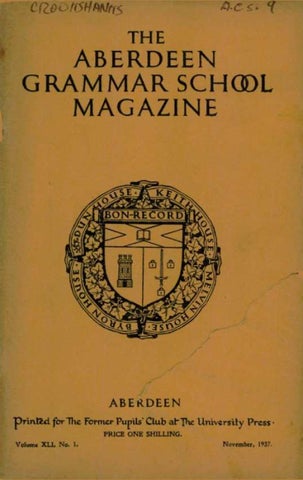
THE
ABERDEEN GRAMMAR SCHOU MAGAZINE
ABERDEEN
p-rirtrkizi for-The Former Pupils' Club al-The University Press • PRICE ONE SHILLING.
Volume XL1, No. I.
November, 1937.
EDUCATIONAL BOOKS JAMES G. BISSET CONTINUES to supply all the Class Books (New or Second-hand) suited for the requirements of the Higher Educational Institutions in the City, at the Lowest Prices. N.B.—Best Value in Students' Note Books.
JAMES G. BISSET, Classical, Medical, and Educational
Bookseller,
85 BROAD STREET (Opposite Marischal College).
•
PHONE 753 •
GOOD HEALTH demands
GOOD BREAD For the children especially is it necessary to ensure their stamina and energy with good, wholesome, nourishing bread. In Hutchison's bread you'll find all these requirement._ are fully met. Phone or give instructions to have it supplied daily.
BRANCHES THROUGHOUT THE CITY
GOOD JEWELLERY GOOD
SILVER
GOOD CUTLERY GOOD CLOCKS and well selected ORNAMENTS are items of real importance in -- every home - -
A. & J. SMITH 191 Union Street ABERDEEN
THE
HOUSE
Coats Gowns in every
Quality and Style
Outsize Wear
105 UNION STREET
A
Speciality
•
ABERDEEN
QUALITY FURNITURE at GALLOWAY & SYKES
does not mean high prices '.f)'::
Our Stocks will prove it! Furniture, Carpets and Fabrics of remarkable quality are there for all to see, admire ' -, and obtain at moderate competitive 1 -- -- ---7 --prices. You will not be disappointed 1721114, if you visit our showrooms RIII!'"' - l''''' !. 7:4 .7.,.-'''.,, DEPARTMENTS • !Ilillr' Furniture Carpets and Linoleums Fabrics Beds and Bedding Mantelpieces Removal Contractors and Storages Parquetry Flooring Billiard Tables Shop Fitters Wood Carvers Church Furniture Funeral Undertakers Valuators -13 114 . '.
Mr1 ..1,4 •,,,-..:•.,,,•„,, ..,,,,,,,
GALLOWAY & SYKES LTD.
TEL. NOS.: 4760-4761 TELEGRAMS, "CRAFTSMEN." ABERDEEN
361-363
UNION
STREET*
ABERDEEN
JAMES FYFE & SON PAINTERS AND GLAZIERS. a
a
a
OFFICE AND SHOWROOMS :-
11 DEE STREET, ABERDEEN. Telephone 304.
Telegrams " Fyfe, Painters."
COUNTRY HIRES AT CHEAP RATES CARS
GARAGED
COLIN S. CLARK DAIMLER TAXI HIRER DAY AND NIGHT SERVICE
PHONE 4422
46 HARDGATE, ABERDEEN
TUE
AMILY COFFEE Curls Cate* is the favourite drink with everyIt ,s most one. delicious, especially Your weather. IP cold grocer can supply you.
CURR'S COF Tbornm Curs & Co.. ABERDEEN.
6,1/0.4/102„.._ Quality is our Truest Economy
ROBERT STOTT Family Grocer Italian Warehouseman, Tea, Coffee, Wine and Spirit Merchant
STREET, ABERDEEN
53 ALBERT
Telephone 1848
Jackson's Bindery 18 Back Wynd Aberdeen -
•
ESTABLISHED 1855
BOOKBINDING OF EVERY DESCRIPTION
BIND FIND FAST FAST
Leather Goods Lettered with Initials or Inscription Maps or Plans Mounted
•
Loose Leaf Specialists
TRADE MARK
TELEGRAMS. " HUB. ABERDEEN."
TELEPHONE. NO. 1719.
CAMPBELL & SELLAR, LTD. Engineers, Hirers and Garage Proprietors
QUEEN'S CROSS GARAGE 1o Fountainhall Road ABERDEEN OPEN DAY AND NIGHT
ANY MAKE OF CAR SUPPLIED
A. D. COPLAND. Phone 896. Telephone No. 2300. Works : Rosebank Place.
Felrw.tphic
" Undertake, Aberdeen."
GORDON & WATSON FUNERAL UNDERTAKERS AND
MOTOR
HIRERS
12 HOLBURN ST. & 40 VICTORIA RD. ABERDEEN
Go to . . .
KE NtNAWAY-S ---of
course
I73 UNION STREET
RESTAURANT
Here you get the finest of food, daintily served, and at a reasonable price. The Restaurant is comfortable and commodious, and is just the place to entertain your friends. Our rooms are available for all types of functions. 'Phone 2371, and ask the Manageress for quotations
WM. KENNAWAY LTD. Quality
Bakers,
Confectioners
and
Caterers,
Aberdeen
Telephone No. 1891.
ARCHIBALD McKELLAR Family Grocer and Wine Merchant,
454-456
Union Street, Aberdeen. -
. . Cooked
-
We Specialise in
•
Gammons, Finest
Belfast Smoked Hams, " Harris's "
Wiltshire Bacon.
Medicinal Wines—Vibrona, Hall's, Wincarnis, Glendenning's.
OFFICIAL SUPPLIERS for the SCHOOL • Grammar Grammar • School Blazers 0 I 2
-
3 4
-
5 6
7 8 9 TO
II 12 13
-
17;1/ IR It 19 It 20 11 21 11 22 11 23 11 24'11 25 I/ 26 11 27 II 28,11 29'11 30 II
School Shorts Lined
Bias Oxford Ties, 2/- ; Open-End Ties, 3/6 ; 2/6 ; First Quality Hose, 71 2 —n 3/I I ; 9-10, 4/6. Badge PullOvers, 24, 9/6 ; 26, 10/6 ; 28. I 1 /6 ; 30, 12/6 ; 32. I3,'6 ; 34, 14'6 ; 36, 15 6. Grey Slip-ons, 24, 26, 28, 30, 5 'I I ; Jerseys, 6; 1 I. 32, 34, 36, 616. Scarves (Large), 4 11 ; (Small) 2'11. Belts—Snake (Narrow), I - ; Belts— Snake, 1 6. Belts—Badge Buckles, 3,'-. Braces, I/6.
Price
Size
•
Size 0
1
•
ISAAC
Price 916
-
9/11
z
-
ro,"6
3 4 S 6 7 8 9
-
10.4: 11/6 11/9 i2/6 12/11 13/6 13/11
10 11 12 13
-
14/6 14/11 15/6 151I
-
BENZIE
LIMITED
GEORGE STREET
•
ABERDEEN
W. J. MILNE, LTD. Men's Outfitters
251 Union Street Aberdeen (Opposite Royal Northern Club)
Telephone 1293
Telegrams : "Gallowses, Aberdeen "
AGENTS FOR BURBURRY COATS
Purveyors of only the FINEST QUALITY in Fish, Butcher Meat, Poultry, and Game.
,A1
: Telephone 5172.
/
492 UNION STREET, ABERDEEN.
Telephone --Aberdeen 1710.
The Mastrick Dairies Ltd. 1 DESSWOOD PLACE, ABERDEEN WE offer you a Choice Selection of DAIRY PRODUCE from our own Farms, and produced under the direct supervison of members of the family. Our Customers may rely upon the absolute Purity and Cleanliness of all our products. Distributors of
Lord Carnegie's and Cairnbrogie Certified Milk. Head Dairy: 3, 5, and 7 WHITEHALL ROAD. Branches: 7 MID STOCKET ROAD. FOUNTAINHALL ROAD. 473 GREAT WESTERN ROAD. 25 BEDFORD PLACE.
33
CONTENTS ILLUSTRATIONS Mr. William Forbes, M.A. . . Mr. P. Murray Stewart . . . The Preparatory Department—May, 1907 The Junior Boarding House . .
• •
•
• •
. .
.
. Facing page 46
.
•
,,
A Message to Former Pupils. By D. M. A. . . . The P. & O. and Sir Thomas Sutherland . . . . Byroniana . . Notes About Old Boys . • . . . . . Obituary • • • • . . . . . Alexander Cruden . • • . . . . . Marriages . . . . . . . • • The Last Rose (Verses). By I. S. F. . . . . The Old Penal Days of Tasmania. By Alexander Taylor . A Week-end on an Australian " Station." By A. W. Duncan An Eventful Morning in Hall. By George Wood . . F.P.s in Singapore . . . . . . . . A Class of Thirty Years Ago . . . . . . The House on the Hill. By G. Topham Forrest . . Three Weeks in Canada. By Alan C. R. Watt . . . •
•
•
•
•
•
•
•
School Section— School and Random Notes . . . Douglas Mackay. By S. B. . . . Two New Members of the Staff . . A Tribute to Mr. Peter Edward, M.A., B.Sc. A Norwegian Cruise. By David Mathieson The Jamboree of 1937. By J. G. I.. . The Heron's Last Day . • • . School Physical Activities. By D. McG. . Rugby Notes . . • . . . House Notes . . . . . Rambling and Mountaineering Club . . The Literary and Debating Society . . Scout Notes . . . . • . The Former Pupils' Club— Club Executive Notes. By J. Patrick Jeffrey The Club Boarding House . . . The Glasgow Centre . . . . Rugby Section . . . . . Hockey Section . . . . . List of Club Consuls . . . . List of New Members . . .
la
46
Between pp. 46 and 47 • . Facing page 47 . Page x . ,, 3 6 . 7 . „ 28 . ' 33 • ,, 34 • 36 . „ 37 39 . ,, 45 „ 46 . . „ 46 . ,, 47 . ,, 52 •
,,
PP
IP
PP
•
PP
•
•
•
95.
•
•
•
15
•
•
•
•
•
•
•
•
•
IP
•
•
•
PI
•
•
•
•
•
•
•
•
•
•
•
•
•
•
•
•
•
•
39
•
•
•
15
•
•
•
99
•
•
•
•
•
•
33
•
•
•
55
59
•
•
•
91
•
•
•
23
•
•
•
6o 65 66 67 68 69 72 73 74 78 79 8o 8z 86 88 89 90 91
92 94
'
'
*:.'..-
,,
Here is the correct undress Costume for boys. This consists of a The Stockings may be plain
Tweed Jacket and Vest and a Tartan Kilt. or have checked tops.
Garters are worn in each case.
The Sporran
may be either an Animal Head or Leather as illustrated. Jackets and Vests, 32/6 and 47,'6.
Hose, 3/6 and 5/6.
Bodice Kilts, 32/6.
Sporrans, 4 6 to 12,6.
The above prices ore for an 8-year size.
Esslemont & Macintosh Ltd. ABERDEEN
Silver Medal Bread Think of it ! A different Loaf for every day of the month 9 VARIETIES OF BROWN BREAD OF WHITE BREAD
21 VARIETIES
Try them all lk
W. M. McPHERSON Baker and Confectioner 15 FOUNTAINHALL ROAD AND-- -8 ST. SWITHIN
STREET
ABERDEEN Telephone 1515
1843.
LOW'S Wm. Cay 8z Sons BOOKSTALLS EST ABI.3511F D
39-50 New Market Gallery ABERDEEN
funeral 111116ertakers,
-
415 UNION STREET ANTI
209 GEORGE STREET, ABERDEEN. Motor Hearses and Cars for Town and Country Funerals.
BOOKS on All Subjects and at All Prices Over 500,000 Volumes in Stock Educational Books in Great Variety CATALOGUES ISSUED
telegrams—"Cay, A berdren.— 'Phones Nos. 92 and 54.
'PHONE 3332
EST/MASHED 1818
BY APPOINTMENT 10 N.M. Ti KING
J. WILLIAMSON & SON (VV. B. 1AIMAIAMSON. PROPRIETOR)
Meat Purveyors and Poulterers 1, 2, & 3 MARKET BUILDINGS, ABERDEE N 'PHONE 452 BRANCI4k1 . 35 FOUNTAINHALL ROM" 'PHONE 1724
THE SQUARE. CULTS 'PHONE, CULTS 2
ALSO AT CHURCH SQUARE. BALLATER 'PHONE 38
AT ANY TIME AND ALL THE TIME
THE WHOLE FAMILY WILL ENJOY
SHORTBREAD IF IT COMES FROM
Mitchell & Muil Ltd. SEAMLESS FITTED CARPETS Every good housewife welcomes the wall-to-wall carpet. She appreciates the beauty and comfort it brings to her home, and the drudgery it saves in keeping polished floors spit and span.
We have arranged with one of the largest carpet manufacturing firms to manufacture a heavy pile carpet exclusively for ourselves, and we have named it "THE BALMORAL." It is woven in one piece, any width, any length, and the price is remarkably low. Obtainable in 6 different colours.
16 6 per square yard.
ROBERTS (Abdn.) LTD. Tel. 2695
Carpet Specialists and House Furnishers
Est. IN73
419 UNION STREET, ABERDEEN
-60
art
THE IMPERIAL TYPEWRITER
,StOents
toe/0 British, is the best and loweSt-priced Standard Typewriter, used in 75°,4, ui the leading offices in Aberdeen.
We carry a fine range of reproductions of the Old, Modern, and Impressionist
THE IMPERIAL PORTABLE The Best Portable, too% British.
School from P.C. size up—and frames to suit all subjects.
Second-Hand Bargains of all Makes of Typewriters, Desks, Chairs, Filing Cabinets in Oak, Mahogany or Steel.
All the latest HANDICRAFTS
EASY
DEFERRED
PAYMENTS
(Hire Purchase) ON ANYTHING.
Octylors 49-51 Scboolbill
C. H. WEBSTER 489 Union Street, Aberdeen 'Phone 505
'Phone 2870
ROLEX 27 WORLD
RECORDS
OYSTER
WATERTIGHT AND DUSTPROOF
ANTI-MAGNETIC — UNBREAKABLE GLASS
- S gns. Stainless Steel Extra Precision - 10 gns. - 13 gns. 9 ct. Gold Other models from 5 gns. We stock the complete range of Rolex Oyster and Rolex Prince Watches.
JAAIIIESON X (CAIRIL Established in the Year 7757
WATCH AND GEM RING SPECIALISTS
142 UNION STREET (next Union Bridge), ABERDEEN
COAL ELLIS & McHARDY LTD. (ESTABLISHED
18
REGENT
1880)
QUAY
AND
250
UNION (AMICABLE
STREET
HOUSE)
ABERDEEN Telegrams " COAL, ABERDEEN "
Telephone 2889
the modern note is cleverly expressed in the new
15.
Fireplace
Arrangements.
Why not inspect them in our showrooms and see at firsthand how greatly one would add to the appearance
and
comfort
of your room?
James Scott & Son (Aberdeen) Ltd. 483-485 UNION STREET ABERDEEN Phone 1881-2
Co-operation HE enthusiastic co-operation of many minds and hands make possible the fine productions of the HOUSE OF OGILVIE. For over three-quarters of a century our constant endeavour has been to give the best possible service to our Customers. We base our claim to your patronage on our ability to please you.
T
J. & A. OGILVIE 369
UNION
STREET,
ABERDEEN. Telephone : No. 433.
Telegrams: " Interiors."
Showyard Erector to the Highland and Agricultural Society of Scotland, and Contractor to the Royal Northern Agricultural Society.
Vcits7
STRACH AN COMMERCIAL & PORTRAITURE
JOHN REID & CO. HOUSE CARPENTERS AND JOINERS
55 Blenheim Place and 14 Fountainhall Road ABERDEEN
PHOTOGRAPHY Telephone 851
416 UNION STREET ABERDEEN
oipet Carpentry and Joinery Work of every description done ESTIMATES
ON APPLICATION
Telephone No. 1997
A MODERN SERVICE for MODERN MOTORISTS
is
i
~-~~.~':'v
We are equipped with the latest and most up-to-date appliances for the lubrication of your car. No longer need you struggle with grease guns and oil cans or crawl to reach inaccessible points. All this work can now be done for you cleanly, efficiently and effectively and without the slightest trouble to yourself. Call in sometime and let us demonstrate this Service.
We are an
O~ICIa~--
-
WAKEFIEIDn
~~~~
LUBREQUIPMENT SERVICE
AU' IEIRIDIEIE
STATION
MIDICILS
LIMITED
THE AUSTIN DEALERS
u N111O N UOIA' s AIIIEIRIDIEIESI Telegrams—" CARS "
Telephone-4580
Established
Assets
1836
£24,600,000
NORTHERN ASSURANCE COMPANY LIMITED ••
FOR ALL CLASSES OF INSURANCE • LIFE
*
BRANCH
Special Leaflets on—
The Family Protection Policy The " Optional " Policy House Purchase Policy Child's Deferred Policy
CHIEF OFFICES : ABERDEEN
•
•
LONDON .
•
•
I UNION TERRACE I MOORGATE, E.C.2
Branches and Agencies throughout the World
Aberdeen Grammar School Magazine 53rd year: No. 137
Vol. XLI -,
(New Series, 441/i )'ear, No. 1.28)
NOVEMBER 1937
-No. 1
The "Grammar School Magazine" is issued under the auspices of The Former Pupils' Club, in March, June, and November. All communications with regard to the " Magazine " should be addressed to the Editor (the Secretary and Treasurer of the Club), THEODORE WATT, M.A., The Rosemount Press, Aberdeen.
A Message to Former Pupils. A sunny Autumn, a fairly clean bill of health for teachers and taught, games going with a swing, and just enough of the salt of novelty to savour the work-a-day routine—such are the thoughts that occur to me as I address myself to another Message. For most of us the Summer vacation had fulfilled expectations ; for the boys who made School history by joining a trip to Canada it was an unforgettable thrill. I hope that one of them has something to say of his experiences in another part of the Magazine. The opening of the Junior Boarding House calls for first mention as an item of news. The House has made an auspicious start. The young boys enjoy a sense of freedom that was not possible in the larger House, and their special needs and interests are well catered for. They appear to be very happy, and I shall be surprised if the House has a spare bed in six months' time. I hinted last June that alterations to the main School building, particularly the Laboratories and Art rooms, were uuder con sideration. Nothing has been done so far, wisely I think, as the major problem of secondary school accommodation created by the raising of the school age in 1939, has to be kept in view. Not that this measure will affect the Grammar School directly, but our needs have to be considered in relation to a comprehensive scheme. Meantime the Laboratories have been generously supplied with new and much-needed apparatus, and the Art rooms are better equipped than they have ever been before. One of the School's most recent and most enthusiastic organizations, the Art Club, is busy on the production of the
z
Aberdeen Grammar School Magazine
first issue of its magazine. Much time and thought have been spent on its compilation, and I hope you will make a point of ordering a copy. It should he well worth the modest sum of is. 3d.—a charge that has been made possible by a subsidy. Our School XV has an excellent record to date, and no mean share of the credit for its achievement must be given to the Captain, D. R. Macgregor, who is also the Senior Prefect of the year. The team has more than held its own with the most prominent Rugby-playing schools in Scotland, and we look forward with special interest to our first encounter with George Watson's College. The second and third XVs have also done well, so that prospects for next season are encouraging. Some time ago I included in my Message a short analysis of the careers which boys in the three highest classes of the School intended to follow. It may interest you to have the corresponding figures for the current year. The number of boys concerned is 193, and the choice is as follows :—Medicine, 46 ; Engineering, 19 ; Teaching, iz ; Law, ii ; Civil Service, 10 ; Commerce, 8 ; Police, 8 ; Insurance, 7 ; Accountancy, 6 ; Architecture, 4; Banking, 4; Forestry, Veterinary Science, Royal Air Force, 3 each ; Divinity, Journalism, Tea Planting, 2 each ; Agriculture, Dentistry, Physical Instruction, Pharmacy, i each ; Undecided (chiefly from Class IV), 38. As before, Medicine has a commanding lead and still attracts a large proportion of the abler boys. This is shown by the prominent places which they take in the Medical class-lists and, notably, by the fact that the School has produced on six successive occasions the most distinguished graduate of the year in that Faculty. The uncertainty of prevailing conditions has led to a notable decrease in the number of boys who seek employment overseas. Some tempting offers from two firms of export merchants have met with little or no response. The one satisfactory feature of the present position is that no boy leaves School without a job, either immediate or prospective. It may not always be the job he wants, but, if his School record has been a satisfactory one, he will be found useful employment of some kind. The changes which the University of Aberdeen has recently made in the regulations for the Entrance Bursary Competition are of great interest to this School as to others in the N.E. area. These changes have been published in the press and are, no doubt, familiar to most of you. It would be out of place to touch on controversial topics here, but it may be stated with confidence that the unfettered choice of subjects which is now permitted will be welcomed by the candidates, and the scheme deserves a reasonably long trial. We await the Scottish Education Department's new regulations for the award of the Leaving Certificate. They become operative in 1940 and are to be issued
Aberdeen Grammar School Magazine
3
before the end of December. It would seem that we arc to witness far-reaching changes in the scope and content of Secondary Education during the next few years. We have welcomed two new members to our staff—Mr. William Forbes, Principal Teacher of English, and Mr. P. Murray Stewart, Physical Instructor. Mr. Forbes is no stranger to the School, having served at one time as Assistant in the Department which he now controls. We have almost completed the thirteenth week of the long Autumn Term, and recurrent spells of frost are a reminder that the Christmas respite is not far distant. The Dramatic Society gives its annual performance on z3rd December, and, among the less joyous occasions, are the examinations which test the fitness of boys to sit the Leaving Certificate. We send you the customary greetings and our good wishes for the Coming Year and—if I may—a special message of remembrance to our F.P.s in Shanghai. D. M. A. z7th November, 1937.
The P. & 0. and Sir Thomas Sutherland. At the beginning of September the Peninsular and Oriental Steam Navigation Company celebrated the centenary of its inauguration, and part of that celebration was the publication of a volume entitled " A Hundred Years' History of the Peninsular and Oriental Steam Navigation Company," by Boyd Cable (Ivor Nicholson & Watson, Ltd., los. 6d.). The book is of special interest to the Grammar School for two reasons : (i) it has been written by a member of the F.P. Club, and (z) it has much to say about one of the most distinguished Old Boys who ever passed through the School. " Boyd Cable," as is now well known, is the pen-name of Lt.-Colonel ERNEST A. EWART (188z-83), O.B.E., the author of " Between the Lines," " Action Front," and other War books. According to the entry in " Who's Who," he has had a " very mixed career: served South Africa, 1900-01, as Scout, and since then has followed many occupations, from teamster and tramp in Australia and farm hand in New Zealand to business manager and partner in commercial work ; has sailed before the mast, and been trimmer, fireman, and greaser in steamships ; applied for commission in August, 1914, and went to France that year ; served there in R.F.A. and R.A.F. until armistice." Boyd Cable's history of the P. & O. is a most interesting and readable book, telling the story of the founders of the Company, of its early years, of the development of the Overland
4
Aberdeen Grammar School Magazine
Route between the Mediterranean and the Red Sea, of the digging of the Suez Canal, of various war services, and of the carrying of mails. The opening of the Canal and its proved success after a year or two brought crisis after crisis on the P. & O., for the value of all their costly establishments and organizations in Egypt was practically wiped out at a stroke. After looking over the tale of that great and almost crashing event, and reading the inside story of those years, Boyd Cable says he can only regard it as little short of a miracle of business management that the Company fought through all their desperate battles and at the end emerged with enhanced prestige and power. " It is an old saying that ' the need finds the man,' and this was certainly borne out in the case of this emergency in the Company's affairs after the Canal opening. . . . It was soon to be shown that again the need had found the man." At this point in the book, accordingly, there is a whole chapter devoted to Sir Thomas Sutherland, G.C.M.G., LL.D., M.P., who became Chairman of the P. & O. and a Director of the Suez Canal Company. He entered the service of the P. & O. in the London office in 185z at the age of 18. Two years later he was sent out to the office at Bombay, but had barely arrived there when he received orders to go at once to China, where he stayed for about twelve years, and, incidentally, found time to start the Hongkong and Shanghai Banking Corporation. He returned to the London office of the P. & O. in 1866, and was appointed Assistant Manager in 1868. " This was when the impending shadow of the Suez Canal was hanging over the very existence of the P. & O., and Sutherland, sure of the enormous changes it would bring to Eastern traffic, devoted himself to the work of preparing, and then of reconstructing affairs to meet the flood of competing shipping." Sutherland was appointed Managing Director in 187z, and Chairman of the Company in 1880, when only 46. He continued to act as Chairman until 1914. Altogether he served the Company for 6z years. Boyd Cable says that he has not found any full-length biography of Sir Thomas Sutherland, and if none has been written, he can only express his surprise, " because from the generally known broad outline of his career, I cannot imagine more attractive material for a book of any man's life." It is rather curious that the author does not mention that Sir Thomas Sutherland was a native of Aberdeen, where his father, Robert Sutherland, was a painter, and that he was a pupil at the Grammar School from 1844 to 1848, thereafter spending a year at Marischal College. Our F.P. will be interested to learn that to the Grammar School Magazine of May, 1901, Sir Thomas Sutherland contributed an article which was at the time rightly regarded as a
Aberdeen Grammar School Magazine
I
wonderful editorial " scoop," telling the story of the Suez Canal, an enterprise with which at that time he had been connected for fifteen or sixteen years as one of the English Directors. That Sir Thomas was willing to find time to write the article —and an authoritative and delightfully written one it is—is evidence of the esteem with which he regarded his old School. In the course of seven pages he unfolded the romance of the Canal and outlined the almost endless difficulties that had to be overcome. It will be of interest to reproduce here the concluding sentences of the article:— Only the other day, I was passing backwards and forwards across its
surface on a visit of inspection, seeing its wonderful dredgers, its sweetwater canal, its now famous ports, its workshops, its railway, its telephonic and signalling stations, and watching the grcat fleets of men-of-war and merchantmen of every nationality passing along that busy though silent highway by day and by night. And then, as invariably must be the case in such circumstances, one's mind reverted to the long distant past. Abraham crossed the line of what is now the Canal when he came to Egypt, somewhere near to Lake Timsah, and it was in all probability in one of the lagoons, now known as the Bitter Lakes, that Pharaoh's host was swallowed up. The Holy Family passed this way, fleeing from Herod. Darius, Alexander, Cesar, Napoleon fought battles on this desert field. The great work of Lesseps links together the past and the present, the oldest civilisation and the newest, through a chain of events lying many centuries apart, yet all memorable in the world's history.
After the death of Sir Thomas on New Year's Day, i 9z 2, at the ripe old age of 87—he was then the Senior Member of the F.P. Club—there appeared an obituary notice in the Magazine in which was given a long extract from a paper contributed by Sir Thomas about twenty years before to Alma Mater (the Aberdeen University Magazine). In this he showed the influence that the School and its great Rector, Melvin, had had upon him as a boy. We quote, in conclusion, from that obituary notice—" In the long list of men that our School has helped to fit for distinguished and valuable careers, there are few in whom she can take a more proper pride than in this son of hers who, by sheer ability and unremitting labour, not only extended British commerce in the East, but indirectly helped to bring about an alliance [the Entente with France] which has already influenced the history of the world."
6
Aberdeen Grammar School Magazine
Byroniana. A complete collection of Byron's works, including many rare copies, together with a large number of documents, pictures, manuscripts, prints, and other articles relating to the poet, which were bequeathed to Nottingham by the late Mr. H. C. Roe, a Nottingham hosiery manufacturer, was formally handed over to the City Corporation on 29th September, at Newstead Abbey, the poet's ancestral home, now the property of the Corporation. There it joins the Byron furniture and relics presented to the city by Mr. Charles Ian Fraser, when the most ancient part of the Abbey was presented to Nottingham in 1930. Mr. Roe, who died in 1923, took a deep interest in everything connected with the life and work of Byron, which led to the gradual building up of the present collection. The catalogue, of nearly two hundred pages, begins with manuscripts and printed and pictorial matter associated with Newstead Abbey and the Byron family. Byron's life is then covered chronologically from his childhood and school days to the last days in Greece ; ten pages are devoted to descriptions of collected and selected editions of the poet's works, and in conclusion, miscellaneous Byroniana are catalogued and described. Notable among the pictures is a portrait of Byron as a boy by Sir Thomas Lawrence. At the ceremony in September it was stated that the fears originally expressed that the Abbey might be burdensome to the ratepayers of Nottingham had been entirely falsified, and that so many thousands of people now visited it annually that a surplus fund had been accumulated which would render the Corporation immune from the cost of repairs to the ancient building. In a letter in the Sunday Times in October Mr. W. Kent, editor of the "Encyclopedia of London," said that it was extraordinary how objects of interest in London could disappear beyond the ken of man, and he went on to refer to the two medallions—one inside and one outside—and the tablets in memory of Byron formerly at 85 Fleet Street, which was pulled down last year. " One inquirer was informed by the foreman of the works that they were being carefully preserved, and another was told they had been sent to Aberdeen Grammar School, which Byron attended. On inquiry there, nothing is known. Can any reader of the Sunday Time, enlighten us ? All the memorials were due to Sir J. Tollemache Sinclair, and they were placed there in 1887." So far no reply to this letter has appeared.
Aberdeen Grammar School Magazine
7
*, * It is requested that the Editor be informed of all new appointments and interesting incidents in the careers of Former Pupils.
The dates given in parentheses after names indicate the sessions of attendance at the School. James Smart Abernethy* (1924-26), LL.B., W.S., Legal Adviser and Commissioner of Lands in the North Borneo Government Service, has recently been relieved of the Labour, Education, and Immigration Departments, for which he has been responsible for a year and a half. In the capacity of " Inspector of Schools," as reported in the last Magazine, he felt it incumbent on him to see that some at least of the Government scholars should do something special to celebrate the Coronation. On the evening before the great day, accordingly, he produced in the open a display of Scottish country dances by native schoolboys. They carried out Stripthe-Willow, the Dashing White Sergeant, and the Eightsome Reel almost perfectly, to the music of a gramophone, and even the ignorant Sassenachs appreciated it. He still captains a local football team, and finds time to play for them occasionally. Mr. Abernethy, in a recent letter to the Rector, says that if there are any suitable pupils at present at the School who have no particular career to follow and are keen on the Colonial Service, they might do worse than apply to the North Borneo Chartered Company to see if there are any openings in the North Borneo Civil Service. " They should be warned that life out here, whether as a professional or as an administrative officer, is not a bed of roses, and they will have to work hard ; but it is a young man's country, and is being, at the moment, more or less run and developed by young men. Cadets generally enter the Service at the age of 20-23, mostly after taking a University degree. If I were to recommend a degree, I would suggest a B.L. or a B.Sc." John Malton Adcock* (1901- I t), A.M.Inst.C.E., who was in the service of Imperial Chemical Industries up to 1931, was thereafter employed by the Hampshire County Council as resident engineer in charge of the Basingstoke By-pass road. On the completion of that, he was employed by the County Borough * Member of Former Pupils' Club.
8
Aberdeen Grammar School Magaine
of West Ham and placed in charge of the High Street (Stratford) Improvement, including the construction of one large reinforced concrete bridge and the widening of two others. In October 1936 he was appointed by the War Office as Assistant Civil Engineer on the removal of sections of the Ordnance Factory from Woolwich, and in July of this year he was promoted to be Engineer. He says that the work has been exceptionally hard, owing to the urgency of the Government's Defence Scheme, and, strange as it may appear, he has been working harder and for longer hours than ever he did for any private firm or public authority. A colleague of his at Woolwich Arsenal is DANIEL GERALD MURPHY* (1911-15). The Right Hon. Lord Alness* (1884-85), P.C., LL.D., appears to be on the way to hold the record for the number of Government Commissions and Inquiries he has undertaken as chairman. He was appointed in October chairman of the Nursing Inquiry, in addition to his chairmanship of the Committee appointed to inquire into University finance in Scotland. Not long ago he was chairman of the Committee which investigated night baking on behalf of the Home Secretary. Alexander Smith Anderson* (1905-09), M.B.E., who for 14 years has been manager for the Norwich Union Life Insurance Society at Aberdeen, has recently been appointed manager in Aberdeen both for that Society and the Norwich Union Fire Insurance Society. He is a member of the Aberdeen Town Council, and in November was appointed a Baillie. Ian Alfred Anderson* (1912-24), B.Sc., M.B., Ch.B., was in July elected to a Beit Memorial Fellowship for Medical Research. He was the most distinguished graduate in medicine at Aberdeen in 1933, and after a year as a Resident Medical Officer at the Aberdeen Royal Infirmary, he was elected to a Rockefeller Fellowship in 1934. The subject of his research under the Beit Fellowship, which is to be conducted at the Metabolic Research Laboratory of the Aberdeen Royal Infirmary, is " Iron Analyses of Diets of Women of the Poorer Classes in Aberdeen and Studies on the Treatment of Anemia." Norman Robert Beattie* (1921-31), C.A., who served his apprenticeship as a chartered accountant with Messrs. Bower and Smith, C.A., Aberdeen, is now on the staff of Messrs. Gray and Kellas, solicitors, Aberdeen. Norman Darroch Begg* (1915-24), M.D., D.P.H., who has been Medical Superintendent of the Borough Sanatorium, Southend-on-Sea, since 1935, has recently returned to the service of the London County Council as Medical Superintendent of the Eastern Hospital, Hackney. It has 6zo beds for acute infectious diseases. Henry C. Boulton* (1882-89), who for many years was
Aberdeen Grammar School Magatine
9
engaged in railway construction in various parts of Africa, and latterly was resident in Canada, is now living in retirement in Muswell Hill, London. Robert Douglas Bruce * (1913-22), M.B., Ch.B., is an Assistant Medical Officer in Hackney Hospital, under the London County Council. Ronald William Gower Bryant * (x9zo-3z), M.A., has been awarded a Carnegie Research Scholarship to take him to the London School of Economics for two years. Last June he was awarded at Aberdeen University the John Stephen Scholarship in Economics. John Malcolm Bulloch* (1877-8o), M.A., LL.D., contributed to The Times in September an interesting letter " as a sort of corollary " to a leading article in that paper on the hold of " The Second Mrs. Tanqueray." " I saw the play on the night of its production in 1893, and, though I have seen 3,631 other plays of more than one act since then—incidentally, I have preserved and bound all my programmes—Mrs. Campbell's performance stands out as the most memorable piece of acting I have ever seen. But then it was less acting than an incarnation, and Pinero's outlines made that incarnation possible." Dr. Bulloch's first attendance at any theatre was at the pantomime " The Yellow Dwarf," which he attended in Aberdeen in 1879 (when a pupil at the Grammar School). The programmes of all the plays he has seen are bound in fifty quarto volumes, complete with the best criticism of each play and the reproduction of photographs of the actors. These volumes preserve a record of the British stage for the past half-century. It is of interest to note that one of his bound volumes was once produced in court to prove the authorship of a play which was in dispute. John Rudolph Wardlaw Burnet* (1 899-1901), B.A., LL.B., K.C., was in September appointed Sheriff Principal of Fife and Kinross, and was welcomed in Cupar Sheriff Court in the following month. Henry Jackson Butchart* (189o-99), D.S.O., B.L., Secretary of the University of Aberdeen, has recently been appointed Commissioner of the Aberdeen Boy Scouts. He is an enthusiastic mountaineer and keenly interested in all outdoor sports. William Nicoll Buyers* (1906-1o) has decided " to retire from the Orient " and settle in Victoria, British Columbia. In a recent letter he says that a curious coincidence occurred when he was motoring through California last April and when he had occasion to call on the Bank of Commerce in Los Angeles. " The accent of the gentleman attending to me drew my attention, and learning that he was from the Granite City, I remarked that I had been at the Grammar School. He seemed rather
lo
Aberdeen Grammar School Magazine
amazed at my statement, and promptly produced from his drawer a copy of the Magazine, pointing out that he was EDWIN MORGAN the Club Consul in Los Angeles. Not to be outdone, and in order to substantiate my statement, I pointed out my name in the list of F.P.s resident abroad that appeared in that Magazine." It is of interest to record that Morgan has recently been promoted to be Assistant Vice-President of the Canadian Bank of Commerce in California. James Rankine Wilson Catto* (19 z 3-36), who was last year's sprint champion at the School, came to the front by running second in the too yards and 22.0 yards at the Scottish Inter-University Championships this year. As a result, he was chosen as a member of the team to represent Scotland at the International Universities Games at Paris in August. Here he rather disappointed in the final of the zoo metres, finishing fifth. He certainly was not up to his best form on that occasion. Thomas Collet (1910-14) is store manager with Messrs. Jaeger, the famous wool firm, and is resident in Kensington. His eight-year-old daughter, Ray Collet, stars with Arthur Tracy in the film " Command Performance." In it she takes the part of the little sister of the sweetheart of the hero, and does her best to bring the romance to success. Her part is very heavy, involving the development of pathos in accident and sick-room scenes. Film directors are already forecasting for her a brilliant career on the screen, and it is probable that she will go to Hollywood in the near future. Nigel Smart Cowan* (1924-28), B.Sc. (Eng.), Captain, Royal Engineers, has been appointed Adjutant of an English Territorial Battalion, the " Robin Hoods," of Nottingham. This was formerly the 7th Battalion The Sherwood Foresters, but is now the 42nd (The Sherwood Foresters) Anti-Aircraft Battalion, Royal Engineers, and Captain Cowan has been posted to them because he is an expert in anti-aircraft searchlight work. Early this year he commanded a demonstration detachment which visited every anti-aircraft battalion in the and AntiAircraft Division. James White Dalgleish * (1928-34) has been awarded at Aberdeen University the Mather Bursary in Law, to the most distinguished law student of the first year ; and Neil Geddes Clarkson Hendry (1923-25) has been awarded the Strachan Bursary at Aberdeen University, open to students who have finished the third year in medicine. Lessel Murray Davidson* (1905-14), Major and Brevet Lieutenant-Colonel, has been selected for command of the 75th (Highland) Field Brigade, Royal Artillery (Territorial Army), in succession to Lieut.-Colonel John R. Cooper (the brother of the President of the F.P. Club). Colonel Davidson
Aberdeen Grammar School Magazine is the eldest son of the late Mr. Andrew Davidson, C.A., and is a partner in the firm of James Meston & Co., chartered accountants, Aberdeen. James Gordon Dawson* (1921-34) recently graduated at Aberdeen University B.Sc. in Mechanical Engineering, with First Class Honours. He has been awarded the Higher National Diploma in Mechanical Engineering, with five Distinctions, and the book prize from the Institution of Mechanical Engineers for the highest marks attained in Scotland. He has also been awarded the Aberdeen University prize to the best engineering graduate in the year 1936-37. Sidney Wardlaw Duguid * (1922-27) is in the Superintending Civil Engineer's Department, Royal Naval Yard, Trincomalee, Ceylon. Robert Weyer Dunlap (1896-97), B.A., M.D., after graduating in medicine at Johns Hopkins University, U.S.A., was a medical missionary in China from 1909 to 1927. He is now resident at Washington, Pennsylvania. Douglas Watt Duthie* (1915-21), M.A., B.Sc., Ph.D., who was appointed Lecturer in Chemistry in the Imperial College of Tropical Agriculture, Trinidad, B.W.I., in 1931, has recently taken up an appointment under the Colonial Agricultural Service as chemist to the Department of Agriculture, British Guiana, and is resident in Georgetown. He has recently been elected a Fellow of the Institute of Chemistry. John Fordyce Robertson Fairweather* (1919-25) entered the service of the Royal Insurance Company, Aberdeen, twelve years ago, and recently left the city for Nairobi, Kenya Colony. He has been appointed Resident Inspector for his company in East Africa—Kenya, Uganda, and Tanganyika Territory, with headquarters at Nairobi. He is a Fellow of the Chartered Insurance Institute. Edward Fiddes* (1 876-81), M.A., LL.D., formerly Senior Pro-Vice-Chancellor and Ward Professor of History in the University of Manchester, is the author of a book entitled " Chapters in the History of Owens College and of Manchester University, i851-1914." In it he has not only sketched from the earliest days the development of a great university, but has also contributed a valuable chapter to the history of higher education in the second half of the last century. Adam Fyfe Findlay* (1879-85), M.A., D.D., was in October inducted as Master of Christ's College (formerly the U.F. Church College), Aberdeen. In his inaugural address Professor Findlay dealt with the training for the Christian ministry, and in the course of it defended the teaching of Greek and Hebrew in the students' courses. lie holds the Chair of Christian Ethics and Practical Theology in the University.
12
Aberdeen Grammar School Magazine
Alexander Findlay* (1882-91), M.A., D.Sc., Ph.D., F.I.C., Professor of Chemistry in the University of Aberdeen, is the author of " A Hundred Years of Chemistry," recently published by Messrs. Duckworth. The author's principal aim has been to show how chemists have studied the properties and transformations of matter, have ascertained the laws according to which these transformations take place, and have, as the result of great experimental skill and insight, obtained ever clearer views regarding the fundamental nature of matter. He has not neglected the practical bearings of the science, and numerous short biographical sketches of those who have contributed most conspicuously to the work of erecting the present-day edifice of chemistry add greatly to the value and interest of the book. George Topham Forrest* (1879-89), F.R.I.B.A., formerly architect to the London County Council, was a member of the Departmental Committee on the Construction of Flats for the Working Classes, whose final report was published in August. Mr. Forrest has been put on the Advisory Committee of the Polytechnic School of Architecture, Town Planning, and Interior Design, London. He is now resident at Brent Knoll, Somerset, and has a business interest in Bristol. Rex Fowell* (1912-23), who has been for some time an engineering assistant in the City Engineer's Office, Aberdeen, was in March of this year transferred to the Main Drainage Department, and is now resident engineer on the Main Drainage Scheme. The work at present in progress is from the Bay of Nigg to the Bridge of Dee, and is mostly in tunnel. He has two F.P. assistants—CHARLES BARCLAY MILLAR (1921-35) and JOHN STRATH WISHART* (1925-35). In the service of the contractors (Messrs Wm. Tawse, Ltd.) are two other F.P.s — IAN FARQUHARSON HENDERSON* (1923-31) and JOHN ADAM RITCHIE SMITH* (1922-27). In March of this year Fowell was commissioned as 1st Lieutenant in the 75th (Highland) Field Brigade, R.A. (T.A.). He is to be the Brigade Survey Officer, and is meantime studying Artillery Survey. Douglas Christian Fraser* (1907-17) recently resigned from the F.P. Club Consulship for Assam, as he has now left that province. He is at present resident in Aberdeen. James Milner Fraser* (t9t8-zo), of the Singapore Improvement Trust, is now President of the Singapore Battalion of the Boys' Brigade, which is very active. He started the first Singapore company in 193o, and there are now six companies and over two hundred boys. In August they went into camp at an ideal spot by the seaside. Most of the officers are Chinese, who are running their own companies now and doing very well. John Forbes Fraser* (1879-83), who was engaged in tea _ _7 to 1929, when he planting in Ceylon and South India from I HA
•
Aberdeen Grammar School Magazine
I;
retired, has recently been on a visit to Australia, India, and Ceylon. He visited Aberdeen a short time ago. John French Gauld * (1919-29) is on the Chulsa Tea Estate, Jalpaiguri, Dooars, Northern Bengal. Richard Ogilvie Girdwood* 9°7-15), M.B., Ch.B., who has been Senior Assistant City Pathologist at Bradford for the past six years, has been appointed by Liverpool City Council to be pathologist to three Liverpool hospitals. He graduated in medicine at Aberdeen in 1923, and for the next two years was associated with Professor Hugh 'MacLean on insulin research at St. Thomas's Hospital, London. At Bradford he was Lecturer in Bio-chemistry at the Technical College. Angus William Grant * (1926-3o), B.Sc.(Agr.), is in the service of The British Oil and Cake Mills, Ltd., Seafield, Leith. John Alexander Gray * (1916-35) was Assistant Stage Manager for the repertory season last summer at the Theatre Royal, Bath. OUR OLDEST "BOY."
Alexander Greig (1857-58), M.A., who was minister of the Presbyterian Church, North-East Harbour, Dunedin, New Zealand, from 1868 to 1894, is now in his tooth year. He was born in the parish of Durris in 1838, and his parents died when he was very young. He had a hard struggle to secure any special education. For years he worked ten hours daily on his grandfather's farm, and with very little help studied for another six or seven hours. After attending the Grammar School for a short period, he competed successfully for a bursary at Aberdeen University, where he gained several prizes and graduated M.A. in 1862. After four years at Aberdeen Free Church College he became an assistant minister, first at Gamrie and then at Auldearn. Defective eyesight prevented his accepting an offer of missionary work in China, and he was asked if he would go to Otago, New Zealand, where ministers were urgently needed. He consented, and was ordained to the work of the ministry in Otago in the Nairn Free Church on 8th August, 1867, when he was z9 years of age. He sailed for New Zealand on and September of that year, and arrived at Port Chalmers on 14th December. A month later the Presbyterian Synod sanctioned Otago Peninsula as a charge, and Mr. Greig was sent to the district to " break ground." There was no Church organization and no communion roll, so all the churchgoers signed the call for Mr. Greig to come to the charge, and he was inducted on i8th April, 1868. For 36 years he laboured at his charge without a break, until in 1904, feeling that he could no longer continue such strenuous work in a satisfactory manner, he resigned, and he now lives with his daughter in St. Clair, New Zealand, where he enjoys good health.
14
-
Aberdeen Grammar School Magazine
Thomas Mundie Hutchison * (19zo-31), B.Sc.(Eng.), is at present with Messrs. Ruston and Hornsby, Lincoln. Frederick Grant Ireland * (1928-35) is in the R.A.F. at Bircham Newton, King's Lynn, Norfolk. Charles Ross Irvine* (1922-26), M.A., B.Sc., who has been on the staff of the Central Secondary School, Aberdeen, has been appointed head master of Plockton Secondary School, Wester Ross. Ronald John Keir * (1924-32) graduated B.Sc. in Electrical Engineering at Edinburgh University in July, with Second Class Honours. He is now undergoing a two years' course of training in the Engineering Division of the British Broadcasting Corporation. James Gray Kyd* (1891-98) has been appointed by the Secretary of State for Scotland to be Registrar-General for Scotland. A son of the late Mr. Thomas Kyd, resident manager of the Northern Assurance Company in Aberdeen, he received practically all his education at the Grammar School. On leaving it in 1898, he entered the service of the Northern Assurance Company, Aberdeen, and was promoted to a position in the London office of this company in 1911. In 1907 he became a Fellow of the Faculty of Actuaries, and in 1912 he entered the Civil Service, being appointed Actuary to the National Health Insurance Commissioners for Ireland. Seven years later he was transferred to the chief post in Ireland of the Government Actuary's Department, and in 1921 became Chief Officer in Scotland. He was appointed Principal Actuary of the Government Actuary's Department in London in 1926, and has also acted as Secretary to that Department since 1932. When in Aberdeen " Stunner," as his old Schoolfellows will recall, was Secretary of the Cairngorm Club. They will join in congratulating him on the very important position to which he has risen. Douglas John Marr Dalgarno Lamont * (1922-3o) received in June a permanent appointment as Technical Assistant with the Marconi International Marine Communication Co., Ltd., and has been stationed in Aberdeen. Alexander Smith A. Leith * (1922-27) is with The Burmah Oil Co., Ltd., at Khodaung, Upper Burma. I-le has recently been home on furlough. John Lendrum (1879-84), M.A., D.D., whose retirement from the charge of the South Church, Elgin, was recorded in the last Magazine, took farewell of his congregation at the beginning of November, when he and his wife were presented with parting gifts. Eric R. R. Linklater* (1913-16), M.A., has produced yet another novel. This is "The Sailor's Holiday," published in October by Jonathan Cape. " This book," says The Times,
Aberdeen Grammar School Magazine
If
" has been a holiday for more than the sailor. Mr. Linklater himself must have relaxed comfortably while he wrote it, free for once from his self-imposed task of satirizing our weaknesses and able to enjoy himself. He has simply amused himself with absurd incidents and situations which have no point beyond their own absurdity, and has not allowed himself to be tied down by any mundane considerations of mere probability—not even so much probability as he allows to Juan on his more extensive journeys. The childlike sailor, Henry Tippus, leaves his ship and crams into his three weeks ashore a wild succession of fantastic fairy-tale adventures, enlivened always by his ready tongue and cheerful philosophy. . . . The story is, in fact, a collection of pointless and fantastically funny nonsense, of which Tippus's endless yarns are perhaps the best part. Mr. I Linklater has created in him a man whose delightful simplicity of character is most endearing, but who is no fool and whose further adventures one would be glad to hear." At the end of July our distinguished novelist took part in the celebration of the Booth anniversary of the founding of the Cathedral of St. Magnus, Kirkwall, by broadcasting a talk on Saint Magnus. He was the joint author of " The Pageant of St. Magnus," which was presented by Soo players, including well-known Norwegian performers. Eight scenes, rich in colour, depicted the birth of the Christian Faith in the early Orkneys, the progress of the islanders from the murder of Earl Magnus to the taking of Rognvald's vow to build the Cathedral in memory of Magnus, and the departure of Rognvald and his warriors for the Holy Land. Mrs. Linklater was the producer of the pageant. In the course of an address to the pupils at the annual prizegiving ceremony at Kirkwall Grammar School, Mr. Linklater advised his audience to try to enjoy themselves as much as they possibly could, both before and after they left school. Everybody would agree with him that that was good advice. But how were they going to enjoy themselves ? He would give them a picture of enjoyment. It was that of a farmer leaning over a dyke on a Sunday afternoon looking at his fine black cattle. He was enjoying himself—and why ? Because he knew all about cattle ; because he had learned all about them and could appreciate their good points. This source of enjoyment came to him because he had educated himself in cattle and perhaps other things as well. One had to be•properly educated to enjoy things. It was not always realized that education was an aid to enjoyment. Some of them had been wondering, no doubt, whether they should choose a modern or classical education. For him, classical was the better. It was very much like that of the farmer. It taught them to appreciate character and human conduct, just as the farmer appreciated his cattle. If they read Greek and Roman history they would find many things happening to-day similar to things which happened a long time ago. They read the newspapers and thought politicians were strange people. In the classics they got the same kind of people, and people lived and were happy in spite of them. One learned nothing of aeroplanes and speedboats from the classics, but one learned how to live and exercise judgment and to think for oneself.
16
Aberdeen Grammar School Magazine
William Alexander McConnach (192o-26), who is on the detective staff of Plymouth City Police, was the first junior officer of that force to go forward to the Police College, Hendon. He has been undergoing a two months' course on detective work. William Moir McCrae * (1899-191o) is at present Acting State Engineer in the Public Works Department, Kota Bahru, Kelantan, Malay States. He has been in the East since 1919. Alastair David MacDonald* (1923-25), who is a student in arts at Aberdeen University, has been appointed University Organist for the year 1937-38. He is to be congratulated on having charge of the fine organ of King's College Chapel and on having the responsibility for the music, which has always been a distinctive feature of the Chapel services. Patrick Alexander Bruce McKerron * (1904-1o), who is in the Colonial Civil Service and is at present Commissioner of Lands and Mines in Trengganu, on the East Coast of Malaya, is being kept very busy organizing the land settlement and administration of that " youngest " and most backward of the Malay States. He hopes to be back in Aberdeen in the summer of 1939. Eliot Digby Mackworth (1923-27), M.B., Ch.B., has been reappointed Medical Registrar of Aberdeen Royal Infirmary for a further period of twelve months from ist January, 1938. Ronald Duncan MacRae * (1916-23), M. B., Ch.B., Captain, Indian Medical Service, is Civil Surgeon in the Civil Hospital, Mercara, Coorg, South India. James William Slesser Marr* (1913-19), M.A., B.Sc., who as a Boy Scout accompanied Sir Ernest Shackleton on his ill-fated Antarctic Expedition of 1922, and who served on the Discovery, Captain Scott's famous Antarctic Expedition ship, was among those present when in October the Duke of Kent, Commodore of the Sea Scouts, received that ship on behalf of the Boy Scouts' Association from Mr. Ormsby-Gore, the Colonial Secretary, and Sir Herbert Henniker-Heaton, Governor of the Falkland Islands. William Menzies * (1922-25), C.A., is in the service of Messrs. Thomson McLintock & Co., Cannon Street, London. Lord Meston* (1876-80), as Chancellor of the University of Aberdeen, presided at the graduation ceremony in July, and in the course of his address said that he hoped the graduates would all have leisure sooner or later to devote not only to their hobbies—which sweetened life—but also to helping in the direction of public affairs—local, national, or international. This was a duty which every year that passed made more incumbent on men and women of education. " Some of you indeed may be entering the public service, and here I diverge for a moment to press on the consideration of those of you who are eligible for
Aberdeen Grammar School Magazine
17
it, the attractions of the Indian Civil Service. Since I passed into it as a Tertian from King's College, great changes have taken place. But it is still a man's job, and it still has a role of importance and consuming interest to play in furthering the development of a vast political experiment and the evolution of a new type of civilized state. Don't put it altogether outside your field of choice in selecting your careers." George Bennet Thomson Michie * ( 1887-97), M.A., B.D., Gourock, has been appointed Clerk to the Presbytery of Greenock. From its inception twelve years ago he was Vice-Chairman of the Duncan McPherson Hospital in Gourock, and has recently become Chairman. Robert Taylor Stewart Millar * (1925 -26), M.A., B.D., who is on the staff of the English Department of the Wilson College, Bombay, has recently passed his Second Marathi Language Examination. William Miller * (1894-?), who was formerly an engineer in the Government Service, Gold Coast Colony, is now living in retirement at St. Brelade's, Jersey, Channel Islands. Sir Peter Chalmers Mitchell* (1879-80), C.B.E., LL.D., has translated for Messrs. Faber & Faber " The War in Spain : A Personal Narrative," by Ram0n J. Sender. He has also contributed a foreword to the book. Wesley Croll Mollison* (1930-33), son of HOWARD FRANCIS MOLLISON (1897-99), is serving as an apprentice with Messrs. Hubert Davies, Ltd., electrical engineers, Port Elizabeth, South Africa. Alexander James Falconer Monro (1899-1902), O.B.E., M.A., Elie, was in June elected minister of Kinnell Church, in the Presbytery of Arbroath. He was appointed to the Presbyterian Church in Lisbon in 1933, and returned to this country last year. Iain Henry Pattison * (1921-3o), B.Sc.(Agr.), has received a Colonial Veterinary Scholarship and is studying at the Royal (Dick) Veterinary College, Edinburgh. James Charles Philip * (1886-89), O.B.E., D.Sc., Ph.D., M.A., F.R.S., was in June appointed Deputy Vice-Chancellor of London University for the year 1937-38. James Duncan Philip* (1902-07) has recently become a member of the F.P. Club. He entered the service of the Ministry of Labour in 1918, and is in the Aberdeen office. Herbert G. Pope * (1890-1902), City Assessor and Registration Officer for Aberdeen, has been elected a member of the National Executive Council of the National Association of Local Government Officers. He is a Past President of the Assessors' Association of Scotland.
18
Aberdeen Grammar Sebool Magazine
James Reid * (1924-34) was in July granted his commission as messenger-at-arms by the Lord Lyon King-of-Arms, following trial and examination in the law of procedure. He had already received his J.P. commission for the City of Aberdeen, and his Sheriff's commission for Aberdeenshire and Kincardineshire, but the Lord Lyon's commission entitles him now to exercise diligence in the High Court. He is the son of Mr. James Reid, messenger-at-arms, Aberdeen, and during the past three years has received training in his father's office. Now, at the age of z1, he is probably the youngest messenger-at-arms in Scotland. He follows in the footsteps not only of his father, but of his grandfather, who was a J.P. officer in the city. Ian Fraser Roberts (1925-37) has started his apprenticeship as a chartered accountant with Messrs. Flockhart & Grant, C.A., Aberdeen. Victor Frederick Roberts (1926-37) has started his apprenticeship with the firm of Roberts (Aberdeen) Ltd., cabinetmakers. Alexander Findlay Robertson * (1919-31), M.A., is on the staff of Staffords School, Harrow Weald, Middlesex. James Brown Robertson (1924-28) was gazetted in October a and Lieutenant in the 4th Battalion The Gordon I Iighlanders (T.A.). James Murray Ross * (1903-14), who was for a number of years engaged in rubber planting in Perak, F.M.S., has recently joined the Plantations Staff of the Firestone Rubber Company, and is stationed at Monrovia, Liberia, West Africa. Launcelot Hugh Ross* (1898-1901), M.C., F.R.I.B.A., architect, Glasgow, is having a large share in the construction of the Empire Exhibition. Under Mr. T. S. Tait he is responsible for the Palace of Engineering (the largest building in the Exhibition, covering si acres), the already famous " Tait's Tower," and the permanent Art Gallery. Cecil Arthur Grant Savidge* (1913-24), M.A., of the Indian Civil Service, was recently home on furlough. He has been posted as Under-Secretary, External Affairs Department, Government of India. He will probably occupy this post for three years, with headquarters at Delhi—Simla. He left for Bombay on z3rd September, travelling by motor car across the Continent to Genoa. Norman Anderson Scorgie * (1908-13), B.L., advocate, Junior Town Clerk Depute of Aberdeen, was in July appointed County Clerk, Treasurer, and Collector of Clackmannan, at a salary commencing at £1,1OO, rising to £1,300. After graduating in law at Aberdeen University in 1919, he was for two years assistant to the Secretary of the University, and in
Aberdeen Grammar School Magazine
19
1921 became Joint Clerk of the Aberdeen Education Authority. After 1928, when the work of the Authority was taken over by the Aberdeen Town Council, he became Junior Town Clerk Depute of the City. He is well known as an outstanding amateur golfer. George Everett Scroggie * (1901-05), who was for many years in the service of the Canadian Bank of Commerce, is now with F. O'Hearn & Co., "stocks—bonds—grain," Hamilton, Ontario. Alexander James Sheret * (I89o-96), who from 1918 was with the Theo. Presser Company, music publishers and dealers, Philadelphia, Pa., U.S.A., and returned to this country some time ago, has now gone back to the United States, and is located at his previous business address. Ian Catto Simpson * (1920-31), M.B., Ch.B., has been appointed House Surgeon for six months at the Aberdeen Hospital for Sick Children. John Alexander Trager Simpson * (1919-28) is in the service of Lake Shore Mines, Ltd., Kirkland Lake, Ontario, Canada. He has been out there for nearly seven years, and is still employed in the accounting office of that company. His address is the intriguing one—The Log Cabin, Swastika, Ont. Patrick William Sinclair * (1924-30) is in the service as cashier of Mr. D. C. Stewart, road contractor, Golspie, Sutherlandshire. John Manson Sleigh * (1914-16), B.Sc.(Eng.)—second son of CHARLES WILLIAM SLEIGH* (1874-79), M.A., LL.D.— was recently promoted to be Senior Executive Engineer for the Southern Provinces of Nigeria. After leaving the School he served his apprenticeship as an engineer with Messrs. Vickers & Co., Ltd., Barrow, and attended engineering classes at Glasgow University, where he took his B.Sc. degree. He was with Messrs. S. Pearson & Sons, contractors on the Gezira Navigation Scheme in the Sudan, 1923-25. He then became Assistant Engineer in the Public Works Department of Nigeria, and after two years was offered and accepted the post of Forest Engineer in Nigeria. He trained for that post at Oxford University, in India, the Philippine Islands, Borneo, Germany, and Sweden. In 1430 he took up his new post in Nigeria, but four years later returned to the Public Works Department as Executive Engineer, and now has been promoted to the post of Senior Executive Engineer. Alan Smith* (1923-28), B.L., has recently started in business as a solicitor on his own account at 248 Union Street, Aberdeen. Harold Edgar Smith * (5889-97), M.A., M.B., Ch.B., Ophthalmic Surgeon at the Royal Hospital for Sick Children,
20
Aberdeen Grammar School Magazine
Aberdeen, has been appointed part-time lecturer in Ophthalmology in the University of Aberdeen. James Bruce Smith* (1918-25), the F.P. Club Consul in Chicago, writes that his duties have of late been negligible, but he is hoping that an F.P. will drop in sometime soon. The Rugby Club in Chicago, of which he is a member, he says is really good, being mainly composed of American players who formerly played American football for their respective Universities. " Our ' Hooker' played for Oxford University last year, and, incidentally, is an Irish Internationalist. Two weeks ago we travelled to Toronto, where we defeated Toronto University to-o. Arrangements are practically complete for a trip to Great Britain next spring, the first game to be played in Glasgow. It would be a real thrill to play on Rubislaw Field once more, and I have little doubt but what the American XV would gladly visit the Granite City in aid of some local charity. If Aberdeen desires it, let it just say the word." Thomas Johnston Smith * (1931-33), who received an appointment in the spring with Messrs. Jardine, Matheson and Co., Ltd., and was posted to their China Produce Department in Shanghai, arrived there in May. Writing at the end of July he reported that he had had a pleasant voyage out and spent Coronation Day in Hongkong. There he met STEWART D. BEGG* (1909-1o) and had a very good time with him. In Shanghai his chief is WILLIAM E. D. SMITH * (1904-09), and he has also been in touch with the Club Consul, HERBERT B. Scorn* (1905-08). Smith was staying in a boarding house in the French Concession, managed by a Scots lady. " It is quite a long way from the city," he writes, " but has a nice garden in a quiet district as compensation." We are afraid that since his letter was written the quietness has been very considerably disturbed! He mentions that a son of PETER L. D. RAEBURN* (1876-78) is in the same department of Jardine, Matheson's as himself. William Smith* (192 1-3o), B.Sc., M.B., Ch.B., is at present Senior Resident Medical Officer of Princess Louise Kensington Hospital, London. Archibald Douglas Spark * (1905-10), M.C., Captain, znd Battalion, The Gordon Highlanders, is at present stationed at Singapore. JAMES MILNER FRASER * (1918-20), of the Singapore Improvement Trust, reports that the Gordons are very popular out there, and make a great show when the full pipe band beats the retreat. John Stewart * (1898-1905), M.A., who has been a missionary in Manchuria since 1914 but three years ago was appointed Foreign Mission Deputy at home of the Church of Scotland, has recently returned to Manchuria, and is stationed at Acheng, via Harbin. In a recent issue of Life and Work it was stated
Aberdeen Grammar School Magazine
zx
that as Deputy responsible for the organization of the Restoration Movement, Mr. Stewart had done an amazing piece of work. " To his credit stands the fact that, after two years, well over z,ooo of the congregations have been conferred with, and using the organization now created, his successor will find it a comparatively simple business to complete the visitation of the remaining 400 congregations. In addition, Mr. Stewart leaves behind in the offices carefully compiled records which make it possible for the first time to gauge, by other tests than the merely financial, the level of each congregation's interest and share in the Church's foreign missionary enterprise." Robert Andrew Stewart * (192z-34)—son of JOHN ALEXANDER STEWA RT * (1897-99), C.I.E., M.A., LL.D.—was placed in Class 111 of Part I of the Classical Tripos at Cambridge last June. He has been studying at Emmanuel College. Ian Hay Storrie * (1921-2.6) has been for the last two years an engineer in the Morris Motor Works at Cowley, Oxford. William Charles Storrie * (1921-26) is in the Police Service in Sheffield. Charles Strachan * (1919-25), M.A. (Aberd.), Ph.D. (Cantab.), Lecturer in the Department of Natural Philosophy in the University of Aberdeen, has been " loaned " to the University of Edinburgh for one year to act in place of Dr. Schlapp, Lecturer in Applied Mathematics. James Runcieman Sutherland (1907-17), M. A.(A berd.), B.Litt. (Oxon.), was last year appointed Professor of English Literature, Birkbeck College, University of London. He is the author of " Defoe," published recently by Messrs. Methuen. The book has been very well received. John Paterson Sutherland * (1912-15), who has been for many years in the service of the British Linen Bank, has recently been appointed its agent at Fort William. He was for ten years in the Inspection Department of the Bank. Arthur Landsborough Thomson * (1899-1908), C.B., O.B.E., M.A., D.Sc., Principal Assistant Secretary to the Medical Research Council, has been appointed a member of the National Radium Commission, in succession to another Aberdeen man, Sir John C. G. Ledingham. Ian Stuart Thomson * (1926-33) has obtained a situation in the Customs and Excise Department of the Civil Service at Liverpool. Reginald Joseph Twort (1916-25), B.A. (Cantab.), M.B., Ch.B.(Aberd.), has been awarded by the University of Aberdeen the Alexander Anderson Scholarship in Medicine. William Clark Warrack * (1898-1909), who has been for
22
Aberdeen Grammar School Magertine
a considerable number of years manager of an estate in Perak, F.M.S., is now manager of the Victoria Estate, Padang Serai, Kedah, where he is to continue his services as F.P. Club Consul, instead of in Perak. Edward William Watt * (1883-94), M.A., Lord Provost of Aberdeen, was in the happy position to announce in June that on the anniversary of the day on which he launched his appeal for the last £ioo,ooo to complete the building fund of the new Royal Infirmary, that large sum had been obtained. On receiving this very welcome intimation, the Board of the Royal Infirmary resolved to place on record their deep sense of gratitude to Lord Provost Watt for the outstanding and remarkable service which, with the able and faithful support of the Lady Provost, he had succeeded in performing for the institution. Despite his manifold public activities, and consequent calls upon his time, the Lord Provost had readily accepted the Board's invitation to raise the large sum required to free the new buildings from debt. Towards the accomplishment of this great task, he had worked with unflagging zeal and tireless enthusiasm, meeting the many calls on his time not only with forbearance but with cheerful acceptance, and by the example of his devotion to the interests of the institution, he had quickly won the interest and sympathetic support of all who had the welfare of the Infirmary at heart. A good story of how Lord Provost Watt once lost and recovered his hat came to light recently when Mr. R. H. Cameron, from Toronto, visited the Town House, Aberdeen, with a letter of introduction to the Lord Provost. In due course he and his wife were shown into the Lord Provost's room. " Controller Cameron ? " asked Lord Provost Watt, as he shook hands with his visitor. " Why, yes," replied Mr. Cameron. " Do you remember my hat ? " the Lord Provost asked with a smile. And then the story came out. It occurred thirteen years ago when the Lord Provost, one of a party of newspaper editors from this country, was on a visit to Canada. Mr. Cameron was official representative of Toronto and the Province of Ontario in welcoming them, and he and his wife entertained the Lord Provost at their home. " One day," said Mr. Cameron, " we were on the top of a tall building in Toronto—a building of about sixteen storeys high—when a gust of wind blew off Lord Provost Watt's hat. " I hurried to an elevator and went down to the street. I asked a chauffeur if he had seen the hat, but he could not help me. Then I asked a policeman. ' A hat ? ' he said. ' Why, yes. There it is,' and he pointed upward. " Sure enough, there was the hat, still floating in the air. I had come down in the elevator more quickly than it had fallen and I was able to get it before it actually touched the footpath, and the Lord Provost got it back safe and sound."
Theodore Watt * (1889-1901), M.A., as President of the British Federation of Master Printers, headed the delegation
Aberdeen Grammar School Magazine
23
from Britain that journeyed to Budapest at the end of August to take part in the International Printing Congress there. On the outward journey the party stopped at Cologne and Nuremberg, and on the return journey at Vienna, Munich, and Coblenz. At all these places the printers were most warmly welcomed and hospitably entertained. In Vienna the Secretary of the F.P. Club had the pleasure of lunching with the Club Consul for Austria, JOHN WILLIAM TAYLOR* (1906-I I), M.A., who is also His Britannic Majesty's Consul and Deputy Representative of Great Britain on the Danube Commission. Frederick Chisholm Waugh * (1928-3o) is in the service of G. B. Ollivant, Ltd., Accra, Gold Coast. John Duthie Webster * (1879-8o) is giving up in May of next year the tenancies of both Collynie and Uppermill, Tarves, on the estate of Lord Aberdeen. Consequently the last of the long series of annual sales of Collynie Shorthorn calves was held on i zth October, and the remainder of the world-famous herd—85 cows—has been privately purchased. At the sale there were zo bull and zo heifer calves from Collynie. The bull calves brought an average of £168, and the top price of 900 guineas was given for a bull that is to go to Australia. The Collynie herd was founded eighty years ago by the grandfather of Mr. Duthie Webster, and was carried on by his uncle, Mr. WILLIAM DUTHIE (18S3-S5), who died in 1923. The small farmhouse of Collynie has given a household name to the world of stock-breeding. During the quarter of a century up to 1923 Shorthorn bull calves bred on this holding made a gross sum of over Ezo0,000, with a peak sale in October, 1919, of over £33,000. John Park Weir * (1918-24), M.B., Ch.B., Captain, R. A.M.C., is now Commanding Officer of the British Military Hospital at Kuldana in the Murree Hills, Punjab. Harry Lyon Williams * (1925-36) is studying architecture at Gray's School of Art, Aberdeen. Archibald M. M. Williamson * (1906-16), M.A., LL.B., advocate, Edinburgh, has been appointed Standing Junior Counsel for the Department of Agriculture, Scotland. George Alexander Williamson * (1904-12), B.L., has, owing to pressure of business, retired from the Aberdeen Town Council, which he entered in April, 1934. For the last three years he has been Convener of the Plans and Town Planning Committee. Stanley George Williamson * (1922-25), who is in the service of the Chartered Bank of India, Australia and China, is at present stationed at Kuala Lumpur, F.M.S. Harold Gardyne Wilson * (1922-27) is resident at Bulawayo, Southern Rhodesia.
24
Aberdeen Grammar School Magazine
SERBIAN F.P.s.
Dragoslav Miletitch (1916-18) paid a visit to Aberdeen during the past summer. He was one of the refugees who in the Great War took part in the famous Serbian retreat to the sea, and along with several other Serbian boys eventually found a temporary home in Aberdeen, and became a pupil at the Grammar School. Miletitch went back to his own country after the War, and graduated as a Doctor of Medicine at Belgrade University in 1929. He is at present Assistant in Pathology in that University. It was almost twenty years since Miletitch had last seen Aberdeen, and he was tremendously interested in the changes that had occurred during the interval. He found time to pay a visit to the Secretary of the F.P. Club, who got from him some information about his compatriots who were at the School with him. Miodrag Milivojevitch is now a clerk with the Treptcha Mining Company in Jugo-Slavia. Luka Sukovitch is in Chicago. Borivoye P. Velitch became an apprentice engineer and is still engaged in shipbuilding in Aberdeen. Dragisha Yankovitch became an officer of the Royal Guard at Belgrade and died about ten years ago. Miodrag Yovanovitch is now a Captain of Artillery in Belgrade. The enrolment of these representatives of ravished Serbia as pupils of the School will always be an outstanding incident in its annals. Miletitch still recalls with gratitude the great kindness with which he and his companions were received in Aberdeen, and says that he does not think that in any other country would they have been treated so considerately. APPOINTMENTS AT ABERDEEN ROYAL INFIRMARY.
The following F.P.s, who are all recent graduates in medicine at Aberdeen University, have been appointed Resident Medical Officers in the Infirmary for the period from 1st August, 1937, to 3 i st July, 1938 :—Eric K. Cruickshank * (1920-32) ; Donald J. Dawson (1919-27), B.Sc. ; Edgar N. Gauld * (1923-32) ; Alexander Macdonald * (592 I -2.7), M.A. ; James F. Mackay * (1919-32) ; Alexander W. Souter * (1921-32) ; George T. Robertson Watt * (1918-31) ; and Archibald G. B. Young * (1924-26). ABERDEEN SCHOOL OF ARCHITECTURE.
Kenneth Bradley Miller (1929-3o), Alexander Milne Wilson* (1 9 i 9-3i), and William Courts Youngson* 92o-31) qualified in June as Associates of the Royal Institute of British Architects. Youngson and Wilson were placed first and third respectively in the year's work at the Aberdeen school. Youngson also gained Honourable Mention for the Rowand Anderson Studentship of the Royal Incorporation of Architects in Scotland,
Aberdeen Grammar School Magertine
25
open to British subjects under the age of 28 years. He was awarded the R.I.A.S. Lorimer Memorial Prize, 1937. ABERDEEN UNIVERSITY S.R.C.
John Scott MacLachlan* (1922-32), M.A., LLB., has retired from the Presidency of the S.R.C. With the exception of the new President, all the other male office-bearers for 1437-38 are F.P.s. Neil Carter Sharp (1923-30) is Senior Vice-President ; August Henry Klie Slater* (1922-35) is Secretary ; John Grant* (1906-12), M.A., C.A., is Treasurer ; Robert Lawrence Richards* (1922-34) is Sub-Secretary; and James Gordon Dawson* (1921-34), B.Sc.(Eng.), is Sub-Treasurer. INCORPORATED TRADES OF ABERDEEN.
As the result of the election of the Convener Court of the Seven Incorporated Trades in Aberdeen, held in November, all the Weavers are F.P.s, viz.:—Charles Crombie Adams (1884-86), Deacon; Patrick Hepburn Watson* (1900-04), Boxmaster ; David Main Ross* (1884-88 and 1893- ?), First Master ; and Stephen James Hunter* (1889-99), Late Deacon. ABERDEEN UNIVERSITY DEGREES AND PRIZES.
At the Summer Graduation at Aberdeen University degrees were conferred on the following F.P.s :— Doctor of Medicine (M.D.) :— James Strachan Walker * (191 3 -1 7), M.B., Ch.B. Thesis—" Immunity in Diphtheria, with observations on the Schick Test and on Active Immunity (a) naturally acquired, (b) artificially induced in Aberdeenshire School Children, 1935-36." Douglas Edward Wilson * (1908-15), M.B., Ch.B. Thesis—" An Investigation into Brucella Infections in Tanganyika Territory." Master of Arts (M.A.) :— Ronald William Gower Bryant * (2920-32), with First Class Honours in Geography and Second Class Honours in Economic Science. James Stewart MacPherson (1928-33), with Second Class Honours in Classics. James William Irvine-Fortescue (1 928-30), with Second Class Honours in French-German. Douglas Stanley Duncan * (1928-33), with Third Class Honours in Mathematics and Natural Philosophy. Malcolm Walker Geary (1918-26), with Third Class Honours in English (Language and Literature).
26
Aberdeen Grammar School Magaine
Bachelor of Science (B.Sc.) :— John Grant Roger (191o-26), with Second Class Honours in Botany. James Scott Campbell Monro * (1920-32). Bachelor of Science in Agriculture (B.Sc.Agr.) :— Iain Henry Pattison * (19zt-30). Bachelor of Science in Engineering (B.Sc.Eng.) :— James Gordon Dawson * (1911-34)—Mechanical Engineering. Trevor Gray (1921-32) (B.Sc. Mech. Eng., 1936)— Electrical Engineering. Bachelor of Laws (LL.B.) :— Henry Farquharson (1926-27), M.A. John Scott MacLachlan * (1922-3z), M.A. Alexander Rollo Robertson* (1924-3 z), M.A. Bachelor of Law (B.L.) :— John Hall Davidson Sharp* (1925-29), M.A. Bachelor of Medicine (M.B.) and Bachelor of Surgery (Ch.B.) :— Eric Kennedy Cruickshank * (1920-32), with Second Class Honours. Passed Final Medical Professional Examination with Distinction. Alexander Macdonald* (1921-27), M.A., with Second Class Honours. Ellis Edward Paul Murray * (1925-30), B.Sc., with Second Class Honours. Alexander Wilson Souter * (1921-32), with Second Class Honours. James Alexander Barclay * (192o-25), M.A., B.Sc. Edgar Bulmer Bright * (1921-3 i). Robert Wilson Catto * (1920-32). Albert Coull * (192o-3z). Donald James Dawson (1919-27), B.Sc. Edgar Norman Gauld * (1923-32). Charles Mitchell Liddell (1920-31). James Glover Thomson Lunn (1924-30. James Finlayson Mackay* (1919-3z). John Macdonald McKiddie * (1929-3 z). George Norman Miller (1918-26). John James Todd Morrison, (1 928-3z). William Smith * (1921-3o), B.Sc. Gordon Bowman Will * (1929-31). Archibald Grahame Brown Young * (1924-26). Diploma in Public Health (D.P.H.) :— William James Hogg * (1908-20, M.D. With reference to the foregoing list, it is noteworthy that
Aberdeen Grammar School MagaVne
27
while there were only five F.P.s who graduated in Arts (all with Honours), five in Science, and four in Law, no fewer than nineteen graduated in Medicine (four with Honours). In the Faculty of Arts Norman C. Madver (1928-34) was awarded the Town Council Prize in Political Economy. In the Faculty of Science lain H. Pattison * (1921-3o) was awarded the Hunter Memorial Prize. In the Faculty of Medicine Bernard H. Smith * (1932-35) was awarded the Chanock Gold Medal in Anatomy, the Fife Jamieson Memorial Gold Medal in Anatomy, and the Lizars Gold Medal in Anatomy ; Alexander Wilson Souter * (i92.1-32) was awarded the Murray Gold Medal and Scholarship for the most distinguished graduate in Medicine (M.B., Ch.B.) of the year 1936-37 ; Robert L. Richards* (1922-34) was awarded the Russell Gold Medal in Pathology ; and Alexander Macdonald * (z 921-27), M.A., was awarded the Shepherd Memorial Gold Medal for the Principles and Practice of Surgery. It is of special interest that for the sixth year in succession an F.P. has been declared to be the Most Distinguished Graduate in Medicine. Here are the six :1932—ALFRED EMERSON MACDONALD (1922-25), M.A. 1933-IAN ALFRED ANDERSON (1912-24), B.Sc. 1934—CHARLES LuDWIG (1917-26). 1935-GEORGE MACKIE STEPHEN (I9zo-z6), M.A. 1936-ALAN HAMILTON CRUICKSHANK (1920-31).
1937-ALEXANDER WILSON SOUTER (1921-32). At a Special Graduation Ceremony on 26th October, 1937, at Aberdeen University degrees were conferred on the following F.P.s.— Master of Arts (M.A.) :— Ronald Birss * (1931-34). William Ernest Coutts (1927-3o). James Craig * (1922-32). Arthur Colson Hay (192o-33). Douglas Nelson Mackinnon * (19z1-34).
Bachelor of Science (B.Sc.Eng.) :— James Gordon Dawson * (1921-34). with First Class Honours in Mechanical Engineering. Reginald Rust Bisset * (1922-30—Civil Engineering. George Lumsden Moir * (1922-34) — Mechanical Engineering. Bachelor of Laws (LL.B.) :— James Craig * (1922-32).
z8
Aberdeen Grammar School Magazine
OBITUARY. William George Anderson (1899-190o), youngest son of the late Mr. William Anderson, West Cults House, Aberdeen, died at Johannesburg, South Africa, on 4th October, 1937, aged 51 years. He served as an apprentice engineer in Aberdeen, and subsequently was engaged in engineering in Brooklyn, New York. He came home in 1915 and was employed during the Great War at Gourock Torpedo Factory. In 1921 he went out to South Africa, becoming an engineer in Johannesburg. William Beveridge (I875-8o), M.A., B.D., D.D., died in Aberdeen on 26th July, 1937, aged 73 years. He graduated in arts at Aberdeen University in 1884, and five years later he was ordained minister of the Free Church (afterwards the West United Free Church), New Deer, Aberdeenshire, where he continued for 32 years. During this long period he earned for himself the love and esteem of his people, and took an active interest in public affairs. He resigned his charge in 1921, and in the following year the Jewish Mission Committee of the U.F. Church of Scotland invited him to take up the heavy post of Senior Missionary at Budapest. There, at an age when many men would never dream of going abroad, he gave eleven years of ungrudging service, face to face with some of the grave and difficult problems of post-war Europe, in a country shattered by the War and by six months of revolution and counter-revolution. His services to Hungary were recognized in some measure when in 1929 the University of Debreczen conferred on him the degree of D.D. He retired in 1932 owing to ill-health and took up residence in Aberdeen, where he still continued to serve his Church as preacher and lecturer, and gave invaluable assistance to the Jewish Mission Committee. His studies in the realm of ecclesiastical and antiquarian research resulted in many valuable papers. John Crombie * (1874-78), younger son of the late Mr. James Crombie, shipowner, Aberdeen, died in Aberdeen on 26th June, 1937, aged 73 years. On leaving the School he entered his father's business, and became a partner in the firm of Messrs. James Crombie & Sons, wholesale produce merchants and shipping agents, Trinity Quay, Aberdeen. He retired from business some years ago, and had been in failing health for a considerable time. He is survived by his elder brother, WILLIAM CROMBIE * (1873-78) ; by his son, JAMES WALLACE CROMBIE* (1907-15), who is a poultry farmer near Sutton Coldfield; and by his grandson, ANTHONY JOHN WALLACE CROMBIE (1931-33). George Leslie Cruickshank * (1886-88), factor of the Fyvie Estates, Aberdeenshire, died at Fyvie on znd September, 1937, aged 63 years. He was the second son of the late Mr.
Aberdeen Grammar School Magatine
29
James S. Cruickshank, farmer, Logie Newton, Auchterless. He received from his father a thorough grounding in farm management, and then was trained in estate-office work at Aberlour. Thereafter for several years he was estate overseer at Hatton Castle to the late Mr. Garden A. Duff. In 1901 he was appointed factor to Lord Leith of Fyvie, and for 36 years he filled this position with outstanding ability. He entered the Aberdeen County Council in 1922, and became Chairman of the Property and Works Committee in 1929. In the affairs of Fyvie and Turriff he took a prominent part. He was a member of the North-East Dowsing Association, and was himself a well-known exponent of the art. His gift of divining was of great value to the farmers on the estate in finding convenient supplies of water. He is survived by three sons :— JAMES ROBERT LESLIE CRUICKSHANK* (I9I 5 -2 1), M.A., LL.B., who is a W.S. in Edinburgh ; GEORGE LESLIE CRUICKSHANK* (1918-23), who is an architect in London; and CHARLES GREIG CRUICKSHANK* (1925-32), M.A., who is studying at Oxford University. Three brothers were also at the School:— ALEXANDER THOMAS CRUICKSHANK* (188 2-87), O.B.E., M.A., advocate in Aberdeen ; JOHN WALKER CRUICKSHANK* (1897-98), farmer, Logie Newton, Rothienorman ; and WILLIAM WALKER CRUICKSHANK (1895-97), O.B.E., M.A., B.D., Vicar of Four Oaks, Warwickshire. George Burnett Currie * (1871-74), M.A., M.D., D.P.H., died in Aberdeen on 16th August, 1937, aged 77 years. After graduating M.B., C.M., at Aberdeen University in 1884, he was for a time Assistant Medical Officer of Health for Hanley, Staffs, and then he was for six years in practice at Insch, Aberdeenshire. Thereafter he went to Belize, British Honduras, joining Dr. Jenkyns in the largest medical practice in Central America. Returning to this country, he settled as a medical practitioner in Ealing in 1897. There he held several hospital and other medical appointments. For five years before retiring he was a medical assessor to the Ministry of Pensions. Dr. Currie left net heritable and moveable estate amounting to over £23,000. One of his bequests was £ i 00 to King's College, Aberdeen, " in repayment of the bursary held by me during 1876-80." Dr. Currie took a keen interest in his old School, and after his retirement was present at several of the Annual Dinners of the F.P. Club. He bequeathed to the School a collection of curios (coral, tortoise shells, native ornaments, etc.), which is in excellent order and has been placed in the Museum. David M. C. Donald * (1882-86), solicitor, Aberdeen, died suddenly at his residence, Blairmor, Murtle, on 31st October, 1937, aged 66 years. On leaving the School, he served as an apprentice with Mr. James M. I. Scott, solicitor, Aberdeen,
3o
Aberdeen Grammar School Magazine
and qualified as a law agent in 1894. He acted as assistant to Mr. Scott till 1897, and thereafter was in business on his own account in Aberdeen. During the past five years he had been Depute Procurator-Fiscal for Aberdeen. On the day of his funeral Bench and Bar joined in paying tribute to him at the opening of the day's proceedings in the Aberdeen Sheriff Court. Sheriff Laing referred to the exceptional position Mr. Donald had occupied at the Bar as lawyer and pleader. " It is," he said, " not merely as an able and helpful advocate that we shall miss Mr. Donald. Seldom has a kindlier face and figure appeared in this Court. His warm geniality, his simplicity of character, and his transparent honesty have endeared him to us all. I am sure that there will long remain in our memories the picture of an upright and kindly soul, who was always ready to help his fellow men, and who ever sought to maintain the high standard of his great profession, to which he was proud to belong." One of his surviving brothers is JAmEs J. DONALD * (1885-87), secretary of Messrs. John Lewis & Son, Ltd., engineers, Aberdeen. Robert Andrew Duthie (1879-84), only son of the late Mr. James Duthie, head master of Ross's School, Holburn Street, Aberdeen, died at Germiston, South Africa, on 28th July, 1937, aged 69 years. He served as an apprentice with Messrs. Leith & Paterson, wholesale warehousemen, Aberdeen. He then went to South Africa, and was for over ten years manager in a store in Klipplatt. Thereafter he was in a similar position in Rustenburg, and latterly he was in Germiston. John Grant * (1921-23), elder son of Mr. William Grant, formerly bank agent at Methlick, died at Quetta, India, in the middle of September last, aged 31 years. On leaving the School he served as an apprentice with Messrs. Bower and Smith, chartered accountants, Aberdeen, and afterwards obtained an appointment with Messrs. Spicer & Pegler, chartered accountants, London. In 1932 he was sent out to that firm's branch in Calcutta, and had been there for the last five years. Hamish Adams Greig * (1918-23), B.Com., C.A., elder son of Mr. William Greig, late L.M.S. Railway, Aberdeen, died of pneumonia at Calcutta on 26th June, 1937, aged 31 years. He graduated in commerce at Aberdeen University in 1926, and served his apprenticeship as a chartered accountant with Messrs. Flockhart & Grant, Aberdeen. Thereafter he was for a short time with a firm of chartered accountants in London, and then received an appointment with the Standard Literature Company, Calcutta, of which he was made a partner four years ago. Colin Fraser Gunn (1903-04), M.A., son of Mr. Robert Gunn, Gairloch, Ross-shire, died in Glasgow on 31st May,
Aberdeen Grammar School Magazine
35
and Mrs. Fordyce, Aberdeen, to Peggy, only daughter of Mr. and Mrs. John C. Davies, Middlesborough. Gilchrist (1915-22).—At Trinity Church, Aberdeen, on zist July, 1937, EDWARD FRED WEBSTER Gocitsts-r, youngest son of the late Captain John Gilchrist and of Mrs. Gilchrist, 168 Bon-Accord Street, to Jessie Simpson, younger daughter of the late James G. Still, marine engineer, and of Mrs. Still, 22 Albyn Grove. Gill (t920-26).—At King's College Chapel, Aberdeen, on 23rd June, 1937, JOHN PATERSON 13EVERtDGE GILL,* M.A., M.B., Ch.B., only SOR of the late 1 r. John P. Gill, and of Mrs. Gill, 45 Beaconsfield Place, Aberdeen, to Jean Evelyn Henze' Youngson, L.R.A.M., eldest daughter of Mr. and Mrs. Sydney Youngson, I II Desswood Place, Aberdeen. Hoggarth (192.1-25).--At Esher, on 17th July, 1937, FRANK EVANS IIOGGARTH,* only sun of Mr. and Mrs. Hoggarth, 65 Devonshire Road, Aberdeen, to Elizabeth (" Betty ") Dunning, daughter of the late George Coplestone Carter and Mrs. Carter, Wyngates, Esher. Johnston (1905-06).—At Kuala Lumpur, on zest August, 1937, JOHN JAMES (" IAN ") JottNsToN,* son of the late Mr. and Mrs. Alex. Johnston, Clach-Ian, Cults, Aberdeenshire, to Kathleen Margaret, daughter of the late Mr. Costello and of Mrs. Costello, Melbourne. Lamb (1914-20).—At Craigiebuckler Church, Aberdeen, on 26th June, 1937, DONALD LAWSON Lams,* elder son of the late Donald K. Lamb and Mrs. Lamb, 36 Abergeldic Terrace, Aberdeen, to Elsie Jane, daughter of Mr. and Mrs. W. A. Calder, Ardmohr, 'I-arland. M'Intosh (1915-20).—At St. John's Church, Perth, on 4th September, 1937, WILI.IAM CRAIN M'INTosti,* younger son of Mr. and Mrs. James M'Intosh, 41 Norfolk Road, Aberdeen, to Amy, daughter of the late Mr. and Mrs. James M'Intosh, Aberdeen, and niece of Mrs. WU:an, 29 Rose Crescent, Perth. Marr (1 913-19).—At Bramshott Parish Church, Hampshire, on 6th July, 1937, JAMES WILLIAM SLESSER MARE,* second son of Mr. and Mrs. Marr, of Coynachie, Aberdeenshire, to Dorothea Helene, youngest daughter of the late Mr. Frederick Plutte and of Mrs. Plutte, of 9 West Hill, Sydenhtun, S.E. 26. Mearns (t912-t7).—At Rawalpindi, on 23rd October, 1937, Captain CORNELIUS MEARNS,* Indian Army, only son of the late Cornelius Meams, and of Mrs. Mcams, 17 Northbum Avenue, Aberdeen, to Fiona, only daughter of the late Lieutenant-Colonel W. E. Tolfrey Christie, C.M.G., D.S.O., O.B.E., and of Mrs. Tolfrey Christie, of Rowanberries, Fleet, Hants. Menzies (1928-29).—At Aberdeen, on 6th August, 1937, WALTER NEIL MENEIEs,* M.A., Ventnor, Isle of Wight, only son of the late Walter Baker Menzies and Mrs. Menzies, and grandson of the late Sir Walter Menzies, Gordon Square, W.C., and Culcreuch, Stirlingshire, to Ethel, elder daughter of Mr. and Mrs. T. T. Irvin, of Cranford, Aberdeen. Mitchell (1916-22).—At King's College Chapel, Aberdeen, on 17th August, 1937, Pinup REwk MITCHELL, M.B., Ch.B., younger son of the late Dr. and Mrs. Alexander Mitchell, 70 High Street, Old Aberdeen, to Elizabeth Gray, only daughter of Mr. and Mrs. John D. Munro, Eastbank, Fonthill Road, Aberdeen. Raffan (1912-24).--At Beechgrovc Church, Aberdeen, on z8th July, 1937, JOHN MARCUS RAFFAN,* elder Sort of Mr. and Mrs. John Raffan, 37 Richmondhill Road, Aberdeen, to Isabel Ritchie, only daughter of Mr. and Mrs. James R. Leith, 71 Devonshire Road, Aberdeen. Reid (1900-07).—At the Grosvenor, Glasgow, on 3oth October, 1937, WILLIAM REID,* only son of the late Wm. Reid, Upper Balfour, Alford, and Mrs. Mary Reid, Homewood, Kemnay, Aberdeenshire, to Catherine M`Ewan, twin daughter of Mr. and Mrs. W. G. Mackellar, 73 Cromarty Avenue, Newlands, Glasgow.
36
Aberdeen Grammar School Magazine
Sangster (1920-24).—At King's College Chapel, Aberdeen, on 9th October, 1937, JOHN RAMAGE MARSHALL SANGSTER, M.B., Ch.B., son of the late Firth Sangster and of Mrs. Sangster, 5 Midstocket Road to Sheilah Alexander, daughter of the late Robert Craighead and of Mrs. Craighead, 6 Thomson Street, Aberdeen. Shinnie (1918-28).—At St. Mary's Episcopal Church, Aberdeen, on 4th September, 1937, IAN GRAY SHINNIE,* son of Mr. and Mrs. Patrick N. Shinnie, ioo Desswood Place, Aberdeen, to Margaret Mary Smith, elder daughter of Mr. and Mrs. Alfred Hyland, 7 Burns Road, Aberdeen. Stott (1913-22).—At the Caledonian Hotel, Aberdeen, on 3oth June, 1937, ROBERT STOW,* only son of the late Robert Stott and Mrs. Stott, 43 Whitehall Place, Aberdeen, to Ethel Mary, only daughter of Frank M`K. Jolly, Los Angeles, California, and Mrs. Jolly, 65 Union Grove, Aberdeen. Thomson (1923-z7).---At Douglas Hotel, Aberdeen, on 14th July, 1937, ALEXANDER THousom,* elder son of the late Alexander Thomson and of Mrs. Thomson, Dalmaik, Drumoak, to Elizabeth, second daughter of Mr. and Mrs. James Willox, 8 Esslemont Avenue, Aberdeen. Urquhart (x877-83).-At St. Mary's Cathedral, Broughton Street, Edinburgh, on 16th October, 1937, JAMES MCKAY URQUHART,* Arrcton I louse, Maidstone, Kent, to Joan Cecilia, daughter of the late Mr. and Mrs. Alexander Hay, 18 Gladstone Place, Aberdeen. Park.—At Ruthrieston West Church, Aberdeen, on 2nd July, 1937, IAN MCPHERSON PARK.* B.SC. (Aberdeen Grammar School), son of the late
John Park, Old Deer, and Mrs. Park, 415 Clifton Road, Aberdeen, to Winifred Margaret, daughter of Mr. Alexander Scott and the late Mrs. Scutt, Jo Louisville Avenue, Aberdeen.
The Last Rose. 0 flower of beauty, Nature's gift, In spotless innocence and grace You blush with young, unfaded face, Bathed in the dew. Your cheek is soft as richest silk, And from your ruby-tinted heart A fragrant sigh do you impart Of beauty too. Here do you bloom, the last of all, The fairest queen among a host Of dainty blossoms, once the boast Of this fair land. Soon you must die, and droop that head Which gives us mortals so much joy ; But that same brilliance we'll enjoy, While memory lives. I. S. F.
Aberdeen Grammar School Magazine
37
The Old Penal Days of Tasmania. When in Australia in the beginning of 1937 I took the opportunity of visiting Tasmania and in particular the Tasman Peninsula. I started from Hobart by car for Port Arthur, crossed en route the Derwent River by ferry to Bellerive, then the Sorell Causeway over Pitt Water, and arrived at Sorell. I then passed through Dunalley and the East Bay Neck to Eaglehawk Neck. Before reaching Eaglehawk Neck I left the car and viewed the famous Tessellated Pavement. The rocks here (they are supposed to be of lava formation) are flat and cut off in squares, as if slabs had been specially laid and cemented together. This is the work of nature. It is wonderful and difficult to believe, especially so as quite a mass of the rock appears to be cut up into slabs of practically the same size. It is said that the cracks in the rock are the result of air coming through from a cold lava formation underneath. After crossing Eaglehawk Neck and viewing Tasman's Arch and other sights, 1 arrived at Port Arthur. Before going to the ruins of the old prison, I visited a small museum. The exhibits were mostly relics of the old penal days of Tasmania, such as chains, leg-irons, man traps, prison records, etc. I examined the prison records. As a sample of the trivial offences for which prisoners, men and women, boys and girls, were deported from England, the records showed that a boy had been deported for life for skating on another man's property, and that another boy was deported for stealing a handkerchief. I will deal with this feature more fully later on in this article. Accompanied by a guide I then visited the ruins of the old prison. I saw the following—the model prison, including the cells and the cell for solitary confinement ; the lunatic asylum, the invalid depot, the hospital, the flogging yard, the commandant's office, the powder magazine and barracks, the penitentiary, the church, built in 1836 by a Scottish prisoner, who got his freedom for this work and was the only prisoner ever allowed to return to his native country. I then saw the Island of the Dead—a small island where 1,547 are buried—practically all prisoners. I also saw Point Puer, where was situated the prison for boys. There were boys to and 12 years of age in this prison, one boy of to being the boy who stole the handkerchief. This prison was obliterated in 1857, the orders being for every stone to be pulled down. The guide explained the various tortures and punishments to which the prisoners were subjected, and I cannot pass from this once gruesome picture without giving a little more of its history. If one will try to imagine the conditions of prisons in those days, one may get a remote idea of the sufferings and privations
38
Aberdeen Grammar School Magazine
of the prisoners and will not be surprised at the necessity for a lunatic asylum. Insanity and total blindness among the prisoners appear to have been common occurrences. The first British occupants of Tasmania, then called Van Diemen's Land, arrived from Sydney under Lieut. Bowen in September 1803, including a number of convicts, and the colony continued to be a dumping ground for Britain's undesirables for exactly half a century, for it was in 18S3, after strenuous efforts by the Anti-Transportation League, that deportation to the Island ceased. In 1815 Macquarie Harbour was discovered by Captain James Kelly during his voyage round Tasmania in a whaleboat, and this place was selected by Governor Sorell in December i8zi as a place for the worst type of criminals. The wretchedness of keepers as well as prisoners in this region was extreme, and Macquarie Harbour was abandoned in favour of Port Arthur, the peninsula being selected because of its special adaptability in having the narrow neck at Eaglehawk, which could easily be guarded. This neck of land is very narrow, with a beach on each side, one open to the ocean and the other quiet and sheltered. This was the spot where were chained a line of fierce dogs to prevent prisoners escaping from the peninsula. Food was also thrown into the water to attract sharks in case of any prisoner trying to swim to safety. Port Arthur began as a penal settlement in 1830, but it was not till 1834 that the last shipload left Macquarie Harbour with a crew and twelve prisoners in the brig Frederick. The ship was seized by the convicts and the crew put ashore, to undergo incredible sufferings. Several of the runaways were retaken in South America and brought back. Port Arthur was a prison from 1830 to 1877. Point Puer, as stated, was obliterated in 1857. In 1841 there were Boo boys in Point Puer. In 1844 there were 7,105 prisoners in the Port Arthur gaols. Amongst the prisoners at one time was the celebrated Martin Cash, who made two attempts to escape by swimming the bay at Eaglehawk, the second attempt being successful, and he then started on his spectacular bushranging career. Australia's first railway was laid down over a distance of five miles from Long Bay (near Port Arthur) to Norfolk Bay, and traces of it may still be seen from the main road. Convicts propelled the trucks, three to each. A wagon held about half a ton of goods, and sometimes, upon emergency, the same gang had to make three double journeys—thirty miles a day— doing the work of horses. Discipline was severe. The most trivial lapse was punished, though not till after careful enquiry. Habitual absconders were placed in irons and chained to their work, which was breaking stones. The following are samples of the punishments inflicted :
Aberdeen Grammar School Magazine
39
Possessing a spoon contrary to orders-24 hours' solitary confinement on bread and water. Absent without leave-2o stripes on the breech. Absent without leave—two months' labour in chains. Having potatoes in possession—five days' solitary confinement. Having tobacco—one month in the chain gang. One can now find comfort in the knowledge that we are living in a more enlightened age and that man's inhumanity to man is a steadily lessening factor. 0
ALEXANDER TAYLOR.
(1890-90
A Week-end on an Australian " Station." So far my knowledge of that fascinating thing vaguely termed the " Bush " was confined to the little I had seen from the windows of a railway carriage, or from walks round and about the outskirts of towns. Blue and pink (salmon) gum trees, wattle, boronia, and other sweet-scented trees and plants, together with a profusion of quaint wild flowers, had whetted my appetite for more, so that when the chance came, in an invitation to spend a few days on a back-blocks station, I fairly jumped at it. My host—a son of the owner—told me to be at the railway station at six o'clock on a certain evening, and to be quite sure of catching my train, I got there a good hour too soon. Presently the other members of the party arrived— eight all told—and as there was no dining-car on the train, Peter (our host) had provided a large hamper of food and drink, so there was no worry on that score. Bundling our kit and ourselves into a carriage, we chose our respective sleeping-berths, and then adjourned to a compartment in which a sort of picnic dinner had been laid out for the whole party. After dinner the " old hands " yarned about Brumbies, Blacks, Buckjumpers, and other interesting subjects connected with station life, while we " new chums " listened and drank it all in. At ten o'clock we looked up the guard and gave him strict injunctions to rouse the whole party next morning half-an-hour before we got to our jumping-off place, which had a long, musical, but unpronounceable-looking native name. I and three mcn sharing my compartment went to bed and we seemed to have slept for a few minutes only when the guard rapped on our windows. " Yanka Yarragadilla, Yanka Yarragadilla," he bellowed. " Three minutes' stop." This was our jumping-off place and he had forgotten all about us. However, there was no time for any talk, so we threw all our belongings through windows and door and followed, in our pyjamas, on
40
Aberdeen Grammar School Magazine
to a cold and draughty platform. It was the hour before dawn and distinctly chilly work trying to dress, especially as several articles of our clothing had disappeared. Meanwhile the train pulled out with its sleepy passengers' noses glued to the window-panes and their eyes goggling out of their heads. I have no doubt we presented quite a diverting spectacle. Presently a dapper little man appeared, shook Peter warmly by the hand and was introduced all round: he was the station manager, who had driven in the previous day to meet us, and now cheered us all up with the welcome news that hot coffee, with ham and eggs, was waiting for us at the local " pub," which was only a few yards away. There was a huge coach standing in front of this, into which out kit was being loaded, and after breakfast we all piled into it for the eighteen-mile drive out to the station. Five horses were yoked on—two wheelers and three abreast in the lead. We were told that two of the leaders had never seen harness until they were driven in to meet us, and I believed it—they were absolutely wild and unbroken. The manager climbed to the box, had the reins thrown up by the ostlers, and looked round to make sure that we were all sitting tight. Then, with a " Stand clear," he gave a shrill whistle and off we went, full gallop. He was a small man and, although hard, couldn't have weighed much over ten stone. The strain must have been terrific, yet he gave us one of the finest exhibitions of driving that I have ever seen. There was no road in the usual sense of the word, so swerves did not matter until we ran through patches of bush, when the space between us and the trees on either side was not as ample as I should have liked. Now and again there were deepish, dry water-courses to cross, and these had to be taken at exact right angles—no mean feat considering our speed and two unbroken horses. At the end of ten miles the sandy going began to tell, and the rest of the drive was done at a more reasonable pace. On arrival, we found a second breakfast ready for us, which, after the excitement of the drive and the keen morning air, did not come amiss. Then a meeting was held to arrange a programme for our entertainment—it included boundaryriding, turkey-shooting, and kangaroo-hunting. "Turkey," by the way, is a misnomer : there are no wild turkeys in the Eastern hemisphere—the bird so-called is the Great Bustard. The station was a small one as such things go " down under " —a mere forty thousand acres. Water, or rather the lack of it, was their chief worry. Several artesian wells had been bored and equipped with windmills for pumping, ponds were being dug, and large galvanized tanks constructed for storage of water. One such tank was nearly finished, and after our midday meal the manager asked me to hold the " dolly " while he riveted. (The " dolly " is a lump of iron which is held against
Aberdeen Grammar School Magatine
I
the head of a nail while its point is being hammered into a rivet.) It was very hot, and on being lowered into the tank with my bag of nails, I found it absolutely stifling. At the end of half an hour I was nearly cooked alive and called to the riveter to haul me up. " Try to stick it a little longer," he shouted, " there are only a few more to be done," but I heard certain gurgling sounds outside and I began to " smell a rat." On being hauled up, I found—as I had suspected—that the whole party were sitting round the tank doubled up with mirth. I made a bee-line for the manager and he made a bee-line for the fence : he looked round just as he topped it, came a purler into the next field, and, before he could recover, 1 was on him! He may have been the better riveter, but I was the better wrestler and buried him in the sand, which squared matters all round. The tank was erected before I left the station and had my name painted all over it in huge letters. Next day we were to ride round part of the boundary. We breakfasted by candle-light. The manager asked me if I could ride, so I told him that, if anything, I was rather a worse rider than riveter. He gave me a nice, well-mannered gee to ride, instead of a beastly man-killer. We had not gone far when up jumped a kangaroo, which looked to me like a monstrous hare. He behaved like one, too, by thudding a warning with his hind legs before making off in a series of very long hops. Some of us started to chase it, but we were called off by the manager, who told us that we had a long ride and he did not want his horses killed, for on those long rides horses are seldom put out of a walk—never during the intense heat of the day. A mile or two further on we were going through a patch of scrub when I was suddenly hit a terrific smack by a hard object. Turning to see who had thrown the brick, I found a regular bombardment going on in all directions. The missiles were the fruit or seed-pods of a scrubby tree : they were about as large as a man's fist. They grow at the tip of a thin branch, which can be easily broken off, and when hit on the side of a tree, the head snaps off and goes like a bullet, with a certain degree of accuracy. The trick is easily mastered in a minute. The ammunition gave out before any serious damage had been done, but one horse was hit well up the tail and, not liking it, bolted. This was grand fun while it lasted—the bumping and riding off in the race for ammunition were as fast and furious as in polo. Towards noon we came to a fence, which appeared to run on for ever in both directions : it had been built to prevent the ingress of rabbits, of which there were no signs. Numbers of emus and wallabies were running up and down outside with
42
Aberdeen Grammar School Magazine
their tongues hanging out—the poor brutes were evidently hard put to it for water and it was blazing hot. Reaching another patch of scrub, we camped to boil the " billy " in what, by courtesy, was called " the shade." We were glad of the canvas water-bags hanging at our saddles—the evaporation there was such that although the sun had been beating on the bags for hours, the water was quite cool. Before we saddled up again, the manager produced a packet of matches and handed a box to each of us, explaining that it was to be used for firing certain patches of coarse grass. This is an annual rite and corresponds to our heather-burning in Scotland. The sweet young grass which shoots up almost immediately after the firing is greedily devoured by the stock, which would not look at the old tough stuff. On reaching the first patch of grass, we spread out to line abreast, and at a given signal everyone struck a match and threw it on the ground in one motion. It looked ridiculously easy, but I, for one, had a very poor percentage of fires to spent matches. Very soon hundreds of acres were burning, and as we were moving with what little breeze there was, it became very hot and smoky. Thinking about the ground we had been riding over all day, it seemed to me to be not only folly but cruelty to animals to run them on such land, but the thin, sun-cured and burnt-uplooking grass must be wonderful stuff, for the stock throve and flourished. The cattle were Herefords, and passing bunches of them, I wondered what they would do if suddenly transported to the Wye Valley. Die from over-eating, I decided. We got home late, having ridden over forty miles during the day. I did not feel tired or sore, although I had not ridden for some years. Several bets were made that I should have to eat breakfast " off the mantelpiece." I took them up and won them, but disgraced myself at dinner that evening. I had barely finished my soup when I fell forward on to the table—sound asleep! Peter and his young brother carried me to my room, and put me into pyjamas and into bed without my knowing anything about it! I was chafed a good deal next morning at breakfast, but soon stopped that by suggesting there were bets to be paid! This was Sunday—a day of rest on the station, for beast at any rate. We hung about the house until some of the younger members of the party found a couple of stock-whips and began to practise, turning our peaceful surroundings into a fair imitation of an over-worked shooting gallery so far as noise went. Nasty thing a stock-whip, with a handle of about twenty inches and a lash of fourteen feet! I tried one, of course, but after snipping a bit out of the back of my own neck, gave it up and went off to visit the " Blacks," of whom there were several attached to the station as trackers and general roustabouts. One of them had
Aberdeen Grammar School Magazine
43
had a tiff with his wife that morning and, chasing her out of his shanty, he got to the door just as she was disappearing round the corner. He threw a boomerang, which took about an inch off her hind heel, and the manager had given him a good beating. He was still sulky, but he and a friend were persuaded by a promise of some " baccy " to give me an exhibition of spear and boomerang throwing. They use a woomerah in throwing a spear—a piece of wood shaped like a very elongated pear. It has a sharp spike of bone or hard-wood at the top, which fits into a tiny hole in the butt of the spear : the woomerah is retained when the spear flies. Boomerangs are much more interesting weapons—they are of all weights and sizes, but are all of the same shape, a shallow, wide-angled V. One side is flat and smooth, the other slightly rounded and rough (tool-marked). Throwing a boomerang is quite easy, up to a point, and can be easily learned, but the performance put up by a good Black is uncanny and must take many years of practice. I bought a collection of weapons, including one huge, fire-hardened boomerang, and on returning to the house gave the stock-whippers an exhibition of my newly acquired art. One idiot asked me to aim at something, so I took a gentle shot with the big weapon at two near-by chairs, and to my horror cut the manager's favourite long cane chair almost in two! On Monday Peter suggested that I should accompany him on a turkey shoot. He had a two-horse buggy brought round, into which we stowed luncheon-basket, rifles, and ourselves. The turkey is an extremely wary bird and it is impossible to get within even reasonable rifle-shot on the sort of ground he frequents, but he appears to be quite unsuspicious of a horsed vehicle and, if the driver keeps out of sight, will allow it to go round and round in ever-decreasing circles until, finally, at seventy or eighty yards he becomes an easy target. We were fairly successful and bagged a couple in the course of the day, but when it came to wending our way homewards, it did not take me long to see that Peter was lost. I suppose there were landmarks, if one really knew the country : to me they seemed to be about as conspicuous as those in mid-ocean. Peter now admitted that he did not know where he was, so I tried to cheer him by saying it did not matter if we did have to camp out, for we still had lots of food and the Black trackers would easily find us in the morning. My remarks had the opposite effect, for he had, apparently, once before suffered the indignity of being rescued by the Blacks. After roaming about aimlessly for some time, we left it to the horses and they—good beasts—took us to a " well" which Peter recognized. We watered the animals and jogged on to the house, which we reached at dark, and found the others beginning to be anxious
44
Aberdeen Grammar School Magazine
on our account. We had been in no danger whatsoever, but this little experience made me realize what it might be like to be really " bushed." Tuesday dawned bright, sunny and cloudless, just as all the other days had done—and would do—for months. For me, alas, it was the ." grand finale," and the occasion was a kangaroo hunt. In this exciting sport the quarry is bayed either with kangaroo dogs or by riding him to a standstill, when he backs up against a tree and waits for you, ready to rip you open by one stroke of his hind middle toe—a deadly weapon armed with a bard, horny claw several inches long and of an extraordinary thickness at the base. We had not been out very long before putting up a huge " old man," which went off through the scrub at a rattling pace. I was riding a nice mare and soon discovered that she knew far more about the game than I—she seemed to know to an inch where it was safe for us to gallop under branches. I left it all to her and she soon had me well up in the forefront, when suddenly a large tree with heavy spreading branches loomed ahead of us. I believe she would have swerved round.it, but I thought there was just enough room and kept her straight. Zip!—we were under it and past it. I felt a sharp sting and was congratulating myself on having, on this occasion, leant forward on the mare's neck instead of lying back on her tail, which I had frequently done, when I heard a horse pounding up behind me —a hand came slowly forward and seized my bridle, and a scared, white face looked up at me. My friend, the manager! He pulled us round to a stop and twice said to me, " Are you hurt ? " " No," I yelled, " let go my bridle," but he hung on and told me me to get off. I was cooling off a bit by now and saw that my shirt was hanging round my waist in shreds, also that my white moleskin breeches were soaked with blood from the seat to the knees. There were three deep furrows cut down my back by the knots on the branch we had passed under and, luckily, they had all missed my spine. It looked worse than it really was, and I wanted to continue the chase, but the manager would not allow it. He insisted on my putting on a linen coat which he was wearing over his shirt, assuring me that if the sun got on to the wounds I should be laid up for a long time. He took me home, where he washed and dressed the gashes, and in an hour or two I was so stiff and sore that riding was out of the question for some days. My leave expired a day or two later, and so ended my first experience of the Bush and of life on an Australian station. A. W. DUNCAN. (1892-93.)
i
Aberdeen Grammar School Magazine
45
An Eventful Morning in Hall. Early one bleak January morning in 1931 I was sitting in the School Hall. I was depressed at being back at work again ; most of us were struggling with a French translation. This gloomy atmosphere was brightened by one thing—we were to miss a period. Two Oxford Group people were coming to talk to us. Most of us knew very little about the Oxford Group, but were all ready for any fun going. We had heard it had something to do with religion. Two men walked in : one was about 21, good-looking, of medium height, with crisp, fair hair ; the other was a giant of a man, probably in the early thirties and well over six feet. He made me feel it would make a great difference which side he " packed " on in a " rugger " scrum. Their appearance shattered any preconceived ideas we had about the Oxford Group ; we had expected long faces and clammy hands. I should have associated these fellows more readily with a " rugger" field or a cocktail bar. They gripped the " Hall " from the start ; at times we could hear the dock tick. The younger man, formerly head prefect of Winchester, was a student at Oxford. He had been the leader of the University Motor Club, and had raced in the Isle of Man. We liked him : he spoke in short, crisp sentences ; he said what he felt, he stated facts, he was honest, and honest about himself ; that was what impressed us most. He said that in spite of success in work and in sport, he had never been satisfied. He had been unable to find a solution to the moral defeat in his life ; he had taken to road-racing hoping to forget about it, but with no success. Now life was different for him. Bad habits which had dogged him for years had dropped off. He had found a real purpose in living, and not only for himself but for his friends also. He said he had tried letting God run his life, and had found it practical and exhilarating. The large man, a Scotsman, an ex-gunner officer, told of how he had been through four years of war and emerged from it disillusioned and bitter. He too had tried the same experiment and it had worked. 1 left the Hall that morning feeling that I must have what these fellows had. I decided to talk to one of them. Eighteen months later I sailed into Montreal. I remember looking across the water ; it was dark ; the great electric cross on Mount Royal seemed to hang in the sky above the city. Below on the plain stretched mile on mile of twinkling lights— the home of a million and a half people. It seemed ludicrous to expect that a team of thirty-five ordinary people could affect the life of so large a community. I felt depressed and hopeless. We went to work. One newspaper man paid up £3,200 to the Customs. A wave of honesty swept through the life
46
Aberdeen Grammar School Magazine
of the city. The Government heard, and ten days later we were given a Cabinet luncheon in Ottawa. The Prime Minister mapped out a route for us across the country. . . . A year later, on our return to Canada, he told us we had made his task of government easier. Seven years have passed since that eventful morning in Hall. Our need for a new Scotland is greater than ever. Sir John Orr, when speaking of Scotland recently, said that at any time in the last fifty years we could have banished slums, poverty, and undernourishment for ever from our national life, if only we had had the will and vision. He said we lacked, not the resources, but a true national spirit. I believe that a united and determined crowd of people can initiate that new spirit, and that it depends on you and me. GEORGE WOOD. (1922-32.)
F.P.s in Singapore. Since the last issue of the Magazine appeared, a further report has been received of the informal dinner of F.P.s and their wives held in Singapore on 27th March last, and an autographed menu card has been received by the Secretary of the F.P. Club. Mr. John No Dawson, the Club Consul, was in the chair, and was accompanied by his wife. The others present were Mr. and Mrs. Walter A. Elmslie, " without whom the dinner would not have been an accomplished fact " ; Mr. and Mrs. James Milner Fraser ; Dr. H. T. Wee (M.B., Ch.B., Aberd. 1920) and Mrs. Wee ; Mr. and Mrs. Alexander James Turner ; Mr. and Mrs. Raymond G. Wilson ; and Robert W. I. Band and his sister. The company were surprised and delighted when they saw the menu card bearing the familiar School crest.
A Class of Thirty Years Ago. From time to time old photographs of School class groups have been reproduced in the Magazine, and have aroused great interest, and sometimes amusement. In this issue there is reproduced a photograph of the boys in the Preparatory Department of the School in May 1907. There was at first considerable difficulty in identifying the individuals, but, thanks to numerous helpers, including two former teachers—Miss I. Anderson and Miss Jessie A. Mackie—most of the names are given in the key. If any reader can " spot" any of the unidentified, he might communicate with the Secretary of the F.P. Club.
MR. WILLIAM FORBES, M.A.
MR.
P. MURRAY STEWART.
i /
The Preparatory Department—May 1907. (The names read /p.m the Karl: r ,,:. d... n.. rd,.)
C
1'i
A • L. E. Horne. Andrew Nicol. D. Dean. Ian G. Galloway. James H. Peters. Unidentified. Chas. A. Hendrick. Cecil Jackson. James Leith, — Reid. John B. Holmes. Douglas Smart.
— Reid. Vacant. D. P. Cochran. R. B. Williamson. John A. S. F.mslie. Edmond M. Fraser. C. Wright.
Vacant. R. Morrison. A. Wilson. Douglas Stephen. D. Middleton. J. P. Jeffrey. John L. Fiddes. E
D Graham Henderson. J. P. Kennaway. John C. E. Murray. Richard B. Davidson. James Douglas Scott. C. G. Kennaway. Alex. G. Walker.
Chas. Saunders. Alastair Kinghorn. James Skinner. E. Brodie. Sydney )ilackinnon. Herbert Ritchie. Unidentified. J. Stericker. Harold W. Galloway. — Craig. Donald S. Stewart. Samuel Ellicock. Ernest R. Sorlcy.
Andrew F. Davidson. Wm. Kelly. Unidentified. Maxwell Stephen. H. J. Edwards. 0. G. Prosser. Raymond G. Wilson.
Norman Taggart. Vacant. John T. Sorley. Gordon C. Grant. John G. Lorimer. David 1'. Levack. Douglas C. Fraser.
Unidentified. Vacant. D. Bonner. Alex. A. Walker. Robert L. Wilson. Unidentified. George J. Allan.
THE.
JUNIOR BOAR DING HOUSE. Aifirimit+
Aberdeen Grammar School Magazine
47
The House on the Hill. Memories of Aberdeen in the 'Eighties and Early 'Nineties. I should like to preface the following few notes by stating that so much has been written about the School staff of many years ago, and about our experiences under former Masters, that I feel an original note might be struck. I have, therefore, in my references to these years, recorded amongst others a few outside incidents—some of which may not as yet have found their way into print, but nevertheless must be well known to many of my former Schoolmates who are happily still with us. Yes, quite right. I am an Aberdonian, but alas, it is nearly half a century since I left my native city. Why did I leave it ? Well, has any Aberdonian in any part of the world an answer to that question ? If he has, it would be interesting to hear it, and yet how many do leave it and go South and abroad each year. There must be a large exodus from Aberdeen constantly going on. In my day the Civil Services, both Home and Indian, claimed a lot ; business firms sent representatives abroad ; bankers staffed their foreign offices with Aberdeen men ; and so on it goes, and you arc constantly meeting them in London. Perhaps you say—" Ah! the Aberdonian has ambition. Prospects are too cramped at home [but there are many wealthy natives], no scope for one's energies, etc., etc." Aberdeen has always been a " feeder " to positions in all walks of life, because, I suppose, no Aberdonian worth his salt has been " bottle-fed." Just think of the many times you walked as a boy down Union Street, coat collar turned up, facing a bitter east wind, fighting the elements—a good training for fighting everybody else. In my own case I followed the usual practice. When I came to the end of my apprenticeship, I received a visit from an Aberdeen friend down from London on a holiday, now an eminent architect. He said—" Are you nearly ready yet to come? I can fix you up for diggings where I am staying. A back bed-sitting room is now vacant—I should secure it at once." 1 had no option : it seemed to be the next natural move, and so I packed up at once and went, sans a situation of any kind, which took a lot of looking for. My experience of these " digs " and my subsequent ones in London would take up many pages of foolscap (closely written) but would not be relevant to these notes. Now, however, that I have finished facing easterly winds, and am in retirement, what memories float before me of my boyhood and early manhood days in the " brad toun" I I was a dullard at School, or perhaps, to put it kindly, " slow in the uptak'." I received in one of my early years a prize in
48
Aberdeen Grammar Sebool Magazine
music for my rendering (I don't say singing) of " The Bay of Biscay " before the full class, but I think it must have been a consolation prize given to me because my father was " weel respected in the toun." I couldn't sing a note, although I am fond of music. Perhaps I read the " modulator " correctly— I'm not quite sure. My parents lived opposite the School gates in Skene Street West, and yet I was always late in the morning. Such proximity to the School, however, had a value. At the quarter-of-an-hour play in the forenoon I had time to run home and get a " piece " from my mother, and was over again before the bell rang. It is said that a boy's school days are the happiest part of his life, but I cannot say that mine were, at anyrate until after 3.15 in the afternoon of each day. I am not aware what the outside attractions for the pupils of the School are to-day, but in my time we had no end of fun. Popie's garden on the slopes of the Den Burn was not then filled up, and didn't we toboggan down these slopes, and skate on the " Gilkie " dam, now obliterated for ever—and a good job too, for in summer time it used to be full of dead cats and other animals. Then we had the daily fight at the back of the " Kits " (old Grammar boys will know what I mean), and all sorts of battles. I can still hear the stentorian voice of that famous sergeant Janitor—" It's a queer thing that you boys can't come down this avenue without throwin' stones," and then he used to find our lost books, and charge us a penny to reclaim them. But we had our own back. We used to sneak into his box in the corridor and jerk the bell rope so that he couldn't reach it to ring the bell, and thus we secured another five minutes' play. We were, of course, found out and taken before the Rector, Dr. Moir (bless his memory!). He was very gentle and read us a lecture, which had more effect than corporal punishment ever had. There was a shop in Rose Street kept by a James Trail. " Twailey " we used to call him, and didn't we worry the poor man by opening the door of his shop and making the bell ring, which brought him from the remote recesses of his house behind the shop, but, of course, we had bolted by that time. Sometimes we waited in the shop for him. This shop was full of the most heterogeneous mass of toys in every kind of disorder that it is possible to imagine. We could have filled our pockets with many of them long before he appeared, but we were honourable even if we were out for a lark. " What's the price of your penny ' crawkers ' ? " we used to ask him. " Tuppence, waddy, tak' them or want," he would reply, and then we ran out before he could get round the counter to catch us. These premises are now occupied by a hairdresser, and the last time I was in Aberdeen I had my hair cut there, and enjoyed
Aberdeen Grammar School Magazine
49
a " crack " with the barber, who knew the history of the famous shop. We had our hero-worship amongst the senior boys at School. Two names I shall always remember, for as boys we simply adored them. They were to us everything that stood for what a hero should be, and I am voicing the sentiments of many of my old School friends to-day when I say so. I will mention their names—Erskine Jameson and Barnett Harvey—and trust that I may be forgiven for doing so. Never shall I forget the day when Barnett Harvey threw the cricket ball and broke a window of a builder's office outside the boundary wall of the School field. I wonder if that feat has ever been repeated— I don't mean breaking the window, but the distance thrown. At the period of our later days at School, dancing classes, conducted by the Misses Fettes, were held during the winter months in the Music Hall. At these classes you met the youth and beauty of Aberdeen. If you lost your heart to one fair maid you lost it to a dozen. They were mostly sisters of Grammar boys. When I visit Aberdeen now and see the beautifullygowned young ladies, I say to myself-" I don't know you, but I wonder if I knew your mothers ?" and my mind travels back at once to these dancing days. There were, of course, no cinemas in Aberdeen in our day, but we very frequently patronized Her Majesty's Theatre in Guild Street—now the Tivoli Music Hall—and pleasant indeed were these evenings. At that period French opera bouffe was all the rage, before musical comedy took a grip of the public. Can we ever forget the delightful music of these comic operas —Planquette's " Les Cloches de Corneville," " The Old Guard," and " Paul Jones," with their ear-haunting waltz melodies ; Audran's " La Cigale," etc., and Lecocq's " Pepita," with its life, its " brio," and easy gaiety. How we did enjoy them. (I saved up my lunch money for the Friday evenings, when we had no home work to do I) Being in Paris recently I paid a visit to Pere-la-Chaise cemetery and dropped a bunch of violets at the foot of the beautiful memorial to Robert Planquette. I was back again at once to the old theatre, listening to his charming melodies, and thought what happiness his music gave me in those dear old Aberdeen days. I shouldn't be a bit surprised to find that the present generation are completely ignorant of the existence of the famous old pieces, for they are very seldom, if ever, heard nowadays. There have been one or two revivals but they are out of caste now. What about grand opera ? J. W. Turner's company visited Aberdeen frequently in those days, and who amongst my generation will ever forget the singing of " Alas! those Chimes" by Josephine Yorke in " Maritana," and Turner's " Let me like a Soldier fall " as Don Caesar de Bazan, and last, but not least, the Gilbert and Sullivan operas,
5o
Aberdeen Grammar School Magazine
with a new one every year or so, and our excitement as to what it would be like? Fortunately their operas are still with us.
About that period there was a house in Aberdeen which I shall call " The House on the Hill," where many of the Grammar boys were always made welcome, and where our beautiful hostess was always so kind and tolerant and hospitable, making her house a second home for us all. I knew her brother well. We were in the same class, and the evenings I used to spend with him were the happiest of my early days in Aberdeen. Our beautiful hostess had always many of her young lady friends visiting her and they used to sing to us, even if they were a little bit shy. It was in that house that I formed a friendship with one who was destined to become my greatest friend in London for many years afterwards. He was also an old Grammar boy, and although literature was not his profession in the fuller years, he was a prolific writer. It was he who introduced me to many literary celebrities in London at a later period of our lives. I was always envious of his library. He had the largest collection of books of anybody I knew in those first years of my life in London. To revert back to my main subject. My greatest horror at School was our preparation for what was known as the " Bursary Comp." To me it was a fearsome thing, with its terrible Latin Version. It picked out the bright ones, however, and when the results appeared and they were at the top (and the Grammar usually led), didn't they forge ahead afterwards ? Just look at your Grammar records, boys of the School, and read for yourselves. But it must have been a terrible grind—I never went in for it : I had a horror of a minus result. And so these days passed away, but I shall always be proud of belonging to a School with such a distinguished record. It is, as we all know, one of the oldest in Britain. I don't know the date of Winchester, but I doubt if it is older. And then think of the fees we paid in those days. They were only thirtyfive shillings a quarter, but I was let off for seventeen-and-six, being the son of a schoolmaster, and when I came to London, mark you, I could hold my own with the best products of the English Public Schools. Well, these days came to an end, and it was a toss-up whether you became a wholesale grocer or an architect. Something had to be done, and done at once. I chose architecture. I often wonder why, but I think my choice was to a great extent determined by my being greatly inspired at that time by the very graceful, slender lines of the Catholic Cathedral spire in Huntly Street. I wonder now how many times I sketched that spire. I admire it yet, but what has happened to the stone work ? The last time I saw it, it looked dirty and patchy.
Aberdeen Grammar School Afagazine
St
My architectural training began in a small room above Patagonian Court in Belmont Street, and we looked out on Cowie the barber's shop (he's still there). Later we removed to what I then thought were palatial premises in Union Terrace, now a coal merchant's office, I believe. At that time there was not in Aberdeen any recognized architectural school for compulsory training, and we had to rely on voluntary evening classes at Gordon's College and Gray's School of Art to augment our office experience. All the youth of Aberdeen, it seemed to me then, must have attended these evening classes in their hundreds and hundreds, hurrying along the avenue leading from Schoolhill to the College. I can assure you it was a sight to sec them. I had a friend at these classes—we were pupils in the same office—who went through the full curriculum with me, and sometimes we sneaked away at nine o'clock and ran down to the theatre, so as to get into the pit at half-time. One evening —I remember it well—the " chucker out " would not let us in. " You canna come in yet—she's deein'," he said. After an interval, and when the tension was over, he replied, " You can come in noo, she's deid. Damn it, man, but that was gran'." We evidently had missed the piece de resistance and didn't get full value for our sixpence on that occasion. These years of architectural pupilage slipped away, but we were still always welcome at The House on the Hill. I shall never forget our last night there. My literary friend was leaving for London, and our hostess had invited some old Grammar boys to meet him and say " Good-bye." How he did bewilder us all by his clever talk. He was extremely witty—very Gilbertian. That night, when we left the house together, little did either of us dream that it was for the last time. We never saw our beautiful hostess again. She who had so often tolerated all our boyish antics and even kindled love in many of our youthful hearts by her choice of beautiful girl friends, was the first of that happy circle to be taken from us. It is a long time since those days, but life has its joys for those of us who remain. Let us, therefore, enjoy these years, repeating Gilbert's famous final lines from the " Mikado"— " Altho' the morning's past too soon There's years and years of afternoon "— and there are. G. TOMAM FORREST. ("79-8O Brent Knoll, Somerset.
5a
Aberdeen Grammar School Afagazine
Three Weeks in Canada. During the past summer five Grammarians* were members of a party that participated in the most ambitious venture of the ever-enterprising Scottish Secondary Schools Travel Trust. Previous to 1937 this Trust had arranged tours to Norway, to the Baltic, to France and Germany, and to Portugal, but this year the organizers decided to go much further afield—to Canada. The varied and comprehensive itinerary of the tour included visits to the chief cities of Eastern Canada, to one or two of the country resorts, and to the great Niagara Falls. It might justifiably be thought absurd that such a distant and extensive tour could be made for £25, yet to do this was the good fortune of 170 members of a party that included boys from almost all the Scottish secondary schools, from Kirkwall to Ayr. Aboard the 13,100-ton Donaldson Atlantic liner Letitia, we left numerous hankie-waving parents on Princes Dock, Glasgow, on z3rd July, and after making calls at Belfast and Liverpool, we finally left known landmarks behind and set off on our pioneer trip. Little need be said of the trans-Atlantic crossing, save that the calmness of the ocean was at all times comparable only to that of the proverbial mill-pond. The voyage on open sea lasted for four-and-a-half days, and during that time the endless waste of water was broken only five times by solitary ships on the distant horizon. It must indeed be admitted that the novelty of travelling in an ocean liner soon wore off, and that the days tended to be somewhat monotonous. " Belle Isle," the name of the first point of land on the other side, became a password of general hope and of rather impatient and excited expectation. On the fifth day of the uneventful crossing—there was not even a chance of being sick to relieve the monotony—any feeling of tediousness was banished by admiration of the beauty of Nature. As we approached the Newfoundland coast we saw fifteen icebergs. Most of these were relatively small, but one or two were huge mountains of ice. Despite coldness of an almost Arctic intensity, the sun was shining brilliantly from a cloudless sky, and the radiant whiteness of the icebergs was in striking contrast with the deep blue of the surrounding sea. One, in particular, that had run aground just off the longed-for Belle Isle was a magnificent sight. A huge oblong mass, it rose almost to the height of our funnel, and its pure whiteness was marred only by streaks of green where the ice was cracking. Already the summer heat had diminished this mountain, and on our return, three weeks later, not a trace remained. * (t) Joseph Farquharson, (z) Ronald Gordon Christie Smith, (5) William Henry Pibel Walker, (4) Alan Crombie Robertson Watt, (5) Harold Murray Robertson Watt.
Aberdeen Grammar School Magazine
S3
THE ST. I.AwRENCE.
We were now elated at having reached the other side, but our voyage was still far from its finish—Montreal was still 900 miles distant. The immense size of the St. Lawrence waterway is difficult for us Scots to realize. On we sailed, with the barren, clear-cut shores of Newfoundland to the south, and those of Labrador, equally barren, to the north. The friendly land, however, was not ours for long. Soon we had entered the Gulf of St. Lawrence and, for all we saw, it might still have been the Atlantic. There remained yet another picture of beauty to be unfolded before our eyes on this wonderful day. The heat of the sun's rays gradually diminished and the huge red ball of fire began, almost as if in haste, to sink towards the horizon, illuminating as it went the stray clouds in the western sky with a tinge of gold. Some of them were hovering between the sun and us, and these were beautifully silhouetted against the golden orb, now half sunk beneath the calm blue waters. For long after sunset these clouds retained their colour, until gold gradually gave way to orange, and orange to grey. Meanwhile a brilliant full moon had risen, and, predominant in the starry heavens, it was reflected on the placid waters of the Gulf. Two days past thickly wooded islands and between banks that were sprinkled with small, picturesque and typically French villages brought us to Quebec. There we had a short and exceedingly rapid sight-seeing tour before re-embarking for the last stage of our 3,ooo-mile voyage. Darkness had fallen when our ship left the docks, and we were within fifty yards of the wonderful Quebec Bridge before we realized its imminence. We were fearful of being deprived of a good view of this wonderful bridge, but Nature came to our aid. A vivid flash of lightning illuminated for us every detail of the magnificent structure, with its huge central span of 640 feet and its two great twin cantilevers, similar to those of the Forth Bridge. The famous optical illusion appeared to us very real. When the bow of the ship is beneath the bridge, it seems quite impossible that the high mast can pass beneath. There were repeated flashes of lightning as we proceeded westwards, and thus we were enabled to have frequent glimpses of the bridge in rather unusual conditions. MONTREAL.
Montreal gave us our first sight of a modern French-Canadian city. By day we looked up at its towering skyscrapers ; at night we admired its brilliantly lit streets. For abundance of coloured lights and an atmosphere of gaiety, Montreal must rank high, if not first, among the cities of the world, and indeed it surpasses even London and Paris, or at any rate the streets that
54
Aberdeen Grammar School Magazine
I have seen in these cities. St. Catharine, the chief street, is decorated for miles by countless lights and coloured signs from shops, cafes, cinemas, and even churches. The art of erecting coloured signs is at present much further developed in Canada than at home. Even elaborate pictures are built up by hundreds of coloured globes to illustrate the goods that are for sale in the shops beneath. Another advance is the varied changes of colour that they effect in many signs—white, red, blue, green, and dark lights are shown either in rotation or in combination. This very colourful city is overlooked by the hill—Mount Royal—from which it derives its name. The extensive view from the summit gives visitors a magnificent panorama of the vast city. Probably the most striking feature is the abundance of trees in many parts of the city, and these seem to mellow the note of modernity that is struck by the skyscrapers. As far as the eye can reach there stretch forth hundreds of buildings. To the cast lies the large French quarter (Montreal is over So per cent. French) ; to the south the chief buildings, including the three great skyscrapers ; and to the west the residential area, chiefly English. Beyond, the St. Lawrence flows down under the city's two huge bridges—the Victoria Memorial and the Harbour Bridge—past the large docks, where ocean liners are berthed, and past the largest grain elevators in the world. Yet such sights do not seriously mar the spectacle and, indeed, in Montreal, as in most of the Canadian cities, beauty and industry seem to be harmoniously mingled. On one of our few days in Montreal we were taken sixty miles north of the city to one of the numerous country resorts among the Laurentian Mountains—to St. Agathe. On the way we journeyed through beautiful wooded valleys and past several picturesque villages, whose houses were distinguished by their brightly coloured roofs. The hills were completely covered by trees and, indeed, the countryside seemed to consist of a series of Craigendarrochs. The village itself was reminiscent of railway posters at home that advertise the French Riviera. Beautiful pictures that had previously seemed the imaginative paintings of artists were here shown to us in reality. The scattered houses nestle among the trees, and to the west there lies a beautiful lake whose blueness was of a much deeper hue than we had ever previously seen. We spent several hours bathing in its warm water and lying in a scorching sun that made towels superfluous. In Montreal we first experienced the Canadians' amazement at seeing over a hundred schoolboys clad in kilts. Such surprise is to be expected in Continental countries, but one would think that the people of Canada would be accustomed to the traditional dress of the Scot. Some were quite disgusted. Surely it was bad enough for girls to parade in male, or pseudo-male, attire
Aberdeen Grammar School Magatine
Si
without boys returning the compliment by taking to skirts. Most, however, were amused. It did not take us long as we walked about to become accustomed to prolonged female titters and repeated male guffaws. Some were less restrained and treated us to a choice selection of usually amusing taunts. In Toronto one small boy asked where the hand was playing that evening. THE DOMINION CAPITAL.
Ottawa, to which we proceeded after three very pleasant days in Montreal, is dominated by the Dominion Parliament Buildings. Situated on Parliament Hill, an eminence in the centre of the town, whose lower slopes are covered with trees, these beautiful and impressive buildings are a landmark for miles around. All except the library has since the disastrous fire of 1916 been rebuilt of fossilized limestone, but the buildings have an appearance not of newness but rather of dignity. Here it was that we experienced the greatest heat of our tour. Now, in the month of October, we long for summer heat, and a temperature of 9z° in the shade would be welcome. Our stay in Canada's capital city was, however, rather spoiled by the excessive sultriness. It is no exaggeration to say that the water was the only place of comfort. Sunhats and the lightest of clothes were worn by all, but even these made every movement uncomfortable. Yet, it must be admitted, we were very gratified to read in the newspapers that London was sweltering under a mere 87°. Necessarily we spent much of our time in Ottawa in bathing. At the Rideau Canoe Club's headquarters on the Ottawa River we spent an all too short two hours in the warm water, while on another day we were guests at the city's official bathing lake, Britannia Bay. Despite having to pay the scandalously exorbitant sum of zo cents for a locker, we spent a thoroughly enjoyable time. Even at this early period of the tour, the 5 cent, to cent, and z5 cent pieces were disappearing .with an alarming rapidity, and such quite unprofitable expenditure seemed to us intolerable. True Aberdonians, however, we surmounted the difficulty by hiring one locker for four boys. At Ottawa some of us had our first experience of a bathing picnic. About nine in the evening we were taken in cars to the north bank of the Ottawa River, and there, in the darkness, we bathed in the always-warm water, while rowing boats with small lights passed silently up and down. Further upstream we saw the lights of Ottawa and of its neighbour city, Hull, which were shining on the slow-flowing river. In these unwonted surroundings we swam about and, despite the lateness of the hour, there was not the slightest chill in the air. Later, we repaired for the picnic of corn cobs, hot dogs, and water melon.
J6
Aberdeen Grammar School Magazine
The first are decidedly an acquired taste. They are about the size of a small cucumber or an overgrown sausage, and consist of a large number of what appear to be white beads. The use of cutlery is strictly forbidden in the eating of them, and they must be held with both hands while the teeth do their best. The " hot dogs " consist of spiced sausages enclosed in a kind of roll. THE FARTHEST POINT.
From the capital city we travelled south-west to Hamilton, and thus had our first experience of a long journey on the Canadian National Railways. It is difficult to decide whether the Canadian railways are superior to our own. The trains are much longer, the engines larger, and the carriages all of the Pullman type. For the journey to Hamilton we were fortunate in having a new carriage, and I have never undergone so comfortable a journey, but the windows of most of the other carriages in our experience refused to open, and this, in the heat of a Canadian summer, is scarcely conducive to comfort. The dining saloon, where we were entertained to a special dinner, was certainly much superior to any that I have seen at home. No motion could be felt, and it was possible to drink coffee in comfort, with no cause to fear that the amount spilt on the tablecloth would exceed that which reached the desired haven. Hamilton is a city where, to quote from its official guidebook, " the industrial and residential areas are so situated that the development of the former does not mar the beauty of the latter." It is certainly a city of undoubted attraction. Its overlooking mountain, the unparalleled rock gardens, the large fruit market—these are three of its most memorable sights. At the last of these, all kinds of fresh fruit from the surrounding country are sold at prices that seemed to be ridiculously low— pears, oranges, apples, plums, peaches. These last were ro cents for five—that is one penny each. Even the Green in Aberdeen could not offer such a bargain. It was in Hamilton that we met most people from the " Old Country." One morning, during our participation in the apparently innocent pastime of a morning walk, we were stopped by more than thirty individuals who, if they had not been born in Aberdeen and district, could at least trace some Scots connection in their great-grandparents. Despite their heartfelt solicitude for our welfare, it did become rather tiresome to be stopped every few yards. Folk from King Street, Woodside, and Albyn Grove, from North-east villages and from Inverness —all were only too ready to unburden their homesick souls to their kilted countrymen. One day's excursion took us to London, on the Thames, in the county of Middlesex. Nor are these the only resemblances to its prototype. Some of the chief streets are Cheapside, St.
Aberdeen Grammar School Magazine
37
James's Street, and Piccadilly, while one of the suburbs is Chatham. In London we lunched at the luxurious Western University, which has several large buildings that stand in their own grounds on a slight hill overlooking the town. This is typical of the schools and universities of Eastern Canada, and Britain ought to be envious of the spacious parks and the vast sporting facilities that are offered to the Canadian students. It was on our excursion to London that we were actually farthest from home, and a statistician of the party calculated that we had then travelled 3,862 miles (correct to the nearest whole milel). We had journeyed about Boo miles in Canada, had seen much, and had made good use of our time, but we had seen but a small fraction of the vast Dominion. It seemed to be the general wish of the Canadians that we could have seen the mountains of the west or the forest parks further north, and we were certainly disappointed that, having come so far, we could not stay longer to admire more of the country's wonderful sights. NIAGARA.
Before turning cast, however, we had still to visit the Mecca of all visitors to Canada—the Niagara Falls, situated some fifty miles to the south-east of Hamilton. It is difficult to give an apt description of these magnificent falls that inspire wonder, but wonder mingled with awe. There are two main falls, quite separate—the American and the Canadian Horseshoe Falls. The latter are much the more interesting, although the inner part of the horseshoe is permanently obscured by the ever-rising clouds of spray. The most interesting part of our Niagara tour was to the tunnel that has been constructed beneath the gigantic falls. Visitors to this unique subterranean passage are required to don huge waterproof coats with attached headgear, and to substitute very large Wellington boots for ordinary shoes. The wisdom of this regulation is at once apparent at the first of the four lookout posts. The spray at each point is like a heavy shower of rain that would drench any clothes other than those provided. From the first two lookouts one can see the nearest part of the falls from a position that is frighteningly close. The view from the others is the strangest I have ever seen. We were completely shut in from the outside world by the roaring torrents, and we could look up to the top of the falls (where the water is twelve feet deep), or down to the seething chaos below. About half-way down is a ledge whereon lie many fragments of rock that have been dashed down. The fall just clears this ledge and is only about ten feet away. We were loath to leave a spectacle so unique, so entrancing, and so magnificent.
58
Aberdeen Grammar School Magazine F. P. HOSPITALITY.
Henceforth we were eastward bound, and the first stage on our return journey was by the shores of Lake Ontario to the great city of Toronto. Montreal (to borrow from Lamb) had been our first love, but Toronto engaged our maturer esteem. Favoured by the pleasantest weather of the tour, we spent four very enjoyable days there, much of the pleasure being due to the very cordial hospitality of the F.P. Club Consul, Mr. Robert Fleming. After taking the Aberdeen contingent a tour of the city, he next day drove us to a club about fifty miles north-west of Toronto. There we spent a perfectly delightful day, bathing and boating in one of the several ponds that are near the clubhouse. Here also we met another F.P.—Colonel Michie—and we were the guests of these two gentlemen at one of the best meals that we had in Canada. Ice-cream and apple tart had been (and were to be for the rest of the trip) the regular second course for lunch and dinner, but here we had blueberry pie that made the teeth water with expectation and the eyes glisten with satisfaction. The ice-cream must be left to the imagination —suffice it to say that it was the best we tasted on the tour, and this despite the fact that, on the average, we had ice-cream twice a day for five weeks. Our headquarters in Toronto were in the University Residences, and there we enjoyed more spacious and more comfortable accommodation than in any other of the cities. All the University buildings are distinguished by their very dignified appearance. An atmosphere of scholarly quietude seems to prevail over every section. In Toronto there are no College Bounds for Corporation buses to thunder along. The chief attraction of all is Hart House, which is really a very glorified Men's Union. Here there are provided the best possible facilities for every conceivable branch of student life. The very large dining-hall, with the armorial bearings of every university in the world, a superb swimming-pool, gymnasium, covered running track, squash and badminton courts, debating hall, library, theatre, concert room, and several lounges—these are some of its chief possessions. It is difficult to imagine any more perfect institution for students. We spent one very hot afternoon in cruising on the lake and stopping for about an hour on one of the islands that lie opposite the city. This island had a delightfully peaceful atmosphere, unimpaired by shops or by traffic. There are fine beaches, picturesque bridges, beautiful grass parks, and narrow paths that are shaded by arches of trees. At the risk of tending to irrelevance, I might also say that while on this island —it was on a Saturday afternoon about 5 p.m.—we read in the evening newspapers that Aberdeen had beaten St. Mirren 4-1 in the first game of the season. Our happiness was complete!
Aberdeen Grammar School Magazine
59
The view of Toronto from the lake is very impressive, and on our visit it was the subject of innumerable photographs. In the foreground a lengthy promenade that is now one of the city's chief attractions has been built on land that has been reclaimed from the lake ; to the west lie the extensive grounds of the annual Canadian National Exhibition with its great number of permanent buildings, grandstands, sports arenas, and all the other accompaniments of a huge exhibition ; while behind there stretches a long line of giant skyscrapers, the chief of which is that of the Canadian Bank of Commerce, which rises 476 feet. Our enthusiastic admiration was rather dimmed, however, when we learned that New York's Empire State Building is two-and-a-half times as high. KINGSTON, ONTARIO.
Our time had by now slipped away all too quickly and only two days remained. These we spent in Kingston, from whose university Principal W. H. Fyfe came to Aberdeen. From this town, which is very• much smaller than the others in which we stayed, we went on a motor-launch trip to Clayton in New York State, passing en route some of the world-famous Thousand Islands. Complete with kilted piper, we disembarked and spent a whole half-hour in United States territory. Next day we journeyed back to our base, Montreal, and settled down in the Athenia, sister ship of our outgoing vessel, the Letitia. For nine days we were aboard, and during that time we were favoured with the experience of sailing on an angry Atlantic. Tables were upset, a porthole broken, the fore deck was closed, while the aft was roped-in about two yards from the rail. It was quite impossible to walk with any confidence as to where one would next be deposited. The waiters had an easy day. Our last sight of Canada was truly a memorable one, and one that all of us will recall with pleasure and with wonder. On a bitterly cold evening about 9 o'clock we passed Belle Isle, the last point of land for five days. The sky was everywhere dotted with myriads of stars that appeared to be sparkling in the keen air. A full moon had risen and was reflected on the waters of the Strait, and it lit up for us a solitary iceberg in the distance. All the while, two isolated, piercing pin-points of light from the barren, rugged coast of Belle Isle were shedding yet other rays of light across the sea. To crown all, the entire northern sky was illuminated by countless green streaks of the Northern Lights. We had sometimes seen these at home but never on such a scale as this. Never twice the same, these entrancing green beams completed a picture that was for us the last, treasured, indelible memory of a glorious Canadian holiday. ALAN C. R. WArr. (1925-37.)
6o
Aberdeen Grammar School Magazine
SCHOOL SECTION. School and Random Notes. It was with high hopes that your Editors commenced their labours, but behold them now, nerve-racked, ink-spotted, pale—their last illusion fled. It is with fear that they lay before you their humble efforts. The last howler has been " howled," the last note noted, School pursues its accustomed course, the " Feast Days " loom ahead. Have mercy on us, Who, prologue-like, your patience pray, Gently to hear, kindly to judge our play. * * *
We arc delighted to welcome, in the name of the School, Mr. William Forbes, M.A., our new Head English Master, who comes to us from the Central School. He has already made himself deservedly popular in the classroom and in various School activities, such as the Dramatic and the Debating Societies. We hope that his stay at School will be a long and happy one. * * * Murray Stewart, has also Mr. P. Master, Gym Our new become a very popular member of the School staff. Mr. Stewart is indeed a worthy successor to Mr. Lawrie, coming to us as he does from Dunfermline College, which also gave us " Bunty." We welcome him most heartily to the School and wish him every success. * * * The Gym has recently acquired some excellent new apparatus. It is now a delight to behold rotund figures leaping like gazelles over large obstacles, aided by the new spring-board. While we are on the subject of the Gym, might we humbly suggest that Spray Baths be supplied ? The present state of our gymnasts is, to put it mildly, hot and bothered. This matter has been mentioned in previous years in these pages ; but as it is an important need in School life, we venture to air it again. * * * " The lighter side of School life " was well exemplified in a Modern VI Science lesson early this term. The master in charge had just asked his distinguished audience, in dulcet tones, the size of the angle A. For a few moments silence reigned, while brains were hard at work on the difficult task. Suddenly, as if to chasten the unresponsive class, through the open window came a stentorian bellow from a nearby classroom—" WHAT Chaos ensued. IS THE SIZE OF THE ANGLE A ? " * * * The Dramatic Society is in the midst of rehearsal for its productions late in December. The plays this year are :—
Aberdeen Grammar School Magazine
6i
" Allison's Lad," by B. M. Dix; " The Poison Party," by F. E. Sladen-Smith ; " The Pardoner's Tale," adapted by James Bridie ; while the Juniors are to give " Higgins," by Ronald Gow. The plays are being produced by Messrs. Forbes, Maclennan, Cunningham, and Christie. * * * A full report of the Literary and Debating Society's activities this term will be found on another page. This session a most attractive syllabus has been arranged, including several interschool debates. A novelty in the programme is an Inter-Debate with Robert Gordon's College, which we hope will prove a very interesting and successful meeting. * * * We wish to congratulate the following on being appointed to the office of Prefect :—D. R. Macgregor (Senior Prefect), C. R. Cruickshank, A. W. Lindsay, W. D. Allardice, R. S. France, H. M. R. Watt, J. G. M. Birss, L C. B. Black, J. Wyness, A. J. M. Simpson, R. A. D. Lindsay, and L. D. Durno. May we express the hope that they have a most enjoyable tenure of office ? * * * The School XV has had a very successful season so far, and has proved itself one of the best School teams in Scotland. By far its most important feat is, of course, its magnificent victory over the rival institution, Robert Gordon's College. Encouraged by a good turn-out of Grammar supporters, the team played a great game and finished up worthy winners by 15 points to 6. Well done, School! * * * A few days ago, while grappling with the intricacies of mathematics, a certain exalted class was horrified to see through the open window two sinister figures creeping stealthily over the roof of the nearby wing. Various theories were advanced to account for this startling occurrence, some of the most plausible being that Alec and the Janny were returning from a night " on the tiles," or that the pilot and observer of a passing aeroplane had dropped in to take a closer view of our far-famed buildings. Alas, for these romantic ideas—it transpired that certain windows were requiring attention. * * * The Boarding House has passed another milestone in its career. Its proper designation now should be the Boarding Houses, for it has recently resolved itself into a Senior and a Junior House. The latter, 6 Queen's Road, was acquired last session and was occupied in September of this year. The Senior House is prominent in all School activities, and this term a very large number of the boarders play for the School Rugby teams. The House has become during its nine years of existence a very
6a
Aberdeen Grammar School Magazine
prosperous and useful adjunct to the School. Long may it continue so! * * * On loth September the Upper and Middle Schools were entertained in the Central School Hall by the now annual G.P.O. films. For the most part the producers, taking to heart no doubt the worthy advice of our esteemed predecessors, gave us a new show. However, that hardy annual, the " 6.3o Collection," remained as a forcible reminder of the now, we fervently hope, completely buried past. Apart from this lapse, the programme was excellent, some of the photography being really magnificent, and we are deeply grateful for the privilege of seeing these films. * * * The term has naturally produced the usual crop of " howlers." Classical VI has several devotees of the great art of " howlerism." Among its " alumni " is one very " bright " star (who whispered Prefect ?), who translated the title of De Vigny's poem, " La Bouteille a la Mer " by " The Bottle at Sea," and rubbed with great gusto the foot of his waistcoat. The austere calm of the French classroom was definitely " gingered" up by this unexpected revelation of the habits of our lumina curiae. The same class produced an unconventional translation of the sentence, " Nous avons un instinct que ne nous trompe pas, nous autres femmes." This was rendered, " We have an instinct which does not deceive us, our wives." Has disillusionment come so soon ? * * * The month of October was remarkable for one very curious atmospherical phenomenon, the absence of sun. In fact the sun was so absent that, strange to say, there was rain! One very stormy day a certain master, noted for his sunny disposition, attired himself in the garments of a Newfoundland fisherman, only to be greeted on his arrival at " the seat of learning " by one of his satellites with the remark, " Ah, Dr. Livingstone, I presume! " On another very wet afternoon we were pleasantly surprised to be informed that we were to have the last period off. Such a magnanimous gesture on the part of the powers that be was greatly appreciated and is surely worthy of repetition. But we would humbly suggest that, on any such future occasion, the first period would be more acceptable. Those of us who had sat in muddy pools for 85 minutes and whose trousers were beginning to corrugate less clammily about our lower limbs were not enthralled by the prospect of once more venturing out into the icy blast. * * * It was with a very deep and real sorrow that School heard of the passing, during the summer holidays, of our former
Aberdeen Grammar School Magazine
6;
Head Science Master, Mr. Peter Edward. " Pat " had endeared himself to many generations of Grammar boys and, indeed, it was only last winter that he took his final farewell of us. Short indeed was the time given him to enjoy a well-earned retirement. To his widow we offer our sincere sympathy. * * * We were also deeply shocked during the summer holidays by the news of the death by a drowning accident of one of our fellow pupils, Douglas Mackay. " Dougie " was a prominent participant in all School activities, and was very popular among his classmates and, indeed, with all with whom he came in contact. We can only record the sorrow felt by the whole School at the death of this promising pupil ; and in its name express deepest sympathy with his parents and relatives. * * * As usual we have a French Student-Teacher at School this session, and we are pleased to welcome M. Reocreux of SaintEtienne, who has already spent a year in Glasgow. He is a worthy successor to a long line of very acceptable teachers, and he himself has already become very popular with the boys. Not only is he efficient in the classroom, but he has interested himself in various School activities, being a familiar figure at Debating Society meetings and at Rubislaw Field. We wish him every success and happiness during his stay at the Grammar. * * * Each summer the Grammar School boys seem to go further afield on their holiday jaunts. This year proved no exception to the rule and Grammarians were to be found in many quarters of the globe. Four of the School Scouts were members of the Aberdeen contingent to the World Jamboree in Holland. They spent a most enjoyable fortnight there, and visited the principal towns and cities in Holland. From what we gather, the kilt again proved the centre of attraction. * * * The Scottish Secondary Schools' Travel Trust again organized a successful holiday cruise in the M.V. Dilwara, and a party from - School spent a pleasant two weeks exploring the beauties of the Baltic Ports. The same Trust organized an ambitious schoolboys' trip to Canada, and five Grammar boys had the enviable experience of crossing the Atlantic to spend three weeks in touring Eastern Canada. In all, the trip lasted more than five weeks and was a great success, the five boys enjoying every minute. * * * Three members of the gth Sea Scout Patrol spent a very thrilling holiday when they sailed " before the mast " on the pleasure cruise of the ketch Henrietta to Norway. This trip
64
Aberdeen Grammar Stbool Magazine
was arranged by the Principal of Gordonstoun School, Elgin, who very kindly invited these boys, as winners of the Bethune Shield, open to all Sea Scouts in Scotland, to accompany his own boys on this trip, and learn by experience the art of seamanship. * * * Another boy voyaged to the Cape of Good Hope and spent a pleasant two months in South Africa, where he had some very thrilling experiences in the African bush. Gone are those days when a trip to Bennachie was regarded with awe. Truly " the world belongs to him who travels." * * * We touch lightly in passing on the Mid-Term Holiday, which this year fell on Monday, 1st November. The clerk of the weather, realizing that this is an eagerly awaited interlude in the long autumn term, did not fail to provide the usual, to put it mildly, filthy weather. However, School did not waste this day's freedom from a life of toil, and many were to be found in a certain house of cinematograph entertainment, following keenly the adventures of Ronald C—n in his search for Shangri La. * * * We congratulate the following on gaining Rugby awards this term :—Ist XV Cap, W. D. Allardice, C. R. Cruickshank, L. D. Durno, A. J. M. Simpson; ist XV Colours, H. S. Cardno, R. F. Buthlay, J. H. D. Black, C. W. Gordon. * * * we acknowledge the untiring It is with great pleasure that generosity of Mr. Louis Wilson, who has again presented a large number of books to the School Library. Such a deep interest in the welfare of the Library deserves another borrower or two. But in all seriousness the Library is, perhaps, the least appreciated of School amenities, and we feel that more boys should take advantage of this truly magnificent collection of books. We hear that a Lower School Library has been inaugurated this term and we wish it every success. * * * This year several French pupils at School had the opportunity to hear French " as she is spoke." That well-known company of French players, " Les Comediens de Paris," were in Aberdeen once again on 18th November, when they gave a performance of Moliere's "Le Malade Imaginaire" in the McRobert Hall. The party thoroughly enjoyed themselves. * * * It is indeed a pleasure nowadays to attend Thursday morning services in Hall. Because of the unprecedented number of Prefects this year, the scope for variety in the reading of the lessons is considerable. We listen in ecstasy to the manly basses,
Aberdeen Grammar School Magazine
65
baritones, and tenors. Indeed, on one never-to-be-forgotten occasion, " a childish treble piped and whistled " through the Hall. * * * On i ith November the usual School Armistice Day Service was held in Flail. The service was conducted as last year by the Rev. W. W. Gauld, and simple as it was, it was sincere and impressive. The lessons were read by the School Captain, D. R. Macgregor, and by the Rector. The signal for the two minutes' silence was given by the sounding of the " Last Post," and the service concluded with the singing of the National Anthem. * * * The decadence of the modern age was clearly illustrated at a Debating Society function early this term. The occasion was Mr. J. I. W. Milne's lecture, " Let's Commit a Murder." During the course of his blood-curdling remarks, the editors were horrified to behold from time to time several Grammarians guiltily stealing out of the room with ashen countenances. These slippings-away culminated in the complete collapse of one member, literally under our noses. " Flow are the mighty fallen! " * * * Alas, dear readers, if such there be, " our revels now are ended," and naught remains for us save to express the old, old wish :—" A Merry Christmas and A Happy New Year to you all! "
Douglas Mackay. It is with a full heart and a feeling of deep regret that I write this. The news of the tragic death of our friend Douglas Mackay came as a tremendous shock to the whole School, and especially to those members of the 38th Troop who were at Summer Camp with him only a week before it happened. I was in camp with some pals at Finzean when I received a letter telling me of the happening, and it was with unbelieving minds that we read it. Douglas had a very promising career before him when Death cut short " the thin-spun life." His prowess on the field of sport was extensive and varied. Of outstanding ability at rugby and cricket, he was also an expert swimmer, an enthusiastic member of the Aberdeen Boat Club, and a skilled exponent of most forms of sport and athletics. Let it not be said that he was only good at sport, for he was also well up in his studies. His character was that of a boy, friendly, generous, unselfish—always ready to see the other fellow's point of view, and never morose or sulky.
66
Aberdeen Grammar School Magazine
Many of us in School have lost a dear friend, and in extending my own personal sympathies I am offering those of the whole School to his bereaved parents. S. B.
Two New Members of the Staff. MR. WILLIAM FORBES, M.A., was at the end of June appointed by the Aberdeen Education Committee to succeed Mr. G. W. J. Farquharson, M.A., Ed.B., as Head of the English Department of the School. From January 193z he held the corresponding post in the Central Secondary School, Aberdeen, and he could not be relieved of his duties there until October. Mr. Forbes graduated at Aberdeen University in 1922, with First Class Honours in English. In April of the following year he was appointed Assistant English Master in the Grammar School, but resigned in September 2924 to take up the position of Principal Teacher of English in TaM Royal Academy. He re-entered the service of the Aberdeen Education Authority three years later, when he was appointed Assistant English Master in the Central Secondary School, and in little more than four years was promoted to the post of Principal Teacher of English in that school. MR PETER MURRAY STEWART, who was appointed in June to be Physical Instructor in the School in succession to Mr. W. H. Lawrie, comes to us from Brechin. He was a pupil for six years in Alloa Academy, where he gained his Higher Group Leaving Certificate in July, 1929, with passes in Higher English, Higher Mathematics, Higher Science, and Higher Art. His athletic record at school was very good. At all stages he was easily first boy, and was Games Champion in his last two years. He was a member of the school rugby XV for four seasons, and captained it very successfully in his last year. He finished his school career by gaining the special prize for athletics and leadership. After being trained as a gymnastic instructor, he was appointed to Dumfries Academy in 193z, and two years later he joined the staff of Brechin High School, where he had full charge of the physical education of the boys both of the Primary and of the Secondary Departments. His work there is reported to have been notable for vigour, brightness, and precision, and it won the approval of His Majesty's Inspector. There is no doubt that the Grammar School has been singularly fortunate in securing the services of Mr. Stewart.
Aberdeen Grammar School Magaine
67
A Tribute to Mr. Peter Edward, M.A., B.Sc. In August last Mr. Peter Edward passed to rest after retirement of only a year, following upon forty years of service to the old School. He was forced to retire on account of a weakness in one of his knees, on which an operation had to be performed. We had hopes of seeing him amongst us again, and his death was a sudden and severe shock to us all. Mr. Edward, or rather " Pat," was a Science master of the first rank, for he possessed all those qualities essential to a good master, especially to a good Science master. The thoroughness and accuracy instilled into his pupils by him made a good training for after life. He always took a great interest in his " boys," and his interest did not desert them when they left School. It was this interest in them that made boys come back and see him long after they had left. Often during a term was there a knock at the classroom door, and there would be a former pupil from Canada or Australia standing smiling to him. He also took a deep interest in all branches of his work, in fact in everything he did. Although he had done the same experiments—finding the resistances of cells, or making sulphuretted hydrogen—time and again for over forty years, it appeared as if he had hardly ever done them before. He took the same interest in the problems he gave us. He would say, " Take this one now. Here's a good one." And then, after we had tried it ourselves, he would come and sit down beside us and slowly and patiently work it out, explaining all the points clearly to us. Apart from his School work, " Pat" used to be a member of the Gordon Highlanders. He was also an active member of Ferryhill Church Choir, whose members were ever-changing for forty years, all except " Pat." Perhaps the peppermints which were ever rattling in his pocket were meant to preserve his voice. He also took a part in the Athletic Sports as judge. Every year he was to be seen standing beside the long-jump pit judging the competitors. Mr. Edward was one of the most genuine of men. When his clear blue eye and ever-smiling face met you, you felt indeed that he was one of the salt of the earth. The remembrance of his rumbling voice, with its so-called Vale of Alford accent, pronouncing " cantimeter" or saying, " If you don't stop that capering I'll send for my belt," brings back happy days spent in the labs, with " Pat." The loss of Mr. Edward will be felt very deeply by his old pupils all over the world. The sympathy of the whole School is extended to Mrs. Edward.
68
Aberdeen Grammar Sebool Magazine
A Norwegian Cruise. Along with two other Grammar School Sea Scouts I had the great experience this summer of going on a cruise to Norway with twenty-four boys of Gordonstoun School, Elgin. Our ship was a 65-ton ketch—a two-masted sailing vessel much smaller than a trawler. She was fitted with an auxiliary engine, but we intended to use it little and gain as much experience in sailing her as possible. While at sea we were formed into three watches and went on watch-duty for four hours in turn. On the return voyage we had enough heavy swell to give us a taste of sea life on a small boat, and to make us feel that we had really " roughed it " at sea. My first impression of Norway was very vivid—the rugged coast-line, blue on the distant horizon ; nearer inshore the lighthouses and small fishing villages nestling against the steep green slopes of the mainland and of numerous islands ; later, as the sun was setting, the majestic yet serene fjord, studded with beautiful wooded islets and with the wooded mountains surmounted by bare precipices and rocky crags towering above us. A few days later we visited Haugesund, a small seaport on the fjord. All the neatly kept houses were wooden and were very brightly but artistically coloured. What a contrast to the rows of drab houses we so often see in Britain! Indeed, I think that Norway can justly claim to be the cleanest country in Europe. And so we enjoyed ourselves for a fortnight, sailing through the calm fjords, anchoring at night off the small villages clinging to the mountain sides, climbing on the mountains and glaciers, sailing in a Norwegian skiff, and camping in the beautiful valleys. Our longest visit was to Simadal, where we spent a few days climbing and camping. Here we crossed a glacier at 4,700 feet and spent the night in a little wooden hostel by the side of the glacier. This, however, was only one of our many similar experiences, which I have no space to relate here. All the time we were in Norway we were favoured with gorgeous weather, which made everything most enjoyable. Norway is essentially a country of majestic mountain scenery, with very little cultivated land. The Norwegians themselves were very hospitable, friendly, and honest, and many of them had a good knowledge of English—an important consideration for the average tourist. The cruise was a great success in two ways—it gave us an excellent experience of sea life aboard a sailing vessel, as well as an opportunity of seeing the different aspects of Norwegian life, people, and scenery. DAVID MATHIESON.
(Cl. VI.)
Aberdeen Grammar School Alagatine
• 69
The Jamboree of 1937. The Boy Scouts of the World held their Fifth World Jamboree in Holland in August of this year. The site chosen was the very beautiful estate of Vogelenzang, lying in the bulb-growing district of Bloemendal, about fifteen miles from Amsterdam. The ten Aberdeen Scouts who had been chosen to attend this Jamboree and of whom four were Grammarians, left the Joint Station on Thursday, 29th July, en route for Dover and Holland. Our journey to Edinburgh, where we spent the night at the Colinton Scout Hostel, was uneventful, and the fun did not start until, having joined up with 400 other Scottish Scouts, we pulled out of Waverley Station at 10.3o a.m. and were off on a great adventure. After a very tedious journey of more than fourteen hours, we eventually arrived at Dover after midnight. We were joined there by the rest of the Scottish contingent, who had travelled via Glasgow and the East Coast, and we were i,zoo strong, all proudly swinging kilts, when we boarded the cross-Channel steamer. Our sea-crossing was very smooth, but unpleasant on account of fog and cold, and we were thankful indeed when we entered the harbour of Ostend in the cold grey light of morning at 4.3o a.m. on Saturday, 3 1st July. The Jamboree was opened at z p.m. on Saturday by the Queen of Holland, and we did not arrive at Vogelenzang until i 2.30 p.m. We were immediately impressed by the beauty of the situation, and as we marched up the avenue lined with trees and flags, we got our first glimpse of the Jamboree Kamp. The Market Place with its shops and restaurant was crowded with people, who gave us a great welcome. We were the last contingent to arrive and other nations were already marching down to their places for the Opening Rally. After a hurried lunch and wash (incidentally the first since we left Edinburgh), we joined them and took part in the March Past of all Scouts who were attending the Jamboree. This took one and a half hours, as the z8,ooo Scouts swung past in seemingly never-ending line. Baden-Powell was a proud man that day! A Rally followed, and then the Queen of Holland, after a short speech of welcome, declared the Jamboree open. We then dispersed to our various sub-camps and settled down to our first night in Holland. On taking a preliminary stroll round, we were struck by the size of the Kamp. As far as one could see, there was nothing but tents—white tents, green tents, black tents, while some Scouts had even gone the length of painting hunting scenes in bright colours on their tents. Another feature was the variety of gates. Every sub-camp had a special gate and the various nations had gateways of their own. Some of these were very effective. The largest was, of course, the American Gateway, which consisted of logs built
7o
Aberdeen Grammar School Magazine
up to form an arch, through which two motor-cars could easily pass abreast. These logs were brought over by the American Scouts, and each log bore the name of a Yank who was at the Jamboree. The camps themselves were well laid out, and each had some distinctive quality. There was something different to be seen wherever one went, but everywhere one noticed smiles and cheerfulness. Everyone was happy and thoroughly enjoyed himself. Every day big displays were given in the arena, and the Scottish contingent twice gave their display of Highland dancing. On the latter occasion H.M. the Queen of Holland attended and expressed great delight on seeing the Scottish dances. " The Jamboree Post," which was the official newspaper on sale throughout the Jamboree, gave the following report :— Scotland was first to take the arena after the march past. The flag of
St. Andrew was hoisted while " God Save the King " was played, then 1,ooo Scottish Scouts, each dressed in a kilt, white shirt, and a tartan scarf, marched on, headed by a massed band of pipers [there were about twenty I]. Then followed massed dancing of the " Reels" and " Dashing White Sergeant," which, viewed from the stand, was a truly wonderful sight. At the conclusion the whole company, formed in fours, marched past the dais, the Scouts cheering lustily and waving their tartan scarves in the air as a salute to the Queen.
I think I may safely say, with all due modesty, that the Scottish Scouts were the most popular at the Jamboree, and wherever we went, we were mobbed by autograph-hunters. We came to realize what a life celebrities must lead, and after the first day or two we hardened our hearts and refused to sign —except in special cases. The lure of the kilt evidently proved irresistible to the ladies, both young and old, of the Netherlands, and we were several times embarrassed by awkward questions. We did not remain in the Kamp all the time, for we wished to see something of Holland itself. We visited the main cities of the Netherlands and went for excursions by boat round the harbours, to the Zuyder Zee and up the canals. The public baths in all Dutch cities arc very fine, and we spent one or two pleasant mornings in swimming. Our excursion to Rotterdam will long be remembered for the route march through the streets of that town. For the best part of two hours we marched with band playing and kilts swinging through streets crowded with interested spectators. It was very hot, and since we were marching over cobble stones and tarmac roads, we were soon tired out. We shall remember also the city of Amsterdam, a town built almost entirely on piles driven deep into the mud. It is interlaced with canals and the main method of transport, especially for goods, is by water. We enjoyed our trip round the world-famous harbour there, and also the sail up the various canals of the city. We also visited Den Haag, famous for its Peace Palace and the beautiful layout of its housing scheme. It is, indeed, one of the finest cities I have ever seen. There
Aberdeen Grammar School Magazine
71
were trees along nearly every street, and many parks where fountains bubbled merrily all day ; there were fine statues at all the street corners, and the houses themselves were clean and painted in bright colours. The Dutch have every right to boast that they are the cleanest nation in the world. Time passed very quickly and there was no dull moment in the whole fortnight. We visited the theatre, where Scouts of all nations gave variety acts and turns, and at night we had sing-songs round the camp-fires. All too soon it was at an end and our time of cheery friendship was over. The Closing Rally was a very moving spectacle indeed. All the Scouts again attended and marched into the arena as at the opening ceremony. This time Sweden led the way, the other countries following in any order, but instead of marching out again they kept wheeling in ever diminishing circles until the whole arena was occupied by marching Scouts circling like a gigantic revolving wheel, an amazing and colourful spectacle. At last a solid circle was massed round the Council Rock, and in brilliant sunshine the Chief passed down the lane from the Royal Box to the Rock, followed by representatives of all countries present. He was greeted by a great roar, and then, after a very moving speech, he handed a model of the camptotem to all leaders of national contingents. Then lifting his hat he said in a voice full of emotion, " God Bless you all! " The loudspeakers struck up the Jamboree Song and the whole assembly, Scouts and general public, took it up, whilst from the back of the arena came the thunderous cracking of fireworks. The Jamboree was over and we were feeling down-hearted as we moved off. When we returned from Holland we were laden with souvenirs, such as cigars, Dutch clogs, etc., and our tedious journey by land and sea was made brighter by the memories of incidents and happenings at the Jamboree. We have made firm friendships with Scouts of other nations ; it is friendship of this sort that is needed in the world to-day. We shall remember Vogelenzang as the Jamboree of Beauty ; indeed a more ideal place would have been difficult to find. With regard to Holland and the Dutch, there are many riddles to which we could not find the answer. Why, for instance, are the Dutch—the first nursery gardeners of Europe—apparently so little stirred in their own homes by the impulse which has led to our cottage gardens? Why, too, while for the sake of privacy, we shield our house fronts with fences and flowering shrubs, does the average Hollander keep them open so as to have a free outlook on the road ? Apparently he does not mind the passer-by looking in at his front window, so long as he himself can get a good look at the passer-by. How is it, too, that while in many countries, as in our own, the most out-ofthe-way country villages and small towns have a regular 'bus
72
Aberdeen Grammar Scbool Mago<ine
service, here this seems practically denied to them, cycles being the only alternative ? Again, by what means—while throughout Britain at least we see nothing but conventional modern dress— have the fashions of old times managed to survive in the quaint and often beautiful costumes of so many Dutch villages and market-places ? Superficial questions, perhaps—but the answer to them lies very deep. For all these memories and for an extremely enjoyable holiday we are glad that we took part in that never-to-be-forgotten experience, a World Jamboree of Boy Scouts. J. G. I.
The Heron's Last Day. Old Nog, the Heron, flapped slowly down the stream. It was bitterly cold, for a hard frost had set in and the edges of the stream were covered with ice. He swerved and started gliding down to where an oak, riven in twain by lightning, hung with its roots awash over the stream. Here he came to rest, and walking sedately down to the edge of the stream, broke the ice with a few crushing blows of his powerful beak and then settled down to catch his morning meal. His steamy breath hung in the morning air like a ghostly veil. He fluffed his feathers as the cold began to creep into his old bones. He wished it was February, so that he might go off and find a mate, return to the heronry where he was born, and begin that exciting period when a nest would be built, eggs laid, and the young would hatch and start their incessant cry for food. Then would follow the teaching of the young to fly and to catch fish in the burn in the warm summer days, when fish are plentiful and the burn goes purling by, not as in winter when only a tinkle is heard, when the frost is very hard and fish are few. The keeper had just finished his brose and was filling his pockets with cartridges preparatory to going out on his daily rounds, when his son rushed in crying, " Feyther, Feyther, you'll get the cragged heron the day. He's up at the pool far the oak is." " Is he though ? " replied his father. " Quick, gie me the gun l " Snatching up his gun, he hurried down the road and cut into the pines where he began to move more cautiously till he stopped behind an old Scots pine. Pushing back the safety catch, he slowly brought his gun to bear upon old Nog's back, which showed through the split oak. Old Nog heard the click of the safety catch and made to fly off, but the cold had made him slow. The keeper pressed the trigger. Nog felt a great tearing pain in his back, blood welled up into his mouth, then blackness. Nog will not now look for a mate in February.
Aberdeen Grammar School Magazine
73
School Physical Activities. A Bright Outlook. So far as games, athletics, and swimming are concerned the present session promises to establish an outstanding record. In all branches of School physical activity the outlook is pleasant to dwell upon. Already, the rugby season has produced some notable successes, with the indication that more lie ahead. The 1st XV is developing into a team comparable with that of three years ago. Apart from a rather unfortunate one-point defeat by Glasgow High School at Glasgow, the side has won all its school matches in decisive fashion. For the first time Daniel Stewart's College were beaten on thcir own ground, and a long sequence of defeats at Glenalmond was ended. For the Gordon's College match the ist XV was unfortunate in being much below full strength, but nevertheless left no doubt as to its all-round superiority. It is surprising how the side has adapted itself to the circumstances arising out of a series of injuries. When the season began two wing-three-quarters were on the injured list. Then two other wings came by an injury—the sun-baked pitches of September had a lot to answer for. This meant that so far as attack went, our striking power on the wings was negligible. To compensate for this, mid-field attack by dropped goals and centre tactics was decided upon, and so far has proved successful. The average age of the ist XV as at the beginning of the season was 17.1 years, the oldest boy being 18.4. This, of course, is much higher than for the past two seasons and might be regarded as just about right. Compared with the " lightweights " of the past two seasons, the side as a whole will average nearly three-quarters of a stone per player heavier, yet even now this is no more than a reasonable weight. Of last year's 1st XV only five returned to School, four backs and one forward. So the side was the reverse of readymade. Fortunately a large proportion of the and, 3rd, 4th, and Junior XVs had returned to School and ample material was available for team-building. With the exception of wingthree-quarters, adequate reserves now exist for all positions, and seldom has the fight for places in the first four teams been so keen. The 1st XV is fortunate in having an experienced captain, holding the position for the second year, and controlling the run of play at stand-off half. In the side which played Gordon's College there were four of last season's 1st XV, five of the znd XV, four of the 3rd XV, one of the 4th, and one junior.
74
Aberdeen Grammar School Magazine
High average ability and sound, intelligent team-work is characteristic of this season's ist XV. There is a lack of one really speedy runner, and not by any means all the openings made are turned to account. The forwards are dependable workers and the backs are unusually effective in kicking and in handling. Enthusiasm for extra practice has been evident in all teams, restraint rather than urging-on being necessary. When the ist were playing Daniel Stewart's College, there was a fine volume of support from young F.P.s now resident in Edinburgh. This did much to inspire the XV to make sure of success. The old Inverleith grand stand echoed and reechoed to the war-cry " Scho-o-o-1." Such support on " foreign soil " is tremendously appreciated by the team. D. McG.
Rugby Notes. At the time of writing, the School ist XV has played eight school games, and of these one has been lost and seven have been won. The loss is represented by only one point and was inflicted by Glasgow High School, while the wins have been all fairly decisive. So far this is a fine record, and one hopes sincerely that the School XV will do its utmost to uphold its present position in Scottish Schools Rugby.
ist XV Matches. 25th September, 1937.—r. Dundee High School, at Ruhislaw. Team :— C. R. Cruickshank ; L. J. Blackhall, R. F. Buthlay, W. D. Allardice, H. S. Cardno ; D. R. Macgregor, W. T. Hay ; A. J. M. Simpson, L. D. Dumo, J. Wyness, C. W. Gordon, W. Wallace, R. A. D. Lindsay, J. H. D. Black, and J. B. G. Russell. School kicked off with the wind and there followed a spell of midfield play, after which the School pack worked down the field to a position from which D. R. Macgregor dropped a goal. The home pack now began to rule the scrums and Macgregor went over for a try, which W. D. Allardice converted. The Dundee defence was now kept very busy, but R. F. Buthlay and H. S. Cardno each added tries, Allardice converting one of these and Cardno kicking a penalty goal just on half-time. Score at halftime—School, zo points ; Dundee High School, nil. The visitors began the second half well, but the School defence was safe, and after a good forward rush, Macgregor scored an unconverted try. This was followed by scores from L. J. Blackball, Buthlay and Cardno, while Allardice and Cardno each placed a goal. Following upon improvement by Dundee, however, K. Philip dropped a goal. School then hit back, and while Allardice and Blackhall each added a try, Cardno kicked a goal. Final score—School, 44 points ; Dundee High School, 4 points. 2nd October.—v. Strathallan School, at Rubislaw. Team :—C. R. Cruickshank ; L. J. Blackball, R. F. Buthlay, H. S. Cardno, W. D. Sinclair ; D. R. Macgregor, W. D. Allardice ; A. J. M. Simpson, L. D. Dumo, J. Wyness, C. W. Gordon, W. Wallace, R. A. D. Lindsay, J. H. D. Black, and J. B. G. Russell. School kicked off against the slope and immediately attacked, and upon the forwards establishing an attacking position, D. R. Macgregor dropped a goal. There then followed a spell of midfield play, and from a scrummage
Aberdeen Grammar School Magazine
75
a run by the School backs ended in H. S. Cardno making a forty yards' dash for a very fine try, which was not converted. Further pressure ended in Strathallan being penalized and H. S. Cardno kicked a penalty goal. The visitors then attacked strongly, but half-time came with no further score. Score at half-time—School, to points ; Strathallan School, nil. School began again with great vigour, and during the whole of this half the visitors never looked like scoring. The home pack established an all-round superiority, and the backs were handling with confidence. This smart, accurate combination saw L. J. Blackhall given a clear run for a good try, which was not converted. The Strathallan defence now improved, however, and the only further score was a penalty goal by W. D. Allardice. Final score—School, 16 points ; Strathallan School, nil. gth October.—y. Glasgow I ligh School, at Glasgow.—Team :— C, R. Cruickshank ; L. J. Blackball, R. F. Buthlay, II. S. Cardno, I. M. Connack ; D. R. Macgregor, W. I). Allardice ; A. J. M. Simpson, L. D. Durno, J. Wyness, C. W. Gordon, W. Wallace, R. A. I). Lindsay, J. H. D. Black, and J. B. G. Russell. School took some time to settle down, and the High School were first to press, their forwards heeling regularly and showing fine bursts of speed in loose rushes. From a scrum on the School line the Glasgow pack pushed its way over for R. A. T. Taylor to score an unconverted try. A further spell of pressure saw the home side go further ahead from a dropped goal by M. L. Paterson. With both these scores coming within ten minutes of the start, School strove hard to cut down the High School's lead, and in a spell of pressure D. R. Macgregor dropped a goal. Thus encouraged, School again returned to the attack, and clever passing among the backs saw I. M. Cormack score a try, which H. S. Cardno converted. Score at half-time-School, 9 points ; Glasgow High School, 7 points. School began the second half with a long spell of pressure, and first Buthlay and then Macgregor were very unlucky not to score. As the High School hacks could not penetrate the School defence, their forwards took the matter into their own hands, and following a dribbling rush, R. Daly scored an unconverted try. Behind by one point, and rather unlucky to be so, School fought back strongly, both hacks and forwards trying to penetrate the opposing defence. But the High School defended desperately, and a very hard and enjoyable game ended with no further score. Final score—School, 9 points ; Glasgow High School, to points. 16th October.—v. Glenalmond, at Glenalmond. Team :—C. R. Cruickshank ; L. J. Blackhall, R. F. Buthlay, I-I. S. Cardno, I. M. Cormack ; D. R. Macgregor, W. D. Allardice ; A. J. M. Simpson, L. D. Durno, C. Grant, C. W. Gordon, J. B. Bittiner, R. A. D. Lindsay, J. H. D. Black, and J. B. G. Russell. Having learnt a lesson from the game at Glasgow, School settled down immediately, and in a spell of pressure D. R. Macgregor ran through for a try, which H. S. Cardno converted. School again set up pressure and increased their lead when R. F. Buthlay dropped a goal. Glenalmond now improved, and first W. M. Whyte and then D. J. Vass went over far out for unconverted tries. School then hit back, and among a series of attacks J. B. Bittiner dribbled over for an unconverted try. Pressure continued until half-time, but no further score was recorded. Score at half-time—School t z points ; Glenalmond, 6 points. At the beginning of the second half School again set up pressure, but the Glenalmond defence prevailed and all attacks were repulsed. Eventually, however, R. F. Buthlay intercepted a pass and added a try to School's lead ; the try was not converted. Glenalmond now attacked desperately, and several times it was only good covering-up which saved a score. But it came when W. M. Whyte crashed his way over at a corner for an unconverted try. Determined to hold on to their lead, School pressed bard, but the final whistle went with no further scoring. Final score—School, 1 i points ; Glenalmond, 9 points.
76
Aberdeen Grammar School Magazine
3oth Octobcr.—v. Daniel Stewart's College, at Edinburgh. Team :— C. R. Cruickshank ; N. S. Mercer, R. F. Buthlay, H. S. Cardno, D. L. Paul ; D. R. Macgregor, W. D. Allardice ; A. J. M. Simpson, L. D. Dumo, C. Grant, C. W. Gordon, J. B. Bittiner, A. C. Paul, J. H. D. Black, and J. B. G. Russell. Since the ground was very wet and School had not yet played a game under such conditions, the early stages were evenly contested, Stewart's being perhaps a little superior. The first score came when School were penalized, and R. Koren kicked a penalty goal for the home side. Roused by this reverse, School attacked strongly, and a good passing movement saw N. S. Mercer score an easy try, which W. D. Allardice converted. Other attacks were made on the home side's line, but half-time came with no further scoring. Score at half-time-School, 5 points ; Daniel Stewart's College, 3 points. Right from the beginning of the second half School set up pressure, and it was only the slippery turf and the slimy ball which saved Stewart's from a number of scores. Eventually, however, an opening made by Macgregor led to H. S. Cardno beating the full-hack and scoring a fine try, which was not converted. Apart from occasional loose rushes, School now had Stewart's pinned within their own twenty-five line and the home side were continually on the defence. Another score came when, from a long throw-out by Macgregor, R. F. Buthlay crossed the home line completely unchallenged. The kick at goal failed. School remained on the attack until the final whistle blew, but no further score was recorded. Final score—School, i i points ; Daniel Stewart's College, 3 points. 6th Nobember—.v. Robert Gordon's College, at Seafield. Team :— C. R. Cruickshank ; N. S. Mercer, R. F. Buthlay, H. S. Cardno, 1. M. Cormack ; D. R. Macgregor, W. D. Allardice ; C. Grant, L. D. Durno, C. W. Gordon, A. D. Calder, J. B. Bittiner, R. A. D. Lindsay, J. H. D. Black, J. B. G. Russell. School kicked off with the advantage of the slope, and good work by the School backs kept Gordon's on the defensive. From a line-out the ball was quickly transferred to D. R. Macgregor, who dropped a goal. Gordon's fought back and their pack took play on to the School line. School defended well everywhere, however, and very soon the College were again on the defensive ; during a series of School attacks, H. S. Cardno finally dived over for a score, which he converted himself. Thus far ahead, School strove to increase the lead still further, and W. D. Allardice fought over for a score which was not converted. During this half much credit was due to the School pack, which served its back division plentifully with the ball. Score at half-time—School, 1 z points ; Robert Gordon's College, nil. Mid-field play marked the opening stages of the second half, but gradually the School pack established an attacking position. Then from a good pass by Black, N. S. Mercer went over at the corner for a try, which was not converted. Gordon's forwards now improved, and from a kick-ahead A. W. Thomson won the race for the touch-down, the try remaining unconverted. School now set up pressure, and in a forward rush were unlucky to lose the touch-down ; from the drop-out the College pack carried the ball downfield, and after a quick passing movement, A. W. Thomson raced over at the corner for a score which was not converted. School then fought back, determined to increase their lead, but full-time came with no further scoring. Final score—School, 15 points ; Robert Gordon's College, 6 points. i 3th November.—v. Dundee High School, at Dundee. Team:— C. R. Cruickshank ; 1. M. Cormack, R. F. Buthlay, H. S. Cardno, J. Garden ; D. R. Macgregor, W. D. Allardice ; C. W. Gordon, L. D. Dumo, C. Grant, J. B. Bittiner, W. Wallace, J. B. G. Russell, J. H. D. Black, R. A. D. Lindsay. School played with the advantage of sun and slope in the first half, and the early stages of the game saw the Dundee line in constant danger. School,
Aberdeen Grammar School Magatine
77
in fact, were through several times, but faulty passing prevented any scoring until after a good combined run, I. M. Cormack went over, for an unconverted try. The visitors then continued to press, and a combined movement between backs and forwards led to a score by L. D. Durno ; the kick at goal failed, High School then set up pressure, and the School defence, which was unusually weak, was kept very busy indeed. The pressure was gradually relieved, however, and just before half-time J. Garden scored an unconverted try. Score at half-time—School, 9 points ; Dundee High School, nil. The second half saw the School at their very poorest. The hacks lacked dash and penetration, and the forwards, although good in some loose rushes, were generally beaten for possession of the ball. The Dundee side played a game of kick ahead and follow through, and thus constructive play was non-existent. School's only score was a penalty by W. D. Allardice, while High School recorded a penalty goal by Grant and a try by the same player, which Donaldson converted. The final whistle went with no further scoring. Final score—School, i z points ; Dundee High School, 8 points. z7th November.—v. Highland Select, at Inverness. Team :—G. P. Mollison ; I. M. Cormack, R. F. Buthlay, C. R. Cruickshank, P. S. Boyd ; H. S. Cardno, W. D. Allardice ; A. J. M. Simpson, C. Grant, C. W. Gordon, J. B. Bittiner, A. D. Calder, J. B. G. Russell, J. H. D. Black, R. A. D. Lindsay. Owing to last-minute changes, School were below strength both at forward and behind the scrum. During the first half there was no scoring, and although the School Pack were superior in every department, the backs could make little progress, partly because the Highland hacks were lying extremely shallow, and partly because of an unfamiliar partnership at halfback. The nearest approach to a score was a penalty kick by Cardno, which rebounded from one of the posts. Score at half-time-School, nil ; Highland Select, nil. School began the second half very strongly, and after carrying play to the opposing line, II. S. Cardno kicked an easy penalty goal. A. further spell of pressure ended in W. D. Allardice dropping a good goal. Highland then hit back, and after Morrison had kicked a penalty goal, Hendry went over, for an unconverted try. School were now thoroughly roused, and took command of the game. Cruickshank broke away twice, and was both times very unlucky not to score. Good play by the backs led to R. F. Buthlay scoring two tries, however, and the second of these was converted by W. D. Allardice. Final score—School, 13 points ; Highland Select, 6 points.
2nd XV Notes. Up to the present the and XV has also had a successful season, and the results of School games are worthy of note. At Strathallan, on and October—and School, tz points ; znd Strathallan, nil. At Rubislaw on IGth October—and School, at points ; rat Elgin Academy, 3 points. At Rubislaw on Gth November—and School, 6 points ; ist Bell-Baxter (Cupar), nil.
78
Aberdeen Grammar School Magazine
House Notes. Byron House. Once again Byron House has plentifully supplied the ist XV with members, and we have pleasure in congratulating A. J. M. Simpson on gaining his 1st XV cap, and L. D. Dumo, J. H. D. Black, R. F. Buthlay, and C. W. Gordon, on being awarded their tat XV colours. And now to the prospects of Byron House for the present session. Last year Byron failed to bring home the House Trophy, not because its members were poor at rugby, cricket, or athletics, but because they (and " they " includes the writer) lacked that essential component of the human body—" grey matter "—otherwise brains. Now this session the House has every appearance of repeating its former successes in rugby, cricket and athletics ; and I would therefore take this opportunity of emphasizing that scholastic success is every bit as important to the House as success in games. As yet the House has only played one senior game of rugby, and that was against Melvin House. The 1st XV won this game by 3o points to I z, but it was only after half-time that Melvin fell away ; they are due considerable credit for the fight which they put up in the first half. The znd XV ran out easy winners against and Melvin. The junior team has so far played two games. In the first of these, against Melvin, Byron were beaten, but against Junior Keith we recorded a good win. Thus the House has made a good start, and I would appeal to every member to do his utmost throughout this session to bring success to Byron both in School and on the sports-field. D. R. MACGREGOR, House Captain.
Dun House. At a meeting of the House held in September C. R. Cruickshank was elected House Captain and Rugby Captain ; H. S. Cardno, Rugby ViceCaptain ; and T. S. Boyd, Swimming Captain. The rugby prospects for this season are quite good. The House has a large supply of backs, but the number of good forwards is limited, only one being a member of the School 1st XV. The House 1st XV has as yet played only one game—against Keith. We won by 45 points to nil after a clean but rather unexciting game. The backs played well but the forwards never got together. The and XV had a much harder game than was expected, but managed to win by i i points to 3 points. The Junior XV has played two games, against Keith and Melvin respectively, but unfortunately were defeated in both. We offer hearty congratulations to H. S. Cardno on being awarded his ist XV colours, and also to N. S. Mercer, W. T. H. Hay, and J. B. G. Russell on being awarded their and XV colours. The House is unfortunate in not having keen swimmers to support our enthusiastic Captain—T. S. Boyd—who is doing all in his power to increase the popularity of swimming amongst the House members. We also offer him congratulations on gaining the Award of Merit. The result of our first match is quite encouraging, but it is only by the enthusiasm of the members of the House that we can hope to do well in Rugby and in other I-Iouse activities. C. R. CRUICKSHANK, House Captain.
Keith House. At the annual September meeting for the purpose of electing officials for the 1937-38 season, A. W. Lindsay was elected House Captain ; R. A. D. Lindsay and James Wyness were elected respectively Captain and ViceCaptain of Rugby, and James Wyness, Captain of Swimming.
Aberdeen Grammar School Magcqine
79
Before reviewing the activities of the I louse on the rugby field, we must take this opportunity of congratulating James Wyness on having gained his and XV Colours. So far we have played one House match, that against Dun House, in which we sustained a rather heavy defeat, although the znd XV succumbed only after a close struggle. The Junior XV have played two matches ; against Dun House they brought us our first victory, but unfortunately they were defeated in their second match, against Byron House. Our rugby record is none too distinguished, but allowance must be made for the lack of older and more experienced players. Although a rough half-dozen of last year's ist XV returned to School, it has been found that the forwards of this year's team lack weight and experience, while the backs do not show the same skill as has made Keith House such a formidable enemy to the other Houses in previous years. Nevertheless, we must not lose heart at this, for every House, at one time or other, suffers a reverse of the fortune which has favoured it in former seasons. " Unity is strength " is not only a fact that plays a great part in the world's history, but is also something which must be adapted to our House activities. Thus each member can do his share by making Keith House notable for its whole-hearted attempts at success and for a steady determination to elevate itself to its former high position. A. W. LINDSAY, House Captain.
Melvin House. At a House meeting held at the beginning of the session, the following officials were elected : House Captain and Rugby Captain, W. D. Allardice ; Rugby Vice-Captain, C. Grant ; Swimming Captain, R. G. Jones. I take this opportunity on behalf of the House of congratulating I. M. Cormack and W. C. Wallace on gaining their and XV Colours. So far this season our senior teams have played one set of House matches, these being against Byron House. Our 1st XV were defeated 3o-12, and notwithstanding the score, put up quite a good show, although under strength. The forwards gave a very creditable display, being particularly good in loose rushes. Our backs were quite satisfactory in attack, but weak in defence. The and and 3rd XVs, although they put up a plucky fight, were soundly defeated. Junior Melvin have been playing particularly well, however, having played two sets of House matches and being victorious in both. They won against Byron House Juniors 21-3, and against Dun House Juniors 32-0. This promises well for the future, and before long we should have an all-conquering XV. In conclusion, I urge every member of our House to do his utmost by concentration and practice to keep up the prestige of the House, and I am confident that renewed efforts will soon be crowned with success. W. D. ALLARDICE, Howe Captain.
Rambling and Mountaineering Club. At the General Meeting of the Club in September the following officebearers were elected for the forthcoming session : President, II. M. R. Watt ; Vice-President, J. G. M. Birss ; Secretary and Treasurer, R. S. France ; Committee—D. R. Macgregor, C. R. Cruickshank, L. D. Davidson, H. Ross; Honorary Advisers— Messrs. Park and Maclennau. No excursions have been held this term, a proposed excursion to Mount Battock having to be cancelled owing to bad weather. The Club has been very fortunate in obtaining a grant of £as from the Endowments Trust. This is being spent on books, tents, and general camping equipment for the use of members of the Club. R. S. F.
8o
Aberdeen Grammar School Magazine
The Literary and Debating Society. 7th October, i937.—The Society's session opened on this date with the Masters' Debate. The subject was " That Modem Advertising is a Blot upon Civilization." Mr. Maclennan opened for the affirmative with a very fine, humorous paper, in which he pointed out that advertisers are often guilty of distorting the truth, and of seriously abusing psychology in their attempts to make us buy their products. Mr. Cunningham, opening for the negative, stated, in an equally fine paper, that modem advertising does much towards the satisfying of new needs, and the stimulating of buying, and that, by raising public taste, it raises the standard of workmanship, and encourages the producer to give of his best. In seconding Mr. Maclennan, Mr. Eddison, in a short but clever paper, quoted that " good wine needs no boost," and said that advertising could be properly used, but that this was far from being the case with modern advertising. Mr. Christie, who seconded Mr. Cunningham, in a quietly humorous paper, said that if modem advertising was to be condemned, a thing which he greatly doubted, it was the fault of the modern world that such advertising had been made necessary. The after speaking was distinctly good, quite a number of members voicing their opinions. Upon a vote being taken the affirmative was found to have won by a fairly substantial majority. 54th October.—On this date Mr. John L W. Milne gave the Society a lecture on the subject, " Let's Commit a Murder." Mr. Milne's lecture, which was throughout very gruesome, and at times very amusing, consisted mainly of anecdotes about various types of murder. First he told us of murders committed in ancient times and in the Middle Ages, and then he gave us a few examples of the trifling but nevertheless disastrous mistakes made by some murderers. Mr. Milne then went on to discuss the various types of murder. He dismissed, as being too dangerous, common methods such as drowning, poisoning, and stabbing, and praised the "poetry and beauty " of such methods as hammering a large nail into the victim's head. Such " brutal" murders as the murder of Becket he condemned as spoiling the " delicate sense of propriety " in murder. Murder in fiction was the next subject to be dealt with ; this type of murder, said Mr. Milne, was more difficult than murder in real life, because the crime must be wellnigh insoluble. To finish his lecture Mr. Milne gave us the stories of three murder cases by which he showed the brutality and subtlety of murder. On the call of Mr. I. D. limes the Society accorded Mr. Milne a hearty vote of thanks for his excellent lecture. 21st October,—At this meeting Mr. J. B. Gadsby and the Secretary debated on the subject " That the Chances of Adventure arc Diminishing,' before a fairly large attendance. In supporting the affirmative Mr. Gadsby pointed out that travel had now lost all its former spirit of adventure, and of said that travel by aeroplane was very dull as compared with the thrills no former methods of travel. Mr. Gadsby also said that love had nowfilms qualities of adventure, and that to get exciting plots for books and authors and producers had to go back to the Middle Ages. The Secretary, past for the negative, admitted that many of the chances of adventure ofmore ages no longer existed, but pointed out that there were infinitely had science arising to take their places. He showed how advances inconcluded by in many ways increased the possibilities of adventure. He cared to saying that the chances of adventure were just as great as anyonewas very make them. The after speaking, although at times irrelevant, satisfactory. The taking of a vote revealed an easy negative win. were all 28th October.—At this meeting a series of short talks, which members by very interesting and well illustrated by photographs, was given Irvine told of the Society on their holiday experiences abroad. Mr. J. G. 1957, held us about his experiences at the Boy Scouts' World Jamboree of Norway in Holland, while Mr. D. W. Mathieson spoke about his trip to
Aberdeen Grammar School Magazine
81
with the Gordonstoun School Sea Scouts. Next Mr. A. L. Spiers recounted the experiences of the School party as a member of which he visited Paris during the Easter holidays. Then Mr. R. S. Couper told us about the x937 " Dilwara " cruise to the Baltic ports, and Mr. C. Connon spoke on his visit to South Africa during the summer holidays. Finally Mr. H. M. R. Watt gave us his impressions of his visit to Canada as a member of the party of schoolboys that visited that country under the auspices of the Scottish Secondary Schools Travel Trust. On the call of the President the Society thanked in the usual manner the six speakers who had made this new venture on the part of the Society so great a success. 5th November. The first of the session's inter-debates, namely, that with the Girls' High School, was held on this date. The subject was " That the Age of Chivalry is Dead." Miss L. Sharp, for the affirmative, gave an extremely fine paper, which was both very well composed and very fluently delivered. She first of all showed that chivalry in its original sense no longer existed. She then, amongst other things, pointed out how chivalry in spheres outside medievalism was no longer what it used to be. Mr. J. G. Irvine, who led for the negative, stated, in another very good paper, that although many ancient forms of chivalry had now necessarily gone out of existence, there were still other ways in which chivalry could be shown. The spirit of chivalry, upon which he laid much stress, was still, he said, very much in evidence. Mr. R. S. France ably supported Miss Sharp, and Mr. Irvine was well seconded by Miss J. Mackay. The after speaking was rather poor, and, on a vote being taken, the affirmative was found to have won by a wide margin. nth November.—On this date Captain A. L. Fletcher, R.N. gave the Society a very interesting and instructive lantern lecture on " The Sea as a Career." Captain Fletcher first told us of the progress of the average young sailor from the time he enters the Navy as a Cadet to the time he gains his first command. This part of his lecture was full of helpful advice for those intending to join the Navy. Captain Fletcher then gave us a very good idea of Navy life and opportunities. To illustrate this part of his talk our lecturer related many interesting and amusing anecdotes, most of them drawn from his own career. The last part of his lecture consisted of the showing of a series of very fine slides, illustrating various sides of Navy life. On the conclusion of this most enjoyable lecture, which had been rendered even more enjoyable by the delightfully informal way in which it had been delivered, Captain Fletcher was thanked in the usual manner on the call of the Secretary. 18th November.—This evening a Hat-night was held. Owing to the proximity of examinations the attendance was very poor. At the outset the speaking was very slow and disjointed, but gradually, with the drawing of several good subjects, the speaking brightened up considerably, so that, before the close of the meeting, there were several interesting discussions. Two of the most successful subjects were—" That we are the slaves of the clock," and " That we spend too much on dress." The outstanding feature of the evening was the series of arguments between Mr. P. Boyd and Mr. I. D. Inncs. A very gratifying feature, and one which contributed greatly to the success of the meeting, was the fact that everybody present had something to say before the meeting was brought to a close. 15th November.—On the occasion of the inter-debate with the Central School an extremely large attendance assembled to debate the subject, " That Sport is Work." The Secretary, leading for the affirmative, tried to convince his audience that all forms of active sport mean work. He also said that professionalism in sport, and all the organization and training necessary for the playing of many types of sport, go to prove that sport is work. Lastly, be pointed out that, as many types of work are most enjoyable, the fact that sport is enjoyable does not stop it from being work. For the negative Miss K. J. W. Melvin, in a very clever paper, pointed out that professionalism only affects a very small number of people, and said
8z
Aberdeen Grammar School Magazine
that energy expended in sport-playing does not make it work, as it is played for enjoyment. She said that, because schoolboys quickly put an end to any interruption while playing games, but encourage any interruption in their schoolwork, it is evident that they do not consider sport as work. Miss A. Dickson, who seconded the Secretary, gave a very fine, comprehensive paper, and Mr. H. M. R. Watt ably supported Miss Melvin with an equally good paper. The after speaking, although rather dull at the outset, was on the whole very lively, and several good discussions were developed. There might, however, have been a few more Grammar School speakers. After the summing-up, on a vote being taken, the negative was found to have won by a fairly comfortable majority.
Scout Notes. Another summer has come and gone and with its departure the four School Troops have concluded their camping season and settled down to a winter of indoor work. For all scouts, however, it is the summer camp that forms the most interesting and the most beneficial part of training, and this year the enthusiasm in each Troop for this annual event seems to have exceeded that of previous years. The First camped again at that " tried favourite" of Grammar Troops, Castle Forbes, and the ThirtyEighth returned for the second year to Inver. The Ninth and Seventeenth both struck new grounds, the former at Nethybridge and the latter at Tannadice. The weather at all the camps seems to have been the worst experienced for many years. At Castle Forbes, where the First Troop was encamped, the rain fortunately grew tired of falling incessantly for a week, and at the start of the second, the weather cleared marvellously and continued to be good for the rest of the camp. At Nethybridge the Ninth underwent several days of continual rain, but the ground was very porous and soon dried, even after the worst downpour. For scenic beauty, when the weather was tine, this site was the best of those visited by the Troop in recent years. Situated about half a mile from the village of Nethybridge, the camp was pitched on a grassy moor, which gave plenty of open ground for games. To the east, the Rothiemurches Forest stretched right up to the lower slopes of Cairngorm, which acted for the campers as a kind of barometer. The weather forecast could be judged from whether or not the mountain was visible, and for four days not a vestige was seen. In the opposite direction was the River Spey, which provided the scouts with a good swimmingpool, very shallow at the edge and becoming gradually deeper, but never dangerously so. Experienced swimmers could swim to the other bank. Unfortunately the rain caused the river to come down in spate, and there was no bathing for several days. One very wet afternoon there was a parade—to Sir Robert Fossett's circus, which was in Nethybridge for the day. There were four Patrols at the Seventeenth camp, which was held in ideal surroundings at Tannadice, Forfarshire, on the estate of Captain Neish, who not only gave permission to camp but was most helpful, obliging, and extraordinarily useful in arranging the camp. The site was very flat, and two football pitches allowed amply sufficient scope for games, while the adjacent indoor swimming-pool, at the hest of times a great attraction to a Scout Troop, was in the bad weather a perfect godsend and, needless to say, it went far towards ensuring the success of the 1937 Summer Camp. A very keenly contested inter-patrol gala was held in the pool, and never has a more exciting morning been spent in camp. Another very welcome feature for the scouts was the abundance of firewood, which, we are told, exceeded by far the supplies at any previous camp. The tents were pitched at the riverside and raft-making, bridge-building, and bathing were enjoyed by all. A great experience for most of the Troop was the Great Flood of Esk. The river rose several feet in an hour or two, and carefully planned and skilfully built rafts were swept downstream to the sea.
Aberdeen Grammar School F.P. Club Boarding House Co. Ltd. GRAMMAR
SCHOOL
SENIOR HOUSE,
HOUSE : JUNIOR HOUSE,
8 QUEEN'S ROAD,
6 QUEEN'S ROAD,
ABERDEEN.
The Houses are conveniently situated in the west end of the town, and are equidistant from the School and the Playing Fields. The Senior House, which can accommodate 45 Boarders, is specially designed and fitted for the purpose, having large common rooms, modern dormitories, bathrooms, changing rooms, etc. The Junior House, which has accommodation for about 15 Boarders, is available for boys up to 9 years of age. The Company have their own Hard Tennis Courts (3) and large Playground adjacent to both Houses. Owing to the increased accommodation available, through the recent opening of the Junior House, then are at present a few vacancies in both Houses. • Fees, £90 per annum exclusive of School Fees. House Master Under House Master Miss ELSIE B. HAY.
Mr. J. S. M. EDDISON, M.A. Mr. WILLIAM P. STEWART, M.A. Matrons : Miss C. M. R. MAVOR.
For Application Forms and further particulars apply to the Secretary of the Company, Mr. JAMES C. DUFFUS, Advocate, 7 Golden Square, Aberdeen
St. Marpret's School for arts (Incorporated)
ALBYN PLACE, ABERDEEN. Head Mistress: Miss M. E. HOLLAND, M.A.Cantab. (Classical Tripos). Chairman of the School Council: E. W. WATT, Esq., Lord Provost of Aberdeen.
T. MARGARET'S SCHOOL FOR GIRLS is an Incorporated School, registered according to the Companies (Consolidation) Act, 5908. It is administered under the management of an eleCtive Council of prominent citizens, on lines similar to those of well-known Girls' Schools in other parts of Scotland. The School stands in its own grounds in the beet part of the City of Aberdeen, and in all respeets is well equipped to secure the comfort of pupils and the efficiency of the education imparted. The aim of the School is to provide a first-class education on modern lines, to care specially for the development of charaCter in the pupils, to prepare them for the interests and responsibilities of social life, and to enable those who desire it to proceed to the higher education of the Universities or to train for a career.
S
SCHOOL BOARDING HOUSES. The School has two Boarding Houses, Nos. 6 and 7 Queen's Gardens (close to the Grammar School Boarding Houses in Queen's Road) for Senior Girls, and special accommodation for Junior Boarders (girls and little boys) is provided at is Albyn Place. These are very commodious, well-appointed Modern Houses, in which Boarders are provided with the comforts of home, and given ample opportunity both for quiet study and for the social side of life. Complete charge taken during holidays if desired. The Head Mistress is in residence at the Senior House. SPECIAL NOTICE.—The School has now taken over x 5 Albyn Place, which is occupied by the Preparatory Department. This now includes a Nursery Class for children under five, under the charge of a fullytrained Nursery School Mistress. Information as to Fees, Entrance Scholarships, Courses of Study, etc., is given in the Prospethis, which may be had on application to the HEAD MISTRESS, 17 ALBYN PLACE, ABERDEEN.
Aberdeen Grammar School Magazine
83
It was unfortunate that the weather was so bad, but it really caused little interference. A parent had kindly and thoughtfully lent a huge marquee, and never were the Troop more thankful for the generosity of the parents. Breakfast was taken in it, football games were played, and camp-fires held which would have been impossible without the marquee. Of all the Troops the Thirty-Eighth seem to have been the most fortunate, as they chose to camp during the second and third weeks of July, instead of the usual first fortnight. They enjoyed ten days of good weather before the spell was broken by a share of what the other Troops had experienced. Their camp was at Inver, six miles east of Braemar, and an attractive novelty was the arranging of a series of boxing bouts with the Crathie Troop. Another day was spent on an expedition to Lochnagar. These were all the official camps, but three patrol leaders—Alistair Calder of the First, Graham Irvine of the Ninth, and Charles R. Cruickshank of the Seventeenth—joined the party of Scottish scouts who attended the World Jamboree of a8,ooo scouts in Holland. They have since related some of their experiences to their various Troops, and both by their accounts and their photographs, they have succeeded in giving to the others a very good impression of what a World Jamboree is and how much it means to those who attend. At the same time three Sea Scouts from the Ninth Troop joined a party from Gordonstoun School and sailed across the North Sea to spend a holiday in Norway. Accounts of these foreign trips will be found in another part of this issue of the Magazine. All these experiences, however, arc now only memories. The various Troops reassembled in September and were soon confronted with the Athletic Sports and the Swimming Gala, which had been postponed from May on account of the Coronation festivities. At the Athletic Sports the Seventeenth Troop distinguished itself by finishing first equal with the 25th Troop, and at the Swimming Gala, the Ninth were second. Most unfortunately, L. M. Shutte, the School swimming champion, who is a Sea Scout in the Ninth, was able to compete in only one event. Had he been available, it is reasonable to think that the Ninth would have won the Cup. The Ninth Pack also did well, being runners-up for the Cub Shield. The First Troop started the winter session with most of the "old faithfuls" and quite a number of recruits. Second S.R. Smith has now left Aberdeen for Manchester, and has been appointed a second in the Third Manchester Troop. Many proficiency badges have been gained this term, and FirstClass Badges have been awarded to no fewer than five scouts—which we think must be a record number. But the badge successes of the Troop do not Fmish there. Three King's Scout Badges have been won, and three All-Round Cords (two green and yellow, and one red and white). PatrolLeader W. Davidson has further added to the laurels of the First Troop by gaining the Bushman's Thong—the only one in Aberdeen. At the beginning of September the Ninth lost its Scoutmaster, Ian S. Thomson, who had been in charge since Christmas, but who had to resign as he received a post in Liverpool. We heartily thank him for his services to the Ninth and wish him all the best in his new position. Fur the time being A.S.M. A. C. R. Watt is taking his place as Acting Scoutmaster. The Troop musters at present over forty scouts, and as a few cubs are graduating to the Troop after Christmas, no more recruits can be received at present. All the meetings have been well attended and on the " peak" evening there were no fewer than thirty-nine present—only one absentee. A September week-end camp was held at Templar's Park under the charge of A.S.M. Philip Dawson, and the fifteen present thoroughly enjoyed themselves. Several Proficiency Badges and one First-Class Badge have been gained this term. The Sea Scout Patrol continues to flourish, with David W. Mathieson as patrol-leader and Mr. Macdonald as supervisor. The Seventeenth are also well up in numbers and several recruits joined after the summer holidays. Two patrols held week-end camps in September, and not even the cold could take the edge off their enthusiasm. The main item of interest is the Café Chantant, Concert, and Dance that are to be held
84
Aberdeen Grammar School Magazine
in the School on Saturday, 4th December. This year it is the Seventeenth's turn to make money but, unfortunately, the use of the laboratories, replenished with up-to-date material, arc not at the Troop's disposal, and thus they are deprived of much valuable space for side-shows. Nevertheless, we feel sure that success will attend their efforts to ruin as many parents as possible. The Thirty-Eighth is at present undergoing one of those periods that seem to come periodically to all Troops, when numbers decline and it is consequently difficult to recruit new members. We would most strongly advise any young boys over the age of eleven to join this Troop. It meets in the headquarters in Forbesfield Lane on Fridays at 7 p.m., and any who are interested should go along some Friday evening. A hearty welcome awaits them. Three of the four Cub Packs seem also to have fewer members than usual. From one faithful sixer the First Pack has increased to twelve—a remarkable tribute to the enthusiasm of that one sixer and to those in charge —S.M. Halliday, P. L. W. D. Allardice, and Scout Instructor H. C. Anton. This Pack meets in the Troop hut on Saturday mornings. The Ninth, under Miss Robertson and Miss Gibb, are of similar strength. Four Second Stars have been won and some badges. As several of the senior cubs will be of scout age after Christmas, recruits will be very welcome next term. Seven of the Thirty-Eighth have recently become scouts, so that Pack is also rather small, but it will doubtless increase when the evenings become lighter. Winter is a bad recruiting season for cubs. The Seventeenth, under C.M. K. G. Pimley, however, is a phenomenally large pack, there being now about forty cubs. It would appear that meetings on Fridays in the School gymnasium are a great boon but, unfortunately, only one pack can use the gym. on that evening, and all the headquarters arc being then used by the Troops. All the cubs arc very enthusiastic and there are now eight First Stars. The Seventeenth was the only Pack to hold a camp during the summer and, as for many years now, this was held at the Schoolhouse, Dinnet. The weather was disappointing, but the enthusiasm of the young campers was in no way impaired. We are asked to say how indebted this Pack is to Mr. Walker, whose invaluable assistance and advice have been at all times most welcome. These " Scout Notes " would be incomplete without a reference to the service of the District Scoutmaster to the four groups—Mr. James F. Walker, who has resigned after many years of active and persevering interest in all that concerned the welfare of any of the Troops or Packs. He regularly visited his Troops on Friday evenings until he agreed to supervise the combined 17th and 38th Cub Packs. Any who know about the running of Packs will realize what a task he undertook. Even after his resignation Mr. Walker is looking after the 38th Pack. Ever since we have been connected with scouting, our District Scoutmaster has always maintained a very close interest with all the various activities. No matter where the Troops were camping, Mr. Walker found time to visit them and see that all was running smoothly. Furthermore, for many years he has been the writer of these Notes, and his knack of telling the various happenings in the Troops has always been much appreciated by readers. We can only express our sincere thanks, realizing as we do that it is insufficient recognition of one who has been the friend of so many Grammar scouts. Promotions: ist Troop—P. L. J. Bowman to Troop Leader ; Scout R. S. Couper to Second. gib Troop—P. L.s J. G. M. Birss and H. M. R. Watt to A.S.M. Seconds C. Connon, G. F. Lindsay and J. A. N. Watt to P. L. Scouts K. Hunter, G. Gibb, G. Lewis, I. Leslie, and M. H. Tawse to Seconds. x7th Troop—Troop Leader N. Mackie to A.S.M. P. L. J. C. Lightbody to Troop Leader. Seconds F. Paterson, G. Mollison and C. Courts to P. L. Scouts I. Taylor, E. Greig, A. Murray and D. Bishop to Seconds. 513th Troop—J. Blair to P. L.
•
I
,
4
A
-,„
/;" -
,
;-• ,/ , ,
1
•
4.1PE
I
\
_
-
,,,vaiOLCLk̀
vt,‘,V,rt •
-
k_
/ ,
44AP
- -
\ A/E
d'z 3/
I -
.,
IS INSURANCE WITH THE
NORWICH UNION For full Particulars of ANY
CLASS
OF
INSURANCE
Apply to our Aberdeen Office-
222-4 UNION STREET District Manager : A. S. ANDERSON, M.B.E., J.P. l'elephone: Aberdeen 23
-
-
70
First For Thirst
(4 Aerated 4 fl Waters 't?
/*/ fi
Address—
Craibstone Lane, Aberdeen Telephone 873
LEDINGHAM 'S
Scotch Shortbread and Oatcakes •
JOHN
LEDINGHAM
470 UNION STREET 580 GEORGE ST. cio.2 44 (2 Linea)
& SON, LTD.
60 ROSEMOUNT PLACE 48 UNION ST. (Tea Room)
ABERDEEN
Aberdeen Grammar School Magaine
85
The Former Pupils' Club. Founded 1193.
President: PATRICK ASHLEY COOPER, B.A., LL.B. Vice-President and Chairman of Executive : J. PATRICK JEFFREY, B.Sc., C.A. Secretary and Treasurer : THEODORE WAIT, M.A., The Rosemount Press, Aberdeen. Secretaries of Centres : London Centre— Glasgow Centre—H. G. EDWARDS, 43 Marlborough Ave., W.I. Edinburgh Centre.—J. L. DUNCAN, LL.B., Ph.D., 33 Great King Street, Edinburgh, 3. Secretaries of Sections : Cricket Section—J. B. TH OMSON, 8 Pitstruan Place. Hockey Section—GEORGE H. McCOMBIE, 22 Carlton Place. Rugby Section—J. S. MACLACHLAN, 39 Belgrave Terrace. Tennis and Badminton Sections—IAN C. MARSHALL, 65 Beaconsfield Place. Rates of Subscription for Membership : . . . Life Membership . . ,€g s o Ordinary Membership— For those under 21 years of age at commencement of Club year (1st January) . . o 2 6 For those of 21 years of age and upwards 0 5 0
Visitors' Register It cannot be too widely known among numbers of the Club that a Visitors' Register is kept at the School under the charge of the Rector's Secretary, and during the School vacations under the charge of the Janitor. Members who are paying a visit to Aberdeen are urged to go to the School as early as possible and sign the Register. If they do this, the Register will become a complete and up-to-date record of the visits of F.P.s ; and members of the Club, when signing the Register, will see who are the other visitors, and will doubtless be able to get into touch with some " exiles " whom, perhaps, they have been trying to find, or whom they have not heard about for a long time. The Secretary of the F.P. Club will be pleased if members from a distance visiting Aberdeen will, in addition to signing the Register at the School, pay him a call at The Rosemount Press. Fle is always delighted to be brought into personal touch with F.P.s.
86
Aberdeen Grammar Scbool Magazine
Club Executive Notes. I lay no claim to originality in starting " Club Executive Notes," for I believe something of the same kind was contributed to earlier issues of the Magazine. I do feel, however, that the Club as a whole might be interested in some of the " thoughts" passing through the minds of their Executive Committee. I can readily assure F.P.s that the i6 members of the Executive are fully conscious of the responsibility that rests upon them from year to year to foster and broaden the interests of a Club which, consisting of the sons of a famous old School, has few if any equals in this country. * * * For some time the Executive have been trying to devise means to encourage the social side of the Club, and for this purpose a sum of L2O was allocated to a Development Fund at the last Annual General Meeting. The possibilities of Monthly Luncheons, Bridge Drives, etc., have all been considered, but one new feature has been definitely arranged for December, namely, an "At Home," to which have been invited all pupils of sixteen years and upwards who have left School recently. This will be an informal Social Evening, and is for the purpose of enabling the young F.P.s to meet the Members of the Executive and of stimulating their interest in the Club. * * * Some of the Sections have their difficulties from time to time, and to them the Executive are always ready to lend a helping hand. Each Section is entitled to have one Representative on the Executive, and it is for him to submit reports regarding his Section's activities. * * * Then there are the Club's two Annual Functions—the Dinner and the Ball. This year the Executive, after much thought, have reverted to the Music Hall for the Ball, which is to be held on Wednesday, 29th December. There is a feeling that the old haunt, with its familiar surroundings, does much to create a social atmosphere. The familiar strains of the School bell as the next dance starts will not, it is hoped, revive any unpleasant recollections of the past! I need hardly say how much we look forward to seeing our President, Mr. Ashley Cooper, at the Dinner on 29th January. He is, if I may say so, one of the younger F.P.s who has early made his mark, and as fellow F.P.s we feel proud of his record. In spite of his many arduous duties he has not neglected the art of after-dinner
PALACE HOTEL ABERDEEN The Premier Hotel in Aberdeen
The Palace Hotel is the recognised rendezvous in the City for Private Luncheons, Dinners, Weddings, Dances, etc., to which special attention is given.
WELL-APPOINTED RESTAURANT LOUNGES AND GRILL ROOM (with popular Orchestra)
OPEN TO NON-RESIDENTS TILIGNAMS .
" PALATIAL. ABERDEEN."
FOR TERMS APPL Y TO MANAGER
TsLarmoNs .
292O.
It's not a serious matter -but easy It's not always too eagerly are for young men who up in the working their way knife edge world to keep that trousers or free crease in their looking soiled, their jackets from flat those peror even to keep lapels. sisting turned-out
•
• )
r % ; J ' 1
.aW/ I
•S!'v • •
•
•
will help you way out which inexpensive an is Here could be. Have any young man as smart as to be and DRESSED CLEANED or DYED your clothes to your own Cleaning Company Gordon difference, the by you see the amazing When satisfaction. it all is. how worthwhile you will realise list, post free. Write for our price
Aberdeen Branch 434 UNION ST. 'Phone: 3971
Early Closing Day Saturday
G0 C1e
afiiflg CO
Cleaners & Dyers, HUNTLY 'Phone 69
THE
Caledonian Hotel UNION TERRACE, ABERDEEN Telephone Nos.: 2916 (3 lines).
80 Bedrooms.
Telegrams : " Repose, Aberdeen."
•
•
15 Bathrooms.
WHY VISITORS STAY AT THE CALEDONIAN HOTEL BECAUSE It is a Comfortable, Modern Hotel, with Good Cooking and Reasonable Terms. Electric Fires. Hot and Cold Running Water in all Bedrooms. Central Heating. Lift to all Floors. Private Suites of Rooms with Bathrooms. Private Suites of Rooms for Weddings, Dinners, etc. Restaurant. Grill Room. Lounges. American Bar. UNDER ENTIRELY NEW PROPRIETORSHIP AND MANAGEMENT.
K. Q. AMNER, Manager.
4 . st
7
„
Clothes Conscious On the social occasion, at business, or at play, a man feels hap-
STAR
at ease in the
pily
knowledge that his clothes are He enjoys
immaculate.
having
his mind free for other matters. A to
simple—and inexpensive—way ensure
appearance
well-groomed
the at
all
times
is
to
use our DRY CLEANING SERVICE
Your
occasionally.
suit,
your coat, or your
hat will be
returned as new.
A 'phone call
brings
our
Van
to
the
door.
Aberdeen Steam Laundry Dry Cleaning Department
ABERDEEN I
1531
BALLATER
30
Aberdeen Grammar School Magazine
89
The Glasgow Centre. The Eighth Annual Dinner of the Centre was held in the Grosvenor Restaurant on Friday, z6th November, when Brigadier-General Magnus Mowat, C.B.E., F.R.S.E., Secretary of the Institution of Mechanical Engineers, and President of the London Centre of the Club, was the principal guest. The President of the Glasgow Centre, Rcv. Sydney C. Still, M.A., Paisley, was in the Chair, and the other members of the Club present were :—D. M. Andrew, M.A., Rector of the School ; Theodore Watt, M.A. Hon. Secretary of the Club ; Thomas E. Aird, Bridge of Allan ; W. M. Anderson, M.A., Troon ; George M. Craig, B.Sc., Glasgow ; Henry G. Edwards, Hon. Secretary, Glasgow Centre ; D. Sinclair Hay, B.L., Glasgow ; James Hay, M.A., B.L., Aberdeen ; John R. Hay, Glasgow ; W. B. Jack, M.A., Greenock; George Lawrence, James Ledingham, A. McCurrach, R. J. Maitland, Dr. Keith R. T. Matthew, C. M. Moir, Ph.D.; D. M. Semple, H. L. Watson, B.Sc.; G. S. Wilson, and D. M. Wright. Mr. A. Russell M'Fayden proposed " The School and the Club in racy fashion. While aware that the School had a long history, he was surprised to find on investigation that it was almost prehistoric. (Laughter.) He was credibly informed that the first extant reference occurred in certain statutes of the Church which were enacted in the year 1156, at which time the Grammar School was in existence, and the possibility was that it had existed for hundreds of years before that. He believed the School was older than Eton and Winchester. He did not suggest that all the youth who had passed through the School were taught Latin. He had no doubt they were also taught the money tables as well. (Laughter.) It was little wonder that the Old Boys should renew associations with their School days. He recently had an opportunity of perusing several numbers of the School Moearine, which was published by the Former Pupils' Club, and he observed that the Club had all over the world F.P. Consuls. The duty of these, he supposed, was to welcome any Aberdeen Grammar School boy who found himself in their territory. That seemed an excellent idea. In closing, Mr. M`Fadyen asked, " What is the real value of this old School spirit and of such clubs ? I don't think it lies in the fact that we arc privileged to wear a tie of a particular design, although that is a privilege which many of us cherish. I don't think it lies altogether in the friendship and social fellowship and the help which young fellows going into strange countries can get through their Former Pupils' Clubs, although that also is a very valuable thing. I think the real value of these old School associations lies in the fact that young fellows going out into the world have had fostered those standards of conduct, those ideas of what one may do and what one must not do, that make for upright and honourable manhood." The reply on behalf of the Club was made by Brigadier-General Magnus Mowat, who said he had always maintained that Aberdeen Grammar School was one of the three oldest scholastic institutions in the country, and was in existence some Soo years before Eton was founded. Replying for the School, Mr. Andrew said that a scheme for the reconstruction and reconditioning of the School would be under the consideration of the Education Committee at an early date. Apart from the erection of a new gymnasium and minor alterations in Westfield School, there had been no substantial change in the fabric since 1915, when the west and east wings were added. It was more than time that the buildings should be overhauled and made to conform to modern standards. Referring to the changes which the University of Aberdeen had made in the regulations for the Bursary Competition, Mr. Andrew associated himself with the welcome which had been given to the new scheme by the secondary teachers in the area served by the University. Doubts had been expressed in certain quarters as to the disinterestedness of that welcome, with special reference to the abolition of a published order of merit. He would like to emphasize the point that a graded merit list, if it were to operate fairly,
90
Aberdeen Grammar School Magazine
postulated a group of subjects common to all the candidates. No matter what principle was adopted in correlating marks gained in a variety of subjects, it was bound to be unreliable and might be positively unfair. There must have been occasions when the University had experienced great difficulty in determining which candidate should be placed first on the list. There was now a free choice of subjects and there would be no need to adjust the relative merits of candidates in widely differing groups. It was no doubt the realization of a similar difficulty which led the University to suggest the discontinuance of the Town Council Medal awarded to the hest graduate of the year in Arts. Cambridge University, with apparently less justification, had abolished the title of Senior Wrangler, and long before that the title of Senior Classic. The new regulations deserved a fair trial and could, and no doubt would, be subject to such amendment as was found to be necessary or desirable in the light of experience. The Rector next went on to suggest that a swimming pond should be added to the amenities of the School. He remarked that the School in itself was unable to tackle a big thing of the kind, and he did not think it was competent for the Town Council to do so completely. But he was pleased to notice in the company a member of Aberdeen Town Council, who had taken a special interest in swimming facilities. That was Mr. James Hay. Mr. Andrew hoped that he was not out of order in suggesting that if the Club and the School went so far in the matter, the Town Council would not be averse from meeting them half-way. Before another dinner of the Club in Glasgow he trusted they would have the satisfaction of at least reporting progress in the provision of a swimming pool. The toast of " Our. Guests" was proposed by Dr. C. M. Moir and replied to by Mr. T. G. Henderson of the Milk Marketing Board.
F.P. Rugby Section. The first XV has played, up to the end of November, seven matches, winning six and losing one. The second XV has played seven, of which four have been won and three lost, two by a single point. The third XV has played five matches, winning two and losing three. Unfortunately the Section is short of members this season. Three XVs can be fielded when all the members are available, but F.P.s seem to be beset by injuries, and every week there are one or two players off. Should these notes catch the eye of F.P. rugby players in and around Aberdeen who are not yet members of the Section, we should be very glad if they would get in touch with the Secretary or any member of the Section. It might also be recorded that the shortage is in no way due to lack of support from the School ; as a matter of interest, more members joined from School last year than for several years. More members than usual have left town since the previous season ; and one can instance the case of three brothers who have for various reasons severed their connection with the Section. New members will be made welcome and assured of regular games. The Seven-a-Side Tournament was held on and October and resulted in a win for Wanderers' "A" Seven, which beat the F.P. " A " Seven in the final. The .F.P. " B" Seven gave 'Varsity " A " a hard fight in the firs t round before being beaten 6-o. F.P. " A " :-
1st Round. and Round Semi-Final Final. v. Wanderers' "B. " v. Gordonians "A" v. 'Varsity "A" v. Wanderers' "A."
Won 14-o Won to-5 Won to-5 Lost 0-9 The " A " Seven had a hard series of games before reaching the final and did well to hold a strong Wanderers' Seven to two penalty goals and a try in the final, especially as they had had an easier passage. But Wanderers arc to be congratulated on their first victory in the series of Sevens tournaments.
NEWS "'MEN fiben5on CICItin5 TAILORED
Made to Measure The added respect accorded to the business man whose clothes bear the stamp of quality is yours for the asking. The MAENSON Tailored Business Suit gives you this undeniable advantage. In all the new shades and designs. LOUNGE
SUITS
4 Gns. and 5 Gns. Other Qualities from 31 to 8 Gns. Extra Trousers from 27. 6
"SAMMY "
RAINCOATS I S.B. Prussian Collars 32/6, 42/-, 55/-: D.B. Belted 35I-, 45/Rubberlesa proofed Tweed Coats will keep out really heavy rain and make you independent of the weather. Spring Tweed Coats, D.B. Belted, with Wool Lining 45.0-
-
-
JOHN FALCONER & Co., Ltd., Aberdeen
HOBBY of a THOUSAND THRILLS
THE
Meccano is a thousand toys in one—and better than Let us demonstrate the remarkable possibilities of this world-famous miniature engineering ever this year.
system.
Inspect also our display of Hornby Trains and
other famous products of Meccano Limited.
Meccano Outfit O builds
73
„
2
„
3
„
4 5
„
98 123 /48
„ „ „
„
173
„
6
„
l98 223 248 273
„ „ „
I
„
" „
25 models
,„
11
7
„„
8
„
9
„
„
Other Outfits up to
2/6 3/6 5/7/6 10/15/20/30/55/80/-
231/-
Illustrated book of Meccano, Hornby Trains, etc., free for the asking.
THE RUBBER SHOP
161
ST NICHOLAS STREET
ABERDEEN
Aberdeen Grammar School Magazine
91
F.P.s' contribution to the Trials to date are as follows :— North v. Midlands, on 6th November, at St. Machar—J. A. Innes, D. A. G. Brander and G. A. Rowton. Reserve—J. S. G. Munro. North v. South, on zoth November, at Perth—J. A. Innes. The teams in the Seven-a-Side Tournament were :— " A " Seven—E. H. Still ; G. C. Warrack ; R. P. Munro and D. A. G. Brander ; G. A. Rowton, J. S. MacLachlan and D. G. M. Covey. " 13 " Seven—A. H. Bruce ; J. S. Wishart ; H. O. C. Cruickshank and J. C. Lightbody ; J. R. Lawrence, J. S. G. Munro and N. I. W. Meldrum.
Results to date. Sept. 25. Oct. 9. „ i6. „ 23. 30. Nov. 13. „ 20. „ 27.
rat XV. v. Highland at Inverness v. Wanderers at Hazlehead v. R.A.F. (Montrose) at Montrose v. Moray at Rubislaw . . v. St. Andrews at Rubislaw v. Dundee H.S.F.P. at Rubisla w v. Aberdeenshire at Rubislaw v. University at King's . .
Sept. 25. Oct. 9. „ 16. >, 23. „ 30. Nov. 13. „ 20. „ 27.
and XV. v. znd Wanderers at Hazlehead . v. znd Gordonians at Seafield . v. znd Wanderers at Rubislaw . v. ist School at Rubislaw • v. znd Aberdeenshire at St. Machar v. 2nd Dundee H.S.F.P. at Dundee v. znd University at King's . v. 1st Gordon's College . .
Sept. 25. „ 16. „ 23. „ 30. Nov. 6. „ 13. „ 20.
3rd XV. v. znd School at Rubislaw v. 3rd Aberdeenshire . v. 3rd School . . v. and Gordon's College . v. 1st Montrose at Montrose • v. 3rd University at King's v. znd Aberdeenshire at St. Machar . v. 3rd Gordonians at Rubislaw . •
PS
2 7.
•
•
•
•
•
•
. .
• •
•
•
.
•
•
•
.
•
•
•
•
•
•
•
•
•
• .
•
•
•
•
•
•
•
•
•
•
•
•
•
•
•
•
•
•
•
•
• • •
• • • • . • • •
Won ~ 3- 9 Won 20- o Won 31-to Won 12- 9 Off Won 3- o Won 14- o Lost 3-10
. • . • • . • •
Off Lost 3-15 Won 39- 3 Lost 9-20 Won 14- o Won i I- o Lost 3- 4 Won 6- 5
• . . • • . • .
Won 24- 3 Lost 9-20 Off Won 15- 9 Lost - 3-11 Off Off Lost
J. S. MACLACHLAN.
Hon. Setretary .
F.P. Hockey Section. The following are the office-bearers for season 1937-38 :—ist XI— Captain, J. S. C. Monro ; Vice-Captain, D. H. McDougall ; Hon. Secy., G. H. McCombie; Committee—A. R. Robertson and A. M. Burns. znd XI—Captain, R. J. Thom ; Hon. Secy., B. D. D. Emslie. There have been many changes in the personnel of our teams since last season, and we have been unfortunate in losing such stalwarts as A. J. Peters, I. S. Thomson, and C. R. Irvine, all of whom have left Aberdeen to take up new appointments, carrying with them their hockey kit and the best wishes of all our members. Our playing strength has also suffered loss through the retiral from the game of O1. H. R. Still, R. A. Grate, and J. H. G. Ross, but we are glad to welcome A. M. Burns, Dr. W. Pollock, and R. Wishart, whose experience of the game should prove of great value.
92
Aberdeen Grammar School Magazine
Despite these setbacks, we have, through blood and mud, produced a team which we confidently believe will hold its own in Aberdeen Hockey. The enthusiasm of our members (many of whom are still comparatively inexperienced) is more than enough to overcome the deficiencies of our play and the watchfulness of umpires. Further, we are under the able leadership of J. S. C. Monro (succeeding A. J. Peters, who left Aberdeen before the beginning of the season, and C. R. Irvine, who left Aberdeen in November). It was distinctly unfortunate that in the first few matches of the season our " team in the making" had to tackle some of the best teams in the Midlands. After drawing with Murray Royal at Perth, we suffered defeat at the hands of Cartha, Dundee Wanderers, and Brechin, but during recent weeks, owing to a reorganization of our team, our efforts have met with greater success, and we had a very creditable victory over Grove Academy F.P.s, whom we defeated r-o. At the present time we arc suffering from a temporary shortage of players, and we look to non-rugby playing F.P.s to remedy this. Lack of experience of the game is no drawback, as, for our modest subscription of I 2S. 6d., we have made players out of the most unpromising material. All of our players join with no knowledge of the game, and indeed many continue in this sublime state. In contradistinction to our old rivals—the Gordonians—we arc handicapped in that we have no support from the School, but we hope that in time this will be remedied, as Hockey appears to be growing in popularity as a School game. We would strongly advise all those who are thinking of taking up the game to come to Rubislaw some Saturday afternoon and observe the contortions of J. S. C. Monro (who has just devised a new technique of playing in all positions of the forward line at the same time), the will-to-win of A. R. (" Tiger") Robertson, the buffoonery of E. K. Morrison between the sticks, and the vigilance of Umpire D. J. Walker. We do not claim to be the best Hockey Team in Aberdeen, but it is our proud boast that there is no team in which a more friendly spirit prevails, and we believe that our away games are unique from an entertainment point of view. Our and XI are fortunate in having as Captain, R. J. Thom, whose enthusiasm, we are sure, is proving infectious. Tribute is also due to B. D. D. Emslie, whose feverish activity on a Saturday forenoon has often been the means of bringing together our znd Xl. The fixtures for our 2nd XI this season are more than usually attractive, though some new talent would be welcome to strengthen the side. Victories, so far, have been conspicuous by their absence, but members of both teams should remember that good team work takes time to develop. GEORGE H. MCCOMBIll.
Hon. Secretary.
List of F.P. Club Consuls. AUSTRIA :—Captain JOHN WILLIAM TAYLOR (1906-11), M.B.E., M.A., His Britannic Majesty's Consul, Vienna. CANADA (British Columbia) :—W1LLIAM ERNEST MILNE (1881-9o), 347 Water Street, Vancouver. CANADA (Nova Scotia) :—GEORGE MACKENZIE WOOD (188o1882), cfo Messrs. Joseph Wood & Co., Central Wharf, Halifax. CANADA (Ontario) :—ROBERT FLEMING (1891-98), C.E., cfo Messrs. Wood, Fleming & Co., Royal Bank Buildings, Toronto. CEYLON :—DAVID SCOTT (1886-94). At present resident at 36 Rubislaw Den South, Aberdeen,
441A2Vill
has always in stock
a
very
large
selection of Ready-tailored Suits at FOUR, FIVE, and SIX GUINEAS. In addition to regular fittings, which are stocked in half sizes, there are special fittings for long, short, stout, and
portly
figures.
If you doubt
our ability to fit you, we shall be very try
glad if you care to call and on one or
two suits without
any obligation to purchase. sure
that
you
will
be
We feel agreeably
surprised.
ESSLEMONT & MACINTOSH LIMITED UNION
STREET
ABERDEEN
lens no w•Ms••••••••••••••ripe•ge Illg•warie•••• ■ •• ■ m••••••••••• II i
..• . . .•
I■I m
SIMPSONS' FOR SPORTS!
N
N
N N
ems B U N N. m u .• • •m s w m a •• • • % N s % • op. Ns • Ns • ion m U• •s ■
a.s N me
*111.1%
es
BE UP TO DATE! Get your Sports Equipment at Simpsons', where
you
will find
everything of the
latest and best.
Golf,
Tennis, Cricket,
Badminton,
and
Hockey Repairs a Speciality.
Special Terms for School and Club Orders.
s EE N
s
el
Er
%• • i N
. •.
ell
i
i
• No en U UNN • ow • w NEe N E • o s o• • Sw E •• ■• • • •
Emporium;: .• s . Si mpsons'Sports (J. Simpson & Son),
s.
•
el
i. N..
Sports Outfitters and Golf Club Makers,
28 BRIDGE STREET,
ABERDEEN.
(next Palace Cinema)
E S • •
• U N
• N. •• ••
O n
ma %
Business Hours : 8.30 a.m. to 8 p.m. ;
Wed. I p.m. ;
Sat. 9 p.m.
'Phone 1094. .-• ••••••••IIIIIIII•M••••••••••••••• ■•••••••IMMINIIIIMIll•••••••••••••••
m Ia N
•Ss . N
Aberdeen Grammar School Magazine
93
CHINA (Shanghai) :—HERBERT BREBNER SCOTT (1905-08), P.O. Box 758, 81 Jinkee Road, Shanghai. CHINA (Tientsin) :—JOHN CAMERON TAYLOR (1904-06), c/o Messrs. Jardine, Matheson & Co., Ltd., Tientsin. EGYPT (Alexandria) :—ALEXANDER GEORGE WALKER (19o6-2o), The Northern Assurance Co., Ltd., St. Mark's Buildings, Alexandria. F.M.S. (Kedah) :—WILLIAM CLARK WARRACK (1898-1909), Victoria Estate, Padang Cerai, Kedah. F.M.S. (Selangor) :—COLIN HAY MILLER (1900-04), Lenggeng Estate, Semenyih P.O. GERMANY :—JAMES GORDON DANIELSON (1896-1901), Hongkong and Shanghai Banking Corporation, Monckeberg Strasse 27, Hamburg, 1. INDIA (Bengal) :—DAVID INGLIS DUFF (1915-16), c/o Messrs. Barry & Co., 2 Fairlie Place, Calcutta. INDIA (Bombay) :—JOHN HALL RITCHIE (1903-09), M.A., B.Sc., c/o Yacht Club, Bombay. INDIA (Coorg) :—RONALD DUNCAN MAcRAE (1916-23), Captain, I.M.S., " Morven," Mercara, Coorg, S. India. INDIA (Delhi) :—BERTRAM JOHN A. G. BARR (1909-13), Mercantile Bank of India, Delhi. INDIA (Rajputana) :—GEORGE TAYLOR SIMPSON (1910-20), Jodhpur State Railway, Jodhpur. INDIA (Sind) :—ALAN REID (1911-14), Chartered Bank of India, Australia and China, Karachi. NIGERIA (Northern Provinces) :—CAMPBELL GRANT McKENZIE (IgIo-1 2), c/o The Secretary, N.P., Kaduna. NIGERIA (Southern Provinces) :—Dr. WILLIAM EDWARD GLOVER (1896-98), c/o The Principal Medical Officer, Lagos. POLAND :—JAMES BRYCE CLARKE (1896-99), Bank Handlowy, Warsaw. PORTUGUESE EAST AFRICA :-FRANK BRUCE F. DUGUID (1919-26), c/o Messrs. Allen, Wack and Shepherd, Ltd., Beira. SOUTH AFRICA (Natal) :—DAVID STRACHAN (1893-19oz), 78/82 Salisbury House, Smith Street, Durban. SOUTH AFRICA (Transvaal) :—JOHN EWAN HENDERSON (1884-87), Derncleugh, 14 Elm Street, Houghton, Johannesburg (P.O. Box 4466 ; Telephone—Yeoville 538). SOUTH AMERICA (The Argentine) :—REGINALD J. G. WILSON (59°5-10, Anglo-South American Bank, 78 Reconquista, Buenos Aires. SOUTH AMERICA (Brazil) :—WILLIAM J. JENKYNS (1894-1903). c/o Brazilian Portland Cement Co., Caixa Postal 2947, 5o Paulo. STRAITS SETTLEMENTS (Penang) :—JOHN RHYS DANSON (1897-1903), Municipal Office, Penang. STRAITS SETTLEMENTS (Singapore) :—JOHN IVO DAWSON (1900-04), c/o Messrs. Guthrie & Co., Singapore. SUDAN :-JAMES LORIMER SOUPER (1898-1909), The Gordon Memorial College, P.O. Box 286, Khartoum. SUMATRA :-EDWARD PERCY BARNETT ( x 895-5903), Boekit Maradja Estate, Pemtang Siantar, E.C. Sumatra. UNITED STATES (California) :—EDWIN MORGAN (1906-12), The Canadian Bank of Commerce, Los Angeles, California. UNITED STATES (Chicago) :—JAMES BRUCE SMITH (1918-25), c/o W. A. Alexander & Co., :35 South La Salle Street, Chicago, Ill. Telephone—Franklin 7300.
94
Aberdeen Grammar School Mc:gm-ine
UNITED STATES (New York) :—THOMAS B. G. HENDERSON (1894-190o), Messrs. Lybrand, Ross Bros. and Montgomery, 90 Broad Street, New York. WEST INDIES (Tobago) :—KENNETH REID (1901-04), King's Bay. WEST INDIES (Trinidad) :—ARCHIBALD YOUNG (1885-93), c/o Messrs. Alston St Co., Ltd., Port of Spain.
List of New Members of the Club. LIFE MEMBERS. Carry, Joseph Robert (1918-3o), 142 Union Street, Aberdeen. Clark, Robert Selbie (1894-1901), M.A., D.Sc., The Cottage, Munk. Milne, John (1912-23), M.A., 3 Gladstone Place, Aberdeen. Ragan, Eric McLeod (1913-24), The Royal Bank of Canada, Medellin, Colombia, South America. Ritchie, James Hunter (1921-27), Cinnitolliah Tea Estate, North Lakhimpur P.O., Assam, India. ORDINARY MEMBERS. 456 Great McKenzie, John Woffenden (193°William (1925-37), Adam, 37), 19 Hayne Road, Beckenham, Western Road, Aberdeen. Kent. Bruce, Andrew Hailstones (1922-37), 421 Great Western Road, Aber- Mayor, George Edward (1928-36), Viewmount, Mannofield, Aberdeen. deen. Cockle, Alastair Mackenzie (1923Meldrum, Neil Ian Wilson (1925-37), 36), 7 Argyle Place, Edinburgh. 26 Carden Place, Aberdeen. Dawson, Philip ( I 9 2 5-37), 5o Forest Milne, John Billing (1929-35), Road, Aberdeen. " Rockville," St. Aubins, Jersey, Fiddes, Brian John (1927-37), 7 Channel Islands. Whittingehame Gardens, Glas- Milner, Thomas Gordon (1 92 5-37), gow, W. 2. 76 Carden Place, Aberdeen. Fiddes, James Ragan, Junr. (1924- Porter, (1933-37), 12 Robert 37), 7 Whittingehame Gardens, Thomson Street, Aberdeen. Glasgow, W. 2. Reid, John Charles Nicol (1925-37), Flett, Ian Stark (1925-37), 261 140 Bon-Accord Street, Aberdeen. Clifton Road, Aberdeen. Russell, James Knox (1932-37), Gill, Ian Munro (193o-34), 6 Bay6 Bright Street, Aberdeen. view Road, Aberdeen. Sangster, George Brown Cameron (1928-37), 36 Gray Street, AberGolding, Harry Sutherland Walpole deen. (1926-37), 24 Huntly Street, AberScott, Wynne Jarvie (1924-36), deen. Connaught Hall, 18 Torrington Grieve, George McKenzie Denny Square, London, W.C. 1. (1936-37), 7o Hamilton Place, Smith, James Buchan Fraser (1928Aberdeen. Hadden, George Campbell (192 5 - 3 7), 37), 41 Thomson Drive, Bearsden, Dumbartonshire. 28 Ashley Road, Aberdeen. Haine, Kenneth John (1926-37), Walker, Alfred (1923-25), 13 Wallfield Place, Aberdeen. 56o King Street, Aberdeen. Henderson, Gordon Nicol (1926-37), Warrack, George Clark (1924-37), 73 Cairnfield Place, Aberdeen. Sirhowy, Cults. Hendry, Allan Cruickshank (1936- Watt, Alan Crombie Robertson (1925-37), 10 Moray Place, Aber37), Olnadale, N'oe, Shetland. Youngson deen. William Hutchison, Danestone Farm, Williams, Harry Lyon (1925-36), (1931-37), Thurlestone, West Cults. Woodside, Aberdeen.
Vhe Best Place to Lunch in Aberdeen -
Watt & Grant's Restaurant
CPU 2/3
A T BLE D'HOTE LUNCHEON
AT
Including SOUP, FISH or ENTREE or JOINT, SWEET Guests should inform the
or CHEESE, and COFFEE.
Waitress of their wish to take the Table d'HiSte when ordering the first course. Tomato Pearl Cocktail.
Grape Fruit. SOUP Minestrone.
Kidney. FISH. Steamed Cod, Shrimp Sauce.
Fried Fillet of Sole and Lemon.
ENTREES, Etc. Dressed Cutlet and Tomato. Curry Madras and Rice.
Sauté of Kidney and Mushrooms. Lancashire Hot Pot. JOINTS.
Roast Sirloin of Beef and Yorkshire Pudding. Roast Stuffed Pork, Prune and Apple Sauce. COLD BUFFET. Roast l'ork and Beetroot. Roast Sirloin and Horseradish Sauce. Ham and Tongue. Silverside and Chutney. Chicken and Salad. VEGETARIAN DISHES. Walnut and Raisin Salad. Egg and Cheese Croquettes. Tomato Soufflé. Asparagus and Poached Egg. Vegetable Salad Potatoes : Creamed, Baked, Boiled and Chip. Orange, Grapefruit and Lettuce Salad. Potato Salad. Fresh Salad. Mashed Turnips. Cabbage. Brussels Sprouts. Peas. Cauliflower and Cream Sauce. Butter Beam and Parsley Sauce. Chutney. Beetroot Pickles. Carrots and Cream Sauce. Pickled Walnuts. SWEETS. French Pancakes. Apple Fritters. Baked Custard. Jam Roly Poly. Pineapple Whip. Wine Trifle. Orange Meringue Pie. Raspberry Cream. Margaret Rose Souffle. Peach or Pear Melba. Chocolate Parfait. Pink Parasol. Vanilla Cream Ice. Crushed Pineapple and Cream Ice.
WATT & GRANT Ltd., UNION ST., ABERDEEN
IRONMONGERY A LARGE AND VARIED STOCK ALWAYS ON HAND SHEETMETAL
WORK
A
SPECIALITY
H. LEITH & SON 26 and 28 NETHERKIRKGATE ABERDEEN
Phone 259
ELLON STALL NEW MARKET, ABERDEEN Famed for Aberdeenshire
Butter, Eggs, Cheese, Poultry. Honey—Clover and Heather
EGG GRADING MACHINE WORKING DAILY
(in combs or extracted)
Also Jams, Jellies, and Marmalade
J. B. MILNE, Propr. Tel. 746
(ALL OUR OWN MAKE)
WILLIAM POWER'S AUTOBIOGRAPHY :
-
Auld Acquaintance
-
-
-
Should
-
-
86
ANTONY, A Record of Youth, by his father, the Earl of Lytton, with a Foreword by J. M. Barrie.
-
-
MY SCOTLAND, by A. G. Macdonell -
-
- 7/6
-
-
-
-
-
-
First cheap
-
edition
Si-
D. WYLLIE & SON Booksellers
Publishers
Stationers
247 UNION STREET ABERDEEN Established 1814
Telephone 402
The House * f Co i lie
THE VERB "TO SH Ft, 2)1,. I shop, you shop, "they"
shop, etc.
shops is most important.
When one shops at COLLIE'S
But WHERE one
OF ABERDEEN, it means he or she appreciates quality in :—
Wines and Spirits Ready-to-Serve Foods Fresh Fruits
Groceries
Provisions
Confectionery Bakery Vegetables, etc.
Branch Shops at
CULTS,
BALLATER,
and
BRAEMAR
Telephones: Cutts 28; Ballater 14; Braemar 212 7
0
ce.6.0
FAMILY GROCERS AND WINE MERCHANTS
269-271
UNION
STREET,
ABERDEEN
Telephones : CENTRAL 4800 (3 lines)
ABERDEEN TOWN COUNCIL -
ABERDEEN
EDUCATION
GRAMMAR
COMMITTEE.
SCHOOL
(FOUNDED PREVIOUS TO I256.) Rector
-
DAVID MIDDLETON ANDREW, M.A.
GRAMMAR SCHOOL provides for Boys a complete course of THE Study, both Elementary and Secondary, Classical and Modem.
The School, which is organized in three Departments—Lower, Middle, and Upper Schools—contains, in addition to the usual classrooms, a Chemical Laboratory, Science Theatre with Physical Laboratory attached, Natural Science Laboratory, Art Room, Gymnasium, Workshop, Botanical Garden, Library, Reading Room, and Museum. Pupils in the Middle School are prepared for the Day School Certificate (Higher) and in the Upper School for the Leaving Certificate of the Scottish Education Department, passes in the latter examination being recognized as exempting from further examination in the corresponding subjects of the Preliminary Examination for graduation in Arts, Science, Law, and Medicine at the Scottish Universities. The situation of the School in the West end of the City is open and healthy. The Class-rooms are large, and the Grounds for Recreation include separate Playgrounds for Juniors and Seniors, Tennis Courts, and a field for Cricket and Football. There is also a Boarding House run in conjunction with the School.
ABERDEEN Head Mistresa
-
HIGH
SCHOOL
FOR
GIRLS.
(ALBYN PLACE.) Miss BEATRICE M. ROSE, M.A. (Aberd., Oxon.)
HIGH SCHOOL provides a liberal education for Girls from THE 5 to a years of age, and aims at fitting them for home life and for
professions open to women. The School buildings occupy an excellent and spacious site in the West end of the City. A Playing Field of i i acres, situated at Ilazlehead and provided with a suitable pavilion, is used for organized games. The School is organized in three Departments—Infants, Primary, and Secondary. The Classes in the Infants and Primary divisions arc graded in accordance with the requirements of the Scottish Code. Pupils in the Secondary Department are prepared for the Day School Certificate (Higher) and the Leaving Certificate of the Scottish Education Department. Pupils whose parents desire it are taught Theory and Practice of Music (Pianoforte, Violin, and Organ) in preparation for the 1--..vntninations of Trinity College of Music, London, and of the Associated Board of the Royal Academy and Royal College of Music. Advanced pupils are prepared for the Licentiate of the Royal Academy. Information as to Fees, Scholarships, Courses of Study, etc., at the Grammar School and High School for Girls is given in the School Prospectus, which may be had free on application to the Director of Education, Education Offices, 22 Union Terrace, or to the Rector or Head Mistress respectively.
'TT^
Royal (Dick) Veterinary College EDINBURGH.
(Affiliated to the University of Edinburgh.)
- _
•
•
After attendance on Complete Courses of Instruction in this College, Students may proceed to the Examinations for the Diploma of Membership of the Royal College of Veterinary Surgeons (M.R.C.V.S.) : for the Diploma in Veterinary State Medicine (D.V.S.M.): and for the Diploma in Tropical Veterinary Medicine (D.T.V.M.), granted by the University of Edinburgh. Students of the College may also present themselves for the Degree of Bachelor of Science (B.Sc.) in Veterinary Science, conferred by the University of Edinburgh. The College being recognized as a Central Institution under the Education (Scotland) Act, 1908, Students are eligible for Bursaries granted by the Education Committees in Scotland. A Copy of the College Calendar, containing particulars of Scholarships, Fellowships, etc., may be obtained on application to A. C. DOULL, C.A., Secretary and Treasurer.
INDOOR GAMES Increasing
Popularity
for
Badminton, Table Tennis Boxing, Darts, Minature Billiards, Bagatelle
Club and Home Recreation -
Campbell's Rubber Co., Ltd. 'PHONE 157
18 Bridge Street
'Grams.: RUBBER
THE NORTH OF SCOTLAND COLLECE OF ACRICULTURE ABERDEEN.
WINTER SESSION SUMMER SESSION
-
.
-
OCTOBER TO MARCH. APRIL TO JUNE.
Courses for B.Sc. (Agr.) Ordinary and Honours Degrees; College Diploma in Agriculture; National Diploma in Agriculture; Special Farmer's Course; Diplomas in Dairying and Poultry-keeping; Planter's Certificate Course; Certificate Course In Horticulture, etc. Residential Course in Rural Domestic Economy for Girls at Cralbstone. Calendar giving full particulars of Courses of Instruction, Syllabus of Experimental Work, particulars of advisory Work undertaken by the College, and Prospectus of Craibstone School of Rural Domestic Economy, may be bad on application to
THE SECRETARY, 41i UNION STREET, ABERDEEN.
!MONO
.t?.#1take risks yourmayy , - P
A Savings Bank pass-book with a good balance is a most important part of your equipment when you start to earn your own living. •
s
Q
s
TE I
--~
—
-
•
1
-
•
ail
--
fur it in your (School YennyVank
ABERDEEN SAVINGS BANK
HEAD OFFICE :-
Established 1815
19 UNION TERRACE, ABERDEEN
The only way to prevent the ill-effect of wrongly fitted Footwear is to see for yourself how your Foot lies inside the Shoe
-
-
SHOE-FITTING BY
X-RAY
Preserve the symmetry of your feet by being correctly fitted with your next pair Expert advice on Foot troubles Free of Charge
JOHN A. DUNN
46 Union Street, Aberdeen 'Phone 158 PRINTED AT THR ABERDEEN t:
IVERSITV PRESS.