- C. c -
C t:botiCifAtta7
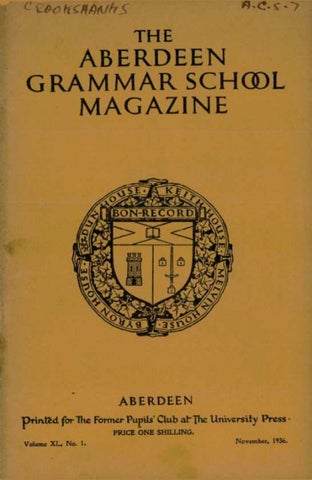
THE
ABERDEEN GRAMMAR SCHCOL, MAGAZINE
ABERDEEN
printed for The Former Pupils' Club at The University Press • PRICE ONE SHILLING.
Volume XL, No. I.
November, 193b.
EDUCATIONAL BOOKS -
JAMES G. BISSET CONTINUES to supply all the Class Books (New or Second-hand) suited for the requirements of the Higher Educational Institutions in the City, at the Lowest Prices.
N.B.—Best Value in Students' Note Books.
- -
JAMES
G. BISSET
Classical, Medical, and Educational Bookseller, 85
BROAD
STREET
(Opposite Marischal College).
Children need
ENERGY te) to N 0 0 4 •
T
O tide them over the trying hours at school, children need energy! They'll get it from Hutchison's Bread. Assure their health by buying NOW!
A.B.HUTCHISON II THE CENTRAL BARRY
13 BRANCHES throughout the CITY
For Doctors Engineers
UNIVERSAL CHRONOGRAPH
Motorists Sportsmen
A. & J. SMITH
L9 15 0 to LI0 17 6
..•
Stainless Steel .. Cases ..
191 Union Street ABERDEEN
LITTLE'S FOR I.
FASHIONS
/-•
1/40 "
fu
-
The House for COATS & GOWNS in all Sizes, Quality and Style
L
Outside Wear A Speciality
A. C. LITTLE & SONS, LTD. I0S UNION STREET
•
ABERDEEN
GALLOWAY & SYKES PERFECTION
LTD.
IN
FURNISHINGS To all interested in fine furnishings GALLOWAY' and SYKES tender the resources of wide ex: pertence and the assistance of showrooms complete with furnishings of every style.
DEPARTMENTS
i V 4760 — 476. Telegrams : I
"Craftsmen" Aberdeen
Furniture Carpets and Linoleums Fabrics Beds and Bedding Mantelpieces and Grates Removal Contractors and Storages Parquetry Flooring Billiard Tables Shop Fitters Wood Carvers Church Furnishers Funeral Undertakers Valuators
INSPECT WITHOUT OBLIGATION the new Season's
stocks now on display
ABERDEEN
• •
UNION ST.
JAMES FYFE & SON PAINTERS AND
it
)4-
GLAZIERS
OFFICE AND SHOWROOMS:-
It DEE STREET, ABERDEEN. Telephone 304.
Telegrams--" Fyfe, Painters."
THE
AMILY COFFEE Curie Coffee is the favourite drink with everyone. It is most especially delicious, Your weather. in cold grocer can supply you .
CUM'S COF Co.. ABERDEEN.
ThornO3 CEITI &
Quality is our Truest Economy
ROBERT STOTT Family Grocer Italian Warehouseman, Tea, Coffee, Wine and Spirit Merchant
53
STREET,
ALBERT
ABERDEEN
Telephone 1848
18 Back Wynd Aberdeen ESTABLISHED 1855
BOOKBINDING OF EVERY DESCRIPTION
BIND FIND FAST FAST V
Leather Goods Lettered with Initials or Inscription Maps or Plans Mounted Loose Leaf Specialists
TRADE MARK
TELEGRAMS: "HUB. ABERDEEN."
TELEPHONE . NO. 1719.
CAMPBELL & SELLAR, LTD. Engineers, Hirers and Garage Proprietors
QUEEN'S CROSS GARAGE io Fountainhall Road ABERDEEN OPEN DAY AND NIGHT
ANY MAKE OF CAR SUPPLIED
-
A. D. COPLAND. Phone 896. Telegraphic Address : "Undertake, Aberdeen."
Telephone No. 2300. Works: Rosebank Place.
GORDON & WATSON FUNERAL UNDERTAKERS AND 12
MOTOR
HIRERS
HOLBURN ST. & 40 VICTORIA RD. ABERDEEN
W. KENNAWAY, Ltd. BAKERS and CONFECTIONERS, 5 and 7 Holburn Street. Luncheon, Tea, and Reception Rooms, 1 73 Union Street and 8 Bridge Street, ABERDEEN
SPECIALITIES WEDDING CAKES. SHORTBREADROYAL DEESIDE IN TARTAN TINS, ALSO A LARGE SELECTION OF PLAIN AND FANCY ICED CAKES.
Telephone No. 1891.
ARCHIBALD McKELLAR Family Grocer and Wine Merchant, 454-456
Union Street, Aberdeen. . . We Specialise in . .
Cooked
Gammons, Finest Belfast Smoked Hams, " Harris's "
Wiltshire Bacon.
Medicinal Wines—Vibrona, Hall's, Wincarnis, Glendenning's.
OFFICIAL SUPPLIERS for the SCHOOL BLAZERS Size
3 4 5 6 7 8 9 10
-
16 6 z6;zx 17 6 186 28 19 6 19 11 21 21 6 22 6 23. 6
11 12
.
24'6 25 -
o I
•
-
2
•
•
•
ISAAC
SHORTS Lined Size Price 0 76 I 711 2 86 8 it 3 4 96 9 21 5 6 to 6 7 - to IF 8 - lz 6 9 - 11 9 10 - I2 6
Bias Oxford Ties, 2'- ; Open-End Ties, 2;6 ; First Quality Hose, 6-'1-7, 3,6 ; 7i—Eq, 3111 ; 9-10, 4/6. Badge PullOvers, 24. 9;6 ; 26, 10;6 ; 28, II6 ; 30, 12;6 ; 32, 13;6 ; 34, 14 6 ; 36.15 6. Grey Slip-ons, 24, 26. 28, 30, 5 11 ; Jerseys, 6 II. 32, 34, 36, 6 6. Scarves (Large). 4 11 ; (Small) 2,11. Belts—Snake (Narrow), 1 - ; Belts— Snake, 1 6. Belts—Badge Buckle, 3,-. Braces, 1 6.
Price
II 12
-
12 IK 13 6
BENZIE
LIMITED
GEORGE STREET
•
ABERDEEN
Always insist on—
FLOCKHARTS' AERATED WATERS Address—Craibstone Lane, Aberdeen. Telephone 873.
FOOD FOR, THOUGHT Such has been the reputation of ALEXANDER'S from their inception that the discerning buyer appreciates that here will be provided only what is best in quality Fish, Game and Butcher Meat. A courteous and efficient staff and a dependable delivery service completes the pleasure of shopping here. Telephone orders receive the same keen personal attention.
DEALERS IN
FISH
-
GAME
-
BUTCHER MEAT
'Phone 5172
492 UNION STREET., ABERDEEN Telephone-Aberdeen 1710.
The Mastrick Dairies Ltd . 1 DESSWOOD PLACE, ABERDEEN WE offer you a Choice Selection of DAIRY PRODUCE from our own Farms, and produced under the direct supervison of members of the family. Our Customers may rely upon the absolute Purity and Cleanliness of all our products. Distributors of
Lord Carnegie's and Cairnbrogie Certified Milk. Head Dairy: 3, 5, and 7 WHITEHALL ROAD. Branches: 33 FOUNTAINHALL ROAD. 7 MID STOCKET ROAD. 25 BEDFORD PLACE. 473 GREAT WESTERN ROAD.
Silver Medal Bread OUT of the oven they come—batch after VV batch—day after day—every one a big beautiful loaf, sporting a thin golden crust. "They are perfect British loaves. When they are cut, a creamy sheen and nice soft texture come to light. Just realise what this perfection, this consistency, this clean, wholesome food must mean to you and your family. To-day, our bread is better than ever, especially our "SUN" loaves, which gained " SILVER MEDAL" at the Scottish National Exhibition this year. They are made by experts, from a scientific blend of the World's finest wheats, under the most hygienic conditions. 1P5
11,3
W. M. McPHERSON Baker and Confectioner, zs FOUNTAINHALL ROAD AND
g
ST. SWITHIN STREET ABERDEEN Telephone z 5 i
ESTABLISHED
1843.
Wm. Cay & Sons
LOW'S BOOKSTALLS
funeral titavrtaher6.
39-50 New Market Gallery
415 UNION STREET
BOOKS on All Subjects and at
ABERDEEN
AND
209 GEORGE STREET, ABERDEEN.
All Prices Over 500,000 Volumes in Stock Educational Books in Great Variety
Motor hearses and Cars for Town and Country Funerals.
CATALOGUES ISSUED
Telegrams—"Cay. Aberdeen." 'Phone: Nos. 92 and 54.
'PHONE 3332
ESTABLISHED
BY APPOINTMENT TO
I 818
H.M. THE KING
J. WILLIAMSON & SON 1w. B. WILLIAMSON. PROPRIETOR)
Meat Purveyors and Poulterers 1, 2, & 3 MARKET BUILDINGS, ABERDEEN 'PHONE 452 BRANCHES,
35 FOUNTAINHALL ROAD 'PHONE 1724 ALSO AT
THE SQUARE, CULTS 'PHONE. CULTS 2
CHURCH SQUARE. BALLATER THOME 38
CONTENTS ILLUSTRATIONS Sir George Carmichael, K.C.S.I., LL.D. Mr. Peter Edward, ,B.Sc. . Mr. C. R. Leslie Millar . . . Mr. C. W. Hemingway . . Mr. John Lynch, B.Sc. . . Mr. Alexander Bruce, M.A., B.Sc. •
The Former Pupils' Club— The Annual Club Dinner . The Club Boarding House Rugby Section Hockey Section Cricket Section . The Edinburgh Centre The Glasgow Centre List of New Members
Facing page 30
•
•
•
•
•
•
IP
•
•
51
VP
•
•
•
•
•
•
•
•
•
•
•
P3
IP
31 6z 62 6;
11
63
SP
PI
•
•
•
•
•
•
•
•
•
•
•
•
•
•
/3
•
•
•
•
•
•
•
PP
•
•
•
•
•
•
•
•
•
•
•
•
•
•
•
•
•
•
•
•
•
•
•
•
SS
Sof
• •
•
12
82 87 88 92 93 95 93 94
Here is the correct undress Costume for boys. This consists of a Tweed Jacket and Vest and a Tartan Kilt. The Stockings may be plain or have checked tops. Garters are worn in each case. The Sporran may be either an Animal Head or Leather as illustrated. Jackets and Vests, 32/6 and 47/6.
Hose, 3/6 and 5/6.
Bodice Kilts, 32/6.
Sporrans, 4/6 to 12/6.
The above prices are for an 8-year size.
Esslemont & Macintosh Ltd. ABERDEEN
COAL ELLIS & McHARDY LTD. 1880)
(ESTABLISHED
1 8
QUAY
REGENT AND
13O, UNION STREET
ABERDEEN Telephone 2889
Telegrams "COAL, ABERDEEN"
FIREPLACE ARRANGEMENTS —the modern note The modern note is cleverly expressed in the new Fireplace Arrangements. Why not inspect them in our showrooms and see at first hand how greatly one would add to the appearance and comfort of your room.
James Scott & Son (Aberdeen) Ltd. 483-485 UNION STREET ABERDEEN
16,
'Phone 1188-2
Co-operation HE enthusiastic co-operation of many minds and hands make possible the fine productions of the HOUSE OF OGILVIE. For over three-quarters of a century our constant endeavour has been to give the best possible service to our Customers. We base our claim to your patronage on our ability to please you.
T
J. & A. OGILVIE 369
UNION
STREET,
ABERDEEN. Telephone : No. 433.
Telegrams : " Interiors."
Showyard Erector to the Highland and Agricultural Society of Scotland, and Contractor to the Royal Northern Agricultural Society.
azt..2%,
STRACH AN COMMERCIAL
JOHN REID & CO. HOUSE CARPENTERS AND JOINERS
55 Blenheim Place and
14 Fountainhall Road PORTRAITURE
ABERDEEN
PHOTOGRAPHY
O4)6.
Telephone 851
Carpentry and Joinery Work of every description done
416 UNION STREET ABERDEEN
ESTIMATES ON APPLICATION
-
Telephone No. 1997
COUNTRY HIRES AT CHEAP RATES CARS
GARAGED
COLIN S. CLARK DAIMLER TAXI HIRER DAY AND NIGHT SERVICE
PHONE 4422
46 HARDGATE ABERDEEN ROBERTS (ABDN.) LTD. Cabinetmakers, Upholsterers, Carpet Warehousemen
RECOGNISED AS EASILY FIRST IN
FURNITURE VALUE Our enormously increasing business testifies to the popularity of our good class and dependable productions. We employ a large staff of highly-skilled craftsmen, and You will their number is being steadily augmented. find our prices surprisingly low. AS AN INVITATION, PLEASE ACCEPT THIS ANNOUNCE-
MENT TO INSPECT OUR LARGE STOCK OF FURNITURE AND FURNISHINGS.
NOTE A D DRESS :
419 Union
Street, ABERDEEN
Z5o
BUY BRITISH
:Art „SttOents
BUY BEST
THE IMPERIAL TYPEWRITER
We carry a fine range of reproductions of the Old, Modern, and Impressionist School from P.C. size up—and frames
too% British, is the best and lowest-priced Standard Typewriter. No increase.
THE IMPERIAL PORTABLE The Best Portable,
to suit all subjects.
too% British. Second-Hand Bargains of all Makes of Typewriters.
All the latest HANDICRAFTS
EASY DEFERRED PAYMENTS (Hire Purchase) ON ANYTHING.
•-+Imor
9
Octytors 49-51 Scboolbill 'Phone 2870
C. H. WEBSTER 4 Rose Street, Aberdeen BUY
'Phone 505
BEST
BUY BRITISH
Why Wait for Watch Repairs? Buy a CRUSADER Watch and never be bothered with repairs. Instead of repair, a new movement is fitted while-you-wait by any CRUSADER Agent throughout the world. 5 years' written guarantee with every Watch Prices from
3 Gns
Cumber EXACT TIME -
NO REPAIRS
Over 200 Models for Ladies and Gentlemen.
Chromium, £4 0 0 Stainless Steel, £6 0 0 Gold, £8 15 0 Special Line for Schoolboys Chrome Lever Watch £1 7 6
JPAMIIIE.SCN
CAIIPIRY
WATCH AND ENGAGEMENT RING SPECIALISTS
1 12
UNION STREET (next Union Bridge), ABERDEEN
A MODERN SERVICE for MODERN
•"'??.
We are equipped with the latest and most up-to-date appliances for the lubrication of your car. No longer need you struggle with grease guns and oil cans or crawl to reach inaccessible points. All this work can now be done for you cleanly, efficiently and effectively and without the slightest trouble to yourself. Call in sometime and let us demonstrate this Service.
We are an Official—
l e-,,WAKEFIELD
LUBREQUIPMENT SERVICE
ASkIt31EIRIDIEIES A
STATION CIO US
LIMITED
THE AUSTIN DEALERS
IU S 11O NI IVIOW Telegrams—" CARS "
Ir
AVI9IEIL II)IE litIN Telephone-4580
NORTHERN ASSURANCE COMPANY LIMITED. Assets L23,ooo,ooo.
Established 1836.
ALL CLASSES OF INSURANCE, INCLUDING:-
LIFE MOTOR CAR
FIRE ACCIDENT
Life Assurance Branch. The Company's Tables of rates for Life Assurance include every class of Policy. Write for Particulars of Life Policies Family Income Policies Endowment Assurance Policies Educational Endowment Policies House Purchase with Life Assurance Children's Deferred Assurance Policies
ABERDEEN LONDON
CHIEF OFFICES: 1 Union Terrace. 1 Moorgate, E.C.2. -
Aberdeen Board of Directors. The Right Hon. The Los!, 1:OREES.
A. S. R. BRUCE, ESQ. The Right Hon. The EARL, or CAITHNESS. FRANCIS J. COCHRAN, ESQ. WILL:Am L. Coos, ESQ.
Afanager Secretary
A. MARTINEAU,
ESQ.
R. W. WALKER, ESQ.
•
R. MACKAY. J. L. WILLIAMS.
Aberdeen Grammar School Magazine 52nd year: No. 134 (New Series, 43rd year, No. 125) Vol. XL
NOVEMBER 1936
No. x
The "Grammar School Magazine" is issued under the auspices of The Former Pupils' Club, in March, June, and November. All communications with regard to the "Magazine " should be addressed to the Editor (the Secretary and Treasurer of the Club), THEODORE WATT, M.A., The Rosemount Press, Aberdeen.
--
--
A Message to Former Pupils. The general remarks which preface H.M. Chief Inspector's report on the School for 1936 should be of interest to Former Pupils. They are as follows :— The organization of this important secondary school is primarily directed towards the University, but alternative courses are being developed to meet the needs and aptitudes of pupils whose formal education will finish at an earlier stage. Courses of a commercial, and to a minor extent of a technical character, are now available for boys proposing to enter commerce and industry. Advice is given regarding the choice of and training for careers, and in this the School is fortunate in its Former Pupils' Club, with a widespread system of Consuls and a singularly devoted Secretary. The BoardingHouse meets the needs of parents resident at a distance, and contributes to the life of the School some of the advantages of a residential system. Training in leadership and self-government is afforded through such agencies as School Houses, prefects, boy scouts with spring and summer camps, the organization of sports, excursions at home and abroad, literary, debating, and dramatic societies, and clubs for the study of art and music. The pavilion in the sports field has recently been extended to afford better facilities for bathing and dressing. The School museum is of unusual merit, and the library is one of three Scottish school libraries specially mentioned in the report of a representative committee recently submitted to the Carnegie United Kingdom Trust. The School Magazine is an interesting record of the varied activities of an enterprising School.
The reference to the Library is interesting. There can be little doubt that the Grammar School possesses one of the bestequipped school libraries in Scotland. It enjoys the further advantage of being housed in a room which is admirably adapted for the purpose. A few additions and alterations to the buildings have been
a
Aberdeen Grammar School Magazine
carried out in recent months. The former include a large cycle shed adjoining the Westfield buildings, built of granite and, one would be inclined to say, almost too imposing for the humble purpose which it serves. The re-seating of the Hall is a notable improvement. The ancient desks, whose flaps served to emphasize the applause of generations of boys, have been supplanted by single and double seats of attractive design. It should now be possible to sit through School functions in comfort. New examination desks are another feature. It will be known in the course of a week or two whether they add to the comfort of examinees! Proposals for the reconditioning and re-equipment of the School laboratories will be submitted to the Education Committee at an early date. Much of our equipment is obsolete and unsuited to the needs of Science teaching on modern lines. In the Aberdeen Educational Endowment Scheme, 1934, a sum of £i So per annum is specially ear-marked " for the benefit of boys attending Aberdeen Grammar School." For the current year this sum is being divided among certain School societies, those which will chiefly benefit being the Literary and Debating, the Dramatic, and the School Orchestra. The purposes to which the money may be devoted are defined in the appropriate clauses of the Scheme and there will, no doubt, be variations in the method of allocation from year to year. The retirement of Mr. Peter Edward, to which reference has already been made, was followed by the death in September last of our Art Master, Mr. Leslie Millar. Mr. Millar had a long connection with the School, and his former pupils, those of them particularly who specialized in Art, will deeply regret his passing. Readers of the Magazine will recall the admirable series of sketches—the work of his pupils—which, for years, were a feature of the Christmas issue. Mr. John Lynch, a distinguished graduate of Glasgow University, has succeeded Mr. Edward as Head of the Science Department, and Mr. Charles \X'. Hemingway, a young artist of exceptional promise, has recently taken up duty as Art Master. The Boarding House is, of course, firmly entrenched both financially and in general esteem. It may be that further expansion will be necessary, but this will depend on the extent of future demands for admission. As you are aware, the aim of the Directors is to provide a separate house for the younger boys. At the Annual Dinner of the Club a hearty welcome was extended to the President (the Lord Provost), and to the chief guest of the evening, Principal Fyfe. The Principal, who, incidentally, is an intimate friend of my immediate predecessor, has enviable gifts as an after-dinner speaker. If I may obtrude a purely personal view, it seems a pity that the Dinner cannot be held at a date which would allow F.P.s who are home on leave
Aberdeen Grammar School Magazine
3
to be present. It may be that your Executive have considered such a suggestion and found it impracticable. I leave the story of our athletic and other activities to the chroniclers concerned, and conclude with the customary Christmas greetings from the School. D. M. A.
Mr. C. R. Leslie Millar. Mr. Millar had been off duty at the School since last Easter, and went to reside at The Shelling, Newtonhill. During the summer holidays he tendered his resignation on account of ill-health, and only a short time afterwards, on 5th September, he passed away. He was a native of Kilmarnock, and was educated at the Academy there, where his father was Art Master. He then studied at the Glasgow School of Art, and was for a time in Holland preparing for his career as an Art teacher. He was appointed Supervisor of Art in seven of the Higher Grade Schools in Fifeshire, and in r9lz dine to the Grammar School as Art Master, in succession to the late Mr. Samuel Pope. ---" Learning to draw is learning to sec." This maxim of Ruskin's is perhaps the keynote to Mr. Millar's teaching at the Grammar School, and one that will remain with us throughout our lives, whether we be architect, engineer, or doctor. It is our privilege that we should have been taught by Mr. Millar. He had that rare gift among artists—the gift of imparting his own enthusiasm, so that an object or a scene became impregnated with subtleties that we had not detected. Sometimes, under the spell of his quiet but forceful personality, we were taken into that fascinating world of art that encompasses everything in life, from the minute structure of a leaf to the dynamic nobility of a Gothic cathedral. Though most of his time was spent in the Art Room, an appreciation of Mr. Millar's work can scarcely be complete without reference to the Art Club which was alive in the School for many years until shortly before his death. It is to this Club, under his supervision, that many F.P.s owe the foundation of their pencil technique, both in architectural and free-hand draughtsmanship—a foundation that has proved an asset in technical colleges and studios throughout the country. It was at the Club meetings, too, that we were first introduced to the mysteries of composition, that elusive but necessary element without which no work of art can find full expression. Through Mr. Millar's death the School has lost not only a fine master, but also an artist whose personal influence is being felt in many professions and in many places—wherever F.P.s are roaming. A. E. B.
4
Aberdeen Grammar School Magaine
Mr. John Lynch, B.Sc. Mr. John Lynch, who has recently been appointed Principal Teacher of Science in the Grammar School in succession to Mr. Peter Edward, is 37 years of age, and was educated at Kilwinning Higher Grade School, and at the Royal Technical College and the University, Glasgow. On reaching the age of 18 he enlisted for military service. After a short course of training he was sent abroad and was on active service with the 5t st Division from March 1918 until the end of the War. Later he was stationed in Germany with the Army of Occupation. At Glasgow University he graduated B.Sc. with Special Distinction in Chemistry (which is the equivalent of First Class Honours under the " New Regulations "). From October 1924 to August 1926 he was engaged in research under the direction of the late Professor Gray, Glasgow, and in 1927 he was appointed an assistant teacher in the Science Department of the Aberdeen Grammar School. His promotion to be Head of this Department has given great pleasure and satisfaction alike to his colleagues and to his former and present pupils. •
Mr. Charles W. Hemingway, D.A. Mr. C. W. Hemingway, who in October was appointed Art Master of the Grammar School in succession to the late Mr. Leslie Millar, is z7 years of age. He was educated at Strichen Secondary School, where he gained the Leaving Certificate with five passes in the Higher grade and was awarded a special prize for Art. In 1927 he went to Gray's School of Art, Aberdeen, entering upon the Diploma course of Drawing and Painting. In 5931 he gained the Diploma of the School in these subjects, and then qualified as a teacher of Art under the Scottish Education Department. In order to secure a wider knowledge of Art in all its branches he proceeded to London, where he studied in the Art Galleries. He also gained experience in story illustration, poster design and general layout by working in commercial art studios. He then continued his studies in Paris, and in January 1934 secured an interim post as assistant teacher of Art in Inverness Royal Academy. During the sessions 1934-35 and 5935-36 he engaged in teaching at Gray's School of Art, Aberdeen, and in May of this year he was appointed interim Art Master at the Grammar School. Mr. Hemingway has come to the School with excellent qualifications and the highest recommendations, and there can be no doubt that the School has been very fortunate in securing his services.
Aberdeen Grammar School Magaine
5
Mr. Peter Edward, M.A., B.Sc. The Memories and Reflections of a Non-Mathematical Mind. " Pat I — he comes like the catastrophe of the old comedy : my cue is villanous melancholy." King Lear, Act 1, Scene z.
Shakespeare had his unofficial uses even thirty-five years ago, and when, under the vigilant eyes of Mr. Murison, we boys were industriously conning " the play " as " the thing " for that anathema the " Comp.," hunting for anachronisms and topical allusions, how it delighted us to discover a topical allusion of our own, and utter to our classmates the abovequoted words, at the approach along the corridor of our mathematical master, Mr. Peter Edward, briefly and familiarly designated " Pat." I suppose, as later reading in a certain Poetics was to suggest, it was a case of purging our emotions through fear. For, undoubtedly, to many of us Grammarians the study of mathematics was simply a tragedy. Not that I have not been beholden, and acknowledged my debt, to the theorem of Pythagoras even in the day of war, what time I awed, if not silenced, a Sergeant-Major by my demonstration of the square on the hypotenuse, though I still think he thought I was referring to the hippopotamus. Let that episode be counted to Mr. Edward for righteousness, even if I did cudgel my mathematical brains no more. But the passing years have not altered my conviction that the appropriate text over every mathematical doorway should be :—" Abandon hope, all ye who enter here," or—in neat, Greek wise— Mathemata, Pathemata—Mathematics is Pathematics. In any case, the bottom, I believe, has been knocked out of the whole edifice. Euclid ! Of him, as of a popular Victorian heroine, we might say—" Oh no! we never mention him, his name is never heard "—and I am not surprised. I always had my doubts about those facile " Q. E. D.s." But I should dearly like to know what William Brownie would have to say nowadays to his triumphant assertion and demonstration in those Victorian days that two parallel lines went—certainly off his blackboard, as he dramatically showed—out at the door too, for that matter—and then, with a final wave of his hand—" to infinity, without meeting." Good old Einstein! And yet nobody understands him. And there is our own Bertrand Russell, who, I am told, speaks disrespectfully of the Axioms 1 0 tempera I 0 mores /
But it is not curiously to assess the less or more that I retain of geometrical or algebraic formula, or to express my heretical opinions to ingenuous youth of a later day that I now write,
6
Aberdeen Grammar School Magazine
but rather to tell—what may well surprise the subject of the article—why even we dullards felt confidence and pleasure in the company of our teacher. First and foremost there were his voice and accent. What a voice 1 It was a Lalland voice, pure and unadulterated, a gift straight from the Doric gods. The " Grammar" had never heard the like. Compared with it William Brownie's was pure Parisian. For a brief while it fell upon Edina. Edina was spell-bound. Then it returned to its procreant cradle, never to leave us again. The mere calling of us by our names warmed our hearts. " Mackie," " Andra Clark "—out there in South Africa, both of you—can you hear " Pat " calling ? He liked Biblical names, especially those of the Disciples. " James," " John," " Andra," and, above all, I think, his own name, " Peter." We had no " Ebenezer " to be thankful for, still less a " Habakkuk." It was a thousand pities. What he would have made of it 1 But there was " Peter Webster," whom " Pat " would invoke in a lilt of tender solicitude—" Have you got that one, Peter?" the " one " being not what in war days we sedulously sought for in our army shirts, but some perplexing deduction. The indefiniteness of " one" evidently pleased him. " Try this one—quite a simple one," and again we plunged, with a cheerful word of final but hopeless exhortation from him, " Just suppose the thing's done and work backwards." I was always willing to " suppose " the fait accompli, but that was as far as I got. The very vocabulary of mathematics was made for that voice and its large utterance. " Quadratics," " parallelograms," "logarithms," "tangents," and—best of all—that blessed word, " parallelopiped "—has anyone since the days of Archimedes uttered them with such full-throated ease as " Pat " ? The voice was the voice of " Hamewith," of course, and the Howe of Alford. It came redolent of haughs and beeves and bonnie green loanings. Yet to give Alford the credit for that voice and accent is not enough. I am in daily contact with Alford, and out of Alford cometh no voice to-day that can match the length, breadth, or depth of " Pat's " vocalic utterance. Certain stationmasters who proclaim to an unheeding world of travellers the names of " Auchterless," " Rothienorman," and " Wartle" approximate, but only approximate. It took I know not how many Bachs to produce the great Sebastian. So must it have been with the voice of " Pat." We shall not hear its like again. Let Dr. J. M. Bulloch take heed. Time passes. Let records be taken of " our master's voice," a voice which Carlyle would assuredly have claimed to be " an authentic voice." But to think of " Pat " in terms of voice alone, as if he of all people, were vox et praeterea nihil, would make the angels
Aberdeen Grammar School Magazine
7
weep ; and he wrestled, certainly not with angels, but angles. It was surely a dispensation of providence that so inhuman a subject should be taught by so brotherly a man. His whole person radiated homeliness and unaffected simplicity. He charmed by his naturalness. Down he sat beside you at your desk, and—a few deft strokes, one or two ciphers, a bracket maybe, and, of course, a few of those " dots " condemned by a certain Chancellor, and somehow or other the intricacies of the problem dissolved. The caller air of Alford had cleared " Pat's " mind of all " can't." Not that it was always smooth seas and auspicious gales. Which brings me to that other aspect of " Pat " it delights one to recall—his tricks of speech in dealing with triflers. As was to be expected from a man of his unsophisticated ways, the manner of dealing was forthright and downright—very downright, indeed, some were feelingly persuaded—yet not without a dash of the figurative. Usually, " Stop the talking" sufficed. If not, to a garrulous youth he would say with a fine seriousness, " Herbert, we'll need to get a plaster for your mouth." Or, to some luckless wight seized with untimely merriment—" Give us the benefit of the joke I Don't be selfish, man." I see from Earl Russell's autobiography that the boys at Winchester counted it a great privilege to be called " men." It was " Pat's " almost invariable mode of addressing us, but I doubt if we felt flattered. Again, when some well-meaning seeker after trigonometrical truths had tangled himself hopelessly in a maze, came that fine effort at irony, " You are a clever fellow," though only those who have heard the words can hope to pronounce them adequately. In giving this last, by the way, to pupils preparing for the Leaving Certificate Examination, I have often felt tempted to substitute, for the douce name of " Macaulay " as the author or source, that of " Peter Edward." But undoubtedly the puce de resistance of " Pat's " figurative armoury was this in the way of truculent innuendo—" Brebner I "—and what a grip " Pat " took of his " b's "—" Brebner I I've got a strap in my drawer." " And the boldest held his breath, for a time."
Reader of a modern day, do you understand now how our study of sine and cosine, secant and cosecant, with or without Two Pi R, was, if not a thing of beauty, at least a joy for ever? But that is not the whole story. The whisper ran round the School—" Pat " sang ! It must have been the Ferryhill boys who brought the news, probably Alick Shinnie. Now nothing that a schoolmaster does to-day surprises. He may sing, smoke, dance, in public or in private. It was not so in the decorous 'nineties. Singing was taboo. It implied levity. One could not picture Mr. Bentley Philip or Mr. William Brownie singing even psalms, much less songs. " C.D." of course, as always,
8
Aberdeen Grammar School Afagazine
was a law unto himself. So for many a Sunday the elders at the plate in Ferryhill Church viewed with complacency the increased attendance of male youth at both diets of worship. Not that these came to scoff and remained to pray. It was a simple act of hero-worship. They saw " Pat," heard him in the Free Church choir, and it made their hearts rejoice. As Shelley puts it, but with deeper meaning than he intended, it was :— " The devotion to something afar From the sphere of our sorrow."
The wheel came full circle home last winter when in our country village I had the privilege of proposing the vote of thanks to that same nest of singing birds, all changed except for unchanging " Pat." Still again, how many boys of the present generation, I wonder, know that " Pat " was once a Gordon Highlander? We knew, and so when once a year the stalwarts of the old ist Volunteer Battalion Gordon Highlanders held their parade to Holburn Church, besides many notable personages of town and county, there was present a loyal if unofficial contingent from the Grammar School, of boys who were not notoriously Sabbatarian. And they had their reward, for there they beheld " Pat " resplendent in tartan kilt and scarlet tunic—khaki was not then the only wear, thank goodness I—and singing lustily, " Onward, Christian Soldiers." So " Pat," you see, had his " fan " in days when film stars were unknown. But here I must invoke the manes of him whom intimates knew as " Crooky," that " fellow of infinite jest, of most excellent fancy." " O Crooky—dear, departed shade "—where is what " C.xsar " so aptly called your Book of Jests, that was wont to set the table on a roar? There was in it at least one anticipation of the humour of a later day, the day of Laurel and Hardy. The jest lay in pairing off masters with a fine incongruity. Thus a sketch—not by Allan Sutherland—depicted " Puggie " and " Pat " walking side by side—the short and the long of it, of course—" Puggie" looking up wistfully, as it were, at " Pat," and taking big strides ; " Pat " shortening his steps in well-trained militarist fashion and generally " showding " along. That was not all. " Crooky " and A. N. Other would have " Pat " and " Puggie " singing the Hallelujah Chorus off the same copy, " Puggie " standing on tip-toe to see the score, and evidently annoying " Pat " by coming in with his Hallelujahs on the wrong beat. Unspeakably frivolous and nonsensical it all was, but I suppose it was a safety-valve for effervescent, unmathematical minds, just as even certain V.C.s on "Q" boats in the war released tension at zero hour by stories of another kind. One thing I can say with conviction—it was because we loved the
Aberdeen Grammar School ilia,gazine
9
man that we so invested him with all these quips and jests, embroidered his personality with all this legendary lore. No one could look on Mr. Edward and doubt for a moment that he was one of the salt of the earth. The mere presence of such a man in our School preserved it from snobbery; and, as always, it was the man, more than the subject he taught, that counted. Of character, virile and various, we had in our time a God's plenty. " Sammy " Pope—" you worry, annoy, perplex, torment, and badger me " ; Bentley Philip, " considering the matter " ; " C.D. ", " J.D.", William Brownie, regally inviting us to his " afternoon levee " ; Charles McLeod, Maxwell Mackie—" any of you fellows got the time: I've forgotten to wind my watch?" ; Middleton, Munson, " Doky " Moir—" I wouldn't allow my grandmother to guess " ; " H.F.M.S. "—daily contact with those men in the formative years of boyhood from Middle I to " my Seventh" was in itself, actual lessons apart, a liberal education. There was a fine leisureliness about it all, and nevertheless, 1 hope, we moved. Anyhow, in compliment to my old master, I shall venture to call it a geometrical progression, and place him in the succession as a known quantity of high power. Forty years on I And now, " Pat "—he goes, but with what reminiscent smiles of goodwill and friendliness, with what troops of friends and happy memories of a long, long trail of pupils winding into the land of his dreams. J. M. R. A Tribute from the School. Although Mr. Peter Edward retired in June on account of an operation to his knee, all his pupils hope to see him soon in School so that they may express to him their gratitude and esteem. It is only right that a man who has introduced scholars, some of them future scientists, to the wonders of his subject, should receive some token of their thanks. Mr. Edward possessed all the essential qualities of a Science teacher. All arguments were willingly heard and were, if necessary, slowly and patiently proved to be wrong. Even out of School hours, he was ever ready to explain and encourage. The characteristic for which he will long be remembered was shown when he was doing an experiment. He always appeared to be trying the experiment himself for the first time in his life. His students might rush through an experiment because they had done it once before : but he carried it out, even although he must have done it a countless number of times, patiently and, if there was the slightest hitch, with perseverance. A. W. C. (Mod. VI.)
Aberdeen Grammar School Afagazine
* It is requested that the Editor be informed of all new appointments and interesting incidents in the careers of Former Pupils.
The dates given in parentheses after names indicate the sessions of attendance at the School. James Smart Abernethy* (1924-26), LL.B., W.S., who earlier in the year was appointed Legal Adviser and Commissioner of Lands in the North Borneo Government Service, excuses himself in a recent letter for not having sent a contribution to the Magazine by stating that he has been trying to run the Lands, Labour, and Education Departments of that State, in addition to acting as Legal Adviser, Registrar of Trade Marks, Registrar of Societies, Registrar of School Teachers, and Secretary for Chinese Affairs ! Alfred Easton Allan* (i924-3o) has gained the final diploma at the School of Architecture, Aberdeen, and qualified for Associate Membership of the Royal Institute of British Architects. George Douglas Allan (1919-3o) qualified last summer as a chartered accountant and was admitted a member of the Society of Accountants in Aberdeen. William Rogie Angus* (I 915-21), M.A., B.Sc., Ph.D., who was appointed in 1932 a lecturer in the Department of Physical and Inorganic Chemistry at University College, London, has now taken up an appointment in the Department of Chemistry, University College of North Wales, Bangor. John William Laing Bain* (r9r5-zz), who graduated I.B., Ch.B., at Aberdeen University in July, has been appointed one of the resident staff at the Aberdeen Royal Infirmary. Robert William Ingram Band* (1924-16), M.A., of the Malayan Civil Service, is at present home on furlough, and has been visiting Aberdeen and the North. He has recently been stationed in Christmas Island, hut expects to be at Singapore when he returns. George Low Barrie* (1893-94), M.A., who has been on the staff of Glasgow Academy since 1903, and Principal Teacher of Modern Languages there since 1918, retired at the end of September, after 33 years' service. Like his cousin, Sir James * Member of Former Pupils' Club.
.Aberdeen Grammar School Magazine
11
Barrie, he is a native of Kirrietnuir. His teaching career began in Dumfries Academy in 1898, and for some fourteen years he spent practically every holiday in attending courses for foreigners at French and German Universities or in travel, with a view to developing and perfecting his languages. A fine appreciation of him, with portrait, appeared in the October Glasgow Academy Chronicle. Charles Leith Barron* (1907-19), M.B., Ch.B., is now in medical practice at Buckie. He was formerly at Armadalc, West Lothian. Charles William Beattie* (1888-89) has recently retired from the position of Provost of Insch, Aberdeenshire, which he has held for twelve years. He went as a tea planter to Ceylon in 1896, and retiring in 1915, took up residence in Insch. Archibald Ernest Bennett* (192o-3o) has gained the final diploma at the School of Architecture, Aberdeen, and qualified for Associate Membership of the Royal Institute of British Architects. Walter George Swan Benzie* (1917-19), B.Sc., is a Lieutenant in the Royal Tank Corps, and has recently been posted to the Depot of the Corps for a " tour " of two years. He finds his work exceedingly interesting, as he is supervising the training of recruits. He has been doing three months at the Tank Gunnery School, Lulworth Camp, Wareham, Dorset, being in charge of about 15o recruits who are undergoing instruction in gunnery. Part of his work consists of running rugby down there, and he says that he has the makings of a useful side to enter for the Army Cup. Peter Beveridge (1865-7o), whose death on 5th May, 1936, was recorded in the last Magazine, left net heritable and personal estate amounting to f58,884. Charles W. J. Bodie* (1914-18) has since 1926 been in the drawing office in Sydney of the New South Wales Government Railways. He was recently surprised to find that the works bell was an old ship's one, and bore the name " Hall, Russell, Aberdeen." " Just another reminder," he says, " of the old town." Charles Ogilvie Will Bowman* (191o-15) is now in the service of the Bai Rubber and Cocoa Estates, Ltd., at Kumba, British Cameroons, West Africa. In a recent letter he says that this estate is easily the most healthy of all the company's estates. He can grow his own vegetables, fruit, etc., can keep a horse and get plenty of exercise, and there is always plenty of work to do. In view of his knowledge and experience, he has been appointed F.P. Club Consul for British Cameroons. Geoffrey Farquhar Brown* (1921-25), who was formerly in Ceylon, is now manager of The Good Hope (Selangor)
12
Aberdeen Grammar School Alagerine
Rubber Co., Ltd., and resident on the Bandar Estate, Kiang, F.M.S. In a letter written on 4th September he said that they were to start their new " rugger " season in the following week. They have a very keen crowd in Selangor, including, in addition to himself and his brother, JACK LESLIE KEITH BROWN (1921-25), DOUGLAS Ross HARPER* (1917-26), WILLIAM FERRIER MAVOR* (1923-3o), and STANLEY GEORGE WILLIAMSON* (1922-25).
Harper and J. L. K. Brown are at present Captain and ViceCaptain of the State Team. As will be seen from another page, G. F. Brown was married in July of this year. John Lamb Bruce* (1911-23) has qualified as a chartered accountant, and has been admitted a member of the Society of Accountants in Aberdeen. He served his apprenticeship with Messrs. J. R. Flockhart & Grant, C.A., Aberdeen, and is now with Messrs. Cooper Brothers & Co., C.A., London. John Malcolm Bulloch* (1877-80), M.A., LL.D., recently unveiled in the dining hall of the Students' Union at St. Andrews University a plaque in honour of the Rev. Millar Patrick, D.D., minister of Craigmillar Park Church, Edinburgh, who was the chief founder of the original " Scottish Students' Song Book." Dr. Bulloch was one of Dr. Patrick's co-editors in the publication of the Song Book, and they are the sole survivors of the little band whose efforts have meant so much to student life. Dr. Bulloch said that to his mind the Song Book separated the centuries-old form of the Scottish University from the University of to-day, so far as the students were concerned. When he became a student it was a very grim business. There were no Unions and no plus fours, and it was with the utmost difficulty that many of them managed to afford the dress clothes to go to a " shine " at the house of some professor. Life then was difficult, and students regarded the University more or less as a technical school by which they could eventually earn their living. A new movement in the University began to express itself towards the end of last century, and students' magazines were started. Then came the idea to express the student spirit in song. The Song Book, when published on ist April, 1891, sold instantly, and a second edition was ready on 3rd July. A year later a third edition, revised and enlarged, appeared. The collection was again revised and enlarged in the sixth edition of 1897. To-day it is still selling at the rate of to,ooo copies annually, and the entire proceeds are devoted to the four Students' Representative Councils in Scotland. Ian Fyfe Cameron* (1918-28), who gained the final diploma (A.R.I.B.A.) at the Aberdeen School of Architecture in June of this year, is now an assistant architect with the Corporation of Dundee. Alexander Whincup Carle* (1914-20), B.Sc.(Eng.), who entered the service of the Bengal and North-West Railway Co.,
Aberdeen Grammar School Magaine
13
Ltd., India, in 1928, is at present home on leave. Latterly he has been stationed at Izatnagar, Bareilly, United Provinces. Ian Harvey Cassie* (1925-35) is studying at the Royal College for Dental Surgeons, Edinburgh. Alan Chalmers* (1915-19), who for more than fifteen years has been in the service of the Hongkong and Shanghai Bank, is at present stationed in Shanghai. Alexander W. Christie* (1878-87) in September had his fifteen years' service as Provost of Huntly commemorated by the presentation to the Burgh of a Provost's badge and chain of office. The donor, Mr. William Will, London, a native of Huntly, in a letter read at the presentation ceremony, stated that he had presented the insignia as a mark of appreciation of the unique services which ex-Provost Christie had rendered to Huntly as its civic head during fifteen strenuous, harassing years, in which he always progressively and loyally safeguarded the interests of the ratepayers. Expressing his deep gratitude to Mr. Will for the gift, Mr. Christie said it did not come to every man to have the distinction of having his name so significandy associated with such important insignia as the Provost's badge and chain. As the years rolled on, the chain woulda many become historic, and would be worn with dignity by honour with down handed be would and true and good man, to posterity. George Norman Clark (19 i 6-22), M.B., Ch.B., F.R.C.S., has recently gone to Egypt to take up the post of Assistant Director of the Anglo-Swiss Hospital in Alexandria. He 1933. In became a Fellow of the Royal College of Surgeons in he Hospital, Anglo-Swiss the at post the addition to holding and has been appointed Consular Surgeon of Alexandria, Health Officer and Delegate to the International Quarantine Board. In these posts he has succeeded another F.P.—Dr. ARTHUR ANDREW MORRISON (187o-73), C.M.G., M.A., M.D., who died at Alexandria in June 1934. Duncan Scott Cochran* (1914-24), M.B., Ch.B., and in the John Park Weir* (1918-24), M.B., Ch.B., both Captains " Valentia " Vickers a when injured seriously were R.A.M.C., crashed Force Air Royal bomber-transport machine of the early in the morning of 8th July at Mersa Matruh Aerodrome, operain the Western Egyptian Desert, while carrying out nightof these and machine, the in persons thirteen were There tions. Weir seven were killed and the remaining six injured. Dr. time, some for condition critical a in lay and burned was severely while Dr. Cochran was less seriously burned. to The accident occurred late in the evening, and according at almost moon the by illumined an eye-witness, the desert was came it as silhouetted was plane the which its full, against
14
Aberdeen Grammar School Alagazine
swooping down to the aerodrome. When it appeared to be about to land, the machine suddenly turned very sharply when only fifty feet from the ground—a most unusual manoeuvre. It was still turning when the left wing-tip struck the ground. The plane appeared to pause in the air for a moment and then to overturn. It crashed with a noise which was audible a mile away and burst into flames. The 'plane caught fire from a wingtip flare which was alight when the left wing struck the ground. The two F.P. survivors of the bomber crash arrived home in Aberdeen on 25th August, and after two months' leave, following on their convalescence, returned to duty on 1 zth October. Captain Cochran is now stationed at Dover, and Captain Weir at Chatham. Readers of the illagaine will recall that a very vivid and fascinating article by Captain Cochran, entitled " In the Western Desert," appeared in the last issue, which was published only about a week before the disaster at Mersa Matruh. Ian Hamish Cooper* (1923-33), who is a cadet with the British India Steam Navigation Co., Ltd., is at present serving on the T.s.s. Devon. Patrick Ashley Cooper* (1896-1901), B.A., LL.B., has recently purchased the estate of Hexton Manor in Hertfordshire, about forty miles from London. The estate extends to about 4,000 acres. Hexton Manor has a history that goes back to the 11th century. It is mentioned in Doomsday Book, and the monastic records refer to it as a manor granted to the Benedictines. Mr. Cooper is now the squire of the three villages of Hexton, Barton, and Shillington. Ian Campbell Cowan* (1924-33) has been awarded at Aberdeen University a Robbie Scholarship in Chemistry of the value of L3o, tenable for one year. Colin Douglas Leslie Cromar* (1922-26), who graduated M.B., Ch.B., at Aberdeen University in 1932, was admitted a Fellow of the Royal College of Surgeons of Edinburgh in July, while a surgeon on the staff of St. Olave's Hospital, London. John Arthur Cumming* (1876-82), who passed into the Indian Civil Service in 1885 and retired in 1913, is resident in Oxford. He has been the Ilonorary Treasurer of St. Peter's Hall, Oxford, since it started in 1928. Its primary objects are " to promote religion and education generally and especially to assist students of limited means, to encourage candidates for Holy Orders and Missionary Work abroad, and to maintain the principles of the Church of England as set forth in the Book of Common Prayer and the Thirty-Nine Articles." Ian Mackenzie Drummond* (1929-34) is at present working in Bishop Auckland, Co. Durham.
.-4berdeen Grammar School Magazine
1i
Andrew Ducat* (1902-06), who for some years has been agent at the Commercial Road branch in Aberdeen of the North of Scotland Bank Ltd., has recently been appointed agent at the George Street branch, Aberdeen. Harold Bisset Duff* (1923-29), after graduating B.Sc. in civil engineering at Aberdeen University, completed his civil engineering pupilage with the Aberdeen Harbour Commis- • sinners, and in April 1935 passed the final examination for Associate Membership of the Institution of Civil Engineers. In August of that year he received an appointment on the staff of the Harbour Engineer, Greenock, and in May of this year became an assistant engineer to the Romney and Denge Marsh Main Drains Catchment Board, with headquarters in Dymchurch, a village near Hythe, Kent. Sydney Duffus* (1911-17), B. A.(Cantab.), LL.B.(Aberd.), was in September admitted a member of the Society of Advocates in Aberdeen. He is a partner in the firm of Wilsone & Duffus, advocates, Aberdeen. Sidney Wardlaw Duguid* 922-27) has recently been transferred from H.M. Naval Base, Singapore, to the Royal Naval Yard, Trincomalee, Ceylon. He served his apprenticeship as a civil engineer with Messrs. Henderson & Nicol, Aberdeen, and entered the service of the Admiralty as a civil engineering assistant in 1934. Alfred George Emslie* (1912-24), M.B., Ch.B., is now in medical practice at Eastbourne. William Ingram Emslie* (1924-30), M.B., Ch.B., has obtained an assistantship with a medical practitioner in Balham, London. Edward Wyllie Fenton* (1895-1908), M.A., D.Sc., of the Department of Botany, Edinburgh and East of Scotland College of Agriculture, in a very interesting paper delivered to the Agriculture Section of the British Association at its recent meeting in Blackpool, discussed some aspects of man's influence on the vegetation of Scotland. There was abundant evidence, he said, of man's destructive activities. Wars, fighting, and raids devastated the forests. Many wooded areas were cut down to exterminate wild beasts. Grazing animals and burning of vegetation prevented natural regeneration of trees. On the credit side of man's influence must be placed the draining and improvement of low-lying marshy lands. The draining of many of its areas was the decisive factor in the disappearance of ague or malaria from several parts of Scotland where it was formerly endemic. The vegetation of Scotland had been completely altered by man's influence, except some isolated parts, mostly at high elevation.
16
Aberdeen Grammar School .1lagazine
John Law Fiddes* (1906-16) recently returned from an extensive business tour of the United States. Before sailing for home he wrote to the Secretary of the F.P. Club to express his appreciation of all the help and kindness he had received from JAMES BRUCE SMITH* (1918-25), the Club Consul at Chicago. "Jimmy Smith," he wrote, "has been a friend indeed, and any F.P. who comes to Chicago can be assured of a very warm welcome from him. His only wish is that some other F.P. will soon come to Chicago and look him up." At a recent meeting of the Aberdeen Rotary Club Mr. Fiddes gave some of his impressions of Chicago. Dealing with traffic, he said he had driven a car in the busiest parts of Chicago much faster and with a greater feeling of security than he did in Aberdeen. He did not know what would be said to him by the Chief Constable if he were caught going along the Ring Road at fifty miles an hour, but if he went slower than forty miles on the outer drive along the shore of Lake Michigan, he might be pulled up for obstructing the traffic. One thing which impressed him was the number of cars to be seen. At one small machinery factory, where there were not more than sixty-five employees, there were at least fifty cars belonging to the workers. John Alexander George Firth* (1931-34) now resides at Bronheulog, Llanrhaiadr, Oswestry. Robert Fleming* (1891-98), of Messrs. Wood, Fleming and Co., Ltd., real estate and insurance agents, Toronto, the F.P. Club Consul there, writes that on the occasion of a visit from GEORGE ESSLEMONT* (1905-15), Aberdeen, he arranged for a small F.P. luncheon party, which consisted, in addition to these two, of A. MURRAY GARDEN (1896-1906), Colonel JOHN F. IsiftcHIE* (1881-82), GEORGE A. LEDINGHAM* (1894-1905), FREDERIC W. MORGAN* (1903-09), and ROBERT G. WATSON (1895-96). Others who were asked to attend, but were unable to come, were Rev. G. STANLEY RUSSELL* (1894-190I), D.D., and ROBERT ABBEY* (1903-08). As may be imagined, the gathering was a very enjoyable one. George Forbes* (1902-04), solicitor, Aberdeen, has recently started the practice of his profession on his own account at i Union Street, Aberdeen. He was for many years assistant to Mr. George Tait Duncan, advocate, Aberdeen. Rex Fowell* (t 9t 2-23) joined the staff of the Aberdeen City Engineer in September 1935, and is engaged on bridge constructional work, in which he has specialized. William Hugh Ross Fraser (1898-190o), a son of the late Rev. Hugh Fraser, Manse of Alvah, Banff, was in August the victim of a shooting outrage in Mexico City, which happily had not a fatal result. He is the general manager of the Mexican Light and Power Company, and was shot in the back in his
Aberdeen Grammar School Magazine
17
office by a former employee of the company. After studying at the Glasgow Technical College, Mr. Fraser became electrical engineer at the Canadian Electrical Works, Stratford, Ontario. In 1914 he took over the charge of the electrical department of the British Columbian Electric Railway at Vancouver, and since 1921 has been in charge of the Mexican Light and Power Company, Mexico City. James Chalmers Gall* (1926-27) is at present 3rd Officer on the M.S. King Malcolm of the King Line, in which there are a large number of Aberdeen officers who have worked their way up from apprenticeship. Angus Frederic Galloway (1921-22), son of FREDERIC W. GALLOWAY (1893-97), of Duncan, Vancouver, received in June the Governor-General's Medal to the cadet obtaining the highest aggregate of marks throughout the entire course at the Royal Military College, Kingston. He has applied for a commission in the Royal Engineers, and has been training at Chatham. He is studying for the Mechanical Science Tripos at Cambridge. Godfrey Power Geddes* (1903-11), D.S.O., M.A., Lieutenant-Colonel, 5th/7th Battalion The Gordon Highlanders, was in June gazetted to be supernumerary on vacating command of his Battalion. He retired with the rank of Brevet Colonel, after twenty-one years' service. Immediately after graduating in Arts at Aberdeen University, he was gazetted and Lieutenant, 11th Battalion The Gordon Highlanders, attached 3rd Battalion, Toth April 1915. Ile was awarded the D.S.O. in August 1917. William Wares Georgeson* (1911-2;), M.A., of the Indian Civil Service, is now Sub-Collector of the Coonoor division of the Nilgiris district. He has recently become a Life Member of the F.P. Club. George Norrie Gordon* (1908-19), B.Sc., B.L., solicitor, Aberdeen, was in September one of four passengers in the Aberdeen Airways liner Aberdonian when its pilot had in thick fog to make a forced landing in a field at Bonnykelly, Aberdeenshire. When the machine struck the ground he fortunately received only a slight injury in the head, and quickly recovered. He is with the firm of Stork, Cruden and Simpson, advocates, Aberdeen. James Hewet Grant* (1914-16) is engineer of M.V. Calgarolite, of Halifax, Nova Scotia. He served his apprenticeship as a marine engineer with Messrs. Hall, Russell & Co., Ltd., Aberdeen. John Malcolm Gray* (1914-15) has been appointed a Senior Technical Officer, in charge of structural strength of aircraft, at the Royal Aircraft Establishment, under the Air Ministry. He joined the Royal Naval Air Service as a and Air Mechanic as long ago as August 1915, and served throughout
18
Aberdeen Grammar School Magazine
the Great War, being demobilized in February 1919 with the rank of znd Lieutenant, R. A .F. Francis Gordon Harper* (1925-28), B.Sc.(For.), who is in the Forestry Department of the Gold Coast, writes that his copy of the last Magazine reached him out in the bush, where he was working on the demarcation of a new forest reserve. He says that recruitment for the Colonial Forestry Service has been at a low ebb since 1930, but of the four graduates from Aberdeen University who have been successful in obtaining appointments during that period, three of them—ALEXANDER FRASER Ross* (1923-27), ROBERT GRAY SANGSTER* (1919-30), and he himself are from the " Grammar." At the time of writing he was stationed in Cape Coast, though most of his time was spent in the bush. He had a particularly interesting appointment last year for about eight months, during which he was Acting Utilisation Officer, and had to inspect all the timber —mahogany, etc.—exported from the country. He has latterly been back on ordinary divisional duties, and more concerned with conservation than with utilisation. He mentions that DOUGLAS M. BOOKLESS (I92.2-28) holds an appointment with the United Africa Company at Accra, Gold Coast. Ivor Llewellyn Bowman Hopkins* (1921-33) has completed three years' apprenticeship with Mr. Edwin L. Williamson, architect, Aberdeen, and has now entered the Aberdeen School of Architecture for a three years' course. Alexander King* (1863-67), who was for many years a missionary in China of the London Missionary Society, is now living in retirement at Boscombe, Hants. Having attained the age of 86, he is one of the oldest members of the F.P. Club. Another member of the Club of about the same age is WILLIAM A. SMITH* (1861-65), of the firm of James Smith & Son, wholesale watch and clock makers, Market Street, Aberdeen. Robert Leslie King* (1912- 24) has for the last ten years been employed in Sarawak, Borneo, by the Sarawak Oilfields, Ltd., and has recently been transferred for a period of three years by the parent group, the " Shell," to another of their subsidiaries, The Caribbean Petroleum Company, Maracaibo, Venezuela, South America. During his time in Sarawak, he says, he met only three old boys—Bishop LOGIE DANSON* (1892-94), ARTHUR G. HUTCHISON* (1909-21), and Dr. CHARLES M. M. MURRAY* (1914-26), who was acting for one of the doctors. James Gray Kyd* (1891-98), F.F.A., is now Secretary of the Government Actuary's Department at the Treasury, London, as well as Principal Actuary, to which latter post he was appointed in 1926. John Laird* (t9o i -03), M.A., LL.D., Professor of Moral Philosophy in the University of Aberdeen, is the author of a
Aberdeen Grammar School Magatine
19
little volume entitled "Recent Philosophy," which he has written for the Home University Library. In a review of the book, it was said in The Times Literary Supplement : " There are few indeed who could have carried through the attempt [to convey information to neophytes on so abstruse a subject] with Professor Laird's assured brilliance and with a clarity and perspicuity which is such as to conceal almost too effectively the depths of erudition that lie beneath them. . . . The outstanding fact is that Professor Laird's work represents ' infinite riches in a little room,' and constitutes a notable piece of judicial summing-up in the world of philosophy." Eric Linklater* (1913-16), M.A., was one of five candidates nominated in November for the office of Rector of the University of Aberdeen. On the basis of the total number of votes cast by the students in all " nations," he came after Admiral Evans, Sir Josiah Stamp, and Sir Alexander Roger, and before Mr. Duff Cooper. According to a writer in The Sunday Times—" There is one thing certain about the Rectorial election at Aberdeen University—we shall read about it eventually in one of Mr. Eric Linklater's books. To himself Mr. Linklater is always the hero of his own books. In real life he is heavy-footed. Nor would his conscience or his mirror describe him as a romantic type. Yet, when he takes up his pen he transforms himself into a swaggering Gascon of a fellow immersed in love affairs, with epigrams glinting in all directions like the sparks of a galloping horse's hoofs on the pavement. In his writing he has not even a bowing acquaintance with reticence, but his humour is boisterous and appealing, and he is capable of passages of rare loveliness. Soldier (wounded as a private in the Black Watch), medical student, Indian journalist, novelist, journeyman politician, he lives in the Orkneys, believes in Scotland as an idea, and is uncomfortable in London." Arthur C. Lothian* (1892-94 and 1898-1904), C.I.E., M.A., B.Sc., Additional Secretary to the Government of India in the Foreign and Political Department, was in August selected, with two others, by Lord Linlithgow, the Viceroy of India, as a representative of his own to visit a group of States and discuss all points of difficulty or uncertainty in the task of the Princes of India in deciding their attitude to the Federal scheme. He passed into the Indian Civil Service in 1910, and joined the Political Department in 1915. Alistair Philip Macdonald* (1913-24), M.B., Ch.B., is in medical practice at Newark-on-Trent, Notts. Ranald Roderick Macdonald* (1907-17), M.A., B.Sc., F.F.A., is now Assistant Inspector of Branches, Aberdeen Savings Bank. He was with the Sun Life Assurance Society, Edinburgh, from 1925.
zo
Aberdeen Grammar School Magazine
Ian Anderson McDougall* (1915-26) is at present with the United Grain Growers Securities Co., Ltd., acting as their superintendent for the Province of Saskatchewan, with headquarters at Saskatoon. Conditions generally, he says, have been rather disappointing in Western Canada this year, the greater part of the crop having been either dried or burned out. Only a very small portion of the Prairie Provinces have borne an average yield. John Clark McGregor* (5926-29), M.B., Ch.B., son of JOHN GRANT MCGREGOR* ( I 896-1900, M.B., Ch.B., Castletown, Caithness, is now in medical practice in Thurso. Patrick Alexander Bruce McKerron* (5904-10), who passed into the Colonial Civil Service in 1919, has recently been home on furlough, and has gone back to rather an interesting part of Malaya, Trengganu, on the East Coast of the peninsula, where he is Commissioner of Lands and Mines. Kuala Trengganu, the capital, is the most remote station in the country, being zoo miles by road from the nearest railway, and the road is liable to serious flooding in the North-East Monsoon. MACKAY OF UGANDA.
Alexander Murdoch Mackay (1863-66)—Mackay of Uganda —has been commemorated by a plaque on the wall of the cottage facing the square at Rhynie, where he was born 87 years ago. On 3oth July last the plaque was unveiled by Lord Forbes, and in the Parish Church nearby a memorial service was held. The plaque bears the inscription : " In this house Mackay of Uganda was born on i3th October, 1849. He died at Usambiro, Uganda, Central Africa, on 8th February, 1890." In a very striking tribute to the brave band of pioneers who brought civilization and Christianity to the " Dark Continent " of Africa and prepared the way for the British Government in the formation of the vast British Colonies, Rev. Dr. Alexander Hetherwick said :— They went to Africa at the risk of their lives, and were the first to bring to the people of that continent, not only the truths of the Christian faith, but also the arts and crafts of civilized life and skill in the healing of disease and suffering. The Government came afterwards, together with the pioneers of trade and commerce, but the men who blazed the trail for all these were the missionaries who went into the unknown lands of Africa and, by their teaching as well as their life, made possible much of its future development. To-day the African woman and her child could wander at will in security, and could lie down to sleep at night without fear of attack by armed warriors. To the Government was all honour for bringing about the change, and to the administrator, the soldier, the planter, and the trader. But the historian of Africa must not fail to remember that the pioneers of it all were the men such as he whose memory they were honouring that day. Character was an open book to the unlettered native of Africa, and it was the character of the men who went to Africa as missionaries, and lived for fifteen years alone with the natives, which made for the mutual understanding and good fellowship between the races which had lasted to the present day. That was why in Uganda, Northern Rhodesia, and Nyasaland there had been
A berdeen Grammar School Magazine
2I
no trouble between white and black, and none of the little wars which had disfigured the relationships between the races in other parts of Africa. In that way Mackay was a great F.mpire-builder as well as a missionary.
Eliot Digby Mackworth (1923-27), M.B., Ch.B., son of NORMAN WALTER MACKWORTH (1892-96), M.B., Ch.B., was in October appointed by the directors of Aberdeen Royal Infirmary to the post of Medical Registrar at the Infirmary. He was formerly on the staff of Hackney Hospital, London. John Scott MacLachlan* (1922-32), M.A., was in November appointed President of the Aberdeen University Students' Representative Council ; JOHN RIDDEL KNIGHT PIRIE* (1915-26), B.Sc., was reappointed Secretary; and JOHN GRANT* (1906-12), M.A., C.A., was reappointed Treasurer. John MacMurray (1902-04), M.A., is the author of " The Structure of Religious Experience," recently published by Messrs. Faber & Faber. He is disturbed by the fact that most of the so-called " progressive " parties in the world to-day arc either passively or actively anti-religious, with the result that organized religion tends to become exclusively associated with reaction. He is convinced that " if religion could abandon its traditional dogmatism and become itself empirically minded, it could lead the progressive movement, with science as its technical adviser." It is to showing how this can be done that the little book is addressed. Alexander Gunn MacNeill* (19o5-o9), A.M.Inst.C.E., is at present stationed with the Royal Engineers at Catterick Camp, Yorks. John Eric MacRae* (1883-87), M.A., Rector of All Souls, Invergowrie, and Canon of the Cathedral Church of St. Paul, Dundee, has been appointed Dean of Brechin in succession to the Very Rev. J. B. JOBBERNS (I88o-86), M.A., D.D., whose death is recorded on another page. A native of Fettercairn, Dean MacRae is a graduate of St. Andrews University, and received his theological training at the Episcopal College, Edinburgh. He was ordained a deacon in 1894, and a priest in 1895. For nearly four years he was a curate at St. Paul's, Dundee, and subsequently served in Edinburgh, London, Salford, and Worcester. Returning to Scotland in 1920, he successfully took up the work of organizing the Sustentation Fund of the Episcopal Church, and in 1924 was appointed Rector at Invergowrie. He is the editor of the Scottish Guardian, the weekly journal of the Episcopal Church in Scotland, which he started. Thomas Pemberton Main* (1883-87), who for many years was engineer in the Shanghai Gas Works, has now retired and taken up residence in Aberdeen. James William Slesser Marr* (1913-19), M.A., B.Sc., who is on the Royal Research Ship Discovery II on her present
22
Aberdeen Grammar School Magazine
commission in the Antarctic, has been awarded the Dr. W. S. Bruce Memorial Prize for 1936. The prize, which commemorates the famous Scottish explorer and scientific investigator in Polar regions, is awarded by a committee representative of several learned societies. It is open to workers of all nationalties, with a preference for those of Scottish birth or origin, and is awarded biennially for some notable contribution to natural sciences. This must be the outcome of a personal visit to Polar regions on the part of the recipient, who shall preferably he at the outset of his career as an investigator. Marr joined the staff of the R.R.S. Discovery in 1927, and since then, with brief intervals at home, he has spent his time in the Southern Ocean. Last year he published in the Discovery Reports a large monograph on the South Orkney Islands, which extended the original researches of Dr. Bruce on that Antarctic group. Leslie Deane Mayor* (1923-33) is at present undergoing training at the Royal Air Force College, Cranwell, Lincs. Sir Peter Chalmers Mitchell* (5879-80), C.B.E., M.A., D.Sc., LL.D., F.R.S., since he retired last year from the Secretaryship of the Zoological Society of London, has been residing at Malaga, Spain. In a letter dated 15th October, printed in The Times of zoth October, he gave a very vivid account of some of his experiences in the Spanish Civil War. Here are the opening paragraphs of the letter :— I left Malaga on Friday last, having been there during 12 weeks of the rebellion which began on July t8. During that time the lives and property of private British subjects who took no part in Spanish politics were in no danger, except from rebel bombing. I received much kindness, and, where possible, assistance, although I was openly trying to protect Spanish friends under suspicion as wealthy monarchists and closely related to persons actually implicated in the rebellion. At first that assistance was given to me as an Englishman. Spaniards defending a Government elected by the people were sure that democratic England would be on their side. From the first I tried to disabuse them. I told them that at the mere echo of the word " Communism " the British Government would shrink in horror, and that the official Labour Party would acquiesce with professions of reluctance.
David Donald Murison* (1922-29), M.A., Scholar of Christ's College, Cambridge, was in June placed in Class I of the Classical Tripos, Part II. He was Classical Dux of the School in 1929, graduated at Aberdeen University in 1933, with First Class Honours in Classics, and last year was placed in Class I of the Classical Tripos, Part I. John Underwood Nicol* (1900-01), Resident Secretary in Aberdeen of the Scottish Equitable Life Assurance Society, retired in September on the grounds of ill-health. John Norrie* (1897-1902), B.Sc., who became an assistant master in H.M. Dockyard Schools in 1913 and has since then been stationed at Chatham, was recently promoted to be senior master at the Dockyard School there,
Aberdeen Grammar School Magazine
23
Alexander William Ogaton* 0922-30, son of Dr.
ALEXANDER OGSTON* (1884-85), Aberdeen, is now studying at
the College of Aeronautical Engineering in Chelsea, London. Gibb Niven Pennie* (1923-26), M.R., was on 7th June ordained a deacon in the Episcopal Church in Scotland by the Bishop of Edinburgh, and is now assistant curate of the Church of the Good Shepherd, Murrayfield, Edinburgh. After graduating in Arts at Aberdeen University, he studied for two years at the Scottish Episcopal Theological College in Edinburgh. Alan James Peters* (192o-3o) qualified in the summer as a chartered accountant, and has been admitted a member of the Society of Accountants in Aberdeen. James Ogilvy Rae* (1912-21), who is in the service of the North British & Mercantile Insurance Co., Ltd., latterly in the Shanghai office, has been transferred for a temporary period of about eight months to the Singapore office. He hopes to come home on furlough in June of next year. David John George Shennan* (1922-26) has been working for the past five years with the firm of John Mowlem & Co., public works contractors, London, and has spent the last three years as contractors' engineer on the Dover Train Ferry Dock, which in view of the manifold difficulties encountered has been described as an " engineering epic." He has just received an appointment with the Port of London Authority in connection with the designing of new docks and other works on which it is proposed to spend some £2o,ooo,ooo. Ian Catto Simpson* (19 zo-3 i), M.B., Ch.B., was in July appointed one of the resident staff at Aberdeen Royal Infirmary. Robert Stewart Slessor* (19:7-), M.B., Ch.B., will be till next April on the staff of the Rotunda Hospital, Dublin. Alan Smith* (1923-28), who has been with Stewart, Rule and Co., solicitors, Fort William, has just gone to the firm of J. C. Richards & Morrice, solicitors, Fraserburgh. James Cruickshank Smith* (2 88 2-83), B.Sc., F.C.S., F.I.C., is a director of Messrs. Morris & Co., Ltd., paint manufacturers, Chester, and practises there as a consulting chemist and chemical engineer. He was in business in Spain for seven years, and came home from Barcelona rather more than a year ago, on account of the ominous outlook there. He has contributed a very interesting and timely article to this issue of the Magazine on the three revolutions in Spain that he has been " privileged" to witness. John Morrison Smith* (1924-32) is in the service of Messrs. Steel Bros. Co., Ltd., at Rangoon, Burma. James Souter Stephen (1919-29), M.A., received in July the degree of Doctor of Philosophy (Ph.D.) at Aberdeen
24
Aberdeen Gran/mar School Alagetzine
University in the department of History and Law. The thesis for which he got the doctorate was on " The History of Roads in the Highlands of Scotland in the Eighteenth and Nineteenth Centuries, contrasting the Military Roads (i.e. those of Wade and Caulfield) with the Parliamentary Roads (i.e. those constructed by Telford)." We hope that his investigations into this very interesting subject will eventually be published. John Alexander Stewart* (1897-99), C.I.E., M.C., M.A., LL.D., who retired from the Indian Civil Service in 1933, and is now Lecturer in Burmese in the School of Oriental Studies, London, has received a Leverhulme Research Fellowship for the compilation of a new Burmese-English Dictionary, with illustrative examples from literature and the colloquial language. Charles Edward Stuart* (1882-84) is in command of the Union-Castle liner Stirling Castle, which on 4th September arrived at Cape Town, having cut three dear days off the time hitherto taken by mail boats on the voyage from Southampton. Her official time for the route was given as 13 days, 6 hours, and 3o minutes. The usual time for the voyage previously has been 16f days. Captain Stuart is Commodore of the UnionCastle fleet, and has had a most interesting seafaring career. He served his apprenticeship in the New Zealand clippers. After being for a time and mate with the Shaw-Savill and Albion Co., Ltd., he joined the Union Company in 1895, trading between Southampton and South Africa. He has been with the UnionCastle Company since 1911. For three years during the War he was commander of the armed cruiser Edinburgh Castle. Arthur Landsborough Thomson* (1 899-1908), C.B., O.B.E., M.A., D.Sc., Assistant Secretary, Medical Research Council, is the author of a book on " Bird Migration " recently published by Messrs. Witherby in their series of Bird Lovers' Manuals. In 1926 Dr. Thomson published a general survey of the subject of bird migration and a discussion of its problems; and he has recently brought this up to date with a supplement reviewing the new literature of the years 1926-35. He has, therefore, a sound knowledge of the vast literature dealing with bird migration, and he has now produced this small volume for beginners, which is written in simple language but is at the same time authoritative. William Eddie Spalding Thomson* (1920-32), M.A., was in October awarded at Aberdeen University the Fletcher Scholarship in Mathematics of the value of L50, tenable for two years. William Maxwell Todd* (1920-32), B.Sc., was in October awarded at Aberdeen University a Robbie Scholarship in Chemistry of the value of £ too, tenable for one year. Charles Addington Walker* (1894-1902), who has been
Aberdeen Grammar Selma/ Magazine
25
for over thirty years in the service of the Hudson's Bay Company and is at present stationed at High Prairie, Alberta, has been elected for the year 1937 Depute District Grand Master for District No. 13, Ancient, Free and Accepted Masons, under the Grand Register of Alberta. This district takes in all territory north of the Athabasca River to the edge of the Peace River block. It is composed of eight Lodges. Walker recently sent to the Secretary of the F.P. Club, for the School Museum, one of the new Social Credit Prosperity Certificates for one dollar, issued by the Government of the Province of Alberta. On the back of the certificate a special one cent stamp has to go on at the end of each of 104 weeks, so, as he says, the Provincial Treasurer when he pays the bearer one dollar at the end of two years will have got his dollar back, in addition to having given the holder nothing to start with! William Telfer Walker* (1919-24) is in the service of the Union Bank of Scotland, Ltd., and is at present stationed at the Union Street branch in Glasgow. George Wallace* (1895-19oz) is a Principal in the Department of Health for Scotland. He began his Government service in 1904 as a znd Division clerk, and his promotion is noteworthy. James Henry Wallace* (1888- ? ), who has been for many years an architect in London, is now resident in Edinburgh, being engaged there on the new Government buildings on the Calton site. Mearns Bruce Watson (1910-19), B.Sc., received in April the degree of Doctor of Philosophy (Ph.D.) at Aberdeen University in the department of Chemistry. The subjects of his theses were (I) " A Study of the Stereochemical Mechanism of Semipinacolinic Deamination," and (z) "The Configuration of Ephedrine Bases." John Petrie Watt* (1915-36) has since April been in the service of the Caledonian Insurance Co., Ltd., Aberdeen. Edward William Watt* (1883-94), M.A., Lord Provost of Aberdeen, has been devoting a great deal of his time during the last few months to the raising of " the last f, too,ooo " for the Aberdeen Royal Infirmary. He presided at the ceremony in September when the new Infirmary was opened by H.R.H. the Duke of York. The Lord Provost has now entered on his second year of office. Edward William Murray Watt* (1918-31), M.A., who last year received an appointment in the Colonial Administrative Service, underwent a special course of study at Oxford and in August of this year left for Sierra Leone. John Duthie Webster* (1879-80), Tarves, was in October,
Aberdeen Grammar School MagaTine at the annual sale of Shorthorn bull and heifer calves from his famous herd at Collynie, fortunate in getting 1,800 guineas for a bull calf. This was the highest figure obtained for the last fifteen years. It is interesting to recall that in 1919 the huge sum of £5,565 was got for a Collynie bull, and in the previous year £4,410 . Charles William Wallace Wilkins* (1926-28) is on the Kumgama Estate, Peradeniya, Ceylon. John Christie Wishart* (1919-24), M.B., Ch.B., who graduated at Aberdeen University in 1929, is now in medical practice at Bromley, Kent. James Fenton Wyness (1915-20), A.R.I.B.A., was in September appointed County Commissioner for the City of Aberdeen Boy Scouts Association, in succession to Colonel ROBERT BRUCE* (1886-89), D.S.O., M.A., M.D., who has been County Commissioner for ten years and has had the rank of Honorary County Commissioner conferred on him. The new Commissioner joined the Scout movement twenty-three years ago, and has been continuously associated with it ever since, having passed through all the ranks. George Robertson Young (1921- 27) has graduated B.Sc. with first class honours at London University. He was President of the London School of Economics Students' Union in 1934- 35. His younger brother, Alexander Mitchell Young (1922-27), took at the same time and place his Intermediate B.Sc. They are sons of Mr. John S. Young, who used to be H.M. Inspector of Factories in Aberdeen and is now stationed in London. Robert Park Yunnie* (1921-26) was appointed as from 1st July last to be Local Secretary in Aberdeen of the Guardian Assurance Co., Ltd. F.P.s IN THE ABERDEEN TOWN COUNCIL.
At the recent Municipal Elections four F.P.s were returned to the Aberdeen Town Council, these being ALEXANDER SMITH ANDERSON* (1905-09), M.B.E. (for Gilcomston Ward); JOHN MACLENNAN* (1914-20), A.R.I.B.A. (for Ruthrieston Ward) ; JAMES HAY* (1883-87), M.A., B.L., advocate (for Holburn Ward) ; and FRANCIS SHEED ANDERSON* (1909-12) (for Rubislaw Ward). There are three other F.P.s in the Council, namely, Lord Provost EDWARD W. WATT* (1883-94), M.A. ; JOHN DUNCAN MACDIARMID* (1889-94), M.A., B.L., advocate; and GEORGE ALEXANDER WILLIAMSON* (1904-12), B.L., advocate. The Convener of the Education Committee is Councillor GEORGE DUNCAN, LL.D., an Honorary Member of the F.P. Club, while two of the external members of that Committee are Dr. John Clarke, a former member of the School staff, and THEODORE WATT* (1889-1901), M.A., the Secretary of the F.P.
Aberdeen Grammar School Magazine
27
Club. Dr. Clarke is Convener of the Secondary Schools Management Committee, and Mr. Watt is Convener of the Staffing, Salaries, and Bursaries Sub-Committee. ABERDEEN UNIVERSITY DEGREES AND PRIZES.
At the Summer Graduation at Aberdeen University degrees were conferred on the following F.P.s :— Doctor of Philosophy (Ph.D.) :— James Souter Stephen (1919-29), M.A. Master of Arts (M.A.) :— Ian Alexander Moir (1924-32), with Second Class Honours in Classics. Eric Keir Morrison* (1922-32), with Second Class Honours in French-German. Charles Greig Cruickshank* (1921-3z), with Second Class Honours in History. Walter Neil Menzies* (1928-29), with Second Class Honours in History. David Alan John Stevens* (1927-32), with Second Class Honours in History. Alexander Findlay Robertson* (1919-31), with Second Class Honours in French-Spanish. Thomas Benjamin Foubister (1920-33). Alexander Cantlay Hutchison* (1927-33). •
Bachelor of Science (B.Sc.) :— William Maxwell Todd* (192o-32), with First Class Honours in Chemistry. Eric Desmond Robertson (19z8-31), B.Sc.(For.). Bachelor of Science in Engineering (B.Sc.Eng.) :— Thomas Mundie Hutchison* (192o-31)—in Mechanical and Electrical Engineering. Gordon Smith Laing* (1926-31)—in Civil Engineering. Lewis Middleton* (1919-32)—in Civil Engineering. John Edwin Barr ( i 9 i 9-3 r)—in Electrical Engineering. Bachelor of Medicine and Bachelor of Surgery (M.B., Ch.B.) : Alan Hamilton Cruickshank (1920-31), with Second Class Honours. Ronald Powlett Walker* (1916-27), M.A., with Second Class Honours. John William Laing Bain* (1915-22). George Lawrence Byth (1919-31). Albert Christie (1919-29), M.A. Norman Stuart Clark* (1919-29), B.Sc. William Ingram Emslie* (1924-30). William John Strachan Ewan (1911-27).
28
Aberdeen Grammar School Maga:zinc
Wilfred John Godden* (1922-31). Andrew Bertram Hay* (i 92 i -31). John Lees Johnston* (1920-23). Norman Alfred Ross* (1925-31). Ian Catto Simpson* (192o-31). Reginald Joseph Twort* (1916-25), B. A.(Cantab.)— passed final examination with Distinction. In the Faculty of Arts Charles Greig Cruickshank* (192 5 32) and David Alan John Stevens* (1927-3z) were awarded jointly the Caithness Prize in History and the Gladstone Memorial Prize. In the Faculty of Science William Maxwell Todd* (1920-32) was awarded the William Rudolph Center Gold Medal in Chemistry, and Eric Desmond Robertson (1928-31) shared with another the Hunter Memorial Prize. In the Faculty of Medicine Reginald Joseph Twort* (1916-2 5 ) shared with another the Davidson Smith Prize in Diseases of Children, and ranked Proxime acressit for the Keith Gold Medal for Systematic and Clinical Surgery ; Robert Semple (1922-34) was awarded the Fife Jamieson Memorial Gold Medal in Anatomy, and the Lizars Gold Medal in Anatomy ; Alan Hamilton Cruickshank (192o-31) was awarded the Lyon Prize and the Murray Gold Medal and Scholarship (for the most distinguished graduate in Medicine (M.B., Ch.B.) of the year 1935-36), and the Shepherd Memorial Gold Medal for " The Principles and Practice of Surgery " ; and Eric Kennedy Cruickshank* (1920-32) was awarded the Struthers Gold Medal and Prize in Anatomy (for a dissection showing the origin and distribution of the Cranial and Spinal nerves). It is of special interest to note that for the fifth year in succession an F.P. has been declared to be the most distinguished graduate in Medicine. Here arc the five :1932—ALFRED EMERSON MACDONALD* (1922-2 5 ), M.A. 1933-IAN ALFRED ANDERSON* (1912-24), B.Sc. 1934—CHARLES LUDWIG (1917-26). 193 5 -GEORGE MACKIE STEPHEN* (1920-26), M.A. 1936-ALAN HAMILTON CRUICKSHANK (1920-31). At a Special Graduation Ceremony on 27th October, 1936, the following F.P.s were " capped " :— Master of Arts (M.A.) :— Charles Cummings Calder* (1921-33). Bachelor of Science (B.Sc.) :— Ian Campbell Cowan* (192 4-33). Bachelor of Science in Engineering (B.Sc.Eng.) :— Trevor Gray (192t -3 2).
Aberdeen Grammar School Magazine
29
OBITUARY. James Mackie Alexander (1870-75) died at Aberdeen on 5th October, 1936, aged 76 years. He was for long a representative of Messrs. Wm. Wright & Co., merchants, Glasgow. David Anderson* (1895-190 i ), M.A., M. B., Ch.B., youngest son of the late Mr. David Anderson, of George Thompson and Co., Aberdeen, died at South Woodford, London, on 18th November, 1936, aged S4 years. He graduated in Arts at Aberdeen University in 1904 and in Medicine in 1907. Thereafter he was in medical practice successively at Bradford ; Barnard Castle, Co. Durham ; Shipley, Yorks. ; and South Woodford, London. During the War he held the rank of Lieutenant in the R.A.M.C., and served in France in 1915-16. He was a brother of Miss Isabella Anderson, who was for many years a member of the School staff. Douglas James Campbell Arthur* (1924-34), only son of JAMES CAMPBELL ARTHUR* (1897-190o), died in a nursing home at Aberdeen on 31st October, 1936, aged 21 years. On leaving the School he entered his father's business of Messrs. Douglas and Arthur, fish merchants, Aberdeen. He was a very promising golfer, being a member of Murcar Golf Club. John Henry Jackson Bisset* (1882-92), M.A., B.D., died at Milltimber, Aberdeenshire, on 11th August, 1936, aged 6o years. The youngest son of the late Mr. George Bisset, merchant, Holburn Street, Aberdeen, he graduated in Arts at Aberdeen University in 1896, and in Divinity in 1903. He entered the Free Church College, Aberdeen, as a student in 1896, and having received the Honours Diploma in Theology, was licensed in 1900. After filling assistantships in Aberdeen, Edinburgh, and Arbirlot, Angus, he was called to Fyvie U.F. Church, where he was ordained in 1907, and twelve years later he was translated to Rothes U.F. Church. There, after three years, his health broke down, and with great reluctance he was compelled to give up the work of the ministry and retired to Milltimber in 1925. Mr. Bisset was a devoted minister, greatly beloved by his two congregations. Norman Dalgarno Brown* (1910-14), younger son of the late Baillie George Brown and of Mrs. Brown, 2 Queen's Road, Aberdeen, died in a nursing home at Aberdeen on 7th September, 1936, aged 37 years. On leaving the School he entered the service of Messrs. Ellis & McHardy, coal merchants, Aberdeen, and in April, 1917, joined the Royal Army Service Corps as a Private. He served at home and in the following year was discharged, with the rank of Acting Sergeant, on account of illness contracted on service. Although he survived the War for nearly twenty years, he never recovered his health and was unable to follow an occupation. His elder brother, GEORGE
3o
Aberdeen Grammar School Magazine
STEPHENSON BROWN* (1910-13), is a civil engineer in the North
of England.
George Bruce (1882-85), M.A., M.B., C.M., of Fairfold, Cults, died in a nursing home at Aberdeen on 16th October, 1936, aged 66 years. He was a son of the late Mr. George Bruce, Heatherwick, Keithhall, Inverurie, and was a brilliant student at Aberdeen University, where he graduated M.A. in 1889 with double Honours—First Class in Classics and Second Class in Mental Philosophy. He also gained the Simpson Greek Prize and the Seafield Latin Medal. After graduating in Medicine in 1894, he practised first at Edwinstowe, Notts, and latterly at Melbourne, Derbyshire. He retired for health reasons in 1928, and came to reside at Cults, Aberdeen. AN INDIAN CHIEF SECRETARY. Sir George Carmichael* (1 876-81), K.C.S.I., LL.D., died
at his residence, Horsley Manor, Nailsworth, Gloucestershire, on 7th October, 1936, aged 7o years. He was born on 25th March, i866, a son of the late Mr. George Carmichael, agent at the West-end branch of the North of Scotland Bank, Aberdeen. Like a number of other Aberdonians in the early 'eighties, he studied for a time at Aberdeen University with a view to entering the Indian Civil Service. In the I.C.S. Competition of 1884 he gained the 25th place, and after studying at Balliol College, Oxford, for two years, he took the 11th place in the Exit Examinations in 1886. From December 1886 he acted as Assistant Collector in the Bombay Presidency, and for five years from 1889 he was lent to Burma, then greatly in need of men of his fine stamp. He was Acting Deputy Commissioner from October 189o to April 1894. In the latter year he returned to the Bombay Presidency as Assistant Collector, and in October 1897 was made Collector. In 191o he went to headquarters as Chief Secretary to the Bombay Government, and was a member of the Bombay Executive Council from 1915 to 1920, when he retired. According to a well-informed writer in The Times—" When Carmichael went to headquarters, it was with a working experience in the districts which he was able to apply both to individual cases and to the formulation of general policies. Not only as a capable official but also as a great gentleman he won general respect and favour, and every one felt that Lord Willingdon had selected wisely in nominating him in 1915 to his Executive Council. He found time to take an active part in the work of the Y.M.C.A. and other good objects, and in this, as in other respects, had the steadfast co-operation of his wife, Mary Gertrude, C.B.E., daughter of Mr. C. T. Glover, shipowner. Carmichael was with Lord (then Sir George) Lloyd in the first two years of his Governorship, and gave him enthusiastic
Aberdeen Grammar School Magazine
35
of the Institute of Chartered Accountants of Manitoba in 1933. Previously he was President of the Alberta Institute of Chartered Accountants. As a boy at the Grammar School he played cricket, and this remained his favourite sport throughout his life. He was a member of the Winnipeg Wanderers team. Duncan Alexander McCombie (1881-83), M.B., C.M., eldest son of the late Mr. Alexander McCombie, Aberdeen, died in London on 25th October, 1936, aged 69 years. He was a specialist in Pathology in London. Richard Faulkner Herbert Hartland-Mahon (1885-87), Captain, R.N., son of the late Major R. Hartland-Mahon, and grandson of General Cole Faulkner, died at Matham Manor, Molesey, Surrey, on 3rd September, 1936, aged 61 years. On leaving the School he passed into H.M.S. Britannia as a naval cadet, and passed out as a midshipman in December 1889. He joined his first ship, H.M.S. Anson, in January 1890, and thereafter served continuously in H.M. Navy, reaching the rank of Commander in 1908. During the Great War he commanded the armed merchant cruiser H.M.S. Digby from November 1914 to September 1915. Thereafter for six months he was in charge of the booms, Swin Defences. In 1916 he was appointed Senior Naval Officer at Brightlingsea and Competent Naval Authority. He was " mentioned " for his services in January 1919, and served at the Admiralty, London, from August of that year in the Local Defence Division of the Naval Staff. A year later he was transferred to the Department of the Director of Torpedoes and Mining, and in March 1922 was appointed for duty inside the Admiralty with the Director of Torpedoes and Mining. He was placed on the Retired List at his own request, with rank of Captain, 1st July, 1922. In April of the following year he was employed by the Government of Northern Ireland in connection with the Ulster Division, Royal Naval Volunteer Reserve, was granted a Commission as Commander, R.N.V.R., and appointed Second in Command of the Ulster Division, R.N.V.R. l ie resigned this appointment in October 1924, and since then had been living in retirement. Robert Roy Hay Miller (1927-28), elder son of COLIN 1 JAY MILLER* (1900-04), F.P. Club Consul for Selangor, died at Boscombe Hospital, after a brief illness, on 5th August, 1936, aged 16 years. Ian Ogilvie (19ox-o3), M.B., Ch.B., died at Grappenhall, Warrington, on 17th June, 1936, aged 5o years. He was a son of the late Rev. John Ogilvie, M.A., formerly of Slains, Aberdeenshire, and graduated in Medicine at Aberdeen in 1908. For a time he was Assistant Medical Officer at Kingseat Mental Hospital, and then settled in medical practice at Warrington, Lancs. In the Great War he served as an officer in the R.A.M.C. at home and in France, being wounded in August 1917. He was
36
Aberdeen Grammar School Magazine
promoted to be Captain in 1916, and was invalided out in March 1919. James Robertson (1893-99), M.A., son of the late Mr. Alexander Robertson, pilot, Middle Row, Footdee, Aberdeen, died on 16th August, 1936, aged 55 years. Shortly after graduating in Arts at Aberdeen University he was appointed Mathematical Master and Principal of Technical Classes in the Vale of Leven Academy, Alexandria, Glasgow. He continued there until 1918, when he gave up teaching for business, becoming first of all works manager of a firm in Melton Mowbray, then general manager (Scotland) and factory manager for Messrs. Lipton, Ltd., London, and lastly, about eight years ago, manager of City Bakeries, Ltd., Glasgow. During his student and teaching days he travelled extensively in Europe, particularly in the Baltic regions. He journeyed mostly on foot and on a bicycle, gaining experience which stood him in good stead in his business life. Alexander Robson* (1899-1900), one of six sons of the late Mr. Alexander Robson, seedsman, Aberdeen, who attended the Grammar School, died in a nursing home at Aberdeen on 31st August, 1936, aged 51 years. He served as an apprentice engineer with Messrs. James Abernethy & Co., Ltd., Aberdeen, and in 1907 was appointed assistant engineer on the Harmutty Tea Estate in Assam. He ultimately became manager of this estate, and later was appointed manager of the Dufflaghur Tea Estate, a new garden which he opened up from the jungle. During his time in Assam he was a keen member of the Assam Valley Light Horse. He retired in 1932 owing to indifferent health, and took up residence in Aberdeen. In his earlier days he played rugby for the School and for the F.P.s. He was also a keen golfer and bridge player. Hugh Ross Souper* (5894-1905), M.A., M.D., Ch.B., died at his residence, z Queen's Terrace, Aberdeen, on list October, 1936, aged 49 years. The son of the late Mr. Hugh Ross Souper, warehouseman, Aberdeen, he graduated in Arts at Aberdeen University in 1908, and four years later in Medicine, with honours. In the Great War he served with the R.A.M.C. from March 1915, being for fully a year with the Mediterranean Expeditionary Force and in France. Thereafter he served at home until demobilized in March 1920. In that year he obtained the degree of M.D., with honours, and was appointed Orthopmdic Surgeon in the Ministry of Pensions Hospital, Newcastle-onTyne. In the following year he started in practice as an aural surgeon in Aberdeen. In 1925 he was appointed Assistant Surgeon in the Ear, Nose, and Throat Department of the Aberdeen Royal Infirmary, and ten years later, on the retirement of HENRY PETERKIN (1886-93), M.A., M.B., Ch.B., he was promoted to be Surgeon in this Department, and was appointed a part-time Lecturer in the University. From his earliest days he
Aberdeen Grammar School Magazine
37
displayed talent as a musician, specializing as a pianist and organist. His services as an accompanist were highly appreciated, and he was himself possessed of a pleasing tenor voice. While a student at the University he took a very active part in both sections of the Choral and Orchestral Society. Alfred George Turnbull* (1893-99), the last surviving son of the late Mr. Andrew R. Turnbull, and formerly a partner in the firm of Messrs. Turnbull Brothers & Co., lead pipe manufacturers, died at Aberdeen on 3oth August, 1936, aged 5o years. His older brother, JOHN LAWSON TURNBULL (1893-99), died at Banchory in 1914, and his young brother, FREDERIC E. B. TURNBULL (1.896-1900), died at Sydney, New South Wales, in 1 934. David West (1883-84), R.S.W., of Lossiemouth, the wellknow landscape and seascape painter, died suddenly in Glasgow on 7th October, 1936, aged 68 years. He belonged to a long line of seamen, and his father, the late Captain James West, refused to consider his desire to be an artist. After a year in the North Sea and the Baltic, serving before the mast in a ship owned and commanded by his father, young West disappeared, and several weeks elapsed before he was traced to Belgium, where he was finally allowed to remain to study art. He joined in the Klondyke gold rush of 1898, but after two winters of privation and bad luck he was glad to work his passage back to civilization in a Seattle tramp. He tried to enlist at the outbreak of the War, but was repeatedly rejected on account of his age. Eventually he reached the Western Front as a Red Cross ambulance driver with the Highland Division. Mr. West, who was a schoolmate of Mr. Ramsay MacDonald, was best known as a painter of Moray Firth sunsets, and many of his water-colours have been hung in the Royal Academy, the Royal Scottish Academy, and leading exhibitions throughout the country.
Mr. John Mackay Thomson. It is with pleasure that we record the appointment as Second Secretary of the Scottish Education Department of Mr. JOHN MACKAY THOMSON, M.A., who was Rector of the Grammar School in 19zo-1921, in succession to Dr. Morland Simpson. He was appointed one of His Majesty's Inspectors of Schools in the latter year, and in 1925 became a Junior Assistant Secretary of the Education Department. He served for four years in the London Office and was then transferred to Edinburgh. Since January 1935 he has been Senior Assistant Secretary. Mr. Thomson is to be congratulated on his well-earned promotion.
-
38
Aberdeen Grammar School Magazine
Marriages. Adam (1915-2o).—At Aberdeen, on 1 ith July, 1936, ERIC PATRICK ADAM,* son of the late Dr. J. W. Adam and of Mrs. Adam, 13 Hammerfield
Avenue, to Christina, daughter of the late Lieut. Nemchinovich, Imperial Russian Forces, and Mrs. A. U. Nemchinovich of Harbin. Anderson (1912-24).—At King's College Chapel, Old Aberdeen, on 2nd September, 1936, CHARLES ERNEST ANDERSON,* youngest son of Mr. and Mrs. Anderson, 135 Hamilton Place, Aberdeen, to Ethel Grace, third daughter of the late Mr. P. C. Adams (1876-78) and of Mrs. Adams, 26o Broomhill Road, Aberdeen. Anderson (1912-24).--At King's College Chapel, Old Aberdeen, on 31st October, 1936, IAN A. Aromasorg,* B.Sc., M.B., Ch.B., younger son of the late Thomas E. Anderson, and of Mrs. Anderson, 29 Argyll Place, Aberdeen, to Kathleen Isobel Walker, daughter of the laic D. Hutchcon Duthie and of Mrs. Duthie, 44 Carlton Place, Aberdeen. Barton (I923-26).—At St. Columba's Church, Brechin, on 15th July, 1936, GEORGE E. C. BARTON,* M.A., younger son of Frederick and Mrs. Barton, London, late of Glassel, to Margaret M., younger daughter of John Hutton, M.P.S., and Mrs. Hutton, Gowan Brae, Brechin. Bate (1917-27).—At St. Columba's, Pont Street, London, on 21st July, 1926, PHILIP ARGALL TURNER BATE, only son of the late Mr. Percy Bate, Aberdeen Art Gallery, and of Mrs. Bate, London, to Sheila Glassford, elder daughter of Donald G. Begg, of London and Buenos Aires. Bell (i92i-25).—At the Methodist Church, Crown Terrace, Aberdeen, on 9th November, 1936, GEORGE GORDON PATERSON BELL, M.P.S., youngest son of the late Mr. John Bell and of Mrs. Bell, 56 Clifton Road, Aberdeen, to Margaret Elizabeth Simpson, M.P.S., elder daughter of the late Mr. Joseph Innes Simpson and of Mrs. Simpson, 8 Crown Street, Aberdeen. Brown (i921-25).—At St. Andrew's Church, Kuala Lumpur, on 16th July, 1936, GEOFFREY FARQUHAR BROWN,* of Bandar Estate, Kiang, younger son of the late Thomas L. Brown (1887-89), of Ulu Buloh Estate, Selangor, and Mrs. Brown, Peterhead, Scotland, to Margaret Jane Upton (Swete), only daughter of the late T. M. Upton, Bangkok, Siam, and Mrs. M. H. F. Swete, of Newton Abbot, Devon. Bruce (1914-23).—At Holbum Central Parish Church, Aberdeen, on 12th August, 1936, DOUGLAS JOHN BRUCE, younger son of the late Alexander Leslie Bruce and Mrs. Bruce, 58 Fonthill Road, to Mabel, younger daughter of Mr. and Mrs. John Gauld, 93 Union Grove. Clark (19i6-zo).—At Woodside North Church, Aberdeen, on 13th June, 1936, GORDON FRASER CLARK,* only son of Mr. and Mn. W. D. Clark, 1S4 Anderson Drive South, to Christina Margaret, eldest daughter of Mr. and Mrs. Joseph Shirras, Ardoyne, Ashgrove Road West, Aberdeen. Coutts (1925-27).—At Glasgow, on 17th July, 1936, GAVIN GREIG Courrs, eldest son of the late W. E. Coutts, Captain, Black Watch, and of Mrs. Courts, Inverurie, to Irene, second daughter of Mr. and Mrs. Donald Fraser, King Street, Inverurie. Cramb (1916-29).—At King's College Chapel, Old Aberdeen, on 8th August, 1936, MAURICE CRAMB,* M.A., LL.B., z8 Louisville Avenue, Aberdeen, to Isobel Dunn Laing, iii Broomhill Road, Aberdeen. Cruickshank (1915-21).—At St. Mary's Cathedral, Broughton Street, Edinburgh, on 5th September, 1936, JAMES ROBERT LESLIE CRUICKSHANK,* eldest son of Mr. G. L. Cruickshank (1879-81), Fyvic, to North, only daughter of the late Mr. and Mrs. Matthew James Burke, of Monaghan, Armagh. Duguid (1922-27).—At Singapore Presbyterian Church, on 22nd July, 1936, SIDNEY WARDLAW DUGUID,* younger son of Mr. Robert W. Duguid, Aberdeen, and the late Mrs. Duguid, to Barbara, second daughter of Mr. and Mrs. James Davidson, High Street, Blairgowrie.
Aberdeen Grammar School Magazine
43
at the instance of political parties is not one that is calculated to result in wise and unprejudiced judgments and actions. The new Republic was going to work wonders ! An era in which there would be perfect equality between everybody was about to begin, so a great many people were shot for sympathizing with the late monarch, and a great many more were cast into prison, apparently to keep them out of mischief. An administration was formed, and the Cortes got down to the framing of a brand-new constitution, an integral part of which should be the granting of wide powers of local autonomy to Cataluna. In due course Cataluna received her new constitution amidst great rejoicings. Streets and squares were renamed in honour of the patriots who had brought her a stage further on the road to that unfettered " liberty " which she still aimed at, to the no small confusion and annoyance of taxi-drivers and members of the public, who, true to the native characteristic of slavish adherence to established custom (save in the matter of government), persisted in using the old names until they were compelled under threats of dire punishment to desist. At this time over 6o per cent. of the adult population of Spain could neither read nor write. In Barcelona, which boasted of being more highly cultured than the rest of Spain, the proportion was about the same, and the boxes of the official " writers," who for a small fee translated and wrote letters for the illiterates of both sexes, were a prominent feature outside the Boquerfa Market in the Ramblas. The first Catalan parliament elected under the new constitution was strongly anti-clerical (anti-religious would perhaps be a better word), and notwithstanding the feelings of the great majority of the population it soon converted its views into action. Elementary education had hitherto been given in three classes of schools, church (i.e. Roman Catholic) schools, state (now converted into municipal) schools, and private schools. Most middle-class people in fairly good positions sent their children to the last, which were not materially affected by the new regime. But many of the church schools were closed down, and members of monastic orders who had acted as teachers were either expelled from the country or were debarred from holding public appointments. With regard to the municipal schools, as no provision had been made for the training of qualified non-clerical teachers, the teaching was placed in the hands of semi-trained laymen, whose political views were dictated by the authority that appointed them and were communicated to the pupils. Then the time-honoured " fiestas " (the word applies both to Church festivals and to public holidays) were declared illegal, and new fiestas were ordained which synchronized with notable dates in Catalan history—particularly revolutions. The hanging out of banners and coloured cloths on saints' days was likewise prohibited, while new enactments relating to cemeteries and
44
Aberdeen Grammar School Magazine
interments shocked the sense of propriety of many members of the public, and caused them to realize that the party which had seized the reins of power was interpreting the word " liberty " in a wholly unexpected manner. When one contrasted the happy bands of townsfolk or villagers who on the afternoon of a fiesta a few years before could have been seen trooping gaily with laughter and music to dance in the woods, to cook their meal of rice, fish and meat over an impromptu fire and to pass the flask of local wine from hand to hand, with the dejected parties which, on days that meant little to them, made holiday to order, one realized how the native of Spain, steeped in tradition, failed to get a thrill out of the new regime, summing up this innovation or that in words which explained everything to him—" no es costumbre" (it is not usual). During the years 1932 and 1933 public order grew worse and worse, except for intermittent periods of comparative calm. A new penal code based on political exigencies had been introduced, and the death penalty for murder had been abolished. Highway robbery, shootings, and crimes of violence became events of daily and nightly occurrence, and for months it was risky to drive a motor-car after dusk in the environs of Barcelona, and even to walk late in the streets. The first President of the Catalan Parliament, don Francisco Macia, died after only a brief term of office. His frankly avowed aim in life had been to see Cataluna entirely independent of the Government of Spain. He was succeeded by don Luis Companys. As 1934 drew to a close " atracos" (crimes of violence) increased in number and intensity. New corps of police armed with batons and revolvers appeared mysteriously, not apparently to deal with crime, for that showed no signs of abatement, but for some other purpose which could only be guessed at. On the 4th of October all doubts were set at rest. Senor Companys and his colleagues took possession of the Generalidad (Parliament House of Cataluna) and from the balcony of that building declared the independence of Cataluna. The General Officer Commanding the Republican garrison in Barcelona was invited to side with the rebels, and asked for an hour to consider his reply. It was expected that being a Catalan he would throw in his lot with the insurgents, but during the hour he communicated with Madrid and made his dispositions, and at the end of it he told the rebels that he remained true to his allegiance to the Republic, and called on them to surrender, failing which he would fire on them.' Desultory street fighting went on for two days, the rebels remaining pent up in the Generalidad. Meantime, as there was some doubt as to the loyalty of the line regiments of the garrison, orders were sent to Morocco to ' The Red Party never forgave General Batet for this. He was captured and shot early in the present Civil War.
Aberdeen Grammar School Magazine
6
45
despatch a battalion of the Spanish Foreign Legion to drive the rebels out of the Generalidad and to restore order. The battalion arrived late in the evening, disembarked, and fought their way to the scene of the coup d'etat. Some stiff street fighting took place, and a battery of field guns in addition to machine guns had to be brought into action before the resistance of the police, who had turned rebels, was overcome. Eventually the white flag was hoisted at the Generalidad, and although Companys remained to face the music, many of his fellow insurgents made good their escape through a secret passage which had been prepared in advance. This abortive revolution cost Cataluna her autonomy. The local parliament was closed, and the administration of the affairs of the province was placed in the hands of a GovernorGeneral appointed by the Madrid Government. Companys and his fellow conspirators were tried for complicity in the rebellion, the ex-President of the Catalan Parliament receiving a sentence of thirty years' imprisonment. And now there came a period during which it seemed as though law and order might be restored to Spain. The wings of the Catalan separatists had been clipped, a moderate party was in power at Madrid, and Governors representing the central Government were superintending the administration of justice throughout the country. But the hopes which had sprung up were not realized. Plotting and counter-plotting were going on, and it became easy to see that the whole country was waiting with anxiety and impatience for the results of the general election that was finally fixed to take place on 16th February, 5936. The electorate had divided itself into two camps consisting of "Rights" and "Lefts." The former included the more moderate elements, but it would be a mistake to regard it as strongly monarchical or clerical, and the Fascist party counted , ' -1 le in Spain. The Left party included all the more extreme elements, and adopted the description el Frente Popular. In it the extremists were masters from the first, and its slogan was " Avenge the events of October 1934." It became difficult to see how, if this party should win a decisive success at the polls, something akin to a " Red Revolution " throughout the country could fail to be the sequel. So serious did the writer of these notes consider the situation to be that he made arrangements to remove his household from Spain forthwith, if the Frente Popular should gain the mastery at the elections. That mastery was gained, by terrorism. In many of the country villages few people except those who were members of the extreme Left parties dared to vote. In the village where the writer had his home the Alcalde (Mayor) and the Padre were shot up in the middle of the night when the result of the local poll was declared. The former was forced to give up the keys of the Town Hall, which was immediately seized, and where new
46
Aberdeen Grammar School Magazine
officials were installed without any formality whatsoever. The Padre had difficulty in preventing, with the help of some of the villagers, the church from being set on fire. Similar incidents occurred throughout Spain. Senor Companys was immediately released from prison, and in company with the other councillors who were under sentence for complicity in the Barcelona insurrection of 1934 made a triumphal return to that city, where he immediately took possession of the Generalidad and reassumed his interrupted functions as President of Cataluna. The Government of the Republic in Madrid, which had undertaken to resign as soon as the elections should have taken place, was replaced by another, which represented the various elements of the Frente Popular. The maintenance of order and the administration of justice throughout Spain ceased to exist. Bombings, shootings, strikes, and incendiarism became rampant, and the conviction grew in the minds of the public that ordered government was purposely being made impossible until the time should be ripe for a Red Revolution to sweep the land. Old scores were being paid off by those in power, and the gunman and the assassin were busy at their dreadful ploy. The wheels of commerce and industry, already clogged, came wellnigh to a standstill, and foreigners, with the exception of those whose duty compelled them to remain, hastened to leave a country which they saw was doomed. The murder of don Calvo Sotel6 marked the commencement of what may be regarded as a counter-revolution, the avowed object of which was neither to set a monarch on the throne nor to play into the hands of the Church, but to restore to the real democracy of Spain the power which had been so ignorantly and cruelly misused by unworthy rulers. The end of the ruthless struggle is not yet in sight. If the question were asked—What has Spain lacked m to the present time in the spheres of internal development and administration ?—the answer might well be : communications, elementary education, and public health and hygiene. Roads are, with but few exceptions, in a deplorable condition ; they are also deplorably few in number. It was estimated only a short time back that throughout Spain there exist not less than sixteen thousand villages (an almost incredible number, but the figure can be justified) which, so far as roads for wheeled traffic are concerned, are absolutely cut off from the outer world. In these places the condition of the inhabitants, materially, physically and morally is such as to be hardly believable by anyone who is not personally acquainted with it. In some parts of the country the natives live in holes in the ground, in others they are marooned in sandy, treeless wastes without even a mule-cart track by which news of the outer world can come to them. Is it to be wondered at that in such places belief in witchcraft
0
i
i
Aberdeen Grammar School Magazine
47
and the evil eye is rife, or that people are stoned to death for offences against the village code? "Otro pais" (another country) does not convey to a Spaniard the idea of a foreign land only. He uses the expression to denote any province or district in Spain other than the one to which he belongs. Without means of communication between one place and another local ignorance and suspicion cannot be broken down, yet neither in the days of the monarchy nor since has any organized attempt been made to alter the primitive conditions under which a considerable number of the inhabitants of Spain live. Education has already been mentioned. Since the revolution of 1931 there has been an endless succession of Governments in Spain, in each of which a minister has been responsible for national education. Cataluna in particular has boasted of her efforts to bring the blessings of education and " culture " within the reach of her humblest citizens. Nevertheless, in addition to the fact that well over 5o per cent. of the adult population of Spain are still illiterate, it is noteworthy that, according to a statement in the public press by the Education Department of the City of Barcelona in June 1935, there were at that time over z8,ooo children of school age in the city for whom schools or teaching facilities were not available, and a waiting list of more than 34,000 children for admission to elementary schools. The same Council, by the way, made school attendance compulsory ! The matter of public health, as the expression is understood in most civilized countries, has only been nibbled at in Spain. Fairly effective control, it must be admitted, is exercised in connection with the slaughter of cattle, sheep and swine and with the sale of dead meat and fish. Other foodstuffs are subject, in theory, to analytical supervision, with, unfortunately, less practical effect than is desirable. For example, about a year ago some five thousand persons in the Province of Murcia suffered gravely (many with fatal results) from lead poisoning, owing to a local flour-miller having hit upon the ingenious expedient of adulterating his flour with a white powder of unknown composition—a by-product of a local factory—which on chemical analysis was found to contain a considerable percentage of white lead. On the medical side public health and hygiene are gravely neglected. In Barcelona, a city with over a million inhabitants, household refuse and the debris from streets and factories are not incinerated or sunk in the sea, but are dumped close to the city on heaps of indescribable filth which have accumulated for years. People actually live in this festering mass under shelters constructed of sheets of old metal. In the country villages there is no attempt at organized sanitation. The effluent from dwellings, stables, and cow-sheds finds its way into a " riera " (bed of a stream), which is usually dry in summer and which passes through or close to the village. It is not strange
48
Aberdeen Grammar School Magazine
that the towns and villages of Spain are seldom, or never, free from cases of various diseases incidental to such conditions. Barcelona and other large towns still have their leper hospitals. And now, to bring these random remarks to an end, here is a parable the recital of which never fails to appeal to the sense of sardonic humour which is characteristic of every Spaniard, who dearly loves a siy dig at the foibles of his fellow countrymen. It also expresses his fatalistic outlook towards matters which he can himself in some measure control. When the world, so the story goes, was being parcelled out among the nations, some of them complained, saying, " See what the Spaniards have got—a rich soil producing wheat and rice ; hillsides bearing vines and olives and all manner of fruits ; trees and flowers ; coal and minerals ; the warm sun and a magnificent climate ; the sea to protect and feed them with fish ; every good thing that a people can wish for ; it is not just." So God gave them a bad Government I J. CRUICKSHANK SMITH. (1882-83.) (Copyright reserved.)
High Wood. I—August 1916. Becordal—Fricourt—shirnmering heat—glare—howitzers— Mametz Wood — stench — flies — Caterpillar Valley — sixty pounders — shattering noises — dust — sweat — mules — fear — the smell of horses dead and alive—Crucifix Corner—field guns — Bazentin-le-grand — barren plains — High Alley — Elgin Alley — fatigue parties — curses — heat — flies — stench — Black Watch Trench—crowds of men—ammunition—putties —plum and apple—bayonets — tin hats—bully beef—rending crashes—smothered curses—the five saps—stealth—whispers— rifle shots — clicking bolts — shimmering heat — desolation — twisted nature—periscopes—wire—riven tree trunks—blue sky— white puffs — sickening detonations — stench — heat — flies — anxious faces—grime—tunnellers—sand bags—picks—timbers — mystery — ammonal — splitting headaches — laboured breathing — detonators — lack of air — claustrophobia — spluttering candles—endless toil—chilled sweat—zero hour— crowds of men—unending noise—a quickening of the earth— tree trunks falling from on high—bits of men—machine guns— new faces—more heat—more stench—saffron bones and crimson blood—myriads of flies—Martinpuich—Flers—choking dust— a huge crater still quivering—death—Courcelette—the Promised Land—the jubilation of success, so short lived—back in the old
Aberdeen Grammar School Magazine
49
saps—the misery of failure—the knowledge that it had to be done all over again with more stench—more flies—more heat and fewer men—a second crater—more slaughter—twisted rifle barrels—acrid smoke—choking thirst—sobbing exhaustion and sleep. II—Twenty Years After. In July of this year I visited the spot once again. I approached from the direction of Longueval, travelling along the Martinpuich road, which in the old days was not used by selfrespecting people even after dark, until I reached as nearly as I could judge the spot where High Alley joined Black Watch Trench, the support line which lay parallel to and just outside the boundary of the Wood. At this spot, which once I knew so well, I stopped and took my bearings. How different I found everything, and yet the old landmarks were still there in the form of copses and the groups of buildings representing what used to be the battered remains of Bazentinle-petit and Bazentin-le-grand. The point of view is responsible for a lot, however ; and as it had in those days been unwise to view those villages except with the eye at ground level, it was perhaps not surprising that the scene looked strangely unfamiliar, coupled with the fact that twenty years had elapsed since last I had had an opportunity of seeing it. Yet there was the Wood with the same fields surrounding it that had once been churned day and night for months on end with bomb and shell : these were the same villages with smoke now lazily rising from the chimneys which a score of years ago were targets for hungry guns : these were the same copses, the same low hills and undulating fields, the roads that I had looked upon and trod—and yet how different. Again and again I asked myself why all should be so changed and strangely unfamiliar to me who at one time knew every fold in the ground and even the very taste of the earth. And then I realized I was lonely. Here was the secret at last. The whole countryside was lonely, the trees were lonely, the roads, the fields, everything cried out for the companionship of the men who in their tens of thousands once sought closer and ever closer contact with Mother Earth, in whose bosom they ever looked for safety, and who would never pass that way again. Then in my mind's eye I began to fill in the gaps and paint in the missing figures, until I saw the crowds again, and once more listened to the rumble of the guns and the rattle of the limbers. I felt no longer lonely as in my mind I had the companionship of those who, like myself, had been and seen and then passed on. In the company of the ghosts of twenty years ago I stood in contemplation of the Wood, now heavily fenced off as if to keep it apart from all other things, where so many had once died, or
5o
Aberdeen Grammar School Magazine
had been broken in body or in mind, in the many attempts to wrest from the enemy the vantage point to which he clung with grim tenacity for almost two months. Crowds of memories chased themselves through my mind, and long could I have spent in this dream of the past, but Time pressed and I shook myself from my reverie and took stock of things as they were. The Wood itself, which in 1916 had practically ceased to exist as a wood, had in some mysterious way pulled itself together again and clothed the area in a dense mass of foliage springing from the roots and stumps of the very trees which once afforded us poor though welcome shelter. My object in visiting the Wood was to find the craters which had been blown in August 1916 during some of the fiercest fighting seen in the war, and with this in view I climbed the barbed wire fence and made my way as best I could through the dense undergrowth in the direction in which I knew the craters should lie. All traces of trenches have long disappeared, but the uneven surface of the ground still gives evidence of the terrific shell fire to which the ground inside the fence had once been subjected. The Wood as a whole had a sinister look and seemed to me to wish to repel the visitor, so grim and secretive did it appear ; but I was on well-known ground and persevered with little mind for other things until, through the thinning trees towards the western corner, I saw what I had come to seek.' Instead of a rugged crater whose tumbled surfaces still smoked and stank when last I saw it, there lay a pond whose placid waters reflected a blue, untroubled sky, and whose raised edges were thickly clothed with tumbled bramble and briar. All was peace where once was turmoil, and a carpet of green now covered the once naked earth and hid the scars of twenty years ago. The pond is oblong in shape, being the result of two mines blown at different dates forming two craters merging into each other. Here once existed a German strong-point, hastily fortified with machine guns and manned by determined men, and it was in order that this obstruction might be removed that the Tunnellers were asked to prove their prowess. It had to be removed twice, hence the two craters, and by so doing the small band of picked experts not only assisted in making a continuance of the advance possible, but added to the annals of military mining an achievement which stands unrivalled in the history of the Royal Engineers, namely, that of conducting successfully mining operations in the midst of a battle. Standing on the edge of this now well-camouflaged evidence of war and looking towards Bapaume, I realized for the first time how tremendously important must High Wood have been to the Germans in their efforts to stem the advance which followed the opening of the Battle of the Somme. I commanded from
Aberdeen Grammar School Magazine
5I
where 1 stood, with my eyes well above instead of at ground level, a great stretch of country to the North, and ceased to wonder at the determination with which our advance in this direction was opposed. Having once more viewed this now historic spot, I retraced my steps past the small but beautiful memorial to the C,ameronians, which stands on the edge of the Wood, to the point from where I started, Here at the south-east corner of the Wood now stands a farm, which on my arrival had aroused my curiosity, as no building was visible in this corner twenty years ago. I therefore hastened to interrogate the farmer regarding this. He informed me that he was a Belgian, now a tenant of the farm which had been built comparatively recently by a French Count on this particular spot on account of the fact that there was now water where none before existed. Having recited a considerable amount of his family history, including a lengthy account of why he no longer lived in Belgium, he informed me that the water supply came from a large excavation in the Wood, which he said I had no doubt seen during my recent investigations. This excavation, I learned from him with no small satisfaction, was our craters, and so I went on my way happy in the knowledge that we had in some small way justified the expense to which we had put the nation and the inconvenience to which we had subjected the enemy on this particular occasion. The farmer accompanied me to the gate leading on to the road, where two or three hands were loading some rusty-looking material on to a lorry, which, if appearances can be trusted, was one of Citroen's early attempts to produce a horseless carriage. I was much surprised to find that this material was mostly fragments of steel, with a good sprinkling of Mills bombs, nosecaps, and one or two complete shells. The farmer explained to me that each year they removed large quantities of this debris from the fields, and in an attempt no doubt to appear friendly, commenced to extricate with difficulty from the heap what he explained was a German shell which had not exploded. Hastily drawing on my scant vocabulary I warned him that it might have a delay-action fuse due to go off at any moment. Whether he agreed or simply did not understand I do not know, but with great sang-froid he tossed the shell on to the lorry while my whole past life flashed before my eyes. Nothing untoward happened, however, and shaken, but outwardly calm, I took my departure after one last look at the spot, the name of which twenty years ago struck chill into the hearts of thousands who knew it and under whose dense foliage I am sure hundreds still sleep deep in the graves which no hand ever dug for them. TUNNELLER.
52
Aberdeen Grammar School Magatine
The Olympic Games, 1936. (From our Special Correspondent.) Ever since I ran a hundred against Fred Fraser and Arthur Milne in the F.P.s' race at the " Grammar " and in the 'Varsity Sports, and got the thrill which fast running gives one, it has been my ambition to see the Olympic Games, and more especially the best sprinters in the world going all out. Previous Games have found me too far away to attempt it, but this year, as I am living within a night's journey of Berlin, I determined to get there, and secured tickets in October 1935 for the light athletics, which took place from znd to 9th August, 1936. This precaution turned out to have been necessary, as the Stadium was sold out by the Spring. When August came round, however, I found it impossible to get away from my work, and all I could do was the week-end 7th to 9th inclusive, i.e. the last three days. I therefore missed the Sprints, the Jumps, and the Hurdles, and Lovelock's great mile—or ',goo metres, as it is actually called. I was disappointed, of course ; but after my three days in Berlin, I found I had seen everyone I wished to see and was completely exhausted at the end of it. It is difficult to describe the excitement of seeing a thrilling athletic performance when you are one of 120,000 people who are all yelling themselves hoarse ; but on comparing notes with others who were present for several days, I found that this feeling of exhaustion was common to them all. Fearing I had missed the sprinters, I was glad to find that all the best men were running in the Relay Races of 400 metres and 1,6oo metres, the final of the latter on the last day being Great Britain's only win in the running events. This caused one of the biggest ovations from the packed Stadium which I saw—probably because it was unexpected. Our men all ran beautifully, and all shared equally in the victory. Much has been said of that great runner, Rampling, but the man who seemed to me the key to victory was Browne. As regards stride and poise, his is the perfect style of the quarter-miler, and in a long experience I have seen no one to compare with him except Willie Welsh, who ran for Edinburgh University in my day and whom in style he much resembles. The running in this race as well as in the heats was beyond reproach. But with this exception and Harper's running in the Marathon Race, our team was a disappointment. The 400 metres relay-4 x too—showed the greatness of Jesse Owens. This American Negro is a super-runner, and appeared each time he ran to be able with ease to beat the world's best by 8 or to metres in a hundred, and when I say " with ease," that is exactly what I mean. His action suggested a beautiful animal, and he gave no impression of effort at all. One wondered how much faster he could go if he really tried. Metcalfe,
Aberdeen Grammar School MagaVne
53
another Negro, who has done almost the same times, did not appear in Berlin to be in the same class at all. The first big race I saw was the 5,000 metres final (which corresponds almost exactly to our 3 miles), in which our Peter Ward ran. Ward had a few weeks previously beaten a longstanding record of Alfred Shrubb's, who was the great longdistance runner of my day. In this race Ward lay 5th nearly all the way, behind the three Finns and a gallant Japanese. The Finns looked like three big race horses compared with a field of ponies. They ran as a team, changing their leader each lap and a half. When some one tried to rob them of the lead, the second Finn moved up abreast of the first, and the third moved into the place of the second, so that in order to gain the lead, a man would have had to run too far out, so he had reluctantly to fall back to the fourth position, and the Finns moved into their former positions. Towards the end of the race the pace became hotter, and Ward could not live with it, but he is young and will live to fight another day, let us hope. While this race and the 400 metres relay were being run, one realized from almost the beginning that a new world's record was being created. It would be tiresome to detail the various races, but no account of these Games could omit to mention Glen Morris, the American boy who won the Decathlon. He was called by the Berlin papers " The King of Athletes," and the title was well earned. He was on the field practically the whole of two days, and gained the highest number of points ever gained in this event. He ran the i oo, 400, 1,50o metres, and i to metres hurdles, did the high and broad jump, and threw the discus and javelin, and putted the weight. He did not put up any world's records, but he reached a very high standard in all these events—a truly remarkable performance, which will be realized by everybody who has reached a high standard in any one of them. I am never likely to forget the races I have described, nor the sudden appearance of Son through the tunnel at the end of the Stadium, when after running 26 miles on the road, he sprinted up the zoo track to the finishing post, waving his hand as he passed to Herr Hitler and the venerable Field-Marshal Von Makensen, for all the world as if he had come out of his dressing-room for a practice run. The Stadium and its surroundings were not the least impressive part of the Games. The field itself, of beautiful green sward, was sunk about ioo feet below ground-level, and the running track, with six lanes, was of red gravel, producing a pleasing effect to the eye. There were stairs on the field itself leading to the dressing-rooms below, and large squares of turf were lifted from time to time. These covered trap doors leading below. Along the straight of the track ran a monorail,
54
Aberdeen Grammar School Magazine
on which was placed a cinematograph camera, which was sent scooting along the rail in front of the runners. The starter's pistol was connected by an electric wire to the time-keeper's clock, which started with the report, and it was also connected with loudspeakers along the track, which enabled the men who were started in echelon in the zoo metres and 400 metres to hear the report at the same time as the man nearest to it. A striking feature was that in three days only two false starts were seen, and the starts were uniformly perfect. Opposite the winning post was a tower, which photographed the results of the races, so that if there was any doubt about the results, the negative was rushed to the developing room and the photograph was available in about four minutes. From the ground-level down to the field there were about 5o tiers of seats, and above ground-level a similar number. During the three days I occupied several different seats, some high up and some low down, but though the prices were different, I failed to detect much superiority in one seat over another, because the place had been so skilfully designed that one could see everything perfectly from every seat. At an exciting moment no one had to rise or crane his neck in order to see. The whole thing is constructed in solid granite, of a light brownish colour, the outer side being a broad colonnade below and a balcony above. The only break in the wall is at the end farthest from the main entrance, where there is a broad platform about midway between ground-level and the top of the wall, on which stands the huge brazier holding the Olympic Fire. At the other end, on the highest tiers, is placed the orchestra, and high above them and the enormous score board tower three tall flagstaffs. All round the Stadium are loud speakers, so that one would have to be stone deaf as well as blind to fail to know what was taking place. Suddenly a voice announces—" C.eremonie Olympique Protocolaire." 110,000 people rise to their feet and everyone on the field stands to attention. Three athletes take their stand on a dais on the field fronting Herr Hitler's box. They are congratulated by the President of the Olympic Committee, who hands them their medals, and girls in smart white uniforms place laurel wreaths on their heads. At this moment the strains of the National Anthem of the winner's country are heard, when the izo,OOO people stretch out their 1 zo,ooo upraised right arms and the flags of the three first rise very slowly to the mast heads, hoisted by three sailors standing on the highest point of the wall, as immobile as statues. I took part in this ceremony about twenty times, and it never failed to impress me, more especially when there was a large contingent of the winning country present, who sang the National Hymn. The most frequent Anthem was " Deutschland Uber Alles," when it seemed that the whole 1 zo,ooo were giving tongue. The volume of
Aberdeen Grammar School Magazine
'5
sound then was so great that one could not hear it properly except at a distance. It is difficult to give an idea of the grandeur of the Stadium, but if it is dug out of the sand 4,000 years hence, I feel sure it will be considered one of the greatest marvels of the Christian —or perhaps the Nazi—Era. Having had enough of the Stadium, one could walk out on the Balcony and look down at the Swimming Pool, which was open at one end, packed with its zo,ooo spectators, and watch divers performing the most astounding contortions between the time they left the high diving board and their almost splashless slip into the water. At about ioo yards from the end of the Stadium is an open iron railing surrounding the Polo Field. On the further side, along its whole length, runs a terraced bank which was said to accommodate 30,000 people. I was one of that number during the match between England and Argentine. Our men did not play badly. They were both fast and skilful, but their opponents played a game I had never seen before, and beat our team by a considerable margin. They did things on galloping horses with a ball flying through the air that one would not have believed possible, and I was not surprised to see that they had also beaten the Americans at Meadowbrook on their way home. The Hockey Ground and the Football Ground, each with its 70,000 or 8o,ooo people, I never saw. Nor did I see, except in photographs, the wonderful open-air theatre, with its zo,ooo seats, each with a perfect view of the stage. There were comfortable wooden seats for everyone, with room beside one to put down one's hat and coat, and there was never the feeling of being in a crowd. Such was the spaciousness of the planning that at the most crowded times one could walk (or run, if one liked) to or from one's scat without touching anyone, even at the gates. The arrangements for parking of cars was on the same scale and far in advance of anything seen elsewhere. The organization from beginning to end can be described only by the word colossal, and I doubt if it could be equalled in any other country. The drive from the centre of the town to the Stadium— about nine miles—was entirely beflagged, with loud-speakers on every lamp-post, so that as one drove to and fro, one knew exactly what was taking place, and at the busiest time the journey did not take over 4o minutes. Everyone who had any connection with the games had written in his book of instructions " The visitor is always right." This led to a display of politeness which at times became almost embarrassing. Anyone you asked in the street to direct you somewhere not only showed you the way but accompanied you, to make sure you got there, and if you were bound for a restaurant, he came in with you, saw that you got a table and service, and left you with sharp click of the heels and a " Heil Hitler."
56
Aberdeen Grammar School Magazine
One has heard doubts expressed from time to time as to whether these Games do more good than harm in promoting friendship between nations. Without being able to gauge what good was done on this occasion, I must record that the attitude of competitors of different nations to each other appeared to be quite as friendly and sporting as one could wish for, and defeated competitors seldom failed to show their appreciation of a good performance by whomsoever it was accomplished. Every visitor to Germany was struck by the physical fitness of the youth of the nation as compared with ours, and I can only confirm this. Both young men and women keep themselves in a condition which is undreamt of in Britain to-day, and there is nothing to be seen of what the Observer has recently described as the " slouching life." All young people after leaving school belong to some kind of organization like our Territorials or Scottish Horse, but their training is much harder. The festivities connected with the Olympic Games did not interfere in any way with routine training. I had invited a young doctor friend to spend the evening with me, but he did not turn up, and I got a telephone message from him at midnight telling me that he had just stopped at a village To miles out of Berlin on a route march with his troop, with full war equipment on his back, and could not see me till the following morning. The youth of most of the European nations are now paying much more attention to physical development and discipline, and although it may in some countries be exaggerated, there is little doubt that our poor showing in the Games was largely due to this as well as to our happy-go-lucky methods of organization. Our much-vaunted team-spirit was conspicuous only by its absence, and one wondered how long our football team and rowing eight had worked together before the contest. One of our best runners said that from the moment he was chosen as a representative of England until the moment he got on to the train for Berlin he did not receive a single word of advice or instruction. When this system is contrasted with the months of training and discipline which other teams undergo, it is easy to see that no other result was possible. Lovelock's great success was doubtless due to the fact that he is a doctor himself, he knew how to train, and all his efforts were concentrated on being at the highest pitch of perfection on the day he had to run the final. If there are any prospective champions at the " Grammar" to-day, let them realize that this question of training, massage, and the constant advice of an expert, are absolutely essential and half the battle. The Olympic Games were a grand show , n every sense of the word, but our team was not worthy of our country. If we are unable to prepare our men so that they will show a standard comparable to that of other countries, it would be better
Aberdeen Grammar Schaal Magazine
57
not to compete. One hears the defence put forward that the competitors of some of the other countries are semi-professionals, and that the Briton plays the game for the sake of it, but this is no defence, because the Olympic Games are a supreme test of athletic prowess, and an imperfectly trained man is as unlikely to make a good showing as a man with no voice-training who takes part in a concert of operatic stars. Our retired athletes have for long known the conditions and what they are up against, and if we wish to compete, it is high time that they showed a little more energy in organizing and looking ahead, so that when Tokyo comes round in 1940 we shall have a team of which we can be proud. J. B. C.
A Visit to F.P.s in Malaya. The following very interesting letter has been received from is an Admiralty harbour engineer at H.M. Naval Base, Singapore :— WALTER A. ELMSLIE (1904-I0), who
The reason of this letter is that I thought you would be interested to hear of a trip to Fraser's Hill, during the course of which my wife [née Jean Sinclair] and I met several Grammar School F.P.s Malaya is teeming with them, and incidentally, I may say, there are many more than those whose names have appeared in recent Magazines. Before leaving for Fraser's Hill, which lies at 4,240 feet above sea-level in the state of Pahang (part of it is, I believe, also in Selangor), I got from RAYMOND G. WILSON a list of fellows who were on our route northwards. We set off from the Base by car on Sunday, 5th July, after an early tiffin, to make Malacca our first stop. This is about 145 miles away, and the greater part of this portion of the trip was through not very interesting country—largely jungle and rubber. At a place called Ayer Hitam (Malay for " black water") we branched left and decided to take the coast road, which involved crossing by boat at Batu Pahat and Muar. These are quaint little ferries, pulled across the mouths of the rivers by a motor boat tied alongside. Should two large cars be on the ferry together, the rear one has to keep edging forward as the first one is getting off, in order to maintain a reasonably even keel on the ferry and prevent its stem being pushed down. It thereby makes the climb less steep for the car in front. The road from Ayer Hitam to Muar is beautifully straight, with a fine surface, and as there are no restrictions about built-up areas and 3o m.p.h., one's progress is in no way slowed down, except probably when some native absentmindedly strolls across the road without first having ascertained if it is safe to do so. I don't know how much truth there is in the story that an Asiatic,
58
Aberdeen Grammar School Magazine
particularly a Chinese, loves to cross the road in front of an oncoming vehicle with only inches to spare, because he knows that if the vehicle misses him, it will be sure to catch and kill the devil which is chasing him. Ninety per cent. of the Asiatics here appear to cross the road with that as their firm belief. Sometimes, however, they are not lucky ! Both of us were rather tired after motoring through the heat of the day, so we spent a quiet evening with some Singapore friends whom we met in Malacca. Not knowing where the estates were of which we had the names, we set off next day fairly soon after breakfast to call on IAN J. JOHNSTON, who is manager on Tebolang Estate, Tebong. As ill-luck would have it, we took a very round-about way and added quite zo miles to our journey, only to find he was out. However, his " boy " told us where he was, and the number of his car, and when he was expected home. We duly met his car, and by frantic signals made him stop. He must have thought we were motor bandits, as it turned out he had been to the bank for money to pay his estate coolies. Distance is no drawback out here, and as a very pressing invitation to have tiffin with him was extended to us, we turned and retraced our steps about I2 Of 15 miles.
We had a good old yarn about old times, and it turned out he and 1 must have been in the same class at School during some part of our time there. All these extra miles were well repaid by the very warm welcome we got, coupled with some very pretty scenery. We sampled all types of road that day, from first-class commercial roads to not-so-first-class estate roads. In the same vicinity was another F.P., ERNEST GRAEME ROBERTSON, so Johnston directed us on the nearest way. Robertson's estate lies about z 5 miles south-west from Johnston's, and the road again took us through very pretty scenery. The lads in these parts may not think very much of the scenery, but in comparison with what we are accustomed to on Singapore Island, it was good to us. Robertson was not quite sure of us, but after a little coaxing and hinting, he remembered us. He, of course, remembered Jean Sinclair at once on being told; and as for me, he was very surprised that I should not be more different from what I was in 1910-12, when his eldest brother and I were great friends. Here again it was a case of going over old acquaintanceships and putting innumerable questions, such as " Do you remember so-and-so ? " or " where is so-and-so now ? " By the time we had exhausted our questions it was dark, and as it meant returning to Malacca by a totally different route, we thought it best to be going and got back there in time to dine with our Singapore friends. Thoroughly tired, yet pleased that we had accomplished so much during the day, we retired in the " wee sma' hoors," so as to get some sleep before tackling our next day's itinerary.
Aberdeen Grammar School Magazine
59
Seremban was our next " port of call," and as it was only 58 miles away, we spent the greater part of the day with an Aberdeen planter and his wife. Wherever one goes out East, one is sure to meet an Aberdonian in some walk of life. Most of this part of the road lay through rubber estates, with occasionally a tin dredger at work. These dredgers certainly may be efficient machines, but they do not improve nature in any way, leaving nasty mounds of earth scattered about the countryside. Unfortunately several of the lads on Wilson's list who live in the vicinity of Seremban were on leave when we were in their part of the world, and our list was reduced to three at this halt. GRAHAM HENDERSON and IAN M. SHAW, who are both on the same estate near Port Dickson, which is about 22 miles from Seremban, were very pleased to see us and gave us a warm welcome. These F.P.s were quite young when I left School, but my wife knew them through her later association with it. Nevertheless it did not make me feel too old to learn that they remembered who I was, though much senior to them. Henderson's and Shaw's lot is certainly cast in pleasant places, in that the surrounding country is beautiful, and they are only a few miles distant from Port Dickson, which is a very pretty sea-side place, with nice sandy beaches. Here again our conversation was of old times and my list of F.P.s was augmented slightly. On our return to the Rest House at Seremban I got in touch with ROBERT R. COOK, who used to be in my class at School. Except for a certain amount of " getting thin on the top, sir," he has changed little. The following morning we set off for Kuala Lumpur— contracted usually in conversation to K.L.—which is the Federal Capital of Malaya. It is a pleasant little place, with some very ornate buildings, many of which have small minarets at the corners. Both the railway station, with which is combined the Station Hotel, and the F.M.S. Railway Offices opposite are very pretentious buildings, almost like miniature Taj Mahals. We spent three days in K.L. and saw four F.P.s in that town and one in the town of Kiang, about 2.5 miles distant. Those actually in K.L. were ALAN GRAEME ROBERTSON, W. FERRIER MAYOR, STANLEY G. WILLIAMSON, and DOUGLAS R. HARPER. There was a gathering of the clans in the Station Hotel one tiflin time, when there were numerous questions asked and answered regarding Old Boys. Several were on leave or had been moved to other stations in Malaya, so our visiting list was considerably curtailed. ALEXANDER R. MURRAY, who was in the P.W.D. Irrigation Department, has now been moved to Ipoh, as also has Dr. JAMES C. NIVEN. The F.P. at Kiang is DOUGLAS REID, agent of the Chartered Bank, who unfortunately considers himself more of a Mill Hill Old Boy, having spent a
Go
Aberdeen Grammar School Magazine
comparatively short time at the " Grammar." He very kindly obtained permission for us to go over a pineapple factory, and we saw all the various processes from the receipt of the fruit in huge lorries to the packing of the filled tins in cases. One huge order was being completed for a firm in Canada, while others were in hand for various places all over the world. Should you ever see any tinned pineapples with the initials M.P.C. stamped on the bottom of the tin, you can safely indulge in one, as we can assure you they are filled under very hygienic conditions. I forgot to mention that on our way to K.L. we made a slight detour and called on COLIN H. MILLER, who unfortunately had gone to town. He is the Club Consul for Selangor. Having seen a fair sprinkling of F.P.s thus far on our travels, we pushed off for Fraser's Hill on Sunday, the i t th, after breakfast, in order to catch the 11.3o " gate up ". This is really a gate which regulates traffic for the last five miles to the Hill Station. The road is so narrow and winding and on the up-grade the whole time—it rises from about a8oo feet to 4240 feet—that the authorities have posted a notice to the effect that motorists use this road at their own risk. One-way traffic only is allowed between 6 a.m. and 7 p.m., and traffic may go up at the odd hours and come down at the even. A Rest House is situated at the bottom, which, I should think, does quite a good business with motorists who just miss the " gate up ". Our trip back from Fraser's Hill was done in two hops. We had lunch with Douglas Harper in the Selangor Club at K.L. as we passed through, and we spent the night with our planter friends at Seremban. Altogether we had a most enjoyable trip, lasting exactly a month, and we came back feeling we had really accomplished something, renewing old acquaintanceships and making fresh ones. In closing I must not forget to mention that while at Fraser's Hill we saw a lot of GEOFFREY F. BROWN and his newly-wed bride. They were on their honeymoon trip and did not want to be reminded of this too often, especially in public ! Here are one or two fresh names of F.P.s who are not in the list in the last Magazine : GEOFFREY F. BROWN, Bandar Estate, Kiang; JOHN B. BARNET, New Labis Estate, Segamat; ALEXANDER A. P. MILNE, Police Officers' Mess, Kuala Lumpur; — MILNE, Selaba Estate, Telok Anson, Perak ; J. L. K. BROWN, Kerling Rubber Estate, Kerling, Ulu Selangor. H.M. Naval Base, SINGAPORE, i5th September, 1936.
Aberdeen Grammar School Magazine
61
SCHOOL SECTION. School and Random Notes. The season of mists and mellow fruitfulness has fled before the blustering onslaught of the November gales. Winter is upon us. With trembling hand we lift the editorial pen and write, before the editorial ink freeze in the editorial bottle. * * * We heartily congratulate Mr. Lynch of the Science Department on his appointment as Principal Teacher of Science in place of Mr. Edward. We wish him a long and successful tenure of office. It is also our pleasant duty to welcome to the School Staff Mr. Charles Hemingway, as Art Master, and Mr. Alexander Bruce, as Assistant Teacher of Science. To both these gentlemen we offer our sincerest good wishes. * * * Another new member of the staff is M. Maillet, who has been appointed our French student-teacher for this session. He has already proved that he will be as popular as his predecessors have been. * * * John, the lab.-boy, is no longer with us to help us out of our scientific difficulties or sell us toffee. No longer shall he treat us to startling " revelations" from John Bull—his favourite paper ; no longer will he give the masters tea at the interval. We wish him luck in his new work with the Corporation Transport Department. We welcome his successor, Alec, or as some say, Sandy, or others, less pleasantly, " Labber," who, we are sure, will prove equally indispensable to the makers of stinks, and worthy to fill the shoes of the mighty John. * * * We congratulate the new Prefects on their appointment : A. C. R. Watt (Senior Prefect), D. R. Macgregor, J. W. McKenzie, A. H. Bruce, J. C. Lightbody, N. I. W. Meldrum, H. B. Pearson, W. B. McGowan, cf. H. Thomson, and R. S. France. * * * The 1st XV have two new fixtures this season—games with Daniel Stewart's College and George Watson's College, Edinburgh. We hope that these matches will become regular additions to the fixture-list. In the inter-school " battle " with Gordon's College, School were narrowly beaten. We hope, however, that this defeat will be avenged in the return game at Seafield. We wish to congratulate D. R. Macgregor, the Captain, N. I. W. Meldrum, the Vice-Captain, and D. G. M. Covey on being awarded their Caps ; also J. C. Lightbody, W. D. Allardice and J. W. McKenzie on gaining their Colours. * * * On a recent Saturday School fielded ten XVs, nine of which
6z
Aberdeen Grammar School Magazine
played against Gordon's College. This beats the previous record of nine. As eight of the matches with Gordon's were won, we can confidently look forward to the future. It is also interesting to know that on i4th November a team of boys in Middle I travelled to Dundee to play a corresponding team from Harris Academy. * * * We are still continuing to thrive on milk. Boys of all ages are now regular customers, but lately there has been an interesting innovation. Bottles of milk are served daily in the Dining Hall to every member of the first, second, third, and fourth Fifteens. Will milk make the difference ? * * * After many months, yes, very many, the extension scheme at the pavilion at Rubislaw has been completed. There is now ample accommodation for all players, and the spraybaths, eighteen in all, are excellent. There has also been constructed a new cycle-stand at the south side of the Field. •* * * One day many years ago, indeed in the mists of antiquity, we saw a beautiful new School flag " fluttering and dancing in the breeze " at Rubislaw Field. Unfortunately, after the day was over, the flag was found to be torn and it has not, to our knowledge, been seen again. Has Mrs. F—y been using it as a duster? * * * The Annual School Cairngorm Expedition in June was an outstanding success. Fifty-five boys and three Masters camped for two nights near Bynack Lodge, and of these, nine boys, with Mr. Maclennan, climbed the three chief summits of Ben-y-Gloe and returned to camp by Glen Tilt. Two other parties did shorter excursions. The next day was spent bathing in the Chest of Dee and sleeping. * * * During the summer holidays eight boys spent a fortnight at Inverey, under the guidance of Mr. Milne and Mr. Christie. During that time (we are told) they climbed the six chief mountains of the Cairngorms. * * * Owing to the Civil War in Spain, the boys from School under Dr. MacAndrew on the Dilwara were unable to visit that country as was intended. A voyage was, however, made to Portugal and Madeira. On behalf of all those Grammarians who joined in the cruise we wish to thank Dr. MacAndrew for the enthusiastic manner in which he made the arrangements, and the untiring interest which he showed in every member of the party. * * * The old cumbersome desks in the Hall, engraved with the
Mr. C. R. LESLIE MILLAR.
Mr. C. W. HEMINGWAY.
Mr. JOHN LYNCH, B.Sc.
Mr. ALEXANDER BRUCE, M.A., B.Sc.
Aberdeen Grammar School Magazine
63
names of knowlittles in examinations of the past forty years, are gone. In their place we now have individual " tip-up " chairs, and, when necessary, individual desks. The innovation is most welcome, but we fear that the comfort of the chairs may be rather conducive to somnolence during examinations. * * * We appreciate the earnest efforts of the Education Committee for our comfort and convenience. The removal of the old sloping floors from one or two classrooms renders the blackboard more difficult to see (a small matter), but is hailed with surreptitious delight by votaries of the ancient and (we must admit) useful art of judicious co-operation, as the back seats are now almost completely out of the Master's sight. * * * The new seats themselves, however, are a sad example of a departmental blunder. Chiefly used by the three Upper classes of the School, they are of a size admirably adapted for the junior infants, and suggest the unfortunate result of cross-breeding a penitential stool and a strait-waistcoat. * * * On trth September the Middle and Upper Schools, with the three senior classes of the Lower School, attended the annual display of films in the Central School Hall. In all there were eight films—" 6.3o Collection," " The Savings Bank," " Travelling Post-Office," " Post-Haste," " Granton Trawler," " Up-Stream," and " Spring on the Farm." While appreciating the privilege of seeing these films, we suggest that the display would be improved if the films were more varied. Although the Post Office films were interesting, they were very similar ; we had already seen two of the films the previous year ; while " Spring on the Farm " was— 1 * * * When Lord Baden-Powell came north to open the Scout camping-ground at Templars' Park in September, the School Troops and Packs, under Mr. Lawrie's guidance, gave a display of Danish gymnastics which was much appreciated. Their courage in braving the bitter wind shows that the spirit of Scout Marr is not yet dead. * * * In the name of the School we wish to thank Mr. Louis Wilson once more for his gifts to the Library. Mr. Wilson's generosity seems to be without end, and the gratitude of the School can receive but inadequate expression from us. * * * School boys last term has example set by two Upper The not been forgotten. The members of Classical IV have presented three books to the Library. This is an excellent way of showing appreciation of the worth of our Library, and we hope that this will form a precedent for other similar gifts.
64
Aberdeen Grammar School Magazine
Among the recent visitors to the School Library there has been Mr. Andrew of the " other school," who came to inspect it with a view to instituting a library in his seminary. Is it too much to hope that our Rector may soon be inspecting the Gordon's College Swimming Pool with a view to making plans for similar facilities at the Grammar ? * * * On i 5th October the Rector presented Intermediate Swimming Certificates to eight boys in the Middle and Upper Schools. We voice the School's congratulations to the recipients and express the hope that they will soon qualify for the advanced award. * * * The Literary and Debating Society is chattering its happy way through another successful season. The attendance at the Masters' Debate was excellent, but at Dr. MacAndrew's lecture on " Practical Flying " it was phenomenal. There were about izo present—a just tribute to a most interesting lecture. This was something of an innovation : it was held in the Gymnasium, and afterwards a very interesting display of model flying was given by Mr. Steele, of the Model Flying Club, to illustrate Dr. MacAndrew's remarks on aeroplane controls. A fuller account will be found in the Debating Society Notes. * * * The Grammar School boy has a love of bright colours that rivals even Chaucer's. This has hitherto been manifested in ties of all the colours of the rainbow, save the official red, white, and blue. Now, however, the School tie has regained its proper place in his affections, since its appearance in a new guise. The thin red and white stripes, with a background of dazzling blue, is bright enough to satisfy anybody, and all are agreed that it is a vast improvement on the old tie. * * * The Dramatic Society is busy rehearsing four plays for the annual performance, which will be given in the School Hall on the 17th December. The Senior Section is presenting " The Ghost of Jerry Bundler," by W. W. Jacobs and C. Rock ; " The Pot of Broth," by W. B. Yeats ; and " The Great Globe Itself," by Ralph Walker (F.P.)—a brother of Mr. J. F. Walker of the English staff. The Junior Section will play " Robin Hood and the Pedlar." * * * Mr. Lawrie's wish for permission to have a boxing and fencing club has not as yet been realized. Even if the " Powers that be " are true Aberdonians, they surely cannot justifiably refuse permission for a club that would be self-supporting. * * * We deplore the lack of sprays for use after gymnastics.
_Aberdeen Grammar School Magazine
65
The discomfort of the present arrangement has to be felt to be understood. * * * We, in moments of Editorial reflection, have often querulously wondered why we have to pay a shilling a term for a cycle stall which frequently is not there. The welcome and timely erection of a new cycle shed will, perhaps, ensure that now, when we arrive hot-pedal at two minutes past two, we shall not find our stall already occupied by someone else's boneshaker. * * * " The child," we are told, " is father of the man." After being at the " Janny's Box " a short time ago, we fervently hope so. A Lower School boy cautiously approached the " Box ' and, balancing with difficulty on his toes, so as to be seen above the counter, said, in a voice quivering with emotion, "Would you please oblige Miss — by giving me an exercise-book, price threepence, with no ruling whatever." The next customer received the same. He was a " big boy" and asked for a " Thrupenny Blank." * * * The School Concert has been arranged for Wednesday, z7th January, 1937. Already the various choirs and soloists have been practising hard, and the tunes, " Come if you dare " and " When I was One-and-Twenty " must be very familiar to all who frequent the School. The Orchestra is also preparing for this event. On Wednesday evenings, under the patient guidance of Mr. Falconer, its members can be seen " sawing " at their various instruments. At present the Orchestra consists of about twelve present and twelve former pupils, but it will, we understand, be augmented before the Concert. * * * The usual impressive service was held in Hall on Armistice Day and was conducted by Rev. W. W. Gauld (F.P.). There were present all the Middle and Upper Schools and, on the platform, the three senior classes of the Lower School. * * * The School buildings manfully resisted the buffeting of the recent gales, but they did not escape without damage. In one classroom the wooden framework of a roof-window was blown off, one pane was smashed, and another left clinging insecurely above us to what remained of the putty. For a day we sat in imminent peril of a gory end ; then with much noise the glass was so replaced by boards " that heaven's light did hide Not perceable with power of any starr."
In spite of these handicaps, our researches into the mysteries of mathematics continued without interruption.
66
Aberdeen Grammar School Magazine
To Flanders, Portugal, and Madeira. In the late evening of Saturday, z5th July, the ri,5oo-ton troopship Dilwara, carrying 85o Scottish schoolboys, with attendant nurses and escorts, set sail from Leith Roads. Auld Reekie lay behind us as we steamed out to sea, its darkbrown pall of smoke dimming the red glare of the evening sky. Majestic against a background of the Pentlands rose the Castle on its rock, standing as it has stood for centuries guarding the gateway of Scotland. Slowly the Bass Rock came into view. How ghostly and mysterious, how suggestive of its historic past it looked in the misty half-light of the setting sun. It was not difficult, indeed, to cast the mind back to those romantic days when David Balfour was imprisoned on this mass of rock, with nothing to do from day to day but watch the solan geese. But now the bugle called us to our hammocks. When we rose next morning—I cannot say " awoke "—we found that we were off Scarborough. Gaunt Flamborough Head was soon reached, and then no land was seen till the low-lying coast of Norfolk came into view. A little later, the chimneystacks of Yarmouth and Lowestoft peered above the level of the water. In the evening, we were off the Thames, and the ship docked in Dunkirk harbour early on Monday morning. A number of the boys travelled by train via Hazebrouck to Ypres, and thence turned northwards to the picturesque city of Bruges. The second party went to Ypres by bus, and continued south to Hill 6o and Dixmude, where a section of the war-time trenches has been preserved. It is difficult to believe that but eighteen short years ago Flanders was the scene of the most devastating conflict that has ever torn the peoples of the world, and to imagine that these fields which in the cheerful morning sunlight reminded one of anything but human strife and hatred, were so lately bathed in blood and echoed with the roar of cannon and the cries of dying men. The countryside looked very peaceful and attractive on this lovely summer day. How happy must be the Flemish peasant with his picturesque little farmhouse and steading, his fruitful orchard, and his tiny, hedgebound fields! How happy—and so how jealous of his freedom! We found that Ypres was full of Canadians returning from Vimy Ridge, where, only the previous afternoon, the memorial to Canada's dead had been unveiled. Many of them were photographing the names of their dead relatives inscribed upon the walls of the Merlin Gate, the magnificent memorial to those soldiers of the British Empire who lie in unknown graves. " They shall not grow old, as we that are left grow old, Age shall not weary them, nor the years condemn. At the going down of the sun, and in the morning, We shall remember them."
.lberdeen Grammar School Magazine
G7
As one looks upon their memorial, trying to appreciate its meaning and its lesson, one wonders if their sacrifice has not been mocked. They died to prove for ever to the world that liberty is dearly loved; they died because they believed from their hearts that the birthright of all, of men and nations, is full, eternal freedom : but those whose freedom they ensured, forgetful of the cause for which their countrymen had given their lives, denied the vanquished liberty—and now they have no patience with the reaction. And yet, I believe, their sacrifice was bound to be in vain ; for the seeds of love cannot germinate in blood ; neither can the passions, hatreds, lusts, and lyings that are the very life and driving force of war soon implant in those who survive that spirit of gentleness and patience, of sympathy with all, and of concern for others rather than for self—that spirit by which alone our goal of universal brotherhood can be attained. Yet man cannot for ever deceive himself. Is it too much to hope that we, the rising generation, will realize—as our fathers have failed to realize—that peace is fruit and righteousness is seed, and that, realizing, we will sow the seed of righteousness and reap the fruit of peace ? Ypres gave us much to think about, and it also provided us with something to laugh about. One of the boys who was wearing a kilt was passing an open-air cafe when a French lady threw down her wine-glass and shrieked delightedly, hands on high, " Ah, zee Scotch l zee Scotch( " Another boy entered a shop, and was affectionately stroking a little urchin's head, when a bystander stopped him by crying, " Mais non! Mais non! Poux1 Pouxl " I need not say, of course, that there is no truth in the rumour which gained much credence on board the Dilwara that the boy, thinking it was a Scotsman who thus addressed him, pulled the child's hair viciously. The Dilwara left Dunkirk on Monday, and, when darkness came, the lighthouses of Dover and Calais could be seen answering each other across the Channel. The fun-if the imagination could be stretched to call it that—began at dinner-time on the following day. For some unaccountable but seemingly urgent reason, there were many hurried and rather ungraceful exits from the mess-decks during that meal. On the morrow we were ploughing through the Bay of Biscay and, with apologies to Tennyson, " all day long the ship Dilwara rolled." To crown all, some misguided bard composed a song of encouragement to the ship—a song which we less able-bodied seamen considered to be quite uncalled for. It ran thus :— Roll, roll, roll the boat, Roll the boat away, Dilwara, Dilwara, Dilwara, Dilwara, Over Biscay Bay.
68
Aberdeen Grammar School Magazine
But at last the beacon on Cape Finisterrc stabbed the evening gloom. Tears of gratitude moistened every eye, and food consumption returned to normal, or rather, to abnormal. The sea was now calm, and our sail down the bare coast of Portugal was a pleasant contrast to that of the previous two days. In the evening of Thursday, 3oth July, the Dilwara turned . into the broad estuary of the Tagus. Away in the distance, overlooking one of the finest natural harbours in the world, rose the great city of Lisbon. Slowly the ship steamed past the Tower of Belem, whence Columbus set sail on his momentous voyage of discovery. At length we reached the quay, and disembarked for an evening's exploration. We had time to visit only the lower part of the town that night, and it was not altogether a pleasant experience to walk in sweltering heat and fast-falling darkness through the slummiest streets of a huge metropolis—streets which were thronged with evil-looking, evil-smelling, and— we were sure—evil-intentioned Portuguese toughs. But in sunlight Lisbon is a lovely city ; for, unlike the large cities of Northern Europe, it has bright-coloured houses, broad, sunny streets, and smokeless, scented air. In the morning tramcars carried us to the Jeronymos, in which lies the tomb of Vasco da Gama, then back past the Government Buildings to the Rocio, Lisbon's Trafalgar Square, and thence to the Bull Ring. This building was much smaller than most of us thought it would be, though it holds i 5 ,ooo spectators. " Performances " are given on Sunday afternoons. The entire company spent the latter part of the afternoon buying presents for loved ones at home—mothers and sisters, I mean—and, in the early evening, the ship once more set sail. Originally, we were to go to Cadiz and Gibraltar, but the Civil War in Spain—it was then only a fortnight old—made this arrangement impracticable. Instead, we sailed south-west to the magic island of Madeira. The calm waters and warm breezes made the voyage luxurious, and now we were all very brave sailors. On Sunday morning, the and of August, the Dilwara anchored off Funchal, the chief town in Madeira. What a gorgeous sight met our eyes as we came up on deck! Between us and the sea lay a stretch of deep-blue water; in the valley beyond nestled the town, a fairy-like patchwork of yellow-walled, red-roofed houses and dark green leafy groves. But that was not all ; for terrace upon terrace of picturesque cottages, peeping from the luscious foliage of sycamore and vine, rose from the level of the valley. Behind, lay a rugged range of deep-corried volcanic mountains, towering 6,ooo feet above the sea. In the sunshine of the morning the scene was like a happy dream ; in the twilight of the evening it was a lovely fairyland ; then, as the darkness
Aberdeen Grammar .School Magazine
G9
fell, behold, the lamps of God and men were making play together in the gently-rippling waters of the ocean. Two days were spent in quaint Funchal—two days so happy that none of us will ever lose the memory of them. What with our large company, and a shipful of Swedish tourists, the town had a very lively appearance. Sunday was like a fête day, and very few people seemed to be going to church. (There is, however, a Church of Scotland in Funchal.) The shopkeepers were very generous with free samples of refreshment—liberality of which, needless to say, we took full and frequent advantage. This was quite excusable, however, as we came from Scotland, and the heat was great. Every second shop sold the far-famed Madeira-work. The boys' choice of embroidery for their mothers was the work of a moment. They picked up the first piece that suited their purses, and said, " Och, this'll do fine." But I pitied the poor shopkeepers who had to make polite conversation for hours while their female customers poked about their shops in search of suitable purchases. They must have learned thoroughly such sentences as, " I wonder if this would suit the dining-room table," and "I really do think this tray-cloth would match our best tea-set." At last, however, the ladies were persuaded to return to the ship, and late on Monday night the Dilwara headed for home. We expected to have quiet seas as far as Cape Finisterre and a rough voyage from there to Southampton. In the morning, however, most of us discovered that we were once more " indisposed." The heavy seas continued till we reached Cape Finisterre, but the Bay of Biscay was as calm as death. For this good luck our gratitude knew no bounds ; for, if we had not had time to recuperate, our haggard faces would have betrayed our constitutional weakness to disappointed mothers, deriding fathers, and jeering little sisters. But now the truth is out I The Isle of Wight gleamed through the morning mist. . In a few hours the Dilwara lay between the Majestic and the Empress of Britain in Southampton harbour. T. M. ALLAN. 0930-36.)
7o
Aberdeen Grammar School Magazine
The Position of School Rugby. The present rugby season is proving to be a pleasant one. We have not a great 1st XV, but it is a clever and plucky little side, making the most of physical immaturity. The percentage of boys playing rugby is higher than it has ever been ; it has never been easier to get boys to practise regularly and intelligently, and the weather has been very kind. Age is a deciding factor in schools rugby. If you have a younger side than most other schools, you cannot hope to win more matches than you lose against first-class opposition. The difference that one year makes to a boy is remarkable. This season our School teams are younger than ever. In the 1st XV we have only two of last year's backs—D. R. Macgregor, the captain, at stand-off half, and A. H. Bruce, a centre or wing three-quarter. Then we also have two forwards, N. I. W. Meldrum, the vice-captain and leader, and D. G. Covey, a second-row player. The remainder of the side consists of four and XV players, five who rarely rose above their House XV, and two juniors. The average age as on 1st September was sixteen years and five months, three of the players being under sixteen! It is a fact that the average is more than twelve months below the average of two years ago, and certainly a year below the average necessary for success in first-class schools rugby. Why is the team so young ? Will most of the boys return to School next year ? Is this year an exception, or will teams continue to be younger than in the past ? These are questions which naturally arise. The team is young because the average age of the Upper School as a whole is lower than it used to be. Boys appear to be coming to the School at an earlier age, and we have the system established seven years ago, and only now making itself felt, whereby the best boys of the Lower School move direct from Lower IV into Middle I, missing out Lower V and so arriving a year earlier at the Upper School. From the point of view of physical education, a subject which is much in evidence nationally at the present time, this pushing on of boys is not good. It subjects boys to the mental and physical strain of the Middle and Upper Schools a year earlier than is necessary. One believes that instead of acceleration there should be retardation, in order that physical and mental maturity may be reached gradually—and happily. As for the future, so long as the present conditions prevail, teams will continue to be younger than in other schools of similar standing. Of this year's 1st XV the majority will again leave the School at the end of the present session, for, though young, the boys are mostly in the 5th and 6th years. Let it be repeated, age is a vital factor in the success of
Aberdeen Grammar School Magazine
71
school sides, and the experience of last season and this, plucky teams fighting under a handicap of physical immaturity, will become the rule unless the average age of boys in the Upper School is raised. Those of us who have seen the ist XV in its matches this season agree that it always conveys an impression of juvenility compared with the opposition. Nevertheless it is a good little side. So long as the ground was firm, there was a chance that it would surprise any team in the country. Against Daniel Stewart's College, for instance, it obtained an honourable draw, despite the handicap of playing a man short for most of the game. That was the last game in which players were right on top of the ground. Since then weight and strength have become more necessary, and the side has not done so well. But when all is said and done, the greatest success is not the winning of matches but the playing of the game—win or lose according to the best traditions of sportsmanship. This greater success, we believe, can again be claimed by the present ist XV. D. MAcG.
nit XV Matches. /9th September, 1936.—v. Harris Academy, at Rubislaw. Team:— R. F. Buthlay ; R. S. France, W. D. Allardice, A. H. Bruce, L. J. Blackhall ; D. R. Macgregor and J. C. Lightbody ; C. Grant, J. W. McKenzie, A. J. M. Simpson, D. Covey, J. Black, R. Lindsay, J. Bittiner, and N. I. W. Meldrum. School were first to attack, and despite the difficulty of handling a wet ball, the backs moved confidently. First R. S. France and then L. J. Blackhall scored tries after good passing by the backs, and W. D. Allardice converted the second. School continued to press and went still further ahead when W. D. Allardice kicked a penalty goal and followed with a try ; and a little before half-time, after a good passing movement between backs and forwards, D. Covey added another try. Score at half-time: School, 17 points ; Harris Academy, nil. In the second half School continued to assert an all-round superiority, and tries were scored by A. H. Bruce (a), N. I. W. Meldrum (a), W. D. Allardice, and D. R. Macgregor. Of these, Meldrum converted one try. Final score : School, 37 points ; Harris Academy, nil. a6th September.—v. Dundee High School, at Dundee. Team :—R. F. Buthlay ; A. W. Wardle, W. D. Allardice, A. H. Bruce, L. J. Blackhall ; D. R. Macgregor and J. C. Lightbody •' N. I. W. Meldrum, D. G. Covey, J. W. McKenzie, C. Grant, J. Black, A. J. M. Simpson, J. B. Bittiner, and R. R. Melville. Midfield play marked the early stages of the game, School finding the loose rushes of the Dundee pack rather troublesome. A spell of pressure, however, saw a break-through by Macgregor lead to a clever try by W. D. Allardice, who himself succeeded with the kick. Play again settled down in High School territory, and a good run by the School backs ended in A. H. Bruce racing over for an unconverted try. At this point the School forwards had established a definite superiority, and the backs, though uncertain in their passing, were often dangerous. After a forward rush, N. I. W. Mcldrum dived over for a try, which W. D. Allardice converted. Despite a rally by the High School, half-time came with no further scoring. School, 13 points ; Dundee High School, nil. In the second half School were playing downhill and with the wind, so that continued pressure resulted in tries scored at regular intervals.
7z
Aberdeen Grammar School Magazine
Of the backs, A. H. Bruce and W. D. Allardice both scored, and of the forwards, J. Black, N. I. W. Meldrum, and J. W. McKenzie. Out of the five scores, however, only one was converted, the kicker being W. D. Allardice. Final score : School, 3o points ; Dundee High School, nil. 3rd October.—v. Strathallan, at Forgandenny. Team :—R. F. Buthlay ; R. S. France, W. D. Allardice, A. H. Bruce. L. J. Blackball ; D. R. Macgregor and J. C. Lightbody ; N. I. W. Meldrum, D. G. Covey, J. W. McKenzie, A. J. M. Simpson, J. B. Bittiner, C. Grant, J. Black, and R. Lindsay. Strathallan began with a rush and caught School napping, but a series of scrummages spoiled the home team's hopes of a " snap" try. Before long, however, a good penalty goal by Pringle put Strathallan ahead. Each sidc then attacked in turn, and following upon a good run by the home backs, R. A. Houston went over for an unconverted try. Pressure by School then followed, and Macgregor narrowly missed with a long dropkick at goal, while Blackball, following up fast, just failed to touch down for a score under the posts. The Strathallan defence held out, however, and half-time came with no further scoring : School, nil ; Strathallan, 6 pts. During the second half the home side used the wind to great advantage, Anderson constantly forcing School back on their own line with short but accurate kicks to touch. Following upon a series of scrums in School's twenty-five, a kick ahead by the Strathallan stand-off half saw the rightwing win the race for the touch down, to score a good try, which was converted by Pringle. A few minutes later, during a period of pressure by School, W. D. Allardice kicked a penalty goal. Until this point School had never really settled down, but during the last ten minutes the home line was subjected to numerous attacks, and School had really very hard luck in not scoring, both backs and forwards being held up by repeated penalty awards. The final score was thus : School, 3 points ; Strathallan, II points. loth October.—v. Glasgow High School, at Rubislaw. Team :—R. F. Buthlay ; G. C. Warrack, W. D. Allardice, A. H. Bruce, L. J. Blackball ; D. R. Macgregor and J. C. Lightbody ; N. I. W. Meldrum, D. G. Covey, J. W. McKenzie, A. J. M. Simpson, J. Black, J. B. Bittiner, R. Lindsay, and L. D. Dumo. School kicked off against a slight breeze, and evenly contested play marked the early stages of the match. The High School forwards were ruling the scrums, but firm tackling by the home backs kept the visitors in check. W. C. McCaig broke away, however, on the Glasgow right wing and ran well to score a fine try. J. M. G. Hendry had very hard luck with a great kick at goal, the ball rebounding from one of the uprights. The visitors then continued to press, but half-time arrived with no further scoring. Score : School, nil ; Glasgow High School, 3 points. Although play in the first half had been very fast indeed, the second half saw it still faster, first one line and then the other being in danger. After smart passing by the High School backs, W. C. McCaig again went over for a score, but the kick at goal from far out fell short. Though still being beaten at forward, School set up pressure but found the visitors' defence sound. Then came another score for the High School, when D. F. Alexander snapped up a loose ball and raced away for a clever try, which J. M. G. Hendry converted. School fought back, however, and D. R. Macgregor cut through in clever style to race ahead, kick on, and score a good try, which W. D. Allardice converted. School were now on top, but the whistle sounded for full time with no further scoring. Final score : School, 5 points ; Glasgow High School, is points. In this match clean play and true sportsmanship were outstanding, thus making the game most enjoyable to players and spectators alike. It is to be hoped that all future matches will be played in a similar spirit. 17th October.—v. Glenalmond, at Rubislaw. Team :—R. F. Buthlgty ; G. C. Warrack, W. D. Allardice, A. H. Bruce, R. S. France ; D. R. Macgregor and J. C. Lightbody ; N. I. W. Meldrum, D. G. Covey, J. W. McKenzie, A. J. M. Simpson, C. Grant, J. B. Bittiner, N. Mackie, and R. R. Melville. Playing with advantage of a strong wind, School set up immediate
.931.nod £ 'afiallop s.uopic,p !Hu lootps .2upoas Imparg ou twin pa/3pm! atuplisq 3nq uo!ssaaans lamb ui pa3ps3n3 [(Imps uatp pus s‘uopzoo 3ssy 31114 aq3 p pua aq3 spremo3 3nq ! Supppl-tianol Suoi £q patnrlial footps game& !punoill AugnrS red 2732UOD atil `Arid palsmuoa AILIOAD JO /130S SUOf E pamoilo3 uaqj, .pazianuoa lou sem qa!qm pool g alODS 03 Apanara qBnonp 3na uosmita -If .0 pus 'palas33s s3!arq s‘uop3o0 aq3 'playp!tu 3E Treq *soot B do Au!ddeus lasq umtpp sem )UU1 atp pus 'ialtamoq 'stumps ay Augur *Jam slur:Aso; ailallco ay.L -uop!sod SUT313E3313 UE ul ioogas paqsqqe3sa sapietsad an!ssaaans lug ag33o saBels Apra ail pa3prtu Arid plagpm .ammaitz AT -a pus `aplatsw `saullng •f* 'uosduns •JA,! .f -y 'auraO 0 'a!zuaNaw •,%\ .f 'Amtor) -0 •Q.wruppw •A\ •I '.Apoq345!-/ o .1 pus 3oAaiSagn 8 .c! TIN'Pzift *f —1' 331130 'H 'd ‘ 3!Pr6 Q . /X1 `138.1.1BiA 0 Q ! Nuells3I3ItuD .jIlf . -o—: W133.1. *A1EISR111{ le 'anallop s‘uopm30 -a---'42C/U10AOrsi q3L -sunod £ i 'aSallo:) s‘airmals punsu ! s3upd i i 'potps : SEA& auras isug ay snqi, -A.33 palianuoaun us Aupoas zsintz -f ul papua atnAsi Aq 1101 aug s `JOADA1013 laua aq3 spismoi, -saaustra maq3 asn rood aprtu slasq alp 3nq 'ApoJag pa3pelle uay s,33rAtals -paumtuoa )OU sem tp!qm 'Al) )5D12 s JOJ pisq Asap UE1 01(A1 'unuppw •I -rsi 03 passsd pue Toads do3 3s qiInostp 303 mailasBasiv ppg-pgu 35 turuas r tuoij pus 'pasnox AmAnosotp mou 213/A TOOtpS -pauanuoa u!EAs mzuaNajv o pug 'Al) ramp 5 103 J0AO ON pinrO -1 digs prays 313p1 13 UIVIIE pus 431as33E 343 03 pauituas sdisma3s ug3A'y -papanuoa arzuaNow o qa!tim poo'A r p2103S ouptii y •f! '133333s 3o suratu snp Au!sn pus lavatTe )fD ay paAoidtua Alsnoimpn! s,3.3sma3s 'pups,. ay 433m Su!Avid 'Asti puoaas atp uI -pu 'aSaipp s,lremms ! sunod 01 'loops : AlI03S 13143103 ou {MA& pattple awls-AsH -3136U03 03 paps; 3snI aaguelly -(1 • m yawn 'Al) B 1031ano luam so2a3AatiN -1; Q utr.As pus 'Airemosaq papuajap spremauj poqas ay tryeAs 'palarm-la3uno3 sJons!A ay up3Ay -A.33 pauaAuoaun Ur Supops 3o2a2Aasysi .11 Q u1 papua spEq aq3 Aq )I1oA pooif pug '300 play aouapp ramps ay3 3nq pa3p533r-amuno3 uatp sdiemms •reoN JOAO13 s paddosp JoAmAariN g .O pus ‘Janamoti Vent ol panupuoa poqas -pmnItr! Aplanas AialrunIsopn pus papps3 AT!Asaq SEM aaussa -s g aug ay JOJ 3as Ham uaqm 3nq 'Ap3s!patuun 3sounr pa3faum loops .uns )UBfl3 sp 3353 u! pus pup& ay 3su!Bilsip parpi sdssma3s Em" `ail?r11 31i! A I * YV . 11 -N !Jaupng .53 'uosduns •IN • 1 -V '3urso o 'mzuaNaw •Amtoo .9 Q `Lun-IPINAI 7/(k .1 H ! AP(KPLI5I1 0 1 pug Joalwaew 'IF Q ! 'S •ll •11 •a3Hxygnv •ia VeugtAk O 0! lueLls43!filD ' A O essay -A-tris!qtql IS vsemals Imurci -,1--Jaqcoao 3st i -snnod rI Vuotuisuaip : siu!od £ lootias : 3.103S IEUU '3Fqs Japteaq qantu E 3su!ESE ssaso! Al3nid saniaswaq3 patto3d AtnArq poops 'Aupoas sayinj ou tinm 3uam ops!qm isug atu, -sap3 pauaAuomm J0AO IUD iismoQ3}V 'I 0343 pus olds 0 mg pus 'red puotuirump Ansaq aq3 Aq `JOA3LAOLT "Nailq uangp aiam paps -A.33 r 334Anwq Apeau Alan turuppw pus 102312781AI U03/1133q AUld ianap `sions!A 34330 Nupprtu U30313143 33idS3p 'pus 'scald 03 panupuoa lootias -panuoa 03 paps.' 3iasw1y ay tp!tim 'Ail 5 303 J0AO pa30.1 ampregy .O •i)(k Auld tuea3 pooN 311105 1333E pus 'Alda3 panagls s aprtu yap lootps -paps; p3o2 us na11 ay u!sAs pus 'any/A -01 -/A Luca.; aloas aug s ltiAnoaq &Ions-TA aq3 Aq asnssaid p !Tads laquinj V 'lia&uoa 03 Sumr; 3aArld awn ay `A-13 Alan! saym 5 103 sano wadi ilsmoQ3i\i -/ pug tisru p3Emio; s 42!m ygq puoaas ay ueifag puotufruarp -*ms 3atma uo Aupoas 011 qnxt atura 'seamy! ay3 3nq Avid 31arq ianap .333p iano ApEau DIOAA aarurg 53343 pug )EJlB mg pus `Str!sszud tneils loops mss awn 31st' 310334 *pup V -punos aauapp loops ay punoj 'tuna u! 'Amp mg laa3larlls puouneuai0 U0111, '31111 3143 11.10.13 saqaut uaqm paf13e3 SEA% unuppiN Jong smnugu ma; tt pus 'aloas 5 3tpfno3q Aprau soflaaarrq Aq tiAnomp 303 V • u 8s au4 may uo nasq uoos DIOA1 1004OS 3nq 'jag= Airaodtual szonsyt ansli 'saAamoq `spriturg puoturuaip ay Aq vont poop .ainssald
£L
outlaw 100VS imaturip uaapiaqv
74
Aberdeen Grammar School Magaine
School began well in the second half, but the forwards could not get the ball either at the scrummages or line-outs, and the heavier College pack, which was playing a great game, gradually took a firm grip of the play. Thus, during the whole of this half, the Gordon's backs were constantly supplied with the ball ; but they made very poor use of their many chances, and indeed, passing movements between the College forwards were more dangerous than those between the backs. The School defence was very sound, however, and although once or twice nearly over the line, the visitors could not actually strike a fatal blow. When the School backs received the ball they made good use of it, but so seldom were they in possession that they also could not strike home to level the scores. And so the game ended with no further scoring, the College being entirely superior at forward, and thus unlucky not to win by a greater margin. The School backs take credit, however, for their sound defence against a heavier and more powerful side. Final score : School, nil ; Gordon's College, 3 points.
2nd XV Matches. 3rd October, 1936.—v. znd Strathallan, at Rubislaw.—School won the toss and Strathallan kicked off into the wind. School immediately pressed, and after a splendid forward rush, Pearson went over for an unconverted try. Strathallan retaliated, but the School forwards were dominating the game, and after a passing movement, Smith scored beneath the posts for Cardno to convert. Shortly before half-time School increased their lead, when a great dribble by the School forwards led to a mtlee on the line, from which School scored a try, which was not converted. In the second half play was much more even, and Strathallan, playing now with the wind, scored two unconverted tries. School's defence improved, however, and when a Strathallan attack was broken up, the forwards broke away for Birss to score an unconverted try. The final whistle blew with School pressing hard. Result :-School, 14 points ; Strathallan, 6 points. 17th October.—v. Elgin Academy 1st XV, at Rubislaw. School won the toss and elected to play downhill with the wind. Elgin kicked off and play was in mid-field for some time. Frequent penalty kicks were being given, and from one of them Pearson kicked a goal. School pressed after this, and just before half-time, good passing by the backs led to tries by Pearson and Black, the second of which was converted by Cardno. In the second half Elgin pressed hard, and after a forward rush crossed the line for a try, which was converted from far out. School then retaliated, and after a fine run Black scored a try, which Cardno converted. Result :— School, 16 points ; Elgin Academy, 5 points. 14th November.—v. Abbey School 1st XV, at Inverness. School won the toss, and Abbey kicked off into the wind. Thcrc was some hard play near the School line, until Abbey broke through and scored an unconverted try. School pressed hard, and after a movement by the backs Pearson scored an unconverted try. Even play followed and there was no further scoring before half-time. In the second half, Abbey, playing with the wind, were masters of the game, scoring three tries, one of which was converted. Result :—Abbey School, 16 points ; School, 3 points.
1st Aberdeen Troop of Boy Scouts. An endeavour is being made to compile a complete record of the Troop, which has now been in existence for twenty-seven years. Former members of the Troop are therefore invited to send a note of their names, present addresses, and particulars of service in the Troop to Dr. W. Douglas Simpson, The University, Aberdeen.
Aberdeen Grammar School Alagazine
75
House Notes. Byron House. At the beginning of the term there was the annual election of officials, and the following appointments were made : House Captain and Rugby Captain, D. R. Macgregor ; House Vice-Captain and Rugby Vice-Captain, N. I. W. Meldrum ; and Swimming Captain, K. G. Pimley. Once again the battle for the Rugby Cup has begun, and although there is still a long way to go, Byron have so far been fairly successful. Our first match was against Melvin House, and this proved to be a very stiff contest, Byron being the winners, however, by 15 points to 5 points. 'The team did not show convincing form, and although some good open play was seen, there was a general lack of spirit and dash about the whole side. Perhaps this may be attributed to the fact that it was the first time the side had played together. Against Melvin House, the and XV won easily, but the Junior XV lost rather narrowly. The next game was with Keith House, and again the 1st XV won their match, but this time by a much larger margin, the final score being 24 points to nil in our favour. Although the team did not settle down until the second half, the play was much better than against Melvin, and spirit and dash were by no means lacking. Keith put up a very good fight considering the light and inexperienced side which they fielded. Again our 2nd XV won their game by a substantial margin, but again our Junior XV lost their game, Keith registering an easy win. In the final House match of the term, we beat Dun House by the substantial margin of 31 points, Dun not recording a score at all. In the first half, however, Dun put up a very fine fight, but in the second half both our backs and forwards held complete supremacy. The and XV beat the equivalent XV of Dun !Louse by 49 points to 3 points. The game between the Junior XVs was cancelled, however, due to the ground being unfit for play. And so, in conclusion, I would ask all members of Byron House, and especially the juniors, to continue to uphold the reputation of the House on the Rugby field. For several years now Byron has held the Rugby Cup, and the task lies with us of the present day to retain this coveted trophy. D. R. MACGREGOR, House Captain.
Dun House. At a House meeting held early in the term the following officials were elected: House Captain and Rugby Captain, J. 'W. McKenzie ; Rugby Vice-Captain, A. C. R. Watt ; Captain of Swimming, H. H. Thomson ; Captain of Athletics, 1. C. Black. So far this season three House matches have been played. Against Keith, a weakened tat XV were unlucky to lose 16-u. A full team might have won the game. The znd XV lost 19-8, but the Juniors won 24-3A stronger team was fielded against Melvin, and play was fairly even until half-time, when Melvin led 9-3. In the second half, however, Melvin raised their total to 23 points, while Dun could only add an unconverted try. The final score was 23-6. The znd and Junior XVs were both defeated. In the third match, the tat XV were well beaten by Byron. Dun did well in the first half to keep the score down to 9-o, but in the second half repeated Byron attacks rapidly tired the defence, and at full-time the score had risen to 31-o. The znd XV lost heavily. The results of our first three matches are not very encouraging, but if all teams can be kept at full strength, we should put up a very good display in the remaining House matches. I would emphasize the importance of the whole-hearted support of all teams by every member of Dun House, for
76
Aberdeen Grammar School Afa,gazine
it is only by such support that we can hope tcp maintain the standard of former years. J. W. McKENizrE, Howe Captain.
Keith House.
•
At a meeting of the House, held at the beginning of the session, the
following appointments were made : House Captain and Rugby Captain, A. H. Bruce ; Rugby Vice-Captain, R. A. D. Lindsay ; Swimming Captain, L. M. Shuttc. This year's Rugby XV is not so strong as in former years, having only two School 1st XV and two and XV players at its disposal, but it has so far done quite well in its first three House games, against Dun, Byron, and Melvin respectively. In the opening game against Dun we seemed to have the game well won at half-time, but Dun in the second half offered so stout a resistance that perhaps we were a trifle fortunate to emerge victors by the somewhat close margin of 16 points to i 1. Our second team did well to win by 19 points to 8, but the Juniors were rather badly beaten by 24 points to three. In our game against the strong-going Byron House we were without three of our regulars ' and were consequently beaten by 24 points to nil. Our second team were also heavily beaten by 28 points to 3, but the Juniors excelled themselves by winning by the substantial margin of 15 points to 6. In the third match, against Melvin House, chief credit goes to the forwards, who played admirably. After a strenuous game, played at a very fast pace, we gradually gained the upper hand, to win by the narrow margin of 9 points to 6. The second team also did well, and were rather unfortunate not to pull off a win. The score was ; points all. Our Juniors, however, found the unbeaten Melvin Junior team a rather stiff opposition, and again had to submit to defeat by an almost overwhelming margin. Our prospects for cricket seem quite bright, and, as usual, I am sure we are again to prove to be the " Swimming House " of the School, having with us L. M. Shutte and J. Wyness, last year's School champion and runner-up respectively. A. 1-i. BRUCE, Howe Captain.
Melvin House. At the House meeting held in September the following officials were elected: House Captain and Rugby Captain, J. C. Lightbody ; Rugby Vice-Captain, H. B. Pearson ; Swimming Captain, R. G. Jones. Our Rugby prospects this season are fairly bright. Of the three sets of House matches played this term, 1st XV has won one match and lost two, while the and XV has won one match, drawn one, and lost one. In the first match, which was against Byron, the ist XV were beaten by 13 points to 5 after a hard struggle, while the and XV were beaten by 19 points to 3. In the second match, which was against Dun, we were much more successful, the 1st XV winning by 23 points to 6, and the and XV winning by 46 points to 6. Although the 1st XV played well as a whole in both these games, C. Grant and N. Mackie of the forwards, and H. B. Pearson and W. D. Allardice of the backs, were most outstanding. In the third and final set of House matches for this term, namely against Keith, the ist XV was below strength, due to injury to two of its regular players. Also one of the forwards was injured in the first half and in consequence we had to play with fourteen men for the rest of the game. The team put up a spirited display, however, and were just beaten by 9 points to 6. The and XV managed to draw its match, the score being 3-3. In conclusion, I should like to urge every member, whether Senior or Junior, to support the House to the best of his ability. It is only by doing so that Melvin House can hope to have a chance of winning the Rugby Cup, which has been out of our possession for so long. J. C. LIGHTBODY, Howe Captain.
Aberdeen Grammar School A:Taga:zine
77
The Literary and Debating Society. At a meeting in September the following officials were appointed: President, A. C. R. Watt ; Vice-Presidents, N. 1. W. Meldrum and R. G. C. Smith ; Secretary and Treasurer, H. B. Pearson ; Committee-1. S. Flett, R. S. France, N. Mackie, and H. M. R. Watt. This year the Society is enjoying what is almost a record membership. The attendances at meetings have been gond, and it is to he hoped that this happy state of affairs will continue, ist October, 1936.—The Society's session opened, as is the custom, with the Masters' Debate. The subject chosen was—" That we are conforming too much to type." Mr. Park opened for the affirmative, and stated that he was not, as usual, to give a select on of humorous stories. I-Ic then proceeded to give examples of dead individualism, referring to the present mode of education, to dress, to rugby, to music, and to the presentday housing schemes, His was a clever speech, covering a great deal of matter. Mr. Dickic, for the negative, was, in an equally successful speech, both witty and serious. He quoted examples of individualism in professions, in marriage and married life, in golf, and in all classes of people. 1-Iis speech was notable for its apt and humorous statements. Mr. Stewart, seconding Mr. Park, gave a brief but very well-balanced speech. He enlarged on the point of uniform dress, and proceeded to say that all humanity was a mass of one type, and had no special function in life, thus making life easy for us. Mr. J. Milne, in support of Mr. Dickic, gave a very amusing speech. He " brought the house down " with a dissertation on his suspenders, and related a witty dialogue between his wife and himself. He pointed out the large number of religious sects, and said that no one was absolutely typical. The after speaking was better than for some years, and many members voiced their opinions. The negative won by a large majority. 8th October.—The first School debate of the season was held on this date. The subject, " That Aberdeen is not behind the Times " was supported for the affirmative by N. I. \X-'. Meldrum, and by R. G. C. Smith for the negative. Mr. Meldrum, opening, stated that the City Fathers were the root of the trouble. lie pointed out how far bChind the times was Aberdeen in not having a swimming-pool, in not having adequate facilities for either skating or sport. He said that the approaches to the city were disgraceful, and that transport in the city was worse. Mr. Smith, tor the negative, stated that Aberdeen had one of the best harbours in the world, and that transport, cleansing, town-planning, and education in Aberdeen compared very favourably with other cities. The building of the new Infirmary was a strong point in his favour. He also quoted newspaper statistics. The after speaking was good, though confined, and, on a vote being taken, the negative was found to have won by a narrow margin. 15th October.—On this date, the Society was addressed by Dr. MacAndrew, of the School staff. He entertained a very large audience in the gymnasium with a most interesting lecture on Practical Flying." He described the various tests to be passed to gain entrance to the R.A.F., and also those to be passed by a pilot before ' getting his wings." With the aid of a model he showed the evolutions of a 'plane, and how it is controlled in the air. His instruction in landing was particularly interesting. After the lecture, Mr. Steele, of the Model Flying Club, gave a demonstration of flying a model 'plane, which the Society thoroughly enjoyed. zand October.--On this evening there was a large turn-out to hear a debate, " That Competition is advantageous to Progress," between H. NI. R. Watt and N. Mackie. Mr. Watt, for the affirmative, gave examples from the competition in class-work, from the competition in motor manufacture, from the competition in railways and in air-races. Competitions were advantageous, he said, but in the 13.B.C., where there was no opposition,
78
.-lberdeen Grammar School liagazine
frequent complaints had to be made. Mr. Mackie, for the negative, said that, in industry, the mob was attracted by cheapness, with a consequent lack of progress. He thought that publicity used up money which could be used for bettering the industry. He reminded the Society of Hitler and Mussolini as examples of his argument. The after speaking was good, and, on a vote being taken, the affirmative was found to have won by a small majority. 29th October.—The Society's annual Fiat Night was held on this date, when a fair number of members came to voice their extempore opinions. There were several good and original subjects, several " old timers," and a few nonsensical subjects. There was a lively discussion about Mr. HoreBelisha's innovations, and the attendance of spectators at School Rugby matches was severely criticized. This was altogether a most successful meeting. 5th November.—The Society was honoured on this date by a lecture on " The Cairngorms" by Dr. Henry Alexander. He showed us the beauties of Lochnagar and Deeside before coming to the higher mountains. His lantern slides were beautiful, and vividly reminded many of the members of enjoyable days on the hills. From Derry Lodge he led us up Glen Derry to Ben Macdhui and down to the Shelter Stone and Loch Avon. Thence we climbed Cairngorm, descended to the Larig Ghru, and saw the beautiful corrics of Cairn Tout and Braeriach. Our lecturer finished by showing us the beauties of Rothiemurchus, notably the Green Loch in the Ryvoan Pass. Throughout the lecture, Dr. Alexander interested us with anecdotes of personal experiences. 15th November.—On this date was held the annual inter-debate with the Central School. The subject chosen was " That we are the Slaves of Custom." Miss E. Mackay, opening for the affirmative, gave a very wellprepared speech, in which she pointed out the divers ways in which we arc the slaves of custom. She took examples from dress and from education to emphasize her argument. A. C. R. Watt, for the negative, gave an excellent and witty paper. He dealt with the subject under five categories ; and gave a very convincing argument to substantiate each point. His arguments were based on education, entertainments, traffic, housing, and dress. The Secretary, supporting Miss Mackay, gave a short speech, pointing out the foolishness of social etiquette and the curb in life to originality. Miss K. Melvin, seconding Mr. Watt, said, in a very able speech, that if we were the slaves of custom, there would have been no progress in civilization, and that we should still be in the cave-man age. She quoted from the books of H. G. Wells to strengthen her argument. Although there was a very large audience, there was little after speaking, and few pertinent questions were put to the speakers. The negative won by a small majority. 19th November.—In spite of approaching examinations, there was a fairly large attendance on this date, when Mr. I. Graham Andrew, head master of Gordon's College, gave us a lantern lecture on " A-cruising we will go." Mr. Andrew first described a fishing holiday spent near the head of one of the numerous fords of Norway. His description of a fishing expedition, when he refused to give up a fish although his boat was in imminent danger of sinking, was most amusing. The second part of the lecture was about the schoolboys' cruise to Norway in 1934, and this was amply illustrated by lantern slides. Lastly, he concluded a most interesting lecture by describing, with views, some of the beauties of northern Norway.
Aberdeen Grammar School Magazine
79
Scout Notes. The succession of good camping seasons with which the School Scouts have been blest for the last four or five years was interrupted this year, for the weather in the first fortnight of July was not as good as usual ; yet much worse has been known. There were six camps altogether this summer, three Scouts', lasting a fortnight, and three Cubs', lasting a week. The first week was warm and mainly dry except for local thunder-showers at some of the camps : it was in the second week that the weather broke, fortunately after the Cubs' camps were over ; and even then, though no day was altogether dry, it was never so wet as to confine the Scouts to their tents all day long, as has been known to occur in past years. The First Troop camped near the old site at Loch Kinnord, with Scoutmaster Halliday in charge. Their former Scoutmaster, Dr. Alan Cruickshank, spent some days with them. The weather of upper Deeside was very indifferent, and this seems to have been the wettest of the six camps ; but, for all that, some of the scouts declared that they had never known so much laughing in a camp. The gth Troop were further away, at Bogside, near Elgin, on a fine stretch of heath-land round which the River Lossie meanders in a wide arc. S.M. Dawson was in charge, assisted most of the time by his predecessor, Dr. Norman Clark. Here again there were heavy showers at times, so heavy that one of the tents sprang a leak and required to be repaired. The 17th Troop, who till this year had always camped on Deeside or Donside (except once, near Paris) decided to break fresh ground. The Scouters accordingly spent a week-end in prospecting the Glenesk district in search of a site, and succeeded in securing one at the Burn, near Edzell. Mr. G. H. Russell, the proprietor, was exceedingly kind and helpful, allowing free scope for tree-felling and the whole run of his estate. Huts were built in the woods and an aerial rope-way was constructed. There were excursions up Mount Battock and to the Caterthunes, an ancient vitrified fort at some little distance. The camp was inspected by Mr. William Cramb, once Cubmaster of the x7th Pack, who now lives in Montrose and is a member of the Angus Scout Council : his remarks upon the camp were most gratifying. The ist and 17th Packs of Cubs camped together on Dinnet Moor at their old haunt beside New Kinnord School. Cubmaster Grant was in charge, assisted by Mr. Douglas Mackinnon, formerly Patrol-leader in the gth Troop, Mr. Ian Stewart and, part of the time, Mr. J. Scott MacLachlan, formerly Cubmaster of the x7th Pack. The gth Pack camped at Linnmoor, near Culter, under Mr. A. J. M. Edwards, assisted by Mr. Arthur Murray and Mr. Clark, the janitor, whose skill in cooking and old-soldierly experience of camping were invaluable. The 38th Pack camped once more in the rounds of Haddo House, in the Monument Park. Mr. A. H. K. Slater, formerly A.C.M. of the Pack, kindly came to the rescue and took charge of the camp as neither the Acting-Cubmaster nor the A.C.M. was able to do so. He was assisted by Mr. George Jack, Mr. Michael Long and P.L. (now A.S.M.) T. G. Milner of the rat Troop. Together they managed one of the most orderly and well-conducted camps that we have ever seen. The Troops and Packs resumed their meetings at the beginning of September. S.M. Douglas G. Dempster of the 38th Troop has been obliged to resign owing to pressure of work, and A.S.M. (formerly Scoutmaster) James Donald has been obliged to do so also and for the same reason. These two had for the last two years been the mainstays of the Troop, and had for seven or eight years been amongst the Troop's most prominent members. Their leaving together is naturally a blow to the Troop. A.S.M. Alan C. Hutchison, who for the last two years has rendered faithful service both as A.S.M. and as A.C.M.. remains to carry on the Troop, as he is well qualified to do. S.M. Halliday has had to give up temporarily the command of the sat Troop to A.S.M. David Bisset, but will resume command after Easter. Mr. A. J. M. Edwards has had to resign the Cubmastcrship of the
8o
Aberdeen Grammar School Magazine
9th Pack owing to other duties that encroach upon his time. For over a year he had managed the Pack, keeping up the high standard of discipline, efficiency and comradeship which has always been kept up in the 9th Pack. Miss Jean Watt, who has had seven years' experience of Cubmastership at Ballatcr, has taken over the command of the Pack. A.C.M. (formerly Acting-Cubmaster) Ian A. B. Johnstone, who has been connected with the 38th Pack for over three years, has also had to resign for the same reason. Along with the Pack's former Cubmaster, Alastair Halliday, and also alone, he has built up and maintained the 38th Pack and made of it one of the most efficient and spirited Packs that the School has ever had. His good nature and attractive personality, his initiative and knack in the managing of young boys were just what is needed to give a Pack the proper keenness, confidence and esprit de eorps, and his loss is deeply regretted by the Pack. His place is still unfilled. There is another vacancy as well, for Cubmaster Alistair Grant is still managing the two packs, ist and t7th, together; so that two Cubmasters are badly needed, one for the 38th and one for the ist or the 17th Pack. The t7th Troop have lost A.S.M. Ernest H. Strachan, who has gone to live in London. From cubhood up he had been a keen camper and a steady, trustworthy pillar of the Troop. Troop-leader John P. Watt of the 1st Troop is now acting as Scoutmaster of the 8th Troop. The September Holiday week-end marks the close of the camping season. This year this week-end was the time of the Chief Scout's visit to open the new Scouts' camping-ground at Maryculter. Members of nearly all the troops in Aberdeen camped over the week-end at the camping-ground, and the School Troops were not exceptions. At the Rally held on the Saturday afternoon members of the School Troops and Packs gave a display of physical training, for which they were coached by Mr. Lawrie, whose kindness in devoting so much time and trouble to it has put the School Scouts once more under a heavy obligation to him. All this is now long past, and the Troops are going ahead as usual with their winter's programmes. The Troops are mostly well filled this year, many new-comers having been received into them. The 17th particularly, what with Cubs up from the Pack and new-comers from the School Boarding House, arc overfull and can at present receive no more. The 1st Troop have held a successful Whist Drive to raise funds, and the 9th Troop are preparing for their big effort on 5th December, when they hold their quadrennial Café Chantant and Concert, by which they hope to pay off the debt on their new headquarters. Finally, we should like in a word to offer congratulations to our new County Commissioner, Mr. J. Fenton Wyness, who for at least a dozen years, first as Cubmaster of the 17th Pack, then as Commissioner for Wolfcubs, then as Assistant County Commissioner and Secretary of the Scout Council in Aberdeen, has been closely concerned with the School Troops and Packs, and has always taken the keenest personal interest Unfortunately Mr. Wyness's promotion was followed in them. immediately by a serious illness owing to overwork in preparing for the Chief Scout's visit. We understand that he is recovering, and we hope soon to see him hack at the helm with strength renewed for the duties of his position, which is far from a sinecure. We must add a word of farewell to Mr. Robert L. Milne, who for the last two years and a half has been our District Commissioner, and whom all who know him are exceedingly sorry to lose. Mr. Milne was formerly Scoutmaster of the 9th Troop, and was one of the most thoroughly capable, inspiring, and universally popular and respected in the long line of admirable Scoutmasters in which the 9th Troop has been so fortunate. Nothing which Robbie Milne undertook ever fell tlat : no one with whom he was associated ever failed to pull with him. His good-humour, tact, versatility, and invariable readiness to help made him a perfect Commissioner. The following promotions are announced : 1st Troop—P.L. T. G. Milner to be A.S.M. 17th Troop—Scouts G. P. Mollison and F. G. Paterson to be Seconds 38th Troop—A.S.M. Alan C. Hutchison to be Scoutmaster.
Aberdeen Grammar School Afagaine
81
The Former Pupils' Club. Founded 1893. President : Lord Provost EDWARD W. WATT, M.A., 'I'. D. Vice-President and Chairman of Executive : J. PATRICK JEFFREY, B.Sc., C.A. Secretary and Treasurer : THEODORE WATT, M.A., The Rosemount Press, Aberdeen. Secretaries of Centres : ALLAN LAING, 78 Corringway, Ealing, Centre—W. London W. 3 Glasgow Centre—H. G. EDWARDS, 43 Marlborough Ave., W.I. Edinburgh Centre.—J. L. DUNCAN, LL.B., Ph.D., 33 Great King Street, Edinburgh, 3. Secretaries of Sections : Cricket Section—J. S. MACLACHLAN, 39 Belgrave Terrace. Hockey Section—IAN S. THOMSON, to Ruthrieston Terrace. Rugby Section—D. P. COCHRAN, 150 Union Street. Tennis and Badminton Sections—UN C. MARSHALL, 65 Beaconsfield Place. Rates of Subscription for Membership : . . . . . Life Membership . LS Ordinary Membership— For those under at years of age at commenceo . ment of Club year (1st January) . o For those of at years of age and upwards
5
O
2 5
6 o
Visitors' Register It cannot be too widely known among members of the Club that a Visitors' Register is kept at the School under the charge of the Rector's Secretary, and during the School vacations under the charge of the Janitor. Members who are paying a visit to Aberdeen are urged to go to the School as early as possible and sign the Register. If they do this, the Register will become a complete and up-to-date record of the visits of F.P.s ; and members of the Club, when signing the Register, will see who are the other visitors, and will doubtless be able to get into touch with some " exiles " whom, perhaps, they have been trying to find, or whom they have not heard about for a long time. The Secretary of the F.P. (:lub will be pleased if members from a distance visiting Aberdeen will, in addition to signing the Register at the School, pay him a call at The Rosetnount Press. He is always delighted to be brought into personal touch with F.P.s.
82
Aberdeen Grammar School Magazine
The Annual Club Dinner. Principal William H. Fyfe the Chief Guest. The Annual Dinner of the Club was held in the Palace Hotel, Aberdeen, on Friday, 13th November, 1936. Lord Provost Edward W. Watt, the President of the Club, occupied the Chair, and there was an attendance of between 8o and 90. The chief guest was Dr. William Hamilton Fyfe, the recently-appointed Principal of the University of Aberdeen, and he was given a very hearty reception. The experiment introduced last year of reducing the number of toasts (apart from the loyal toast) to two was repeated this year, so that there were only four speeches, and these were confined to the second half of the programme—after the usual interval for social intercourse.
The Company. The following were at the Chairman's table: Principal William H. Fyfe, LL.D. ; Mr. D. M. Andrew, Rector of the School ; Mr. I. Graham Andrew, Head Master of Robert Gordon's College ; Councillor George Duncan, LL.D. ; Mr. John N. Milne, President of the Robert Gordon's College F.P. Association ; Dr. A. A. Cormack, Head Master of Rosemount Intermediate School ; Mr. John A. Harrow ; Rev. C. Gordon Mackenzie, Logic Coldstone ; Mr. J. P. Jeffrey, Vice-President of the F.P. Club ; and Mr. Theodore Watt, Secretary of the F.P. Club. The following members of the Club were also present : H. J. Butchart, D. P. Cochran, W. G. Craigen, Maurice Cramb, Charles Davidson, John Doeg, H. J. Edwards, Dr. John G. Elmslic, J. Bryce Esslemont, Ranald Esslemont, Dr. Louis Findlay, George Forbes, George H. Fyfe, G. N. Gordon, Alexander Gray, Dr. A. C. Hendry, Dr. Wm. J. Hogg, Douglas J. T. Jamieson, C. G. Kennaway, James Leith, W. M. Littlejohn, Alan McBain, G. II. McCombie, J. Ross McMillan, E. H. Manthei, Frank W. Michie, J. W. Monro, G. G. Nicol, James Patterson, E. Bimie Reid, Mitchell C. Ross, J. G. Sellar, A. G. Nicol Smith, Alfred Smith, Dr. W. Clark Souter, F. Floyd Stott, R. J. Thom, D. J. Walker, Dr. J. S. Walker, Norman J. J. Walker, Thomas Walker, G. T. Robertson Watt, James B. Watt, N. S. Whitehead, G. A. Williamson, and R. B. Williamson. The following Guests of Members were present: John Alexander, Athol Benzie, Joseph Bisset, J. R. Blair, John T. Boyd, J. J. Davidson, James L. Dean, Alexander Forbes, D. Poison Hall, Dr. A. Henderson, John Henderson, Dr. A. F. MacBcan, James A. Mackie, F. M. McRitchie, Professor A. C. Morrison, Treasurer A. T. Morrison, Alexander Mutch, Dr. W. G. Ogg, W. I. Ramsay, Henry Riches, Alexander Ross, James Scott, W. H. Smith, Professor T. M. Taylor, Francis S. Teunon, J. W. Thomson, and J. L. Williams.
" The School and The Club." This toast was proposed by Dr. A. A. Cormack, a former member of the School staff and one of the Honorary Members of the F.P. Club. In the course of his speech Dr. Cormack said : " You choose, Gentlemen, a fitting season for your annual reunion— Hallowmass, or the Festival of All Saints. You meet to commune together, as the early Christians agreed to do on 1st November annually, when they instituted this Festival, to draw inspiration as you recall the many saintly men who passed through your School and who now rest from their labours ; you turn aside one evening in the year to revive your memories of those pleasant days spent under the common roof—those great days in your teens, when you were making your friendships that must last you for a life-time —and this, I consider, is one of the finest things a school can do for you.
Aberdeen Grammar School Magazine
83
I suppose you will recall first of all, all the fun you had as typified in this rhyme— How well I remember the school I attended That seems in the past so distant and dim, And how I remember the pin that I bended And carefully put on the seat under him. Well I remember—he astonished the master When his bullet-head shot right up through the plaster And the scholars all set up a din. " And what do I remember of my twelve years in the School? My daily wrestling with boys over the pronunciation, the grammar, the syntax of that elusive but precise tongue spoken in France ?—No, I don't remember much about that. The correction of piles of exercises week by week ? —No, routine work is quickly forgotten, and rightly so. But I do remember very clearly the swift advance in the power of comprehension of certain very bright classes, the growth of the ability to reason accurately and to discuss. To teach classes of such calibre gives the teacher a thrill, and the University Entrance Examination presents no difficulty whatsoever. There is a tendency to-day to decry examinations. I beg to protest. The boys have to be trained to think, and a discipline in studies and a standard in studies are as essential to-day as ever they were. The average boy, by dint of application, can easily jump the Leaving Certificate hurdle, and it is right that he should learn early that his greatest satisfaction in life will come to him through a job well done. " What I shall remember to my dying day will be the excursions on Saturdays with Grammarians, and particularly our annual School journeys to France. For nine years the parents entrusted to my wife and myself one or two dozen boys for two or three weeks in the vacation. I assure you we miss these trips. Something has gone out of our lives. How proud we were to have charge of these clean, well-groomed lads, whom the French never ceased to admire. Boarding houses and hotels were always delighted to have us back—a fine compliment to any band of modem young men. French journalists invariably described them as "dirties:els, and clad in blue blazers with the royal arms of Scotland thereon." In swimming and athletics our boys could hold their own with their French mates. Once in Angers, on the Loire, along with French boys we were shown a palatial gymnasium, with ropes suspended from the roof. Naturally the boys, both French and Scottish, would try to climb the ropes. One Grammarian, who was never enamoured of French, went right to the roof with ease, without using his feet. I felt a new pride in that lad, and learned from his modest behaviour that education is something more than text-books, a teacher, and the four bare walls of a room. " The kindness of one elderly F.P. I can never forget. On our way to France we always had a day in London, and Dr. John Malcolm Bulloch always took an afternoon off, lunched with us, and trotted us around historical London until all except himself were fit to drop. How he enjoyed himself, and how proud he was to show off to his friends the young products of his old School I " In France we attended on Sunday morning the Reformed Church. One Sunday an old grey-haired little lady came up to us after the service to say that her grandfather had been an Aberdeen doctor, a lecturer in the University, and a pupil of the Grammar School. She knew the city of Aberdeen well and named among her schoolmates in Aberdeen the late Professor George Pitrendrigh, Mr. George D. Collie, advocate, Dr. Frank Collie, Lord Meston, etc. When we came home, we decided, the boys and I, to look into this family history, and at once discovered two outstanding Grammarians, the brothers Alexander and William Henderson, of Caskieben and of 49 Schoolhill, Aberdeen. We found their School records in the Town House, their University records at Marischal College ; their interests in the Inverurie Canal and in the construction of railways ; their supplying of granite from their estate for London docks and the Bell
R:}
.•4berdeen Grammar School Magazine
Rock lighthouse and the Bridge of Don ; iheir gifts of books and Roman vases to the University ; their founding of a Chair of Forensic Medicine ; their endowment of University bursaries ; their building of a lodging house ; their memorial to Flora Macdonald at Inverness ; their graves in St. Nicholas churchyard ; and their marriage contracts and wills in the office of a lawyer F.P., Mr. James W. Garden. Alexander never married ; William had Grammarian sons and grandsons, and he has as his descendants, a professor of Chemistry in Berlin, a banker in Halle, a professor of Divinity in Paris, a dentist in Philadelphia, the engineer of the Mersey Tunnel, and so on. That little French lady made us realize what wonderful men your School has produced at all times."
The President's Reply. Replying to the toast, Lord Provost Watt said the trips which Dr. Cormack had referred to were memorable events in the history of the Grammar School. There was nothing more educative and more fraught with powers of development than foreign travel of that sort, especially when it was conducted under such auspices as teachers like Dr. Cormack would provide. " I feel it a very great honour to be President of this Club," went on the Lord Provost. " The curious fact is that I happen to be in succession the second former pupil of the Grammar School who has occupied the post of Lord Provost. There have been Lord Provosts among our former pupils in the past, but never until the present succession has there been a case where two former pupils have succeeded each other in that post and where there is the further interesting circumstance that they were both journalists." Going on to refer to the long record of the School, which, he said, emerged from the mists of antiquity, Lord Provost Watt commented on the wonderful book, " Bon Record," which was the work of their late Rector, Dr. Morland Simpson. He was hoping, he said, that one day before very long, someone interested would prepare and produce a complete history of the School, which would be extremely welcome to all Grammarians. The School was more than zoo years old when Pope Alexander VI issued a Bull erecting a University in the renowned city of Old Aberdeen, so that " the priceless pearl of knowledge " might be possessed by his children in the far North. It was very interesting to note that in all the centuries since, the Grammar School and the two Aberdeen Universities had worked hand in hand in developing the youth of this part of the country. It was more than half-a-century since he himself had gone to the School, but they all had and cherished many pleasant memories of their early days in it, and of the teachers who guided them along the flowery paths of knowledge. Lord Provost Watt touched on names which awakened memories- Miss Watson, Miss Daniel, Mr. Rough, " Grcenie," Mr. Morison, Mr. A. V. Lothian (one of the pioneers of Association football in this part of the country), Mr. Black (the gym. instructor), Herr I-Iein (who taught German), Mr. C. M. Lawrence (who taught shorthand) ; the rectors, Dr. Moir and Dr. Nlorlancl Simpson, and Sergeant Duncan, the janitor—they were all gone. But others were still with them, Bentley Philip, Charles McLeod, M. H. Mackie, H. F. Campbell, and William Murison. " In the fifty years I have personal experience of," continued the Lord Provost, " the Grammar School has had a wonderful record of progress. To contrast the School and all its activities to-day with what they were fifty years ago is to observe an extraordinary change and development. We have an impressive hall, there is now a proper gymnasium, and, of course, we now have our fine playing field at Rubislaw with its memorial pavilion. " We have our fine war memorial in the Hall, our museum, our organ, the F.P. Trophy, and our Shanghai Clock, which was given to us by Old Boys out in the Far East. Then we have the School library, which has taken such a prominent place in the work of the School. 'The library of
ROYAL
EXCHANGE
ASSURANCE ALL
OF
CLASSES
BUSINESS
INSURANCE
TRANSACTED
Special Features FIRE.-HOUSEHOLDERS'
COMPREHENSIVE
POLICIES.
CONSEQUENTIAL Loss. LIFE.-LIBERAL TERMS FOR LIVES RESIDE NT ABROAD. REBATES OF EXTRA PREMIUMS DURING PERIODS AT HOME. ACCIDENT.-ATTRACTIVE
PERSON AL ACCIDENT AND
SICKNESS POLICIES.
For Full Particulars Apply to
ABERDEEN OFFICE 150 UNION STREET Local Manager: Douglas P. Cochran
TOTAL FUNDS EXCEED
-
- £22,000,000
TOTAL CLAIMS PAID EXCEED - £92,000,000
St. Mar4c:tut's School for (bids (Incorporated)
ALBYN PLACE, ABERDEEN. Head Afisiress: Miss M. E. HOLLAND, M.A.Cantab. (Classical Tripos).
`T. MARGARET'S SCHOOL FOR GIRLS is an Incorporated School, registered according to the Companies (Consolidation) Act, 1908. It is administered under the management of an elective Council of prominent citizens, on lines similar to those of well-known Girls' Schools in other parts of Scotland. The School Stands in its own grounds in the best part of the City of Aberdeen, and in all respeas is well equipped to secure the comfort of pupils and the efficiency of the education imparted. The aim of the School is to provide a first-class education on modern lines, to care specially for the development of charaaer in the pupils, to prepare them for the interests and responsibilities of social life, and to enable those who desire it to proceed to the higher education of the Universities or to train for a career. SCHOOL BOARDING HOUSES. The School has two Boarding Houses, Nos. 6 and 7 Queen's Gardens (close to the Grammar School Boarding House in Queen's Road). These are very commodious, well-appointed Modern Houses, in which Boarders are provided with the comforts of home, and given ample opportunity both for quiet study and for the social side of life. Special accommodation is provided for Junior Boarders. Complete charge taken during holidays if desired. The Head Mistress is in residence. Information as to Fees, Entrance Scholarships, Courses of Study, etc., is given in the ProspeCtus, which may be had on application to the HEAD MISTRESS, 17 ALBYN PLACE, ABERDEEN. The Head Migtress may be consulted at the School on THURSDAYS between 11.3o and 12.30, and between 2.3o and 4 o'clock, and at any other time by appointment.
Aberdeen Grammar School Alagazine
85
the Grammar School is one of three Scottish school libraries specially mentioned in the report of a representative committee recently submitted to the Carnegie United Kingdom Trust. This Trust has now appointed a standing committee to investigate and report on libraries in secondary schools, and our Rector, Mr. Andrew, is a member—the only one from Scotland. That is a very great honour to Mr. Andrew and a great compliment to the School. " The lack of a swimming pool at the School has been impressed upon us by H.M. Inspector, and I have heard a rumour that there is another institution which has actually got a swimming pool, or is at least rapidly acquiring one. It is high time that the Grammar School was equipped in the same way, and I pass the hint on to two groups of people, the former pupils and the Education Committee. " Our Boarding House has been a wonderful and an extraordinarily fruitful development in the history of the School. The House has proved a very great success in every way. We had to make a very big extension, but the House is now full and the question of further extension is being very seriously considered. If we can provide facilities for former pupils abroad who want to send their own sons back to the School at which they themselves were educated, we are doing a very useful thing. I have not very much sympathy with the people who think their old School is not good enough for their sons. The Grammar School is just as good as any so-called public school. " The present condition of the School is summed up in the remark which appears in the report of H.M. Inspector, who says it is ' an enterprising School.' The School is turning out a good, solid, well-educated type of Aberdonian. It has a splendid staff under our able Rector, Mr. Andrew, and if the Bursary Competition is not regarded as it used to be, we must remember that it has greatly changed in its character in the last generation, and perhaps there is something to be said in favour of the recent remarks of Principal Fyfe on the examination fetish. The only criticism I have heard is that the people who run down examinations are the people who can't do them. So far as the Grammar School is concerned it is not a criticism that can be applied to this particular doctrine. It was one of our boys, Arthur Kellas, who won this year an Open Scholarship at Balliol College, Oxford, and we have D. D. Munson, who has taken a First Class in both parts of the Classical Tripos at Cambridge. A School which can produce boys who can do such things has nothing to fear in the way of criticism." Lord Provost Watt said it was interesting to note that in Aberdeen Town Council they had at present seven former pupils of the Grammar School, and they had in addition a distinguished honorary member of the Club in Dr. George Duncan, convener of the Education Committee. After a brief reference to the admirable system of Club Consuls and to the Magazine, of which father and son were this year joint editors, the Lord Provost went on to remark on the marvellous change and development which had taken place in sport. The Grammar School F,P.s were doing as well as they had ever done at rugby, he said, and other Aberdeen teams had a number of former pupils of the Grammar School playing for them. " Our Guests." Mr. D. M. Andrew, who proposed the toast of " Our Guests," also referred to the trips to France which had been conducted over a series of years with marked success. Since Dr. Cormack had left, he said, the scheme had been carried on with the exception of an cpcca.ional year. The trips had not been confined to France, however, and on one occasion the boys had gone as far as Rome, when they had had an audience with the Pope. A trip to Canada was now being organized for Scottish Schoolboys, and the Rector urged parents and guardians of boys at the Grammar School to take advantage of the splendid offer. Turning to the new Principal of the University, he said that Principal
86
Aberdeen Grammar School Magazine
Fyfe had more than satisfied expectations. By his ripe scholarship, by his charm of manner, by his gift of facile and appropriate speech, by his wide experience of men and affairs, he had won the confidence of all with whom he had been brought in contact. " We are satisfied," said Mr. Andrew, " that he will not only maintain but that he will enhance the traditions of his high office. We of the Grammar School have, of course, a close connection with the University of Aberdeen. The Grammar School on one occasion gave a Principal to the University in the person of Sir William Geddes, and I also venture to say that if justice had been done on another occasion, we would have sent a Professor of Latin to the University in the person of one of the most distinguished Rectors the Grammar School ever had—James Melvin." All the faculties of the University, and societies, both social and athletic, were full of Grammar School boys and of Gordonians ; so much so that if Gordonians and Grammarians were withdrawn from the classes, it seemed to him that the residue would be a very small and insignificant part. The Principal was at present engaged in trying to know the minds of Aberdonians, and they wished him well in what he was bound to find a difficult task. He could assure him on behalf of the Grammar School that he would have not only the interest but also the support of all members of the School in the responsible duties which he had been called upon to discharge. They had also with them that night a representative of the Former Pupils' Association of Gordon's College, Mr. John Milne. He occupied a prominent position on various public bodies and they felt certain that the affairs of the Association over which he was now to preside were in safe hands. Both the Grammar School Former Pupils' Club and the Gordon's College Association had large memberships, whose influence extended to most parts of the inhabited globe—so much so that one was inclined to feel sorry for the products of schools who did not enjoy the advantages and privileges which Grammarians and Gordonians had. They had all one thing in common—an intense loyalty to their old Schools and a jealous regard for their Schools' best interests. Under the able and energetic management of Mr. Ian Graham Andrew the traditions of Gordon's College were not likely to suffer.
The Principal's Reply. Principal Fyfe, in reply, said the only links he could claim with the Grammar School were that for many years he was a close friend of their late Rector, Mr. Douglas Miller, and that when he came to choose a wife, he took the daughter of one of their duxes of almost a hundred years ago. Going on to speak of the ancient history of the Grammar School, he emphasized the value of gatherings such as he had enjoyed that night. It was a very great thing indeed for a School to keep the affection and interest of its Old Boys right into their old age. They were all very hearty supporters of the School ; and he reminded them that their primary duty was to agree with everything that the Rector said and did I He was sure they were Old Boys of the sort who got behind their Rector and put their backs into everything that was for the benefit of the School. An " extra" toast was that of " The Secretary of the F.P. Club," proposed by the Rev. C. Gordon Mackenzie and briefly responded to by Mr. Watt. Thereafter Mr. J. P. Jeffrey proposed " The Chairman," and another happy evening closed with the toast of " Bon-Accord " and the singing of " Auld Lang Sync."
PALACE HOTEL ABERDEEN The Premier Hotel in Aberdeen
The Palace Hotel is the recognised rendezvous in the City for Private Luncheons, Dinners, Weddings, Dances, etc., to which special attention is given.
WELL-APPOINTED RESTAURANT LOUNGES AND GRILL ROOM (with popular Orchestra)
OPEN TO NON-RESIDENTS TELEGRAMS
TILEPHONR .
PALATIAL. ABERDEEN."
FOR TERMS APPL Y TO MANAGER
2920.
Man and his
Clothes He has a certain amount of pride in the way he dresses. He endeavours to keep smart, but perhaps finds it rather a struggle at times. To buy a new Suit or Coat every season is out of the question. What is the solution to his problem ?
Having them revived and restored by the Gordon Cleaning Company.
434 Union St. Aberdeen
Send for a complete Price List, and see what you will save if you " Send them to Huntly."
'Phone
3971 • CLOSES EARLY ON SATURDAY
Cleaners and Dyers, HUNTLY 'Phone - 69
87
Aberdeen Grammar School Magaftine
The F.P. Club Boarding House. Boys who entered in September, 1936.
Ian M. Cormack, s. of John Cormack, L.D.S., F.P.S., Station Hotel, M inflow. Alistair D. Fiddes, s. of Dr. John D. Fiddes (1895-1902), M.A., B.Sc., " Rubislaw," Hutton, Brentwood, Essex. Patrick Gordon, s. of Sidney G. Gordon, Bank of London and South America, 7 Yokerhouse Yard, London, E.C. z. William F. Jenkins, s. of Thomas Jenkins, Albert Quay, Aberdeen. Dennis T. L. Marr and John C. Marr, s. of Edward G. Marr (1899-1901), Bank of London and South America, 7 Yokerhouse Yard, London, L.C. 1. Ian H. L. Murray, s. of Alexander R. Murray (1903-13), clo Drainage and Irrigation Dept., Ipoh, F.M.S. Charles W. Peasland, s. of Albert G. Pcasland, Bank of Montreal, Victoria, British Columbia. Allan J. Smith, s. of F. W. Smith, c/o P. & O. Banking Corporation Ltd., 56 Esplanade Road, Bombay. John T. Sorley, s. of Dr. John T. Sorley (i9o4-17), M.A., c/o A.D.M.S., Lagos, Nigeria. George Stephen, s. of James H. Stephen, East Mothers, St. Cyrus. Clyne R. B. Stewart, s. of Clyne G. Stewart, O.B.E., M.A., DeputyInspector General of Police, Rangoon, Burma. Peter G. H. Younie, s. of John Younie, District and Session Judge, dio Lloyds Bank, sot Clive St., Calcutta, Bengal.
Annual Meeting of the Boarding House Company.
The Eighth Annual General Meeting of the Aberdeen Grammar School F.N. Club Boarding House Co., Ltd., was held in the registered office of the Company, 7 Golden Square, Aberdeen, on 14th October, 1936, Mr. A. G. Nicol Smith presiding in the absence of the Chairman of the Company, Lord Provost Edward W. Watt. The report of the Directors to the meeting stated that during the year 1935-36 the average number of boys in the House had been 41. The bookings for the current year were 48, so that less than two years after the completion of the extension of the House the whole available accommodation was in use. The Directors were very glad to report that bookings ahead indicated that the demand for accommodation was increasing. They were satisfied that this was due in no small part to the excellent manner in which the 1-louse was conducted by the Housemaster, Mr. Eddison, and the staff under him. The increased number of boys in the House during the year was reflected in the Accounts, and the Directors were pleased to report that, after allowing . ,C6o1 16 51 for depreciation, the profit for the year amounted to . To this had to be added the amount carried forward in the 78 3 111 . . . . • . . last Report . . f,68o 0 5 . . . . . Making a total available of This amount was dealt with as follows :— . k3oo 0 o . . . (I) Writing off the Property Account (z) Paying a dividend on 14th October, 1936, of 5 per cent., z 17 6 3 . . . . . • . • less tax 16z 14 z (3) Carrying forward to next year, subject to Directors' fees £680 0 5 The report was unanimously adopted. Mr. A. Niels:. Johnston was the retiring Dirt.ctor, and he was re-elected, as also was the auditor, Mr. Alan McBain, C.A.
88
Aberdeen Grammar School Magazine
F.P. Rugby. Section. Six victories and two losses sums up the position at time of going to press as far as the 1st XV is concerned_ Seven wins and one draw augurs well for the future of the 2nd XV, and three wins and four defeats in 3rd XV games is satisfactory. The last-mentioned team has been somewhat handicapped by shortage of players, chiefly due to the fact that approximately so per cent. of the playing strength has not been available for one reason or other. Injuries, as is F.P.s' wont, have again played a fair part in this state of affairs. The Seven-a-Side Tournament, held at Rubislaw on 3rd October under the auspices of F.P.s, was very successful, the record sum of L17 I9s. 6d. being handed over to the Aberdeen Royal Infirmary. The ' A" team reached the Final, in which they were rather badly defeated by Gordonians " A," whilst the "B " team were drawn against, and eliminated by, F.P.s " A " in the second round, having received a bye in the first. F.P.s " A ":— zst Round. and Round. Semi-Final. v. Shire " B." v. F.P.s " B." v. R.A.F. (Montrose) p. Gordon. "A" Won 13-3. Won 18-0. Won 1o-6. Lost 30-6. A playing membership of 56, a few less than last season, is considered excellent, taking into consideration the fact that eight stalwarts have now become " Exiles," and as many again have given up the game. Every one of these has given long and valued service, and it will take some little time for the Section to recover from this set-back. It is heartening to note, however, that support is being extended from the School each year in the form of a steady supply of recruits. Taking the broader view, it is a healthy sign to see the members going south again, as during the past few years there have been few openings. In fact, the " Exiles " XV, who play an Aberdeen Select at Christmas, was beginning to find it rather difficult to muster i5 players. There is a lot of fresh blood available this year, and the game promises to be the hard and interesting tussle that it used to be some three or four seasons ago. Among those who have left town, mention may be made of several :—G. W. Bowes, J. L. Conner, A. G. M. Grassick, J. L. Johnston, F. D. Lindsay, L. Middleton, A. M. Robertson, and I. L. Smith. F.P.s' contributions to the Trials to date arc as follows :—North v. Midlands-7th November, 1936, at Aberdeen—G. W. Bowes, J. A. Trines, J. I. Morrice, G. A. Rowton, J. B. Thomson. Reserve—J. S. G. Munro. North p. South—gist November, 1936, at Perth—J. A. Inns and J. I. Morrice. A VISIT TO FORFAR. The following is an account of the Forfar trip to play Strathmore on zist November, 1936:— In spite of last year's snowy precedent at Laurencekirk, the and XV, when it visited Forfar to play Strathmore, was favoured with a bright, frosty day. Although in the morning Rubislaw was too hard to permit play, when we arrived in Forfar there was no sign of any hardness in the ground, which 'was very thickly covered with grass. As usual, the bus, through no fault of its own, was late in starting, but despite the fact that we had to climb two storeys to the hotel where we were to change, we were only half-an-hour late in reaching the field. We arrived there to find the Strathmore team waiting, but for a short time no referee appeared. When he turned up he said he had fallen asleep while waiting for us, and that when he had arrived and seen us kicking about, he bad thought that it was nearly half-time. At last, however, the game started amid exhortations from the spectators like, " Hi, Geordie, mark touch! " We were playing down the hill and very quickly scored, although the Strathmore players responded to the voice on the touch-line. For a long time that was all the scoring, but before
THE
Caledonian Hotel UNION TERRACE, ABERDEEN Telephone Nos.: 2916 (3 lines).
Telegrams : " Repose, Aberdeen."
80 Bedrooms.
15 Bathrooms.
•
WHY VISITORS STAY AT THE CALEDONIAN HOTEL BECA USE It is a Comfortable, Modern Hotel, with Good Cooking and Reasonable Terms. Electric Fires. Hot and Cold Running Water in all Bedrooms. Central Heating. Lift to all Floors. Private Suites of Rooms with Bathrooms. Private Suites of Rooms for Weddings, Dinners, etc. Restaurant. Grill Room. Lounges. American Bar.
UNDER
ENTIRELY
NEW
PROPRIETORSHIP AND MANAGEMENT.
C. W. GILL, Manager. 1
Quality Cleaning for your Sportswear Send ALL your Sportswear to us now and have everything immaculate for play. Our really excellent laundry and dry cleaning services provide every facility to assure your complete satisfaction.
'Phone now or send a Postcard—it will receive immediate attention.
-
1/6
-
9d.
SUITS SPONGED and PRESSED -
2/-
FLANNEL
TROUSERS
-
JERSEYS and SWEATERS from
Aberdeen
Steam Laundry
Dry Cleaners, Carpet Cleaning Craftsmen ABERDEEN
1531
BALLATER 30
THE
"PICCADILLY "
The coat depicted above, which we call the " Piccadilly," is the most We sell more of this fashionable and popular of all our overcoats model perhaps than any other—chiefly in blues and greys, with a neat towny pattern. We stock this model at3, 4, 5, 7 and 9 GUINEAS
THE
MAN'S
SHOP
•
w
■ ••••••
•••••••••••••••••••••• •••••••••••••••••••••••••••% • e
• .11• •N am
•.
ES ■
.
SPORTS OUTFITTERS TO THE GRAMMAR SCHOOL
a%
.•
E
• % • i. E i•
. U.• ••s
Everything of the Latest and Best in Sports Goods :
RELIABLE GOODS
:
MODERATE PRICES
.%m2
SIIM,USCINS4' CILIUM 28 Bridge Street,
S ID C IFIS
CM IlD
(Next Palace Cinema)
ABERDEEN
.•
•m •s a N.
%• % .8 . . •• %
.i
ow• • s U•m .2 •• % aim N s
% u m
Um
'Phone 1094
Es %
• sm es ow
e %s
0
so so •
M s M s
•m U •ss
a a so so s
N s
• % .• s . .s so .a
E s•
Closed at 8 p.m.
mm U ms a %
is il
.2 . •• ..• % ••••••••••••••••••••••••••• N . .•••••••••••••••••••••••••••• Wednesday, 1 p.m.
Saturday, 9 p.m.
lberdeen Grammar Seboal A lagqine
91
penalty for F.P.s just failed. Just on half-time France scored a try, following a good inter-passing movement by the backs. Innes kicked a great goal from the touch-line. Half-time :—F.P.s, 13 points (s placed goal, z dropped goals) ; Panmure, 5 points (s goal). A smart piece of fielding and kicking by Cruickshank put F.P.s on the attack. The backs continued their pressure and Thomson got away on the right, but his kick ahead was safely cleared. Midfield play followed until Munro intercepted and went away, and after an exchange of passes Thomson dodged through for a try, which Inns converted. The packs were fairly even but F.P.s' backs were decidedly on top. A good dribbling rush by F.P.s' pack, and a kick ahead by Munro, almost resulted in a try. In subsequent pressure Thomson snapped up a loose ball to beat the defence for a clever try at the posts. Innes converted. Panmure were getting their good share of the ball out of the tight scrums, but they were slow in making use of their chances. The last try followed an F.P. attack, Brander sending Lobban over. Innes failed with a difficult kick. Panmure made a desperate effort in the closing stages, but no-side came without further scoring. Result : F.P.s, z6 points (3 placed goals, z dropped goals, I try) ; Panmure, 5 points (I goal). 2.4th October.—r. Aberdeenshire, at St. Machar. F.P.s : G. A. Paterson; J. B. Thomson, R. P. Munro, G. W. Bowes, E. K. Cruickshank ; C. W. France and D. A. G. Brander ; J. I. Morrice, J. S. G. Munro, J. Dumo, J. G. Bisset, G. A. Rowton, J. R. Lawrence, D. G. Dempster, D. Y. Lobban. 'Shire won the toss and chose to play downhill and also with wind advantage. Play was rather scrappy and even in the opening stages. However, a good kick by Bowes brought F.P.s well into Shire territory. Paterson gathered the ball and made good ground and then kicked to touch well inside the 'Shire " as." From the line-out Own° broke away and scored. He failed to convert. The 'Shire right wing three-quarter got well away but Paterson brought him down with a splendid tackle. The 'Shire scrumhalf broke cleverly away from a scrum and passed to a forward, who scored between the posts. The kick failed. A penalty for offside against F.P.s was well fielded by Cruickshank, who kicked into touch in 'Shire territory. Just on half-time from a kick ahead, Brander scored well out. The kick at goal failed. Half-time : F.P.s, 6 points (z tries) ; Aberdeenshire, 3 points (I try). F.P.s' backs started with a burst in the second half and the ball came out to Cruickshank, who with a beautifully-timed reverse pass to Bowes, who was following him up closely, allowed the latter to go over and score the best try of the game. Midfield play ensued, neither side being able to penetrate. Lobban broke away well from a line-out, but being unsupported, was forced to find touch. Two penalties for offside awarded to F.P.s resulted in both Durno and Morrice failing with their kicks. F.P.s' pressure was, however, being kept up and a score came to them when R. P. Munro broke through the centre. The kick again failed. 'Shire's three-quarters came away at this stage but a forward pass nullified their effort. Brander stole away from a set scrum, and missing out the stand-off half, lobbed a pass to Bowes, who " dummied" his over for a splendid try. Durno failed with the kick. From a loose scrum, Brander again got away and sent Durno over for a try, which he failed to convert. F.P.s were now definitely on top but there was no further scoring. Result: F.P.s, 18 points (6 tries) ; Aberdeenshire, 3 points (1 try). 31st October.—r. Gordonians, at Scafield. F.P.s : J. A. Innes ; J. B. Thomson, R. P. Munro, G. W. Bowes, E. K. Cruickshank ; C. W. France and D. A. G. Brander; J. Dumo, J. G. Munro, J. R. Lawrence, J. G. Bisset, G. A. Rowton, D. Y. Lobban, J. I. Morrice, D. A. Milne. Gordonians kicked off with the slight advantage of the wind and slope in ideal weather. From the first scrum, F.P.s were penalised for " feet-up " but the kick failed. From the drop-out, Gordonians dribbled over but an F.P. managed to touch down in time. Bowes sent F.P.s upfield with a long
92
...iberdern Grammartynd Mak r;,-,ita
kick ahead, but the ball was fielded and touch found at midfield. From the line-out Brander got away but his kick ahcad went dead. From a penalty for " feet up " Innes failed with his kick. Cruickshank just saved a score from a breakaway by the Gordonian scrum-half. From 3o yards out F.P.s were again penalised for " feet-up " and the Gordonian full back dropped a magnificent goal. Gordonians were now pressing hard, and Jones just saved by a good tackle on the line. From a serum on the F.P. goal line a Gordonian forward barged over for a try. The kick failed. On the resumption, Bowes burst through the centre, but his kick was well fielded and returned to touch. Just on half-time F.P.s' backs got away from a scrum but Cruickshank was well tackled. Bowes was just dispossessed before Half-time : F.P.s, nil ; Gordonians, 6 points crossing the Gordonian line. goal, I try). (I F.P.s came away in the second half and a scrum on the edge of the Gorpe donian " 25 " saw the ball travel right along the three-quarters to Thomson, who raced over at the corner. Innes failed with the kick. A similar move looked like bringing out further points, but Munro was well tackled before he could get rid of the ball. Gordonians at this point began to take a better grip of the game and Inns was caught in possession but he managed to recover, and play returned to the Gordonian " 25," where, from a penalty kick, Innes failed from an easy position. The score, however, was not long delayed, as a similar handling movements by the F.P. backs saw Thomson again take the final pass to race round for a splendid try. lanes failed to convert. Innes had now found his feet and good defensive kicking was keeping Gordonians within their own " 25." There were several penalties awarded both sides, and from one of them Innes kicked a goal from an easy position. This now put F.P.s on the lead and this reverse spurred Gordonians on, but over-eagerness spoiled several chances. End-to-end play ensued until Bowes got possession and raced through with great determination, only to be brought down just before reaching the line. Result : F.P.s, 9 points (i penalty goal, 2 tries) ; Gordonians, 6 points (t penalty goal, t try).
F.P. Hockey Section. The Section has had so far only a moderately successful season. In our games with Aberdeen clubs we have won each one with the exception of that with the University. In our games with dubs outside the district we have, unfortunately, been defeated each time. Our last game was with Grove Academy F.P.s on tath November. The pitch was very heavy owing to rain which had fallen before the game, and militated against good hockey. In the first half play was even, and we were unfortunate to be one goal down at the interval. The second half was similar to the first, and after about quarter of an hour Grove increased After hard pressure F.P.s scored through A. J. Peters. The their lead. game continued on even lines, but we were unable to score again, and it ended with the result of two goals to one in favour of Grove. Our personnel this season has changed slightly. J. L. Bruce and N. Robertson have left town, and E. L. Yule has given up the game, but with the return of J. H. G. Ross and D. M. Wilson the outlook is not so bad as it at first seemed. A slight rearrangement of the forwards was necessary, and as a result the team is just settling down, and we expect to improve upon the past results. A. J. Peters is our chief scorer, while J. S. C. Monro, C. R. Irvine, O. H. R. Still, and D. M. Wilson have contributed to our total of goals. Our second eleven has met with fair success, having won three games and lost three. They are improving with every game, however, and expect to do better in the future.
IAN S. THOMSON,
Hon. Secretary.
_4berdeen Grammar School Magazine
93
F.P. Cricket Section. Season 1936 has been very successful for the Cricket Section. Although no major honours came to the Club, both the First and Second elevens were runners-up in their Grades. Both teams, too, reached the semi-final of their Cup-tie competitions, and were, curiously enough, both defeated by Kintore teams. J. A. Innes, the Vice-Captain, gained the Aberdeen Cricket Association prize for the best bowling analysis in the First Grade. J. A. Donald, who was close on Innes's heels for first place, had the satisfaction of taking most wickets. A. R. Taylor was awarded the prize for the best batting average in Grade I. The Section was well represented in local cricket circles, even although, as stated, the Cup and Grade once more eluded their grasp. A most gratifying feature of the Section's activities was the number of School boys who played for the F.P. teams during the holidays. Their services were very• welcome, and it is hoped that they will join up on leaving School. T. M. Allan, last year's School opening bat and wicket-keeper, had one particularly bright knock at Stoneywood for the First XI. But all round there seemed to be a keenness on the part of the School players to play for the F.P. teams. This is very welcome and much to be encouraged. Near the end of the season the Section suffered a severe loss by the departure of their Captain to a business appointment in Coventry. Jim Conner was a member of the Section from its revival in 1932, and a keener and more sporting player could not be found. To him mainly was due the success of the past season, and only when he has gone will his true worth be realized. He takes with him the best wishes not only of the Cricket Section but also of a large circle of F.Y. friends in Aberdeen. J. S. MAGLACHLAN,
Hon. Secretary.
The Edinburgh Centre. At the Annual General Meeting held in November the following were elected Office-Bearers for 1936-37:—President, The Hon. Lord Mackay, LL.D. ; Vice-President, J. A. Lillie, LL.B., K.C. ; Hon. Secretary and Treasurer, J. L. Duncan, LL.B., advocate ; Committee—J. R. Wardlaw Burnet, LL.B., K.C. ; Rev. P. I). Lawrence, M.A. ; Douglas H. Johnston, B.A., advocate ; E. Wyllie Fenton, M.A., D.Sc. ; and Francis J. Milne. At the Annual Meeting it was decided that, with a view to promoting social intercourse among the members, there should he tea meetings from time to time. The first of these took place very successfully in a specially reserved room in Messrs. Gibsons' Restaurant, Princes Street, on Wednesday, 25th November, from 4.15 to 5.15 p.m. It was attended by a large number of the members resident in Edinburgh. They gave a hearty welcome to Lord Provost Watt, who fortunately was able to be present. Provisional arrangements have also been made for the holding of the Annual Dinner of the Centre next spring, and for a Lunch Meeting during the summer. Members will receive details about these functions in due course.
The Glasgow Centre. The Annual General Meeting of the Centre was held on Wednesday, t4th October, Mr. Launcelot H. Ross, the retiring President, in the chair. There was the usual modest attendance. The report and accounts for the past year were submitted and approved. The finances of the Centre are satisfactory. Office-bearers and Committee were appointed as follows: President, Rev. Sydney C. Still, M.A. ; Vice-President, H. L. Watson, B.Sc. ; Hon.
94
Aberdeen Grammar School Alagaine
Secretary and Treasurer, Henry G. Edwards ; Committee—J. R. Hay, A. McCurrach, R. J. Maitland, C. M. Moir, Ph.D. ; and Launcelot H. Ross. After the formal business was concluded, the members present enjoyed an hour's conversation over the tea-table. As certain members attend no meetings of the Centre other than the Annual General Meeting, this aftermeeting is proving decidedly advantageous. On Friday, 3oth October, one of the Centre's usual Bridge evenings was held. Ladies were present and the function was most enjoyable. These evenings have now an established place in the Centre's winter programme, and another is being arranged for Friday, 19th February, 1 937• The Annual Dinner of the Centre was held on Friday, 27th November, when Lord Provost Edward W. Watt, M.A., T.D., the President of the Club, was the principal guest. An account of the Dinner will appear in the next Magazine. F.P.s coming to the Glasgow area are cordially invited to communicate with the Hon. Secretary of the Centre, Henry G. Edwards, 43 Marlborough Avenue, Glasgow, W. 1.
List of New Members of the Club. LIFE MEMBERS. Galloway, Eric James (1908-18), Gordondale House, Gordondale Road, Aberdeen. Georgeson, William Wares (1911-23), M.A., I.C.S., Coonoor, the Nilgiris, S. India. Souter, Alexander Wilson (1921-32), 9 Albyn Place, Aberdeen. Thow, Gordon (1914-20), M.B., Ch.B., St. Giles, Elgin. ORDINARY MEMBERS. Minto, William Henry Peter (1928;6), 68 Blenheim Place, Aberdeen. Munro, James Scott Gray (2922-28), Eastbank, Fonthill Road, Aberdeen. Murray, Robert Garden (1933-36), 95 Forest Avenue, Aberdeen. Ogston, Alexander William (19223S), 107 Warwick Street, Victoria, London, S.W.t. Paul, John William, Junr. (1929-36), Bank House, Ellon. Porter, John (1927-36), 2735 38th Avenue West, Kerrisdale, Vancouver, B.C., Canada. Strachan, Ernest (1929-36), Grove Chambers, t7o Church Road, Hanwell, London, W.7. Walker, William Lumsden (1925-36), St. Clement's Presbytery, Commerce Lane, Aberdeen. Wallace, William Norman (1933-36), I York Street, Peterhead. Watt, Robert Allan Stewart (1924;6), Hillside, Cornhill Road, Aberdeen.
Angus, Colin George Marr (192536), 53 Gladstone Place, Aberdeen. Buchanan, John Rust (1925-36), 32 Albyn Place, Aberdeen. Cruickshank, Hugh Ogilvie Campbell (1924-36), 27 Woodstock Road, Aberdeen. Gair, Alan Begg (1925-36), t Market Street, Aberdeen. Griffiths, George Ian (1925-56), 86 King's Gate, Aberdeen. Guy, James Robertson (2924-36), 2o3 Forest Avenue, Aberdeen. Harrow, John Alexander (1925-36), Avondow, Milltimber, Aberdeenshire. Hendry, William Gordon (2924-36), 39 Beaconsfield Place, Aberdeen. Laurence, Herbert Murdoch (192336), 68 Carden Place, Aberdeen. MacDonald, Alastair David (192325), 5o Albury Road, Aberdeen. Mackenzie, Alistair Campbell (1928;6), 6 Ashley Gardens, Aberdeen. Meff, Patrick Nicol (1931-35), 11 Forest Avenue, Aberdeen. Mennie, Robert Alexander Esslemont (1924-36), 21 Bonnymuir Place, Aberdeen.
cr he Best Place to Lunch in Aberdeen—
Watt & Grant's Restaurant
A
BLE D'HOTE LUNCHEON
AT 2/-
Including SOUP, FISH or ENTREE or JOINT, SWEET or CHEESE, and COFFEE.
Guests should inform the
Waitress of their wish to take the Table d'H6te when ordering the first course.
Grape Fruit.
Melon.
Tomato Pearl Cocktail.
SOUP. Cream of Artichoke. Thick Paysanne.
Fried Fillet of Sole and I.emon.
FISH. Steamed Halibut and Tartare Satac.
ENTREES, Etc. Casserole of Rabbit. Dressed Cutlet and Tomato. Minced Steak and Poached Egg. Grilled Fillet Steak and Braised Onions. JOINTS. Roast Chicken, Bacon and Bread Sauce. Roast Sirloin of Beef and Yorkshire Pudding. COLD BUFFET. Roast Pork and Beetroot. Roast Sirloin of Beef and Horseradish Sauce. Silverside and Chutney. Brisket and Beetroot. Chicken and Salad. VEGETARIAN DISHES. Brazil Nut Roast. Mushroom Flan. Spaghetti and Raisins. Banana Gratinees. Omelettes (Various, to minutcs). VEGETABLES AND SALADS. Vegetable Salad. Potatoes : Creamed, Boiled, Baked and Chip. Fresh Salad. Potato Salad. Orange, Grapefruit and Lettuce Salad. Brussels Sprouts. Mashed Turnips. Cabbage. Butter Beans and Parsley Sauce. Peas. Cauliflower and Cream Sauce. l'ickled Walnuts. Carrots and Cream Sauce. Chutney. Beetroot Pickles. SWEETS. Steamed Orange Pudding. Banana Fritters. Apfel Strudel. Tapioca Cream. Wine Trifle. Meringue Chantilly. Chocolate Scuff], . Compote of Fruit. Crushed Pineapple and Cream Ice. Pink Parasole. Chocolate Parfait. Peche or Pear Melba. Vanilla Cream Ice.
WATT & GRANT Ltd., UNION ST., ABERDEEN
LEDINGHAM 'S
Scotch Shortbread and Oatcakes
JOHN LEDINGHAM & SON, LTD. 470 UNION STREET 580 GEORGE ST. T(
i Nt i
60 ROSEMOUNT PLACE 48 UNION ST. (Tea Room)
ABERDEEN
444 e
APPOINTED OFFICIAL OUTFITTER TO THE F. P. CLUB, LONDON CENTRE
10:116-, a re .lI *to
o
r
@
440
0
ie /
p
Ie
All kinds of Garments for MORNING and EVENING WEAR, LIVERIES, UNIFORMS, Etc., at :: REASONABLE PRICES
HENRY J. HARDY Tailor 18 CONDUIT STREET REGENT STREET
LONDON, W.1 Tel.—Mayfair 1509
The House of Collie
113
4
_
1
1 - 1i 1-9 0 35117-
i
-
1 11111
FOR
Provisions Groceries Wines and Spirits Ready-to-Serve Foods Confectionery Bakery Vegetables, Etc. Fresh Fruits Branch Shops at CULTS, BALLATER, and BRAEMAR Telephones: Cults 28 ; Balloter 14 ; Braemar 12
Andrew Collie & Co. FAMILY GROCERS AND WINE MERCHANTS
269-271 UNION ST., ABERDEEN Telephones: CENTRAL 4800 (3 Lines)
W. LUMSDEN & SON 58 UNION STREET, ABERDEEN.
GROCERIES, PROVISIONS, :: WINES and SPIRITS, :: ALL
OF
HIGHEST
QUALITY.
HAVANA CIGARS in Great Variety. -
'PHONE 260.
Telegrams: "TRAVELLED, ABERDEEN."
We are well and favourably known for our good quality .--'
GALLOWSES Prices from 4/6 to 17/6 a pair
W. J. MILNE, LTD. MEN'S OUTFITTERS
ABERDEEN (OPPOSITE ROYAL MORTMIRN CLUO)
Telegra►►►s : " Gallo►vses, Aberdeen"
Telephone I293
IRONMONGERY A LARGE AND VARIED STOCK ALWAYS ON HAND SHEETMETAL WORK
A
SPECIALITY
H. LEITH & SON 26 and 28 NETHERKIRKGATE Phone 259
ABERDEEN
ELLON STALL NEW MARKET, ABERDEEN Famed for Aberdeenshire
Butter, Eggs, Cheese, Poultry. Honey—Clover and Heather (in combs or extracted)
MACHINE WORKING DAILY
Also Jams, Jellies, and Marmalade
J. B. MILNE, Propr.
EGG GRADING
Tel. 746
(ALL OUR OWN MAKE)
THE ANIMAL'S WORLD By Doris L. Mackinnon, Professor of Zoology. University of London 7/6, postage 6d.
MUSICAL SECRETS By Lilias Mackinnon
3 6, postage 2d.
JOHN GALT By Jennie W. Aberdein
8 6, postage 6d.
D. WYLLIE & SON Booksellers
Publishers
Stationers
247 UNION STREET ABERDEEN Established 1814
Telephone 402
ABERDEEN TOWN COUNCIL - EDUCATION COMMITTEE.
ABERDEEN
GRAMMAR
SCHOOL
(FOUNDED PREVIOUS TO 1256.)
Rector
-
DAVID MIDDLETON ANDREW, M.A.
HE GRAMMAR SCHOOL provides for Boys a complete course of T Study, both Elementary and Secondary, Classical and Modern. in three Departments—Lower, Middle,
The School, which is organized and Upper Schools—contains excellent laboratories handsomely furnished and equipped, including a Chemical Laboratory, Science Theatre with Physical Laboratory attached, Natural Science Laboratory, Art Room, Gymnasium, Workshop, Botanical Garden, Library, Reading Room, and Museum. Pupils in the Middle and Upper Schools arc prepared for the Da.,. Scottish School Certificate (Higher) and the Leaving Certificate of therecognized Education Department, passes in the latter examination being of as exempting from further examination in the corresponding subjects the Preliminary Examination for graduation in Arts, Science, Law, and Medicine at the Scottish Universities. The situation of the School in the West end of the City is open and healthy. The Class-rooms are large, and the Grounds for Recreation include separate Playgrounds for Juniors and Seniors, Tennis Courts, and a field for Cricket and Football. There is also a Boarding House run in conjunction with the School.
ABERDEEN HIGH SCHOOL FOR GIRLS. (ALBYN PLACE.) Head Mistress
-
Miss BEATRICE M. ROSE, M.A. (Aberd., Oxon.)
a liberal education for Girls from
HIGH SCHOOL provides THE 5 to 18 years of age, and aims at fitting them for home life and for
professions open to women. The School buildings occupy an excellent and spacious site in the West end of the City. The School is organized in three Departments—Infants, Primary, and Secondary. The Classes in the Infants and Primary divisions are graded in accordance with the requirements of the Scottish Code. Pupils in the Secondary Department are prepared for the Day School Certificate (Higher) and the Leaving Certificate of the Scottish Education Department. The subjects of study include—Scripture, English with History and Geography, Mathematics, Classics, Modern Languages, Experimental and Domestic Science, Art, Class Singing, and Physical Exercises. Pupils whose parents desire it are taught Theory and Practice of Music (Pianoforte, Violin, and Organ) in preparation for the Examinations of Trinity College of Music, London, and of the Associated Board of the Royal Academy and Royal College of Music. Advanced pupils are prepared for the Licentiate of the Royal Academy. Information as to Fees, Scholarships, Courses of Study, etc., at the Grammar School and High School for Girls is given in the School Prospectus, which may be had free on application to the Director of Education, Education Offices, zz Union Terrace, or to the Rector or Head Mistress respectively.
Royal (Dick) Veterinary College EDINBURGH. (Affiliated to the University of Edinburgh.)
- _
Principal:
0. CHARNOCK BRADLEY, M.D., D.Sc., F.R.C.V.S. -
After attendance on Complete Courses of Instruction in this College, Students may proceed to the Examinations for the Diploma of Membership of the Royal College of Veterinary Surgeons (M.R.C.V.S.) : for the Diploma in Veterinary State Medicine (D.V.S.M.): and for the Diploma in Tropical Veterinary Medicine (D.T.V.M.), granted by the University of Edinburgh. Students of the College may also present themselves for the Degree of Bachelor of Science (B.Sc.) in Veterinary Science, conferred by the University of Edinburgh. The College being recognized as a Central Institution under the Education (Scotland) Act, 19°8, Students are eligible for Bursaries granted by the Education Committees in Scotland. A Copy of the College Calendar, containing particulars of Scholarships, Fellowships, etc., may be obtained on application to A. C. DOULL, C.A., Secretary and Treasurer. REGULATION
Navy Rainproofs : : Waterproofs - Oilskins 'Phone 157 for Selection on Approval
CAMPBELL'S RUBBER CO. LTD. 18 BRIDGE STREET Telegrams, "RUBBER "
THE NORTH OF SCOTLAND COLLEGE OF AGRICULTURE ABERDEEN. WINTER SESSION SUMMER SESSION
-
-
-
-
OCTOBER TO MARCH. APRIL TO JUNE.
Courses for B.Sc. (Agr.) Ordinary and Honours Degrees; College Diploma in Agriculture; National Diploma in Agriculture; Special Farmer's Course; Diplomas In Dairying and Poultry-keeping; Planter's Certificate Course; Certificate Course in Horticulture, etc. Ilculdential Course in Rural Domestic Economy for Carla at Craibstone. Calendar giving full particulars of Courses of Instruction, Syllabus of Experimental Work, particulars of advisory Work undertaken by the College, and Prospectus of Craibstone School of Rural Domestic Economy, may be bad on application to
THE SECRETARY, 41; UNION STREET, ABERDEEN.
(00
efeutz
71
73k.Rd R.A,11
Lez7t-t 76,4 t.f)tc tad/ tailt a./tt, dfrandcott kueg . ,oxiatatciecuhity, O.,,,ez a tituttcatitit6 /-tr a and iva/ sitizt ABERDEEN SAVINGS BANK HEAD OFFICE:-
19 UNION TERRACE, ABERDEEN, -•
ESTABLISHED
iyiS
•
EVERY LITTLE FOOT
" Let the child's feet grow as they
CORRECTLY FITTED
SHOULD BE
should." -
That is the only way to prevent the ill-effects
1
of romping on hard roads and pavements.
LET THEM BE FITTED next time with "START-RITE." or "JACK and JILL" footwear at John A. Dunn's, where we have the X-RAY shoe-fitting machine, and see for yourselves how the child's feet
Jeidwaill
rests inside the shoes.
VISIBLE FITT ER
JOHN A. DUNN 46 Union
Street
TELEPHONE 158 ERIETED AT THE ABERDEEN usivERSITV PRESS.
"Give them the comfort
Dunn's
shoes afford."