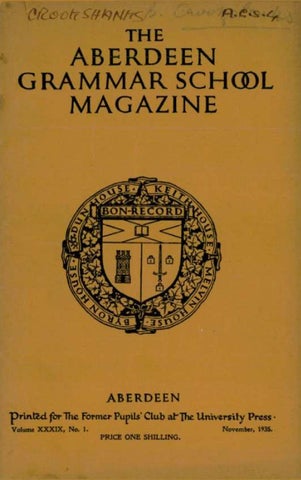
'01'217- C(//9NteC
THE
ABERDEEN GRAMMAR SCHML MAGAZINE
ABERDEEN
prinMcl for-Me Former- Pupils' Club at-The University Press • Volume XXXIX, No. 1.
November, 1935.
PRICE ONE SHILLING.
a--3
-
EDUCATIONAL BOOKS "@.>0<..9-•
JAMES
G. BISSET or
to supply all the Class Books (New CONTINUES Second-hand) suited for the requirements of the Higher Educational Institutions in the City, at the Lowest Prices. N.B.—Best Value in Students' Note Books.
JAMES G. BISSET, Classical, Medical, and Educational Bookseller,
85 BROAD STREET (Opposite Marischal College).
H --
}
-
Children need
ENERGY •f ef) t)
o
= •
14.1.1
TO tide them over the trying hours at school, children need energy! They'll get it from Hutchison's Bread. Assure their health by buying NOW!
A.B.HUTCHISONI,
13 BRANCHES throughout the CITY
Culture Pearls of . . . Great Beauty
NECKLACES RINGS
BROOCHES EAR-RINGS
I
I
A. & J. SMITH JEWELLERS o SILVERSMITHS
o
WATCHMAKERS OPTICIANS
191 UNION STREET, ABERDEEN
abittle's The House for Up-to-the-Minute FASHION WEAR
The House where QUALITY AND VALUE go hand in hand 000
The House for FUR COATS— all manner of CLOTH COATS and SUITS—for GOWNS for all occasions <3;.-C%-<> •
• i ( I 3
\
The House for OUTSIZE WEAR
Mourning Wear Specialists. FIT IS GUARANTEED WITHIN 6 HOURS.
IFUIRNITUIVE THAT
NEVER
FAILS
TO
To all who find pleasure in things of homely interest, Calloway & Sykes' stock is sure to appeal. You will find all the furnishings you desire at prices far lower than you anticipated. WE CORDIALLY INVITE YOU to walk around our COMPLETELY FURNISHED MODEL ROOMS at your leisure without any obligation to purchase.
INSPECT OUR MANY NEW DEPARTMENTS SOFT FURNISHINGS CARPETS BEDDING You will Had many things of absorbing interest and beauty.
GALLOWAY & SYKES LIMITED
361-363
Union St., Aberdeen
JAMES FYFE & SON PAINTERS
GLAZIERS.
AND •
•
•
OFFICE AND SHOWROOMS
11 DEE STREET, ABERDEEN. Telephone 304. TELEPHONE, NO. 1719.
Telegrams —" Fyfe, Painters." TELEGRAMS r " HUB. ABERDEEN."
CAMPBELL & SELLAR, LTD. Engineers, Hirers and Garage Proprietors
QUEEN'S CROSS GARAGE To Fountainhall Road ABERDEEN OPEN DAY AND NIGHT
ANY MAKE OF CAR SUPPLIED
v
/ /n,, i , /~ -
THE
-
W:ts
-/
AMILY COFFEE
Curls Coffee is the favourite drink with every‘J It .5 most one especially delicious. Your in cold weather grocer can supply you.
/
l _
II
CURR'S COf :--....
/
Thomas Cur, 6 Co, ABERDEEN.
./...,....,,,
A' 'il% -;./....•
/),','.‘,,„_
-,..., .,„:„,/
Quality is our Truest Economy
ROBERT STOTT Family Grocer Italian Warehouseman, Tea, Coffee, Wine and Spirit Merchant
53 ALBERT STREET, ABERDEEN Telephone 1848
BOOKS BOUND
ALL
SORTS AND SIZES
Telephone
No. 291
Established
1855
Tailoring of Distinctive Character modelled on ULTRA-MODERN lines. FRED WATT'S Suitsto-Order bear the Hall Mark of Good Taste
80/- 95/- to 126/-
PRICES:
FRED WATT 23 BRIDGE STREET, ABERDEEN `Phone 3515
A. D. COPLAND. Phone 896. Telegraphic Address : " Undertake, Aberdeen."
Telephone No. 2300. Works : Rosebank Place.
GORDON & WATSON FUNERAL UNDERTAKERS AND
MOTOR
HIRERS
12 HOLBURN ST. & 40 VICTORIA RD. ABERDEEN
W. KENNAWAY, Ltd. BAKERS and CONFECTIONERS, 5 and 7 Holburn Street. Luncheon, Tea, and Reception Rooms,
1 73 Union Street and 8 Bridge Street, ABERDEEN
SPECIALITIESSHORTBREAD -
WEDDING CAKES.
ROYAL DEESIDE IN TARTAN TINS, ALSO
A
SELECTION
LARGE
OF
PLAIN AND
FANCY ICED CAKES.
Telephone No. 1891.
ARCHIBALD McKELLAR Family Grocer and Wine Merchant, 454-456
Union
Street, Aberdeen. -
. . Cooked
We Specialise in . .
Gammons, Finest Belfast Smoked Hams, " Harris's "
Wiltshire Bacon.
Medicinal Wines—Vibrona, Hall's, Wincarnis, Glendenning's.
,
Wedding .
Cakes ,
f .
Catering
1 Ir
i /
ALSO
Christening, Birthday, Anniversary Cakes of Finest Quality
MITCHELL & MUIL LTD. Always insist on—
FLOCKHARTS' AERATED WATERS Address—Craibstone Lane, Aberdeen. Telephone 873.
ESTABLISHED
1897.
A. &W. ALEXANDER Fishmongers Butchers Game and Poultry Salesmen - --
PURVEYORS
OF
TIIE
FINEST
QUALITY.
492 UNION STREET
ABERDEEN Telegrams— Telephones-5172 (3 Lines). " Alexanders, Fishmongers, Aberdeen."
Telephone—Aberdeen 1710.
The Mastrick Dairies Ltd. 1 DESSWOOD PLACE, ABERDEEN
WE offer you a Choice Selection of DAIRY PRODUCE from our own Farms, and produced under the direct supervison of members of the family. Our Customers may rely upon the absolute Purity and Cleanliness of all our products. Distributors of Lord Carnegie's
and Cairnbrogie
Certified Milk.
Head Dairy: 3, 5, and 7 WHITEHALL ROAD. Branches : 33 FOUNTAINHALL ROAD. 7 MID STOCKET ROAD. 25 BEDFORD PLACE. 473 GREAT WESTERN ROAD.
CONTENTS ILLUSTRATIONS. James Beattie, M.A., LL.D. (from Sir Joshua Reynolds's . . . . . . Facing page 24 allegorical picture) . . . Lord Provost Edward William Watt . . " 25 Lord Provost Henry Alexander with Lord Meston and Field. , . . Marshal Lord Milne • . „ 64 . Douglas Gordon Miller, M.A. (Oxon.) . „ 65 • • •
. . . . A Message to Former Pupils . . . . The Aberdeen University Bursary Competitions At the School in the 'Sixties. By Professor A. F. Murison . . . . . About Slates. By W. M. A. . Life in Nyasaland and Mozambique. By F. Bruce Duguid. Bicentenary of James Beattie, " The Minstrel " . • . . • • • . Notes About Old Boys . . . . • • • • Obituary • • • • Marriages . . • • • • • • The Daily Howl. By J. I. W. M. . • •
. . .
School Section— . The Value of Broadcasting Modem Russia . . . . The Joy of Fireworks . • School and Random Notes . . . School Rugby . . . House Notes . The Literary and Debating Society The Library . . . . . . . Scout Notes .
. . • . • .
4
The Former Pupils' Club— . F.P.s in Shanghai . F.P.s Resident Abroad . . The F.P. Club Boarding House The Annual Club Dinner . The Edinburgh Centre . . . . The London Centre The Glasgow Centre . . The Rugby Football Section . The Hockey Section . . List of New Members . .
. • . . • . • . .
. • . . • . • •
• •
•
•
•
•
.
• • • • • • • •
• • . • • • • •
. . . . . . . .
•
•
•
•
•
• •
Page I „ 3 „ 4 „ i6 „ 20 „ 22 5 ,, 44 „ 5o ,'', :3 2
91
,, „ „ „ „ ,,
56 58 6o 61 65 68 70
99
7 1
,,
72
It
•
•
•
•
•
•
•
•
•
79
•
•
•
•
•
ft
•
•
•
•
•
•
•
•
•
•
•
•
•
•
•
•
•
•
•
•
•
•
•
19 •
29
76 76 76 78 8i 82 85 86 89 9o
The candcwn An extremely comfortable and easy-fitting Coat which is suitable for either town or country wear. In a wide choice of patterns and with or without patch pockets. Fittings from 34 to 46 in. chest.
3 to 8 Gns.
Esslemont & Macintosh Ltd.
Pleasant ! Uniform ! Reliable ! Entrancing ! That is what they all say about our Brown Bread NINE different VARIETIES
W. M. McPHERSON Baker and Confectioner, 15 FOUNTAINHALL ROAD AND
8 ST. SWITHIN STREET ABERDEEN
LOW'S Wm. Cay & Sons BOOKSTALLS 39-50 New Market Gallery ABERDEEN
Funeral thavrtahers, 415 UNION STREET AND
209 GEORGE STREET, ABERDEEN.
BOOKS on All Subjects and at All Prices Over 5oo,ooo Volumes in Stock Educational Books in Great Variety
Motor Hearses and Cars for Town and Country Funerals.
CATALOGUES ISSUED
Telegrams—"Cay, Aberdeen." 'Phones Nos. 92 and 54.
'PHONE 3332
ESTABLISHED
1818
Br APPOINTMENT TO H.M. THE KING
J. WILLIAMSON & SON (W. B. WILLIAMSON, PAOPRIETOS)
Meat Purveyors and Poulterers 1, 2, & 3 MARKET BUILDINGS, ABERDEEN 'PHONE 412
enaNcers . 3S FOUNTA1NHALL ROAD 'Noel 1724 ALSO
AT
THE SQUARE. CULTS 'PHONE, CULTS 2
CHURCH SQUARE. BALLATER 'PHONE 38
"RECOLLECTIONS OF AN OLD LAWYER" by
LACHLAN MACKINNON
Advocate in Aberdeen With II Full-Plate Illustrations. 5/-; Postage 6(1. extra.
D. WYLLIE & SON Booksellers
247
UNION
Publishers
Stationers
STREET, ABERDEEN
Established 1814
Telephone 402
COUNTRY HIRES AT CHEAP RATES CARS
GARAGED
COLIN S. CLARK DAIMLER TAXI HIRER DAY AND NIGHT SERVICE
PHONE 4422
46 HARDGATE, ABERDEEN
ROBERTS (ABDN.) LTD. Cabinetmakers, Upholsterers, Carpet Warehousemen RECOGNISED AS EASILY FIRST IN
FURNITURE VALUE Our enormously increasing business testifies to the popularity of our good class and dependable productions. We employ a large staff of highly-skilled craftsmen, and their number is being steadily augmented. You will find our prices surprisingly low. AS AN INVITATION, PLEASE ACCEPT THIS ANNOUNCEMENT TO INSPECT OUR LARGE STOCK OF FURNITURE AND FURNISHINGS.
NOTE ADORES'S :
419 Union Street, ABERDEEN
Handicrafts Raffia and Cane Seagrass and Stool Frames
BUY BEST
BUY BRITISH
THE IMPERIAL TYPEWRITER roo°,4, British, is the best and lowest-priced Standard Typewriter. No increase.
THE IMPERIAL PORTABLE Thc Best Portable, loocyc, British.
DRAWING MATERIALS of every description
Second-Hand Bargains of all Makes of Typewriters.
Taylors' Art Saloon
EASY
Picture Framers and Artist Colourmen SCHOOLHILL
49-51
PAYMENTS
C. H. WEBSTER 4 Rose Street, Aberdeen
ABERDEEN
BUY BEST
Telephone 2870.
DEFERRED
(Hire Purchase) ON ANYTHING.
'Phone 505
BUY BRITISH
Why Wait for Watch Repairs? Buy a CRUSADER Watch and never be bothered with repairs. Instead of repair, a new movement is fitted while-you-wait by any CRUSADER Agent throughout the world. 5 years' guarantee. Call for Demonstration or write for Free Catalogue.
Prices from
3 Gns.
erimber
EXACT TIME-NO REPAIRS
Chromium, £4 0 0
Stainless Steel, £6 0 0
Over 100 Models for Ladies and Gentlemen.
Gold, £8 15 I)
JP A8\1 II !ESC IS Ac CA IR IF,' ENGAGEMENT
142
RING
SPECIALISTS
UNION STREET (next Union Bridge), ABERDEEN
COAL ELLIS & McHARDY LTD. (ESTABLISHED 1880)
18
REGENT
QUAY
AND
13Oi UNION STREET
ABERDEEN Telephone 2889
GEORGE BISSET'S Clan Tartan Warehouse 15 UNION STREET
ABERDEEN CLOTHIER TO THE
ADMIRALTY, R.N.R., and R.N.V.R.
HIGHLAND OUTFITS :: a Speciality :: for Boys, Youths, and Gentlemen, also for Maids' and Ladles' Wear; and will gladly supply patterns of Ladies' favourite Tartans for Kilts. Telephone 2680.
Telegrams " COAL, ABERDEEN "
N fitg
•. •
7-V ‘ ;;„r4' . .1. • ,
Co-operation T
HE enthusiastic co-operation of many minds and hands make possible the fine productions of the HOUSE OF OGILVIE. For over three-quarters of a century our constant endeavour has been to give the best possible service to our Customers. We base our claim to your patronage on our ability to please you.
J. & A. OGILVIE 369
UNION
STREET,
ABERDEEN. Telephone : No. 433.
STRACH AN COMMERCIAL 0O, PORTRAITURE PHOTOGRAPH Telephone 851
Telegrams : " Interiors."
Showyard Erector to the Highland and Agricultural Society of Scotland. and Contractor to the Royal Northern Agricultural Society.
vitibfr
JOHN REID & CO. HOUSE CARPENTERS AND JOINERS-
55 Blenheim Place and 14 Fountainhall Road ABERDEEN 4-4-4
416 UNION STREET
Carpentry and Joinery Work of every description done
ABERDEEN
ESTIMATES ON APPLICATION Telephone No. 1997
•
FOR
SALES AND SERVICE in the North Consult—
Aberdeen Motors Ltd. UNION ROW ABERDEEN Works
-
Telephone 4580 (3 lines)
49 Huntly Street Telegrams " Cars "
NORTHERN ASSURANCE COMPANY LIMITED. Assets £23,000,000.
Established 1836.
ALL CLASSES OF INSURANCE, INCLUDING :—
LIFE MOTOR CAR
FIRE ACCIDENT
Life Assurance Branch. The Company's Tables of rates for Life Assurance include every class of Policy. Write for Particulars of Life Policies Endowment Assurance Policies Educational Endowment Policies Children's Deferred Assurance Policies House Purchase with Life Assurance Life Bonus Year 1935. Participating Policies effected before 31st December, 1935, will rank for Bonus at the Valuation to be made as at that date.
CHIEF OFFICES :
ABERDEEN
-
-
-
1 Union Terrace.
LONDON
-
-
-
1 Moorgate, E.C.2.
Aberdeen Board of Directors.
The Right Hon. The Loito
S. R. BRUCE, Esq. The Right Hon. The EARL or A.
FORBES.
CAITHNESS.
A.
FRANCIS J. COCHRAN, ESQ. WILLIAM
L. COOK, ESQ. Manager Secretary
MARTINEAU,
ESQ.
R. W. WAT.KER, ESQ. -
R. MACKAY. J. L. WILLIAMS.
Aberdeen Grammar School Magazine jzse year : No. 2-31
(New Series, 'and year, No. 122)
Vol. XXXIX
November 1933
No. i
The "Grammar School Magazine" is issued under the auspices of The Former Pupils' Club, in March, June, and November. All communications with regard to the " Magazine " should be addressed to the Editor (the Secretary and Treasurer of the Club), THEODORE WATT, M.A., The Rosemount Press, Aberdeen.
A Message to Former Pupils. I formed the impression, when School re-assembled after the Summer vacation, that the boys in the Senior classes were younger and more immature than usual, and a survey of their ages showed that my surmise was correct. It is due partly to earlier enrolment and partly to the saving of a year in the Lower School, and if a year in the " Sixth " were the normal practice, no serious rault could be found with a lowering of the average age. There is a tendency, however, for boys to regard the Leaving Certificate—is the title responsible for it ?—as the end of a Secondary course, and off they go to the University and elsewhere with minds and bodies unequal to the strain of an adult environment. So far as rugby is concerned, there is an undoubted element of risk in pitting boys who are in the age category of Juniors against teams of normal weight. I hope that the wise words to which Mr. Eric Linklater gave utterance at a recent meeting of the London Centre of the F.P. Club will be re-read and carefully pondered. Term has followed its usually placid course. True, there have been diversions, such as the attendance of a party of our boys at the Music Hall when the Freedom of the City was conferred on Lord Meston and Field-Marshal Lord Milne. We have to thank the kindly forethought of Lord Provost Alexander for this privilege, and it is a precedent which might usefully be followed. A platform background of youth and promise was eminently appropriate at a ceremony at which honour was paid to age and achievement. Then there was a holiday for the Royal wedding, rendered all the more enjoyable
a
Aberdeen Grammar School Magazine
by the luck of a really fine day. Altogether there has been sufficient variety of incident to break the monotony of what is much the longest term of the session. The School XV, for reasons which 1 have mentioned, has hardly equalled the record of its immediate predecessor, but that does not mean that it has not shown commendable grit and pluck in the face of odds. If it were slightly heavier, it would bear comparison with any of our best teams. At the moment of writing, Rubislaw Field is at its worst. Heavy rain has played havoc with the surface, and to add to the discomfort, bathing arrangements in the Pavilion are more or less in abeyance. Work at the extension progresses all too slowly, but when the new wing is completed, there will be spray baths in abundance and—what was even more badly needed—dressing rooms of adequate size. I have no wish to continue on the note of complaint, but I cannot refrain from alluding once more to what I regard as the most urgent need of the School, namely, the provision of a Swimming Bath within our own grounds. We congratulate " another school " on its happy solution of this problem, and we hope that the day may not be far distant when the Grammar School will have something more satisfactory to offer its pupils than occasional half-hours in an overcrowded public pond. Now that the Boarding House is out of the way, I suggest that this is a matter which might usefully engage the attention of the Club. It is gratifying to note a continued increase in the number of Boarders. The House has practically its full- quota, and some at least of the enquiries which are reaching me are likely to end in disappointment. I should like to emphasize what is said in another page of the Magazine about the Scouts and the difficulty which is being experienced in finding suitable men, who are also F.P.s, for the office of Scoutmaster. The four Grammar School Troops have fine traditions, and, so far as the Scouts themselves are concerned, there is no lack of zeal and efficiency. The charge of a Troop admittedly involves a sacrifice of time and leisure, but it is work which is well worth while, and there must be F.P.s resident in the City who would welcome the opportunity of repaying by this form of service the debt which they owe to Scouting. The Annual Dinner of the Club was an unqualified success. The choice of an earlier date than usual prevented any clashing with other public functions, and the attendance was large and representative. The new President treated us to one of the most entertaining speeches we have had from the Chair, while Mr. Douglas Miller, the guest of the Club, was in happy vein and obviously enjoyed the re-union with so many of his old
Aberdeen Graniniar School Magazine
3
boys. He spoke to the Senior School before returning to Manchester, and spent the greater part of a forenoon visiting class-rooms and talking to former colleagues. Three years ago we acclaimed the newly-elected Lord Provost of Aberdeen as one of ourselves. Now Lord Provost Alexander gives place to Lord Provost Watt, and School enjoys the signal honour of counting two successive holders of that office among her sons. There is no need to recall here the fine record of service to the City and to his School which the present Lord Provost, like his predecessor, has to his credit. It is sufficient to offer him what I venture to think he will appreciate, the cordial congratulations of boys past and present, and their united wishes for health and strength to sustain the labours of an exacting and responsible post. Christmas greetings to you all! D. M. A. 16th November, 1935.
The Aberdeen University Bursary Competitions. Under regulations that have recently come into effect, the bursaries in the three Faculties—Arts, Science, and Medicine (first year)—are awarded on the results of competitions which take place concurrently. The five subjects selected by candidates may be the same, and in that event, they " sit " the same papers. The maximum number of marks assigned to each subject is the same, viz. zoo. It is becoming a common practice for competitors to enter for Science and/or Medicine as well as for Arts, and as the total marks attainable, viz. i,ooo, are the same in each of the three Faculties, it is possible to com- pare the relative positions of the candidates in each of these. In the case of the last Competition, held in June, the competitor with the highest marks was Bernard II. Smith, from the Aberdeen Grammar School, who was first in Medicine, with 809 marks. This compares with 799 marks made by the first bursar in Arts. A. Harry K. Slater and Andrew S. Finnie were fifth and ninth respectively in the Arts competition, and Alfred W. C. Lobban was fourth in the Medical competition. Although in the past it has been customary to give special honour to the winner of the first place in the Arts Competition, it would now seem only fair that this should be given to the candidate securing the highest number of marks, regardless of whether this is in Arts, Science, or Medicine.
4
Aberdeen Grammar School Magazine
At the School in the 'Sixties. We are privileged to present to our readers a chapter from " Memoirs of 88 Years, being the Autobiography of Alexander Falconer Munson," i which will shortly he issued for private circulation only. In a Foreword to the " Memoirs" the Right Hon. Lord Amulree, who was one of Professor Murison's first Roman Law pupils at University College, London, says :— The present volume was written, we are told, in three months, " with frequent interruptions." Murison at the time was 88 and approaching his end. The clearness of his memory, the vigour of his style, and the vast and accurate discrimination shown in the selection of facts and episodes, makes the book an almost unique production for a man of his age. Nothing could better testify to the fact that he grew old in nothing but years.
Again Lord Amulree writes :— To be told of a man that he was familiar with practically every modern European language—to say nothing of Latin, Greek and Hebrew—that the search for and perusal of an ancient manuscript was for him a high adventure and an excitement, and that he found recreation in the translation of German, Greek, and Latin verse, is for most people to raise an image of a recluse, working behind a closed door in a hush of self-importance. So far as Murison is concerned, nothing could be further from the truth than such a conception. The " Memoirs " show that he was full of the zest of life, and that his vast store of learning was gained not by a sacrifice of mankind's ordinary interests, but by an amazing vitality and industry.
The following gives a very vivid and self-revealing picture of a Grammar School boy's life three-quarters of a century ago. Ed., A.G.S. Mag. On the cruelly cold morning of Saturday, 19th January, 186r, about five o'clock, my father and I started for Aberdeen. At the junction of the new Strichen road with the turnpike we • waited the arrival of Morrison's coach, already coming down Milltown's brae. Presently we were seated on the top, outside, and whirled away—very much I daresay after the fashion of Pinch's famous ride to London : for I remember little about it, except that, when other passengers got down at the various stoppages and refreshed the inner man, I only got down and stamped about to warm myself, without any such comforting and inspiriting refreshment as I had on a time enjoyed in the tent at Aikey Fair. Eventually, however, we drove gallantly up to the Broad Street end of Queen Street ; and I—like Tom Pinch, " stunned and giddy "—was in Aberdeen. As we passed through narrow Broad Street and along spacious Union Street, I marvelled at the stately buildings and blocks of buildings of grey granite, and in the open Crown Street at the blithe charm of the private residences. Half-way down Crown Street we struck into a small court on the left, and made for No. 5, no doubt according to directions previously
Aberdeen Grammar School Magazine
5
obtained. " O, yes; the boy might easily share with two others, who would certainly agree to the arrangement." Happy to have found a pied a terre, we hurried off to the New Market in the Green, and upstairs to the commanding book-shop of John Adam. My father, I suppose, had got from my future master a list of the books I should require ; and we carried away Andrews' "Latin Dictionary," Riddle's " English-Latin Dictionary," " Selections from Ovid " (Chambers), White's " History of Rome," and two or three other small volumes, at the total cost of £3 5s. A trifling literary outfit, you will say ; and so it was : but, proud as I was of my new possessions, my heart was wrung to think how long and how hard my father had had to work to save even that petty sum. Trivial in itself —yes, yes; but, knowing the circumstances, I cannot even now, some three-quarters of a century later, recall the fact without being overcome with r wave of pity and gratitude— ay, and admiration. On returning to the lodging, however, we found that the two other lodgers had decidedly disagreed to admit me. Here, then, was a quandary. Morrison's coach would be starting to return in a couple of hours ; we had no other reference ; Saturday was almost, Sunday was altogether, a dies non ; my father would be kept till Monday afternoon ; and meantime what was to become of us—utter strangers, practically penniless ? Well, thought the landlady, we might try Mrs. Thompson, 24 Marywell Street—the next street. We did so ; and there I was installed with this good woman. And there I was left—a country boy not yet 14, unacquainted with a single living soul, and totally ignorant of the manifold dangers of a great city. Mrs. Thompson was a middle-aged, buxom, motherly woman,' and childless. Her husband was a big, powerful fellow, a member of the highly-respected corps of commissionaires or licensed porters employed mainly in connection with the docks. Worthy Christian folk, both of them : they treated me as carefully as if I had been their only son. Heaven reward them I For surely my contribution was far from rewarding. Only consider. The flat consisted of two small rooms on the first floor, and a fellow-lodger and I occupied the " best " room, on the side of the street. I paid 2s. a week for room and attendance (and, almost certainly, fire and light)! You cannot believe it ? Well, I may say here, at once, that never, during all my years at school and at the University, did I have a room all to myself, or did I pay more for my share except on one occasion—and that was when I shared a room and bedroom with Charles Annandale,' later the distinguished lexicographer, at 2s. 6d. ; and I lived in well over half a dozen different parts 1 M.A. (Aberd.), 2867; LL.D. (Aberd.), 1885. Died at Glasgow, 4th Sept. 1915.
6
Aberdeen Grammar School Magazine
of the city. Incredible it does seem ; but it is a sure and certain fact. Another fact is that my weekly bill, including the as., was practically 4s. ; if it went a few pence over that sum, the excess disturbed me. For, as every month my father sent me a pound note, I had but a very scanty margin left for contingencies. Of course, I could not live on zs. a week : this was supplemented somewhat by " the box." Every week the New Pitsligo carrier, who passed my father's house, brought a small box—say z ft. by ft. by 6 or 7 inches—to his station in Loch Street ; whence I bore it tenderly in my arms, rain or shine or snow, to my lodging—a box containing, with my "laundry," parcels of butter, cheese, and other eatables ; sometimes, I remember, a jar of cooked rice and milk, dry enough not to spill, which would furnish two or three dinners. My diet was not what a school doctor would have pre9eribed ; but at the moment I am dealing only with the means of keeping down my expenditure in cash, and probably nobody concerned ever gave a thought to the possible effects on my health. Certainly, as yet, I felt no cause for complaint. My fellow-lodger was a queer customer in some ways, but he was extremely kind to me. He was at least twice my age, a clerk in the Audit Office of the Caledonian Railway Company : often he would bring home bundles of used railway tickets, and I would help him to arrange them in packets according to the stations of issue. Through some accident he had one leg shorter than the other, the difference being redressed by a boot-sole several inches thick. He was meagre in appearance, but very good-natured. Now and again, I suspect, he went off the deep end somehow ; for Mrs. Thompson would talk to him first as a father, and then as a mother ; and he would take his drubbing penitently. He was fond of reading, and borrowed many well-chosen volumes from the Mechanics' Institute. These I, too, read, with immense zest—good novels and useful general literature : I remember specially the works of Judge Haliburton (" Sam Slick "). On one occasion he got a severe handling from our landlady over a story involving, though not specially obtruding, sexual affairs ; she dared him to let it into my hands. I did not consider it necessary to tell her that I had read it, and that I could not in the least understand why she was making such an ado about it. Now I know she was right. On Monday morning, zest January, 1861, I shouldered my parcel of new books, and set out to discover the Grammar School. I was just turning into Crown Street when a small, old, brisk gentleman hailed me : " Hi! laddie ; you're not fit to carry such a load of books on this ' slidder ' [slippery ice]. Give them to me. . . . Where are you going?" " To the Grammar School, Sir." " Hal so am I. That's right ; we'll
Aberdeen Grammar School Matazine
7
go together." So we went together, like father and son, up Crown Street, to the right over Union Bridge, to the left along Belmont Street, into School Hill ; and he left me at the gate of the school. God bless the good man' I never saw him again, or knew who he was. Now I joined the stream of pupils and passed through the small stone-paved court, and up the entrance steps, when I came right in face of the Masters, standing under the clock till it should strike nine, and disperse them to their several class-rooms. My class was the third ; and 1 passed to the third class-room by the left. The Master—the Rev. James Wilson Legge,' M.A.—followed immediately. The room was spacious enough, but bare of ornament, and scarcely inviting. A passage ran up the middle, and forms —" factions " they were called—extended on both sides from the passage to the walls, the Master's raised seat overlooking directly the left group of forms, at the inner end of the room. There might have been 6o to 7o pupils. 1 took my seat at the bottom, of course ; that is, at the end of the last occupied form on the right side from the entrance—on the left side from the Master. As the lesson went on, I now and again ventured to ask my neighbour—a charming boy, son of a banker—what this or that meant. The uniform answer, perfectly indifferent, was : " Don't know." Presently a question was put to a boy in the first faction on my side : he failed to answer, and the Master's finger moved steadily down faction after faction till it rested on me. I rose and answered correctly. Accordingly, I had to go up and take my place above the pupil that had failed ; the fact of a new boy's sudden rise, and, perhaps, no less his astonishing impedimenta of books, creating somewhat of a sensation. But this was only a beginning. Hardly had I settled down in the first faction on the left side (from the Master) when a boy in the first faction just under the Master failed to answer, and the moving finger again rested on me. Again I answered correctly. And there I was already in the first faction of the class, and only two pupils above me. A third chance came : the top boy missed fire ; but, when the moving finger rested on me, I was not ready to respond: I knew the word that was wanted, but for the life of me I could not at the moment bring it to my tongue. Not a soul in the class could produce that word. It was a bitter moment, obliterating my former successes : there was the top place open, yet I could not get the word, though I knew I had it at the very edge of my tongue. Then the Master genially acknowledged that neither could he remember it. It was the Latin for " advisedly." I made an effort, and suggested, though 1 knew I was wrong, " consilio " : it ought to have been " consult° "—which shows 1 Pupil at A.G.S., 1843-51; M.A. (King's Coll.), 1835. A.G.S., 1855-91. Died at Aberdeen, zznd June 1895.
Master in
8
Aberdeen Grammar School Magazine
how nearly I had it. But the Master shook his head at " consilo," wistfully, and the matter had to lie over. However, for the first day, I had done not so badly. We adjourned for dinner from rz to 2 o'clock. On my return my landlady eagerly questioned me how I had fared, and was highly delighted with my success ; and my fellowlodger, on hearing of it, began to look on me, with an air of puzzlement, as a prodigy. Thereafter I was seldom dislodged from the first faction. Mr. Legge was a man of about 3o, slightly built, with firm, not to say severe, features, which readily opened in sunny kindliness, even tenderness. He loved us all, and we all loved him, and respected him profoundly: he never had to raise a finger to check disorder ; he very seldom had to speak a word of remonstrance. He was a good scholar, and he was a constant student. He was also a good Conservative, and stood on the ancient ways stoutly, in education as in politics. I do not know whether he had been a pupil, or even a colleague, of the celebrated Dr. Melvin,1 a recent Rector of the School, whose fame as a Latinist was great and widely recognized ; but to . him Melvin's name was sacred. Our great subject was, of course, the " Version "—that is, the translation of a passage of English into Latin. Once a week a passage was read to us, and we took it down, and turned it into Latin. In two or three days Mr. Legge read out the results, and according to them we took our places afresh. The papers without error were marked "sine errore": the blunders were marked r, z, 3, 4, according to their heinousness, 4 being styled a " maxie" (maximus error)—e.g. a misconjugation of a verb, or a wrong gender, etc. We did not read much Latin ; but what we did read was very thoroughly analysed, not only in all grammatical bearings, but also with an eye to utilization in the " Version." Of course, we were thoroughly drilled in Latin grammar : I forget whose " Grammar,' I think Ruddiman's. Also we had a singular terror of a book, so portentous a book that it is strange I should forget its author's name : was it Ruddiman ? or was it Melvin himself ?—a book wherein the genders of nouns, the longs and shorts of vowels, and Heaven knows what, were set forth in groups with strings of exceptions, in exhaustive detail, in hexameter verses : and these verses, in their hundreds, we had to commit to memory( Thus, for example : 0 varies. Monosyllaba longa, et cuncta secundae. And so on, for I know not how many lines, till the wayward lengths of " o " were exhaustively grouped or detailed—a suit 1 Pupil at A.G.S., 1804-09 ; M.A. (Marischal Coll.), 1816 ; LL.D. (Marischal Coll.), 1834. Master in A.G.S., 1821-26; Rector of A,G.S., 1826-53. Died at Aberdeen, 28th June 1853•
Aberdeen Grammar School Magazine
9
of harness that weighed the ordinary warrior to earth, or completely " girded " him (sank him into the earth). Surely never was invented so cruel an engine for a benevolent purpose ; but happily the healthy instinct of the human boy in nearly all cases kept it at a safe distance. I myself learnt the lines simply in the day's work ; and, when even the Rector (Barrack), in the fourth or the fifth class, gave us a savage exercise on genders, etc., mine, I am almost ashamed to remember, was the sole paper "sine errore," proving me the most proficient in this gigantic futility of recondite and curious learning. As for Latin authors, we no doubt read some prose, but I remember only that we sampled those " Selections from Ovid," and did not find them too easy. History, geography, etc.: all these 1 forget, for everything else was overshadowed by Latin. White's little sketch of Roman History was mainly, if at all, read at home. Our programme might have been considerably varied with great advantage, but what we learnt we learnt. I have no recollection of the prize-list. But the best thing we learnt and the best prize open to all, was the daily example of the beloved Master—gentle and gracious, just and considerate, with an air of elevation deeply impressive, though as yet but vaguely understood by us. We had no playground. We had no library. We had no hostel. How different from the ample provisions of the present day! But we did have a sort of Debating Society, at any rate in the last quarter of stay in the Third Class. I recollect that I speechified in some debate, and that I read papers on some other occasions. One paper was about novels : I praised Miss Bremer, not without contradiction. Another was about the Battle of Bannockburn—which I was to describe on a later day in the " Famous Scots " series—and no doubt I was again open to contradiction, but really my mind was almost wholly absorbed in the chivalrous aspects of the combat. I quoted Scott. Out of school I must have been, somehow, an industrious reader. For one phase, I had by this time fallen under the magical wand of Pierce Egan, thralled by his stirring romances in the London Journal. Then followed the Weekly Budget (?), Bow Bells, the Reader, the Family Herald, and so forth ; and, though some of them at least were published a fortnight in advance of their date, I was always aggrieved at their slow appearance. I have dim recollection also of a periodical of somewhat weightier character, with which I connect Andrew Halliday (under the pen-name of Matthew —) : its name, if I mistake not, was something like One and All. The Bannockburn paper I connect persistently with a new lodging, in Broad Street, looking (south) on the Netherkirkgate and on the seductive windows of Shepherd, the confectioner. I had certainly crossed the street with the Thompsons, from
to
Aberdeen Grammar School Magazine
No. 24 to No. 27, at the May term, and remained with them till the summer vacation at the end of June. But, apparently, on returning in August, I had gone—probably with a school friend, whom I do not now recall—to Broad Street. The shifting of lodgings was entirely at my own indiscretion; and I doubt whether in this case I had made a change for the better. Anyhow, the memory of it is all but wholly forgotten. One day we were surprised to find a gentleman of more than twice our own age, tall, well-built, alert, and beaming with kindliness, seated at the bottom of the class. He turned out to be a distant relative of my own : William Irvine, brother of Alexander Irvine of Uppertack (a son-in-law of Walhowe). He was going out to Madagascar as a missionary, and had come to rub up his elementary studies. What eventually became of him I do not know ; but he proved a great favourite among us. About Easter we had a few holidays, and my good friend and fellow student, James M. Rae—several years my senior, formerly a draper's assistant, but now studying in view of the ministry in some dissenting body—proposed that we should walk home for the short vacation, his mother's little farm lying on the road some five or six miles nearer Aberdeen than my father's. The railway to Maud was not yet open, and the coach was beyond our purses ; so walk we did—for me a matter of some 33 miles. It was an exhilarating experience to me, and a great astonishment to my parents. And we walked back again. I will anticipate here another astonishing, and not quite so laudable, though, perhaps, natural and intelligible escapade of a similar character, which probably belongs to the winter following. Again we had a few days off, and the railway, now open, was offering reduced fares. I found myself in possession of as. The Tempter was busy at my elbow : " Go and see Leebie,1" said he. The as. was clearly not mine ; the journey would clearly have been vetoed by the true owner of the as. ; the fact would become known ; and I should be disgraced, if not soundly punished as well. " Go," insisted the Tempter ; and spring was in the air. Not only had I nobody to back my better sense, but I was at war with myself ; and, of course, the Tempter prevailed. I would stop at Auchnagatt, the second station short of Maud : this would save money, and it would keep me out of the way of acquaintances. So to Auchnagatt I went ; then in the open wintry weather trudged over the hill and through Crichie to Old Deer—some six or seven miles. Even in the Seventh Heaven—and long afterwards—my conscience was keenly pricked by the illegitimate adventure. Likely enough, there were tongues long enough to reach Walhowe 2 ; but I was never challenged—except by the irrepressible illiquid 'Elizabeth Logan—the future Mrs. A. F. Munson. 2 Walhowe of Aucheoch, Brucklay— the home of A. F. Munson.
Aberdeen Grammar School Magazine
11
amari of inner remonstrance.
In spite of all emollients, I had begun to realize the meaning of the saying that the way of transgressors is hard. " Bad boy! " " Yes, sir. Thank Heaven that you were never a bad boy." In October, 1861, I passed on to the Fourth Class. The Fourth and Fifth Classes were under the charge of the Rector. They were seated on opposite sides of the passage running up the middle of a huge room, the Fourth on the left (as you enter), the Fifth on the right, with the Rector's desk at the top. In my Fourth Class there were 6z pupils ; the Fifth had somewhere about as many, but it was usually much increased in the quarter before the " Competition" by an influx of pupils seeking a final polish for the contest. The Rector, the Rev. William Barrack,1 M.A. (later LL.D.), was about 4o, fully middle-size, vigorous, with fresh, open, genial countenance, and hearty bearing ; and he was greatly liked by all of us, in spite of a somewhat trenchant manner. He was a good scholar, and a skilful and energetic teacher. What he might have done in complete freedom can only be surmised: his business there and then was to prepare his pupils directly for the " Competition " ; and that he did with might and main, and with great success. A dozen years later he became head master of a new secondary school of high aspirations in Glasgow, but he soon died, prematurely. Then cracked a noble heart. The combined teaching of the two classes forbade a grading of work specially suitable for each—an unfortunate system, one would think ; but it may have acted as a spur to the juniors. Latin, of course, was the great subject. I quote from the School " Programme for 1862-63 " :— Versions were written twice every week, on Tuesday and Friday afternoon in School ; and usually three Exercises, viz., a Translation, a Greek Exercise, and Latin Sentences, were written at home weekly. The Tuesday's Version is always a Trial Version, i.e., the errors are counted, and the place of the pupil in the class is assigned accordingly. The Translation is read, examined, and criticised in school, and the Greek Exercises and Latin Sentences are carefully examined, corrected, and returned to the pupils. Frequently on Monday afternoon, a Translation, or a Greek Exercise, or a Version was written in School without the use of Notes or Dictionaries, and afterwards examined and corrected. Obviously the office of Rector was no sinecure! The marking followed the same plan as in the Third Class : the keenness of competition may be inferred from the fact that on one occasion I forgot myself so far as to write " fieretur " (for " fieret ") 1 Pupil at A.G.S., 1847-48 ; M.A. (King's Coll.), 1851; LL.D. (Aberd.), 1875. Rector of A.G.S., 186o-68. Died at Glasgow, 4th April 1881.
12
Aberdeen Grammar School Magazine
—a " maxie "—and found myself in consequence placed top of the fifth faction (21st in order). Strangely enough, I have hardly any recollection of the Latin authors we read : I have but a vague notion of Livy, and of Cicero pro Milone ; not of anything in verse. I think we must have begun Greek in the Fourth Class : though it is not easy to see how beginners in the Fourth could work with the Fifth, who had been working at it for a year. We mastered Geddes's Greek Grammar, and we read Xenophon's Anabasis—two books at least. Incidentally I may note that I got my first lesson in Greek a year or two earlier from Charlie Dalgarno,' on one of our country excursions : he taught me to decline raµrj. History and Geography were " Ancient," not modern ; and we read them up at home ; not, so far as I recollect, in class. In like manner the " Private" Latin and Greek Readings were purely home-work : I remember well reading the Anabasis, Book viii, at home. And we had a taste of English : we read Julius Caesar and The Merchant of Venice in class, with a minimum of comment ; but we were in no way prepared to meet the sort of English papers set at the " Competition." Even the energy of the Rector had a limit. We had no mathematics, or writing. For these, pupils had to go to the Town's Public Schools in Little Belmont Street ; fee 5s. a quarter for one hour daily. I did not go : it was all I could do to afford the classical fee at the School : los. 6d. a quarter. I had done very little Euclid at Old Deer, and I remember, with amazement, how puzzled I was to know when to call A B C a triangle and when to call it an angle. However, I got to know it somehow, and Euclid, Book I, was all that was required for the " Competition." I believe French and German classes were offered in the School, at i 5s. a quarter, " if a class of at least 8 be formed." I do not recollect the formation of a class. I have lost sure count of my lodgings at this time. I think I soon left Broad Street, and was housed at 1 Union Wynd (Mrs. Warren) with my old friend William Ritchie, early in 1862. My recollection is blank till the autumn, when I settled with Mrs. Milne at a cottage on the Aberdeen-Ellon road, right opposite to King's College, Old Aberdeen. How I should have gone there, a very long mile from the School, with winter in prospect, I cannot imagine. I knew that Tom Davidson 2 had lodged there, and that it was a comfortable place ; I may have been decoyed by a friend, though I forget who shared the room with me. Anyhow, the double journey in wicked weather, over harassing roads, proved rather trying. One day on tendering my excuse for yesterday's absence—" It was pouring rain "— the Rector took me up sharply : " Why, you're not made of 1 M.A. (Aberd.), z 866. Mathematical Master, Christ's College, Finchley, London, 1884-1919. Died at Braemar, zest Sept. 1930. 'The "Wandering Scholar." M.A. (King's Coll.), 186o. Died at Montreal, 1goo.
Aberdeen Grammar School Magazine
13
sugar! " Obviously, he meant it jocularly—to treat my excuse as a mere formality ; yet I was painfully hurt. He did not know where I lived ; he did not know that I had neither overcoat nor umbrella ; he did not reflect how many days I might have had to be absent if I had come to school drenched to the skin and sat all day in my wringing clothes. But allowance must be made for the hasty utterance of a pre-occupied and vigorous man. Some months later, I am happy to say, he spoke otherwise. I had taken a day off a week or so before the " Competition," and, strolling up Union Street, I met him. He stopped me and asked why I had been absent. I replied simply : " I was getting up Euclid." " Quite right! " said he, and left me astounded at my escape. About Easter I must have been at Mrs. Baxter's, in a close off Gerrard Street, near where it meets the Gallowgate at Mounthooly. And presently we removed to Commerce Street, under Castle Hill and running down to the harbour. In the Fourth Class I must have been fairly diligent. The Aberdeen Grammar School Magazine (Nov. 1933) says, on the basis of the official " List " : A. F. Murison is recorded as being ist in Latin, ist in Greek, 1st in History, 2nd in Geography [What a falling-off was there!], ist in Private Latin Readings, ist in Greek Private Readings, and ist in General Excellence. He was also awarded the ist " Extra Prize for Visitation Exercise." The " Visitation " Exercise—a " version "—was specially connected with the annual visit of the patrons (the Lord Provost, Magistrates, and Councillors of the City) on Prize Day. As the magnates were filing down from the platform, Councillor Harper genially bent down to me and said, " Have you ordered a Pickford [a waggon of the Pickford company of public carriers]?" The first Latin prize—Liddell and Scott's Greek Lexicon—was a most timely, as well as a most valuable acquisition; and the rest of the volumes were also wisely selected with a view to utility. In 1863 the Visitation was held, not in the time-honoured building in School Hill, but in the spacious new building in Skene Street West, this being the opening ceremony. I have not before me the list of prizes in the Fifth Class, and, though I have somewhere in my library the volumes I received, it is not worth while to seek them out and find the inscription. I did very well, but not quite so well as in the Fourth Class— an ominous circumstance. Indeed, it was all but miraculous that I appeared in the prize-list at all. At the .commencement of the examinations, in some brief interval in the class-work, happening to look round from my seat in the first faction, I was instantly struck full in the eye by an apple, heedlessly thrown by some prize fool from the other end of the room. Fortunately, the apple was very rotten. My old friend James M. Rae at once took me round to Dr. Jackson, in the Woolmanhill, who did
1
4
Aberdeen Grammar School Magazine
his best for me, with great sympathy, and so efficiently that I was able to attend all the examinations, notwithstanding much discomfort. If that apple had been but a little harder, I might have lost that eye ; I might have missed all the examinations ; I might have been incapacitated for attending the " Competition." And then? Again I marvel that the recklessness of boys leaves either themselves or their fellows unmaimed or even alive. To all outward appearance I was running well in the Fourth and Fifth classes. From the Fourth I had gained the 32nd bursary (Liz) at the " Competition " ; but I resigned it, partly in view of its smallness; more, perhaps, because I thought it wiser to be better prepared before entering the University. In the Fifth I was generally regarded as sure to come out pretty near the top at the " Competition " of 1863. Indeed, at a later time, the Rector told me in so many words that I was the one pupil he had ever confidently counted on to be First Bursar. All very well ; but neither the Rector nor any of my fellows ever suspected that there was another side to the question. I had no official " tutor" ; no man ever troubled to enquire where or how I lived out of school. So my life out of school was another life—a hidden life—not necessarily consonant with, or helpful to, my open school life. I was left to steer my boat with no chart, with no knowledge of navigation, with no suspicion of sunken reefs or of treacherous squalls. It never occurred to me that my life outside school was other than correct and even praiseworthy. I did not neglect my home-work : I regularly prepared the next day's task, as I thought, sufficiently ; and this cost me no trouble at all. I took a great deal of exercise, merely as a natural output of energy, without any consideration of its bearing on my health. I perambulated the Links and the Broad Hill, and all the country roads running through the varied and delightful suburbs ; bathed in the Dee and in the sea ; inspected the great quarries of Rubislaw; investigated ships and cargoes in the harbour ; crossed the Dee and explored the rock-bound coast for miles south of the Nigg Lighthouse. Once more, while bathing in the sea, I encountered an unexpected danger. The beach was sandy, but not always firm and safe. My friend Charlie and I waded straight in, next turned to one side for a space, and then proceeded to walk straight out. To our consternation, the water, instead of becoming more shallow, became deeper and deeper, and there was a strong back-draught, the tide being on the ebb. " Hi! " cried Charlie, " look out for my corpse! " The exclamation was not reassuring : I shouted to the beach-tender, and swam for dear life. Presently I touched ground. We had gone round the end of a deep pool scooped by the waves, and returned through the middle of it. Apparently the beach-tender knew nothing of it. So far, good. But then I had so much to read. I had no
Aberdeen Grammar School Magazine
15
plan in my reading, nor had I any monitor to suggest that a plan was desirable : I read whatever came into my hands, and as it came. Poetry : Scott, Campbell, Goldsmith, etc. ; especially dramatic works : John Home's " Douglas "—" My Name is Norval" ; miscellaneous single plays published by Samuel French, which I could never leave on the stalls of the New Market when I could possibly spare the required pennies ; a chance volume of Nat Lee's plays ; a thick, close-type, cheap volume of Charles Maturin's plays ; and others. By the way, another Charles Maturin, a relative of the playwright, and professor of Law at Trinity College, Dublin, was later to be my co-examiner in Law in the University of London. But reading was not enough: we must recite ; we must even attempt to act. At Old Deer I had had as school-fellow Jamie Hay, a farm-servant that had been sent to school by his employer as a young man likely to learn. Jamie was a good deal older than myself, but we were close friends. He was now living in Aberdeen, a granite-polisher at Macdonald's well-known works. His line was comedy ; mine was—more serious. On the occasion of some celebration by Macdonald's men he and I agreed to recite, my piece being Lochiel's Warning" ; and we rehearsed bravely in front of a committee, but I do not recollect that our performance went any further. However, we recited industriously to each other. I fancy that it was in the winter of 1862-63 that I first went to the theatre—a heinous step, I knew ; but I persuaded myself that the occasion was quite exceptional : Charles Keen and his company were to play Hamlet. Of course, we fought our way desperately into the gallery (" the gods ") of the small house. An unforgettable experience ; and, even if the usual price was doubled, costing only a shilling. Really, we must raise another shilling: and so we witnessed Richard III, and probably The Merchant of Venice and The Gamester, though these two may belong to a later date. The fire was in the heather. After mature deliberation, I wrote to the manager of the theatre—Mr. Maclein (for MacNeil, they said)—explaining that Jamie Hay and I were stage-struck and requesting the favour of an interview. Mr. Maclein received us courteously, and talked the matter over with the soberness of a Judge and the suavity of a Dean, without a trace of surprise, impatience, or reproach, and decided that we should be ill-advised to have anything to do with the stage. Naturally we were disappointed, but we were convinced, and ever afterwards entertained profound respect for Mr. Mackin as a great gentleman. My histrionic ardour was finally extinguished by a decisive douche of cold water administered by Leebie Logan. Still, however, my insatiable reading went on. In the quarter before the summer vacation (1863) I read the whole of
i6
Aberdeen Grammar School Magazine
Shakespeare's plays at the regular rate of one play a day. And the " Competition " was but three or four months ahead I Ay, and as if all these time-wasting and nerve-shattering heroics were not enough, there was yet another deflecting influence. During the quarter before the " Competition," when I should have had all oars in the water, Leebie was staying in town, taking some lessons in preparation for competition for a scholarship at the Church of Scotland Training College (Normal School) for lady teachers in Picardy Place, Edinburgh. Well ? Did I not go to see her? I did. How could I but help her with her French ? I did : in fact, we read and discussed " Les Freres Ennemis " of Racine, and that on almost every evening of that fateful quarter before the competitions! . . . Nay, nay, my good Sir, I surrender at discretion. It would be vain to attempt to assess the advantages and the disadvantages of such vagaries in my extra-mural activity ; but there will probably be felt a general impression that the devotion of even half the dissipated time and energy to my regular studies would have materially improved my chances of success. It does seem amazingly strange that, though I did my daily work with constant fidelity, I yet appear to have regarded with complete indifference not only the honour but the material advantages of a high place in the " Competition." The interests of the moment obstructed the vision of the future. And the sand-glass was steadily running down. The competitions duly arrived : Leebie gained her scholarship ; I was declared FIRST BURSAR.
About Slates. We are told that a considerable variety of materials was used by the early peoples for writing upon. The Babylonians wrote on bricks, the Egyptians on papyrus, the Romans on wax, the Goths, or some such people, upon bark—and so on. We ourselves, at the Grammar School, wrote on stone ; in fact we did all our arithmetic upon stone tablets. There is something finely primitive about slates and the use of them, as one remembers it, when you place it in relation to its ancient background. Slates possessed something of that gritty quality which one associates with the stout men of old ; the quality which is expressed in the Latin adjective priscia, and is not expressed in any English word. It may be worth while, then, to put down a few things which some of us remember about slates. In my time we never carried slates to the School. That may have been the practice at an earlier date. The slates were lying in a pile as you entered the room, and you each took one as you went in. You picked up the likeliest-looking one you could see. They varied greatly in quality. Some were smooth and soft and pleasant to write on ; others were rough and nasty.
Aberdeen Grammar School Magaine Some were chipped and had corners broken off. All had at some date been enclosed in a wooden frame round the four edges ; but this wooden frame merely remained as a historic relic on a few of them ; in most cases it had long since been lost. I do not remember having any preference for those which still had the wooden frame on them ; and what you looked for every time was the quality of the slate, not the state of its edges. The sharp eyes of any schoolboy could recognize which were the good slates at any distance ; this is to say, the slates which were agreeable to write on ; and it was such a one that you grabbed if you got the chance. In certain of the classrooms the slates stood in a rack near the door, instead of standing in a pile. This to my mind always seemed an unnecessarily formal way of keeping them. I never saw that it had any advantages. It certainly made the slates themselves neither better nor worse. These slates were rather bigger, I think, than the ordinary roofing slates. They measured about twelve inches by eighteen. So they had ample width to accommodate such sums as spread far across. When you took your slate from the pile, it generally had somebody's sums of the previous day still upon it. So the first thing to do was to clean off the old figurings and get a fresh surface for yourself. The technique employed was, of course, plain spit and rub. The rubbing was done with the ball of the palm, that is, the base of the thumb. To use the sleeve of your jacket, or anything else, for rubbing the slate was to depart from customary practice, and was not usually done. At a somewhat later date some public health fanatic invented an appendix to the slate, consisting of a bit of string with a sponge or felt wiper attached to it. It never fell to me in my time to use this invention ; so I can speak with no authority upon its merits. Regarded in an objective way from a standpoint in adult life, it looked creditable to its inventor's feelings, if not to his intelligence. I remember, however, that there was some kind of cleansing ritual performed upon the slates at considerable intervals. I never saw how it was done ; but there were occasions, when you came to take slates in the morning, when you found that they had all been washed since you saw them last. Perhaps it was the work of fairies. In any case it was done with water, because upon such occasions you would often find water dripping off the edges. I have now described the slate itself, which was the property of the Aberdeen School Board. The other thing needed was your own property, namely, the slate pencil. A slate pencil, when new, was a strip of slate some four or five inches long. It was a good deal thinner than an ordinary pencil, and of course was not round, but had rather angular edges. I have said—when it was new. But in its new state it was never seen ; although it possibly existed in shops in that condition. In practice it
i8
Aberdeen Grammar Scbool Magazine
consisted of a well-used bit, not more than two inches long, which you carried in your trouser pocket along with your marbles. For this bit of slate pencil there is a good Scotch word, a word which was constantly used by us at the Grammar School. It was called a " skaillie." That is the spelling of the word as given in Jamieson's Dictionary. It is a rather interesting word. The Franco-Scottish Society would no doubt tell us that it is a direct importation from French. Anyway, you get the word in the old Scotch literature meaning any sort of slate. In our time it had the restricted meaning only, of slate pencil. But that is not all the tale. Note the pronunciation. In the Grammar School the sound was " sceillie " (rhyming not with " daily " nor with " highly," but with, say, the surname " Wyllie.") This I rather think was the regular pronunciation of the word in Aberdeen town, and also on Deeside. In the northern part of the county there was another pronunciation of it—" scallie." This difference of sound, according to the provenance of the speaker, will be confirmed, I am sure, by many of my contemporaries. We nearly all invariably said " sceillie" ; but I feel almost certain that I heard Dr. Moir, the Rector, use the word, and that he said " scallie." He had a great knack, had the Doctor, of getting into the boyish mind. But to return to the French connection. " Sceillie" may be French in origin, you can look up its source in the dictionaries. In our time there was a kind of pencil for writing on slates which was of a quite different kind, and which was actually called a " Frenchie." This was a composition affair made of chalk and grease like what artists do their pastel drawings with. It had a skin painted red or green, and made a soft white sort of writing on the slate. I never used a "Frenchie" myself. It was said that they cost twopence each. I only remember seeing stray bits of " Frenchies" in the possession of other boys. These bits had some value in the bartering transactions of the time ; ordinary " sceillie " had no bartering value. Perhaps some one can supply information upon a matter upon which my memory has unfortunately grown very hazy. Scratch my head as 1 will, I cannot re-establish the facts. The " sceillie" had a definite utility for purposes of divination. It was this way. In winter, when we had slides going on the pavements—excellent slides, so long as fussy folk didn't come and put sand on them—we used to have a curious ceremony. You wanted to know, let us suppose, whether it was going to freeze or to thaw or something like that. You put a " sceillie " down on the slide, endways, that is along the slide, not across it. You then put your cap on the top of the " sceillie." You did this carefully, so as to have the cap sticking up with plenty air-space above the "sceillie." What you did after that I cannot remember ; I think you started counting, didn't you? Anyway, by this method you found out something. I remember
Aberdeen Grammar School Magatine
we were doing this once on the Craigie Loanings. The Rector passed us on his way home ; he lived in Hamilton Place, then only half built. And it was characteristic of him to stop and suggest improvements in the procedure we were following. Dr. Moir knew all about it. Perhaps it is these early associations which have given some of us a lifelong interest, in the bygoing, in slates. Not that we know the difference between Penrhyn Red, Dinorwic Blue, and that sort of thing. But it is rather impressive to stand on a quiet day on the top of one of the Welsh hills, and to hear the frequent shots going off in the slate quarries on each side ; to look at these quarries and see what a quantity of rubbish has had to be shifted to get the usable slates, a mere fraction of the total excavation ; and to think that it was on slates from there that you learnt to do your arithmetic, such as it is to-day, perhaps nothing much to boast of but something that has served you fairly well. At least, I assume that the slates we used in the Grammar School were Welsh slates. The Scotch slates, by comparison, are much thicker and rougher ; although on roofs they take on a far pleasanter tint than the Welsh ones do. The bleak blue of the Welsh slate has been a blighting influence, from the tsthetic standpoint, upon British architecture. It is so omnipresent that no one can escape it, in our generation. The queer colours now appearing on bungaloid roofs are at least more cheerful. As for the slates of this corner of Scotland, what does anybody know or care about them ? Tarrymount, Foudland, and so on, these names carry a meaning only to a few. I once heard a man in the village of Tomintoul who was showing the chapel there to some visitors ; he explained that the slates upon its roof had come from Newfoundland. Perhaps you can guess what was in his noddle. So far as the visitors were concerned, 1 suppose the slates might have come from Hongkong. But that has led me away from the point. I forgot to say that in actual use the slate had several noticeable features. You could construct a " slide " upon a slate. This you did by rubbing a lead pencil up and down it, and then blowing off the lead dust. A slate pencil would not work across a slide, it being too greasy ; so in this way you put one over on the next user of the slate, and in fact the slate itself would require to be washed to get rid of a slide. Another item that one remembers was the shrieking sound that could be made by shoving the " sceillie " rapidly down the slate ; if you got the " sceillie " at just the right angle of incidence, this shriek was very effective. And they were stout things, these slates. They were banged about in all ways, but I don't think I ever saw one broken, although I saw many broken ones. They were common property, and if anyone wanted to know who had broken a slate, the answer was obvious ; it wasn't me! W. M. A.
zo
Aberdeen Grammar School :Magazine
Life in Nyasaland and Mozambique It is over eight years since I was home and it is really grand to be back again! Since last I saw this wonderful island of ours, I have spent most of my time in East and Central Africa, and as I have been asked to contribute something to our Magazine, 1 am sure I can do no better than tell you how I have fared during that time. May 1927 found me in a Union-Castle liner bound for Nyasaland—full of the joy of spending a few years on a tobacco estate on the western shores of Lake Nyasa. Shipboard life is really marvellous, and the voyage came to an end long before I should have liked it to have done. I landed at Beira, in Portuguese East Africa, and after spending a few days there, I took train for Blantyre in Nyasaland. The first part of the journey was made through the steaming-hot Chupanga Forest, and I was very pleased indeed when the Zambesi River came into sight. (No amount of iced German beer could slake my thirst when the temperature was ranging between too° and i xo° in the train.) The crossing of the river, however, revived me, and that night I slept on the deck of the river-steamer which transported us, and found the breeze wafted over the water to be very much more refreshing than the iced lager. Next day I was in Nyasaland—a marvellously pretty country, with a fine temperate climate—such a change from the torrid heat of the plains! From Blantyre I went by car to Fort Johnson (at the southern end of Lake Nyasa), from which point the mode of transport was again changed to that of lake steamer. It took us almost five days to reach our destination at Nkata Bay, and during that voyage on an inland fresh-water sea, I was sea-sick for the first time in my life! The first night ashore I was rather perturbed by the thought of wild animals, and barricaded myself into a native hut for the first and last time. Ever after that I slept in the open, under a canvas awning, and found it to be healthier, although this idea of mine cost me a pair of boots one night, as I shall relate further on. After a tramp of some sixty miles, we (for I had now joined the rest of the party) arrived on one of my father's tobacco estates, and after a fortnight I becanie quite used to my new life and surroundings. We were right in the heart of a big-game country, and many a time we went out to shoot meat for our native labourers. I became quite experienced with game, and very soon had bagged quite a fair collection of the larger antelope and also one or two buffalo. On my first trip I came across three cheetah (most rare in South Africa), which were following a roan antelope I had wounded, and was very lucky indeed to shoot one.
Aberdeen Grammar School Magazine
21
Hyenas were a great pest and nuisance on these meatprocuring expeditions, and we had to keep good watch at night over the spot where we had our meat drying. I had two most peculiar experiences with these scavengers—once I had a pair of boots stolen from my bed-side during the night, and on another 1 was wakened by a scream of terror to find that a zebra skin, of which I was particularly proud, had been pulled away from under a native, who had been sleeping on it. From our bungalow on the farm we had a really wonderful view of the lake, which at that point was so wide that it was only on a clear day that the high mountains on the eastern shore could be seen. The lake is very deep in places, but, unfortunately from a navigator's point of view, too shallow close inshore for good anchorages. The water is beautifully fresh and clear, and very fine for table use. It is also full of good edible fish, although these appear to migrate from one part of the lake to another during the various seasons. The natives on the lake shores are very keen fishermen, and fishing and the making of fishing-nets is their chief and favourite way of spending their really lazy lives. Slumps in the tobacco market found me in 1930 in Beira, the capital of the Mozambique Company's territory in Portuguese East Africa, and there I still reside. This town, although very hot and steamy during the rainy season, is, nevertheless, very pretty, with its tree-lined streets and picturesque bungalows. The town itself is very healthy and practically devoid of the malarial menace, although this is not the case in the outlying districts. It has one of the finest golf courses in South Africa, and being under sea level and having turf of a salt-water variety, it is perpetually moist and fresh. There is also a tidal inlet from the sea running through the course, and when the sea tides are high, sluice gates are opened and the water allowed to flow over the course. In this unique way we are able to have perfect turf on the fairways and greens throughout the entire year. The business of the town is largely devoted to shipping and transport to and from the Rhodesias (where there are large copper and various other crude-ore mines), the Belgian Congo, and Nyasaland. All firms of importance are British—in fact, I feel quite safe in saying that Beira would be almost non-existent if it were not for British capital and Britishers. The railways and docks also have been built entirely with British money and handle a larger general cargo tonnage than any other port in South Africa, with the exception of Durban and Capetown. Almost everyone speaks English, and it is becoming more and more common to hear of young Portuguese being sent to schools in Rhodesia or South Africa for their education. They are very keen footballers, but limit their prowess to association football, at which game they are becoming very adept. They have also attempted " rugger," but I'm afraid they have not got the " guts " for that branch of the game. We have also full
az
Aberdeen Grammar School Magazine
scope for tennis and cricket, and there are several very fine social clubs in the town, where fine iced beer may be had after a strenuous game of billiards. As is common in most really hot climates, dancing is a favourite pastime—apart from dancing on board the various passenger ships in the harbour, there are " impromptu" dances almost every second night in the various clubs. I meet quite a number of F.P.s in my capacity as Club Consul for Portuguese East Africa, and not long ago spent a very pleasant evening with Mr. Ashley Cooper (the Governor of the Hudson's Bay Company) and his wife. I also met Mr. H. T. Sorley of the I.C.S., and as he has given us a very fine description in the Magazine of that wonderful creation of nature, the Victoria Falls, I need not mention it here. Needless to say, it is a sight well worth seeing. Since coming home I have met so many of my old School pals that I feel quite loathe to return, but—well, all good things must surely come to an end—and in a little over a month now I shall be on my way once more to sunnier climes. F. BRUCE DUGUID. 4th Sept. 1935. (191[9-26.)
Bicentenary of James Beattie, " The Minstrel." James Beattie, the once famous author of " The Minstrel " and a Master in the Grammar School, was born at Laurencekirk, Kincardineshire, on z 5th October, 1735, and the bicentenary of his birth has called forth numerous articles about him. In 1920 an exceptionally interesting lecture on Beattie was delivered to the Aberdeen Branch of the English Association by the late Professor William Leslie Davidson (1839-64), M.A. LL.D., and on it, to a considerable extent, the following brief account of the poet and philosopher's life is based. Beattie was the son of a small farmer at Laurencekirk, and he got his early education at the parish school there. In 1749, at the age of fourteen, he enrolled himself as a student at the Marischal College and University of Aberdeen, having gained the first bursary at the annual Competition, and, after four years' study, graduated M.A. in 1733. In that year he became schoolmaster in the village of Fordoun, a few miles from his birthplace, and remained there for five years. It was while schoolmaster at Fordoun that he began to reveal himself as a poet. In 1757 he had applied unsuccessfully for a vacant Mastership in the Grammar School, Aberdeen, which at that time was taught by a Rector and three Masters under him; but in the following year, when another Master was required, Beattie was appointed by the Magistrates of the City. This position he held for two years only ; for, in 5760, he became a
Aberdeen Grammar School Magazine
23
Professor in Marischal College. The Chair to which he was presented was that of Natural Philosophy ; but by a happy accident, before the session began, the Chair of Moral Philosophy fell vacant by the transference of Alexander Gerard to the Chair of Divinity. To Gerard's vacant Chair Beanie accordingly was appointed, where he found the work that was proper and congenial to him. In 1770 appeared his " Essay on the Nature and Immutability of Truth," a work that, contrary to his own expectations, brought him immediate fame. It sold rapidly, reaching a third edition within two years, and was translated into French, German, Dutch, and Italian. It was praised by English Statesmen and English men of letters—such as Lord Chatham, Burke, Samuel Johnson, Sir Joshua Reynolds—and won for Beattie the friendship of these distinguished men and that of many other English celebrities. It was eulogized by great Church dignatories, including the two Archbishops, and brought offers of ecclesiastical preferment, on condition of his taking Holy Orders. Above all, it attracted the attention of George III, and led to Beattie's having interviews with the King, and to his obtaining a royal pension of Lzoo a year. Honours were now showered upon Beattie. Oxford conferred upon him the degree of Doctor of Civil Law, and made his work a textbook ; Sir Joshua Reynolds painted his portrait as part of the famous allegorical picture of the Angel of Truth pushing down the infidels and sceptics (Voltaire certainly, and probably Hume and Tom Paine also), who have been found wanting according to the balance of Justice held in her left hand. This picture is now the prized possession of the University of Aberdeen, and hangs in the Court Room at Marischal College. Beattie was lionized and welcomed everywhere as the philosophical champion of the Faith. The year 1771 saw the publication of the first book of " The Minstrel." This poem at once raised Beanie to a high place as a poet in the public estimation, and had, like the "Essay," a rapid circulation. The second book of "The Minstrel" was published in 1774, and both books have this note of immortality that selected passages from them appear in every worthy Book of Quotations of the present day, and in every good modern Encyclopedia of English Literature. His poem was destined to exercise no small influence in form and manner on the genius of Byron. In 1771, too, Beattie visited London, and was introduced by Boswell to Dr. Johnson, who, he wrote, " received me with the utmost kindness and affection, and desired me to be with him as much as possible." Johnson's first impressions of Beattie were as favourable as Beattie's of the great sage. Boswell tells us that when he thanked Dr. Johnson for the civilities he had shown Beattie, he replied : " Sir, I should thank you.
24
Aberdeen Grammar School Magazine
We all love Beattie. Mrs. Thrale says, if ever she has another husband she will have him." Beattie as a man of society makes a pleasing picture to the imagination ; for, while moving in the highest social circles in the Kingdom and lauded by the leaders in thought and in letters, he never allowed himself to be carried away by the exceptional elevation. His domestic life was clouded during many of his later years by the sad and long-continued illness of his wife—Mary, only daughter of Dr. James Dun, Rector of the Aberdeen Grammar School—who suffered from mental derangement, and had ultimately to be parted from her husband. Then the elder of his two surviving sons, James Hay Beattie, who had been educated at the Grammar School and at the age of x9 had been appointed his father's assistant and colleague in the Chair of Moral Philosophy, died after a lingering illness in 7 79o, at the age of 22. Rather more than five years later the younger son, Montagu (named after Mrs. Montagu, leader of the " blue stockings " of the time, and an ardent admirer and patron of Beattie) died at the age of 17, after being ill for only five days. For the father, that was the beginning of the end. Physical ailments followed, but he lingered on for more than seven years, and died in his house in Aberdeen on x8th August, 1803. He lies buried in the Town Churchyard, off Union Street, on the left-hand side of the walk leading up to the main entrance of the East Church, with his two sons near him, and not far from the grave of his distinguished colleague, Principal George Campbell. There is still in existence in Aberdeen one of the houses in which Beattie resided—that in which also he died. It is in Crown Court, off the Upperkirkgate, and was later used as the General Dispensary. This house is specially associated with the well-known experiment that Beanie made, in the garden of it, on his elder son, when a boy of five or six, so as to discover whether a boy who had as yet been told little regarding God would naturally rise from the perception of a work of design to the existence of a designer, and thence, by definite steps, to the existence of a Great Supreme Being, the Author and Designer of the Universe. Beanie was an expert 'cellist, and his violoncello is preserved in Marischal College.
JAMEs BEAT!' I I ., M.A., 1,1 I). (Reproduced from the mezzolinl engraving of rijj (q. Sir f. a Reynolds's allegorical picture qf Beattie, which now hangs in Marisehal College, Aberdeen.) •
i1
Lord Provost EDWARD WILLIAM WATT.
Aberdeen Grammar School Magazine
2i
*, * It is requested that the Editor be informed of all new appointments and interesting incidents in the careers of Former Pupils.
The dates given in parentheses after names indicate the sessions of attendance at the School. ANOTHER F.P. LORD PROVOST. Edward William Watt* (1883 -94),
M.A., was on 8th November elected by the Aberdeen Town Council to be Lord Provost of the City in succession to HENRY ALEXANDER* (1881- 91), M.A. When the latter was elected Lord Provost in November 1932, the former was elected First Baillie for the year 1932-1933, and last year he was appointed City Treasurer. It is rather remarkable that one F.P. should succeed another as Lord Provost, and still more remarkable that one journalist should succeed another. These two F.P.s have had a life-long association, for their respective fathers were joint editors and fellow-proprietors of the Aberdeen Free Press, and they themselves for many years worked together on the Free Press and its associated paper the Evening Gazette. Both, too, became directors of Aberdeen Newspapers, Ltd., when the two morning and the two evening Aberdeen newspapers were amalgamated in 1922, and both retired at the close of 1925. Lord Provost Watt is the eldest son of the late WILLIAM WATT (1858- 59), and like his two younger brothers, the late Professor GEORGE ROBERTSON WATT (1885 -97), B.A. (Cantab.) and THEODORE WATT* (1889-1901), M.A., received all his schooling at the Grammar School. He graduated at Aberdeen University, with Honours in Philosophy, in 1898, and after spending six months in Brunswick, joined the reporting staff of the Aberdeen Free Press. In 19oz he went to London as a reporter in the Gallery of the Houses of Parliament and had many interesting experiences in those days when the late Mr. Joseph Chamberlain was strenuously advocating tariff reform. It fell to his lot to report the famous—some would say infamous— judgment of the House of Lords on the Scottish Churches case. He returned to Aberdeen in 1904 to become chief subeditor of the Free Press, and in 1906, on the death of his father, he was appointed editor of the Evening Gazette. This position he continued to hold until the outbreak of the Great War, when * Member of Former Pupils' Club.
26
Aberdeen Grammar School Magazine
he was mobilized as a Captain of the 4th Battalion Gordon Highlanders (T.F.). He served at home as Adjutant of the 2/4th Battalion from September 1914 to March 1915, and in command of the 4th Reserve Battalion from April 1 9~5 to August 1918, first as Major, and from November 1915 as Temporary Lieutenant-Colonel. Thereafter he served in France, Belgium, and Germany with the 4th Battalion as Major, to April 1919, when he was demobilized. Two years later he retired from the Territorial Army with the rank of LieutenantColonel, having previously been awarded the Territorial Decoration. On returning to civil life, he became joint manager of the Free Press and Evening Gazette, and was also joint manager of the amalgamated Aberdeen newspapers from 192z to 1925. In 19zo he was a Scottish delegate to the Second Imperial Press Conference at Ottawa, and again visited Canada four years later at the invitation of the Canadian National Railways. He entered the Aberdeen Town Council in 1927, serving for a period on the Bench, and afterwards becoming Convener of the Plans and Town Planning Committee. The new Lord Provost has for many years been associated with the Aberdeen Battalion of the Boys' Brigade as VicePresident, and latterly as Treasurer also. He is a member of the Scottish Central Council of Juvenile Organizations, and a member of the Scottish Central Probation Council. While at the School he was one of the first editors of the Magazine when it was initiated by the late Dr. Morland Simpson immediately after he took office as Rector in 1893, and at the University he was editor of Alma Mater. He has always taken a very warm interest in the F.P. Club, being for long a member of the Executive, and was Vice-President for two years. He took a leading part in the formation of the Boarding House Company and has been Chairman since its inception. He used to play rugby for the F.P.s, and is now the President of the F.P. Club Rugby Football Section. A note about his only son, who also received all his school education at the " Grammar," appears on another page. The Lord Provost has just been gazetted His Majesty's Lieutenant of the County of the City of Aberdeen. ABERDEEN HONOURS LORD MESTON.
The Right Hon. Lord Meston* (1876-80), K.C.S.I., LL.D., was one of two distinguished Aberdonians who received the Freedom of the City of Aberdeen on zoth September, the other being Lord Milne. The ceremony took place in the Music Hall, and by a happy arrangement the large audience included representative detachments of senior pupils from various schools in the City, induding, of course, the Grammar School. Lord Provost HENRY ALEXANDER* (1881-91) presided at the ceremony, and in the course of his speech when presenting
Aberdeen Grammar School Magazine
z7
Lord Meston said that his Lordship stood for the great administrative services of the Empire. They thought of Lord Meston in the setting of those great Imperial duties in which he had been for so many years engaged in India, of those academic interests and activities to the encouragement of which he had contributed so much, and of those greater moral issues of world peace in which he had laboured so zealously. There had been and there were many links between the schools and the University of Aberdeen and the great Indian services, administrative, missionary, and medical. Of the first, the administrative, Lord Meston was an outstanding example, just as his brother, the late Principal WILLIAM MESTON (1881-86), was a devoted and esteemed worker in the field of Indian missionary and educational effort. At the Grammar School Lord Meston had had as a schoolfellow Sir GEORGE CARMICHAEL* (1876-81), who had risen to high office in the Presidency of Bombay ; and when they turned to the University, they found a long succession of men before Lord Meston's time, of his time, and after his time, who had entered the Indian Civil Service, a service the portals of which, as they all knew, were guarded by the most searching of competitive examinations. The credit for directing the eyes of so many Aberdeen men to the Indian Civil Service and for assisting them to pass the examination lay largely with the late Dr. David Rennet, and it might be interesting to state that in 5883 no fewer than seven Aberdeen students, all coached by Dr. Rennet, passed the examination. Of these James Scorgie Meston was one. After referring briefly to Lord Meston's career in India, Lord Provost Alexander said that Lord Meston was both student and scholar, but not the scholar of the cloister, but the scholar whose judgments and conclusions were based upon practical knowledge of men and affairs. He spoke as the statesman, ripe in experience, wise in counsel, bringing to the encouragement of scientific research and academic culture the wider and freer spirit of the outside world. They wished to honour Lord Meston as one who had taken a very loyal, a very constant, and a very important part in developing and consolidating the permanent organization of the League of Nations. He was Vice-Chairman of the Supervisory Commission of the League, and he had only recently returned from Geneva, whither his duties in that office frequently took him. That this cause— the cause of world peace—should closely touch Lord Meston surprised no one who knew him. His was a fine and sensitive spirit. He had served his country well, and running through all his career had been the golden thread of service to men— to men, not as subjects, but as citizens of a great commonwealth of free and friendly nations. The Town Clerk then read the Burgess Ticket, and amid enthusiastic applause Lord Meston signed the Burgess Roll.
28
Aberdeen Grammar School Magazine
The quaint ceremony of tying the diploma to Lord Meston's top-hat was performed by the Lord Provost, who also presented the new Burgess with a silver casket to hold the Ticket. To the accompaniment of renewed applause, Lord Meston came forward to reply. In his speech he said that he would be a dull man whose imagination had not been stirred by that picturesque and dignified ceremony. He had been particularly touched by the gracious welcome with which the Lord Provost had accompanied the honour. If anything could have enhanced the pleasure of 'receiving the Freedom, it would have been that the Burgess Ticket should have come from the hands of one who had brought such lustre to the Chief Magistracy of the City as Lord Provost Alexander had done, and who, amid the strain and turmoil of his administrative labours, had never parted with that delicacy of literary touch which was the tradition of his distinguished name. Might one other personal allusion be forgiven? It was this. His father was a Burgess of the City, and in his own quiet way, very proud of it. One of Lord Meston's early recollections was of his father taking him to that very Hall—it must have been sixty years ago—to see an eminent statesman of the day being enrolled as an Honorary Freeman, and he could not help thinking how full his father's heart would have been if he could have lived to see his son similarly honoured. For himself there might have been other decorations and other distinctions, but he felt that day much as the old captain of the host of Syria did when he cried : " Are not Abana and Pharpar better than all the waters of Israel ?" Were not Dee and Don worth all the sources of honour ? Referring to the future, Lord Meston said that the task of leading backward nations into the light was going to be just as interesting as the duty of ruling them in the twilight. The job would be different, the orientation strange, but the challenge to the young Aberdonians would be as vivid and as compelling as ever. And Aberdeen would respond. Along with its splendid schools and its great University, it had definite natural advantages. There was also the climate, that stern nurse of hardy men and women ; and above all, the grit, the tenacity, and the character of their race. Armed with these, the rising generation in Aberdeen might still treat the whole world as their oyster, whether they searched for the pearl in their own or in distant lands. (Photo. facing p. 64.) Edward George Abercromby* (i913-z5), B.Sc. (Eng.), on leaving the School joined the staff of the Aberdeen Harbour as a civil engineering pupil under the late ROBERT GORDON NICOL (1871-73), O.B.E., M.Inst.C.E., and at his suggestion entered the University of Aberdeen, where he took the degree
Aberdeen Grammar School Magazine
29
of B.Sc. in Engineering in November 1931. After completing his pupilage in June 1932, he remained in the Harbour Office for fully a year, and then entered the service of the Metropolitan Water Board on the temporary staff. Promotion to the permanent staff of the Board followed in April 1935. He was elected A.M.Inst.C,E. in December 1933. Harold Ferguson Merchant Aitken* (193o-33) is at present studying at the Royal (Dick) Veterinary College, Edinburgh. The Right Hon. Lord Alness* (1884-85), P.C., K.C., M.P., LL.D., received the honorary degree of LL.D. from the University of St. Andrews in June. Professor Rose, in presenting him, said : " This son of a Scottish manse can look back upon a long career, in which he has risen from one responsible post to another, adorning each in turn by his learning and industry, till after some years in Parliament, six of which he spent as Secretary for Scotland, he attained the place and title which he now worthily holds. How he has found time also to be an author, he best can tell. Lest it should be imagined that only the University which gave him his early training and the city whereof he is a Freeman, recognise his high merits as a public servant and an administrator of justice, St. Andrews to-day joins her voice to that of Edinburgh in hailing one who has upheld the noblest traditions of Scottish jurisprudence and Scottish civic spirit." Norman Darroch Begg* (1915-24), who graduated M.B., Ch.B. at Aberdeen in 1929 and M.D. in 1933, having taken his D.P.H. at London in the previous year, has recently been appointed Medical Superintendent of the Borough Infectious Diseases Hospitals at Southend-on-Sea. He entered the London County Council Infectious Hospitals Service more than four years ago, and until recently was Senior Assistant Medical Officer at the North-Eastern Hospital, South Tottenham. William George Rowntree Bodie* (1913-22), who is an architect in Edinburgh, in response to an invitation by the Council of the Aberdeen Chapter of the Incorporation of Architects in Scotland, submitted a design in competition for a presidential badge. His was adjudged best, and from it the badge has been fashioned. Ernest Jack Bonner* (1928-32) since leaving the School has been studying Science at Blackburn Technical College. Having passed the University Matriculation Examination, he is now studying with a view to graduating B.Sc. in Papermaking Technology at the Manchester College of Technology. Robert Bruce* (1886-89), M.A., M.D., County Commissioner to the City of Aberdeen Boy Scouts' Association, was in June the guest of the Association at a complimentary luncheon in Aberdeen to commemorate his receiving the Boy
30
Aberdeen Grammar Scbool Magazine
Scouts' Medal of Merit. Lord Provost HENRY ALEXANDER* (1881-91), in making the presentation of the Medal, referred to the great work done by Colonel Bruce for the Scout movement in Aberdeen, and paid tribute to his War service. Gordon Burns* (1926-33) sailed in October for Rangoon to take up an appointment with Messrs. Steel Brothers & Co., Ltd. He has been in their London office since 1933. John Brunton Cameron (1923-28), M.A., B.D., son of GEORGE GORDON CAMERON (1889-91), M.A., B.D., minister of Rutherford Church, Aberdeen, left in September to take up duty with the Calabar Mission, Nigeria, of the Church of Scotland. Alexander W. Christie* (1878-87), who has been Provost of the Burgh of Huntly for fifteen years, recently retired owing to the increasing demands of business upon his time. His Outstanding services to the Burgh have been highly appreciated. William Robertson Clark* (1907-11), who entered the service of the Gold Coast Railways as an assistant engineer in 192o, is now district engineer at Tarkwa, British West Africa. Patrick Ashley Cooper* (1896-1901), B.A., LL.B., is one of the three experts appointed in June by the Air Minister to devise measures for the control of prices for aircraft. He was a member of the National Economy Committee (the May Committee), appointed in 1931. Charles George Cowie* (1884-86), M.A., M.D., after being for thirty years in Bournemouth, recently retired from medical practice, and is now residing at Regent's Park, London. Lindsay Douglas Cox* (1898-1903) is managing director of Goldies Motor Supplies, Ltd., Johannesburg. He went out to South Africa in 1904. John MacArthur Croll* (1912-24), M.B., Ch.B., who for the past three and a half years has been assisting in the Bacteriology Department at Marischal College, has recently been appointed Lecturer in Bacteriology at Sheffield University. Frederick George Cummings* (1918-24), who went out to Australia in 1925 and was latterly engaged in sheep-farming in North Queensland, has now settled in New South Wales, having purchased a property in Cowra, which is a mixed farming district. Frederick Scott Thomson Dewar* (1923-29) has passed the final examination of the Chartered Institute of Secretaries. Sidney Wardlaw Duguid* (1922-27) is now employed at H.M. Naval Base, Singapore, in the Superintending Civil Engineers' Department. John Stewart Dunnett* (1922-28), who is in the service of the Hongkong and Shanghai Banking Corporation, is at present
Aberdeen Grammar School Magazine
31
stationed in Hongkong. He was for a year in the New York office of the Bank. Henry George Edwards* (19o5-14), who has been an assistant in the Scottish Branch in Glasgow of The Equitable Life Assurance Society since 1923, has recently been appointed Resident Secretary of the Society in Scotland. He is Secretary of the Glasgow Centre of the F.P. Club, and will be warmly congratulated on his well-deserved promotion. Stephen George Esson* (1929-34), son of GEORGE FORBES ESSON (1894-1903), has joined H.M.S. Conway (cadet ship), where he is taking the Aviation course, covering a period of two years. If all goes well, he will pass out as a fully qualified pilot with " B" Licence, and thereafter obtain a commission in the Royal Air Force. George Neil Farquhar (19o3-09), M.C., son of Professor JOHN 1VTICOL FARQUHAR (1882-83), M.A. and D.Litt. (Oxon.), D.D. (Aberd.), D.D. (Manch.), who died in July 1929, was last year appointed Treasurer of Sierra Leone. He was formerly in the Ceylon Civil Service. John Frederick Ferguson* (1904-09), formerly Major in the Durham Light Infantry, who joined the Metropolitan Police Force in November 1933, becoming a Chief Constable in the Commissioner's Office at New Scotland Yard, was promoted to the rank of Deputy Assistant Commissioner as from 1st September. He is in charge of No. 4 District, which includes all the Metroolitan Police Area south of the Thames with the exception ofd" V " Division (Putney). Alexander Findlay* (1882-91), M.A., D.Sc., Professor of Chemistry in the University of Aberdeen, is the author of " The Teaching of Chemistry in the University of Aberdeen," which has recently been published as No. 112 of Aberdeen University Studies. In this attractive and well-illustrated volume the history of the teaching of chemistry in the Universities of Aberdeen is brought down to the year 1914. In that year Professor F. R. Japp retired and was succeeded by Professor Frederick Soddy, F.R.S., who in 1919 was succeeded by Professor Findlay. James Francis Forbes* (1921-27) is in the service of Messrs. Milne & Company, Lima, Peru. Arthur Alexander Fox* (1923-29) is now in the West-End Branch of the Clydesdale Bank, Edinburgh. James Milner Fraser* (1918-20) is now acting manager of the Singapore Improvement Trust. He has been President of the Institute of Architects of Malaya for the current year. William Garvie (1883-89), M.A., has resigned the charge of Altries Church, Marvculter, which he has held since 1924. He was formerly minister of the Free Church, Ballantrae, Ayrshire, in which he was ordained in 1900.
32
Aberdeen Grammar School Magazine
George Bertie Gauld* (1878-8 z), Wellington, accountant for New Zealand of the Colonial Mutual Life Assurance Society, Ltd., retired on superannuation in February of this year, after fully fifty years' continuous service with the Society from the age of sixteen. He received from the staff an illuminated address, accompanied by a handsome money gift. George Byron Gordon (1795-98)—better known as Lord Byron—is the subject of a volume by Mr. Peter Quennell entitled " Byron : The Years of Fame," recently published by Messrs. Faber & Faber. According to one well-known reviewer, " it would be hard to put one's finger on any point where the author is unfair either to Byron or the many women who victimized or were victimized by him. The whole management of the biographical material is beyond praise. Byron's vain, film-star side is shown without mercy: the curl-papers, the biscuits and soda-water, the slimming; but the reality of the Childe Harold side is also acknowledged : the predestinarianism, the feeling of ancestral guilt." Mr. Quennell traces Byron's life from his return from the Continent in 18i 1 with the first two cantos of " Childe Harold " to his departure, in disgrace, five years later. "Mr. Quennell's Byron is at least a human if not quite a likeable figure : a man even to be admired, though not in the ways he wished. The story of these five years is told with extraordinary skill." Hamish Brown Grant* (1918-30), M.A., LL.B., who served his law apprenticeship with Mr. George Alexander, solicitor, Aberdeen, recently entered the service of Messrs. Peirce, Leslie and Co., Ltd., East India merchants, and is at present stationed at Calicut, Malabar, South India. In a recent letter he mentions that he has met several Aberdeen people in the course of his travels, but only one F.P.—W. ALISTAIR L. MARR* (1919-23), who is meantime tea-planting in the Wynaad District, up in the Nilgiri Hills. His brother, DONALD M. MARK* (1919-26), is also stationed in South India, but is now on leave. Ranald Forbes Greig* (1921-31) has qualified as an L.D.S. of St. Andrews University. Douglas Ross Harper* (1917-26), who for eight years has been in the service of Messrs. Harrisons & Crosfield, Ltd., latterly in their Penang office, F.M.S., was recently home on leave, and was present at the F.P. Club Dinner in the beginning of November. He is going back to Singapore by way of Panama, New Zealand, Australia, and Java. His elder brother, EDWARD JOHN HARPER (1909-14) is in the Shanghai Municipal Police, and his younger brother, Louts REGINALD HARPER* (1910-17), is an engineer with the B.B.C. in Aberdeen. Norman G. F. Harper* (1902-03), who entered the service of the Union Bank of Scotland, Ltd., has for the past six years
Aberdeen Grammar School Magazine
33
been agent of the Stonehaven Branch, and has just been promoted to the agency of the Strathaven Branch, Lanarkshire. James Hay* (1883-87), M.A., B.L., advocate in Aberdeen, who has been a member of the firm of Messrs. Adam, Thomson and Ross since 1911, has just been appointed a Deputy-Lieutenant of the County of the City of Aberdeen. He served throughout the War as a Captain in the Gordon Highlanders (T.F.). He has been a member of the Aberdeen Town Council for seven years, and is Chairman of the Directors of the Aberdeen Royal Infirmary. Other F.P.s who are Deputy-Lieutenants are :—JOHN MALCOLM FYFE* (1882-87) ; Colonel WILLIAM SMITH GILL* (1876-79), C.B. ; Colonel HARRY JACKSON KINGHORN* (1876-80), C.B., T.D. ; Colonel LACHLAN MACKINNON (1863-70), V.D., M.A. ; and Colonel THOMAS OGILVIE* (1884-87), C.B., C.M.G., T.D. Louis Vass Helmrich* (1918-27) is in the service of the
North of Scotland Bank at its West-End office, St. James's Street, London. Charles Stewart Jackson (1909-1i), who was ordained in 1927 by the United Free Church Presbytery of Deer and inducted to the charge of Stuartfield in the parish of Old Deer, remained there till 1932, when he was translated to Queen's Cross, Glasgow. He has recently been elected to the North Church, Stirling. Robert Farquharson Keith (1923-24), B.A., son of the late ROBERT DONALD KEITH (1892-95), M.A., M.D., has received
an appointment in the Indian Civil Service as the result of the open competitive examination held in August, and has been assigned to the Presidency of Bombay. From the Grammar School he proceeded to Fettes College, Edinburgh, and thence as a scholar to Gonville and Caius College, Cambridge. There he was placed in Class I of the Classical Tripos, Part II. His period of probation for the I.C.S. will be passed at the School of Oriental Studies, University of London. Charles Forrester King* (1912-23), who is in the service of the Chartered Bank of India, Australia and China, is at present home on leave from Penang. He was previously in Bangkok. William Knight* (1924-34) is at present serving on the s.s. Trekieve, belonging to the Hain Steamship Company, Cardiff. John Laird* (r9or-o3), M.A., F.B.A., Regius Professor of
Moral Philosophy in the University of Aberdeen, received the honorary degree of LL.D. from the University of Edinburgh at the end of June. The following was the laureation address relating to him : " The claims of divine philosophy can never be ignored by a University which owes its renown to its metaphysicians no less than its physicians, and blazons on its walls
34
Aberdeen Grammar School Magaine
the motto, ' On earth there is nothing great but Man : in man there is nothing great but Mind.' Professor Laird is one of the youngest members of the British Academy, but he ranks as a veteran among the sages of British philosophy. An alumnus of Edinburgh and Cambridge, he had a highly distinguished record in mental and moral science, which culminated in his election to the Shaw Philosophical Fellowship—the blue riband of the Scottish Universities in that department. He started an equally distinguished professorial career at Dalhousie University, Nova Scotia, whence he migrated to the Queen's University, Belfast ; and he is now the happy moralist of the University of Aberdeen. With unfailing regularity he has published a long series of critical and historical studies on the problems of ethics and metaphysics, remarkable no less for acumen and originality than for wide philosophical learning. Professor Laird's profound study of the mysterious laws that guide the human understanding and regulate human conduct entitles him to a place among those learned in the law." Professor Laird's latest book, recently published by Messrs. Allen and Unwin, is entitled " An Enquiry into Moral Notions." In it he deals with three allied subjects, viz. Aretaics, Deontology, and Agathopoeics, which it would appear are other names for the theory of Virtue, the theory of Duty, and the theory of Well-Being and Well-Doing. Eric Linklater* (1913-16), M.A., has contributed one of the first two volumes of a series called " The Voice of Scotland," published by Messrs. Routledge. The name of his book is " The Lion and the Unicorn," and the sub-title " What England has meant to Scotland" explains its purpose. His essay has been described as being "readable, rollicking, and often irrelevant." His thesis is that by precipitating the War of Independence England generated in the minds of the Scots a spirit of hatred, which, when it became redundant in the political sphere, found an outlet in the Reformation in hostility to Romanism, and at the Industrial Revolution resulted in cruel, self-seeking materialism. In a chapter on cultural relations, he regrets the decay of Scots occasioned by the adoption of English, but recognises that we have to make the best of the latter as a literary medium. He argues in favour of small nations on the grounds that they make for greater administrative efficiency, peace, richer culture, and less regimentation. John Clark McGregor (1926-29), M.B., Ch.B., who was for a time on the staff of Woodend Hospital, Aberdeen, has now taken over a practice in Thurso. His father, JoHN GRANT MCGREGOR (1896-1900), M.B., Ch.B., has been for many years in medical practice at Castletown, Caithness. William Craib McIntosh* (1915-20), M.A., M.B., Ch.B., has recently started in general practice at Ashford, Middlesex.
Aberdeen Grammar School Magazine
35 James Craib Mackie* (1924-27) has since the beginning of this year been in the service of his father's firm of C. W. Mackie & Co., Ltd., Colombo. Harvey Goodwin Mackintosh* (1912-15), L.D.S., R.C.S. Edin., has recently been awarded the Higher Dental Diploma (H.D.D.) of the Royal College of Surgeons, Edinburgh. John MacMurray (1902-04), M.A. (Glasg.), Grote Professor of the Philosophy of Mind and Logic, University of London, is the author of a volume entitled "Reason and Emotion," recently published by Messrs. Faber & Faber. The book arises out of the author's broadcast talks on " Freedom in the Modern World," and consists of a number of lectures bearing directly or indirectly on the function of the emotions in human life. The importance attached to Professor Macmurray's writings is attested by the number of reviews of this book that appeared prominently on its publication. Ronald Duncan MacRae* (1956-23), M.B., Ch.B., Captain, Indian Medical Service, has been appointed Civil Surgeon and Chief Medical Officer of Health of the State of Coorg, South India. Alistair James Margach (19i 5 -z z), B.Sc. (Agr.), is engaged on a coffee and rubber estate near Masindi, Uganda. James William Slesser Marr* (19 I 3-19), M.A., B.Sc., left London in the beginning of October in the Royal Research Ship Discovery II on her fourth commission in the Antarctic. She is expected to be absent from home for about twenty months, and after calling at Capetown, will circumnavigate the Antarctic Continent, making observations on the distribution of whales and investigating conditions along the ice edge and at the junction of the Antarctic water with the warmer water further north. She will make calls at Australia, New Zealand, and the Falkland Islands, returning to Capetown in June next. Then, after a short rest, she will return to the South for a further season's work before returning home in the early part of 1937. Mart is senior zoologist on the scientific staff. Leslie Deane Mavor* (1923-33) is now a Flight Cadet at the Royal Air Force College, Cranwell, Lincs. He passed fifth in the entrance examination held in June, and as a result the Air Council have awarded him a Prize Cadetship. George Polson Merson* (1918-28), M.B., Ch.B., is Obstetric House Surgeon in Queen Mary's Hospital for the East End, Stratford, London. Francis William Michie* 885-9 I ), M.A., who was appointed H.M. Chief Inspector of Schools for the Highland Division of Scotland in 1932, has recently been transferred to the Northern Division, with headquarters in Aberdeen.
36
Aberdeen Grammar School Magazine
Stuart Auldjo Middleton* (1918-29), C.A., became in August a partner in the firm of Messrs. R. L. J. Henderson and Middleton, chartered accountants, Aberdeen, and owing to the death of Mr. Henderson, which took place immediately afterwards, he is now the sole partner in the firm. Keith Birnie Miller* (1898-1902), who has been in India since 1910, is now a partner in the firm of Williamson, Magor and Co., tea merchants, Calcutta. He has recently become a Life Member of the F.P. Club. He was home on holiday during the summer, but has now returned to India. Alexander Andrew Philip Milne (1927-31), M.A., has received a cadetship in the Colonial Administrative Service in Malaya, and will enter upon his duties early next year. Charles B. Milne* (1893-96), K.C., M.A., LL.B., it is thought, is the only F.P. who was a candidate at the recent General Election. In 1931, to quote The Scotsman, he " brought off a resounding victory for the National Government by ending the 21 years' monopoly of the seat of West Fife by Mr. William Adamson, the veteran miners' leader." At the recent election he had not only Mr. Adamson to fight again, but Mr. William Gallacher, " who was also back to the fray, preaching Communism in the mining villages with his customary lustiness." The result was that the Communist got 13,462 votes, the former Secretary for Scotland (Mr. Adamson) 12,869, and our F.P. 9,667. In the 1931 election the figures were : Milne, 12,977 ; Adamson, 11,063 ; Gallacher, 6,829. West Fife has now the distinction of having as its representative the only Communist in the present Parliament. Christian Hoyer Milne* (1881-87), M.A., D.Litt., retired in July from the position of head master of Daniel Stewart's College, Edinburgh, after holding it for 24 years. In the course of a speech when making his last appearance as head master, Dr. Milne said that it was to the boys themselves, the present pupils, that it was the hardest of all to say good-bye. The boys were the school. All efforts, whether parental, or scholastic, or administrative, were utterly futile unless the boys responded. From his personal contact day by day with those boys he had derived nothing short of exuberant delight. A boy attracted by the unconscious radiance of his personality. He had often wished that a boy could always remain a boy, retaining all the charm which was peculiar to boyhood, sheltered from the storms of life, immune from its temptations, exempt from its trials. That could not be ; but they could prepare the boy to weather the storms, to resist the temptations, to endure the trials. Francis James Milne* (1924-35) is now studying at the Royal (Dick) Veterinary College, Edinburgh.
Aberdeen Grammar School Magazine
37
Gordon Edward Milne* (192o-26) has recently gained his Second Officer's Certificate in the Merchant Service. Murdo Morrison* (1894-96), M.A., Director of Education, Inverness, is one of the honorary conveners of the Highland Mod to be held there in 1936. His name is not readily recognisable in one of the Mod announcements, where it appears as " Murchadh Mac Ghille Mhoire, Fear-stiairidh an Fhtighluirn." We are told that the latter title, which is a translation of "Director of Education," means literally "steersman of learning." The rudder of Inverness-shire learning has been in his hands since 1919. David Donald Munson* (1922-29), M.A., a scholar of Christ's College, Cambridge, was at the end of June placed in the First Class of the Classical Tripos, Part I, with " distinction " in Latin verse and " proficency" in Greek verse. He was Classical Dux of the Grammar School in 1929, and graduated at Aberdeen University in 1933, with First Class Honours in Classics, being at the same time awarded the Simpson Prize for Greek. In the same year he gained the Fullerton Scholarship in Classics. Alexander R. Murray* (1903-13), who has been in the Public Works Department of the Federated Malay States since 1923, is now employed in the Drainage and Irrigation Department, Kuala Lumpur. He has been recently home on furlough and was present at the F.P. Club Annual Dinner. Alexander Paterson* (1910-21), M.B., Ch.B., is now in medical practice at Brookiands, Sale, Cheshire. He was previously at East Sheen, London. James Charles Philip* (1886-89), O.B.E., M.A., D.Sc., F.R.S., Director of the Department of General and Physical Chemistry in the Imperial College, London, is to be the President of the Chemistry Section of the British Association for the Advancement of Science at its meetings at Blackpool in September 1936. Sir David Prain* (1872-73), C.M.G., C.I.E., LL.D., F.R.S., was entertained in July to lunch by the Imperial Institute, London, on the occasion of his retirement from the chairmanship of the Advisory Council of the Institute on Plants and Animals. He was Superintendent of the Royal Botanic Garden, Calcutta, from 1893 to 1903, and Director of the Royal Botanic Gardens, Kew, from 1905 to 1922. The Chairman, speaking of Sir David, said that he had spent most of his life studying botany and medicine, and his profound knowledge acquired in India and later in this country, and particularly at Kew, had brought joy into the hearts of millions of people. Lovers of flowers and lovers of food—producers in the Empire, industrialists, and consumers—all owed to Sir David a debt they could never repay.
38
Aberdeen Grammar School Magerine
George Stanley Russell* (1894-1901), M.A. (Aberd.), D.D. (Toronto), who was formerly minister of Grafton Square Congregational Church, Clapham, London, and since 1929 has been minister of Deerpark United Church, Toronto, has recently added to his growing list of books another entitled " The Face of God," published by Harper & Brothers. This is a collection of ten sermons forming the 38th book in Harpers' tr.oo " Monthly Pulpit," which presents each month a famous American preacher. Dr. Russell's many friends in this country, and particularly his contemporaries at the School and the University, will welcome this little volume. Robert Gray Sangster* (1919-3o), B.Sc. (For.), has received an appointment as a probationer in the Colonial Forest Service, Uganda Protectorate. He sailed for Africa at the end of August. Cecil Arthur Grant Savidge* (1913-24), M.A., who entered the Indian Civil Service in 1928, has recently been appointed Deputy Commissioner of Bannu District, North-West Frontier Province. He joined the Foreign and Political Department of the Government of India in 1933. James George Dawson Scott (1884-88), M.A., minister of Park Church, Dundee, has recently accepted a call from Logicalmond Church, Perthshire. He has been in Dundee for the past five years. Patrick Cardno Brooks Simpson* (1921-25), son of Sir James F. Simpson, is now a partner in the firm of Simpson Brothers, wholesale fruit merchants, Aberdeen. George Baird Sleigh (1885-89), M.A., M.B., Ch.B., is at He was present in medical practice at Alyth, Perthshire. formerly at Aboyne. Alistair Nicol Smith* (1919-29) was in July awarded the parchment of the Royal Humane Society. Along with another member of the Aberdeen Boat Club he displayed gallantry in rescuing a boy from drowning in the River Dee on 21st May. John Hastie Speirs* (1911-24), M.A.—son of Mr. Alexander Speirs, formerly of the School staff—was in June appointed Lecturer in English Language and Literature in the University of Riga, Latvia. He graduated in Arts, with Honours in English, at Aberdeen University in 1928, and then went to Emmanuel College, Cambridge, taking the B.A. degree there. Patrick Magnus Spence* (1904-06) is now Financial Secretary of the Royal Insurance Co., Ltd., and the Liverpool and London and Globe Insurance Co., Ltd., Lombard Street, London. He served as an apprentice in the National Bank of Scotland, Aberdeen, and thereafter was on the foreign staff of the Hongkong and Shanghai Banking Corporation, London, and on the staff of the Imperial and Foreign Corporation, Ltd.,
Aberdeen Grammar School Magazine
39
London. In the War he served with the 1st Battalion Grenadier Guards, and commanded the King's Company in France for over two years. He was awarded the M.C. in 1917 and a Bar to it in 1918. Graeme George Sutherland* (1903-09) is no longer resident in Uganda, but is in Nakuru, Kenya Colony. He was formerly the F.P. Club Consul for Uganda, and in a recent letter said that Uganda as a country for settlement was little sought after, which was perhaps just as well, for there was no doubt that Uganda, without periodical changes to a cool climate, was not a healthy country in which to reside over long periods. The official community have home leave every 3o months. This rejuvenates their vitality and helps them to keep fit, but even so, one hears of an occasional fatal case of blackwater fever, the fever—it is more or less accepted—that caused the death of our famous missionary, " Mackay of Uganda " (186366). Sutherland says that on one happy occasion in Uganda five men of a party sat down to dine, and before the meal was over it was discovered that four out of the five were F.P.s. Alexander Taylor* (i 9II-I 5), who is one of H.M. Inspectors of Taxes, has been transferred from Leeds to Sutton, Surrey. Frank Salmond Taylor* (1923-28)—son of Rev. A. R. Taylor, Ruthrieston West Church, Aberdeen—served as an apprentice with the Bank of Scotland in the Stonehaven office and in the principal office in Aberdeen. Thereafter he was for three years with the \Vest-end Branch of the Bank in Aberdeen, and has recently been transferred to the Head Office in Edinburgh. In the final examination of the Institute of Bankers he passed third for the whole of Scotland. George Joseph Cathcart Thompson* (1914-22) continues in the service of Messrs. Carreras, Ltd., and is resident at Croydon. Andrew Pearson Thomson* (1894-98) is at present with Kentan Gold Areas, Ltd., at Mwanza, Tanganyika Territory. Alfred Ross Towns (1927-29), who served his apprenticeship as a dyer with Messrs. J. & J. Crombie, Grandholm Works, Aberdeen, is now chief dyer to Messrs. W. Smith & Co. and J. & N. Philips (Witney) Ltd. Ralph Spence Walker* (1910-22), M.A., has been appointed an assistant in the English Department of the University of Aberdeen. Edward William Murray Watt* (I 918-3 1), M.A.—only son of Lord Provost EDWARD WILLIAM WATT* (1883-94)—has recently received an appointment in the Colonial Administrative Service, and has been assigned to Sierra Leone. He graduated in Arts at Aberdeen University in July, with Honours in Economic Science, and is at present undergoing a special course of study at Oxford (Corpus Christi College).
40
Aberdeen Grammar School Magazine
DUTHIE AND DUTHIE WEBSTER OF COLLYNIE. John Duthie Webster* (1879-8o), of Collynie, the wellknown cattle breeder, was in October presented with his portrait in recognition of his services to agriculture, and especially of his donations to the Rowett Institute for the establishment of the Duthie Experimental Farm. In presenting the portrait Mr. John Mackie, the chairman of the meeting, said that Mr. Duthie Webster was the successor of a great man [his.unde, WILLIAM DUrxIE (1853-5 5)J and of a great tradition, and he had proved himself eminently worthy of that big responsibility. In 1915 he made a contribution of £ x o,ooo, supplemented by a further sum of £z,ooo, for the purpose of establishing a stock farm to be run in conjunction with the Rowett Institute. But he not only gave money ; he gave his services. He was chairman of the Duthie Farm Committee, and in that capacity he was guiding the work of the farm so that its lessons would be of the greatest practical benefit to the farming community. The station was completed about three years ago, and the farm now ran to about 6oo acres arable, with 400 acres rough grazing. About two-thirds of this was purchased, the rest being rented. The primary function of the farm was to do experimental work of universal application. It was a national institution. It was not part of its work to do educational or administrative work for the farmers in the North-East. That was the business of the College of Agriculture. A large part of the experimental work of the Duthie Farm had, therefore, been done in conjunction with other research institutions, under the supervision of the United Kingdom Research Committee. Replying, Mr. Duthie Webster made a witty speech, in which he referred to his forebears, and particularly to Mr. William Duthie, who had made the money and inspired what interest the speaker had in agriculture. He mentioned that Mr. William Duthie's portrait by Sir GEORGE REID (1853-54), given by the cattle breeders of the world, was a treasure which he had bequeathed in his will to the Aberdeen Art Gallery. His forebears had been merchants, farmers, and bankers in the village of Tarves for seven or eight generations. In 1856 his grandfather bought his first shorthorn at the Little Methlick dispersion sale, paying 4o guineas for the animal. His uncle, William Duthie, added to and improved the herd until its reputation became world-wide. He was a man with a big heart and an open hand, and altogether a striking, lovable personality. John Park Weir* (1918-24), M.B., Ch.B., is now in the R.A.M.C., and has recently been sent to Egypt. Norman Stuart Williamson* (1915-19) continues with the Scottish Assam Tea Co., Ltd., at Kharikatia, Assam. George Wilson (1865-68), who was formerly a stockbroker
Aberdeen Grammar School Magazine
41
in London, in a recent letter states that he is now 8z years of age and must therefore be one of the few survivors of the time of " Dick " Beverly and " Bliny " Macarthur. He wonders how many of his schoolfellows of 1868 now survive. Howard Bruce Wilson* (1921-25), M.B., Ch.B., who took his D.P.H. in London in 1932, has been appointed Senior Clinical Assistant at St. John Clinic, Victoria, London, and District Medical Officer in the L.C.C. Public Assistance Department. William Donald Wilson* (1914-2 5 ), M.B., Ch.B., is at present Resident Medical Officer at Woodend Hospital, Aberdeen, and was previously for nine months at Keith, as assistant in a general practice. Alexander Charles Wood* (191o-19) is in the service of Barclays Bank, Dominion, Colonial and Overseas, at Mwanza, Tanganyika Territory. Archibald Young* (1885-93)—son of the late Rev. Archibald Young, Carden Place U.P. Church, Aberdeen—has been in the service of Messrs. George R. Alston & Co., Port of Spain, Trinidad, since 1898, and is now secretary of the Company. He was recently home on holiday. Other F.P.s in Trinidad are JOHN LEDINGHAM DUCAT* (1916-27), who is with Caroni Sugar Estates, Ltd., and NOEL. W. J. MILLER* (x906-xx), who went out in 1919 and became a director of Messrs. James Miller and Co., Ltd. ABERDEEN UNIVERSITY DEGREES AND PRIZES.
At the Summer Graduation at Aberdeen University degrees were conferred on the following F.P.s Doctor of Philosophy (Ph.D.) :— Douglas Watt Duthie* (1915-21), M.A., B.Sc., Trinidad. Thesis—" A Study of the Chemical Composition of Soil Organic Matter, with particular reference to Tropical Soils." (In absentia.) Doctor of Medicine (M.D.) :— Ernest Robert Sorley* (x906-18), M.B., Ch.B. Thesis —(x) " Observations on the Aetiology of Climatic Bubo; (2) The Treatment of Climatic Bubo by Intravenous Tartar Emetic, with notes on 25 cases." (In absentia.) Master of Arts (M.A.) :— Alexander Andrew Philip Milne (x927-31), with Second Class Honours in English (Language and Literature). Charles Hugh Eddie Ross* (192.0-31), with Second Class Honours in English (Language and Literature).
42
Aberdeen Grammar School Magazine
John Hugh Gunn Ross* (1924-31), with Second Class Honours in English (Language and Literature.) William Strachan* (1920-30), with Second Class Honours in French-German. Edward William Murray Watt* (1918-31), with Second Class Honours in Economic Science. Charles Alexander Brown* (1920-32). Douglas Stuart Sandeman Marr* (1919-32). William Guthrie Milne* (1921-32). Norman Richard Wylie* (1927-30). Bachelor of Science in Agriculture (B.Sc. Agr.) :— William Lindsay Drummond Gordon (1914-20). William Ferris Reid* (1925-31). Bachelor of Science in Engineering (B.Sc. Eng.) :— Denis Scott Garvie (1919-29)—in Civil Engineering. James Duncan Lindsay Keith* (192 5-32)-in Mechanical Engineering. Bachelor of Law (B.L.) :— David Mitchell Cooke Donald* (1926-32). Bachelor of Medicine and Bachelor of Surgery (M.B., Ch.B.) Alexander Johnston Slessor* (1918-3o), with Second Class Honours. John James Reid Duthie (1919-22). Alan Douglas Morgan (1919-28), M.A. (passed final Examination with Distinction). Forbes James Anderson Norris* (1918-21). John Low Stephen* (1921-28), M.A. In the Faculty of Medicine Gilbert Frewin Hamilton* (1921-30), B.Sc., was awarded the Chanock Gold Medal in Anatomy and the Lizars Gold Medal in Anatomy ; George Mackie Stephen* (1920-26), M.A., M.B., Ch.B., was awarded the Murray Gold Medal and Scholarship (to the Most Distinguished Graduate in Medicine, M.B., Ch.B.) ; and Alexander Cruickshank* (1911-17), M.D., was awarded the Straits Settlements Gold Medal (for the best thesis on a tropical medicine subject submitted during the years 1933, 1934, and 1935 for the degrees of D.Sc. or M.D.). At a Special Graduation Ceremony on 28th October, 1935, the following F.P.s were " capped " :Bachelor of Science (B.Sc.) :— Williamson Jackson Finnic* (1928-31). Alexander Forsyth (1923-30). Bachelor of Science in Engineering (B.Sc. Eng.) :— James Duncan Lindsay Keith* (1925-32) (B.Sc. Eng. 1935), with Second Class Honours in Mechanical Engineering.
Aberdeen Grammar School Mager#ne
43
James William MacLeod* (192o-30—Civil Engin-
eering.
Ian Lewis Smith* (1918-3o)--Civil Engineering. Alan Theodore Louis Mackenzie (1927-29)—Mech-
anical Engineering. F.P.s IN THE ABERDEEN UNIVERSITY S.R.C.
In the recently-elected S.R.C. the following F.P.s are officebearers :— Secretary—John Riddell Knight Pirie* (1915-26), B.Sc. Sub-Secretary—David Mitchell Cooke Donald* (1926-3z), B.L.
Treasurer—John Grant* (1906-12), M.A., C. A. Sub-Treasurer—John Scott MacLachlan* (1922-3z). Director of Publications—James Alexander Barclay* (1920-25), M.A., B.Sc. A DIAMOND JUBILEE RE-UNION.
Fellow students who entered on the Arts course at Aberdeen University in the autumn of 1875 held a Diamond Jubilee Reunion Luncheon in Aberdeen on 27th September last. Of the 131 members of the Class there are now only zo known survivors in this country, and of these the following F.P.s were present :—Very Rev JAMES HARVEY* ( I 870-75), M.A., D.D., Edinburgh; Rev. JAMES GORDON SUTHERLAND* (1872-75), M.A., D.D., Edinburgh ; Rev. ALEXANDER FIDDES* (1870-75), M.A., D.D., Edinburgh ; GEORGE DUNCAN COLLIE* ( I 869-72 and 5873-75), advocate, Aberdeen ; JAMES YOUNGER COLLIE* (1869-72 and 1873-75) advocate (retired), Aberdeen; and JAMES MACNAUGHTON (1874-75), formerly merchant in Perthshire. Another member of the Class who was present was Mr. Hugh Fraser Campbell, M.A., advocate, Aberdeen, who was English Master of the Grammar School before becoming a lawyer. Letters were received from the following F.P.s who were unable to be present :—CECIL GEORGE SMITH-SPARK ( I 87o-75), M.A., Bridgwater, Somerset; WILLIAM MACKINNON (1869-74), stockbroker, Aberdeen ; Rev. HENRY FARQUHAR (1874-75), M.A., B.D., Hythe ; and Rev. ALEXANDER Ross* (5875-75), M.A., B.D., Pulteneytown, Wick.
44
Aberdeen Grammar School Magazine
OBITUARY. Alexander Anderson (1859-65), M.D., died at Mirfield, Yorks, on 21st October, 1935, aged 86 years. He graduated M.B., C.M., at Aberdeen in 1875, and three years later received his M.D. He had been a medical practitioner in Mirfield from 1878. John Blackhall Anderson (1885), M.A., died at Carlochy, Dinnet, on zoth October, 1935, aged 66 years. After graduating M.A. at Aberdeen in 189o, he was appointed head master of Logie-Coldstone Public School in 1897, and retired from that position in 1931. During the early stages of the Great War he served at home with the Scottish Horse, receiving a commission in July 1915, and being transferred to the T.F. Reserve in December 1916. Robert Bruce* (1896-1901), M.A., B.L., died at Aberdeen on 18th July, 1935, aged 51 years. He was the elder son of the late Mr. John Bruce of the Aberdeen Free Press, and graduated at Aberdeen University in Arts in 1905, and in Law in 1906. He served as a law apprentice with Messrs. James & George Collie, advocates, Aberdeen, and qualified as a law agent in 1908, being admitted a Member of the Society of Advocates in Aberdeen in the same year. He subsequently entered the commercial department of the Aberdeen Free Press, eventually becoming a partner in the ownership of that newspaper. On the amalgamation of the Free Press and the Evening Gazette with the Journal and the Evening Express he became London manager of the combined papers (Aberdeen Newspapers, Ltd.), and resigned that position at the end of 1925. When the Great War broke out he was a Lieutenant in the Royal Engineers (T.F.), being attached to the Highland Divisional Signal Company and went to Bedford in 1914 as second in command. He subsequently returned to Aberdeen to form a second line of the Highland Divisional Signal Company, and when this was merged in the 51st (Highland) Divisional Signal Company, he formed another Company, the 64th, which he commanded till he went to France. He was mentioned in dispatches in 1916, and on demobilization held the rank of Major. His son, JOHN LAMB BRUCE,* was at the School 1921-23, and is at present serving his apprenticeship as a chartered accountant. William John Carmichael (1877-83), M.B., C.M., died at Elvington, Yorks, on 24th October, 5935, aged 67 years. He was in medical practice successively at Darlington and Elvington. He had two older brothers at the School, namely CHARLES CARMICHAEL (1876-79), who became an architect and died in Johannesburg in 189o ; and Sir GEORGE CARMICHAEL* (I 8 76-81), K.C.S.I., LL.D., formerly of the Indian Civil Service, who is now living in retirement at Nailsworth, Glos.
Aberdeen Grammar School Magazine
45
Joseph Davidson Carnegie* (1877-80), minister of the Congregational Church, Stamford, Lines, died there on 22nd July, 1935, aged 69 years. He preached at both services in his church on 21st July and passed away on the evening of the following day. A son of the late Mr. David Carnegie, of the Aberdeen Mission to Seamen, on leaving the School he passed four years with Messrs. Fraser & Duguid, advocates, Aberdeen. Thereafter he studied at the Congregational Institute, Nottingham; at King's College, Aberdeen; at University College, London ; and at New College (Congregational), Hampstead, in preparation for the ministry. He was appointed minister of Bond Street Congregational Church, Leicester, in 1892, and continued there until 1918. Two years later he went to Melton Mowbray Congregational Church, and in 1922 to Stamford. In the War he served with the Y.M.C.A. in the Dieppe area from July 1917 to March 1919, and was with the British Army of the Rhine from April to December 1919. He was a most enthusiastic member of the F.P. Club and an ardent admirer of the Magazine, to whose Editor he frequently sent cheery letters of encouragement. He was a man of remarkable personality, generous and broadminded. Alexander Craig* (1910-13), M.B., Ch.B., died suddenly at the Royal Mental Hospital, Aberdeen, on 18th November, 1935, aged 37 years. After graduating at Aberdeen, he specialized in psychological medicine, taking the D.P.M., R.C.P.S. (Eng.) in 1929. He had been for about twelve years on the medical staff of the Royal Mental Hospital, Aberdeen, latterly as Senior Assistant Physician. He was a son of the late Mr. Alexander Craig, fish merchant, Aberdeen. George Davidson (1862-67), Major, Royal Engineers (retired), died at Elgin on 3oth July, 1935, aged 84 years. He attended classes at King's College, Aberdeen, for the three years 1867-70, and two years later obtained a commission in to 1902, Ft the Royal Engineers. He served in India from 1_74 being employed in the Public Works Department, also on the Railways and in the Military Works Department. From 1896 to 1902 he was Mint Master at Bombay. He served with the Kandahar Field Force in the Afghan War in 1880. After retiring in 1902 with the rank of Major, he resided at Palmers' Cross, Elgin. During the Great War he was re-employed as a Major, Royal Engineers, and was assistant to the Chief Engineer, Scottish Command Headquarters, Edinburgh, from June 1915 to January 1919. James Logie Lyall Duffus* (1912-14), elder son of the late Dr. James Duffus, Auchenblae, Fordoun, died at Aberdeen as the result of a motor-car accident on 6th September, 1935, aged 39 years. On the afternoon of the day of his death, when motoring between Fordoun and Laurcncekirk on the main
46
Aberdeen Grammar School Magaine
road, he came into violent collision with a loaded motor lorry. The bodywork of his car was reduced to matchwood, and the radiator was thrown into an adjoining field. He himself was jammed among the wreckage and received terrible injuries, from which he died a few hours later in Aberdeen Royal Infirmary. When the War broke out he was mobilized as a Private in the 4th Battalion Gordon Highlanders (T.F.), and went over to France with this battalion in February 1915, serving there till September 1915. In the previous month he was gazetted and Lieutenant, 7th Battalion Gordon Highlanders, and served with that battalion to May 1916, when he was transferred to the Royal Flying Corps. In July 1917 he became Lieutenant, R.F.C., and Captain in the following November. After the War he continued as an Officer in the Royal Air Force, resigning in 1924. He then went out to Southern Rhodesia, where for some years he had been manager of an estate at Figtree, near Bulawayo. At the time of the accident he was on holiday, staying with his mother at Auchcairnie, Laurencekirk. His brother, GEORGE MACNAUGHTON RAE DUFFUS* (19x0-x5), M.B., Ch.B., was until recently on the staff of the Aberdeen Royal Infirmary. James Gibb (1870-76), D.D., died at Seatoun, Wellington, New Zealand, on z4th October, 1935, aged 78 years. After studying for four years at Aberdeen University and taking a theological course in Edinburgh for two years, he went to Australia in 188z, and began his ministerial career at Footscray, a suburb of Melbourne. Four years later he was called to the First Presbyterian Church, Dunedin, New Zealand, where he had a memorable ministry for seventeen years. In 1903 he was translated to St. John's Church, Wellington, and there, as in Dunedin, his influence was deeply felt in the religious and social life of the community. He sustained and improved his reputation as a preacher, and many a time there was not sufficient room in the church to accommodate all who wished to attend. He was elected Moderator of the General Assembly of the United Presbyterian Church of New Zealand in 1905, and received the honorary degree of D.D. from the University of Aberdeen in 5903. He retired from the active ministry in 5926. John Hector* (5875-78) died suddenly at his residence, 71 Forest Road, Aberdeen, on list November, 1935, aged 72 years. He was senior partner in the firm of Messrs. John Hector & Son, salmon fishers and white fish merchants, Aberdeen. His firm has been in business for generations as salmon merchants and lessees of fishings. He was one of six brothers, sons of the late Mr. Andrew E. Hector, who were all pupils at the Grammar School in the 'seventies and 'eighties of last
Aberdeen Grammar School Magazine
47
century. The other brothers were ALEXANDER (1879-83), ANDREW EDWARD (187s-78), EDWIN (1880-86), JAMES (1877-80), and WILLIAM (1880-85). The last-named was for many years in medical practice at Tarland and died in Aberdeen in October 1931. Mr. John Hector's only daughter is the wife of GODFREY P. GEDDES* (1903-11), D.S.O., M.A., of The Culter Mills Paper Co., Ltd., Peterculter. Walter George Jameson* (1874-75) died at Putney on 13th November, 1935, aged 71 years. A son of the late Mr. John Jameson, Aberdeen, he spent the years 1880-84 in the office of the Aberdeen Commercial Company, and then for health reasons went out to Sydney, New South Wales. After being in a bank there for two years, he engaged in stock farming in the Barwon District, remaining there for some thirteen years. In 1899 he returned to Aberdeen and became a partner in the firm of The John Duthie Torry Shipbuilding Company and in the firm of Smith, Jameson & Holmes, fish salesmen and trawl-owners, Aberdeen. Ile retired from business some years ago and resided first at Bournemouth and latterly in London. James Lawson Mackie (1905-08) died in Glasgow on 18th July, 1935, aged 4z years. He was for a time farmer at Blackdog, Belhelvie. John Mair (1887-90), youngest son of the late Mr. Thomas Mair, Kinmuck, Ellon, died at Johannesburg, South Africa, on 3rd September, 1935, aged 6z years. He was a mining engineer, and in the War served in German East Africa with the South African Infantry from January 1916 to September 1917. James Stronach Margetts (1895-97) died at Ellon on zznd August, 1935, aged S4 years. He was the eldest son of the late Mr. James M. Margetts, agent of the Town & County Bank at Alford, and himself entered the service of that Bank shortly after he left the School. For several years he was in the Head Office of the Bank in Aberdeen, and for a long period had been accountant in the Square Branch, Ellon, of the North of Scotland Bank. On mobilization in 1914 he was a Sergeant in the 5th Battalion Gordon Highlanders (T.F.), and served at home with various battalions of the Gordon Highlanders. His younger brother, PATRICK GRANT MARGETTS (1896-99), served in the Great War with the Australian Imperial Forces, and after being severely wounded in France, died at Sydney, Australia, in 192o. John Minto* (1878-8o), M.A., died in Edinburgh on 8th
July, 1935, aged 7z years. A son of the late Mr. James Minto, Auchterless, and a brother of the late Professor William Minto of Aberdeen University, he graduated M.A. in 1885. Soon afterwards he was appointed to a junior assistantship in the
48
Aberdeen Grammar School Magazine
Aberdeen University Library, where he served for seven years, being promoted to the position of senior assistant. For a time he acted as amanuensis to the late Emeritus-Professor Alexander Bain, LL.D., assisting him in the preparation of literary work on which he was then engaged. In 1892 he was appointed Sub-Librarian of the Aberdeen Public Library, and four years later Librarian of the Sandeman Public Library, Perth. In 1902 he became Chief Librarian, Curator of Museums, and Director of Public Art Galleries at Brighton, and in 1906 he returned to Scotland as Librarian to the Society of Writers to H.M. Signet, Edinburgh. He retired from this post early in 1935, having held it for 29 years. He compiled and edited numerous library and other publications, and had been a member of the Council of the Library Association since 1905, being Vice-President for nine years. From 1901 to 1925 he was President of the Scottish Library Association. Andrew Munro (1884-85), M.A., Fellow and Bursar of Queens' College, Cambridge, died at Sheringham on 1st July, 1935, aged 65 years. A son of the late Mr. Andrew Munro, Commercial Bank, Invergordon, he graduated M.A. at Aberdeen in 1889, and proceeding to Queens' College, Cambridge, as a foundation scholar in mathematics, he was bracketed fourth Wrangler in 1892, and in the following year was placed in Class I, Division 2, of the Mathematical Tripos, Part II, a position which led to his election in the same year to a Fellowship at Queens'. Here for the next twenty years he devoted himself with singular success to the duties of College Lecturer, Director of Studies, and Supervisor in Mathematics. In 1913 he succeeded to the Bursarship, and to his admirable tenure of that office the College owes much of its present prosperity. It was on his advice that in the years following the War most of the College farms were sold and the proceeds invested in Government stocks. According to The Times, "as VicePresident, Bursar, Steward, and Senior Fellow he was a pillar in the fabric [of Queens' College], which in increasing measure for the past 45 years had come to depend on his shrewd policy and sound practical sense." He left net personality of £67,103. This very large sum will eventually come to Queens' College, and if the testator's wishes are followed, will be used for scholarships for mathematical or physical science. James Bowie Riddell* (1876-77 and 1883-86), M.A., died at Ballater on 12th July, 1935, aged 67 years. He was for 35 years an English master in Robert Gordon's College, Aberdeen, and retired in 1931. He was one of five brothers who attended the Grammar School, two of the others being JOHN Scorr RIDDELL (1876-79), C.B.E., M.V.O., M.A., M.B., C.M., LL.D.; and GEORGE STEEDMAN RIDDELL* (1883-86 and 1889-92), solicitor, Macduff.
Aberdeen Grammar School Magazine
49
John Nicol Shinnie (1898-1904), sixth son of the late Mr. Robert Shinnie, coachbuilder, Aberdeen, died in Glasgow on 27th July, 1935, aged 5o years. He was an ironmonger in Glasgow, and during the War served in France with the Argyll and Sutherland Highlanders. William Sinclair* (1883-85), M.A., M.B., C.M., died at his residence, Torlundie, Ellon, on 29th July, 1935, aged 66 years. A son of the late Mr. William Sinclair, general merchant, New Pitsligo, he graduated in Arts at Aberdeen University in 1889 and in Medicine in 1892. After gaining experience in Wales and at Forres, he started as a medical practitioner at Ellon in 1897, and became one of the most popular doctors in the North, endearing himself particularly to the cottar population in the Buchan area. At the time of his death he was Provost of Ellon. Walter Andrew Smith (1888-96), a son of the late Mr. Alexander Smith of Messrs. A. & J. Smith, jewellers, Aberdeen, died on 15th November, 1935, aged 54, while on a voyage from Canada, and was buried at sea. He was one of a considerable number of F.P.s who served in the South African War of 18991902. He was in the British South African Police, and received the war medal, with clasps. In the Great War he served as an officer in the Highland Divisional Train, Army Service Corps (T.F.). In civil life he became an engineer, working in this country and in Canada. David Sutherland (1872-73), M.A., died at Aberdeen on 28th October, 1935, aged 87 years. He graduated M.A. at Aberdeen in 1882, and became a licentiate of the Church of Scotland in 1887. Four years later he was appointed Chaplain to H.M. Convict Prison, Peterhead, and there he continued till 1919. He was ordained minister of Eday and Faray, Orkney, in January 192o, and retired in October 1921, coming to reside in Aberdeen. Peter Thomson (1861-63), M.A., D.D., senior minister of Dunning, Perthshire, died in Glasgow on 17th October, 1935, in his 9oth year. He was a native of Insch, and graduated M.A. at Aberdeen, with First Class Honours in Classics, in 1867. Three years later he took his B.D. degree at Edinburgh. In 1872 he was appointed minister of Kelvinhaugh, Glasgow, and in 1878 was translated to Dunning, where he continued in active service till 191o. He received the honorary degree of D.D. from the University of Edinburgh in 1898. A son of his, Mr. John Mackay Thomson, was Rector of the Aberdeen Grammar School in 1920-21, and is now Second Secretary, Scottish Education Department, Edinburgh.
5 0
Aberdeen Grammar School Magazine
MARRIAGES. Adam (i9I7-25).—At Kensington, on 22nd October, 1935, FRANKLIN
M`PHERSON ADAM,* youngest son of the late Dr. J. W. Adam and of Mrs.
Adam, 13 Hammerfield Avenue, Aberdeen, to Evelyn Lovie, only daughter of the late Captain A. A. Sullivan and of Mrs. Sullivan, 35 Ditton Road, Surbiton, Surrey. Adams (i895-r9oi).—At St. Matthew's Parish Church, Morningside, Edinburgh, on 31st August, 1935, JAMBS NAPIER ADAMS,* son of the late Robert Adams, Aberdeen, to Alison, youngest daughter of the late William Leslie, Huntly, Aberdeenshire. Alexander (19i7-zo).—At the John Ker Memorial Church, Edinburgh, on 12th September, 1935, ROBERT DENHAM ALEXANDER, son of the late William C. Alexander and of Mrs. Alexander, 88 Salisbury Place, Aberdeen, to Isabella Glen, daughter of Mr. Powrie and the late Mrs. Powrie, 9 Merchiston Avenue, Edinburgh. Bodie (1913-z2).—At St. Paul's Episcopal Church, Aberdeen, on 25th June, 1935, WILLIAM GEORGE ROWNTREE BODIE,* A.R.I.B.A., son of Mr. and Mrs. John M. Bodie, 32 Clifton Road, Aberdeen, to Christian Hall, younger daughter of the late Mr. and Mrs. John Innes, Callander. Booth (1 916-28).—At Fochabers Parish Church, on 28th August, 1935, IAN FARQUHAR Boarn,* M.A., younger son of the late Alexander Booth, St. Swithin Street, Aberdeen, and Mrs. Booth, Dorlethen, Mil'timber, to Charlotte Annie Munro, M.A., daughter of Mr. and Mrs. Munro, York House, Fochabers. Brown (i913-21).—At South Church, Aberdeen, on 14th September, x935, KENNETH STEWART BROWN, younger son of Mr. and Mrs. D. W. Brown, 36 Ashley Gardens, to Hilda Leslie, only daughter of the late Lewis Anderson Smith and Mrs. Smith, 47 Carlton Place, Aberdeen. Cay (1918-z5).—At Station Hotel, Elgin, on 5th November, 1935, EDWARD CAY,* M.B., Ch.B., youngest son of the late George Cay and of Mrs. Cay, rzo Crown Street, Aberdeen, to Margaret Christian, elder daughter of Mr. and Mrs. Thomas Ogston, Surradale, Elgin. Connon (t9x6-25).—At the Church of St. Thomas's, Walton-on-the-Hill, on i4th September, 1935, EDWIN WILLIAM CONNON,* B.Eng.(Liverp.), B.Sc.Eng.(Aberd.), English Electrical Co., Stafford, to Muriel, eldest daughter of Mr. and Mrs. Frederick Senior, 16 Baswich Lane, Stafford. Cramb (I9t5-25).—At the Roman Catholic Church, Stonehaven, on izth September, 1935, WILLIAM JOHN CRAMB,* elder son of Mr. and Mrs. Wm. Cramb, z8 Louisville Avenue, Aberdeen, to Rosalind, only daughter of Mr. and Mrs. John Elrick, The Castle Hotel, Inverbervie. Cran (19i r-23).—At St. Asaph, Wales, on 8th July, 1935, BRENNAN Scorr Crux, M.D., son of the late Alexander A. Cran and Mrs. Cran, to Kathleen Reynolds, of County Leitrim, Ireland. Davidson (1912-t8).—At Holborn Registry Office, London, on 31st August, 1935, JAMES BISSET DAVIDSON, son of the late Mr. J. B. Davidson, advocate, Aberdeen, and Mrs. J. M. Davidson, 25 Warrington Crescent, Maida Vale, W. 9, to Doris Elizabeth, daughter of Mr. and Mrs. A. T. Constable, 7 Amesbury Road, Bickley, Kent. Esslemont (t 9 i5-z4).—At St. Mary's Chapel, East Church of St. Nicholas, Aberdeen, on 31st july, 1935, JAMES BRYCIS ESSLEMONT,* youngest son of the late James Esslemont (1875-8o) and of Mrs. Esslemont, 24 Rubislaw Den North, to Elizabeth Stewart Rae, younger daughter of Mr. and Mrs. A. S. R. Bruce, zo Rubislaw Den North.
Aberdeen Grammar School Magazine
51
Ferrier (1912-13 and 1916-2o).—At St. Ninian's Church, Aberdeen, on 3rd August, 1935, WILLIAM LAURENCE FERRIER,* son of Mr. and Mrs. William Ferrier, to Anderson Drive, to Isabel Luise Thomson, elder daughter of the late Mr. George Thomson, Bowes Park, London, and Mrs. C. A. Thomson, 39 Richmondhill Road, Aberdeen. Fiddes (1904-14).—At Holy Saviour's Church, Tynemouth, on 3rd July, 1935, JAMES FMDES,* second son of Mr. and Mrs. James Fiddes, of 89 Queen's Road, Aberdeen, to Ursula, daughter of the late John Rooke Rusden and of Mrs. E. M. Purdy, of Tynemouth. Grant (1914-16).—At Bank House, Bothwell, on 4th September, 1935, JOHN KING GRANT,* M.B., Ch.B., The Brae, Hillside, Montrose, to Martha Scoular, daughter of Mr. and Mrs. David Clarke, Buss Knowe, Wishaw. Humphrey (192o-26).—At Newton, Methlick, on 14th November, 1935, JAMES RANKINE HUMPHREY,* youngest son of Mr. and Mrs. Humphrey, Craigton House, Cults, to Isabel Mary, only daughter of Mr. J. M. Campbell, Easter Cardno, Fraserburgh. Johnston (192o-26).----At Berhampore Baptist Church, Wellington, New Zealand, on 1st June, 1935, DOUGLAS HENDRY JOHNSTON, youngest son of Mr. and Mrs. J. R. Johnston, 3o Fonthill Road, Aberdeen, to Nora, younger daughter of Mr. and Mrs. Smith, Berhampore (late of Buckie, Banffshire). Johnston (1917-22).—At St. Michael's Church, Barford, near Deddington, Oxon, on 23rd September, 1935, Dr. WILLIAM ELLIS JOHNSTON*, son of the late W. G. Johnston, It Ferryhill Place, Aberdeen, to Irene Rose, daughter of Councillor and Mrs. K. T. Woolgrove, of Coventry. Mackay (t884-94).—At Queen's Cross Church, Aberdeen, on 7th August, 1935, WILLIAM MACKAY,* advocate in Aberdeen, youngest son of the late Mr. and Mrs. Robert Whyte Mackay, 5o Albyn Place, Aberdeen, to Margaret Louisa Fyfe Findlay, youngest daughter of the late Mr. and Mrs. William Findlay, 34 Fountainhall Road, Aberdeen. Mackie (1926-28).—At King's College Chapel, Old Aberdeen, on 29th June, 1955, MAITLAND MACKIE, B.Sc. (Ag.r.), son of Maitland Mackie (18971902), North Ythsie, Tarves, to Isobel Milne Ross, youngest daughter of the late Mr. Frank Ross and of Mrs. Summers, 63 Holburn Street, Aberdeen. Michie (t923-25).—At the Grosvenor Hotel, Edinburgh, on the zest June, 1935, CHARLES WAIT MICHIE,* Colonial Administrative Service, Nigeria, eldest son of Mr. Charles Michie, 12 Braemar Place, Aberdeen, to Janet Leslie Graham, elder daughter of Mr. and Mrs. David Kinloch, i6 James Grove, Kirkcaldy. Milne (1915-28).—At King's College Chapel, Old Aberdeen, on 18th September, 1931, JOSEPH PETER MILNE, M.B., Ch.B., only son of Mr. and Mrs. J. Milne, S ilmafilly, Auchnagatt, to Margaret J. Strachan, M.A., second daughter of Mr. and Mrs. R. Strachan, South Kirkton, Echt. Murray (t9to-t7).—By special licence, at Aberdeen, on 27th August, 1935, WILLIAM STEPHENSON MURRAY, son of Mr. and Mrs. Murray, 197 Queen's Road, to Constance May Millicent, eldest daughter of the late Dr. Adam Hutton and Mrs. Hutton, 25o Rosemount Place, Aberdeen. Porter (1897-t9o2).—At All Saints', Botley, Hams, on 17th July, 1935, DOUGLAS PORTER,* M.B., Ch.B., D.P.H., King George V. Sanatorium, Godalming, Surrey, son of the late Mr. and Mrs. Wm. Porter, Grandholm Cottage, Woodside, to Edith Stratton, youngest daughter of the late Mr. and Mrs. R. J. Anderson, 38 Carden Place, Aberdeen. Riddell (1915-26).—At St. Mellitus Church, Hanwell, London, on 6th September, 1935, GEORGE ALEXANDER RIDDELL,* to Winifred Emily, daughter of the late Mr. Lewis Wright and Mrs. Wright, 62 Church Road, HanwelI, W. 7.
52
Aberdeen Grammar School Magazine
Rosa (1914-19).—On 3 i st August, / 935, at Madan, Nigeria, SIMON DOUGLAS Ross* (Dept. of Agriculture), elder son of Simon Ross, Uganda, and Mrs. Ross, Broomhill Road, Aberdeen, to Lilias May, elder daughter of the late Major Garland, O.B.E., M.C., Egyptian Government, and Mrs. Garland, 2 Deemount Avenue, Aberdeen. Scrimgeour (192x-27).—At King's College Chapel, Aberdeen, on 15th July, 1935, ARTHUR MARTTN SCRIMGEOUR,* second son of Dr. and Mrs. Frederick J. Scrimgeour, of Tangier, to Helen Dalziel, second daughter of Mr. and Mrs. James D. M'Intosh, of Fraserburgh. Sellar (x9i2-2i).—At the Cults East Church, on 25th September, i955, NORMAN BRUCE SELLAR,* son of the late James Sellar and Mrs. Sellar, Bucksburn House, Bucksbum, to Jane, younger daughter of the late Lewis Smith (1894-95), of 55 Queen's Road, Aberdeen. Simpson (x901-13).—At the Cathedral Church of St. Paul, Dundee, on i lth August, 1935, WILLIAM DOUGLAS SIMPSON,* M.A., D.Litt., The Chaplains' Court, The Chanonry, Old Aberdeen, to Ellen Dorothy Mason, 12 Bingham Terrace, Dundee. Tawse (1913-16).—At St. John's Church, Cambridge, on rzth October, 1935, BERTRAM WILLIAM TAWSE,* only son of Mr. and Mrs. William TRWSC, oft Rubislaw Den North, Aberdeen, to Madeleine Tyson Hunter Chapple, youngest daughter of Mr. and Mrs. Alfred Chapple, of 6 Luard Road, Cambridge. Wilson (19o5-14).—At Llanishen Parish Church, on 18th September, t 955, HUGH NORMAN BLACKETT WILSON,* son of the late Mr. Hugh Wilson, Milton of Noth, and Mrs. Wilson, Eddislea, West Cults, to Joy, second daughter of Mr. and Mrs. Percy Thomas, Tregenna, Llanishen.
1
Present Members of the School Staff. Dickie.—At King's College Chapel, Aberdeen, on 8th July, 1935, WILLIAM WOOD DICKIE, M.A., second son of the late William Dickie and of Mrs. Dickie, 49 Braemar Place, Aberdeen, to Winifred Agnes Calder, eldest daughter of the late William F. Calder, cattle dealer, and of Mrs. Calder, 54 Gladstone Place, Aberdeen. MacLennan.—At the Palace Hotel, Inverness, on z9th June, 1935, CHRISTOPHER MACLENNAN, M.A., youngest son of the late Christopher MacLennan and Mrs. MacLennan, Bellfield Park, Inverness, to Mary Elizabeth, second daughter of Mr. and Mrs. John Harvey, Gelderhouse, Dounby, Orkney. Milne.—At the Caledonian Hotel, on 7th August, 1935, JOHN IRVINE WALLACE MILNE, M.A., son of the late Dr. J. Wallace Milne and of Mrs. Milne, a Osborne Place, Aberdeen, to Helen Jane, daughter of the late Robert Stott and of Mrs. Stott, 43 Whitehall Place, Aberdeen. Former Members of the School Staff. Dewar.—At King's College Chapel, Aberdeen, on isth July, 1935, WILLIAM M`LACHLAN DEWAR, M.A., eldest son of Mr. and Mrs.]. M. Dewar, Aldersyde, Crieff, to Mary Sinclair Anderson, M.A., eldest daughter of the late John Anderson and of Mrs. Anderson, 9 Hill Lane, Lerwick. Middleton.—At St. Mary's Cathedral, Aberdeen, on rith November, 1935, GEORGE MIDDLETON, M.A., D.Litt., 14 Dcsswood Place, to Anna Margareta Herold. Milton.—At King's College Chapel, Aberdeen, on 4th July, 1935, ALEXANDER GORDON MILTON, M.A., eldest son of Mr. and Mrs. A. Milton, Rosarie House, Mulben, to Nancy, only daughter of the late Mr. Charles O'Hagan and Mrs. E. Hardy, Powell River, B.C.
•
Aberdeen Grammar School Magaine
s3
The Daily Howl. A Victorian, and therefore eminently respectable, journalist once gave vent to this egregious period : " A daily paper, under ideal conditions, might quite possibly give us accurate news ; it might enlarge fair political controversy by printing both sides of an argument ; it might widen the intellectual interests of its readers ; it might even attempt to cultivate their artistic tastes ; that is, potentially, a newspaper is a considerable moral and intellectual force." His use of a vague subjunctive suggests quite clearly to us that the newspapers of his day failed miserably to achieve these ideals, and demonstrates equally clearly the stupidity of the nineteenth century dogma, plastered with hideous excess of sentiment over Europe by Tolstoy, that every human occupation should have as its core and nucleus a moral vision of human progress. The reason for this " failure," however, of our average newspapers is not to be found within the province of mere morals— a conscious pre-occupation with morality is always nauseating ; we must look for it rather in the sphere of psychology. Stubborn as we are to admit it, every human being is impressionable and therefore fatally prejudiced from the start. We have been, from earliest infancy, taught or " conditioned "—the terms are synonymous—by the " damnable iteration " of parents, teachers, lecturers, professors, bosses, to uphold certain tenets and canons which may be, and very often are, false, futile, and ridiculous ; and gradually we have come to invest these dogmas with an element of absolute and sacramental truth. The proprietors of our daily newspapers, being more or less human, share these ingrained prejudices, and, unfortunately, are considered doubly responsible and blameworthy simply because,a by chance or through ability, they are in a position to exercise powerful influence upon public opinion ; by means of leading articles, exclusive interviews, and advertisements, they continue the " damnable iteration " until to a few super-sensitive minds it becomes intolerable. Again, in these hectic days of heavy electioneering boomings, punctuated by lively chirrups from the I.L.P., another psychological factor comes to life : the aptitude of human beings to resolve themselves into clearly defined and strictly competitive groups. A few minutes' conversation with a casual acquaintance will convince us that he is Labour or Tory, Tennysonian or Browningite, post-impressionist or surrealist, rugger or soccer ; and the very few occasions when a Tory sees eye to eye with a disciple of Attlee, or a scrum-half talks in a gentlemanly fashion to a goalkeeper, will demonstrate the bottomless gulf that lies between them. Newspaper men are also prey to these thousand natural isolations ; and just as we have, on the "less-advanced" continent,
54
Aberdeen Grammar School Magazine
political groups who dye their shirts to match their creeds and perform various manual gesticulations when greeting groupmembers, so we in this country have " red " newspapers (definitely unrespectable and therefore un-British), "yellow" newspapers (not quite respectable, and only to be discreetly peeped into behind drawn curtains), and " true-blue " newspapers (invariably Conservative and usually stodgy). Now this heavy-handed grouping of human beings into intellectual and emotional pens is, psychologically speaking, quite unsound—the Hindus are possibly correct in saying that there are 83,000 human beings under each skin, and that Mr. Smith No. i may at any moment change like Proteus into Mr. Smith No. 3184—but it is quite certain that if we were all to become mental cameleons and devout worshippers of the relativity of truth and opinion, we would be deprived of a great deal of fun. Think of the sheer monotony of watching a football match where the crowd, to a man, was totally in agreement with each player's tactics and with the referee. Imagine a pclitical meeting where each potential heckler, so delicately conscious of the candidate's unalterable rights to his own views, pocketed his rotten egg and sat mute and numb in his seat. Picture Mr. Jones, spurning his too-dogmatic shirt of blue, brown, or green, and stalking down the Strand in Liberal trousers, Conservative waistcoat, and Bolshevik undervest, with a hint of Fascism worked into the colour-scheme of his suspenders. No! In attacking the mass suggestion of the newspapers we are forgetting one unalterable fact, namely, that human beings must have objects—such as flags and swastikas, persons —such as wives and mistresses, and above all, causes—such as are found in politics, whereon to hang their loyalties and enthusiasms, however unreasonable and however misplaced. Then let our blatant party organs continue their mutual vituperation, unadulterated with the milk of human kindness: let them touch the skirts of nonsense or libel and be as quixotic or futile as they please—they form a useful outlet for our instincts of pugnacity, just as their Dusseldorf crimes and Moffat discoveries satisfy our impulses to gloat upon horror ; for without them these instincts and propensities might find for themselves less stupid and more harmful modes of expression. But the real triumph of the modern newspaper lies less in its dissemination of comparatively accurate news and in its perpetuation of the group and party idea than in its marvellous capacity for selling itself by means of its advertisements. The blurbs on every second page of our dailies no doubt benefit the merchants and tradesmen who insert them with such regularity ; the slogans and captions keep bread and butter in the mouths of the ingenious gentlemen who give them birth ; the pictures produced in favour of the consumption of Oxo,
Aberdeen Grammar School Magazine
• -
f
•
55
Guinness, and Wills's cigarettes provide more than a pittance for the artists whose serious contributions to contemporary art are cold-shouldered out of our galleries by our faded intelligentsia. The fact that the great majority of such efforts are false and illusory does not seem to be germane to the question —the producers make an income and the consumers are charmed. The disinterested person who scans the " ad." pages does so because he likes the " lay-out " or is frankly amused by the letterpress ; the deluded person who is induced to " try a bottle " gains in hope and encouragement. Every normal young woman wishes no doubt to be considered beautiful, and if painting the lily with Bond's vanishing cream or Butterworth's toilet soap contributes to her general satisfaction with her looks, what in the world can we say in criticism ? No middle-aged man has a positive desire to be bald, and if he believes that a sample bottle of " Auxithrix" will produce a solid mass of hair where the Creator produced an egg, by all means let him live in hope. If the charm works, he will be happier ; if it does not, he will be wiser. If my stomach is disordered, through an ultra-strong belief in Guinness advertisements, and the insertion of two of Pippin's pink pills will bring me instant relief, I shall hie me to the chemist with the cutting from my newspaper, the very hope of cure contributing largely to my recovery ; for even Petronius knew that the first duty of the physician is to heal and console the mind. My neighbour is 48 inches round the waist ; she consumes Dr. Bloomer's slimming mixture for three months, at the same time abstaining from gin and potatoes—hey presto, she is now a fairy-like 34 and wins second prize in a beauty contest. She is happy, she probably remembers the kind doctor in her prayers, she regains her husband's naturally waning affection—another potential domestic tragedy has been prevented, and, after all, she has broken the gin-habit. What our friend the Victorian journalist would have to say concerning such conduct would assuredly not be fit for Victorian ears. The newspaper, besides fulfilling, as well as one can expect from a humanly controlled organisation, its more ordinary and orthodox roles, has cracked the myth of faith-healing and made it a reality. It never has had moral and intellectual uplift graven on its heart, and, I believe, was never meant to have : instead, it gives the clearest and most direct photograph of our present-day civilisation—for a penny we can view at leisure the spectacle of our contemporary world, its eccentricities, its cruelties, its futilities, its humours, and its sorrows ; and if we stand rather aghast and slightly horrified at the nakedness of humanity, at the fevered skeleton obtruding through the flesh, we can always crush up the " Daily Howl " and throw it in the fire where, in an ideal and totally stupid Victorian age, it would quite properly J. I. W. M. belong.
56
Aberdeen Grammar School Magazine
SCHOOL SECTION. The Value of Broadcasting. " Stocktaking is a difficult process when all the stock is intangible, much of it uncountable, and its precise value an unknown quantity. The results of such an assessment necessarily depend largely upon the assessor's starting-point." There is a disposition, in some quarters, to blame broadcasting for half the evils of the age—evils, that is to say, such as vulgarized taste, standardized opinion, potted knowledge, and consequently superficiality of interest and outlook. It seems to me doubtful whether the B.B.C. can accept more than a very limited responsibility for this state of affairs. In other quarters there is a disposition to look to the B.B.C. for salvation from these same evils, and for a general and speedy enrichment of mind and elevation of taste. This is, I think, equally unreasonable. Just as "a government cannot successfully legislate too far ahead of general opinion," so the B.B.C. cannot successfully frame programmes too far ahead of general taste and enjoyment. To entertain and to educate are social functions, and the B.B.C. are charged with duties in both directions. If they were to ignore the claims of those who want dance music and football results, they would not play fair with those who pay ten shillings for these very items. What we are entitled to ask, however, is to what extent the B.B.C. satisfy other claims : to what extent they encourage the better, and discourage the worse, elements in public demand, and to what extent they have been able to take a lead in creating new interests and appreciations, and in provoking critical and independent thought. It is natural in analysing the programmes to start with those which make most appeal. These are, I think, " actuality recordings "—the launching of great liners, royal weddings, big soccer matches. Part of the benefit is, no doubt, the sense of reality which makes the listener feel almost an active participator. Contact with life, high or low, at home or abroad, and with the diversity of human nature and human experience, is the best raw material which broadcasting possesses. More use could be made of " actuality " in the evening programmes, either directly or by means of recorded strips. They would provide a welcome re-inforcement to the more stereotyped fare of variety and light music. The value of this light entertainment varies in the opinion of every listener. I myself think that considerable initiative and enterprise have been shown, but the " tendency is towards a closer approximation to the various forms of standardized entertainment." It is, however, doubtful whether the B.B.C.
Aberdeen Grammar School Magazine
t
• e
f7
have fully explored the entertainment value of sound—I do not mean "effects" as a background to drama—but sound for sound's sake, as material for a skilful producer. Persistence and concentration might bring to light possibilities of interest, excitement, or humour, which would bring variety into the routine of crooners, alleged comedians, sopranos, and child impersonators. For radio plays and dramas the audience is smaller and more critical. They demand a power of closer concentration in the listener : he has to remain alert to be able to digest the provocative ideas. He may be annoyed or pleased, but at least he is made to think. This is a great achievement. When we come to news and talks, we reach a function of the B.B.C. which gives them a commanding position of influence in the life and thought of the state, and which subjects them to the anxious scrutiny of governments, of political parties, of the press, and of all organized opinion. This is the real ground for fear and prejudice, and possibly accounts for the vacillating policy of the B.B.C. That the organization, however, has not been prostituted to satisfy commercial ends, nor used as a means of circulating government propaganda, arc two of the most remarkable features of its administration. There are two other important branches of the spoken word —service talks and general talks. By service talks I mean, for example, lectures to mothers on cookery, house decoration, and medical treatment. This is, I think, a splendid service done to women, whose means would not permit of professional instruction on these points. Educational talks may be included for their influence in spreading information on books and in making known unfamiliar views. In regard to the value of talks beyond this sphere, covering the whole field of events, experiences, ideas, and personalities, the value is somewhat lacking, and the " impression is one of arrested development." The B.B.C. seem to me to be falling back on middle opinions in the various schools of thought, and on the official spokesmen of groups within a limited band. There seems to be, in some groups, jealousy of the B.B.C.'s prerogative of choice. Little advance has been made since talks were inaugurated in 1927. Interest is not stimulated by such controversial themes as " The Point of View " Series, when the scripts were not officially submitted beforehand at all. But however we may grumble at the timid rigidity of the B.B.C., this purgation is all done with a view to preserving the neutrality of the programmes. The administration tries to provide entertainment of such a kind that every listener may turn on his radio without any fear of hearing his own opinions condemned. The merits of British programmes are widely understood and do not need further elaboration, Their real achievement is
58
Aberdeen Grammar School Magazine
that they have set and maintained a high level without losing contact with the general public. Irritation against a superior attitude, resistance to being elevated, resentment against being bored, form chronic undercurrents, occasionally breaking out into something more. But the B.B.C. are firmly established in the respect and affection of the nation as a whole, and " their programmes have become part and parcel of national life, individual and collective." QUILIBET.
Modern Russia. All revolutions are means to ends. Experience tells us that the ends are not usually found to justify the means. It is a matter of opinion. Whether the ends of the Russian Revolution are going to justify their means is not yet dear. But the Russians have already proved beyond a shadow of doubt that a Utopia is not created in a day—not even in a day of revolution. Eighteen years of communism in Russia have produced a state of affairs which might greatly surprise the prophet Marx, could he see it. For Russia is still passing through the stage which Marx termed " the dictatorship of the proletariat." The present Russian dictator is a man named Djugashvilli, who calls himself Stalin, presumably for the sake of brevity. This Stalin dictates, the Communist Party signifies its approval, and the common people have to do as they are told whether they like it or not. Marx's theory was that the people would tell the Communist Party what they wanted, that the Communist Party would modify the demands as seemed necessary, and that the Government would then do as the people wished : which would have been very pleasant for all concerned. Unfortunately, communism, as Marx thought of it, is not at present in force in Russia, because once the leaders obtained the power, they could not refrain from using it as they themselves thought fit. The ordinary Englishman, ready to inflate himself and sing " Britons never shall be slaves," and to demonstrate his freedom in one or two other ways, usually remarks in a somewhat superior manner, when talking about Russia, that the Russians are not free. And he is, for once, right. If a Russian wants to experiment, he is free to do so—so long as he keeps within the limits of the Russian philosophy. But if he feels that there are flaws in that philosophy, if he does not agree with the Government's opinions, then he is not free. Communism makes a man sufficiently free to be a happy, obedient, contented animal— if he can. But it does not give him the liberty to inquire or experiment. It does not, in other words, allow him to form and hold opinions of his own, antipathetic to those of the State. The Communist, of course, has plenty to say in defence of
Aberdeen Grammar School Magazine
59
his system. He declares that the Britisher only wants to be free to obstruct, whereas the Russian sacrifices his own liberty in order that the Government may be free to achieve. Which means, of course, that there is a free Government and an unfree people, who may, or may not, approve of those measures which the Government uses its freedom to enforce—measures which are, presumably, for the good of the people. But if they are not, the people can say nothing. In Britain, if we do not like the laws, we can, perhaps, persuade our fellow-citizens to change them. We prefer this to having what may be efficiency forced upon us from above, and fixed for ever. In modern Russia, then, individualism is out of date. There is no freedom to disagree with the Government. Liberty of opinion under a dictatorship is necessarily treason. Freedom of the individual, of course, when carried to excess, results in anarchy and in the disintegration of the State. In Russia it is the freedom of the Government which is being carried to excess, and which may, in time, result in the disintegration and disappearance of the Russian will. The ideal communist citizen is one who learns nothing and forgets everything, who has a mind like a mirror and a brain like a parrot's—a phonograph for the catch-words of the hour. Communism thinks it progress to treat a human mind as the Chinese used to treat a human foot—to tie it here, bind it there, and force it into a conventional and unnatural shape. There may soon be no minds in Russia fit either to rule or to be ruled. We must remember that there can be no such thing as absolute freedom, nor such a thing as a perfect democracy. But modern Russia is one of the least free and least democratic countries in the world. The tendencies shown in modern Russia are in no normal sense revolutionary: they are, in fact, definitely reactionary. The Czar Stalin says to-day, " Le proletariat, e'en' moi :" just as the Czar Nicholas II was saying yesterday, " L'etat, c'est moi ! " In this post-war world of debt and dole, society, it seems, must change. Russia has changed from the rule of a neglectful monarchy to that of the most oppressive system of State autocracy and bureaucratic slavery which it is possible to imagine— where free speech, freedom of the press, " Habeas Corpus," the right of free assembly, and so on, are the unknown playthings of a sunny, pagan, Western culture, long since superseded. A Government should be neither slavishly traditional nor hurriedly emancipated : it should be stable, but should not stand still. I am not asking you to subscribe to some arrogant system of the superman variety. Dictatorship is the Russian solution for present difficultids : it is the German and Italian solution also. Should it he ours ? I am not prepared to say. V. Y. (Cl. VI.)
6o
.Aberdeen Grammar School Magazine
The Joys of Fireworks. " Remember, remember the Fifth of November, Gunpowder, treason, and plot, . . ."
This familiar rhyme preserves the memory of an attempt made by certain rather extreme idealists who wished to dispense with Parliament in as expeditious a way as possible. The name of the man whom these people procured to do the " dirty work " was Guy Fawkes, a very honourable gentleman, despite tradition, who was given the task of making Parliament adjourn in a somewhat precipitate manner. As everyone knows, the attempt was discovered, and poor Guy shouldered most of the blame for the dastardly attempt. The memory of such a daring scheme seems to have left quite an impression in the minds of the people. Tradition has preserved the custom of lighting huge bonfires on the Fifth, and in later years the introduction of fireworks has added novelty and liveliness to the annual proceedings. As far back as 166o people seem to have derived much joy and excitement from the Fifth. Samuel Pepys, in his diary for that year, records that he noticed that the Fifth " was observed mightily well in the city : at night great bonfires and fireworks." To-day, the vast amount of variegated fireworks has proved an immense attraction to the younger generation. But do not think that the older folks are beyond such contrivances. Not at all. You will be sure to see the " paterfamilias," by no means the least excited of the party, helping to set off a rocket, or throwing a cracker behind some unsuspecting member of the party. What joys and thrills fireworks must provide if even august and staid fathers throw their reputations to the winds and thus honour the martyrdom of poor Saint Guy! This attitude of the older folks is best illustrated by a poster advertising a brand of fireworks. In the poster an old gentleman is walking past a house where some youngsters are setting off fireworks. He stops to watch them, ruminating the while on what a waste of money all this is. Some very spectacular " squibs " go up, and he displays quite an added interest in the proceedings. A " bob " rocket goes up and makes a most impressive display in the air. He becomes infected with the spirit of these youngsters, and, thrilled to the core, he watches firework after firework, and, forgetting that he is a grown man, becomes for the nonce a youngster. The next picture shows him making quite a creditable attempt to beat the 44o yards record in his wild excitement to reach the nearest firework dealer. Young and old alike seem mastered by the same feelings of ecstasy, wonder, pride, and awe. For, after all, Guy Fawkes' Night, like Christmas, " comes but once a year," and the novelty
Aberdeen Grammar School Magazine
61
never wears off . No one can restrain his pride as some spectacular firework goes off, causing the next-door neighbours, who are also having a show, to pause and watch it throwing out its lurid, fanciful lights into the surrounding darkness. What a thrill of wonder and awe runs through the onlookers as a fat rocket, hissing up to heaven, bursts in a thousand coloured lights which twinkle in the sky for a moment, then vanish! Only the rocket stick, which falls to the earth a few yards away, mocks the former splendour of itself. Although much of the significance of the Gunpowder Plot is now forgotten, people still delight to make a big blaze, not because they are trying to emulate Guy Fawkes, but because man still inherits from Druidical times the fascination for a spectacular conflagration. And I am sure that, were it not for fireworks and the joys that they bring, the Fifth would lose a great deal of its popularity. R. A. M. (Cl. VI.)
School and Random Notes. After observing how many distinguished people have written in these pages, it is with fear and trembling that we step forward to add our modest contribution. We can but hope that you will bear with us, and that by the summer term we shall have become so proficient that you will be able to scan these paragraphs without feeling that School badly needs a new English staff. * * * We feel that it is our very first duty—an extraordinarily pleasant one—to offer our most sincere congratulations to Bernard H. Smith on his brilliant success in the Bursary Competition. He was First Bursar, and nobody seems to have noticed it : it is disgraceful, and quite unfair to Bernard Smith, that such a meritorious performance should have passed unnoticed. All honour to Miss Tait for her 799 marks in the Arts list, but Bernard Smith had 809 in the Medicine list ; and his name did not appear in the Arts list simply because he did not sign a form entering for the Arts Competition. Why the person with the highest number of marks in the Arts Competition should be counted First Bursar is quite incomprehensible, for the same examinations serve for each branch of the Bursary Competition. To be First Bursar is a most noteworthy and praiseworthy achievement ; this year's First Bursar has gone unpraised and passed unnoticed. This paragraph is a pitifully inadequate attempt to remedy a most scandalous omission. * * * We congratulate J. R. W. Catto, one of our last year's Prefects, on becoming Senior Prefect ; also the following on their appointment as Prefects : T. M. Allan, H. O. C. Cruickshank, W. S. Gibh, V. W. Jaffray, J. W. Paul, A. M. Scott, and E. Strachan.
•
6z
Aberdeen Grammar School Magazine
No doubt owing largely to the efforts of the Milk Marketing Board, milk is now dispensed from the Janitor's box to those who care to pay for it. Prefects and infants alike are now to be seen finding in the bottle (complete with straw) solace from the cares of life. The substitution of this nourishing and satisfying liquid—a real power for Good—for mere chocolate, quite definitely, we feel, improves the tone of the School. Milk, let us remember, does not heat the blood, nor minister to the baser passions. * * * A public acknowledgment is long overdue from the School to one of its many benefactors. Mr. Louis Wilson has for years been giving books to swell our Library, and he has done a great deal to make it one of the best school libraries in Scotland. We do not suggest that it is solely due to Mr. Wilson's generosity that the Library is beginning to flow and expand into the corridors, but he is responsible to a very considerable extent for this happy state of affairs, and we owe him a deep debt of gratitude. We have ourselves seen Mr. Wilson quietly and unobtrusively walking into the Library and delivering a pile of books. Mr. Wilson attended the Grammar School from 1872 to 1875, and some F.P.s will certainly remember him. His gifts have been exceedingly numerous and valuable, bestowed over a long period of years, and he deserves better recognition and much more of our gratitude than he has received. * * * On 6th September the Middle and Upper School visited the Central School Hall to see six films. Four of these were made by the G.P.O., and two by Gaumont-British. For once we were permitted to see films in which there was no homicide—not even a hint of it. The most ambitious—and best—of the films shown was that which dealt with the air-mail. It was an attempt to show the variety and scope of the work done by Imperial Airways. The film was essentially a record of work ; it was not a series of artistic and decorative pictures of aeroplanes in action, but was the story of all the work and planning which go to make possible the prompt delivery of letters by air-mail. The film, directed by Mr. John Grierson, was always careful, often charming, and occasionally brilliant. We have ourselves frequently seen worse and paid for it. * * * Once again a " Grammar " F.P. has been made Lord Provost of Aberdeen. For the last three years Mr. Henry Alexander was Provost, and for the next three Mr. Edward W. Watt is to hold the office. Surely few schools can supply their city with two Lord Provosts in succession. Lord Provost Watt has always taken a very keen interest in the School. It was he who spoke to us last Empire Day, and he is usually present at prize-
I
•
Aberdeen Grammar School Magazine
•
63
givings. He received all his school education at the " Grammar," as did his brothers, and his son. His father, too, was at the School for a time. We congratulate our new Lord Provost, and wish him all happiness during his term of office. * * * The School was gratified to receive an unlooked-for holiday on 6th November. We ourselves used it to write some of these notes I * * * We bow respectfully in the passing to the member of Its who recently informed School that an apiary is a place " where they keep monkeys " ; also to the boy who, in modernizing an " Apologie for Poetrie," written in 157o, rendered the word " Crouder," in the sentence, " sung by some blind Crouder, with no rougher voyce, then rude stile," as " crooner." No: tacuinne at ait frau . . . I * * * On 31st October School received a visit from Miss Owen's Players. Miss Owen is the grand-daughter of Dr. Thomas I. Rowell, who so generously helped to provide the School organ. The company presented one of Shakespeare's earlier plays, " King John," which is seldom acted nowadays, and despite the limited cast, the production, which went with an admirable swing, was wholly convincing, and was much appreciated both by our guests from the High School and by ourselves. * * * This year's French student-teacher is M. Pierre Aurousseau. He comes from Gaillac, near Toulouse—a district rich with vineyards. He knows his predecessor, M. Reynaud, who came from Vals-Ariege. They were together both in the lycie in Toulouse and at Toulouse University. M. Aurousseau plays rugby, and although he informs us that he has yet to play his first game of cricket, we feel certain that when the time of the Masters v. Boys Match comes round he will prove a valuable and necessary addition to the Masters' team. * * * A unique opportunity of hearing French " as she is spoke " presented itself at the end of October. Les Comediens de Paris gave two performances : one of Moliere's " L'Avare," and one of Jules Romain's modern play, " Knock." " Knock " was attended by almost all Classical VI and V Remove, and also by a few others from School. Few of the Grammar representatives had read this play, and as a result they never knew when a joke was coming, and only knew when it was past by hearing the belated laughter of those few of the audience who could understand what was being said. We ourselves occasionally managed to laugh at the right place, chiefly by keeping a careful watch on M. Aurousseau. We could, however, realize how very
64
Aberdeen Grammar School Magazine
good the Comediens were. They were handicapped by not having their own scenery, but their acting was consistently excellent. Doctor Knock acted so well that we usually forgot that he was acting at all. For those who really could understand French, the evening could scarcely have been more enjoyable. * * * On zoth September some classes were privileged to see one of our most distinguished and famous former pupils, Lord Meston of Agra and Dunottar, receive the Freedom of the City. This was at the same time conferred upon Field-Marshal Lord Milne, whom, however, the School cannot claim to have had on its roll. * * * All Former Pupils will be pleased to hear that we had our former Rector, Mr. Douglas G. Miller, with us again the other day. Mr. Miller was Rector from 1921 to 1924, and he will not soon be forgotten, though there are now but few boys in School who attended in his time. Mr. Miller gave one of the most attractive and arresting addresses that we have ever heard in Hall, and impressed upon us the value of courage, truth, and faith. After hearing his speech it was easy to understand why he had been so highly thought of while he was Rector. The Senior Prefect, perhaps inspired by Mr. Miller's speech, gave one of the best votes of thanks ever proposed by a Prefect in Hall. * * * While we agree with the Education Authority's assertion that School is very well provided with athletic facilities, we regret that the proposal to start boxing and fencing clubs was turned down—on the score of expense, we understand. Mr. Lawrie assured us that the membership would have made the clubs self-supporting, and that there would have been no interference with our studies. We hope, therefore, that such clubs will be formed when the subject is discussed again in January. * * * It is our painful duty to report a serious loss to the School. Mr. Linton, one fine morn, when autumn was Conspiring with him how to load and bless with fruit
the apple-trees trained up the walls of the Garden, descended to the said Garden and found that the fruit had departed. The youth in whose company it departed is now being earnestly sought for by Rab and others.
131. rnsirles1 of P. Photos. Aberdeen.
Lord Provost HENRY ALEXANDER with Lord MESTON (left) and Field-Marshal Lord MILNE (right), after they had received the Freedom of Aberdeen on zoth September, 193 5. In accordance with ancient custom their Burgess Tickets were tied to their hats.
DOUGLAS Go R DON MILLER, M.A. (Oxon.) Rector of the School, 1921-24.
Aberdeen Grammar School Magazine
65
School Rugby. School rugby prospects were black when the session began. Of last year's splendid side only two colours had returned to School. Things improved when later two of last year's caps, the Captain and Vice-Captain elect, returned. But the facts remained rather depressing. The position was this : for the ist XV we had two of last year's caps, two colours, and two players who had been out and in the 1st XV. There was not, however, a single big heavy forward. And the clearance of and XV boys had been even more complete, so that the new side would of necessity be exceptionally young and light. Nothing has been more encouraging to those who work in the cause of rugby in School than the surprisingly good form shown by our very juvenile team. It has done vastly better than was believed possible, and but for ill-luck in the matter of injuries might even have escaped defeat in school matches. It is evident that we are working on the right lines with our younger boys, so that even in our leanest years we can produce a good side, while in our years of plenty we may rival the strongest in the land. Regarding this year's side as now settled, the chief surprise is the effectiveness of the smallest and youngest pack that the School has had since the War. One cannot help keeping a degree of speculative wonderment as to just how it gets its results. A last year's player, seeing the names of the forwards in print before he had seen them play, exclaimed, " What a pack! " meaning nothing complimentary. After he had seen them play he again said," What a pack! " but with a very different meaning. A high degree of fitness, exemplary keenness in training, and a good leader have enabled the pack to settle down in a most satisfactory way. Low packing, whole-hearted shoving, and a skilled hooker ensure a reasonable supply of the ball. Of course, under pronounced weight handicap the pack is apt to tire late in the second half. The backs are clever and fast, and given a sufficient supply of the ball would, when at full strength, be match-winners against the great majority of Scottish schools. Though well below the level of last year's side, this season's team is definitely an attractive little XV and, what matters most, its spirit is good and its sporting manners beyond criticism. Our and and 3rd XVs are also very young. In our third year, however, we have exceptionally good material. To see two sides of third year boys playing is to be pleasantly assured that two and three years hence we shall have some great teams.
66
Aberdeen Grammar School Magazine
tat XV Matches. 5th October, 1935—v. Strathallan, at Rubislaw. Team :—J. R. S. Innes ; W. N. Wallace, R. P. Munro, D. R. MacGregor, and J. R. W. Catto ; H. O. C. Cruickshank and D. Coull ; E. Strachan, W. S. Gibb, R. A. S. Watt, T. M. Allan, A. M. Scott, D. G. M. Covey, J. A. Harrow, I. Meldrum. The opening inter-school game against Strathallan was played in miserable conditions, rain falling heavily throughout the match. School were set to face the wind but were soon on the offensive, the pack obtaining a large share of the ball. After heavy pressure a quick heel and good passing saw D. R. MacGregor cross for a try, which Cruickshank converted. The visitors were forced to defend direct from the kick-off, and following brilliant play by Catto and Trines, the latter scored a great try for Grammar. MacGregor failed to convert. Strathallan improved, and a great run by J. G. Forrest resulted in T. M`Farlane racing for the line only to be tackled and lose possession as he went over. In the second half the visitors pressed, but the home defence gave nothing away, and after a good run by the backs, Catto outstripped the opposing defence to score far out. Cruickshank failed to convert. Play thereafter was on even lines and no side came without further scoring. The School pack take great credit for the victory, as they outplayed a much heavier eight in totally unsuitable conditions. Result : School, i t points ; Strathallan, nil. izth October—v. Glasgow I ligh School, at Old Anniesland. Team:— W. M. Menzies ; W. Wallace, J. Paul, D. R. MacGregor, and D. H. Bruce ; H. O. C. Cruickshank and D. Coull ; E. Strachan, W. S. Gibb, R. A. S. Watt, T. M. Allan, M. Scott, J. Harrow, D. G. M. Covey and I. Meldrum. Owing to injuries School were without J. R. W. Catto and R. P. Munro, for whom J. Paul and D. H. Bruce deputized. School, playing with the wind, were first to attack, good work by the entire team keeping the High School defending. D. R. MacGregor came into possession from a scrum, and after beating two men, dropped a beautiful goal to put School deservedly in the lead. Further Grammar pressure was met by a steady High School defence and gradually play shifted towards the School half. A severe handicap in the shape of an eye injury to W. Wallace befell the School team and the winger had to leave the field. Immediately on top of this calamity High School drew level by means of a splendid drop-goal by M. Smith. In the second half School were forced to defend almost continuously, the loss of Wallace being a great handicap. Eventually, after sustained pressure, High School went ahead through a well taken try by W. M`Caig. Towards the end High School increased their lead by tries from H. B. Davidson and W. M`Caig. Neither scoring was improved on. Result— School, 4 points ; Glasgow High School, i3 points. 2nd November—v. Robert Gordon's College, at Seafield. Team:— W. M. Menzies ; W. N. Wallace, R. P. Munro, D. R. MacGregor, J. R. W. Catto ; H. O. C. Cruickshank and D. Coull ; E. Strachan, W. S. Gibb, A. M. Scott, T. M. Allan, J. A. Harrow, D. G. M. Covey, N. I. W. Meldrum, and I. Meldrum. Gordon's College kicked off against a very strong wind and immediately set up an attack. The School defence held out, and good touch kicking transferred play to Gordon's territory. Using the high wind to advantage School kept play in their opponents' half, and after a spell of pressure were awarded a penalty, which Cruickshank converted. This reverse nettled the College and, attacking strongly, H. W. Booth dropped a good goal, to put them one point ahead. This lead soon disappeared when Catto followed up a kick ahead to catch the full back in possession and enable N. Meldrum to dribble over for a try, which Cruickshank converted. Just before half-time School lost D. R. MacGregor through a leg injury. In the second half College attacked steadily, their forwards obtaining the ball with monotonous regularity, but the School backs defended magnificently. Pressure, however, was hound to tell, and after good work by
Aberdeen Grammar School Magtqine
67
Taylor, F. A. Shepherd scored a try, which H. W. Booth converted with a good kick. A few minutes later Booth kicked a penalty goal for Gordon's, putting his team well ahead. The depleted School team fought on gamely against their heavy opponents and a great last-minute rally almost won them the game, but Gordon's held out and emerged deserving victors of a grand game. Result—School, 8 points ; Robert Gordon's College, 12 points. 16th Nov.—v. Dunfermline High School, at Dunfermline. Team :— W. M. Menzies ; W. Wallace, R. P. Munro, J. Howitt and J. R. W. Catto ; H. O. C. Cruickshank and J. Lightbody • E. Strachan, R. A. S. Watt, W. S. Gibb, M. Scott, T. M. Allan, D. G. M. Covey, J. Harrow and N. Meldrum. School kicked off against a strong wind and were driven back by a rush of the Dunfermline forwards, but this pressure was relieved and School began to press. After good work by the Grammar backs, Catto kicked ahead for Watt to score an unconverted try. In quick succession two more unconverted tries were scored for School ; the first was obtained by Watt and the second by Wallace. The High School forwards gradually took control of the play and strong rushes on the extremely muddy ground led to tries being scored by W. Martin and R. Carr. Both these scores were unconverted. Half-time—Dunfermline High School, 6 points ; School, 9 points. Immediately after the kick off in the second half a great rush by the Dunfermline forwards resulted in T. Thomson going over for an unconverted try. 'Phis reverse nettled the School, and after fast combined play by the backs, who held the slippery ball really well, first Catto and then Howitt scored. Cruickshank converted both these tries. School held the upper hand till the end, the backs being always dangerous when in possession, and the forwards fighting the strong High School pack in great style. Result—Dunfermline High School, 9 points • School, 19 points. z3rd Nov.—v. Dollar Academy, at Edinburgh. Team—J. Guy ; W. Wallace, R. P. Munro, J. Howitt, J. R. W. Catto • H. O. C. Cruickshank and D. Coull ; E. Strachan, R. A. S. Watt, W. S. Gibb, M. Scott, T. M. Allan, D. G. M. Covey, J. Harrow, N. Meldrum. School kicked off in glorious weather and play for a considerable period was confined to mid-field. A forward rush by Dollar was checked but the ball flashed out to their left wind three-quarter, who ran well to score well out. Brown kicked a wonderful goal to put School farther in arrears. Grand forward play by School put them in an attacking position, and after a good run by the backs, Catto outstripped the defence to score mid-way out. The kick at goal failed. Up to half-time play was of a very even order, both packs struggling to gain the upper hand but without success. Half-time-School, 3 points ; Dollar Academy, 5 points. In the second half Dollar gained a firm footing in the School half, and following a scrum in front of the posts, the Dollar stand-off dropped a fine goal. School retaliated and Catto ran strongly on the left, but his cross kick was missed and the chance lost. Another try for Dollar was scored by Beattie after an excellent run. Cruickshank missed an easy opportunity to kick a penalty goal, and from that moment School were a well-beaten team. Full time came with play at mid-field, and Dollar were worthy winners, though the School pack fought gamely throughout. Result— Dollar Academy, 12 points ; School, 3 points.
2nd XV Matches. z8th Sept., x935.—v. Dundee High School ist XV, at Dundee. School won the toss and decided to play with the wind. Dundee kicked off in pouring rain. Play was even for a time, but gradually the heavier Dundee team gained the upper hand, and scored three unconverted tries before half-time. After the interval School were kept on the defensive. The forwards were playing particularly well. Dundee further added to their score without reply from School. Result—Dundee, 17 points ; School, nil. 5th Oct.—v. Strathallan znd XV, at Forgandenny. School kicked off into the wind. After some play about mid-field the Strathallan forwards
68
Aberdeen Grammar School Magazine
got over the line for an unconverted try. After the change-over School, with the wind behind them, did more attacking. Some good work by the backs almost brought a try. The game ended without further score. Result —Strathallan, 3 points ; School, nil. tzth Oct.—v. Elgin Academy 1st XV, at Rubislaw. Elgin won the toss and School kicked off in perfect conditions. Elgin soon attacked, and scored an unconverted try. School soon replied with good tries from G. Warrack and Munro. Neither was converted. In the second half Elgin did most of the attacking, and soon added two converted tries. Result— Elgin Academy, 13 points ; School, 6 points. 1sith Oct.—v. Harris Academy xst XV, at Rubislaw. This game was abandoned owing to weather conditions after half-time. Harris, with the wind in their favour, attacked from the beginning. Their long kicking kept School on the defensive. Four unconverted tries were scored by the Academy team before the interval. The game was resumed without a stop for half-time, but, after about five minutes, play was abandoned. Result—Harris Academy, II points ; School, nil. and Nov.—v. Glenalmond and XV, at Glenalmond. School lost the toss and kicked off against a high wind. Play continued for a time without either team gaining much advantage. Before half-time Glenalmond scored two tries in quick succession, neither being converted. On the resumption School did more attacking, and only a good Glenalmond defence kept them from scoring. Then the Glenalmond backs broke away and scored a try, which was converted. The game finished with no other scoring. Result —Glenalmond, it points ; School, nil.
House Notes. Byron House. At the House meeting held at the beginning of the term the following officials were elected :—House Captain, J. W. Paul ; Rugby Captain, D. R. Macgregor ; Rugby Vice-Captain, J. W. Paul ; Captain of Swimming, B. E. Brocks. Rugby prospects for this season are quite good. Two series of House games have been played. The sat XV drew their game with Melvin after a hard match. The final score was—Byron, 3 points ; Melvin, 3 points. In the game against Keith the ist XV were beaten by to points to 3, but both the backs and the forwards played well. In this game we were unfortunate to be without the services of D. R. Macgregor, the captain. The znd XV has been playing well and has won both its games. The Juniors have beaten Melvin and drawn with Keith. We take this opportunity to congratulate D. G. M. Covey, A. M. Dalgleish, and N. Meldrurn on gaining their and Colours. In conclusion, I would emphasize that it is the duty of all Senior and Junior members of the House to give it their full support. Only then can Byron hope to maintain the success it has had in former years. J. W. Prim, Haute Captain.
Dun House. At the meeting held in September to elect House officials, J. R. W. Catto was elected House Captain and Rugby Captain, and W. Wallace, Rugby Vice-Captain and Swimming Captain. Let me take this opportunity of congratulating W. Wallace on being awarded his nit XV Colours, and also J. R. Guy and D. Coull on being awarded their znd XV Colours, and R. A. S. Watt on being awarded his sat XV Cap. Dun House has this year some very good rugby players, and provided we are not handicapped by injuries, we should go far towards obtaining the coveted Rugby Cup. This year there has been much more enthusiasm shown by members of the House, and we have had no difficulty in being able to field three teams. On 16th October we opened the series of House matches, our opponents
Aberdeen Grammar School Magazine
69
being Keith House. Severely handicapped by injuries to players, including the Captain and Vice-Captain, Dun put up a great fight against their heavier and more skilled opponents. Although at half-time the score was 8-3 against, the game ended with Keith clear winners by 23-6. The znd team lost, but the 3rd team were able to force a draw. Against Melvin House, on i 5 th November, Dun House fielded a strong team ; and after a hard, clean game succeeded in winning by 21-8. The 2nd team were, however, beaten by zo-xt, whilst the 3rd team were victorious. Although the 1st team as a whole played well, R. Watt and M. Scott of the forwards, and D. Coull and especially W. Wallace of the backs, were outstanding. In closing I would urge each and all of the members of Dun Housc to strive to the best of their ability, so that the House may do as well in rugby as in other House activities. J. R. W. GAIT% Howe Captain.
Keith House. At the meeting held in September to elect officials for the season 1935-36, H. 0. C. Cruickshank was elected House Captain and Captain of Rugby, with E. Strachan Vice-Captain. R. P. Munro was elected Captain of Swimming. We offer our hearty congratulations to E. Strachan on gaining his rat XV Cap ; and to W. M. Menzies, R. G. Murray, and H. Lawrence on gaining their 2nd XV Colours. So far this season two House matches have been played, and Keith have won both. Against Dun, Keith had an easy victory by 23-6, but Dun were very much under strength, so that the victory loses much of its value. The znd XV had an overwhelming victory by 5o points to nil over and Dun. In the game with Byron, Keith won a very hard game by to-3, despite the fact that the Byron forwards were on top for most of the game. E. Strachan, leader of the Keith pack, played a magnificent game and was largely responsible for our victory. The znd XV unfortunately lost to and Byron by 23 points to 6 points, and thus checked our run of victories slightly. Prospects for the remaining games arc very bright, and given freedom from injuries, Keith should have a very good chance of winning the Rugby Cup this year. H. 0. C. CaulcirsHANK, Howe Captain.
Melvin House. At a House meeting held early in the term the following appointments were made :—House Captain and Rugby Captain, W. S. Gibb ; Rugby Vice-Captain, T. M. Allan ; Captain of Swimming, W. D. Allardice. This term we have played two sets of inter-House matches. Against Byron the 1st XV drew, 3-3, and with a little luck might have won. The znd XV and the 3rd XV both lost heavily, but some excuse may be made for them, as several regular players were absent from School at the time. Against Dun the ist XV lost, though the score, zi-8, scarcely represented the difference in the teams, as Melvin had to play the major part of the game with fourteen men. The and XV won, zo points to ii, and the ;rd XV was defeated by 11 points to 6. Junior Melvin defeated Dun by 12 points to ; but lost to Byron. 14-15. I take this opportunity of congratulating W. D. Sinclair and E. W. Lewis of the ist XV on good individual performances in these games, and, on behalf of the House, I also congratulate T. M. Allan, J. Harrow, J. B. Hewitt, H. L. Williams and J. C. Lightbody on winning their School znd XV Colours. As far as House activities are concerned, the year has just begun, and so there has been little indication of Melvin's strength. I look to the Senior boys, however, to support the House in all departments that the competition involves, and I would impress on the Juniors that they are as important House members as the Seniors and that their wholehearted cooperation is vital to the success of Melvin this season. Wu. S. GIBB, House Captain.
70
Aberdeen Grammar School Magazine
The Literary and Debating Society. 3rd October, I933.—The Masters' Debate, as in previous years, opened the Society's session. The subject was " That the Cinema is an asset to the Community." Mr. Stewart, opening for the affirmative, gave a quick and witty paper. He stated that the cinema took people out of themselves and added cheerfulness to life. He also stated that the screen was an outlet for the passions. Mr. J. I. W. Milne spoke for the negative, and gave a most amusing paper. He treated the subject from the moral point of view. Mr. Milne also said that the theatre was superior to the cinema. Mr. Christie gave for the affirmative a more serious paper. He stated that the public desired something to take the place of drama. In his paper he quoted from Bacon to strengthen his point of view. Mr. Cunningham, seconding Mr. Milne, gave a short paper, for the most part criticizing certain points in the affirmative papers. The after speaking was fairly good, but was confined to a few members. Upon a vote being taken, the affirmative was found to have won by a large majority. zoth October.—There was a debate held on this date on the subject " That Sport is a Danger." Mr. A. C. R. Watt, opening for the affirmative, pointed out the vices of Pittodrie. Amongst these he mentioned bad language and gambling, urging that many young people were badly influenced by such a state of affairs. Mr. Watt also stated that football clubs have degenerated into money-making concerns. At this point the speaker discussed the trash in the paper about sport, and its bad effects. He ended by stating that sport was a physical and moral danger. Mr. Griffiths, speaking for the negative, began by showing that the Greeks held games and felt no ill effects. After discussing the various advantages of sport, he ended by stating that spurt helps the formation of closer friendships and teaches unselfishness. There was quite good after speaking, and when a vote was taken, the negative won by a fairly large majority. i 7th October.—The Society was honoured by the presence of Sheriff Laing, who gave a lecture on the " Lighter Side of the Law Courts." He gave us a most enjoyable evening by telling his stories of the law courts. The number of stories which he had collected was amazing, and each one was most amusing. Mr. Farquharson, who was in the chair, proposed a vote of thanks to Sheriff Laing, and the President, N. I. W. Meldrum, seconded him by asking for three cheers for the lecturer. 2.4th October.—On this date a Hat-Night was held and, proved to be reasonably successful. Unfortunately not many suitable subjects were picked out, and the speaking was therefore only fair. A few members voiced their opinions, but many of the members had nothing to say. 7th November.—As Dr. Simpson was unable to give his lecture tonight, a Debate was arranged. The subject was " That the Radio has superseded the Stage." Mr. C. G. M. Angus spoke for the affirmative, and Mr. H. B. Pearson for the negative. Mr. Angus began by admitting that the theatre would survive for a long time. He stated that Shakespeare plays are broadcast clearly and can be understood very well. Mr. Angus thought that a trial which is broadcast is better than one acted, because more excitement is experienced. He also discussed the opera and the lessons taught by broadcasting. Mr. Pearson gave a much more convincing paper, and showed excellently that the stage is still supreme. His main point was that the stage creates the right atmosphere, which the radio cannot do. The after speaking was very good, but too confined. A vote was taken, and the negative won by a large majority. r4th Nov.—The inter-debate with the Central School was held to-night in the School Hall. The subject was " That Co-Education is Desirable." Mr. A. C. R. Watt gave aniadmirable paper for the affirmative. He treated the subject from the economic point of vices and then proceeded to show that
Aberdeen Grammar School Magazine
71
better results were produced by co-education than by non-co-education. The speaker also spoke about the social benefits and the benefits to the Dramatic Society. After discussing the benefits to sport Mr. Watt ended by quoting from a newspaper to strengthen his argument. Miss Isobel Lawrence gave for the negative a most methodical and convincing paper. She told us that there were only six real co-educational schools in Britain. Miss Lawrence favoured co-education up to the age of eleven and separate education after that age. The speaker discussed the curriculum, and showed that it could be better carried out in one-sex schools. She stated that the woman's place was the home, and concluded by pointing out that the Grammar School had done well without girls. Miss Margaret Craze supported Mr. Watt and also discussed the economic side of the question. She thought that boys and girls grew to understand each other's ways better in a co-educational school. She showed by numerous examples that many more opportunities were open to a co-educational school than to a one-sex school. Miss Craze ended by saying that broad minds were developed in a co-educational school. Mr. Griffiths seconded the negative and said that economy should not affect education, as education was too important. He stated that in a dramatic society more experience was gained through disadvantages. As Mr. Griffiths thought that the subject had been exhausted, he had no more to add. The after speaking was fairly good, a number of the company giving their opinions. When a vote was taken it was found that the affirmative had won by a large majority. 21st Nov.—The Society was on this date honoured by Mr. W. Cunningham, who gave a lecture on " A Tramp through Germany." Mr. Cunningham lectured on the district round Heidelberg, where he had stayed for a few weeks, and also on the Black Forest. As the party of which Mr. Cunningham was a member wore kilts, they were the centre of attraction in all the towns which they visited. A vivid description of the Rhine country was given by the lecturer, and an especially beautiful description of sunrise seen from the mountains at Heidelberg. Mr. Cunningham, during his lecture, gave numerous humorous stories about the different people and the different hostels. At Heidelberg he saw a German Drama Festival in the old castle there, and gave a fine picture of the town bedecked with flags for the occasion. The magnificence of the Black Forest was described admirably by Mr. Cunningham, and so vivid were his various pictures that one could feel that one was actually in the Forest. After a most interesting lecture Mr. Cunningham gave a grand finale by asking the Society to sing some German songs. The Society responded to the best of their ability, and a happy ending was thus provided to a happy evening. On the call of the President, the lecturer was awarded a hearty vote of thanks by the I. S. FLETT, Hon. Sec. Society.
The Library. Since September 1154 volumes have been borrowed by the various classes, a slight increase (it) over the number borrowed during the similar period last session. There is, however, a marked decline in the number of books borrowed by all sections of Class V of the Upper School, with the exception of V Remove (28). Lower IV and Lower V have made most use of the Library, the number of volumes borrowed by these classes being 183 and 134 respectively. In the Upper School, Classical VI (79) and Classical IV (57) are making most use of the Library ; in the Middle School IIa (1o2) and In (r i s). The generosity of Mr. Louis Wilson in gifting useful books continues to put the School more deeply in his debt.
72
Aberdeen Grammar School Magazine
Scout Notes. This year again the summer camps were held in excellent weather, except for some showers and a day or two of high wind in the first week. The 1st Troop had its camp far afield, at Strathconan in Ross-shire. The river Conan, which runs into the Cromarty Firth, winds through a Highland glen between hills covered with pines on both sides. On one side is a level stretch of turf between the river and the road. The height of the undercut bank shows that in winter the river is a powerful torrent, but in July it is a large, shallow stream sweeping over great stones, with here and there a spot deep enough to swim in. The Troop had with them a canoe, which caused endless merriment, for though it was unsinkable it was not uncapsizable, and it was seldom that there were not one or two of the Troop whose only dry clothes were a towel or a blanket. The Conan is rich in salmon, and one day one of the scouts saw a salmon floundering in a pool. He threw a stone at it and put it to death. The Scoutmaster marched him up to confess to the gamekeeper, who laughed, and the Troop had the salmon for tea. The camp was visited twice by Mr. W. W. M. Ross, a former member of the 1st Troop and now County Secretary for Invernessshire, and also by Dr. A. F. Hyslop and Mr. R. B. Williamson. The 9th Troop held their camp at Loch Davan, on the site that they have occupied for the last three years. The camp proved as pleasant as its predecessors, and the weather was as fine but for the two days of driving gale, which strained the tents' guys and the campers' tempers. The camp incidents included an all-day excursion over Culblean and two days in a bog nearby, spent in gathering sphagnum moss, which was afterwards packed and sent to Lady Haig's poppy-factories in Edinburgh. Bathing in Loch Davan was as popular as ever, though the water was not as warm as in the last two years. The 17th Troop's summer camp was held again at Castle Forbes. There was a fine attendance ; the weather was as fine on Donside as on Deeside, and everyone was full of high spirits all the time. The camp was on the same site as last year, but another and a better bathing place was used, at a curve of the river, with a high bank to dive off into the deep outer edge of the curve. The boys bathed every day and sometimes twice a day, for this Troop is at present particularly rich in swimming talent. Several wide games, to which the free open country lent itself, were organized ; and one of these, which took place on the four peaks of Benachie, occupied a whole day. Another was a treasure-hunt, which, instead of the usual follow-my-leader, was full of new ideas and excitement and was a good test of scouting. More scouting work was done than usual, and several younger members gained their second-class badges. The 38th Troop's camp was held at Inver, near Balmoral. For natural beauty this site beats that of any scout camp we have ever seen. On a hill-side facing the sun, the field is skirted with birch woods, and in front, straight over the Dee valley, you see the full breadth of Lochnagar. Behind is open, wooded hill and moorland ; you could wander fifty miles without getting in anyone's way. The spot was unsurpassable for all scouting ploys and games, the woods behind being perfect for stalking and tracking. The burn that bounds the field is dammed into an artificial bathing pool at one corner. Many excursions were made to the hills round about. From one of these, Craig Leek, the Caimgorms and all the country round were seen in magnificent panorama. The use of the site was granted by Mr. John Fiddes, whom the Troop warmly thank. All the four Packs of Wolf-cubs also camped this summer—a thing that has never happened before—so that in the first week of July there were eight camps running at once. A party of the ist Pack, with C. M. Alistair Grant, spent the week at the Clinterty Hut. The 9th Pack held a large and jovial camp at Deecastle, over the river from Dinnet. In a clearing among thin birch-trees on the hill-side stands the camping field with a half-natural swimming-bath a little lower down the hill. The burn has been dammed
Aberdeen Grammar School Magazine
Ilt
•
.
73
to form an oblong pool with upright sides ; it is shallow at one end and deep enough at the other for a small boy to dive into, so that it is safe for all. The (.M., Alfred Singleton, and his partner, A. R. Robertson, were in charge, with Mr. John L. Johnston, ex-Scoutmaster of the 9th Troop, and Mr. Peter Beattie assisting. The camp was visited by Mr. Edwards, Cubmasterelect, who was received with enthusiasm. The 17th Pack camped again, for the sixth time, at New Kinnord Schoolhouse on Dinnet Moor. C.M. J. Scott MacLachlan was in charge for the fourth time, assisted by A.C.M. Robert Wetherly and Messrs. Gordon Henderson, formerly A.C.M. of the Pack, and Eric Mutch, who was a cub in the Pack when first they camped on that site six years before. The 38th Pack, under acting C.M. Ian Johnstone, held their camp at their favourite site at Haddo House. Helping the Cubmaster were A.C.M. Colin Angus and Mr. A. I-I. K. Slater, formerly acting-Cubmaster of the Pack, and Mr. George Jack. To all those mentioned as having assisted the Cubmasters in this anything but light task, the gratitude of the Packs and of all others concerned arc due, anil we herewith beg to tender it. The Sea Scout patrol of the 9th Troop has taken full advantage of the summer, and, during the fine weather, the river work which was carried on during the winter was given up in favour of the open sea. Their longest trip so far has been to Newtonhill, which they visited on the July Holiday. As usual a September week-end camp was held by the 9th Troop at Maryculter in the usual detestable weather. The 9th Troop's Saturday night games meetings, which were popular last winter, have been started again. The outstanding event this autumn has been the opening of the new Headquarters of the 17th Troop in Salisbury Lane, behind Salisbury Terrace. They were opened by the County Commissioner, Dr. Robert Bruce, and the Chaplain, Rev. John Ross, on ist November, in presence of a large gathering of parents and friends, who were much impressed and delighted with the new hall. Even those who feel a sentimental regret at leaving the old, ramshackle, leaky, homely wooden hut near Anderson Drive, admit that electric light and heating have advantages over the old smoky and sooty stoves and the oil-lamps that seldom succeeded in creating anything more than darkness not quite invisible. The new headquarters, long overdue, have infused the Troop with new enthusiasm, and made them look forward with confidence to a winter session that will beat all records. The other outstanding event has been the Café Chantant and Concert of the tst Troop, held on and November. To the great regret of everyone, the Scoutmaster, Norman C. Maclver, was taken ill just before the Café Chantant and was unable to be present. Nevertheless all the arrangements went off perfectly, and, though this was not one of the -great money-making efforts that we have had recently but altogether on a smaller scale, sufficient money was raised to carry the Troop on for four years until again its turn comes round to replenish its coffers. This winter most of the Troops report an increase in numbers, and two have had to form new patrols. The 1st Troop have added Owls to their aviary and are now definitely at full strength, and the 17th have added Curlews to theirs, as they too are increasing, while the 38th also report an encouraging number of new members, though they suffer from lack of older boys for Patrol-leaders. The younger lads, however, are doing well. The following promotions have been made :-1st Troop: to G.S.M., ex-S.M. Alan H. Cruickshank ; to A.S.M.s, P.L.s A. M. Scott, B. E. Brocks, L. Watt and D. S. Reith ; to P.L., W. D. Allardice ; to Seconds, N. R. Wishart and J. Craig. 9th Troop : to A.S.M., P.L. 1. S. Thomson ; to P.L.s, B. E. Emslie and P. Dawson ; to Seconds, J. R. Buchanan and W. S. Urquhart. 17th Troop : to A.S.M.s, P.L.s E. H. Strachan, L. D. Richards, I. H. Seggie and C. R. Cruickshank ; to P.L.s, Seconds J. Lightbody, L. J. Blackball, K. G. Pimley and N. Mackie ; to Seconds, H. S. Cardno, J. 13. Bittiner, R. Aitken, C. D. Coutts and K. J. Haine. 38th Troop : to A.S.M., P.L. Alan C. Hutchison ; to Seconds, P. S. Boyd and R. A. Smith. We are sorry to say that we have an unusually heavy number of losses
74
Aberdeen Grammar School Magazine
to record. The Scoutmaster of the 1st Troop, Norman C. Maclver, has had to resign owing to illness. Though one of the youngest, he was one of the best Scoutmasters the School Troops have ever had. While he was in charge of the 1st Troop its numbers leapt up owing to his energy and enthusiasm. In his time the hut at Clinterty was enlarged and tis more than it had ever been used before. The camp which he managed at Strathconan was a brilliant success. He spared no pains or thought to make the Friday meetings useful and attractive. Seldom has a Troop gone with such a swing as the ist during his period of Scoutmastership. We all wish him a quick return to health. The 9th has lost its Cubmaster and his Assistant, Alfred C. B. Singleton and Alexander R. Robertson, who in harmonious partnership guided the fortunes of the 9th Pack for more than two years. The Pack has continually grown under their care. It was much attached to its two leaders, and said goodbye with deep regret on their resignation in October. Their place has been filled by Mr. A. J. M. Edwards, Lower School Master, a former member of the 9th Troop, in whose hands the Pack may be left with the confident expectation that it will carry all before it. The 17th Troop has also suffered severe losses. Its two senior Assistant Scoutmasters, Harold B. Duff and Alfred W. Lobban, have both had to resign. Mr. Duff, if not quite an original member of the t7th Troop, dated his membership from the very year of its founding, 1922, and was thus by far its senior member. For these thirteen years he was a devoted and unselfsparing worker for the Troop. He attended regularly at the summer camps and never missed a week-end camp if he could help it. He assisted three successive Scoutmasters faithfully and always did his share of the work admirably. Now he has had to leave Aberdeen to take up a post in Greenock, where he intends to continue his scouting. We all wish him every success, knowing how well he deserves it. Alfred Lobban, who was prominent last year both on Sports Day and on Prize Day, a good all-round man and a good scout if ever there was one, has also been obliged to leave the Troop, of which he had been one of the keenest members since his Lower School days, and latterly a valued A.S.M. He rendered service, indeed, not only to his Troop but also to the readers of these Scout Notes, for during the last two years he was their main compiler, the responsible party exploiting Lobban's literary ability with unscrupulous indolence. Yet another 17th Troop stalwart of long standing is lost to us in the Cubmaster, J. Scott MacLachlan, who ruled the Pack for four years. During this time he won the affectionate respect of successive generations of Cubs, who passed through the Pack on their way up into the Troop. That the 17th is so large and successful a Troop is largely due to its being founded on a Pack trained by him in the true spirit of scouting. As this long list of departures shows, we have been exceptionally unfortunate of late in losing some of our oldest and most reliable Scoutmasters and Cubmasters ; and it grows continually more and more difficult to supply their places. This is all the more distressing since there is no lack of keen scouts and cubs—as many at present in the School as ever there were. Now, there must be many men in Aberdeen, former pupils of the School, not yet too old, who read the Magazine, and who, when at School, were scouts, and left their Troops as they found that University work or other training did not allow them leisure to continue their scouting. Some of them must now be done with training years and settled in business or profession in Aberdeen, and must have pleasant memories of their scouting days, and sometimes perhaps a wish that they might help the present generation of boys to enjoy the pleasure and the physical and mental benefits that they themselves derived from scouting. Or there may be some who were never scouts and regret it because they sympathise with the ideals of the Movement. If there are among the Former Pupils who read these notes any who are able and willing to serve the School and the Scout Movement as Scoutmasters or Cubmasters, we appeal to them to come forward and offer their services.
Aberdeen Grammar School Magazine
75
The Former Pupils' Club. Founded 1893.
President :
Colonel H. J. KINGHORN, C.B.
0 a
Vice-President and Chairman of Executive : WILLIAM DOUGLAS SIMPSON, M.A., D.Litt. Secretary and Treasurer : THEODORE WArr, M.A., The Rosemount Press, Aberdeen. Secretaries of Centres : London Centre—W. ALLAN LAING, 78 Corringway, Ealing, W. 5 [The Centre comprises, without additional subscription, all Members of the Club resident in London, and within a radius of 5o miles.]
Glasgow Centre—H. G. EDWARDS, 43 Marlborough Ave., W.I. [The Centre comprises, without additional subscription, all Members of the Club resident in the South-Western Counties of Scotland—west of a line drawn from Stirling to Carlisle.]
Edinburgh Centre.—J. L. DUNCAN, LL.B., Ph.D., 31 Dundas
Street, Edinburgh.
[The Centre comprises, without additional subscription, all Members of the Club resident in Scotland south of the Tay and east of a line drawn from Perth to Stirling, and from Stirling to Carlisle.]
Secretaries of Sections : Cricket Section—J. S. MACLACHLAN, 39 Belgrave Terrace. Hockey Section—J. S. C. MoNao, to Gladstone Place. Rugby Section—D. P. COCHRAN, 150 Union Street. Tennis Section—IAN C. MARSHALL, 65 Beaconsfield Place.
Rates of Subscription for Membership : Life Membership . . . . . • -f.. 5 5 O Ordinary Membership— For those under 21 years of age at commencement of Club year (1st January) . . o 2 6 For those of 21 years of age and upwards o 5 o •
•
Visitors' Register. For a number of years a Visitors' Register has been kept at the School, under the charge of the Rector's secretary. The idea is that Former Pupils, and particularly members of the Club, who are paying a visit to Aberdeen and renewing their acquaintance with the School, shou ld sign the Register. The Secretary of the F.P. Club will be pleased if members from a distance visiting Aberdeen will, in addition to signing the Register at the School, pay him a call at The Rosemount Press. He is always delighted to be brought into personal touch with F.P.s.
76
Aberdeen Grammar School Magazine
F.P.s in Shanghai. The F.P. Club Consul at Shanghai, HERBERT BREBNER Scorr (1905-08), writes that on 7th September some members of the Shanghai Branch of the Club had the pleasure of meeting Major DOUGLAS HERBERT WALKER WILLIAMSON (1894-1902), M.A., of the Army Dental Corps, India, who spent a few hours in Shanghai whilst en route to Japan. In spite of very short notice, a small tiffin party was arranged at the Shanghai Club, which was attended by P. D. L. RAEBURN, G. A. Bums, T. A. T. BEGG, J. 0. RAE, and H. B. Scorr. As Scott found himself unable to look after Major Williamson, Mrs. Buyers and Mrs. Drummond Smith [wife of William Elder Drummond Smith] very kindly stepped into the breach and entertained the guest in the afternoon and evening. Scott says that out there they all derive great pleasure from meeting F.P.s from other parts of the world, and it is hoped that intending visitors will always get into touch in advance with the Club Consul.
F.P.s Resident Abroad. In an early issue of the Magazine it is intended to publish as complete a list as possible of members of the F.P. Club who are resident abroad. To some it may appear a simple matter to compile such a list, but this is not the case, for F.P.s resident abroad, and particularly those who are liable to be shifted from one place to another, frequently prefer to register with the Secretary their permanent home address, rather than their temporary foreign address. In view of this, the Secretary of the Club will be greatly obliged if such members, or their relatives at home, will kindly furnish him with their present foreign addresses. By so doing, they will enable the Secretary to compile a list showing the geographical distribution of the Club membership. This will obviously be very useful, particularly to members who are going abroad for the first time. Club Consuls, too, would render very welcome assistance by sending to the Secretary lists of those F.P.s whom they know to be resident in their respective areas.
The F.P. Club Boarding House. List of New Boarders. For the past few years it has been the practice to publish in the June issue of the Magazine a list of the boys who have been resident in the Boarding House for the whole or for a portion of the School session then ending. It is intended to continue this practice, but the suggestion has been made that it would be of considerable interest to print in each November issue a list of new entrants to the Boarding House. This
Aberdeen Grammar School Magazine
77
suggestion is now being adopted, and the following is the list for the session 1935-36
:-
John Peter Grant, s. of George Grant, Glenfarclas, Blacksboat, Grantownon-Spey. James Andrew Sandilands Grant, s. of the late Dr. James A. S. Grant (1889-91) and of Mrs. G. B. Grant, Ythan Villa, Montrose. James Henderson Deas Black, s. of John Black, Auchmuty House, Mark inch. Arthur Meldrum Murray, s. of Arthur J. Murray, 56 High Street, Montrose. Rognvald Garden Ritchie, s. of A. J. Ritchie, Bank House, New Pitsligo. Angus Vickers Petrie, s. of George A. McA. Petrie, Alleppey, Travancore, S. India. Donald McCombie Grassick, s. of Alfred D. Grassick, Rosemount, Blairgowrie. David James Garden, s. of David S. Garden, M.B., Ch.B., D.P.H., 59 Plancficld Road, Inverness. Lewis James Harper, s. of Lewis Harper, " Fembank," Inch. John Anderson McNicol, s. of R. C. A. McNicol, Knock, by Huntly. Ian Farquhar Ogilvie, s. of Ian E. Ogilvie, Meru, Ipoh, Perak, F.M.S. Rowand Gordon Chalmers Skinner, s. of Thomas C. Skinner; " Emsallah," Peterhead. Thomas Hill Buchan, s. of Captain J. I. Buchan, Governor's House, H.M. Prison, Peterhead.
Annual Meeting of Boarding House Company. The Seventh Annual General Meeting of the Aberdeen Grammar School F.P. Club Boarding House Co., Ltd., was held in the registered office of the Company, 7 Golden Square, Aberdeen, on 9th October, 1935, Mr. Edward W. Watt, M.A., Chairman of the Company, presiding. The report of the Directors to the meeting stated that during the year ended 31st July, 1935, the final balances in respect of the alterations to and extension of the property had been paid, and the book value of the property had been increased by the amount of these payments, less the amounts previously provided and depreciation appropriation. During the year new furnishings and fitments had been added to the value of £234. The total cost of the alterations and additions had proved to be somewhat in excess of the original estimates, but on the experience of the year the Directors were satisfied that the expenditure had been amply justified by the much improved accommodation now available. The average number of boys in the House during the year was less than in the previous year, but the Directors were glad to report that for this session the number of boarders had increased to 4o, and that future bookings had also improved. After allowing for depreciation the profit for the year . £t77 11 to . . . . . amounted to . To this has to be added the amount carried forward in the It! II 3i . . . . last Report . . • Making a total available of
.
.
•
•
-
This amount was dealt with as follows :— . . . (i) Writing off the Furniture Account . (I) Paying a dividend on 9th October, 1935, of 5 per cent., • . . . . . . less tax . . . (3) Carrying forward to next year . . .
£399 5 11 ioo
o
o
220 19
2
78 3 1 if £399 3 11
Mr. E. W. Watt was the retiring Director and he was re-elected, as also was the auditor, Mr. Alan McBain, C.A.
78
./lberdeen Grammar School Magazine
The Annual Club Dinner. Mr. Douglas G. Miller the Principal Guest. The Annual Dinner of the Club was held in the Palace Hotel, Aberdeen, on Saturday, znd November, 1935. Colonel Harry J. Kinghom, C.B., President of the Club, occupied the Chair. The fixing of a date for the Dinner rather earlier in the year than usual was thoroughly justified, for it prevented any clashing with other social functions, and there was consequently a larger attendance than usual, including a welcome representation of the older members. This satisfactory state of matters was also undoubtedly contributed to by the fact that the principal guest of the evening was Mr. Douglas G. Miller, who became Rector of the Grammar School in 1921 and left in 1924 for his present post, that of High Master of Manchester Grammar School. This was the first occasion on which Mr. Miller had visited Aberdeen since he left more than eleven years ago, and he received a very hearty welcome from the large company, and particularly from those who had either been pupils under him or been otherwise associated with him during his brief but memorable rectorship. Another feature of the evening was the very happy chairmanship of Colonel Kinghom. This year an experiment was made of reducing the number of toasts (apart from the loyal toast) to two, with consequently only four speeches, and the confining of these to the second half of the programme—after the usual interval, which, having been extended, enabled former schoolfellows to see more of each other than was formerly the case. Probably the only drawback to holding the Dinner in November is that at that time of year there are usually very few F.P.s home from abroad, but on this occasion, fortunately, two or three were able to be present. Altogether the Dinner was an outstanding success and was thoroughly enjoyed by all who were present.
The Company. The following were at the Chairman's table : Mr. Douglas G. Miller, High Master, Manchester Grammar School ; The Hon. Lord Wark, LL.D. ; Mr. D. M. Andrew, Rector of the School ; Colonel James Dawson, Director of Education ; Councillor George Duncan, Convener of the Education Committee of the Aberdeen Town Council ; Professor David Campbell ; Mr. James C. Duffus, advocate ; Mr. John N. Milne (representing Robert Gordon's College F.P. Association) ; Dr. W. Douglas Simpson, VicePresident of the F.P. Club ; and Mr. Theodore Watt, Secretary of the F.P. Club. The following members of the Club were also present :—H. E. J. Brown, Calcutta ; D. P. Cochran, W. G. Craigen, Maurice Cramb, Charles Davidson, Lessel M. Davidson, William M. Davidson, John Doeg, A. B. Donald, H. J. Edwards, George Esslemont, Harold Esslemont, J. Bryce Esslemont, Ranald Esslemont, G. W. J. Farquharson, George Forbes, George H. Fyfe, Alexander Gray, Douglas R. Harper, Penang; James Hay, William J. Hogg, J. P. Jeffrey, A. McK. Johnston, C. G. Kennaway, Kenneth L. W. Kinghom, James Leith, John Lynch, Alan McBain, Ian McBain, George H. McCombie, William Mackay, Dr. Charles McLeod, Eric H. Manthei, J. P. Miller, G. Angus Mitchell, Wm. B. J. Moncur, J. W. Monro, A. R. Murray, Kuala Lumpur; G. G. Nicol, Henry Paterson, James Patterson, W. Wallace Porter, J. F. Robson, N. K. Robson, Mitchell C. Ross, J. G. Sellar, N. B. Sellar, A. G. Nicol Smith, Alfred Smith, F. Floyd Stott, J. R. S. Third, R. J. Thom, J. S. Walker, Norman J. J. Walker, Thomas Walker, Edward W. Watt, G. T. Robertson Watt, G. A. Williamson, J. J. Williamson, R. B. Williamson, and W. B. Williamson. The following Guests of Members were present: A. D. Aitchison, John Alexander, Hugh R. Barr, Joseph Bisset, J. R. Blair, John T. Boyd,
Aberdeen Grammar School Magazine
79
G. Gordon Bruce, F.R.C.S. ; Sydney G. Davidson, F.R.C.S. ; James L. Dean, Alexander Forbes, G. S. Fraser, Town Clerk ; Dr. Alex. Henderson, John Henderson, John M. Ironside, Very Rev. Provost Gordon Kinnell, George Lyall, Dr. A. F. MacBean, D. McKechnie, James A. Mackie, George MacPhee, Councillor A. T. Morrison, Baillie John D. Munro, Alexander Mutch, William Porter, Councillor W. D. Reid, W. J. Robertson, Procurator Fiscal; James Scott, and W. S. Urquhart.
"The School and the Club." In the speech in which he proposed this toast Mr. Douglas Miller spoke with affection of the three years he had spent as Rector of the Aberdeen Grammar School. He said that the toast was a comprehensive one. It was really to his mind the toast of Aberdeen. (Hear, hear.) There were other institutions in the town—the University and, he had heard tell, there was another school—but to all unbiased listeners, and he was sure that all who attended the dinner were unbiased, the toast of Aberdeen Grammar School and its Former Pupils' Club was the toast of Aberdeen itself. (Applause.) He thought that all would agree with him that it was no mere form of words on his part to say that it was a great privilege for him to propose such a toast. He had had the good fortune to be associated with a good number of schools in his time, but he was particularly indebted to Aberdeen Grammar School. He came there in some trepidation, for he bad been told by his friends, when he told them that he was going to Aberdeen, that the climate there was chilly and the people hard. He had not found that to be the case. He had learned that one of the gentlemen responsible for his appointment had received a letter from a somewhat eccentric although distinguished son of the Grammar School in which he stated, " If Miller is any good, keep him. If not, sack him." (Laughter.) " I was not very alarmed at this remark," said Mr. Miller, " but in the end I was glad that they did not have to sack me. I remember the Grammar School in a very vivid way ; especially do I remember its spirit of real good fellowship. I was very fortunate." (Applause.) Mr. Miller then declared that he often thought of himself at the Grammar School as a figure standing upon four pillars which were very secure. These four pillars were Mr. Munson, Dr. Middleton, Dr. McLeod, and Mr. Mackie. (Applause.) He fortunately was firmly secure on the top of these pillars. There were others, too, he added, in the Grammar School who were tremendously helpful to one, down to the janitor, Kennedy. (Applause.) Kennedy was a person for whom he had a great regard. He remembered having an ethical discussion with him on the subject of selling chocolate to the boys in the School. Legally, it was illegal. He remembered discussing whether it was right to collar the profits for the School or whether they were "doing the dirty" on the Education Authority. He hoped that his audience would not accuse him of taking up a Jesuitical position, but finally they decided to carry on selling the chocolate. (Laughter.) He next referred to the excellent work done for the Education Authority by Colonel Dawson and Professor Gilroy. The latter, he said, provided the comic relief in the Authority. He remembered his coming to the School once and he happened to speak to the boys in the class in which his (Mr. Miller's) son was a pupil. The Professor asked his son what he intended to do, and the boy replied, " 1 want to be a clown." Continuing the conversation, Professor Gilroy asked, " What does your father do ? " " He does nothing," replied the boy, quite naturally. " I suppose he is retired," said the Professor. " No. " Well, he must do something. Is he a chemist or a shoemaker ? " " He is the Rector of this School." " Well then, he surely does something ? " " I never see him do anything but open and shut drawers."
8o
Aberdeen Grammar School Magazine
Amid laughter, Mr. Miller said that he supposed that his son was speaking quite truthfully. " There was never a better set of boys in my experience than the boys of the Grammar School," continued Mr. Miller. " In the Grammar School we used to have dances to which the boys invited their girl friends. They used to ask me to dance with their girls. I greatly appreciated that mark of favour on the part of the Grammar School boys. I spent three very happy years in their company. (Applause.) [ learned things of really serious help to me. I learned that at the Grammar School there was a love of learning for itself. There is one thing, however, to which I should like to make special reference. I find that in these times, when there is a difficulty in choosing the proper form of Government, there is a tendency on the part of parents to expect that their sons will be educated in the ways of a particular type of government, the type which they themselves favour and which they believe will be best for the country. I think that there is a danger of trying to impose on boys, from the point of view of authority, ideas which they cannot examine and assimilate for themselves. I am a firm believer in the sound principle of teaching subjects objectively in a school. Latin or French verbs or algebraic formula are subjects which can be taught without reference to present-day controversies." The Club was then referred to by Mr. Miller. He declared that after the School came the Old Boys' Club, whose principal objects were to keep its members young and enthusiastic, and to check anything which they thought was going to intrude itself into the School and would not be for its benefit. The Magazine was a thoroughly excellent one, and must be about the best of its kind in the whole country. (Applause.) " I once heard Dr. Wardrop Griffith, who left the Grammar School in 1876, declare ' I really look forward to the Magazine. It is thoroughly good reading? (Applause.) When you look at the long list of foreign consuls in it you feel that it is a wonder that Government recognition has not been given to Mr. Theodore Watt." (Applause.) Comparing Manchester and Aberdeen, Mr. Miller said that the city where he now held a scholastic appointment was similar in many ways to the Granite City. It was to the North of England what Aberdeen was to the North of Scotland. " You have turned out from Aberdeen Grammar School for generations past people who have reached great heights and realized their ambitions in this life. It will go on doing that, I am certain, for centuries to come. It is not trying to be an imitation of a public school, although it has its traditions, its beautiful buildings, and its glorious playing field." After eleven years, Mr. Miller declared, it was a great pleasure to him to return to Aberdeen, for he had a great love for it, as had his wife. In the train approaching Aberdeen he leaned out of the window just to catch the peculiar aroma of Cove. (Laughter.) It was either his own fault, or they had removed that fine old institution, the fish meal factory, but he could not get the aroma. (Laughter.) Concluding, he declared, ' I hope that the School will continue to be the great educational force in the North of Scotland that it has been for centuries, and that the Club will continue to be, as it has been, an institution whose object is modestly to guide but never to thwart the course of the School ; to be, in fact, a kindly mentor." Mr. Miller's speech was most enthusiastically received, and after the toast had been pledged the company sang with fervour, " For he's a jolly good fellow."
The President's Reply. Replying to the toast, Colonel H. J. Kinghorn recalled the happy times which he and the boys who were his companions at the Grammar School in 1876 enjoyed. He declared that he had enjoyed his time at the School just as much as the average boy did in those days, taking the rough with the smooth and the good with the bad in a boy's usual cheery manner. In his mind's eye he could see quite distinctly the Masters of those days, and he
17 lu
A i
ROYAL
EXCHANGE
ASSURANCE ALL
OF
CLASSES
BUSINESS
INSURANCE
TRANSACTED
Special Features FIRE.-HOUSEHOLDERS'
COMPREHENSIVE
POLICIES.
CONSEQUENTIAL Loss. LIFE .—LIBERAL TERMS FOR LIVES RESIDENT ABROAD. REBATES OF EXTRA PREMIUMS DURING PERIODS AT HOME. ACCIDENT.-ATTRACTIVE
PERSONAL ACCIDENT AND
SICKNESS POLICIES.
For Full Particulars Apply to
ABERDEEN OFFICE 150 UNION STREET Local Manager: Douglas P. Cochran
TOTAL FUNDS EXCEED
-
- £19,847,000
TOTAL CLAIMS PAID EXCEED - £89,410,000
St. Margaret's School for Oirts (Incorporated)
ALBYN PLACE, ABERDEEN. Hsad Mistress: Miss M. E. HOLLAND, M.A.Cantab. (Classical Tripos),
S
T. MARGARET'S SCHOOL FOR GIRLS is an incorporated School, registered according to the Companies (Consolidation) Act, 1908. It is administered under the management of an ele&ive Council of prominent citizens, on lines similar to those of well-known Girls' Schools in other parts of Scotland. The School Stands in its own grounds in the bat part of the City of Aberdeen, and in all respeEts is well equipped to secure the comfort of pupils and the efficiency of the education imparted. The aim of the School is to provide a first-class education on modern lines, to care specially for the development of charaEter in the pupils, to prepare them for the interests and responsibilities of social life, and to enable those who desire it to proceed to the higher education of the Universities. SCHOOL BOARDING HOUSES. School has two Boarding Houses, Nos. 6 and 7 Queen's The Gardens (close to the Grammar School Boarding House in Queen's Road). These are very commodious, well-appointed Modern Houses, in which Boarders are provided with the comforts of home, and given ample opportunity both for quiet study and for the social side of life. Special accommodation is provided for Junior Boarders. Complete charge taken during holidays if desired. The Head Mistress is in residence. •
Information as to Fees, Entrance Scholarships, Courses of Study, etc., is given in the Prospeaus, which may be had on application to the HEAD MISTRESS, 17 ALBYN PLACE, ABERDEEN. The Head Mi§tress may be consulted at the School on THURSDAYS between it.30 and 12.3o, and between 2.3o and 4 o'clock, and at any other time by appointment.
Aberdeen Grammar School Magazine
Si
related some amusing and interesting anecdotes about them and their peculiarities. Among those whom he recalled were Mr. Green of the Preparatory School; Rev. J. W. Legge, who was to his mind a saint, for he never lost his temper and was always a quiet and courteous gentleman—he always doffed his " lum " hat to all the boys, even the smallest and youngest of them, when they met and saluted him in the street ; and Mr. Charles Sleigh, who was really one of the kindliest men whom one could meet. Colonel Kinghorn told how he often looked at the School as he passed along Skene Street or Leadside Road, but he missed one old landmark [" The Kitts "], which had given place to beautiful new school buildings. Most of all, however, he missed the sight of old Sam Pope working in his garden behind the janitor's lodge. His " lum " hat used to hang on the stick of a flowering dahlia and, with his black frock-coat off, he worked busily in his shirt sleeves. Grammar School boys simply loved Mr. Pope, for he was the salt of the earth. However much the passing of these old days might be regretted, the President believed that times had changed for the better, so far as the Grammar School was concerned. It now had an up-to-date gymnasium, the Rubislaw sports ground with its splendid pavilion, the beautiful School Hall with its organ—all improvements which were decidedly to the advantage of the School. Another development which was of great value was the Boarding House scheme, which filled a need, especially for boys attending the Grammar School whose parents were abroad. The Club was in a flourishing condition and, declared Colonel Kinghorn, its Magazine was the best production of its kind in Britain. It was eagerly read by exiled F.P.s all over the world. It was largely due to the time and energy which the Secretary, Mr. Theodore Watt, expended in the interests of the Club that it was enjoying such a large measure of success. (Applause). Proposing the toast of " The Guests," Mr. J. C. Duffus, advocate, Aberdeen, said that, short as was Mr. Miller's stay, he had endeared himself to and gained the whole-hearted respect of the staff, boys, and former pupils. He suggested that when the history of the Grammar School came to be written, Mr. Douglas Miller would be assigned a high place. It was true that in his time the Boarding House scheme was a seedling, but he never lost an opportunity of nursing it to its eventual successful fruition. Mr. Duffus also welcomed Lord Wark, and remarked that until recently the Aberdeen Grammar School had the proud boast of supplying two members of the Scottish Bench—Lord Alness and Lord Mackay. (Applause.) Professor David Campbell, Aberdeen University, replied to the toast. A very happy evening dosed with the toast of " Bon-Accord," given by the Chairman, and with the singing of " Auld Lang Syne."
The Edinburgh Centre. The Annual Meeting of the Centre was held on 4th November, when the following Office-bearers and Committee were elected for the ensuing year :— President, The Hon. Lord Mackay, LL.D. ; Vice-President, Mr. J. A. Lillie, K.C. ; Hon. Secretary and Treasurer, Mr. J. L. Duncan. Members of Committee: Messrs. J. R. Wardlaw Burnet, K.C. ; Rev. P. D. Lawrence, E. Ros Birkett, E. Wyllie Fenton, and Francis J. Milne. It has been decided to hold the Annual Dinner of the Centre on Friday, is i 3th March, and to have informal luncheons from time to time. Itwill hoped that all F.P.s in Edinburgh and within the area of the Centre support these functions, of which due notice will be given.
8z
Aberdeen Grammar School Magazine
The London Centre. An Evening with Mr. Patrick Ashley Cooper. An Informal Dinner was held at Prince's House, 190 Piccadilly, on Thursday, 7th November, 1935, when the Right Hon. Lord Alness, one of the Vice-Presidents of the Centre, occupied the Chair, in the absence of the President, Mr. G. Topham Forrest. The attendance was one of the largest, if not indeed the largest, at any Informal Dinner of the Centre, there being over seventy, including a number of F.P.s who had seldom if ever been at a meeting before. This was no doubt due to the fact that the speaker of the evening was Mr. P. Ashley Cooper, D.L., Governor of the Hudson's Bay Company, who gave a talk on " Trading into Hudson Bay," accompanied by a film taken on a voyage which he had made on the Company's supply ship to the Eastern Canadian Arctic. After dinner, in introducing Mr. Ashley Cooper, Lord Alness expressed his appreciation of the privilege of presiding, and said that he always rejoiced to take part in a function which reminded him of the Grammar School, to which he owed so much, and of the city of Aberdeen, to which he was bound by many ties. He could not think of Aberdeen that night without recalling that it was bidding good-bye to one Principal and welcoming another. Sir George Adam Smith he had known for many years ; indeed, he attended Queen's Cross Church, when Sir George was minister there, half a century ago. His retirement would be a grievous loss to the city and to the county. He had the consolation of knowing—at any rate, his friends knew—that his was a great work, greatly done. The speaker also had the privilege of knowing the new Principal, whom he had visited at Horsham, when he was head of the Blue Coat School, with Sir Thomas Jaffrey. Then Mr. Fyfe went to Canada, and he (Lord Alness), being in close touch with Kingston University, of which Mr. Fyfe was the head, well knew of the fruitful service rendered by him there. They all wished the new Principal well in his work in Aberdeen. Tuming from those topics of dubious relevancy, Lord Alness said he had now to discharge the wholly superfluous task of introducing to them Mr. Ashley Cooper. He said " superfluous," because Mr. Ashley Cooper's name was a household word not only in Aberdeen, but far beyond its bounds. It would be sheer impertinence on his part to hymn Mr. Ashley Cooper's praises. He would content himself by saying that it has been given to Mr. Ashley Cooper to accomplish work which was at once solid, spectacular, and ubiquitous. He had chosen an absorbing theme for his address, and he now invited Mr. Ashley Cooper to deliver it.
Mr. Ashley Cooper's Talk. In introducing the film Mr. Cooper said that he appreciated very highly being invited to address the Centre, and also the honour paid to him by Lord Alness in taking the chair. it was appropriate that he should talk to the Centre about the Hudson's Bay Company, for that Company had always been predominantly Scottish. For the last zoo years it had drawn its men largely from Scotland, and Scotsmen had provided some of the most distinguished names in its long career of exploration and development. There were still many Scotsmen in the Company, particularly at the trading posts in the wilder parts of Canada, and the present Governor and Deputy Governor were both Scotsmen. To appreciate the film it was necessary to sketch the historical background. Mr. Cooper reminded his audience that the Company had been in existence for 265 years, and that he himself was the 3oth Governor. It was in s668 that an expedition was sent to Hudson's Bay, -where they established the first fort or trading post, which is still in existence and is called Rupert's House. As a result of the success of this first voyage, the Company was incorporated by Royal Charter in 167o, the first Governor being Prince Rupert. Its subsequent career was one of constant difficulties and fighting
PALACE HOTEL ABERDEEN The Premier Hotel in Aberdeen
The Palace Hotel is the recognised rendezvous in the City for Private Luncheons, Dinners, Weddings, Dances, etc., to which special attention is given.
WELL-APPOINTED RESTAURANT LOUNGES AND GRILL ROOM (with popular Orchestra)
OPEN TO NON-RESIDENTS TELEGRAMS:
PALATIAL. ABERDEEN."
FOR TERMS APPL Y TO MANAGER
How to keep your Boys Smart with little expense You find, like so many other mothers, that it is difficult enough to make the clothes allowance cover the things your Boys must have now-a-days, without anything to spare ? Then it is to you . . . and thousands like you . . . that the Gordon Cleaning Company's Service can make all the difference. Their Suits or Coats, which should be good for many months of wear . . . perhaps, have faded or soiled. At Huntly they can be made like new . . . at minimum cost and in minimum time. Similarly, every other article of Clothing that has become a little faded or soiled, or definitely " the worse of wear," can be revived and restored. Send for a complete price list, and see what you will save if you " send them to Huntly."
Cleaners and Dyers, HUNTL Y 434 Union Street PHONE: 1971 Closes early on Saturday
Aberdeen Grammar School Magazine
to
•
•
-
83
---tighting first against the French, who regarded the Company as intruders on their territories, and then against the great rival trading company— -the North-West Company, with which the Hudson's Bay Company finally combined in 1821. To-day the Company's operations covered the whole of the Dominion of Canada. There were more than 225 trading posts, a number of fur purchasing agencies, and store depots. There were ocean-going steamers and, all round the coast, a fleet of small ships which distributed stores to the trading posts. Nor was the Company neglecting the most modern form of transport, for more and more every year they were making use of the aeroplane. To give an idea of the size of the territory of which he was speaking, he mentioned that from Ottawa, the capital of the Dominion, to Dundas Harbour, the Company's most northerly trading post, was as far as from London to the Persian Gulf ; while St. John's, Newfoundland, in the east and Victoria in the West was as far apart as London and the Belgian Congo. In spite of the huge extent of the Fur Department's operations, it must not be supposed that this was the Company's only activity in Canada. There was also the Retail Stores Department, which operated ten large departmental stores in the big cities of Western Canada. There was the Land Department, which administered nearly two million acres of town and farm sites. There was the Wholesale Department, which dealt with the Company's own liquors and other proprietary brands, and there were a number of subsidiary companies dealing, amongst other things, with fish. Mr. Cooper said that he only mentioned these to give an idea of the extent of the Company's operations. To-night it was the Fur Trade of which he wished to tell them something. The Company's supply ship had sailed into Hudson Bay and to the north-eastern trading posts every year since 1670, but in spite of this, Mr. Cooper said that he was the first Governor who had ever entered the Bay by the old Fur Trade route. The voyage, therefore, which he had made in 1934 to visit the trading posts of the Eastern Canadian Arctic was one of considerable historic interest to the Company. The route of the voyage lay from Montreal along the coast of Labrador, through Hudson Strait, along the east side of I Judson Bay into James Bay at the south-east corner, and then north to Churchill, where he left the ship to go to Winnipeg. He was accompanied on the voyage by Mrs. Cooper, by the Fur Trade Commissioner, the Head of the Company's Fur Department in Canada, other officials of that Department, members of the Royal Canadian Mounted Police, who were going to relieve other men at the northern posts, and a party of scientists, who were making various investigations on behalf of the Government. During the voyage the ship stopped at a number of the trading posts to deliver the year's stores and to bring away the previous winter's fur catch. At these posts Mr. Cooper spent his time discussing the Company's operations with the post officials, inspecting the buildings, and holding short ceremonies with the Eskimo population. It was a tew pictures of these varied and unusual events which he was going to show. There were then displayed three reels of the film which had been taken during the voyage. These showed the events at Cartwright, the capital of Labrador ; Port Burwell, at the eastern entrance to Hudson Strait • Lake Harbour on the south coast of Bailin Land ; Stupart's Bay on the other side of the Strait, in Quebec ; and Moose Factory and Rupcrt's House, two of the Company's oldest trading posts on the shores of James Bay. The pictures showed the ceremonies with the Eskimos, during which Mr. Cooper made a short speech and delivered to them a special message from His Majesty the King. Mr. Cooper then presented them with gifts, and the ceremony was followed by a programme of sports, which the natives entered into with the greatest enthusiasm. There were also scenes of the ship stuck in the ice, of Eskimo encampments, of Mr. Cooper himself in an Eskimo kayak or canoe, and many scenes of similar unusual interest.
84
Aberdeen Grammar School Magazine
In the pictures dealing with Moose Factory and Rupert's House, Mr. Cooper was seen arriving in an aeroplane to be welcomed by the assembled Indians. Mr. Cooper pointed out that from his all-metal aeroplane he landed on the very beach which had witnessed the arrival of Henry Hudson himself in t6to and of the expedition in 1668. After these films had been shown Mr. Cooper said : " I hope indeed that they have been of some interest to you, though I realise how impossible it is with any form of picture to give you the real atmosphere of the North. This atmosphere has to be felt to be fully understood, and without having seen the country, the natives, and the ice, and all the other factors which make up this extraordinary picture, it is impossible really to appreciate the excitement and glamour of my voyage. With the growth of big cities and the gradual advance of civilization in Canada, many of our trading posts have become little more than small country stores—a part of humdrum daily life. But I assure you that when one goes up to these northern wastes and finds, stuck in the middle of a barren coast, our little buildings and our Hudson's Bay Company's flag, one can still feel most vividly the atmosphere of adventure and exploration, which is after all the key-note of our Company's development. We have in our long history been much more than a mere trading company. We have explored the unknown wilds. We have cared for the natives. We were until 1870 the absolute lords of lands equal to two-thirds of the present Dominion of Canada. We have in fact been, in the true sense of the words, ' Empire builders,' and if any of you want to know what it feels like to be a pioneer, I cordially recommend you to make the voyage on our ship to the Eastern Canadian Arctic and Hudson Bay." Mr. Alexander Reid, on behalf of all present, thanked Mr. Cooper for the most interesting talk he had given, and Mr. J. Drummond Smith thanked Lord Alness for presiding.
Annual General Meeting. The Annual General Meeting of the London Centre was held on Thursday, 7th November, 1935, immediately before the Informal Dinner, a report of which appears above. In the absence of the President, Mr. G. Topham Forrest, Mr. Alexander Reid, M.Inst.C.E., was called to the Chair. The following report from the President for the year ended 3oth September, 1935, WaS submitted :— " On 1st October, 1934, there were 267 members of the London Centre, a decrease of to during the year. This decrease was due to members allowing their subscriptions to lapse, change of address, death, etc. The official figures are not yet available for the year ended 3oth September last, but it is believed that they will show an increase. "The Secretary has been checking the register of members with Mr. Theodore Watt, and they have brought it up to date as far as possible with a view to reprinting the List of Members in booklet form. It is hoped that this will be ready for issue to members early next year. In this connection, it is hoped that members will notify the Secretary of any change of address, so as to enable him to keep the register as up to date as possible. Also he will be pleased if members will give him the names of Former Pupils known to them who are not members of the Club. With the members' co-operation he believes that the membership of the London Centre could be increased to 300. " During the year we have had to lament the death of Sir John Collie, D.L., C.M.G., and Professor A. F. Munson, K.C., LL.D. " The Annual Dinner was held in The Hotel Victoria, Northumberland Avenue, when we had the pleasure of entertaining Mr. Eric Linklater, the novelist, who was accompanied by Mrs. Linklater. The attendance was very disappointing, owing to fog which made travelling from some of the suburbs impossible.
THE
Caledonian Hotel UNION TERRACE, ABERDEEN Telegrams : " Repose, Aberdeen."
Telephone Nos.: 2916 (3 lines).
80 Bedrooms.
••
15 Bathrooms.
WHY VISITORS STAY AT THE CALEDONIAN HOTEL BECA USE It is a Comfortable, Modern Hotel, with Good Cooking and Reasonable Terms. Electric Fires. Hot and Cold Running Water in all Bedrooms. Central Heating. Lift to all Floors. Private Suites of Rooms with Bathrooms. Private Suites of Rooms for Weddings, Dinners, etc. Restaurant. Grill Room. Lounge, American Bar.
UNDER
ENTIRELY NEW
PROPRIETORSHIP AND MANAGEMENT.
C. W. GILL, Manager.
"THE LAUNDRY FOR
DISCERNING PEOPLE"
DRY CLEANINCHere is a cleaning service of superlative merit. We conscientiously strive for quality of workmanship and every article is handled with expert care. You may confidently entrust your most delicate garments and furnishings to our skill. Delivery within 48 hours or sooner if specially desired.
INVISI8LE MENDING There's no longer any need to discard that torn or burnt garment. Send it to us. We will match every thread to the original and so guarantee an invisible mend. Remember, we don't patch — we re-weave.
" SERVU" SERVICE€ This service is an economical one, specially designed to suit the average household. Every article is thoroughly washed. Flatwork, such as sheets, tablecloths, pillowcases and towels, are carefully ironed. Body linen pressed and returned folded. No starch is used.
Aberdeen Steam Laundry CLAREMONT STREET, Phone 1531
ABERDEEN
Managing Director, D. R. IMAcnorcaLn
Aberdeen Grammar School Magazine
85
" The other function was an Informal Dinner held at "The Albert," Victoria Street, when Dr. Frank Collie entertained the members with a talk on " Round Africa." The attendance at this function was again disappointing. The preparations for these functions entail a good deal of trouble, and I do wish that members would show their appreciation, particularly by turning up, and help by returning the reply-paid post cards to the Secretary as soon as possible, to enable him to make the necessary arrangements with the catering firm. " This concludes my review of the activities of the Centre for the past year, and I shall now ask the Honorary Treasurer to deal with the accounts." After the Honorary Treasurer had submitted the accounts and these had been approved, Office-bearers were elected for the year 1935-36. On the motion of Mr. T. D. H. Brown, Brigadier-General Magnus Mowat was unanimously elected President for the usual term of two years, and the Vice-Presidents were re-elected. To the post of Honorary Secretary and Treasurer Mr. W. Allan Laing was appointed, and he was warmly thanked for all he had done during the past year in the capacity of Interim Secretary and Treasurer. To the Committee, in place of four who retired by rotation and one who resigned owing to his having to go abroad, the following five F.P.s were elected, viz.: Edward G. Abercromby, James A. Davidson, John Ross Esson, J. Drummond Smith, and T. J. Wilson.
Annual Dinner of the Centre. The Annual Dinner of the Centre is to be held on Thursday, 23rd January, 1936, when the principal guest will be Mr. D. M. Andrew, Rector of the School. It is hoped that there will be a very large attendance to welcome Mr. Andrew on this his first visit to the Centre.
The Glasgow Centre. The Annual General Meeting of the Glasgow Centre was held on Friday, nth October, Mr. Launcelot H. Ross, President of the Centre, in the chair. There was a fair attendance of members. The Committee's report on the past season showed that the membership was 58—an increase of r on the previous year, and that few F.P.s known to be in the Glasgow area were not members of the Club. The finances of the Centre continue to be satisfactory, the season having closed with a balance in hand of £4 18s. 9d. As the President and Vice-President of the Centre hold office for two years, no appointments fell to be made to these offices. Mr. Henry G. Edwards was re-appointed Honorary Secretary and Treasurer, and the following Committee was elected : John R. Hay, George Lawrence, R. J. Maitland, H. T. Nicol Sands, and H. L. Watson. The first Progressive Bridge evening for the season was held on Friday, 25th October. There was a good attendance and the function was, as usual, greatly enjoyed. Another has been arranged for Friday, 6th March, 1936. Although the attendance at the Dance held last season was not encouraging, the Annual General Meeting produced a request from the younger members that the experiment should be repeated. It is therefore proposed to arrange a Dance during January, 1936. The Annual Dinner of the Centre was held on Friday, 29th November, when Mr. Patrick Ashley Cooper, Governor of the Hudson's Bay Company and a Director of the Bank of England, was the principal guest. A report of the Dinner will appear in the next Magazine. F.P.s coming to the Glasgow area are invited to communicate with the Hon. Secretary of the Centre, Henry G. Edwards, 43 Marlborough Avenue, Glasgow, W. I.
86
Aberdeen Crammar School Magazine
The Rugby Football Section. F.P.s commenced the season well by winning the Seven-a-Side Tournament which was held on 28th September, 1935, at Rubislaw. This is the first time since the inauguration of the Cup in 1932 that they have been successful. Two teams were entered as usual, viz. :—" A" Team: J. B. Thomson, S. R. Smith, J. A. Innes, E. K. Cruickshank ; J. I. Morrice, R. D. Bain, L. Middleton. " B" Team: I. C. Cowan, A. W. Ogston, E. H. Still, J. L. Connor ; E. W. M. Watt, D. T. H. Russell, J. R. Lawrence. In the first round F.P.s " A " beat Moray " A " by I2 points to 3 ; in the second round, Panmure by 8 points to nil ; in the semi-final, Gordonians " A " by 4 points to 3 ; and in the final, 'Shire " A " by 6 points to 3. The " B " Team, after a hard fight, was overcome by 'Varsity " A " by the narrow margin of 6 points to nil. Municipal affairs have been of special interest to the Section this season and it is gratifying to note that Mr. E. W. Watt, President, has been elected Lord Provost of Aberdeen. The Golf Outing as usual took place at Aboyne on 2nd June last, when 20 members participated. First in the Singles Handicap was J. A. Innes, and in the Foursomes, 1). G. Dempster and E. C. Strachan. The membership remains approximately the same as that of the past few seasons, three teams being fielded when necessary. The rst XV results, so far, have been quite good considering that against Panmurc at Dundee on izth October the team was several men short for almost half the game owing to a breakdown on the road. In the game against Aberdeen University at King's on and November there were eight reserves, and although in the first half the game was fairly even, all departments were outweighed and outclassed in the closing stages. For the North of Scotland v. the "All Blacks' game at Aberdeen on 27th November, F.P.s were fortunate in supplying three players to the North team, viz. :— J. A. Inncs at full back, and Messrs. R. D. Bain and J. I. Morrice at forward. F.P.s' contributions to the Trials, etc., to date arc as follows :— Unofficial Trial at Rubislaw, 3oth October, 1935 : R. D. Bain, G. W. Bowes, E. K. Cruickshank, J. R. Lawrence, J. B. Thomson. The following were asked to play but could not turn out : J. A. Innes, J. S. MacLachlan, L. Middleton, J. I. Morrice. North v. Midlands at St. Andrews, 2nd November, 1935 : R. D. Bain, G. W. Bowes, J. A. lanes, J. I. Morrice. ist Travelling Reserve Forward : L. Middleton.
This Season's Results. 1 935. Oct. 5. „ 12. „ 19. „ 26. Nov. 2. $i 9. „ 16.
1st XV. v. Gordonians at Scatield . . v. Panmurc at Dundee . . . v. Aberdeen Wanderers at Hazlehead . . v. Aberdeenshire at St. Machar . v. Aberdeen University at King's v. Dundee High School F.P.s at Rubislaw v. Highland at Elgin . . .
1935Oct. 5. „ 12. ,, 19. a6. Nov. 2. „ 9. „ 16.
and XV. v. ist Aberdeen Wanderers at Rubislaw . . v. and Panmure at Rubislaw . . . v. znd Aberdeen Wanderers at Rubislaw v. 1st Gordon's College at Rubislaw . . . . v. and Aberdeenshire at Rubislaw v. and Dundee High School F.P.s at Dundee . . v. znd Gordonians at Rubislaw .
• • •
• • • • • • •
Won 6- 3 Lost 3-15 Won 16- 3 Lost 6-so Lost o-2 i Won 15- 3 Won 49- 5
• . . . • . •
Lost 3-II Won 21- 3 Won 31- o Lost 8-II Lost 3- 5 Lost 3-13 Won 22- 3
-Cefie/14d "rota/4O(4e BOYS' KILT WEAR During the past twelve months we have experienced a remark a ble increase in the demand for Boys' Kilt Wear. For the Party this National Dress is most becoming, and for School Wear most Economical. Black or Green Vicuna Jacket and Vest 53/6 Homespun Tweed Jacket and Vest (as • . 31/6 . . illustrated) . Tailored ins. hem. Bodice Kilt with 3 . . 39/6 . from Super Tartan 9/6 . . Trews to match •
Clan Tartan Top Stockings Balmoral or Glengarry Cap . Leather Sporrans from . Animal Sporrans from . . Chain straps . Cap Crests, plated
.
.
•
•
•
.
. .
. .
6/6 6/6 5/11
. .
10/6
. .
.
2/11
2/6
. 9/6 . Cap Crests, silver, from . Skean Dhus, with or without knife 10/6 to 29/6 . 2/6 . . Silk Tartan Flashes 2/11 to . . 6d. . Kilt Pins, from Grouse Claws . Tartan Ties .
. .
.
.
.
.
. .
3/6 2/6
The above quotations are for a boy of 8 years. Large Selection of SILK and CREPE DE CHINE BLOUSES always in Stock for Kilt Wear for the Smaller Boy. Kilts executed in every Clan Tartan. Expert advice given concerning correct Kilt Wear.
John Falconer & Co. Ltd. UNION STREET
ABERDEEN
•••••••••••••••••••••••••• ••••••••••rnes••••••••••••• % % a m N ▪
• • w o ma
N.
% Simpsons
i
•.E.• Sports
i Emporium %% .% •• SPORTS OUTFITTERS AND m•
N. UN .. II.• %.Us to■.. %N•
i
w
E
EN
Em N
%
U
i
GOLF
am
.••ain •. ••E
CLUB
MAKERS
28 BRIDGE STREET
N
•.
i i
N
'Phone 1094
a . m a • % U •N
all• a U• amN U %N
Ir N
O Closed at 8 p.m. Wednesday, 1 p.m.
• •••
...a0 ..•.NN N .U • s •
O
•
i
i
•
.
s
E m
Ea
• am
U
▪
ABERDEEN
m •
.•
U
▪
i i
i
.
•
a
Saturday, 9 p.m.
a II el•a El • • a • M • II a a II If II II MI IN II Ilan aa• ••• II III MI • Ella
i
ma as •
• MEM . •• Ill •• M Ma• • a• •
Aberdeen Grammar School Magaine
87
3rd XV. 1 93f•
Oct. 12. v. 1st Gordon's College at Rubislaw „ xg. v. 3rd Gordonians at Rubislaw . . „ 26. v. School " A " at Rubislaw
• • •
•
•
. . .
Lost 0-44 Won 23- 0 Won 12- 3 D. P. C.
xst XV Matches. 5th October, 1935.—v. Gordonians, at Seafield. F.P.s : I. H. Pattison ; J. B. Thomson, J. A. Innes, C. W. France, S. R. Smith ; G. W. Bowes, E. K. Cruickshank ; J. I. Morrice, R. D. Bain, J. G. Bisset, D. G. Dempster, J. S. MacLachlan, A. Nicol Smith, J. R. Lawrence, L. Middleton. Although the rain ceased in the afternoon, it had been heavy all forenoon, with the result that the ground conditions were not good. F.P.s were first to attack, but were soon repulsed by a good dribbling rush by Gordonians, who made repeated attempts to cross F.P.s' line. Their three-quarters got the ball and after working their way upheld, a forward got possession and scored a good try, which was unconverted. Morrice brought F.P.s on the offensive with a long kick up the centre, but the ball was returned to mid-field. S. R. Smith coming into possession almost scored, but was brought down on the line. F.P.s, however, maintained their pressure, and following a scrum Lawrence broke through to give to Bisset, who scored. Innes just failed to convert. Innes's kicking was keeping F.P.s on the offensive, as handling was found to be very difficult. Gordonians were pressing at half-time, when the scores were—F.P.s, 3 points (1 try) ; Gordonians, 3 points (I try). Mid-field play was the main feature on resumption, and limes just missed a long-range penalty kick. Good work by Gordonians' pack had F.P.s' defence in trouble, but after Pattison had " knocked on," F.P.s took possession from the scrum and returned to the Gordonian half, where a brilliant anticipation of a pass from Innes to Smith almost resulted in a try. F.P.s, however, came back, and after a scrum on the Gordonian line, Innes gathered a cross-kick by a Gordonian three-quarter, to score a good try, which he himself failed to convert. Gordonians strove hard to retrieve themselves, and after attacking strongly, their stand-off just missed in an attempt to drop a goal. Dempster and Nicol Smith had a splendid run from F.P.s' " 25 " right to the other end, where, however, the full back was able to touch down. Gordonians came away again, and after a great bout of passing, they were unfortunate not to score. Inns, however, got possession and put F.P.s again on the attack, which continued until the final whistle. Result— F.P.s, 6 points (z tries) ; Gordonians, 3 points (1 try). 19th October.—v. Aberdeen Wanderers, at Hazlehead. F.P.s : I. H. Pattison ; A. W. Ogston, J. B. Thomson, G. W. Bowes, I. L. Smith ; C. W. France, E. K. Cruickshank ; J. G. Bisset, L. Middleton, J. I. Mortice, J. R. Lawrence, A. Nicol Smith, J. S. MacLachlan, D. G. Dempster, R. D. Bain. F.P.s kicked off against the wind and on a sodden pitch, but the ball was returned to F.P.s' " 25 " following a loose rush, where Wanderers were awarded a penalty, which just failed. Wanderers were again on the attack, and Thomson managed to secure the touch down after the ball had been dribbled over F.P.s' line. F.P.s took play to Wanderers' line, but Wanderers' defence prevailed and play moved back to mid-field. F.P.s were using their hands instead of their feet, with the result that faulty handling allowed Wanderers to keep on the attack. Middleton fielded a kick from a mark and sent Smith away on the wing. He made good ground and was just held up on the line. A great F.P. rush led by Morrice, followed by a bout of clever passing, left Thomson in possession, but Wanderers again kept their line intact. They worked upfield and from a line-out and a kick ahead a three-quarter managed to get the touch down. The kick at goal failed. Half-time—F.P.s, nil ; Wanderers, 3 points (1 try).
88
Aberdeen Grammar School Magaine
F.P.s attacked immediately, play remaining in Wanderers' territory. Following some loose kicking, Bisset dived over for a try, which Mortice converted. Following a spell of mid-field play, France sent Thomson away on the wing. He eluded several defenders, to race through for a try, which Morrice converted. F.P.s were now coming into their own. Play was becoming chiefly confined to the forwards, although Bowes just failed to get over, and from a resultant scrum MacLachlan dribbled over for a try far out. The kick at goal failed. Wanderers were still confined to their own territory, and from a scrum fairly far out, the ball came to Smith, who raced through the defence, to put F.P.s further ahead with a grand try. The kick at goal failed. Wanderers rallied somewhat after this, but F.P.s defence prevailed. Result—F.P.s, x6 points (2 placed goals, 2 tries); Wanderers, 3 points (x try). 26th October.—v. Aberdeenshire, at St. Machar. F.P.s : I. H. Pattison ; J. B. Thomson, G. W. Bowes, I. L. Smith, A. W. Ogston ; C. W. France, E. K. Cruickshank ; J. I. Morrice, L. Middleton, J. G. Bisset, A. Nicol Smith, J. R. Lawrence, J. S. MacLachlan, D. G. Dempster, R. D. Bain. F.P.s kicked off against the wind and uphill. 'Shire put on hard pressure from the beginning, and a long-range penalty kick against F.P.s just failed. F.P. forwards had not yet settled down, and from a clever breakaway the 'Shire scrum-half was instrumental in a three-quarter movement which resulted in a try at the corner. The kick failed. F.P.s were hard pressed, and after about quarter-of-an-hour began to settle down, although the rain fell heavily and handling became difficult. 'Shire's loose kicking, however, was troubling F.P.s' defence, and in a spell of pressure the 'Shire scrum-half dropped a clever goal. F.P.s' pack was now much improved, and a loose rush led by Bain gained a footing in Shire territory, but long touch kicking drove them back. Another loose rush by F.P.s took play up-field, and a spell of pressure followed. A mark by Bowes and a quick kick put F.P.s in a scoring position, but the 'Shire defence held out. The F.P. pack was well on top now, but they could not cross the 'Shire line. Half-time— F.P.s, nil ; Aberdeenshire, 7 points (x dropped goal, I try). Playing downhill and with wind advantage, F.P.s resumed in great style and almost scored in the first minute. 'Shire backs were holding up repeated attempts by F.P.s to break through. Clever blind-side play by Bowes and Thomson looked like bringing a score, but 'Shire defence held out. Bowes had a great solo run, but a half tackle by the 'Shire full-back saved the situation. A mistake in the 'Shire defence, however, gave Thomson the chance to dive over at the right corner for a try, which Morrice failed to convert. F.P.s were award.d a penalty kick and Morrice again failed to convert. The same player, however, a few minutes later, dived over at the posts. Bowes failed to convert. F.P.s were again immediately on the offensive, and a great rush by the F.P. pack, led by MacLachlan, had play in the 'Shire line. Bad handling and lack of penetration on F.P.s' part kept them from scoring again. From a 'Shire breakaway a try was scored by a centre three-quarter. The kick failed. 'Shire came away somewhat after this, but no-side resulted in the score remaining unaltered. Result— F.P.s, 6 points (2 tries) ; Aberdeenshire, to points (I dropped goal, 2 tries). 9th November.—v. Dundee High School F.P.s, at Rubislaw. F.P.s: J. A. Innes, J. B. Thomson, C. W. France, I. L. Smith, A. W. Ogston ; G. W. Bowes, E. K. Cruickshank ; J. I. Morrice, L. Middleton, J. G. Bisset, J. R. Lawrence, F. D. Lindsay, J. S. MacLachlan, A. Nicol Smith, J. Dumo. F.P.s faced a strong wind in the first half. Although the forwards were holding their own, the backs' handling was faulty, with the result that several good chances were missed. From a penalty, Innes failed from an easy position. Play remained mainly with the forwards, but a good run by the Dundee backs almost resulted in a try, a forward pass nullifying the attempt. Bowes broke through and ran strongly before passing to MacLachlan, who was just tackled on the line. F.P. forwards were now well on top and the backs were handling better. From a quick pass by
The Towceiter These distinctive Coats arc obtainable in fine Grandholms, Camelhair and Wool and Scotch Tweeds, and should have a special appeal to men who appreciate quality. Prices are from—
8 to 13 Gns. The Man's Shop
I
a
•
•
-
• HO _
10-18 S! NICHOLAS STREET-ABERDEEN
I
A
For Complete Model Railway Equipment
• ••••..:
.
•
.
I.
4 r• I
.4 ". .TV
. 3
Miniature railways are exact in every detail when constructed with Hornby Trains and Accessories. That is why they make an irresistible appeal to all boys. Call and inspect our special display. See also the wide range of Meccano Constructional Toys — better than ever this year.
, l i
,
4
BRAKE VAN PRICE 3/6
14
1
-AN., STANDARD NO (DRUM!) WINE WAGON PRICE 4/PRICE 3/9
-
Aberdeen Grammar School Magazine
89
Cruickshank, Bowes went clean through the defence and swerved past the full-back to score a splendid try, which Innes converted. On the resumption, F.P.s were kept on the defensive, but over-strong kicking ahead by the forwards was giving the opposition too many chances to handle the ball. Middleton was leading the pack splendidly. The Dundee pack was doing great work and took the ball over F.P.s' line, but Nicol Smith managed to get the touch down in time. Another attack by the Dundee backs was repelled by Thomson and Innes. Half-time—F.P.s 5 points (I placed goal) ; Dundee H.S.F.P.s nil. F.P.s pressed upon the resumption, with the result that from a scrum Cruickshank passed to. Thomson, who dived over at the cover. Innes kicked a great goal. Soon afterwards, Bowes cut through in great style to pass to MacLachlan, who scored between the posts. Ions converted. It was Dundee's turn now, and after great work by their pack, the backs got possession and scored a well-deserved try. The kick at goal failed. F.P.s countered strongly, and MacLachlan just failed to score after a fine run. The Dundee forwards were still playing a very hard game, but F.P.s' defence prevailed. Result—F.P.s, 15 points (3 placed goals) ; Dundee H.S.F.P.s, 3 points (t try).
The Hockey Section. The Section so far has not had a particularly successful season. Our membership is at the dangerously low level of 2;, which does not allow a sufficient margin of safety for the running of two full XIs. We would appeal to all non-rugby-playing F.P.s to rally to the support of the Club. So far this season, we have played four games, winning against Depot Gordons, losing against 'Varsity, and drawing with Graduates and with St. Ronald. By far the best of these games was that against 'Varsity at King's College on 19th October, when we were somewhat unfortunate to lose. In the first half we opened the scoring through J. L. Bruce, and at half time led i-o. Immediately after the resumption, E. J. Nicol increased our lead, but 'Varsity now made a fine recovery and eventually equalized. E. J. Nicol restored our lead, but 'Varsity scored again, and in the last minute secured the winning goal. Our personnel this season in the first team is very much the same as that of last year, though we are experimenting with our forward line formation. The defence is playing very well at the moment, but the halves might be recommended to follow up a little more. The attack has not yet settled down, though J. L. Bruce and A. J. Peters are quite up to their usual standard. Though our results have not been very satisfactory, we hope to improve as the season goes on, and more especially to defeat those whom we can lure on to the treacherous surface of the Rubislaw marshes. Rugby through the week is hardly fair treatment for a pitch used for Hockey on Saturday afternoons I J. S. C. MONRO,
Hon. Sec.
F.P. wants change of Job. F.P., married, age 32, with eight years' experience of tropical planting, who has been manager of a large estate for the last three years, desires position in the East or any other part of the world ; has thorough knowledge of rubber, cocoa, oil palms, and bananas ; estate management and economics, costing, surveying, building construction, road and bridge making, and every branch of planting from felling to production ; shipping, forwarding, insurance, and the jute trade ; willing to tackle any kind of work in a healthier country than that in which he is at present employed. Highest testimonials and credentials can be submitted to anyone who may be interested, on application through the Secretary of the F.P. Club.
9o
Aberdeen Grammar School Magazine
List of New Members of the Club. Life Members. Brown, Harry Ernest Johnstone (1920-24), Ellerslie, Bankhcad, Bucksburn. Duguid, Frank Bruce Farquharson (1919-26), cio Messrs. Allen, Wack and Shepherd, Ltd., Beira, Portuguese East Africa. Dunnett, John Stewart (1922-28), c/o The Hongkong & Shanghai Banking Corporation, I longkong. Finnic, Williamson Jackson (1928-31), 73 Forest Road, Aberdeen. Miller, Keith Bimie (1898-1902), 4 Mangoe Lane, Calcutta. Nicol, Thomas James Trail (193o-35), 222 Springfield Road, Aberdeen. Ross, David Forbes (1924-35), 51 Osborne Place, Aberdeen. Scrimgeour, Ronald Charles (5921-24), to Rankine's Court, Dundee.
Ordinary Members. Arthur, Douglas James Campbell (1924-30), ' Glendoune," Oakhill Road, Aberdeen. Blackhall, Harold Anderson (192229), " Maitlands," S9 Etchingham Park Road, Finchley, London, N. 3. Bonner, Ernest Jack (1928-32), " Pcnshurst," Peasington, near Blackburn, Lancs. Burns, Gordon (1926-33), 47 Gray Street, Aberdeen. Burr, Captain William Walker (187682), Manor House, Shooters Hill, London, S.E. 18. Colley, John Kenneth (1926-35), 389 Great Western Road, Aberdeen. Dron, William Kennaway (1921-34), " Cressbrook," Queen's Road, Aberdeen. Duthie, Robert Patrick (5923-35), " Hohnhurst," io Belgrave Terrace, Aberdeen. Esson, Stephen George (1929-34), 1S9 Broomhill Road, Aberdeen. Finnic, Andrew Scott (1925-35), Rowallan, Cults. Firth, John Alexander George (193134), 9 Carden Place, Aberdeen. Gray, John Alexander (1926-30 and 1932-3 f ), 85 Colinton Road, Edinburgh, io. IIastie, Robert, Junr. (1926-35), 14 Westholme Avenue, Aberdeen. Hay, George (1925-35), 79 Fonthill Road, Aberdeen. Innes, John Robert Stephen (192;35), 4 Queen's Road, Aberdeen. Ireland, Frederick Grant (1928-35), to Granville Place, Aberdeen. Jamieson, John Henry Alexander (1930-35), 7 Allan Street, Aberdeen.
Kemp, Alexander John (1929-35), 7o Murray Terrace, Aberdeen. Knight, William (1924-34), 43 View Terrace, Aberdeen. Lobban, Alfred William Clark (19253S), 81 Brighton Place, Aberdeen. Mackay, John Kinnear (1919-33), Bon-Accord Hotel, Market Street, Aberdeen. Meldrum, William James Gillan (1925-35), 26 Carden Place, Aberdeen. Milne, Andrew Gordon (1926-35), " Lonach," 18 Scofield Drive East, Aberdeen. Milne, Derek A. (1923-35), 3 Devanha Gardens, Aberdeen. Milne, Francis James (1 924-35), 352 Great Western Road, Aberdeen. Nimmo, John Paterson (1923-32), 281 Union Grove, Aberdeen. Rankine, Henry William (1925-35), 7o Beaconsfield Place, Aberdeen. Reith, Douglas (19 24-35), 270 Great Western Road, Aberdeen. Reith, John, Junr. (1923-35), 65 Burns Road, Aberdeen. Robertson, John Stephen (1924-34), 33 Salisbury Terrace, Aberdeen. Ross, James Matthew (192 4-35), 35 Richmondhill Road, Aberdeen. Slater, August I knry Klie (1924-35), 25 Polmuir Road, Aberdeen. Watt, Leslie (1923-35), 6; Morningfield Road, Aberdeen. Will, Ian Charles Ogilvie 0893-97), 35 Eardley Crescent, Earl's Court, London, S.W. 5. Willox, Hugh Andrew (1925-35), " Kuala," Cults. Youngson, John Alfred (1922-34), " Engleberg," 11 t Desswood Place, Aberdeen.
`"Che House where Quality counts"
Vhe Best Place to Lunch in Aberdeen—
Watt & Grant's Restaurant SPECIMEN MENU. Iced Grape Fruit. Iced Tomato Pearl Cocktail. Potato Puree.
Cream of Tomato.
Fried Fillet of Sole and Lemon. Haddock d'Horley. Dressed Cutlets and Tomato. Casserole of Rabbit. Fried Liver and Braised Onions. Boiled Silverside, Vegetables and Dumplings. Roast Beef and Yorkshire Pudding. Roast Mutton and Beetroot. Roast Pork and Beetroot. Chicken and Salad. Pressed Beef and Beetroot. Ham and Tongue. Silverside and Beetroot. Roast Beef and Horseradish Sauce.
Mushrooms in Cream Sauce. Welsh Rarebit. Cauliflower au Gratin. Omelettes. Baked Beans on Toast. Potatoes, Creamed, Baked or Boiled. Chips. Orange or Grape Fruit and Lettuce Salad. Vegetable Salad Potato Salad. Green Peas. Butter Beans and Parsley Sauce. Mashed Turnip. Beetroot. Tomato Chutney. Brussels Sprouts. Carrots in Cream Sauce. Chutney. Pickles. Pickled Walnuts. Cabbage. Steamed Syrup Pudding. Apple Tart. Plums and Custard. Baked Apples and Cream. Coffee Cream. Tapioca Cream. Meringue Glace. Wine Trifle. Chocolate Parfait. Vanilla Cream Ice. Banana Split. Pink Parasole. Pear or P6che Melba. Crushed Pineapple and Cream Ice.
SPECIAL TABLE D'HOTE LUNCHEON AT Including Soup, Fish or Entree or Joint, Sweet or Cheese and Coffee.-
2/
, -
Watt & Grant Ltd., Union St., Aberdeen
LEDINGHAM 'S
Scotch Shortbread and Oatcakes
470 UNION STREET 580 GEORGE ST.
60 ROSEMOUNT PLACE 48 UNION ST. (Tea Room)
ABERDEEN
Tel. No. 2544 (2 Lineal
APPOINTED OFFICIAL OUTFITTER TO THE F. P. CLUB, LONDON CENTRE
a
dfym
ro 47* (:7
All kinds of Garments for MORNING and EVENING WEAR, LIVERIES, UNIFORMS, Etc., at :: REASONABLE PRICES
HENRY J. HARDY Tailor 18 CONDUIT STREET REGENT STREET
LONDON, W.1 Tel.—Mayfair 1509
The House of Collie
.
•
FOR
Wines and Spirits Ready-to-Serve Foods Fresh Fruits
Provisions Groceries Confectionery Bakery Vegetables, Etc.
Branch Shops at CULTS, BALLATER, and BRAEMAR Telephones: Cults 28 ; Ballater 14 ; Braemar 12
-
Andrew Collie & Co. FAMILY GROCERS AND WINE MERCHANTS
269-271 UNION ST., ABERDEEN Telephones: CENTRAL 4800 (3 Lines)
W. LUMSDEN & SON 58 UNION STREET, ABERDEEN.
GROCERIES, PROVISIONS, ::
WINES and SPIRITS, ALL
OF
HIGHEST
::
QUALITY.
HAVANA CIGARS in Great Variety. Telegrams: "TRAVELLED, ABERDEEN."
'PHONE 260.
W. J. Milne, Ltd. Men's Outfitters
AIBEIRDEIEN (OPPOSITE ROYAL NORTHERN CLUB'
Telephone 1293 BURBERRY
AGENTS
IRONMONGERY A LARGE AND VARIED STOCK ALWAYS ON HAND SHEETMETAL WORK
A
SPECIALITY
H. LEITH & SON 26 and 28 NETHERKIRKGATE ABERDEEN
Phone 259
ELLON STALL NEW MARKET, ABERDEEN Famed for Aberdeenshire
Butter, Eggs, Cheese, Poultry. Honey—Clover and Heather on combs or extracted) Also Jams, Jellies, and Marmalade
EGG GRADING MACHINE WORKING DAILY
J. B. MILNE, Propr. Tel. 746
(ALL OUR OWN MAKE)
SCHOOL OUTFITS .`.
ESTABLISHED 1844
BROGUES, HOUSE SHOES, GYM. SHOES FOOTBALL BOOTS, CRICKET SHOES
JAMES LORIMER & SON BOOTMAKERS
162 UNION STREET Telephone No. 724
ABERDEEN TOWN COUNCIL -
ABERDEEN
EDUCATION COMMITTEE.
GRAMMAR
SCHOOL
(FOUNDED PREVIOUS TO 12 5 6.) Rector
-
DAVID MIDDLETON ANDREW, M.A.
HE GRAMMAR SCHOOL provides for Boys a complete course of TStudy, both Elementary and Secondary, Classical and Modern.
The School, which is organized in three Departments—Lower, Middle, and Upper Schools—contains excellent laboratories handsomely furnished and equipped, including a Chemical Laboratory, Science Theatre with Physical Laboratory attached, Natural Science Laboratory, Art Room, Gymnasium, Workshop, Botanical Garden, Library, Reading Room, and Museum. Pupils in the Lower School arc prepared for the Control Examination of the Education Committee, while the Senior Classes are examined for the Day School Certificate (Higher) and the Leaving Certificate of the Scottish Education Department, passes in the latter examination being recognized as exempting from further examination in the corresponding subjects of the Preliminary Examination for graduation in Arts, Science, Law, and Medicine at the Scottish Universities. The situation of the School in the West end of the City is open and healthy. The Class-rooms are large, and the Grounds for Recreation include separate Playgrounds for Juniors and Seniors, Tennis Courts, and a field for Cricket and Football. There is also a Boarding House run in conjunction with the School.
ABERDEEN Head Mistress -
HIGH
SCHOOL FOR
GIRLS.
(ALBYN PLACE.) Miss BEATRICE M. ROSE, M.A. (Aberd., Oxon.)
THE HIGH SCHOOL provides a liberal education for Girls from 5 to 18 years of age, and aims at fitting them for home life and for professions open to women. The School buildings occupy an excellent and spacious site in the West end of the City. A Playing Field at Hazlehead, extending to to acres and provided with a suitable pavilion, is used for organised games. The School is organized in three Departments—Infants, Primary, and Secondary. The Classes in the Infants and Primary divisions are graded in accordance with the requirements of the Scottish Code. The pupils are prepared for the Control Examination of the Education Committee. Pupils in the Secondary Department are prepared for the Day School Certificate (Higher) and the Leaving Certificate of the Scottish Education Department. The subjects of study include—Scripture, English with History and Geography, Mathematics, Classics, Modern Languages, Experimental and Domestic Science, Art, Class Singing, and Physical Exercises. Pupils whose parents desire it are taught Theory and Practice of Music (Pianoforte, Violin, and Organ) in preparation for the Examinations of Trinity College of Music, London, and of the Associated Board of the Royal Academy and Royal College of Music. Advanced pupils are prepared for the Licentiate of the Royal Academy. Information as to Fees, Scholarships, Courses of Study, etc., at the Grammar School and High School for Girls is given in the School Prospectus, which may be had free on application to the Director of Education, Education Offices, zz Union Terrace, or to the Rector or Head Mistress respectively.
Royal (Dick) Veterinary College EDINBURGH. (Affiliated to the University of Edinburgh.) Principal :
0. CHARNOCK BRADLEY, M.D., D.Sc., F.R.C.V.S. ,
.•
After attendance on Complete Courses of Instruction in this College, Students may proceed to the Examinations for the Diploma of Membership of the Royal College of Veterinary Surgeons (M.R.C.V.S.) : for the Diploma in Veterinary State Medicine (D.V.S.M.): and for the Diploma in Tropical Veterinary Mcdicinc (D.T.V.M.), granted by the University of Edinburgh. Students of the College may also present themselves for the Degree of Bachelor of Science (B.Sc.) in Veterinary Science, conferred by the University of Edinburgh. The College being recognized as a Central Institution under the Education (Scotland) Act, 1908, Students are eligible for Bursaries granted by the Education Committees in Scotland. A Copy of the College Calendar, containing particulars of Scholarships, Fellowships, etc., may be obtained on application to A. C. DOULL, C.A., A.S.A.A., Secrekry and Treasurer.
-
IRtiebv Football [toots LATEST IMPROVEMENTS "KINGSWELL" "COTTON OXFORD" and " MOON" Try a Pair of Cellular Insoles, 6d. per pair.
CAMPBELL'S RUBBER CO. LTD. 'Phone 157
18 BRIDGE STREET
Grams "Rubber."
THE NORTH OF SCOTLAND COLLECE OF AGRICULTURE ABERDEEN. WINTER SESSION - OCTOBER TO MARCH. SUMMER SESSION - APPII TO JUNE_ Courses for B.Sc. (Agr.) Ordinary and Honours Degrees; College Diploma In Agriculture; National Diploma in Agriculture; Special Farmer's Course; Diplomas in Dairying and Poultry-keeping; Planter's Certificate Course; Certificate Course In horticulture, etc. Residential Course m nurat oomestic economy for Girls at Crulbetuue.
-
Calendar giving full particulars of Courses of Instruction, Syllabus of Experimental Work, and particulars of advisory Work undertaken by the College: and Prospectus of Craibstone School of Rural Domestic Economy, may be bad on application to
THE SECRETARY, 414 UNION STREET, ABERDEEN.
ywtotcl dam, tite *eke& 1Pvte liAzotti/ •
aiteA
,zeiterre' ..ott. cede teqt aft aifrand(44it kaast " ,fterzast-cliectetity and • w
anciA/Vtie4
ABERDEEN SAVINGS BANK HEAD OFFICE'-
19 UNION TERRACE, ABERDEEN,
E STABLISHED
IBIS
"Let the Boy's feet grow as they should." GET THE
SAVE THOSE LITTLE FEET
BOY FITTED at JOHN A. DUNN'S
You don't want your child to grow up with ugly, flat feet.
Flat
feet are a handicap all through life, and they can be prevented. Come and see our stock of Boys' Shoes.
have the X -HAY shoe-fitting machine, and see for
where we
yourselves how the boy's feet rest inside the shoe.
Free fitting
JOHN A. DUNN 46 Union Street
Demonstrations.
Home of the X-RAY Shoe-fitting Machine PRINTI,I) AT THE ABERDEEN UNIVERSITY I.REvti.