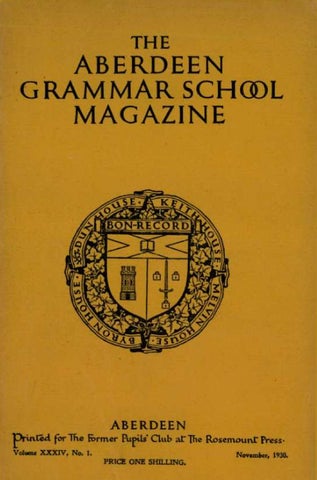
THE
ABERDEEN GRAMMAR SCHML MAGAZINE
ABERDEEN
pi-41W for The E"riner Puri Club ar The Rosemount Press• Volume XXXIV, No. 1.
PRICE ONE SHILLING.
November, 1930.
EDUCATIONAL BOOKS -
JAMES G. BISSET CONTINUES to supply all the Class Books (New or Second-hand) suited for the requirements of the Higher Educational Institutions in the City, at the Lowest Prices. N.B.—Best Value in Students' Note Books.
JAMES G. BISSET, Classical, Medical, and Educalional Bookseller,
85 BROAD STREET (Opposite Marischal College).
"THEY'RE GOOD BAKERS, HUTCHISON'S ! " Hutchison's Bread is made from finest Empire flour, and is delightful to eat, and very easy to digest. Their Cakes and Fancies, too, are all unusually tasty and light. Try them TO-DAY!
[A.B.HUTCHISON I THE CENTRAL l3AKERY
BRANCHES
THROUGHOUT Telephone 753.
THE
CITY.
Engagement Rings Pearls
. fig
Watches
CJ
Clocks
Led _
Yic
Silver Cutlery
cz?
U •ar• •
c• cte
Always an interesting collection at
A. & J. SMITH
. °•'41" (*o..
IC9I UNION
STREET ABERDEEN
A. C. LITTLE & SONS, LIMITED,
COSTUMIERS & FURRIERS. For High-Class Garments and Furs at the very Keenest Prices, including :— FUR COATS FUR TRIMMED COATS TAILORED COATS AFTERNOON GOWNS EVENING DRESSES COAT FROCKS LEATHER COATS 2- and 3-PIECE SUITS SHOWERPROOFS DRESS SKIRTS, ETC. We can Fit any figure in our LARGE SIZE DEPARTMENT. Large Size Garments of every description always in stock.
MOURNINGS. We pay very prompt attention to Fit is Guaranteed Mourning Orders. Black Coats, Coswithin 6 hours. tumes, Dresses, Coat Frocks, 2- and 3-Piece Suits, Skirts, etc., always in stock at the very Keenest Prices.
"THE HOUSE FOR VALUE" Telephone
523.
105 UNION ST., ABERDEEN.
THE YOUNG MAN'S
CAP ALEXANDER BOOTH 127 UNION STREET, ABERDEEN
JAMES FYFE & SON PAINTERS AND .
.
GLAZIERS. •
OFFICE AND SHOWROOMS:
11 DEE STREET, ABERDEEN. Telephone 304
Telegrams—" Fyfe, Painters."
WILLIAM GRAY Tailor and Outfitter, 17 HOLBURN ST.
ABERDEEN.
We are Outfitters to the Grammar School, and hold Stocks of everything for present and former pupils. Your patronage will be esteemed. 'PHONE 2211.
ESTABLISHED 1886.
MACMAHON Artistic Portraiture in all Modern Styles SPECIAL TERMS TO SCHOOL 502 UNION STREET ABERDEEN
'PHONE 187
JACKSON
W
(ABERDEEN)LT D IS BACK WVND
ALL
SORTS AND SIZES Established 1855
Telephone No. 291
TAILORING
AND
OUTFITTING
OF THE HIGHEST GRADE AT MODERATE PRICES. ALL
GARMENTS AND GOODS
GUARANTEED.
G. W. RAFFAN & SON Tailor and Outfitter ---
:: 'Phone 462
82 UNION STREET ---
The Bureau of Travel. An tip-to-date SHIPPING. PASSENGER and TOURIST OFFICE, where all travel is arranged. WINTER AND SPRING ON THE FRENCH ANI) ITALIAN RIVIERA. WINTER SPORTS IN SWITZERLAND. AGENTS for P.L.M.. and International Sleeping Car Co. Railway Tickets, Sleeping Berths, Hotel Accommodation, etc., Reserved. CONTINENTAL TRAVEL-CONDUCTED OR INDEPENDENT. Official Agents—IMPERIAL AIRWAYS AND AIR UNION. AGENTS :—Polytechnic Touring Association, George Lunn, Sir H..nry Lunn, Frame's Tours, Dean & Dawson, Free Church Touring Guild, etc., etc. CHRISTMAS in CEYLON, SOUTH AFRICA, INDIA, EGYPT, and the HOLY LAND. Special Sailings and Fares. Hotel Accommodation, etc., arranged. SHIPPING. OFFICIAL AGENTS-ALL LINES, ALL ROUTES. Personally Conducted Tours to Canada and U.S.A. Tourist Third Cabin from 08 Return. CRUISES to WEST INDIES, SOUTH AMERICA, SOUTH AFRICA, MEDITERRANEAN, NORTHERN CAPITALS, AND NORWAY; CANARY AND MADEIRA Special Arrangements for Round the World Tours. ISLANDS. Reduced Rail Fares issued in connection with Tours and Cruises. L. & N.E. Rail Tickets issued and dated in advance. Sleeping Berths, Seats, and Compartments Reserved. Pleasure Parties catered ior. PASSPORTS, also VISA, Particulars on application. TRAVEL HOLIDAY CLUB. FOREIGN MONEY Bought, Sold or Exchanged. arranged where necessary.
MACKAY BROTHERS & 35a
Union
COY. (Aberdeen) LTD.
Street, Aberdeen.
Civility, Courtesy. and Attention. 'Phone 825 Central. Tels. " Worldwide, Aberdeen."
DECORATOR
A. D. COPLAND.
W. KENNAWAY, Ltd. BAKERS and CONFECTIONERS, 5 and 7 Holburn Street. Luncheon and Tea Rooms, 1 73 Union Street, ABERDEEN
SPECIALITIESWEDDING CAKES. SHORTBREADROYAL DEESIDE IN TARTAN TINS, ALSO A LARGE SELECTION OF PLAIN AND FANCY ICED CAKES.
Telephone No. 1891.
ARCHIBALD MIELLAR Family Grocer and Wine Merchant,
454-456 Union Street, Aberdeen. . . We Specialise in .
•
Cooked Gammons, " Sinclair's "
Belfast Smoked Hams, " Harris's " Wiltshire Bacon.
Medicinal Wines—Vibrona, Hall's, Wincarnis, Glendenning's.
Telegraphic Address : " Undertake, Aberdeen."
Telephone No. 2300. Works : Rosebank Place.
GORDON & WATSON FUNERAL UNDERTAKERS AND MOTOR HEARSE PROPRIETORS
12 HOLBURN ST. & 40 VICTORIA RD. ABERDEEN
Royal (Dick) Veterinary College EDINBURGH.
-
-
Principal:
O. CHARNOCK BRADLEY, M.D., D.Sc., M.R.C.V.S.
-
After attendance on Complete Courses of Instruction in this College, Students may proceed to the Examinations for the Diploma of Membership of the Royal College of Veterinary Surgeons (M.R.C.V.S.), and for the Diploma in Veterinary State Medicine (D.V.S.M.). Students of the College may also present themselves for the Degree of Bachelor of Science (B.Sc.) in Veterinary Science conferred by the University of Edinburgh. The College being recognised as a Central Institution under the Education (Scotland) Act, 1908, Students are eligible for Bursaries granted by Education Committees in Scotland. A Copy of the College Calendar, containing particulars of Scholarships, Fellowships, etc., may be obtained on application to A. C. DOULL, C.A., A.S.A.A., Secretary and Treasurer.
43aiteltbp HATS Kt
HP
FRED WATT Coat Specialist 23 BRIDGE STREET ABERDEEN
..WPM SNAP BRIM TWENTY SHILLINGS 'PHONE 351.5
Curr's Coffee is equally acceptable and invariably delicious. There is 60 years' experience of Coffee making in it —hence the reason of its excellence. A
CURR'S COFFEE A r:'• Thomas Curr es.' Co., A BLRDEEN.
Telephone—Aberdeen 1710.
1 DESSWOOD PLACE, MATTHEW ABERDEEN. BOOTH, THE MASTRICK DAIRY. WE offer you a Choice Selection of DAIRY PRODUCE from our own Farms, and produced under the direct supervision of members of the family. Our Customers may rely upon the absolute Purity and Cleanliness of all our products.
Distributors of Lord Carnegie's Certified Milk. Head Dairy: 3, 5, and 7 WHITEHALL ROAD. Branches : 33 FOUNTAINHALL ROAD. 7 MIDSTOCKET ROAD. 25 BEDFORD PLACE. 100 ROSEMOUNT VIADUCT. 473 GREAT WESTERN ROAD.
CHRISTMAS CAKE 'PHONE VAN
1515
DELIVERIES BRANCH
DAILY
15O3
HIGHLY COMMENDED LONDON EXHIBITION, 1930
CHRISTMAS CAKES SHORTBREADS :: PLUM PUDDINGS SWEET MINCE PIES
W. M. McPHERSON BAKER AND CONFECTIONER
15 Fountainhall Road : 8 St. Swithin Street ABERDEEN
ESTABLISHED
1843.
LOW'S BOOKSTALLS
Wm. Cay & Sons
39-50 New Market Gallery ABERDEEN
funeral lanOertalters,
-
Books on All Subjects and at All Prices Over 500,000 Volumes in Stock Educational Books in Great Variety
415 UNION STREET AND
209 GEORGE STREET, ABERDEEN. Motor Hearses and Cars for Town and Country Funerals.
CATALOGUES ISSUED]
Telegrams—" Cay:Ab erdeen." 'Phones Nos. 92 and 54.
l'PHONE 3332
ESTABLISHED
IBIS
BY APPOINTMENT TO H.M. THE KING
J. WILLIAMSON & SON (W. B. WILLIAMSON. PROPRIETOR)
Meat Purveyors and Poulterers 1, 2, & 3 MARKET BUILDINGS, ABERDEEN 'PHONE 452 BRANCHES:
35 FOUNTAINHALL ROAD 'PHONE 1724
THE SQUARE. CULTS 'PHONE, CULTS 2
ALSO AT CHURCH SQUARE, BALLATER 'PHONE 3B
FRED HARDIE
D. Wyllie & Son
Photographic A rtist,
247 Union Street,
416 Union Street,
Aberdeen.
ABERDEEN
4 Wyllies' Bookshop, Aberdeen ; Prompt service ; prices keen Established—One-eight-one-four : Car service at our door.
For every style of In- and Out-Door Group, Composite Groups & General Portraiture, Etc.
What to do, 'Phone 402.
Commercial Photography our Speciality. Telegraphic Address:
AT POPULAR PRICES.
"Wyttie, Bookseller, Aberdeen "
Suits and Overcoats of the Better.Quality and Style READY TAILORED AND MADE TO MEASURE IN THE FINEST SCOTTISH AND ENGLISH CLOTHS Priced from 5 to 8 Guineas
W.
S.
McINTOSH
5 oo UNION STREET WEST-END OUTFITTERS FOR MEN 'PHONE 1232
TELEPHONE 851.
For Drawing Instruments & Materials PICTURE FRAMERS AND ARTISTS' COLOURMEN
TAYLORS' ART SALOON 49-51
TYPEWRITERS IMPERIAL " ALL BRITISH " STANDARD TYPEWRITERS. Magnificent Machines. More up-to-date than the foreigners and better built. No dearer.
AU Makes of TYPEWRITERS. PORTABLE New and Second-Hand. Come and make your own selection after seeing the different ones together.
SCHOOLHILL
ABERDEEN
C. H. WEBSTER ALFORD PLACE ABERDEEN
Telephone 2870.
Geo.Jamieson & Son Silverstniths Watchmakers and Jewellers Sole Representative of the world-famous firm of Silversmiths— Eikington & Co., Ltd.
One of the finest selections of GEM RINGS, REAL PEARL NECKLETS, and SCOTCII PEARLS, in Necklets and Single Pearls.-
142 Union Street (Next Union Bridge)
ABERDEEN.
ELLIS & MI-TARDY, LTD. 18 REGENT QUAY & 1301 UNION STREET.'
Importers of Household and Steam Coals. Delivered by Careful and Experienced Men. Telephone 2889.
GEORGE BISSET'S I t\ Clan Tartan"Warehouse
15 UNION STREET ABERDEEN CLOTHIER TO THE
ADMIRALTY, R.N.R., and R.N.V.R.
HIGHLAND OUTFITS :: a Speciality :: for Boys, Youths, and Gentlemen, also for Maids' and Ladies' Wear; and will gladly supply patterns of Ladies' favourite Tartans for Kilts. Telephone 2680.
,
HIS MAJESTY'S THEATRE ABERDEEN'S PREMIER HOUSE .18 OF ENTERTAINMENT .0 and one of the finest Theatres in the British Isles A FIRST-CLASS ENTERTAINMENT ALWAYS! Once Nightly at 7.30 Twice Nightly at 6.40 and 8.45. All when Advertised. Matinees - at 2.15 Advance Booking Office Open to Callers at the Theatre Daily Conditions of Advance Booking as Exhibited at the Booking Office Seats booked by Telephone must be paid for before 4 p.m —1 p.m on Saturdays. It
mus t be distinctly understood, however, that no seats are guaranteed until they are paid
for, and in order to avoid disappointment, seats asked for by Telephone must be claimed and paid for immediately, as under no circumstances will they. be kept if they remain unpaid when all other seats have been sold. Telephone enquiries can only be attended to as the work of the Box Office permits.
Popular Prices Telephone-493 For full particulars of this week's Programme see Theatre Bills or .Advertisement in Daily Press or Tram Cars Acting Manager, W. LOTHIAN GILBERT Lessee, WALTER GILBERT
RANGES, STOVES, WATER HEATERS and COOKERS. MCI FIREPLACE ARRANGEMENTS IN? MARBLE' AND1 TILES. We cordially invite you to visit our Showrooms and inspect the many Designs displayed.
JAMES SCOTT & SON (Aberdeen) LTD. 483-485 UNION STREET, ABERDEEN. Telephone Nos.: 1881-1882.
Telegrams : " Strength," Aberdeen.
Telephone No. 2299.
Telephone No. 2299.
WE ARE CLOTHIERS TO THE
YOUNG GENTLEMAN. QUALITY FIXES THE PRICE. WE KEEP ONLY
THE
BEST.
IT'S CHEAPEST IN THE END.
LARGE SELECTION OF CORRECT
SCHOOL
WEAR
ALWAYS IN STOCK.
A. & J. SCOTT! Tailors, Clothiers, and Outfitters,
29 GEORGE STREET, ABERDEEN. CONTENTS. Facing page 16 Portrait of Professor George Pittendrigh, M.A., D.D. „ 73 „ Part of Company at F.P. Club Annual Dinner Between pp. 44 and 45 Art Club Sketch Book, No. 11 • . .. .. • • Page 1 A Message to Former Pupils .. .. „ 3 .. .. .. Notes About Old Boys .. .. .. .. " 26 F.P. Presidents of the University S.R.C. .. .. .. ,. 26 .. Pupils of Sixty-Five Years Ago .. „ 27 .. .. .. .. •• .. •• Marriages .. „ 29 Have We too much Sport ? By J. M. Bulloch, M.A., LL.D. •• „ 31 A Glimpse of Russia. By W. M. Alexander, M.A., B.I.. ., 35 American Coruscations. By G. G. Cameron, Jun., B.D. .. .• •• .. 45 •• Kellas Peak and Kellas Col .. ,. 46 .. The University Bursary Competitions .. .. .. , 47 •• Testimonial to Mr. William Kennedy .. .:798 The David Alexander Irvine-Fortescue Prize .. .. .. , School Notes •• •• .. .. .. .. .. .. •• , 51 .• • • .. .. .. Random Notes .. " 52 The Romance of Arctic and Antarctic Exploration .. .. .. .. .. .. .. , 54 .. School Rugby .. .. .. .. .. .. , 59 The Dramatic Society .. .. .. " 60 •• •• •• House Notes „ 61 •• .. •• •• •• The Art Club .. ., 62 .. The Literary and Debating Society •• .. „ 63 The Orchestra. The Library. The Museum • • . , 64 •• •• .. .. .. •. Scout Notes The Former Pupils' Club— • „ 71 .. The School Boarding House 72 • • .. The London Centre .. .. „ 73 .. .. The Annual Dinner .. „ 79 .. .. Proposed Glasgow Centre .. ,. 80 •• .. .. Rugby Football Section ,. 83 Hockey Section. Cricket and Motor Sections • • „ 83 .. List of New Members of the Club .. • •
• •
• • •
•
•
•
•
• •
• •
NORTHERN ASSURANCE COMPANY LIMITED. Established 1836.
Assets £22,000,000.
ALL CLASSES OF
INSURANCE,
FIRE ACCIDENT
INCLUDING:-
LIFE MOTOR CAR
Life Assurance Branch. The Company's Tables of rates for Life Assurance include every class of Policy. Write for Particulars of:WHOLE LIFE POLICIES ENDOWMENT ASSURANCE POLICIES EDUCATIONAL ENDOWMENT POLICIES CHILDREN'S DEFERRED ASSURANCE POLICIES The Reversionary Bonus for the quinquennium 1921-25 was at the rate of 55/- per cent. per annum upon the Sum Assured. CHIEF OFFICES :
ABERDEEN LONDON
-
-
-
1 Union Terrace. 1 Moorgate, E.C. 2.
Aberdeen Board of Directors. A. S. R. BRUCE, EsQ. The Right Hon. The EARL OF CAITHNESS. FRANCIS J. COCHRAN, ESQ. GEORGE M. COOK, ESQ.
Manager
GARDEN A. DUFF, ESQ. The Right Hon. The LORD FORBES. A. MARTINEAU, ESQ. •
R. MACKAY.
Aberbeen Orammat School tffaga3ine Vol. X X XIV.
NOVEMBER, t93o.
No. I
The " Grammar School Magazine " is issued under the auspices of The Former Pupils' Club, in March, June, and November. All communications with regard to the " Magazine " should be addressed to the Editor (the Secretary and Treasurer of the Club), THEODORE WATT, M.A., The Rosemount Press, Aberdeen. *A,* Members of the Club are requested to inform the Secretary of any change of address.
A Message to Former Pupils. A suggestion offered to the Editor that a discontinuance of these notes might prove not unwelcome to his readers was not entertained. Your chronicler hesitant, though not recalcitrant, must therefore continue and leave.you to deal with him. Of the Term now closing there is not much to be said. We have done, I hope, some honest work. Weather conditions have been propitious for games, and the results of the more important matches have been encouraging. The victory over Glenalmond, in particular, showed how rapidly an average team can improve under judicious training and an enthusiastic Captain. The " Big School " is as full as ever, but there are desks to—spare in the Infants' Department. By the time Easter comes round there should be fewer gaps. Of the staff and of the buildings one can say almost literally " No Change." William Kennedy, of course, is off the strength, and we welcome in his place Theodore Clark, who bids fair to be as competent as his predecessor. The death of Dr. Pittendrigh, early in the Term, was deeply deplored. The Grammar School never had a more loyal son. School functions did not seem complete if they lacked his genial presence. His solicitous regard, in and out of season, for the well-being of the School, his sympathetic understanding of our difficulties, and his unstinted appreciation of our successes will not readily be forgotten.
2
Aberdeen Grammar School Magazine.
The Boarding House has never looked back. Indeed the indications are that it will look very much forward. I have thought for some time that more might be done to attract pupils from overseas. There are at least two schools in Scotland which have important connections of this kind, and I see no reason why there should not be a third—our own. If a School is to attract such pupils, it must satisfy four conditions. It must have a tradition. It must offer adequate training for a variety of careers. It must give due attention to organized games. It must have satisfactory boarding arrangements. Only in the last of these requirements does the Grammar School fail to satisfy. I refer, of course, not to the management of the House, which could not be bettered, but to the inadequacy of the available provision. Instead of our present limit of thirty-five, we should and could have a hundred boarders. Your Directors, however, would not be justified in going forward with a larger scheme unless there were guarantees of support, and such guarantees would have to take the form of definite applications for admission. As a first step, the residential facilities available at the School should be more widely known, and here the Club Consuls have it in their power to lend material assistance. They should have copies of the School and of the Boarding House prospectuses and be in a position to supply information which is accurate and up to date. To revert to School, we were honoured with a visit from the President of the F.P. Club on the 7th of November. Professor Macleod held the close attention of his large audience from start to finish, his subject, " Medicine as a Career," being one on which he is eminently qualified to speak. The upper classes of the School contain a large proportion of prospective medicals, and they must have found both inspiration and helpful guidance in what they heard. Armistice Day was observed with the customary solemnity, the service being taken by Professor Henderson, who has succeeded Dr. Pittendrigh as Convener of the Secondary Schools Committee. This is the Christmas Number of the Magazine, and it is fitting that I should conclude with a message of greeting and remembrance from the School. We, at home, do not forget that for many of you the present time is fraught with difficulties and anxieties, that the future is filled with uncertainty, and that the role of optimist is a difficult one, at the moment, to sustain. May the hopes of betterment with which we shall usher in the New Year find at least some measure of fulfilment, and, meantime, whatever your case, may you have the best of times at Christmas I D. M. A.
Aberdeen Grammar School Magazine.
3
*4* It Is requested that the Editor be informed of all new appointments and interesting incidents in the careers of Former Pupils.
The dates given in parentheses after names indicate the sessions of attendance at the School. William Ernest Adam (1902-09) is at present curate of Duddon, Cheshire. Wilson Anderson* (1919-22) is now in the service of the Universal Credit Corporation, Penobscot Building, Detroit, U.S.A. He was previously in the service of Messrs. Price, Waterhouse & Co., accountants. William Rogie Angus* (1915-21), M.A., B.Sc., has been appointed to a Ramsay Memorial Fellowship of £300, tenable for two years, at University College, London, where he has been conducting research investigations in "infra-red" spectroscopy. Raymond Davie Belford* (1913-18), who was for three years in the Mercantile Marine with the Shaw Savill & Albion Co., and spent one year in the R.N.R. as midshipman in H.M.S. Royal Oak and H.M.S. Vanoc, is now manager in Wellington, New Zealand, of Dr. Scholl's Foot Comfort Service. He went to New Zealand in 1926, and is at present home on leave till January. George Gordon McLean Black* (1887), M.A., M.B., C.M., Tomintoul, has been appointed an Honorary SheriffSubstitute for the County of Banff. William George Rowntree Bodie* (1913-22), A.R. I.B.A who has been assistant for the past two years to JAMES B. NicoL* (1881-83), architect, Aberdeen, has received an appointment as assistant with Messrs. Auldjo Jamieson and Arnott, architects, Edinburgh. Edmund Blaikie Boyd* (1900-12), M.A., of the Home Civil Service, was in April appointed Principal Private Secretary to the Secretary of State for the Colonies, Lord Passfield. Geoffrey Farquhar Brown* (1921-25) is in the service of Messrs. Harrisons & Crosfield, Ltd., on the Soengei Bed* Member of Former Pupils' Club.
4
Aberdeen Grammar School Magazine.
jankar Estate, Laboean Roekoe, Asahan, East Coast of Sumatra. George Gordon Cameron* (1915-17), M.A., B.D., who has been studying at the Union Theological Seminary, New York, recently completed his second year's work as Summer Pastor of the First Presbyterian Church of New York, an historic church on lower Fifth Avenue, the pulpit for six years of Dr. H. E. Fosdick, and one of the oldest congregations in the city. He says the work was heavy, but intensely interesting. He had full charge for six weeks, and preached every evening for fourteen weeks at an open-air service on the lawn which flanks the Church. He recently returned to this country, and has been called to the Leighton Church, Dunblane. An article by him giving some impressions of the U.S.A. appears elsewhere in this issue of the Magazine, as also does an intimation of his marriage. John Alexander Cheyne* (1921-26) is at present in the office of Mr. Robert Milne, C.A., Aberdeen. John Gordon Chope* (1915-22) has gone to Trinity College, Cambridge, to read for the English Tripos. William Pearse Chope* (1917-23) has gone to Stephenson Hall, University of Sheffield, for a year's course in Natural Sciences. Alexander Clark* (1885-89), M.A., who is on the staff of Selborne College, East London, South Africa, has recently been home on a trip, after an absence of over twenty years. Ernest Clark* (1891-1900) is Director of Messrs. W. Harold Perry, Ltd., Invicta Works, London, N.12. This firm specializes in the building of G.P.O. vans. It has built the mail vans for Aberdeen, Edinburgh, Glasgow, Inverness, and many towns in the South—in all 1,300 in the past seven years. . A LONDON SCOTTISH TROOP OF BOY SCOUTS.
Douglas George Wilson Clyne* (1919-20)-writes calling attention to a Scots activity in London, the existence of which is probably unknown to many F.P.s, namelyAthe Scottish Troop of Boy Scouts run by St. Columba's Church of Scotland, Pont Street, S.W. Membership is open to all Scots boys who are members or adherents or whose parents are members of the Church of Scotland. As there is a regular influx to London of young F.P.s, many of whom must have been connected in one way or another with the School Scouts, it is thought that they would like to know about this London Scottish Troop. Anyone wishing further information should write to Clyne, whose address is 290 Fulham Palace Road, S.W.G. George Alexander Combe* (1889-95), C.M.G., M.A.,
Aberdeen Grammar School Magazine.
5
who entered H.M. Consular Service in China as a student interpreter in 1901, has risen steadily in the service, and in April of last year was promoted to be one of His Majesty's Consuls General in China. He is at present on furlough and, apart from a brief visit to the Old Country, has been spending this in British Columbia. He returns to China early next year. Edwin William Connon* (1916-25), B.Sc.(Eng.), received in July the degree of B.Eng., with honours, at Liverpool University. He was also awarded a premium from the Council of the Institute of Electrical Engineers for a paper entitled " Hydro-electric Developments in Great Britain." He has received an appointment with the English Electric Company at Stafford. Charles Cooper* (1875-80) is editor of the Chester Courant, which celebrated its bi-centenary on 16th November. He began in journalism as a reporter on the staff of the Aberdeen Journal, and left in 1883 for a post on the Courant, of which he has been editor since 1895. Patrick Ashley Cooper* (1896-1901), B.A., LL.B., who is chairman of the Primitiva Gas Co., Ltd., Buenos Aires, and the B.I. Holding Co., Ltd., has recently been appointed a director of the Banca d'America e d'Italia, of Milan, as a result of its acquisition of the Banca Italo-Britannica (formerly controlled by the B.I. Holding Co. of London). Edwin John Cruickshank* (1913-15) is now with the British Controlled Oilfields, Ltd., at El Meni, Maracaibo, Venezuela. He was previously with the Indo-Burma Petroleum Co., Ltd., in Upper Burma. George Leslie Cruickshank,* Jun. (1918-23), second son of GEORGE L. CRUICKSHANK* (1886-88), Fyvie Estate Office, has recently been elected an Associate of the Royal Institute of British Architects, and secured an appointment in the Architect's department of the London County Council. He received his training in Turriff, Aberdeen, and New York. Charles George Deacon* (1917-28) is on the motor vessel King John, which, when he last wrote to the Secretary of the F.P. Club, was 200 miles south-east of Melbourne, Australia, and on arrival there would have completed a passage of 12,000 miles in 50 days. He was looking forward eagerly to getting his Magazine. John Wight Duff* (1877-82), M.A., D.Litt., LL.D., has been elected a Fellow of the British Academy. The Academy holds within the domain of literature a standing analogous to that of the Royal Society within the domain of science. It was founded by Royal Charter to promote historical, philosophical, and philological learning. Its statutes are sanctioned by H.M. Privy Council ; and the membership of
6
Aberdeen Grammar School Magazine.
the Academy may not exceed 150 members, who must have attained distinction in some of the fields of learning which it is the function of the Academy to advance. Alexander Mathieson Dugan (1898-1907), M.B., Ch.B., was in August appointed by the Aberdeen Town Council to be Assistant Medical Officer of Health for the School Medical Service. He graduated in medicine at Aberdeen University in 1918, and took the D.P.H. in 1921. He has had nine years' experience in the medical inspection and treatment of school children, and has latterly been one of seventeen assistants employed by the Manchester Education Committee. In his new appointment he will be primarily engaged in the inspection and treatment of school children, but as he is an Assistant Medical Officer under the Public Health Department, he will form one of a team to take part in the general preventive public health work in the city. The salary is £650 rising to £750. Marshall Keith Duguid* (1919-29) has received an appointment with the Lena Sugar Estates, Ltd., Caia, Portuguese East Africa. Douglas Watt Duthie* (1915-21), M.A., B.Sc., who is engaged in biochemical research under the Chilean Iodine Committee is at present working in Cambridge. Ernest Reeves Evinson* (1921-25) is now in the service of the Chartered Bank of India, Australia and China, London. John Fordyce Robertson Fairweather* (1919-25) has been appointed resident inspector for the Royal Insurance Company at Keith. James Fiddes* (1904-14) has returned to this country from the F.M.S., and has joined Messrs. Wm. Fiddes & Son, Ltd., packing box and barrel manufacturers, Torry Sawmills, Aberdeen. Alexander Findlay* (1882-91), M.A., D.Sc., Ph.D., Professor of Chemistry in the University of Aberdeen, is the author of "The Spirit of Chemistry: an Introduction to Chemistry for Students of the Liberal Arts," recently published by Messrs. Longmans. The Times Literary Supplement says that, while illustrating the fundamental principles and concepts of chemistry by a wide range of interesting and important facts, the author succeeds in giving his readers a sense of the spirit of intellectual adventure and of intellectual honesty which he rightly claims for all truly scientific work. His account of chemical discoveries and achievements is given an historical setting, and is enriched by numerous portraits and thumbnail biographical sketches of the great chemists. The present volume is based largely upon the author's well-known earlier hook, " Chemistry in the Service of Man."
Aberdeen Grammar School Magazine.
7
Rex Fowell* (1912-23), who'served his pupilage as a civil engineer at Aberdeen Harbour under ROBERT GORDON Nicol.* (1871-73), M.Inst.C.E., and thereafter was with Messrs. Henderson & Nicol, chartered civil engineers, Aberdeen, has received an appointment with Messrs. William Tawse, Ltd., public works contractors, Aberdeen, and has been in charge of the re-surfacing of the South Deeside Road from Potarch to Ballater. Alexander Marr Geddes* (1897-1903), M.D., who has been in medical practice at Cape Town since 1911, has recently taken over some appointments and a practice in Dundee, Natal. He has consequently resigned the post of Club Consul at Cape Town, where he repeatedly rendered highly appreciated services to members of the Club. He says that he will be delighted to help F.P.s in any way in Natal. Alexander Reid Gordon* (1884-88), M.A., D.Litt., D.D., Professor of Hebrew, McGill University, and of Old Testament Literature and Exegesis, the United Theological College, Montreal, was in July appointed to the Chair of Hebrew and Oriental Languages in the University of St. Andrews. Unfortunately, however, owing to illness, he has not so far been able to take up the duties of his new post. He went to Canada in 1907. John George Crichton Grant* (1908-15), who was home last year, is now on the Bhogotpore Tea Estate, Nagrakata, Dooars, Bengal. John Greig* (1878-79), who went in 1886 to Ceylon, where he engaged in tea planting, latterly at Brae Group Estates, Madulkelle, is now at Watapulniva, Katugastota, Ceylon. Edward John Harper* (1909-14), who is a sub-inspector in the Shanghai Municipal Police, has recently been home on furlough. He is a keen member of the Shanghai Branch of the F.P. Club. It is noteworthy that two very important posts in Shanghai are at present held by members of the Branch, namely, WILLIAM ROBERTSON MYERS* (1895-99), who is Commissioner of Customs (and, almost as important, F.P. Club Consul !) ; and Major FREDERICK WERNHAM GERRARD* (1905-06), C.I.E., who is Commissioner of Police. Harper while at home improved the shining hour by getting into touch (professionally) with Scotland Yard. Hubert Douglas Henderson* (1901-04), M.A. (Cantab.), a principal member of the staff of the Economic Advisory Council, prepared a memorandum for the Committee of Ministers which had to get up the Government case for the Imperial Conference. In it he advocated a general tariff of 10 per cent. for revenue purposes, with a rebate for goods from the Dominions, to be imposed for a limited period. It seems all
8
Aberdeen Grammar School Magazine.
to the good that trained economists are coming to the help of the politicians in the discussions on fiscal policy. The Observer said recently of Mr. Henderson : " It is enough to say of his Liberalism that he was formerly editor of The Nation, and that there is no keener nor fresher intelligence amongst the younger lights of his party." Stanley Frank Walker Humphrey* (1912-22)- has recently passed the final examination of the Chartered Accountants of Scotland, and been admitted a member of the Society of Accountants in Aberdeen. He served his apprenticeship in the office of Messrs. Williamson & Dunn, C.A., Aberdeen. William Greig Hutcheon* (1914-23) sailed in July to' take up a post with the United Africa Co., Ltd., in the Yola district, Northern Nigeria. He is engaged in trading in the bush country, some 800 miles from the coast. Arthur Gilbertson Hutchison* (1909-21), B.Sc., who has received the degree of Ph.D. from Cambridge University, and James Edward Smith* (1916-22), B.Sc., are the joint authors of an illustrated brochure entitled "The Geology of Auchernach," which has recently been printed for the proprietor, GEORGE FALCONER ROSE* (1881-92), of Messrs. Andrew Yule & Co., Ltd., Calcutta. Three years ago he decided to have his estate' surveyed, and the work was carried out by the two young F.P.s. The report, which forms the body of the brochure, was written by Hutchison, and the whole work is described as " an unusual and most valuable and interesting addition to local topographical literature." Auchernach lies in the parish of Strathdon, towards the head of Glen Nochty, and the estate, with its Green Hill, is an oasis in the bare and sterile glen. In a foreword WILLIAM DOUGLAS SIMPSON* (1901-13), D.Litt., describes the estate itself, the mansion house, and several of the more interesting features of the district. Charles Innes* (1883-84), head master of Stonehaven Public School since 1919, has had the degree of F.E.I.S. conferred upon him by the Educational Institute of Scotland. Charles Ross Irvine* (1922-26), B.Sc., has been awarded a Robbie Scholarship at the University of Aberdeen. Douglas Harold Johnston* (1913-26), B.A. (Oxon.), of the Inner Temple, has passed the final barristers' examination in London. After leaving the School he studied at St. John's College, Oxford. Thomas Austin Keenan* (1927-30) has left for Vernon, British Columbia, to engage in fruit farming. He has taken the wise step for an F.P. resident abroad of becoming a Life Member of the Club at the earliest opportunity. Gordon Kilgour* (1919-23) has passed the final exami-
Aberdeen Grammar School Magazine.
9
nation of the Chartered Accountants of Scotland, and been admitted a member of the Society of Accountants in Aberdeen. He served his apprenticeship with Messrs. Jas. Henry Reid and Son, C.A., Aberdeen. George Lawrence (1901-03), agent of the Cluny Square branch of the North of Scotland Bank in Buckle, has been appointed agent of the Commercial Road branch, Aberdeen. Alexander Douglas Learmonth* (1922-25) has received an appointment with the Chartered Bank of India, Australia and China, and is at present working in the London office. John William Lindsay (1888-91), M.A., M.B., Ch.B., of the South American Missionary Society, Belen, Paraguay, has recently called attention to a prophecy concerning his school-fellow Lord Mackay (ALEXANDER MORRICE MACKAY*1882-91), which was made 42 years ago. " Our Junior English Master of Middle III—Mr. Morison, I think, his name was-overtook me one lunch hour on my way to School. Walking along, he talked about the clever boys of Middle III, and in a burst of enthusiasm said, ' But Alick Mackay ! Eh, what a head he has ! You will live to see him sit on the Woolsack ! ' This little reminiscence might be put on record against the day ! " Eric Robert Russell Linklater* (1913-16), M.A., has recently published through Jonathan Cape his first book of verse, " A Dragon Laughed." Alfred Emerson Macdonald* (1922-25) has been awarded at Aberdeen University the Bertie Russell Gold Medal in Pathology for 1929-30. Ian Anderson McDougall* (1915-26), who has been for three years in Canada, has recently been appointed office manager of the Sea Insurance Co., Ltd., at Moose Jaw, Sask. He was previously in Winnipeg, where he met JOHN DUGUID CRUICKSHANK* (1899-1904) and the Club Consul, JOHN CHARLES MURRAY LIGERTWOOD* (1903-06). McDougall played for the Province of Manitoba Rugby XV. Donald Macfarlane* (1909-14) has been moving about " quite a bit" during the eleven years since he last saw Aberdeen. At present he is in Northern Zululand, transporting sugar-cane from the farms to the railway by motor lorry, and expects to remain in that part of Africa for some time to come. He is another of the F.P.s abroad who always look forward to getting the Magazine. Robert Whyte Mackay* (1882-90), O.B.E. (a brother of Lord Mackay), has recently left Aberdeen to join his wife and family at Morrone, Kendrew, C.P., South Africa; and his son, GEORGE NEIL WHYTE MACKAY* (1922-25), who was for a time in Northern Transvaal, has returned to Kendrew.
10
Aberdeen Grammar School Magazine.
Roy John Mackenzie* (1921-23), M.B., Ch.B., has started in medical practice at Walls, Shetland, under the County Council of Shetland. He was previously an assistant in Lerwick. Ian Hastings McLaren* (1920-23), A.R.I.B.A., was in May last admitted a member of the Incorporation of Architects in Scotland. James Milne McLeod* (1912-25), who in April, 1930, completed his apprenticeship with Messrs. Tawse & Allan, civil engineers, Aberdeen, and since then has been an engineering assistant under the Burgh Surveyor, Aberdeen, has received an appointment in the Engineer's Department of the City of Oxford. In April last he passed the final examination for A.M. Inst.C.E. John James Rickard Macleod* (1884-93), D.Sc., LL.D., F.R.S., Professor of Physiology in the University of Aberdeen, and President of the F.P. Club, is a member of the Scientific Advisory Committee on Medical Administration and Investigation recently appointed by the Secretary of State for Scotland. The reference to the Committee is " to assist the Department of Health for Scotland in applying the results of scientific research to the details of public health administration, and in promoting such medical investigations as come within the sphere of the Department or of the local authorities in Scotland." Edward George Marr* (1899-1901), who has been engaged for many years in banking in South America, latterly as manager of the Bank of London and South America in Barranquilla, Colombia, is at present home on leave, and has become a Life Member of the F.P. Club. Ralph Marshall* (1915-25), who served his pupilage with Messrs. Henderson & Nicol, chartered civil engineers, Aberdeen, has received an appointment in the Buildings and Roads Section of the Public Works Department, Government of Burma, and sailed for the East in October. Before leaving, he armed himself with a copy of " Bon Record." Lord Meston* (1876-80), K.C.S.I., LL.D., as one of the recognized authorities on the Indian problem, has been much in evidence recently. He contributed to The Contemporary Review for August the opening article, " India and the Simon Report" ; and in The Nineteenth Century and After for October he had another article on " The Indian Conference." Lord Meston spent part of the past summer in the United States, where he did not a little to counteract the hostility to Britain that is very prevalent there in regard to the present situation in India. He was present in September at the annual meeting of the Institute of Politics at Williamstown, Mass., and the New York correspondent of The Glasgow
Aberdeen Grammar School Magazine.
11
Herald in a recent letter told of the deep impression which Lord Meston's speeches made on thinking Americans. " His plain speaking before an American audience at a gathering whose deliberations are reported at length in all the principal papers of the United States appears to have made thoughtful people pause a little and wonder whether, after all, ' they have got the right dope ', as they say in the States. At all events Lord Meston has provided the people with something to think about, and his addresses have been widely commented upon." Lord Meston, as Chancellor of the University of Aberdeen, presided at the Summer Graduation on 9th July, when the record number of 162 students were " capped" M.A. Benjamin Disraeli Milne* (1893-97) has recently joined the Board of Directors of Messrs. Spencer (Melksham), Ltd., engineers and contractors, Melksham, Wilts. He was appointed works manager in 1914. William John Milne* (1908-14) has since 1928 been a partner in the firm of Messrs. Frank Brown & Co., assessors to the insurance companies and Lloyd's underwriters, Palmerston House, Old Broad Street, London. Alexander James Falconer Monro (1899-1902), O.B.E., M.A., has recently become minister of St. Andrew's Church, Greenknowe, Annan. Prior to the War he was minister of the U.F. Church, Ancrum, Roxburghshire. Hamish Andrew Munro* (1908-21) has been acting manager of Duffiaghar Tea Estate, Halem P.O., Darrang,Assam. He will receive the deepest sympathy of members of the Club in the death of his wife, who, as Miss Evelyn Colyer, was well known as a lawn tennis player for over seven years. She excelled chiefly as a doubles player, and it was in 1923 that she first came into prominence when she reached the final of the Ladies' Doubles at Wimbledon, with Miss Joan Austin. The two were quite young, and their play, as unusual as it was daring, won the cheers of the crowd, who took the young ladies to their hearts and called them " The Children." Hamish Munro met his future wife while at winter sports in Switzerland last winter, and they were married at Christchurch, Streatham, London, on 13th February last. Ian Barclay Munro* (1911-22) has been elected to the Board of the Cantilever Shoe Company, Northampton, as Sales and Advertising Director. James Roland Murdoch* (1911-15), M.D. (Edin.), is first assistant medical officer at the North Middlesex Hospital, London, and lecturer in clinical medicine to the North-East London Post-Graduate College. Hugh Alexander Murray* (1919-25), M.A., who has
12
Aberdeen Grammar School Magazine.
been studying at St. John's College, Cambridge, was placed last summer in the First Class in Part I of the Classical Tripos. Donald Fraser Mursell* (1921-22) is working on a coffee estate at Sidapur, Coorg, India. He was previously engaged in forestry in Burma. David Bruce Nicol (1900-02), M.C., M.A., B.D., who died at the Manse of Govan, Glasgow, on 23rd March last, is commemorated by a recently-published memoir written by his widow. George Alexander Paterson* (1920-30) has started as an apprentice with Messrs. James Henry Reid & Son, chartered accountants, Aberdeen. William Peters* (1900-06), C.M.G., M.A., has been United Kingdom Trade Commissioner at Dublin since April, 1929. He became a secretary in H.B.M. Commercial Diplomatic Service in 1919, and for a number of years was Acting Trade Representative of the British Government in Moscow. William Balfour Smith Pigge* (1914-21), who has been for some time a Town Planning Assistant with the Singapore Improvement Trust, in a cheery letter recently received by the Secretary of the F.P. Club states that he has never regretted going out to Singapore, and that he enjoys the life there tremendously. He wishes to be remembered to all his former colleagues on the Executive of the Club. A DISTINGUISHED BANKER RETIRES.
John Rae* (1882-85) has recently resigned from the post of Chief General Manager of the Westminster Bank. He is, however, to retain his seat on the Board of the Westminster Bank, and will also remain a Director of the Bank of Scotland. He entered the service of the National Bank of Scotland in 1885, and after being appointed in 1891 to the inspecting department of Parr's Bank at Warrington, received rapid promotion, and became one of the most distinguished figures in British banking. According to The Times, few men have had a more strenuous career. He held a number of important posts in Parr's Bank before it was merged with the Westminster Bank in 1918. He was successively Superintendent of Branches, Assistant General Manager, and Joint General Manager. Then for some years he was Treasurer of the Bank of Scotland, and in recognition of his services he then rendered, he was elected a Director of that bank. In 1920 he went. from Edinburgh to London to take up the still more responsible position of Chief General Manager of the Westminster Bank for a period which has proved to be the most difficult that British banking has ever experienced. He filled that position with more than average distinction, for he combined with a wide and varied experience exceptional qualities of
Aberdeen Grammar School Magazine.
13
judgment and character. Besides his work for banking, Mr. Rae has rendered some notable public services. He made a special study of Japan's finances, and the valuable assistance which he gave to that country in regard to finance received special recognition from the Government, for he was made a member of the Order of the Rising Sun (Second Class). He is a son of the late Mr. John Rae, formerly of the Town and County Bank, Aberdeen. William Brewster Rae* (1920-24), who served his apprenticeship with Messrs. William McKinnon & Co., Ltd., Aberdeen, has been appointed engineer assistant with Messrs. MacNeill 8z Co., Ltd., Calcutta, on the Dalkush Tea Estate, Bengal. He sailed for India in September. John Milne Rennie (1916-19), B.Sc.(Agr.), has taken a lease of the farm of Mains of Bogfechil, Whiterashes. Peter Johnstone Rhind* (1902-04) has recently become a Director in the firm of Strachan & Co. (Aberdeen), Ltd., wholesale woollen warehousemen. Norman George Robb* (1913-22) is one of the Directors of Robbs, Limited, aerated water manufacturers, Edinburgh. Alexander Robson* (1917-30) is an electrical engineer apprentice with Messrs. John M. Henderson & Co., Ltd., Aberdeen. John Grant Roger* (1920-26) is in the service of Messrs. Harrisons & Crosfield, Ltd., as assistant on the Mardjandi Tea Estate in Sumatra. James Ross* (1910-15), B.Com., who was in the office of H.M. Inspector of Taxes, Inverness, was in October of last year promoted to the Manchester 26th District, as Assistant Inspector of Taxes. William Wilson Michie Ross* (1916-24), M.A., B.L., passed in July ninth out of 300 candidates in the Civil Service Examination for the Income Tax Inspectorate. He was posted to Warrington as Assistant Inspector of Taxes (on probation), and entered on his duties on 1st October. He is well known in the Boy Scout movement, having been latterly on the headquarters staff in Aberdeen. Arthur Martin Scrimgeour* (1921-27) has recently taken up an appointment with Messrs. Joseph Nathan & Co., Ltd., London. David John George Shennan* (1922-26), B.Sc.(Eng.), after six months in the office of ROBERT GORDON NIcoL* (1871-73), Harbour Engineer, Aberdeen, is now with the famous firm of bridge designers and builders, Sir William Arrol & Co., Ltd., Glasgow. William Douglas Simpson* (1901-13), M.A., D.Litt.,
14
Aberdeen Grammar School Magazine.
Librarian of the University of Aberdeen, is the author of "Julian the Apostate," recently published in Aberdeen. The book bears the 'dedication: Viro optimo Georgio Middleton, A.M. Cantab., D.Litt. Aberdon., praeceptori dilectissimo hoc opusculum dedicat auctor." Dr. Simpson states in his preface that his aim has been " to present, in as compact a form as possible, a coup d'oeil of one of the most remarkable personalities and one' of the most extraordinary careers in the whole range of history." Two papers by Dr. Simpson have been reprinted from the Proceedings of the Society of Antiquaries of Scotland—" The Campaign and Battle of Culblean, 1335," and " Craig Castle and the Kirk of Auchindoir," to which is added a short monograph by JOHN MALCOLM BULLOCH* (1877-80), M.A., LL.D., on The Gordons of Craig." James Bruce Smith* (1918-25), who served his apprenticeship with the Ocean Accident and Guarantee Corporation, Ltd., Aberdeen, left in August for Chicago. Although he had no definite post in view when he left Aberdeen, he very quickly got an appointment with W. A. Alexander & Co., insurance brokers, Chicago, thanks, as he says, to T. B. G. HENDERSON* (1894-1900), the Club Consul there. " Mr. Henderson has helped me in every way. I really do not know how to thank him for the way he has treated me. I can only say how grateful I am to him and to the Former Pupils' Club." Robert Alexander Stephen* (1919-25) was appointed resident medical officer at the Aberdeen Royal Infirmary from September last. James Runcieman Sutherland (1907-17), M.A., has been appointed Senior Lecturer in the Department of English, University College, London. Since 1925 he has been on the English staff of the University of Glasgow, and was previously lecturer at the University of Saskatchewan and at Southampton University College. He is the author of " The Narrative of Jasper Weeple," recently published by the Scholartis Press. This has been described as " a kind of romantic satire." Godfrey Roy Symmers* (1912-24), B.Sc. (Eng.), has been appointed an assistant engineer of the London and North-Eastern Railway Company at York. John Montgomery Walker* (1881-90), who was for many years manager of a tea estate in Bengal, has now retired and is resident in Ealing, London. Ralph Spence Walker* (1910-22), M.A., shares with another the Alexander Murray Scholarship awarded at Aberdeen University. This scholarship, of the annual value of £50, is awarded as the result of a special examination in English literature and language. John Park Weir* (1918-24), M.B., Ch.B., is senior
Aberdeen Grammar School Magazine.
15
resident surgeon at Eccles and Patricroft Hospital, Eccles, near Manchester. George Clark Whyte* (1908-14) is in the service of Messrs. Williamson, Magor & Co., Calcutta. He has recently become a Life Member of the F.P. Club. Alexander Macgregor Williamson* (1908-11) has for the last two years been agent of the British India Corporation, Ltd., at Rangoon. He was previously in the service of the Cawnpore Woollen Mills, Ltd., at Cawnpore, and is at present home on furlough. John Ewen Wilson* (1910-20) is an assistant engineer in the Public Works Department at Ipoh, Perak, F.M.S. John Leslie Inglis Wilson* (1913-18) has been for the last two years in London and Buenos Aires. John Warrack Wilson* (1921-22 and 1924-30) has recently received an appointment with the London and Lancashire Insurance Company in London. Raymond Graham Wilson* (1906-12 and 1915-17), who was previously with United Engineers, Ltd., at Singapore, is now in the service of Mr. Stewart McIntyre, public works contractor, Singapore. Ninian Blundell Wright* (1910-23), M.A., B.D., who is at present assistant minister at St. Cuthbert's Parish Church, Edinburgh, has just been ordained by the Presbytery of Edinburgh and admitted as an ordained assistant minister for work in the Church and Parish of St. Cuthbert's. He has been assistant to Dr. Norman Maclean in St Cuthbert's since he was licensed eighteen months ago. ABERDEEN UNIVERSITY DEGREES AND PRIZES.
At the Summer Graduation at Aberdeen University degrees were conferred on the following F.P.s Doctor of Philosophy (Ph.D.)— William George Macmillan* (1916-22), B.Sc. Thesis—" The Conversion of Derivatives of Dimethylaniline by Nitrous Acid into the corresponding Nitrosamines and Monomethylanilines." Doctor of Medicine (M.D.)— Robert Petrie Gammie* (1912-18), M.B., Ch.B. Thesis—" An Enquiry into the Incidence of the Common Cold in an English Public School, with special reference to attempts at Prophylactic Immunisation." Master of Arts (M.A.)— Robert Taylor Stewart Millar* (1925-26), with First Class Honours in English. Richard Cameron Kelman (1926-27).
16
Aberdeen Grammar School Magazine.
William Thomson Mann* (1922-27). Arthur Martin Scrimgeour* (1921-27). Ronald Fraser Skene* (1918-26). Bachelor of Science (B.Sc.)— Ian Alfred Anderson* (1912-24), with First Class Honours in Physiology. Bachelor of Science in Agriculture (B.Sc.Agr.)— Simon Douglas Ross* (1914-20). Bachelor of Science in Forestry (B.Sc.For.)— Alexander Fraser Ross* (1923-27). Bachelor of Science in Engineering (B.Sc.Eng.) : Electrical Engineering— Godfrey Roy Symmers* (1912-24). Bachelor of Commerce (B.Com.)— Victor Ralph Witcomb Engstrom* (1923-27). Bachelor of Law (B.L.)— William Wilson Michie Ross* (1916-24), M.A. Bachelor of Medicine (M.B.) and Bachelor of Surgery (Ch.B.)— John Morrice* (1919-25). Charles William Robertson* (1919-25).. Robert Alexander Stephen* (1919-25). William Donald Wilson* (1914-25) In the Faculty of Arts Robert Taylor Stewart Millar* (1925-26) was awarded the Minto Memorial Prize in English and the Seafield Gold Medal in English. In the Faculty of Science Alexander Fraser Ross* (1923-27) was awarded the Sutherland Gold Medal in Forestry. F.P.s IN THE 4th BATTALION GORDON HIGHLANDERS.
For many years a large proportion of the officers of the local Infantry Battalion of the Volunteers or Territorials came from the Grammar School, and this was specially noticeable when the Great War broke out in 1914. The connection between the School and the 4th Gordon Highlanders still continues, and we have noted the following F.P.s among the officers :-James Hall McIntosh Gordon* (1901-02), Lieut.Colonel, M.C. Alexander Milne* (1911-13), Captain. Charles Whyte Williamson* (1910-17), Captain. David Sinclair Hay* (1907-11), 2nd Lieutenant. Alexander Lessel Stephen Mitchell* (1911-19), 2nd Lieutenant. Harry Sangster Paterson (1919-20), 2nd Lieutenant. Harvey Tytler Nicol Sands* (1913-18), 2nd Lieutenant. William Reid Wisely* (1918-25), 2nd Lieutenant.
Professor GEORGE PITTENDRIGH, M.A., D.D.
Aberdeen Grammar School Magazine.
17
OBITUARY. George Pittendrigh* (1872-76), M.A., D.D., formerly Professor in the Madras Christian College, India, died suddenly at a nursing home in Aberdeen on 17th September, 1930, aged 72 years. He entered the Grammar School from Whiterashes, Newmachar, where his father was a merchant, in 1872, and left four years later as Dux and Gold Medallist. At the University of Aberdeen he graduated M.A. in 1880, with Second Class Honours in Mental Philosophy. After continuing his studies at the Free Church College, Aberdeen, he was appointed in 1885 Professor of English Literature in Madras Christian College, then and for many years after under the principalship of Dr. William Miller. During his 35 years' membership of the staff he had passing through his classes many of the men who have been, or are, prominent in the public life of Southern India, and it was mainly due to his influence that the Women's Christian College at Madras became the foremost institution of its kind for the training of women students. He took an active interest in the affairs of Madras University, and during the War years was the representative of it in the Provincial Legislative Council. For three years before his retirement in 1920 he was President of the Madras Representative Council of Missions. He also for a time occupied the positions of President of the Y.M.C.A. in Madras, and Secretary of the Board of Missionary Education. For his work in India he was awarded in 1919 the Kaisar-i-Hind Medal of the First Class, and three years later his Alma Mater conferred on him the honorary degree of D.D. No sooner had he returned finally to this country and settled in Aberdeen than he threw himself into public work of various kinds. In 1920 he was co-opted as a member of the Aberdeen Education Authority, and from 1922 he was Convener of the Secondary Schools Management Committee. This was an office which he found very congenial, for it brought him into close personal contact with his old School, for which he always had the deepest affection, and for which he could never do too much. He presided with great acceptance at numerous Prize Distributions and other School functions, and was particularly happy when addressing the younger pupils of the School. For the more important occasions his speeches were carefully prepared, and were always very felicitous in expression, being frequently enlivened by a touch of quiet humour. Professor Pittendrigh was also a Governor of Robert Gordon's Colleges, a member of the Aberdeen Endowments Trust, a Director of the Oakbank School for Boys, and a Trustee of the Aberdeen Savings Bank. Professor Pittendrigh maintained to the end the deepest interest in all the activities with which he was associated.
18
Aberdeen Grammar School Magazine.
He was a keen motorist, having learned to drive in India, and within less than a fortnight of his death he drove his car to Fyvie Castle to attend a meeting of the Deeside Field Club there. He did not like to " crawl," and remarked to his companion on that occasion: " I hate going slow—round about 40 is a nice speed." In his membership of the Former Pupils' Club he found a medium for the expression of his love for his old School. He was President of the Club for the year 1921-22, and continued to take a very practical interest in the various activities connected with it, such as the Magazine, the management of the Rubislaw Field, and the Club Boarding House. The Appreciation of a Life-long Friend. Of the many former pupils of the Grammar School whose passing has been recorded in this Magazine, there can have been no more lovable personality than George Pittendrigh. He aimed not at the heights ; he was content to reach a modest eminence among his fellows, and, pursuing the even tenor of his way, he contrived to benefit his fellow-men by ways of kindness and consolation, permeating the community in which he lived by his uprightness of conduct and character, unchilled by austerity. His career, academical and administrative, was successful, and he was happy in the choice of his vocation. Carlyle has written " happy is he who has found his life work," and that observation was never more fully justified than it was in the case of George Pittendrigh. On ecclesiastical and educational history in our neighbourhood and farther afield he has left the impress of a thoughtful and constructive mind, never controversial, ever plastic yet collected and resolved. His work for the Endowments Trust, the Girls' Home, the Oakbank School, the United Free Church College, and the Education Authority, among other departments of his activities, will be remembered with gratitude by those who worked shoulder to shoulder with him. As a Missionary he was devoted in his zeal, and as Professor in the Madras Christian College and as a member of the Legislative Council he made a valuable contribution to the solution of our Imperial problems. While, however, his friends regard with pride his achievements in the sphere of active life, their most enduring recollections will centre upon his companionable qualities, which endeared him to all who knew him at all intimately. Principal Cairns, in a letter to me on another subject, says of him—" What a wise, friendly, generous man he was. I remember his first coming into my study, just about twenty years ago, and I have never in all these years known him to do or say anything unkind or mean or unhelpful. I am thankful to have known him." My own friendship with him began early in life and continued to his death. It
Aberdeen Grammar School Magazine.
19
was deepened as our lives went on by sorrows mutually consoled and borne in fellowship. From the days when at Whiterashes we played together to the time when, his major task accomplished, he joined us as a member of the Committee of Management at the Savings Bank, a bond of affection and a congenial interest united us to each other. In most of his work for those in need of guidance and care he allowed me to share, and he was the first to encourage and support me in any effort of my own for the same ends and unselfishly to applaud any success which fell to my lot. As I bring to mind the many instances of his quiet, considerate concern for those to whom he gave the gift of his friendship, a journey to Algiers stands out brightly as illustrating the many-sidedness of his helpful character. His unassuming learning, his humour, his self-effacement, and his child-like enjoyment of all that was new, and his power to make the old vital and fresh, made our excursion one continual delight. And a continual delight it was to know him and to feel the security of his unchanging affection. I cannot remember that he ever lost a friend or made an enemy. How few of us can claim that for ourselves ! Not by being all things to all men can it be brought about, but by unselfishness, humanity, and rectitude. Like Seneca, George Pittendrigh so governed his life and thoughts that the whole world might see the one and read the other. In common with the former pupils of the Grammar School and the citizens of Aberdeen, I mourn the loss of one by whose death the city is the poorer, but by whose example and service the world has been enriched. " Friend after friend departs. Who has not lost a friend ? There is no union here of hearts That has not here an end." THOMAS JAFFREY.
Alexander Thomson Arthur* (1869-71), M.B., C. M., died suddenly at his residence, Ingleside, West Cults, on 2nd September, 1930, in his 75th year. A son of the late Rev. D. F. Arthur, who for many years was the well-known minister of the Free Church, Banchory-Devenick, he graduated in medicine at Aberdeen in 1880, and after holding various medical positions in England, settled some years later in the Rosemount district of Aberdeen, where he conducted a successful practice, ultimately leaving to become partner with his elder brother, Dr. Mitchell Arthur, at Cults, where they built up a large practice extending over a very wide area of Lower Deeside. Their smart dog-cart and brougham are still remembered, but much of the visiting had to be done on
20
Aberdeen Grammar School Magazine.
foot or by cycle. On thewdeath of Dr. Mitchell Arthur in 1905, Dr. A. T. Arthur retired, and the practice was taken over by Dr. David Rorie. Dr. Arthur was keenly interested in all antiquarian matters, and was a Fellow of the Society of Antiquaries of Scotland. Charles Taylor Christie* (1876-79) died suddenly at Aberdeen on 30th October, 1930. After leaving the School he entered the service of Messrs. Charles Christie & Co., coal merchants, Aberdeen, and later was a joint partner in the business until 1893. From 1897 he was a partner in the firm of Messrs. John Fyfe & Son, brush manufacturers, Aberdeen. John Smith Cromar (1858-61), retired bank clerk, died at Aberdeen on 11th November, 1930, aged 85 years. Norman Esslemont* (1912-23), M.A., died at 24 Rubislaw Den North, Aberdeen, on 21st November, 1930. He was 26 years of age. After graduating in Arts at Aberdeen University, he served his apprenticeship as a chartered accountant with Messrs. James Henry Reid & Son, C.A., Aberdeen. He was preparing for his final examination in accountancy when, in the spring of 1930, he had to undergo an operation for what appeared to be appendicitis. He temporarily recovered, but his illness was later found to be due to actinomycosis (streptotrichosis), a disease occurring comparatively rarely in man. For several months prior to his death he lay in a nursing home, wasted by the ravages of the disease, but it was no surprise to those who knew the strength of his fine character to find him suffering the acute discomfort of his long and exhausting illness with indomitable fortitude and steady cheerfulness. His short life was one of great promise, for he had exceptional ability and outstanding personal integrity, combined with qualities of judgment and determination and a maturity of thought quite beyond his years. His social interests were wide, and his loss will be keenly felt by the younger generation of Former Pupils, among whom he was well known and deservedly popular. He played rugby in the F.P. team for a number of years, and was secretary of the Rugby Section during the season 1925-26. By his death the Club and the community have lost a genial member of sterling worth. Alan Grant* (1914-17), youngest son of the late Alexander Drimmie Grant, of Singapore, died at Siantar Hospital, Sumatra, on 8th July, 1930, aged 28 years. He served as an apprentice engineer with Messrs. James Abernethy & Co., Ltd., Aberdeen, and in 1926 received an appointment with Messrs. Harrison & Crosfield, Ltd., as an assistant engineer in one of their Sumatra estates. John Gray* (1882-85), O.B.E., M.B., C.M., second son of the late Alexander Gray, baker, Inverurie, died at Ury
Aberdeen Grammar School Magazine.
21
House, Stanhope, Co. Durham, on 8th September, 1930, aged 61 years. He graduated in medicine at Aberdeen in 1890, and thereafter settled in practice at Stanhope. At the outbreak of the Great War he was mobilized as a Captain in the Durham Light Infantry (T.F.), and was promoted to the rank of Major in November, 1914. In March of the following year, however, he was transferred to the R.A.M.C., retaining his rank of Major and becoming Lieut.-Colonel in July, 1915. He commanded the 2/3rd Northumberland Field Ambulance (T.F.), and served at home till August, 1916, and on the Salonika front from September, 1916, to April, 1919. He was mentioned in despatches twice, in 1917 and 1918, and was made an O.B.E. in January, 1918. THE SENIOR MEMBER OF THE F.P. CLUB.
Robert Collie Gray* (1851-54), S.S.C., died at 10 Hermitage Drive, Edinburgh, on 22nd June, 1930, aged 88 years. He was the second son of George Gray, merchant, Aberdeen. After leaving the School, he studied for two sessions at Marischal College and then entered the office, as an apprentice, of his uncle's firm, James & George Collie, advocates, Aberdeen. He became a member of the Society of Advocates in Aberdeen in 1864, and was for several years prior to his death the " Father " of that Society. Very soon after qualifying as a law agent he went to Edinburgh, where in 1869 he was admitted a member of the Society of Solicitors in the Supreme Court of Scotland. He was a partner of the firm of R. C. Gray and Paton, S.S.C., 37 Frederick Street, Edinburgh, and he attended at business till within a week of his death. At the time of the centenary of the appointment of James Melvin as the Rector of the Grammar School Mr. Gray wrote to the Editor of the Magazine as follows :—" Perhaps I am one of the few survivors of those who remember the great Latinist, and who were at the old School in his time. But I hadn't any actual experience of his teaching, as, in June 1853, when he died, I was in the second class under Beverley. Very vividly do I remember his portly and venerable form as, in tall hat and Geneva gown, he ' marched in a procession of one ' from his house in Belmont Street to the School. Though it is over three score and ten years ago, I remember well the afternoon in the end of June, 1853, when, as our class-work was proceeding, John, the old porter, came into the room and announced that the Doctor had passed away." After the death of Rev. Dr. John Smith at Pietermaritzburg, Natal, in June, 1927, Mr. Gray became the Senior Member of the F.P. Club (that is, the member whose connection with the School goes furthest back). This position is now held by Mr. HARVEY HALL,* advocate, Aberdeen, who, although a year older than Mr. Gray, did not enter the School till 1852 ;
22
Aberdeen Grammar School Magazine.
and the next in seniority is Dr. THOMAS IRVINE ROWELL* (1854-55), C.M.G., Cheltenham, who on 30th November entered his 91st year. Thomas David Gray (1855-56), M.A., Chaplain, Bengal Ecclesiastical Establishment (Retired List), eldest son of the late David Gray, Professor of Natural Philosophy in Marischal College, died at Cambridge on 14th September, 1930, in his 88th year. After graduating M.A. at Marischal College in 1860 he gained a scholarship at Queens' College, Cambridge, and was a wrangler in the mathematical tripos of 1865. In the following year he was ordained in the Church of England, and after serving curacies at St. Clement Danes and St. Peter's, Great Windmill Street, London, he was selected for the Bengal Ecclesiastical Establishment in 1869. His time in India ended in 1893, and he was vicar of Babraham, Cambridgeshire, from 1894 to 1912, when he resigned. Alexander Hardie (1883-86), only son of the late James Hardie, Old Meldrum, died at 131 Hamilton Place, Aberdeen, on 13th November, 1930, aged 61 years. Shortly after leaving the School he entered the service of the Northern Assurance Company, Aberdeen, in December 1887, and he rose to be Fire Superintendent of the Company, the position he held at the time of his death. His hobbies were music and painting. His only son, ALEXANDER MERRIE HARDIE* (1918-28) was Gold Medallist of the Modern Side of the School in 1928, and is at present an Arts student at Aberdeen University. Thomas Davidson Harrow* (1922-29) died in Aberdeen, as the result of a motor-cycle accident, on 8th September, 1930, aged 19 years. He was a son of Mr. John A. Harrow, fish salesman, Avondow, Milltimber, and was serving his apprenticeship with Messrs. John Lewis & Sons, Ltd., shipbuilders, Aberdeen. He was a member of the F.P. Club Rugby Football Section, playing for the 1st XV on the Saturday before his death, and was also a member of the 21st Aberdeen Troop of Boy Scouts. William John Joiner (1889-90), son of the late Alexander Joiner, Auchreddie, New Deer, died at Manchester on 24th September, 1930, aged 55 years. After leaving the School he was in the service of the Town and County Bank, first at Banchory and afterwards at Strathdon. Then he entered his father's business of merchant at New Deer, and thereafter he was in business in Manchester. James McRobie (1882-84), M.A. (Aberd.), LL.B. (Edin.), died at Springbok, Cape Province, South Africa, on 2nd August, 1930, aged 62 years. He was a son of the late Mr. William McRobie, merchant, Portsoy. After graduating M.A. at Aberdeen, he qualified as a law agent in 1893, and took the LL.B. degree at Edinburgh in 1894. He was principal of the
Aberdeen Grammar School Magazine.
23
Lady Frere School, Cape Colony, until 1900, and then practised as a solicitor in Buckie, Banffshire, for a short time. He served in the South African War in the Scottish Horse in 1901-02. Thereafter he practised as a solicitor in Krugersdorp, Transvaal, and later became principal of Beaconsfield School, Nababeep, Namaqualand. John Masson (1875-76), M.D., of St. Helens, Lanes, died as the result of a motor accident on 27th July, 1930, aged 71 years. He had been for a long period in medical practice at St. Helens. Alexander George Matheson (1882-84) died suddenly as he was entering the Murcar Golf Club House, Aberdeen, on 4th July, 1930, aged 62 years. For several years he was in the service of Messrs. George Rezin & Sons, clothiers, Aberdeen, and thereafter with Messsr. Myres & Mortimer, Conduit Street, London. For a long time he had carried on the business of Messrs. John Matheson & Son, hosiers, etc., Aberdeen. He was one of the originators of the old Aberdeen Cycling Club, which used to organize long-distance cycling tests. Alexander Morrice (1859-61), retired bank agent, died at 126 Hamilton Place, Aberdeen, on 27th September, 1930, aged 81 years. On leaving the School at the age of 14 he entered the office of Messrs. Adam & Horne, stockbrokers, and two years later he started in the head office of the Town and County Bank, Aberdeen. Promotion was rapid, and in 1873, after nine years' experience, he was appointed from a tellership in the head office to be the first agent of the then newly opened Western Branch in Union Place. He removed with the branch to its present premises at 262 Union Street in 1874, and remained in charge for 40 years, until he retired in 1913 at the age of 65. He was well known as a musician, and was one of the founders of the Aberdeen Madrigal Choir. In his younger days he was an enthusiastic volunteer, and served as an Ensign, Lieutenant, and Captain in the old Rifle Volunteers, retiring in 1884. He was an uncle of Lord Mackay —ALEXANDER MORRICE MACKAY* (1882-91). His only son, ALEXANDER MACKAY MORRICE (1904-10), M.B., Ch.B., i8 in medical practice in Southampton. Thomas Catto Pirie (1892-94), only son of the late George Pirie, contractor, Aberdeen, died at Cardiff on 23rd June, 1930, aged 50 years. He was in the service of Messrs. Walker & Duncan, civil engineers, Aberdeen, from 1894 to 1898, and thereafter was a member of the firm of Messrs. George Pirie & Sons, public works contractors, Aberdeen. John Reid (1875-76), late of Monaltrie, Alford, died at 14 Louisville Avenue, Aberdeen, on 21st August, 1930, aged 69 years. The third son of the late Archibald Reid, farmer, Dockington, Glenbuchat, he worked at Dockington until
24
Aberdeen Grammar School Magazine.
1881, and then took the farm of Balquharn, Tullynessle, remaining there for the long period of 26 years. Thereafter he practised as a licensed valuator and appraiser at Alford. Kenneth Mackintosh Robertson* (1907-18), M.A., died in Ituri Forest, Congo Beige, on 11th July, 1930, aged 29 years. He was the son of Mr. Will Robertson, formerly head master of Causewayend Public School, Aberdeen, and had a varied and, at times, adventurous career. After taking his M.A. at Aberdeen University, where he was awarded the MacGillivray Prize in Zoology, he trained for the stage, and went on tour with a dramatic repertory company. Under the name of " Kenneth Dare " he made his first professional appearance in London as Dr. Wrangel, the leading male part in Ibsen's " Lady from the Sea." While still in Aberdeen he took a keen interest in the now defunct Dramatic Section of the F.P. Club, and many will remember him as " Ali," valet to Dr. Rylott, in the production of " The Speckled Band " in 1920. In 1922 he contributed to the Magazine an article entitled " A Unique Motor Cycle Tour," in which he described a visit he had just then made to Serbia to meet the boys from that country who came to the Grammar School during the War, and to follow on a motor cycle the route of the Great Retreat of the Serbian Army through the mountains of Albania to the Adriatic Sea. The following summer he visited Jugo-Slavia, and in the Magazine there appeared a letter written by him on the old frontier between Serbia and Bosnia, " the centre of a district which boasts of a number of Hajduks, or footpads, who live in the mountains and relieve belated travellers of their worldly goods." On one occasion he went in the capacity of photographer to the Congo forests with an expedition from the British Museum. From 1927 he was engaged as an " Equatorial transport contractor " in East Africa, his firm being Motor Tours, Ltd., Kampala, Uganda. At the beginning of June of this year he joined an expedition which left Nairobi for the purpose of exploring the Ituri Forest, north of the Belgian Congo. From Kassenyi, the Belgian port on Lake Albert, the expedition reached Irumi, and then began the safari proper into the forest. They headed due north about 125 kilometres, then due west for another 300, where a base camp was built on 20th June. Robertson's companion went off on a week's scouting, and on returning found him very sick. The camp was immediately abandoned in order to take the sick man out, and on 8th July they reached the road leading to Beni, to which place Robertson was sent, while his companion returned to the camp. On 12th July came a letter to say that Robertson had died, and once more the camp was abandoned. His death was the result of blackwater fever. Randal W. J. Walker Robertson* (1892-94) died in
Aberdeen Grammar School Magazine.
25
Shanghai on 19th June, 1930, aged 51 years. He served in the South African War in the 34th Company of the Imperial Yeomanry, and was taken a prisoner in May, 1900. He went to Shanghai in 1902, entering the service of the Chartered Bank of India, Australia and China. The outstanding ability he displayed in dealing with exchange problems led to his rapid rise, and he was appointed assistant manager in Shanghai, and subsequently manager in Hankow. He returned to Shanghai from Hankow as acting manager. In 1925 he left the service of the Bank, and decided to take up the work of exchange broking. For this he was eminently suited, but unfortunately illness curtailed his activities to a very great extent. He was a keen member of the Shanghai Branch of the F.P. Club, and was one of the chief donors of the Shanghai Clock in the School tower. Alexander Roger (1883-84) died at Aberdeen on 30th July, 1930, aged 62 years. He was a son of the late Alexander Roger, farmer, Uppermill, Kintore, and served as an apprentice in the North of Scotland Bank, Sauchen. For many years he was in the head office of the Bank in Aberdeen. George Skeen* (1878-86), M.B., C.M., of Colne, Lancs, died suddenly at Kilmore Quay, Wexford, on 6th September, 1930, aged 60 years. He had been in medical practice at Colne from 1894. He was one of a family of six brothers who were pupils at the School between the years 1876 and 1899. Joseph Hume Smith (1857-58), M.A., M.D., died at Methlick, on 22nd July, 1930, aged 87 years. He was the fourth son of the late Alexander Smith, merchant, Methlick, and graduated M.A. at Aberdeen University in 1863. Five years later he took the M.B., C.M. degrees there, and in 1870 qualified as M.D. From 1876 to 1889 he was Senior Assistant Medical Officer and Deputy Superintendent of Hampshire County Asylum, but his chief work was in the capacity of Resident Medical Officer at Normansfield, Hampton Wick, Middlesex. He retired from this post a good many years ago, and came to reside in Methlick. Robert Kerr Smith* (1877—83) died very suddenly in his shop, 403 Union Street, Aberdeen, on 8th October, 1930, in his 64th year. A son of the late John Smith, manager of the Aberdeen Steam Navigation Company, he served as an apprentice with Messrs. Anderson & Thomson, wholesale warehousemen, Aberdeen, and started on his own account as a hatter in Aberdeen in 1888. Latterly he carried on business as a boys' and men's outfitter, and was the most extensive advertiser in the Magazine. His son, MALCOLM KERR SMITH* (1921-30), has recently entered the service of an outfitting firm in Edinburgh.
26
Aberdeen Grammar School Magazine.
F.P. Presidents of the University S.R.C. There has recently been erected in the Students' Representative Council Room in Marischal College a mural tablet inscribed with the names of the Presidents of the S.R.C. from 1885- 86 to 1928-29. The following F.P.s are included in the list :— • 1888- 89—Donald McMillan (1876-83). 1893-94—John Everard Rae* (1885- 87). 1894-95—James Charles Philip* (1886-89). 1900-01—Charles Forbes* (1884-86). 1901-02—William Bain Griffiths Minto (1888-98). 1905-06—Andrew Ritchie Williamson (1898-1902). 1907-08—William Wilson Jameson* (1892-1902). 1909-10—Harold Edgar Smith* (1889-97). 1910-11—Frederick Wishart* (1897-1906). 1911-12—Richard Reginald Maitland Porter* (1895-1906). 1914-15—Robert Daniel Lawrence* (1900-09). 1915-16—James Sutherland Balkwill Forbes (1903-10). 1924-25—George Carmichael Kelly* (1905-14). 1928-29--Charles Grant Brown* (1921-24).
Pupils of Sixty-Five Years Ago. There has been issued recently a Supplement to the Record of the Aberdeen University Arts Class of 1866-70, published in 1905. The Secretary of the Class latterly has been James Stewart* (1863-66), who was for many years a marine superintendent and consulting engineer in Newcastle-on-Tyne, and has been resident at Laurencekirk since he retired in 1920. In addition to Mr. Stewart, the surviving F.P. members of the class are :—Benjamin Alcock (1864-66), parish school master of Cruden from 1872 to 1911 ; Robert Davidson (1864-66), M.A., B.D., who has been parish minister of St. Cyrus since 1884 ; William Harper (1863-65), M.A., B.D., who was a missionary in India of the Church of Scotland and is now resident in Surrey ; Robert Mitchell (1864-66), M.A., minister of the Presbyterian Church, Rosedale, Victoria, Australia, from 1891 to 1918, who still lives near there ; William Robinson Pirie* (1861-66), M.A., D.D., who has been parish minister at Nairn since 1898, and who contributes a foreword to the Supplement ; Robert William Reid (1865-66), M.D., LL.D., who was professor of anatomy in the University of Aberdeen from 1889 to 1925 ; David Carnegie Simpson (1864-66), who was a divisional engineer, superintending Government railways in Sydney until his retirement in 1921, and is still resident there ; and Joseph R. Maclagan Wedderburn (1862-66), who became a W.S. in Edinburgh in 1876 and is senior partner of the firm of Shepherd & Wedderburn, W.S.
Aberdeen Gram mar School Magazine.
27
Marriages. Allan (1899-1901 ).-At Badulla, on 30th September, 1930, WILLIAM ALLAN,* Ury, Ceylon, to Alma Blackler, only daughter of Mr. and Mrs.
Owen Blackler, of New Zealand. Benzie (1907-16).-At St. Peter's Church, Eaton Square, London, on 2nd July, 1930, ALEXANDER SWAN BENZIE,* M.B., Ch.B., son of the late Mr. A. E. Benzie, and of Mrs. Benzie, of Aberdeen, to Irene, daughter of Mr. and Mrs. W. J. Sidey, of Balham. Bisset (1909-18).—At Fulham, London, on 28th August, 1930, CHARLES BARRON BISSET,* Geological Survey, Nyasaland, to Catherine Munro Cumming, daughter of the late John Cumming and of Mrs. Cumming, 35 Salisbury Terrace, Aberdeen. Brown (1910-13).-At St. Peter's Roman Catholic Church, Grimsby, on 31St July, 1930, GEORGE STEPHENSON BROWN,* A.M.Inst.C.E., elder son of the late George Brown, and Mrs. Brown, 43 Queen's Road, Aberdeen, to Henrietta Ellen, elder daughter of Mr. and Mrs. John Wright, Newland, Hull, Yorks. Cameron (1915-17).—At Bennington, Vermont, U.S.A., on 19th September, 1930, Rev. GEORGE G. CAMERON,* M.A., B.D., eldest son of the Rev. G. Gordon Cameron (1889-91), M.A., B.D., and Mrs. Cameron, of Rutherford Church, Aberdeen, to Mary Levering, daughter of Rev. and Mrs. Joseph Haswell Robinson, Monument Ave., Bennington. Edward (1911-17).—At Presbyterian Church, Pasadena, California, on 28th June, 1930, ALEXANDER WISHART EDWARD* to Gladys Helen, second daughter of Mr. and Mrs. James Morrison, Los Angeles. Gordon (1912-18).—At the Church of Scotland, Carr-Bridge, on 26th June, 1930, Rev. GILBERT G. P. GORDON,* B.D., minister of St. Paul's Church of Scotland, Aberdeen, to Jean Grant, only daughter of Mr. and Mrs. Alexander Maclean, Glencharnoch, Carr-Bridge. Hunter (1907-13 ).—A t Craigiebuckler Church, Aberdeen, on 28th June, 1930, ROBERT ERIC HUNTER,* Ph.C., son of Robert Hunter and Mrs. Hunter, Rivermead, Bieldside, to Mary Alison Guthrie, daughter of the late R. P. Stott, advocate, and Mrs. Stott, Cults. (1914-21).—At Beechgrove Church, Aberdeen, on Johnstone 25th June, 1930, PETER ALEXANDER JOHNSTONE,* elder son of the late John William Johnstone, trawler owner and fish salesman, and Mrs. Johnstone, 13 Rubislaw Terrace, Aberdeen, to Elsie May (" Betty "), second daughter of Mr. and Mrs. Alexander Scatterty, Tynehoim, Queen's Road, Aberdeen. Laing (1904-14).—At St. Andrew's Church, Ealing, London, on 25th October, 1930, WILLIAM ALLAN LAING,* youngest son of the late Robert Laing and of Mrs. Laing, 56 Forest Road, Aberdeen, to Constance, younger daughter of Mr. and Mrs. Henry Hutcheon, Denhead, Cults, Aberdeenshire. Mackay (I912-19).—At Mayfield North Church, Edinburgh, on 1st October, 1930, ANGUS FRASER MACKAY,* younger son of the late R. A. Mackay and of Mrs. Sands, Lethendry, Cromdale, to Dora Bruce, younger daughter of Mr. and Mrs. Martin, 83 Westburn Drive, Aberdeen. M`Pherson (1888-91).—At St. Oran's Church of Scotland, Edinburgh, on 4th November, 1930, Rev. JOSEPH M. M'PHERSON, D.D., minister of Dunnichen, to Jean Cattanach, second daughter of the late Mr. J. B. Stirling and Mrs. Stirling, Letham, Angus. Milne (1911-15).—At the Imperial Hotel, Aberdeen, on 8th September, 1930, ALEXANDER MILNE,* son of the late Alexander Milne, solicitor, Aberdeen, and of Mrs. Milne, 12 Belvidere Crescent, Aberdeen, to Annie Elizabeth, younger daughter of Mr. Duncan Clarke, 7 Argyll Place, Aberdeen.
28
Aberdeen Grammar School Magazine.
Mitchell (1909-19).—At St. James's Episcopal Church, Stonehaven, on 20th November, 1930, HENRY STUART MITCHELL, son of the late Henry B. Mitchell (1881-90), of Leddach, Skene, to Irene Victoria, daughter of Mr. Albert H. Brokenshire, and the late Mrs. Brokenshire, Coastguard Station, Stonehaven. Moir (1914-20).—At Wellington Church, Glasgow, on 4th July, 1930, CHARLES M'GREGOR MoIR,* second son of the late James Moir and of Mrs. Moir, 73 Argyll Place, Aberdeen, to Jean Browning, daughter of the late J. Barrie Paterson, and of Mrs. Paterson, Hyndland, Glasgow. Munro (1916-17).—At Ferryhill South Church, Aberdeen, on 6th September, 1930, DONALD HUNTER MUNRO,* eldest son of Mr. and Mrs. Donald Munro, Ravenswood, Banchory, to Frances Alexander Forrest, elder daughter of Mr. and Mrs. George Forrest, 5 Marine Terrace, Ferryhill, Aberdeen. Paterson (1916-21).—At the Caledonian Station Hotel, Edinburgh, on 29th September, 1930, EDWARD ALEXANDER PATERSON,* M.B., Ch.B., 316 Blackness Road, Dundee, eldest son of Mr. and Mrs. E. Paterson, 80 Salisbury Place, Aberdeen, to Annie Burns, younger daughter of the late James Lawson, and of Mrs. Lawson, Mosslea, Bathgate. Reid (1909-18).—At East and Belmont Church, Aberdeen, on 19th August, 1930, EDWIN EVERARD REID,* C.A., SOH of James Henry Reid, C.A., and Mrs. Reid, 189 Forest Avenue, Aberdeen, to Isobel George, second daughter of Mr. and Mrs. James D. Kynoch, 20 Beechgrove Terrace, Aberdeen. Robertson (1911-12).—At St. Mary's Church, Dundee, on 3rd October, 1930, KENNETH WILLIAM JAMES ROBERTSON, son of Rev. William George Robertson* (1884-90), M.A., B.D., Cullen, to Margaret Peters, Dundee. Robson (1899-1900).—At the Imperial Hotel, Aberdeen, on 9th October, 1930, ALEXANDER RousoN, son of Alexander Robson, 121 Desswood Place, to Dorothy Marie, daughter of the late Mr. and Mrs. John Smith, Glasgow. Ross (1914-21).—At St. Margaret's Church, Barnhill, Angus, on 9th September, 1930, MITCHELL CUMMING RoSS,* B.Sc., Ph.C. (of Messrs. William Paterson & Son (Aberdeen), Ltd), son of the late Mr. and Mrs. David Ross, 6 Belvidere Street, Aberdeen, to Edna, elder daughter of Mr. and Mrs. George D. Charlton, " Dunelm," Barnhill. Sellar (I912-18).—At St. Katharine's Parish Church, Newburgh, Fife, on 16th September, 1930, JAMES GORDON SELLAR,* eldest son of the late James Sellar and Mrs. Sellar, of Bucksburn House, Bucksburn, Aberdeenshire, to Jenny Davie, elder daughter of the late James Cameron and Mrs. Cameron, of Tayside, Newburgh, Fife. Simpson (1910-20).—At Christ Church, Lausanne, Switzerland, on 18th October, 1930, GEORGE TAYLOR SIMPSON,* Jodhpur State Railway, Jodhpur, India, only son of the late George A. Simpson, advocate in Aberdeen, to Isabel Esme Helen, eldest daughter of Samuel Walker, C.I.E., chief engineer and secretary for irrigation, N.W.F.P., India. Sleigh (1885-89).—At the Palace Hotel, Aberdeen, on 26th August, 1930, GEORGE BAIRD SLEIGH, M.A., M.B., Aboyne, to Charlotte Fisher Gill, A.R.C.M., daughter of Mr. and Mrs. James M. Gill, Aberdeen. Strachan (1915-17).--At King's College Chapel. Aberdeen, on 7th October, 1930, DOUGLAS JOHN STRACHAN, second son of the late Mr. John Strachan, and Mrs. Strachan, Anderson Drive, Aberdeen, to Elizabeth Williams (" Betty "), second daughter of Sir Andrew and Lady Lewis, 11 Queen's Road, Aberdeen. Watt (1905-16).—At " Hamewith," Queen's Road, Aberdeen, on 25th June, 1930, FREDERICK ROBERTS WATT,* son of the late Alexander
Aberdeen Grammar School Magazine.
29
Watt and Mrs. Watt, 92 Queen's Road, Aberdeen, to Myra, elder daughter of Mr. W. B. Gammie, late of 82 Desswood Place, Aberdeen. Wilson (1919-23).—At St. Andrew's Scots Presbyterian Church, Buenos Aires, on 29th September, 1930, JOHN STEVENSON WILSON,* C.A., only son of Mr. and Mrs. W. Wilson, 332 Holburn Street, Aberdeen, to Florence Isobel, eldest daughter of the late Mr. W. Stuart and Mrs. Stuart, 22 Smithfield Road, Hilton, Aberdeen. Wyllie (1899-1908).-At Imperial Hotel, Aberdeen, on 5th July, 1930, WILLIAM RIACH WYLLIE, younger son of Mr. William Wyllie, Netherley, 212 Westburn Road, Aberdeen, to Alexandra Thomson, second daughter of Mr. and Mrs. John A. M'Combie, 15 Elmfield Avenue, Aberdeen.
Have We too much. Sport ? By JOHN MALCOLM BULLOCH (1877-80), M.A., LL.D. I belong to a generation of Grammar School Boys who had practically no sort of physical training, certainly not on the present basis, and probably for that reason, aided and abetted by temperament, I have never been able to take an interest in outdoor games of any kind, being able of recent years to rationalize my dislike by clearly understanding that to play games if you are not interested in them does one no good. Even the doctors are beginning to say that, pointing out the case of the busy man who is told to take to golf as a recreation. In many cases he is utterly bored; in some cases he coppers up his heart, for it is rest he needs rather than " recreation." But my doubts as to the length that the craze for recreation has gone have been recently corroborated by some remarks by the late Mr. Alan Archibald Campbell Swinton in his " Autobiographical and Other Writings," published this year. Swinton was brought up at Fettes, and looked back upon the greater part of his three years there " with horror." He tells us that he " always loathed games from early childhood, having many other much more important interests, which were mostly scientific and constructive," and therefore to be forced to play games was purgatory. But he went on to point out that although Fettes had been in existence for nearly sixty years, and despite the fact that its pupils were very successful in passing examinations at Oxford, Cambridge, and other universities, yet the school had produced only two persons of first-rate ability, and neither of them was Scottish born—namely, Justice Rowlatt and Sir John Simon. As against this, he said, boys from other Scots schools, such as the Edinburgh Academy and Watson's College, " crowd the distinguished seats of Government and other administrations." Another corroboration has come to myself in watching
30
Aberdeen Grammar School Magazine.
the Aberdeen Bursary Competition lists, and the extraordinarily high place now taken by country schools, such as Peterhead, which are maintaining, and even increasing, the old reputation for education independently of the county capital. It is not difficult to see why this should be so. It is due largely to the fact that pupils at schools in the country have not so many things to divert their attention either by way of games or other amusements. They are left with time to concentrate on their work, and having little of the spirit of compromise, which is the main pivot of Englishmen—a spirit which we in the North will never on this side of Jordan be able to imitate successfully—they make a success of the tasks to which they are set. I know thoroughly all the arguments against this point of view. They used to be trotted out apropos of the pupils of the New and Old Aberdeen Grammar Schools, and still more of the " Gym." The " Barn " was supposed to produce men with the instincts of a barn, simply sloggers ; whereas the other two schools were supposed to give men a juster sense of the uses to which knowledge might be put. There is no doubt a great deal to be said against compulsory cramming, but I am equally against compulsory athletics, which seem to me an inroad on the rights of the individual and are even worse in their effects than compulsory cramming. I have in mind the vision of a distinguished " Gym." boy, now occupying one of the highest positions in educational Scotland, who loathed playing football. He would have far rather been reading Keats or Shelley, whereas he was forced into a football team and clearly loathed it. Why should it be supposed that all boys are suitable for playing games? It is an idea alien to our native genius, which, I take it, is based on individualism, and it is borrowed from the English public schools, which are drawn, or at any rate used to be drawn, from a class which had not to worry so much as we have over the necessity of earning a living. These English public school boys dawdle through life, though they have the ability at times to attain great scholarship side by side with this dawdling. With our lack of compromise we seem as a people quite unable to mix the two things up. Thus it is that I really think the time has come when we should decide to educate ourselves in the terms of our national temperament, and not in this spirit of mimicry, which seems to me wholly preposterous, and which, I am very glad to think, I had not to go through. [No doubt there are readers of the Magazine who will be strongly opposed to the views set forth above by Dr. Bulloch. The pages of the Magazine are available for the discussion of this very interesting question.—Ed., A.G.S. Mag.]
Aberdeen Grammar School Magazine.
31
A Glimpse of Russia. By W. M. ALEXANDER (1887-96), M.A., B.L. Russia to-day is a country surrounded by a strong ring fence. Its situation resembles that of all European countries during the War, when any sort of free contact between the people of one nation and those of another was practically impossible. This ring fence can be crossed only at a limited number of frontier points, and then only upon authority from Moscow. But there is much to see inside that fence ; above all, there is the spectacle of a communist state in being, and what is more, every reasonable facility is provided to enable the outsider to see communism at work. Here let me make an incidental remark. Many in this country think that visitors to Russia are taken by the hand, " spoon-fed," shown only what it is desired they shall see. If people are foolish, that may be the case. I do not know. What I do know is that in the course of a visit to Russia in October of this year I asked to see a whole variety of things and asked a still greater variety of questions; I was shown everything I asked to see, and never received anything but a full and frank reply to my questions. Of course there is a discretion to be observed. As in other foreign countries, there are things one does not say, and arguable matters that one does not argue ; anyone who has not learned that elementary principle of foreign travel should not go to Russia. In any case the broad impression is given the visitor to Russia that those who now rule the country are so confident of the success of their system that they will show him anything or tell him anything. There is optimism ; and there is also a severe nervous tension about. But so far as my experience went, there is always patience and courtesy with the honest enquirer. A first walk in the streets of Leningrad as it is to-day gives an impression of a prevailing drabness. Everyone is very plainly dressed ; you never see anyone who, from appearance, would be reckoned well-to-do ; there are very few automobiles. But the dominating factor is the absence of display in the shop windows. Occasionally a bon-bon shop makes some sort of window show, but this merely emphasizes the absence of display in bigger establishments, such as the grocery or clothing stores. All these larger shops are co-operative or communal stores. For one thing, they are monopolies, and for another, many classes of goods are rationed, so that they have little need for window-dressing. Queues are more or less general at the doors of these stores, as well as the shops of bakers, liquor-sellers, and others ; but the significance of the queues is not to be exaggerated, because they vary in length according to the time of day, and if you go inside, you see that
32
Aberdeen Grammar School Magazine.
purchases are made on the strength of a ticket or coupon. Roughly the rationing system seems to be worked much as it was in Western Europe during the War. As you continue your exploration of the streets, you find that private trading is restricted to small establishments such as watchmakers, cobblers, and barbers. The big stores are all communal ; the retail grocery, etc., trade is grouped in what are styled co-operativ'es, with a district monopoly; that in Central Leningrad being named " Proletarii," that on the Vassili Ostrov (a section of the city on the Vassili island in the Neva) being called " Vasilostovetz," and so on. One naturally makes enquiry about prices. Such an enquiry turns out, however, to be quite inconclusive because of the impossibility of equating Russian prices with those in another country. A rouble is worth around two shillings, but there is no free market in Russian exchange : the business is a closely preserved monopoly of the state bank. This circumstance, along with the fact that many things are rationed and only purchasable with a ticket (" po orderam "--" with an order " : they use the English word), seems to prevent any really useful comparison between their prices and ours. As regards restaurant feeding I noted the following : a dinner of two good dishes in a modern workman's canteen, 1/7 ; in a " stolovaya " (public dining-room), soup 2d., fish 10d., meat 1/- ; in the hotel mainly used by foreigners, soup 1/6, meat 3/-, the portions being quite substantial. Street conveyances are scarce ; everybody uses the tram cars, which are usually very crowded, the fare on them being 10 kopecks (about 2d.) for any distance. Small change is not always to be got, and one is frequently landed with tram coupons or postage stamps instead. On the railways fares are zoned, being eased off in proportion to distance, and so cannot be directly compared with ours. But for a long journey the fare in a cushioned carriage is about the same as in our third class ; that in a carriage with wooden seats substantially less. The distinction amounts to one between a first and a second class, although they do not call it so ; the distinction they make is between " soft carriage " and " hard carriage " (myagki vagon, shosti vagon)—terms which, when you hear them first, seem rather funny. Similarly when you try to collect figures about wages, cost of living, household budgets, and the like, you again find that any effective comparison with our figures is almost impossible. You have to allow, for instance, for the five-day week, that is, for one day off in five ; as well as for a variety of privileges and benefits, actual or potential, enjoyed by the privileged class, the "working class" being openly and avowedly such. To find how things work out for the individual would demand not only a full knowledge of the communist
Aberdeen Grammar School Magazine.
33
economic structure, but also an overpowering mass of detail. It is more important to grasp the general lines upon which manufacture and commerce are carried on. It is possible to state this broadly. In the first place, all the major branches of industry and trade are communalized. There is no competition, and the tendency is to form large concerns. Within each concern there function a workers' union and a managing committee. These two make an agreement once a year determining rates of pay, hours of work, and so on. This socalled " collective agreement " (called, for short, the " koldogovor ") is a pivotal thing in communist economics. It is registered with the government and has the force of law. Some of the new undertakings certainly impress by their size. I was shown one workers' club, which had a theatre holding some 2,000 people. I was shown what is called a " factory-kitchen," nearly finished, which is to be capable of putting out 40,000 dinners a day ; by such means, it is claimed, women are to be freed from the drudgery of domestic cooking. In Moscow a huge block of government offices is going up. All these buildings are of the concrete and glass order. These structures seem to express the impetuosity of the present communist tide. It is as if an old country, with many traits that are still visibly old-fashioned, was being rushed willy-nilly into ultra-modernity. For wherever you turn, you find that all the activities of this communist state are accompanied by a continuous roar of government propaganda. No one can escape this, unless perhaps those who are totally ignorant of the Russian language. Newspapers, books, the radio are only a few of its channels. Long streamers across streets and along the face of buildings make all kinds of exhortations, most commonly about the importance of getting on with the " five-years plan." In the theatres, I am told, all modern plays are propagandist, and the three or four that I saw were very definitely so. Go to a cinema and you will hear a propagandist speech between the films, which themselves are probably also red in tint. In short, communism accompanies its doings with what is the biggest and certainly the most thorough-going publicity campaign on record. In Russia you can no more escape this propaganda than you can miss seeing a picture of Lenin at every turn. The object of this continuous propaganda is to keep up the " tempo." I use this word with some diffidence because I am not sure what precisely they mean by it ; but it is in such frequent use in the contemporary language that it may as well be quoted. It seems to represent the notion of high pressure, or spurt, or general keyed-upness. For there is a keen, youthful element in the post-revolutionary Russia for whom the new Jerusalem is within a day's march, provided the " tempo" is kept going. And severe as is the
34
Aberdeen Grammar School Magazine.
nervous tension, there is about this young Russia a cheerful camaraderie which is rather engaging. The plentiful use of " comrade " (tovarish), as a form of address, perhaps helps to convey this. You hear it constantly. The other form of address, " citizen," is also common. This is the one which I found applied to myself ; I was more than once hailed with " Skasite, grashdanin "—literally, " Say, citizen." But behind this cheerful courtesy there is also a seriousness which was probably always a Russian trait. You hear no laughter. In their relaxations, at the theatre or cinema, they scarcely disclose their feelings. In the street there is no idling ; everyone's movements seem purposive and direct. Violent as was the social overturn brought about by the Russian Revolution, the material damage done to buildings and their contents seems, at anyrate in Leningrad, to have been remarkably small. There was nothing, for instance, like the destruction of the Tuileries in Paris in 1871. All the Imperial palaces, and their contents, are intact, and are now, of course, show-places. Part of the Winter Palace that was formerly used by the royal family is now a Museum of the Revolution. But there are two show-places in particular which stand to-day as the most eloquent memorials of a melancholy past. One is the Fortress of Peter and Paul across the Neva, which contains the notorious prison where so many of the revolutionaries of the nineteenth century were confined, persons who are now acclaimed, of course, as the fathers of the revolution. The other is the New Palace at Tsarskoe Selo, the last residence of Nicholas II. Tsarskoe Selo (Tsar's Village) has now become Detskoe Selo (Children's Village), the residential houses being now used as homes for children. The New Palace stands as it was left by the last of the Romanovs and his family ; everything is in place, down to trifling ornaments and children's toys. It is a very sad place ; with the same melancholy about it as the reflecting mind may find, in a much less intimate way, in Holyrood in Edinburgh, because the Romanovs were like the Stuarts, a race fated to be always doing the wrong thing. Moscow is to-day a crowded and busy city. They put the population at three million, while that of Leningrad is put at a million and a half. And in Moscow is the Kremlin, the nerve centre of Soviet government. It consists of a half mile square of palaces, churches, and museums, all surrounded by a high fortified wall of the olden time. In these palaces sits the Russian government. While it is centralized, one must at the same time remember that it is also decentralized to an extent that Russia has never known before. The " nationalities," that is, the Ukraine and so on, each have an independence which the Tzars, had they been wiser, would have given them long ago. This fact is, of course, embodied in the title of
Aberdeen Grammar School Magazine.
35
the state—Union of Soviet Socialist Republics. Then there is another element of decentralization in the organization of the separate industries, which are all meant to be selfgoverning ; there is some approximation here to the " guild socialism " of political theorists. The ultimate centre of the whole is the Government of the Union in Moscow. Apart from this Government, however, or alongside it, there stands a power which is stronger than itself. This is the Communist Party, a close corporation whose members are of the unadulterated faith, and with whom lies the final control. I suppose an academic mind might call this structure by the name of "pararchy," or some such title; the relationship of the Communist Party to the Government might be considered to be that of a " power behind the throne," but it is more like that of the engine of a machine in relation to the working parts. Anyone returning from Russia is naturally asked—" Well, what about it ? " It is the question he has been asking himself, and there is no answer ; at least if it is a ready answer, one feels it must be false. I do not see that anyone can have data on which to base a reasoned prophecy regarding the future of Russia ; and meanwhile the time is past for slapdash judgments formed a priori from one's previous opinions. Who can say what potentialities there may be, or may not be, in this young Russia, with its " tempo " and all the rest of it ? Who can say what may be the volume, or eventual efficacy, of such opinion in Russia as is to-day absolutely silent ? A visit to Russia does not make one wiser than other people, but it clears a lot of misinformation out of one's mind, and throws the big issues into better perspective.
American Coruscations. By GEORGE GORDON CAMERON (1915-17), M.A., B.D. With a year and a half of American experience behind, and at least another summer ahead, I feel myself to be at a point where the urge to write down impressions and formulate opinions on the life and characteristics of this vast and complex civilization has become both pressing and valid. It is certainly pressing, for there are offered such amazing and significant contrasts to the realms in which an average Scots student is accustomed to move that he is seized with fear lest, as he delays, the tide of opportunity and ability either to discern or to articulate these contrasts, while he is in the midst of one and still conscious of the other, will pass from him. It is probably valid because a year and a half does really give him some insight into the people and their life, the country and its opportunities, in which he is entirely lacking, both from bewilderment with strange variety and from sheer
36
Aberdeen Grammar School Magazine.
absence of opportunity to observe them, when he first enters the land, and is challenged at the pier-head by his American friends who come to meet him with the enquiry, " Well, what are your impressions of the country ? " " Coruscations, however, is the only appropriate title for these hasty comments, for there is not time to build up and fill in an adequate and consistent total impression of the country. The most that can be done is to indicate a gleam here and another there, and hope to leave a final idea of what the eye can hardly take in with one glance ; much as one gazes at the scintillating spire of the Chrysler Building and tries to make out in a neck-breaking glance the lofty grace of its outlines, while the eye runs up and down in an effort to take in its proportions and its bulk. These eighteen months have been spent almost entirely in New York City, so that I am in no position to speak with authority from real contact with that true America I had hoped to meet and understand when I left " Babbie Law " in 1928. I do flatter myself, however, that I have sensed something of the outlook and spirit of this great people, and I am far from slighting my own country and people when I say that to live and work in the United States offers me strong inducements and attractions. The variety of its outlook and thought is extraordinarily stimulating, even although at times confusing almost to the point of despair. The only peculiar and universal flavour, the distinctively American tinge, that characterizes and unifies all varieties, is the peculiar blend of two things—the pioneer urge, a desire to exploit every new outlet, a readiness to capitalize even the setbacks of life, openness to conviction, and a hospitality to every new thing, together with that strangely conservative insistence on the accustomed luxuries of physical comfort which we Europeans have come to associate painfully with the visiting American's insatiable desire for iced water, central heating, and ice-cream. It would be easy, of course, to ascribe both traits to the peculiarities of the climate : one may discover, in the extremes of heat and cold which they have to suffer, the stimulus to that full growth and activity by which Americans may everywhere be known, as well as the desire to control and ameliorate these extremes which has issued in the pseudo-comforts of steam-heat and the benefits of the refrigerator ; and then one may easily derive the complementary trait from the resultant mixture of pride in and dependence on these comforts, which is said to be the cause of the American's urge to travel abroad, as it certainly is the reason for his discomfort when he does. As to the former, one cannot be dogmatic, but it has been said, by an American magazine writer, that it is not the desire to see this and that nor even " do " this place and that country
Aberdeen Grammar School Magazine.
37
that takes Uncle Sam abroad, so much as it is the half-conscious hope that he may be able to say to French and German and Briton alike—" Say, you're doing a very inefficient job on this thing ; now if you're going to make a real thing of it, you've got to get at it this way 1 "—whereafter he can return to his native State feeling the righteous pleasure of the travelled missionary of Americanism! But climate, or national pride, or what not, the fact stands that the U.S. is a nation which goes and keeps going ahead, and which no one can visit without being stimulated and inspired by all it has to show of modernity and the progressive spirit. The speech of New York and the general directness of American repartee and humour at first staggers the sedate Britisher. Some of it he quickly discovers to be merely the mechanical jargon of talkative society : " How are you making out ? " " Go to it ! " " What are your reactions to so and so? " " How do you evaluate Prohibition? " and others are mild stock phrases, which, like all the nuances of " I guess . . ." may be made to save much time in casual conversation but lose much of their appeal when overworked. On the whole, however, he finds it vital and dynamic, abounding in expressive idiom and clever shorthand slang. The type of the latter is now well known in Britain, but surprises still await the stranger in the idiom and address of the land. What of these, culled from the walls of one of the myriad service- and filling-stations" which decorate the roads at every corner, and cater, most profitably, to motoring America's - ,unquenchable thirst for " gas" ? THE TOOL YOU WANT HASN'T BEEN BROUGHT BACK YET ! " " WE WELD OR BRAZE ANYTHING BUT A BROKEN HEART OR THE TEN COMMANDMENTS. DON'T BREAK THEM." " THIS IS A BUSINESS PLACE, NOT A HARBOR. DON'T ANCHOR HERE. THIS MEANS YOU ! ! ! " Or this, a Chicago " Cop's" account
of a stunt in a police display programme, which I copy from the New York Times of 22nd August, 1929 ?—" A cannon fades a mark and takes it on the lam with the boodle. He is tailed by the bulls, dunce-capped, given the weeps by a Niagara pineapple, and hooked for the rap." Which, being interpreted, meaneth—" A gunman holds up a citizen and runs away with the man's money. He is trailed by the police, cornered, driven from his refuge by tear-bombs, and captured for punishment." It ought to be added, however, that this is not quite the language of everyday, and that the Times heads its interesting paragraph " Chicago Policeman Speaks A Tongue All His Own." One of the entrancing things about New York, nevertheless, is just the fact that there are so many thousands there who do still speak their own tongue. Yiddish, Italian, Polish, Czecho-Slovakian, Irish, German, Armenian, Greek, Turkish,
38
Aberdeen Grammar School Magazine.
French, Spanish—every European and practically any Oriental language may be heard at one time or another in the crowded subway. An amusing commentary on the average New Yorker's acceptance of strange languages and surfeited indifference to them was the remark which one made to me not long after I arrived. We spoke in the vestibule of a famous Presbyterian Church on Madison Avenue, and he said " So you're a Scotsman, and you've only been a month in the country ! Well, Mr. Cameron, I cert'nly must hand it to you that you speak the language well ! " It is the land of extremes, as some further news-cuttings will serve to illustrate. The value of land, for instance, at least in Manhattan :— The four children of Francis L. Adrian, of Pleasantville, will receive $100 for their one-twenty-fifth interest in a strip of land one half inch wide and 102 feet long, between the premises at 443 and 445 East Eightieth Street, according to an order signed yesterday by Supreme Court Justice McGoldrick.
The extremes to which the hire-purchase system has gone :— LYONS, Ill., Aug. 21.—The instalment collector was out this way yesterday and drove off with the village fire truck. There was about $9,000 due on it. The Village Trustees were sorry, explaining that the treasury was temporarily a bit low. The instalment fellow was nice about it, but adamant. Lyons, therefore, was virtually without fire protection to-day. The townsfolk were right sorry to see it go. It was such a pretty red truck.
The way to run the kitchen :— KINGSTON, N.Y., Dec. 1.—A new use for traffic lights has been discovered by some of the housewives of Kingston. They have found that three green lights and three red ones, with intermediate ambers, give the proper period for boiling eggs soft.
Even the fish-story—this from the Canadian side :— PETERBORO, Ont., Aug. 21.—The strangest fish story of the local season comes from the Trent River district, where Herbert Rose, Toronto, met a tame bass in his boathouse. Mr. Rose, it is reported, picked up an acquaintance with his friend last summer and found him waiting at the same spot this year. The fish jumps out of the water for a worm which Rose dangles, but refuses to have his meals served by any one else.
As for facial ceramics :— CHICAGO, Aug. 26.—Enough lipstick will be used in the coining year by America's 20,000,000 women of lipstick age—officially placed at from 14 to 64 years by cosmetician— to paint all the bungalows in Hollywood red, according to a prediction made today at the tenth annual convention of the National Association of Cosmeticians and Hair Artists. " Improved lipstick flavors is one reason why more will be used," declared Mrs. H. D. McGavran of Kansas City, national president. The sun-tan fad required an increased use of lipstick to give the proper contrast, she said.
And we shall leave a paragraph from the leader page of the
Aberdeen Grammar School Magazine.
39
New York Times during last summer to make the concluding comment :— MOTLEY. No wonder Americans feel that for one who lives in GOD'S own country there are no more worlds to conquer. A gentleman from New Jersey has created a new record by using the same collar stud for fifty-one years. An American citizen it was who, for a wager, pushed a peanut up a mountain with his nose ; while to a youth of the same nationality belongs the coveted distinction of having sat at the top of a flagpole longer than anyone else. Doubtless had HENRY I been alive he would have claimed the record for keeping a straight face, while DIOGENES might have won a prize for the longest period of residence in a tub. Still, The right to be a cussed fool Is safe from all devices human, and if a man likes to spend his time sitting at the top of a flagpole, nobody will want to interfere with the modern SIMEON STYLITES. All the same, a reward really ought to be offered for the person who can be sensible for the longest stretch of time.
Leaving extremes aside, however, and judging the country as we would prefer our own to be judged on its more representative and normal characteristics, there still remains a vast amount to arouse the newcomer's interest. He will find himself amazed, inspired, shocked, amused, troubled, and stimulated all as it were in a breath, if, amidst such a succession of " reactions " he can find himself able to keep his mind fresh and wondering, and his imagination from over-stimulated dullness. Nor need he go further than the ordinary and everyday matters of domestic and civic life. Education, for example. The finished product he will judge diversely, depending upon what his standard of the aim of education may be : I suppose a Scotsman will still maintain his national ideal of what an educated nation is, and feel that his own country outstandingly exemplifies it, in which case he will feel somewhat surprised that in a country which prides itself on its democracy as America does, the average man should be so far below that ideal in letters and in parts, to say nothing of literary and artistic appreciation. But he will or ought to be correspondingly gratified to discover a very clearly defined educated class, amongst whom he will forgather with men whose culture, while not founded on the broad courses of classical thought as his is supposed to be, is nevertheless as real as his, and in some ways possibly larger and more comprehensive. The thing in American education, however, which will give him most " furiously to think " will be the immense problem which it presents. Consider a population such as that of New York, twenty per cent. of which is probably composed of immigrant illiterates, all of whose children have to contend with the difficulty of speaking one language at home and another at school. Consider the educational policy which has
40
Aberdeen Grammar School Magazine.
to deal with the school curriculum that must include both these and the third generation immigrant child, besides the thoroughly American child. Consider the harassed teacher with a class of phlegmatic Scandinavians, alert Americans, volatile Jews, and fiery-blooded South Italians. Then you have some faint idea of the problems of the educator in the U.S.A., for in the main the conditions are not so very different in any part of the country. Then, of course, there is the endless chain of all those civic and social relationships which take their initial direction from the circumstances of the same period of the people's life, and which in America suffer from the urgency of the same problem. The visitor soon learns to make a due allowance for the demoralizing effects of the " ethnological indigestion " that is now afflicting the States when his moral and civic sensibilities are affronted by the graft, the " racketeering," and the corruption in high places which seem to vie with crime and gang war in an effort to give the country a place at least in the sun of notoriety. In time he comes to wonder that things are so comparatively quiet and orderly as they are. He probably takes less time to get used to the speed of transport, and although—at least if he is but a temporary visitor—he will probably retain his conviction that a slower and more considered way of overtaking the tasks of the day would probably leave him as efficient, happier, and longer-lived, he will doubtless, while he enjoys them, properly appreciate such conveniences as the subway, the ubiquitous and daredevil taxi, and even the " El." can offer him. Yet I cannot refrain from quoting here a verse from " The Englishman's Lament," a song composed by an English friend and myself as a fairly pleasant and easy way of conveying our " reactions to America." The tune is from Gilbert and Sullivan's Gondoliers-" I stole the Prince "— To see the world from Woolworth's Tower, That was my next intention ; But when I tried to cross the street, The motor-cars jumped over my feet And nearly hurled me a block complete, Despite my best intention. But still I survive, More dead than alive, And beginning to think I'm clever. Of that there is no manner of doubt, No probable possible shadow of doubt, No possible doubt whatever !
He will doubtless regard the conveniences of central heating in much the same way :— Americans love the heavens above. They build to heights supernal ; But how they heat The places they eat
Aberdeen Grammar School Magazine.
41
And every room and street-car seat To temp'ratures such as you'd never meet Except in a place infernal ! T fear that for eternity to prepare is their endeavour ! Of that there is no manner of doubt, etc. !
He will soon get used to lunch-counter and cafeteria ways of eating. He will discover how out of a combination of the shortage of land in cities like New York and the consequent high rentals, with the insistent need for heated houses at low cost, there has grown the gigantic apartment-house system, as a result of which the average American lives—at least the city American--in layers, goes home in an elevator, reaps all the co-operative benefits of neighbourhood and none of its responsibilities, and has, as a result, little left of the family meal or indeed of the family life. For a time the great variety of food offered by the cafeteria at what are relatively reasonable prices (" reasonable" must always he thus qualified here to the Britisher !) compensates the homebred Scotsman for the loss of the things which the day's meals mean in his own country, even to a student in " digs." Then things resume their proportions, and he sighs for what the highly civilized urban life of to-day seems inevitably to have destroyed. Yet he will not bring himself to say that he would really be satisfied that there should be no " Bagdhad-by-theHudson." Which leads one to think of 0. Henry, and, thinking of him, of New York as it was and as it now is. I have had the privilege, for the past eighteen months, of working as assistant pastor in a church which is the oldest in foundation in the State of New York, whose present edifice dates from 1843, and whose records reach back to times when conditions of labour, society, and home life were as " normal " as they are to-day in Foggyloan. The contrast is nothing short of amazing, and one's greatest tribute to American genius and ability probably comes unconsciously as one's mind discovers and dwells upon the romance and inspiring impossibility of what has been done to tame and develop this rocky island in the past half century. Nevertheless the genius of this country lies not alone in the realms of engineering and financial achievement. America may justly claim to have played her proper part in the realms of social and ethical advance. The newcomer from our land at once notices, when he begins to sense the Gemath of the people, an insistent quality of idealism, and while it may appear to him a quality peculiarly insulated from the average American's attitude to everyday business, he cannot but realize what a great force it offers upon which to appeal in the interests of social and national reform. Certainly one could wish that it entered more honestly into business relationships, and more clear-sightedly into international matters—
42
Aberdeen Grammar School Magazine.
for, of course, the main argument for America's dissociation from the League of Nations is based on the idealistic ground that she may best make her contribution to world amity by holding aloof and balanced, and remaining unswayed by the inter-national feelings of the European nations. When it does, however, and emotion is wedded to sound and balanced reason, it gives rise to a race of men and women than whom none could have clearer vision or more practical policy. The names of the late Chief Justice Taft, of Dr. Harry E. Fosdick, and of Reinhold Niebuhr at once occur as examples of this. Extremes, of course, once again make themselves felt in such matters : nowhere is there fiercer feeling on both sides in the matter of war and disarmament than in these United States. Labour problems are less pressing a field for reform than with us, yet even there the opposing camps stand ready at extremes for fierce fighting. The question of Tariff Policy occupies public attention to an extreme degree as this is being written, and the guest in this country cannot but feel that slow though the American is to take proper interest and responsibility in the political activities and obligations of his nation, when he does get roused and a question of national import comes into his mind, it stays there till it is fought at least to exhaustion. The outstanding instance, however, is that of Prohibition. To give a real opinion on the merits of the present law with any confidence in its value is extraordinarily difficult. The whole thing is so tangled up with other issues on both sides that it is not even possible to be certain of the verdict of the people. For example, the bootleggers are confirmed " Drys " ; repeal of the Eighteenth Amendment would ruin their business. Something must be said, however, to disqualify the illconsidered verdicts of the various hasty partisans who rush over here to look at things, and after a few weeks go back with a waterproof case that prohibition is the most progressive or the most unfortunate thing (as the case may be) that has ever happened in America. Neither bishop nor blue-ribboner will ever again convince me of either. It is true, as anyone can see in six weeks, that in large cities and on the Atlantic seaboard, and especially in the student and social circles of a certain class of people whose patronage of worthy causes is beyond reproach, there is liquor of a kind to be had with great ease, and to the shame and demoralization of those whose citizenship is insufficient to control their appetite. It is just as true that since prohibition came into force national thrift has greatly increased, crime has disappeared in certain parts of the country where prohibition is a fact, and the life of the working man, and especially his family, is healthier and happier
Aberdeen Grammar School Magazine.
43
than before. Neither of these alone, nor even both together, can prove any case. A two years' observation of the matter, from the standpoint of a sojourner in the land, with the advantages on the one hand of special opportunities of observing the benefits of prohibition to the working man in the east side of New York and in the Bowery as it is to-day, and on the other of having lived in the Greenwich Village quarter of the city, where the speakeasies are thickest and liquor flows freest, has enabled me to conclude this, even of the thing as it is in the City : the ideals of prohibition are excellent ; made effective they immensely improve the condition and prosperity of the people ; if the alternative be prohibition or the old saloon, I am for prohibition. The Volstead Law, however, is militated against severely by four things, of which two are peculiar to American civilization and politics. First there is the fact that America is not, nor has been, a " law-abiding" country. She still retains the aggressive individualism of her pioneer days, displayed by men who have not earned the right to it, yet have not grown beyond it and upon it into a maturer social sense. This is aggravated by that malady of ethnological indigestion to such an extent that no ethical considerations control the desire for easy money and quick profits. The result is seen in an enormous and hidden drug traffic, in " racketeering" (over things such as milk and foodstuffs, which come into the control of gangs and are boosted and kept at high price by a policy of spoiling the supplies of those who stand out against the gang), in the buying of public offices, such as has recently been disclosed in the City of New York, and in bootlegging activities. Furthermore, the immature sense of personal liberty which the man expresses who says " I'm not going to have my personal indulgences controlled by anyone else," irrespective of the fact that the " someone else " includes himself in a society of which he is the rich and obligated beneficiary, provides a ready market for the bootlegger's wares. Then there is the second fact that the problem of enforcement at once met, and continues increasingly to meet, the graft engrained in the whole civil and police administration of the cities, whereby every kind of vice has its price which it pays for a measure of immunity from the law, with a definite scale of payment to all grades in the force. There is the third fact, which involves the whole question of the philosophy of law, as to whether the Eighteenth Amendment was not prematurely born, and whether anything of the kind ought to rest so largely upon a practical question of legal enforcement. It seems to be a common opinion that if public opinion had been given another year to harden it would have provided another infinitely stronger leg upon which to rest the issue. Finally there is the woeful fact that the
44
Aberdeen Grammar School Magazine.
temperance advocates have practically entirely abandoned their educational programme and concentrated upon the issue of enforcement. On the whole I think that prohibition has come to stay and that it will stay. But I hope for the future of America, her character and her morale, that in this of all problems she will experience an Aufklarung which will result in some real application of her idealistic temper, and some practical concretion of it in the tackling of this problem with that spirit which she can so energetically apply to business and engineering enterprises. I cannot help feeling, on the whole, that in America's hands today lies the unique chance of showing the world the way to real progress in a multitude of things. The questions of peace and disarmament need hardly be mentioned, nor the general hope be reiterated that she may fully realize her part in solving them. The fact of her place in the forefront of scientific advance has all the emphasis it requires from the achievements of the past two years. Particularly notable, of course, are her interest and her strategic and economic importance in the future of aviation. The pioneer work of Lindbergh, Chamberlin, Roger Q. Williams and Yancey, the arrival of the Graf Zeppelin (which reached New York one Sunday night and roared overhead above my Sunday Evening Lawn Service at Fifth Avenue and Eleventh Street, completely interrupting my sermon, but providing a most apposite illustration !), the work of the Walker brothers in Chicago, and the recent arrival of Admiral Byrd and his men, and of Major Kingsford Smith in the Southern Cross, all point to the extraordinary future this country may have in regard to aviation. Perhaps the most significant thing, however, in the future of America lies rather in the call, which it shares with Great Britain and the nations of the west, to co-operation in that spirit of friendliness which it so uniquely brings to its welcome and understanding of individual visitors. There is just now, one cannot help feeling, too much misunderstanding between Britain and America, failure of each to realize the other's standards and ideals, and even more failure to cooperate in mutual adjustments both of trade and armaments. One of the great shocks I had on first coming here was to hear how the possibility of war with Britain at some future date was talked of as a thing seriously to be faced. I have no shadow of doubt that if the real and not the superficial attitude of Britain to America in matters affecting national attitude and commercial relations were properly known, and if in Britain real effort were made to understand the American spirit and her genuine needs as a growing nation, the more immediate economic, political, and international factors which induce this talk would be easily and amicably adjusted.
-
EL.
c5:1 n I /: ( J
cs.
-
-- \
,
D5 z
Zt t
1
i
1 "15'
•
• i
1
i /
;
iI
4'
# #
,
. • t. A._ ,
1 2
,
. •
•.? t
•
'4
,
t -
?*
-r ,
.
'
^ C
-'
-0
Is
r-
r
4
T,r$
r
A -;,? •
( e,
\ 00-r••••
. N ,-
- a±
.,
•
-
•
-
-.
^-1 -000 .eI&cvk--177IPrkt1 • S.A,Pri-
i
04^' 41ir • • 1/0 , . .
18.21"4
' 491.0IL.
r
thtti`
. v,
•
1
--
,
t ,
.0. .•••••• ,
a•••••••••••••niak••• n•••••.1.1?, s
'
i
f
. — from" _ -
.01,44Whomor., /
-
I
—Tem,./.110
-
17-
-
7.." •
-
'71"""Wiej-1".""e11417C71
Hi
-I"i
p r-
c<
•-•••••••
-
31
•7 . '-/~"~-
-
•fir `
'i-
•
'c
1- 4" it
i
-•
t
,
!
;‘
i ;tuff 0 1950
gt-2.44.4
•
.
-
•
.,
v.,44
tfrigke.4
44,4 .
-.
,
,--41‘c*,4O; A ,
' --•-• 4 ,tir , v .
i
1h1 /trite fr•aci br At a A
40
fc.41 —
4
- . . '
.1- • i‘
-
I I
i
7
.
.
,
.
or,
• -71%, k
0•
••
-
..k 16` 1.,
' .
,
, --
.i
•.
,
i-
- ..4
4%1
, ' -
4.
' .
Aberdeen Grammar School Magazine.
45
Kellas Peak and Kellas Col. F.P.s all over the world must have been thrilled when the announcement was made in June that a peak and col in the Himalayas had been named after Dr. A. M. KELLAS (1881-84). It will be recalled that Dr. Kellas was a member of the Mount Everest Expedition of 1921. This expedition started from Darjeeling in two parties on 18th and 19th May of that year, and all was believed to be going well when the announcement was made that Dr. Kellas had died at Kampa Dzong, Tibet, on 5th June, from sudden heart failure. Alexander Mitchell Kellas, D.Sc., Ph.D., was Lecturer in Chemistry at the Middlesex Hospital Medical School, and in the intervals between his summer and winter lectures he visited India five times before the War, and carried out exploring and mountaineering expeditions in the Himalayas. During the War he undertook special scientific work in London. Owing to the strain upon his health he was unable to continue his lectures at the Middlesex Hospital during the winter of 1919-20, but by the following spring he had sufficiently recovered to set out again for India. His health rapidly improved, and he was able to carry through another season of exploration in the Himalayas. He did not return to this country during the winter of 1920-21, but spent it at Darjeeling, conducting preparations for the expedition to Mount Everest. Dr. Kellas had for many years interested himself in ascertaining how far it was possible, by the use of oxygen, to overcome difficult breathing at high altitudes, and it was for this purpose that he so frequently visited the Himalayas and made several remarkable ascents in Sikkim. In 1920 he attempted the ascent of Kamet in Garhwal and reached an altitude of 23,600 feet. He had intended, by climbing the same mountain, to pursue still further in 1921 his investigations in the use of oxygen. The Mount Everest Committee, however, invited him to carry out his experiments on Mount Everest instead of on Kamet, and he accepted the invitation. In June of this year a party of six mountaineers of four nations took part in a new attack on the Himalayas, and they climbed Jonsong Peak, 24,340 feet, the highest summit yet reached by man. In the account of the expedition and of the route it followed in making the climb, frequent reference is made to Dr. Kellas. For instance, in the description of the view from Camp One it is stated : " As the sun set the whole of this wonderful and practically unknown valley, visited only by Kellas, was filled with an indescribable colour, its brown earth golden, its far depths purple, its fantastic ice pinacles blood-tipped, like the spears of warring Titans. The following day the party left in good weather and ascended the northern Lhonak Glacier, following the Kellas route."
46
Aberdeen Grammar School Magazine.
Again : " Camp Two was pitched at 20,000 feet in the shelter of a solid ice wall beneath the col reached by Kellas. To the north of this col rises a fine peak, about 22,000 feet, which the expedition named Kellas Peak, while the col was named Kellas Col, in honour of the great Himalayan mountaineer, who, without any European companion, did magnificent work in the Himalayas, particularly in finding the route to this col." Dr. Kellas, whose name will henceforth be permanently associated with the Himalayas, was buried on one of the slopes within sight of Everest, which he was so eager to climb, and looking over the three great peaks—Chomiomo, Chumalhari, and Kungchinjinga—which he alone had already climbed. Three of Dr. Kellas's nephews—Ronald, Arthur, and Derek Kellas, sons of the late HENRY KELLAS (1881-87), advocate, Aberdeen—are at present pupils at the School. •
The University Bursary Competitions. It is a great pleasure to record that the School has again been successful in obtaining first place in an Aberdeen University Bursary Competition. For five years in succession (1923 to 1927) the first place in the Arts Bursary Competition was won by a pupil of the School. Since 1927, it has to be explained, there has been a change in the arrangements for the awarding of bursaries at the University. Since that date a Science Bursary Competition has taken place concurrently with the Arts Bursary Competition. For the Arts Bursary Competition candidates must take English, Latin, and Mathematics, and may select not more than two from the following six subjects :—Greek, Natural Philosophy (including Mechanics), French, German, Gaelic, Spanish. For the Science Bursary Competition the candidates must take English and Mathematics, and not more than three from the following eight subjects :—Latin, Greek, Natural Philosophy (including Mechanics), Chemistry, French, German, Gaelic, Spanish. It will be seen that English and Mathematics are compulsory for both Competitions, and that the other three subjects may be common to both. In practice many candidates enter for the Arts and the Science Competitions simultaneously, and sit the same papers for each Competition. All papers have the same maximum number of marks assigned to them. In the last Competitions the first place in the Science List was obtained by Gilbert F. Hamilton, with 852 marks, as against 840 marks scored by the first successful candidate in the Arts List. Gilbert Hamilton, who was Dux and Gold Medallist of the Modern Side of the School for 1929-30, is a brother of William A. B. Hamilton, who secured the first place in the Arts Bursary Competition in the years 1926 and 1927.
Aberdeen Grammar School Magazine.
47
Testimonial to Mr. William Kennedy. As all readers of the Magazine must know by this time, Mr. William Kennedy, Janitor of the School from 1901, retired in June, at the close of the session 1929-30. When it became known that he was to retire, the matter was brought before the Executive of the F.P. Club, and they at once came to the conclusion that it would be the desire of the members generally that something should be done to mark the Janitor's retirement, and to demonstrate the very high regard in which he is held by all who came in contact with him at the School. It was accordingly decided to institute a Testimonial Fund, and in spite of the fact that the maximum subscription was fixed at 5/-, a very substantial amount was subscribed. Mr. Kennedy was consulted as to what form he would like the Testimonial to take, and after consideration he decided to accept a cheque, for a purpose which is indicated in the following letter that was received by the Secretary of the F.P. Club :— Callie Brae, Wellbrae Terrace, Aberdeen, 12th November, 1930. Theodore Watt, Esq ., M.A. Dear Sir, Will you please convey to the members of the Grammar School Former Pupils' Club my cordial thanks for their generosity and goodwill towards myself on the occasion of my leaving the School, where I have spent so many happy years. My wife and I keenly appreciate the spirit that prompted the Club's gift, which goes some way to reconciling us to a parting we both feel deeply. It may interest the Club to know that their generosity puts me in the happy position of exchanging for a Saloon car my present MorrisCowley. This will enable us to defy the weather in future outings. I shall long remember with gratitude the kindly relations between myself and the pupils of the old School, which I now leave with every good wish for its future honour and success. I am, Dear Sir, Yours respectfully and gratefully, WM. KENNEDY, " The Janny."
Contributions to the Testimonial Fund came literally from all quarters of the globe, and in not a few cases were accompanied by letters expressing very warm regard for " the old Janny." A few extracts may be given :— From London : " I paid a fleeting visit to the School last summer when 1 was passing through Aberdeen. I found Kennedy in the
48
Aberdeen Grammar School Magazine.
grounds near the Byron Statue, and he remembered me at once without any difficulty, after seventeen years ! My wife was very much amused." From Tientsin: " It is a sad, sad thought indeed that the ' Janny ' —there can be only one to so many thousands of us—will not be in his accustomed place when I next go up to have a look at the School. He was always the first who had to be seen. Tempora mutantur—which reminds one of dear old ' Puggy ! ' " From Rajputana : " Kennedy was a dear friend of mine, as of all of us, and I should hate to be left out in the presentation. Can't he be made an Honorary Member of the Club ? I would propose this at any F.P. meeting if I were present, as I am sure it would be a very popular move among all of us." From Zululand : " It is over eleven years now since I last saw Aberdeen, and all that time I have always pictured the ' Janny ' sitting in his box with a smile and a kind word for all. I know when I visit the old School once more I shall miss his familiar figure, as no doubt all F.P.s who knew him will, and the place won't seem the same." From Buenos Aires : " I do hope 1 get home in time to have a chat with the good old ' Janny ' before he leaves his familiar surroundings. If not, the old School will indeed be a different school altogether. How hard that ' age limits ' and other changes make these retirals necessary, as I am sure that our faithful friend could carry on for many years yet, unless he has changed considerably since I saw him three years ago. I should like to place on record my gratitude for all the patience and forbearance shown me by Mr. Kennedy for the many—aye, many— times he held the Hall door open for me after all the Masters were in, and our esteemed Dr. Simpson was waiting for the closing of the door, and for many other kindnesses, too numerous to mention. Over twenty years of time and 7,000 miles of distance I send my congratulations on the completion of a fine record of service, wishing our good old ' Janny ' many happy years to enjoy his well-earned rest. The toast is ' The Janny For he's a jolly good fellow.' "
And so say all of us.
The David Alexander Irvine-Fortescue Prize. In the last issue of the Magazine was recorded the death of David Alexander Irvine-Fortescue, one of the most promising pupils in Class Lower IIA. At a meeting in September, intimation was made to the Education Committee of the Town Council by Major and Mrs. Archer Irvine-Fortescue of Eastland, Maryculter, that they desired to found a Prize in memory of their son, who had died whilst a pupil at the Grammar School, and a draft of the deed of trust upon which the fund was to be handed over was submitted. The convener expressed the Committee's appreciation of the generous intention of the donors to benefit the School. The Prize is to be awarded to the member of Class II of the Lower School who possesses " the highest principles in his understanding of truth, honour, and kindliness to all around him, and who is a true sportsman in the best sense of the word,"
Aberdeen Grammar School Magazine.
49
The School has suffered a great loss by the passing of the Rev. Professor George Pittendrigh. As Convener of the Secondary Schools Management Committee, he worked untiringly for the welfare and improvement of the School. He was at all times willing to give his services at any function connected with his old School, and his kindly, interested presence will be sadly missed from both platform and corridor. * * * On 7th November the School was addressed by Professor Macleod, of Aberdeen University, one of our most brilliant F.P.s. Professor Macleod, who has won world-wide fame as the co-discoverer of insulin, gave a splendidly instructive and stimulating talk on the medical profession as it is to-day. This subject could not fail to be of the greatest interest to the very large number of boys who intend to take up medicine as their career. Professor Macleod outlined the different branches of the medical profession, his talk being illustrated by many an anecdote taken from fiction and real life. It was full of interest, not merely for future medicos, but for everybody, and it must have made more than one boy who was undecided as to his career resolve to enter one of the noblest of professions. On the call of the Rector, Professor Macleod was accorded in the traditional manner a hearty vote of thanks. * * * We congratulate Mr. T. G. M. Clark on his appointment as Janitor to the School. He has already become liked and respected by all on account of his never-failing courtesy and readiness to be of service, and we wish him all success in his new post. * * * On 18th October last year's Classical V held their first annual reunion. After a delightful entertainment at the Tivoli, the party proceeded to Mitchell & Muil's for supper. Every member of the class made a short speech, humorous or reminiscent. Did the subsequent behaviour of the class in Union Street leave much to be desired in the way of law and order ? * * * Class Modern VB of 1928-29 held a similar function on 7th
50
Aberdeen Grammar School Magazine.
November. At Mitchell & Muil's pianoforte music was given by Messrs. C. Lawrie, R. C. Scrimgeour, and I. C. Marshall. Messrs. J. A. Brockie and H. B. Grant (last year's Senior Prefect and Rugger Captain) were prominent after-supper speakers. * * * Two new members of the staff are welcomed, in the persons of Mr. Alexander G. Milton, M.A., who has succeeded Mr. W. Donald as Assistant Modern Languages Master; and Mons. E. E. Beaugeois, who succeeds Mons. Vedier in the French department. We hardly need say that we are glad to see Miss B. R. Brown, M.A., back in her former post as Rector's Clerk, after an absence of a year. * * * An inscription cut on the old doorway of the building now used as a cycle-shed will no doubt acquaint many Grammarians of the fact that this is the only remaining portion of the old Grammar School which stood in Schoolhill. There is a corresponding inscription on Gray's School of Art marking the site of the old School. * * * We offer hearty congratulations to the following who have been appointed Prefects for 1930-31 :—E. W. Murray Watt, Senior Prefect ; G. D. Bisset, J. S. Maclachlan, T. F. Robson, G. A. Rowton, W. D. Swinney, and G. T. Robertson Watt. * * * On 11th November the usual simple Armistice Day Service was held in Hall. Rev. Professor Henderson, of Aberdeen University—the successor of the late Rev. Professor Pittendrigh as Convener of the Secondary Schools Management Committee—offered the prayer. * * * We congratulate T. F. Robson and C. M. Liddell on gaining their 1st XV Caps, and also J. M. Fyfe, A. B. Hay, and E. B. Bright on being awarded their 1st XV Colours. * * * The School Dance will take place on Tuesday, 6th January, in Isaac Benzie's Rooms in St. Andrew Street. The price of tickets is the same as last year, namely, 8/6 double for pupils, and 10/- double for first-year F.P.s. There will be no single tickets. * * * The formation of a Four-part Choir in the School has been projected, and for this purpose Mr. Henry has been holding practices every Monday afternoon to " lick into shape " the tenors and basses. These are promising well, and when the treble and alto singers trained by Mr. Falconer have been added, the Choir should give a good account of itself at the School Concert.
Aberdeen Grammar School Magazine.
51
Random Notes.
•
0
Yet another great change has come over the Hall, and yet another School tradition has gone by the board. No longer does " Gunga" Br—ie sit in solitary state on the Modern Sixth benches, alone maintaining the dignity and prestige of the class. In these revolutionary times he is followed. into Hall by a hapless herd of stalwart comrades. Would that the Classical side might follow the example thus set! But then the Modern side has always been renowned for a crowd of enthusiastic early birds. * * * n, Is there not a gentleman of Modern VA, Private H No. 2874739, who was prevailed upon by his playful tentmates to arise from his warm and cosy couch at 1.30 a.m. on a particularly cold and rainy morning, and present himself in a half-clad condition at the guard-tent for a purely imaginary fire-picket ? * * * But while the traditions about favouring Hall with one's absence are fast disappearing, there are still some quaint old superstitions that linger on, as in the case of the youth of one of Mr. Milne's classes. This knowing gentleman, on being informed that there would be no lessons for Mid-term week-end, immediately replied that he was of the opinion " there must be a catch somewhere." This is on a par with the cynicism of that disillusioned member of Classical VI who notes that " Juliet was a singularly pure woman." * * * After this the Cockerel of IVB, who translates " materia " as " motherhood," seems inane, if not weak. But we still maintain our superiority in the quality of our " howlers " ; why, it takes the ingenuity of a lumen curiae (did anyone say prefect ? ) to translate en repos by " as for the rest." * * * We hear with interest that one of our Classical Masters has become extremely adept in the use of the wooden duster as a missile for rousing somnolent pupils. More power to his elbow ! * * * At a recent " smelling competition " held by one of the School Scout Troops, several competitors fairly outdid Chaucer in their airy independence of the rules of orthography. " Yewkalyptis," " Ulaciptis," " Ukaliptus " were but a few of the different versions of " Eucalyptus" ; while one youth confidently labelled Turpentine " Eau de Cologne." * * * In a term unusually unproductive of howlers it is refreshing
52
Aberdeen Grammar School Magazine.
to discover two like the following :—Asked to translate the line J'etais morne au milieu du bal le plus joyeux, one member of Modern Vs, who has a great affection for the full stop, gave as his rendering, " I felt sad in the middle. The gayest ball . . ." * * * Here is the other " howler," this time from the Spanish Class. The words " ala," a wing, and " anade," a duck, happen to be in close juxtaposition in the vocabulary. Mr. F—, of Vc, on being asked to translate " The little brown bird has broken its wing," gave a rendering in Spanish which, when translated, reads :—" The little brown bird has broken its duck." He was no doubt recalling one of his less brilliant achievements on the cricket field during the past season. * * * Silver! Who is this that comes John Shades of Long tapping eerily along the passage five minutes after the period has begun ? Ah, 'tis only our worthy co-editor, painfully bearing witness to the fact that Rugger is no gentle art.
The Romance of Arctic and Antarctic Exploration. The story of Arctic and Antarctic exploration is one of strenuous endeavour, gallant self-sacrifice, hardships and privations difficult to conceive. It is a story which reflects the complex nature of mankind. Six centuries ago a Norseman wrote of Arctic exploration : " If you wish to know what men seek in this land, or why men journey thither in so great danger of their lives, then it is the threefold nature of man which draws him thither." He goes on to say that this threefold nature of man is one part the desire of fame, one part the desire of knowledge, and one part the desire of gain. The philosophy of this ancient Norseman, I think, is probably true. It is peculiar to reflect that men strove to reach the Poles for hundreds of years, and then, in the short space of three years, both the North and the South Poles were reached. The North Pole was reached by Robert Peary on 6th April, 1909, and the South Pole by Roald Amundsen on 14th December, 1911. Previous to these achievements, however, many valuable lives had been lost and much suffering endured. Many are the tragedies which have been enacted in the frozen deserts of the Arctic and the Antarctic. Many are the mysteries to which these regions hold the key. For instance, what became of the ill-fated Franklin expedition ? Turning to more recent years, we ponder over the unknown
Aberdeen Grammar School Magazine.
53
fate of part of the crew of the airship " Italia," which was lost in far northern latitudes. One of those mysteries has recently been solved in an unexpected fashion. I refer to the discovery of the remains of Andree and his companions. More than thirty years ago, Salomon August Andree, a Swedish aeronaut, with two companions, Ekholm and Strindberg, set out from Spitzbergen on a brave but misguided attempt to balloon over the North Pole. They were never again seen alive, and no one imagined that traces of the expedition would ever be found. Now, however, more than thirty years later, the bodies of the three daring explorers have been found, partly preserved by the extreme cold. Many notes and useful data have been discovered alongside the bodies. The great tragedy of the Antarctic is, of course, the disaster which befell the Scott Expedition. The members of the Polar party were Scott himself, Dr. Wilson, Captain Oates, Lieutenant Bowers, and Edgar Evans. The intrepid five bade farewell to the supporting party on 3rd January, 1912, Scott hoping to reach the Pole in a fortnight. On 18th January they reached their objective, only to find that they had been forestalled. A month previously Amundsen had reached furthest South, and had left a tent, within which was the message—" Welcome to 90 degrees ! " Disappointed, the five men turned homeward. Their original enthusiasm and elasticity of spirit was gone : they were facing a trying journey, bad weather, and an insufficiency of rations. The first disaster was the death of Evans on 17th February. Without the assistance of Evans, the weight of the sledges was more than the party could move. Oates was the next to fall ill. His feet were terribly frostbitten and he was retarding his companions. One morning when the blizzard was raging furiously, Oates said good-bye to the other three, and staggered away into the storm to die, in order that they might live. His sacrifice was a useless one. The party was forced to make camp at a spot only eleven miles from a well-stocked depot. The blizzard raged for a week, and in spite of lack of food and extreme cold, Scott and his companions lived in the tent for four days. Scott was the last to pass away, and up to the end he kept his diary. Eight months later the tent was discovered by the search party, the most tragic disaster of the South Pole regions being thus disclosed. The world has benefited little from these discoveries. They have neither added to nor subtracted from the welfare of civilization; but yet, if these years of hardship have inspired heroism such as that of Scott and his comrades, then they have not been entirely in vain.
54
Aberdeen Grammar School Magazine.
School Rugby. A diary entry under date 8th September, reads :—" School rugby prospects very poor. Only one Cap and four Colours again available. Unfortunate clearance of 2nd and 3rd XV players. Few forwards ; fewer backs." Who at the time of this entry would have believed that in a little over a month the 1st XV would be defeating Glenalmond (hailed as one of the best public school sides of the season), and that the 2nd XV would be overcoming a Strathallan 2nd XV which went on to make records? Yet this did happen. From the very beginning the newly formed teams settled down to practise with commendable zeal and most satisfactory results. The 1st XV did all that was asked of them ; the 2nd XV far exceeded this, showing a remarkable willingness for that painstaking regularity in practice which alone brings the highest reward. And enquiries from class masters have shown that those who have been most ardent in rugby, have not in any way neglected their class work. As usual the 1st XV forwards are the strong section of the team. At the time of writing they have met the forwards of six other schools and have been on top every time. They are reasonably heavy, very strong and tough, and have a pleasing capacity for real hard work. The backs are not so good. They might have been, but an injury to the stand-off half, our only back of experience and our best all-round player, resulted in his being absent from the team after the second match of the season. With him, it is reasonable to suggest, the games against Stewart's and Strathallan would have been won. In the 2nd XV the customary Grammar School tradition is reversed : the backs and not the forwards are the better part of the side. The passing and running of the backs, all of whom are lightly built and youthful, has on more than one occasion been a pleasure to watch. Less bright is the position regarding the 3rd and 4th XVs. They are not up to those of last year, but the 3rd have so far improved that they were beaten by only two points by 3rd Glenalmond. Among the younger boys there is great activity. A Colts' XV has been formed, and splendid work is being done by masters in charge of Juniors 1st (under 14/ years of age) and Juniors 2nd (under 13i years of age). The Juniors have four XVs. Public schools fixtures have been obtained for the Colts and the Juniors.
Aberdeen Grammar School Magazine.
55
First XV Matches. 13th September.—School v. F.P.s " A " XV, at Rubislaw.—On their opening game of the season, School were a shade unfortunate to be beaten by the narrow margin of one point by an F.P. XV with a strong sprinkling of 1st XV players in it. It was soon seen in this game that School's strength this season lies in the forwards, with T. F. Robson as the star back. Owing to the extremely greasy ball, the play was mainly confined to the forwards, and what handling there was, was of a shaky nature. At half-time F.P.s led by six points to nil. On the resumption of the game, School attacked hard, and F.P.s had to defend vigorously to keep their line intact. After ten minutes' hard pressure on the F.P. line, play reverted to midfield, but Booth broke away and, by a clever piece of dribbling, scored an unconverted try for School. As a result of further pressure by the School forwards, another try was scored by Fyfe, and converted by Robson. F.P.s scored an unconverted try just before no-side. A good, hard game, in which Robson and Fyfe were prominent, left the impression that the School XV is to be stronger than anticipated. 27th September.—School v. 2nd Gordonians, at Rubislaw.—In this game School were at the top of their form, and the team played like a machine. As a result they had no difficulty in running up a score of 40 points, without Gordonians crossing the School line. School were also materially helped by the excellent place-kicking of Murray Watt, who kicked five goals and three penalty goals. For the first ten minutes play was fairly even, but at the end of that time School settled down and made repeated attacks on the visitors' line. Robson cut through and sprinted ahead, to score between the posts, a try converted by Watt. Five minutes later he was repeating this manoeuvre when he was heavily tackled, with the result that he had to go off with a badly sprained ankle. Gillan, who then took Robson's place, scored a try, which was also converted. This was followed by a penalty goal, and a try scored and converted by Watt. Half-time came with School leading by 18 points to nil. On the resumption, School continued to attack by sparkling forward rushes, and cohesive three-quarter movements. Gordonians could neither get going nor keep the School out. Two more tries, both converted by Watt, were scored by Paterson. A period of mid-field play followed. At this point Rowton and Cruickshank were also temporarily off, but nevertheless School attacked, and an unconverted try by Booth, and two more penalty goals by Watt, were added. Just before no-side, Fyfe broke away and scored. School played a great game, their team-work and backing-up being of a high standard. It would be invidious to single out any one of the team for a good performance, but Watt deserves praise for his kicking and allround work, while Hutton showed his versatility in playing as a centre " three." 4th October.—School v. Strathallan, at Forgandenny.—In their first inter-school match of the season, School, anxious to avenge last year's heavy defeat, were very unfortunate to be beaten by a goal to a try. Although they were handicapped by the absence of Watt and Robson, they were superior in every position save that of stand-off, where Moncur, the Strathallan captain, was ever a source of danger. School attacked from the kick-off, but were driven back by touchkicking. At this point the School forwards put in some great work, and finally succeeded in getting back to within the Strathallan twenty-five, where a constant pressure was maintained. Just before half-time School were rewarded by an unconverted try, when Fyfe, coming up at great speed for his pass, raced ahead and scored. From the kick-off School again attacked by means of forward rushes. Fyfe again broke through and apparently scored, but he was recalled to the twenty-five line for a straight pass, and the free kick which was given transferred
56
Aberdeen Grammar School Magazine.
play to the School half. School, however, returned to the attack, but were continually driven back by free kicks. Just before no-side, the Strathallan stand-off broke away from his own twenty-five and after a magnificent run, scored a try, which, was converted. Thus School found themselves unlucky losers by two points. Best for School were Fyfe and Paterson at back, and Liddell, Hutton, and Lindsay at forward. 11th October.—School v. Glasgow High School, at Rubislaw.— School were still without Robson, whose absence was greatly felt in this match, and L. Bain came in at scrum-half. School went on to the field determined to avenge a series of heavy defeats by High School, and a hard game ensued. It soon became apparent that the result of the match would depend on whether the School backs could hold the elusive Shaw and Barrie, the Glasgow halves. At forward, School were superior in both the tight and the loose. After ten minutes' even play in midfield, School, who were playing uphill, were forced back to their goal-line by the judicious touch-kicking of the Glasgow backs. From a scrum near the School line, Barrie, the Glasgow scrum-half, broke through and scored. After this, School kept play at the Glasgow end by some great forward work, and they were most unfortunate in not scoring. A run by the opposition took the game down to the School twenty-five, where Shaw, the Glasgow stand-off, cut through and scored. At half-time the score was—Glasgow High School, 10 points ; School, nil. On the resumption, the School forwards took the ball down to the Glasgow line, where continual School attacks were kept out by a dogged defence. At this point Gillan scored for School by a penalty kick. School now had to defend, but Barrie again scored for Glasgow. School, however, attacked more vigorously than ever, and it seemed as if scoring was certain. Liddell, indeed, did touch down, but he was recalled for a forward pass. The High School forwards then took the ball up to the School end, where Shaw scored. The few remaining minutes were occupied by play in midfield. Final score— Glasgow High School, 18 points ; School, 3 points. School were equal to Glasgow in every point save at half-back, where the brilliant Glasgow pair won the game. Best for School were Hay, Lindsay, and Smith at forward, and Bright at full back. 18th October.—School v. Glenalmond, at Rubislaw.—Play commenced with a very strong west wind blowing right down the pitch. School had to play up at the start, with the result that the match was a game of dogged defence in the first half and eager attack in the second. From the kick-off, School took the ball up to the Glenalmond line, but they were gradually driven back to within their twenty-five line, where the play remained for a considerable time. School kept their line from being crossed by the close marking of the backs, and gradually, by a series of forward rushes, they worked up to the Glenalmond line. Here Fyfe cut through and broke away ; his pass, however, was a little high, and School lost a chance of scoring. Play, owing to the continual touch-kicking of Glenalmond, who were taking every advantage of the wind, reverted to the School line, and remained there until the end of a gruelling first half for School. After half-time, it was the School's turn to attack, and, at the end of five minutes' play, Ross broke away to score far out. He converted the try with a good kick. Apart from a few rushes by the Glenalmond forwards, School were keeping up a constant pressure, which was rewarded when Gillan scored from a kickahead by Paterson. At this period, Glenalmond made a determined effort to save the game, but they were beaten back by the School forwards. A few minutes afterwards, Booth, following up a kick by Middleton, scored for School, and Gillan converted. Glenalmond, however, were not discouraged, and their efforts were at last rewarded by an unconverted try. The final score was—School, 13 points ; Glen-
Aberdeen Grammar School Magazine.
•
57
almond, 3 points. School owed their victory to the work of their forwards, coupled with the improved tackling of the backs. 25th October—School v. Gordon's College, at Rubislaw.—This all-important game found School with Robson, Cruickshank, and Fyfe all off with injuries. The absence of three 1st XV backs is a big handicap in an important match, and, as a result, the School back division never really got going. School played up in the first half, and thus often had to be on the defensive. School forwards got the ball back monotonously, but the backs could do nothing with it. After a spell of uninteresting mid-field play, the Gordon's left wing got well away, but he was brought down in an excellent tackle by Bright. Halftime came with no scoring by either side. On the resumption, School brightened a little, and Gordon's were lucky in not having their line crossed. At last, however, the School backs got going, and a good run ended by Booth going over, far out, for a try. Ross converted with a great kick. A few minutes after, a bright piece of School forwardwork was completed by Ross running hard for a try. This kick failed. Gordon's now attacked vigorously, and a great cut-through found Bright ready to save the situation. School forwards took the ball down the field, and Gillan, after a clever " dummy," raced away to score between the posts. He converted the try himself. The final score was —School, 13 points ; Gordon's College, nil. The handling of the backs in this game was poor, and the forwards, although superior, were without their usual dash. In fact, the play of the School in this match can only be described as apathetic. Liddell, at forward, was however, a notable exception; while Gillan, at stand-off, played well. Bright gave his usual sound display, and had some excellent tackles. 1st November.—School v. Daniel Stewart's College, at Rubislaw.-This game was played under wretched conditions. The field was soft after heavy rain, and there was a drizzle continuously during the game, which resolved itself into a great struggle between the two packs. Stewart's, who outweighted the School pack, were slightly superior in the tight, but the School forwards established a big and telling superiority in the loose. School attacked for the first ten minutes, and were unfortunate in not scoring. The Stewart's backs, however, drove the eager School pack back to the School twenty-five by clever touch-kicking, and School had to defend vigorously. A series of clever wheels and rushes by the School forwards was followed by repeated attacks on the Stewart's line. Paterson broke away, cleverly dummied," and was within a few feet of the line when he was brought down. School backs had a good run, and Ross appeared to score, but he was recalled for a knock-on. Halftime score—School, nil ; Stewart's College, nil. In the second half, School were playing down, and they were soon attacking. Time after time it seemed as if a score would result, but the passing always broke clown. A very greasy ball rendered sure handling well-nigh impossible. After a succession of drop-outs from the Stewart's line, the Edinburgh forwards took the ball up to the School twenty-five, where Stewart's dropped an excellent goal. School strove hard to get the all-important try, but no-side came with them still attacking. Final score—Stewart's College, 4 points ; School, nil. The School pack played an heroic game, every man giving of his best ; Hutton, Bisset, and Smith deserving special mention. Paterson played well at three-quarter. G. A. ROWTON.
Second XV Matches. 4th October.-2nd School v. 2nd Strathallan, at Rubislaw.—This was School's first inter-school match of the season, and they won by 13 points to nil. School lost the toss and played against the sun and a light breeze. Strathallan pressed for the first fifteen minutes, but a good forward rush brought play to the visitors' 25-line, where School were awarded a penalty. Byth took the kick and drop-kicked a great goal
58
Aberdeen Grammar School Magazine.
from far out. Play was then fairly equal until half-time, when School were leading by 3 points to nil. After half-time, School immediately pressed and kept the visitors on the defensive. After about ten minutes' play, Bain obtained the ball, and beating the opposing full back, scored a good try beneath the posts. Byth converted. The team were all playing well, and after several forward rushes, Bain again scored close to the posts. Again Byth converted, and soon after no-side came, with play in mid-field. Best for School were Burns among the forwards, and Bain among the backs, though all the team played well. School deserved to win this hard and very equal game. 11th October.-2nd School v. 2nd Gordon's College, at Rubislaw.— School won by 30 points to nil. In the first three or four minutes McLusky scored an unconverted try for School, following a forward rush. After this followed two more tries for School in quick succession, both scored by Halliday and both converted by Byth. Then the home team seemed to waken up, and play was kept in mid-field till just before the interval, when Halliday a third time crossed the line for School. Byth again converted. This gave School a lead of 18 points at half-time, Gordon's began the second half in a resolute fashion, but quick handling by the School backs soon resulted in a fine, unconverted try by Rust. Once or twice the Gordon's College backs got away, but good tackling by Still kept the School line safe. The School backs kept raiding time after time, and Rust and Halliday both got unconverted tries. Just on time, Halliday scored his fifth try, which was unconverted. All the School forwards played well, while Rust and Halliday were the pick of the backs. 18th October.-2nd School v. 2nd 'Shire, at St. Machar.—School were beaten by 12 points to 11 points after a very equal game. Playing with a strong wind, School began to attack at once, and after about ten minutes' play, France cut in, sold two " dummies," and scored a splendid try near the posts. Byth converted with a well-judged kick. School made several attacks, both by forward rushes and runs by the backs, but strong tackling by the 'Shire players repulsed every effort. Just before half-time, Halliday scored a well-earned try far out, which was not converted. This made the score 8 points to nil at half-time. In the second half, 'Shire pressed hard, and the School forwards were overwhelmed by a much heavier pack. 'Shire scored two tries, one of which was converted, and Anderson still further increased their score by a beautiful dropped goal. Just on time, MacLachlan intercepted a pass and scored an unconverted try for School. The team as a whole did not play so well as on former occasions. 25th October.-2nd School v. 2nd F.P.s, at Rubislaw.—School were beaten by 11 points to nil. Winning the toss, School played against sun and wind. F.P.s pressed at once, and superior weight kept School continually on the defensive. After two minutes, F.P.s scored an unconverted try far out. Play remained in the School twenty-five, and only good kicking by the School backs saved the situation. Just before half-time, however, F.P.s scored a second try, which was converted. At the beginning of the second half, F.P.s scored another unconverted try, following a forward rush. After that, play remained • very even, and neither side scored. The team as a whole played well, Smith and MacLachlan among the forwards, and Still and Cruickshank among the backs playing outstandingly well. 1st November.-2nd School v. 2nd Engineers, at Rubislaw.— School won this game easily by 36 points to nil. The teams were about equal weight, but the superior fitness of the School team enabled them to gain an easy victory. Gauld opened the scoring for School by a good unconverted try beneath the posts. Then followed, in quick succession, two tries by Halliday, one of which was converted by Watt. After some hard mid-field play, School were awarded a penalty beneath the posts, and Watt converted easily. A few minutes before half-time
Aberdeen Grammar School Magazine.
59
Watt dribbled well up the field, and scored close in. He converted In the second half, School were given many chances on the try. account of loose kicking by the Engineers. Burns, Watt, France, Halliday, and Rust all scored tries, one of which Watt converted. The handling of the School backs was very good indeed, despite a wet ball, Best for School were Watt and MacLachlan among the forwards, and Halliday and Gauld among the backs. 8th November.-2nd School v. 2nd Glenalmond, at Rubislaw.— Glenalmond won a very hard-fought game by 3 points to nil. They, on the whole, deserved to win, but School were once or twice unfortunate not to score. Winning the toss, School played against sun and wind, and for the first quarter of an hour play was confined to mid-field, but gradually the Glenalmond pack worked their way to the School twentyfive, and as a result of quick heeling from a loose scrum, they scored an unconverted try. After this, School worked very hard, and Bain broke away, having very hard luck not to score. Half-time came with the School still pressing. The second half was very even, first one side pressing, and then the other. The School backs never got going, being very well marked by the opposing backs, and the forwards did not seem to be able to heel the ball cleanly. School made several desperate attempts to score, but no-side came with play in mid-field. The team as a whole did not play as well as on previous occasions, but nevertheless they held their own. All the forwards worked hard, and Still at full back played a very sound game.
Third XV Matches. The 3rd XV have been unfortunate in having many of their matches scratched. 3rd XV v. 3rd A.G.S.F.P.s.—This match was rather a " scrappy " one, owing to the fact that School had to lend F.P.s several men. The depleted School team played fairly well, Calder, Middleton, and Keir being outstanding. F.P.s won 10-0. 3rd XV's next match was with 3rd Glenalmond. This Glenalmond team was an undefeated one, and played extremely well, showing much team-spirit and clever play. At half-time School were leading 9-0, Calder having scored two tries, and Macpherson one ; all were scored near the touch-line, and all were unconverted. At half-time Laing had to leave the field with a twisted ankle ; this upset the School scrum, and thereafter the forwards were out-manoeuvred. Glenalmond won 11-9. Best for School were Lawrence and Middleton forward, and Usher, Calder, and Cameron back.
The Dramatic Society. At the General Meeting, held at the beginning of the session, the following acting office-bearers were appointed :—President—D. S. S. Marr ; Vice-President—A. B. Hay ; Secretary and Treasurer—G. S. MacLachlan ; Assistant Treasurer—E. K. Morrison. Committee— G. E. Swinney, G. R. Tocher, G. G. T. Lunn, G. F. Mackay, C. G. Sang, A. M. Wilson, W. Mitchell. It has been decided to produce four one-act plays in the School Hall during the third week of December. The plays selected are :—" Under the Skull and Bones," to be produced by Mr. MacLennan; Lord Dunsany's " A Night at an Inn," to be produced by Mr. Maclver ; Galsworthy's " The Little Man," to be produced by Mr. Dewar ; and Sheridan's " A Tragedy Rehearsed," to be produced by Mr. Farquharson. Although the membership this year is as large and as enthusiastic as ever, new members are always welcome. There must be many in the School, worthy of parts in the productions, who are not at present members of the Society. J. S. MACLACHLAN, Secretary.
60
Aberdeen Grammar School Magazine. HOUSE
NOTES.
Byron House. We must first congratulate ourselves on winning the House Trophy last year. Great credit is due to A. J. Slessor, our last year's Captain, who deserves our thanks for his untiring efforts on behalf of the House. At the meeting held at the beginning of the session the following officials were elected :—House Captain, A. D. D. Hutton ; Rugby Captain, E. Bright ; Swimming Captain, G. S. Laing. This year's XV is not quite so strong as it has been in former years. It contains only two First Colours and four Second Colours. In the opening game of the season we had a hard game with Melvin, resulting in a draw, each side scoring three points. Our forwards were good, but the " threes " could not get going. W. Middleton and G. Laing were the best of the forwards and N. A. Ross, who scored the try, and E. Bright were the best backs. The Second won by a substantial margin. In the next game with Keith, Byron obtained a well-deserved win, the scores being U points to 9. It was a very hard game, and the team, which was greatly changed from the team that drew with Melvin, played very well ; E. Bright, N. A. Ross, C. France, and W. Middleton were outstanding ; N. A. Ross and C. France scored the tries. Our 2nd XV were defeated by twenty-four points to three. The juniors are not doing as well as they did last year. Provided that every member does his best and co-operates with the others, we have a sporting chance of retaining the Trophy and of being " Cock House " again. A. D. D. HUTTON, House Captain.
Dun House. At the meeting held at the beginning of the session the following officials were appointed :—House Captain and Rugby Captain, C. M. Liddell ; Vice-Captain and Swimming Captain, G. D. Bisset. The Rugby prospects for Dun House this season are decidedly bright, the House having six of the School 1st XV, and three of the 2nd XV. The first game of the season, against Keith, resulted in a victory for Dun by 12 points to 8 points. Dun opened the scoring with an unconverted try by Watt, but before half-time, faulty tackling on the part of the Dun backs let Keith over our line, the try being converted. In the second half, however, Dun were decidedly superior to their opponents, and further tries were scored by J. Gillan and R. Paterson (2). In the second game, against Melvin, Dun were worthy winners. Owing to the superiority of the Dun forwards and to fine play by the halves, Dun were continually on the offensive. A very scrappy game resulted : Dun, 26 points ; Melvin, 6 points. The 2nd XV and the Juniors, however, are not very strong this year, the former having lost their first two games. Little can be said about our swimming prospects, as in past years Dun has not occupied a very high position amongst House Swimming teams. All members are, therefore, urged to take every opportunity to practise, and to do their utmost to win the House Trophy for Dun. C. M. LIDDELL, House Captain.
Keith House. At a meeting of the House at the beginning of the season, the following elections were made :—House and Rugby Captain, A. B. Hay ; House Vice-Captain, J. M. Hendry; Rugby Vice-Captain, J. S. MacLachlan ; Swimming Captain, J. M. Smith. We have an unusually powerful 1st XV this year, and were unlucky
Aberdeen Grammar School Magazine.
61
to be defeated by Dun and Byron ; but we have another chance of proving ourselves the better team. Our 2nd XV has been victorious on both occasions, and our juniors have been fairly successful. The greater part of last year's swimming team has returned, and there are plenty good swimmers to fill the vacancies. We may, therefore, count on retaining our reputation as the " Swimming House " of the School. I am told that the prospects for Cricket are also good, so we may look forward to a very successful season and to coming out as " Cock House " in the end. A. B. HAY, House Captain.
Melvin House.
M
Before recounting the House events of the present term, we must thank H. B. Grant for his untiring efforts and boundless enthusiasm for the success of the House in 1929-30. That Melvin secured second place reflects great credit on him, for, to tell the truth, there was simply not the material for good teams in the House. When School resumed this year, a casual glance would have led one to think that Melvin would be the weakest House. Subsequent events have proved, however, that this was not the case. In our first match of the season, Melvin, with only two 1st XV players and two 2nd XV, played a drawn game against a strong Byron team, which included four 1st XV players and several 2nd XV players. The game was closely contested throughout, the Melvin forwards holding their own, while keen tackling by the backs prevented any cohesive movements from the opposition. Melvin's score was secured by Rowton, who, unmarked in a line out, broke away and managed to touch down. In our second match, Melvin fell heavily to Dun by 26 points to 6 points. A weakened Melvin team were unable to hold the Dun side lorwards, while at three-quarter they were unable to cope with the strong-running Dun backs. In the Byron game Still, Smith, and Middleton played well, while Jamieson gave an excellent display at full back. In the Dun game, Still and McKiddie played splendidly, but there was no outstanding forward. Our 2nd XV and Juniors have also rendered a good account of themselves. The Second were defeated by 16 points to 9 points by a strong Byron team. In their second match, however, they played extremely well, and succeeded in beating Dun by 19 points to nil. Our Juniors are small in size but great in spirit, and they acquitted themselves well to defeat Byron by 6 points to 3 points. They were outweighted by Keith, however, who ran up a score of 28 points to 6 points. In conclusion, I am confident in saying that with the return of Robson, our crack three-quarter, Melvin will, provided there are no further injuries, prove one of the shock teams of the year. G. A. ROWTON, House Captain.
The Art Club. The Art Club, as in previous years, has had a very successful season. Its membership is steadily increasing, and the work produced is very satisfactory. Many enjoyable outings were organized in the summer term, and the Club was remarkably lucky as regards weather conditions for its trips. This year several of the members confined themselves to sketches in water-colour, the reproduction of which in the magazine, however, is not practicable. A very interesting visit was paid, in October, to Messrs. Middletons' Printing Works, when those present were shown the various steps in the production of a colour print. The Club is greatly indebted to that firm for their kindness in receiving them and for a booklet illustrating colour printing. A. M. W
62
Aberdeen Grammar School Magazine.
The Literary and Debating Society. The " Debater " is still flourishing in the School, and although we miss the old stalwarts, we are pleased to be able to say that we have many young members who give great promise of being able to carry on the Society and its traditions when their time comes. At the Annual General Meeting of the Society, held early in September, with Mr. Farquharson in the chair, the following were appointed as acting Office-Bearers :—President—G. E. Swinney ; Vice-Presidents— G. A. Rowton, J. G. Munro, G. S. Laing ; Secretary and Treasurer— W. D. Swinney; Members of Committee—Alex. P. Milne, Norman Beattie, Colin Maclver, J. S. MacLachlan. 17th October.—On this date the activities of the Society for the session began in the time-honoured way, namely, with the Masters' Debate. The President was in the chair, and having read out carefully the subject of debate : " Is Dress Reform Desirable ? " he called on Mr. Park to open for the affirmative. Mr. Park, in a racy and humorous paper, made a lasting impression on his audience by remarks on a pair of knees seen in a bus. The speaker then poured ridicule on men's attire, and showed how lacking it was in common sense by many references to a suit of plus-fours, which he himself was wearing. Mr. Park, in closing, appealed, for health's sake, for rational clothing. Mr. Park was followed by Mr. Milton, who led for the negative. Mr. Milton's chief point was that present-day clothing made for comfort and convenience, which, he contended, was one of the most desirable things in clothing. He said that the only sane solution in changing men's attire was to adopt the kilt, which was cracked up to be rather more comfortable than it really was. Mr. Maclver, seconding for the affirmative, said that rational clothing was desirable, and what he meant by rational clothing was some garment which was suitable for all occasions. In the course of his remarks, Mr. Maclver made the following bold statement, which came like a bolt from the blue to certain members of the audience :—" Women suffer from an inferiority complex—Men suffer from a superiority complex." Before the audience had recovered from this blow, Mr. Himsworth rose to second for the negative and ridiculed the standard dress for men of a certain part of Germany, where it consisted of a leather apron, leather jerkin, and a few other " equally ridiculous " articles of attire. On the debate being thrown open, the speaking was lively, and a great deal of discussion centred round Mr. Park's description of Mr. Himsworth's manly form, clad in a leopard skin, the tail of which might be used to clean the black-board. Thereafter the leading speakers summed up, and a vote showed that, by a majority of three (17 votes to 14), Dress Reform was desirable. 13th October.—On this night we had with us Dr. Cormack, who took us, once again, to " Brittany with the Boys," by means of a very interesting lecture, illustrated by lantern slides. The Society was honoured by a visit from Sir F. C. and Lady Thomson, who were thanked by Dr. Cormack for their kindness to the School-boys when they were in London. Sir Frederick spoke for a short time to the audience, before he had to leave to keep another appointment. Dr. Cormack had many excellent slides, which gave the audience a good impression of what a trip to Brittany was like. 6th November.—An old friend of the Society gave us another of his very interesting lectures on this date. Mr. Rowton presided, and introduced Provost Erskine Hill, who lectured on " Richard III." The Provost showed how the powerful character of Richard dominates the whole play, and suppresses characters which would be powerful but for the king. The play also shows the power of the murdered over the murderer, yet, despite his character, the lecturer said that you could not loathe Richard, because of his strong sense of humour.
Aberdeen Grammar School Magazine.
63
The Orchestra. The Orchestra has commenced practices again, and we are looking forward to another successful season. Last season was undoubtedly the most successful in the history of the Society, owing largely to the energetic and whole-hearted efforts of our enthusiastic conductor, Mr. Falconer, and we are all hoping that this season will be even more successful than the last. The membership has now been increased to twenty-seven, and we have every reason to be satisfied with the progress made by the Society. On 22nd May last, we contributed a section of the programme at a Concert given in the School Hall, and were adjudged to have given a very satisfactory account of ourselves. Mr. Falconer this year intends to arrange a similar performance, and we feel sure that if he receives the support he is entitled to expect, the Concert will be a huge success. T. F. RoBson, President.
The Library; A total of 1,411 volumes borrowed since the beginning of the session compares slightly unfavourably with the 1,427 which is the figure for the corresponding period last session. In the Upper School neither the Sixth division nor the Fourth is borrowing sufficiently well : the best borrowing class in this part of the School is Classical V with 51 volumes, the runner-up being Modern VA with 48. In the Middle School the First division makes best use of the Library, having borrowed 197 volumes since the beginning of the session ; the class in this part of the School that uses the Library most is IIIB with 74 volumes, closely followed by IA and In with 68 and 67 respectively. During the period under review the Lower School has borrowed 664 volumes, and Lower IVA continues the tradition established last session of being the class that makes most use of the Library in the whole School, this class having borrowed no less than 330 books during the nine weeks ; its runner-up is Lower IVB with 162 books.
The Museum. Towards the end of last year Mrs. Bower, 31 Queen's Road, Aberdeen, presented to the School a stuffed specimen of a Kiwi and also one of a Platypus, the property of her late husband, Mr. Haddon A. Bower. A case containing a brace of pheasants was given by the Misses Stewart, Drumduan House. The birds were the gift of King Edward VII to Sir David Stewart, once Lord Provost of Aberdeen. These donations, along with a splendid specimen of a golden eagle, the gift of Mr. G. F. Rose, Tullich Lodge, Ballater, are suitably displayed in the Museum. From Mr. Louis Graham Wilson, Hilo, Hawaii, a pupil at the School many years ago, we have an interesting collection of Hawaiian Island curiosities. These include an opium and a tobacco smoking outfit, a portable " scale," and a " store " calculating machine as used by the natives there. A young crocodile from Johore is the contribution of Mr. Wilson's son, Mr. Raymond G. Wilson, who attended School from 1906 to 1917. Again is the School indebted to Mr. J. Florence, Kievcote, Coonoor, for a further very welcome donation—two packages of Indian butterflies, all named and classified. These are now displayed to advantage in suitable cases. At the request of Mr. Florence, the Hon. Secretary of the Bombay Natural History Society has forwarded a copy of Col. W. H. Evans's Identification of Indian Butterflies. This book has greatly simplified the work of classifying a collection of unnamed Indian butterflies previously received from Mr. Florence.
64
Aberdeen Grammar School Magazine.
Scout Notes. Since the last number of the Magazine was published, the results of the County Flag Competition, which took place in May, have been announced, showing, as for several years past. a Grammar School Troop at the head. This year it is the 17th, for the third time in its history ; while the 1st was fourth, and the 9th and 38th tied for sixth place. At the Wolf-cubs' Totem Pole Competition the result was curious : the 1st Pack won the Totem Pole, the 9th came second, the 17th third, and the 38th fourth. At the Scouts' Athletic Sports last June the 38th Troop won the Scouts' Trophy, the 1st Pack won the Cubs' Shield, and the 9th Crew the Rovers' Cup. At the Swimming Sports our Troops were unable to beat the 3rd, which has held the Shield now for several years ; but the 38th Pack carried off the Cubs' Cup. At the Annual Church Parade there was a large attendance from all four Troops and Packs : and so ends the report for the summer term of last session. Then came the holidays and the summer camps. We had six this year, four Scouts' and two Cubs' camps, the Scouts in the first fortnight and the Cubs' for the first week of July. The weather was magnificent —hot sunshine nearly all the time except for a thunder-shower or two. Not for nine years has the July camping fortnight been so lavish of ultra-violet rays ; and the health and spirits of the campers were as high as the barometer. The 1st Troop camped at Pitfour : there were thirty-four of them present under S.M. Ronald F. Skene. The Scoutmaster and Troop wish to thank Mr. Bisset and Mr. Fred Martin for the continual kindness shown to them throughout their camp. They look back with recollections of keenest enjoyment to the bathing, boating, and fishing in the beautiful lake of Pitfour. The 9th Troop camped at Glendye. Their number was twenty-two, including four officers, of whom three were Rovers, who kindly offered their services for the occasion. The camp was a small one, nor did it last the full fortnight, since many of the Troop did not attend because they were taking part in the expedition to Paris, which will be mentioned later. A.S.M. Alex. Duncan was in charge of the camp, which, needless to say, was admirably conducted. The other four camps were all in the neighbourhood of Dinnet ; the 17th Troop and 1st Pack on the south side of the Dee, and the 38th Troop and 17th Pack on the north side. The 17th's camp was at Corntulloch, near Dinnet, a beautiful spot on the Glen Tanar estate, standing high above the South Deeside road, and commanding a splendid prospect away to the North over Loch Kinord and all the Howe of Cromar, a perfect place for stalking and tracking. S.M. Alex. B. Donald was in charge. From camp the Scouts made an excursion up the Tanner Glen, and several of them climbed Mount Keen. A competition was held for the best set of photographs of the camp ; the winner was Scout David G. Bisset. From Corntulloch could be seen in the distance the tents of the 38th's camp on the grassy bank of Loch Kinord. Four complete patrols were assembled here, with S.M. George Bowes in charge. That nearly a 100 tests were passed in the First and Second Class Badge work shows what a power of good work was done by this Troop at camp. By Mr. Barclay Harvey's permission they had the use of a boat in which to row on the loch, and from which the expert swimmers could dive. Loch Davan provided safe bathing for the rest. About a mile from the 17th Troop, the 1st Pack had their camp, at Deecastle : and the 17th Pack had theirs near the 38th Troop, at Dinnet Schoolhouse. C.M. Floyd Stott and C.M. Joseph R. Carry were in charge, each with over a dozen cubs to look after. The success with which this difficult undertaking was carried through by both Cubmasters was evident to anyone who visited the camp and saw the health and high spirits of the boys. The Cubmasters and their assistants deserve the highest praise. Especially we wish to thank Mr. William D. Ironside, an ex-Scout of the 17th Troop, who lent C.M. Stott a practical and capable hand in
Aberdeen Grammar School Magazine.
65
the running of the 1st Pack's camp, particularly in the cooking and all the indispensable but non-spectacular parts of camp management. The 9th Troop's camp at Glendye, as we said before, was a small one, because the Troop this summer held another camp eighteen kilometres from Paris. Mr. William Donald, M.A., who was Rover-leader of the 9th Crew before leaving the Grammar School for Dundee, had promised to conduct a party of Scouts and Rovers on a trip to Paris, and he was as good as his word. A separate account of the expedition appears on another page. During the latter part of the holidays " hikes " were enjoyed by many of the Scouts. Some aspiring members of the 1st Troop, discontented that there were no mountains to conquer in the neighbourhood of Pitfour, set out on foot to see Scotland for themselves. They returned with their boots in shreds, but vastly pleased with themselves. Many of the 17th, always a keen hiking Troop, went tramping after the camp was over, mostly to the West Coast and to Skye. The 1st and 9th Troops held camps on the September Holiday week-end at Clinterty and Auchlunies respectively, which they enjoyed in spite of most inclement weather. That same week-end its first camp, a kind of house-warming camp, was held by the new Crew of Rovers, the 1st-17th Crew. This Crew, formed of old members and present Scouters of the 1st and 17th Troops, was started in September. A most capable Leader has been found in Mr. William P. Stewart, M.A., one of our Mathematical Masters, who is a keen athlete and camper. He has taken up his new position with enthusiasm, determined to make the Crew a tower of strength to the two Troops. Various projects have been undertaken already, and the members of the Crew are gradually being placed in positions where they may be of service to the public and may have the chance to hand on the ideals that they themselves learned in the Scout Movement. The 9th Crew also continues on its way under Mr. Dickie's leadership. Rover Harry Fraser has been appointed Cubmaster of the 38th Pack ; Louis Helmrich is now A.S.M. in the 21st Troop, and Frank Forster is Assistant Badge Secretary at County Headquarters. The Crew's fortnightly meetings are always well attended, being jolly social gatherings. One day in September fifteen of the Crew had an outing to Edzeil, where they spent a pleasant day. The 9th Rovers are arranging a Group Dance, to be held on 16th December in Isaac Benzie's rooms. This year is a special year in the 9th Troop's history, the year in which it comes of age, the Troop having been founded in the spring of 1909. To celebrate the occasion it is being arranged to have a dinner, of which an announcement appears on another page. The Scoutmaster and Rovers are eager to unite as many as possible of the former members of the Troop on this important occasion. Now that autumn has succeeded to summer, the Troops have started properly into their winter programmes. The Patrols of the 1st Troop are engaged in handiwork, making things for use in future camps and boxes for stores, while one patrol has undertaken the lining and decoration of one of the rooms in the Troop Headquarters. The 9th Troop has been concentrating on the work for the Second-Class Badge, the Scouts of this Troop being at present on the average unusually young ; and by this time nearly all the Troop, except the new members and those who have come up from the Cubs, have gained the Badge. The S.M. informs us with pardonable pride that the following Proficiency Badges also have been won : 12 Cyclist's Badges, 5 Ambulance, 7 Pathfinder's, 4 Carpenter's, 2 Camper's, 1 Gardener's, besides 1 First-Class Badge. We have been asked to intimate that the number of the 9th Troop's annual Magazine, published last May, is not yet out of print and can be obtained on application. The Troop has been glad to see again a former Scoutmaster, the Rev. George G. Cameron, Jun., who is home from New York.
66
Aberdeen Grammar School Magazine.
The 17th Troop's winter work was begun with two definite objects ahead, the " Benmore Shield " Competition on the 12th of November, and the Troop's Café Chantant on the 10th of January. The Benmore Shield is the Blue Riband of Scottish Scouting, competed for by the Troops that gain the County Flags in all the counties of Scotland. Once before the 17th Troop gained this coveted honour—it is, indeed, the only Aberdeen Troop that has ever held it—and we all hope that it may be as successful again this year. Every year one of the four School Troops holds a Caf€ Chantant to raise funds that will carry it on for the coming four years. This year it is the 17th Troop's turn. The Patrols are hard at it, making calendars, enlarging and framing photographs in passe-partout, and making various other articles, useful and ornamental, for sale at the Café Chantant. The secrets of the programme of the evening concert have not.yet transpired, but it is known that the 1st-17th Rovers are rehearsing a play. It is also darkly hinted that it is not impossible that there may be something quite new in the way of a side-show, arranged by a very devoted and solid friend of the Grammar School Scouts—but all these things will be advertised in clue course. The 38th Troop continues to meet in the School gymnasium, for they have not yet been able to acquire the Headquarters of their own that they so badly need, and for which they raised the necessary money by their wonderfully successfully effort last April. The difficulty is not the purchasing of a hut, but the Nevertheless there is good reason to hope that this finding of a site. difficulty will be overcome before long. Meanwhile the Troop continues with its winter programme, which is to be varied by a series of talks from certain Masters of the School and others, commencing with a cinema show given by Dr. A. F. Hyslop and Mr. R. B. Williamson, showing principally the Troop in camp. The four Packs of Wolf-cubs, also, are into their stride again. All have sent up to their Troops boys who have reached the age of twelve, two from the 1st Pack, five from the 9th, three from the 17th, and two from the 38th. A number of boys who have not been Cubs have also joined the Troops, especially the 38th, which has during the last summer been reinforced by a contingent of five from the School Boarding House, besides five others, so that it is now quite full. The 38th Pack has more than doubled its membership. In all the Troops and Packs not only has all wastage been made up, but there is also an increase in numbers, except in the 1st Troop, which was overgrown and wishes to decrease its membership, and the 9th Pack, which has reduced the number of its Sixes to four, the Blacks being abolished. There is as usual a sad story to tell of resignations, the Wolf-cubs being particularly hard hit. No less than three of the Packs are now under new leadership. The 9th Pack has lost Mr. W. Wallace Porter, who had been its Cubmaster for the last five years. Mr. Porter's gift of leadership and power of winning the admiration of young boys enabled him to make and keep the 9th Pack one of the most efficient and enthusiastic in the city. Year after year he passed on a supply of finely-trained boys to the Troop, and the present high tone of the 9th Troop owes much to Mr. Porter's admirable handling of the 9th Pack. We are glad to say that he is not entirely lost to us, for he has been promoted to be District Commissioner for Wolf-cubs, and therefore is able still to keep an eye on the Pack to which he devoted so much hard work. A.C.M. Leslie G. Boyd, who becomes Cubmaster, was his assistant for over three years, and has, therefore, had the best possible training. In his hands the Pack may be safely left, with confidence that its present high standard will be maintained. The 17th Pack also has lost its Cubmaster. Mr. Joseph R. Carry led this Pack for two years. Very young for such a position when he started, he at once gained the Cubs' respect and presently their cordial confidence. By his sympathetic understanding of youngsters he won a quiet authority over them, and
Aberdeen Grammar School Magazine.
•
67
through his attractive personality he had an influence with them, strong, though quite unobtrusive, directed always to forming their characters along the right lines and making them into good Scouts. The Pack presented him with a fountain pen as a parting gift. He has gone to London to pursue his studies for the next two years. After that we hope to see him back in Aberdeen—possibly connected in some way with Scouts or Cubs. Meanwhile we wish him all good fortune. Rover Robert Fraser of the lst-17th Crew, formerly a Patrol Leader in the 1st Troop, takes his place. The 17th Troop also mourns the loss of A.S.M. Fraser Ross, who has had to leave Aberdeen to study at Oxford before going abroad to East Africa. Mr. Ross can be ill spared by the Troop, which has been so well served by him, the most devoted and hardworking of A.S.M.s, always cheery and ready to do far more than his share. May his fortune in Oxford and Africa be just the best ! The same wish, though nearer home, to Mr. W. Wilson Ross, who ran the 1st Pack with such success last winter while C.M. Stott was obliged to be absent, who also acted as Secretary to the 1st Troop, and who was a most efficient and managing quarter-master at their camps. His cheerful face will long be missed by the Troop to which he had belonged for more than a decade, and in which he always seemed to be an established personage. After taking ninth place in an examination, open to the whole country, for a branch of the Civil Service, he has left to take up a post in Warrington, where he is already engaged in Scout work. The 1st Troop has also lost Instructor Arthur Adams, who has gone to Edinburgh. As Scout, Patrol Leader, and Officer, he always worked hard for the good of the Troop. He was most popular and reliable, and will be sorely missed. Finally, we must welcome a new Cubmaster to the 38th Pack. Rover Harry Fraser of the 9th Crew has taken charge in succession to C.M. W. Russell Scott, whose resignation we announced in last issue, and A.C.M. W. Ferrier Mayor, by whom our thanks have been earned for carrying on the Pack during the summer term. C.M. Fraser has already proved his worth, doubling the membership of the Pack. He is assisted by P.L. John Anderson of the 38th Troop. The following promotions have been made :—In the 1st Troop, Y.L. Robert Fraser becomes C.M. ; Seconds Eric Cruickshank and Albert Coull become Patrol Leaders, and Scouts Donald, Wishart, Keir, Still, and Marr become Seconds. Scout Donald Philip is acting as Assistant Troop Secretary. In the 9th Troop, P.L. Norman Clarke becomes A.S.M., P.L. George T. Robertson Watt becomes A.C.M., Seconds Alex. Robertson and George Brander become P.L.s, and Scouts Herdman, McDougal, David Wilson, and James Milne become Seconds. In the 17th Troop, P.L. Harold Duff becomes A.S.M., Seconds J. Scott McLauchlan and John Fox become P.L.s, and Scouts Thomas Hogg and Ian Cowan become Seconds. In the 38th Troop, Seconds James Donald and John Stewart become P.L.s, and Scout A. P. Milne becomes Troop Secretary.
The 9th Troop's " Coming of Age " Dinner. A Dinner to commemorate the 21st anniversary of the 9th Troop's inception will be held towards the end of December. Since the Troop started, it has gone from strength to strength and this celebration of its " achieving manhood " is sure to be an outstanding social event in Aberdeen Scouting circles. It is desired to invite all those who have given time and service to the 9th, but as no official record of members is in existence, omissions are unavoidable. If anyone thinks that he ought to have received an invitation, and this so far has not been forthcoming, a request to the Scoutmaster, John I.. Johnston, II Ferryhill Place, Aberdeen, will have prompt attention.
68
Aberdeen Grammar School Magazine. The Ninth Troop in Paris.
in the After much discussion at several Court of Honour meetings abroad. earlier part of this year it was decided to hold a summer camp enthusiThe result of this was that on Monday, 14th July, twenty-four and astic members of the Troop and Rovers met in the Joint Station boarded the 7.35 p.m. train for London. Fortunately for the peace of other travellers we had a carriage to ourselves. At Waverley we descended from the train and proceeded of sundry to dance (?) an eightsome, to the astonishment and hindrance porters. After this, peace reigned, but very few slept, and eventually Scoutmaster, we arrived at King's Cross, where we were met by our old London. Billie Nelson, who had arranged the programme for our day in Bridge, In the morning we visited St. Paul's, the Tower, and London Strand. In and for lunch we repaired to Lyons' Corner House in the good luck the course of our peregrinations in the afternoon we had the recognized who Miller, Mr. Rector, old our Street Downing in meet to many of us and chatted with us for some time. the We left Victoria at 8.20 p.m. for Newhaven, where we boarded eightsome steamer for Dieppe. On leaving the harbour we started an to stop (we seem to have a strange passion for eightsomes), but had slipperiness when half finished, owing to the movement of the boat, the crossing of the deck, and the giddiness of some of the performers. The lay still was comparatively calm, and no one was sick, although several arrived at with somewhat dismal expressions on their faces. We duly magnificent command Dieppe, and while passing the Customs, J--'s asked over the French language quickly became apparent: on being without by a Customs Official how many cigarettes we had, he replied a moment's hesitation, " Un paquet per chappie I" On the way to Paris most of us slept through sheer exhaustion, although the train was far less comfortable than the " Aberdonian." masters We alighted at the Gare St. Lazare at 5.23 a.m., to be met by two consuming of the ' Grammar," who were to guide us in the city. After much " café au lait " and " petit pain," we took tube to Denfert-Rochfor the ereau. The Paris tubes would be a paradise for Aberdonians : modest sum of lid. it is possible to travel as far as you like ; in fact, At provided you don't come above ground, you can travel all day. Denfert-Rochereau we boarded a suburban train for Palaiseau-Villebon, where we were to encamp. We arrived in pouring rain, and walked about one and a quarter miles to our camping place in the grounds of L'E,cole de l'Ile de France. exception Camp was pitched, and most of us slept till evening, with the We and one or two others, who set off in search of food. of J of cooked a belated dinner in the rain, and retired to sleep on the stage the the school-hall, to which we were admitted through the kindness of resident house-master. Next morning, Thursday, breakfast was cooked in pouring rain, we and then ensued a frantic rush to catch the train. In the morning the visited the Cluny Museum. After petit ddjeuner we rested in Luxembourg Gardens, where there was a spate of post-card writing. easily put all other writers in the shade by despatching no fewer Bto than sixteen cards. Having got this off our chests, we proceeded the Pantheon, where we saw the graves of many famous Frenchmen. In the course of the next two days we visited the Louvre, the Bois de Boulogne, the Eiffel Tower, and Les Invalides. The Louvre greatly impressed us with its vastness and the number of its priceless old In the limited time at our paintings, statues, and other exhibits. disposal we could look at only a few of the treasures. We reached the the Bois by sailing down the Seine to Suresnes, whence we traversed city. Bois, and took a bus to the Madeleine, in the heart of the directions Not being very sure of our way, one of our guides asked
Aberdeen Grammar School Magazine.
69
from a lady, and got rather more than he bargained for : for about five minutes she gesticulated wildly and poured forth volubly strings of unintelligible directions. When at last she paused for breath, he remarked, " Merci bien, Madame ; for Heaven's sake get out of this," and withdrew in haste before she could begin again. Saturday morning was spent on the Eiffel Tower, which we ascended by lifts (luckily for ourselves), patronizing the shops on the different Stages. Our view was wonderful, considering the recent bad weather. Paris lay at our feet, with her vast streams of traffic appearing like our familiar friends, the midges. On descending, we paid a visit to Les Invalides, where we saw Napoleon's Tomb. " After this, many of the Troop bathed in one of the floating " bains in the Seine. As the sewers of Paris run into the Seine, the less said the about this the better. On the way to Denfert we bought almost whole stock of berets that a shop possessed : with much indifferent French and havering, we obtained what we wanted—and so home. On Sunday we visited Notre Dame, where we met Mr. Stewart, another of our masters, fresh from the Alps. In the afternoon we went to the Sainte Chapelle to view the world-famous stained-glass windows, and then walked along the Rue du Rivoli to the Champs-Elysées, where we rested. Soon we went on past a " Punch and Judy " show towards the Arc de Triomphe, meeting another master with a lady friend. At the Arc we met some French Scouts, who took one of us to examine his kilt and sporran, curios from the far north. It was here also that two ladies came up, one of whom said, " Oh ! we come from the same place as you—well, not quite—London! " In the evening we hired a char-a-banc to see the city by night. From the church of the Sacre Coeur we had a wonderful twilight view with of the city, and then crossed Montmartre, brightly lit and crowded pleasure-seekers. What would a Skye man think of Paris on the Sabbath? While passing the Eiffel Tower, flashing with electric advertisements, one of our guides shouted excitedly, " Look at the aeroplanes, they're flying in formation." Many believed him, but aerials alas, in reality, the aeroplanes were the huge insulators on the of the Eiffel Tower wireless station. Next morning we once more awoke in pouring rain. Breaking of noon, camp had to be done, however : this was accomplished before and we tramped for the last time to Villebon station. The afternoon was spent in shopping and having a last look round, the weather being final fine for about the second time since our arrival. We had our meal near the station in a stylish café. Everything seemed very calm as we boarded the steamer at Dieppe, the but as soon as we cleared the harbour the situation changed, and on fun began. In a short time it became almost impossible to stand fortunate deck without a support, and before long those who were not of enough to sleep were in a row beside the rail, past heeding the clouds land at spray that swept the decks repeatedly. All were very glad to Newhaven, where, at the Customs, many people had to open their cases, Cologne, but we had merely to file past displaying our bottles of Eau de morning, mostly No. 4711. We were back at Victoria by six in the and were again met by Billie Nelson. trying to After spending a quiet day at the Zoo and " the pictures," recuperate, we assembled at King's Cross and entered the north-going and quiet, " Aberdonian " about 7.30 p.m. The journey was uneventful expedition. and we arrived in Aberdeen thoroughly satisfied with the and Mr. We must not forget to thank Mr. Donald, Mr. Walker, " Farquharson, our masters, for all their help and guidance, and " Joker ensure Johnston, our Scoutmaster, for the immense amount he did to the success of the whole trip. N. S. C. G. T. R. W.
Aberdeen Grammar School Magazine.
The Former Pupils' Club. FOUNDED 1893.
Presibent: Professor JOHN J. R. MACLEOD, D.Sc., LL.D., F.R.S. Wicespresibent anb Cbatrman of Erecutive : ALAN MCBAIN, M.A., C.A. Secretary anb treasurer: THEODORE WATT, M.A., The Rosemount Press, Aberdeen. Secretaries of Sections: London Centre—Taos. D. H. BROWN, Esbourn, Lawrie Park Cresent, Sydenham S.E.26. [The Centre comprises, without additional subscription, all Members of the Club resident in London, and within a radius of 50 miles.] Rugby Section—D. P. COCHRAN, 150 Union Street. Hockey Section—DANIEL J. WALKER, 22 Rosebery Street. Tennis Section—F. F. STOTT, 273 Great Western Road.
Rates of Subscription for Membership : Life Membership . . 25 5 0 Ordinary Membership-For those under 21 years of age at commencement of Club year (1st January) . 0 2 6 For those of 21 years of age and upwards . 0 5 0 •
•
•
Visitors' Register. For a number of years a Visitors' Register has been kept at the
School,. under the charge of the Rector's clerk. The idea is that Former Pupils, and particularly members of the F.P. Club, who are paying a visit to Aberdeen and renewing their acquaintance with the School, should sign the Register. From the comparatively few entries in the Register it would appear that its existence is not well known, and it is hoped that in future many more visits to the School will be recorded in it, so that its interest and value may be greatly enhanced. The Secretary of the F.P. Club will be pleased if members from a distance visiting Aberdeen will, in addition to signing the Register at the School, pay him a call at The Rosemount Press. He is always delighted to be brought into personal touch with F.P.s, and is pleased that so many of the younger members, before leaving for posts abroad, spare a few minutes to report themselves and say good-bye.
Aberdeen Grammar School Magazine.
71
The School Boarding House. The Second Annual General Meeting of the Aberdeen Grammar School F.P. Club Boarding House Co., Ltd., was held on 1st October, 1930, when an exceedingly satisfactory report was submitted by the Directors. The Report stated that the average number of boys in residence in the Boarding House during the year 1929-30 had been 27. As occupation of the property 84 Queen's Road had been obtained only in December, 1929, outside accommodation had had to be obtained for about half the number of boys and certain members of the staff for the period September to January. The necessary alterations to the two properties, 8 and 84 Queen's Road, had been carried out during the Christmas holidays, and since then the two houses had been running as a complete unit. The Directors reported that the House was fully booked for the current year, and that there were several applications on a waiting list, besides definite bookings for future years. The profit for the year, after allowing amply for depreciation, etc., amounted to . . . . . £377 16 3 to which had to be added the amount carried forward at 31st July, 1929 . . . 99 3 74 making a total available of
.
.
.
. £476 19 104 -
This amount was dealt with as follows :(1) In writing off the balance of the Preliminary . . Expenses . . . . £114 16 8 (2) In paying a Dividend on 1st October, 1930, of 5 per cent., less tax . . . . 219 19 11 (3) In carrying forward to next year . . 142 3 3i £476 19 101 The Chairman of the Company, Mr. Edward W. Watt, stated at the meeting that the maximum number of 35 boys were now resident in the Boarding House, and that the Directors had further extensions in view. The retiring Director, Mr. A. McK. Johnston, was reelected, as was also the auditor, Mr. Alan McBain, C.A. The success of the Boarding House has exceeded all expectations. There was never any doubt in the minds of the promoters that the Boarding House would meet a real want, and would in the long run be successful, but no one dreamt that it would be established in such a sound and satisfactory position within such a short time of starting. The House has been exceptionally fortunate in the matter of the personnel responsible for running it, and there is ample evidence that the boarders are happy and their parents thoroughly satisfied.
72
Aberdeen Grammar School Magazine.
The shareholders, too, have no reason to complain—the payment of a dividend within two years of the starting of the Company was not anticipated.
The London Centre. As is generally known, the Club has in London a very flourishing Centre, which is composed of members residing in the Metropolis and within a radius of approximately 50 miles thereof. At present there are about 275 members in the Centre, the President of which is Mr. John Malcolm Bulloch, M.A., LL.D. During the winter season the Centre arranges a series of Dinners. They are well attended, and afford Old Boys resident in the neighbourhood an opportunity of meeting together and renewing friendships of bygone days. The price of the Dinner (which is of excellent quality) is very moderate, and is collected during the evening. The President and Committee of the London Centre accordingly desire to extend a very hearty welcome to any Old Boy visiting town to spend an evening with them. The programme arranged so far for the current season is as follows :Saturday, 6th December, 1930: Annual Meeting in the Grosvenor Hotel, adjoining Victoria Station, S.W. 1, at 6.30 p.m., followed by the Annual Dinner, when the chief guests will be two distinguished F.P.s : The Right Hon. Lord Alness, Lord Justice-Clerk of Scotland; and the Honourable Lord Mackay, Senator of the College of Justice in Scotland. One or two eminent Judges from the English Bench are also expected to be present. Thursday, 29th January, 1931 : Dinner at 7.30 p.m. in the Holborn Restaurant, Kingsway. Sir Arthur Keith, Rector of the University of Aberdeen, and Lady Keith, will be the chief guests, and members will be permitted to bring lady friends with them. The Secretary of the Centre is Mr. Thos. D. H. Brown, Esbourn, Lawrie Park Crescent, Sydenham, S.E. 26, who will be pleased to reserve a place for any provincial or other member who desires to attend one or both of these functions, on hearing from him ; or, if time does not permit an Old Boy to make arrangements beforehand, all he need do is to ask for the Secretary on his arrival at the meeting. Members of the Club taking up residence in the London Area are requested to get into communication with the Secretary of the London Centre, who will send a copy of the Rules of the Centre and a list of the London Members of the Club.
PART OF THE COMPANY AT THE ANNUAL DINNER OF THE F.P. CLUB, 1 Nov. 1930. In the front row are Professor Macleod, Mr. George Hall, Dr. W. Douglas Simpson, Professor Black, Rev. Professor Henderson, the Rector, and the Secretary. Those behind include Mr. Alan McBain, Col. McLennan, Mr. W. G. Craigen, Mr. G. G. Nicol, and Mr. Alfred Smith.
Aberdeen Grammar School Magazine.
73
The Annual Club Dinner. The Annual Dinner of the Club was held in the Palace Hotel, Aberdeen, on Saturday, 1st November, 1930, the Chairman being the President of the Club, Professor J. J. R. Macleod, D.Sc., LL.D., M.B., F.R.C.P., F.R.S., of the Chair of Physiology in the University of Aberdeen. There was a company of the usual size of members and friends. The Chairman was accompanied at the head table by Dr. R. A. Cleghorn, Toronto ; Mr. D. M. Andrew, the Rector of the School ; Mr. George Hall, President, Robert Gordon's College F.P. Association ; Rev. Professor G. D. Henderson, convener of the Secondary Schools Management Committee ; Professor John B. Black ; Dr. W. Douglas Simpson, University Librarian ; Mr. Alan McBain, C.A., Vice-President of the Club ; and Mr. Theodore Watt, Secretary of the Club.
The Company.
•
*
The following is a list of the members of the Club who were present, arranged in order of School seniority :— A. G. Nicol Smith, D.S.O. (1880- 88). Charles Davidson, M.A. (1882-86). George H. Fyfe (1882-84). Edward W. Watt, M.A. (1883-94). James F. Robson (1883-95). John J. R. MacLeod, D.Sc., LL.D., M.B., F.R.C.P., F.R.S. (1884-93). James W. Monro (1885-93). David Scott (1886-94). William J. Cruickshank (1887-92). Charles W. Beattie (1888- 89). Farquhar McLennan, D.S.O., M.B., Ch.B. (1888-90). Alfred Smith (1889-96). Theodore Watt, M.A. (1889-1901). Norman J. J. Walker, M.A., LL.B. (1893-1902). Robert S. Clark, M.A., D.Sc. (1894-1901). William G. Craigen, M.A., LL.B. (1894-97 and 1900-02). George G. Nicol, D.S.O., A.M.Inst.C.E. (1894-1903). J. Vass Lorimer, O.B.E. (1894-1906). Alexander M. Watt (1895-1903). Harry J. Rae, M.A., M.B., Ch.B. (1898-1904). Edward G. Marr (1899-1901). James J. Williamson (1900-02). William M. Littlejohn, A.M.Inst.C.E. (1901-02). W. Douglas Simpson, M.A., D.Litt. (1901-03). George Forbes (1902-04). A. Eric Bruce, M.A., LL.B. (1902-15). Alexander Wilson (1902-05). Ranald Esslemont (1903-13). Alan McBain, M.A., C.A. (1903-14). George A. Williamson B.L. (1904-12). John G. Elmslie M.B., Ch.B. (1904-13). James Fiddes (1904-14). Ian McBain, C.A. (1904-14). Charles G. Kennaway, M.A., B.Sc., C.A. (1904-16). Lessel M. Davidson, C.A. (1905-14). Donald A. Davidson, B.L. (1905-15). George Esslemont (1905-15). James Leith (1905-17). James Patterson, M.A., LL.B. (1906-12). Douglas P. Cochran (1906-15). John L. Fiddes (1906-16). Herbert J. Edwards, M.A., LL.B. (1906-17). J. Patrick Jeffrey, C.A. (1906-18).
74
Aberdeen Grammar School Magazine. Alexander G. Walker (1906-20). Allan C. Hendry, M.C., M.B., Ch.B. (1907-14). J. Gray Kilgour, M.A (1909-16). Charles B. Bisset, M.A., B.Sc. (1909-18). J. Keith Sellar (1910-12). John Doeg (1910-15). Alexander Gray, M.A., LL.B. (1910-22). James G. Sellar (1912-18). Richard Irvin (1914-18). Harold Esslemont (1915-19). Alexander Robson (1917-30). Ian G. Shinnie (1618-28). Robert A. Stephen, M.B., Ch.B. (1919-25). Henry G. Stephen (1920-30). D. Alexander Murray (1921-25). Charles McLeod, M.A., D.Sc. (Honorary Member).
MEMBERS OF THE SCHOOL STAFF. David M. Andrew, M.A., Rector. George W. J. Farquharson, M.A., Ed.B. Henry Paterson, M.A. GUESTS OF MEMBERS. Messrs William J. Adan, Athol Benzie, C. E. Beveridge, Joseph Bisset, James L. Dean, John S. Doeg, Alexander Forbes, George S. Fraser, Town Clerk ; Dr. H. J. Green, Mr. James Grosert, Professor Hendrick, Mr. John M. Ironside, Dr. H. J. A. Longmore, Messrs. C. E. Lumsden, James A. Mackie, George MacPhee, A. T. Morrison, Jack Reid, Andrew Ruxton, P. N. Shinnie, A. A. Williamson, and E. Wilson.
" The School." Mr. Charles Davidson, lecturer in Spanish at Aberdeen University, in giving the toast of " The School," said he had been a master for twenty-seven years at the Grammar School and, therefore, could say something about the old days and the new at that institution. The great thing that struck one now was the gulf that formerly existed between masters and boys. No one used to care for anything but studies and examinations. That gulf, however, had been bridged very completely by the new type of master that had come into being. In the old days the pupils at the School were simply trained on parsing and analysis, being told nothing about the beauties of literature. They were just grounded in Greek and Latin Grammar. They toiled over the mysteries of the Anglo-Saxon Constitution, they knew everything about the Feudal System, William the Conqueror, and the Wars of the Roses, but nothing was told them of the ancient Celtic civilization of Scotland or of the history of Aberdeen—because the masters did not know. (Laughter.) [The foregoing is all of Mr. Davidson's speech that was reported in the Press and Journal. He spoke, however, for about threequarters of an hour, keeping his audience rippling with laughter in the earlier stages.] Mr. D. M. Andrew, the Rector, in responding to the toast, said :— Mr. Davidson, in the course of his characteristically witty speech, spoke of the somewhat narrow type of curriculum which prevailed in the Grammar School in his time, confined as it was mainly to Latin, particularly the writing of Latin composition, and, I suppose, elementary Mathematics. Looking back on the classical training we had in these days- I confess to being a product of the system—we are bound I think to admit that, in the light of present-day practice, it was rather a soul, , destroying business. We have, however, broadened and humanized (Continued on page 75.)
St. Marpret's School for Girls (Incorporated)
ALBYN PLACE, ABERDEEN. Head Mistress: Miss M. E. HOLLAND, M.A.Cantab. (Classical Tripos).
S
T. MARGARET'S SCHOOL FOR GIRLS is an Incorporated School, registered according to the Companies (Consolidation) Act, 1908. It is administered under the management of an eleaive Council of prominent citizens, on lines similar to those of well-known Girls' Schools in Scotland. The School stands in its own grounds in the best part of the City of Aberdeen, and in all respeels is well equipped to secure the comfort of pupils and the efficiency of the education imparted. The aim of the School is to provide a first-class education on modern lines, to care specially for the development of charaaer and manners in the pupils, to prepare them for the interests and responsibilities of social life, and to enable those who desire it to proceed to the higher education of the Universities. SCHOOL BOARDING HOUSES. The School has two Boarding Houses, Nos. 6 and 7 Queen's Gardens (close to the Grammar School Boarding Houses in Queen's Road). These are very commodious, well-appointed Modern Houses, in which Boarders are provided with the comforts of home, and give ample opportunity both for quiet study and for the social side of life. Special accommodation is provided for Junior Boarders. The Head Mistress is in residence. Information as to Fees, Scholarships, Courses of Study, etc., is given in the School Prospe&us, which may be had free on application to the HEAD MISTRESS, 17 ALBYN PLACE, ABERDEEN. The Head MiStress may be consulted at the School on THURSDAYS between 11.3o and 12.3o, and between 2.3o and 4 o'clock, and at any other time by appointment.
Co-operation HE enthusiastic co-operation of many minds and hands make possible the fine productions of the HOUSE OF OGILVIE. For over three-quarters of a century our constant endeavour has been to give the best possible service to our Customers. We base our claim to your patronage on our ability to please you.
T
J. & A. OGILVIE, 369
UNION
STREET,
ABERDEEN. Telephone : No. 433.
Telegrams : " Interiors."
ENSIGNS ARMORIAL OF THE ABERDEEN GRAMMAR SCHOOL response to numerous requests, the INregistered Coat of Arms of the School, with the official " blazon," has recently been reproduced in the correct " tinctures." This beautiful lithograph, which will be welcomed by all F.P.s, measures it" x 8i", and has an ample margin for framing. The cost of a copy of the Arms, post free, in strawboard-protected envelope is if-. Orders and remittances should be addressed to THE ROSEMOUNT PRESS ABERDEEN
a
COMPLETE KILT OUTFITS.
R.K.SMTH & 403 Union Street, ABERDEEN.
Detailed Price List on Application.
fackets and Vests of Homespun and Cheviot Tweeds, and of Black and Green Superfine. Kilts of Medium Weight Tartan Kilting. Animal and Hair Sporrans and other accessories. Outfits from £9 9s.
Abe anion TS anti of itocotlanb Ximiteb CAPITAL (paid up) (2,4;30) - £1,000,000. RESERVE FUND - £1,550,000. NORMAN L. HIRD, General Manager. Head Offices. GLASGOW ST. VINCENT STREET (With specially organized Foreign Exchange Department). EDINBURGH GEORGE STREET. 200 Branches throughout Scotland. Adapted in every way to carry through all forms of Banking business. Small Deposit Passbooks and Home Accounts bearing Interest. Sums of Is. and upwards received. Safes issued. Call or write for details. Strictest Secrecy observed by the Bank's Officials 7.1ilik7.77!!!! M
-
SAFE
HOME
The Bank also undertakes the duties of Trustee and Executor LOCAL BRANCHES. 53 Castle Street, Aberdeen. Chief Office 166 Market Street, Aberdeen. Fish Market 171 George Street, Aberdeen. George Street 21 Holburn Street, Aberdeen. Holburn Kittybrewster 65 Powis Terrace, Kittybrewster, Aberdeen. 24 Victoria Road, Torry, Aberdeen. Torry 203 Union Street, Aberdeen. West-End
IF IT'S RADIO IT MUST BE
PIPER'S 118 UNION
STREET
For Largest Selection in Scotland. ALL THE FOLLOWING IN STOCK— Philips' Radio Gramophone, A.C. Mains
£80.
Philips' Radio Console, A.C. Mains -
£45.
Philips' Mains 3, D.C. and A.C. Mains -
-
20 Gns.
McMichael Mains 3, A.C. Mains
20 Gns.
Ekco Mains 3, A.C. Mains
£22 10s.
Large Selection of PORTABLES, including— McMICHAEL PHILIPS' - McMICHAEL -
McMICHAEL - 35 Gns. BRANDES - - £27 10s. MARCONI - - 26 Gns. Etc. etc.
- 22 Gns. - 19 Gns. - 18 Gns.
Aberdeen Grammar School Magazine.
75
the teaching of the humanities, and I think that our attitude to other subjects has become more sympathetic. Altogether we are on sounder, healthier, and certainly more interesting lines than we were in the period to which Mr. Davidson has referred. I agree with Mr. Davidson's spirited condemnation of the University Bursary Competition. I venture to think that the Competition in its present form is doing infinite harm. No account is taken of the special interests or the special proclivities or even of the future careers of the young people concerned. They must offer five subjects, three of which are compulsory, and although a boy may have no aptitude for mathematics, or for Latin, he must offer a weak or distasteful subject on a competitive standard. That, I think, is wrong. The sooner the University of Aberdeen comes into line in this matter with the other Universities of Scotland, the better it will be for the health and happiness of the schools. As to the Classical and Modern sides—the other point to which Mr. Davidson alluded—there has been a considerable change in recent years in the type of boy who goes Modern. Quite recently—within the last three days—I took a census of the future careers of the boys in the three highest classes in the School. The few figures I offer are, I think, rather interesting, especially to a gathering of Former Pupils. In the three highest classes there are 165 pupils. Twenty-three of these stated that they were undecided in their choice of a career. Of the remaining 142, thirty-eight—by far the largest proportion—have decided in favour of medicine. Nineteen intend to become engineers ; nine are going in for law, nine for business, eight for accountancy ; five each for the Civil Service, the Church, and banking ; four for agriculture, four for forestry, two for teaching, two for architecture, two for tea-planting, one for dentistry, and one for civil aviation. Twelve intend to take the B.Sc. degree, and eleven are going forward with open minds to the Arts curriculum. These figures show a large preponderance in favour of the Modern side. A fair proportion of the abler boys still favour the old lines of classics and mathematics, working for an honours degree, and ending, perhaps, in the Civil Service. The vast majority, however, are aiming at some kind of career which may be roughly classified as Modern. Mr. Davidson has confessed to a great partiality for the average boy. I have shared that partiality all through my professional life. He is, as a rule, a very decent and attractive fellow, and he seldom fails to make good. I was interested in a remark made recently by Dr. Cyril Norwood, the head master of Harrow School, who recently made a tour of Canada along with other public school head masters, including my immediate predecessor, Mr. D. G. Miller. Dr. Norwood stated that he had found occupying prominent positions abroad a larger number of pupils who had been educated in the Aberdeen Grammar School than had been educated at Eton and Winchester. No doubt Dr. Norwood would have included Harrow too, but for loyalty to his own school. It seems hardly necessary for me to refer to the normal activities of the School. You have a first-rate Magazine which keeps you informed down to the minutest detail of what is going on. Almost anything I could say would savour of repetition. I am particularly glad to note the signal success which has attended the Club's efforts in the matter of the Boarding House. The House is full to overflowing, and there is every indication and prospect that the scheme will extend. We are only on the fringe of the problem. I feel certain that you appreciate the ability and the energy which the Directors have shown in the management of the House. Speaking here some years ago I mentioned one or two things that I thought the School needed, among them a Clock for the Tower and an Organ for the Hall. Both of these desiderata, as you know, have
76
Aberdeen Grammar School Magazine.
materialized, and if I may venture to cast another fly on the waters of benevolence, I would suggest that the thing which the School needs most now is a Swimming Bath of its own. We are living in depressed times and money is possibly not so plentiful as it was, but if not now, perhaps at some future date this much-needed project will be given a thought. It would add greatly to the amenities of the School if we had There is a place for it and the a Swimming Bath near our own gates. plans are ready : all we want is the munificent donor. We were all sorry to hear of the retirement of a very familiar old friend of the School, our Janitor, William Kennedy. Kennedy looked from that " window in Thrums " at the end of the corridor for many a long year, and I have been very much struck by the affection he inspired in all the boys who passed through his hands. It is comforting to think that there are still masters with us to form a connecting link between the present and the past, so that when you visit the School, as I hope many of you will do, you will not find that the old order has wholly changed. I may conclude fittingly with the assurance that the School is still sound at heart and that it is showing a spirit of enlightened progressiveness in dealing with ever-changing problems.
" The Club." Mr. George Hall, in submitting the toast of " The Club," said :— The thought which occurred to me when Mr. Theodore Watt kindly asked me to propose this toast, was this : It seemed to me to be an evidence of an entente cordiale between the two Associations (the Aberdeen Grammar School and the Gordon's College Former Pupils' Clubs), because, after all, if we give the matter a moment's thought, we shall agree that the two Associations are working on common ground. We are all anxious that the schools which we represent should do their very best, be their very best, and show their very best. We have all the same problems to deal with, and I think when we remember what happens during school, in the field of sport, in scholastic and university matters, and what is brought about by the best kind of rivalry, we realize that many good qualities are put at the service of the community by those who leave the two schools and remain in town. If you go over the list of members of your Club and of my own, you will find that in all matters of interest and value to the town they take a very considerable share, and that, I think, is one of the best things that these Clubs stand for. That is not, however, entirely the reason for their existence. There are some other objects which they have very clearly in mind. One is that they engender and encourage the traditions and spirit of the schools and the carrying of these into our daily life, and make for a continuance of the friendships formed with those who were with us in school. The Club stands as a trusteeship of all that is of value in the School, and I think if we consider for a moment what that means, we shall realize that we have great responsibilities, and it is up to us on all occasions, and in all circumstances, to see that we do not fail in that trusteeship. Then the Club is a sample of service to the School ; and I do not think there is anything better in life than remembering that it was in our School that a very large part of the foundation of our after life was laid. The School, therefore, has every right to expect from us a full measure of service to it, and we must remember that when there is a call on behalf of the School, it should be our duty and pleasure to proceed at once to help it. I leave these few thoughts with you, and in asking you to drink the toast of the " Aberdeen Grammar School Former Pupils' Club," I would say to you that if the terms in which I have submitted the toast are inadequate, believe me that they are made with all sincerity, and
LET THE
ABERDEEN STEAM LAUNDRY DO YOUR
DRY CLEANING Our Specially equipped Plant with Expert Staff is the only Service in Aberdeen where Dry Cleaning is done on the premises. If you are already a Laundry Customer, hand your Dry Cleaning to our vanman; if not, a Post Card or 'Phone Message will place you on our weekly calling list. TELEPHONE
No. 1531.
THERE'S AN AGENT IN YOUR DISTRICT
ABERDEEN STEAM LAUNDRY RADIO FRENCH CLEANERS
CLAREMONT
STREET
ABERDEEN
dar -cone/i4d ota,404, Yz/ue GRAMMAR SCHOOL OUTFITS FOR BOYS CONSISTING OF
BLAZERS, SHORTS, PULL-OVERS, JERSEYS, CAPS, BELTS AND SCHOOL OVERALLS
0 Boys' Pull-overs in extensive range of Season's Colourings, to be had in Pesco (as sketch), Sportsman, Jaeger and other reliable makes. Sizes 28-34. Prices 8/11-19/11. Boys' Jerseys to be had in Marl Mixture or Fancy Designs. All splendid wearing qualities and suitable for School wear. Sizes stocked to fit 3-12 years. Prices 7/6-13/6. BOYS' NAVY TRENCH COATS in best quality Gaberdine; also Fawn Waterproofs in same shape. Size 2-8 fitting 6-144ye ars. Price 33/6-42/6. School Coats in Navy Nap and newest Tweeds, in smart tailored styles, suitable for Boys of 5-14 years. Prices ranging from 21/-63/-. Cap piece to match each Coat; price for making up, 3/11. Tweed Suits in hard-wearing qualities:; 'also newest Suitings int Single or Doublebreast and short Knickers. Sizes 0-8 fit 5-14 years. Price 20/6-51/6.
)ohn Falcon
ers
at
tf
'Royal _Wrearie ZekreAotise ABERDEEN
Aberdeen Grammar School Magazine.
77
from the bottom of my heart I wish your Club the greatest possible measure of success. I give you the toast, coupled with the name of your President, Professor Macleod.
The President's Speech. Professor Macleod, replying to the toast, said :—It is a great honour to be asked to officiate as chairman at this annual banquet of the Aberdeen Grammar School Former Pupils' Club, and a pleasure to reply to the toast so graciously offered by Mr. Hall. I can imagine to-night that I am back in the Grammar School, back in the playground ; for some reason sport has been curtailed and we are talking about our life work. Instead of telling of where we are to go in the world, what we are to do, and of the kind of people we expect to meet, we are telling of what actually.has happened. At certain stages of our careers most of us aspired to be engine-drivers, or midshipmen, or sea captains or even pirates, and were it to-day, I am sure most of us would have thought of being aviators. Some did, indeed, follow one or other of these vocations, but the remarkable thing is that such a large proportion of my class-fellows—and I am sure that this is also true for the pupils of other classes and for those of many other schools—have had to go beyond the " twal mile " limit to find their livelihood. I think that this tradition of the School is a glorious one. I think that the spirit thus engendered in the boy, that he will have to go out into the wide world to seek his livelihood, is a good one, and that it does more for the spreading of our British civilization in the world than anything else can do. I do not believe that there is any school in Great Britain in which there are relatively so many of the pupils who afterwards find their life's sphere outside in the Empire than the Grammar School of Aberdeen. I can imagine myself to-night back in a certain corner of the School yard among my old School-fellows, and that, like Rip Van Winkles, we are telling each other where we have been and what we have really seen and heard since leaving the School. I should have to tell that I crossed the Atlantic to what I was told was the land of the free and the home of the brave—God's own country. On going there the first " person " I met was an effigy in stone called the Statue of Liberty. I have never found out exactly why that statue was put there. I found, however, that life in the United States and Canada is full of something that it is difficult to find in the Old World. Since I stayed a quarter of a century in America I am not entitled, like those who have spent only three weeks in Pullman cars, to say very much about it or to write a book, but I did pick up some tag ends, and I think it might be of interest if I were to tell you one or two of the things I saw and experienced. The first thing that impressed me was the average American's pretended hatred of everything English. This is owing mainly to the type of history books then used in the schools, from which the average American boy gained the impression that the people who govern this country are of the George III type and spend their time in court ceremonials and in planning how they can reconquer the United States—Mayor Thompson is convinced that it is Chicago we wish to annex. As a matter of fact, most Americans love these very things they pretend to despise—kings, ancestors, ceremonial, and dress. They love to dress up in fantastic garb and parade the streets in solemn procession to the fearful noises of an amateur brass band. They may be members of the Elks, or the Shriners, or the Knights of Columbus, or it may be of the Klu Klux Klan, although the latter usually hold their conclaves in secret. They love to dress up and they love to show off. Not only that, but they love ancestors. Make money first and then get ancestors, and if these ancestors can possibly be Scotch, all the better. The fortunate ones will then delight to impress you with the fact that they really have Scotch blood in them. That is a great compliment to our country. -
78
Aberdeen Grammar School Magazine.
I do not believe that there are many places in the world where St. Andrew's banquets and Burns' concerts are more fully attended than in some of the American cities. I remember meeting at a St. Andrew's Dinner a gentleman whose name was Rosenberg. I said to him : " How does it come that you are a member of this Club ? " He replied : " I have a right to be a member, for my name is Scotch. Is it not the same as Montrose ? " On another occasion a lady who professed a great admiration for Burns invited us to a concert. After a certain beautiful Scotch song had been sung, she asked me in a whisper : "What is an ' awa-Jean ' ? " Some of those who have none of the red corpuscles of Scotland in their blood rather jeer at Scotland. Coming to this country on one occasion, I was sitting opposite a newspaper writer who signed himself Josh Wise, and who used to contribute rather clever articles on general things for one of the press syndicates in the United States. Wise said to me : " Say Doc ! what is all this talk about your 'ere country, Scotland ? There's nothing to it. You can't bluff me. You have no mountains or streams—nothing like what there are in California. It's all due to your advertising artists, Bobby Burns, Sir Walter Scott, and the like." I asked him why he was going to Scotland when he thought so little of it, and his reply was : " I am going there to dope the thing up right for my papers." We entered the Firth of Clyde on a glorious evening in June, and after we had passed Kintyre and Arran and Bute, Wise came to me and said : " I think I will take all that back. I think you have the goods here. I will write it up in elegant style for my papers," and he did. Any Scottish boy going to the United States, if he is able to enter, is assured of a hearty welcome, as the name of Scotland stands higher than any other in the estimation of the people. The Scottish boy is depended upon, and usually succeeds. If he can chase a ball with a long stick across a golf course, he may soon become famous. The American people are individually among the finest in the world, but they are a young and inexperienced nation. There is a greater diversity of types of people in the United States than in any country in the world, not excluding China and India. Many of these types do not mix as we are led to believe, and I believe it will take a long time before there is a homogeneous race which can be called " Uncle Sam." Taking them as individuals, particularly those whose people have been there for several generations, they are the most delightful that one could meet. I thank Mr. Hall for the toast of " The Club, " and I am sure we shall all try to live up to the ideals that he has expressed.
" Our Guests." Mr. Alfred Smith, in giving " Our Guests," said :—A very happy feature of our Grammar School dinners is that there are so many representatives present from other schools. Without these gentlemen our function would not be complete. As our official guest to-night we have a pillar of the Gordonians, Mr. George Hall, who in a busy life finds time for everything. We are proud that Mr. Hall is with us tonight as a strengthening link between the two great rival city schools. To the other guests I would like to say that we hope that our evident pride in the old School is tempered with modesty. I ask my brother F.P.s to drink the health, happiness, and prosperity of our guests, among whom is Professor J. B. Black, of the Chair of History in the University of Aberdeen, who recently sent a valuable contribution to the Grammar School in the person of his two sons. Professor J. B. Black, replying for the guests, said :—There is one general sentiment with which my fellow guests will agree, and that is that we have greatly appreciated your hospitality and the splendid repast to which you have treated us. If I were to go and rhapsodize
PALACE HOTEL, ABERDEEN. 4
7 OWN
'
1
y
, -
GRILL ROOM. TEA ROOM. On Union Street Level.
LOUNGES.
This Hotel, maintained with every modern comfort and convenience, is the premier and best appointed Hotel hi Aberdeen. it is owned and managed by the London and North Eastern Railway.
Personally patronised by Their Majesties The King and Queen, and Royal Family. Covered way from Station Platforms to Hotel Entrance, and Passenger and Luggage Lifts. Porters in RED COATS attend all trains. Electric Light, Lifts, Central Heating, etc. Private Luncheons, Dinners, Weddings, Dances, Meetings, Celebrations, etc., specially catered for. Telegraphic Address— " PALATIAL, ABERDEEN,"
Telephone No.— 2920 Central (4 Lines).
FOR TERMS APPLY TO MANAGER.
Aberdeen Motors Ltd. UNION
ROW
ABERDEEN AGENTS FOR
AUSTIN
SUNBEAM
CROSSLEY
FIAT
ORKSHOPS
49 HUNTLY STREET
Where is installed the most modern and up-to-date garage equipment for the handling of all motor car repair work Engines decarbonised by the VAN NORMAN ELECTRICAL PROCESS Brakes tested and all chassis adjustments accurately carried out on SKIHI HYDRAULIC LIFT Telephone 4580 (3 lines)
Telegrams " Cars "
Aberdeen Grammar School Magazine.
79
over the culinary efforts of the chef of this hotel, I am afraid I might become too gastronomic for words, and so I am inclined to speak to you more personally. What do I think about you, having been in the city for four weeks ? • This reminds me of a fellow professor who made his debut in Canada by telling the Canadians what he thought about them. The result was disastrous, and that worthy gentleman for a week afterwards had to go about in sackcloth and ashes apologizing. Some four months ago when it was rumoured that I was going to Aberdeen, some of my Yorkshire friends thought I was going to Ultima Thule, and that I would never see London again. I said : " Thank God for that." I did not, however, find an Ultima Thule, I found a community when I came here, a modern city, and above all, a contented people. I was told that when I came north I would meet a hard-headed community of men looking for the main chance. That is as much a legend as the legend of Ultima Thule. In due course I had to find somewhere for the education of my two hostages to fortune. I found my way to the Grammar School, and I am glad I did. From what I have seen and heard, it is an institution with which I shall be delighted to be associated. When I heard from the genial Rector, Mr. Andrew, that the tradition of the Grammar School was more ancient than that of the University, in fact that it was by far the most ancient tradition in the city, I fell for the Grammar School for the keeping of my hostages. I wish you all as a Club, individually and collectively, the highest measure of prosperity in the future, not forgetting the School of whose traditions you are the guardians and the perpetuators. Mr. Alan McBain submitted the toast of " The Chairman." We have had of late years, he said, many eminent Presidents, like Lord Alness and Lord Meston, and I think Professor Macleod a worthy successor to these two. We are proud to have him here as our President, and as Professor of Physiology in Aberdeen. Professor Macleod, replying, said :—As I said before, I do not think that any event of my life has given me greater pleasure than to be chairman at this particular function and have the opportunity of meeting many of my class-fellows and schoolmates. I can truthfully say that there is nothing in my life that has had such an influence on me as the ten years or so I was a pupil at the Grammar School. I thank you very much for this-honour you have done me and for the toast you have proposed, and I can assure you I shall always look back to this as one of the events of my life. While dinner was being served, a small orchestra discoursed music, and in the course of the evening Messrs. W. G. Craigen, J. W. Monro, and David Scott contributed very acceptable items to the programme.
Proposed Glasgow Centre of the Club. A group of F.P.s at present resident in Glasgow, including John H. N. Craigen, Henry G. Edwards, Sydney C. Still, and Launcelot H. Ross, are trying to arrange for the formation of a Centre of the F.P. Club in Glasgow. A meeting to discuss the project has been called for 1st December, and a report of this will appear in the next issue of the Magazine. If there are any F.P.s resident in Glasgow, or within a radius of 30 or 40 miles of it, who have not received any communication about the proposed Centre and are disposed to join it, they are requested to communicate with Mr. Henry G. Edwards, 12 Cresswell Street, Glasgow, W. 2.
80
Aberdeen Grammar School Magazine.
F.P. Rugby Football Section. The Section has sustained a severe loss by the untimely death, as the result of a motoring accident, of T. D. Harrow, who played regularly for the 1st XV last season as a successful wing forward. Not only is he missed on the field, but also amongst his fellow members, with whom he was a staunch favourite. Our deepest sympathy is extended to his relatives, as also to those of Norman Esslemont, who died recently after a long illness. Until he gave up the game, he was one of the keenest members, and his services as Hon. Secretary and Treasurer during season 1925-26, Vice-Captain of the 1st XV during season 1926-27, and later on the Management Committee were always highly appreciated. The results of the 1st XV games have so far not been as successful as was anticipated. Several very close games have already resulted, but the team has, unfortunately, on a few occasions been unable to record a win, viz., against Panmure, Gordonians, and 'Varsity. A very hard tussle resulted in a draw with Aberdeenshire. Recently injuries, together with the difficulty of assembling a representative team for away fixtures, have undoubtedly contributed materially towards the losses. At full strength the 1st XV should be very hard to beat, and there is every prospect of reversing before long a few of the defeats. The 2nd XV is much stronger than in previous years, owing to the assistance of several very keen players who have just left School, and has so far been beaten only twice. The 3rd XV also turns out each week and they have just one loss to their debit. The membership has materially increased over that of any previous season, there being now almost 60 players, which is the highest recorded in the history of the Section. It is hoped, therefore, that the difficulty of putting three teams on the field regularly is now a thing of the past. It is interesting to note that several F.P.s were selected to play in the following games :— Dunfermline v. Aberdeen Representative-4th October, at Rubislaw. R. D. Bain, G. W. Bowes, J. M. McLeod, and J. Trail. Local Trial-11th October, at Rubislaw. R. D. Bain, G. W. Bowes, J. W. B. Cruickshank, J. I. Morrice, A. Nicol Smith, James Trail. North v. Midlands—8th November, at St. Machar. R. D. Bain, G. W. Bowes, J. M. McLeod, J. I. Morrice, James Trail. North v. South-22nd November, at Dunfermline. R. D. Bain, J. I. Morrice (injured and unable to play). Like his brother a few years ago, J. M. McLeod has made a most successful Captain as well as a very sound full back, and it is with regret that intimation has been received of his departure in the beginning of December to take up a situation in Oxford. Although his loss will be felt very much by the F.P.s, their best wishes will accompany him upon his new venture. R. D. Bain will succeed as Captain, and as he is at present leader of the forwards, the selection should undoubtedly be a success. News has just come to hand that two previous members, viz., G. M. Cochran and R. A. Low, both now of the National Bank of India, Ltd., London, were chosen to play for the United Banks against the Civil Service Rugby XV on 19th November, Cochran playing full back and Low forward. The choice of the team was out of a total London Banks' membership of approximately 500. The result was a win for the United Banks by 12 points to 3.
s a B
••••••••••••••••••••••••••
O NI•••••IIIIIIIINOW•1••••••MOR2O• o n
• •
so
s
EVERYTHING
•
. for .
e• •s •
so • a N a U N
•■ae a ••• •
N
a s•
•aN
I:" The Field .•• N
-
E
■
• • • M • ■ •• ■ •
• M■ • •• •■• • ••
and Gym. .•• a. .•• a •
▪■ ■ • •
x_r —
a
M I
LARGEST SELECTION IN TOWN
a
■
•
A QUALITY and PRICE to Suit All
M
• i
• •• a •• •■•• E • •N ■ M
•
M U M •
E
•
■
••
• •
•
s■ • s a• N E s
lT
%
a
a
s
•
•
•.• •■a .•
M U
.•
Simpsons'
.. •
Sports Emporium
•
•
s
sa
s
28 BRIDGE STREET, ABERDEEN •/: % ▪
Closed Wed. 1 pan.
Ns
e
'Phone 1094
OllIIIIIIIOWIIMONINII••
el s
■■
s ■ •••••••••••
aMagma Por is the word which perhaps most aptly sums up the appeal of Braemar Knitwear. This is particularly the case in the "Braemar Jersey." for Boys. A product of Scottish craftsmanship throughout, they are admirably suited for the colder days which lie before us. Warmth is provided without weight, while that freedom of movement, which is essential to healthy boyhood, is in no way impaired.
" QUALITY"
JERSEYS FROM 10/6 TO 21/-. SHORTS TO MATCH, FROM 6/11 TO 13/6.
Esslemont & Macintosh Ltd. UNION STREET,
ABERDEEN
Aberdeen Grammar School Magazine. 1st XV Results. v. Panmure, at Forthill . . v. Aberdeenshire, at Rubislaw . v. Cambuslang, at Rubislaw . v. Gordonians, at Seafield . v. 1st 'Varsity, at King's . . v. 1st Engineers, at Hazlehead . v. Hillhead H.S.F.P.s, at Glasgow . 2nd XV Results. Sep. 27 v. 2nd Aberdeenshire, at St. Machar Oct. 11 v. 2nd Gordonians, at Rubislaw . „ 18 v. 2nd 'Varsity, at Rubislaw . . • 25 v. 2nd School, at Rubislaw . . Nov. 1 v. 2nd Aberdeenshire, at Rubislaw „ 15 v. 2nd Aberdeenshire, at Rubislaw 3rd XV Results. Sep. 27 v. 3rd Aberdeenshire, at Rubislaw . Oct. 18 v. 3rd 'Varsity, at Rubislaw . . • 25 v. 2nd Aberdeenshire, at St. Machar Nov. 1 v. 3rd School, at Rubislaw . .
Sep. 22 „ 27 • 29 Oct. 18 • 25 Nov. 1 „ 15
. . . . . . . .
.
. .
. . .
•
. •
• •
•
81
Lost 16-18 Draw 3-3 Won 20-3 Lost 10-11 Lost 0-11 Won 18-0 Lost 10-39 Won 22—8 Lost 9-11 Lost 3-11 Won 11-0 Won 14—0 Won 14-12 Won 17-3 Won 4-3 Lost 0-42 Won 20-0
1st XV Matches. 27th September.—F.P.s 1st XV v. Aberdeenshire, at Rubislaw.— F.P.s : J. M. McLeod ; S. R. Smith, G. A. Paterson, J. W. B. Cruickshank, E. C. Strachan ; G. W. Bowes, A. MacDonald ; R. D. Bain, J. I. Morrice, J. Trail, I. F. Booth, A. N. Smith, W. P. Smith, A. Adams, E. Bothwell. 'Shire won the toss and immediately forced the pace, but the F.P. defence was equal to the pressure. Nicol Smith had a splendid run with the ball at his feet but was dispossessed just short of the line. Play became scrappy, and bad handling in both teams indicated that the season was not far advanced. The game was very fast, play going from end to end. Shortly before half-time, Cruickshank was badly injured and was unable to resume. Half-time—F.P.s, 0 points ; 'Shire, 0 points. On resuming, F.P.s were awarded a free kick, but failed to gain points. All the younger players for F.P.s were doing well. After Bowes had failed with an attempt to drop a goal, Morrice was brought down just on the line, but immediately thereafter, 'Shire opened the scoring with an unconverted try. MacDonald was injured but recovered, and Cruickshank resumed on the wing. F.P.s were awarded a penalty kick, which McLeod converted brilliantly, but he failed with another shortly afterwards. F.P.s were pressing towards the end, but there was no further scoring. 29th September.—F.P.s 1st XV v. Cambuslang, at Rubislaw.— F.P.s : G. A. Paterson ; N. A. Ross, A. B. Donald, R. F. Greig, S. R. Smith ; J. M. Yule, A. MacDonald ; R. D. Bain, J. Trail, J. I. Morrice, I. F. Booth, A. N. Smith, H. B. Grant, D. P. Cochran, J. Dunnett. Cambuslang, who spent the week-end in Aberdeen, met a scratch F.P. team. F.P.s were early in attack, and a run by S. R. Smith resulted in R. F. Greig getting over for H. B. Grant to convert. F.P.s continued to hold the advantage, and H. B. Grant just failed with a penalty kick. Another try was scored for F.P.s by A. B. Donald shortly after, J. I. Morrice failing with the kick. Later, from a penalty, Morrice struck the woodwork. F.P.s were the better team up to the interval. Half-time—F.P.s, 8 points; Cambuslang, 0 points. The F.P.s were again superior in the second half, and scored further unconverted tries through J. Trail, I. F. Booth, S. R. Smith, and R. F. Greig. An unconverted try was the visitors' only score. 18th October.—F.P.s 1st XV v. Gordonians, at Seafield.—F.P.s : J. M. McLeod ; A. N. Smith, G. W. Bowes, J. W. B. Cruickshank,
82
Aberdeen Grammar School Magazine.
S. R. Smith; J. M. Yule, A. MacDonald; R. D. Bain, J. I. Morrice, J. Trail, I. F. Booth, N. D. Begg, H. B. Grant, W. P. Smith, E. Bothwell. Gordonians won the toss and played with the wind. A free kick was awarded against F.P.s early on, but Cruickshank soon after set the backs going and took play up the field. R. D. Bain, with a brilliant run, scored between the posts for McLeod to convert. A lot of scrumming followed, and F.P. forwards gained ground in the loose scrimmages and always looked dangerous. Gordonians then scored an unconverted try through a good movement by the backs. Play remained even, and neither side could gain the advantage. A free kick for F.P.s3just failed, but the backs got moving and Nicol Smith ran over to score between the posts. McLeod converted. A penalty against F.P.s was-successful, but soon after McLeod just failed with one for F.P.s. Half-time— F.P.s, 10 points ; Gordonians, 6 points. On resuming, Yule stopped a movement by Gordonian backs, intercepting a pass, and gaining ground with his kick. F.P. forwards were now thoroughly' roused, and playing well together. The backs then came into prominence, gaining a lot of ground. Gordonians took play back to the F.P. twenty-five, but McLeod relieved. Gordonians, however, succeeded in getting over, and brought out full points. F.P.s again pressed :and F.P.s continued Morrice was outstanding, but Gordonians relieved. to press, but failed to penetrate the defence. Bain and Morrice were the best of the forwards and Yule best among the backs. 25th October.—F.P.s 1st XV v. Aberdeen University, at King's.— F.P.s : J. M. McLeod ; N. S. Cowan, G. W. Bowes, J. W. B. Cruickshank, S. R. Smith ; J. M. Yule, A. MacDonald ; R. D. Bain, J. Trail, I. F. Booth, G. D. Allan, A. N. Smith, H. B. Grant, E. Bothwell, W. P. Smith. F.P.s kicked off and a free kick against 'Varsity shortly after took play down field. A lot of forward play followed, 'Varsity gaining ground, until Yule relieved to touch with a fine kick. 'Varsity were getting the ball in the tight scrums, but Cruickshank stopped a three-quarter movement by intercepting and passing to Yule, whose kick, unfortunately, went dead. F.P.s continued to press, but McLeod failing badly with a penalty, 'Varsity gained ground. 'Varsity backs then got going F.P.s attacked again and were and an unconverted try resulted. unfortunate to be down at half-time. Half-time—F.P.s, 0 points ; 'Varsity, 3 points. F.P.s resumed without Grant, who went off injured. 'Varsity were always dangerous, but McLeod at full back was very safe. Cowan broke away, but failed to get the touch-down. An unexpected rally by 'Varsity resulted in a further score. F.P.s were unlucky, as they had been doing most of the pressing. Bowes was conspicuous shortly after with a clever movement, Cruickshank was injured and had to be carried off, and Grant, who had resumed, had again to retire. F.P.s fought back, but with thirteen men could not cope with the 'Varsity attack. Two more tries were added by 'Varsity, and thereafter play remained at midfield until no-side. 1st November.—F.P.s 1st XV v. Engineers, at Hazlehead.—F.P.s :— J. M. McLeod ; N. S. Cowan, N. Sands, G. W. Bowes, S. R. Smith ; J. M. Yule, A. MacDonald ; R. D. Bain, J. I. Morrice, J. Trail, I. F. Booth A. N. Smith, G. D. Allan, E. Bothwell, W. P. Smith. F.P.s were on the offensive from the start, and Trail soon opened the scoring. The try was not converted. Mid-field play ensued, but F.P. backs gained ground and play remained in the Engineers' twentyfive. After much scrumming, MacDonald got over for another unconverted try, and Cowan, by a brilliant run, scored again for F.P.s just before the interval. Half-time-F.P.s, 9 points; Engineers, 0 points. F.P.s opened again by pressing and were held up just on the line. Cowan scored another unconverted try, far out, shortly after. A forward rush by F.P.s once more let Cowan cross the line. The try was not converted. The forwards were pulling well together and Spark went over far out for a good try. There was no further scoring.
McMILLAN'S SPORTS DEPT. SUPPLIES
Every Requisite for Sport TENNIS
FOOTBALL
BADMINTON
LA CROSSE
HOCKEY --- NET BALL
CRICKET --- GOLF
- CROQUET, Etc.
SPECIAL TERMS TO CLUBS.
MCMILLAN LTD., Union Bridge, ABERDEEN. TELEPHONE
932.
ESTABLISHED
1897.
A. &W. ALEXANDER : Butchers and Fishmongers : Game and Poultry Salesmen PURVEYORS
OF
THE
FINEST
QUALITY
492 UNION STREET ABERDEEN Telegrams—
Telephones-817, 818.
" Alexanders, Fishmongers, Aberdeen."
SHORTBREAD
JOHN LEDINGHAM & SON, LTD. 470 UNION STREET 580 GEORGE ST. Tel. No. 2544 (2 Lines)
60 ROSEMOUNT PLACE 48 UNION ST. (Tea Room)
ABERDEEN
Aberdeen Grammar School Magazine.
83
F.P. Hockey Section. The Section were unfortunate in having to start a new season without A. W. Wilson, last year's Captain. Wilson, who is now in Helmsdale, was one of our most promising players, and possibly the finest half-back playing hockey in Aberdeen in recent years. Once again we are able to field three elevens and, so far, they have all done well. The standard of play is high, but good stick-work is impossible while the pitch remains as it is at present—a quagmire. 'The following is a list of 1st XI matches and results so far :-2-1 Won v. St. Ronald . Won 3-1 v. Aberdeen . 2-1 • Won v. 1st 'Varsity • 1-5 Lost . . v. St. Ronald . 5-2 • Won v. Mackie Academy F.P.s . • Won 6-2 . v. A.G.S. F.P.s " A " •
•
•
•
•
•
•
•
•
•
•
F.P. Cricket and Motor Sections. For various reasons the Cricket and the Motor Sections of the Club fell into abeyance last season, and the Sections' books and funds (which come to a considerable amount) have meantime been placed in the custody of the Secretary of the Club. It is hoped that both Sections will be resuscitated before long. Any who are interested might please note that there are funds available for restarting them.
List of New Members of the Club. LIFE MEMBERS. Keenan, Thomas Austin (1927-30), 1 Forbesfield Road, Aberdeen. Marr, Edward George (1899-1901), 46 Ashley Gardens, Aberdeen. Munro, Ian Barclay (1911-22), Chamber of Commerce Club, Northampton. Ogilvie, Lawrence (1907-16), M.A., M.Sc., Research Station, Long Ashton, near Bristol. Ross, William Wilson Michie (1916-24), 27 Gray Street, Aberdeen. Sellar, Norman Bruce (1912-21), Bucksburn House, Bucksburn,Newhills. Symmers, Godfrey Roy (1912-24), B.Sc. (Eng.), 53 Braemar Place, Aberdeen. Walker, George Stewart Garden (1924-30), Tillygreig, Udny Station, Aberdeenshire. Whyte, George Clark (1908-14), c/o Williamson, Magor & Co., 4 Mangoe Lane, Calcutta, India. ORDINARY MEMBERS. Bennett, Archibald Ernest (1920Adams, Arthur James (1919-30), 30), 35 Desswood Place, Aber260 Broomhill Road, Aberdeen. deen. Adams, John Charles (1919-20), Byth, John Gordon (1919-30), 38 90 Powis Place, Aberdeen. Belvidere Street, Aberdeen. Allan, Alfred Easton (1924-30), Carry, Joseph Robert (1918-30), 39 Queen's Road, Aberdeen. 314 Great Western Road, AberAllan, George Douglas (1919-30), deen. Pityot, Muchalls, KincardineCheer, Leonard Massie (1921-30), shire. 245 Union Street, Aberdeen. Belford, Raymond Davie (191318), c/o Dr. Scholl's Foot Com- Cleghorn, Harold Barrows (1909), 43 Caird Drive, Glasgow, fort Service, 9 Willis Street, W.1. Wellington, New Zealand.
84
Aberdeen Grammar School Magazine.
Combe, Robert Forbes (1923-30), The Bungalow, Newburgh. Conner, James Lewis (1924-30), 64 Broomhill Road, Aberdeen. Cooper, Andrew James (1924-30), 28 Irvine Place, Aberdeen. Davidson, Harold John (1923-30), 559 Great Western Road, Aberdeen. Deacon, Albert Sidney (1917-30), 14 Ashley Park Drive, Aberdeen. Dewar, Donald James (1924-30), 4 Hammerfield Avenue, Aberdeen. Emslie, William Ingram (192430), 279 Clifton Road, Woodside, Aberdeen. Forsyth, Alexander (1923-30), 8 Mile End Place, Aberdeen. Fraser, Robert (1922-30), 104 Hammerfield Avenue, Aberdeen Frazer, Allan Cameron (1925-30), 70 Hamilton Place, Aberdeen. Gilbert, Peter Murray (1923-30), 4 Abbotsford Place, Aberdeen. Grant, Angus William (1926-30), 102 High Street, Old Aberdeen. Grant, Hamish Brown (1918-30), Mill House, Murtle. Greig, Ranald Forbes (1921-30), 16 Harlaw Road, Aberdeen. Harper, Eric Imlay (1918-30), 29 Ashley Gardens, Aberdeen. Hendry, Allan Cruikshank (190714), M.B., Ch.B., 41 Oldmeldrum Road, Bucksburn. Hunter, Francis Heddell (192529), 61 Hamilton Place, Aberdeen. Jackson, Douglas Logan (1922-30) 303 Broomhill Road, Aberdeen. Johnstone, John William (191422), 13 Rubislaw Terrace, Aberdeen. Lamont, Douglas John Marr D. (1927-30), 4. Watson Street, Aberdeen. Logan, William Garth (1922-29), 20 Oakhill Road, Aberdeen. McHardy, Alastair (1919-30), 17 Braemar Place, Aberdeen. Mackie, James Robertson Monro (1920-27), 15 Carlton Place, Aberdeen. McLaren, William Hamish (192130), 46 Murray Terrace, Aberdeen. Matheson, John Cowan (1925-30), 15 King's Gate, Aberdeen.
Mayor, William Ferrier (1923-30), 16 Ashley Park North, Aberdeen. Milne, Royston John (1918-30), 79 Desswood Place, Aberdeen. Murray, Ellis Edward Paul (192530), 20 Hollybank Place, Aberdeen. Nicol, Edward James (1924-30), 6 Hosefield Avenue, Aberdeen, Park, John Watson (1929-30). Stanley Villa, Peterculter. Paterson, George Alexander (192030), 66 Gray Street, Aberdeen. Peters, Alan James (1920-30), 63 Forest Avenue, Aberdeen. Rickart, George Barclay, Jun. (1923-30), 46 Burns Road, Aberdeen. Ritchie, Harry Ball Craig (192430), 87 Hamilton Place, Aberdeen. Robertson, William John (192130), 33 Whitehall Place, Aberdeen. Robson, Alexander (1917-30), 39 Bonnymuir Place, Aberdeen. Rowton, John Leslie (1920-26), 7 Devanha Gardens, Aberdeen. Scrimgeour, Harold Frederick (1921-30), Eastleigh, Peterculter. Slessor, Alexander Johnston (1918-30), 5 Ardross Terrace, Inverness. Smith, Ian Lewis (1918-30), 47 Carlton Place, Aberdeen. Smith, Malcolm Kerr (1921-30), 3 Marine Terrace, Aberdeen. Smith, Sydney Robertson (192430), 79 Forest Avenue, Aberdeen. Smith, William (1921-30), 58 Hammerfield Avenue, Aberdeen. Stephen, Henry Gordon (1920-30), 60 Hilton Place, Aberdeen. Sykes, Vernon Henderson (192328), 30 Desswood Place, Aberdeen. Towns, Alfred Ross (1927-29), 25 Auchmill Road, Bucksburn. Towns, Kenneth William (192029), 25 Auchmill Road, Bucksburn. Whitson,Gordon Stuart (1918-30), 24 Ashley Road, Aberdeen. Wilson, John Warrack (1924-30), 12 Grange Park, Ealing, London, W.S.
BY APPOINTMENT
SHIRRAS, LAING &CO.'S HIRE
DEPARTMENT
Can cope with all demands, large or small. Our huge stock of Hire Goods is at your service. From the smallest informal function to the largest reception we can suit you.
Parties, Receptions, Whist Drives, Bazaars can be supplied with Tables (oblong or round), Table Linen, Chairs, Form Seats, Cutlery, Crockery, Table Glass Ware, Tea Urns (Nickel Silver or Copper), Card Tables, Playing Cards, all on Hire. Indoor Fireworks and Parlour Bombs are becoming the popular feature both for Juvenile and Adult Parties, we carry a large stock; also Paper Lanterns and Decorations. Whist Drive Prises.—We have a large stock of useful and Ornamental Goods very suitable for Whist Drive Prizes—from Novelties at 6d. to Silver Plate & Jewellery. HOUSEHOLD IRONMONGERY.—We have a very comprehensive range of all Household Ironmongery, including Aluminium and Enamelware Kettles, Tea Pots, Fry Pans, and all Culinary Articles; also Brushes in endless variety, Chamois, Dusters, Carpet Sweepers, Vacuum Cleaners, including the famous " Whirlwind" and "Electrolux."
Heating and Cooking Stoves, Lamps. Blacksmiths, Tin and Copper Smiths, Heating Engineers, Marquee and Tent Makers and Hirers.
SHIRRAS, LAING
&
CO., LTD.,
46-52 SCHOOLH ILL, ABERDEEN. 'Phones-1424 Sc 176. Wires—" Lamps, Aberdeen."
7 NIGHTS OF THE WEEK. You'll sleep in luxurious comfort if you take your rest on the
1-
°Tress
71 .7
-s
,
,
-
„.„
P6re, tra
16,Rest" " VI-SPRING" MATTRESSES are absolutely the most healthy, comfortable, durable that it is possible to obtain. The thorough ventilation of these mattressesand ensured by their construction, thus making them purer and cleaner than any otheris mattress made. The soft resiliency and comfort obtained from the ingenious arrangement and even distribution of the innumerable small springs is far greater than it is possible to get from a stuffed filling—uo matter how expensive—or a mattress made with a few stiff springs in certain parts. They fit the body at every point, and gently yield to the slightest movement of the occupant. Agents for Aberdeen and District
GALLOWAY & SYKES LTD. 361-363 Union Street, Aberdeen
Showyard Erector to the Highland and Agricultural Society of Scotland, and Contractor to the Royal Northern Agricultural Society.
Bluebell Higher-Grade
SWEETS Best Mixed Drops Toffee Mixture Aniseed Balls Cinnamon Balls
aZt9.30.
I 3d. Qr.
Black Striped Balls Licorice Bon Bons I Cough Caramels Chocolate de Danse Dairy Butter Bon Bons Barley Sugar Bon Bons Buttered Ginger Walnuts , . Almonds 1 t
JOHN REID HOUSE CARPENTER AND
JOINER
4d. c er.
55 Blenheim Place and 14 Fountainhall Road
6d. i Qr.
ABERDEEN 4c44.
Also 6d., 11-, 1 6 Pocket Jars, and the well- known
Carpentry and .Joinery Work of every description done
21b. Home Jars 3'-, 3'8, 5 - each. ESTIMATES ON APPLICATION
ESSLEMONT FOR SWEETS ABERDEEN
Telephone No. 1997
HUTCHISON SUIT-CASE MAKER and LEATHER MERCHANT
All Materi ,is stocked fo..
l/~~dns
LEATHER
Eke' tl,,C
11
BACK
CRAFT
21 PALMERSTON ROAD
WYND
ABERDEEN Telephone 1994 (Private Exchange)
'pull,'
THE CRITICISM OF YOUTH " . . . that's on the Hearth Critic's The " what of the quad know us ! We fellows us . . • maters get it for we want, so our poet tuck!! As the at Collies. Great here," that Winter's Johnny bleats " Now back, and games with a punch in 'em are keeping fit . . • our punch by we must keep — Collies. our "eats" from that's why we get can to the eyes, we Rugger scrums, mud or foul ! . . fair weat'ler tackle anything . a real he-man stuff for Whenever you want honestwhere to go. For beano you know field. Collies lead the to-goodness value
CO. ANDREW COLLIE & STREET 269 UNION
-
-
ABERDEEN
/
I could do that ; walk again For really comfortable walking there's nothing to beat these flexible Cantilever Shoes. Never a question of " How much further have we got to go? I'm feeling rather tired." " No! I could do that over again." You never feel tired in British-made Cantilever Shoes. They're so easy and comfortable, you hardly notice you're walking at all. The ground plan of the Cantilever Shoe is different from other shoes—the sole conforms to the outline of your foot, allows ample toe-room, and never squeezes or cramps the toes. Cantilevers are very comfortable. They are made for Men, Women and Children in a wide variety of sizes. There's a pair that will fit you heautifnily.
Cantilever Shoes FOR COMFORTABLE WALKING. Cantilevers can be fitted only by a personal call at
MILNE & MUNRO 263 UNION STREET, ABERDEEN Aberdeen's Leading Shoemakers 80 years ago. Make us your Scientific Shoe Fitters to-day.
In this diagram, the solid hoc indicates the sole of theCantilever Shoe, the dotted line the sole of the ordinary shoe. See how the comfortable Cantilever Shoe conforms t o the natural straight inner line of the foot and provides ample toe room where the ordinary shoe would force the big toe inwards to squeeze_ crowd and cramp the other toes.
THE CORRECT KIT FOR BOYS' WEAR AT THE GRAMMAR SCHOOL OUR POSITION IN THE TRADE HAS BEEN WON AND HELD BY RIGHT GOODS, RIGHT PRICES, RIGHT METHODS, AND RELIABILITY-BLAZERS, Lined Sleeves and Double Shoulders, 14/6 on Size 5 (fit Boy of 10 years); rise and fall, 6d. per Size. POCKET BADGES, 2/6 each. SHORTS, Lined throughout, 8/- on Size 5; rise and fall, 3d. per Size BOYS' and YOUTHS' NAVY GABARDINE RAINCOATS, in the popular Double-Breasted Trench Coat or the new Tylock Buttonless Style, 28/on Size 5; rise and fall, 1/- per Size. Leading Lines in BOYS' 4-GARMENT SUITS at 21/-. Jacket, Vest, and two Pairs of Knickers. All-Wool Tweeds in the best shades of Brown, Fawn, and Grey. Large Selection of BOYS' 3-GARMENT SUITS in Indigo Navy Worsted Serges, from 34/- to 50/-; Single or Double-Breasted Jacket. CAPS, with Grammar Badge, 2/6. BELTS, 1/- and 2/6. TIES, 1/-, 1/6, 2/6. WOOL SCARVES, School Colours, 5/6 each.
ALEX.
SCOTT ::
58 St. Nicholas Street,
CO.
&
Aberdeen
(Near Woolworths)
CATERING IN ALL ITS BRANCHES. PARTIES SOCIALS WEDDINGS, Etc. Accommodation for 20 or 200.
or
THE ST. NICHOLAS CAFE OFF ST. NICHOLAS STREET)
MITCHELL
&
MUIL
LTD.
WE STOCK THE
DOGGIE CAPS for Young Men al so
BURBERRY
COATS
Suitable for wearing at HOME OR ABROAD.
W. J. MILNE, LTD. HATTERS
249-251 UNION STREET, ABERDEEN (Opposite Royal Northern Club)
'Phone 1293
Eller. Aitken antl Zons !Painters & Decorators 335 'union Ztreet • •• •• •• • Bberbcen.
W. LUMSDEN & SON 58 UNION STREET, ABERDEEN.
GROCERIES, PROVISIONS, WINES and SPIRITS,
::
ALL
OF
HIGHEST
::
QUALITY.
HAVANA CIGARS in Great Variety. Telegrams: - TRAVELLED, ABERDEEN.' '
TiluNE 260.
Telephone 274
Established 1770
SIMPSON & WHYTE -- -
LIMITED A
Tailors of . .
Ladies' & Gentlemen's Garments ALSO
Naval, Military, and Clerical
8 ALBYN PLACE, ABERDEEN
ABERDEEN
TOWN
ABERDEEN Rector
COUNCIL-EDUCATION
GRAMMAR
COMMITTEE.
SCHOOL.
(FOUNDED PREVIOUS TO 1256.) DAVID MIDDLETON ANDREW, M.A.
HE GRAMMAR SCHOOL provides for Boys a complete course of Study, both Elementary and Secondary, Classical and Modern. The School, which is organized in three Departments—Lower, Middle, and Upper Schools—contains excellent laboratories handsomely furnished and equipped, including a Chemical Laboratory, Science Theatre with Physical Laboratory attached, Natural Science Laboratory, Art Room, Gymnasium, Workshop, Bbtanical Garden, Library, Reading Room, and Museum. Pupils in the Lower School are prepared for the Control Examination of the Education Committee, while the Senior Classes are examined for the Day School Certificate (Higher) and the Leaving Certificate of the Scottish Education Department, passes in the latter examination being recognised as exempting from further examination in the corresponding subjects of the Preliminary Examination for graduation in Arts, Science, Law, and Medicine at the Scottish Universities. The situation of the School in the West end of the City is open and healthy. The Class-rooms are large, and the Grounds for Recreation include separate Playgrounds for Juniors and Seniors, Tennis Courts, and a field for Cricket and Football. There is also a Boarding House run in conjunction with the School.
T
ABERDEEN HIGH SCHOOL FOR GIRLS. (ALBYN PLACE.) Head Mistress - Miss BEATRICE M. ROSE, M.A. (Aberd., Oxon.)
HE HIGH SCHOOL provides a liberal education for Girls from 5 or 6 to 18 or ro years of age, and aims at fitting them for home life and for professions open to women. The School buildings occupy an excellent and spacious site in the West end of the City. The furnishings and equipment of the School comprise, in addition to numerous Class-rooms fitted up with many modern conveniences for teaching purposes, an Assembly Hall, Gymnasium, Art Rooms, a Lantern Room, a School Library of 2,000 volumes, spacious Cookery and Laundry Rooms, and a suite of Laboratories of the most approved description for the teaching of Physics, Chemistry, and Biology. The School is organized in three Departments—Infants, Primary, and Secondary. The Classes in the Infants and Primary divisions are graded in accordance with the requirements of the Scottish Code. The pupils are prepared for the Control Examination of the Education Committee. Pupils in the Secondary Department are prepared for the Day School Certificate (Higher) and the Leaving Certificate of the Scottish Education Department. The subjects of study include—Scripture, English with History and Geography, Mathematics, Classics, Modern Languages, Experimental and Domestic Science, Art, Class Singing, and Physical Exercises. Pupils whose parents desire it are taught Theory and Practice of Music (Pianoforte, Violin, and Organ) in preparation for the Examinations of Trinity College of Music, London, and of the Associated Board of the Royal Academy and Royal College of Music. Advanced pupils are prepared for the Licentiate of the Royal Academy.
T
Information as to Fees, Scholarships, Courses of Study, etc., at the Grammar School and High School for Girls is given in the School Prospectus, which may be had free on application to the Director of Education, Education Offices, 22 Union Terrace, or to the Rector or Head Mistress respectively.
"PREFECT" SUITS THE " Prefect" School Suits are made of reliable cloths in a well-assorted range of designs and colourings. They are cut and tailored : : by experts. ::
- -
TO
FIT
AGES 8
TO
14
YEARS.
Usual Qualities451- to 60/ -.
55/- to 70/ -. Super Quality-65/ - to 90/ -.
SMTH &G.. 403 Unicm Street, ABERDEEN
Quality is our Truest Economy
ROBERT STOTT Family Grocer Italian Warehouseman, Tea, Coffee, Wine and Spirit Merchant
53 ALBERT
STREET, ABERDEEN Telephone 1848
THE NORTH OF SCOTLAND COLLEGE OF AGRICULTURE. MARISCHAL COLLEGE. ABERDEEN. WINTER SESSION SUMMER SESSION
-
-
-
OCTOBER 70 MARCH. APRIL TO JUNE.
Courses for B.Sc. (Agr.) Ordinary and Honours Degrees ; College Diploma in Agriculture; National Diploma in Agriculture ; Special Farmer's Course ; Planter's Certificate Course, etc. Residential Course in Rural Domestic Economy for Girls at Cralbstone. Calendar giving full particulars of Courses of Instruction, Syllabus of Experimental Work, and particulars of Advisory Work undertaken by the College ; and Prospectus of Craibstone School of Rural Domestic Economy, may be had on application to
THE SECRETARY, 41i UNION STREET, ABERDEEN.
ummumion ESTABLISHED 1815
ABERDEEN SAVINGS BANK
FUNDS £7,800,000
(Certified under Act of Parliament) THE BANK PROVIDES ABSOLUTE SECURITY AND MOST COMPLETE SERVICE FOR SAVING.
THE
Compound Interest. Sums of One Shilling and upwards received. No Stamp Duty on Withdrawals.
THE SAVINGS BANK endeavours to co-operate with the Parents and with the School in training our Youth in wise spending and in saving. "'Tis Education forms the common mind; Just as the twig is bent, the tree's inclined." BOOK SAFES—This most attractive Home Safe may be obtained by Depositors on Application or by making an Initial Deposit of Two Shillings. JAMES R. FIDDES,
HEAD OFFICE-
19 UNION TERRACE, ABERDEEN. BRANCHES THROUGHOUT
ACTUARY. THE
CITY
AND
COUNTY.
BOYS LOVE THE COMFORT DUNN'S BOOTS AFFORD PARENTS APPRECIATE :: THEIR LASTING :: :: PROPENSITIES ::
-
Made on lasts that are stylish as well as comfortable, and the wide selection of leathers and styles insure complete satisfaction.
Boys' and Youths' Box-calf Boots with either Leather or Uskide Soles. Sizes and half-sizes from 10/6 upwards.
JOHN A. DUNN 46 UNION STREET
•
ABERDEEN
'Phone 158 PRINTED AT THE. ROSEMOUNT PRESS, ABERDEEN.