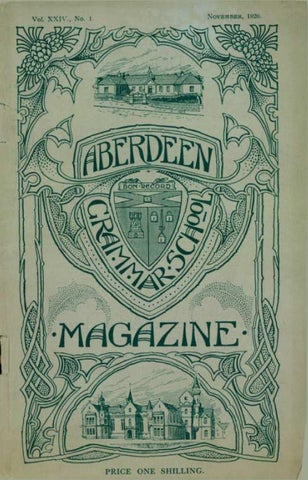
Vol. XXIV., No.
NOVEMBER, 1920.
1.
• MtAGAZ1NE
-
-
••
PRICE ONE SHILLING.
EDUCATIONAL BOOKS JAMES
G.
BISSET
c
(iN T 1 N C.:ES to supply all the Class Books (New or Second-hand) suited for the requirements of the Higher Educational Institutions in the City, at the Lowest Prices. N.B.—Best Value in Students' Note Books.
JAMES G. BISSET, Classical,
Medical, 85
and
BROAD I
Educational Bookseller, STREET
Opposite Morischal College).
THE HOME OF FASHION & NOVELTY.
The best appointed and most centrally situated Warehouse in Aberdeen.
You can begin and complete your Shopping under one roof at S. & H.'s.
Sangster & Henderson, DRAPERS, MILLINERS, AND COMPLETE HOUSE FURNISHERS.
UNION STREET, ABERDEEN. Telephone 363.
Telegrams: '• Sangster Henderson, Aberdeen."
1 /
f ' -
•
ENGAGEMENT RINGS this important branch of our IN business we are careful to select only the finest quality of Gems. We make a special feature of uncommon settings and designs, and employ a cornpetentstaff of jewellers for this highly skilled work. are worn more constantly RINGS than any other jewellery, therefore quality and distinctive character are of the utmost importance.
A. & J. SMITH 191 UNION ST., ABERDEEN. 1r^• S
: SIGNET: RINGS
-
/
Telegrams-" Biscuits, Aberdeen."
Telephone 122.
PURVEYORS TO
BY
HIS MAJESTY.
APPOINTMENT. • o
•
The Unprecedented Demand for our
r
I
EDUX' OAT CAKES
•
HAS MADE AN EXTENSION OF THIS DEPARTMENT ABSOLUTELY NECESSARY. Our increased facilities will Ensure Prompt Attention to all Orders. 1
MITCHELL & MUlL, LTD., ABERDEEN.
$
THE BELNIONT WORKS.
i
G. & W. FRASER, LTD., ABERDEEN. We produce
PRINTING OF QUALITY. t
opLOC 4 6,
Ideas submitted for
O.6
ritASt a. r 7.)
or any kind of Printed Matter.
64)70tC'
4 )0 01r
i trs, vo‘.°
We are EXPERTS, our WORKMEN are SKILLED CRAFTSMEN, and efficient service is your guarantee of satisfaction. our 50 - YEARS of
i
Y3, 64s. 6d.
Y5, 56s. 6d.
Y4, 65s. i;<1
Y2, 58s. 6d.
Visit our Boys' Department where we are showing the "Newest" in
BOYS' WINTER COATS Y3.—Quite new, showing a high waist in a Double-Breasted Coat. To fit boys from 21 to 5 years. Made in pretty shades of Tweed. Prices 64s. 6d., 67s. 6d., 74s. 6d., to 79s. 6d. Y5.—A School Coat for the boy from 6 to 13 years. Wide cut and Double-Breasted, with and without Velvet Collar. Made in Grey, Brown, and Lovat Tweeds. Prices 56s. 6d., 63s. 6d., 65s. 6d., 67s. 6d., to 80s. Y2.—The Latest Cut—a wide-fitting Coat, fastening with one large button. Is stocked in shades of Saxe, Purple, Betio, and Brown. To fit boys from 2* to 7 years. Prices 58s. 6d., 63s. 6d., 75s. 6d., 77s. 6d., to 81s. 6d. Y4.—A Comfy Coat for stormy weather, made in a variety of Tweeds. To fit boys from 5 to 12 years. Prices 65s. 6d., 68s. 6d., 71s. 6d., to 79s. 6d. Y6.—The Youth's Coat, as sketch, in Fawn and Grey Tweed. Prices 80s. 6d., 86s. 6d., 90s. 6d., 95s. 6d., to £5 5s. o
To each Coat is attached a Cap Length of Material, which we can make up to size required
Y6, 80s. 6d.
[-~1 FALCONEit@ .„.
.
ter1 I '
ji
THE
ROYA L
ARCADE
ABERDEEN
Royal (Dick) Veterinary College EDINBURGH. Principal :
O. CHARNOCK BRADLEY, M.D., D.Sc., NI.R.C.V.S. -
After attendance on -complete courses of instruction in this College, Students may proceed to the Examinations for the Diploma of Membership of the Royal College of" Veterinary Surgeons (M.R.C.V.S.). Students of the College may also present themselves for the Degree of Bachelor of Science (B.Sc.) in Veterinary Science conferred by the University of Edinburgh. The College being recognised as a Central Institution under the Education (Scotland) Act, 1908, Students are eligible for Bursaries granted by Education Authorities of Counties, and certain Burghs of Scotland. A Copy of the College Calendar may be obtained on application to F. P. MILLIGAN, W.S., Secretary. N.D.—The College has been transferred to the new buildings at Suutmeritall, East Aleadows.
Fine Selection of .
.
PURE WOOL
Scotch Tweed Suitings W. DAVIDSON & SON, Civil, Military, and Naval Tailors and Outfitters,
123 UNION STREET, ABERDEEN. Established 1843.
Telephone 579.
•
v)s
--
_-
"••• "•!_s
OVERCOATS. _
FOR
VALUE,
STYLE,
Our
present
stock
AND is
SELECTION unsurpassed.
tel Blue Nap, Velvet Collar, Band 63/at Back, at
,
Dark Grey, Plain Back Dark Grey,
65/-
Double-Breasted 84/-, 95/-
Dark Brown, Single-Breasted 90/Double-Breasted 100,„
I
Dark Brown or Grey, style as 95/— sketch (Very Dressy Coat.)
Clearing Lines of RAINCOATS At 51h, 60/-, and 75/-. Letter Orders Carriage Paid.
TAY
4.91
29 EGREOEREGNE STREET, .
A. & J. SCOTT / AB D •
CONTENTS.
•
4 •
PAGE. .. .. 1 OUR NEW RECTOR'S INDUCTION 4 •• • • • • •• •• NOTES ABOUT OLD BOYS 20. .. •• PHOTOGRAVURE OF DR. SIMPSON'S PORTRAIT .. 21 .. •• •• •• .. .. .. OLD BOYS IN CANADA 26 •• .. TREKKING ON THE GOLD COAST . • 31, 57 •. •. •• •• .. THE SCHOOL WAR MEMORIAL 32 .. .• •• •• A WINTER IN THE ARCTIC 35 •• . •• .. .. OUR CONTEMPORARIES PORTRAITS OF THE ALL-ROUND TROPHY MEDALLIST AND THE Dux 36 .. .. •• .. OF THE SCHOOL (CLASSICAL), 1920.. .• 37 •• •• .• .• •• .. .. SC11OO1, NOTES 41 .. .. •• •• •. •• .. .. RANDOM NOTES 43 .. •. THE SWIMMING SPORTS. THE ATHLETIC SPORTS •• 44 •• .. .. SCHOOL CRICKET NOTES. SCHOOL. RUGBY 45 •• .. •• •• .. NOTES ON OUR SCOUTS .. THE FORMER PUPILS' CLUBTHE ANNUAL DINNER .. CLUB NOTES .. THE CRICKET CLUB .. .. HOCKEY SECTION LIST OF NEW MEMBERS
.. •• .. .. .
•• •• •• ••
••
• • • ..
•• ••
•• •• ..
.• .. •.
46 51 54 56 58
W. LUMSDEN & SON, 58 UNION STREET, ABERDEEN.
GROCERIES,
PROVISIONS,
WINES and SPIRITS,
::
ALL
OF
HIGHEST
::
QUALITY.
HAVANA CIGARS in Great Variety. Telegrams : "TRAVELLED, ABERDEEN."
'PHONE 260.
BY APPOINTMENT.
Dine at
.
.
The Royal Athenaeum Restaurant and Grill Room (Opposite Town House).
THE
PREMIER
DINING
HALL
IN
THE
CITY.
Patronised by the elite of the Town and County. Choice Selection of OLD VINTAGE CHAMPAGNES AND OTHER WINES. TABLE D'HOTE DINNER FROM 6 P.M. AT 6/Tel. No. 2273. Telegrams: Athenaeum.
John Mitchell, Proprietor.
WALTHAM WATCHES. Presentation Watches and Clocks. •
0
SILVER TEA AND COFFEE SERVICES. •
o
Canteens of Cutlery in Community Silver Plate with Rustless Cutlery. • •
Engagement Rings.
GEO, JAMIESON & SON (W. \V. C
V),
125 UNION STREET, ABERDEEN (Opposite St. Nicholas Facade). ESTABLISHED 1843.
Wm. Cay & Sons funeral Illnbertakers,
City Goldsmiths Co.
9
(A. HOLDSWORTH),
98 Union St., Aberdeen. SECOND-HAND DIAMOND JEWELLIERI A SPECIALTY
415 UNION STREET AND
209 GEORGE STREET, ABERDEEN. Motor Hearses and Cars for Distant Funerals.
Telegrams—" Cay, Aberdeen." 'Phones Nos. 92 and 54.
Engagement Rings. Finest Selection and most Reasonable Prices in the North of Scotland. Latest London Designs. Set 18 carat Gold and Platinum. From 60/- to £30. Other Prices from 10/6 upwards. Inspection and comparison invited. Ring Size Cards free. NOTE.—Owing to limited window space we hold a large Reserve Stock inside which we shall be pleased to show to intending purchasers.
NORTHERN ASSURANCE COMPANY LIMITED ESTABLISHED
Assets exceed
.
1836.
£15,000,000.
CHIEF OFFICES :
ABERDEEN LONDON -
ALL
- 1 Union Terrace. - 1 Moorgate Street, E.C. 2.
CLASSES OF
INSURANCE.
FIRE LIFE ACCIDENT MARINE 'Trustees. HIS GRACE THE DUKE OF RICHMOND AND GORDON, K.G. THE RIGHT HoN. VISCOUNT MILNER, G.C.H., G.C.M.G.
Aberdeen Boar 1 of Directors. SIR THOMAS BURNETT, BART.
GEORGE_ MILNE COOK, ESQ.
DAVID M. A. CHALMERS, ESQ.
GARDEN ALEXANDER DUFF, ESQ.
FRANCIS
ALFRED MA RTINE A V,
JAMES COCHRAN, ESQ. DAVID M.
EsQ.
NI. M ILL [GA N, ESQ
Manager and Secretary
-
PROSPECTUSES
ON
R. MACK AV, F. F.A.
APPLICATION.
•
:iberbeen Orammat Sci?oot tllaga3ine. •
Vol. XXIV.
NOVEMBER, 1920.
No.
I.
The " Magazine " is issued under the auspices of The Forme! Pupils' Club, in March, June, and November. All communications with regard to the " Magazine " should be addressed to the Editor and Secretary and Treasurer of the Club, THEODORE WATT, M.A., The Rosemount Press, Aberdeen. *** Members of the Club are requested to inform the Secretary of any change in their address.
Our New Rector's Induction. Prize Day (30th June), 1920, will for long be remembered in the annals of the School. on account of the welcome given to our new Rector. He was introduced by Mr. George Duncan, the Chairman of the Education Authority, who said that Mr. Thomson came to us with very high credentials. He started with the great advantage of having a strong hereditary connection with the Grammar School. His father, who was a distinguished former pupil, left as long ago as 1863, to go as second bursar to King's College. Mr. Thomson had also another great advantage as he had gained experience in two of the foremost Scottish schools, Glenalmond and Fettes, and had a distinguished career at Edinburgh University and Oxford. With such an academical record the fame of the Grammar School would be abundantly safe in his hands. Mr. Thomson also came with a high reputation as a successful, stimulating, and sympathetic teacher. As a young man he would be sympathetic, and would take a keen interest in our work inside and also in our outside activities. He would have the loyal support of a very able body of teachers, and
2
Aberdeen Grammar School Magazine,
Mr. Duncan promised him the whole-hearted support of the Education Authority. He wished him every prosperity and every good in his work. •
MR. THOMSON'S SPEECH. Mr. Thomson, who on rising to reply received a very cordial reception said—" Professor Gilroy, My Lord Provost, Mr. Duncan, Ladies and Gentlemen, I should like to thank you with all sincerity for the too generous welcome you have given me to the Grammar School. I have been assured that no long speech is expected of me ; but yesterday it looked as if you would be spared even a short one, and that I would have to appear as a tbA rp_crunrov—a h mute character at my own induction. This vocal disability, which causes me unutterable regret, increases what I venture to hope you will appreciate and excuse, my difficulty in finding words to do justice to what is by far the greatest, indeed, the only great event of my life. " First of all, may I take this occasion to do what had more fittingly, perhaps, been done three weeks ago, and express to Mr. Duncan, as representing the Education Authority of the City, my deep sense of the honour they have done me in choosing me as Rector of this historic School. I shall never forget my first three days in Aberdeen. What might easily, elsewhere, have been something of an ordeal, was made a pleasure by the great kindness of the Chairman, the Director of Education, Professor Gilroy and other members of the Authority. " Then I must acknowledge most gratefully the welcome extended to me by Mr. Theodore Watt on behalf of the Former Pupils of the School. I am very keenly aware of the service which can be rendered to a school by a loyal and influential Club of its Old Boys, particularly by a Club with a Secretary so energetic in his activities and so untiring in his research. " Nothing has given me more encouragement for the work which lies before me than the assurance I have received from Dr. McLeod and other members of the Staff of their readiness to afford me all the help they can. I need hardly say that this promise of their co-operation means everything to me. " Eighteen years ago, when I was a boy at school, I was present at the introduction of a new Head Master ; and quite recently I have seen the coming of a new Head Master to the school I am shortly to leave. I little thought I was one day to become a Rector myself, and remember well my curiosity on both occasions—how I wondered what their thoughts and what their feelings were. I remember also how I pitied them in what I certainly regarded as a most embarrassing experience —the Argus-eyed scrutiny of their new schools. Perhaps you boys of the Grammar School are inspired with that same curiosity—that same pity, possibly. Perhaps you are asking
Aberdeen Grammar School Magazine.
3
the same question, and complex though it is, you may wish that I should attempt an answer. " One feeling is that of pride at having been chosen Rector of a School with such historic associations, with such splendid traditions, and so glorious a past. And though I cannot claim to be coming back to my own old school, I am proud to be coming to my father's, which is perhaps the next best thing. Even before my father came to the Grammar School, he had begun to feel its influence ; for Mr. McLauchlin, his parish schoolmaster at Insch, had been for eight months interim Rector here. It is curious that almost the first Latin prose I can remember doing was sentences taken from versions dictated to my father by Dr. Barrack, the Rector of his day. " But this pride is sobered when I reflect on what it means to continue a line of Rectors stretching centuries back into the past, containing so many names that are famous ; and most of all when I reflect on the greatness of him whom I immediately succeed. You know better than I the worth of his achievement—how the work, the games, the social activities of the School were encouraged by him, how unsparingly he strove to promote the development of individual character and public spirit in the School. " The successor of Dr. Morland Simpson has indeed a hard task, and his lamented death deprives him of that advice and help in any difficulties which would have meant so much. To rival him seems impossible ; I can at best seek to emulate his great example. " Education seems now to be entering upon a new era. At no time has more been expected of the schools ; and of no school will more be expected than of that which can claim as an Old Boy the author of the last Education Act. " Nothing has impressed me more deeply with the responsibilities of the office to which you have given me so warm a welcome, than the words with which Mr. Duncan, the Chairman of the Authority, made me aware of my appointment. He said ' We have put you in charge of an old and historic School, of which we in Aberdeen are very proud, and of whose reputation we are very jealous.' " I hope that every boy in the School will remember that the safety of that reputation lies in our common keeping. I, myself, will spare no effort to justify the trust that has been placed in me ; and I feel confident that I can count on your loyal support in maintaining that most precious of heritages, a great tradition."
4
Aberdeen Grammar School Magazine.
••• It is requested that the Editor be informed of all new appointments or interesting incidents in the careers of Former Pupils.
The dates given in parentheses after names indicate the sessions . of attendance at the School. Three important books on India have appeared recently from the pens of F.P's. In the March issue of the Magazine attention was called to the volume on " Indian Nationality" by Principal Robert Niven Gilchrist* (1901-05),. M.A. In the June issue it was announced that Lord Meston* (1876-80), K.C.S.I., LL.D., was to deliver the Rede Lecture of 1920 at Cambridge University. His subject was " India at the Crossways," and the lecture has now been published in book form by the Cambridge University Press. The third work is by John Nicol Farquhar (1882-83), M.A., Litt.D., Literary Secretary for the Y.M.C.A. in India, and is entitled " An Outline of the Religious Literature of India." All three books have been very favourably noticed by the leading literary reviews. Another of our Anglo-Indians, William George Robertson* (1884-90),M.A., B.D., Principal of Gujarat College, Ahmedabad, has just brought out an interesting volume," Neglected English Classics." His aim is to extend the range of study in English literature. John Laird (1901-03), M.A., professor of logic and metaphysics in Queen's University, Belfast, is the author of " A Study of Realism," just published by the Cambridge University Press. His aim has been to give a methodical survey of the chief problems of philosophical realism. Frederick Wernham Gerrard* (1905-06), Major, Indian Army Reserve of Officers, who is Deputy Commissioner of Police at Basrah, Mesopotamia, was in June appointed a Companion of the Order of the Indian Empire (C.I.E.). John Malcolm Bulloch* (1877-80), the editor of the Graphic, must surely have created a record among F.P's by witnessing, on 29th September, his 2000th play of more than one act. "As he saw his first in Aberdeen over 40 years ago," writes the London correspondent of the Aberdeen Journal, --" it was in December, 1879, and the play was ' The Yellow Dwarf '—he had hopes of completing his second thousand in Aberdeen during his recent holiday. Not merely has Mr.
Aberdeen Grammar School Magazine.
*
•
•
A
5
Bulloch seen that formidable total of plays ; he has kept a record of them of unique interest and value. That is in a series of volumes entitled.' Plays I have Seen.' He has preserved not only the programmes of the plays and descriptions of them, but also large numbers of illustrations of scenes and the various characters. It is a constant marvel to Mr. Bulloch's friends that he is able to find time for such a record of the drama as a side issue to his strenuous editorial work, and his monumental labours as the historian of the Gordons. The ' Plays I have Seen ' now extends to 34 volumes, which their compiler intends to bequeath to the British Museum. It is well known that Mr. Bulloch is a leading authority on our famous theatrical families. He is indeed the greatest genealogist of our time." James Mathewson Milne* (1895-1902), M.A., was in July appointed rector of Nairn Academy. He was assistant master in North Kelvinside H. G. School, Glasgow, from 1908 until his enlistment in 1915 in the 3/1st Lowland Field Ambulance, R.A.M.C. (T.F.) He received a commission in the 5th Scottish Rifles in March, 1917, and shortly afterwards was placed in charge of anti-gas training in a M.G.C. Training Battalion. He was demobilized in January, 1919, with the rank of Acting Captain, and was appointed assistant master in Glasgow High School. Early this year he became principal classical master in the Bell-Baxter School, Cupar-Fife. James Gibb (1870-76), D.D., minister of the Presbyterian Church, Wellington, New Zealand, has recently been in this country. The object of his visit was to secure ministers for the Presbyterian Church in New Zealand, and he was successful in getting thirty-four aspirants. Ritchie Doughty. Lyon* (1907-13), M.A., B.D., was in June ordained minister of the North Parish Church, Dunfermline. William Douglas Simpson* (1901-13), M.A., was in July appointed lecturer on British History in the University of Aberdeen. He was previously assistant to the Professor of History. William Gordon Craigen* (1894-97 and 1900-02), M.A., LL.B., Robert Mackay Ledingham* (1897-1909), M.A., LL.B., John Alexander Nicol* (1895-99), M.A., B.I.., and James Patterson* (1906-12), M.A., LL.B., have been admitted members of the Society of Advocates in Aberdeen. Alexander Morice Wilson* (1895-1906), Captain (acting Major), 4th Gordon Highlanders, has received from the King of the Hellenes the Greek Military Medal (3rd Class). A correction to the London Gazette states that Major Wilson " awarded the M.B.E. in the Gazette of June 3, 1919, in error, is now promoted to the 4th Grade, Military Division (O.B.E.), from that date inclusive."
6
Aberdeen Grammar School Magazine.
Edward William Watt* (1883-94), Major, 4th Gordon Highlanders, and James Hastings Edwards* (1894-1900), Major, 1st Highland Brigade, R.F.A., have been awarded the Territorial Decoration. James Logie Lyall Duffus* (1912-14), who holds a regular commission in the Royal Air Force, is at present serving in Egypt. David Inglis Duff* (1915-16) is now resident in India, having joined the staff of Messrs. Barry and Co., Calcutta. Launcelot Hugh Ross* (1898-1901) has recommenced the practice of his profession as an architect in Glasgow, after serving for five years in the Army. He kindly says that he will always be glad to meet any F.P. coming to Glasgow who may want befriending. Walter Lothian Gilbert (1902-06) has been appointed acting-manager at the Tivoli Theatre, Aberdeen. During the War he held a commission in the Gordons, serving in India, Mesopotamia, Persia, and Southern Russia. Charles Lamond Henderson (1909-13), M.A., was in June called to the Bar at the Middle Temple. Arthur H. Peter Ferguson* (1905-14) is at present working with a Flax and Land Developing Company in British East Africa, and is stationed near Eldoret, the capital of the Wasin Gishu Plateau. George Jamieson Hall* (1915-18) is now in Australia, working on a sheep station. Alfred Jack Hayward* (1908-16), who was a Midshipman on H.M. Destroyer " Vanquisher," and took part in several night raids on Zeebruge and Ostend, is now studying at Jesus College, Cambridge. Hugh E. J. Lister* (1910-16) is studying at Trinity College, Cambridge. William MacDonald* (1914-15) is studying in the Faculty of Arts at Glasgow University. Arthur Leslie Scott* (1908-14), who was appointed a student interpreter in China in March, is stationed at the British Legation, Peking. William Farquharson Smart* (1906-14) has for the past year been on a rubber estate in Perak, F.M.S. He has sent us a couple of very interesting photographs that he took during the Tamils' Festival. George Alston Buyers* (1906-08), C.A., holds an appointment with the New Engineering & Shipbuilding Works, Limited, at Shanghai, China. Robert Rannie Cook* (1899-1908), who was on the Kamanis Estate, Jesselton, British North Borneo, from 1913, received
•
+
Aberdeen Grammar School Magazine.
7
an appointment in October, 1919, on the Sengkang Estate, Port Dickson, F.M.S. Gray Hassell* (1873-76), M.D., retired from the New Zealand Government Mental Hospital Department on 31st May, after 32 years' service. Robert Robertson Hynd* (1879-84) is now manager at Manila, Philippine Islands, of the Hongkong and Shanghai Banking Corporation, whose service he entered in 1889. William Menzies Kesson* (1893-98) is now secretary and treasurer to Messrs. Kitchen Brothers, Limited, wholesale merchants, Fredericton, New Brunswick. John McPherson* (1900-03), M.D., is now in medical practice at Granville, near Sydney, New South \Vales. Archibald Campbell Macrae* (1896-1901), M.B., Captain, Indian Medical Service, had a wide range of service during the War, being stationed in India, France, Mesopotamia, Waziristan, and East Persia. Latterly he has been in Transcaspia and East Persia. James William Milne* (1884-1895), C.A., the former Secretary and Treasurer of the F.P. Club, has retired from the firm of Messrs. Jeffrey & Milne, C.A., Aberdeen, having been assumed a partner in Messrs. Cooper Brothers & Co., London, Liverpool, etc. He has been awarded the O.B.E. for his services in the Ministry of Munitions during the War. Richard Pithie* (1875-76), who joined the Indo-China Steam Navigation Company as chief engineer in 1895, expects to retire from the sea this year and to settle in the South of England. He reminds us that he was once a Sapper in the Aberdeen Royal Engineers, and was at the Edinburgh Review in 1881. The only part of the War he saw was the fight in Penang Harbour when the " Emden " blew up a Russian gunboat. His ship was lying not far off, and he saw everything clearly. He also saw some of the fighting at Singapore, when the Indian Regiment mutinied, but had no active part in it. Douglas Porter* (1897-1902), M.B., is now Assistant Medical Officer, Tuberculosis Service, Metropolitan Asylums Board, and is stationed at the Downs Sanatorium, Sutton, Surrey. Kenneth Reid* (1901-04), on returning after the War to Tobago, B.W.I., has purchased King's Bay Estate from his father. He was formerly manager of the estate, Which produces cacao and coconut. Arthur C. Smith* (1893-1900), who joined Messrs. Guthrie Ltd., at Singapore in 1910, has, since January Company, & of this year, been manager at Singapore of Messrs. Sutro & Co. Eastern, Ltd. George Grant Thomson* (1910-12) is in the service of
8
Aberdeen Grammar School Magazine.
the Hongkong and Shanghai Banking Corporation at Tienstin, North China. Thomas Gildawie Watson* (1896-99) has since May, 1918, been manager in Victoria, Australia, of the Queensland Meat Export Company, Ltd. John F. Irvine Fortescue (1896-1900), who spent several years in business in Sarawak and Singapore, recently qualified as a minister of the Scottish Congregational Church and has been ordained minister at Oban. Alexander Pringle Jameson (1892-1904), D.Sc., who until recently was working at the Institute for Agricultural Research, Pusa, Bihar, India, is now at Shillong, Assam, where he is engaged in investigating the silk-worm disease. Douglass Irvine Watson (1881-86) has again won the English Bowling Association's invitation tournament. Mr. Watson, who was captain of the Malden (Surrey) Bowling Club last year, won the Surrey County single-handed championship in 1913 ; in 1914 the All-England championship ; and in 1915 the championship of London and Southern Counties Association. By winning this tournament and thus becoming champion of champions for the second time, he has demonstrated that he is the best single -handed player in England. Mr. Watson also holds the record as an International skip. He has " skipped " six times for England, twice each against Scotland, Ireland, and Wales, his rink winning five games out of six and having a balance of 74 shots to the good. This is a record which far surpasses that of any other English, Irish, Welsh or Scottish skip. James Francis Gerrard* (1911-13) has received an appointment in Barclay's Bank, London, and has been posted to the Foreign Department. Cecil Hay Aiken* (1911-14) has taken up duty as assistant engineer to the Assam Sawmills & Timber Co., Ltd., on the Gadiga Frontier Track, Assam. James Christian Hall* (1911-14) M.B., is Casualty Medical Officer at Miller Hospital, London, S.E. Gordon Wallace Hunter* (1907-16), who entered the mercantile marine in 1916 and joined the C.P.O.S. " Empress of Asia " in 1918, sailing between Vancouver and Hongkong, is now with Houlder Bros., Liverpool to South America. Hamish Ogilvie McIntosh* (1910-14) is going to America to take up ranching. Kenneth Macintosh Robertson* (1907-18) is training for the stage, and has recently been on tour with a dramatic repertory company. Robert Petrie Stott* (1912-18) has recently received a planting appointment in South India.
Aberdeen Grammar School Magazine.
9
Reginald John George Wilson* (1905-11) holds an appointment in the service of the British Bank of South America, and is stationed at Buenos Aires. George Clark* (1907-12) has, since demobilization, taken up ranching in British Columbia. Prior to the War he was in the service of the Canadian Bank of Commerce at San Francisco. William Ferguson Cook* (1911-13), who served his apprenticeship as an engineer in Aberdeen, went out, to Borneo in July. John Ross Esson* (1893-97), who on returning to this country from Brazil in 1917 became engineering manager of a shipyard under Government control, is now commercial manager of the Joint Development . Syndicate, Bedford Row, London, W.C. 1. William Wallace Gauld* (1893-98), M.A., minister of the U.F. Church, Callander, from 1911, has recently been appointed to Langside Hill U.F. Church, Glasgow. Hubert Douglas Henderson* (1901-04), M.A. (Cantab.), is now a Fellow of Clare College, Cambridge, and is University Lecturer in Economics. Alexander McCurrach* (1897-1901), who entered the service of the Sun Insurance Office in 1901, has been promoted District Secretary at Aberdeen. William Moir* (187.1-78) retired from India in 1919, and is now resident in London. Reginald Percy Morrison* (1895-1905) passed the C.A. Final Examination in June last, and was in August admitted a Member of the Society of Accountants in Aberdeen. Norman Munro* (1895-1900), M.A., is Mathematical and Science Master in the Grammar School, Vancouver, B.C. Cecil Valentine Robertson* (1897-1906) is in the Trade Boards Division of the Ministry of Labour. William Walker Scott* (1903-13) is on the Sungei Began Rubber Estate, Kelantan, F.M.S. James Drummond Smith* (1900-1908), O.B.E., M.A., has been appointed Sir Ernest Cassel Lecturer in Commerce in the University of London. George Stephen* (1900-07) is Lecturer and Instructor in Carpentry and Joinery at the Government Instructional Factory, Forbesfield, Aberdeen. Andrew Forbes Davidson (1905-15) now holds a commission in the Indian Army and is at present attached to the 103rd Mahrattas. John Ogilvie Gordon* (1913-15), having passed . the Planter's Course at Aberdeen University, is going to engage
10
Aberdeen Grammar School Magazine.
in rubber planting in Malaya, and is to collect mammals out there for the British Museum. Robert Richards* (1899-1904), M.A., M.D., D.P.H., who was appointed assistant surgeon to the Royal Aberdeen klospital for Sick Children early in the year, has been admitted a Fellow of the Royal College of Surgeons of Edinburgh as a result of the examination for fellows held in June. Kenneth James Allardyce* (1894-95), who entered the Fiji Civil Service in 1898 and became Secretary for Native Affairs in 1916, has decided to retire from the Service and go on the land out there. In May, 1917, he received a commission in the Army, and being appointed to command the Fijian Labour 'Corps, served with it in France and Italy. Alexander Thomas Stephen* (1906-15), who passed into the Indian Army in 1917, is at present serving with the Punjabis on the North-West frontier of India. Samuel Baker (1881-89) is Superintending Engineer of the China Sugar Refinery, East Point, Hongkong. Henry Joseph Smith* (1913-14) is now with the British Dyestuffs Corporation, Huddersfield. He plays for the Doncaster Rugby Union Football Club. John Malton Adcock** (1901-11) has since April, 1919, been civil engineering assistant with the Associated Portland Cement Manufacturers, Limited, Gravesend. William John Milne (1908-14) is with a firm of underwriters at Lloyd's, London. Alexander Thomson Begg (1909-10) is now in the service of the Northern Assurance Company, Ltd., in Calcutta. Alfred E. H. Brown (1899-1902) has, since December last, been Inspector of Weights and Measures for the Southern Division of Derbyshire. Jameson Boyd Adams (1893-94), D.S.O., who served in the earlier part of the War as Flag-Lieutenant to Admiral Hood and later was transferred to the Royal Naval Siege Guns at Nieuport, now holds the position of General Manager of Employment Exchanges. He entered the Civil Service after his return from the British Antarctic Expedition of 1907-09. William Davidson* (1881-84), M.B., has been appointed a Regional Medical Officer to the Ministry of Health, and is stationed at Plymouth. Go Khek Ghee* (1904-08) is employed in the engineering department of the Pacific Trading Company, Russian Concession, Hankow, China. Andrew Gourlay Clow (1896-98), B.A. (Cantab.), entered the Indian Civil Service in 1914, and is now Organising Secretary to the Indian Government Labour Department at Delhi.
Aberdeen Grammar School Magazine.
11
Robert Brown (1895-99), M.D., has received an appointment in the Egyptian Government School of Medicine, Cairo. William Gibson Cochrane (1894-1901), who was engaged prior to the War in fruit farming in the United States, and served as an officer with the Royal Scots from January, 1915, to July, 1919, is now in the service of the Penang Rubber Company, Ltd., Straits Settlements. John Harvey Cochrane (1894-1900), who came home from Sumatra in October, 1914, and served as an officer in the Royal Scots till discharged on account of ill-health in May, 1917, returned to Sumatra in 1918, and is now manager and administrator of the Shanghai-Sumatra Tobacco Company. Walter H. Bulloch (1881-88) is on the staff of the Directorate of Works and Buildings of the Air Ministry. Thomas Russell Davidson* (1884-94), who was works manager of the Singapore Oil Mills, Ltd., at Singapore from 1911 to 1918, is now managing director of Duthie Brothers, Ltd., rope manufacturers, Aberdeen. Douglas Parodie Capper (1906-08), who served in the R.A.F. as a Lieutenant (Pilot and Observer), is now assistant manager of Padang Jawa Rubber Estate, Selangor, F.M.S. William George Dean (1906-10), who was a Lieutenant in the Scots Guards, is now studying at Christ Church, Oxford. Edward William Watt* (1883-94), M.A., of the Aberdeen Free Press, was one of the delegates from Scotland at the Second Imperial Press Conference held in Ottawa in August. On the outward voyage, as a passenger on the steamship Victorian of the C.P.O.S., he had the privilege of taking part in the first successful experiment of telephoning from midAtlantic to Britain. A wireless telephone message from him, forwarded from Chelmsford by telegraph, appeared in the Free Press of 22nd July. An article by' Mr. Watt appears on pp. 21-25. George Topham Forrest* (1880-89), F. R.I. B. A., Superintending Architect of Metropolitan Buildings and Architect to the London County Council, is joint author of a book dealing with the nineteen threatened City of London churches. It gives the story of the City churches from the time of the great fire of 1666 down to the present time. Patrick Taldo Pirie (1906-07), M.C., Lieutenant, 1st Battalion Gordon Highlanders, has received special recognition from the Commander-in-Chief of the Army of the Black Sea for his prompt and courageous action in September last in helping to save the lives of two privates who were in danger of drowning in the Gulf of Ismid. Alexander Slater* (1914-17) has been awarded a gold watch, with a suitable inscription, by the Carnegie Hero Fund
12
Aberdeen Grammar School Magazine.
Trustees for rescuing a boy of twelve years from drowning in Lerwick Harbour on 22nd July. This is the second award to an F. P. within twelve months, the other recipient being James W. S. Marr, as already recorded in the Magazine. Alexander Reid Gordon* (1884-88), D.Litt., Professor of Hebrew in M`Gill University, Montreal, has just added to his published works another volume entitled " The Enchanted Garden. Stories from Genesis Re-told for Young Folk." Dr. Gordon has established for himself a reputation both as a profound scholar and as an attractive writer. Charles Strachan Hadden* (1903-08), M. A. , LL.B. , has been elected secretary of the Aberdeenshire Cricket Club. Robert Murray* (1861-64) has retired from the position of senior agent of the North of Scotland and Town and County Bank's High Street Branch, Dundee. He entered the service of the North of Scotland Bank in 1865, and became its agent in Dundee in 1888. A correspondent writes :-" I spent an afternoon in London recently and saw G. O. Gauld* [(1886-91), M.B., of Nottingham] playing cricket for the M.C.C. v. Enfield. He got five wickets for 40 runs and did the hat trick, clean bowling three men in succession. It is not so uncommon to get three men out in succession, but very unusual to bowl the wicket down each time. Rather good for a man of 45 ! Very few F.P.'s play cricket with any distinction in England, and I do not think any other F.P. ever was captain of an English County, as Gauld was of Notts. a year or two ago." At the Summer Graduation of the University of Aberdeen degrees were conferred on the following F.P.'s :— Master of Arts (M.A.)— Nenion Elliot* (1909-15). Alan McBain* (1903-14). Norman Sutherland Rose* (1907-16). Archibald Moir Macrae Williamson* (1906-16). Doctor of Science (D.Sc.)-Arthur Landsborough Thomson* (1899-1908), M.A. Alexander Pringle Jameson (1892-1904). Doctor of Medicine (M.D.)-Hugh Ross Souper* (1894-1905), M.A., (with Honours for Thesis). Bachelor of Medicine (M.B.) and Bachelor of Surgery (Ch.B.)— Alan Alexander Duffus* (1900-11). John Grant Elmslie* (1904-13). James Christian Hall* (1911-14). Frederic Dudley Ross-Keyt* (1901-12). Map Tock Wee (1913-15).
Aberdeen Grammar School Magazine.
13
Diploma in Public Health (D.P.H.)-Alfred William Harper Cheyne* (1905-09), M.B. Alexander Johnstone* (1904-10), M.A., M.B. John Herbert Stephen* (1899-1900), M.B. William Taylor (1900-04), M.B. In the Faculty of Law, the Edmond Prize to the most distinguished graduate in Law of 1920 was awarded to James Patterson* (1906-12), M.A., LL.B. In the Faculty of Medicine, the Straits Settlements Gold Medal for the best M.D. thesis during 1918-20 on a subject dealing with tropical medicine was awarded to Williard Linton Millar (1898-99), M.A., M.D., Captain, R.A.M.C., who died in France on 23rd October, 1918. Alfred Easton (1872-74) is the senior member of the Victorian pilot service and had the honour of piloting H.M.S. " Renown," with the Prince of Wales on board, on its voyage from New Zealand through Port Phillip Heads, and up to Port Melbourne. He figured prominently in a dramatic incident of the War which, owing to the censorship, was not recorded at the time, and until recently has remained unpublished. Several days after Britain had entered the War, a German steamer from Hamburg, the captain of which was unaware of the outbreak of hostilities, appeared off Port Philip Heads, and signalled for a pilot. She was boarded by Pilot Easton, who refrained from acquainting the visitor with the news. Meanwhile the vessel proceeded safely through the entrance, and was approaching a point off Portsea, where a naval launch was in waiting to place an armed guard on board. At this stage Pilot Easton, addressing the German captain, said.: " We'll slow down the engines to half -speed here ! " Knowing from experience gained during many previous visits to the port that this was an unusual proceeding, the German skipper asked, " Why, Pilot, why ? " Realising that he could now no longer conceal the news, Pilot Easton replied : " Because, captain, Britain and Germany are at war." Obviously staggered at this sudden disclosure, and furious with rage at having been " trapped," as he described it, the German rushed to the steering wheel with an oath, and expressed his intention of " making a bolt for it " out' to sea again. " It's no use, captain," replied the pilot, " those guns on Fort Nepean are fully trained upon your ship, and if you attempt to escape, they will sink her." This warning caused the German to abandon his desperate resolve almost as quickly as it had been conceived, and to accept the situation with as much philosophy as could reasonably be expected. Five minutes later a detachment of blue-jackets scrambled up the liner's side from the naval launch, and, taking possession of the vessel, hauled down the German flag.
14
Aberdeen Grammar School Magazine.
OBITUARY. William Bruce (1846-51), M.A., M.D., LL.D., medical officer of health for Ross-shire, died at the Castle, Dingwall, on 24th October, aged 85 years. After graduating at King's College, Aberdeen, in Arts in 1855 and in medicine in 1858, he started in medical practice in the Crimond district of Buchan. In 1870 he acquired a practice in Dingwall, and there built up a great reputation both as a physician and as a surgeon. In 1890 he was appointed Medical Officer of Health for the combined county of Ross and Cromarty, in consequence of which he gave up general practice, but continued to act as a consultant. As a health administrator he will long be remembered for his successful efforts to improve the housing conditions of the Highlands. In 1886 he was elected Direct Representative for Scotland on the General Medical Council, and five years later received the degree of LL. D. from the University of Aberdeen. He was a man of broad sympathies and enlightened outlook, and took a very active interest in public affairs in the North of Scotland. Alexander Bruce (1849-50), M.A., K.C., who was born at Longside, Aberdeenshire, on 23rd November, 1836, died at Toronto, Canada, in August. He graduated in Arts at Marischal College in 1854, and was called to the bar in Canada in 1861. He was the oldest practising barrister in the province of Ontario. George Sutherland (1849-50), M.A., for 21 years rector of St. John's Episcopal Church, Portsoy, died on 17th July at Aberdeen, where he had lived in retirement since 1903. He graduated M.A. at Marischal College in 1854, and after studying at Glenalmond, was ordained a supernumerary of the Aberdeen diocese in 1856. He was appointed to Falkirk in 1859, Banchory-Ternan in 1861, Tillymorgan in 1865, Wick in 1876, and Portsoy in 1882. His writings included a book entitled " Outlines of Scottish Archaeology." It is interesting to record that his father, who was a farmer at Udny, was born so long ago as 1764, being a man of eighty-five when his son entered the Grammar School. William Ewan (1849-54), M.A., senior minister of the U. F. Church, Fyvie, died at Aberdeen on 28th June, in his 83rd year. He graduated M.A. at Marischal College in 1858, and after studying at the Free Church College, Aberdeen, was licensed as a preacher by the Free Church Presbytery of Paisley in 1862. He was ordained minister of the Free Church of Fyvie in 1868, and celebrated his ministerial jubilee two , years ago. John Parker* (1850-52), M.A., advocate, died at Aberdeen on 16th August, aged 84 years. He was the only son of Rev. Gavin Parker, of Bon-Accord Church (afterwards the
Aberdeen Grammar School Magazine.
15
Free Church), a noted minister in his day, who " came out " at the Disruption. Mr. Parker graduated in Arts at Marischal College in 1857, and after serving as a law apprentice with Messrs. Milne and Walker, Aberdeen, was admitted a member of the Society of Advocates in Aberdeen in 1865. He was a partner in the firm of Messrs. Parker and McCombie, Aberdeen, from 1869 to 1888, retiring from business in the latter year. Mr. Parker was one of the oldest members of the F. P. Club, and took a warm interest in it. For many years he was a familiar figure driving through the streets of Aberdeen in his carriage and pair. Robert Walker* (1852-57), M. A. , LL.D., Registrar Emeritus of the University of Aberdeen, died at Tillydrone House, Old Aberdeen, on 26th October, in his 78th year. He graduated M.A. with honours at Aberdeen in 1861, and B.A. (15th Wrangler) at Cambridge in 1865. In the following year he was elected a Fellow of Clare College, Cambridge, and held his fellowship for twelve years. From 1866 to 1870 he was assistant in mathematics at Aberdeen University, under Professor Fuller. In 1877 he was appointed secretary of the Aberdeen University Court and Clerk of the General Council, and continued in these positions until a few months after the University Quater-Centenary Celebrations in 1906. He was University Librarian from 1877 to 1893, and Registrar from 1877 to 1918. He received the honorary degree of LL.D. in 1907. In everything he did Dr. Walker was punctiliously methodical and meticulously accurate. Even in regard to his membership of the Former Pupils' Club it was highly characteristic that only a few days before his death he personally delivered at the office of the Secretary of the Dinner Committee a notification that he would not be present at this year's gathering. Alexander Davidson (1853-55), M.A., of Mugiemoss and 1 Ridgway Place, Wimbledon, died as the result of an accident on 10th July, aged 78 years. He was chairman of Messrs. C. Davidson and Sons, Ltd., paper manufacturers, Mugiemoss, Aberdeen, having been connected with the business for over sixty years. Charles Peter Littlejohn* (1859-64), M.A. , (Cantab.), sixth son of the late William Littlejohn, manager of the Town and County Bank, Aberdeen, died at Chew Magna, Somerset, on 17th October, aged 72 years. For twenty years after leaving the School he engaged in business, and then entered Cambridge University, where he graduated B.A. in 1886. In the same year he was ordained a deacon of the Church of England, and a priest in the following year. He was curate of Shalford, Surrey, from 1886 to 1890 ; vicar of Send, Surrey, from 1890 to 1895 ; and vicar of St. Benedict's, Cambridge, from 1895 to 1900. Thereafter he was a licensed preacher in the dioceses
16
Aberdeen Grammar School Magazine.
of Ely and Norwich, and latterly was living in retirement in Somerset. George Minty (1860-64), M.A.; late of St. Mary's Church, Fyvie, died at Aberdeen on 10th August, aged 72 years. After graduating M.A. in 1868, he studied at the Divinity Hall, Aberdeen University, and was licensed as a probationer of the Church of Scotland by the Presbytery of Aberdeen. William Hendry Shepherd (1861-65), third son of the late James Shepherd, of Messrs. Souter and Shepherd, wholesale druggists, died at Aberdeen on 16th September, aged 71 years. After a year at King's College, he entered his father's business, on whose death he became a partner with his brother, GEORGE JAMIESON SHEPHERD (1856-61), who died in 1916. He had been living in retirement since 1904, when the business was wound up. The only remaining member of the family is JAMES SHEPHERD* (1859-64), M.D., D.D., who has been a medical missionary at Rajputana, India, since 1872. George James Robertson* (1864-66), M.B., C.M., died at Aberdeen on 4th August, aged 72 years. He was for many years in medical practice at Oldham. Latterly he had been living in retirement at Old Meldrum, of which he was a native. By his will Dr. Robertson directs his trustees to pay over, on the death of certain life-renters, the residue of his estate to the Aberdeen University Court, the free income to be derived therefrom to be applied for the advancement of the science and practice of surgery in the University--the fund to be known as the George James Robertson Trust Fund. The revenue of the fund may be applied for such purposes as— the appointment of lecturer or lecturers ; the appointment of research fellow or fellows; and any research in surgery or any cognate subject, such as surgical pathology or bacteriology. Logan Shirres (1864-66), B.A., B.C.L., barrister-at-law, son of David L. Shines, Tullos House, Nigg, died at 57 Pentonvile Road, London, N., on 28th August, aged 68 years. He was Gold Medalist and Dux of the School in 1866, and matriculated at Balliol College, Oxford, in 1871. He graduated B.A. (second class Litt. Hum.) in 1875, B.C.L. in 1876, and was called to the bar at Lincoln's Inn in 1879. Hugh Brebner (1865-67) died at Bristol on 23rd May, aged 67 years. He was a son of William Brebner, who founded the " Brebner " French and German Prizes at the School, and was an artist by profession. David Stewart (1869-72), manager of the Union Bank of Australia, Wellington, New Zealand, and youngest son of John Stewart, Mains of Badentoy, Portlethen, died at Wellington on 18th April, aged 64 years. After serving his apprentice-
Aberdeen Grammar School Magazine.
17
ship in a Scottish bank, he joined the Union Bank of Australia in 1877, and became manager at several of its branches in succession. In 1911 he was promoted to the management of the Wellington branch, the head office in New Zealand of the Union Bank of Australia. William Lorimer (1875-76), M.A., for 35 years head master of Forglen Public School, Banffshire, died at Elgin on 29th July, aged 63 years. He graduated M.A. at Aberdeen in 1880, and was appointed to Forglen in 1885. John Hay Begg (1876-84), eldest son of Henry F. Begg of Lochnagar and Inchgarth, Aberdeen, died at Stanthorpe, near Brisbane, Queensland, on 7th August, aged 51 years. He went to Australia about ten years ago and engaged in farming at Stanthorpe. During the War he enlisted for active service with the Australian Imperial Force, and his death was due to illness contracted while serving. Henry Woodhams Brazier* (1878-80), late Commissioner of Customs, China, died at Inverness on 11th August, aged 57 years. He passed into the Imperial Chinese Customs Service in 1881, on the nomination of the late Sir Robert Hart, then Inspector-General. After serving at numerous ports in China and Corea, he resigned in 1914, receiving from the President of the Republic of China the order of the Chia Ho, Fourth Class, in recognition of his services. He was a son of the late Professor Brazier, who filled the chair of chemistry in Aberdeen University. Anthony Callaghan (1878-82) died at sea on 25th September. He was a sheep farmer in New Zealand. John Gray Chalmers Jolly* (1882-83) died at Aberdeen on 16th August, aged 53 years. After serving his apprenticeship with the Aberdeen Commercial Company, he joined his father and brothers in the printing business of Messrs. W. Jolly and Sons, Aberdeen, becoming a partner. Charles W. Fleming (1883-84), M.A., B.D., died at Aliwal North, Cape Colony, on 5th August, aged 52 years. He graduated in Arts and Divinity at St. Andrews University, and after being assistant minister in Corstorphine, Ayr, and Glasgow, was for seven years minister of the Presbyterian Church at Indwe, Cape Colony. He was thereafter in the joint charge of Ficksburg and Ladybrand, Orange Free State, until he resigned in 1911. Charles A. Cheyne* (1884-85), M.P.S., died at Jeppestown, Johannesburg, on 10th August, aged 47 years. After qualifying as a chemist, he went to South Africa in 1898 and latterly was in business as a chemist and pharmacist in Johannesburg. On 28th August, 1914, he joined the 9th Brigade Mounted Field Ambulance (South Africa) as staffsergeant, and was drafted in September to Upington,
•
18
Aberdeen Grammar School Magazine.
Bechuanaland Border, for service under the notorious Colonel Maritz. 'When Maritz turned traitor in the second week of October, 1914, Cheyne escaped under cover of darkness along with a few loyalists. On the completion of his term of service on 28th February, 1915, he came home and engaged in munition work in London until the signing of the armistice. Arthur Shepherd* (1891-1902), Major, R.A.M.C., youngest son of the late George Shepherd, Shethin,- Tarves, died there on 19th July, aged 35 years. He graduated M.B., Ch.B., at Aberdeen in 1907, and in February, 1908, passed into the R.A.M.C. After a time he was sent to India, and served among other places at Agra, Mandalay, and the Andaman Islands. From May, 1916, to October, 1919, he served with the Mesopotamian Expeditionary Force. He was mentioned in Lieut-General Marshall's dispatch of 11th November, 1918, and was promoted Brevet-Major, as from 1st January, 1919, for distinguished services in Mesopotamia. While abroad he contracted malaria, and to a recurrence of the fever his death is attributed. Raymond Verel* (1896-99), O. B.E. , M.B., F. R.C. S. (Ed. ) , died in Aberdeen from blood poisoning on 29th September, aged 34 years. He graduated M.B. at Edinburgh in 1908 and was elected F.R.C.S. (Ed.) three years later. In 1912 he started in medical practice in Aberdeen, specializing in ear, nose, and throat. He received a commission as Captain in the R.A.M.C. in September, 1914, and served to July, 1916, with the Scottish Horse Field Ambulance at home, in Gallipoli, and on the Suez Canal. Thereafter he was ear specialist in hospitals at Cairo, being mentioned in dispatches and receiving the O.B.E. (military division) in June, 1919. Last year he resumed his practice in Aberdeen. He was a son of Mr. John B. Verel, of Brooke House, near Norwich. George Ross* (1898-1906), eldest son of James Ross, 125 Desswood Place, Aberdeen, died at Inverness on 4th July, aged 29 years. He served his apprenticeship as an engineer in Aberdeen, and in 1912 went to Upper Assam as engineer on the Powai Tea Estate, Margherita. He was a trooper in the Assam Valley Light Horse from 1913 to 1920. During the War he was refused permission to leave Assam. A younger brother, JAMES STEWART Ross, who was a 2nd Lieutenant in the Royal Air Force, died in July, 1918, as the result of an aeroplane accident at Duxford, Cambridgeshire. Reginald Francis Japp (1905-14), A.C.G.I., electrical engineer, son of F. R. Japp, LL.D., F.R.S., emeritus-professor of chemistry, University of Aberdeen, died at Acton, London, on 18th July, aged 24 years. During the War he was engaged in engineering work under the Government.
Aberdeen Grammar School Magazine.
19
Marriages.
•
Alexander (1881-91).—At St. Andrew's Cathedral, Aberdeen, on 17th June, HENRY ALEXANDER,* 1 Queen's Cross, to Margaret Skelton, third daughter of John Clarke and the late Mrs. Clarke, Chanonry, Old Aberdeen. Bisset (1882-87).—At Emmanuel Church, Maida Hill, London W., on 8th July, WILLIAM SINCLAIR SMITH BISSET, youngest son of the late James Bisset, Aberdeen, to Florence Mabel, youngest daughter of the late James Wilkinson, Manchester. Ferguson (1885-88).—At Salto, Uruguay, South America, on 29th June, GDORGE D. H. FERGUSON,* manager, The London and River Plate Bank, Ltd., Salto, second son of the late Wm. M. Ferguson, dyer, and of Mrs. Ferguson, 178 Holburn Street, Aberdeen, to Pilar, third daughter of Senor Fonseca, ranch owner, Salto. Strachan (1885-95).—At St. Ninian's Parish Church, on 29th July, JAMES STRACHAN,* H. M. inspector of schools, to Laura Stewart, eldest daughter of Dr. and Mrs. Charles McLeod, 120 Hamilton Place, Aberdeen. Adam (1889-93).—At Bon-Accord U. F. Church, Abeideen, on 7th September, GEORGE ADAM,* M.D., Gourock, to Minnie Donaldson, third daughter of the late Lord Provost Maitland, Aberdeen. Lothian (1892-1904).—At Pennington Parish Church, on 28th August, WILLIAM ARTHUR (CUNNINGHAM) LOTHIAN,* Indian Civil Service, SOD of Mr. and Mrs. D. B. Lothian, of Aberdeen, to Mary Helen, only daughter of Mr. and Mrs. W. O. McGregor, Ranchi, India. Burnett (1893-96).—At St. Luke's Church, Nightingale Lane, on 26th August, ALEXANDER DOUGLAS GILBERT BURNETT, son of the late Alex. G. Burnett, of Kemnay House, Aberdeenshire, to Margaret Irene, second daughter of the late Arthur Kennedy, of Epsom and Balham. Anderson (1894-95).—At Aberdeen, on 15th September, ALEXANDER WILLIAM ANDERSON, of Assam, eldest son of Alexander Anderson, 54 Victoria Street, to Annie Stuart, only daughter of Mr. and Mrs. Alexander Grant, 27 Gladstone Place, Aberdeen. Brown (1894-1904).— At S. Andrew's, Willesden Green, on 23rd June, ALEXANDER MIDDLETON BROWN,* M.A., M.D. D.P.H., to Clara Ethel, eldest daughter of Mr. and Mrs. W. Copp, Cricklewood. Robertson (1894-1901).----At St. Ninian's Parish Church, Aberdeen, on 6th July, JOHN MINTO ROBERTSON,* M.A., Classical Master, Turriff, son of the late John G. Robertson and Mrs. Robertson, 184 Mid Stocket Road, Aberdeen, to Edith Jane, eldest daughter of the late Dr. and Mrs. Morrison, Springbank, Methlick. Catto (1895-99).—At the Parish Church, Bettyhill, Thurso, on 12th August, Rev. ALEXANDER G. CATTO,* B.D., The Manse, New Aberdour, and Elizabeth Kate M' Leod, M.A., I3ettyhill. Hay (1895-1902).—At 25 Ferryhill Place, Aberdeen, on 20th July, GEORGE E. HAY,* M.A., 191 Forest Avenue, Aberdeen, to Elizabeth Campbell (" Bessie") eldest daughter of William Tulloch, 7 Haldane Street, Whiteinch, Glasgow. Macdonald (1895-1903).-At St. Nicholas United Free Church, Aberdeen, on 1st September, D. RONALD MACDONALD,* 98 Queen's Road, Aberdeen, to Anne Dick (Nancy), elder daughter of W. D. Jenkins, St. Aethans, Rubislaw Den South, Aberdeen. Murray (1895-1906).-At All Saints' Church, Barry, South Wales, on 1st July, JAMES ROBERTSON MURRAY,* M.D., Osman House, Muswell-hill, London, son of Mr. and Mrs. A. Lovie Murray, 437 Great Western Road, Aberdeen, to Ethel Lilian, eldest daughter of Mr. and Mrs. J. Marshall, Dros-y-Mor, Barry, South Wales. Gray (1896-1901).—At St. Paul's U. F. Church, Aberdeen, on 14th August, GEORGE GRAY, Assam, second son of Mr. and Mrs. George Gray, 41 Springbank Terrace, to Agnes Sinclair, second daughter of the late George Rose M'Gillivray and Mrs. M' Gillivray, Tawatinaw, Alberta. Fyvie (1897-1906).—At Rubislaw. Parish Church, Aberdeen, on 11th September, JOHNSTON MILNE FYVIE* (C. Davidson & Sons, Ltd.), youngest son of the late A. C. Fyvie and of Mrs. Fyvie, 12 Beaconsfield Place, Aberdeen, to Margaret Ruther, youngest daughter of Mr. and Mrs. John Worthing, Dyce House, Jamaica Street, Aberdeen. IVI'Currach (1897-1901).—At St. Paul's Presbyterian Church, Harrogate, on 31st August, ALEXANDER M'CURRACH,* District Secretary, Sun Insurance Office, Aberdeen, to Sarah Winnifred, daughter of Mr. and Mrs. Charles England, of Harrogate.
20
Aberdeen Grammar School Magazine.
Mitchell (1897-98).-At St. Olaf's United Free Church, Lerwick, on 1st September, CHARLES E. MITCHELL,* second son of the late Baillie Mitchell and Mrs. Mitchell, Fraserburgh, to Mary Marjory, elder daughter of Mr. D. Williamson, bank agent, and Mrs. Williamson, 21 Hillhead, Lerwick. Robb (1897-1906).-In St. Andrew's Cathedral, Aberdeen, on 6th September, MARSHALL J. Rona, B.Sc., F.I.C., analytical chemist, to Mary, second daughter of Alexander Meffet, advocate, Aberdeen. Thomson (1899-1908).-In King's College Chapel, Old Aberdeen, on 13th July, ARTHUR LANDSBOROUGH THOMSON,* O.B.E., M.A., D.Sc., eldest son of Professor and Mrs. J. Arthur Thomson, Old Aberdeen, to Mary Moir, second daughter of the late Professor J. W. H. Trail and of Mrs. Trail, Old Aberdeen. Ogilvie (1902-04).-At St. Andrew's, Penang, on 31st August, CHARLES B. OGILVIE, Assoc. M.Inst. C. E., of the Strathisla (Perak) Rubber Estates, Limited, Ipoh, F.M.S., to Dorothy Harvey, third daughter of Alexander Sands, advocate, Aberdeen. Horne (1903-05).—At the West Parish Church of St. Nicholas, Aberdeen, on Wednesday, 8th September, ARTHUR ROBERT HORNE* (late of Singapore), eldest son of Arthur Horne, Bonn-na-Coille, Murtle, Aberdeenshire, to Florence Elizabeth Innes, elder daughter of Mr. and Mrs. Charles Innes Graham, 13 Queen's Road, Aberdeen. Morgan (1903-09).—At Old St. Andrew's Church, Toronto, on 24th August, FREDERIC WILLIAM MORGAN* of Montreal, son of Mr. and Mrs. George Morgan of Aberdeen, to Jessie Mary, daughter of Mr. and Mrs. William John Dennison of 22 Glebeholme Boulevard, Toronto. Allan (1904-10).—At St. Andrew's Cathedral, Aberdeen, on 17th June, WILLIAM A. ALLAN,* son of Mr. and Mrs. Alex. J. Allan, Whitehall Road, Aberdeen, to Molly, daughter of the late James Cooper and Mrs. Cooper, Grampian Road, Aberdeen. Still (1904-10).—At 23 Fonthill Terrace, Aberdeen, on 14th July, Rev. SYDNEY C. STILL,* M.A., Kilcreggan, to Jane Douglas, daughter of Mr. Alex. Craig, 23 Fonthill Terrace, Aberdeen. Goodbrand (1905- ? ).-In the Cathedral, Old Aberdeen, on 15th June, WILLIAM C. K. GOODBRAND, Hazlebank, Banchory, and 51 Argyll Place. Aberdeen, to Isabella MacDonald, younger daughter of the late Edward Hutcheon and Mrs. Hutcheon, Marchmont, King Street, Aberdeen. MeCreadie (1905-08).—At St. Mary's Church, Nelson, on 17th June, Dr. ANTHONY J. MCCREADIE, M.C., only son of Mr. Anthony McCreadie, late of Alford; to Muriel Harper, elder daughter of Dr. and Mrs. Andrew Findlay, Nelson, Lancs. Watson (1905-09)—At the Grand Hotel, Aberdeen, on 17th August, JAMES INNES WATSON,* M.A., M.B.. Ch.B., to Angelica, eldest daughter of Mr. and Mrs. David Anderson. Upper Rainnieshill, Newmachar. •
Photogravure of Dr. Simpson's Portrait. The suggestion having been made that many former pupils of Dr. Morland Simpson would like to possess a copy— suitable for framing—of the presentation portrait of the late Rector, the Secretary of the F. P. Club has inquired into the probable cost. The idea is to have a photogravure reproduction measuring 11" x 7" on thick, white, plate-marked paper measuring 15" x 10", with autograph underneath. If a minimum of fifty copies were subscribed for, the price would be 10s. 6d. per copy, and if at least 100 were wanted, the price would fall to 7s. 6d. These prices include free delivery of the portraits—fiat, and • well-protected—to the individual subscribers. Anyone wishing to obtain a photogravure such as described, and willing to pay either 10s. 6d. or 7s. 6d., is requested to communicate at once with the Secretary of the F. P. Club (Mr. Theodore Watt, The Rosemount Press, Aberdeen). No money should be sent in the first instance. The reproduction will be proceeded with only if a minimum of fifty subscribers is obtained.
Aberdeen Gram mar School Magazine.
21
Old Boys in Canada. BY OUR SPECIAL CORRESPONDENT. Eight years ago a member of the F.P. Club made a journey through the Dominion of Canada and recorded in the Magazine his impressions, and, especially, his meetings with Former Pupils (" Grammar School Old Boys in Canada," by W. M. This summer I followed in Alexander—Vol. XV., p. 96.). his footsteps. I was a delegate to the Second Imperial Press Conference which assembled at Ottawa in the first week of August, and I was also, unofficially, a delegate from the F. P. Club to the many members who are scattered throughout the Dominion. A notice to this effect was inserted in the last number of the Magazine and the Secretary of the Club furnished me with a list of all the members who are in Canada. A fixed time-table and a crowded programme left me little opportunity to look up these members, but the notice served its purpose in many cases, and I got some striking evidence of the wide circulation of the Magazine, the eagerness with which it is looked forward to, and the interest with which it is read. Several F. P.'s came to see me at various places and others who could not come, wrote or telephoned me. At Ottawa, for example, I received a most cordial letter from GEORGE E. SCROGGIE (1901-05), and as it is a fine example of the warm feelings which F.P.'s have for the School and their comrades, I am sure he will forgive me if I quote it here. " I was very pleased," he wrote, " to read in the last copy of The Grammar School Magazine that you have come to Canada, not only
as a representative of the Imperial Press Conference, but also as the bearer of greetings and goodwill from the Former Pupils' Club, of which I am a member. I assure you that you will find many loyal Old Boys of the dear old School scattered throughout Canada, and you will feel as you travel from coast to coast that you are not among a foreign people, but with your own kith and kin. "I am manager of a branch of the Canadian Bank of Commerce situated at Carleton Place, which is only thirty miles from Ottawa, and if your days are not too crowded when you are in Ottawa, I should enjoy meeting you if only for a few minutes. . . It would be delightful if you could pay Carleton Place a visit on Saturday afternoon coming (Aug. 7), as the Canadian Canoe Association are having their annual big regatta on the lake here that day and the best canoeists in Canada will be competing in the various events. Could the affairs of State be halted long enough to permit you to visit here on that day ? " I was at the Grammar from 1901 to 1905 and am a contemporary of W. G. CRAIGEN, GEO. LEDINGHAM, A. M. JOHNSTON, etc., so we will doubtless have many friends in common." The affairs of State that Saturday afternoon included a garden party given by the Governor-General at Government House, and as that could not be " halted," I missed the canoeists and Scroggie. Four weeks later at Edmonton I got a similar letter from DOUGLAS HARPER who was anxious to meet me there and " to
22
Aberdeen Grammar School Magazine.
get news of the old School and any Old Boys you may have met during your tour." Harper is a member of a flourishing legal firm at Fort Saskatchewan. On the day I was at Edmonton, he telephoned that he was not able to come there. At that time I had a visit from ARTHUR STEWART WArr, whom business had brought from Wetaskiwin to Edmonton. He is also a lawyer, and was holding forth eloquently about the evils of prohibition when Harper's message arrived. It may be remarked that since then the province of Alberta has voted itself " bone dry." In the Maritime Provinces and Quebec, Grammar boys are scattered about in many places, holding important positions. We landed at the fine harbour of Sydney to the strains of " The Maple Leaf," which we had practised assiduously with the help of the ship's orchestra. That national anthem, however, does not seem to be very much in favour with Canadians. " 0 Canada ! " we heard much oftener, and it is interesting to note that a new version of that song has been written by the veteran statesman, Hon. W. S. Fielding, a version which attempts, not unsuccessfully, to supply " a song of Canada, telling of the beauty of its scenery, the richness of its resources, the charm of its history, and, withal, the pride which Canadians feel in their citizenship in the British Empire." G. M. WOOD has been in Halifax for a good many years now and I was sorry that time did not permit me to look him up. It was not until our party arrived at Ottawa that I had my first talk with an Old Boy. In Nova Scotia and New Brunswick the Scotch element is very pronounced. Scotch names abound and in many ways the traveller is forcibly reminded of the old country. One result of the War has been to strengthen enormously the links that bind together the Mother Country and the Dominion. Many Canadians came over to Britain on their way to the front who, in normal times, would probably never have made the journey, and that has widened their outlook in a way that was not possible even within the huge territory of Canada. They were brought into close association with British troops, and especially the Scotch regiments. The 51st Division has hosts of friends all over Canada, and to have served in that Division is about the best introduction one could have to Canadian hospitality. The Premier spoke about Canadians having opened " their hearts and homes and in some cases their cellars " to the press delegates, and I think the most effective key to these preserves was that forged on the battlefields of France and Flanders. It was specially interesting to see how the Canadians have settled down to work after the War. At the Yacht Club at
Aberdeen Grammar School Magazine.
23
Sydney I was introduced to a big, burly Scot named McDonald, who holds an important post in the large steel works there. He proved to have been a distinguished Colonel in the Canadian Artillery and he showed me that he knew a lot about our own Highland Division gunners, for whom he has the highest admiration. At McGill University, Sir Arthur Currie has been transformed from Corps Commander to Principal. I had an opportunity of speaking to him at a garden party at the Macdonald Agricultural College at St. Anne's, and he recalled the time when he had the 51st Division under his command. One of his principal staff officers was an Old Boy, WILLIAM RAE, who was out in Canada before the War, and Sir Arthur spoke very highly of Rae's fine work in the army. Rae is at present in this country, after having spent some time in an important business appointment in West Africa. All over Canada one meets Generals and Colonels in mufti—men who did so much to make the name and fame of the Canadian Corps. The War gave them the chance of showing their abilities and proving how efficient and formidable a citizen army can become. Canada is devoting much attention to the problems connected with her ex-service men. Many institutions have been established for the treatment and training of disabled men, and the Soldiers' Settlement Boatd is doing good work in settling soldiers on the land and starting them as farmers— an occupation which in these days promises a rich reward to the man who is willing to put his back into the work. I heard something about this from, STUART M. ROBERTSON, who called on me at the Château Laurier at Ottawa. He is in the Land and Loan Branch of the Soldiers' Settlement Board. Our visit to Toronto was brief and busy and so I got in touch with none of our members there. There is, however, quite a colony of F. P. 'sin that city, including J. F. MICHIE, A. TAYLOR, ROBERT FLEMING, J. J. R. MACLEOD, ROBERT INGLIS and LEONARD SMITH. Niagara, Hamilton, and Sarnia were the next stages in our pilgrimage, which was continued up the Great Lakes to Port Arthur. At the hotel there, I was talking to the head porter when, for some inscrutable reason, he remarked that I came from Scotland. I could not deny it and he then told me that his name was Macdonald and that he hailed from " Foggieloan." A night's journey took us through the beginning of the vast prairie country, and on a Sunday morning we woke up in the magic city of Winnipeg. This is the headquarters of the grain trade. The city is growing rapidly, reflecting the wonderful prosperity of the West. Motor-cars (or rather I should say " automobiles ") are universal. It is not uncommon to see a gang of roadmen working on the road, with their " auto," which had brought them in style to their work, parked near them ready to take them
24
Aberdeen Grammar School Magazine.
home again. Street accidents, many of them fatal, are also common, and one result is that the authorities are becoming very strict in enforcing the law against erring drivers. " Speeding " is severely dealt with. If you are caught—and they have motor-cyclists to do the catching—you will certainly be severely fined and you may also have your car impounded for a week or more. Motorists accordingly keep a watchful eye on suspicious-looking motor-cyclists. One good rule for street traffic which might well be introduced in this country is that which compels a motorist who is overtaking a street (i.e. tram) car, to stop dead if the tramcar stops ahead of him to receive or discharge passengers. I do not mean to suggest that Winnipeg motorists scrupulously observe the law. They don't, as I soon discovered. A breezy citizen kindly offered to take me and a friend down to Lower Fort Garry one afternoon for tea, and he worked up to 45 m.p.h. over the dirt trail, which is the equivalent of a road. It was something like what sailing in a small boat on a rough sea must be. We frankly got the " wind up," and fortunately our diffident suggestion that a slower pace would enable us better to enjoy the scenery was taken in good part by our cheery driver. Two things about Winnipeg are impressive. One is the large number of banks, housed in magnificent buildings, and the other is the golf courses. Of course there are other impressive things like the Hudson's Bay and Eaton's Stores and the Grain Exchange, not to mention such a relic as the gateway of the original Fort Garry, but the golf courses are so unexpected that the visitor keeps *ondering how they were evolved from the prairie. They are really the product of the motor-car, without which they are inaccessible, and of the business man's love of recreation. I was driven out to one of them by a bank manager and we brought lunch with us, because they have not got to the stage of doing their own catering on the spot. The club-house is a tin shed and the dining-room a tree-shaded lawn. The course is beautifully laid out and kept in the best possible order by a Scotch greenkeeper. The shower bath is a pipe arrangement, primitive but effective when you come in from a round with the temperature well over 90 degrees. There are other courses which go in for elaborate, sybaritic club-houses, but I shall always remember the delightful simplicity and charm of the Pine Ridge Club. In Winnipeg and Calgary, where there is quite an Aberdeen colony, I was able to do a little missionary work for the Club. At the Manitoba capital I had a visit from GEORGE H. YULE; who had motored in from Beausej our, whereheis manager of the Royal Bank of Canada. Yule entered the School in 1893, and we had a pleasant talk about old times while he drove me through the spacious park which Winnipeg has
Aberdeen Grammar School Magazine.
25
laid out as a permanent possession. At Calgary one of a jovial deputation of Aberdonians that called on me at the Palliser Hotel was. JoHN SANGSTER, who was a class-fellow of our Secretary from 1896 to 1900. Neither he nor Yule has yet joined the F.P. Club, but from what they said I am sure both will soon be life members. Another recruit, ARTHUR P. BRUCE, is waiting at Vancouver, where he is a keen and active journalist, and married to one of the leading lady journalists of Canada. Bruce would like to form a branch of the F.P. Club in Vancouver, and when our Secretary gets in touch with him we should hear of something to our advantage. On the prairies, in the Rockies, and in the fertile valleys of British Columbia I met many Aberdonians, some of whom had served in the Gordon Highlanders during the War. One F.P. who made a special journey to see me was ALEXANDER BEATTIE, JUN., who was for some time a journalist in Aberdeen. Our party had made a side trip into the fertile but dusty Windermere district. Through this district a new trunk motor road is being built, which will help greatly to open up the beautiful scenery of the Rockies, and Beattie is one of the surveyors engaged in the work. He came to Windermere Station to meet me, and, in the short time we had, he told me many interesting things about his job. In the beautiful capital city of Victoria, I had a delightful talk with a lady well known to many young people in Aberdeen. This was Mrs. Jaffray, whose music has inspired many a festive gathering in the Granite City. It says much for the attractions of the typically English city on the Pacific shore that Mrs. Jaffray has no desire to live again on the shore of the North Sea. Before sailing for home I was able to spend a few days in New York, and there I met WILLIAM MACKINTOSH, the American manager of the Royal Insurance Company, and one of our most loyal F. P.'s. I found him in his sanctum on the " urnteenth " storey of a skyscraper near Wall Street, and he took me on to the roof, which gave a magnificent panoramic view of the city. There is no keener F.P. than Mackintosh, and he was eager to hear about School and Club affairs. He has been married for some time now, and has settled down as the head of a large and influential business organisation which covers the whole of the United States, but he is still an Aberdonian and an F.P., and not likely to forget it. Our Old Boys are to be found all over Canada. They are playing an important part in developing the vast resources of the Dominion, and I found everywhere that they are proud of the unbreakable link which binds them to their old School. E. W. WATT (1883-94).
26
Aberdeen Grammar School Magazine.
Trekking on the Gold Coast. Trekking in West Africa, even when only going away from your station for a short week-end, is a very different matter from taking a week-end at home. Hotels, except in one or two of the larger towns on the Coast, are unknown. In place of them there are Government rest houses, and if there happens to be one where you are staying for the night, you put up there. If there is no rest house, you have to make the best of a bad job and apply to the Chief, or Headman, of the village for a hut to spend the night in. As most of the Government rest houses are empty, one has to furnish one's own hotel by taking everything that may be required on the trek, as very often it is quite impossible to obtain any food-stuffs on the road. It generally requires a great deal of trouble to procure even tiny eggs and the miserable West African fowl. They may be' The same holds good with the carriers. unable to get any food at the village where you intend to stop for the night, and they have, therefore, to carry their food supply with them for miles from the nearest market on the road. When one is not travelling by rail or motor transport—and it is only in certain parts of the country that one can depend on such means of conveyance—all baggage and food stores have to be toted along on carriers' heads. A carrier will take a load of from 50 to 60 lbs., and the only method of transport is walking, cycling, or by hammock. For a short journey of five or six days one would probably require about sixteen carriers, including hammock-men, so that by the time you are ready to start out on your trip, there is quite a merry little caravan waiting to go along with you. The first morning is always the worst. The carriers usually turn up late, and when they do turn up, there is always a long time wasted over their loads—such a squabbling and chattering at each other, the biggest and strongest carriers always wanting the lightest loads, that you would think there was a free fight in full swing, till you go out and arrange the loads yourself, then everybody seems satisfied, and away they go chattering, joking, and laughing among themselves, as if they had not a care in the world, although they had been making absolute pandemonium a few minutes before. But you are not out of your troubles and worries yet, and will not be till you have got your carriers out of the village and well on their way to the next stopping-place, as there is always at least one of the carriers who will forget something, and, if you are not careful, will put down his load and go off back to the village. The load is probably one that cannot be left behind on the off-chance of its turning up hours afterwards, so you have to be firm with them, and drive them all on in front,
Aberdeen Grammar School Magazine.
27
and keep them there, if you want to have a comfortable journey. A good gang of Mendi or Crepi carriers will do about three miles an hour, and will complete a journey of eighteen miles in a little over seven hours, keeping this up day after day for quite a long time. If one has the misfortune to have to depend on carriers picked up locally, one may " strike oil," but 10 to 1 half of them will turn out " duds," and then one has a taste of the real pleasures of West African bush travelling ! It is advisable to try and get away early in the morning, so that the greater part of the journey may be over before the heat of the day has begun to tell on the carriers. When there is a good moon, nothing is more delightful than to travel by moonlight. If one has to make such a journey along the beach, it is advisable to watch the tides, because a trek along the beach at high tide is a far from pleasant experience. I still vividly remember the first journey I made along the beach from Axim to Half-Assinie. I had just returned from leave, and was expecting to go to the Northern Territories, but, on landing at Seccondee, received instructions to proceed to Half-Assinie to relieve the Medical Officer there, who was reported to be on the sick list. I came round from Seccondee to Axim by steamer, and found sixteen carriers waiting for me. They were tiny little men from the Enchi district of the N. W. Frontier, and I thought they would never be able to tote the loads along, but though none of them was more than 5 ft. 8 ins. in height, they turned out to be just as good a gang of carriers as I have ever had, and they were with me all the time I was stationed at Half-Assinie. A hammock had not been sent in for me, so I thought that the road was probably too bad for hammocking, and that it was a case for foot-slogging. Steamers call at Half-Assinie, but the surf there has the reputation of being one of the worst on the coast for landing in, and if one is not a good swimmer, it is advisable to do the fifty odd miles from Axim on foot. Not being a good swimmer, and knowing the reputation of the Half-Assinie surf, I preferred to do the overland trek, and was very glad of this when I did get there and saw the surf `and, incidently, six surf boats capsized one after the other in coming through the surf. There being nothing to detain me at Axim, I made the necessary arrangements for my surplus baggage and stores to be sent round to Half-Assinie by boat, and had all my kit sorted out and ready for an early start the following morning. The usual palaver occurred with the carriers before leaving, but finally we got away at 6.30 a.m. and had got only as far as the outskirts of the town when it began to rain, and in a few minutes we were all soaked to the skin. Such an incident does not inconvenience one very much, as one travels very
28
Aberdeen Grammar School Magazine.
lightly clad in West Africa, a pith helmet, bush shirt, shorts, thick marching stockings and shoes, or, if you prefer, puttees and strong-soled boots, making up the outfit. Being caught in the rain in such a kit will not do you much harm if you keep on walking and do not get chilled. It poured steadily all the way to Esseamu, which we reached about 10.30 a.m. in a most damp and bedraggled condition, so thoroughly wet and tired that we were only too glad to get into a native house and spend the rest of the day there. The first three miles from Axim was easy going, along a fairly decent road to the Ancobra River, where we had to be ferried across in canoes. These canoes are trunks of trees hollowed out and trimmed to look something like boats. Some of the canoes one sees on the river are big enough to carry from thirty to forty passengers with ease. They are propelled along by means of paddles, and a big canoe may have as many as ten paddle-men. The Ancobra is a fairly big river, about quarter of a mile wide at the mouth, and used to be a very important waterway in the old days, some twenty years ago, when the gold boom was on at Axim, as it was the main route to the Tarquah Mines before the days of the Seccondee-Coomassie Railway. It is still an important waterway and centre for the mahogany industry, and, during the season, hundreds of rafts of mahogany logs may be seen floating down the river to be collected at its mouth and towed over the bar and round to Axim by little steam launches. There the logs are finally dressed and shipped to America and this country. When we reached the other side of the Ancobra it was high tide and quite impossible to go along the sands, so we had to take the " High Road," a long narrow strip of sand just above high-water mark. The going was very stiff, and what with the driving rain and soft sand, the road soon began to tell on us, and before long we had lost all interest in the beauties of the country-side, and had only one object in view, to get to our destination as quickly as possible. Bridges, even West African ones, are quite unknown along this route. All the small streams were in full spate, but we were so wet and tired that we plunged into them and scrambled through as best we could. The Headman did volunteer to carry me across on his brawny shoulders, but after the experience of the first stream, in which he slipped, and we both sat down suddenly right in the middle of the stream, the offer was declined in future. One did not seem to feel so wet wading through, often up to the armpits, as going in suddenly over the head. There are little fishing villages scattered all along this coast, about twenty minutes' walk between each. After about three hours' walk we began to ask if we were getting near our
Aberdeen Grammar School Magazine.
29
destination, but only got the vague and unsatisfactory West African answer that it was " far small." The West African " far small " has a very close resemblance to the proverbial Scotch mile when you are just about fagged out. Esseamu is a fairly large and thriving fishing village situated about three miles from the Twin Rivers, at the western end of a sandy bay and about nine miles from the Ancobra, which forms the other arm of the bay. There is a lovely stretch of nice firm sand along this bay at low tide, and one can trek in comfort all the way to Half-Assinie if a careful note is kept of the tides. It was from the experiences of this trek that I learned the useful lesson to watch the tides, and travel in the early morning, or late afternoon, or by moonlight, if you can possibly arrange to do so. The rain stopped in the afternoon and the sun came out in all his glory, and we were able to have all our bedding and kit dried. In the evening the sea looked so tempting that I thought that I would have a dip. I had been in the water about ten minutes when I noticed two men fishing close beside me, one on either side. They did not seem to be doing very well, and the smooth water did not appear very suitable for net fishing. I then noticed my boy standing on the shore shouting and waving a bath-sheet, and quite an excited crowd gathering. On coming ashore I found that I was the cause of all the excitement, my boy informing me that there were " Plenty shark live." The good people of Esseamu were apparently afraid that one of these might take a fancy to me. I have never seen any signs of sharks there, but all the same I have not' been tempted to try bathing again at Esseamu. We were up early next morning and away by 6 a.m., and as luck would have it, it was high tide. The beach is very steep between Esseamu and the Twin Rivers, and at high tide the surf is very heavy and throws up a frothy sud. If caught at such a time, one has to plod through this, over soft sand-hillocks, the going being very stiff. We were all thankful to reach the Twin Rivers after such an experience, but the thankfulness soon gave place to dismay when we saw the swift-flowing rivers in full spate and the kind of canoes we were expected to cross in. I was truly thankful when we were all safely across. The Twin Rivers have a common mouth only about 100 yards long, and 30 yards wide, but the current is so treacherous, and so many people have been drowned trying to make the short crossing, that you are first ferried across one river just before it joins with the other, and then, after a tramp of about a quarter of a mile through dirty, evilsmelling, mangrove swamps, you are ferried over the other river not very far from where you started. It was very slow work getting across, as the canoes would only hold four or five loads with their respective carriers, and were bringing a corres-
30
Aberdeen Grammar School Magazine.
ponding number of passengers back with them on their return trip. The cook had gone over in the first canoe with his cook's box, lunch basket, etc., and when I reached the other side I found a nice fire burning, the kettle boiling, the bacon and eggs frizzling in the frying pan, and breakfast set. It is a remarkable thing how quickly a good West African cook will have his fire going and breakfast ready when trekking. He collects a few dry leaves and twigs, and there is a nice fire going in a few minutes. Breakfast put new life into us, and feeling much revived and better pleased with things in general, we started on the second lap of thirteen miles to Beyin. The going was still bad, but after the first six miles it got easier, and by the time we reached Beyin at 1.30 p.m. there was a nice firm beach. The sun and spray, however, had had their little say in the matter, and my arms and knees had become quite inflamed and angry-looking. A deck chair and a nice cool drink were, therefore, very acceptable. At Beyin we had to put up for the night in a native stoneand-lime house, which had once been well built but was now rapidly going to ruin. I heard afterwards that the place was supposed to be haunted. The story goes that the owner of the house, having quarrelled with his family, put a curse on the house just before he died, and that he visits anyone that has the temerity to spend the night there, but I do not think all the walking spirits in West Africa could have disturbed my slumbers that night. I had a stroll round the town in the evening and went to have a look at the old English fort. It is quite in ruins now, and appears to have been a very poor sample of the type of fort the buccaneering traders of bygone generations used to build to protect their trading stations. There are still a few old cannon lying scattered about, and I believe the Chief still fires salutes with one of them on special occasions. The fort was originally built by the English in 1750, and after a chequered history was abandoned in 1833. It was re-occupied for a short time in 1834 by Governor Maclean's Expeditionary Force. In 1868 it was transferred to the Dutch, . when they took over the trading rights of this part of the Coast, but not long after its Dutch occupation it was sacked and burned by a native chief, and apparently was never re-built. On 6th April, 1877, it was purchased by the English from the Dutch, along with all their other possessions on the Coast. This date was really the beginning of the union of the different tribes under British administration, which has brought such freedom and prosperity to what was previously a country often devastated by tribal wars and exploited by the different trading communities. They have a nice herd of cattle at Beyin, well fed and ap-
• t
Aberdeen Grammar School Magazine.
0
31
parently healthy. These feed all day on the fresh green grasses of the extensive savannah behind the town, and in the evening you may see them coming down to the beach to get a breath of the cool, evening sea-breeze before going to their kralls. Beyin and Attuaboe are the only two places where I have seen cattle bred along this Apollonian Coast, Herds of cattle are to be seen in other places along the Coast. but they are not indigenous, and will live for only a few months, as that terrible scourge to four-footed animals in Africa, the Tsi-Tsi fly, is common right along from Addah to Half-Assinie. It rained most of the night and early morning, so we had breakfast before starting at 7 a.m. to do the last lap of twentyfour miles into Half-Assinie. My arms and knees were very sore and stiff, and it was•quite painful to move them. The going, however, was not so bad, and we got into Bonyere about noon, and stopped for lunch. We left Bonyere an hour later and arrived at Half-Assinie at 3 p.m. I do not think I ever experienced such a hot sun as we had for the last two hours into Half-Assinie. There was no shade, and I could feel the burning hot sand through the soles of my boots. The carriers must have had a " thin " time of it, and it was surprising how they were able to keep up with their bare feet. Next morning there was quite a big muster to have their feet attended to. The results of this trip were that I had a sharp attack of fever, and the skin of my arms, from the elbows downwards, came off like a kid glove. But one soon forgets such minor troubles, and in a few days there was the usual bustle and excitement of getting ready, and the pleasure of looking forward to a long trip inland up the North-Western Frontier to Amoya. S. G.
The School War Memorial. Since the last issue of the Magazine there has been received the sum of £135. 10s. 4d., being the total of the subscriptions given on p. 57. The amount actually received or definitely promised up to 1st October was £3,440. 1 ls. 5d., and when to this is added the sum which the F.P. Club holds on account of the Recreation Ground Fund, the total of the Memorial Fund touches £3,600. As the sum aimed at is £5,000, it will be seen that £1,400 still remains to be subscribed. At the present fate of progress this would have taken about four years, but there is a good prospect of the goal being reached in a much shorter time, for the President of the F. P. Club, as the result of an appeal made to him at the Annual Dinner, has promised to take the matter seriously in hand and to do his utmost to complete the raising of the desired amount.
32
Aberdeen Grammar School Magazine.
A Winter in the Arctic. I.—Surgery under Difficulties. Six of us were seated round the fire in a wooden hut five hundred miles nearer the Pole than Hammerfest, the world's most northerly town. It was in March, a month during which the thermometer in these regions registers often - 30° C. " Somebody seems to be knocking " one of the party said incredulously, and at once a dash was made for the door, for a visitor in Spitsbergen during winter is a seven days' wonder. Outside, a man clad in a Burberry suit and helmet was stooping to unfasten his skis, his moustache and beard were covered with ice, and he gave one the impression of having had a long trek. A mug of our " ever-ready " coffee was soon in front of him, and he started to explain in broken English the reason of his visit. He was, it appeared, a Norwegian trapper, and had come a distance of forty miles in order to obtain help for a friend who had accidentally shot himself through the knee while setting a " self-shooter " trap intended for Polar bears. As far as we could gather, the accident had taken place some time previous, and the wound had become septic for want of proper attention, so it seemed likely that an operation would be necessary. The doctor of our party was only too willing to do what he could, and asked two of us if we would accompany him. To this we gladly agreed, so a dog-sledge was packed there and then, containing the necessary operating equipment, food, and clean blankets for the injured man. The trapper was to be our guide, so the four• of us turned in as soon as possible, preparatory to making an early start on the morrow. The next day was ideal for our journey, not a breath of wind and a temperature of - 20° C. Our eight best dogs were harnessed up, and after carefully fitting on our skis we set off in splendid style. The going was good and the dogs fit, so we took turns in riding on the sledge, though it was too cold to remain inactive long. Ten miles on we came to a gorge down which we had to lower both dogs and sledge by ropes. We cut steps for ourselves, and after a good deal of trouble got up the other side. We pulled the dogs up singly and made them help us to draw Up the sledge. After a few minutes' rest we set off again. The remainder of the journey was more or less uneventful, occasional stops being made to have frozen biscuit and meat, and coffee from our thermos flasks. About six in the evening we sighted the hut, and made for it with renewed strength. The building was only ten feet by six, but very strongly constructed. After tying up our dogs and throwing dried fish and biscuits to each, we went inside,
1
.I
f
Aberdeen Grammar School' Magazine.
33
very glad to be able' to sit down and get ourselves thawed. The furnishings consisted of two bunks, a stove, a chair, and a small table fixed to the wall. In one of the bunks lay the patient, thin, white, and pinched by weeks of suffering. For want of proper attention to the wound, his leg had become gangrenous from a little above the knee downwards, and the stench penetrated the whole hut. Very gladly we partook of the coffee, bread, and marmalade which the trapper provided, and after a chat over to-morrow's business, for the doctor had decided to amputate the leg, we prepared sleeping-quarters. A tent spread on the floor did duty for a mattress on which two of us were to lie. The doctor was to occupy the bunk of the trapper who was messenger and guide, while he slept on a few planks laid across the rafters. The hearing of the groans of the injured man who lay in his bunk a few feet from us was not conducive to sleep, and the floor is not the warmest of beds under any conditions, but certainly not with a temperature of under — 20° C. At 3-30 a.m., cold and stench-saturated, we folded up our bed and made some coffee. After unpacking the instruments, sterilizing them was the next process. All the water had to be melted from ice, and as there was only a small stove at our disposal, it was a very slow business. However, at the long last, things were got in order and three pairs of hands washed in the same water, clean faces being considered too much of a luxury. Had some of our surgeons at home looked into that small, rough, badly-lit, not over-clean hut doing duty as an operating theatre, with a surgeon whose face had a seven months' growth of beard and who was clad in an old khaki shirt and ancient breeches, they might have shaken their heads and given a somewhat gloomy prognosis as to the result of the operation. Had they been told that the doctor's assistant was a Yorkshire workman, and the anaesthetist a youth who had never handled a chloroform bottle, nor been inside an operating theatre, nor had he listened to lectures on surgery, but instead, got a few hints from the operator before leaving camp on what to do and what not to do, then I think they would have predicted " impossible success." Luck was with us, however, and everything went splendidly. In less than an hour the patient, minus a leg, was back in his bunk. The cleaning and sterlizing of the instruments was performed in the porch, but as soon as they were taken from the boiling water they froze, so we moved them to the warmer air of the hut. After a lunch of stewed ptarmigan and apples we hitched up our dogs, said " good-bye " to the doctor, who intended staying about ten days with his patient, and set off. We took a good deal longer time on the return journey, for besides not being too fit, we had a deal of trouble in crossing
34
Aberdeen Grammar School Magazine.
the gorge, as there were only two of us to do the work. Very thoughtfully the horse sledge had been sent from our camp to meet us, and as quickly as our half -frozen fingers could undo the buckles, our skis were removed, and two tired men grept into reindeer bags, thankful to be sledged home. A fortnight later we returned for the doctor, and were glad to learn the operation had been entirely successful and to see the patient starting to move about. II.—The Return of the Sun. The sun, after a long and continuous spell of shining, had disappeared, not to return for four months, and the darkness had a very depressing effect on the eight occupants of the camp. Truly monotonous it was to rise, spend the day, and go to bed by lamp-light, and the filling of the lamp with paraffin twice a day became almost mechanical. We were thankful for the few days' moonlight we got once a month, and took every opportunity of exercising the dogs and practising skiing. The aurora borealis, although giving little light, was very cheering, and we had the good fortune of seeing it coloured now and then—bands of purple, green, and red flashing across the sky. Our spirits rose when, in February, to the south the first rays of light appeared. The approach of the sun was heralded by brilliant-coloured skies —reds and purples of every shade predominating. When we saw the highest hilltops lit up, then we knew the sun was really near, and each day saw it climb higher and higher. As the days became longer, sledging trips were organised, and the few people resident within a hundred miles of us visited. On one trip the party were caught in a blizzard and sought protection in fur bags. All, however, got frostbitten, and one man so severely, that at one time amputation of leg seemed necessary; but fortunately the limb was attended to and saved by a doctor with considerable Arctic experience. During the first week in May, three of us set off in a small boat to shoot duck. As our food during the winter months consisted of a monotonous round of tinned foods, we were anxious to secure a good bag. To our disappointment, however, birds were not very plentiful, and it was decided we should pull to an island twelve miles off to look for eggs. The day had been bitterly cold, with an occasional fall of snow, but toward evening the wind dropped and the sun appeared, so we expected a pleasant trip. We got, perhaps, within half a mile of the island, when the wind sprang up, and with it, the sea. We were soaked to the skin in no time, and were forced to turn and run before the wind, which drove us in a direction quite different from that of the camp.
Aberdeen Grammar School Magazine.
35
Fortunately we managed to land not very far from a deserted hut, and although rather shaken, stiff, and wet, got a huge fire going and feasted on condensed milk and tinned meat which had been left in the hut. After drying and warming ourselves, we again took to the boat and managed to land about two miles from camp at 5.30 next morning. Shortly after we had arrived home, tired and cold, and had the boat beached, we heard the chug-chug of a motor-boat, and to our surprise saw, as one of the occupants, the trapper whose leg had been amputated by our camp doctor. He had come to the camp to wait for a boat to take him home to Norway, and had brought with him a splendid supply of eggs, much to the delight and satisfaction of the three disappointed trippers, who were badly in need of breakfast ! PERCY SHIRREFFS
(1913-16).
Our Contemporaries. We have with great pleasure received the following :— Turriff School Magazine (June). The Watsonian, Jubilee Number (Summer, 1920). [This number surveys the fifty years' career of George Watson's Boys' College as a secondary school. It is interesting to recall that our School gave Watson's her first head master—George Ogilvie, LL.D., who was a pupil of Melvin's in the 'Forties of last century. The Watsonian was started in 1904 and since then has known only one Editor.] Stewart's College Magazine, Jubilee Number (July). [Stewart's College, like George Watson's, has also been celebrating its jubilee. Here again our School has a direct interest, for the present head master of Stewart's College is one of our F.P.'s—Mr. C. H. Milne, M.A. The first number of the College Magazine appeared in December, 1910.] The Fettesian (June and July). [The July number contains an appreciation of our new Rector, who like Dr. Morland Simpson, came to us from Fettes. We quote the concluding sentences :—" Mr. Thomson has many obvious qualifications for the distinguished office to which he has been called. A Scotsman to the backbone, with a thorough understanding of the Scottish character, with his untiring industry, his capacity for making and retaining friendships, and his talent for method and organisation, he should be able to maintain to the full the traditions and efficiency of the great School of which he has undertaken the charge."] The Merchistonian (June and August). [The President of our F.P. Club, Colonel Thomas Ogilvie, C.B., C.M.G., is also President of the Merchistonian Club, It is surely unique for a man to hold office as President of two such Clubs at the same time.] Glasgow Academy Chronicle (June). [Contains an account of the Academy 1st XV's " missionary journey " to Aberdeen in March last to play a Rugby match against a combined team picked from the Aberdeen schools.] The Edinburgh Academy Chronicle (June and July), The Herioter (July), Schola Regia (Summer 1920), Glasgow High School Magazine (June), Kelvinside Academy Magazine (Summer 1920), The Edward Alleyn Magazine (July), The Boltonian (July), The Portmuthian (July), The Olavian (July), Coleraine Academical Institution Magazine (May and September), Royal Belfast Academical Institution School News (Midsummer, 1920), Our School Times (Foyle College, Londonderry) (June), The South African College School Magazine (August), The Scotch Collegian (May and August).
All-Round Trophy Medallist, 1920.
JAMES R. L. CRUICKSHANK.
Dux of the School (Classical), 1920.
CHARLES S. MCLEOD.
Aberdeen Grammar School Magazine.
:37
On consulting the opening effusions of our predecessors, we find that the usual method of beginning is to make some comments on the numbers and prospects of the highest class. We feel privileged, however, on this occasion to depart from this time-honoured custom, and to begin our notes by extending a very hearty welcome to our new Rector, Mr. John Mackay Thomson. * * * us with the highest recommendahas come to Mr. Thomson tions both as a teacher and as a scholar, and, we feel sure, will be able to fill successfully the trying position as successor to so great a man as Dr. H. F. Morland Simpson. This will be no easy task, as men of Dr. Simpson's intellect are few and far between, but we wish to assure Mr. Thomson of the loyal support of the School, and we hope that he will find his duties here equally as pleasant as those which he left, if not more so. * * * We regret that Mr. Ritchie is still unable to be with us owing to ill-health. We hope, however, that he will soon be restored to health and be able to take up his charge again. His post has been for a time filled by Mr. A. F. Hyslop, a distinguished Former Pupil of the School, but as he has lately been appointed to an assistantship at Aberdeen University, his work is being carried on temporarily by a lady teacher until the appointment of a successor. * * * Former as well as present pupils will have received with pleasure the news of the award of the Meritorious Service Medal to Mr. J. B. Summers, our popular gymnastic instructor, for his work as drill-sergeant in India during the War. May he long continue to turn out such men as he has done in the past and is still doing. * * * Classical VI this year is the largest class there has been since the beginning of the War. There are over twenty in it, including one of last year's Modern VI, who has been unable to resist the call of the School. We are glad to see, however,
38
Aberdeen Grammar School Magazine.
that the Moderns are beginning to realise which is the best side of the School. The Classicals will be unanimous on this point. * ' * * The School did rather well in the Bursary Competition last session. There was the unusual phenomenon of a Modern being the best out of the School. He obtained the third place on the list, the next being tenth, which was obtained by the Classical Dux. Some of this year's highest class did well also and should take high places next year. * * * Speaking of the University, we are pleased to record the appointment of Mr. Charles Davidson to be Lecturer in Spanish there. We understand that arrangements have been made by which Mr. Davidson will continue his duties at the School till Christmas. It is to be hoped, however, that even if he does leave us then, he will not altogether sever his connection with us. He has been so long connected with the School, and especially the social life of it, both as pupil and teacher, that we feel it would be very different without him. Former and present pupils will unite in wishing Mr. Davidson all success in his new position. * * * The possibilities of producing another School Play this winter are already being discussed among the senior members. An event which was so successful last year should not be neglected this year, and we look to Mr. Davidson's services in this direction. It was mainly by his help that we managed to produce " Vice Versa " last session. * * * Members of the School will be gratified to learn that the School Instrumental Quartet, which did such useful work last winter, is still carrying on, and hopes to be able to give a concert on its own sometime during the session. We welcome the proposal to form a School Orchestra, and trust that a sufficient number of musicians will be found to make its formation possible. * * * The teaching of " Divinity " to the Upper and Middle Schools has now been introduced. We do not hesitate in saying that this is sorely needed, the ignorance on the subject exhibited by some being, as one of our religious instructors says, " perfectly appalling." The Upper Classes of the School hope that, as a result of this teaching, the attitude of the younger members of the School towards their seniors will undergo a marked improvement.
Aberdeen Grammar School Magazine.
39
The Cricket Season last session was very successful. The weather was excellent and a fair percentage of matches was won by the First XI. The members of the team greatly enjoyed the away matches, particularly the one at Huntly, the success of which was in a great part due to Mr. Summers, who provided for the entertainment of the team during its visit. * * * both passed off successSports Athletic Swimming and The fully in June. There was a record attendance at the former, and some excellent swimming was witnessed. It is a great pity that School swimmers have not had an opportunity of competing with other schools in the south, as we feel sure that they would put up a good show. There are prospects, however, of this being remedied in the future. * * * though the proceedings did well, also Sports The Athletic were marred by uncertain weather. There was a large entry for the various events and the finals were hotly contested. Two records were broken—putting-the-weight by J. D. Brown, and the half-mile by S. D. Ross. These results reflect great credit on Mr. Duncan Macgregor, who is responsible for the training of the competitors. The most successful competitor was J. R. L. Cruickshank, who was closely followed by P. J. M. Walker. Cruickshank thus gained the Athletic Medal, and also had the additional honour of receiving the All-Round Trophy while only in the Fifth. * * * enjoyed the Camp • at greatly Territorials The School Montrose, which was held for a fortnight in the Summer Holidays. In the sports, "D" Company, to which the School members are attached, succeeded in carrying off nearly all the events. * * * Scouts also held their of Boy Troops Ninth The First and respective camps during the Vacation, the former at Alford, the latter at Haddo House, both being much enjoyed. The Ninth Troop is, we understand, organising a Café Chantant to be held sometime during November. We offer our best wishes for its success. * * * The decision of the Education Authority to make games compulsory in the School should prove of great service in making the Rugby season successful. A start has now been made, several practice games and two matches having been played. Only seven of last year's colours are back, and consequently there will have to be a good deal of raw material in the team. With steady practice, however, this
40
Aberdeen Grammar School Magazine.
should be worked up into quite presentable shape, though we cannot help feeling that the standard of Rugby-playing is not so high nowadays as it used to be. The First XV are lucky, at any rate, in having as captain, J. R. L. Cruickshank, who was one of the mainstays of the team last winter. We hope he will be able to lead his team to victory many times during the season. He is to be heartily congratulated on his selection to play in the Fifteen to represent the North of Scotland. Such an honour does not often fall to a schoolboy. All who witnessed his display in the Trial Match will agree, however, that he fully deserves his place. We are looking forward to see him playing for Scotland in a short time. * * * . By the time this appears in print, the meetings of the Literary and Debating Society will have commenced. The syllabus has been drawn up and an attractive list of lectures arranged. It is requested that as many as possible of the Upper Classes become members and help to keep popular one of the most important institutions in the School. * * * ' The Library has been re-opened and so far a fair number have joined. Many do not realize the wealth of literature on its shelves, and we would impress upon the School the great advantages which are to be derived from membership. * * * The Museum is at present being re-arranged by Mr. W. Douglas Simpson, who is perhaps more able to perform this important duty than anyone else. * * * The School has now been re-painted, and we would exhort the younger members to take pride in keeping it as tidy as possible. During the visit of the painters, the majority of us walked along the corridors nervously, lest we should chance to brush against some paint not yet dried. We still remember the nasty feeling one had when settling down on the newlyvarnished seats in the Hall. We very much doubted whether we would be able to rice without taking them along with us. * * * We understand that one- of the schemes which the late Rector had so much at heart is now in the process of completion. It is expected that the Byron Statue will be erected in a few months. Our only regret is that Dr. Simpson did not live to see it standing in the School grounds. * * * Before the next issue of the Magazine the Christmas examinations will be over, and we shall be well on towards the Leavings. We wish all the best of luck, and hope that intending entrants will ensure their being put in, by doing their best . in the test exams. With this exhortation to work, we close.
Aberdeen Grammar School Magazine.
41
Random Notes. A few weeks ago we invoked the aid of the Muses, but no inspiration was forthcoming. Not knowing what to do, we appealed to the Fates, and Clotho took our part. And now, with the aid of our lyre, we set to work : not to spin threads, * * * but to spin yarns. On looking over the March number of last year's Magazine, we find that our predecessors complained of the advertisements. So do we. Why should there be advertisements of chemists and funeral undertakers ? We hope we are very much alive. Speaking of funeral undertakers reminds us of the " coffin " rooms, which made us feel seedy, for they were very stuffy. With such rooms as these, our masters deserve our thanks for instituting out-door lessons in the summer * * * months. One day during the holidays we were on the Skene road, when a young Grammarian—he. would have been about ten years old--cycled up to us and said, " Am I going to Alford ? " We supposed he was, and directed him on his way. He did not seem to know where he was going, except that he wanted to go to Alford. We admire the youngster's pluck and * * * determination. On Monday mornings, a feature of the Sixth is indolence and sloth. The afternoon is different, however, as the following incident shows. We had just finished " P.V.", and silence reigned supreme. Suddenly one of our number burst into the beauties of Greek verse, beginning " Kat µO gro"),W KOkiTL µd&p:'
On looking up our notes, we find : " After this Hermes leaves the stage. The fate of the Chorus is doubtful." We may add that where ignorance is bliss, it were folly to be wise. * * * In our reading of Thucydides we found an interesting fact which throws light upon how the Greeks would have viewed Pussyfoot. The sentence when translated is as follows: " And the Spartans sent down three cutters to increase the spirits of the defenders." * * * One of our correspondents informs us that the Christmas exams. are at hand. We thank him for his kindness, but we can't remember when it was otherwise at this time of the year. We remember a few " howlers " from the last quarter's exams :— Virgil's " Four Georges " is a history dealing with the first four kings of that name. Virgil, had he been living, would probably have written about George V. Bacon is a fictitious character mentioned in a " Dissertation upon Roast Lamb." The Angles were a people who taught our ancestors how to fish according to Euclid.
42
Aberdeen Grammar School Magazine.
We should like to know-ft) who gave a fery so-so answer to the future of 006.1 ; (2) who said to one of the Sixth, " Would you might go up to the board " ; (3) who found a " New English Grammar " in the Library with the following below, " H. Sweet " (Wc don't think so) ; and (4) who entered the Applied Maths. room and found one of the masters engaged ? * * * The other day we came across the following lines or their equivalent :-" Here lies the body of Sally Ouinn • All bright without and pure within. She's cracked the shell of her earthly skin And now she's hatched a cherubin." * * * Those who have not joined the Territorials could do worse than join our Applied Maths. section. A few days ago we were shown what happened to a line of soldiers marching from a rare medium to a denser. We have been led to understand that spiritualistic mediums are frauds ; and we have no hesitation in saying the same of this very rare medium. We were told that the face altered—and so did ours--when the line entered the denser medium. We must admit we are densest of all, for what with faces, dense and other mediums, inclines, etc., we have no inclination for such tactics. Someone ventured the remark that " tactics " comes from " taceo," to be silent. We wonder, for our strategy lay in remaining silent while the subject was being expounded. Our instructor, we believe, is an expert at forming " Fores." * * * The School has just been re-painted. Like Bottom, we can say—" These be the flowers of odious savours wet." We should like to know who failed to rise from his seat after prayers, and who remarked, on seeing the busts re-whitewashed, " we might be like those some day." Although the School has been re-painted, other repairs are necessary. A seat at the hack of our classroom was broken the other day. We looked round, and saw nothing but a display of hands and legs. On such occasions the seats are, in our humble opinion, very " handy." The master's platform would not be any the worse of being re-nailed or recovered, for sometimes a quick recovery is necessary. We note, however, that our graph boards have red between the lines. We sincerely hope that you have not been bored, but have read between the lines. That's all.
Aberdeen Grammar School Magazine.
43
The Swimming Sports. The annual Swimming Gala was successfully held at the Corporation Baths on Friday, 11th June, at 7 p.m. before a large attendance of parents, friends, and pupils. The number of competitors for the senior events was less than usual, but this was made up for by the large number of junior competitors and beginners. Mr. Charles Davidson occupied the chairman's position with great success, while Mr. R. Macrae, along with certain officials of the Bathing Station, were of great service in managing the various events. The Captain of the Swimming Club, J. I. C. Crombie, won the Rector's Cup race for the third year in succession, J. Stirrat being a good second. The team race and the polo-match were keenly contested, the former being won by Classical and the latter resulting in a draw. The results of the principal events were as follows— Rector's Cup-1 J. Crombie, 2 J. Stirrat, 3 H. Munro. Junior Handicap1 J. Aitken, 2 J. Munro, 3 J. McLeod. Senior Handicap-1 H. Munro, 2 A. Macpherson. Junior Neat Dive-1 J. Stuart, 2 W. Ferrier, 3 B. Ferrier. Senior Neat Dive—I J. Crombie, 2 (equal) H. Munro and A. Edwards. I.ower School Beginners' Race-1 F. Waring, 2 A. Cruickshank, 3 A. Brebner. Object Diving-1 A. Edwards, 2 J. I. C. Crombie. Team Race (Classical v. Modern)— Won by Classical. Polo Match (School v. 2nd Varsity)—Draw—School 1, 2nd Varsity 1.
The Athletic Sports. Favoured with good weather and a large and enthusiastic entry for all events, the School Athletic Sports, held on 25th and 26th June, were an unqualified success. The keen interest of the boys in the Sports was reflected in the large attendance of parents and friends on both days. As a whole the results were eminently satisfactory. Compared with the average• for the last twenty years, twenty-one events were above, three were equal, and only five were below. Jumping—high, broad, and pole—was good, and the middle distance running also showed improvement, but the pace in the short races was on the whole below average. In throwing the hammer, shot putting, and throwing the cricket ball the results were exceptionally good. Two records were established, one by S. D. Ross for the open half-mile, his time being 2 minutes 6 seconds, and the other by J. D. Brown in putting the shot, his distance being 31 ft. 10 ins. The newly-established School Athletic Championship was won by J. R. L. Cruickshank with twenty points, P. J. M. Walker, with nineteen, being runner up. A feature of the Sports was the excellent manner in which the purveying of light refreshments was done by lady members of the School Staff. The following is a complete list of the winners :— Class I—High Jump-1 J. R. L. Cruickshank, 4 feet 11 in. ; 2 N. Marr, 3 J. Stirrat. Broad Jump-1 J. R. L. Cruickshank, 18 feet 9 in. ; 2 P. Walker, 3 J. Spark. Pole Vault-1 A. J. M. Edwards, 8 feet ; 2 J. R. L. Cruickshank. 100 Yards-1 P. J. M. Walker, 11 f secs. ; 2 J. R. L. Cruickshank, 3 G. Riddell. 220 Yards-1 P. J. M. Walker, 2 J. R. L. Cruickshank, 3 G. Riddell. 440 Yards —1 P. J. M. Walker, 612 secs. ; 2 J. R. L. Cruickshank, 3 J. Spark. Halfmile-1 S. D. Ross, 2 mins. 6 secs. ; 2 A. Edwards, 3 A. G. Walker. Mile1 A. J. M. Edwards, 5 mins. 3 secs. ; 2 G. Gill, 3 S. D. Ross. Hurdle Race1 J. R. L. Cruickshank, 2 P. J. M. Walker, 3 M. Gibb. Throwing the Hammer1 J. Spark, 76 feet 10 in. ; 2 J. D. Brown. Putting the Shot-1 J. D. Brown 31 feet 10 in. ; 2 J. Spark, 3 E. Baird. Drop Kick— 1 P. J. M. Walker, 2 J. R. L. Cruickshank, 3 C. Moir. Place Kick—I J. Spark, 2 J. Barclay, 3 J. Cruickshank. Throwing the Cricket Ball-1 D. Gauld, 2 P. Walker, 3 J. Spark. Class II—High Jump-1 C. Walker, 4 feet 11 in. ; 2 J. Fraser, 3 D. Cruickshank. Broad Jump-1 J. Middleton, 16 feet 4 in. ; 2 J. Fraser, 3 C. Walker. 100 Yards-1 C. Walker, ng secs. ; 2 J. Middleton, 3 E. Paterson. 220. Yards-1 C. Walker, 28 secs. ; 2 C. Thomson, 3 J. Johnstone. 440 Yards1 E. Paterson, 64 secs. ; 2 J. Fraser, 3 D. Cruickshank. Half-mile-1 C. Savidge, 2 B. Esslemont, 3 W. Mearns. Hurdle Race-1 C. Walker, 2 J. Middleton, 3 W. Mearns. Class III — High Jump — 1 (equal) R. Bain and N. Begg, 4 feet 1 in. ; 3 H. Strachan. Broad Jump-1 G. Duffus, 13 feet 11 in. ; 2 R. Bain,
•
Aberdeen Grammar School Magazine.
44
3 G. Anderson. 100 Yards-1 J. Richardson, 13 secs. •' 2 G. Anderson, 3 A. Leith. 220 Yards-1 J. Richardson, 2 D. Rennet, 3 J. Thom. 440 Yards-1 G. Anderson, 68t secs. ; 2 A. Wilson, 3 D. Rennet. Half-mile-1 A. Wilson, 2 N. Begg, 3 D. Rennet. Class IV (10-12)—High Jump-1 J. Meff, 3 feet 7 in. ; 2 (equal) D. Harper and E. Hunter. Broad Jump-1 A. Hay, 11 feet 4 in. ; 2 (equal) A. Marr and D. Harper. 100 Yards—I N. Mearns, 15 Secs, ; 2 C. Low, 3 A. Simpson. 220 Yards-1 O. Waring, 2 G. Bowers, 3 A. Hay. 440 Yards — 1 O. Waring, 76 secs. ; 2 A. Low, 3 A. Hay. Half-mile-1 C. Low, 2 O. Waring, 3 F. Adam.
School Cricket Notes. The School Team took part in 21 games during last season, 11 of which were won. Five away matches were played, including a match with 2nd Huntly, by whom we were very hospitably entertained. We had two very enjoyable games with the Staff, in both of which we suffered defeat. On both occasions we enjoyed an excellent tea provided by the lady members of the Staff. C. Moir headed the batting list for the year with an average of 15.6, while G. Pirie was top of the bowling averages with an average of 5.8. The following is a complete list of the batting and bowling averages for the season :—
•
•
C. Moir . . . J. R. L. Cruickshank A. G. Walker . . D. Brown . . W. Macintosh A. Davidson . . P. J. M. Walker . H. Morgan . . . . G. Pirie A. Edwards . . D. Gauld . .
BATTING AVERAGES. No. of Times Highest Innings. Not Out. Score. 1 . 21 54 1 56 • 20 • 16 4 33 . 19 2 37* . 19 0 22 • 13 0 24 . 18 4 17* . 20 4 16 . 11 0 14 . 20 1 17 • 16 3 4 * Signifies not out.
BOWLING AVERAGES. Maiden Overs. Ovens. Runs. G. Pirie . . 25 4 70 H. Morgan . . 64 7 200 J. R. L. Cruickshank 191 23 475 . . 30.7 2 83 A. Edwards . . 159.1 523 C. Moir . 17
Total Runs. 312 289 162 219 143 90 86 68 40 51 19
Wickets. 12 30 68 11 62
Average.
15.6 15.21 13.5 12.88 7.53 6.92 6.14 4.25 3.64 2.68 1.46
Average. 5.83 6.66 6.99 7.55 8.44
School Rugby. School Football began with a practice on 29th September. In the following week another practice was held, and much improvement in the play leads us to believe that the XV will be quite up to last year's standard. The team has again entered the Junior League, in which it held second place last year, being one point behind the champions. 16th October.
•
SCHOOL v. GORDON'S COLLEGE.
(Friendly.)
During the first half, play was fairly even, but Edwards, Paterson (2), and C. Walker succeeded in scoring. Gordon's had the heavier pack but School had the better backs. In spite of their heavier forwards Gordon's seldom got the ball out of the scrum, and Margach and Edwards added to the School score in the second half. Result : School, 27 points ; Gordon's College, nil.
Aberdeen Grammar School Magazine.
49
year succeeded in celebrating its jubilee as a school; our jubilee took place more than six hundred years ago. " When I was at school and the arrival of a new head master was imminent, I remember well how we dreaded changes in certain institutions we held almost sacred : in moments of gloomiest apprehension we would console ourselves with the reflection ' The Old Boys would never allow it ! ' We looked on our Old Boys as having lived in a Golden Age, when all things were good, and we invested them, as the Greek poet Hesiod invests his Golden Men after they are gone, with a mystic guardianship of us their less fortunate successors. Without implying or admitting for a moment that the present generation of Grammar School boys is less to be envied than those who have gone before, this is something like the role I like to think of this Club as playing—that of Guardian Spirit, following with a sympathetic, friendly, and—to become more practical—a generous interest the activities of those who now pass on at School the torch they once held. I should be sorry indeed were I to trample all unwittingly upon any cherished tradition, and far from resenting, will welcome any kindly warning from you that some long-established institution is in danger. Like Hesiod's Golden Men again, rdvrn 95ovrclivres dir' caav, you are spread the wide world over; your influence is unlimited, and it is difficult to exaggerate the good we may gain from your loyalty to the School. " On an occasion like this it is perhaps natural that I should, in thought if not in word, be reminiscent and reflect on the steps which led to my coming here as Rector of the Grammar School. I can be very reminiscent on the subject of short leets. Not every Authority can boast of proud headquarters like those of Aberdeen. I have known what it is to stand in the dock of a country court-room, with the Chairman on the Bench, and to be cross-examined by members of an Authority from the jurymen's seats. Figuring on a short leet is at best an acquired taste: it differs from salmon-fishing, or from roulette at Monte Carlo, in that success does not proverbially attend one's first attempt. . . . " There are two questions which, since my arrival here, I have come almost to expect when I am introduced to people. The first you will readily guess ; it is, ' Have you got a house ? ' You will as readily guess my answer. The second is, ' Are you going to like Aberdeen ? ' My reply is ' I am liking Aberdeen.' What other reply is possible ? Whether Aberdeen will like me is a much more serious matter. On learning of my appointment here, an ecclesiastic whose name is not unknown to you warned me of the precarious position in which, through my own act, I stood. ' Mr. Thomson,' he said, ' the Aberdeen people will take seven years to make up their minds about you : if they decide that they like you, all will be well— if they don't, then the Lord help you ! '
50
Aberdeen Grammar School Magazine.
" Seven years is a long period of probation, and I prefer to look ahead no further. But if in Aberdeen you are really so generous, and if in these seven years I am shown anything like the kindness and hospitality which has made my first seven weeks so unforgettable, I shall indeed have good cause to be grateful. I should like you to feel how deeply I appreciate the encouragement I have received at the commencement of my work not only from you and the Authority, but from the Staff and the School, and to assure you I will spare no effort to maintain the reputation of the historic School on whose behalf I have had the honour to reply this evening." " The Club." After the usual interval, the Chairman proposed " Our Guests," and Mr. George Davidson, general manager of the Great North of Scotland Railway, replied. The next toast was " The Club," proposed by Mr. George Duncan, advocate, chairman of the Aberdeen Education Authority. On behalf of the Authority he desired to acknowledge what the Former Pupils had done for the School. He knew how much the Club had strengthened the hands of the late lamented Rector, and he had no doubt that in the future we would support the new Rector as loyally--(applause). Why, he asked, were there not more Former Pupils taking a share in the administrative work connected with our own old School ? He hoped that when another election of the Education Authority came round some of us would come forward and take part in the educational affairs of the city— (hear, hear). The present Authority included only one Grammar School Old Boy—Professor Pittendrigh. He thought also that the Club should seek to have a representative on the School Management Committee—as was the case elsewhere—a suggestion he made the more freely because, perhaps, he would not be there to deal with it. The question of providing something in the way of a hostel or boarding house in connection with the School was another point worthy of consideration. Many Aberdonians who had gone abroad to push their fortunes wished, naturally, to send their sons to their own old School to be educated, and the only difficulty confronting them was the present lack of residential accommodation for their children. The matter had already been before the Education Authority, and if the project ever did mature, no doubt the Club would use its influence with its members outside Aberdeen to send their children back to the old School to be educated. It was not suggested that the Club should contribute anything in the way of pecuniary help—such a boarding house or hostel should be self-supporting. (Applause.)
Aberdeen Grammar School Magazine.
51
The President's Reply. Colonel Ogilvie responded, and concurred in the hope that Former Pupils would take a greater share of educational responsibility and government in the future. The Club could wield a tremendous influence not only in the School, but in the city, and there was no reason why the Education Authority ought not to be composed entirelyof Grammar School Old Boys. (Laughter and applause.) With all deference to the Education Authority, the Former Pupils knew more about the School than the members of that Board did. (Laughter.) It would be an excellent thing if we tried to come into closer contact with our School, which, he felt, we did not visit sufficiently. He suggested that the Club should arrange annual or biannual golf matches with the masters, play a couple of cricket matches with the School on the last two days of the session, have the annual dinner on the night of the second day, and then turn out in force at the prize-giving ceremony. Referring to the development of sport at the School, Colonel Ogilvie said he wished that every board school in the city had a football ground, and that all boys had to play football and cricket. If necessary, the purchasing of " togs " for the games should be put on the rates, but the schools should certainly have sports masters, as the Grammar School had, to turn the boys out on the playing fields, where they would learn to take a licking as well as to give one and, by their training, assist to dispel the spirit of suspicion that was causing so much trouble and dissension in the country at the present time. (Applause.) " The Chairman " was proposed by Dr. H. Edgar Smith, Vice-President of the Club, and the Dinner ended with the singing of " Auld Lang Syne." The arrangements for the Dinner were most successfully carried out by a small committee, of which Mr. W. G. Craigen, advocate, was secretary. Numerous stories enlivened the proceedings, and throughout the evening there was displayed a fine spirit of camaraderie.
Club Notes. To F.P.'s Visiting Aberdeen. The Executive of the F.P. Club has recently started a Register wherein members not resident in Aberdeen may enter their names and addresses while visiting the city. In this way " returned exiles," whether from far or near, will be enabled to report themselves and, if they desire, be brought into touch with old classfellows and other members of the Club living in Aberdeen. As the Club Secretary's office is rather inconveniently situated in relation to the main thorough-
52
Aberdeen Grammar School Magazine.
fare of Aberdeen, it has been arranged, through the courtesy of the proprietors of the Aberdeen Free Press, that the Register be kept at their office, 28 UNION STREET, where it is available from early morning to late evening. The Secretary hopes, however, that registration will be regarded only as a first step, and that he will have the pleasure of receiving a call at his office from F.P.'s who are on a visit to Aberdeen. To all who have left the School. The Executive of the F. P. Club invite every boy who has left the School to become a member of the Club if he has not already done so. The objects of the Club are to promote educational and social intercourse among Former Pupils, to keep them in touch with the School, and to assist them and the School in whatever way may seem advisable to the Executive. The Club has various Sections devoted to athletics and other interests, and membership of the Club is necessary for admission to any Section or to any Club gathering. A copy of the Magazine, which is issued three times a year, is sent, free of charge, to every member, whether resident at home or abroad. Members' Subscriptions. All Ordinary Members of the Club who have not yet paid their subscriptions for the current year are made aware of this fact and of the amount now due by a slip attached to the front cover of the present issue. It would greatly facilitate the work of the Treasurer and reduce expense were members to send their subscriptions forthwith. Perhaps a good many of the older members will think well of the suggestion that they send a Treasury Note for 10s. This would cover two years, and obviate the trouble of obtaining a Postal Order. The Increased Life Membership Subscription. On another page appears a further list of Life Members who have sent to the Treasurer the balance of £3. 3s. required to bring their original subscriptions up to the new rate of £5. 5s. One member has sent £3. 3s. " to enable you to carry on the good work of the Magazine, which I sincerely trust will never be discontinued. You may take it from one who was at the School from 1886 to 1894 and has been abroad for nigh on twenty years, that the Magazine is always welcome, and doubly so, I think, to old F.P.'s like the writer, who are exiles in a far country. May you and the excellent work you are doing continue to prosper." It is hoped that more and More of the Life Members will come to realize that the income (less tax) derived from the investment of their subscriptions at the old rate of £2. 2s. is quite inadequate to cover the greatly increased cost of producing the Magazine and of running the
Aberdeen Grammar School Magazine.
53
Club, and will see their way to supplement their original subscriptions. The " Roll of Pupils." All members who have received an Inquiry Form and have not yet returned it are requested to -do this forthwith. Even though there be nothing to add to what is already in type, it will be helpful if the Form is returned with a note to this effect. Those who have left the School within the last two or three years should state what occupation they have already adopted or are preparing for. The Club's Winter Programme. As already intimated by circular to members resident in and around Aberdeen, a Cinderella Dance is to be held in the Palace Hotel on Friday, 19th November. The price of the double ticket is £1. ls. Any member who would like to be present at the Cinderella and who has not received particulars about it, should communicate with Mr. Douglas Sangster, Hon. Secretary of the Cinderella Committee, 32 Union Street, Aberdeen. Members willlearnwithpleasure that the Dramatic Section of the Club has been revived, and that arrangements have been made for the production of " The Speckled Band " —An Adventure of Sherlock Holmes—by Sir Arthur Conan Doyle, in the School Hall on Thursday, Friday, and Saturday, 16th, 17th, and 18th December. Many will remember that this play was previously performed with extraordinary success by the Dramatic Section in December, 1913, and will look forward eagerly to the coming revival. Practically all the surviving members of the 1913 cast are to assume their original parts, the following being the DRAMATIS PERSON/E. .• .. Sherlock Holmes, the great detective Dr. Watson, his friend •• •• .. Billy, page to Sherlock Holmes Dr. Grimesby Rylott, a retired Anglo-Indian Surgeon, owner of Stoke Moran Manor .. • • • • .. Enid Stonor, his step-daughter • • Ali, valet to Dr. Rylott • • Mrs. Staunton, housekeeper to Dr. Rylott • • •• •• .. Mr. Longbrace, Coroner • • Mr. Armitage, a juror • Mr. Milverton, client of Sherlock Holmes .. and others (minor parts not yet filled).
Mr. W. G. Craigen. Mr. J. C. Duffus. Mr. A. V. Morgan. Mr. J. H. N. Craigen. Mrs. J. H. N. Craigen. K. M. Robertson. Miss Florence Shirras Mr. Alan McBain. Mr. W. S. Morgan. Mr. D. P. Cochran.
the utmost The revival has been entered into withanticipated. confidently are houses enthusiasm, and bumper The Annual Ball is to be held in the Palace Hotel on fixed Friday, 24th December. The prices of tickets have been 6d. ; 22s. lady, extra ; 42s. gentleman, as follows: lady and
54
Aberdeen Grammar School Magazine.
single gentleman, 25s. 6d. These prices are exclusive of the cost of wines, etc. Full particulars may be had on application to Mr. Charles Watt, Hon. Secretary of the Ball Committee, 172 Union Street, Aberdeen. The London Section. A preliminary meeting of the Section will, through the kindness of the Right Hon. Robert Munro, K.C., M.P., LL.D., Secretary for Scotland, be held at the Scottish Office, on Thursday, 25th November, at 5.30 p.m. The object of the meeting is to have a general discussion on the proposed activities of the Section and to elect a committee. All members of the Club resident in or near London are requested to make a special point of attending this meeting, so that arrangements ensuring the successful running of the Section may be come to.
The F.P. Cricket Club. Season 1920. The Club has had another most successful season. Owing to increased membership it was found possible to have matches, usually in the evening, for a second eleven. In all 48 matches were played, of which 25 were won, 16 lost, and 7 drawn. The Club scored 4,630 runs for the loss of 408 wickets, an average of 11.35 runs per wicket, against our opponents' 4,248 runs for 432 wickets, an average of 9.83 runs per wicket. On the whole the team was meteoric rather than steady, putting up some excellent performances and some rather bad ones. The batting was generally of a high standard, indeed the team might lay claim to be the best local side in this respect ; the bowling was quite consistent, but often the need was felt of one really high-class bowler, either fast or slow, to give variety to the attack ; the fielding, with the exception of one or two bad lapses, was excellent, in fact it might be truly said that the fielding won several closely-contested matches for the team. In the Saturday League the Club finished third equal ; in the Cup Competition, Varsity won in the Semi-final tie. The Club won both the Wednesday League and Cup Competitions. This year a tour down south was undertaken, and matches were played against Royal Asylum, Montrose; Forfarshire, Fifeshire, and Stirling County. The first was won, the second drawn, and the last two lost. The best performance was against a strong Forfarshire XI, containing six or seven of the regular county team, when the F.P.'s, batting first, declared at 272 runs for 6 wickets, Forfarshire replying with 178 for 4. The match against Fifeshire should have been won easily, because after Fifeshire had made 128, the F.P.'s first wicket pair put on 70 before they were separated, but the rest collapsed and the side was out for 110. However, apart from the results altogether, everybody thoroughly enjoyed the tour, and it is hoped that such an event will become an annual institution. The highest score the F.P.'s made—and it was the highest score made in Aberdeen this season—was 288 runs for 6 wickets against Mannofield XI in a Cup-Tie. Among the best individual performances with the bat were the following :— C. H. Webster, v Mannofield XI, 76 ; v Mannofield XI, 60 ; v. Huntly, 64 ; v. Stirling County, 50. J. T. Sorley, v. Forfarshire, 81 ; v. Red Triangle, 63. G. N. Gordon, v. Pharmacy, 70 not out ; v. Glen, 51 not out. A. McBain, v. School, 67 not out ; v. Forfarshire, 51 not out. F. R. Sleigh, v. Mannofield XI, 90.
W E •
. E
•
MEM II • MI IN • MEM • MOM III III II IN • I II • • Ill II II • • • M • • IN • M III • • • • Ill • II IN • • • MI • •
•m•• . m •. .0 1
•
N S U • U N
E
'Phone 1094.
Nil
• I
Ali
te:41
N
•• • N
U. • •
•
N E N
E
•
•
N
E E
s •wil • • • :: Sporting Outfitters is• •• w u m •N % • s . o
U N E N
U N
U S
SIMPSON'S
N E
.
o
N N E
•
• •
E N
o
s
E N
s N s N s N
SPORTSMAN'S EMPORIUM ABERDEEN
U
'N
N U U N N U N U
(Next to Palace Theatre). IP
a
U N
•
•
•
• •
■
•
s
a
o s o N o n n
m
N U
N s U s U N
N U N U U N U N U N
E
o s s U
U N
•• m. •U• •N •N•o N
28 BRIDGE STREET, •
E
°
J. SIMPSON & SON.
••••••••••••••••••••••••• ••••••••••••••••••••••••••
▪ •
••
• i • % %
%
Highland Wear FOR SCOTLAND'S SONS .4
/Ay 4
1O
4NA \
?MIA aft ;-41
.PC
We are Specialists in Highland Costumes for Boys. .4
A
ii111111 11181,
CORRECT IN EVERY DETAIL.
The Selection of Highland Wear, with all the Accessories thereto, is extensive. ,PC Quality and Workmanship of the very best. .4 ,,I
•••••
1
-
& Macintosh, Eslemont s Ltd., BOYS' OUTFITTERS.
W. KENN AWAY, Ltd., BAKERS and CONFECTIONERS, 5 and 7 Holburn Street. Luncheon and Tea Rooms, 173 Union Street, ABERDEEN. SPECIALTIESSHORTBREADWEDDING CAKES. ROYAL DEESIDE IN TARTAN TINS, ALSO A LARGE SELECTION OF PLAIN AND FANCY ICED CAKES.
Aberdeen Grammar School Magazine.
55
The record score for the first wicket was against Mannofield XI, when Webster and Sleigh made 135 before they were separated. On many other occasions these two gave the team a good start as v. Fifeshire, 70 runs for the 1st wicket ; v. Stirling County, 77 ; v. Forfarshire, 66 ; v. Crescent, 54. The Annual General Meeting will be held some time in March, 1921, and it is hoped that all cricket-playing F.P.'s will rally round and help to make the season a successful one. With the facilities at the disposal of the Club both for matches and practice, there should be a large membership. The date of the meeting will be duly notified. 1st XI. • Played 36 ; Won 21 ; Lost 10 ; Drawn 5. Scored 3,802 runs for 294 wickets — 12.93 runs per wicket. Opponents scored 3,429 runs for 315 wickets — 10.89 runs per wicket.
•
BATTING AVERAGES. Times Highest Total Innings. Not Out Score. Runs. Average. C. H. Webster 29 2 76 28.1 759 A. McBain 25 4 433 67• 20.6 F. R. Sleigh 20 1 389 90 20.5 G. N. Gordon 13 3 70• 174 17.4 J. T. Sorley 25 2 81 372 16.2 E. M. Anderson 17 3 146 10.4 35* J. Lindsay 26 2 46 243 10.1 R. S. B. Hervey 25 5 29 169 8.5 J. L. Riddell 23 1 174 7.9 48 J. S. Lawrie 13 1 29 93 7.9 W. K. Moir 11 0 81 23 7.4 E. R. Sorley 23 5 123 20* 6.8
2nd XI. Played 13 ; Won 5 ; Lost 6 ; Drawn 2. Scored 828 runs for 114 wickets7.26 runs per wicket. Opponents scored 819 runs for 117 wickets — 7.0 runs per wicket. BATTING AVERAGES. Times Highest Total Innings. Not Out. Score. Runs. Average. J. S. Lawrie 22.4 7 2 39 112 12 E. M. Anderson 8 2 35* 72 9.5 W. Stewart 7 1 34* 57 I. Finlayson 4 1 22• 28 9.3 J. Cartwright 11 2 19* 74 8.2 J. L. Riddell 43 5.4 8 0 25 7 0 30 4.3 C. Lindsay 11 34 4.3 W. McRobert 9 1 8 6 0 10 25 4.2 A. Edwards 11 A. J. Allan 0 13 44 4.0 4 0 15 R. D. Strachan 5 3.8 E. Paul 13 3.3 7 3 6 1st XI. BOWLING AVERAGES.
C. H. Webster R. S. B. Hervey A. McBain J. T. Sorley
Overs
Maidens
309 174 113 245
59 31 18 34
Runs Wickets 697 412 298 647
87 48 34 53
Runs per Wicket 8.0 8.6 8.8 12.2
2nd XI. BOWLING AVERAGES. Overs A. J. Allan J. L. Riddell H. Ritchie W. Stewart
45 50 20 33
Maidens
Runs
6 116 112 9 2 47 3 110 * Signifies not out.
Wickets Runs per Wicket 5.0 23 20 5.6 5.9 8 10.0 11
56
Aberdeen Grammar School Magazine. Some Leaves from the Diary of a Member of the Team while on Tour.
Sunday, 15th August. Motor section started 1.30 p.m. So did the rain. Stopped at Montrose with traces of roads of three counties liberally distributed over cycles and riders. After dinner went out and found weather and evening prospects much cheerier. And so—eventually---to bed. Monday, 16th. Train section arrived by various trains, each looking for other members of the party. C. H. W-bs--r turned up with the last batch fully supplied with vegetable pies, typewriters, a Stoneywood C.C. cap, and a limp. Proceeded to Sunnyside Asylum and had a most enjoyable game. The crowd provided entertainment throughout the match. Much cheered by one aged inmate, who, when not engaged in calling down all the curses of Heaven (and other places) on the heads of all and sundry, treated us to some very fine poetry. Mingled amusement and consternation when McB--n put himself on to bowl, and, thanks to the pitch being set at an angle of about thirty degrees, was able to bowl slow leg breaks with unusual (and unmerited) success. Returned to the hotel and with great difficulty restrained the team from sampling an item on the wine list under the heading " champagnes "— Chateau Montrose, 10s. per bottle. Tuesday, 17th. Rose to a sound like Niagara Falls in miniature outside, and looking out, realised that Jupiter Pluvius was at it again. Train party left for Arbroath, followed after an hour or so by motor section, who by this time had got so accustomed to being soaked, that they felt quite uncomfortable if dry. Still raining cats and dogs, so match declared off. Went on to Dundee in the afternoon, and spent the evening between a picture house, poker, and bridge. Wednesday, 18th. Sighs of relief heard when rain observed to be off. Pottered about Dundee—not impressed by it—till time to start for Broughty Ferry, where we played a Forfarshire XI. S-rl-y in great form. W-bs--r greatly worried by non-appearance of two members of the team in the evening, who eventually turned up convulsed with mirth, and assured him that they, at least, thought a lot of Dundee. Thursday, 19th. Train section left at some unearthly hour for Dunfermline and arrived there minus a pocket-book with some money. Motor section crossed the ferry and took a rather circuitous route, but arrived safely, though much shaken up internally. Arrived demanding to know why it was that mine-shafts should be sunk in the road through Lochgelly and Cowdenbeath instead of in the actual coalfields. Played a Fife XI and proceeded to Stirling. More blasphemous comments by the motor-cyclists on the state of the roads, necessitating dinner being taken off the mantelpiece. Friday, 20th. Startled at lunch by loud exclamation of horror and dismay, and looking up saw W-bs--r regarding his vegetable pies with a look of anguish on his face. They've cooked them with gravy," he muttered, all his vegetarian principles outraged by this act of vandalism, and could not proceed until the offending plate had been removed. During the forenoon wire received by McB--n from Mortimer, the Secretary of the Aberdeenshire C.C., asking that seven of us should play for the County against Stirlingshire the following day. Pretty good work for the F.P.'s, what ? Especially as Stirling got badly beaten in the game. Various members of the team testified to the fine appearance of Stirling Castle by moonlight. Strangely enough, most of these gentlemen arrived singly at the hotel. Saturday, 21st. After the County game referred to above, the train section returned home, and the motor section proceeded to Perth. From there they proceeded home next day, several times passing a char-a-bane (i.e. a motor lorry with hard benches strapped on) containing Aberdeen football enthusiasts performing vigorously on various unmusical instruments, who had been down watching Aberdeen " after a gruelling game, share the points with the Dens Park stalwarts " (see local papers). And so home, with everybody voting strongly for a repetition next year of a splendid tour.
F.P. Hockey Section. The Annual Meeting of the Section was held in the School on Monday, 20th September, at 7.30 p.m. The following appointments were made: Captain, V. O. Bisset; Vice-Captain, N. M. Milne; Hon. Secretary and Treasurer, N. S. Rose, 16 Rubislaw Terrace ; Committee, W. N. Stewart. Would any F'.P.'s desirous of joining the Section please communicate with the Secretary ? Present pupils are eligible for membership of the 2nd XI.
Messrs. MORGAN, Photographic Artists, Miniature Painters, and Makers of Artistic Frames
•
•
393 UNION STREET, ABERDEEN.
Special Terms to Grammar School Students. Telephone No. 603.
10 a.m, till 5 p.m.
ROBES et MODES.
WATT & MILNE, 172 Union St., ABERDEEN.
FOURRURES et MANTEAUX.
As British as the Weather —but reliable!
WEATHERPRO3FS
Rainhard Dexter takes very seriously the responsibility of protecting the public from the weather's worst, and of providing a smart and perfectly tailored coat. . . Your exact fit is ready for you at
ALEXANDER BOOTH 127, Union Street, and 37, St. NiAolas Street, ABERDEEN
Headquarters for ARTISTIC FLORAL WORK. Bouquets, Wreaths, and all Floral Tributes promptly supplied at : Moderate Prices. :
M. H. SINCLAIR,
PRINTING.
Tlir .
Central Press (JOHN MILNE.),
General Printer, Lithographer, ANt, Stationer.
Florist and Bulb Merchant,
61 Belmont Street,
347 UNION STREET,
ABERDEEN.
ABERDEEN. 'Phone 1121.
Telephone No. 809.
Aberdeen Grammar School Magazine.
57
The School War Memorial. Subscriptions received from 12th June to 31st October, 1920. Anderson, Lt.-Col. A. V., I.M.S. (retired), Stonehaven .. .. £5 0 0 Angus, James A., 254 Beaconsfield Avenue, Notre Dame de Grace, Montreal .. .. .. .. .. , .. .. •• 1 0 0 Aymer, C. Alastair, King Street, Bervie .. .. .. .. 0 10 0 Barnett, E. P. Station Hotel, Aberdeen .. .. .. .. 5 5 0 Bruce, John G., Johannesburg (154 Hamilton Place, Aberdeen) .. 2 2 0 Cook, James, Enfield, Cults, Aberdeen, in memory of W. Bryan Wright, 10th Canadian Infantry •• .. .. 2 2 0 Dawson, W. M. G., North Bank House, Inch,in memory of 2nd Lieutenant Frank M. F. Dawson, Gordon Highlanders .. 2 2 0 Duff, D. I., 22 Whitehall Gardens, Edinburgh .. .. .. 0 10 0 Esslemont, Mary, King's Acre, Aberdeen .. .. .. .. 1 0 0 Fleming, Robert, c/o Messrs. Wood, Fleming & Coy., Royal Bank Buildings, Toronto, Canada .. .. .. .. .. 1 2 5 Harvey, George, Grantown-on-Spey .. .. 0 Henderson, J. W., 83 Hamilton Place, Aberdeen .. .. .. 2 0 0 Hunter, Major W. A. and Mrs. Hunter, 1 Alexandria Drive, Liverpool .. .. .. .. .. .. .. .. 25 0 0 Kesson, W. M., North Devon, New Brunswick, Canada, in memory of James Cuthbert Gill .. .. .. .. •• 1 1 0 Latto, Alexander, 3 Marisehal Street, Aberdeen .. .. .. 1 1 0 Lumsden, Mrs., 12 Argyll Crescent, Aberdeen, in memory of Alan Murray Lumsden, killed 25th September, 1915 .. .. 1 0 0 Lumsden, Mrs., 14 Ferryhill Place, Aberdeen, in memory of Alan Murray Lumsden, 1/4t h Gordon Highlanders, killed 25th September, 1915 . .. .. .. 10 0 0 Lumsden, Captain A. G. R.A.M.C., 14 Ferryhill Place, Aberdeen, in memory of his brother, Alan Murray Lumsden, 1/4 Gordon Highlanders, killed 25th September, 1915 .. .. .. 10 0 0 Mackintosh, James U., Ralli Bros. Tando Adam, Sind, India .. 5 5 0 Mackintosh, J. F., c/o The Anglo-Siam Corporation Ltd., Lakon Lampang, Northern Siam, in memory of F.A.C. and W.G. .. 2 2 0 Mackintosh, Misses, Bank House, Hopeman, in memory of Captain John Mackintosh, 6th Battalion, Seaforth Highlanders .. 5 0 0 Michie, J. F., 7 King Street West, Toronto, Canada .. .. 2 10 11 Murray, Rev. Thomas, C.F. (retired), Holy Trinity Vicarage, Upper .. .. .. .. .. 1 1 0 Tooting, London, S.W. 17 Paterson, William, Teja Estate, Batu Gajah, Perak, F.M.S. .. 10 0 0 Rose, George F., c/o Chartered Bank of India, Australia and China, 38 Bishopsgate, London, E.C. (additional subscription) .. 5 0 0 Ross, Launcelot H., Blythswood Chambers, 180 West Regent Street, Glasgow, in memory of Finlay George McLeod Ross, M.B., .. .. 2 2 0 .. Ch.B., Captain, South African Forces.. 1 1 0 .. .. Scott, Rev. T., Cambridge House, Caterham, Surrey Scott, David, Colombo, Ceylon, in memory of Hugh Fordyce, 10 0 0 .. .. Mackenzie, Highland Ligbt Infantry .. .. •• •• 2 2 0 Simpson, Dr. A. B., Singapore, Straits Settlement Smart, William Farquharson, Sungei Krian Rubber Estate, Bagan 2 0 0 Serai, Perak, F.M.S., in memory of J.D.W. and D.M.W.L. .. 3 3 0 .. .. Smith, W. A., 3 Rubislaw Place, Aberdeen .. Sorley, H.T., I.C.S., Assistant Collector, Hyderabad, Sind, India (additional subscription) .. .. .. .. .. 5 0 0 1 1 0 Thomson, Chas. F., c/o Thos. Duff & Co., 3 Clive Road, Calcutta 1 1 0 Watson, T. G., Box 26, Stock Exchange, Melbourne, Australia .. .. .. 3 3 0 Williamson, W. J., 88 Fountainhall Road, Aberdeen .. .. .. .. .. 5 0 0 Wilson, Louis G.O., Hawaii .. Young, John, Rainier Motor Corporation, New York Bayside .. .. .. .. 2 2 0 Avenue, Flushing, New York ••
..
• •
• .
1
1
Subscriptions should he sent to Mr. John McBoin, C.A., 11 Golden Square, Aberdeen, the Honorary Treasurer of the Memorial Fund.
58
Aberdeen Grammar School Magazine.
List of New Members of the Club. LIFE MEMBERS. Mackintosh, James U. (1901-06), c/o Ralli Bros., Tando Adam, Sind, India. Collie, James S. G. (1905-10), M.A., B.L., c/o A. H. Rennie, Esq., shipowner, Durban, Natal, South Africa. Barnett, Edward P. (1895-1903), Pamoedian Estate, Siantar, E.C., Sumatra. Wiseman, Herbert H. E. (1896-1903), M.A., Education Offices, Edinburgh. Ross, Launcelot H. (1898-1901), 180 West Regent Street, Glasgow. Walker, Andrew Norman (1902-14), 7 Bayview Road, Aberdeen. Davidson, Thomas Russell (1884-94), Ltd., Rope Works, Aberdeen. Campbell, George (1875-77), Harthill, Bieldside. Additional Subscriptions from Life !Members. The following, who became Life Members of the Club when the subscription was £2. 2s., have remitted the additional sum of £3. 3s. in order to bring their subscriptions up to the new rate of £5. 5s. :— Watt, Charles, 5 St. Swithin Street, Aberdeen. Clark, Alexander, Selborne College, East London, South Africa. Danson, J. Gordon, Surgeon, R.N., Royal Naval College, Dartmouth. Garden, William, M.A., Uttershill, Penicuik, Midlothian. Pithie, Richard, 73 Cairo Road, Church-hill, Walthamstow, Essex. Scott, David, 21 Baillie Street, Colombo, Ceylon. Walker, C. A., 10742 107th Street, Edmonton, Alberta, Canada. Copland, Robert, jun., Nichola Oya Estate, Rattota, Ceylon. ORDINARY MEMBERS. Harper, Alfred (1901-05), 214 Union Street, Aberdeen. Sutherland, John (1899-1904), M.A., 17 Hilton Street, Aberdeen. Sheret, Alexander J. (1890-?), Theodore Presser Co., music publishers, Philadelphia, Pa., U.S.A. Stewart, William Neilson (1912-19), Granville Lodge, Great Western Road, Aberdeen. Graham, Walter (1916-19), 35 Belvidere Street, Aberdeen. Davidson, George (1879-80), M.D., Torphins. Murray, William Stephenson (191017), 21 Osborne Place, Aberdeen. Stephen, Arthur James (1912-14), Clifton House, Peterhead. Gunter, Herbert C. T. (1910-19), The Boarding House, Bournemouth School, Bournemouth. Ross, S. Douglas (1914-19), c/o Bowie, 5 Wilton Street, Glasgow. Topping, William Renton (1914-20), 36 Beaconsfield Place, Aberdeen. Esslemont, Alex. Gordon (1908-20), 21 Louisville Avenue, Aberdeen. Cruickshank, Alexander (1915-20), 154 Mid Stocket Road, Aberdeen. McIntosh, William Craib (1915-20), 275 Clifton Road, Aberdeen. Moir, Charles McGregor (1916-20), 73 Argyll Place, Aberdeen. Laing, George Innes (1911-20), 32 Richmondhill Place, Aberdeen.
MacDonald, George F. A., 13 Duncan Street, Thurso. Grant, Lawrence B. (1918-20), The Manse, Drumblade. McLeod, Charles Stewart (1908-20), 120 Hamilton Place, Aberdeen. Mearns, William John (1916-20), 186 Mid Stocket Road, Aberdeen. Mearns, James Godsman (1913-20), 186 Mid Stocket Road, Aberdeen. Anderson, Thomas McLennan (190310) 28 Braemar Place, Aberdeen. Walker, Alexander George (1906-20), 127 Hamilton Place, Aberdeen. Thow, Gordon (1914-20), 3 Burnett Place, Aberdeen. Allan, George J. (1907-20), 39 Queen's Road, Aberdeen. Dean, Vaughan N. (1913-20), 32 Stanley Street, Aberdeen. Brown, James Donald (1916-20), 38 Osborne Place, Aberdeen. Barnet, Avon A. (1911-19), 17 Carlton Place, Aberdeen. Bain, Ian G. (1915-20), and Bain, Rivers Lind (1915-20), " RockCrosshill Terrace, mount," Wormit-on-Tay, Fife. Maclennan, John (1914-20), 339 Great Western Road, Aberdeen. Wilson, George (1915-20), 89 Cairnfield Place, Aberdeen. Simpson, George T. (1910-20), Fernlea King's Gate, Aberdeen. Cowie, Alastair M. (1915-20), Primrosebank, Cults.
•
•
■ II II ■ M N IN •
RI •
U NI NM MEM
•EM
•
IN •
II •
• • • ■ IN••••• ...•.•.U....•• • • • ••• • • ° Great North of Scotland Railway. •• ••• ••• • • •• • ••• •• ABERDEEN. Um •• . •. •• •• • ••• GRILL ROOM. m. N TEA ROOM. m•• • LOUNGE. ••• •• These Rooms are complete with the • •• very best of modern comfort and m• convenience, and an experienced •• Staff use every endeavour to please all tastes. ••■ • • • •• British and Continental Cooking. •• . .•. •• d'Hote and a la Carte Menus. Table •• Meats, etc., selected from display arc U grilled in view of Customers. •
PALACE HOTEL,
N • a m
N.
• % % • • • • •• • o n .
N
. . . Light Refreshments and dainty Afternoon Teas, at which are served Pastries, etc., made by our own Chefs. . . . Private Luncheons, Dinners, Weddings, Dances, Meetings, Celebrations, etc., specially catered for in handsome apartments reserved for the occasion. ......._ . Enquiries should be addressed to—
II •
• • • • • • • • • • • • • • • • • • • i • . • • • • •
•• •• • •
• •
•• •• •
• • • • • • • • • • m m • e s N E • • •• i • • • % • w o • N %o s m • • • min a m
will mi. MANAGER, PALACE HOTEL. • •• •N •••••••••••••• ••••••••••••••• •••••••••••••••••••••••••••••
R. J. MACKENZIE, LTD. Artistic and Effective Furniture. ag
JI
OUR Stocks will be found to be the Largest in the Northern District and our Prices are moderate. . •
DEPARTMENTS: Antique and Modern Furniture.
Cabinetmakers. . — — Upholsterers.
Second-hand Furniture of good quality.
Carpet and Linoleum Factors.
Fine Art Dealers visit our Art Saloon.
Auctioneers and Valuators.
Num.—Our Carpet Stock is extensive and well worth a visit. Only best quality stocked. A i
jl
WAREHOUSES-
419 UNION STREET, ABERDEEN. Goods Entrance-6 Justice Mill Lane. Wires—" Assets, Aberdeen." 'Phones 1168—Private Branch Exchange. Hours-9 to 6; Sat., 9 to 1.
W. J. MI L\ E, LTD., sA
MEN'S
eA4
OUTFITTERS, 251
UNION STREET, ABERDEEN.
Opposite
Appointed Agents for
ROYAL : :. NORTHERN CLUB : :
TRESS HATS Telephone 1293.
& BURBERRY
COATS
:
:
antN $ons painters & Decorators 333 Union $treet • -_ •• • • Elberbeen.
I
Select your Overcoat you can have a large choice.
where
You will find one of the largest selections in Aberdeen of Smart, Stylish Overcoats at 33 BRIDGE STREET.
In all makes of Cloth, FLEECY,
High Grade Overcoats.
PATRICK McGEE, TAILOR
AND
OUTFITTER,
33 Bridge Street, Aberdeen. Patterns and Prices sent on Application.
TELEPHONE 618.
M. GERARD, WATCHMAKER, JEWELLER, & SILVERSMITH,
411 UNION STREET (wEsT). Telephone - 447
ENGAGEMENT AND WEDDING RINGS, DIAMOND
AND
PEARL JEWELLERY,
BROOCHES, PENDANTS,
ETC.,
ALSO WATCHES,
CLOCKS,
TOISESHELL, GOODS,
IN
AND
NEWEST
SILVER,
TOR-
ELECTRO-PLATED DESIGNS, AND
SELECTION TO CHOOSE FROM.
LARGE
Telephone 1750.
Established 1859. FOR
.
.
MILK and CREAM, BUTTER, EGGS, TEA CAKES, SCONES, & OATCAKES, TRY
.
.
FINDLAY'S DAIRY, 457 Union Street, and Branches, ABERDEEN; Also, THE SQUARE, CULTS, And 6 EVAN STREET, STONEHAVEN. Telephone No. 1891.
ARCHIBALD McKELLAR, Family Grocer and Wine Merchant,
456 Union Street, ABERDEEN. . . We Specialise in . . Cooked Gammons, " Sinclair's " Belfast Smoked Hams, " Harris's " Wiltshire Bacon. Medicinal Wines—Vibrona, Hall's, Wincarnis, Glendenning's.
ELLIS & NI`HARDY 1 18 REGENT QUAY & 13(q UNION STREET.
W."
I
Impow•ters of Household and Steam Coals. Delivered by Careful and Experienced Drivers. Telephone 2889.
George Bisset, Complete Outfitter and Hatter,
5 & 15 UNION ST., ABERDEEN.
Highland Outfits a
Speciality- — FOR
BOYS,
YOUTHS, AND GENTLEMEN.
If you want a treat in
HOME-MADE CHOCOLATES get our Crown Assortment. SPECIAL COVERING.
SPECIAL CENTRES.
From
Manufacturing Confectioner, 402 and 404 UNION STREET.
THOMSON
Telephone No. 1524.
Established 1SS4.
Telegrams: " Bruce, Cycles, Aberdeen.-
Hellbent Meterd Cycle Works GEORGE BRUCE & SONS9 IS Holbert, :street, Aberdeen. Blacksmiths, Engineers, Motor and Cycle Agents.
— :O:Agencies :
Reading Standard, Williamson, Wilkins, Ivy, Radco, and the G. N. Cycle Cars.
i4 -
- :O:-
THE DE LUXE IVY TWO-STROKE. Isle of Man Sporting Model. ESTABLISHED
Works, 1 Alford Lane. TELEPHONE 523.
1832.
A. CRUICKSHANK & CO., 105 UNION
STREET,
'hosiers, Glovers, atib ,Sbirtinaker9. ALL CLASS OF SHETLAND GOODS AND CLAN TARTANS IN STOCK.
-
'Phone 1629.
Get your Photographic Requirements at
D. Souter Allan's Pharmacy 35 HOLBURN STREET (Near Hamm: Junction),
Photographic Department. A Large Stock of Cameras, Plates, 111ms, Papers, and Accessories. DeAlt for Kodaks and Kodak SuMies. Developing and Printing executed by an Expert and delivered in 24 hours.
THE ABERDEEN
JAS. FYFE & SON,
SCHOOL OF SHORTHAND,
PAINTERS
TYPEWRITING
::
AND BUSINESS
GLAZIERS
AND
::
:: TRAINING :: (C. M. LAWRENCE)
OFFICE AND SHOWROOMS:
o
11 DEE STREET
19 & 21 Crown Street Established 1884.
O
'Phone 875.
Telephone 304. Painters."
Telegrams—"
THE
TAYLOR CORONA PORTABLE FOLDING
For Drawing Instruments & Materials PICTURE FRAMER AND ARTISTS' COLOURMAN.
SCHOOLHILL,
ABERDEEN Telephone 2870.
TYPEWRITER. This wonderful Typewriter has every modern improvement, Standard Keyboard of 84 keys, Back spacer, Two-Colour Ribbon. etc., and at the same time weighs only 9 lbs. in its case, and can be carried about anywhere. Above Thouall it is reliable. sands went through the War, often in front line trenches. Price only 15 Guineas.
Sole Agent for North of Scottsod—
CHAS. H. WEBSTER 446 Union Street, Aberdeen
SCIENTIFIC APPARATUS
FRED HARDIE, Photographic Artist, 416 Union Street,
Microscopes and Microscopical Apparatus. Students' Requisites Micro. and Dissecting. Slide Rules. Mathematical Instruments.
ABERDEEN ♦
For every style of In- and Out-Door
PHOTOGRAPHIC MATERIALS
Group, Composite Groups & General
Che nical, Physical, Bacteriological Glassware. Thermometers, Hydrometers, etc., etc. Acids. Fitter and Test Papers.
NICOL SMITH CO.,
Portraiture, Etc., AT POPULAR PRICES.
St. Nicholas St., ABERDEEN.
TILEPHONE 851.
Telephone 1315.
D. Wyllie & Son 247 Union Street, Aberdeen.
J. GEDDES, High Class Tobacconist and Cigar Importer.
-71
• Agents for Ordnance Survey Maps. Booksellers, Army and Navy Stationers. Circulating Library in connection with Mudie's, of London. Engraving, Bookbinding, and Printing of every description. Fountain Pen Emporium. Premier House in the North of Scotland for the sale of Scottish Publications. Publishers and Proprietors of " The Aberdeen Book-Lover." Telephone 402.
Telephone— No. 3346.
All kinds of Smokers' Requisites. Varied Stock of Walking Sticks by best London Makers. Agent for the FAMOUS lit NI/ILL PIPES.
Established 1814.
Telegraphic Address: 'Wyllie, Booksellers, Aberdeen."
478 Union St., Aberdeen I
ABERDEEN
. ABERDEEN Rector
-
EDUCATION
AUTHORITY.
GRAMMAR
SCHOOL.
(POUNDED PREVIOUS TO 1256.) J. MACKAY THOMSON, M.A. (Edin.), B.A. (Oxon.) (Late Scholar of Oriel College. Oxford.)
T
HE GRAMMAR SCHOOL provides for Boys a complete course of Study, both Elementary and Secondary, Classical and Modern. The School, which is organized in three Departments—Lower, Intermediate, and Upper Schools—contains excellent laboratories handsomely furnished and equipped, including a Chemical Laboratory, Science Theatre with Physical Laboratory attached, Natural Science Laboratory, Art Room, Gymnasium, Workshop, Botanical Garden, Library, Reading Room, and Museum. Pupils in the Lower School are prepared for the Qualifying Examination, while the Senior Classes are examined for the Intermediate and Leaving Certificates of the Scottish Education Department, which are accepted in place of the Preliminary Examinations for the Universities, etc. The situation of the School in the West end of the City is open and healthy. The Class-rooms are large, and the Grounds for Recreation include separate Play-grounds for Juniors and Seniors and a field for Cricket and Football.
ABERDEEN Headmistress
HIGH SCHOOL FOR GIRLS. -
(ALBYN PLACE.) Miss LUCY L. WARD, B.A. (Load.)
HE HIGH SCHOOL provides a liberal education for Girls from 5 or 6 to i8 or rg years of age, and aims at fitting them for home life and for professions open to women. The School is organized in three Departments—a Junior, an Intermediate, and a Secondary. The curriculum in the Junior and Intermediate Departments embraces the ordinary branches of an English Education, and in the Secondary or Higher Department, pupils receive advanced instruction in English Literature, Latin, Mathematics, French, German, Natural Science, Drawing and Painting, Artistic Needlework, Domestic Economy, Cookery, etc. The course in the Secondary Department also includes preparation for the Leaving Certificate of the Scottish Education Department and for the Entrance Examinations to the Universities. Pupils whose parents desire it are taught Theory and Practice of Music (Pianoforte, Violin, and Organ) in preparation for the Examinations of Trinity College of Music, London, and of the Associated Board of the Royal Academy and Royal College of Music. Advanced pupils are prepared for the Licentiate of the Royal Academy. The School buildings occupy an excellent and spacious site in the West end of the City. The furnishing and equipment of the School comprise, in addition to numerous Class-rooms fitted up with many modern conveniences for teaching purposes, an Assembly Hall, Art Rooms, a Lantern Room, a School Library of z,ooo volumes, spacious Cookery and Laundry Rooms, and a suite of Laboratories of the most approved description for the teaching of Physics, Chemistry, and Biology.
T
Information as to Fees, Scholarships, Courses of Study, etc., at the Grammar School and High School for Girls is given in the School Prospectus which may be had free on application to the Director of Education, Education Offices, 22 Union Terrace, or to the Rector or Headmistress respectively.
Established 1864.
THE SIGN OF GOOD TEA, ..gists ort OA 1le at /WI.
Read New Booklet—, "The Scandal of the Tea Table - (gratis).
_isk your Grocer Ior
John E. Esslemont TE A
In Large Variety to suit all tastes
M any Blen ds to select from
Including the Super Tea for the Household
Good as Gold Small Tippy Tea
. JOHN E. ESSLEMONT, Ltd., 16-22 King St., ABERDEEN, Specialist in Fine Teas and Coffees.
The House for Quality
EST l..T.IStfrn
Quality
J. Williamson & Son (n-.
II.
, ,
la
MEAT PURVEYORS,
and
1, 2, and 3 MARKET BUILDINGS ('Phone 452),
ABERDEEN.
Service. I:ranches :
35 FOUNTAINHALL ROAD ('Phone 1724). THE SQUARE, CULTS ('Phone, Cults 2).
Garden and Farm Seeds and Plants. Forest and Ornamental Trees and Shrubs. Fruit Trees and Bushes. Bedding and Border Plants and Bulbs. Herbaceous and Rock Plants. Stove and Greenhouse Plants, etc., etc.
Catalogues, descriptive of all the newest and best varieties, post free on application. •
W. SMITH & SON, Exchange Seed Warehouses, ABERDEEN.
THE ROSEMOUNT PRESS PRINTERS AND LITHOGRAPHERS FARMERS' HALL LANE, ABERDEEN
TELEPHONE 1035
R.. K. SMITH Ltd 9
-
.,
THE KI NG'S BUILDINGS,
1 1 3-1 1 9 Union Street, Aberdeen. The House with the Arcade. Perfect Fitting Suits for Boys and Youths. OU naturally do not wish to pay more for your clothes than is necessary. At the same time you want to be correctly fitted and get a suit that will hold its shape for months to come.
y
R. K. SMITH'S service of READY-TO-WEAR CLOTHING is so well-known that we have no hesitation in asking you to call and see the big variety of styles and fittings we offer at prices that enable you to dress with economy and good taste.
Our name on your suit is a dependable guarantee of quality and style—and there is no guess work about the workmanship either. Telephone No. 315.
Telegrams—" Clothing, Aberdeen.''
DUNN'S SHOES — FOR LADIES. - -
THE IDEAL SHOE. ALWAYS DRESSY. ALWAYS COMFORTABLE. ALWAYS A PLEASURE TO WEAR. DUNN'S A31--36 6 PRICES LOWEST
POSSIBLE.
John A. Dunn 26 and 175
UNION STREET, ABERDEEN. DUNN'S 5166-32 6 ,RINTE:11 AT THE ROSENIOCAT PRESS. ABEND', ,
'PHONE 158.