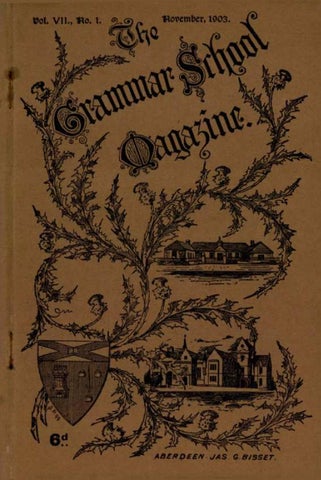
November, 1903.
Vol. VII., 140. 1.
Q
6
ABERDEEN • JAS. G.
eisser.
Educational Books. JAMES G. BISSET ONTINUES to supply all the Class Books (New or Second-hand) suited for the Requirements of the Higher Educational Institutions in the City, at the Lowest Prices.
C
N.B.-BEST VALUE IN STUDENTS' NOTE BOOKS.
JAMES G. BISSET, Classical, flbebical, anb ]Et ucational 13ooliseller,
85 BROAD STREET (Opposite Marischal College).
The Sportsman's Depot and Athletic Stores.
GEO. M. MACKAY (Fellow of Educational Institute of Scotland), Angling Correspondent for the "Field," "Fishing Gazette," &c.
50
BRIDGE
STREET,
• -
saFt 'DamN.
Telegraphic Address—"MACKAY. Bridge Street." N.B.—Close to Railway Station. High-Class Tackle of every description, for River, Lake, or Sea Angling. Flies dressed to any pattern. Greenheart and Cane Rods, Reels, Lines, &c. Angling Bureau and Fishing Agency. All information as to waters in the North of Scotland. Advice given. Fishings and Shootings arranged. Guns and Shot of the best and latest description. Air and Spring Guns a speciality. Golf.—Clubs, Golf Bags, Golf Balls, &c. Simpson's, Weir's, and other makers. Cricket.—Lockwood, Ayres, Lillywhite, &c. Tennis, Croquet, Bowls, &c. Football.—The latest and best in the Market. Repairs.—Rode, Reels, Guns, Clubs, Rackets, Cycles, &c., repaired at shortest notice. Golfing, Cycling, and Angling Gloves. Physical Culture and Gymnastic Apparatus.—Boxing Gloves; Flasks, Knives, &c. Mackay's Anti-Midge, for Gnat and Mosquito Bites, Is. Bottles. Post, is. 2d. Larger Bottles, 2s. od. Post, 2s. 9d. In-door and Out-door Games of every description. Catalogue and Anglers' Guide now ready. Free on application.
WILSON'S BOOKSTALL 45 MARKET
GALLERY,
Is the successor to the Old Shop, 31 Schoolhill, which supplied Books to Grammar School Students in olden days when Mr. Dunn was Headmaster. It is still keeping to the front with large stocks of Second-hand Books, in all classes of Literature.
COME AND SEE THE STOCK.
TEXT BOOKS oi-14
• 6
Cf all ImiN; (NEW AND SECOND-HAND), , D.WYLLIE&SON, 247 A I ONEESTREET N
JOHN C. M'LEOD, - - HATTER, - -
48-U NION STREET-48
.
Sole Agent for Messrs. Scott & Co., I Old Bond St., London.
on hand a Large Stock of Grammar School a LWAYS Badges for Caps and Glengarrys; Plain, Wool, and Regulation Jerseys; also, F.P.s'Jerseys, Belts, Knickers, &c. •••••••••••••••
•••••••• ••••••••VY
TROPHY AND CLUB CAPS MADE TO ORDER. Large
Stock
of Winter Ties,
November, 1903.
GloVes, Mufflers, 8ce.
CONTENTS.
ALEXANDER BAIN, LL.D. SCHOOL NOTES
-
-
-
-
-
Frontispiece -
-
1
-
-
8
NOTES ABOUT OLD BOYS
-
-
-
-
-
-
-
10
-
-
-
-
-
-
13
-
-
-
-
-
15
-
-
-
-
-
-
17
-
-
-
-
-
-
20
THE SWIMMING SPORTS -
..
-
-
-
-
21
A LEOPARD HUNT IN CHINA -
-
RANDOM NOTES
-
A FISHING EXCURSION NOTHING
-
TALL AMERICANS
-
THE SWIMMING CLUB
22
-
CRICKET NOTES
-
-
-
-
-
-
-
24
FOOTBALL NOTES
-
-
..
-
-
-
-
28
THE ATHLETIC SPORTS
-
-
-
-
-
OUR CONTEMPORARIES
-
-
-
-
-
33
DEBATER NOTES
..
-
-
-
-
34
POETRY-PEACE
-
-
-
-
-
36
..
_.
-
37
-
-
-
-
-
39
-
..
-
40
-
LEAVING CERTIFICATE EXAMINATIONS THE LIBRARY
-
-
-
POETRY-THE SNOW OF YESTER-YEAR SCHOOL OFFICIALS -
-
-
31
38
ALEXANDER BAIN, LL. D.
THE
&alma Sc1?oot tliaga3ine. -
Vol. VII.
NOVEMBER, 1903.
No. 1.
THE last time we commenced our editorial labours we
remarked that a May sun was beating down on our editorial head. Now, however, the case is different, for the rain is now beating down on our editorial roof. We have just been out in it, and the water is squelching in our editorial boots, and dropping from our editorial coat collar down the back of our editorial neck. The weather nowadays, as everybody must have observed, may be described in one word, " Rain," or, at most, in two, " Rain and Mist." However, there seems to be little use discussing the weather. As a matter of fact, it is beneath criticism, so let us leave this painful subject and pass to the more congenial affairs of the School. The School perhaps did not do itself full justice in the Bursary Competition, but the late Seventh have • completely vindicated their honour in the Leaving Certificates. Three years in succession has the School taken eight Honours Certificates, a record which it may well be proud of. Our heartiest congratulations are due to Ian A. K. Burnett, our late dux, who has equalled the feat of his predecessors, .John M. Robertson and George E. Hay, by taking Honours in Latin, Greek, and English, as many Honours as any one candidate is allowed to try. Burnett was one
2
The Grammar School Magazine.
of the best all-round scholars the School has ever seen, and we have not the slightest doubt that, had he been allowed to try Honours Mathematics, he would have secured that also, especially as he gained a pass in Analytical Geometry, with distinction. His success in the Leavings shows us all the more clearly how cruelly his failing eyesight hampered him in the Bursary Competition, but we earnestly hope that it will keep up during his University course, which is sure to be a distinguished one. The following is very wicked : —" A minister once tacked up a funeral notice which read thus: ' Brother Johnson departed for Heaven at 9.30 a.m.' Underneath, some sin-saturated soul attached a telegraph blank filled up as follows: `Heaven, 11 p.m.—Johnson not arrived yet; great anxiety.' Last year it was remarked that Mr. Middleton might well be proud of having for two successive years brought a pupil through Honours Greek. Mr. Middleton's power of imparting advanced Classical instruction has evidently not abated in the least, for once again has he piloted a pupil through that most difficult examination. More than that, Mr. Middleton has another honour to boast of, for, while for three successive years there have been only two Honours Classics gained by the School, the number has this year been increased to three. We offer our hearty congratulations to the Rector and Mr. Middleton on these splendid results achieved by their pupils, and hope that this year the record may be, if not improved on, at least kept up. We must also congratulate Mr. Murison on the splendid performance of his pupils in taking thirteen Honours English in three years. This is a result of which any master might be proud. " Papa," said Willie, as he watched his mother packing her trunks for the seaside, " elephants has trunks, don't they?" " Yes, Willie." "Does the lady elephants have more'n one? " All Grammar boys, past and present, will, we are sure, with one accord, welcome our frontispiece. A more distinguished and eminent scholar than Dr. Bain, the philosopher, never left the Grammar School. We were proud
School Notes.
3
of him, and had good reason to be. Perhaps none of our present pupils ever saw him or heard him speak, but we venture to say that all must have heard his name ; and to have heard his name and to know that he was a distinguished Old Boy of our School is enough to bring forth our admiration for him. We are greatly indebted to the Alma Mater Staff, who so kindly lent us the block of his photograph. Our frontispiece is a famous picture of a still more famous man. Master—" What is space ? " Confused Pupil—" I can't describe it, sir, but—well, I've got it in my head."
*
The Debating Society has commenced its season again. The results of the elections have one unsatisfactory feature: there are too many novices appointed. Several of the Committee, for instance, have never been heard to deliver a single speech. However, this is a fault which we hope will be easily remedied by their taking zealous interest in the welfare of the Society. We feel sure that at least they will do their duty better than some members of last year's Committee. The new President, H. G. M. Wilson, we are certain, will give every satisfaction. IV. E. Wallace, the Secretary, has also shown commendable energy in promoting the affairs of the Society, and we reget that he has been able to fill his post for only a short time. Teacher (severely)—" Is that chewing gum in your mouth ? " Boy—" Yes, ma'am." Teacher—" Give it to me." Boy—" Wait, and I'll get you a piece that isn't chewed." Mr. G. S. Russell opened the session with a most enjoyable paper. Mr. Russell has always proved himself most willing to help the institutions of the School in every way he can. We wish all other F.P.'s were as loyal. Mr. Mixup (to his son at a concert, during the performance of a duet)—" D'ye see, Tom, now it's getting late, they're singing two at a time so as to get done sooner." Again the Library officials have the old complaint to make about the scarcity of members. We are afraid the
4
The Grammar School Magazine.
School is beginning to lose interest in this institution, and we regret it very much. We asked a youth not long ago his reasons for not joining, and his reply was, " Oh, rot! I've read all Henty's and Ballantyne's books, and there's nothing else worth reading." We can assure anyone who thinks so that this is not the case. Henty and Ballantyne are very enjoyable in their way, but they should not be considered the Alpha and Omega of literature. We would suggest that the Lending Library might be improved by the transference of several of the books in the Reference Department to the Lending. Why should not the two Libraries be made one? Who went and bought me a little gun? A pretty toy for her darling son ; Who sent me out to have some fun ? My mother ! But one day when I got a chance, And slyly shot at sister Nance, Who pressed a boot against my pants ? My father ! Our Sports have once more passed by, and we congratulate all those who were fortunate enough to win prizes. This year the number of entries was a record one, as was also the number of spectators. The average results of the events were far above those of last year, and in three events a new record was made for the School. We compliment A. Reid on the excellent exhibition of hammer throwing which he gave, and also G. E. Scroggie, who was one of the most successful competitors at the Sports. As was anticipated, the mile, the race of the day, was very hotly contested. Five started in the final, and, after a fast race, Wallace reached the tape, with Todd a few yards behind. We congratulate Wallace most heartily on winning this race. The number of spectators, we said, was a record; but, we might remark, the public do not pay their money and don their best to see certain " be-chokered " non-members of the committee, officious boys of the VI., showing off their beautiful forms on the field. Boys ! read and profit by this :— " Do cigarettes hurt a boy's brain? "
School Notes.
*
5
Doctor—" Oh, no! Boys with brains don't smoke them."—Ex. We have not had what one might call a successful season in cricket, but, although we have lost the majority of the matches, yet most of them have been very evenly contested—far more so than in the former season. We regret to say that our worthy captain, H. M`Pherson, has left us, but it is in football that he will be missed more. As a " footer" captain, we have never had a better, and we are pleased to note that he is one of the leading lights in the F.P.'s. We grieve also over the loss of P. B. Simpson, who distinguished himself equally on the cricket as on the football field. Teacher—" Johnny, repeat after me—Moses was an austere man, and made atonement for the sins of his people." Johnny—" Moses was an oyster man, and made ointment for the shins of his people." The School may well be proud of their last " footer" season, for a team in which the players combined as well could not be found in Aberdeen. The team scored in every match—a record unprecedented. We only lament that when we reached the end of the second game this season this glorious line of successes was brought to an end. The scoring honours of last year went to M. J. Williamson, who, as everyone will admit, with Leonard Smith and H. 3/Pherson formed the backbone of the team.
0
Though we are not so strong as last year, we hope to improve. Our captain, Wallace, has unfortunately already left us. Wallace is a good all-round player, and can play equally well in every part of the field. It would seem as if all our big fellows were leaving us. Let us hope there are still a few more to fill their place ! Professor—" How dare you swear before me? " Student—" How did I know you wanted to swear first? " When reading over some old Magazines lately, we noticed one thing which fairly brought tears to our eyes. It was a passage in the football notes, where we read that, two years ago, the Gordon's College team was defeated by 51 points to nil. Tempora mutantur, in sorrowful truth,
6
The Grammar School Magazine.
for what do we read now? The Grammar is beaten by 16 points to 11. For goodness sake, Grammar, buck up! You have two chances of avenging your defeat; see that you do it. Last month the Leaving Certificates and Sports Prizes were presented—the former by Mr. Craigen, and the latter by Colonel Cruden, F.P. There was a large attendance of practically the whole School, and several parents and friends also favoured us with their presence. We hope that the sight of the many and beautiful prizes carried off by the winners will cause the number of entries to be doubled at next sports. The more competitors, the handsomer prizes, remember. " Has your bull-pup been properly broken yet? " " No," replied the dog-fancier; " but if you touch him, he'll snap." We join with the whole School in heartily congratulating Mr. M`Leod on the degree of D.Sc. which he has received from the University. Among boys on the Modern side especially Mr. M`Leod's name is a household word, and the Classicals too, though they do not get the benefit of his instruction until they come to the Seventh. It is no exaggeration to say that Mr. M`Leod is one of the most popular and efficient masters in the School. In every branch of Mathematics, and in almost every branch of Science, Dr. M`Leod is an expert, as he has shown in his Lectures to the Debating Society, which we looked forward to every year with so much interest. Last year we had the ' Electric Tramway explained to us, and this year Dr. M`Leod is to expound the mystery of Wireless Telegraphy. An Epicurean is a man who pampers his stomach with the best of fruits, and has a roast goose for his dinner every day. Another thing which must have caused great gratification to Dr. M`Leod is the brilliant success of his late pupil, W. P. Milne, in Mathematics. It was recorded in our last issue that Milne had carried off the highest Honours and Prizes in Mathematics, and now we are still further gratified to hear that he has been awarded one of the Ferguson Scholarships, the " blue ribbon" of Scottish University success. He has entered at Clare College, Cambridge.
School Notes.
0
7
The Ichthyosaurus lived of yore In the region of Timbuctoo, When the water was H2 SO 4 And the air was C02. Our staff this year has been considerably weakened. We lament greatly the loss of our Literary Editor, Ian K. Burnett. He was for a short time Editor-in-Chief of the Magazine, and even after he had to resign that post owing to his weak eyesight, his ability and experience were always at our disposal, and were of great assistance to us. We learn also the loss of J. B. Gillies, our Business Manager, who has resigned his post, which he always filled with great energy and skill. His place has been taken by J. A. Wattie. We beg to acknowledge receipt of donations of £2 from the Swimming Club and £1 from the Debating Society. Thank you, Societies ! Let 'em all come ! The Syllabus of the Society has been issued, and promises to be a very attractive one. There were rather too many set debates last year, but this year the number has been reduced. We hope, by the way, that all who have undertaken to take debates will fulfil their promises, as there were several regrettable instances of the contrary last year. We are again to have a Judicial Night, which has always proved a most successful and enjoyable function; and lectures and papers by masters, former pupils, and friends, as usual, fill up the Syllabus. What is phonetic spelling?
4
Spelling by shorthand.
Grandpa had an easy chair, Johnny had a pin, Papa had a trunk strap, And Johnny's pants were thin. The Swimming Club has once again been set agoing. Let us congratulate J. B. Gillies and W. R. Eddie, our new captain and vice-captain. Two more suitable fellows we could not find. Eddie, our readers will remember, won the Rector's Cup and Medal at our last Swimming Sports. The Swimming Club is at present in a very flourishing condition. May it long continue so !
4
re
WITH the death of Dr. Alexander Bain our School has lost its most illustrious name. It is true that Dr. Bain was a pupil but for a short time in 1836, but he showed his interest in us by acting as one of the Honorary VicePresidents of the Former Pupils' Club. The Honourable L. B. Shirres has been appointed Financial Secretary for Bengal and Member of the Council of the Lieutenant-Governor of that Province. H. F. Lyall Grant and Hardy Philip have taken their LL.B. degrees at Edinburgh University. We congratulate our distinguished Old Boy, Murdo Morrison, on being appointed a Junior Inspector of Schools. His career both at School and College was brilliant, and, after graduating with honours, he was appointed a master in the Nicolson Institution in far-away Stornoway. Robert W. Dunlap has taken the B.A. degree of the University of Washington " magna cum laude." He was first in the examination. During our tour in Portugal this summer, we had the pleasure of meeting Bob Walker in Oporto. He wishes to be remembered to all his old School-fellows. His father, who kindly showed us over his wine-lodge, besides piloting us over the town, intends to send another son to us soon. Jack, the elder brother, is now farming in the United States. At the head of all the athletic clubs in Oporto and there are many—is an Old Boy, J. Smart, who was a noted footballer when he was with us. At our Sports there were representatives of the following countries on the field : —Spain, Mexico, Chile, Philippine Islands, Burma, Australia, Germany, England, Scotland, United States, Ceylon, British Guiana, German East Africa, India, Straits Settlements.
Notes about Old Boys. 0
9
Mr. John Gerard Anderson, Under-Secretary of Public Instruction, Queensland, has been made a Companion of the Imperial Service Order. He graduated in 1854, and he was for a number of years a school inspector in Queensland, before his appointment as permanent head of the Education Department of the State. Mr. John Macdonell, C.B., Master • in the Supreme Court since 1889, has received the honour of Knighthood. Sir John, who is one of the leading jurists and writers of the English Bar, besides being one of the authorities on International Law, is Quain Professor of Comparative Jurisprudence in London University. He was invited by the Russian Government to attend the Congress at Petersburg of the International Union of Penal Jurisprudence. He has edited the new series of State Trials, a work of great historical as well as legal importance. He also edited the Civil and Criminal Judicial Statistics. Sir John is LL.D. of Aberdeen, and is also member of many of the learned societies, as well as Vice-President of the Royal Statistical Society. With him and Lord Justice Stirling as our representatives at the English Law Courts, our School may well indulge in a feeling of legitimate pride.
•
a
The Rev. Dr. George Philip, of St. John's United Free Church, Edinburgh, who left the School as First Bursar at Marischal College in 1833, has just celebrated his diamond jubilee, and has been presented with an illuminated address by his congregation. At the meeting, an apology for absence was read from the Rev. Dr. Murray Mitchell, Nice, who is ",father" of the United Free Church of Scotland. In his letter, Dr. Mitchell had many interesting reminiscences of the Grammar School seventyfive years ago, when Dr. Philip and he were pupils under Melvin. Seventy-five years ago ! We offer to both these Old Boys our respectful salutations. May they still have many happy years before them. Dr. George Philip is not the only distinguished member of his family, for his brother is the Rev. Dr. John Philip, formerly of Fordoun, father of Mr. J. Bentley Philip. He is, of course, an F.P. as well.
10
The Grammar School Magazine. RANDOM NOTES.
THOUGH we have not such amazing miracles as last time to chronicle, yet several exceedingly curious phenomena have been observed lately. Although football has been in progress for more than a month, we have heard of only three footballs being lost. The exceedingly small number of broken windows, too (four or five only, we believe), has aroused great amazement.' The authorities of the School are now taking an admirable interest in finding out the time taken for preparation of work, and we have even heard a rumour (which, however, we publish with all reserve) that some of the masters have signified their intention of reducing the work ! We live in hopes. •
Contentment seems to reign in the School just now, especially among those who cycle to School every day. Our School " stables " are without doubt an ornament to it, and in the name of all who use bicycles we beg to thank the School Board for the splendid accommodation provided for the machines. Sometimes we do hear rumours of holes being cut in tyres, padlocks snapped, valves removed, and cycles upturned and left lying in lime-heaps, but these little inconveniences are small matters when we think of the luxurious quarters which the bicycles are allowed to occupy. We note, by the way, that a new feature has been started among the Lower classes. This is an arrangement by which, at three o'clock, junior pupils may practise cycle-riding. The infants' playground makes an excellent race-course, and a large selection of bicycles is supplied, free of charge, in the verandah. We regret to see that, owing, we believe, to some remarks made by the Rector some weeks ago, these opportunities have not been so largely taken advantage of as formerly. While passing the old workshop a day or two ago, we could not help thinking what a handsome building it looked. The beautifully boarded-up windows gave the place a most noble aspect. This fine building, as everybody knows, has proved extremely useful for the last two years, and indeed it is difficult to think what the School would have done without it. The Debating Society has commenced a new session,
Random Notes. 4
11
and has already had two meetings, which have been of a most orderly description, only one desk being broken and the half of another hacked off. At the first meeting, all who spoke were delighted with their reception, one in particular remarking that he had been hit by only five paper pellets and two books, and howled down only four times. The second meeting was of a very peaceful nature, but one very regrettable and annoying incident occurred. While one of the papers was being read, a certain member created such a disturbance that he awoke the President, who immediately, with praiseworthy vehemence, called the unruly member to order, expressing his earnest hope that such a painful incident should not occur again. We too sincerely hope that the slumbers of our worthy President may never again be so shamefully disturbed. The Football Club has also commenced its season, which promises to be a very successful one. Up to the present time, at any rate, the XV. can boast of having lost only three matches, and considering that they had to engage such powerful veteran teams as Gordon's College and Queen's Cross, the record is a most admirable one. Alma Mater, we observed, found fault with the Old Boys' notes of our last issue as being slightly touched with "side." We shall not dare to dispute this assertion; before the opinion of a periodical which is a whole year our senior we bow in humble submission. Perhaps in future we shall have to make abject apologies for the success of our Old Boys ; it is evidently a great mistake to appear the least proud of them. We note, too, that Alma Mater objected to our placing an advertisement of an excellent kind of cricket bats among our reading matter. This, we own, was a most grievous blunder, and we trusts that our Advertisement Committee will remedy this in future. We would advise them also to do away with such inferior advertisements altogether, and to follow the example of our illustrious contemporary by inserting advertisements of old clothes buyers and funeral undertakers. The Athletic Sports took place about a month ago. Accounts of them will be found elsewhere. We shall only remark here how pleased we were to note how everyone seemed to be so anxious to help the committee. This was particularly the case with two prominent pupils, who, at
12
The Grammar School Magazine.
the urgent request of the committee, very kindly consented to help in the proceedings. The committee have been wondering ever since what they would have done without them. We particularly remarked how careful one of these gentlemen was, while officiating at the blackboard, to avoid making any such misspellings as were made last year. He very prudently made a point of consulting his programme for all words he was doubtful about. Some youths, we observed, kept out of the quarter and half-miles in order to keep up their strength for the sack race. A most prudent action, was it not? One of the sack races, we believe, was spoiled by a youth falling through a hole in his sack. We hope that this lamentable occurrence will not occur again. We are sorry to see how far down some of the times were this year, but this is partly to be explained by what we have mentioned above. Perhaps, too, the refreshment tent is partly responsible for it, as several of the athletes seemed to have patronised it less wisely than well. The census which was taken of the amount of time spent on preparation has made startling revelations to the masters. They are now beginning to realise what they have been responsible for, and, we believe, are very penitent for their past tyranny. And no wonder, for the lot of negro slaves before their emancipation seems to have been a happy one compared with that of some of our schoolmates. Some of those in the higher classes, according to their schedules, spent over six hours every night at their work. But their troubles, we hope, will be considerably reduced now, and a new era of at least partial liberty is about to commence. We are reminded of the saying, " And trouthe shal delivere, hit is no drede." On the whole, everything seems to be cheerful nowadays. It rains cheerfully in the morning, it rains cheerfully at noon, it keeps on raining cheerfully throughout the afternoon and evening, and pours cheerfully all night. The water runs in cheerful rivulets on the streets, and in low places it stands in cheerful pools. Cheerful clouds are always drifting across the sky, except when they are shrouded from our gaze by the cheerful fog. In the football field, the players cheerfully slide and wallow about in the cheerful mud. In fact, a more delectable state of things could scarcely be imagined.
A Fishing Excursion.
13
A FISHING EXCURSION. "ANGLING is always to be considered as a stick and a string, with a fly at one end and a fool at the other." Though this saying is not entirely true, yet the last phrase—with regard to me at any rate—almost invariably proves to be true. Sometimes I have shown myself worthy of even a stronger epithet, and it is my intention to tell you of the day which, in all my fishing experience, "takes the cake," as we are inclined to say nowadays, for my making an ass of myself on a fishing excursion. I am less chary in telling of this, seeing that I was not unaccompanied on this eventful day, having two of my chums to share in the pleasures of it. It was in the middle of our last summer holidays, and we had absolutely nothing to do. There had been a little rain during the day—not an uncommon occurrence in these parts—and, by way of change, we decided to go a fishing excursion. My two chums, Muggins and Juggins, were to look after the tackle and the bait, while I, as commander-in-chief, was to see to the provender. The scene of our excursion was to be a village eight miles from where we were staying ; and, to arrive there in decent time for a good day's sport, we found it necessary to travel by a train at 6.45 a.m. I had to call on my way to the station for Muggins and Juggins at 6 a.m. prompt, so that there would be no need for hurrying. So it was all arranged. The next morning, at 5, I awoke to hear the rain pelting on my bedroom window ; but by the time I was ready to proceed on my way, armed with an abundance of "grub," the sun was shining—remarkable, but nevertheless true—and consequently I saw no need for a waterproof. Just as 6 was striking on the village clock, I tugged rather violently at the bell of the house in which Muggins and Juggins resided. One minute passed ; no answer was forthcoming, and I gave such a pull at that bell that I really thought the wire would snap—and it did. However, I was not to be overcome by a mere detail like that. Round I went to the back of the house, and pelted Muggins & Cots window with gravel. This had the desired effect, for two heads soon appeared at the window, and two voices exclaimed simultaneously, " Jingo, is it that time already?" No answer was needed to that
14
The Grammar School Magazine.
question. The two were pulling and tugging at trousers and stockings, and by 6.15 a.m. were dressed. By the time they were ready to start, however, it was half-past six, and we had a good mile to go to the station. " Perseverance wins the day," however, and we entered the station as the train was about to start. Without tickets, we leaped into a first class just as the train began to move. We soon recovered our breath, and likewise our good spirits, and it was not long before the train steamed into our destination. We soon got out, only to be S---, confronted by a ticket-collector, who would not believe our story, but who was mollified on receiving a " tanner," and on our paying up third class fare we escaped. Ten minutes' walk brought us to the " burn," and immediately all was bustle. Muggins had been so liberal with regard to hooks that he had provided one for each of us and an extra one for himself. But when we were searching for the bait in Juggins' basket, and could find none, we looked up and espied that hero vigorously turning up stones, and every now and then casting a furtive glance in our direction. Then it came out that in the hurry he had forgotten altogether about the bait, and that, as a result, we should first have to " howk" for worms, or it would be " goodbye" to the fishing that day. By dint of hard labour, we managed to gather together about a dozen green-looking animals which Mugging informed me, much to my astonishment, were worms--real live worms. For the next half-hour or so, we patiently fished away, but with no result. Soon after that, however, the wormhero, Juggins, started leaping about in ecstasy, and informed us he had caught a "thumper." On examination I found it was a " bandy " about 3-1- inches long, and which, much to the disgust of its captor, I deposited safely in its proper dwelling-place. No further reward attended our patience, although we fished for two or three hours longer, and it suddenly dawned on me that we should be none the worse of a little " provender." Accordingly we all sat down, and, as it was more pleasant to eat than to fish, we ate till the refreshments were exhausted, and till we could hardly move. We found it necessary to rest a while, and before five minutes had elapsed, we were all in the midst of dreams. When we awoke it was about three in the afternoon. The sky was very much overcast, and it was not long before it began to rain—not the drizzling rain which we have
A Fishing Excursion.
15
every day in Aberdeen—but rain that came down in sheets, or, in other words, like " cats and dogs." At anyrate it seemed like it. We were all unwilling to go home emptyhanded, and, thinking that the rain would make the trout take, we fished on, and were soon soaked to the skin. Our return train left at six, and just as we were thinking of stopping, I landed a half-pounder. This put new life into us. Muggins and Juggins said we could easily fish till quarter to six, and be in plenty of time for the train ; so we did fish till quarter to six, but no more fish were caught. We tore like madmen—the fact is, we were pretty near madmen—to the station, but far be it from us to catch the train. Not so far, however ; for, as we entered the station, we saw the tail-eud of the train disappearing round a curve, and the station-agent, with a smile about two feet long, remarked in the tenderest of tones, " Just in time to be too late." It was tantalising, or, as Muggins said, " sompthing chronic." But, seeing it was the last train, we had perforce to tramp those eight miles home. In glum silence, we started along the road, and not even the remark of the station-agent, " Three fishers went trailing out into the wet," could provoke a smile on our countenances. We arrived home about nine o'clock, in a sodden condition, footsore and weary, vowing never to fish again ; but I am sure (if it were legal) we three fishers would set out to fish to-morrow as eagerly as we set out that day last summer. NIL DESPERANDUM.
NOTHING. I HAVE been asked to " write something " for the Magazine It was the Editor himself who honoured me with the request, and when the Editor honours one in that way— well, I appeal to those who have been similarly favoured, What is to be done ? What can, be done ? Nothing ; only submit. This leads me up to my subject : what is nothing? I have often noticed that young, inexperienced writers, when asked for a contribution, reply that they have nothing to write about. Then why in the world don't they write about it? I have been deceived too long now by such to wait any longer for a paper upon the subject.
16
The Grammar School Magazine.
Again and again I have eagerly scanned the pages as soon as printed for even a trace of what was promised. And I have invariably been disappointed. There is always something—however worthless. Tearful reflections on this—one of the innumerable frailties of human nature—led me to take pen in hand, and attempt doing what they have not done. And before proceeding further it may be as well—in order to the true understanding of this paper—to impress thoroughly upon everyone what nothing consists of. For which purpose I have at length, after much meditation and tribulation of spirit, attained a most admirable definition. It is strange how unsympathetic one's friends are in matters of this sort. When I was in sore trouble over the definition I applied to mine. Alas! so far from being definitions their answers were irrelevant and insulting remarks about the amount of brains generally possessed by essay writers ; and I withdrew in silence and in sadness. An Irish gunsmith was kinder. " Nothing," he informed me, " is an invaluable substance in the manufacture of fire-arms. In fact, without it we could never form the barrels, which are merely long, slender cylinders of nothing incased in steel." Yet, valuable as it thus would appear, the majority of people don't seem to realise the fact; for when they are possessed of it, they use their utmost energy to get rid of it again. To such I would point out a remarkable advantage that nothing possesses. It can never grow less! The widow's meal and cruse of oil could not go one better. Yet perhaps, considering the matter from a nutritious point of view, the widow was wise in her preference of meal and oil. A man once—so I have been told—endeavoured to train his horse to live upon nothing ; but unfortunately, just when the course of training was completed, the horse died. From this we may have some ground for inferring that nothing is not very sustaining as a food. Its power of penetration, however, is something extraordinary. It has a knack of continually getting into one's pockets, and especially one's purse, which seems to be its favourite residence. Even vacuums generally contain a considerable amount of it. Incredible as it may seem, I venture to say that whatsoever is perfectly empty will— on close inspection—be found to be full of nothing. This seems a paradox. Experiment will prove its truth.
Nothing.
17
The arithmetical symbol of nothing is a cipher. But, of course, everyone knows that in mathematics figures are merely material representations of the impalpable; and this is even more than usually so in the case of a cipher, since the enclosing circular line is absolutely valueless, the real representation of nothing being within it. A great many ignorant and pig-headed people contend that nothing does not exist ; that its very name implies non-existence; that, since it does not exist, neither do its qualities and properties : and so dismiss the question. If there are any such among my readers (I sincerely hope there are not), let me recommend for their earnest study the " Time Machine," by H. G. Wills. This might convince them that, if nothing does not exist, neither does anything else ; since every solid is composed of an infinite number of planes, every plane of an infinite number of points, and a point having only position but not magnitude, therefore does not exist : hence a solid does not exist. And now that I have finished, what do you suppose my essay is worth? Nothing? You pay me the highest compliment possible; it is not every writer that makes the paper written worth the subject written upon. Yet one word to those (if any) who were disappointed in the third paragraph, and who may think I omitted to give the promised definition of nothing. By that omission they received a clearer definition of it than the most carefully worded definition could have given them. A. C. H. TALL AMERICANS. THERE is an old Scottish proverb which says, " If ye tell a lee ava, ye may as weel tell a big ane." Now, most people are adepts at telling both lies and big lies, or rather, to put it more politely, fibs and big fibs. It seems to come natural to nearly everybody, but yet there is an art in prevarication (to use another polite term). This art consists in telling lies which do no harm, and merely serve the purpose of amusing the hearers. We shall not deal with the ordinary exaggerations or hyperboles of everyday conversation, as these are familiar to everybody, but with the sort of stories which, when told at dinner, make us reach eagerly for the salt-cellar.
18
The Grammar School Magazine.
The place to go for the finest type of long-bow drawing is, of course, America. It is natural for every man to make his words greater than his deeds, and as the Americans are always accomplishing great things, their stories have to be large in proportion. Everything is wonderful in America, the stories especially. The dogs of America, for example, are wonderful animals. One, which belonged to a gentleman in New York, got lost, but, noticing an advertisement for himself in a piece of newspaper fluttering down the street, promptly went home. Another story is told of a dog who belonged to a sheep-farmer. One of the duties of this dog was to stand at the gate of a field as the sheep were passing in, and count them. This he did in the following manner. A pile of pebbles was placed beside him, and for every sheep that passed he pushed a pebble aside and thus formed another heap, which his master afterwards counted. One day, however, he was found biting and gnawing at a pebble to break it in two. It was afterwards found that a lamb had been added to the flock the night before. Another gentleman of New York was the possessor of three very fine and intelligent dogs. He allowed them almost perfect licence in everything, but there was one sofa in his drawing-room which he was very fond of himself, and which he never allowed his dogs to lie on. One night, however, coming home rather late, he found the animals sound asleep on the forbidden sofa. He drove them off immediately, and gave them a sound thrashing. When he came home next night the dogs were lying innocently on the floor, but on putting his hand on the sofa he found it was warm, and knew that the animals had been disobeying him again. This time he flogged them more severely than before. On coming home next night, he found that the dogs, having lain some time on the sofa, and, being afraid that its warmth might betray them again, were blowing vigorously on the sofa to cool it. So much for American dogs. Let us now deal with American railways and trains. They are, according to Americans, among the most wonderful things in America, which is saying a good deal. These trains go round curves where the guard can light his pipe from the fire of the engine, cross chasms so deep that the passengers have to use telescopes to see to the bottom, and descend gradients where the rear of the train has to be pressed
Tall Americans.
.
19
on to the rails by weights to prevent it turning a somersault over the engine. As regards the speed of American trains, it is well known that the telegraph poles usually appear one continuous wall, and passengers have to be very careful, for who has not heard the story of the young man, who, as his train was starting, leaned out of the window to kiss his sweetheart good-bye, and found himself, one second after, kissing a porter at the next station ? During the winter Americans suffer from very severe cold. It is nothing for a man to find that his thermometer has turned itself upside down to enable the mercury to sink further, while business men are often inconvenienced by their coffee freezing as they pour it out, and sometimes a man finds it impossible to blow out the candle, owing to the flame being frozen so stiff that it has to be broken off. In summer, however, they are recompensed by as excessive heat, for in the height of the hot season they have to put their hens in ice-chests to prevent their laying hard-boiled eggs. This reminds us of a conversation which took place between two famous African travellers. One of them had been in Egypt, and declared that it was "a fine country; but, by Jove, what awful heat! They think nothing of cooking their eggs in the sun, and often are able to cook them in the moonlight." " Bless you, that's nothing to Zanzibar," said the other. "They can cook eggs there on a pitch-dark night, and whenever they want boiling water for tea they have just to go to the nearest river." One American artist can boast of having painted a piece of marble so like cork that it floated, while another painted a piece of orange-peel on the pavement so naturally that the first passer-by slipped and fell down on it. Another artist had a wife of very extravagant tastes, whose favourite fruit was grapes, with which she insisted on his keeping her well supplied. He found that his money was fast running away until he hit on a plan to deceive her. He carved and painted small pebbles so exactly like grapes that his wife ate them and never knew the difference. This is as good a record as that of the novelist whose books are so full of burning emotion that they have to be written and printed on asbestos paper. "When Greek meets Greek," or rather, "When Seventh meets School, then comes the tug-of-war"; and when two Americans enter into a contest of lying, the
20
The Grammar School Magazine.
result is interesting, to say the least of it. One day two agents for fire-proof safes met at an inn, and each, naturally, loudly advocated his own wares. "At anyrate," said one, " our firm once put their safes to a test which yours were never put to." " What was that, pray? " asked his rival. " Well, it's easily told. We shut up a live kitten in one of our safes, placed the safe on the top of a bonfire, set a light to the pile, and poured tar and paraffin on to the blazing pile until the safe was red-hot. Then we let the fire die out, opened the safe, and found the kitten as lively as ever, not a bit the worse." " Oh, that's a mere nothing," said the other. " Our firm once put one of their safes to a much severer test than that. They made an extra big safe, and, not content with anything so insignificant as a kitten, they bought a polar bear from a menagerie, enclosed it in the safe, and had the safe put into a smelting furnace, heated to an inconceivable degree, and kept in the furnace for twelve hours. When the safe cooled sufficiently for it to be opened the polar bear—" " Was dead, of course," chuckled his rival. " You are right, my friend ; the poor bear had been frozen to death."
4
THE SWIMMING CLUB. THE Annual Meeting of this Club was held in Room I. on October the 21st, the Rector being in the chair. A proposal was made by the Rector to have members of the Club taught swimming free of charge. If this is feasible, the membership of the Club ought to increase very much. We would especially draw the attention of parents to this. For one shilling, members of this Club get into the baths at a reduced rate, and get taught that most useful art, swimming, free of charge. The following officials were then elected :— Captain—S. B. Gillies. Vice-Captain—W. R. Eddie. Secretary and Treasurer—A. Campbell. Committee—H. G. M. Wilson, R. N. Paton, S. M. Robertson, C. D. Peterkin, G. E. Scroggie. The meeting closed with a vote of thanks to our Rector.
4
g
The Swimming Sports.
21
TtIE SWIMMING SPORTS. • THE School Annual Aquatic Sports took place on the 3rd of June. There was a very good attendance of spectators, but the entries and swimming were not so good as in former years. Our Rector was in the chair. The first event, as usual, was the race for the Rector's Cup and Medal. This race decides who is the best swimmer in the School. The race, which, for the first three lengths, was very equal, was eventually won by W. It. Eddie, A. M. Watt being a good second. It is not given to many to win this cup the first time they enter for the sports, and W. It. Eddie must be congratulated on his success. Eddie has a style of his own, the main feature of which is an exceedingly strong leg kick. Some competition was expected in the neat dive, and the winner, H. M`Pherson, was run very close by A. Campbell, who was second. The three-legged race was an innovation. It was won by A. M. Johnston and W. E. Wallace. Needless to say, the winners did not break any records. The greasy pole was in an improved position, as far as the spectators were concerned, but several competitors who fell off towards the shallow end thought the water might have been deeper. It was a pity that the team race, Classical v. Modern, did not come off, as it would have proved very close and exciting. The Rector, in a few suitable words, brought the proceedings to a close. We must express our indebtedness to A. Johnstone, Esq. (T.S.C.), who ran the sports most successfully. The following were prize-winners :— Rector's Challenge Cup and Silver Medal (120 Yards) —1 W. R. Eddie, 2 A. M. Watt. Neat Dive-1 H. M'Pherson, 2 A. Campbell, 3 W. Shepherd. Junior Handicap (Two Lengths)-1 D. S. M'Afillan, 2 G. A. Ledingham. Senior Handicap-1 J. B. Gillies, 2 A. M. Watt. Plunge-1 J. B. Gillies, 2 H. M`Pherson, 3 W. E. Wallace. Three-Legged Race-1 A. M. Johnston and W. E. Wallace.
22
The Grammar School Magazine.
Object Diving-1 H. M`Pherson, 2 W. Shepherd, 3 G. A. Ledingham. Candle and Potato Race-1 A. M. Watt, 2 ',V. Shepherd. Greasy Pole-1 W. R. Eddie, 2 W. Shepherd. Obstacle Race-1 W. R. Eddie, 2 A. M. Watt. J. B. G. A LEOPARD HUNT IN CHINA. Ix the immediate neighbourhood of the engineering work with which I am at present associated, there is a large number of people who dwell in caves excavated in the " Loess." This geological formation is of great interest, and many different theories are placed on record as to its origin. But for the present purpose we shall take it as we find it. Sometimes it forms cliffs of height up to two hundred, and even three hundred, feet of a perfectly homogeneous earth: Sometimes it is in detached needlelike pillars standing alone. Generally it has a vertical cleavage. In any case, its structure and climatic conditions make it very adaptable as dwellings for those who take the trouble to excavate a hole sufficiently large to live in. If you can afford a door, all the better. If you do not mind the smoke of the cooking fire, do not trouble to bore a hole through the roof for a chimney. Some of those loess caves are very extensive, and, we hear, have been used as refuge places for banditti and suspicious characters, of whom there are plenty in these parts. Hunting round in the loess district the other day, I chanced upon a weird-looking old Chinaman, whose pigtail had almost worn off. He carried a large matchlock gun, and was placidly smoking a long bamboo pipe—just exactly three feet in length the pipe was, and it had a jade mouthpiece, in addition to sundry ornamental attachments. " In that cave, just exactly 47 years ago, I nearly died of fright in one of my leopard hunts. Surely you must know that I am Mung, the leopard hunter? " he said, with an air of superiority, between the whiffs of his bamboo. " It was this way. The leopard had come down from the hills, and had eaten several of our pigs. It had also run away with a small child. Not that the child was of much importance, as it was ' only a girl child' [the Chinese, of the poorer class in particular, do not set a high value on
A Leopard Hunt in China.
23
their daughters—they cannot work or worship at the ancestral shrine, and they will probably get married and work in the household of some other family], but we made up our minds to slay that leopard, and, as good luck would have it, we traced him to this particular cave. Wang went first, with a torch in one hand and a long knife in the other. I followed on with the matchlock, with its match fusing. Soon we saw in the dark recess of the cave the glaring eyes of the fine, full-grown leopard. He was preparing to spring. I levelled my gun at him and fired. There was an enormous yell. The explosion of the powder had extinguished Wang's torch. I was dashed to the ground, and felt the fangs of the brute in that part of my anatomy used for sitting purposes. I fainted, and felt I was dead and gone to my fathers. How long I lay in that cave I know not, but I found myself on a couch in my house feeling weak and faint. The skin of the leopard lay beside me. No look of sympathy at my terrible accident and marvellous escape was evident in the assembled company of my friends. All looked amused except Wang. I felt for my wounds, and caused more amusement. The truth was told me at last. In the scrimmage after my shot at the leopard in the cave, which had proved fatal to the leopard, Wang, in trying to get out of the cave, had knocked me down. He held the drawn knife in his hand. I sat on the point of the knife. Excitement, darkness, and the growling of the dying leopard did the rest, and I thought I was being devoured. Wang was confident that I was killed, and it took half a day before a rescue party could be got to enter the cave to ascertain my fate. Meantime I lay unconscious. Now I am chief of the leopard hunters of the Tai Hang Mountains, and hundreds have I killed since that day. But I have no intercourse with the Wang family." ALEXANDER REID. THERE was a young student at School,
Who for a leaving certificate entered ; In his first shot he proved not a fool, And his boasts on a higher were centred. Next year, and the tale's very sad, For honours he gaily did try ; He thinks all the examiners mad, A lower received he. 0 my ! 27r.
24
The Grammar School Magazine.
A.G.S.C.C. (1903). ASYLUM V. ScnooL.—This fixture was played off in
the Asylum Grounds on a wicket which was very soft owing to the recent rains. Three of the team were absent. Campbell was top scorer with 24. P. Simpson and Campbell bowled for the School. For the Asylum, Stewart played a faultless game. Rather bad judgment was shown by the School, four of the team being run out. The scores were—Asylum, 103 ; School, 57. KINTORE V. ScnooL.—In lovely weather, the School travelled to Kintore to play off this game. Kintore took first lease of the wickets, and Ramsay, playing a very steady game, ran up a score of 24. For the School, the two highest scorers were H. M`Pherson and A. Campbell, with 11 and 13 respectively. Rae bowled well for the School. The scores were—Kintore, 91; School, 62. BANCHORY V. SCHOOL.—This match was played at Banchory on a soft pitch. About an hour before the time for starting, the rain began to come down in torrents, and play had to be stopped frequently. P. Simpson played splendid cricket, and had hard luck in being bowled just before time. Rae and Campbell bowled well for the School, the former having five for 10 runs and the latter three for 6. The game ended in a complete victory for the School, the scores being—School, 92 ; Banchory, 19. 'VARSITY V. SCHOOL.—The above fixture was played off at the Grammar Grounds in hot weather. The pitch was
Cricket Notes.
25
very dry, and the watering and rolling which it got in the morning had little effect. Johnston played very steadily. Rae and Jackson bowled for the School. For the 'Varsity, Duguid, who was badly missed when he had scored 12, made 32, and Welsh, who was in great form with the ball, had eight wickets for 10 runs. The 'Varsity ran up 121, while the School replied with 47. F.P.'s v. SCHOOL.—On Wednesday, 27th May, this match was played on Mannofield Grounds. The F.P.'s had got together a very formidable eleven, and before their last wicket fell had brought up their score to 141. Rae scored freely, and was bowled after he had scored 40, which included five 4's, three 3's, and four 2's. He also bowled best for the School. A. Lyon played very steadily, and was not dismissed until he had brought his score to 49. The two Mortimers bowled well for the F.P.'s. The School replied with 92. TURRIFF V. SCHOOL.—This match was played off at Turriff. The journey was a long one, but was thoroughly enjoyed by everyone. The game ended in a draw, owing to the lack of time. Ross played well for 19. Rae and Simpson bowled for the School. M`Gregor had 30 for Turriff. The scores when time was called were—Turriff, 102 for eight wickets ; School, 57 for five. ASYLUM V. SCHOOL.—This return match was played on the Asylum Grounds, after a few days' dry weather. The pitch was in perfect condition, and the School went in first. Simpson was most successful in batting, having 16 to his credit, while Jenkyns and Barnett shared the bowling honours. Gray played very steadily and neatly for the Asylum. M`Ewan bowled very well. Scores—Asylum, 64 ; School, 56. STONEHAVEN THISTLE V. SCHOOL.—This fixture was played off at the Stonehaven Grounds, Cowie, in cold and rainy weather. Jenkyns was top scorer with 26. Barnett proved a very valuable addition to the team, and his bowling on this occasion took great effect. Rae, unfortunately, had a bad finger, and was unable to bowl. Annandale played a very good game for Stonehaven. The game proved very exciting towards the end, and ended in a win for Stonehaven by 9 runs. Scores—Stonehaven, 71; School, 62. CULTS V. SCHOOL.—The above match took place at Cults on Wednesday, 18th July, in dry weather. The match ended in a draw. Wilson was seen to advantage in this
26
The Grammar School Magazine.
match, running up 30 not out in a very short time. Johnston played a very steady game. The School had far the best of the game. The scores were—School, 100; Cults, 26 for four wickets. ABOYNE V. SCHOOL.—This match was played off at Aboyne on a very dry pitch. The teams were not at all well matched, as was seen from the result. Laing played very well for Aboyne, and made his 59 in about an hour and a half. Johnston again played a steady game for the School. After the game was ended, the team were entertained to tea in the hotel by Admiral Farquhar's son. A very one-sided game ended thus—Aboyne, 154 ; School, 30. GORDON'S COLLEGE V. SCHOOL.—The above match, which was played on Wednesday, 29th June, on the School Grounds, ended in a well-deserved victory for the Gordon's by 4 runs. Gordon's went in first, while Rae and Simpson opened the attack for the School. V. Johnston did nearly all the batting for Gordon's, having 47 to his credit. Wilson was top scorer for the School with 27, and gained complete mastery over the bowling. Campbell came next with 20. Massie bowled well for Gordon's. Scores— Gordon's, 105 ; School, 101. MONALTRIE C.C. V. SCHOOL.—This fixture, the last before the holidays, was played off at Ballater, after a long but merry journey. The weather was bright, and the pitch in good condition. The School started steadily, but a rot set in, and in less than three-quarters of an hour were all out for the small total of 25. None of the School got into double figures, Wilson coming nearest with 7. Monaltrie started badly, and some hope was entertained of winning the match, but by fluky hitting the Ballater men brought their score to 56. KINTORE V. SCHOOL.—Kintore had started their " footer " season, and as the footballers refused to play us, the match was declared off. This match, which is generally the first after the holidays, has been put off each time for the last three years. We do not think this return fixture should be continued. GORDON'S COLLEGE V. SCHOOL.—This return match was played at the School Grounds on the 30th August in ideal weather, and resulted in a win for the School. Gordon's, who were in first, lost eight wickets for 24 runs, but, through our poor fielding, their score was raised to 60. For the School, Wilson was again top scorer with 21, which he made in a few minutes. Barnett played a good
Cricket Notes.
27
game, and bowled, as usual, very well. Rae also bowled well. Scores—Gordon's, 60; School, 83. ABERDEENSHIRE v. SCHOOL.—This match, which brought our cricket season to an end, was played at Mannofield on. a very soft pitch. Many of the School were late, and substitutes had to be found. Rae was unable to play, as he was hurt at practice on the previous day. The School fielding was exceptionally good in this match. Simpson brought oft a splendid catch at long-on. Semple, who made his first appearance for the School, made a good show in bowling, and ought to be good next year. Wallace kept wickets well, especially against Barnett's swift delivery, and deserves great praise. Simpson's steady game proved useful to the School. Campbell also played steadily. Had the School held out another three minutes, they would have succeeded in. drawing the match. The scores were— 'Shire, 100 ; School, 79. The season, which has not been a very successful one for the School, is past once more. Let us hope for a better " footer " season. The following is a summary of the matches played during the season. 1903 : —Matches played, 13; won, 2; lost, 9 ; drawn, 2 ; put off, 2. AVERAGES. Total No. Highest No. of Average. score Runs. Innings. Not out. Name. 10.5 1. H. G. M. Wilson - 11 ... 1 .. 105 • • . 30* 9.8 24 2. A. Campbell - - - 14 ... 0 ... 138 ... 9.6 • • • 3. A. Johnston - - - 13 ... 3 ... 96 ... 20 8.6 4. P. B. Simpson - - 14 ... 0 ... 123 ... 37 8.1 9 ... 0 ... 73 ... 40 5. F. Rae 7.8 6. W. Jenkyns - - • 11 ... 1 ... 78 ... 26 • • • 5.1 7. C. Peterkin - - - 10 ... 1 ... 46 ... 14 • • • 4.4 8. F. Ross - - - - 11 ... 0 ... 49 ... 19 4.37 0 ... 35 ... 14 •• • 9. E. P. Barnett - - 8 .. 4.36 - - 12 ... 1 •.. 48 ... 14 10. R. Saunders 4 11. H. M`Pherson — 13 ... 1 ... 48 ... 11 4 7 ••• L. F. Merrylees - 3 ... 0 ... 12 ... 3.2 5 •• • 12. W. Wallace - - - 8 ... 3 ... 16 " Signifies not out.
H. G. M. Wilson, who has come out top of the batting averages, certainly deserves this honour. He is by far the best batter in the School. With his help, as he is staying on another year at School, we all hope to do much better A. CAMPBELL. next season.
28
The Grammar School Magazine.
GORDON'S COLLEGE v. SCHOOL.—This match was played on the School Grounds on the 3rd October. The ground was soft, as it had been raining all the forenoon. Gordon's kicked off towards the east, but the kick was well returned, and play drifted to the Gordon's 25. Adam got the ball out of a scrum and scored. Eddie converted. After a few minutes, Gordon's made a rush and scored ; the kick was converted. Play was now mostly in mid-field, and Gordon's scored twice again, but both kicks failed. The School forwards dribbled the ball to the Gordon's territory, and Duncan scored. The difficult kick failed. Scores at half-time—Gordon's College, 11 points (1 goal, 2 tries) ; School, 8 points (1 goal, 1 try). Soon after half-time, L. Robb scored for the Gordons. The kick was converted. The play after this was always in mid-field, except when the School made a few rushes. Towards the end the School pressed hard and scored, but Wallace failed to convert. A few minutes after, time was called. Score at full time—Gordon's College, 16 points (2 goals, 2 tries) ; School, 11 points (1 goal, 2 tries). Duncan played by far the best game amongst the forwards. Adam played and kicked well at three-quarters. Mr. Matthews acted as referee. 1sT NOMADS v. ScnooL.--The above match was played at the Grammar School Grounds on the 10th October in bright weather. The Nomads started by kicking down field, and scored a few minutes after, but failed to bring out full points. After some very good passing in the
Football Notes.
29
Nomads' three-quarter line, Smith scored. The kick was converted. The School now began to play better, and play was for some time in mid-field, but Smith got away again and scored. The kick failed. The School made a few rushes, but were always checked. At half-time the scores were—Nomads, 11 points (1 goal, 2 tries) ; School, nil. The School played much better in the second half, Two although the ball was always in the School 25. penalty goals were kicked, one after the other, by the Nomads. Soon after this the Nomads' three-quarters got away, and M`Lean scored between the posts; the kick was converted. There was no scoring after this The School forwards played very well, and sometimes mauled the Nomads, although they were the heavier lot. Adam and Wilson played well at three-quarters. Scores at full time were—Nomads, 22 points (2 goals, 2 penalty goals, 2 tries) ; School, nil. MODERN V. CLASSICAL.—This match was played off on Wednesday, 14th October, in rather cold weather. The Classicals kicked off, and the play soon went down to their own territory, and was kept there for some time. Some time before half-time the Classicals woke up, and, after a series of passes, scored through Wilson. Robertson failed with the kick. Shortly afterwards, Wallace scored, adding three more points to the Classical score. The " 25 " kickoff did not bring much relief, and several times the Classicals were dangerous. A 'free kick was awarded to them, Merrylees being off-sides. Wallace kicked a good goal. Half-time resulted—Classical, 10; Modern, nil. In. the second half the Moderns fell further behind. Wallace, who was playing a fine game, again scored, and again the kick failed. Kelman, after a long run, got in behind. The try was not converted. Shortly afterwards the whistle blew for time, and the game ended—Classical 16; Modern, nil. Mr. Aitken refereed. SCHOOL V. QUEEN'S GROSS (October 17).—The School team travelled to Summerhill to play off this fixture. A strong gale was blowing. The School won the toss, and decided to play with the wind in their favour. The play for some time was very even, but at last the School got the ball into their opponents' 25. Several times the School were on the point of scoring. Queen's Cross played a strong defensive game. Just before half-time, Scroggie scored a magnificent try, far out, and Robertson, with an equally good kick, brought out full points. Half-time—
30
The Grammar School Magazine.
School, 5 points ; Queen's Cross, nil. On resuming, the School had to face the strong wind. Owing to the slippery nature of the ground, it was essentially a forward game. We were not at our full force in the forward line. The Queen's Cross played up considerably in the second half, and, after some passing, Anderson scored, but failed with the kick. Shortly afterwards, the Queen's Cross again scored, and again the kick failed. The School now wakened up, and in a few minutes were in the opposing 25. Wallace had a good run, but failed to score. We tried hard to score, but the whistle then blew, leaving the Queen's Cross victors by 6 points to 5. The forwards did not pack well, and seldom succeeded in heeling out the ball. Scroggie played a grand game at three-quarters, while Kelman was good at half. If anything, the halves kept the ball too much to themselves, and did not give the three-quarters a chance. 2ND XV. FIXTURES. 2ND QUEEN'S CROSS V. 2ND SCHOOL.—The first of the 2nd Fifteen fixtures was played on the School Grounds on 17th October, when they met the 2nd Queen's Cross. The latter played down and were always in the School 25. There was no scoring in the first half. In the second half the School, with the help of the wind, played the better game. J. Giles, who is very safe at three-quarters, scored two penalty goals. Scores—School, 7 points (2 penalty goals) ; Queen's Cross, nil. A. CAMPBELL. THE FIRST XV.: OR, THE GORY SCALP RAISERS. (By our -own special punter and punster, who will be punished for it.—Ed.) OUR. full back is a very good one, and ought not to be changed. The opposing three-quarters simply cannot touch, ours, and consequently they cannot get round him easily. Our three-quarters have by no means easy quarters, as the halves are unsurpassed, and are so equal that neither of them can be said to be the better half. The forwards do not follow up enough. They are never far enough forward, don't you know, and ought to be mauled and kicked; in fact, they are usually backward. The games try to start at a quarter past three—not threequarters past ; and although the forwards are so backward, yet they never succeed in getting in behind.
The Athletic Sports.
31
THE ATHLETIC SPORTS. THERE is no doubt about it ; it is truly wonderful. For the last five years, our Annual Sports have been favoured with ideal sporting weather. Long may we say the same! If anything, from the spectator's point of view, it was rather cold, but the end of September, as far as we are concerned, marks the beginning of autumn's decline, so that it is not the weather that is to blame, but the time of year. Our number of entries, as will be noticed in another place, was a record one ; and we beg to thank all the kind parents and friends who favoured us with their presence. The refreshment tent was conducted on a much better system than formerly, as each party had a separate table, and received better attendance. Having discussed fully the fundamental essentials of the Sports, namely, the weather and the refreshment tent, we shall now proceed to discuss the Sports themselves. The Sports were held a week earlier this year, the dates being Friday, the 18th, and Saturday, the 19th of September. As usual the Trial Heats and Jumping took place on the Friday, and the finals on Saturday. The chief events of the first day were the Open Broad Jump, which Scroggie won with a magnificent leap, and the Open Hurdles, which Wilson ran in 15 seconds, thus equalling the School record. One o'clock on Saturday came round, and with it the Oakbank Band, which gave the proceedings a lively aspect throughout the afternoon. At the outset, we were confronted, as last year, with some difficulty with regard to the pistol. The cartridges were found to be too big for the starting weapon, which refused to go off when required, and went off when not required. It was no unusual thing to hear the report just as the competitors were starting on their last lap of the half-mile. But such little inconveniences are easily put right, and a few warning words from Mr. Josephs set the minds of the racers at ease. We were surprised to see such a large number of former pupils taking part in the programme. The F.P. 100 Yards was won by D. Jamieson, who has just returned from Fettes College. The School 100 Yards was won by H. 0-. M. Wilson, as were also the Quarter-Mile, Half-Mile, and Hurdles. The Mile was won by Wallace, who kept up a steady pace throughout the whole course. In Class II. all other competitors were eclipsed by G. E. Scroggie, who
32
The Grammar School Magazine.
promises to be a fine athlete. We expect great things of Scroggie, who, already being one of the pillars of the 1st XV., intends, as we heard, to stay at School for two years more. The sword feats on bicycle, as usual, created great excitement; the entries for this event were very large, but no tyres were burst, as was the case last year, while the gentle knights were " pricking o'er the plain." On the whole, the Sports were a great success, and a large improvement on former years. We congratulate those who carried off prizes, especially those in Class I. Our thanks are due to Mr. James Davidson, and also the members of the Sports Committee, who showed the greatest amount of energy in supporting him. We must not forget to thank Mr. Charles Davidson and Mr. Knox, who acted as judges. Prizes were presented by A. Ledingham, Esq. (F.P.) ; A. Duffus, Esq. (F.P.) ; John Flett, Esq. ; W. Wyllie, Esq. ; A. Smith, Esq. ; and members of the Staff. The following is the list of prize-winners : — Consolation Race—P. J. Rhind. Under 6—W. J. Johnston, 2nd 60 Yards ; A. E. Bruce, 1st 60 Yards. Under 7—W. B. Stott, 1st 80 Yards. Class VI.—K. Robson, 3rd 100 Yards ; M. C. Wright, 2nd 100 Yards ; W. G. Henderson, 1st 100 Yards. Class V.---G. Simpson, 3rd 100 Yards; W. Wyllie, 2nd 100 Yards ; R. B. Finlayson, 2nd 300 Yards ; J. Key, 2nd High Jump; M. Bisset, 1st 100 Yards, 300 Yards, High Jump, Sack Race (IV. and V.). Class IV.—R. Cook, 3rd High Jump; G. Fraser, 2nd High Jump; G. Wright, 2nd Sack Race; J. M. Walker, 2nd 300 Yards, 3rd 100 Yards ; K. Tomory, 1st 100 Yards ; H. Shinnie, 1st 300 Yards; R. D. Lawrence, 1st High Jump, 2nd 100 Yards, 3rd 300 Yards. Class III.—E. Ducat, 3rd Sack Race • E. W. Fenton, 3rd Broad Jump; R. Copland, 2nd Half-Mile; D. C. Duncan, 2nd Sack Race ; G. Beath, 3rd 100 Yards, 300 Yards ; J. A. Clarke, 2nd (equal) Hurdle Race, High Jump; J. Mlfurray, 1st Obstacle Race, 2nd 100 Yards, 3rd Half-Mile ; H. Finlayson, 1st Hurdle Race, 300 Yards ; J. Giles, 1st High Jump, Broad Jump ; C. Reid, 1st Sack Race, 2nd Sack Race (open), Obstacle Race; G. A. Ledingham, 1st Half-Mile, 100 Yards, 2nd (equal) Hurdle Race, 300 Yards, Broad Jump, 3rd Obstacle Race.
The Athletic Sports.
33
Class A. Rennie, 2nd Half-Mile, 3rd Three-Legged Race (open); L. F. Merrylees, 1st Broad Jump; J. Bannochie, 2nd High Jump, Broad Jump; F. D. Leslie, 1st Half-Mile, 2nd 100 Yards, Hurdles, Quarter-Mile; G. E. Scroggie, 1st 100 Yards, Hurdles (15 two-fifth seconds), Quarter-Mile, High Jump, Broad Jump (open) (17 feet 5 inches), 3rd 100 Yards (open), Putting the Weight (open), Throwing the Hammer (open), Throwing the Cricket Ball (open), Three-Legged Race (open). W. C. Todd-2nd Mile.
OPEN.
A. Campbell-2nd Throwing the Cricket Ball, ThreeLegged Race. D. Crabb—lst (equal) Sword Feats on Bicycle. W. L. Stephen-1st (equal) Sword Feats on Bicycle. D. Adam-2nd Quarter-Mile, 3rd Half-Mile, Obstacle Race. J. G. Bisset-1st Sack Race. R. Semple-1st Throwing the Cricket Ball. A. Reid-1st Throwing the Hammer, 2nd (equal) High Jump. R. D. Leslie-1st Obstacle Race, 2nd Half-Mile, 3rd Hurdles, Sack Race. G. H. M`Donald-1st High Jump, Putting the Weight, Three-Legged Race, 2nd 100 Yards, Throwing the Hammer. W. E. Wallace-1st Mile, Three-Legged Race, 2nd Hurdles, High Jump (equal), Putting the Weight, 3rd Broad Jump, Sword Feats on Bicycle. H. G. M. Wilson--1st 100 Yards, Hurdles (15 seconds), Quarter-Mile, Half-Mile, 2nd Broad Jump, Obstacle Race, Three-Legged Race. FORMER PUPILS.
D. J. T. Jamieson-1st 100 Yards (11 one-fifth seconds). OUR CONTEMPORARIES. THE Editor begs to acknowledge with thanks the receipt of " The Nelsonian " (2), " The Edinburgh Academy Chronicle" (3), "The Yellow Dragon," "Alma Mater," " St. Andrew's College Magazine " (Grahamstown), " The Olavian " (2), " St. Andrew's College Magazine " (Dublin), "The Washington Jeffersonian," "High School Sentiment," " Glasgow High School Magazine " (2).
34
The Grammar School Magazine.
"DM15ATER"
NOTES
THE General Meeting for the election of officials took place in Room I. Mr. Murison, Hon. President, was in the chair. The results of the election will be found on the end page. SYLLABUS. 1903. Oct. 9. Paper—" Odds and Ends." G. S. RUSSELL, Esq. (F.P.). ,, 16. Debate—" Is Patriotism Declining in Britain ?" Aff., J. A. MAcxix ; Neg., R. N. PATON. 23. Heckling Night. 30. Lecture—" Legendary Ballads of Scotland" (with Musical Illustrations by Mrs. MuaisoN). W. MI7RISON, Esq., M.A. Nov. 6. Debate—" Is the Present System of Competitive Examination a Good One ?" .Aff., J. B. GILLIES ; Neg., H. G. M. WILSON. .. 13. Magazine Night. 20. Debate—" Are Carnegie's Gifts altogether Beneficial ?" Aff., R. P. MASSON ; Veg., R. RICHARDS. 27. Impromptu. Dec. 4. Judicial Night. a 11. Debate—" Does Education tend to Decrease Crime ?" AI, W. E. WALLACE ; Neg., J. A. WATTIE. .. 18. Impromptu. 1904. Jan. 8. Paper— A. C. HAY, Esq. (F.P.). 15. Debate—"Has Money or Talent more Influence ?" Former, A. P. JAnixsoN ; Latter, J. T. DAWSON. 22. Lecture—" Australia," with Limelight Views. Rev. 1). RITCHIE KEY, M.A. 29. Humorous Reading. C. DAVIDSON, Esq., M.A. (F.P.).
Debater Notes.
35
1904. Feb. 5. Lecture—" Wireless Telegraphy." Dr. M‘LEon, M.A. fl 12. Lecture—" Wireless Telegraphy." Dr. WLEon, M.A. 19. Debate—" Which is the more Injurious to Young Men— Tobacco or Alcohol ?" Former, G. C. CHEYNE ; Latter, A. J. FINDLAY. 26. Lecture—" From Cairo to Khartoum," with Limelight Views. Rev. J. ESSLEMONT ADAMS, B.D. Mar. 4. Finale.
Friday, October 9.—On this date the Society opened for the session before a large turn-out of members. H. G. M. Wilson occupied the chair. G. S. Russell (P.P.), read a paper on " Odds and Ends." His paper covered a lot of ground. He described some practical jokes played on professors at the University. He gave a good description of some of the different types of humanity, namely— teachers, journalists, and editors of school magazines. Au extract from a Cambridge magazine was greatly enjoyed, and quotations from Dr. Moir and Principal Geddes were very well rendered. The paper proved a great success, and was greatly enjoyed by all present. We must thank Stanley Russell for consenting to open the Society, as it must have been a great tax on him, more especially as he was in the middle of examinations. Friday, October 16.—The business on this night was the debate, "Is Patriotism Declining in Britain?" Affirmative, J. A. Mackie; negative, R. N. Paton. H. G. M. Wilson was in the chair. Mackie said that the number of volunteers was annually falling away, and that those who offered their services in the late Boer war simply went for a holiday or to get away from work—a rather queer idea, we are inclined to think. He was somewhat pedantic in his quotations, but nevertheless his paper was good. Paton cited many good proofs, which were always to the point. He pointed out how willingly the people responded to the cry of, Pay ! Pay ! ! Pay ! ! ! On the debate being thrown open for general speaking, Gillies, T. J. *Wilson, Findlay, and Wallace all spoke for the negative. The voting resulted--Affirmative, 12; negative, 18. The debate, "Are the Baths or the Public Library the more advantageous?" was proposed. There were plenty of speakers, but none of them were very eloquent. Another debate was, " Should suicides be prevented from carrying
36
The Grammar School Magazine.
out their intentions? " This debate seemed to appeal to the members, and was engaged in with great gusto. Friday, October 23.—The Society met to hold their annual Heckling Night. S. M. Robertson and W. E. Wallace were the first pair of. candidates. Robertson gave a good paper, and treated subjects confined mostly to his own Ward, Ferryhill. Wallace paid no heed to any Ward, but spoke on the defects of the whole city. The heckling was, on the whole, very good. The candidates managed to answer most of the questions easily, but a question dealing with bona fide travellers disturbed them greatly. The vote was then taken, and Wallace was returned at the top of the poll. The detailed voting was—Robertson, 7 ; Wallace, 14. The next seat, Rubislaw, was contested for by J. A. Mackie and G. G. Stewart. The proceedings here were very similar to the former. Stewart was returned with flying colours. The most enthusiastic hecklers were J. M`Pherson, Wilson, Gillies, and Semple. Impromptus were afterwards indulged in, but the speaking was mostly of a see-saw order. We should have liked a larger attendance. W. E. WALLACE, Sec. PEACE. (With apologies to a well-known Comic Opera.) IT has often been said, now that Cobden is dead, That Protection is best for our country ; But it seems now to us that this terrible fuss Is a piece of most shameless effrontery. For our prospering trade has been nearly all made Since our imports were freed from taxation, And the miserable whine that " we're on the decline " Is an insult, in fact, to the nation. Peace, peace, " the Empire's decease Under Free Trade will come before long." So Protectionists croak, and our feelings provoke, For we're all staunch Free Traders in Bhong. Peace ! let disturbances cease! Can Protectionist countries be strong? The electors say " No," and they'll bung out poor Joe In the beautiful valley of Bhong.
Leaving Certificate Examinations, 1903.
37
LEAVING CERTIFICATE EXAMINATIONS, 1903. Honours, 8 ; Higher Grade, 52 ; Analytical Geometry, 1 ; Higher Dynamics, 2 ; Lower Grades and other Passes, 145 ; Intermediate Science, 9 ; Science, 5 ; Drawing, 8; (Group) Leaving Certificates, 7; Intermediate (Group) Certificates, 3; Arithmetic only, Lower 6, Higher 15 ; in all 261 Certificates. The Honours were gained by— Ian A. K. Burnett—English, Latin, Greek. Alex. Bain—Latin. Alex. F. Johnston—English. Colin J. Maciver—Mathematics. William J. Reid—English. Herbert H. E. Wiseman—English. The records of 1901 and 1902, with their 85 Higher Grades, 8 Honours, and 105 Higher Grades and 8 Honours respectively, represented the high-water mark of the Judged by School's attainment in this Examination. such a standard, the successes of the present year, including 8 Honours and only 55 Higher Grades, seem at first But sight to mark the neap tide of recent progress. comfort may be taken in the thought that in 1903 the highest classes, VII. and VI., to whom we look for the higher passes, were unusually weak in numbers ; and in proportion to their numbers, and judged by the attainments of the best scholars in each, showed no falling off from the average excellence of recent years. Almost every year this examination is subject to considerable fluctuations in the difficulty of papers and percentage of passes in individual subjects. But, so far as we are able to estimate the opinions of experienced teachers, year in year out there has been a general rise of standard all round ; and this corresponds with the increasing demands made on candidates by the University Entrance and Bursary Examinations. These increasing demands have been only partially met by the increase of our School hours of instruction, from 25 a week in 1893 to our present 26 hours 5 minutes nett. More significant of these increased demands has been the steady rise, by at least a year, in the age of those who enter the Universities. That this, in spite of the increase of female students, is largely responsible for the decline in the total number of University students, seems self-evident. Fewer men, at least,
38
The Grammar School Magazine.
can afford the prolonged expense, delay, and ultimate uncertainties of a University career, in spite of its brilliant possibilities. And when, as in the case of Theology, an additional four years are tacked on to the Arts Course, we reach the climax: this, and the temptation to accept a King's Studentship, more than all else, account for the serious decline in the numbers of candidates for the ministry. The unanimous voice of experienced teachers, as well as the less articulate cry of the " dumb driven" many, is insistent that the standard is too high, not in individual subjects, but in the aggregate of five required for excellence in the Bursary Competition, not to speak of the recent gross impost of Anglo-Saxon. There is urgent need for some latitude of choice amidst this welter of subjects. " The fathers have eaten sour grapes, and the children's teeth are set on edge." THE LIBRARY. THE Library has been open now for some time, but it is
rather discouraging to find that so few members of such a School as ours have thought it worth their while (and perhaps the necessary shilling) to join. It is, however, pleasing to note that, among those who have joined, a large majority are from the Middle School. In fact, if we had as many from the Upper as from the Middle School we might think that the Library was really going to flourish. Some really good books have been added recently, " Pro Patria " and " I Crown Thee King," both by Max Pemberton; " The Disentanglers," by Andrew Lang ; and " The Hosts of the Lord," by A. Steele. We are also very pleased to acknowledge four volumes of " The Captain," which were presented by Robert Aitken, F.P. R. CORRESPONDENCE. [To the EDITOR of the GRAMMAR SCHOOL MAGAZINE.] DEAR SIR,-Is it possible for the Grammar School Rugby Football Club to give a dance? Of course, we must not depend on the " Games Fund " to supply us with money for the expenses, but I am sure we can easily raise a subscription from the 1st and 2nd Fifteens. The Albyn Place School Rocky Club has set us an example, which was followed by the Queen's Cross Football Club last season. Why should not we? L. A.
THE SNOWS OF TESTER-YEAR. " Oil sont les neiges d'antan?"—Villon. WHERE is the glee of boyhood's hours, Pure as an unmixed wine?— Scour not the desert for odorous. flow'rs ; Pearls are not cast unto swine. Where are the visions, ambitions of youth, Spirits from airy sphere?— Blanched at the visage of sober truth, Chilled by the world's cold sneer. Where is the promise of pregnant life, Deeds of unspotted fame ?— Leering Remorse, with threat'ning knife, Stalking behind us—their name! Where are the passions which thrilled the soul, Self the sole god of the creed ?— Clattering skeletons, cheek by jowl, Riding with Death on pale steed. Where are the loved ones of other years ?— Sundered on life's dark stream ; Laid in the earth with a tribute of tears, Then—forgot like a dream ! Where are the comrades of youth's sweet days ?— Piled 'mid the patriot slain ! Wind out the roll of Fame for their praise, Scan your life for their gain. Where is youth's unbelief, unrest ?— Leave it with youth behind : Faith that the Good abounds is best— Seek it and ye shall find ! Z. THE GRAMMAR SCHOOL MAGAZINE
Published Quarterly throughout the School Year. The Magazine may be obtained from the Janitor, at the School; James G. Bisset, Bookseller, Broad Street; and D. Wyllie & Son, Booksellers, Union Street. The Annual Subscription to the Magazine is 2s. ; or, post free, 2s. 6d., at home or abroad. All subscriptions should be forwarded to the Business Manager of the Magazine, Grammar School, Aberdeen. Back numbers of the Magazine since 1885 may be had on application to the Business Manager. All literary communications should be sent to the Editor, Grammar School, Aberdeen. Correspondents must enclose their names, not necessarily for publication.
$chool Officials. Session 1903- 1904Games Committee.
President, The RECTOR. Hon. Secretary, Mr. JAMES DAVIDSON. Mr. J. C. Kriox (representing Lower School). D. ADAM (Football). I F. RAE (Cricket). J. P. CAMERON. W. E. WALLACE* (Football). A. CAMPBELL (Cricket, Swimming). H. G. M. WrLsoN (Cricket, FootA. P. JAMESON. ball, Magazine). C. PETERKIN (Cricket). Cricket.
Captain, Secretary,
A. CAMPBELL. H. G. M. WILSON. Football.
Captain, Secretary,
W. E. WALLACE.* -
D. ADAM.
Swimming Club. Captain, J. B. DILLIES. Vice-Captain, W. R. EDDIE. Secretary and Treasurer, A. CAMPBELL. Committee. R. N. PATON. S. M. ROBERTSON. C. PETERS IN. G. E. SCROGGIE. H. G. M. WILSON. Literary
and Debating Society.
President,
H. G. M. WiLsort. J. B. GILLIES.
Vice-Presidents, Secretary and Treasurer,
-
.
( A. J. FINDLAY. W. E. WALLACE.*
Committee. A. CAMPBELL. G. C. CHEYNE.
A. P. JAMESON.
R. Y. HUNTER. H. J. RAE. Library.
Mr. DAVID REID (Reference). R. RICHARDS (Lending). J. B. GILLIES (Lending). H. G. M. WILSON (Lending). A. M. BROWN (Lending). Magazine. Editor-in-Chief, HERBERT G. M. WILSON. Editor for Sport, A. CAMPBELL. Literary Editor, R. N. PATON. . J. A VV. ATTIE. Business Manager, . The Hon. Secretary of the Former Pupils' Club is Mr. ALFRED W. EDWARDS, 267 Union Street, Aberdeen. *Left October 31st. D. Adam has succeeded Wallace as Captain ; and F. Ross has been elected Secretary.
Any one in want of same should
GOLF CLUBS
see our Stock. Agent for . . .
GOLF BALLS
t
•
D. & W. AUCHTERLONIE, ST. ANDREWS.
GOLF BAGS.
ALEX. TAYLOR, 404 Union Street.
CHRISTIE & GREGOR FOR
-
• DRESS SUITS • I CailorE; ani)
43 UNION TERRACE, Aberdeen. Cho florth of
cotland lancy moods emporium
For
TAIlening Gifts, 113irthbap ±Gift6, (presentations, anD
pri3es, &c. E respectfully solicit the favour of a visit to our Showrooms, which
gUrt
are replete with a most attractive variety in all Departments.
Workshop on the Premises for the Covering, Repairing, and Manufacture of Umbrellas, &c.
McIVIILLFIN, LTD., 151 UNION STREET, ABERDEEN. IVY. STE H".A ET,
'Tanager.
Are a rrivi ng de i l y in a ll shades shad of Leather at
NEW SEASON'S GOODS JOHN A. DUNN'S,
THE GLOBE BOOT AND SHOE HOUSE, Come and have
All Goods
your Choice.
marked in Plain Figures
The and at Variety is Lowest Prices. Endless. See
See
WINDOWS.
WINDOWS.
26 UNION STREET, ABERDEEN. Repairs a Specialty, either in Leather, Gutta Percha, or Rubber. Also, Rubber Revolving Heel Pads—Ladies', ls,, Gent.'s, ls. 3d. per Pair. Telephone No. 158.
(31-10011 EOOK JOSIC 7i\D NNFEpunis. Drawing Instruments, 4c. CHE7CPEST ON
RECORD.
WALKER & COMPANY, ?ooksellers and Stationers (UNDER ROYAL PATRONAGE),
19 BRIDGE STREET, ABERDEEN.
pianofortes, harmoniums, -and Organs.
James Macbeth Has always on hand a Magnificent Assortment of
GRAND PIANOS, COTTAGE PIANOS, FRENCH and GERMAN HARMONIUMS, For Sale or Hire on the Three Years' System.
SECOND-HAND PIANOS, ORGANS, & HARMONIUMS ALWAYS IN STOCK, VERY CHEAP.
Pianoforte and Music Saloon-
181
UNION
STREET,
ABERDEEN.
JamesEwing PHOTOGRAPHIC
Artist, 11 Crown 3., AHD AT
Braemar. +-Dila+-
Telephone No. 417.
A. ci J. SMITH, Opticians, 23 & 25 St. Nicholas St., Aberdeen. Catalogue Free on application.
R. H. Smith, BOYS' and YOUTHS' OUTFITTER.
Athletic Outfits
4n.4r
`-`Q,MX_D/'
OF ALL KINDS. Yng's BuRclings,
117 and 119 UNION STREET, ABERDEEN.
THEATRICAL WIGS, 150, FOR SALE OR HIRE. Grease Paints and every requisite kept for " Making-up," at cut prices. "Making-up" a Speciality. APPLY FOR TERMS TO
%. C3. Prezzliet Ladies' and Gentlemen's Hairdresser, Sheet, 10 ABERDEEN.