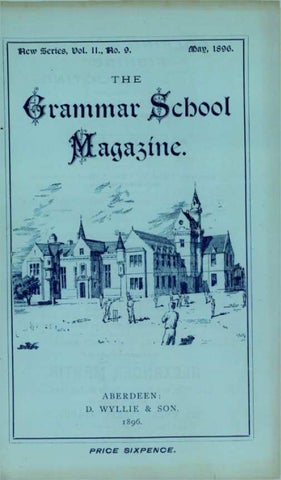
flew Series, Dol. 1 I., 'Flo. 9.
Mayo, 1896.
rammat cbool aga3inc.
•
ABERDEEN: D. WYLLIE & SON, 1896.
PRICE SIXPENCE.
GOLFING. FISHING. SHOOTING. BOYS' GOLF CLUBS, Drivers, Irons, Cleeks, Bulgers, Brassies, &c., by best makers, at Lowest Prices. Park's Patent Unbreakable Clubs. Sole Agents in Aberdeen for Bradell's Patent Aluminium Golf Clubs.
"Silvertown," "Black Al," "Match," and other best quality balls always in stock. "SILVERTOWN" Re-made „Speciality ' --Guaranteed Balls, at 8c1. each ; 7'4 per doz, "FLYING SOOTCHMAN" Golf Balls, at 6d. each, A good practice ball.
Special Quality, 12 ft. Greenheart Trout Rod, suitable for young anglers, at 7/6 each ; may also be had in 10, 11, 13, 14 feet. Cheaper qualities from 1/- to 5/9; 10 and 12 feet. Best qualities from 10/- to 30,'- ; 10 and 12 feet. Fly Books, Lines. Reels, and all other Fishing Tackle. Trout and Salmon Flies dressed suitable for Aberdeenshire Waters. Trout Flies, 1d. and 1'd. each. Bait Hooks, d. and 1d. each. Trout Cast Lines, from id. to 8d. each. AIR CUNS, AIR PISTOLS, SALOON AND ROOK RIFLES, FOR CARDEN SHOOTING. Rel9a
c areful a i ICU 01I in
at'h (lira r Oil t
Price Lists of Fishing Tackle, Guns and Rifles, and Ammunition Free. VNAIVYNAOWNINNON"""ei•
RliEXANDER MARTIN, Gun, rifle, and FisI-/in Tackle Maker, Golf Manufartueer, 128 UNION STREET, ABERDEEN (Branch from 40 Excu ser: SCARE, ( adiS( ;ONN').
'
" '-
-
•
-`S •
CONTENTS. PAGE.
EDITORIAL NOTES NOTES ABOUT OLD BOYS ATHLETIC NOTES THE DECORATION OF THE HALL FORMER PUPILS' CLUB THE PROPOSED WESTFIELD SCHOOL DEBATING SOCIETY FINALE THE MAIDEN'S PROPHECY A TALE OF THE SEA THE LAKE DISTRICT .. THE POACHERS' REVENGE -
-
-
• -
-
33 36 37 40 42 - 43 - 45 - 46 - 49 51 - 55 EXTRACTS FROM COUNCIL REGISTER OF THE BURGH OF ABERDEEN - 57 FOOTBALL • - 59 CRICKET - 63 DEBATING SOCIETY - 64 1ST XV. CHARACTERS • - 67
- Vie
London Rubber Ooy., 16 ST. NICHOLAS STREET, ABERDEEN, are famed throughout Scotland for their
FOOTBALLS, CRICKET BATS, BALLS, TENNIS RACQUETS, GOLF CLUBS, and Requisites of all kinds for Games and Pastimes. Footballs, 11-, 1/6, 2/-, 3/-, 3/6, 4/6, 5/6, to 10/6. Boys' Waterproof Tweed Capes, from 12/6. Men's do. do., „ 16/6. Ladies' Waterproof Mantles, „ 2/111. All guaranteed thoroughly Waterproof, and Newest Designs.
A Large Selection of everything connected with the WATERPROOF, MECHANICAL, and SURGICAL TRADE kept in Stock, at lowest cash prices. "1.1.11.% • %%%%% % %%%%%% %111.11.1.1.
ONLY ADDRESS-
THE LONDON RUBBER COY., 16 ST. NICHOLAS STREET, ABERDEEN.
" Rooks, the bliss of silent 1-/ours.
'I'
P. 1\TICOT_JI_I,
BooxsELLE B., 8, 10, & 11 GALLERY, New Market, ABERDEEN, Second-Hand Books Purchased in any Quantity. BOOKS BOUND IN EVERY VARIETY OF STYLE. LARGE STOCK OF SECOND-HAND SCHOOL AND COLLEGE CLASS BOOKS.
The Most Varied, Cleanest, and withal Cheapest, Collection of Books in the Market. INSPECTION INVITED.
C A_ MPHH,
1_1
&
CO
Successors to CAMPBELL, ACHNACH, & CO.,
3n0tar-lfZubbcr an0 'Waterproof ilbanufacturcr6,
i8 Bridge Street, ABERDEEN, SHOW ONE OF THE LARGEST AND MOST SELECT STOCKS IN
WATERPROOF, AIRPROOF, & INDIA-RUBBER GOODS. CHOICEST GARMENTS FOR LADIES AND GENTLEMEN In Most Fashionable Styles. Newest Patterns and Select Designs. CARRIAGE APRONS, LORRY COVERS, CART & LOIN COVERS. DOOR AND CARRIAGE INDIA-RUBBER MATS
Made to any Size and Design on the Shortest Notice. India-Rubber Sheet, Insertion Valves, Packing, Washers, Hose Pipes, Belting, &c. Also Great Variety in
CRICKET, GOLF, TENNIS, and CROQUET, from the Best Makers only.
INSPECTION RESPECTFULLY SOLICITED. Please Note the
—
CAMPBELL & COMPANY, Successors to CAMPBELL. ACHNACH, & CO.,
18
BRIDGE STREET.
THE
Orarnmar School Iliagct3ine. New Series, Vol. IL
MAY, 1896.
No. 9.
EDITORIAL NOTES. THE last issue of the Magazine commenced the second volume of the New Series. It is extremely gratifying to announce that the support accorded it by the School was of an exceedingly cordial nature. Nevertheless, in a School like ours, with its large number of pupils, both past and present, the circulation ought to be at least double. However, at the present it is not our intention to enlarge upon this theme. Our chief grievance at present is " Copy! Copy! Copy!" It is the aim of the Magazine to be as representative of the different School clubs and societies as it may be. To further this aim, we ask the co-operation of secretaries and others. Accordingly, we invite all scholars, past and present, to send in contributions of a suitable nature, by which the interest in the Magazine may be increased, and our School paper placed in the position it should have among the magazines of the great public schools The Annual Inspection of the School by H.M.I., Dr. T. A. Stewart, will take place on Monday and Tuesday, June 1st and 2nd. The Science and Art Inspection, by Mr. Blair, Edinburgh, will be held on May 27th and 28th. The Leaving Certificate Examination commences on June 15th. The School will break up for the mid-summer vacation on Thursday, June 25th, on which day the annual distribution of prizes, both for class work and the sports, will take place in the Hall. A Concert and Exhibition of Work by the pupils of Mr. Pope and Mr. Philip, took place in the Hall towards the 3
34
The Grammar School Magazine.
end of March. The work exhibited included a number of general drawings, and also of special drawing for the Science and Art Department's Art Teacher's Certificate. Written exercises in English, Latin, and Mathematics were exhibited by Mr. Philip's pupils. The Rector presided, and briefly expressed the pleasure it was to him and the staff that so many should have visited the School that evening. Most of the work exhibited had been done by boys of from ten to fourteen years of age, and the criticism passed on it would, he hoped, be favourable. He might mention that the Science and Art Inspector, who visited the School recently, had stated that he had not seen better Geometrical Drawing in any organised Science School he had examined. The concert commenced with a piano solo, "Highland Gems," by Miss Sutherland, after which Miss Combe charmed her audience with the song, " Queen of the Roses." Miss Ruth Littlejohn performed a piano solo, " La Gazelle," in a way which was highly appreciated, the same remark applying to a song by Mrs. Murison and a duet by Misses A. M. Cameron and C. S. Mitchell. After a loudly applauded recitation by Miss Emily Duthie, a violin duet was performed in a very pleasing style by Messrs. W. G. Melvin and W. M`C. Alexander. Miss Littlejohn having given a song, a piano solo by Miss Pirie closed the first half of the programme. After an interval, R. A. Salmond acquitted himself of a piano solo to the entire satisfaction of the audience. A song by Miss Donaldson, and a violin solo by Mr. William Welsh, were succeeded by the comic song, " The Tin Gee-Gee," by J. R. Pope, which evoked the loud applause of the audience. Perhaps the feature of the programme was a piano solo by a little boy, W. Bentley, who fairly captivated the company by the self-command he displayed on the platform. An effective rendering of " The Old Folks at Home," by Gavin Gillespie, terminated the concert, which was thoroughly enjoyed by all present. The following F.P.'s graduated with Honours at the University at the close of the winter session :—(1) In Classics—M. M. Mackenzie (First Class), G. M. Angus and
Editorial Notes.
35
Patrick Riddell (Third Class); (2) In. Mental Philosophy— O. F. Kirby (First Class), Alex. Christie, F. F. Macalpine, and C. G. Mackenzie (Second Class) ; (3) In Mathematics— James Taggart (First Class), F. W. Gray (Second Class). M. M. Mackenzie was equal first for the Simpson Greek Prize, for the Seafield Gold Medal in Latin, and for the Dr. Black prize for Latin, but was found ineligible to hold the last. In the Middle Greek Class, F.P.'s who left the School last session carried off five out of nine prizes—John M`Bain (2nd), James Forrest and William H. Melvin (3rd, equal), R. D. Keith (5th, equal), and G. A. Combe (7th). In the Senior Greek Class G. F. Milne was 2nd, and T. S. Slessor 9th ; G. F. Milne was also 2nd in the examinations on advanced work and summer readings, and 1st (equal) in Greek Prose Composition. Middle Latin Class— John M`Baiii (1st), W. H. Melvin (5th), and R. D. Keith (10th) ; John M`Bain was also first for voluntary essays. Latin Graduation Class—G. F. Milne (1st), T. S. Slessor (8th), G. L. Barrie (9th), C. Lyall Grant (12th); James Strachan was 1st in English, John M`Bain, 3rd, and R. D. Keith, 6th ; James Strachan was also 1st in Mathematics— Ordinary Graduation Class ; C. Lyall Grant was 2nd in the Intermediate Class, and A. MC. Mutch, 3rd ; C. Lyall Grant was 1st in Natural Philosophy. Altogether F.P.'s have gained eight first, and six second prizes in the ordinary classes. H.M.I., Dr. T. A. Stewart, a Vice-President of the F.P. Club, has been promoted to the Western District, and leaves Aberdeen for Glasgow in September. Beyond mere official routine, he has taken a keen, helpful interest in the School, and done much to keep the past in touch with the present. We have to acknowledge receipt of the Fettesian, the Blairlodge School Magazine, and the Dundee High School Magazine. In the last named a brief review of our Magazine appears.
NOTES ABOUT OLD BOYS. A. L. DAMSON, Balliol College, Oxford, has gained a First Class in Classical Moderations. A. M. Mackay has gained in open competition a Major Scholarship in Moral Science of £100 per annum, at Trinity College, Cambridge. He graduated with double first class honours last year at Aberdeen University, and was awarded the Town Council gold medal as the best graduate of the year. In honour of his recent success, the School was granted a half-holiday. Professor Murison, who was one of the Liberal candidates in the North Aberdeen contest, is a native of Brucklay, Aberdeenshire. He entered Aberdeen University as first bursar. For some time he was an assistant master in the Grammar School. Three years ago his University . conferred upon him the degree of LL.D., and recently lie was elected a life governor of University College, London. On the 27th April, Dr. Charles Urquhart, who contributed so much to the success of the dramatic performances of the F.P. Club, married Miss Blanche Leslie, who also took a leading part in the dramatic club. Amongst former pupils who have recently died, mention may be made of Mr. Peter Bayne, LL.D. He had a distinguished career at Marischal College. He was the winner of a prize poem open to competition to the whole University, and after taking his degree, he won the Blackwell Prize (£40) for an essay on a literary subject. Though originally intending to enter the ministry, he turned aside to literary pursuits. Mr. Bayne was editor in turn of " The Commonwealth," " The Witness," " The Dial," " The Weekly Review," and contributed to many other periodicals. Of his writings, the most popular was a treatise, " The Christian Life in the Present Time." His " Life of Luther " is a standard work of the highest merit.
Notes About Old Boys.
37
Mr. Robert Maitland, who died recently, was a pupil of the Grammar School during the years 1835-1839. At an early age he entered the Sheriff-Clerk's office at Aberdeen, and in 1848 was transferred to Peterhead as Sheriff-Clerk Depute. On the passing of the Education Act, Mr. Maitland was appointed Clerk to the Burgh and Parish School Boards. He was an enthusiastic volunteer, and became a lieutenant in the Peterhead Artillery at its formation in 1862, in which he rose to the rank of honorary lieutenantcolonel. The long obituary of the quarter includes also the name of the Very Rev. William Webster, Dean of the Episcopal Diocese of Aberdeen, and for fifty years Rector of St. John's, New Pitsligo. Mr. Webster was a native of Aberdeen, and was educated at the Grammar School and Marischal College. He graduated M.A. in 1828, and on that occasion gained the silver pen, which was then the prize given for proficiency in Greek. Too young for holy orders—he was only 18—he spent the next six years in teaching. In 1834, he was . ordained deacon, and priest in the following year. His first charge was that of Drumlithie, Kincardineshire. In 1841, he was appointed to the cure of St. John the Evangelist at New Pitsligo. On the death of Mr. Harper, he was appointed Dean of Aberdeen and Orkney.
ATHLETIC NOTES. THE Hall again, on 21st February, was, as it used to be in days gone by, the scene of an assault-at-arms. There was a large attendance of parents and friends of the performers. Mr. Alexander Monro, our gymnastic instructor, acted as conductor of the proceedings, while Miss Davidson accompanied on the piano. The first item on the programme was a series of exercises on the " horse." About thirty representatives of the Upper and Middle Schools took part. Alexander Sheret proved a most efficient leader, being cheered repeatedly at the vaults and hand-spring. For the
38
The Grammar School Magazine.
somersault there entered Sheret, Poison, Smith, Monro, Watson, and Morphy. This was succeeded by an exhibition of single bar-bells by the Middle III. class. The third performance consisted in an exhibition of free gymnastics after the Swedish system. The performers were members of the III. Lower class, and were exceedingly smart, keeping excellent time. K. WKenzie and C. Kerr then engaged in a bout at quarterstaff. The resounding thuds as the poles struck together caused great amusement to the more juvenile spectators. An exhibition of Indian clubs by the IV. Modern was much admired. A team of boys from different classes then went through several exercises on the parallel bars. Sergeant Monro was vigorously applauded at the hand-spring. Dumb-bells by the II. Middle then followed. But the most exciting event of the evening was a prize competition open to boys between the ages of twelve and fourteen for the best high jump from the spring-board. Starting at 4 ft, when 5 ft. 11 in. was reached, all had failed except F. Fraser, T. Robertson, and A. Matheson. These three failed at 6 ft. Two other chances were granted to each. Fraser and Robertson again failed, Matheson clearing it at the second attempt. Matheson being disqualified by age, the tie was afterwards decided in favour of Fraser, with a second prize to Robertson. The next item was twining the May-pole. The performers were from the Preparatory School, and were directed by Miss J. T. Davidson in the absence of Miss Young. The accurate performance of the intricate figures was loudly applauded. A single-stick engagement between J. G. Slessor and A. S. Tarras was fought with much sound and fury. The next, and undoubtedly the best item on the programme was double bar-bell exercises by the VI. Classical. The exercises, which were many and manifestly intricate, were gone through without a hitch. Mr. Monro deserves great praise for the excellent manner in which he had trained the performers. In thanking the large and enthusiastic audience for their attendance, the Rector remarked on the fact that the gymnastics of the school had for two years been condemned by circumstances to vegetate in the
Athletic Notes.
39
cellars of a neighbouring church, but he hoped they would agree with him that the display they had just witnessed showed, in spite of such adverse conditions, that the vegetation was of a vigorous, hearty growth. Mr. Menzies, we notice from the Fettesian, has been playing for the Fettesian-Lorettonian team against Richmond and Blackheath. The XV. were photographed on 20th March by Mr. Wilson. The photographs are excellent. A. J. Milne has been elected cricket captain, and W. Macintosh secretary. The Sports were held on Friday and Saturday, the 17th and 18th April. The weather was fair, and a large number of spectators were present on each occasion. Dr. Scott Riddell acted as referee ; Mr. J. Clarke and Mr. Mackie as timekeepers ; Mr. Ward and Mr. Menzies as judges ; and Mr. Monro as starter. Music was supplied on Saturday by the band of Oakbank Industrial School. The prize list is as follows:— FORMER PUPILS.— Hundred Yards-1 A. E. Rae ; 2 J. A. Butchart (time, 11 2-5 sec.). Half Mile-1 J. W. Milne; 2 A. J. Milne (time, 2 min. 19 4-5 sec.). OPEN (age over 16). — Throwing the Cricket Ball--Prizes from Dr. Scott Riddell-1 J. G. Slessor (dist., 89 yds.) ; 2 J. A. Thomson. High Jump—Prize from Colonel George Cruden-1 G. Reid (height, 4 ft. 9 in.) ; 2 W. Clarke. Hurdle Race—Prize from H. F. Menzies, Esq.-1 J. Thomson (time, 20 sec.) ; 2 K. 111‘Kenzie. Half Mile—Prizes from William Watt, Esq.-1 J. Thomson (time, 2 min. 31 sec.) ; 2 J. Robertson. Quarter Mile— Prize from John Clarke, Esq.-1 J. Thomson (time, 60 sec.) ; 2 J. C. Clarke. Mile—Prizes from Former Pupils-1 J. Thomson (time, 5 min. 53 sec.) ; 2 J. Robertson. Obstacle Race (with Class II.)—Prizes from Dr. Ogilvie Will-1 F. Fraser; 2 K. M'Kenzie ; 3 W. Morphy. Broad Jump —1 J. C. Clarke (dist., 15 ft. 8 in.) ; 2 J. Thomson. Hundred Ya rds-—1 J. Thomson (time, 11 sec.) ; 2 J. Clarke. Hammer-1 J. Smith (dist., 59 ft.) ;
40
The Grammar School Magazine.
2 W. Fraser. Putting the Weight--1 W. Fraser (dist., 26 ft. 9 in.); 2 G. Reid. Drop Kick-1 J. Slessor (dist., 53 yds. 2 ft.). Place Kick--A. M. Gauld. Consolation Race (Handicap)—Prize from S. Pope, Esq.-1 A. Wyness. Tug•of--War (Classical VII. v. School) —Won by School., AGE 16-14.— Hurdle—Prize from C. Davidson, Esq.-1 C. Kerr (time, 20 1-5 sec. ; 2 A. Smith. Half-mile —Prize from M. H. Mackie, Esq.-1 C. Kerr (time, 2 min. 29 sec.) ; 2 H. Watson. Broad Jump—Prize from Wm. Murison, Esq.-1 A. Smith (dist., 15 ft. 4 in.) ; 2 C. Kerr. Quarter Mile—Prize from H. F. Morland Simpson, Esq.-1 C. Kerr (time, 60 2-5 sec.) ; 2 W. Morphy. Hundred Yards—Prizes from Dr. Moir-1 C. Kerr (time, 11 3-5 sec.); 2 A. G. Fraser. High Jump-1 W. Fraser and M. Thomson (hgt., 4 ft. 7 in.) AGE 14-12.—High Jump—Prize from Mr. Calder.- -1 R. Hally (hgt., 4 ft. 3 in.); 2 J. Strachan. Half Mile—Prize from W. H. K. Ward, Esq.-1 D. Rae (time, 2 min. 41 sec.) ; 2 R. Hally. Broad Jump—Prize from W. Brownie, Esq.-1 D. E. Rae (dist., 13 ft. 3i in.); 2 J. Kyd. Three Hundred Yards— Prize from J. B. Philip, Esq.-1 T. Robertson (time, 45 sec.); 2 D. E. Rae. Hundred Yards—Prize from Mrs. Morland Simpson —1 T. Robertson (time, 13 sec.); 2 D. E. Rae. Hurdles —1 T. Robertson, 2 R. Hally. Sack Race—Prize from Miss Davidson— ] R. Salmond, 2 Strachan. AGE 12-10.—High Jump—Prize from J. M'Bain, Esq.-1 A. Smith (hgt., 4 ft.); 2 J. Russell. Three Hundred Yards (handicap) —Prize from Miss E. Davidson-1 S. Robertson, 2 D. Strachan. Hundred Yards—Prize from J. Davidson, Esq.-1 E. Clark, 2 A. Smith. Sack Race--Prize from Miss Adam-1 F. Cruden, 2 G. Shand. Obstacle Race—(with Class III.)-1 J. Kyd, 2 H. Jamieson, 3 K Poison. AGE 10-8.—High Jump —Prize from C. M. Lawrence, Esq.1 C. Walker, 2 C. Peterkin. Hundred Yards—Prize from Miss Mackie-1 S. Robertson, 2 D. Strachan. AGE UNDER 8.—Eighty Yards—Prize from Mrs. Ledingham1 A. Ward. THE DECORATION OF THE HALL. THIS work has now been begun in earnest. The walls have been painted dull gold, divided into panels by dark brown
The Deconttion, of the Holt
41
beading. The frieze at the top is tastefully adorned in brown, initialed red, with appropriate texts from the Vulgate of Psalm cxxvii. as follows :THE WEST OR "GOVERNORS' WALL." NISI • DOMINUS • AEDIFICAVERIT • DOMUM • IN • VANUM LABORAVERUNT • QUI • AEDIFICANT • EAM. (" Except the Lord build the house," dc.)
Two panels filled with the list of Rectors. The remaining three panels will be occupied by the Duxes, continued on the north wall. On the frieze of the panelling, the Benefactcrs. Below this a group of portraits—Dr. Patrick Dun (Chief Benefactor) ; Dr. J. Dun (Rector) ; Dr. Melvin (Rector). Busts of Lord Byron and Sir William Geddes in the angles. Case of Archery Medals and Swimming Cup in the centre. THE NORTH OR "CITY WALL." NISI • DOMINUS • CUSTODIERIT • CIVITATEM • FRUSTRA VIGILAT • QUI • CUSTODIT • EAM. Except the Lord keep the city (or state)," &c.) ("
Panels 1-3—Duxes continued. Panel 4—First Bursars. Panel 5 (the large centre panel)—City Arms ; list of Provosts educated at the School. Below, the portrait of Sir Alexander Anderson, surmounting the Latin rules drawn up by John Vans in 1523, framed in five compartments, along with the Town Council rules established in 1700. These rules, engrossed in Indian ink on parchment, have been written out and presented by the Rector. Panels 6, &c.—First Bursars continued. Thereafter the lists of General Distinctions, t•o be continued on the East and South Walls. THE EAST OR "SONS' WALL." ECCE • HEREDITAS • DOMINI • FILII • SICUT • SAGITTAE IN • MANU • POTENTIS. (" Lo, sons are the Lord's heritage, like arrows in a strong man's hand.")
Below this a bracket for a (suggested) clock. THE SOUTH OR "PARENTS' WALL." BEATUS • VIR • QUI • IMPLEVIT • DESIDERIUM • EX • IPSIS. (" Blessed is the man who has fulfilled his desire of them.")
FORMER PUPILS' CLUB. THE annual meeting of the Club was held in October last, when the office-bearers were elected for the ensuing year, as follows :—President, H. F. Morland Simpson, M.A. ; Vice President, A. Duffus, advocate ; Secretary, G. W. S. Walker, 2 Union Terrace; Treasurer, A. W. Christie, 127 Union Street; Committee —W. S. Davidson, Dr. Finlay, G. 0. Gauld, Dr. Glennie, R. A. Henderson, R. W. Mackay, Jun., G. E. Marr, J. W. Milne, H. P. Sleigh, M. G. Tulloch, Dr. Urquhart, Louis Wilson. During the past winter the executive have afforded the members numerous opportunities of cultivating social intercourse. The annual dinner was held in the Imperial Hotel, and was presided over by Dr. T. A. Stewart, whose genial presence largely contributed to the success of the function, at which about 35 members were present. Not content, however, with batchelor entertainments, the Club has provided a concert in the Hall of the School, and a most successful dance in the Palace—the great difficulty the promoters had in connection with the latter being the large number of applications which had to be refused on account of the limited accommodation. While the social side of the Club has been fully attended to, the executive have not been neglectful of other and more important issues. The proposal to plant a public elementary school, partly on the Grammar grounds and partly on the site of the present Westfield School, at once appeared to the executive a scheme which would be hurtful to the best interests of the Grammar School. They accordingly got a number of prominent citizens to interest them-. selves in the question, and they formed a Deputation to the School Board, from which they received but cold comfort. This was followed by one of the most representative and influential public meetings recently held in the city, and resulted in a memorial to the Department condemning the scheme.
The Proposed Westfield School.
43
We can only trust that the Board will give effect to what is the wish, not only of the Club, but of the citizens generally, and drop the proposal. The membership of the Club is at present 250.
THE PROPOSED WESTFIELD SCHOOL. SINCE our last issue in January, when we commented on the proposal of the School Board to build an elementary school for 1000 children on the site of the present Westfield School, appropriating for the purpose the Grammar School cottage and garden, the scheme has been the subject of keen public discussion. As it is desirable that our Magazine should contain a record of matters so deeply affecting its interests, we propose to give a brief outline of what has since occurred. The omission of the Bath, and the repeated admonitions of the " Free Press," roused within the Board itself a desire to have the whole question reconsidered. On February 20th, the Rev. Mr. Calder, Convener of the High Schools' Committee, moved accordingly ; but after a long debate an even vote (6 to 6), was decided by the Chairman's casting vote against the motion. On March 12th, the Administration Committee resolved by 7 to 2, to refer to the Department the order in which they should proceed with the items of their building programme. Meantime the Former Pupils' Committee on hearing a statement of objections made by the Rector, resolved unanimously to take steps in opposition to the scheme. The matter being considered urgent, a meeting of prominent and representative citizens was convened in the offices of Mr. Duffus, advocate, vice-president of the club. The gentlemen present resolved unanimously to oppose the scheme, and for this purpose decided to wait on the Board as a Deputation. On March 19th, the Rector's objections were made the subject of special articles in the " Free Press." The same evening the Deputation waited on the Board and asked to
44
The Grammar School Magazine.
be heard before the final vote on the question of reference to the Department. The Deputation consisted of Baillies Edwards and Murray; Councillors Henry Gray, Sangster, and Wm. Johnston ; Dr. Ogilvie Will, and Messrs. Bisset (ex-treasurer), G. B. Esslemont, Thos. Kyd, Geo. Murray, Geo. Souter, G. M. Thomson, Alex. Duffus, G. W. S. Walker, solicitor, and Louis Wilson, photographer, the last three as acting representatives of the F.P. Committee. To all of these and to many others the School is deeply indebted for their warm advocacy of its interests. After much delay the Deputation was admitted. Objections were stated by Baillie Edwards (Chairman of the Deputation) and Messrs. Bisset, Murray, Ogilvie Will, and others. They were then subjected to a long interrogatory by the chairman (Professor Robertson), after which the Board remitted to a Committee to consider what answer should be given to the Deputation, and then resolved by 8 to 7 in favour of reference to the Department. Subsequently the minority drew up a protest to the Department against the illegality of the Board's reference vote. Disappointed in one of their 'main objects—to get the Board itself to consider or reconsider the question, the Deputation called a Public Indignation Meeting, held in Rosemount School on March 31st. The chair was taken by Baillie Edwards. There was a large gathering of ratepayers of a representative character, nearly filling three large class-rooms thrown into one. Letters, &c., expressing hearty sympathy with the object of the meeting were read from Principal Sir Wm. Geddes, Lord Provost Mearns, Dr. Alexander Bain, Professor Ramsay, Colonel Allardyce, Mr. Thos. Kyd, Mr. David Littlejohn (Sheriff-Clerk), and the Rev. Gordon Murray and Mr. John Anderson (Members of the School Board), &c. Motions condemning the scheme and resolving to memorialise the Department, were carried unanimously and with enthusiasm. The meeting was addressed by Baillie Edwards, ex-Treasurer Bisset, Dr. C. B. Davidson, Mr. John Keir (President of the Trades' Council and Member of the School Board), the Rev. J. Calder (School Board Member), Mr. Geo. Murray, Councillor
The Proposed Westfield School. Johnston, Dr. Angus Fraser, and Dr. Ogilvie Will. Dealing with the question very thoroughly, and from a variety of aspects, the speakers carried their audience entirely with them. The impression of those well qualified to judge, was that not for years has there been in Aberdeen so large, weighty, and successful a meeting of the kind. On April 10th, the reply of the Department to the reference vote was read to the Administration Committee of the Board, to the effect that the " duty and responsibility in the matter rested primarily with the Board," and " my Lords are unable to relieve the School Board of that responsibility." On April 14th, the memorial to the Department from the public meeting was published. On the 17th, the Board, in view of the rebuff from the Department, resolved to proceed first with the St. Paul Street School. As the Board's term of office expires in April, 1897, the effect of the Department's reply, followed by this resolution, was hailed by the minority as a victory, and the general opinion gains ground that the Westfield Scheme has received its quietus (R.I.P.) At the same meeting, the Board resolved in private to request of the Rector an explanation of his action in allowing objections to be published in his name on March 19th. This private resolution was allowed to leak out, and was officiously defended in a communication to the " Evening Express," on April 21st. • DEBATING SOCIETY FINALE. The Literary Club and Debating Society brought their thirteenth session to a close on Thursday, 26th March, by a grand finale. Though the performance did not commence till eight o'clock, by that hour every available seat in the Hall was occupied by a large and appreciative audience. The first part of the programme commenced with a piano solo—Neustedt's " Fete Hongroise," by Mr. J. J. Johnson.
46
The Grammar School Magazine.
Mr. Menzies then sang "The Romany Lass"; Mr. J. W. Milne, " Allan Water " ; and Mr. T. Watt, " The Lighthouse Keeper." During the interval the Rector briefly commended the aims of the Debating Society, and hoped that the audience would contribute liberally towards its objects. The second part of the programme consisted in the comedy, " My Turn Next." The cast of the piece was as follows :— TARAXICUM TWITTERS, Apothecary, -
Tom TRAP, Commercial Traveller, FARMER WFIEATEAR, from Ianbury, LYDIA, Twitters' Wife, CICELY, her Sister, PEGGY, Twitters' Housekeeper, TIM BOLUS, his Assistant,
-
J. WALKER.
G. MICIIIE. A. FORTESCUE. K. M'KENIZIE. A. SMITH. T. DIvcosoN. J. RAE.
The acting was excellent, considering this was the &bat of all the performers. Mr. C. Davidson deserves all praise for the time, trouble, and patience bestowed to bring the play up to the mark. " Mr. Twitters," by J. Walker, the chief r6le, was excellently represented. G. Michie and J. Rae seemed naturally adapted for their several parts, Rae causing roars of laughter as "Peggy," showing how thoroughly he had studied his subject. The " fair ones "— A. Smith and T. Davidson—cannot be too highly praised for their successful personation of " Lydia" and " her little sister." A. I. Fortescue, as "Tom Trap," was excellent, while K. Maenzie, as " Farmer Wheatear," looked as if he came from "'way back." Loud and hearty applause followed the ringing down of the curtain.
THE MAIDEN'S PROPHECY. ON one of the numerous inlets, which the tireless Atlantic
has cut on the coast of Donegal, there once stood the stately and ancient pile known as the Castle of Ballaghaderreen. For centuries the ancient Irish family of O'Bryan had dwelt there, undisturbed by the changes on the eastern side of the island, and staunch supporters of the old religion. News, however, had penetrated to this almost de-
The Maiden's Prophecy.
47
serted and rarely visited spot, that the people of England had risen against their sovereign James II., and that the exiled Stuart was now in Ireland seeking help both in money and men from all his loyal Catholic adherents. On receipt of this news, the O'Bryan immediately sent the Fiery Cross round his clansmen, and within a few days was prepared to lead three hundred armed Irish kerns to the camp of the Stuart. On the eve of his departure he addressed a few words to those of his kin who remained behind, but before he had finished he was interrupted by the clear, ringing tones of a woman's voice from the centre of the crowd. " O'Bryan, beware ! Go not on this journey. However, if such be your steadfast resolve, then beware of three dangers : a false friend, a treacherous enemy, and the river Boyne." The speaker was a young girl between nineteen and twenty, of marvellous beauty, but of a type quite distinct from the Celtic Irish who surrounded her; in fact, she was a cast-away from a ship which had been wrecked there a few years previously. Being subject to fits of temporary madness, she was regarded by the superstitious Irish as a prophetess. Her speech, therefore, had put an end to the talking, and all eyes were turned on the young chief, who at first was manifestly disturbed, but quickly recovered his composure and said : "I despise your warning. So far from failing, I see myself enthroned on the throne of my forefathers, as king of this island." The maiden only answered, " Wait ! We shall see." The dawn was appearing in the east when O'Bryan and his chosen three hundred followers marched out from the castle, and by nightfall they had traversed a distance of about fifty miles. They were now in a part of the island where the O'Donnell family held sway. O'Bryan had encountered O'Donnell in the afternoon, and had been invited by him to pass the night in his lands, protection being promised for his followers. Accordingly, having encamped, and being weary with the long day's march, the O'Bryans were quickly wrapt in slumber. Even the watchmen by the fire began to nod. In the dead of night a dusky form might be discerned stealthily creeping on the
48
The Grammar School Magazine.
unsuspecting sleepers. Five times a flash is seen, each time there follows a groan. Alas, when morning breaks, five brave fellows will never rise again. Too surely has the knife of the assassin done its deadly work. When O'Bryan discovered the murder of his five followers he swore to take a frightful vengeance on the perpetrators of the deed. While he was endeavouring to discover the motive for the assasination, he was startled by hearing issue from the neighbouring wood the clear tones of the maiden who had warned him. " Dennis O'Bryan, tho.i hast met thy false friend. The deed was done by O'Donnell's order. Return ere thou and thy followers be all destroyed." The voice ceased, and O'Bryan immediately gave orders for the woods to be scoured and the maiden brought to him. It was all in vain. No trace of the girl could be found; she had vanished as if into air. Having buried their comrades, the company once more set out. Since their number was less than three hundred, the chief did not feel himself justified in risking an encounter with the O'Donnells. By dawn of the following day they found themselves in a district swarming with Orangemen and other followers of William. After a skirmish with a party of Dutch horse, the leaders on both sides agreed to a four hours' cessation of hostilities. The Irish threw aside their weapons and stretched themselves on the ground to rest. The Dutch pretended to do likewise, but kept their petronels concealed under their clothing. At an agreed signal from their leader they fired on the defenceless Irish, killing about one hundred. The remainder sought safety in flight, but had hardly quitted the scene of the fight, when, for a second time, the voice of the prophetess was heard. " Thy false friend thou hast met, likewise thy treacherous enemy. Beware and return ; else the Boyne is thy grave and its waters thy doom." As on the former occasion, all search was fruitless. Towards evening the party reached the King's army, and the chief was heartily welcomed by James and his generals. On the following day the battle took place. The O'Bryans with their leader were stationed near the river's bank, and were gradually forced back to the edge. All had now fallen save
A Tale of the Sea.
49
the chief and a young stripling. A last wild charge drove the O'Bryan into the river, and as the waters closed over his head he heard the maiden's voice : " Dennis, the Boyne is thy grave. Mine also shall it be." He cast one look at the bank, in time to see the pretended stripling leap into the river, and then sank never to rise again. According to local tradition, every 1st of July the spectres of the young chief and the prophetess rise from the water, and escorted by a phantom following of armed Irish kerns, journey to the now ruined castle of Ballaghaderreen, where they hold high revel in the crumbling banqueting hall. His retainers hail him as monarch of Erin and king of the Irish. Y. M. A. A TALE OF THE SEA. but among my many acquaintances men, and I always keep a sea-faring a few there are not sailors. I used to know one— for warm corner in my heart sea life for many years. an old salt—who had retired from He was a regular sea dog, a great, huge-limbed, grizzlylooking fellow, and under his right jaw there was a huge scar, which he had received in some brawl in the slums of London, when he was stabbed with a dagger. I used to go to spend an occasional evening with him, listening to his long yarns, which often threatened to be interminable. He could yarn by the hour. I remember vividly, however, one story from the many he told me. It was a cold, blowy night, and we were seated together in his dingy little room, listening to the howling of the wind outside, and inside too, for the house was rather dilapidated. We were sitting quietly, when suddenly he said to me, "Ah, my boy, I remember just such another night as this. I was at that time third mate in a sailing vessel, the captain of which was a young fellow on his first voyage as captain. We sailed from Cardiff with a cargo of coal, going north. Hardly had we got fairly out to sea, and made two or three days' sailing, when it came on to blow 4 I AM a land-lubber ;
50
The Grammar School Magazine.
hard. Now, as bad luck would have it, we had no dividing boards, that is, no partition down the middle of the hold to keep the cargo equally balanced. It was a fearful night. The men advised the captain to turn into the nearest port : but he was a young fellow, on his first voyage, and he said he would sooner sink with his ship than turn back : for they might suspend his certificate if he was so unlucky. To crown all, just at this moment the ship gave a terrific lurch, and over went the whole of the cargo to one side, and the ship lay on her side shipping water at every movement. All hands were ordered down to the hold to right the cargo. It was hard work, I tell you, balancing that cargo ; but we got it righted, and the ship came gradually round until she was upright. We got out of the hold then, and were in good hopes of getting safely through the gale, when another tremendous wave struck the vessel amidships, throwing the cargo against the side so violently, that we thought the side would go out. Over went the ship even worse than before, with her sails a few yards from the water, and, to complete the destruction, the next wave staved in the hatches and the ship began to fill. All hands were called to the pumps, but from the first, hope was dim. So we approached the captain, saying that if he did not lower the boat immediately, we should do it ourselves. Accordingly he conceded, and our life-boat was lowered over the side, and we had to push it down, the ship had so toppled over. As much provisions were put in it as were necessary for a week's consumption. A long rope was attached to the end, and the boat allowed to drift away till the rope was tight. Then one of the men put a pair of life-belts round him, an axe in his belt, and jumped over the side. He swam along, keeping as near the rope as possible till he reached the boat. Getting in, he sat down beside the rope-end ready to cut it whenever the ship should sink. " We all followed his example. When I left the ship, the water was high in the hold, and the prow was dipping in the sea. All went well till the first mate left the ship,
The Lake District.
51
and he had just reached the boat when the ship sunk. The man at the prow cut the rope, and we pulled away as hard as we could, and even then we were in danger of being sucked in by the sinking of the ship. After the water was quieter we rowed back to the spot to see if the captain was alive. There was no sign of him. The poor fellow had gone down on his first and last voyage as captain." Here he stopped, looking before him as if he saw it all, and I left him so. •
THE LAKE DISTRICT. WITH the approach of summer and the long vacation, one's' thoughts naturally turn to summer resorts and holiday recreations, and few will deny that the pleasantest form of holiday is that which is spent among the hills " far from the busy haunts of men." The British Islands offer an endless variety of such scenes. Scotland itself is not easily exhausted, but it is useful as well as interesting to go afield as far as opportunity allows, and the beauties and charms of our native land are perhaps best appreciated by comparison and contrast with other scenes. Putting out of account the Continent, there are three places which every one ought to make acquaintance of, and to visit not once but often : they represent the three countries at their best. They are Skye, Killarney, and the Lake District. It is of the last that I am going meantime to speak. Roughly speaking the Lake District consists of the Cumbrian range, an irregular mass of mountains thrown off to the west from the Pennine chain, and is contained in the counties of Cumberland and Westmoreland, on the south running into, or rather run into by, Lancashire. On the east the boundary may be taken to be the line of the London and North-Western Railway from Penrith, say, to Tebay or Oxenholme Junction. The connecting range between the Yorkshire heights and the Cumbrian range is Shap Fells, and the highest point of the railway, Shap summit, figured often very prominently in the recent
52
The Grammar School Magazine.
railway race to Aberdeen. The Irish Sea, including the Solway and Morecambe Bay, is the general boundary on the other sides. The great feature of the district in its physical aspect is the number of its lochs—" meres " or " waters " as they are called locally—which, of course, arises again from the peculiar lie of the hills. The latter form a mass, more or less irregular, without any well-marked division into ranges. The general lie of the component ranges is north and south, but such is the irregularity of formation that from the blocking of the valleys by cross ranges or spurs there are frequent depressions, in which the water collects and remains until it rises to a sufficient height to surmount its breastwork and flow off into a river. The lochs formed in this way include Windermere, Thirlmere, Buttermere, Derwent Water, Ullswater, Wast Water, Coniston Water, &c., &c. Among other local peculiarities of name may be mentioned " beck " for stream or burn, " force " for waterfall ; all the glens are " dales." Many of the mountains are " fells " and a few " pikes," while one must not omit to note the very large number of " thwaites "—a term which, however, seems now to have lost its original distinctive meaning. The chief mountains in the district are Helvellyn and Fairfield nearly in the centre, and more toward the west, Langdale Pikes, Bow Fell, Scafell, and Scafell Pikes, Great Gable, The Pillar, &c., while away to the north lie Skiddaw and Saddleback. The approaches are from the London and NorthWestern railway by branch lines—the north one from Penrith to Keswick, Cockermouth, and on to Workington on the coast, and the south one from Oxenholme Junction to Kendal and Windermere. It was my good fortune on one occasion to have a few spare days to bestow on a journey from Edinburgh to Belfast, and my mind was soon made up as to how they were to be utilised. Leaving Princes Street station at 10 A.M. on Monday morning, I reached Carlisle in due course by the express, and thence by slower conveyance, Penrith,
The Lake District.
53
Oxenholme, and finally Kendal and Windermere. The summer day was not even then exhausted, but aff0rded time to visit Bowness, the port of Windermere, and to enjoy a sail on the lake steamer as far as Lake Side at the extreme south of Windermere, and back to Bowness in time for dinner. The views of the hills, thrown into bold relief by the evening sun, were most exquisite, giving promise of the treats in store, and the weather also promised fair for the morrow. On Tuesday, accordingly, after further enjoying the beautiful views from the points of vantage about the hotel, I made an early start by coach, meaning to proceed thus as far as Grasmere, and thence by Tongue Gill over Helvellyn descending on the vale of St. John, and so into Keswick. But this was not to be. All went well so far. We passed Lin Wood, a famous resort, as " Dove Nest " in the vicinity may explain, Ambleside, Rydal, and Grasmere—all famous in connection with the Lake Poets. But early in the forenoon a regular Scotch mist came down, rendering solitary mountaineering on unknown ground somewhat foolhardy ; so leaving "the steep brow of the lofty Helvellyn" for another occasion, I descended from Grisedale Tarn at the head of Tongue Gill by Pattendale to Ullswater, and thence by steamer, coach, and train, via Penrith to Keswick. On Wednesday I was successful in making the ascent of Helvellyn and obtaining a fine view, keeping the coach road as far as Thirhnere, which lies right under the mountain. This, I may mention, is the source whence Manchester derives its water supply, the water being conveyed in culverts and pipes a distance of some 90 miles. At the time of my visit, the works were in progress, and the level of the lake was being artificially raised some feet ; while the greatest precautions were being taken that no pollution should reach the lake from the surrounding drainage area I must pass quickly over the surroundings of Keswick and the placid beauty of Derwent Water, well deserving as they are of mention. It had been my intention to ascend Skiddaw, but the lost day had necessitated the omission of
54
The Grammar School Magazine.
this excursion. On Thursday accordingly, taking the Buttermere coach, I visited Lodore, a woeful disappointment to one who goes expecting to find a roaring cataract—and, by the way, most " waterfalls " in this country are the same—then the famous Bowder Stone in Borrowdale and by Kosthwaite and Scatoller to the top of the Honiston Pass. At one point the route is close to Scathwaite, the wettest place, judged by the rainfall, in the kingdom. From the top of the Honiston I worked my way up the Great Gable, one of the best points in the whole Lake district from which to obtain a view. A description of it would be in great part an enumeration of the chief summits and other physical features of the district. Suffice it to say that the valleys seem to radiate as from this point, six or seven lie almost symmetrically around, and in each appears a gleaming " mere " : away to the west the Isle of Man is very plain, while fancy calls up a vision in the far west of the Emerald Isle. " Aye haddin' sooth," I reached the Sty Head Pass, and by the track over it, Wastdale Head. The evening was spent in visiting the quaint little church, the smallest I have ever seen, and Wast Water, the most westerly and the most romantic of all the lakes. The views of the great surrounding peaks—Scafell, Scafell Pikes, Great Gable, Tewbarron, Scatallan, &c., were indescribably glorious, and this nests in my memory as by far the most impressive scene of all. The spirit of the mountains seemed to pervade the place and the great mountains to raise themselves in order to look over into the glen, and, withal, as if half in surprise and half in scorn of the doings of mortals. Friday morning dawned most auspiciously. At Wastdale Head a gentleman in training for the Alps was stopping, and he very kindly offered to be my guide for the morrow, our destination being Scafell Pikes and Scafell itself. The ascent was made by Pier's Gill and was without incident, though very successful. From Scafell Pikes we passed through Mickledore Chasm, where my friend mentioned he had once broken a watch glass (he was a man of substance), and scrambled up to the top of Scafell. The highest point of the Pikes is 3210 ft., Scafell itself being
The Poachers' Revenge.
55
only a little lower, 3162 ft. From its outlying position the latter looks the higher of the two. As in most cases, however, the impressiveness of a mountain is not at all proportionate to its absolute height above sea level, but depends much more on the situation, surroundings, and shape of the top. Consequently it would be a great mistake to suppose that these mountains, the highest in England, are inferior in effect to the Cairngorms, say, which are about 1000 ft. higher. Comparisons are deceptive, each has its own charm, and for this it is loved. From Scafell the descent was made over loose "screes" into Eskdale where the narrow gauge railway is gained at Boot. By slow progression I reached Ravenglass on the Cumberland coast line, and thence by fast train Barrow-in-Furness. There the steamboat took charge of me, and early on Saturday morning I reached Belfast. Should I ever have another spare week, it shall be devoted to a like purpose. To each of my readers I say meantime, " go thou and do likewise." MONTIVAGUS. THE POACHERS' REVENGE. rocky shore was lined by an anxious and excited crowd of women, who vainly endeavoured to penetrate the veil of mist which hid from their anxious gaze the scene enacted beyond. But though nothing could be seen, yet their ears assured them that a sharp and bloody conflict was in progress. The clash of blows, the creaking of timber and the yells and cries of the combatants all bore witness to the fact that a fierce fight was going on in their immediate vicinity. But why should the quiet neighbourhood of Alton-on-Sea be disturbed by such an occurrence ? The reason was not difficult to find. Seven years ago Squire Thornton, the owner of Thornton Hall, had been instrumental in securing the conviction and transportation of two notable poachers and burglars, by name Jim Barlow and Tim Caudle. These malefactors had passed three years at Botany Bay, but their conduct had been so insubordinate
THE
56
The Grammar School Magazine.
that they were embarked for transfer to Norfolk Island. During the voyage they succeeded in getting rid of their irons. Their next move was to free their companions and seize the ship. Such of the crew as were willing to join them they spared, the rest were sent to feed the sharks which infest these waters. For three years they pursued a course of piracy, robbing, murdering, and burning. At the end of that period they had amassed considerable wealth, and were thinking of settling on shore, to pass their lives peaceably with their ill-gotten gains. Barlow and Caudle, however, still harboured a revengeful feeling against Squire Thornton, and at last they saw a prospect of satisfying it. Accordingly they spread a report among their companions of the great wealth stored in Thornton Hall and of the totally undefended state of the place. This, however, was only a cloak to their real object, which was to carry off Blanche Thornton, the Squire's daughter. She was an only child, and her father was so fond of her that by this means they hoped to inflict on him a greater blow than even by personal violence. Accordingly, one cold, dark, wintry night, which favoured their purpose, they surrounded the Hall, and forced an entrance. Barlow and Caudle immediately made their way to Blanche's bedroom, while the others separated for the purpose of loot. Caudle kept watch at the bedroom door, while Barlow snatched the sleeping girl from the bed, and ordered her to dress, warning her if she screamed that he would kill her. When she was dressed, Barlow lifted her up, and stifling her screams, carried her to the vessel. Squire Thornton had been knocked senseless by one of the pirates. When all had come on board, the pirates set sail, but a squall coining on, the masts went by the board, and they were compelled to make for land to effect repairs. For this reason they chose a small cove a few miles from Alton-on-Sea. A young lad while walking along the coast observed the ship and its crew, and found that they resembled the description given by Squire Thornton. Accordingly he went at once to Lord Hardcastle, who was inconsolable for the loss of Blanche, to whom he had been engaged. His lordship gathered
Extracts .froni the Council Register.
57
together a band of brave fellows, and favoured by a mist, they set sail from the harbour of Alton-on-Sea, and sailed round to the pirates' anchorage. Though totally surprised, the pirates fought with great determination, but were compelled to give way before the attack of their enemies. Barlow and Caudle were captured, and Blanche rescued. The pirates were summarily dealt with, being hanged in chains at the scene of their last infamy ; Squire Thornton recovered his daughter and his jewels, while the pirate vessel was sold and the proceeds divided amongst those who had helped Lord Hardcastle. A few months afterwards Blanche was married to his lordship, and often they retail to their wondering children the tale of the " Poachers' Revenge." B. EXTRACTS FROM THE COUNCIL REGISTER OF THE BURGH OF ABERDEEN. LIST OF THIEVES, ETC., IN 1411. W. FICHET et vxor sua communes pikares. Vxor Johannis Walteri carnificio est communis pikar et receptor. Johannes Inchouen est communis fur. Meg Rolly de Foty est pikar et rebellis. Thomas Pykar est suggestor* famulorum burgensiuin ad furandum vasa sua stagnea.* Filius Elene Couper qui solebat custodire viculos est communis fur. Johannes Couper Andreas filius suus filia Jonete leueryke sunt communes fures. Elena Couper Anny Couper sunt communes fures et receptores [Army] est pessitna. Anny Lynton est pessimissima. Filii vxoris Duncani Futheis sunt pykares communes et noctivagi* et lusores. Christina Man est communis receptor meretricium et furium. *See note on following page.
58
The Grammar School Magazine. Anny Rauff. Jamy Hardbak. Dam Margaret Walchope. Elena Couper communis pykar et rebellis. Marion Grame. Puella manens* cum Thoina Thekar. Aly Inchera. COLLATION BY THE CHANCELLOR OF ABERDEEN OF A MASTER TO THE GRAMMAR SCHOOL. 10th October, 1418.
Pro libertate et facultate presentandi Magistrui it Scolarum. Vniuersis Christi fidelibus ad quorum noticiam presentes litere peruenerint Duncanus petit cancellarius ecclesie Aberdonensis salutem in omnium saluatore. Quia ad dignitatem cancellarie predicte collacio beneficii Magistri Scolarum burgi de Abirdene pleno jure noscitur pertinere et idem nunc de facto vacat per mortem Andree de Syves quondam vicarii de Bervy vltimi magistri scolarum predictarum honesto viro prouido et discreto magistro Johanni Homyll michi per prepositum et communitatem dicti burgi in pretorio suo presentato ad beneficium antedictum et exanimato de sua sufficiencia diligenter reperto que eciatn bone vite laudabilis conuereationis et honeste magne literature et sciencie propter quam scienciam non immerito in artibus graduatur suis meritis exigentibus per donacionem birreti mei contuli beneficium antedictum ipsum in corporalemt et realem possessionem eiusdem inuestiendo sibi pro toto tempore vite sue remansuro. Supplicans omnibus et singulis quorum interest vel interesse poterit ac autoritate michi * The Spalding Club publication from which these extracts are taken has several incorrect readings. Dr. Moir has corrected these, and his conjectural emendations were, on examination of the MSS., in every case save one, sustained by Mr. Alexander M. Munro of the Town-House: In the Spalding Club suggestor is puggestor, stagnea is stanyea, and manes-c is marents. Noctivayi presents more difficulty, being spelt nollmagi. On comparing the Council Register, no further light was obtained. Dr. Moir conjectured " noctuagi" (night birds), which, it must be acknowledged, is an exceedingly appropriate word in the above connection. t See note on following page.
Extracts .from the Council Register.
57
together a band of brave fellows, and favoured by a mist, they set sail from the harbour of Alton-on-Sea, and sailed round to the pirates' anchorage. Though totally surprised, the pirates fought with great determination, but were compelled to give way before the attack of their enemies. Barlow and Caudle were captured, and Blanche rescued. The pirates were summarily dealt with, being hanged in chains at the scene of their last infamy ; Squire Thornton recovered his daughter and his jewels, while the pirate vessel was sold and the proceeds divided amongst those who had helped Lord Hardcastle. A few months afterwards Blanche was married to his lordship, and often they retail to their wondering children the tale of the " Poachers' Revenge." B. EXTRACTS FROM THE COUNCIL REGISTER OF THE BURGH OF ABERDEEN. LIST OF THIEVES, ETC., IN 1411.
W. FICHET et vxor sua communes pikares. Vxor Johannis Walteri carnificio est communis pikar et receptor. Johannes Inchouen est communis fur. Meg Rolly de Foty est pikar et rebellis. Thomas Pykar est suggestor*fa,mulorum burgensium ad furandum vasa sua stagnea.* Filius Elene Couper qui solebat custodire viculos est communis fur. Johannes Couper Andreas filius suns filia Jonete leueryke sunt communes fures. Elena Couper Anny Couper sunt communes fures et receptores [Anny] est pessima. Anny Lynton est pessimissima. Filii vxoris Duncani Futheis sunt pykares communes et noctivagi* et lusores. Christina Man est communis receptor meretricium et furium. *See note on following page.
58
The Grammar School Magazine. Anny Rata Jamy Hardbak. Dam Margaret Walchope. Elena Couper communis pykar et rebellis. Marion Grame. Puella manens* cum Thoma Thekar. Aly Inchera. COLLATION BY THE CHANCELLOR OF ABERDEEN OF A MASTER TO THE GRAMMAR SCHOOL. 10th October, 1418.
Pro libertate et facultate presentandi Magistrum Scolarum. Vniuersis Christi fidelibus ad quorum noticiam presentes litere peruenerint Duncanus petit cancellarius ecclesie Aberdonensis salutem in omnium saluatore. Quia ad dignitateni cancellarie predicte collacio beneficii Magistri Scolarum burgi de Abirdene pleno jure noscitur pertinere et idein nunc de facto vacat per mortem Andree de Sy ves quondam vicarii de Bervy vltimi magistri scolarum predictaruin honesto viro prouido et discreto magistro Johanni Homyll michi per prepositum et communitatem dicti burgi in pretorio suo presentato ad beneficium antedictum et exanimato de sua sufficiencia diligenter reperto que eciam bone vite laudabilis conuersationis et honeste magne literature et sciencie propter quam scienciam non immerito in artibus graduatur suis meritis exigentibus per donacionem birreti mei contuli beneficium antedictum ipsum in corporalemt et realem possessionem eiusdem inuestiendo sibi pro toto tempore vite sue remansuro. Supplicans omnibus et singulis quorum interest vel interesse poterit ac autoritate michi * The Spalding Club publication from which these extracts are taken has several incorrect readings. Dr. Moir has corrected these, and his conjectural emendations were, on examination of the MSS., in every case save one, sustained by Mr. Alexander M. Munro of the Town-House: In the Spalding Club suggestor is puggestor, stagnea is stanyea, and maven-s is )narens. Noctivagi presents more difficulty, being spelt nollmagi. On comparing the Council Register, no further light was obtained. Dr. Moir conjectured " noctuagi" (night birds), which, it must be acknowledged, is an exceedingly appropriate word in the above connection. t See note on following page.
Football.
59
in hac parte commissa precipiens* atque mandans quatenus predicto magistri Johanni in omnibus et singulis dictum beneficiuin suum concernentibus pareant obediant et intendant sub omni pena que competit in hac parte Datum sub sigillo meo apud Aberdon decimo dic mensis Octobris anno dotnini millesimo quadringentesimo decimo octavo.
FOOTBALL. 1ST XV. MATCHES.
GRAMMAR SCHOOL (nil) v. 2ND 'SHIRE (16 points)—8th Feb. —Played at School Grounds. Butchart kicked off for the School, but the ball was quickly returned, and play confined to the School twenty-five. After fifteen minutes' play the 'Shire got behind. Scott, however, failed to convert the try. Before half time the 'Shire got behind a second time. The kick was comparatively easy, but Scott again missed. In the second half the 'Shire again scored two tries, both of which were converted by Monroe. After the second goal was kicked time sounded. The score by no means represents the play, the 'Shire only scoring owing to their superior weight. Their play also was characterised by roughness, Scott and Ross being especially guilty in this respect. Milne and McKenzie at half, Rae at quarter, and M'Queen and Fraser at forward were the best of the Grammar side. Thomson also stopped several rushes of the 'Shire. Alexander at back did not play up to his usual form. The School team consisted of— Alexander ; Milne, Thomson, Greig, McKenzie ; Rae, McKenzie, M'Queen, Fraser, Bisset, Butchart, Thomson, Robertson, Davidson, and M'Conabie. . GRAMMAR SCHOOL (nil) v. NOMADS (8 points)-15th Feb.— Played at Mannofield. The Nomads kicked off, and some stiff mauling took place in mid field. The superior weight of the senior team soon began to tell, and after ten minutes' play the Nomads got behind. Garvie, however, did not kick the goal. Before half time the Nomads obtained a second try, which was converted. Play was now confined to the Nomads' territory. After half time the School made several desperate attempts to * As in the preceding extract, Dr. Moir corrected coporalem to corporalem, and i)ercipienn to preripienx, which are the words in the original.
60
The Grammar School Magazine.
score, but to no purpose ; the Nomads, however, were obliged to touch down several times. The game ended without further scoring. For the Nomads Russell, Garvie, and Flockhart were the best, while on the Grammar side Mr. Ward, A. M'Kenzie, and J. Thomson were the best. The School team was as follows : — Garvie; Milne, Greig, M'Kenzie, Thomson; Mr. Ward, M'Kenzie; M'Queen, Fraser, Tarras, Robertson, Butchart, M'Combie, Mackay, and Davidson. GRAMMAR SCHOOL (11 points) v. NOMADS SCRATCH (nil)22nd Feb.—Played at School Grounds. The Nomads kicked off, but the ball was quickly returned by A. M'Kenzie. Play was confined for the next twenty minutes or thereabout to centre field. The School broke away once, and compelled the Nomads to touch down. At half time neither side had scored. When play was resumed the School pressed, and W. R. Butchart, by a sharp rush, got behind. The kick was taken by Alexander, who kicked a splendid place. The Nomads then began to press hard, and forced the School to their twenty-five. The School forwards by a neat dribble carried the ball into their opponents' twenty-five, where a maul took place. The forwards heeled out smartly, and after a few seconds' passing between the half backs, Greig crossed the line. The kick, however, was too far out, and proved too much for Alexander. Before the game ended W. R. Butchart again scored a try, and taking the kick himself, made an excellent attempt at a goal. Play ended shortly afterwards, leaving the School winners by 11 points to nil. The best men on the Nomads' side were Fleming and Scott, forwards; Fyfe and Russell at quarter ; Barr, Brown, and M'Rae also played well. Holmes at goal had a somewhat uncomfortable position, this being his first match against us since he left the team. Undoubtedly the best player on the School side was W. R. Butchart. He was well supported by the other halfs, M'Kenzie and Greig. Mr. Ward, at quarter, played exceedingly well, being instrumental in stopping a dangerous rush by the Nomads' halfs. Alexander, at goal, and K. M'Kenzie, at quarter, played well. Of the forwards, however, nothing need be said. Though inferior in weight and strength to their opponents, yet they displayed a combination and doggedness which raised cheers from the spectators. Their heeling out and dribbling were first-class, and far superior to that of the Nomads. The School team was as follows :—W. M. Alexander ; W. R. Butchart, A. F. M'Kenzie,
Football.
61
G. Greig ; Mr. Ward, K. M‘Kenzie ; B. Butchart, J. 111`Queen, A. S. Tarras, M. Thomson, J. Thomson, T. Davidson, J. Robertson, A. Fraser, G. 11PCombie. CLASSICAL VII. (18 points) v. SCHOOL (7 points)-4th March.—Played at the School Grounds. The Classical immediately began to press, and after some minutes' play A. M‘Kenzie got behind, and Tarras kicked the goal. The School, from a rush, managed to get within their opponents' twenty-five, but could not score. Before half-time 11PKenzie again got behind. Tarras, however, failed to convert. In the second half the School fared better, scoring 7 points (dropped goal by H. Garvie, try by J. Rae). Thomson got behind twice for the Classical, and Tarras obtained the major points on each occasion. Shortly afterwards " No-side " sounded. The teams were as follows :—Classical VII. —Mackintosh ; J. Thomson, A. M'Kenzie, A. S. Tarras; K. M'Kenzie, C. Kerr; Robertson, Mackay, Burnett, Anderson, School— Davidson, M'Combie, Combe, Smith, Watson. Alexander ; M'Queen, Fraser, R. Garvie ; H. Garvie, Butchart ; Thomson, Hally, Watt, Johnston, Rae, Clarke, Shepherd, A. N. Other. GRAMMAR SCHOOL (3 points) v. CLYNE MITCHELL'S ENGINEERS (nil)-7th March.—Played at School Grounds. The Engineers kicked off, and at once commenced to press. The School forwards were more than a match for their opponents, and forced the ball over the goal-line several times. At half-time neither side had scored. Within two minutes from time Tarras got behind close to the touch line. He took the kick, but it proved too much. The whistle sounded immediately. For the School Robertson and M`Queen were the best of the forward line. Alexander at goal played excellently, as also did A M`Kenzie and Thomson at, half, and Mr. Ward at quarter. The team consisted of J. Thomson, A. M`Kenzie, A. S. Tarras ; K. M‘Kenzie, Mr. Ward; M'Queen, Robertson, Fraser, Butchart, M‘Combie, M. Thomson, Garvie, Johnson, Davidson. CLASSICAL VII. (3 points) v. SCHOOL (nil).—This return was played on 11th March. On this occasion the School placed a far stronger and better selected team in the field, while the Classical played two men short. The game consisted for the most part of a series of scrummages. The halfs had no work of any importance. The only scoring was a try by J. Thomson for the The teams were as follows : Classical VII.Classical.
lit
The Grammar School Magazine.
Mackintosh ; J. Thomson, A. M'Kenzie, A. S. Tarras ; C. Kerr, K. M'Kenzie ; Mackay, Burnett, Anderson, Davidson, M'Combie, Watson, Robertson. School team—Alexander ; Fraser, M'Queen, Clarke ; Rae, Gauld ; Thomson, Butchart, Shaw, Lyon, Shepherd, Johnson, Hally, Watt, Walker. GRAMMAR SCHOOL (3 points) v. 2ND F.P.'s (6 points) —14th March.—Played at School Grounds. The F.P.'s brought down a strong team, and gave us a very hard time of it. Our forward play was as usual far superior to that of our opponents, but our halfs were "not in it." For the F.P.'s J. Milne and G. Greig scored. None of the tries were converted. Towards the end of the game A. Fraser scored for the School. The kick was a long one, and proved too much for Tarras. The team missed the services of A. M'Kenzie and M'Queen. Hally took M'Queen's place, Rae going quarter, and Mr. Ward half. The School forwards played a splendid game, and if they had been supported at half would likely have changed the score. Our team consisted of :—Alexander; Thomson, Mr. Ward, A. S. Tarras ; J. Rae, M'Kenzie ; Robertson, Fraser, Butchart, Mackay, M. Thomson, M'Combie, Hally, Davidson, Johnson. GRAMMAR SCHOOL (9 points) v. GORDON'S COLLEGE (nil)21st March.—This, in one respect, our most important match, was played at the School Grounds on the above date. Our opponents looked a heavier and stronger set than our fellows, and at first matters looked black for us. However, after a few minutes' Within three minutes' play the aspect of affairs changed. play J. Rae touched down, but the try was disallowed on the A few minutes afterwards J. ground of a forward pass. Thomson scored for us, but Tarras failed to convert. The College then began to press, and managed to reach almost to mid-field. Here a free kick was granted, from which Alexander kicked a splendid goal. In the second half matters were all our own way, and it is mainly owing to the bungling of our halfs that we only scored one try, by Tarras. The game ended thus with 9 points in our favour. One feature of the play was the frequent touch-downs of the College. For the School Robertson was our best forward. Mackay, Butchart, and Fraser played well, Mackay's dribbling being especially good. Our halfs were not of much use, but M'Kenzie and Rae at quarter made up for their deficiency. Team :—Alexander; J. Thomson, A. M`Kenzie, A. S. Tarras ; Rae, K. M Kenzie ; Butchart, Robertson, M'Queen, Fraser, Mackay, Davidson, Johnson, M. Thomson, M'Combie.
Football.
63
SUMMARY OF MATCHES. Points. For. Agnst.
5 5 0 5 18 10 0 0 11 3 3 9
4 3 6 5 0 0 16 8 0 0 6 0
69 or 7 wins, 1 draw, and 4 losses.
48
t'. Panmure (A), .
. . . v. 2nd Shire, . . v. 2nd F.P.'s, v. 'Varsity Wanderers, v. 9nd Nomads, . . v. Clyne Mitchell's, . . . v. 2nd Shire, . . v. Nomads, . . . v. Nomads, . v. Clyne Mitchell's, . . . v. 2nd F.P.'s, v. Gordon's College, .
. . . . . . . . . . . .
. . . . . . . . . . . .
- -
JUNIOR MATCHES. Feb. 8.—Classical IV. (nil) v. West-end (4 pts.). 15.—Classical V. (18 pts.) v. Classical IV. (nil). 19.—Modern IV. (21 pta.) v. Middle III. (nil). u 22.—Middle II (3 pts.) v. Middle I. (6 pts.). us —Modern IV. (nil) v. Gordon's College 2nd XV. (nil). 29.—Middle II. (7 pts.) v. 2nd Louisville (8 pta). Mar. 14.—Middle III. (11 pts.) v. 2nd Louisville (nil). —Classical IV. (17 pts.) v. Classical V. (nil). II
ii
CRICKET. GRAMMAR SCHOOL v. ABERDEENSHIRE.—This, the first match of the season, was played at Mannofield, on Saturday, April 25, and resulted in a draw. The 'Shire had first base of the wicket, and the score mounted to 124 before they were dismissed. W. S. Brown was top scorer with 28 ; while, for the Grammar, Mr. Reid had 18. Milne captured six wickets for 51, while Slessor had four for 39. Full score :—
The Grammar School Magazine.
64
'SHIRE.
GRAMMAR.
S. Brown, c Smith b Milne . . 28 A. Reid, Esq., c Milne b Webster . IS D. J. Innes, c Slessor b Milne . . 0 A. Mackenzie, b Brown . . . . 2 14 W. Mackintosh, b Brown . . . . 7 J. W. Milne, b Milne O. Watt, b Slessor 15 K. Mackenzie, b Brown . . 0 D. Kyd, b Slessor 0 A. Smith, c Scott b Watt . . . 1 W. Scott, b Slessor 7 A. Milne, c Inner b Brown . . . 4 W. Webster. 13 Milne 18 J. Slessor, b Watt 2 D. Wood, b Milne 12 A. Butchait, not out 7 W. Taylor, not out . . . . 6 J. Robertson, h Brown 1 0 W. Davidson, c Mackintosh b Milne 8 S. Tarras, b Webster W. Moir, b Slessor 8 J. Walker, to bat. Extras 8 Extras, 20 — Total 124 Total (for 9 wickets) . 64W.
9
CRICKET FIXTURES-1ST XI. Date. April 25, . May 2, . 9, . 16, . 23, . 30, . June 6, .
• • •
ff
.
1 f
•
ft
• •
. . • . • ' .
11, Evening, . 12, • 13, . . It . . 20, . 91 • Aug. 15, . • „ 22, • • . 29, . • . Sept. 5, . 12, . . • 19, . . • 9, 26, . . • PI If
Club. 'Shire, . . . . . . F.P.'s, .. • • Stonehaven, Asylum, . . . . . Ferryhill, . II. Eighteen of School, University Wanderers,
. . . . . . .
Ground. Mannofield. Grammar. . Cowie. . Asylum. • Grammar. . Grammar. • University. . •
Eldon,
Grammar.
f f
• •
ff
Gordon's College, Asylum, . • II. Braemar, • . . Carlton, Clifton Reserves, II. Stoneywood, . . 'Shire, . . Crescent, . • Eldon,
. • • • • • . •
. . . . . . . .
. . • . . • . •
Grammar. . Asylum. Grammar. Grammar. Grammar. Grammar. Mannofield. Grammar. Grammar.
-REPORTS. DEBATING SOCIETY. ON 24th January the question, "Was Dr. Jameson's action justifiable I" was discussed. J. A. Thomson supported the affirmative, alleging in support of his choice that any man would be justified in endeavouring to alleviate the wrongs of the Uitlanders, and to help them to live on terms of political equality with their Boer neighbours. C. M. Kerr, who supported the negative, dissented from this view. He characterised the undertaking as a "filibustering" expedition, undertaken in times of
Debating Society.
65
peace into a friendly State, having as its leader a mere adventarer, and as its aim that of self-aggrandisement and the obtaining of wealth. A. lively discussion followed. Dr. Jameson's supporters at first seemed to hesitate whether they should give their views or not, but after severe strictures on the expedition, they showed, by a majority of eight, that the boys of the Grammar School Debating Society thoroughly approved of Dr. Jameson's attempt. On 31st January five impromptu debates were discussed. The first "Professionalism in Athletics," was supported in the affirmative by A. S. Tarras, W. Alexander favouring the negative, which carried the point with a majority of five. The second subject which the chairman had chosen was, " Should we have State railways ?" It was supported by W. Minto and opposed by D. E. Stewart. A majority of seven affirmed the proposition. " Should the income•tax be abolished ? " was supported by G. Robb in the affirmative. J. M'Queen, however, obtained a negative majority of thirteen. The next debate was on "European Disarmament." G. M'Combie spoke in favour, and A. S. Tarras against. There was a majority of seven against disarmament. The last question, " Should Britain have Protection 7" was supported by A. S. Tarras, while R. M. Garden favoured FreeTrade, and won by a majority of nine. On Friday, 7th February, the " Hat-Night " was held. The subjects for discussion were principally connected with the New Woman and other phenomena of the century. As all the members present had spoken within an hour, K. M'Kenzie moved and J. M'Queen seconded that two of the subjects drawn from the hat be discussed as impromptu debates, which then took place. On Friday, 14th February, a lecture was delivered under the auspices of the Society, in the Art Room. The lecturer was the Rev. G. Mackie, brother of Mr. M. H. Mackie, French Master. Mr. M'Leod briefly introduced the lecturer. Mr. Mackie chose as his subject " Life in Palestine." In commencing, the lecturer said that what he wished to speak about that evening was life. He went on to remark that three things forcibly struck the traveller to the East, the third, but not the least of which, was the universal predominance of the British Empire. Mr. Mackie then described several peculiar customs and traits of the land of Palestine. The lecturer illustrated his remarks by means of little models of Jewish household utensils and of agricultural imple5
66
The Grammar School Magazine.
ments. Ho also gave renderings of several Arab proverbs. Mr. Mackie closed his lecture by a series of limelight views. These included scenes from the Holy Land, a Jewish New-Year card, pictures copied from the monuments of Egypt, some " modern Philistines," and a portrait of the Lady "in whose hands the reins of government which control the nation in whose keeping are the destinies of the world, are held." Mr. C. Davidson, in a short and pithy speech, proposed a vote of thanks to the lecturer. Between fifty and sixty of the Upper School were present. On Thursday, 27th February, a meeting was held to elect a new Finale Committee, the members of the former one having resigned. On Friday, 6th March, Mr. Charles Macleod delivered a lecture in the Hall. The subject was " Mechanics." Mr. Macleod said he would divide his lecture into four heads—Earth, Air, Fire, and Water—and would illustrate each by experiments. He explained the principle of the hydraulic ram, the air pump, &c. Among the experiments were several showing the pressure of air, how friction produced heat, and others of a similar nature. The Rector at the close proposed a vote of thanks, which was heartily accorded. The Finale took place on 26th March. A report will be found above. There has been a lamentable falling off in membership during the session. The number of names on the roll is 38, but at no meeting was the attendance over 26. The average attendance before Christmas was 19.5, and after Christmas 20. The average for the whole session was 19.8. This lack of attendance is mainly due to the apathy and want of enthusiasm among the VII. class. Only seven members of that class were able to be present six times or more during the session. The attendance of the VI. class is remarkably good. As was noticeable last year, the Committee of the Society are the chief defaulters in respect of attendance. Notwithstanding the smallness of the general attendance, the session has otherwise been a success. This session, every member has taken part in at least one debate (Hat night excluded). The behaviour has also shown a marked improvement, though doubtless the room could be in a tidier state after the meetings. The financial standing of the Society is also good. We hope that succeeding years will see the Society yet more flourishing, and that it will continue -to produce budding orators to uphold the prestige of our ancient school ANDREW SYDNEY TARRAS, Secretary.
1 sT XV. CHARACTERS. A. F. M`KENZIE (1894-5-6), Captain, has led his team splendidly, and imbued it with a keenness and a confidence in him that has commanded success. He is a very good centre-half, taking and delivering a pass with equal accuracy :-.nd facility, punting judiciously, and tackling with the greatest certainty. A. J. MILNE (1894-5-6).--Has filled various positions with conspicuous ability. With more speed he would make an excellent full back, and gives the greatest promise of distinction. A splendid kick, both drop and place, and a long punt ; has been chosen on more than one occasion to represent the city. * G. W. GREIG (1894-5-6).— A good half with a fair turn of speed ; tackles and saves splendidly, but not very sure with his kick. Left after Christmas. * J. A. STUART (1894-5-6).—An energetic forward, with weight and speed ; tackles well, and follows up magnificently. Left at Christmas. A. B. BUTCHART (1894-5-6).—A very useful forward, especially out of touch, where his height tells ; works hard in the " scrum," but is slow in the open. K. W. M`KENZIE (1894-5-6).—Has maintained the promise of last year, and played consistently well throughout the season. As a quarter he has given his opponents any amount of trouble ; he tackles most tenaciously, and makes the most of his own opportunities, both with hands and feet. A. G. FRASER (1894-5-6).—Has developed wonderfully since Christmas ; he is a very fast forward, follows up and tackles well, but should aim lower ; he dribbles well, and is good out of touch ; a poor kick. * R. W. B. HOLMES (1894-5-6).---Has picked up the game quickly, but must still learn to kick ; runs strongly, and can tackle and punt; should develop into a useful hack. Left at Christmas. *J. J. JOHNSON (1894-5-6).—Played with some dash—although at times misapplied—at beginning of the season, but fell away lamentably towards the end, and played far too much on the wing ; could be a good forward with a little trouble and patience. Has left. J. M'QUEEN (1895-6).—A very good, hard-working forward, invariably near the ball, and a good tackler ; useful on the touch-line.
68
The Grammar School Magazine.
A. S. TARRAS (1895-6).—For a wing half rather lacks speed, but takes a pass and kicks well, and tackles in correct style. W. M. ALEXANDER (1895 6).—As a full back, has been the discovcry of the season ; a strong kick and punt, and a sure and very neat tackler. J. THOMSON (1895-6).—Has tried lately to remedy his great defect of inability to pass, and when successful will be a good half, as he runs strongly and straight, with good speed and weight. G. S. NPCommE (1895-6).— Has proved himself one of the best forwards since Christmas, with better knowledge of the game than some who have played longer; works hard in the " scrum " and in the open, and is often in evidence on the touch-line M. THOMSON (1895-6).—Rather listless at times, but gives promise of developing into a good forward. G. MACKAY (1895-6).—His weight has been of great service in a light team, and with more knowledge of the Rugby game, his value in the open will be much enhanced. J. ROBERTSON (1895-6).—Though he gained his place lately, is one of the most hard-working forwards ; plays a good game throughout. T. DAVIDSON (1895-6).—Also a new member. For a forward he is extremely light, but what he lacks in weight he makes up for in energy.
high-Class Pho1ography. -
7
al •
J. T. PITHIE, ,AVING just completed Extensive Alterations, has now
A
Every Facility for the production of the
Sittest gtee of TOorfi.
Aelisfic
pleasiq pictures of yourselves or 0?ildren. Enlargements in
CARBON, CARBON-OPAL, PLATINOTYPEI At Various Prices.
COPYING, &c. Zatistaction Otiaranteeb to Mt ,Setters. 4^04,,,,,INNV'esININONNSP'ev
PITHIE'S CENTRAL STUDIO, 115 Union Street.
JOHN C. M`LEOD, HATTER, 48 UNION
STREET,
OULD respectfully intimate to pupils of Grammar School a
W Large Stock of Cap and eilengarrp Vabges, as authorised; also, football 3erseps, Wants, and Costumes.
Volts, Xatbing
Great variety of Football, Cricket, Tennis, and Boating Jerseys, Sweaters, Knickers, Trousers, Shirts, jackets, Belts, Cowls, Caps, and Hats. TROPHY AND CLUB CAPS MADE TO ORDER.
for Bummer-6fraW .}Fats, Wiff? 11.110 and other planc2 Lands, Guards, puttarees, t%%%1A1.1.1.1/V1,W1A.A.V,A1
NEW STYLES FELT HATS, TWEED CAPS, &e. Ties, Scarfs, Collars, Braces, and Umbrellas.
7cot7,all. •
OricRat. 0
Indian Clubs, Dumb Bells, FENCING FOILS. &c, &c., All of the Best Quality and at Moderate Prices, at
64
OW 'S, GEORGE STREET, ABERDEEN.
PIANOFORTES, HARMONIUMS, --De- AND ORGANS.
cames
i
acBet.h
HAS ALWAYS ON HAND A MAGNIFICENT ASSORTMENT OF
eeTTAqE
'BRAND
PRGNell t\NID qERANI\O hAIVAONIU/A 7 For Sale or Hire on the Three Years System. SECOND-HAND PIANOS, ORGANS, & HARMONIUMS ALWAYS IN STOCK, VERY CHEAP.
-
:inspection requested of titp Stock before settling elsewhere. Pianoforte and Music Saloon-
181 UNION STREET, ABERDEEN.
CORRESPONDENCE. FAMILY STATIONERY IN GREAT VARIETY. Unsurpassed Value in VELLUM NOTEPAPER, at 64. per Pound. ENVELOPES, bid. per 100. Superior quality Parchment, Cream-laid, and Mottled NOTEPATER in Court, Albert, Victoria, and Club Sizes.
COMMERCIAL STATIONERY. Superior NOTEPAPER from 6A. per pound packet. Cut lines in No. 6 ENVELOPES, and DAY BOOKS, CASH BOOKS, and LEDGERS. Slightly Window Foiled. A CLEARING LINE IN
22 PHOTOGRAPH ALBUMS, Second-Hand Class Books in
CHEMISTRY, BOTANY, ANATOMY, MEDICINE, and SURGERY. SECOND-HAND CLASS BOOKS FOR THE ARTS CURRICt I. M. We still hold the field for best value in NOTE BOOKS. MICROSCOPE GOODS. CABINETS, SLIDES, and COVER GLASSES. &c. BOTANICAL CASES, ctcc., at Cut Prices.
WALKER & COMPANY, 19 BRIDGE STREET, Branches at
{55 SCHOOLIIILL (OPPOSITE CORDON'S COLLECE) 41 & 43 BRIDGE STREET,
ABERDEEN.
0. WYLLIE & SON, BOOKSELLERS AND STATIONERS,
247
UNION
STREET,
ABERDEEN.
Large Selection of Books in all Classes of Literature, NEW AND SECOND-HAND.
LIBERAL DISCOUNT ALLOWED.
Publishers of University Local Calendar.
nue/Hwy-IL BOOKS. Wss.‘%%%1.1.1•MV...W1.1•1,
JAMES G. HISSET Continues to supply all the CL.ISS .BOOKS (new or second-hand) suited for the Requirements of the higher Educational Institutions in the City, at the Lowest Prices
N.B.- Best value in STUDENTS' NOTE BOOKS.
JAMES G BISSET, ¢[assica[,
fibcOical, aitO EOticational )13onseller,
85 BROAD STREET, Opposite Marisehal College.