ABERDEEN ✓AS G. BISSET".
Educational Books. 1 i.
JAMES G. BISSET ONTINUES to supply all the Class Books (New or Second-hand) suited for the Requirements of the Higher Educational Institutions in the City, at the Lowest Prices.
C
N.B.—BEST VALUE IN STUDENTS' NOTE BOORS.
JAMES G. BISSET, Classical, flbebical, and Educational Voohseller,
85 BROAD STREET (Opposite Marischal College).
pianofortes, 1armonIumS, and Organs.
James Macbeth Has always on hand a Magnificent Assortment
of
GRAND PIANOS, COTTAGE PIANOS, FRENCH and GERMAN HARMONIUMS, For Sale or Hire on the Three Years' System.
SECOND-HAND PIANOS, ORGANS, & HARMONIUMS ALWAYS IN STOCK, VERY CHEAP.
.-
anspection requested of mg %tacit before settling
elsewhere.
Pianoforte and Music Saloon-
181
UNION
STREET, ABERDEEN.
CONTENTS.
1ST XV. FOOTBALL TEAM GROUP FINALE: LITTLE TODDLEKINS .. SCHOOL NOTES -
Frontispiece. 170 - face page
-
_
-
-
159
_
-
-
166 168
-
-
-
170
GEO. REID,P.R.S.A. "WHEN WE WERE BOYS," M.-SIR THOMAS SUTHERLAND, THE SUEZ CANAL BY SIR
172
_
NOTES ABOUT OLD BOYS THE BURSARY COMPETITION THE FINALE -
G.C.M.G.
-
-
-
_
-
-
1533 BY THE RECTOR THE GRAMMAR SCHOOL IN _ MAN v. ALBATROSS A ROYAL PRISONER IN ENGLAND _ _ OUR LETTER RACK _ _ _ CRICKET AND FOOTBALL -
181 187 188 195 197 198
-
-
-
-
199 200
.. " DEBATER " NOTES OF LITERARY AND SECRETARY'S ANNUAL REPORT DEBATING SOCIETY -
202
-
207
AND PUPILS WITH COMPLETE REGISTER OF MASTERS YEAR OF ENTRY -
209
SWIMMING CLUB NOTES _ LIBRARY -
-
..
_
_.
-
-
OUR CONTEMPORARIES
SMACK AT SCHOOL
_
_
174
_
_
205
SHORTHAND and TYPEWRITING.
C. M. LAWRENCE, Ebe Elberbeen %chool of
bortbanb,
19 CROWN STREET. Prospectus on
application.
TEXT
Telephone 875.
K-4--
9.4
BOOKS
Of all Itinb6 (NEW AND SECOND-HAND), AT
D. WYLLIE &SON 9
247 UNION STREET,
RDEE ABEN.
ROYAL SUNBEAMS. Reduced in Price FRum \ _s
£18 18s. to £14 14s.
----- , • /
—
DESIGN A. I _ _ n n
n
—
With the famous Oil Bath Gear Case. 62
M. WATT & CO.
St. Nicholas Street.
470 Union Street.
1St XV., 1900-1901.
A. Shepherd. C. Crawford. D B. Nicol. J. C. Lyon. H. Macpherson.
W. Grant W. Jameson. Mr. Ward. D. Anderson. J. Macpherson. F. R. Johnson. T. B. Robertson (Captain). W. Brodie. A. R. Mortimer (Reserve). A. Robson
J. Lillie ithservi, M. Macrae. W. M. Anderson
THE
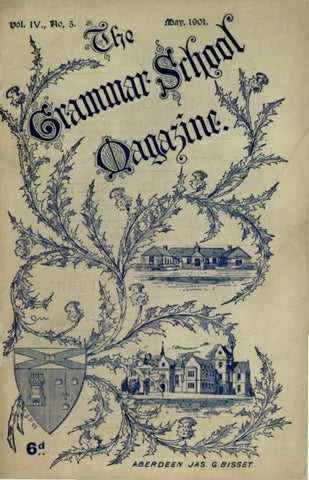
Grammar Sci?oot t1Taga3inc. Vol. IV.
MAY, 1901.
No. 5.
" With what a gentle foot doth silent Time Steal on his everlasting journey !"
So wrote Barry Cornwall, and so we feel as we write these, our last " School Notes." It is over a year since we first took up our pen, and we took it up with some apprehension, as we now lay it down with a great deal of regret. Our tenure of the office of Editor of the Magazine has been most happy; not one discordant note has broken the harmony with which things have progressed, hardly one thing has happened that we would wish otherwise. In reviewing a school magazine, a contemporary once said that they had noticed a very unusual line—" The Editor begs to acknowledge his indebtedness to the SubEditors." Now we do not intend to say that, though we should very much like to; but we cannot allow this fourth volume of our Magazine to end without thanking everyone, boys and " Old Boys," for their kind and generous support. To some " Old Boys " we owe a special debt of gratitude, notably Sir Arthur Farquhar, K.C.B.; and Mr. Charles" Davidson. Of present pupils we are most deeply in the debt of the various Secretaries who have kept us supplied with the news and official Reports of our various School Clubs. " To one and all we bows our thanks : of one and all we takes our leave."
160
The Grammar School Magazine.
The third article of the series " When We were Boys " appears in this issue, and is by a very well-known " Old Boy "—Sir George Reid, P.R.S.A., LL.D., one of the bestknown of present-day artists. Our other articles include one from Sir Thomas Sutherland, G.C.M.G., LL.D. (F.P.), late M.P. for Greenock, Director of the Hong-Kong and Shanghai Bank, and Chairman of the world-famed P. & 0. Steamship Co. Of his retirement from Parliament, " Toby, M.P.," in " Punch," said : —" House learns with regret that P. & 0: Sutherland intends to retire from the scene at the close of present Parliament. . . . He is of the kind that gives solidity to the character, weight to the counsels of Parliament. Haven't too many of his class. House could better spare a more fluent man." Our Hall is getting quite warlike: to the fetters from Omdurman, the piece of the gahdi's flag, and the case of Victorian War Medals, a companion has been added in the shape of a " real live " Boxer flag sent-by W. R. Butchart (F.P.), engineer on H.M. Transport " Salamis," whom we thank in the name of the School. Dr. Giles, Professor of Chinese at Cambridge, tells us that the symbols on the flag mean " Left division of the land forces." We are glad to see that the Board have appointed Mr. Ward to be School Librarian. H.I.M. the King has been graciously pleased to accept an Italian poem on the death of Queen Victoria, with an English translation by Mr. Morrison. As a rule no photographs are allowed to be hung in the Hall unless they are those of " Old Boys." An exception has, however, been made in the case of the beautiful picture of the late Queen Victoria, which the Board has so kindly given us. We are glad that this portrait of Her late Majesty has found a place in the Hall where all the treasures of our School are. •
It would, we think, be a capital idea, when it is desired to erect a memorial to any famous " Old Boys," to place a stained glass window to them in the Hall. Why not start now with a window to Byron, Hill Burton, Beattie, and, say, Mackay of Uganda? Let the Literary and Debating Society place aside every year some portion of its surplus
School Notes.
161
and begin a general fund for this purpose, and we could soon get one window. It is worth the trouble and the money, and, to us who are so proud of our lovely Hall, would supply one of the two things we need, the other being a small organ. They are getting one, we believe, at the principal girls'—beg pardon—young ladies' School in town, so why should we not try for one at the principal educational seminary for young gentlemen? We have received a very kind letter from His Grace the Archbishop of Rupertsland (F.P.), Primate of all Canada, and Prelate of St. Michael and St. George. We hope that some day the Magazine may have an article from him, as we are sure it would be interesting. The Cricket Colours will for the future consist of a white blazer, with red, white, and blue braid, and the School Arms on the pocket ; a white cap, with red, white, and blue ribbon radiating from the button in the centre, and the Arms on the front. None but members of the 1st XI. are allowed to wear the above colours, and they must have written authority from the Captain to do so. This is a step in the right direction ; but how does it come about that in the lowest parts of the town urchins are to be found puffing at cigarettes, using coarse and vile language, and wearing our colours ? The colours of other Schools are sacred; no outsider would ever presume to flaunt them in this way, and it is not right that our School should get the discredit of fellows who indulge in such habits. For a man to wear another's coat of arms, or trick himself out in titles or garbs that do not belong to him, is an odious impertinence, and in some cases illegal. Moral.—When your School cap is worn out, make a point of seeing that it is destroyed ; do as we do— burn it. Still the Grammar School, for which were mortified all the lands of Ferryhill, and which once (once !) owned so much land, is in want of that new field ! The School football season is now over, and we must congratulate the 1st XV. on its success. It is now the first junior team in town, though they were once beaten by the F.P.'s by about 3 points when our best player was
162
The Grammar School Magazine.
absent. The chief credit for our successful season is undoubtedly due to T. B. Robertson, without whom the team would never have been able to achieve such greatness ; but J. C. Lyon, F. R. Johnson, W. Brodie, M. Macrae, and others, supported him nobly, and deserve praise for so doing. It is long since the School had such a good allround athlete as Robertson, and it is much to be regretted that he cannot play in the XI. this cricket season. Still we hope for a good season, and see no reason why we should be disappointed. The production of " Little Toddlekins " seems to have given general satisfaction, but, as a more competent criticism than any we could give will be found in another place, we shall abstain from "remarks " here, and shall content ourselves with saying that if the spectators enjoyed it as much as the actors did, they must have passed a very happy evening. From a financial point of view, at any rate, the Literary and Debating Society should be well pleased with their entertainment, and gratified that there will probably be no fewer than five of the cast who, if they are asked very nicely, may act next year. We must not forget to thank Mr. J. M. Morrison for so kindly superintending the rehearsals of the play and generally looking after the whole performance. His kindness was much appreciated by the actors and the Debating Society. Mr. Charles Davidson and Mr. Ward were busily attending to the comfort of the audience, and looking after the " cash." An army of stewards, present and former pupils, assisted them, and to all these our thanks are also due. The heartiest thanks of the School in general and the Society in particular are due to Madame Patti Hicks, the Misses Donaldson, Miss Copland, Rev. J. C. Smith, and Messrs. Fernie, Watt, and Allan, for their services at the Finale. Our concert won golden opinions from all who attended it, and has been voted one of the best, if not the best, we have ever had. The front plot of grass will not be available for net practices this season. It will be the better for another year's rest, if carefully attended, weeded, and doctored. Recent neglect, in spite of what was done for it a year ago,
School Notes.
163
threatens to make the last state of it worse than the first. Meantime the first two elevens will practise at Mannofield, where they will have the advantage of the " Professor's" coaching. It is also hoped that a net for practice may be started at the new Westburn addition to the Victoria Park. The turf there is good, and with a little attention in the way of cutting, rolling, &c., will provide very good pitches. It is understood that the Links and Parks Committee have resolved to set aside a portion for such games. This is excellent, as our Parks already have quite enough of the pasture-and-perambulator sort of thing. We want more of what the Germans call " tumble-places " for the young. Apropos, the Victoria Park on Easter Monday was a joyous sight. And Easter eggs drew a glorious cloud of sea-gulls in their wake ; quite an egg-sighting scramble ! The officials for next year, as far as we know them, augur well for the School. As will be seen elsewhere, A. Lyon will be Librarian of the Lending Department of the Library, and J. Macpherson will be assistant. Lyon will also have charge of the Magazine, so that this will also be in good hands. We have to acknowledge the following donations to the Magazine :—Sir Arthur Farquhar, K.C.B., ; Literary and Debating Society, £2 ; A.G.S. Swimming Club, £1. This is the best kind of encouragement.
'
The Literary and Debating Society has furnished the necessary funds for hanging (absit omen!) the 1st XV. in the Corridor. We reproduce the photo. with this issue, and are sure our readers will agree that it is a very good one. The Literary and Debating Society is on the wax (if you can say " on the wane," why not ' on the wax "). Its membership is the largest ever known. Its officials— especially the indefatigable James G. Danson, Secretary and Treasurer—have been most assiduous. Its meetings, with one exception, have been all that one could wish. That one exception was the night before the Xmas Holidays, when exams. had held their sway and exhausted all the energy of the members. This year has brought out several new speakers, from whom—if an " old hand " may say so—the Society may expect much in the future, and we venture to say they will not be disappointed. Such
164
The Grammar School Magazine.
speakers are J. G. Danson and A. Lyon, both of whom we ought to see in " high places" next year. Both have certainly got " the gift o' the gab." One thing, however, is essential for the conducting of a Literary Society worthy of the name, and that is seriousness. Unless things are taken seriously the Society cannot prosper as it ought to. It may flourish financially; but that is not its chief raison d'etre—at anyrate it ought not to be. This year has seen a great improvement in this respect ; but there are still one or two members who seem to find " jokes " where others look for them in vain. We would venture to suggest that next year's officials be very careful what outsiders they admit to membership, as this is one of those things which when once done are very difficult and unpleasant to undo. Speaking of officials, a word with regard to elections may not be altogether out of place here. When an election comes round there is a tendency—a natural tendency, we admit—to elect the popular candidate in preference to one who, though not so popular, is perhaps more competent. Sometimes a fellow is both competent and popular, but it is not always so. When, therefore, the elections come round again next year, we hope the School will " look before they leap," or, in other words, think before they vote. The Librarians have been employed lately in dusting the Library, and even in the dust he who runs may read strange things. He may see how Dickens, Thackeray, Scott, and Besant send clouds out when the brush touches them, and how the latest writer, who will probably be forgotten in a year or two, is clean, though a trifle dog-eared. ' This tells a tale." It shows how the Grammar boys choose their literature. Read for amusement, certainly ; but let your amusement be profitable, and not a waste of time. As for anyone who takes out Biography, History, Poetry, or any of the other divisions except fiction, the Librarians beam upon him, and shake hands in private over this one poor fellow who " has sense enough " to have a taste for something more than blood and thunder on the one hand or milk and water on the other. We welcome our new Janitor, J. Bisset, and hope he will have a long and happy stay with us.
School Notes.
165
We have received an article on the old days at the " Gram." from John Johnston, Esq., of Milwaukee, which we hope will be published in the next number of the Magazine. Mr. Johnston is very well-known in Aberdeen and neighbourhood, and we are very grateful for his remembering us. The article is most interesting, and may well form one of our " Old Boy " series in the future. We are glad to see that Gordon's College has started a magazine. The literary talent of that institution will now have full scope ; indeed it is high time that Gordon's had some periodical. No School of decent size and respectable literary standing should be without one. We welcome our young brother heartily, only we wish he had been christened "The Gordon's College [with or without the addition of " in Aberdeen "] Magazine," instead of " The Schoolboy's Realm." The small-pox scare has been visiting us, and the School almost en masse have been vaccinated. One prominent official endured great tribulation, and went about with a face that revealed his sufferings ; in fact we believe the sight of his face prevented others from going and doing likewise. We should like to remind all those who are leaving that there is such a thing as the F.P. Club, and that they ought to join it. The Secretary is Mr. Alfred W. Edwards, and the subscription is merely nominal (is. per annum). The social side of the Club has not been very active this year owing to the war and the death of Queen Victoria, but we hope that next season the Club will resume those social gatherings—including the dramatic performances—which have been so successful in the past. And now, what shall we say? The time is nearly at hand when we must take our last farewell of the place which has been so dear to us for so many years. You who are left, guard her honour : uphold her traditions : consider her welfare. To us who go forth, to you who take our places, the same ideal should be present— Vivat, crescat, floreat Sch,ola Grammatica Aberdonensis ! there to say more ? What need is
166
The Grammar School Magazine.
-Note Old
-Boys s
=
BYRON'S DEATH-DAY.
THE following "In Memoriam" notice again appears in the Times : — "George Gordon Noel, Lord Byron, died nobly for Greece at Missolonghi, April 19th, 1824." " When love, who sent, forgot to save The young, the beautiful, the brave." —The Bride of Abydos.
" Sir Walter Scott, speaking of his death, said—' It is as if the sun had gone out.' " The quotations are each year the same. The explanation of the announcement is that a lady bequeathed a sum of money to place a wreath of Marechal Niel roses on this day at the foot of Byron's statue in Hyde Park Gardens, and for an " In Memoriam " advertisement in the papers, till such time as the authorities in Westminster Abbey shall allow the one word " Byron " to be inscribed in Poets' Corner. We hear that the F.P.'s are to give a dramatic performance in the autumn in aid of the Byron Statue Fund. The King has conferred on Sir James Reid, Bart., the Grand Cross of the Royal Victorian Order. This is the highest grade in that Order. Sir James has also been appointed Physician-in-Ordinary to His Majesty. Professor Ogston, M.D., has been appointed Surgeon-inOrdinary to His Majesty in Scotland. We have to announce the death of the Rev. W. F. Aitken, lately Professor of Biblical Criticism in the Original Secession Church. He was born in 1832, in Aberdeen, where his father was a minister, and so was his
Notes about Old Boys.
167
One of his sons, the Rev. G. R. Aitken, grandfather. Kirkintilloch, represents the fourth generation of one family of ministers in the Original Secession Church.
-
This wonderful record is almost equalled by the four parson sons of the Rector of Alford, Mr. Petrie, all of them " Old Boys," one of whom has just been appointed to the the charge of the Episcopal Church at Oldmeldrum. The Rev. P. T. Forsyth, D.D., Cambridge, has just been appointed Principal of the Hackney Theological College, London. While at the School and College, the late Rev. Dr. Emslie was one of his class-mates. He declares that in his day many of the fellows permanently injured their health by too hard study and no games. As a preacher and scholar Dr. Forsyth holds a place in the front rank. We have to announce the death of the Rev. Charles M`Donald, Professor of Mathematics in Dalhousie College, Halifax, Nova Scotia. Born in 1828, he had a remarkably brilliant career at School and College, having been called not only the most brilliant scholar of his year, but also of his time. He was a Master in the School for several years, but left in 1863 for Halifax where he was Professor for 38 years. The Halifax Herald says—" Alert of mind, apt and exact in expression, logical in all things, goodhumoured, honest, vigorous, thorough, his students generally admired and loved him and became like him. As a teacher of Mathematics, he stood in the front rank." Lieutenant R. A. Henderson has gone to the front with He was one of the mainstays of the the Gordons. Dramatic Society of the F.P.'s, and his performance of the blasé Talbot Champneys in " Our Boys" will long Like all remain in the minds of those who saw him. properly constituted Grammarians he has been a regular Luck to our subscriber to the Mag. for many years. " Bob." In his Company there went out two other F.P.'s —W. Duncan and G. B. Pirie. James Brebner and Hector Brown are in the Imperial Yeomanry. Percy Snowdon, who left the V. last year to live with his parents in England, has been elected to a Senior Scholarship of £20 a year at Rossall School.
168
The Grammar School Magazine.
J. Ritchie has got a commission in the Royal Army Medical Corps. Kenneth H. Crawford has got his commission in the Royal Garrison Artillery Regiment, stationed at Gibraltar. We regret to announce the death of the Rev. John Davidson, lately Schoolmaster of Ellon, who died in Aberdeen, at the advanced age of 85. Hugh Bisset and Ernest F. Watson are serving their time in the " Strathdon," recently home from Australia. Another F.P. in the service of Messrs. Geo. Thompson and Co. is W. R. Butchart, engineer on H.M. Transport " Salamis." Butchart presented us with the Boxer flag, which now adorns the Hall. Bisset and Watson are joining the Naval Reserve, as every patriotic British seaman should. The F.P. dance, after being postponed, came off on the 15th March, in the Grand Hotel. Owing to the change of date it was not so popular this year as it has been, but all the same it was thoroughly enjoyed by those who were present.
THE BURSARY COMPETITION. THE general results of the year's Bursary Competition are already known to readers of the Magazine. An analysis of the detailed list of marks, however, discloses several interesting facts, to which attention may be drawn. It has to be observed in the first place that the entire scale of marks this year is considerably lower than it has been in any previous year under the present scheme of examination—indicating presumably either that the questions set were more difficult, or that the papers have been more severely marked. Theoretically, of course, there is a third possibility; but, as it can hardly be supposed that the whole of a year's candidates are of inferior ability to their predecessors, this possibility may be dismissed from consideration. Candidates who were at both years' Competitions are agreed that this year's papers were appreciably more difficult than those of last year, while there is a general concurrence that the marking is harder. The
The Bursary Competition.
169
•
following are the places taken by the School, with the total marks made out of a possible maximum of 1800 : 6. William S. Mackie 15. George Dawson 17. John M. Robertson 28. Ian M. M`Laren 34. Andrew R. Williamson 40. George E. Hay 43. James M. Milne 47. G. Stanley Russell 48. Norman S. Gilchrist 50. Theodore Watt 52. Frederick J. Dean 54. Peter Webster 73. David Anderson 74. John A. Lillie 82. Robert S. Clark 83. Alexander J. Munro 87. William W. Jameson 88. Cecil B. Simpson
.
.
.
-
. . -
. -
-
. -
-
. . . -
1375 1297 1290 1261 1233 1192 1183 1142 1137 1127 1125 1118 1045 1043 1020 1018 1014 1011
. -
.
.
Five of the places, the 40th, 43rd, 48th, 87th, and 88th, have been taken by members of the Classical VI., who entered for the Competition for the first time this year. Although the taking of the 40th place under such circumstances is by no means " unprecedented " in the annals of the School, as some suppose, yet these figures may be taken as an augury of very good results at the next Competition. Though the School has not obtained so many places in the first 50 as Gordon's College (the only School with which we can compare ourselves), this is no proof that we have been beaten. It must be remembered that one-third of the candidates from Gordon's College who have taken places in the first 50 have been at some other school also during the last two years, and therefore the College can take- only part of the credit for the position of these in the list. On the other hand, every one of the Grammar School pupils in the first 50 has been at the School for the whole of the last two years, and, with one exception, for over four years, and so may be said to belong exclusively to the School. The best way of showing how the candidates from the Grammar School have done is to compare their average marks in each subject with those of competitors from other schools. The following table shows the average marks in each subject made by candidates from the Grammar School and Gordon's College : — French. Dynamics. Greek. Latin. Maths. English. Max. 400. Max. 400. Max. 400. Max. 4G). Max. 200. Max. 200.
Grammar School - 303.6 303-2 Gordon's College *3001
196.7 250-3 243.2
280.2 '290-9 292.6
298.7 291.2 290.2
142.8 151.6 151
• The second set of figures is for the "pure article."
177 — 144.6
170
The Grammar School Magazine.
The averages in Dynamics are for all who obtained places in the list ; in the other subjects the averages are for those placed in. the first 50. As the Grammar School had only one competitor who took German and Gordon's College had none, no comparison can be made. From the foregoing figures it will be seen that the Grammar School is before Gordon's College in three out of six subjects, viz., English, Greek, and Dynamics. Another noteworthy fact is that the highest place in Greek is taken by one of the competitors from the School, with 351 marks, or seven above the number obtained by the First Bursar. The two highest results scored by Grammar School candidates in each subject are:— English J. M. Robertson, 328 ; W. S. Mackie, 320. Mathematics Latin Greek French German Dynamics
-
-
W. S. Mackie, 292 ; I. M. M`Laren, 274. G. S. Russell, 304 ; W. S. Mackie, 302. J. M. Robertson, 351 ; G. E. Hay, 331. J. M. Robertson and A. R. Williamson, 157. George Dawson, 130. Peter Webster, 182 ; W. S. Mackie, 172.
The Classical VI. have done exceedingly well for the first " try." George E. Hay, with 661, has made higher marks in Classics than any other " Grammar " boy. James M. Milne is well up in English, with 299. Norman S. Gilchrist has made 144 in. French, and so is fourth among competitors from the School. May the Classical VI. flourish ! THE FINALE. ON Friday, 22nd February, the Debating Society held one of its most successful finales. It was so in respect of the crowded audience, the capital programme, and the highly commendable behaviour of the School. At last it seems that the School is conscious of the duty that it owes to itself, and to others, in exercising proper self-control on high occasions. The first part of the programme was, as usual, musical. Mr. W. Fernie sang the " Serenade," and the Misses Donaldson a duet, "Hark to the Mandoline." Madame Patti Hicks gave two delightful violin solos. Mr. H. J. Watt, an old boy, was well received in his song, but our friend, the Reverend J. C. Smith, fairly took the house by storm with his comic selections. Encores were loudly demanded from him, and he was good enough to comply. Miss Copland recited with dramatic effect. Mr. John Allan was accompanist. All, however, were agog for Part II.
" LITTLE TODDLEKINS," February, [um.
Captain Littlepop J. Macpherson). Mr. Brownsnaith (J. G. Danson). Mr. Babbieombe (G. S. Russell). Annie Babbicombe A. Lyon). Mr. J. M. Morrison (Stage Manager). Susan (D. Robb).
Theo. Watt (Asst. Stage Manager). Amanthis (D. B Nicol).
The Finale.
171
" Little Toddlekins" sounded such a charmingly childish title that the audience expected to see some precocious infant prattling on the stage when the curtain rose. No such vision met the eye. The " little " one, Amanthis, the virgin step-daughter of uncertain age, had remained a heavy incubus on the shoulders of her doting "poppa," Mr. J. Robinson Brownsmith (J. G. Danson), who tried his best to get some simple Simon to take her off his hands. Such briefly was the plot of the story, but there were, as Euclid would say, several corollaries. The fair damsel had, through her father's artful devices, two suitors for her hand, Mr. Barnaby Babbicombe (G. S. Russell), and Captain Littlepop (J. Macpherson). Danson did well, showing his anxiety to get his Amanthis palmed off on Macpherson. Macpherson looked and talked the cavalry captain to the life. D. B. Nicol, as Amanthis, was got up in a wondrous way. Little wonder that she had to remain that unconsidered trifle, a spinster, for ever. He reminded us strongly, down to the ringlets, of a former landlady of ours who used to blame the cat for many things. Annie Babbicombe(A. Lyon)looked, as the Evening Gazette would put it, altogether " winsome." Many indeed thought that we had borrowed some of our sisters from the Albyn Place seminaries for this night only. Susan, the household slave, was acted with all the necessary go by D. Robb. G. S. Russell, as Mr. Barnaby Babbicombe, made quite a character-study of his part, and kept up the illusion throughout. He seemed the very counter-part of some successful London linen draper, with oleaginous persuasive manners, who may be met in hundreds at the South Coast watering places. One almost expected to see him in a smoking cap, reading Tit-Bits, and smoking a cheap cigar. The whole piece went without a hitch from beginning to end, and besides being a pleasure to the audience and to the actors, must have been particularly so to the Stage Manager, Mr. Morrison. We imagine that about 600 people were present, but there were 400 threepenny pieces in the plate. Now, we do not wish to be rude, but we do say that if an entertainment is not worth more than 3d. then it is not worth going to see. And even at that, four people got in without giving any contribution, which we are still waiting for. What is worst of all, however, is that those who guard the doors cannot help seeing who the people are who try to conceal their " widows' mites " on entering.
172
The Grammar School Magazine. "WHEN WE WERE BOYS "-III. SIR GEORGE REID, P.R.S.A., LL.D.
THE old Grammar School, which stood on the' site now occupied by Gray's School of Art, was a low, one-storied building, plain, almost to ugliness. A stone wall surmounted by an iron railing separated it from the street. The entrance gate was flanked by square pillars surmounted by granite balls. The Public School occupied the centre of the building. Two or three rude stone steps led up to the door, above which rose a simple pediment and belfry, the only attempt at architectural adornment of any kind. The class-rooms were equally bare and ugly—lowroofed, whitewashed, and divided down the middle by a passage having on either side a number of hard wooden benches, or "factions," as they were called, not unlike church pews, and much carved over with the names and initials of former boys. The master's desk was on a slightly raised platform at the end nearest the fireplace, where also stood a coal-box, and a poker of Brobdingnagian size. In winter the class-rooms were often wretchedly cold, being so arranged that most of the boys sat between the outer door, under which the wind freely entered, and the fireplace, and any warmth given out by the latter went up the chimney. When the snow was deep, pathways had to be cleared to reach the class-room doors. Snow-balling went on as a matter of course, with no worse result than an occasional broken pane of glass. Each morning, before beginning the work of the classes, the teachers met in the Public School, which was seldom used except on great occasions, such as the annual visitation of the Lord Provost, Magistrates, and city clergy. The lessons for the day began with a short prayer and calling the roll, each boy present answering to his name with an " Adsum." The class-books in use during the first year were "Ruddiman's Rudiments," the Colloquies of Erasmus, Chambers's Geography, a History of Scotland (White's or Macculloch's), and one or two more, the names of which are now forgotten. Few school books can have had such a long lease of life as Ruddiman's " Rudiments." It was first published in 1714, and was still in use in Aberdeen Grammar School a hundred and forty years later! Does it still survive, or
"When We were Boys."
173
have modern ideas and modern methods consigned it to the limbo of things forgotten ? The teachers were the Rector, Mr. W. D. Geddes, for many years Professor of Greek and afterwards Principal of the University ;Messrs. Beverly, Dunn, and Brebner. I was in the class taught by the last-named. In after years I knew the Rector as a dear personal friend—but if I begin to speak of Sir William Geddes and of all he was there will be no limit to this paper. " O man, greatly beloved, go thou thy way till the end ; for thou shalt rest, and stand in thy lot at the end of the days." Of the other teachers my recollections are less distinct. Mr. Beverly—" Dick," as he was irreverently called—was lame ; Mr. Dunn, short, and stout of build, has left on the mental retina only the image of the drab-coloured breeches and light waistcoats he used to affect in warm weather. Mr. Brebner—who went afterwards to South Africa—rose to a position of considerable importance in the whilom Orange Free State. The Janitor of the School, John Gray, was a little, fresh-complexioned, white-haired man, somewhat stricken in years, but still active and not slow to wrath when There was a story provoked—as he frequently was. current among the boys that he had seen better days—had, in fact, been a Bailie (if not a Provost) of Bervie at one On Sunday he acted as minister's beadle in the time. West Parish Church. He was kindly, and on the whole well liked by the boys, but, being small of stature and somewhat infirm, he was occasionally subjected to a good deal of hustling and annoyance. There was only one boy in the class who possessed a watch. His name was Alfred Duncan, and he had invented an ingenious method of signalling the time of day on his fingers to anxious enquirers, of whom there were many as the hour for dismissing the class drew near. Among my classfellows were—George Croom Robertson, afterwards Grote Professor of Philosophy and Logic in -University College, London; Lieutenant-Colonel A. B. M`Hardy, C.B. ; Colonel Andrew Baird, C.S.I. ; Alexander and David Kerr, sons of a well-known physician in Aberdeen ; George Thompson, son of a tailor in Broad Street, who afterwards went to China as a student interpreter, and died there ; Robert Gray, who became an advocate ; James Grant, a clever little fellow with a crutch ; one Macrobbie, who became a doctor ; another of the same name, a big, grown-up young man, one-armed and rather stupid, who
174
The Grammar School Magazine.
turned cattle-dealer; Colin Longmuir, son of a Free Church clergyman, afterwards a bank manager in Melbourne, and who died at sea on his way home ; William Keith and John. Gordon; but there must have been at least a score of others in the class, whose names are quite forgotten.
THE SUEZ CANAL. THE story of the Suez Canal is in many ways a romantic one. I have been connected with this enterprise for fifteen or sixteen years, as one of the English Directors of the Company, and willingly comply with the request of the Editor of my old School Magazine to write a short article on the subject for the pages of that paper. I can only do so, however, in a very rough and superficial manner ; for, according to the summons which I have received, I have only an hour or two in which to accomplish the task. This is not the fault of the Editor, but of a change in my address, causing a note of his to miscarry, which would otherwise have given me ample time to devote to the subject. Everyone knows that the Suez Canal has been for the last thirty years the great highway of communication between the East and the West, and that from its first opening in the latter days of 1869, the foundation was laid of a revolution in our Eastern commerce, whereby sailing ships and the Cape of Good Hope route were soon. to become things of the past. Not everyone knows, however, that the opening of the Canal synchronised with a new departure in marine engineering, by the perfecting of high and low pressure machinery, in the form of what was called the Compound Engine, and that the great economy of coal, resulting from this development, led to a rush of steam shipbuilding which has gone on increasing from year to year, until the present day. But for this economy of fuel, sailing ships and the Cape route might have held their own; and the Canal instead of becoming the fortunate enterprise which it is, in a financial sense, might have lain dormant and unprofitable for many years. The Compound Engine may be said to have made the fortune of the Canal, and the Canal gave our engineers and shipbuilders a new world to conquer. The Canal is a deep cutting through the desert which lies between Egypt and Syria. Its length is about 90
175
The Suez Canal.
miles, and its navigable width was originally 72 feet, with a depth of 26, which enabled ships to pass through drawing 241 feet. On the surface it is in some places some 300 or 400 feet wide, but elsewhere the width diminishes to little more than double that of the navigable channel, owing to the steepness and hardness of the banks through which the cutting runs. For some twenty miles of the distance the channel passes through what are called the great and small bitter lakes—lagoons which had dried up in the course of A large expenditure has been incurred in centuries. widening and deepening the channel since its first opening, and at the present moment the navigable width is upwards of 120 feet, and the depth 29 feet, so that the very large vessels which now pass through do so much more easily than did the smaller ships of thirty years ago. There are gares or sidings every five miles, where ships can draw up easily, to allow other vessels to pass, and the traffic is of course regulated by very strict rules. The average passage of ships is something like eighteen hours, while in the earlier period of the navigation double or treble this length of time was occupied. This acceleration is due not only to the improvement of the Canal, but to the use of the electric light, which enables ships to steam as easily at night as in the daytime. The nights are usually windless, and the steering of the great masses of vessels of 8,000 and 10,00% tons is rendered easier in that way. The electric light is carried in the bows of the ship, and thrown by means of a " projecteur " for a distance of perhaps half-amile along the course of the Canal, which is carefully marked by buoys. It is difficult to imagine the weird effect thus produced by the magnificent illumination on the ship's path, with the massive shadow of the stately ship herself in the background. Seeing this strange sight in the desert, sacred to so many memories, one inevitably thinks of the " pillar of fire " in the olden time. The revolution effected by the Canal is perhaps most easily grasped when one reflects on the comparative distances between this route and the old way round the Cape. Thus— Via Canal.
Via Cape.
6,274 knots. 10,719 knots. London to Bombay, 11,606 „ „ 7,974 Calcutta, London to 13,805 „ London to Shanghai, - 10,466 „ In addition to the contrast presented by these figures, it must be remembered that the traffic is now carried on entirely by steam, while the Cape route was devoted ex-
176
The Grammar School Magazine.
elusively to sail. It is true that steam was tried by the Cape, but it never met with any success. Speaking broadly, therefore, we may set it down that the employment of steam via the Suez Canal, as compared with the old sailing-ship days, curtails the length of voyage to onefourth of the time formerly occupied. A slow steamer now gets out to Bombay in 26 days, while the sailing ship formerly took 100 ; to Shanghai say 43 days, as against the old time of 130 or 140 days, and so throughout. To sum. up the matter very briefly, goods are now carried in about a fourth of the time formerly occupied, while (thanks to the vast economy which has attended the improvement of machinery and ship construction) the charges are less than half what they were in the old and slow days ! The natural result has followed. Year by year the tonnage passing through the Canal has continued, with little variation, to increase, and sometimes the increase grows by leapg and bounds. Here are a few figures. The first year after the Canal was opened, viz., 1870, the tonnage which passed through was only 436,000 tons. In 1875, it had grown to 2,000,000 tons, and in 1885 to 6,300,000 tons. Last year, in 1900, the tonnage was 9,700,000. It must be noted that this is what is called net tonnage ; and, if we were to take the figure of the gross tonnage, we should have to estimate last year's traffic at nearly 14,000,000 tons. It does not require any great insight to perceive that the Company which owns the Canal is now a very fortunate enterprise, or to imagine that the value of its stock (notwithstanding large abatements in the tariff made from time to time in favour of the shipping interests) is very considerable. A £20 share is worth at the present moment not far short of £150. Of this great tonnage, Great Britain's share is nearly 75 per cent., while, if the trade carried on by these fleets could be analysed, it would probably be found that not less than 90 per cent. of it was derived from British sources. To what extent the canal has been instrumental in adding to the world's wealth, and especially to that of our own country, it is impossible to say with any precision, but if such an investigation could be pursued with exactitude the result would be highly interesting. The pupils of the Aberdeen Grammar School are, of course, aware that in ancient times canal communication existed between the Mediterranean and the Red Sea. According to Herodotus, this canal was finished in the time of Darius, after the Persians had effected the conquest of
The Suez Canal.
177
Egypt, and Plutarch mentions that, after the battle of Actium, Cleopatra escaped with her fleet by this route. This channel finally fell into disuse about the ninth century. It was not, however, a maritime canal between the two seas, but a channel connecting the Nile with the Red Sea ; nor was the idea, so far as we know, ever entertained of cutting a maritime highway between the two seas, until the time of Napoleon's campaign in Egypt. Full of the desire to baulk the power of Great Britain, which rested so largely on the trade of the Indies, Napoleon ordered the survey of the Isthmus of Suez, with a view to the creation of a maritime channel through the desert. His engineers fell into the error of believing that a considerable difference existed between the altitudes of the two seas, and the project of directly connecting the Mediterranean and the Red Sea was therefore abandoned ; nor was it ever reopened until Ferdinand de Lesseps appeared on the scene. To his genius and perseverance for long years, in the face of difficulties which would have conquered most men, the existence of the Suez Canal is solely due. Here the romance of the story begins. Lesseps was not an engineer but a diplomatist, and in the year 1831 he was sent as a youngster to join the Consular Service in Egypt. The ship by which he arrived at Alexandria came from Tunis, and was placed in quarantine for some The French Consul General kindly considerable time. sent off some books to the ships to help his young countryman to pass away a dreary time, and among these works was the volume containing the reports of Napoleon's engineers on the survey of the Isthmus. The subject fascinated Lesseps, and he must have jumped instinctively to the conviction that the engineers had miscalculated the level of the two seas. At all events, the project of creating the canal took possession of his mind, and never left it. He was stimulated in his great conception by witnessing the extraordinary efforts which Waghorn was then making to demonstrate the feasibility of the Egyptian route for the conveyance of our mails, which then went round the Cape, and occupied months on their journey. (This Overland Route shortly fell into the hands of the Peninsular & Oriental Company ; but that is quite another story.) Lesseps remained in Egypt for some years, always working away privately at his great idea (which most people with whom he came into contact treated as utterly chimerical), and he was then moved on
178
The Grammar School Magazine.
to other posts in the Diplomatic Service, which he finally From that time onwards he devoted quitted in 1849. himself exclusively to this project, and began by petitioning the then Viceroy of Egypt, and also the Sublime Porte, for a concession to carry out his idea. His proposals received no attention whatever, or met with an absolute refusal. But in 1854 Said Pacha ascended the Viceregal throne, and then the whole prospect changed, for Said had been one of Lesseps' intimate friends during the years in which the latter had lived in Egypt. Lesseps went out immediately to Egypt at Said's invitation, and was received with every favour and consideration. But it was not without difficulty that he obtained the desired concession for cutting through the Isthmus, for it was known that England wanted, not a canal (which she did not believe in), but a railway across the Isthmus by which her mails, passengers, and valuable goods might be easily and quickly transported. At length, however, Lesseps' persuasive powers carried the day, and he obtained from the Viceroy a concession to create the Canal, with such advantages in the way of land, of forced labour, and other privileges, as only an Eastern potentate could confer. He might have sold this concession the next day for an enormous sum ; but it was not wealth that he desired for himself. His ambition was to create a work of imperishable fame. But with the concession in his pocket, Lesseps' difficulties had only begun. The concession was invalid without the consent of the Porte, and the English Ambassador, then all-powerful, stopped the way. Lord Stratford de Redcliffe was polite and hospitable, but assured Lesseps that the Canal neither could nor would be made. Then commenced a pilgrimage to the Ministers of the great European States, with the hope of influencing them in favour of the scheme. Palmerston was impracticable and hostile in the highest degree. He did not believe that the scheme was practicable, and for this view he relied on the authority of Stephenson and other engineers ; but, if it were practicable, then he considered that its success would be opposed to the true interests of Great Britain, whose prosperity was associated with the Cape route, while the new route would be advantageous to French and other Mediterranean ports at the expense of British shipping. The question was debated on several occasions in the House of Commons in Palmerston's time and afterwards, but always with the same feeling of incredulity and hostility. Palmerston was then the most powerful Minister in
The Suez Canal.
179
Europe, and the mot d'ordre of the Emperor of the French was that of the English alliance, so that even from his own Government Lesseps could obtain little or no encouragement, notwithstanding his cousinship with the Empress Eugenie, who was always his close friend. Years passed by in the seemingly hopeless endeavour to obtain the desired confirmation by the Sultan ; but Lesseps had not been otherwise idle. His plans were ready. The scheme He dared not, however, of his Company was formed. venture to put it into operation until 1858, when, secretly encouraged by various authorities not very friendly to England, he opened a subscription in the month of November for eight millions sterling, which was met by France taking half the capital, and the Viceroy of Egypt the other half, and on the 25th November, 1859, the first stroke of the pickaxe was given in the bed of the future Canal. No sooner was the work begun than it was stopped by the Porte. But the influence of France was then thrown into the scale in favour of a scheme for which French money had been subscribed, and so the work proceeded. It was a stupendous undertaking, for no provisions, or water, or stone existed in that illimitable desert. Everything had to be brought to the scene of operations, and a deep-water port had to be created in the Mediterranean, A for which no natural facilities of any kind existed. sweet-water canal had to be cut from the Nile to supply drinking water, and to carry materials into the middle of the desert. One facility Lesseps had at his disposal, that of the old forced labour of Egypt, although the labour was slightly paid. He had also a grant of a large territory which it would have been possible to render fruitful by irrigation. But a new Viceroy now came to the throne, and he insisted on the retrocession of these advantages— the territory, the sweet-water canal, and the forced labour. Ruin stared Lesseps in the face. But the French Emperor then came to his assistance, by requiring that an arbitration should determine what compensation should be given the Canal Company for the grave infringement of the Lesseps concession. The Emperor was himself chosen as Arbitrator by the Viceroy, and awarded compensation to The the extent of three and a-half million sterling. absence of manual labour was soon amply compensated by the ingenuity of the French engineers, who invented such dredging machines and other appliances as had never been seen at work before. The needed workmen were imported from all parts of Eastern Europe, and a scene of un-
180
The Grammar School Magazine.
paralleled activity was witnessed in the formerly sad and silent desert. To the astonishment of an incredulous world it was announced that the Canal was about to be opened, and, on. the 17th of November, 1869, ships representing the flags of the great European Powers passed through its waters, almost before the world at large had recovered from the sensation of doubt and incredulity with which the announcement had been received ! The well-merited triumph of Lesseps was complete, and every State hastened to shower its decorations on his breast. He lived to see the financial prosperity of his great work, which had to pass through considerable difficulty in that respect at the commencement of its career. At a date when the Company was not too prosperous the offer was made to the British Government to buy half the Ordinary Shares in the Canal from the improvident Viceroy, Ismail, and this was effected at the price of four millions sterling. To-day this investment brings the Chancellor of the Exchequer an annual dividend amounting to nearly a million sterling ! . Such, very briefly and imperfectly told, is the story of the Suez Canal. To do it full justice would require far more time and space than I have now at my disposal. Only the other day, in the month of January of the present year, I was passing backwards and forwards across its surface on a visit of inspection, seeing its wonderful dredgers, its sweet-water canal, its now famous ports, its workshops, its railway, its telephonic and signalling stations, and watching the great fleets of men-of-war and merchantmen of every nationality passing along that busy though silent highway by day and by night. And then, as invariably must be the case in such circumstances, one's mind reverted to the long distant past. Abraham crossed the line of what is now the Canal when he came to Egypt, somewhere near to Lake Timsah, and it was in all probability in one of the lagoons, now known as the bitter lakes, that Pharaoh's host was swallowed up. The Holy Family passed this way, fleeing from Herod. Darius, Alexander, Caesar, Napoleon fought battles on this desert field. The great work of Lesseps links together the past and the present, the oldest civilisation and the newest, through a chain of events lying many centuries apart, yet all memorable in the world's history. THOMAS SUTHERLAND.
The Grammar School in 1533.
181
THE GRAMMAR SCHOOL IN 1533. IOHANNIS VAUSII STATUTA ET LEGES LUDI LITERARII GRAMMATICOR UM ABERDONENSIUM. THE Library of King's College contains a Latin Grammar, printed at Paris in 1533, the author of which was John Vans or Waus, first " Humanist" or Professor of Latin in King's College, which, after ten years of incubation, had got started in 1505. Little is known of the writer. The exact date of his appointment to King's College has not been ascertained. We may hazard the guess that he was perhaps a descendant of " John the Waus " (i.e., John of the Walls, de Vallis), Alderman (Provost) of the city in 1444-45—one of whose sons also bore the name John, and another, Richard, bestowed on the Grey Friars their place in Broad Street, the last vestige of which is on the eve of disappearing. The Town Council registers record that in 1520 ' Sir John Waus, Chaplain of the Altar of Jesus" [in St. Nicholas Church], became possessed of a tenement belonging to " John Arthour." The title " Sir" and his office mark him as a priest. Probably he had studied in Paris, after obtaining the rudiments of his education at the Grammar School, if, as seems probable, Aberdeen was his native city. The School had then existed for nearly three centuries, if not longer—was as old then as Marischal College now is. The chief interest of his Grammar for us, and in the history of education generally, lies in the quaint Latin rules drawn up by Vans for the management of the Grammar School, and printed therein, ' that those who serve under our cane (qui sub nostra ferules militant—a finely expressive phrase) may the more diligently keep the law, and may not plead ignorance of the statutes." It has been conjectured, though, so far as we know, never seriously maintained, that these rules referred not to the Grammar School but to the University. There are, no doubt, obscurities and difficulties in the text, which it would be beyond our present scope to discuss, and which, for lack of other direct information as to the School at that date, may leave it matter for debate whether these rules were intended for our School. Let us admit that the connection of Vaus with it is merely matter of conjecture, while his position in the new University is an accepted fact of history. We know, too, that undergraduates then and till within living memory were more juvenile than the
182
The Grammar School Magazine.
"'Varsity men " of our own days ; sometimes accordingly treated, as befitted their more tender years, to the salutary discipline of the rod. It is a tradition of Cambridge, though without historical basis, that Milton himself was flogged there, as were boys of old in our own School, by being mounted on the shoulders of a servitor. But the general tenour of the rules, the repeated use of the terms " schola," "pueri," and " Grammatici," the study of "Parts" (i.e., Latin Accidence), the mention of a Class of "Elementarii," for long afterwards a term used in our School for a class of beginners, the absence of specific terms appropriate and peculiar to the University, the mention of a Headmaster (praeceptor, archididascalus, gymnasiarcha), and more particularly of hypodidascali, whether ushers or monitors, the regulation that one of these should always supervise the pupils at play, and the- terrible " sanctions " of the law in the last dread paragraph—Hr CASTIGANDI VENIVNT-a thing evidently of daily recurrence—all point to the School rather than the College. It is reasonable, therefore, to guess that Vans, as a man of learning and position, was employed by the clerical or civic authorities who controlled the School to draw up this code for its management ; just as in 1700 the Town Council employed certain ministers and professors for the same purpose. And Vaus's connection with the town Church of St. Nicholas, with which our School had long been intimately associated, adds colour to the supposition. A copy of these rules, engrossed on parchment, along with the Code of 1700, has hung in our Hall for some years. But probably few of those who run have read it, so we shall endeavour to give the gist of them. The reader will hardly taste the flavour of their antiquity, if he fails to realise something of the - local colour " of those times. About the beginning of the 16th century Scotland, it has been estimated, contained some 600,000 inhabitants, or about four times the present population of Aberdeen alone, and Aberdeen itself only some 4,000 or 5,000, about the present size of Banff. It lay huddled round the Castle Hill, all east of the Denburn Valley, where the railway now cuts Union Street, and straggled northwards by the Gallowgate and east of the " Marisch " or North Loch—the site of the Infirmary—up to Windy Wynd or thereabouts. The houses were mostly of wood and thatched, the School itself a "thekked building, with a roof not seldom in need of repairs, to
The Grammar School in 1533.
183
judge by the frequent mention of this item in the Tosvp. records. The narrow streets were ill paved and filthy, a happy breeding-ground for the plague which then. frequently swept the country—the strange "seiknes of Nappillis " (Naples) ; so that in 1507 it was necessary to appoint men " to cleng [cleanse] the toun and dicht [dress or mend] the causaies," while " na muk " is to lie " at ony mannis yit [gate] or dur " longer than twenty-four hours, under pain of 8s., and the " muk" to be free to every person who shall " pleas to tak or leid it away." * The School Rector then was " John Byssat " (1519-39), probably the John Bysset who was a " regent " of King's College in 1519, and Principal, 1542-46 and 1547-54. No doubt, on his induction to the Rectorship he was duly presented with the " pair of bedes" or rosaries, emblem that his office must be maintained with prayerfulness. The Provost of the town was Thomas Menzies of Pitfoddels, of a family which then held a practical monopoly of the office ; and Hector Boece, most credulous of historians, was The Chancellor, Bishop Gavin Principal of King's. Dunbar, had died the year previously. Aberdeen was then at frequent feud with its turbulent neighbours, notably the Forbeses of Brux and Pitsligo, who in 1530 tried to rush the city, but, finding it prepared, were forced to an ignominious surrender, after a day's Middle-aged men could still siege in the Greyfriars. recall_ the first rumours of Columbus's great discovery. " Luther's book " had lately been proscribed by the Scottish Parliament (1525), and Aberdeen, as a port closely connected with the Continent, was warned to be diligent in suppressing the new heresy. Patrick Hamilton, the first martyr of the Reformation in Scotland, had perished at St. Andrews (1528), and Henry Forest, the monk, in 1532. In this same year, 1533, John Firth, an Englishman, was burned at Smithfield for translating Hamilton's book. For Henry, in England, was more bent on being Pope in his own realms than on making any material change in the practice and doctrine of the old Church. To this end he had broken Wolsey's heart, disgraced More, and in this same year of grace incontinently got himself married to Flodden was still a living agony in the Anne Boleyn. How many of the memories of widows and orphans. twenty spearmen and six horsemen who went south from • "Memorials of the Aldermen, Provosts, &c., of Aberdeen," by Mr. A. M. Munro, p. 79.
184
The Grammar School Magazine.
our little town won home again from that fatal field ? Had it not cost Scotland one in every sixty of its population ? In all this turmoil of religion and politics, education, hitherto fostered by the Church, was like to fare ill with the fall of the monasteries and wreck of Church organisation. Statesmen like the advisers of Edward VI., Elizabeth, and Knox, struggled, but not always effectually, to snatch something for learning from the greedy claws of the nobles and the brutal ignorance of the mob. Such schools as the religious houses had cherished fell with their impoverished patrons, and " Grammar Schools" had to be founded or re-founded throughout the land. Of all the great schools now famous in England hardly more than two or three date their origin before this century of deluge and renascence. Winchester was founded in 1387 ; Eton, 1440 ; the City of London School in 1442 ; St. Paul's, 1509 ; Manchester, 1510 ; Newcastle-on-Tyne, 1525 ; Durham, 1541 ; Canterbury, 1542 ; Chester, 1544 ; York, 1546 ; Leeds, Bedford, and Birmingham, 1552 ; Christ's Hospital, Tunbridge, and Shrewsbury, 1553 ; Westminster, Oundle, and Repton, 1556 ; Rugby, 1567 ; Harrow, 1571; Uppingham, 1581. Marlborough, Cheltenham, Clifton, Wellington, Rossall, are the creations of yesterday. In. Scotland the survival of the pre-Reformation schools, in the chief burghs, was probably due to the wiser policy of the Church in associating the civic rulers of the towns in the management of the schools. When the Church went by the board, there was still the broken reed of Town Councils to lean on, not always untainted by the prevailing greed to devour into the " Common Good " the patrimony of Church and Schools alike ; but still, in a fashion, under obligation to maintain their school ; and, with help of the ministers, capable of appointing Rectors after solemnly hearing the Latin " disputations " of rival candidates. MDXXXIII.* " JOHN VAUS'S STATUTES AND LAWS OF THE LITERARY t SCHOOL OF ' GRAMMAR BOYS' IN ABERDEEN. " In the first place, on entering School, the boy is to prostrate himself on the ground on bended knees, and CC
* The date is incorrectly given as 1553 in the old Spalding Club Miscellany, which gives the Latin text of these Laws. t Ludi Literarii: is this to distinguish it from the other school of the town, the "Song School"?
The Grammar School in 1533.
185
salute Christ the Lord Supreme (Optimum Maximum) and the Virgin Mother of God in the following brief little prayer : — " ' I thank Thee, Heavenly Father, for Thy favour during the past night, and pray for the same this day, to Thy glory and the salvation of my soul ; and oh, Thou that art the true Light that knows no setting, eternal Sun, bestowing life, growth, and joy on all, deign to illumine my mind, that nowhere may I fall into sin, but by Thy guidance may attain unto life eternal. Amen. Jesu, be Thou Jesus [Saviour] unto me, and strengthen me with Thy ruling [principali] Spirit.' * ' At 7 o'clock the Parts [grammar lessons] are to begin. This ended, let the Pmeceptor enter and punish those who fail with chidings or stripes. Punishment over, there is to be public lecture [praelectio] on all the lessons by the Preceptor himself at 8 o'clock. Thereafter the boys are to hasten to breakfast. At 10 there is to be the private lecture of the under-teachers [hypodidascali], each in their own classes. At 11 or half-past 10 the poor scholars [condiscipuli] are to have opportunity to go into the city, and the town's boys [i.e., poor boys of the town ?], if there be any, shortly afterwards. The second lecture of the Headmaster [Archididascalus] in Terence, Virgil, or Cicero, is to be at At the half-past 10, for those who have to attend it. stroke of noon the boys are to have interval for lunch. " STATUTES FOR TI3E AFTERNOON. " Before 2 o'clock everyone is to be in School, to hear the lectures of the classes. " There is always to be one under-teacher by turn in the building [gymnasium], to correct errors, mistakes in writing Latin, and those who are idle. Let them see to it, lest they themselves fall into the errors their duty is to check in others. At 4, after the stroke of the bell, the boys are to repeat to their teachers [instructoribus] the task of the day. " Only two at a time are to be allowed to " leave the room" with the tally or stick [cum signo aut baculo]. None Pare to be let out without need, before the return of those who have had leave. " The Headmaster [Gymnasiarcha] himself shall hear
* The expression is from the Vulgate of Psalm li., 12, where the English Version gives " free Spirit."
186
The Grammar School Magazine.
one or the other class besides his own highest class [implying three classes in the School], when he is so minded. In the evening ' Disputations' [defence and discussion of a thesis, conducted in Latin] are to be held from 5 to 6 o'clock. When these have been conned [cognita], let them hasten to evensong [preces canere. Festinent seems to imply away from the School; cf., jentatum festinent, above ; if so, the prayers were probably chanted at the evening service in St. Nicholas, across the way. There for long afterwards the boys had special seats: see the Laws of 1700.] " Pythagorean [i.e., strictest] silence for one year is to be imposed on boys of the elementary class and on new boys [elementariis et neophytis]. " They are to learn the table of the Confession. "They are to have a slight taste of Arithmetic [numerandi artem modice praelibent—think of it, ye who groan in the throes of ' Higher Grade' !]. "All are to speak Latin, Greek, Hebrew, French [Gallice], or Erse [Hybernice, i.e., Gaelic], never the vernacular, at least with those who know Latin. " Each [master] is to bear his own cane. " ' Extraneans ' are excluded from the ' familia ' [collective for membership of the School ?—an obscure rule, seeming to mean that outsiders are not to be admitted to the classes]. "No Grammar School boy [nullus de grege Grammaticorum] is to have dealings with [a ?] Dialeeticus [teacher of Logic]. " LEGES. "It shall be unlawful [for a boy] to barter, or to purchase the goods of others, or to part with his own, without the consent of the Headmaster or of his deputy [suffraganeus]. " There is to be no play with books, money, clothes, or food [prandii] for stakes. Only the elder pupils [provectiores] may play for shoe-laces or pins [coriaceis ligaturis vel aciculis]. " Games of chance are forbidden, as a snare to the poor u I [aleae lucro gaXdebunt pauperes]. " Play is not to be allowed except with supervision of the under-teachers. " LAWS OF PUNISHMENT. " None shall injure another in word or deed. If the boy injured endure it, and make reasonable complaint,
The Grammar School in 1533.
187
But if they brawl and the offender is to be punished. wrangle, both are to pay the penalty. But he who returns blows for words is to be punished alone. Senior scholars [provectiores] who by evil example cause the younger to offend are to be doubly punished—for the offence itself, and for leading others astray. " THE FOLLOWING ARE TO BE CHASTISED. " The disobedient. Late for School in the morning. Unable to say their `parts,' with the text of the lesson. Needlessly moving from place to place. Playing truant Returning [discurrentes]. Chattering during lessons. late from breakfast or lunch. Dawdling when they ' leave Absent for a Speaking in the vernacular. the room.' Authors of evil long time from a class [ab auditorio]. [authores mali—a sufficiently comprehensive clause !]." Then follow three passages, giving the views of Quintilian, Cicero, and Terence on the duties of youth, and the words— "HOC FAC ET VIVES." H. F. M. S.
MAN v. ALBATROSS. THE following incident connected with a sea life may amuse some of the pupils of the Grammar School. Many years ago, when on my passage round Cape Horn in a frigate, and to the westward of the Cape, the vessel being under close-reefed topsails, and a heavy sea running, I was startled by the cry of " A man overboard ! " and, rushing on deck, found the ship hove to and a boat being lowered, and a man clinging to the life-buoy which had been let go and by this time was some distance astern of the ship. I observed several large birds, "albatrosses," swooping about the man, who, to defend himself from the attack they were making on. him, had taken off his shoe, which they got from him, and he would soon have been seriously injured or killed had not the boat been at hand to rescue The man was brought safely on board, none the him. worse for his encounter. The birds have an expanse of wing from 12 to 15 feet, of immense power.
188
The Grammar School Magazine. A ROYAL PRISONER IN ENGLAND. CHARLES OF ORLEANS, PRINCE AND POET.
OF Charles d'Orleans, the last but not the least of the troubadours, the sweet singer who brings up the rear of the courtly train of the allegoric and lyric poets of the Middle Ages, the worthy disciple and lineal successor of Thibaut de Champagne and of Guillaume de Lorris, we might well say that he was the sport of Fortune during his life, and her delaissl after his death; for during over twenty years of his best manhood he languished in a foreign prison, and after he died his fame as a writer underwent a total eclipse for over two hundred years, his poems not being unearthed from the oblivion into which they had sunk till 1734. Charles was born in Paris, on the 26th of May, 1391, and he was the son of Louis, Duke of Orleans, himself a prince of some literary taste and culture, brother of the ill-starred and weak-headed monarch, Charles VI. When Charles had reached the tender age of fourteen, his father married him to Isabella of France, the lately bereaved widow of the unfortunate Richard II. of England (1404). The match was not altogether to the liking of this lady, who complained of losing her title of queen and marrying a boy, nor can we think it was any the more to the taste of the young prince, for not by one word does he refer to her in his works. The first blow he was to receive at the hands of Fortune was the assassination of his father at the instigation of the infamous Jean Sans-Pear, Duke of Burgundy (1407). This crime left the young prince, at the age of sixteen, to be the avenger of his father's death and of the honour of his house. Nor was the youth wanting in spirit for the task, for he soon threw down the gauntlet and issued his challenge to him whose hand he clearly perceived in the foul deed. The course of events—the misfortunes which overtook his country, to whose side he rallied in the hour of her great need, postponing and subordinating all considerations of his own private wrongs to it—his subsequent long confinement in a foreign land took the sword of the avenger out of his own hand. But retributive justice followed none the less sure on the murderer, who met a death worthy of his life at the hands of a knight, who struck him down mercilessly for his insolence some years later. But to return to Charles.
A Royal Prisoner in England.
189
Soon after his father's death, he lost his wife, Isabella, but he shortly after married (1410) Bonne d'Armagnac, a beautiful young lady, seventeen years of age, daughter of the powerful Count of Armagnac, the enemy of the Duke of Burgundy. Henry V. of England, summoned to their aid against their common foe, soon deserted his allies in his ambitious designs on the throne of France, and joined forces with Burgundy, who was himself more powerful than King Charles VI. Then came the disastrous battle of Agincourt which laid France low at the invaders' feet, and robbed her of her fairest chivalry. Charles of Orleans was picked out from amongst the dead, and though sorely wounded and unconscious through loss of blood, he recovered and was shipped off to England as a valuable prisoner. He stood too near the throne of France to hope to leave it soon, and thus have an opportunity of balking the aims of the English King. Here then he is a close prisoner at Windsor, when he has but scarce entered manhood, far from all he held dear. Another cruel blow was soon to follow, when in his prison he received the news in a few months' time of his lady's death. He was next transferred to the castle of Pomfret, the gloomy scene of the imprisonment of Richard II. He finds it, however—or persuades himself that he does—" bien a ma plaisance." Then in 1422 he was transferred to the castle of Bolingbroke, where we learn he was kept at a pension of " vingt sous le jour." In 1430 we find him in London, in the guard of John of Cornwall, at the rate of 300 marks per annum. This price the Council of State found excessive, and accordingly he was, so to speak, put up to auction and knocked down to the lowest bidder. The Earl of Suffblk seems to have been this lowest contractor, and got him at " quatorze sous et quatre deniers par jour." When Joan of Arc perished at the stake, Henry VI. was crowned King of France as well as of England,in Westminster and Paris. Charles saw how valuable he could be as an intermediary between the two nations, and so he was anxious to cross to France, and had offered his mediation to the Council of Regency. Thus we find him at Arras in 1435, where he made a good impression on the Duchess of Burgundy, and was reconciled to the Duke by her agency. Here was concluded the treaty between Charles VII. and the Duke of Burgundy, who renounced the English alliance. Unfortunately for Charles, no agreement was come to as to the concluding of peace, and so, in 1436, we find him, after the rupture of the peace negotiations, back in England, now in
190
The Grammar School Magazine.
charge of the "Chevalier de Cobham," at the Castle of Wingfield. Charles was again at Calais in 1438, with a view to facilitate the arrangements for peace. Finally, in 1440, we find him at Gravelines, where by the conference there he was ransomed at the enormous sum of 120,000 dcus d'or. At last, after twenty-five weary years' imprisonment— for his confinement was undoubtedly strict and close— Charles' cry was answered, and he could tread his native soil once more—a free man ! The Duke of Burgundy, with whom, as has been stated, he had been reconciled, met him, and thereafter great fetes were held at Saint-Omer to celebrate the occasion. One of the stipulations made by Burgundy at Charles' release was that the latter should marry the Duke's niece, Marie of Cleves. This he did in November of the same year (1440), and then started off on a triumphal procession to Paris, being everywhere received on the way with such acclamations as might have been given to the King himself. The result was that Charles VII. was jealous, and received him coldly. In consequence of this reception, Charles, feeling that for the moment at least he was not a pei-saila grata at Court, retired to his palace of Blois, where his first poems after his return from England were written. Here, too, he remained the greater part of the rest of his days, spending his time amongst his own people, who were devoted to him, and gathering around him a group of friends, all men of culture and literary taste. Once or twice only did Charles issue from his retreat. He had some pretensions to the Duchy of Milan, and on the death of the Duke, in 1447, he tried to induce the Milanese to declare for him. In these overtures he was unsuccessful, for Sforza seized the duchy. Charles took the town of Asti, but that was all, and, despairing of success—perhaps he never was too keen or sanguine over the whole project, and only glad to get back to Blois—he returned to France (1449). He now lived in a philosophic calm, surrounded by his select circle of poets; he established a court of literature, such as that of Rend of Anjou, wherein minstrels and wits vied with each other in the school of good language and gentle conceits--joettcr d bien dire. Amongst those who thus assembled around him we read of the King of Sicily, the Counts d'Alencon, de Nevers, d'Estampes. Francois Villon also joined them for a time, invited by Charles, who did his utmost to reclaim this mountebank highwayman and genius, and make him a respectable mem-
A Royal Prisoner in England.
191
ber of society ; but we can well imagine Villon did not find the company congenial. Good taste and delicacy of thought and diction were not in his line, whatever else was, and so he soon tired of this cultured and refined circle—or they of him ? Charles died on the 4th of January, 1465, at the age of seventy-four. He left two daughters by Marie of Cleves, and one son, who afterwards succeeded to the throne on the death of Charles VIII., as Louis XII., the pyre du people. Before looking at the more salient features of the writings of this " captive and captivating prince," as Mr. Andrew Lang happily terms him, it may not be out of place to account in some way for the long and unmerited neglect which befell them. Amongst several easily discovered and well-defined causes, all operating in this direction, the chief is the fact that not only was Charles of Orleans unhappy in his life and after death, but he was unfortunate in his birth. He was like one born out of due season, when the old order to which he belonged was changing and giving place to a new with which he had no sympathy, but which commanded the attention of the world. He was born just at the time when Mediaavalism was fast passing away; he had been nurtured in its spirit and trained in its courtly school, but it was not the spirit and not the school of the coming age. He wrote on the borderland of two ages, he stood at the parting of two ways—the old and the new— which stretched far in contrary directions, and whilst the throng was pressing eagerly along the new, straining and struggling for yet veiled vistas of the things which shall be, he stood gazing wistfully back along that fair well-trod old road, where knights wandered in the pleasant gardens of Romance which fringed its course, and held sweet communings with fair dames in their delightful shady retreats, and sang of their lady loves' eyes. The spirit of this new age, then, did not appeal to Charles, for there was in it a rudeness and a roughness out of touch with the sweet, refined culture of the Age of Chivalry. For be it understood, Charles was no creative genius, destined to be the leader of a new literary crusade ; his lips were not swollen with the fine frenzy prophetic; but they had been softly touched by the bees of Mount Parnassus to melliflous song. His province was to sing the sweet swan's song of the dying age ; to another was reserved to usher in with cloven tongue, like as of fire, the dawn of a newer, but a ruder age. There is no need to depreciate Francois Villon for the sake of Charles, but surely too it is mean and un-
192
The Grammar School Magazine.
worthy to belittle the latter to prove that Villon was a poet —a fact which no one will seek to deny—but "vixere fortes ante .Agamemnona multi." The provinces of these two poets were so distinct, and their spirit so diverse that they ought not to be put side by side : their divergence is not to be measured by the few years which severed them, but, as it were, by an unfordable stream which, for the wayfarer, might divide a fair garden of roses from the plantation of vigorous young saplings and hardy growths beyond. In a word, Charles is the embodiment of the troubadour and romantic spirit of poetry, which took infinite pains with the correctness and grace of form, but which had too great delicacy of feeling and refinement of taste to probe into and lay bare the depths of the soul, whilst Villon, who saw life more whole perhaps than Charles, was the first who gave expression to the deepest and most inexplicable feelings of the heart, but with the precision of the specialist and the callousness of the dissecting room. It was when Charles first reached his English prison that, like that other royal captive, our own King James, he turned to the Muses for comfort. For, as the great critic Villemain says, " Que devenir en prison ? Poete, si l'on peut." But Charles' range will be a narrow one. for how could it be otherwise ? One's outlook on the world and destiny from a prison in a foreign land must be restricted. So he will sing first of all of his dear lady, who invites him to poesy as a distraction, and of her bright eyes; of the pain of separation from her; of his unhappy fate, cut off from the sunshine and fair scenes and fair dames of his country. As time goes on and brings no hope of release, but it seems as if he were completely forgotten, he will harp, rather querulously perhaps, on the ingratitude of France to one who had shed his blood in her cause. He will try to keep up a good heart— aequam rebus in arduis rnentem—and even persuade himself that he finds some " pleasance " in his surroundings ; he will even perforce be merry ; he will at last invite death as a welcome relief from his hopeless position, till he has not the heart left to sing of his misfortunes even, and his Muse is silent. This ends the first period of his writings. But after long years song (for a bird in its cage sings with the return of spring) again bursts forth with the hope of approaching release. He rejoices in the beauty of Nature around him, and gaily gives voice to the prickings of spring within him in two rondels, which it is safe to say have never been surpassed for their freshness of touch and manifestation of the simple joy of life at the return of that season. Does this
A Royal Prisoner in England.
193
read as if it came from a musty manuscript stored away amongst the shelves of a mediaeval library? Surely it is not the smell of parchment that is exhaled from it, but rather the balmy softness of spring air, and the sweet smell of opening leaves and recondite woodland flowers— redeunt jam gramin,a campis, arboribusque comae. Le temps a laiss6 son manteau De vent, de froideur et de pluie, Et s'est vetu de broderie De soleil rayant, clair et beau ; Il n'y a bete ni oiseau Qui en son jargon ne chante ou crie Le temps a laisse son manteau. Riviere, fontaine et ruisseau Portent en livree jolie Gouttes d'argent d'orfevrerie ; Chacun s'habille de nouveau : Le temps a laisse son manteau.
Charles has been reproached with thinking too little of the misfortunes of France and too much of his own, but it is not difficult to find in several of his ballades a true patriotic ring, showing how deeply he felt for France, and how dear her honour and her good name were to him. In the principal one of these ballades, the " Complaints de France," one of the noblest, if not the noblest, of his poems, he strikes a deep note of patriotism, appearing as the " guide, philosopher, and friend " of his much-tried country. There is just one more principal note (already referred to), struck again and again by the poet in his exile, and it is a most natural one. Its very iteration but adds to its plaintiveness, like the mournful boom of the minute gun in the storm, or the muffled toll of the passing bell, and its pathetic appeal moves our hearts ever more and more. Surely he had not deserved this of his country, that his best days should be wasted in stagnating inactivity, and so can we blame him if at tunes a petulant cry of despite and of injustice suffered escapes him ? Here one may remark that many have been deterred from giving Charles that study he deserves from the mistaken notion that he lives in a world of allegorical unreality and artificiality. First, indeed, he presents himself to us under his aspect the least favourable to the general reader —that of the mere allegorist. But, as a matter of fact, it is only two of his pieces that are essentially and entirely allegorical. There may be a leaven of allegory pervading his poetry in general—he was too good a disciple of the author of the "Roman de la Rose" for it to be otherwise,
194
The Grammar School Magazine.
but it is not enough to be tedious or repellant ; as has been said, " elle sourit sans ennuyer." The third period of Charles' work is that subsequent to his return to France, and it is his best. Here we find all his charm of playful satire which delights in not even sparing himself, his melancholy mingled with happy content, his musical flow of lyric verse in perfection. He will still have his moments of deep depression, for the iron of the past has entered too deeply into his soul for the wound ever to wholly heal, and this hugging of grief, as it were, to his bosom becomes at last a sort of malady with him, which wearies us almost by its querulousness. Yet he can easily and lightly pass from it. He will complain overmuch of his bodily ailments and of the infirmities incident to old age. Peace and cessation from strife are still dearest to his heart, for must he not entertain a deep-rooted aversion from war and unrest, since these have cost him so much. France is now delivered from her foe, and he would have his countrymen—rival nobles and rival factions—cease from all intestine and internecine wranglings and jarrings and bickerings, and ]et the olive branch of peace shoot forth once more in their sore distracted and tempest-tossed beloved land. Since then old age is on him, it befits him and all to consider their ways, and to amend wherein they have offended. These good resolutions and querulous plaints must not be taken too literally. It is a good, pleasant enough world after all, and his resolutions will be laid aside for a time with his ailments and melancholy. He can pass from grave to gay, from the frown to the smile, and even to " folle gaiete " with the facility of weather in April. What a youthful delight this old man still takes in the sports of a country gentleman's life, and in the gentle craft he is evidently an enthusiast before the time of Isaac Walton. Thus he goes on for some two or three hundred rondels to the end of his poems. His lyrics have all the spontaneity and smoothness of a limpid stream. But they must be taken in moderation: a few will be better than a feast. The appetite will soon be cloyed if they are too heartily partaken of. He has not the virtue of restraint—he empties himself too much. The following, as a sample, is in his best manner; it is full of melody and graceful ease. Let lovers try the healing balm of his ricipe:— Pour tous vos maux d'amours guerir, Prenez la fleur de souvenir, Avec le jus d'une ancolie, Et n'oubliez pas le souci : Et melez tout en deplaisir.
A Royal Prisoner in England.
195
L'herbe de loin de son &sir, Poire d'angoisse pour rafraichir, Vous envoie Dieu de votre amie, Pour tous vos maux d'amours guerir. Poudre de plains pour adoucir, Feuille d'autre que vous choisir, Et racine de jalousie, Et de tretout la plus partie Mettez au coeur avant dormir, Pour tous vos maux d'amours gu4rir.
To sum up the leading qualities and features of Charles' poetry in a few words. He is not original, but he is also not merely imitatory, and never tedious, for his own personal charm pervades and vivifies all he writes. His satire is rather amiable banter than austere reproof, at least when the heart of the delinquent is good at bottom. His songs have all that musical charm and easy melodious flow that belongs only to the front rank of lyric poets, such as Beranger, whom he anticipated. It is Monsieur Michelet who has most happily styled him the Beranger of the XVth Century. His irreproachable good taste in times not particularly remarkable for that virtue is admirable. His heart is ever open to the endless varying moods of Nature, but he is particularly susceptible to the charms of Spring and the merry month of May. To finish where we began, he is the last and one of the sweetest of the troubadours. He outstrips them all easily in the variety and elegance of his style, and in the richness and melody of his lyric range. In a word, as Mr. Saintsbury points out, he has their best qualities in abundance J. M. M. without their tediousness.
OUR LETTER RACK. " Daily Argus," Birmingham, March 28th, 1901. DEAR SIR, I am not sure to whom I am indebted for a copy of the latest issue of your Magazine. Will you permit me to say that it is a most excellently put together publication. I have read it right through, and I cannot imagine a more interesting budget of notes, news, and articles. I notice mention of early issues of the Magazine having been secured for preservation. The first number within my knowledge was published in the autumn of 1884. It was
196
The Grammar School Magazine.
much less ambitious than yours, but we looked on it as a great effort. Any merit which it had was due, if I recollect, to Mr. Hugh Campbell, who acted as Editor, and put our incubations in shape for the press. It would be interesting to know whether there was a Magazine in any previous generation. Ours was an outcome of the Debating Society, which was founded in 1882 through the encouragement of Dr. Moir. I daresay some of the memoranda of its beginnings have been preserved. The first President was Mr. Alfred Cooper, the second the Rev. John Lendrum, and the third Mr. Johnstone Murray. The first Secretary was the Rev. Donald MacMillan, and a very good Secretary he was. We ended the first season with a Musical Finale," and I gather from your notes that such an institution still survives. I gather, too, that the state of the field is still a burning question. It was so twenty years ago ! [N.B.—The italics are ours.—En.] Something that you say of the part which masters take in games reminds me of the fine lead Mr. A. V. Lothian used to give the School in cricket and football. He was an excellent all-round athlete, and one of the funniest things I ever saw was in a Rugby match when, forgetting the rules for a moment, he seized a favourable opening and brilliantly punted the ball over the enemy's cross-bar. The other side were quite demoralised with laughter for sometime. It was not unlike the mistake made once in my class of putting a Greek word in a version—upon which Dr. Moir's comment was, " Too much learning hath made thee mad." With best wishes for the future of the Magazine, I am, Yours very truly, HOWARD A. GRAY.
197
Cricket.
CRICKET, 1901. FIRST XI. —Captain—A. R. Mortimer. Secretary—R. S. Clark. Committee—A. S. Johnson. CLASS OFFICIALS. Vice-Captain. M. M. Macrae IV. S. Angus H. Macpherson P. O'Brien G. J. Baxter C. R. Macleod D. Whamond W. J. Jenkins A. Gordon G. G. Nicol
Secretary. W. W. Jameson J. J. P. Wilson A. R. Taylor
Captain. Clam. W. M. L. Grant Classical VI. J. Macpherson Classical V. A. S. Johnson Classical IV. Modern VI. & V. A. Robson L. J. Smith Modern IV. C. Walker Modern III. E. R. M‘Bain Middle III. C. D. Peterkin Middle II. A E. Brander Middle II.B E. P. Barnett Middle L
J. Ellis D. Adam A. Horne S. Legge H. W. Cook
FOOTBALL SEASON, 1900-1. Matches played won . lost drawn .
-
-
-
Points for against •
•
-
•
12 6 5 1
• -
151 122
198
The Grammar School Magazine. EXCLUDLNG FIRST TEAMS (i.e., 1st F.P.'s, 'Shire, Nomads). Matches played 8 ,, won 6 ,, lost 1 drawn I Points for - 139 against 24 Against each of the First Teams the School scored.
Oct.
6. 1st Nomads 20. 2nd F.P.'s 27. 1st F.P.'s Nov. 10. University Wand. 17. 2nd 'Shire Dec. 1. Gordon's College 8. 2nd Nomads 15. 1st F.P.'s Jan. 12. University Wand. Feb. 23. Do. Mar. 9. 2nd Nomads ,, 16. 1st 'Shire -
lost lost lost won won won won lost drawn won won lost
Points for.
3 0 6 17 14 51 9 0 0 7 41 3
Points against.
9 5 43 10 0 0 3 38 0 6 0 8
•
SWIMMING CLUB. PERHAPS some members of last year's Club, who have left us, would be glad to see the statement of the Club money for last season (1900), and it is on this account that we publish it in the Magazine. We had a surplus of £5 14s. 10d. from the season before (1899). To this sum we added £1 16s. for membership, and from the sports we added £8 14s. 6d.—in all making a grand total of £16 5s. 4d. Of course all this sum could not be carried over to the present season as surplus, since we had to pay various accounts out of it. We are glad to say that we were able to give some help to the Magazine by giving it a donation of £1. The Club this year has a greater membership than last ; however, it is not quite so large as it could be. We are having more membership cards printed, so that those who have not joined may have a chance of joining. We are now looking forward to the Swimming Sports, and it is hoped that members will go down to the Baths regularly, so as to make the Sports a greater success than last year.
Swimming Club Notes.
199
The following is the statement of accounts for 1900 : — INCOME. Surplus from 1899, - £5 14 0 Membership for 1900, - 1 16 0 Made at Aquatic Sports (1900), - 8 14 6
EXPENDITURE. McMillan's Account for Sports, £1 14 Playrair's Account - forSports, - 5 2 Cost of Baths for Sports, 1 14 Lewis Smith & Son's Account for Printing Programmes and Tickets for Sports, - 0 13 Account for Membership Cards (G. Cornwall & Son), - 0 7 Donation to Magazine Fund,Surplus, -
£16 5 4
-
-
-
0 0 0
6 6
£9 11 0 1 0 0 £10 11 0 5 14 4 £16 5 4
T. B. R.
LIBRARY. STAFF.—John Lillie's name was unfortunately omitted from the last Library Report. He joined the Staff before Christmas, and is doing very valuable work. A. Lyon has been appointed. Assistant Librarian for this year, and will have full charge of the Library next year. We feel sure that should any of the School activities decline (quod di avertant!), it will no's be the Library, as Lyon has shown himself splendidly fitted for the duties which will in time devolve upon him. J. Macpherson will make a capital assistant to him. PRESENTATIONS.-Dr. Gordon Stables (F.P.) has presented his " Nervous Dyspepsia, and what it may lead to." We commend this to the younger members of the community, especially the part on Diet. Mr. C. Sanford Terry, M.A., has sent us his " Life and Campaigns of Alexander Leslie, first Earl of Leven," which is a very fine book, and for which we are very grateful. T. Watt has given us " Half Text History " (School Stories), by Ascott R. Hope. The Literary and Debating Society (1900-1901) has given to the Library funds, with which we hope to buy some good novels. G. H. Mair has presented several volumes of the " Captain" and " Windsor," which are
200
The Grammar School Magazine.
very welcome. Bryan Wright (F.P.) has presented thirty books. May other F.P.'s be as liberal ! John C. Mackenzie (F.P.) has kindly given us several volumes of the " B.O.P.," which we have no doubt will be very much appreciated. Other presentations are "Louise de la Valliere" (Dumas), " The Constable of France" (Grant), " The Innocents Abroad " (Mark Twain), and a " History of France." GENERAL.—The grievance we have just now is that some members will not return their books before the Holidays : though they do not seem to see it, it is themselves who are the losers by this. Unless there is a great improvement in this direction, other means than mere suspension will have to 'be tried. We should also like to remind members that those who keep a book longer than 14 days will be fined after this. G. S. RUSSELL, Hon. Librarian.
OUR CONTEMPORARIES. WE have received, and beg to acknowledge with thanks, the following Magazines :— " Edinburgh Academy Chronicle" (3), " Glasgow Academy Chronicle " (2), " Olavian," " Rolandseck School Magazine," "Spier's School Magazine" (Beith), " WashingtonJeffersonian " (U.S.A.), "St. Andrew's School Magazine" (Grahamston, S. Africa), "The Yellow Dragon" (Queen's College, Hong-Kong).
The number of the " Rolandseck School Magazine " that we have received is the first. We congratulate our contemporary on its warlike cover and generally tasteful get-up. It contains a good article on Gymnastics. The " Glasgow Academy Chronicle," for April, has several good features, including a fine poem on the death of Queen Victoria, entitled " At the Grave," and written by Mr. Louis A. Barbe. The "Washington-Jeffersonian" has all the "go" that one would expect from a magazine hailing from the American side of the " Pond," and is not wanting in school news.
Owr Contemporaries.
201
A quaint idea is putting the date of leaving (we suppose that is it) after the names of the fellows, e.g. H. K. Gibson, '03. The " Olavian " is the most artistic and one of the best managed magazines we receive. It is printed on the finest paper and has no advertisements. The " Edinburgh Academy Chronicle " continues to maintain its usual high standard of merit. The February No. gives a list of over a hundred Academicals at the front, including Lieut.-Gen. Sir J. Hills-Johnes, V.C., G.C.B. The March and April Nos. contain an interesting article in two parts on " A Fishing Expedition in French Canada." Football, both Academy and Academical, is well to the fore. " St. Andrew's School Magazine " hails from Grahamston and from the school which gave us one of our best Africa, S. footballers last season. It is one of the best magazines we have ever seen. The Editor apologises for the magazine being published late, but urges as an excuse that the Cadet Corps were in the trenches owing to the approach of the enemy.—A very valid excuse, Sir. " The Yellow Dragon" (Queen's College, Hong-Kong) is one of those Colonial productions which ought to keep us from being conceited, and to make us in the Old Country remember that wisdom will not (necessarily) die with us. In the part of the Magazine devoted to " Exchanges" we home magazines are accused of solemnity and want of humour. Why we should have this failing is difficult to understand, but that it is a failing, and that we all more or less have it, cannot be doubted. NOTE.-A desire was expressed that the Magazines sent to us should be placed in the Reading Room, but as we wish to retain them as nearly as possible whole, we felt that to give a few notes on them was as far as we could go.—ED., A.G.S.M.
202
The Grammar School Magazine.
"DzsATER"
NOTES
FRIDAY, January 11th.—The Society met on the above date in Room I., Mr. Middleton being in the chair. No minutes were read. The lecturer for the evening was Mr. Murison. Having been introduced in a short speech from the chairman, Mr. Murison delivered a most interesting lecture, entitled "Witchcraft." The lecturer introduced into his paper many local incidents, which made the lecture all the more interesting to his audience. At the close of the lecture Mr. Middleton thanked Mr. Murison, who received a hearty cheer; and the President thanked Mr. Middleton, a vote which was also enthusiastically responded to. After the lecturer had left the room, several debates were held, the Secretary being in the chair. One or two gentlemen, to judge from their speeches, were of a bloodthirsty turn of mind. Friday, January 18th.—The Society met on the above date in Room I., Mr. Mackie presiding, when Mr. Middleton delivered a lecture, entitled " A Visit to America." There was a large audience. Mr. Middleton gave an interesting account of his travels, and he was listened to with great attention. He described his voyage, his visit to New York, a long railway journey to Denver, and an excursion which he took from that town to the Rocky Mountains. One of the things in America which tested Mr. Middleton's keen senses was food. Wherever the lecturer set foot he noted what he had to eat ; and he gave us graphic accounts of American cookery. At the close of the lecture, the President thanked Mr. Middleton, amidst the applause of the audience ; and the Secretary thanked the Chairman. A short meeting of the Society was held after the lecture. Friday, January 25th.—The Society met on the above date in Room XIX., the President being in the chair, when Dr. Moir delivered a lecture, entitled " Greece," with lime-
Debater Notes.
203
light illustrations. There was a fairly large audience. Dr. Moir, at the opening of his lecture, said he would like to make his meeting with the Grammar School boys a talk rather than a formal paper. He then proceeded to describe his tour to Greece ; he gave a description of the political state of Greece to-day, and contrasted it with her state of old. He also gave some account of the Greek religion. The limelights were somewhat dim, but they could easily be seen. Parnasus was thrown on the screen—the Parthenon, Mars Hill, the Areopagus, and many other famous spots in Greece. At the close of the lecture, the President thanked Dr. Moir, who in turn thanked the President, and the proceedings closed. Friday, February 1st.—No meeting was held on the above date on account of the funeral of Her Majesty Queen Victoria, Friday, February 8th.—No meeting was held on the above date on account of the " Assault-at-Arms." Friday, February 15th.—The Society did not hold a formal meeting on this evening. Friday, February 22nd.—The Finale was held on this night. Friday, March 1st.—The Society met on the above date in Room XIX., the President being in the chair, when the Rector delivered a lecture, entitled "The Ships of the Vikings," with limelight illustrations. The Rector gave an account of the Norse history and of the Danish expeditions to our own shores, and he showed by means of a chart the connection between many words in Norse, English, and Scotch. One of the famous old galleys which still exists was described, and the Rector recited a ballad which he had himself translated from Norse, a work which brought loud and appreciative cheers from the members. At the close of the lecture, limelights were thrown on the screen, showing a long piece of beautifully worked tapestry, which gave a continuous history of the " Galley Age." The views were very interesting. At the close of the lecture, the President thanked the Rector, and in a brief speech the Rector replied. When the Rector had left the room, the, last issue of the Magazine was discussed. On the whole, everyone was pleased with it ; but sundry critics came down rather severely on one or two portions. J. C. Lyon did not like the Minutes. The Secretary, he said, was partial, and made the Minutes an instrument whereby he could attack his foes. The Secretary repudiated all charges of this sort, but it was of no avail. A word in the School Notes was spelt
204
The Grammar School Magazine.
wrong; but the Editor resorted to the last defence of all editors: it was a printer's mistake. A compliment was paid to the Football Secretary on his good criticism of the 1st XV. The President, in closing the meeting, summarised the faults, explained their sources, defended the Minutes, and hoped that in the next issue of the Magazine there would be contained more contributions from school boys than is generally the case. Friday, March 8th.—The Society met on the above date in Room IV., the President being in the chair, when Mr. C. M`Leod delivered a lecture on " Electricity and Magnetism." The Lecturer illustrated his lecture by experiments; he showed us the power of the magnet and its various effects on different metals; he showed us the principle of the telegraph and telephone, and many other things of interest. At the end of the lecture the President accorded a vote of thanks to the Lecturer, which was heartily responded to. Mr. M`Leod, in reply, said that it gave him great pleasure to lecture to the Society. It gave the Classical boys an insight into Science ; in fact, the Classical boys, he thought, should have a little Science in their school round. Friday, March 15th.—The Society met on the above date, the President being in the chair. The minutes of last meeting were read. The business of the meeting was a de- . bate entitled " Are Republics Failures ? " James Rae took the affirmative side, and read a good paper in an almost inaudible voice. W. Cruickshank took the negative, and also gave a good paper. On Cruickshank's finishing, the President left the chair. The papers were fairly well debated. On votes being taken, it was found that the negative had beaten the affirmative by four votes, the numbers being— neg. 15, aff. 11. Several debates were held during the evening, in the course of which several members became excited and disorderly. The Town Council was attacked on the one side, and defended on the other, the Secretary and Alexander Lyon both becoming somewhat hot on the subject. South Africa was also discussed. At 915 the meeting closed. J. G. D., Secy. and Treas.
Report of Library and Debating Society.
205
SECRETARY'S REPORT ON THE SESSION 1900-01. GENTLEMEN,-I have the honour to report on the proceedings of the Literary and Debating Society of the Aberdeen Grammar School for the session 1900-01. As regards the general work of the Society, I have only to say that it has flourished this session perhaps more than in any previous one. The lectures delivered by those gentlemen who were kind enough to take an interest in our welfare, the finance, the number of members enrolled, and the smoothness of the proceedings generally, have given great satisfaction. There were several changes made in the office-bearers at the beginning of the session—a new patron, Sir Arthur Farquhar, K.C.B., in place of the late Sir William Geddes, and a new Honorary Vice-President, Geo. Middleton, Esq., were elected, and several smaller changes were made among the other officials. Rules II. and XVI. were altered—Rule II. referring to those who are eligible as members, and Rule XVI. to the time the Society should break up its meetings. The minutes of the Society were read at the beginnings of meetings and published in the School Magazine. The roll was called at the ends of meetings whenever it was found possible to call it. The membership reached a higher number this year than it ever did in preceding years. In 1886 the membership came' to 71, in 1884 to 67 ; but this year it reached 75, which is partly due to the fact that boys from Classical IV. were admitted. The average attendance was 45.625, and this average has only once been surpassed, namely, in 1886 when it came to 47.2. The syllabus drawn up for the year had to be altered very considerably for the last half of the session, owing to the Assault-at-Arms, the Finale, and J)r. Moir's lecture which was postponed. We had nine lectures delivered to us during the session—eight by masters and one by an outsider. Four of these lectures were illustrated by lime-light views. We thank Mr. Morrison for giving us an interesting paper in the absence of Dr. Moir. Speaking by the members was not so successful this year as in several former years. One or two good speeches were made and a few debates were well argued ; but on the
206
The Grammar School Magazine.
whole there was a lack of spirit on the part of the members in debating, perhaps to be attributed to two reasons, first, that several boys were quite new to the Society and perhaps nervous, and secondly, that the debates chosen by a subcommittee were not always popular, and consequently not well debated. " Parliamentary Night " was very successful. The classes which spoke most during the session were Classical VI. and Classical V. The tone of the Society's behaviour is much improved. All attempts at singing and the like were suppressed, personal remarks were checked, and on most occasions sufficient order was kept for the easy management of the Society. We all appreciate the generous way in which Mr. Morrison gave his time to getting up the annual Finale. The play acted this year was entitled " Little Toddlekins." It took place on February 22nd in the School Hall. Your Committee have instructed me to place in the minute-book a record of their appreciation of Mr. Morrison's trouble in getting up the Act. The concert, which took place before the play, went off well, and I am sure we feel grateful to those who took part in it. The finance of the Society is in a satisfactory condition. The money was drawn for the most part from the membership, the lime-light lectures, and the Finale. Our expenditure was not very great; and we are spending most of our balance in contributing towards the maintenance of the other School Clubs. In conclusion, I have to thank the office-bearers for their ready help. Our President has been most energetic, and the Society owe special thanks to him for the admirable way in which he arranged for the Finale. I think he was well rewarded for his services by the success of that meeting. I have the honour to be, Gentlemen, Your obedient Servant, J. GORDON DANSON, Secy. and Treasurer.
The Smack at School.
THE SMACK AT SCHOOL.
.
A DISTRICT school not far away 'Mid Berkshire hills, one winter's day, Was humming with its wonted noise Of three-score mingled girls and boys, Some few upon their tasks intent, But more on furtive mischief bent ; The while the master's downward look Was fastened on a copy book, Rose sharp and clear a rousing smack ! As 'twas a battery of bliss Let off in one tremendous kiss ! " What's that? " the startled master cries, " That, thir," a little imp replies, " Wath William Willith, if you pleathe, I thaw him kith Thuthanah Peathe ! " With frown to make a statue thrill The master thundered, " Hither, Will ! " Like wretch o'ertaken in his track With stolen chattels on his back, Will hung his head in fear and shame, And to the awful presence came— A great, green, bashful simpleton, The butt of all good-natured fun. With smile suppressed, and birch upraised The threatener faltered, " I'm amazed That you, my biggest pupil, should Be guilty of an act so rude ! Before the whole set school, to boot, What evil genius put you to 't? " " 'Twas she, herself, sir," sobbed the lad, " I didn't mean to be so bad ; But when Susannah shook her curls, • And whispered I was 'fraid of girls, And dursn't kiss a baby's doll, I couldn't stand it, sir, at all, But up and kissed her on the spot, I know—boo-hoo—I ought to not, But somehow from her looks—boo-hoo-I thought she kind o' wished me to ! "
207
THE GRAMMAR SCHOOL MAGAZINE
Published Quarterly throughout the School Year. The Magazine may be obtained from the Janitor, at the School ; James G. Bisset, Bookseller, Broad Street; and D. Wyllie & Son, Booksellers, Union Street. The Annual Subscription to the Magazine is 2s. ; or, post-free, 2s. 6d., at home or abroad. All subscriptions should be forwarded to the Business Manager of the Magazine, Grammar School, Aberdeen. Back numbers of the Magazine since 1885 may be had on application to the Business Manager. All literary communications should be sent to the Editor, Grammar School, Aberdeen. Correspondents must enclose their names, not necessarily for publication.
COMPLETE
REGISTER
OF THE
Masters and Pupls of the Aberdeen Grammar School, WITH YEAR OF ENTRY.
MAY, 1901.
NOTE. THIS Register is the joint work of the Magazine Staff, and no effort has been spared to make it accurate, but accidents will happen, so we apologise in advance for anything that is not correct. We must not forget to thank the Rector and Staff for the invaluable assistance they have so kindly given us in compiling and verifying the various classes. THE EDITORS.
211.
Staff
STAFF. H. F. MORLAND SIMPSON, M.A. (Cantab.), F.S.A. (Scot.), 1893, Rector.
upper anb (Dibble Schools. SAMUEL POPE, 1867, Drawing and Writing. MAXWELL H. MACKIE, M.A., 1881, Senior French. CALDER M. LAWRENCE, 1881, Book-keeping and Phonography. Jogs BENTLEY PHILIP, M.A., 1888, Class III. and Junior Science. JAMES DAVIDSON, M.A., 1892, Mathematics and English. CHARLES MACLEOD, M.A., 1893, Senior Mathematics and Science. WILLIAM MURISON, M.A., 1893, Senior English. WILLIAM BROWNIE, M.A., 1893, Classics and Mathematics. CHARLES DAVIDSON, M.A., 1893, Classics and English.
W. H. KIRWAN WARD, B.A. (Cantab.), 1895, German. PETER EDWARD, M.A., B.Sc., 1896, Mathematics and Science. DAVID REID, M.A., 1896, Classics and English. JOHN N. CARMICHAEL, 1896, Manual. PATRICK G. ALLAN, M.A., 1897, I. A and French. JOHN SHAW, 1898, Rector's Clerk. GEORGE MIDDLETON, M.A. (Abdn.), B.A. (Cantab.), 1900, Senior
Classics. ALEX. SPEIRS, M.A., B.Sc. (Edin.), 1900, II. A and Science. GEO. N. RITCHIE, M.A., 1900, II. B and French.
J. M. MORRISON, M.A., 1900, Modern Languages. JOHN C. KNOX, M.A., 1900, I. B and Classics. HECTOR G. DUTHIE, M.A., 1900.
lower ant) 'preparatory School. Miss J. A. MACKIE, 1892, Lower 4.
Miss A. C. ADAM, 1887, Lower 3. Miss E. DAVIDSON, 1895, Lower 2. Miss L. DuFFrrs, 1897, Preparatory. Miss I. A. ANDERSON, 1897,
„
Miss J. B. T. DAVIDSON, 1878, Music (Piano and Violin). H. J. JOSEPHS, 1899, Gymnastics. J. BISSET, 1900, Janitor.
The Grammar School Magazine.
212
%civet Officiate. Games and Sports Committee. President,
-
Eon. Secretary,
-
-
-
-
-
-
-
The RECTOR.
-
Mr. WARD.
Mr. JAMES DAVIDSON (representing Lower School). T. B. ROBERTSON (Cricket, Football, and Swimming). G. S. RUSSELL (Magazine). TH. WATT (Magazine). D. H. W.WILLIAmsoN (Swimming).
D. ANDERSON (Football). R. S. CLARK (Cricket). A. S. JouxsoN (Cricket). M. M. MACRAE (Football). A. MORTIMER (Cricket).
Cricket. Captain,
A. MORTIMER.
Secretary,
R. S. CLARK.
President,
Literary and Debating Society. G. S. RUSSELL. Vice-Presidents.
TH. WATT, A. LYON, JOHN M. ROBERTSON.
Committee. Tu. GRAY. JOHN LILLIE.
JAMES RAE. JAMES SOUTTER.
I
J. MACPHERSON. Library. G. STANLEY RUSSELL.
JOHN LILLIE.
TH. WATT.
A. LYON. Magazine. G. STANLEY RUSSELL. T. B. ROBERTSON.
Editor-in-Chief, Sport, Business Manager, -
TH. WATT.
Swimming Club. Captain, Secretary and Treasurer,
-
-
D. H. W. WILLIAMSON. T. B. ROBERTSON.
Committee. D. G. Rolm. L. J. SMITH. M. J. WILLIAMSON. W. W. JAMESON.
M. MACRAE.
I. A. K. BURNETT. R. BRUCE. J. SOUTTER.
REGISTER OF PUPILS. CLASSICAL VII. Anderson, David, Clark, Andrew, Clark, Robert S., Dawson, George, Dean, Fred J., . • . Lillie, John, • Mackay, William, • M`Iver, Kenneth, Mackie, William S., M`Laren, Ian M., •
•
•
•
•
•
•
•
•
•
1895 1895 1894 1896 1896 1893 1900 1899 1895 1896
• • • • •
. Macrae, Alex., . . Monro, Alex. J., Robertson, John M., Robertson, Thomas B., Russell, G. Stanley, . Shepherd, James A., . Watt, Theodore, . Webster, Peter, . Williamson, Andrew R.,
. . . . . . . .
1896 1899 1894 1887 1894 1896 1889 1898 1898
. . . . . . . . . . . . . . . .
1899 1900 1895 1896 1900 1900 1896 1889 1899 1899 1900 1898 1896 1901 1892 1894
. . . . . . . . . .
1897 1898 1901 1895 1892 1898 1894 1896 1896 1896
. . . . . .
1898 1896 1896 1892 1898 1892
CLASSICAL VI. Anderson, William M., . . Bain, Alex., . Cramond, D., . Cruickshank, W. J., . Danson, James G., . . Dunn, Herbert, Dunn, P. M`Naughton, . Elder, James, . . Fiddes, J. D., . . S., Gilchrist, N. . M., Grant, W. L. Gunn, Roderick, . Hay, George E., . Jameson, W. W., . . Lyon, Alex., Macrae, Murdo M., .
1895 1900 1900 1894 1894 1892 1890 1896 1896 1896 1895 1901 1895 1892 1893 1898
• • • • •
• • • • • • • • •
Mair, G. H., . . Masson, Charles A., . . Milne, J. M., . . Morrison, J. A., . Nicol, D. B., . . Nicol, J. U., . . Rae, Charles L., . Rae, James, . . . Rae, John, Robb, Douglas G., . Robertson, H. S., . Simpson, C. B., . Sutherland, Allan, . Sutherland, John, . Walker, N. J. J., . Williamson, D. H. W.,
CLASSICAL V. Angus, William S., . . Barry, E. W., . Burnett, Ian A. K., . Cameron, J. P., Clapperton, W. R., . . . Cox, L. D., Crawford, C. F. G., • • Duncan, E. P., . . Garland, C. E., . . Johnston, A. F., . Macpherson, J.,
. . . . . . . . . . .
1899 1896 1894 1897 1899 1898 1898 1899 1898 1897 1900
. Morgan, A., . Paton, R. N., . . . . Rae, Allan, . Rennie, M. P., . . Shepherd, A., . . Soutter, J. T., . Williamson, M. J., . . Wilson, J. I. P., . Wilson, T. J., . H. H. E., Wiseman,
CLASSICAL IV. Blackwood, Wm. B., . Brown, Alex. M., Cheyne, George C., . Cooper, George B., . Easton, Robert M., . Findlay, Alex. J., .
. . . . . .
1899 1894 1900 1898 1894 1898
Forbes, Thomas G., . . Gillies, James B., Hunter, Robert Y., . . Jameson, A. P., Johnson, Alan S., . Kirby, Percy R.,
214
The Grammar School Magazine.
Learmonth, David H., Lothian, W. Arthur, . Mackay, James D., . Mackie, James A., . Macleod, William G., Macpherson, Hugh, . . Marr, Frank S., . Milne, Herbert, Moir, James R., . A. N., . Mortimer, O'Brien, Daniel G., . Paterson, William, . Rae, Harry J.,
CLASSICAL I V.—Continued. . 1899 Rennie, William B., . . 1898 Richards, A. J., . . 1899 Richards, Robert, . . 1898 Russell, John D., . . 1900 Semple, Robert, . . 1900 Shinnie, Andrew J., . . 1899 Smyth, B. E., . 1898 . Stewart, G. G., . . 1900 Sutherland, J., . . 1899 Taylor, A. R., . 1899 . Taylor, W., . . 1900 . Webster, Charles H. A., 1898 . Wilson, H. G. M., .
• • • •
•
•
•
•
•
•
•
CLASSICAL . Adam, D., Aitken, R., H. J., . Anderson, Asher, R. S., . . . . Bruce, J., . Burnet, J. R. W., . Burr, G. P., . . . Christen, A. B. Chrystall, A. M., . . Cooper, P. A., . Cruickshank, J. D., . . Danson, J. R., . Ferries, J. G. D., Geddes, A. M., . . Giles, C. I., Greeson, B. L., . Jamieson, D., Lawrence, J. T., Leslie, F. D., . Leslie, R. D., . M‘Bain, E., WDonald, G. H.,
• •
•
•
•
• • • • • • • • • • •
•
•
•
•
•
•
•
•
•
•
•
•
•
•
•
•
•
•
•
•
. . . .
. . .
1898 1897 1898 1898 1896 1899 1894 1898 1898 1896 1899 1897 1894 1897 1900 1898 1893 1898 1898 1898 1895 1900
I
•
•
1898 1895 1899 1900 1898 1897 1899 1898 1899 1899 1900 1896 1899
III.
Milne, H. J. M., . Milne, W. C., . . Oxford, W. L., . . Pickford, F. M. M., . Rae, F. M., . Rae, J.. . . Robertson, S. M., Runcie, G., . Scott, A. M., . Shepherd, W., . Smith, A. L., . Souper, H. R., . Stewart, J., . Stronach, A., Wallace, W. E., Ward, W. A. 13. K., . Watson, D., . . Wattie, J. A., . . Whamond, D. M., . Wilson, D. L., . . Youngson, J., . .
• • • •
•
•
•
•
•
•
•
•
•
•
•
•
•
•
•
•
•
•
•
•
•
• • • • •
•
1900 1900 1900 1898 1895 1892 1893 1898 1900 1894 1895 1894 1898 1899 1898 1895 1899 1899 1900 1897 1899
MODERN VI. Adam, Hector R., Adams, James N., Bruce, Robert, . Catto, William S.,
Clapperton, D. W., . . Craig, J. H., . Deuchar, W. R., . A., Duncan, G. Findlay, A. J., . Harper, G., . M'Currach, A., . M'Dougall, R., Milne, G. C., .
. . . . . . . .
Allan, W., . Baxter, G. J., . Davidson, J. A., . Fyvie, L., .
. . . .
•
•
•
•
•
•
1897 1895 1896 1895
M`Lean, Thomas, Mortimer, Andrew R., Williamson, Alfred J.,
MODERN
V. Norrie, John, O'Brien, P., Rennie, J. O., . Robson, A., Scott, J. R., . Stodart, J., Trail, William S., Wallace, G., .
•
1898 1897 1898 1897 1892 1897 1894 1898
•
•
•
•
•
•
•
•
•
•
•
•
•
•
•
•
•
•
1894 1895 1897
1897 1899 1895 1899 1895 1899 1896 1896
MODERN IV. • • • •
1899 1897 1893 1896
Greig, F. M., . Hall, John, . . Hector, Kenneth S., Johnstone, J. H., . •
• • • •
1898 1897 1891 1897
Register of Pupils. Lamb, J., . • Mackie, M., . Mitchell, J. R., Morris, J. S., . Mutch, A. R., . Park, J. A., . Pope, H. G., . Porter, D., . Ross, L. H., . Scorgie, A. M., .
. . . . . . . . . .
MODERN I V.—Continued. Simpson, J. A., 1899 . Smith, L. J., . 1897 . Strachan, A. W., 1898 . Strachan, D., . 1898 . Taylor, A. R., . 1899 • . Tod, C. D., . 1898 . Tod, J. E., 1891 • Williamson, A. D., 1897 . Yule, W. A. C., 1898 . 1897 .
215
. . . . . . .
. . . . . . . . .
1899 1890 1893 1893 1897 1898 1898 1898 1894
Marr, Edward G., . . . Milne, Charles W., . . . . Reid, Alex., . Reid, James, . . . . Ross, F. G. M., Saunders, Robert, . . Scott, William K., . . . . Smith, Norman, . . Smith, Robert, . . . Snowie, Herbert, . Stewart, James, . . Thomson, Robert M., Walker, Charles A. P., . Walker, Renton P., . . Watson, George R., . Williamson, William B.,
1898 1898 1900 1900 1898 1893 1899 1890 1900 1899 1897 1899 1894 1900 1898 1900
MODERN III. Anderson, Herbert, . . Barron, W. P., . Barry, F. R., . . . Clark, Alex., . Clark, William L., . . . Cook, J. D., . Dawson, J., . . Durno, James, . . Ellis, John M., . . Fildes, Percy M., . James H., Garland, . Adam, Gilchrist, . Johnstone, Alex., . Lawrence, IN ., . . Low, J. Arthur, Macdonald, William A., Macleod, Clement, .
. . . . . . . . . . . . . .
. .
1900 1896 1896 1900 1893 1895 1900 1900 1893 1896 1900 1900 1898 1900 1898 1901 1894 MIDDLE
. Anderson, A., . . Barclay, Robert, Beverley, G., . . . Chedburn, C., . . . Cox, F. G., . . Craig, P.. . Craigen, J. H. M., . . Duncan, Alex., . Duncan, W., . . . Easton, J. M., . . Flett, Hector, . . Home, A. D., . Hutchison, A. B., . Jenkyns, William J., . Jones, Adam, . Kelman, John, . . . . Lyon, John, . Mackie, Alex., .
I I.
•
Sect ion A. . Merrilees, Frank, 1900 Miller, Keith, . . 1898 Mackintosh, William, 1900 Milne, David, . . 1901 Murray, James R., . 1899 Peterkin, Charles D., 1899 Peters, William, . 1895 . . 1899 Rees, David, . . Ross, Henry, 1900 . Sangster, Alex., 1895 . 1900 Stewart, Philip, Stewart, Thompson, . 1897 . Still, Andrew, . 1896 . 1894 Watt, Alex., . . Watt, Victor. . 1900 Wishart, Fred., 1899 Williamson, James J., 1900 1896
. . . . .
1897 1900 1894 1894 1899
• • • • • • • • • •
• • • • • • •
. . . . . . . . . . . . . . . .
1896 1898 1900 1900 1895 1893 1900 1897 1899 1899 1899 1896 1900 1895 1897 1897 1900
. . . . . •
1900 1894 1900 1897 1896
Section B. Allan, S., . Bain, H. S., Bannochie, J., Brander, E., Cannon, S.,
. . . . .
. . . . .
Catto, A. S., . Cochrane, W. G., Elder, J. G., . Flett, J., . . Garden, A. M., .
. . . . .
The Grammar School Magazine.
216 Gauld, W. F., . . Gordon, A., Gordon, J. H., . . Rally, S. J., Henderson, F. J., Johnston, G., . Legge, S. H., . Macdonald, D. R., . M`Lean, N., Willillan, D. S., Marshall, L. S.,
. . . . . . . . . .
. . . . . . . . . . .
Section B—Continued. Middleton, H. F. D., 1900 Milne, J. G., . . 1899 . Mollison, H., . 1901 . . 1894 Pine, H. L., Porter, R. R. M., . 1894 . Robertson, J. D., 1900 Tonnochy. A. B., . . 1900 . Walker, J. M., . 1895 . 1897 Walker, R. A., . . . 1895 Watt. A. S., . Wright, A., 1899 .
MIDDLE
. . . . . . . . . . .
1899 1899 1898 1899 1895 1894 1897 1900 1900 1900 1895
. . . . .
I.
Section A. Barnett, E. P., . . Brown, E. H., . Bruce, A. C. C., . Butehart, R. E., . . Cook, H. W., . Esson, G. F., . . . Finlayson, H. T.. Fyvie, J. M., . . Harris. A., . . Hay, J. C., . . Hepburn, H. O. P., .
. . . . . . . . . . .
. . . . . . .
. . . .
1894 1897 1895 1900 1896 1893 1897 1900 1900 1895
. . . . . . . . . .
. . . . . • . . . .
1897 1896 1895 1898 1900 1895 1897 1899 1897 1897
. Lyon, Robert, . . Miller, Colin H., . Mutch, Fred. C., . Reid, Charles, . . . William, Reid, . Riddell, A. D., . Saunders, Ben. T., . Sharp, D. E.. . Simpson, Robert F., . . Smith, J. D., . . Thomson, A. L.. Thomson, William D., . Turnbull, Fred., . Watson, H. L.,
. . . . . . . . . . . . . .
1899 1900 1895 1895 1900 1899 1896 1897 1899 1900 1899 1898 1896 1895
Johnstone, H. W., Lawrence, G. S., Lindsay, C. A., . Mair, W. J., . Milne, J., . . Morrison, H., Robertson, C. V , Robson, F. K., . Whyte, D. H., . Wilson, A. M., .
1894 1899 1897 1894 1895 1894 1895 1897 1894 1893 1900
.
Section B. Adam, A. T., . • Allan, G., . Bisset, I. G., . . Cruikshank, A. D., . Davidson, D., . Doak, J. K. R., . Fisher, J., . . . Flett, A. M., . Fraser, A., . . . . Harper, C., Ledingham, G. A.,
•
. . . . . . . . . .
CLASS . Anderson, B. A., Brown, N., . . . Campbell, G. P., . Craib, A. P. M., Ducat, Ernest S.; . . Duncan, Hugh, . Dunn, John W., . Duthie, Stewart, Fenton, Edward W., . Forgan, Robert, . . Hay, A. S., Johnston, George M., Johnstone, Norman M., Ledingham, Andrew,
. . . . • . • . . . • :
Leslie, W., . Lillie, R., . -. Lorimer, J. V., . . Marr, E., . Melvin, A. R., . Nicol, G. G., . . Robb, M... . Sinclair, R., . Smith, A., . . Smith, W.,
1898 1897 1897 1898 1895 1898 1897 1897 1898 1898 1895
1900 1898 1901 1897 1898 1899 1894 1898 1895 1898 1895 1898 1895 1896
I V.—(Lower).
I
217
Register of Pupils. CLASS Bannochie, William G., . Begg, John H., . Cranna, M. W., Cumming, Ronald . Duffus, James C., • Ellis, James, . Finlayson, Sidney K.. Johnstone, G., . Mackie, Charles, Macbeth, I. L. F,.
• • • • • • • • •
CLASS Chree, George W. J. . Cook, Robert R.. Davidson, Alex. A., . Green, James S., . Hay, Robert C. B., Hyslop, Archibald F.. Lawrence, Robert D., Lindsay, John G., . . M`Hattie, A. N., . Mackie, Cecil J.,
• • • • •
II I.—(Lower.) M'Hattie, John B. M., Morrison, Reg. P., . . Reid, Henry, . Reid, Meston, . . Ross, George, . . Simpson, C. H., Sorley, Herbert T., . . Stewart, I. D., . Tomory, Ken. A. M., . Walker, William,
1895 1901 1899 1899 1897 1896 1896 1896 1900 1898
•
•
1901 1900 1900 1900 1899 1900 1901 1900 1900 1901 1900 1898 1900 1900 1900 1900 1898 1898 1900 1900 1900 1900 1896 1900 1900 1899 1900 1899
• • •
• • • • •
I I.—(Lower).
1900 1899 1900 1897 1900 1897 1900 1901 1900 1898
PREPARATORY . Adcock, John M., . Bannochie, J. H. M. Boyd, Edmund B., . . Brander, Ronald C.. . . . Byres, Arthur B., . Buthlay, Alex. F., . . . Connor, Thomas, . . Cook, John. . Craig, Andrew, . Cumming, Alastair, . . Duffus, Alan A., . . Dugan, Alex. M., Esson, James G., : F., Farquharson, Alfred . Findlay, H. W., . Finlayson, R. Boyd, . . Fraser, Douglas F., . . . Grant, Lewis L., . Home, William H., . Johnstone, J. Stewart, • . Key, Gordon J., Ledingham, Archibald R. Ledingham, Robert M., • . Lyon, Douglas, . Macdonald, Hector R., . M'Crae, William M., . M'Hattie, Hallcrow, Meston, James M'S., '
1900 1895 1900 1896 1898 1897 1899 1899 1899 1896
• •
. . Murray, H. W., . Robertson, Graeme, . . Rose, Gilbert W., . . • . Ross, John, . Rust, James B., . Shepherd, Lindsay L.. . Stephen, George, Strachan, Edmund W., . . Walker, James M`D., Williamson, William A., •
1896 1900 1900 1899 1899 1900 1901 1900 1900 1898
CLASSES. . . Middleton, Alex., . Middleton, Ed., MI., Paterson, George A. R., . . . Reid, Walter A., . Reid, Douglas, Robson, Norman K., . . Rose, Alastair. . Simpson, E. William, Simpson, H. Graham, Simpson, William Douglas, . Slessor„ Francis B., . Souper, James L., . Stericker, Walter H.. Stephen, David E., . Stott, Douglas W., . Stott, George W., . Stott, Herbert A., . Stott, Norman A., . Stott, William N., . Thomson, R. Bruce, . . Walker, Charles, Warrack, William, . Watson, James A., . Watson, Patrick I., Wilson, William D., . Wyllie, George A. . Wyllie, William R., .
1898 1900 1900 1897 1900 1900 1900 1898 1899 1901 1897 1898 1900 1900 1900 1897 1898 1899 1898 1898 1898 1898 1900 1900 1899 1898 1899
•
•
•
•
• • •
•
•
•
•
•
•
• •
•
•
•
•
•
THE
GRAMMAR SCHOOL MAGAZINE
NEW SERIES—VoL. 1V. 1900-1901
ABERDEEN JAMES G. BISSET MDCCCCI.
INDEX TO VOLUME
IV.
-
PAGE.
134 65 A SSAULT AT-ARMS 78 29, ANSWERS TO CORRESPONDENTS 6 BAZAAR, THE F.P. 39 BURSARY COMPETITION, THE 29 CEN II' UMUS. BY " / " 28, 108, 197 CRICK ET NOTES 22, 152 CRITICISM OF 1ST XV. 75, 115 27, CYCLING CLUB 49 B.D. MACKAY, MACKINTOSH W. BY REV. DEATH OF RTJS KIN. ARCHERY MEDALS
-
-
-
-
119 - 23, 70, 114, 141, 202 " DEBATER NOTES." BY THE SECRETARIES 63 DUELLING IN GERMANY. BY AN OLD BoY 31 EIE AATPIHN. BY DR. JAMES MOIR 93 R Y DR . . JAMES MOIR BIM MHPIAN THN MOPIAOT. ..-. -
-
-
EXTRACTS FROM LETTERS OF F.P.'s -
-
-
DEATH OF QUEEN VICTORIA
-
-
-
-
-
-
-
-
-
16, 90 170
-
-
-
-
FOOTBALL (SCHOOL) -
-
-
-
-
-
- 18, 67, 154, 197
FOOTBALL (OLD BOYS')
-
-
-
-
-
-
-
-
FINALE
GRAMMAR SCHOOL IN 1533. HOLIDAY IN THE TYROL, A.
BY A COMPETITOR
I.C.S. EXAMS., THE.
IN MEMORIAM-A. SIDNEY TARRAS •
-
-
LADYSMITH DAY
-
-
JAMES MOIR
-
-
LETTER FROM MR. MAX PEMBERTON LIBRARY
-
-
-
DEBATING
AND
LITERARY
REPORT MAN V. MUSEUM
-
-
-
NOTES ABOUT OLD BOYS -
-
-
-
-
-
-
-
-
-
-
-
-
-
-
-
-
SOCIETY -
•
-
•
-
-
-
148 181 132 12 89 8 66 102
94 147, 199 74, 116 27, -
SECRETARY'S
-
-
-
-
-
ALBATROSS -
•
-
-
LEAVING CERTIFICATE EXAMINATIONS, 1900
•
-
BY THE RECTOR By GEO. MIDDLETON, ESQ., M.A. -
-
-
-
-
ANN UAL
205 187 - 117, 139 4, 36, 84, 125 -
-
Index.
iv.
PA( E.
88 200 147, 118, OUR CONTEMPORARIES 75, 195 OUR LETTER RACK 76 .. OUR POETS' CORNER 29 OUR PRIZE COMPETITIONS 56 • PUER NIPALENSIS 188 PRISONER IN ENGLAND, A ROYAL 59 RUSSIA. BY " STEF." 209 REGISTER OF 11/ASTERS AND PUPILS, WITH YEAR OF ENTRY 15 SANDHURST. BY A. F. M. 39 BOY OLD AN SCENES IN CALIFORNIA. BY 159 120, 32, 79, 1, SCHOOL NOTES 117 SCHOOL OFFICIALS 95 SKETCH OF AN OLD GRAMMAR SCHOOL BOY'S LIFE 207 SMACK AT SCHOOL, A 83 SNORER CURED, THE. BY "STEP." .. 52 SPANISH BULL FIGHT, A. By C. D. 174 G.C.M.G. SUTHERLAND, SUEZ CANAL, THE. BY SIR THOMAS 27, 74, 198 SWIMMING CLUB OLD BOYS IN S. AFRICA -
WEATHER, THE.
-
BY ".XOLcs"
-
-
-
-
-
-
-
-
-
-
-
-
-
-
10
-
-
97 128 172 99
" WHEN WE WERE BOYS" : I.
THE HON. SIR WILLIAM BISSET BERRY
II.
THE HON. SIR JAMES WESTLAND, K.C.S.I., LL.D.
III.
SIR GEORGE REID,
WHY NOT A CADET CORPS ?
P.ILS.A., LL.D. BY J. M. BULLOCH, ESQ., M.A.
LIST OF ILLUSTRATIONS. JAMES Mot;, LL.D.,
Litt.D. -
-
-
-
Facing page „
THE LATE PRINCIPAL SIR WM. GEDDES, LL.D., D.Litt. ADMIRAL SIR ARTHUR FARQUHAR, R.C.B. (F.P.) THE HON. SIR JAMES WESTLAND, K.C.S.I.,
LL.D.
THE 1ST XV. FOOTBALL TEAM
-
-
FINALE : " LITTLE TODDLEKINS " GROUP -
-
-
,, ,, ,, 19
•
1
31 79 119 159 170
J. Seivwright's FAMOUS FOR
Wedding Presents, Presentation Articles, Needlework, and Bazaar Goods.
Umbrellas Re-covering in an hour.
111 Union Street.
ANDERSON'S
p
hotographic
26 Union Terrace (Opposite Wallace Statue/.
Every kind of Photographic Work done, including Portraiture and Buildings. School and other Groups taken either direct or built up from separate photos. ENLARGEMENTS in Black and White or Colour. Old Pictures Copied,
&c.
~.rw~w..-.r
'novelties. '; '-, G--X Specialties.
Studio,
Note
the Address-
26 UNION TERRACE, ABERDEEN.
Cho porth of Scotland jancy 'goods emporium For
Ilelebbing Gifts, IBirtbbav + C3ifts, -
'presentations, anb
1Pri3es, &c. respectfully solicit the favour of a visit to our Showrooms, which are replete with a most attractive variety in all Departments.
`.'E
Workshop on the Premises for the Covering, Repairing, and Manufacture of Umbrellas, &c.
McMILLRIsl, LTD., 151 UNION STREET, ABERDEEN. WM. STEWART, Manager.
NEW SEASON'S GOODS
Are arriving daily in all shades of Leather at
JOHN A. DUNN'S THE GLOBE BOOT AND SHOE HOUSE, Come and have
All Goods
your Choice.
marked in Plain Figures
The and at Variety is Lowest Prices. Endless. See
See
WINDOWS.
WINDOWS.
26 UNION STREET, ABERDEEN. Repairs a Specialty, either in Leather, Gutta Percha, or Rubber. Also, Rubber Revolving Heel Pads—Ladies', is., Gent.'s, Is. 3d, per Pair. Telephone No. 158.
Pew. . . . Season . . Patterns. .
DO
Hand Cameras,
Send for Catalogue of everything you want in Photography.
AND
Company,
YOU
2s. 6d. £5 5s.
Walkor Booksellers AND
Stationers
KODAK?
(The Home of the Cinematograph),
19 -;:s
Bridge Street ABERDEEN.
JOHN C. M'LEOD, a
HATTER,
I
STREET, 48 UNION OULD respectfully intimate to pupils of Grammar School a Large Stock of Cap and Glengarry Badges, as authorised; also, Football Jerseys, Belts, Bathing Pants, and Costumes.
W
Great Variety of Football, Cricket, Tennis, and Boating Jerseys, Sweaters, Knickers, Trousers, Shirts, Jackets, Belts, Cowls, Caps, and Hats. TROPHY For
AND CLUB CAPS MADE TO
ORDER.
Summer—Straw Hats, with Club & other Fancy Bands, Guards, Puggarees, &c.
•
NEW STYLES FELT HATS, TWEED GAPS, &e. Ties, Scarfs, Collars, Braces, and Umbrellas. 1901.
Rossleigh Ltd., Cycle Merchants, &c., AGENTS FOR
44,
" SWIFTS," " SPARKBROOKS," " NEW HUDSONS,"
orogeit nui ,., .0„... ,,„:,,,, __....._
AND
" ROSSLEIGHS," ARE
;
RE MOV INCTO LARGER PREMISES AT
Ear
379 "IPIE UNION STREET See their SELECT STOCK OF
HIGH GRADE CYCLES.
A.ctJ.SMITH, Optician6, 23 & 25 St. Nicholas St., Aberdeen. Catalogue Free on application.
F. B. KELLY, 10 ST. NICHOItlIS STREET.
tailoring. l
Football & Cricket Outfits, Athletic Costumes.
)Cveninç tflress Suits. %bids, ties, C311oves.
BOYS' AND YOUTHS' OUTFITTER.
thletie Outfits
akv`:,-co
OF ALL KINDS.
101 UNION
STREET,
AND
MARKET ARCRDE.