P4- s _
(DiZOCIrStfptim
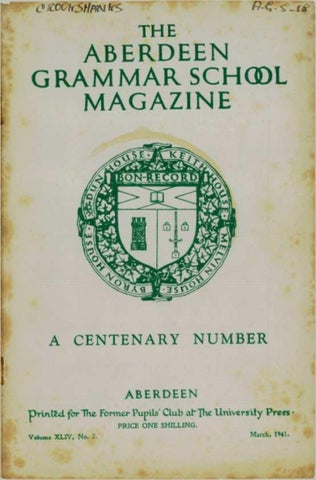
THE
ABERDEEN GRAMMAR SCHODL MAGAZINE
A CENTENARY NUMBER
ABERDEEN
E
printLet for The. Former Pupils' Club at-The University Press • PRICE ONE SHILLING.
March, 1941.
Volume XLIV, No. 2.
4
-
EDUCATIONAL BOOKS JAMES G. BISSET CONTINUES to supply all the Class Books (New or Second-hand) suited for the requirements of the Iligher Educational Institutions in the City, at the Lowest Prices. N.B.—Best Value in Students' Note Books.
JAMES G. BISSET, Classical, Medical, and Educational
Bookseller,
85 BROAD STREET (Opposite Marischal College).
•
PHONE 753 •
GOOD HEALTH demands
GOOD BREAD For the children especially is It necessary to ensure their stamina and energy with good, wholesome, nourishing bread. In Hutchison's bread you'll find all these requirements are fully met. Phone or give instructions to have it supplied daily. -
BRANCHES THROUGHOUT THE CITY
WATCHES FOR
ACTIVE SERVICE
STAINLESS STEEL CASES specially constructed for SEVERE
CONDITIONS and
Mechanism of exceptional accuracy and
durability
♦ We
have a very
large Stock, and
each Watch has been carefully tested
♦
-
A. & J. SMITH 191 UNION STREET
ABERDEEN
tittles Have just what you are looking for. Something to wear that is well cut, smart, and practical and not too expensive. - •
SUITS TRAVEL COATS MODEL COATS FROCKS DRESSES GOWNS FUR COATS
Sizes to fit all figures from 36' hip to 56" hip. •
A. C. LITTLE & SONS, LTD. 105 UNION STREET
•
ABERDEEN
TENNIS and GOLF GOODS STOCKS STILL AVAILABLE —AT PRE-TAX PRICE—
Campbell's Rubber Co., Ltd. 18 BRIDGE STREET
'Phone 157
„,-
.
II-COPLAND
"
rir i
DECORATOR jelezotant-inace,Seeendear • )te- SPECIALIST
CF--- STAINED GLASS 6? MURAL DECORATIC?ti i adZberke.,072,-O/107f/ 4
rts
A. D. COPLAND. Phone 896.
For Better Footwear
JAMES LORIMER & SON (BOOTMAKERS), LTD.
CIVIL and MILITARY BOOTMAKERS
8 CHAPEL ST.
ABERDEEN
(Late of x62 Union Street)
Estd. A.D. 1844.
'Phone 724.
1
4
Go to . . .
KEN NAWAY'S of course
RESTAURANT—I73 UNION STREET Here you get the finest of food, daintily served, and at a reasonable price.
The Restaurant is
comfortable and commodious, and is just the place to entertain your friends.
Our rooms
are available for all types of functions.
'Phone
2371, and ask the Manageress for quotations
WM. KIENNAWAY LTD. Quality
Bakers, Confectioners
and
Caterers,
Aberdeen
Telephone No. 1891.
ARCHIBALD McKELLAR Family Grocer and Wine Merchant,
454-456 Union Street, Aberdeen. . Cooked
We Specialise in
. .
Gammons, Finest
Belfast Smoked Hams, Wiltshire Bacon.
Medicinal Wines—Vibrona, Hall's, Wincarnis, Phosferine.
THE VALUE OF RECOMMENDATION I )
"We have been recommended to you by Every day that phrase is being used by Customers on their first visit to our showrooms.
REASON—
THE
OUR STOCK is of good quality and our prices are reasonable. OUR SERVICE is of a personal nature and we study the requirements of every Customer.
SATISFACTION IS OUR AIM
ROBERTS (Abdn.) LTD. CABINETMAKERS AND UPHOLSTERERS
THE FURNISHING HOUSE OF ENTERPRISE
419 UNION STREET, ABERDEEN Telephone 2695
Established 1873
JAMES FYFE & SON PAINTERS AND GLAZIERS. •
OFFICE AND SHOWROOMS:-
11 DEE STREET, ABERDEEN. Telephone 304.
Telerunrs
" Fyie, Pnintvre."
• It's an economy and a convenience to register with ALEXANDER . . . for your Butcher Meat, Bacon and Cooking Fats. You can then be certain of supplies of FISH and POULTRY—and you can place your order for all these food stuffs either in person or at the cost of only one 'phone call. The 'phone No. is 5172
4. Ai W. ALEXANDER FISH, GAME AND MEAT MERCHANTS
492 UNION STREET
•
DAIRY: ABERDEEN Tel. 1215, 7013, 701.4
+
ABERDEEN
FARM : CULTER Tel. 6
KENNERTY FARM
DAIRY •
WILLIAM REITH Sole Proprietor : JOHN REITH •
46 -48
ROSE STREET, ABERDEEN
CONTENTS ILLUSTRATIONS. F.P. Rugby Football ist and znd XVs—Season 1940-41 • • • • • Professor William Bulloch, M.D., LL.D., F.R.S. . Between PP. 132-133 . . Charles James Davidson, M.A., B.L. School Rugby Football ist XV—Season 19.40-41 - i . A Centenary Number . . . . . . . . . . Some Centenary Congratulations . . . . . . . An Editorial Retrospect . . . . . . Notes about Old Boys . . . . . . Marriages . . . . . . . . . . Roll of F.P. War Service . . . . . . . Obituary . . . . . . . . . Pro Patria Mortui . . . . . . " C.D." Looks Back . My Memories of the School. By William G. Walker, M.A. . . . . . Going Abroad on Service . . . . . Eric Linklater's Autobiography .
. Page 95 . J, . ,, too . ,, 11 5 „ 122 . . ,, 124 . ,, 127 . ,, 138 . ,, 139 146 . ft . ,, 149 „ 151 .
School Section— • School and Random Notes . . . . School Sport • Who's Who in the xst XV • . . First XV Matches . . . . . House Notes . The Literary and Debating Society . . . The Scientific and Photographic Society. The Dramatic Society. The Gramophone Club . The Former Pupils' Club— . . . . . . Report for the Year 1940 . . . . . Section Cricket Rugby Section. • • List of New Members . • • • • •
•
•
•
96
,, 1 55 „ 16o „ 161 „ 162 ,, 164 „ 165 „ 167 „ 168 „ t-p. ,, 172
1
WINDSOR WOOLIES for Kiddies Illustrated are two suits from a large range of styles
"FREDDIE" BUSTER SUIT Detachable Knickers to button on. Collar stitched flat, Zip fastener. Novel arrangement of stripes. Sizes 16, 18, 20, 22 in. length. Short or Long Sleeves, from
16 6
" BRIAN " BUSTER SUIT Detachable Knickers. A serviceable suit in fine Merino yarn, Stitched collar, Zip fastener. Sizes 16 to 22 in. length. Long or Short Sleeves, from - -
19 6
In our Boys' section you can always be sure of finding a good selection of woollens— WOLSEY
JERSEYS, WITH TIES 7,11
BRAEMAR JERSEYS
-
-
from 11/6
ESSLEMONT & MACINTOSH LIMITED UNION
STREET
ABERDEEN
INSIDE
INFORMATION •
A WAR CABINET IN EVERY AIR-RAID SHELTER
• A tin of our Ginger Snaps will make an excellent Prime Minister of biscuits. They will help you snap your fingers at the "Blitz." s
.
•
W. M. McPHERSON BAKER and CONFECTIONER
15 FOUNTAINHALL ROAD ABERDEEN
Established 1843
STRACHAN
WM. CAY & SONS
COMMERCIAL
(FUNERAL DIRECTORS) LIMITED
415 UNION STREET and
PORTRAITURE
209 GEORGE STREET,
PHOTOGRAPHY
ABERDEEN
•
Telephone 851 All Funeral Requisites Supplied
•
Cremations Arranged
416 UNION STREET ABERDEEN
Telegrams—" Cay. Aberdeen." Telephone Nos. 92 and 54.
Telephone: 8811-2
Telegrams : ' Blake Builders'
1 A MA IIES 13 ILA IF IV ILL ID,. Joiners
and
Building
Contractor%
23, 25, 29 SUMMER STREET, ABERDEEN •
All classes of Building Joinery
Enquiries courteously solicited ES.TAA ISHL D
[BIB
APPOINTED MEAT PURVEYORS AND POULTERERS TO
HIS MAJESTY THE KING, DATED I ST JULY 1940
J. WILLIAMSON & SON (W.
B. WILLIAMSON. PROPRIETOR)
Meat Purveyors and Poulterers 1, 2, & 3 MARKET BUILDINGS, ABERDEEN 'PHONE 452 BRANCHES, 3f
FOUNTAINHALL ROAD 'PHONE 1724
ALSO AT CHURCH SQUARE. BALLATER.
THE SQUARE. CULTS •PHONE. OAT' 2 'PHONE 38
YES, I STILL HAVE THEM
DRAWING INSTRUMENTS
Typewriters, large and small. Desks, Chairs, and other items of Office Furniture. It's not so easy to give bargains nowadays, but whiles it's wonderful what one can do.
PAPER COLOURS
Even with Purchase Tax added, the famous Imperial Portable Typewriter only costs £14 12s. 0d.
&
52:- of that is a Hit at Hitler. One gets a little bit of a kick out of that.
BRUSHES
You can get literary, scientific, medical, mathematical, or Continental keyboards.
at
EASY DEFERRED PAYMENTS ON ANYTHING
Octylors9
'Phone 505 or come along and see me:
C. H. WEBSTER
49-51 Scboolbill 'Phone 2870
489 Union Street, Aberdeen
-
fogarmat Rims ENGAGEMENT RINGS are our speciality.
Our large selection
will make your choice an easy one
Prices to suit all
K-'1`
£5
J.")
to
t„INt
ter
£150 Telephone : 12 I 9
_
Modern atchmakers,
Jewellers
and
Silversmiths
14 2 UNION STREET
Designs
Perseverance PERSEVERANCE is the determination to carry on in the face of difficulties and discouragements and to overcome them in the end. At the present time we are faced with great difficulties and many discouragements, but we are determined to carry on and give our customers—as far as in us lies—the same service which has been a feature of our business for nearly a hundred years.
J. & A. OGILVIE 369 UNION STREET ABERDEEN Telegrams : " Interiors "
Telephone No. 433
Your Happiest Hours t
•
are spent at your own fireside, and the choice of your Fireplace deserves the utmost consideration. From the range of Modern and Period Fireplace Arrangements we are showing, you will find it easy to to select exactly the style you desire.
James Scott & Son (Aberdeen) Ltd. 483-485 UNION ABERDEEN Phone 1881-2
STREET
. . I
1 4"
A
4 1 1 1 1
.;‘? ;
,
i
1 4 Fl
-s 1 3 ) 1.>*n_ '4
-11-1
"BUSINESS IS SERVICE" That's the guiding principle of Collie's of Aberdeen. To bring together the finest possible selection of quality goods, display them conveniently, and offer them at reasonable prices, combined with unobtrusively courteous service—these are the things that make shopping at Collie's of Aberdeen so pleasant and satisfactory. In peace or war, this famous shopping centre will hold fast to the sentimental maxim that " Business is Service."
Gaf, 4•Cice FAMILY GROCERS AND WINE MERCHANTS
269-271 UNION
STREET
+
ABERDEEN
Telephones: CENTRAL 4800 (4 lines) Branch Shops at CULTS, BALLATER, and BRAEMAR Telephones : Cults 28 ; Ballater 14 ; Braemar 212
•
Established 1836
Assets £z6,895,4 00
Northern Assurance Company Limited •
•
FOR ALL CLASSES OF INSURANCE •
•
LIFE ASSURANCE BRANCH The Company's tables of rates for Life Assurance include every class of Policy SPECIAL LEAFLETS ON-
The " Optional " Policy The Educational Endowment Policy Child's Deferred Assurance Policy Death Duties Policy Life Annuities
CHIEF OFFICES:
ABERDEEN . LONDON .
1 UNION TERRACE I MOORGATE, E.C. z
Branches and Agencies throughout the World =
-
_
Aberdeen Grammar School Magazine 57th year: No. 147 (New Series, 481k year, No. 138)
Vol. XLIV
MARCH 1941
No. a
The " Grammar School Magazine " is issued under the auspices of The Former Pupils' Club, in March, June, and November. All communications with regard to the " Magazine " should be addressed to the Editor (the Secretary and Treasurer of the Club), THEODORE WATT, M.A., LL.D., The University Press, 6 Upper Kirkgate, Aberdeen.
-
- - -
A Centenary Number. On z4th September 5907 there was a special general meeting of the F.P. Club, at which a resolution was unanimously passed that the subscriptions for membership should be raised, the new rates to entitle all members to a copy of the School magazine, " which will be published three times a year and will be sent post free. The Magazine will be managed by a committee of former and present pupils. It will retain all its old features as a School magazine, but will be enlarged so as to contain a section entirely devoted to matters of interest to former pupils in all parts of the world." It was arranged at the same time that the Club should have the whole financial control of the Magazine, and that the editorial committee should consist of three former and three present pupils. The F.P. Executive appointed Messrs. Charles Davidson, William Keith Leask, and Theodore Watt as the first F.P. editors, Mr. Watt to be editor-in-chief. In accordance with the resolution, the Magazine has been published regularly three times every School session since October 1907, with the exception of 1918-19—the last year of the Great War—when, owing to the high cost of production, only two numbers were issued. The present number is accordingly the moth that has appeared under the auspices of the Club since the happy arrangement was made a third of a century ago, and throughout that period it has had the same editor-inchief. While this number commemorates a centenary, it must not be thought that there have been no more than one hundred issues. From the line in italic type under the title " Aberdeen Grammar School Magazine " at the top of this page it will be
96
Aberdeen Grammar School Magazine
seen that the Magazine is actually in its S7th year, and that this is No. 147. The first number to be printed appeared in 1885 and there were in all nine intermittent issues until June 1893. In January 1894, a few months after the late Dr. Morland Simpson came to the School as Rector, a " New Series " was started in octavo instead of quarto size, and from that date the Magazine has been issued continuously. The present issue is No. 138 of the New Series, which is now in its 48th year. The Magazine, it may be mentioned, will be in its 5oth year when the Club reaches its Jubilee in September 1943. In the Magazine of October 1907—the first issued under the new arrangement—it was stated that the object of the Executive of the Club in associating themselves with the conduct of the Magazine was to develop it as a means of communication between the School and those who had gone from her into the world, and the hope was expressed that through it the many claims of the School would be kept constantly before her sons at home and abroad. That the object and the hope have been amply fulfilled there is abundant evidence. It is the Magazine preeminently that links F.P.s to the School, and its success in urging her claims is shown by various schemes for her benefit- that have been successfully carried through and by the long list of gifts that have come to her.
Ccntenary Congratulations. From Mr. D. M. ANDREW, M.A., Rector of the School since 1924 ; Honorary President of the F.P. Club. The mortality rate for school magazines is notoriously high ; hence the issue of this Centenary Number of " The Grammar School Magazine " is an achievement which must be acclaimed even amid the stresses of war. An ancient Magazine for an ancient School is merely what one expects. What borders on the miraculous is that all these hundred numbers have been sponsored by a single Editor. Several thoughts are suggested—his unremitting industry, his sound journalistic instinct, his uncanny power of selecting from the mass of human activities those which concern the chosen race of F.P.s ; but surely, above all, this record betokens a loyalty to school which must be almost without precedent. There remains just one further service from which he cannot be absolved. He must make certain—hardest task of all—that he has secured a worthy successor. We of the School as it is to-day beg him to accept our cordial congratulations.
.
,
Aberdeen Gratnnear School Magazine
97
From Colonel ARCHER IRVINE-FORTESCUE, D.S.O., A. D. M. S. No. 4 Liaison H.Q. (Polish Forces); President of the F.P. Club. It has been a bitter disappointment to me that owing to unforeseen circumstances I have been unable to discharge the duties of Club President. Like thousands of other ancient pieces, I have been taken from the cupboard of retirement and replaced on the chessboard of active service. As Omar hath it :— 'Tis all a chequer-board of nights and days Where Destiny, with men for pieces, plays ; Hither and thither moves and mates and slays, And one by one back in the closet lays.
•
It is forty-four years since I left the dear old Grammar and thirty-seven years since I first took service under the Crown, and I have never ceased to thank Providence for having enabled me to write myself Alumnus Scholae Grammaticae Aberdonensis. I am certain that all brother alumni feel as I do. But without the bond of common membership of the F.P. Club many old Grammarians would have lost touch with their Alma Mater Scholastica and the flame of their enthusiasm for the School would have been quenched by the waters of oblivion and the chill of age. As President of the F.P. Club and on behalf of my fellowmembers I congratulate the " Magazine " with all my heart on its Centenary Number and offer my warmest thanks and admiration to our Secretary, Dr. Theodore Watt, who has for over thirty-three years kept the " Magazine" going, and has thereby ensured the continuity and prosperity of the Grammar School Former Pupils' Club. Saul is occasionally among the prophets, and even Adolf Hitler sometimes talks sense. In " Mein Kampf " it is stated that there are three essentials for successful organization—energy, ability, and efficiency. Dr. Watt has achieved his Centenary Number by the display in a conspicuous degree of these three qualities. Let us all endeavour to profit by his example.
40141.44." yous-#4.4.40. From the Right Hon. LORD ALNESS, P.C., M.A., LL.D., formerly Lord Justice-Clerk of Scotland ; President of the F.P. Club 1928-29 ; President of the London Centre. I willingly accede to the Editor's wish that I should, on this historic occasion, write a few lines regarding our " Maga." Mr. Watt, in asking me to discharge this duty, with characteristic modesty deprecated references to himself in anything which one might write. I find it however impossible to comply with his request.
98
Aberdeen Grammar School Magazine
I cannot think of the " Magazine " without thinking of Mr. Watt, and I cannot think of Mr. Watt without thinking of the" Magazine." In that attitude I am certain that I do not stand alone. To-day the readers of the " Magazine," scattered as they are over the habitable globe, are deeply conscious of the debt which they owe to Mr. Watt and the " Magazine "—a debt which they can never hope to repay. Mr. Watt has woven a golden thread which binds all our lives together. I don't know what qualities in the "Magazine" to select for special mention : they are so numerous and varied. The " Magazine" is marvellously comprehensive : it is invariably interesting. It is never pedestrian or dull. The sleuth-like skill with which Mr. Watt follows up our careers, be they great or small, is simply astonishing. The " Magazine " makes us all feel that, wherever our lot is cast, we are members of one great family, the intimate and domestic atmosphere of which is engendered and developed by the " Magazine " and its gifted Editor. Yes, Mr. Watt ; saving your presence, I feel I that must say, nemine contradicente, yours is " great work, greatly done."
From the Right Hon. LORD MESTON, K.C.S.I., LL.D. ; President of the F.P. Club 1929-30. My dear Editor, It must be given to few to look back upon such a record as yours. What is remarkable about it is not only the tale of years which your Centenary celebrates, but the mass of splendid matter that has been packed into these hundred numbers. Our Old Boys are scattered over every region of the habitable globe ; and for every one of them the " Magazine " regularly brings something of interest : the life of the School to-day, the doings of old chums and class-fellows, stirring tales of travel and adventure. There are few, if any, school magazines that can hold a candle to it. We are all proud of it, and grateful to you for the care and labour which you have so long devoted to it ; and we could wish no happier future for the " Magazine " than that its next hundred issues may be as successful as the last. Sincerely yours,
Aberdeen Grammar School Magazine
99
From the Right Reverend LOGIE DANSON, M.A., D.D., Bishop of Edinburgh ; President of the F.P. Club 1932-33.
I heartily congratulate the "Aberdeen Grammar School Magazine " on reaching its Centenary. It has behind it a fine record as a periodical of historical value, full of informative and instructive articles, and it contains a most complete record of the doings of Grammar School boys both past and present. I have been a regular reader for fifty years or more, and have seen the "Magazine" grow both in size and interest. Twenty years of my life were spent in comparatively remote countries, and I know from experience how welcome was the news of one's old friends, in all parts of the world, which one received from the " Magazine." As F.P. Consul for Borneo, I tried to keep in touch with the few F.P.s resident there, and when we met, the " Magazine " was sure to be one topic of conversation, and the discussion of some travel article written by a mutual friend would serve to revive memories of old School days. May the " Magazine " long continue to flourish and to be the means of keeping F.P.s together.
oefit
f,e4
From Mr. PATRICK ASHLEY COOPER, B.A., LL.B., Director-General of Finance, Ministry of Supply; President of the F.P. Club 1937-38. The publication of this Centenary Number of our " Magazine " comes at a time in our history when the eyes of the whole world are focussed on Youth—the splendid Youth of Britain and our Empire. In sending my warmest congratulations on the publication of the moth issue, I feel that this is an occasion which more than any other calls for a word of special commendation on the success the " Magazine " has achieved in its appeal to the younger members of our Club, whom the Editor has striven so hard to serve. But we older members also owe him a deep debt. He gives us an opportunity to keep in touch with our old school-fellows. We can read with interest and also with pride the record of their achievements, and this record must indeed be a stimulus to young and old. This has been perhaps the most outstanding accomplishment of the " Magazine." I send my warmest best wishes that the " Magazine" may continue with a long and successful career.
too
Aberdeen Grammar School Magazine
From Dr. GEORGE DUNCAN, C.B.E., M.A., Convener of the Education Committee of the Aberdeen Town Council ; an Honorary Member of the F.P. Club. Although I am not a former pupil of the Grammar School, I have the distinction, of which I am proud, of being an Honorary Member of the Aberdeen Grammar School Former Pupils' Club and for over twenty years I have been an admiring and diligent reader of its " Magazine." Frequently I have said, and I repeat it without fear of contradiction, that it is the best school magazine in the country. It is so not merely by reason of the literary merit of its contents but because of its unique appeal to former pupils of the School in every quarter of the civilized world. Well may its Editor exclaim in the words, if not with the feelings, of the pious Aeneas : " Quae regio in terris nostri non plena laboris ?" The " Magazine " has had a magnificent effect in keeping Former Pupils, in whatever remote region they may live, in close touch with the activities of their old School and Dr. Watt deserves the warmest thanks and the heartiest congratulations of every one interested in the School for what he has done. Long may the " Magazine " flourish and long may its Editor continue his splendid work !
From Mr. HOWARD A. GRAY, M.A., Assistant Editor of " The Observer." I doubt if there is anyone to whom the Centenary Number of the " Aberdeen Grammar School Magazine" under its present editorship can be of keener interest than to my old school-fellow Johnstone Murray and myself. For it was we who in the autumn of 1884, with the kind assistance of Mr. Hugh F. Campbell, produced what, I think, must have been the first publication under that title. Our bantling—if any copy of it survives—must look a very pathetic thing alongside the robust successor with which we have so long been familiar. I cannot exaggerate the pleasure which the latter has given me for so many years with its contributions to contemporary and to past history. Nor—as a journalist with fifty years' hard labour behind him—can I congratulate the Editor too cordially on the unflagging interest of its contents and the finished style of their presentation. / P0-•-""---6"---.(
__,.....4!c4-..4--.7
if
v)
•It ut asuas aim zmoz inq—„ fcluevy map"„ aem azatpvaa ifaosindueoo awooaq 11.m aupv2viv sty wpm maul naau v fo ;aydauf ay; sv paztuffo,aa aq ;a,C m dvtia aH •suotiviniva2uoo pauaavat ano sae:goal ay utv2v auo put, 'apnitiva2 ano fo paanssv et-pvaaiv st aH •fallaq sty aof pits aq 01 Supllatuos aq It-mu a.tay; puv—vpuv2vdold luallaoxa st 'os •vpuvffvdoad aand st csaaftat auo „'autzv2vAr „ ay; puy %Cuomo 1OO110S droUllUV413 v sv paztukoal dpticind aaanz it ft amid aanaq v aq moo piaora ay; ;vq; fayaq a;vaud sdivin lou st ampayen saapuoin ua;fo auo ;mg Vava ay; fo soma' avf ay; let yaorn o; 2up2 aof uoyoappa.uf sdooyos 4V114144V19 ay; paz.twydrua or svq— auFv2vw sy,—„auFv2vly „ aqi • Lo6i a,uts ‘s;uaueivisut avin2aa puv saidtuvs limas tat cit gutinqtalstp puv 2ugutad uaaq svzi lives aaopoaza aof cuompva; ano 2upaasald fo aignol; ay; paavds uaaq uaaa aavy aj leapav2 .O1OK• aof mama ay; ?qv; puv 'd191(1 Jpf 'man poo2 'yam ;saucy fo uompva; loom ay; : uompva; v o;u! paddag Klaaatu ant aof caotoyo ivy; fo ,Cuo2v ay; paavels uaaq aavy aAi sv suoma22ns pmaut • uasoy, aq molts uompva; fo ;acs my= put' .‘uompva; v tistiqvisa o; glaO2 pvy atay ay; lvto yeaterams utualos aq; paystiqnd 03U0 aadvdsenau iCpsaaatun uvoyaluy uv 't~I- S 161 „au!ve2EAT „ aiI3 Jo Hama Dnia Jcqnsi tuo-ia `uai.v-Dmia I 00113S g
•lay2ty ou aspad uVo auo puv clomps, ay; fo ,Cymont ;val. •aaquenN ifavualuao sly; fo luaueysneltuov ayi uo aoppg v puv „autzavly „ 1O°yoS all o; suopvinlvauo2 alamts ruasaad lue ‘paaaffo aq iture aans tut' i duvue ay; o; ppv o; ayti pptoys 1 •atp aaaau ifvue It adoq 1 •saay ano le! ;sauy. ay; fo auo st ;olds v ionsmy; pa,uyeaeoo wv 1 ‘suoyvtoossv puv saidpuyd „ 1°°11'S P10 ,, dill uozop ea, of uotysvf ii-vp-peasald ay; apdsaci •apaty ivn;nzu ;svd ivy; paaaeloosv acn lay= ‘Cylvduas fo puoq v ysyqvisa o; pattyf laraau puv ‘spcInd laueaod 01440S put' suvtuopaaqv ;am aavy 1 ppm ay; fo siavd duvue u1 .1;t0 apuvaej alp aof uotpaffv fo ivap ivaa v puv imoz uotpauuoo maws pautmaa pfmnpy aavq 1 lnq ‘iootiog pio ay; fo itaInd v svoz 1 amts meagv paddlls aavy savaif etuvyv .(a am') pAog „) tuosd Iou°I03-zweualnala isamia *Two Los
atqlany 100q.ly .111111laAID ummaqv
102
Aberdeen Grammar School Magazine
From Emeritus Professor JAMES C. PHILIP, O.B.E., F.R.S., M.A., D.Sc., LL.D., University of London; President of the F.P. Club 1938-39. The history of school and college magazines is often a chequered one, and the supporters of the Aberdeen Grammar School Magazine " may be all the more gratified at the undiminished vitality which it exhibits after a career of 33 years. Those F.P.s in particular who are in " the arenas of the south " or " ayont the seas " are full of admiration for the way in which the " Magazine" has been run. It has kept them in touch with fellow-Grammarians and has sustained in a remarkable degree their affection and loyalty to the old School. To keep this particular " home fire " burning has meant persistent effort and all F.P.s gratefully acknowledge that the success attained has been mainly due to the energy and enthusiasm of the Editor. May the achievement of a " Centenary Number" be the earnest of continued prosperityfor the" Magazine"!
CFrom The Hon. LORD MACKAY, M.A., LL.D., Senator of His Majesty's College of Justice in Scotland ; President of the F.P. Club 1931-32 ; President of the Edinburgh Centre. Good words are being used up so dreadfully fast nowadays that it is almost alarming to have the suggestion before one, that one should write an Appreciation. But Appreciation is a good word : and I retain, in the face of all the dog Latin and bastard Maxims with which we Judges are popularly credited, enough of'my Latinity to remember that it comes from ad pretium. What one is to do —what one longs to do adequately—is to put the status of this Magazine ad pretium suum, up to its true precious worth. I have always, since the F.P. Club lent its auspices to Theodore Watt's great venture, been among our Magazine's ardent admirers and most constant laudators. It is not only that three times in every year it brings to me (and, I am sure, to you) a breath of the springtime of life ; nor only that it keeps an ageing mind in close touch with the new boys who still rejoice in the School team victories, or with the men, still boys at heart, who climb the Himalayas or Fujiyama or Kilimanjaro, thereby stuffing my mind with visions of the rocks and the snow of old. Nor is it only that it brings home to one poignant memories and living pictures of old friends passed away, like Sir Henry Alexander, for instance, whose wonderful work (apart from little incidents like the Provostship and Townplanning) was to produce the best and fullest guide to those dear Cairngorms. It is more than all that. We who look forward,
Aberdeen Grammar School Magazine
103
and will look forward, to each new instalment feel that through the living pages of the Magazine" there is in the closest personal touch —living with each of us—speaking to each of us, the Editor. Few could, I feel, express fully how much this Editorial work, searching after us, groping out for all our doings in every part of the World, sympathizing with us, encouraging us in the spirit of the glorious old " Gram," means to one and all. Long may the" Magazine" flourish. Long may it embody in the flesh and blood of print and picture all that is best in the inspiration of a grand old School Community.
From Mr. J. MACKAY THOMSON, M.A., Secretary of the Scottish Education Department ; Rector of the School 1920-21. But for a welcome reminder I should have been unaware that the " Magazine" of last November, with its simple designation " Vol. XLIV, No. 1," was in fact the 99th issue since the Club took over the editorial control, and that the next number would be the tooth to be produced by the present Editor. I am most glad to have this opportunity of congratulating him on reaching his " century," and of wishing him and the " Magazine" all success in the future. Every really good school has its magazine, but few produce a record of the activities of their past and present pupils so admirably comprehensive as " The Aberdeen Grammar School Magazine." The 99th number, with its 94 pages and its photographs, is indeed a contrast to " the surreptitious journal of stitched version-paper that circulated below the seats " of which William Keith Leask once wrote. Some school papers are little else than " logs" of the term's events ; others concentrate on original productions of one kind or another and have too little to say of what is happening at the school. But of the " Magazine" it may well be said " Omne tulit punctum, quod miscuit utile dulci "; for it contains not only useful information about the current activities of the School and its Former Pupils, but a wealth of pleasant reading from the pens of a wide range of contributors. Congratulations, once again, and all success.
rk"..1/6,1
104
Aberdeen Grammar School Magazine
From Mr. GEORGE WATSON, London ; President of the F.P. Club 1934-35. I think the Editor's brain-wave to make the March issue of the " Magazine" a special one to commemorate the booth production under his able and vigorous editorship, is an excellent one, and I most heartily congratulate him on" something attempted, something done," but may he not take his " repose " for a long time ! The contents of the " Magazine " are so varied, so widespread, and so " human," that they appeal to all sorts and conditions of men all over the Globe and must afford great pleasure to those serving in many countries, civilized and otherwise. The current histories of Former Pupils keep one in touch with the happenings of old friends, and the interesting letters and articles from Former Pupils living in remote parts are lessons in geography, national life and customs—all most absorbing. Even the Cricket and Football statistics are interesting to me, an old player, although I am often puzzled to know if the player is a grandson or a greatgrandson of my old classmate ! I hope the Editor and the " Magazine " will " haud on and niver look ahint."
An Editorial Retrospect. To spend an evening or two looking through the 99 numbers of the Magazine that have been issued during the last third of a century is to arouse mingled feelings, but their remains a sense of satisfaction that from very modest and amateurish beginnings there has been a slow but steady development into something which is frequently declared to be unique in school journalism. The outstanding feature has undoubtedly been the unbroken flow of " Notes about Old Boys," which throughout have appeared under the same simple head-piece, designed by the late Mr. Samuel Pope and retained in memory of his 45 years' service as Drawing and Writing Master in the School. In the period under review there have been almost 14,000 notes, including over i,6oo marriage announcements (started in 1910) and nearly 1,900 obituaries. Every note has been card-indexed and so a corpus of reliable information about F.P.s has been built up and rendered instantly available. It has been fascinating to examine the entries from time to time and to see how many of them have grown as the individual, starting at the bottom of his ladder, has steadily climbed, rung by rung. Frequently the question is asked, " Flow ever do you manage to collect all the
Aberdeen Grammar Scbool Magazine
io5
information about F.P.s ? " There is really no mystery about this: some notes are based on information that has been supplied, but the great majority are the outcome of the systematic scanning of newspapers and periodicals for F.P. items, regularly day by day, week by week, and month by month. On looking through the obituary notices since 1907, one is forcibly reminded of the really extraordinary contribution made by the School to the life of the Nation and the Empire, and for the sake of the younger generation some of the outstanding names may be mentioned :—among Administrators, Sir William Mortimer Clark, Lieutenant-Governor of Ontario ; Sir William MacGregor, Governor of Queensland; and Sir George Carmichael, Sir George Stuart Forbes, and Sir James Thomson, of the Indian Civil Service ; in the Navy, Admiral Sir Arthur Farquhar ; in the Army, Major-General Sir James R. L. Macdonald, Major-General Sir Alexander J. F. Reid, General Sir Andrew Skeen, and Lieut.-Colonel Sir Alexander B. McHardy, chairman of the Prison Commission ; in the Church, Rev. Dr. Peter T. Forsyth, Professor A. R. Gordon, Bishop Anthony Mitchell, Very Rev. Dr. William Mair, and Very Rev. Dr. James N. Ogilvie; in Law, Sir John Macdonell, Professor A. F. Murison, and Lord Justice Stirling ; among Authors and Journalists, Sir Henry Alexander, Dr. John Malcolm Bulloch, Sir W. Robertson Nicoll, Dr. Gordon Stables, and Rev. Dr. Walter C. Smith, the poet ; in Art, Sir George Reid and James Cadenhead; in Science, Dr. Alexander M. Kellas, Sir Francis Grant Ogilvie, and Sir George Watt ; in Surgery and Medicine, Sir William Bisset Berry, who became Speaker of the Cape Parliament, Sir William Watson Cheyne, Bart., Sir John Collie, Sir David Ferrier, Sir Alexander Hendry, Professor J. J. R. Macleod, Sir Alexander Ogston, Sir James Reid, Bart., Professor Robert W. Reid, and two experts in lunacy, Sir John Baker and Dr. David Nicolson ; in Education, Professor William L. Davidson, Principal Sir James Donaldson, Dr. David Duncan, Professor David Masson, and Dr. William L. Mollison, Master of Clare College, Cambridge ; in Business and Commerce, Sir John Duthie, Sir William D. Gibbon, Sir Thomas Sutherland ; and in Transport, Sir William S. S. Bisset, Sir George S. Gibb, and Sir James C. Inglis. Another feature throughout the period has been the quality of the articles that have formed the backbone of each issue : the Magazine has indeed been fortunate in its contributors, who have given of their best, without stint. Those responsible for the new order in tgo7 were wise in their selection of William Keith Leask as one of the editors, for no application to him for " copy" was ever made in vain. Out of a mind steeped in local lore and familiar not only with the highways but also with the by-ways of literature, ancient and modern, he could weave an article of rare charm, and altogether, up to within a short
•
lob
Aberdeen Grammar School Magatine
time of his death in 1923, he contributed over a score of articles and other items. His knowledge of the history of the School and of her pupils in past times was profound. He it was who, in one of his early contributions, brought to light that " Concordance " Cruden and Field-Marshal James Keith were pupils together at the School in the early years of the eighteenth century. He loved to recall his own school-days and schoolfellows ; he wrote on old school-books and books that had influenced the School ; on Professor Masson and Sir James Donaldson ; on " A Scott Original," " The Book of BonAccord " ; "The Old Ally," " Doctor John Brown" ; and reviewed J. D. Symon's " Byron in Perspective." For Dr. Morland Simpson and for all that that great Rector stood for he had unbounded admiration : " He is already," he declared in an obituary tribute, " with the great four—Cargill, Wedderburn, Melvin, Simpson." In a tribute to Leask at the time of his death an old friend wrote in the Magatine, " There looks down from the wall of the School Hall the fine likeness and strong painting of its distinguished alumnus, a man whose scholarship is an honour to it, and whose devotion to learning is an Inspiring example." A little later at the School than Leask was James W. Harper, for many years Episcopal Chaplain of St. Serf's, Culross, and latterly Dean of St. Andrews. He was an experienced writer, and among other artides and reviews contributed two series of sketches delineating seven in all of his old Masters at the School. The next outstanding contributor in order of School seniority was Dr. John Malcolm Bulloch. He, like Leask, had contributed occasionally to the Magazine in its early days, but it was not until he was about fifty that his interest in the School was re-awakened and he became a dynamic member of the London Centre of the F.P. Club. He reviewed at length the " Roll of Pupils" when it appeared in 1923, and trailed his coat in characteristic fashion in such articles as " What our School stands for," " Aspects of our Mysterious Something," " Have we too much Sport ? " " The English-Wet-Nursed Scots Boy." As President of the Club and as President of its London Centre he delivered racy and provocative speeches, which were printed in full in the Magazine, as also was his address when he set the Shanghai Clock agoing. He concluded this with what he called a " jingle," the first two verses of which ran— Your List excuse fur being late Has passed away. You must nut dawdle at the gate And try to say Your watch was slow, You didn't know The time o' day.
Aberdeen Grammar School Magazine
107
For high upon yon tapering tower They've filled the gap With moving minute hand and hour That tell a chap 1k mustn't snoove But get a move— Or else the strap.
Charles Davidson, more readily recognizable as " C.D.," was another of the original F.P. Editors and contributed a few articles .rui generic. When a Master in the School he took a keen interest in all his pupils individually. Probably there was no one who knew so many F.P.s personally, and out of his knowledge sprang originally the " Notes about Old Boys," in the early days of his re-introduction to the School by Morland Simpson. His continued interest in the Magazine is shown by the septuagenarian article which he has contributed to the present issue. William M. Alexander is another F.P. to whom the Editor has never applied in vain for " copy." If a subject could be found, the article was promptly forthcoming, and more than a dozen—more or less anonymous—have come from his running pen, some based on his travels in Canada, South America, and Russia-for he has visited many parts of the world, others recalling with sardonic humour his days at the School and the Masters he " experienced " there. When the semi-jubilee of Morland Simpson's rectorship was marked by the presentation of his portrait to the School, John Minto Robertson, who as a newcomer in 1894 astounded his class-fellows by the width of his reading and the fluency of his writing, was fortunately chosen to present an accompanying word-picture of H.F.M.S., whom he vividly depicted as bearing down the long School lobby in his flowing black robe, like some stately Spanish galleon. He recalled how the Rector, revealing that uncanny knowledge which schoolmasters sometimes have of their nicknames, staggered a class in the days of the Boer War, when a certain gun was rather famous, by ending up his exposition of the parallel between the Latin idiom iamdudum and the French ily a longtemps with the quiet remark, "Jr !Nis Long Tom" 1 When a Master resigned or retired, J.M.R. was generally called upon to pay the appropriate tribute, and the pages of the Magazine enshrine inimitable sketches of " C.D.," " Pat " Edward, " Caesar " Middleton, and " Spicy " Murison. In the last war Minto Robertson served with the guns, and as " Tertiary John " contributed with classical humour and delightful literary allusiveness a serial account of "A Humanist's Offensive, or What I did in the Great War." For some unaccountable reason W. Douglas Simpson was not a School Editor of the Magazine, but in his last year at the " Grammar " he contributed a schoolboy's tribute to Mr. Samuel Pope on his retirement, and demonstrated that " childhood
io8
Aberdeen Grammar School Magazine
shows the man as morning shows the day " by writing well and with insight on Hallforest Castle. Was this, perhaps, his first appearance in print as an enthusiastic and indefatigible explorer and excavator of castles ? He, too, paid a tribute to Dr. Middleton, and also to Mr. J. B. Philip, while his article on the tercentenary of Dr. Patrick Dun's bequest to the School was a masterly account of the disgraceful mishandling of that great mortification. One of the editorial " finds " as a result of the " Roll of Pupils " investigations was the late Major Robert Bruce Macleod Cameron, son of the Northern Burghs M.P. of 1886-92. He entered the Royal Artillery in 1894 and, retiring as a Captain in 1910, took up residence in British Columbia. Shortly after the outbreak of the Great War he joined a Canadian battalion as a Private, but was speedily commissioned and served in France until severely wounded in March 1917. He was given his Majority in the following year, and after the war struggled bravely with severe heart trouble until his death at Brighton in 1926. The Editor discovered in him a willing contributor to the pages of the Magazine. His first article appeared in June 1921 under the title " Random Recollections of an F.P.," and there followed six instalments of " Some Phases of an Army Career," in which he racily recounted his experiences as an Artillery officer. There have been few more loyal friends of the Magazine than Bruce Cameron. In 1909 George H. Mair joined the editorial staff of the Manchester Guardian, and the Magazine recorded with pride that he was the first journalist in this country to make a voyage in the air, when he ventured on a trip with Colonel Cody in his aeroplane at Aldershot. It was scarcely less proud of the fact that Mair's name had found its way into Punch, which printed the following : " A writer in the Manchester Guardian, describing his sensations on an aeroplane trip, observes that after the flight he ' began to feel as I think, perhaps, the poets do.' This may account for the headlines of his article which run :— ' A FLIGHT WITH MR. CODY. IMPRESSIONS IN THE AIR (FROM OUR SPECIAL CORRESPONDENT, MR. G. H. MAIR).' "
In the midst of a very busy journalistic life Mair did not forget the Magazine of his old School, and at that time wrote for it a short article on aviation, containing some suggestions for School inventors. When Mair died prematurely in January 1926, several distinguished journalists paid striking tributes in the .Magazine to his amazing gifts and versatility. James Melvin was the outstanding personality of the nineteenth. century associated with the School, and in the early part of this century life under Melvin in the old School in Schoolhill
Aberdeen Grammar School Magazine
log
was a favourite subject of articles by ageing F.P.s, who looked back to their days under " Grim " with warm appreciation of his qualities and not with the repugnance that his nickname might suggest as likely. Among those who recalled the Melvinian heyday of the School were, in order, Alexander Forbes, Sir William D. Gibbon, Dr. T. Irvine Rowell, Sir James Stirling, Rev. Dr. James Brebner of Forgue, and Rev. Dr. John Smith of Natal. The gifts to the School of Melvin relics have been recorded from time to time, and in 1930 the story of the renovation of his tombstone in St. Nicholas' Churchyard was told. A vivid and detailed account of how Melvin's successor, the Irishman Evans, was barred out of the School in 1859 came in 1912 from the pen of the bibliographer of the North-Eastern shires, James Fowler Kellas Johnstone. The period covered by the present review saw the centenary of Byron's death and the 150th anniversary of his birth, and the Magazine took appropriate notice of these. In April 2923 there was the great Byron Banquet in London to record and in September of that year the unveiling of Pittendrigh Macgillivray's fine statue, which had taken a quarter of a century to erect. The latter was the occasion of Professor Grierson's comprehensive and balanced survey of Byron as man, poet, and influence. The Magazine published the purpler passages of the oration, which the Professor has recently printed in full in his " Essays and Addresses." There was for long a tradition in the School that Byron had carved his name on a desk, and in 2909 a letter was published from the late Dr. Gordon Stables (of The Boys' Own Paper fame), in which he declared that in his School days (1852-54) the desk was there " in the fourth or fifth faction from the bottom " with the name " Byron " cut in large capitals. In 1917, the late Mr. G. M. Fraser, the City Librarian, contributed an illustrated article on the Byron House which used to stand at Honeybrae, amid fields to the west of Morningfield Hospital. There the budding poet spent his summer holidays in 2798. Numerous other Byron items have appeared from time to time, nothing concerning the School's most famous F.P. being regarded as alien to the Magazine. Since the beginning of the present century F.P.s have taken a noteworthy part in Polar exploration. In 1903-04 Dr. William Clark Souter was surgeon in the Antarctic relief ship Terra Nova, and in 1909 he contributed an appreciation of the British Antarctic Expedition of 2907-09, led by Shackleton, during which he and our F.P., Lieutenant J. B. Adams, R.N.R., with two others, reached to within 97 miles of the South Pole. Ten years later Dr. Robert S. Clark, the biologist to Shackleton's Antarctic Expedition of 2924-17, described his experiences as one of the party of 22 who were marooned on Elephant Island, in the South Shetlands, from April to August 1916. In 1918, and again in 2929-20, Percy Shirreffs went with Captain Frank
Aberdeen Grammar School Magazine Wild to Spitzbergen and wrote vividly of " Surgery under Difficulties " and " The Return of the Sun" in the issue of November 1920. In the following year Patrol-Leader James W. S. Marr awoke one day to find himself famous, having been chosen as one of two Scouts to accompany Sir Ernest Shackleton as cabin-boy in the Quest. In 1922 extracts from some of Scout Marr's letters home were printed, giving " a first-hand account of experiences uniquely interesting, an account doubled in value by the racy, vivid manner in which these experiences are described." In 1925 Marr was again on the move—this time in the Arctic with Worsley and Algarsson, and accompanied by another F.P., Charles B. Bisset. Marr was the zoologist and Bisset the geologist of the expedition, and both contributed accounts of their varied and somewhat unfortunate experiences. Since then Marr has been several times back in the Antarctic, engaged in zoological research. Descriptions of life and experiences in every continent and in many countries have been a striking feature of the Magazine. Under the title, " A Unique Motor Cycle Tour," Kenneth M. Robertson (who died in Congo Belge in 1930), described how in 1922 he followed the route of the Great Retreat of the Serbian Army through the mountains of Albania to the Adriatic and met with many exciting incidents, including one which resulted in " one bandit less." Dr. Alexander Cruickshank, who has been fighting sleeping sickness, leprosy, and other diseases in the Southern Sudan, has been repeatedly a contributor, and has described an elephant hunt out there, bongo-hunting on the Belgian Congo border, and the misadventures of an Austin Six on its way from Aberdeen to Khartoum. In 1927 A. W. Duthie of Cape Town wrote about an exploring trip he had made to the magnificent but seldom visited Great Aughrabies Falls on the Orange River, which required a journey of 85 miles from the nearest railway line, through semi-desert country, where the only thing to drink was the muddy water of the Orange River. Bishop Logic Damon wrote on Sarawak; Robert Fleming described a surveyor's Christmas Eve in the Canadian backwoods and railroad construction in the Canadian bush ; and among other writers and subjects were John No Dawson, " A Jaunt in Java " ; Archibald Young, " Trinidad—the Land of the Humming Bird " ; the late A. G. Wright, " A Day's Sport in India " ; A. J. Findlay, " Twelve Months in Southern Nigeria " ; D. R. Barclay, " How I came to the South Seas " ; John Ross Esson, " A Visit to Venezuela and Colombia" ; Captain Charles A. Hendrick, " Two Whites on a Red Sea Island " and " Trekking in Somaliland" ; G. Jamieson Hall, " The Water Supply of Western Queensland " ; A. L. Scott, " Travels with a Donkey in Northern China " ; R. M. Johnstone, " Memories of Sierra Leone" ; Thomas G. Forbes, " The Farmer's Lot in Saskatchewan" ; W. Robertson Clark, " On the Gold Coast Rail-
Aberdeen Grammar School Magazine
111
ways " ; D. W. E. Gauld, " Tobacco Harvesting in Northern Rhodesia " ; W. R. Hepburn, " Cattle Watching in New South Wales"; Dr. Archibald C. Irvine, " Up Kenya's Mountain Road " ; A. H. P. Ferguson, " The Lupa Goldfield in Tanganyika" ; Donald Macfarlane, " Life in the Bechuanaland Protectorate Police"; R. B. Whyte Mackay, " An Ascent of Fujiyama " ; C. O. W. Bowman, " On a West African Estate " ; F. Bruce Duguid, " Life in Nyasaland and Mozambique" ; Captain Duncan S. Cochran, " In the Western Desert" (at Mersa Matruh in 1935) ; J. Cruickshank Smith, " Three Revolutions in Spain " ; J. S. Abernethy, " British North Borneo " ; G. C. Grant, " Getting by in Vancouver Island " ; A. A. Fox, " Inside Rhodesia" ; P. A. B. MacKerron, " Trengganu " ; but the list is almost endless. Mention, however, must be made of the informative articles contributed by James B. Chirke when he was the F.P. Club Consul in Poland and since he returned to this country. The staff of the School have occasionally (indeed, too rarely) written in the Magazine. Several very acceptable articles have come from Mr. W. M. Henry, including a specially memorable one on " Juvenile Humours and Confusions," the seven pages of which probably caused more uproarious laughter than anything that has ever appeared in the Magazine. Mr. Munson, before his retirement, at the time of the tercentenary of the death of Sir Thomas Dempster, wrote about the School days of that F.P. of European reputation (or notoriety), the contemporary there of David Wedderburn (afterwards Rector) and of Thomas Reid, who became King James's Latin Secretary. Several contributions of special School interest have come from Dr. A. A. Cormack, both while he was on the staff and since. In the course of the last war—in October 1916—a letter appeared from " Mr. Boyd Cable," from which readers learned with surprise that the author of the then " best sellers" " Between the Lines " and " Action Front " was a former pupil of the School. An editorial note said: " It is true that the name ' Boyd Cable' is not to be found in the Register of the School, but none the less he studied within its walls some thirty odd years ago." At that time he wished his anonymity to continue, and it was some time before he was identified as Lieut.-Colonel Ernest Andrew Ewart, O.B.E. As such he contributed in 1934 an article on " The Wandering Scot." Throughout the last war many pages of the Magazine were filled with letters and other contributions from F.P.s in the Navy and the Army, giving accounts of their experiences in the various theatres of warfare. One of the earliest described the naval battle off the Chilean Coast in November 1914, when Admiral Cradock's flagship, H.M.S. Good Hope, and the Monmouth were out-classed by German cruisers and sunk. A number of correspondents gave vivid narratives of what the
112
Aberdeen Grammar School Magazine
4th Gordons, the Artillery, the Engineers, and the R.A.M.C. had been doing at the Front in France. Then there were such items as " War Experiences in Poland," " Training in Saskatchewan," " A Visit to Sakkara," " From Australia to Egypt and Gallipoli," " Basra," " A Glimpse of America at War," " Torpedoed !" " General Carey's Force," and letters from an I.M.S. officer in the Mediterranean and later in East Africa. Altogether a wonderful composite picture was presented of what the School was doing in the Great War, in which, it can never be forgotten, nearly z5o Old Boys gave their lives. In the present war everything seems to be different. An opportunity of comparing experiences then and now would be most interesting, but censorship regulations seem to be damping down enthusiasm for descriptive writing. Let us hope, however, that the Magazine will yet see some accounts of what F.P.s have been doing. Very little verse has appeared in the Magazine, but in March 1920 it was privileged to publish one of the war poems of Dr. Charles Murray, whose " Hamewith " had taken by storm in 1912 not only his native North-East but the hearts of Scotsmen everywhere. The poem, later included with " It wasna his Wyte " and other gems in " In the Country Places," was based on Horace, Car. I, 34, and had four verses, of which the second and third run :— For God Almichty in the past micht fyles forget his ain When craps were connached noo an' than wi' weet or want But, Sirsl o' late, while hoastin' men are warslin' wi' the flu,o' rain ; Frail wives in soakit shawls an' sheen are stervin' i' the queue. An' owre the sea it's waur than that. The Marne is rinnin' reid, The lang canals an' saugby bums are dammed wi' German deid ; An' bonny Wipers, braw Louvain, an' France's fairest tours, Cathedrals, ay an' hospitals, are levelled to the founs.
From time to time addresses and speeches delivered either at the School or at gatherings of the F.P. Club were clearly of more than evanescent interest and deemed worthy of permanent record in the Magazine. On one Empire Day Professor Alexander Gray, then of Aberdeen University and now of Edinburgh University, spoke inspiringly to the School on " If ye be True Men " ; and in 1938 the late Sir Henry Alexander took as the topic for his youthful audience the term " Commonwealth of Nations," pointing out prophetically, " You are citizens of a free nation and citizens of a commonwealth of free nations, and it is going to depend upon each of you individually whether this freedom is going to continue and whether this ideal, not of conquest and dominion but of liberty, is to be preserved for the future progress of mankind." He then referred to some issues of the Magazine (which he generously described as "the best school magazine published in this
Aberdeen Grammar School Magazine
it 3 .
country ") and showed from them what the Empire meant to the Grammar School, and what it might mean to his listeners in a very few years, when they entered on their life's work. Among memorable after-dinner speeches that have been reported are several by that past-master of after-dinner speaking, Lord Alness ; by Lord Meston, by Patrick Ashley Cooper, by Sir Henry Alexander, by several other Presidents of the F.P. Club, and by Eric Linklater, who in a speech to the London F.P.s, described at the time as " scintillating and profound," made a characteristic defence of the Classical Sixth against the barbarian hordes of industrialism and commercialism. During the period 1920-24 the School had no fewer than four Rectors. The Magazine had to record the resignation in April 1920 of Dr. Morland Simpson, followed by his death three weeks later ; the induction as Rector of Mr. J. Mackay Thomson on the succeeding Prize Day; the resignation of Mr. Thomson in April 1921, when he was made an Inspector of Schools ; the appointment of Mr. Douglas G. Miller two months later; the resignation of Mr. Miller in May 1924, when he went to his present post of High Master of Manchester Grammar School ; and the introduction of the present Rector, Mr. David M. Andrew, on ist September 1924. All the Rectors have taken a keen and appreciative interest in the Magazine, and one of its most welcome features since 1926 has been the regular contribution half-yearly by Mr. Andrew of his Messages to Former Pupils, which have kept them informed of what has been happening at the School. In years to come these Messages collectively will prove invaluable to the School historian. In accordance with the agreement entered into in 1907, a section of the Magazine has been devoted entirely to " School and Random Notes," reports of the various School activities, and other contributions from pupils. Full accounts have also been given of the more outstanding events in the School, such as its extension just before the last war ; the acquisition of Rubislaw Field ; the presentation of the All-Round Trophy in 1914 ; the granting of a coat of arms in 1918 ; the creation of a new post—that of Games Master—in 1919 ; the institution of School " Houses " in 1922 ; the re-decoration of the Hall and the unveiling in it of the War Memorial panels in 1923 ; also, in the same year, the erection and unveiling of the Byron Statue ; the opening of the War Memorial Pavilion at Rubislaw in 1924 ; the installation of the Shanghai Clock in 1917 ; the opening of the first Boarding House in 1928 ; the inauguration of the John Waters Organ in the Hall in 1930 ; and the announcement of numerous other benefactions, one of the most recent being the Malayan Clock, installed in the Hall in 1939. Similarly, there has been a full account of F.P. activities, many of them naturally having direct reference to the School. In the early days not a little appeared about the compilation of
114
Aberdeen Grammar School Magazine
the " Roll of Old Boys," the publication of which eventually became part of the War Memorial scheme. The Club's active part in raising funds for the purchase of Rubislaw Field and for • the War Memorial was duly recorded, as also was the introduction of the Club Consul system in 1921, and some years later the initiation and successful consummation of the Boarding House scheme. The starting of the various Club Centres has been reported and their activities chronicled. F.P. sport has had its share of attention, and during the period the selection of six F.P.s as Internationalists has been noted. This retrospect is already too long, but to review even the main contents of over 7,25o printed pages is impossible in small compass. A few words must be said in conclusion about the appearance and general make-up of the Magazine throughout the 33 years. The format has remained constant, but with the passing of the years there have been several changes in the typeface employed for the text. Of designs for the front cover there have been three : for the new start in 1907 Mr. Samuel Pope replaced his previous design by a new one, with characteristic thistle tracery surrounding views of the " Old " and the " New " School buildings and the old, unregistered coat of arms ; in 1912 Mr. Pope's successor as Art Master, Mr. Moyes, provided a new design, also embodying views of the two Schools and the coat of arms ; in 1923 this, in turn, gave way to the present design, which was the outcome of a competition, in which the winner was James Harrison Ball. It was on entirely fresh lines and of such a character that there has been no call for a change (apart from the imprint). With its dignified and restrained lettering it happily displays as its main feature the revised and registered arms of the School, surrounded by a ribbon bearing the names of the four School " Houses." The Magazine has always been well illustrated : there have been throughout photographs of School and F.P. teams and of prominent Old Boys ; old Class groups have been brought to light intermittently since 1911, and two groups were reproduced of the Staff in the 'eighties, the sartorial embellishment of whom caused a later generation much amusement. In more recent times the Staff was portrayed in 1923 and again in 1935. But the most outstanding illustrations—and a novelty in school journalism—were undoubtedly the series of seven sets of sketches by members of the School Art Club that were reproduced by photo-lithography between 1925 and 1932. These were of conspicuous merit and received widespread commendation. T. W.
Aberdeen Grammar School Magazine
** * The Editor is glad at all times to receive from any quarter items of information for this section of the " Magazine."
The dales given in parentheses after names indicate the sessions of attendance at the School.
New Year Honours. William Robert Tennant* (1904-Jo), M.A., of the Indian Civil Service, was at the New Year created a Companion of the Order of the Indian Empire (C.I.E.). Dux and Gold Medallist on the Classical side of the School in 191o, he graduated M.A., with First Class Honours in Classics, at Aberdeen University in 1914, being awarded the Town Council Gold Medal as the most distinguished graduate in the Department of Language and Philosophy. In the last war he held a commission in the Royal Garrison Artillery, serving in India, Mesopotamia, Persia, Kurdistan, and Armenia. In 1919 he passed into the Indian Civil Service as an Army candidate, and was at first an Assistant s Magistrate and Collector. By 1925 he was Deputy AccountantGeneral of the United Provinces, and two years later Deputy Secretary in the Finance Department, Imperial Secretariat, New Delhi. His present post is Deputy Auditor-General of India.
It is with great pleasure that we record the conferring at the New Year on Dr. GEORGE DUNCAN* of the honour of Commander of the Order of the British Empire (C.B.E.). Although Dr. Duncan, by his misfortune and not his personal fault, as he has pleaded, had not the advantage of a " New " Grammar School education, he has for long taken a very warm interest in the School, and years ago was elected an Honorary Member of the F.P. Club. The honour now conferred has been awarded " for services to education in Scotland." He was the first and only Chairman of the Aberdeen Education Authority, and under the " new dispensation " of 1929 continues as Convener of the Education Committee of the Aberdeen Town Council. * Member of the Former Pupils' Club.
1 16
Aberdeen Grammar School Magazine POSTHUMOUS SERVICE DECORATION.
In a list of R.A.F. awards announced in March appeared the name of Acting Squadron Leader Alan Milne Scott, Auxiliary Air Force, whose distinguished services were recognized by the bestowal of the Air Force Cross. He was killed in an accident to his aircraft on 5th November 1940, as recorded in the last issue of the Magazine. By his will Squadron Leader Scott left Esoo for the benefit of the officers and airmen of his squadron, to be administered by the Commanding Officer at his own discretion. James Smart Abernethy* (1925-26), LL.B., W.S., of the North Borneo Government Service, was refused permission to join the Navy " for the duration," and directed to stick to his job. He has recently been on leave, and instead of coming home, has spent a delightful time in Australia, Tasmania, and New Zealand, of which, perhaps, some account may yet appear in the Magazine. William McCombie Alexander* (1 88 7-96), M.A., B.L., has recently given up the Postal Censorship work in which he was engaged at Liverpool. The Right Hon. Lord Alness* (1884-85), P.C., LL.D., has been appointed the new President and Acting Chairman of the• Scottish Savings Committee, and is once more resident in Edinburgh. His appointment to take charge of the Savings movement in Scotland came from the Chancellor of the Exchequer. He has lost no time in throwing himself into the *arduous work entailed in the various War Weapons Weeks that have been taking place up and down the country. Eric William Beattie* (1921-28), C.A., who was on the statistical staff of Messrs. de Zoete and Gorton, stockbrokers, London, has been appointed a Sub-Officer in the London Fire Brigade. Before the outbreak of war he was doing part-time service in the Auxiliary Fire Service, London. In September 1939 he was called up for full-time duty and promoted to the rank of Section Officer in the A.F.S. He was transferred in January of this year to the London Fire Brigade. Leonard John Blackhall* (1929-39), who on leaving the School went out for a two months' holiday to his father's estate in Perak, F.M.S., and was unable to return to this country, was in the first 20 out of about 400 applicants selected some months ago for training out there as a Pilot in the R.A.F. He expected to be sent to an R.A.F. Training School elsewhere for further instruction before engaging in active service. Charles Greig Cruickshank (1925-32), who graduated M.A., with honours in History, at Aberdeen University in 1936, has received the degree of Doctor of Philosophy from the
Aberdeen Granmar School Magazine
117
University of Oxford. For the past two years he has been a student at Hertford College. John No Dawson* (1900-04), formerly the F.P. Club Consul at Singapore and the donor to the School of the John Ivo Dawson Prize to the winner of the Former Pupils' AllRound Trophy, is at present Chairman of the Singapore Chamber of Commerce—a very important post out there. At the halfyearly meeting of the the Chamber at the end of September he gave a comprehensive review of trading conditions in Malaya during the first half of 1940. His speech was reported in full in The Straits Budget, and from it we quote the concluding paragraphs :— Britain has, for some weeks, endured with undiminished courage ferocious attacks from the air on London and other big cities, not directed on military centres but on the unprotected homes of its inhabitants and more than once attempting the destruction of our beloved King and Queen, whose steadfastness and devotion to their people arc an example to all of us. Gentlemen, on your behalf, I express our devotion to their Majesties and our deep sympathy for and admiration of the determination and gallantry with which they and our people at home are facing our mortal foes. To me the issue is simple. Shall we and other men be free and independent citizens of states wherein we can hold and express our own opinions while respecting those of others, choose our forms of Government by debate and vote, and live peaceably with our neighbours within the laws which legislatures elected by ourselves enact for the common good ; or shall we live in states wherein uncontrolled power is exercised by bands of sycophants, liars, fanatics, even thieves and murderers who, to maintain themselves in their unaccustomed dignities, hesitate not to suppress by maiming and killing all those who criticize or oppose ? The one with all its faults and inefficiencies is freedom and life ; the other, stripped of its pomp and circumstance, is slavery and degradation. I do not doubt, gentlemen, that you, like myself, would rather die than live under the second.
David Edwards* (1903-09), M.A., LL.B., continues in his judicial post in the Colonial Legal Service at Haifa, Palestine. Writing in December, he mentioned that they had had so far ten Italian air raids. Rex Fowell* (1 91 2- z3), Captain, G.S., s.c., was some time ago transferred from Ireland to the War Office as a G.S.O. 3 on the Imperial General Staff, working directly under the G.1.G.S. Working conditions, it would appear, are not pleasant—artificial light for six days on end—no daylight, no air—then one day's break—then back to it again. " Not exactly an enviable job, but it is interesting work." Hubert Douglas Henderson* (1901-04), M.A. (Cantab.), was recently mentioned again in a leading article in The Tintes, which dealt with the winding up of the Economic Survey directed by Lord Stamp. " The Survey of Economic and Financial Plans was set up in the summer of 1939 as a small committee of economists, Lord Stamp, Mr. Hubert Henderson, and Professor Henry Clay, to ascertain any gaps and to point out any inconsistencies in the war plans of the various Government
118
Aberdeen Grammar School Magazine
Departments. It was soon expanded into an organization to keep a watch over the whole economic field. . . . The Survey, which met regularly several times a week, discussed every aspect of our economic life as it affected or was affected by the war and drew up proposals. . . . It is safe to say that there is scarcely an economic question arising out of the war upon which the Survey has not compiled exhaustive and valuable reports and made appropriate recommendations." Recently the machinery has been remodelled, but again " it is safe to say that the material assembled by the Survey in their memorandum covering every phase of the economic effort is bound to prove of the utmost value. Gratitude is due to Lord Stamp and his colleagues for their unstinted labours of the past eighteen months." Arthur Gilbertson Hutchison* (1909-21), B.Sc., Ph.D., who for a number of years has been an oil exploration geologist with the Royal Dutch Shell Company, Trinidad, has recently been transferred to Burma under the Burmah Oil Co., Ltd. While in transit by devious ways he found time to write an article which will appear in the next issue of the Magazine. Sir William Wilson Jameson* (189z-19oz), M.D., LL.D., who, as reported in the last Magazine, is now Chief Medical Officer of the Ministry of Health, gave at the beginning of January a satisfactory account of the health of the nation. He did not attempt to minimize future dangers ; indeed, he said that the risks we ran would be at their maximum during the next three months, but his summing-up was that we had so far been very fortunate. In a leading article The Times said that Sir Wilson " shoulders a great responsibility. He does not minimize the danger to the public health of the assembly of people in large and crowded air-raid shelters, but he has statistical proof that so far the dangers which are to be feared are not showing themselves in a menacing form." Robert Daniel Lawrence* (1900-09), M.D., F.R.C.P., as Chairman of the Diabetic Association, recently wrote to The Times about the late Sir Frederick Banting, as follows :— Our association represents diabetics in this country and we would like to add our warmest tribute to the work of Sir Frederick Banting, the discoverer of insulin, whose tragic death is almost a personal loss to all diabetics. It is difficult to find proper words to thank a man for saving one's life but this is what Banting did for thousands of us. We know that, but for him, we should have died, some of us as long ago as 18 years. We owe him directly many years of healthy and active lives and we wish to express our public thankfulness to this great man and his work.
It is interesting to recall that Dr. Banting shared with the late Professor J. J. R. MACLEOD (1884-93), F.R.S., the Nobel Prize in Medicine for 1923, for their joint work in the discovery of insulin, one of the greatest medical achievements of modern times.
Aberdeen Grammar School Ma,g‘qine
119
John Adam Lillie* (1893-1903), K.C., M.A. (Aberd.), LL.B.(Edin.), has been appointed by the King to be Sheriff Principal of Fife and Kinross in place of the late J. R. WARDLAW BuitxEr (1899-1901). It is a curious coincidence that one F.P. has succeeded another in this office. Sheriff Lillie was admitted to the Faculty of Advocates in 1912 and " took silk " in 1931. He has been a member of the English Bar since 1920, and since 1928 he has been lecturer in Mercantile Law at Edinburgh University. Alan Loke* (1907-15), who, according to The Straits Budget, is one of the best-known Chinese in the Federated Malay States, recently made a generous contribution to the Government for the war effort. ' Four plots of land in Seremban, each of about 2,400 square feet owned by Mr. Alan Loke, were required by Government for defence purposes, and the usual steps were taken to requisition them. Normally compensation would have had to be paid, and the cost to Government would have been very substantial. However, on learning that these lands were required for defence purposes, Mr. Alan Loke immediately and spontaneously offered to place them at the disposal of Government free of any charge, cost, or compensation. In his own words, Mr. Alan Loke counts it ' an honour that I am able in this way to be of assistance to the Government of the State at this time.' Mr. Alan Loke is a member of the great Loke family, whose fortunes were built up in this country by that fine old F.M.S. pioneer, Dr. Loke Yew. Mr. Loke is a miner, planter, and landed proprietor, and is also well known on the turf as an owner." James Glover Thomson Lunn* (1924-31), M.B., Ch.B., is now Resident Surgical Officer at the Salisbury General . Infirmary, Wilts. (1910-23) has been released James Wyness MacGregor* from his post as Town Engineer of Umtafi, Southern Rhodesia, and is a Lieutenant in the Southern Rhodesian Forces. Since 1st December last he has been Assistant Inspector of Military Transport. Alan Theodore Louis Mackenzie* (1927-29), B.Sc. (Eng.), who in civil life is in the service of Messrs. Jessop & Co., Ltd., Calcutta, and holds a commission in the Indian Motor Transport, has recently been transferred to the Tank Development Board, Calcutta. Ernest Main (1903-08), M.A., is at present engaged on special duty at the British Embassy, Baghdad. He previously spent some years as a journalist in Mesopotamia. Eric Henderson Manthei* (1921-24), who since he left the School has been in the service of Messrs. Galloway & Sykes, Ltd., house furnishers, Aberdeen, in August of last year joined
120
Aberdeen Grammar School Magazine
the Police War Reserve for the duration of the war. He was previously a Special Constable, with the rank of Sergeant. William Ferrier Mayor* (1923-30), M.A., a Preventive Officer in Malaya, was home on leave in 1939, and on returning, was seconded for service to Johore and posted to Mersing, a small station on the east coast of Johore, where he enjoys the glorious breezes which blow from the China Sea. He is in charge of the anti-smuggling work of the district, which comprises some 120 miles of coast-line. In a recent letter he says that he has a beautiful 7o-foot launch for sea-patrol work, which makes this a real joy. " This is a glorious spot of soft, white sands and crystal waters—real tropical scenery. There are only a handful of Europeans stationed here, but it is a very pleasant community. With Singapore too miles away, we are not entirely isolated, and run into it about once every six weeks on shopping expeditions or for a golf competition." John James Alexander Neil (1883-92), who, as previously recorded, died at Durban, South Africa, in March 1940, bequeathed the residue of his estate to the University of Aberdeen, to be applied either for or towards the establishment of a Chair of Music or for a Lectureship in Music. The Senatus of the University has recently decided that the bequest should be used to found a Lectureship in Music, and agreed that the holder of the Lectureship would also be University Organist and Director of Music in the University. James Charles Philip* (1886-89), O.B.E., D.Sc., F.R.S., Emeritus Professor of Physical Chemistry and Director of the Inorganic and Physical Laboratories, Imperial College of Science, South Kensington, and President of the Society of Chemical Industry, is to receive the Honorary Degree of LL.D. from the University of Aberdeen. Professor Philip was President of the F.P. Club in 1938-39 and is President-Elect of the Chemical Society. Douglas Reith* (1924-33), M.A., who was studying Law at Aberdeen University and as a and Lieutenant in the Royal Corps of Signals was taken a prisoner of war in France in June of last year, wrote a letter from Oflag VII C/H on zst October 1940 to the Secretary of the F.P. Club giving a list of the F.P.s who were with him in the German camp. " We presume," he says, " that Club functions will be in abeyance just now, but we send the Club and the members °flit best wishes for the coming year." He concluded—" I am still in excellent health and in very good spirits." George Thomas Garland Shepherd* (59z 5 -28) is in the service of Messrs. Duncan Brothers of Calcutta and London, and was home on leave last year. He is now on the Garganda Tea Estate, Hantupara, Jalpaiguri, Bengal.
Aberdeen Grammar School Magazine
121
Robert Watson Smith* (1923-10 recently completed eleven years' service in the Electricity Department of the Aberdeen Town Council. In May of last year he was appointed Assistant Distribution and Transmission Engineer, a post with A.R.P. duties in connection with the supply of electricity. Arthur William Strachan* (1893-1901), who was formerly on a tea estate in Assam and in the last war was a Captain in the Indian Army, is now Assistant Divisional Coal Officer, Mines Department, Glasgow. Adrian Stronach* (1899-19oz) has been since 1926 agent of the North of Scotland Bank at Aboyne, and is at present the Secretary, under the Department of Agriculture for Scotland, to the Alford and Deeside Agricultural Executive Committee. Here he is associated with other F.P.s—HUGH REID MOLLISON* (1898-1901), who has been factor on the Cluny Estates since 1926 ; DONALD FRASER PROCTOR* (1908-I2), M.C., farmer and flockmaster, Tillyfour, Alford; and JAMES DUNCAN PHILIP* (1902-07), who sometimes appears as a representative of the Ministry of Labour. Kenneth William Towns* (1920-29) is in the service of the Forestry Commission (Timber Supplies) at Tynehead, Midlothian. He was formerly at Clattcringshaw, New Galloway. Albert A. Turreff (1883-94) has been Vicar and Surrogate of Wrockwardine, Wellington, Shropshire, since 1906. In a recent letter he remarks that he has been away from Aberdeen for over 46 years, but apparently he has lost none of the Aberdonian lust for work. Apart from his Church concerns, he is either chairman or a member of at least forty Boards and Committees, and is deeply engaged in work arising out of the war. Charles A. P. Walker* (1894-1902), who entered the service of the Hudson's Bay Company in 1903 and was awarded the D.C.M. while serving in France with the Canadians in the last war, writes that he is " back in harness again," being R.Q.M.S. at a C.A. (Res.) Training Centre in Alberta. " Out here in Canada so far it's a lovely war : we have wonderful quarters, spring beds, sheets, pillow-slips, and the best of grub. We are not very far from Edmonton and run up there quite often on week-ends. On my last week-end I ran into one of the Watsons from Ferryhill way [ROBERT GEORGE WATSON (189396)], who is in charge of the Edmonton Power Plant. It was great talking over old School days, and days gone by in Aberdeen. Walker concludes : " Have my name in for active service, so may be seeing you one of these days." George Clark Warrack* (1924-37) received the degree of B.Sc. (For.) at the Summer Graduation at 'Aberdeen University last year. His name was inadvertently omitted from the list of new graduates given on page 2 r of the last issue of the Magazine.
122
Aberdeen Grammar School Magazine
Alexander James Garland Waters* (1924- 28) has recently taken up a new appointment with Rotal Airscrews Ltd., a Rolls-Royce subsidiary, employed on scientific and industrial research in connection with airscrews. For a time he captained the firm's side at " rugger," which was exceptionally strong, including several county and University players. Alexander Milne Wilson* (1919-31) is assistant architect to Messrs. Carter, Paterson & Co., Ltd., the London carriers, and has recently been engaged in the surveying of war damage to their properties. George Alexander Wilson* (1882-83) has been resident in South Africa for a number of years, and is now at Uitenhage, Cape Province. ABERDEEN UNIVERSITY DEGREES.
At a Graduation Ceremony at Aberdeen University on 17th December 1940 degrees were conferred on the following :— Bachelor of Medicine and Bachelor of Surgery (M.B., Ch.B.)— Donald Austin Grant (1926-33). Alexander Walker McBain (1922-24).
Marriages. Alexander (19z3-3o).—At Aberdeen, on 2Oth November, 1940, LanceBombardier ALASTAIR IAN LAING ALEXANDER,* 14 Pine's Lane, Woodside, Aberdeen, to Muriel Gorman, 6o Gilbert Road, Bucksbum. Anderson (t914-16).—At Ealing, on 76th December, 1940, EDMUND MITCHELL ANDERSON,* son of Mr. and Mrs. E. M. Anderson, 42 Desswood Place, Aberdeen, to Ann Marie, daughter of Mr. and Mrs. Coleman, 4 Hartfield Terrace, Dumbarton. Bruce (1921-30).—At Ruthrieston West Church, Aberdeen, on 23rd January, 1941, ALEXANDER WILLIAM BRUCE, twin son of Mrs. Bruce, 32 Momingside Avenue, to Margaret Minnie, elder daughter of Frank Kinnaird and the late Mrs. Kinnaird, Glasgow, and granddaughter of Mr. and Mrs. Frank Kinnaird, Brae Farm, Momingside Road, Aberdeen. Craigmile (1913-26).—At St. Geraldine's Church, Lossicmouth, on 23rd December, 1940, Pilot Officer HARRY GEORGE CRAIGMILE, R.A.F., V.R., only son of Mr. H. S. Craigmile and the late Mrs. Craigmile, 39 Hammersmith Road, Aberdeen, to Celia Marguerite, eldest daughter of Mr. and Mrs. H. Halsamsmith, 62 Knighton Church Road, Leicester. Donald (19 t 3-24).—At Carden Place Church, Aberdeen, on ist February, 1941, Pte. JoliN Ross DONALD,* Gordon Highlanders, only son of Mr. and Mrs. H. G. Donald, So Osborne Place, Aberdeen, to Edith Tough, daughter of Mr. James Munro and the late Mrs. Munro, 15 Osborne Place, Aberdeen. Fairweather (19i9-25.)--At Nairobi, Kenya, on and October, 2940, JOHN FORDYCE ROBERTSON FAIRWEATHER,* F.C.LI., and Lieut., King's African Rifles, elder son of Dr. and Mrs. S. D. Fairweather, late of Aberdeen, to Grace Hill Russell, daughter of the late Mr. Simon Kemp Bell and of Mrs. Bell, of Hamilton and Nairobi.
Aberdeen Grammar School Magaine
123
Fraser (I 5107-17).—At Edinburgh, on 21St December, 1940, DOUGLAS CHRISTIAN FRASER,* sixth son of the late George Fraser and of Mrs. Fraser,
4 Kingshill Avenue, Aberdeen, to Bessie Mathieson, daughter of the late Henry Johnstone and the late Mrs. Johnstone, Edinburgh. Gilchrist (1924-30).—At St. George's Church, Hanover Square, London, on tith February, 1941, 2nd Lieut. ARTHUR HUTCHINSON GILCHRIST, eldest son of Mr. and Mrs. W. J. Gilchrist, zo Forbesfield Road, Aberdeen, to Doreen Wendy, elder daughter of Mr. and Mrs. R. E. L. Gerrard, Amos Grove, London. Helmrich (1918-27).—At Chelsea Registry Office, on 31st December, 1940, LOUIS VASS HELMRIC II,* son of the late Talbert Helmrich (1885-92) and of Mrs. Mitchell Stuart, 22 Gordondale Road, Aberdeen, to Margaret, only daughter of the late L. F. H. Damen, of Antwerp, and of Mrs. Damen, Hull. McIntosh (1928-33).—At Woolwich Registry Office, on 23rd August, 1940, Lieut. MURDOCH MCINTOSH,* R.A., eldest son of Mr. and Mrs. Murdoch McIntosh, Drummond Tower, Inverness, to Pamela, daughter of Mr. and the late Mrs. Thurston Basset-Powell of Bedford Park, London, W.4. Mitchell (19/9-32).—At the West Church of St. Nicholas, Aberdeen, on 22nd March, 1941, znd Lieut. WILLIAM MITCHELL,* (R.A.O.C.), elder son of Mr. and Mrs. Mitchell, Allt-na-braigh, Milltimber, to Mary, only daughter of Mr. and Mrs. D. C. Logan, Invercauld Arms Hotel, Ballater. Mortimer (I925-28).—At Methodist Church, Warwick, on 3oth January, 1941, ARTHUR BROADBENT MORTIMER,* youngest son of Mr. and the late Mrs. A. Mortimer, St Murray Terrace, Aberdeen, to Isabel Jean, younger surviving daughter of the late Dr. and Mrs. Hugh Johnston, Newtyle, Angus. Reid (1924-34).—At St. Ninian's Church, Aberdeen, on 27th January, 1941, and Lieut. Ja fs REID,* Royal Artillery, only son of Mr. and Mrs. James Reid, 94 Leslie Terrace, Aberdeen, to F.liva Downie Grant Douglas, daughter of Mr. and Mrs. James Douglas, Heathcot, 5o Ashgrove Road West, Aberdeen. Smith (1922-26).—At I-iolburn West Church, Aberdeen, on 12th March, 1941, ALEXANDER RuNctE SMITH,* son of the late Alexander Runcie Smith and of Mrs. Smith, 57 Abergeldie Road, Aberde.-n, to Agnes Winifred Spencer, daughter of Mr. and Mrs. Edward Christie, 4z Union Grove, Aberdeen. Smith (192o-25).--At St. John's Church, Eden Park, Beckenham, on 2 MCI February, 1941, WILLIAM PANTON SMITH,* eldest son of the late Alexander Runcie Smith and Mrs. Smith, 57 Abergeldie Road, Aberdeen, to Eileen, daughter of Mr. and Mrs. H. G. Williams, 15 Abbot's Way, Beckenham. Wilson (1912-23).—At King's College Chapel, Aberdeen, on 26th December, 194o, ALEXANDER ROGER WILSON,* elder son of Mr. and Mrs. Alexander Wilson, 17 Westbum Drive, Aberdeen, to Mary, elder daughter of the late Mr. Robert Sutherland and of Mrs. Sutherland, 44 Grosvenor Place, Aberdeen. McCrea.—At St. Machstr's Cathedral, Aberdeen, on 1st March, 1941, THOMAS HowrE MCCREA,* M.A., B.A. (Oxon.), Aberdeen Grammar School, second son of Mr. and Mrs. James McCrea, 122 Finnart Street, Greenock, to Hilda, eldest daughter of Mr. and Mrs. A. Cowan, 263 Clifton Road, Aberdeen.
1 24
Aberdeen Grammar School Magazine
Roll of F.P. War Service. Third Instalment. It should be noted that the Roll contains the names only of Former Pupils who are members of the F.P. Club. Brief particulars of service in the last war have been added within•square brackets. The Editor will always welcome additional names for the Roll and particulars of commissions, promotions, decorations, " mentions," etc., etc.
The Navy, The Army, and The Air Force. AITKEN, John Abel (1918-22), representative, H. J. Heinz Co. Ltd., Edinburgh. and Lieut. (Jan. 1941), R.A., from Battery Quartermaster Sergeant (Sept. 1939), R.A. ALEXANDER, Alaister Ian Laing (1923-30), banker, Aberdeen. Lance-Bombardier, Coast Battery, R.A. BAXTER, James (1926-3z), 17 Brighton Place, Aberdeen. Lance-Corporal, Gordon Highlanders. BLACKHALL, Harold Anderson (1922-29), chartered accountant, London. Ordinary Seaman on a Destroyer (Aug. 1940). Previously in the Metropolitan Special Constabulary. BOTHWELL, James Edward (1915-23), M.A., LL.B., advocate, Aberdeen. Trooper, Lothians and Border Yeomanry, R. A.C. (Jan. 1941). COOPER, Andrew James (1924-30), banker, Aberdeen. Training as Pilot, R.A.F. CRAIB, David Andrew (1930-34), 23 Devonshire Road, Aberdeen. Flying Officer, R.A.F. CRUICKSHANK, Alexander (1911-1 7), M.D., Sudan Medical Service. Lieut.-Colonel (July 1940), Sudan Defence Force. DIACK, Patrick John (1912-23), tea-planter, Dooars, Bengal. Cadet at O.C.T.U., India. DONALD, David Mitchell Cook (1926-32), B.L., Aberdeen. Gunner, Anti-Aircraft Regiment, R.A. DUGUID, Robert Hutton (1918-23), chartered accountant, Calcutta. and Lieut. (April 1938), Calcutta Scottish. EVINSON, Ernest Reeves (1921-25), Sutton-in-Ashfield, Notts. Trooper (Jan. 1941), Royal Armoured Corps. FAIRWEATHER, John Fordyce Robertson (1919-2 5 ), Royal Insurance Co., Ltd., Nairobi, Kenya. and Lieut. (Sept. 1940), King's African Rifles. FRANCE, Ronald Spalding (1926-38), Arts student, Aberdeen University. and Lieut. (Dec. 1940), King's Shropshire Light Infantry. FRASER, Richard Michael (1925-29), 16 Albyn Place, Aberdeen. znd Lieut., R.A. 4
Aberdeen Grammar School Magazine
125
GALLOWAY, Rudolf William (1902-09), D.S.O., Lieut.A.D.M.S. Colonel, R.A.M.C. (regular commission). [Lieut., R.A.M.C., Aug. 1914 ; Acting Lieut.-Colonel, Nov. 1917.] GAULD, Edgar Alexander (1925-39), 29 Beechgrove Terrace, Aberdeen. Aircraftsman (znd Class), R.A.F. GILCHRIST, William Scott (1929-36), zo Forbesfield Road, Aberdeen. Sub-Lieut. (June 1939), R.N.R. Previously in the Merchant Service. GORDON, Robert Anderson (1925-27), 48 Fountainhall Road, Aberdeen. In Motor Boat Section, R.A.F. GRAFTON, Edward George (1909-15), Captain, R.A.O.C. [znd Lieut., R.F.C., Feb. 1918 ; Lieut., R.A.F., Dec. 1918.] IRONSIDE, Redvers Noel (1907-17), M.B., Ch.B., 89 Harley Street, London, W. 1. Squadron Leader, R.A.F., V.R. JONES, Anthony Wallis Aubrey- (1 925-26 and 1932-36), Slough, Bucks. Bombardier, Berkshire Yeomanry, R.A. LINDSAY, James (1905-17), L.D.S., dental surgeon, Aberdeen. Lieut., Army Dental Corps. McGREGOR, James Wyness (1910-23), Town Engineer, Umtali, Southern Rhodesia. Lieut., Southern Rhodesian Forces. McGREGOR, John Bennett (1921-31), Straits Steamship Co., Singapore. Sub-Lieut., R.N.R. MACKIE, Alexander George Angus (1924-29), 20 Ashley Road, Aberdeen. Lieut., R.E. MACNEILL, Alexander Gunn (1905-09), M.C., A.M.Inst.C.E., Newcastle-onTyne. Lieut.-Colonel, R.E. At present C.R.E. of an area in the North of England. [2nd Lieut., 1/2nd Highland Field Coy., R.E. (T.F.), Oct., 194 ; Acting Major, Dec. 1916.] MELVIN, James (1 904-1O), M.C., M.B., Ch.B., Streatham, London. Lieut.-Colonel (Dec. 1937), R.A.M.C., Middle East Force. [Lieut., R.A.M.C. (S.R.), 1914 ; Captain, Feb. 19i6.] MERCER, Neil Shillinglaw (1929-38), clerk, Aberdeen. Sergeant (Oct. 1940), R.A.F. MIDDLETON, Lewis (1919-32), B.Sc. (Eng.), civil engineer, Government of India. Captain, R.E. MILNE, Robert Lamb (1915-26), auctioneer and valuator, Aberdeen. Guardsman (Oct. 1940), Scots Guards. MITCHELL, William (19 x 9-32), Italian warehouseman, Aberdeen. znd Lieut. (Nov. 1940), R.A.O.C. MOIR, George Wellington (1918-28), chartered accountant, Paris. znd Lieut. (Dec. 1940), MOLLISON, George Pine (1929-40). Training with Fleet Air Arm. OGILVIE, Thomas, Jun. (1909-15), woollen merchant, Aberdeen. Major, R.A.
126
Aberdeen Grammar School Magazine
PAUL, Edward Fyfe (1910-18), znd Australian Division, A.I.F. PETRIE, George Grant (1910-T2), farmer, Inchhroom, Elgin. Major, Seaforth Highlanders. [Private, Seaforth Highlanders, 1914.] RAE, James Ogilvy (1912-21), North British and Mercantile Insurance Co., Ltd., Calcutta. Lieut., R.I.A.S.C. REID, John Charles Nicol (1925-37), fishcurer, Aberdeen. Sergeant Pilot (Nov. 1940), R.A.F. ROBERTSON, George Croom (1921-34), insurance inspector, Beckenham. Driver (Sept. 1939), Cavalry Brigade, Middle East Force. ROSS, William Annesley (1923-32), tea factory charge engineer, Assam. Trooper, Assam Valley Light Horse, 193840. znd Lieut., R.E. SELBIE, William Philip (5905-06), M.B.E., M.C., M.A. Major, Army Educational Corps. [2nd Lieut., East Surrey Regiment, April 1915 ; Captain, April 1918.] SHEPHERD, William Black (1922-33), C.A., Aberdeen. Accountancy Dept., R.A.F. SHUTTE, Lancelot Mitchell (1929-40). Temporary znd Lieut., Royal Marines. STEPHEN, Henry Gordon (1920-30), 13 Richmondhill Road, Aberdeen. Wireless Operator, R.A.F. STRACHAN, Ernest (1929-36). Sergeant, R.A.F. THOMPSON, George Joseph Cathcart (5914-22), commercial traveller, Sanderstead, Surrey. Private (Nov. 1940), R.A. THOMSON, Ian Stuart (1926-33), 10 Ruthrieston Terrace, Aberdeen. Gunner, R.A. THOMSON, James Booth (1918-31), si Forest Avenue, Aberdeen. Aircraftsman (znd Class), R.A.F. WISHART, Alexander Ogilvie (1911-16), South Manse, Aboyne. Captain, King's Own Scottish Borderers.
Civilian Service.
•
CASSIE, Gordon Fordyce (1929-39), medical student, Aberdeen University. Home Guard.
Prisoners of War. the following have to be added to the list which appeared in the last issue of the Magazine :— Robert Hastie (1926-35), Lance-Corporal, Gordon Highlanders. Alexander John Kemp (1915-35), Gordon Highlanders. Frederick David Morgan (1927-33), znd Lieut., Gordon Highlanders. Ronald Charles Scrimgeour (1921-24).
Aberdeen Grammar School Magazine
12.7
OBITUARY. A DISTINGUISHED BACTERIOLOGIST. William Bulloch* (1877-80), M.D., LL.D., F.R.S., Emeritus-
Professor of Bacteriology in the University of London, died in London, after an operation, on iith February 1941, aged 72 years. A son of the late Mr. John Bulloch, Aberdeen, and a brother of the late JOHN MALCOLM BULLOCH (1877-80), M.A., LL.D., he received his preliminary medical education at Aberdeen University, graduating M.B., C.M., with highest honours, in 189o, and taking his M.D., also with highest honours, in 1894. " With £loo and no knowledge of German, he went by cargo-boat to Hamburg, and thence to Leipzig, where he was accepted as a voluntary assistant by Birch-Hirschfeld. He then went to Vienna to learn practical medicine, studying under Politzer, Caposi, and others. He returned by cargo-boat to Aberdeen, and that night met his fellow-student Arthur (now Sir Arthur) Keith, who persuaded him to come with him next day to try his fortune in London." There he was made assistant to Professor (later Sir) DAVID FERRIER (18 54-5 8) at King's College, and was next appointed assistant to the Professor of Pathology of University College, Victor Horsley, who enabled him to study under Emile Roux in Paris. In July 1895 he was appointed Bacteriologist in charge of the antitoxin laboratories of the Lister Institute at Sudbury. Two years later he was elected Bacteriologist to the London Hospital, became Goldsmiths' Company Professor of Bacteriology (London University) in the London Hospital Medical College in 1919, retired in 1934, and was immediately appointed Consulting Bacteriologist to the London Hospital, and EmeritusProfessor of London University. After his retirement, until the outbreak of war, he continued to come daily to work in his old room, looking after the sterility of the London Hospital catgut. He was elected F.R.S. in 1913, and received the honorary degree of LL.D. from Aberdeen University in 192o. In the last war he was " mentioned " for valuable services rendered in the United Kingdom as a civil medical practitioner. Professor Bulloch published in British and German journals at least thirty papers embodying original research. His first notable published work was " Studies in Pathology " for the Quatercentenary of the University of Aberdeen (1906), to which he acted as general editor. His last work was " The History of Bacteriology," published in 1938 by the Oxford University Press. For many years he came for his summer holiday to Braemar, where he was a familiar figure and knew everybody. In 1923 he married Irene Adelaide (nee Peyman), widow of Alfred A. Baker, and is survived by her.
I z8
Aberdeen Grammar School Magazine
•
A Tribute from Sir Arthur Keith. Professor William Bulloch, one of the most distinguished of the Old Boys of the Grammar School, died in London on 11th February 1941. His elder brother, Dr. John Malcolm Bulloch, held the same high place in journalism and letters as William did in his chosen subjects—Pathology and Bacteriology. His father, too, was a self-made scholar and his mother was a Malcolm of Leochel-Cushnie. William was recognized all the world over as amongst the most distinguished of British bacteriologists, being one of the pioneers in this subject. He was renowned, above all, by the accuracy of his observations. I do not think he had ever to retract from any statement made regarding a matter of science ; if he accepted a discovery as valid, then it was sure of an easy reception everywhere. Although not any single great and outstanding discovery is due to him, yet his subject owes more to him than to many others whose discoveries have become world-famous. He, too, was a scholar ; no one knew the men who made Bacteriology and the times in which they lived with his intimacy and precision. He has written a " History of Bacteriology " (1938), which will keep his memory alive for many a day. His interests, although not so ample in scope as those of his brother John, covered a wide field ; he was interested in the biographies of men of science ; histories of the more distinguished Fellows of the Royal Society of London occupied the spare hours of his riper years. He had hands—not beautiful—and yet they were the most deft and quick I have ever seen. He was an artist : no one could paint so vivid word-pictures of his friends and acquaintances as he could. To sit down with him and his friends to a meal was to sit down to mirth and laughter. Ordinary games which make such a strong appeal to most of us, made none to him, but he loved the country and country walks. He was appreciative of merit, but it had to be of the highest sort ; he was acrimoniously critical of all forms of hollow pretentiousness. As far as his own claims went he was ultramodest. I note that Fellows of the Royal Society, in sending in personal details for the year-book of the Society, are apt to blow their own horn a bit loudly. I have opened the year-book of 1940 and this is his entry : " Bulloch, William, M.D., LL.D. (Aherd.), Emeritus-Professor of Bacteriology in the University of London." He was elected in the year 1913—being then 45 years of age ; I remember the occasion very well, for my name was also included in the list for that year. He took the degrees M.B., C.M. in 189o with highest honours, being the best man of his year. He and I were thrown much together in these earlier years. I was his senior by a couple of years or so ; he was " Grammar " and I was "Gordon's," but I bore him no grudge on that account.
Aberdeen Grammar School Magazine
129
We both found that Science came easier to us than Classics or Mathematics. I'm proud to think he was once " under " me —in 1888, I being then just graduated and substituting for Professor Mac\Villiam at Marischal, he as a third year medical had to submit to my tuition. We both went to Leipzig, and after that we met in London, very hard up and living in a mean lodging called the " Kraal " ; John Bulloch, William A. Mackenzie (" Shon Campbell") and James George being fellow-lodgers. Then one after the other slipped into such openings in the moving ranks of men in " real " life as gave us a start ; later Bulloch and I were colleagues at the Medical College of the London Hospital; but as so often happens, companions who in youth were so close drew apart as years came on and interests diverged. I look back on our early companionship as one of the happy strokes of fortune that have come my way in life's journey. Ian Gordon Bisset (1897-1906), M.A., M.B., Ch.B., son of the late Mr. William Bisset, of Messrs. J. & W. Bisset, wholesale merchants, Aberdeen, died at a nursing home in Aberdeen on 28th February 1941, aged 51 years. At Aberdeen University he graduated in Arts in 1909, and in Medicine, with honours, in 1914. In the following year, after the outbreak of the Great War, he received a commission in the R.A.M.C. (T.F.), and served at home, with the Egyptian Expeditionary Force and, in 1918-19, with the Italian Expeditionary Force. He was demobilized in June 1919, with the rank of Captain. Thereafter he practised his profession in Charlton, London ; Nordrachupon-Mendip, Somerset ; and Cathcart, Cape Province, South Africa. He returned to Scotland about a year ago owing to ill-health, and took up residence in Culter, Aberdeenshire. SHERIFF OF FIFE AND KINROSS.
John Rudolph Wardlaw Burnet* (r 899- i 901), K.C., B.A., LL.B., Sheriff of Fife and Kinross, and Vice-Dean of the Faculty of Advocates, died suddenly in Glasgow on 26th February 1941, aged S4 years. He had been appearing in the last week of February as leading counsel for the defence in a murder trial at the High Court in Glasgow, and had a fatal heart attack in his hotel about an hour after the end of the hearing on the 26th. He was a son of the late Sheriff G. Wardlaw Burnet, Aberdeen, and after being two years at the Grammar School, went on to Fettes College, and then to Caius College, Cambridge, where he graduated B.A. in 1908. Three years later he received the LL.B. degree at Aberdeen, being at the time the most distinguished graduate in Law, and in 1912 was admitted to the Faculty of Advocates, Edinburgh. During the last war he served as an officer on the Recruiting Staff from April 1917 to December 1918. In January 1927 he became Clerk of the Faculty of Advocates, holding that office till 1934, when he
530
Aberdeen Grammar School Magazine
" took silk." In September 1937 he was appointed Sheriff of Fife and Kinross, and in October 1939 was elected Vice-Dean of the Faculty of Advocates. For several years he was Examiner in Law in Aberdeen University. He married in 1917 Miss Lucy Margaret Ord, younger daughter of James Wallace, advocate, The Hope, Moffat, and is survived by her and two sons and a daughter. The tragic death of Wardlaw Burnet came as a great shock to all who knew him. It is difficult yet to realize that we shall not sec again one who was imbued with the spirit of youth. The qualities which above all others were possessed by him were his passionate sense of justice and his unwavering loyalty. That section of the Former Pupils' Club which is centred upon Edinburgh found in him an enthusiastic supporter, and all Former Pupils who had occasion to ask his advice or guidance received it unstintingly. The writer has many recollections of kindnesses done to himself and frequently were his possible mistakes, whether as humble apprentice or struggling advocate, averted through the timely intervention of Wardlaw Burnet. He was a man who was honoured and respected by all who came in contact with him ; he was a skilful and eloquent advocate; and if he fought hard, he fought fair; his generosity to his opponents was freely acknowledged, but his attention to the interests of his clients was unsurpassed. When he was able to take a little relaxation, he was never happier than when watching some schoolboys' match, either rugger or cricket, or when spending a quiet day with the rod. It can safely be said of him that he had not an enemy in the world ; it is impossible to imagine anyone not liking him. The legal profession is much the poorer by his death ; the Faculty of Advocates, who held him in such esteem, have lost a most devoted and loyal Vice-Dean ; but we, each and every one of us who knew him, have lost a friend. A. M. M. W. James Frederick Clyne (i881-84), Lieut.-Colonel—late of The Royal Warwickshire Regiment (S.R.)-of Knappach, Banchory, died there on 7th December 1940, aged 72 years. He was a son of the late Mr. James Clyne of Hirpletillim, Rubislaw, Aberdeen, and entered the Army for his career, being commissioned in The Royal Warwickshire Militia. When the Great War broke out he was in command of the 3rd Battalion (S.R.), and served in France for a year from September 1916, being in command of the z/7th Battalion (T.F.) from December of that year. He was " mentioned" in Sir Douglas Haig's dispatch of April 1917, and relinquished his commission in June 1918.
Aberdeen Grammar School Alagaine
151
THE BELOVED PHYSICIAN.
Charles George Cowie* (1884-86), M.A., M.D., died very suddenly at Woodmancote, Sussex, on z5th November 1940, aged p years. A son of the late Mr. Alexander Cowie, Ellon, he spent two years at the Grammar School, being a classfellow of the late Bishop ANTHONY MITCHELL (188z-86), and a fellowboarder at 34 Fountainhall Road with ROBERT MUNRO (188485), now Lord Alness.* At Aberdeen University he graduated in Arts in 1890 and in Medicine in 1894, receiving the M.D. degree six years later. He started in medical practice at Hartlepool, and then went to Bournemouth, where he continued for thirty years until his retirement in 1935. A Tribute from Lord Alness. The passing of Charles Cowie snaps yet another link with one's remote School days. My recollection of him goes back to the year 1 88 5, when he and I, along with several other Grammar School boys, lived in Mrs. Salmond's celebrated establishment at 34 Fountainhall Road. We were a happy and congenial company. The company comprised "Jamie" Macdonald, Jim Key, George Shepherd, Archie Watson, Alec Brown and William Lackic. Cowie I remember as a diligent student, and an expert mathematician—one who stood high in the graces of Mr. Charles Sleigh. The rest of us, I fear, fell short of inclusion in either of these categories. Though somewhat shy in demeanour, Cowie was nevertheless a good mixer. In short, as a schoolboy, he was both popular and distinguished. His after life I have reason to believe did not belie the promise of his youth. I lost sight of him for many a long year, and then some time ago we forgathered in Bournemouth, where he had a large medical practice and a devoted band of patients. Though crippled by arthritis, he bravely carried on—his mind as clear and alert as ever—with the help of a devoted wife, who drove his car, as he made his rounds, and ministered to all his needs. Like Luke he might, I think, be described as " the beloved physician." What finer epitaph could a doctor desire ? Recently Cowie retired from practice and went to live in a London flat. 1, who had left London for Bournemouth, again lost sight of him. It is with real sorrow, and with many grateful and pleasant memories of days gone by, that 1 bid him farewell. May God rest his soul! Robert F. S. P. Crombie (1884-85), son of the late Dr. Charles M. Crombie, Aberdeen, died at Cults, Aberdeenshire, on 17th December, 1940, aged 64 years. He was for forty-seven years in the service of the Aberdeen Steam Navigation Co., Ltd.
13 z
Aberdeen Grammar School Magazine
A DEVOTED AND GENEROUS F. P. Charles James Davidson* ( i 8 8 6-91), M.A., B.L., advocate in
Aberdeen, died suddenly in his office on 7th February 1941, aged 66 years. The elder son of the late Dr. Charles Brown Davidson, advocate, he passed from the School to Aberdeen University, where he graduated in Arts in 1895 and in Law (with distinction in Forensic Medicine) in 1897. He was apprenticed in 1895 to his father's firm of Messrs. Lumsden and Davidson, advocates in Aberdeen, and after serving two years, continued his apprenticeship with Messrs. Mackenzie and Kermack, W.S., Edinburgh. In 1898 he became a partner in Messrs. Lumsden and Davidson, and was admitted a member of the Society of Advocates in Aberdeen. He was for many years senior partner of his firm, which was founded as long ago as 1759, and had as his junior his brother, HENRY ALEXANDER DAVIDSON* (1886-93), B.Sc., C.A. The latter is to retire soon and the firm will then go out of existence. For a time another member of the firm was ROBERT PEARSON MASSON* (1903-04), M.A., LL.B., who is now a partner in Messrs. C. and P. H. Chalmers, and they are to take over the business of Messrs. Lumsden and Davidson. Mr. Davidson was an Aberdeen Director of the North British and Mercantile Insurance Co., Ltd., and a Trustee of the Aberdeen Savings Bank. He also took an active part in the management of several local charities, and was, like his father, for many years a member of the Business Committee of the General Council of Aberdeen University. To few Old Boys has the School and the F.P. Club been more indebted for devoted service and generous support than to C. J. Davidson. He was elected Vice-President of the Club in 191 z, and for the next thirteen years he was either chairman, acting chairman, or a member of the Executive, and the Club was indeed fortunate in securing his advice and guidance during a period when some of the most important of its schemes were initiated and carried through successfully. In December 1913, in the absence of the President, the late Mr. James Esslemont, he presided at the memorable Annual Dinner when the then Lord Advocate for Scotland, Mr. ROBERT MUNRO (now Lord Alness), was the guest of the evening, and when the scheme for the acquisition of a playing-field for the School and the Club was announced. Along with Mr. Esslemont and Mr. James W. Milne, who was then Secretary of the Club, Mr. Davidson took a very active part in the preliminary negotiations for the purchase of what is now known as Rubislaw Field and in the starting of the Recreation Ground Fund, to which he himself immediately subscribed £5o. In September 1916 the Rubislaw Field was opened, and almost immediately afterwards the suggestion was put forward and generally welcomed that the School War Memorial should take the form, in part at least, of a Pavilion to be erected in the
CHARLES JAMES DAVIDSON, M.A., B.L.
School Rugby Football 1st XV—Season 1940-41.
Back Row—A. I. \1. Edwards (Interim Games Master), C. L. C. Soutar, A. C. Mutch, R. J. Bain, 13. Stuart, FL Ross. Middle Rozr—R. J. Armstrong, I. W. Sinclair, G. Stephen, J. R. S. Bell, R. A. MacKenzie, G. L. Gibb. Front Row—J. A. S. Grant, W. Hunter, J. S. Duguid (Vice-Captain), D. W. C. Smith (Captain), J. D. Garden, W. C. M. Lawrence, W. Davidson,
F.P. Rugby Football ist and 2nd XVs—Season 194o-41.
Beck Ron—T. Menzies, I. B. Taylor, Wm. Milne, J. P. Hutcheson, Jos. Craig, Jas. Durao, J. I. Mortice, J. M. S. Moir, J. A. Harrow, J. S. Calder. Second Row—Ian Flockhart (Linesman), A. G. McLean, D. G. Dzmpster, A. C. Paul, D. L. Paul, A. W. F. Forrest, F. R. Paterson, J. G. Iimes, G. C. Warrack, E. G Sangster, A. J. M. Edwards (acting Hon. Secy.). Third Row—J. C. Lightbocly, H. S. Canino, Dr. ►. R. S limes (Captain), E. C. Strachan, H. N. McPherson, N. I. W. Meldrum. Front Row—W. L. Connon, A. J. Fraser, P. S. Boyd, R. R. Melville.
1
Professor WILLIAM BULLOCH, M.D., LL.D., F.R.S.
i
I
Aberdeen Grammar School Magazine
1 33
Field. During the last two years of the war the scheme was outlined and developed, thanks largely to Mr. Davidson, and the appeal for subscriptions was launched at a public meeting held in the School Hall on 26th December 1918, when the chief speaker was Mr. ROBERT MUNRO, who had by then become Secretary for Scotland. Mr. Davidson was appointed Convener of the Memorial Committee, and straightway increased a donation of £1O he had previously given to £loo. The War Memorial Scheme had two branches—(I) the publication of the " Roll of Pupils," including the War record of F.P.s, and (z) the erection of the Pavilion at Rubislaw Field—and before it could be carried through, a large sum of money had to be obtained. The " Roll " was duly published in 1923, and the Pavilion was completed and opened in 1924. Altogether a sum of over £5,000 was required to meet the cost of the two parts of the scheme, and to help in raising this large amount a supplementary appeal was issued in March 1924. This called forth a further £50 from Mr. Davidson. The final meeting of the Memorial Committee was held in January 1926, when the Honorary Treasurer, Mr. JOHN MCBAIN, C.A., reported that a prospective deficit in the accounts of £252. iss. 8d. had been wiped out by a cheque for that amount from Mr. Davidson. In all, therefore, he contributed over £400 to the Memorial Fund and, besides, he gave unremittingly for years his closest attention to the arduous work of carrying the scheme to a satisfactory issue. In addition to being a memorial " to Fallen Comrades," the Pavilion is also a memorial to the generosity and devotion of C. J. Davidson. In 1925 Mr. Davidson retired from the Executive of the Club, having, as has been shown, served it faithfully and well. His interest, however, in all pertaining to the welfare of the School and the Club in no way flagged or diminished, and when the Club's next big scheme, the establishment of the Boarding House, was launched, he presented the Club with £loo to be employed by it in the purchase of shares in the Boarding House Company. His generosity was of the most unobtrusive kind. He hated publicity, but it is only right that something of what he did for the School and the Club should be put on record in the Magazine. Minto Rodger Gillanders* ( I 8 81-95), M.C., M.A., died at Dufftown on zoth December 1940, aged 63 years. He entered the School at the age of four, and few F.P.s can have exceeded the period of fourteen years he spent at it. After graduating M.A. at Aberdeen in 2900, he was appointed Science and Mathematical Master at Keith, and then he went to Elgin Academy, becoming Principal Science Master there. In 1924 he was appointed Second Master and Principal Teacher of Mathematics and Science in Banff Academy. There he continued till 1931,
1 34
Aberdeen Grammar Schad Magqine
when he was transferred to the corresponding position in Keith Grammar School. This post he held at the time of his death. In January 1916 he enlisted as a Gunner in the Royal Horse Artillery, and three months later was granted a commission in the Royal Engineers. He served in France with a Sound Ranging Section, of which he was latterly in command, and he was awarded the M.C. for work in connection with the capture of the Hindenburg Line. After the Armistice he was selected for the command of one of the Artillery sections in the British Army of the Rhine, and he was demobilized in September 1919, with the rank of Captain. In a tribute which appeared in the Press and Journal a classfellow wrote of Gillanders : " His nature overflowed with joyousness, friendliness, and kindly humour, and he grudged no labour, if only he could be of service to others. Beneath his happy nature there was a deep vein of earnestness. He revered and followed high ideals, and his condemnation of anything he considered unjust was stern and fearless and quite regardless of consequences to himself." John Ledingham* (1884-88), son of the late Mr. John Ledingham, baker, Aberdeen, died at a nursing home in Aberdeen on 13th January 1941, aged 65 years. On leaving the School he entered his father's business at the Rosemount Biscuit Factory, Aberdeen, and became junior partner in •1903. After his father's death in 1909, the business was turned into a company, Messrs. John Ledingham & Son, Ltd., of which he became managing director, and which, under his guidance, developed extensively. Mr. Ledingham, who latterly resided at Bellenden House, Milltimber, was an expert gardener, and had one of the best greenhouses on Deeside. He also possessed a fine outdoor and also an indoor aquarium. In his younger days he took part in amateur operatic performances, and was always a great lover of music. He is survived by his son, ROBERT GIBB LF.DINGHAM* (1912 and 1917-19), who is now head of the bakery business. George Mollison* (1882-83), retired wholesale merchant, died at Aberdeen on 24th January 1941, aged 71 years. Three years after leaving the School he entered the Mercantile Marine, serving as an apprentice in the clipper Salamis, belonging to Messrs. George Thompson & Co. He was twice shipwrecked and had many exciting experiences. He left the sea in 1896 and joined his father as a partner in the firm of Messrs. George Mollison & Sons, flour importers and preserved provision manufacturers, Aberdeen. He travelled for the firm for many years, but latterly devoted himself to the development of the fruit side of the business. He retired in February of last year, owing to ill-health.
Aberdeen Grammar Selma/ Magazine
135
John Charles Edward Murray* (1904-14), eldest son of JoHN MuttRAY* (1868-75), M.A., advocate in Aberdeen, died suddenly at a nursing home in Crieff on zznd February 1941, aged 43 years. When the last war broke out he was mobilized as a Private in the School Company of the if 4th Battalion Gordon Highlanders (T.F.), and received a commission as a znd Lieutenant in the 5th Battalion in December 1916. He served in France with the 7th Battalion in the summer of 1917 and from January to March 1918, when he was made a prisoner and taken to Pforzheim, Baden. After demobilization in March 1919 he became assistant manager and then manager of a rubber estate in Malaya. He was for fifteen years in the East, and returning to this country, was appointed a driving examiner to the Ministry of Transport, stationed in Perthshire. He married in June 1938 Miss Agnes II. L. Griffiths, of 47 Mile End Avenue, Aberdeen. James George A. Rae (I88z-85), eldest son of the late Rev. John Rae, Aberdeen, died in New South Wales on 24th October 1940, aged 65 years. He entered the service of the North of Scotland Bank, George Street, Aberdeen, in 1889, and in 1895 joined the Union Bank of Australia Ltd. at Fremantle, Western Australia. Subsequently he was Inspector of Branches with headquarters at Brisbane. David Rennet (1877-83), M.B.E., M.D., the eldest of the late Dr. David Rennet's five sons who attended the School, died at Upton Cross, Chester, on 13th January 1941, aged 75 years. He graduated M.B., C.M. at Aberdeen in 1889, and obtained the D.P.H. in the same year, being one of the first graduates to get that diploma. Four years later he received the degree of M.D., with commendation. From 1891 he was in general practice in Aberdeen, and after a few years became Assistant Medical Officer of Health for the City. He also was Assistant Professor of Medical Jurisprudence and Public Health in the University, having been appointed in 1892. In 191i he became M.O.H. for the City of Chester and continued there until his retiral in 1932. In 1914 he was mobilized as a Captain in the R.A.M.C. (T.F.), and was a Specialist Sanitary Officer in the Western Command until March 1919. He was promoted Major in 1915 and Brevet Lieut.-Colonel in 1917, and was made an M.B.E. in 1919. His wife, who died in 1936, was a daughter of the late Mr. R. G. Foggo, for many years factor of the Invercauld Estates, six of whose sons were educated at the School. James Barclay Bennett* (1878-83)—he adopted this spelling of his surname in i896—advocate and chartered accountant, died at his residence, 1z Moray Place, Aberdeen, on 3oth December 1940, aged 7z years. The second son of the late Dr. David Rennet, he graduated M.A. at Aberdeen in
I36
Aberdeen Grammar School Magazine
1888, and subsequently qualified as both a chartered accountant and a law agent. He was admitted a member of the Society of Accountants in Aberdeen in 1892 and of the Society of Advocates in Aberdeen in 1895. He was in business on his own account for many years, mainly as an accountant. For over forty years he was Secretary and Treasurer of the Royal Horticultural Society of Aberdeen, and he was the Treasurer of the Aberdeen University Union from its foundation in 1895 until last year, when he resigned, having seen the completion and opening of the new Students' Union. He was for many years an officer in the Volunteer Engineers, and in the second year of the Great War received a commission in the Royal Engineers. He served both at home and in France, and was latterly Adjutant in the R.E. Training Centre, Ayrshire. He was demobilized in February 1919, with the rank of Captain. His elder son, DAVID HERBERT RENNETT ( I 9 I 0-2. 0, was an architect in London and died in November 1934. His younger son, JAMES LESLIE RENNETT* (1913-26), B.L., was for a number of years on a rubber estate in Sumatra and is now a solicitor in Aberdeen. Kemp Saunders* (1871-74) died in London at the beginning of January 1941, aged 8o years. The second son of the late Mr. Kemp Saunders, coal merchant, Aberdeen, he went to sea in 1876 in one of the Aberdeen " clippers," and for twenty-four years was Captain of steamers sailing from London to the Persian Gulf. From 1908 until his retiral he was Marine Superintendent in London of the steamers of Messrs. Strick & Co. Throughout the last war he was engaged in superintending this company's steamers, and also prize steamers, on H.M. Transport Service. Alexander Sheret (1875-80) died at Aberdeen on 3oth November 1940, aged 78 years. For ten years after leaving the School he taught in private hoarding schools in England, and from 1892 was in law offices in Aberdeen, for the most part with Messrs. Davidson and Garden, advocates. George Innes Smith (1872-73), M.A., minister-emeritus of . Abernyte, Perthshire, died at Mordington Mains, Berwick-onTweed, on 16th March 1941, aged 86 years. He was a son of • the late Rev. William Smith, of the Free Church, Craigmyle, Kincardine 0' Neil, and was minister of the (United) Free Church at Abernyte from 1886 until 1932. George Charles Taggart (1897-1900), a son of the late Sir James Taggart, Ashley Lodge, Aberdeen, died at Edmonton, Canada, on 15th December 1940, aged 5 6 years. For some time after leaving the School he was in a paper warehouse in San Francisco, and along with another F.P., GEORGE W. MORGAN (1898-1900), came through the great earthquake there in 1906, although both lost all their belongings. He then went to British Guiana, where he had charge of a sugar plantation, and next to Alberta, Canada, where he entered the service of the
Aberdeen Grammar School Magazine
'37
Bellevue Collieries Company. Subsequently he became manager of the Cadomin Coal Company, Alberta. In the last war he served in France with the Canadian Expeditionary Force from 1916 to 1919. Alexander Thomson* (1872-77), MA., died in Edinburgh on I ath February 1941, aged 78 years. Born at Pitcaple, Aberdeenshire, in 1862, he passed right through the Grammar School, being Dux and Gold Medallist at the age of 15, and graduated in Arts at Aberdeen University before he was 20. At that age, in 1882, he was appointed Professor of Mathematics in the Duff College of the Free Church of Scotland at Calcutta, and continued there till 1908. Prior to that, there was a long period of negotiations about the union of the Colleges of the Church of Scotland and the Free Church of Scotland in Calcutta, in which he took a leading part. After the union was completed, he continued as Professor of Mathematics in the Scottish Churches College till 1913. He was always very friendly with the native Indians and was greatly beloved by them both inside and outside the College. In his retirement, which was due to illhealth, he taught himself French, German, and Italian, becoming proficient in all three languages. He was an elder in St. George's West Church, Edinburgh. Robert Ormond Thomson (1882 and 1884-92), one of three sons of the late Rev. Dr. G. Webster Thomson, Aberdeen, who were educated at the School, died in London on 4th March 1941, aged 64 years. He was first of all in the service of the Northern Assurance Co. Ltd., in Aberdeen and Glasgow, and then turned to journalism in the latter city. PRESIDENT OF THE GLASGOW CENTRE.
Herbert Louis Watson* (1895-1907), B.Sc., the eldest son of the late Mr. James Watson, managing director, Messrs. Ogston & Tennant, Ltd., died at Pollokshields, Glasgow, on 27th January 1941, aged 5o years. He graduated B.Sc. at Aberdeen in 1911, and became a technical chemist in the service of Messrs. Lever Brothers Ltd., Port Sunlight. In 1920 he was appointed Works Manager to Messrs. Ogston & Tennant, Ltd., Renfrew, and was in their service when he died. In the last war he joined up as a Private in the 18th Battalion King's (Liverpool) Regiment, and shortly afterwards was transferred to the Royal Engineers, with the rank of Sergeant. He served at home and in France until September 1916, when he was transferred to the Army Reserve for munition work. By his death the School and the F.P. Club have lost a v4iry loyal and grateful friend. From the very beginning of the Glasgow Centre Watson took a lively interest in it, revelled in the associations it resurrected for him, and pulled all his weight to make it a success. At the time of his death he was
138
Aberdeen Grammar School Magazine
its President. But, apart from all that he did, there was the man himself, genial and brotherly, with a transparent goodwill which endeared him to many friends. He was proud of the School : and the School may well be proud to have had some part in shaping a very lovable Christian gentleman. Many F.P.s will learn with regret of the death, which took place at Kirriemuir on 28th December 1940, of Mrs. Davidson, widow of Mr. James Davidson, M.A., for many years a Master at the School. It will be recalled that Mr. and Mrs. Davidson for many years kept pupils of the School as boarders in their home at 6 Beaconsfield Place, Aberdeen. Their son, Captain WILLIAM MACKAY DAVIDSON* (1914-28), R.A.M.C., is at present a prisoner of war in Germany.
Pro Patria Mortui. " I has onlY done my duty as a man is bound to do."
Harry George Craigmile (1923-26), Pilot Officer, R.A.F., lost his life on active service in February, at the age of z6. He was the only son of Mr. Alexander Craigmile, 39 Hammersmith Road, Aberdeen, and passed from the Grammar School to study engineering at the University and Robert Gordon's Technical College. At the University he took a prominent part in the students' musical shows, and was also Captain of the University hockey team. On leaving the University, he became a student apprentice with Metropolitan-Vickers, and after completing his course there, received an appointment with the firm of Bekra Ltd. While with them he joined the R.A.F. Volunteer Reserve. He was next appointed organizing engineer at Dartington Hall, Devonshire, and it was from there that he was called to the R.A.F. An announcement of his marriage appears on another page. Allan James Stewart (1901-07), Corporal, R.A.F., was killed on active service in August 1940, aged 48 years. A son of the late Dr. William A. Stewart, Oldham, he served as an apprentice engineer with Messrs. Clyne, Mitchell & Co., Ltd., Aberdeen, and then went to Glasgow. During the last war he was an engineer in the Merchant Service, and in 1921 joined the Royal Air Force, serving in it for four years. Returning to Aberdeen, he was employed by Messrs. Hall, Russell & Co., Ltd., for several years, and thereafter went to London. Brian Alexander Sutherland (1930-33), an engine-room artificer in the Royal Navy, was reported missing in June 1940 and is now presumed to have been lost at sea. He served his apprenticeship as an engineer with Messrs. John M. I lenderson and Co. Ltd., Aberdeen, and had been in the Navy for over a year. He is survived by his wife and a baby daughter.
Aberdeen Grammar School Magazine
1 39
"C.D." Looks Back. What am 1 going to tell my readers ? For four years I was a pupil of the School, and for twenty-seven years I was a Master. For nineteen subsequent years I was Head of the Department of Spanish in the University. And so I shall babble of the days o' aul' Lang syne. I had the great pleasure of being part editor of our School magazine when I was a Master, and it was one of the most interesting features of the Mag. to bring into light the careers of distinguished Old Boys. When I was part editor I had recourse to a very old F.P., Mr. George Allan, advocate, who had in his possession a big black manuscript volume in which was written the story of most of the important Aberdeen families of the nineteenth century. But what a revelation! I had occasion to ask him about a certain outstanding former pupil. Bringing out his " black calendar" from a lock-fast cupboard, he twinkled over his long-sighted glasses while thumbing the pages and said, wagging his long white beard, " Aye, man, I kent him fine. His fadder and midder lived in a corner o' the lunatic asylum. I think they werena marriet. Bit their sin is a Sir." Where is this volume to-day ? It is a scandalous but true history of some of Aberdeen's brightest and best socialites of an age that is gone. It passed into the hands of his son, Mr. Buckley Allan, and after that—the dark. A rather unpleasant book. When I was at School I lived for some time in the house of Mr. Charles Sleigh in King Street, to which he had moved from Bellevue, Hardgate—now a convent. Sir Peter Chalmers Mitchell was once a boarder with Mr. Sleigh. Though Mr. Sleigh had the reputation of being stern, severe, and even somewhat brutal, his bark was worse than his bite. We boarders saw another side of the mathematician, say on a Saturday night when he returned after forgathering with a few cronies, schoolmasters mostly, in a famous old-fashioned hostelry with its small friendly rooms. On such occasions he would pat us on the head with a kindly phrase or two. He also showed this mellower mood when he came down from Tarves during the vacation to fish for salmon in the Ythan with my father. They were often joined by the head keeper at Haddo House, Mr. John MacBain, whose son was in my class. Their usual refreshment before starting was a large glass of milk laced with whisky. I well remember the fine big salmon they spread out on the stone farm-kitchen floor on their return. Refreshments were served again, followed by a birse tea, so a certain liveliness was evident. Mrs. Sleigh was the essence of kindness to us. She supplied us with packs of cards to play after forbidden hours. In a large attic bedroom we would squat in our nightshirts round a big trunk as quiet as mice, ready to pull a string attached to the gas
1 40
Aberdeen Grammar School Magazine
jet if we heard a certain step creak loudly. Once we were discovered and were docked of our afternoon liberty for a few days. For a time we were taught French by a certain Jean Simon Clapasson. His knowledge of English was poor. I can still see his bright eyes surrounded by gold-rimmed spectacles, his, Gallic gestures, the little silver box filled with tiny pieces of chocolate. When he put a piece in his mouth he clicked the bonbonniere gently. The whole class simultaneously smacked their lips in unison. Rolling his eyes to the ceiling and shrugging his shoulders in impotent expostulation, he would say, " We shall now say ze Lord Prayer togezzer—Poraison dominicale." " O, please sir, we cannot. We are Catholics ! " " Will zose of you who are Catholiques go outside and wait." Instantly almost the whole class, including a future Bishop of Aberdeen and Orkney, cascaded through the door and into the playground. Joseph Jobberns, later Dean of Brechin, was one of the good boys. He remained behind. The Rector, kindly Dr. James Moir, being engaged with a class, did not hear the pandemonium. Monsieur Clapasson greatly incensed a country boy called Tough by pronouncing his name Tuff, and another rather fat lad was annoyed at being called Lipton. There succeeded to Clapasson Mr. William Brebner, who refused to take any salary. The Brebner French Prize is a monument to his memory. He was an incarnation of the Third Empire—moustache, imperial and all. Every week he cyclostyled for us all the French irregular verbs, with commentaries. But, alas! there were boys who refused to rise to the bait that he dangled in front of us. Had we done so, we should to-day have been most accomplished French scholars. Boys will be boys. Sometimes, explaining the differences between avoir and etre, he lost touch with the average human boy and a snigger from the back bench aroused the wrath of Mr. Brebner, who really was a bit of an actor. Puffing out his Napoleon III moustache, flinging his hands up to the skies, and rushing into the corridor, he would shout out to the janitor—" Duncan, fetch me the instrument of torture ! " The tag being brought in—he had no strap of his own—he, tears rolling down his cheeks, gave a few ineffectual whacks, the victim sideways to the class winking and shooting out his tongue. " O, Laddie," said Mr. Brebner, " if you only knew how much this hurts me." We all grinned. " Doddie" Harvey, our Greek master, we simply loved, but he was very blushful and shy. We had only to look at his feet, and one of our class did so, and Doddie was so perturbed that he crimsoned and lost his train of thought. His desk was marked with nervous scratchings. Psycho-analysis to-day would explain his outlook on life. A. V. Lothian was our ideal master then, not altogether on
Aberdeen Grammar Schaal Magazine
141
account of his athletic prowess and mathematic exposition, but because every Friday after hours he gave us a demonstration of Animal Physiology, when frogs and rabbits were opened out and we saw how our own bodies were constituted—from A to Z. Most of us got a certificate from South Kensington for passing an examination on the subject. I remember well sitting in a dingy hall for this exam., where James Augustus Sinclair, later to be the Earl of Caithness, sat, a strange parchmentcoloured invigilator. One of the human Inspectors of Schools, Dr. Robert Ogilvie, came to " inspect " us in Latin. A bright, breezy man clad in rough Harris tweed, which retained the odour of a good cigar, he entered our room after lunch, smiling genially at us. Possibly his lunch had agreed with him and so he expounded to a delighted class Horace and the Horatian theory of life. I still remember his sympathetic exposition of that Roman man of the world. He said that he had about a quarter of an hour to give us, but he was so engrossed in his exposition and we were so fascinated by it, that the quarter of an hour became three-quarters. Suddenly, looking at his watch he apologized, and without asking us a single question, he made for the door, the whole class meantime rising and cheering him loudly. I never saw such a spontaneous manifestation of approval by a class. Would that all teachers of the Classics were live wires such as he! In our day there were many imports from several of the smaller English public schools, misfits perhaps, not all of them better than they should have been. The best of them, quite an exception, an excellent type, was Barnett Harvey, the idol of the School at games. He was the only boy who sported a gold ring. One day the grim Mr. Sleigh, pausing behind his desk, asked, " Dae ye ca' that a fower, Barnett ? " " O no, sir, I call it a four." Even Mr. Sleigh joined the class in a roar of laughter. Skipping over the years at the University, I shall mention only the venerable Principal Geddes, who, with all respect, must be called a poseur, but a picturesque poseur. He deliberately adopted a diction of his own, smacking of ancientry, as if he still lived in the antique world. He called a clock a horologe. At the reception given to us Magistrands at Chanonry Lodge, I was called upon to sing, So, Heaven forgive me, 1 gave them " Wrap me up in my old stable jacket," which seemed to meet with approval. The picturesque old Principal, with finger-tips touching, his head on one side and his upper lip gently raised at one corner, said, " Thank you, Mr. Davidson, for that beautiful song, which seems to me to be filled with a pathos that is almost epic in its character. I suppose the buffer in the song was a member of the Regiment of Buffs! " After graduation I became a " crammer " in a South Devon school, my chief duties being to prepare private pupils for the various public examinations. My very first pupil, a lad of about
2 42
Aberdeen Grammar School Magazine
eighteen, appeared at the school in pink hunting coat and buckskin breeches, driven by a very smart groom in a dog-cart. His father, an army man, wanted him to be coached in general knowledge. Believe me, it was some task. He seemed to know nothing. And further, he was a type very different from that of the sturdy North. Sinking down in an armchair and flicking his delicately powdered face with a lace-edged handkerchief he exclaimed, " Isn't the east wind biting to-day ? " Yet he was really a likeable lad, and to-day he is the owner and producer of a certain food that must make him a very wealthy man. The French master, who, by the way, had Lord Trenchard as a private pupil, used to support me, France and Scotland against the auld enemy of England. What arguments, almost fights, in the common-room I Here also, in the town of Torquay, as lovely as Naples, the sense of beauty of architecture, painting, and music first stole upon me. In the lovely Church of St. John the Divine, with its high liturgy, one looked back with something like dismay on the Hielan' braes, the Hielan' birks, and a' the bonny U.P. kirks of Robert Louis Stevenson. The gracious Lady Chapel and the wonderful frescoes of Burne-Jones with the wistful-eyed angels made an indelible impression. And the Easter processions, headed by the silver trumpets and sweet-voiced boy choristers, opened a new vista. The masters had to take Sunday duty once a month. We had to accompany the boys either to a Low Church Anglican service or to a Baptist one. The latter was purgatory, as the pastor was an uneducated word-monger. 1 can still see his Paul Kruger face with goat whiskers. The gulf between the Church of England and Nonconformity was unbelievable in that town. After more than two years of this experience I was offered a tutorship in Spain in the ancient city of Cartagena (Carthago Nova). Sharing in all the gaieties of life in Southern Spain and learning the language, I passed a very pleasant year. Returning to Aberdeen, I was offered a mastership in the School, where I spent some of the happiest days of my life. I had seen the different way in which the English and Scottish schoolboy looked at their schools, their masters, and their studies. In England, very properly, great stress was laid on good manners. I think of a Scots youth, very clever, sitting in front of me using the sleeve of his jacket as a handkerchief, as the " snotties " were alleged to do in the Navy. Boys should be told plainly about such horrors. There was a much more friendly atmosphere in the classrooms in England. The boys and masters were very friendly. Dr. Morland Simpson had a sentence in one of his prayers—" 0 Lord, save us from the degrading fear of one another." The earnest grinding for the Bursary Competition left little
Aberdeen Grammar School Magazine
1 43
time for the cultivation of the graces of life. And yet when one looks back after so many years, it was not the very clever boys who were the successes in life. We spent too much time in encouraging the lad o' pairts, so that he, neglecting all physical exercise, overstrained his nervous system and often became a physical wreck. One of these grinders in my class became mentally deranged. A schoolmaster has the great privilege of growing up with succeeding generations, renewing his youth like the eagle's, and retaining the friendship of those who have passed through his hands. And these are often people who as boys showed no particular scholastic ability but were just " decent fellows." It was a great chance for me to come into close contact with the boys during the Great War, when I organized Harvest and Forestry Camps. None of the boys who took part in harvesting at Turriff will ever forget the overwhelming kindness of the people of the town and the farmers who employed them. To the late Baillie Ritchie we owe a deep debt of gratitude. The Government inflicted upon us—after we had made all our own arrangements—a corporal, two orderlies, and a cook. They were such fine fellows that we allowed them to have a holiday at the country's expense, but one of them, an expert boxer, taught several of the lads the noble art of self-defence. Yet the language of the licentious soldiery was apt to be rather too vivid, so I had to ban the use of certain over-rated vocables and fined any one using them sixpence a time. Another splendid camp we had was at Gledfield, near Ardgay, Ross-shire. Here we occupied the large garage attached to the mansion house, with all its artistic treasures. Our boys cut down thousands of trees and it was very interesting to see how so many of our members, rather swotty types of the Classical side, began to take a real pleasure in their physical development. I found several of them measuring their biceps and chest with great pride, recording an increase of several millimetres weekly. We had the advantage of having a real French cook, Madame Thoumine from Jersey. Her husband was chauffeur at the Castle. We were really in clover—the beef-steak pies, the thick broths, the raspberry and currant tarts must still be in the memory of many. The only thing the camp rejected was fish, although a fishwife from Embo came down once a week and gave our " fine laddies," as she called them, splendid fish, with the sea-lice on them, at half price. But there was a snag. We got the free run of all the garden fruit for making tarts, etc., at a charge of 6d. a head, but the produce of the greenhouses was taboo. One night a raid was made on the peaches, nectarines, muscatel grapes, green figs, etc., and the gardener came to me in great distress and anger so that I might discover the culprits. I knew who they were, but after a general assembly of the camp, no one would confess. So
144
Aberdeen Grammar School Magazine
next day I got the gardener to give me the top prices for all these fruits at Covent Garden—for example, muscatels at 9s. a pound— and I deducted the amount of the total from their weekly wages. I told them that for revenge they could fling the culprits into the lovely basin of amber water in the river close by, where they bathed daily. I remained discreetly away for the afternoon. A number of French-Canadian lumbermen were on the opposite side of the river and their tame brown bear was a great attraction. We often had them to supper and they played on the violin the old French chansons of the seventeen-hundreds. Incidentally, many of our lads improved their French. Further down the river was a Yankee camp. The occupants were notorious salmon-poachers, and when the water-bailiffs came on them, they were promptly thrown into the river ; and when the Yanks were fined at Dingwall, a round-robin was sent through their camp and the heavy fine was shared by all. Once cigarettes and all tobacco were unprocurable and I sent out cycle scouts in all directions to get me some, but with no success. Lunching at the little hotel one fine summer day, the Commander-in-Chief of Scottish troops, Sir Charles Mackracken, K.C.B., with a glittering staff, oakleaves, scarlet and gold tabs and all, was smoking his post-prandial cigar outside and I niffing the grateful aroma like a Bisto kid. The envy I felt I Not even a woodbine. The little aide-de-camp was fluttering around. Suddenly from the river appeared two Yankee lumbermen, shirt sleeves rolled up, their arms plunged in their trouser pockets, swaying widely from side to side. Gazing at the gold-tabbed retinue, one remarked loudly to the other—" Say, bo, who is this gold bug anyhow?" A perfect subject for a Bateman picture. These camps ought to form a part in the curriculum of our Secondary Schools, especially for the big town areas. Town boys knowing nothing of country life must be initiated into the mysteries of the countryside. When I was a Master at the School I took my class on a Wednesday half-holiday to study the eyrie of the peregrine falcons at Newtonhill. Lying on their stomachs they would see with their binoculars how the falcons rent their prey for their snow-white progeny. One day we arrived at the eyrie on the first day of the flighting. Out the young birds came, lighting awkwardly in the hay field, the father and mother screeching wildly above them. In rushed the boys through the hay to capture the birds, but they could not be found. I don't know what the farmer thought of his flattened field. Another time on Benachie our lads came on their first— mine also—capercailzie nest, with nine eggs, rather like turkey eggs. Now this is not subject matter like the gerundial infinitive or the paulo-post future, or
Aberdeen Grammar School Magazine
145
Common are to either sex Artifcx and opifcx,
and all the soul-destroying bosh which was crammed down our unwilling throats by dominies who really never lived—they had no experience of the wider world. The Bursary Competition was their ideal. Puir craiturs! If I might be excused for stressing the ego, it is the friendships of so many of these old pupils, not brilliant academically in many cases, that have given me the greatest pleasure in life. At the Grammar I acted as tutor to many boys, and their fathers asked me to take their sons over Europe, money being no object, as the vulgar phrase goes. It was a delightful experience. Then and afterwards I had the happy chance of seeing all the great picture galleries of Europe—Paris, Flanders, Holland, Madrid, Venice, Vienna, Florence, Rome, etc. At School no one had ever talked to us about art or any of the refining things of life. I came back to School as a Master with so many of these experiences but such experiences had no market value. One touring experience while I was a Master I must mention. I met an American millionaire, Pulitzer by name, at a meeting of the Franco-Scottish Society in Aberdeen. He asked me to join him as his cheerer-up. A dreadful dyspeptic he. Eighteenstone weight, he travelled over the world in a great caravan of thirty-one trunks of clothes with a French secretary—the Count Mikorski, an English secretary, and a Swiss valet who spoke all the European languages. Special carriages were reserved for him. He had perpetual suites of rooms in the Carlton, London, in the Continental, Paris, in the Weimar, Vienna, and in the Adlon, Berlin. But the censor must draw a veil over this extraordinary trip. Suffice it to say that a distant kinsman of mine, Professor Thomas Davidson, the " wandering scholar," "one of the Seven Wise Men of the World" as the Spectator called him, accompanied the even wealthier brother in his sound-proof yacht round the world. A mislaid letter robbed me of the opportunity to make a yachting cruise with the former to Spitzbergen in the next year. Then came his suicide. It would be a long story to tell of all these Continental tours with my pupils, but one funny episode remains in my mind. A very shy Grammarian with no knowledge of French was accompanying me through Brittany, and at a certain railway station where "Hommes" and " Dames" were displayed, he disappeared down the " Dames." An indignant scream from the female attendant made Jacques rush up to the platform, pink as a peony. At another time, a father asked me to spend my Easter holiday in finding out the best English preparatory school for his son. 1 knew the school before, at Eastbourne, so I simply spent one day at it and found it so different from anything we have in Scotland. It had 5o boys. There were a chapel,
1 46
Aberdeen Grammar School Magazine
swimming bath, fine playing fields, etc. As I entered each classroom along with the Principal, all the boys stood up saying, " Good morning, Sir." When I went out, one of the boys came bowing to open the door. I had luncheon with the boys and it was really a revelation to see the boys and masters in such extremely friendly relationships. Aiberdeen an' twal mile roon' is something different. To revert for a moment to foreign travel with one's pupils, I must say a word about one of my oldest pupils and friends, who has been so good and kind as to ask me to accompany him all over Europe many times. I refer to James Cooper Clark, captain of rugger in his day and record hundred yards runner at the School Sports. He has lived for years in Florence, Mexico, and Ceylon, and his Codex Mendoza, a twenty-guinea volume, is a monumental work of scholarship. Now he and I have travelled together over many parts of Europe and Morocco and his ideas of hotels are rather expensive, but I did not foot the bill. Travel, travel is the real educator. And now I must bring my rambling discourse to a close and hope that my words may strike a chord of memory in the minds of those with whom I lived and whom I loved so well in the years that are gone. CHARLES DAVIDSON.
My Memories of the School. By WILLIAM G. WALKER, M.A., Glasgow (one of the School Editors of 1907-o8). After many years spent in the newspaper atmosphere of mergers and amalgamations, sell-outs and buy-ups, it was strange to get a letter from Dr. Theodore Watt in connection with this Centenary Number of the Grammar School Magazine. For that letter recalled that I was concerned in the change of control which brought the F.P. element to the front in the Mag., and made it probably the most widely circulated school magazine in the world. We boys of the Editorial Committee had our misgivings, I remember. We were consulted, of course—we had to be, because, after all, it was our magazine—but when Morland Simpson advised us, the decision was less hard to take. It was inevitable that Dr. Watt's letter should bring back vivid memories of schooldays. Forgive me if I become anecdotal. When I wrote that phrase, " our magazine," there jumped Into my mind one of those classroom incidents which stick more firmly than the most repeatedly hammered point of Latin syntax. It was the Latin class. We had been engaging at the interval in a bout of that vulgar game, soccer, with a syrup tin, and one of the boys had hurt his toe. In class he took off his boot to
Aberdeen Grammar School Magazine
147
examine the damage. The boot was passed down to the front desk, which " Caesar " Middleton could not sec unless he stood up, and there it reposed for some time. When " Caesar " got up for one of his expository perambulations, he saw the boot. " Take that old boot out of there," he ordered, " and throw it over the wall." I shall never forget that plaintive voice from the back, " Please, sir, it's my boot." Speaking of soccer at the School recalls the brand we used to play in the Pay. The goals were a couple of forms and the ball was a rugby one. When a dozen or so boys got into that small space, hacking for all they were worth at the ball and often at each other, the fun was fast and furious and the dust was thick and sticky. We needed the rest of the day to get it out of our systems. And try shooting a rugby ball below a form on a concrete floor some day when you have a couple of hours to spare! Another memory of the Latin class and " Caesar " is the way the shadow of his nose on the wall behind him used to stretch and stretch as the westering sun shone through the window, until it became like a pointer. And " Caesar" knew what amused us. He always knew. It would be easy to fill this Mag. and several more with memories. C.D.'s finger-nail parade, for example, and the crack of the classroom key across the knuckles when we did not have time to clean up properly after a kick-about. It wasn't a Yale key either ; it must have weighed a couple of pounds. There was that great day when we beat the Nomads, the day, if my memory is good, when Jimmy Stewart dropped a goal as a 15-stone opponent was swinging him round like a heavyweight athlete about to release a 16-1b. hammer. As I visualize the old playing-field at the School, I recall the Rector's rule for windows broken at cricket. The batsman paid half because he broke the window, and the bowler paid half for sending up such a rotten ball. Present-day Grammar boys don't know how lucky they are with that splendid field at Rubislaw. Hockey was not a School game in those days. The thin end of the wedge came with matches in the Christmas holidays against the girls' schools, on the excuse of keeping fit. A flimsy pretext, you will say, for such a short spell. One hockey game in Westburn Park saw us in the role of rescuers. As we approached the bridge over the burn in the main avenue, we saw a distracted mother gazing down the culvert. Her child had climbed out of its pram and toppled in. From the other end some of us crept along and grabbed the child, floating along steadily in its voluminous clothing and howling in a way that served to keep the water out of its mouth. And when we restored it, damp but unharmed, to its mother,
148
Aberdeen Grammar School Magazine
we realized for the first time that she was the wife of one of the Masters. That made us doubly pleased to have been of service, and gave us a good story to tell when we went back to School. On sports days we used to marvel at the grey-bearded veterans who, as Old Boys, hailed " Sammy" Pope, our Drawing Master. Mr. Pope's discipline was achieved by, metaphorically, setting offenders apart for the rest to laugh at. He even lapsed into verse. " Ewing, what are you doing?" he would say ; or, " Walker, don't be a talker." He was, of course, the father of John Pope, redoubtable F.P. forward of the flying tackle. Of the son, someone once wrote in the Mag., " Pope springs eternal on the human breast." We gave up drawing at the same time as we gave up other childish things, like botany and Mr. Bentley Philip's garden. One day I was in a party cleaning out the upper garden, where a greenhouse was to be put up, and came across an overlooked potato. The missile was too good to waste. With a shout of warning I heaved it at a fellow-digger. He ducked, and it crashed succulently on the jamb of the garden door, a few inches from the head of Bentley Philip, who was coming up the steps to see how we were getting on. Sports days were productive of incidents, which are all the more amusing to look back upon because we took them in such deadly seriousness at the time. When two boys, for example, tied in the broad jump, it was first agreed to bracket them equal. Later, an extra jump was decided upon. In the meantime, one of the boys, having no more events to compete in, drank a whole bottle of ginger pop. There is no prize for guessing which lost. And there was the day when Peter Edward—mathematician and all as he was—tried to spoil my perfectly good cricket-ball throw by subtracting feet from yards. " Away back to Miss Adam," Peter used to say when a particularly childish blunder was made. The Infant Mistress might have been called upon that day to put the Maths. Master right. One of the prize howlers of our days popped up in the Latin class. " Still they fought," said the version ; and search of the dictionary produced the translation—" Alembicum pugnaverunt." Appropriately enough, the perpetrator became a scientist of distinction, though not, as might have been expected, in chemistry. Let me finish with a little true story of modern days, which shows that other schools have their loyalties also. An eightyear-old, sent home from abroad for his education at the rival seminary, was chided by his temporary guardian for a lapses linguae. " That's not good grammar," she said. " I don't want to be good Grammar," was the reply, " I want to be good Gordon's I "
Aberdeen Grammar School Magaine
149
Going Abroad on Service. The Glories of Summer in Winter. The following extracts which we are privileged to print from a letter recently received from a young F.P. on his way abroad for training show that, in spite of being cabined, cribbed (or rather, hammocked) and confined, he has been thoroughly enjoying his experiences :— " On a perfect summer evening, with the sun setting over the vast expanse of calm water known as the Atlantic, I sit down to start my latest epistle. To-day has been another marvellous day of brilliant weather—the hottest so far, but always accompanied by a cooling breeze. This afternoon the deck was like the Beach on a July day—deck chairs, sun glasses, ' dooking ' in a miniature pool they've rigged up, and judicious nakedness on all sides. Tropical kit has been sported by some for the first time, and anything conducive to warmth has been relegated sine die to the bottom of our cases. I never thought that we'd experience such great heat so soon, and I've miscalculated a bit as to the correct ratio of warm to cool clothing. The weather right from the start has been amazing : ever since we sailed, it's never been cold. First an invigorating breeze, and later a coolish wind, then plenty of sun and wind gradually becoming hotter every day as we get further and further south. Also the Atlantic—who could possibly have dreamt that it could be so calm in mid-January ? At no time has it been rough, and for the past day or two there hasn't been a ripple on the whole vast expanse, apart from those stirred up by the ship. It's just like a colossal pond on a perfectly still day, and the ships glide along with maximum ease and practically no motion. All this has contributed to a very enjoyable voyage, to date at any rate, and it's been ever so much better than I ever imagined—once we got started. " There was a mass attack of sea-sickness when we were about two days out—all of it quite unjustified, for there were no heavy seas running—just a bit of a roll now and again. The decks and every available corner were filled with prostrate forms, and faces that plainly registered a desire for a merciful torpedo to put an end to their agony. About 7o per cent. of the company were sick or threatened to be—I think many had decided in advance that they would be sick, and, of course, they were. For myself, I never felt better in my life, and at no moment was sickness even a remote possibility—in fact I rather liked the motion of the ship. The mass indisposition was not without its advantages : my table had seventeen people, and for two days the usual attendance was nine. I always thought, and now I am practically certain, that a full stomach is the best antidote to threatened mal de men
i5o
Aberdeen Grammar School Magazine
" Only within the past day or so have we had any definite idea as to our position. It is said that the ship's crew have known where we've been, but if so, it's been their secret. Fortunately we haven't been Boy Scouts for nothing, and judicious reference to sun, moon, and stars has given us a general idea as to our direction. On and on we have trundled across the endless ocean. Yesterday the Southern Cross was said to have been seen. " The assembling and moving off of the convoy was a most impressive business—so systematic, neat, and powerful. It seemed utterly impossible that a successful attack could be made on us. I felt as safe, though considerably less comfortable, as if I'd been sleeping in a room surrounded by a dozen ' coppers ' and a few detectives. " In the black-out this has been no picnic—a blacked-out ship is about the worst form of black-out I have encountered, for there are all sorts of beams, ventilators, and ropes that hit innocent limbs or unoffending heads. For the most part, however, it's been grand, for one has access to all parts of the ship, and an unrivalled opportunity for viewing the wonderful sights over the sea—the sunrises, the sunsets, and between times, the millions of sharp pin-points of light dotted around the moon and all over the clear sky. " I don't think I'd ever tire of watching the sea, especially at night, when the moonbeams make the waves seem sinister, as they rise up only to retire into the mass of water that makes up our wake. Then there's the frothy foam churned by the ship, and made to appear so fresh and beautiful by moonlight. Also on the darker nights, or before the moon gets up, one can watch the phosphorescent. waves that surround the ship and crowd at the stern in the foamy water. I've heard of these but never seen them, and am very glad now to have had the opportunity. It is as if someone had thrown hundreds of sparklers into the waves, or like an irregular succession of flashes from an electricity wire. . " The sunsets and sunrises have been glorious—every day seems better than the one before. In the evening we see the sun setting behind the mass of ships, each beautifully silhouetted against the dark orange of the evening sky, and the fleecy clouds apparently suspended on it. " Then this morning there was a magnificent sunrise—I saw it from the best of viewpoints, the spotting post above the bridge. First the sky was vaguely orange, then it became more definitely so, and some clouds drifted into the picture just above the horizon. It seemed as if the stage was being set for the appearance of the principal character, but after this elaborate build-up came anticlimax, for the sun first appeared at another point through a bank of grey cloud skirting the horizon. The principal had chosen a side entrance after all! First a streak of pink light that spread like the flames of a fanned fire, until the clouds were filled first
Aberdeen Grammar School Alagazine
iSr
with silver and then with gold—like the mountain peaks one sees in railway posters. By now the clouds, high in the northeast, had caught the first (as yet unseen) beams, and were changed from grey to purple and then to a rosy pink. Then the sun itself began to surmount the wall of cloud, and one by one the ships caught the beams and were brilliantly illuminated as if by floodlight. Another few seconds and everything was bathed in its warm light—and all this at 8 o'clock on a mid-January morning. " Life on board, of course, is certainly not that of a luxury liner—the aforementioned deck chairs were on the boat deck only, and for officers only. We have to lie where best we can, and there isn't much available space. Still the day doesn't take long to pass, now that we are down to a regular routine. There are still a lot of queues, but (mercifully) considerably fewer than at the start. We're to get hot salt-water sprays once or twice a week, and a dip in the pond once. " At present I am writing this in one of the smoke-rooms, with a handkerchief in my free hand to mop my brow every few minutes. After black-out there's nowhere for us to go in any comfort, for the atmosphere below decks, when the portholes are closed, is wellnigh intolerable. Hammocks have their usefulness for economy of space, but at night they're no joke, and it is very difficult to move about at 111 in the mess decks. Fortunately they've started a system of sleeping on deck, so there'll be more space below. " We're rather starved of news on board, but on most days a small news-sheet of headlines is posted up. These don't tell us very much, but it's surprising how little we miss newspapers. We seem to be away from all that, and the new experience is not unpleasant. This, of course, doesn't apply to home papers. In general, however, it's surprising how many items of conspicuously little interest they manage to include— the sheet is usually headed by the latest racing results. " One of my jobs, ex officio, is N.C.O. in charge of a mess table of 17 chaps, and I enjoy even this little bit of responsibility after so long being a mere tool. The chaps are a fair cross-section of the company—most of them 18 and 19, from Oxford and Cambridge. I'm not impressed : in fact, my respect for students at these places has dwindled appreciably. They're not men, but schoolboys with too much money, and their guiding light is the Divine Right of Public Schoolboys. They have been called to be officers, and the importance of the distinction between men and gentlemen cannot be overstressed. It's enough to make Wallace turn in his grave (if he has one—I rather think he was disposed of on the instalment system) to hear such voices issuing forth from beneath Balmoral bonnets. " My atlas has been in great demand and this will doubtless increase as we get nearer land and know better where exactly
152
Aberdeen Grammar School Magazine
we are. There seem to be very few on board, so I am very glad I brought it along. " Last night we had a sing-song on deck, conducted by one of the officers, and led by a chap on a piano-accordion. It was high time the officers did something for our entertainment, but now they've got a start, they may keep it up. The singsong was definitely good—the fine weather made it all the better—and everything from ' Oh Johnny' to ' Jerusalem' was bawled forth across the Atlantic. The song-sheets provided were issued by the Star for use in shelters. An atmosphere more unlike that of a confined and musty air-raid shelter would be difficult to imagine. " This morning we were issued with out topees, and tomorrow we blossom forth in khaki shirts and shorts. To-day I'm to have my first ' dook' in the canvas pool. Most of the open deck has now been covered by canvas tarpaulins as protection against the sun. The food continues to be very good, and fresh fruit is now available at the canteen, so I start and finish the day with an orange. " Just in case, I've included my Christmas greetings and best wishes for 1942! "
Et* Linklater's Autobiography.* During his last year at the School—he was a pupil from 1913 to 1916—Eric Linklater was one of the School Editors of the Magazine along with Douglas S. Walker (who was later to be his " best man "), John T. Sorley, and Philip D. Lawrence, and by a happy coincidence his autobiography has appeared in time for notice in this Centenary Number. Linklater is one of those F.P.s whose evolving careers have been progressively recorded in the Magazine—not, it need hardly be said, at his instigation, but by the compulsion of his own achievements. Already about a score of books are at his credit —most of them, at any rate I—and his literary fame is now such that any major thing he writes gets immediate critical attention in both the " high-brow" and popular press. It is probably correct to say that there is no other F.P. whose name is so widely known, not only on both sides of the Atlantic, but wherever the English language is spoken. To read his autobiography—" the third large impression is printing "—is a sheer delight, although at times his confessions and self-revelations are somewhat staggering. Aberdeen readers will be specially interested in what he records of his days at the Grammar School—" a strenuous, ancient, and sensible kind of school "—when it supplied the 4th Battalion of the Gordon Highlanders with half a company of young soldiers, from which, *" The Man on My Back." An Autobiography. By Eric Linklater. (Macmillan. las. 6d. net.)
Aberdeen Grammar School Magazine
153
a few days after mobilization in 19'4, Linklater to his all too obvious grief was " expelled " because of short sight. One of his School companions that he mentions was James " Garry " Ritchie, who scarcely survived demobilization ; and another, a companion in dalliance and in Medicine, was Douglas Bonner, who " had a gaiety of spirit that coloured the world about him like a fine morning," and who was killed in France in the last weeks of the fighting. In 1917 Linklater was posted to a home-defence Yeomanry battalion, and in December of that year, "not without forgery and finesse," joined the Black Watch in France and as a sniper was badly wounded in the head some five months later. After varying experiences of chilly matrons and complaisant nurses he returned to his regiment for a short spell, and early in 1919 was back to civil life and Aberdeen. For a time he resumed his studies in Medicine, without any relish for them but with huge enjoyment of the post-war student life he so vividly and at times luridly depicts. Never coming within sight, as he says, of the necessary degrees, he turned to Arts and there found content in aspiring (with outstanding success, as he does not say) to English Honours. His picture of Professor Jack will delight many an Aberdeen graduate :— His touch was delicate, but his mind robust. In his own house, where every wall was clad with books, his conversation was incurably peripatetic. He would go from room to room, reaching with eager hands to upward shelves—his tail-coat lifting oddly as he stretched—for book after book that would fortify or confirm an observation ; till his visitor at last went home with Elzevirs and octavos in all his pockets, three quartos in roughened calf under one arm, and a folio of steel engravings below the other. His regular visitors never arrived without a knapsack or small suitcase. Most of his own traffic, he admitted, had been with the printed word, but he liked his students to have known the elements of life. A useful beginning to the appreciation of literature, he implied, was to have been in love, in battle, and in debt.
After two years in Bombay as assistant editor of The Times of India and an eventful return journey through Iraq, Persia, the Caucasus, and Russia, Linklater became assistant to Professor Jack and also lectured once a week, on English poetry, to forty young women in a teachers' Training College. The success of all these " nice girls " in a concluding examination was surprising, but there was an explanation! At that time he was writing his first novel and he tells of how he remembered a saying of his Professor's :— " A writer," he said, " should remember his manners, and for a writer the best of good manners is clarity. Clarity is also the debt he owes to his readers." An admirable piece of advice, and I have tried to follow it. But even clarity has many sorts, from the bi-focal lucidity of Jane Austen to the multi-coloured, church-window-coloured magnificence of Doughty ; and I have sometimes been led astray in the matter of illumination by a liking for fine phrases. I drank deeply of the Elizabethan writers, and the fumes of their prodigious eloquence hung in my brain for years. Even the fumes were so agreeable that I had not the heart to let them blow away.
154
Aberdeen Grammar School Magazine
Linklater's next move was to America, as the holder of a Commonwealth Fellowship, which he declares he got through his blissful honesty at an interview. During his travels through the States, from New York to California, his " Juan in America " took shape : " Its pedigree was by Byron out of the United States ; or if not Byron himself, his statue outside the Aberdeen Grammar School." And at this point comes an interesting revelation of himself and of his modus operandi :— I am a laborious worker, and must worry myself into a state of pernicious excitement before I can write with an appearance of ease. I have an active imagination, and in a modest way I am capable of invention. I have also an interest in words, which is like an honest carpenter's interest in wood. Bring together these two conditions, and you have an incipient novelist. Bring to his experience the rapture of conception, and you have a novelist condemned to work. Rapture, I said. The finding, development, and first rough shaping of an idea are among the most compulsive and overwhelming pleasures under the sun. But then comes work. Then come the finer shaping, the forcing into a pattern, the bending of thought, the ferreting for words, the discarding of words, the comparing of two good words to find the better. This is labour, and the brain will take heat like a blacksmith's iron in the blown fire, and the heat may sometimes, about midnight, engender a paragraph that gives a little pleasure to the novelist before he stumbles into bed. But in the morning he must blot and banish and scribble anew. Hard labour.
Having returned steerage—" or Tourist Third as they more politely call it nowadays "—from San Francisco to New York via the Panama Canal, he came home and after further wanderings " embraced both Scottish Nationalism and a wife "—the former disastrously (as evidenced by an Election result) and the latter felicitously. Then followed another visit to India and thence to Assam, the Tibetan Border, and Cathay, where "Juan in China" was conceived. But with the years came the conviction that there is no place like home, and he decided to settle down in his native Orkney, for all his life he had been in love with the islands, and in this his wife came to share. There are many passages in the book which charm the mind and the ear, but few, if any, surpass this :— There is, indeed, a power in the land, or in the broad sky enclosing it, that may take perpetual captive those who are rash enough to open their eyes to the endlessly flowing line of its hills, their ears to the curlew's cry and the bourdon of the sea, their hearts to the northern peace. On a fine morning, when the winds are still and the lakes relume an azure sweep of sky, vacant but for a curd of cloud, a mallard and its mate, there is a hush like the drifting of the young earth, not wakened yet, in the innocence of time. There looks to be no movement on the land but smoke rising slowly from a cottage hearth, the peewits dancing, the deliberate pace of a ploughman and the horse straining stiffly against its collar. There is silence, as it seems, without note or cry to break it, till you too fall silent and catch with livelier ears the small bright talk of linnets in the heather, the creaking fall of a lapwing, the tentative voice of a plover, or the thresh of a rising swan, and far away the Atlantic rolling its organ-tongue in a cavern of the western cliffs.
And now Major Linklater, R.E., is in arms for the second time, engaged in the defence of Scapa Flow.
lberdeen Grammar School Maza.zine
i Ss
SCHOOL SECTION. School and Random Notes. What c'cr men do, or say, or think or dream, Our motley paper seizes for its theme.
Unfortunately for us poor Editors, nothing very much has happened with the exception of one outstanding event, avidly seized by the F.P.s, namely the fact that this is the Tooth issue of the School Magazine published under the auspices of the F.P. Club. This means we are the 34th lot of School Editors to damp these hallowed pages with our sweat in the attempt to keep them at the " height of perfection "—what modest fellows we Editors are! * * * is always the custom to record with a slavish adherence to It habit the more humorous mental wanderings of the schoolboy, but this term we feel sure that the piece de resistance of abstractions is that of the Master who in several bouts of absent-mindedness has corrected the grammar and punctuation of parents' notes. And we heard that a boy, working on an Elementary Analysis paper (1933), looked up the answer to number five and was surprised to find the following note added by the Senior Mathematician : " I get a different answer every time, so give it up." *
*
*
However, in our search for howlers we made the discovery of a heart pregnant with celestial fire in Lower II, whose first public work, we submit, deserves more than the gilio it received :— " THE AUTOBIOGRAPHY OF A HORSE." " I am a horse and my name is Dobin. I started life in a stable. My mother's name was Gertrude and my master's
name was Farmer Brown. When I was just a colt, I was harnessed to a trap and I drove to town. Nothing much has happened in my life and I expect I will soon go to the slaughterhouse." Quite in the Hardy tradition, don't you think ? * * * Although last year, owing to the poor response, there was no School Dance, this brilliant social function was resumed this year with great éclat. The large attendance justified the experiment of excluding F.P.s and holding it in the new Students' Union, the exploration of which was an added source of enjoyment. Forty-four couples tripped the light-fantastic, while a merry band of music-makers and an excellent running buffet provided the necessities. Much amusement was caused in the
15 6
Aberdeen Grammar School Magazine
Elimination Waltz by the difficulties of deciding whether flashes were garters and whether a green-blue frock was green or blue. It was generally agreed that the dance was a complete success, the only complaint being that it ended too soon. Hearty congratulations to Mr. Edwards and all concerned. * * * Not such a complete success was the series of matches against the G-rd-ns. Their hearts filled with jubilation at a previous defeat of the enemy, a small but determined band of Grammarians, a contingent of F.P.s, and a train of campfollowers, canine and feminine, took up their stance at Rubislaw. Here the vociferous thunderings of the massed Grammarians, led and conducted by a usually dignified youth, rent the air to speed their fifteen demi-gods to victory. But " 0 was is me To have seen what I have seen! " And then to see it repeated a few weeks later! * * * A glittering limousine rolled majestically through the School gates, only to come to a sudden, undignified halt. A little boy stood in the way and all the orthodox efforts of the driver failed to shift him. At last, down came the window of the.. car and out came the owner's head. The little man was given a severe lecture, to which he listened patiently, and even politely. Then the window went up and the occupant proceeded to roll on to the School in proud splendour, when to his astonishment the boy came up to the car and began to draw faces in the dust on the window. And the appropriate ending to that story is, " How are the mighty crestfallen! " * * * Elsewhere in these notes you will find a reference to an old copy of the Magazine. In it we found that in the School Notes there were printed answers to readers' letters. Thinking this an excellent practice, we revive the idea, and print below the answers to three readers. " Lonely."—Although it may be difficult to buy a School blazer with colours, we certainly advise you to try your best to obtain one. Otherwise you will look exceedingly conspicuous among the other boys without it. " I.D.B."—We certainly think it is best to follow the example set by the prefects of staying in School during the interval, and not leaving to buy doughnuts and pies. " Free period."—We have no official information as to the organizing of a Ping-pong Club in the Library, although several of its more energetic habitues have been known to indulge in an occasional game.
Aberdeen Grammar School Magaine
1 37
A Latin scholar, struggling after his Lower, invariably wandered far from the original Latin meaning in his unseens, and the Master often severely reprimanded him for this. At last the resourceful youth took to heading his paper, " Based on Latin Unseen No. —." * * * Once more the great treks by the Middle School have been going on, for the " policemen" are in the corridor and the Fifth and Sixth in the Hall, striving for those Highers. To each paper haggard and wan candidates came to do battle, and left looking decidedly more cheerful, until they came face to face at the end of the week with a sterner ordeal. They left the Hall more haggard and wan, wearing that stoical " I have failed, so what does it matter ? " expression so commonly seen during this time of year. Nevertheless, from the security of our post-Leaving Certificate position we wish all candidates every success, and give them the advice of Carlyle : " Yet toil on, toil on ; thou art in thy duty, be out of it who may ; thou toilest for the altogether indispensable." * * * From an unconfirmed report from high and influential sources, we learn that one of the banes of School life—indeed, ranking second only to working on the " night shift "—namely, Saturday school, may be discontinued next term. There can be no doubt about the universal acclamation of this proposition, if it materializes. * * * We are happy to be able to say that despite the traps which have been installed in the trenches by the powers-that-be—the low-hanging and wellnigh indistinguishable lights, the slippery floors, the projecting edges, the incessant dripping from above— disregarding the hundred-odd cases of 'flu, we have only one casualty to report. An unfortunate youth, running (to keep warm ?), fell a victim to one of these traps for the unwary— removing much of the skin of his forehead in the process. The School's F.A.P., overjoyed after months of frustration, pinned him to a stretcher, poured torrents of water on him, applied dressing after dressing and completed their orgy by smothering him with blankets until all signs of life were extinct. His final fate is uncertain, but we are able to state that no damage was done to property. * * * If anybody had chanced to enter the School on a certain evening this term, he would have fancied that he had stumbled on a conjuring display when he saw the Captain of the School
158
Aberdeen Grammar School Magazine
producing in dazzling succession, apparently from nowhere, various School garments, ranging from ties to gym-pants. If he had questioned the admiring onlookers, he would have discovered that this Mephistophelian character was merely a harmless participator in a School debate. The subject was, " Is the Grammar School going to the dogs ? " and the debater was engaged in arguing how much superior were the present-day gym-pants and ties to the earlier vestments. To prove his points he had fortified himself with concrete examples, which he produced at unexpected moments. The debate raged hot and furious into the large hours of the night, when it was decided that " the Grammar School is not going to the dogs." This cheering verdict, however, was achieved by only one vote. * * * The great Rab, in his retirement, would writhe with horror if he saw the desecration of his lovely lawns by the Diggers for Victory. But with Science (in the person of Mr. Lynch) superintending operations, we are confident that victory will be brought nearer by many " spuds." As the Central School have a plot behind the Gym, it is up to School to beat them on the home ground. Patriotic sentiment, however, does not prevent us from shuddering at the six new spades beside the Janny's box. Writing editorials is bad enough, but digging. . . . In this connection we suggest that wrong-doers should be sentenced to an hour's digging instead of the customary lines. *
*
*
While browsing in the Library one morning, we unearthed a dusty tome and discovered it to be the fourth volume of the School Magazine, dated 1900-1. On examining this historic document we discovered that a War Weapons Week is not an original idea and that the School contributed £ r7 16s. rod. towards the Boer War Fund, including an unclaimed z≥;d. found in the grounds. Pocket money seems to have considerably increased since those good old days, for to the present War Fund the School has contributed £8o1. * * * to the Library this term have been added So many books that the rubber stamp Miss Henderson uses for marking the new additions has been quite worn out. The exotic covers of modern novels are now relieving the drabness of the old handstitched volumes and so up-to-date are the history and science sections that F.P.s at 'Varsity, au moyen de lairs fames frires, use the School Library to make up for deficiencies at King's. * * * Relying on the fact that the native runners are still maintaining their pre-war efficiency, we presume that, by the time
Aberdeen Grammar School Magazine
1 59
this Magazine is issued, even the most isolated F.P.s dwelling in the farthest reaches of the Upperkabompo know of the existence of the Air Training Corps. Therefore we are sure that they would wish to know the part the School is playing in this national movement. Seventy-nine boys from the School have volunteered. In achieving this excellent result the School was spurred on by two addresses, one from Wing Commander Spence of the Air Defence Cadets, the other from Wing Commander Fletcher of the Air Ministry. Both indicated the urgent need for trained men in the Air Force and emphasized the great advantage which the boy who had passed through the A.T.C. had over the untrained recruit. All good luck to the new Corps! * * * While reading through previous issues of the Magazine, we have often found that their Editors have at some time or other passed humorous remarks about the " Janny." We feel sure that this is not the attitude to adopt to Mr. Clark. Where would the School be without him and his two colleagues? Those of us who enjoy learning our French irregular verbs and who find infinite amusement in doing Latin versions, are greatly indebted to them, for it is due to their punctuality that the merry clatter of the bell calls us to class, at 8.45 a.m. prompt, while for those of us who do not take such an interest in Latin and French, they are our saviours, releasing us from bondage every forty minutes. And what would the School scientists do without V-ct-r ? Surely the whole Science Department would have to cease work if he was not there to fetch foot-bellows, clean the bottles, and transport sundry pieces of apparatus from one laboratory to another with marked zeal? And now we owe them even more, for when the sirens go, do they rush underground as we base cowards ? No! There stands the Janny on the School Tower, placidly smoking and contemplating the landscape, ready to warn us if there is any imminent danger to the School. As long as such men are, " Britain shall never, never . . ." * * * To those for whom our cryptic remarks have no meaning, we apologize ; for those who know not whence our classical allusions are drawn, we sorrow ; and for those who do not appreciate the loose sallies of our wit, we grieve, for long has the midnight oil burned while we compiled these Random Notes. * * * " It is much easier to begin than to finish," wrote Plautus, but all we need to do this time is to wish the Magazine yet another centenary or even a millenary!
16o
Aberdeen Grammar School Magazine
School Sport.
•
School's 1st XV fixtures were sadly interfered with during the Spring term, wretched weather conditions during January and Saturday afternoon school throughout February combining to render the usual programme of matches impossible. Only five Saturday games have been played since the beginning of the year and one mid-week match, with the Royal Artillery Cadets. The return game with Strathallan was cancelled, and the suggested match with Leys School, Cambridge, at Pitlochry did not take place because the latter could not see their way to give School a return fixture at Aberdeen. Most of the School sides seem to have struck a bad patch this term. The glory of the ist XV's victory over Gordon's College at Seafield in November has been decidedly dimmed by two successive failures against their old rivals. The only wins registered by the " Firsts " were at the expense of a weak F.P. " A" XV and the Artillery Cadets. In addition to the defeats by " Gordon's," School also lost to a Gordon Highlanders' Battalion team and to R.A.F. (Montrose), but in neither of these last two matches were they by any means disgraced. Opposed by adult sides who outweighted them, School gave plucky and clever displays, especially against the Montrose R.A.F. XV. School znd and 3rd XVs have yet to play their return games with the corresponding Gordon's College teams, whom they beat last term, and are fully expected to retrieve our fortunes. Other School sides have fared very badly against the " old enemy," and during one dismal week after the tst XV's failure at Seafield, our 4th XV, 4th Year XV, znd Year XV, and 1st Year XV were successively beaten, in one or two cases decisively beaten. There is much to make up for when cricket starts. Swimming has been almost at a standstill pending the completion of an arrangement whereby School swimmers will have a period of their own at the Up-town Baths. Gordon's College swimmers, with a pond of their own, continue to forge ahead, and it will be many years before School can hope to compete with them on even terms in this branch of sport. Some cross-country running took place when rugby was out of the question at Rubislaw and there was unearthed considerable talent, especially among Middle School boys. The runs were short, and were usually inter-House affairs, but the form shown was such that, in this middle-distance running at least, School could challenge Gordon's College with some hope of prevailing. In the Lower School ground conditions as a rule have made rugby impossible, but there has been considerable activity in inter-House " soccer " games. Byron are unbeaten to date, and have vanquished Melvin, Keith, and Dun in successive weeks. A. J. M. E.
Aberdeen Grammar School Magazine
161
Who's Who in the 1st XV. Douglas W. C. Smith (I939-4o-41). 6 feet ; 14 st. 4 lb. Left wing threequarter and Captain. Probably the heaviest " three" who has ever played for School. Enthusiastic and whole-hearted player, who should go far if he cultivates a little repose. A match-winner when on his game, but defence sometimes suspect. Returns to School next session. John S. Duguid 939-4o-4s). 5 feet sof in. ; is st. Vice-Captain and hooker. Enterprising leader of the pack. Tough forward, particularly effective in the loose. Should make a good senior. James A. S. Grant (1939-40-41). 6 feet i in. ; 13 st. 4 lb. Strong and tireless second-row forward, but rather erratic. Reliable in defence. Would be an asset to any club. James D. Garden (1939-40-41). 5 feet 74 in. ; so St. I1 I lb. Left centre threequarter. Usually efficient both in attack and defence, but handling sometimes uncertain. Excellent at " dummying." Should have bright future. Kenneth W. Hunter (1940-41). 5 feet 114 in. ; sz st. 3 lb. A dependable wing forward who trains assiduously. Useful in line-outs and a tenacious tackler. William C. M. Lawrence (194o-41). 5 feet 64 in. ; 9 st. 74 lb. Scrum-half who learned the game at George Watson's College. Sound in attack and defence, his service compares favourably with that of W. D. Allardyce and J. C. Lightbody. Returns to School and should prove decided asset to next season's side. William Davidson (1940-41). 5 feet 94 in. ; I I st. 41 lb. A useful front-row forward of the right build. Good with his hands and feet in the loose. A young player who, like Lawrence, should do well in next year's XV. R. A. MacKenzie (194o-41). 5 feet 1st in. ; 1z st. Ili lb. Well built for lock position. Inclined to make mistakes at critical moments, but with experience seems certain to improve. Tackles well. Douglas Stuart (1940-41). 5 feet 8 in. ; so st. 6 lb. Inside threequarter. Played in only a few School games but acquitted himself quite well. Is sound in essentials and should be one of next season's prominent players: Robert J. Armstrong (1940-41). 5 feet 8f in. ; so st. 8 lb. Inside threequarter. Most unfortunate player, having had his collar-bone broken twice at the beginning of the season. In the games he did play, he showed good form and was a spirited " centre," with ideas of his own. Alistair C. Mutch (1940-41). 5 feet 94 in. ; I I st. If lb. Excellent reserve front-row forward, who was unfortunate not to gain a regular place in the side. Energetic and forceful, he has a sound conception of forward play.
162
Aberdeen Grammar School Magazine
C. Lewis C. Soutar (1940-41). 5 feet 7f in. ; so st. 2 lb. A much-improved stand-off half. Reliable in handling and passing, and at times brings off a smart cut-through. A most unselfish player, considered by several competent critics to be the most promising member of the side. J. Russell S. Bell (1940-41). 6 feet 3 in. ; 12 St 12 lb. A big, strong and tough second-row forward. Apt to make mistakes at critical times, but a hard worker who trains regularly and should develop well with experience. George L. Gibb (1940-41). 5 feet 9 in. ; so st. 4 lb. Frontrow forward, but rather lightly built. Clever in his footwork, but rather reckless at times in his handling. Reliable in defence. A promising and intelligent player. Harry Ross (1940-41). 5 feet 6 in. ; 9 st. 5 lb. Originally a full back, but turned into a serviceable right-centre threequarter. On occasion he appears to take his eye off the ball when receiving, but he is fast and unselfish if not exactly the penetrative type of " centre." George Stephen (194o-4x). 5 feet III in. ; so st. 6 lb. Full back. Very sound in fielding and kicking, but must increase his pace. Showed his capabilities in the first game with Gordon's at Seafield. Robert J. Bain (1940-41). 5 feet 9f in. ; so st. 10 lb. A smart wing forward. Good in the loose and uses his feet to advantage. A promising player who might devote more time to training and practice. Ian W. Sinclair (1940-41). 5 feet 54 in. ; is st. 3f lb. Right wing threequarter. Leg injury prevented his playing in all games. Very fast, determined runner. Defence sound and he knows how to make use of an opening.
First XV Matches. 23rd November 1940.—v. Gordon's College, at Rubislaw. School :— G. Stephen ; H. Ross, D. Stuart, ) D. Garden, D. W. C. Smith ; C. L. C. Soutar, W. C. M. Lawrence ; J. S. Duguid, G. L. Gibb, W. Davidson, J. R. S. Bell, J. A. S. Grant, K. W. Hunter, R. A. MacKenzie, R. J. Bain. Playing with the slope in their favour, School were early aggressive and magnificent play by their forwards kept the College backs on the defensive. It came as no surprise when Smith scored a try following a movement by Lawrence and him. Smith was partially tackled but managed to touch down. His attempt to convert went wide from a difficult angle. Although Gordon's were getting more of the ball in both set scrums and line-out, their backs could make little headway against the brilliant School defence and play was almost entirely in their own half. After good play by the School threequarters, Smith gained possession from a well-judged pass by Garden and ran with fine determination to score at the corner and increase the School lead. His kick fell short of the posts. Play was fast and interesting, and there was some remarkably fine tackling by both sides. Robb and Bilsland were very prominent for Gordon's. There was little to choose between both sides. Half-time score—School, 6 points ; Gordon's College, nil. In the second half Gordon's attacked more frequently but were always
Aberdeen Grammar School Magazine
163
held by good marking and keen tackling. Stephen at full back was sound and at times brilliant ; Bilsland came near to reducing the leeway for Gordon's with a penalty which just fell short of the posts. Hard pressure by both sides followed after this, in which Lawrence and Soutar, the School halves, Smith and Garden on the left wing, and Duguid and Grant in the forwards, were prominent. Final score—School, 6 points ; Gordon's, nil. 11th January 1941.—v. and F.P.s, at Rubislaw. School :—G. Stephen ; I. W. Sinclair, D. Stuart, H. Ross, W. C. M. Lawrence ; D. W. C. Smith, A. C. Mutch ; G. L. Gibb, W. Davidson, J. A. S. Grant, J. R. S. Bell, K. W. Hunter, R. A. MacKenzie, R. J. Bain. School won the toss and Inns kicked off for F.P.s. From a loose scrum the ball came out to Stuart, who passed to Garden, who went over at the corner to score. Smith kicked a good goal. Hard play by F.P. forwards led Boyd to make a good attempt to score. F.P.s continued to press, and J. M. S. Moir went over for a try at the corner. G. C. Warrack brought out full points with a good kick. Further forward rushes by F.P.s led to Inns scoring a try, which Warrack converted. After Mackenzie had narrowly missed scoring, Bain went over for a try, which Smith converted well. Just on half-time Gibb scored a further unconverted try. Half-time score—School, 13 points ; F.P.s, to points. School pressed strongly after the restart and MacKenzie went over near the corner for a try, which Smith converted. Smith ran strongly to send Garden over at the corner for an unconverted try, following an unsuccessful penalty attempt by Smith. Final score—School, 21 points. ; F. P.s, to points. 25th January.—v. Army XV, at Rubislaw. School :—G. Stephen ; I. W. Sinclair, D. Stuart, H. Ross, J. D. Garden ; W. Ct M. Lawrence, D. W. C. Smith ; A. C. Mutch, G. L. Gibb, W. Davidson, J. A. S. Grant, J. R. S. Bell, K. Hunter, R. A. MacKenzie, R. J. Bain. Army kicked off, and difficult handling made play indecisive until R.S.M. Kean led a forward rush which gave Army the first try. The kick failed. School pressed strongly but were repelled by keen tackling. Another Army rush ended in a score, which was followed by another splendid try by Lieut. Slight. Lieut. Crichton brought out full points with the kick. Half-time score—School, nil • Army XV, ix points. On recommencing School started with a determined effort to break through Army's defence, and led by Mutch and Bain, the forwards made several praiseworthy efforts, but the Army defence withstood the pressure. Lieut. Slight had a smart run and passed to Lieut. Crichton, who scored between the posts and followed this up by converting. School attacked strongly and Smith went over for an unconverted try at the corner. Final score—School, 3 points ; Army XV, 16 points. 3oth January.—v. Royal Artillery Cadets, at Rubislaw. School:— G. Stephen ; I. W. Sinclair, D. Stuart, J. D. Garden, H. Ross ; D. W. C. Smith (capt.), W. C. M. Lawrence ; A. C. Mutch, G. L. Gibb, W. Davidson, J. A. S. Grant, J. R. S. Bell, K. W. Hunter, R. A. MacKenzie, R. J. Bain. Play was even at first with the Cadets forwards prominent. Mid-field play was general until School were awarded a penalty, which Smith did not improve upon. After good play by the School backs, Sinclair went over at the post to score. Smith failed to convert. Close on half-time, Garden went over at the corner for an unconverted try. Half-time score :—School, 6 points ; Cadets XV, nil. After the restart School were more aggressive, and Garden showed great dash by outstripping the Cadets' defence for an unconverted try. Vigorous forward play by the School maintained their pressure, and Smith went brilliantly for the corner for an unconverted try. Cadets fought back gallantly, and R.S.M. Kean went through for a splendid try, following hard running. The kick at goal failed. Towards the end, School reasserted their superiority when Smith ran strongly to score at the corner. He kicked a magnificent goal. Final score :—School, 17 points ; Cadets, 3 points.
164
Aberdeen Grammar School Magazine
sat February.—v. Gordon's College, at Rubislaw. School :—G. Stephen; D. W. C. Smith, J. D. Garden, H. Ross, I. W. Sinclair; C. L. C. Soutar, W. C. M. Lawrence ; W. Davidson, G. L. Gibb, A. C. Mutch, G. R. W. Dalgleish, R. A. MacKenzie, K. W. Hunter, J. A. S. Grant, R. J. Bain. The Gordon's boys suffered an early set-back when Smith ran strongly through on the right to score a try, which he failed to convert from far out. The reverse seemed to stimulate the College side, and they were not long in arrears. A. P. Macdonald, the scrum half, originated a clever move, making an opening for his right wing threequarter, D. Law, to score a try, which M. M. Bilsland, the College captain, had no difficulty in converting. Play moved from end to end in the remainder of the first half, each side having spells of pressure. The College side heeled well and got the ball in most of the set scrums, but their backs' handling was often faulty, and the School threequarter line as a rule moved more smoothly than that of the visitors. Half-time score :—School, 5 points ; Gordon's College, 5 points. In the second half a feature was the fine half-back play cn both sides. W. Lawrence and C. L. Soutar combined well behind the School forwards, and the Gordon's College pair, A. P. Macdonald and J. Fordyce, were also in fine form. After forceful play by the College forwards, Gordon's went further ahead. J. Cameron, their left wing threequarter, finished off a movement to score a try between the posts. J. W. Robb converted. There was no further scoring, the forwards on both sides monopolizing the play. Smith changed places with H. Ross, the left wing threequarter, but the move did not make for improvement, and School retired beaten by a better side on the afternoon's showing. Final score—School, 3 points ; Gordon's College, so points. 1st March.—v. Gordon's College, at Rubislaw. School :—G. Stephen; H. Ross, D. Stuart, J. D. Garden, D. W. C. Smith ; C. L. C. Soutar, W. C. M. Lawrence ; W. Davidson, J. S. Duguid, G. L. Gibb, J. R. S. Bell, J. A. S. Grant, K. W. Hunter, R. A. MacKenzie, R. J. Bain. Gordon's kicked off and after end-to-end play, Smith kicked a penalty goal for School, which was offset almost immediately by J. W. Robb, who kicked a penalty goal for Gordon's. Smith later received a pass from Garden in School's half to stage a magnificent run, scoring between the posts. By converting, Smith put School in a strong position, but slackness in defence led to J. H. Cameron scoring a good try at the corner, and Robb converted. Half-time score—School, 8 points ; Gordon's, 8 points. Throughout the second half Gordon's superiority was pronounced, particularly in the set scrums. Quick and clean heeling by the forwards made A. P. McDonald's task at scrum-half an easy one, and the School backs seldom got the ball, except when the College threequarter movements broke down. J. W. Rohb finished off a spell of pressure by his team to put Gordon's ahead with a try, which he himself converted, and the same player later just failed to convert another try by S. C. Forbes during a forward rush. School fell away after these reverses, and although when the game, finished, they were in their opponents' half, they retired well beaten. Final score—School, 8 points ; Gordon's, s6 points. K. J. PETERS.
House Notes. Byron House. We must congratulate. W. Davidson on being awarded his ist XV Cap, and both G. R. W. Dalgleish and M. G. Robbie on receiving their and XV Colours. Owing to rather unsuitable weather conditions no inter-House matches have been played. This is rather a pity, as Byron can field an outstanding team, which consists of seven first and two second XV players. We are glad to announce that I. W. Sinclair has recovered from his leg injury. Our junior team has also felt the absence of their usual House matches,
Aberdeen Grammar School F.P. Club Boarding House Co. Ltd. GRAMMAR SCHOOL HOUSE: JUNIOR HOUSE, 6 QUEEN'S ROAD,
SENIOR HOUSE, 8 QUEEN'S ROAD,
ABERDEEN. The Houses are conveniently situated in the west end of the town, and are equidistant from the School and the Playing Fields. The Senior House, which can accommodate 45 Boarders, is specially designed and fitted for the purpose, having large Common Rooms, modern Dormitories, Bathrooms, Changing Rooms, etc. The Junior House, which has accommodation for about 15 Boarders, is available for boys up to 9 years of age. The Company have their own Hard Tennis Courts (3) and large Playground adjacent to both Houses. The Junior House is closed at present but there are vacancies in the Senior House for both Seniors and Juniors. Juniors (boys up to 9 years of age) have their separate dormitories and as much separate Common Room accommodation as possible. A.R.P. shelter accommodation has been provided in the Senior House basement in accordance with M.H.S. standards. Fees, £90 per annum exclusive of School Fees. House Master -
-
Miss ELSIE B. HAY.
-
Mr. J. S. M. EDDISON, M.A.
Matrons : Miss C. M. R. MAYOR.
For Application Forms and further particulars apply to the Secretary of the Company, Mr. JAMES C. DUFFUS, Advocate, 7 Golden Square, Aberdeen
St. Margaret's ,School for Oirts (Incorporated)
ALBYN PLACE, ABERDEEN. Head Afistress: Miss M. E. HOLLAND, M.A.Cantab. (Classical Tripos). Chairman of the School Count:I: Dr. E. W. WArr, Ex-Lord Provost of Aberdeen.
T. MARGARET'S SCHOOL FOR GIRLS is an IncorS porated School, registered according to the Companies (Consolidation) Act, 5908. It is administered under the management of an eleEtive Council of prominent citizens, on lines similar to those of well-known Girls' Schools in other parts of Scotland. The School stands in its own grounds in the best part of the City of Aberdeen, and in all respeas is well equipped to secure the comfort of pupils and the efficiency of the education imparted. The aim of the School is to provide a fiat-class education on modern lines, to care specially for the development of charaeter in the pupils, to prepare them for the interests and responsibilities of social life, and to enable those who desire it to proceed to the higher education of the Universities or to train for a career. SCHOOL BOARDING HOUSES.
As a special war-time arrangement, a country branch of the School has been established at Blackhall Castle, Banchory. This is organized as a Boarding School, with all the advantages of residence. In this healthy atmosphere, in conditions of complete tranquillity, girls are able to follow the normal School routine and at the same time enjoy the pleasures of an unrestricted country life. Full responsibility is taken by the School if the parents wish, and holidays are arranged for. Information as to Fees, Entrance Scholarships, Courses of Study, etc., is given in the Prospe&us, which may be had on application to the HEAD MISTRESS, 7 QUEEN'S GARDENS, ABERDEEN.
Aberdeen Grammar School Magazine
16 5
but we all hope that the summer term will bring good weather and give Byron its chance to shine in athletics and cricket, although I feel sure the swimmers of the House are at present taking full advantage of the baths on sports afternoons. J. S. DUGUID, Howe Captain.
Dun House. We must congratulate the following on their awards. 1st XV Cap— K. W. Hunter ; 1st XV Colours—A. Mutch, D. Stuart ; and XV Colours— D. F. Farquharson and A. M. Durward. Unfortunately, owing to bad weather, there have been no House games. This is a great pity, because Dun, for the first time in many years, has had a really strong and efficient rugby team. Our prospects for cricket and athletics seem very bright. I sincerely hope that in regard to athletics there will not be the tendency for some members to adopt a " What's-the-use" attitude as has sometimes been seen in previous years. It does not matter whether we are first or last either in cricket or in athletics, so long as every member gives of his best. No one can do more. A. M. DURWARD, Howe Captain.
Keith House. To begin with, we must warmly congratulate W. C. M. Lawrence on being awarded his ist XV Cap ; H. Ross and C. L. C. Soutar on their ist XV Colours ; G. M. Macphee and P. G. 0. Lawrence on their and XV Colours. The spotlight in rugger this season falls on W. C. M. Lawrence. His gaining of a rugger Cap in the Fourth Form is a notable feat, as I understand no other player has ever obtained it in a Form lower than the Fifth. The inter-House ru6by fixtures this term have not been started up to the time of writing owing to the bad weather conditions of the past two months. It is doubtful if any games will be played at all, but, if they are, I am sure Keith will be able to give a very good account of itself. We are looking forward to the cricket season and the Athletic Sports with confidence. Out of last year's ist and and XIs we have at our disposal five players, and many fine athletes hack at School from last year. If all of us try hard during the coming term, I am certain the House will prove itself superior to the rest. R. D. W. JAmizsoN, House Captain.
Melvin House. Although there have been no more 1st XV Colours awarded to any of the Melvin boys, besides those of G. L. Gibb and R. A. Mackenzie, there have been a few second Colours awarded. We must congratulate R. M. Sinclair, I. G. K. Phillips, and C. S. Forbes on gaining these. As in the last term, there have been no House rugger matches played, with the result that Melvin has not had the chance to show its mettle in that sphere. However, the House has made up for this by its success in crosscountry running. In the last race Melvin came in first, due to the splendid running by F. Macpherson and J. H. Harper. Except for this there have been no House activities. Unfortunately Melvin have had no House matches at all in the last two terms. But there is every hope that we shall have far greater opportunities during the coming cricket season. C. S. FORBES, Howe Captain.
The Literary and Debating Society. 21st November 194o.—On this date the Society welcomed Professor T. M. Taylor, who delivered a lecture on Finland. He described his journey to that country, and then gave an account of life in Finland. He illustrated his talk with two beautiful films, one of which was in colour, and these
166
Aberdeen Grammar School Alagazine
afforded the audience an insight into Finnish life and scenery. Professor Taylor was given a hearty vote of thanks by the Society on the call of I. J. M. Sutherland. 28th November.—Owing to examinations the attendance was below the average, but it was a keen, interested audience which heard Mr. H. D. Welsh's lecture, " Echoes from the Corries." Mr. Welsh gave the Society a long and interesting account of mountaineering expeditions among the Cairngorms, illustrating his lecture with a superb collection of slides, many of which were in colour. The Society was shown excellent pictures of Lochnagar, and was taken on an interesting tour through the Cairngorms and finally shown pictures of Skye. rath December.—R. C. Steven, the Vice-President, was in the chair for a lecture by Mr. W. S. McNeill, of the Forestry Department of Aberdeen University. Mr. McNeill gave the Society a very fine lecture on " Ceylon and its Peoples," and illustrated his remarks with a series of slides and pictures. The speaker went into many aspects of Ceylon life and customs, besides giving the Society an interesting historical survey of the island. On the call of K. J. McRae, the Society thanked Mr. McNeill for his lecture, and following the vote of thanks, Mr. McNeill showed members of the Society several excellent hand-polished gems from Ceylon. x9th December.—The Society held a Hat Night on this occasion, when a fair audience was present to discuss the subjects. " That the aeroplane is a benefit to civilization " was a popular topic and produced the liveliest discussion ; another popular subject was " The Advantage of Prefects." ifith January 1941.—Mr. Piddington was the speaker on this occasion, and gave the Society a lecture entitled " From Savagery to Civilization." After describing the life of a savage, Mr. Piddington turned to modern times, making a strong plea for Federal Union. A discussion then took place on the merits of Federal Union, and I. J. M. Sutherland thanked the lecturer for his speech. z;rd January.—The Society met in Mr. Falconer's room and a very large audience was present to hear Mr. P. S. Boyd (President of the Society in the Session t939-40) give a programme of gramophone records. Mr. Boyd gave varied selections of modern music, ranging from records of Louis Armstrong to those of Benny Goodman, and the appreciation with which they were received by the audience was ample evidence of their success. K. J. McRae proposed the vote of thanks, to which the Society responded in a very hearty fashion. 3oth January.—The debate on this occasion was " That competitive examinations arc a true test of merit." R. J. Armstrong, leading for the affirmative, defended the Civil Service Examinations on the grounds that they selected the good candidates and rejected the useless ones. I. J. M. Sutherland, for the negative, stressed the effects of examinations on the nervous candidates. The speakers were supported by R. C. Steven and W. O. Pattullo respectively ; and upon a vote being taken the affirmative won by a small majority. r3th February.—The Vice-President was in the chair for a lecture by Mr. Ralph Walker on the subject " Writings and Sagas." Mr. Walker gave the small audience an interesting talk about the Vikings and read several extracts from the better-known Sagas. Mr. Walker was thanked by I. J. M. Sutherland. zoth February.—The Society on this date debated the subject : " That the Grammar School is going to the dogs." K. J. McRae, leading for the motion, described the appalling state in which the School was at present. He cited the trenches and the classrooms as examples of the present conditions, while the speaker also stressed the need for a reform of the School administration. As a pupil the speaker demanded a better-organized School, worthy of its name. The speaker deplored the apathy of a certain type of pupil, who was to be found in every class of the School. As an example of the prevailing apathy, the speaker cited the attendances of Grammar boys
THERE'S SAFETY FOR YOUR SAVINGS IN THE
ABERDEEN SAVINGS BANK
QUALITY BAKERY PRODUCTS in an unequalled selection are still obtainable at . . .
LEDINGHA M'S 470 UNION ST. 580 GEORGE ST.
: :
48 UNION ST. (Tea Rouni) 6o ROSEMOUNT PLACE
ABERDEEN
le • a II IN II • • al • moor ••••••••• 2
•
• • a • a n a e m m U • U m a • • m a m U o s • • m a s a • • •
•
•
MI •
•
••••
•
•
•
•
•
•
•
a •••••••••
•
•
•
•
•
o
a m
• • l
SIMPSONS' FOR SPORTS! Specialists in Golf, Tennis and Cricket.
SIMPSONS' SPORTS EMPORIUM Sports Outfitters and Golf Club Makers,
%
ABERDEEN.
i a m m a
■
% a •
• •
a a m as • • a • m a • a a m m e • s S • • m a • • a a m a m a m • • • o • • ■
% STREET, . 28 BRIDGE (next Palace Cinema) sp. m u •
•
s
a
u m % % %
■
• ■
a
▪ um
•
I
▪ U E
EXPERT REPAIR WORK.
i• am s
•
•
a■
i
•
Business Hours : 8.30 a.m. to 8 p.m. ;
Wed. I p.m. ;
'Phone 1094.
Sat. 9 p.m.
• a m • • • a m • • m U a I s • a m • • n I • • • • e m a m s I • • • • • m a a • • m a
III a • M • • • • M a • II • • • M IN • MI la MI M • II II • • III II • • M • la • IN • II • • M • • • II ■ • II • 0 • IN • • • II
Aberdeen Grammar School Magazine
167
at the Gordon's-Grammar rugby matches. Concluding his speech, K J. McRae made a strong plea for a School Parliament. R. K. Booker, for the negative, rejected the idea that the School was going to the dogs by comparing past and present aspects of School life. After defending School administration,the speaker went on to uphold the voluntary system of games now in vogue. W. 0. Pattullo and K. J. Peters seconded the affirmative and negative respectively, and after further debate, the negative won the debate by one vote. K. J. PETERS, Secretary.
The Scientific and Photographic Society. Since the last issue of the Magazine, the Society has had some very interesting meetings. Unfortunately we were unable to purchase an enlarger but, in its place, we purchased photographic equipment to the value of £zo. We had one meeting on a Monday morning and took some photographs ; since then we have met on Wednesday evenings from 7 till 9.3o. Mr. MacKenzie has shown some excellent films and slides, and Mr. Lynch has given us lectures on photographic lenses. Recently, however, air-raid warnings have prevented the Society from meeting, but once the summer term starts, we should he assured of regular meetings both indoors and outdoors. D. W. C. SMITH, Secretary.
The Dramatic Society. Although the activities of the Society, previous to the presentation of its plays, arc always highly secretive and mysterious, some members of the School have had glimpses of somewhat chaotic rehearsals in the Hall, for although the Society is not able to meet regularly, owing to the fact that most of the casts in the various plays have to work for approaching examinations, production is still continuing. The Society intends to present three short plays at the end of the term, and not until then can we really give any information of its work, for the charm and enjoyment of these plays lies mainly in keeping unknown both actors and material. Therefore, this short note is only to assure all who are interested that the Society still flourishes and is working hard. R. K. B.
The Gramophone Club. Although the key-note of modern music is the rhythm of pulsation, one should never be so bigoted on such a vast question as this, as to exclude all other music. In order to ensure this open mind, the Gramophone Club meets regularly on Tuesdays to hear and discuss various pieces of its own choosing. These discussions prove most helpful towards the fuller understanding and enjoyment of a subject to which little time can be devoted in School. Those interested in music should avail themselves of the opportunity of reading the new books on this subject recently added to the School Library, and they will find Grove's Musical Dictionary especially a comprehensive source of information. However, the most important event in this term's history of the Gramophone Club is the addition of some forty records, purchased by a grant from the Endowments Trust. These and the old records have now been classified and indexed by the members of the Club, who devoted a whole day to obtain this result for the benefit of the School and the Society. R. K. B.
168
Aberdeen Grammar School Magazine
The Former Pupils' Club. Founded 1893.
President: Colonel ARCHER IRVINE-FORTESCUE, D.S.O., M.B., Ch.B. Vice-President and Chairman of Executive : JOHN LENNOX RIDDELL.
Secretary and Treasurer : M.A., LL.D., The University Press, WATT, THEODORE Aberdeen.
Rates of Subscription for Membership : . £5 O 0 . . . . LIFE MEMBERSHIP Or Five Consecutive Annual Payments of £I is. each. ORDINARY MEMBERSHIPFor those of zi years of age and upwards at commencement of Club year (1st January) For those under z1 years of age at the commencement of Club year (1st January) but a single payment of Li is. will secure membership for SEVEN YEARS.
o
5
o
0
2
6
Report for the Year 1940. The Executive has pleasure in submitting the Report for the Club year which ended on 31st December :940. Curtailed Activities. Throughout the year the Club activities, with the exception of the publication of the Magazine, continued to be suspended, but the boys who left the School during or at the end of the last two sessions were invited to a Social Evening on 7th February 1941, when there was present a company of about 9o, who enjoyed an attractive programme and welcomed the opportunity of meeting old School friends, Membership and Subscriptions. The Executive is gratified that the war has caused very little diminution in the membership of the Club, as the following analysis shows :—
Despite the handicaps of the present day--
THE ABERDEEN STEAM LAUNDRY
remains, as before, at your service
ABERDEEN 1531
BALLATER 30
WARM OVERCOATS from
5 to I I Guineas
THE MAN'S SHOP
ESSLEMONT & MACINTOSH LIMITED UNION
STREET
ABERDEEN
Aberdeen Grammar School Magatine
171
F.P. Rugby Section. January and February were practically blank months as far as F.P. rugby was concerned, only two 1st XV fixtures and one " A " XV fixture being fulfilled in eight weeks. March, however, was a better month and a number of enjoyable games were played. The 1st XV have not suffered defeat since early December, when they lost at King's College to the I.T.C. Gordon Highlanders in a game played under Arctic conditions. Since then they have twice beaten Gordonians, once at Rubislaw and once at Seafield, have registered wins over the xi th Gordon Highlanders and Aberdeen University, and have played a drawn game with Wanderers. The " A " XV have fared less well, losing the only two games played this year, one with the School 1st XV and the other with a znd University team that included a number of Royal Artillery Cadets. In the recent Representative match between North of Scotland and United Services, played at King's College, no fewer than ten of the players who participated learned the game at the Grammar School. Sergeant C. R. Cruickshank of the R.A.F. and znd Lieutenant Neil Meldrum of the Gordon Highlanders played in the successful Services side, at outside half and front-row forward respectively. In the North team there were four playing members of the F.P. Rugby Section—Dr. J. R. S. lnnes, J. I. Morrice, J. Dumo, and H. S. Cardno, and also four "'Varsity F.P.s," namely, T. O. F. Kelly, W. J. G. Meldrum, A. R. Taylor, and L. Dumo. The Rugby Section continues to lose members through their departure to join the Forces, and the playing strength is now reduced to thirty. Among those who have left recently to join either the Army or the R.A.F. are P. S. Boyd, W. L. Connon, Wm. Milne, J. M. S. Moir, and J. I. Morrice. A match between the present F.P. ist XV and a side composed of F.P. rugby players now with the Forces could, of course, hardly be arranged, but if it were possible, it would be very interesting to see how the Forces players would fare against a team that is still capable of playing really good rugby, as they proved in their last encounter with their old rivals the Gordonians. Such F.P. rugby stalwarts now serving with the Forces as J. Scott Maclachlan, G. F. Rowton, Ronnie Macgregor, J. R. Lawrence, Neil Meldrum, Eddie Still, Ronald Buthlay, and Jimmy Morrice would certainly find the present F.P. XV to be " foemen worthy of their steel." Perhaps F.P.s' best achievement of the season was the winning of the Seven-a-Side Tournament which took place at Rubislaw recently. Ten teams participated, and although the F.P. " B" seven were summarily knocked-out by Gordonians " A" in the second round, they were fully avenged by F.P. " A " in the semi-final, in which the latter dismissed Gordonians " A," winning 8-6, after being two tries in arrears. The successful F.P. " A " team consisted of Dr. J. R. S. Innes, H. S. Cardno, F. R. Paterson, J. Dumo, I. W. Kirton and D. G. Dempster. Dr. Innes as Captain of the team accepted custody of the Seven-a-Side Cup, which was presented to him by the Lord Provost. The Rugby Section Dance is to be held at the Palais, Diamond Street, on the evening of Friday, x8th April. All F.P.s are welcome. A. J. M. E.
F.P. Cricket Section.
It is hoped to keep the Cricket Section in continuous, if not normal life in 1941. Organized F.P. cricket commenced during the last war, and should be able to keep going in this one. In all probability F.P.s will again engage in Grade I of the Aberdeenshire Cricket Association. It is likely that membership subscriptions will be collected by a small weekly levy per match played. All F.P.s whose military or other duties land them in Aberdeen are requested to get in touch with the undersigned at 489 Union Street or 88 Fountainhall Road with a view to enjoying some cricket. (Telephones 505 and 2330.)
172
Aberdeen Grammar School Magazine
The Club " kit" at present includes only two bats, and as the income for 1941 is not likely to be a large one, F.P.s who have given up the game are invited to look out spare cricketing material (especially bats in any condition) and the undersigned will collect and return thanks for them. This is important. It is requested that intending players will attend a meeting at 88 Fountainhall Road on Tuesday, 15th April, at 8 p.m. C. H. WEBSTER, HON. See., Pro tem.
List of New Members of the Club. LIFE MEMBERS. Brown, Ernest Duncan (1913-17), 44 Wyehall Lane, King's Norton, Birmingham. Gill, James Munro Christie (1910-2z), M.B., Ch.B., Rogell, Inverurie. Hall, Charles Mortimer (1929-4o), 13 Seafield Crescent, Aberdeen. Harrow, John Alexander, Jun. (1925-36), Avondow, Milltimber. Stronach, Adrian L. (1899-1902), The Bank House, Aboyne. ORDINARY MEMBERS. Barr, James (1928-40), 29 Westbum McLaren, Harry B. T. (1929-40), 46 Murray Terrace, Aberdeen. Drive, Aberdeen. Burns, Arnold Marischal (1920-25), MacPhail, Ian Angus Shaw (1933M.A., 304 Great Western Road, 40), 34 Norfolk Road, Aberdeen. Aberdeen. Cassie, George (1909-12), 5 Burns Macpherson, George John (1933-40), 69 Fonthill Road, Aberdeen. Gardens, Aberdeen. Marston, Edwin Roy (1936-39), St. Cassie, George, Jun. (1932-40), 5 Edmundsbury, 2S4 Westburn Rd., Burns Gardens, Aberdeen. Cheyne, William David (1929-40), 17 Aberdeen. Edgehill Terrace, Aberdeen. Menzies, Thomas (1931-40), 24 Gordondale Road, Aberdeen. David, Ian Ainsley Fearon (1930-40), Windyridge, West Cults. Munro, Stewart Sinclair Fowler (1930-31 and 1934-40), 26 WoodDavidson, Lawson Douglas (1934end Place, Aberdeen. 40), 41 Great Southern Road, Neville, Hugh Henry (1938-40), 27 Aberdeen. Orchard Street, Aberdeen. Dewar, John McLaren (1937-39), 18 Noble, John (1927-40), St. James, Bracside Avenue, Aberdeen. Frost, William Maurice (1929-39), S4 King's Gate, Aberdeen. Paul, Douglas Lamont, (1933-40), 316 Broomhill Road, Aberdeen. 12 Woodburn Avenue, Aberdeen. Georgeson, Douglas Norrie (192939), 2 ia Braemar Place, Aberdeen. Robertson, John Charles (1935-40), 68 Louisville Avenue, Aberdeen. Groat, George Mitchell (1927-40), Shivas, Andrew Armitage (1927-39), 108 Stanley Street, Aberdeen. 36 Brighton Place, Aberdeen. Hendry, James Rennie (1928-40), 83 Shutte, Lancelot Mitchell (1929-40), Beaconsfield Place, Aberdeen. Mostyn 81 Don Street, Old Aberdeen. Hoops, Douglas Harry (1928-33), 6: Perham Road, Lon- Smith, Alan Douglas (1929-40), 6 Gladstone Place, Aberdeen. don, W. 14. Johnston, Eric Ferguson (1935-40), Smith, Robert Anderson (1929-40), 38 Wellbrae Terrace, Aberdeen. 27 Burns Road, Aberdeen. Laird, Bowman Stiven (1928-40), 35 Taylor, Ian Bryson (1933-40), 45 Argyll Place, Aberdeen. Beechgrove Avenue, Aberdeen. Laird, John Alexander Grant (1928- Thomson, Alexander McAra Moncrietf (1935-39), 1 King's Cross 40), 41 Richmondhill Road, AberTerrace, Aberdeen. deen. McGregor, Archibald McKenzie Urquhart, James Frederick (1928;9), 118 Broomhill Road, Aber(1933-40), 35 Gray Street, Aberdeen. deen. Mackay, Eric Beattie (1930-40), 43 Urquhart, William Smith (1928-37), 118 Broomhill Road, Aberdeen. Springbank Terrace, Aberdeen.
"Che Best Place to Lunch in gberdeen—
Watt & Grant's Restaurant
A
BLE D'HOTE
LUNCHEON
AT 2/3
Including SOUP, FISH or ENTREE or JOINT, SWEET or CHEESE, and COFFEE.
Guests should inform the
Waitress of their wish to take the Table d'H6te when ordering the first course.
Grape Fruit Cocktail. Cream of Lentil.
Tomato Pearl Cocktail. SOUP. Scotch Broth.
FISH. Fried Fillet of Sole and Anchovy Sauce.
.Mixed Hors d'CEuvre.
Cream of Tomato. Fish Souni.
ENTREES, Etc: Grilled Lamb Cutlets and Peas. Steak and Kidney Pudding. Sausage, Liver and Bacon Pie. Casserole of Ox Tongue. JOINTS. Roast Beef and Yorkshire Pudding. Boiled Shoulder of Mutton and Caper Sauce. VEGETARIAN DISHES. Pineapple and Cheese Salad. Cauliflower au Gratin. Omelettes (Various). Grilled Tomato on Welsh Rarebit. VEGETABLES AND SALADS. Brussels Sprouts. Potatoes : Mashed Turnips. Boiled Cabbage. Creamed Carrots and Cream Sauce. Baked Beetroot and Cream Sauce. Chip Orange and Cheese Salad. Potato and Beetroot Salad. SWEETS. Gooseberry Tart. Apricot and Banana Tart. Steamed Fig Pudding. Apple Dumpling. Pineapple Fritters. Pear Flan. Sliced Peaches and Custard. Orange Creams. Loganberries and Custard. Banana Split. Pear or Peach Melba.
WATT & GRANT Ltd., UNION ST., ABERDEEN
IRONMONGERY A LARGE AND VARIED STOCK ALWAYS ON HAND SHEETMETAL
WORK
A
SPECIALITY
H. LEITH & SON 26 and 28 NETHERKIRKGATE ABERDEEN
Phone 259
ELLON STALL NEW MARKET, ABERDEEN Famed for Aberdeenshire
Butter, Eggs, Cheese, Poultry. Honey—Clover and Heather
EGG GRADING MACHINE WORKING DAILY
(In combs or extracted)
Also Jams, Jellies, and Marmalade
J. B. MILNE, Propr. Tel. 746
(ALL OUR OWN MAKE)
There is none better than the " BEST" but Davidsons' Coals are better than the " REST"
J. &
A. DAVIDSON, LTD. 2 BLAIKIE'S QUAY, ABERDEEN
Branch Office:—MAJESTIC
BUILDINGS, 238
Telegrams—" Davidson"
UNION STREET
Phone 2873
Various kinds of ENGLISH, SCOTCH HOUSE, STEAM COAL, ANTHRACITE, and "Ideal" Triplex Fuel at keenest prices WE
SOLICIT
A TRIAL
ORDER Wyllies Circulating Library
Agents for Ordnance Survey Maps
WYLLIES Booksellers, Stationers 247 UNION Established 1814 Books for Young Men Books for Boys
STREET, ABERDEEN Telephone 402 Books for Lower School age Books for the Young
THE
FAMILY COFFEE Curl's Coffee is the favourite drink with everyone It is most especially delicious, Your in cold weather can supply you. grocer
CUPP'S CUE C
Thomas Curt 6 Co_ ABERDEEN.
Anderson & Spence DISPENSING
CHEMISTS
PHOTOGRAPHIC
DEALERS
31 FOUNTAINHALL ROAD, ABERDEEN Telephone No. 1711
Jackson's Bindery 18 Back Wynd Aberdeen
TELEPHO NE No. 29 1
•
•
ESTABLISHED
1855
BOOKBINDING OF EVERY DESCRIPTION
BIND FIND FAST FAST
Leather Goods Lettered with Initials or Inscription
•
Maps or Plans Mounted
TRADE MARK
Loose Leaf Specialists
STAY
AT THE
Caledon ian Hotel ABERDEEN A.A.**** Telephone 2916 (3 lines)
R.S.A.C.
Telegrams " Repose, Aberdeen"
Overlooking Union Terrace Gardens. Three minutes from Quiet. Station.
80 Bedrooms, all with H. and C. Running Water. PRIVATE SUITES.
ELECTRIC LIGHT.
CENTRAL HEATING. LIFT.
LOUNGES.
WRITING ROOM. GARAGE
AMERICAN BAR. 40
CARS.
Dining Room and Restaurant la carte. Grill Room open until 11.45 p.m.
En Pension Weekly from Five Guineas.
Manager, G. S. AMNER.
R.A.C.
ABERDEEN
TOWN COUNCIL -
EDUCATION
COMMITTEE.
ABERDEEN GRAMMAR SCHOOL TOUNDPD PREVIOUS TO 1246.) Rector
-
DAVID MIDDLETON ANDREW, M.A.
HE GRAMMAR SCHOOL provides for Boys a complete course of T Study, both Elementary and Secondary, Classical and Modem.
The School, which is organized in three Departments—Lower, Middle, and Upper Schools—contains, in addition to the usual classrooms, a Chemical Laboratory, Science Theatre with Physical Laboratory attached, Natural Science Laboratory, Art Room, Gymnasium, Workshop, Botanical Garden, Library, Reading Room, and Museum. Pupils in the Middle School arc prepared for the Leaving Certificate of the Scottish Education Department, passes in the latter examination being recognized as exempting from further examination in the corresponding subjects of the Preliminary Examination for graduation in Arts, Science, Law, and Medicine at the Scottish Universities. The situation of the School in the West end of the City is open and healthy. The Class-rooms are large, and the Grounds for Recreation include separate Playgrounds for Juniors and Seniors, Tennis Courts, and a field for Cricket and Football. There is also a Boarding House run in conjunction with the School.
ABERDEEN Head Mistress
HIGH SCHOOL
FOR
GIRLS.
(ALBYN PLACE.) - Miss BEATRICE M. ROSE, M.A. (Aberd., Oxon.)
HIGH SCHOOL provides a liberal education for Girls from THE 5 to 18 years of age, and aims at fitting them for home life and for professions open to women. The School buildings occupy an excellent and spacious site in the West end of the City. A Playing Field of II acres, situated at Hazlchead and provided with a suitable pavilion, is used for organized games. The School is organized in three Departments—Infants, Primary, and Secondary. The Classes in the Infants and Primary divisions are graded in accordance with the requirements of the Scottish Code. Pupils in the Secondary Department are prepared for the Leaving Certificate of the Scottish Education Department. Pupils whose parents desire it arc taught Theory and Practice of Music (Pianoforte, Violin, and Organ) in preparation for the Examinations of the Associated Board of the Royal Academy and Royal College of Music. Advanced pupils are prepared for the Licentiate of the Royal Academy.
Information as to Fees, Scholarships, Courses of Study, etc., ■t the Grammar School and High School for Girls is given in the School Prospectus, which may be had free on application to the Director of Education, Education Offices, or to the Rector or Head Mistress respectively.
WE
SPECIALISE
IN
cdbovses W. J. MILNE, LTD. Hatters
ABERDEEN -
--
SHOE FITTING BY X-RAY
JOHN A. DUNN Family Boot and Shoe Maker
46 UNION STREET ABERDEEN Phone 158
Repairs Executed
SPECIALISTS IN YOUNG-PEOPLES FOOTWEAR FAINTS/1 AT TM• ABZIIDIEN VNIVERSITY PX1iSS.