ad% 5,
f z, F))
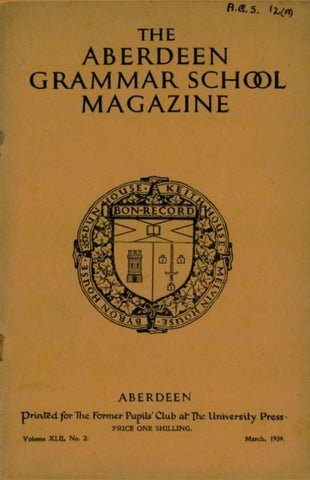
THE
ABERDEEN GRAMMAR SCHODL MAGAZINE
ABERDEEN
prinMcl for The former Pupils' Club at The University Press • PRICE ONE SHILLING.
Volume XLII, No. 2.
March, 113Y.
EDUCATIONAL BOOKS JAMES G. BISSET to supply all the Class Books (New or CONTINUES Second-hand) suited for the requirements of the Higher Educational Institutions in the City, at the Lowest Prices. N.B.—Best Value in Students' Note Books.
JAMES G. BISSET, Classical, Medical, and Educational Bookseller,
85 BROAD STREET (Opposite Marischal College).
•
PHONE 753 •
GOOD HEALTH demands
GOOD BREAD For the children especially is it necessary to ensure their stamina and energy with good, wholesome, nourishing bread. In Hutchison's bread you'll find all these requirements are fully met. Phone or give instructions to have it supplied daily.
A►.B.HUTCHISON , BRANCHES THROUGHOUT THE CITY
ACVATIC 1I! I
-
UNBREAKABLE GLASS
Standard Size, Centre Seconds Plain Junior
E6 I2s. Os.
Cd.
„
Centre
£7
2s.
6d.
••
Plain
£6 ISs.
Cd.
In 1863 We sold watches. To-day many of these are still in daily use. What better testimonial could you have ? The watches of to-day are superior and very much less costly, sufficiently sturdy to withstand the vigour of present life, yet not ponderous as the watches of our grandfathers' time.
-
6d.
£6
A. & J. SMITH JE WELLERS
191 UNION STREET
ABERDEEN
THE
HOUSE
Gowns in every
Quality and Style
Outsize Wear A
Speciality
A. C. LITTLE & SONS, LTD. 105
UNION
STREET
•
ABERDEEN
III
GALLOWAY & SYKES LTD FURNITURE EQUAL TO ANY TEST Time has tested and firmly established our reputation for Fine Furnishings. Every suite, carpet or curtain is quite beyond reproach. The materials used are selected for fine quality, and the workmanship employed secures a perfect production. MAKE AN EXAMINATION of our stocks, you will find a high stalldard of comfort and beauty is now at your command for every room iii the home, with expert advice to solve your furnishing problems.
361-363
ONION STREET, ABERDEEN
* II,
, , J !
Ilk A ill d o A . -,....... Ilk iii, 4N:will-1 ‘: . -; --...--,7, , ..'>, , l's-...1.,„ ., ---- .. li ‘ I -et:iir,",
t—___,7-X ~l'r (;~l.,iM"` Mama
JAMES FYFE & SON • • • OFFICE AND SHOWROOMS :-
11 DEE STREET, ABERDEEN. Te egrams " FyIe, Painters."
Telephone 304. Hairdressing for . . . LADIES, GENTLEMEN & CHILDREN .0.<>
Maison Beattie HAIR STYLISTS
In Albyn Place, Aberdeen 'Phone 4104
A CUGeNle wave
AMTLY COFFEE '
Cures Coffee is the favourite 40 drink with everyIt is most one. especially de icious, Your in cold weather. grocer can supply you.
CUM COF
/
4
-
ThO,11G3 C1117 & Co.
Anderson & Spence DISPENSING
CHEMISTS
PHOTOGRAPHIC
DEALERS
31 FOUNTAINHALL ROAD, ABERDEEN Telephone No. 1711
05 -BES
\-- c -
C4.. i... -cZ sr-. LP v>
e9
Qe, 7--1". >•
.
BIND FIND FAST FAST V TRADE MARK
(-,)
18 Back Wynd Aberdeen ESTAIDLISHED 1855
BOOKBINDING OF EVERY DESCRIPTION Leather Goods Lettered with Initials or Inscription Maps or Plans Mounted Loose Leaf Specialists
TELEGRAMS. "HUB. ABERDEEN."
TELEPHONE . NO. 1711.
CAMPBELL & SELLAR, LTD Engineers, Hirers and Garage Proprietors
QUEEN'S CROSS GARAGE to Fountainhall Road ABERDEEN ANY MAKE OF CAR SUPPLIED
OPEN DAY AND NIGHT
r-
COPLANDEl?
DECORATOR
54/knoum
21,41c&.9teierdeerr
lte-- SPECIALIST
.to n=
OE- STAINED GLASS & MURAL DECW2O„ cazar ky.070
- •
A. D. COPLAND. Phone 896.
For Better Footwear
JAMES LORIMER & SON (BOOTMAKERS), LTD.
CIVIL and MILITARY BOOTMAKERS
8 CHAPEL ST.
ABERDEEN
(Late of x62 Union Street)
Estd. A.D. 1844.
'Phone 724.
Go to . . .
KE NNAWAY'S of course RESTAURANT-173 UNION STREET Here you get the finest of food, daintily served, and at a reasonable price. The Restaurant is comfortable and commodious, and is Just the place to entertain your friends. Our rooms are available for all types of functions. 'Phone 2371, and ask the Manageress for quotations
WM. KENNAWAY LTD. Quality
Bakers, Confectioners and
Caterers,
Aberdeen
Telephone No. 1891.
ARCHIBALD McKELLAR Family Grocer and Wine Merchant,
454-456 Union Street, Aberdeen. . . We Specialise in . . Cooked
Gammons, Finest Belfast Smoked Hams, " Harris's "
Wiltshire Bacon.
Medicinal Wines—Vibrona, Hall's, Wincarnis, Glendenning's.
Did Shakespeare eat Bacon? We cannot tell, but we do know there will be no " Bacon" controversy if you shop at the
Rubislaw Supply Stores 34 Queen's Road : Phone 2054 All our Bacon is cut to individual requirements, under personal supervision—hence our reputation
Burberry Overcoats From 31 Guineas * * * *
W. J. MILNE, LTD. flatters & Outfitters
251 Union Street, Aberdeen (Opposite Royal Northern Club)
Telephone 1293
Telegrams: "Gallowses, Aberdeen"
On your MENUS . include fresh fish prime butcher meat, poultry and game from A. & W. Alexander. You can be confident of complete satisfaction Telephone 5172 for courteous and personal attention Our delivery service is dependable
A. & W.
ALEXANDER FISH, GAME AND BUTCHER MEAT
492 UNION STREET
ABERDEEN
Telephone Aberdeen 1710.
The Mastrick Dairies Ltd. 1 DESSWOOD PLACE, ABERDEEN WE offer you a Choice Selection of DAIRY PRODUCE from our own Farms, and produced under the direct supervison of members of the family. Our Customers may rely upon the absolute Purity and Cleanliness of all our products. Distributors of
CAIRNBROGIE CERTIFIED MILK. Head Dairy: 3, 5, and 7 WHITEHALL ROAD. Branches: 33 FOUNTAINHALL ROAD. 25 BEDFORD PLACE. 473 GREAT WESTERN ROAD.
CONTENTS ILLUSTRATIONS. Colonel Archer Irvine-Fortescue, D.S.O., M.B., Ch.B., B.C,om. . . . . . . . . Facing page 92 Sir William Wilson Jameson, M.A., M.D., F.R.C.P. . 93 John R. S. Inns . . . -. . . . 104 Medallion in Marble of Lord Byron . . 105 . School Rugby Football ist XV—Season 1938-39 120 Robert W. Linton . . . . . . . I21 James Stewart MacPherson, M.A. . . . . 12/ Group at the Annual Dinner in Aberdeen of the F.P. Club 152 Annual Dinner of the London Centre of the F.P. Club i68 The Class of 1873-188o . . . • . 169 F.P. Club Rugby Football Section 1st XV—Season 1 938-39 178 0/
.
PP
If
.
.
Pf
13
.
ff
.
Of
10
,,
91
PS
10
•
•
+11,
Our Rugby Internationalist . . . . . . The President of the F.P. Club . . . . . Notes About Old Boys . . . . . . . F.P. Art in London . . . . . . . Obituary . . . . . . . . . The Magazine in the British Museum . . . . Marriages . . . . ' • . ' • " The Crisis-1938 " . . . . . . . A Doctor's Life . . . • • • • • Medallion of Byron . . . . . . . " Mag." Thoughts from Abroad . . . . . School Section— School and Random Notes . . . . . Robert C. Haine . . . . . . . An F.P. Master . . . . . . . " Rab." By R.A.D.L. . . . . . . How to climb Lochnagarl By M. H. Tawse . . A Journey to Belgium. By Naufragium . . . How did we come to have Music ? By B. W. H. Cook School Rugby . . . . . . . Who's Who in the rat XV . . . . . 1st XV Matches . . . . . . . and XV Matches . . . . . . . House Notes . . . . . . . . The Literary and Debating Society . . . Scout Notes . . . . • • • . The Former Pupils' Club— The Annual Meeting of the Club Club Executive Notes . . New Club Consuls . . . Interim List of Consuls . . The Annual Club Dinner . London Centre Dinner . . . Annual Meeting of London Centre . Edinburgh Centre Dinner . Malayan F.P.s' Annual Dinner . Rugby Section . . . Hockey Section . . . . Cricket Section . . . List of New Members . . Club Office-Bearers for 1939-4o,
. Page 91 92 • 9/
•
PP
• •
11
•
„
•
PP
•
SP
•
/22
•
PS
•
PS
•
IP
•
.
•
PS
•
PP 19
•
PP
•
/1
•
91
•
.
•
19
•
•
•
•
•
•
P9
•
•
•
•
•
.
•
•
•
•
•
•
•
•
•
•
•
•
•
•
•
PA
•
•
•
•
19 19
. U
•
•
•
•
•
•
•
•
•
Ps
•
•
•
•
•
11 11
•
•
•
•
•
•
•
•
•
•
.
•
•
•
•
Pl
•
•
•
•
92
•
•
•
PS
93 109 I10 113 114 115 116
118 118 119 I25 I25 Iz6
127 129
132 1 34 1 35 1 37 1 39
141 1 43 144
147 1 54 1 55 1 59
168 166 1 75 176 177 178 181 182 183 184
Highland Dress for Girls & Boys E. & M. place at your disposal a service in Highland Outfitting backed by many years of experience.
If you
are unable to call let us post to you our Illustrated Catalogue and Price List.
FOR BOYS TWEED JACKET and VEST - 35/- and 49/6 TARTAN KILTS - 34/6 and 45/Do. Ancient Colours 49/6 BALMORAL BONNETS 6/6 TARTAN TOP HOSE 6/6 TARTAN TIES I/11 and 2/11
FOR GIRLS TARTAN KILTED SKIRTS - 16/11 to 30/TAILORED KILTS - 35/- to 77/6 JERSEYS to suit Kilts 10/11 to 18/6 KILT JACKETS - 34/ to 55/-
ESSLEMONT & MACINTOSH LIMITED UNION
STREET
ABERDEEN
Silver Medal Bread Think of it ! A different Loaf for every day of the month 9 VARIETIES OF BROWN BREAD 2I
VARIETIES OF WHITE BREAD
Try them all Ilk 15 1P5
W. M. McPHERSON Baker and Confectioner '5 FOUNTAINHALL ROAD AND
8 ST. SWITHIN STREET
ABERDEEN Telephone 15 x 5
ESTABLISHED
1843.
Wm. Cay & Sons ifuncral Untlertallers,
STRACHAN
415 UNION STREET
COMMERCIAL
AND
&
209 GEORGE STREET,
PORTRAITURE
ABERDEEN.
PHOTOGRAPHY Motor Hearses and Cars for Town and Country Funerals.
Telephone 851
416 UNION STREET ABERDEEN
Telegrams—"Cay, Aberdeen." 'Phones Nos. 92 and 54.
Telephone : 1156
Telegrams : ' Blake Builders ' •• SrrS
lee
4111111111
antl
-
,J11A M IES 1113IL4 IF 4 'MI
311181
l'ae1111.
23, 25, 29 SUMMER STREET, ABERDEEN All classes of Building Joinery Enquiries courteously solicited ESTABLISHED
18 1 8
His LATE MAJESTY THE KING
BY APPOINTMENT TO
J. WILLIAMSON & SON (w. B. WILLIAMSON. PPOPRIET011)
Meat Purveyors and Poulterers 1, 2, & 3 MARKET BUILDINGS, ABERDEEN 'PHONE 452 BRANCHES, 35
FOUNTAINHALL ROAD 'PHONE
ALSO AT
1724
CHURCH SQUARE. BALLATER.
THE SQUARE. CULTS 'PHONE. CULTS 2 'PHONE 38
QUALITY CAKES for The Seven Ages of Man CHRISTENING BIRTHDAY MAJORITY WEDDING ANNIVERSARY SILVER
WEDDING
GOLDEN
WEDDING
CAKES
Mitchell &
Muil
Ltd.
THE FIRM WITH A REPUTATION
SEAMLESS FITTED CARPETS Every good housewife welcomes carpet. She the wall-to-wall appreciates the beauty and comhome, and fort it brings to her the drudgery it saves in keeping polished floors spit and span.
We have arranged with one of the largest carpet manufacturing firms to manufacture a heavy pile carpet exclusively for ourselves, and we have named it " THE BALMORAL." It is woven in one piece, any width, any length, and the price is remarkably low. Obtainable in 6 different colours.
I5/- per square yard.
ROBERTS (Abdn.) LTD. 1e1.2695
Carpet Specialists and House Furnishers
F.,t. 1873
419 UNION STREET, ABERDEEN
DON'T WRITE IT—TYPE IT !
Tart Students -yJ 4 J We carry a fine range of reproductions of the Old, Modern, and Impressionist School from P.C. size up—ond frames to suit all subjects. All the latest HANDICRAFTS
Oaylots 49-51 Scboolbill
Little Portable Typewriters nowadays are very cheap, and enormous value for money—three British Portables: the Barlock Portable, the Baby Empire, and, the best of all, the Imperial Portable, the famous — Good Companion." Also all the foreign Portables.:: •• ••
You can get literary, scientific, medical, or Continental keyboards. •• ••
EASY DEFERRED PAYMENTS ON ANYTHING
Come along and see me :
C. H. WEBSTER 489 Union Street, Aberdeen 'Phone 505
Phone 2870
ROLEX OYSTER 27 WORLD RECORDS
WATERTIGHT AND DUSTPROOF
ANTI-MAGNETIC - UNBREAKABLE GLASS
Stainless Steel 8 gns. Centre Seconds 9 gns. Extra Precision - 10 gns. 9 ct. Gold - 13 gns. Other models from 5 gns.
We stock the complete range of Rolex Oyster and Rolex Prince Watches.
JAMIIIFSCS1 E,Liblishesi in Ike Year 7733
WATCH AND GEM RING SPECIALISTS
142 UNION STREET (next Union Bridge), ABERDEEN
COAL ELLIS & McHARDY LTD. (ESTABLISHED 1880)
18
REGENT
25O
UNION
QUAY
AND
(AMICABLE
STREET
HOUSE)
ABERDEEN Telephone 2889
Telegrams " COAL, ABERDEEN"
the modern note is cleverly expressed in the new Arrangements.
Fireplace
Why not inspect them in our showrooms and see at fi rst hand how greatly one would add to the appearance
and
comfort
of your room!
ames Scott & Son (Aberdeen) Ltd. 483-485 UNION STREET ABERDEEN Phone 1881-2
Co-operation HE enthusiastic co-operation of many minds and hands make possible the fine productions of the HOUSE OF OGILVIE. For over three-quarters of a century our constant endeavour has been to give the best possible service to our Customers. We base our claim to your patronage on our ability to please you.
T
J. & A. OGILVIE 369
UNION
STREET,
ABERDEEN. Telephone : No. 433.
There is none better than the " BEST" but Davidsons' Coals are better than the " REST —
J. & A. DAVIDSON LTD.
2 BLAIKIE'S QUAY ABERDEEN Telegrams—" Davidson" Phone 2873 Branch Office :— MAJESTIC BUILDINGS, 238 UNION STREET
Telegrams: " Interiors."
showyard Erector to the Highland and Agricultural Society of Scotland, and Contractor to the Royal Northern Agricultural Society.
JOHN REID & CO. HOUSE CARPENTERS AND JOINERS
55 Blenheim Place and 14 Fountainhall Road ABERDEEN ate
Various kinds of ENGLISH, SCOTCH HOUSE, STEAM COAL, ANTHRACITE, and "Ideal " Triplex Fuel at keenest prices WE SOLICIT A TRIAL ORDER
Carpentry and Joinery Work of
every description done ESTIMATES ON APPLICATION — -Telephone No. 1997
A MODERN SERVICE
We are equipped with the latest and most up-to-date appliances for the lubrication of your car. No longer need you struggle with grease guns and oil cans or crawl to reach inaccessible points. All this work can now be done for you cleanly, efficiently and effectively and without the slightest trouble to yourself. Call in sometime and let us demonstrate this Service.
We are an Official—
K EFI ELD
C
LUBREQUIPMENT AL
SERVICE
STATION
•
•
IES MUM IRS A IUIEIR ID LIMITED THE AUSTIN DEALERS 1U rSicS Telegrams—" CARS "
1V1C W
IL IDIE Telephone-4580
: Established
Assets
1836
£25,400,000
NORTHERN ASSURANCE COMPANY LIMITED •
FOR
*
ALL CLASSES OF INSURANCE •
LIFE
•
ASSURANCE BRANCH
The Company's tables of rates for Life Assurance include every class of Policy
Special Leaflets on— The Family Protection Policy The " Optional "
Policy
The House Purchase Policy The Educational Endowment Policy Child's Deferred Assurance Policy CHiEF OFFICES ABERDEEN LONDON .
I UNION TERRACE •
•
I MOORGATE, E.C. 2
Branches and Agencies throughout the World
Aberdeen Grammar School Magazine 54th year: No. 14r (New Series, 451h year, No. 132) Vol. XLII -
-
MARCH 1939
No. 2
-
The " Grammar School Magazine " is issued under the auspices of The Former Pupils' Club, in March, June, and November. All communications with regard to the " Magazine " should be addressed to the Editor (the Secretary and Treasurer of the Club), THEODORE WATT, M.A., LL.D., The Rosemount Press, Aberdeen.
•
_-
Our Rugby Internationalist.
e
JOHN R. S. INNES (1923-35) has earned the distinction of being the first F.P. to win three International Rugby Caps in a season. In fact only two F.P.s have previously been Internationalists—GEORGE A. LEDINGHAM (I 8 94-1 9o5), playing against France in 1913, and RODERICK R. F. MACLENNAN (190918) playing (whisper it!) for England against Scotland in 1925, and against France in the same year. JAMES I. MORR1CE was, of course, offered his place against Ireland in 1934 but had to decline owing to injury. Innes was Captain of the very successful School XV of 1 934-35. Now studying medicine at the University, he has played for that Club for the last four years, and in the season just finishing has captained the side, being recently awarded his Full Blue. He has certainly earned his place in the Scottish team and is one of the few members to have played the three games this season. He has had to play hard for recognition, and probably played through more trial games than any of the other members of the Scottish team. Before reaching International status, Innes had to show his paces for the North against the Midlands, the North against the South, and in two Scotland v. The Rest games. Originally a reserve for the Welsh game, Innes got his chance when J. G. S. Forrest withdrew, and so impressed the Selectors that he was a first choice for both the Irish and English games. Still only 2i years of age, there is nothing to prevent Innes gaining further awards in future years.
92
Aberdeen Grammar School Mageqine
The President of the F.P. Club. At the Annual Business Meeting of the F.P. Club, held on 15th March, 1939, ARCHER I RVINE-FORTESCUE (1892-97), D.S.O., M.B., Ch.B. (Aberd.), B.Com.(Edin.), Colonel, Army Medical Service (retired), was elected President. Born in 188c), the eldest son of Dr. William Irvine-Fortescuc of Kingcausie, Maryculter, Colonel Irvine-Fortcscue passed from the Grammar School to Aberdeen University, where he graduated in medicine, with honours, in 1904. In that year he was appointed Curator of the Royal Herbarium, Calcutta, and in 1907 he entered the Royal Army Medical Corps as a Lieutenant. He served with distinction throughout the Great War at home, in France, Belgium, Italy, and Russia, attaining the rank of Acting LieutColonel. From 1919 to 1921 he was a member of the AngloPersian Military Commission. He was mentioned in despatches four times, received the D.S.O. in 1919 for services in North Russia (Archangel), the Order of St. Stanislaus of Russia, znd Class, with swords ; and the Order of the Lion and Sun of Persia, znd Class. In the Waziristan operations of 1922-23 he was Senior Medical Officer of the 7th Brigade, and was again mentioned in despatches and received the medal and clasp. From 1926 to 1929 he was Inspector of Medical Services, Iraq Army, and served in Kurdistan in 1927. He was latterly in command of the British Military Hospital at Rawal Pindi, having attained the rank of Colonel in 19;5, and at the time of his retiral, in July, 1937, on reaching the age limit of S7, was Assistant Director of Medical Services, Rawal Pindi District. The new President is a keen student of foreign languages, and has passed Higher Standard Examinations in Urdu, Persian and Pashtu languages. He has also qualified as an Interpreter in German, Arabic, and Turkish, and has passed the Preliminary Interpretership Examinations in French, Russian, and Italian. While in command of the Military Hospital in Edinburgh Castle he studied in the Faculty of Commerce at Edinburgh University and was awarded the degree of B.Com. in 1932. In the following year he passed with credit the intermediate examination for M.A. with honours in Modern Languages, with " high distinction " in German, and " distinction" in French. Colonel Irvine-Fortescue has all along taken the keenest interest in the School and the F.P. Club, and he and his wife founded the David Alexander Irvine-Fortescue Prize, in memory of their son, who died in 1930, to be awarded to the member of Class II of the Lower School who possesses " the highest principles in his understanding of truth, honour, and kindliness to all around him, and who is a true sportsman in the best sense of the word."
•
COLONEI. ARCHER IRVINE-FORTESCT.1E, D.S.O., M.B., Ch.B., B.Com. President of the Former Pupils' Club, 1939-40.
•
SIR WILLIAM WILSON JAMESON, M.A., M.D., F.R.C.P.
•
Aberdeen Grammar School Alagazine
93
** *It is requested that the Editor be informed of all new appointments and interesting incidents in the careers of Former Pupils.
•
The dates given in parentheses after names indicate the sessions of attendance at the School.
New Year Honours.
•
*
In the list of New Year Honours conferred by the King the names of four F.P.s appeared :— William Wilson Jameson* (1892-1902), M.A., M.D., F.R.C.P. Lond., Dean and Professor of Public Health, London School of Hygiene and Tropical Medicine, was created a Knight Bachelor. At Aberdeen University, where he took a prominent part in student affairs, being President of the S.R.C. for 1907-8, he graduated in Arts in 1905, and in Medicine in 1909, taking the M.D. degree three years later. He was Lecturer and Assistant in the Department of Hygiene, University College, London, 5914 to 1920 ; Deputy Medical Officer of Health for the Metropolitan Boroughs of Stoke Newington and St. Marylebone, and Medical Officer of Health for Finchley and the Borough of Hornsey, 1914 to 1928. In the latter year he was appointed to his present Professorship. Ile was called to the Bar at the Middle Temple in 1922, and was elected a Fellow of the Royal College of Physicians, London, in 1930. He is a member of various Advisory Committees dealing with Hygiene and Tropical Medicine. In the Great War he served as a Specialist Sanitary Officer in England, France, and Italy, having the rank of Captain in the R.A.M.C. George Haddon Bower* (1877-87), T.D., M.A., Lieut.Colonel, was made a Companion of the Order of the Bath (C.B.) in the Civil Division. He graduated in Arts at Aberdeen University in 189 ►, and after serving a law apprenticeship, was admitted as an advocate in Aberdeen in 1899. For many years he has been a partner in the firm of G. H. Bower and Gibb, advocates. For half a century he has been connected with the Volunteers and the Territorials, having enlisted as a Private in the A.R.A.(V.) in October 1889. After two years he received * Member of Former Pupils' Club.
94
Aberdeen Grammar School Magaine
a commission in the 5th V.B. Gordon Highlanders, later the 7th Gordon Highlanders, with whom he served in the Great War both at home and in France, his final rank being that of Lieut.-Colonel. He has recently retired from the chairmanship of the Territorial Army Association of the County of Kincardine, which he held for almost ten years, and the honour conferred on him is a well-merited recognition of the work he has done. Edwin Salisbury Macleod* (1881-89), R.D., Commander, Royal Naval Reserve (retired), and Principal District Officer in London of the Board of Trade, was made an Officer of the Order of the British Empire (O.B.E.), Civil Division. Shortly after leaving the School he went to sea as an apprentice in the Aberdeen Line, and having worked through the various grades, obtained his certificate as Extra Master. He is one of the few who hold that certificate for both sail and steam. After commanding several large steam vessels, he passed a competitive entrance examination and became a Nautical Surveyor under the Board of Trade. He held appointments in this capacity and also as a Senior Nautical Surveyor at various ports, and was eventually promoted to be Principal District Officer and Emigration Officer for the Port of London, a position which he still holds. When the Great War broke out, he held a commission as Lieutenant in the R.N.R., and served in various ships until he was demobilized, before hostilities ceased, for special service with the Board of Trade. One of his most interesting jobs during the War was to lay a line of anti-submarine nets across the entrance to Suvla Bay for the protection of the transports carrying troops for the landing there. This was done the night before the landing. He was also employed evacuating the troops from Suvla Bay and from Cape Helles at the end of the campaign. He retired from the Active List of the Royal Naval Reserve with the rank of Commander, and was awarded the Reserve Decoration. Commander Macleod is a son of the late Mr. Alfred Macleod, whom older F.P.s will remember as teacher of elocution at the School. Edward Birnie Reid* (1901-1;), Lieut.-Colonel and Brevet Colonel, commanding the 51st (Highland) Divisional Signals, Royal Corps of Signals (T.A.), was made an Officer of the Order of the British Empire (O.B.E.), Military Division. He qualified as a chartered accountant in 1911, and is a partner in the firm of Messrs. James Meston and Co., chartered accountants, Aberdeen. At the beginning of the Great War he was a cadet in the Cambridge University O.T.C., and in February 1915 received a commission in the R.F.A.- He served with the 67th Brigade, R.F.A., Mediterranean Expeditionary Force, from June to November 1915, and in France with the 94th Brigade, R.F.A., from September 1916 to October 1917, when he was gassed. Ultimately he was demobilized with the rank of
Aberdeen Grammar School Magazine
95
Lieutenant in January 1920. Since 1923 he has been con• tinuously associated with the 51st Divisional Signals, of which for the last four years he has been in command. Frederick Robert Aitken* (1918-21) holds an executive post on the staff of Messrs. W. H. Dorman & Co., Ltd., Diesel engine manufacturers, Stafford. Arthur James Anderson* (19°3-06) is master of a tramp steamer sailing, as he says in a recent letter, " to any—or all—of the seven seas." " I might mention," he continues, " that though I have visited practically all quarters of the globe during my thirty odd years at sea, I have yet to run across F.P.s that I knew at the School, with the exception of GEORGE C. CHEYNE* (1900-04), whom I met last year and again this year in Rangoon. On both these occasions I had been staying with my brotherin-law, C. G. Stewart of the Indian Police, an Arts graduate of Aberdeen University but unfortunately not a Grammar F.P. He has, however, done the next best thing, he has sent his only son, Clyne R. B. Stewart, to the School, and he is resident at the Boarding House." Ian Alfred Anderson* (1912-24), B.Sc., M.B., Ch.B., was in January appointed Clinical Assistant in Metabolism at the Aberdeen Royal Infirmary. John Anderson* (1921-34) has passed the final examination of the Chartered Accountants of Scotland, and has been admitted a member of the Society of Chartered Accountants in Aberdeen. He served his apprenticeship with Messrs. James A. Jeffrey and Co., C.A., Aberdeen. Archibald Ernest Bennett* (1920-30) was in December elected an Associate of the Royal Institute of BritishArchitects. He was trained at the Aberdeen School of Architecture. James Gordon Bisset* (1919-20 and 1922-29) is in the service of Messrs. Osborne, Stevens & Co., Ltd., timber merchants, Uxbridge. Alexander Brown* (1924-33) has received his and Mate's Certificate, and is now 3rd Officer with Messrs. Andrew Weir and Co., Ltd., on the m.v. Myrtlebank. He served as a cadet in the Bank Line. Neil George Brown* (1918-27) has recently got an appointment with the Anglo-American Oil Co., Ltd., as 3rd Officer in the m.v. Arthur Corwin. George Taylor Bruce (1870-71), M.A., who after being a teacher in this country for over twenty years emigrated to Canada in 1904 and became a farmer in Saskatchewan, contributed an interesting letter from Regina, Sask., to a recent issue of the Aberdeen Press and Journal, with regard to his first
96
Aberdeen Grammar School Magazine
cousin, William Keith, the landscape painter, who, like himself, was born in Old Meldrum. Our F.P. is now in his 83rd year. Ian Fyfe Cameron* (1918-28) was in December elected an Associate of the Royal Institute of British Architects. He received his training at the Aberdeen School of Architecture. Alexander Vernon White Cantlay* (1903-1o) has since January of this year been stationed on Bandar Pinang Estate, Galang, East Coast of Sumatra. Alexander Mackie Chalmers (1904- ? ) is manager of the Hudson's Bay Company post at Fort Alexander, Manitoba. In 1912, while serving as an apprentice in one of the distant outposts of the H.B.C. in Northern Canada, he was the means of rescuing a Scots baby girl who was orphaned a few hours after her birth. Her father was a trapper in the employment of the Company, and while on a tour of his district was drowned. During his absence his wife gave birth to a baby girl, but died immediately afterwards. Chalmers devoted his time for weeks, under trying conditions, to keeping the child alive, and eventually she was sent to her grandparents in Cartwright, Labrador. In 1916 Chalmers brought her to Scotland and she was handed over to her paternal grandparents in Aberdeen, where she continues to reside. Albert Christie* (1919-29), M.B., Ch.B., was in January re-appointed an anaesthetist at Aberdeen Royal Infirmary. Melville S. Christie* (1926-28) left in December to take up an appointment as a tea planter in Assam with the firm of Messrs. Duncan Bros., Calcutta. After leaving the School he was employed with his father in the firm of Messrs. Christie Bros. (Aberdeen) Ltd., the Crown Paper and Printing Works, Aberdeen. For seven years he was in the Scottish Horse, latterly holding the rank of Sergeant and Riding Instructor. Monsignor William Robert Clapperton* (5899-1901), M.A., Ph.D., D.D., who has been Rector of the Scots College in Rome since 1922, was present in the Vatican during the recent visit of the Right Hon. Neville Chamberlain and Lord Halifax. At the request of the Editor Mgr. Clapperton has sent the following very interesting account of the proceedings :— A visit to Rome without seeing the Pope is like a plum-pudding without
the raisins, and so it was only natural that Mr. Chamberlain in the course of his recent visit to Rome as guest of the Italian Government should pay his respects to His Holiness. The visit to the Vatican took place on the morning of Friday, 13th January. Mr. Chamberlain and Lord Halifax drove from their residence at the Villa Madams on Monte Mario to the British Legation to the Holy See, and thence, accompanied by the British Minister to the Holy See, their Secretaries, and the Foreign Office officials who had come to Rome with them, they set out in Vatican cars flying Union Jacks and Papal flags. Arrived at the Cortille San Damaso, they were given the ceremonious reception prescribed by Papal Court etiquette for visiting Prime Ministers. They were then conducted to the Sala Clamentina, where some three hundred
Aberdeen Grammar School Magazine
Ai
•
• • -•
97
British ecclesiastical students from the English, Scots, Canadian, Beda, and Propaganda Colleges, together with their Rectors, were assembled. As soon as the visitors entered the Hall a platoon of Swiss Guards, drawn up opposite the entrance, stood to the salute, while the students gave vent to a resounding cheer, which by its unexpectedness (in these surroundings) and full-throated heartiness helped to make the atmosphere much less formal, and put the visitors more at ease, after they had recovered from their initial surprise. The newly appointed Apostolic Delegate to Great Britain, Mgr. Godfrey, Rector of the English College, was first presented to Mr. Chamberlain, and then the Rectors of the other Colleges. Photographers got busy with their flash-lights and their cameras, and as the Ministers left the Hall for the audience chamber, the students renewed their cheers. The audience was strictly private, the only person present, besides Mr. Chamberlain and Lord Halifax, being Mr. Osborne, British Minister to the Holy See. At its termination the Secretaries and other officials were admitted. As a memorial of their visit the Holy Father gave to each of the Ministers a medal bearing on one side the head of the Pope, and on the other the heads of Saints John Fisher and Thomas More, canonised in 1935. On leaving the papal apartments the visitors called on the Secretary of State, Cardinal Pacelli. They then returned to the British Legation to the Holy See, and received a return visit from the Cardinal Secretary of State. Afterwards a luncheon party was given in their honour by the British Minister to the Holy See, the guests including Cardinals Pacelli and Pizzardo, Prince Colonna, Marchese Scrafini (Governor of the Vatican City), the Rectors of the English, Scots, Canadian, and Bcda Colleges, and one or two other Vatican officials. Whatever the political results of Mr. Chamberlain's visit to Rome may be, it showed beyond all doubt his popularity among the people of Italy, and their sincere desire for peace ; wherever he went he was cheered by enthusiastic crowds, who looked upon him as the man who had saved them from war last September, and who would still save Europe and civilization from destruction. It is good to know that Mr. Chamberlain had long and intimate talks with Cardinal Pacelli, now Pope Pius XII, whose desire for peace among the nations no one will call in question. In his message to the world on the day after his election, he proclaimed that he would dedicate his reign, without arms but trusting in God's help, to the promotion of peace joined with justice and truth. May he succeed! Herr Hitler, alas! when he came to Rome did not pay a visit to the Pope.
William Robertson Clark* (1907-1i), A.M.Inst.C.E., M.Inst.S.E., has retired from the Civil Service of the Gold Coast, where he was engaged as an engineer on the railways for over eighteen years from 19zo. Andrew Gourlay Clow (1896-98), C.S.I., C.I.E., M.A. (Cantab.), of the Indian Civil Service, is to be a member of the Governor-General's Executive Council. He has been in the Commerce and Labour Secretariat (formerly Industries and Labour) for a number of years, and has a knowledge of industrial labour problems probably not equalled by any colleague in the I.C.S. He has visited Geneva on several occasions for International Labour Conferences. He entered the I.C.S. in 1913. Charles Cooper* (1875-8o) has been editor of the Chester Courant and the Cheshire Observer since 1895. As will be seen on another page, , he recently attained the golden jubilee of his wedding. Ian Hamish Cooper* (1923-33) is now 3rd Officer of the
98
Aberdeen Grammar School Magazine
s.s. Chakdina, belonging to the British India Steam Navigation Co., Ltd., of London, which will be trading in the West Indies for over three years. Patrick Ashley Cooper* (1896-1901), who has recently paid a flying visit to Trinidad, will shortly be going to Canada in connection with the Royal visit. It will be his duty as Governor of the Hudson's Bay Company to present to the King personally two elk and two black beavers in part token of the charter granted by the King's forebear, King Charles, to the Company of Gentlemen Adventurers of England trading into Hudson's Bay. Mr. Cooper has recently resigned the chairmanship of Primitiva Holdings and its associated companies, and also the chairmanship of the Province of Buenos Aires Waterworks Co. and associated companies. He has been appointed a director and chairman of the board of Trinidad Leaseholds, Ltd. Alexander Thomas Cruickshank* (1882-87), O.B.E., M.A., was in November elected President of the Society of Advocates in Aberdeen. It is noteworthy that the other three office-bearers are F.P.s : James William Garden* (1886-95), M.A., B.L., is Treasurer ; Norman John Jamieson Walker* (1893-1902), M.A., LL.B., is Secretary, Factor, and Librarian ; and Charles Williamson* (1883-85), M.A., C.A., is Auditor. Andrew John Maxton Cruickshank (5959-25), who has been making a big name for himself as an actor in London, is showing unusual talent as a playwright. He has co-operated with another actor, Mr. Reginald Beckwith, in a version of " Lysistrata," and in the writing of a play, " Adults Only," which was produced at the Globe Theatre in January. Charles Davidson* (1882-86), M.A., who has been Lecturer in Spanish at Aberdeen University since 1920, is retiring from that position at the end of September. Many will recall that he was an Assistant Master in the School from 1893 until he received his present appointment. Andrew Alexander Marr Ducat* (1924-34), after serving a four years' apprenticeship with the Bank Line, has now obtained his and Mate's ticket, and has entered the service of the New Zealand Shipping Co., Ltd. He has been appointed 4th Officer of the s.s. Cambridge. James Catto Duffus* (1897-1904), senior partner of the firm of Wilsone & Duffus, advocates, Aberdeen, was in January elected to a seat on the Aberdeen head office board of directors of the Northern Assurance Co., Ltd. James Lindsay Duncan* (1911 -14), LL.B., Ph.D., has been appointed one of the reporting staff of Session Cases, Official Law Reports, attached to the First Division of the Court of Session, Edinburgh.
Aberdeen Grammar School Magerine
• •
•
41.
99
Douglas Watt Duthie* (1915-21), M.A., B.Sc., Ph.D., Agricultural Chemist to the British Guiana Government, has been attached to the Commission of five Americans and two Britons which is examining the possibilities of settling involuntary Jewish-German refugees in the hinterland of British Guiana. Provided that the results of the survey are satisfactory, His Majesty's Government contemplate the leasing of large areas of land on generous terms. Dr. Duthie is to advise and cooperate with the Commission. John Murray Easton* (1895-1905), F.R.I.B.A., the architect of the British Pavilion at the New York World Fair, has designed the doors for the Pavilion, and these were displayed for the first time at Grosvenor House, London, on 6th March. The doors are remarkable for being made of extruded nickel silver, which has not been used before for industrial purposes. They weigh a ton and a half, and are to be taken to pieces and packed for shipment to America. They are elaborately decorated with the emblems of the four countries of the United Kingdom. The design of the British lion is described as being particularly virile. Arthur Hercules Peter Ferguson* (1905-14) in a recent letter from Matambo Estate, Namadzi, Nyasaland, says that he made a trip to New Zealand in 1937 and found that it was naturally a wonderful grazing country, and as compared with his part of Africa, very easy to pioneer. Scotland, he declares, can produce better honey, better butter and apples, and as good lamb and mutton. Matthew George Fisher (1896-1900), K.C., M.A., LL.B., was in December appointed Professor of Civil Law in the University of Edinburgh. He is the only son of the Rev. R. H. Fisher, D.D., of St. Cuthbert's Parish Church, Edinburgh, and formerly of the West Parish Church, Aberdeen. He graduated M.A. at Edinburgh University in 1910, with First Class Honours in Classics, and LL.B. in 1913, being in the same year admitted as a member of the Faculty of Advocates. From 1914 to the end of 1919 he was engaged on military service, becoming latterly Staff Captain and then Brigade Major of a brigade in India. He has been counsel to the Secretary of State for Scotland under the Private Legislation Procedure Acts since 1928, and was Secretary to the Scottish Ecclesiastical Commissioners from 1925 to 1937. He has been Lecturer in Administrative Law in Edinburgh University since 1932. Archer Irvine-Fortescue* (1892-97), D.S.O., M.B., Ch.B., Colonel, Army Medical Department (retired), recently qualified as a First Class Instructor (Special Certificate) in civilian anti-gas precautions, obtaining over So per cent. in the theoretical and over 85 per cent, in the practical examinations. The Special
too
Aberdeen Grammar School Magazine
Certificate has been officially described as " an honours degree in gas." James William Irvine-Fortescue* (1928-3o), M.A., son of Colonel ARCHER I RVINE-FORTESCUE* (1892-97), and grandson of Dr. William Archer Irvine-Fortescue of Kingcausie, Kincardineshire, in February attained his majority, and the occasion was marked by a presentation from the tenantry and employees on the estate of Kingcausie. He represents the fourth generation of the family that has studied at the University of Aberdeen. Rex Fowell* (1912-23) now holds a permanent appointment with the Aberdeen Corporation and is at present engaged as resident engineer on the construction of Aberdeen's new main sewer. Rudolf William Galloway* (1902- ? ), D.S.O., M.B., Ch.B., Lieut.-Colonel, R.A.M.C., in October last relinquished his appointment as Senior Medical Officer of the Shanghai area, and in January was appointed Senior Medical Officer and O.C. Military Hospital, Bovington Camp, Dorset. Edgar Norman Gauld* (1923-32), M.B., Ch.B., is on the staff of Bolingbroke Hospital, London, S.W. it. Trevor Gray* (1921-32), B.Sc.(Eng.), is on the design staff of the Railway Signalling Department of MetropolitanVickers Electrical Co., Ltd., Trafford Park, Manchester. He qualified at Aberdeen University in Mechanical Engineering in 1936 and in Electrical Engineering in 5937. He then started on a two years' College apprenticeship course with MetropolitanVickers, and after fifteen months was given his present position. He is a member of the Pilot Section of the R.A.F. Volunteer Reserve. David Collier Greig (1921-27) was in January awarded the diploma in dental surgery at the University of St. Andrews. Robert Kellas Hall* (1928-38) is now on the head office staff of the National Bank of Scotland, Aberdeen. Very Rev. James Harvey* (1870-75), M.A., D.D., has intimated his intention to demit the office of Joint Senior Clerk to the General Assembly of the Church of Scotland at the next Assembly in May. Dr. Harvey, who is 8o years of age, started as a minister in the Free Church of Scotland at Duntocher in Dumbartonshire, and was for nearly 4o years in the charge of Lady Glenorchy's, Edinburgh, from which he retired in 1929. He was Moderator of the General Assembly of the U.F. Church in 1925, and in 1935 his ministerial jubilee was celebrated. He was appointed Junior Principal Clerk of the U.F. Assembly in 1916, and Senior Clerk three years later. At the Union in 1929 he became Junior Principal Clerk of the Assembly. James Masson Hector (I889-1900), B.Sc., Professor of Agricultural Botany in the University of-Pretoria, is the author
Aberdeen Grammar School Magqine
gib
101
of a substantial work recently published in two volumes, " introduction to the Botany of Field Crops." It is intended to meet the need for a co-ordinated account of a subject which has an enormous literature, and in which knowledge has been very greatly increased since 1900. John Blain Howitt* (1926-35) is now on the Sookerating Tea Estate, Doom Dooma, Assam. Herbert Douglas Jamieson* (1922-34), son of the late DOUGLAS JAMIESON (1895-1903), has qualified as a dental surgeon at the University of St. Andrews, where in December he was awarded the diploma in dental surgery. 1-ie is now doing six months' temporary work prior to starting a B.D.S. course at St. Andrews University in October. In his last year at the School he set up the record for the High Jump, and followed this success by establishing a record for the High Jump at his University. At the same time he was awarded the Prain Cup for the best athlete of the year 1936-37. Derek Mario Mitchell Kellas (1924-35), B. Sc.(For.), was last year selected for an appointment in the Colonial Forest Service, and having been posted to the Gold Coast, has recently proceeded there. David Proudfoot Levack* (1906-09), M.B., Ch.B., was in November appointed to the command of Aberdeen's latest Territorial Medical Unit—the 154th (Highland) Field Ambulance—with the rank of Lieut.-Colonel. He has been Regimental Medical Officer of the 5ist (Highland) Divisional Signals for about fourteen years. A graduate of Aberdeen University, for about ten years he has been Honorary Radiologist to the Aberdeen Royal Infirmary. John Adam Lillie* (1893-1903), K.C., LL.B., was in December appointed a member of a Royal Commission which is enquiring into workmen's compensation. He was made a K.C. in 1931. Eric Robert Linklater* (1913-16), Lieutenant from T.A. Reserve of Officers (General List, Infantry), was in March gazetted a Captain in the Royal Engineers, Orkney (Fortress), T.A., with seniority from 16th September, 1938. Alexander Low* (1883-86), M.A., M.D., Emeritus Professor of Anatomy in the University of Aberdeen, is to receive the honorary degree of LL.D. from the University. He joined the teaching staff of the Anatomical Department in 1894 and was appointed Lecturer in Embryology in 1911, Reader in Embryology in 1923, and was Regius Professor of Anatomy from 1925 until his retiral last year. James Glover Thomson Lunn* (1924-31), M.B., Ch.B., late officer cadet, Aberdeen University Contingent (Medical Unit), Senior Division, O.T.C., was in February gazetted a
102
Aberdeen Grammar School Magazine
Lieutenant in the R.A.M.C.—General List (T.A.). He is at present on the staff of the City General Hospital, Sheffield. Norman Henri Lyall* (1912-16) is engaged as a chartered accountant in Cape Town, South Africa, He has recently become a Life Member of the F.P. Club. Alexander Lyon* (1893-1902), D.S.O., was in December gazetted a Deputy Lieutenant of the County of the City of Aberdeen. A Major of the 4th Battalion Gordon Highlanders, he was for two periods in command of that Battalion in the Great War. At present he is the Chairman of the Aberdeen City Territorial Army Association, and he was formerly the Chairman of the Directors of the Aberdeen Royal Infirmary. Other F.P.s who hold the position of Deputy Lieutenant are Sir HENRY ALEXANDER* (1881-9O, M.A., LL.D. ; JOHN MALCOLM FYFE* ( I 882-87) ; WILLIAM SMITH GILL* (1876-79), C.B., V.D. ; JAMES HAY* (1883-87), M.A., B.L., advocate ; HARRY JACKSON KINGHORN* (1876-80), C.B., T.D. ; LACHLAN MACKINNON (1865-70), M.A.,V.D., advocate; THOMAS OGILVIE* (1884-87), C.B., C.M.G., T.D. ; and EDWARD WILLIAM WATT* (1883-94), M.A., T.D. (see p. 1O7). Alastair David MacDonald* (1923-25) was in December elected to the Organ Scholarship of St. Catharine's College, Cambridge, open to the whole of the British Isles. The winner of the scholarship, which is tenable for three years, is appointed organist of St. Catharine's College, and is expected to take the leading part in all the musical activities of the College. MacDonald, who is studying for History Honours at Aberdeen University, will enter Cambridge in October next. There he will continue his studies in history, and in addition he intends to study for the degree of Mus.Bac. In 1937-38 he was the first undergraduate of Aberdeen University to be organist of .King's College, and last year he was also the first undergraduate to conduct the orchestra at a University theatre show. Brian Walter Whyte Mackay* (1922-23), who has been resident in South Africa for a number of years, latterly at Port Elizabeth, the centre of the Eastern Province of the Cape, last season won the badminton men's doubles championships of both Grahamstown and the Eastern Province, after having been runner-up in the latter event in the two previous years. Mackay is employed by a German firm, and during the period of tension last September naturally had an anxious time. Most of the staff is either British, or at least South African-born, and if there had been any outbreak of hostilities, their jobs would have been gone at once. The employer is a member of one of the old aristocratic families of Germany, and is greatly opposed to Nazism—hence his voluntary exile. Dennis Lorraine Mackay* (1924-29) is at present serving in H.M.S. Manchester.
Aberdeen Grammar School Magazine
to;
George Henry McCombie* (1916-29), M.A., LL.B., Royston John Milne* (1918-30), M.A., LL.B., and Geoffrey Allen Rowton* (1920-31), B.A., LL.B., are at present Law Agents for the Poor in Aberdeen. George Scott McLaren* (1928-32), C.A., has recently taken up an appointment in Johannesburg. John MacMurray (1902-04), M.A., Grote Professor of Philosophy of Mind and Logic, University of London, is the author of ' The Clue to History," recently published by the Student Christian Movement Press. He finds the clue in the teaching of Christ that the will of God for mankind is the attainment of real community, without distinction of creed, race, or class. Those who have studied his profoundly suggestive " Creative Society " know that he believes in a Christian version of Communism, and here he develops and continues in a different context certain of the arguments in that volume. According to The Times, " the book deserves all the respect which is owed to a piece of independent and rigorously honest thinking." Thomas Menzies* (19o5-Io), M.B., Ch.B., Major, R.A.M.C., is at present at the Queen Alexandra Military Hospital, Millbank, London. Douglas Falconer Middleton* (1920-25) is on the staff of the Hyndland Branch of the Union Bank of Scotland, Glasgow. Kenneth Bradley Miller* (1929-30), A.R.I.B.A., who was formerly in the City Architect's Department, Aberdeen, is now in the corresponding Department at Portsmouth. He gained the Diploma of Architecture in Aberdeen in 1937. In November of that year he was granted a commission as a and Lieutenant in the 75th (H.) Field Brigade, Royal Artillery (T.A.), and is at present attached to the S7th (Wessex) Anti-Aircraft Brigade, Royal Artillery (T.A.). Alfred Forbes Milne* (1895-190o), M.A., B.Mus., was composer of the music of " Quick Change," a comic opera in two acts successfully produced at Christmas at Berkhamsted School, Herts, where he has been Organist and Director of Music since 1920. John Macgregor Milne* (1927-3o) has recently, through the agency of the F.P. Club, received an appointment with Messrs. George R. Alston & Co., Ltd., Port-of- Spain, Trinidad. Two other F.P.s in the service of this firm are A RCHIBALD YOUNG* (1 8 8 5-93) and ALEXANDER GORDON* (1899-1900). Milne was previously for some years in the service of Messrs. Wm. Tawse, Ltd., public works contractors, Aberdeen. Magnus Ramsay Milne* (1927-30)—a twin brother of the foregoing—is employed at Southampton with Supermarine Aviation, Ltd., makers of seaplanes.
104
Aberdeen Grammar School Magazine
Alexander Lessel Stephen Mitchell* (1911-19), B.L., is now well known as a successful theatre manager in London. At the Duchess Theatre he has been presenting " The Corn is Green," one of the most outstanding plays in the West End during the present season. In February the King and Queen paid a private visit to this theatre to see the play. Stephen Mitchell's interests in the London theatre are steadily expanding. He is associated with the Phoenix, and is also presenting Ian Hay's new play, " Little Ladyship," which promises to have a long run at the Strand. George Angus Mitchell* (1902-13) has been gazetted Major and Brevet Lieut.-Colonel. He is in command of the 51st (Highland) Divisional Engineers (T.A.). A partner in the firm of Messrs. George Bennett Mitchell & Son, architects, Aberdeen, he has recently been appointed President of the Aberdeen Society of Architects, and as such a Vice-President of the Royal Incorporation of Architects in Scotland. Donald Alexander Campbell Morrison (1922-25) has recently been awarded one of the most coveted honours in Oxford scholarship, namely the Slade Exhibition. This is awarded, without examination, on the work of the " Greats " (Literae Humaniores) course. David Donald Murison* (1922-29), M.A. (Aberd.), B.A. (Cantab.), is Senior Assistant in Greek at Aberdeen University. Ellis Edward Paul Murray* (1925-30), B.Sc., M.B., Ch.B., is at present on the staff of the Portsmouth Hospital on the surgical side. John Charles Edward Murray* (1904-14) was last year appointed a Driving Examiner with the Ministry of Transport, and is stationed at Perth. Colonel Thomas Ogilvie* (1884-87), C.B., C.M.G., has recently retired from the Honorary Colonelcy of the 4th Battalion The Gordon Highlanders, on completion of his period of office, which he held for twelve years. The honour of the Colonelcy was paid to him for his distinguished services to the Battalion, which he took out to France in February, 1915. He was mentioned in despatches during the Great War no fewer than six times. For a term he was Chairman of the City of Aberdeen Territorial Association. John William Paul* (1901-03), agent of the North of Scotland Bank at the Market Street Branch, Ellon, has recently, at his own request, on account of the state of his health, retired under the Bank's pension scheme. Alfred William Raffan* ( x 919-31), M.B., Ch.B., was in February appointed a resident anaesthetist in the Aberdeen Royal Infirmary.
JOHN R. S. 1NNEs.
r o6
Aberdeen Grammar School Magazine
William Murray Ritchie* (1922-3z), M.B., Ch.B., is at present on the staff of the Royal Infirmary, Glasgow. Reginald Mitchell Scott* (1919-28), who for the past ten years has been a motor salesman with Messrs. Claud Hamilton & Co., Ltd., Aberdeen, has received an appointment as representative for the northern half of Scotland with The Filtrate Oil Co., Ltd., of Leeds. John Hall Davidson Sharp* (1925-27), late officer cadet, Aberdeen University Contingent, Senior Division, O.T.C., was in December gazetted a 2nd Lieutenant in the 5/7th Battalion The Gordon Highlanders. David John George Shennan* (1922-26), B. Sc.(Eng.), who is in the service of Messrs. E. Nuttall Sons & Co. (Manchester), Ltd., has been for about a year in Trinidad, B.W.I., in charge of the reconstruction of a pipe-line viaduct for Trinidad Leaseholds, Ltd. Petrol when refined is pumped 1I miles through pipes along the viaduct into tankers, which carry it to England, where it is marketed as Regent motor spirit. On the viaduct reconstruction there is one white foreman from England, the remainder of the labour being coloured. Shennan says that the climate varies pleasantly from 75° to 95°, but is rarely uncomfortably hot. William Black Shepherd* (1922-33) has passed the final examination of the Chartered Accountants of Scotland and has been admitted a member of the Society of Chartered Accountants in Aberdeen. He served his apprenticeship with Messrs. James Milne & Co., C.A., Aberdeen. August Henry Klie Slater* (1922-35) was in January awarded an exhibition in Classics at Merton College, Oxford. He is at present in his final year of the Classical Honours course at Aberdeen University. He was Classical Dux of the School in 1935. This year he is Senior Vice-President of the Students' Representative Council : last year he was Secretary. Charles William Sleigh* (1874-79), M.A., LL.D., recently completed forty years of service in public life. He was elected to Lesmahagow Parish Council in 1898, while he was an estate factor in Lanarkshire. Later he was elected to Lesmahagow School Board and Lanarkshire Secondary Education Committee. In 1918, when he succeeded his father at Strichen Estates Office, he took his seat in the Aberdeen County Council. He became chairman of the Aberdeenshire Education Authority at its inception in 1919, and has been at the head of the County Education body ever since. For ten years he has been ViceConvener of the County. Alexander Johnston Slessor* (1918-3o), M.B., Ch.B,. was in December admitted a member of the Royal College of Surgeons of Edinburgh.
Aberdeen Grammar School Magazine
4 0
107
Alan Smith* (1923-28), B.L., solicitor, has recently been assumed as a partner by Mr. William Mollison, solicitor, Aberdeen. The practice is being carried on under the firm name of William Mollison & Smith. Archibald Douglas Spark* (1905-10), M.C., Major, The Gordon Highlanders, organized the air raid precautions in Singapore, and handed over a scheme and estimates to the Colonial Government there. He has recently come home and been appointed an A.R.P. Inspector under the Home Office. Douglas Gordon Stewart* (1924-33) has passed the final examination of the Chartered Accountants of Scotland and has been admitted a member of the Society of Chartered Accountants in Aberdeen. He served his apprenticeship with Messrs. Bower & Smith, C.A., Aberdeen. Ian Jackson Stewart* (1923-29), B.Sc.(For.), has received an'appointment as a District Officer in the Forestry Commission. John Stewart* (1898-1905), M.A., of the Church of Scotland Mission, Acheng, by Harbin, Manchuria, has been transferred to Moukden as. General Secretary of the Scottish and Irish Missions in Manchuria. He was appointed a U.F. Church of Scotland Missionary in Manchuria in 1914. Charles James Strachan* (I 917-2 r) has for some years been on the Macaldeniya Estate, Koslanda, Ceylon. He first went out to Ceylon in 1927. George Grant Thomson* (1910-14), who has been for many years in the service of the Hongkong and Shanghai Banking Corporation, has recently been transferred from Shanghai to Singapore. Frederick A. Tough* (192o-21) is with Consolidated Eastern Plantations, Ltd., at Leyang-Leyang, Johore. Charles Chamberlain MacCulloch Watt* (1922-27) was in December granted a commission as Acting Pilot Officer, No. 612 (County of Aberdeen) (General Reconnaissance) Squadron, General Duties Branch, Auxiliary Air Force. Edward William Watt* (1883-94), M.A., was in December gazetted a Deputy Lieutenant of the County of the City of Aberdeen. He is to receive from Aberdeen University the honorary degree of LL.D., in recognition of his services as Lord Provost of Aberdeen for the period 1935-38, and particularly in view of his having raised the last Lioo,ooo for the new Aberdeen Royal Infirmary £500,000 building fund. He entered the Town Council in 1927, and was a Magistrate and City Treasurer before becoming Lord Provost. He has a long record of military service, having joined the old 1st Volunteer Battalion Gordon Highlanders in 1901. At the outbreak of the Great War he was mobilized as a Captain of the 4th Battalion Gordon Highlanders (T.F.) and he retired in 1921 with the rank
ro b
Aberdeen Grammar School Magazine
of Lieut.-Colonel, having previously been awarded the Territorial Decoration. Recently he has been appointed Special Officer for National Service for Scotland. He has also recently become Chairman of the North-East of Scotland Agricultural Wages Committee. He is a member of the National Fitness Association for Scotland and Chairman of the North-East Regional Committee ; he is a member of the Scottish Central Council of Juvenile Organizations and of the Scottish Central Probation Council. John Park Weir* (1918-24), M.B., Ch.B., Captain, R.A.M.C., is at present stationed at the British Military Hospital, Nowshera, N.W. Frontier Province, India. Robert Moir Williamson* (188z-83), M.A., LL.B., senior partner of the firm of Messrs. Paull & Williamsons, advocates, Aberdeen, is to receive from Aberdeen University the Honorary Degree of LL.D. For the twenty-five years from 1908 to 1933 he was Lecturer in Constitutional Law and History in Aberdeen University, and for the last eight of these years he was a member of the Senatus. He has been Chairman of the Aberdeen Savings Bank for ten years. Daniel Overbeck Wright* (1915-16) is at present on the Puchong Estate, Selangor, F.M.S. ABERDEEN UNIVERSITY DEGREES.
At a Graduation Ceremony at Aberdeen University on 14th December, 1938, degrees were conferred on the following :— Doctor of Medicine (M.D.)— William Robertson Gauld* (1923-30), M.B., Ch.B., London. Thesis—" The In-patient and Out-patient Treatment of Diabetes by Zinc Protamine Insulin." Bachelor of Medicine and Bachelor of Surgery (M.B., Ch.B.) : Norman James Hunter Davidson (1926-33). Williamson Jackson Finnic* (1928-31), B.Sc. Donald Graham McRobbie* (1921-33). Henry Knox Paterson* (I 9 zo-33). Laurence Gardner Tulloch (192 1-33). "VERSES FROM NEW KING'S."
Just before last Christmas there was published in Aberdeen a little anthology of poems by some former students of Aberdeen University. The book, which has met with a very warm welcome, is of interest to the Grammar School since a number of the contributors are F.P.s. They include ALLAN CAMERON FRAZER* (1925-30), M.A., LL.B.; ERIC R. R. LINKLATER* (191316), M.A. ; JoHN HASTIE SPEIRS* (191I-24), M.A. (Aberd.), B.A. (Cantab.) ; Professor JAMES RUNCIEMAN SUTHERLAND (1907-17), M.A. ; and RALPH SPENCE WALKER* (1910-22), M.A.
Aberdeen Grammar School Magazine
I09
ABERDEENSHIRE JUSTICES OF THE PEACE.
The following F.P.s were appointed Justices of the Peace for Aberdeenshire in February :—WILLIAM BAXTER BRODIE BROWN* (I sa 5-x8), M.B., Ch.B., Aboyne ; Lieut.-Colonel NORMAN WALTER MACKWORTH (1892-96), M.B., Ch.B., F.R.C.S.E., Indian Medical Service (retired) ; ALEXANDER MANSON (1901-04), Culblean, Meldrum ; Major CHARLES NAPIER GORDON MILNE (1893-94), Bucksburn ; and DAVID RICIIARDS (1894-99), M.A., Schoolhouse, Aboyne.
S
• •
F.P. Art in London. The Exhibition of Scottish Art held at the Royal Academy of Arts, London, in January and February contained examples of the work of at least five Former Pupils of the School. Right at the beginning, in the first room, came seven portraits by GEORGE JAMESONE (IS97-1601), known as the " Scottish Van Dyck." These included "The Young Montrose" (James Graham, 1st Marquess of Montrose) as a youth in his marriage dress, " George Gordon, and Marquess of Huntly," and a selfportrait. The School may well be proud that it can claim " the first native portrait-painter of note in these islands." Then there was a jump over the centuries to WILLIAM DYCE (1814-19), M.A., R.A., of whose work there were five examples, including "Titian's First Essay in Colour" and " The Ferryman," from the Aberdeen Art Gallery. Dyce was the first artist commissioned to execute a fresco for the Houses of Parliament, and " by general agreement, his panels illustrating the legend of King Arthur, in the Queen's robing-room, mark the high-water-mark of Victorian decorative art." Next came Sir GEORGE REID (1853-54), P.R.S.A., who was represented by four paintings, including " Montrose," from the Aberdeen Art Gallery, and four pen and ink and wash drawings. JAMES GARDEN LAING (1863-66), R.S.W., painted in watercolour, and an example of his work was " Interior of St. Maclou, Rouen," lent by the Glasgow Corporation. Another watercolour was " Lochnagar," by JAMES CADENHEAD (187o-74), R.S.A., R.S.W., who died as recently as 1927. One exhibit of special interest to the School was a small version, 3o inches in height, of Pittendrigh Macgillivray's statue of Byron that stands in front of the School buildings. Another notable example of Macgillivray's sculpture was a bust of Sir George Reid.
11o
Aberdeen Grammar School Magazine
OBITUARY. Charles Moorhouse Duncan ‘1,..9...-1905), ( 2 R Major, Royal Field Artillery, son of CHARLES AULD DUNCAN(' 877-85), formerly of the Indian Public Works Department, and grandson of Sergeant Charles Duncan, who was for many years the Janitor of the Grammar School, died on 21st January, 1939, as the result of a car accident, aged 42 years. He was trained at the Royal Military Academy, Woolwich, and passed into the Royal Field Artillery as a and Lieutenant in September, 1914. In the following June he was promoted to be Lieutenant, and in February 1918 to be Captain. In the Great War he was awarded the Military Cross, and at its close held the rank of Acting Major. John Gall (1865-68), M.A., who was for many years minister of Munro Church, Rutherglen, Lanarkshire, died at the beginning of February at Giffnock, aged 92 years. He graduated M.A. at Aberdeen in 1872, and five years later was appointed Minister of the Free Church, Liff, Forfarshire. In 1879 he was translated to the Free Church (afterwards the West U.F. Church), Rutherglen, and there he continued until his retirement in 1913. At the time of his death he was " Father " of the Presbytery of Glasgow. Charles Inns* (1883-84), late head master, Fetteresso School, died at Stonehaven on 3rd February, 1939, aged 68 years. He was trained as a teacher in Aberdeen and was appointed an assistant in Tobermory School, Mull, in 1892. Two years later he went to Cullen, and then to Dunnottar, Stonehaven, in 1895 and Stonehaven Public School in 1897. After another two years he was appointed head master of Cookney School, Muchalls, and in 1959 he became head of Fetteresso School, retiring about six years ago. He was a Fellow of the Educational Institute of Scotland. John Hay Lobban (1882-88), M.A., died suddenly at Great Chesterford, Essex, on 8th February, 1939, aged 67 years. He graduated M.A. at Aberdeen in 1892, with double honours— in Classics and Mental Philosophy. He was appointed assistant at the University to the late Professor Minto, and he carried on the classes in English and Logic from the time of Professor Minto's death until the appointment of Professor Grierson. In 1897 he joined the staff of Messrs. Blackwood & Sons, publishers, Edinburgh, and became assistant editor of Blackwood's Maga-dine. After seven years he became literary adviser to Messrs. Hodder and Stoughton, publishers, London, and assistant editor of The Bookman. For many years he was Lecturer in English Literature at Birkbeck College, University of London. Mr. Lobban had an extraordinarily extensive knowledge of English literature. He helped Professor Minto in his " Litera-
Aberdeen Grammar School Magazine
•
i
ture of the Georgian Era," and was the compiler of " An Anthology of English Verse," published in t9oz, which covered the whole field of English poetry. He was the editor of the Granta Edition of Shakespeare, and of the County Histories of Scotland. He married in 1910 Miss Lilian Couch, sister of Sir Arthur Quiller Couch. An older brother, ALEXANDER LOBBAN (1866-70), M.A., for 37 years Rector of Nairn Academy, died in 19zz ; and another brother, WILLIAM LOBBAN (1876-83), M.A., was Classical Master of the High School, Glasgow, and died in May 1935. James Alexander Macdonell (1871-7z), M.D., died at Hastings, Hawke Bay, New Zealand, on zznd January, 1939, aged 84 years. Ile graduated M.B., C.M., at Aberdeen in 1882, and took his M.D. ten years later. After visiting various parts of the world, he arrived in New Zealand about 1890, and settled in Westport. Some years later he moved to Hastings, and continued in practice there until about four years ago. In the Great War he served as a Captain with the New Zealand Medical Corps on transports sailing to and from England. When he was demobilized in November 1918 he held the rank of Temporary Lieut.-Colonel. Harry Hume MacGregor (1886-89), S.S.C., died at Edinburgh on i3th January, 1939, aged 64 years. He served as a law apprentice in Stonehaven, and after studying for a time at Edinburgh University, qualified as a law agent in 1889. He started in business on his own account in Edinburgh in 1903, when he was admitted a member of the S.S.C. Society. In the Great War he was gazetted a Captain in The Cameronians in November 1914, and served in France with the loth Battalion of that regiment until September 1916, when he was dangerously wounded. Hugh Falconer Don Middleton* (1899-1903), telegraphist, died in Aberdeen on 18th January, 1939, aged 5o years. He joined the Post Office service in Aberdeen in 1904, and became a telegraphist two years later. For many years he was engaged in the preparation of statistical returns. In the Great War he was a Sapper in the Royal Engineers (Signal Section), and served in France from August 1917 to March 1919. Charles Wright Milne* (1897-1901) died at Woodside Park, London, on 23rd April, 1938, aged 51 years. A son of the late Mr. Samuel Milne, of the once well-known firm of McRobbie & Milne, carpenters, Aberdeen, he served as a pupil with Messrs. A. Marshall Mackenzie & Son, architects, and thereafter was in the service of this firm in London and in Aberdeen. In 1912 he joined the Valuation Department of the Inland Revenue, and was in charge of the Peterhead Sub-Centre until October 1915. At the close of the War he became an architectural assistant in H.M. Office of Works, Whitehall,
II2
Aberdeen Grammar School Magazine
London, but after a few months was appointed an assistant architect in the head office of the Great Eastern Railway (later the London and North-Eastern Railway), London. In the War he started as a and Lieutenant in the City of Aberdeen (Fortress) Company of the Royal Engineers (T.F.), serving at home until February 1917, and then with the Egyptian Expeditionary Force. Later he was employed on the lines of communication of the Egyptian Army, planning and building hospital camps, remount depots, etc., under the Director of Works, until February 1919, when he was invalided home. He contracted malaria while serving in Egypt, and had never since then been in perfect health. Colonel George Milne (1867-72), C.B., of Logie and Glenbuchat, died at Logie, Pitcaple, on 8th January, 1939, aged 81 years. On leaving the School he entered the business of Messrs. George Milne & Co., shipowners, Aberdeen, which had been founded by his grandfather. Later he became owner of the business, which went out of existence during the War. Throughout his life he displayed great enthusiasm for soldiering. He began his long military career by becoming a Sub-Lieutenant in the 3rd Aberdeenshire Artillery Volunteer Corps in 1875. When that unit became the 1st Aberdeenshire ArtilleryVolunteer Corps in 188o, he was given his company, and rose to the rank of Lieut.-Colonel in 1901. Three years later he was placed in command of the Corps, and his services to the Army were recognized by his being made a Companion of the Order of the Bath (C.B.) in 1911. At the outbreak of the Great War he was in command of the ist Highland Brigade, R.F.A., and although then nearly 6o years of age, gave his services unstintedly. He played an important part in raising the well-remembered "Taggart's Own" Brigade of Artillery, and having been appointed Commanding Officer, trained the brigade for service abroad and took it over to France. He was a very active member of the Aberdeen County Council, and from 1933 was Chairman of the Aberdeen County Road Board. He owned Logic Estate for over thirty years, farming about z,ooo acres. He also owned the Glenbuchat and Tullymorgan Estates. James Monro* (1878-8o), chartered accountant, died at Edinburgh on 17th February, 1939, aged 73 years. A son of the late Mr. Joseph Monro, Broomhill, Aberdeen, he went to Edinburgh as a young man, and after engaging in legal work there, turned to accountancy, and served with the well-known firm of Messrs. J. & F. Anderson, W.S., for 45 years, retiring only a short time before his death. He was keenly interested in bowling. Frank Gelly Tennant Peterkin, who was at the School for a short time in 1897, and graduated M.B., Ch.B., at Aberdeen
Aberdeen Grammar School Magazine
113
in 5903, died at Kirkwall on 18th February, 1939, aged 57 years. He engaged in medical practice in Kirkwall. Andrew Mitchell Ramsay (1896-99), elder son of Emeritus Professor Sir William Mitchell Ramsay, formerly of Aberdeen University and now resident at Bournemouth, died at Kendrew, South Africa, on 3oth December, 1938, aged 53 years. For a time he studied at Aberdeen University, and then engaged in farming in New Zealand. Thereafter he was in business in Smyrna, Asia Minor, and in 1914 was an aeronautical engineer at f tendon. He continued to work there during the War, his company being controlled by the Government and engaged on aeroplanes for both the War Office and the Admiralty. After the War the company made some efforts to adapt itself to civil work, but in 1925 Ramsay and his family emigrated to South Africa to take up fruit-farming at Kendrew, in the hope that the climate would help the asthma from which he was an almost constant sufferer. His health, however, did not improve. Latterly it had been getting worse, but his death was sudden and unexpected. He married in 5914 the youngest daughter of the Rev. James Hunter of Laurieston, Falkirk, and is survived by her and by four sons, three of whom have been studying at Edinburgh University. James Douglas Wood (1911-22), younger son of Mr. James A. Wood, 5i Albury Road, Aberdeen, died at a nursing home in Aberdeen on zznd December, 1938, aged 34 years. He entered the service of the Aberdeen Lime Company as a clerk in 1925, and from March 1931 until the time of his death he was with Messrs. Harrison & Reeve, Ltd., fruit salesmen, Elgin. lie never enjoyed good health after he left the School. Alexander Ross Yeoman (5859-6o), M.A., died in Edinburgh on 14th February, 1939, in his 94th year. Born at Kincardine O'Neil in 1845, he graduated M.A. at Aberdeen University in 1864 and in the following year joined the Inland Revenue Service. He was appointed Inspector of Inland Revenue at Somerset House, London, in 1895, and later was Collector of Inland Revenue at Newcastle-on-Tyne. For many years he lived in retirement at Trinity, Edinburgh.
The " Magazine" in the British Museum. With reference to the paragraph in the last issue about the file of the [Magazine in the British Museum, in which it was stated that only one issue was missing, readers will be interested to learn that a copy of this issue has now been found and forwarded to the Museum.
11 4
Aberdeen Grammar School Magazine MARRIAGES.
•
Baxter (191a-33).—At Biscot Church, Luton, Bedfordshire, on 7th January, 1939, Pilot Officer ROBERT GEORGE. LESLIE BAXTER,* R.A.F., son of the late Dr. Alexander Baxter, Oldmeldrum, and of Mrs. Baxter, Aberdeen, to Danai Francis, youngest daughter of Mr. and Mrs. Walter Sharpe, Westview, Beechwood Road, Luton. Beattie (1888-89).-At Imperial Hotel, Aberdeen, on 9th February, 1939, CHARLES WILLIAM BEATTIE,* J.P., Emerald Bank, Insch, to Isabella, eldest daughter of the late William Scatterty, Mains of Boddam, and of Mrs. Scatterty, Wrangham Cottagcs, Insch. Black (19i4.-17).—At Shanghai, on znd January, 1939, FRANK CHARLES BRISCOE BLACK,* elder son of Alfred Alexander Black* (1882-84), 71 Forest Avenue (late of Cawnpore), to Annie Betty, second daughter of the late Mr. Donald Sinclair, J.P., advocate, and Mrs. Sinclair, 4 Brighton Place, Aberdeen. Bruce (1921-23).—At St. Cyprian's School Chapel, Cape Town, on 18th February, 1939, JOHN LAMB BRUCE,* C.A., son of the late Robert Bruce 0896-1900, and of Mrs. Bruce, 1 Albyn Terrace, Aberdeen, to Chorys Mary, daughter of Mr. and Mrs. F. A. Turner, Sea Point, Cape Town, South Africa. Buyers (1894-19o1).—At Edinburgh, on 16th December, 1938, LESLIE BUYERS,* youngest son of the late Mr. and Mrs. James Buyers, Aberdeen, to Jessie, third daughter of the late Mr. James McIntosh, and of Mrs. McIntosh, The F.lms, Banchory. Byars (1927-29).—At St. Mary's Parish Church, Newark, Notts, on 5th January, 1939, JOHN ROBBIE BYARS, M.B., Ch.B., D.P.H., elder son of Mr. and the late Mrs. George B. Byars, Drumoak, to Eileen Mary, younger daughter of Mr. and Mrs Ernest Robb, Newark. Cooper (t92.4-3o).—At Trinity Hall, on 5rd December, 1938, ANDREW JAMES COOPER,* only son of the late Andrew Alexander Cooper, East I ndian Railway, and Mrs. Cooper, z8 Irvine Place, Aberdeen, to Margaret (Daisy), only daughter of Mr. amd Mrs. James Findlater, 29 Holbum Road, Aberdeen. Donald (i922-28).—At Murrayfield Parish Church, Edinburgh, on 21St January, 1939, ALEXANDER BOTHWELL DONALD,* M.D., D.P.H., son of James J. Donald* (1885-87), 55 Gray Street, Aberdeen, to Mary, daughter of Mr. T. B. M. Lamb, O.B.E., and Mrs. Lamb, to Murrayfield Avenue, Edinburgh. Garvie (i9i8-3o).—At Saint Paul's Church, Stafford, on 18th February, 1939, DONALD WILLIAM GARVIE, elder son of John T. R. Garvie (1893-95), 13 Gladstone Place, Aberdeen, to Violet, daughter of Mr. and Mrs. A. S. Jones, 27 Salt Avenue, Stafford. Hall (r9t2-zo).—At Holbum Central Church, Aberdeen, on z9th December, 1938, JACK AUSTIN HALL, son of Captain and Mrs. J. H. Hall, 4 Ashley Park North, to Evelyn Mary, daughter of Mr. and Mrs. Frank Birss, 13 Great Western Place, Aberdeen. Hendry (t9zo-30.—At Greyfriars Parish Church Aberdeen, on 24th December, 1938, JOHN MADDISON HENDRY,* Cider son of Mr. and Mrs. John Hendry, 15 Richmondhill Place, Aberdeen, to Mabel, youngest daughter of the late Mr. and Mrs. Robert Tawsc, Huntly. Leslie (19,8-23).-At St. Mary's Episcopal Church, Aberdeen, on 2nd March, 1939, GEORGE FRASER LESLIE, eldest son of the late Mr. and Mrs. George Leslie, i Caledonian Place, to Agnes Donald, second daughter of Mr. and Mrs. J. Angus, 76 Grampian Place, Aberdeen. Marr (191j-21).—At London, on 9th December, 1938, NEIL GEORGE MARR,* M.B., Ch.B., Coynachie, Gartly, to Gladys Lorna Drummond-Hay, ;2 Dc Walden Street, London, W. 1.
Aberdeen Grammar School Magazine
115
Marr (1919-23).--At St. Leonard's Church, Lasswade, on 8th February, 1939, WILLIAM ALISTAIR LOVIE MARK,* sixth son of Mr. and Mrs. John G. Marr, Coynachie, Gartly, to Margaret Lilian, younger daughter of Mr. and Mrs. Miles G. Simpson, Hilton Cottage, Lasswade, Midlothian. Murray (t9z5-3o).—At St. Mary's Church, Kingston, Portsmouth, on 16th February, 1939, EI.LIS EDWARD PAUL MURRAY,* B.Sc., M.B., Ch.B., son of Mr. and Mrs. D. Murray, zo Hollybank Place, Aberdeen, to Ivy Winifred, daughter of the late Mr. H. J. Johns and of Mrs. Johns, 187 Fratton Road, Portsmouth. Raffan (1913-24).—At Cartagena, Colombia, South America, on 18th December, 1938, Et= McLaon RAFFAN (Royal Bank of Canada), younger son of Mr. and Mrs. John Raffan, 18 Woodburn Avenue, Aberdeen, to Maria Elsa Laura Herran, of Medellin, Colombia. Walker (19to-zz).—At King's College Chapel, Aberdeen, on 17th December, 1938, RALPH SPENCE WALKER,* son of the late Rev. George Walker, D.D., and of Mrs. Walker, 24 Ruhislaw Terrace, Aberdeen, to Margaret Jean, daughter of Mr. and Mrs. James Sutherland, 24 Beaconsfield Place, Aberdeen. Golden Wedding. Cooper (I875-8o).—At Aberdeen, on 26th February, 1889, by the Rev.
Dr. Jamieson, Old Machar Cathedral, assisted by the Rev. John Calder,
CHARLES COOPER,* of Chester, youngest son of Francis Cooper, Aberdeen,
to Elizabeth Craig Malcolm, youngest daughter of Mrs. Malcolm and the late Aitken Malcolm, of Old Aberdeen.
" The Crisis-i938." Complaint has been made that certain passages in J. B. C.'s article in the last Magazine might be interpreted as justifying the persecution of Jews by the Nazi Government. It is pointed out that much evidence could be adduced to refute such allegations as that Jews amassed great wealth during the inflation period or that they are an integral part of the private capitalist system. The Editor wishes to make it clear that the passages referred to represent the personal opinions of the writer. The Magazine, it need hardly be mentioned, is entirely non-political and nonsectarian. Two Points of View. (I) "The Aberdeen Grammar School Magazine is 54 years old, and better than ever. Apart from the vast quantity of collected information about F.P.s, there is a splendid article entitled " The Crisis, 1938." The author is a bank manager in Poland, and he actually crossed Europe when the crisis was at its height. Of all the articles we have read about that fateful month of September, this is the best. It is first-hand and first-rate. We note that he advises us to go to Germany and sec the country for ourselves."— Tbe Scoiii.rb Ed:wallow! Journal (the official organ of the Educational Institute of Scotland), 13 January, 1939. (2) "An article in the Grammar School Magazine has caused much adverse comment from parents and former pupils. It is considered unfair to present to immature minds one-sided comments on political matters that arc highly controversial. The article in question is not worthy of detailed criticism,' etc., etc.—The New Citizen, No. 4, Aberdeen, March, 1939.
116
Aberdeen Grammar School Magazine
A Doctor's Life. An entertaining book that will interest F.P.s and others belonging to the North-East of Scotland has recently been published by Messrs. Heath Cranton, Ltd., at the price of 7s. 6d. This is " Comedy and Drama of a Doctor's Life," by JOHN Low DICKIE, M.B., C.M. While Dr. Dickie was a pupil at the School for only a short time—his name appears in the School Register in 1881—his father and his two elder brothers were all educated at the School. The father was Professor GEORGE DICKIE (18z i-2.6), M.A., M.D., F.R.S., who was appointed to the Professorship of Botany at Aberdeen University in 186o, on the fusion of King's and Marischal Colleges, and died in 1882. Dr. Dickie's two brothers were GEORGE FOWLER DICKIE (1869-73), accountant and registrar at the Imperial Institute, South Kensington, from 1887 to 1902, who died in 1936 ; and ALEXANDER Low DICKIE ( I 871-73), M.Inst.C.E., who died in 1928. For many years the Dickies lived " in an old-world house, with the fascinating name of Cherryvale, standing in a large garden of several acres, with some fine old trees skirting the lawn in front of the house." This house still stands on the Denburn, on the east side of Esslemont Avenue, and in it Dr. Dickie was born in 1868. The Doctor records how they used to dam up the stream which ran through the grounds and sail a tub on it, and how one fine summer morning his eldest sister, when attempting with his assistance to board it, met with disaster. He draws a veil over what followed. In 188o the Dickie family " with great grief" exchanged their dear old house, with its romance and delightful grounds, for a new house further west. This was No. 16 Albyn Place, which the family continued to occupy for the next forty years and which, it may be mentioned, has recently become part of the Boarding House of Robert Gordon's College, with a Grammar School F.P. House Master. At the age of sixteen Dickie had a severe attack of rheumatic fever. It was this that made him take up seriously what afterwards became a lifelong hobby, trout and salmon fishing. When he was eighteen there came the question of his future, and he went into the family lawyer's office to see whether he inclined to the law. He found this monotonous, so it was eventually decided that he should take up medicine. He accordingly went to Marischal College, where he seems to have thoroughly enjoyed himself as a student. He graduated in 1895, and after doing some locums, was appointed a medical officer of the Assam-Bengal Railway. In India he had not a few adventures and out-of-the-way experiences. He faced death in the great earthquake of 1897 ; while riding home one moonlight night, thanks to his pony
Aberdeen Grammar School Magazine
ti7
snakes ; he just escaped being struck by one of the most deadly of and he gives a hair-raising account of a race from three rogue elephants :— and the syce yelled Meanwhile the elephants came nearer and nearer, out of his head. I shall
yet louder with horror, his eyes nearly starting the great brutes never forget that dreadful race. Now we gained, now listen to. My pony to awful were rage of trumpetings their gained, and great pants. in coming breath his foam, with white on, wildly plunged tremble to I pace—well, his maintain not could he If ? he last But would animal poor the though little, by Little be. would fate our think of what whoop wild a gave I Then nearer. drew elephants the best, his was doing villagers rushing of delight, for I could see a crowd of some two hundred and firing tom-toms with noise hideous a making torches, with towards us seemed pony The saved. be should we and more yards few of guns. A dashed and effort supreme a made he for I, as well as fact to realize the more. ahead once thud behind Bang! A bullet whizzed past our ears, and by the heavy hide of the tough the on mark a found it had knew I along, us as we sped But career. mad their stopped us it for Fortunately foremost elephant. lifeless mangled, been have would I and my horse syce, the bullet, for that brutes forms by the roadside within another few seconds, for the great us. were almost upon
•
40
In the course of his varied career Dr. Dickie came across he studied not a few F.P.s. At Aberdeen University, of course, under the late Sir ALEXANDER OGSTON (1 855 - 58), Professor of Surgery, and he tells an amusing story of his absent-mindedness of Sir with regard to his family. In India he was the guest Calcutta. Gardens, Botanic the at GEORGE KING (1849-50) In Ceylon he stayed with Sir WILLIAM D. GIBBON (1848-51), he " one of the fathers of tea in Ceylon." In Chittagong chummed with an old friend, LINDSAY D. HOlUNIE (1885-87), who was Assistant Superintendent in the Locomotive Departhe came ment of the Assam-Bengal Railway. In Calcuttapresumably them of "—one Justice across the " two brothers WILLIAM A. JUSTICE (1883), M.B., who passed into the Indian Medical Service in 19oz. Having come back to this country, at the outbreak of the the War he was gazetted a Captain in the R.A.M.C., and in following year he was appointed Medical Superintendent of soldiers the Star and Garter Home for totally disabled sailors andstaff was consulting the of one There Surrey. Richmond, at he whom for specialist, brain the 8), 5 45 Sir DAVID FERRIER (I 8 had the highest regard. One day the late King George visited place the Home, and as a result of a conversation that took between the two keen anglers, Dr. Dickie shortly afterwards on the got a letter announcing that he might spend his holidayBirkhall. Royal waters of the Dee at Balmoral, Abergeldie, and my " That was a joyous day for me, the most eventful in sporting calendar." In a concluding chapter Dr. Dickie emphasizes the importance of hobbies. " Cultivate a hobby," he says ; " it brings battle peace of mind, the forgetting of worry, and health to with life's many problems."
118
Aberdeen Grammar School Magazine
Medallion of Byron.
,
For many years two marble medallions of Byron were inserted in Byron House, the old home of the Press Association, in Fleet Street, London—one on the outside and the other in the entrance hall. The building was recently pulled down to make way for the new Reuters and Press Association combined building on the same site. At the time of the demolition the Chairman of the P.A. was Mr. William Will, a director of Allied Newspapers, Ltd., and he secured the medallions with a view to presenting them to Byron's old School. The two medallions are of practically the same size—about 3o inches in diameter. The background of the one that stood outside the building has got cracked, but fortunately the head is intact. The other one is in an excellent state of preservation, and when Mr. Will wrote to the Secretary of the F.P. Club offering to present it to the School, the offer was at once accepted, and the medallion lies in the School waiting to be erected in a suitable position. It would be a mistake to expose the marble to the weather on the outside of the School buildings, and it will, therefore, probably be placed in the new Library that is to be provided when the School is reconstructed. There it would be in a very suitable setting. The medallion is a beautiful example of sculpture in marble, as may be gathered from the illustration facing page io3. Both the School and the Club will be highly appreciative of the thoughtfulness which prompted Mr. Will to make this singularly appropriate and welcome gift.
" Mag." Thoughts from Abroad. "I cannot adequately express how much I appreciate receiving the School Magazine from time to time. It is now practically my only link with Aberdeen. Not only am I interested in the news concerning Former Pupils, but also keenly interested in the present activities of my old School." (Alberta.) " I find the Magazine most interesting and yearly improving." (Assam.) " By means of the Magazine I have been enabled to keep in touch with the School and the movements of F.P.s. In fact, there are few publications I enjoy more than the quarterly copy of the Gram. Mag., and it is seldom that I do not find something in its pages to awaken old memories." (Kenya.) " The old Mag. is just of as much interest to me as when first I started to receive it over thirty years ago." (Manitoba.) " I can honestly say that the Magazine keeps me in touch with Aberdeen in a way no other publication could possibly do. Those of us who have been overseas for years appreciate it in a way folk in the Old Country cannot understand." (Rhodesia.
Aberdeen Grammar School Magazine
i I ,>
SCHOOL SECTION. School and Random Notes. Here we are, here we arc, Here we are again.
And thus, dear reader, we greet you, and come once more to plague you with our inconsequential babblings. Since we last had the pleasure of writing for you, we have seen our Christmas report, one hundred and twenty-one copies of the first chapter of " Isaiah " in the Prefect's Room, and " Snow White and the Seven Dwarfs " for the fourth time. We hope that you will find these notes not uninteresting, and without more ado we shall proceed to our task. * * * In last term's notes, you may remember, we made a reference to the fact that there was a German student-teacher in School, but said nothing of a French student-teacher. The reason was that he had not then arrived. He has now, and his name is M. Rongier. He was born in Limousin, and went to ClermontFerrand University. Prior to corning here he was in Indiana, America, where he studied at Cornell University. We welcome him to School, and hope his stay, though shorter than is usual, may yet be a very happy one. * * * " I happen to know a proverb which says : ' Men often stand upon ceremony, when they ought to be sitting upon their bottoms.' " With these words Mr. John Milne, now in Stonehaven (Bless his soul!), began his speech in reply to the Head Prefect on the occasion of his presentation in December. Despite the enthusiasm and cheering, unparalleled on any similar occasion in the past few years, both speakers eventually succeeded in completing their respective discourses. After some amusing anecdotes, one of which we have seen fit to relate later in these Notes, and not the least important of which concerned cricket matches and Forfar bradies, Mr. Milne said something of which we might well he proud, namely, that we had very nearly made him forget he was a Gordonian. * * * Mr. Milne's place on the School staff has been taken by Mr. J. Stewart MacPherson. We are specially glad to welcome him to School, as he is himself an old Grammar School boy. He was a Prefect, Classical Dux of the School in 1933, and took a prominent part in the activities of the Literary and Debating Society, of which he was President in his last year at School. Besides this, he played for the First XV at rugby. Since he is a keen climber himself, he will be of great assistance to the
tab
Aberdeen grammar School Magazine
School Rambling and Mountaineering Club. We extend to him a hearty welcome and wish him every success and happiness in this, his first, post. * * * We were delighted to hear in Hall last term that the School is to have an annual rugby fixture with Fettes College, Edinburgh. This is certainly a tribute to our rugby team, as we shall now be among the few day-schools with whom Fettes competes in the rugby field. * * * For the Dramatic Society's Christmas production the Hall was completely filled, despite a raging blizzard outside. The four plays went over splendidly without the slightest hitch, and the general opinion of both the audience and of the local press was that the production was one of the best ever staged by the Society. Financially, too, the production was a success, and we are sure that the members of the Society and the producers must feel greatly gratified. * * * It is with tears in our eyes and with full hearts that we tell you that " Rab " has left us. No longer do the followers of the ancient cult of I.D.B. (for the uninitiated—Illicit Doughnut Buying 1) sneak on their nefarious expeditions in mortal terror of encountering the lithesome figure and sweet fairy whisper of the famous " Rab." It seems but yesterday that we saw him surveying the scene of desolation in Esslemont Avenue. But now, alas! Rab's familiar frame no longer stalks the well-trod paths of School. He has been a faithful servant for many years, and it was with great regret that we said good-bye to him. We wish him many long and happy years of peaceful retirement. * * * The Annual School Dance was held this year in Kennaway's Rooms on Friday, i 3th January, when thirty-two couples spent a most enjoyable evening. The School devotees of the popular art of dancing were to be observed " doing the Lambeth Walk " " 'neath the spreading Chestnut Tree," imitating, it is said, with commendable abandon members of the proletariat in an advanced state of joie de vivre. As one member of the Staff sardonically suggested, the boys seemed to be having a remarkably good time with their " sisters and cousins." Mr. Macgregor once more ably superintended the arrangements. * * * We are sure that all Grammar School boys, both past and present, were extremely pleased to hear of J. R. S. Innes's selection as a travelling-reserve for Scotland against Wales at Cardiff. But when we heard on the Friday morning before the match that he was actually to play, our enthusiasm knew
•
-
W
School Rugby Football 1st XV-Season 1938-39•
Back Row—Mr. D. Macgregor (Games Master), I. C. B. Black, R. A. D. Lindsay, A. D. Calder, J. S. Calder, J. \X-yness, H. C. Marl-lardy. Second Rota.—D. L. Paul, C. W. Gordon, C. R. Cruickshank (Vice-Captain), W. D. Allardice (Captain), H. S. Cardno, G. U. Sandison, I. M. Cormack. hi Front—F. R. Paterson, I. W. Kirton,
ROBERT W. LINTON.
(Better known as " Rab, the Gardener.")
•
•
JAMES STEWART MACPHERSON, M.A.
Aberdeen Grammar School Magazine no bounds. To our surprise the authorities concerned thought fit to grant us a half-holiday—and no homework over the weekend. (The age of miracles is not past !) So it was with expectant smiles on their faces that the younger members of our ancient establishment came to School on the morning that Innes's selection for the game with Ireland was announced. We old hands were under no illusions and, alas, our fears were justified —the authorities had repented of their praiseworthy beneficence and there was to be no half-holiday this time. Stop Press I He's done it again—v. England, at Murrayheld. * * * The School's new cinematograph projector, which we mentioned in the last issue, has been put to great use already. The Science classes have seen interesting films on the lives of the earthworm and the frog. The Modern Languages Department has exhibited short films about the Rhine, the Black Forest, the Alps, the Rhone, and the sights of Paris. We even hear that on the last day of the Christmas term one class was regaled with a thrilling " Cowboys and Indjuns " serial. * * * Here is the story about Mr. Milne which we promised to tell you. While a fourth-year class was receiving some measure of Classical instruction from the aforesaid Mr. Milne, he happened to refer to the Muses. He asked a certain member of the class whose suiting is popularly supposed to have originated in an old Army blanket, " What do I do if I am a devotee of the Terpsichorean art? " The bespectacled wit replied tersely, " You fish, sir." Mr. Milne, we understand, is still wondering whether this was meant to be a direct statement or an exclamation of disdain. * * * " Sixteen Casualties in School "—" Hygiene Lectures take Heavy Toll of Flower of Nation's Youth." Such headlines might have graced the columns of the local press had it been present to report Mr. Macgregor's lectures on Hygiene in December. Whether it was the heat of the room or the gruesomeness of the subject discussed that " did for " so many of our stalwarts we do not know, but the vigilant newshawk might have noticed a procession of pale-faced figures making a hasty and undignified exit from the Chamber of Horrors. Even the Senior Prefect was noticed to be distinctly pallid about the gills. * * * The Library is still as popular and well used as ever. Borrowing continues to be good, IA, IB, and Ic in the Middle School, and Modern VA and Classical and Modern VI in the Upper School heading the list. The Library becomes more
Izz
Aberdeen Grammar School Magazine
interesting and covers an ever-widening field with the generous additions of new books which are made each term. Outstanding new books this term are mainly concerned with contemporary affairs—" Our Own Times," by Stephen King-Hall; " Propaganda Boom," by A. J. Mackenzie ; and " This Modern Age," by F. C. Happold. * * * Mr. Gonnella has once again undertaken the arrangements for the School trip to Paris, which will take place, as usual, during the Easter holidays. We are sure that this year's trip will be no less successful than last year's, and that the party will spend a thoroughly enjoyable week exploring the sights of Paris. May we wish the party " Bon voyage" and plenty of " pomrcies frites " ? * * * Unfortunately, since the Scottish Secondary Schools Travel Trust has been unable to charter a suitable vessel, the annual " Dilwara " cruise, which has been so popular with Grammar School boys, will not take place this year. The trip to Canada, which was inaugurated two years ago, will, however, proceed as usual. This cruise has proved to be a most enjoyable one and we are sure that the School contingent this year will have a thoroughly good time. But we have heard doubts expressed whether, if the price of the trip continues to rise, the School will be able to send a really representative Aberdonian party. * * * There were for some time a great many vacant pews at morning assembly in Hall. This was not due to any lack of vigilance on the part of the Prefects—though it is rumoured that the age-old custom of giving " Bible" as an imposition for defaulters has been abandoned by the presiding deity of the Prefects' "funk-hole" (Big-Hearted Arthur, that's he)—but to the ravages of influenza. Two notable figures were missing from their posts, and a stripling took over the onerous duties of Managing Director of the Janny's Box. These duties he nobly discharged to the utmost satisfaction of the School— especially when, overcome by a too zealous enthusiasm for his job, he rang the bell no less than seven and a half minutes early. * * * A fairly large number of pseudo-F.P.s have recently taken up the cult of the crooked stick, by which we mean that certain of our number have been bribed, cajoled, and otherwise compelled to turn out on Saturday afternoons for one of the F.P. Hockey teams. If the results obtained in the match played by a School team against the Girls' High School at Christmas are any indication of their goal-scoring ability, the F.P. Hockey Section should be in for some very good seasons. The game does not seem to be without its amusing moments, or so we
Aberdeen Grammar School Magazine
123
think after hearing from one of the " Hockeyists " the wording of a post-card that he had received, requesting his assistance at the Links on Saturday. The post-card is worth quoting in full :— Dear Sir, You have been chosen to play for the and XI at 1.15 at the Links on Saturday. Please bring threepence for the pitch and a clean pair of shorts, as you are playing out.
Well, well!
s. •
P
* * * During the Christmas holidays a very interesting and instructive lecture was given in the MacRobert Hall, Gordon's College, by Engineer-Captain Smith, R.N. (retired), on the subject of " Ships and their Engines," to an audience including, among others, a large party of Grammar School boys. After performing two rather unusual experiments, he went on to ask : " Who began all this racket about steam engines ?—It was you Scotsmen! " The lecture was illustrated by lantern slides, and was made the more interesting by witty anecdotes. * * * As we were wending our homeward way at lunch-time one December day, the usual peacefulness of the Craigie Loanings was disturbed by the first Staff Grand-Prix Race. Although the number of competitors was limited to two, one a member of the English and the other of the Mathematics staff, the race was nevertheless a very exciting one. The English Department's automobile eventually succeeded in winning by a short bonnet after a gruelling struggle along the final straight. * * * The Christmas holidays, you will recollect, were enlivened by an unusual amount of skating at Cults, among other places. In addition, many Grammar School boys were much intrigued to see a Scottish skating champion (female, needless to say) showing them how it should be done. Snow, too, definitely added to our enjoyment of what the Rector called " the Christmas holidays of our lives "—(cheers from the Government benches). * * * The mental processes of the younger flock seem to be nothing if not logical. For instance, one spark of intelligence, when asked the essential difference between an adjective in French and an adjective in English, replied after a meditative pause and with devastating finality : " One is in French and the other is in English." And it was this same young intellectual who, when he was asked why the scene in a certain tale of the Middle Ages was so sad and dismal, replied : " Oh! because they had no wallpaper in those days." But it was no infant but a youth in his early manhood who explained with childish
T 24
Aberdeen Grammar School Magazine
ingenuousness that the name " Barbarossa " meant " barbarian bones." * * * " Tell it not in Gath, publish it not in the streets of Askelon" : THIS IS TO COMMEMORATE " A MINOR MISHAP "
Robert Gordon's College, ; ; Aberdeen Grammar School, o. * * * In our many years at School we have witnessed more than one presentation, but never one so singular as that which took place on the Kalends of March, 1939. It was on this memorable date that the illustrious " Rab " was presented with a watch from the School. In the vehemence and ardour of his poetic zeal he surpassed all our memories of previous eloquent speakers. As he paced the stage and his fruity tones echoed through the lofty Hall, he declaimed with ever-increasing abandon Byron's " Ode to a Dog." Never before have we heard cheers so long, so loud, and so profuse ; and the only distinguished person in the whole gamut of Grammar School life who was not honoured was " Alec." * * * Apart from the " minor mishap " referred to above, the School rugby team has had, once more, a remarkably successful term. In addition to the one defeat, only once has any school been able to keep our XV from winning. This was Heriot's, who drew the match at Goldenacre. We were very sorry to see our unbeaten record go by the board, but we have this consolation that the margin was very small. * * * We congratulate the following on gaining rugby awards :— D. L. Paul, Cap ; F. R. Paterson, 1st XV Colours ; and J. W. Davidson, J. Hutchinson, and D. W. L. Webster, znd XV Colours. * * * And now, once more, " that far-off divine event to which the whole creation moves " is upon us. " All the air a solemn stillness holds " as the unfortunate victims who are sitting the Highers grill on the devouring flames of the fire of learning. To those of them who survive, and to you who are lucky enough to be spared the torment, we wish a happy Easter holiday.
Aberdeen Grammar School Magazine
I 25
Robert C. Haine.
r
Not for many years has such a gloom been cast over the whole School as was caused by the tragically sudden death through an accident of Robert C. (" Bobby ") Haine, of Lower 4A. Lower School boys in particular were profoundly shocked and grieved to learn on the Monday morning that one with whom many of them had played on the preceding Friday had died as a result of a blow from a cricket ball sustained that day. Universally loved because of his cheerful disposition and sportsmanship, Bobby Haine was the youngest of four brothers, two of whom are still at School, and was generally regarded by his teachers as a most promising scholar. He was keenly interested in every activity of Lower School pupils, and in addition to showing aptitude for swimming, rugby, and cricket, was an enthusiastic member of the i 7th (Grammar School) Pack of Wolf Cubs. Despite his active outside interests there was something of the dreamer about Bobby Haine, and by his untimely death a really fine young personality has been removed from School and home. Time will never efface his memory from the minds of his schoolfellows, and the sympathy of pupils and teachers alike goes out to his family in their days of sorrow. A. J. M. E.
An F.P. Master.
t 9
Just before Christmas Mr. JAMES STEWART MACPHERSON (1928-33), M.A., was appointed an Assistant Classical Master at the School in succession to Mr. J. I. W. Milne, M.A., who, as recorded in the last Magazine, has gone to Mackie Academy, Stonehaven, as Head Classical Master. Mr. MacPherson, who is a son of Mr. James S. MacPherson, formerly schoolmaster at Ythanwells, attended the Grammar School for five years, leaving as Classical Dux in 1933, with the Morland Simpson Medal for Greek, the Arthur Johnston Medal for Latin, the Smith Medal for Latin Version, and the Former Pupils' Medal for English. He took an active part in the life of the School, being a Prefect in 1932-33, and President of the Literary and Debating Society. He played in the 1st XV and was awarded Colours. At Aberdeen University Mr. MacPherson distinguished himself in Classics, gaining several first and second prizes. There, too, he took a prominent part in undergraduate activities. He was editor of Alma Mater, President of the Classical Society, played rugby for the first two years, until stopped by an injury, and rose to the rank of Sergeant in the O.T.C. At the Aberdeen Training Centre he took a prominent
r 26
Aberdeen Grammar School Magazine
place, being President of the S.R.C. and of the Federation of Students in Training in Scotland. He was also a student representative of the Educational Institute of Scotland. Mr. MacPherson has had a wide experience of mountaineering in all parts of Scotland, and has engaged in fishing, swimming, tennis, badminton, golf, and cycling, with fishing as the dominant interest. He is also keen on geology and botany, and on photography of the hills. The School has indeed been fortunate in getting such a highly qualified and versatile F.P. as a member of the staff.
" Rab." In a previous article on this same subject the writer described the possible retirement of Rab as " an event too momentous to think about." The time has come, however : he is leaving us at last. In May 1913 Rab first came to the Grammar School. Twenty-six years! What has not happened in this period of time within the School buildings ? How many stories could he not tell us of the thousands of boys he has known? Four Rectors have taken over the School during his time ; the number of masters is only to be guessed at. Physically, Rab is still in perfect condition, and although he is sixty-five years old, he wanted to join the " Keep-fit " classes recently. Confidentially, he gives the credit for his good health and physique to a liberal amount of olive-oil and dandelions taken daily, together with the lifting of as many as fourteen tons of coal a day. One of Rab's proudest achievements is the growing of four vines, each one called after the four Rectors in whose periods of office he has been Gardener at the School. Our present Rector's vine, particularly, is the apple of Rab's eye. In 1924, when Mr. Andrew came to School, this vine was planted by Rab, six inches high. Now it covers a wall and the roof of the big greenhouse, bearing fifty to sixty bunches of grapes yearly. Rab's literary enthusiasm is as well known to us as the interior of the Hall (the decorating, incidentally, of which, on Prize Day, was his artistic handiwork). To use his own mixed metaphor, he has "ploughed the ocean of thought." His extensive literary knowledge has been gained by much reading, particularly the works of Shakespeare, Burns, Byron, Campbell, and Fitzgerald. An interesting fact, however, is that Rab's love of literature is not only self-developed : it is inherited. John Linton, Rab's father, wrote a poem, which was published, on the Jubilee of Queen Victoria. Rab the Gardener—a most fitting title for one whose love of nature is as deep as his. No man could have been happier,
Aberdeen Grammar School Magazine
127
more contented, than he was in his position, he assured me. If he had his life to live over again, he would still be a gardener. But— The moving finger writes ; and, having writ, moves on.
•
His time is up and he must leave us. He is going, I understand, to Militimber, where a more restful life awaits him. No longer will the members of the I.D.B.S. (Illicit Doughnut Buying Society) trouble him at the forenoon interval. No longer shall we hear that homely, half English, half Irish brogue expound the beauty of Burns or Byron. We must reconcile ourselves to the fact that Rab is gone. " Nothing now is left but a majestic memory," but that will remain for long in the annals of the Grammar School. R. A. D. L.
How to climb Lochnagar !
r
Last summer a friend of mine had staying with him three English boys, who wanted very much to climb Lochnagar. I had a friend staying with me, and so there were six of us who set off to explore the heights of Lochnagar, travelling from Aberdeen by car. We left the car a short way from Loch Muick, and started the walk to the foot of the mountain. We had lunch at the Fox's Well, that historic spot where so many lunches have been taken and so many thirsts quenched, and continued our climb, over " the Saddle," and down to the foot of the Black Spout. As we were standing gazing at the beetling cliffs, which towered several hundred feet above us, most of them seemed to us to melt away, swallowed up by some monster, until we realized it was a very thick mist which obscured everything further than fifty feet away. Then it began to pour. The rain was as heavy as the mist was thick, and we took shelter under stones and boulders till it went off. While I was sitting, in a very cramped position (I may say under a fallen boulder), I realized how badly our Scottish weather was letting us down in front of the Englishmen, who had possibly heard of the glory of the Cairngorms, the magnificent views, and the lovely weather! However, the rain blew over, and we continued up the Black Spout to the summit, where, of course, we had to partake of some more food. We spent about an hour at the top, all the while in mist, and started to descend. We thought we were going down " the Ladder," but when we compared the surrounding ten yards of heather with our map, we found we were not on the Ladder. We were lost! Everybody realized it, but nobody said so. We wandered along, going in the
i z8
Aberdeen Grammar School Magazine •
same direction as much as possible, but always going down. We arrived at a small loch which we recognized as Sandy Loch. This is on the other side of Lochnagar from our destination, the Glas-allt Falls, and as we did not wish to go up into the mist again (we had descended below it now), we decided to try to skirt the mountain. By this time it was six o'clock, and the idea of spending the night on the foothills of Lochnagar was not very thrilling. Accordingly, we " stepped on it," and in the process one of our party put a step in it! He had gone up to the knee in soft mire, which could be smelt about a mile away. Poor lad! What a smell! We worked out a possible route, assuming we were where ultimately, I'm afraid, we found that we weren't, and started off. However, we didn't know that, and hiked miles and miles through about four valleys, until we came upon a vast stretch of water, which instantly, in spite of all our hopes to the contrary, we recognized to be Loch Callater—ten miles across as many hills, and thirty miles by road from our car. The time was eight o'clock, so we had to hurry. We inspected Callater Lodge, but there was nobody at home, so we walked along the road towards Braemar, till we joined the main road from Blairgowrie. At the junction there was a cottage, and I entered to 'phone home to tell our already-mourning parents that we should be home—we hoped—sometime soon. It was I who 'phoned, and, as the call took some time to go through, the farmer should not believe, until he had asked the exchange, that I had had only one call. We continued our walk towards Braemar, " thumbing" the only car which passed us, but with no success. We eventually reached Braemar (time—to p.m.) and found that the last bus had gone. After much hunting around, we found a garage which would hire us a conveyance to Ballater only. In Ballater, after more humbug, we hired another car, to take us up the bumpy road to Loch Muick and our car. We arrived there safely, piled into the car, and set out on the road home. Our driver had not previously driven by night, and as the sides of the road were not very clearly defined, we hit one or two little pebbles, about two feet in diameter, with considerable thumps. The smell still clung to the unfortunate boy who " stepped in it," and I think lulled everybody, except the driver and myself, to sleep. We arrived home at i a.m. after having spent a nice day in the country, and having shown our English friends some of the glorious scenery and multi-coloured panorama of Lochnagar—I don't think! Still, it was well worth it. M. H. TAWSE. (Modem VA.)
Aberdeen Grammar School Magazine
129
A Journey to Belgium.
V 4
I
It was 7.3o p.m. on the 3oth of June at the Aberdeen Joint Station. The night express was due to leave for London in five minutes. The platform was crowded with people—porters, relatives, actual travellers, and a few late-corners—dodging in and out of the small groups looking for a seat. Suddenly the guard appeared, looking at his watch and unfurling his flag. There was a general movement towards the train, and hurried " good-byes" were exchanged. The guard waved his flag, the engine whistled, doors slammed, and the train steamed slowly out, leaving the crowd on the platform waving their handkerchiefs until the last carriage vanished round the curve. The anticlimax of sudden peace after hectic bustle left the " farewell bidders" rather forlorn and dejected, until they suddenly remembered that " Band Waggon" was " on the air" at 8 o'clock, and hastened their homeward footsteps. On board the train most people retired to their bunks to read, a few went along to the dining-car for dinner, and one or two remained in the corridor to watch the countryside, tinted gold in the soft light of that fine summer evening, go flashing past. I was one of these. At length it grew too dark to distinguish one landscape from another, so I slowly made my way along the corridor to the compartment which I shared with three friends. All was dark within, so I switched on the lights at the top of each bunk, pulled down the blinds, stowed the cases under the bottom seat, stretched myself out and began to read. It was not long before my friends returned from dinner, talking animatedly on the respective merits of cold salmon and ham and tongue. They quickly stopped when they saw me safely ensconced on one of the lower bunks. This was not to their liking, so, to please them, I agreed to toss, and, as luck would have it, I lost and was relegated to the top left-hand corner, the draughtiest bunk in the compartment. After reading for a short time, we clambered into our respective beds, opened out the travelling rugs provided, arranged the pillows to our liking, and settled down for a long, deep sleep. Just as we had finished counting the sheep, our door was pulled violently open, a bright light streamed in, and we were startled into complete wakefulness by the voice of the attendant asking if we would want any tea in the morning. Oh, yesl we could do with a cup to warm us up at 6 o'clock. " Four teas." The man noted it down, said " good-night," pulled the door close, and left us with our thoughts, under the pale-blue, ghostly light in the roof. Gradually I fell off to sleep, once again to be rudely awakened ; this time by an icy feeling in the region of my feet. Sure enough, the ventilator was open. Climbing
130
Aberdeen Grammar School Magazine
back into my " pallet of straw," after closing the air-hole, I fell to dreaming of the Channel and how it would receive us. Think of itl—the boat swaying up and down, backward and forward, up and down, up and down, up-But I was fated to spend a restless night, for yet again I was sharply disturbed, this time by the sudden silence of the stopping train. Cautiously pulling the blind aside, I looked out upon a deserted and dimly-lit pleorm. Where could this be? Ah, there was something like a name! Aber—what was it ? Aberdeen—only an advertisement! There was another— Leeds, yes Leeds, that would be it! The place was almost empty, the porter's shouts echoing strangely round the deserted station. I lay back again and settled down to wait patiently for the arrival of the attendant and tea. The last part of the journey was longer than I thought, and I fell drowsily asleep, almost missing my tea after all. Drinking it hurriedly, I had just time to dress and pull out my case, before we steamed into Euston, dead on time. Amid all the bustle of the great station, I bade a hurried farewell to my friends, and managed to commandeer a taxi, which transported me through London's crowded streets to Victoria. My train for Dover was not scheduled to leave until io.zo a.m., so there were almost three hours to pass. Depositing my bags in the left-luggage office, I set forth to find the nearest restaurant for breakfast. With the comforting knowledge that I was entirely unknown, I boldy propped the morning newspaper against the sugar basin. The Channel crossing, represented in this paper by the sketch of a ship, was reported to be moderate, but the steamer had ominous waves as a background. A good breakfast is a perfect " refresher," however, and I strode out of the restaurant with straight shoulders and a feeling that defied the Channel in its worst mood. My compartment on the Dover train was quite full, mostly with foreigners going home, who kept up a lively chatter all the way. After a rather wearisome journey, made all the more distasteful by the thought of what was waiting for me at the other end, the train ran out on the coast above the famous harbour, and I got my first glimpse of the Channel. From that height, the water looked as smooth as glass, and I felt courage rising in me by leaps and bounds. There was the boat—a large, yellow-funnelled vessel, beside the quay. Away out on the horizon was the coast of France, seeming only a few miles distant. The train began to descend to the level of the harbour, and, before long, I was standing in a queue waiting my turn to get through the turn-stile to the quay. A fresh, salty wind was blowing along the platform, and I caught a glimpse of the steamer, the " Princess Marie Jose," moving slightly in the swell, as she strained at her moorings. Once on the quay, I looked anxiously out to sea, but the
I e
a
I.
Aberdeen Grammar School Magazine
I
1 ot
131
breakwater blocked my view. A precarious journey up the gangway, an examination of tickets, a step down on to the planked decks, and I was safely aboard. Procuring a deckchair, free, gratis and for nothing, I settled down with my back against the life-jacket shelter, looking out across the harbour at the well-known cliffs. Suddenly a loud blast from the siren nearly deafened me, and the ship slid smoothly away from the quay-side. I waited anxiously for the first sign of a roll, but in the harbour, protected as it was by the large concrete breakwater, the ship proceeded on her way, with only the throbbing of her engines and a slight increase in the force of the wind to remind me that she was moving. Ah! This wasn't so bad. I stretched myself out, and prepared to enjoy the crossing. A slight heave made me lower my book, and I found that we had left the breakwater behind. Gradually the heaving became more noticeable until, when we got right into the open, " The Princess" was rolling very heavily, with a disconcerting side-slip, which made me feel that I had left my stomach in mid-air. I gazed longingly at the white cliffs, and wished that we were approaching them instead of retreating. I closed my eyes, but this only made me feel worse, for I found myself waiting for the next heave. Three and a half hours of this! To remain seated a moment longer was impossible. I rose and plunged down into the dining saloon. Negotiating the stairs was like trying to run backwards up a moving staircase. I reeled over to the counter, and bought three ham sandwiches, tucked my prize into my pocket, and set out once more on the hazardous journey to my chair. Perhaps the chef knew they were ham sandwiches, but, to an unenlightened person like me, it was very difficult to see where the resemblance lay. They consisted of two very large, dry, thick slices of bread, with no butter, and an almost indiscernible slice of fat ham. I ate half of one, a greedy-looking seagull, with a sure, swift movement worthy of Twickenham, caught the other half in mid-air, and the rest went overboard. My mind would keep wandering to thoughts of sea-sickness, so I made my way up to the bow. There, to my joy, the side motion was hardly noticeable. The cold air braced me up, and I remained there, with the crashing seas roaring past on either side, until the coast of Belgium appeared dimly on the horizon. Everybody now began to tidy up, coats were straightened, bags were sorted out, and, with all thoughts of sea-sickness banished from their heads, the passengers waited expectantly till the ship should come to rest. Now she was approaching the narrow channel between the two long piers which stretch out about zoo yards into the sea and mark the entrance to Ostend harbour. Suddenly she began
132
Aberdeen Grammar School Magaine
to swing round, heeling, as she did so, to an alarming angle. I learnt afterwards that these particular boats were rather topheavy, and no doubt this fact had something to do with the bad crossing we experienced. Anyway, after completing a semi-circle, she began to back slowly down the channel, which was lined with sightseers, until she entered the large basin which was the harbour. After a great deal of siren-blowing, bell-ringing, and manoeuvring between other vessels, she tied up to the quay opposite " La Douane." Immediately there began a steady stream down both gangways of people looking singularly strained and windswept. Wending my way through the innumerable cousins, aunts and uncles, I was among the first to enter the customshouse. " Anything to declare ? " " No! " " Open that case, please! " The officer rummaged about in my case, upsetting all my careful packing of the night before, and, satisfied at last, chalked on a funny sign, rather like two S's rolled together, and let me through. In a few minutes, I had walked through the palatial hall of the large station, where everyone was shouting and gesticulating in such a frenzied manner that my mind flew to the possibility of a sudden revolution. A voice at my elbow, " Taxi, monsieur? " reassured me. I nodded, and, a few moments later, was speeding along, on the wrong side of the road, or so it seemed, to my hotel.
I I
NAUFRAGIUM.
How did we come to have Music ? Music plays a great part in our national life to-day, and its importance in school life cannot be stressed too much. Like those who prefer to dispute the value of Divinity in a school curriculum, there are those who doubt the value of this precious art, but only because of their own ignorance. Doubtless you will often have asked yourself how this art has taken such a vital part in our lives, and how it originated. If you will think a moment, you will realize that there has never been a time when there were not sweet sounds upon the earth. For even in the twilight past there must have been a grand surging of the waves and, as they broke on the bare shore, a sound like the beating of great drums ; and whenever the lightning played it was followed by the majestic rolling of the thunder. Later, when life began to quiver all around, there was the soft murmur of leaves, the lapping of the waves, the ripple of little streams, the pleasant hum of insects and the song of birds. All this is Nature's music—music which our greatest composers try hard to imitate with flutes and horns and strings.
I
i
Aberdeen Grammar School Magazine
P
I
t
k
133
But where, .you will ask, did our kind of music come from —music to which we can sing, dance, and tune our instruments ? Have you ever seen a small child try to imitate a kitten's mew ? Like a child Man has copied the sounds around him. One can imagine how in ancient times men would gather and would beg some talented member of the tribe to give various bird calls or to imitate the sound of the waves on a crude drum, Finally, when someone had the happy notion of stretching a sheepskin over a frame, he could produce the roll of distant thunder. Four hundred years before Christ men along the Nile and on the banks of the Euphrates and Tigris were experimenting in insrfument-making, and some of their lyres and other instruments were often quaint but very beautifully made. Crude as they were, those simple contrivances were very dear to men. The use of the drum spread through Asia as far as China. A person in Asia Minor found that wind passing over strings stretched on hollow boards would make music of its own. His instrument was called after the God of the winds, and to-day we know it as the Aeolian harp. There is one ancient instrument which we see to-day, the tambourine or timbrel. It is often seen in the carvings of the Assyrians and other ancient peoples. In fact the Incas of Peru and the earliest inhabitants of Northern Europe all enjoyed its lovely tones. But it was the Hebrews and Greeks who passed the early music on to us. In the Book of Exodus there is written one of the oldest songs in the world, the song of Miriam, which she sang when the Israelites saw their enemies swallowed up in the Red Sea. The Hebrews in David's time had a magnificent Temple service with four thousand singers and a large orchestra. The chorus was composed of men and women divided into two great choirs, who stood on the Temple steps and chanted their hymns, each answering the other in what we call " antiphony." It was the Greeks who invented the scale. To us who are used to hearing our modern music from birth, it seems absurd that there could have been a scale different from the one we know. But this scale is a product of comparatively modern times. The first scale we know of among the Greeks was only three notes long, corresponding roughly to the third, fourth and sixth of our modern scale. They added notes until they produced a progression not unlike our modern scale. The Greeks also invented a way to write music which we could not understand to-day, the Athenians using one "mode," the Spartans another. Music all down the ages has had its effect on character, and to-day must not be treated with contempt. It is one of God's greatest gifts to the human race. Let us not regard it as a contemptible gift, but as an everlasting art. B. W. H. CooK. (Classical V.)
T 34
Aberdeen Grammar School Magazine
School Rugby. Figures indicate that the past season has been the most successful in the rugby history of the School. Only last year's side and this year's have played so many as 15 school matches, and of these two teams with a very similar record this season's comes with a slightly better record. This season's record is: played, x5 ; won, 13 ; drawn, I ; lost, 1. Points for, 307 ; points against, 36. Last season two games were lost. This year one penalty goal led to our only defeat, and last year one dropped goal and one point accounted for our two defeats, so there is very little between the two sides. A good many folk not connected with the School seem to think that we have the best side in the country this season. Our record suggests this. Though held to a draw by Heriot's at Goldenacre and beaten in our return game with Gordon's College by a penalty goal, I think that the School XV in all their games gave the impression of superior ability. In a long testing programme there are bound to come days when a side just does not play as well as it might do, but any team is to be judged on its season's record and not on individual performances. I place the win over George Watson's College at Myreside as the best single performance. Watson's had been beaten only twice, and the dreadful weather and ground conditions were all in favour of the splendid College pack and against the School's more open style of play. What happened in the Gordon's College return game? A penalty goal and a very gallant Gordon's defence won the game. That's all there is to it. The School had gone stale after the draw at Goldenacre with Heriot's, a match above all others that they wished to win. They could not raise the same eagerness. for the Gordon's match. They played much below their best form, and that was not good enough to break down the tenacious Gordon's defence, despite long spells of pressure. For a week before the Watson's game the side were forbidden to go near the field or as much as look at a ball. They regained their eagerness for the fray. It has been very pleasant to go about with this team. Everywhere we have met with great kindness. Last season's team were particularly good ambassadors for this year's and later teams. And I think that this season's side have made new friends. The support that we have had from the Edinburgh F.P.s has been especially welcome. It is our ambition, if not to be the best playing side in the country, then to be the best liked. The znd XV have had an equally good record. They have lost only one match and that was against our old friends whom we have never beaten, the Abbey School 1st XV. A penalty
1 i
I i
Aberdeen Grammar School Magazine
135
goal decided the issue here also. On its record I question if we have ever had a better reserve side. But the fact is that we are in a very good seam all round just now, and defeats for any of the many School sides have been rare. Next year we cannot be nearly so strong but gloom is by no means called for. There is ample material available and we must just build another side. Our Colts' XVs (under 16) are playing good rugby and should do well in the " big " sides. Our thanks again are due to all who have given faithful and invaluable help throughout the season. In addition to our established helpers we welcome an old 1st XV player, J. S. MacPherson, who has returned to the School as a master. Already he has done his bit. In conclusion, though it might he taken for granted, we must express our very great pleasure at the distinction that has come to our former Captain, J. R. S. Innes. In this column some years ago such a distinction was indicated as probable. School rugby has felt very proud, especially as successive International games have proved that the honour has been well deserved. " Donnie" Innes has reached the top by sheer keenness and persistence of effort. fie was a talented player but not brilliant. Study of the game, a willingness to learn, and unremittinga faithfulness in practice have taken him where he is. Such success is of far greater value than the success obtained by gifts of natural brilliance.
Who's Who in the 1st XV. W. D. Allardice (1936-37-38-39). 5 ft. 5 in. ; io st. 8 lb. Scrum-half and Captain. Enjoys well-deserved popularity as Captain. I regard him as the best of the post-war scrum-halves and this season the best in Scottish Schools rugby. His service is remarkable. Bright future. C. R. Cruickshank (1936-37-38-39). 5 ft. 5i in. ; 1o st. as 3 lb. Vice-Captain and full-back. Has set a new fashion Also game. every nearly in an attacking full-back. Scores excels in the recognized arts of full-back play. Not a weakness. Bright future. G. U. Sandison (1936-37-38-39). 5 ft. ro in. ; 11 st. 13 lb An entirely reliable front-row forward who missed a season owing to a broken leg. Now perfectly fit and playing very well. A highly promising player. C. W. Gordon (1937-38-39). 6 ft. ; 12 st. 3 lb. Leads the pack. Strong and tough for the fiercest of the fray and also quite fast in the loose. Good with hands and feet. Bright future. H. S. Cardno (1937-38-39). 5 ft. 5i in. ; 11 st. 1 lb. The best School centre-threequarter I have seen this season. Has a dazzling side-step and dash for the line. Defends soundly. Inclined to take eye off ball in attack at critical moments. Age
136
Aberdeen Grammar School Maga•#ne
for age a better individualist than was J. R. S. Innes, but not such a good team player. At his best reminds one of Cliff Jones. Bright future. J. Wyness (1937-38-39). 6 ft. ; i3 st. At home anywhere in the front row. Effective hooker. Immensely strong in the body. Fast in the loose. Still lacks judgment at times. Excels at the line-outs. Bright future. R. A. D. Lindsay (1937-38-39). 6 ft. i in. ; 11 st. 5 lb. A very dependable back-row forward. Quick to see run of play and never far away either in attack or defence. Always fit and keen. D. L. Paul (1938-39). 5 ft. 8 in. ; II st. A much improved stand-off-half. Very reliable in his handling and in defence. Faster in attack than he looks to the onlooker. At times brings off a really top class cut through. Fine team player. Bright future. I. M. Cormack (1937-38-39). 5 ft. 7i in. ; 8 st. 13 lb. Right centre-threequarter and considering his lack of " beef " the pluckiest man in the team. Has never let the side down either in attack or defence. Sound in essentials. A. Calder (1938-39). 6 ft. z in. ; 14 st. 7 lb. The heaviest forward that I have ever seen in a Grammar School team. Can play a grand game when properly roused, but inclined to be slow and lazy. If he cares to take the trouble can have a very bright future. Ideally built for the lock position. J. Calder (1938-39). 6 ft. z in. ; 1z st. 13 lb. Brother of the above. Can be even better than his brother when properly roused, because he is faster in the loose. But also inclined to be slow and lazy. If he cares to take the trouble can have a very bright future. These twin brothers need plenty of ball practice to bring them on. I. W. Kirton (1938-39). 5 ft. 6i in. ; i i st. i lb. A useful front-row forward of the right build. Good with his feet in in the loose and goes very hard. A young player who should come on well next season. I. C. B. Black (1938-39). 6 ft. ; 11 st. 13 lb. Right wing threequarter. Improving but has still a bit to go. Has the ability but lacks the aggressiveness to make full use of it. Quite fast, handles well, kicks well, and yet only occasionally shows flashes of real dash. Someone will require to think of a method ♦ of getting him annoyed. H. C. McHardy (1938-39). 5 ft. so in. ; 1o st. 13 lb. A smart back-row forward. Fast in the open and uses his feet well. Good reliable player. F. R. Paterson (1938-39). 5 ft. 7i in. ; 11 st. 9 lb. Left wing-threequarter and the last man to get a regular place in the side. Strong and aggressive and quick to get a move on. A young player who should develop well. Thoroughly reliable.
Aberdeen Grammar School Magazine
1 37
1st XV Matches. t9th November, 1938.—v. Harris Academy, at Rubislaw. Team :— D. W. Webster ; I. C. B. Black, I. M. Cormack, H. S. Cardno, L. D. Davidson ; D. L. Paul and W. D. Allardice ; G. U. Sandison, J. Wyncss, 1. W. Kirton, C. W. Gordon, J. Calder, H. C. McHardy, A. Calder, R. A. D. Lindsay. The superiority of both the pack and the back division of School enabled them to score freely. It was evident that the very young visitors' team lacked experience. Final score—School, 6; points ; Harris Academy, nil. 26th November.—m Perth Academy, at Rubislaw. Team :—G. Mollison ; I. C. B. Black, I. M. Cormack, H. S. Cardno, L. D. Davidson ; D. L. Paul and W. D. Allardice ; G. U. Sandison, J. Wyness, I. W. Kirton, C. W. Gordon, J. Calder, H. C. McHardy, A. Calder, R. A. D. Lindsay. In spite of the fact that School were playing with the wind, the cohesion of the visiting pack and the sound defensive covering of their backs put an end to many promising moves. The School backs, however, soon settled down, and H. S. Cardno ran exceedingly well to score a good try, which D. L. Paul failed to convert. The hard-fighting Perth pack did not give the School forwards many opportunities, but a quick heel again enabled the backs to score. The ball flashed out to Black, who scored at the corner after running well. Half-time-School, 6 points ; Perth Academy, nil. As the ground was now sodden and rain was falling heavily, play was confined to the forwards. The visitors began to attack, but the finishing of their backs was poor. The well-trained and powerful School forwards finally mastered their opponents, ruling the line-outs and scrums. Wellcontrolled dribbling rushes harassed the Perth defence. Cardno, with an elusive run, scored a brilliant try mid-way out, which remained unconverted. Just on time quick passing gave Davidson a chance, which he took in great style to score at the flag. Wyncss failed with the kick. Perth played good football, and gave School their hardest game of the season. Final score— School, is points ; Perth Academy, nil. 3rd December.—v. Dollar Academy, at Dollar. Team :—C. R. Cruickshank ; I. C. B. Black, 1. M. Cormack, H. S. Cardno, L. D. Davidson ; D. L. Paul and W. D. Allardice ; G. U. Sandison, J. Wyncss, I. W. Kirton, C. W. Gordon, J. Calder, H. C. McHardy, A. Calder, R. A. D. Lindsay. Owing to overnight rain conditions underfoot were very heavy, but, despite this, it was soon evident that the School backs were to be harassed by the good play of their opposite numbers. The defences were on top, however, and play swung from end to end. At last, after a quick heel from a scrum on the Dollar line, Allardice went over at the corner for an unconverted try. After this reverse Dollar pressed desperately, but the School defence prevailed, mainly clue to the sound work of the full-back. Half-time—School, 3 points ; Dollar, nil. Dollar began the second half in great style, and their good work was rewarded when G. Watson dived over at the corner for an unconverted try. With the scores now level, both sides strove desperately for the lead. Dollar were unfortunate, however, to lose their right wing, and School immediately pressed home their advantage. Grand work by the pack took play upfield, and, after the ball had been dribbled over the line, Kirton touched down. School now asserted their superiority in all departments, and the best try of the game came when Cruickshank deceived the entire Dollar defence with a sharp change of direction and scored beneath the posts. Final score—School, 9 points ; Dollar Academy, 3 points. nst January, 1939.—v. Strathallan School, at Rubislaw. Team :— C. R. Cruickshank ; I. C. B. Black, I. M. Cormack, H. S. Cardno, F. R. Paterson ; D. L. Paul and W. D. Allardice ; G. U. Sandison, J. Wyness, I. W. Kirton, C. W. Gordon, J. Calder, H. C. McHardy, A. Calder, R. A. D. Lindsay. In this game School easily maintained their unbeaten record by scoring
138
Aberdeen Grammar School Maga:zine
their tenth successive victory this season. A distinct superiority forward was the foundation of the School success, and, with a continual supply of the ball, the speedy combination of the backs soon produced many scores. A feature of the match was the fine form shown by the School full-back, C. R. Cruickshank, who frequently joined with his three-quarters and scored three of his side's six tries. Before the interval School led by 57 points, scored by Cruickshank (1 tries, both converted), Cardno (I unconverted try), and Allardice (dropped goal). Half-time-School, 57 points ; Strathallan, nil. School resumed with equal fervour, and McHardy failed narrowly to score after a breakaway by Lindsay. Strathallan improved in'all sections of the side, playing with great dash, but Cormack had a great run which resulted in a try by Cruickshank. A few minutes later tries were scored by Cardno and Paterson. Incidentally, this is the greatest margin that the Strathallan boys have been beaten by in a school game. Final score—School, z6 points ; Strathallan, nil. x ith February.v. George Heriot's School, at Goldcnacre. Team :— C. R. Cruickshank ; I. C. B. Black, I. M. Cormack, H. S. Cardno, L. D. Davidson ; D. L. Paul and W. D, Allardice •' G. U. Sandison, J. Wyncss, I. W. Kirton, C. W. Gordon, J. Calder, H. C. McHardy, A. Calder, R. A. D. Lindsay. School have yet to beat Heriot's at Goldenacre, but they will never fail more narrowly than they did in this game, when the result was a draw. In the first half School attacked confidently and steadily, but time and again, when a score seemed certain, Heriot's excellent defensive covering prevailed. However, School supplied all the clever touches, with H. S. Cardno outstanding. A brilliant run by him almost brought a score, but he was unlucky to slip while rounding the full-back. Cruickshank also missed narrowly with two long-range penalty efforts. In the second half School returned to the attack, and speedy combination ended in a try by Cardno. Unfortunately D. L. Paul failed to gauge the effect of the high wind and the kick at goal failed. After a period of pressure Heriot's were awarded a penalty, which McMath converted with a splendid kick. School forwards were off form and, through lack of cohesive pushing, failed to get the ball in the tight. The backs, on the other hand, were full of running, and their moves were well executed. Final score—School, 3 points ; Heriot's, 3 points. z5th February.—v. Perth Academy, at Viewlands. Team :—C. R. Cruickshank ; I. C. B. Black, I. M. Cormack, H. S. Cardno, F. R. Paterson ; D. L. Paul and P. S. Boyd ; G. U. Sandison, J. Wyness, I. W. Kirton, J. Calder, C. W. Gordon, J. Calder, H. C. McHardy, A. Calder, R. A. D. Lindsay. Playing with the advantage of a strong wind, School set up immediate pressure and Cardno dribbled over for a try, which he converted. Perth forwards were playing destructive football, but their backs were unable to cope with the clever play of the School backs. School soon dominated play, and tries were scored by Paterson, Cardno, and McHardy. Perth fully held their own in the line-outs, but completely failed to heel the ball in the tight scrums. Half-time—School, 16 points ; Perth Academy, nil. Perth staged a great revival on resuming, and strong forward rushes drove the School back on the defensive. From a loose maul on the School line, Wood flopped over for a try, which Borthwick converted. A minute later Borthwick kicked a grand penalty goal from the School twenty-five. At this point School's record seemed in danger, but Cruickshank came to the rescue with some splendid tackling, fielding, and kicking. Cardno subsequently kicked a penalty goal, and he and Paterson scored tries. Cardno was the outstanding player on the field, his determined and elusive running frequently caught the Perth defence napping, and his kicking was without equal. F. R. Paterson, at left wing, ran with rare resolution for his three tries, and he was splendidly supported by I. M. Cormack. McHardy and
Aberdeen Grammar School Magaine
139
Lindsay were definitely on form, and J. Wyness hooked in great style. Final score—School, 3o points ; Perth Academy, 8 points. 1st March.—v. Gordon's College, at St. Machar. Team :—C. R. Cruickshank ; I. C. B. Black, I. M. Cormack, H. S. Cardno, F. R. Paterson ; D. L. Paul and W. D. Allardice ; G. U. Sandison, J. Wyness, I. W. Kirton, C. W. Gordon, J. Calder, H. C. McHardy, A. Calder, R. A. D. Lindsay. The game was played at St. Machar owing to ground conditions at Seafield. Gordon's kicked off against the slope, and School immediately took play to the Gordon's twenty-five. Although the team pressed very hard Gordon's defence prevailed. The Gordon's wing-forwards were quick with their covering-up, and successfully broke up the passing movements of the School backs, who over-indulged in mid-field inter-passing and cross-running. Just before half-time Gordon's were awarded a penalty for a dubious infringement. R. A. Laing kicked the goal from a very easy position. Half-time—Grammar, nil ; Gordon's, 3 points. The beginning of the second half was notable for its lack of outstanding play. School soon pressed, however, and the forwards wakened up. For a long time—a very worrying and hectic period for Gordon's—School launched attack after attack, and it was most surprising that no try was scored. Gordon's deserved their win, as they caught School on an " offform" day—" even Homer nods." Final score—Grammar, nil; Gordon's, 3 points. rah March.—v. George Watson's College, at Myreside. Team :— C. R. Cruickshank ; I. C. B. Black, I. M. Cormack, H. S. Cardno, F. R. Paterson ; D. L. Paul and W. D. Allardice ; G. U. Sandison, J. Wyness, I. W. Kirton, C. W. Gordon, J. Calder, H. C. McHardy, A. Calder, R. A. D. Lindsay. A day's incessant rain had made the pitch a quagmire. Right from the start it was seen that it would be a forwards' game. School did not settle down for a long time and were confined to their own half during the better part of the first period. Some terrific battles took place on our line, but a stubborn defence and the hearty encouragement of our Edinburgh F.P.s enabled us to clear our lines successfully. Cruickshank narrowly failed a few minutes later with a very difficult penalty kick. Rain was still falling heavily, and because of this, although our backs were constantly served with the ball, they could do little more than kick. Half-time—School, nil ; George Watson's, nil. Watson's immediately returned to the attack and, after a kick ahead, scored near the posts. The try was converted. This reverse banished the staleness noticeable in School's last two games, and the team gave the home supporters a magnificent display of cohesive rugby in spite of the deplorable conditions. Allardice and Paul were the outstanding backs on the field— not one pass went astray. Excellent handling by both forwards and backs resulted in Cruickshank scoring a try at the corner, which Cardno failed by inches to convert. A minute later Paul dropped a magnificent and unexpected goal. School forwards had now completely mastered the opposing forwards, and our defence prevailed to the final whistle. This game was a fitting climax to a most successful season. Final score—School, 7 points ; George Watson's, 5 points.
znd XV Matches. r2th November, 1938.—v. Abbey School, at Inverness. School started well and for some time were on the attack. Good touch-kicking kept play fairly even. The forwards got a considerable share of the ball, but the backs could not find a way through. The Abbey forwards, however, soon settled down and several loose rushes were cleared with difficulty. Just before half-time School were penalised and the free kick was converted from well out. Half-time—Abbey School, 3 points ; School, nil. In the second half School were playing against the wind and the Abbey
140
Aberdeen Grammar School Magazine
forwards, especially towards the end of the game, obtained the greater share of the ball. Their backs had plenty of opportunities but could not break through the School defence. The defences on both sides were superior to the attacks. Except for an occasional breakaway, which looked dangerous, School were on the defensive most of this half. Final score—Abbey School, 3 points ; and School, nil. 26th November.—v. Gordon's College and XV, at Seafield. Ground conditions did not favour an open game. School kicked off and at first pressed hard. Paterson came very near to scoring more than once but the Gordon's defence held out. The Gordon's forwards were ruling the scrums and line-outs and their backs got a plentiful supply of the ball. A Gordon's three-quarter scored beneath the posts and the try was converted. Halftime—Gordon's College, 5 points ; School, nil. Straight from the kick-off School attacked and were unfortunate not to score. The forwards and, indeed, the whole team were playing with much more spirit. The backs got the ball from the line-outs. After passing among the backs, Boyd scored an unconverted try. Almost immediately Garden finished off another attack with a fine score. School pressed steadily and Wilson scored. In a forward rush, Wilson again touched down for yet another unconverted try. Final score—and Gordon's College, 5 points ; znd School, la points. 3rd December.—v. Elgin Academy, at Elgin. School played against the slope in the first half. The forwards were evenly matched. Paterson scored a try for School from a pass by Garden. It was not converted. The rest of the first half was very evenly contested, although play often moved quickly from one end to the other. Half time—Elgin Academy, nil ; School, 3 points. In the second half School found the marking keen and could not find a way through. Persistent pressure, however, led to a score at the corner by Paterson, who rounded off a fine bout of passing. The forwards now got a greater share of the ball. Paterson cut through to score his own and the side's third try. Soon after the whistle went for full time. Final score— Elgin Academy, nil ; and School, 9 points. zest January, 1939.—v. Strathallan and XV, at Forgandenny. Strathallan kicked off, but School were soon on the attack. Several back movements came very near to producing scores, but Strathallan worked their way upheld and School had some difficulty in keeping them out, Play returned to midfield where a movement begun by Buthlay was carried on by Garden, who finished by scoring at the posts. The kick failed. Half-time— Strathallan, nil ; School, 3 points. School attacked immediately after the re-start and Hall picked up on the line and dived over at the post. Buthlay converted. Strathallan were penalised and Buthlay added other three points with a drop kick. School continued to press, and from a line-out Dobson dropped over for another try, which Buthlay again converted. Final score—and Strathallan, nil ; and School, 16 points. rah February.—v. Harris Academy, at Dundee. School kicked off with a strong wind blowing across the pitch. Each side attacked in turn but could not score. The high wind was proving troublesome. Each set of forwards was getting about an equal share of the ball. From a forward rush, however, Wilson touched down for a score. The kick failed. Soon after Inns added another unconverted try. Half-time—Harris Academy, nil ; School, 6 points. The first part of the second half was very even. The forwards were well matched, and it was not until Wilson scored a try, converted by Connon, that the result was settled. School attacked again but could not score. Final score—Harris Academy, nil ; and School, 11 points. 25th February.—v. Glenalmond and XV, at Rubislaw. Glenalmond kicked off against the sun and a strong wind. School attacked, and from a scrum Connon broke through to score near the posts. Inns converted.
Aberdeen Grammar School Magardne
141
School, with the wind behind them, continued to press and Innes scored a try, which he converted. The School forwards were playing very well and got a good share of the ball in the line-outs and scrums. Eddie finished a movement by the backs by scoring a third try. The kick failed. Halftime—School, 13 points ; Glenalmond, nil. School were playing against the sun and the wind now but kept up the attack. School scored again through Innes, but the kick hit an upright. Glenalmond were now roused, and a forward rush led to a score which was converted. Just on time the visitors scored another try at the corner. A great kick brought out full points. Final score—and School, 16 points ; 2nd Glenalmond, to points. 4th March.—v. Gordon's College znd XV, at Rubislaw. School played with the wind in the first half. They attacked following the kick-off, but the Gordon's forwards took the ball upheld. School drove them back and Innes went over from close in for a try, which remained unconverted. Passing among the backs let Eddie in for a score at the corner. The wind was making passing difficult. A three-quarter movement was finished off by Garden, who ran well to score at the flag. Half-time-School, 9 points ; Gordon's, nil. Gordon's now had the advantage of the wind and pressed for a short time. The School forwards, however, repeatedly took the ball upheld. They were definitely on top, in the loose especially. Boyd, although injured, managed to cross the line far out for another unconverted try. A good dribble followed, Garden having the speed to beat the Gordon's defence to the touch-down. Connon converted. The forwards again took the ball to the Gordon's line, and Ions got over for the last try, which was unconverted. Final score—and School, zo points ; znd Gordon's, nil.
House Notes. Byron House. The House has carried all before it since the last notes were written, and is well on the way towards again winning the Rugby Cup. A feature of Byron's rugby activities has been the regular fielding of three sides. The ist XV, with only one Cap and two Colours, is paving the way to success with splendid displays. At the end of last term the ist XV beat a keen, young Keith team by 17 points to nil. The Dun game was won by zz points, mainly by forward superiority. In January we won a grand game against Melvin. This was the best match of the series, Byron leading 12-II until the last few minutes, when a goal put the issue beyond doubt. The return game against Keith was won rather easily by 32 points to nil. The and and 3rd teams have carried all before them, which augurs well for the next few years. The Juniors have not been too successful, but have made the best of a spate of injuries. Our congratulations are due to J. W. Kirton and J. D. Garden on gaining 1st and znd Colours respectively. The summer term is the time when House Cups arc won and lost, therefore the House must continue, in the spheres of cricket, athletics, and swimming, its good work on the rugby field. Lastly, however, don't neglect that ogre of the summer term, home-lessons, for School work is as important as any branch of sport. L. J. BLACKHALL, Horne Captain.
Dun House. The House has not had a very successful season so far. However, although lacking in age and size, enthusiasm has never been wanting from the three senior teams. Byron and Melvin both piled up cricket scores against us, but at least we managed to trounce Keith, our rivals for bottom place. The second and third XVs have fared no better. The one bright
542
Aberdeen Grammar School Magazine
spot in an otherwise cloudy sky was the series of fine displays given by the Junior XV, which has won all its games. We have only on one occasion been able to field a team fully representative of the House, and that was against Keith. This proves that our record is not as bad as it would seem at first sight. The House has, however, supplied three players to the School First XV. It seems that in the future stronger rugby teams will represent the House and perhaps even win the Rugby Cup. We offer hearty congratulations to I. C. B. Black on gaining his ist XV Colours, and to W. Wilson and J. P. Hutcheson on being awarded their and XV Colours. This year we again hope to win the Cricket Championship. With many of last year's splendid team still with us we will surely make amends for our somewhat disappointing rugby season. Unfortunately our swimming ability, as usual, is almost nil, but we will put up a sporting show. Therefore, Dun, let us all pull together and help to make a most successful summer term 1 C. R. CRUICKSHANK, House Captain.
Keith House. The House congratulates H. C. McHardy on gaining his ist XV Colours in November. House rugby this term has failed to raise Keith from last place. Unfortunately, Keith have not won a game since they beat Dun last term. The House rugby players, however, are very young and should more than hold their own next year. The summer term should show Keith in its true light. I have no hesitation in saying that Keith will predominate in House cricket. Swimming in former years has always been the strong point of Keith boys and this year is no exception. The House has two Rector's Medallists and a potential third—N. S. Wishart—in the relay team. The House also had a surprising revival in Athletics last year, which should be maintained this year. Junior Keith is outstanding in Athletics. Great satisfaction is felt by Keith House that J. R. S. Innes, a former House Captain, has been the first F.P. actually to play for Scotland. Besides being capped three times for his country this season, he has also been honoured by being awarded a full " Blue" by Aberdeen University. JAMES WYNESS, House Captain.
Melvin House. Before reviewing this term's activities I take this opportunity of congratulating I. M. Cormack and F. R. Paterson on gaining their ist XV Colours. During the term two House matches have becn played. Against Byron House we were defeated by i6 points to so, after an excellent game in which Melvin, although under strength, put up a valiant fight. The second match was against Dun House. In this encounter we scored a substantial win, but Dun were considerably handicapped, as several of their regular players were unable to take part in the match on account of injuries. Another victory has also been recorded since last report, that against Keith House at the end of last term—Melvin being victorious by a satisfactory margin. In the three House matches played by our second team, victories were recorded against Dun and Keith, while they suffered defeat at the hands of Byron House. We congratulate Byron House on winning the Rugby Cup this year. In this competition we were worthy runners-up, and if our and and 3rd XVs had been stronger the honour would have been ours. So ends another rugby season, and now we look forward with hope to our activities at Cricket, Swimming, and Athletics. Let each and every one of us do our utmost to keep up the honour and tradition of Melvin. W. D. ALLARDICE, House Captain.
Aberdeen Grammar School Magaine
1[43
The Literary and Debating Society. 24th November, 1938.—This evening there was a fairly large attendance to hear Dr. Ogg, Director of the Macaulay Institute, speak on the subject " From Moorland to Farm." Dr. Ogg began by describing the different kinds of peat mosses found in Scotland. He said that the organic matter composing the peat did not decay, because the absence of air in the mosses prevented the existence of bacteria which bring about decay. For this reason certain articles which become submerged are sometimes found many years later in a remarkably good state of preservation. A curious example of this occurred some time ago when a lump of butter was discovered quite well preserved. The lecture was illustrated by two films on the work on the experimental farm in Perthshire. • These films showed how the land to be reclaimed is drained and prepared for cultivation. Incidentally, this was the first occasion on which films were shown to the Society. The vote of thanks was proposed by J. Watt. ligrh January, 1939.—The other secondary schools of Aberdeen were invited to a lecture by Mr. J. M. Henderson, M.A., on " The Great Age of Discovery•," delivered in the School Hall ; there was a large attendance. The lecture was illustrated by lantern slides of pictures taken from old chronicles—the trade routes, maps of the voyages, portraits of the explorers, and the ships they sailed in. The speaker described some of the epochmaking voyages in the history of the world—the Cape route to the East, the discovery of America, and the first circumnavigation of the world. The vote of thanks was proposed by the Rector. aoth January.—A four-school debate between the Girls' High, Central, Gordon's, and Grammar was held this evening in the MacRobert Hall, the subject being, "That freedom of speech has been abused." Miss R. Allan led for the affirmative and gave a convincing speech. J. G. P. White led for the negative with another effective speech. P. S. Boyd and Miss Lumsdcn seconded for the affirmative and negative respectively. It was unfortunately true of this, as of many other inter-school debates, that many speakers, including some on the platform, could not always be heard distinctly, particularly at the back of the Hall. Apart from this, however, the debate was quite successful. It ended in a win for the affirmative. 27th January.—The annual inter-debate with the Central Secondary School took place this evening at the Central. The subject was " That for all national purposes, the power of Great Britain ought to be conscripted." The speakers were, for the affirmative, Miss H. Dunbar and J. B. Gadsby, and for the negative, J. Wyncss and Miss H. Henderson. The subject was keenly contested, and although at times the debate nearly degenerated into a discussion of the probability and imminence of a European war, the speaking was generally quite good. On a vote being taken the negative was found to have won. 3rd February.—The annual inter-debate with the Girls' High took place this evening in the Grammar Hall, and there was a fairly large attendance. The subject was " That we should not conform to convention." For the affirmative were P. S. Boyd and Miss Copeland, and for the negative were Miss Cassic and L. D. Davidson. The subject proved to be very controversial, and in the after speaking there were several lively exchanges between speakers. The debate ended in a win for the affirmative. gth February.—This evening the speaker was J. McFarlane, Esq., M.A., M.Com., of the University of Aberdeen, and his subject was " The Peoples of Europe." There was a fairly large attendance. Mr. McFarlane introduced a topical note to his lecture by saying that the word Aryan was often wrongly used. It ought to be applied only to a group of languages, and there was no such thing as an Aryan individual. The speaker described the general characteristics of certain types, particularly with regard to shape
144
Aberdeen Grammar School Magazine
of head and kind of hair, and said that these types were found throughout Europe. To emphasize this point he showed a number of slides depicting natives of various countries, and asked those present to guess the nationality of each. Only a few were correctly identified. The vote of thanks was proposed by J. Watt. 16th February.—On this date, Miss E. W. Stewart, M.A., and her party entertained the Society with excerpts from the Gilbert and Sullivan operas. Miss Stewart first apologised for the absence of one of the party, and for the consequent alteration of the programme at short notice, and then proceeded to give an account of the general characteristics and qualities of the works of Gilbert and Sullivan. This was followed by the rendering of a wellvaried selection of the popular lyrics in several of the operas, excellently accompanied on the piano by one of the party. Although there was not a very large attendance of members, the programme was greatly apprecia ted by the audience. Mr. W. Forbes, M.A., proposed the vote of thanks and expressed the Society's appreciation. 9th March.—The original short-story competition which was postponed from 23rd February took place this evening and there was a fairly good attendance. Seven entries had been submitted, and these were read and voted on. The prize-winning stories were " The Green Box," by J. C. S. Arnaud ; " For all we Know," by R. S. Couper ; and " A Cast-iron System," by G. F. Hendry. The prizes were book tokens to the value of 7s. 6d., is., and is. respectively.
Scout Notes. Christmas and its delights are already distant memories : but the last issue of the Magazine was earlier still. The Scout Troops and Cub Packs all enjoyed their usual " beanos " and, so far as is known, without unduly serious results. Anyhow, the vigorous skating, sledging, and snowballing of the holidays provided an excellent antidote to even the heaviest dumplings. In their own merrymaking, too, the Scouts did not forget those less fortunate than themselves, and the annual " good turns " were duly performed. With the New Year routine work was resumed. The extra demands of school work have somewhat thinned the ranks of senior boys, if only for a time : but their absence has proved an opportunity and a challenge to younger fellows to carry on, and they have done so worthily. This year it is the 9th Troop's turn to hold a Café in December. Though that is yet a long way off, preparations are already in hand. If you have not tried for a prize on a Name-Card or electric battery, tell one of the Ninth boys! At a parents' meeting on 9th March preliminary arrangements were made. A Whist Drive was held on 16th March at Main Headquarters ; and in the Summer Term an elaborate Treasure Hunt will be held. The Scouts themselves arc busy on production of a variety of articles for the Scout Stall. In addition to the usual Friday evening meetings, the boys of the 9th enjoyed a visit to Broadcasting House on 3rd February. They thank all concerned for a memorable and interesting occasion. On 14th March the 9th held an " Open Night," when parents and friends were invited to join in the fun : there were tongue-twisting and other contests between the boys and their elders, not to mention a play by the Scouts and the submission of reports. During the Easter holidays the usual visit will be made to Dunecht for the period xst to 8th April. The 9th Pack continues to grow in numbers and enthusiasm—a Pack to make you proud! With their Café past and done with, the xst Troop has this term settled down to normal working. The P.L.s have had full charge of the weekly
Aberdeen Grammar School Magazine
145
programmes, and the enthusiasm and initiative they have shown deserve the highest praise. H. Fraser and A. J. Clark were recently invested as Scouts. Steady progress is being made in work for znd and 1st Class Badges, and three boys have now prepared to be tested for some of the Proficiency Badges. A. McGregor, Wm. Davidson and E. Craig have acted as P.L.s with great success. The 1st Troop will hold an Easter " camp" at Clinterty from 31st March to 7th April. The ist Cub Pack is as lively and keen as ever. They intend to visit Clintcrty some time in the week following the Scouts' stay. The 17th Troop has varied work with novelty in very interesting ways. One of these was an Inter-patrol Cooking Competition. The test " dish" was pancakes, and judging by the rapidity with which even the officerjudges consumed them, the results must have been first class. The competition will no doubt be repeated! The second deviation from routine was a visit to the Fire Station. The attendance on that occasion was the largest for the season. In three groups the party was conducted over the building. Suddenly the escorting firemen-guides vanished : for the Alarm Bell had sounded and, before one quite knew what had happened, the fireengine was out and away. The speed and precision of the operations were astounding. Everything was of enthralling interest, particularly the pole down which the firemen slide to their posts. The Troop desire to express their appreciation and thanks to the officials and men of the Fire Brigade who made the visit possible. Scout work is progressing steadily. With so large an addition of recruits in September, many of the boys are trying to win the znd Class Badge, and on a fine Friday evening numbers of Scouts may be seen near the hut gazing skywards in search of the Pole Star, studying shop windows to sharpen their memories, or signalling and doing other exercises in Scout work. During the Easter holidays a week will be spent at Braemar: this " Camp" is for the older lads, and it is hoped that a dozen or so will spend the first week of the holidays in the hut there. For the younger boys it is hoped that some day excursions, either on foot or on bicycles, will be arranged. The motto of the /7th is, " the more the merrier" ; and although already well up in numbers, they will welcome any boys between / 1 and /3 at Salisbury Lane any Friday evening. To come to the /7th Cub Pack must, on this occasion, strike a sadder note. It is with deep regret that the Pack reports the untimely death of one who was perhaps its keenest member, Sixer Bobby Haine. Officers and boys alike cherish the memory of Bobby very warmly ; and they would offer to Mr. and Mrs. Haine and family their heartfelt sympathy in their sad bereavement. I-Ie was a good Cub. The Pack has had a very successful winter with remarkable immunity from the prevalent epidemics. New recruits have fully replaced the large number of those who " went up" into the Troop last September. Keenness has been fully maintained and the Pack now has eight First Star Cubs in its number. Pressure of studies has deprived the Pack of the valuahlc help of J. B. Bittiner : they would express their thanks to him for all he did for them. They are fortunate, however, to retain the services of H. R. Wilding and J. Skoyles, and the unfailing friendship of Mr. Walker. In the 38th Pack numbers and enthusiasm are on a high level. Already several of the Cubs have gained the Second Star, and Collector's, First-aider, and House Orderly Badges. E. A. S.
1 46
Aberdeen Grammar School Magazine
The Former Pupils' Club. Founded 1893.
President :
Colonel ARCHER IRVINE-FORTESCUE, D.S.O., M.B., Ch.B. Vice-President and Chairman of Executive : JOHN LENNOX RIDDELL.
Secretary and Treasurer : THEODORE WArr, M.A., LL.D., The Rosemount Press,
Aberdeen. Secretaries of Centres : London Centre—D. P. COCHRAN, Royal Exchange Assurance,
4 Mitcham Lane, Streatham, London, S.W. 16. Glasgow Centre—H. G. EDWARDS, 43 Marlborough Ave., W.I.
Edinburgh Centre.—ALLAN C. FRAZER, LL.B., 68 Great King Street, Edinburgh, 3. Secretaries of Sections : Cricket Section—D. F. N. CRAWFORD, 7 Richmondhill Road. Hockey Section—B. D. D. EMSLIE, c/o Scottish Oils and Shell
Mex Ltd., 34 Albyn Place. Rugby Section—J. Scorn MACLACHLAN, I5 Rubislaw Park
Crescent. Rates of Subscription for Membership : LIFE MEMBERSHIP
. . . . . Or Five Consecutive Annual Payments of I is. each.
£s 0 O
ORDINARY MEMBERSHIP— For those of as years of age and upwards at commencement of Club year (1st January) o 5 o For those under as years of age at commencement of Club year (1st January) . . o 2 6 but a single payment of £,I is. will secure membership for SEVEN YEARS.
F.P.s from a Distance. The Secretary of the F.P. Club will be pleased if members from a distance visiting Aberdeen will, in addition to signing the Visitors' Register at the School, pay him a call at The Rosemount Press. He is always delighted to be brought into personal touch with F.P.s.
Aberdeen Grammar School Magazine
2
47
The Annual Meeting of the Club. The Annual General Meeting of the Club was held in the Palace Hotel on Wednesday, 15th March, 1939. Mr. J. Patrick Jeffrey, C.A., the Vice-President, presided over a fairly large attendance of members. After the minute of the last Annual General Meeting had been read and approved, the Report by the Executive for the year ended 31st December, 1938, was submitted as follows :— REPORT FOR THE YEAR 1938. The Executive has pleasure in submitting the Report for the Club year which ended on 31st December, 1938. Membership and Subscriptions. The following is an analysis of the membership of the Club :— ExtraOrdinary— Honorary. ordinary.
Total.
Senior.
junior.
607 173 54 63
224 12 4 3
12 1 — —
42 — — —
1,128 288 70 87
140 158
10 9
4 —
— —
235 345
637 633
1,195 1,187
262 272
17 17
42 42
2,153 2,151
+4
+8
— 10
0
0
+2
Life.
Aberdeenshire and 243 Kincardineshire 102 London Centre 12 Glasgow Centre 21 Edinburgh Centre Rest of Great Britain 81 and Ireland 178 Abroad Total at 31/12/38 Total at 31/12/37 Increase or Decrease
=
=
From these figures it will be seen that the membership of the Club at the end of the year was two more than at the end of the previous year. As a matter of fact the membership has been practically stationary around 2,150 for the last eight years, the highest number in that period being 2,157 (twice), and the lowest 2,147. During the twelve months to 28th February, 1939, 16 new Life Members, 1 2 new Senior Ordinary Members, and 74 Junior Ordinary Members—a combined total of to2— have been enrolled, the corresponding figures for the previous year being respectively 13, to, and S9—a combined total of 82. The table shows that there has been a net increase of 4 Life Members. 16 were enrolled during the year and 12 died. Of the boys who left the School during or at the end of the session 1937-38, 75 who had attained the age of 16 years were invited to join the Club, and so far 43 have done so. The corresponding figures a year ago were 49 out of 86. Of the 98 boys who left the School in the session 1936-37 and are now 16 years of age
148
Aberdeen Grammar School Magazine
or over, more than two-thirds (68) have become members of the Club—a very satisfactory proportion. The position with regard to the payment of subscriptions continues to be rather unsatisfactory, although less so than at the end of the previous year. There are 6o Senior Members and 9 Junior Members who up to 28th February, 1939, had not paid their subscriptions for 1938, the total amount outstanding being £16 zs. 6d. The corresponding figures in February, 1938, were 81 and 14 respectively, and the total amount of the subscriptions £zz. At the close of the year the names of 52 Senior and to Junior Members had to be removed from the Club Register, their subscriptions being more than two years in arrear. The corresponding figures a year ago were 36 and 4 respectively. A few members every year definitely intimate their resignation from membership, but the great majority of those whose names have to be removed make no reply to repeated requests for payment of their subscriptions, and simply let their membership lapse. It is very disappointing that in this way during the last two years alone the Club has lost over 10o members. Losses by Death. During 1938 the Club's losses through death were rather heavy. The total was 25, which compares with 18 in 1937 and 23 in 1936. Of the 25, 12 were Life Members and 13 were Senior Ordistry Members. Among those who passed away were Mr. J. M. Bulloch, M.A., LL.D., who was President of the Club in 1927-28 and President of the London Centre for a number of years, and who took a very keen interest in the affairs of the Club, particularly in the Magazine, frequently contributing very welcome articles to its pages ; the Very Rev. J. W. Harper, M.A., Dean of St. Andrews, Dunkeld, and Dunblane, who was also a contributor to the Magazine; and Mr. Louis G. O. Wilson, who strenuously supported the Club from its inception, was for a number of years its Consul at Hilo for the Island of Hawaii, and was a generous benefactor of the School. Honours to F.P.s. Four members of the Club figured in the New Year Honours list. A knighthood was conferred on Professor W. W. Jameson, M.A., M.D., University of London; Lieut.-Colonel G. H. Bower, T.D., was made a Companion of the Order of the Bath (C.B.) ; and Commander E. S. Macleod, R.D., R.N.R., and Lieut.-Colonel and Brevet Colonel E. Birnie Reid were made Officers of the Order of the British Empire (O.B.E.). An honour to an F.P. in another field has been the selection of J. R. S. Innes (Captain, Aberdeen University 1st XV) to play in the Scottish Rugby XV in this season's International matches with Wales, Ireland, and England. This is the first time in
Aberdeen Grammar School Magazine
149
recent years that an F.P. has actually played for Scotland, and only three times before has the School been represented in an International team. The Club and the School. At the annual distribution of prizes at the School on 3oth June, 1938, the Club presented two Medals. These were awarded as follows :— Ian D. Innes. Silver Medal for English ... Lewis Garden. Silver Medal for Spanish ... There was again no award of the Silver Medal for German. The All-Round Trophy and John No Dawson Prize were awarded to Ronald S. France. The Executive have watched with keen interest the continued and outstanding success of the School Rugby XV, and would express the hope that the members of all teams, when they leave the School, will make a point of joining the F.P. Rugby Section. A former Master, who was an Honorary Member of the Club—Mr. J. Bentley Philip, M.A., eldest brother of the Club President—died in May 1938. He was a member of the School staff from 1888 until his retirement in 1926. A tribute, accompanied by a striking portrait, appeared in the June issue of the Magazine. For a considerable time the Executive of the Club have had under consideration the desirability of the provision of a Swimming Pool at the School, and as plans for the reconditioning and enlargement of the School buildings are at present being prepared, a letter on behalf of the Executive was recently addressed to the Aberdeen Education Committee, suggesting that advantage should be taken of the present opportunity to provide a Pool, and emphasizing the advantages which would accrue therefrom to the pupils of the School. A recommendation from the Secondary Schools Management Committee that the suggestion be approved in principle has been adopted by the Education Committee. Gift from Malayan F.P.s. During the year the gratifying intimation was received by the Secretary of the Club that the F.P.s in Malaya had collected a substantial amount of money and were desirous that this should be expended on a new clock for the School Hall. Acting on behalf of the Malayan F.P.s, the Secretary has arranged for the installation at an early date of a clock of handsome design, in keeping with the War Memorial and the decorative features of the Hall. Club Consuls. Since the system of Club Consuls was instituted in 192r much useful work for F.P.s has been done in various parts of on page 252.)
ABERDEEN GRAMMAR SCHOOL Abstract of Revenue and Expenditure Account REVENUE.
Ordinary Subscriptions received prior to 1st Jan. 1938 .. Ordinary Subscriptions received during 1938 •. .. •. Arrears recovered in 1938
.• .•
Revenue from Investments Miscellaneous ..
•.
£92 12 211 10 5 2
6 0 6
£309
0
5
110 10 5 10 7 4
£430
2
9
Balance Sheet as CAPITAL AND LIABILITIES. I. CAPITAL—
.. £3,165 19 Amount at credit at 31st December 1937 87 10 Life Members' Subscriptions received during 1938 .. 28 2 Surplus for 1938, as per Revenue Account
9 6 5 £3,281 12
8
IL ENTERTAINMENTS SUSPENSE ACCOUNT—
Amount at credit as per last Balance Sheet
..
EV
..
15
0
0
ev
.0
•
•
20
0
0
147 15
0
III. CLUB DEVELOPMENT ACCOUNT—
Amount at credit as per last Balance Sheet IV. ORDINARY SUBSCRIPTIONS PAID IN ADVANCE—
Balance of Subscriptions received prior to 31st December 1937, applicable to future years Subscriptions received in 1938 applicable to future years .. V.
£56 17
6
90 17
6
FUNDS OF CLUB SUCTIONS IN SUSPENSE— 00
00
4
3 8
04
om
op
2
0
0
VII. "MAGAZINE" ADVERTISEMENTS PAID IN ADVANCE
..
••
3 0
0
VIII.
..
..
10
0
0
£3,483 11
4
Motor Section VI.
001
00
00
..
00
..
••
SCHOOL SPORTS PRIZE FUND—
Balance in hand
..
..
GIFT OF 10 SHARES IN BOARDING HOUSE CO., LTD.
FORMER PUPILS' CLUB. for year ended 31st December 1938. EXPENDITURE. .. .. .. .. .. .. — •• Working Expenses Magazine—Cost for year, less revenue from advertisements and sales .. .. .. .. .. London Centre—Grant for 1937-38 do. Glasgow Centre— do. •• .. do. .• .. •• Edinburgh Centre—do, .. — •• .. •• Miscellaneous Expenses .. •. Surplus for year
••
••
..
46
ON
••
• •
-•
..
..
£104 5 5 206 9 6 34 12 6 8 5 0 9 IS 0 38 12 11 £402 0 4 28 2 5 £430 2 9
at 31st December 1938. ASSETS. I. "MAGAZINE" EXPENSES PAID IN ADVANCE
..
£29 2 0
II. GLASGOW CENTRE—
Amount paid to account of Capitation Grant for 1938-39 III. CASH IN HAND AND INVESTED FUNDS AT 31ST DECEMBER 1938
6 0 0 3,4-18 9 4
ABERDEEN, 8th March, 1959.—We have examined the foregoing Revenue and Expenditure Account for the year ended 31st December 1938, and relative Balance Sheet as at 31st December 1938, compared the figures with the vouchers, and found the Accounts correct. We are of opinion that the above Balance Sheet correctly states the position of the Club as at 31st December 1938. We have had exhibited to us the various Securities supporting the Funds at the close of the Accounts. The Securities are all entered in the Balance Sheet at cost prices. BOWER de SMITH, C.A., (Signed) Honorary Aaditors.
£3,483 II
4
151
Aberdeen Grammar School Magazine
the world by these representatives, and the Executive has recently authorised the appointment of a considerable number of additional Consuls, whose names will appear in the March issue of the Magazine. At Christmas a special card of greeting, bearing an attractive view of the School, was sent to all the Consuls then in the service of the Club. The School Boarding House. The Executive continue to take the closest interest in the School Boarding House, and in this connection it may be mentioned that the Club now owns 2,o1 o out of the 7,500 ordinary shares of the Boarding House Company. The Executite have noted with satisfaction the growing evidence of the success of the new Junior House, opened in September 1937. Club Gatherings. For the second year in succession the Executive issued an invitation to all boys of 16 years and upwards who had recently left the School to meet them at a social gathering in November. There were present about 5o boys, who enjoyed a very pleasant evening's entertainment. The Annual Ball was again held in the Music Hall Buildings, on 28th December, and was an outstanding success from every point of view. The only regret of the Entertainments Committee was that owing to special local circumstances the Ball had to be held on a date which made it impossible for many F.P.s resident in the South to attend. The Annual Dinner was again held at the end of January, which has been found to be a generally convenient time of year. There was an attendance of nearly too, under the chairmanship of the President, Professor James C. Philip. The after-dinner speaking was of an interesting and entertaining character. Club Centres. During the year, thanks to the work of the indefatigable Secretary, Mr. D. P. Cochran, and to the very helpful interest of the President, Lord Alness, the London Centre has been soundly re-established. No effort has been spared to bring into membership every F.P. known to be resident in the London area. Many of these met at a most successful Dinner held on 9th February. The Glasgow Centre continues to function very satisfactorily. Its Annual Dinner was held in November, when the principal guest was the Secretary and Treasurer of the Club. At the Edinburgh Dinner, held on 17th February, when Dr. W. Douglas Simpson was the chief guest, there was a representative gathering of between 3o and 4o. For some time the Executive of the Club have had under consideration the formation of a Centre in the Far East, and
I
Reproduced 1.11 (outlay of Aberdeen journals Dd.
GROUP AT TTIE ANNUAL DINNER IN ABERDEEN OF THE F.1. Cu:,B
28TH JANUARY, 1939.
From kit to ri:ght—ri.cfessuf ). C. Philip (President), Mr. J. P. Jeffrey (Vice-President), Dr. George Duncan (Chairman, Aberdeen Education ('l.mmittee), Mr. D. M. Andrew (lion. ('resident), and 1)r. Theodore Watt (Secretary).
Aberdeen Grammar School Magazine
153
recently a Constitution for a China Centre has been approved. For years there has been a very loyal and keen informal branch of the Club in Shanghai, and it is hoped that when the present turmoil is over, a flourishing Centre, with headquarters in that town, will be established. In Malaya the members of the Club are determined to be in no way behind their brethren in China, and they are taking steps for the formation of a Centre. The Malayan Clock in the School Hall will shortly be as welcome an evidence of the devotion of F.P.s in the East as is the Shanghai Clock in the School Tower. Club Sections. The Rugby Football, Hockey, and Cricket Sections of the Club are carrying on satisfactorily, and reports of their activities have appeared regularly in the Magazine. A formal report from each Section will again be presented to the Annual Business Meeting of the Club. The Tennis and Badminton Sections are at present in abeyance. Legacy. For the first time the Club is going to receive a legacy. Some years ago the late Miss Alice Lamb, 23 Holburn Road, Aberdeen, bequeathed the sum of Li 00 to the Club, subject to a life-rent by her mother, who has recently died. The Executive are grateful for this unexpected gift and hope that it will prove to be the forerunner of many more. Finance. The Revenue and Expenditure Account for the year to 31st December, 1938, shows a surplus of £z8 zs. 5d. The Capital of the Club is now £3,281. Ten years ago it was £1,911, and twenty years ago £524. During the year the capital has increased by £116. On the motion of the Chairman, seconded by Mr. Alan McBain, the foregoing Report, and also the Accounts for the year 1938, were unanimously adopted. Reports were next submitted from the Rugby, Hockey, and Cricket Sections of the Club, and duly approved of. Office-bearers, including a considerable number of new Honorary Vice-Presidents, and members of the Executive for 1939-40, were appointed in accordance with the list which appears on page 184. Messrs. Bower & Smith, C.A., were re-appointed Honorary Auditors, and were thanked for their services during the past year. Various alterations on and additions to the Constitution of
1 54
Aberdeen Grammar School Magazine
the Club, of which notice had been given with the circular calling the meeting, were unanimously adopted. Thereafter, in accordance with one of the new provisions, Mr. J. Patrick Jeffrey, C.A., was appointed the auditor of the accounts of the Sections of the Club, and the meeting closed with a specially warm vote of thanks to the Chairman, proposed by Mr. J. L. Riddell, not only for presiding at the meeting but for the very efficient and painstaking way in which he had conducted the affairs of the Executive during the past three years.
Club Executive Notes. Yet another year has passed and the 43rd Annual General Meeting of the Club was held a few days ago. A full account of the year's activities is given in the Report, but it would, perhaps, not be out of place to comment on a few of the points arising at the Annual Meeting. * * * For sixteen years there has been no change in the Constitution of the Club, and the most important business at the Annual Meeting was the adoption of a considerable number of additions to and alterations on the Constitution. Some of these deal with minor points, but an important group of paragraphs legislate for Centres. * * * The most outstanding alteration in the Constitution has reference to the rates of subscription for membership. The rate for Life Membership, which for the last twenty years has been k5 5s., was reduced to £s ; but a provision, which is expected to prove very popular, was inserted whereby those who wish to become Life Members may do so on the " instalment system," by paying £i is. in each of five consecutive years. * * * A special provision, too, to encourage young F.P.s either to start or to continue their membership in that early period after they leave the School which is apt to be rather trying financially, is that, if they are under zi years of age at the commencement of the Club year, they may by a single payment of Li is. secure membership for seven years. By adopting this method of payment an F.P. who is zo may save as much as i is. 6d. over the septennial period. * * * One of the interesting points brought up again was the plea by the F.P. Hockey Section for more support for hockey at the School. It does seem unfortunate that those who are unable to take part in rugby do not have an opportunity of playing hockey. Perhaps with the new extension to Rubislaw
Aberdeen Grammar School Magazine
15 5
Field adequate facilities may be provided, and this branch of sport encouraged at the School to a greater extent than in the past. * * * Of the Swimming Pond at the School just one word—the proposal has received in principle the blessing of the Secondary Schools Management Committee. It is felt by the Executive that, with the proposed reconstruction of the School in immediate view, the suggestion of a Pond would indeed materialize in the near future if Former Pupils would give it their support. The Pond would cost approximately £15,ooo, and if only F.P.s would indicate their willingness to contribute even a comparatively small proportion of this sum, the Executive are confident that the Authorities would proceed with the scheme. One small band of io F.P.s in Aberdeen have already promised the sum of km° between them. Is it too much to hope that the remaining 2,143 members of the Club will do their bit also? if any F.P. would like to promise some financial support, he might please let the Secretary know at once. * * * Perhaps I may be forgiven if I end these Notes in a personal vein. My term of office is completed, and for me it has been three years of the most pleasurable work. This has been made easy by the whole-hearted co-operation of my fellow members of the Executive ; but above all the unselfish and devoted services to the Club of the Secretary, Dr. Theodore Watt, makes the position of Vice-President indeed a pleasant one. To my very worthy successor in office, Lennox Riddell, I can wish no better fortune than the continuance of that support. J. PATRICK JEFFREY, Vice-President, retired. zotb March, 1939.
New Club Consuls. As is mentioned in the Annual Report of the F.P. Club (printed in this issue), the Executive have recently decided to make a considerable number of new Consular appointments, and already some dozen and a-half fall to be " gazetted." BORNEO. James Smart Abernethy (1925-26), LL.B., W.S., writes from Jesselton, North Borneo, that he will be very pleased to undertake the duties of Club Consul there, but he thinks the chances of there being enough F.P.s within a reasonable distance of Jesselton to have a reunion are rather slender. However, " it will be a pleasure to give any F.P. information about North Borneo, Labuan, or Brunei, and to tell him what little I know of Sarawak and Dutch Borneo."
Aberdeen Grammar School Magazine
156
CANADA (Alberta). Douglas Harper (1888-98), M.A., B.L., writes from Edmonton :—" I shall be very pleased indeed to undertake the duties of Club Consul for Alberta. As Edmonton is the capital city of the Province of Alberta, with a population of 8o,ooo, and is the seat of the Provincial Government and also of the University of Alberta, I feel that I am in a position to give better service as a Consul than when I was living at Fort Saskatchewan." CANADA
(Manitoba).
John
Duguid
Cruickshank
(1899-1904) will consider it an honour to act as the Club representative at Winnipeg. He is in the Personal Loan Department there of the Canadian Bank of Commerce. CEYLON. DAVID Scam (1886-94), who has been the representative of the Club for Ceylon since the Consular system was started, and was indeed the main instigator of it, has recently resigned office. His place is to be taken by another planter, Douglas J. Davidson (1891-1902), who has been in Ceylon for about a third of a century, having gone out to learn teaplanting in 1906. He is Manager for the Rosehaugh (Ceylon) Rubber Co., Ltd., at Culloden Estate, Neboda. What he does not know about tea and rubber planting in Ceylon is not worth knowing. CHINA (Shanghai). HERBERT BREBNER SCOTT (190 5 -o8), of the Royal Insurance Co., Ltd., has recently been transferred from the Shanghai to the Calcutta office of the Company and has, therefore, had to resign his Consulship in China. He has been succeeded by Charles Forrester King (1912-23), of the Chartered Bank of India, Australia and China, Ltd., who has previously acted as Interim Consul. He will be the first Secretary of the newly constituted China Centre of the Club. GOLD COAST COLONY. In view of his eighteen and a half years' experience of the Gold Coast, WILLIAM ROBERTSON CLARK (1907-I I) was asked to undertake the duties of Consul there, but, as reported elsewhere in this issue, he has retired from the Colonial Civil Service and is now living in this country. He says that if ever any young F.P. is thinking of taking an appointment in the Gold Coast, he will be only too pleased to advise him of what to expect when he gets there, and of what kit to take with him. HONG KONG. Andrew Nicol (19o3-15), who is in the Port Works Office, P.W.D., is very willing to do his best for the Club at Hong Kong. It is, he says, such a distant outpost of the Empire (many people don't know it is a Crown Colony), and is such a small dot on the map that it is rarely he comes across an Old Boy. Last year, however, he did have the pleasure of meeting once again ALEXANDER R. MURRAY (1903-13), on his way home, via America, from the F.M.S. " We had a grand talk together, and being members of the same profession, had
Aberdeen Grammar School Magazine
i57
much to say to one another. Hong Kong is at present full to overflowing with refugees, and the recent bombing on the border, twenty miles distant, has not improved the situation. Owing, however, to the extraordinary tenacity of the Chinese, trade somehow goes on, and to all outward appearances we are a prosperous community." INDIA (Assam). Harcourt Just Lawrence (1901-o4) is to be the Consul for Assam. This, of course, is a very large area, and although there are a fair number of F.P.s in it, they are all very much scattered. In the district in which the new Consul resides, which is more or less Central Assam, there are a great many Scots from the North-East, but the only one of these he knows as an F.P. is NORMAN S. WiLLIAmsoN (1915-19), of the Scottish Assam Tea Co., Ltd. INDIA (Bihar). Alexander Whincup Carle (I914-2o), B.Sc., is in the service of the Bengal and N.W. Railway Co., Ltd., which runs partly through the United Provinces and also through Bihar. He is liable to be posted in either province, but is to undertake the Consular duties for Bihar. He has come across very few F.P.s in his part of the world, but would be only too pleased to assist any who may come his way. INDIA (Madras). Writing on zest February, Ian Cumming (1907-14), of Messrs. Vernon & Co., says that he will he delighted to undertake the duties of Club Consul in Madras. He feels these will not he very arduous, as there are few F.P.s in South India. He has recently come across " Budge " MACKINTOSH, who is now a coffee planter in Coorg. • The new Consul is to be home on leave in the coming summer, and expects to spend the month of August at Ahoyne. INDIA (United Provinces). William Maurice Grant Dawson (1905-07), of the Indian Public Works Department, although he has no settled abode, being on tour in the United Provinces throughout the year, and may therefore find it difficult to arrange to meet any F.P. coming out for the first time, has nevertheless undertaken the Consular duties for these Provinces. ITALY. Monsignor William R. Clapperton (1899-1901), M.A., Ph.D., D.D., has for a good many years been Rector of the Scots College at Rome, and is the only member of the Club known to be resident in the Eternal City. He says that he is very much tied down to his work, and knows little about conditions outside ecclesiastical spheres in Rome, but he would gladly help F.P.s by putting them in touch with others who might give them more assistance. We recall that some years ago, when a party of " Grammar " boys paid an Easter visit to Rome, Monsignor Clapperton took a warm interest in them and paid them great attention. KENYA. Here Graeme George Sutherland (1903-09) is
/58
Aberdeen Grammar School Alasafzine
to be the new Consul. He is resident at Nakuru, where he has recently joined the staff of the Municipal Board and is at present Acting Town Clerk. Kenya, he says, has many attractions for a would-be settler. The climate is particularly attractive, especially to people who have lived in the tropics for some years. Agriculture is well developed, and institutions exist for the ready marketing of crops and dairy produce. The hardships experienced by early settlers no longer obtain. MALAYA (Singapore). Raymond Graham Wilson (1906-12 and 1915-17) has, as already reported, taken over the Consular duties at Singapore from JOHN IVO DAWSON (1900-04). He has been largely responsible for the two annual Dinners of Malayan F.P.s that have already been held, and is now engaged in the formation of a Malayan Centre of the F.P. Club. NORWAY. So far as we are aware, there is only one F.P. resident in Norway. This is L. George Stephen Simonsen (1910-14), and he has undertaken to act as the Club Consul for that country. He is resident at Sandefjord, which is three hours by rail from Oslo. Although, therefore, he is not exactly " in the centre of things," and may not be able to make personal contacts, he will always be pleased to answer letters of inquiry. PERU. James Francis Forbes (1921-27), C.A., of Messrs. Milne & Co. (S.A.), Lima, is the only member of the Club in Peru, and has gladly accepted the post of Consul. He expects to he home on leave in the coming summer. RHODESIA (Southern). James Wyness MacGregor (1910-23) is Town Engineer of the Municipality of Umtali, has undertaken the Consulship for the Colony. He does not • expect the duties will be heavy, as Southern Rhodesia does not appear to be a favourite haunt of F.P.s, although his district is " stiff" with Aberdonians. Last September NORMAN A. SINCLAIR (1913-16) spent a few days in Umtali ; JOHN YULE (1914-24) made one of his periodical visits in January ; and in November the Consul looked up A. A. Fox (1923-29) in Fort Victoria. These are the only recent contacts he has made with F.P.s. SWITZERLAND. For years James Lawson Mowat (1915-16), M.A., Ph.D., has been in the International Labour Office at Geneva, and is now to be the Club Consul for Switzerland. His duties as interpreter have taken him to meetings and conferences in half a dozen European capitals, and also in Washington, and in Santiago de Chile. As he is thus often away from Geneva for considerable periods, it is possible that he may not be able to reply to letters of enquiry for several weeks, but these should be addressed to him at the International Labour Office, Geneva, and if he is within reasonable distance, they will be forwarded to him. He knows of no other F.P. at present resident in Switzerland.
Aberdeen Grammar School Alagazine
1 59
Interim List of Consuls. BORNEO :-JAMES SMART ABERNETHY (1925-26), LL.B., W.S.,
The Mount, Jesselton, North Borneo. CANADA (Alberta) :—DOUGLAS HARPER (1888-98), M.A., B.L., 609 Tegler Building, Edmonton. CANADA (British Columbia) I—WILLIAM ERNEST MILNE (1881-90), 347 Water Street, Vancouver. CANADA (Manitoba) :—JOHN DUGUID CRUICKSHANK (t8991904), Personal Loan Department, The Canadian Bank of Commerce, Winnipeg. CANADA (Nova Scotia) :—GEORGE MACKENZIE WOOD (188o1882), c/o Messrs. Joseph Wood & Co., Central Wharf, Halifax. CANADA (Ontario) :—ROBERT FLEMING (1891-98), C.E., c/o Messrs. Wood, Fleming & Co., 70o Royal Bank Buildings, Toronto, 2. CEYLON :—DOUGLAS J. DAVIDSON (1891-19oz), Rosehaugh (Ceylon) Rubber Co., Ltd., Culloden Estate, Neboda. CHINA (Shanghai) :—CHARLES FORRESTER KING (1912-23), The Chartered Bank of India, Australia and China, Ltd., Shanghai. CHINA (Tientsin) :—JOHN CAMERON TAYLOR (1904-06), c/o Messrs. Jardine, Matheson & Co., Ltd., Tientsin. EGYPT (Alexandria) :—ALEXANDER GEORGE WALKER (59o6-20)*
The Northern Assurance Co., Ltd., St. Mark's Buildings, P.O. Box 1695, Alexandria.
GERMANY :—JAMES GORDON DANIELSON (1896-19o5), Hongkong and Shanghai Banking Corporation, Monckeberg Strasse 27,
Hamburg, r.
GOLD COAST COLONY :—[WILLIAM ROBERTSON CLARK (1907-
1 t), A.M.Inst.C.E., 42 Salisbury Terrace, Aberdeen.]
HONG KONG :—ANDREW NICOL (1903-15), Port Works Office, Public Works Department, Hong Kong. INDIA (Assam) :—HARCOURT JUST LAWRENCE (1901-04), Hoolun-
gooree Tea Co., Ltd., Hoolungooree Division, Mariani P.O. INDIA (Bengal) I—DAVID INGLIS DUFF (1915-16), 40 Messrs.
Barry & Co., z Fairlie Place, Calcutta. INDIA (Bihar) :—ALEXANDER WHINCUP CARLE (r954-20), B.Sc., Loco. Superintendent's Office, B. & N. W. Railway, Gorakhpur. INDIA (Bombay) :—JOHN HALL RITCHIE (I9o3-o9), M.A., B.Sc., c/o Yacht Club, Bombay. INDIA (Coorg) :—RONALD DUNCAN MAcRAE (1916-23), Captain, I.M.S., " Morven," Mercara, Coorg, S. India. INDIA (Madras) :—IAN CUMMING (1907-14), 40 Messrs. Vernon
and Co., 36 Second Line Beach, Post Box 79, Madras.
INDIA
(Rajputana) :—GEORGE TAYLOR
SIMPSON (591o-zo),
Jodhpur State Railway, Jodhpur.
(United Provinces) :—WILLIAM MAURICE GRANT DAWSON (1905-07), c/o Secretariat, Irrigation Branch, P.W.D., Lucknow.
INDIA
16o
Aberdeen Grammar School Magazine
ITALY (Rome) :—Monsignor WILLIAM ROBERT CLAPPERTON (1899-1901), M.A., Ph.D., D.D., Collegio Scozzese, Rome. KENYA :—GRAEME GEORGE SUTHERLAND (1903-09), Municipal Offices, P.O. Box 124, Nakuru. MALAYA (Kedah) :—WILLIAM CLARK WARRACK ,__9 (1898-19O9), Victoria Estate, Padang Cerai, Kedah. MALAYA (Penang) :—JOHN RHYS DANSON (1897-1903), Municipal Office, Penang. MALAYA (Selangor) :—COLIN HAY MILLER (19oo-o4), Lenggeng Estate, Semenyih P.O. MALAYA (Singapore) :—RAYMOND GRAHAM WILSON (1906-12 and 1915-17), c/o United Engineers Limited, Singapore. NIGERIA (Northern Provinces) :—Captain CAMPBELL GRANT McKENZIE (191o-12), clo The Secretary, N.P., Kaduna. NIGERIA (Southern Provinces) :—Dr. WILLIAM EDWARD GLOVER (1896-98), c/o The Principal Medical Officer, Lagos. NORWAY :—L. GEORGE STEPHEN SIMONSEN (1910-14), Morgenstund, Sandefjord. PORTUGUESE EAST AFRICA :-FRANK BRUCE F. DUGUID (1919-26), c/o Messrs. Allen, Wack and Shepherd, Ltd., Beira. RHODESIA (Southern) :—JAMES WYNESS MACGREGOR (1910-23), Municipality of Umtali, P.O. Box 91, Umtali. SOUTH AFRICA (Natal) :—DAVID STRACHAN (1893-1902), 78/82 Salisbury House, Smith Street, Durban. SOUTH AFRICA (Transvaal) :—JOHN EWAN HENDERSON (1884-87), Derncleugh, 14 Elm Street, Houghton, Johannesburg (P.O. Box 4466 ; Telephone—Yeoville 538). SOUTH AMERICA (The Argentine) :—REGINALD J. G. WILSON (1905-x t), Anglo-South American Bank, 78 Reconquista, Buenos Aires. SOUTH AMERICA (Brazil) :—WILLIAM J. JENKYNS (1894-1903). c/o Brazilian Portland Cement Co., Caixa Postal 2947, go Paulo. SOUTH AMERICA (Peru) :—JAMES FRANCIS FORBES (1921-27), C.A., cio Messrs. Milne & Co., S.A., Lima, Peru. SUDAN :—JAMES LORIMER SOUPER (1898-1909), The Gordon Memorial College, P.O. Box z86, Khartoum. SUMATRA :-EDWARD PERCY BARNETT (1895-1903), Bock it Maradja Estate, Pemtang Siantar, E.C. Sumatra. SWITZERLAND :-JAMES LAWSON MOWAT (1915-16), M.A., Ph.D., International Labour Office, Geneva. UNITED STATES (California) :—EDWIN MORGAN (1906-12), The Canadian Bank of Commerce, 649 South Spring Street, Los Angeles, California. UNITED STATES (Chicago) :—JAMES BRUCE SMITH ,(1918-25), CI O The W. W. Rice Company, 135 South La Salle Street, Chicago, Ill. UNITED STATES (New York) :—THOMAS B. G. HENDERSON (1894-19oo), Messrs. Lybrand, Ross Bros. and Montgomery, 90 Broad Street, New York. WEST INDIES (Tobago) :—KENNETH REID (1901-04), King's Bay. WEST INDIES (Trinidad) :—ARCHIBALD YOUNG (1885-93), c/o Messrs. Alston & Co., Ltd., Port of Spain.
Aberdeen Grammar School Magazine
i6z
The Annual Club Dinner. This year's Annual Dinner, which was held in the Palace Hotel or Saturday, z8th January, 1939, must surely have been one of the most attractive and enjoyable of the series. The company of ninety, genially presided over by the President, Professor J. C. Philip, can testify that the evening did not lag for a single moment and thete were not a few who felt that it had passed all too quickly. The dinner itself more than came up to expectations, for which thanks are due to the staff of the hotel. The remark of one of the speakers that he had not had such a dinner for many a year—he has just returned from abroad—was fitting testimony in itself. The following were at the Chairman's table :— Mr. D. M. Andrew, Rector of the School ; Sheriff Laing, Dr. George Duncan, Chairman of the Aberdeen Education Committee ; Mr. Andrew Fowler, President of the Robert Gordon's College F.P. Association ; Mr. R. Bruce Farquhar, President of the Aberdeen and District Heriot Club ; Mr. Robert S. Aitken, representing the Aberdeen Watsonian Club ; Mr. J. P. Jeffrey, C.A., Vice-President of the Club ; and Dr. Theodore Watt, Secretary of the Club. The following members of the Club were also present :— Sir Henry Alexander, Dr. John W. L. Bain, A. Galloway Brown, Charles G. Brown, G. W. Bruce, George A. Buyers, Shanghai ; Dr. A. A. Cormack, Maurice Cramb, A. J. M. Edwards, Herbert J. Edwards, l3r. J. Elder, Harold Esslemont, J. Bryce Esslemont, Ranald Esslemont, George Forbes, Colonel A. Irvine-Fortescue, J. W. Irvine-Fortescue, George H. Fyfe, Eric J. Galloway, Dr. M. G. Gild), Alexander Gray, J. Hector Gray, Dr. A. C. Hendry, D. J. T. Jamieson, C. G. Kcnnaway, D. L. Lamb, James Leith, Alan McBain, G. H. McCombie, Eric H. Manthci, J. W. Monro, G. Quintin Murray, James Patterson, J. Lennox Riddell, N. Keith Robson, R. M. Robson, Mitchell C. Ross, Simpson Shepherd, F. Floyd Stott, G. A. Thomson, D. J. Walker, Dr. J. S. Walker, N. J. J. Walker, Edward W. Watt, J. B. Watt, G. A. Williamson, R. B. Williamson, and D. M. Wood. Some very entertaining speeches were made during the evening. The toast list was given a bright send-off by Mr. Alexander Gray, a member of the Executive, who submitted the toast of " The Club and the School " in one of the most witty speeches heard at any of the Dinners.
" The School and The Club." If he were a famous politician, said Mr. Gray, what an opportunity that would be for him, surrounded by microphones, to indulge in the fashionable after-dinner sport of Dictator-baiting, otherwise known as " Appeasement." " What," he should say to a listening world, " have Mussolini and Hitler up their sleeves ?" The answer in either case appeared to be " Arms."—(Laughter.) Speaking of Mussolini, he could not credit the rumour that the Cairngorm Club was naming a mountain in his honour, calling it, of course, Ben Ito, but he believed it was true that a river in Abyssinia which was named after him subsequently dried up.—(Laughter.) Some other less unsuitable name had therefore to be found for it.—(Laughter.) He should refer to Adolf Hitler, who was now, he heard, establishing Concentration Camps in his recently acquired territory, a process which had been wittily described as " putting the Nazi jug in the Danubian basin." —(Laughter.) Many people who used to murmur unkindly— " How odd Of God To choose The Jews " now feel that, "This urge To purge Makes Hitler Much littler."—(Iaughter.)
x6 2
Aberdeen Grammar School Magazine
But then he was not a politician, being classed among, not the Fascists, but that larger group, the Dinna-Fashists.—(Laughter.) He was, however, honoured by being a member of the Executive of the F.P. Club. They were particularly fortunate in having as their VicePresident Mr. J. P. Jeffrey, who notwithstanding all his many and varied interests still found a great deal of time to devote to the F.P. Club.—(Cheers.) He observed from occasional reports in the newspapers that he was also a keen supporter of the Aberdeenshire Hunt, which seemed to flourish despite a certain " falling-off " in the membership inevitably associated with equestrianism.—(Laughter.) Let him atone for that unkind gibe by commending to them a scheme of Mr. Jeffrey's which he felt would hold water. He referred to the proposed Swimming Baths for the School, which were urgently needed if for no other purpose than to ensure that the amenities provided were in no way inferior to those of " Another Place."—(Laughter and cheers.) Calling attention to the tea parties at which the Executive met young F.P.s, Mr. Gray said they opened the F.P. season at these meetings with a flourish of crumpets.—(Laughter.) The pill of F.P. propaganda was well sugared with entertainment. They did not seek directly to exhort their young guests, upon the threshold of their careers, to be upright, downright, straightforward, " on the level," and neither " tight " nor loose—(Laughter) ; nor did they placard the room with mottoes such as " Hats off to the past and coats off for the future," " Make stumbling blocks your steppingstones," and " Life is a staircase, not an escalator."—(Laughter.) At the last party they had a film show and Mr. W. G. Craigen, that master magician and staunchest of F.P.s, introduced among other things a wonderful machine for calculating the degree of human intoxication to the nearest decimal " pint."—(Laughter). They believed, in short, in catching F.P.s young, so that their affection for their old School might be perpetuated by their allegiance to the F. P. Club. For centuries Grammar School F.P.s had been one of Aberdeen's principal exports.—(Cheers.) In the year r;16 a party of Scots, possibly F.P.s, penetrated to the neighbourhood of Durham and burned the seat of the Prior of Beaurepaire—an indignity which the Prior presumably did not take sitting down—(Laughter), and ever since the earliest marauding days, F.P.s, " Former Plunderers," had been called to fill the highest positions in and outside their own city and country.—(Cheers.) He did not think the standard was going down, although he doubted whether they now could boast of the stamina recorded in the report of a rugger match of long ago, when the captain of F.P.s broke his leg and thereafter played one short.—(Laughter). In the old days, he believed, hacking was allowed on the rugger field, but now, of course, that was confined to games like contract bridge.—(Laughter.) There were F.P.s, he was sure, in almost every walk of life. Some were famous, others mere " incogs." in the wheels of industry ; some getting rich without working, but more of them working without getting rich. The variety of occupation was extraordinary. One might be a pugilist, hoping to make a fat purse from a thick ear—(Laughter)—another might succeed in living long enough to be made a judge. The average judge was very much older than, say, the average financier. In fact, the former could often give the latter as much as twenty years.—(Laughter.) He heard of one judge who electrified his court (presumably on short circuit) by enquiring whether Shirley Temple was one of their City Churches.— (Laughter.) One F.P. might be a racing motorist, stepping on the gas ; another, a commercial traveller, gassing on the step.—(Laughter.) Some might be in gaol—he wondered whether their Secretary had yet compiled a " Who's Hooligan"? Gaol, incidentally, was losing its terrors. Convicts might now receive weekly pocket money, but he gathered that there was little hope that this scheme would be extended to include tax-payers.—(Laughter.) Some F.P.s became schoolmasters, and if they were lucky, returned to the old School. The correction of exercises must sometimes result in the
Aberdeen Grammar School Magazine
x63
exercise of correction, particularly when one found " Ghurkas " defined as " Indian Pickles," " The Soviet" as a " Russian table napkin," and that, as an example of " an heroic couplet " was given " Romeo and Juliet. "— (Laughter.) Many of their F.P.s went to the University and distinguished themselves by plucking stars from the academic firmament, while others left without going through the formality of taking a degree. Some became chartered accountants. Accountancy must be one of the oldest professions. Noah was recognized as the founder, being the first to float a limited company and a pioneer of the double-entry system.—(Laughter.) Other F.P.s entered the world of commerce and prospered exceedingly. One, he knew, was making his fortune as a draper. With every pair of trousers sold he gave away a pair of braces. That, he said, was how he kept his sales up.— (Laughter.) Many F.P.s became doctors and took up golf seriously.— (Laughter.) In Aberdeen, when they got off the chain, they went on the links and the daily round supplanted the common task. He saw near him a table surrounded by members of the medical profession, and he should have to choose his words carefully, as he had no wish to storm " The Citadel."—(Laughter.) Others took up big business in the "City" where " every prospectus pleases," " Necessity is the mother of Debentures," and " A man is known by the companies he promotes."—(Laughter.) The theme of that toast might have been treated in many different ways. He could have talked in reminiscent vein ; or told them of the present activities of the School, of scholastic triumphs, and victories on the playing fields, of the School Boarding Houses, and their plans for the future. He could have spoken of the wonderful organization of the Club, with its Centres and Sections and Consuls, its Afagazine, and its devoted Secretary. But he had resisted the temptation to become sentimental. There were some things, like the button of one's waistcoat, which, perhaps were better left undone.—(Laughter.) However flippant he might have been, he must say that they were proud of their ancient School, with its fine traditions, and it was their hope and belief that it would flourish through the centuries. In the F.P. Club, bound together by the proverbial " old school tie," they continued those friendships made long ago in the class rooms of the " Grammar."—(Cheers.)
The President's Reply. Replying to Mr. Gray, Professor Philip said it was fifty years since he was at the Grammar, and since then there had been great changes at the School. A constant stream of F.P.s had gone from Aberdeen to maintain the traditions of the School and the educational traditions of the NorthEast in all ranks of life and in all parts of the world.—(Cheers.) They would find that in the South and, in fact, all over the world, F.P.s engaged in law, medicine, education, and commerce, were prospering and upholding the best traditions of the Scottish race.—(Cheers.) The character of education in Aberdeen, as elsewhere, had undergone many changes and developments in the last fifty years. If he was not mistaken there had been a growing opportunity for the development of the qualities of leadership, so far as that was possible, in the School. He had charge of a department of chemical students who were going into industry and he acted as a kind of intermediary between them and the employers. While the employers wanted trained men, they were looking more and more favourably on first-class men who could get along with other people, had tact and common sense, and took an interest in social and athletic activities. The more the schools in this country could produce men who were not only competent in their particular job but were also men of character and personality, the more likely they were to rise to the top and take leading positions. —(Cheers.) He thought a great many of their Scotsmen who came South and went out into the world were men of that type. They had a certain supply of
164
Aberdeen Grammar School Maga:tine
native grit which meant success if they had the necessary training in their profession. Speaking of the F.P. Club, he said he had experience with similar clubs in the South and he had been struck by the fact that, as with the Grammar School F.P. Club, they turned on one man who was really so enthusiastic and so hard-working that the Association was bound to go. It was run by a committee of one. They were very fortunate to have that kind of man available in Dr. Watt.—(Cheers.) An Association like that was a link with those impressions, associations and loyalties that were characteristic of their younger days. Members like himself, who had spent the whole of their life away from Aberdeen, welcomed the opportunity to testify to a valuable link of that kind. It might be intangible and sentimental, but it was one of the most prized possessions of those who were growing old. However attractive and interesting or profitable the Metropolis was, they missed the heather and the Scottish atmosphere which they associated with it.—(Cheers.) Perhaps most of them did not realize how very refreshing it was to come back North. One found there a robustness, common sense, homeliness, directness of outlook and a pithiness of speech which was very refreshing to one from the South. He had the honour of belonging to the London Centre of the Club, which was to have a Dinner very soon, at which he hoped to be present. Lord Alness was to be in the chair and one of the principal guests was to be " C.D." In Union Street he had met " C.D.," who had tendered his apologies for not being there that night as he was preparing for the feast in London.—(Laughter.) He was sure they would like him, in the name of the mother institution in Aberdeen, to convey to the members of the London Centre hearty greetings and best wishes for their prosperity and success.—(Hear, hear.) Aberdonians in London were ready to forgather on the slightest excuse. It was extraordinary the number of societies they had. He belonged to a society called " Sons of the Scottish Manse." They had about forty people coming to dine. One of those who attended was the Archbishop of Canterbury, who told some very amusing anecdotes about himself. One was that when the Archbishop was quite young he was very delicate and his nurse, commenting on it, said, " The Lord in His mercy will tak' him." —(Laughter.) He hoped the Club had many prosperous years before it and that the School would be equally prosperous. The Club had the advantage of constantly being re-invigorated by new members, and there was no reason why it should not go on.—(Cheers.)
" Our Guests." Colonel A. Irvine-Fortescue, submitting the toast of " Our Guests," referred to the hospitality which had been provided that evening. He recalled experiences he had had in the course of his thirty years in the British Army abroad, and spoke of the hospitality he had received east of Suez from various people, no matter how poor their circumstances. He mentioned particularly the Pathans of India, whose motto was " hospitality and revenge." He emphasized that hospitality was one of the ancient Scottish virtues. They welcomed there representatives of Robert Gordon's College, Aberdeen Watsonians, and Aberdeen George Heriot F.P.s. They only wished that every great Scottish Secondary School was represented at the Dinner.—(Cheers.) Referring to the present international tension, he put forward the view that if they kept up the ideas of thrift, hard work, and patience they would be able to get over the difficulties with which they were faced. He had travelled extensively in Italy and Germany among the working classes, and he could not help having a considerable amount of sympathy for the
Aberdeen Grammar School Magazine
16 5
underdog who envied the British people who could afford tos. for a dinner, similar to what they had had that evening. He felt even in their own country there should be a levelling down of classes. During the thirty years he had been in the British Army he had been continually coming in contact with the product of the English public schools and he had come away from the Service without any feeling of inferiority complex. He had sent his son to the Grammar and if he had his way his grandson would go there also.—(Laughter and cheers.) When he had to pick men, he looked for fellows who had been educated at Scottish Secondary Schools, because they generally worked harder. They all knew that nothing short of hard work, thrift, and perseverance would bring about success. Mr. Andrew Fowler, representing Robert Gordon's College F.P. Association, expressed the guests' pleasure at being present and their warm thanks for the excellent hospitality they had enjoyed. For himself, he was glad that they had not carried out the second part of the Pathan motto—"revenge." —(Laughter.) He felt like Daniel in the lion's den, but it had been a very comfortable den.—(Cheers.) He felt that if only Sir John Orr had been there, with his knowledge of dietetics and calorific values, he might have told them that the sumptuous meal would perhaps be sufficient to last them till about Tuesday or Wcdnesday.—(Laughter.) He thought that the time was past for such feuds as existed in t he old days between Robert Gordon's and the Grammar, and they ought really to be forgotten.—(Shame, shame). But he did think that the healthy rivalry should continue, as it was good for both institutions. The standard of rugby in Aberdeen had improved greatly because of the stern fights between the two schools.—(Cheers.) He was sure the guests would join with him in thanking the Association for the very pleasant evening's entertainment that they had enjoyed.— (Cheers). The next item was not on the programme, but it was as entertaining as it was unexpected. It was an impression of Mr. Charles Sleigh, a former member of the Grammar School staff, by Mr. J. W. Monro, and'his realistic characterisation recalled to some experiences in the classroom, pleasant and otherwise, and was relished by all. Mr. J. P. Jeffrey, Vice-President, in proposing the toast of " The Chairman," referred to his brilliant career at Aberdeen University and to his splendid work in London. He expressed indebtedness to Professor Philip for presiding so efficiently that evening. Professor Philip, in reply, thanked Mr. Jeffrey for his speech and the company for their response. In his concluding remarks he intimated that the Chemical Society, of which he had been Secretary for eleven years, had done him the honour of asking him to write a history of the Society in preparation for its centenary in I941.—(Cheers.) Proposed by the Chairman the toast of " Bon-Accord "—" Happy to meet, sorry to part, happy to meet again "—was pledged with heartiness, and the singing of " Auld Lang Sync " brought a very bright and happy evening to a close.
i 66
Aberdeen Grammar School Magazine
London Centre Dinner. Aster an interval of several years an " Annual " Dinncr of the London Centre of the Club was held on Thursday, 9th February, 1939, in the Criterion Restaurant, Piccadilly Circus. Lord Alness, President of the Centre, presided over a company of eighty. Those at the top table were Professor Philip, President of the Club ; Sir Peter Chalmers Mitchell, Lord Meston, Mr. J. W. Milne, Mr. Charles Davidson, Dr. Oliver St. John Gogarty, Mr. J. D. Smith, and Dr. A. L. Thomson.
Seniority List of Members Present. The following is a full list of the F.P.s who were present, arranged approximately in order of School seniority:— The Right Hon. Lord Meston, K.C.S.I., LL.D., 1876-1880 ; John F. Fraser, 1879-1883 ; Sir P. Chalmers Mitchell, C.B.E., F.R.S., D.Sc., LL.D., 1879-1880 ; A S. Hector, 1881-1889 ; James E. H. Watt, i881-x882 ; The Right Hon. Lord Alness, P.C., M.A., LL.D., 1884-1885 ; James W. Milne, C.A., 5884-1895 ; J. Richard H. Jones, 1885-1893 ; Professor James C. Philip, O.B.E., F.R.S., D.Sc., Ph.D., 1886-1889 ; D. Bruce Rae, 1886-1889; J. Burnett Rae, M.B., Ch.B., 1886-1897 ; R. Norman Hally, 1889-1897 ; Leonard J. Smith, 1890-1902 ; James A. Davidson, M.D., 1893-19oz; J. Ross Esson, 1893-1897 ; James Cooper Clark, 1894-1896 ; William L. Watson, M.B.E., A.M.Inst.C.E., 1894-1896 ; Wilfrid P. Shepherd-Barron, A.M.Inst.C.E., 1896-1903 ; Thomas J. Wilson, C.A., 1896-19o3 ; Thomas D. H. Brown, 1897-19oo ; Douglas Porter, M.B., Ch.B., D.P.H., 1897-1902 ; John C. 0. Lawrence, A.M.I.Mech.E., 1898-1899 ; Keith B. Miller, 189819O2 ; A. Landsborough Thomson, C.B., O.B.E., M.A., D.Sc., 1899-1908 ; J. Drummond Smith, O.B.E., M.A., 1900-1908 ; Walter A. Elmslie, A.M.Inst.C.E., 1904-1910 ; Captain Patrick M. Spence, M.C., 1904-1906 ; Major Thomas Menzies, M.B., Ch.B., R.A.M.C., 1905-5910 ; Hugh N. B. Wilson, 1905-1914 ; Douglas P. Cochran, 1906-1915 ; Arthur L. Scott, 1908-1914 ; George M. Cochran, 1909-1922 ; Edward G. Grafton, 19O91915 ; Thomas C. Young, C.A., 1910-1917 ; John W. Benzie, C.A., 19121919 ; A. G. Emslie, M.D., 1912-1924 ; Alfred W. Grafton, C.A., 1911-1922 ; E. G. Abercromby, B.Sc.(Eng.), 1913-1925 ; R. Douglas Bruce, M.B., Ch.B., 1913-1922 ; Vaughan N. Dean, C.A., 1913-1920 ; Thomas Robertson, F.I.A.C., 191J-1920 ; John M. Gray, 5914-1915 ; Norman D. Begg, M.D., 1915-5924 ; George W. Bowes, 1915-1928 ; William C. McIntosh, M.A., M.B., Ch.B., 7915-1920 ; George A. Riddell, C.A., 1915-1926 ; George E. Crombie, M.A., 1916-1921 ; Alastair G. Sharp, B.A., 1918-1924 ; J. Gordon Bisset, /919-1929 ; Norman S. Clark, M.B., Ch.B., 1919-1929 ; James Warrack, 1922-1928 ; Alexander Forsyth, 1923-1930 ; John R. Buchanan, 1925-5936 ; John A. Gray, 1926-1935 ; George S. Laing, 1926-1931.
Sir P. Chalmers Mitchell's Reminiscences. The toast of" The School " was proposed by Sir Peter Chalmers Mitchell, F.R.S., for many years the Secretary of the London Zoological Society. He said :— " The telephone is a very disagreeable instrument. Two nights ago the Secretary of our Club rang me up and asked me if I would propose the toast of "The School,' coupled with the formidable and distinguished name of Lord Alness. Now, if he had written me a letter, I could have tried to think out a definite and plausible excuse. A telephone call, however, gave me no opportunity of doing so, and that is the only reason I quite unworthily occupy this position to-night. I have to-day, however, felt some comfort in the thought that Lord Alness and myself arc both culprits of the same kind—both guilty of the same sin of omission. In the column
Aberdeen Grammar School Magazine
167
in ' Who's Who' into which is compressed the history of some of the activities of Lord Alness, and in the quarter of an inch into which my own activities have been expanded—(laughter)—there is one serious omission. The most interesting, the most dynamic part of our lives is omitted : in neither case is it said that we were members of the Aberdeen Grammar School. " As a matter of fact, in 1879 my father was worried with the progress of myself and my brother at the High School at Dunfermline, our native town. He decided, accordingly, that one of us should go to Fettes and that the other should go to the Grammar School at Aberdeen. I had the good fortune to go to Aberdeen. My brother, who went to Fettcs, has spent a long life sheep-farming in Australia ; I have done another kind— a more varied kind—of wool-gathering, possibly not so profitable, but certainly, to my mind, much more interesting. When I went to the Grammar School at Aberdeen, Sandy Martin, who probably very few of you here to-night will remember, was the Head Master. Well, S.M., after examining me, put me in the Fourth Class, and I was in Aberdeen Grammar School only for one year, so that I am really not competent to speak of it as I should like to speak. There are not many things that I remember about my year in the Grammar School—not very many—but one of the odd things is that they are nearly all connected with literature, whereas most of my life has nut been spent in literary avocations. I remembered this afternoon that our English master told us all to write a poem. I just remember one line of my own poem, which was something of this kind : ' Night's jewelled hand held up the lantern of the world.' He said : ' Mon, what do you mean by the " jewelled hand of night," and what is the " lantern of the world " ? I said I supposed it was the moon. ' Well,' he said, ' it is just damned nonsense.' He went on to say that I should know better ; you compared smaller things with bigger things— you might compare jewels with stars, but never the stars with jewels ; and you might compare a lantern with the moon, but never the moon with a lantern I While I never quite agreed with that particular analysis, he was undoubtedly a most distinguished man, afterwards becoming a very noted lawy,er. My next memory in connection with literature was of a slightly different kind. I boarded with Charles Sleigh, the Mathematics Master, who was, I remember, a strict disciplinarian with us boys, and also with his wife, a very bright young woman in those days. He did not believe that a wife should waste her time with books or newspapers or nonsense of that kind, so when he went to the School at a quarter to nine, he carefully locked up the newspapers, books, etc. Then his wife, who was a dear, thought that possibly I also, had a hankering after some lighter kind of literature, and she beguiled me into buying secretly every week the Family Herald Supplewritten ment, which I expect very few of you remember. It was a periodical rather in the luscious style of Ouida. My reward for this help to literature was that I was given the Family Herald Suppkmeett, after she had done with it, to read myself. " A third reminiscence of literature, for which I am still indebted to Charles Sleigh: on Sundays we boys were set different problems, and usually mine was the learning of twenty lines of Milton's ' Paradise Lost.' If I repeated them absolutely faultlessly after we came back from church, I could go out for the test of the day, so long as I came back by supper. If I failed in this task, I was given another twenty lines. I have never regretted that task, for all my life those lovely lines from Milton have come unexpectedly surging into my memory, and I always think gratefully of that part of my education. " The last thing about Aberdeen is another literary memory, but a very important memory. The Latin Master at Aberdeen Grammar School just then was a poor wisp of a creature with a long straggling beard, and he was almost, if not quite, the worst disciplinarian it is possible to imagine. We
i68
Aberdeen Grammar School Magazine
naturally took the fullest advantage of this lack of discipline, and one afternoon—it was a very hot, thundery day, and we were all rather disturbed and probably more unruly than usual—the master called upon one of the boys and ordered him to *o out of the room. The boy refused, whereupon the master rushed from his desk, rushed up the classroom, and tried to put the boy out by force. There was a tetrific rough-and-tumble for a few minutes, and finally the boy was ejected. The master returned, his collar crumpled and soiled, his tie awry, and breathless from the struggle, he looked absolutely a wreck of a man. We all sat silent in a sort of cold horror, and then in a few minutes he recovered himself and began to read to us : ' Infandum, regina, jubcs renovare dolorem,' and so on, translating phrase by phrase the lovely words. You could see that in the emotional beauty of the passage he was recovering his self-respect, and his emotion and his sense of beauty made themselves felt by all of us, and I, for one, could have listened ' until the stars rushed down from Heaven.' I felt for the first time the glory and magic of words. " Well, at the end of the year I had the good fortune to be a few marks ahead of my nearest competitor. I remember that because of my acute disappointment when I was presented with a mean little medal, and the man I had beaten received a set of handsomely-bound books. Instead of staying on I went straight to the University, and so it happened—particularly, I think, because there were no organized games in the School, and partly because I was only there a year—I did not to the same extent keep in touch with my fellow-members of the class as I did with my fellow-members of the University. This is my only regret, and it is a great pleasure and interest to me to be a member of the old School Club here among so many of you. I think I may say, however, that despite its better equipment, the School does not provide a better education than in those days. " However, I am not here to speak about myself, but merely to propose the toast, and couple it with the name of our Chairman, Lord Alness. Well, I had a look through that foot or so of detail in ' Who's Who,' and it is quite impossible to pick out any particular item. He has been a judge, a Secretary of State, a financier, and has been interested in almost every possible activity—and distinguished in them all. The only thing I can fmd that he has not done is to be arrested, under revolvers, by first one side and then by another side, in the trouble going on in Spain. This is the only thing which I can find that I have done and Lord Alness has not I " I do not want to detain you another moment—I only want to give you the toast of " Our School," coupled with the name of our most distinguished Chairman and President, Lord Alness, who is honouring us by his presence here to-night."
Lord Alness also looks back. The Chairman, responding, said :— " I think you will all agree with me in congratulating Mr. Cochran on his presence of mind in using the telephone in communicating with Sir Peter instead of writing him a letter. Now my first and most obvious duty is to thank Sir Peter on your behalf and on my own for the felicity and charm with which he has proposed this toast. He has delivered an interesting and moving speech, which struck many chords of memory and produced a sweet melody for all of us. I think he regards, as I regard, this as not so much a ceremonial occasion as an intimate family gathering, in which every member is linked with every other in common allegiance to the old School. Many of us left it a long time ago ; some of us left it a short time ago, but those of us who left it long ago do not yield a whit in affection for the School to those whose memory of it is more recent. ' Time but the impression stronger makes, As streams their channels stronger wear.' " Now there are many ties which bind together the members of the many Scottish societies which assemble in London. Some members come from
ANNUAL DINNER OF THE LONDON CENTRE OF THE F.P. CLUB, 9TH FEBRUARY,
T939.
Il the 1 Itad Table (from left to right)—J. Drummond Smith, Dr. Gogarty, Lord Meston, Professor J. C. Philip, Lord Alness (Chairman), Sir P. Chalmers Mitchell, James W. Milne, Charles Davidson, Dr. A. Landsborough Thomson.
The Class of 1875-188o. (In its fourth )'ear.)
NI . 1\ Roy, R,,se, Edward J. Savage. I has. A. Mitcham RACK Row.—(?) Shines, James Milne, Wm. Mu SEcosin Row.—Daniel M. Smith, Wm. Beveridge, Andrew Philp, Patrick L. Gordon, James Fraser, David M. Brown, Walter G. Jameson. Robert Milne, Stephen Forsyth, Frank L. Collie. THIRD Row.—Charles Cooper. John F. Even, Alex. Rsslemont, Alex. Milne, W. Mayer, Andrew Forrest, Jahn P. Miller, Alex. F. Proctor, John Minto, George ('srn»ehael. FRONT Row.—George J. Harper, Leslie J. Milne, James Esslemont, James Brown, John C. Mijdleton, James S. Mestcn, John A. Robson, George Michie.
Aberdeen Grammar School Magazine
169
the same county, there are others who come from the same town, and there are others who belong to the same clan. Some may be associated by reason of their joint admiration of some great literary figure or poet. But I venture to think that the ties which bind us together as former Schoolfellows are just as binding, if not more binding, than the ties of any other association in London to-day. " Now I feel in speaking about the School that one can hardly fail to be reminiscent and consequently egotistic, so I beg your pardon in advance if I seem to be egotistic in the few reminiscences which I propose to share with you. I well remember Charles Sleigh, to whom Sir Peter referred, and many others will also remember his name and personality. Our distinguished friend had the good fortune to board with Charles Sleigh—I do not have the good fortune to include in my memories Mrs. Sleigh, which seems to be a loss on my part! But I remember him as a pawky Aberdonian, complete with snuff-box. He was, of course, our teacher of Mathematics. Then there was A. V. Lothian—debonair and handsome and athletic—a very good teacher, whose class we loved. Then there was George Harvey, who taught us Classics, a gentle retiring man with a tendency on occasion to blush. Then there was Hugh Campbell. He taught us English Literature. His class was lively and on occasion even turbulent. I can see him now declaiming—' Blow, Winds, and crack your cheeks,' to a class utterly indifferent to these meteorological phenomena. " When I think of the boys of that day and name them I draw my bow at a venture. Their names will possibly strike a chord of memory in those who are now middle-aged or old. There was Barnett Harvey, a great athlete, and Joseph Jobbems, William Meston, that bright personality Gavin Bisset, and Johnstone Murray. Some are still with us : some are scattered to the four winds of Heaven, and some of them are passed on. " I have an intimate recollection of Fountainhall Road, in which I had the good fortune to reside with Mrs. Salmond, a sister-in-law of Principal Salt/rand. No. 34 was her boarding house, and there were six of us housed there. There was Jim Key, the son of a Montrose doctor ; Jamie Macdonald, who played cricket for the County ; Archie Watson, son of a Fraserburgh banker, who subsequently was a banker himself in lnvergordon ; William Lackie, also from; Montrose, who became a famous man in the electrical world ; George Shepherd ; and Charles Cowie, who became a doctor in Bournemouth, and who is fortunately still with us in London. " Well, 34 Fountainhall Road was at that time the last house on the righthand side as you went up the street. Beyond it lay green fields, which led up to the Stocket Road, and we lived in an atmosphere of and rusticity. On the opposite side of the road was the house ofPetalicee then minister of Queen's Cross Church, subsequently Sir George Adam Smith, who entertained us most hospitably from time to time in his house, and preached to us each Sunday morning. Re-visiting Fountainhall Road in recent times I was almost unable to recognize it. The green fields were gone, and the district had become a built-up area, with tramway cars running up and down the street. " Well, Gentlemen, when I think of those days, I think of them with pleasure and with some degree of envy. You know, I sometimes think that one does not fully realize the charms and delights of youth until they are lost. There are many youths here to-night, and to them I would venture to say : ' Cherish the joys of youth while they are still yours.' But even for those of us who are past the meridian, and who look back to a remote period, while we have lost youth, we have not lost everything. And, as I look to the future, I am reminded of some noble lines which I have read and the author of which I know quite well. He was a distinguished Judge in Canada, the oldest serving Judge in the British Empire, Sir William Mulock, who retired last year at the age of 93, in the full complement of his powers of mind and body. Sir William was entertained to dinner when 9z, before he retired from the Bench, and he spoke these words :— ' I am still at work, with my hand to the plough, and my face to the
170
Aberdeen Grammar School Magazine
future. The shadows of evening lengthen about me, but morning is in my heart. I have lived from the forties of one century to the thirties of the next. I have bad varied fields of labour, and full contact with men and things, and have warmed both hands at the fire of life. The testimony 1 bear is this : that the Castle of Enchantment is not yet behind me, it is before me still, and daily I catch glimpses of its battlements and towers. The rich spoils of memory are mine. Mine, too, arc the precious things of to-day—books, flowers, pictures, nature, and sport. The First of May is still an enchanted day to me. The best thing of all is friends. The best of life is always further on. Its rich lure is hidden from our eyes, somewhere beyond the Hills of Time.' " Gentlemen, are not these inspiring words ? Are they not true words 2 May it be that you and I shall face the future blithely and bravely, as did that aged Judge. We look back with joy on the remote days of which I have spoen, but we also look forward, as Sir William did, to the future with confidence and with hope. If Sir George Adam Smith were here to-night he would bid us not only to look back, and to look forward, but also to look up as well. And we know he would be right. " My parting words to you are these : Let us cherish those memories of the past ; let us hoard them as precious jewels in a casket. Let us remember that you and I arc joint heirs of a great inheritance. And let us resolve that we shall, neither in thought or word or deed, do anything to bring discredit or dishonour to the School which is so dear to all of us, and to which we owe so much."
Lord Meston's Brandy Balls. Lord Meston, the Honorary Life President of the Centre, in proposing the toast of " The Club " said :— " The toast which you have kindly imposed upon me is just the sort of toast which gives colour to the well-known gibe of the unlettered Englishman, who said he understood that the Scotch as a race have a very acute appreciation of their own merits, because the only toast at a Scottish banquet which he had ever heard was ' Here's tae oorsel's—nane's like us.' Not quite the way of doing it, but that is what I am proposing to you now— that we should drink our own health. We are a Club that has known many fluctuations, and has seen its ups and downs. Warm congratulations are due to our new Secretary, Mr. Cochran, for bringing it, after its long period of hibernation, again into activity. We are sure that under the distinguished and genial Presidency of Lord Alness, and with the consummate ability of Mr. Cochran as his lieutenant, we shall once more have this fraternity ranking among the great Scottish institutions in London. " We hear a good deal of sarcastic and amused reference nowadays to the old school tic. There is a great deal of nonsense about it, for the old school tie fulfils an extremely useful function. We have a School tie, and I hope to wear it on the next occasion on which I visit the School. A curious incident happened to me last week. I was up in the North of England working on behalf of a Political Party—wild horses will not drag from me the name of that party—(laughter)—and after I had said my little piece my friend on the right said : ' You know, there's an old school-fellow of yours in this town who runs the opposition organization's paper, and he will give you the devil of a slating to-morrow morning! ' So I went, with much apprehension, into the den of the editor of the chief Northern paper, and there I saw a wizened old gentleman working at a desk, and above the desk there was a photograph* of the Fourth Class of the Grammar School in my own day, sitting cross-legged on the ground outside Mr. Legge's classroom. And beside me in the photograph there was * Reproduced in this issue of the Magazine, facing page 169. As the result of prolonged and intensive investigation " Charlie is identified as Mr. Charles Cooper, editor of the Chester Courant.—[Ed. A.G.S. Mag.]
Aberdeen Grammar School Magazine
171
exactly that little man working at the desk. Recognizing him through this archaic picture, I said : ' Hello, Charlie! Is that you?' and I remembered that our association was mostly concerned with swapping postage stamps, etc., so I said : ' Look here, there are two brandy balls in ma pouch. Will you take them and let me off to-morrow morning ? "rhe next day 1 opened the local paper, and found myself almost praised with a few damns. This just shows how a school tie may be useful. We hope to see it still more in this little Club of ours, for I well know how it inspires that spirit to which Lord Alness has given such admirable expression this evening, and generates that current of electric happiness which runs through a meeting like this. " Now when the same catastrophic telephone attacked me as an earlier speaker has described, it was in the voice of a persuasive angel, but at the same time on one matter absolutely definite, and that was that I should propose the toast of the F.P. Club, coupled with the distinguished name of Professor Philip. I do not think that any quotation from ' Who's Who' would be regarded as an undue extension of his brilliance. He has been a recipient of blue ribands all his life, from the time he was at King's College until the time when he became a Fellow of the Royal Society. All through he has had a most brilliant career. It is rather wonderful that we should be the possessors of two Fellows of the Royal Society sitting on either side of the great lawyer and statesman whom we also possess in Lord Alness, It is to all of us a source of profound regret that Professor Philip has laid down the reins of his distinguished office ; but I am sure that in retirement he will be able to do even more for the promotion of his science than he has done in the past. " I ask you to drink to the Club and to Professor Philip."
The Club President Replies. Professor J. C. Philip, President of the Club, in replying, said :— " It is to me a real pleasure to acknowledge, as President of the Club for this year, the very cordial terms in which Lord Meston has proposed the toast of ' The Club,' and the response given to his proposal. " My association with the Grammar School, which commenced about 5o years ago, a little later than the times referred to by the last speakers, provides many pleasant memories, both of teachers and contemporaries. My career, however, has kept me entirely in the South, and so I have not recently been in such close touch with the School as many of you have. But from all accounts the old place is prospering, and there have been many extensions and improvements which add notably to the efficiency of the School ; in particular, more opportunities are provided for the practice of ►eadership and team work than perhaps used to be the case in the old days. What the world calls for is men of personality and character, not merely of learning, and in so far as our Grammar School is able to turn out men of that kind, it will continue to play that fine part in the educational system of the North-East of Scotland which it has played in the past. " Thc F.P. Club, which brings us together this evening, provides a link with the associations and loyalties of earlier years, and to many of us such links are treasured possessions—matters of sentiment, perhaps, but none the less real. Aberdeen, and especially its Grammar School, has a warm place in our hearts, and we welcome such opportunities as the Club provides of renewing contact with those of like origin and like loyalties. In this practice we are in line with all other Scotsmen, whose readiness to form a club on the slightest provocation is well known. " One duty I must not forget to discharge and that is to convey a friendly message from your fellow-members in the North, Last Saturday week 1 had the honour and pleasure of presiding at the Annual Club Dinner in Aberdeen and 1 was commissioned to bring you the most cordial greetings of the members there, and to express their hearty wishes for the success and renewed prosperity of this London Centre.
172
Aberdeen Grammar School Magatine
opportunity of " I had an interesting time in Aberdeen and had theactivities, to wit, visiting the School and seeing something of its subsidiary Pavilion. Everything the School House and the Recreation Ground and that I had the pleasure of seems to be going strong. I recall, by the way,and he assured me that he meeting Mr. Charles Davidson in Union Street very glad to was getting into training for our feast this evening. We are see him here. Gentlemen, " Once again let me thank you, my Lord Meston, and you, the toast of for the cordiality with which you have proposed and received ' The Club.'"
" The Guests." Smith, The toast of " The Guests " was proposed by Mr. J. Drummond as follows: — of ' The Guests' to " I have been asked before proposing the toast Centre, the pleasure and express to Lord Alness, on behalf of the London our deep gratitude appreciation we feel at his presence in the chair to-night,again, and our hope together for the work he has done in pulling the Centreand (Applause.) that he will long be with us as our President the leader. toast of ' The Guests,' " And now I am to attempt to propose and Dr. Oliver St. coupling with it the names of Mr. Charles Davidson to a very simple statement. John Gogarty. This toast seems to lend itselfglad our friends have come ; Really all we want to say is that we are very they will come again. But we hope they have enjoyed themselves and that that in their honour, and you would want me to say something more than toast of any sort after the a it is a difficult matter to stand up and propose listening to this evening. brilliant speaking we have had the privilege of speeches for the trepidation " There are good reasons besides the other called ' Plummy ' at the School, I feel. After all, as some of you know, I was(Laughter.) Another influence and you can't expect much after that I it must be of some supernatural moves me so strongly to sit down that I think that an angel attends origin. There is a legend in parts of the country If the child is destined to be the birth of every child as a bearer of gifts. a craftsman, the hands ; if a poet, an artist, the angel kisses the eyes ; if intense desire to sit down that overthe lips ; and if a dancer, the toes. The angel . . . powers me on such occasions as this makes me wonder if the (Prolonged laughter.) I will admit to " A third reason is the presence of Charles Davidson. attention to the cleanness you that before coming here to-night I paid specialso I fear I may hear him Even of my hands and the purity of my nails. this will not do. Write me out say on some other matter, ' Oh boy, boy, racket was a speciality of C.D.'s one hundred times . . . " This finger-nail a quarter of an hour in the and it was a bit under the belt. We had only practice to beat middle of the morning in which to steal enough rugby pavilion it was imGordon's, and after kicking the ball round in a dustyhis eagle eye. under possible to wipe away the grime before passingDr. Gogarty's poems, which "` O Boys I O Boys I ' is the title of one of begins as follows O Boys, the times I've seen! The things I've done and known! If you knew where I have been, Or half the joys I've had, You never would leave me alone ; But pester me to tell, Swearing to keep it dark.' the guests we are so proud to " This is a not unfitting description ofthey've seen! The things they've times the boys, ' O to-night. us with have here on an evening when them have to glad are We known!' and done We are proud of their School. great of a traditions great the honour we
Aberdeen Grammar School F.P. Club Boarding House Co. Ltd. GRAMMAR
SCHOOL
HOUSE : JUNIOR HOUSE,
SENIOR HOUSE, 8 QUEEN'S ROAD,
6 QUEEN'S ROAD,
ABERDEEN.
The Houses are conveniently situated in the west end of the town, and are equidistant from the School and the Playing Fields. The Senior House, which can accommodate 45 Boarders, is specially designed and fitted for the purpose, having large common rooms, modern dormitories, bathrooms, changing rooms, etc. The Junior House, which has accommodation for about 15 Boarders, is available for boys up to 9 years of age. The Company have their own Hard Tennis Courts (3) and large Playground adjacent to both Houses. Owing to the increased accommodation available, through the recent opening of the Junior House, there are at present a few vacancies in both Houses. Fees, €90 per annum exclusive of School Fees. House Master Master Under House
-
Miss ELSIE B. HAY.
Mr. J. S. M. EDDISON, M.A. Mr. WILLIAM P. STEWART, M.A. Matrons : Miss C. M. R. MAYOR.
For Application Forms and further particulars apply to the Secretary of the Company, Mr. JAMES C. DUFFUS, Advocate, 7 Golden Square, Aberdeen
.St. Margaret's School for arts (Incorporated)
ALBYN PLACE, ABERDEEN. Ilsad Mistress: Miss M. E. HOLLAND, M.A.Cantab. (Classical Tripos).
Cbairmut of the &boo!Council: E. W. WArr, Esq., Ex-Lord Provost of Aberdeen.
SN T. MARGARET'S SCHOOL FOR GIRLS is an Incorporated School, registered according to the Companies (Consolidation) Act, 1908. It is administered under the management of an eleEtive Council of prominent citizens, on lines similar to those of well-known Girls' Schools in other parts of Scotland. The School Stands in its own grounds in the beat part of the City of Aberdeen, and in all respeCts is well equipped to secure the comfort of pupils and the efficiency of the education imparted. The aim of the School is to provide a first-class education on modern lines, to care specially for the development of chara&er in the pupils, to prepare them for the interests and responsibilities of social life, and to enable those who desire it to proceed to the higher education of the Universities or to train for a career. SCHOOL BOARDING HOUSES. The School has two Boarding Houses, Nos. 6 and 7 Queen's Gardens (close to the Grammar School Boarding Houses in Queen's Road) for Senior Girls, and special accommodation for Junior Boarders is provided at Canmore House, Albyn Place. These are very commodious, well-appointed Modern Houses, in which Boarders are provided with the comforts of home, and given ample opportunity both for quiet study and for the social side of life. Complete charge taken during holidays if desired. The Head Mistress is in residence at the Senior House. SPECIAL NOTICE.—The School has now taken over 15 Albyn Place, which is occupied by the Preparatory Department. This includes a Nursery Class for children under five, under the charge of a fullytrained Nursery School Mistress. Information as to Fees, Entrance Scholarships, Courses of Study, etc., is given in the Prospeaus, which may be had on application to the HEAD MISTRESS, 17 ALBYN PLACE, ABERDEEN.
Aberdeen Grammar School Magazine
1 73
achievements and we rejoice that we are able to link the friends we have made in this land of very pleasant exile with those we made in the sacred and lovely days when we were schoolboys. " We warmly welcome C.D. here to-night. It gives me a personal and very great pleasure to be able to pay a tribute to our old master and friend. I do not want him, however, to get away with the idea that any praise I may have for him is unflecked by criticism. (Laughter.) My life as a real Classical scholar was spoiled by that man. He and I disagreed, I think, on my rendering of a certain Greek verb, and Charles Davidson told me to write out one hundred times a page of Sonnenschein's ' Grammar.' It was a labour of Hercules. I tried every known expedient, like the use of two or three pens ; but it was a hopeless business. In the end I wrote the damned page out four times, placed three on top, inserted a wad of blank paper and then the last page. I handed this in with some fear. Then came the unkindest cut of all ; for C.D. took this magnum opus between forefinger and thumb and dropped it into the wastepaper basket without a glance! (Laughter.) My interest in the Classics was rudely shocked. " And I have something to say about the real Charles Davidson. We shall always remember with gratitude his kindness to us boys at the School, and also outside the School, when he took us to his chambers and told us about places he had seen and people he had met, and pointed the way to the realms of art and literature. Many of us have good cause to be thankful to Charles Davidson. (Loud applause.) " A poem of Gogarty's called ' Petronius Arbiter' somewhat describes C.D. :— ' Proconsul of Bithynia, Who loved to turn the night to day, Yet for your ease had more to show Than others for their push and go'— " The last two lines, Charles, do not quite apply— Teach us to save the Spirit's expense, And win to Famc through indolence.' " You certainly never taught us how to win to Fame through indolence. I hope that the years have fashioned you more to the poet's prayer. " It is superfluous for me to say much about Dr. Gogarty. His place in the realm of poetry is on the mountain tops. Like ourselves, he is a Celt. Wherever the angel kissed me, there is no doubt he kissed Gogarty on the lips. Through his poetry there runs a deep clear note of humanity that, apart altogether from the haunting beauty of expression, will make his poems eternal. His vision he himself expresses in one of his earlier poems :— ' I gaze and gaze when I behold The meadows springing green and gold, I gaze until my mind is naught But wonderful and wordless thought! Till, suddenly, surpassing wit, Spontaneous meadows spring in it ; And I am but a glass between Unwalked in meadows, gold and green.' " Dr. Gogarty is, however, more than a poet. He is a man, a brave man, and a very modest man. In him the art of conversation lives again. To sit with Dr. Gogarty for an evening is a joy. He talks of men, things, and words in a way that is entrancing. He is a great surgeon, an intrepid airman, and has done many of the things that we in our dreams would like to have done. The story of his escape from death by swimming the Liffey amid a hail of bullets is one that will for long thrill boys and men alike. " Lady Gregory once said that Irish poetry was born out of original sin, and, perhaps, in this there is the secret of the essential humanity of Gogarty's poems and of the brilliance of his adventurous life. It is certainly one of the many reasons why those of us who have the privilege of knowing
174
Aberdeen Grammar School Magazine
him value his rare friendship. As Yeats said of his poetry, so of him— gay, stoical, heroic. " We welcome our guests to-night. We are proud to have them here. Members of the School, Our Guests.' "
" C.D." on the School. Mr. Charles Davidson, who had travelled specially to London to be present as one of the guests of the Centre, was the first to be called on to reply to the toast which had just been enthusiastically honoured. He said:— " I thank you very much for the kind way in which you have greeted me, but after the flights of rhetoric which have delighted you to-night I feel it is an anti-climax for me to stand up and talk to you. I am somewhat in the position of Lord Birkenhead, who had been asked to address a meeting in Manchester. On this occasion the speeches went on, and on—and on. Finally, on being asked to give his address, he said My address, Gentlemen, is 46 Carbon House Terrace, and I'm damned if I'm not going straight back there now! ' So do not be afraid : I shall be very brief. I am just going to tell you a few of my recollections of the Grammar School. Sir Peter Chalmers Mitchell has told you of Mr. Sleigh, as has also Lord Alness and Professor Philip. I also was a boarder with the Sleighs, and I, like Sir Peter, had the task of buying the Family Herald for Mrs. Sleigh. It was a terrible business trying to smuggle it into the house, so I used to slip down the staircase and stealthily deposit it in the coal cellar, from whence it would be retrieved by Mrs. Sleigh. " In this room there is a representation of sixty years of educational life in the Grammar School and University, and I want to say a word or two about the School. It ras for the most part a Grammar School. Several of the masters gave no inspiration at all, the humanities had left little impress on them, but one brilliant exception was Mr. A. V. Lothian, a handsome, dashing, athletic fellow, who introduced soccer to the School. The end-all and be-all of many schools in Scotland, including Grammar schools, in my time was the Bursary Competition. Boring parsing and analysis in English, irregular plural genitives in Latin, conjugation of irregular Greek verbs, parrot repetition of the exact words of Euclid's theorems—these formed the main ingredients of our daily pabulum. We sadly lacked the guidance of someone with vision, for without vision the people perish. What was required was someone who had travelled extensively, someone who would expound to us the beauties of literature, the beauties of painting and architecture, the beauties of Nature, and descriptions of things which were going on in other countries. Few of this type were to be found. The world of our ken was bounded by ' Aiberdecn and twal' mile roon.' " The masters knew little about us and we as little of them except the fact that some of them met on a Saturday night for convivial purposes in a well-known howff in the Guestrow. Things, however, have greatly changed, and the old feeling of awe that separated teachers and taught has largely vanished. The master now is the elder brother of the boy. Some of us knew that that should have been the case long ago. I remember the aspirations of Dr. Morland Simpson which he voiced in the School prayers, and it is the only one I do remember—` 0 Lord, save us from the degrading fear of one another : Perfect love casteth out fear.' " Prowess in athletics is now looked upon as of equal importance to academic ability. This is the ideal now upheld in the Grammar School, and in most of the Scottish schools. When Innes got his "cap" last week, the School got a half-holiday. We must admit, I think, that these changes are for the general good, though borrowing the idea from England, we must give the English all due credit. " Standing, metaphorically, on the great divide between present and past, looking in front of me at the westering sunset and the evening star, and casting a backward glance along the pleasant plains behind, peopled
Aberdeen Grammar School Magazine
175
by many generations of Grammarians, I feel myself a sort of Phoenix, renewing my youth in recollection of the days that arc past. I think of the troops of friends l have known and taught and loved, whose friendship I still retain, and this is the greatest reward of the teacher of youth." Dr. Oliver St. John Gogarty, Dublin, the Irish author and poet, and formerly a Senator of the Irish Free State, also replied in characteristically humorous vein.
Annual Meeting of London Centre. Prior to the Dinner on 9th February, 1939, the Annual Business Meeting of the Centre was held. The President, Lord Alness, was in the chair, and in presenting his report said :— " I understand that it is customary for the President at the Annual Meeting to submit a report on the proceedings of the year that has gone. I can only say that the Centre has arisen like a phoenix from its ashes, and that its membership is now 284. This revival is due more than to anyone else to the Secretary, Mr. Cochran. The Centre has been, indeed, fortunate to find him, and our warm thanks are tendered to him and for what he has done ; moreover he has the support of a keen and enthusiastic Committee. We had intended to hold a Supper Party before Christmas, but the crisis forbade. The only other matter which I have to report is the issue of a brochure containing the names of members of the Centre and particulars regarding them. In its preparation I)r. Theodore Watt rendered invaluable assistance. 1 would appeal for more members. 1 would appeal to existing members to be something more than members : to be evangelists—to go out to the highways and hedges and compel them to come in. There must be many Grammar School boys in this city who ought to be with us. If each member of the Centre brought in one other, then, if my arithmetic is not at fault, we could double our membership. I should like to see this happen during my term of office. It is gratifying to find such a gathering here to-night. At first we expected about twenty diners ; now there are almost eighty. I hope that the Dinner will prove a harbinger of better and brighter days for the London Centre." The Treasurer then presented his accounts, which showed a balance carried forward of £37 125. 5d. in place of LI 3 135. id. in the previous year. The Contingency Fund Account remained at £24 2s. 5d. On the motion of the Right Hon. Lord Mcston, Lord Alness was unanimously accorded a vote of confidence at the commencement of his second year of office. Owing to the inactivity of the Centre during the past few years it was found impossible to decide which four members of the Committee should retire, but as there had been only eleven during 1938 and Mr. Abcrcromby wished to resign for business reasons, two vacancies were thus available to be filled. Mr. A. W. Grafton proposed the re-election of the ten remaining members of the Committee, with the addition of Messrs. G. W. Bowes and A. G. Sharp. After some discussion the motion was unanimously adopted. The Hon. Secretary, Mr. D. P. Cochran, was re-appointed, on the motion of Mr. J. Drummond Smith, seconded by Mr. J. Ross Esson. As it was left to the Committee to decide regarding future activities, the meeting closed with a vote of thanks to the Chairman, proposed by Mr. J. Drummond Smith.
176
Aberdeen Grammar School Magazine
Edinburgh Centre Dinner. The Annual Dinner of the Centre was held in the Balmoral Restaurant, Princes Street, on Friday, i7th February, r939, when Dr. W. Douglas Simpson, Aberdeen University Librarian, was the principal guest. The President of the Centre, The Hon. Lord Mackay, LL.D., presided over a company which, though small, was enthusiastic, including two stalwarts on the border line of 8o—the Very Rev. James Harvey, D.D., and the Rev. Alexander Fiddes, D.D. Other members of the Club present were D. M. Andrew, M.A., Rector of the School ; Theodore Watt, M.A., LL.D., the Secretary of the Club ; George Lawrence, representing the Glasgow Centre ; Ian F. Baxter, William G. R. Bodie, Sheriff J. R. Wardlaw Burnet, K.C. ; Dr. A. B. Donald, David M. C. Donald, B.L. ; J. Lindsay Duncan, LL.B., Ph.D. ; E. Wyllie Fenton, M.A., D.Sc. ; Allan C. Frazer, LL.B., Secretary of the Centre; Rev. P. D. Lawrence, M.A.. ; John A. Lillie, K.C., LL.B. ; W. Balfour Pigge, Frank S. Taylor, and Alfred B. Valentine, M.A. The Chairman proposed the toast of " The Guests," and referred to Mr. D. M. Andrew and Dr. Theodore Watt before coming to speak of Dr. Simpson. " We are no longer content with the English historian's or even the German historian's view of Scotland," said Lord Mackay. "We are finding out for ourselves about ourselves, and most prominent among those who are doing this work is Dr. Simpson." In passing, Lord Mackay recalled that the Grammar School has the oldest authentic history of any school in Scotland. They had clear evidence, dating back to 1256.
Dr. W. D. Simpson's Tribute to his Father. Dr. Simpson, replying for the guests, said that he had always thought it a fine thing that the old Romans should have used the same word, harper, to signify " host" and " guest." He thought the idea was that both for the time being were one, merged in the unity of good fellowship. That was certainly the case in the company that evening. So far as the guests from Aberdeen were concerned, he could well understand why they bad invited Mr. Andrew and Dr. Watt. On Mr. Andrew's shoulders rested the responsibility of maintaining the proud traditions of their School. He was the worthy successor of a long and illustrious line, a strong link in an intersecular chain, the holder of an office that was older than any other in Aberdeen—for there were Rectors of the Grammar School long before there were Provosts of the city. As to Dr. Theodore Watt's services to the School, he need say no more than that no finer tribute to the School could be paid than to point out that she was capable of evoking such devotion from her sons. For himself, Dr. Simpson recognized that he had no such claims to the honour now being done to him. He realized fully that his presence there that evening was due to the fact that he was his father's son. While he could not pretend to be impartial on the subject, he thought most of them there would agree with him that Dr. Morland Simpson's name would always have an honoured place in the long line of Rectors of their School. He laid the foundations of her modern reputation, and was a pioneer in educational development along lines which other schools, in Aberdeen and elsewhere, had since followed up. In his early days he had many difficulties to contend with, and no doubt it was true that he never quite understood the Scottish ethos. But his devotion to his adopted country, to her history and literature, to the City of Aberdeen and above all to the School, was unbounded and unfaltering, and the speaker regarded his own presence there that night as a proof that his father's work and worth were not forgotten. In an old Irish tract on St. Columba, among the catalogue of the Saint's virtues a high place was given to the fact that he was an " abounding benefit of guests.' That night the Edinburgh Centre of their Former Pupils' Club had followed truly in Columba's footsteps ; and on behalf of himself and his fellow guests he tendered them their heartiest thanks.
Aberdeen Grammar School Magazine
177
In giving the toast of " The School and The Club," Rev. Gibb M. Pennie said that the Aberdeen Grammar School inspired with a great sense of loyalty all those who passed through it. The outstanding reason, he said, was that it had very ancient and honoured traditions, coupled with a modern and progressive spirit. They heard of revolutienary changes in prospect at the School. There was even a possibility of swimming baths. But they had heard so much about that possibility that perhaps they had better not be too hopeful. He welcomed the new and modern projector which was in prospect at the School. Scotland, he said, had been behind the times in the use of the cinema for educational purposes, and it would be a fine thing if the Grammar School were to give a lead to the North in that respect. He emphasized the great opportunities that lay in front of an organization such as theirs. The one thing the world was suffering from, he said, was a lack of fellowship. There was a continual stress of individualism and narrow nationalism. The way to combat these things was to understand the other man's and the other nation's point of view. Mr. Frank S. Taylor, replying, said the time was not far off when they would have to consider the celebration of the booth anniversary of the School, which would serve as a reminder of its long and ancient traditions. " Sooner or later," he added, " this question of swimming baths must be dealt with. Last year we had a director of the Bank of England with us. Surely we could have induced him to float a public utility loan or something like that. To-night we have Dr. Simpson. I think we should prime him with information about some historical building of very great importance which lies buried in the School grounds. His influence and reputation are quite sufficient to see that excavations arc started in the most suitable place. The Club could surely do the rest itself." The toast of " The Chairman " was proposed by the Rev. Dr. Alexander Fiddes, and Lord Mackay replied.
Malayan F.P.s' Annual Dinner. The Second Annual Reunion Dinner of Malayan Former Pupils took place in the Scottish Masonic Hall, Yenning Road, Kuala Lumpur, on Saturday, 14th January, 1939, with Mr. C. H. Miller, Club Consul for Selangor, in whose district the dinner was held, in the chair. The following F.P.s were present :—G. R. Burns, W. J. Duncan, Graham Henderson, J. G. Lorimer, Loo Yew Hoi, J. G. Meares, W. J. Meatus, A. R. Murray, A. G. Robertson, E. G. Robertson, I. M. Shaw, A. M. Tosh, S. G. Williamson, R. G. Wilson, and D. 0. Wright. Best wishes were received from Mr. J. R. Danson, Club Consul for Penang, while the following intimated their inability to attend the gathering : Messrs. G. Anderson, R. W. 1. Band, J. R. Bell, G. F. Brown, R. R. Cook, J. I. Dawson, W. J. Donaldson, J. M. Fraser, D. R. Harper, J. J. Johnston, W. C. Kemp, Lam Say Kee, Alan Loke, Loke Yaik Chee, Loke Wan Yat, W. F. Mayor, W. McCrac, P. A. B. McKerron, D. B. Palmer, R. A. Rainnie, E. R. Sorlcy, and A. J. Turner. Letters from Mr. D. M. Andrew, Rector of the School, and Dr. Theodore Watt, Secretary of the F.P. Club, expressing their appreciation and warm thanks to Malaya for the gift of a new Hall Clock were read by the chairman. It was intimated that the necessary arrangements for the purchase and installation of the Clock were now in hand. It was hoped that all Former Pupils on home leave within the next two or three months would notify Dr. Theodore Watt of their whereabouts while at home, in order that they might be present at any formal presentation ceremony. In proposing the toast of " The School," Dr. W. J. Duncan, Seremban, in an amusing speech referred to his previous attempts at education before finally being sent to the Grammar School ; while in reply Mr. R. G. Wilson,
178
Aberdeen Grammar School Magazine
Singapore, recalled memories of many Masters and Mistresses with whom he had come into contact during his School period. The toast of " The F.P. Club" was proposed by Mr. A. R. Murray, Ipoh, and replied to by Mr. Graham Henderson, -Port Dickson. Both these speakers appealed for too per cent. support of the F.P. Club and its various activities, and stressed the hope that every F.P. in Malaya would become a member of the Club, thus helping to fulfil one of its main objects— to keep in touch with one another. Arising out of a proposal put forward by Mr. Graham Henderson it was agreed that steps be taken towards the formation of a Malayan Centre of the Former Pupils Club, on the lines of London, Glasgow, and Edinburgh, with a recognized constitution. The " Malayans' would thus be in a better position to help not only themselves but also the parent Club. It was agreed that the following names be forwarded to the Executive of the Club at home for recommendation as Club Consuls in the areas concerned :— Johore—E. G. Robertson, Pogoh Estate, Tcnang, Johore. Negri Sembilan—Graham Henderson, Sua Betong Estate, Port Dickson. Perak—A. R. Murray, Drainage and Irrigation Department, Ipoh. A group photograph was taken before dinner, and a pleasant evening terminated with the usual vote of thanks to the officials responsible for its success.
F.P. Rugby Section. The Section is just completing what must be regarded as the most successful season for many years—one has to go back to the halcyon days of 1922-23 and 1923-24 to find the First XV finishing with a better record. We read in the Section Notes in the Magazine of March 5923 that the Section, undefeated, scored 274 points and conceded only 16, and that " the victories over Inverness, Howe of Fife, and and Glasgow Academicals (who fielded a particularly strong side) were particularly meritorious." In fact the Inverness team scored to of the 16 points against F.P.s. And in November 1923 we read: " Encouraged by last year's success and realizing that the welfare of rugby demanded more variety than can be obtained locally with only four senior clubs in the city, the F.P.s endeavoured to secure fixtures with South teams. Though matches to be played in the South might fairly easily be arranged, considerable difficulty was experienced in getting teams to travel to Aberdeen, and it was found necessary to travel more this year in the hope of inducing teams to return the fixture next season. To enable the Section to extend its activities further, it is hoped F.P.s in the city will encourage the Section as far as possible by their patronage at Rubislaw." And the records show that F.P.s in that season played and beat Stewart's College F.P.s in Edinburgh, and Kelvinside Attics and 1-lillhead in Glasgow. Unfortunately for the laudable ambition of the committee of the time, support was not forthcoming from the very place it might be most expected —the School. Several of the older players left and their places were not filled completely by young School players. Many of the members of School teams on leaving the School decided to play for the University or other clubs. This process went on for several years : but two seasons ago the majority of the first year F.P.s joined the Section, as they did at the beginning of this season. And there, I think, we find one of the basic reasons for the welcome revival of the Rugby Section. The friendship, team spirit and knowledge of each other's play gained in School XVs find their natural fruition in the F.P. senior sides, and it is hoped that this natural, but often overlooked, process will continue for many years. The committee is at present actively engaged in extending the fixtures of the Section—the present lists show that the Section's outlook is far from being
F.P. Club Rugby Football Section ist XV-Season 1938-39. (Vinners of Aberdeen 1 vague.)
Back Ron—D. R. Macgregor, G. C. Warrack, J. R. Guy, R. F. Buthlay, D. G. M. Covey, J. Durno, J. S. G. Munro, N. I. W. Nfe!drum, J. C. Lightbody. Front Row-1. L. Smith, J. A. limes, J. R. Lawrence (Vice-Captain), G. A. Rowton (Captain), J. S. \lacLachlan. (I Ion. Sec. and Treas.), J. I. Morrice, E. fl. Still (Hon. Teams' Sec.)
LET'S
HAVE
A
PARTY
You Make It Up— We'll Make It Go
BRING YOUR PARTY TO
TH E
F'ALA I S-D &DANSE Aberdeen's Leading Ballroom
Special Terms and Facilities (with or without Catering) for Birthday — Wedding —Staff— Club —Office Re-union and other Parties 'Phone 400S and ask for the Manager
!PALAIS
PARTIES ARE POPULAR
DROP IN TO THE N
NES CINEMA'
PARTIES!
Always most Entertaining and Interesting. 70 to 80 minutes' Programme of Double-Length Newsreel, Short Pictures and Cartoon
• DAILY
1 30 to II
LUXURY SEATS, 6d.
ABERDEEN'S MINIATURE LUXURY THEATRE
LEDINGHAM'S
Scotch Shortbread and Oatcakes
JOHN
LEDINGHAM
470 UNION STREET 580 GEORGE ST. Teli IZI,z 2444 ie (
Si
SON, LTD.
60 ROSEMOUNT PLACE 48 UNION ST. (Tea Room)
ABERDEEN
Aberdeen Grammar School Magazine
179
parochial—and confidently looks for the support of the young School players to make this aim an achieved fact. There is, after all, no real reason why the F.P. team should not be as successful against South teams as the School sides have been in the last two years. Among the better results obtained by the First XV were the victory over a strong Cambridge Vandals team in Edinburgh and a narrow defeat by Allan Glen's P.F.s, this year's Scottish Champions. For the second year in succession Vandals were defeated by a single point, and this victory was all the more meritorious as the team lost the services of G. C. Warrack, right wing threequarter, early in the game, and had to play with seven forwards thereafter. And it was the Vandals' first game of the tour. In previous years they have played the Aberdeen game at the end of a hard week's play. The game against the Scottish Champions was played in depressing weather, but the team played with great spirit, making light of the elements, and did exceedingly well to hold Allan Glen's to a 5-5 defeat. This result makes it clear that F.P.s need have little fear of meeting any of the Scottish Championship sides. The Section is greatly indebted to one of its members, N. I. W. Meldrum, for arranging for more than half the team to stay the week-end in a relative's house in Edinburgh on the occasion of the Vandals' game and International day. From Friday to Sunday the inhabitants of a normally staid and respectable neighbourhood in the Scottish Capital must have been somewhat astonished to find cars full of young rugby players drawing up and emptying themselves into their midst. But to Meldrum and his relatives we arc extremely grateful. In the words of one of our number, as he was walking down the steps, " Well, boys, we've come to the end of an historic week-end I" The completed fixtures show that the First XV has played z5 games, winning zo, losing 4, and drawing t : scoring 48o points and conceding 537. The team won the unofficial Aberdeen League Championship, losing only one game. The XV struck a very fine team game in the second half of the season and scored two notable away wins against University and Panmure, two of the clubs who had beaten them in the first half of the season. The team was extremely fortunate in keeping clear of injuries, and it was only occasionally that changes had to be made on that account. The Second XV has also had a good season, although it is only recently that they have been obtaining results proportionate to the strength and ability of the side. zo games have been played : as won and 8 lost, and one drawn. Of the games lost, all but one have been against the First XVs of other clubs. The team contains many clever players who, when called on to deputise in the First XV, have acquitted themselves with great credit. In fact the strength of the Second helped to keep the First up to standard when any original choice was unavailable. The Third XV played s6 games, winning 6 and losing to. Unfortunately in the second half of the season one or two players became unavailable, and on occasions a full team could not be fielded : and often the opposition failed to turn up numerically complete. Since November the Section has had the services of J. A. Innes only occasionally. In that month Innes's employment took him to Kingussie, but in his enthusiasm he has travelled to Aberdeen to play whenever possible. It is with satisfaction that we note that D. A. G. Brander, our Vice-Captain last season, now resident in Glasgow, has been playing regularly for West of Scotland. Colours for the season have been awarded as follows :—Half : R. F. Buthlay, J. R. Guy, D. R. Macgregor. Full : D. G. M. Covey, J. Durno, J. A. Innes, J. R. Lawrence, J. C. Lightbody, D. R. Macgregor, J. S. MacLachlan, N. I. W. Meldrum, J. I. Morrice, J. S. G. Munro, G. A. Rowton, E. H. Still. The success of the team has stirred the Section muse, and his remarks on the players may be of interest and help to lessen the shock experienced by readers glancing at the team photograph appearing on another page. The Secretary wishes to make it clear that he does not associate himself with the poetical playfulness which follows :—
1130
Aberdeen Grammar School Alagaine
Ah, Fate! how could you bring this player To waste his prowess on the desert air ! Courage, brother, do not stumble. J. R. Guy: Courage, brother, do not fumble. I. L. Smith : O'er the top of the Broad Hill the galley will glide, And Ruhislaw will flood with the incoming tide, And pitches at Seafield be covered with grass Before winger Ian will e'er hold a pass! A hooded eagle among blinking owls. E. H. Still : Our handsome young Buffer he gases R. F. Buthlay: With all types and descriptions of lasses. In games he cuts through, And sells dummies too, But 'twcrc better he looked where he passes. Take him up tenderly, G. C. Warrack : Lift him with care ; Fashioned so slenderly, Young and so fair I Fail not for sorrow, falter not for sin, D. R. Macgregor : But onward, upward, till the [drop] goal ye win. They seek him here, they seek him there J. C. Lightbody: Those forwards seek him everywhere : Has he been caught--or evaded the thugs— Our demned elusive scrum-half " Bugs"? I gaed to Inverurie for to get a fee, J. Dumo : And there met farmer Durno with whom I did agree : For James he is the best man in all that countryside, He even might plant suit-cases along the railway side. Words are like leaves : and where they most abound J. S. G. Munro : Much fruit of sense beneath is rarely found. always teasing others, always teased, Thus Lawrence : R. J His only pleasure is—to be displeased. [Rivals Mackay Brothers for organizing our away games.] Man should ever be D. G. M. Covey : The friend of Beauty in distress. [Remembers with pride the day he trained.] The laird o' the team, he's prood and he's great, G. A. Rowton : His mind is ta'en up wi' his Steenhivc estate ; He's wanting a wife to help his mad plans And N-n-y will do so when up go the banns. N. I. W. Meldrum : Who shames a scribbler ? Break one cobweb through He spins the slight, self-pleasing thread anew. Destroy his fib or sophistry : in vain, The creature's at his dirty work again. Is it for fear to wet a widow's eye J. I. Morricc : That thou consum'st thyself in single life ? J. S. MacLachlan : A would-be satirist, a hired buffoon, A paltry scribbler of some low lampoon, Condemned to drudge, the meanest of the mean, And furbish falsehoods for a magazine. J. A. Innes :
The Secretary would be glad to hear from any former member of the Section who has any knowledge of the records before 5909. Minute Books back to that date are in his hands and, if possible, he would like to have complete information of the Section from its inauguration,
PALACE HOTEL ABERDEEN The Premier Hotel in Aberdeen
The Palace Hotel is the recognised rendezvous in the City for Private Luncheons, Dinners, Weddings, Dances, etc., to which special attention is given.
WELL-APPOINTED RESTAURANT LOUNGES AND GRILL ROOM (with popular Orchestra)
OPEN TO NON-RESIDENTS TELEGRAM!.
" PALATAL. ABERDEEN."
FOR TERMS APPL Y TO MANAGER
riitnioNE 292O.
Quality Cleaning for your Sportswear Send your Sportswear to us now and have everything immaculate for play. Our Laundry and Dry Cleaning Services provide facilities to assure your complete satisfaction. 'Phone now or send a postcard, it will receive immediate attention Flannel Trousers — 1/6 Jerseys & Sweaters from 9d. Tennis Frocks - from 1/6 Suits sponged and pressed 2/-
Aberdeen Steam Laundry ABERDEEN 1531
BALLATER 30
THE
Caledonian Hotel UNION TERRACE, ABERDEEN Telegrams : "Repose, Aberdeen."
Telephone Nos.: 2916 (3 lines).
80 Bedrooms.
•
15 Bathrooms.
WHY VISITORS STAY AT THE CALEDONIAN HOTEL BECAUSE It is a Comfortable, Modern Hotel, with Good Cooking and Reasonable Terms. Electric Fires. Hot and Cold Running Water in all Bedrooms. Central Heating. Lift to all Floors. Private Suites of Rooms with Bathrooms. Private Suites of Rooms for Weddings, Dinners, etc. Restaurant. Grill Room. Lounges. American Bar.
UNDER
ENTIRELY
NEW
PROPRIETORSHIP AND MANAGEMENT.
K. Q. AMNER, Manager.
-
Safe-Guard
I
Health
/
E jj),..
with
4 '
",
44
Rubber Shop Rainwear !
NAVY GABERDINE SCHOOL COATS I
I
Cosy, comfy, cold and shower-resisting Navy School Coats in super quality Gaberdine, containing 80"„ wool, and guaranteed fast colour. Shoulders interlined batiste rubber. Fully lined check throughout in double— breasted shape with belt. Nice full cut.
LENGTH
GREAT
24"
VALUE!
Other sizes:32 in. 34 in. 36 in.
26 in. 28 in.
30 in.
18/- 20/-
22/- 24/- 25/- 27/- 29/- 31/- 32/-
38 in.
40 in. 42 in.
16-18 ST NICHOLAS STRI-FT-ABEPDEEN
18 a
Aberdeen Grammar School Magaine
The complete records of the three teams for the season are :— 1st XV: Played, 25 ; won, zo ; lost, 4; drawn, a ; points for, 48o ; points against, 137. 2nd XV: Played, zo; won, xx ; lost, 8 ; drawn, 1 ; points for, 227 ; points against, 15z. 3rd XV : Played, x6 ; won, 6 ; lost, ro ; points for, 169 ; points against
1938. Dec. to. v. R.A.F., Montrose, Montrose . „ 17. *v. Aberdeenshire, St. Machar . „ 3x. v. Panmure, Rubislaw 1939. Jan. z. v. Perth Academicals, Rubislaw . 7. v. Dundee H.S.F.P., Rubislaw . . 14. *v. Gordonians, Rubislaw . ff . . zx. *v. Moray, Elgin ff IP z8. *v. Wanderers, Rubislaw . . Feb . 4. *v. Aberdeenshire, Rubislaw . 1 x. v. R.A.F., Montrose, Rubislaw . ff 18. *v. Aberdeen University, King's College ff . , 25. v. Panmure, Broughty Ferry, . . . . Aar. 4. v. Highland, Rubislaw . x x. v. Allan Glen's S.F.P., Rubislaw ff 18. v. Cambridge Vandals, Edinburgh . ff . 25. v. Melville College F.P., Rubislaw * League games. •
"
•
•
•
•
•
•
•
•
•
•
•
•
•
•
•
•
•
•
•
•
. • .
Won 3- o Won io- o Lost xr-18
• . . • •
Won 24- 3 Off Off Won 21- 6 Won 29- 5 Won 27- 6 Won 51- 6 Won 21- 3 Won 9- 3 Won 52- o 3- 5 Won 6- 5
•
•
• . • . . • .
•
•
.
•
•
•
•
•
•
•
•
•
•
•
•
•
•
•
•
•
•
•
•
•
•
• • •
• • •
Won 24-12
2nd XV
1938. Dec. 10. v. and University, King's College 1 7 . v. Harris Academy F.P., Dundee fl ,, 31. v. znd Panmure, Broughty Ferry 1939. . Jan. 7. v. Aberdeenshire, Rubislaw v. znd Aberdeenshire, St. Machar ff . „ 21. v. Montrose, Montrose . . . 28. v. School, Rubislaw . ff Feb. 4. v. Gordon's College, Rubislaw . ,, xi. v. 2nd Aberdeenshire, Rubislaw . „ 18. v. znd Wanderers, Rubislaw . 25. v. and Panmure, Rubislaw. Mar. 4. v. and Dundee H.S.F.P., Dundee „ II. V. . „ 18. v. Aberdeenshire, Rubislaw „ 25. v. and Gordonians, Rubislaw .
•
•
•
•
. . . .
Lost 5-13 Lost o- 5 Off Off Off Lost 3-16 Lost 0- If
•
Won 12- 5
• . . •
Won 6- o Won zo- 6 Won 35- o Won 16- 6
. .
Off Lost 7-zo
. . .
Lost o- 3 Off Off
. . .
Off Off Won 32- o Lost 3-32
3rd XV 1938.
. Dec. so. v. znd Wanderers, Rubislaw Rubislaw . 1 7. v. znd Gordonians, f1 . ,, 31. v. 3rd Gordonians, Seafield 1939. Jan. 7. v. and Aberdeenshire, St. Machar . Rubislaw ff 1 4 -* v. znd Wanderers, 21. v. 3rd Wanderers, Rubislaw „ 28. v. znd School, Rubislaw . •
•
•
•
•
•
•
•
•
•
•
•
•
•
•
Aberdeen Grammar Sebool Maggqine
18 z
V. 3rd University, King's College v. 3rd Gordonians, Seafield . v. 3rd School, Rubislaw . . PP v. 3rd Gordon's College, &afield . Mar. 4. V. 3rd University, Rubislaw ix. v. 3rd Aberdeenshire, Rubislaw . PP 18. v. 2nd Wanderers, Hazlehead . PP 25. v. 3rd Gordonians, Rubislaw . PP Feb. Of
411. 18. 23.
•
•
•
•
•
•
•
•
•
•
•
•
•
•
•
•
. . . . . . . .
Won 26- 3 Off Won 14- 3 Won 3o- 8 Lost o- 9 Off Off Off
F.P. Hockey Section. In reviewing the results of this season it pains us to record that the opposition have in most cases had a larger score than ourselves. Defeated but not discouraged, we have carried on through a strenuous season with very little support in the way of new members from the Club. The condition of our pitch, too, has not been assisted by the weather, and latterly it has become unplayable for Hockey. Since just before the New Year we have been playing all our home fixtures at the Links, incurring extra cost, which the Section cannot very well afford. Notwithstanding, we have had a very enjoyable season, one of the bright spots being a repeat of our New Year visit to Glasgow, when we played Cartha and Whitecraigs, two of the best clubs in the West of Scotland. We were defeated on both occasions, but this did little to damp the spirit of our party. Another very enjoyable outing was a recent visit to Perth, where we played Gaflac, the result, after a hard game, being 2-1 against. In the evening we made a visit en mars.: to the Perth Ice Rink, where we saw a very exciting game of Ice Hockey between the Perth Panthers and the Fife Flyers. Three of our members, J. S. C Monro, R. France, and D. H. McDougall were selected for the Trials. The last-mentioned, unfortunately, was unable to play owing to injury. As far as next season is concerned we are looking to those F.P.s and schoolboys leaving who do not play rugby for a greater measure of support, as lack of members is undoubtedly our greatest handicap. Anyone interested should communicate with the undersigned. B. EMSLIE, Hoer. See.
F.P. Cricket Section. The Annual General Meeting of the Section was held at Rubislaw on 7th February and was attended by nineteen members. The following officials were appointed :—Captain: J. S. Manley ; Vice-Captain: A. C. Mackenzie ; Secretary : D. F. N. Crawford. There are sufficient members for the coming season to run two elevens, but the appointing of a 2nd XI Captain was deferred. There is a fixture for each Saturday from the first game with School on 29th April to that with St. Ronald on 2nd September, except for the two holiday Saturdays, 15th and 22nd July, and also for the Cup-Tie dates. But, as an endeavour is being made to fix up games for these two Saturdays, and as we hope to do well in the Cup Competition, we should have nineteen Saturday games without a break. In addition, matches are being arranged for Wednesday evenings, so that even though there are many more members than are required for two teams, there will be plenty of games for all. This programme, combined with the excellent practice facilities available at Rubislaw, should tempt all those who are in any way keen on cricket ; so will all those who intend joining and have not yet indicated their wish to do so, please notify the Secretary as early as possible. All new members will be welcome. (Practice nights—Monday and Thursday at Rubislaw ; subscription, ios. 6d.). D. F. N. CRAWFORD, Hon. So.
.-essm••••••••••••••••••••• was ••••• ••••••••• a E s U n o n o N U • o n N s s • eo n
••
• s•ins ••••••••••% • s i.
SIMPSONS' FOR SPORTS!
i
.
E . N
i
■• •• ••
.•
• •.
a m o N in w n o
. •m a
o n U N N U o s n E w o
%•
n o o n o n N U U m N U n o N U G s a m •n a a o r U s in n
.
i iw
For a really good selection of SPORTS GOODS shop at
•
o N U n so ow • s e • s e
SIMPSONS' ▪. •• SPORTS . EMPORIUM .i .• E
Sports Outfitters and Golf Club Makers,
28 BRIDGE STREET,
ABERDEEN.
(next Palace Cinema)
Business Hours : 8.30 a.m. to 8 p.m. ;
Wed. I p.m. ;
'Phone 1094.
•. E . E
i.
%
% •
%
U • Nn o • E N N s
i.
E
i Sat. 9 p.m. • %
i ll ••• ••••••••IS•• ••Ol•• a ••II a ••• • • • • • • • • II••• ••• • • • • • • • • • • III pi• 8_JI• • • • 6•••••• • • • ••••
*-V414 . G O1) appearance "st a goodyou to su ccess helps IT is not always an easy matter for a
young man working his way up in the world to be always immaculate — suits begin to lose their freshness, trousers get crumpled and coats become shabby. LET
THE
GORDON
CLEANING
COMPANY help you — send us your clothes and we will Clean, Dye and Dress them to your own satisfaction at a very moderate cost — you will be amazed at the difference.
Cleaners & Dyers, HUNTL Y ABERDEEN DEPOTS
434 Union Street—Telephone : 3971 505 George Street—Telephone : 6385
s pecia i Offer from HOP FOR ME N "
S
PURE WOOL UNDERWEAR To-day's Finest Value! "Out of sight, out of mind" is notla to be applied to Underwear. We specialise in the finest, most com-
maxim
fortable Underwear of every type. (No ! One range in only the best types.) " Smedley's " Pure Wool, specially made for Falconers, we are offering at a really substantial saving. Stocked in sizes 36 in. to 44 in. in :— VESTS
with
short
long
or
sleeves. PANTS with long legs. TRUNKS with button front.
I
PER GARMENT.
Price per Suit, 19,/, Each Garment is guaranteed for its wearing and washing capabilities, and
represents
that
keen
every
buyer
value will
appreciate.
JOHN FALCONER & CO., LTD., Union St., Aberdeen
Comfy Dressing Gowns for Winter (
THE MAN'S SHOP has an excellent collection to choose from in self-colours, checks and with reversed collar and 21,- to 70 cuffs at Light-weight art and all-silk Dressing Gowns take up little In stripe, spot and shawl patterns room when travelling. 21 - to 75/Bed Jackets in self-natural and check -
-
-
-
25/-
Velvet House jackets, navy and brown
-
-
-
63!-
THE MAN'S SHOP
ESSLEMONT & MACINTOSH LIMITED UNION
STREET
ABERDEEN
Aberdeen Grammar School Magazine
283
List of New Members. LIFE MEMBERS. Cooper, Patrick Ashley (1896-190:), B.A., LL.B., Hexton Manor, Hexton, near Hitchin, Herts. Emslie, William Ingram (1924-30), M.B., Ch.B., 279 Clifton Road, Aberdeen. Fortescue, James William Irvine- (1928-30), Eastland, Maryculter, Kincardineshire. Turnbull, James Bruce (1897-99), Ashgrove, Forgue, Huntly. ORDINARY MEMBERS. Adams, William (1935-37), Nether Anguston, Peterculter, Aberdeenshire. Aitken, Alastair (1927-31), 7 Hammet-field Avenue, Aberdeen. Alexander, Alfred Herbert (193036), 14 Pixie's Lane, Woodside, Aberdeen. Anderson, Francis (1924-30), 121 Hamilton Place, Aberdeen. Bain, Alistair (1937-38), 66 Beechgrove Terrace, Aberdeen. Bittiner, John Bruce (1925-38), 1 Woodburn Avenue, Aberdeen. Bruce, Robert (5929-37), 4 Royfold Crescent, Aberdeen. Clark, Charles Alexander ( t 932-37), 52 Salisbury Terrace, Aberdeen. Crawford, Kenneth Stewart (5928;2), M.B., Ch.B., 3 St. John's Terrace, Aberdeen. Currie, Dugald Thomson Stuart (1927-34), 9 Richmondhill Place, Aberdeen. Currie, Stanley (1930-38), 9 Richmondhill Place, Aberdeen. Forbes, James Rennie (1920-20, Galloway House, Musgrave Road, Berea, Durban, South Africa. Garden, Lewis (1930-38), 115 Hilton Street, Aberdeen. Gillespie, Charles Robert (5 934-38), 4o Grampian Circle, Aberdeen. Gray, Trevor (1921-32), 23 Ponsonby Road, Stretford, Manchester. Grieve, Donald McLeod (1935-38), Beech Hill, Milltimber, Aberdeenshire. Hall, Robert Kellas (1928-38), 44 Burns Road, Aberdeen. Henderson, Leonard Wamock (1933.38), 25 Murray Terrace, Ferryhill, Aberdeen. Irvine, James Graham (1927-38), 34 Ailsa Road, St. Margarets-onThames, Middlesex.
Liddell, Charles Mitchell (1920-31), M.B., Ch.B., 17 Louisville Avenue, Aberdeen. Lindsay, Angus William (1935-38), Stanley Cottage, Peterculter, Aberdeenshire. Lindsay, Archie Gordon (1935-38), 6z Caimcry Road, Aberdeen. Macdonald, Neil Hunter (1 934-38). 5o Albury Road, Aberdeen. MacLennan, John Duncan (1923-29), M.B., Ch.B., Post Graduate School of Medicine, Bacteriology Department, Hammersmith, London, W. 12. McPherson, James (1934-37), 52 Mile-End Avenue, Aberdeen. Melville, Robert Ross (1931-37), 12 Kepplestone Avenue, Aberdeen. Mercer, Neil Shillinglaw (1929-38), 104 Crown Street, Aberdeen. Millar, David William (1927-37), 31 Balmoral Place, Aberdeen. Milne, John Macgregor (1927-30), c/o Messrs. Alston & Co., Ltd., Port of Spain, Trinidad, B.W.I. Milne, Magnus Ramsay (1927-30), 77b Pear Tree Avenue, Bitterne, Southampton. Murray, Robert George Stables (1929-35), 27 Argyll Place, Aberdeen. Myles, Peter Martin (1935-38), 338 Hilton Drive, Aberdeen. Phimister, Robert Slater (1931-37), 25 North Burn Avenue, Aberdeen. Rennie, Ian Smart (1914-24), 18 Norfolk Road, Aberdeen. Ritchie, Rognvald Garden (1932-37), 8 Kingshill Road, King's Gate, Aberdeen. Russell, James Bertrand Gordon(1934-38), cio Gray, 498 Union Street, Aberdeen. Smith, Erik Malcolm (1926-38), 86 Hamilton Place, Aberdeen. Stephen, William Strachart (1927-37), 48 Forbesfield Road, Aberdeen.
184
_Aberdeen Grammar School Magazine
F.P. Club Office-Bearers, 1939-40. Honorary President—DAVID MIDDLETON ANDREW, M.A. (Rector since 1924). Honorary Vice-Presidents— Sir HENRY ALEXANDER, M.A., LL.D. The Hon. Lord MACKAY (ALEXANDER MORFUCE MACKAY), M.A., LL.D. (1881-91) (1882-91). President, 1933-34. President, 1931-32. The Right Hon. Lord ALNESS, P.C., The Right Hon. Lord MESTON, M.A., LL.D. (1884-85). K.C.S.I., LL.D. (1876-80). President, 1928-29. President, 1929-30. Sir JOHN BAKER, M.D. (1875-79). DOUGLAS GORDON MILLER, M.A., Rector, 1921-24. Professor WILLIAM BULLOCH, M.D., Sir PETER CHALMERS MITCHELL, LL.D., F.R.S. (1877-80). C.B.E., M.A., D.Sc., LL.D., F.R.S. PATRICK ASHLEY COOPER, B.A., LL,B. (1879-80). (1896-1901). OGILVIE, C.B., THOMAS Colonel President, 1937-38. C.M.G., T.D. (1884-87). ALEXANDER THOMAS CRUICKSHANK, President, 1920-21. O.B.E., M.A. (1882-87). Professor JAMES CHARLES PHILIP, President, 1923-25. O.B.E., M.A., D.Sc., F.R.S. (r886The Right Rev. Bishop ERNEST DENNY 89). LOGIE DANSON, M.A., D.D. (1892President, 1938-39. 94). Lt.-Col. Sir DAVID PRAIN, C . M.G., 1932-33. President, C.I.E., M.A., M.B., LL.D., F.R.S. Sir GEORGE STUART FORBES, K.C.S.I., (1872-73). M.A. (186o-64). Lt.-Col. ALEXANDER G. NICOL SMITH, D.S.O. (1880-88). JOHN MALCOLM FYFE (18 82-87). President, 1926-27.
President, 1925-26.
Sir ROBERT WILLIAM LYALL GRANT,
Professor ROBERT SCOTT C.M.G., C.I.E., M.A., F.R.S. (I888-91).
TROUP,
D.Sc., M.A., LL.B. (1884-91). Sir WILLIAM WILSON JAMESON, M.A., GEORGE WATSON (1873-77). M.D., F.R.C.P. (1892-1902). President, 1934-35. Colonel HARRY JACKSON KINGHORN, Lt.-Col. EDWARD WILLIAM WATT, T.D., C.B., T.D. (1876-80). M.A., LL.D. (1883-94). President, 1935-36.
President, 1936-37.
President—Colonel ARCHER IRVINE-FORTESCUE, D.S.O., M.B., Ch.B., A.M.S. (retired) (1892-97). Vice-President—JOHN LENNOX RIDDELL (1907-16). Secretary and Treasurer— THEODORE WATT, M.A., LL.D. (1889-19ot), The Rosemount Press, Aberdeen. Committee—
J. P. JEFFREY, B.Sc., C.A. G. A. ROWTON, B.A., LL. B. LL.B. ALAN MCBAIN, M.A., W. DOUGLAS SIMPSON, C.A. JAMES C. DUFFUS, M.A., M.A., D.Litt. LL.B. J. S. MACLACHLAN, D. J. WALKER. LL.B. M.A., A. J. M. EDWARDS, M.A., J. B. WATT, M.A., C.A. B.Com. G. G. Nicol., D.S.O. R. B. WILLIAMSON, M.A., LL.B. ALEXANDER GRAY, M.A., JAS. PATTERSON, M.A., R. P. WISHART. LL.B. LL.B. Hon. Auditors—Messrs. BOWER & SMITH, C.A. MAURICE CRAMB, M.A.,
`'he Best Place to Lunch in Alberdeen--
Watt & Grant's Restaurant
((eau A
BLE D'HOTE LUNCHEON
AT
2/3
Including SOUP, FISH or ENTREE or JOINT, SWEET Guests should inform the
or CHEESE, and COFFEE.
Waitress of their wish to take the Table d'Hiite when ordering the first course. Tomato Pearl Cocktail.
Grape Fruit.
SOUP Thick Hough
Cream of Artichoke. FISH.
Steamed Halibut, Tartare Sauce.
Fried Lemon Sole.
ENTREES. Dressed Cutlet and Tomatoes. Grilled Liver and Bacon.
Chicken Clementine. Sweetbreads Supreme.
JOINTS. Roast Duckling, Orange Salad.
Roast Beef, Yorkshire Pudding.
COLD BUFFET. Roast Sirloin, Horseradish Sauce. Ham and Tongue. Silverside and Beetroot.
Chicken and Salad. Veal and Ham Pie.
VEGETARIAN DISHES. Grilled Mushrooms and Toast. Chestnut Croquettes and Peas. Welsh Rarebit. Pineapple and Cream Cheese Salad.
VEGETABLES. Potatoes : Boiled, Baked, Creamed and Chipped Potatoes. Peas. Cauliflower and Cream Sauce. Brussels Sprouts. Sauce. Cabbage. Creamed Turnips. French Beans. Carrots and Cream SWEETS. Apple Tart. Banana Fritters. Ground Rice Soufflé. Orange Meringue. Wine Trifle. Prune Soufflé. Steamed Lemon Pudding. Apricot Cream. Orange Whip. Cream Ice. Pink Parasol. Banana Split. Peach or Pear Melba. Vanilla Crushed Pineapple and Ice Cream. Chocolait Parfait.
WATT & GRANT Ltd., UNION ST., ABERDEEN
IRONMONGERY A LARGE AND VARIED STOCK ALWAYS ON HAND SHEETMETAL WORK
A
SPECIALITY
H. LEITH & SON 26 and 28 NETHERKIRKGATE ABERDEEN
Phone 259
ELLON STALL NEW MARKET, ABERDEEN Famed for Aberdeenshire
Butter, Eggs, Cheese, Poultry. Honey—Clover and Heather (In combs or extracted) Also
EGG GRADING MACHINE WORKING DAILY J. B. MILNE, Propr.
Jams, Jellies, and Marmalade (ALL OUR OWN MAKE)
Tel. 746
SPARK'S ELECTRICAL ENGINEERING ENGINEERS ELECTRICAL - WORKS •
LIGHTIN4i
11014
EXIDE AND DRYDEX BATTERY SERVICE STATION
ABERDEEN
283-287 KING STREET Telephone 1085
AGENTS FOR
ORDNANCE SURVEY
MAPS
WEST-END CIRCULATING LIBRARY
D. WYLLIE Booksellers
Publishers
& SON Stationers
247 UNION STREET, ABERDEEN Established 1814
Telephone 402
••*4 "
. • 41 A
4: '
-
_ _ 119
]
1
j
11 I
111 I
r
-
I
„,N I /11 , 1 3
1 11
.
;
A.
tares, THE MECCA OF DISCRIMINATING SHOPPERS COLLIE'S of Aberdeen, one of the finest shops of its kind in the country, has gained its pre-eminence through a conscientious endeavour to offer goods, service and value that will please the most fastidious. • .
.
•••
P. .
Wines and Spirits Ready-to-Serve Foods
Groceries Confectionery Vegetables, etc.
Fresh Fruits Provisions Bakery Branch Shops at
CULTS,
BALLATER,
and
BRAEMAR
Telephones: Cults 28; Ballater 14; Braemar 212
atiketv Gee& Teozed FAMILY GROCERS AND WINE MERCHANTS
269-271 UNION
STREET,
ABERDEEN
Telephones: CENTRAL 4800 (3 lines)
ABERDEEN TOWN COUNCIL - EDUCATION COMMITTEE.
ABERDEEN
SCHOOL
GRAMMAR
(FOUNDED PREVIOUS TO I256.) Rector
-
DAVID MIDDLETON ANDREW. M.A.
HE GRAMMAR SCHOOL provides for Boys a complete course of T Study, both Elementary and Secondary, Classical and Modern. is organized in three Departments—Lower, Middle,
The School, which and Upper Schools—contains, in addition to the usual classrooms, a Chemical Laboratory, Science Theatre with Physical Laboratory attached, Natural Science Laboratory, Art Room, Gymnasium, Workshop, Botanical Garden, Library, Reading Room, and Museum. Pupils in the Middle School arc prepared for the Day School Certificate (Higher) and in the Upper School for the Leaving Certificate of the Scottish Education Department, passes in the latter examination being recognized of as exempting from further examination in the corresponding subjects the Preliminary Examination for graduation in Arts, Science, Law, and Medicine at the Scottish Universities. The situation of the School in the West end of the City is open and healthy. The Class-rooms are large, and the Grounds for Recreation include and a field separate Playgrounds for Juniors and Seniors, Tennis Courts, conjunction for Cricket and Football. There is also a Boarding House run in with the School.
ABERDEEN Head Mistress
-
HIGH
SCHOOL
FOR
GIRLS.
(ALBYN PLACE.) Miss BEATRICE M. ROSE, M.A. (Aberd., Oxon.)
provides a liberal education for Girls from
HIGH SCHOOL for THE 5 to 18 years of age, and aims at fitting them for home life and to women.
professions open in the West The School buildings occupy an excellent and spaciousatsite Hazlehead and situated end of the City. A Playing Field of is acres, provided with a suitable pavilion, is used for organized games. Primary, and The School is organized in three Departments—Infants, arc graded Secondary. The Classes in the Infants and Primary divisionsPupils in the Code. in accordance with the requirements of the Scottish (Higher) Secondary Department are prepared for the Day School Certificate Department. and the Leaving Certificate of the Scottish Education of Music Pupils whose parents desire it are taught Theory and Practice Examinations of (Pianoforte, Violin, and Organ) in preparation for the Board of the Royal Trinity College of Music, London, and of the Associated for Academy and Royal College of Music. Advanced pupils are prepared the Licentiate of the Royal Academy. etc., at the Infotmation as to Fees, Scholarships, Courses of Study, School Proin the Grammar School and High School for Girls is given Director of Education, spectus, which may be bad free on application to the Mistress Education Offices, zz Union Terrace, or to the Rector or Head respectively.
Royal (Dick) Veterinary College EDINBURGH. (Affiliated to tie University of Edinburgh.) Principal -
Colonel Sir A. OLVER, C.B., C.M.G., F.R.C.V.S.
After attendance on Complete Courses of Instruction in this College, Students may proceed to the Examinations for the Diploma of Membership of the Royal College of Veterinary Surgeons (M.R.C.V.S.) : for the Diploma in Veterinary State Medicine (D.V.S.M.) : and for the Diploma in Tropical Veterinary Medicine (D.T.V.M.), granted by the University of Edinburgh. Students of the College may also present themselves for the Degree of Bachelor of Science (B.Sc.) in Veterinary Science, conferred by the University of Edinburgh. The College being recognized as a Central Institution under the Education (Scotland) Act, 19O8, Students are eligible for Bursaries granted by the Education Committees in Scotland. A Copy of the College Calendar, containing particulars of Scholarships, Fellowships, etc., may be obtained on application to A. C. DOULL, C.A., Secretary and Treasurer.
CAMP OUTFITS LIGHT-WEIGHT TENTS, SLEEPING BAGS MATTRESSES, BEDS, COOKING UTENSILS RUCKSACKS, AND ALL ACCESSORIES
-
Campbell's Rubber Co., Ltd. 18 BRIDGE STREET
'Phone 157
THE NORTH OF SCOTLAND COLLEGE OF AGRICULTURE WINTER SESSION SUMMER SESSION
-
-
OCTOBER TO MARCH. APRIL TO JUNE.
If you are considering Agriculture as a Career, why not come to the College of Agriculture, where you can correlate farming theory with practice and equip yourself either for practical farming or for securing one of the teaching or administrative posts now available to qualified students ? College Classes are open to young women as well as men in almost all branches of Agricultural Science, and Calendars and full particulars of the various Courses may be obtained free from the undersigned. R. M. LEMMON, Secretary, 41i UNION STREET, ABERDEEN.
So take ) i s/s 144rhyourmayy --1
Put it inyour [ cYchoot YennyVank
A Savings Bank pass-book with a good balance is a most important part of your equipment when you start to earn your own living.
•
ABERDEEN SAVINGS BANK
HEAD OFFICE:-
19 UNION TERRACE, ABERDEEN
Established 1815
SEEING THE FIT THROUGH XRAY ETES
Try the Comfort DUNN'S SHOES Afford
Preserve the symmetry of your feet -~_.. COMFORT. SHAPE AND WEAR ENSURED BY PEDOSCOPE XRAY FITTING
JOHN A. DUNN, 46 Union St. PRIATIM AT Till