r
eecch-Stchlniti
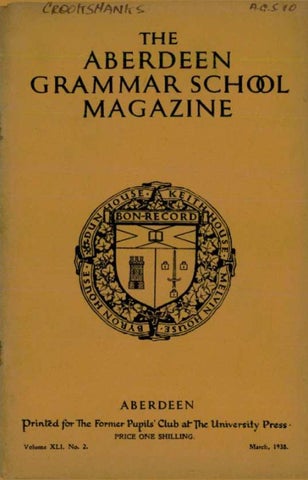
THE
ABERDEEN GRAMMAR SCHGDL MAGAZINE
ABERDEEN
printed for The Former Pupils' Club atlhe University Press • PRICE ONE SHILLING.
Volume XLI. No. 2.
March, 1938.
EDUCATIONAL BOOKS `0_,oc_Gy*
1
JAMES G. BISSET CONTINUES to supply all the Class Books (New or Second-hand) suited for the requirements of the Higher Educational Institutions in the City, at the Lowest Prices. N.B.—Best Value in Students' Note Books.
JAMES G. BISSET, Classical, Medical, and Educational Bookseller, 85 BROAD STREET (Opposite Marischal College).
•
PHONE 753 •
GOOD HEALTH demands
GOOD BREAD For the children especially is it necessary to ensure their stamina and energy with good, wholesome, nourishing bread. In Hutchison's bread you'll find all these requirements are fully met. Phone or give instructions to have it supplied daily. _ f. CENTRAL Maw
BRANCHES THROUGHOUT THE CITY
GOOD JEWELLERY GOOD
• e
1
SILVER
GOOD CUTLERY GOOD CLOCKS and well selected ORNAMENTS are items of real importance in — every home —
A. & J. SMITH ICI Union Street ABERDEEN
7 ----., LITTLE'S FOR TAILORED / .<7 SUITS AND SILVER FOX — 1D , TIES Man-Tailored SUITS cut on the newest lines in fine quality Tweeds and Suiting Cloths. Fitted and altered, free of charge,
i
to your satisfaction
63/- 73 6 to 5 Gns. Ali Sizes
r•-`
)
SUPER QUALITY SILVER FOXES
I
Specially picked skins. A huge selection from Gns. to 17 Gns.
A. C. LITTLE & SONS LIMITED
105
UNION
\ /
STREET, ABERDEEN
QUALITY FURNITURE at GALLOWAY & SYKES does not mean high prices Our Stocks will prove it I Furniture, Carpets and Fabrics of remarkable quality are there for all to see, admire and obtain at moderate competitive prices. You will not be disappointed --~` I if you visit our showrooms 4;+, ill/ lit , ,
'` . t
DEPARTMENTS Furniture Carpets and Linoleum+ Fabrics Beds and Bedding Mantelpieces Removal Contractors and Storages Parquetry Flooring Billiard Tables Shop Fitters Wood Carvers Church Furniture Funeral Undertakers Valuators
TEL. Nos.
GALLOWAY & SYKES LTD.
4760-4761
TELEGRAMS:
" CRAFTSMEN." ABERDEEN
361- 363
STREETS
UNION
ABERDEEN
JAMES FYFE & SON PAINTERS AND GLAZIERS. S OFFICE
AND
•
•
SHOWROOMS :-
11 DEE STREET, ABERDEEN . Telegrams- -" Fyfe, Painters."
Telephone 304.
COUNTRY HIRES AT CHEAP RATES CARS
GARAGED
COLIN S. CLARK DAIMLER TAXI HIRER DAY AND NIGHT SERVICE
PHONE 4422
46 HARDGATE, ABERDEEN
-FAMILY COFFEE Cures Coffee is the favourite drink with everY_.,........„) one. It is most especially delicious. Your in cold weather. grocer can supply you.
CURR'S COF Thomas Con 6
Co.
zo Quality is our Truest Economy
ROBERT STOTT Family Grocer Italian Warehouseman, Tea, Coffee, Wine and Spirit Merchant
53
ALBERT STREET, ABERDEEN Telephone 1848
Jackson's Bindery 18 Back Wynd Aberdeen ESTABLISHED 1855
BOOKBINDING OF EVERY DESCRIPTION
B1 ND FIND FAST FAST V 77 TRADE MARK
Leather Goods Lettered with Initials or Inscription
Loose Leaf Specialists
TELEPHONE. NO. 1719.
TELEG RAMS 1 "HUB, ABERDEEN."
CAMPBELL & SELLAR, LTD Engineers, Hirers and Garage Proprietors
QUEEN'S CROSS GARAGE ro Fountainhall Road ABERDEEN OPEN DAY AND NIGHT
ANY MAKE OF CAR SUPPLIED
mite'
r-COPLAND DECORATOR
i
jeletotoyx}nace,Si YAP-- SPECIALIST CIE-- STAINED GLASS £? MURAL DECO c?, 0.71-
/
•
A. D. COPLAND. Phone 896. Telephone No. 2300. Works : Roeebank Place.
Telegraphic Address:
" Undertake, Aberdeen."
GORDON & WATSON FUNERAL UNDERTAKERS ANI)
MOTOR
HIRERS
12 HOLBURN ST. & 40 VICTORIA RD. ABERDEEN
Go to . . .
K E N NAWAY S of course
RESTAURANT
I73
UNION STREET
Here you get the finest of food, daintily served, and at a reasonable price. The Restaurant is comfortable and commodious, and is just the place to entertain your friends. Our rooms are available for all types of functions. 'Phone 2371, and ask the Manageress for quotations
W M. KENN.AWAY .LTD. Quality
Bakers, Confectioners and
Caterers,
Aberdeen
Telephone No. 1891.
ARCHIBALD McKELLAR Family Grocer and Wine Merchant,
454-456 Union Street, Aberdeen. . . We Specialise in . . Cooked
Gammons, Finest Belfast Smoked Hams, - Harris's "
Wiltshire Bacon.
- Medicinal Wines—Vibrona, Hall's, Wincarnis, Glendenning's.
OFFICIAL SUPPLIERS for the SCHOOL Grammar • • School Blazers Bias Oxford Ties, 2/- ; Open-End Ties, Size Price 2/6 ; First Quality Hose, 6i-7, 3/6 ; O 17111 I 74-81, 3/11 ; 9-10, 4/6. Badge PullIS/11 2 19/11 Overs, 24, 9/6 ; 26, 10/6 ; 28, 11/6 ; 20/11 3 30, 12/6 ; 32, 13/6 ; 34, 14/6 ; 36,15/6. 31,717 4 Grey Slip-ons, 24, 26, 28, 30, 5/11 ; 33/11 5 6 23/11 32, 34, 36, 6,6. Jerseys, 6/11. 7 24/11 Scarves (Large), 4/11 ; (Small) 2/II. 8 25:11 Belts—Snake (Narrow), I - ; Belts— 26 11 9 10 27 II Snake. 1 6. Belts—Badge Buckles, 31-. II 28 II Braces, 1 '6. 29'11 13 13
-
30 II
•
•
ISAAC
Grammar School Shorts Lined
Price
Size
0
-
9/6
I 2
-
9 Il IO 6 xo xr
3
-
II,6
4
-
5
-
ix 9
6
-
7
-
8 9 10
-
II
-
12
-
13
-
12 6 I2 II 13'6 13 II /46 1411 15,`6 IS II
BENZIE
LIMITED
GEORGE STREET
•
ABERDEEN
HIGHLAND CLAN TARTANS Septs
and
Dependents
We have 133 different Tartan Ties in Stock Price
2 6 each
Made in Woollen Material woven in Scotland
W. J. MILNE, LTD. Men's Outfitters
ABERDEEN Telephone 1293
Telegrams : " Gallowses, Aberdeen "
Purveyors of only the FINEST Q UALITY in Fish, Butcher Meat, Poultry, and Game.
4 )S7 1 : Telephone 5172.
492 UNION STREET, ABERDEEN.
Telephone—Aberdeen 1710.
The Mastrick Dairies Ltd. 1 DESSWOOD PLACE, ABERDEEN WE offer you a Choice Selection of DAIRY PRODUCE from our own Farms, and produced under the direct supervison of members of the family. Our Customers may rely upon the absolute Purity and Cleanliness of all our products. Distributors of
Lord Carnegie's and Cairnbrogie Certified Milk. Head Dairy: 3, 5, and 7 WHITEHALL ROAD. Branches: 7 MID STOGKET ROAD. 33 FOUNTAINHALL ROAD. 473 GREAT WESTERN ROAD. 25 BEDFORD PLAGE.
CONTENTS ILLUSTRATIONS. . Facing page 140 School Rugby Football sat XV—Season 19;7-;8 • . . John Malcolm Bulloch, M.A., LL.D. . . . In centre Professor James Charles Philip, O.B.E., M.A., D.Sc., F.R.S. . ,, The First Reunion Dinner of Malayan F.P.s, January, 1938 Facing page 141 . . • . . The President of the F.P. Club • . . • Notes About Old Boys • • • • M . . . . • Obituary . Was This How It Happened ? By " Reactionary-progressive ". . Humour—and the Law. By A. C. F. . • • • . . . . Byron's i5oth Birthday • • • School Section— School and Random Notes . . . • • . International Day. By M. H. T. . . . . . . Coastwise Men. Verse. By James Wyness . . A Visit to South Africa. By Campbell Connon . . . A Cruise on the M.V. Dilwara. By R. S. Couper . Our School. By the Senior Prefect . • • The Past Rugby Season . . • • • • • • • • . Who's Who in the ist XV . . School Rugby . . • • • • . . . . . . • House Notes . • . . . • • . Scout Notes . . . . The Rambling and Mountaineering Club . . . . . The Literary and Debating Society . The Former Pupils' Club— . • • . Honour for the Club Secretary . . . . The Annual Meeting of the Club . • • . . Club Executive Notes . . • • • . . • The Annual Club Dinner • • • . F.P.s in Malaya . . . . • • • . . • The Glasgow Centre . . • • . • . . The London Centre . • • • . . The Edinburgh Centre . . . . . . • • • Rugby Section . . . . . . . Hockey Section . . . Members whose Present Addresses are Wanted . . . • • • List of New Members . . . . • • Club Office-Bearers for 1938-39 arriages
.
.
.
.
.
•
•
4
6
6
•
.
.
.
6
0
Page 95 96 509 PP „
„
110
„ 12r ,, 125 „ 128 „ „ ,, ,, „ ,. ,, ,, „
I3o
136 137 139 x42 146 147 148 150
52 „ 555 „ x56 „ 157 ,
1
„ „ ,, ,, „ „ „ , „ „ „ „
161 166 173 174 x 8o 18o 18 x r82 x 83 185 x86 x87
,,
x88
,
Here is the correct undress Costume for boys. This consists of a Tweed Jacket and Vest and a Tartan Kilt. The Stockings may be plain or have checked tops.
Garters are worn in each case.
The Sporran
may be either an Animal Head or Leather as illustrated. Jackets and Vests, 32 6 and 47 6.
Hose, 3/6 and 5/6.
Bodice Kilts, 32/6.
Sporrans, 4/6 to 12;6.
Esslemont & Macintosh Ltd. ABERDEEN
Silver Medal Bread Think of it ! A different Loaf for every day of the month 9 VARIETIES OF BROWN BREAD 2I
VARIETIES OF WHITE BREAD
Try them all -11P5
W. M. McPHERSON Baker and Confectioner '5 FOUNTAINHALL ROAD AND
8 ST. SWITHIN STREET ABERDEEN Telephone z5z5
ESTABLISHED 1843.
LOW'S Wm. Cay & Sons BOOKSTALLS 39-50 New Market Gallery ABERDEEN
jfuncral Unbertaher5.
BOOKS on All
415 UNION STREET
Subjects and at All Prices Over 500,000 Volumes in Stock
AND
209 GEORGE STREET, ABERDEEN.
Educational Books in Great Variety Motor Hearses and Cars for Town and Country Funerals.
CATALOGUES ISSUED
Telegrams—"Cay, Aberdeen." 'Phones Nos. 92 and 54.
PHONE 3332
ESTAALISHEO
BY APPOINTMENT TO
18 18
H.M. THE KING
J. WILLIAMSON & SON (VV. B. WILLIAMSON, PROPRIETOR)
Meat Purveyors and Poulterers 1, 2, & 3 MARKET BUILDINGS, ABERDEEN 'Nom 452 BR•NCHES.
35 FOUNTAINHALL ROAD 'PHONE ♦ LSO AT
1724
THE SQUARE, CULTS 'PHONE. CULTS 2
CHURCH SQUARE. BALLATER 'PHONE 38
AT ANY TIME AND ALL THE TIME
THE WHOLE FAMILY WILL ENJOY
SHORTBREAD IF IT COMES FROM
Mitchell & Muil Ltd. SEAMLESS FITTED CARPETS Every good housewife welcomes the wall-to-wall carpet. She appreciates the beauty and comfort it brings to her home, and the drudgery it saves in keeping polished floors spit and span.
I
We have arranged with one of the largest carpet manufacturing firms to manufacture a heavy pile carpet exclusively for ourselves, and we have named it "THE BALMORAL." It is woven in one piece, any width, any length, and the price is remarkably low. Obtainable in 6 different colours. 161/6 per square yard.
ROBERTS (Abdn.) LTD. Tel. 2495
Carpet Specialists and House Furnishers
Est. 1873
419 UNION STREET, ABERDEEN
-60
THE IMPERIAL TYPEWRITER
:Art Stuoents
x oo% British, is the best and lowest-priced Standard Typewriter, used in 75% of the leading offices in Aberdeen.
We carry a fine range of reproductions of the Old, Modern, and Impressionist
THE IMPERIAL PORTABLE
School from P.C. size up—and frames
The Best Portable, too% British.
to suit all subjects. All the latest HANDICRAFTS
Second-Hand Bargains of all Makes of Typewriters, Desks, Chairs, Filing Cabinets in Oak, Mahogany or Steel. EASY DEFERRED PAYMENTS (Hire Purchase) ON ANYTHING.
Oct tors
C. H. WEBSTER
49-51 Scboolbill
489 Union Street, Aberdeen 'Phone 505
'Phone 2870
ROLEX OYSTER WORLD "RECORDS
WATERTIGHT AND DUSTPROOF ANTI - MAGNETIC - UNBREAKABLE GLASS
Stainless Steel - 8 gns. Extra Precision - 10 gns. 9 et. Gold - 13 gns. Other models from 5 gns. We stock the complete range of Rolex Oyster and Rolex Prince Watches.
JI
II "ESC N
CAIIIIRV
Established in the Year 1733
WATCH AND GEM RING SPECIALISTS
142 UNION STREET (next Union Bridge). ABERDEEN
(ESTABLISHED
1880)
18
REGENT
QUAY
250
UNION
STREET
(AMICABLE
HOUSE)
ABERDEEN Telephone 2889
-
Telegrams " COAL, ABERDEEN "
-
the modern note is cleverly expressed in the new Fireplace
Arrangements.
Why not inspect them in our showrooms and see at first hand how greatly one would add to the appearance
and
comfort
of your room?
ameS Scott & Son (Aberdeen) Ltd. 483-485 UNION STREET ABERDEEN Phone 1881-2
Co-operation T
HE enthusiastic co-operation of many minds and hands make possible the fine productions of the
HOUSE OF OGILVIE. For over three-quarters century our constant endeavour has been to give of a the best possible service to our Customers. We base our claim to your patronage on our ability to please you.
J. & A. OGILVIE 369
UNION
STREET,
ABERDEEN. Telephone : No. 433.
Telegrams : " Interiors."
Showyard Erector to the Highland and Agricultural Society of Scotland, and Contractor to the Royal Northern Agricultural Society.
AtSt:,
STRACHAN COMMERCIAL
JOHN REID & CO. HOUSE CARPENTERS AND JOINERS
55 Blenheim Place and 14 Fountainhall Road PORTRAITURE
ABERDEEN
PHOTOGRAPHY
444-Xt
Telephone 851
Carpentry and Joinery Work of every description done
416 UNION STREET
ESTIMATES ON APPLICATION
ABERDEEN Telephone No. 1997
,
A MODERN SERVICE for MODERN
•
We are equipped with the latest and most up-to-date appliances for the lubrication of your car. No longer need you struggle with grease guns and oil cans or crawl to reach inaccessible points. All this work can now be done for you cleanly, efficiently and effectively and without the slightest trouble to yourself. Call in sometime and let us demonstrate this Service.
We are an Official—
FIELD/ _
Qa* i wAKE4 •M lM
LUBREQUIPMENT SERVICE STATION
A IUIEIRIDIE
MOTOIUS
LIMITED
THE AUSTIN DEALERS
IU
II C
IU0141
Telegrams—" CARS "
AID
ID
%
Telephone-4580
Established
Assets
1836
E24,600,000
NORTHERN ASSURANCE COMPANY LIMITED •
•
FOR ALL CLASSES OF INSURANCE •
LIFE
•
BRANCH
Special Leaflets on—
The Family Protection Policy The " Optional "
Policy
House Purchase Policy Child's Deferred Policy
CHIEF OFFICES : ABERDEEN
•
•
I UNION TERRACE
LONDON .
•
•
I MOORGATE, E.C. 2
Branches and Agencies throughout the World
Aberdeen Grammar School Magazine 53rd year : No. 138 (New Series, 44.th year, No. 129)
Vol XLI
MARCH 1938
No. 2
•
11P
The "Grammar School Magazine" is issued under the auspices of The Former Pupils' Club, in March, June, and November. All communications with regard to the " Magazine" should be addressed to the Editor (the Secretary and Treasurer of the Club), THEODORE WATT, M.A., LL.D., The Rosemount Press, Aberdeen.
The President of the F.P. Club.
•
•
At the Annual Business Meeting of the F.P. Club, held on 16th March, 1938, JAMES CHARLES PHILIP (1886-89), O.B.E., M.A., D.Sc., F.R.S., Professor of Physical Chemistry and Director of the Inorganic and Physical Laboratories, Imperial College of Science, South Kensington, and Deputy ViceChancellor of the University of London, was elected President. Born in 1873, the youngest son of the late Rev. John Philip (1828-33), M.A., D.D., for many years minister of the Free Church, Fordoun, and a nephew of three other F.P.s who all became ministers of the Free Church of Scotland, Professor Philip was educated at Fordoun Public School and the Aberdeen Grammar School. At Aberdeen University he graduated M.A., with First Class Honours in Mathematics, in 1893 ; B.Sc., with Special Distinction in Mathematics, Natural Philosophy, and Chemistry, in 1895 ; and D.Sc. in 1906. From Aberdeen University he proceeded to Germany, to the University of Gottingen, where he obtained the degree of Ph.D. in 1897. He was appointed Demonstrator and Lecturer in Physical Chemistry, Royal College of Science, London, in 1900, and was Assistant Professor of Chemistry in the Imperial College from 1909 to 1913, when he became Professor of Physical Chemistry there. Since 1932 he has been Director of the Inorganic and Physical Laboratories. From 1913 to 1924 he was Secretary of the Chemical Society, and since 1932 he has been a member of the Senate of the University of London. Last year he was appointed Deputy Vice-Chancellor of the University. For his services as a chemist during the Great War he was made an O.B.E. in 1918 ; and in 1921 he was elected a Fellow of the Royal Society.
96
Aberdeen Grammar School Alagaine
** * It is requested that the Editor be informed of all new appointments and interesting incidents in the careers of Former Pupils.
The dates given in parentheses after names indicate the sessions of attendance at the School.
New Year Honours. In the list of New Year Honours conferred by the King the names of three F.P.s appeared :— Henry Alexander* (1881-91), M.A., LL.D., J.P., D.L., Chairman, Scottish Housing Advisory Committee, was created a Knight Bachelor. This honour is widely regarded as only fitting recognition of the work which he has done and is doing both in civic and national capacities. A few years after he retired from the editorship of the Aberdeen Free Press, when that newspaper was merged with the Aberdeen Daily Journal in 1922, he entered the Aberdeen Town Council, and shortly afterwards was appointed Convener of the Town Planning Committee. He became Chairman of the Aberdeen and District Joint Town Planning Committee, inspiring and directing the tremendous task of preparing the town planning scheme for the area. From 1932 to 1935 he was Lord Provost of Aberdeen, and in all that he did and said in that capacity showed a high conception of the dignity and responsibility of the office. He subsequently became Chairman of the Scottish Housing Advisory Committee, which advises the Department of Health for Scotland on matters arising in connection with the execution of the Housing (Scotland) Acts. He is a member of the Consumers Committee for Scotland, the Food Council for the United Kingdom, the Scottish Committee of the Council for Art and Industry, and the Argyll National Forest Park Committee. He is a Deputy Lieutenant and Justice of the Peace of the County of the City of Aberdeen. In 1935 he received the honorary degree of LL.D. from the University of Aberdeen, and in 1936 became Rector's Assessor in the University Court. He has been for many years a member of the F.P. Club, and was its President for 1933-34. Edmund Blaikie Boyd* (1900-i 2), C.M.G., M.A., Principal Private Secretary to the Secretary of State for the Colonies, was * Member of Former Pupils' Club.
Aberdeen Grammar School Magazine
1
97
made a Companion of the Royal Victorian Order (C.V.O.). He was Dux of the School in 191 z, and graduated in Arts at the University of Aberdeen in 1916, with First Class Honours in Classics. During the War he served in France and Belgium as a Lieutenant in the R.G.A. After demobilization he entered the Colonial Office in 1919, and became Private Secretary to Parliamentary Under-Secretaries of State. In 1925 he became a Principal, and has been Private Secretary to successive Secretaries of State. He was created a C.M.G. in 1935. Theodore Grant Gray* (1895- i 9o1), M.B., Ch.B., DirectorGeneral, Mental Hospitals Department, Dominion of New Zealand, was created a Companion of the Order of St. Michael and St. George (C.M.G.). After hospital service in Aberdeen, he was appointed Assistant Medical Officer at the Kingseat Mental Hospital, Aberdeenshire. He went to New Zealand in 191x to take a post in the New Zealand Mental Hospital Service. He was Senior Assistant to Sir Truby King at Seacliff for several years, and in 19zo was appointed Medical Superintendent of the Nelson Mental Hospital, where he inaugurated the villa system. In 1916-18 he saw active service as a member of the New Zealand Medical Corps, in which he held the rank of Captain. In 1925 he was appointed Medical Superintendent at the Auckland Mental Hospital, and later in the same year he was promoted to be Deputy Inspector-General. He was appointed Inspector-General of Mental Hospitals in September, 1927, on the retirement of Sir Truby King. In 1926, at the request of the Government, he visited Canada, the United States, Great Britain, and the Continent to study modern systems of treatment of the mentally afflicted.
F.P.s in Recent Crises.
•
Frederick Wernham Gerrard* (1 90 5 -o6), C.I.E., Commissioner of the Shanghai Municipal Police, has had a very anxious time of late, particularly when, during the Japanese demonstration march through the International Settlement which took place at the beginning of December, a Chinese bomb was thrown at the procession. This incident required long investigation, but after a period of inconvenience, owing to the stoppage of traffic in the busiest part of the city, the Japanese troops withdrew altogether, thanks largely to the tactful handling of a difficult situation by the Commissioner of Police. The Settlement police have been heavily overworked since the Japanese attack and occupation. On 8th January Major Gerrard issued a report on an assault by Japanese soldiers earlier in the day on British members of the International Police Force. The report declared that the Japanese threatened with loaded rifles and fixed bayonets other police who attempted to intervene. " There would," the Commissioner stated, " have been serious consequences had senior officers not acted with great restraint."
98
Aberdeen Grammar School Magazine
William Robertson Myers* (1895-99), who joined the Chinese Maritime Customs in 1904 and is one of the senior F.P.s in China, was specially mentioned in a dispatch from The Times correspondent in Tokyo in December. The latter said that in connection with the taking over of the Maritime Customs in the north of China by the new Peking Government, Japanese press messages paid tribute to the assistance given by the British Commissioner, Mr. W. R. Myers, whose friendly attitude, they said, would prove of advantage to Great Britain. John William Taylor* (19o6-11), M.B.E., M.A., as His Britannic Majesty's Consul at Vienna, must recently have had an exceedingly busy and anxious time. The British Minister in Vienna being at home, with small chance of his ever going back, the British Government's contacts with the new rulers of Vienna were maintained through the Consul there. In a recent issue of The Times it was stated that every possible precaution for English subjects and English property was being taken. After strong representations, the Consul was assured that instructions would be given to the frontier authorities to show respect to all with British passports, " even though they are of the Jewish race." He was further promised that British property in Austria would not be confiscated unless a claim were proved invalid, and that British travellers would be allowed to take over the frontier more than the 5o Austrian schillings to which Austrians were limited. These assurances would improve the lot of many British in Vienna, although many cases of hooliganism and indiscipline were still being reported. Mr. Taylor entered H.M. Consular Service in 1919. His first appointment was Vice-Consul at Lyons, and he was promoted to Prague in 1921. He was made Consul at Vienna in 1933, when he also became the F.P. Club Consul there. The Right Hon. Lord Alness* (1884-85), P.C., LL.D., has had the good fortune to obtain an unopposed second reading in the House of Commons of his Bill to reform the divorce laws of Scotland. It has already been passed by the House of Lords, and now goes before the Scottish Grand Committee. Albert Allan* (1919-16), C.A., is now Secretary of Technicolor, Ltd., Bath Road, Harmondsworth, Middlesex. Alexander Donald Stewart Anderson* (5918-24), M.A., C.A., is in the service of Messrs. Buser & Co., Ltd., George Street, Hanover Square, London. James Alexander Barclay* (1920-25), M.A., B.Sc., M.B., Ch.B., who graduated in medicine at Aberdeen University last summer, was in September appointed demonstrator in the Physiology Department of the School of Medicine, Leeds. IP
Aberdeen Grammar School Magazine
10
•
99
George Chambers Brander* (1920-32) obtained in December the diploma of M.R.C.V.S. at the Royal (Dick) Veterinary College, Edinburgh. He is at present on the staff of that College. John Alexander Brockie* (i9zi-3i), who served his apprenticeship as an engineer with Messrs. John M. Henderson and Co., Ltd., Aberdeen, is now on the staff of the Ratefixing , Department of that firm. He gained at evening classes both the Lower and Higher National Certificates in Mechanical Engineering, and had the latter endorsed in Workshop Organization and Management. In April of last year he passed the final A.M.I.M.E. examination. John Lamb Bruce* (1921-23), C.A., who served his apprenticeship with Messrs. J. R. Flockhart & Grant, C.A., Aberdeen, and then entered the service of Messrs. Cooper Brothers & Co., C.A., London, recently made a trip to Australia for the sake of his health, and has received an appointment as accountant with a motor distributing firm in Cape Town, South Africa. Alfred Gordon Cameron* (1923-34) recently sailed for Bombay to take up an appointment as assistant manager to the Singlo Tea Co. After leaving the School he was engaged for a time as a clerk in the Aberdeen Education Office. In January, 1937, he entered the Metropolitan Police, and leaving Peel House Training School in May of that year, was stationed as a uniformed constable at Bow Street Police Station. He played rugby for the School and for the F.P.s, and in London he played for " E " Division of the Metropolitan Police. Patrick Ashley Cooper* (1896-590i), B.A.(Cantab.), LL.B. (Aberd.), was in March appointed as one of the six members of the Royal Commission which is to consider the question of closer co-operation or association between Southern and Northern Rhodesia and Nyasaland. The Observer in a recent issue said of him :—" The Governor of the Hudson's Bay Company has the touch of a born organizer. More than one company has been given a new lease of life by his administrative genius. He was appointed Governor of the Hudson's Bay Company in 1931, when its finances were in a straitened position. After a complete overhaul, the company is this year resuming the payment of Ordinary dividends. Mr. Cooper's method of business resuscitation consists in getting a complete grasp of every aspect of the business from top to bottom. He then picks the right men to fill the executive positions, and leaves them with wide powers and responsibility. His successes have been obtained largely by his capacity to judge character and ability in others. Mr. Cooper has many other important appointments apart from the Governorship of the Hudson's Bay Company. He is a Director of the Bank of England, a member of the London Passenger Transport Board, and Chairman of the Province of Buenos Ayres Waterworks Co., Ltd."
too
Aberdeen Grammar School Magazine
Alan Hamilton Cruickshank (t9zo-3t), M.B., Ch.B., has been appointed by the Medical Research Council to a research scholarship in clinical science. As a student of medicine at Aberdeen University he gained many distinctions, and graduated with honours in 1936, being awarded the Murray Medal and Scholarship and the Lyon Prize as the most distinguished graduate in medicine of that year. James Robert Leslie Cruickshank* (1915-21), M.A., LL.B., has recently been assumed as a partner in the firm of Menzies and White, W.S., Edinburgh. He was previously with Messrs. Davidson and Syme, W.S. The Right Rev. Logic Danson* (1892-94), M.A., D.D., Canon of Carlisle Cathedral and Assistant Bishop of Carlisle, has been appointed Provost of St. Mary's Cathedral, Edinburgh. Before going to Carlisle seven years ago he was Bishop of Labuan and Sarawak. He was President of the F.P. Club for the year 1932-33. William Sharp Davidson* (1921-26), M.B., Ch.B., was appointed to the Indian Medical Service as from 1st January, 1938, with the rank of Captain. He was for a time a SurgeonLieutenant in the Royal Navy. James Alexander Donald* (1920-32) has qualified as a chartered accountant, and in March was admitted to membership of the Society of Chartered Accountants in Aberdeen. Leslie Ducat* (192o-32), son of JOHN H. DUCAT* (1881-86), is on the Brechin Castle Estate, Conva, Trinidad, British West Indies. John Murray Easton* (1895-1905), F.R.I.B.A., is a member of the firm of Stanley Hall, Easton and Robertson, who have been appointed architects for the Empire and United Kingdom Sections of the New York Exhibition of 1938. His firm has had much experience in previous International Exhibitions in which this country has participated. In 1925 he won the competition for the best design for the British Pavilion at the Paris Exhibition. Alfred George Emslie* (1912-24), M.D., was in July of last year appointed Honorary Assistant Physician to the Princess Alice Memorial Hospital, Eastbourne. Louis Findlay* (1924-30), M.B., Ch.B., son of Rev. Professor ADAM FYFE FINDLAY* (1879-85), M.A., D.D., is at present resident physician in the children's section of a hospital in New York. Matthew George Fisher (1896-1900), LL.B.(Edin.), has recently received the rank and dignity of King's Counsel to His Majesty in Scotland. He was admitted to the Faculty of Advocates in 1913, and is Counsel to the Secretary of State for Scotland
Aberdeen Grammar School Magazine
lot
under the Private Legislation Procedure (Scotland) Act 1936. In December last he was appointed a member of a Committee which is to review the whole field of Local Government and Public Health Law in Scotland, and to prepare the necessary measures for its revision and consolidation. Other F.P.s who are K.C.s are ARTHUR RICHARDSON BROWN (1884-90), M.A., appointed in 1925 ; JOHN ADAM LILLIE* (5893-1903), M.A., LL.B., appointed in 1931 ; CHARLES B. MILNE* (I893-96), M.A., LL.B., appointed in 1932 ; and JOHN RUDOLPH WARDLAW BURNET (1899-1901), B.A., LL.B., appointed in 1934. Robert David Spittal Fleming* (1925-37) is now studying at St. Paul's School, London. George Forbes" (1902-04), solicitor, Aberdeen, has been appointed Honorary Secretary and Treasurer of the Balnagask Golf Club, Aberdeen. Archer Irvine-Fortescue* (1892-97), D.S.O., M.B., Ch.B. (Aberd.), B.Com. (Edin.), Colonel, Army Medical Department, retired from the Active List on 6th July, 1937, on attaining the age limit of 57 years. At the time of his retirement he was acting as Assistant Director of Medical Services, Rawalpindi District, India. He was for over thirty years in the Army, during which period he saw active service in many lands, and was awarded ten decorations and medals, including the Distinguished Service Order, the Russian Imperial Order of St. Stanislaus, the Persian Imperial Order of the Lion and Sun, and the Active Service Medal of the Kingdom of Iraq. He specialized in modern foreign languages, and passed qualifying examinations in French, German, Russian, Italian, Arabic, Turkish, Persian, Pashtu, and Hindustani. He has now settled at Eastland, Maryculter. Allan Cameron Frazer* (1925-3o), M.A., LL.B., is with Messrs. Buchan and Buchan, S.S.C., Edinburgh. Gordon Couper Grant* (1904-17), B.Sc.(For.), sent to the Secretary of the F.P. Club at Christmas a pitchy chip of Douglas fir all the way from the west side of Vancouver Island, where he is a member of a forest survey party of the Alberni Pacific Lumber Company. In a cheery letter he wrote :— When a Douglas fir withstands the violence of the wind and dies of old age in the damp forests of the coast, the huge trunk rots away and tumbles down in fragments until all that remains is a mouldering stump, covered with moss and lichen. As the stump dwindles, there will sometimes emerge a solid spike of pitchy wood, undamaged by decay. Here is treasured up for travellers in the wild the inflammable essence of a mighty tree. On wet or wintry days, when lunch time draws near, a survey crew will remember this useful relic. One soon hacks out a likely chip and whittles off translucent shavings, whose pungent odour is yet fresh and strong. Majesty has fallen and crumbled long ago ; but what a cheering token it has left behind !
102
Aberdeen Grammar School Magazine
Hamish Brown Grant* (1 918-3o), M.A., LL.B., is a legal assistant in the office of the Aberdeenshire County Council, under another F.P., Douglas Moir Wood* (1912-24), M.A., LL.B. Grant has recently returned from India, when he was in the service of a firm of East India merchants in Malabar. John Peter Grant* (1 936), who is in his father's firm of John Houlton & Son, Ltd., building contractors, Hull, was in January gazetted a znd Lieutenant in the East Riding Heavy Brigade. William Grant* (1923-25), son of Mr. William Grant, formerly bank agent at Methlick, is meantime in the Public Works Department at Gombe, via Jos, Nigeria. He recently qualified as A.M.Inst.C.E. Ranald Forbes Greig* (1921-31)—a brother of HAMISH A. GREIG (1918-23), B.Com., C.A., whose death in Calcutta was reported in the last Magazine—is an assistant dental surgeon in Peterborough. He qualified as L.D.S. in 1935, and was in Arbroath till the beginning of this year. David Sinclair Hay* (19o7-11) is General Manager of the Scottish Industrial Estate at North Hillington, Glasgow, and was recently in London with a view to launching a huge publicity and advertising campaign to attract new light industries to Scotland. On the estate, when all the factories become properly developed and organized, there will be a capacity for zo,ooo workers. From this it will be seen that, allowing for wives and families, our F.P. is playing a leading part in the birth and development of a new town of 8o,ooo to i oo,ooo inhabitants. Already fifty firms have booked factory sites at North Hillington. James Hay* (1883-87), M.A., B.L., a partner in the firm of Messrs. Adam, Thomson and Ross, advocates, Aberdeen, was at the end of November elected President of the Society of Advocates in Aberdeen. It is interesting to record that the other office-bearers appointed at the same time are all F.P.s— James William Garden* (1886-95), M.A., B.L., the Treasurer ; Norman John Jamieson Walker* (1893-19oz), M.A., LL.B., the Secretary, Factor, and Librarian ; and Charles Williamson* (1883-85), M.A., C.A., the Auditor. Norman Fordyce McKerron Henry* (1915-27), M.A., B.Sc., of St. John's College, Cambridge, has received the degree of Ph.D. (Cantab.), and has been appointed Demonstrator in the Department of Mineralogy and Petrology, University of Cambridge. He graduated at Aberdeen University in Arts, with First Class Honours in Geography, in 1931, and in Science, with First Class Honours in Geology, in 1934. In 1933 he gained the Kilgour Senior Scholarship in Geology, and was awarded a Carnegie Research Scholarship. Two years later he was awarded a Carnegie Research Fellowhip, which was renewed in the following year.
Aberdeen Grammar School Magazine
103
Alexander Ross Hewet* (1926-32), M.A., is now on the staff of Leith Academy. Henry Dugmore Hunter (1919-22), son of Rev. C. F. Hunter, formerly minister of the Wesleyan Methodist Church, Aberdeen, is this year President of the Students' Representative Council of the University of Edinburgh. Alexander Low* (1883-86), M.A., M.D., Regius Professor of Anatomy in the University of Aberdeen, is to resign from his Chair on 3oth September. He has been associated with the University for 52 years, for it was in 1886 that he entered King's College as a student in Arts. After graduating in medicine in 1894, he became a member of the teaching staff of the Anatomical Department, being first Assistant, then Lecturer, and finally Reader in Embryology before succeeding to the Chair of Anatomy in 1925. At present he is President of the Anatomical Society of Great Britain and Ireland. It has been very truly said that " his never-failing courtesy and kindness, his unflagging zeal as a teacher, and his keen interest in the welfare of his students past and present, have become proverbial, and many have had cause to be grateful to him." In a minute expressing regret at the decision of Professor Low to retire at the end of the academic year, the Senatus placed on record its gratitude for his distinguished services to the University during the long period of forty-four years. " His colleagues recall with pride and gratitude," it states, " his distinction as embryologist, anthropologist, and anatomist of international reputation, and the great work he did in developing these branches of study in the University." Alexander Gow Lumsden* (1904-tz), M.B., Ch.B., is now in medical practice at 16 Harley Street, London. James Lewis McAllan (1931-34), son of JAMES MCALLAN* (1903-08), M.A., B.Sc., M.R.C.V.S., Chief Veterinary Officer, Government of Northern Ireland, has been captain of the Royal Belfast Academical Institution Rugby XV, which won the Ulster Schools' Cup in its jubilee year at Ravenhill, Belfast, before a crowd of i 2,000. McAllan is head boy of the Institution this year, and comes back to Aberdeen in October to start the study of medicine. John Clark McGregor* (1926-29), M.B., Ch.B., who is in medical practice at Thurso, has been appointed a Flying Officer in the R.A.F.V.R. (M.S.). Murdoch McIntosh* (1928-33), who is in the Town Clerk's Department, Aberdeen, was in August gazetted as znd Lieutenant in the 62nd (Scottish) Medium Brigade, R.A. (T.A.). Dennis Lorraine Mackay* (1924-29) has recently been drafted from H.M.S. Nelson, and is serving in H.M.S. Curacoa,
104
Aberdeen Grammar School Magazine
Portsmouth. This ship is a light cruiser in the Reserve Fleet, and is used for training gunnery ratings from Whale Island. John Mackenzie* (193o-32) has qualified as a chartered accountant. He served his apprenticeship with Messrs. J. R. Flockhart and Grant, Aberdeen. Norman Humphrey Mackworth (I 9z 3-34), M.B., Ch.B., has been awarded the Munday Prize in Pathology at Aberdeen University. George Scott McLaren* (1928-32) recently qualified as a chartered accountant, and in March was admitted to membership of the Society of Chartered Accountants in Aberdeen. John Smith MacRae* (1923-26), M.B., Ch.B., has recently settled in medical practice at Bradford. Ralph Marshall* (1915-25) is in the Burma Service of Engineers, and is at present in charge of the Maymyo Sub-Division, Public Works Department. Maymyo is forty miles north-east of Mandalay, and about 3,300 feet up. It is the hot-weather seat of the Government. Leslie. Deane Mayor* (1923-33), who studied engineering at Aberdeen University for two years and entered the R.A.F. College, Cranwell, in September, 1935, passed out in July 1937, with the rank of Pilot Officer. Since then he has been at the School of Army Co-operation, Old Sarum, Wilts, and has now been posted to the 3 ist Army Co-operation Squadron, Karachi, India. Robert Arthur Milne* (5907-55), who entered the Royal Engineers from the Royal Military Academy in 1918, was promoted to be Major from 25th January, 1938. He is at present stationed at Chester. Royston John Milne* (1918-3o), M.A., LL.B., qualified as a law agent in September of last year, and is now on the staff of Messrs. Brander and Cruickshank, advocates, Aberdeen. Sir Peter Chalmers Mitchell* (1879-8o), C.B. E., D.Sc., LL.D., was the Independent Progressive Candidate in the recent Scottish Universities by-election, and secured 3,864 votes, as compared with 14,042 for the successful National Government candidate. His nomination as a candidate was seconded by the late JOHN MALCOLM BULLOCH (1877-80), M.A., LL.D. Sir Peter is the author of " My House in Malaga," published in February by Messrs. Faber & Faber. He was arrested by the insurgent forces in Spain when they captured Malaga early last year. This was shortly after the publication in this country of his autobiography, " My Fill of Days," which ended with a picture of the Spanish civil war as he saw it up to the autumn of 1936. In his new book he tells the story of the villa Santa Lucia in Malaga, to which, on his retirement from the Secretaryship of the Zoological Society, he went to spend what
Aberdeen Grammar School Magazine
105
he expected to be a peaceful old age ; of the circumstances surrounding his life and political sympathies there ; and the dramatic climax which followed the fall of Malaga into insurgent hands. Donald Alexander Campbell Morrison (1922-25), elder son of Dr. George A. Morrison, M.P., has been awarded the Ireland and Craven Classical Scholarship at Oxford. The Ireland Scholarship is recognized as the blue riband in classical education, and the first of the three Craven Scholarships is awarded with the Ireland Scholarship. Morrison went to Christchurch, Oxford, from Fettes College, Edinburgh, two years ago. At Oxford he is regarded as a brilliant student who is destined to earn further distinction in classical scholarship James Maconachie Morrison (1928-33) has received an appointment with Messrs. Gillanders, Arbuthnot & Co., East India merchants, and sailed for Calcutta at the end of January. On leaving the School he entered the service of the North of Scotland Bank, Ltd., at Tarves, and later was transferred to the London Office. Murdo Morrison* (1894-96), M.A., who has been Director of Education for Inverness-shire since 1919, retired at the end of last year. A fluent Gaelic speaker, Mr. Morrison was always keenly interested in the teaching of that language, and under his direction Gaelic, from being neglected in the past, has assumed its rightful place in the educational system of Inverness-shire. Charles Mitchell McQuibban Murray* (1914-26), M.B., Ch.B., was in December admitted a Fellow of the Royal College of Surgeons of Edinburgh. He is at present provisional partner with Dr. Graham at Selkirk. Donald Fraser Mursell* (1921-22) has returned from Southern India for an indefinite period, and is at present resident at West Kilbride, Ayrshire. James Ogilvy Rae* (1912-21), who is in the service of the North British & Mercantile Insurance Co., Ltd., was home on furlough last year from Shanghai. Owing to the situation in China he did not return to Shanghai, but went to the Calcutta office of the Company. He travelled by air, and leaving Southampton by Imperial Airways flying boat on Thursday, 3oth December, arrived at Calcutta on Wednesday, 5th January. The flying boat conveyed him as far as Alexandria, and from there to Calcutta he travelled in land 'planes. The flying boat did the journey from Southampton to Marseilles airport in exactly 3 hours 55 minutes. Rae likes the life in Calcutta, which he finds quite different from that at Shanghai or Singapore, but during March he was sent to the Bombay office of his Company for eight months, after which he expects to return to Calcutta.
106
Aberdeen Grammar Sebool Magazine
Robert Lawrence Richards* (1922-34) has divided with another the Venn Prize in Physiology at Aberdeen University. William Brian Richardson* (1919-28), who served as an apprentice in the West-End Branch in Aberdeen of the Union Bank of Scotland, and since 1933 has been in the London office of the Chartered Bank of India, Australia and China, sailed in December to take up a post in the Hongkong office of that Bank. George Ferguson Ritchie* (1917-24) is now on the Dock Staff of the Lago Oil and Transport Co., Ltd., San Nicolas, Aruba, Dutch West Indies. George Arthur Roberts* (i92I-32) has joined the firm of Messrs. Harrison & Gibson, house furnishers, Bromley, Kent. Norman Alfred Ross* (1925-31), M.B., Ch.B., is on the staff of the City Hospital, Aberdeen. Douglas Thomas Henderson Russell* (i 921-3 z) left Aberdeen for Cape Town, South Africa, in April of last year. His brother, James Knox Russell* (1917-28) is now in Buenos Aires, South America. James Harold Sim* (1901-06) has retired from the service of the Canadian Bank of Commerce, owing to ill-health, and is now resident in Toronto. He joined the Bank in 1909, and at the time of his retirement was Manager of its branch in Yarmouth, Nova Scotia. William Douglas Simpson* (19o i -I 3), D.Litt., has been appointed a member of the first Scottish Records Advisory Council, which has been constituted under the Public Records (Scotland) Act, 1937. Alexander George Nicol Smith* (1880-88), D.S.O., senior partner in the firm of Messrs. A. & J. Smith, jewellers, Aberdeen, has been appointed Chairman of the National Association of Goldsmiths. He has received this honour in the jubilee year of his entering the trade. He will preside at the Annual Conference of the Association, which is to be held in Edinburgh in June. He was made a Brevet Lieutenant-Colonel in the Great War, and was mentioned in dispatches five times. In addition he received the D.S.O. and the French Croix de Guerre. Charles Edward Smith (1889-92) has recently retired from the post of Assistant Gas Engineer and Manager of the Aberdeen Corporation, which he has held since 1905. Altogether he has served 46 years with the Gas Department. James Bruce Smith* (1918-25), the F.P. Club Consul at Chicago, is now with the Builders and Manufacturers Casualty Insurance Company there. He says there is a really good rugby club in Chicago, mainly composed of American players who formerly played American football for their respective Universities. Smith is a member of the XV who are to visit Great
Aberdeen Grammar School Magazine
507
Britain this spring. The first game to be played will be in Glasgow, and it would, he says, be a " real thrill " for him to play on Rubislaw Field once more. Malcolm Kerr Smith* (1921-30) has recently gone out to Assam as assistant on a tea estate. Ronald Gordon Christie Smith* (1927-37) is at present spending a year on Pitairlie Farm, near Elgin, preparatory to studying agriculture at Aberdeen University. He is a member of the Moray Rugby Club, and has several times played for the 1st XV as scrum-half. George Mackie Stephen* (1920-26), M.A., M.B., Ch.B., has been appointed assistant in Bacteriology in the University of Aberdeen. John Low Stephen* (1921-28), M.B., Ch.B., was in December admitted a Fellow of the Royal College of Surgeons, Edinburgh. Ian Jackson Stewart* (1923-29), B.Sc.(For.), has received an appointment for one year on the staff of the Aberdeen University Forestry Department. Walter Forbes Stratton* (1897-99) has recently been transferred from Leeds to Glasgow as the official representative for Scotland of Wiggins, Teape & Alex. Pink (Sales) Ltd., paper makers, London. James Gordon Sutherland* (1872-75), M.A., D.D., has intimated his intention to retire in May from the Junior Clerkship of the General Assembly of the Church of Scotland, which he has held since 1929. Before that he was Junior Principal Clerk of the General Assembly of the U.F. Church of Scotland. He is a son of the late Rev. James Sutherland (1832-37), M.A., D.D., Free Church minister at Turriff, who was born 115 years ago. John Sutherland* (1899-5904), M.A., who has been head master of George Street Primary School, Aberdeen, since 1932, has recently become head master of Causewayend School. He has been for thirty years in the service of the Aberdeen Education Authority. John Wallace Milne Sutherland* (192o-24 and 1928-29), M.B., Ch.B., who has been House Surgeon at the Robert Jones and Agnes Hunt Orthopzdic Hospital, Oswestry, for fifteen months, has been appointed a Demonstrator in Anatomy at Durham University. William Sutherland* (1928-i4) is serving as an apprentice with the firm of Messrs. C. & P. H. Chalmers, advocates, Aberdeen. Alexander Taylor* (1911-1 5 ) was promoted last year to H.M. Inspector of Taxes Higher Grade, and transferred to the
l ob
Aberdeen Grammar School Magazine
head office, Somerset House. There Charles Edward Garland* (1898-1902) is one of H.M. Principal Inspectors of Taxes. Bruce Drummond Taylor* (1919-3O, M.B., Ch.B., is at present on the staff of the East Surrey Hospital, Redhill, Surrey. Robert Jamieson Thom* (1923-29), M.A., who was on the staff of Sunnybank Intermediate School, Aberdeen, has been appointed principal teacher of English in Macduff Higher Grade School. At Macduff his head master is Mr. Goodall, who used to be on the staff of the Aberdeen Grammar School. Arthur Landsborough Thomson* (1899-1908), C.B., O.B.E., M.A., D.Sc., Principal Assistant Secretary, Medical Research Council, has been elected a Fellow of the Royal Society of Edinburgh. John Park Weir* (1918-24), M.B., Ch.B., Captain, R.A.M.C., is at present stationed at the British Military Hospital, Nowshera, North-West Frontier Province, India. Douglas Herbert Walker Williamson* (1894-1902), M.A., L.D.S., Major, Army Dental Corps, retired in November last. He has recently been in South Africa, where he met various F.P.s, including GEORGE JAMES RIDDELL (190I), in Cape Town, and DAVID STRACHAN* (1893-1902), the F.P. Club Consul for Natal, in Durban. He was not, however, fortunate in meeting WILLIAM PETERS* (1900-06), C.M.G., M.A., the Trade Commissioner at Cape Town; nor yet Professor WILLIAM S. MAC KIE* (189 5-1901), of the University of Cape Town. Maurice Joseph Williamson* (1894-1903), M.C., M.B., Ch.B., who entered the R.A.M.C. in 1909, now holds the rank of Colonel, and went to Gibraltar as Deputy Director of Medical Services in September last. Robert Bertram Williamson* (1906-18), LL.B., received in November a bar to the Medal of Merit which he was previously awarded for his services to scouting in Aberdeen. George Alexander Wilson* (1882-83), who has been for many years in the service of Messrs. Tozer Kemsley & Millbourn, Ltd., Fenchurch Street, London, retired at the end of last year, and has gone to South Africa for an extended stay. His SOO, GEORGE ALEXANDER WILSON* (I 92.0- 2 3), M.B., Ch.B., is in the East African Medical Service at Tanga. Douglas Mitchell Wood* (1918-29), is in the service of Barclays Bank (D. C. and O.), and sailed in March for Sierra Leone, having been posted to Freetown. He was previously at Accra, Gold Coast. Edward James Wood* (1908-21), M.A. (Aberd.) 1925, (Cantab.) 1932, was in March appointed to the chair of Latin Language and Literature at Leeds University, in succession to Professor P. S. Noble, who is the new Professor of Humanity at Aberdeen University. Professor Wood graduated
Aberdeen Grammar School Magazine
113
To the London Centre of the Club Dr. Bulloch gave two addresses which were subsequently printed in the Magazine. In the course of the first, on " What our School stands for," delivered in January, 1921, he dealt with " the essentially vulgar Victorian, who among other things pretended that he would not speak our expressive Doric, and set himself assiduously to cultivate the horrid hybrid which I have nicknamed more than once ' Albyn Place English.' " Another of his favourite topics was also dealt with—" the fashion for some of the betteroff Aberdeen citizens—victims either of the lazy process of parenthood by proxy, or else of sheer snobbery—to send their boys to schools away from home, and especially to English public schools." On another occasion he explained that he had first heard the expression " parenthood by proxy" used by the Rev. George Adam Smith one Sunday evening in the year 1882 in Queen's Cross Church, Aberdeen. The preacher "even went the length of saying that some people would bear their children by proxy, if they could." Dr. Bulloch's second address to the London Centre was in April, 1924, on " Aspects of our ' Mysterious Something.' " This was based to a considerable extent on the " Aberdeen Grammar School Roll of Pupils, 1795-1919," which had been published a few months before and which he had reviewed at length and appreciatively in the Magazine of November, 1923. The " Mysterious Something " lay in the fact that the Aberdeenshire man had had to use his wits to make the best of his limited opportunities. " The difficulties he has had to face have sharpened the Aberdeen man's wits, making him hardy and tenacious enough to face any climate. Thus his equipment of brains and brawn turned him into a valuable exportable commodity, the necessity for migration being forced upon him by the inability of the countryside to support all the men it produced." Another way in which Dr. Bulloch demonstrated his interest in the Grammar School was when parties of boys were passing through London at Easter on their way to France. He regularly spent an afternoon with them, taking them to see quaint and interesting parts of the city of his adoption, and expounding all the time in his broadest Aberdeen Doric. In spite of having spent nearly half a century in London, Dr. Bulloch never lost his love for Scotland in general and for Aberdeen in particular. Yearly he came to it on pilgrimage. " When I get to Stonehaven, and see the marvellous sea, I stand in the corridor for the rest of the journey, and look through the misty window pane as we steam along the bleak, rock-bound coast, then through the rocky canyon of Tullos Hill, and past Girdleness, to feast my eyes once again on the embosomed panorama with its spires and towers, as we circle gracefully into the Silver City. That sensation never grows stale for me.
114
Aberdeen Grammar School Magaine
If anything, it increases its fascination the older I get." These words were vividly recalled to the present writer when the train with the funeral party from London swept past the Bay of Nigg on the morning of Wednesday, 9th March. The funeral was from King's College Chapel to Allenvale Cemetery. A Friend's Impressions. " Duncan is in his grave ; after life's fitful fever he sleeps well." Often have I heard John Bulloch quote from "Macbeth"; often, too, has he told me that he would love to sleep at Allenvale ; and now, his wish gratified, he rests among his ain fowk by the River Dee. Invited to write for your Maggine about one of the oldest of my friends, one of the best of men, I am attempting a few impressions which may interest the boys of the School, of which John Bulloch was himself a pupil between 1877 and 188o. I first met J.M.B. in August 1881 at the Old Town Seminary —" The Barn." I knew him, therefore, for upwards of 56 years, and, although we had on occasion our differences, never, in all that time, did we have a single quarrel. In the Barn days my friend favoured purple ink. In 1899 he presented me with an original poem in that colour, dealing with our Rector, Dr. Dey— So the days went by—for the years won't wait— And he ruled us all from his throne of state, And he reigned supreme ; but it's all a dream, No scholars throng by the old iron-gate.
In 1921 Aberdeen offered LL.D. to the most widely-read book-reviewer in Great Britain. I had anticipated the distinction, and he acknowledged with modesty the letter which I wrote on that occasion : " I feel the honour would weigh heavily on the back of a poor working journalist." When I was returning from the Cevennes in the spring of 1924, Bulloch was in the chair of The Graphic. Tremulously I proceeded to his sanctum off Fleet Street. To admire the steeples of Christopher Wren, we ascended to the roof of the Graphic Buildings, and I remember that from a fire escape stair he pointed out a chair and desk in the adjoining block, those of John Buchan. The Graphic published, in June, a whole page of my photographs and another page of notes on the Cevennes. Some of the Aberdeen boys will have read Travels with a Donkey, the account of the tour which R.L.S. undertook in 1878. Method, with a marvellous memory, was the secret of my friend's store of miscellaneous knowledge. Taking from his pocket a notebook with certain questions, he would fire them at his friends. His curiosity was insatiable. He answered
Aberdeen Grammar School Magazine
1I 5
practically every letter the day he received it. He regarded open-air exercise as a waste of time. He prided himself in never having patronized a football match, and I used to tease him by saying that one day he would accompany me to a game. This he did in March 1925 on the occasion of the opening of Murrayfield, when England played Scotland. Summer after summer we have spent a week or ten days together. In Edinburgh his favourite haunts were the National Library and the Naval and Military Museum. We explored Fife pretty thoroughly. We did Abbotsford, Melrose, Dryburgh, Haddington, and Whittingehame. He was much interested in the Black Dwarf's Cottage. In Peebles we called on Mrs. Fairbairn, daughter of the Pentlands shepherd, John Tod, whom Stevenson immortalizes in Memories and Portraits. We had tea at Bank House with Mrs. Buchan, Lord Tweedsmuir's mother ; " old only in the body," he wrote to me from London, " but in spirit the leader still." He was shown Buchan MSS., and the mother spoke with obvious pride of the future Governor-General of Canada, remarking that for years at a stretch John had written to her every day. When he married in 1907, she doubted whether he could maintain the record. Nevertheless she got the morning letter with one exception —John had been mountaineering in the Highlands, and on reaching the glen in the evening and finding that the last mail had gone, he sent his mother a telegram! Through the good offices of Dr. Bulloch, the remains of the Waterloo hero, Charles Ewart, of the Scots Greys, are to be re-interred in the Esplanade of Edinburgh on 16th April. My friend interested an ex-Prime Minister in the project, and the latter patriotically did the needful. Writing to myself on 26th June, 1937, Mr. J. Ramsay MacDonald says : " I recall the part you played in getting J. M. Bulloch to draw my attention to the resting-place of Ensign Ewart. I was very pleased to be able to get his bones transferred to Edinburgh Castle." I possess scores of admirable letters written by the man who professed not to care a straw for literary style. He writes of Barrie and Strachey, of Public Schools in England, of Poles in Edinburgh University, etc., etc. With a heart flowing out " in sympathy over universal nature " he writes even of a white sparrow that he used to feed from my window in Ravelston. A great man is fallen in Israel ; one can apply to him the words of Matthew Arnold— A man unspoil'd, Sweet, generous, and humane.
R. T. SKINNER. Edinburgh, 16th March, 19 3 8.
I16
Aberdeen Grammar School Magazine
Obituary (continued). James Duncan Anderson (1872-79) died at the Manse of Hoy, Orkney, on loth December, 1937, aged 76 years. After studying for a time at Aberdeen University, he was licensed by the Presbytery of Aberdeen in 1891 ; and after being assistant minister at Aberlemno, Angus, and at Macduff, he was ordained minister of Hoy and Graemsay, Orkney, in 1895. He was the oldest member of Orkney Presbytery. Robert Carr Burnett* (1864-67), M.A. (St. And.), died at Aberdeen on 5th March, 1938, aged 87 years. He graduated in arts at St. Andrews University in 1873, and also studied divinity there. In 1876 he was appointed master of Echt Public School, and continued in that position until his retirement in 1919. Throughout his time at Echt he took a leading part in the life of the community. He was an enthusiastic golfer and played regularly until about three years ago. He had a family of three sons and eight daughters, one of the latter being the wife of Professor WILLIAM P. MILNE* (1897-99), D.Sc., of the University of Leeds. Harry Winfield Cook* (1895-1904), son of the late Mr. Alexander Cook, The Birches, Milltimber, died at Durban, South Africa, on 23rd December, 1937, aged 49 years. On leaving the School he served as an apprentice engineer with Messrs. Barry, Henry & Co., Ltd., Aberdeen, and thereafter was in the engine drawing office of Messrs. Hall, Russell & Co., Ltd., Aberdeen. For many years he was on a tea estate in Assam, and latterly was engaged in engineering in Durban. He was one of five brothers who were pupils at the School. Thomas Russell Davidson* (1884-94), a son of the late Mr. James Davidson (of Homewood), shipowner, Aberdeen, died at Cults on 5th February, 1938, aged 59 years. He served as an apprentice engineer with Messrs. Hall, Russell & Co., Ltd., Aberdeen, and then gained experience with Messrs. Siemens Brothers, electrical engineers, Charlton and Stafford, and with Messrs. Palmers, shipbuilders, Jarrow-on-Tyne. For four years from 1907 he was engineer on a steamer trading from Singapore, and in 1911 was appointed works manager of Singapore Oil Mills, Ltd. He continued in that capacity until 1918, when he came home, and was thereafter associated for two or three years as managing director with Messrs. Duthie Bros., Ltd., rope manufacturers, Aberdeen. He had latterly been living in retirement, interesting himself particularly in motoring and photography. He is survived by three brothers, who were all at the School—JAMES DAVIDSON* (1883-89), Dr. NORMAN DAVIDSON* (1884-94), and THEODORE DAVIDSON* (1888-99).
Aberdeen Grammar Sebool Magazine
11 7
ALMOST A CENTENARIAN. Alexander Greig (18S7-58), M.A., who was minister of the Presbyterian Church, North-East Harbour, Dunedin, New Zealand, died there on loth February, 1938, in his. tooth year. A long note about him, giving particulars of his career, appeared in the last issue of the Magazine, under the heading " Our Oldest ' Boy.' " He was ordained to the work of the ministry in Otago, New Zealand, in 1867, and inducted to the charge there in the following year. For 36 years he laboured without a break, and resigned in 1904. He lived latterly with a married daughter at Dunedin. In his tooth year he was able to read without spectacles, but he was very deaf and had a trained nurse always with him. He was an uncle of JOHN ALEXANDER MASSON (1879-80), formerly an agent of the Commercial Bank of Scotland, whose death was recorded also in the last issue of the Magazine. John Barron Holmes* (1905-17) died in a nursing home at Aberdeen on 3rd February, 1938, aged 37 years. A son of the late Mr. HARRY A. HOLMES (1881-85), he spent twelve years at the School, and while still under seventeen years of age, joined the Royal Flying Corps as a boy mechanic in December, 1917. He served in England, and was demobilized from the Royal Air Force as a private in April, 192o. He then entered the firm of Messrs. Smith & Holmes, one of his father's concerns, and for a number of years acted as a fish salesman. On the death of his father he became a partner in the firm, and later a director of various companies in Aberdeen connected with the fishing industry. He was an enthusiastic cricketer. John Andison Huggan (1898-1900) died in Aberdeen on 5th February, 1938, aged 54 years. He was representative in the North of Messrs. Andrew Riddell & Co., seedsmen, Edinburgh. During the latter part of the Great War he served in France as a gunner with the R.G.A. John Irvine* (1886-88), M.A., died at Insch, Aberdeenshire, on 29th January, 1938, aged 7o years. He entered the School at the unusually late age of nineteen, and after two years passed to the University of Aberdeen, graduating M.A. in 1892. He then studied at the Theological College in Edinburgh of the Episcopal Church in Scotland, and in 1899 was appointed priest in charge of St. Martin's Episcopal Mission, Glasgow. Four years later he became Rector of St. Drostan's, Insch, and there he continued until his death, which occurred quite unexpectedly. He was a gentle, kind-hearted man, much respected in the district. His son, ALEXANDER MURDOCH IRVINE* was at the School from 1924 to 1927.
8
Aberdeen Grammar School Magazine
James Iverach* (1887- ?), son of the late Very Rev. Principal James Iverach, D.D., died at Aberdeen on 16th February, 1938, aged 63. He was for many years associated with the firm of Messrs. Fraser and Duguid, advocates, Aberdeen, and later was with Messrs. Alexander Stronach and Sons, advocates, Aberdeen. In 1918 he set up in practice as a solicitor on his own account. He was for a number of years a member of the Aberdeen Public Library Committee, and among his other interests were golf, mountaineering, art, and chess. He was unmarried. George David Knight* (1873-77), M.D., died at Streatham on 3oth January, 1938, aged 76 years. A son of the late Mr. George Knight, Cults, he graduated M.B., C.M., at Aberdeen in 1882, and took his M.D. eleven years later. He had been in medical practice in Brixton and Streatham, London, from 1885. George Lawson* (1877-78), M.A., D.D., minister-emeritus of St. Mary's Church, Selkirk, died suddenly in Edinburgh on Christmas Day, 1937, in his 79th year. He graduated M.A. at Aberdeen in 1882, and after taking the divinity course there, was appointed assistant minister of the West Parish Church, Aberdeen, in 1885. Three years later he was ordained minister of the parish of Forglen, Banffshire, and in 1899 was translated to Selkirk. He received the honorary degree of D.D. from his Alma Mater in 1929 and retired in the following year, taking up residence in Edinburgh. He took a keen interest in the Edinburgh Centre of the F.P. Club, and was for a time its Vice-President. John MacRae (1917-23), B.Com., died on 1st January, 1938, aged 33 years. He was the only son of the late Mr. John MacRae, 36 Holburn Road, Aberdeen. At the Grammar School he was the holder of a MacRa Bursary. George Bennet Thomson Michie * (1887-97), M.A., B.D., died suddenly at Gourock on 22nd March, 1938, aged 57 years. He graduated in Arts at Aberdeen University in 1901, and in Divinity in 1905. For two years he was assistant minister in the West Church of St. Nicholas, Aberdeen, and in 1907 was ordained parish minister of Gourock, continuing in Old Gourock Church until his death. In the Great War he joined the Inns of Court O.T.C. as a Private, and in January, 1917, was gazetted as and Lieutenant in the Machine Gun Corps (Heavy Section), later the Tank Corps. He crossed to France in the spring of 1917, and was Camp Commandant of the Tank Corps Firing School from November, 1917, to June, 1918, when he was wounded. He was promoted to be Acting Captain in July, 1917, and resigned his commission in October, 1918. John Poynter Miller* (1876-80), M.A. (Aberd.) 1884, B.Sc.(Vict. Univ. Manch.) 1886, died at Heathcot, near Aber-
Aberdeen Grammar School Magazine
119
deen, on 6th January, 1938, aged 73 years. He was a son of the late Mr. John Miller, founder of the well-known firm of John Miller & Co., Sandilands Chemical Works, Aberdeen, and after four years at the Grammar School, went on to Fettes College, Edinburgh, Aberdeen University, and Owens College, Manchester. He graduated with honours at both Universities. After studying for a year in Berlin, he entered his father's firm, of which in later years he was the senior director. Some time ago the firm became associated with Scottish Agricultural Industries, Ltd., and Imperial Chemical Industries, Ltd. He took a keen interest in numerous local philanthropic organizations, including the Royal Infirmary and the Hospital for Sick Children. He was a director of the North of Scotland Bank and of the Culter Mills Paper Co., Ltd. He left net estate valued at £132,494 Williamson Rust Reith* (1876-77), M.A., M.D., died on loth February, 1938, aged 71 years. A son of the late Dr. Alexander Reith, Aberdeen, he graduated M.A. at Aberdeen University in 1886, M.B., C.M. in 1889, and M.D. in 1897. For a considerable period he was in medical practice at Erdington, Birmingham, becoming District Medical Officer and Public Vaccinator there. From 1915 to 1917 he held a temporary commission in the R.A.M.C., and on demobilization was appointed Deputy Commissioner of Medical Services, Ministry of Pensions, London Region. Andrew Still (1900-oz) died in Aberdeen as the result of an accident on 14th January, 1938, aged 5o years. For more than quarter of a century he was town traveller for commercial stationery with Messrs. Lewis Smith & Son, Aberdeen. When the Great War broke out, he was mobilized as a Sergeant in the and Scottish Horse (T.F.), and was promoted in November, 1915, to be Squadron Quartermaster-Sergeant. He served in Gallipoli, Egypt, Sinai, and Salonika, from August 1915 to May 1918, and thereafter in France. John Thomson (187z-77), only son of the late Mr. John Thomson of the firm of Messrs. Adam, Thomson and Ross, advocates, Aberdeen, died at Montrose on 25th November, 1937, aged 78 years. In his earlier days he was occupied in Aberdeen chiefly with literary work, and then was for a period in Australia. Latterly he was resident at Cove Bay, Aberdeen. He was an enthusiastic philatelist. William Thomson (1881-83), M.B., C.M., died in Nottingham on 18th February, 1938, aged 7o years. He graduated in medicine at Aberdeen in 1889, and took the D.P.H. in 189z. He was for a time in medical practice at Fettercairn, Kincardineshire, and thereafter at Nottingham. Douglas Wardrop* (1867-69), C.B., C.V.O., M.B., C.M.,
,-
44/
I20
Aberdeen Grammar Sebool Magazine
Colonel (retired), Army Medical Service, died at Camberley on Christmas Day, 1937, at the age of 8;. After graduating in medicine at Aberdeen in 1875, he joined the Medical Service of the Army in 1880, having previously been a civil surgeon attached to the Army Medical Department in the Zulu War of 1878-79, receiving the medal and clasp. In the Soudan Campaign in 1898 he was mentioned in dispatches, and received the Khedive's Star and medal and clasp. From 1908 to 1911, when he retired from the Army, he was Commandant of the Royal Army Medical College, London, and from 1911 to 1920 he was House Governor and Medical Superintendent of the Officers' Convalescent Home, Osborne. He was a Companion of the Royal Victorian Order, and for his services in the Great War as D.A.D.M.S. for the Isle of Wight, was " mentioned " in 1917 and created a Companion of the Order of the Bath. He reached the rank of Colonel in the Army Medical Service in 1907. George Westland* (1864-66), son of the late JAMES WESTLAND (I 8 11-14), manager of the North of Scotland Bank, Ltd., died at Berkeley, California, on 12th November, 1935, aged 85 years. On leaving the School he entered the North of Scotland Bank, Aberdeen, and after being trained there, joined the Bank of British North America. He served in various of its branches, the last being that in San Francisco. He retired in 5906, and thereafter lived in Berkeley. Shortly before his death, which has only recently come to the knowledge of the Editor, he contributed to the Magazine a short article on San Francisco's Bridges, in which he described the wonderful suspension bridge across the Golden Gate, and the amazing bridge, some five miles in length, connecting San Francisco with the populous east-bay mainland. He was a brother of Sir JAMES WESTLAND (1852-55), K.C.S.I., LL.D., who died in 1903, and of Dr. ALBERT WESTLAND (1864-68), London and Aberdeen, who died in 1915.
Norman Wilson Legge,* eldest son of the late Rev. James Wilson Legge, who was for many years a master in the Grammar School, died at 48 Forest Road, Aberdeen, on 4th March, 1938. Unlike several of his brothers, he was not educated at the Grammar School, but in view of his connection with it through his father and of his great interest in it, he was some years ago elected an Honorary Member of the F.P. Club, a distinction which he highly appreciated.
Aberdeen Grammar School Magazine
121
Was This How It Happened? It was about sixty years ago—or perhaps rather more—that Geddes made a pronouncement about the outfit of scholarship which he thought should be possessed by all those leaving secondary schools and entering universities. It is a pronouncement which has long since been forgotten, but which is interesting from a historical point of view. Geddes, whom many of us remember well enough in his old age when he was Principal of the University, was at the time referred to Professor of Greek ; he had left the Grammar School some years before. (If I remember rightly his Greek Grammar had on its title page " By William D. Geddes, M.A., Classical Master in the Aberdeen Grammar School ".) In any case, in this part of the world he was always regarded as the main exponent of the classical learning. And in his day the classics occupied the crown of the educational causeway, a position from which they did not begin to be dislodged till towards the end of the last century. Geddes, answering the queries of an educational commission, said that pupils leaving schools and going to universities should have read thoroughly four or five books of Homer, and, as for (Note Latin, they should be able to read Livy ad aperturam. the ad aperturam—that is Geddes speaking.) These requirements he set down as a minimum, not an optimum. Such a minimum was certainly not reached forty years ago, and one scarcely imagines that it has been reached since. But it gives us some idea of what classicists wanted in the heyday of the classics. Now it is generally supposed that the classics were put into the paramount position they occupied for so long by Melvin. A hundred years ago Melvin had made them a mighty instrument of education. In particular, it is to Melvin that there is generally ascribed supremacy of the Latin version as an educational discipline. The version did not lose ground till about the 'nineties. It was still marked in the 'nineties in the manner established, it was understood, by Melvin. That is to say, marks were deducted in proportion to the gravity of each error. The lightest grade of error cost you i mark ; the worst error cost you 4 marks ; so that an error of the latter gravity wa% ordinarily called a " maxie," which was short for maximus error. The total of marks allotted for errors was then deducted from too, which gave the score. This system of marking by deduction gave the thing an interest it might not have possessed otherwise. If you like, you can make comparison with golf, which owes not a little of its piquancy to the negative direction of its scoring. Looking back from some distance of time at the passing of the classical supremacy, we seem to see some of the factors at work clearer than was possible when the change was actually in progress. In the first place it was not French and German which led the assault on the classics ; in those days the modern
122
Aberdeen Grammar School Magazine
languages were merely instruments of the pop-gun order ; they were scarcely serious business. The real attack on the classics came from another quarter. And it came inadvertently. Perhaps it is wrong to speak of " attack " and such things. The classics were never " defeated." What happened was that they had to step down off the pedestal they were standing on and take their place alongside, not above, other subjects. Let us attempt one possible reading of the sequence of events. About that time there was in Aberdeen a man who could often be seen in the streets with an overcoat and an umbrella. He was Professor Bain. He had a mind that was Baconian in type, although it lacked Bacon's humanism. Amongst his other intellectual activities he conceived the idea of making English grammar as mighty an engine of education as Latin grammar was. Bain's Grammar became the best known of schoolbooks. In reality there were two of them, a lower and a higher treatise. They were very able books, and very dry. So effective were these two treatises that I imagine there are many people who, given a little prompting, could repeat whole chunks of Bain's Grammar to you to this day. (I can do so myself ; for instance : " ' the negroes went to church dressed in their boots only ' : put that ' only' in its proper place. ") Now, things have a way of never working out quite as anyone intends them to. Down the educational high road went this engine of Bain's. The schoolboys of the time, of course, simply took it lying down ; there was nothing else to be done. As for those in authority, the classicists, they did not oppose it. They were forced to admire the very smooth efficiency of the thing. They could discern behind it a brain at work that was of a rather impressive calibre, in fact more impressive than most of them could offer to view in that line themselves. As a matter of fact, Bain in his way seemed to them simply to reinforce the classical tradition and to endorse its methods. So far so good. Then the unexpected took place. Bain had never contemplated passengers on his machine. He was for serious work all the time. Yet presently on the back of his Grammar—stealing a ride, as it were—there came along a new subject, namely, English Literature. What was noticeable was that this new subject was rather attractive to many people ; but its attractions were not entirely clear at first, because everyone was forced to view it through Bain's spectacles, these twin lenses of high power called parsing and analysis. Under the earlier dispensation English Literature had been mostly an affair of recitation and reading in junior classes : the " Oft had I heard of Lucy Gray" sort of business. Now it emerged as one of the higher humanities. People began to say on the quiet that after all you can be quite cultured and civilized if you read a little Shakespeare occasionally ; or some of the choicer of later poets—Tennyson, for example, for
Aberdeen Grammar School Magazine
123
Tennyson was the poet of the period. The advance of English Literature was thoroughly insidious. Here was the higher education without tears ; for the first time a subject was offered which was not hard work. The public concerned hailed it with delight. What were the classicists doing meanwhile? They didn't really notice what was going on ; and some of them were themselves attracted by the newcomer. But when the classicists did waken up, they found that heresy was rife in the land. They were not sure what importance this new subject called English Literature might have, and they smelt dangerous doctrines ; because folk had begun to say—would you believe it ?—quite openly, that Homer and Virgil were not the only poets that ever spilt ink. They were placed in a rather difficult position. It was true that the classical tradition was still quite intact. Nothing, it was felt, could affect that. But none the less some serious mistake had been committed somewhere. " You see, we had to admit Bain and his Grammar" ran their reflections. " It was so able a thing that we couldn't keep it out. Besides, Professor Bain's name is known all over Europe. It's not Bain that has caused the trouble. It's this young woman that has come gate-crashing after Bain ; she calls herself English Literature. There are, of course, only two real literatures, namely those of Greece and Rome." To the older classicists the worst of it was that some of their younger brethren seemed to like dancing with the gate-crasher. To all this Bain himself was quite indifferent. He went on with his work—writing The Senses and the Intellect. But English Literature had come to stay. The classical old guard granted it a seat at the foot of the table, and pretended it wasn't there. The subsequent history of the matter is well known. The most curious attitude towards it was that of My Lords of the Privy Council for Education in Scotland. They devised a large umbrella labelled " English," under which you can put all sorts of things like, say, the Wars of the Roses and the geography of Hongkong; under this umbrella it was possible to keep a nearly unlimited stock of the kind of conundrums which examiners are always asking. As long as the classical old guard remained master in its house, it was a very faint cheep that anybody else uttered there. At intervals, about that period, there would come a faint knock at the door. " Look who's there" said the old guard to English. English looked out, and then said, " It's two foreign gentlemen, called French and German." " What ? " exclaimed the old guard, " Foreigners ? Frogs and sausages I This will never do ! " And every time that timid knock came to the door, these old fellows would go out and bash these two foreigners over the head. That went on, more or less, for a couple of decades. The complete story of how French and German got inside has never been written. It was French that really gained
1 24
Y•
Aberdeen Grammar School Magazine
admittance for the pair of them. It had seen English Literature smuggle itself in with Bain ; and had watched the whole comedy —how the great Bain's Grammar caravan had gone in, with a piece of luggage on top labelled, " Quotations from standard authors " ; and how when this luggage was opened, out had jumped English Literature. Nothing like this was possible to French. It followed a course of peaceful penetration. There was something masterly in its quiet assiduity. Leaving its colleague German to grunt inarticulately somewhere in the rear, it went on patiently, never pushing and never retiring. When for the first time it got its foot pushed well into the doorway, there was a shout from the old guard, " Who's foot is that ? Tell him this is a private meeting." French popped its face in cheerfully, waved its fingers and said, " Ah, pardon, messieurs ; a thousand pardons I " But it didn't remove its foot from the door. After a considerable period it got right into the room and stood in some uncertainty at the door. " Who's this foreign-looking fellow?" asked the old guard. " Parfait.Next, answered French, not understanding the question. After this time French was accepted as a real and substantial thing. Until then it had been only a trumpery affair, on a " donny-rnwa-le-sel " sort of standard. My Lords of the Privy Council got keen on it. They found it rather useful for their Leaving Certificate examinations ; it was great fun for them to pot examinees with questions about the French nouns that end in "-ail." Because, you see, everybody, My Lords included, was beginning to get definitely softer in the fibre. The grim barrack-yard of the Latin grammar had produced a reaction. Bain's Grammar had been merely the same place white-washed and laid with concrete. And everybody, with one accord, began to ask for something gentler, something less exhausting to body and soul. A turning point had been reached. A change-over from hard to soft was taking place in all directions : in other things even more conspicuously than in education ; for, to take only one instance, it was just about this very time that Dunlop invented the pneumatic tyre, the true symbol of our age. People began rolling along upon air. A year or two later Dewar invented liquid air, which is very cold. And presently an unprecedented advance took place in the utilization of hot air, an important product, albeit not wholly modern. The classicists could scarcely have understood these phenomena. The advent of English Literature and modern languages was accelerated by the changes which took place in women's education. These changes were contemporaneous with the passing of the classical predominance. Because in a few years, as it now seems, girls' schools, in the secondary stages, were improved out of all knowledge compared with what they had been before. They were assimilated to the secondary schools for boys ; and it was natural that their pupils should incline
Aberdeen Grammar School Magazine
115
strongly towards these new subjects that we have been discussing, in preference to the old. The effect has been good, for it has raised the status of these subjects. Of course, the comparative merits, in any absolute sense, of the various subjects of study, old and new, will remain a subject for debate to the end of time. What we do recollect, clearly, when we recall the period which we have been discussing—the period, namely, when the classics were first giving way—is that as long as new subjects are cold-shouldered by those which are in possession and placed in an inferior position, they can scarcely show what they are capable of. Which leaves one, with mixed feelings, signing oneselfREACTIONARY-PROGRESSIVE.
Humour—and the Law. There is no profession which is reputed to be so dull as the Law, and none in which there is, actually, more humour to be found. Why that should be is not difficult to discover. For of all things which a lawyer must have, the most important is a sense of proportion. And a sense of humour is, after all, simply the capacity for seeing the disproportion in things—or, to put it another way, for seeing incidents in relation to their context. To take a very simple example, there is the remark reputed to have been made by, I think, Lord Cockburn to a singularly long-winded and tedious Clerk of Court. " Sir," said Lord Cockburn, " you not only use up time, you encroach upon Eternity! " The Bench has little time for the tedious advocate. Sir Henry Hawkins, who had patiently listened to the tiresome and redundant pleading of a barrister, decided that he could tolerate it no longer. He wrote a note in pencil and passed it to the Bar of the Court. Counsel read it and abruptly concluded his speech. On the paper were written these words : " For Patience. First Prize—Sir Henry Hawkins. Honourable Mention—Job." But the Bench does not always get the better of it. There have probably been few pleaders whose wit was so ready and so apt as the late Lord Birkenhead's. As F. E. Smith he frequently had tussles with the Judges before whom he appeared, and on one occasion he found himself in repeated conflict with his Lordship. The Judge, who had had the worst of the encounter, felt at length that he must assert his dignity. " Mr. Smith," said he, " what do you think I am on this Bench for ? "
i z6
Aberdeen Grammar School Magazine
" Sir," replied F. E., " it is not for me to question the inscrutable workings of Providence." Lord Birkenhead was never at a loss for words. And this capacity for swift thought and caustic repartee was an invaluable asset. The fumbling, tongue-tied advocate starts with a heavy handicap. A certain Junior who suffered from this affliction was pleading before a Judge who had a reputation for biting sarcasm. The advocate was very nervous, and his anxiety to avoid a rebuke made him even more than usually incoherent. He began, " My, Lord, my unfortunate client . . ." and stuck. Again he ventured, " My Lord, my client is unfortunate," and again broke down. " Pray continue, Mr. —," observed the Bench, " so far the Court is with you." Sometimes advocates get the worst of it from the witness box, and I am indebted to an anonymous writer in the Scots Law Times for the two following stories. A certain barrister was examining a farmer as to the identity of some ducks which had been stolen from him. He asked the farmer if he was sure they were his ducks. The farmer said he was. " How can you be so certain ? " pursued counsel. " I have some ducks of the same kind in my possession." " Very likely," replied the witness drily, " these are not the only ducks I've had stolen." Which was almost as telling as the reply of the clergyman who was being examined by a hectoring, brow-beating advocate at the Worcester Assizes in a horse-stealing case. " Pray, sir," said counsel, " how do you know the difference between a horse and a cow ? " " I acknowledge my ignorance," said the clergyman, "I hardly know the difference between a horse and a cow or between a bull and a bully—only a bull, I am told, has horns, and a bully (bowing to counsel), luckily for me, has none." Humour in Court is, as elsewhere, sometimes quite unconscious. A friend of mine told me of one occasion when he was poor's agent in Edinburgh. He was acting for one worthy—an old lag—who was reputed to be the second best burglar in Scotland (the honour of first place being held, I believe, by a gentleman known as Scots Jimmy!). The accused man duly appeared for his crime before the late Lord Scott Dickson, who, when about to pronounce sentence, said, " John —, you are here with one of the worst records I have ever seen—a record of over thirty-five years' imprisonment." A look of consternation and hurt dignity passed over the prisoner's face as he rose to protest—" Forty-two years, my Lord." Another example of a rebuke to a Judge—a very different one this time—is a story told of Lord Justice Clerk Boyle. He was a very genial and kindly man, but with a high sense of
Aberdeen Grammar School Magazine
127
the importance of his office. He was down on one occasion partridge shooting in Ayrshire, and not knowing the country well, he trespassed into the lands of a neighbouring farmer. The farmer ordered him off with rather offensive language ; and his Lordship, being outraged by this attack, turned somewhat severely to him and said, " Do you know, sir, that you are speaking to the Lord Justice Clerk." " I dinna care wha's clerk ye be," was the reply, " get oot o' my neeps." There are many stories told of Lord Young. One is that a brother Judge had had his portrait painted and told Lord Young that his wife was anxious that he should come down and see it. When the visit was paid, the subject asked rather nervously if Lord Young thought that the painting resembled him. " Painfully so," was the reply. Another story tells of one occasion when he was sitting next one of our less distinguished Poets Laureate whose identity (and whose verse) he knew. The poet, however, did not know who his distinguished neighbour was, and by way of opening the conversation remarked, " May 1 ask, sir, what is your profession ? " " I am a Senator in the College of Justice," was the reply. " And tell me, what is yours ? " " Oh," said he, " I write a little poetry to keep the wolf from the door." " Do you mean," replied Lord Young drily, " by reading your poetry to the wolf ? " The answer is not recorded. But there is a very human side to the Bench. An Edinburgh lawyer walking down the Mound, some years ago, fell in with the Judge before whom one of his cases had been called that morning. He remarked that there had been perjury in his Lordship's Court that day. " Perjury," said the Judge. "Pray, when was there perjury?" " You must remember the woman who said distinctly that her age was thirty-eight, when unquestionably she was over fifty." " Ah," replied his Lordship, " have you never observed, sir, that I always ask female witnesses their age before administering the oath! " And typical of the best type of legalist is the story told of Lord Trayner. He had a very excellent library ; and one night a neighbouring advocate who was preparing a case, finding that he required to consult a certain book, sent his butler to see whether his Lordship had the volume in question. The butler was ushered in and duly presented his master's compliments and his request. Lord Trayner, after a little thought as to the whereabouts of the book, took it down from a top shelf. Before handing it
'28
Aberdeen Grammar School Magatine
over, however, he opened it at the fly-leaf and wrote in it, " This book is the property of Lord Trayner " ; and giving it to the butler said, " It's no' that I doubt your maister's honesty. It's just a direction to his executors." No article on this subject could be complete without mentioning Dean Ramsay's delightful " Reminiscences." The book is full of excellent stories of Scottish life, and for those who are unacquainted with it, we may take the liberty of quoting one. It concerns John Clerk (afterwards Lord Eldin), who was arguing a Scottish appeal before the House of Lords. His client claimed the use of a mill-stream by a prescriptive right. Mr. Clerk spoke broad Scots and argued that " the waiter had rin that way for forty years. Indeed naebody kenned how long, and why should his client now be deprived of the watter ? " etc. The Chancellor, much amused at the pronunciation of the Scottish advocate, asked him in a rather bantering tone, " Mr. Clerk, do you spell water in Scotland with two ' is '." Clerk, a little nettled at this hit at his national tongue, answered, " Na, my Lord, we dinna spell watter (making the word as short as he could) wi' twa ' t's ' but we spell mainners (making the word as long as he could) wi' twa ' n's '." The Law dull? Well, sometimes perhaps it is. But it has its light side too. And not many of those who settle to its ways ever care to leave them. A. C. F.
Byron's I5oth Birthday. One hundred and fifty years ago—on 22nd January, 1788— our best-known F.P.—George Gordon, Lord Byron—was born at 16 Holies Street, London, and the anniversary was made the occasion of numerous estimates of his life and work. To The Times Mr. Harold Nicolson contributed an article, entitled " Byron and His Own Legend : Was it Fame ? The Answer of the Years," in which he said :—" We can distinguish the period when Byron was regarded as the greatest of poets ; the period when he was considered a most disreputable lapse ; and the more recent period when he has been cherished as one of the most . stimulating Englishmen that ever lived. . . . Even to-day, with all the material available, it is difficult to picture the domination which Byron exercised over his contemporaries, or to understand how his death was regarded as a national tragedy. . . . He never had the slightest conception of the real nature of his own popularity. He knew that he had that within him which ' would tire Torture and Time.' Yet he never knew that he had achieved affectionate respect while still alive. Had he even for a moment known what England felt about him, those last hours at Missolonghi would have seemed less wasted, less forlorn."
Aberdeen Grammar School Magazine
129
COMMEMORATION IN GREECE.
On nand January a service was held at Missolonghi, in the presence of the local authorities, to commemorate the 15 oth anniversary of Byron's birth. A wreath was afterwards placed on the poet's monument in Heroon. The newspaper Proia wrote that Byron was not merely a foreign Philhellene ; he was to the Greeks one of the most gallant heroes of her struggle for independence, whose poetical genius was devoted to Greece. It continued :—" In the golden pages of Greek gratitude Byron is a naturalized Greek. The news of his death at Missolonghi sanctified the Greek struggle throughout the world. Singers of the reborn Greece, Solomis and Calvos, immortalized his name, united with the names of Missolonghi and Greece, as the Castalian Swan. One hundred and fourteen years afterwards, on the 15oth anniversary of his birth, the Greek spirit rises with the same emotion to the sacred memory of the hero poet." CELEBRATIONS IN RUSSIA.
Soviet Russia, it appears, has now adopted Lord Byron, and during the 15oth anniversary of his birth there were great celebrations all over the Union. Organized with the finesse and thoroughness typical of Soviet economic or political propaganda campaigns, the celebrations were carried into remote villages and hamlets where, only two decades ago, most of the illiterate peasants, and even their " kulak " masters, had never even seen a printed book. In Leningrad the Institute of Literature of the Academy of Sciences held a special session to commemorate Byron's memory. Papers on his life and work were read before large audiences of Russia's literary elite. Professor Zhirmundsky spoke on " Byron and Our Times" ; Professor Piksanov on "Byron and Russian Literature." Soviet literary critics have made it eminently clear that the official " approval " of Byron is based chiefly on his rebellious life and his great influence upon Russia's poets, Pushkin and Lermontov. Particular stress is being laid on Byron's fiery maiden speech in the House of Lords in defence of the weavers of Nottingham, his participation in the conspiracies of the Italian Carbonari, and his death in Greece while aiding that country in its struggle for independence from Turkey. There is quite a boom in Byron's works. In all, some 300,000 volumes of Byron's poetry have been published during the two decades of the Soviet regime as compared with only 3,000 during the twenty years before 1917. Editions have been brought out in Ukrainian, Georgian, Armenian, Jewish, and other languages.
I
Aberdeen Grammar Sebool Magazine
SCHOOL SECTION. School and Random Notes. Your Editors commenced their labours this term with the firm intention of making no mention whatsoever of that stock Easter Note, the Diploma of Departure (alias, the Leaving Certificate). They had fond illusions of a term crammed with exciting events on which they might comment in their " usual " snappy style. However, as Walpole said, " I cannot make news without straw," and it was with increasing distress and anguish that they watched the term roll on its uneventful way. No famous orator orated, no happy skaters skated, no swimming pool donated! " Mais revenons i nos moutons," dear readers. Notes are needed, so notes we needs must write. " If you have tears, prepare to shed them now." * * * This term has seen an important event in Aberdeen educational circles. The Aberdeen Education Committee, in conjunction with the Governors of Robert Gordon's Colleges (cries of " Shame! ") organized an Educational Exhibition which lasted three days, the 24th, 25th and 26th of February. This Exhibition was arranged to show parents and school children in Aberdeen the various methods and different kinds of education in the schools and evening classes of this city. School did its little bit in this undertaking. A display of vaulting and gymnastic exercises, and three dramatic productions were presented by Grammar boys. The Science Department ran various experiments, while the Art and Manual, the History and Geography Departments had several fine exhibits in the Music Hall. Many Grammarians were also to be seen among the general public at the Exhibition on all three days, evidently taking a keen interest in all the demonstrations. * * * Early in the term we were delighted to see new cupboards installed in several of the classrooms. These are large and spacious, and in great contrast to the " pokey" little rat-traps many masters had previously to use. One remark passed about the new erections was that they were rather like mummy-cases : scarcely had this been said, when a loud creak was heard, proceeding apparently from the " mummy-case." Investigation proved this to be merely the cracking of the wood. Still, it was a nice thought! * * * Once more the austere calm of this, our Seat of Learning, has been violated. The Old School has witnessed rebellion,
Aberdeen Grammar School Magazine
131
fire, and attempted murder in its long and chequered career, and now, as the crowning blow, " a sacrilegious thief," nay, rather a band of brigands has desecrated our shrine. By this we imply that the School has been honoured by the attentions of nocturnal visitants. One night early in March the eagle-eye of our worthy Janitor espied three furtive figures busily engaged in stripping the lead off the roofs of OUR School I Our wonderful Aberdeen policemen bore the miscreants off to far-famed Lodge Walk, where they were incarcerated. Several visits were paid to the School by officers of the law in search of evidence, which fact caused undue trepidation in the breasts of our own "juvenile criminals." The delinquents proved to be responsible for several other burglaries of a similar nature in the district. While guests of His Majesty they will, no doubt, have plenty of time in which to repent of the rash moment when they resolved to turn their attentions to the Grammar School. * * * On the occasion of the historic Rugger struggle between School and Gordon's, our finer xsthetic feelings were rudely shocked by the spectacle which greeted us as we entered the battlefield. Our sacred Rugby posts had been defiled with the daubings of some very amateur artist. Grief clutched at our hearts as we noticed, too, a slogan, taboo to all good Grammarians, painted in drunken letters on OUR Fence. Yet pity for these poor barbarians filled us, and we murmured in Dryden's words, How should any sign-post dauber know, The worth of Titian or of Angelo ?
Despite the distraction of these blotches, School overcame their repugnance for the painted posts and gained a splendid victory over the yellow foe. * * * As we intimated in our last issue, the Grammar School Boarding House has become a " parent," there now being an Infant House next door to the original building. The scheme of division has worked very well during its first six months of existence, and the House has had one of its most successful years. Two members have gained the coveted award of a Rugby Cap, which is an especial distinction in this year's splendid School team. * * * The House has an internal " House " system of its own, independent of the School Houses, there being four divisions of the Seniors, named after the first four Captains of the Boarding House. The impetus for this system was provided by that distinguished F.P., Mr. Patrick Ashley Cooper. He very generously donated a sum of money, with which was purchased a Cock House Cup, to be competed for annually in Grammar
132
Aberdeen Grammar School Magazine
House, points being gained for proficiency in all branches of School activities. The School is very grateful to Mr. Cooper for his interest so handsomely manifested in one of the School's greatest institutions. * * * A Continental visitor, on being asked his opinion of that excellent body of men, Our Prefects, replied, " I tink they're vonderful1 " So do we! They are ready for all emergencies and we are constantly finding new instances of their omnipotence. A good example occurred early in the merry month of March. Certain of this august band had occasion to chastise a youthful offender. He was borne into the " Holy of Holies," whence shortly proceeded sounds of direful woe. The expectant crowd gathered round the door were horrified to observe the wretched state of the " criminal " as he emerged blushing furiously and swathed in the " toga " of one of the " Great." It transpired that while he was being lifted from the rack by one of the " Inquisitors " the posterior part of his pants had parted from the parent body, thereby causing undue embarrassment to all concerned. " Minimum decet libere cui multum licet." * * * Although the Prefects are, as yet, in an excellent state of repair, the same cannot be said about the stone steps on the School's staircases. Recently the Editors noticed that large pieces of masonry were missing from the aforesaid, making the ascent to the upper regions extremely hazardous. A possible solution was suggested when the " Labber " was seen stealthily proceeding towards Rab's Rockery, bearing slabs of stone. Whether or not he is receiving a substantial consideration for services rendered has not been reported. We had heard that School was to be rebuilt : evidently the present buildings are to be demolished first. * * * The Library returns have been increasing slowly, we are pleased to announce, but there are still large numbers of boys who do not make use of the splendid range of books offered. Many additional books have recently been acquired on a large variety of subjects. These acquisitions include books for all ages. Outstanding are : " The Torch of Freedom," by Earl Baldwin ; " Science and Music," by Sir James Jeans ; Darwin's "Voyage of the Beagle"; " English Journey," by J. B. Priestley ; and for younger boys—" Recent Heroes of Modern Adventure." The above is merely a small extract from the list and, we hope, will give some idea of the range and variety of subjects. * * * On Thursday, 3 1st March, a most enjoyable School Dance
Aberdeen Grammar School Magazine
13 3
was held in Kennaway's Rooms, there being about thirty-five couples present. It was a great pleasure to see so many budding exponents of the Terpsichorean art gyrating rhythmically to the sweet melodies of The Astorians band. The Dance Committee, which was under the able direction of Mr. Macgregor, is to be congratulated on the excellent arrangements. * * * There will once again be an Easter trip to Paris. This year Mr. Gonnella has kindly consented to accompany the party of Grammarians, which will leave Aberdeen on Friday, ist April, to spend eight days in the French capital. The Grammar School seems determined to paint Paris red, white, and blue ! * * * The usual December production of plays by the Dramatic Society took place in the School Hall just before the Christmas vacation. Although the attendance was rather disappointing, a thoroughly enjoyable evening was spent. The audience was regaled by an excellent feast of dramatic talent. All the actors acquitted themselves in worthy fashion, and the Press notices were very favourable. In the actual presentation a bloodthirsty atmosphere was successfully created, there being a preponderance of pistol shots, one of which, however, " didn't," thereby causing great amusement amongst the audience, who were overjoyed to behold a " highwayman " drop dead, evidently through the influence of some invisible death-ray. Sweet music from the School radiogram, under the able direction of one of the " Blood Royal " of the Grammar, whiled away the time during the intervals. * * * The two Internationals at Murrayfield this year have been well attended by Grammarians. In fact the ist, znd, Junior, and Minor teams, as well as various unattached parties, have all been present at one or other of these spectacles of sport. On the occasion of the Welsh International, on Saturday, 5th February, a large crowd of Rugby enthusiasts and others in Princes Street were entertained by the antics of three of our ist XV stalwarts. These worthy gentlemen had commandeered one of the few horse-drawn landaus in Edinburgh and drove along Scotland's most famous thoroughfare in regal style. Messrs. Burno, Dimpson, and Sittiner really showed Edinburgh that the " Grammar " had come to town! * * * This year has seen one of the most successful seasons in School Rugby for a long time. Throughout the season we have been favoured with excellent weather, and unlike last year, not a match has had to be cancelled. Against school opposition the team has excelled itself, having suffered only two defeats—one
134
Aberdeen Grammar School Magaine
at the hands of Glasgow High School very early in the season. The margin of this defeat was extremely narrow, School scoring nine points against the High School's ten. The high lights of this splendid year have been the two decisive defeats of Gordon's College and the great feat of drawing with George Heriot's at Goldenacre. Under the able leadership of D. R. Macgregor the School team has shown itself to be one of the finest School XVs in the whole of Scotland. * * * We take great pleasure in congratulating the following on gaining Rugby awards :—tst XV Caps : H. S. Cardno, J. H. D. Black, C. W. Gordon, and R. F. Buthlay ; 1st XV Colours : C. Grant, and J. B. Bittiner. * * * attention to a most School's draw the We should like to attractive magazine to be found in the School Library. Entitled " Red and Grey," it is the magazine of the Canadian Academy, Kobe, Japan, and is well worth reading. One rather interesting feature is entitled " Exchange," in which are given " potted " criticisms of the school magazines which are received in exchange for " Red and Grey." Particularly interesting to Grammarians are the remarks referring to the Grammar Mag., an extract from which we crave permission to reproduce here : " We feel that more space in this fine magazine should be devoted to the School's activities and not to the Old Boys." May your Editors appeal again, as they have done already throughout the term, for wholehearted support from the School in the production of a School Section worthy of the Grammar? * * * The syllabus of the Literary and Debating Society has been full of interesting items this term. The Society has numbered amongst its guests several eminent gentlemen, including three Professors of Aberdeen University. The debates have also been of an extremely high standard. Perhaps the most lively of these was the one held on 3rd February, when Mr. Irvine and Mr. Boyd debated on the subject, " That World War is Imminent." After these two gentlemen had rent each other's arguments to shreds, the rest of the small company present proceeded to demolish them piecemeal. Although it was finally decided that World War was not imminent, it was evident from the hot encounters of the various participants that a local war was. * * * spent two weeks later, was evening enjoyable most Another when we were the guests of " Gordon's " Debating Society. On the subject, " That Civilization tends to make us more and more alike," hosts and guests waxed eloquent. Our only regret is that School did not turn out in greater numbers in response
Aberdeen Grammar School Magcr#ne
13 5
to the College's kind invitation. It is to be hoped that this Inter-Debate will become a regular feature of the Society's syllabus. A full report of the Society's activities for the term will be found elsewhere in this issue. * * * The current term has been singularly devoid of those sayings of the " Great " known commonly as " Howlers." " Quae cum ita cssent " (floreat Latina!), we wish to express our deep appreciation and gratitude to those young men who have not failed us. Let them be nameless. * * * All honour to the budding sage who, translating " conversus abibat," produced this gem," Having spoken, he took a drink." This flight of lyrical fancy betrays a soul preoccupied with spirituous things! It would appear that the majority of howlers perpetrated in this School bear some stomachic significance, as witness the prize effort of a well-known character in Modern VI. This " ruddy rascal " was asked to render that excellent dish " chips" into French. After much cogitation he ejaculated " Ah, de pommes frises 1 " Was it Marcelle or Eugene, or was " this curly-headed baby " thinking of some Vale of Alford Belle ? * * * It is customary, we believe, at this time, to offer a word of encouragement to those about to embark upon the troubled seas of the Highers in these " mad March days." In all sincerity, then, we wish " Bon Voyage " to the sixty-odd candidates about to write (or fail to write) several hundred lines of English on several scores of pages, in order to obtain a small black and white piece of parchment. We trust that, having attained to the dignity of Vth year, they will be able to give ample proof to the Inquisitors that " That unlettered small-knowing soul" which entered these halls twelve years ago, has now become a very Solomon. * * * As we were finishing these notes, and thinking, as Editors should, of things random, a further howler was brought to our notice. We had supposed that any youth who had reached the august dignity of the Vth Classical would never descend to depths of banality. But no! On being asked by the Chief of all the Classicists to render the following line from Vergil : " Vipereum crinem vittis innexa cruentis," one young hopeful shocked the very Amazons themselves with his translation : "Hair adorned with bloody fillets." And now that we are properly warmed to the job, we'll let you have it. A base scroyle has been heard to suggest that the Library copy of " More School Howlers " periodically disappears while these Notes are being written. To him and to all who believe in his uncalled-for insinuations we say, " (Hush! Walls have ears I)
136
Aberdeen Grammar School Magazine
Rather an interesting innovation in the realm of Aberdeen Schools' social life has been suggested by the Literary and Debating Society of Robert Gordon's College. It is that an Inter-School Debate should be held with speakers from the Girls' High School, the Central School, Gordon's College, and the Grammar. As we write, a Grammar deputation is on its way to the College to meet with representatives of the other three schools in order to make the arrangements for this function. We believe that such social affairs are of great worth in School life, and offer this excellent scheme our heartiest wishes for its success. * * * And so, having ferreted out the events of this term, we bid you " Adieu." Sunny weather has favoured us for several days and we hope this will continue throughout the Easter Holidays. Anyway, we wish you all a happy holiday and " Here's to the Next Time."
International Day. Everybody interested in rugby enjoys watching an International Match, where two superb teams strive for victory. Accordingly, the Junior and Minor teams of the School arrange for International Day games against an Edinburgh school. Unfortunately, owing to the fact' that Edinburgh is more than a hundred miles away, we have to rise at about 5.15 a.m., and on a cold, dark, windy morning that is no joke. However, when the slow process of dressing is finished, the worst is over, except that the station must be reached before 6.1o a.m. Still, somehow or other, everybody manages to catch the train, and then begins the wearisome journey of three-and-a-half-hours, the monotony of which is broken only when the fisher folk crowd on to the train at Montrose, and we have coffee and rolls in the restaurant car at 8 o'clock. When we arrived at Waverley Station on the day of the Irish match we boarded a tramcar for Goldenacre, where we played Heriot's corresponding teams. Having washed and changed, we betook ourselves to the Cockburn Hotel to have luncheon. We did full justice to the meal, and immediately afterwards walked up to Princes Street and caught a tram for Murrayfield. We arrived there about a o'clock and took our places on the terracing. The bands were playing continuously, and there was a clatter of voices. Amidst this medley of noise, four Irishmen rushed on to the field, and commenced to run up and down, passing a ball to each other. Suddenly one of them on receiving the ball increased his speed, and tearing down the touchline,
Aberdeen Grammar School Magazine
137
scored a magnificent " try," as he rolled over and over on the ground. The crowd raised a cheer, but the men were chased off by a few stalwart policemen, whom they had managed to evade once before. By this time the crowd was immense, women with woolly bonnets, men with thick coats, and schoolboys with gailycoloured caps (we also wore caps) were packed together on the terracing. Three o'clock arrived, and the game commenced. Above the roar of the crowd, a few individual voices could be heard. Some were shouting, " Come on Oirland I " ; others, " Play up Sco'landl " ; and many were shouting advice to the players. When the whistle blew for " No side," there was the usual rush on to the field for autographs, and the usual crowd of policemen tried to escort the players to the dressing-rooms. The crowd outside was closely packed and slow-moving, but we saw one boy who had thoughtfully brought a motor horn with him. When he sounded this, the people naturally made a path for the " car " and the boy with his friends hurried through, to continue the proceeding ahead. After alternately " stealing " tram-car rides and walking the remainder of the way, we eventually reached the Cockburn Hotel, where we had tea. Then we went down to the station to wait for the train. Again everybody caught the train and we prepared to spend the remaining time enjoyably. Some of us watched the fleeting panorama through the windows ; others were too tired to watch it ; some read, some slept, and some went to the restaurant car to try to persuade the attendant to serve them with ginger beer or other drinks. Eventually we reached Aberdeen and wandered home, wondering what we had forgotten to bring back. However, we returned to School on Monday morning as usual, quite pleased that we had added yet another yellow programme, or another thistle, to our collection. M. H. T. (Mod. IVA).
•
Coastwise Men. We are not deep sea sailors— Of that we never boast— From Girdleness to London Town We simply hug the coast. For this we must remember, When we were very young We promised our dear mothers That risks we'd never run.
I 38
Aberdeen Grammar School Magavne We've never been to China, Japan, or Timbuctoo, And all the funny beasts we've seen Are locked up in the Zoo. We're sorry to admit it, And quite deserve your scorn, In sail we've never hazarded To double round Cape Horn. We dare not face the Biscay, Or lose the sight of land, Unless some Hero stands close by To hold our trembling hand. For we are coasting sailors And like to see the shore, When running on our weekly trips We do not ask for more. But even coasting sailors Find life upon the sea Is not a " bed of roses " Or all that life might be. The gales come from the South'ard And hit the Southward bound, High seas make the propellers race And reeling bows to pound. 'Tis then we gladly welcome, Sharp flashing in the night, The winking gleam of Whitby Or loom of Flambro's light— Old friends of many a night watch Whose far-seen guiding gleam Will point us south by Yarmouth Roads Till Southwold shows abeam. We are not deep sea sailors, But keep the narrow lane, From Girdleness to London Town, And back up North again. We've never been to Egypt, The Cape nor 'Frisco Town. Our simple tastes are satisfied With coasting up and down. JAMES WYNESS.
(Classical V.)
Aberdeen Grammar School Magazine
139
A Visit to South Africa. At 4 p.m. on 25th June, 1937, the Carnarvon Castle sailed from Southampton with my father and me among the passengers en route for Cape Town, but at that time I did not know I was setting out on a journey which was to include three of the most exciting experiences I have ever had. Three and a half days' " plain " sailing brought us to Madeira, which provided a pleasant break in our journey of 17 days, although our visit to that picturesque island lasted only for about four hours. Funchal, the capital, at which the majority of the ships touch, is a dreamland come true—until you land!—for it is built on the steep-sloping sides of several mountains, which raise their heads to 2,5oo feet. It is exceptionally pretty, and the white houses with their red roofs, which literally cover the slopes, are a pleasing contrast to the grey buildings which are so common here. After walking some of the palm-lined, cobble-stoned streets, well polished by the runners of bullock carts, and visiting the Lido, in which the natural sea-water was at 72° F., we returned to the ship and sailed about 11.3o a.m., with the traders in their small boats still trying to sell their wares, and the diving boys still shouting, " One 'scud, I dive." Rain prevented the heat from becoming oppressive while we were crossing the Equator, and gradually we left the " tropics." The flying-fish remained behind in the warmer waters, and as we neared the Cape great albatrosses appeared, winging over the ship. I will just mention briefly that on 6th July, while we were right in the middle of the great gulf between Liberia and the Cape, a serious fire broke out in one of the holds, and was extinguished only after it had been flooded to a depth of 18 feet. Thus passed my first thrilling experience. Being up at 6 a.m. on 12th July, I went on deck in time to see the many lights of Cape Town breaking the darkness ahead, as we entered Table Bay. The day broke dull and wet, yet I was delighted to see this, the southernmost point of Africa, after 14 days without even glimpsing land. The scene was a striking one, for there before us lay Cape Town, huddled at the foot of Table Mountain, whose flat top was hidden beneath its white cloth ; while, slightly to the left, I could barely discern some shipbuilding yards, behind which there appeared a thin layer of smoke rising from the awakening town. The pilot soon boarded ; by so a.m. we had passed through the customs ; and my African holiday had really begun. From the i zth to the zist of July we lived with relatives at the little village of Somerset West, about 3o miles from Cape
1
40
Aberdeen Grammar School Magazine
Town, and during that time we managed to get a knowledge of the district and town sufficient for us to find our way about. Cape Town itself is a beautiful city with close on 250,000 inhabitants. The main part of it, with fine streets, lined mostly with granite buildings, is situated at the very foot of Table Mountain, while the suburbs—consisting mostly of the residential part—are built terrace-like on what slope there is before the Mountain rises almost perpendicular to the flat top,which unfortunately I did not visit, but which one can reach by cable railway. There are beautiful parks with great palms, which provide a welcome shade from the sun's rays, and in them tame squirrels abound all the year round. The University in the centre of the city is a magnificent granite building, surrounded by fine gardens with gold-fish pools. One afternoon we climbed Sir Lowry's Pass, and from a height greater than that reached by any road in this country— I should think—we looked out over a great plain, with False Bay below to the left, and Table Bay about 4o miles away, its waters shining in the dying rays of a southern sunset. On 2 i st July we left the Cape by motor car and set out up country on our way to Johannesburg, but little did we know what was before us. We expected that the roads would be reasonably good, but after making our way up the Hex River Valley we came to Karroo proper, and through this we had to labour for three days before reaching Johannesburg. The distances are immense—in one instance we went about i 20 miles and during that time the only " village " we passed was a little railway station with a hotel and a store—and the roads were, for the most part, a nightmare, it being not uncommon for us to have to leave the car to open gates across them. Leaving Kimberley on the morning of 25th July, we drove fast, in order to do the 3oo miles to Johannesburg on that day, but when about 2o miles from our goal, we crashed into a great express, which suddenly dashed across the road out of the darkness when we were only yards from it. Although the car was smashed up, we miraculously escaped injury, and were none the worse of that, our second thrilling experience. Unfortunately I did not see as much of Johannesburg as I should have liked, for my journey further up country started on 29th July, yet from what I did see, I should imagine it is just another New York on a small scale. The streets are not very wide, and great buildings rise on both sides, most of them, in the centre of the city at least, being about z 2 storeys high, while the greatest has almost 20. The traffic, too, befits any gold city, in that all is hurry and bustle as if one constant rush were on. Yet, although gold may bring great wealth, the residue slag heaps, of immense size, prove a " blot on the landscape " as far as the city's beauty is concerned, for they are to be found everywhere.
1
a (
0
c
School Rugby Football 1st XV-Season 1937-38.
Back Row—D. Macgregor (Games Master), N. S. Mercer, J. B. Bittiner, R. F. Buthlay, J. H. D. Black, C. W. Gordon, R. A. D. Lindsay, C. Grant, J. Wyness.
Sscond Row—L. D. Dumo, W. D. Allardice (Vice-Captain), D. R. Macgregor (Captain), A. J. M. Simpson, C. R. Cruickshank. In Froxt—L. Davidson, H. S. Cardno.
JOHN NIAL(COIAI
B1 1.1.0(.11,
President of the Former Pupils' Club, 1927-z8.
JAMES CHARLES PHILIP,
O.B.E., M.A., D.Sc., F.R.S.
President of the Former Pupils' Club, I9311-39.
The First Reunion Dinner of Malayan F.P.s, Kuala Lumpur, 15th January, 1938.
Skmdias Olt to right)—S. G. WilliamsI. NI. Shaw, W. J. Mearns, R. G. Wilson, W. A. Elmslie, J. R. Lorimer, J. G. Nlcarns, G. F. Brown, G. Anderson, Loke Yaik Chec, J. C. Niven, G. Henderson, and A. G. Robertson. Seated (left to right)—R. R. Cook, C. H. Miller, Loo Yew Hoi, and A. D. Spark.
Aberdeen Grammar School Magazine
141
II a.m. on the 29th found some friends and me driving through one of the most beautiful places imaginable—Pretoria, which is the administrative capital of South Africa—en route for the Kruger Park. I cannot omit mentioning that the great granite buildings—especially the Union Buildings—together with the beauty of the position, make it quite worthy of being the South African seat of Government. Staying overnight at the small village of Barberton, we continued north next morning, passing on our way such places as Revolver Creek and Honey Bird Haven, and about mid-day on the 3oth the cars were pulled across the Incomati River on punts by natives, who sang to keep time with their pulling. Thus we were transferred from the modern world of speed into that great tract of " Unspoilt Africa " which is at it was centuries ago, except for the introduction of roads and rest camps, for the beasts live in their natural state and are hardly affected at all by the intrusion of man. Having spent the night safe within the stockade of the " Crocodile River " Camp, we departed early next morning for Skukusa, hoping to see plenty of wild life, and although we were greatly disappointed by our seeing nothing but impala (creatures like deer) up till about i i a.m., our hopes were suddenly raised when, on turning a corner, we caught sight of a giraffe nibbling the leaves off a tree-top. Not much further on we came on two lions and two lionesses padding along the road in front of us. On our approaching they merely moved to the side as if to let us past, but, greatly thrilled at being less than two yards from real live lions, we drove slowly alongside them till they disappeared down to a nearby river for water. After dining in a beautiful restaurant at Skukusa—the largest of the rest camps—we set out to return to Crocodile River, and during our homeward journey we again saw more lions, some of which were tracking a herd of impala. The agility of these massive brutes in chasing the nimble-footed deer-creatures was amazing. Hurrying to get back before sundown, a native driver and I mistook the road; darkness seemed to come down unusually quickly, and, to make matters worse, the car's lights would not go on. We had to proceed very slowly, guided only by the light sand of the road, and after obtaining a lamp at a native " kraal," the driver put in a new fuse, and we reached Crocodile River an hour late, to discover that a search party was being prepared to look for us, as my friends in the other car had gone on ahead, and were anxious at our not turning up. As a penalty we were fined £I. So passed the third outstanding experience of my African holiday. Next morning we left " Unspoilt Africa " and soon were back among the rushing Johannesburg traffic. A 29 hours' journey on the train brought us to Cape Town, and 4 p.m. on
1 42
Aberdeen Grammar School Magazine
13th August found us leaving Table Bay on board the Stirling Castle. How sorry I was to leave that country where I had had such a delightful time! And as I stood at the stern watching first the city, then Table Mountain gradually disappearing from sight as we sailed north, I thought of the " super " time I'd had, and my holiday seemed to become an unforgettable dream. CAMPBELL CONNON. (Mod. VA.)
A Cruise on the M.V. Dilwara. The sun shone gloriously from a cloudless sky as our train steamed out of the Joint Station on the morning of Friday, 23rd July, and this we took to be a happy augury for the success of our tour. Our company, under the charge of Mr. Ellis, Sunnybank School, numbered 26, of whom 12 were pupils of our School. At 4 p.m. we embarked on the M.V. Dilwara, a fine ii,ooo-ton ship, lying in Leith Roads, and some three hours later, having received her full complement of 724 scholars, she sailed gently down the Firth of Forth. A heavy haze hung over sea and land and we soon lost sight of the Scottish coast. The sea was perfectly calm and some of us untried sailors hoped earnestly that the North Sea would continue to be kind to us and carry us gently to our first port of call. In most cases our hopes were realized and the crossing was accomplished with little discomfort. The Dilwara anchored in Gothenburg harbour early on Sunday morning and immediately after breakfast we set foot on Swedish soil. Motor buses were waiting on the quay to take us round the city, each carrying a guide who had a fair ability to converse in English. The official in the bus in which I found a a place had, in addition, the disconcerting habit of putting out his tongue after every few words, but this apparently was no mark of disrespect, as he showed himself eager to impart to us no end of information. Gothenburg possesses many fine modern buildings, including several up-to-date hospitals and schools. We were particularly interested to learn that the school year lasts only for eight months and that a first-class education may be secured at a cost of £4 per annum. On these points we scholars, and doubtless our parents, would invite the consideration of our local Education Committee. Our way led us through a part of the city where Government workers are allowed to build villas with money loaned by the Government, interest on the loan being charged at the rate of a half per cent. It being Sunday, most of the places of business were closed, but we were able to sample Swedish ice-cream, which is sold in a peculiar manner—round thin pieces of wood. A remarkable number of small yachts and motor-boats lay moored in
Aberdeen Grammar School Magazine
I
I
43
1
the harbour. As many people seem to travel by ferry as by bus and tram. In some country districts the ancient custom of coming to church by boat still survives. The church boats were large open craft of the same model as the long ships of the Vikings, carrying as many as seventy people and propelled by eight or more pairs of oars. Such boats, however, are now few in number. Sweden, too, it would appear, has its non-churchgoing problem. At Gothenburg several private parties left the ship to travel across country by canal to Stockholm. If they had hoped thus to avoid the possibilities of sea-sickness they were disappointed. It was amusing to learn later that they had been caught in a storm while crossing one of the lakes through which the canal runs, and that most, if not all, had found its turbulent waters too much for them. The Baltic was in quiet mood, and after a forty hours' sail we reached Stockholm. The approach to the Swedish capital lies through a maze of innumerable islands, rocky yet well wooded, and the scene as the Dilwara threaded her way among these in the early hours of the morning will long be a pleasant memory. Stockholm is a fine city, boasting many magnificent buildings. Prominent amongst these stands out the Royal Palace, adjoining which is the House of Commons. The city hall, completed in 1924 at a cost of k300,000, is an imposing structure. Entering the building we found ourselves in a large hall, where bazaars and free concerts are held. Sumptuous corridors lead to the Room of Representatives with its press and public balconies, and from it we passed into the Golden Hall. The walls of this room are entirely covered by little pieces of gold-coloured glass. Among its magnificent decorations is a panel illustrating the life of man from the cradle to the grave. In Riddarholm Church we saw the tombs of Kings and Generals who fought in the Thirty Years' War. In open vaults the coffins have lain there for three centuries. Drottingholm, the country residence of the King, lies on the outskirts of the city. In addition to the palace, which though much smaller than the one within the town yet contains some 3oo rooms, there is a separate building which serves as a church and another as a theatre. The latter has not been in use for a century and a half, but it is lavishly furnished with many precious relics of bygone days, while fine paintings adorn the roof. A room in the palace contains portraits of the rulers who governed in other countries at the same time as did the King whose room it was. There are, we were told, over too cinemas in Stockholm. English versions of films are used and a translation in Swedish is shown on the screen. At one point in our tour of the city we were amazed to find the railway line crossing a main thoroughfare without the safeguards of level-crossing barricades, while it seemed odd to see, rising from the middle of the street, an
Aberdeen Grammar School Magazine
147
The Coming Summer Term. Prospects for the Summer Term are good. Cricket, Athletics and Swimming should all be strong. Parents and F.P.s arc asked to note that the Swimming Sports will be held on Friday, 27th May, at 7.3o p.m., and the Athletic Sports on Friday and Saturday, i7th and 18th June, at 2.3o p.m.
The Past Rugby Season. Season 1937-38 is now a pleasant memory. Nor will it soon be forgotten. The ist XV established itself as among the strongest school sides of the season; the weather was amazingly kind, not a single Saturday and one Wednesday only being lost during the School terms, and the general atmosphere surrounding games as a whole was never more harmonious. Wherever it went, the 1st XV made friends, which is the supreme test of a side. It was admired for its clever play, respected for its staunch courage, and commended for its cheerful sportsmanship. In all, twenty-one matches were played, two being lost, one drawn, and the remainder won. This is the best record of any side since the War, having regard to the quality of the fixtures. The defeats were by Glasgow High School at Glasgow on 9th October by to points to 9, and by George Watson's College, at Rubislaw, on 1 zth March, by a dropped goal to nil. In neither case was the School definitely the inferior side. The draw was with the unbeaten George Heriot's School at Goldenacre. This draw and the defeats of Glenalmond, at Glenalmond ; Stewart's College and Melville College, both at Edinburgh, were results which established the Grammar School as a side to be feared and respected either at home or away. Team work was the feature of the side and nowhere was there a definite weakness which had to be covered up. Fortunate in having an experienced and very hard-working captain, the side on the whole made few mistakes. Only once did it fail to score, and that was against Watson's. Its best game was against Dollar Academy, and its poorest form against Dundee High School at Dundee. Gordon's College were twice beaten soundly. Freedom from injuries was a feature of the season except for wing three-quarters. At one time we had five wings injured or ill. Eventually the and XV stand-off half occupied the right wing and a junior the left wing. The future can be viewed with confidence. There is an ample supply of clever backs and big, strong forwards coming
148
Aberdeen Grammar School Magatine
on. Actually, only five or six of this season's 1st XV are likely to return to the School, but from the and and 3rd XVs so many promising young players are available that next season's side must be strong. Members of the staff have again been most helpful. Mr. Edwards, with the Lower School rugby on Tuesdays and Saturdays, and Swimming on Mondays, has given valuable assistance ; Mr. W. P. Stewart and Mr. Park have as usual " fathered " the Juniors and Minors ; while on their " Day for the Field," Mr. Dickie, Mr. J. Milne, Mr. Christie, Mr. Bruce, and Mr. Baxter could always be relied upon. Mr. Cunningham undertook the care of the Wednesday swimmers. Mr. H. S. Mackintosh, whom we used to watch in the front row of the Scottish scrum, has given the benefit of his experience to the forwards on several occasions and has been a popular referee for the " big games." And we could hardly have done without " Harry " Paterson, who is always willing " to take a game." Last but not least, there have been two notable teas in the Pavilion, certainly the best ever, and still talked about wherever eating boys forgather. In the one case all the ist XV's mothers and Miss Hay of the School Boarding House shared in the effort, but for the second, Mrs. Macgregor and Miss Hay took on the job themselves. The verdict was " Another super tea."
Who's Who in the 1st XV. D. R. Macgregor (1935-36-37-38). 5 ft. 9 in. ; 11 st. 4 lb. A very conscientious and efficient captain. Sound in all respects as a stand-off half. Excels in defensive covering, goal kicking, and tactical touch-kicking. Should do well in senior rugby if two years of captaincy have not " burned him up." W. D. Allardice (1936-37-38). 5 ft. 5 in. ; Io st. 6 lb. Vicecaptain and scrum-half. Converted from a centre to a scrumhalf, he has been a complete success in his new position. Quick, courageous, unhurtable, completes a half-back partnership at least the equal of any in the country. Returns to School. C. R. Cruickshank (1936-37-38). 5 ft. 5 in. ; to st. 5 lb. An excellent full back. Certain in fielding, well controlled in kicking, quick-footed and sure in tackling. Cool and efficient. Returns to School. A. J. M. Simpson (1936-37-38). 5 ft. it in. ; 12 st. 10 lb. A good leader of a good pack. Strong and determined front-row scrummager. Very quick on the ball in the loose. Should do well in senior rugby. H. S. Cardno (1937-38). 5 ft. si in. ; to st. 9 lb. Left centre, though formerly a stand-off half. A greatly improved
Aberdeen Grammar School Magazine
149
little player. Exceedingly clever in attack and improving in defence. First-class kicker. Returns to School. R. F. Buthlay (1937-38). 6 ft. ; Iz st. 4 lb. Moved from full back to centre and an immediate success in his new position. Tall and heavy, with an elusive action. Fairly fast, distinctly clever and a powerful kicker. Not always dependable in defence. Should do well in senior rugby. L. D. Durno (1937-38). 5 ft. 9i in. ; i i st. A splendid hooker. Works untiringly and with plenty of aggression. Fast and intelligent in the loose. Should develop well. J. Black (1937-38). 6 ft. 3 in. ; 12 st. I2 lb. A big, strong forward who did well in the lock position. Commands the line-out and does good work in the open with quick defensive covering and close backing-up. Should do very well as a senior. C. W. Gordon (1937-38). 5 ft. 14- in. ; ii st. 7 lb. A strong and tough second-row forward of the indestructible type. Has improved very rapidly. Possesses great possibilities of development. One of next season's stalwarts, we hope! C. Grant (1937-38). 5 ft. II in.; ii st. i lb. One of the last forwards to get his place but has improved beyond all knowledge this term. A reliable wing-forward both in defence and attack. Backs up closely. R. A. D. Lindsay (1937-38). 6 ft. i in. ; i i st. Another entirely reliable wing-forward. Always busy covering up or backing up in the loose. Should fill out and develop into a very fine player. J. B. Bittiner (1937-38). 6 ft. ; 1 i st. 8 lb. A strong and eager second-row forward. Tireless worker. Backs up well in the loose. Can do with much kicking and fielding practice. J. Wyness (1937-38). 5 ft. 11 in. ; 12 st. ro lb. A strong and solid front-row forward. Rather inexperienced but learning. Quite fast and kicks well. Should develop into first class forward. Returns to School. N. S. Mercer (1937-38). 5 ft. I i in. ; i 1 st. 2 lb. Really a most promising stand-off half but used in the ist XV as a stop-gap wing three-quarter. Greatly improved, being decidedly clever, but not fast enough for the wing. May return to standoff half in next season's XV. I. M. Cormack (1937-38). 5 ft. 7 in. ; 8 st. 6 lb. Pluck and cleverness, despite his exceptional lack of weight, took him into the ist XV as a stop-gap wing. He never let the side down. Injured in the Heriot's match, he never gave in until the final whistle went. Returns to School. L. D. Davidson (1937-38). 5 ft. 6 in. ; xo st. 9 lb. One of our five injured wings who was able to play only in the last six weeks of the season. Fast and courageous though very young, he should develop satisfactorily. Returns to School.
15o
Aberdeen Grammar School Magazine
School Rugby. During the second half of the rugby season the ist XV has fully maintained the promising form shown before Christmas. Being only once beaten this term, our record for the whole season is twenty games played, two lost, one drawn, and seventeen won. While 83 points were scored against the School, the total for is 258, and the two defeats, inflicted by Glasgow High School and George Watson's College, are represented by a total margin of five points. zznd January, 1938.—v. Strathallan, at Forgandenny. Team: C. R. Cruickshank ; N. S. Mercer, R. F. Buthlay, H. S. Cardno, I. M. Cormack ; D. R. Macgregor, D. W. Allardice ; A. J. M. Simpson, L. D. Durno, J. Wyness, J. B. Bittiner, C. W. Gordon, R. A. D. Lindsay, J. H. D. Black, C. Grant. School won the toss and elected to play with the wind and against the slope. Strathallan started very hard, however, and for some time School were obliged to relieve continual spells of pressure by kicking. Gradually the School pack worked play into the Strathallan twenty-five, and only a stout defence prevented the School backs from scoring. But towards the end of this half School were awarded a penalty, and H. S. Cardno kicked a good goal. Half-time came with no further scoring on either side, although Strathallan nearly had a try from an interception by Macfarlane. Score at half-time: Strathallan, nil; School, 3 points. In the second half Strathallan again began very strongly, and after several minutes of play, R. Peacock kicked a penalty goal for the home team. School now began to settle down, and for the last twenty minutes Strathallan were in continual difficulties. After a spell of pressure School scored, when C. R. Cruickshank went over after a beautiful handling movement ; the kick at goal failed. After the kick-off School again set up pressure, but lack of finishing power caused several chances to be missed. Final score : Strathallan, 3 points ; School, 6 points. 5th February.—v. Melville College, at Edinburgh. Team: C. R. Cruickshank ; N. S. Mercer, R. F. Buthlay, H. S. Cardno, I. M. Corrnack ; D. R. Macgregor, W. D. Allardice ; A. J. M. Simpson, L. D. Durno, J. Wyness, J. B. Bittiner, C. W. Gordon, R. A. D. Lindsay, J. H. D. Black, C. Grant. School won the toss and decided to play with both the wind and the slope. Right from the start pressure was set up, and a movement by the backs ended in D. R. Macgregor dropping a goal. After the kick-off School again established an attacking position, and a forward rush finished in J. Wyness scoring a try, which H. S. Cardno converted. Just before half-time Macgregor and Cardno had a dribble from the centre, which brought another try for School, Cardno obtaining the touch-down. The kick at goal failed. Score at half-time : Melville College, nil ; School, 1 2 points. The second half was more evenly contested, for the College made good use of the wind to establish position. But the School forwards took control of the game to a large extent, and the backs proved very safe in defence. School actually did more attacking, and combined runs between backs and forwards saw the College line in a state of almost continual danger, especially in the closing stages of the game. But the final whistle went with no further scoring. Final score : Melville College, nil ; School, 12 points. 12th February.—v. George Heriot's School, at Edinburgh. Team: C. R. Cruickshank ; N. S. Mercer, R. F. Buthlay, II. S. Cardno, I. M. Corrnack ; D. R. Macgregor, W. D. Allardice ; A. J. M. Simpson, L D. Durno, J. Wyness, J. B. Bittiner, C. W. Gordon, R. A. D. Lindsay, J. H. D. Black, C. Grant. The ground was in .excellent condition for a fast, open game, and on winning the toss School played with the wind and slope. School attached
Aberdeen Grammar School Magazine
15 I
right from the start, and Heriot's had a narrow escape when a penalty by Cardno scraped past the outside of an upright. The home side then worked clear, and during a spell of pressure W. Bagat kicked a good penalty goal. School at once returned to the attack, and after being very unlucky not to draw ahead through a penalty by Cardno and a dropped goal by Macgregor, finally drew level from a well-taken penalty by D. R. Macgregor. School continued to press until half-time, but the Heriot's defence was sure. Score at half-time: Heriot's School, 3 points ; School, 3 points. Heriot's attacked strongly on resumption, but the School defence in turn proved its mettle. Then a break-away by Macgregor took School up field, and for some time Heriot's were hard pressed to keep their line intact, and a battle royal was waged on the l leriot's twenty-five line. Allardice had a solo effort for School which was unlucky not to bring a score. From a penalty kick, Heriot's established an attacking position, however, and for the last ten minutes the School defence underwent its hardest test of the whole season. But full time came with no further scoring, and a draw an excellent result. Final score : George Heriot's School, 3 points ; School, 3 points. isIth February.—v. Glasgow Academy, at Rubislaw. Tcam: C. R. Cruickshank ; N. S. Mercer, R. F. Buthlay, H. S. Cardno, L. Davidson ; D. R. Macgregor, W. D. Allardice ; A. J. M. Simpson, L. D. Durno, J. Wyness, J. B. Bittiner, C. W. Gordon, R. A. D. Lindsay, J. H. D. Black, C. Grant. School again won the toss and played against the slope but with the wind. From the start School set up pressure, but the Academy gradually worked clear and they in turn had a spell on the offensive. But the School defence was sure, and for a considerable time play was confined to midfield with both sides striving to break the other's defence. Eventually, however, School succeeded in establishing an attacking position, and before the interval first Allardice and then Macgregor were unfortunate not to drop goals. Score at half-time : Glasgow Academy, nil ; School, nil. School set off very hard indeed at the beginning of the second half, and the Academy were driven back on the defensive. Then Macgregor cut through on the blind side, and R. A. D. Lindsay, who was up in support, crossed for an easy try, which was not converted. Academy then attacked but were driven back, and a cross-kick by Macgregor enabled Dumo to set the School backs away for N. S. Mercer to score a good try far out. The kick at goal failed. From the kick-off the School pack again took play downfield, and R. F. Buthlay increased School's lead with a very good drop goal. School continued to press for some time, but in the closing stages of the game the Academy made several vain attacks on the School line. Final score : Glasgow Academy, nil ; School, so points. 5th March.—v. Gordon's College, at Rubislaw. Team : C. R. Cruickshank ; N. S. Mercer, R. F. Buthlay, H. S. Cardno, L. Davidson, D. R. Macgregor, W. D Allardice ; A. J. M. Simpson, L. D. Durno, J. Wyness, J. B. Bittiner, C. W. Gordon, R. A. D. Lindsay, J. H. D. Black, C. Grant. For the first time since Christmas School lost the toss, but Gordon's elected to play against the slope and wind. Thus a long kick put School on the attack right at the start, and in a spell of pressure D. R. Macgregor dropped a goal. School returned to the attack from the kick-off, and again Macgregor dropped a goal from a similar position. Gordon's were now kept defending and could make no headway. Then School were awarded a penalty well out, and with the help of the wind Macgregor put his side further ahead with a penalty goal. School continued to attack until halftime, but good passing was spoilt by the wind. Score at half-time : Gordon's College, nil ; School, is points. With the advantages of wind and slope Gordon's pressed at once in the second half, but the School defence was always sure. Then Cardno had a great run up field, and in a scramble on their line Gordon's were lucky to gain the touch down. From the drop-out they attacked, however, and
15 2
Aberdeen Grammar School Magazine
School's main weakness, which is lack of pace, was seen when A. W. Thomson scored for Gordon's. The kick at goal failed. School now struck top form and, beaten both in the tight and loose, Gordon's were forced back on their line. School were unlucky not to score, first through Macgregor and then through Davidson, but at last C. Grant got a well-deserved score for School. The kick at goal failed. Final score: Gordon's College, 3 Points ; School, 14 points. rath March.—v. George Watson's College, at Rubislaw. Team: C. R. Cruickshank ; N. S. Mercer, R. F. Buthlay, H S. Cardno, L. Davidson ; D. R. Macgregor, W. D. Allardice ; A. J. M. Simpson, L. D. Dumo, J. Wyness, J. B. Bittiner, C. W. Gordon, R. A. D. Lindsay, J. H. D. Black, C. Grant. School won the toss and played up field with the wind. Play at the start was mainly about midfield, but good touch kicking put School on the offensive. For a time Watson's were in difficulties and Buthlay just failed with a drop at goal. Then Watson's took play down field, and although unable to cross the home line, the visitors went ahead when G. Keddie dropped a clever goal. School pressed from the kick-off but Dewar, who was always dangerous, relieved pressure. Then first Watson's and later School each had a spell of pressure ; but this time the College could not work clear, and although School fought tooth and nail for a score, the visitors defended very safely. Score at half-time: Watson's College, 4 points • School, nil. School set off very hard in the second half, but again the College defence showed great resolution. Then a rush by the Watson's pack took play up field, and the School defence had considerable trouble in working clear. A penalty relieved pressure, however, and from a similar award a little later Macgregor just failed to kick a goal. Then both sides had good passing movements, and each side had spells of pressure. Right until the end both sides fought it out—Watson's to make their lead decisive and School to save the game. But full time came with no further scoring, and with Watson's just worth their win in a very close and keen tussle. Final score : George Watson's College, 4 poins ; School, nil.
The 1st XV would like to take this opportunity of thanking Mr. H. S. Mackintosh for his services during the season. Mr. Mackintosh has helped in coaching the forwards and has refereed the home games, and of these services so willingly rendered, we would record our sincere appreciation. D. R. MACGREGOR, Rigby Captain.
House Notes. Byron House. Another Rugger season has just ended, and Byron House has not only repeated its former successes in House rugby, but has also been represented in the ist XV by no fewer than eight players. So we would take this opportunity on behalf of the House of congratulating A. J. M. Simpson, L. D. Dumo, J. H. D. Black, C. W. Gordon, and R. F. Buthlay on gaining their caps, and J. B. Bittiner on gaining his colours. Our first game with Dun House, which was not reported in the last issue of the Magazine, resulted in a decisive victory for us by 3o points to 3. This win was surprisingly big, but was due mainly to the superiority
Aberdeen Grammar School Magazine
IS 3
of the heavy Byron pack. The and XV gained a convincing victory over and Dun, and the Junior XV also won their game. The return game with Melvin House was won by ty points to 3, and was one of the best yet played. Melvin put up a very fine fight and at forward were a match for our pack, but behind the scrum Byron held a slight advantage. Again our and XV won their game, and after a great tussle, the Junior XV also recorded a very fine victory. This season Keith House has unfortunately struck a bad patch as regards rugby, and both our sat and and XVs recorded decisive victories. Our Junior XV again put up a Food performance and won their game. At the moment of writing the return game with Dun House has yet to bc played. Byron have thus had a very successful Rugger season, but we must not rest now simply because we have won the Rugger Championship. The summer term is not far off, and Byron House members must make a point of bringing to their House success in cricket, athletics, and swimming ; and it must not be forgotten that it was lack of intellectual success that finally beat us last year. So stick in, chaps, and bring the House Trophy back to Byron. D. R. MACGREGOR, Hoare Captain.
Dun House. Before reviewing the events of the Term, we offer hearty congratulations to H. S. Cardno, N. S. Mercer and P. S. Boyd on gaining their 1st XV Caps, rst XV Half-Colours, and and XV Colours respectively. In the November issue of the Magazine the result of only one House match was reported. This was against Keith, when we ran out clear winners by 45 points to nil. The second match of the Term was against Melvin. This game was played on a very windy day and Dun, playing with the wind, managed to score ty points before half-time. After the interval Melvin, making good use of their much heavier forwards, scored 9 points. Although Dun tried several times to break through the Melvin defence, the game ended with the score remaining at IS points to 9 points. The match against Byron was played this term instead of last term. The game started on evenly contested lines, and for a time the score was 3-3, but soon Byron applied the " screw " and by half-time they had scored 21 points. In the second half Dun played much better and for a time managed to keep Byron from scoring, despite the efforts of one Byron forward to " kick centre" (was he trying to drop a goal ?). This same forward was constantly falling over our rather diminutive pack with the result that only once did we get the ball from a throw-in. The final result was Dun 3 points ; Byron, z8 points. The next game was against Keith, and although they put up a good fight we again won. The score this time was Dun, 37 points ; Keith, 6 points. The second game against Melvin ended in a win for Melvin by 3 points to nil. The only score of the game was a well taken penalty goal by W. D. Allardice. The znd and Junior XVs have been rather disappointing. The and XV has won both its matches against Keith, but has lost the others. The Junior XV has lost all its matches and most of them by a cricket score. Nevertheless the proper spirit has been present and that it what is required. In the past Dun House has always held a high position in House Cricket, and it is up to the members of the House to retain that standard and also to do their best at swimming and athletics. C. R. CRUICKSHANK, Howe Captain.
1 54
Aberdeen Grammar School Magazine Keith House.
Another term is drawing to a close and we have still to play one House match, which will, in all probability, remain unplayed owing to the forthcoming " Higher " examinations. Since the last issue we have played four House matches, and despite the fact that a Byron House critic " predicted the downfall of that outstanding House " in the June Magazine, we have seen little evidence of this, for on both occasions the Byron team " fell on us " and smote us " hip and thigh." We also received a moderate defeat from Melvin House early in the term, and later, another from Dun House, whose three-quarters were formidable throughout the game. Nevertheless Keith did well to keep down the run of tries and hold the score down to within moderate limits. Our Juniors had one victory over Dun, but, generally, they have also had a bad season. The School 1st XV has had a remarkable season and some credit is due to Keith for producing two members, one of whom—R. A. D. Lindsay— we must congratulate on gaining his 1st XV colours. The athletic, cricket and swimming season is now close and we should do moderately well in the first two, and exceptionally well in the last mentioned ; should we gain the most points in the gala (there should be no doubt about this), we shall complete our hat-trick. The writer, who is now leaving School, wishes the hest of luck to his House for the coming term. A. W. LINDSAY, House Captain.
Melvin House. Before reviewing this Term's activities, I take this opportunity of congratulating C. Grant on gaining his xst XV Colours, I. M. Cormack his Half-Colours, and A. D. Calder, A. K. Davidson and J. S. Calder on gaining their and XV Colours. Since last report we have not been too successful. Against Dun House we were defeated by 15 points to 9. In this game Dun had the advantage of a strong breeze in the first half, and they established a lead which we could not wipe out in the second half. Against Keith House we were more fortunate. After a somewhat shaky start we settled down in earnest, and finally ran out winners by 35 points to x o. Our second team was successful in both these games. Of the new series of House matches this Term, we have played only against Byron House. In this game, with the inclusion of G. V. Sandison to our pack, there was marked improvement in our team-work. Through excellent forward work we scored first, and retained the lead until just before half-time, when Byron drew level. In the second half Byron came away strongly, scoring two tries and a penalty goal without reply, and finally winning by 14 points to 5. The game was very well contested and our forwards combined splendidly, being ably supported by a clever defence. Our second team were soundly defeated in their game. Junior Melvin are still keeping up their reputation as conquerors, having again defeated Byron, Dun, and Keith. In reviewing the season just ended we have no reason to be downhearted. With most of our team available next year, we should be able to give a better account of ourselves. We now look forward to our Cricket, Swimming, and Athletic season, and I urge one and all to strive valiantly to bring Melvin House once again to the forefront. W. D. Ara.watacz, House Captain.
Aberdeen Grammar School Magazine
155
Scout Notes. •
The " Scout Notes " in the March issue are always singularly uneventful and this year is no exception. Since November the only outstanding event in the activities of the four School groups has been the café chantant, concert, and dance organized this year by the Seventeenth Troop and held in the School buildings on 4th December. From start to finish this event was an outstanding success. For the first time the stalls, instead of being in the laboratories as had previously been the custom, were all accommodated along with the tea-tables in the Infant Department, where the opening was also held. This innovation, by concentrating the crowd in one place from the start, had a most beneficial effect on the briskness of trade, and nearly all the stalls broke their previous records, some by a very substantial amount. In addition, the publicity efforts of the scouts bore fruit in the unusually large attendance—easily the best in recent years—and the numerous side-shows as well as the stalls were much patronized. The concert, which took the form of a variety show, was crowded to the doors and the subsequent dance proved even more popular than ever, there being more than two hundred people present. All this resulted in the very satisfactory net total of L250. The scouts of the 1st Troop are looking forward to the annual Easter camp at Clinterty, which will this year be rather a novel affair. Professor Steven, who was recently appointed Professor of Forestry at Aberdeen University, has very kindly consented to conduct a short course in forestry for the senior boys in the Troop, and during the camp at Clinterty, those privileged few will spend part of each day at the Rowett Research Institute. It is pleasing to note that the ist has now twenty-six members. Alistair Calder, the new A.S.M., is already proving his efficiency in his new position. The gth has also had a busy but uneventful term. On Christmas Eve dinners were delivered by the patrols to six poor families in the city. Since the New Year almost every scout has entered for some proficiency badges and many have already been won. A few weeks ago a change from the usual routine was arranged and almost a full muster attended the Fire Station to be shown the equipment and methods used in fire-fighting. At a recent meeting a very successful Spelling Bee was organized between the different patrols, and many of the scouts are said to have shown better ability than those Britons and Americans who have recently been spelling over the air. It is intended to have another contest, this time between parents and scouts, at the annual Open Night to be held on 25th March. On that occasion the gth Troop band—piano, trumpet, clarinet, violin, double bass and drums— will give its first public performance. The organizers feel encouraged by the fact that as yet no complaints have been lodged by any of the neighbours. During the first week in April the Troop is to hold its Easter Camp on the traditional site in the Dunecht House Estates. The chief items of news from the 17th Troop are concerned with that most unfortunate bugbear of Scout Troops—resignations. The 17th have lost an enthusiastic and experienced leader in S.M. Joe Carry, who resigned at Christmas. He had performed with unfailing tact and cheerfulness all the arduous duties which are the lot of a Scoutmaster, during the long period of five years. To have led a Troop through two very successful cafés, five summer camps, and innumerable week-end camps, is a big achievement. To Joe also must be given the credit for planning and carrying through the construction of the Troop's new headquarters. He has had a very long connection with the 17th, being one of its original members. With equal success he has since held the ranks of Second, Patrol Leader, Cubmaster, and Scoutmaster ; and though he leaves the group trailing the clouds of glory of his last café, he will be chiefly remembered by his brother scouts for this enduring loyalty and especially for the time and trouble which he so willingly devoted to the routine running of the Troop. His scouts showed their appreciation of his long service and of
15 6
Aberdeen Grammar School Magazine
the qualities by which they themselves knew him by presenting him with a group-photograph of the Troop—the first ever to be taken. The 17th have been unfortunate also in losing two keen and efficient A.S.M.s in Sandy Lightbody and Leslie Richards, who have been forced to resign owing to pressure of work. They have both a long record of service, and, both together and separately, they have organized many camps as P.L.s and A.S.M.s, and have at all times helped the S.M. in all matters connected with the Troop. Their efficiency and good humour played a great part in the success of the recent café. Either would have been a worthy successor to Joe Carry, and it is most unfortunate that neither was able to take over the Troop. After such a drastic clear-out, the supply of potential officers has naturally been seriously depleted, but at present A.S.M.s Ninian Mackie and John C. Lightbody are in charge. It is intended to hold another camp this Easter at Braemar. The Troop has already spent two enjoyable holidays there, and if sufficient numbers are raised, they should have another successful week, whatever the weather. The various Cub Packs are all progressing and are looking forward to the summer term, which is always the most popular in this branch of the movement. The ist, 9th, and 58th have all increased in size but recruits will be very welcome in each of the Packs, especially after Easter, as several of the senior cubs are then to become scouts. The i7th have lost their popular assistant, Kenneth J. Haine, who received an R.A.F. appointment at Christmas, but they have been fortunate in securing the services of H. R. Wilding and James Skoyles, late of the ist Troop, as assistants. The unusually large membership of this Pack is being maintained in flourishing condition and the cubs are attaining a high standard of proficiency. Promotions-1st Troop—P.L. A. Calder to A.S.M. and Scout S. Anton to Second. 9th Troop—Scouts N. Jones and A. Ross to Second. 17th Troop —Troop-Leader J. C. Lightbody to A.S.M.
The Rambling and Mountaineering Club. The Club has held two joint meetings with the Literary and Debating Society, the first a lecture by Mr. Hugh D. Welsh on " Chips from the High Tops," the second by Dr. David P. Levack on " Mountaineering." Both these meetings were greatly enjoyed by members of the Club. The Club had the first lecture of its own on 18th January, when Mr. W. Ewen gave a lecture entitled " Safety First." Mr. Ewen said that rock climbing was not a dangerous sport so long as due care was taken, hence the title of the lecture. Mr. Ewen took the company to Lochnagar, and then on to the Coolins of Skye. His lecture was illustrated by some admirable monochrome and Dufay colour slides, which were greatly appreciated by the audience. Mr. J. G. M. Bins, in proposing the vote of thanks, stressed the value of the lecture to any budding rock-climbers in the Club. At his call the Club gave Mr. Ewen a very hearty vote of thank., It is hoped that many boys will join the Club, as several week-end camps are to be held in the Summer Term. Members may also have the use of the tents and camping equipment, which the Society has bought, to go off on hikes of their own. R. S. F.
Aberdeen Grammar School Magzaine
157
The Literary and Debating Society. The Society has just completed another very successful session. Although the number of members present at some meetings was rather small considering the unusually large membership of about one hundred, the attendances have, on the whole, been very satisfactory. znd December, x937.—At the first joint meeting held with the Rambling and Mountaineering Club a large attendance heard Mr. Hugh D. Welsh, Vice-President of the Cairngorm Club, give a very interesting lantern lecture entitled " Chips from the High Tops." In his lecture Mr. Welsh first took us to Lochnagar and the Cairngorms, and told us of some of his experiences on the peaks and in the corries of these mountains in the course of his lengthy climbing career. After mentioning all the places of note in the Cairngorms, he took us to Skye, whose mountains had also afforded him many enjoyable and adventurous days of climbing. The beautiful lantern slides, the best the Society had seen for a long time, with which Mr. Welsh illustrated his remarks, were the outstanding feature of the lecture. Several of the slides were in colour, and these, which included some wonderful sunset studies taken in the Coolins, were truly magnificent. Mr. Welsh was heartily thanked in the usual manner on the call of Mr. D. R. Macgregor. gth December.—A debate was held on the subject, " That a man cannot get rich honestly." Mr. Hutton, in supporting the affirmative, confined himself to mentioning the careers of certain famous industrialists, who, he claimed, had certainly not amassed their riches honestly. Mr. Inns, after trying to pull his opponent's argument to pieces, went on to say that the possession of monetary wealth was not the only means of being rich. Friendship and other such possessions, he said, can make people rich, and these are certainly not come by dishonestly. The after-speaking was very poor, and the taking of a vote showed that the affirmative had won by a narrow margin. 16th December.—On this date the Society welcomed Professor H. M. Steven, who entertained a moderately large attendance with an extremely interesting lecture on the subject " Forests in different parts of the World." First of all our lecturer explained to us the various ways in which climate affects forest growth. These remarks he illustrated chiefly by photographs taken in South Africa. He next told and showed us how the South Africans are growing great forests of imported species of timber in order to provide for the future supplies of wood necessary for certain of their industries. Professor Steven also showed us how in certain places, such as Italy, carefully terraced plantations are being grown in order to reinforce crumbling hill slopes. He dealt also with forestry methods used in India, and even found time to include one or two slides of forestry work in Aberdeenshire. On the call of Mr. H. M. R. Watt, Professor Steven was thanked warmly for his most instructive lecture. x3th January, 1938.—A fairly large attendance was present at the first meeting of the term to hear Mr. William Forbes, the new Honorary President of the Society, deliver a lantern lecture on " The Making of Italy." Mr. Forbes started by informing us that he was not going to relate the deeds of a certain Mr. Benito Mussolini, but the deeds of Garibaldi and the various other heroes of the Italian Unification. He first explained to us the position of the various Italian states in the year 1848, and then traced the history of the Unification from that date until its completion in the early " sixties." He made Garibaldi the chief figure in his remarks, but stressed the fact that Cavour, Mazzini, and others also played important parts in the Unification. The slides shown consisted chiefly of pictures of the people and of incidents about which he told us, and the lecture was made all the more interesting by the recounting of small but important incidents that find no place in the average history book. By some of these incidents Mr. Forbes showed us how small affairs may change the course of history ; Garibaldi had many
15 8
Aberdeen Grammar School Magatine
narrow escapes from death, and if any of these attempts on his life had succeeded, Italy might not have been united when it was. At the end of this very interesting and instructive lecture Mr. Forbes was accorded a hearty vote of thanks on the call of the President. zoth January.—This evening a debate was held on the subject, " That our tongues are too free." Mr. L. Davidson, for the affirmative, said that far too much time was given over to talks on the wireless ; although some talks were quite interesting, there were few that the ordinary listener really enjoyed. Mr. Davidson also said that women wasted much valuable time in useless talking, and that school teachers sometimes become so loquacious that they nearly send their pupils to sleep. Mr. R. S. France, for the negative, compared the peoples of Germany and Italy with ourselves ; Germans and Italians, he said, could hardly ever express their own opinions, whereas in this country we could say practically what we liked, and were therefore living in far more prosperous and settled conditions. He also said that it would be madness to restrict speech in this country ; the population would not allow it, and would thus clearly show that our tongues are not too free. Mr. France condemned the forced politeness that is so prevalent in everyday life ; we were not frank enough, and shrank from saying what we thought. The after-speaking was very good and several good discussions were held. A vote resulted in a win for the negative. 27th January.—At this meeting the Society welcomed a new lecturer in Professor James R. Learmonth, who gave us an extremely entertaining lantern lecture on " Medicine in bygone days." He told us of the first hospitals, and of the extremely unhygienic conditions.which existed in them, and then described to us, with not a small touch of humour, the queer medicinal beliefs of our ancestors, and the crude methods by which various operations were carried out by them. Such operations as boring holes in skulls and sawing off legs with murderous-looking saws, and stopping bleeding with red-hot pokers were all described. Professor Learmonth concluded by telling us how lucky we were to be living in these days of painless operations and medical skill, instead of in the days when there were no anesthetics and comparatively little medical knowledge. The lecture was illustrated by a very fine series of lantern slides made from old " woodcuts." On the call of Mr. I. D. Innes, the Society accorded Professor Learmonth the usual three hearty cheers. 3rd February.—There was a fair attendance this evening to debate the subject, " That World War is imminent." For the affirmative Mr. J. G. Irvine gave a very fine, forceful paper. After vividly describing the horrors of such a war, he went on to say that all the great world powers were rearming in preparation for a war, the outbreak of which was steadily becoming nearer. He made reference in particular to the preparations of such countries as Italy, where the spirit of war was being instilled into the nation's youth. International relations, he said, were becoming more strained every day. After the pessimism of Mr. Irvine's paper, the cheerful optimism of Mr. P. S. Boyd, who gave an equally good paper in support of the negative, was quite a relief. He claimed that the world was saner than it had ever been before, and that, apart from Britain, no European country was financially able to enter upon a great war. In conclusion, he said that, however warlike the atmosphere was, world war was very distant. Despite the fact that only about ten members voiced their opinions, there was scarcely a pause in the after-speaking, with the result that it was the best heard for a long time. Many subjects were heatedly but amicably discussed before this very lively and enjoyable debate was finally brought to a dose. On a vote being taken, it was found that the negative bad won comfortably—a true reflex of the general trend of the after-speaking. moth February.—On this occasion a fairly large attendance welcomed Professor F. C. Roe. In a most interesting lecture on " French Schools and Scholars " be succeeded in giving us a very clear impression of French school life. From his remarks we came to the conclusion that it is only in
Aberdeen Grammar School MagaVitt
159
small particulars that French schools differ from our own. French schools are all extremely similar, and French schoolboys are, if anything, even harder worked than we are ; their school day is, in most cases, longer than ours, and they have practically no sport. Professor Roe's intimate knowledge of French schools helped to make this lecture very enjoyable, as also did the slides, which gave us realistic glimpses of the conditions under which French schoolchildren work. The heartiness with which the Society responded to Mr. J. G. Irvine's call for three cheers showed how much this lecture had been appreciated. x7th February.—On this date was held the first inter-debate with the newly-formed Gordon's College Society. The subject debated was, " That Civilization tends to make us more and more alike," and, despite the fact that the attendance was rather poor, the meeting proved to be a great success. Mr. D. M. Gordon led for the affirmative, and, in a very good paper, stressed the similarity of clothes, the similarity of education, and the massing into types of people engaged in different occupations in these civilized times. For the negative Mr. H. M. R. Watt gave a very convincing paper, in which he tried to show the futility of Mr. Gordon's remarks regarding clothes, and referrred to the infinite varieties of food we now enjoy, the great dissimilarities in human character, and the vast number of different arts and occupations which bring about these dissimilarities. Mr. J. G. M. Birss seconded the affirmative, and Mr. Watt was ably supported by Mr. J. A. T. Duncan. The after-speaking, although rather one-sided, was exceptionally good, and the vote resulted in an easy win for the negative. 24th February.—The Society was honoured in having as lecturer, at a joint meeting held with the Rambling and Mountaineering Club, Dr. D. P. Levack, President of the Cairngorm Club. In his lecture on " Mountaineering" he first dealt with Lochnagar and the Cairngorms. and then briefly with the mountains of Skye. He told us many interesting tales about his climbing experiences on these mountains, and included in his remarks some valuable advice on mountaineering. Dr. Levack's lecture was illustrated by an abundant supply of extremely fine slides, outstanding amongst which were some magnificent snow studies, which, if anything, excelled the fine slides the Society had seen in previous lectures this session. On the conclusion of this most enjoyable lecture, Dr. Levack was thanked very warmly on the call of Mr. A. L. Spiers. 3rd March.—At the last meeting of the session the Society welcomed as lecturer Mr. John McFarlane. Our speaker bad only recently returned from a visit to India, and it was on some of the outstanding events and experiences of this visit that he based an interesting and instructive lantern lecture on " India." After tracing out on a map the journey he made in India, he proceeded to tell us briefly about some of the main characteristics of the places and people he saw. He had visited, amongst other places, Bombay, Hyderabad—near which he examined some very artistically decorated two-thousand-year-old caves ; Darjeeling—from which he saw the Himalayas; Agra—where he saw the famous Taj Mahal ; and Calcutta. During his lecture Mr. McFarlane showed us many lantern slides and postcards depicting the scenes and places he had seen. Mr. Davidson, in giving the vote of thanks, called for the usual three cheers, by the heartiness of which the Society showed how much it had enjoyed this lecture.
i 6o
Aberdeen Grammar School Magazine
The Former Pupils' Club. Founded 1893. President : Professor JAMES CHARLES PHILIP, O.B.E., M.A., D.Sc., F.R.S. Vice-President and Chairman of Executive : J. PATRICK JEFFREY, B.Sc., C.A. Secretary and Treasurer : THEODORE WArr, M.A., LL.D., The Rosemount Press,
Aberdeen. Secretaries of Centres : London Centre—D. P. COCHRAN, Royal Exchange Assurance, 4 Mitcham Lane, Streatham, London, S.W. 16.
Glasgow Centre—H. G. EDWARDS, 43 Marlborough Ave., W. i. Edinburgh Centre.—J. L. DUNCAN, LL.B., Ph.D., 7o North-
umberland Street, Edinburgh, 3 (after ist May).
Secretaries of Sections : Cricket Section—J. B. THOMSON, 8 Pitstruan Place. Hockey Section—GEORGE H. McCOMBIE, 22 Carlton Place. Rugby Section—J. S. MACLACHLAN, 39 Bclgrave Terrace. Tennis Section—IAN C. MARSHALL, 65 Beaconsfield Place. Rates of Subscription for Membership : . . . . Life Membership • iS 5 o Ordinary Membership— For those under z 1 years of age at commence. o 2 6 ment of Club year (1st January) . o 5 o For those of 21 years of age and upwards .
Visitors' Register It cannot be too widely known among members of the Club that a Visitors' Register is kept at the School under the charge of the Rector's Secretary, and during the School vacations under the charge of the Janitor. Members who arc paying a visit to Aberdeen are urged to go to the School as early as possible and sign the Register. If they do this, the Register will become a complete and up-to-date record of the visits of F.P.s ; and members of the Club, when signing the Register, will see who are the other visitors, and will doubtless be able to get into touch with some " exiles " whom, perhaps, they have been trying to find, or whom they have not heard about for a long time. The Secretary of the F.P. Club will be pleased if members from a distance visiting Aberdeen will, in addition to signing the Register at the School, pay him a call at The Rosemount Press. He is always delighted to be brought into personal touch with F.P.s.
Aberdeen Grammar School Magazine
161
Honour for the Club Secretary. LL.D. Degree from the University of Aberdeen. On zznd February, 1938, it was announced that the Senatus Academicus of the University of Aberdeen had agreed to confer the Honorary Degree of LL.D. on THEODORE WArr, M.A. (Aberd.) 1904, Editor of the " Roll of the Graduates of the University of Aberdeen, 1901-1925 " ; Managing Director of The Aberdeen University Press, Ltd. ; President of the British Federation of Master Printers. The honour was recommended " in recognition of Mr. Watt's loyal and voluntary labour in the service of the University. He has done great work in the preparation of the Roll of University Graduates since 1900. The number of graduates from 1901 to 1915 was 4,539, and to the information given about each of these Mr. Watt added supplementary information regarding 3,28o graduates recorded as not yet deceased in the earlier Roll (186o-1900), which was compiled by Colonel William Johnston. Mr. Watt, who is President of the Master Printers' Federation of Great Britain, has also done good work as Hon. Secretary of the Aberdeen University Review, a work which he has carried on with great zeal since 1924." The announcement of the honour to Mr. Watt was received with great gratification by the School and by the F.P. Club. On behalf of the School the Rector wrote at once to Mr. Watt as follows :— " The news of your Doctorate has given much satisfaction to your old School. No man could show a better title to the honour. Your ' Roll of Graduates ' is an abiding tribute to your industry and zeal, and our University does right to show her gratitude in the most appropriate way. We all join in wishing you a long and happy tenure of your new honour." The Executive of the Club lost no time in arranging to mark the occasion. Mr. Watt was entertained at luncheon on Wednesday, 16th March, in the Palace Hotel, Aberdeen, by present and former members of the Executive. Mr. J. P. Jeffrey, C.A., the Vice-President of the Club and Chairman of its Executive, presided, and was supported by Mr. Watt's brother—the Lord Provost, and by Mr. Patrick Ashley Cooper, the President of the Club. Our Secretary's health was proposed by Dr. W. Clark Souter in a brief yet graceful speech, and Mr. Watt replied in a few words, expressing his pleasure at the presence of several of the older members of the Club with whom he had worked on the Executive in earlier days.
Aberdeen Grammar School Magazine Presentation from the Club of Gown and Cap. After the luncheon a representative company of F.P.s and others, including the Lord Provost, the Lady Provost, Mr. D. M. Andrew, Mrs. Theodore Watt, and Mrs. J. P. Jeffrey, gathered in the Palace Hotel at 2.3o p.m. to witness the presentation to Mr. Watt of an LL.D. gown (of scarlet cloth lined with pale blue silk) and black velvet cap (of the " John Knox " style). Mr. J. Patrick Jeffrey, the Chairman of the Club Executive, who presided, said it was a red-letter day in the history of the Club, for there had been bestowed on one who was near and dear to the heart of every loyal Former Pupil of the Grammar School a signal honour from his Alma Mater. How universal were good wishes for Mr. Watt was exemplified by the almost simultaneous desire of the Aberdeen Education Committee and of the F.P. Club to express their pleasure in tangible form. After some negotiation, it had been agreed that the scarlet gown and cap should be presented by the Club, leaving the black gown and LL.D. hood to come from the members of the Education Committee. Unfortunately, time had not permitted of a general appeal to all members of the Club, but the Executive had felt justified in deciding that the robes should be presented out of the funds of the Club, so that all members might be represented in the gift. He then called on Mr. Ashley Cooper, the President of the Club, to make the presentation. Mr. Cooper, it was mentioned, had travelled specially from London for the purpose. The President said that those were stirring times, in which they had to face unprecedented problems which entailed long, busy, and often anxious hours, and it was therefore good that they should be able to turn aside to take part in such a gathering assembled to do honour to an old schoolfellow who had reached a high position and had so well deserved the honour which the University of Aberdeen was about to confer on him. How well Mr. Watt deserved their praise was shown by his record of deeds and achievements. Mr. Watt's business career, his work for the School and the University, his long association with the F.P. Club, of whose Executive he had been a member for 37 years and Secretary for zo, were traced. As a schoolboy, said Mr. Cooper, Mr. Watt had early showed literary bent, being one of the editors of the Aberdeen Grammar School Magazine in 19°o-or. Later, as editor-in-chief, • he had created what was probably the best school publication in the country. Reference was also made to Mr. Watt's compilation of the " Roll of Graduates " of Aberdeen University, to the fact that this year he is President of the British Federation of Master Printers, and to his activities on behalf of Education, the Church, and public life in the city of Aberdeen. In conclusion, Mr. Ashley Cooper quoted the following recent appreciation of the Club Secretary :—" Theodore Watt
Aberdeen Grammar School MagaVne
r63
is a scholar, a man of wise judgment, possessed of a clear, logical, and analytical mind. He is a man of great ability, quiet, reserved, and dignified; but he does not stand aloof from his fellows ; indeed, no man is more ready and willing to place his ability at their disposal. To serve and not to seek reward is his outstanding characteristic. His sincerity of purpose is beyond question, and he will not agree for the sake of agreeing —he will go the way that his mind shows him is the right way." The President then handed the gown and cap to Mr. Watt amid enthusiastic applause. Mr. Watt in acknowledging the gifts said :— " I should like in the first place to say that I am more grateful than I can express for the extraordinary kindness of the President of the Club in coming specially to Aberdeen in order to make this presentation to-day. Mr. Ashley Cooper has, as you know, a wide range of business interests, and fulfils a large number of public duties. His responsibilities are very great, and in these days of crisis and anxiety, I am deeply moved by the fact that out of the goodness of his heart he has snatched the time to come here, and has thus demonstrated in no uncertain fashion his regard for the Secretary of the F.P. Club of his old School. " Mr. Cooper's speech has been far too kind—I can hardly recognise myself in what he has said. I am inclined to say with the ' Wee Wifikie ' in the song—' This is nae me! '—and yet it is typical of what has been showered upon me since the announcement of the honour. I have been almost overwhelmed with congratulations and good wishes. It is only now that I have come to realise the number of friends and well-wishers that I am fortunate enough to possess. One of the delightful results of the announcement of an honour is that it gives to one's friends the opportunity of expressing themselves. Usually one has to die, or do something of that sort, before one's friends become vocal, and I presume that one is then not quite so appreciative! Seriously, one of the most pleasant features of this honour has been the very real pleasure that the announcement of it has obviously given to my friends—not only in Aberdeen but in many parts of the country and even abroad. " It is proverbial that a prophet is not without honour save in his own country, but proverbs, as you know, are not universal truths. In any case, I am neither a prophet nor the son of a prophet. No, I am essentially a recorder, qualifying, perhaps, to become a Recording Angel! If so, what a prospect! " One of the grounds for the conferring of the degree is the work that I was privileged to do in compiling the latest `Roll of Graduates' of the University. This work was started in January 1927, and completed in December 1933, so that the pastime extended over only nine brief years! But
164
Aberdeen Grammar School Magazine
before that was another and a much more difficult piece of recording work—the compiling of the Grammar School ' Roll of Pupils.' This was started almost exactly thirty years ago— in 1908, and was not completed until 1923—a period of fifteen years. This Roll was on the eve of publication when the Great War broke out. The printing had then to be suspended, and it soon became evident that much of it would have to be recast and the individual War records added. When I mention that no fewer than 1,686 F.P.s (including 1,091 who held commissions) were discovered to have been in the War, the magnitude of the task of recording their service will be realised. In the Grammar School Roll there appear altogether 13,318 names of pupils who attended the School during the period 1795-1919. Only those who were pupils after 1863, when the present School buildings were opened, were annotated, and I find that the ' potted ' biographies of these number 5,254. In the two sections of the University Roll there are over 7,80o annotated entries, so that altogether over 13,000 Aberdeen school pupils and University students have been ' biographed' by me, as the late Dr. J. M. Bulloch would probably have phrased it. " Well, well, it is the sad story of a misspent youth—the ' leisure' hours of about a quarter of a century occupied in outlining the careers of others! What a life ! And yet, I can honestly say that, in retrospect, the inevitable tedium has been forgotten, and that the solid satisfaction remains of having achieved something that is, if not more enduring than brass, at least not entirely ephemeral and evanescent. " Another of the reasons given for the conferring of the Honorary Degree is that for the year 1937-38 I am the President of the British Federation of Master Printers. This is the highest position to which one can rise in the Printing Industry—an Industry which ranks either sixth or seventh in importance in this country, and is reckoned to support some two millions of the population. In the last thirty years only four times has the honour of the Presidency come to Scotland, and never before to an Aberdonian. A President of the Federation is elected every year, and in the lengthening list only three times has the President when in office been an LL.D., and the three have all come from Scotland. Curiously enough, the three have been associated respectively with the Edinburgh University Press, the Glasgow University Press, and now the Aberdeen University Press. I am naturally very proud that my Alma Mater has taken cognisance of the position that I at present hold in the Printing Industry, particularly as the Annual Congress of the Federation is to be held this year in Aberdeen at the end of May. " It would be affectation, to say the least, not to admit that I am greatly gratified by this honour from the University—the highest that it also can bestow—and it has fortunately come to me at an age when, I think, it is not obvious that I have
Aberdeen Grammar School Magazine
173
Club Executive Notes. Although most of the Club activities are fully reviewed in the Annual Report, I may be permitted to add a few notes following upon the Annual Meeting. * * * First and foremost on that day, Mr. Theodore Watt was entertained by present and past members of the Executive to a Complimentary Luncheon in recognition of the honour bestowed upon him by his Alma Mater. It was particularly gratifying to have present the Lord Provost, who is an ex-President of the Club, a past member of the Executive, and the brother of Mr. Watt. There was also present the President of the Club, Mr. P. Ashley Cooper, who had come that morning all the way from London specially for the Luncheon and to attend the presentation which followed. It was typical of Mr. Cooper that,'on being complimented on his zeal in coming so far, he should deprecate any praise, for "Even had it not been a very special personal pleasure to do this for Mr. Theodore Watt, I should still have felt it my duty, as President of the Club, to attend." * * * It was rather interesting to hear at the Annual Meeting the renewed plea put forward that Hockey should be played at School. While this, of course, is not a matter for the Executive, I think that we should compliment the F.P. Hockey players on the enthusiasm with which, in spite of many difficulties, they manage to keep their Section going. * * * I feel I must include in these notes some reference to the question of the School Baths. The problem is very much in our minds, and the Sub-Committee are busy on plans for the venture. It requires, however, not only the unbounded enthusiasm of the Sub-Committee, but also the general support of all F.P.s to make the possibility a reality; and perchance some loyal son of the Old School may yet give a practical lead. * * * To strike a personal note, I should like to take this opportunity of very sincerely thanking the members of the Club who at the Annual Meeting elected me for a further year as your Vice-President. I assure you that this is an honour of which I am deeply conscious. J. PATRICK JEFFREY,
Vice-President. 28th March, 1938.
1
74
Aberdeen Grammar School Magazine
The Annual Club Dinner. Admiral Sir Edward Evans the Chief Guest. The Annual Dinner of the Club for 1937-38 was held in the Palace Hotel, Aberdeen, on Saturday, z9th January, 1938. Mr. Patrick Ashley Cooper, the President of the Club, occupied the chair, and there was an attendance of almost i 5o—the largest in the history of the Club. The chief guest was Admiral Sir Edward Evans, K.C.B., D.S.O., LL.D., the Rector of the University of Aberdeen. The speeches, which were confined to the period after the usual interval for social intercourse, were of the best after-dinner character, and were warmly applauded.
The Company. The following were at the Chairman's table : Lord Provost Watt, Admiral Sir Edward Evans, Mr. D. M. Andrew, Rector of the School ; Dr. George Duncan, advocate ; Dr. W. Clark Souter, Mr. I. Graham Andrew, Head Master of Robert Gordon's College ; Mr. John N. Milne, President of the Gordon's College F.P. Association ; Mr. W. Balfour Robb, representing the Aberdeen and District Heriot Club ; Mr. William Veitch, representing the Aberdeen Watsonian Club ; Mr. J. P. Jeffrey, C.A., VicePresident of the Club; and Mr. Theodore Watt, Secretary of the Club. The following members of the Club were also present : James Alexander, Baillie Alex. S. Anderson, F. S. Anderson, Robert Bain, Charles G. Brown, Dr. W. B. Brodie Brown, George W. Bruce, H. J. Burchart, A. W. Christie, Huntly ; Dr. R. S. Clark, Dr. A. A. Cormack, F. E. Coull, Maurice Cramb, A. T. Cruickshank, A. A. Davidson, Charles Davidson, Col. James Dawson, J. C. Duffus, Robert Duthie, Junr.; Herbert J. Edwards, Dr. J. Elder, Dr. John G. Elmslie, Dr. J. A. Simpson Emslie, Harold Esslemont, J. Brycc Esslemont, Ranald Esslemont, George Forbes, George H. Fyfe, Godfrey P. Geddes, Dr. Maxwell G. Gibb, Ian M. Gill, Dr. Wilfred J. Godden, G. N. Gordon, Alexander Gray, J. Hector Gray, David Hanna, James Hay, Dr. William J. Hogg, William G. Hutcheon, E. D. Jameson, Elgin ; A. McK. Johnston, Dr. Francis C. Kelly, C. G. Kennaway, James Leith, Professor Alexander Low, George H. McCombie, R. C. Mackie, . Scott MacLachlan, Very Rev. Dean MacRae, Dundee ; Douglas S. S. l~farr, Frank W. Michie, Robert L. Milne, Geo. Angus Mitchell, James W. Monro, G. Quintin Murray, James Patterson, Samuel Pope, W. Wallace Porter, J. Lennox Riddell, James F. Robson, Lieut.-Colonel A. M. Rose, G. F. Rose, of Auchernach ; Mitchell C. Ross, J. G. Sellar, N. B. Sellar, Dr. W. Douglas Simpson, A. G. Nicol Smith, Adrian L. Stronach, Robert J. Thom, Lieut.-Colonel A. M. Urquhart, Daniel J. Walker, N. J. J. Walker, J. B. Watt, Charles W. Williamson, George A. Williamson, R. B. Williamson, R. M. Williamson, and Douglas M. Wood. The following guests of members were present : George Alexander, Dr. E. R. Allison, Dr. A. Greig Anderson, A. R. Anderson, H. A. Anderson, John C. Bannerman, Athol Benzie, Joseph Bisset, J. R. Blair, Dr.j . S. W. Boyle, John T. Boyd, Wm. Scott Brown, Alexander Cheyne, ohn R. Cooper, Patrick Cooper, George B. Cram, W. R. Cramb, A. richton, Col. Alexander Dawson, James L. Dean, James Farquharson, Alexander Forbes, Dr. Allan Fraser, Dr. N. Bumet Gadsby, William Godden, Geoffrey Goddard, J. Gordon Gray, Benjamin W. Gunn, John A. Harrow, H. L. Hill, John M. Ironside, James Johnstone, David Kerr, James A. Mackie, A. McLeay, William Macnab, Frederick Martin, A. Mitchell, Dr. G. A. G. Mitchell, Treasurer A. T. Morrison, W. Ironside Ramsay, Major J. N. Reid, Walter Rhind, James Scott, F. K. Smith, James Spence, Dr. G. Swapp, William Tawse, J. J. Thom, J. L. Williams, A A. Williamson, M. H. Williamson, G. A. Wilson, advocate ; and Professor J. S. Young.
Aberdeen Grammar School Magazine
175
" The School and The Club." This toast was proposed by Mr. Frederick Martin, Mintlaw, in a sparkling speech. He said : " The Grammar School has had a long and honourable history, which ought to be, and no doubt is, more familiar to the majority of the members of this company than it is to an outsider like myself. I propose, therefore, to let its 70o years of history and tradition speak for themselves to-night. It is an ancient but not an enfeebled institution, and I believe that at no time in its existence has it been more vigorous and more efficient than it is to-day. It is a handsome School and a well-equipped School--almost a perfectly-equipped School. Only one thing, I am told, is now required to make it a perfect educational Elysium, namely, a swimming pool. Upon that subject I have only two very brief observations to make. The first is that this seems to me to be a gathering of very opulent Former Pupils. The second is that, if a swimming pool could be provided, not only would a great boon be conferred upon the youngsters of to-day, but you, gentlemen, would have the satisfaction of knowing that you were once more even with what I shall refer to, adopting the language of the House of Commons for this purpose, as ` Another Place '. (Laughter and applause.) " If I have any title to perform the duty which I am attempting to-night, it is that all through my life the Grammar School has provided me with many of my best, most close, intimate, and valued friends. My personal associations with members of your School and Club include an episode concerning Mr. Ashley Cooper, your distinguished President, of which he is entirely unaware. May I tell you the story? During the glorious spring and summer of 1914, when we were young and happy, I lived in a certain club in London. Incidentally, one of the attractive features of that club was that it was situated within the Mayfair postal and telephone district, with the result that letters penned from that address had about them what is known in the best circles, I believe, as ` a touch of class.' (Laughter.) That, however, has nothing to do with my story. One day I found in my room a morning mail which was much more numerous and more imposing than those to which I was accustomed. I seized the letters with much avidity only to find upon examining the envelopes that they were addressed not to me but to P. Ashley Cooper, Esq. Further inspection showed me that they had been directed to Room 124, whereas they had been delivered to Room iz3, which was mine. From all this you will perceive, my dear Watson, that the letters were the property of my next-door neighbour. I realized, of course, that that neighbour was the son of a much-respected and eminent citizen of Aberdeen, who, being here this evening, is, I feel sure, enjoying an experience which must be dear to a father's heart. Well, that was the beginning and the end of the story. Mr. Cooper and I never met in that club so far as I know. One reason, no doubt, was that he led a respectable life, working by day and sleeping soundly o' nights. I, of course, reversed the process. " The Aberdeen Grammar School turns out with unfailing regularity a supply of youths who, in an incredibly short time, rise to positions of power and influence, and provide ample raw material for the periodical Honours lists. Those who enter the Church and the Law become dignitaries with all speed ; civil servants grow quickly into pro-consuls holding dominion over palm and pine ; apprentices to business soar to the heights of heads of departments and captains of industry ; mere politicians become statesmen ; physicians sign bulletins concerning the internal affairs of the illustrious ; and surgeons dexterously carve their way to fame and fortune. Of recent years you seem to have been running a particularly attractive line in Provosts and Lord Provosts. The eminence achieved by the present head of the City and his predecessor are most gratifying to myself, who had a good deal to do with their early professional training. That is to say, I am one of those upon whom both of them practised the art of
1.76
Aberdeen Grammar School Magazine
bossing their fellow men. (Laughter.) The honour which has come to Mr. Henry Alexander is very gratifying and very well deserved. I do not know whether he has yet received the accolade. If he has not, then I believe it would be out of order to give him his honorific appellation. But that will come soon, and when it does, none will more cordially acclaim him as Sir Henry than the pupils and former pupils of his old School, unless, indeed, it be his old comrades of the Press. " With an output of talent such as this it is little wonder that your Magazine bristles with distinguished records. I wonder if you have ever scored a double in the Honours list. If that should happen in the future, may I suggest to your Editor that he might, with advantage, record and comment upon it after the fashion adopted by a eulogist of one of our county schools a few years ago? Regarding a certain notable event a paragraph appeared in a newspaper well known to all of us, which was to the following effect : ' It is not often that a country school has the distinction of having two former pupils in the Honours list. This has happened in connection with Inversnecky Secondary School. Both Sir A. B. and Sir C. D., who received knighthoods last week, were pupils of this school. They both received their education under the late Mr. X. Y. Z., M.A., whose record otherwise was highly creditable.' (Laughter.) " Now, Sir, there is one thing that is common to every Grammar School boy. From the moment that the timid urchin enters the portals of your School, an eagle eye is fixed upon him and a card index gapes to engulf his personality. Wheresoever he may go in later years, whether to Hudson's Bay, or Hindustan, or Huntly ; to whatsoever position of distinction he may rise, whether he be a bank director in Threadneedle Street, or a baillie in Lodge Walk, Theodore Watt will track him and pursue him with the relentless skill of a Sherlock Holmes and with the rapacious gusto of a John Malcolm Bulloch. I am not in the confidence of your Executive, but I am in a position to deny a rumour that it is proposed to set up a finger-print department. This sort of thing, it is understood, is attended to adequately by outside agencies when occasion arises. (Laughter.) Short of this, however, I believe there is outside of Scotland Yard no more complete and systematic recording of any group of men. Your Club in this respect, and with its Consuls in every part of the world, is indeed a model for all such associations. " The Club, I am told, was founded in 1893. Of the original officebearers only one remains, and he is present to-night and is likely to be present on many future occasions—I mean Provost Christie of Huntly, the Club's first Treasurer. (Applause.) It was in the class-rooms and the playing-fields of the Grammar School that he acquired those qualities which have enabled him during many years to, shall we say, bulk so largely— (laughter)—in the business and the administrative life of the North-east of Scotland. And I have little doubt that it was during the period of his intromissions with the funds of the Club that he laid the foundations of what is now, his friends are glad to think, a modest competence. (Laughter.) " I should like to say that all the Grammar School boys that I have known have been good fellows ; loyal, steadfast, and generous friends. There are a good many in this room to-night who are with you but not of your number. Speaking for all of them, may I say with regard both to the Grammar School and to the Former Pupils' Club, and addressing myself particularly to you, Mr. President, to the Rector of the School, and to the Secretary of the Club, that we admire your achievements, we recognize your renown, and we wish you well? (Applause.) It is a great privilege for us to have the opportunity now of joining with you in honouring this toast, ' The School and The Club.' " (Report continued on page 177.)
Aberdeen Grammar School F.P. Club Boarding House Co. Ltd. GRAMMAR SENIOR HOUSE, 8 QUEEN'S ROAD,
SCHOOL
HOUSE :
JUNIOR HOUSE, 6 QUEEN'S ROAD,
ABERDEEN.
The Houses are conveniently situated in the west end of the town, and are equidistant from the School and the Playing Fields. The Senior House, which can accommodate 45 Boarders, is specially designed and fitted for the purpose, having large common rooms, modern dormitories, bathrooms, changing rooms, etc. The Junior House, which has accommodation for about 15 Boarders, is available for boys up to 9 years of age. The Company have their own Hard Tennis Courts (3) and large Playground adjacent to both Houses. Owing to the increased accommodation available, through the recent opening of the Junior House, there are at present a few vacancies in both Houses. Fees, £90 per annum exclusive of School Fees. - Mr. J. S. M. EDDISON, M.A. House Master Under House Master - Mr. WILLIAM P. STEWART, M.A. Miss ELSIE B. HAY.
Matrons : Miss C. M. R. MAYOR.
For Application Forms and further particulars apply to the Secretary of the Company, Mr. JAMES C. DUFFUS, Advocate, 7 Golden Square, Aberdeen
St. Margaret's School for Girls (Incorporated)
ALBYN PLACE, ABERDEEN. Head Mistress: Miss M. E. HOLLAND, M.A.Cantab. (Classical Tripos). Chairman of the School Council: E. W. WATT, Esq., Lord Provost of Aberdeen.
T. MARGARET'S SCHOOL FOR GIRLS is an Incorporated School, registered according to the Companies S (Consolidation) Act, 1908. It is administered under the
management of an eleEtive Council of prominent citizens, on lines similar to those of well-known Girls' Schools in other parts of Scotland. The School stands in its own grounds in the best part of the City of Aberdeen, and in all respefts is well equipped to secure the comfort of pupils and the efficiency of the education imparted. The aim of the School is to provide a first-class education on modern lines, to care specially for the development of charaeter in the pupils, to prepare them for the interests and responsibilities of social life, and to enable those who desire it to proceed to the higher education of the Universities or to train for a career. SCHOOL BOARDING HOUSES. The School has two Boarding Houses, Nos. 6 and 7 Queen's Gardens (close to the Grammar School Boarding Houses in Queen's Road) for Senior Girls, and special accommodation for Junior Boarders (girls and little boys) is provided at 15 Albyn Place. These are very commodious, well-appointed Modern Houses, in which Boarders are provided with the comforts of home, and given ample opportunity both for quiet study and for the social side of life. Complete charge taken during holidays if desired. The Head Mistress is in residence at the Senior House. SPECIAL NOTICE.—The School has now taken over xs Albyn Place, which is occupied by the Preparatory Department. This now includes a Nursery Class for children under five, under the charge of a fullytrained Nursery School Mistress. Information as to Fees, Entrance Scholarships, Courses of Study, etc., is given in the Prospea-us, which may be had on application to the HEAD MISTRESS, 17 ALBYN PLACE, ABERDEEN.
Aberdeen Grammar School Magazine
177
The President's Reply. The Chairman, when replying to the toast, said : " In the first place, may I express the great pleasure it gives me to be occupying this chair to-night, and to be the recipient of such a cordial reception at your hands. The toast, so eloquently proposed, is one that must be received with acclamation by all interested in our old School, and I wish I could respond to it in language that would suitably express the happy feelings with which we have all listened to Mr. Martin's speech. " It is unfortunate for me that I should be called upon to succeed two Old Boys whose proud position as Lord Provost of this City has provided each with ample opportunities of public speaking and enables him to do full justice to an occasion such as this. Whatever my shortcomings as a speaker may be, however, I yield to neither of my predecessors in my appreciation of the distinction conferred upon me as President of the Former Pupils' Club and Chairman of this Annual Dinner. There is no greater honour that can be bestowed by his fellows on an old Grammar School boy, unless, perhaps, in the fulness of time to be appointed an Honorary Vice-President! For that implies appreciation of long and honoured public service—as is evident from the Club's list of Vice-Presidents, which includes names distinguished in Law, in Education, in the ServicesIndian and Colonial, in Medicine, Chemistry, Biology, Zoology, Botany, and Forestry : names and distinctions that signify long years of valuable service to the State, both at home and abroad. " To an Old Boy like myself, interested in varied activities overseas, one of the most interesting features of the School Magazine is the neverending flow of information regarding the welfare and progress through life of boys who have left Scotland to seek fame and fortune in other countries. In the Report for 1936 I was very much interested to see that the Club had 165 members in London and 341 more overseas. These overseas members are scattered all over the world—in about 43 different countries. In Canada and other parts of the American Continents, in Africa, in India and other countries in the Far East and on the other side of the world old Grammar School boys arc to be found. " Speaking at the Club's Glasgow Centre Dinner not long ago, our Rector, Mr. Andrew, reminded his audience that the Aberdeen Grammar School had been in existence during the reign of 3o English Sovereigns. Think of the Old Boys who during these centuries went Furth of Scotland to take part in the development not only of the British Empire but of many other countries. To-day they may be found in France, Germany, Italy, Spain, Palestine, China, and other countries very much in the public eye. If our worthy Secretary could arrange for representative Club members from these countries to take their holidays and to give us the pleasure of their company in Aberdeen at the same time, what a series of interesting and instructive evenings we might all have together! " I would like, on behalf of myself and of the hundreds of Old Boys whose life-work takes them far away from Aberdeen, to thank Theodore Watt for the magnificent work done by him as Secretary and Treasurer of the Club and as Editor of the Afagazine. Recently I was consulted by another Old Boys' Club on the subject of maintaining a record of Old Boys, keeping track of them and keeping in touch with them. I felt that I could not do better than advise them to follow and adopt, in its entirety, the system which we have in this Club, but I went on to explain that our success is not due so much to the system as to the man behind it. I told them they must find a Theodore Watt. For our Theodore Watt is the creator, the life and soul of our Club. He deserves his reward, and I feel that it must be some reward to him to know that he links up Grammarians in far-distant lands and inspires and heartens them. And may I add what a pleasure it was to learn that our good friend had been elected President of the British Federation of Master Printers—proof positive of the high esteem in which
178
Aberdeen Grammar School Magazine
Theodore Watt is held by his fellow craftsmen, and of this Club's sound judgment in the choice of an invaluable guide, philosopher, and friend! ' On the very day on which you did me the honour of appointing me your President, I sailed from Southampton to visit Canada and the United States of America. Since then I have also visited South America. On both these journeys I seized the opportunity to travel on German ships. I was anxious to meet and talk with Germans and other Continental people —to learn from them at first hand their thoughts on the present state of affairs. And I learned a good deal—a medley of desires and ambitions, of anxieties and fears—a condition of mind fraught with all sorts of possibilities—and certainly not without danger. You know the very old story of the one Jew in Aberdeen—well, that's a back number now. The synonym for scarcity to-day is ' a Jew on a German ship' ! " It is a commonplace, in connection with school matters, to refer to the importance of teaching foreign languages ; but, certainly, if there is one thing which I note on my travels, especially in South America, it is the need for a thorough knowledge of foreign languages. In whatever sphere you find yourself, it helps enormously, and in these days of fierce competition we in Great Britain have to admit that in most cases foreigners are far better linguists than we are. I confess that I myself am not very strong in foreign languages. This is not a criticism of my teachers. It is much more a confession of my own early lack of interest, or perhaps even laziness. " It is not my intention this evening to discuss international finance or economics, but there is. one thing which strikes me forcibly as I travel abroad—something which affects all of us here in this room—a process going on continuously, but almost unnoticed—the repatriation of British funds from abroad, without a counterbalancing fresh investment in foreign countries. And, what is even more disturbing, this process appears to be accelerating. In pre-War days we were building railways and other public utility works in young countries still undeveloped and without capital of their own. To-day an important change has taken place. Partly through the wave of economic nationalism which has swept over all countries, partly by the accumulation of funds, those countries are now proceeding to buy and control their own railways, public works, and other concerns. We cannot complain. We may think this process sometimes unfortunate, and even unwise, but on the whole we must regard it as normal and natural. Nevertheless, it affects us in Great Britain greatly. " Where we own and control those businesses abroad, we usually have our own countrymen in positions of trust and authority. Quite apart from the instructions of the directors at home, these men are more inclined to place their orders in Great Britain than abroad, partly from patriotism, but much more because they are more familiar with British machinery than with foreign machinery. Now, as these businesses pass into the hands of their own nationals, the orders which used to come here so easily are much more likely to go elsewhere. How are we to counteract this process ? Should we not endeavour to re-export our funds ; to re-invest in foreign business, perhaps not in the previous form, but in other ways which we must seek out and devise ? Ways and means must be found to use these funds abroad wisely, safely, and profitably. And that means that there must be available a ready supply of young men willing to go abroad and able to take positions of responsibility, and thus to perpetuate and to develop the trade of this country as in the past. That is where this country of Scotland and this School of ours must play their part. One glance at the records will show how well it has played its part in the past, but it must go on. And here I hesitate. I wonder just a little. I have already spoken at length on this subject at our Club gathering in Glasgow, and I will not repeat now what I said then. I spoke of the danger of anglicising Scotland too much from her splendid educational system and her social outlook, for Scottish character has been based on simple living, hard thinking, and industry.
r/f,
A i0 / / /
/j
//,
/4 4 „0 /
0
/ )/
-
..--- ___-...,-_... .1 .z.v.e....te.a.sw‘er.,
\,
-
\ ..„......--- .,.........,.r..ze.e.s.../.,...r.,,,,..., .....sreiretrAvafac
IS INSURANCE WITH THE
NORWICH UNION For full Particulars of
ANY
CLASS
OF INSURANCE
Apply to our Aberdeen Office-
222-4 UNION STREET District Manager : A. S. ANDERSON, M.B.E., J.P. Telephone: Aberdeen 23
Address—
Craibstone Lane, Aberdeen Telephone 873
LEDINGHAM 'S
Scotch Shortbread and Oatcakes
470 UNION STREET 580 GEORGE ST.
2444
TeI No. (2 •
60 ROSEMOUNT PLACE 48 UNION ST. (Tea Room)
ABERDEEN
Aberdeen Grammar School Magazine
179
" But I hear you asking me why I have taken up so much of your time with this matter. It is simply because I feel that there are forces at work which, if not countered, may have great effect on our School and on our City. It is simply because I believe that much of the prosperity which we all desire for our School, our City, and our Country depends on a clear recognition of this movement which is taking place—and on finding a successful solution. And I believe that you, Gentlemen, the leaders here, must help to find that solution. And I say this with confidence, for here in Scotland we have seen a great revival—not merely an industrial revival with busier steel works and shipyards, but a great revival of ideas, of energy, of determined investigation and planning, all of them leading up to remarkable developments—developments which, if carried forward with courage, will be a source of great pride to us all. " Mr. Martin, I thank you again most sincerely for the kind terms in which you were good enough to propose the toast of " The School and The Club," and I thank you, Gentlemen, most gratefully for the cordial manner in which you responded to a toast which is so dear to the heart of every Old Boy in whatever part of the world his lot is cast." (Loud applause.)
" Our Guests."
This toast was proposed by Dr. W. Clark Souter, who referred to Admiral Sir Edward Evans's interest in youth. Aberdeen University, he said, had had many distinguished Rectors, but never before had there been one who did so much for the students as Admiral Evans had accomplished during the one year he had been in office. Sir Edward Evans replied to the toast. He spoke of the pleasure it afforded him to come to Aberdeen. Every time he came north of the Tweed he met with new friendships, new sympathies, and new hospitalities, which widened his horizon and made him ever more conscious of the honour that was his in becoming Rector of the University of Aberdeen. He spoke in glowing terms of Scotland and its people, and recalled incidents in his naval career as examples of Scottish courage and bravery. He had heard a lot of mud-slinging at the British Navy, the British nation, and British youth. " But I can assure you, from the interest I take in youth, the sailor of to-day is leaner, taller, and a good deal more intelligent than his predecessor." Sir Edward supported the Chairman's reference to the importance of a knowledge of foreign languages. It was incorrect to say we could not speak foreign languages. We could—if we took the trouble.
" The Chairman " —and a Swimming Pool. Mr. J. Patrick Jeffrey proposed the health of the Chairman, and in doing so spoke of steps that had been taken with a view to the provision of a swimming pool for the School. He recalled that, as far hack as 1906, plans were prepared for baths, but nothing developed at that time. Then in x926 reference was made to the project by the Rector on the occasion of the opening of the new gymnasium. It had been stated that " all we require now to complete our amenities is a swimming pond, and I understand we are to have that soon." In 1936, said Mr. Jeffrey, a very fine lead had been shown by their friends and rivals, Gordon's College. " This year we are tackling the problem seriously," he said, " and I would like to emphasize that we are in the course of preparing draft proposals. I feel that we must push ahead with this. Our honour is definitely at stake. (Applause.) I think many of us would welcome the opportunity of showing in some tangible form the affection we hold for our old School. I hope when the time does come, you will remember your old School and do your very utmost." (Applause.) Acknowledging, Mr. Ashley Cooper said : " It is up to all of us to do what we can to support the proposal which has been put forward." An outstandingly successful and enjoyable Dinner was brought to a close with the toast of " Bon-Accord " and the singing of " Auld Lang Syne,"
18o
Aberdeen Grammar School Magazine
F.P.s in Malaya. The First Reunion Dinner of Malayan Former Pupils took place in the Scottish Masonic Hall, Yenning Road, Kuala Lumpur, on Saturday, 15th January, 1938. The chair was occupied by Mr. C. H. Miller, Club Consul for Selangor, in whose area the Dinner was held. The following Former Pupils were present : Messrs. G. Anderson, G. F. Brown, R. R. Cook, W. A. Elmslie, Graham Henderson, Loke Yaik Chee, Loo Yew Hoi, J. R. Lorimer, J. G. Meams, W. J. Meams, J. C. Niven, A. G. Robertson, I. M. Shaw, Major A. D. Spark, Messrs. S. G. Williamson and R. G. Wilson. Apologies for absence and good wishes were intimated from the Club Consul for Singapore, Mr. J. I. Dawson ; Club Consul for Penang, Mr. J. R. Danson ; Club Consul for Kedah, Mr. W. C. Warrack ; Mr. A. R. Murray and Mr. D. R. Harper ; while the following were unable to attend the meeting : Messrs. R. W. I. Band, J. R. Donald, W. 0. Fiddes, J. J. Johnston, W. C. Kemp, Loke Ah Lan, W. F. Mayor, P. A. B. McKerron, R. A. Rainnie, D. Reid, D. Graeme Robertson, E. Graeme Robertson, E. R. Sorley, and A. J. Turner. The toast of" The School " was proposed by Mr. R. R. Cook, Seremban, and replied to by Major A. D. Spark, Singapore. Both spoke of the many changes that had taken place at the School since they were pupils and agreed that such changes were helping the School to maintain its position as one of the leading scholastic institutions in the country. Both speakers recalled days spent at the School and also pleasant memories of friendships made with masters and pupils in the old days. The toast of " The Former Pupils' Club " was proposed by the chairman, Mr. C. H. Miller, Selangor, and replied to by Mr. Loo Yew Hoi, Kuala Lumpur. Both these speakers praised the great work done by the F.P. Club and its wonderful representation throughout the world through its Club Consuls. Hope was expressed that the Club would continue in its endeavours to help the School and those who govern it. Meetings such as was being held that evening ensured that friendships and memories originated in early youth were being maintained. During the evening it was unanimously agreed that a Reunion Dinner in Kuala Lumpur should be an annual event and that the following be appointed the first officials : Mr. C. H. Miller, President ; Mr. R. G. Wilson, Secretary ; and Mr. A. G. Robertson, Treasurer. Before Dinner was served a group photograph was taken for despatch to Mr. Theodore Watt for publication tn the Magazine. A cable was also sent off to Aberdeen conveying good wishes to the School and the Club. Before the conclusion of a most enjoyable evening appreciation for the work of Mr. Wilson and Mr. Robertson was expressed all round, and a vote of thanks was accorded to them for their great efforts in bringing so many members together.
The Glasgow Centre. In addition to the Annual Dinner, reported in the November issue of the Magazine, two successful Bridge Evenings were held by the Centre during the winter. Ladies were present at both functions, which proved most enjoyable. On the occasion of the F.P.s' Rugby match with Allan Glen's F.P.s on Saturday, lath March, a few members of the Centre entertained the F.P. team to lunch and provided cars to convey them to and from the ground. Although our team was beaten, the Glasgow F.P.s welcomed the opportunity of meeting the members and demonstrating their interest in any F.P.s who may visit Glasgow. The Hon. Secretary of the Centre, Henry G. Edwards, 43 Marlborough Avenue, Glasgow, W.I, will be glad if any F.P.s coming to Glasgow will get into touch with him.
PALACE HOTEL ABERDEEN The Premier Hotel in Aberdeen
PALACE
HOTEL
The Palace Hotel is the recognised rendezvous in the City for Private Luncheons, Dinners, Weddings, Dances, etc., to which special attention is given.
WELL-APPOINTED RESTAURANT LOUNGES AND GRILL ROOM (with popular Orchestra)
OPEN TO NON-RESIDENTS TELEGRAMS s
Tautruoug .
" PALATIAL. ABERDEEN."
2920.
FOR TERMS APPL Y TO MANAGER
It's not a serious matter -but
oft t = -3
• isl
too easy ICs not always are eagerly for young men who up in the working their way that knife edge world to keep trousers or free crease in their looking soiled, their jackets from fiat those peror even to keep lapels. sisting turned-out way out Here is an inexpensive
0.00/1,
01/./. ,
I •
:k;,O/,•.
..„„
t
• o which will help y u Have
to be as smart as any young man could DRESSED your clothes CLEANED or Company DYED and to your own Cleaning Gordon difference, by the you see the amazing satisfaction. When it all is. how worthwhile you will realise list, post free. Write for our price
Aberdeen Branch 434 B UNION ST. 'Plume : 3971 Early Closing Day
ANte G 0 f c!4:9 . Cleaning co
Saturday
Cleaners & Dyers, HUNTLY Phone 69
Aberdeen Grammar School Magazine
1 81
The London Centre. The Annual General Meeting of the Centre was held in the Albert Tavern, 52 Victoria Street, S.W. 1, on Thursday, 24th March, 1938, at 6.45 p.m. The Right Hon. Lord Meston, Honorary Life President, occupied the chair, in the absence through illness of the President, Brigadier-General Magnus Mowat. Before starting the regular business of the meeting, Lord Meston spoke feelingly of the loss which the Club had sustained through the recent death of Dr. J. M. Bulloch. " No formal testimony we can pay to his memory is really adequate to the loss we have sustained," he said. " It is true he was only a short time at the Grammar School, but he was an ardent and valiant champion of Grammar School interests. That was typical of the man —he never did anything by halves." Lord Meston also expressed regret that serious illness prevented General Mowat from being present, and the Secretary was asked to write to him conveying a message of good cheer, coupled with the hope that he would soon be completely restored to health. Mr. D. P. Cochran, acting as Honorary Secretary in the place of Mr. W. Allan Laing, who has now returned to Aberdeen, submitted a statement as to the present position of the funds of the Centre, which was considered to be satisfactory. He also intimated that the membership was 282. On the motion of the Chairman, The Right Hon. Lord Alness, P.C., LL.D., was unanimously elected President of the Centre, in place of BrigadierGeneral Magnus Mowat, whose term of office has now expired. Mr. D. P. Cochran was warmly thanked for the work that he had recently done in resuscitating the Centre, and was cordially elected its Honorary Secretary. The following were elected as the Committee for the ensuing year :— Messrs. E. G. Abercromby, T. D. H. Brown, J. A. Davidson, V. N. Dean, J. Ross Esson, A. W. Grafton, J. C. O. Lawrence, T. Robertson, J. Drummond Smith, and T. J. Wilson, with power to the Committee to co-opt two others. A short discussion took place in regard to the type and number of future meetings of the Centre, and several suggestions were put forward for consideration by the Committee. It was intimated that a new print of the Rules and List of Members would be issued within the next few months,and arrangements were made to ensure that the List should be accurate. On the motion of Dr. R. W. A. Salmond, the Chairman was heartily thanked for presiding. After the Annual Business Meeting was over, an informal Dinner was held, at which Lord Alness, the new President, took over the chair from Lord Meston. The following were seated at the top table :—The Right Hon. Lord Meston, Mr. T. D. H. Brown, Dr. J. A. Davidson, Mr. Alex. Flctt, Mr. Hector Hughes, K.C. ; Dr. Andrew Shinnie, Mr. A. Landsborough Thomson, C.B. ; Mr. Alex. Turreff, Mr. James E. H. Watt, and Major D. H. W. Williamson. The others present included Messrs. E. G. Abercromby, J. Aitken, E. W. Beattie, Dr. N. D. Begg, Dr. J. C. Bell, Messrs. J. W. Benzie, J. G. Bisset, G. W. Bowes, Dr. R. Douglas Bruce, Messrs. D. P. Cochran, G. E. Crombie, J. I. C. Crombie, J. H. Davidson, V. N. Dean, J. Ross Esson, Robert D. S. Fleming, A. W. Grafton, E. G. Grafton, F. E. Hoggarth, J. R. H. Jones, G. S. Laing, J. C. O. Lawrence, Dr. R. D. Lawrence, Dr. W. C. McIntosh, Messrs. I. G. Munson, A. W. Ogston, C. F. Palmer, Thomas Robertson, Dr. L. Don Robertson, Dr. R. W. A. Salmond, Messrs. F. G. D. Smith, Alex. Taylor, and Dr. John C. Wishart. After Dinner, Lord Alness referred to Dr. Bulloch. The Club and indeed the country, he said, had sustained a great loss. They knew him well as a literary critic, and his criticisms had secured for him a very high place in the world of letters. They also knew him as a perfervid Scot, who would indulge in the most vigorous criticism of any Scottish tendencies of which he did not approve. Here was a man of tremendous character and individuality.
182
Aberdeen Grammar School Magatine
Lord Alness said it was his privilege—he now realized it was a sad one —to hear Dr. Bulloch make his last speech. It was made at the dinner of the Caledonian Society, when he was called upon to make an impromptu speech for the guests. He entertained them for a quarter of an hour with one of those vigorous speeches which he could so well make ; and none of them thought that they would not see him again. " All I can say is, Ave
aiqsa Yak."
Speaking of the School, Lord Alness said there was a tremendous remodelling scheme in prospect whereby, at a cost of Et oo,ooo, new classrooms, art rooms, etc., were to be provided. The scheme was under the consideration of the Education Committee of the Aberdeen Town Council, and he hoped it would soon be approved by the Scottish Education Department. There was also in contemplation the construction of a new and large swimming pool at the School. Turning to the successes of the " rugger " team, Lord Alness said that this year they were very much " on the map." He then went on to mention the activities of some of the Former Pupils, with special reference to three who, in connection with the present world crises, were not only pulling their weight in the outposts but were discharging their most onerous responsibilities at this very moment. [Notes about these three F.P.s appear elsewhere in this issue of the Magazine.—Ed.] Lord Alness concluded by saying that he was glad to see such a large number at the Dinner, and he thought it was an excellent sign for the future. In his time as President he hoped to see the membership of the Centre doubled, and suggested this could easily be done if each member present promised to bring a new member to the next Dinner. He was sure there was a large number of F.P.s in London who were not members of the Club and he was equally sure they ought to be. Thanking the members for his election, Lord Alness said he felt it was a very great honour. He would strive to be worthy of the Presidency, which came as a new and welcome link between himself and the old School. They must all remember that they had the honour of the School to maintain. Mr. Hector Hughes, K.C., replied to Lord Alness in a very racy speech, and the Dinner dosed with a vote of thanks to the Chairman, proposed by Major Douglas H. W. Williamson.
The Edinburgh Centre. The Annual Dinner of the Centre was held in the Balmoral Restaurant, Princes Street, on Saturday, 26th February, 1938. The dinner was one of the most successful which the Centre has yet held. The Hon. Lord Mackay, LL.D., President of the Centre, presided over a company of 42 members and guests. The principal guest was Mr. P. Ashley Cooper, President of the F.P. Club, and the outstanding feature of the evening was the exhibition by him of a film dealing with his visit to the Arctic as Governor of the Hudson's Bay Company. This proved a most interesting innovation on the usual programme at such functions. The Chairman proposed the toast of " The Guests," to which Mr. Cooper replied. The toast of " The School and The Club " was given by Mr. J. Gray Kyd, Registrar General, and Mr. D. M. Andrew, Rector of the School, and Mr. J. L. Duncan, advocate, replied. In the course of his speech the Rector said that the chief item of interest in the year which had elapsed since the last Dinner was the scheme presently under the consideration of the Education Committee for the enlargement and modernization of the School. Apart from the erection of the east and west wings and a new Gymnasium, the building was substantially the same as it was when it was opened in 1863. They needed new Science Laboratories, new Art and Technical Rooms, a new Kindergarten Department, and a second Gymnasium. If the plans which bad been drawn up were approved, as he believed they would be, the Grammar School would be one of the best-equipped secondary schools in the country. They were
THE
Caledonian Hotel UNION TERRACE, ABERDEEN Telephone Nos.: 2916 (3 lines).
Telegrams : " Repose, Aberdeen."
80 Bedrooms.
•
15 Bathrooms.
WHY VISITORS STAY AT THE CALEDONIAN HOTEL BECAUSE It is a Comfortable, Modern Hotel, with Good Cooking and Reasonable Terms. Electric Fires. Hot and Cold Running Water in all Bedrooms. Central Heating. Lift to all Floors. Private Suites of Rooms with Bathrooms. Private Suites of Rooms for Weddings, Dinners, etc. Restaurant. Grill Room. Lounges. American Bar.
UNDER
ENTIRELY
NEW
PROPRIETORSHIP AND MANAGEMENT.
K. G. AMNER, Manager.
(
k
,
.
Clothes Conscious
,
;„:(t ./4/
1 / ,
On the social occasion, at business, or at play, a man feels hap-
Slaw
the
at ease in
pily
knowledge that his clothes are He enjoys having immaculate. his mind free for other matters. A simple—and inexpensive—way well-groomed the to ensure appearance
at
times
all
is
to
use our DRY CLEANING SERYour suit, VICE occasionally. your coat, or your
hat will be
returned as new.
A 'phone call
brings
our
Van
to
the
door.
Aberdeen Steam Laundry Dry Cleaning Department
ABERDEEN
1531
BALLATER 30
Aberdeen Grammar School Magazine
18 3
fortunate in having a site which allowed an extension of buildings on a generous scale without curtailing facilities for play to any appreciable extent. At the conclusion, Mr. J. R. Wardlaw Burnet, K.C., proposed the Chairman's health. The general company included: Sir Alexander Murray, K.C.I.E. ; J. A. Lillie, K.C., Vice-President of the Centre ; the Very Rev. James Harvey, D.D. ; Charles Milne, K.C. • Fred Anderson, William Beattie, Wm. 6. Rowntree Bodie, Robert Bruce, J. A. Crawford, advocate ; Alexander Donald, J. L. Duncan, advocate ; E. Wyllie Fenton, D.Sc. ; Rev. Alexander Fiddes, D.D. ; Allan Frazer, James Hair, C.A. ; Robert A. Lillie, A. G. A. Mackie, Douglas Maitland, Francis J. Milne, James Monro, R. J. Milne, W. Balfour Pigge, James Rhind, G. A. Robertson, H. A. Shewan, advocate, representing Edinburgh Gordonian Association ; Rev. J. G. Sutherland, D.D. ; Dr. A. C. Stephen, Douglas Walker, W.S. • H. L. Watson, representing Glasgow F.P. Centre; A. Macrae Williamson, advocate; and H. M. Williamson.
F.P. Rugby Section. The Section has just concluded a season which gave promise of good results but which descended to little more than average. Winners of last season's unofficial League Championship, the 1st XV maintained an unbeaten card until the last week of November. A crop of injuries then began to take toll of the playing resources, and from that date until the end of the season we have been unable to put our full-strength teams on to the field. Happily, the two most seriously injured members—R. P. Munro and H. E. R. Shand—are now on the mend, though, to both, this season has been unfortunately curtailed. Owing to the unusual number of injuries it has been found increasingly difficult to field three XVs each week, a difficulty which would appear to be common this year to all local clubs. It does emphasize, however, the fact that there is plenty of room for new members, and it is hoped that a large proportion of those now leaving School will join up with their Former Pupils' Club. This applies not only to the ist XV members but to all who play rugby. A welcome awaits everyone. This season's results have shown in the main that the forwards have been up to standard, but the backs have never managed to attain any great heights as a division. Individual merit has been displayed but cohesion and direct attack has rarely been in evidence. This may be attributed, in a degree, to the unsettling effect produced by successive injuries to players and the resultant changes in the team. But team work is the result of practice, and many members might with profit practise more frequently and more conscientiously. The Aberdeen Select v. Exiles fixture took place at Rubislaw on Christmas Day and was again a great success. Aberdeen revenged last year's defeat by winning by 16 points to to. A welcome result of this popular fixture has been the formation of an Exiles' Rugby Football Club, which is applying for membership of the North District Rugby Union. Any members or former members of the Section who leave Aberdeen should get in touch with Mr. Norman Mathieson, Secretary of the Exiles Club, or with the Secretary of the F.P. Rugby Section, as the Exiles are keen to make their Club as representative as possible. On the occasion of the Section's visit to Glasgow on z zth March to play Allan Glen's F.P.s, the Glasgow Centre entertained the team to lunch and arranged transport to and from the pitch, which is some considerable distance from the centre of the city. The Section would like to put on record its appreciation of the hospitality of the Glasgow members of the Club, and especially to thank Mr. H. G. Edwards, the Secretary of the Centre, for the trouble he took to ensure the success of the fixture. The season was brought to a close with a very pleasant game against the School team on Wednesday evening, 3oth March. The pitch was in
Aberdeen Grammar School Magaine
184
very Food condition and a fast, open game ended in a win for F.P.s by 38 points to 8. Both teams met for tea in the Pavilion after the game, and G. A. Rowton, F.P. Captain, congratulated the School on their very successful season. D. R. Macgregor, Captain, replied on behalf of the School team. Such was the success of this game that it is hoped to make it an annual fixture. J. S. M. The complete records of the three XVs for the season are :1st XV : Played 17 ; Won i1 ; Lost 6. 2nd XV : Played 17 ; Won 8 ; Lost 9. 3rd XV : Played to ; Won 5 ; Lost 4 ; Drawn x. Colours for season 1937-38 have been awarded as follows :— Full : D. A. G. Brander, J. Dumo, C. W. France, J. A. Innes, J. R. Lawrence, J. S. MacLachlan, J. S. G. Munro, R. P. Munro, J. G. Mortice, G. A. Rowton, E. H. Still. Half: A. H. Bruce, D. G. M. Covey, J. C. Lightbody, N. I. W. Meldrum, G. C. Warrack, J. S. Wishart.
List of Results since the last issue of the " Magazine." let XV. 1937.
Dec.
1938. Jan. JP
. 4. v. Watsonians, at Rubislaw . 1 I. v. R.A.F., Montrose, at Rubislaw . 18. v. Panmure, at Rubislaw . I. v. Gordonians, at Rubislaw . 8. v. Panmure, at Broughty Ferry
. .
. v. Wanderers, at Rubislaw . v. Moray, at Elgin . . . v. Montrose, at Rubislaw . . . v. University, at Rubislaw . . v. Aberdeenshire, at St. Machar . v. Dundee H.S.F.P., at Dundee . v. Gordonians, at Seafield . . . v. Highland, at Rubislaw 12. v. Allan Glen's S.F.P., at Glasgow . 19. v. Cambridge Vandals, at Rubislaw.
15. 22. 29. Feb. 5. 12. 19. z6. , Mar. 5. >,
VS 2,
. . .
. Lost 5- 7 . Off. . Off.
. Lost 3-18 . . . Draw 1- 1 (Played as a Soccer game.) Won 20- 6 . . . Won 12- 6 . Off. Lost 3-16 Lost 6- 8 . Won 5- 3 . Lost o-18 . Won 19- 3 . Lost 5-27 Won 9- 8 • •
•
•
•
•
•
•
•
•
•
4. v. znd Gordonians, at Seafield . I1. v. ist Wanderers, at Hazlehead . 18. v. znd Panmure, at Broughty Ferry
. . .
Lost 0-19 . . Off. . Off.
1. 8. 15.
. . . . . . . . . . .
.
snd XV. 1937.
Dec. IP
1938. Jan. PP
St
22.
Feb.
29. 5.
90.
IS.
19. 26. Mar. 5. „ 12. OP
v. ist Wanderers, at Rubislaw . . v. snd Panmure, at Rubislaw v. znd Wanderers, at Hazlehead . V. rat Gordon's College, at Rubislaw v. 1st School, at Rubislaw . . v. and University, at King's . . V. 1st Montrose, at Rubislaw . v. znd Dundee H.S.F.P., at Rubislaw v. znd Gordonians, at Rubislaw . v. and Aberdeenshire, at Rubislaw v. 1st Aberdeenshire, at Rubislaw .
Lost 9-16 Off. Won x7- o Won to- 8 . . Lost o- 7 . Won 4- 3 Lost 3-II . Off. Lost 5-43 . Won 33- 5 . Lost 11-33
sm••••••••••••••••••••••••••• •••••••••••••••••••••••••••••
% le
a
s • :
SIMPSONS' FOR SPORTS!
No • so %II • • •• • •
UN % •• • •: •• •• % • •• ' • • s•: %o • •• • ■ ■
BE UP TO DATE! Get your Sports Equipment at Simpsons', where you will find everything of the latest and best.
Golf, Tennis, Cricket, Badminton, and Hockey Repairs a Speciality.
Special Terms for School and Club Orders.
■
• • a • • • • • mam U amU N E•s •• •m U • •s e •m• a m•a •• •• •• • EN • •o sm U m U • U m s o s • •• • • •
::Simpsons'Sports Emporium:.. ■a m•
% a a • .•
.
um N ME a
m•
N E %
(J. Simpson & Son),
Sports Outfitters and Golf Club Makers,
28 BRIDGE STREET,
ABERDEEN.
(next Palace Cinema)
Wed. I p.m. ;
% 'Phone 1094. il • ••••••••••••••• ■ •••• •••••••••••••••••••••••••••••
i
a
l'i,s % a NU • ma
Business Hours : 8.30 a.m. to 8 p.m. ;
UN Es a
Sat. 9 p.m.
%
•
• s•
a
me••••••
me U.
THE
. u8BER SF? 4".
I() -18 S' NICHO AS STREET-AliERDEIN
Aberdeen Grammar School Magazine
18 3
3rd XV. Dec.
418,
1938. Jan. Pl.
Feb.
8. 22. 29.
5. 52. tg. z6. Mar. 5. 12.
v. 3rd Aberdeenshire, at Rubislaw . v. and School, at Rubislaw • . v. 3rd Gordonians, at Seafield . • v. and Gordonians, at Seafield . r. znd Gordon's College, at Seafield r. 3rd University, at Rubislaw . v. and Wanderers, at Rubislaw . v. 3rd Aberdeenshire, at Rubislaw . v. ;rd University, at King's . . v. and Aberdeenshire, at Rubislaw . v. 3rd University, at Kings . . v. znd Gordon's College, at Rubislaw
• . .
. . ,
Off. Off. Off.
. . . . . . . . .
. Lost o-35 . Lost 0-14 . Draw o- o . Off. . Off. . Won 24- 3 Off. . Won 15- 3 Off
F.P. Hockey Section. It is customary in these Notes to give a list of victories and other deeds on the field of play. This year, owing to the fortune of the opposition and the bias of our umpires, among other factors, the time and place of our last victory is a popular subject of controversy among our senior members. We can always say, however, that we are good losers, or at least that we have plenty of practice in developing this admirable quality. But the enthusiasm of the members has never wavered. In fact, we are proud to report three new enterprises in the activities of the Section. An excursion to Glasgow at the New Year week-end was an outstanding success. Eleven of our players were, by a variety of means, collected bodily on New Year's morning and transported by car to Glasgow. By 3 o'clock the same afternoon our players were on the field of Blackhall, Paisley, fit —or perhaps I should say ready—for the start of our match against Anchor, a crack Paisley team. And it turned out to be probably the most enjoyable game of the season. Our opponents were the strongest scam we had ever encountered, and the game was played at a very fast pace on a splendid pitch, in perfect playing condition. The Anchor forward line swooped down upon our goal in rampant style, but, in the words of the local press, " the Scholars refused to capitulate" until absolutely forced to do so. Although defeated 3-0, we were by no means disgraced. The next day being Sunday, our players rested quietly—according to an unofficial bulletin —but we have no authority to make any statement regarding this matter. On the Monday forenoon, however, we played a match against a team from Cartha. The weather had changed, and there was a hard white frost on the ground. This made playing conditions difficult, as it was practically impossible to control the ball, and we had to admit defeat to the tune of 4-0. The score, however, was hardly a true reflex of the game. Another new feature of our activities since New Year is the weekly Training Night. Anyone looking over the fence at Rubislaw about 7.30 p.m. on a Wednesday evening will see and hear strange figures running round the field in short pants. Despite their fairy-like movements, these figures arc merely some of the dozen or so of our members who are going their rounds in the sacred cause of a fitter Britain and a better F.P. Hockey team. Since the Ncw Year, however, the results of our matches have not turned out well in print. In fact, they have been rather blurred, due no doubt to our wrong type of play. We have been further handicapped by having to chop and change our teams owing to players being unable to turn out. Despite this, however, we were able to send two full teams to Dundee on 5th March. Our and XI have made distinct progress, urged on by the raucous voice of Captain R. P. Wishart giving his weekly exhortation from the goalmouth, As a result of their captain's enthusiasm the team is at least 33*
Aberdeen Grammar School Magazine
i 86
per cent. better than before! In fact, the local press has gone so far as to describe the team's play as courageous. Shortage of players has been our biggest handicap this season, and to remedy this we are considering holding a recruiting drive in the late summer. F.P.s will, therefore, render themselves liable to be kidnapped by the Sections' Press Gang. . GEORGE H. MCCOMBIE, Hon. Secretary.
Members whose Present Addresses are wanted. In the course of time the addresses of Life Members in the Club register tend to become obsolete, for they have not necessarily to communicate with the Secretary and Treasurer as have Ordinary Members when renewing their subscriptions. There is given below a list of Life Members (and a few Ordinary Members) whose addresses in the register have proved to be unsatisfactory, and readers of the i'llagazim are asked to go over the list and, if they know any of the present addresses, to send a note of them to the Secretary of the Club. LIFE MEMBERS.
Cecil H. Aiken,. formerly cio A. C. Turner, Esq., zo Budge Row, Cannon Street, London, E.C.4. David Sinclair Allan, formerly Budla Beta Tea Co. Ltd., Kanjikoah Division, Panitola P.O., Assam. Arthur B. Byres, formerly Beres&Id, Takeley, Essex. Charles Williamson Duff. Lieut.-Col. J. H. Edmond, R.A., formerly Conifers, Ashley Road, New
Milton, Hants.
Alexander Wishart Edward, formerly 15 ox South Chapel Street, Alhambra,
California, U.S.A.
William Elmslie. James Gardiner formerly 101 Dalkeith Road, Edinburgh, 9. Dr. Stephen Goodbrand, formerly Viewmount, Banchory. Herbert Gore, formerly 7 Grampian Circle, Balnagask, Aberdeen. William S. Henderson, formerly Pabhoi Tea Estate, Mijicajan P.O.,
Bishnath, Assam.
Douglas Holdsworth, 3 Carden Place, Aberdeen. William Hepburn Home. John Keith, Jun., formerly Chapel Hall, Ellon. Theodore W. B. Knight, formerly 5 z Clarence Parade, Southsea, Hants.
A. Adamson Laing, formerly Manager, Royal Bank of Australia, Ltd., Head Office, Melbourne, Australia. Go Khek Law, formerly I 5 Syed Ali Road, Singapore. Alfred George Mathieson, formerly 32 Springbank Terrace, Aberdeen.
D. G. Murphy. John McPherson, M.D., formerly New Norfolk, Tasmania. Hugh Lewis Pink, formerly 38 Cadogan Road, Surbiton, Surrey. James Russell, formerly" Lisburn," Hall Road E., Blundellsands, Liverpool. William Walker Scott, formerly Bridge House, Bridge of Dee, Aberdeen. Arthur William Strachan, formerly Bombay. Gordon I. Strachan, C.E., formerly 6 The Walk, Cardiff. William Webster, formerly 4 Hyde Road, Eastbourne, now believed to be
in U.S.A.
ORDINARY MEMBERS. Alexander Allan Angus, formerly Cheruvally Estate, Kanjirapally P.O.,
Tranvacore, South India.
Arthur James Anderson, formerly 44 Whitehall Road, Aberdeen. William T Gibb, formerly 71 Stanley Street, Aberdeen. John Porter, formerly 2735 38th Avenue West, Kerrisdale, Vancouver, B.C. Frederick Chisholm Waugh, formerly It Raeburn Place Aberdeen.
THE MAN'S SHOP AT E.& M.
has always in stock
a
very
large
selection of Ready-tailored Suits at FOUR, FIVE, and SIX GUINEAS. In addition to regular fittings, which are stocked in half sizes, there are special fittings for long, short, stout, and
portly
figures.
If you
doubt
our ability to fit you, we shall be very glad if you care to call and two suits
without
any obligation to purchase.
We feel
try
sure
on one
that
or
you
will
be
agreeably
surprised.
ESSLEMONT & MACINTOSH LIMITED UNION
STREET
ABERDEEN
IIIA ILCO lit
NUNA fur MIEN _
fliarn5on TAILORED
etOthe5 Made to Measure The added respect accorded to the business man whose clothes bear the stamp of quality is yours for the asking. The MAENSON Tailored Business Suit gives you this undeniable advantage. In all the new shades and designs. LOUNGE
SUITS
4 Gns. and 5 Gns. Other Qualities from 3 1, to 8 Gns. Extra Trousers from 27 6
" SAMMY"
RAINCOATS
D.B. Belted 35/-, 45 S.B. Prussian Collars 32;6, 42:-, 55 Rubberless proofed Tweed Coats will keep out really heavy rain and make you independent of the weather.
-
Spring Tweed Coats, D.B. Belted, with Wool Lining 45 -
JOHN FALCONER & Co., Ltd., Aberdeen
Aberdeen Grammar School Magazine
187
List of New Members of the Club. Life Members. Hanna, David (1916-22), itz Desswood Place, Aberdeen. Menzies, Graeme Mitchell Mill (1917-20), M.B., Ch.B., c/o Director of Medical Services, Lagos, Nigeria. Sharp, Alastair George (1918-24), 45 Gray Street, Aberdeen.
Ordinary Members. Anderson, Robert John, Junr. (1951-37), Milton of Fintray, Kinaldie, Aberdeenshire. Bowman, George Munro (1928-37), Bracriach, Bieldside, Aberdeenshire. Clark, Charles Alexander (1932-37), 5z Salisbury Terrace, Aberdeen. Craig, Ian George Logan (1932-36), 420 Great Western Road, Aberdeen. Durno, Sydney Elmslie (1935-37), Priory Hill, Cutter, Aberdeenshire. Fleming, Robert David Spittal (1925-37), Norfolk Court Hotel, 5 Belsize Grove, Hampstead, London, N.W. 3. Forbes, Maitland Moir Wilson (1930-37), 80 Whitehall Road, Aberdeen. Fox, Edgar Alexander (1926-37), Blythebank, West Cults, Aberdeenshire. Gibb, Robert Crombic (1926-37), 89 Westburn Drive, Aberdeen. Gilbert, Peter Murray (1923-30), Queen's Hotel, Stonehavcn, Kincardineshire. Gray, Robert Imray Alexander (5932-35), 126 Forest Avenue, Aberdeen. Keith, Alexander Macpherson (192223), M.A., M.B., Ch.B., St. Congan's Den, Turriff, Aberdeenshire. Lightbody, John Cumming (592537), 13 Devonshire Road, Aberdeen. Maccallum, Duncan (1929-37), 21 Crown Street, Aberdeen. McGowan, William Barber (192637), 16 Ruthriehill Road, Stoneywood, Aberdeen. Mackay, John Robert (1926-37), 14 Rubislaw Den North, Aberdeen.
Mackie, Ninian (1927-37), 20 Ashley Road, Aberdeen. Mackintosh, Malcolm Hugh Alexander (1936-37), Glan-y-mor, Dufftown. Morrison, James Mawnashie (1928;3), Delaware, Eden Bridge, Kent. Murray, Arthur Mcldrum (1935-37), 56 High Street, Montrose. Nelson, Harold Patrick Adair (1919;2), 149 Forest Avenue, Aberdeen. Paterson, George Murray (1934-37), 198 Union Grove, Aberdeen. Paul, Alexander Cadenhead (593237), Bank House, Elton. Pearson, Harold Bean (5928-37), 529 Broomhill Road, Aberdeen. Petrie, Kenneth Dunbar (1925-37), 86 Comhill Road, Aberdeen. Pimley, Kenneth Gordon (19 24-37), 81 Crown Street, Aberdeen. Ritchie, Rognavald Garden ( t 932;7), The Bank House, New Pitsligo, Aberdeenshire. Roberts, Ian Fraser (1925-37), " Rotunda Lodge," Polmuir Road, Aberdeen. Roberts, Victor Frederick (192637), " Rotunda Lodge," Polmuir Road, Aberdeen. Ross, Alexander (1928-36), 6 Caledonian Place, Aberdeen. Rusack, Louis Seton (1926-37), 57 Rosebery Street, Aberdeen. Smith, Ronald Gordon Christie (1927-37), 1 Queen's Cross, Aberdeen. Taylor, John Godsman (5929-37), 4z Victoria Street, Aberdeen. Wainwright, Richard William (192937), 51 Victoria Street, Aberdeen. Wilding, Harry Reuben (1925-37), 72 Forest Avenue, Aberdeen.
188
Aberdeen Grammar School Magazine
F.P. Club Office-Bearers, 1938-39. Honorary President— DAVID MIDDLETON ANDREW, M.A. (Rector since 1924).
Honorary Vice-Presidents— Sir HENRY ALEXANDER, M.A., LL.D. (1881-91). The Right Hon. Lord ALNESS, P.C., M.A., LL.D. (1884-85). Sir JOHN BAKER, M.D. (1875- 79). Professor WILLIAM BULLOCH, M.D., LL.D., F.R.S. (1877-8o). Sir GEORGE STUART FoREEs, K.C.S.I., M.A. (186o-64)Sir ROBERT WILLIAM LYALL GRANT, M.A., LL.B. (1884-91). The Hon. Lord MACKAY (ALEXANDER MORRICE MACKAY), M.A., LL.D. (1882-91). The Right Hon. Lord MEsToN, K.C.S.I., LL.D. (1876-8o). DOUGLAS GORDON MILLER, M.A. (Rector, 1921- 24). Sir PETER CHALMERS MITCHELL, C.B.E., M.A., D.Sc., LL.D., F.R.S. (1879—80). Lieut.-Col. Sir DAVID PRAIN, C.M.G., C.I.E., M.A., M.B., LL.D., F.R.S. (1872-73). Professor ROBERT ScoTT TROUP, C.M.G., C.I.E., M.A., D.Sc., F.R.S. (1888-91).
President—Professor JAMES CHARLES PHILIP, O.B.E., M.A., D.Sc., F.R.S. (1886-89).
Vice-President—JAmEs PATRICK JEFFREY, B.Sc., C.A. (1906-18). Secretary and Treasurer— THEODORE WATT, M.A., LL.D. (1889-1901), The Rosemount Press, Aberdeen.
Committee— WM. G. CRAIGEN, M.A., ALEXANDER GRAY, LLB. M.A., LL.B. MAURICE CRAMS, M.A., ALAN MCBAIN, M.A., ) C.A. LLB. J. S. MACLACHLAN, JAMES C. DUPPUS, M.A., LL.B. M.A., LL.B. G. G. Nicol., D.S.O. A. J. M. EDWARDS, JAS. PATTERSON, M.A., M.A., B.Com. I LL.B.
J. L. RIDDELL. W. DOUGLAS SIMPSON, M.A., D.Litt. D. J. WALKER. A. C. R. WArr. J. B. WArr, M.A., C.A. R. B. WILLIAMSON, M.A., LLB.
Hon. Auditors—Messrs. BOWER & SMITH, C.A.
Vhe Best Place to Lunch in 4berdeen—
Vvtatt & Grant's Restaurant
call A
BLE D'HÔTE
LUNCHEON AT
2/3
Including SOUP, FISH or ENTREE or JOINT, SWEET Guests should inform the
or CHEESE, and COFFEE.
Waitress of their wish to take the Table d'Hate when ordering the first course. Tomato Pearl Cocktail.
(;rape Prutt. SOUP
Kidney.
Minestrone. FISH.
Steamed Cod, Shrimp Sauce.
Fried Fillet of Sole and Lemon.
ENTREES, Etc. Dressed Cutlet and Tomato. Curry Madras and Rice.
Saute of Kidney and Mushrooms. Lancashire Hot Pot. JOINTS.
Roast Sirloin of Beef and Yorkshire Pudding. Roast Stuffed Pork, Prune and Apple Sauce. COLD BUFFET. Roast Pork and Beetroot. Roast Sirloin and Horseradish Sauce. Ham and Tongue. Silverside and Chutney. Chicken and Salad. VEGETARIAN DISHES. Walnut and Raisin Salad. Egg and Cheese Croquettes. Tomato Souffle. Asparagus and Poached Egg. Vegetable Salad. Potatoes : Creamed, Baked, Boiled and Chip. Orange, Grapefruit and Lettuce Salad. I'otato Salad. Fresh Salad. Cabbage. Mashed Turnips. Brussels Sprouts. Cauliflower and Cream Sauce. Peas. Butter Beans and Parsley Sauce. Carrots and Cream Sauce. Pickled Walnuts. Chutney. Beetroot Pickles. SWEETS. French Pancakes. Apple Fritters. Baked Custard. Jam Roly Poly. Pineapple Whip. Wine Trifle. Orange Meringue Pie. Raspberry Cream. Margaret Rose Souffle. Peach or Pear Melba. Pink Parasol. Chocolate Parfait. Vanilla Cream Ice. Crushed Pineapple and Cream Ice.
WATT & GRANT Ltd., UNION ST., ABERDEEN
IRONMONGERY A LARGE AND VARIED STOCK ALWAYS ON HAND SHEETMETAL
WORK
A
SPECIALITY
H. LEITH & SON 26 and 28 NETHERKIRKGATE ABERDEEN
Phone 259
ELLON STALL NEW MARKET, ABERDEEN Famed for Aberdeenshire Butter, Eggs, Cheese, Poultry. Honey—Clover and Heather
MACHINE WORKING DAILY
EGG GRADING
(in combs or extracted)
Also Jams, Jellies, and Marmalade (,LL Ot It OWN MAKE)
J. B. MILNE, Propr. Tel. 746
AGENTS FOR ORDNANCE SURVEY MAPS WEST-END CIRCULATING LIBRARY
D. WYLLIE & SON Booksellers
Publishers
Stationers
247 UNION STREET ABERDEEN Established 1814
Telephone 402
The House of Co I I e I
1
-
A
A
1
1
I
-
i
R11
111 1111:1:11711L,
;
._J
' 11_111'1 -
-
THE VERB "TO SHOP" I shop, you shop, "they" shops is most important.
shop, etc. But WHERE one When one shops at COLLIE'S OF ABERDEEN, it means he or she appreciates quality in :—
Wines and Spirits Ready-to-Serve Foods Fresh Fruits
Groceries Provisions Confectionery Bakery Vegetables, etc.
Branch Shops at
CULTS, BALLATER, and
BRAEMAR
Telephones: Cults 28; Ballater 14; Braemar 212
awe/. GM:6 4 Ltd FAMILY GROCERS AND WINE MERCHANTS
269-271 UNION STREET. ABERDEEN Telephones : CENTRAL 4800 (3 lines)
ABERDEEN
TOWN COUNCIL -
ABERDEEN
EDUCATION
COMMITTEE.
SCHOOL
GRAMMAR
(FOUNDED PREVIOUS TO 1256.)
Rector
-
DAVID MIDDLETON ANDREW, M.A.
THE GRAMMAR SCHOOL provides for Boys a complete course of Study, both Elementary and Secondary, Classical and Modem. The School, which is organized in three Departments—Lower, Middle, and Upper Schools—contains, in addition to the usual classrooms, a Chemical Laboratory, Science Theatre with Physical Laboraniry attached, Natural Science Laboratory, Art Room, Gymnasium, Workshop, Botanical Garden, Library, Reading Room, and Museum. Pupils in the Middle School are prepared for the Day School Certificate (Higher) and in the Upper School for the Leaving Certificate of the Scottish Education Department, passes in the latter examination being recognized as exempting from further examination in the corresponding subjects of the Preliminary Examination for graduation in Arts, Science, Law, and Medicine at the Scottish Universities. The situation of the School in the West end of the City is open and healthy. The Class-rooms are large, and the Grounds for Recreation include separate Playgrounds for Juniors and Seniors, Tennis Courts, and a field for Cricket and Football. There is also a Boarding House run in conjunction with the School.
ABERDEEN Head Mistress
-
HIGH
SCHOOL
FOR
GIRLS.
(ALBYN PLACE.) Miss BEATRICE M. ROSE, M.A. (Aberd., Oxon.)
liberal education for Girls from
HIGH SCHOOL provides a THE 5 to 18 years of age, and aims at fitting them for home life and for
professions open to women. The School buildings occupy an excellent and spacious site in the West end of the City. A Playing Field of 11 acres, situated at Hazlehead and provided with a suitable pavilion, is used for organized games. The School is organized in three Departments—Infants, Primary, and Secondary. The Classes in the Infants and Primary divisions are graded in accordance with the requirements of the Scottish Code. Pupils in the Secondary Department are prepared for the Day School Certificate (Higher) and the Leaving Certificate of the Scottish Education Department. Pupils whose parents desire it arc taught Theory and Practice of Music (Pianoforte, Violin, and Organ) in preparation for the Examinations of Trinity College of Music, London, and of the Associated Board of the Royal Academy and Royal College of Music. Advanced pupils are prepared for the Licentiate of the Royal Academy. Information as to Fees, Scholarships, Courses of Study, etc., at the Grammar School and High School for Girls is given in the School Prospectus, which may be had free on application to the Director of Education, Education Offices, zz Union Terrace, or to the Rector or Head Mistress respectively.
Royal (Dick) Veterinary College EDINBURGH.
(Affiliated to the Uniefftity of Edinburgh.) After attendance on Complete Courses of Instruction in this College, Students may proceed to the Examinations for the Diploma of Membership of the Royal College of Veterinary Surgeons (M.R.C.V.S.) : for the Diploma in Veterinary State Medicine (D.V.S.M.): and for the Diploma in Tropical Veterinary Medicine (D.T.V.M.), granted by the University of Edinburgh. Students of the College may also present themselves for the Degree of Bachelor of Science (B.Sc.) in Veterinary Science, conferred by the University of Edinburgh. The College being recognized as a Central Institution under the Education (Scotland) Act, 1908, Students are eligible for Bursaries granted by the Education Committees in Scotland. A Copy of the College Calendar, containing particulars of Scholarships, Fellowships, etc., may be obtained on application to A. C. DOULL, C.A., Secretary and Treasurer. The Latest Productions in
SPORTS by
LEADING
GOODS MAKERS are
LARGER STOCKS -
now
to
hand
GREATER VARIETY
CRICKET . GOLF • TENNIS • SWIMMING
Campbell's Rubber Co., Ltd. 18 BRIDGE STREET
'Phone 157
THE NORTH OF SCOTLAND COLLEGE OF AGRICULTURE ABERDEEN. WINTER SESSION SUMMER SESSION
- OCTOBER TO MARCH. - APRIL TO JUNE. Courses for B.Sc. (Agr.) Ordinary and Honours Degrees; College Diploma In •
.
Agriculture; National Diploma in Agriculture; Special Farmer's Course; Diplomas in Tlairying and Poultry-keeping' Plnnter'a Certificate Course; Certificate Course in Horticulture, etc. Residential Course In Rural Domestic Economy for Girls at Craibstone. Calendar giving fall particulars of Courses of instruction, Syllabus of Experimental Work, particulars of a.lVisory Work undertaken by the College, and Prospectus of Craibstone School of Rural Domestic Economy, may be had on application to
THE SECRETARY, 41i UNION STREET, ABERDEEN.
-- _
-
Soh/ take -risks IWthyourinof9/
A—savings Bank 1 _ pass-book with a good balance is a most important part of your equipment when you start to earn your own living.
fut it in your cichoot Penny ank -
•
ABERDEEN SAVINGS BANK
HEAD OFFICE:-
Established 1815
19 UNION TERRACE, ABERDEEN
The
Preserve
only way
the symmetry of your feet by
rn prevent the ill-effect ofwrongly fitted Footwear is to
see for your-
self
your
how
BY
being correctly with your fitted . next pair
X-RAY
Expert advice on
SHOE-FITTING
Foot lies in-
Foot troubles
side the Shoe
Free of
JOHN A. DUNN 46 Union Street, Aberdeen 'Phone 158 PRINTPI. AT THE AMEROHYN
NIVER,ITV
-
Charge