C P CI a t eN
F14,4 fr
04C- S-
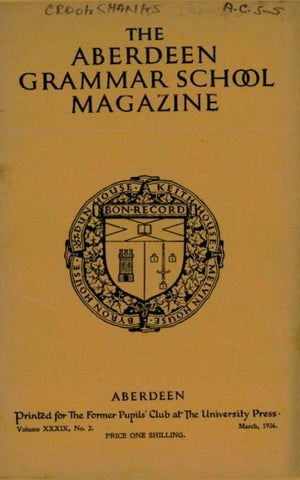
THE
ABERDEEN GRAMMAR SCHGDL MAGAZINE
ABERDEEN
prim' for-The Former Pupils' Club at-The University Press • Volume XXXLX, No. 2.
March, 1936.
PRICE ONE SHILLING.
EDUCATIONAL BOOKS JAMES G. BISSET CONTINUES to supply all the Class Books (New or Second-hand) suited for the requirements of the Higher Educational Institutions in the City, at the Lowest Prices. N.B.—Best Value in Students' Note Books.
JAMES G. BISSET, Classical, Medical, and Educational Bookseller, 85 BROAD
STREET
(Opposite Marischal College).
]
Children need
ENERGY ►r) O.)
O 0
a.*
TO tide them over the trying hours at school, children need energy! They'll get it from Hutchison's Bread. Assure their health by buying NOW!
•
„ .
13 BRANCHES throughout the CITY
Culture Pearls of . . . Great Beauty
NECKLACES BROOCHES
RINGS
EAR-RINGS
A. & J. SMITH JEWELLERS SILVERSMITHS
WATCHMAKERS OPTICIANS <>
r 91 UNION STREET, ABERDEEN
Outsize Wear A Specialty
IlL111111-11LIUS FOR THE MOST UP-TO-DATE FASHION WEAR AT THE BEST VALUE PRICES
FURS FUR COATS
COSTUMES COATS TWEEDS TWO-PIECE SUITS GOWNS FROCKS
A. C. LITTLE & SONS, LTD. 105 Union Street, Aberdeen
rursuiruivr NEVER FAILS TO
THAT
• To all who find pleasure in things of homely interest, Galloway & Sykes' stock is sure to appeal. You will find all the furnishings you desire at prices far lower than you anticipated. WE CORDIALLY INVITE YOU to walk around our COMPLETELY FURNISHED MODEL ROOMS at your leisure without any obligation to purchase.
INSPECT OUR MANY NEW DEPARTMENTS SOFT FURNISHINGS CARPETS BEDDING You will find many things of absorbing interest and beauty.
GALLOWAY & SYKES 361-363
Union St., Aberdeen
JAMES FYFE & SON PAINTERS
GLAZIERS.
AND •
•
•
OFFICE AND SHOWROOMS:-
11 DEE STREET, ABERDEEN. Telephone 30 3.
Telegrams " Fyfe, Painters."
TELEPHONE, NO. 1719.
TELEGRAMS: "HUB. ABERDEEN."
CAMPBELL & SELLAR, LTD. Engineers, Hirers and Garage Proprietors
QUEEN'S CROSS GARAGE to Fountainhall Road ABERDEEN OPEN DAY AND NIGHT
ANY MAKE OF CAR SUPPLIED
ANILY COFFEE Curie Col lee is the favourite drink with every. ‘ II one. It is most especially delicious. Your in cold weather. grocer can supply you.
011:
rita
CURB'S COF % Thomas Curr & Co, ABERDEEN.
Quality is our Truest Economy
ROBERT STOTT Family Grocer Italian Warehouseman, Tea, Coffee, Wine and Spirit Merchant
53
ALBERT STREET, ABERDEEN Telephone 1848
z 0
BOOKS BOUND 4s 10035
z
w
m W t!1 J
C-40( SON
z z
(ABERDEENILAP 18 BACK WVND
0 ? c,
C)
ALL
SORTS
Telephone No. 291
AND
SIZES
Established 1855
Tailoring of Distinctive Character modelled on ULTRA-MODERN lines. FRED WATT'S Suitsto-Order bear the Hall Mark of Good Taste
80/- 95/- to 126/-
PRICES :
FRED WATT
23 BRIDGE STREET, ABERDEEN `Phone 3515
rCOPLAND DECORATOR
0e/zoarn, gre)aac&Noenclee/rr SPECIALIST 0E- STAINED GLASS & MURAL DECORATIO
-
celearhyovnklpitcaiion A. D. COPLAND.
Phone 896. Telegraphic Address : " Undertake. Aberdeen."
Telephone No. 2300. Works : Rosebank Place.
GORDON & WATSON )ERTANLFL. li FUNERAL. UN DE.RTA ANT)
MOTOR
HIRERS
12 HOLBURN ST. & 40 VICTORIA RD. ABERDEEN
W. KENNAWAY, Ltd. BAKERS and CONFECTIONERS, 5 and 7 Holburn Street. Luncheon, Tea, and Reception Rooms, 1 73 Union Street and 8 Bridge Street, ABERDEEN
SPECIALITIES-WEDDING CAKES. SHORTBREADROYAL DEESIDE IN TARTAN TINS, ALSO A LARGE SELECTION OF PLAIN AND FANCY ICED CAKES.
Telephone No. 1891.
ARCHIBALD McKELLAR Family Grocer and Wine Merchant, 454-456
Union Street, Aberdeen. . . We Specialise in . .
Cooked
Gammons, Finest Belfast Smoked Hams, " Harris's "
Wiltshire Bacon.
Medicinal Wines—Vibrona, Hall's, Wincarnis, Glendenning's. •
•
i Wedding 11. Cakes
1\,‘,1 Cri l , iq
-4
4
Wedding Catering
rt t
ALSO
Christening, Birthday, Anniversary Cakes of Finest Quality
MITCHELL & MUIL LTD. Always insist on—
FLOCKHARTS' AERATED WATERS Address—Craibstone Lane, Aberdeen. Telephone 873.
ESTABLISHED 1897.
A. &W. ALEXANDER Fishmongers Butchers Game and Poultry Salesmen PURVEYORS
492
OF
THE
FINEST QUALITY.
UNION STREET ABERDEEN Telegrams—
Telephones-5172 (3 Lines).
" Alexanders, Fishmongers, Aberdeen."
Telephone
Aberdeen 1710.
The Mastrick Dairies Ltd. 1 DESSWOOD PLACE, ABERDEEN Selection of DAIRY PRODUCE from our own Farms, and produced under the direct supervison of members of the family. Our Customers may rely upon the absolute Purity and Cleanliness of all our products. WE offer you a Choice
Distributors of
Lord CarnegIe's and Cairnbrogie Certified Milk. Head Dairy: 3, 5, and 7 WHITEHALL ROAD. Branches: 7 MID STOCKET ROAD. 33 FOUNTAINHALL ROAD. 473 GREAT WESTERN ROAD. 25 BEDFORD PLACE.
CONTENTS ILLUSTRAI IONS. George Aliddleton, M.A., D.Litt. . . School Rugby Football ist XV . . F.P. Club Rugby Football Section tat XV
. . .
Facing page 114
• • •
SI
>I
142
•
71
15
1 43
. . . . . The Rector in Edinburgh . - Page 91 " The Prosperity of the Old School." By Patrick Ashley Cooper 93 Notes About Old Boys . . . . . . . 98 Marriages ., . . . . . . • . • Obituary . . . . . . . . . . III . . Dr. George Middleton . . . . . . 114 The School's Carnegie Researchers . . . . . " Play the Man!" . . . . . . . . The University Roll of Graduates. By W. D. S. . . . Mr. Cooper Clark and the Codex Mendoza. By Dr. J. M. Bulloch . . . . . . . . . „ 120 A Trip to the Diamond Mountains. By Licut.-Colonel Maurice J. Williamson, R.A.M.C. . . . . . . 122 A School Census . . . . . . . . . 127 Roll of F.P. Honour . . . • • 130 The Second and Third Generations 1 34 A South Sea Drama. By D. R. B. 1 35 „
109
••
116
„
118
„
119
11
•
• •
School Section— School and Random Notes . School Rugby . . . House Notes . . . The Literary and Debating Society . Scout Notes . •
•
•
•
•
•
•
•
• •
•
•
•
•
•
•
•
•
•
•
•
.
.
. • . .
. . . .
. . . .
The Former Pupils' Club— The Annual Meeting of the Club . . . List of F.P. Club Consuls . . . . The Cricket Section makes an Appeal . . Rugby Section . . . . . . . . . . . Hockey Section . Glasgow Centre : The Annual Dinner . Edinburgh Centre : The Annual Dinner . . List of New Members . . . . . Members whose Present Addresses are Wanted Club Office-Bearers, 1936-37 • . . •
•
• • • • •
•
•
. • . • . . . .
,, ,, „ „ „
137 140 143 145 146
148 154 156 157 16z 163 164 „ 166
„ ,, „ ,, „ „
•
•
„
167
•
•
„
168
N
Quite a number of London's best-dressed men have been seen wearing double-breasted suits this season.
This is
a style which is particularly suited to tall and slim figures. THE MAN'S SHOP have a good range of fittings in smart pin and shadow stripes at
FOUR,
FIVE
and
SIX
GUINEAS
Esslemont & Macintosh Ltd. UNION STREET
ABERDEEN
Pleasant ! Uniform ! Reliable ! Entrancing ! That is what they all say about our Brown Bread NINE different VARIETIES
W. M. McPHERSON Baker and Confectioner, 15 FOUNTAINHALL ROAD --
AND
8 ST. SWITHIN STREET ABERDEEN
LOW'S Wm. Cay & Sons BOOKSTALLS ESTABLISHED 1843.
39-50 New Market Gallery ABERDEEN
funeral Univ.rtallers.
BOOKS on All Subjects and at All Prices Over soo,ooo Volumes in Stock Educational Books in Great Variety
415 UNION STREET 8N
209 GEORGE STREET, ABERDEEN. -
Motor Hearses and Cars for Town and Country Funerals.
CATALOGUES ISSUED Telegrams—"Cay, Aberdeen."
'PHONE 3332
'Phones Nos. 92 and 54.
I 8 : 8
ESTABI IP/ Z O
•
1
BY
APPOINTMENT
TO
H.M.
THE
KING
J. WILLIAMSON & SON (W. 8. WILLIAMSON, PROPRIETOR)
Meat Purveyors and Poulterers 1, 2, ct. 3 MARKET BUILDINGS, ABERDEFN 'PHONE BRANCHES,
452
35 FOUNTAINHALL ROAD 'PHONE 1724 ALSO AT
THE SQUARE. CULTS 'PHONE, CULTS 2
CHURCH SQUARE, BALLATER 'PHONE 38
cc
RECOLLECTIONS OF AN OLD LAWYER" by
LACHLAN MACKINNON Advocate in Aberdeen With 11 Full-Plate Illustrations.
5/-; Postage 6d. extra.
D. WYLLIE & SON 247
Booksellers
Publishers
UNION
STREET,
Stationers
ABERDEEN
Established 1814
Telephone 402
COUNTRY HIRES AT CHEAP RATES CARS
COLIN
GARAGED
S.
CLARK
DAIMLER TAXI HIRER DAY AND NIGHT SERVICE
PHONE 4422
46 HARDGATE, ABERDEEN
ROBERTS (ABDN.) LTD. Cabinetmakers, Upholsterers, Carpet Warehousemen
RECOGNISED AS EASILY FIRST IN
FURNITURE VALUE Our enormously increasing business testifies to the popularity of our good class and dependable productions. We employ a large staff of highly-skilled craftsmen, and their number is being steadily augmented. You will find our prices surprisingly low. •
AS AN INVITATION, PLEASE ACCEPT THIS ANNOUNCEMENT TO INSPECT OUR LARGE STOCK OF FURNITURE AND FURNISHINGS.
NOTE A D DRESS:
419
Union
Street,
ABERDEEN
Handicrafts Raffia and Cane Seagrass and Stool Frames
BUY BEST
BUY BRITISH
THE IMPERIAL TYPEWRITER loo% British, is the best and lowest-priced Standard Typewriter. No increase.
THE IMPERIAL PORTABLE DRAWING MATERIALS of every description
Taylors' Art Saloon Picture Framers and Artist Colourmcn 49-51 SCHOOLHILL
ABERDEEN Telephone 2870.
The Best Portable, too% British. Second-Hand Bargains of all Makes of Typewriters. EASY DEFERRED PAYMENTS (Hire Purchase) ON ANYTHING.
C. H. WEBSTER 4 Rose Street, Aberdeen 'Phone 505 BUY BUY BRITISH BEST
Why Wait for Watch Repairs? Buy a CRUSADER Watch and never be bothered with repairs. Instead of repair, a new movement is fitted while-you-wait by any CRUSADER Agent throughout the world. 5 years' guarantee. Call for Demonstration or write for Free Catalogue. Prices from
eru5aber
3
EXACT TIME — NO REPAIRS
Gns.
Chromium, £4 0 0
Stainless Steel, £6 0 0
JP AM II IESC
Gold, £8 15 0
Ac CA
RING SPECIALISTS Union Bridge), ABERDEEN (next STREET
ENGAGEMENT
142 UNION
Over 100 Models for Ladies and Gentlemen.
ELLIS & McHARDY LTD. (ESTABLISHED 1880)
18
REGENT
QUAY
AND
13O-i UNION STREET
ABERDEEN Telephone 2889
GEORGE BISSET'S Clan Tartan Warehouse
15 UNION STREET ABERDEEN CLOTHIER TO THE ADMIRALTY, R.N.R., and R.N.V.R.
HIGHLAND OUTFITS :: a Speciality :: for Boys, Youths, and Gentlemen, also for Maids' and Ladies' Wear; and will gladly supply patterns of Ladies' favourite Tartans for Kilts. Telephone 2680.
Telegrams " COAL, ABERDEEN "
Co-operation HE enthusiastic co-operation of many minds and hands make possible the fine productions of the HOUSE OF OGILVIE. For over three-quarters of a century our constant endeavour has been to give the best possible service to our Customers. We base our claim to your patronage on our ability to please you.
T
J. &
A. OGILVIE
369
UNION
STREET,
ABERDEEN. Telephone: No. 433.
STRACH AN COMMERCIAL PORTRAITURE PHOTOGRAPHY Telephone 851
Telegrams: " Interiors."
Showyard Erector to the Highland and Agricultural Society of Scotland, and Contractor to the Royal Northern Agricultural Society.
Vtlifr
JOHN REID & CO. HOUSE CARPENTERS AND JOINERS
55 Blenheim Place and 14 Fountainhall Road ABERDEEN
416 UNION STREET
Carpentry and Joinery Work of every description done
ABERDEEN
ESTIMATES ON APPLICATION Telephone No. 1997
I OR
SALES AND SERVICE in the North Consult—
Aberdeen Motors Ltd. UNION ROW ABERDEEN Works
-
Telephone 4580 (3 lines)
49 Huntly Street Telegrams "Cars "
NORTHERN ASSURANCE COMPANY LIMITED. Established 1836.
Assets i23,ooo,ooo.
ALL CLASSES OF INSURANCE, INCLUDING :-
FIRE ACCIDENT
LIFE MOTOR CAR
Life Assurance Branch. The Company's Tables of rates for Life Assurance include every class of Policy. Write for Particulars of Life Policies Family Income Policies Endowment Assurance Policies Educational Endowment Policies House Purchase with Life Assurance Children's Deferred Assurance Policies
ABERDEEN LONDON
CHIEF OFFICES : I Union Terrace. - 1 Moorgate, E.C. 2.
-
Aberdeen Board of DIrectors. The Right Hon. The LORD A. S. R. BRUCE, EsQ. The Right Hon. The EARL or FORBES. CAITHNESS. A. MARTINEAU, ESQ. FRANCIS J. COCHRAN, ESQ. R. W. WALKER, ESQ. WILLIAM L. COOK, ESQ. Manager Secretary
R. MACKAY. J. L. WILLIAMS.
Aberdeen Grammar School Magazine 5.rst year: No. 132
(New Series. 42nd year, No. .223)
MARCH 1936
Vol. XXXIX
No. 2
The "Grammar School Magazine" is issued under the auspices of The Former Pupils' Club, in March, June, and November. All communications with regard to the " Magazine " should be addressed to the Editor (the Secretary and Treasurer of the Club), THEODORE WATT, M.A., The Rosemount Press, Aberdeen. •
The Rector in Edinburgh. Some Interesting Points. his reply to the toast of " The School " at of In the course the Annual Dinner of the Edinburgh Centre of the Former Pupils' Club, the Rector said he would like in the first place to associate the teaching staff and the boys of the School with the congratulations which the Chairman had extended to their guest, the Lord Provost. The School had good reason to be proud of the fact that two of her sons had held this high office in succession. Lord Provost Watt had shown the greatest personal interest in all their activities, and he seldom missed a Rugby match. It would not be possible within the limits of a brief reply to refer to more than one or two matters of passing interest. The most recent of these concerned their School Library. Two years ago a Committee was appointed by the Carnegie United Kingdom Trust to enquire into the provision of libraries in the Secondary Schools in Great Britain and Northern Ireland. The report of this Committee had been issued three days before, and it was gratifying to find that the Grammar School Library was one of three in Scotland which earned the commendation of the Committee. The Library, as they were aware, had a valuable collection of old books, the cataloguing of which had been carried out with expert skill by the late Miss Allardyce ; in addition, there was a large and serviceable collection of modern books of reference to which the boys had ready access. There could be no doubt that the Library formed a most useful adjunct to the work of the classroom.
92
Aberdeen Grammar School Magazine THE CLASSICAL TRADITION.
The tradition of the Grammar School was first and foremost a Classical one, and he was glad to think that this tradition was being maintained. He might instance the winning of a Balliol Scholarship in Classics by A. R. H. Kellas, an achievement for which, so far as he knew, there was no precedent in Aberdeen. He had heard that day that the Silver Pen and the Baroness de Gurbs Prize in the Graduation Class in Greek had been awarded to a Former Pupil. This was the third occasion in four years on which this had happened. It was fitting when speaking of Classical teaching in the Grammar School that he should make a passing reference to the recent death of Dr. George Middleton, whose pre-eminence as a scholar and a teacher added lustre to their School. Many of the boys who had passed through his hands had earned distinction in various fields ; even the less distinguished of them must have felt the abiding benefit of contact with so cultured a mind. But their academic successes were not limited to the Classical side. The John Murray Prize and Scholarship awarded annually to the best graduate in Medicine of the year at Aberdeen had been gained by a Former Pupil for four years in succession. A feature of the School in recent years had been the Easter trip to the Continent. There had been several visits to France and one to Rome. This Easter they were sending a party of boys to Paris in charge of one of the masters. Such visits were in the highest degree educational, and the cost was kept within modest limits. THE BOARDING HOUSE.
He would not like to conclude without a brief reference to what he regarded as the most successful enterprise which the Club had ever carried through—the Boarding House. The House at the moment was causing the Directors a certain amount of embarrassment in respect that they had more applications for admission than they found it possible to accept. There were sound reasons why the Directors should hold their hands for the time being. It was only two years since a large extension had been added, and common financial prudence suggested a period of consolidation. He, however, took the view that they were only at the beginning of a very considerable expansion in the demand, and when this materialized, the Directors would not hesitate to take the next forward step and establish a second house for the younger boys. Viewing the matter from a wider standpoint, he sometimes wondered whether the city of Aberdeen had sufficiently exploited the advantages which it enjoyed as an educational centre. They had first-rate schools for both sexes, well equipped and with excellent traditions, schools in which as much attention was
Aberdeen Grammar School Magazine
93
now being paid to physical as to mental development, and a climate will suitcd to the fostering of a robust and vigorous growth. The trouble so far had been that the residential facilities available in the schools were limited, but this defect could be remedied. Why should Edinburgh always be associated with schools ? Could Aberdeen not enjoy a measure of similar repute ? Some of their industries were either declining or not more than stationary. Here was an industry—if such a term could be applied to education—which with judicious propaganda was capable of almost indefinite expansion. A regular influx of young life from overseas would add to the grace and charm of their city. lie thought the suggestion should be considered.
" The Prosperity of the Old School." 1 By PATRICK ASHLEY COOPER. Although we are in Glasgow to-night, I know that all of you owe allegiance to Aberdeen. Either you were brought up there or at least you were educated there, and, therefore, you will fully understand me if I quote the Classics to you. " All Scotland is divided into three parts—the Highlands, the Lowlands, and Aberdeen," and I come frae Aberdeen. I am greatly honoured that you should have asked me to propose this toast to-night, and particularly that you should have asked me to journey from London to do so. Nevertheless I feel greatly embarrassed. In London, well away from my old haunts, I am able to put up quite a good bluff, but here that is impossible. Too many of you remember me during my School career, with all its inefficiencies. But there it is-I must make the best of a bad job. You have asked me to propose the toast of " The Prosperity of the Old School." That, as I understand it, embraces prosperity for those who have been there, those who are there now, and those who in the future will go there. As to those who have been there, looking round this room I should say that you need no words of mine to bring you prosperity. You all look remarkably prosperous. But when one thinks of the Grammar School, one's mind goes back a long way. Seven centuries is a long time, even in the life of a nation. In that time there have been some remarkable men. Recently I spent a holiday in Aberdeenshire. My days were devoted to shooting grouse or walking amongst those incomparable hills. My evenings I spent studying local history. I was enthralled to see how great a part Grammar School boys have taken down through the centuries in making local history, and the romantic 1 A speech delivered at the Annual Dinner of the Glasgow Centre of the F.P. Club, zgth Nov. 1935.
94
Aberdeen Grammar School Magazine
part which they have played in the national history also. And the same applies abroad. Did you ever hear the story of Marshal Keith, so closely associated with Aberdeen? As a Russian Marshal he was admiral of the fleet which forced the Dardanelles in the war against Turkey. After the taking of Constantinople he proceeded with his officers to the Grand Vizier's Palace in order to discuss the terms of peace. After the preliminaries, the Grand Vizier suggested that he would dismiss his retinue if the Marshal on his side would do the same, in order that they might discuss the treaty in private. The Russians, alarmed at the thought of treachery, urged Keith not to agree. Nevertheless he fell in with the plan. No sooner had the officers on both sides retired than the Grand Vizier rose from his divan and said :—" Man, Keith, I ken ye fine. My father was the bellman when you and your brother were going to school." Do any of you know who defeated Napoleon at Moscow ? Most of us think that it was the winter or the burning of the city, but the man who commanded the army, the man who achieved Napoleon's downfall, was Count Barclay de Tolly. Barclay de Tolly, of course, is the Russianized form of Barclay of Towie. I do not say that this Prince was at the Aberdeen Grammar School, but his forebears were. I remember once, when I was in Rio de Janeiro, going into the Cathedral to see the monument erected to the memory of the first Prime Minister of Brazil. He was none other than John Forbes, a younger son of the Laird of Skellater. A wonderful career—brought up on porridge and a Grammar School education, he had the most romantic life all over Europe, married a Portuguese princess, and, as I have said, died a Prime Minister. And you remember that the Bank of England was founded by a Scot—William Paterson; that, too, the first Bank of France was established by a Scot—John Law, though the latter had a flaw in his make-up, as I shall presently tell you : you see, he was not educated at the Grammar. When I boast to my friends in London that it was a Scot who founded the Bank of England, and a Scot who established the banking system in France, I always feel nervous, for there are two excellent repartees, but, fortunately, few of my friends know them. The first is that an Englishman founded the Bank of Scotland, and the second, a more serious one, is that John Law's subsequent career was anything but satisfactory. He it was who persuaded the Regent in France to go in for large-scale monetary inflation, which brought in its train widespread disaster and misery, and was, I have always maintained, one of the most potent of the contributory causes of the French Revolution. After this recital I am sure that you will not be surprised if I claim as F.P.s such distinguished persons as Abraham, Isaac,
Aberdeen Grammar School Magazine
95
and Jacob. I am afraid I'm too late—they have claimed us— at least judging by the frequency with which they change their names to Gordon. In my own Company, the Hudson's Bay Company, we have for over two centuries recruited many of our men from Aberdeen and the North. Travelling to the Arctic last year, one of the principal officers accompanying me was George Watson, an F.P. [1904-09], District Manager of St. Lawrence-Ungava—an area about as big as one half of Europe. In all of my Companies we have Aberdonians and F.P.s. I have travelled widely in Brazil, Argentina, Uruguay, Paraguay, Bolivia, Peru, South Africa, East Africa, Rhodesia and, of course, all over Canada and the United States. Wherever I go, I find F.P.s holding leading positions. When I receive the School Magazine, the first thing I always do is to turn to the pages recording the activities of F.P.s. I cannot take up your time to-night in repeating to you what you have already read yourselves; but you will, I am sure, agree when I say this—that when we read that record of work and achievement by our schoolfellows at home and abroad, we all feel very proud to be able to say that we were at the old School. I have spoken of those who have gone abroad. But those of you who have stayed in this country have just as great an achievement, and you have far greater competition. I have to-day had the opportunity of seeing much that you have accomplished here in Glasgow and on the Clyde. I have had the opportunity of inspecting that marvel of shipbuilding engineering—that greatest of all ships, the Queen Mary. When I saw her I marvelled, and I felt that here in Glasgow we had a combination of courage and brains of which we might all be proud. How comes it that we find so many Scotsmen leading in their respective spheres ? It cannot be accidental. It is often said to be due to Scottish character. What is this " character " and whence does it come ? I think that we can answer that in two words—environment and education. In both the old School has played an important part. From my own observations here and abroad I feel that the Scot owes much to his country. He has not been blessed by Nature, for Scotland on the whole is a poor country. Production depends far less on soil and climate than on the sweat of man's brow—hard work. As a nation the Scots have been compelled to live simply and economically, and to work extremely hard for what they get. On the other hand, they have for centuries been blessed by a wonderful educational system. I need not describe it to you. It has been the envy of many nations. Of course, the Scottish character is in many ways complex, but it has been based on simple living, thinking, and industry. What of the future ? So far as the Grammar is concerned,
96
Aberdeen Grammar School Magazine
we are at present in a happy position. We have a cheerful, healthy, vigorous lot of boys, as anyone can see for himself. We have an able and progressive Rector, and a keen and intelligent staff. We can confidently say that the School is in good hands. But what of the future of Scottish character and education ? I am not so certain—I am not so confident. But I feel that the remedy in large degree lies with you. Owing to the nationwide nature of much of our legislation, I feel Scotland is being anglicized, and that is not to her advantage. I see a tendency to destroy the individuality of this Scottish educational system of ours. I see in the social legislation, much of it designed for England, a great tendency to break down the independence, that moral fibre on which the Scots have learned to rely. Scotland is different from England. Scotsmen are different from Englishmen, and you cannot put both of them through the same mould without altering the one or the other. I am not a politician and it would ill befit me to talk politics to-night. I am aware of the feeling regarding Home Rule for Scotland. For myself, I think that Scotland gains more than she loses by her attendance at Westminster. At the same time I do believe that there are matters of a purely national character which might well be dealt with in Edinburgh instead of Westminster. I feel, too, that those who advocate a greater degree of autonomy for Scotland would do well to drop the words " Home Rule," which have so sad a history elsewhere and which so easily rouse feelings of antagonism. But some measure of devolution would, I believe, be helpful both to Scotland and to a very overworked British Parliament. But, Sit, I have strayed from my course. You must be wondering what is the subject of my toast. I am reminded of the soap-box orator in Hyde Park. An old gentleman and lady were listening to him. She turned to her husband and said: " What is he talking about, George?" To which Gcorgc replied : " I don't know, my dear, he don't say." [Nom.—As some of the " history " in the foregoing speech is admittedly of the " after-dinner " variety, the following very interesting notes by Mr. Cooper's archivist are appended.— Ed. A.G.S.Mag.] 1. I have been unable to discover any confirmation of the fact that Marshal Keith was admiral of the fleet which forced the Dardanelles in the war against Turkey, or for the story quoted. He entered the Russian Service in 1728 as a Major-General, and his gallant conduct in 1737 aided the Russian corn minder, Miinnich, in effecting the capture of Ochakoff from the Turks. For this he was promoted by the Empress Anne to be Lieutenant-General. z. Barclay de Tolly was born in Livonia in 1761, and was descended from a Scottish family which had settled in Russia in the 17th century. He entered the Russian Army at an early age and eventually became Commander-inChief. In x812 he was given command of one of the armies operating
Aberdeen Grammar School Magazine
97
against Napoleon, but after he was defeated at Smolensk, he resigned his command. In 1813 he took part in the campaign in Germany, and after the Battle of Bautzen was reinstated as Commander-in-thief of thc Russian forces, in which capacity he served at Dresden, Kuim, and Leipzig. He took part in the invasion of France in 1814, and at Paris received his FieldMarshal's Baton. In 1815 he was again Commander-in-Chief of the Russian army which invaded France, and at the close of the War he was made a Prince. He died at Insterburg, Prussia, in May i8i8. 3. John Forbes of Skcllater (1733-1808) was the only son of Patrick Forbes of Skcllater in Aberdeenshire. He entered the Army when a boy of fifteen as a volunteer at the siege of Maestricht. Later, when Portugal applied to Great Britain for officers to reorganise her army under the Count of Lippe Buckcburg, he was one of the first to volunteer. He remained in Portugal after the termination of the Seven Years' War in 1763, and as he was a Catholic and had married a Portuguese lady, he had no difficulty in obtaining employment. After the French republicans had defeated the combined Spanish-Portuguese army, Forbes was too old to seek further active service, so he went to Brazil with the Queen, Maria Pia, the Prince Regent, and thc Court, when they fled before Junot. On arrival in Brazil he was appointed Governor of Rio de Janeiro, where he died in 1808. According to an obituary notice in the Gentleman's Magazine, Forbes was the senior general officer in the service of the Crown, General and Governor of Rio de Janeiro, a Counsellor of War, General of Cavalry, and Knight Grand Cross of the Orders of Avis in Portugal and of Charles III in Spain. 4. I find from the " Dictionary of National Biography" that the Bank of England was founded by William Paterson, son of John Paterson of Skipmyre, Dumfriesshire. In 1705 Paterson had a controversy with John Law and prevented the adoption of an inconvertible paper currency in Scotland. 5. John Law (1671-1729) of Lauriston was the son of a prosperous "goldsmith," and was born and educated in Edinburgh. He later migrated to London, killed Edward Wilson in a duel, and was sentenced to imprisonment. Whilst " appeal of murder " brought by a relative of the victim was pending, Law escaped to the Continent. From 1708 to 1715 he appears to have roamed about the Continent, and during visits to Paris, before the death of Louis XIV, he submitted projects to the French Government for the restitution of the country's finances, which, however, were not accepted. During the minority of Louis XV, Philip, Duke of Orleans, was appointed Regent, and during this period letters patent were granted on May 20, 1716, to Law and his associates for the formation of a Banque Generale, thc first Bank established in France. Law instituted a reliable system of paper currency in France, which was rapidly successful. He also advanced money on loan at a low rate of interest. Law also inaugurated what was known as the " Mississippi Scheme " and persuaded the Regent to make over to him Louisiana. Later, Law also acquired the Company of Senegal and the East India and China Companies, as well as an African Company, so that he gained control of all the non-European trade of France. In July 1719 the Mint was handed over to Law's Company, and in the following year he was appointed Comptroller-General of the national finances, and his Company of the Indies was united to the Royal Bank. In 172o a financial panic set in after Law had resorted to stringent measures in order to check speculation. Finally, in May 172o, the Banque Royale suspended cash payments and Law, relieved of the Comptroller-Generalship, was appointed by the Regent Intendant-General of Commerce and Director of the ruined Bank. His " system " had failed, however, and he was compelled to leave France. In 1721 Law was received in England by King George 1, but was denounced by the House of Lords for having become a Roman Catholic and for having countenanced the adherents of the Pretender in the Jacobite Rebellion of 1715. In 1725 he proceeded to Italy, and four years later he died in comparative poverty in Venice.
98
Aberdeen Grammar School Magazine
** * It is requested that the Editor be informed of all new appointments and interesting incidents in the careers of Former Pupils.
The dates given in parentheses after names indicate the sessions of attendance at the School. The Right Hon. Lord Alness* (1884-85), P.C., LL.D., was one of " the Lords Spiritual and Temporal of this Realm, being here assisted with these of His late Majesty's Privy Council, with Numbers of other Principal Gentlemen of Quality, with the Lord Mayor, Aldermen and Citizens of London" who " with one Voice and Consent of Tongue and Heart " published and proclaimed at St. James's Palace on the twenty-first day of January 1936 " That the High and Mighty Prince Edward Albert Christian George Andrew Patrick David is now, by the Death of our late Sovereign of Happy Memory, become our only lawful and rightful Liege Lord Edward the Eighth," etc., etc. James Smart Abernethy* (1924-26), LL.B., W.S., who last year became a partner in the firm of Smith & Abernethy, W.S., Montrose, has recently been appointed Legal Adviser and Commissioner of Lands (including Protector of Labour) in the North Borneo Government Service. He sails from Liverpool for Singapore in the middle of May, and expects to be resident in Jesselton, British North Borneo. Arthur James Adams* (19,9-3o), B.Sc.(Vet.), M.R.C.V.S., was in September last appointed Assistant Veterinary Inspector for the West Riding of Yorkshire. He graduated M.R.C.V.S. at the Royal (Dick) Veterinary College, Edinburgh, in July 1934, and B.Sc. (Vet.) at Edinburgh University in March 1935. He is a son of the late PETER CROMBIE ADAMS (1876-78), of Messrs. P. &. C. Adams, drapers, Aberdeen, who died in September 1934. Henry Alexander* (1881-91), M.A., LL.D.—Lord Provost of Aberdeen from 1932 to 1935—has been appointed by the
Secretary of State for Scotland to be the Chairman of the Scottish Housing Advisory Committee, which has been set up under the Housing (Scotland) Act, 1935, for the purpose of advising the Department of Health for Scotland on matters * Member of Former Pupils' Club.
Aberdeen Grammar School Magazine
99
arising in connection with the execution of the Housing (Scotland) Acts. George Allan* (1923-28), who is in the mercantile marine, has recently been undergoing Royal Naval Reserve training in H.M.S. Hood. Alexander Smith Anderson* (1905-09), M.B.E., Manager of the National Union Life Insurance Society, Aberdeen, has been appointed a Justice of the Peace for the County of the City of Aberdeen. Herbert John Anderson* (1898-59o1) is one of the two directors of the firm of Stayers & Anderson, Ltd., Creechurch Lane, Leadenhall Street, London. He has been for many years in business in London, but has only recently become a member of the F.P. Club. William Andrew Baxter* (1916-19), M.A.(A berd.), B.A. (Cantab.), who was from i928 assistant master in the Classical Department of Daniel Stewart's College, Edinburgh, was last summer appointed Senior Classical Master in the Royal High School, Edinburgh. He graduated M.A. at Aberdeen, with First Class Honours in Classics, in 5923, and at Cambridge he obtained a First Class in Part I and a Second Class in Part II of the Classical Tripos, graduating B.A. in 5925. Immediately after leaving Cambridge he was appointed a classical master at Trinity College, Glenalmond, and then became senior assistant in the Latin Department of Aberdeen University. Eric William Beattie* (1921-28) last year passed the final examination of the Chartered Accountants of Scotland. He served his apprenticeship with the firm of J. R. Flockhart and Grant, C.A., Aberdeen. Stewart Duncan Begg* (1909-10) is in the service of Messrs. John I. Thornycroft & Co., Ltd., shipbuilders and marine engineers, in their office at Hongkong. He hopes to get home this year. Charles Barron Bisset* (1909-18), M.A., B.Sc., who has been in the Geological Survey of Nyasaland since 1927, has recently been transferred to the Geological Survey of Uganda, and is resident at Entebbe. Robert Mitchell Bonner* (1922-28), C.A., is at present with Messrs. Broads Paterson & Co., chartered accountants, London. James Edward Bothwell* (1915-13), M.A., LL.B., was recently assumed as a partner in the firm of Macqueen and Findlater, advocates, Aberdeen. George William Bowes* (1915-28) is at present with Messrs. A. Marshall Mackenzie & Son, architects, Aberdeen, having completed his year of post-diploma study on the Bryne Scholarship at the Aberdeen School of Architecture. Last
too
Aberdeen Grammar School Afagazine
year he was runner-up for the Royal Institute of British Architccts' Grissell Gold Medal. Harry Ernest Johnstone Brown* (1920-24), who is in the service of the National Bank of India, has recently been home on furlough, and has now been posted to Nairobi, Kenya. He sails from London in April. Reginald Errol Butchart* (1894-1906), Rector of St. Michael and All Angels Episcopal Church, Inverness, has been appointed to a canonry in St. Andrew's Episcopal Cathedral, Inverness, by the Diocesan Synod of Moray, Ross, and Caithness. He was for several years priest-in-charge of St. Clement's, Aberdeen. Robert Henderson Calder* (1921-24) last year joined the firm of Kempsey, Pty, importers, Melbourne, Australia, and is now their representative in Sydney. Donald Campbell* (1908-17), M.B., Ch.B., who has for some years been in medical practice at Ellon, has now taken over a practice at Parkstone, Dorset. Robert H. Campbell* (1919-29) is now with the National Bank of India, Ltd., 2.6 Bishopsgate, London. Robert Selbie Clark* (1 894-1901), M.A., D.Sc., Superintendent of Scientific Investigations under the Fishery Board for Scotland, was last year appointed Lecturer in Scientific Study of Fisheries in the University of Aberdeen. James William Spence Cobban* (r920-2r) is at present on the Gatooma Central Section of Rhodesian Plantations, Ltd., Southern Rhodesia. Nigel Smart Cowan* (1924-28), B.Sc.(Eng.), who received a commission in the Royal Engineers in 1934, is at present serving with the 1st Air Defence Brigade at Blackdown, near Aldershot. Maurice Cramb* (1916-29), M.A., LL.B., has been awarded the Cruickshank Law Prize of the value of £tzo for each of two years at Aberdeen University. He is a member of the Executive of the F.P. Club. Alexander Cruickshank* (t 9 i 5-19), M.A., M.B., Ch.B., F.R.C.S., is at present surgical assistant in St. Peter's Hospital for Stone, etc., Henrietta Street, London. He was formerly resident medical officer at King George Hospital, Ilford, Essex. John Rhys Danson* (1 897-1903), D.C.M., Company Sergeant-Major, Penang and Province Wellesley Volunteer Corps, 3rd Battalion, Straits Settlements Volunteer Force, was created at the New Year a Member of the Order pf the British Empire (M.B.E.), Military Division. He has been in Penang since 1919, having been appointed in that year Assistant Municipal Electrical Engineer, Georgetown. He is the F.P. Consul for Penang.
Aberdeen Grammar School Magazine
101
Donald Arbuthnot Davidson* (I 9c) 5-15), B.L., Sydney Duffus* (1911-17), B.A.(Cantah.), I.L.B.(Aberd.), and James Bryce Esslemont* (1913-24), B.L., have recently been made partners in the firm of Wilson & Duffus, advocates, Aberdeen. The head of the firm is JAMES Cerro DUFFUS* (1897-1904), M.A., LL.B., a member of the Executive of the F.P. Club and the Secretary of the School Boarding House Company. Lessel Murray Davidson* (1 905-14), Major, 75th (Highland) Field Brigade, Royal Artillery (T.A.), was promoted on list January to be Lieut.-Colonel. He is a partner in the firm of James Meston & Co., chartered accountants, Aberdeen. He became a Major in 1928, and holds the Territorial Decoration. Donald James Dawson (1919-27) was recently awarded at Aberdeen University the Thomas Munday Prize in Pharmacology and Therapeutics. The Prize is one of the value of approximately Li5 (for one year). Eric Henry Weir Duncan* (1918-26), M.B., Ch.B., has recently bought the medical practice of NORMAN STEPHEN GILCHRIST* (1897-1901), O.B.E., M.A., M.D., 166 Coldharbour Lane, London, S.E. 5. He has as his next-door neighbours two other Aberdeen graduates—John Durno (M.A. 1877, M.D.), and George Cooper (M.B., Ch.B., 1906), with whom, he says, he frequently plays bridge. Herbert John Edwards* (1906-17), M.A., LL.B., has been for a number of years sole partner in the firm of Watt and Cumine, advocates, Aberdeen. This firm has recently been amalgamated with another firm of Aberdeen advocatesWm. M. Sellar & Patterson, of which, since the death of Mr. Sellar, James Patterson* (1906-12), M.A., LL.B., has been sole partner. The combined firm is now practising under the name of Watt & Cumine at 8 Golden Square, Aberdeen. Mr. Patterson is a member of the Executive of the F.P. Club and one of the directors of the School Boarding House Company. Alexander Forsyth* (19 z 3-3o), B.Sc., M. P.S., has recently received a technical post under Messrs. Honeywill & Stein, Ltd., chemists, London, and is at present stationed at Hull. He was admitted a member of the Pharmaceutical Society in June of last year. George Knowles Fraser* (1907-08), M.A., D.Sc., B.Sc.(For.), has recently rejoined the F.P. Club. He is lecturer in Forest Soils and Chemistry at Aberdeen University. John French Gauld* (1919-29), who served as an apprentice engineer with Messrs. John M. Henderson & Co., Ltd., Aberdeen, received an appointment on a tea plantation in Northern India, and sailed in February for Calcutta.
I02
•
Aberdeen Grammar School Magazine
Godfrey Power Geddes* (1903-I I), D.S.O., M.A., Lieut.Colonel, 5/7th Batt. The Gordon Highlanders, has recently received the Territorial Decoration. Wallace John Gill* (191 1 - r 7), M.D., F.R.C.S.(Edin.), is now Superintendent of Paddington Infirmary, London. Gilbert George Patterson Gordon* (1912-18), M.A. B.D., minister of St. Paul's Church, Aberdeen, has recently accepted a call to Sandgate Church, Ayr. His first charge was the U.F. Church at Carrbridge, Inverness-shire, to which he was appointed in 1926, and three years later he was called to Aberdeen. James Marcus Gossip (1921-27), B.A.(Oxon.), has recently been appointed a missionary of the Church of Scotland, and has been posted to Rajputana. George Hay* (1925-35) is at present serving as an apprentice on the s.s. British Engineer, belonging to the Anglo-Iranian Oil Co., Ltd., London. James V. Hay* (1926-35) has recently joined the Metropolitan Police. Hubert Douglas Henderson* (1901-04), M.A.(Cantab.), has been appointed a member of the Departmental Committee recently set up to inquire into Fixed Trusts in all their aspects, and to report what action, if any, is desirable in the public interest. He is Senior Research Fellow in Economics at All Souls College, Oxford, and was formerly Joint Secretary to the Economic Advisory Council. From 1923 to 1930 he was editor of The Nation and Atheneum. Charles Albert Hendrick* (1906-15), who received a commission in the Indian Army in 1917, after serving as a cadet in the Military College, Wellington, Madras, was promoted to be Major in June 1935. He is in the 17th Dogra Regiment, and is at present with the loth (Training) Battalion at Jullunder, Punjab. James Hughes* (1925-35) has entered the office of his father, Mr. Alexander B. Hughes, assessor of fire losses, etc., Aberdeen. Stanley Hurry* (1916-zi), B.Sc.(Eng.), continues in the service of Messrs. Worthington-Simpson, Ltd., Manchester. William Wilson Jameson* (1892-1902), M.A., M.D., F.R.C.P.Lond., Professor of Public Health, London School of Hygiene and Tropical Medicine, University of London, has been appointed a member of the Tropical Medicine Research Committee recently set up by the Medical Research Council in consultation with the Colonial Office. The new Committee will advise and assist in the direction of such investigations as the Council may be able to promote, whether at home or abroad, into problems of health and disease in tropical climates, and make suggestions generally as to research in this field. The
Aberdeen Grammar School Magazine
103
Secretary of the Committee is Arthur Landsborough Thomson* (1899-1908), C.B., O.B.E., M.A., D.Sc., the Assistant Secretary of the Medical Research Council (Committee of Privy Council for Medical Research). William John Jenkyns* (1894-1903), who is in the service of the Brazilian Portland Cement Company at Silo Paulo, Brazil, in a letter, dated 28th February, to the Secretary of the F.P. Club, said that he was then writing for the third time in reply to a letter he had received in December. Both his previous letters had been lost in mid-Atlantic. The first travelled by French Air Mail, and the 'plane crashed somewhere between Brazil and the African coast and had not been heard of since. In the following week he wrote again, and his letter went by German Air Mail, and, strange to say, this 'plane was also lost in midocean and had not been heard of. Jenkyns has accepted office as F.P. Club Consul for Brazil in succession to the late A. BAIN MACKIE, whose death is reported on another page. Ronald John Reir* (1924-32) is at present serving for one year as an apprentice with the Harland Engineering Co., Ltd., Alloa, and will then return to Edinburgh University for a final year before taking the degree of B.Sc. in engineering. Arthur Roy Handasyde Kellas* (1926-32), a son of the late HENRY KELLAS (1881-87), advocate, Aberdeen, was in December elected to a scholarship in Classics at Balliol College, Oxford. He has just been awarded First Class Honours in Classics at Aberdeen University. Gordon Smith Laing* (1926-31) has recently started on his two years' practical training for the B.Sc.(Eng.) degree at the engineering works of the Aberdeen Harbour Commissioners. Ian Horace Laing* (I926-3o) passed in December the znd Mate's Examination at Glasgow. He is at present serving as an apprentice with Alfred Holt & Co., and was previously in H.M.S. Conway. Eric Linklater* (1953-16), M.A., brought out in November through Jonathan Cape a first volume of short stories entitled " God Likes Them Plain." It is a collection of sixteen stories, which differ not only in geographical setting, but in approach and treatment. In a recent issue of The Observer Mr. St. John Ervine wrote : " Mr. Linklater is a robustious writer, with a gift of what is called, I believe, Homeric laughter, and he certainly makes me laugh a lot ; but I cannot abide his imitators who atone for their lack of his talent by their profanity and downright indecency." Ritchie Allan Low* (1915-27) is in the service of the National Bank of India, and is at present stationed in the Bombay office. William Macbain* (I88o-85), M.D., has now retired from
104
Aberdeen Grammar School Magazine
practice at Cheetham Hill, Manchester, and is resident near Newquay, Cornwall. Alexander Macdonald* (1925-27), M.A., has been awarded at Aberdeen University the Eric Wemyss Fulton Prize in Neurology. Dennis Lorraine Mackay* (1924-29) is at present serving in H.M.S. Nelson. Charles Stewart McLeod* (5908-20), M.A.—son of Dr. Charles McLeod, formerly Principal Mathematical and Science Master in the Grammar School—has recently been appointed chief assistant to the District Goods and Passenger Manager of the London and North-Eastern Railway at Dundee. After graduating M.A. at Aberdeen University in 5924 with First Class Honours in Mathematics, and B.A. in 5927 at Cambridge University, where he was a wrangler in the Mathematical Tripos, he entered the service of the L.N.E.R. as a traffic apprentice. He has had varied experience in many departments of the Railway, and since 5932 has been attached to the staff of the Chief General Manager at King's Cross Station, London. George Herbert Mair (1899-1902), C.M.G., M.A., who died on 3rd January, 1926, was commemorated by two " In Memoriam " notices in The Times of 3rd January, 1936. To one of them was appended the following :— dtat'w etivwv ai sbaa•rart • mdati )(1p tyvon Kaki • Kax6iv O aU crol ikapav IVELILE BEGS. Harry Maitland* (1931-33) has received an appointment on the staff of the Mercantile Bank of India, Ltd., in London, and takes up duty on 1st April. William Ferrier Mayor* (5923-30), M.A., who is Preventive Officer in the F.M.S. Customs at Kuala Lumpur, last year won his place in the Selangor State Rugby Team at stand-off. He was chosen for the F.M.S. Volunteers to play against the Straits Settlements Volunteers, which is regarded as a big honour. In a newspaper report of this match we read : " Mayor was a host in himself to the F.M.S., and not only was his kicking to touch excellent—and he did not overdo it as so many standoff men do—but he was fast, had fine hands, and showed that he could go through perfectly when the occasion demanded. To him must go the chief credit for the F.M.S. winning." There are two other F.P.s in the Selangor State Team, namely, GEOFFREY FARQUHAR BROWN (1921-2 5 ), and his brother, JACK LESLIE KEITH BROWN (1921-2 5 ). Unfortunately Mayor has been out of the game since November, for in a match he dislocated a bone in his shoulder and tore the ligaments in it. On the more serious side of life, he has passed his General Orders and Colonial Regulations Examinations, which he regards as being another step in the right direction.
Aberdeen Grammar School MagaVise
105
James William Slesser Marr* (1913-19), M.A ., B.Sc., is the author of " The South Orkney Islands," which forms a section of Volume X of the " Discovery Reports." The book, which has been beautifully printed at the Cambridge University Press, deals first with the history of the islands, and gives a brief account of nineteenth-century exploration and of recent research and commercial exploitation. Then follows an account of the recent survey of the islands, and a description of them, under such headings as climate, pack-ice, icebergs, glaciation, physiography, vegetation, and seals. A feature of the volume and is a collection of magnificently-reproduced photographs may author the which of one is work The panoramic views. justly feel very proud. The Right Hon. Lord Meston* (1876-8o), K.C.S.I., LL.D., is chairman of a Commission which is at present considering the reorganization of the Liberal Party, and which expects to report early in May. Lord Meston, who was formerly Lieutenant-Governor of the United Provinces, revisited India in the autumn of last year, and in a luncheon speech in January said he described some of the changes he had seen there. He The changes. remarkable very some were there that externally villages were just as they had been for generations, but the cities were moving. There were great town-planning schemes, of the and wonderful new roads being driven through some young, no India in day his In Britain. Great old slums, as in respectable woman was ever seen outside the inner quarters of her own home after seven years of age. Now the situation was entirely different. Young women in their thousands were pouring out from behind purdah, and demanding the same education as their brothers, and the same privileges, amusements, and opportunities of seeing the world. Lord Meston said he believed that the Indians would be more and more dependent on the help that the British could give them. He believed also that this help should be given by the very best men this country could send, whether in administration, commerce, or anything else. Herbert Stewart Milne (1897-1901), M.B., Ch.B., Major, R.A.M.C., is at present Embarkation Medical Officer at Southampton. Malcolm Ross Milne* (1925-35)—son of Mr. ANDREW MILNE* (19o3-o9), Senior Classical Master of the School—left School last Christmas and is now a midshipman apprentice with the Booth Steamship Company on the Anselm, plying between Liverpool and Mangos in Brazil. He holds what is believed to be a record for the School on the scholastic side. He " sat " his Leaving Certificate in March of last year, when he was fifteen years and one month old, and succeeded in getting his five Higher passes on the Classical side.
i o6
Aberdeen Grammar School Magazine
Robert Moir Milne* (1881-90), M.A., who retired from the staff of the Royal Naval College, Dartmouth, in 1933, is now resident at Pennington, Lymington, Hants. John Hendry Morgan* (x 924-25) has recently been appointed assistant secretary of Tanganyika Central Gold Mines, Ltd., Sekenke, via Kinyangiri, Tanganyika Territory. He took up this post in November of last year. Donald Hunter Munro* (1916-17) has now completed ten years' service with the British Broadcasting Corporation. He was appointed as from 1st Jan. 1936 Television Productions Director, and will have charge of all programmes at the first public Television Service, to be opened by the B.B.C. at Alexandra Palace, London, early in the coming summer. James Alastair Nicholson* (1927-34) has recently sailed for Canada, where he is to take up farming at Saltcoats, Saskatchewan. Eric McLeod Raffan* (1913-24), who joined the service of the Royal Bank of Canada some years ago, is now accountant of this Bank in Medellin, Colombia, South America. He expects to be home on leave during the coming summer. William Murray Ritchie* (1922-32) was in November last awarded the Venn Prize in Pathology at Aberdeen University. The Prize is of the value of approximately Li4 los., and is awarded annually. Douglas Robertson* (1921-28) is now 3rd Officer on the R.M.S. Karanja of the British India Steam Navigation Co., Ltd. Alfred Charles Scott* (1882-89), higher clerical officer, Telephone House, Aberdeen, has recently retired, after being for nearly 35 years in the Telephone Service. He joined the Commercial Department of the National Telephone Co., Ltd., in 1901, and was for about two years in the District Manager's Office, Post Office Telephones, Edinburgh, returning to Aberdeen in 1930. Alastair George Sharp* (1918-24), B.A.(Cantab.), has recently resigned from the post of lecturer at the Bonar Law College, Ashridge, Herts, and has started to practise at the Bar at the Middle Temple, London. He was placed in Class I of the Classical Tripos, Part II, at Cambridge in 1933, and was awarded a Harmsworth Law Scholarship valued at kzoo a year for three years. Edward Henry Paton Shirran (19x4-19), son of Mr. A. M. Shirran, formerly banker at Braemar, is now a partner with his brother in the business of E. and A. Shirran, newsagents and tobacconists, 229 Holburn Street, Aberdeen. Percy Charles Brand Shirreffs* (1913-16), M.B., Ch.B., who entered the Government Service of the Gold Coast Colony
Aberdeen Grammar School Magazine
107
in 1927, and became Political Officer at Kibi, Eastern Province, Gold Coast, has recently retired, and is now resident at Titan Barrow, Bathford, Somerset. He graduated in medicine at Aberdeen in 1931. Charles Edward Smith* (1923-24), son of CHARLES R. SMITH* (1881-88), is now in the service of the Prudential Assurance Co., Ltd., at Weston-super-Mare. Ferguson George Donaldson Smith* (1922-33), who joined the Metropolitan Police shortly after leaving the School, has now left the Uniform Branch, and is at present working at Scotland Yard in the Special Branch of the C.I.D. where they keep an eye on aliens and extremist political movements. James Bruce Smith* (1918-25) says that his duties as F.P. Club Consul at Chicago have been negligible, and he hopes that some day an F.P. will ring him up. He has been selected to play stand-off half for the Illinois State Team against the Oxford University Rugby XV in April. John Stewart* (1898-1905), M.A., who was appointed a missionary of the U.F. Church of Scotland in Manchuria in 1914, has received a temporary appointment as Foreign Mission Deputy of the Church of Scotland, in order to take charge of the Foreign Mission Restoration Movement, and is at present resident in Edinburgh. He expects to return to Manchuria in the autumn of 1937. Douglas Still* (1932-35) has recently entered the service of Messrs. Steel Brothers, importers, Fenchurch Avenue, London. Robert Still* (1924-27), M.A., is teacher of mathematics and science in the Higher Grade School, Aboyne. Henry James Strachan* (1917-24), M.A., has recently been appointed principal teacher of classics in the Secondary School, Portree, Skye. He previously held the corresponding post in Galashiels Academy. David Murray Strath* (1881-87), who has been a director of Messrs. Ogston & Tennant, Ltd., soap and candle makers, since 1918, retired at the end of last year. He entered the service of Messrs. A. Ogston & Sons, Aberdeen, in 1891, and in 1914 was appointed to take charge of the commercial side of the business. Charles Edward Stuart (1882-84), who entered the merchant service in 1888, and has been for many years with the UnionCastle Steamship Company, is in command of the Royal Mail motor vessel Stirling Castle, which sailed from Southampton on 7th February on her maiden voyage to South African ports. The Stirling Castle is the largest ship engaged in the South African trade, and is the highest-powered motor vessel afloat.
log
_Aberdeen Grammar School Magazine
Ian George Stuart* (1908-19) is on the Majuli Tea Estate, Hatigarh P.O., Darrang, Assam. John Wallace Milne Sutherland* (1920-24 and 1928-29), M.B., Ch.B., was for six months Senior House Surgeon in the Lowestoft and North Suffolk Hospital. He is now Senior House Surgeon in Salop Royal Infirmary, Shrewsbury. His colleague there was Dr. ROBERT MACPHERSON STEWART (191825), whose death is recorded in this issue of the Magazine. Dr. Sutherland had the melancholy duty of bringing home to Aberdeen on 7th January the body of his friend and schoolfellow. Frank Salmond Taylor* (1923-28) is in the Inspectors' Department at the Ikad Office of the Bank of Scotland, Edinburgh. James Frater Taylor* (1886-88) has been appointed by His Majesty King Haakon VII of Norway to be a Commander of the Order of St. Olav, in recognition of his valuable services to Norwegian shipping interests. Mr. Taylor is now resident at Cobham, Surrey. John Cameron Taylor* (1904-06), who has been for many years in the service of Messrs. Jardine, Matheson & Co., Ltd., was transferred in March of last year from Hongkong back to Tientsin. He has re-assumed the duties of F.P. Club Consul there. His son, IAN BRYSON TAYLOR, has been a pupil at the School and a resident in the Boarding House since 1933, and there are younger brothers to come. George Alexander Thomson* (1903-o6) has been for many years on the staff of the Chartered Bank of India, Australia and China, and has recently been appointed agent of this Bank at Delhi. George Grant Thomson* (1910-12), who is in the service of the Hongkong and Shanghai Banking Corporation, is at present stationed at Shanghai. James Ferguson Thomson* (191 3-15), who entered the mercantile marine on leaving the School, is Captain of the s.s. Maiwara, trading from New Guinea. Frederick A. Tough* (1920-21), went to Canada on leaving the School, but is at present taking the planters' course at Aberdeen University. James Trail* (1959-28) is in the service of Messrs. Ross, Taylor & Co., Ltd., at Sourabaya, Java. Horace Walker* (1922-28), M.A., B.D., was in December ordained by the Presbytery of Aberdeen. His ordination came at the request of the Home Mission Committee of the Church of Scotland, in order to give him additional status in his work
Aberdeen Grammar School Magazine
109
among students in Scotland on behalf of the Student Christian Movement of Great Britain and Ireland. William Reid Wisely* (1918-25), who has been for some time a Lieutenant in the 4th Battalion The Gordon Highlanders (T.A.), was on ist January promoted to be Captain. Douglas Herbert Walker Williamson* (1894-1902), M.A., Major, Army Dental Corps, arrived in this country from India in December last, and is now stationed at the Dental Centre, Woolwich. On his way home he visited China and Japan, seeing his brother, Lieut.-Colonel MAURICE J. WILLIAMSON* (1894-1903), M.B., Ch.B., at Hongkong ; JOHN R. DAMSON* (1897-1903) in Penang ; and eight F.P.s at Shanghai. Robert Moir Williamson* (188 2-83), M.A. (Aberd.), LL.B. (Edin.), was recently honoured by the presentation of his portrait to the Aberdeen Savings Bank as a permanent memorial of his eminent services to the Bank. The portrait, which is the gift of Sir Thomas Jaffrey, Bt., and is the work of the Aberdeen artist, Mr. John M. Aiken, R.S.A., will hang in the hall of the Bank, so that, as was said at the presentation ceremony, " future generations of trustees and depositors may know what manner of man it was who presided over its fortunes during a period of development eventually resolving into one of increased power and influence." Charles Featherstonhaugh Wylie* (1915-20) is with Messrs. Hitchcock Williams & Co., 47 Paternoster Row, London, E.C. James Smith Yule* (1915-28) is at present working on an estate under the resident agent at Lingfield, Surrey. MARRIAGES. Alcock (1912-t4).—At the Caledonian Hotel, Aberdeen, on z8th December, 1935, JOHN GEORGE ALCOCK, younger son of Mr. and Mrs. B. Alcock, 79 Stanley Street, Aberdeen, to Hilda Mary, younger daughter of Mr. and Mrs. Alex. Law, 9 Forest Avenue, Aberdeen. Archibald (I915-22).—At St. Aidan's Church, Morebattle, on 17th March, 1936, Rev. ALEXANDER SPRING ARCHIBALD, M.A., Morebattle, and Minister-elect of St. Andrew's Church, Turriff, to Margaret Rendall Liddell, M.A., daughter of the late Robert Hardie Liddell, and of Mrs. Charlotte Liddell, Morebattle. Coutts (1908-13).-At St. Andrew's Church, Calcutta, on 5th March, 1936, HARRY GEORGE COUTTS,* Dooars Tea Co., Bengal, to Alice Margaret, youngest daughter of the late James Fettcs and Mrs. Votes, 47 Whitehall Road, Aberdeen. Duncan (1910-31).---At St. Machar's Cathedral, Aberdeen on lath February, 1936, ASHER CRAIB DUNCAN, third son of Mr. and Mrs. John Duncan, 477 King Street, Aberdeen, to Edith Fiddes Anderson, eldest daughter of Mr. and Mrs. Alex. Brown, 16 Sunnybank Place, Aberdeen.
tic)
Aberdeen Grammar School Afagazine
Gilchrist (t915-22).—At Ferryhill North Church, Aberdeen on 4th December, 1935, JOHN AYLMER HALDANE GILC:HRIST, elder son of the late Captain John Gilchrist, Black Watch, and Mrs. Gilchrist, Dalshian, Northbum Avenue, Aberdeen, to Blanche Henrietta Annie, youngest daughter of Mr. John F. Watt and the late Mrs. Watt, 18 Springbank Terrace, Aberdeen. Glennie (1911-17).—At Hig_hfield Church, Southampton, on t ith January, 1936, WILLIAM ROBERT DANIEL GLM•INIE, younger son of Mr. and Mrs. William Glennie, 1 1 Albert Street, Aberdeen, to Winifred Lilian, eldest daughter of the late Mr. and Mrs. Arthur Prince, Southampton. Hutcheon (t914-23).—At Aberdeen, on 12th February, 1936, WILLIAM GREIG HurcimoN,* youngest son of the late Mr. and Mrs. Edward Hutcheon, Aberdeen, to Jessie Burge Anderson, younger daughter of Mr. and Mrs. H. Allen Anderson, Aberdeen. Leith (1903-11).—At Naraingunje, Bengal, India, on Toth February 1936, GEORGE SETON SIMPSON LEITH,* younger son of the late Rev. J. Watson Leith, M.A., B.D., Oldmeldrum, Aberdeenshire, and Mrs. Leith, Kelvin House, West Hill, London, N. to Phyllis Marjorie, only daughter of the late J. R. Faulkner and Mrs. Faulkner, Phylroy, Westrow Road, Southampton. Mackay (t913-14).—At St.-Mary-of-the-Angels, London, W.2, on 21st March, 1936, DOUGLAS ROBER1` WHYTE MACKAY, eldest son of Robert Whyte Mackay* (1882-9o), Aberdeen, to Pamela, only daughter of Mr. and Mrs. R. L. Eber, of Singapore. Murdoch (1921-27).—At the Dr. Cowan Memorial Chapel, Aberdeen, on 7th March, 1936, THOMAS HENDERSON MURDOCH,* M.A., only son of Mr. and Mrs. James Murdoch, 6 Carlton Place, Aberdeen, to Florence Mae, daughter of Mr. 1. W. Briggs and the late Mrs. Briggs, Northumberland. Rae (1888-19oo).-- At the Church of St. John the Baptist, Hatch Beauchamp, Somerset, on 22nd January, 1936, Lieutenant-Colonel WILLIAM RAE, D.S.O., M.A., B.L., eldest son of Mr. William Rae* (1867-69), advocate, and Mrs. Rae, 9 Queen's Terrace, Aberdeen, to Edith Marion Brodrick, elder daughter of the late Lieut-Col. L. St. John Brodrick. Ross (1916-24).—At St. John's Presbyterian Church, Warrington, on 4th March, 1936, WILLIAM WILSON MICHIE Ross,* son of Mr. and Mrs. William Ross, 27 Gray Street, Aberdeen, to Mary Alison, elder daughter of the late Frederick Arthur Yeomans and Mrs. Yeomans, 232 Lovely Lane, Warrington. Smith (1923-24).—At Andover, Hants on 27th November, 1935, CHARLES EDWARD SMITH,* younger son of Mr. Charles Robert Smith,* (7881-88) (late of Perth), 9 Riehmondhill Place, Aberdeen, to Ruby Joyce, third daughter of Mr. and Mrs. C. J. Sturgess, " Springfield," Appleshaw, Hants. Stephen (i9t9-25).—At St. John's Church, Westminster, London, on 3rd December, 1935, ROBERT ALEXANDER STEPHEN, M.D., Captain, R.A.M.C., elder son of Dr. and Mrs. James A. Stephen, Morayfield, Cults, Aberdeenshire, to Audrey Vivien, youngest daughter of Mr. and Mrs. George William Royce, Hurst Park Avenue, Cambridge. Stephen (192o-29).—At Hebron Hall, Aberdeen, on toth January, 1936, WILLIAM HAY STEPHEN, elder son of Mr. and Mrs. John R. Stephen, Rocksley, Queen's Road West, Aberdeen, to Anna Davidson, second daughter of Mr. and Mrs. Sydney Youngson, t i i Desswood Place, Aberdeen.
Aberdeen Grammar School Magazine
OBITUARY. Samuel Baker* (1881-89) died at Osterley, Middlesex, on 8th December, 1935, aged 62 years. He joined the Indo-China Steam Navigation Co., Ltd., as an engineer in December 1895, and was promoted to be second engineer in 1898, and chief engineer in 1903. He held the latter post on the s.s. Kum Sang, running between Calcutta, Hongkong, and Japan, up to 1913, and was then transferred to the China Sugar Refining Co., Ltd., East Point, Hongkong, with which he served until 1929, when he retired. He was for many years a member of the Institution of Engineers and Shipbuilders, Hongkong. In the Great War he served with the Hongkong Defence Corps from August 1914 to December 1919. James Lessel Bisset (I88o-85) died at Strawberry Hill, Middlesex, on 14th February, 1936, aged 68 years. He was the eldest son of the late Mr. James Bisset, who used to live at 7 Albyn Place, Aberdeen. After leaving the School and receiving a business training in Manchester, he spent some years on a tea estate in India. Thereafter he was in business near Gisborne, New Zealand. He returned to England in 1913 and engaged in the motor industry. During the Great War he was employed in Admiralty Naval Stores. Thomas Leslie Brown* (1887-89) died at Aberdeen on znd December, 1935, aged 61 years. He served as an apprentice engineer in Aberdeen and Glasgow, and thereafter was engineer to the Eastern Produce Company, Ceylon. Next he was engineer on several estates in the F.M.S., and latterly he was General Manager in Malaya for the Strathmore Rubber Company. He was the father of GEOFFREY FARQUHAR BROWN (1921-25) and JACK LESLIE KEITH BROWN (1921-25). Stewart Salmond Buyers* (1879-88) died in Aberdeen on 15th December, 1935, aged 64 years. A son of the late Mr. James Buyers, bank agent, British Linen Bank, Aberdeen, he was one of seven brothers who were educated at the Grammar School. On leaving it he entered the service of Messrs. Edmonds & Macqueen, solicitors, now Edmonds & Ledingham, and was connected with this firm until he retired in 1926. He qualified as a solicitor in 190o. Frederick George Grant Cook, M.A., who was at the School for a few weeks in 1892-a son of JOHN Coox (1863-65), M.A., LL.D., Principal of the Government Central College, Bangalore, India—died at Aberdeen on 9th January, 1936, aged 5o years. William Forsyth (1883-84), M.A., a son of the late Rev. William Forsyth, Abernethy, Inverness-shire, died suddenly at Grantown-on-Spey on 9th December, 1935, aged 72 years.
IIz
Aberdeen Grammar School Alakzzine
He graduated in Arts at Aberdeen in 1888, and qualified as a law agent in 1891. When Grantown-on-Spey became a burgh, about 35 years ago, he was appointed its first Town Clerk, and he held that position until August of last year, when he retired. David Hobbs (1878-79), M.A., died at Cathcart, Glasgow, on 24th February, 1936, aged 76 years. He was a son of the late Mr. John I lobbs, general merchant, Aberdeen, and after graduating in Arts at Aberdeen University in 1883, became minister of the Evangelical Union Church, Coatbridge. Later he was appointed minister of the Congregational Church, Galston, Ayrshire, and relinquished this charge on becoming proprietor and editor of the trishaw Herald. After a period of ten years he returned to active service in the ministry, being appointed to Great Hamilton Street Congregational Church, Glasgow. In 1919 he entered the ministry of the United Free Church of Scotland, becoming minister at Windygates, Fife. This church later became known as St. David's, and Mr. Hobbs retired from it about four years ago, thereafter living in retirement in Glasgow. Alexander Burnett Hutchison* (1896-1904) died at Aberdeen on 24th March, 1936, aged 48 years. On leaving the School, he entered the business of his father, the late Mr. A. B. Hutchison, of the Central Bakery, Aberdeen, and on the latter's death, succeeded him in control of it. He was regarded as one of the best golfers in the North of Scotland, and was for many years a member of the Royal Aberdeen Golf Club. Alexander Bain Mackie* (1896-1904), only son of the late ALEXANDER MACKIE (1870-72), M.A., Principal of Albyn Place School, Aberdeen, died at Sio Paulo, Brazil, on 3oth November, 1935, aged 46 years. After serving as an apprentice with the North of Scotland Bank, Aberdeen, he entered the service of the London and River Plate Bank in 1910, being stationed first in Rio de Janeiro and thereafter at Curityba, Brazil. In 1919 he joined the Royal Bank of Canada, and later became assistant manager of this Bank at Rio de Janeiro, where he remained until about two years ago, when he was appointed joint manager of the Bank's branch in Sio Paulo. In Rio he was one of the mainstays of the St. Andrew Society, and it is rather curious that he should have passed away on St. Andrew's Day. Mackie was a very enthusiastic member of the F.P. Club, and was the Club Consul first at Rio de Janeiro, and latterly at Sic) Paulo. He proved a most efficient and helpful Consul, and frequently supplied reliable and useful information to F.P.s making enquiries with regard to Brazil. John Ross* (1988-1906) died suddenly at Lansdowne, Ratnapura, Ceylon. on 12th March, 1936, aged 44 years. He was in the service of the Union Bank of Scotland, Ltd., in Glasgow till 1913, when he went to Ceylon and joined the
Aberdeen Grammar School Magazine
1i 3
Neboda Rubber & Tea Estates, Ltd. He later became superintendent for the Rosehaugh Tea & Rubber Co., Ltd., of the Godahena Estate, Kalutara, and his most recent appointment was at Lansdowne, Ratnapura. Thomas Scott (1863-68), M.A., late Senior Presidency Chaplain, Calcutta, and last surviving member of the family of Alexander Scott, shoemaker, Aberdeen, died in Aberdeen on 12th March, 1936, aged 83 years. He graduated M.A. at Aberdeen in 1872, and his first ministerial charge was at the old " Iron Church" which stood on the site of the present Ruthrieston Church, Aberdeen. He was appointed a chaplain of the Church of Scotland at Mhow, India, in x 88 z, and at Rawal Pindi in 1888. In the following year he became junior chaplain (Church of Scotland) on the Bengal Ecclesiastical Establishment, joining the znd Battalion The Royal Scots Fusiliers. He was on active service with the Chitral Expedition of 1895, when he was appointed chaplain to three Scots regiments. He was present at the action on the Swat River, was mentioned in dispatches, and received the medal and clasp. In 1897 he joined the 1st Battalion of the Fusiliers at Sialkot, after which he saw service at various Indian stations, holding the rank of Senior Chaplain from 1899 to 1907. He retired from India in 1911, and on the outbreak of the Great War he was appointed a chaplain on the Home Establishment and posted to Aldershot. In 1915 he was posted to the Guards Depot at Caterham, where he did duty until his final retirement in 1922. For the last few years he had been living in Aberdeen. He had three brothers at the School :— ALEXANDER Scorr (1850-53), M.A., M.B., staff surgeon, R.N., who died at Aberdeen on 17th February, 19zo, aged 82 years ; JOHN SCOTT (1856-61), M.A., M.D., who was a doctor in Manchester and died at Abridge, Sussex, on 1 znd November, 1921, aged 74 years ; and BENJAMIN Scorr (1872-75), M.B., C.M., who was also a doctor in Manchester and died there on 28th June, x 9 zo, aged 61 years. Robert MacPherson Stewart* (1918-25), M.B., Ch.B., son of the late Rev. R. A. Stewart, chaplain, Aldershot, died suddenly at Shrewsbury on 4th January, in his 24th year. From the Grammar School he passed to Fettes College, Edinburgh. Gaining a Kitchener Scholarship, he entered Aberdeen University in 1930, and graduated in medicine there last year. In October he was appointed Resident House Physician at the Royal Salop Infirmary, Shrewsbury. Unfortunately he contracted pneumonia, from which he never recovered. He was an enthusiast in all branches of sport, but particularly in golf, being for a time a member of the Royal Aberdeen Golf Club.
114
Aberdeen Grammar School ,Aldgazine
Dr. George Middleton. The unexpected death, on 15th December last, of Dr. George Middleton, affectionately known as " Cxsar " to relays of Grammarians, came as a shock to all who had enjoyed the good fortune of knowing him, particularly to his old pupils, who will ever cherish the memory of a profound scholar and great lover of the classics, a gifted teacher, and the lealest of friends. Dr. Middleton was born in Montrose on 28th August, 1865, the son of a provost of that ancient burgh. From Montrose Academy in 1881 he came to Aberdeen University, and next year obtained second place in the Bursary Competition. His academic career was one of unusual brilliance. He took Firsts in Classics, obtained the Liddel and Simpson Prizes, and the Fullerton Scholarship in Classics jointly with the late William Christie Macdonald ; and in 1886 crowned his achievement by carrying off the Ferguson Scholarship in Classics, which is open to competition in all the Scottish Universities. It is interesting to remember that both in the Fullerton and the Ferguson Scholarships he immediately succeeded his subsequent colleague and lifelong friend, William Munson. During the session 1885-86 he studied Sanskrit at Edinburgh University, and thereafter proceeded to Cambridge as a scholar of Emmanuel. In 1889 he obtained a First Class (Division, z) in Part I of the Classical Tripos, and next year a First Class in Part II. Thereafter he studied Philology in Germany, and 1892 returned to Aberdeen as assistant in Humanity. Middleton was never robust, and his arduous intellectual toil resulted in a serious breakdown, so that he had to spend nearly a year in Davos. In after life he used often to say that this compulsory holiday had saved his life. In 1898 he became assistant in Greek at St. Andrews, and subsequently lecturer in Sanskrit there. Two years later he came to us, and for the long period of twenty-nine years was our Senior Classical Master. The outstanding position which Aberdeen Grammar School for many years enjoyed in the teaching of Classics was largely due to the remarkable combination of Middleton and Knox. For thoroughness the grounding which Knox supplied in Greek and Latin grammar and syntax was unrivalled, so that when pupils for their final two years came up to Middleton they were equipped with an admirable foundation upon which he, with his fastidious scholarship and fine critical insight, was free to build. In Middleton's view the Classics were always something of a privilege, only to be enjoyed by those who were intellectually capable and morally willing to make the effort. Upon those who did not care to work he exercised no undue pressure : but for that rarer band who had caught something of the glamour of the ancient literatures he was a teacher without compeer.
GEORGE MIDDLETON, M.A.,
D.Litt.
Aberdeen Grammar School Magazine
I I
5
Above all, he had a rare gift of winning affection. Even his whimsical mannerisms contributed to this result, for we always like all the better those at whom we can laugh a little. Among his old pupils the stories linked to his name are legion, but the sense of loss is yet too deep for it to be fitting to recall them here. In 1919 Middleton took his M.A. at Cambridge and in 1921 obtained the degree of D.Litt. from Aberdeen, his thesis being " Studies in the Orations of Libanius." His published works include " An Essay on Analogy in Syntax" (1892) ; " The Student's Companion to Latin Authors," jointly with T. R. Mills (1896) ; " Latin Verse Unseens " (1897) ; " Livy, Book XXVIII," jointly with Professor Souter (1902) ; and his thesis on Libanius (1919 and 1928). He also contributed the final chapter to the revised edition of " Smith's Smaller History of Rome," dealing with the Empire down to the death of Trajan. Middleton was a scholar of the finest calibre, combining profound learning with delicate insight and literary taste. Only his health prevented him obtaining a higher post, and the School must count herself fortunate that this circumstance provided her for so many years with a Classical master of such distinction. Whatever disappointment he may have felt through his failure to obtain a University Chair—for which he was more than once a candidate—he found his consolation in the love of his work and of his pupils, and in the pride that he took in their notable successes and brilliant careers in various walks of life. Three times he was appointed external examiner in Classics for St. Andrews, and he was also an examiner of the Classical papers in the Leaving Certificate. After his retirement he was appointed part-time assistant in Humanity in Aberdeen University—so that at the end of his career, as he used to remark, with a sense of the humour of the situation, he had returned to the point whence he started. But Middleton was no mere Classicist. He was well acquainted with English and French literature, had a working knowledge of Italian, and a perfect command of German, which tongue he spoke fluently. For many years he spent his summer holiday at Wiirzburg. It was there that he met the lady whom so recently as last November he married—a circumstance adding poignancy to his tragically sudden death. All his old pupils and friends will extend their deep and respectful sympathy to his widow, so sorely stricken in an alien land. The longer one knew Dr. Middleton the more one learnt to love him. As with so many fine characters, it was not always easy to win a path into the citadel of his affection : for a certain natural reserve and shyness had first to be breached. ypi y6t.kcis µEv yviiicrtv, yraicretos U 7reipav, wrote Julian. For Middleton's friends their love of him was based on years of cumulative proof of his sterling qualities of mind and heart. W. DOUGLAS SIMPSON.
116
Aberdeen Grammar School Magazine
The School's Carnegie Researchers. There has recently been published a Record of the Fellows and Scholars and of Teaching Fellows under Research Schemes of the Carnegie Trust for the Universities of Scotland during the period 19o3 to 1935, together with catalogues of their publications. Among the Fellows and Scholars, Aberdeen University is represented by 88 men graduates, and of these 19 are F.P.s. Their names, as given below in chronological order, constitute a very interesting list and one of which the School may well be proud (S. = Scholar ; F. = Fellow ; D. = Department of Study ; and R. = Subject of Research) :— Henry Jackson Watt (1891-96), M.A., Ph.D. (Wiirzburg), D.Phil. (Aberd.). S. 1903-04, F. 1904-o7 ; D. Experimental Psychology ; R. Association, memory, and thought processes. Reader in Psychology, University of Glasgow. Died Glasgow, 25th Oct. 1925. Henry William Malcolm (1886-87), M.A., D.Sc., Ph.D. (Heidelberg). S. 1904-06, F. 1906-08 ; D. Physics ; R. The statical characteristic of the electric arc, etc. Consulting Telegraph Engineer. James Wood (1894-97), M.A., B.Sc., F.I.C. S. 1904-05 ; D. Chemistry ; R. Action of hydrazine hydrate on various unsaturated ketones. Chief Analyst and Joint Manager, Research Department, Co-operative Wholesale Society, Manchester. Died Manchester, April 1933. Robert Donald Keith (1892-95), M.A., M.D. S. 1904-06 ; D. Pathology ; R. Bacteriology of the female genito-urinary tract. Principal, King Edward VII Medical School, Singapore. Died Turriff, 2nd Oct. 1918. Robert Lindsay Graeme Ritchie* (1894-99), M.A., D.Litt., LL.D. S. 1904-06, F. 1908-09 ; D. Modern Languages and Literature ; R. La syntaxe de " que " en ancien francais. Professor of French, University of Birmingham. Francis Strachan Mart (1899-1902), B.Sc. (Agr.). M.A. S. 1907-09 ; D. Agriculture ; R. The stimulus of phosphoric acid on the early development of plant growth. Died Breslau, Germany, i3th May 1909. M.A., D.Sc. S. 1912Robert Selbie Clark* (O_94-1901), R 13; D. Zoology ; R. A study of the rarer British marine fishes. Scientific Superintendent, Fishery Board for Scotland. William Peters* (1900-06), C.M.G., M.A. F. 1913-16 ; D. Economics ; R. Credit in Russia. United Kingdom Trade Commissioner in the Irish Free State. James Drummond Smith* (1900-08), O.B.E., M.A. S. 1914-15, F. 1920-21 ; D. Economics ; R. The condition of * Member of Former Pupils' Club.
Aberdeen Grammar School Magazine
117
the Scottish agricultural labourer. Chairman, British Waxed Wrappings, Ltd., London. David Glass Larg (19o5- I t), M.A., D.Litt. (Lond.). S. 1919-zo ; D. Modern Languages and Literature ; R. The Baron v. Bielfeld. Reader in French Literature, Birkbeck College, University of London, 1927-29. James Lawson Mowat* (1915-16), M.A., Ph.D. S. 1923-24 ; D. Modern Languages and Literature ; R. The industrial revolution in Germany as reflected in German literature. Translator, International Labour Office, Geneva. Francis Charles Kelly* (19o5-14), B.Sc., Ph.D. S. 1924.25 ; D. Physiology ; R. The metabolism of iodine. Deputy Director, Imperial Bureau of Animal Nutrition, Rowett Institute, Aberdeen. James William Slesser Marr* (1913-19), M.A., B.Sc. S. 5926-27 ; D. Zoology ; R. Echinoderms from the Spitsbergen and Franz Joseph Land area. Zoologist, "Discovery" Investigations. William George Macmillan* (1916-22), B.Sc., Ph.D. (Aberd., Cantab.). S. 1917-29, F. 5929-31 ; D. Chemistry. Chief Chemist with firm of dyers. Arthur Gilbertson Hutchison* (1909-21), B.Sc., Ph.D. (Cantab.). F. 1928-29 ; D. Petrology ; R. The metamorphic history of the Deeside limestone, Aberdeenshire. Exploration Geologist with the Dutch Shell Group. William Rogie Angus* (1915-2 1 ), M.A. B.Sc., Ph.D. (Lond.). S. 1929-30 ; D. Chemistry ; R. The infra-red absorption spectra and radiation. Lecturer in Physical and Inorganic Chemistry, University College, London. Ian Alfred Anderson* (1912-24), B.Sc., M.B., Ch.B. S. 192.9-30 ; D. Physiology; R. The relationship between the glycogen metabolism and energy production in animals. Rockefeller Foundation Fellow ; Johns Hopkins University, Baltimore. James Cumming Niven* (1920-26), M.B., Ch.B., S. 1932-33 ; D. Physiology ; R. Investigation of the problems of metabolism in animals. Malaria Research Officer, Institute of Medical Research, Kuala Lumpur, F.M.S. Alfred George Emslie* (1918-24), M.A., Ph.D. (Cornell). F. 1934-36 ; D. Chemistry ; R. Scattering of a beam of positive ions by a single-crystal surface. In the Record of Teaching Fellows, including Part-Time Assistants and Lecturers, there are four F.P.s., viz :— Douglas Morrison Milne Fraser* (1898-1910), M.A., M.B., Ch.B. Assistant in Pathology, University of Aberdeen, 5959-22. Medical practitioner, Ash and Eastry, Kent.
I 18
Aberdeen Grammar School Magatine
George Knowles Fraser* (1907-08), M.A., B.Sc. (For.), D.Sc. Lecturer in Forestry, University of Aberdeen, 1923-28. Now Lecturer in Forest Soils and Chemistry, University of Aberdeen. Brennan Scott Cran (1911-23), M.D. Assistant in Pathology, University of Aberdeen, 1931- 34. Subsequently Assistant in Anatomy, University of Aberdeen. Charles Strachan* (1919-25), M.A., B.A. and Ph.D. (Cantab.). Assistant in Natural Philosophy, University of Aberdeen, from 1933.
" Play the Man !" A correspondent informs us that the following verses (slightly altered), with the name "W. C. Smith, Aberdeen Grammar School" at the end of them, are inscribed on the wall of the Wade Deacon Grammar School, Widnes. Nobody is able to say how the verses happen to be there, but it would be difficult to find anything more appropriate for the hall of a boys' school. It would certainly be very appropriate if the verses were displayed in the Aberdeen Grammar School, for they are the work of the well-known Aberdeen poet, Rev. WALTER CHALMERS SMITH, M.A., D.D., LL.D., who was a pupil at the School from 1833 to 1837. He was for many years minister of the High Free Church, Glasgow. The verses will be found in his collected works in the group of poems " Thoughts and Fancies for Sunday Evenings." PLAY THE MAN 1 Gird your loins about with truth ; Life will not go always smooth, Singing lightsome songs of youth : Play the man I Learn with justice to keep pace, Spurning what is vile and base, And bravely ever set your face To play the man. Fear not what the world may say, Hold the strait and narrow way In the open light of day, And play the man. They will call you poor and weak, Being merciful and meek ; Heed them not, but steadfast seek To play the man. It needeth courage to be true, And patiently the right to do, Loving him that wrongeth you— Play the man I Trust in God, and let them mock ; They will break, as they have broke, Like the waves upon the rock— Play the manl
Aberdeen Grammar School A fa,gazine
1.19
The University Roll of Graduates.' The capacity for work of our P.P. Club Secretary is something astounding. In addition to the heavy burden of his business responsibilities and all the thought and labour which he gives to running the Club and editing its Magazine, he has found time to compile two works of first-class importance, the School " Roll of Pupils 1795-1919," published in 1923, and the University " Roll of Graduates," which has recently appeared. The labour involved in such a compilation, covering the careers of 7,819 graduates, is of the most arduous nature. It has occupied all Mr. Watt's spare time since he became editor in 1926, and the more one looks through the pages of the book, the more one is astonished at the magnitude of his achievement. Mr. Watt's compilation is a successor to, and in some degree has absorbed, the late Colonel William Johnston's "Roll of Graduates 1860-1900," which appeared in 1906. It is interesting to remember that the idea of continuing Colonel Johnston's Roll originated with another F.P., Dr. J. M. Bulloch, who in 1925 drew the attention of the General Council of the University to the matter. Representations were made by the Council to the University Court, and it was decided to publish a continuation covering the first quarter of the century, 190 1-1925. The late Mr. Alexander Macdonald, headmaster of Durris, undertook the editorship, but illness intervened, and in November 1926 Mr. Watt stepped in to take over the task. And now, after nine years, the work is completed, and a noble work it is. The original idea has been greatly expanded, for in addition to the new Roll from 1901 to 1925, the former Roll has been revised and brought up to date. So the second part consists of a list of all graduates included in the former Roll and not known to have been dead before the date of its publication, with additional particulars compiled from inquiries made by Mr. Watt. What this undertaking has involved in correspondence, inquiry, collation, and analysis, will be known only to its compiler. Others with some small experience of such work may faintly guess, and those best qualified to judge will approach the book not otherwise than in a spirit of the most respectful admiration. Mr. Watt himself records that work on the book has absorbed approximately 2,100 hours of his " spare time." A bare enumeration of statistics is impressive enough. The book contains 972 pages, deals with 4,539 graduates of the years 1901-25, and 3,28o belonging to the former Roll. In the new period a condensed and documented biography is given in every case, including particulars of parent or guardian, degrees and 1 "Roll of the Graduates of the University of Aberdeen I9ol-1925, with Supplement 1860-1900." Compiled by Theodore Watt, M.A., Aberdeen University Press, M-CM•XXXV, pp. xx-l- 95z, crown gto.
120
Aberdeen Grammar School Magazine
honours gained, and marriage. To each Roll is appended an alphabetical list of the married women with their maiden names ; for the later period a list of honorary graduates is also supplied. In the Appendix is an extremely interesting statistical apparatus— by itself no mean labour. It includes an analysis of occupation, general and detailed, an analysis of marriages by occupation, and an analysis of deaths by occupation. Finally, there is a large table showing the number of degrees and diplomas granted in each year during the period 1905-25. Such a book is full of fascination—not least in unexpected byways. For example, the list of abbreviations used for degrees, honours, etc., is a most comprehensive and valuable corpus for the guidance of those who have to handle these complicated matters. It may be doubted whether such a list is available anywhere else. Needless to say, the work is of special interest to F.P.s of the School, whose careers bulk so largely in its pages. And lastly, as one would expect from the University Press, it is a superb piece of typography. F.P.s will be proud indeed that ciur Secretary has completed a monumental work whose value will be acknowledged and which will remain in use as long as the University of Aberdeen endures. W. D. S.
Mr. Cooper Clark and the Codex Mendoza. One of the most remarkable pieces of scholarship produced by an old Grammar School boy is the forthcoming issue in three volumes of the Mexican pictograph manuscript known as the Codex Mendoza, which has been interpreted and edited by Mr. J. COOPER CLARK [1894-96], and will be published by him personally, as the Oxford University Press, which first thought of publishing it, has not seen its way to do so. It may be said that Mr. Cooper Clark has done everything in connection with the choice of paper, which is Whatman, and the selection of type ; the printing is being done by the house of Waterlow. The edition will be issued in folio, with coloured reproductions of the pictographs, of which there are 71 pages. These will fill the first volume. The second volume is Mr. Cooper Clark's translation of the Spanish text, with commentary. The third volume contains an interpretation of the Nauatl placeglyphs, so far the first rendering in English. The edition is limited to 25o copies, the subscription price of which is fifteen guineas per set. Mr. Clark has already booked forty orders for the series, which is of first-rate importance to learned societies. This is not the first time that the Codex has been reproduced, for a copy of it was made by hand for the volumes of Mexican antiquities which Lord Kings-
Aberdeen Grammar Sebool Magatine
121
borough (1795-1837) began in 183o, and made himself bankrupt in producing, but many mistakes occur in it. The present photographic reproduction makes such mistakes impossible. The preservation of the Codex, which is now in the Bodleian, has been something of a miracle. It was made for Don Antonio Mendoza, who was sent out as viceroy of New Spain by Charles V of Spain, and he landed at Mexico City in November 1535. The king apparently wanted to see the pictograph system of the Mexicans, and commissioned Mendoza accordingly. It may be mentioned that in the Mexican glyphs for Mendoza the viceroy is represented with drawn sword, mounted on a charger as when he made his entry into the city, then known as Tenochtitlan. Mendoza, who was transferred in 1550 to Peru, got a priest or scribe of some kind to caption the pictographs in Spanish, and it is that which gives us the due. The Codex is made up of three different documents. The first is a copy of an old Mexican chronicle, now lost, containing a history of Mexico City from 1325 to 1521, with a list of the towns conquered by its kings. The second part is a copy of the tribute from year to year paid to the Mexican ruler, Montececuma, who is more familiar to us as Montezuma. The third part, compiled by the Mexican scribe for the viceroy, depicts the life of a Mexican " from the grave of the wombe to the wombe of the grave," as Purchas quaintly calls it. The Codex was sent home to Charles V by a convoy starting out from Hispaniola, now known as Haiti. The particular vessel in which it was carried got detached from the main fleet and was captured by the French, so the manuscript came into the possession of Henri II of France. He gave it to his secretary or librarian, M. Thevet. He in turn sold it to Richard Hakluyt (1552 ?-16r6), our famous geographer : he passed it on to Samuel Purchas (1S7f ?-16z6), who made him famous in his great book, " Purchas, his Pilgrims." From Purchas it passed it beto John Seldon (1584-1654), the jurist, and from Seldon where Oxford, at Library Bodleian came the property of the it is now preserved. The University authorities have made the colour photographs of the Codex themselves, for reproduction in Mr. Cooper Clark's book. Mr. Cooper Clark, who is an expert on Mexican antiquities generally, has done a great deal of his work in the British too, to Museum, where he is constantly to be seen. He is often,famous the kinsman, his where Club, Reform the at found be " Smith of Chicago," lived for years, installing a lift for his personal use. J. M. BULLOCH.
122
Aberdeen Grammar Sebool Magazine
A Trip to the Diamond Mountains. By Lieut.-Colonel MAURICE J. WILLIAMSON, R.A.M.C. The Diamond Mountains are in Korea. When I first came out to the Far East I had never heard of them, so I tell you where they are first, in case some of you may be equally ignorant. When we were stationed in Pekin, my wife and I were asked to join a party to do a walking tour there. I got hold of a guidebook, read up something about them, and found that they were described as the most beautiful mountains in the Far East. We began to make preparations, but the fates were not kind to us. The powers that be said that there was no leave available, and we departed soon after for Hongkong. The Hongkong summer is hot and sticky, and the Diamond Mountains, away up North, with the promise of cold, clear mountain air, seemed the correct antidote. My wife and I eventually set sail in early September for Korea via Shanghai. There, at the Hungjao Golf Club, I met my brother Douglas,' on leave from India, doing a tour round the Far East, and also Scott,2 Buyers,3 and Ogilvie.' The A.G.S. men made us sorry that we were only flitting through. The Japanese express boat took us to Nagasaki, and after a short train journey we re-embarked at Shimonoseki. A fast ferry steamer took us across the Korean Straits, where the Russian Fleet in 1905 was terribly mauled in the Russo-Japanese War. It landed us in Fusan, right at the tip of the Korean Peninsula, and there we caught the Mukden Express for Keijo (the Japanese name for the Korean capital, Seoul). It is an extraordinarily comfortable train, with all possible amenities, including an observation car. Beyond knowing that the going was pretty rough, we had a very hazy idea of what we might expect in the mountains. However, the Japan Information Bureau took us in hand, told us how to get there, advised us as to carrying everything in rucksacks—leaving all our other baggage behind—and gave us a general scheme for eight days' sojourn. We bought all the necessaries at a huge Japanese " Selfridges' " and found we had the afternoon free. The sights of Keijo we could do on our way back, and what we wanted was some preliminary walking exercise. The Keijo Golf Club was only 25 minutes out by car, so we made a bee line for that. It was a charming course with pinetree-bordered fairways and plenty of ups. and downs. We thoroughly enjoyed ourselves and bumped back to Keijo, over an evil road, in time for dinner. Keijo boasts a first-class hotel, sMajor Douglas H. W. Williamson (1894-19oz), Army Dental Corps, Herbert B. Scott (1905-08), Royal Insurance Co., Ltd. 'George A. Buyers (1906-08), C.A. 4 Charles B. Ogilvie (1902-04).
Aberdeen Grammar Savo/ Magazine
123
the Chosen Hotel. By the way, the Japanese name for Korea is Chosen. After dinner we faced the knotty problem of deciding how little we need take in our rucksacks without leaving out any necessaries. That over, we were ready for an 8 a.m. departure the next morning. My somewhat out-of-date guide-book had told me that I could go only part of the way by train and would have to do the rest either by car or boat. Now, however, the railways have been extended to allow approach to the outskirts of the mountains, which are situated three-quarters of the way up the East coast of Korea. While we are travelling up through the rice fields of the Korean valleys, I want to give you some idea of the country we are setting out to see. The Japanese name for the area is Kongosan, a name which is derived from a Buddhist classic book. Buddhist monks from India arrived and settled there somewhere about 371 A.D., although legend puts their arrival further back than that. Gradually the mountains became a centre of the religion, and monastries grew up in its weirdly beautiful gorges. It was a place of pilgrimage, and the pilgrims believed that after their visit they would never descend into Hell when they died. It was known throughout the East as the Twelve Thousand Peaks District. That number is poetical licence, but Buddhist sacred sutras use the term Twelve Thousand to mean a great number. Once we got well into the area, the array of jagged granite pinnacles towering to the sky, running in serried lines from the central giant, made us admit that reality almost bears out the title. The amazing thing is that the whole Kongosan area is only 7o square kilometres, and the peaks are crowded into it like pins in a pin-cushion. The mountains form a sort of skeleton umbrella with arching, irregular ribs of tortured rock, curving on one side down to the sea, and on the other to a deep, placid valley. Between the ribs are ravines, each with its mountain stream leaping and gurgling through the deep-cleft mountain sides. Everywhere in these rocky ravines are trees, mostly pines and maples, in masses where the ground allows, and in nooks and crevices of the rocks right up to the tops of the crags, where one would expect no self-respecting tree to attempt to live. The hub of the umbrella is Biroho (5,300 ft.). The side which runs seaward is known as the Outer Kongo, while on the land side is the Inner Kongo. On the outer fringe of each of these two districts is a little village, with a small hotel run on more or less Western lines. From these two centres the whole of the area can be walked over, with an occasional night out . in a mountain hut. We had chosen to start from the Inner Kongo village— Uchi Kongo. We arrived there in the afternoon of a grey,
12
4
Aberdeen Grammar School Magazine
cloudy day to find that a large party had got ahead of us and there were no rooms to be had in the hotel. A Korean white-clad man, with some sort of official cap, rushed up to us and pushed a card into our hands yelling, " Hotel very good." The card announced that the Kongosan Hotel was a Korean hotel which took foreign visitors and was run by Mrs. Sing-Song. An American missionary and his family, a gunner officer and ourselves descended on it. Shouts of joy when it was discovered that it ran to beds. We hadn't really expected beds of any sort, so even if they were in tiny bare rooms, we were not so badly off. The little hotel had many advantages, and we thoroughly enjoyed our few days there. They fed us well, the nephew of the manageress spoke English and knew every path in the district. He set to after dinner on the day of our arrival and worked out a first-class programme for all of us in accordance with our status as mountaineers. After the first night we sat on the floor in Japanese fashion and fed off a low table. The great joy was that the flues from the next-door kitchen passed under the floor and warmed the room and us. We had arrived in a cold spell, and that warm room, was, without doubt, the "cat's whiskers." Another pleasure was the bath, where you sat up to the neck in a cauldron and were slowly cooked by a young furnace somewhere underneath. After a long day of climbing this was the very thing to prepare the old body for the exertions of the next day. We started off at 9 a.m. the first day, up the main glen. The mountain stream flowed down over and round enormous boulders in waterfalls, glissades and rapids, with beautiful crystal-clear cairngorm-coloured pools linking up the rushing waters. We passed three monasteries, all built in the Chinese style, for the very good reason that Chinese workmen had been imported to build them many years ago. Our end point was a jagged peak called Hakundai. We had a glorious view of the whole of the Inner Kongo from there in the clear light of a brilliant day. The air was cold but immensely bracing, and we walked till 5 p.m. without being more than moderately leg-weary. One thing that struck us was the way the area was being opened up. All the paths were rough but perfectly safe, while the worst places had chains hanging down alongside steps, or footholds cut in the cliff side. For the intrepid mountaineer who wants a bit of rock-climbing, roped to his fellows, there is plenty of scope, but all the better-known view-points can be scaled by anyone who can hang on to a chain and climb stairs. I do not propose to ask you to follow us on our daily trips : every day had its thrills and its marvellous views, but I will put in a day from my diary as a sample. it4th Sept.—Set off at 9 a.m. Our road lead us up the opposite bank of the stream from yesterday's walk, and soon
Aberdeen Grammar School Magazine
125
we diverged up a tributary. It was the usual mountain stream filled with boulders and banked by frowning precipices. The track was in process of being made up with bridges, etc. They weren't all in situ and, as the path crosses the stream frequently, D. had to take some gazelle-like leaps from rock to rock across the foaming stream. Half an hour took us to Meikyodai. This is a pool dominated by a 5o ft. flat rock which stands on end. This is the Mirror of the Judgment Hall of Emma, the King of Hell. As each person comes up, his past is reflected in the Mirror. Emma sits on an adjacent high peak. The whole place to-day looked more heavenly than otherwise, with the blue sky overhead, sun-kissed mountains, and an emerald pool. The path took us round the back of the Mirror. A small hole and a large one at its base were pointed out as the Penalty Holes for unfortunates condemned by Emma. Then on up the valley about two miles to the Reigen-an Monastery. It consists of one building standing by itself, surrounded by the mountains. Only monks who wish to live the most ascetic lives come here. A rest, and then back for the business of the day, viz., the climb of Bogundai. We had to go back to get on to the Bogundai trail. It started us off very fairly gently. We lunched at the head waters of the stream and then the real climb began. Most of it was straight up cliff faces. Sometimes the path was a sort of hen-roost stair in rough wood, and sometimes it was wooden steps pinned against the cliff face, with a chain to hang on to. It was all perfectly safe but, unless you were accustomed to heights, it was not sheer pleasure to look back down the cliffs. At the top of the worst bit was a massive log table and bench. We sat down and panted, while the guide explained graphically that the rest was not so steep. It wasn't, and we finally got to the topmost pinnacle at 2.15 p.m. Just room to sit down, with sheer cliff on three sides and a wonderful view of sawtoothed mountain-tops. Some photographs, and then down by another route. Barring a nasty bit near the beginning, this was a steep, zigzag path down to the main stream. Gently home, by 5 p.m., to another Jap bath. After dinner we all asked for our bills. Manager at first said that we knew how much we had to pay as it was all on his card. We said " Right," and started to work out our dues. Meanwhile he went out and returned with an abacus. He then proceeded to check up on our results. Click, click, every item detailed and added on. Then he'd remember something else—beer or stamps or something—and he'd have to start anew, right from'the beginning. Eventually he got the total to his satisfaction, incidentally to ours, and we produced to yen notes. No change or not enough, and out a minion went to search the village for change. Then the tips for the
126
Aberdeen Grammar School Magazine
staff were discussed and settled. Altogether it took Mac and us nearly an hour of amicable discussion to pay our bills. We slept one night in a mountain hut. That was at the top of Biroho. To get there we had trekked up a new route (Kyuseido Route), which demonstrated every form that falling water could take. In a 5-hours' climb we passed 3 5 waterfalls, each with its own claim to beauty. Next morning, after seeing the sun rise over the sea far beneath us, we walked down the main ravine of the Outer Kongo. After a steep descent to the head waters of a stream, we were suddenly faced with two flights of iron steps going down a perpendicular cliff with a path going off to the right at the bottom. It was just like going down into a boiler room without a floor to catch one. Once down, we were rewarded by a picturesque walk down the Jade Flowing Stream, where all the pools were coloured the deep jade green the Chinese love so much. We finished off our tour with a day at the Sea Kongo. There a cluster of little rocky islands lie off a pleasant coast with sandy bays and bold cliff headlands. These islands are supposed to represent the tips of the mountains of a submerged Kongo which the Deity dropped there one day in the long past. The rock formation of the islands is rather like the hills on the land, but our main interest that day was a bathe in the cool, transparent water of one of the charming coves. Next day we went back to Keijo to view the sights there. It was rather an anticlimax, as there is little to see in this halfJapanese, half-Korean city. The people are the most interesting part of it. The Korean does not look very different from his Manchurian neighbour, but he signalizes his separate identity by a garb all his own. The men all dress in white, in contrast to the Manchurian blue ; and the ladies affect white for the older ones, and the brighest blues, yellows, reds, and greens for the younger. The headgear of the older men is a strange one. It consists of a small-sized, black top-hat of stiff, transparent gauze, which is perched on the top of the head on a black skullcap. The whole is tied on by black ribbons going under the chin. This headgear is as entirely useless as our own top-hat and only shows, perhaps, that tast and West are not so far apart after all. The Mukden Express run to Fusan finished off our holiday proper. We decided as we went down the coast that we'd had the best leave ever and in the most perfect surroundings. If any of you, my readers, do come out to this part of the world, make a point of seeing Kongosan, and if possible do so in May, September, or early October, when rain is unusual.
Aberdeen Grammar School Magazine
127
A School Census. In the spring of 1926 a census was taken of the pupils in the School, the chief objects of which were to find out (t) to what extent F.P.s were continuing to send their sons to the School, and (2) to what extent boys were being sent to the School from places outside Aberdeen, and, more particularly, from abroad. The facts disclosed by the investigation in 1926 were so interesting and of such importance to the School that it has been deemed desirable to make another investigation after the lapse of ten years. A fresh census has, therefore, just been taken. In " the old days," and even down to less than twenty years ago, there used to be a large influx of boys from " the country " —from the whole North of Scotland, including Orkney and Shetland, and the Western Isles. Many of these boys joined the higher classes with the object of being " polished up " for the " Bursary Comp." Since the establishment, however, in numerous centres throughout the North, first of higher grade schools and more recently of secondary schools, most boys (and girls, too) have been able to obtain within a reasonable distance of their own homes such higher education as enables them to qualify for entrance to the University, and also to compete successfully in the " Comp." The result of this has been a great falling off in the " country " element in the Grammar School. In particular, the " lad o' pairts " is no longer coming from a country school to an Aberdeen school, and the boys that do come are not, as a general rule, sent with the object of being specially prepared for the University. From the census it appears that there are at present in the School only 44 boys whose parents live in Scotland outside Aberdeen and its suburban area (including Culter, Dyce, etc.). These come, in Aberdeenshire, from Aboyne, Alford, Braemar, Culsalmond, Ellon (5), Hatton of Cruden (2), Huntly (2), Insch (2), Inverurie (5), Lonmay, Maud, Newburgh (2), New Pitsligo, Old Meldrum, Peterhead (2), Turriff, and Udny ; in Morayshire, from Grantown-on-Spey (2) ; in Inverness-shire, from Inverness, Fort Augustus, and Portree; in Kincardineshire, from Laurencekirk ; in Angus, from Forfar and Montrose (2) ; in Perthshire, from Blairgowrie ; in Fifeshire, from Elie, Markinch, and Kirkcaldy; and in Dumfriesshire, from Annan. There are 13 boys from various parts of England, including South Shields (2), Wingate (Co. Durham), Darlington, Hull (3), Manchester, Bishop's Stortford (2), London (z), and Orpington, Kent. In 1926 there were only 7 " Englishmen." In view of the establishment some years ago of the F.P. Club Boarding House, which has as one of its main objects the accommodating of the sons of F.P.s resident abroad, special interest attaches to an analysis of the pupils whose parents live outside the United Kingdom. There are 69 of these, whose names,
128
Aberdeen Grammar School Magazine
with place of fathers' residence, are given below. Curiously enough, the corresponding number ten years ago was practically the same, viz. 68. It is certainly rather surprising to find that of the 69, only i r are the sons of F.P.s. A further analysis shows that 17 are at present resident in the Boarding House, and of these only 3 are the sons of F.P.s. While it is satisfactory to know that the Boarding House is now so fully booked up that a waiting list has had to be started, it is disappointing that F.P.s resident abroad are not taking advantage of the splendid accommodation that is offered at the House, on terms that are very reasonable. PUPILS WHOSE
FATHERS ARE ABROAD.
SPAIN. SHUTTE, L. Mitchell, Huelva. EGYPT. fDURWARD, Alexander Miller, Heliopolis, Cairo. fDURWARD, James Mortimer, Heliopolis, Cairo. NIGERIA. BARR, Robert McLeod, Nigeria. UGANDA. McRAE, Kenneth John, Masindi. KENYA. PHIMISTER, George Eustace Slater, Mombasa. PHIMISTER, Robert Slater, Mombasa. PHIMISTER, Victor James, Mombasa. WATT, James Robertson, Agricultural Department. TANGANYIKA TERRITORY. MILNE, Ronald David Lawie Wilson, Dar-es-Salaam. STICKLAND, Ian Wernborne, Dar-es-Salaam. ZANZIBAR. tWITTS, Denys James, Zanzibar. CAPE PROVINCE. ADAMS, John Clifford, Port Elizabeth. PALESTINE. JACK, Ernest Munro, Jerusalem. IRAQ. f PATERSON, Gordon Murray, Baghdad. tPATERSON, Malcolm, Baghdad. t signifies Boarder in the F.P. Club Boarding House.
1
Aberdeen Grammar School Magazine INDIA. BOOKER, Patrick Kilgour, Sootea, Assam. BOOKER, 'Robert Kilgour, Sootea, Assam. tBROOKER, Ian Mackintosh, Cossipore, Calcutta. DOW, John, Calcutta. GARDEN, James, Rawal Pindi, Plinjah. GARDEN, Lewis, Rawal Pindi, Punjab. GRAY, Patrick Barnet, Assam. tHALL, Charles Mortimer, Quilon, Travancore. *HALL, John Dewar, Kanjirspally, Travancore. JACK, William Ferguson, Sylhet, Assam. McGREGOR, Archibald McKenzie, Dooars, Bengal. McGREGOR, James Anderson, Dooars, Bengal. MANSON, Charles Stewart, Sholapur, Bombay. MANSON, Peter Cameron, Sholapur, Bombay. MARTIN, Kenneth Gavin, Mangalore, South India. MASSON, John A., Dooars, Bengal. -MENZIES, Gilbert Douglas, Mhow. 'MENZIES, Thomas, Mhow. tMERCER, Neil Shillinglaw, Cachar. MUNRO, Ian Gordon, Coimbatore, South India. MUNRO, Robert Philp, Fredandganj. MUNRO, Stewart Sinclair Fowler, Sonari, Assam. tPETRIE, Angus Vickers, Alleppey, Travancore. ROBERTSON, Noel John, Khagaul, Patna. SCOTT, Andrew Maxwell, Cossipore, Calcutta. STEVENSON, Henry John, Kharagpur, B.N. Railway. STEVENSON, Robert Malcolm, Kharagpur, B.N. Railway. WORLING, Peter Metcalfe, Nagrakata, Bengal. tYOUNG, James Steel, Howrah, Bengal. BURMA. STEWART, Clyne Robert Bruce, Rangoon. CEYLON. *ALLAN, John Alexander Thomson, Badulla. MESTON, Robert Harrington, Colombo. MESTON, Ian Harrington, Colombo. REID, Herbert William Moggach, Colombo. STRAITS SETTLEMENTS. *tELMSLIE, Gordon Sinclair, Singapore. 'TURNER, Alistair G., Singapore. *tFIDDES, Donald King, Penang. MALAYA. tAITKEN, Robert John, Padang Serai, S. Kedah. fBLACKHALL, Leonard John, Sungkai, Perak. CARSWELL, Robert Finlayson, Kelantan. * signifies Son of a Former Pupil of the School.
1 29
13o
Aberdeen Grammar School Magazine
tMELVIN, Eric Reid Malt, Ipoh, Perak. MILLER, Ian Charles, Puchong, Selangor. *MURRAY, Ian Henri Lyall, Ipoh, Perak. tOGILVIE, Ian Farquhar, Ipoh, Perak. *ROBERTSON, Alastair Graeme, Pahang. WALLACE, William Clarke, Johore. *WARRACK, George Clark, Sungkai, Perak. WATT, Ian Stuart, Ipoh, Perak.
•
CHINA. *tTAYLOR, Ian Bryson, Ticntsin. BRAZIL. JOHNSTON, Leslie Graeme, Rio Grande do Sul. PARAGUAY. LINDSAY, Angus William, San Salvador. HAWAII. PHILPOTTS, William George, Honolulu. FIJI. MACPHERSON, Colin C. R., Suva.
Roll of F.P. Honour. The question as to what extent F.P.s are sending their sons to the Grammar School is answered in the following " Roll of F.P. Honour," which gives the names of 77 F.P.s who together have 94 sons at the School. The corresponding figures ten years ago were 504 F.P.s and rz6 sons. From the Roll it will be seen that the majority of F.P.s have only one son at the School, 53 have two sons, and only two have as many as three sons. It will be noted that three F.P. brothers (Robsons) have each one or more sons at the School. The father whose connection with the School as a pupil goes farthest back (188t) is Dr. Henry Alexander, and the father who left the School most recently (192o) is Mr. William G. Slater. An asterisk (*) indicates that the father is a member of the F.P. Club, and a dagger (t) that the father is now deceased but was formerly a member of the F.P. Club. ALEXANDER,* Henry (1881-91), M.A., LL.D., Aberdeen. Henry Gavin Alexander (Mid. IA). ALLAN,* William (1899-19o1), Badulla, Ceylon. John Alexander Thomson Allan (Mid. Ill Prep.). ANDERSON,* Robert John (1895-99), Milton, Fintray. Robert John Anderson (Cl. V). George Edmund Anderson (Mid. ILO. ANDERSON, William (1885-87), Little Haddo, Newburgh. William Robert Anderson (Mid. le). BRUCE,* John ( t 896-1903), Cults. John Marshall Bruce (Low. IIa).
Aberdeen Grammar School Magazine CASSIE, George (1909-r2), Aberdeen. George Cassie (Mid. Is). CATTO,' Alexander Stewart (19oo-o3), West Cults. Alexander de Buy Catto (Mid. IIa). CRAIGEN,* William Gordon (1894-97 and 1900-02), NI.A., LL.B. William Gordon Cameron Craigen (Mid. Ls). DAVIDSON,* Alexander Aitken (1900-07), Cults. Thomas William Nicol Davidson (Mid. Ic). DAVIDSON,* James (1883-89), Cults. Alexander Kennedy Davidson (Mid. Ilc). DUCAT,* Andrew (1902-06), Aberdeen. Eric Francis Ducat (Mid. Is). DUFFUS,* James Catto (1897-5904), M.A., LL.B., Aberdeen. Alexander James Duffus (Low. IVs). Adrian Michael Campbell Duffus (Low. IVA). DURNO,* James (190o-02), Crichie, Inverurie. Leslie Duncan Dumo (Mod. V Remove). EDDIE,* Robert William (1902-04), M.B., Ch.B., Hull. Robert Moir Eddie (Mid. Ha). ELMSLIE,* John Grant (1904-13), M.B., Ch.B., Aberdeen. John Alexander Grant Elmslie (Low. IIA). ELMSLIE,* Walter Angus (1904-1o), Singapore. Gordon Sinclair Elmslie. ESSLEMONT,* George (1905-15), Aberdeen. George Birnie Esslemont (Low. Ils). FERRIES, John George Duncan (1894-1905), Aberdeen. Harvey Ferries (Mid. IIIc). FIDDES,* William Ogilvie (1904-15), Penang, S.S. Donald King Fiddcs (Low. IA). FLETT, John (1897-1903), Aberdeen. Ian Stark Flctt (Cl. V). FRASER, Allan Henry Hector (1916), Aberdeen. Derek Shaw Fraser (Sen. Inf. a). FRASER,* George Knowles (1907-08), 'M.A., D.Sc., Aberdeen. George Paterson Fraser (Low. Is). GILL, Ian Munro (1909-14), Aberdeen. David James Gill (Low. V). GILL, William James (1907-1 r), Pitfodels. Alfred James Gill (Mid. Ic). GOODBRAND, William Clow Knight (1905-07), Aberdeen. Stephen Goodbrand (Mid. III Prep.). GORDON, Charles (1888-96), Aberdeen. Charles Gordon (Low. V). GORDON, William Douglas McGregor (1893-94), Bieldside. Douglas Thomson Gordon (Low. IA). GRAHAM,* Charles Gordon (x911-r8), Balmedie. Gordon Innes Graham (Jun. Inf. s). GRANT,t James A. S. (1889-91), M.A., M.B., Ch.B., Montrose. James Andrew Sandilands Grant (Mid. IA). GRAY, Olaf Everard (1912-14), Aberdeen. Hamish William Gray (Low. IIA). HALL,* John Levack (1903-07), Travancore, S. India. John Dewar Hall (Low. IVA).
x31
132
Aberdeen Grammar School Magazine
HAY,* George Edward (1895-1902), I.A., Aberdeen. William Tulloch Hutton Hay (Mod. Ills). INNES,* Ian George (1903-08), M.A., B.Sc., M.D., Hull. Ian Dunbar Innes (Cl. IV). INNES, Maxwell (1897-x9o0), Aberdeen. Maxwell Alexander Allan Innes (Low. IIs). KELLY,* Francis Charles (1903-14), B.Sc., Ph.D., Aberdeen. Francis Carmichael Kelly (Low. IA). KNOWLES, Charles Robert (1912-14), Aberdeen. Charles Simpson Knowles (Low. IA). LEVIE,* William Elder (1889-93), Aberdeen. Alexander Elder Anton (Mid. IIA)—stepson. Henry Craigen Anton (Mid. IA)—stepson. McKAY, John Charles (19o3-o7), Aberdeen. John Arthur McKay (Low. V). Douglas Charles McKay (Low. IIA). McKENZIE,* Archibald (1887-92), Aberdeen. John Woffenden McKenzie (Mod. IV.A). MACKINNON, Walter Grieve (19o5-o8), B.Sc., M.B., Ch.B., Forfar. Colin Grieve Mackinnon (Low. Is). MENZIES,* Thomas (1903-1o), M.B., Ch.B., Major, R.A.M.C., India. Thomas Menzies (Mid. IA). Gilbert Douglas Menzies (Low. IA). MILNE, Douglas George (5904-08), Pitfodels. Ronald Douglas Milne (Jun. Inf. A). MINTO,t Charles Creighton (1888-98), Aberdeen. Charles Nicholson Minto (Mid. IIIA). William Henry Peter Minto (Cl. V). MOLLISON,* George (1882-83), Aberdeen. George Pine Mollison (Mid. III Prep.). MORGAN, William S. (1906:07), Aberdeen. Douglas George Morgan (Low. IV A). MURRAY,* Alexander Ross (19o3-13), I poh, F.NI.S. Ian Henri Lyall Murray (Jun. lnf. s). MUTCH, Alexander Robert (1899-19o Colter. Alastair Cameron Mutch (Mid. IA). NICOL,t David Bruce (1900-432), M.A., B.D. David Mark Wotherspoon Nicol (Low. IIIs). Kenneth Moir Nicol (Sen. Inf. A). PATTERSON,* James (1906-12), M.A., LL.B., Aberdeen. Douglas Gordon Patterson (Mid. Ic). PAUL,* John William (s9ox-o3), Ellon. John William Paul (Mod. VI). Alexander Cadenhead Paul (Mid. IIc). Douglas Lamont Paul (Mid. ITO. RAE,* Harry James (1898-1904), M.A., M.B., Ch.B., Aberdeen. William Jack Watson Rae (Low. V). REID,* Edward Birnie (1902-13), C.A., Aberdeen. Robert Cameron Birnie Reid (Low. IA). ROBERTSON,* Douglas Graeme (1904-15), Pahang, F.M.S. Alastair Graeme Robertson (Low. INrk). ROBSON,* Norman Keith (19oo-I3), B.Sc.(Agr.), Aberdeen. Norman Keith Bonner Robson (Low. IA).
Aberdeen Grammar School Magazine
1 33
ROBSON,' Robert McKimmie (1902-06), Aberdeen. Robert Alexander Robson (Low. Ha). ROBSON,* Thomas Ogilvie O902-1O, M.B., Ch.B., Aberdeen. John Douglas Robson (Low. IIIA). Francis Ogilvie Robson (Low. Is). ROSS, Henry (1892-95), Aberdeen. Henry Ross (Mid. Ic). SELLAR,* John Keith (19to-I2), Aberdeen. Forbes Keith Sellar (Low. IA). SEMPLE,* Robert (1898-1905), M.D., Aberdeen. Roderick McKenzie Semple (Mid. IIIA). John Ferguson Semple (Low. IVA). SHEPHERD,* Simpson (1890-97), Aberdeen. Simpson Shepherd (Low. IIIB). SIMPSON,* James Andrew (1891-94), M.B., Ch.B., _Alford. Alexander James NIcCombie Simpson (Mod. IVa). SINCLAIR,j William (1883-85), NI.A., M.B., C.M., Ellon. William Dawson Sinclair (Mod. IVB). SKAKLE, George (1894-98), Cults. George Scott Skakle (Mid. IIIA). SLATER,* William George (1914-20), Aberdeen. George Moray McAdie Slater (Jun. Inf. A). STEPHEN, George (x900-07), Aberdeen. George Stephen (Low. IIIA). STEWART,* John A. (1897-99), C.I.E., M.A., LL.D., Bishop's Stortford. John Maxwell Stewart (Cl. VI). Donald Rae Stewart (Mid. III Prep.). STOTT, William Norman (1898-1904), Aberdeen. David Hall Stott (Sen. Inf. A). TAYLOR,* John Cameron (1904-06), Tientsin, China. Ian Bryson Cameron (Mid. 1Ic). TAYLOR,* John Herbert (1909-12), Aberdeen. John Hamilton Taylor (Low. Is). THOMSON,* Douglas Robertson (1909-14), Aberdeen. Alan Douglas Robertson Thomson (Low. IA). Ian William Cruickshank Thomson (Jun. Inf. A). TURNER, Alexander James (1907-11), Singapore. Alistair Glass Turner (Sen. Inf. A). WALKER,* Rev. Vane (1904-05), M.A., L.Th., Aberdeen. William Lumsden Walker (Cl. V). Charles Walker (Low. V). WARRACK,* William Clark (1898-x909), Perak, F.M.S. George Clark Warrack (Mod. VA). WATSON,* Patrick Hepburn (1900-04), Aberdeen. Alexander Lindsay Watson (Low. Is). WATT,* Theodore (1889-1901), M.A., Aberdeen. Alan Crombie Robertson Watt (Cl. V). Harold Murray Robertson Watt (Cl. IV). Donald Elmslie Robertson Watt (Low. Ills). WEBSTER,* Charles Henry Alexander (1897-1901), Aberdeen. Douglas William Lawrence Webster (Mid. IIIc). Charles Antony Webster (Mid. IB). WILLIAMSON,* William B. (1900-02), Aberdeen. William Noel Williamson (Mod. IVA).
Aberdeen Grammar School Magazine
234
The Second and Third Generations. When the last School census was taken, in 1916, it appeared from an analysis that there were iz pupils whose fathers (9) and grandfathers (8) has also been educated, in part at least, at the School. A similar analysis has just been made, and the table which appears below has been compiled in order to demonstrate the long-continued connection with the School of a considerable number of families that are at present represented in it. As on the previous occasion, the table shows only three generations, but it is quite likely that in one or two cases further investigation would bring in another generation. In the table there are zz grandsons of 14 F.P.s. Curiously enough, these zz have between them only four F.P. fathers. It will be seen that in the majority of cases the links between the first and the third generations are the mothers of the present pupils. There are no fewer than nine of these. The grandfather whose connection with the School goes farthest back is George Mackie, who entered it 97 years ago ; and the youngest grandfather is Mr. William J. Cruickshank, who entered the School in 1887, almost half-a-century after Mr. Mackie. ist Generation.
znd Generation.
3rd Generation.
i Alex. C. Thomson John A. Cooper I (Mid. IA) [Mrs. Alex. Thomson] (1839-62) 'Ronald C. Thomson (Low. IIIa) {Alan D. R. Thomson William J. Cruickshank (Low. IA) [Mrs. D. R. Thomson] (1887-92) Ian W. C. Thomson (Jun. Inf. A) {Alexander J. Duffus Alexander Duffus James C. Duffus (Low. IV a) (1871-76) A. Michael C. Duffus (t 897-1904) (Low. IVA) (George Esslemont George B. Esslemont George B. Esslemont (2905-55) (Low. IIa) (t 871-76) F. Carmichael Kelly ([Mrs. F. C. Kelly] (Low. IA) (Robert C. Steven (Mid. IA) 1 Ronald F. F. Steven (Low. IIIa)
A. Fyfe Findla} (1879-85)
[Mrs. H. M. Steven]
William Forbes (t88x-82)
[William Forbes (not F.P.)]
William A. B. Forbes (Low. HA)
James Gillan (186o-62)
[Mrs. Neil Meldrum]
Neil
George Mackie 18 39-40)
[C. J. Mackie (not F.P.)]
Ninian Mackie (Cl. V)
W. Meldrum (Cl. VI)
/Menke,: Grammar School Magazine
1 35
isl Generation. David J. Milne (1877-78)
[Mrs. Wm. Ewen]
3rd Generation. William M. Ewen (Low. IIA)
Robert G. Nicol (1871-73)
[Mrs. W. B. Williamson]
W. Noel Williamson (Mod. IVA)
William J. Scott (1879-89) J. Ironside Still (1871-72)
[Mrs. Jas. L. Williams]
Gordon S. Williams (Low. In)
[Mrs. N. Gadsby)
Jas. B. Gadsby (Mid. IIA)
wit Generation.
William L. Walker (1872-74)
Vane Walker (1904-05)
William Watt (1858-59)
Theodore Watt (1889-19o1)
W. Lumsden Walker (Cl. V) J ] Charles Walker (Low. V) "Alan C. R. Watt (Cl. V) Harold M. R. Watt (Cl. IV) Donald E. R. Watt (Low. Illn)
A South Sea Drama. The following is the true story of a tragedy which happened in the New Hebrides some years ago, and is of particular interest to the writer on account of his acquaintance with " Little Tom," one of the unfortunate victims, who was brought up on Malo Island, a bright little fellow of dwarfish height, who often supplied the fish for the table. It was on a Monday evening in November that the ketch Voltaire lay becalmed off Epi Island awaiting a breeze to take her north to the anchorage at the Foreland. The vessel was on a recruiting and trading voyage, chartered by Silvio Hoarau, a French subject, who was now in charge. He had as mate a Loyalty islander called Candwich, and as crew the New Hebrideans Samaroubou, Quoique, Banga, and " Little Tom." There was also on board a New Hebridean woman, a native of Aoba, one named Lizzie—the central figure of this human drama. As it was a hot, tropical night, the master and Lizzie slept on the top of the cabin hatchway, and the mate down in the cabin, but as the night drew on, the wind came up and rain fell. Lizzie went for shelter to the hold, and the mate and two of the crew got the vessel under weigh. At midnight the mate called Banga and " Little Tom " to take their watch with the master, and he went below, with Samaroubou and Quoique. " Little Tom" took the wheel, and Banga stationed himself for'ard on the look-out. Presently the master himself sat down on a step of the companion hatchway with his back to the wheel. Little by little his head nodded forward, and at last he slept—never to wake again. Stealing towards the sleeping man, Banga seized a hatchet that
136
Aberdeen Grammar School Magazine
had been left on the top of the hatch, and struck him a blow on the nape of the neck. The master fell into the cabin dead, and, turning quickly, the murderer faced " Little Tom," who had left the wheel in horror at what he had seen. Another blow hit deep into " Little Tom's " neck, and a second life had been taken. Roused by the fall of his master's body, the mate, Candwich, made to go on deck, taking with him his Winchester rifle, but as he stumbled up, he received a violent blow on the head from Banga's chopper, and fell back stunned. Banga secured the rifle and placed it on the hatch, then going along the deck, he threw " Little Tom's " body into the sea. The cries of the injured mate had, in the meantime, wakened Lizzie, the indirect cause of the tragedy. Coming up from the hold, she found herself face to face with the bloodstained miscreant, who did not attack her, but told her what he had done, adding that he was going to finish the injured mate. Suiting the action to the word, he went below where Candwich was on the floor, leaning against the bulkhead, and with a few blows killed the helpless Loyalty islander. He then went for'ard intent on killing the other members of the crew, and at the entrance of the fo'c'sle met Samaroubou, who drew back on seeing Banga. There was no chance of catching Samaroubou unawares, so Banga also retreated, and while Banga was thinking out a plan of campaign, suddenly Samaroubou and Quoique rushed in and disarmed him. Captured and weaponless, Banga admitted his crimes, but such an influence did he wield over his horror-stricken captors that he persuaded them to release him, and to throw the remaining corpses over the rail. The terrible wounds on the bodies struck terror into the two sailors, and with talk of the danger they ran of being arrested as accomplices, Banga induced them to agree to his project of blowing up the vessel and escaping to the bush. At daylight Banga and his accomplices got into the whaleboat and pulled for the shore. Presently, amid a tremendous explosion, the Voltaire was rent asunder and disappeared. They told a plausible tale to a planter who happened to be early on the shore and who witnessed the explosion. Subsequently, however, Samaroubou and Quoique denounced Banga to this settler, and he was captured. Banga made no attempt to deny any of the charges. He admitted that his crime was premeditated, and that he had also hoped to kill the men who eventually betrayed him. He asserted that it was at the woman's instigation that he committed the murder of Hoarau. There was, however, no evidence that Lizzie had any aversion towards her master. Banga suffered for his crime alone, being executed under the guillotine at Port Vila. D. R. B.
Aberdeen Grammar School Magazine
1 37
SCHOOL SECTION. School and Random Notes. It is not for us to write of the passing of a King. We can only record the sorrow felt by the whole School at the death of one who gained the affection of his people as few monarchs have ever done, and who set a standard of devotion to royal duty which has never been excelled. " Nothing can be said to praise this man. His years, and all their deeds, arc what they arc And need not any praise." * * *
On zand January the School radiogramophone was taken into Hall, and the whole of the Middle and Upper Schools were able to hear the broadcast of the London proclamation of the Accession of King Edward VIII. The next day, School dismissed at eleven o'clock in order that boys might be able to go down to the Market Cross and hear the proclamation being read there. On Tuesday, 28th, the day of his late Majesty's funeral, Rev. W. W. Gauld, minister of Queen's Cross Church, and a Former Pupil of the School, came to conduct a service in Hall in memory of King George. The service was very simple and short, and was closed by Mr. Falconer's playing of Handel's " Dead March" in " Saul." After the service, School dismissed for the rest of the day. * * * Two years ago a Committee was appointed by the Carnegie United Kingdom Trust to enquire into the provision of libraries in secondary schools throughout England, Scotland, and Wales. This Committee has just made its report, and it is particularly gratifying to see that the Aberdeen Grammar School is mentioned as one of the three schools in Scotland in which the libraries are, from every point of view, " wholly admirable." The two other schools singled out for special praise in this respect are St. Leonard's School at St. Andrews, and Glenalmond. * * * Readers will be glad to hear that Bernard Smith's achievement in the last University Bursary Competition has not, after all, passed unnoticed. It was celebrated in a particularly attractive manner by the giving to the School of a whole holiday on i7th February. On very nearly the same date the High School was given a holiday in honour of their winner in the 44 C omp.
),
* * * School was grieved, however, at not being given a skating half-holiday, despite the long period of frost. Day after day
1 38
Aberdeen Grammar School Mageqine
overworked scholars turned up in the morning with no homework done for the afternoon, firm in the belief that there was to be a half-holiday. Alas, day after day they were disappointed, and had to spend an exceptionally busy lunch-hour. * * * It was with gratification rather than with surprise that we noticed that crowds of would-be attenders had to be turned away from the Dramatic Society's entertainment. That, perhaps, is not altogether felicitously worded — What we mean is, that only those who were privileged to witness the four plays know how much was missed by those who were not so privileged. The success of the evening was due very largely to the skill and industry of the producers, Messrs. Farquharson, Cunningham, Christie, and Maclennan. Although the theme of " The Stolen Prince" was rather too subtle and modern for the majority of the audience, two other plays, " The Thread of Scarlet " and " Rorie Aforesaid," were very much appreciated. Mr. Farquharson and his colleagues, however, did not forget the younger pupils, and to suit their tastes an exquisite play of fairyland, " King Melon and the Castaway," was presented. VCre congratulate the Dramatic Society on their performance, and hope that in the future they will continue to stimulate the somewhat jaded appetites of the Upper School. * * * It is good to hear that Mr. Andrew Robb has become the official coach for the School Swimming Club. Mr. Robb's expert services will be available for boys from 4.30 to S.3o every Monday and Wednesday. In view of the large number of pupils who attend the baths, this is a most desirable innovation. In the meantime, we still await the construction of our own baths, complete with swimming-instructor, water, etc., etc. * * * to observe how much simple mind) amusing (to a is always It poetry appears in school magazines. In this respect, it is curious to notice our own poetry as compared with that of most Aberdeen school magazines, our indigence by the side of the magazines of other Scottish schools, and our virtual destitution in comparison with the products of the big public schools. Most school " mags." seem positively to seethe with poetry : not so ours. Perhaps this is as it should be : on the other hand --. But this is a note, not an essay. * * * Once more a party from School is to go to France during the Easter holidays. The party will be under the charge of Mr. Niven St. C. Mackenzie, one of our most recently appointed masters. The boys will leave Aberdeen on the evening of 3rd April, and will return on the 1 ath. They will stay in Paris from the 4th to the i ith, their headquarters being in the Rue
Aberdeen Grammar School Magazine
139
de Fleurus. The programme of the party while in Paris will be designed to give as comprehensive an idea of Paris and of French every-day life as the shortness of the visit will allow. The last School party to France was led by Mr. Milton—who is now in Glasgow—in 1934. Dr. Cormack's trips to France will still be happy memories for many Former Pupils. We are confident that Mr. Mackenzie's trip will be just as successful as any of the former ones. * * * More travelling will be done by some members of School in the summer holidays. Twenty-two Grammarians are to sail in the Dilwara on a cruise specially arranged for boys in secondary schools in Scotland. The Dilwara leaves Leith on 25th July, and arrives in Southampton on 8th August. During her voyage, she will have visited Dunkirk, Cadiz, Ceuta, Gibraltar, and Lisbon. This is the fifth year that such a cruise will have been made. A few boys from School went on the former ship, the Neuralia, two years ago, but as many as twenty-two have never gone before. Even more than twenty-two names were handed in from School, but as the Dilwara cannot take as many as wish to go, some of the younger boys have had to withdraw. Dr. R. M. Macandrew, School's Spanish master, will be in charge of the boys from School and from Gordon's College. * * * We congratulate Mr. A. R. H. Kellas on gaining a scholarship in classics at Balliol College, Oxford. He was a pupil of the School from 1926 to 1932, and is at present in his final year at Aberdeen University. Mr. Kellas will go up to Oxford with the admiration and best wishes of the whole School. * * * The School humorists are losing nothing of their verve, élan, or inspiration. Here is one of them settling for all time the reason for the English Reformation : " Henry VIII wanted a divorce from Catherine of Aragon because she was losing her beauty-spots, and it was not worth having her." Another informs us that the Lord Mayor of London " lives in the Temple Bar," while yet another, more exalted and more experienced, recently gave the derivation and meaning of " bachelor" as follows : " Bachelor comes from the name of the Latin god, Bacchus. It means one who indulges too freely in wine." * * * Those interested in music in School will be sorry to hear that there will be no School Concert this year. The Gordon's College Concert, which took place in February, was arranged largely with a view to raising money for the new College swimming-bath. No doubt when School is starting on the construction of its swimming-bath, a Concert will be found desirable. Until then, we shall just have to wait and see.
1 io
Aberdeen Grammar School Magazine
School Rugby. The past rugby season has had its difficulties and disappointments, but reviewing it in the light of all the facts, one feels that the game in the School has come with considerable credit through a trying time. No one seems to recollect a season so much upset by weather conditions. Floods in November were followed by the frost and snow of December and January. Week after week rugby was impossible and association football became for the time the game of the School. Under such conditions it is difficult to keep enthusiasm alive. Fortunately the second half of February brought ideal conditions for rugby, and the season ended with boys displaying unusual keenness for the game. In season 1934-35, when we were fortunate in the possession of ample material, the 1st XV was not troubled by injuries to players. This season, faced with an acute shortage of material, we were continually embarrassed by injuries to players. Up to 2.2nd February the 1st XV had only once finished a match with fifteen sound players on the field. And our full-back and right wing three-quarter of the first term left School at Christmas. It may be recollected from what was written in the last issue of the Magazine that we began the season with an almost entirely new team. Not only was it a new team, but it was much the lightest and youngest side that the School has had since the war. Considering the fact that the tst XV has never been badly beaten and has some good victories to its credit, the weight and height statistics of the side make remarkable reading. In fact I consider that this year's XV has every right to be regarded as a remarkable side. The heaviest boy in the side is only II st. 7 lb. ; the average of the forwards is to st. I I lb. ; the two half-backs averaged 9 st. 9 lb., and the leader of the pack weighed only to st. 6 lb. As for the heights, taken in stocking-soles, one boy only is over 6 ft., and he with just half an inch to spare. The average of the team is just under 5 ft. 9 in. These boys are only now developing into the adult stage. They have been pushed on through School in such a way that they are undertaking responsibilities both in sport and in School which should be the lot of boys at least a year older. They are liable to suffer in body and in character. It is evident in many cases that they do. So long as we have the best boys in the Lower School moving direct from Lower IV into the Middle School we shall have immature players. The year " gained " then will, I venture to suggest, prove a year lost later on. All things considered, then, this Season's 1st XV did remarkably well. It was a clever and plucky side, with a pronounced sense of good sportsmanship. D. MAcG.
Aberdeen Grammar School Magazine
1 41
Who's Who in the ist XV. H. O. C. Cruickshank 0934-3 5 -3 6). 5 ft. 5 i in. ; 9 st. i; lb. Captain of the side. A clever and quick stand-off half who was unfortunate to be injured and out of the game for three months. J. R. W. Catto (1933-34-35-36). 5 ft. 1(4 in. ; 11 st. z lb. Vice-Captain. An exceptionally speedy wing-three-quarter— the fastest since the war—and not lacking in skill and courage. Handicapped by a weak knee, which constantly gives trouble. If his leg weakness disappears, should have a brilliant future. E. Strachan (1934-35-36). 5 ft. 7 in. • io st. 6 lb. Leader of the pack. An excellent leader and a skilled hooker. A very fine general player, but greatly lacking in size and weight. W. S. Gibb (1934-3 5-36). 5 ft. 85 in. ; io st. 9 lb. A hardworking and clever front-row forward. Sound in every way, but lacks size and weight. R. A. S. Watt (1934-35-36). 5 ft. ,,in.; I1 st. A fast and clever back-row forward. Plays with any amount of dash. T. M. Allan (1934-35). 5 ft. 8 in.; to st. 9 lb. An honest and hard-working front-row forward who plays much above his weight. Expert dribbler. N. I. W. Meldrum (1935-36). 5 ft. 75 in. ; II st. I lb. Another hard-working and effective little forward. Only beginning to develop. Plays in either back or front-row. A. M. Scott (1935-36). 5 ft. II in. ; I I st. I lb. A stronger second-row forward. Valuable in the scrummages. Usually in the thick of things. D. Coull (1935-36). 5 ft. 9 in. ; 9 st. 65 lb. A sound and very plucky scrum half. Must learn to do a little more on his own. Decidedly promising. D. R. Macgregor (1935-36). 5 ft. 8 in. ; i i st. a lb. A strong and clever centre-three-quarter. Not yet fast enough. Off for over three months with a leg injury. R. P. Munro (1935-34 5 ft. 8i in.; ix st. 3 lb. Centrethree-quarter. A strong and determined runner but not a good passer. Must improve in this respect. D. G. M. Covey (1935-36). The youngest and the heaviest of the forwards. 6 ft. I in. ; 11 st. 7 lb. A promising young player. Fast and hard-working. Excels at the line-out. J. A. Harrow (1935-36). 5 ft. xo in. ; xo st. 4 lb. Quite a fast and clever wing-forward. Backs up closely. A. H. Bruce (1935-36). 5 ft. 71 in. ; io st. 84 lb. Right wing-three-quarter. Much improved, especially in defence. Good average ability. J. R. Guy (193 5-36). 5 ft. io in. • it st. A promising young full-back who will probably develop into a good centre.
1 42
Aberdeen Grammar School Magazine
1st XV Matches. 1st February, i936.—School visited Edinburgh on the day of the Welsh International and played Edinburgh Institution in the morning. An added attraction of this game was the fact that the referee was no other than G. P. S. MacPherson, the famous Internationalist. For this game School were without their Captain and stand-off half, H. 0. C. Cruickshank, for whom J. W. Paul deputised. School won the toss and elected to play with the slight breeze. Time and again School got the ball back, but weak handling by the backs broke down many movements. Mid-way through this half an opponent picked up a loose ball and began a movement which ended in a good try, which was converted. Equality marked the remainder of this half, in which there was no more scoring. Half time : School, o ; Edinburgh Institution, 5. School started off the second half in great style, and on several occasions were unlucky not to score. From a penalty mid-way between the twenty-five line and the centre Paul had a very fine kick, which did actually go over the bar but was rightly disallowed, because the ball had in its flight touched an opponent. School kept pressing, and should have scored on at least one occasion, but a stubborn defence guarded the Institution line. Just on time, the Edinburgh Institution forwards having taken the ball to School's twenty-five line, their scrum-half broke through and scored an unconverted try. The result was, Edinburgh Institution, 8 points ; School, nil. 15th February.—v. Glasgow Academy, at Rubislaw. Team : J. Guy ; A. Bruce, R. P. Munro, D. R. Macgregor, and J. R. W. Catto; H. 0. C. Cruickshank and D. Coull ; E. Strachan, W. S. Gibb, T. M. Allan, D. Covey, M. Scott, J. Harrow, N. I. W. Meldrum and R. A. S. Watt. Glasgow Academy kicked off in ideal weather, and were the first to press ; but the School defence held out, and, after good work by Macgregor, the School took up an attacking position, but were sent back by excellent touch kicking. After a spell of mid-field play, the Academy went ahead by a try scored by Henderson, their left-wing, who kicked ahead and won the race for the touch down. The kick at goal failed. The heavy Glasgow pack was on top at this period, and, following heavy pressure, Russell increased their score with a clever dropped goal. Play remained fairly even until half-time when the score was : School, o ; Glasgow Academy, 7 points. School were first to attack after the interval, but the heavy Academy forwards gradually took play to the Grammar half, and, after a prolonged assault on the School line, Anderson ran through to score a clever try. The goal kick went wide. School rallied, and, with the forwards displaying great dash and determination, found a footing in the Glasgow half, and Cruickshank dropped a goal. There was no more scoring after this, but the School team, though eventually well beaten by their heavier opponents, managed to hold their own until the end. Result : School, 4 points ; Glasgow Academy, so points. 29th February.—v. Gordon's College, at Rubislaw. Team : J. Guy ; A. Bruce, R. P. Munro, D. R. Macgregor, and J. R. W. Catto ; H. O. C. Cruickshank and D. Coull ; E. Strachan, W. S. Gibb, R. A. S. Watt, D. Covey, N. I. W. Meldrum, M. Scott, T. M. Allan, J. Harrow. School kicked off downhill in fine weather and at once were on the attack, but Gordon's repelled every move with deadly tackling and good touch kicks. School ought to have scored more than once during this period, but the backs lacked penetration and handled poorly, so that all chances went abcgging. Gordon's meanwhile were obtaining the ball from the scrums, and slowly forced School back ; but they could not score either, and play swung from end to end until half-time arrived. Play restarted with a great deal of forward rushes, the backs of both teams finding it impossible to break through the keen defences. At last a Gordon's forward broke away with the ball, and it passed out to the right wing, MacPherson, who ran strongly to score between the posts. Booth made the try worth five points by an easy kick. School retaliated strongly
School Rugby Football 1st XV-Season 1935-36.
How—Mr. D. Macgregor (Games Master), A. H. Bruce, T. M. Allan, I. A. Harrow, D. G. M. Covey, A. M. Scott, J. R. Guy, R. P. Munro. Front Row—D. Coull, N. I. W. Me!drum, R. A. S. Watt, J. R. W. Catto (Vice-Captain), H. 0. C. Cruicksank (Captain), E. Strachan, W. S. Gibb, D. R. Macgregor.
F.P. Club Rugby Football Section 1st XV—Season 1935-36.
Bath Row—D. A. G. Brander, F. D. Lindsay, J. G. Bisset, J. I. Morrice, G. A. Rowton, D. G. Dempster, J. S. MacLachlan, D. P. Cochran (Hon. Secretary and Treasurer). Front Row—J. B. Thomson (Teams' Secretary), I. L. Smith, G. \V. Bowes, J. A. limes, E. K. Cruickshank (Captain), L. Middleton (Vice-Captain), C. W. France, J. R. Lawrence, A. Nicol Smith.
Aberdeen Grammar School Magazine
1 43
and tried hard to score, but the backs could do nothing right. Once Bruce got away after a grand combined move among backs and forwards, but he was pulled down when only yards from the line. School were on top at the end, but Gordon's held out and won by the only score of a rather scrappy and disappointing game. School, nil ; Gordon's College, 5 points.
House Notes. Byron House. I learty congratulations arc offered to D. R. Macgregor, N. I. Mcldrum, and D. G. Covey on gaining their ist XV colours, and to G. Warrack and J. P. Watt on gaining their and XV colours. Since the last notes were written four House matches have been played. In the first game against Dun we wcrc beaten by 9 points to o ; but in the return game we gained a victory, by 16 points to 3 points. Melvin were beaten after a close game by 15 points to 9 points, the issue being in doubt Against a weakened Keith team we had our up to the last five minutes. best win, the final score being 37 to o in our favour. The play this term has been of a much higher standard than previously, and the whole XV are to be congratulated on having done so well. The and XV have had a very good year, having won all their matches. The Juniors had a victory over Keith, but were defeated by Melvin. The Rugby season has proved a very successful one, and prospects for House activities in the summer term seem bright. J. W. PAUL, Horne CaPiain.
Dun House. In the November issue of the Magazine only two House games were reported. The first was against Keith House, in which Dun were defeated ; and the other against Melvin House, in which Dun were victors. The third game of last term was against Byron House. After an exceedingly hard and equal game, Dun, owing in no small measure to the great play of W. Wallace, were victorious by six points to nil. Before beginning to describe the three games of this term, I should like to take this opportunity of congratulating M. Scott, D. Coull and J. R. Guy on obtaining their ist XV colours, and J. Sutherland on gaining his and XV colours. Weather conditions prevented the games of this term being played as scheduled. The only game played as previously arranged was against Byron on 19th February. For this game Dun were wit'iout some of their best players, including W. Wallace, who left School in Dtcember. Dun did not manage to repeat their earlier victory, and were defeated by sixteen )OifltS to three points. In their next game, that against Melvin House, Dun won by a substantial margin. The last House game of the season was against Keith house, for which Dun were, for the first time this season, able to field a full team. The game ended with Dun victorious by eighteen points to nil. Thus Dun ist XV has had a successful season, having four wins out of six games played—more indeed than any other House. But unfortunately, owing to injuries to players in the 1st XV, the and XV were considerably weakened. Only on one occasion—the last game of all—were Dun able to field three teams truly representative of the House. The and XV had an exceedingly poor season, winning only one out of six games, that against Keith House, the score being fifteen points to thirteen points. Unfortunately, although the ist XV's record is impressive, that of the Juniors is the reverse. Nevertheless the spirit of the House towards
1 44
.Aberdeen Grammar School Magazine
rugby was enthusiastic, and on every occasion Dun were able to field three teams. It is my earnest hope that all the members of Dun House will, this year, exert all their energy towards obtaining the supreme honour, the House Trophy, and contribute to the healthy rivalry that is necessary to make the House system of real value to the School. J. R. W. CArro, house Captain. Keith House. We take this opportunity of congratulating R. P. Munro and A. H. Bruce on gaining their ist XV colours. Since the last issue of the Magazine four House matches have been played, one at the end of last term and three this term. The game last term was against Melvin, and resulted in a win of i 5 points to iz points for Keith. Unfortunately for the hopes of the House, several members of the ist XV left School at Christmas, and in the games that followed we were rather handicapped at forward. But despite this weakness the House did very well, even though defeated three times. Melvin revenged their earlier defeat by a zo to 8 victory, and this was followed by two more defeats by Byron and Dun. The Juniors have done quite well this season, but the znd XV have not been very successful. The rugby season being finished, it is time to look forward to the summer term and Cricket, Swimming and Athletics. There is no reason why Keith should not do very well in all these departments, and in conclusion, I ask all members of the House to do their very utmost to help to bring the House Trophy to Keith this year. H. 0. C. CRUICKSHANK, House Captain.
Melvin House. Since the last issue of the Magazine four inter-House rugby matches have been played with moderate success. Last term the 1st XV lost against Keith by 15 points to is in a fast open game. This term it played Keith first, and gained a victory of zo points to 8. Against Dun a heavy defeat was the result, the score, 5o points to 5, undoubtedly representing the difference in the teams. The best game of all was with Byron, who won by 15 points to 9. Till within four minutes of " noside " the issue was in doubt, and, although defeated, Melvin can take credit for a good performance. Throughout these games T. M. Allan, J. Harrow, J. C. Ligbtbody and W. D. Allardice have been outstanding. The znd XV has drawn twice with Keith, beaten Dun, and lost to Byron. On the whole these have been quite good performances in view of the fact that the House XVs have been very much disorganised by injuries to players. As many as nine players have been away from School at one time, and throughout the season Melvin has never been able to field one full team. The Junior XV has done very well, defeating Keith twice and Byron twice. We offer our heartiest congratulations to T. M. Allan and J. Harrow on winning their ist XV colours, and J. Pixie and C. Grant on winning their and XV colours. The rugby season being now over, we may turn our attention to the summer term. I appeal to every boy in Melvin to do his bit for his House, whether it be on the cricket-field, in athletics, or in the swimming gala, for unless that is done, success will not come our way. WM. S. GIBS, House Captain,
Aberdeen Grammar School Magazine
1 4S
The Literary and Debating Society. 9th January, 1936.—On this date Mr. J. F. Walker gave a lecture entitled " Body-Snatching Alive and Dead." Mr. Walker began by telling, in full detail, about the kidnapping of boys in Aberdeen in the ifIth century. Those boys were forced to sign a contract by which they were bound to go to America as slaves. As the police force was non-existent, a large trade was practised in Aberdeen. Not only boys, but also judges used to be kidnapped. This was done to postpone a case, so that the release of the accused might be effected. After this excellent talk, the lecturer proceeded to give a vivid account of the grave-robbery carried on around Aberdeen. Mr. Walker told many tales about this trade, and the audience was delighted. 16th January.—There was a fair attendance to hear a debate between Mr. R. S. France and the Secretary. The subject was " That we are too Conceited." The Secretary, for the affirmative, dealt with the subject from the view of personal manners, boasting, and speech. Mr. France concentrated on personal appearance, and said that situations were more easily gained by immaculate boys than by untidy boys. The after speaking was fairly good. The vote resulted in a small majority for the Secretary. 23rd January.—At this meeting the Society was entertained to the first lantern lecture of the session. Mrs. Trail, LL.D., gave a most interesting lecture on " Old Aberdeen." The main part of the lecture was centred round King's College. Dr. Trail told us the history of the University, and by lantern slides illustrated the great changes in the building itself. Every step in the development of the College was made perfectly clear in the lecture. ;oth January.—This evening Mr. W. Gibb arid Mr. E. Strachan debated the subject, " That Aberdonians are Unappreciative." The attendance was good. In opening, Mr. Gibb, for the affirmative, gave a lengthy speech. Ile dealt with Aberdonians and voting, Aberdonians and music, .Aberdonians and sport. Mr. Gibb stated that Aberdonians arc narrow-minded and selfish. Mr. Strachan, in a shorter speech, denied that Aberdonians were selfish. The after speaking was good. Upon a vote being taken, the negative was found to have won. t3th February.—On this date the Society welcomed as lecturer Dr. W. Douglas Simpson, who gave a lantern lecture on " Pictish Symbolism, and the Sculptured Stones of North-East Scotland." By means of lantern slides the lecturer took us to many well-known spots, including Dycc, Inveruric and Kintore. He explained all the markings on the stones found in these places, and told us the names of the various symbols. The lecture was a lengthy one, and gave a most excellent interpretation of the stones found in this part of Scotland. zoth February.—The Society assembled to hear a lantern lecture on " Palestine," given by the Rev. P. C. Millar. Mr. Millar dealt chiefly with General Allenby's campaign, and the capture of Jerusalem. '['he lecturer also spoke of many places famous in Biblical history. He ended by giving a sketch of a day in the life of an inhabitant of Palestine. :7th February.—This evening the Society met to hear a debate between the President and Mr. A. Gibb. The subject was, " That Newspapers arc a Curse to the Modern Age." Mr. Gibb, for the affirmative, stated that newspapers promoted murders, kidnappings, and suicides. He condemned them for giving false reports. Mr. Gibb also said that newspapers are an evil to unemployment. He finished by saying that they are a waste of money. The President opened by saying that newspapers voice the thoughts of a civilization. He said that the photographs in the newspapers helped to make events clear. The speaker spoke of the advantages of advertisements, and ended by observing that many people would be unemployed if there were no newspapers. The after speaking was good, but sometimes not to the point. When a vote was taken, the negative won. 5th March.—On this evening, the last of the session, the Society was
146
Aberdeen Grammar School Alaga•Zine
excellently entertained by the Rev. C. V. A. MacEchern, who gave a talk on " The Lighter Side of Sport." This lecture was illustrated by the actions of the lecturer himself. The Society had excellent exercise for its laughingpower. Mr. MacEchern was thanked in the usual manner.
Scout Notes. Since the last number of the Magazine was published two new Scoutmasters have assumed office, Alastair G. Halliday of the 1st Troop and J. Gordon Dawson of the 9th. Mr. Halliday had been Cubmaster of the 38th Pack, and Mr. Dawson Assistant Scoutmaster in the 9th Troop. The old reason, the approach of final examinations, obliged Scoutmaster Norman S. Clark to resign after being fourteen years in the Troop, of which for the last two he was Scoutmaster. In the long list of distinguished Scoutmasters in which the 9th Troop has been uniformly fortunate, Norman Clark will always be remembered as one of the ablest. His attractive personality, absolute reliability and cheerful self-confidence carried the Troop along with a swing. He never failed to give his best services to the Troop and never spared himself in working for the good of the Movement. For last year's bazaar no Scoutmaster put in more hard work than he, and all so willingly and so capably, everything he undertook was done perfectly. It was during his incumbency that the 9th Troop moved into its new headquarters, so that his Scoutmastership will mark a new epoch, a re-birth of the Troop. All four Troops are thus well provided with Scoutmasters, but there is still a shortage of Cubmasters. The 17th and 1st Packs arc at present sharing Cubmaster Alistair Grant, meeting together in the gymnasium on Friday nights. The 38th Pack, whose Cubmaster has stepped up into the position of Scoutmaster of the 1st Troop, is still without a Cubmaster. Fortunately there are able and experienced assistants who are carrying on the work, A.C.M.s Ian A. B. Johnstone and Alan C. Hutchison, with the help of Messrs. Michael Long and George Jack, so that the Pack continues ; but the want of a regular Cubmaster is seriously felt and the present arrangement cannot continue indefinitely. Fortunately the 9th and 17th Packs arc both large and growing, for at this time of year new members begin to come dribbling in. After Christmas, also, some of the Packs sent Cubs up to the Troops, no less than ten to the 17th, and some also to the 38th. At Christmas this year a good old custom was revived, the giving of Christmas dinners to poor families, which had been in abeyance for a few years. There were also the usual Feeds and Patrol Leaders' dinners, a custom that needed no reviving. Since Christmas nothing of special note has occurred. The passing of first and second class tests has been the main occupation in all the Troops. The next prominent event will be the Easter Holiday camps. The ist and 38th Troops both intend to make use of the 1st Troop's Hut at Clinterty, the one in the first week of the holidays, the other in the second, as they have done for the last two years. The 9th arc going back to Dunecht, as they usually do at Easter, though last year was an exception to the rule. The Scouters and Patrol-leaders of the 17th Troop are to camp at Braemar, from which they have arranged to make excursions into the Caimgorms. The ist Troop has undergone some reorganising, having formed a senior patrol. The Troop has lost its tried and valued Assistant Scoutmaster, Leslie Watt. He had stuck to the Troop through thick and thin for eight years, serving under five Scoutmasters. His services were indispensable during the vacancy last November and December. The following promotions have been reported : 1st Troop—Seconds J. F. Bowman, J. Craig, A. M. Geddes to be Patrol-leaders, and Scouts G. F. Chrystal, J. D. Pine and N. Willox to be Seconds. 9th Troop—Patrol-leaders W. S. Gibb and R. A. S. Watt to be Assistant Scoutmasters, Seconds H. M. R. Watt and J. R. Buchanan to be Patrol-leaders, Scouts R. F. Buthlay and J. G. M. Birss to be Seconds.
Aberdeen Grammar School Magazine
I.lam
The Former Pupils' Club. Founded 1893.
President : Lord Provost EDWARD W. WATT, M.A., T.D. Vice-President and Chairman of Executive : J. PATRICK JEFFREY, B.Sc., C.A. Secretary and Treasurer : THEODORE WATT, M.A., The Rosemount Press, Aberdeen. Secretaries of Centres : London Centre—W. ALLAN LAING, 78 Corringway, Ealing, W. 5 [The Centre comprises, without additional subscription, all Members of the Club resident in London, and within a radius of 5o miles.] Glasgow Centre—H. G. EDWARDS, 43 Marlborough Ave., W. t. [The Centre comprises, without additional subscription, all Members of the Club resident in the South-Western Counties of Scotland—west of a line drawn from Stirling to Carlisle.]
Edinburgh Centre.—J. L. DUNCAN, LL.B., Ph.D., 31 Dundas Street, Edinburgh. [The Centre comprises, without additional subscription, all Members of the Club resident in Scotland south of the Tay and east of a line drawn from Perth to Stirling, and from Stirling to Carlisle.]
Secretaries of Sections : Cricket Section—J. S. MACLACHLAN, 39 Belgrave Terrace. Hockey Section—J. S. C. MONAD, to Gladstone Place. Rugby Section—D. P. CocmAN, i5o Union Street. Tennis Section—IAN C. MARSHALL, 65 Beaconsfield Place. Rates of Subscription for Membership : . . . . . . LS 5 o Life Membership Ordinary Membership— For those under at years of age at commence. o 2 6 ment of Club year (1st January) . o 5 o For those of xi years of age and upwards Visitors' Register. For a number of years a Visitors' Register has been kept at the School, under the charge of the Rector's secretary. The idea is that Former Pupils, and particularly members of the F.P. Club, who are paying a visit to Aberdeen and renewing their acquaintance with the School, should sign the Register. The Secretary of the F.P. Club will be pleased if members from a distance visiting Aberdeen will, in addition to signing the Register at the School, pay him a call at The Rosemount Press. He is a:ways delighted to be brought into personal touch with F.P.s.
I 48
Aberdeen Grammar School Afagazine
The Annual Meeting of the Club. The Annual General Meeting of the Club was held in the Palace Hotel on Wednesday, i 1 th March. Dr. W. Douglas Simpson, the Vice-President, presided. After the Minute of the last Annual General Meeting had been read and approved, the Report by the Executive for the year ended 31st December, 1935, was submitted, as follows :— REPORT FOR THE YEAR 1935. The Executive has pleasure in submitting the Report for the Club year which ended on 31st December, 1935. Membership and Subscriptions. The following is an analysis of the membership of the Club :— Life.
Ordinar— ExtraSenior Junior. Honorary. ordinary.
Total.
212 95 10 17
598 177 48 50
260 10 3 10
10 2 —
1,120 284 61 77
79 209
137 163
14 5
3 —
622 610
1,173 1,176
302 315
15 16
Increase or Decrease + 12
— 3
— 13
— 1
Aberdeenshire and Kincardineshire London Centre Glasgow Centre Edinburgh Centre Rest of Great Britain and Ireland Abroad Total at 31/12/35 Total at 31/12/34
40 —
233 377 40 40
2,152 2,157 — 5
From these figures it will be seen that the total membership at the close of 1935 was almost the same as at the close of 1934. The total has indeed been practically stationary for the last four years, and it does not seem likely that there will be any material increase unless a special campaign for additional membership is entered upon. During the last year 23 new Life Members were enrolled, as compared with 16 in the previous year. In 1935, 6 new Senior Ordinary Members and 69 new Junior Ordinary Members —a combined total of 75—were added to the membership. The corresponding total for 1934 was 86. There has again been a decrease in the total number of Junior Members, there being 13 fewer at the end of 1935 than there were at the end of 1934. Since 1932 there has been a drop of 6o in this class of member. Between September 1934 and September 1935, 130 boys left the School. These included 84 who are now over sixteen years of age, and of them 46 have already joined the Club. These figures compare with 53 out of 96 in the previous year.
Aberdeen Grammar School Magazine
1 49
The number of members whose subscriptions for 1935 had not been received up to 3 1 st January 1936 was 68, comprising 54 who were due 5s. and 14 who were due zs. 6d., and the total amount of subscriptions for 1935 outstanding at that date was £15 5s. od. The corresponding numbers for 1934 were 5z and to respectively, and the amount of their subscriptions £14 5s. od. In connection with the latter, it may be mentioned that the names of 39 Senior and 9 Junior Members have now been removed from the Club Register, their subscriptions being two years in arrear. The total loss in 1935 through resignations and lapsing of membership was 5 t. Losses by Death. The number of members who died during 1935 was smaller than in the previous year, being z5, as compared with 31. Among those who passed away were three distinguished Honorary Vice-Presidents of the Club—Sir John Collie, Professor J. J. R. MacLeod, and General Sir Andrew Skeen. Mention must also be made of Mr. A. Bain Mackie, who was the representative of the Club in Brazil from the time the system of Club Consuls was initiated, first at Rio de Janeiro and latterly at Sib Paulo ; and of Mr. John Thom (187z-75), who was for a time the Secretary of the London Centre of the Club. Honours to F.P.s. The Executive has special pleasure in recording the appointment of Mr. Edward W. Watt as Lord Provost of the City of Aberdeen in succession to another F.P., Dr. Henry Alexander, for Lord Provost Watt was for many years a member of the Executive and was its Chairman for a period. He has also rendered great service as Chairman of the F.P. Club Boarding House Company, and is the President of the Rugby Football Section. Another outstanding honour that came to a member of the Club was the conferring in September last on Lord Meston of the Freedom of the City of Aberdeen. In the New Year's Day Honours List Mr. Edmund B. Boyd was created a Companion of the Order of St. Michael and St. George (C.M.G.). The " Magazine." The Magazine continues to be the main link between the many F.P.s who are no longer resident in Aberdeen, and between all F.P.s and the School. No effort has been spared to make the record of Old Boys as complete and accurate as possible, and the Editor has been fortunate in securing articles and other contributions on a wide variety of subjects. As in former years, several illustrations have added to the interest of each issue. The Club and the School. In addition to presenting to the School, as in previous years, Silver Medals for English and for German, the Club for
1 so
Aberdeen Grammar School Magazine
the first time presented also a Silver Medal for Spanish. These Medals were awarded at the close of the session 1934-35 as follows :— Silver Medal for English • • Alexander J. Brown. Silver Medal for German Kenneth Mackintosh. Silver Medal for Spanish Douglas K. Cameron. • • The All-Round Trophy and No Dawson Prize were awarded to John R. S. Innes. The Executive again made a special contribution to the School Sports Prize Fund. Members of the Club will have learned with deep regret of the sudden death in December of Dr. George Middleton, who was for over a quarter of a century Senior Classical Master of the School, and endeared himself to many hundreds of " Grammar " boys. The Executive records with pleasure that a pupil of the School, Bernard H. Smith, took the first place in the Medical Bursary Competition at Aberdeen University last June, with higher marks than were obtained by the first bursars in Arts and in Science. It is also worthy of note that the School gained a larger number of Leaving Certificates in 1935 than in any previous year, and also that at the Athletic Sports four School records were broken. The School Boarding House. The Boarding House, which owes its existence to the Club, and in which the Club has a very large financial interest, continues to prosper, and already the enlarged premises are almost fully occupied, and will be completely so next session. Indeed, the number of applications for admission is such that a -waiting list has had to be started. It is likely that before very long the Directors will have to consider seriously the provision of still more boarding accommodation. There is no doubt that the Boarding House is proving a great incentive to parents resident either abroad or at a distance from Aberdeen to send their boys to the School, and the only cause for regret is that so few F.P.s are sending their sons to the Boarding House, for it was largely with a view to helping F.P.s abroad to solve the problem of their sons' education that the Boarding House was started. Club Gatherings. The Annual Dinner was held this year rather earlier in the winter than usual—on and November. Colonel Harry J. Kinghorn, C.B., the President of the Club, was in the Chair, and the fact that Mr. Douglas G. Miller, a former Rector of the School, was the principal guest, undoubtedly accounted for there being an even larger attendance than usual. The Dinner
Aberdeen Grammar Scbool MagaVne
151
was an outstanding success and was thoroughly enjoyed by all who were present. The Annual Ball was again held on Christmas Eve, and was attended by a company of well over two hundred. For many years the Ball has been in the Music Hall Buildings, but this time the venue was the Beach Ballroom. Before deciding where the next Ball will be held, the Executive intends to consult those who are in the way of attending. Club Centres. In the London Centre, which has a membership of nearly 300, Brigadier-General Magnus Mowat has succeeded Mr Topham Forrest as President, and Mr. W. Allan Laing has been appointed Honorary Secretary. At an Informal Dinner on 7th November, 1935, when the Right Hon. Lord Alness was in the chair, Mr. Patrick Ashley Cooper gave a talk to an unusually large attendance of members. The formal Dinner, which was to have been held in January, was cancelled owing to the death of King George. The Glasgow Centre, which has a membership of about 6o, continues to flourish. The Annual Dinner was held on 19th November, when Mr. Patrick Ashley Cooper was the principal guest. The Edinburgh Centre, with a membership of about 8o, has had several Informal Luncheons, and is holding its Annual Dinner on 13th March, when Lord Provost E. W. Watt will be the principal guest. The Shanghai Branch held its eleventh annual re-union on 22nd March, 1935, when ten members were present. Club Sections. The four Athletic Sections—Rugby, Hockey, Cricket, and Tennis—continue to carry on satisfactorily. Reports from them are given from time to time in the Magaine. Finances. The details of the Revenue and Expenditure Account for the year to 31st December, 1935, are very similar to those of the previous year, but there has been an increase of surplus from £39 18s. 5fd. to £56 8s. 9d. From this amount the Executive have decided to transfer £30 to a new Club Development Account, leaving a balance of £z6 8s. 9d. to be added to Capital Account. The total amount paid in Capitation Grant to the three Centres of the Club was £5z, as compared with £49 175. 6d. in 1934. The capital of the Club now amounts to £2,859 8s. 9id., which is Liz; 6s. 6d. more than at the close of the previous year. The total assets of the Club at 31st December, 1935, amounted to £3,062 19s. 1 x id., as compared with £2,916 18s. 5-d. at 31st (Continued on page I54.)
ABERDEEN GRAMMAR SCHOOL Abstract of Revenue and Expenditure Account REVENUE. Ordinary Subscriptions received prior to 1st Jan. 1935 .. Ordinary Subscriptions received during 1935 •• .. .. Arrears recovered in 1935 .. .. ..
..
.. .. Revenue from Investments Credit balances from Dinner and Ball •• •• .. •. Miscellaneous
..
•
•
•
•
.•
• •
•• •• ••
•• •• ..
.. .. ..
£95 17 212 7 3 7
6 6 6
£311 12 104 16 12 15 0 5
6 7 5 0
9
6
£429
Balance Sheet as CAPITAL AND LIABILITIES I. CAPITAL—
.. £2,736 2 Amount at credit at 31st December 1934 94 17 Life Members' Subscriptions received during 1935 Gift of 2 shares in Boarding House Company (at 2 0 .. •• par) .. 26 8 Surplus for 1935, as per Revenue Account
33 9 0 9 £2,859
8
93
II. ENTERTAINMENTS SUSPENSE ACCOUNT—
••
Amount at credit as per last Balance Sheet
15 0
0
III. CLUB DEVELOPMENT ACCOUNT—
Amount transferred from Revenue Account IV.
30
.•
0 0
ORDINARY SUBSCRIPTIONS PAID IN ADVANCE—
Balance of Subscriptions received prior to 31st December 1934, applicable to future years .. Subscriptions received in 1935 applicable to future .• years ..
£59 15 0 90
2
6
149 17 6
V. FUNDS OF CLUB SECTIONS IN SUSPENSE—
Motor Section VI.
•
•
• •
• •
• •
•
•
4
3 8
SCHOOL SPORTS PRIZE FUND—
Balance in hand
.•
••
..
4 10
0
£3,062 19 113
FORMER PUPILS' CLUB. for year ended 31st December 1935. EXPENDITURE.
I
£99 11 202 5 34 12 7 7
•• •• •• •• •• •• .• .. Working Expenses Magazine—Cost for year, less revenue from advertisements and sales . • • • •• .. .. 1934-35 for Centre—Grant London 44, .. .. .. .. do. ▪ Glasgow Centre— do. se •• •• .. .. do. Edinburgh Centre—do, .. .. .. .. 8. •• .. Expenses Miscellaneous ▪ •• .• .. Surplus for year.. Whereof— Account Development to Club Transferred .. Capital Account Do.
• •
• •
• •
..
£30 26
0 8
0 9
£56
8
9
8 6 6 6
10
0
0
19
3
7
1373 56
0 8
9 9
£429
9
6
£28 16
7
at 31st December 1935. ASSETS. I. " MAGAZINE" EXPENSES PAID IN ADVANCE II. GLASGOW CENTRE— Amount paid to account of Capitation Grant for 1935-36
..
6
0
0
III. CASH IN HAND AND INVESTED FUNDS AT 31ST DECEMBER 1935 ..
3,028
3
41
ABERDEEN, 7th March, 1936.—We have examined the foregoing Revenue and Expenditure Account for the year ended 31st December 1935, and relative Balance Sheet as at 31st December 1935, compared the figures with the vouchers, and found the Accounts correct. We are of opinion that the above Balance Sheet correctly We states the position of the Club as at 31st December 1935. have had exhibited to us the various Securities supporting the Funds at the close of the Accounts. The Securities are all entered in the Balance Sheet at cost prices. (Signed)
BOWER & SMITH, C.A., Honotary Auditors. £3,062 19 I 1i
-
1f4
Aberdeen Grammar School Magazine
December, 1934. It may be mentioned that the market value of the Club's investments continues to exceed the book value by a considerable amount. On the motion of the Chairman, seconded by Mr. J. L. Bruce, the foregoing Report and Accounts were unanimously adopted. Office-bearers and members of the Executive for 1935-36 were, after a ballot vote, appointed in accordance with the list which appears on page 168. Messrs. Bower & Smith, C.A., were re-appointed Honorary Auditors, and were thanked for their services during the past year. After some discussion regarding the next Annual Ball, the meeting ended with a vote of thanks to Dr. Simpson, not only for presiding at the meeting, but also for his services as VicePresident of the Club during the past two years.
List of F.P. Club Consuls. The list of Consuls is shortly to be revised and a number of new appointments made. Meantime it should be noted that JOHN C. TAYLOR, who for a short period was representing the Club at Hongkong, is again back at Tientsin ; and that WILLIAM J. JENKYNS has been appointed to succeed the late A. BAIN MACKIE at Sao Paulo, Brazil. There is at present a vacancy in Uganda, as G. G. SUTHERLAND, the former Consul, resigned last year on his moving to Kenya Colony. AUSTRIA :—Captain JOHN WILLIAM TAYLOR (19o6-11), M.B.E., M.A., His Britannic Majesty's Consul, Vienna. CANADA (British Columbia) :—WILLIAM ERNEST MILNE (1881-9o), 347 Water Street, Vancouver. CANADA (Manitoba) :—JOHN CHARLES MURRAY LIGERTWOOD (1903-06), C.A., Comptroller-General, Legislative Buildings, Winnipeg. CANADA (Nova Scotia) :—GEORGE MACKENZIE WOOD (188o188z), c/o Messrs. Joseph Wood & Co., Central Wharf, Halifax. CANADA (Ontario) :—ROBERT FLEMING (1891-98), C.E., c/o Messrs. Wood, Fleming & Co., Royal Bank Buildings, Toronto. CEYLON :—DAVID SCOTT (1886-94). At present resident at 36 Rubislaw Den South, Aberdeen, CHINA (Shanghai) :—HERBERT BREBNER SCOW (1905-08), P.O. Box 758, 81 Jinkce Road, Shanghai. CHINA (Tientsin) :—JOHN CAMERON TAYLOR (1904-06), c/o Messrs. Jardine, Matheson & Co., Ltd., Tientsin. EGYPT (Alexandria) :—ALEXANDER GEORGE WALKER (19o6-1o), The Northern Assurance Co., Ltd., St. Mark's Buildings, Alexandria. F.M.S. (Perak) :—WILLIAM CLARK WARRACK (1898-1909), Bikam Estate, Sungkai, Perak. F.M.S. (Selangor) :—COLIN HAY MILLER (59oo-o4), Leoggeng Estate, Semenyih P.O. FIJI :-KENNETH JAMES ALLARDYCE (1894-95), Nabavatu.
Aberdeen Grammar School Magazine
'55
GERMANY :-JAMES GORDON DANIELSON (1896-1901), Hongkong and Shanghai Banking Corporation, Monckeberg Strasse 27, Hamburg, 1. INDIA (Assam) :—DOUGLAS CHRISTIAN FRASER (1907-17), Lukwah Tea Estate, Lukwah P.O., Upper Assam. INDIA (Bengal) :—DAVID INGLIS DUFF (1915-16), c/o Messrs. Barry & Co.,2 Fairlie Place, Calcutta. INDIA (Bombay) :—JOHN HALL RITCHIE (19o3-o9), M.A., B.Sc., c/o Yacht Club, Bombay. INDIA (North-West Province) :—CECIL ARTHUR GRANT SAVIDGE (1913-24), c/o Secretariat, N.W. Frontier Province Government, India. INDIA (Delhi) t—BERTRAM JOHN A. G. BARR (1909-13), Mercantile Bank of India, Delhi. INDIA (Rajputana) :—GEORGE TAYLOR SIMPSON (191o-zo), Jodhpur State Railway, Jodhpur. INDIA (Sind) :—ALAN REID (1911-14), Chartered Bank of India, Australia and China, Karachi. NIGERIA (Northern Provinces) :—CAMPBELL GRANT McKENZIE (1910-12), c/o The Secretary, N.P., Kaduna. NIGERIA (Southern Provinces) :—Dr. WILLIAM EDWARD GLOVER (1896-98), c/o The Principal Medical Officer, Lagos. POLAND :—JAMES BRYCE CLARKE (1896-99), Anglo-Polish Bank, Warsaw. PORTUGUESE EAST AFRICA :-FRANK BRUCE F. DUGUID (1959-26), c/o Messrs. Allen, Wack and Shepherd, Ltd., Bcira. SOUTH AFRICA (Natal) :—DAVID STRACHAN (1893-1092), 78/82 Salisbury House, Smith Street, Durban. SOUTH AFRICA (Transvaal) :—JOHN EWAN HENDERSON (1884-87), Demdeugh, 14 Elm Street, Houghton, Johannesburg (P.O. Box 4466 ; Telcphonc—Yeoville 538). SOUTH AMERICA (The Argentine) :—REGINALD J. G. WILSON (1905-i Anglo-South American Bank, 78 Reconquista, Buenos Aires. SOUTH AMERICA (Brazil) :—WILLIAM J. JENKYNS (1894-1903). c/o Brazilian Portland Cement Co., Caixa Postal 2947, Slo Paulo. STRAITS SETTLEMENTS (Penang) :—JOHN RHYS DANSON (1897-1903), Municipal Office, Penang. STRAITS SETTLEMENTS (Singapore) :—JOHN IVO DAWSON (1900-04), c/o Messrs. Guthrie & Co., Singapore. SUDAN :—JAMES LORIMER SOUPER (1898-1909), The Gordon Memorial College, P.O. Box 286, Khartoum. SUMATRA :-EDWARD PERCY BARNETT (1895-1903), Boekit Maradja Estate, Pemtang Siantar, E.C. Sumatra. UNITED STATES (California) :—EDWIN MORGAN (1906-12), The Canadian Bank of Commerce, Los Angeles, California. UNITED STATES (Chicago) :—JAMES BRUCE SMITH (1918-25), c/o W. A. Alexander & Co., 135 South La Salle Street, Chicago, Ill. Telephone—Franklin 7300. UNITED STATES (New York) :—THOMAS B. G. HENDERSON (1894-1900), Messrs. Lybrand, Ross Bros. and Montgomery, 90 Broad Street, New York. WEST INDIES (Tobago) :—KENNETH REID (1901-04), King's Bay. WEST INDIES (Trinidad) :—ARCHIBALD YOUNG (1885-93), c/o Messrs. Alston & Co., Ltd., Port of Spain.
156
Aberdeen Grammar School Magazine
The Cricket Section makes an Appeal. This Section of the Club was resuscitated in 1932 after several years of inactivity. The period of inaction succeeded what might be termed the Golden Age of F.P. Cricket—the team playing and beating County teams and other teams of equal calibre, and supplying the major portion of the Aberdeenshire County Team. The Section is now aiming to attain a standard worthy of its past and of the School it represents. A School's sporting ability is judged on the merits of its Former Pupils' Athletic Clubs ; and it is to be regretted that &this Section of our Club's activities is not supported by members as it might and ought to be. Too few members of the School Team on leaving School join the F.P. Cricket Section. It would seem natural to support a Former Pupils' Section, but at present the Cricket Section has little to offer prospective members who would otherwise be willing to join. Support would be forthcoming if attractive fixtures were obtained. The Section is handicapped, however, in this respect, for to obtain attractive fixtures with Clubs outwith Aberdeen would entail financial outlays beyond the means of the Section. It is, therefore, not surprising that ex-members of a School Eleven, reasonably talented and inclined towards the game, should join a Club which offers attractive and varied matches rather than support the Former Pupils' Section, which cannot. The Section has already launched a more ambitious programme than those of the previous seasons, but it is restricted in its efforts. It is certain, however, that if the Section were to offer a more varied fixture list, new and keen members would be forthcoming to support the venture. To enable the Section to do this, the Committee is making this appeal to any member of the Club who is sufficiently interested in the welfare of the Section to be willing to give a donation and thereby help to put F.P. Cricket in a position worthy of the School.
At the Annual Business Meeting of the Cricket Section the following officials were appointed for 5936 :—Captain, James L. Conner; ViceCaptain, James A. Innes ; Secretary and Treasurer, J. Scott MacLachlan, 39 Belgrave Terrace. The 1st XI has been entered in Grade I of the Aberdeenshire Cricket League and the snd XI in the Alliance League. In addition, several attractive fixtures with Midlands clubs have been arranged. There is room in the Section for new members ; and any F.P. wishing to join should communicate with the Secretary. Practice for old and new members will commence at Rubislaw on Monday, x3th
Aberdeen Grammar School Magazine
1S7
F.P. Rugby Section. Owing to the consistent severity of the weather, this season can definitely game has had be regarded as one of the worst for many years. Game after to to be cancelled, sometimes on account of sodden pitches, but mostly due games for a hard frost. For instance, 1st F.P.s were obliged to cancel all On the period of six weeks from t6th November to 28th December, 1933. soundly the latter date, they played Glasgow Accies at Rubislaw and were the beaten. The following two Saturdays the ground was playable, and on three subsequent, no rugby was possible—then an isolated game, another blank, and then Allan Glen's F.P.s on 29th February, after which the weather settled. Even the Aberdeen Select v. Exiles game on Christmas Day— which is looked forward to by all—had to be abandoned, rain swamping the many pitch. The fixture list this season was one of the most attractive for years, and it is, therefore, doubly unfortunate that the weather misbehaved. High Three excellent Glasgow teams were on this list, including Hillhead School F.P.s, one of Scotland's outstanding teams. I-Iillhead were met by a much improved F.P. side, which gave a worthy display with a thoroughly merited result—Hillhead 1a points, F.P.s 3 points. Another splendid game was played against Cambridge Vandals at Rubislaw on 21st March, where the Vandals ran out worthy winners by 17 points to 6. They secured possession from almost every set scrum, and it therefore says a great deal for F.P.s' defence that the score was kept so low. The Vandals were the guests of the Section at Supper in the Douglas Hotel in the evening, and thus their Easter tour terminated in Aberdeen for the third successive year. The particulars of gains and losses for the season to date are as follows :1st XV—won 6, lost to; and XV—won 7, lost 9; 3rd XV—won 4, lost 1. Distinction has again been brought to F.P.s by the selection of J. I. ;Mortice as a reserve for both the Welsh and the Irish Internationals. He was also invited to play along with another Aberdeen forward for Moffat's XV v. Watsonians on 1st January, 1936, in Edinburgh. Colours for season 1933-36 have been awarded as follows :—Full : J. G. Bisset, G. W. Bowes, E. K. Cruickshank, J. A. Innes, J. R. Lawrence, J. S. MacLachlan, L. Middleton, J. I. Mortice, A. Nicol Smith, I. L. Smith, J. B. Thomson ; Half : F. D. Lindsay. The following is an account by one of the and XV of their trip to Laurencekirk to play Strathmore on 14th December, 1933 :—
ARCTIC EXPEDITION TO LAURENCEKIRK. Saturday, 14th December, 1933, was one of the many blank days so far as rugby in Aberdeen was concerned during the past season. That morning the members of the and XV seemed doomed to an extra bitter disappointment, for it was the day of the Strathmore match at Laurencekirk. Once again, however, the enthusiasm and energy of the Strathmore captain, Mr. John Mackie, overcame all obstacles and made this game possible. When we arrived at Laurencekirk station the snow was falling steadily, but Mr. Mackie Yes, the game was on, we were was standing smiling on the platform. told. The local " soccer " pitch, on which our game was to have been played, was unplayable on account of frost, and the pitch on Mr. Mackie's farm, where the memorable game of the previous season had been staged, was unplayable for other reasons, but a field on the outskirts of the village had been found passably soft and turned into a very satisfactory rugby pitch. We were conducted to conveniently-situated changing quarters, where we gathered round a cheery lire and waited for our opponents to arrive. Perhaps the outlook from the window into a well-filled graveyard was less cheery, and the faint-hearted amongst us, watching the snowflakes swirling round the gravestones, may have wished like the Three Fishers that they'd never set out from the town. The Strathmore team, however, with enthusiasm
ij 8
Aberdeen Grammar School Magazine
equal to their captain's, began to gather from far and near ready for the fray. Unfortunately they succeeded in mustering only fourteen men and, to our disappointment, Mr. Mackie had not recovered sufficiently from a recent illness to take the field against us. It devolved upon a somewhat diminutive member of our ist XV, who had accompanied us, to fill Mr. Mackie's shoes, and although he may have had some claim, in a metaphorical sense, to do this, he proved quite unfit, in a literal sense, to till either his boots or his shorts. Adjustments were, however, made and we took the field fifteen-a-side. The game itself was rather spoiled by the weather conditions, as frequent showers of sleet and snow blew down the field. We were lucky in having the wind behind us in the first half, during which we scored two tries. In the second half we had to fight hard to hold on to our lead, and only just succeeded in doing so, the final score being six points to five in our favour. There were times when the hefty, black-jerseyed forwards from Strathmore shoved all before them, and one of the local inhabitants on the touch line was to be excused for mistaking our opponents for the famous " All Blacks " themselves. By now we have almost forgotten the wet and the cold and the hard knocks which were agoing, but we still remember the good fare which our hosts put before us after the game. We were sorry when the cancelling of our return fixture with Strathmore prevented us from returning to some extent the hospitality which had been extended us. Long life and success to the Strathmore Club and Mr. John Mackie I J. E. B.
Results since Issue of last " Magazine." 1st XV. 1935-
Dec. 28. 1936. Jan. 4. „ I I. Feb. 15. „ 29. Mar. 7. ,, 14. „ 21.. „ 28.
v. Glasgow Academicals, at Rubislaw . . v. Gordonians, at Rubislaw v. Panmure, at Rubislaw . . v. Aberdeen University, at Rubislaw v. Allan Glen's F.P.s, at Rubislaw v. Moray, at Elgin . . . v. Hillhead H.S. F.P.s, at Rubislaw V. Cambridge Vandals, at Rubislaw v. Aberdeen Wanderers, at Rubislaw
. . . . . . .
.
•
Lost o-3o
. . . . . . . .
• • • • • • . •
Lost 1 x -16 Lost 12-19 Lost 3-19 Lost 8-15 Won 33- 3 Lost 3-12 Lost 6-17 Won 24- o
. .
• •
Lost o- 8 Won 6- 5
. . . . . . .
• • • . • • .
Won io- o Lost to-14 Lost 4- 6 Won 16- 8 Lost o-f 9 Lost 4-21 Won 16- 3
. .
• .
Won 43- 5 Won 19- 3
and XV. 1935•
Nov, 23. v. Aberdeenshire " A," at Rubislaw . Dec. 14. v. Strathmore, at Laurencekirk . 1936. Jan. 4- v. znd Gordonians, at Seafield . . „ It. v. and Panmure, at Dundee . . Feb. 15. v. 1st Aberdeen Wanderers, at Rubislaw „ 22. v. School " A," at Rubislaw . . „ 29. v. 1st Aberdeenshire, at Rubislaw . Mar. 7. v. Aberdeen University "A," at King's „ 14. v. znd Aberdeen Wanderers, at Rubislaw 3rd XV. 1935• Nov. 23. Ps 30.
v. 3rd Aberdeenshire, at Rubislaw . v. and Aberdeen Wanderers, at Rubislaw
D. P. C.
n.[.
ROYAL
1720
EXCHANGE
ASSURANCE ALL
CLASSES
BUSINESS
OF
INSURANCE
TRANSACTED
Special Features COMPREHENSIVE FIRE.-HOUSEHOLDERS' CONSEQUENTIAL Loss.
POLICIES.
LIFE.—LIBERAL TERMS FOR LIVES RESIDENT ABROAD. REBATES OF EXTRA PREMIUMS DURING PERIODS AT HOME. ACCIDENT.-ATTRACTIVE PERSONAL ACCIDENT AND SICKNESS POLICIES. For Full Particulars Apply to
ABERDEEN OFFICE 150 UNION STREET Local Manager: Douglas P. Cochran
TOTAL FUNDS EXCEED
-
- £19,847,000
TOTAL CLAIMS PAID EXCEED - £89,410,000
St. Marqctret's School for Ott-Is (Incorporated)
ALBYN PLACE, ABERDEEN. Head Mistress: Miss M. E. HOLLAND, M.A.Cantab. (Classical Tripos).
T. MARGARET'S SCHOOL FOR GIRLS is an IncorS porated School, registered according to the Companies (Consolidation) Act, 5908. It is administered under the management of an dative Council of prominent citizens, on lines similar to those of well-known Girls' Schools in other parts of Scotland. The School stands in its own grounds in the best part of the City of Aberdeen, and in all respells is well equipped to secure the comfort of pupils and the efficiency of the education imparted. The aim of the School is to provide a first-class education on modern lines, to care specially for the development of charaRer in the pupils, to prepare them for the interests and responsibilities of social life, and to enable those who desire it to proceed to the higher education of the Universities.
SCHOOL BOARDING HOUSES. The School has two Boarding Houses, Nos. 6 and 7 Queen's Gardens (close to the Grammar School Boarding House in Queen's Road). These are very commodious, well-appointed Modern Houses, in which Boarders are provided with the comforts of home, and given ample opportunity both for quiet study and for the social side of life. Special accommodation is provided for Junior Boarders. Complete charge taken during holidays if desired. The Head Mistress is in residence. Information as to Fees, Entrance Scholarships, Courses of Study, etc., is given in the Prospeaus, which may be had on application to the HEAD MISTRESS, 17 ALBYN PLACE, ABERDEEN. The Head Mistress may be consulted at the School on THURSDAYS between 11.3o and 12.30, and between 2.30 and 4 o'clock, and at any other time by appointment.
Aberdeen Grammar School Magazine
1 59
rst XV Matchcs.
.
p
Gordonians, at Rubislaw. F.P.s :—A. R. 4th January, Taylor ; J. B. Thomson, J. A. Innes, J. L. Conner, I. L. Smith ; G. W. Bowes, E. K. Cruickshank ; J. E. Bothwell, L. Middleton, D. I. Campbell, J. Dumo, F. D. Lindsay, D. Y. Lobban, J. R. Lawrence, J. S. MacLachlan. Gordonians kicked off against the wind. Midfield play prevailed during the early stages of the game, and from a scrum a Gordonian forward dived over for a try, which was converted. Just following this, a Gordonian back dropped a clever goal. F.P.s counter-attacked and Cruickshank, breaking away from a scrum, dribbled over to touch down for a try. Innes failed with a difficult kick. F.P.s' pack kept Gordonians on the defensive, both Bowes and Cruickshank almost succeeding in good efforts to cross the line. Innes just failed to score from a penalty. The Gordonian pack got possession of the ball, and from a good dribble to F.P.s' line, Taylor just managed to clear. Innes kicked a penalty goal from an easy position. F.P.s' forwards were heeling regularly and Bowes, from a scrum outside the Gordonian " 25," ran right through, to score a great try. Innes kicked a good goal. Gordonians returned to the attack, but Taylor managed to touch down in time. Just on half-time, the same Gordonian back dropped a clever goal. Half-time :—F.P.s, II points (I placed goal, t penalty goal, t try) : Gordonians, 13 points (i placed goal, a dropped goals). F.P.s were on the attack on the resumption, and clever back play took the game to the Gordonian " as." The pressure was, however, relieved by the opponents' pack. Both threequarter lines were getting plenty of opportunities, but the movements were breaking down at the vital point. Innes failed with a long-range penalty, and play returned to midfield. MacLachlan broke away and was making for a score, but the Gordonian full-back relieved. From a penalty for off-side, the Gordonian scrum-half found touch in F.P.s' line. From the line-out, the Gordonian right wing got the ball, but Taylor tackled splendidly, to save a sure try. Gordonians resumed their pressure and were territorially superior, except for spasmodic F.P. bursts, in one of which Thomson broke away and took play to the Gordonian ":s," but the visitors' pack relieved. Only bad handling by the Gordonian backs nullified their chances of further scoring until almost no-side, when a good passing movement by Gordonians resulted in a score. The kick failed. Result :—F.P.s, i t points (t placed goal, 1 penalty goal, t try) ; Gordonians, 16 points (i placed goal, 2 dropped goals, i try). 1 ith January,r'. Panmure, at Rubislaw. F.P.s :—E. H. Still ; J. B Thomson, J. A. Innes, C. W. France, I. L. Smith ; G. W. Bowes, E. K. Cruickshank ; J. Durno, L. Middleton, J. G. Bisset, J. E. Bothwell, F. D. Lindsay, D. Y. Lobban, D. I. Campbell, J. S. NlacLachlan. F.P.s pressed from the kick-off and Thomson had a good run down the right but was brought down, with the result that play returned to F.P.s' line. Still, however, relieved under the posts and passed to Smith, who kicked clear to midfield. Panmurc returned to F.P.s' territory, and from a line-out their left wing threequarter heat the F.P.s' defence, to score a good try between the posts. The same player kicked an easy goal. Panmure maintained their pressure and by good dribbling rushes kept F.P.s on the defence. lnnes relieved with good touch kicking, and at one period Smith was forced to kick " dead." From a scrum at the home posts F.P.s got possession, and a long dribble to the other end just failed to bring a score. Panmure returned play to F.P.s' line, and a grand handling movement ended with their inside left threequarter racing over for a try at the corner. The kick failed. On the resumption, Bowes broke away and gave to MacLachlan, who in turn passed to France. Innes next secured possession and handed to Thomson, who raced over for a score at the posts. Innes kicked a goal. Front the kick-off, Panmure scored again by their right wing running clean through to score a brilliant try, which was converted. Soon afterwards, another Panmure threequarter passing movement resulted in a try at the corner, which was not converted. just on half-time, the
16o
Aberdeen Grammar School Magazine
Panmure left wing threequarter added another unconverted try, following a breakaway from a scrum under the posts. Half-time :—F.P.s, 5 points (I placed goal) ; Panmure, 19 points (a placed goals, 3 tries). Panmure resumed with a great forward dash, and Innes was forced to carry over his own line in the face of strong pressure. A long kick ahead by Dumo found the Panmure full back out of position, but he recovered and found touch at the " 25." F.P.s were now putting on the pressure, but a surprise breakaway by the Panmure right wing almost resulted in a try, but Bowes brought off a great tackle and Innes, with a long kick, found touch in the visitors' territory. Bowes was almost through for a score, but Lindsay failed to take his pass. Play remained in the Panmure " 25," when Inncs, who took the outside pass, doubled back and dropped a penalty goal from a difficult angle. The home pack, led by MacLachlan, dribbled well downfield and Middleton, backing up, scored a try far out. Innes just failed with the kick. F.P.s were now pressing continually, but were not taking their chances. Lobban lost possession after taking the ball to the opponents' line and Panmure relieved. From a penalty for offside Innes's kick went wide. At this stage Panmure came away a little and almost scored on the left. Innes had a great run at the other end before being pulled down in front of the posts. F.P.s maintained their attack until no-side. Result :—F.P.s, 72 points (I placed goal, i dropped goal, i try) ; Panmure, 19 points (a placed goals, 3 tries). 15th February.—v. Aberdeen University, at Rubislaw. F.P.s :—C. W. France ; J. S. MacLachlan, J. A. Inncs, E. K. Cruickshank, I. L. Smith ; G. W. Bowes, D. Brander ; J. I. Morrice, J. Dumo, L. Middleton, G. A. Rowton, J. R. Lawrence, F. D. Lindsay, D. G. Dempster, D. Y. Lobban. Varsity kicked off against the sun, and after some loose scrummaging, a dribbling rush by F.P. forwards carried play into Varsity's territory. F.P.s, however, were driven back from a combined movement by the Varsity backs, who were securing possession from the set scrums. Bowes initiated an F.P. attack, and from a penalty kick for off-side, Innes gave F.P.s the lead. Varsity taint away and their wing threequarter finished a great dash for the line by running round for a try. The kick failed. Imes just failed narrowly to increase F.P.s' score from another penalty kick. A combined move by Bowes and Brander sent Innes away, but a defender successfully fielded his short punt ahead. Back came F.P.s, Middleton leading a rush, but a forward pass held up the movement and the backs came into possession. Good touch kicking established F.P.s in an attacking position, and when Inncs failed with a penalty kick, the danger to Varsity's line was averted. The visitors took the lead with a penalty goal from far out. Up to half-time the game was chiefly concentrated amongst the forwards. Half-time :—F.P.s, 3 points (x penalty goal) ; Aberdeen University, 6 points (t penalty goal, I try). Midfield play characterized the opening stage of the scrum half, and Varsity were still getting possession from the scrums. Cruickshank and Bowes had a good inter-passing movement, but Middleton, who was backing up, just failed to get the final pass, the loose ball being taken possession of by the Varsity pack, who dribbled to midfield. The F.P. backs were improving, and Smith was just hauled down on the line after a clever combined move. A Varsity back got possession and a forward got over for a try, which was converted from a difficult angle. The Varsity wing got possession, to score a try at the flag. The kick failed. Middleton broke away and carried play to the Varsity " 25," but the backs lost possession when a score seemed certain, and the Varsity scrum-half found touch at midfield. Soon afterwards the Varsity scrum-half dashed over for a try, which was converted. Result :—F.P.s, 3 points (x penalty goal) ; Aberdeen University, 19 points (2 placed goals, x penalty goal, z tries). 29th February.—v. Allan Glen's F.P.s, at Rubislaw. F.P.s :—C. W. France ; I. C. Cowan, J. L. Conner, E. K. Cruickshank, I. L. Smith ; G. W. Bowes, D. Brander ; J. I. Morrice, L. Middleton, G. A. Rowton, F. D. Lindsay, J. R. Lawrence, D. Y. Lobban, D. G. Dempster, J. S. MacLachlan. The visitors kicked off against the wind and their stand-off got possession
PALACE HOTEL ABERDEEN The Premier Hotel in Aberdeen
PALACE
HOTEL
it 2
The Palace Hotel is the recognised rendezvous in the City for Private Luncheons, Dinners, Weddings, Dances, etc., to which special attention is given.
WELL-APPOINTED RESTAURANT LOUNGES AND GRILL ROOM (with popular Orchestra)
OPEN TO NON-RESIDENTS TELEPHONE i
TELEGRAMS i
PALATIAL. ABERDEEN,"
FOR TERMS APPL Y TO MANAGER
2920.
1
How to keep your Boys Smart with little expense You find, like so many other mothers, that it is difficult enough to make the clothes allowance cover the things your Boys must have now-a-days, without anything to spare ? Then it is to you . . . and thousands like you . . . that the Gordon Cleaning Company's Service can make all the difference. Their Suits or Coats, which should be good for many months of wear . . . perhaps, have faded or soiled. At Huntly they can be made like new .. . at minimum cost and in minimum time. Similarly, every other article of Clothing that has become a little faded or soiled, or definitely " the worse of wear," can be revived and restored. Send for a complete price list, and see what you will save if you "send them to Huntly."
Cleaners and Dyers, HUNTL Y 434 Union Street PHONE: 3971
Closes early on Saturday
Aberdeen Grammar School MagaVile
161
soon after and burst through, to score near the posts. The kick failed. Another kick, a penalty, for the visitors just failed. The visitors' scrumhalf stole away on the blind side and kicked ahead, but Bowes beat him for the touch down. F.P.s then came away, but a penalty relieved the situation for the visitors. F.P.s were carrying the majority of the scrums, but close marking of the visitors' wing forwards nullified most of the movements. Play continued in the visitors' territory and a score seemed imminent when Brander broke away, but his pass-out was delayed and the movement broke down. The F.P. pack was playing well, and time and again the ball was brought into the visitors' territory with fine rushes. The visitors' wing threequarter got away on the right, but France was able to put him into touch. A bout of inter-passing by F.P. forwards brought play to the visitors' line, and in the scrummage Lobban scored well out. Morrice just failed with the kick. . The visitors came away, and from a loose ball they scored just on half-time. Half-time :—F.P.s, 3 points (I try) ; Allan Glen's F.P.s, 6 points (2 tries). On the resumption F.P.s were soon on the attack, Bowes getting well away, but his inside pass was " knocked on." Smith intercepted a pass and ran on, and the ball came to Lawrence, who scored. Morrice converted. The visitors put up a strong attack, and after some fierce exchanges on F.P.s' line, a forward scrambled over for a try. The kick failed. With only one point between the sides, the exchanges were fairly robust. The visitors, however, settled down in the F.P.s' " 23 " and Middleton just intercepted in time when a score seemed certain. From a line-out, an unmarked visitors' forward crashed through, to score in good position. The kick at goal failed. The F.P. pack was now being dominated, the visitors still playing strongly. From a good passing bout, Conner just failed to take a pass. Cowan had a strong dash before being hurled into touch. The visitors' scrum-half again stole away on the blind side and scored at the corner flag. F.P.s attacked strongly until the finish, both Cruickshank and Smith making bold bids to score, but the defence stood out. Result :—F.P.s, 8 points (i try, I placed goal) ; Allan Glen's F.P.s, 13 points (5 tries). t4th March.—v. Hillhead High School F.P.s, at Rubislaw. F.P.s :— J. A. lanes ; J. B. Thomson, W. Sutherland, E. K. Cruickshank, I. L. Smith ; G. W. Bowes, D. Brander ; J. I. Morrice, J. R. Lawrence, D. G. Dempster, G. A. Rowton, F. D. Lindsay, J. S. MacLachlan, L. Middleton, A. Nicol Smith. Playing with the wind advantage, F.P.s were the first to attack, and good passing by the backs saw I. L. Smith near to scoring on the left. Hillhead were, however, soon in an attacking position, and after some loose play they scored an unconverted try. In subsequent pressure F.P.s were rather unlucky not to score, but strong running by the Hillhead stand-off relieved for the time being. A clever cut-through by Cruickshank saw Thomson kick ahead, but the winger was beaten for the touch down. lnnes failed with a long-range penalty goal. Brilliant passing by the backs resulted in 1. L. Smith scoring a fine try in the corner. Innes narrowly missed with the kick. F.P.s were displaying greatly improved form. Half-time :—F.P.s, 3 points (I try) ; Hillhead High School F.P.s, 6 points (z tries). F.P.s were first to attack on the resumption, but a long touch kick put Hillhead on the attack. A strong dribbling rush by MacLachlan took play upfield. Despite their facing the wind and the slope F.P.s were holding their own, both backs and forwards playing with great fire. The visitors set up pressure, which resulted in a great penalty goal from forty yards' range. Hillhead again attacked, but Innes, who was playing a very sound game, kicked cleverly to touch. A glorious run by their threequarters saw Hillhead near to scoring. Soon afterwards their left centre scored a well-earned try. The kick at goal failed. F.P.s were almost in when Inns gathered smartly and ran up field, with Bowes in support. From the drop-out, Innes saved well by marking. F.P.s rallied well and the Hillhcad defence was stretched, but there was no further scoring. Result :—F.P.s, 3 points (t try) ; Hillhead High School F.P.s, x2 points (t penalty goal, 3 tries).
16z
Aberdeen Grammar School Magazine
21st March.—v. Cambridge Vandals, at Rubislaw. F.P.s :—J. A. Innes ; J. B. Thomson, W. Sutherland, E. K. Cruickshank, I. L. Smith ; G. W. Bowes, D. Brander ; D. G. Dempster, J. R. Lawrence, J. I. Morrice, C. A. Rowton, F. D. Lindsay, J. S. MacLachlan, L. Middleton, A. N. Smith. Vandals :—G. G. Kerr ; E. P. Morley, W. H. Roden, J. A. Readman, G. R. L. Abrahams ; J. W. Anson, J. L. Conner ; A. Hutchison, L. S. Chadwick, J. D. Hamilton, T. C. Palmer, W. Wilson, I. A. F. Craig, C. W. Wilton, T. H. Miller. Vandals kicked off against a bright sun. F.P.s secured the ball, but a dropped pass allowed the Vandals to dribble to F.P.s' end, where a penalty against the visitors drove them back. Good handling by the Vandals' backs had the F.P. line in danger, but Thomson got the wing man when he was going through. A penalty by limes from 4o yards gave F.P.s the lead. Good work by the F.P. centres looked promising and good handling by the F.P. backs resulted in Sutherland going over for a try, which Inns failed narrowly to convert. The Vandals put on a spurt, and their stand-off, after making good ground, gave to one of their centres, who ran strongly to score a good try, which was not converted. A magnificent bout of passing by the visitors backs again initiated by their stand-off saw the ball travel out to their wing and in again to the stand-off, who finished off the movement The kick was successful, thus giving the with a great try at the posts. visitors the lead. The visitors' stand-off again broke cleverly away from the scrum, but MacLachlan came back and saved the situation by finding touch. A great loose rush by F.P. forwards, in which Rowton and MacLachlan were prominent, took play into the visitors' half, and lanes consolidated the advantage by finding touch in the Vandals' " 25 " from a penalty. A spell of loose scrummaging near the Vandals' line ended when Ines failed narrowly to kick a penalty goal. Half-time :—F.P.s, 6 points (I penalty goal, x try) ; Vandals, 8 points (I placed goal, i try). From a penalty, Imes found touch on the visitors' line, but a loose rush and good inter-passing by the Vandals' forwards won back the lost ground. limes was most reliable in his touch kicking and twice drove the visitors back by long kicks. A. N. Smith and Bowes were held up only a yard from the line, when Rowton had carried play upheld. Bowes again failed by the narrowest of margins to secure the touch down when Brander punted ahead. Play was confined to the Vandals' " 25," but a lack of finishing power destroyed possible chances for F.P.s. Bad handling was also responsible for the lost chances and nullified the good work of the forwards. A good burst by a Vandals' centre left him with only limes to beat, but the full back The score was only delayed, tackled well and the ball was dribbled clear. however, as the visitors' stand-off initiated another movement, which, after several players' handling, resulted in one of the forwards going over for a try. The kick at goal failed. From the kick-off, slack defensive work by F.P.s gave two tries in succession, both the kicks failing. MacLachlan revived F.P.s' hopes with a great dash up the centre, and Cruickshank failed only by a yard to get over. Result :—F.P.s, 6 points (1 penalty goal, i try) ; Vandals, 17 points (I placed goal, 4 tries).
F.P. Hockey Section. From the point of view of results the Section has enjoyed quite a good season. We have lost only two games locally and are undefeated away from Aberdeen. In addition to this, we have won the Seven-a-side Tournament, the only competitive event in Aberdeen Hockey. On Christmas Day the Section had a very enjoyable visit to Dundee to play Dundee Wanderers, the well-known Midlands side. Though the weather conditions were about the worst possible, the game was keenly contested, and the result, F.P.s 5, Dundee Wanderers 2, was extremely satisfactory. In the return game at Rubislaw on 14th March we won again by 5-t. On i tth January we travelled to Brechin to play the local side, and won a very fast encounter by 4-3. This was the only time we have been able to
THE
Caledonian Hotel UNION TERRACE, ABERDEEN Telegrams :
Telephone Nos.: 2916 (3 lines).
" Repose, Aberdeen."
80 Bedrooms.
••
15 Bathrooms.
WHY VISITORS STAY AT THE CALEDONIAN HOTEL BECA USE It is a Comfortable, Modern Hotel, with Good Cooking and Reasonable Terms. Electric Fires. Hot and Cold Running Water in all Bedrooms. Central Heating. Lift to all Floors. Private Suites of Rooms with Bathrooms. Private Suites of Rooms for Weddings, Dinners, etc. Restaurant. Grill Room. Lounges. American Bar.
UNDER
ENTIRELY
NEW
PROPRIETORSHIP AND MANAGEMENT.
C. W. GILL, Manager.
"THE LAUNDRY FOR
DISCERNING PEOPLE"
DR Y CLEANIN G Here is a cleaning service of superlative merit. We conscientiously strive for quality of workmanship and every article is handled with expert care. You may confidently entrust your most delicate garments and furnishings to our skill. Delivery within 48 hours or sooner if specially desired.
INVISIBLE MENDING There's no longer any need to discard that torn or burnt garment. Send it to us. We will match every thread to the original and so guarantee an invisible mend. Remember, we don't patch — we re-weave.
" SERVU " SERVICE This service is an economical one, specially designed to suit the average household. Every article is thoroughly washed. Flatwork, such as sheets, tablecloths, pillowcases and towels, are carefully ironed. Body linen pressed and returned folded. No starch is used.
Aberdeen
Steam Laundry
CLAREMONT STREET, Phone 1531
N
,
=
ABERDEEN
Managing Director, D. R. MACDONALD
Aberdeen Grammar Scboo! Magazine
I
i63
field our lull ist XI away from Aberdeen. Our game at Elgin on 7th March resulted in a draw, z-z. Our membership this year has not been up to standard and our znd XI has had to play short on most occasions. This falling off is very mysterious, and we would appeal to all F.P.s who are free on a Saturday afternoon to join the Section. Among some of those who have never played, Hockey has the reputation of being a somewhat effeminate game. We would challenge all those to give it a trial, as at all events playing a game is better than merely watching. The subscription is specially reduced in the case of members still at School, and we can guarantee a game every week. The pitch at Rubislaw is now showing signs of improvement with the advent of drier weather. A glimpse of our pitch on a Saturday forenoon will reveal many minor games in progress. 'The ground is divested of its grass by dozens of rugby players, and small boys do their best to emulate the feats of their Pittodrie heroes by shooting footballs into our goals. By the afternoon the ground looks as if an inter-school ploughing match had been held on it. In January and February it had the unenviable distinction of being the worst in Aberdeen. J. S. C. MoivRo, Hon. Secretary.
The Glasgow Centre. The Annual Dinner.
•
The Sixth Annual Dinner of the Glasgow Centre of the Club (as briefly mentioned in last Magazine) was held in the Grosvenor Restaurant on Friday, 29th November, 1933. The President of the Centre, Mr. Launcelot H. Ross, M.C., F.R.I.B.A.,•was in the Chair, and the chief guests were Mr. D. M. Andrew, M.A., Rector of the School and Honorary President of the F.P. Club, and Mr. P. Ashley Cooper, B.A., LL.B., Chairman of the Hudson's Bay Company and a Director of the Bank of England. The following members of the Centre were present :—D. Sinclair Hay, J. R. Hay, William B. Jack, George Lawrence, James Ledingham, Alexander McCurrach, R. J. Maitland, Dr. Keith R. T. Matthew, H. 'I'. Nicol Sands, William E. F. Simpson, B.Sc. ; J. C. Spark, J. Murray Tomory, H. L.Watson, B.Sc. ; Dr. J. Thomson West, D. M. Wright, and Henry G. Edwards, Honorary Secretary of the Centre. There were also present John A. Lillie, K.C., Vice-President of the Edinburgh Centre ; and Theodore Watt, M.A., Honorary Secretary of the F.P. Club. The toast of " The School and the Club " was proposed by Mr. P. Ashley Cooper in a speech which is printed in full elsewhere in this issue of the Magazine. Replies to the toast were made, on behalf of the School, by Mr. D. M. Andrew, who remarked that from the point of view of scholarship and of rugby they had had what he described as a " vintage " year ; and on behalf of the Club by the Chairman, who threw out the suggestion that there might be formed in the School either a cadet corps or an officers training corps. The toast of " Our Guests " was proposed by Mr. J. Murray Tomory, and replied to by Colonel J. Maurice Arthur, C.M.G., D.S.U. The gathering was altogether a most happy one.
A Progressive Bridge evening on the usual lines was held on Friday, 6th March, when members of the Centre, with their ladies, spent a most enjoyable evening. The Bridge played at these meetings is perhaps not on a very high standard, but the good fellowship engendered is in inverse proportion, and those who are in the habit of attending regard them as amongst the happiest functions of the winter season. F.P.s coming to the Glasgow area are cordially invited to get into touch with the Hon. Secretary of the Centre, Mr. Henry G. Edwards, 43 Marlborough Avenue, Glasgow, W. t.
164
Aberdeen Grammar School Magaine
The Edinburgh Centre. The Annual Dinner. The Fifth Annual Dinner of the Centre was held in the Balmoral Restaurant, Princes Street, on Friday, t5th March, 1936. The Chair was occupied by Mr. John A. Lillie, K.C., the Vice-President of the Centre, who explained that he was taking the place of the President, the Hon. Lord Mackay, LL.D. The chief guests were Lord Provost Edward W. Wart, the newly-appointed President of the F.P. Club, and Mr. D. M. Andrew, Rector of the School. The following members of the Centre were present :—William G. R. Bodie ; J. R. Wardlaw Burnet, K.C. ; E. Wyllie Fenton, M.A., B.Sc. ; Matthew G. Fisher, LL.B. ; Very Rev. James Harvey, D.D. ; Douglas H. Johnston, B.A. ; Rev. Philip D. Lawrence, M.A. ; Robert. A. Lillie, Ph.D. ; Francis J. Milne ; James Monro, C.A. ; J. McDonald Walker; A. M. Macrae Williamson, LL.B. ; Rev. G. T. Wright, B.D. ; and James L. Duncan, LLB., Ph.D., Honorary Secretary of the Centre. There were also present Launcelot H. Ross, M.C., F.R.I.B.A., President of the Glasgow Centre, and Theodore Watt, Honorary Secretary of the F.P. Club. THE LORD PROVOST OP ARF.RDEEN,
The Chairman proposed the health of the guests, and particularly the Lord Provost of Aberdeen. Referring to him, Mr. Lillie said : " I find that Lord Provost Watt was at the School before I was born, and left it just a year after I arrived at it. I cannot say I remember him at the School, but I have a distinct recollection of him, clad in the familiar white cotton jersey, with blue collar, blue shorts, and red stockings of the. F.P. Rugby Club. Such as he were the heroic figures of my early School days, and the feeling of reverence then acquired I am glad to be able to say still subsists towards our guest in the form of a deep respect—especially when I read the long catalogue of his work and achievements in the last issue of the Alagazine, surely one of the best in quality and interest we have ever had—a most catholic record of distinctions, athletic, academic, journalistic, and social. " But it is, of course, his latest achievement we wish particularly to celebrate to-night. We congratulate ourselves in being the first gathering of F.P.s to have the Lord Provost as guest. It is to me personally a special pleasure that we are honouring an F.P. who has attained eminence in Scotland and in his own city, for I do not agree with the acidulated suggestion of some latter-day Scots in England that we home-keeping Scots suffer from an inferiority complex, and by comparison with those who have gone to batten on the fat of the Englishmen arc of small account. Rather is it that they overrate their achievements—more easy to attain among the English. "It is, of course, a much-commented-on circumstance that two `Grammar' boys in succession have occupied the civic chair. It has led me to make some investigation into the previous record of the School in this regard. I have been aided in this in that Aberdeen has, of all cities, kept the most complete records of the personal histories of its civic • heads, and that these have been gathered in a book ' Memorials of the Aldermen, Provosts, and Lord Provosts of the City of Aberdeen,' by the late Mr. A. M. Munro. This survey extends from 1276—that is contemporaneous almost with the beginning of the records of the School—until 1895, when Sir David Stewart was Provost. That record demonstrates well the grounds for pride that the city has in its civic heads, and its narratives underline the qualities of independence and elevation of character and ability in action which holders of the office have stood for and which arc notably exemplified in our guest." After giving some of the results of his investigations into the records of the Lord Provost's F.P. forerunners, Mr. Lillie said : " I conclude by two quotations—one from Mr. Baldwin, which expresses better than I can the merit and the opportunity which attach to the high office occupied by our guest. Mr. Baldwin says : ' Public life is a great trial in many ways, but I
SC II-1 0 0 IL
ILA II P44 CCATS
A reliable regulation Coat of superior quality well tailored from specially selected rain-resisting fabric. In Navy Blue with generous upturns on skirt and sleeves for lengthening, also safety loop to guard against belt getting mislaid. Fit 5 to 8 years.
22fc
-
Fit 9 to 12 years.
Fit 13 to 19 years.
Lco.. 25'
ROYAL ARCADE
UN ION ST,
27
ABERDEEN
1 €
uliesNa••••••rnmamEmosE•ww•• Niam•NrEseas••••••••••••••••• a
•
• N E e s N
•
e
•
EN
% %
E
.ma Simpsons' % Sports 1• Emporium iU ,„
••
EN
4 ix"
_
is a si
a
.%•s
a■ is
•
% x
a s a
U N
„, ,-
i
%
%s
_
N E NE
.„
• .. .■. . Ell
N
a e s
• •o N • •
% %
SPORTS OUTFITTERS AND
• s N
E
•
GOLF
CLUB
•
MAKERS
• • •
s
U N N
•
Um a s E U N
E N E
ii N o
% e
E
•
NEo
28 BRIDGE STREET
N
s
ABERDEEN
ENN
%
E
•a
'Phone 1094
. o s.
E • ll • s e
%• o r m is %
I: • w o us s E
Li
in
• % a N
Closed at 8 p.m. Wednesday, 1 p.m.
s
Saturday, 9 p.m.
•
•
E
•••••••••••••••••••••••••••••
se
NE
s
ammus•••••••••••••••
a
s U . N U
%
i
N
N s s s in
wawa
Nam
Aberdeen Grammar School Magazine
163
believe there is no better life to which a man can devote himself than this life of public service, if he takes into it his ideals, and if he is determined to think more of the good of the country than of himself. The whole character of public government depends upon the character of its leaders.' And I am reminded also of a saying of Walter Bagehot—I think in his ' English ConThe first duty of a statesman is to communicate to his fellowstitution countrymen something of his own high nature.' That saying applies equally to the Lord Provost of a great city. It is by these touchstones we can be sure that our guest will make his tenure of office a notable one, and it is with the aspiration that it will be so that I ask you to rise and drink to the health of our guests and in especial Lord Provost Edward William Watt." THE LORD PROVOST'S REPLY. Lord Provost Watt in the course of his reply pointed out that there were present that evening several distinguished members of the Scottish Bar. He wanted to commend the action and business acumen of the Town Council of Aberdeen, who were promoting two Provisional Orders, in that they had decided to brief three of these members of the F.P. Club in connection with that matter. [The Lord Provost referred to Messrs. A. M. Macrae Williamson, Douglas H. Johnston, and James L. Duncan.] The Lord Provost also spoke in some detail about the teachers he had had at the School, and referring to Mr. Samuel Pope, the Writing Master, said that whatever progress the Grammar School had made in the last fifty years, he regretted to say that the writing of the rising generation was steadily deteriorating to a degree of Discussing changes illegibility which, to him, was almost undecipherable of the past fifty years, the Lord Provost said the facilitites afforded by the School and the results it now secured contrasted very favourably with what was done in the old days. Prior to 1872 the School was under the control of the Town Council, and he thought it was a good thing that since 1929 the School had again come under the Council's management. " THE SCHOOL AND TILE CLUB,"
•
•
Rev. G. T. Wright, who proposed " The School and the Club," said that north, south, cast, and west the men coming from the Grammar School proved in the quality of their lives and their service to their fellow-men the worth of that " something " which was begotten in their souls during the years at the School. That essential thing was composed of two contradictory elements. There was on the one hand stout local patriotism, and on the other hand there was that culture which exceeded all boundaries of parish and city. He thought that in the Grammar School more than in any other that he knew one got these two contradictory elements balanced and poised to make that essential spirit which marked the old Grammarian. He had not seen it in men of other schools. The reply to the toast was jointly given by Mr. D. M. Andrew and Mr. Launcelot Ross. Mr. Andrew referred to Mr. Theodore Watt's recently published " Roll of the Graduates of the University of Aberdeen," which he described as a magnificent service to the author's Alma Mater. He then dealt with various topics of School interest, as reported in the opening pages of this issue of the Magazine. Mr. Ross, in the course of a brief speech, expressed the hope that the time might come when the Club would form some kind of a fund whereby it might help former pupils who happened temporarily to need assistance. The toast of " The Chairman" was proposed by Mr. Douglas H. Johnston, and the singing of " Auld Lang Syne " and the National Anthem brought a very pleasant evening to a close.
166
Aberdeen Grammar School Magazine
List of New Members of the Club. LIFE MEMBERS. Bisset, James Gordon, Junr. (1919-29), 8 Ashley Gardens, Aberdeen Hutcheon, James (1910-13), M.B., Ch.B., 9 Queen's Road, Aberdeen. Macdonald, Alfred Emerson (1922-25), M.A., M.B., Ch.B., 39 Whetley Lane, Bradford, Yorks. Middleton, John (1920-26), 42 Fonthill Road, Aberdeen. Mitchell, John Paterson (1911-1;), 38 Desswood Place, Aberdeen. Sleigh, John Manson (1914-16), B.Sc. (Eng.), c/o Director of Public Works, Lagos, Nigeria. Wilson, George Grant (1913-20), 398 Great Western Road, Aberdeen. Wood, George Tyrell Nicol (1918-21), 47 Argyll Place, Aberdeen. ORDINARY MEMBERS. Anderson, Herbert John ( z 8981901), 18 Cteechurch Lane, Leadenhall Street, London, E.C.3. Bruce, Duncan Philip (1929-35), 4 Royfold Crescent, Aberdeen. Cassie, Ian Harvey (1925-35), c/o Maclennan, 31 Forest Road, Edinburgh. Dumo, Charles Annandale Wilson (1927-35), Priory Hill, Peterculter. Dumo, James (1929-35), Crichie, Inverurie. Emslie, Basil Duncan Deans 0929;0> 4 Beechgrovc Place, Aberdeen. England, Denys William (1927-35), c/o MacBrayne Hall, i i Park Circus Place, Glasgow, C.3. French (2919-29), Gauld, 271 Hylton Drive, Aberdeen. Hay, James V. (1926-35), 381 Union Street, Aberdeen. Henderson, Gordon Harvey (192134), 89 Caimfield Place, Aberdeen. Hughes, James (1925-35), 207 Forest Avenue, Aberdeen. Hutchison, Alan Cruickshank (29233S), 9 Beechgrove Terrace, Aberdeen. Jackson, Sydney Hart (1924-35), 303 Broom/till Road, Aberdeen. Laidlaw, William Young (1925-35), "Dundargue," Craigton Road, Aberdeen. Laing, Thomas Bryce Jeffrey (292;35), 227 Great Western Road, Aberdeen. McEwan, George Lamb (1929-35), 26 Bright Street, Aberdeen.
Mackay, Dennis Lorraine (1924-29), 33 Mess, H.M.S. Nelson, c/o G.P.O., London. Mackenzie, Allan Niarr (193o-35,) r88 Mid Stocket Road, Aberdeen. McNaught, Duncan Arthur Hutchison (1928-35), 43 Hamilton Place, Aberdeen. Meff, Robert Henderson (1924-33), 1 t Forest Avenue, Aberdeen. Meldrum, Ian (1923-35), 302 Queen's Road, Aberdeen. Menzies, William McDonald (193;35), " Avalon," Craigton Road, Aberdeen. Middleton, James Fletcher (1924-34), Belmont House, Berryden Road, Aberdeen. Milne, Malcolm Ross (1926-35), i8 Seafield Drive East, Aberdeen. Munson, Ian Gordon (1923-3o), " Craigewan," Churchfield Close, North Harrow, Middlesex. Penny, John (1923-35), 285 Union Grove, Aberdeen. Rebecca, Edward Sutherland Pryor (1923-35), " St. Ives," 12 Ashley Park Drive, Aberdeen. Richards, William Leslie (1924-35), 1 i Queen's Gardens, Aberdeen. Robertson, J11111CS Marne (1920-27 and 1929-33), 95 Beaconsfield Place, Aberdeen. Ross, Ian Gordon (1930-33), 14 Claremont Street, Aberdeen. Russell, Ramsay Roger (1923-55), West Park, Cults. Smith, Bernard Hooper (1932-35), Lower Craigton, Peterculter. Stewart, Robert Andrew (1922-34), 75 Tenison Road, Cambridge.
RODEX COATS have a world-wide reputation. Ask to see them in all kinds of coating fabrics. This model is made in neat Herring-bone and Covert Cloths and is priced at
5 GUINEAS The Man's Shop
Esslemont
& Macintosh Ltd.
UNION STREET
ABERDEEN
-
W111- 5219CAKAllill is.A.AAAAAAA
LA AA & f1
GOOD
a .1"AlAILVAIIAIV,
•
.2 I Ir
i
Aberdeen Grammar School Magazine Sutherland, William (1928-34), 99 Clifton Road, Aberdeen. Tough, Frederick A. (1920-21), " Newseat," Pities Lane, Woodside, Aberdeen. Watson, Alexander (I 9 22-3 5), 59 Devonshire Road, Aberdeen.
167
Williamson, Alistair Gordon (192829), 4 Beaconsfield Place, Aberdeen. Wilson, Douglas Strachan (1917-19), 9 Albert Street, Aberdeen. Wishart, John Strath (1925-35), 6 Royfold Crescent, Aberdeen.
Members whose Present Addresses are wanted. In the course of time the addresses of Life Members in the Club register tend to become obsolete, fur they have not necessarily to communicate with the Secretary and Treasurer as have Ordinary Members when renewing their subscriptions. There is given below a list of those Life Members whose addresses in the register have proved to be unsatisfactory, and readers of the Magazine arc asked to go over the list and, if they know any of the present addresses, to send a note of them to the Secretary of the Club. LIFE MEMBERS. David Adam, B.Sc., formerly 58 Great George Street, Hillhead, Glasgow, W. 2. John Malton Adcock, A.M.I.C.E., formerly 2 Malvern Road, Billinghamon-Tees, Co. Durham. Arthur B. Byres, formerly Beresfield, Takelcy, Essex. James Cheyne, formerly 68 Hilton Road, Aberdeen. Charles Williamson Duff (1877-78). William Elmslie (1904-07). Herbert Gore, formerly 7 Grampian Circle, Balnagask, Aberdeen. Alexander Gordon Grant, formerly 203 Clifton Road, Aberdeen. George W. Greig, formerly 78 College Street, Aberdeen. William S. Henderson, formerly Pabhoi Tea Estate, Mijicajan P.O., Bishnath, Assam. William Hepburn Horne (1900-08). John Keith, Jun., formerly Chapel Hall, Mon. Theodore W. B. Knight, formerly 5z Clarence Parade, Southsca, Hants. Go Khek Law, formerly 15 Syed Ali Road, Singapore. Hamish Forrest MacLennan and R. R. Forrest MacLennan, formerly 6 Southwood Court, Hampstead Garden Suburb, London, N.W. It. William Walker Scott, formerly Bridge House, Bridge of Dee, Aberdeen. George Everett Scroggie, formerly Canadian Bank of Commerce, Carleton Place, Ontario, Canada. Arthur William Strachan, (1893-1901), formerly Bombay. Gordon I. Strachan, C.E., formerly 6 The Walk, Cardiff. William Webster (1878-86), formerly 4 Hyde Road, Eastbourne, now believed to be in U.S.A. ORDINARY MEMBERS. N. Cowie, formerly 36a Mid Street, Keith. William William Peters, C.M.G., formerly Lisaniskea, Blackrock, Co. Dublin.
168
Aberdeen Grammar School MagaVne
F.P. Club Office-Bearers, 1936-37. Honorary President— DAVID MIDDLETON ANDREW, M.A. (Rector since 1 924).
Honorary Vice-PresidentsThe Right Hon. Lord ALNESS, P.C., M.A., LL.D. (1884-85). Sir JOHN BAKER, M.D. (1875-79). Professor WILLIAM BULLOCH, M.D., LL.D., F.R.S. (1877-80). Sir GEORGE CARMICHAEL, K.C.S.I., LL.D. (1876-81). Sir GEORGE STUART FORBES, K.C.S.I., M.A. (1860-64). Sir ROBERT WILLIAM LYALL GRANT, M.A., LL.B. (1884-91). The Hon. Lord MACKAY (ALEXANDER MOR RICE MACKAY), M.A., LL.D. (1882-91). The Right Hon. Lord MEs-rox, K.C.S.I., LL.D. (1876-8o). DOUGLAS GORDON MILLER, M.A. (Rector, 192i-24). Sir PETER CHALMERS MITCHELL, C.B.E., M.A., D.Sc., LL.D., F.R.S. (1879-8o). Professor JAMES CHARLES PHILIP, O.B.E., M.A., D.Sc., F.R.S. (1886-89). Lieut.-Col. Sir DAVID PRAIN, C. M .G., C.I.E., M.A., M.B., LL.D., F.R.S. (1872-73). Professor ROBERT Scorr TROUP, C.M.G., C.I.E., M.A., D.Sc., F.R.S. (1888-91).
President—EDWARD WILLIAM WAIT ( I 883- 94), M.A., T.D., Lord Provost of Aberdeen.
Vice-President—JAMES PATRICK JEFFREY (1906-18), B.Sc., C.A. Secretary and Treasurer— THEODORE WArr, M.A. (1889—190I), The Rosemount Press, Aberdeen.
Committee— D. P. COCHRAN, WM. G. CRAIGEN, M.A., LL.B. MAURICE CRAMB, M.A., LL.B. JAMES C. DUPFUS, M.A., LLB. RANALD ESSLEMONT.
ALEXANDER GRAY, M.A., LL.B. JAMES LEITH. ALAN MCBAIN, M.A., C.A. G. G. Nrcor., D.S.O. JAS. PATTERSON, M.A., LL.B.
J. L. RIDDELL. W. DOUGLAS SIMPSON, M.A., D.Litt. D. J. WALKER. J. B. WAT-r, M.A., C.A. R. B. WILLIAMSON, M.A., LL.B.
Hon. Auditors—Messrs. BOWER & SMITH, C.A.
"Vhe House where Quality counts"
`-
t=
`"he Best Place to Lunch in Aberdeen—
Watt & Grant's Restaurant SPECIMEN MENU. Iced Grape Fruit. Iced Tomato Pearl Cocktail. Potato Puree.
Cream of Tomato.
Fried Fillet of Sole and Lemon. Haddock d'Horley. Dressed Cutlets and Tomato. Casserole of Rabbit. Fried Liver and Braised Onions. Boiled Silverside, Vegetables and Dumplings. Roast Beef and Yorkshire Pudding. Roast Mutton and Beetroot. Roast Pork and Beetroot. Chicken and Salad. Pressed Beef and Beetroot. Ham and Tongue. Silverside and Beetroot. Roast Beef and Horseradish Sauce.
Mushrooms itt Cream Sauce. Welsh Rarebit. Cauliflower au Gratin. Baked Beans on Toast. Omelettes. Potatoes, Creamed, Baked or Boiled. Chips. Orange or Grape Fruit and Lettuce Salad. Vegetable Salad Potato Salad. Green Peas. Butter Beans and Parsley Sauce. Mashed Turnip. Beetroot. Tomato Chutney. Brussels Sprouts. Carrots in Cream Sauce. Chutney. Pickles. Pickled Walnuts. Cabbage. Apple Tart. Steamed Syrup Pudding. Plums and Custard. Baked Apples and Cream. Coffee Cream. Tapioca Cream. Wine Trifle. Meringue Glace. Vanilla Cream Ice. Chocolate Parfait. Banana Split. Pink Parasole. Pear or Pectic Melba. Crushed Pineapple and Cream Ice.
SPECIAL TABLE D'HOTE LUNCHEON AT Including Soup, Fish or Entree or Joint, Sweet or Cheese and Coffee.- 2/, -
Watt & Grant Ltd., Union St., Aberdeen
LEDINGHAM 'S
Scotch Shortbread and Oatcakes
JOHN
LED1NGHAM & SON, LTD.
470 UNION STREET 580 GEORGE ST. T
60 ROSEMOUNT PLACE 48 UNION ST. (Tea Room)
ABERDEEN
ch•; 2 5 (2 Lln e. ) 44
APPOINTED OFFICIAL OUTFITTER TO THE F. P. CLUB, LONDON CENTRE
All kinds of Garments for MORNING and EVENING WEAR, LIVERIES, UNIFORMS, Etc., at :: REASONABLE PRICES
HENRY J. HARDY Tailor 18 CONDUIT STREET REGENT STREET
LONDON, W.1 Tel.—Mayfair 1509
The House of Collie
FOR
Wines and - Spirits Ready-to-Serve Foods Fresh Fruits
Provisions Groceries Bakery Confectionery Vegetables, Etc.
Branch Shops at CULTS, BALLATER, and BRAEMAR Telephones: Cults 28; Ballater 14; Braemar 12
Andrew Collie & Co. FAMILY GROCERS AND WINE MERCHANTS
269-271 UNION ST., ABERDEEN Telephones: CENTRAL 4800 (3 Lines)
W. LUMSDEN & SON 58 UNION STREET, ABERDEEN.
GROCERIES, PROVISIONS, :: WINES and SPIRITS, :: ALL OF HIGHEST QUALITY.
HAVANA CIGARS in Great Variety. Telegrams: "TRAVELLED, ABERDEEN."
'PHONE 260.
W. J. Milne, Ltd. Men's Outfitters
All9EUIDIEIEN (OPPOSITE ROYAL NORTHERN CLUB)
Telephone 1293 BURBERRY
AGENTS
IRONMONGERY A LARGE AND VARIED STOCK ALWAYS ON HAND SHEETMETAL WORK A SPECIALITY
H. LEITH & SON 26 and 28 NETHERKIRKGATE Phone 259
ABERDEEN
ELLON STALL NEW MARKET, ABERDEEN Famed for Aberdeenshire
Butter, Eggs, Cheese, Poultry. Honey—Clover and Heather (in combs or extracted) Also Jams, Jellies, and Marmalade
EGG GRADING MACHINE WORKING DAILY J. B. MILNE, Propr. Tel. 746
(ALL OUR OWN MAKE)
SCHOOL OUTFITS
ESTABLISHED 1844
BROGUES, HOUSE SHOES, GYM. SHOES FOOTBALL
BOOTS,
CRICKET
SHOES
JAMES LORIMER & SON BOOTMAKERS
16z UNION STREET Telephone No. 724
ABERDEEN TOWN COUNCIL - EDUCATION COMMITTEE.
ABERDEEN
GRAMMAR
SCHOOL
(FOUNDED PREVIOUS TO I256.) Rector
-
DAVID MIDDLETON ANDREW, M.A.
HE GRAMMAR SCHOOL provides for Boys a complete course of TStudy, both Elementary and Secondary, Classical and Modern.
The School, which is organized in three Departments—Lower, Middle, and Upper Schools—contains excellent laboratories handsomely furnished and equipped, including a Chemical Laboratory, Science Theatre with Physical Laboratory attached, Natural Science Laboratory, Art Room, Gymnasium, Workshop, Botanical Garden, Library, Reading Room, and Museum. Pupils in the Lower School are prepared for the Control Examination of the Education Committee, while the Senior Classes are examined for the Day School Certificate (Higher) and the Leaving Certificate of the Scottish Education Department, passes in the latter examination being recognized as exempting from further examination in the corresponding subjects of the Preliminary Examination for graduation in Arts, Science, Law, and Medicine at the Scottish Universities. The situation of the School in the West end of the City is open and healthy. The Class-rooms are large, and the Grounds for Recreation include separate Playgrounds for Juniors and Seniors, Tennis Courts, and a field for Cricket and Football. There is also a Boarding House run in conjunction with the School.
ABERDEEN Head Mistress -
HIGH
SCHOOL
FOR
GIRLS.
(ALBYN PLACE.) Miss BEATRICE M. ROSE, M.A. (Aberd., Oxon.)
-
HE HIGH SCHOOL provides a liberal education for Girls from 5 to 18 years of age, and aims at fitting them for home life and for professions open to women. The School buildings occupy an excellent and spacious site in the West end of the City. A Playing Field at Ilazlehead, extending to so acres and provided with a suitable pavilion, is used for organised games. The School is organized in three Departments—Infants, Primary, and Secondary. The Classes in the Infants and Primary divisions are graded in accordance with the requirements of the Scottish Code. The pupils are prepared for the Control Examination of the Education Committee. Pupils in the Secondary Department are prepared for the Day School Certificate (Higher) and the Leaving Certificate of the Scottish Education Department. The subjects of study indudc--Sczipture, English with History and Geography, Mathematics, Classics, Modern Languages, Experimental and Domestic Science, Art, Class Singing, and Physical Exercises. Pupils whose parents desire it are taught Theory and Practice of Music (Pianoforte, Violin, and Organ) in preparation for the Examinations of Trinity College of Music, London, and of the Associated Board of the Royal Academy and Royal College of Music. Advanced pupils are prepared for the Licentiate of the Royal Academy.
T
Information as to Fees, Scholarships, Courses of Study, etc., at the Grammar School and High School for Girls is given in the School Prospectus, which may be had free on application to the Director of Education, Education Offices, 22 Union Terraec, or to the Rector or Head Mistress respectively.
I
Royal (Dick) Veterinary College EDINBURGH. (Affiliated to the University of Edinburgh.)
Principal: 0. CHARNOCK BRADLEY, M.D., D.Sc., F.R.C.V.S. After attendance on Complete Courses of Instruction in this College, Students may proceed to the Examinations for the Diploma of Membership of the Royal College of Veterinary Surgeons (M.R.C.V.S.) : for the Diploma in Veterinary State Medicine (D.V.S.M.): and for the Diploma in Tropical Veterinary Medicine (D.T.V.M.), granted by die University of Edinburgh. Students of the College may also present themselves for the Degree of Bachelor of Science (B.Sc.) in Veterinary Science, conferred by the University of Edinburgh. The College being recognized as a Central Institution under the Education (Scotland) Act, 1908, Students are eligible for Bursaries granted by the Education Committees in Scotland. A Copy of the College Calendar, containing particulars of Scholarships, Fellowships, etc., may be obtained on application to A. C. DOULL, C.A., Secretary and Treasurer.
Cricket - Golf - Tennis SWIM WEAR
CAMP GOODS
All Accessories for Sport at Moderate Prices
CAMPBELL'S RUBBER CO. LTD. 'Phone 157
18 BRIDGE STREET
'Grams "Rubber."
THE NORTH OF SCOTLAND COLLEGE OF AGRICULTURE
-
ABERDEEN. WINTER SESSION SUMMER SESSION
OCTOBER TO MARCH. APRIL TO JUNE.
Courses for B.Sc. (Agr.) Ordinary and Honours Degrees; College Diploma in Agriculture; National Diploma In Agriculture; Special Farmer's Course; Diplomas in Dairying and Poultry-keeping; Planter's Certificate Course; Certificate Course In Horticulture, etc. Residential Course in Rural Domestic Economy for Girls at Craibstone. Calendar giving full particulars of Courses of Instruction, Syllabus of Experimental Work, and particulars of advisory Work undertaken by the College; and Prospectus of Craibstone School of Rural Domestic Economy, may be had ou application to
THE SECRETARY, 41i UNION STREET, ABERDEEN.
-
hat tite facts /146fiaii conttiAtaAml , *
citez
4,4,e
ted€ teco. cot dan (Ickd0.4a- kaitek t4-viterAdectieavitt4, 041.4;1
and14:lux/I. ABERDEEN SAVINGS BANK HEAD OFFICE'-
19 UNION TERRACE, ABERDEEN,
ESTABLISHED
IBIS
" Let the Boy's feet grow as they should." SAVE THOSE LITTLE FEET
GET THE BOY FITTED at JOHN A. DUNN'S
•cv. You don't want your child to grow up with ugly, fiat feet. Flat feet are a handicap all through life, and they can be prevented. Come and see our stock of Boys' Shoes.
where we have the X-RAY shoe-fitting machine, and see for yourselves how the boy's feet rest inside the shoe.
Free-fitting Demonstrations.
JOHN A. DUNN 46 Union Street
Home of the X-RAY Shoefitting Machine PRINTED AT THE ABERDEEN UNIVERSITY PRESS.